Lost Landscapes

                           Screening the Future
                          Los Angeles, May 2012


Wednesday, May 23, 2012                           1
Wednesday, May 23, 2012                                                                                   2


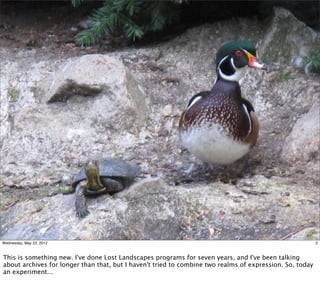
This is something new. I've done Lost Landscapes programs for seven years, and I've been talking
about archives for longer than that, but I haven't tried to combine two realms of expression. So, today
an experiment...
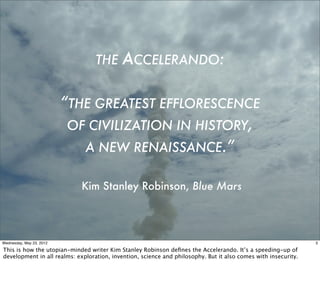
THE      ACCELERANDO:

                          “THE GREATEST EFFLORESCENCE
                           OF CIVILIZATION IN HISTORY,
                             A NEW RENAISSANCE.”

                             Kim Stanley Robinson, Blue Mars


Wednesday, May 23, 2012                                                                                         3

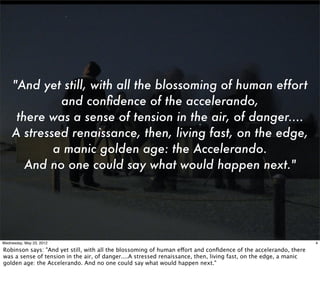
This is how the utopian-minded writer Kim Stanley Robinson defines the Accelerando. It’s a speeding-up of
development in all realms: exploration, invention, science and philosophy. But it also comes with insecurity.
"And yet still, with all the blossoming of human effort
             and confidence of the accelerando,
     there was a sense of tension in the air, of danger....
    A stressed renaissance, then, living fast, on the edge,
            a manic golden age: the Accelerando.
       And no one could say what would happen next."


Wednesday, May 23, 2012                                                                                           4

Robinson says: "And yet still, with all the blossoming of human effort and confidence of the accelerando, there
was a sense of tension in the air, of danger....A stressed renaissance, then, living fast, on the edge, a manic
golden age: the Accelerando. And no one could say what would happen next."
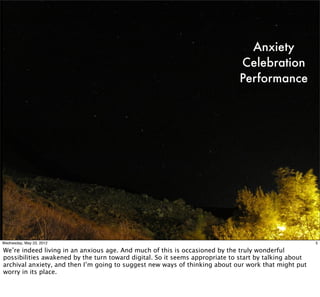
Anxiety
                                                                             Celebration
                                                                             Performance


Wednesday, May 23, 2012                                                                                5

We’re indeed living in an anxious age. And much of this is occasioned by the truly wonderful
possibilities awakened by the turn toward digital. So it seems appropriate to start by talking about
archival anxiety, and then I’m going to suggest new ways of thinking about our work that might put
worry in its place.
Wednesday, May 23, 2012                                                                    6

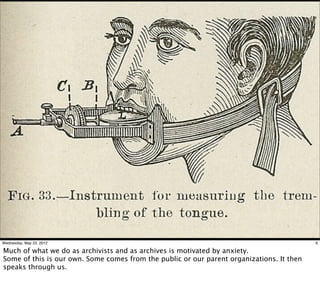
Much of what we do as archivists and as archives is motivated by anxiety.
Some of this is our own. Some comes from the public or our parent organizations. It then
speaks through us.
Wednesday, May 23, 2012                                                                            7

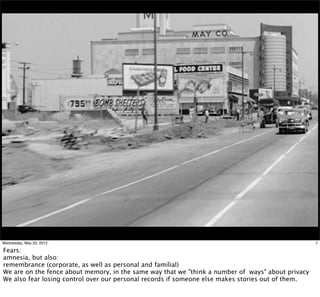
Fears:
amnesia, but also:
remembrance (corporate, as well as personal and familial)
We are on the fence about memory, in the same way that we "think a number of ways" about privacy
We also fear losing control over our personal records if someone else makes stories out of them.
Wednesday, May 23, 2012                                                                          8

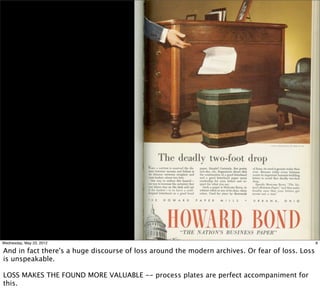
And in fact there's a huge discourse of loss around the modern archives. Or fear of loss. Loss
is unspeakable.

LOSS MAKES THE FOUND MORE VALUABLE -- process plates are perfect accompaniment for
this.
Wednesday, May 23, 2012                                                                                    9

[We should not cause media to be lost. But we should also recognize that loss is formative. Loss of
records increases the value of records that still exist. And found records gain value because of those
that are lost. If you watch news stories about archives, you'll see very few that promote the daily work
of archivists doing the routine work they're supposed to be doing. Most of them are about new
"discoveries," however authentic these discoveries may be. The common denominator of these stories
is that they're about materials saved by accident.]
MORAL PANIC

Wednesday, May 23, 2012                                   10

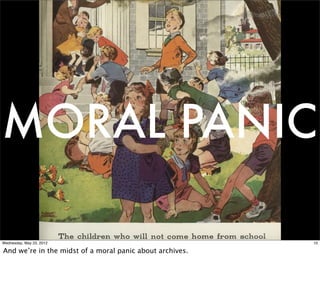
And we’re in the midst of a moral panic about archives.
from yesterday’s Wikipedia
Wednesday, May 23, 2012                                                                   11

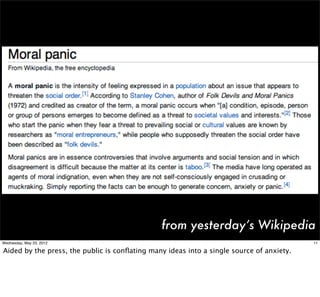
Aided by the press, the public is conflating many ideas into a single source of anxiety.
Bit rot
    Format obsolescence
    Loss of machines
    "I can't play my VCR tapes."
    "Don't films explode if you don't copy them to DVD?"
    Distrust of the cloud
    Dot-com phobia
    My personal information!
    TMI (we heard a lot of this yesterday)
Wednesday, May 23, 2012                                                                      12

This confuses the public. They’re waiting for us to give them clarity and reassurance.

Right now some archivists (and a lot more journalists) are promoting a kind of moral panic to
focus attention and funds on digital longevity. Film archivists did this in the 1970s with the
"Nitrate won't wait!" campaign.
Wednesday, May 23, 2012                                                                  13

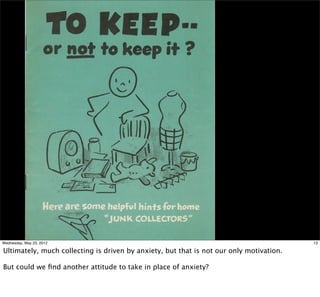
Ultimately, much collecting is driven by anxiety, but that is not our only motivation.

But could we find another attitude to take in place of anxiety?
ANXIETY


Wednesday, May 23, 2012             14
Wednesday, May 23, 2012   15

[film]
Wednesday, May 23, 2012                                                                                 16

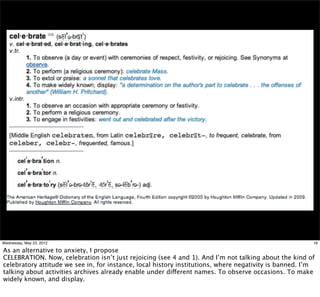
As an alternative to anxiety, I propose
CELEBRATION. Now, celebration isn’t just rejoicing (see 4 and 1). And I’m not talking about the kind of
celebratory attitude we see in, for instance, local history institutions, where negativity is banned. I’m
talking about activities archives already enable under different names. To observe occasions. To make
widely known, and display.
Wednesday, May 23, 2012                                                                                          17

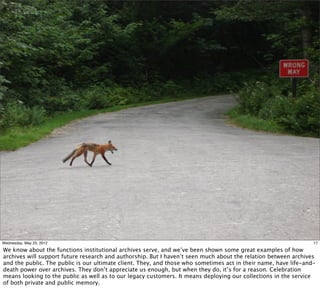
We know about the functions institutional archives serve, and we’ve been shown some great examples of how
archives will support future research and authorship. But I haven’t seen much about the relation between archives
and the public. The public is our ultimate client. They, and those who sometimes act in their name, have life-and-
death power over archives. They don’t appreciate us enough, but when they do, it’s for a reason. Celebration
means looking to the public as well as to our legacy customers. It means deploying our collections in the service
of both private and public memory.
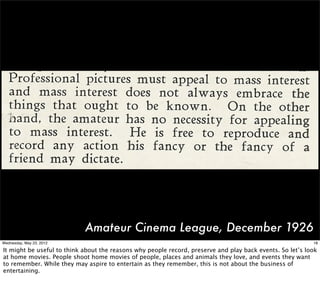
Amateur Cinema League, December 1926
Wednesday, May 23, 2012                                                                                    18

It might be useful to think about the reasons why people record, preserve and play back events. So let’s look
at home movies. People shoot home movies of people, places and animals they love, and events they want
to remember. While they may aspire to entertain as they remember, this is not about the business of
entertaining.
Wednesday, May 23, 2012                                                                                         19

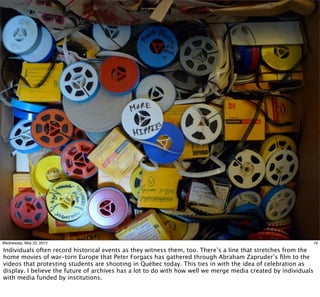
Individuals often record historical events as they witness them, too. There’s a line that stretches from the
home movies of war-torn Europe that Peter Forgacs has gathered through Abraham Zapruder’s film to the
videos that protesting students are shooting in Québec today. This ties in with the idea of celebration as
display. I believe the future of archives has a lot to do with how well we merge media created by individuals
with media funded by institutions.
Wednesday, May 23, 2012                                                                            20

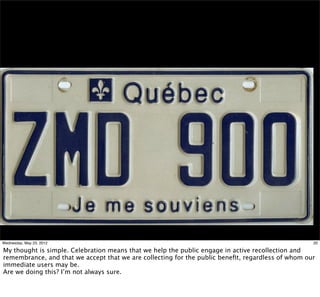
My thought is simple. Celebration means that we help the public engage in active recollection and
remembrance, and that we accept that we are collecting for the public benefit, regardless of whom our
immediate users may be.
Are we doing this? I’m not always sure.
Wednesday, May 23, 2012                                                                                   21

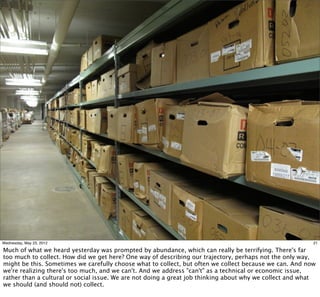
Much of what we heard yesterday was prompted by abundance, which can really be terrifying. There's far
too much to collect. How did we get here? One way of describing our trajectory, perhaps not the only way,
might be this. Sometimes we carefully choose what to collect, but often we collect because we can. And now
we're realizing there's too much, and we can't. And we address "can't" as a technical or economic issue,
rather than a cultural or social issue. We are not doing a great job thinking about why we collect and what
we should (and should not) collect.
Wednesday, May 23, 2012                                                                                 22

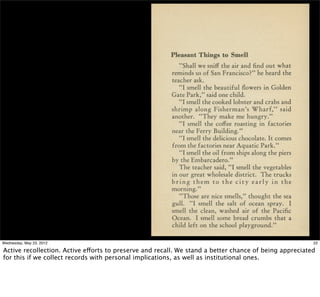
Active recollection. Active efforts to preserve and recall. We stand a better chance of being appreciated
for this if we collect records with personal implications, as well as institutional ones.
Wednesday, May 23, 2012                                                                                          23

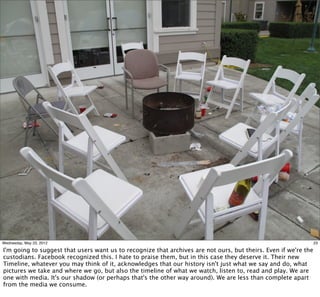
I'm going to suggest that users want us to recognize that archives are not ours, but theirs. Even if we're the
custodians. Facebook recognized this. I hate to praise them, but in this case they deserve it. Their new
Timeline, whatever you may think of it, acknowledges that our history isn't just what we say and do, what
pictures we take and where we go, but also the timeline of what we watch, listen to, read and play. We are
one with media. It's our shadow (or perhaps that's the other way around). We are less than complete apart
from the media we consume.
CELEBRATION


Wednesday, May 23, 2012                 24
Wednesday, May 23, 2012   25

[film]
photo: Bryan Boyce
Wednesday, May 23, 2012                                                                                      26

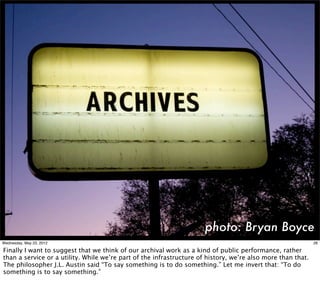
Finally I want to suggest that we think of our archival work as a kind of public performance, rather
than a service or a utility. While we’re part of the infrastructure of history, we’re also more than that.
The philosopher J.L. Austin said “To say something is to do something.” Let me invert that: “To do
something is to say something.”
Wednesday, May 23, 2012                                                                                      27

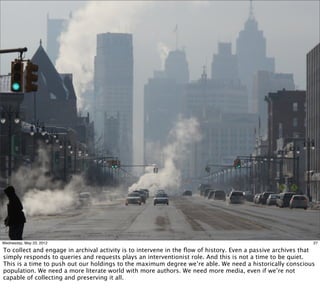
To collect and engage in archival activity is to intervene in the flow of history. Even a passive archives that
simply responds to queries and requests plays an interventionist role. And this is not a time to be quiet.
This is a time to push out our holdings to the maximum degree we’re able. We need a historically conscious
population. We need a more literate world with more authors. We need more media, even if we’re not
capable of collecting and preserving it all.
Wednesday, May 23, 2012                                                                                         28

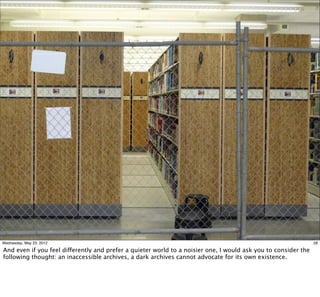
And even if you feel differently and prefer a quieter world to a noisier one, I would ask you to consider the
following thought: an inaccessible archives, a dark archives cannot advocate for its own existence.
Wednesday, May 23, 2012                                                                                     29

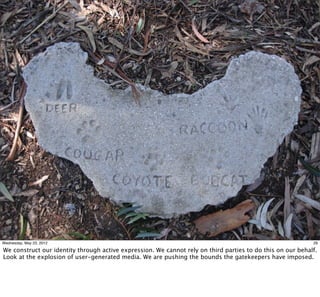
We construct our identity through active expression. We cannot rely on third parties to do this on our behalf.
Look at the explosion of user-generated media. We are pushing the bounds the gatekeepers have imposed.
Wednesday, May 23, 2012                             30

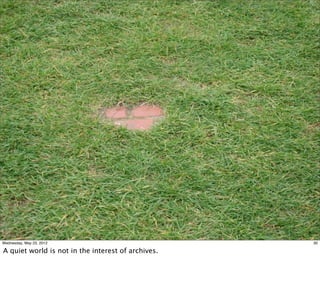
A quiet world is not in the interest of archives.
PERFORMANCE


Wednesday, May 23, 2012            31
Wednesday, May 23, 2012   32

[film]
rick@archive.org
                              @footage


Wednesday, May 23, 2012                                              33

Let’s put celebration and performance ahead of anxiety. Thank you.

Prelinger_LostLandscapes_20120522

  • 1.
    Lost Landscapes Screening the Future Los Angeles, May 2012 Wednesday, May 23, 2012 1
  • 2.
    Wednesday, May 23,2012 2 This is something new. I've done Lost Landscapes programs for seven years, and I've been talking about archives for longer than that, but I haven't tried to combine two realms of expression. So, today an experiment...
  • 3.
    THE ACCELERANDO: “THE GREATEST EFFLORESCENCE OF CIVILIZATION IN HISTORY, A NEW RENAISSANCE.” Kim Stanley Robinson, Blue Mars Wednesday, May 23, 2012 3 This is how the utopian-minded writer Kim Stanley Robinson defines the Accelerando. It’s a speeding-up of development in all realms: exploration, invention, science and philosophy. But it also comes with insecurity.
  • 4.
    "And yet still,with all the blossoming of human effort and confidence of the accelerando, there was a sense of tension in the air, of danger.... A stressed renaissance, then, living fast, on the edge, a manic golden age: the Accelerando. And no one could say what would happen next." Wednesday, May 23, 2012 4 Robinson says: "And yet still, with all the blossoming of human effort and confidence of the accelerando, there was a sense of tension in the air, of danger....A stressed renaissance, then, living fast, on the edge, a manic golden age: the Accelerando. And no one could say what would happen next."
  • 5.
    Anxiety Celebration Performance Wednesday, May 23, 2012 5 We’re indeed living in an anxious age. And much of this is occasioned by the truly wonderful possibilities awakened by the turn toward digital. So it seems appropriate to start by talking about archival anxiety, and then I’m going to suggest new ways of thinking about our work that might put worry in its place.
  • 6.
    Wednesday, May 23,2012 6 Much of what we do as archivists and as archives is motivated by anxiety. Some of this is our own. Some comes from the public or our parent organizations. It then speaks through us.
  • 7.
    Wednesday, May 23,2012 7 Fears: amnesia, but also: remembrance (corporate, as well as personal and familial) We are on the fence about memory, in the same way that we "think a number of ways" about privacy We also fear losing control over our personal records if someone else makes stories out of them.
  • 8.
    Wednesday, May 23,2012 8 And in fact there's a huge discourse of loss around the modern archives. Or fear of loss. Loss is unspeakable. LOSS MAKES THE FOUND MORE VALUABLE -- process plates are perfect accompaniment for this.
  • 9.
    Wednesday, May 23,2012 9 [We should not cause media to be lost. But we should also recognize that loss is formative. Loss of records increases the value of records that still exist. And found records gain value because of those that are lost. If you watch news stories about archives, you'll see very few that promote the daily work of archivists doing the routine work they're supposed to be doing. Most of them are about new "discoveries," however authentic these discoveries may be. The common denominator of these stories is that they're about materials saved by accident.]
  • 10.
    MORAL PANIC Wednesday, May23, 2012 10 And we’re in the midst of a moral panic about archives.
  • 11.
    from yesterday’s Wikipedia Wednesday,May 23, 2012 11 Aided by the press, the public is conflating many ideas into a single source of anxiety.
  • 12.
    Bit rot Format obsolescence Loss of machines "I can't play my VCR tapes." "Don't films explode if you don't copy them to DVD?" Distrust of the cloud Dot-com phobia My personal information! TMI (we heard a lot of this yesterday) Wednesday, May 23, 2012 12 This confuses the public. They’re waiting for us to give them clarity and reassurance. Right now some archivists (and a lot more journalists) are promoting a kind of moral panic to focus attention and funds on digital longevity. Film archivists did this in the 1970s with the "Nitrate won't wait!" campaign.
  • 13.
    Wednesday, May 23,2012 13 Ultimately, much collecting is driven by anxiety, but that is not our only motivation. But could we find another attitude to take in place of anxiety?
  • 14.
  • 15.
    Wednesday, May 23,2012 15 [film]
  • 16.
    Wednesday, May 23,2012 16 As an alternative to anxiety, I propose CELEBRATION. Now, celebration isn’t just rejoicing (see 4 and 1). And I’m not talking about the kind of celebratory attitude we see in, for instance, local history institutions, where negativity is banned. I’m talking about activities archives already enable under different names. To observe occasions. To make widely known, and display.
  • 17.
    Wednesday, May 23,2012 17 We know about the functions institutional archives serve, and we’ve been shown some great examples of how archives will support future research and authorship. But I haven’t seen much about the relation between archives and the public. The public is our ultimate client. They, and those who sometimes act in their name, have life-and- death power over archives. They don’t appreciate us enough, but when they do, it’s for a reason. Celebration means looking to the public as well as to our legacy customers. It means deploying our collections in the service of both private and public memory.
  • 18.
    Amateur Cinema League,December 1926 Wednesday, May 23, 2012 18 It might be useful to think about the reasons why people record, preserve and play back events. So let’s look at home movies. People shoot home movies of people, places and animals they love, and events they want to remember. While they may aspire to entertain as they remember, this is not about the business of entertaining.
  • 19.
    Wednesday, May 23,2012 19 Individuals often record historical events as they witness them, too. There’s a line that stretches from the home movies of war-torn Europe that Peter Forgacs has gathered through Abraham Zapruder’s film to the videos that protesting students are shooting in Québec today. This ties in with the idea of celebration as display. I believe the future of archives has a lot to do with how well we merge media created by individuals with media funded by institutions.
  • 20.
    Wednesday, May 23,2012 20 My thought is simple. Celebration means that we help the public engage in active recollection and remembrance, and that we accept that we are collecting for the public benefit, regardless of whom our immediate users may be. Are we doing this? I’m not always sure.
  • 21.
    Wednesday, May 23,2012 21 Much of what we heard yesterday was prompted by abundance, which can really be terrifying. There's far too much to collect. How did we get here? One way of describing our trajectory, perhaps not the only way, might be this. Sometimes we carefully choose what to collect, but often we collect because we can. And now we're realizing there's too much, and we can't. And we address "can't" as a technical or economic issue, rather than a cultural or social issue. We are not doing a great job thinking about why we collect and what we should (and should not) collect.
  • 22.
    Wednesday, May 23,2012 22 Active recollection. Active efforts to preserve and recall. We stand a better chance of being appreciated for this if we collect records with personal implications, as well as institutional ones.
  • 23.
    Wednesday, May 23,2012 23 I'm going to suggest that users want us to recognize that archives are not ours, but theirs. Even if we're the custodians. Facebook recognized this. I hate to praise them, but in this case they deserve it. Their new Timeline, whatever you may think of it, acknowledges that our history isn't just what we say and do, what pictures we take and where we go, but also the timeline of what we watch, listen to, read and play. We are one with media. It's our shadow (or perhaps that's the other way around). We are less than complete apart from the media we consume.
  • 24.
  • 25.
    Wednesday, May 23,2012 25 [film]
  • 26.
    photo: Bryan Boyce Wednesday,May 23, 2012 26 Finally I want to suggest that we think of our archival work as a kind of public performance, rather than a service or a utility. While we’re part of the infrastructure of history, we’re also more than that. The philosopher J.L. Austin said “To say something is to do something.” Let me invert that: “To do something is to say something.”
  • 27.
    Wednesday, May 23,2012 27 To collect and engage in archival activity is to intervene in the flow of history. Even a passive archives that simply responds to queries and requests plays an interventionist role. And this is not a time to be quiet. This is a time to push out our holdings to the maximum degree we’re able. We need a historically conscious population. We need a more literate world with more authors. We need more media, even if we’re not capable of collecting and preserving it all.
  • 28.
    Wednesday, May 23,2012 28 And even if you feel differently and prefer a quieter world to a noisier one, I would ask you to consider the following thought: an inaccessible archives, a dark archives cannot advocate for its own existence.
  • 29.
    Wednesday, May 23,2012 29 We construct our identity through active expression. We cannot rely on third parties to do this on our behalf. Look at the explosion of user-generated media. We are pushing the bounds the gatekeepers have imposed.
  • 30.
    Wednesday, May 23,2012 30 A quiet world is not in the interest of archives.
  • 31.
  • 32.
    Wednesday, May 23,2012 32 [film]
  • 33.
    rick@archive.org @footage Wednesday, May 23, 2012 33 Let’s put celebration and performance ahead of anxiety. Thank you.