Pre-Stressed & Pre-Cast Concrete Technology - CE462
Written & Composed BY ENGINEER SAQIB IMRAN
WhatsApp & Contact No: 0341-7549889
Email: Saqibimran43@gmail.com
Student of B.TECH(Civil) at Sarhad University of Science &
Information Technology Peshawer.
INTRODUCTION TO PRECAST AND PRE-STRESSED CONCRETE CONSTRUCTION:
PRECAST CONCRETE: Precast concrete consists of concrete that is cast into a specific shape at a
location other than its in service position. The concrete is placed into a form, typically wood or
steel, and cured before being stripped from the form. These components are then transported
to the construction site for erection into place. Precast concrete can be plant-cast or site-cast.
PRESTRESSED CONCRETE: Precast concrete components are reinforced with either
conventional reinforcing bars, strands with high tensile strength, or a combination of both.
Actually, pre-stressing is quite simple. High tensile strands are stretched between ends.
Concrete is then poured into the forms encasing the strands. As the concrete sets, it bonds to
the tensioned steel. When the concrete reaches a specific strength, the strands are released.
This compresses the concrete and creates a built in resistance to service loads.
MERITS OF PRESTRESS CONCRETE
 Section remains un-cracked under service loads,  Reduction of steel corrosion,
 Full section is utilized,  Less deformations (improved serviceability),
 Reduction in self-weight,  Suitable for precast construction,
 Availability of standard shapes,  Better quality control.
DEMERITS OF PRESTRESS CONCRETE
 It requires high quality dense concrete of high strength.
 It requires high tensile steel, which is 2.5 to 3.5 times costlier than mild steel.
 It requires complicated tensioning equipment and anchoring devices
 Construction requires perfect supervision at all stages of construction.
TERMINOLOGY
Tendon: A stretched element used in a concrete member of structure to impart pre-stress to
the concrete. Generally, high-tensile steel wires, bars cables or stands are used as tendons.
Anchorage: A device generally used to enable the tendon to import and maintain pre-stress in
the concrete. The commonly used anchorages are the Freyssinet, Magnel Blaton, Gifford-Udall,
Leonhardt-Baur, LeeMcCall, Dywidag, Roebling and B.B.R.V. systems.
Pre-Tensioning: A method of pre-stressing concrete in which the tendons are tensioned before
the concrete is placed. In this method, the pre-stress is imparted to concrete by bond between
steel and concrete.
Post-Tensioning: A method of pre-stressing concrete by tensioning the tendons against
hardened concrete. In this method, the pre-stress is imparted to concrete by bearing.
Bonded Pre-Stressed Concrete: Concrete in which pre-stress is imparted to concrete through
bond between the tendons and surrounding concrete. Pre-tensioned members belong to this
group.
Non-Bounded Pre-Stressed Concrete: A method of construction in which the tendons are not
bonded to the surrounding concrete. The tendons may be placed in ducts formed in the
concrete members or they may be placed outside the concrete section.
Full Pre-Stressing: Pre-stressed concrete in which tensile stresses in the concrete are entirely
obviated at working loads by having sufficiently high pre-stress in the members.
Limited or Partial Pre-Stressing: The degree of pre-stress applied to concrete in which tensile
stresses to a limited degree are permitted in concrete under working loads. In this case, in
addition to tensioned steel, a considerable proportion of un-tensioned reinforcement is
generally used to limit the width of cracks developed under service loads.
Moderate Pre-stressing: In this type, no limit is imposed upon the magnitude of the tensile
stresses at working loads. According to Leonhardt, this form of construction is not really pre-
stressed concrete but is to be regarded as reinforced concrete with reduced cracking and the
sections should be analyzed according to the rules of reinforced concrete, as a case of bending
combined with axial force.
Axial Pre-stressing: Members in which the entire cross-section of concrete has a uniform
compressive pre-stress. In this type of pre-stressing, the centroid, of the tendons coincides with
that of the concrete section.
Eccentric Pre-stressing: A section at which the tendons are eccentric to the centriod, resulting
in a triangular or trapeziodal compressive stress distribution.
Concordant Pre-stressing: Pre-stressing of members in which the cables of follow a concordant
profile. In the case of statically indeterminate structures, concordant pre-stressing does not
cause any change in the support reactions.
Non-distortional Pre-stressing: In this type, the combined effect of the degree of pre-stress and
the dead-weight stresses in such that the deflection of the axis of the member is prevented. In
such cases, the moments due to pre-stress and dead-weight exactly balance resulting only in an
axial force in the member.
Uniaxial, biaxial and triaxial Pre-stressing: The terms refer to the cases where concrete is pre-
stressed (i) in only one direction, (ii) in two mutually perpendicular directions and (iii) in three
mutually perpendicular directions.
Circular Pre-stressing: The term refers to pre-stressing in round members, such as tanks and
pipes.
Transfer: The stage corresponding to the transfer of pre-stress to concrete. For pre-tensioned
members, transfer takes place at the release of pre-stress from the bulk-heads; for post-
tensioned members, it takes place after the completion of the tensioning processes.
Supplementary or Un-tensioned reinforcement: Reinforcement in pre-stressed members not
tensioned with respect to the surrounding concrete before the application of loads. These are
generally used in partially pre-stressed members.
Transmission Length: The length of the bond anchorage of the Pre-stressing wire from the end
of a pre-tensioned member to the point of full steel stress.
Cracking Load: The load on the structural element corresponding to the first visible crack.
Creep in Concrete: Progressive increase in the inelastic deformation of concrete under
sustained stress component.
Shrinkage of concrete: Contraction of concrete on drying.
Relaxation in steel: Decrease of stress in steel at constant strain.
Proof stress: The tensile stress in steel which produces a residual strain of 0.2 percent of the
original gauge length on unloading.
Creep-coefficient: The ratio of the total creep strain to elastic strain in concrete.
Cap cable: A short curved tendon arranged at the interior supports of a continuous beam. The
anchors are in the compression zone, while the curved portion is in the tensile zone.
Degree of pre-stressing: A measure of the magnitude of the pre-stressing force related to the
resultant stress occurring in the structural member at working load.
Debonding: Prevention of bond between the steel wire and the surrounding concrete.
MATERIALS USED IN PRE-STRESSING:
Concrete: The main factors for concrete used in PSC are:
• Ordinary Portland cement-based concrete is used but strength usually greater
than 50 N/mm2;
• A high early strength is required to enable quicker application of pre-stress;
• A larger elastic modulus is needed to reduce the shortening of the member;
• A mix that reduces creep of the concrete to minimize losses of pre-stress;
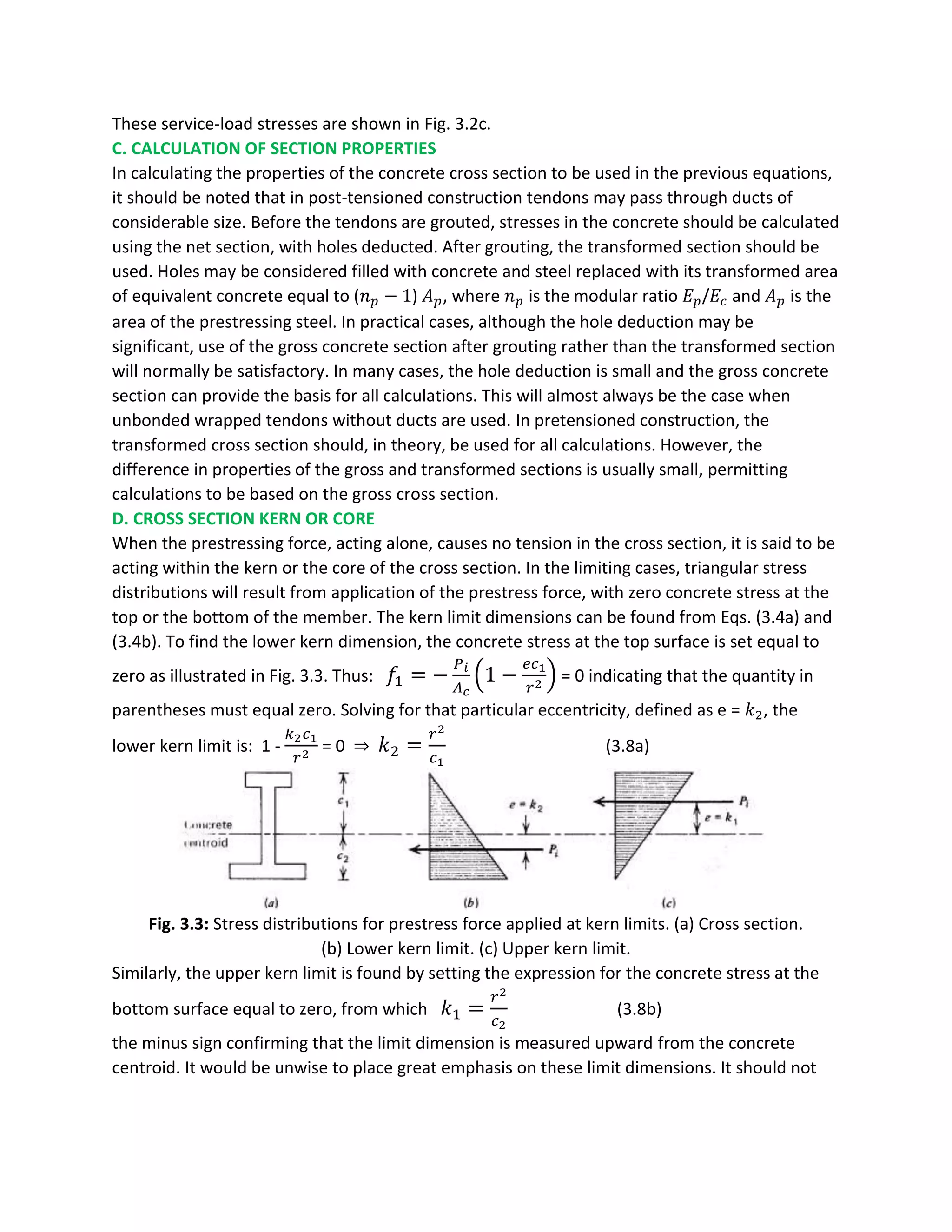
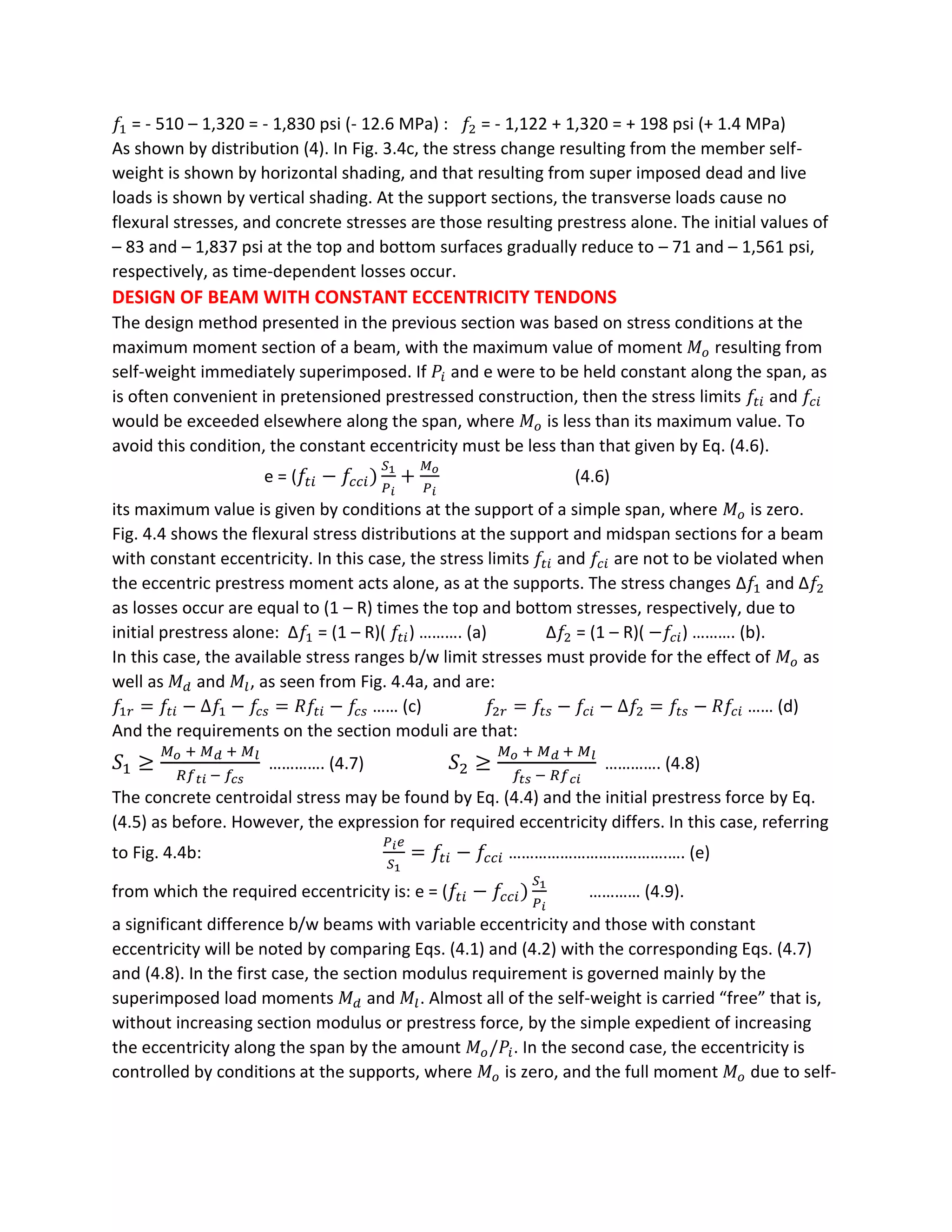
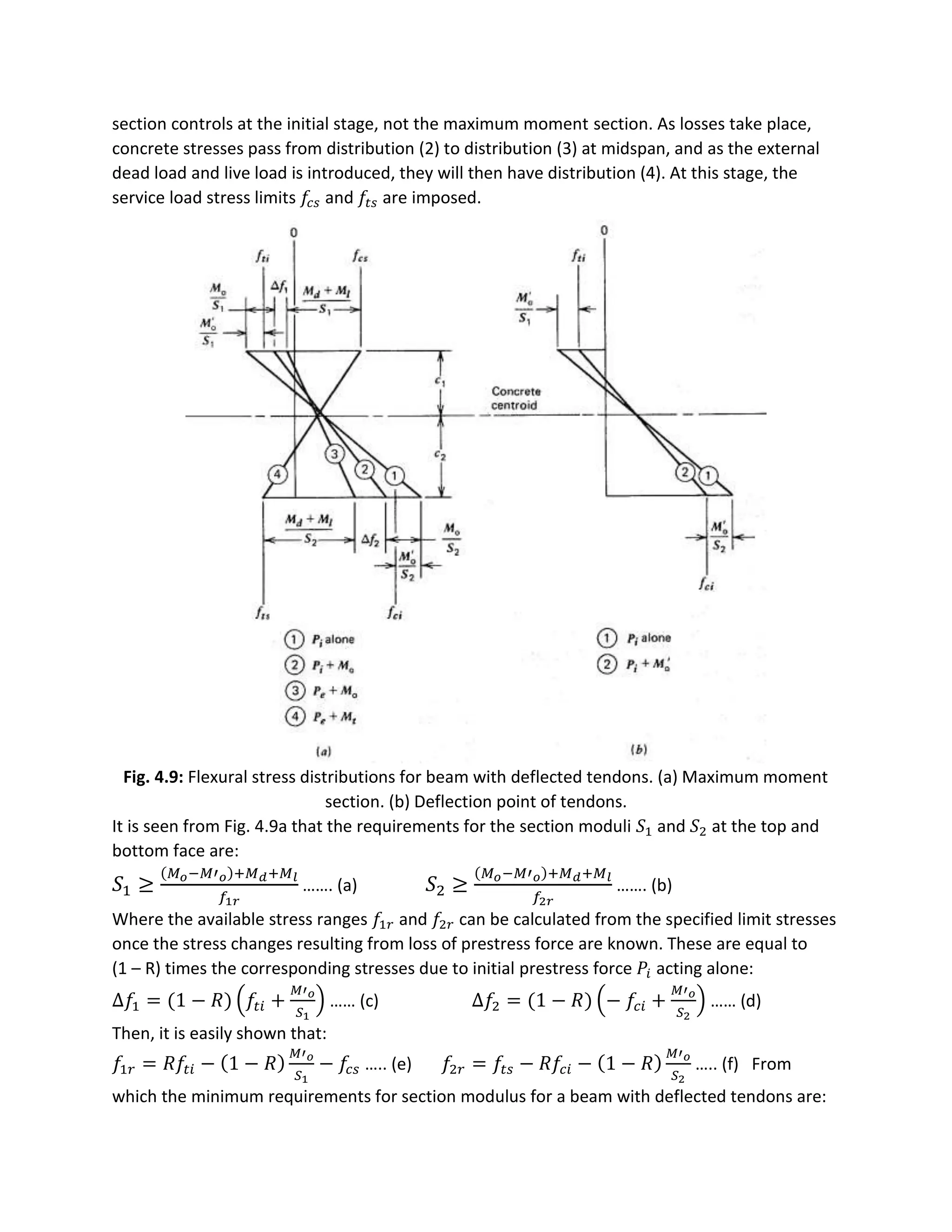
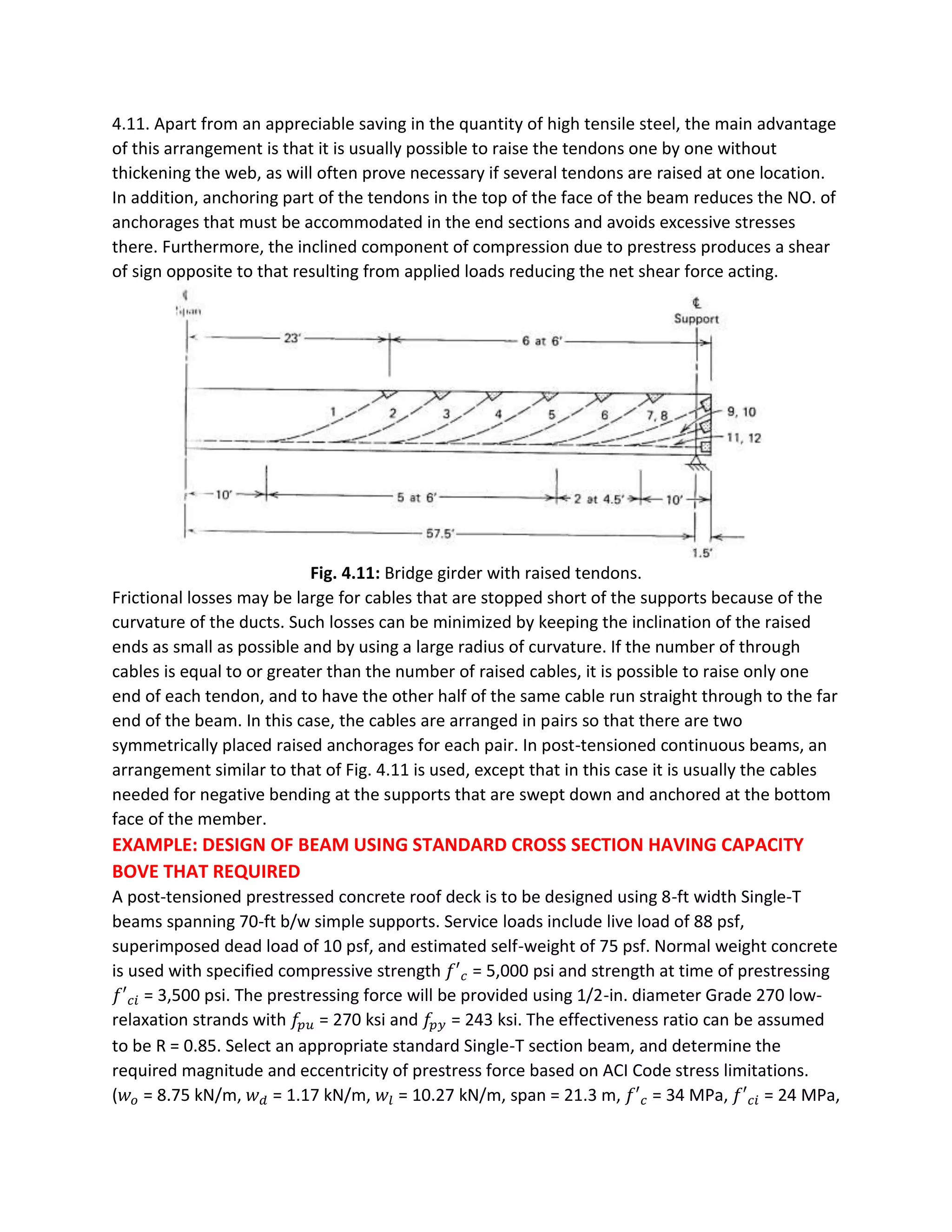
You can see the importance creep has in PSC from this graph:
Steel: The steel used for pre-stressing has a nominal yield strength of between 1550 to 1800
N/mm2. The different forms the steel may take are:
• Wires: individually drawn wires of 7 mm diameter;
• Strands: a collection of wires (usually 7) wound together and thus having a diameter that is
different to its area;
• Tendon: A collection of strands encased in a duct – only used in posttensioning;
• Bar: a specially formed bar of high strength steel of greater than 20 mm diameter.
Pre-stressed concrete bridge beams typically use 15.7 mm diameter (but with an area
of 150 mm2)7-wire super strand which has a breaking load of 265 kN.
PRE-STRESSING SYSTEM:
PRE- TENSIONING SYSTEM:
 Pre-stressed before concrete is poured into the mould.
 High early strength concrete is often used for moulding.
 Pre-stressed are transferred to the concrete by bond, mostly near the ends of the beams.
 No special anchorage is required.
 Large hydraulic jacks are used.
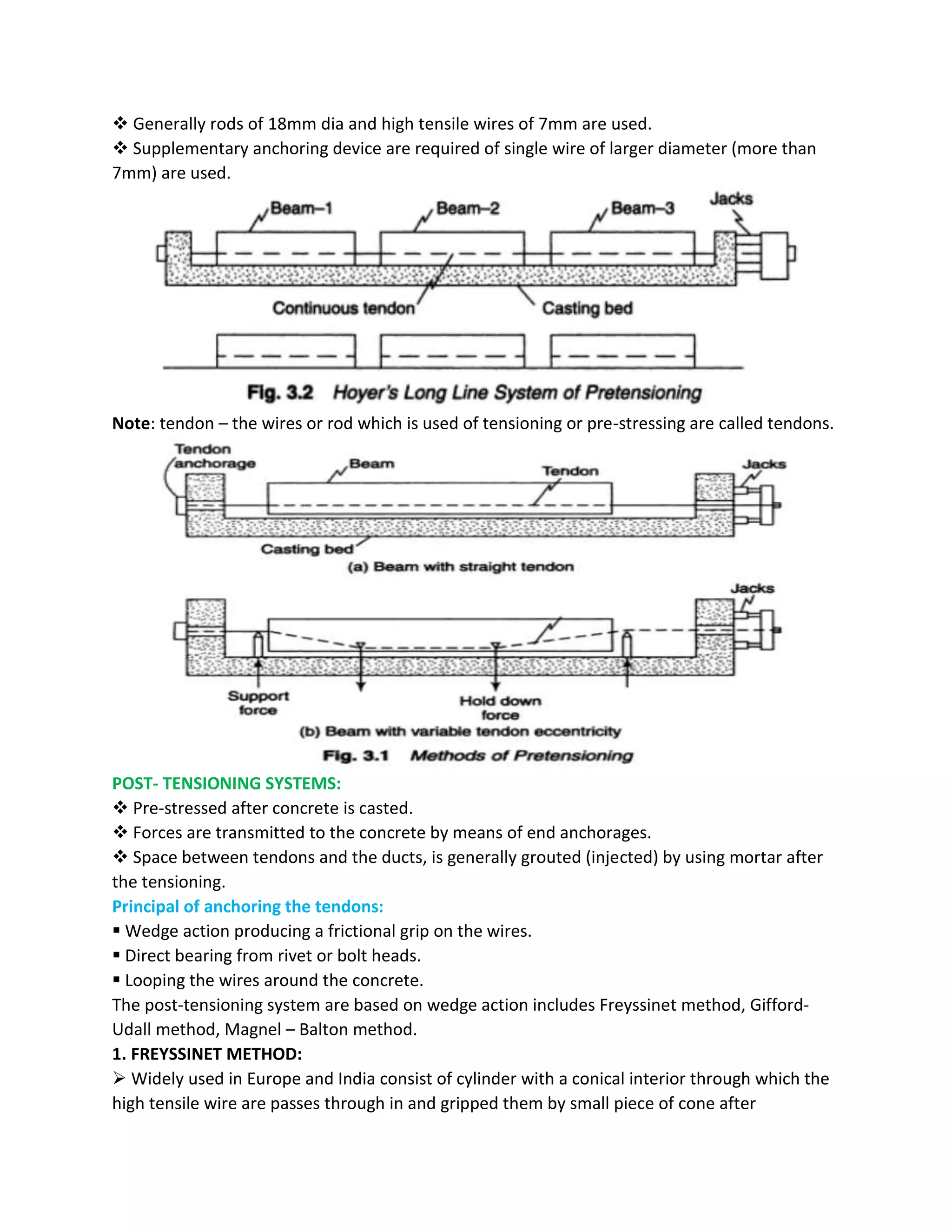
 Generally rods of 18mm dia and high tensile wires of 7mm are used.
 Supplementary anchoring device are required of single wire of larger diameter (more than
7mm) are used.
Note: tendon – the wires or rod which is used of tensioning or pre-stressing are called tendons.
POST- TENSIONING SYSTEMS:
 Pre-stressed after concrete is casted.
 Forces are transmitted to the concrete by means of end anchorages.
 Space between tendons and the ducts, is generally grouted (injected) by using mortar after
the tensioning.
Principal of anchoring the tendons:
 Wedge action producing a frictional grip on the wires.
 Direct bearing from rivet or bolt heads.
 Looping the wires around the concrete.
The post-tensioning system are based on wedge action includes Freyssinet method, Gifford-
Udall method, Magnel – Balton method.
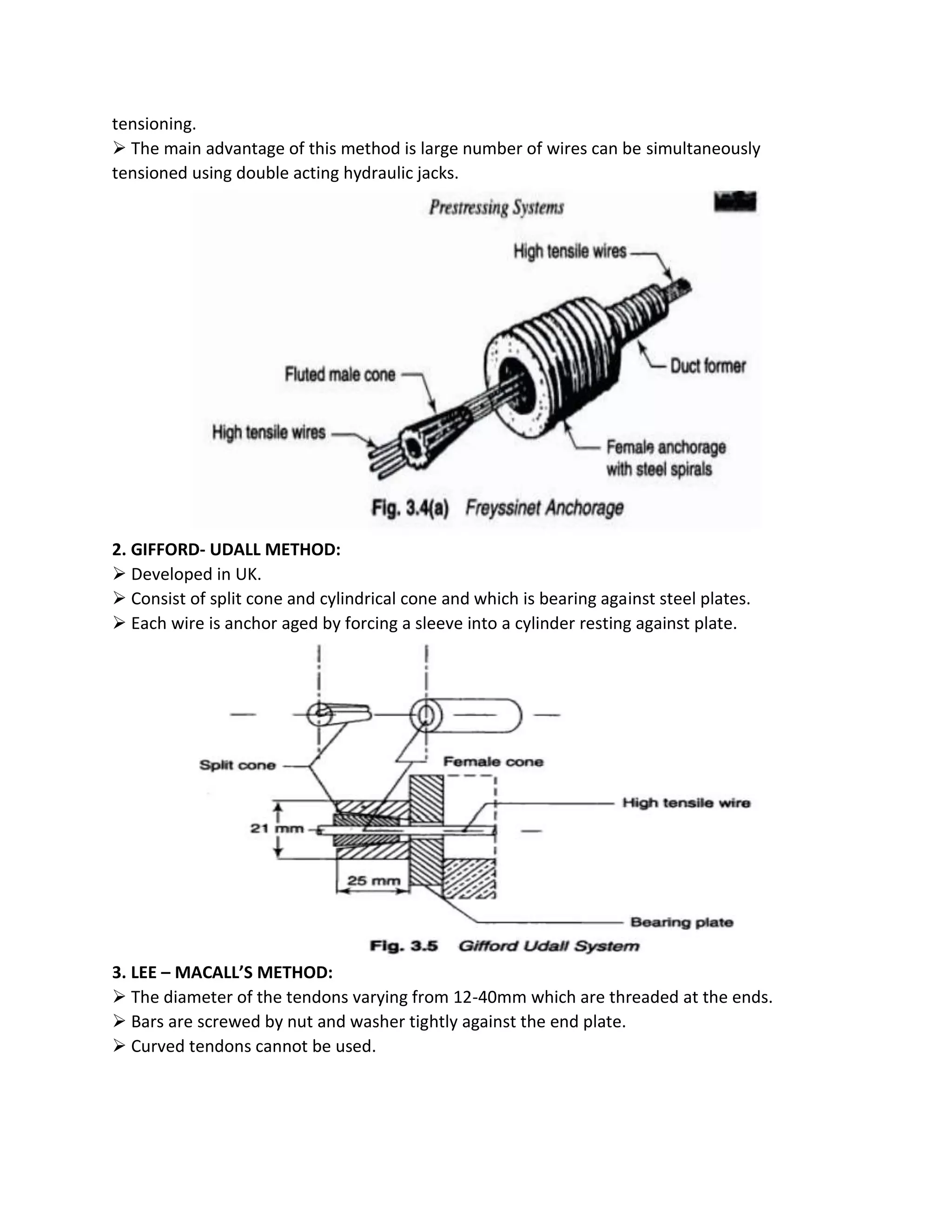
1. FREYSSINET METHOD:
 Widely used in Europe and India consist of cylinder with a conical interior through which the
high tensile wire are passes through in and gripped them by small piece of cone after
tensioning.
 The main advantage of this method is large number of wires can be simultaneously
tensioned using double acting hydraulic jacks.
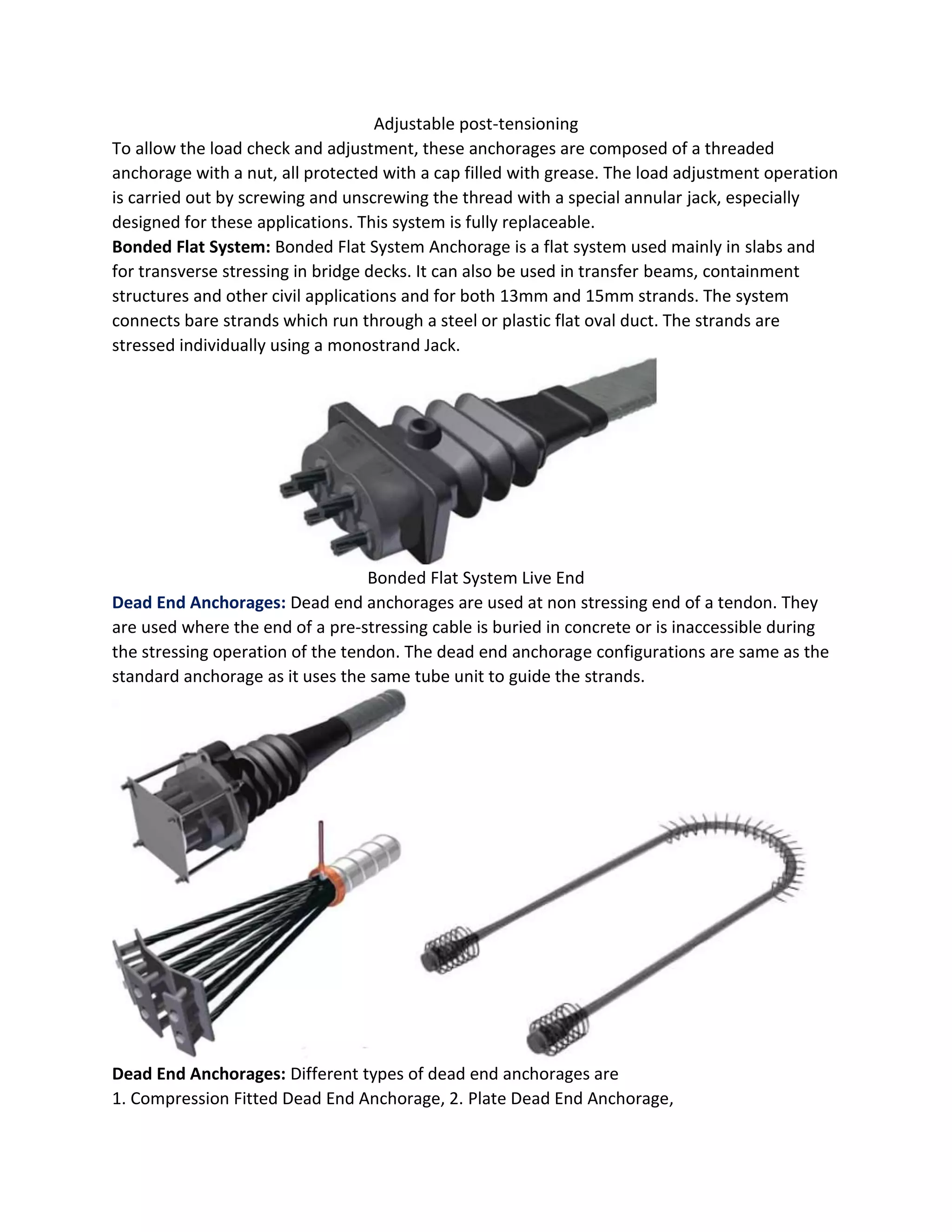
2. GIFFORD- UDALL METHOD:
 Developed in UK.
 Consist of split cone and cylindrical cone and which is bearing against steel plates.
 Each wire is anchor aged by forcing a sleeve into a cylinder resting against plate.
3. LEE – MACALL’S METHOD:
 The diameter of the tendons varying from 12-40mm which are threaded at the ends.
 Bars are screwed by nut and washer tightly against the end plate.
 Curved tendons cannot be used.
4. MAGNEL – BALTON METHOD:
 Metallic sandwich plates, flat wedges and a distribution plates are used for anchoring each
plate as whole to anchor four pair of wires.
 2 to 64 numbers of wires can be anchored.
ANALYSIS OF PRESTRESSS:
a) For concentric tendons:
b) Eccentric tendons:
𝑓𝑖𝑛𝑓 = (
𝑃
𝐴
+
𝑃𝑒
𝑍 𝑏
=
𝑃
𝐴
(1 +
𝑒𝑦 𝑏
𝑖2
))
𝑓𝑠𝑢𝑝 = (
𝑃
𝐴
+
𝑃𝑒
𝑍𝑡
=
𝑃
𝐴
(1 +
𝑒𝑦𝑡
𝑖2
))
c) Resultant stresses: total stress in a pre-stressed concrete member after live load and dead
load act on the structure.
ANCHORAGES PRE-STRESSED CONCRETE:
Anchorage as the name signifies is a component of post tensioning system which is used to
anchor the tendons into the concrete while terminating or joining two tendons. Main function
of anchorage is to transfer the stressing force to the concrete once the stressing process is
completed.
It is one of the most important 5 components of post tensioning systems. Anchorage is an
inevitable part of pre-stressing system. Efficiency of anchorages affects the service life of a pre-
stressed structure.
Components of Anchorages: Important components of Anchorage Are Anchor plate or anchor
head, Removable grouting cap, Iron Block/force transfer unit, Bursting reinforcement, Deviation
cone and duct coupler. The pre-stressing force is applied to the strands and locked in place by
the wedges in the anchor head which is supported on the force transfer unit cast into the
concrete.
Components of Post Tensioning Anchorages
The force transfer unit ensures the transmission of the pre-stressing force into the concrete.
The force transfer unit and the deviation cone ensure the correct deviation of the strands from
the anchor head to the duct.
Types of Pre-Stressed Concrete Anchorages
Post-tensioning tendons anchorages are classified into following types
1. Live anchorages, 2. Dead anchorages, 3. Couplers, 4. Annulars, 5. External and electrically
insulated.
Live Anchorages: In pre-stressing, the side of tendon which is stressed is referred to live end. In
both side stressing systems, two ends of tendons are live ends. Live anchorages are those which
are used at the stressing/live end of the tendon.
Live End Post Tensioning Anchorage
Electrically insulated post-tensioning: Some other types of live anchorages include Electrically
insulated anchorages and external types. Electrically insulated anchorages are used were
protection of pre-stressing cables from corrosive agents is required. The cable is enveloped
completely in a protective sheathing from outside agents from the starting of anchoring blocks.
A dielectric material made of high-density polyethylene is used for covering the tendons.
Live End Post Tensioning Anchorage Insulated (top) and External Type (bottom)
External post-tensioning: External type is used with external cables where full replace ability as
well as protection of tendon is required. System can be demounted and substituted through
the presence of an inner steel
cone that separates strands and inner protective injection from the surrounding elements in
the anchorage zone.
External tendons can reduce congestion in concrete and better corrosion resistance since it
makes inspection and replacement possible. Friction losses are minimum compared to internal
tendons as friction occurs at the deviators & anchorage points.
Adjustable post-tensioning: Adjustable anchorages are used where force adjust and re-
stressing are required, depending on the structure behavior and construction needs. It also
gives the possibility to monitor loads, especially in the period following the installation of
cables, when either the strands relaxation or the viscous effects of concrete can affect the
evaluation of forces.
Adjustable post-tensioning
To allow the load check and adjustment, these anchorages are composed of a threaded
anchorage with a nut, all protected with a cap filled with grease. The load adjustment operation
is carried out by screwing and unscrewing the thread with a special annular jack, especially
designed for these applications. This system is fully replaceable.
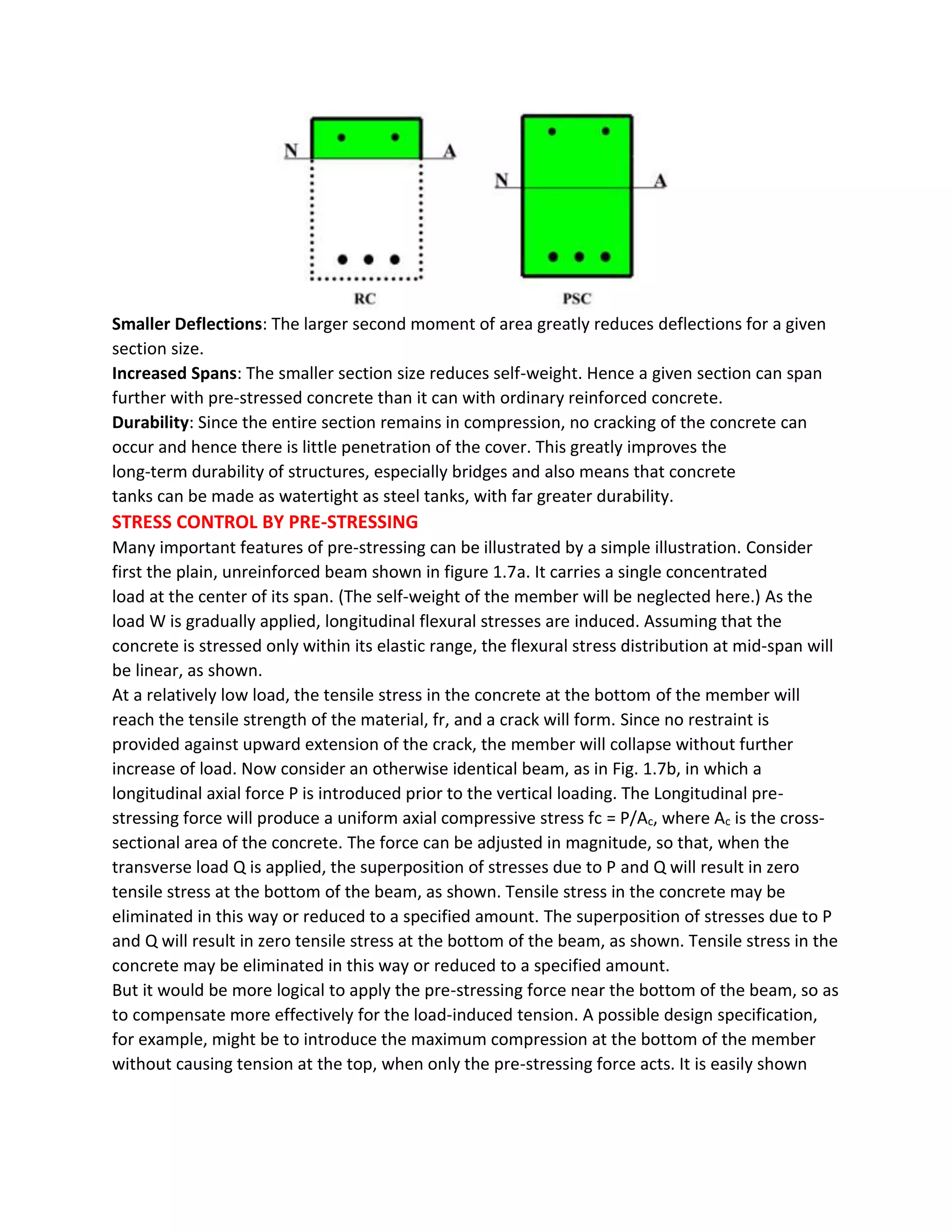
Bonded Flat System: Bonded Flat System Anchorage is a flat system used mainly in slabs and
for transverse stressing in bridge decks. It can also be used in transfer beams, containment
structures and other civil applications and for both 13mm and 15mm strands. The system
connects bare strands which run through a steel or plastic flat oval duct. The strands are
stressed individually using a monostrand Jack.
Bonded Flat System Live End
Dead End Anchorages: Dead end anchorages are used at non stressing end of a tendon. They
are used where the end of a pre-stressing cable is buried in concrete or is inaccessible during
the stressing operation of the tendon. The dead end anchorage configurations are same as the
standard anchorage as it uses the same tube unit to guide the strands.
Dead End Anchorages: Different types of dead end anchorages are
1. Compression Fitted Dead End Anchorage, 2. Plate Dead End Anchorage,
3. Loop Dead End Anchorage, 4. Basket dead end anchorages.
PRE-STRESS LOSSES:
During pre-stressing of the tendons and the transfer of pre-stress to the concrete member, there is a
drop of the pre-stressing force from the recorded value in the jack gauge. The various reductions of the
pre-stressing force are termed as the losses in pre-stress. These losses are broadly classified into two
groups:
1. Short term losses or immediate losses: The immediate losses occur during pre-stressing of the
tendons and the transfer of Pre-stress to the concrete member.
i. Elastic shortening
a. Pre-tensioned Members: When the tendons are cut and the pre-stressing force is transferred
to the member, the concrete undergoes immediate shortening due to the pre-stress. The
tendon also shortens by the same amount, which leads to the loss of pre-stress.
b. Post-tensioned Members: If there is only one tendon, there is no loss because the applied
pre-stress is recorded after the elastic shortening of the member. For more than one tendon, if
the tendons are stretched sequentially, there is loss in a tendon during subsequent stretching
of the other tendons.
ii. Friction: Frictional loss occurs only in post tensioned beams. When the cable is stressed,
friction between the sides of the duct and the cable does not permit full tension to be
transmitted. Therefore, at a point away from the jacking end pre-stress is less.
iii. Anchorage slip: In a post-tensioned member, when the pre-stress is transferred to the
concrete, the wedges slip through a little distance before they get properly seated in the conical
space. The anchorage block also moves before it settles on the concrete. There is loss of pre-
stress due to the consequent reduction in the length of the tendon. The total anchorage slip
depends on the type of anchorage system. Due to the setting of the anchorage block, as the
tendon shortens, there is a reverse friction.
Hence, the effect of anchorage slip is present up to a certain length.
2. Long term or Time dependent losses
The time-dependent losses occur during the service life of the pre-stressed member.
i. Creep of Concrete: Creep of concrete is defined as the increase in deformation with time
under constant load. Due to the creep of concrete, the pre-stress in the tendon is reduced with
time. The rate of strain increase is rapid at first, but decreases with time until, after many
months, a constant value is approached.
Creep strain for concrete has been found experimentally to depend not only on time, but on
the mix proportion, humidity, curing conditions and the age of concrete when it is first loaded.
The ratio of the ultimate creep strain to the elastic strain is defined as the ultimate creep
coefficient or simply creep coefficient.
𝐶 𝑢 =
𝜀 𝑐𝑢
𝜀 𝑐𝑖
The creep coefficient at any time Ct can be related to the ultimate creep coefficient Cu by
equation:
𝐶𝑡 =
𝑡0.60
10 + 𝑡0.60
𝐶 𝑢
This equation applies for standard conditions as concrete with 4in slump or less, 40% relative
humidity, minimum thickness of member of 6in or less and loading age of seven days for moist
cured concrete or loading age of one to three days for steamed-cured concrete
ii. Shrinkage of Concrete: The shrinkage represents a time dependent deformation which
reduces the volume of concrete, without the impact of external forces. The time flow and the
final values of shrinkage are influenced by numerous factors such as temperature, humidity,
method of curing, concrete age at the end of curing and many other factors. Standard
equations relating shrinkage to time as follows:
For moist-cured concrete at any time t after age seven days
𝜀 𝑠ℎ,𝑡 =
𝑡
35 + 𝑡
𝜀 𝑠ℎ,𝑢 − − − −→ 𝜀 𝑠ℎ,𝑢 = 800 × 10−6
For steam-cured concrete at any time t after age three days
𝜀 𝑠ℎ,𝑡 =
𝑡
55 + 𝑡
𝜀 𝑠ℎ,𝑢 − − − −→ 𝜀 𝑠ℎ,𝑢 = 730 × 10−6
iii. Steel Relaxation: When pre-stressing steel is stressed to the levels that are customary
during initial tensioning and at service loads, it exhibits a property known as relaxation.
Relaxation is defined as the loss of stress in a stressed material. The stress relaxation of pre-
stressing steel tendons is normally measured at constant strain and constant temperature. In
evaluating loss of steel stress as a result of relaxation, the length is considered as constant.
The amount of relaxation varies depending on the type and grade of steel, but the most
significant parameters are time and intensity of the initial stress. It must be accounted for in
design because it produces significant loss of pre-stress force.
METHODS OF PRE-STRESSING:
Pre-stressed Concrete Definition: A creation of internal stresses in a structure in order to
improve its performance. Such stresses are designed to counter-act stresses induced by
external loads. Concrete is strong and ductile in compression, it is weak and brittle in tension,
and hence its response to external loads is improved by pre-compression. Pre-stressed concrete
is a type of Reinforced Concrete in which steel has been tensioned against the concrete.
Pre-stressing Methods: Two different procedures for pre-stressing concrete were developed:
(a). Pre-tensioned Concrete: In this method, the pre-stressing tendons are initially tensioned
between fixed abutments and anchored. With the formwork in place, the concrete is cast
around the highly stressed steel tendons and cured. When the concrete has reached its
required strength, the wires are cut or otherwise released from the abutments. As the highly
stressed steel attempts to contract, the concrete is compressed. The stress is imparted via bond
between the steel and the concrete.
Pre-tensioned concrete members are often precast in pre-tensioning beds long enough to
accommodate many identical units simultaneously.
(b). Post-tensioned concrete: In this method, the concrete is cast around hollow ducts which
are fixed to any. The steel tendons are usually in place, unstressed in the ducts during the
concrete pour. When the concrete has reached its required strength, the tendons are
tensioned. Tendons may be stressed from one end with the other end anchored or may be
stressed from both ends. The tendons are then anchored at each stressing end.
The concrete is compressed during the stressing operation and the pre-stress is maintained
after the tendons are anchored by bearing of the end anchorage plates onto the concrete.
After the tendons have been anchored and no further stressing is required, the ducts
containing the tendons are often filled with grout under pressure. In this way, the tendons are
bonded to the concrete and are more efficient in controlling cracks and providing ultimate
strength. In some situations, however, tendons are not grouted for reasons of economy and
remain permanently un-bonded.
PRE-TENSIONING AND POSTTENSIONING PROCEDURES:
There are two methods of pre-stressing:
• Pre-tensioning: Apply pre-stress to steel strands before casting concrete;
• Post-tensioning: Apply pre-stress to steel tendons after casting concrete.
Pre-tensioning: This is the most common form for precast sections. In Stage 1 the wires or
strands are stressed; in Stage 2 the concrete is cast around the stressed wires/strands; and in
Stage 3 the pre-stressed in transferred from the external anchorages to the concrete,
once it has sufficient strength:
In pre-tensioned members, the strand is directly bonded to the concrete cast around it.
Therefore, at the ends of the member, there is a transmission length where the strand
force is transferred to the concrete through the bond:
At the ends of pre-tensioned members it is sometimes necessary to debond the strand
from the concrete. This is to keep the stresses within allowable limits where there is
little stress induced by self with or other loads:
Post-tensioned: In this method, the concrete has already set but has ducts cast into it. The
strands or tendons are fed through the ducts (Stage 1) then tensioned (Stage 2) and then
anchored to the concrete (Stage 3):
The anchorages to post-tensioned members must distribute a large load to the
concrete, and must resist bursting forces as a result. A lot of ordinary reinforcement is
often necessary. A typical tendon anchorage is:
And the end of a post-tensioned member has reinforcement such as:
Losses: From the time the pre-stress is applied, the pre-stress force gradually reduces over time
to an equilibrium level. The sources of these losses depend on the method by which pre-
stressing is applied.
In both methods:
• The member shortens due to the force and this relieves some of the pre-stress;
• The concrete shrinks as it further cures;
• The steel ‘relaxes’, that is, the steel stress reduces over time;
• The concrete creeps, that is, continues to strain over time.
In post-tensioning, there are also losses due to the anchorage (which can ‘draw in’ an
amount) and to the friction between the tendons and the duct and also initial
imperfections in the duct setting out.
For now, losses will just be considered as a percentage of the initial pre-stress.
CONCEPTS OF PRE-STRESSING:
Reinforced concrete is the most widely used structural material of the 20th century. Because
the tensile strength of concrete is low, steel bars are embedded in the concrete to carry all
internal tensile forces. Tensile forces may be caused by imposed loads or deformations, or by
load-independent effects such as temperature changes or shrinkage. Consider the simple
reinforced concrete beam. The external loads cause tension in the bottom fibers which may
lead to cracking, as shown. Practical reinforced concrete beams are usually cracked under the
day-to-day service loads. On a cracked cross-section, the applied moment is resisted by
compression in the concrete above the crack and tension in the bonded reinforcing steel.
Although the steel reinforcement provides the cracked concrete beam with flexural strength, it
does not prevent cracking and does not prevent the loss of stiffness caused by cracking. Crack
widths are approximately proportional to the strain, and hence stress, in the reinforcement.
Steel stresses must therefore be limited to some appropriately low value in order to avoid
excessively wide cracks. Similarly, large steel strain is the result of large curvature, which in turn
is associated with large deflection. There is little benefit to be gained, therefore, by using higher
strength steel or concrete, since in order to satisfy serviceability requirements, the increased
strain capacity afforded by higher strength steel cannot be utilized. Pre-stressed concrete is a
particular form of reinforced concrete. Pre-stressing involves the application of an initial
compressive load on a structure to reduce or eliminate the internal tensile forces and thereby
control or eliminate cracking. The initial compressive load is imposed and sustained by highly
tensioned steel reinforcement reacting on the concrete. With cracking reduced or eliminated, a
pre-stressed section is considerably stiffer than the equivalent (usually cracked) reinforced
section. Pre-stressing may also impose internal forces which are of opposite sign to the external
loads and may therefore significantly reduce or even eliminate deflection.
ADVANTAGES of PRE-STRESSING:
The main advantages of pre-stressed concrete (PSC) are:
Smaller Section Sizes: Since PSC uses the whole concrete section, the second moment of area is
bigger and so the section is stiffer:
Smaller Deflections: The larger second moment of area greatly reduces deflections for a given
section size.
Increased Spans: The smaller section size reduces self-weight. Hence a given section can span
further with pre-stressed concrete than it can with ordinary reinforced concrete.
Durability: Since the entire section remains in compression, no cracking of the concrete can
occur and hence there is little penetration of the cover. This greatly improves the
long-term durability of structures, especially bridges and also means that concrete
tanks can be made as watertight as steel tanks, with far greater durability.
STRESS CONTROL BY PRE-STRESSING
Many important features of pre-stressing can be illustrated by a simple illustration. Consider
first the plain, unreinforced beam shown in figure 1.7a. It carries a single concentrated
load at the center of its span. (The self-weight of the member will be neglected here.) As the
load W is gradually applied, longitudinal flexural stresses are induced. Assuming that the
concrete is stressed only within its elastic range, the flexural stress distribution at mid-span will
be linear, as shown.
At a relatively low load, the tensile stress in the concrete at the bottom of the member will
reach the tensile strength of the material, fr, and a crack will form. Since no restraint is
provided against upward extension of the crack, the member will collapse without further
increase of load. Now consider an otherwise identical beam, as in Fig. 1.7b, in which a
longitudinal axial force P is introduced prior to the vertical loading. The Longitudinal pre-
stressing force will produce a uniform axial compressive stress fc = P/Ac, where Ac is the cross-
sectional area of the concrete. The force can be adjusted in magnitude, so that, when the
transverse load Q is applied, the superposition of stresses due to P and Q will result in zero
tensile stress at the bottom of the beam, as shown. Tensile stress in the concrete may be
eliminated in this way or reduced to a specified amount. The superposition of stresses due to P
and Q will result in zero tensile stress at the bottom of the beam, as shown. Tensile stress in the
concrete may be eliminated in this way or reduced to a specified amount.
But it would be more logical to apply the pre-stressing force near the bottom of the beam, so as
to compensate more effectively for the load-induced tension. A possible design specification,
for example, might be to introduce the maximum compression at the bottom of the member
without causing tension at the top, when only the pre-stressing force acts. It is easily shown
that, for a rectangular cross-section beam, the corresponding point of application of the force is
at the lower third point of the section depth.
The force P, with the same value as before, but applied with eccentricity e = h/6 relative to the
concrete centroid, will produce a longitudinal compressive stress distribution varying from zero
at the top surface to a maximum value of 2 𝑓𝑐 = (
𝑃
𝐴 𝑐
) + (
𝑃𝑒𝑐2
𝐼 𝑐
), at the bottom, where fc is the
concrete stress at the section centroid, c2 is the distance from concrete centroid to the bottom
face of the concrete, and Ic is the moment of inertia of the cross section.
This is shown in Fig. 1.7c. The stress at the bottom will be exactly twice the value produced
before by axial pre-stressing. Consequently, the transverse load may now be twice as great as
before, or 2Q, and still cause no tensile stress. In fact, the final stress distribution resulting from
the superposition of load and pre-stressing force in Fig. 1.7c is identical to that of Fig. 1.7b,
although the load is twice as great. The advantage of eccentric pre-stressing is obvious.
For present purposes, it is sufficient to know that one common method of pre-stressing uses
high strength steel wires passing through a conduit embedded in the concrete beam. The
tendon is anchored to the concrete at one end, and is stretched at the far end by a hydraulic
jack that reacts against the concrete. When the desired tension in the tendon is obtained, it is
anchored against the concrete at the jacking end as well, and the jack is removed. The result is
a self-contained system by which the force P of Fig. 1.7 may be applied.
If such a system is used, a significant improvement over the arrangement of Figs. 1.7b or 1.7c
can be made by using a variable eccentricity of pre-stress force with respect to the centroid of
the concrete section along the length of the member. The load 2Q produces a bending moment
that varies linearly along the span from zero at the supports to maximum at the center.
Intuitively, one suspects that the best arrangement of pre-stressing would produce a counter
moment, acting in the opposite sense, that would vary in the same way. This is easily done,
because the pre-stress moment is directly proportional to the eccentricity of the tendon,
measured from the steel centroid to the concrete centroid. Accordingly, the tendon is now
given an eccentricity that varies linearly from zero at the supports to maximum at the center of
the span. Such an arrangement is shown in Fig. 1.7d. The stresses at mid span are the same as
before, both when the load 2Q acts and when it does not. At the supports, where only the pre-
stress force acts, with zero eccentricity, a uniform compressive stress fc is obtained as shown.
(a)
(b)
(c)
(d)
(e)
Figure 1.7: Alternative schemes for pre-stressing a rectangular concrete beam. (a) Plain
concrete beam. (b) Axially pre-stressed beam. (c) Eccentrically pre-stressed beam. (d) Beam
pre-stressed with variable eccentricity. (e) Balanced load stage for a beam with variable
eccentricity.
It should be clear that, for each characteristic load arrangement, there is a “best” tendon
profile in the sense that it produces a pre-stress moment diagram that corresponds to that of
the applied load. It is of further interest to note that, if the pre-stress counter moment should
be made exactly equal and opposite to the moment from the loads all along the span, the result
is a beam that is subject only to uniform axial compressive stress throughout for that particular
loading. The beam would not only be free of cracking but also (neglecting the influence of
concrete shrinkage and creep) would deflect neither up nor down when that load is in place,
compared to its un stressed position. Such a situation would be obtained for a load of ½ x (2Q)
= Q, as shown in Fig. 1.7e, for example. This condition is referred to as the balanced load stage.
EQUIVALENT LOADS
The effect of a change in the vertical alignment of a pre-stressing tendon is to produce a
transverse vertical force on the concrete member. That force, together with the pre-stressing
forces acting at the ends of the member through the tendon anchorages, may be looked upon
as a system of external forces in studying the effects of pre-stressing.
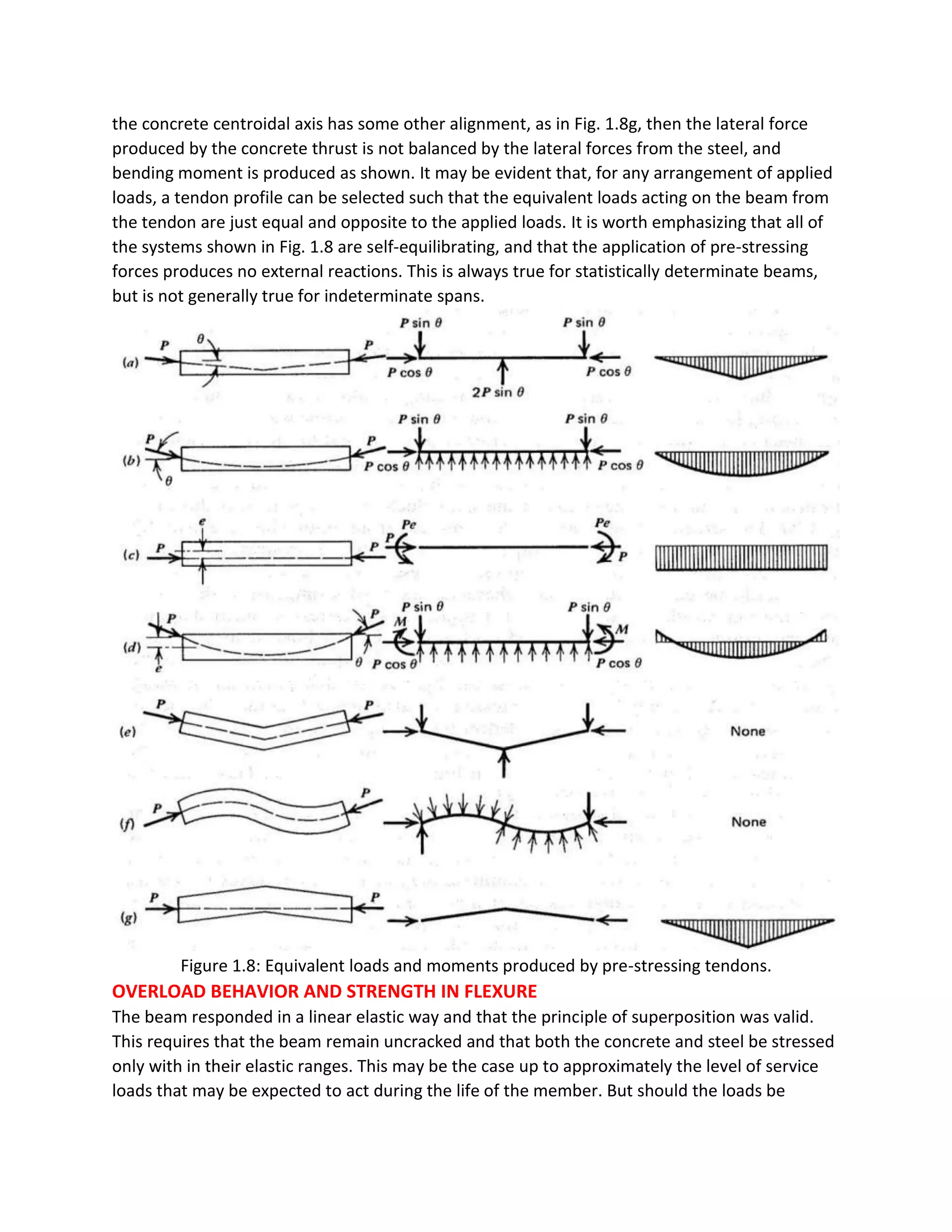
In figure 1.8a, for, example, a tendon that applies force P at the centroid of concrete section at
the ends of a beam and that has a uniform slope at angle 𝜃 between the ends and mid span
introduces the transverse force 2P sin 𝜃 at the point of change in tendon alignment at mid
span. At the anchorages, the vertical component of the pre-stressing force is P sin 𝜃 and the
horizontal component is P cos 𝜃. The horizontal component is very nearly equal to the force P
for the usual small slope angles. The moment diagram for the beam of Fig. 1.8a is seen to have
the same form as that for any center-loaded simple span.
The beam of Fig. 1.8b, with a curved tendon, is subject to a transverse distributed load from the
tendon, as well as the forces P at each end. The exact distribution of the load depends on the
alignment of the tendon. A tendon with a parabolic profile, for example, will produce a
uniformly distributed transverse load. In this case, the moment diagram will have a parabolic
shape, as for a uniformly loaded simple span beam.
If a straight tendon is used with constant eccentricity e, as in Fig. 1.8c, there are no transverse
forces on the concrete. But the member is subject to a moment ‘Pe’ at each end, as well as the
axial force P, and a diagram of constant moment results.
The end moment must also be accounted for in considering the beam of Fig. I.8d, in which a
parabolic tendon is used that does not pass through the concrete centroid at the ends of the
span. In this case, a uniformly distributed transverse load and end anchorage forces are
produced, just as in Fig. l.8b. But, in addition, the end moments M = Pe cos 𝜃 must be
considered. The concept of equivalent transverse loading is a useful one, but it must be applied
with care. In all of the cases considered thus far, the profile of the centroid was straight. The
concrete thrust was horizontal, consequently, and any change in alignment of the tendon
produced an unbalanced force acting on the concrete at that section. If the beam axis is curved,
as in Figs, 1.8e and 1.8f and if the tendon and concrete centroid coincide at all sections, then
the lateral force produced by the steel at any section is balanced by a resultant force in the
opposite direction produced by the thrust from the adjacent concrete, and no bending moment
results. The result would be a state of pure compression in the beam. An advantage of the
equivalent loading concept is that it leads the designer to select what is probably the best
tendon profile for any given load configuration. On the other hand, if the tendon is straight but
the concrete centroidal axis has some other alignment, as in Fig. 1.8g, then the lateral force
produced by the concrete thrust is not balanced by the lateral forces from the steel, and
bending moment is produced as shown. It may be evident that, for any arrangement of applied
loads, a tendon profile can be selected such that the equivalent loads acting on the beam from
the tendon are just equal and opposite to the applied loads. It is worth emphasizing that all of
the systems shown in Fig. 1.8 are self-equilibrating, and that the application of pre-stressing
forces produces no external reactions. This is always true for statistically determinate beams,
but is not generally true for indeterminate spans.
Figure 1.8: Equivalent loads and moments produced by pre-stressing tendons.
OVERLOAD BEHAVIOR AND STRENGTH IN FLEXURE
The beam responded in a linear elastic way and that the principle of superposition was valid.
This requires that the beam remain uncracked and that both the concrete and steel be stressed
only with in their elastic ranges. This may be the case up to approximately the level of service
loads that may be expected to act during the life of the member. But should the loads be
increased further, tensile stresses resulting from flexure will eventually exceed the tensile
strength of the concrete, and cracks will form. These cracks do not cause failure, because of the
presence of the steel, and the loads generally can be increased well beyond the cracking load
without producing distress.
Eventually, with loads increased still further, either the steel or the concrete, or both, will be
stressed into their nonlinear range. The condition at incipient failure is represented by Fig. 1.9,
which shows a beam carrying a factored load, equal to some multiple of the expected service
load. In designing a member, the magnitude of the load factor can be selected to provide the
desired degree of safety.
For the overloaded condition, the beam undoubtedly would be in a partially cracked state; a
possible pattern of cracking is shown in Fig. 1.9. Only the concrete in compression is considered
to be effective, just as in the analysis of ordinary reinforced concrete. The steel in tension works
with the concrete in compression to form an internal force couple, which resists the moment
from the applied load.
Figure 1.9: Pre-stressed concrete beam at ultimate flexural load. (a) Beam with factored load.
(b) Equilibrium of forces on left half of beam.
The magnitude of the compressive resultant C, the tensile force T in the steel, and the distance
between the two. If the internal lever arm is z then the ultimate resisting moment is
𝑀 𝑛 = 𝐶𝑧 = 𝑇𝑧
It will be recognized that, at the ultimate load stage, when the beam is at the point of incipient
failure in flexure, it behaves very much as an ordinary reinforced concrete beam. The main
difference is that the steel used has very high strength and requires a very large strain to
achieve a high stress level. If it were to be used without being pre-stressed (and pre-strained) in
tension, unacceptably large deformation and cracking of the beam would result.
Through review of this section, and the two preceding sections, it will be clear that the effects of pre-
stressing have been considered from three points of view: Providing concrete stress control, creating
equivalent transverse loads, and providing overload strength through creating an internal force couple,
just as in ordinary reinforced concrete. Each of these approaches is useful in the analysis and design of
pre-stressed concrete, and each will be used in the work that follows. It should be emphasized that
analysis based on elastic stresses provides no information about member strength.
Strength prediction requires development of equations that account for both cracking and nonlinear
material behavior. On the other hand, strength analysis reveals nothing about cracking or deflections,
whereas elastic stress analysis and equivalent load analysis will do so. In most cases, pre-stress effects
must be considered at different load states, and from different points of view, in the total pre-stressed
concrete design process.
SERVICEABILITY, STRENGTH AND STRUCTURAL SAFETY:
SERVICEABILITY
To serve its purpose, a structure must be serviceable under ordinary conditions of use and must
be safe against collapse. Serviceability requires that deflections be suitably small, that crack
widths be kept to within acceptable limits, that vibrations be minimized, and so on. In addition,
most specifications limitations on the stresses in the concrete and steel. Safety requires that
strength of the structure be adequate to resist overloading should the loads actually expected
to act be increased by a certain amount.
In designing pre stressed concrete structures, the engineer must consider a number of load
stages and must impose certain limiting conditions defining serviceability and safety. This
process is sometimes known as limit states design, with specific consideration of cracking limit
state, deflection limit state, strength limit state, and the like.
STRENGTH
The strength of a structure depends on the strength of the materials from which it is made.
Minimum material strengths are specified in certain, standardized ways. The properties of
concrete and its components, the methods of mixing, placing, and curing to obtain the required
quality.
Strength also depends on the care with which the structure is built, that is, the accuracy with
which the drawings and specifications of the engineer are followed. Member sizes may differ
from specified dimensions, reinforcement may out of position, pre stressing force may be
improperly applied, or poor placement of the concrete may result in voids. An important part of
the engineer’s job is to provide proper supervision of construction, and slighting of this
responsibility has had disastrous consequences in more than one instance.
STRUCTURAL SAFETY
If strength could be predicted accurately and if loads were known with equal certainty, then
safety could be assured by providing strength just barely in excess of the requirements of the
loads. But there are many sources of uncertainty in the estimation of loads, as well as in
analysis and design of the structure and in construction. These uncertainties require a larger
margin of safety. The selection of an appropriate safety margin is not a simple matter, but
much progress has been made in recent years toward rational safety provisions in design codes.
The approach to safety that is found in the ACI Code (Ref. 1.5) is as follows. Separate
consideration is given to loads and strength. Load factors, larger than unity, are applied to the
calculated dead loads and calculated or specified service live and environmental loads to obtain
factored loads that the member must just be capable of sustaining at incipient failure. Load
factors pertaining to different types of loads vary, depending on the degree of uncertainty
associated with loads of various types, and with the likelihood of simultaneous occurrence of
different loads.
The required strength, should the member be overloaded, must not exceed conservative
estimate of the actual strength. To obtain that estimate, the nominal strength Sn is calculated
according to the best available information concerning materials and member behavior. That
nominal strength is reduced by applying a strength reduction factor to obtain what is called the
design Strength of the member. The design strength must be at least equal to the required
strength from the factored loads that is,
𝜑𝑆 𝑛 ≥ 𝑈 ………. (1.2)
Equation 1.2 is stated in general terms. T can be interpreted as applying either to loads acting
on a member or to the related internal effects such as moment, shear, and thrust.
Thus, in specific terms for a member subjected, say, to moment, shear and thrust:
𝜑𝑀 𝑛 ≥ 𝑀 𝑢 ………. (1.3a)
𝜑𝑉𝑛 ≥ 𝑉𝑢 ………. (1.3b)
𝜑𝑃𝑛 ≥ 𝑃𝑢 ………. (1.3c)
Where terms with the subscript n are the nominal strengths in flexural, shear, and thrust,
respectively, and terms with the subscript u are the factored load moment, shear, and thrust.
Table 1.2: Factored load combinations for determining required strength U in the ACI Code.
Condition Factored load or load effect U
Basic U = 1.4D + 1.7L
Winds U = 0.75(1.4D + 1.7L + 1.7W) & include consideration of L = 0.
U = 0.9D + 1.3W ⇒ U = 1.4D + 1.7L
Earthquake U = 0.75(1.4D + 1.7L + 1.87E) & include consideration of L = 0.
U = 0.9D + 1.43E ⇒ U = 1.4D + 1.7L
Earth pressure U = 1.4D + 1.7L + 1.7H ⇒ U = 0.9D + 1.7H ⇒ U = 1.4D + 1.7L
Fluids Add 1.4F to all loads that include L
Impact Substitute (L + I) for L
Settlement, creep,
shrinkage, or temperature
change effects
U = 0.75(1.4D + 1.4T + 1.7L)
U = 1.4(D + T)
The strength reduction factor found ∅ in the ACI code are summarized in Table 1.3. These are
given different values depending on the state of knowledge’ of particular kinds of member
behavior, that is, the confidence with which various strengths can be calculated.
Thus the ∅ value for bending is higher than that for shear or bearing. Also, ∅ values reflect the
probable importance, for survival of the structure, of the particular member, as well as the
probable quality control achievable. For both reasons, a lower ∅ value is used for columns than
for beams.
Table 1.3: Strength reduction factors in the ACI Code.
Kind of strength Strength
reduction
factor (∅)
Flexure, without axial load 0.90
Axial load, & axial load with flexure: Axial tension, & axial tension with flexure: 0.90
Axial compression, & axial compression with flexure: Members with spiral
reinforcement
0.75
Other Members: except that for low values of axial load, ∅ may be increased in
accordance with the following: For members in which fy does not exceed 60,000
psi, with symmetrical reinforcement, and with (h – d’ – ds)/h not less than 0.70 ∅
may be increased linearly to 0.90 as ∅𝑃𝑛 decreases from 0.10𝑓′ 𝑐 𝐴 𝑔 or ∅𝑃𝑛𝑏 ,
whichever is smaller, to zero.
For other reinforced members, ∅ may be increased linearly to 0.90 as ∅𝑃𝑛
decreases from 0.10𝑓′ 𝑐 𝐴 𝑔 to zero.
0.70
Shear and torsion 0.85
Bearing on concrete 0.70
PARTIAL PRE-STRESSING
Early designers of pre-stressed concrete focused on the complete elimination of tensile stresses
in members at normal service load. This is defined as full pre-stressing. As experience has been
gained with pre-stressed concrete construction, it has become evident that a solution
intermediate between fully pre-stressed concrete and ordinary reinforced concrete offers many
advantages. Such an intermediate solution, in which concrete tension, and usually some
flexural cracking, is permitted at full service load, is termed partial pre-stressing.
Although full pre-stressing offers the possibility of complete elimination of cracks at full service
load, it may at the same time produce members with objectionably large camber, or negative
deflection, at more typical loads less than the full value. A smaller amount of pre-stress force
may be produce improved deflection characteristics at load stages of interest. While cracks will
usually form in partially pre-stressed beams should the specified full service load be applied,
these cracks are small and will close completely when the load is reduced.
In addition to improved deflection characteristics, partial pre-stressing may result in significant
economy by reducing the amount of pre-stressed reinforcement and by permitting the use of
cross-section configurations with certain practical advantages compared with those required by
full pre-stressing.
Even though the amount of pre-stress force may be reduced through use of partial pre-
stressing, a beam must still have an adequate factor of safety against failure. This will often
require the addition of ordinary reinforcing bars in the tension zone. Alternatives are to provide
the total steel area needed for strength by high strength tendons, but to stress those tendons
to less than their full permitted value, or to leave some of the strands unstressed.
Partial pre-stressing is looked upon with increasing favor in the United States, as it offers the
combined advantages of reinforced and pre-stressed concrete.
STAGES OF PRE-TENSIONING AND POST-TENSIONING WITH ADVANTAGES AND
DISADVANTAGES:
Stages of Pre-tensioning
• In pre-tensioning system, the high-strength steel tendons are pulled between two end
abutments (also called bulkheads) prior to the casting of concrete. The abutments are fixed
at the ends of a pre-stressing bed.
• Once the concrete attains the desired strength for pre-stressing, the tendons are cut loose
from the abutments. The pre-stress is transferred to the concrete from the tendons, due to the
bond between them. During the transfer of pre-stress, the member undergoes elastic
shortening. If the tendons are located eccentrically, the member is likely to bend and deflect
(camber).
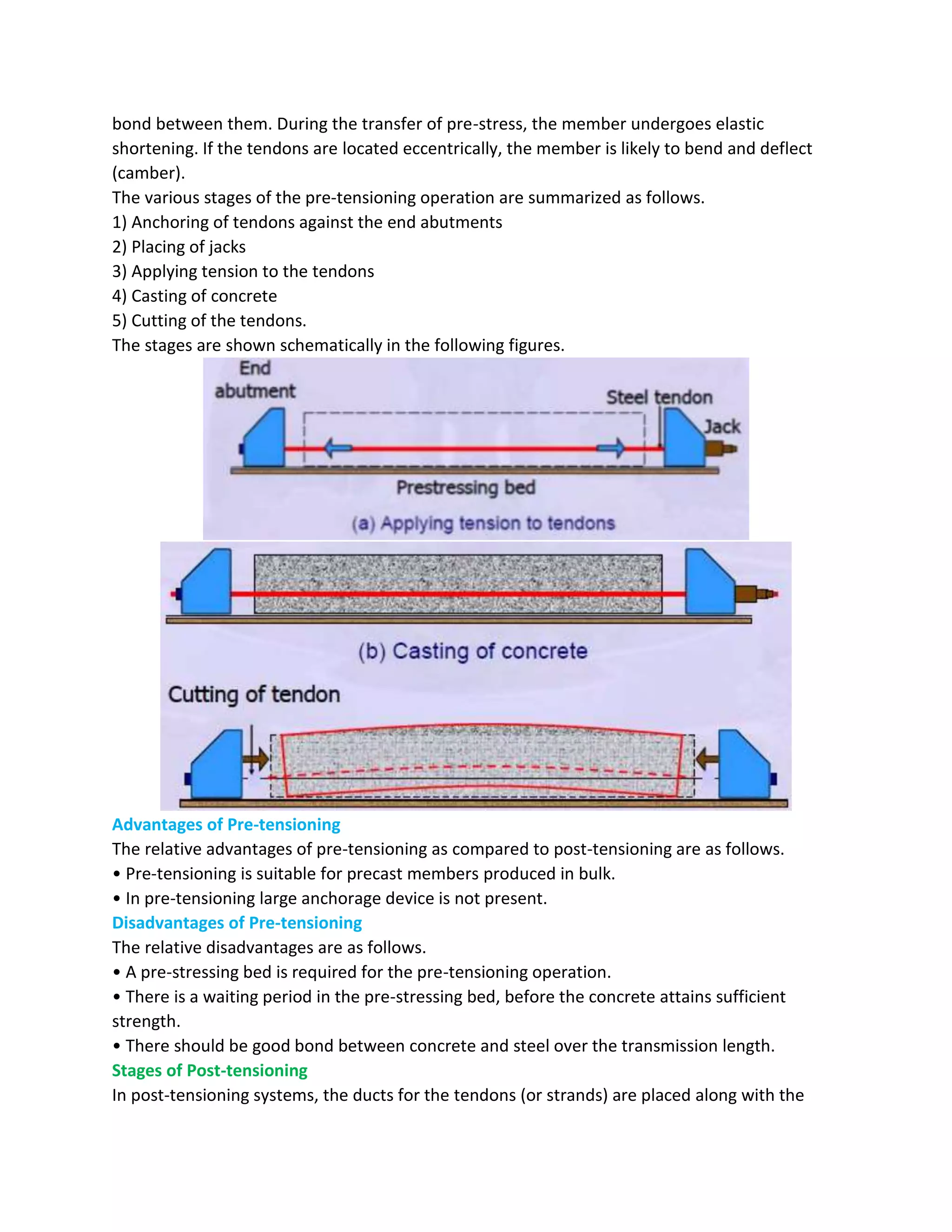
The various stages of the pre-tensioning operation are summarized as follows.
1) Anchoring of tendons against the end abutments
2) Placing of jacks
3) Applying tension to the tendons
4) Casting of concrete
5) Cutting of the tendons.
The stages are shown schematically in the following figures.
Advantages of Pre-tensioning
The relative advantages of pre-tensioning as compared to post-tensioning are as follows.
• Pre-tensioning is suitable for precast members produced in bulk.
• In pre-tensioning large anchorage device is not present.
Disadvantages of Pre-tensioning
The relative disadvantages are as follows.
• A pre-stressing bed is required for the pre-tensioning operation.
• There is a waiting period in the pre-stressing bed, before the concrete attains sufficient
strength.
• There should be good bond between concrete and steel over the transmission length.
Stages of Post-tensioning
In post-tensioning systems, the ducts for the tendons (or strands) are placed along with the
reinforcement before the casting of concrete. The tendons are placed in the ducts after the
casting of concrete. The duct prevents contact between concrete and the tendons during the
tensioning operation. Unlike pre-tensioning, the tendons are pulled with the reaction acting
against the hardened concrete.
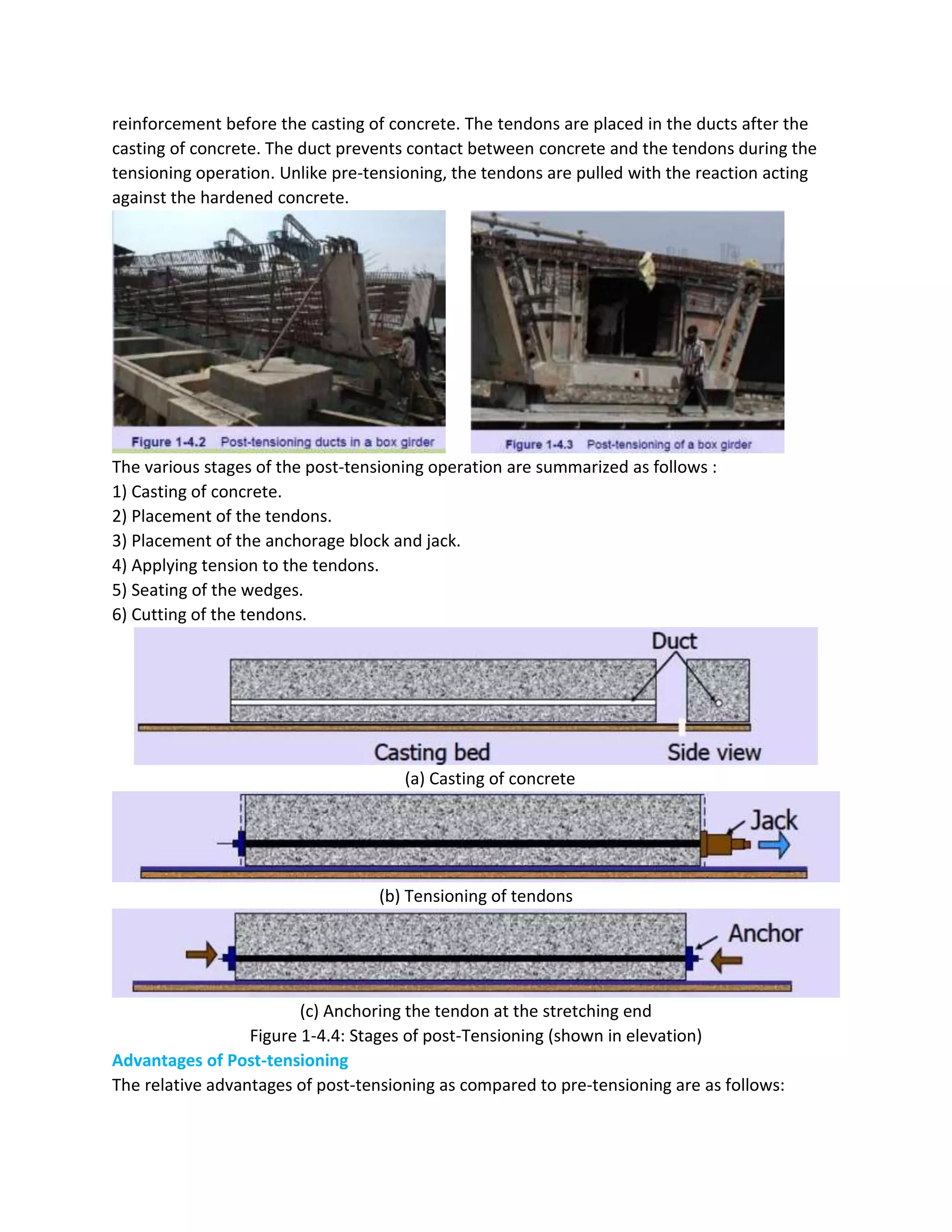
The various stages of the post-tensioning operation are summarized as follows :
1) Casting of concrete.
2) Placement of the tendons.
3) Placement of the anchorage block and jack.
4) Applying tension to the tendons.
5) Seating of the wedges.
6) Cutting of the tendons.
(a) Casting of concrete
(b) Tensioning of tendons
(c) Anchoring the tendon at the stretching end
Figure 1-4.4: Stages of post-Tensioning (shown in elevation)
Advantages of Post-tensioning
The relative advantages of post-tensioning as compared to pre-tensioning are as follows:
• Post-tensioning is suitable for heavy cast-in place members.
• The waiting period in the casting bed is less.
• The transfer of pre-stress is independent of transmission length.
Disadvantage of Post-tensioning
The relative disadvantage of posttensioning as compared to pre-tensioning is the requirement
of anchorage device and grouting equipment.
LIMITATIONS OF PRE-STRESSING
• Pre-stressing needs skilled technology. Hence, it is not as common as reinforced concrete.
• The use of high strength materials is costly.
• There is additional cost in auxiliary equipment’s.
• There is need for quality control and inspection.
PRE-STRESSING METHODS
Although many methods have been used to produce the desired state of pre-compression in
concrete members, all pre-stressed concrete members can be placed in one of two categories:
Pre-tensioned or Post-tensioned. Pre-tensioned pre-stressed concrete members are produced
by stretching the tendons between external anchorages before the concrete is placed. As the
fresh concrete hardens, the jacking force is released, and the force is transferred by bond from
steel to concrete. In the case of post-Tensioned pre-stressed concrete members, the tendons
are stressed after the concrete has hardened and achieved sufficient strength, by jacking
against the concrete member itself.
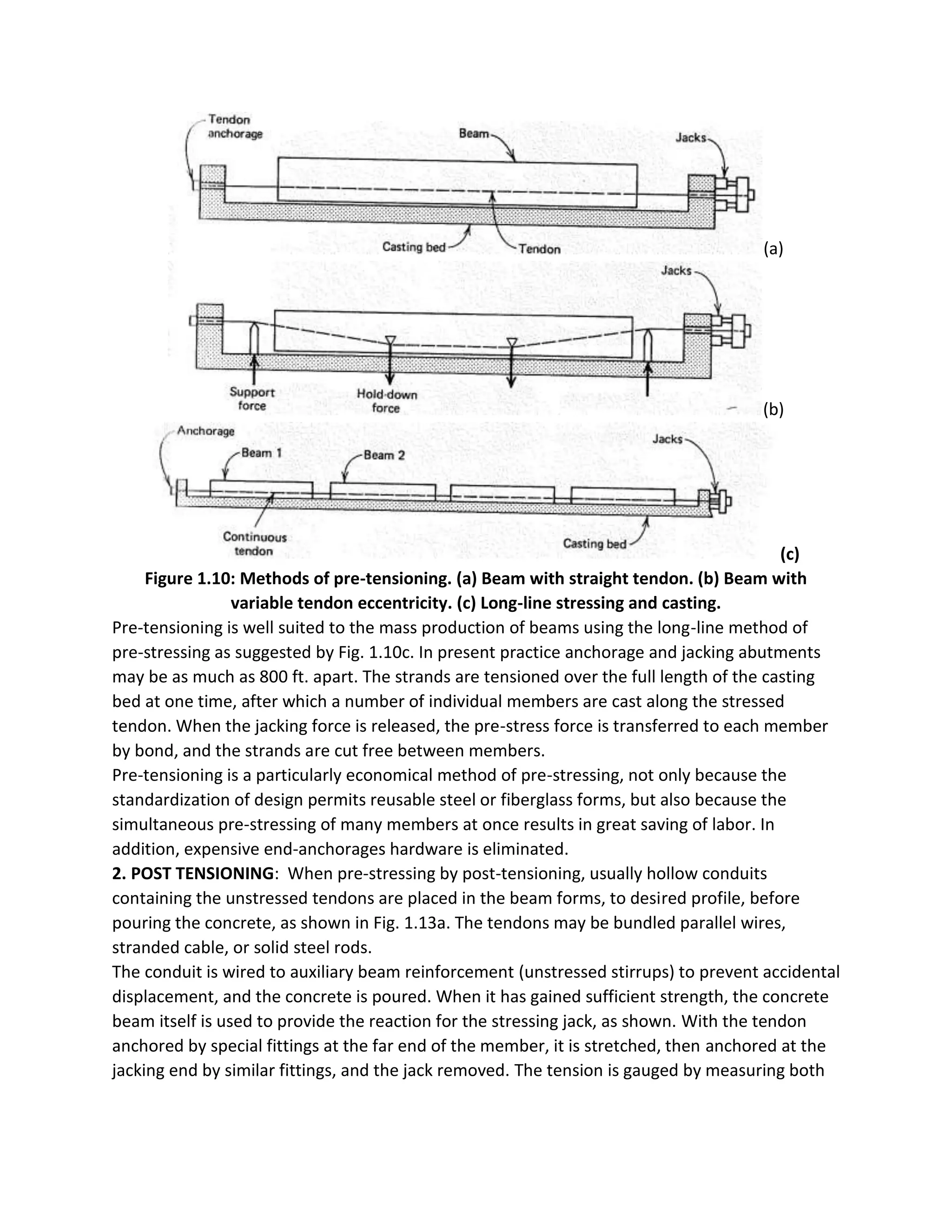
1. PRETENSIONING: The greater part of pre-stressed concrete construction in the US is pre-
tensioned. The tendons, usually in the form of multiple-wire stranded cables, are stretched
between abutments that are a permanent part of the plant facility, as shown in Fig. 1.10a. The
extension of the strands is measured, as well as the jacking force.
With the forms in place, the concrete is cast around the stressed tendon. High early strength
concrete is often used, together with steam curing to accelerate the hardening of the concrete.
After sufficient strength is attained, the jacking pressure is released. The strands tend to
shorten, but are prevented from doing so because they are bonded to the concrete. In this way,
the pre-stress force is transferred to the concrete by bond, mostly near the ends of the beam,
and no special anchorage is needed. It was noted that it is often advantageous to vary the
tendon eccentricity along a beam span. This can be done when pre-tensioning by holding down
the strands at intermediate points and holding them up at the ends of the span, as shown in
Fig. 1.10b. One, two, or three intermediate cable depressors are often used to obtain the
desired profile. These hold-down devise remain embedded in the member. To minimize
frictional loss of tension, it is common practice to stretch the straight cable, then to depress it
to the final profile by using auxiliary jacks. Allowance must be made, in this case, for the
increase in tension as the cable is forced out of straight alignment.
(a)
(b)
(c)
Figure 1.10: Methods of pre-tensioning. (a) Beam with straight tendon. (b) Beam with
variable tendon eccentricity. (c) Long-line stressing and casting.
Pre-tensioning is well suited to the mass production of beams using the long-line method of
pre-stressing as suggested by Fig. 1.10c. In present practice anchorage and jacking abutments
may be as much as 800 ft. apart. The strands are tensioned over the full length of the casting
bed at one time, after which a number of individual members are cast along the stressed
tendon. When the jacking force is released, the pre-stress force is transferred to each member
by bond, and the strands are cut free between members.
Pre-tensioning is a particularly economical method of pre-stressing, not only because the
standardization of design permits reusable steel or fiberglass forms, but also because the
simultaneous pre-stressing of many members at once results in great saving of labor. In
addition, expensive end-anchorages hardware is eliminated.
2. POST TENSIONING: When pre-stressing by post-tensioning, usually hollow conduits
containing the unstressed tendons are placed in the beam forms, to desired profile, before
pouring the concrete, as shown in Fig. 1.13a. The tendons may be bundled parallel wires,
stranded cable, or solid steel rods.
The conduit is wired to auxiliary beam reinforcement (unstressed stirrups) to prevent accidental
displacement, and the concrete is poured. When it has gained sufficient strength, the concrete
beam itself is used to provide the reaction for the stressing jack, as shown. With the tendon
anchored by special fittings at the far end of the member, it is stretched, then anchored at the
jacking end by similar fittings, and the jack removed. The tension is gauged by measuring both
the jacking pressure and the elongation of the steel. The tendons are normally tensioned one at
a time, although each tendon may consist of many strands or wire.
Tendons are normally grouted in their conduits after they are stressed. A cement paste grout is
forced into the conduit at one end under high pressure, and pumping is continued until the
grout appears at the far end of the tube. When it hardens, the grout bonds to the tendon and
to the inner wall of the conduit, permitting transfer of force. Although the anchorage fittings
remain in place to main pre-stressing force to the concrete, grouting improves the performance
of the member should it be overloaded and increases its ultimate flexural strength.
An alternative method of post-tensioning is illustrated in Fig. 1.13b. A hollow, cellular concrete
beam with solid end blocks and intermediate diaphragms is shown. Anchorage fittings are
provided as before, but the tendons pass through the void spaces in the member. The desired
cable profile is maintained by passing the steel through sleeves positioned in the intermediate
diaphragms.
In many cases, particularly in relatively thin slabs, post-tensioning tendons are wrapped with
asphalt-impregnated paper or encased in plastic sheathing, as shown in Fig. 1.13c. Anchorage
and jacking hardware is provided. The wrapping prevents the concrete from bonding to the
steel. When the concrete has hardened, the tendons are stretched and anchored, and the jack
removed.
(a)
(b)
(c)
Figure 1.13: Methods of post-tensioning. (a) Beam with hollow conduit embedded in
concrete. (b) Hollow cellular beam with intermediate diaphragms. (c) Continuous slab with
plastic-sheathed tendons.
CHANGES IN PRE-STRESS FORCE
The magnitude of pre-stressing force in a concrete member is not constant, but assumes
different values during the life of the member. Some of the changes are instantaneous or nearly
so, some are time-dependent, and some are a function of the superimposed loading. All such
changes must be accounted for in the design. Neglect of time-dependent losses, in particular,
accounts for the lack of success of all early attempts to pre-stress concrete.
With the exception of conditions at serve overloading, the greatest force that acts are during
the jacking operation. The jacking force will be referred to subsequently as Pj. For a post-
tensioned member, this force is applied as a reaction directly upon the concrete member, while
with pre-tensioning, the jacking force reacts against external anchorages and does not act on
the concrete at all.
At the moment of transfer of pre-stress force from the jack to the anchorage fittings that grip
the tendon, there is an immediate reduction in force. There is inevitably a small amount of slip
as the wedges or grips seat themselves into the steel tendon, and the shortening of the tendon
that results is accompanied by loss in tensile strain and stress. This is always a factor to consider
in post-tensioned beams. Corresponding slip loss occurs in pre-tensioning too, because
temporary grips are normally used at jacking abutment to hold the strand as the concrete is
poured. However, in beams pre-tensioned by the long-line method, slip loss is apt to be
insignificant because of the great length of tendon over which the slip is distributed.
There is an instantaneous stress loss because of the elastic shortening of the concrete as the
pre-stress force is transferred to it. This always occurs in pre-tensioning, but occurs in post-
tensioning only if there are two or more tendons and if they are tensioned sequentially.
Another source of immediate loss of pre-stress force, applying to post-tensioned members
only, is the friction between the steel and the conduit through which it passes as the tendon is
stretched. The tensile force at the jack will always be larger than that at the far end, where the
tendon is anchored. This loss can be minimized by overstretching the steel slightly if necessary,
then reducing the jacking force to the desired value. In some cases, tendons are jacked from
both ends to minimize frictional losses, particularly when the tendon profile has several
reversals of curvature.
As a consequence of all instantaneous losses, including those due to anchorage slip, elastic
shortening, and friction, the jacking force Pj is reduced to a lower value Pi, defined as the initial
pre-stress force.
With the passage of time, the steel stress is further reduced. The changes that cause this
reduction occur rather rapidly at first, but the rate of change of stress soon decreases. A nearly
constant stress level is approached, but only after many months, or even several years.
The main causes of time-dependent loss are shrinkage of the concrete and concrete creep
under sustained compressive stress. Both of these produce shortening of the member, which
results in a reduction in steel strain and stress. In addition, the steel experiences a gradual
relaxation of stress, as it is held at nearly constant strain. The result of all time-dependent
effects, including concrete shrinkage and creep and steel relaxation, is that the initial pre-stress
force is gradually reduced to what will be termed the effective pre-stress force Pe.
The sum of all losses, immediate and time-dependent, may be of the order of 20 to 30 percent
of the original jacking force. All losses must be accounted for in the design of pre-stressed
concrete.
Loading of a pre-stressed beam will generally produce an increase in stress in the tendon. As
long as the member remains uncracked, the increase is so small that it is usuallay neglected in
desig. However, cracking of the concrete is accompanied by an instantaneous increase in steel
stress, as the tensile force formerly carried by the concrete is transferred to the steel. If the
load is increased further, the member behaves much as ordinary reinforced concrete, and the
steel stress increases roughly in proportion to the load until the nonlinear range of material
behavior is reached, followed by eventual failure. The steel may reach its ultimate tensile
strength at failure, although this is not generally so.
LOADS:
Loads that act on structures can be divided into three broad categories:
1. dead load, 2. live loads, 3. environmental loads.
1. DEAD LOAD: Dead loads are fixed in location and constant in magnitude throughout the life
of the structure. Usually the self-weight of a structure is most important part of the dead load.
This can be calculated closely, based on the dimensions of the structure and the unit weight of
the material. Concrete density varies from about 90 to 120 pcf (14 to 19 KN/m3) for lightweight
concrete and is about 145 pcf (23 KN/m3) for normal concrete. In calculating the dead load of
structural concrete, usually a 5 pcf (1 KN/m3) increment is included with the weight of the
concrete to account for the presence of the reinforcement.
2. LIVE LOAD: Live Loads consist chiefly of occupancy loads in building and traffic loads on
bridge. They may be either fully or partially in place or not present at all and may change in
location. The minimum live loads for which the floors and roof of a building should be designed
are usually specified in the building code that governs at the site of construction.
This loading may come and go with the result that its intensity will vary considerably.
At one moment a room may be empty, yet at another packed with people. The minimum live
load for which the floor and roof of a building should be designed are usually specified in the
building code that governs at the site of construction. These loads are expected maxima and
considerably exceed average values. In addition to these uniformly distributed loads, it is
recommended that, as an alternative to the uniform load, floors be designed to support safely
certain concentrated loads if these loads produce a greater stress. Certain reductions are
permitted in live load for members supporting large areas on the premise that it is not likely
that the entire area would be fully loaded at one time. All the movable objects in a building
such as people, desks, cupboards and filing cabinets produce an imposed load on the structure.
3. ENVIRONMENTAL LOADS: Environmental loads consist mainly of the snow loads, wind
pressure and suction, earthquake loads, soil pressures on subsurface portions of structures,
loads from possible ponding of rainwater on flat surfaces, and forces caused by temperature
differentials. Like live loads, environmental loads at any given time are uncertain both in
magnitude and distribution.
i. Wind load: Wind load is primarily horizontal load caused by the movement of air relative to
earth. Wind load is required to be considered in design especially when the heath of the
building exceeds two times the dimensions transverse to the exposed wind surface.
For low rise building say up to four to five storeys, the wind load is not critical because the
moment of resistance provided by the continuity of floor system to column connection and
walls provided between columns are sufficient to accommodate the effect of these forces.
Further in limit state method the factor for design load is reduced to 1.2 (D.L + L.L + W.L) when
wind is considered as against the factor of 1.5(D.L + L.L) when wind is not considered. IS 1893
(part 3) code book is to be used for design purpose.
ii. Snow Load (SL): The magnitude of the snow load will depend upon the latitude and altitude
of the site. In the lower latitudes no snow would be expected while in the high latitudes snow
could last for six months or more. In such locations buildings have to be designed to withstand
the appropriate amount of snow. The shape of the roof also plays an important part in the
magnitude of the snow load. The steeper the pitch, the smaller the load. The snow falling on a
flat roof will continue to build up and the load will continue to increase, but on a pitched roof a
point is reached when the snow will slide off.
Service load: The sum of the calculated dead load and the specified or calculated live and
environmental loads is called the service load, because this is the best estimate of the
maximum load that can be expected to act during the service life of the structure.
IMPORTANCE OF HIGH STRENGTH STEEL
The reason for the lack of success of earliest attempts to pre-stress concrete was the failure to
employ steel at a sufficiently high stress and strain. The time-dependent length changes
permitted by shrinkage and creep of the concrete completely relieved the steel of stress. The
importance of high initial strain and the corresponding high initial stress in the steel can be
shown by a simple example.
Shown in Fig. 2.1(a) is a short concrete member that is to be axially pre-stressed using a steel
tendon. In the unstressed state, the concrete has length Lc and the unstressed steel has length
Ls. After tensioning of the steel and transfer of force to concrete through the end anchorages,
the length of the concrete is shortened to L’c and the length of the stretched steel is L’s. these
value must, of course, be identical, as indicated by the figure.
Figure 2.1: Effect of shrinkage and creep of concrete in reducing pre-stress force. (a) Axially
pre-stressed concrete member. (b) Stress in steel.
But the concrete experiences a shrinkage strain 𝜀 𝑠ℎ with the passage of time and, in addition, if
held under compression will suffer a creep strain 𝜀 𝑠ℎ. The total length changes in the member
∆𝑙 𝑐 = (𝜀 𝑠ℎ + 𝜀 𝑐𝑢)𝑙 𝑐 (a)
may be such that it exceeds the stretch in the steel that produced the initial stress, and
complete loss of pre-stress force will result.
The importance of shrinkage and creep strain can be minimized by using a very high initial
strain and a high initial stress in the steel. The reduction in steel stress from these causes
depends only on the unit strains in the concrete associated with shrinkage and creep, and the
elastic modulus 𝐸𝑠 of the steel:
∆𝑓𝑠 = (𝜀 𝑠ℎ + 𝜀 𝑐𝑢)𝐸𝑠 (b)
It is independent of the initial steel stress.
It is informative to study the results of calculations for representative values of the various
parameters. Suppose first that the member is pre-stressed using ordinary reinforcing steel at an
initial stress 𝑓𝑠𝑖 of 30 ksi. The modulus of elasticity 𝐸𝑠 for all steels is about the same and will
be taken here as 29,000 ksi. The initial strain in the steel is
𝜀 𝑠𝑖 =
𝑓 𝑠𝑖
𝐸𝑠
=
30
29,000
= 1.03 × 10⁻³
and the total steel elongation is
𝜀 𝑠 𝑙 𝑠 = = 1.03 × 10⁻³
𝑙 𝑠 (c)
But a conservative estimate of the sum of shrinkage and creep strain in the concrete is about
0.90 X 10⁻³
, and the corresponding length change is
(𝜀 𝑠ℎ + 𝜀 𝑐𝑢)𝑙 𝑐 = = 0.90 × 10⁻³
𝑙 𝑐 (d)
Since 𝑙 𝑠 and 𝑙 𝑐 are nearly the same, it is clear by comparing (c) and (d) that the combined
effects of shrinkage and creep of the concrete is almost a complete loss of stress in the steel.
The effective steel stress remaining after time-dependent effects would be
𝑓𝑠𝑒 = (1.03 – 0.90) X 10−3
x 29 x 103
= 4 ksi.
Alternatively, suppose that the pre-stress was applied using high strength steel at an initial
stress of 150 ksi. In this case, the initial strain would be
𝜀 𝑥𝑖 =
150
29,000
= 5.17 x 10⁻³
(e)
And the total elongation
𝜀 𝑠 𝑙 𝑠 = = 5.17 × 10⁻³
𝑙 𝑠 (f)
The length change resulting from the shrinkage and creep effects would be the same as before
(𝜀 𝑠ℎ + 𝜀 𝑐𝑢)𝑙 𝑐 = = 0.90 × 10⁻³
𝑙 𝑐
And the effective steel stress 𝑓𝑠𝑒 after losses due to shrinkage and creep would be
𝑓𝑠𝑒 = (5.17 – 0.90) 10−3
X 29 X 103
= 124 ksi.
The loss is about 17 percent of the initial steel stress in this case compared with 87 percent loss
when mild steel was used.
The results of these calculations are shown graphically by Fig. 2.1b and illustrate clearly the
need in pre-stressing for using steel that is capable of a very high initial stress.
TYPES OF PRE-STRESSING STEEL:
There are three Common forms in which steel is used for pre-stressed concrete tendons:
1. Cold-drawn round wires, 2. stranded cable, 3. alloy steel bars.
1. ROUND WIRES: The round wires used for post-tensioned pre-stressed concrete construction
and occasionally for pre-tensioned work are manufactured to meet the requirements of ASTM
Specification A 421, “Uncoated Stress-Relieved ire for Pre-Stressed Concrete”. The individual
wires are manufactured by hot-rolling steel billets into round rods. After cooling, the rods are
passed through dies to reduce their diameter to the required size. In the process of this drawing
operation cold work is done on the steel, greatly modifying its mechanical properties and
increasing its strength. The wires are stress-relieved after cold drawing by a continuous heat
treatment to produce the prescribed mechanical properties.
Wires are available in different diameters and in two types. Type BA wire is used for
applications in which cold-end deformation is used for anchoring purposes. Type WA is used for
applications in which the ends are anchored by wedges and no cold-end deformation of the
wire is involved. Tendons are normally composed of groups of wires, the number of wires in
each group depending on the particular system used and the magnitude of pre-stress force
required. Typical prefabricated post-tensioning tendons may consist of 8 to 52 individual wires.
2. STRANDED CABLE: Stranded cable almost always used for pre-tensioned members and is
often used for posttensioned construction as well. Strand is manufactured to ASTM
Specification A 416, “Uncoated Seven-Wire Stress-Relieved Strand for pre-stressed Concrete.” It
is fabricated with six wires wound tightly around a seventh of slightly larger diameter. The pitch
of the spiral winding is between 12 and 16 times the nominal diameter of the strand.
The same type of cold-drawn stress-relieved wire is used in making stranded cable as is used
for individual pre-stressing wires. However, the apparent mechanical properties are slightly
different because of the tendency for the stranded wires to straighten when subjected to
tension because the axis of the wires does not coincide with the direction of tension. Cable is
stress-relieved by heat treatment after stranding. Low-relaxation or stabilized strand is widely
available. Strands may be obtained in range of sizes from 0.0250in to 0.600in diameter. Two
grades are manufactured Grade 250 and Grade 270 have minimum ultimate strengths of
250,000 and 270,000 psi respectively based on the nominal area of the strand.
3. ALLOY STEEL BARS: In the case of alloy steel bars, the required high strength is obtained by
introducing certain alloying elements, mainly manganese, silicon, and chromium during the
manufacture of steel. In addition, cold work is done in making the bars, further increasing the
strength. After cold-stretching, the bars are stress-relieved to obtain the required properties.
Bars are manufactured to meet the requirements of ASTM Specification A 722, “Uncoated High-
Strength Steel Bar for Pre-Stressing Concrete.”
Alloy steel bars are available in diameters ranging from
5
8
in to 1
3
8
in and in two grades, Grade
145 and Grade 160, corresponding to the minimum ultimate strengths of 145,000 and 160,000
psi (1000 and 1100 MPa), respectively.
NON-PRE-STRESSED REINFORCEMENT:
Non-pre-stressed steel has several important applications in pre-stressed concrete
construction. Although web reinforcement for diagonal tensile stress may be pre-stressed,
ordinarily it is non-pre-stressed bar steel. Supplementary non-prestressed reinforcement is
commonly used in the region of high local compressive stress at the anchorages of post-
tensioned beams. For both pretensioned and post-tensioned members, it is common to provide
longitudinal bar steel to control shrinkage and temperature cracking. Overhanging flanges of T-
and I-shaped cross sections are normally reinforced in both the transverse and longitudinal
directions with non-tensioned bars. Finally, it is often convenient to increase the flexural
strength of prestressed beams using supplementary longitudinal bar reinforcement.
Such non-pre-stressed reinforcing bars which are identical to those used for ordinary reinforced
concrete construction, are manufactured to meet the requirements of ASTM specifications.
Bars are available in nominal diameters from
3
8
in to 1
3
8
in. They are generally referred to by
number, for example a No.7 bar has nominal diameter of
3
8
in. to identify bars that meets the
requirements of the ASTM specification, distinguishing marks are rolled into the surface of one
side of the bar to denote.
(a) the point of origin (b) the size designation by number, (c) the type of steel, and (d) in the
case of Grade 60 bars either the number 60 or a single continuous longitudinal line through at
least five paces offset from the center of the bar side.
In the case of bar reinforcement, it is important that steel and concrete deform together, that
is, that there be a sufficiently strong bond between the two materials so that little or no
relative movement can occur. This bond is provided by the relatively large chemical adhesion
that develops at the steel concrete interface, by the natural roughness of the mill scale on hot-
rolled reinforcement, and by closely spaced rib-shaped surface deformations with which bars
are furnished to provide a high degree of interlocking of the two materials. Minimum
requirements for these deformations have been developed in experimental research and are
described in the ASTM Specification. Different bar producers use different patterns to satisfy
these requirements.
Bars are produced in different strengths. Grades 40, 50 and 60 have specified minimum yield
strengths of 40000, 50000 and 60000 psi respectively (276, 345, and 414 MPa). The present
trend is toward the use of Grade 60 bars; the bars of lower yield strength may not be
commonly available. Large diameter bars with 75,000 and 90,000 psi (517 and 621 MPa) yield
are available on special order, although they find little application in prestressed concrete
members. Apart from single reinforcing bars, welded wire mesh is often used for reinforcing
slabs, beam flanges and other surfaces such as shells. The mesh consists of longitudinal and
transverse cold-drawn steel wires, at right angles, welded at all points of intersection. Mesh is
available with wire spacing from 2in to 12in, and wire diameter from 0.080in to 0.628in,
although all combinations are not readily available. The size and spacing of the wires may be
the same in both directions or different as needed.
TYPES OF PRE-STRESSED CONCRETE
According to the construction method, there are two kinds of pre stressed concrete:
a). Pre-tensioned Concrete: In this method, wires or tendons are tensioned at first and
concrete is poured later. It creates a good bondage between the tendon and concrete. As a
result, the tendons are protected from corrosion and tensions are transferred directly. Tendons
are anchored and stretched and the stress is transferred to the concrete when it is hard. Then
the tendon tries to get back to the original length, but resisted by the bond between the
concrete hence it induces compressive force in it.
b). Bonded Post-Tensioned Concrete: Similar to pre-stressing but here concrete is poured first
then tendons are tensioned. Tendons are placed at suitable places in the member and then
casting is done. After the concrete becomes hard, the tendons are tensioned by hydraulic jacks
against the concrete. When the tendons have tensioned sufficiently, according to design, they
are fixed in position. After the jacks are removed, tension remains and it transfers pressure to
the concrete. This method is widely used in building monolithic slabs for mega house
construction projects where expansive soil sometimes creates problems. Moreover, post-
tensioned concrete is also used in bridges.
c). Un bonded Post-Tensioned Concrete: It is little different from bonded post-tensioned
concrete. It allows freedom to move the cables. For this, each tendon is coated with grease and
covered by plastic. Stress transfer to the concrete is achieved by the cables through anchors.
There are some advantages to this like- • The ability to distress tendons before trying to repair
work. • The ability to individually adjust cables.
CONCRETE IN UNAXIAL COMPRESSION
Concrete is useful in compression and at controlling sections of members, is often subject to a
state of stress that is approximately uniaxial. Accordingly, the uniaxial compressive stress strain
curve is of primary interest. Such a curve is obtained by loading standard cylinders’ parallel to
their axis at prescribed rates of loading. Fig 2.6 shows a typical set of such curves for normal
weight concrete with 𝑤𝑐 of about 145 pcf obtained from uniaxial compressive tests performed
at normal, moderate testing speeds on concrete 28 days old. Fig 2.7 shows corresponding
curves for lightweight concretes with a density of 100 pcf. All the curves have a similar
character. They consist of an initial relatively straight elastic portion in which stress and strain
are closely proportional, then begin to curve to the horizontal, reaching the maximum stress,
that is, the compressive strength, at a strain that ranges from about 0.002 to 0.003 for normal
weight concretes and 0.003 to 0.0035 for lightweight concretes, the larger values in each case
corresponding to the higher strengths. All curves show a descending branch after the peak
stress is reached; however, the characteristics of the curves after peak stress are highly
dependent on the method of testing. If special procedures are followed in testing to insure
constant strain rate while cylinder strength is decreasing, long stable descending branches can
be obtained. In the absence of special devices, unloading past the point of peak stress may be
rapid, particularly for the higher strength concretes, which are generally more brittle than low
strength concrete. According to present design practice, the limiting strain in uniaxial
compression is taken as 0.003. It should be emphasized that the exact shape of the stress-strain
curve for any concrete is highly dependent on such variables as rate of loading, the particular
testing equipment, the method of testing, and the size and shape of the specimen. The
relations shown in Figs. 2.6 & 2.7 are typical only of test results obtained by present standard
procedures. In the actual structure, quite different conditions may be obtained. Fortunately,
design procedures have evolved that are not particularly sensitive to the shape of the stress-
strain curve.
Fig. 2.6: Typical compressive stress-strain curves for normal density concrete with 𝑤𝑐 = 145 pcf.
Fig. 2.7: Typical compressive stress-strain curves for lightweight concrete with 𝑤𝑐 = 100 pcf.
The modulus of Elasticity 𝐸𝑐 (in psi units), that is, the slope of the initial straight part of the
stress-strain curve, is larger the higher the strength of the concrete. For concretes in the
strength range to about 6,000 psi, 𝐸𝑐 can be computed with reasonable accuracy from the
empirical equation found in the ACI Code: 𝐸𝑐 = 33𝑤1.5
𝑐√𝑓′ 𝑐 (2.3)
Where 𝑤𝑐 is the unit weight of the hardened concrete in pcf and 𝑓′ 𝑐 its strength in psi. Eq. (2.3)
was obtained by testing structural concretes with values of 𝑤𝑐 from 90 to 155 pcf. For normal
sand-and-stone concretes with 𝑤𝑐 = 145 pcf, 𝐸𝑐 may be taken as 𝐸𝑐 = 57,000√𝑓′ 𝑐 (2.4)
For compressive strengths in the range from 6,000 to 12,000 psi, the ACI Code equation
overestimates 𝐸𝑐 for both normal weight and lightweight material by as much as 20 percent.
Based on recent research at Cornell University, the following Eq. is recommended for normal
weight concretes with 𝑓′ 𝑐 in the range from 3,000 to 12,000 psi, and for lightweight concretes
from 3,000 to 9,000 psi. 𝐸𝑐 = (40,000√𝑓′ 𝑐 + 1,000,000) (
𝑤 𝑐
145
)
1.5
(2.5)
When compressed in one direction, concrete, like all other materials, expands in the direction
transverse to the direction of applied stress. The ratio of the transverse strain to the
longitudinal strain is known as Poisson’s ratio. It is meaningful only in the elastic range, at
stresses less than about half the concrete strength. In this range, Poisson’s ratio for concrete
varies between about 0.15 and 0.20. The strength of concrete varies with age, the gain in the
strength being rapid at first, then much slower. This variation of strength is specially important
in the design and fabrication of prestressed concrete members, because heavy loads may be
Fig. 2.6
Fig. 2.7
caused at quite an early age by the tensioned steel. In prestressed construction of all types, but
particularly for pretensioned plant-produced members, special methods are often followed to
insure rapid development of compressive strength. These include the use in the concrete mix of
high-early-strength Portland cement (Type III) rather than ordinary Portland cement (Type I),
and the use of steam curing. A study of extensive experimental data indicates that the
following expressions are suitable for predicting the strength of concrete at any time.
Fig. 2.8: Effect of age on uniaxial compression strength of concrete. (a) Moist cured.
(b) Steam cured.
For moist-cured concrete using Type I cement: 𝑓′ 𝑐,𝑡 =
𝑡
4.00 + 0.85𝑡
𝑓′ 𝑐,28 (2.6a)
For moist-cured concrete using Type III cement: 𝑓′ 𝑐,𝑡 =
𝑡
2.30 + 0.92𝑡
𝑓′ 𝑐,28 (2.6b)
For steam-cured concrete using Type I cement: 𝑓′ 𝑐,𝑡 =
𝑡
1.00 + 0.95𝑡
𝑓′ 𝑐,28 (2.6c)
For steam-cured concrete using Type III cement: 𝑓′ 𝑐,𝑡 =
𝑡
0.70 + 0.98𝑡
𝑓′ 𝑐,28 (2.6d)
In these Equations, 𝑓′ 𝑐,𝑡 is the compressive strength at time t, 𝑓′ 𝑐,28 is the compressive
strength at 28 days, and t is the age of the concrete in days. Fig. 2.8 presents these strength-
time functions graphically, with time plotted to a logarithmic scale. Test evidence indicates that
Eqs. (2.6a) through (2.6d) are equally applicable for normal weight, sand-lightweight, and all-
lightweight aggregate concretes.
CONCRETE IN UNAXIAL TENSION
Cracks in prestressed concrete members may be caused by direct tension, flexure, combined
shear and flexure in beams webs, torsion, and other actions. The behavior of members often
changes abruptly when tensile cracks form. Accordingly, it is important to know the tensile
strength of the material. There are several ways to measure the tensile strength of concrete,
none of them entirely satisfactory. Direct tensile tests have been made using dumbbell-shaped
specimens held in special grips. Results show great scatter because of the effects of minor
misalignments, stress concentrations in the grips, and random effects associated with the
location of aggregate, and for this reason, direct tension tests are seldom used. For many years,
tensile strength has been measured using either the modulus of rupture test or the split
cylinder test. The modulus of rupture is the computed flexural tensile stress at which a test
beam of plain concrete fractures. The test arrangement, shown in Fig, 2.9, is standardized by
ASTM specifications. It employs a small block of unreinforced concrete, supported at its ends
and loaded at the third points. Usually a 6 X 6 in. beam is used, with 18 inches between
supports. The modulus of rupture is 𝑓𝑟 =
𝑃𝐿
𝑏ℎ2
(2.7)
Fig. 2.9: Tests to determine the tensile strength of concrete. (a) Modulus of rupture test.
(b) Split cylinder test.
Where P is the total load at fracture, L is the span, and b and h, respectively, the width and
depth of the cross section. For normal density concrete the modulus of rupture is usually
between 8√𝑓′ 𝑐 and 12√𝑓′ 𝑐, whereas for lightweight aggregate concrete it may range from
6√𝑓′ 𝑐 to 8√𝑓′ 𝑐. In each case, the smaller values apply to higher strength concretes. Because
the modulus of rupture is computed on the assumption that concrete is an elastic material, and
because the critical stress occurs only at the outer surface, it is apt to be larger than the
strength of concrete in uniform axial tension, which is often taken between 3√𝑓′ 𝑐 and 5√𝑓′ 𝑐
for normal density concrete and 2√𝑓′ 𝑐 and 3√𝑓′ 𝑐 for lightweight material.
In recent years, the split cylinder test has come into favor because of good reproducibility of
results. The standard arrangement is shown in Fig. 2.9b. A 6 x 12 in. concrete cylinder (the same
as used for the standard uniaxial compressive test) is inserted in a compression is applied along
two diametrically opposite generators. It can be shown that, in an elastic cylinder loaded this
way, a nearly uniform tensile stress exists at right angles to the plane of the load. The cylinder
splits at a stress that is computed from the Equation: 𝑓𝑐𝑡 =
2𝑃
𝜋𝐿𝑑
(2.8)
Where P is the rupture load, d is the diameter of the cylinder, and L is its length. For normal
aggregate concrete, the split cylinder strength is usually between 6√𝑓′ 𝑐 and 8√𝑓′ 𝑐, whereas
for lightweight concrete it is generally between 4√𝑓′ 𝑐 and 6√𝑓′ 𝑐. As before, the lower values
correspond to higher strength concretes. Concrete subject to uniaxial tension responds nearly
elastically up to the fracture load. The modulus of elasticity and Poisson’s ratio in tension can
be taken equal to the corresponding values in uniaxial compression for design purposes.
BIAXIALLY STRESSED CONCRETE
In many locations in structures, concrete is subjected to a complex state of stress. For example,
beam webs carry shear, combined with flexural tension or compression. Torsional shearing
stresses in members generally act concurrently with transverse shears and longitudinal normal
stresses. Other examples are easily found. It is clearly of some importance to be able to predict
the strength as well as the behavior before failure of concrete subject to various states of
combined stress. Such complex stress states can always be reduced to three equivalent
principal stresses, acting at right angles to each other, by appropriate coordinate
transformation. Any of the principal stresses can be tension or compression. If one of them is
zero, the state of stress is uniaxial. In spite of extensive research in recent years, no general
theory of the strength of concrete under combined stress has yet emerged. Progress has been
made toward establishing experimentally the effect of multi-axial stresses, notably for cases of
biaxial stress. Fig. 2.10 shows the influence of the lateral principal stress 𝑓𝑦 on the failure stress
𝑓𝑥 in the perpendicular direction. All stresses are expressed non-dimensionally in terms of the
uniaxial compressive strength 𝑓′ 𝑐. It is seen that, in the biaxial compression quadrant, lateral
compression in the amount of 20% or more of the compression in the longitudinal direction in
sufficient to increase the strength in the longitudinal direction by about 20%. In the biaxial
tension quadrant, the strength is almost independent of lateral stress. In the tension-
compression stress state, an approximately linear interaction is obtained. A relatively small
value of lateral tension results in significant loss of longitudinal compressive strength.
It has also been found that lateral compression or tension modifies the apparent stress-strain
curve obtained for a uniaxial state of stress. This is due partially to the Poisson effect, but also
results from the increased confinement of internal micro cracks in the case of lateral
compression. Such information has been useful in the refined analysis, using finite elements
methods, of concrete members such as deep beams and shear walls where the stress state can
be considered biaxial. Although some progress has been made in studying the behavior and
strength of concrete in triaxial stress, information has not yet been developed that would be
useful in design. Fortunately, in most practical cases, the stress state can be idealized as uniaxial
or biaxial; in other cases, empirical methods of design continue to serve.
Figure 2.10: Strength envelope for concrete subject to biaxial stress.
STEEL RELAXATION:
When pre-stressing steel is stressed to the levels that are customary during initial tensioning
and at service loads, it exhibits a property known as relaxation. Relaxation is defined as the loss
of stress in a stressed material held at constant length. (The same basic phenomenon is known
as creep when defined in terms of change in length of a material under constant stress). In
prestressed concrete members, creep and shrinkage of the concrete as well as fluctuations in
superimposed load cause changes in tendon length. However, in evaluating loss of steel stress
as a result of relaxation, the length may be considered constant.
Relaxation is not a short-lived phenomenon. From available evidence it appears to continue
almost indefinitely, although at a diminishing rate. It must be accounted for in design because it
produces significant loss of prestress force.
The amount of relaxation varies depending on the type and grade of steel, but the most
significant parameters are time and intensity of the initial stress.
Analysis of the results of many experimental investigations, some exceeding nine years’
duration, has produced the information presented graphically in Fig. 2.5, in which 𝑓𝑝 is the final
stress after t hours, 𝑓𝑝𝑖 is the initial stress, and 𝑓𝑝 𝑦 is the yield stress. The yield stress may be
taken equal to the effective yield stress. The information shown in Fig. 2.5 may be
approximated with satisfactory accuracy by the following expression.
𝑓𝑝
𝑓 𝑝𝑖
= 1 −
log 𝑡
10
(
𝑓 𝑝𝑖
𝑓𝑝𝑦
− 0.55) (2.1)
Where log t is to the base 10, and
𝑓𝑝
𝑓 𝑝𝑖
is not less than 0.55.
The tests on which Fig. 2.5 and Eq. (2.1) are based were all carried out on round stress-relieved
wires. The results are equally applicable to stress-relieved strand, and in the absence of other
information, may also be applied to alloy steel bars.
In the case of pretensioned members, the relaxation loss occurring before release (transfer of
force to the concrete) should be subtracted from the total relaxation loss predicted for the
effective stress at release. For example, if the stress is to be estimated at time 𝑡 𝑛, the wire
tensioned at time zero, and released at time , then Eq. (2.1) may be modified as follows:
𝑓𝑝
𝑓 𝑝𝑖
= 1 −
log 𝑡 𝑛 − log 𝑡 𝑟
10
(
𝑓 𝑝𝑖
𝑓𝑝𝑦
− 0.55) (2.2)
Figure 2.5: Steel relaxation curves for
ordinary stress-relieved wire and strand.
The term 𝑓𝑝𝑖 may be taken as the steel
stress at release.
In some cases, relaxation losses have been reduced by prestretching, a technique by which the
stress in the steel is increased to a level higher than the intended initial stress, held at that level
for a short period of time, and then reduced to the initial stress. Since the practical level of
initial stress is about 70 percent of the strength of the steel, it is not feasible to overstress by
more than about 15 percent. On the basis of available evidence (Ref. 2.1) it appears that
prestretching is of little consequence if the prestretching period is limited to only a few
minutes. Special low-relaxation wire and strand are available, and their use is becoming
common. According to ASTM Specifications A 416 and A 421, such steel will exhibit relaxation
after 1,000 hours not more than 2.5 % when initially loaded to 70 % of the specified tensile
strength, and not more than 3.5 % when loaded to 80 % of the specified tensile strength.
Relaxation loss for low-relaxation wire and strand can be taken to be about 25 % of the loss for
normal wire and strand.
CREEP OF CONCRETE
Creep is the property of many materials by which they continue deforming over considerable
lengths of time at constant stress or load. The rate of strain increase is rapid at first, but
decreases with time until, after many months, a constant value is approached asymptotically.
Creep strain for concrete has been found experimentally to depend not only on time, but on
the mix proportions, humidity, curing conditions, and the age of the concrete when it is first
loaded. Creep strain is nearly linearly related to stress intensity, to a stress of at least
1
2
𝑓′ 𝑐. It is
therefore possible to relate the creep strain to the initial elastic strain by a creep coefficient
defined as 𝐶 𝑢 =
𝜀 𝑐𝑢
𝜀 𝑐𝑖
(2.9)
Where 𝜀 𝑐𝑖 is the initial elastic strain and 𝜀 𝑐𝑢 is the additional strain in the concrete, after a long
period of time, resulting from creep. The same phenomenon is sometimes described in terms
of unit creep strain, or creep per unit stress, such that: 𝜀 𝑐𝑢 = 𝛿 𝑢 𝑓𝑐𝑖 (2.10)
Where 𝛿 𝑢 is the unit creep coefficient, sometimes called the specific creep, and 𝑓𝑐𝑖 is the stress
intensity. Since the additional strain 𝜀 𝑐𝑢 can be written either as 𝐶 𝑢 𝜀 𝑐𝑖 or 𝛿 𝑢 𝑓𝑐𝑖, it is easily seen
that: 𝐶 𝑢 = 𝛿 𝑢 𝐸𝑐 (2.11)
The values of Table 2.5 are extended for high strength concrete based on recent research at
Cornell University, are typical values for average humidity conditions for concretes loaded at
the age of seven days.
Table 2.5: Typical Creep Parameters
Compressive Strength Specific Creep 𝜹 𝒖 Creep Coefficient
psi MPa 10−6
per psi 10−6
per MPa 𝐶 𝑢
3,000 21 1.00 145 3.1
4,000 28 0.80 116 2.9
6,000 41 0.55 80 2.4
8,000 55 0.40 58 2.0
10,000 69 0.28 41 1.6
A comprehensive study was made by Branson and Kripanarayanan of existing and original data
pertaining to both shrinkage and creep. Basic equations describing the functional relationships
b/w both creep and shrinkage strains and time were recommended, together with modification
factors that permit accounting for the other variables of greatest significance. These
recommendations were endorsed by ACI Committee 209, charged with the study of creep and
shrinkage in concrete, and provide information in a useful form for design. The creep coefficient
at any time 𝐶𝑡 can be related to the ultimate creep coefficient 𝐶 𝑢 by the equation:
𝐶𝑡 =
𝑡0.60
10+ 𝑡0.60
𝐶 𝑢 (2.12a) or alternatively 𝛿𝑡 =
𝑡0.60
10+ 𝑡0.60
𝛿 𝑢 (2.12a)
Where t is time in days after loading. This relation is shown graphically in Fig. 2.11.
Fig. 2.11: Variation of creep coefficient with time.
Equation (2.12) applies for “standard” conditions, defined by Branson and Kripanarayanan as
concrete with 4 in. slump or less, 40% relative humidity, minimum thickness of member of 6 in.
or less., and loading age of seven days for moist-cured concrete or loading age of one to three
days for steam-cured concrete. For other than standard conditions, correction factors are
recommended as follows, to be applied either to 𝐶𝑡 or 𝛿𝑡:
Table 2.6: Creep Correction factors for non-standard loading ages.
Creep correction factor 𝑭 𝒄.𝒕𝒂
Age at loading 𝒕𝒕𝒂 days Moist-cured, loaded later
than 7 days
Steam-cured, loaded later
than 1 to 3 days
10 0.95 0.90
20 0.87 0.85
30 0.83 0.82
60 0.77 0.76
90 0.74 0.74
For loading ages later than seven days for moist-cured concrete: 𝐹𝑐,𝑡𝑎 = 1.25𝑡𝑡𝑎
−0.118
(2.13a)
Where 𝑡𝑡𝑎 is the loading age in days.
For loading ages later than 1 to 3 days for steam-cured concrete: 𝐹𝑐,𝑡𝑎 = 1.13𝑡𝑡𝑎
−0.095
(2.13b)
For greater than 40% relative humidity: 𝐹𝑐,ℎ = 1.27 – 0.0067H (2.14)
Where H is the relative humidity in percent. Some specific values for the correction factors 𝐹𝑐,𝑡𝑎
and 𝐹𝑐,ℎ are given in Table 2.6 and 2.7, respectively. In most cases corrections associated with
member size, higher slump concrete, and other variables can be neglected.
Table 2.7: Creep and Shrinkage correction factors for non-standard relative humidity.
Relative humidity H (%) Creep correction factor 𝐹𝑐,ℎ Shrinkage correction factor
𝐹𝑠ℎ,ℎ
40 or less 1.00 1.00
50 0.94 0.90
60 0.87 0.80
70 0.80 0.70
80 0.73 0.60
90 0.67 0.30
100 0.60 0.00
SHRINKAGE OF CONCRETE
Normal concrete mixes contain more water than is required for hydration of the cement. This
free water evaporates in time, the rate and completeness of drying depending on the humidity,
ambient temperature, and the size and shape of the concrete specimen. Drying of the concrete
is accompanied by a reduction in volume, the change occurring at a higher rate initially than
later, when limiting dimensions are approached asymptotically. Branson and Kripanarayanan
suggest “standard” equations relating shrinkage to time as follows:
For moist-cured concrete at any time t after age seven days: 𝜀 𝑠ℎ,𝑡 =
𝑡
35+ 𝑡
𝜀 𝑠ℎ,𝑢 (2.15a)
Where 𝜀 𝑠ℎ,𝑡 is the shrinkage strain at time t in days and 𝜀 𝑠ℎ,𝑢 is the ultimate shrinkage strain.
The value of 𝜀 𝑠ℎ,𝑢 may be taken as 800 X 10−6
if local data are not available. For steam-cured
concrete at any time after age one to three days: 𝜀 𝑠ℎ,𝑡 =
𝑡
55+ 𝑡
𝜀 𝑠ℎ,𝑢 (2.15b)
An average value for 𝜀 𝑠ℎ,𝑢 of 730 X 10−6
is suggested for steam-cured concrete.
The relation b/w shrinkage strain and time, plotted to semi logarithmic scale, is shown in Fig.
2.12 for both moist-cured and steam-cured concrete. For other than standard conditions of
humidity. Eqs. (2.15a) & (2.15b) must be modified by a correction factor:
For 40 < H ≤ 80% 𝐹𝑠ℎ,ℎ = 1.40 – 0.010H (2.16a)
For 80 < H ≤ 100% 𝐹𝑠ℎ,ℎ = 3.00 – 0.030H (2.16b)
Fig. 2.12: Variation of shrinkage coefficient with time.
Representative values of the shrinkage correction for various humidity levels are presented in
Table 2.7. For most prestressed concrete members, the effect of member size on creep and
shrinkage is relatively small. Test evidence shows no consistent variation b/w normal weight,
sand lightweight, and all-lightweight concrete, and no consistent difference b/w concretes
using Type I or Type III cement. In the absence of other information, the equations and
correction factors given previously may be used for all cases.
FLEXURAL ANALYSIS
Beams may require analysis or design. In the case of flexural analysis, the concrete and steel
dimensions, as well as the magnitude and line of action of the effective prestress force, are
usually known. If the loads are given, one may wish to find the resulting stresses and compare
these against a set of permissible values. Alternately, if permissible stresses are known, then
one may calculate maximum loads that could be carried without exceeding those stresses. For
known material strengths, the member capacity can be calculated and safety against collapse
determined for any loading. In contrast, in flexural design, permissible stresses and material
strengths are known, the loads to be resisted are specified, and the engineer must determine
concrete and steel dimensions as well as the magnitude and line of action of the pre-stressing
force. The analysis of prestressed flexural members is by far the simpler task. Design is
complicated by the interdependence of the many variables. Changes in one variable generally
will affect many, if not all, of the others, and often the best path to the final design is an
iterative one. A trial member chosen on the basis of approximate calculation is analyzed to
check its adequacy and then refined. In this way, the designer converges on the solution that is
“best” in some sense. Both analysis and design of prestressed concrete may require the
consideration of several load stages as follows:
1. Initial prestress, immediately after transfer, when 𝑃𝑖 alone may act on the concrete.
2. Initial prestress plus self-weight of the member. 3. Initial prestress plus full dead load.
4. Effective prestress, 𝑃𝑒, after losses, plus service loads consisting of full dead and expected live
loads. 5. Ultimate load, when the expected service loads are increased by load factors, and the
member is at incipient failure.
At and below the service load level, both concrete and steel stresses are usually within the
elastic range. Should the member be overloaded, however, one or both materials are likely to
be stressed into the inelastic range, in which case predictions of ultimate strength must be
based on actual, non-linear stress-strain relations.
PARTIAL LOSS OF PRE-STRESS FORCE
It is not possible to proceed very far with the analysis or design of prestressed concrete
members without considering that the pre-stressing force is not constant. The jacking tension
𝑃𝑗, initially applied to the tendon, is reduced at once to what is termed the initial prestress
force 𝑃𝑖. A part of this loss in jacking tension, that due to friction b/w a post-tensioned tendon
and its encasing duct, actually occurs before the transfer of prestress force to the concrete. The
remainder due to elastic shortening of the concrete and due to slip at post-tensioning
anchorages as the wedges take hold, occurs immediately upon transfer.
Additional losses occur over an extended period, because of concrete shrinkage and creep, and
because of relaxation of stress in the steel tendon. As a result the prestress force is reduced
from 𝑃𝑖 to its final or effective value, 𝑃𝑒 after all significant time-dependent losses have taken
place. The values of greatest interest to the designer are the initial prestress 𝑃𝑖 and the
effective prestress 𝑃𝑒. It is convenient to express the relation b/w these values in terms of an
effectiveness ratio R, defined such that: 𝑃𝑒 = R𝑃𝑖 (3.1)
Put another way, the ratio of time dependent losses to initial prestress force is
𝑃 𝑖−𝑃𝑒
𝑃 𝑖
= 1 - R (3.2)
In works of major importance, it is always advisable to make a careful estimate of each
component of loss of prestress force, making use of the best available knowledge of the
material properties and the construction sequence. In routine design or in cases of lesser
importance, it is adequate to assume a value for the effectiveness ratio R based on published
information or past experience with similar construction.
ELASTIC FLEXURAL STRESSES IN UN-CRACKED BEAMS
A. BEHAVIOR OF PRESTRESSED BEAMS IN THE ELASTIC RANGE
A simple-span prestressed beam with a curved tendon is shown in Fig. 3.1a. The concrete
centroid is that of the entire, uncracked cross section, and the steel will be represented by its
centroidal axis, whether there is one tendon or many. The eccentricity of the steel centroid,
positive if measured downward from the concrete centroid, is e. The distances from the
concrete centroid to the top and bottom surfaces of the member are 𝑐1 and 𝑐2, respectively.
Fig. 3.1b shows the force resultants acting on the concrete after the steel is tensioned. The
force F acts on the concrete at the tendon anchorages near the ends of the member.
(a)
(b) (c)
(d) (e)
Fig. 3.1: Forces acting on typical prestressed beam. (a) Beam profile and section. (b) Forces
acting on concrete. (c) Force equilibrium polygon. (d) Anchorage and curvature forces replaced
by resultant. (e) Beam with transverse loads.
The force P at midspan is the resultant of all the normal compressive stresses in the concrete at
that section. These normal stresses vary from a value 𝑓1 at the top surface to 𝑓2 at the bottom
surface. The forces N are exerted on the concrete by the tendon because of its curvature, and
the exact distribution of these forces depends on the particular tendon profile used.
The three forces F, N, and P form a self-equilibrating system, as illustrated by the closing force
polygon of Fig. 3.1c. Note that when prestress forces act alone on a statically determinate
beam, the external reactions on the beam are zero. Fig.3.1d shows an alternative
representation of the forces of Fig.3.1b, in which the forces F and N are replaced by their vector
sum T. The compressive resultant P acts as before. Note that P and T are equal and opposite
forces, acting at the same point on the cross section. It is concluded that, for a statically
determinate beam, the consequence of prestressing is a compressive resultant force that acts
at the location of the steel centroid at any section. The direction of the compressive resultant is
always tangent to the tendon profile at any section. For the midspan section of the symmetrical
beam just considered, the compressive resultant was horizontal. If the section had been taken
at another location, say, at the quarter point of the span, the compressive resultant would have
both a horizontal and vertical component. In such case, the horizontal component would
represent the summation of all the normal forces acting on the concrete, and the vertical
component of the summation of all the shearing forces. Next, a uniformly distributed load of
intensity w is applied as shown in Fig.3.1e. There is an associated reaction force R = 𝑤𝑙/2 at
each support. As the load w is gradually applied, the magnitude of the prestressing force stays
essentially constant, and T maintains both its magnitude and position. As flexural stresses due
to the applied load are superimposed on axial and flexural stresses due to prestressing, the
compressive resultant P moves upward. An internal resisting couple is generated, with equal
forces P and T and lever arm z. This couple exactly equilibrates the external moment.
The difference b/w the behavior of a prestressed concrete beam and a reinforced concrete
beam should be noted carefully. In the case of the reinforced concrete beam, the internal lever
arm remains essentially constant as the load is increased, and the increasing moment is
accompanied by an almost proportionate increase in the internal forces. For the prestressed
beam, the forces stay essentially constant as the load is increased, and the increasing moment
is accompanied by an increase in the internal lever arm.
B. ELASTIC STRESSES
As long as the beam remains uncracked, and both steel and concrete are stressed only with in
their elastic ranges, then concrete stresses can be found using the familiar equations of
mechanics, based on linear elastic behavior. In present practice, these conditions are often
satisfied up to, and including, the level of service loading. Stresses may be found using linear
elastic methods, even though the nominal tension is somewhat in excess of the probable value
of the modulus of rupture. The rationale for this is that a certain amount of bonded
reinforcement, prestressed or otherwise, must be provided in the tension zone. This serves the
purpose of controlling both cracking and deflection, and permits the member to respond
essentially as if it were uncracked. If the member is subjected only to the initial prestressing
force 𝑃𝑖, it has just been shown that the compressive resultant acts at the steel centroid. The
concrete stress 𝑓1 at the top face of the member and 𝑓2 at the bottom face can be found by
superimposing axial and bending effects.
𝑓1 =
𝑃 𝑖
𝐴 𝑐
+
𝑃 𝑖 𝑒𝑐1
𝐼 𝑐
(3.3a) ⇒ 𝑓2 =
𝑃 𝑖
𝐴 𝑐
−
𝑃 𝑖 𝑒𝑐2
𝐼 𝑐
(3.3b)
Where e is the tendon eccentricity measured downward from the concrete centroid, 𝐴 𝑐 is the
area of the concrete cross section, and 𝐼𝑐 is the moment of inertia of the concrete cross section.
Other terms are as already defined. Substituting the radius of gyration 𝑟2
= 𝐼𝑐/𝐴 𝑐, these
equations can be written in the more convenient form:
𝑓1 = −
𝑃 𝑖
𝐴 𝑐
(1 −
𝑒𝑐1
𝑟2 ) (3.4a) ⇒ 𝑓2 = −
𝑃 𝑖
𝐴 𝑐
(1 +
𝑒𝑐2
𝑟2 ) (3.4b)
The resulting stress distribution is shown in Fig. 3.2a. Almost never would the initial prestress 𝑃𝑖
act alone. In most practical cases, with the tendon below the concrete centroid, the beam will
deflect upward because of the bending moment caused by prestressing. It will then be
supported by the framework or casting bed essentially at its ends, and the dead load of the
beam itself will cause moments 𝑀𝑜 to be superimposed immediately. Consequently, at the
initial stage, immediately after transfer of prestress force, the stresses in the concrete at the
top and bottom surfaces are:
𝑓1 = −
𝑃 𝑖
𝐴 𝑐
(1 −
𝑒𝑐1
𝑟2 ) −
𝑀 𝑜
𝑆1
(3.5a) ⇒ 𝑓2 = −
𝑃 𝑖
𝐴 𝑐
(1 +
𝑒𝑐2
𝑟2 ) +
𝑀 𝑜
𝑆2
(3.5b)
Where 𝑀𝑜 is the bending moment resulting from the self-weight of the member, and 𝑆1 =
𝐼𝑐/𝑐1 and 𝑆2 = 𝐼𝑐/𝑐2 are the section moduli with respect to the top and bottom surfaces of the
beam. The stress distribution at this load stage is shown in Fig. 3.2b.
Fig. 3.2: Elastic stresses in an uncracked prestressed beam. (a) Effect of initial prestress. (b)
Effect of initial prestress plus self-weight. (c) Effect of final prestress plus full service load.
Superimposed dead loads (in addition to the self-weight) may be placed when the prestress
force is still close to its initial value, that is, before time-dependent losses have occurred.
However, this load stage would seldom, if ever, control the design, as can be confirmed by
study of Fig. 3.2. Superimposed live loads are generally applied sufficiently late for the greatest
part of the loss of prestress to have occurred. Consequently, the next load stage of interest is
the full service load stage, when the effective prestress 𝑃𝑒 acts with the moments resulting
from self-weight (𝑀𝑜), superimposed dead load (𝑀 𝑑), and superimposed live load (𝑀𝑙). The
resulting stresses are:
𝑓1 = −
𝑃 𝑖
𝐴 𝑐
(1 −
𝑒𝑐1
𝑟2 ) −
𝑀𝑡
𝑆1
(3.6a) ⇒ 𝑓2 = −
𝑃 𝑖
𝐴 𝑐
(1 +
𝑒𝑐2
𝑟2 ) +
𝑀𝑡
𝑆2
(3.6b)
Where the total moment 𝑀𝑡 is: 𝑀𝑡 = 𝑀𝑜 + 𝑀 𝑑 + 𝑀𝑙 (3.7)
These service-load stresses are shown in Fig. 3.2c.
C. CALCULATION OF SECTION PROPERTIES
In calculating the properties of the concrete cross section to be used in the previous equations,
it should be noted that in post-tensioned construction tendons may pass through ducts of
considerable size. Before the tendons are grouted, stresses in the concrete should be calculated
using the net section, with holes deducted. After grouting, the transformed section should be
used. Holes may be considered filled with concrete and steel replaced with its transformed area
of equivalent concrete equal to (𝑛 𝑝 − 1) 𝐴 𝑝, where 𝑛 𝑝 is the modular ratio 𝐸 𝑝/𝐸𝑐 and 𝐴 𝑝 is the
area of the prestressing steel. In practical cases, although the hole deduction may be
significant, use of the gross concrete section after grouting rather than the transformed section
will normally be satisfactory. In many cases, the hole deduction is small and the gross concrete
section can provide the basis for all calculations. This will almost always be the case when
unbonded wrapped tendons without ducts are used. In pretensioned construction, the
transformed cross section should, in theory, be used for all calculations. However, the
difference in properties of the gross and transformed sections is usually small, permitting
calculations to be based on the gross cross section.
D. CROSS SECTION KERN OR CORE
When the prestressing force, acting alone, causes no tension in the cross section, it is said to be
acting within the kern or the core of the cross section. In the limiting cases, triangular stress
distributions will result from application of the prestress force, with zero concrete stress at the
top or the bottom of the member. The kern limit dimensions can be found from Eqs. (3.4a) and
(3.4b). To find the lower kern dimension, the concrete stress at the top surface is set equal to
zero as illustrated in Fig. 3.3. Thus: 𝑓1 = −
𝑃 𝑖
𝐴 𝑐
(1 −
𝑒𝑐1
𝑟2 ) = 0 indicating that the quantity in
parentheses must equal zero. Solving for that particular eccentricity, defined as e = 𝑘2, the
lower kern limit is: 1 -
𝑘2 𝑐1
𝑟2
= 0 ⇒ 𝑘2 =
𝑟2
𝑐1
(3.8a)
Fig. 3.3: Stress distributions for prestress force applied at kern limits. (a) Cross section.
(b) Lower kern limit. (c) Upper kern limit.
Similarly, the upper kern limit is found by setting the expression for the concrete stress at the
bottom surface equal to zero, from which 𝑘1 =
𝑟2
𝑐2
(3.8b)
the minus sign confirming that the limit dimension is measured upward from the concrete
centroid. It would be unwise to place great emphasis on these limit dimensions. It should not
be implied that the steel centroid must remain within the kern. However, the kern limits often
serve as convenient reference points in the design of beams.
ALLOWABLE FLEXURAL STRESSES
Most specifications for prestressed concrete construction impose certain limitations on stresses
in the concrete and steel at particular stages, such as while tensioning the steel, immediately
after transfer of prestress force to the concrete, and at full service load. These stress limits are
intended to avoid damage to the member during construction, and to insure serviceability by
indirectly limiting crack width and deflection. In present practice, stress limit specifications
often provide the starting point in selecting the dimensions for prestressed concrete members.
The resulting design must, of course, be checked for strength to insure adequate safety against
failure. Often deflections must also be calculated explicitly at particular load stages of
importance.
A. Concrete: Concrete stress limits imposed by the ACI Code are summarized in Table 3.1. Here
𝑓′ 𝑐𝑖 is the compressive strength of the concrete at the time of initial prestress, and 𝑓′ 𝑐 is the
specified compressive strength of the concrete. Both are expressed in psi units, as are the
resulting stress. The allowable stresses of Part 1 of Table 3.1 apply immediately after transfer of
prestress force to the concrete, after losses due to friction, anchorage slip, and elastic
shortening of the concrete have been deducted, but before time-dependent, losses due to
shrinkage, creep, and relaxation are taken into account.
Table 3.1: Permissible Stresses in Concrete in Prestressed Flexural Members
1 Stresses immediately after prestress transfer (before time-dependent prestress losses)
shall not exceed the following: (a) Extreme fiber stress in compression 0.60𝑓′ 𝑐𝑖 (b)
Extreme fiber stress in tension except as permitted in c 3√𝑓′ 𝑐𝑖. (c) Extreme fibre stress in
tension at ends of simply supported members 6√𝑓′ 𝑐𝑖. Where computed tensile stresses
exceed these values, bonded auxiliary reinforcement (non-prestressed or prestressed)
shall be provided in the tensile zone to resist the total tensile force in the concrete
computed with the assumption of an uncracked section.
2 Stresses at service loads (after allowance for all prestress losses) shall not exceed the
following: (a) Extreme fiber stress in compression 0.45𝑓′ 𝑐𝑖 (b) Extreme fiber stress in
tension in precompressed tensile c 6√𝑓′ 𝑐. (c) Extreme fibre stress in tension in
precompressed tensile zone of members (except two-way slab systems) where analysis
based on transformed cracked sections and on bilinear moment-deflection relationships
shows that immediate and long-time deflection comply with requirements stated
elsewhere in the code, and where special cover requirements are met. 12√𝑓′ 𝑐.
3 The permissible stresses of Sections 1 and 2 may be exceeded if shown by test or analysis
that performance will not be impaired.
The tension stress limits of 3√𝑓′ 𝑐𝑖 and 6√𝑓′ 𝑐𝑖 refer to tensile stress at locations other than the
precompressed tensile zone. If the tensile stress exceeds the applicable limiting value, the total
force in the tension zone should be calculated, and bonded auxiliary reinforcement provided to
resist this force. For design purposes, such steel is assumed to act at a stress of 60% of its yield
stress, but not at a stress greater than 30 ksi. The service load limits of Part 2 of Table 3.1 apply
after all losses have occurred and when the full service load acts. The allowable concrete tensile
stress of 6√𝑓′ 𝑐 has been established mostly on the basis of experience with test members and
actual structures. Use of this stress limit, rather than a lower value of zero, requires that there
be a sufficient amount of bonded reinforcement in the precompressed tension zone to control
cracking, that the amount of concrete cover for the reinforcement is sufficient to avoid
corrosion, and that unusually corrosive conditions will not be encountered. Bonded
reinforcement may consist of bonded prestressed or non-prestressed tendons, or of bonded
reinforcing bars, well distributed over the tension zone. The use of a tensile stress limit of
12√𝑓′ 𝑐 is permitted to obtain improved service load deflection characteristics, particularly
when a substantial part of the live load is of a transient nature. It should be emphasized that an
allowable tensile stress of 12√𝑓′ 𝑐, calculated on the basis of an uncracked cross section, is a
nominal stress only, since its value is well above that of the modulus of rupture of the concrete.
If this stress limit is used, the concrete protection for the reinforcement must be increased 50%
above its usual value, according to the code, and explicit check made of service load deflection.
The “escape clause” of Part 3 of Table 3.1, permits higher stress limits to be used when tests or
analysis indicate that satisfactory performance can be expected.
B. Steel: The permissible tensile stresses in prestressing steel given in Table 3.2 are expressed in
terms of 𝑓𝑝𝑢, the ultimate strength of the steel, and 𝑓𝑝𝑦, the specified yield strength. It is seen
that the stress permitted by the Code depends on the stage of loading. When the jacking force
is first applied, a stress of 0.85𝑓𝑝𝑢 or 0.94𝑓𝑝𝑦 is allowed, whichever is lower. The justification for
these high stress limits is that the steel stress is known rather precisely during the stretching
operation, since hydraulic pressure and total steel strain can easily be measured.
Table 3.2: Permissible Stresses in Prestressing Steel
Tensile stress in prestressing tendons shall not exceed the following:
1 Due to tendon jacking force
But not greater than 0.85𝑓𝑝 𝑢 or maximum value recommended by manufacturer
of prestressing tendons or anchorages.
0.94𝑓𝑝 𝑦
2 Immediately after prestress transfer
But not greater than 0.74𝑓𝑝 𝑢
0.82𝑓𝑝 𝑦
3 Post-tensioning tendons, at anchorages and couplers,
Immediately after tendon anchorage
0.70𝑓𝑝 𝑢
The value of 0.74𝑓𝑝 𝑢 and 0.82𝑓𝑝 𝑦 apply after elastic shortening and anchorage slip losses have
taken place but before time-dependent losses due to shrinkage, creep, and relaxation. No limit
need be placed on final steel stress after all losses, because that stress will always be less than
the steel stress under initial conditions, when an adequate factor of safety must have obtained.
The allowable steel stress of Table 3.2, quoted from the 1983 ACI Code, have been modified
compared with earlier editions of the ACI Code to reflect the properties of low-relaxation wire
and strand, which are now in general use and typically have a higher ratio of 𝑓𝑝 𝑦/𝑓𝑝 𝑢 than
ordinary tensions. With the higher allowable initial stresses now permitted, final steel stresses
after losses may prove to be higher. The Code Commentary warns that designers should be
concerned with setting a limit on final stress when the structure is subject to corrosive
conditions or repeated loadings.
NUMERICAL EXAMPLE
Example: Flexural Stresses for Given Beam and Loads
The simply supported I-beam shown in cross section and elevation in Fig. 3.4 is to carry a
uniformly distributed service dead and live load totaling 0.55 kips/ft. over the 40-ft span, in
addition to its own weight. Normal concrete having density of 150 lb/𝒇𝒕 𝟑
will be used. The
beam will be pretensioned using multiple seven-wire strands; eccentricity is constant and
equal to 5.19 in. The prestress force 𝑷𝒊 immediately after transfer (after elastic shortening
loss) is 169 kips. Time-dependent losses due to shrinkage, creep, and relaxation total 15% of
the initial prestress force. Find the concrete flexural stresses at midspan and support sections
under initial and final conditions. (Load = 8.02 kN/m, span = 12.19 m, density = 24 kN/𝑚3
, e =
132 mm, 𝑃𝑖 = 752 kN).
For pretensioned beams using stranded cables, the difference b/w section properties based on
the gross and transformed section is usually small. Accordingly, all calculations will be based on
properties of the gross concrete section. Average flange thickness will be used, as shown in Fig.
3.4b. For that section: Moment of inertia: 𝐼𝑐 = 12,000 𝑖𝑛.4
(4.99 X 10⁹
𝑚𝑚4
). Concrete Area: 𝐴 𝑐
= 176 𝑖𝑛.2
(114 X 103
𝑚𝑚2
). Section modulus: 𝑆1 = 𝑆2 = 1,000 𝑖𝑛.3
(16.4 X 10⁶
𝑚𝑚3
).
Radius of gyration: 𝑟2
= 𝐼𝑐/𝐴 𝑐 = 68.2 𝑖𝑛.2
(44 X 103
𝑚𝑚3
).
Stresses in the concrete resulting from the initial prestress force of 169 kips may be found by
Eq. (3.4). At the top and bottom surfaces, respectively, these stresses are
𝑓1 =
𝑃 𝑖
𝐴 𝑐
(1 −
𝑒𝑐1
𝑟2 ) = −
169,000
176
(1 −
5.19×12
68.2
) = - 83psi.
𝑓2 =
𝑃 𝑖
𝐴 𝑐
(1 +
𝑒𝑐1
𝑟2 ) = −
169,000
176
(1 +
5.19×12
68.2
) = - 1837psi.
As shown by distribution (1) in Fig. 3.4c. These stresses exist throughout the length of the
member. However, as the prestress force is applied, the beam will camber off the casting bed,
and stresses due to the beam-load bending moment will act.
The member dead load is: 𝑤𝑜 =
176
144
x 0.150 = 0.183 kips/ft.
At midspan the corresponding moment is: 𝑀𝑜 =
1
8
x 0.183 x 402
= 36.6 Ft.-kips.
This moment produces top and bottom concrete stresses at midspan of:
𝑓1 = −
𝑀 𝑜
𝑆1
= −
36.6 ×12,000
1,000
= - 439psi.
𝑓1 = −
𝑀 𝑜
𝑆2
= +
36.6 ×12,000
1,000
= + 439psi.
The combined effect of initial prestress and self-weight is found by superposition.
𝑓1 = - 83 - 439 = - 522 psi (- 3.6 MPa). 𝑓2 = - 1,837 + 439 = - 1,398 psi (- 9.6 MPa). As shown by
distribution (2). Time-dependent losses are 15% of 𝑃𝑖. Accordingly, the effectiveness ratio:
R =
𝑃𝑒
𝑃 𝑖
= 0.85. and the effective prestress force after all losses is: 𝑃𝑒 = 0.85 x 169 = 144 kips.
Fig. 3.4: I-beam with constant eccentricity. (a) Elevation. (b) Cross section. (c) Concrete stresses
at midspan.
Top and bottom concrete stresses due to 𝑃𝑒 are:
𝑓1 = 0.85 x (- 83) = - 71 psi. 𝑓2 = 0.85 x (- 1,837) = - 1,561 psi.
Flexural stresses due to self-weight must be superimposed as before. The resulting midspan
stresses due to 𝑃𝑒 and self-weight are:
𝑓1 = - 71 - 439 = - 510 psi (- 3.5 MPa) : 𝑓2 = - 1,561 + 439 = - 1,122 psi (- 7.7 MPa)
As given by distribution (3) in Fig. 3.4c.
The midspan moment due to super imposed dead and live load is:
𝑀 𝑑 + 𝑀𝑙 =
1
8
× 0.55 × 402
= 110 Ft.-kips. And the corresponding concrete stresses are:
𝑓1 = −
110 × 12,000
1,000
= - 1320 psi. 𝑓2 = +
110 × 12,000
1,000
= + 1320 psi.
Then, combining effective prestress force with moments due to self-weight and superimposed
load, the stresses produced are:
𝑓1 = - 510 – 1,320 = - 1,830 psi (- 12.6 MPa) : 𝑓2 = - 1,122 + 1,320 = + 198 psi (+ 1.4 MPa)
As shown by distribution (4). In Fig. 3.4c, the stress change resulting from the member self-
weight is shown by horizontal shading, and that resulting from super imposed dead and live
loads is shown by vertical shading. At the support sections, the transverse loads cause no
flexural stresses, and concrete stresses are those resulting prestress alone. The initial values of
– 83 and – 1,837 psi at the top and bottom surfaces gradually reduce to – 71 and – 1,561 psi,
respectively, as time-dependent losses occur.
DESIGN OF BEAM WITH CONSTANT ECCENTRICITY TENDONS
The design method presented in the previous section was based on stress conditions at the
maximum moment section of a beam, with the maximum value of moment 𝑀 𝑜 resulting from
self-weight immediately superimposed. If 𝑃𝑖 and e were to be held constant along the span, as
is often convenient in pretensioned prestressed construction, then the stress limits 𝑓𝑡𝑖 and 𝑓𝑐𝑖
would be exceeded elsewhere along the span, where 𝑀𝑜 is less than its maximum value. To
avoid this condition, the constant eccentricity must be less than that given by Eq. (4.6).
e = ( 𝑓𝑡𝑖 − 𝑓𝑐𝑐𝑖)
𝑆1
𝑃 𝑖
+
𝑀 𝑜
𝑃 𝑖
(4.6)
its maximum value is given by conditions at the support of a simple span, where 𝑀𝑜 is zero.
Fig. 4.4 shows the flexural stress distributions at the support and midspan sections for a beam
with constant eccentricity. In this case, the stress limits 𝑓𝑡𝑖 and 𝑓𝑐𝑖 are not to be violated when
the eccentric prestress moment acts alone, as at the supports. The stress changes ∆𝑓1 and ∆𝑓2
as losses occur are equal to (1 – R) times the top and bottom stresses, respectively, due to
initial prestress alone: ∆𝑓1 = (1 – R)( 𝑓𝑡𝑖) ………. (a) ∆𝑓2 = (1 – R)( −𝑓𝑐𝑖) ………. (b).
In this case, the available stress ranges b/w limit stresses must provide for the effect of 𝑀𝑜 as
well as 𝑀 𝑑 and 𝑀𝑙, as seen from Fig. 4.4a, and are:
𝑓1𝑟 = 𝑓𝑡𝑖 − ∆𝑓1 − 𝑓𝑐𝑠 = 𝑅𝑓𝑡𝑖 − 𝑓𝑐𝑠 …… (c) 𝑓2𝑟 = 𝑓𝑡𝑠 − 𝑓𝑐𝑖 − ∆𝑓2 = 𝑓𝑡𝑠 − 𝑅𝑓𝑐𝑖 …… (d)
And the requirements on the section moduli are that:
𝑆1 ≥
𝑀 𝑜 + 𝑀 𝑑 + 𝑀 𝑙
𝑅𝑓 𝑡𝑖 − 𝑓𝑐𝑠
…………. (4.7) 𝑆2 ≥
𝑀 𝑜 + 𝑀 𝑑 + 𝑀 𝑙
𝑓𝑡𝑠 − 𝑅𝑓 𝑐𝑖
…………. (4.8)
The concrete centroidal stress may be found by Eq. (4.4) and the initial prestress force by Eq.
(4.5) as before. However, the expression for required eccentricity differs. In this case, referring
to Fig. 4.4b:
𝑃 𝑖 𝑒
𝑆1
= 𝑓𝑡𝑖 − 𝑓𝑐𝑐𝑖 ……………………………….…. (e)
from which the required eccentricity is: e = ( 𝑓𝑡𝑖 − 𝑓𝑐𝑐𝑖)
𝑆1
𝑃 𝑖
………… (4.9).
a significant difference b/w beams with variable eccentricity and those with constant
eccentricity will be noted by comparing Eqs. (4.1) and (4.2) with the corresponding Eqs. (4.7)
and (4.8). In the first case, the section modulus requirement is governed mainly by the
superimposed load moments 𝑀 𝑑 and 𝑀𝑙. Almost all of the self-weight is carried “free” that is,
without increasing section modulus or prestress force, by the simple expedient of increasing
the eccentricity along the span by the amount 𝑀𝑜/𝑃𝑖. In the second case, the eccentricity is
controlled by conditions at the supports, where 𝑀𝑜 is zero, and the full moment 𝑀𝑜 due to self-
weight must be included in determining section moduli. Nevertheless, beams with constant
eccentricity are often used for practical reason.
Fig. 4.4: Flexural stress distributions for beam with constant eccentricity. (a) Maximum moment
section. (b) Support section.
Certain alternative means are available for coping with the problem of excessive concrete
stresses resulting from prestress at the ends of members with constant eccentricity. The
prestress force may be reduced near the ends of the span by encasing some of the tendons in
plastic sheathing, effectively moving the point of application of prestress force inward toward
midspan for a part of the strands. Or supplementary non-prestressed bar reinforcement may be
used in the end regions to accommodate the local high stresses. The ACI Code includes a special
provision that the concrete tensile stress immediately after transfer, before time-dependent
losses, at the ends of simply supported members, may be as high as 6√𝑓′ 𝑐𝑖, twice the limit of
3√𝑓′ 𝑐𝑖 that applies elsewhere. Conditions at the supports will generally control for beams with
constant eccentricity, and 𝑓𝑡𝑖 may be taken equal to 6√𝑓′ 𝑐𝑖 in preceding equations.
Superposition of 𝑀𝑜 at midspan will generally result in tension at the top surface in that region
less than the allowed 3√𝑓′ 𝑐𝑖.
EXAMPLE: DESIGN OF BEAM WITH CONSTANT ECCENTRICITY TENDONS
The beam of the preceding examples is to be redesigned using straight tendons with constant
eccentricity. All other design criteria are the same as before. At the supports, a temporary
concrete tensile stress of 6√𝑓′ 𝑐𝑖 = 390 psi is permitted. Anticipating a somewhat less efficient
beam, the dead load estimate will be increased to 270 plf in this case. The resulting moment 𝑀𝑜
is 54 ft-kips. The moment due to superimposed dead load and live load is 300 ft-kips as before.
Fig. 4.5: Beam with constant eccentricity of tendons. (a) Cross section dimensions. (b) Stresses
at midspan. (c) Stresses at supports.
Using Eqs. (4.7) and (4.8), the requirements for section moduli are:
𝑆1 ≥
𝑀 𝑜 + 𝑀 𝑑 + 𝑀 𝑙
𝑅𝑓 𝑡𝑖 − 𝑓𝑐𝑠
=
(54 +300)12,000
0.85 ×390+2,700
= 1,401 𝑖𝑛3
𝑆2 ≥
𝑀 𝑜 + 𝑀 𝑑 + 𝑀 𝑙
𝑓𝑡𝑠 − 𝑅𝑓 𝑐𝑖
=
(54 +300)12,000
465+ 0.85 × 2,520
= 1,629 𝑖𝑛3
Once again, a symmetrical section will be chosen. Flange dimensions and web width will be
kept unchanged compared with the previous example, but in this case a beam depth of 30.5 in.
is required. The dimensions of the cross section are shown in Fig. 4.5a. The following properties
are obtained: 𝑰 𝒄 = 25,207 𝑖𝑛4
(10.49 × 10⁹
𝑚𝑚4
). S = 1,653 𝑖𝑛3
(27.1 × 10⁶
𝑚𝑚3
).
𝑨 𝒄 = 255 𝑖𝑛2
(165 × 103
𝑚𝑚2
. 𝒓 𝟐
= 98.9 𝑖𝑛2
. 𝒘 𝒐 = 266 plf (close to the assumed value).
The concrete centroidal stress, from Eq. (4.4), is:
𝑓𝑐𝑐𝑖 = 𝑓𝑡𝑖 −
𝐶1
ℎ
(𝑓𝑡𝑖 − 𝑓𝑐𝑖) = 390 −
1
2
(390 + 2,520) = - 1,065 psi. & from Eq. (4.5), the initial
prestress force is: 𝑃𝑖 = 𝐴 𝑐 𝑓𝑐𝑐𝑖 = 255 x 1,065 = 272 kips (1,210 kN). From Eq. (4.9), the required
constant eccentricity is: e = ( 𝑓𝑡𝑖 − 𝑓𝑐𝑐𝑖)
𝑆1
𝑃 𝑖
= (390 + 1,065)
1,653
272,000
= 8.84 in. (224 mm).
Again, two tendons will be used to provide the required force 𝑃𝑖, each composed multiple ¼-in.
diameter wires. With the maximum permissible stress in the wires of 168 ksi, the total required
steel area is: 𝐴 𝑝 =
272
168
= 1.62 𝑖𝑛4(1,045 𝑚𝑚2). A total of 34 wires is required as before, 17 in
each tendon. The calculations will be checked by verifying concrete stresses at the top and
bottom of the beam for the critical load stages. The component stress contributions are:
𝑃𝑖: 𝑓1 =
272,000
255
(1 −
8.84 ×15.25
98.9
) = +387 𝑝𝑠𝑖. 𝑓2 =
272,000
255
(1 +
8.84 ×15.25
98.9
) = +2,522 𝑝𝑠𝑖.
𝑃𝑒: 𝑓1 = 0.85 × 387 = + 328 𝑝𝑠𝑖. 𝑓2 = 0.85(−2,522) = − 2,144 𝑝𝑠𝑖.
𝑀𝑜: 𝑓1 = −
54 ×12,000
1,653
= − 392 𝑝𝑠𝑖. 𝑓2 = + 392 𝑝𝑠𝑖.
𝑀 𝑑 + 𝑀𝑖: 𝑓1 =
300 ×12,000
1,653
= −2,178 𝑝𝑠𝑖. 𝑓2 = +2,178 𝑝𝑠𝑖.
Superimposing the appropriate stress contributions, the stress distributions in the concrete at
midspan and at the supports are obtained, as shown in Figs. 4.5b and 4.5c, respectively. When
the initial prestress force of 272 kips acts alone, as at the supports, the stresses at the top and
bottom surfaces are: 𝑓1 = + 387 psi. 𝑓2 = - 2,522 psi.
After losses, the prestress force is reduced to 231 kips and the support stresses are reduced
accordingly. At midspan the beam weight is immediately superimposed, and stresses resulting
from 𝑃𝑖 plus 𝑀𝑜 are: 𝑓1 = + 387 – 392 = - 5 psi. 𝑓2 = - 2,522 + 392 = - 2,130 psi.
When the full service load acts, together with 𝑃𝑒, the midspan stresses are:
𝑓1 = + 328 – 392 – 2,178 = - 2,242 psi. 𝑓2 = - 2,144 + 392 + 2,178 = + 426 psi.
If we check against the specified limiting stresses, it is evident that the design is satisfactory in
the respect at the critical load stages and locations.
EXAMPLE: DESIGN OF BEAM WITH VARIABLE ECCENTRICITY TENDONS
A post-tensioned prestressed concrete beam is to carry a live load of 1,000 plf and
superimposed dead load of 500 plf, in addition to its own weight, on a 40-ft simple span.
Normal density concrete will be used with design strength 𝒇′ 𝒄 = 6,000 psi. It is estimated that,
at the time of transfer, the concrete will have attained 70% of its ultimate strength, or 4,200
psi. Time-dependent losses may be assumed at 15% of the initial prestress, giving an
effectiveness ratio of 0.85. Determine the required concrete dimensions, magnitude of
prestress force, and eccentricity of the steel centroid based on ACI stress limitations as given
in the Tables 3.1 and 3.2.
(𝑊1 = 14.6 kN/m, 𝑊𝑑 = 7.3 kN/m, span = 12.2 m, 𝑓′ 𝑐 = 41 MPa, and 𝑓′ 𝑐𝑖 = 29 MPa.)
Referring to Table 3.1, we obtain the following stress limits:
𝑓𝑐𝑖 = - 0.60 X 4,200 = - 2,520 psi. 𝑓𝑡𝑖 = 3√4,200 = + 195 psi.
𝑓𝑐𝑠 = - 0.45 X 6,000 = - 2,700 psi. 𝑓𝑡𝑠 = 6√6,000 = + 465 psi.
The self-weight of the girder will be estimated at 250 plf. The moments due to transverse
loading are: 𝑀𝑜 =
1
8
x 0.250 × 402
= 50 ft-kips. 𝑀 𝑑 + 𝑀𝑙 =
1
8
× 1.500 × 402
= 300 ft-kips.
The required section moduli with respect to the top and bottom surfaces of the concrete beam
are found from Eqs. (4.1) and (4.2):
𝑆1 ≥
(1−𝑅)𝑀 𝑜 + 𝑀 𝑑 + 𝑀 𝑙
𝑅𝑓 𝑡𝑖−𝑓𝑐𝑠
=
(0.15 × 50+300)12,000
0.85 × 195 + 2,700
= 1,288 𝑖𝑛3
𝑆2 ≥
(1−𝑅)𝑀 𝑜 + 𝑀 𝑑 + 𝑀 𝑙
𝑅𝑓𝑡𝑠−𝑅𝑓 𝑐𝑖
=
(0.15 × 50+300)12,000
465+ 0.85 𝑋 2,520
= 1,415 𝑖𝑛3
These values are so nearly the same that a symmetrical beam will be adopted. The 28-in. depth
I-section shown in Fig. 4.3a will meet the requirements, and has the following properties:
: 𝑰 𝒄 = 19,904 𝑖𝑛4
(8.28 × 10⁹
𝑚𝑚4
. S = 1,422 𝑖𝑛3
(23.3 × 10⁶
𝑚𝑚3
).
𝑨 𝒄 = 240 𝑖𝑛2
(155 × 103
𝑚𝑚2
). 𝒓 𝟐
= 82.9 𝑖𝑛2
. 𝒘 𝒐 = 250 plf (as assumed).
Fig. 4.3: Beam with variable eccentricity of tendons. (a) Cross section dimensions. (b) Stresses
at midspan.
Next, the concrete centroidal stress is found from Eq. (4.4):
𝑓𝑐𝑐𝑖 = 𝑓𝑡𝑖 −
𝐶1
ℎ
(𝑓𝑡𝑖 − 𝑓𝑐𝑖) = 195 −
1
2
(195 + 2,520) = - 1,163 psi. & from Eq. (4.5), the initial
prestress force is: 𝑃𝑖 = 𝐴 𝑐 𝑓𝑐𝑐𝑖 = 240 x 1,163 = 279 kips (1241 kN). From Eq. (4.6), the required
tendon eccentricity at the maximum moment section of the beam is:
e = ( 𝑓𝑡𝑖 − 𝑓𝑐𝑐𝑖)
𝑆1
𝑃 𝑖
+
𝑀 𝑜
𝑃 𝑖
= (195 + 1,163)
1,422
279,000
+
50 ×12,000
279,000
= 9.07 in. (230 mm).
Elsewhere along the span the eccentricity will be reduced in order that the concrete stress
limits not be violated. The required initial prestress force of 279 kips will be provided using
tendons consisting of ¼-in. diameter stress-relieved wires. The minimum tensile strength,
according to Table 2.1, is 𝐹𝑝𝑢 = 240 ksi, and for normal prestressing wire, the yield strength may
be taken as 𝑓𝑝 𝑦 = 0.85 X 𝑓𝑝 𝑢 = 204 ksi. According to the ACI Code (Table 3.2), the permissible
stress in the wire immediately after transfer must not exceed 0.82𝑓𝑝 𝑦 = 168 ksi or 0.74𝑓𝑝 𝑢 = 178
ksi. The first criterion controls. The required area of prestressed steel is:
𝐴 𝑝 =
279
168
= 1.66 𝑖𝑛2
(1,071 𝑚𝑚2
). The cross sectional area of one ¼-in. diameter wire is
0.0491 𝑖𝑛2
, hence, the number of wires required is: Number of wires =
1.66
0.0491
= 34. Two 17-wire
tendons will be used, as shown in Fig. 4.3a.
It is good practice to check the calculations by confirming that stress limits are not exceeded at
critical load stages. The top and bottom surface concrete stresses produced, in this case, by the
separate loadings are:
𝑃𝑖: 𝑓1 =
279,000
240
(1 −
9.07 × 14
82.9
) = +618 𝑝𝑠𝑖. 𝑓2 =
279,000
240
(1 +
9.07 × 14
82.9
) = +2,943 𝑝𝑠𝑖.
𝑃𝑒: 𝑓1 = 0.85 × 618 = + 525 𝑝𝑠𝑖. 𝑓2 = 0.85(−2,943) = − 2,501 𝑝𝑠𝑖.
𝑀𝑜: 𝑓1 = −
540×12,000
1,422
= − 422 𝑝𝑠𝑖. 𝑓2 = + 422 𝑝𝑠𝑖.
𝑀 𝑑 + 𝑀𝑖: 𝑓1 =
300 ×12,000
1,422
= −2,532 𝑝𝑠𝑖. 𝑓2 = +2,532 𝑝𝑠𝑖.
Thus, when the initial prestress force of 279 kips is applied and the beam self-weight acts, the
top and bottom stresses in the concrete at midspan are, respectively:
𝑓1 = + 618 – 422 = + 196 psi. 𝑓2 = - 2,943 + 422 = - 2,521 psi.
When the prestress force has reduced to its effective value of 237 kips and the full service load
is applied, the concrete stresses are:
𝑓1 = + 525 – 422 – 2,532 = - 2,429 psi. 𝑓2 = - 2,501 + 422 + 2,532 = + 453 psi.
These limiting stress distributions are shown in Fig. 4.3b. Comparison with the specified limit
stresses confirms that the design is satisfactory.
EXAMPLE: DETERMINATION OF TENDON CENTROID LIMIT ZONE (DESIGN PROBLEM)
Determine the limiting tendon zone for the 40-ft span post-tensioned beam of 28-in. depth
designed in the example of Section 4.2A. (Span is 12.2 m and depth 711 mm.) Results of that
design are summarized as follows:
𝑓𝑐𝑖 = - 2,520 psi
(- 17.4 MPa)
𝑀𝑜 = - 50 ft-kips
(6 kN-m)
𝑆1 = 1,422 𝑖𝑛3
(23.3 x 10⁶
𝑚𝑚3
)
𝑓𝑡𝑖 = +195 psi
(+ 1.3 MPa)
𝑀𝑡 = 350 ft-kips
(475 kN-m)
𝑆2 = 1,422 𝑖𝑛3
(23.3 x 10⁶
𝑚𝑚3
)
𝑓𝑐 𝑠 = - 2,700 psi
(- 18.6 MPa)
𝑃𝑖 = 279 psi
(1241 kN)
𝑆1 = 240 𝑖𝑛2
(155 x 103
𝑚𝑚2
)
𝑓𝑡𝑠 = + 465 psi
(+ 3.2 MPa)
𝑃𝑒 = - 237 kips
(1,054 kN)
𝑟2
= 82.9 𝑖𝑛2
(53.5 x 10³
𝑚𝑚2
)
Since the member self-weight and all superimposed loads are uniformly distributed, the
variation of all moments is parabolic, from maximum at midspan to zero at the supports.
Accordingly, the moment ordinates may be established:
Midspan Quarter Span Support
𝑀𝑜 50 ft-kips 37.5 ft-kips 0
𝑀𝑡 350 ft-kips 262.5 ft-kips 0
The lower limit of the steel centroid will be found first from Eq. (4.10):
At support: e(x) =
195 × 1,422
279,000
+
1,422
240
= 6.92 in. (176 mm).
At quarter span: e(x) =6.92 +
37.5 × 12,000
279,000
= 8.53 in. (217 mm).
At midspan: e(x) = 6.92 +
50 × 12,000
279,000
= 9.07 in. (230 mm). & the lower limits from Eq. (4.11) are:
At support: e(x) =
2520 × 1,422
279,000
−
1,422
240
= 6.92 in. (176 mm).
At quarter point: e(x) = 8.53 in. (217 mm). At midspan: e(x) = 9.07 in. (230 mm).
That identical results are obtained from Eqs. (4.10) and (4.11) simply confirms that the
prestress force has been chosen to exactly satisfy the stress limits 𝑓𝑡𝑖 𝑎𝑛𝑑 𝑓𝑐𝑖.
Next, the upper limit curve will be established using Eqs. (4.12) and (4.13). From Eq. (4.12):
At support: e(x) =
− 2,700 × 1,422
237,000
+
1,422
240
= - 10.28 in. (261 mm).
At quarter span: e(x) = - 10.28 +
263 × 12,000
237,000
= 7.44 in. (189 mm). and from Eq. (4.13):
At support: e(x) =
− 465 × 1,422
279,000
−
1,422
240
= - 8.72 in. (- 221 mm).
At quarter span: e(x) = - 8.72 +
263 × 12,000
237,000
= 4.60 in. (117 mm).
At midspan: e(x) = - 8.72 + +
350 × 12,000
237,000
= 9.00 in. (229 mm).
It is clear that Eq. (4.13), based on limiting tension, controls in the loaded stage. This could be
anticipated by study of Fig. 4.3b, which indicates that in the loaded stage, for the value of
effective prestress used, top surface compression is well below the allowed value.
The results of the calculations are summarized in Fig. 4.7a, which shows the upper and lower
limit curves for the tendon centroid. The small range b/w the upper and lower limits of the
prestress force at midspan is typical of closely designed beams in which the concrete cross
section meets, but does not greatly exceed, the requirements of flexure. The actual centerline
profiles of the two tendons is shown in Fig. 4.7b. The ducts are spaced 4 in. apart at midspan
with the steel centroid 9 in. below the concrete centroid. Steel and concrete centroids are
made to coincide at the supports, but the individual tendons are flared apart to provide
clearance for the end anchorage hardware. A parabolic variation of eccentricity along the span
is used for each tendon.
BEAMS WITH DEFLECTED TENDONS
In pretensioned prestressed beams, they are often practical advantages in using a tendon
profile that is segmentally linear, that is, a tendon profile that only approximates the parabolic
variation of eccentricity that could be considered ideal if loads are uniformly distributed. The
tendon centroid profile in a typical pretensioned beam with deflected tendons appears as
shown in Fig. 4.8a. Tendon deflectors hold the tendons down at points a and b before the
concrete is cast, and end forms, with holes through which the tendons pass, hold them up at
the supports. The deflection points are often at the one-third points or one-quarter points of
the span, and the support eccentricity is often zero, as shown. The result is a tendon
eccentricity that varies linearly from supports to the hold-down points and is constant
throughout the central region. For such cases, modifications must be made in the design
equations developed in Sections 4.2A and 4.2B. The critical section for the beam when in the
unloaded stage immediately after transfer will be at the hold-down points a and b, rather than
at midspan as for the beam with variable eccentricity, or at the supports as for the beam with
constant eccentricity. The self-weight moment variation along the span for a typical prismatic
beam is shown in Fig. 4.8b. The maximum self-weight moment is at midspan as before and has
value 𝑀𝑜. At the hold-down points, it has a lower value 𝑀′ 𝑜. The flexural stress distributions in
the concrete for the various load stages are shown in Fig. 4.9a for the midspan section, and in
Fig. 4.9b for the critical section at the hold-down location. Immediately after transfer, the stress
limits 𝑓𝑡𝑖 and 𝑓𝑐𝑖 are imposed as usual. In the central region with constant eccentricity, the self-
weight moment is never less than 𝑀′ 𝑜, its value at the hold-down locations. With reference to
Fig. 4.9b, stress distribution (2) is the first that is actually attained. The limits 𝑓𝑡𝑖 and 𝑓𝑐𝑖 are
imposed at this stage, so the initial prestress force 𝑃𝑖 can be applied, with appropriate
eccentricity, to produce distribution (1) if it were acting alone. The stress distribution at the
support would be uniform compression with a value 𝑃𝑖/𝐴 𝑐, if zero eccentricity is specified
there, and would not control.
Fig. 4.7: Location of tendons for example beam. (a) Upper and lower steel centroid limits. (b)
Actual tendon locations.
Fig. 4.8: Pretensioned beam with deflected tendons. (a) Tendon profile. (b) Moment variation
resulting from self-weight.
The concrete flexural stress distributions at the maximum moment section, generally at
midspan, are shown in Fig. 4.9a. Distribution (1), which is the result of 𝑃𝑖 acting alone, is
identical to distribution (1) in Fig. 4.9b, and would never actually be attained, because the self-
weight comes into effect at once. Distribution (2) at midspan would produce tension less than
𝑓𝑡𝑖 at the top, and compression less than 𝑓𝑐𝑖 at the bottom, because the stress changes 𝑀𝑜/𝑆1
and 𝑀𝑜/𝑆2 are longer than 𝑀′ 𝑜/𝑆1 and 𝑀′ 𝑜/𝑆2, respectively. This confirms that the hold-down
section controls at the initial stage, not the maximum moment section. As losses take place,
concrete stresses pass from distribution (2) to distribution (3) at midspan, and as the external
dead load and live load is introduced, they will then have distribution (4). At this stage, the
service load stress limits 𝑓𝑐 𝑠 and 𝑓𝑡𝑠 are imposed.
Fig. 4.9: Flexural stress distributions for beam with deflected tendons. (a) Maximum moment
section. (b) Deflection point of tendons.
It is seen from Fig. 4.9a that the requirements for the section moduli 𝑆1 and 𝑆2 at the top and
bottom face are:
𝑆1 ≥
(𝑀 𝑜−𝑀′ 𝑜)+𝑀 𝑑+𝑀 𝑙
𝑓1𝑟
……. (a) 𝑆2 ≥
(𝑀 𝑜−𝑀′ 𝑜)+𝑀 𝑑+𝑀 𝑙
𝑓2𝑟
……. (b)
Where the available stress ranges 𝑓1𝑟 and 𝑓2𝑟 can be calculated from the specified limit stresses
once the stress changes resulting from loss of prestress force are known. These are equal to
(1 – R) times the corresponding stresses due to initial prestress force 𝑃𝑖 acting alone:
∆𝑓1 = (1 − 𝑅) (𝑓𝑡𝑖 +
𝑀′ 𝑜
𝑆1
) …… (c) ∆𝑓2 = (1 − 𝑅) (− 𝑓𝑐𝑖 +
𝑀′ 𝑜
𝑆2
) …… (d)
Then, it is easily shown that:
𝑓1𝑟 = 𝑅𝑓𝑡𝑖 − (1 − 𝑅)
𝑀′ 𝑜
𝑆1
− 𝑓𝑐𝑠 ….. (e) 𝑓2𝑟 = 𝑓𝑡𝑠 − 𝑅𝑓𝑐𝑖 − (1 − 𝑅)
𝑀′ 𝑜
𝑆2
….. (f) From
which the minimum requirements for section modulus for a beam with deflected tendons are:
𝑆1 ≥
(1−𝑅)𝑀′ 𝑜+(𝑀 𝑜−𝑀′ 𝑜)+ 𝑀 𝑑 + 𝑀 𝑙
𝑅𝑓 𝑡𝑖−𝑓𝑐𝑠
... (4.14) 𝑆2 ≥
(1−𝑅)𝑀′ 𝑜+(𝑀 𝑜−𝑀′ 𝑜)+𝑀 𝑑 + 𝑀 𝑙
𝑓𝑡𝑠−𝑅𝑓 𝑐𝑖
... (4.15)
The concrete centroidal axis will be located by Eq. (4.3) as before. The concrete centroidal
stress under initial conditions of loading is calculated from Eq. (4.4), and the initial prestress
force is calculated from Eq. (4.5) without change. But the prestress eccentricity, constant
through the central region, will now be given by:
e = ( 𝑓𝑡𝑖 − 𝑓𝑐𝑐𝑖)
𝑆1
𝑃 𝑖
+
𝑀′ 𝑜
𝑃 𝑖
……………………….. (4.16)
Equations (4.14), (4.15), and (4.16) replace Eqs. (4.1), (4.2), and (4.6) of Section 4.2A, and
permit selection of the ideal section, prestress force, and eccentricity for a beam that will use
deflected tendons.
REDUCTION OF PRE-STRESS FORCE ALONG THE SPAN
It has already been shown that a particular combination of prestress force and eccentricity that
may prove satisfactory at the maximum moment section of a beam may result in excessive
elsewhere, where the moment due to self-weight is less. This can be avoided by reducing the
eccentricity of the steel near the supports. An alternative with distinct practical advantages for
pretensioned beams is to keep the eccentricity constant or nearly so, but to reduce the
magnitude of the prestress force. This is easily achieved by preventing certain of the cables
from bonding to the concrete near the ends of the span. The most common way to accomplish
this is to enclose those cables in tightly fighting split plastic tubes, as suggested by Fig. 4.10, or
Fig. 4.10: Use of sheathed tendons to reduce prestress force near supports.
To wrap the cables with heavy paper or cloth tape through the desired length. In such a case,
there is no prestress force transmitted to the concrete from the sheathed strands near the ends
of the span, and the effective prestress force is provided by the remainder of the steel area. It
may be evident that there will usually be some reduction in the effective eccentricity as well,
even if straight cables are used, because of the upward shift of the steel centroid when a part of
the steel area becomes ineffective. With such an arrangement, consideration should be given
to the required transfer length for the sheathed tendons, measured toward the center of the
span from the end of the sheathing, to insure that the total prestress force is developed where
needed. In post-tensioned beams of long span, particularly in bridges, it is often advantageous
to stop off certain of the tendons where they are no longer needed to resist flexural stress.
Normally, they are swept upward and anchored at the top face of the beam, as shown in Fig.
4.11. Apart from an appreciable saving in the quantity of high tensile steel, the main advantage
of this arrangement is that it is usually possible to raise the tendons one by one without
thickening the web, as will often prove necessary if several tendons are raised at one location.
In addition, anchoring part of the tendons in the top of the face of the beam reduces the NO. of
anchorages that must be accommodated in the end sections and avoids excessive stresses
there. Furthermore, the inclined component of compression due to prestress produces a shear
of sign opposite to that resulting from applied loads reducing the net shear force acting.
Fig. 4.11: Bridge girder with raised tendons.
Frictional losses may be large for cables that are stopped short of the supports because of the
curvature of the ducts. Such losses can be minimized by keeping the inclination of the raised
ends as small as possible and by using a large radius of curvature. If the number of through
cables is equal to or greater than the number of raised cables, it is possible to raise only one
end of each tendon, and to have the other half of the same cable run straight through to the far
end of the beam. In this case, the cables are arranged in pairs so that there are two
symmetrically placed raised anchorages for each pair. In post-tensioned continuous beams, an
arrangement similar to that of Fig. 4.11 is used, except that in this case it is usually the cables
needed for negative bending at the supports that are swept down and anchored at the bottom
face of the member.
EXAMPLE: DESIGN OF BEAM USING STANDARD CROSS SECTION HAVING CAPACITY
BOVE THAT REQUIRED
A post-tensioned prestressed concrete roof deck is to be designed using 8-ft width Single-T
beams spanning 70-ft b/w simple supports. Service loads include live load of 88 psf,
superimposed dead load of 10 psf, and estimated self-weight of 75 psf. Normal weight concrete
is used with specified compressive strength 𝑓′ 𝑐 = 5,000 psi and strength at time of prestressing
𝑓′ 𝑐𝑖 = 3,500 psi. The prestressing force will be provided using 1/2-in. diameter Grade 270 low-
relaxation strands with 𝑓𝑝 𝑢 = 270 ksi and 𝑓𝑝 𝑦 = 243 ksi. The effectiveness ratio can be assumed
to be R = 0.85. Select an appropriate standard Single-T section beam, and determine the
required magnitude and eccentricity of prestress force based on ACI Code stress limitations.
(𝑤 𝑜 = 8.75 kN/m, 𝑤 𝑑 = 1.17 kN/m, 𝑤𝑙 = 10.27 kN/m, span = 21.3 m, 𝑓′ 𝑐 = 34 MPa, 𝑓′ 𝑐𝑖 = 24 MPa,
𝑓𝑝 𝑢 = 1,860 MPa, 𝑓𝑝 𝑦 = 1,680 MPa.). Referring to Table 3.1, the permissible stresses in the
concrete immediately after transfer and at service load are:
𝑓𝑐𝑖 = - 0.60 x 3,500 = - 2,100 psi. 𝑓𝑡𝑖 = 3√3,500 = + 177 psi.
𝑓𝑐 𝑠 = - 0.45 x 5,000 = - 2,250 psi. 𝑓𝑡𝑠 = 12√5,000 = + 849 𝑝𝑠𝑖5
Fig. 4.14: Example of design using standard Single-T section beam. (a) Beam cross section. (b)
Stresses at midspan.
The beam loads per foot and maximum moment values are found as follows:
𝑤 𝑜 = 75 X 8 = 600 plf 𝑀𝑜 = 0.600 X 702
/8 = 368 ft-kips.
𝑤 𝑑 = 10 X 8 = 80 plf 𝑀 𝑑 = 0.080 X 702
/8 = 49 ft-kips.
𝑤𝑙 = 88 X 8 = 704 plf 𝑀𝑙 = 0.704 X 702
/8 = 431 ft-kips.
____________
Total 𝑀𝑡 = 848 ft-kips.
The minimum acceptable section moduli with respect to the top and bottom faces of the beam
are found from Eqs. (4.1) and (4.2):
𝑆1 ≥
(1−𝑅)𝑀 𝑜 + 𝑀 𝑑 + 𝑀 𝑙
𝑅𝑓 𝑡𝑖−𝑓𝑐𝑠
=
(0.15 × 50+300)12,000
0.85 × 177 + 2,250
= 2,675 𝑖𝑛3
𝑆2 ≥
(1−𝑅)𝑀 𝑜 + 𝑀 𝑑 + 𝑀 𝑙
𝑓𝑡𝑠−𝑅𝑓 𝑐𝑖
=
(0.15 × 368 + 49 + 431)12,000
849 + 0.85 × 2,100
= 2,438 𝑖𝑛3
Consulting tables of section properties of standard Single-T sections found in Ref. 4.6, it is found
that the smallest section that can be used is a 36-in. depth member with the dimensions shown
in Fig. 4.14a. For that cross-section, the section modulus 𝑆2 = 2,650 𝑖𝑛3
is somewhat above the
requirement, and 𝑆1 = 6,899 𝑖𝑛3
is greatly above the required value. Complete section
properties of the selected cross-section are: : 𝑨 𝒄 = 570 𝑖𝑛2
. 𝑺 𝟏 = 6,899 𝑖𝑛3
.
𝑰 𝒄 = 68,917 𝑖𝑛4
. 𝑺 𝟐 = 2,650 𝑖𝑛3
. 𝒄 𝟏 = 9.99 in. 𝒓 𝟐
= 120.9 𝑖𝑛2
. 𝒄 𝟐 = 26.01 in. 𝒘 𝒐 = 594 plf
(approximately as assumed). For members of this type, it is probable that the eccentricity will
be controlled by the maximum available depth. Allowing for 3.5 in. from the tendon centroid to
the bottom face of the beam, 𝑒 𝑚𝑎𝑥 = 26.01 – 3.50 = 22.51 in. Referring to Fig. 4.13, it is seen
that the prestress force can be calculated from Eq. (4.20):
1
𝑃𝑖
=
𝑅(1 + 𝑒𝑐2/𝑟2
)
(− 𝑓𝑡𝑠 + 𝑀𝑡/𝑆2)𝐴 𝑐
=
0.85(1 + 22.51 × 26.01/120.9)
(− 849 + 848 × 12,000/2,650)570
From which: 𝑃𝑖 = 343,000 lb.
According to ACI Code (see Table 3.2), the permissible tension in the steel immediately after
transfer should not exceed 0.74𝑓𝑝 𝑢 = 0.74 X 270 = 200 ksi, identical in this case. Thus, the
required steel area is: 𝐴 𝑝 =
343
200
= 1.715 𝑖𝑛2
.
Each ½-in. diameter strand provides an area of 0.153 𝑖𝑛2
. Thus, the number of strands required
is: Number of strands =
1.715
0.153
= 11.21.
Twelve strands will be used, in a single tendon having eccentricity e = 22.51 in at midspan,
decreasing parabolically to zero at the supports. Stresses in the concrete at midspan will now
be checked, first calculating the separate effects, then superimposing.
𝑃𝑖: 𝑓1 =
343,000
570
(1 −
22.51 × 9.99
120.9
) = +517 𝑝𝑠𝑖. 𝑓2 =
343,000
570
(1 +
22.51 × 26.01
120.9
) = - 3,516 psi.
𝑃𝑒: 𝑓1 = +517 × 0.85 = + 439 𝑝𝑠𝑖. 𝑓2 = −3,516 × 0.85 = − 2,989 𝑝𝑠𝑖.
𝑀𝑜: 𝑓1 = −
368 × 12,000
6,899
= − 640 𝑝𝑠𝑖. 𝑓2 =
368 ×12,000
2,650
= + 1,666 𝑝𝑠𝑖.
𝑀𝑖: 𝑓1 =
848 ×12,000
6,899
= −1,475 𝑝𝑠𝑖. 𝑓2 =
848 ×12,000
2,650
= +3,840 𝑝𝑠𝑖.
Then, under initial conditions, immediately after transfer, the concrete stresses at the top and
bottom faces are: 𝑃𝑖 + 𝑀 𝑜: 𝑓1 = + 517 − 640 = −123 𝑝𝑠𝑖. 𝑓2 = - 3,516 + 1,666 = - 1,850 psi.
And at full service load, after all losses, they are:
𝑃𝑒 + 𝑀𝑡: 𝑓1 = +439 − 1,475 = −1,036 𝑝𝑠𝑖. 𝑓2 = −2,989 + 3,840 = +851 𝑝𝑠𝑖.
These stress distributions are shown in Fig. 4.14b. Comparison with specified limit stresses
confirms that the design is satisfactory.
EXAMPLE: DESIGN OF BEAM INITIATING WITH LOAD BALANCING
A post-tensioned beam is to be designed to carry a uniformly distributed load over a 30-ft
span, as illustrated by Fig. 4.19a. In addition to its own weight, it must carry a dead load of
150 plf and a service live load of 600 plf. Concrete strength of 4,000 psi will be attained at 28
days; at time of transfer of prestress force, the strength will be 3,000 psi. Prestress loss may
be assumed at 20% of 𝑷𝒊. On the basis that about one quarter of the live load will be
sustained over a substantial time period, 𝒌 𝒃 of 0.25 will be used in determining the balanced
load. (Span = 9.1 m, 𝑊𝑑 = 2.2 kN/m, 𝑤𝑙 = 8.8 kN/m, 𝑓′ 𝑐 = 28 MPa, and 𝑓′ 𝑐𝑖 = 21 MPa.).
On the basis of an arbitrarily chosen span – depth ratio of 18, a trial section of 20 in. total depth
is selected, having a 10-in. width. The calculated self-weight of the beam is 208 plf and the
selected load to be balanced is: 𝑊𝑏𝑎𝑙 = 𝑊𝑜 + 𝑊𝑑 + 𝐾𝑏 𝑊𝑙 = 208 + 150 + 150 = 508 plf.
Based on a minimum concrete cover from the steel centroid to the bottom face of the beam of
4 in. the maximum eccentricity that can be used for the 20-in. trial section is 6 in. A parabolic
tendon will be used to produce a uniformly distributed upward tendon reaction. To equilibrate
the sustained downward loading, the prestress force 𝑃𝑒 after losses, from Eq. (4.27), should be:
𝑃𝑒 =
𝑊 𝑏𝑎𝑙 𝑙2
8𝑦
=
508 × 900
8 × 0.5
= 114,000 lb. (507 kN). And the corresponding initial prestress force is:
𝑃𝑖 =
𝑃𝑒
𝑅
=
114,000
0.8
= 143,000 lb. (636 kN). For the balanced load stage, the concrete will be
subjected to a uniform compressive stress of: 𝑓𝑏𝑎𝑙 =
114,000
200
= - 570 psi. as shown in Fig. 4.19b.
Fig. 4.19: Example of design by load balancing. (a) Beam profile and cross section. (b) Flexural
stresses at maximum moment section.
Should the partial live load of 150 plf be removed, the stresses to be superimposed on 𝑓𝑏𝑎𝑙
result from a net upward load of 150 plf. The section modulus for the trial beam is 667 𝑖𝑛3
and
𝑀 𝑢𝑛𝑏𝑎𝑙 = 150 ×
900
8
= 16,900 ft-lb. Hence, the unbalanced bending stresses at the top and
bottom faces are: 𝑓𝑢𝑛𝑏𝑎𝑙 = 16,900 ×
12
667
= 304 psi. Thus, the net stresses are:
𝑓1 = - 570 + 304 = - 266 psi (- 108 MPa). 𝑓2 = - 570 - 304 = - 874 psi (- 6.0 MPa).
Similarly, if the full live load should act, the stresses to be superimposed are those resulting
from a net downward load of 450 plf. The resulting stresses in the concrete at full service load
are: 𝑓1 = - 570 - 910 = - 1,480 psi (- 10.2 MPa). 𝑓2 = - 570 + 910 = + 340 psi (+ 2.3 MPa).
Stresses in the concrete with live load absent and live load fully in place are shown in Fig. 4.19b.
It is also necessary to investigate the stresses in the initial uploaded stage, when the member is
subjected to 𝑃𝑖 plus moment due to its own weight.
𝑀𝑜 = 208 ×
900
8
= 23,400 ft-lb. Hence, in the initial stage:
𝑓1 = −
143,000
200
(1 −
6×10
33.35
) −
23,400×12
667
= + 150 psi (+ 1.0 MPa)
𝑓2 = −
143,000
200
(1 +
6×10
33.35
) +
23,400×12
667
= + 1,580 psi (+ 10.9 MPa).
The stresses in the unloaded and full service load stages must be checked against these
permitted by code. With 𝑓′ 𝑐 = 4,000 psi and 𝑓′ 𝑐𝑖 = 3,000 psi, the permitted stresses are:
𝑓𝑡𝑖 = + 165 psi (+ 1.1 MPa). 𝑓𝑡𝑠 = + 380 psi (+ 2.6 MPa).
𝑓𝑐𝑖 = - 1,800 psi (- 12.4 MPa). 𝑓𝑐𝑠 = - 1,800 psi (- 12.4 MPa).
The actual stresses, shown in Fig. 4.19b, are within these limits and acceptably close, and no
revision will be made in the trial 10 x 20 in. (254 x 508 mm) cross section on the basis of stress
limit. The ultimate flexural strength of the members must now be checked, to insure that an
adequate factor of safety against collapse has been provided. The required 𝑃𝑖 of 143,000 lb. will
be provided using stranded Grade 250 cable, with 𝑓𝑝𝑢 = 250,000 psi and 𝑓𝑝𝑦 = 212,000 psi.
Referring to Table 3.2, the initial stress immediately after transfer must not exceed 0.74 x
250,000 = 185,000 psi, or 0.82 x 212,000 = 174,000 psi, which controls in this case. Accordingly, the
required area of tendon steel is: 𝐴 𝑝 = 143,000/174,000 = 0.82 𝑖𝑛2
(529 𝑚𝑚2
).
This will be provided using eight 7/16 in. strands, giving an actual area of 0.864 𝑖𝑛2
. The
resulting stresses at the initial and final stages are:
𝑓𝑝𝑖 =
143,000
0.864
= 166,000 psi. 𝑓𝑝𝑒 =
114,000
0.864
= 132,000 psi.
Using the ACI approximate equation for steel stress at failure, with 𝑝 𝑝 = 0.864/160 = 0.0054,
and 𝛾𝑝 = 0.40 for the ordinary Grade 250 tendons, the stress 𝑓𝑝𝑠 is given by:
𝑓𝑝𝑠 = 𝑓𝑝𝑢 (1 −
𝛾 𝑝
𝛽1
𝑝 𝑝 𝑓𝑝𝑢
𝑓′ 𝑐
) = 250 (1 −
0.40
0.85
0.0054×250
4
) = 210 ksi.
Then, a =
𝐴 𝑝𝑠 𝑓𝑝𝑠
0.85𝑓′ 𝑐 𝑏
=
0.864 × 210
0.85 × 4 × 10
= 5.34 in. (136 mm). The nominal flexural strength is:
𝑀 𝑛 = 𝐴 𝑝 𝑓𝑝𝑠 (𝑑 −
𝑎
2
) = 0.864 x 210,000(16 −
5.34
2
)
1
12
= 202,000 ft-lb (275 kN-m).
This must be reduced by the factor ∅ = 0.90 as usual to obtain design strength:
∅𝑀 𝑛 = 0.90 x 202,000 = 182,000 ft-lb. (247 kN-m).
It will be recalled that the ACI load factors with respect to dead and live loads are, respectively,
1.4 and 1.7. The safety factor obtained in the present case will be evaluated with respect to the
service live load moment of 67,500 ft-lb. assuming that dead loads may be 1.4 times the
calculated values, in keeping with the ACI requirements. Accordingly,
182 = 1.4(23.4 + 16.9) + 𝐹𝑖(67.5) ⇒ 𝐹𝑖 = 1.86.
This exceeds the ACI minimum of 1.7 and the design is judged satisfactory.
INTRODUCTION TO PRECAST CONSTRUCTION
PRECAST CONSTRUCTION
Over the past 30 years, development of prestressed concrete in Europe and in the United
States has taken place along quite different lines. In Europe, where the ratio of labor cost to
material cost has been relatively low, innovative one-of-a-kind projects were economically
feasible. Sophisticated design and construction techniques were used to achieve the ultimate in
material savings. In the US, where by contrast, the demand for skilled on-site building labor
often exceeded the supply, economic conditions favored the greatest possible standardization
of construction, replacing site labor by factory production of precast parts. Conditions of
practice here are changing. Construction labor is no longer scarce, and material costs are
increasing. Advanced design and construction concepts are more often employed, both to save
material and to extend the range of prestressed concrete beyond previous limits.
The advantages of pre-casting, are clearly established, however. Because of mass production,
less labor is required per unit, and unskilled local labor, which is much less expensive than
skilled mobile construction labor, may be used. High-quality, high-strength concrete is more
easily attained. Complex section shapes are made economically feasible by the repeated use of
metal or fiberglass forms. The work can proceed with greater independence from weather and
season. On-site construction time is reduced because of the prefabrication of parts, an
important consideration in congested localities. Thus, the operation of centrally located
permanent precasting plants, supplying standard members within a shipping radius of several
hundred miles, will comprise an important part of the total US construction effort in the years
ahead. Many designs are likely to combine precasting with cast-in-place concrete to provide
composite action or to develop continuity. The combination of pre-tensioning and post
tensioning has proved economically advantageous in many instances. In addition, one can
expect the greater use of temporary precasting yards set up at the site of heavy construction to
produce members specially designed for particular projects. An example is the production of
precast cellular segments for long span bridges. In other cases, site precasting will be used to
reduce forming costs and speed construction, as for lift slabs or construction of shell roofs.
Many types of precast members have been developed, and much thought has been given to
the design of connection of precast members, such that structural requirements are met and
erection procedure simplifies to the maximum degree. For economy, standard members and
connections are used where possible. In other cases, when special components and details are
justified, close collaboration is needed b/w the engineer and builder to develop the best
arrangement.
PRECAST MEMBERS FOR BUILDINGS
Certain more-or-less standard forms of precast units have been developed for buildings.
Though not completely standardized, they are widely available with minor local variations. At
the same time, the pre-casting process is sufficiently adaptable so that special shapes can be
produced economically, provided the number of repetitions of each unit is sufficiently large.
This is particularly important for exterior wall panels, for example, for which a great variety of
architectural treatment is needed.
A. FLOOR AND ROOF UNITS
Perhaps the most common of the standard shapes for buildings is the double-T floor or roof
plank shown in Fig. 12.1a. These are available in 8 and 10 ft. widths, with depths ranging from
12 to 32 in. Often a 2 in. The Double-T is highly functional, because it not only meets structural
requirements, but provides a flat useful surface. Often a 2-in. cast-in-place concrete topping
slab is used over the top flange to provide a smooth finished surface. The topping bonds to the
precast units, the tops of which are deliberately left rough. Resulting composite action
increases both stiffness and strength. Spans of about 30 ft. are common, but spans well over
100 ft. have been achieved using deep sections. Also widely employed for floors and roofs are
the various types of hollow core slabs. A representative panel cross section is shown in
Fig.12.1b. Slabs panels are ordinarily available in depths from 6 to 12 in. and widths from 2 to 8
ft. The 4 ft. width is most common. Spans may range from 15 to about 40 ft. A 2 in. topping Slab
is also often used with these panels. The Single-T section of Fig. 12.1c has been employed
frequently for longer spans and heavier loads in buildings such as parking garages, auditoriums,
gymnasiums, and dining halls. Stem width is 8 in. as a rule, and flange widths are usually 8 or 10
ft. although narrower flanges are easily cast simply by blocking out the forms. Depths range
from 36 to 48 in. Topping slabs are generally used. Floor and roof spans to 120 ft. are not
uncommon for members of this type. When concrete is cast against smooth steel or fiber glass
formwork, as is generally the case for members of the types just described, and when care is
taken in proportioning the mix and vibrating after placement, the resulting member has a
surface that is very smooth and hard. Often this is left exposed in the completed structure with
no additional finish other than paint. Flat plank provides a smooth ceiling overhead. Single and
double-Ts, too, may be left exposed and incorporated in the basic architectural scheme.
Fig. 12.1: Typical standard sections. (a) Double-T section. (b) Hollow core plank. (c) Single-T
section. (d) L-section. (e) Inverted-T section.
B. BEAMS & GIRDERS
Beams and girders of many shapes have been produced for the main framing members of
precast pre-stressed concrete buildings. The shape and dimensions of these members are not
as standards as was for deck units. Cross-sectional geometry is dictated not only by
requirements of load and span, but often by the need to provide a shelf, or continuous corbel,
for the end support of precast deck units framing in at right angles.
Special attention should be given to detailing of reinforcement for sections of this type.
Auxiliary Web steel should project into the flange to provide for the vertical reactions from
floor units. This Steel may be designed using the shear friction approach. Longitudinal pre-
stressing steel in case of unsymmetrical L-beams, should have its centroid in the same vertical
plane as the centroid of the concrete section, to avoid lateral warping due to prestress force.
C. COLUMNS
Columns, as well as floor beams and girders, are often precast. They may be prestressed but
more often are conventionally reinforced, even though the rest of the work is prestressed.
Rectangular cross sections are most common, but unusual shapes have been employed for
special purposes. Columns are precast in the horizontal position, greatly simplifying formwork
and facilitating the placement of concrete. A variety of columns details have been developed to
support beams and girders. Brackets are used extensively in industrial construction, but may be
visually or functionally objectionable in apartments or schools.
The main reinforcement in columns is longitudinal, parallel to the direction of the load, and
consists of bars arranged in a square, rectangular or circular pattern.
Columns may be divided into two categories: short columns, for which the strength is governed
by the strength of the materials and the geometry of the cross section, and slender column, for
which the strength may be significantly reduced by lateral deflections.
D. EXTERNAL WALL PANELS
Many types of precast wall panels have been used to enclose multi as well as single-story
buildings. These may serve only as cladding, but often the walls are load bearing, and provide
vertical support for floors and roofs. In addition, with proper attention to details, they can be
effective in providing resistance to lateral forces on buildings.
The same Double-T forms used to produce to floor deck plank can be employed to manufacture
wall panels. Widths are normally 8 ft, and typical surface thickness 2 or 3 in., with ribs 12 to 24
in. in depth. Such units provide vertical support for floors and roofs by using continuous corbels
on the inside face, or by steel shelf angles anchored to inserts cast into the concrete.
Flat wall panels are often used as well. These may have various surface treatments, including
exposed aggregate and patterned surfaces. Flat panels are sometimes cast with an internal
layer of 2 to 4 in, of foam-insulating material, with structural concrete faces, inside and out,
connected by shear clips. The unusually large bearing wall panels are continuous over four
stories of building height, carrying floor and roof loads directly to the foundation wall.
E. LARGE PANEL CONSTRUCTION
Large panel construction is the name given to the broad class of structural systems, some
patented, in which precast floor panels span freely between precast interior and exterior wall
panels. Generally, no columns or beams are used. The walls enclose and subdivide the space,
provide vertical support, and resists lateral loads. Wall panels are reinforced and may be pre-
tensioned. They may serve as forms for cast-in-place reinforced concrete columns. In some
cases, the completed assemblage is post tensioned, permitting the structure to act in an
integrated sense in resisting horizontal loads due to wind or seismic action. Post tensioning
tendons lock the residential units together, permitting dramatic cantilevers and open space in
the seemingly random arrangement of boxes. The project may be regarded as a prototype in
the development of industrialized housing that retains a large measure of uniqueness in the
final result.
CONNECTION DETAILS FOR COLUMN BASE
By their very nature, cast-in-place concrete structures tend to be monolithic and continuous.
Connections, in the sense of joining two otherwise separate pieces, rarely occur in that type of
construction. Precast structures, on the other hand, resemble steel construction in that the
final structure consists of an assemblage of a large number of prefabricated elements that are
connected together on the site. For precast structures, as for steel structures, connections can
be detailed to transmit gravity forces only, or gravity on horizontal forces, or moments in
addition to these forces. In the latter case, a continuous structure is obtained much as in cast-
in-place construction, and connections that achieve such continuity by appropriate use of
special hardware, rebars, and concrete to transmit all tension, compression, and shear stresses
are sometimes called hard connections. In contrast, connections that transmit reaction in one
direction only, analogous to rockers or rollers in steel structures, but permit a limited amount
of motion to relieve other forces such as horizontal reaction components, are known as soft
connections. In many precast connections, bearing plates, suitably anchored into the connected
members, are used to insure distribution and reasonable uniformity of bearing pressure. F
these bearing plates are steel and the plates of the connected members are joined by welding,
a hard connection is obtained in the sense that at least horizontal, as well as vertical, forces are
transmitted. On the other hand, bearing details are common that permit relief of horizontal
forces, such as by use of tetrafluorethylene (TFE) pads, which effectively eliminate bearing
friction, or of pads with low shear rigidity (elastomeric or rubber pads of various types) that
permit sizable horizontal movements. Precast concrete structures are subjected to dimensional
changes from creep and shrinkage, in addition to temperature, whereas in steel structures only
temperature changes produce dimensional variations. Early in the development of precast
construction there was a tendency to use soft connections extensively to permit these
dimensional changes to occur without causing restraint forces. More recent experience with
soft connections indicates that the resulting structures tend to have insufficient resistance to
lateral forces, such as those due to earthquake. For this reason, the present trend is toward the
use of hard connections with a high degree of continuity. In connections of this sort, provision
must be made for resistance to the restraint forces that are caused by volume changes.
Few specific recommendations are found in the ACI Code pertaining to the design of
connections for precast members, for the reason that such construction is still regarded as
somewhat special. A substantial amount of work has been done by industry-oriented groups
towards formulating design recommendations and establishing more-or-less standard
connection details. Of particular interest are the recommendations found in the PCI publication,
Connections for Precast Prestressed Concrete Buildings, formulated with the assistance of the
PCI Committee on connection details and the PCI Seismic Committee. In the design of
connections, it is prudent to select load factors that exceed those required for the members
being connected. This is so because connections are generally subject to high stress
concentrations, which preclude the attainment of much ductility should overloading occur. In
contrast, the members connected are apt to show substantial deformation when loaded near
the ultimate, and will give warning of impending collapse. In addition, imperfections in
connections, as built, may cause large changes in the magnitude of stresses from what was
assumed in the design. In general, in designing members according to the ACI Code, load factors
of 1.4 and 1.7 are applied to dead and live loads, D and L respectively, to determine the
required strength. When volume changes effects T are considered, they are normally treated as
dead load, and the ultimate load effect U is calculated from the Equation U = 0.75(1.4D + 1.4T +
1.7L). The overall reduction factor of 0.75 is introduced, recognizing that simultaneous
occurrence of worst effects is not likely.
However, for the design of brackets and corbels the ACI Code provides that the tensile force
resulting from volume change effects should be included with the live load. Thus, a load factor
of 1.7 is to be used. No overall reduction factor is used for corbels and brackets. PCI
recommendations for load factors are still more conservative. In view of the importance of
connections, and to further ensure that, should failure occur, it will be in the members
connected rather than in the connections themselves, the PCI Committee has recommended
that an additional load factor of 1.3 be applied in designing all connections. This is equivalent to
an overall load factor of about 2 in. in typical cases. Others have noted that, for connections
that may be particularly sensitive to imperfections, an overall factor of 2.5 is not excessive.
COLUMN BASE CONNECTIONS
Fig. 12.9a, shows a column base detail with projecting base plate. Four anchor bolts are used,
with double nuts facilitating erection and leveling of the column. Typically, about 2 in. of non-
shrink grout is used between the top of the pier, footing, or wall and the bottom of the steel
base plate. Column reinforcement is welded to the top face of the base plate. Tests have
confirmed that such column connections can transmit the full moment or which the column is
designed, if properly detailed. An alternative base plate detail is shown Fig. 12.9b with the
dimensions of the base plate the same as, or in some cases less than, the outside column
dimensions. The advantage of this type of column is that it can be cast using long-time forms,
without the need for special modification to accommodate the projecting base plates of Fig.
12.9a. Anchor bolt pockets are provided, either centered on the four column faces as shown, or
located at the corners. Ordinarily a double nut system is used to facilitate leveling of the
column, and non-shrink grout is placed after the column is set. Bolt pockets too are grouted
after the nuts are tightened. Column reinforcement would be welded to the top face of the
plate. In Fig. 12.9c, the main column reinforcement projects from the end of the precast
member a sufficient distance to develop its strength by bond. The projecting rebar’s are
inserted into grout-filled cold-formed steel conduits, which are embedded in the foundation
when it is poured. Temporary bracing may be used to position the column until the grout has
set and hardened, or temporary erection angles may be provided, bolted to two opposite
column faces using inserts cast in the concrete. In all cases described, confinement steel should
be provided around the anchor bolts in the form of closed ties. A minimum of four No. 3 ties is
recommended, placed at 3 in. centers near the top surface of the pier or wall in addition to the
normal pattern of tie steel. Tie reinforcement in the columns, not shown in Fig. 12.9 for clarity,
should be provided as usual.
Fig. 12.9 Column base Connections.
BEAM-TO-COLUMN CONNECTIONS
Several alternatives means for interconnecting beams and columns are illustrated in Fig. 12.10.
In all cases, rectangular beams are shown, but similar details would apply to I-beams or single-
Ts. The figure shows only the basic geometry of the joint in each case, and auxiliary
reinforcement, anchors, and ties are omitted for the sake of clarity. Such steel is crucially
important to the integrity of connections, and careful attention must be given to detailing.
Fig. 12.10a: It shows a joint detail with concealed haunch. Well-anchored bearing angles are
provided at the column seat and the beam end. This type of connection may be used to provide
vertical and horizontal reaction components only, or with the addition of non-shrink grout and
post-tensioning at the top of the beam as shown, will serve as a moment connection as well.
The tendon in such case passes through the column and is jacked and anchored from the
outside. It may be continuous through the entire beam span, may be terminated in an internal
anchor, or may be curved downward and anchored at the bottom face of the beam.
Fig. 12.10b: It shows a typical bracket connection, common for industrial construction where
the projecting bracket is not architecturally offensive. The seat angle at the upper corner of the
bracket is welded to reinforcing bars anchored into the column, and special ties and moment
bars provided in the bracket. A steel bearing plate is used at the bottom corner of the beam,
anchored into the concrete.
Fig. 12.10c: The embedded steel shape is used when it is necessary to avoid projections beyond
the face of column or below the bottom of the beam. The steel, often a short piece of wide-
flanged beam, with steel angle or plate at its top, to receive the beam stub. Alternately, a
dapped-end beam detailed may be used, similar to that shown but with the cutout extending
the full width of the beam. Auxiliary reinforcement is specially critical in such cases. Holes
provided in the web of the steel beam stub help to insure good concrete consolidation between
flanges.
Fig. 12.10d: This figure shows a doweled connection with bars projecting from the column into
cold-formed steel tubing or conduit embedded in the beam ends. The tubes are grouted after
beams are in position. A steel plate is shown at the top of the column, with bearing plates also
provided at the bottom faces of the beams. The connection may be made continuous by
providing non shrink grout between the beam ends, after which top post-tensioning is
introduced. Alternately, non-prestressed rebars may be placed in block out slots along the top
of the beams and grouted in place.
Figure 12.10 Beam-to-column connections.
COLUMN-TO-COLUMN CONNECTIONS
Following are several typical column-to-column splices. Generally, a non-shrink grout is used
between column members, and often a double nut system is used to facilitate leveling of the
upper column. Base plates may be slightly smaller than the external column dimensions if
architectural requirements so indicate. Tie steel and main steel have been omitted from the
sketches for clarity, in most cases. Closely spaced ties should be placed in the column
immediately above and below the joint.
Fig. 12.11a: It shows a detail using anchor bolt pockets and a double-nut system with anchor
bolts. The bolt pockets would be packed with non-shrink grout after assembly of the parts.
Bolts can also be located at the center of the column faces.
Fig. 12.11b: In the detail of figure-B permits the main steel to be lap-spliced with that of the
column below. Generally, clip angles would be provided, attached to inserts cast into the
column faces to permit positioning of the upper column during erection.
Fig. 12.11c: One of many possibilities for connecting columns through a continuous beam. Main
reinforcement in both upper and lower columns should be welded to steel cap and base plates
to transfer their load and anchor bolts should be detailed with the same consideration. Closely
spaced ties must be provided in the columns, and in this case, in the beam as well, to transfer
the load between columns.
Figure 12.11 Column-to-column connections.
BRACKETS & CORBELS
Brackets are widely used in precast construction for supporting beams at the columns. When
they project from a wall rather than column, they are properly called corbels. In either case,
they are designed for the vertical reaction 𝑉𝑢 at the end of the beam but, unless special
precautions are taken to avoid horizontal forces due to restrained shrink age, creep (in the case
of prestressed beams), or temperature change, they must also resist a horizontal force 𝑁𝑢𝑐.
Such tensile force is to be regarded as live load, and a load factor of 1.7 applied. According to
the ACI Code, unless special precautions are taken, a tensile force not less than 20% of the
vertical reaction will be assumed to act. Steel bearing plates or angles are generally used at the
top surface of brackets to provide a uniform contact surface and to distribute the reaction. A
corresponding steel bearing plate or angle is usually provided at the lower corner of the
supported beam. If the two plates are welded together, as is commonly done, horizontally
forces clearly must be allowed for in the design. However, they may be avoided by use of Teflon
or elastomeric bearing pads. The structural performance of a bracket is fairly complex, but may
be visualized. A correctly designed bracket, if overloaded, is likely to develop a diagonal crack.
The applied forces 𝑉𝑢 and 𝑁𝑢𝑐 (if presents) are then equilibrated in a truss like fashion by the
tension force T in the main bars having area 𝐴 𝑠 and the diagonal force C in the concrete
compression strut outside of the crack. A second possible mode of failure is by direct shear
along a plane more or less flush with the vertical face of the main part of the column. Shear
friction reinforcement crossing such a crack would include the area 𝐴 𝑠 previously determined
and the area 𝐴ℎ below it. The bars providing 𝐴ℎ are placed in the form of closed hoops, and
also serve to confine the diagonal crack. The framing bars are usually of about the same
diameter as the stirrups, and serve mainly to improve stirrup anchorage at the outer end of the
bracket. Because bracket dimensions are small, special attention must be paid to providing
proper anchorage for all bars. The main tensile bars of area 𝐴 𝑠 must develop their full yield
strength directly under the load 𝑉𝑢, and for this reason are usually anchored by welding to the
bearing plate or angle. Present ACI Code provisions for the design of brackets and corbels have
been developed, mainly based on tests. They apply to brackets and corbels with a shear span
ratio a/d of 1.0 or less. The distance d is measured at the column face, and the depth at the
outside edge of the bearing area must not be less than 0.5d. The usual design basis is
employed, that is, 𝑀 𝑢 ≤ ∅𝑀 𝑛 and 𝑉𝑢 ≤ ∅𝑉𝑛, and for brackets and corbels (for which shear
dominates the design) ∅ is to be taken equal to 0.85 for all strength calculations.
The section at the face of the support must resist simultaneously the shear 𝑉𝑢, the moment
𝑀 𝑢 = [𝑉𝑢 𝑎 + 𝑁𝑢𝑐(ℎ − 𝑑)], and the horizontal tension𝑁𝑢𝑐. Design for shear is based on the
shear friction method and the total shear reinforcement 𝐴 𝑣𝑓 is found by Eq. (12.4).
𝐴 𝑣𝑓 =
𝑉𝑢
∅𝜇𝑓𝑦
(12.4). The usual limitations that 𝑉𝑛 must not exceed the smaller of 0.2𝑓′ 𝑐 𝐴 𝑐 or
800𝐴 𝑐 apply to the critical section at the support face. (For brackets, 𝐴 𝑐 is to be taken equal to
the area bd according to the ACI Code). Special ACI Code provisions introduce modifications for
lightweight concrete. An amount of steel 𝐴𝑓 to resist the moment 𝑀 𝑢 can be found by the usual
methods for flexural design. Thus: 𝐴 𝑓 =
𝑀 𝑢
𝜑𝑓 𝑦(𝑑−
𝑎
2
)
(12.6)
Where a = 𝐴𝑓 𝑓𝑦/0.85𝑓′ 𝑐 𝑏. An additional area of steel 𝐴 𝑛 must be provided to resist the tensile
component of force. 𝐴 𝑛 =
𝑁 𝑢𝑐
∅𝑓𝑦
(12.7)
Thus, the total area required at the top of the bracket is: 𝐴 𝑠 = 𝐴𝑓 + 𝐴 𝑛 (12.8)
In addition, according to the ACI Code, the area 𝐴 𝑠 must not be less than:
𝐴3 =
2
3
𝐴 𝑣𝑓 + 𝐴 𝑛 (12.9)
An additional restriction, that 𝐴 𝑠 must not be less than 0.04(𝑓′ 𝑐/𝑓𝑦)𝑏𝑑, is intended to avoid the
possibility of sudden failure upon formation of a flexural tensile crack at the top of the bracket.
Closed-hoop stirrups having area 𝐴ℎ not less than 0.5(𝐴 𝑠 − 𝐴 𝑛) n=must be provided, uniformly
distributed within two-thirds of the effective depth adjacent to and parallel to 𝐴 𝑠.
LIFT SLAB CONSTRUCTION
A form of on-site precast construction that has been widely exploited employs what is known as
the lift-slab technique. A casting bed, often doubling as the ground floor slab, is poured,
columns are erected and braced, and at ground level successive slabs, which will later become
upper floors, are cast. A membrane or sprayed parting agent is laid down between successive
pours so that each slab can be lifted in its turn. Jacks placed atop the columns are connecting,
in turn, to lifting collars embedded in the slabs.
Columns may be steel or concrete. Often tubular steel sections are used. When a slab is in its
final position, shear keys are welded to the column to transfer vertical reactions from the slab.
Lift-slab construction almost invariably implies flat plate construction with no beams, dropped
panels, or column capitals, for obvious reasons. The slabs are normally post-tensioned using
unbonded strand encased in plastic tubing.
Typically, slab-to-column connections in lift-slab buildings can transfer little moment, and so
frame stability against lateral loads causing sway must be provided by other resisting elements.
Stairwells, elevator shafts, and utility shafts may be used for this purpose.
STANDARD PRECAST BRIDGE SECTIONS
The pre-casting of bridge beams and girders is particularly advantageous because it permits the
rapid erection of a bridge superstructure with little or no interference with the traffic passing
below. For spans up to about 140 ft, it is common to cast the main structural elements in one
piece, either in a precasting plant or in a temporary casting yard established at the construction
site, then to lift these into position with truck cranes. Placed side-by-side, often with a deck slab
cast in place and designed to act in a composite sense with the precast elements, such bridge
girders provide low initial cost, minimum maintenance, and high quality through plant control
of mixing, placing, and curing the concrete. Fig. 12.18 shows some of the precast beam sections
that are used for pretensioned prestressed bridges with spans up to about 100 ft. The Voided
slab of Fig. 12.18a are similar to solid slabs, but are cast with longitudinal cylindrical voids to
reduce self-weight. The Voids generally stop about 15 to 18 in. from the end of the spans. With
depth h ranging from 15 to 21 in. and width b either 3 or 4 ft. these slabs can carry AASHTO
HS20 loads on simple spans from about 20 to 50 ft. Side joints are formed to receive a grout
that, when hardened, locks adjacent slab sections together to prevent differential vertical
movement. The box beam section shown in Fig. 12.18b is widely used for span from about 65
to 100 ft. The Width is 3 to 4 ft. and depth ranges from 27 to 42 in. Box sections are normally
placed side-by-side, with side joints grouted, and often a composite slab is cast in place,
bonding to the top surface of the precast units for composite action. Solid end blocks 18 in. long
are used. The Single stemmed T-beams of Fig. 12.18c are available with flange width b of 4, 5
or 6 ft. and in depth h from 24 to 51 in. They are normally placed side-by-side, with flange tips
in contact, to form the roadway surface, usually with a slab cast in place over the T-beams.
They are suitable, for simple spans, to carry AASHTO HS20 loads on spans to about 100 ft. or
more. The Double stemmed channel beams shown in Fig. 12.18d are used for spans about 60
ft, width from 36 to 66 in. and depth range from 20 to 35 in. These sections also used with
composite cast in-place slab. For longer spans about 140 ft. with HS20loading, the AASHTO
standard I-beams of Fig. 12.19a and 12.19b are widely used. Placed side-by-side at a spacing
typically 6 to 10 ft. these beams provide support for temporary formwork to construct a cast-in
place deck slab 6 to 8 in. thick. The slab spans transversely, carrying wheel loads to the girders.
In addition, composite action is developed in the main span direction b/w cast-in-place and
precast section components, so that the slab provides the main part of the compression flange
for the girders. AASHTO girders I, II, III and IV have cross sections similar to the Type IV girder
shown in Fig. 12.19a, with total depth respectively 28, 36, 45 and 54 in. They are best described
unsymmetrical I-beams. The large bottom flange provides heavy initial pre-stress force. They
are suitable for spans from about 50 to 100 ft. For longer spans, to about 140 ft. the deeper
section of Type V and VI, similar to Fig. 12.19b, are suitable. All six AASHTO sections represent
somewhat inefficient sections with stocky proportions. They were developed some years ago
when full prestressing (I.e., zero tensile stress at service load) was considered essential. Many
states have now adopted more efficient members as standard, such as the I-beam of Fig. 12.19c
adopted by the state of Washington.
Bridge girders may be pre-tensioned, with straight or deflected strands, post-tensioned or pre-
stressed using a combination of pre-tensioning and post-tensioning. When post tensioning is
used, a solid end block, of width equal to that of the narrower top flange and having length of
three-quarters of the girder depth, is used to provide space for the end anchorages and to
accommodate the high bearing stresses under the anchor plates. Lateral diaphragms are used
b/w bridge girders at the ends of the girders, and at mid span for spans to 80 ft or at the third
points for spans above that. Note the reinforcing bar shear reinforcement extending upward for
later embedment in the cast-in-place deck slab. The beam being lifted has one post-tensioning
tendon stressed to facilitate handling the girder, and those on the ground to the left have both
tendons stressed. In addition to the post tensioning tendons, straight pretensioned strands
were used in the bottom flanges. Note also the flared end block, used to provide room for the
post-tensioning anchorages. The web width of the girders in the main part of the span is only 5
in. as shown in Fig. 12.19c.
Fig. 12.18: Typical cross sections used for precast prestressed short-span bridges. (a) Voided
slabs. (b) Box beams. (c) Single-stemmed T-beams. (d) Double-stemmed channel beams.
Fig. 12.19: Precast bridge girder cross sections used on medium-span highway bridges (all
dimensions’ inches or as noted). (a) AASHTO Type IV girder with slab. (b) AASHTO Type V girder.
(c) Washington state standard bridge girder for 100-ft span.
SEGMENTALLY PRECAST BRIDGE CONSTRUCTION
One of the most important developments in structural concrete in the past two decades has
been the use of prestressed box girders for medium and long span bridges. The Houston Ship
Channel bridge opened to traffic in May 1982, is a fine example of this type of construction. The
central span is 750 ft, and the side spans are 375 ft. Such bridges are built segmentally,
balanced cantilevers projecting from the piers and eventually meeting at mid-span. The
segments may be cast in place, or may be precast in a plant or casting yard and lifted into
position. In either case, each segments is post-tensioned to the construction already in place,
and after the mid-span joint is made, continuous cables are stressed to provide full continuity.
Using the balanced cantilever technique, clear spans as long as 790 ft. have been achieved.
Most precast segmental bridges have single or double cell box girders. Typical cross sections are
shown in Fig. 12.22. Cross sections are optimized to reduce the weight of individual segments,
to reduce the cost of transporting and erecting them, and to reduce the dead load of the
structure. Segments are normally from 6 to about 24-ft long. The use of pre-stressing for
continuous box-girder bridges has extended the range of structural concrete far beyond what
was thought possible just a few years ago.
Fig. 12.22: Typical cross sections of segmental concrete bridges. (a) Single-cell cross section of
constant depth. (b) Single-cell cross section of variable depth. (c) Double-cell cross section.
DIFFERENCE BETWEEN PRE TENSIONING AND POST TENSIONING ARE AS FOLLOWING:
Pre-Tensioning Post-Tensioning
In this method, the concrete is prestressed
with tendons before it is placing in position.
In this method prestressing is done after the
concrete attains sufficient strength.
This method is developed due to bonding
between the concrete and steel tendons.
This method is developed due to bearing.
Pre tensioning is preferred when the
structural element is small and easy to
transport.
Post tensioning is preferred when the
structural element is heavy.
In this method, similar prestressed members
are prepared.
In this method, products are changed
according to structure.
Pre-tensioning members are produced in
mould.
Cables are used in place of wires and jacks
are used for stretching.

Pre stressed &amp; pre-cast concrete technology - ce462

  • 1.
    Pre-Stressed & Pre-CastConcrete Technology - CE462 Written & Composed BY ENGINEER SAQIB IMRAN WhatsApp & Contact No: 0341-7549889 Email: Saqibimran43@gmail.com Student of B.TECH(Civil) at Sarhad University of Science & Information Technology Peshawer.
  • 2.
    INTRODUCTION TO PRECASTAND PRE-STRESSED CONCRETE CONSTRUCTION: PRECAST CONCRETE: Precast concrete consists of concrete that is cast into a specific shape at a location other than its in service position. The concrete is placed into a form, typically wood or steel, and cured before being stripped from the form. These components are then transported to the construction site for erection into place. Precast concrete can be plant-cast or site-cast. PRESTRESSED CONCRETE: Precast concrete components are reinforced with either conventional reinforcing bars, strands with high tensile strength, or a combination of both. Actually, pre-stressing is quite simple. High tensile strands are stretched between ends. Concrete is then poured into the forms encasing the strands. As the concrete sets, it bonds to the tensioned steel. When the concrete reaches a specific strength, the strands are released. This compresses the concrete and creates a built in resistance to service loads. MERITS OF PRESTRESS CONCRETE  Section remains un-cracked under service loads,  Reduction of steel corrosion,  Full section is utilized,  Less deformations (improved serviceability),  Reduction in self-weight,  Suitable for precast construction,  Availability of standard shapes,  Better quality control. DEMERITS OF PRESTRESS CONCRETE  It requires high quality dense concrete of high strength.  It requires high tensile steel, which is 2.5 to 3.5 times costlier than mild steel.  It requires complicated tensioning equipment and anchoring devices  Construction requires perfect supervision at all stages of construction. TERMINOLOGY Tendon: A stretched element used in a concrete member of structure to impart pre-stress to the concrete. Generally, high-tensile steel wires, bars cables or stands are used as tendons. Anchorage: A device generally used to enable the tendon to import and maintain pre-stress in the concrete. The commonly used anchorages are the Freyssinet, Magnel Blaton, Gifford-Udall, Leonhardt-Baur, LeeMcCall, Dywidag, Roebling and B.B.R.V. systems. Pre-Tensioning: A method of pre-stressing concrete in which the tendons are tensioned before the concrete is placed. In this method, the pre-stress is imparted to concrete by bond between steel and concrete. Post-Tensioning: A method of pre-stressing concrete by tensioning the tendons against hardened concrete. In this method, the pre-stress is imparted to concrete by bearing. Bonded Pre-Stressed Concrete: Concrete in which pre-stress is imparted to concrete through bond between the tendons and surrounding concrete. Pre-tensioned members belong to this group. Non-Bounded Pre-Stressed Concrete: A method of construction in which the tendons are not bonded to the surrounding concrete. The tendons may be placed in ducts formed in the concrete members or they may be placed outside the concrete section. Full Pre-Stressing: Pre-stressed concrete in which tensile stresses in the concrete are entirely obviated at working loads by having sufficiently high pre-stress in the members.
  • 3.
    Limited or PartialPre-Stressing: The degree of pre-stress applied to concrete in which tensile stresses to a limited degree are permitted in concrete under working loads. In this case, in addition to tensioned steel, a considerable proportion of un-tensioned reinforcement is generally used to limit the width of cracks developed under service loads. Moderate Pre-stressing: In this type, no limit is imposed upon the magnitude of the tensile stresses at working loads. According to Leonhardt, this form of construction is not really pre- stressed concrete but is to be regarded as reinforced concrete with reduced cracking and the sections should be analyzed according to the rules of reinforced concrete, as a case of bending combined with axial force. Axial Pre-stressing: Members in which the entire cross-section of concrete has a uniform compressive pre-stress. In this type of pre-stressing, the centroid, of the tendons coincides with that of the concrete section. Eccentric Pre-stressing: A section at which the tendons are eccentric to the centriod, resulting in a triangular or trapeziodal compressive stress distribution. Concordant Pre-stressing: Pre-stressing of members in which the cables of follow a concordant profile. In the case of statically indeterminate structures, concordant pre-stressing does not cause any change in the support reactions. Non-distortional Pre-stressing: In this type, the combined effect of the degree of pre-stress and the dead-weight stresses in such that the deflection of the axis of the member is prevented. In such cases, the moments due to pre-stress and dead-weight exactly balance resulting only in an axial force in the member. Uniaxial, biaxial and triaxial Pre-stressing: The terms refer to the cases where concrete is pre- stressed (i) in only one direction, (ii) in two mutually perpendicular directions and (iii) in three mutually perpendicular directions. Circular Pre-stressing: The term refers to pre-stressing in round members, such as tanks and pipes. Transfer: The stage corresponding to the transfer of pre-stress to concrete. For pre-tensioned members, transfer takes place at the release of pre-stress from the bulk-heads; for post- tensioned members, it takes place after the completion of the tensioning processes. Supplementary or Un-tensioned reinforcement: Reinforcement in pre-stressed members not tensioned with respect to the surrounding concrete before the application of loads. These are generally used in partially pre-stressed members. Transmission Length: The length of the bond anchorage of the Pre-stressing wire from the end of a pre-tensioned member to the point of full steel stress. Cracking Load: The load on the structural element corresponding to the first visible crack. Creep in Concrete: Progressive increase in the inelastic deformation of concrete under sustained stress component. Shrinkage of concrete: Contraction of concrete on drying. Relaxation in steel: Decrease of stress in steel at constant strain. Proof stress: The tensile stress in steel which produces a residual strain of 0.2 percent of the original gauge length on unloading.
  • 4.
    Creep-coefficient: The ratioof the total creep strain to elastic strain in concrete. Cap cable: A short curved tendon arranged at the interior supports of a continuous beam. The anchors are in the compression zone, while the curved portion is in the tensile zone. Degree of pre-stressing: A measure of the magnitude of the pre-stressing force related to the resultant stress occurring in the structural member at working load. Debonding: Prevention of bond between the steel wire and the surrounding concrete. MATERIALS USED IN PRE-STRESSING: Concrete: The main factors for concrete used in PSC are: • Ordinary Portland cement-based concrete is used but strength usually greater than 50 N/mm2; • A high early strength is required to enable quicker application of pre-stress; • A larger elastic modulus is needed to reduce the shortening of the member; • A mix that reduces creep of the concrete to minimize losses of pre-stress; You can see the importance creep has in PSC from this graph: Steel: The steel used for pre-stressing has a nominal yield strength of between 1550 to 1800 N/mm2. The different forms the steel may take are: • Wires: individually drawn wires of 7 mm diameter; • Strands: a collection of wires (usually 7) wound together and thus having a diameter that is different to its area; • Tendon: A collection of strands encased in a duct – only used in posttensioning; • Bar: a specially formed bar of high strength steel of greater than 20 mm diameter. Pre-stressed concrete bridge beams typically use 15.7 mm diameter (but with an area of 150 mm2)7-wire super strand which has a breaking load of 265 kN. PRE-STRESSING SYSTEM: PRE- TENSIONING SYSTEM:  Pre-stressed before concrete is poured into the mould.  High early strength concrete is often used for moulding.  Pre-stressed are transferred to the concrete by bond, mostly near the ends of the beams.  No special anchorage is required.  Large hydraulic jacks are used.
  • 5.
     Generally rodsof 18mm dia and high tensile wires of 7mm are used.  Supplementary anchoring device are required of single wire of larger diameter (more than 7mm) are used. Note: tendon – the wires or rod which is used of tensioning or pre-stressing are called tendons. POST- TENSIONING SYSTEMS:  Pre-stressed after concrete is casted.  Forces are transmitted to the concrete by means of end anchorages.  Space between tendons and the ducts, is generally grouted (injected) by using mortar after the tensioning. Principal of anchoring the tendons:  Wedge action producing a frictional grip on the wires.  Direct bearing from rivet or bolt heads.  Looping the wires around the concrete. The post-tensioning system are based on wedge action includes Freyssinet method, Gifford- Udall method, Magnel – Balton method. 1. FREYSSINET METHOD:  Widely used in Europe and India consist of cylinder with a conical interior through which the high tensile wire are passes through in and gripped them by small piece of cone after
  • 6.
    tensioning.  The mainadvantage of this method is large number of wires can be simultaneously tensioned using double acting hydraulic jacks. 2. GIFFORD- UDALL METHOD:  Developed in UK.  Consist of split cone and cylindrical cone and which is bearing against steel plates.  Each wire is anchor aged by forcing a sleeve into a cylinder resting against plate. 3. LEE – MACALL’S METHOD:  The diameter of the tendons varying from 12-40mm which are threaded at the ends.  Bars are screwed by nut and washer tightly against the end plate.  Curved tendons cannot be used.
  • 7.
    4. MAGNEL –BALTON METHOD:  Metallic sandwich plates, flat wedges and a distribution plates are used for anchoring each plate as whole to anchor four pair of wires.  2 to 64 numbers of wires can be anchored. ANALYSIS OF PRESTRESSS: a) For concentric tendons: b) Eccentric tendons:
  • 8.
    𝑓𝑖𝑛𝑓 = ( 𝑃 𝐴 + 𝑃𝑒 𝑍𝑏 = 𝑃 𝐴 (1 + 𝑒𝑦 𝑏 𝑖2 )) 𝑓𝑠𝑢𝑝 = ( 𝑃 𝐴 + 𝑃𝑒 𝑍𝑡 = 𝑃 𝐴 (1 + 𝑒𝑦𝑡 𝑖2 )) c) Resultant stresses: total stress in a pre-stressed concrete member after live load and dead load act on the structure. ANCHORAGES PRE-STRESSED CONCRETE:
  • 9.
    Anchorage as thename signifies is a component of post tensioning system which is used to anchor the tendons into the concrete while terminating or joining two tendons. Main function of anchorage is to transfer the stressing force to the concrete once the stressing process is completed. It is one of the most important 5 components of post tensioning systems. Anchorage is an inevitable part of pre-stressing system. Efficiency of anchorages affects the service life of a pre- stressed structure. Components of Anchorages: Important components of Anchorage Are Anchor plate or anchor head, Removable grouting cap, Iron Block/force transfer unit, Bursting reinforcement, Deviation cone and duct coupler. The pre-stressing force is applied to the strands and locked in place by the wedges in the anchor head which is supported on the force transfer unit cast into the concrete. Components of Post Tensioning Anchorages The force transfer unit ensures the transmission of the pre-stressing force into the concrete. The force transfer unit and the deviation cone ensure the correct deviation of the strands from the anchor head to the duct. Types of Pre-Stressed Concrete Anchorages Post-tensioning tendons anchorages are classified into following types 1. Live anchorages, 2. Dead anchorages, 3. Couplers, 4. Annulars, 5. External and electrically insulated. Live Anchorages: In pre-stressing, the side of tendon which is stressed is referred to live end. In both side stressing systems, two ends of tendons are live ends. Live anchorages are those which are used at the stressing/live end of the tendon.
  • 10.
    Live End PostTensioning Anchorage Electrically insulated post-tensioning: Some other types of live anchorages include Electrically insulated anchorages and external types. Electrically insulated anchorages are used were protection of pre-stressing cables from corrosive agents is required. The cable is enveloped completely in a protective sheathing from outside agents from the starting of anchoring blocks. A dielectric material made of high-density polyethylene is used for covering the tendons. Live End Post Tensioning Anchorage Insulated (top) and External Type (bottom) External post-tensioning: External type is used with external cables where full replace ability as well as protection of tendon is required. System can be demounted and substituted through the presence of an inner steel cone that separates strands and inner protective injection from the surrounding elements in the anchorage zone. External tendons can reduce congestion in concrete and better corrosion resistance since it makes inspection and replacement possible. Friction losses are minimum compared to internal tendons as friction occurs at the deviators & anchorage points. Adjustable post-tensioning: Adjustable anchorages are used where force adjust and re- stressing are required, depending on the structure behavior and construction needs. It also gives the possibility to monitor loads, especially in the period following the installation of cables, when either the strands relaxation or the viscous effects of concrete can affect the evaluation of forces.
  • 11.
    Adjustable post-tensioning To allowthe load check and adjustment, these anchorages are composed of a threaded anchorage with a nut, all protected with a cap filled with grease. The load adjustment operation is carried out by screwing and unscrewing the thread with a special annular jack, especially designed for these applications. This system is fully replaceable. Bonded Flat System: Bonded Flat System Anchorage is a flat system used mainly in slabs and for transverse stressing in bridge decks. It can also be used in transfer beams, containment structures and other civil applications and for both 13mm and 15mm strands. The system connects bare strands which run through a steel or plastic flat oval duct. The strands are stressed individually using a monostrand Jack. Bonded Flat System Live End Dead End Anchorages: Dead end anchorages are used at non stressing end of a tendon. They are used where the end of a pre-stressing cable is buried in concrete or is inaccessible during the stressing operation of the tendon. The dead end anchorage configurations are same as the standard anchorage as it uses the same tube unit to guide the strands. Dead End Anchorages: Different types of dead end anchorages are 1. Compression Fitted Dead End Anchorage, 2. Plate Dead End Anchorage,
  • 12.
    3. Loop DeadEnd Anchorage, 4. Basket dead end anchorages. PRE-STRESS LOSSES: During pre-stressing of the tendons and the transfer of pre-stress to the concrete member, there is a drop of the pre-stressing force from the recorded value in the jack gauge. The various reductions of the pre-stressing force are termed as the losses in pre-stress. These losses are broadly classified into two groups: 1. Short term losses or immediate losses: The immediate losses occur during pre-stressing of the tendons and the transfer of Pre-stress to the concrete member. i. Elastic shortening a. Pre-tensioned Members: When the tendons are cut and the pre-stressing force is transferred to the member, the concrete undergoes immediate shortening due to the pre-stress. The tendon also shortens by the same amount, which leads to the loss of pre-stress. b. Post-tensioned Members: If there is only one tendon, there is no loss because the applied pre-stress is recorded after the elastic shortening of the member. For more than one tendon, if the tendons are stretched sequentially, there is loss in a tendon during subsequent stretching of the other tendons. ii. Friction: Frictional loss occurs only in post tensioned beams. When the cable is stressed, friction between the sides of the duct and the cable does not permit full tension to be transmitted. Therefore, at a point away from the jacking end pre-stress is less. iii. Anchorage slip: In a post-tensioned member, when the pre-stress is transferred to the concrete, the wedges slip through a little distance before they get properly seated in the conical space. The anchorage block also moves before it settles on the concrete. There is loss of pre- stress due to the consequent reduction in the length of the tendon. The total anchorage slip depends on the type of anchorage system. Due to the setting of the anchorage block, as the tendon shortens, there is a reverse friction. Hence, the effect of anchorage slip is present up to a certain length. 2. Long term or Time dependent losses The time-dependent losses occur during the service life of the pre-stressed member. i. Creep of Concrete: Creep of concrete is defined as the increase in deformation with time under constant load. Due to the creep of concrete, the pre-stress in the tendon is reduced with time. The rate of strain increase is rapid at first, but decreases with time until, after many months, a constant value is approached. Creep strain for concrete has been found experimentally to depend not only on time, but on the mix proportion, humidity, curing conditions and the age of concrete when it is first loaded. The ratio of the ultimate creep strain to the elastic strain is defined as the ultimate creep coefficient or simply creep coefficient. 𝐶 𝑢 = 𝜀 𝑐𝑢 𝜀 𝑐𝑖 The creep coefficient at any time Ct can be related to the ultimate creep coefficient Cu by equation:
  • 13.
    𝐶𝑡 = 𝑡0.60 10 +𝑡0.60 𝐶 𝑢 This equation applies for standard conditions as concrete with 4in slump or less, 40% relative humidity, minimum thickness of member of 6in or less and loading age of seven days for moist cured concrete or loading age of one to three days for steamed-cured concrete ii. Shrinkage of Concrete: The shrinkage represents a time dependent deformation which reduces the volume of concrete, without the impact of external forces. The time flow and the final values of shrinkage are influenced by numerous factors such as temperature, humidity, method of curing, concrete age at the end of curing and many other factors. Standard equations relating shrinkage to time as follows: For moist-cured concrete at any time t after age seven days 𝜀 𝑠ℎ,𝑡 = 𝑡 35 + 𝑡 𝜀 𝑠ℎ,𝑢 − − − −→ 𝜀 𝑠ℎ,𝑢 = 800 × 10−6 For steam-cured concrete at any time t after age three days 𝜀 𝑠ℎ,𝑡 = 𝑡 55 + 𝑡 𝜀 𝑠ℎ,𝑢 − − − −→ 𝜀 𝑠ℎ,𝑢 = 730 × 10−6 iii. Steel Relaxation: When pre-stressing steel is stressed to the levels that are customary during initial tensioning and at service loads, it exhibits a property known as relaxation. Relaxation is defined as the loss of stress in a stressed material. The stress relaxation of pre- stressing steel tendons is normally measured at constant strain and constant temperature. In evaluating loss of steel stress as a result of relaxation, the length is considered as constant. The amount of relaxation varies depending on the type and grade of steel, but the most significant parameters are time and intensity of the initial stress. It must be accounted for in design because it produces significant loss of pre-stress force. METHODS OF PRE-STRESSING: Pre-stressed Concrete Definition: A creation of internal stresses in a structure in order to improve its performance. Such stresses are designed to counter-act stresses induced by external loads. Concrete is strong and ductile in compression, it is weak and brittle in tension, and hence its response to external loads is improved by pre-compression. Pre-stressed concrete is a type of Reinforced Concrete in which steel has been tensioned against the concrete. Pre-stressing Methods: Two different procedures for pre-stressing concrete were developed: (a). Pre-tensioned Concrete: In this method, the pre-stressing tendons are initially tensioned between fixed abutments and anchored. With the formwork in place, the concrete is cast around the highly stressed steel tendons and cured. When the concrete has reached its required strength, the wires are cut or otherwise released from the abutments. As the highly stressed steel attempts to contract, the concrete is compressed. The stress is imparted via bond between the steel and the concrete. Pre-tensioned concrete members are often precast in pre-tensioning beds long enough to accommodate many identical units simultaneously.
  • 14.
    (b). Post-tensioned concrete:In this method, the concrete is cast around hollow ducts which are fixed to any. The steel tendons are usually in place, unstressed in the ducts during the concrete pour. When the concrete has reached its required strength, the tendons are tensioned. Tendons may be stressed from one end with the other end anchored or may be stressed from both ends. The tendons are then anchored at each stressing end. The concrete is compressed during the stressing operation and the pre-stress is maintained after the tendons are anchored by bearing of the end anchorage plates onto the concrete. After the tendons have been anchored and no further stressing is required, the ducts containing the tendons are often filled with grout under pressure. In this way, the tendons are bonded to the concrete and are more efficient in controlling cracks and providing ultimate strength. In some situations, however, tendons are not grouted for reasons of economy and remain permanently un-bonded. PRE-TENSIONING AND POSTTENSIONING PROCEDURES: There are two methods of pre-stressing: • Pre-tensioning: Apply pre-stress to steel strands before casting concrete; • Post-tensioning: Apply pre-stress to steel tendons after casting concrete. Pre-tensioning: This is the most common form for precast sections. In Stage 1 the wires or strands are stressed; in Stage 2 the concrete is cast around the stressed wires/strands; and in Stage 3 the pre-stressed in transferred from the external anchorages to the concrete, once it has sufficient strength: In pre-tensioned members, the strand is directly bonded to the concrete cast around it. Therefore, at the ends of the member, there is a transmission length where the strand force is transferred to the concrete through the bond:
  • 15.
    At the endsof pre-tensioned members it is sometimes necessary to debond the strand from the concrete. This is to keep the stresses within allowable limits where there is little stress induced by self with or other loads: Post-tensioned: In this method, the concrete has already set but has ducts cast into it. The strands or tendons are fed through the ducts (Stage 1) then tensioned (Stage 2) and then anchored to the concrete (Stage 3):
  • 16.
    The anchorages topost-tensioned members must distribute a large load to the concrete, and must resist bursting forces as a result. A lot of ordinary reinforcement is often necessary. A typical tendon anchorage is: And the end of a post-tensioned member has reinforcement such as: Losses: From the time the pre-stress is applied, the pre-stress force gradually reduces over time to an equilibrium level. The sources of these losses depend on the method by which pre- stressing is applied. In both methods:
  • 17.
    • The membershortens due to the force and this relieves some of the pre-stress; • The concrete shrinks as it further cures; • The steel ‘relaxes’, that is, the steel stress reduces over time; • The concrete creeps, that is, continues to strain over time. In post-tensioning, there are also losses due to the anchorage (which can ‘draw in’ an amount) and to the friction between the tendons and the duct and also initial imperfections in the duct setting out. For now, losses will just be considered as a percentage of the initial pre-stress. CONCEPTS OF PRE-STRESSING: Reinforced concrete is the most widely used structural material of the 20th century. Because the tensile strength of concrete is low, steel bars are embedded in the concrete to carry all internal tensile forces. Tensile forces may be caused by imposed loads or deformations, or by load-independent effects such as temperature changes or shrinkage. Consider the simple reinforced concrete beam. The external loads cause tension in the bottom fibers which may lead to cracking, as shown. Practical reinforced concrete beams are usually cracked under the day-to-day service loads. On a cracked cross-section, the applied moment is resisted by compression in the concrete above the crack and tension in the bonded reinforcing steel. Although the steel reinforcement provides the cracked concrete beam with flexural strength, it does not prevent cracking and does not prevent the loss of stiffness caused by cracking. Crack widths are approximately proportional to the strain, and hence stress, in the reinforcement. Steel stresses must therefore be limited to some appropriately low value in order to avoid excessively wide cracks. Similarly, large steel strain is the result of large curvature, which in turn is associated with large deflection. There is little benefit to be gained, therefore, by using higher strength steel or concrete, since in order to satisfy serviceability requirements, the increased strain capacity afforded by higher strength steel cannot be utilized. Pre-stressed concrete is a particular form of reinforced concrete. Pre-stressing involves the application of an initial compressive load on a structure to reduce or eliminate the internal tensile forces and thereby control or eliminate cracking. The initial compressive load is imposed and sustained by highly tensioned steel reinforcement reacting on the concrete. With cracking reduced or eliminated, a pre-stressed section is considerably stiffer than the equivalent (usually cracked) reinforced section. Pre-stressing may also impose internal forces which are of opposite sign to the external loads and may therefore significantly reduce or even eliminate deflection. ADVANTAGES of PRE-STRESSING: The main advantages of pre-stressed concrete (PSC) are: Smaller Section Sizes: Since PSC uses the whole concrete section, the second moment of area is bigger and so the section is stiffer:
  • 18.
    Smaller Deflections: Thelarger second moment of area greatly reduces deflections for a given section size. Increased Spans: The smaller section size reduces self-weight. Hence a given section can span further with pre-stressed concrete than it can with ordinary reinforced concrete. Durability: Since the entire section remains in compression, no cracking of the concrete can occur and hence there is little penetration of the cover. This greatly improves the long-term durability of structures, especially bridges and also means that concrete tanks can be made as watertight as steel tanks, with far greater durability. STRESS CONTROL BY PRE-STRESSING Many important features of pre-stressing can be illustrated by a simple illustration. Consider first the plain, unreinforced beam shown in figure 1.7a. It carries a single concentrated load at the center of its span. (The self-weight of the member will be neglected here.) As the load W is gradually applied, longitudinal flexural stresses are induced. Assuming that the concrete is stressed only within its elastic range, the flexural stress distribution at mid-span will be linear, as shown. At a relatively low load, the tensile stress in the concrete at the bottom of the member will reach the tensile strength of the material, fr, and a crack will form. Since no restraint is provided against upward extension of the crack, the member will collapse without further increase of load. Now consider an otherwise identical beam, as in Fig. 1.7b, in which a longitudinal axial force P is introduced prior to the vertical loading. The Longitudinal pre- stressing force will produce a uniform axial compressive stress fc = P/Ac, where Ac is the cross- sectional area of the concrete. The force can be adjusted in magnitude, so that, when the transverse load Q is applied, the superposition of stresses due to P and Q will result in zero tensile stress at the bottom of the beam, as shown. Tensile stress in the concrete may be eliminated in this way or reduced to a specified amount. The superposition of stresses due to P and Q will result in zero tensile stress at the bottom of the beam, as shown. Tensile stress in the concrete may be eliminated in this way or reduced to a specified amount. But it would be more logical to apply the pre-stressing force near the bottom of the beam, so as to compensate more effectively for the load-induced tension. A possible design specification, for example, might be to introduce the maximum compression at the bottom of the member without causing tension at the top, when only the pre-stressing force acts. It is easily shown
  • 19.
    that, for arectangular cross-section beam, the corresponding point of application of the force is at the lower third point of the section depth. The force P, with the same value as before, but applied with eccentricity e = h/6 relative to the concrete centroid, will produce a longitudinal compressive stress distribution varying from zero at the top surface to a maximum value of 2 𝑓𝑐 = ( 𝑃 𝐴 𝑐 ) + ( 𝑃𝑒𝑐2 𝐼 𝑐 ), at the bottom, where fc is the concrete stress at the section centroid, c2 is the distance from concrete centroid to the bottom face of the concrete, and Ic is the moment of inertia of the cross section. This is shown in Fig. 1.7c. The stress at the bottom will be exactly twice the value produced before by axial pre-stressing. Consequently, the transverse load may now be twice as great as before, or 2Q, and still cause no tensile stress. In fact, the final stress distribution resulting from the superposition of load and pre-stressing force in Fig. 1.7c is identical to that of Fig. 1.7b, although the load is twice as great. The advantage of eccentric pre-stressing is obvious. For present purposes, it is sufficient to know that one common method of pre-stressing uses high strength steel wires passing through a conduit embedded in the concrete beam. The tendon is anchored to the concrete at one end, and is stretched at the far end by a hydraulic jack that reacts against the concrete. When the desired tension in the tendon is obtained, it is anchored against the concrete at the jacking end as well, and the jack is removed. The result is a self-contained system by which the force P of Fig. 1.7 may be applied. If such a system is used, a significant improvement over the arrangement of Figs. 1.7b or 1.7c can be made by using a variable eccentricity of pre-stress force with respect to the centroid of the concrete section along the length of the member. The load 2Q produces a bending moment that varies linearly along the span from zero at the supports to maximum at the center. Intuitively, one suspects that the best arrangement of pre-stressing would produce a counter moment, acting in the opposite sense, that would vary in the same way. This is easily done, because the pre-stress moment is directly proportional to the eccentricity of the tendon, measured from the steel centroid to the concrete centroid. Accordingly, the tendon is now given an eccentricity that varies linearly from zero at the supports to maximum at the center of the span. Such an arrangement is shown in Fig. 1.7d. The stresses at mid span are the same as before, both when the load 2Q acts and when it does not. At the supports, where only the pre- stress force acts, with zero eccentricity, a uniform compressive stress fc is obtained as shown. (a)
  • 20.
    (b) (c) (d) (e) Figure 1.7: Alternativeschemes for pre-stressing a rectangular concrete beam. (a) Plain concrete beam. (b) Axially pre-stressed beam. (c) Eccentrically pre-stressed beam. (d) Beam pre-stressed with variable eccentricity. (e) Balanced load stage for a beam with variable eccentricity. It should be clear that, for each characteristic load arrangement, there is a “best” tendon profile in the sense that it produces a pre-stress moment diagram that corresponds to that of the applied load. It is of further interest to note that, if the pre-stress counter moment should
  • 21.
    be made exactlyequal and opposite to the moment from the loads all along the span, the result is a beam that is subject only to uniform axial compressive stress throughout for that particular loading. The beam would not only be free of cracking but also (neglecting the influence of concrete shrinkage and creep) would deflect neither up nor down when that load is in place, compared to its un stressed position. Such a situation would be obtained for a load of ½ x (2Q) = Q, as shown in Fig. 1.7e, for example. This condition is referred to as the balanced load stage. EQUIVALENT LOADS The effect of a change in the vertical alignment of a pre-stressing tendon is to produce a transverse vertical force on the concrete member. That force, together with the pre-stressing forces acting at the ends of the member through the tendon anchorages, may be looked upon as a system of external forces in studying the effects of pre-stressing. In figure 1.8a, for, example, a tendon that applies force P at the centroid of concrete section at the ends of a beam and that has a uniform slope at angle 𝜃 between the ends and mid span introduces the transverse force 2P sin 𝜃 at the point of change in tendon alignment at mid span. At the anchorages, the vertical component of the pre-stressing force is P sin 𝜃 and the horizontal component is P cos 𝜃. The horizontal component is very nearly equal to the force P for the usual small slope angles. The moment diagram for the beam of Fig. 1.8a is seen to have the same form as that for any center-loaded simple span. The beam of Fig. 1.8b, with a curved tendon, is subject to a transverse distributed load from the tendon, as well as the forces P at each end. The exact distribution of the load depends on the alignment of the tendon. A tendon with a parabolic profile, for example, will produce a uniformly distributed transverse load. In this case, the moment diagram will have a parabolic shape, as for a uniformly loaded simple span beam. If a straight tendon is used with constant eccentricity e, as in Fig. 1.8c, there are no transverse forces on the concrete. But the member is subject to a moment ‘Pe’ at each end, as well as the axial force P, and a diagram of constant moment results. The end moment must also be accounted for in considering the beam of Fig. I.8d, in which a parabolic tendon is used that does not pass through the concrete centroid at the ends of the span. In this case, a uniformly distributed transverse load and end anchorage forces are produced, just as in Fig. l.8b. But, in addition, the end moments M = Pe cos 𝜃 must be considered. The concept of equivalent transverse loading is a useful one, but it must be applied with care. In all of the cases considered thus far, the profile of the centroid was straight. The concrete thrust was horizontal, consequently, and any change in alignment of the tendon produced an unbalanced force acting on the concrete at that section. If the beam axis is curved, as in Figs, 1.8e and 1.8f and if the tendon and concrete centroid coincide at all sections, then the lateral force produced by the steel at any section is balanced by a resultant force in the opposite direction produced by the thrust from the adjacent concrete, and no bending moment results. The result would be a state of pure compression in the beam. An advantage of the equivalent loading concept is that it leads the designer to select what is probably the best tendon profile for any given load configuration. On the other hand, if the tendon is straight but
  • 22.
    the concrete centroidalaxis has some other alignment, as in Fig. 1.8g, then the lateral force produced by the concrete thrust is not balanced by the lateral forces from the steel, and bending moment is produced as shown. It may be evident that, for any arrangement of applied loads, a tendon profile can be selected such that the equivalent loads acting on the beam from the tendon are just equal and opposite to the applied loads. It is worth emphasizing that all of the systems shown in Fig. 1.8 are self-equilibrating, and that the application of pre-stressing forces produces no external reactions. This is always true for statistically determinate beams, but is not generally true for indeterminate spans. Figure 1.8: Equivalent loads and moments produced by pre-stressing tendons. OVERLOAD BEHAVIOR AND STRENGTH IN FLEXURE The beam responded in a linear elastic way and that the principle of superposition was valid. This requires that the beam remain uncracked and that both the concrete and steel be stressed only with in their elastic ranges. This may be the case up to approximately the level of service loads that may be expected to act during the life of the member. But should the loads be
  • 23.
    increased further, tensilestresses resulting from flexure will eventually exceed the tensile strength of the concrete, and cracks will form. These cracks do not cause failure, because of the presence of the steel, and the loads generally can be increased well beyond the cracking load without producing distress. Eventually, with loads increased still further, either the steel or the concrete, or both, will be stressed into their nonlinear range. The condition at incipient failure is represented by Fig. 1.9, which shows a beam carrying a factored load, equal to some multiple of the expected service load. In designing a member, the magnitude of the load factor can be selected to provide the desired degree of safety. For the overloaded condition, the beam undoubtedly would be in a partially cracked state; a possible pattern of cracking is shown in Fig. 1.9. Only the concrete in compression is considered to be effective, just as in the analysis of ordinary reinforced concrete. The steel in tension works with the concrete in compression to form an internal force couple, which resists the moment from the applied load. Figure 1.9: Pre-stressed concrete beam at ultimate flexural load. (a) Beam with factored load. (b) Equilibrium of forces on left half of beam. The magnitude of the compressive resultant C, the tensile force T in the steel, and the distance between the two. If the internal lever arm is z then the ultimate resisting moment is 𝑀 𝑛 = 𝐶𝑧 = 𝑇𝑧 It will be recognized that, at the ultimate load stage, when the beam is at the point of incipient failure in flexure, it behaves very much as an ordinary reinforced concrete beam. The main difference is that the steel used has very high strength and requires a very large strain to achieve a high stress level. If it were to be used without being pre-stressed (and pre-strained) in tension, unacceptably large deformation and cracking of the beam would result. Through review of this section, and the two preceding sections, it will be clear that the effects of pre- stressing have been considered from three points of view: Providing concrete stress control, creating equivalent transverse loads, and providing overload strength through creating an internal force couple, just as in ordinary reinforced concrete. Each of these approaches is useful in the analysis and design of pre-stressed concrete, and each will be used in the work that follows. It should be emphasized that analysis based on elastic stresses provides no information about member strength. Strength prediction requires development of equations that account for both cracking and nonlinear material behavior. On the other hand, strength analysis reveals nothing about cracking or deflections, whereas elastic stress analysis and equivalent load analysis will do so. In most cases, pre-stress effects
  • 24.
    must be consideredat different load states, and from different points of view, in the total pre-stressed concrete design process. SERVICEABILITY, STRENGTH AND STRUCTURAL SAFETY: SERVICEABILITY To serve its purpose, a structure must be serviceable under ordinary conditions of use and must be safe against collapse. Serviceability requires that deflections be suitably small, that crack widths be kept to within acceptable limits, that vibrations be minimized, and so on. In addition, most specifications limitations on the stresses in the concrete and steel. Safety requires that strength of the structure be adequate to resist overloading should the loads actually expected to act be increased by a certain amount. In designing pre stressed concrete structures, the engineer must consider a number of load stages and must impose certain limiting conditions defining serviceability and safety. This process is sometimes known as limit states design, with specific consideration of cracking limit state, deflection limit state, strength limit state, and the like. STRENGTH The strength of a structure depends on the strength of the materials from which it is made. Minimum material strengths are specified in certain, standardized ways. The properties of concrete and its components, the methods of mixing, placing, and curing to obtain the required quality. Strength also depends on the care with which the structure is built, that is, the accuracy with which the drawings and specifications of the engineer are followed. Member sizes may differ from specified dimensions, reinforcement may out of position, pre stressing force may be improperly applied, or poor placement of the concrete may result in voids. An important part of the engineer’s job is to provide proper supervision of construction, and slighting of this responsibility has had disastrous consequences in more than one instance. STRUCTURAL SAFETY If strength could be predicted accurately and if loads were known with equal certainty, then safety could be assured by providing strength just barely in excess of the requirements of the loads. But there are many sources of uncertainty in the estimation of loads, as well as in analysis and design of the structure and in construction. These uncertainties require a larger margin of safety. The selection of an appropriate safety margin is not a simple matter, but much progress has been made in recent years toward rational safety provisions in design codes. The approach to safety that is found in the ACI Code (Ref. 1.5) is as follows. Separate consideration is given to loads and strength. Load factors, larger than unity, are applied to the calculated dead loads and calculated or specified service live and environmental loads to obtain factored loads that the member must just be capable of sustaining at incipient failure. Load factors pertaining to different types of loads vary, depending on the degree of uncertainty associated with loads of various types, and with the likelihood of simultaneous occurrence of different loads. The required strength, should the member be overloaded, must not exceed conservative estimate of the actual strength. To obtain that estimate, the nominal strength Sn is calculated
  • 25.
    according to thebest available information concerning materials and member behavior. That nominal strength is reduced by applying a strength reduction factor to obtain what is called the design Strength of the member. The design strength must be at least equal to the required strength from the factored loads that is, 𝜑𝑆 𝑛 ≥ 𝑈 ………. (1.2) Equation 1.2 is stated in general terms. T can be interpreted as applying either to loads acting on a member or to the related internal effects such as moment, shear, and thrust. Thus, in specific terms for a member subjected, say, to moment, shear and thrust: 𝜑𝑀 𝑛 ≥ 𝑀 𝑢 ………. (1.3a) 𝜑𝑉𝑛 ≥ 𝑉𝑢 ………. (1.3b) 𝜑𝑃𝑛 ≥ 𝑃𝑢 ………. (1.3c) Where terms with the subscript n are the nominal strengths in flexural, shear, and thrust, respectively, and terms with the subscript u are the factored load moment, shear, and thrust. Table 1.2: Factored load combinations for determining required strength U in the ACI Code. Condition Factored load or load effect U Basic U = 1.4D + 1.7L Winds U = 0.75(1.4D + 1.7L + 1.7W) & include consideration of L = 0. U = 0.9D + 1.3W ⇒ U = 1.4D + 1.7L Earthquake U = 0.75(1.4D + 1.7L + 1.87E) & include consideration of L = 0. U = 0.9D + 1.43E ⇒ U = 1.4D + 1.7L Earth pressure U = 1.4D + 1.7L + 1.7H ⇒ U = 0.9D + 1.7H ⇒ U = 1.4D + 1.7L Fluids Add 1.4F to all loads that include L Impact Substitute (L + I) for L Settlement, creep, shrinkage, or temperature change effects U = 0.75(1.4D + 1.4T + 1.7L) U = 1.4(D + T) The strength reduction factor found ∅ in the ACI code are summarized in Table 1.3. These are given different values depending on the state of knowledge’ of particular kinds of member behavior, that is, the confidence with which various strengths can be calculated. Thus the ∅ value for bending is higher than that for shear or bearing. Also, ∅ values reflect the probable importance, for survival of the structure, of the particular member, as well as the probable quality control achievable. For both reasons, a lower ∅ value is used for columns than for beams. Table 1.3: Strength reduction factors in the ACI Code. Kind of strength Strength reduction factor (∅) Flexure, without axial load 0.90 Axial load, & axial load with flexure: Axial tension, & axial tension with flexure: 0.90 Axial compression, & axial compression with flexure: Members with spiral reinforcement 0.75
  • 26.
    Other Members: exceptthat for low values of axial load, ∅ may be increased in accordance with the following: For members in which fy does not exceed 60,000 psi, with symmetrical reinforcement, and with (h – d’ – ds)/h not less than 0.70 ∅ may be increased linearly to 0.90 as ∅𝑃𝑛 decreases from 0.10𝑓′ 𝑐 𝐴 𝑔 or ∅𝑃𝑛𝑏 , whichever is smaller, to zero. For other reinforced members, ∅ may be increased linearly to 0.90 as ∅𝑃𝑛 decreases from 0.10𝑓′ 𝑐 𝐴 𝑔 to zero. 0.70 Shear and torsion 0.85 Bearing on concrete 0.70 PARTIAL PRE-STRESSING Early designers of pre-stressed concrete focused on the complete elimination of tensile stresses in members at normal service load. This is defined as full pre-stressing. As experience has been gained with pre-stressed concrete construction, it has become evident that a solution intermediate between fully pre-stressed concrete and ordinary reinforced concrete offers many advantages. Such an intermediate solution, in which concrete tension, and usually some flexural cracking, is permitted at full service load, is termed partial pre-stressing. Although full pre-stressing offers the possibility of complete elimination of cracks at full service load, it may at the same time produce members with objectionably large camber, or negative deflection, at more typical loads less than the full value. A smaller amount of pre-stress force may be produce improved deflection characteristics at load stages of interest. While cracks will usually form in partially pre-stressed beams should the specified full service load be applied, these cracks are small and will close completely when the load is reduced. In addition to improved deflection characteristics, partial pre-stressing may result in significant economy by reducing the amount of pre-stressed reinforcement and by permitting the use of cross-section configurations with certain practical advantages compared with those required by full pre-stressing. Even though the amount of pre-stress force may be reduced through use of partial pre- stressing, a beam must still have an adequate factor of safety against failure. This will often require the addition of ordinary reinforcing bars in the tension zone. Alternatives are to provide the total steel area needed for strength by high strength tendons, but to stress those tendons to less than their full permitted value, or to leave some of the strands unstressed. Partial pre-stressing is looked upon with increasing favor in the United States, as it offers the combined advantages of reinforced and pre-stressed concrete. STAGES OF PRE-TENSIONING AND POST-TENSIONING WITH ADVANTAGES AND DISADVANTAGES: Stages of Pre-tensioning • In pre-tensioning system, the high-strength steel tendons are pulled between two end abutments (also called bulkheads) prior to the casting of concrete. The abutments are fixed at the ends of a pre-stressing bed. • Once the concrete attains the desired strength for pre-stressing, the tendons are cut loose from the abutments. The pre-stress is transferred to the concrete from the tendons, due to the
  • 27.
    bond between them.During the transfer of pre-stress, the member undergoes elastic shortening. If the tendons are located eccentrically, the member is likely to bend and deflect (camber). The various stages of the pre-tensioning operation are summarized as follows. 1) Anchoring of tendons against the end abutments 2) Placing of jacks 3) Applying tension to the tendons 4) Casting of concrete 5) Cutting of the tendons. The stages are shown schematically in the following figures. Advantages of Pre-tensioning The relative advantages of pre-tensioning as compared to post-tensioning are as follows. • Pre-tensioning is suitable for precast members produced in bulk. • In pre-tensioning large anchorage device is not present. Disadvantages of Pre-tensioning The relative disadvantages are as follows. • A pre-stressing bed is required for the pre-tensioning operation. • There is a waiting period in the pre-stressing bed, before the concrete attains sufficient strength. • There should be good bond between concrete and steel over the transmission length. Stages of Post-tensioning In post-tensioning systems, the ducts for the tendons (or strands) are placed along with the
  • 28.
    reinforcement before thecasting of concrete. The tendons are placed in the ducts after the casting of concrete. The duct prevents contact between concrete and the tendons during the tensioning operation. Unlike pre-tensioning, the tendons are pulled with the reaction acting against the hardened concrete. The various stages of the post-tensioning operation are summarized as follows : 1) Casting of concrete. 2) Placement of the tendons. 3) Placement of the anchorage block and jack. 4) Applying tension to the tendons. 5) Seating of the wedges. 6) Cutting of the tendons. (a) Casting of concrete (b) Tensioning of tendons (c) Anchoring the tendon at the stretching end Figure 1-4.4: Stages of post-Tensioning (shown in elevation) Advantages of Post-tensioning The relative advantages of post-tensioning as compared to pre-tensioning are as follows:
  • 29.
    • Post-tensioning issuitable for heavy cast-in place members. • The waiting period in the casting bed is less. • The transfer of pre-stress is independent of transmission length. Disadvantage of Post-tensioning The relative disadvantage of posttensioning as compared to pre-tensioning is the requirement of anchorage device and grouting equipment. LIMITATIONS OF PRE-STRESSING • Pre-stressing needs skilled technology. Hence, it is not as common as reinforced concrete. • The use of high strength materials is costly. • There is additional cost in auxiliary equipment’s. • There is need for quality control and inspection. PRE-STRESSING METHODS Although many methods have been used to produce the desired state of pre-compression in concrete members, all pre-stressed concrete members can be placed in one of two categories: Pre-tensioned or Post-tensioned. Pre-tensioned pre-stressed concrete members are produced by stretching the tendons between external anchorages before the concrete is placed. As the fresh concrete hardens, the jacking force is released, and the force is transferred by bond from steel to concrete. In the case of post-Tensioned pre-stressed concrete members, the tendons are stressed after the concrete has hardened and achieved sufficient strength, by jacking against the concrete member itself. 1. PRETENSIONING: The greater part of pre-stressed concrete construction in the US is pre- tensioned. The tendons, usually in the form of multiple-wire stranded cables, are stretched between abutments that are a permanent part of the plant facility, as shown in Fig. 1.10a. The extension of the strands is measured, as well as the jacking force. With the forms in place, the concrete is cast around the stressed tendon. High early strength concrete is often used, together with steam curing to accelerate the hardening of the concrete. After sufficient strength is attained, the jacking pressure is released. The strands tend to shorten, but are prevented from doing so because they are bonded to the concrete. In this way, the pre-stress force is transferred to the concrete by bond, mostly near the ends of the beam, and no special anchorage is needed. It was noted that it is often advantageous to vary the tendon eccentricity along a beam span. This can be done when pre-tensioning by holding down the strands at intermediate points and holding them up at the ends of the span, as shown in Fig. 1.10b. One, two, or three intermediate cable depressors are often used to obtain the desired profile. These hold-down devise remain embedded in the member. To minimize frictional loss of tension, it is common practice to stretch the straight cable, then to depress it to the final profile by using auxiliary jacks. Allowance must be made, in this case, for the increase in tension as the cable is forced out of straight alignment.
  • 30.
    (a) (b) (c) Figure 1.10: Methodsof pre-tensioning. (a) Beam with straight tendon. (b) Beam with variable tendon eccentricity. (c) Long-line stressing and casting. Pre-tensioning is well suited to the mass production of beams using the long-line method of pre-stressing as suggested by Fig. 1.10c. In present practice anchorage and jacking abutments may be as much as 800 ft. apart. The strands are tensioned over the full length of the casting bed at one time, after which a number of individual members are cast along the stressed tendon. When the jacking force is released, the pre-stress force is transferred to each member by bond, and the strands are cut free between members. Pre-tensioning is a particularly economical method of pre-stressing, not only because the standardization of design permits reusable steel or fiberglass forms, but also because the simultaneous pre-stressing of many members at once results in great saving of labor. In addition, expensive end-anchorages hardware is eliminated. 2. POST TENSIONING: When pre-stressing by post-tensioning, usually hollow conduits containing the unstressed tendons are placed in the beam forms, to desired profile, before pouring the concrete, as shown in Fig. 1.13a. The tendons may be bundled parallel wires, stranded cable, or solid steel rods. The conduit is wired to auxiliary beam reinforcement (unstressed stirrups) to prevent accidental displacement, and the concrete is poured. When it has gained sufficient strength, the concrete beam itself is used to provide the reaction for the stressing jack, as shown. With the tendon anchored by special fittings at the far end of the member, it is stretched, then anchored at the jacking end by similar fittings, and the jack removed. The tension is gauged by measuring both
  • 31.
    the jacking pressureand the elongation of the steel. The tendons are normally tensioned one at a time, although each tendon may consist of many strands or wire. Tendons are normally grouted in their conduits after they are stressed. A cement paste grout is forced into the conduit at one end under high pressure, and pumping is continued until the grout appears at the far end of the tube. When it hardens, the grout bonds to the tendon and to the inner wall of the conduit, permitting transfer of force. Although the anchorage fittings remain in place to main pre-stressing force to the concrete, grouting improves the performance of the member should it be overloaded and increases its ultimate flexural strength. An alternative method of post-tensioning is illustrated in Fig. 1.13b. A hollow, cellular concrete beam with solid end blocks and intermediate diaphragms is shown. Anchorage fittings are provided as before, but the tendons pass through the void spaces in the member. The desired cable profile is maintained by passing the steel through sleeves positioned in the intermediate diaphragms. In many cases, particularly in relatively thin slabs, post-tensioning tendons are wrapped with asphalt-impregnated paper or encased in plastic sheathing, as shown in Fig. 1.13c. Anchorage and jacking hardware is provided. The wrapping prevents the concrete from bonding to the steel. When the concrete has hardened, the tendons are stretched and anchored, and the jack removed. (a) (b) (c) Figure 1.13: Methods of post-tensioning. (a) Beam with hollow conduit embedded in concrete. (b) Hollow cellular beam with intermediate diaphragms. (c) Continuous slab with plastic-sheathed tendons. CHANGES IN PRE-STRESS FORCE The magnitude of pre-stressing force in a concrete member is not constant, but assumes different values during the life of the member. Some of the changes are instantaneous or nearly so, some are time-dependent, and some are a function of the superimposed loading. All such
  • 32.
    changes must beaccounted for in the design. Neglect of time-dependent losses, in particular, accounts for the lack of success of all early attempts to pre-stress concrete. With the exception of conditions at serve overloading, the greatest force that acts are during the jacking operation. The jacking force will be referred to subsequently as Pj. For a post- tensioned member, this force is applied as a reaction directly upon the concrete member, while with pre-tensioning, the jacking force reacts against external anchorages and does not act on the concrete at all. At the moment of transfer of pre-stress force from the jack to the anchorage fittings that grip the tendon, there is an immediate reduction in force. There is inevitably a small amount of slip as the wedges or grips seat themselves into the steel tendon, and the shortening of the tendon that results is accompanied by loss in tensile strain and stress. This is always a factor to consider in post-tensioned beams. Corresponding slip loss occurs in pre-tensioning too, because temporary grips are normally used at jacking abutment to hold the strand as the concrete is poured. However, in beams pre-tensioned by the long-line method, slip loss is apt to be insignificant because of the great length of tendon over which the slip is distributed. There is an instantaneous stress loss because of the elastic shortening of the concrete as the pre-stress force is transferred to it. This always occurs in pre-tensioning, but occurs in post- tensioning only if there are two or more tendons and if they are tensioned sequentially. Another source of immediate loss of pre-stress force, applying to post-tensioned members only, is the friction between the steel and the conduit through which it passes as the tendon is stretched. The tensile force at the jack will always be larger than that at the far end, where the tendon is anchored. This loss can be minimized by overstretching the steel slightly if necessary, then reducing the jacking force to the desired value. In some cases, tendons are jacked from both ends to minimize frictional losses, particularly when the tendon profile has several reversals of curvature. As a consequence of all instantaneous losses, including those due to anchorage slip, elastic shortening, and friction, the jacking force Pj is reduced to a lower value Pi, defined as the initial pre-stress force. With the passage of time, the steel stress is further reduced. The changes that cause this reduction occur rather rapidly at first, but the rate of change of stress soon decreases. A nearly constant stress level is approached, but only after many months, or even several years. The main causes of time-dependent loss are shrinkage of the concrete and concrete creep under sustained compressive stress. Both of these produce shortening of the member, which results in a reduction in steel strain and stress. In addition, the steel experiences a gradual relaxation of stress, as it is held at nearly constant strain. The result of all time-dependent effects, including concrete shrinkage and creep and steel relaxation, is that the initial pre-stress force is gradually reduced to what will be termed the effective pre-stress force Pe. The sum of all losses, immediate and time-dependent, may be of the order of 20 to 30 percent of the original jacking force. All losses must be accounted for in the design of pre-stressed concrete.
  • 33.
    Loading of apre-stressed beam will generally produce an increase in stress in the tendon. As long as the member remains uncracked, the increase is so small that it is usuallay neglected in desig. However, cracking of the concrete is accompanied by an instantaneous increase in steel stress, as the tensile force formerly carried by the concrete is transferred to the steel. If the load is increased further, the member behaves much as ordinary reinforced concrete, and the steel stress increases roughly in proportion to the load until the nonlinear range of material behavior is reached, followed by eventual failure. The steel may reach its ultimate tensile strength at failure, although this is not generally so. LOADS: Loads that act on structures can be divided into three broad categories: 1. dead load, 2. live loads, 3. environmental loads. 1. DEAD LOAD: Dead loads are fixed in location and constant in magnitude throughout the life of the structure. Usually the self-weight of a structure is most important part of the dead load. This can be calculated closely, based on the dimensions of the structure and the unit weight of the material. Concrete density varies from about 90 to 120 pcf (14 to 19 KN/m3) for lightweight concrete and is about 145 pcf (23 KN/m3) for normal concrete. In calculating the dead load of structural concrete, usually a 5 pcf (1 KN/m3) increment is included with the weight of the concrete to account for the presence of the reinforcement. 2. LIVE LOAD: Live Loads consist chiefly of occupancy loads in building and traffic loads on bridge. They may be either fully or partially in place or not present at all and may change in location. The minimum live loads for which the floors and roof of a building should be designed are usually specified in the building code that governs at the site of construction. This loading may come and go with the result that its intensity will vary considerably. At one moment a room may be empty, yet at another packed with people. The minimum live load for which the floor and roof of a building should be designed are usually specified in the building code that governs at the site of construction. These loads are expected maxima and considerably exceed average values. In addition to these uniformly distributed loads, it is recommended that, as an alternative to the uniform load, floors be designed to support safely certain concentrated loads if these loads produce a greater stress. Certain reductions are permitted in live load for members supporting large areas on the premise that it is not likely that the entire area would be fully loaded at one time. All the movable objects in a building such as people, desks, cupboards and filing cabinets produce an imposed load on the structure. 3. ENVIRONMENTAL LOADS: Environmental loads consist mainly of the snow loads, wind pressure and suction, earthquake loads, soil pressures on subsurface portions of structures, loads from possible ponding of rainwater on flat surfaces, and forces caused by temperature differentials. Like live loads, environmental loads at any given time are uncertain both in magnitude and distribution. i. Wind load: Wind load is primarily horizontal load caused by the movement of air relative to earth. Wind load is required to be considered in design especially when the heath of the building exceeds two times the dimensions transverse to the exposed wind surface.
  • 34.
    For low risebuilding say up to four to five storeys, the wind load is not critical because the moment of resistance provided by the continuity of floor system to column connection and walls provided between columns are sufficient to accommodate the effect of these forces. Further in limit state method the factor for design load is reduced to 1.2 (D.L + L.L + W.L) when wind is considered as against the factor of 1.5(D.L + L.L) when wind is not considered. IS 1893 (part 3) code book is to be used for design purpose. ii. Snow Load (SL): The magnitude of the snow load will depend upon the latitude and altitude of the site. In the lower latitudes no snow would be expected while in the high latitudes snow could last for six months or more. In such locations buildings have to be designed to withstand the appropriate amount of snow. The shape of the roof also plays an important part in the magnitude of the snow load. The steeper the pitch, the smaller the load. The snow falling on a flat roof will continue to build up and the load will continue to increase, but on a pitched roof a point is reached when the snow will slide off. Service load: The sum of the calculated dead load and the specified or calculated live and environmental loads is called the service load, because this is the best estimate of the maximum load that can be expected to act during the service life of the structure. IMPORTANCE OF HIGH STRENGTH STEEL The reason for the lack of success of earliest attempts to pre-stress concrete was the failure to employ steel at a sufficiently high stress and strain. The time-dependent length changes permitted by shrinkage and creep of the concrete completely relieved the steel of stress. The importance of high initial strain and the corresponding high initial stress in the steel can be shown by a simple example. Shown in Fig. 2.1(a) is a short concrete member that is to be axially pre-stressed using a steel tendon. In the unstressed state, the concrete has length Lc and the unstressed steel has length Ls. After tensioning of the steel and transfer of force to concrete through the end anchorages, the length of the concrete is shortened to L’c and the length of the stretched steel is L’s. these value must, of course, be identical, as indicated by the figure. Figure 2.1: Effect of shrinkage and creep of concrete in reducing pre-stress force. (a) Axially pre-stressed concrete member. (b) Stress in steel.
  • 35.
    But the concreteexperiences a shrinkage strain 𝜀 𝑠ℎ with the passage of time and, in addition, if held under compression will suffer a creep strain 𝜀 𝑠ℎ. The total length changes in the member ∆𝑙 𝑐 = (𝜀 𝑠ℎ + 𝜀 𝑐𝑢)𝑙 𝑐 (a) may be such that it exceeds the stretch in the steel that produced the initial stress, and complete loss of pre-stress force will result. The importance of shrinkage and creep strain can be minimized by using a very high initial strain and a high initial stress in the steel. The reduction in steel stress from these causes depends only on the unit strains in the concrete associated with shrinkage and creep, and the elastic modulus 𝐸𝑠 of the steel: ∆𝑓𝑠 = (𝜀 𝑠ℎ + 𝜀 𝑐𝑢)𝐸𝑠 (b) It is independent of the initial steel stress. It is informative to study the results of calculations for representative values of the various parameters. Suppose first that the member is pre-stressed using ordinary reinforcing steel at an initial stress 𝑓𝑠𝑖 of 30 ksi. The modulus of elasticity 𝐸𝑠 for all steels is about the same and will be taken here as 29,000 ksi. The initial strain in the steel is 𝜀 𝑠𝑖 = 𝑓 𝑠𝑖 𝐸𝑠 = 30 29,000 = 1.03 × 10⁻³ and the total steel elongation is 𝜀 𝑠 𝑙 𝑠 = = 1.03 × 10⁻³ 𝑙 𝑠 (c) But a conservative estimate of the sum of shrinkage and creep strain in the concrete is about 0.90 X 10⁻³ , and the corresponding length change is (𝜀 𝑠ℎ + 𝜀 𝑐𝑢)𝑙 𝑐 = = 0.90 × 10⁻³ 𝑙 𝑐 (d) Since 𝑙 𝑠 and 𝑙 𝑐 are nearly the same, it is clear by comparing (c) and (d) that the combined effects of shrinkage and creep of the concrete is almost a complete loss of stress in the steel. The effective steel stress remaining after time-dependent effects would be 𝑓𝑠𝑒 = (1.03 – 0.90) X 10−3 x 29 x 103 = 4 ksi. Alternatively, suppose that the pre-stress was applied using high strength steel at an initial stress of 150 ksi. In this case, the initial strain would be 𝜀 𝑥𝑖 = 150 29,000 = 5.17 x 10⁻³ (e) And the total elongation 𝜀 𝑠 𝑙 𝑠 = = 5.17 × 10⁻³ 𝑙 𝑠 (f) The length change resulting from the shrinkage and creep effects would be the same as before (𝜀 𝑠ℎ + 𝜀 𝑐𝑢)𝑙 𝑐 = = 0.90 × 10⁻³ 𝑙 𝑐 And the effective steel stress 𝑓𝑠𝑒 after losses due to shrinkage and creep would be 𝑓𝑠𝑒 = (5.17 – 0.90) 10−3 X 29 X 103 = 124 ksi. The loss is about 17 percent of the initial steel stress in this case compared with 87 percent loss when mild steel was used. The results of these calculations are shown graphically by Fig. 2.1b and illustrate clearly the need in pre-stressing for using steel that is capable of a very high initial stress.
  • 36.
    TYPES OF PRE-STRESSINGSTEEL: There are three Common forms in which steel is used for pre-stressed concrete tendons: 1. Cold-drawn round wires, 2. stranded cable, 3. alloy steel bars. 1. ROUND WIRES: The round wires used for post-tensioned pre-stressed concrete construction and occasionally for pre-tensioned work are manufactured to meet the requirements of ASTM Specification A 421, “Uncoated Stress-Relieved ire for Pre-Stressed Concrete”. The individual wires are manufactured by hot-rolling steel billets into round rods. After cooling, the rods are passed through dies to reduce their diameter to the required size. In the process of this drawing operation cold work is done on the steel, greatly modifying its mechanical properties and increasing its strength. The wires are stress-relieved after cold drawing by a continuous heat treatment to produce the prescribed mechanical properties. Wires are available in different diameters and in two types. Type BA wire is used for applications in which cold-end deformation is used for anchoring purposes. Type WA is used for applications in which the ends are anchored by wedges and no cold-end deformation of the wire is involved. Tendons are normally composed of groups of wires, the number of wires in each group depending on the particular system used and the magnitude of pre-stress force required. Typical prefabricated post-tensioning tendons may consist of 8 to 52 individual wires. 2. STRANDED CABLE: Stranded cable almost always used for pre-tensioned members and is often used for posttensioned construction as well. Strand is manufactured to ASTM Specification A 416, “Uncoated Seven-Wire Stress-Relieved Strand for pre-stressed Concrete.” It is fabricated with six wires wound tightly around a seventh of slightly larger diameter. The pitch of the spiral winding is between 12 and 16 times the nominal diameter of the strand. The same type of cold-drawn stress-relieved wire is used in making stranded cable as is used for individual pre-stressing wires. However, the apparent mechanical properties are slightly different because of the tendency for the stranded wires to straighten when subjected to tension because the axis of the wires does not coincide with the direction of tension. Cable is stress-relieved by heat treatment after stranding. Low-relaxation or stabilized strand is widely available. Strands may be obtained in range of sizes from 0.0250in to 0.600in diameter. Two grades are manufactured Grade 250 and Grade 270 have minimum ultimate strengths of 250,000 and 270,000 psi respectively based on the nominal area of the strand. 3. ALLOY STEEL BARS: In the case of alloy steel bars, the required high strength is obtained by introducing certain alloying elements, mainly manganese, silicon, and chromium during the manufacture of steel. In addition, cold work is done in making the bars, further increasing the strength. After cold-stretching, the bars are stress-relieved to obtain the required properties. Bars are manufactured to meet the requirements of ASTM Specification A 722, “Uncoated High- Strength Steel Bar for Pre-Stressing Concrete.” Alloy steel bars are available in diameters ranging from 5 8 in to 1 3 8 in and in two grades, Grade 145 and Grade 160, corresponding to the minimum ultimate strengths of 145,000 and 160,000 psi (1000 and 1100 MPa), respectively. NON-PRE-STRESSED REINFORCEMENT:
  • 37.
    Non-pre-stressed steel hasseveral important applications in pre-stressed concrete construction. Although web reinforcement for diagonal tensile stress may be pre-stressed, ordinarily it is non-pre-stressed bar steel. Supplementary non-prestressed reinforcement is commonly used in the region of high local compressive stress at the anchorages of post- tensioned beams. For both pretensioned and post-tensioned members, it is common to provide longitudinal bar steel to control shrinkage and temperature cracking. Overhanging flanges of T- and I-shaped cross sections are normally reinforced in both the transverse and longitudinal directions with non-tensioned bars. Finally, it is often convenient to increase the flexural strength of prestressed beams using supplementary longitudinal bar reinforcement. Such non-pre-stressed reinforcing bars which are identical to those used for ordinary reinforced concrete construction, are manufactured to meet the requirements of ASTM specifications. Bars are available in nominal diameters from 3 8 in to 1 3 8 in. They are generally referred to by number, for example a No.7 bar has nominal diameter of 3 8 in. to identify bars that meets the requirements of the ASTM specification, distinguishing marks are rolled into the surface of one side of the bar to denote. (a) the point of origin (b) the size designation by number, (c) the type of steel, and (d) in the case of Grade 60 bars either the number 60 or a single continuous longitudinal line through at least five paces offset from the center of the bar side. In the case of bar reinforcement, it is important that steel and concrete deform together, that is, that there be a sufficiently strong bond between the two materials so that little or no relative movement can occur. This bond is provided by the relatively large chemical adhesion that develops at the steel concrete interface, by the natural roughness of the mill scale on hot- rolled reinforcement, and by closely spaced rib-shaped surface deformations with which bars are furnished to provide a high degree of interlocking of the two materials. Minimum requirements for these deformations have been developed in experimental research and are described in the ASTM Specification. Different bar producers use different patterns to satisfy these requirements. Bars are produced in different strengths. Grades 40, 50 and 60 have specified minimum yield strengths of 40000, 50000 and 60000 psi respectively (276, 345, and 414 MPa). The present trend is toward the use of Grade 60 bars; the bars of lower yield strength may not be commonly available. Large diameter bars with 75,000 and 90,000 psi (517 and 621 MPa) yield are available on special order, although they find little application in prestressed concrete members. Apart from single reinforcing bars, welded wire mesh is often used for reinforcing slabs, beam flanges and other surfaces such as shells. The mesh consists of longitudinal and transverse cold-drawn steel wires, at right angles, welded at all points of intersection. Mesh is available with wire spacing from 2in to 12in, and wire diameter from 0.080in to 0.628in, although all combinations are not readily available. The size and spacing of the wires may be the same in both directions or different as needed. TYPES OF PRE-STRESSED CONCRETE According to the construction method, there are two kinds of pre stressed concrete:
  • 38.
    a). Pre-tensioned Concrete:In this method, wires or tendons are tensioned at first and concrete is poured later. It creates a good bondage between the tendon and concrete. As a result, the tendons are protected from corrosion and tensions are transferred directly. Tendons are anchored and stretched and the stress is transferred to the concrete when it is hard. Then the tendon tries to get back to the original length, but resisted by the bond between the concrete hence it induces compressive force in it. b). Bonded Post-Tensioned Concrete: Similar to pre-stressing but here concrete is poured first then tendons are tensioned. Tendons are placed at suitable places in the member and then casting is done. After the concrete becomes hard, the tendons are tensioned by hydraulic jacks against the concrete. When the tendons have tensioned sufficiently, according to design, they are fixed in position. After the jacks are removed, tension remains and it transfers pressure to the concrete. This method is widely used in building monolithic slabs for mega house construction projects where expansive soil sometimes creates problems. Moreover, post- tensioned concrete is also used in bridges. c). Un bonded Post-Tensioned Concrete: It is little different from bonded post-tensioned concrete. It allows freedom to move the cables. For this, each tendon is coated with grease and covered by plastic. Stress transfer to the concrete is achieved by the cables through anchors. There are some advantages to this like- • The ability to distress tendons before trying to repair work. • The ability to individually adjust cables. CONCRETE IN UNAXIAL COMPRESSION Concrete is useful in compression and at controlling sections of members, is often subject to a state of stress that is approximately uniaxial. Accordingly, the uniaxial compressive stress strain curve is of primary interest. Such a curve is obtained by loading standard cylinders’ parallel to their axis at prescribed rates of loading. Fig 2.6 shows a typical set of such curves for normal weight concrete with 𝑤𝑐 of about 145 pcf obtained from uniaxial compressive tests performed at normal, moderate testing speeds on concrete 28 days old. Fig 2.7 shows corresponding curves for lightweight concretes with a density of 100 pcf. All the curves have a similar character. They consist of an initial relatively straight elastic portion in which stress and strain are closely proportional, then begin to curve to the horizontal, reaching the maximum stress, that is, the compressive strength, at a strain that ranges from about 0.002 to 0.003 for normal weight concretes and 0.003 to 0.0035 for lightweight concretes, the larger values in each case corresponding to the higher strengths. All curves show a descending branch after the peak stress is reached; however, the characteristics of the curves after peak stress are highly dependent on the method of testing. If special procedures are followed in testing to insure constant strain rate while cylinder strength is decreasing, long stable descending branches can be obtained. In the absence of special devices, unloading past the point of peak stress may be rapid, particularly for the higher strength concretes, which are generally more brittle than low strength concrete. According to present design practice, the limiting strain in uniaxial compression is taken as 0.003. It should be emphasized that the exact shape of the stress-strain curve for any concrete is highly dependent on such variables as rate of loading, the particular
  • 39.
    testing equipment, themethod of testing, and the size and shape of the specimen. The relations shown in Figs. 2.6 & 2.7 are typical only of test results obtained by present standard procedures. In the actual structure, quite different conditions may be obtained. Fortunately, design procedures have evolved that are not particularly sensitive to the shape of the stress- strain curve. Fig. 2.6: Typical compressive stress-strain curves for normal density concrete with 𝑤𝑐 = 145 pcf. Fig. 2.7: Typical compressive stress-strain curves for lightweight concrete with 𝑤𝑐 = 100 pcf. The modulus of Elasticity 𝐸𝑐 (in psi units), that is, the slope of the initial straight part of the stress-strain curve, is larger the higher the strength of the concrete. For concretes in the strength range to about 6,000 psi, 𝐸𝑐 can be computed with reasonable accuracy from the empirical equation found in the ACI Code: 𝐸𝑐 = 33𝑤1.5 𝑐√𝑓′ 𝑐 (2.3) Where 𝑤𝑐 is the unit weight of the hardened concrete in pcf and 𝑓′ 𝑐 its strength in psi. Eq. (2.3) was obtained by testing structural concretes with values of 𝑤𝑐 from 90 to 155 pcf. For normal sand-and-stone concretes with 𝑤𝑐 = 145 pcf, 𝐸𝑐 may be taken as 𝐸𝑐 = 57,000√𝑓′ 𝑐 (2.4) For compressive strengths in the range from 6,000 to 12,000 psi, the ACI Code equation overestimates 𝐸𝑐 for both normal weight and lightweight material by as much as 20 percent. Based on recent research at Cornell University, the following Eq. is recommended for normal weight concretes with 𝑓′ 𝑐 in the range from 3,000 to 12,000 psi, and for lightweight concretes from 3,000 to 9,000 psi. 𝐸𝑐 = (40,000√𝑓′ 𝑐 + 1,000,000) ( 𝑤 𝑐 145 ) 1.5 (2.5) When compressed in one direction, concrete, like all other materials, expands in the direction transverse to the direction of applied stress. The ratio of the transverse strain to the longitudinal strain is known as Poisson’s ratio. It is meaningful only in the elastic range, at stresses less than about half the concrete strength. In this range, Poisson’s ratio for concrete varies between about 0.15 and 0.20. The strength of concrete varies with age, the gain in the strength being rapid at first, then much slower. This variation of strength is specially important in the design and fabrication of prestressed concrete members, because heavy loads may be Fig. 2.6 Fig. 2.7
  • 40.
    caused at quitean early age by the tensioned steel. In prestressed construction of all types, but particularly for pretensioned plant-produced members, special methods are often followed to insure rapid development of compressive strength. These include the use in the concrete mix of high-early-strength Portland cement (Type III) rather than ordinary Portland cement (Type I), and the use of steam curing. A study of extensive experimental data indicates that the following expressions are suitable for predicting the strength of concrete at any time. Fig. 2.8: Effect of age on uniaxial compression strength of concrete. (a) Moist cured. (b) Steam cured. For moist-cured concrete using Type I cement: 𝑓′ 𝑐,𝑡 = 𝑡 4.00 + 0.85𝑡 𝑓′ 𝑐,28 (2.6a) For moist-cured concrete using Type III cement: 𝑓′ 𝑐,𝑡 = 𝑡 2.30 + 0.92𝑡 𝑓′ 𝑐,28 (2.6b) For steam-cured concrete using Type I cement: 𝑓′ 𝑐,𝑡 = 𝑡 1.00 + 0.95𝑡 𝑓′ 𝑐,28 (2.6c) For steam-cured concrete using Type III cement: 𝑓′ 𝑐,𝑡 = 𝑡 0.70 + 0.98𝑡 𝑓′ 𝑐,28 (2.6d) In these Equations, 𝑓′ 𝑐,𝑡 is the compressive strength at time t, 𝑓′ 𝑐,28 is the compressive strength at 28 days, and t is the age of the concrete in days. Fig. 2.8 presents these strength- time functions graphically, with time plotted to a logarithmic scale. Test evidence indicates that Eqs. (2.6a) through (2.6d) are equally applicable for normal weight, sand-lightweight, and all- lightweight aggregate concretes. CONCRETE IN UNAXIAL TENSION Cracks in prestressed concrete members may be caused by direct tension, flexure, combined shear and flexure in beams webs, torsion, and other actions. The behavior of members often
  • 41.
    changes abruptly whentensile cracks form. Accordingly, it is important to know the tensile strength of the material. There are several ways to measure the tensile strength of concrete, none of them entirely satisfactory. Direct tensile tests have been made using dumbbell-shaped specimens held in special grips. Results show great scatter because of the effects of minor misalignments, stress concentrations in the grips, and random effects associated with the location of aggregate, and for this reason, direct tension tests are seldom used. For many years, tensile strength has been measured using either the modulus of rupture test or the split cylinder test. The modulus of rupture is the computed flexural tensile stress at which a test beam of plain concrete fractures. The test arrangement, shown in Fig, 2.9, is standardized by ASTM specifications. It employs a small block of unreinforced concrete, supported at its ends and loaded at the third points. Usually a 6 X 6 in. beam is used, with 18 inches between supports. The modulus of rupture is 𝑓𝑟 = 𝑃𝐿 𝑏ℎ2 (2.7) Fig. 2.9: Tests to determine the tensile strength of concrete. (a) Modulus of rupture test. (b) Split cylinder test. Where P is the total load at fracture, L is the span, and b and h, respectively, the width and depth of the cross section. For normal density concrete the modulus of rupture is usually between 8√𝑓′ 𝑐 and 12√𝑓′ 𝑐, whereas for lightweight aggregate concrete it may range from 6√𝑓′ 𝑐 to 8√𝑓′ 𝑐. In each case, the smaller values apply to higher strength concretes. Because the modulus of rupture is computed on the assumption that concrete is an elastic material, and because the critical stress occurs only at the outer surface, it is apt to be larger than the strength of concrete in uniform axial tension, which is often taken between 3√𝑓′ 𝑐 and 5√𝑓′ 𝑐 for normal density concrete and 2√𝑓′ 𝑐 and 3√𝑓′ 𝑐 for lightweight material. In recent years, the split cylinder test has come into favor because of good reproducibility of results. The standard arrangement is shown in Fig. 2.9b. A 6 x 12 in. concrete cylinder (the same as used for the standard uniaxial compressive test) is inserted in a compression is applied along two diametrically opposite generators. It can be shown that, in an elastic cylinder loaded this way, a nearly uniform tensile stress exists at right angles to the plane of the load. The cylinder splits at a stress that is computed from the Equation: 𝑓𝑐𝑡 = 2𝑃 𝜋𝐿𝑑 (2.8) Where P is the rupture load, d is the diameter of the cylinder, and L is its length. For normal aggregate concrete, the split cylinder strength is usually between 6√𝑓′ 𝑐 and 8√𝑓′ 𝑐, whereas for lightweight concrete it is generally between 4√𝑓′ 𝑐 and 6√𝑓′ 𝑐. As before, the lower values
  • 42.
    correspond to higherstrength concretes. Concrete subject to uniaxial tension responds nearly elastically up to the fracture load. The modulus of elasticity and Poisson’s ratio in tension can be taken equal to the corresponding values in uniaxial compression for design purposes. BIAXIALLY STRESSED CONCRETE In many locations in structures, concrete is subjected to a complex state of stress. For example, beam webs carry shear, combined with flexural tension or compression. Torsional shearing stresses in members generally act concurrently with transverse shears and longitudinal normal stresses. Other examples are easily found. It is clearly of some importance to be able to predict the strength as well as the behavior before failure of concrete subject to various states of combined stress. Such complex stress states can always be reduced to three equivalent principal stresses, acting at right angles to each other, by appropriate coordinate transformation. Any of the principal stresses can be tension or compression. If one of them is zero, the state of stress is uniaxial. In spite of extensive research in recent years, no general theory of the strength of concrete under combined stress has yet emerged. Progress has been made toward establishing experimentally the effect of multi-axial stresses, notably for cases of biaxial stress. Fig. 2.10 shows the influence of the lateral principal stress 𝑓𝑦 on the failure stress 𝑓𝑥 in the perpendicular direction. All stresses are expressed non-dimensionally in terms of the uniaxial compressive strength 𝑓′ 𝑐. It is seen that, in the biaxial compression quadrant, lateral compression in the amount of 20% or more of the compression in the longitudinal direction in sufficient to increase the strength in the longitudinal direction by about 20%. In the biaxial tension quadrant, the strength is almost independent of lateral stress. In the tension- compression stress state, an approximately linear interaction is obtained. A relatively small value of lateral tension results in significant loss of longitudinal compressive strength. It has also been found that lateral compression or tension modifies the apparent stress-strain curve obtained for a uniaxial state of stress. This is due partially to the Poisson effect, but also results from the increased confinement of internal micro cracks in the case of lateral compression. Such information has been useful in the refined analysis, using finite elements methods, of concrete members such as deep beams and shear walls where the stress state can be considered biaxial. Although some progress has been made in studying the behavior and strength of concrete in triaxial stress, information has not yet been developed that would be useful in design. Fortunately, in most practical cases, the stress state can be idealized as uniaxial or biaxial; in other cases, empirical methods of design continue to serve.
  • 43.
    Figure 2.10: Strengthenvelope for concrete subject to biaxial stress. STEEL RELAXATION: When pre-stressing steel is stressed to the levels that are customary during initial tensioning and at service loads, it exhibits a property known as relaxation. Relaxation is defined as the loss of stress in a stressed material held at constant length. (The same basic phenomenon is known as creep when defined in terms of change in length of a material under constant stress). In prestressed concrete members, creep and shrinkage of the concrete as well as fluctuations in superimposed load cause changes in tendon length. However, in evaluating loss of steel stress as a result of relaxation, the length may be considered constant. Relaxation is not a short-lived phenomenon. From available evidence it appears to continue almost indefinitely, although at a diminishing rate. It must be accounted for in design because it produces significant loss of prestress force. The amount of relaxation varies depending on the type and grade of steel, but the most significant parameters are time and intensity of the initial stress. Analysis of the results of many experimental investigations, some exceeding nine years’ duration, has produced the information presented graphically in Fig. 2.5, in which 𝑓𝑝 is the final stress after t hours, 𝑓𝑝𝑖 is the initial stress, and 𝑓𝑝 𝑦 is the yield stress. The yield stress may be taken equal to the effective yield stress. The information shown in Fig. 2.5 may be approximated with satisfactory accuracy by the following expression. 𝑓𝑝 𝑓 𝑝𝑖 = 1 − log 𝑡 10 ( 𝑓 𝑝𝑖 𝑓𝑝𝑦 − 0.55) (2.1) Where log t is to the base 10, and 𝑓𝑝 𝑓 𝑝𝑖 is not less than 0.55.
  • 44.
    The tests onwhich Fig. 2.5 and Eq. (2.1) are based were all carried out on round stress-relieved wires. The results are equally applicable to stress-relieved strand, and in the absence of other information, may also be applied to alloy steel bars. In the case of pretensioned members, the relaxation loss occurring before release (transfer of force to the concrete) should be subtracted from the total relaxation loss predicted for the effective stress at release. For example, if the stress is to be estimated at time 𝑡 𝑛, the wire tensioned at time zero, and released at time , then Eq. (2.1) may be modified as follows: 𝑓𝑝 𝑓 𝑝𝑖 = 1 − log 𝑡 𝑛 − log 𝑡 𝑟 10 ( 𝑓 𝑝𝑖 𝑓𝑝𝑦 − 0.55) (2.2) Figure 2.5: Steel relaxation curves for ordinary stress-relieved wire and strand. The term 𝑓𝑝𝑖 may be taken as the steel stress at release. In some cases, relaxation losses have been reduced by prestretching, a technique by which the stress in the steel is increased to a level higher than the intended initial stress, held at that level for a short period of time, and then reduced to the initial stress. Since the practical level of initial stress is about 70 percent of the strength of the steel, it is not feasible to overstress by more than about 15 percent. On the basis of available evidence (Ref. 2.1) it appears that prestretching is of little consequence if the prestretching period is limited to only a few minutes. Special low-relaxation wire and strand are available, and their use is becoming common. According to ASTM Specifications A 416 and A 421, such steel will exhibit relaxation after 1,000 hours not more than 2.5 % when initially loaded to 70 % of the specified tensile strength, and not more than 3.5 % when loaded to 80 % of the specified tensile strength. Relaxation loss for low-relaxation wire and strand can be taken to be about 25 % of the loss for normal wire and strand. CREEP OF CONCRETE Creep is the property of many materials by which they continue deforming over considerable lengths of time at constant stress or load. The rate of strain increase is rapid at first, but decreases with time until, after many months, a constant value is approached asymptotically. Creep strain for concrete has been found experimentally to depend not only on time, but on the mix proportions, humidity, curing conditions, and the age of the concrete when it is first loaded. Creep strain is nearly linearly related to stress intensity, to a stress of at least 1 2 𝑓′ 𝑐. It is
  • 45.
    therefore possible torelate the creep strain to the initial elastic strain by a creep coefficient defined as 𝐶 𝑢 = 𝜀 𝑐𝑢 𝜀 𝑐𝑖 (2.9) Where 𝜀 𝑐𝑖 is the initial elastic strain and 𝜀 𝑐𝑢 is the additional strain in the concrete, after a long period of time, resulting from creep. The same phenomenon is sometimes described in terms of unit creep strain, or creep per unit stress, such that: 𝜀 𝑐𝑢 = 𝛿 𝑢 𝑓𝑐𝑖 (2.10) Where 𝛿 𝑢 is the unit creep coefficient, sometimes called the specific creep, and 𝑓𝑐𝑖 is the stress intensity. Since the additional strain 𝜀 𝑐𝑢 can be written either as 𝐶 𝑢 𝜀 𝑐𝑖 or 𝛿 𝑢 𝑓𝑐𝑖, it is easily seen that: 𝐶 𝑢 = 𝛿 𝑢 𝐸𝑐 (2.11) The values of Table 2.5 are extended for high strength concrete based on recent research at Cornell University, are typical values for average humidity conditions for concretes loaded at the age of seven days. Table 2.5: Typical Creep Parameters Compressive Strength Specific Creep 𝜹 𝒖 Creep Coefficient psi MPa 10−6 per psi 10−6 per MPa 𝐶 𝑢 3,000 21 1.00 145 3.1 4,000 28 0.80 116 2.9 6,000 41 0.55 80 2.4 8,000 55 0.40 58 2.0 10,000 69 0.28 41 1.6 A comprehensive study was made by Branson and Kripanarayanan of existing and original data pertaining to both shrinkage and creep. Basic equations describing the functional relationships b/w both creep and shrinkage strains and time were recommended, together with modification factors that permit accounting for the other variables of greatest significance. These recommendations were endorsed by ACI Committee 209, charged with the study of creep and shrinkage in concrete, and provide information in a useful form for design. The creep coefficient at any time 𝐶𝑡 can be related to the ultimate creep coefficient 𝐶 𝑢 by the equation: 𝐶𝑡 = 𝑡0.60 10+ 𝑡0.60 𝐶 𝑢 (2.12a) or alternatively 𝛿𝑡 = 𝑡0.60 10+ 𝑡0.60 𝛿 𝑢 (2.12a) Where t is time in days after loading. This relation is shown graphically in Fig. 2.11. Fig. 2.11: Variation of creep coefficient with time.
  • 46.
    Equation (2.12) appliesfor “standard” conditions, defined by Branson and Kripanarayanan as concrete with 4 in. slump or less, 40% relative humidity, minimum thickness of member of 6 in. or less., and loading age of seven days for moist-cured concrete or loading age of one to three days for steam-cured concrete. For other than standard conditions, correction factors are recommended as follows, to be applied either to 𝐶𝑡 or 𝛿𝑡: Table 2.6: Creep Correction factors for non-standard loading ages. Creep correction factor 𝑭 𝒄.𝒕𝒂 Age at loading 𝒕𝒕𝒂 days Moist-cured, loaded later than 7 days Steam-cured, loaded later than 1 to 3 days 10 0.95 0.90 20 0.87 0.85 30 0.83 0.82 60 0.77 0.76 90 0.74 0.74 For loading ages later than seven days for moist-cured concrete: 𝐹𝑐,𝑡𝑎 = 1.25𝑡𝑡𝑎 −0.118 (2.13a) Where 𝑡𝑡𝑎 is the loading age in days. For loading ages later than 1 to 3 days for steam-cured concrete: 𝐹𝑐,𝑡𝑎 = 1.13𝑡𝑡𝑎 −0.095 (2.13b) For greater than 40% relative humidity: 𝐹𝑐,ℎ = 1.27 – 0.0067H (2.14) Where H is the relative humidity in percent. Some specific values for the correction factors 𝐹𝑐,𝑡𝑎 and 𝐹𝑐,ℎ are given in Table 2.6 and 2.7, respectively. In most cases corrections associated with member size, higher slump concrete, and other variables can be neglected. Table 2.7: Creep and Shrinkage correction factors for non-standard relative humidity. Relative humidity H (%) Creep correction factor 𝐹𝑐,ℎ Shrinkage correction factor 𝐹𝑠ℎ,ℎ 40 or less 1.00 1.00 50 0.94 0.90 60 0.87 0.80 70 0.80 0.70 80 0.73 0.60 90 0.67 0.30 100 0.60 0.00 SHRINKAGE OF CONCRETE Normal concrete mixes contain more water than is required for hydration of the cement. This free water evaporates in time, the rate and completeness of drying depending on the humidity, ambient temperature, and the size and shape of the concrete specimen. Drying of the concrete is accompanied by a reduction in volume, the change occurring at a higher rate initially than later, when limiting dimensions are approached asymptotically. Branson and Kripanarayanan suggest “standard” equations relating shrinkage to time as follows: For moist-cured concrete at any time t after age seven days: 𝜀 𝑠ℎ,𝑡 = 𝑡 35+ 𝑡 𝜀 𝑠ℎ,𝑢 (2.15a)
  • 47.
    Where 𝜀 𝑠ℎ,𝑡is the shrinkage strain at time t in days and 𝜀 𝑠ℎ,𝑢 is the ultimate shrinkage strain. The value of 𝜀 𝑠ℎ,𝑢 may be taken as 800 X 10−6 if local data are not available. For steam-cured concrete at any time after age one to three days: 𝜀 𝑠ℎ,𝑡 = 𝑡 55+ 𝑡 𝜀 𝑠ℎ,𝑢 (2.15b) An average value for 𝜀 𝑠ℎ,𝑢 of 730 X 10−6 is suggested for steam-cured concrete. The relation b/w shrinkage strain and time, plotted to semi logarithmic scale, is shown in Fig. 2.12 for both moist-cured and steam-cured concrete. For other than standard conditions of humidity. Eqs. (2.15a) & (2.15b) must be modified by a correction factor: For 40 < H ≤ 80% 𝐹𝑠ℎ,ℎ = 1.40 – 0.010H (2.16a) For 80 < H ≤ 100% 𝐹𝑠ℎ,ℎ = 3.00 – 0.030H (2.16b) Fig. 2.12: Variation of shrinkage coefficient with time. Representative values of the shrinkage correction for various humidity levels are presented in Table 2.7. For most prestressed concrete members, the effect of member size on creep and shrinkage is relatively small. Test evidence shows no consistent variation b/w normal weight, sand lightweight, and all-lightweight concrete, and no consistent difference b/w concretes using Type I or Type III cement. In the absence of other information, the equations and correction factors given previously may be used for all cases. FLEXURAL ANALYSIS Beams may require analysis or design. In the case of flexural analysis, the concrete and steel dimensions, as well as the magnitude and line of action of the effective prestress force, are usually known. If the loads are given, one may wish to find the resulting stresses and compare these against a set of permissible values. Alternately, if permissible stresses are known, then one may calculate maximum loads that could be carried without exceeding those stresses. For known material strengths, the member capacity can be calculated and safety against collapse determined for any loading. In contrast, in flexural design, permissible stresses and material strengths are known, the loads to be resisted are specified, and the engineer must determine concrete and steel dimensions as well as the magnitude and line of action of the pre-stressing force. The analysis of prestressed flexural members is by far the simpler task. Design is complicated by the interdependence of the many variables. Changes in one variable generally will affect many, if not all, of the others, and often the best path to the final design is an iterative one. A trial member chosen on the basis of approximate calculation is analyzed to
  • 48.
    check its adequacyand then refined. In this way, the designer converges on the solution that is “best” in some sense. Both analysis and design of prestressed concrete may require the consideration of several load stages as follows: 1. Initial prestress, immediately after transfer, when 𝑃𝑖 alone may act on the concrete. 2. Initial prestress plus self-weight of the member. 3. Initial prestress plus full dead load. 4. Effective prestress, 𝑃𝑒, after losses, plus service loads consisting of full dead and expected live loads. 5. Ultimate load, when the expected service loads are increased by load factors, and the member is at incipient failure. At and below the service load level, both concrete and steel stresses are usually within the elastic range. Should the member be overloaded, however, one or both materials are likely to be stressed into the inelastic range, in which case predictions of ultimate strength must be based on actual, non-linear stress-strain relations. PARTIAL LOSS OF PRE-STRESS FORCE It is not possible to proceed very far with the analysis or design of prestressed concrete members without considering that the pre-stressing force is not constant. The jacking tension 𝑃𝑗, initially applied to the tendon, is reduced at once to what is termed the initial prestress force 𝑃𝑖. A part of this loss in jacking tension, that due to friction b/w a post-tensioned tendon and its encasing duct, actually occurs before the transfer of prestress force to the concrete. The remainder due to elastic shortening of the concrete and due to slip at post-tensioning anchorages as the wedges take hold, occurs immediately upon transfer. Additional losses occur over an extended period, because of concrete shrinkage and creep, and because of relaxation of stress in the steel tendon. As a result the prestress force is reduced from 𝑃𝑖 to its final or effective value, 𝑃𝑒 after all significant time-dependent losses have taken place. The values of greatest interest to the designer are the initial prestress 𝑃𝑖 and the effective prestress 𝑃𝑒. It is convenient to express the relation b/w these values in terms of an effectiveness ratio R, defined such that: 𝑃𝑒 = R𝑃𝑖 (3.1) Put another way, the ratio of time dependent losses to initial prestress force is 𝑃 𝑖−𝑃𝑒 𝑃 𝑖 = 1 - R (3.2) In works of major importance, it is always advisable to make a careful estimate of each component of loss of prestress force, making use of the best available knowledge of the material properties and the construction sequence. In routine design or in cases of lesser importance, it is adequate to assume a value for the effectiveness ratio R based on published information or past experience with similar construction. ELASTIC FLEXURAL STRESSES IN UN-CRACKED BEAMS A. BEHAVIOR OF PRESTRESSED BEAMS IN THE ELASTIC RANGE A simple-span prestressed beam with a curved tendon is shown in Fig. 3.1a. The concrete centroid is that of the entire, uncracked cross section, and the steel will be represented by its centroidal axis, whether there is one tendon or many. The eccentricity of the steel centroid, positive if measured downward from the concrete centroid, is e. The distances from the concrete centroid to the top and bottom surfaces of the member are 𝑐1 and 𝑐2, respectively.
  • 49.
    Fig. 3.1b showsthe force resultants acting on the concrete after the steel is tensioned. The force F acts on the concrete at the tendon anchorages near the ends of the member. (a) (b) (c) (d) (e) Fig. 3.1: Forces acting on typical prestressed beam. (a) Beam profile and section. (b) Forces acting on concrete. (c) Force equilibrium polygon. (d) Anchorage and curvature forces replaced by resultant. (e) Beam with transverse loads. The force P at midspan is the resultant of all the normal compressive stresses in the concrete at that section. These normal stresses vary from a value 𝑓1 at the top surface to 𝑓2 at the bottom surface. The forces N are exerted on the concrete by the tendon because of its curvature, and the exact distribution of these forces depends on the particular tendon profile used. The three forces F, N, and P form a self-equilibrating system, as illustrated by the closing force polygon of Fig. 3.1c. Note that when prestress forces act alone on a statically determinate beam, the external reactions on the beam are zero. Fig.3.1d shows an alternative representation of the forces of Fig.3.1b, in which the forces F and N are replaced by their vector sum T. The compressive resultant P acts as before. Note that P and T are equal and opposite forces, acting at the same point on the cross section. It is concluded that, for a statically determinate beam, the consequence of prestressing is a compressive resultant force that acts at the location of the steel centroid at any section. The direction of the compressive resultant is always tangent to the tendon profile at any section. For the midspan section of the symmetrical beam just considered, the compressive resultant was horizontal. If the section had been taken at another location, say, at the quarter point of the span, the compressive resultant would have both a horizontal and vertical component. In such case, the horizontal component would represent the summation of all the normal forces acting on the concrete, and the vertical component of the summation of all the shearing forces. Next, a uniformly distributed load of intensity w is applied as shown in Fig.3.1e. There is an associated reaction force R = 𝑤𝑙/2 at each support. As the load w is gradually applied, the magnitude of the prestressing force stays essentially constant, and T maintains both its magnitude and position. As flexural stresses due
  • 50.
    to the appliedload are superimposed on axial and flexural stresses due to prestressing, the compressive resultant P moves upward. An internal resisting couple is generated, with equal forces P and T and lever arm z. This couple exactly equilibrates the external moment. The difference b/w the behavior of a prestressed concrete beam and a reinforced concrete beam should be noted carefully. In the case of the reinforced concrete beam, the internal lever arm remains essentially constant as the load is increased, and the increasing moment is accompanied by an almost proportionate increase in the internal forces. For the prestressed beam, the forces stay essentially constant as the load is increased, and the increasing moment is accompanied by an increase in the internal lever arm. B. ELASTIC STRESSES As long as the beam remains uncracked, and both steel and concrete are stressed only with in their elastic ranges, then concrete stresses can be found using the familiar equations of mechanics, based on linear elastic behavior. In present practice, these conditions are often satisfied up to, and including, the level of service loading. Stresses may be found using linear elastic methods, even though the nominal tension is somewhat in excess of the probable value of the modulus of rupture. The rationale for this is that a certain amount of bonded reinforcement, prestressed or otherwise, must be provided in the tension zone. This serves the purpose of controlling both cracking and deflection, and permits the member to respond essentially as if it were uncracked. If the member is subjected only to the initial prestressing force 𝑃𝑖, it has just been shown that the compressive resultant acts at the steel centroid. The concrete stress 𝑓1 at the top face of the member and 𝑓2 at the bottom face can be found by superimposing axial and bending effects. 𝑓1 = 𝑃 𝑖 𝐴 𝑐 + 𝑃 𝑖 𝑒𝑐1 𝐼 𝑐 (3.3a) ⇒ 𝑓2 = 𝑃 𝑖 𝐴 𝑐 − 𝑃 𝑖 𝑒𝑐2 𝐼 𝑐 (3.3b) Where e is the tendon eccentricity measured downward from the concrete centroid, 𝐴 𝑐 is the area of the concrete cross section, and 𝐼𝑐 is the moment of inertia of the concrete cross section. Other terms are as already defined. Substituting the radius of gyration 𝑟2 = 𝐼𝑐/𝐴 𝑐, these equations can be written in the more convenient form: 𝑓1 = − 𝑃 𝑖 𝐴 𝑐 (1 − 𝑒𝑐1 𝑟2 ) (3.4a) ⇒ 𝑓2 = − 𝑃 𝑖 𝐴 𝑐 (1 + 𝑒𝑐2 𝑟2 ) (3.4b) The resulting stress distribution is shown in Fig. 3.2a. Almost never would the initial prestress 𝑃𝑖 act alone. In most practical cases, with the tendon below the concrete centroid, the beam will deflect upward because of the bending moment caused by prestressing. It will then be supported by the framework or casting bed essentially at its ends, and the dead load of the beam itself will cause moments 𝑀𝑜 to be superimposed immediately. Consequently, at the initial stage, immediately after transfer of prestress force, the stresses in the concrete at the top and bottom surfaces are: 𝑓1 = − 𝑃 𝑖 𝐴 𝑐 (1 − 𝑒𝑐1 𝑟2 ) − 𝑀 𝑜 𝑆1 (3.5a) ⇒ 𝑓2 = − 𝑃 𝑖 𝐴 𝑐 (1 + 𝑒𝑐2 𝑟2 ) + 𝑀 𝑜 𝑆2 (3.5b)
  • 51.
    Where 𝑀𝑜 isthe bending moment resulting from the self-weight of the member, and 𝑆1 = 𝐼𝑐/𝑐1 and 𝑆2 = 𝐼𝑐/𝑐2 are the section moduli with respect to the top and bottom surfaces of the beam. The stress distribution at this load stage is shown in Fig. 3.2b. Fig. 3.2: Elastic stresses in an uncracked prestressed beam. (a) Effect of initial prestress. (b) Effect of initial prestress plus self-weight. (c) Effect of final prestress plus full service load. Superimposed dead loads (in addition to the self-weight) may be placed when the prestress force is still close to its initial value, that is, before time-dependent losses have occurred. However, this load stage would seldom, if ever, control the design, as can be confirmed by study of Fig. 3.2. Superimposed live loads are generally applied sufficiently late for the greatest part of the loss of prestress to have occurred. Consequently, the next load stage of interest is the full service load stage, when the effective prestress 𝑃𝑒 acts with the moments resulting from self-weight (𝑀𝑜), superimposed dead load (𝑀 𝑑), and superimposed live load (𝑀𝑙). The resulting stresses are: 𝑓1 = − 𝑃 𝑖 𝐴 𝑐 (1 − 𝑒𝑐1 𝑟2 ) − 𝑀𝑡 𝑆1 (3.6a) ⇒ 𝑓2 = − 𝑃 𝑖 𝐴 𝑐 (1 + 𝑒𝑐2 𝑟2 ) + 𝑀𝑡 𝑆2 (3.6b) Where the total moment 𝑀𝑡 is: 𝑀𝑡 = 𝑀𝑜 + 𝑀 𝑑 + 𝑀𝑙 (3.7)
  • 52.
    These service-load stressesare shown in Fig. 3.2c. C. CALCULATION OF SECTION PROPERTIES In calculating the properties of the concrete cross section to be used in the previous equations, it should be noted that in post-tensioned construction tendons may pass through ducts of considerable size. Before the tendons are grouted, stresses in the concrete should be calculated using the net section, with holes deducted. After grouting, the transformed section should be used. Holes may be considered filled with concrete and steel replaced with its transformed area of equivalent concrete equal to (𝑛 𝑝 − 1) 𝐴 𝑝, where 𝑛 𝑝 is the modular ratio 𝐸 𝑝/𝐸𝑐 and 𝐴 𝑝 is the area of the prestressing steel. In practical cases, although the hole deduction may be significant, use of the gross concrete section after grouting rather than the transformed section will normally be satisfactory. In many cases, the hole deduction is small and the gross concrete section can provide the basis for all calculations. This will almost always be the case when unbonded wrapped tendons without ducts are used. In pretensioned construction, the transformed cross section should, in theory, be used for all calculations. However, the difference in properties of the gross and transformed sections is usually small, permitting calculations to be based on the gross cross section. D. CROSS SECTION KERN OR CORE When the prestressing force, acting alone, causes no tension in the cross section, it is said to be acting within the kern or the core of the cross section. In the limiting cases, triangular stress distributions will result from application of the prestress force, with zero concrete stress at the top or the bottom of the member. The kern limit dimensions can be found from Eqs. (3.4a) and (3.4b). To find the lower kern dimension, the concrete stress at the top surface is set equal to zero as illustrated in Fig. 3.3. Thus: 𝑓1 = − 𝑃 𝑖 𝐴 𝑐 (1 − 𝑒𝑐1 𝑟2 ) = 0 indicating that the quantity in parentheses must equal zero. Solving for that particular eccentricity, defined as e = 𝑘2, the lower kern limit is: 1 - 𝑘2 𝑐1 𝑟2 = 0 ⇒ 𝑘2 = 𝑟2 𝑐1 (3.8a) Fig. 3.3: Stress distributions for prestress force applied at kern limits. (a) Cross section. (b) Lower kern limit. (c) Upper kern limit. Similarly, the upper kern limit is found by setting the expression for the concrete stress at the bottom surface equal to zero, from which 𝑘1 = 𝑟2 𝑐2 (3.8b) the minus sign confirming that the limit dimension is measured upward from the concrete centroid. It would be unwise to place great emphasis on these limit dimensions. It should not
  • 53.
    be implied thatthe steel centroid must remain within the kern. However, the kern limits often serve as convenient reference points in the design of beams. ALLOWABLE FLEXURAL STRESSES Most specifications for prestressed concrete construction impose certain limitations on stresses in the concrete and steel at particular stages, such as while tensioning the steel, immediately after transfer of prestress force to the concrete, and at full service load. These stress limits are intended to avoid damage to the member during construction, and to insure serviceability by indirectly limiting crack width and deflection. In present practice, stress limit specifications often provide the starting point in selecting the dimensions for prestressed concrete members. The resulting design must, of course, be checked for strength to insure adequate safety against failure. Often deflections must also be calculated explicitly at particular load stages of importance. A. Concrete: Concrete stress limits imposed by the ACI Code are summarized in Table 3.1. Here 𝑓′ 𝑐𝑖 is the compressive strength of the concrete at the time of initial prestress, and 𝑓′ 𝑐 is the specified compressive strength of the concrete. Both are expressed in psi units, as are the resulting stress. The allowable stresses of Part 1 of Table 3.1 apply immediately after transfer of prestress force to the concrete, after losses due to friction, anchorage slip, and elastic shortening of the concrete have been deducted, but before time-dependent, losses due to shrinkage, creep, and relaxation are taken into account. Table 3.1: Permissible Stresses in Concrete in Prestressed Flexural Members 1 Stresses immediately after prestress transfer (before time-dependent prestress losses) shall not exceed the following: (a) Extreme fiber stress in compression 0.60𝑓′ 𝑐𝑖 (b) Extreme fiber stress in tension except as permitted in c 3√𝑓′ 𝑐𝑖. (c) Extreme fibre stress in tension at ends of simply supported members 6√𝑓′ 𝑐𝑖. Where computed tensile stresses exceed these values, bonded auxiliary reinforcement (non-prestressed or prestressed) shall be provided in the tensile zone to resist the total tensile force in the concrete computed with the assumption of an uncracked section. 2 Stresses at service loads (after allowance for all prestress losses) shall not exceed the following: (a) Extreme fiber stress in compression 0.45𝑓′ 𝑐𝑖 (b) Extreme fiber stress in tension in precompressed tensile c 6√𝑓′ 𝑐. (c) Extreme fibre stress in tension in precompressed tensile zone of members (except two-way slab systems) where analysis based on transformed cracked sections and on bilinear moment-deflection relationships shows that immediate and long-time deflection comply with requirements stated elsewhere in the code, and where special cover requirements are met. 12√𝑓′ 𝑐. 3 The permissible stresses of Sections 1 and 2 may be exceeded if shown by test or analysis that performance will not be impaired. The tension stress limits of 3√𝑓′ 𝑐𝑖 and 6√𝑓′ 𝑐𝑖 refer to tensile stress at locations other than the precompressed tensile zone. If the tensile stress exceeds the applicable limiting value, the total force in the tension zone should be calculated, and bonded auxiliary reinforcement provided to resist this force. For design purposes, such steel is assumed to act at a stress of 60% of its yield stress, but not at a stress greater than 30 ksi. The service load limits of Part 2 of Table 3.1 apply
  • 54.
    after all losseshave occurred and when the full service load acts. The allowable concrete tensile stress of 6√𝑓′ 𝑐 has been established mostly on the basis of experience with test members and actual structures. Use of this stress limit, rather than a lower value of zero, requires that there be a sufficient amount of bonded reinforcement in the precompressed tension zone to control cracking, that the amount of concrete cover for the reinforcement is sufficient to avoid corrosion, and that unusually corrosive conditions will not be encountered. Bonded reinforcement may consist of bonded prestressed or non-prestressed tendons, or of bonded reinforcement may consist of bonded prestressed or non-prestressed tendons, or of bonded reinforcing bars, well distributed over the tension zone. The use of a tensile stress limit of 12√𝑓′ 𝑐 is permitted to obtain improved service load deflection characteristics, particularly when a substantial part of the live load is of a transient nature. It should be emphasized that an allowable tensile stress of 12√𝑓′ 𝑐, calculated on the basis of an uncracked cross section, is a nominal stress only, since its value is well above that of the modulus of rupture of the concrete. If this stress limit is used, the concrete protection for the reinforcement must be increased 50% above its usual value, according to the code, and explicit check made of service load deflection. The “escape clause” of Part 3 of Table 3.1, permits higher stress limits to be used when tests or analysis indicate that satisfactory performance can be expected. B. Steel: The permissible tensile stresses in prestressing steel given in Table 3.2 are expressed in terms of 𝑓𝑝𝑢, the ultimate strength of the steel, and 𝑓𝑝𝑦, the specified yield strength. It is seen that the stress permitted by the Code depends on the stage of loading. When the jacking force is first applied, a stress of 0.85𝑓𝑝𝑢 or 0.94𝑓𝑝𝑦 is allowed, whichever is lower. The justification for these high stress limits is that the steel stress is known rather precisely during the stretching operation, since hydraulic pressure and total steel strain can easily be measured. Table 3.2: Permissible Stresses in Prestressing Steel Tensile stress in prestressing tendons shall not exceed the following: 1 Due to tendon jacking force But not greater than 0.85𝑓𝑝 𝑢 or maximum value recommended by manufacturer of prestressing tendons or anchorages. 0.94𝑓𝑝 𝑦 2 Immediately after prestress transfer But not greater than 0.74𝑓𝑝 𝑢 0.82𝑓𝑝 𝑦 3 Post-tensioning tendons, at anchorages and couplers, Immediately after tendon anchorage 0.70𝑓𝑝 𝑢 The value of 0.74𝑓𝑝 𝑢 and 0.82𝑓𝑝 𝑦 apply after elastic shortening and anchorage slip losses have taken place but before time-dependent losses due to shrinkage, creep, and relaxation. No limit need be placed on final steel stress after all losses, because that stress will always be less than the steel stress under initial conditions, when an adequate factor of safety must have obtained. The allowable steel stress of Table 3.2, quoted from the 1983 ACI Code, have been modified compared with earlier editions of the ACI Code to reflect the properties of low-relaxation wire and strand, which are now in general use and typically have a higher ratio of 𝑓𝑝 𝑦/𝑓𝑝 𝑢 than ordinary tensions. With the higher allowable initial stresses now permitted, final steel stresses
  • 55.
    after losses mayprove to be higher. The Code Commentary warns that designers should be concerned with setting a limit on final stress when the structure is subject to corrosive conditions or repeated loadings. NUMERICAL EXAMPLE Example: Flexural Stresses for Given Beam and Loads The simply supported I-beam shown in cross section and elevation in Fig. 3.4 is to carry a uniformly distributed service dead and live load totaling 0.55 kips/ft. over the 40-ft span, in addition to its own weight. Normal concrete having density of 150 lb/𝒇𝒕 𝟑 will be used. The beam will be pretensioned using multiple seven-wire strands; eccentricity is constant and equal to 5.19 in. The prestress force 𝑷𝒊 immediately after transfer (after elastic shortening loss) is 169 kips. Time-dependent losses due to shrinkage, creep, and relaxation total 15% of the initial prestress force. Find the concrete flexural stresses at midspan and support sections under initial and final conditions. (Load = 8.02 kN/m, span = 12.19 m, density = 24 kN/𝑚3 , e = 132 mm, 𝑃𝑖 = 752 kN). For pretensioned beams using stranded cables, the difference b/w section properties based on the gross and transformed section is usually small. Accordingly, all calculations will be based on properties of the gross concrete section. Average flange thickness will be used, as shown in Fig. 3.4b. For that section: Moment of inertia: 𝐼𝑐 = 12,000 𝑖𝑛.4 (4.99 X 10⁹ 𝑚𝑚4 ). Concrete Area: 𝐴 𝑐 = 176 𝑖𝑛.2 (114 X 103 𝑚𝑚2 ). Section modulus: 𝑆1 = 𝑆2 = 1,000 𝑖𝑛.3 (16.4 X 10⁶ 𝑚𝑚3 ). Radius of gyration: 𝑟2 = 𝐼𝑐/𝐴 𝑐 = 68.2 𝑖𝑛.2 (44 X 103 𝑚𝑚3 ). Stresses in the concrete resulting from the initial prestress force of 169 kips may be found by Eq. (3.4). At the top and bottom surfaces, respectively, these stresses are 𝑓1 = 𝑃 𝑖 𝐴 𝑐 (1 − 𝑒𝑐1 𝑟2 ) = − 169,000 176 (1 − 5.19×12 68.2 ) = - 83psi. 𝑓2 = 𝑃 𝑖 𝐴 𝑐 (1 + 𝑒𝑐1 𝑟2 ) = − 169,000 176 (1 + 5.19×12 68.2 ) = - 1837psi. As shown by distribution (1) in Fig. 3.4c. These stresses exist throughout the length of the member. However, as the prestress force is applied, the beam will camber off the casting bed, and stresses due to the beam-load bending moment will act. The member dead load is: 𝑤𝑜 = 176 144 x 0.150 = 0.183 kips/ft. At midspan the corresponding moment is: 𝑀𝑜 = 1 8 x 0.183 x 402 = 36.6 Ft.-kips. This moment produces top and bottom concrete stresses at midspan of: 𝑓1 = − 𝑀 𝑜 𝑆1 = − 36.6 ×12,000 1,000 = - 439psi. 𝑓1 = − 𝑀 𝑜 𝑆2 = + 36.6 ×12,000 1,000 = + 439psi. The combined effect of initial prestress and self-weight is found by superposition. 𝑓1 = - 83 - 439 = - 522 psi (- 3.6 MPa). 𝑓2 = - 1,837 + 439 = - 1,398 psi (- 9.6 MPa). As shown by distribution (2). Time-dependent losses are 15% of 𝑃𝑖. Accordingly, the effectiveness ratio: R = 𝑃𝑒 𝑃 𝑖 = 0.85. and the effective prestress force after all losses is: 𝑃𝑒 = 0.85 x 169 = 144 kips.
  • 56.
    Fig. 3.4: I-beamwith constant eccentricity. (a) Elevation. (b) Cross section. (c) Concrete stresses at midspan. Top and bottom concrete stresses due to 𝑃𝑒 are: 𝑓1 = 0.85 x (- 83) = - 71 psi. 𝑓2 = 0.85 x (- 1,837) = - 1,561 psi. Flexural stresses due to self-weight must be superimposed as before. The resulting midspan stresses due to 𝑃𝑒 and self-weight are: 𝑓1 = - 71 - 439 = - 510 psi (- 3.5 MPa) : 𝑓2 = - 1,561 + 439 = - 1,122 psi (- 7.7 MPa) As given by distribution (3) in Fig. 3.4c. The midspan moment due to super imposed dead and live load is: 𝑀 𝑑 + 𝑀𝑙 = 1 8 × 0.55 × 402 = 110 Ft.-kips. And the corresponding concrete stresses are: 𝑓1 = − 110 × 12,000 1,000 = - 1320 psi. 𝑓2 = + 110 × 12,000 1,000 = + 1320 psi. Then, combining effective prestress force with moments due to self-weight and superimposed load, the stresses produced are:
  • 57.
    𝑓1 = -510 – 1,320 = - 1,830 psi (- 12.6 MPa) : 𝑓2 = - 1,122 + 1,320 = + 198 psi (+ 1.4 MPa) As shown by distribution (4). In Fig. 3.4c, the stress change resulting from the member self- weight is shown by horizontal shading, and that resulting from super imposed dead and live loads is shown by vertical shading. At the support sections, the transverse loads cause no flexural stresses, and concrete stresses are those resulting prestress alone. The initial values of – 83 and – 1,837 psi at the top and bottom surfaces gradually reduce to – 71 and – 1,561 psi, respectively, as time-dependent losses occur. DESIGN OF BEAM WITH CONSTANT ECCENTRICITY TENDONS The design method presented in the previous section was based on stress conditions at the maximum moment section of a beam, with the maximum value of moment 𝑀 𝑜 resulting from self-weight immediately superimposed. If 𝑃𝑖 and e were to be held constant along the span, as is often convenient in pretensioned prestressed construction, then the stress limits 𝑓𝑡𝑖 and 𝑓𝑐𝑖 would be exceeded elsewhere along the span, where 𝑀𝑜 is less than its maximum value. To avoid this condition, the constant eccentricity must be less than that given by Eq. (4.6). e = ( 𝑓𝑡𝑖 − 𝑓𝑐𝑐𝑖) 𝑆1 𝑃 𝑖 + 𝑀 𝑜 𝑃 𝑖 (4.6) its maximum value is given by conditions at the support of a simple span, where 𝑀𝑜 is zero. Fig. 4.4 shows the flexural stress distributions at the support and midspan sections for a beam with constant eccentricity. In this case, the stress limits 𝑓𝑡𝑖 and 𝑓𝑐𝑖 are not to be violated when the eccentric prestress moment acts alone, as at the supports. The stress changes ∆𝑓1 and ∆𝑓2 as losses occur are equal to (1 – R) times the top and bottom stresses, respectively, due to initial prestress alone: ∆𝑓1 = (1 – R)( 𝑓𝑡𝑖) ………. (a) ∆𝑓2 = (1 – R)( −𝑓𝑐𝑖) ………. (b). In this case, the available stress ranges b/w limit stresses must provide for the effect of 𝑀𝑜 as well as 𝑀 𝑑 and 𝑀𝑙, as seen from Fig. 4.4a, and are: 𝑓1𝑟 = 𝑓𝑡𝑖 − ∆𝑓1 − 𝑓𝑐𝑠 = 𝑅𝑓𝑡𝑖 − 𝑓𝑐𝑠 …… (c) 𝑓2𝑟 = 𝑓𝑡𝑠 − 𝑓𝑐𝑖 − ∆𝑓2 = 𝑓𝑡𝑠 − 𝑅𝑓𝑐𝑖 …… (d) And the requirements on the section moduli are that: 𝑆1 ≥ 𝑀 𝑜 + 𝑀 𝑑 + 𝑀 𝑙 𝑅𝑓 𝑡𝑖 − 𝑓𝑐𝑠 …………. (4.7) 𝑆2 ≥ 𝑀 𝑜 + 𝑀 𝑑 + 𝑀 𝑙 𝑓𝑡𝑠 − 𝑅𝑓 𝑐𝑖 …………. (4.8) The concrete centroidal stress may be found by Eq. (4.4) and the initial prestress force by Eq. (4.5) as before. However, the expression for required eccentricity differs. In this case, referring to Fig. 4.4b: 𝑃 𝑖 𝑒 𝑆1 = 𝑓𝑡𝑖 − 𝑓𝑐𝑐𝑖 ……………………………….…. (e) from which the required eccentricity is: e = ( 𝑓𝑡𝑖 − 𝑓𝑐𝑐𝑖) 𝑆1 𝑃 𝑖 ………… (4.9). a significant difference b/w beams with variable eccentricity and those with constant eccentricity will be noted by comparing Eqs. (4.1) and (4.2) with the corresponding Eqs. (4.7) and (4.8). In the first case, the section modulus requirement is governed mainly by the superimposed load moments 𝑀 𝑑 and 𝑀𝑙. Almost all of the self-weight is carried “free” that is, without increasing section modulus or prestress force, by the simple expedient of increasing the eccentricity along the span by the amount 𝑀𝑜/𝑃𝑖. In the second case, the eccentricity is controlled by conditions at the supports, where 𝑀𝑜 is zero, and the full moment 𝑀𝑜 due to self-
  • 58.
    weight must beincluded in determining section moduli. Nevertheless, beams with constant eccentricity are often used for practical reason. Fig. 4.4: Flexural stress distributions for beam with constant eccentricity. (a) Maximum moment section. (b) Support section. Certain alternative means are available for coping with the problem of excessive concrete stresses resulting from prestress at the ends of members with constant eccentricity. The prestress force may be reduced near the ends of the span by encasing some of the tendons in plastic sheathing, effectively moving the point of application of prestress force inward toward midspan for a part of the strands. Or supplementary non-prestressed bar reinforcement may be used in the end regions to accommodate the local high stresses. The ACI Code includes a special provision that the concrete tensile stress immediately after transfer, before time-dependent losses, at the ends of simply supported members, may be as high as 6√𝑓′ 𝑐𝑖, twice the limit of 3√𝑓′ 𝑐𝑖 that applies elsewhere. Conditions at the supports will generally control for beams with constant eccentricity, and 𝑓𝑡𝑖 may be taken equal to 6√𝑓′ 𝑐𝑖 in preceding equations. Superposition of 𝑀𝑜 at midspan will generally result in tension at the top surface in that region less than the allowed 3√𝑓′ 𝑐𝑖.
  • 59.
    EXAMPLE: DESIGN OFBEAM WITH CONSTANT ECCENTRICITY TENDONS The beam of the preceding examples is to be redesigned using straight tendons with constant eccentricity. All other design criteria are the same as before. At the supports, a temporary concrete tensile stress of 6√𝑓′ 𝑐𝑖 = 390 psi is permitted. Anticipating a somewhat less efficient beam, the dead load estimate will be increased to 270 plf in this case. The resulting moment 𝑀𝑜 is 54 ft-kips. The moment due to superimposed dead load and live load is 300 ft-kips as before. Fig. 4.5: Beam with constant eccentricity of tendons. (a) Cross section dimensions. (b) Stresses at midspan. (c) Stresses at supports. Using Eqs. (4.7) and (4.8), the requirements for section moduli are: 𝑆1 ≥ 𝑀 𝑜 + 𝑀 𝑑 + 𝑀 𝑙 𝑅𝑓 𝑡𝑖 − 𝑓𝑐𝑠 = (54 +300)12,000 0.85 ×390+2,700 = 1,401 𝑖𝑛3 𝑆2 ≥ 𝑀 𝑜 + 𝑀 𝑑 + 𝑀 𝑙 𝑓𝑡𝑠 − 𝑅𝑓 𝑐𝑖 = (54 +300)12,000 465+ 0.85 × 2,520 = 1,629 𝑖𝑛3 Once again, a symmetrical section will be chosen. Flange dimensions and web width will be kept unchanged compared with the previous example, but in this case a beam depth of 30.5 in. is required. The dimensions of the cross section are shown in Fig. 4.5a. The following properties are obtained: 𝑰 𝒄 = 25,207 𝑖𝑛4 (10.49 × 10⁹ 𝑚𝑚4 ). S = 1,653 𝑖𝑛3 (27.1 × 10⁶ 𝑚𝑚3 ). 𝑨 𝒄 = 255 𝑖𝑛2 (165 × 103 𝑚𝑚2 . 𝒓 𝟐 = 98.9 𝑖𝑛2 . 𝒘 𝒐 = 266 plf (close to the assumed value). The concrete centroidal stress, from Eq. (4.4), is: 𝑓𝑐𝑐𝑖 = 𝑓𝑡𝑖 − 𝐶1 ℎ (𝑓𝑡𝑖 − 𝑓𝑐𝑖) = 390 − 1 2 (390 + 2,520) = - 1,065 psi. & from Eq. (4.5), the initial prestress force is: 𝑃𝑖 = 𝐴 𝑐 𝑓𝑐𝑐𝑖 = 255 x 1,065 = 272 kips (1,210 kN). From Eq. (4.9), the required constant eccentricity is: e = ( 𝑓𝑡𝑖 − 𝑓𝑐𝑐𝑖) 𝑆1 𝑃 𝑖 = (390 + 1,065) 1,653 272,000 = 8.84 in. (224 mm). Again, two tendons will be used to provide the required force 𝑃𝑖, each composed multiple ¼-in. diameter wires. With the maximum permissible stress in the wires of 168 ksi, the total required steel area is: 𝐴 𝑝 = 272 168 = 1.62 𝑖𝑛4(1,045 𝑚𝑚2). A total of 34 wires is required as before, 17 in each tendon. The calculations will be checked by verifying concrete stresses at the top and bottom of the beam for the critical load stages. The component stress contributions are:
  • 60.
    𝑃𝑖: 𝑓1 = 272,000 255 (1− 8.84 ×15.25 98.9 ) = +387 𝑝𝑠𝑖. 𝑓2 = 272,000 255 (1 + 8.84 ×15.25 98.9 ) = +2,522 𝑝𝑠𝑖. 𝑃𝑒: 𝑓1 = 0.85 × 387 = + 328 𝑝𝑠𝑖. 𝑓2 = 0.85(−2,522) = − 2,144 𝑝𝑠𝑖. 𝑀𝑜: 𝑓1 = − 54 ×12,000 1,653 = − 392 𝑝𝑠𝑖. 𝑓2 = + 392 𝑝𝑠𝑖. 𝑀 𝑑 + 𝑀𝑖: 𝑓1 = 300 ×12,000 1,653 = −2,178 𝑝𝑠𝑖. 𝑓2 = +2,178 𝑝𝑠𝑖. Superimposing the appropriate stress contributions, the stress distributions in the concrete at midspan and at the supports are obtained, as shown in Figs. 4.5b and 4.5c, respectively. When the initial prestress force of 272 kips acts alone, as at the supports, the stresses at the top and bottom surfaces are: 𝑓1 = + 387 psi. 𝑓2 = - 2,522 psi. After losses, the prestress force is reduced to 231 kips and the support stresses are reduced accordingly. At midspan the beam weight is immediately superimposed, and stresses resulting from 𝑃𝑖 plus 𝑀𝑜 are: 𝑓1 = + 387 – 392 = - 5 psi. 𝑓2 = - 2,522 + 392 = - 2,130 psi. When the full service load acts, together with 𝑃𝑒, the midspan stresses are: 𝑓1 = + 328 – 392 – 2,178 = - 2,242 psi. 𝑓2 = - 2,144 + 392 + 2,178 = + 426 psi. If we check against the specified limiting stresses, it is evident that the design is satisfactory in the respect at the critical load stages and locations. EXAMPLE: DESIGN OF BEAM WITH VARIABLE ECCENTRICITY TENDONS A post-tensioned prestressed concrete beam is to carry a live load of 1,000 plf and superimposed dead load of 500 plf, in addition to its own weight, on a 40-ft simple span. Normal density concrete will be used with design strength 𝒇′ 𝒄 = 6,000 psi. It is estimated that, at the time of transfer, the concrete will have attained 70% of its ultimate strength, or 4,200 psi. Time-dependent losses may be assumed at 15% of the initial prestress, giving an effectiveness ratio of 0.85. Determine the required concrete dimensions, magnitude of prestress force, and eccentricity of the steel centroid based on ACI stress limitations as given in the Tables 3.1 and 3.2. (𝑊1 = 14.6 kN/m, 𝑊𝑑 = 7.3 kN/m, span = 12.2 m, 𝑓′ 𝑐 = 41 MPa, and 𝑓′ 𝑐𝑖 = 29 MPa.) Referring to Table 3.1, we obtain the following stress limits: 𝑓𝑐𝑖 = - 0.60 X 4,200 = - 2,520 psi. 𝑓𝑡𝑖 = 3√4,200 = + 195 psi. 𝑓𝑐𝑠 = - 0.45 X 6,000 = - 2,700 psi. 𝑓𝑡𝑠 = 6√6,000 = + 465 psi. The self-weight of the girder will be estimated at 250 plf. The moments due to transverse loading are: 𝑀𝑜 = 1 8 x 0.250 × 402 = 50 ft-kips. 𝑀 𝑑 + 𝑀𝑙 = 1 8 × 1.500 × 402 = 300 ft-kips. The required section moduli with respect to the top and bottom surfaces of the concrete beam are found from Eqs. (4.1) and (4.2): 𝑆1 ≥ (1−𝑅)𝑀 𝑜 + 𝑀 𝑑 + 𝑀 𝑙 𝑅𝑓 𝑡𝑖−𝑓𝑐𝑠 = (0.15 × 50+300)12,000 0.85 × 195 + 2,700 = 1,288 𝑖𝑛3 𝑆2 ≥ (1−𝑅)𝑀 𝑜 + 𝑀 𝑑 + 𝑀 𝑙 𝑅𝑓𝑡𝑠−𝑅𝑓 𝑐𝑖 = (0.15 × 50+300)12,000 465+ 0.85 𝑋 2,520 = 1,415 𝑖𝑛3 These values are so nearly the same that a symmetrical beam will be adopted. The 28-in. depth I-section shown in Fig. 4.3a will meet the requirements, and has the following properties: : 𝑰 𝒄 = 19,904 𝑖𝑛4 (8.28 × 10⁹ 𝑚𝑚4 . S = 1,422 𝑖𝑛3 (23.3 × 10⁶ 𝑚𝑚3 ).
  • 61.
    𝑨 𝒄 =240 𝑖𝑛2 (155 × 103 𝑚𝑚2 ). 𝒓 𝟐 = 82.9 𝑖𝑛2 . 𝒘 𝒐 = 250 plf (as assumed). Fig. 4.3: Beam with variable eccentricity of tendons. (a) Cross section dimensions. (b) Stresses at midspan. Next, the concrete centroidal stress is found from Eq. (4.4): 𝑓𝑐𝑐𝑖 = 𝑓𝑡𝑖 − 𝐶1 ℎ (𝑓𝑡𝑖 − 𝑓𝑐𝑖) = 195 − 1 2 (195 + 2,520) = - 1,163 psi. & from Eq. (4.5), the initial prestress force is: 𝑃𝑖 = 𝐴 𝑐 𝑓𝑐𝑐𝑖 = 240 x 1,163 = 279 kips (1241 kN). From Eq. (4.6), the required tendon eccentricity at the maximum moment section of the beam is: e = ( 𝑓𝑡𝑖 − 𝑓𝑐𝑐𝑖) 𝑆1 𝑃 𝑖 + 𝑀 𝑜 𝑃 𝑖 = (195 + 1,163) 1,422 279,000 + 50 ×12,000 279,000 = 9.07 in. (230 mm). Elsewhere along the span the eccentricity will be reduced in order that the concrete stress limits not be violated. The required initial prestress force of 279 kips will be provided using tendons consisting of ¼-in. diameter stress-relieved wires. The minimum tensile strength, according to Table 2.1, is 𝐹𝑝𝑢 = 240 ksi, and for normal prestressing wire, the yield strength may be taken as 𝑓𝑝 𝑦 = 0.85 X 𝑓𝑝 𝑢 = 204 ksi. According to the ACI Code (Table 3.2), the permissible stress in the wire immediately after transfer must not exceed 0.82𝑓𝑝 𝑦 = 168 ksi or 0.74𝑓𝑝 𝑢 = 178 ksi. The first criterion controls. The required area of prestressed steel is: 𝐴 𝑝 = 279 168 = 1.66 𝑖𝑛2 (1,071 𝑚𝑚2 ). The cross sectional area of one ¼-in. diameter wire is 0.0491 𝑖𝑛2 , hence, the number of wires required is: Number of wires = 1.66 0.0491 = 34. Two 17-wire tendons will be used, as shown in Fig. 4.3a. It is good practice to check the calculations by confirming that stress limits are not exceeded at critical load stages. The top and bottom surface concrete stresses produced, in this case, by the separate loadings are: 𝑃𝑖: 𝑓1 = 279,000 240 (1 − 9.07 × 14 82.9 ) = +618 𝑝𝑠𝑖. 𝑓2 = 279,000 240 (1 + 9.07 × 14 82.9 ) = +2,943 𝑝𝑠𝑖. 𝑃𝑒: 𝑓1 = 0.85 × 618 = + 525 𝑝𝑠𝑖. 𝑓2 = 0.85(−2,943) = − 2,501 𝑝𝑠𝑖. 𝑀𝑜: 𝑓1 = − 540×12,000 1,422 = − 422 𝑝𝑠𝑖. 𝑓2 = + 422 𝑝𝑠𝑖.
  • 62.
    𝑀 𝑑 +𝑀𝑖: 𝑓1 = 300 ×12,000 1,422 = −2,532 𝑝𝑠𝑖. 𝑓2 = +2,532 𝑝𝑠𝑖. Thus, when the initial prestress force of 279 kips is applied and the beam self-weight acts, the top and bottom stresses in the concrete at midspan are, respectively: 𝑓1 = + 618 – 422 = + 196 psi. 𝑓2 = - 2,943 + 422 = - 2,521 psi. When the prestress force has reduced to its effective value of 237 kips and the full service load is applied, the concrete stresses are: 𝑓1 = + 525 – 422 – 2,532 = - 2,429 psi. 𝑓2 = - 2,501 + 422 + 2,532 = + 453 psi. These limiting stress distributions are shown in Fig. 4.3b. Comparison with the specified limit stresses confirms that the design is satisfactory. EXAMPLE: DETERMINATION OF TENDON CENTROID LIMIT ZONE (DESIGN PROBLEM) Determine the limiting tendon zone for the 40-ft span post-tensioned beam of 28-in. depth designed in the example of Section 4.2A. (Span is 12.2 m and depth 711 mm.) Results of that design are summarized as follows: 𝑓𝑐𝑖 = - 2,520 psi (- 17.4 MPa) 𝑀𝑜 = - 50 ft-kips (6 kN-m) 𝑆1 = 1,422 𝑖𝑛3 (23.3 x 10⁶ 𝑚𝑚3 ) 𝑓𝑡𝑖 = +195 psi (+ 1.3 MPa) 𝑀𝑡 = 350 ft-kips (475 kN-m) 𝑆2 = 1,422 𝑖𝑛3 (23.3 x 10⁶ 𝑚𝑚3 ) 𝑓𝑐 𝑠 = - 2,700 psi (- 18.6 MPa) 𝑃𝑖 = 279 psi (1241 kN) 𝑆1 = 240 𝑖𝑛2 (155 x 103 𝑚𝑚2 ) 𝑓𝑡𝑠 = + 465 psi (+ 3.2 MPa) 𝑃𝑒 = - 237 kips (1,054 kN) 𝑟2 = 82.9 𝑖𝑛2 (53.5 x 10³ 𝑚𝑚2 ) Since the member self-weight and all superimposed loads are uniformly distributed, the variation of all moments is parabolic, from maximum at midspan to zero at the supports. Accordingly, the moment ordinates may be established: Midspan Quarter Span Support 𝑀𝑜 50 ft-kips 37.5 ft-kips 0 𝑀𝑡 350 ft-kips 262.5 ft-kips 0 The lower limit of the steel centroid will be found first from Eq. (4.10): At support: e(x) = 195 × 1,422 279,000 + 1,422 240 = 6.92 in. (176 mm). At quarter span: e(x) =6.92 + 37.5 × 12,000 279,000 = 8.53 in. (217 mm). At midspan: e(x) = 6.92 + 50 × 12,000 279,000 = 9.07 in. (230 mm). & the lower limits from Eq. (4.11) are: At support: e(x) = 2520 × 1,422 279,000 − 1,422 240 = 6.92 in. (176 mm). At quarter point: e(x) = 8.53 in. (217 mm). At midspan: e(x) = 9.07 in. (230 mm). That identical results are obtained from Eqs. (4.10) and (4.11) simply confirms that the prestress force has been chosen to exactly satisfy the stress limits 𝑓𝑡𝑖 𝑎𝑛𝑑 𝑓𝑐𝑖. Next, the upper limit curve will be established using Eqs. (4.12) and (4.13). From Eq. (4.12): At support: e(x) = − 2,700 × 1,422 237,000 + 1,422 240 = - 10.28 in. (261 mm).
  • 63.
    At quarter span:e(x) = - 10.28 + 263 × 12,000 237,000 = 7.44 in. (189 mm). and from Eq. (4.13): At support: e(x) = − 465 × 1,422 279,000 − 1,422 240 = - 8.72 in. (- 221 mm). At quarter span: e(x) = - 8.72 + 263 × 12,000 237,000 = 4.60 in. (117 mm). At midspan: e(x) = - 8.72 + + 350 × 12,000 237,000 = 9.00 in. (229 mm). It is clear that Eq. (4.13), based on limiting tension, controls in the loaded stage. This could be anticipated by study of Fig. 4.3b, which indicates that in the loaded stage, for the value of effective prestress used, top surface compression is well below the allowed value. The results of the calculations are summarized in Fig. 4.7a, which shows the upper and lower limit curves for the tendon centroid. The small range b/w the upper and lower limits of the prestress force at midspan is typical of closely designed beams in which the concrete cross section meets, but does not greatly exceed, the requirements of flexure. The actual centerline profiles of the two tendons is shown in Fig. 4.7b. The ducts are spaced 4 in. apart at midspan with the steel centroid 9 in. below the concrete centroid. Steel and concrete centroids are made to coincide at the supports, but the individual tendons are flared apart to provide clearance for the end anchorage hardware. A parabolic variation of eccentricity along the span is used for each tendon. BEAMS WITH DEFLECTED TENDONS In pretensioned prestressed beams, they are often practical advantages in using a tendon profile that is segmentally linear, that is, a tendon profile that only approximates the parabolic variation of eccentricity that could be considered ideal if loads are uniformly distributed. The tendon centroid profile in a typical pretensioned beam with deflected tendons appears as shown in Fig. 4.8a. Tendon deflectors hold the tendons down at points a and b before the concrete is cast, and end forms, with holes through which the tendons pass, hold them up at the supports. The deflection points are often at the one-third points or one-quarter points of the span, and the support eccentricity is often zero, as shown. The result is a tendon eccentricity that varies linearly from supports to the hold-down points and is constant throughout the central region. For such cases, modifications must be made in the design equations developed in Sections 4.2A and 4.2B. The critical section for the beam when in the unloaded stage immediately after transfer will be at the hold-down points a and b, rather than at midspan as for the beam with variable eccentricity, or at the supports as for the beam with constant eccentricity. The self-weight moment variation along the span for a typical prismatic beam is shown in Fig. 4.8b. The maximum self-weight moment is at midspan as before and has value 𝑀𝑜. At the hold-down points, it has a lower value 𝑀′ 𝑜. The flexural stress distributions in the concrete for the various load stages are shown in Fig. 4.9a for the midspan section, and in Fig. 4.9b for the critical section at the hold-down location. Immediately after transfer, the stress limits 𝑓𝑡𝑖 and 𝑓𝑐𝑖 are imposed as usual. In the central region with constant eccentricity, the self- weight moment is never less than 𝑀′ 𝑜, its value at the hold-down locations. With reference to Fig. 4.9b, stress distribution (2) is the first that is actually attained. The limits 𝑓𝑡𝑖 and 𝑓𝑐𝑖 are
  • 64.
    imposed at thisstage, so the initial prestress force 𝑃𝑖 can be applied, with appropriate eccentricity, to produce distribution (1) if it were acting alone. The stress distribution at the support would be uniform compression with a value 𝑃𝑖/𝐴 𝑐, if zero eccentricity is specified there, and would not control. Fig. 4.7: Location of tendons for example beam. (a) Upper and lower steel centroid limits. (b) Actual tendon locations. Fig. 4.8: Pretensioned beam with deflected tendons. (a) Tendon profile. (b) Moment variation resulting from self-weight. The concrete flexural stress distributions at the maximum moment section, generally at midspan, are shown in Fig. 4.9a. Distribution (1), which is the result of 𝑃𝑖 acting alone, is identical to distribution (1) in Fig. 4.9b, and would never actually be attained, because the self- weight comes into effect at once. Distribution (2) at midspan would produce tension less than 𝑓𝑡𝑖 at the top, and compression less than 𝑓𝑐𝑖 at the bottom, because the stress changes 𝑀𝑜/𝑆1 and 𝑀𝑜/𝑆2 are longer than 𝑀′ 𝑜/𝑆1 and 𝑀′ 𝑜/𝑆2, respectively. This confirms that the hold-down
  • 65.
    section controls atthe initial stage, not the maximum moment section. As losses take place, concrete stresses pass from distribution (2) to distribution (3) at midspan, and as the external dead load and live load is introduced, they will then have distribution (4). At this stage, the service load stress limits 𝑓𝑐 𝑠 and 𝑓𝑡𝑠 are imposed. Fig. 4.9: Flexural stress distributions for beam with deflected tendons. (a) Maximum moment section. (b) Deflection point of tendons. It is seen from Fig. 4.9a that the requirements for the section moduli 𝑆1 and 𝑆2 at the top and bottom face are: 𝑆1 ≥ (𝑀 𝑜−𝑀′ 𝑜)+𝑀 𝑑+𝑀 𝑙 𝑓1𝑟 ……. (a) 𝑆2 ≥ (𝑀 𝑜−𝑀′ 𝑜)+𝑀 𝑑+𝑀 𝑙 𝑓2𝑟 ……. (b) Where the available stress ranges 𝑓1𝑟 and 𝑓2𝑟 can be calculated from the specified limit stresses once the stress changes resulting from loss of prestress force are known. These are equal to (1 – R) times the corresponding stresses due to initial prestress force 𝑃𝑖 acting alone: ∆𝑓1 = (1 − 𝑅) (𝑓𝑡𝑖 + 𝑀′ 𝑜 𝑆1 ) …… (c) ∆𝑓2 = (1 − 𝑅) (− 𝑓𝑐𝑖 + 𝑀′ 𝑜 𝑆2 ) …… (d) Then, it is easily shown that: 𝑓1𝑟 = 𝑅𝑓𝑡𝑖 − (1 − 𝑅) 𝑀′ 𝑜 𝑆1 − 𝑓𝑐𝑠 ….. (e) 𝑓2𝑟 = 𝑓𝑡𝑠 − 𝑅𝑓𝑐𝑖 − (1 − 𝑅) 𝑀′ 𝑜 𝑆2 ….. (f) From which the minimum requirements for section modulus for a beam with deflected tendons are:
  • 66.
    𝑆1 ≥ (1−𝑅)𝑀′ 𝑜+(𝑀𝑜−𝑀′ 𝑜)+ 𝑀 𝑑 + 𝑀 𝑙 𝑅𝑓 𝑡𝑖−𝑓𝑐𝑠 ... (4.14) 𝑆2 ≥ (1−𝑅)𝑀′ 𝑜+(𝑀 𝑜−𝑀′ 𝑜)+𝑀 𝑑 + 𝑀 𝑙 𝑓𝑡𝑠−𝑅𝑓 𝑐𝑖 ... (4.15) The concrete centroidal axis will be located by Eq. (4.3) as before. The concrete centroidal stress under initial conditions of loading is calculated from Eq. (4.4), and the initial prestress force is calculated from Eq. (4.5) without change. But the prestress eccentricity, constant through the central region, will now be given by: e = ( 𝑓𝑡𝑖 − 𝑓𝑐𝑐𝑖) 𝑆1 𝑃 𝑖 + 𝑀′ 𝑜 𝑃 𝑖 ……………………….. (4.16) Equations (4.14), (4.15), and (4.16) replace Eqs. (4.1), (4.2), and (4.6) of Section 4.2A, and permit selection of the ideal section, prestress force, and eccentricity for a beam that will use deflected tendons. REDUCTION OF PRE-STRESS FORCE ALONG THE SPAN It has already been shown that a particular combination of prestress force and eccentricity that may prove satisfactory at the maximum moment section of a beam may result in excessive elsewhere, where the moment due to self-weight is less. This can be avoided by reducing the eccentricity of the steel near the supports. An alternative with distinct practical advantages for pretensioned beams is to keep the eccentricity constant or nearly so, but to reduce the magnitude of the prestress force. This is easily achieved by preventing certain of the cables from bonding to the concrete near the ends of the span. The most common way to accomplish this is to enclose those cables in tightly fighting split plastic tubes, as suggested by Fig. 4.10, or Fig. 4.10: Use of sheathed tendons to reduce prestress force near supports. To wrap the cables with heavy paper or cloth tape through the desired length. In such a case, there is no prestress force transmitted to the concrete from the sheathed strands near the ends of the span, and the effective prestress force is provided by the remainder of the steel area. It may be evident that there will usually be some reduction in the effective eccentricity as well, even if straight cables are used, because of the upward shift of the steel centroid when a part of the steel area becomes ineffective. With such an arrangement, consideration should be given to the required transfer length for the sheathed tendons, measured toward the center of the span from the end of the sheathing, to insure that the total prestress force is developed where needed. In post-tensioned beams of long span, particularly in bridges, it is often advantageous to stop off certain of the tendons where they are no longer needed to resist flexural stress. Normally, they are swept upward and anchored at the top face of the beam, as shown in Fig.
  • 67.
    4.11. Apart froman appreciable saving in the quantity of high tensile steel, the main advantage of this arrangement is that it is usually possible to raise the tendons one by one without thickening the web, as will often prove necessary if several tendons are raised at one location. In addition, anchoring part of the tendons in the top of the face of the beam reduces the NO. of anchorages that must be accommodated in the end sections and avoids excessive stresses there. Furthermore, the inclined component of compression due to prestress produces a shear of sign opposite to that resulting from applied loads reducing the net shear force acting. Fig. 4.11: Bridge girder with raised tendons. Frictional losses may be large for cables that are stopped short of the supports because of the curvature of the ducts. Such losses can be minimized by keeping the inclination of the raised ends as small as possible and by using a large radius of curvature. If the number of through cables is equal to or greater than the number of raised cables, it is possible to raise only one end of each tendon, and to have the other half of the same cable run straight through to the far end of the beam. In this case, the cables are arranged in pairs so that there are two symmetrically placed raised anchorages for each pair. In post-tensioned continuous beams, an arrangement similar to that of Fig. 4.11 is used, except that in this case it is usually the cables needed for negative bending at the supports that are swept down and anchored at the bottom face of the member. EXAMPLE: DESIGN OF BEAM USING STANDARD CROSS SECTION HAVING CAPACITY BOVE THAT REQUIRED A post-tensioned prestressed concrete roof deck is to be designed using 8-ft width Single-T beams spanning 70-ft b/w simple supports. Service loads include live load of 88 psf, superimposed dead load of 10 psf, and estimated self-weight of 75 psf. Normal weight concrete is used with specified compressive strength 𝑓′ 𝑐 = 5,000 psi and strength at time of prestressing 𝑓′ 𝑐𝑖 = 3,500 psi. The prestressing force will be provided using 1/2-in. diameter Grade 270 low- relaxation strands with 𝑓𝑝 𝑢 = 270 ksi and 𝑓𝑝 𝑦 = 243 ksi. The effectiveness ratio can be assumed to be R = 0.85. Select an appropriate standard Single-T section beam, and determine the required magnitude and eccentricity of prestress force based on ACI Code stress limitations. (𝑤 𝑜 = 8.75 kN/m, 𝑤 𝑑 = 1.17 kN/m, 𝑤𝑙 = 10.27 kN/m, span = 21.3 m, 𝑓′ 𝑐 = 34 MPa, 𝑓′ 𝑐𝑖 = 24 MPa,
  • 68.
    𝑓𝑝 𝑢 =1,860 MPa, 𝑓𝑝 𝑦 = 1,680 MPa.). Referring to Table 3.1, the permissible stresses in the concrete immediately after transfer and at service load are: 𝑓𝑐𝑖 = - 0.60 x 3,500 = - 2,100 psi. 𝑓𝑡𝑖 = 3√3,500 = + 177 psi. 𝑓𝑐 𝑠 = - 0.45 x 5,000 = - 2,250 psi. 𝑓𝑡𝑠 = 12√5,000 = + 849 𝑝𝑠𝑖5 Fig. 4.14: Example of design using standard Single-T section beam. (a) Beam cross section. (b) Stresses at midspan. The beam loads per foot and maximum moment values are found as follows: 𝑤 𝑜 = 75 X 8 = 600 plf 𝑀𝑜 = 0.600 X 702 /8 = 368 ft-kips. 𝑤 𝑑 = 10 X 8 = 80 plf 𝑀 𝑑 = 0.080 X 702 /8 = 49 ft-kips. 𝑤𝑙 = 88 X 8 = 704 plf 𝑀𝑙 = 0.704 X 702 /8 = 431 ft-kips. ____________ Total 𝑀𝑡 = 848 ft-kips. The minimum acceptable section moduli with respect to the top and bottom faces of the beam are found from Eqs. (4.1) and (4.2): 𝑆1 ≥ (1−𝑅)𝑀 𝑜 + 𝑀 𝑑 + 𝑀 𝑙 𝑅𝑓 𝑡𝑖−𝑓𝑐𝑠 = (0.15 × 50+300)12,000 0.85 × 177 + 2,250 = 2,675 𝑖𝑛3 𝑆2 ≥ (1−𝑅)𝑀 𝑜 + 𝑀 𝑑 + 𝑀 𝑙 𝑓𝑡𝑠−𝑅𝑓 𝑐𝑖 = (0.15 × 368 + 49 + 431)12,000 849 + 0.85 × 2,100 = 2,438 𝑖𝑛3 Consulting tables of section properties of standard Single-T sections found in Ref. 4.6, it is found that the smallest section that can be used is a 36-in. depth member with the dimensions shown in Fig. 4.14a. For that cross-section, the section modulus 𝑆2 = 2,650 𝑖𝑛3 is somewhat above the requirement, and 𝑆1 = 6,899 𝑖𝑛3 is greatly above the required value. Complete section properties of the selected cross-section are: : 𝑨 𝒄 = 570 𝑖𝑛2 . 𝑺 𝟏 = 6,899 𝑖𝑛3 . 𝑰 𝒄 = 68,917 𝑖𝑛4 . 𝑺 𝟐 = 2,650 𝑖𝑛3 . 𝒄 𝟏 = 9.99 in. 𝒓 𝟐 = 120.9 𝑖𝑛2 . 𝒄 𝟐 = 26.01 in. 𝒘 𝒐 = 594 plf (approximately as assumed). For members of this type, it is probable that the eccentricity will be controlled by the maximum available depth. Allowing for 3.5 in. from the tendon centroid to the bottom face of the beam, 𝑒 𝑚𝑎𝑥 = 26.01 – 3.50 = 22.51 in. Referring to Fig. 4.13, it is seen that the prestress force can be calculated from Eq. (4.20): 1 𝑃𝑖 = 𝑅(1 + 𝑒𝑐2/𝑟2 ) (− 𝑓𝑡𝑠 + 𝑀𝑡/𝑆2)𝐴 𝑐 = 0.85(1 + 22.51 × 26.01/120.9) (− 849 + 848 × 12,000/2,650)570
  • 69.
    From which: 𝑃𝑖= 343,000 lb. According to ACI Code (see Table 3.2), the permissible tension in the steel immediately after transfer should not exceed 0.74𝑓𝑝 𝑢 = 0.74 X 270 = 200 ksi, identical in this case. Thus, the required steel area is: 𝐴 𝑝 = 343 200 = 1.715 𝑖𝑛2 . Each ½-in. diameter strand provides an area of 0.153 𝑖𝑛2 . Thus, the number of strands required is: Number of strands = 1.715 0.153 = 11.21. Twelve strands will be used, in a single tendon having eccentricity e = 22.51 in at midspan, decreasing parabolically to zero at the supports. Stresses in the concrete at midspan will now be checked, first calculating the separate effects, then superimposing. 𝑃𝑖: 𝑓1 = 343,000 570 (1 − 22.51 × 9.99 120.9 ) = +517 𝑝𝑠𝑖. 𝑓2 = 343,000 570 (1 + 22.51 × 26.01 120.9 ) = - 3,516 psi. 𝑃𝑒: 𝑓1 = +517 × 0.85 = + 439 𝑝𝑠𝑖. 𝑓2 = −3,516 × 0.85 = − 2,989 𝑝𝑠𝑖. 𝑀𝑜: 𝑓1 = − 368 × 12,000 6,899 = − 640 𝑝𝑠𝑖. 𝑓2 = 368 ×12,000 2,650 = + 1,666 𝑝𝑠𝑖. 𝑀𝑖: 𝑓1 = 848 ×12,000 6,899 = −1,475 𝑝𝑠𝑖. 𝑓2 = 848 ×12,000 2,650 = +3,840 𝑝𝑠𝑖. Then, under initial conditions, immediately after transfer, the concrete stresses at the top and bottom faces are: 𝑃𝑖 + 𝑀 𝑜: 𝑓1 = + 517 − 640 = −123 𝑝𝑠𝑖. 𝑓2 = - 3,516 + 1,666 = - 1,850 psi. And at full service load, after all losses, they are: 𝑃𝑒 + 𝑀𝑡: 𝑓1 = +439 − 1,475 = −1,036 𝑝𝑠𝑖. 𝑓2 = −2,989 + 3,840 = +851 𝑝𝑠𝑖. These stress distributions are shown in Fig. 4.14b. Comparison with specified limit stresses confirms that the design is satisfactory. EXAMPLE: DESIGN OF BEAM INITIATING WITH LOAD BALANCING A post-tensioned beam is to be designed to carry a uniformly distributed load over a 30-ft span, as illustrated by Fig. 4.19a. In addition to its own weight, it must carry a dead load of 150 plf and a service live load of 600 plf. Concrete strength of 4,000 psi will be attained at 28 days; at time of transfer of prestress force, the strength will be 3,000 psi. Prestress loss may be assumed at 20% of 𝑷𝒊. On the basis that about one quarter of the live load will be sustained over a substantial time period, 𝒌 𝒃 of 0.25 will be used in determining the balanced load. (Span = 9.1 m, 𝑊𝑑 = 2.2 kN/m, 𝑤𝑙 = 8.8 kN/m, 𝑓′ 𝑐 = 28 MPa, and 𝑓′ 𝑐𝑖 = 21 MPa.). On the basis of an arbitrarily chosen span – depth ratio of 18, a trial section of 20 in. total depth is selected, having a 10-in. width. The calculated self-weight of the beam is 208 plf and the selected load to be balanced is: 𝑊𝑏𝑎𝑙 = 𝑊𝑜 + 𝑊𝑑 + 𝐾𝑏 𝑊𝑙 = 208 + 150 + 150 = 508 plf. Based on a minimum concrete cover from the steel centroid to the bottom face of the beam of 4 in. the maximum eccentricity that can be used for the 20-in. trial section is 6 in. A parabolic tendon will be used to produce a uniformly distributed upward tendon reaction. To equilibrate the sustained downward loading, the prestress force 𝑃𝑒 after losses, from Eq. (4.27), should be: 𝑃𝑒 = 𝑊 𝑏𝑎𝑙 𝑙2 8𝑦 = 508 × 900 8 × 0.5 = 114,000 lb. (507 kN). And the corresponding initial prestress force is:
  • 70.
    𝑃𝑖 = 𝑃𝑒 𝑅 = 114,000 0.8 = 143,000lb. (636 kN). For the balanced load stage, the concrete will be subjected to a uniform compressive stress of: 𝑓𝑏𝑎𝑙 = 114,000 200 = - 570 psi. as shown in Fig. 4.19b. Fig. 4.19: Example of design by load balancing. (a) Beam profile and cross section. (b) Flexural stresses at maximum moment section. Should the partial live load of 150 plf be removed, the stresses to be superimposed on 𝑓𝑏𝑎𝑙 result from a net upward load of 150 plf. The section modulus for the trial beam is 667 𝑖𝑛3 and 𝑀 𝑢𝑛𝑏𝑎𝑙 = 150 × 900 8 = 16,900 ft-lb. Hence, the unbalanced bending stresses at the top and bottom faces are: 𝑓𝑢𝑛𝑏𝑎𝑙 = 16,900 × 12 667 = 304 psi. Thus, the net stresses are: 𝑓1 = - 570 + 304 = - 266 psi (- 108 MPa). 𝑓2 = - 570 - 304 = - 874 psi (- 6.0 MPa). Similarly, if the full live load should act, the stresses to be superimposed are those resulting from a net downward load of 450 plf. The resulting stresses in the concrete at full service load are: 𝑓1 = - 570 - 910 = - 1,480 psi (- 10.2 MPa). 𝑓2 = - 570 + 910 = + 340 psi (+ 2.3 MPa). Stresses in the concrete with live load absent and live load fully in place are shown in Fig. 4.19b. It is also necessary to investigate the stresses in the initial uploaded stage, when the member is subjected to 𝑃𝑖 plus moment due to its own weight. 𝑀𝑜 = 208 × 900 8 = 23,400 ft-lb. Hence, in the initial stage: 𝑓1 = − 143,000 200 (1 − 6×10 33.35 ) − 23,400×12 667 = + 150 psi (+ 1.0 MPa) 𝑓2 = − 143,000 200 (1 + 6×10 33.35 ) + 23,400×12 667 = + 1,580 psi (+ 10.9 MPa). The stresses in the unloaded and full service load stages must be checked against these permitted by code. With 𝑓′ 𝑐 = 4,000 psi and 𝑓′ 𝑐𝑖 = 3,000 psi, the permitted stresses are: 𝑓𝑡𝑖 = + 165 psi (+ 1.1 MPa). 𝑓𝑡𝑠 = + 380 psi (+ 2.6 MPa). 𝑓𝑐𝑖 = - 1,800 psi (- 12.4 MPa). 𝑓𝑐𝑠 = - 1,800 psi (- 12.4 MPa). The actual stresses, shown in Fig. 4.19b, are within these limits and acceptably close, and no revision will be made in the trial 10 x 20 in. (254 x 508 mm) cross section on the basis of stress limit. The ultimate flexural strength of the members must now be checked, to insure that an adequate factor of safety against collapse has been provided. The required 𝑃𝑖 of 143,000 lb. will be provided using stranded Grade 250 cable, with 𝑓𝑝𝑢 = 250,000 psi and 𝑓𝑝𝑦 = 212,000 psi. Referring to Table 3.2, the initial stress immediately after transfer must not exceed 0.74 x
  • 71.
    250,000 = 185,000psi, or 0.82 x 212,000 = 174,000 psi, which controls in this case. Accordingly, the required area of tendon steel is: 𝐴 𝑝 = 143,000/174,000 = 0.82 𝑖𝑛2 (529 𝑚𝑚2 ). This will be provided using eight 7/16 in. strands, giving an actual area of 0.864 𝑖𝑛2 . The resulting stresses at the initial and final stages are: 𝑓𝑝𝑖 = 143,000 0.864 = 166,000 psi. 𝑓𝑝𝑒 = 114,000 0.864 = 132,000 psi. Using the ACI approximate equation for steel stress at failure, with 𝑝 𝑝 = 0.864/160 = 0.0054, and 𝛾𝑝 = 0.40 for the ordinary Grade 250 tendons, the stress 𝑓𝑝𝑠 is given by: 𝑓𝑝𝑠 = 𝑓𝑝𝑢 (1 − 𝛾 𝑝 𝛽1 𝑝 𝑝 𝑓𝑝𝑢 𝑓′ 𝑐 ) = 250 (1 − 0.40 0.85 0.0054×250 4 ) = 210 ksi. Then, a = 𝐴 𝑝𝑠 𝑓𝑝𝑠 0.85𝑓′ 𝑐 𝑏 = 0.864 × 210 0.85 × 4 × 10 = 5.34 in. (136 mm). The nominal flexural strength is: 𝑀 𝑛 = 𝐴 𝑝 𝑓𝑝𝑠 (𝑑 − 𝑎 2 ) = 0.864 x 210,000(16 − 5.34 2 ) 1 12 = 202,000 ft-lb (275 kN-m). This must be reduced by the factor ∅ = 0.90 as usual to obtain design strength: ∅𝑀 𝑛 = 0.90 x 202,000 = 182,000 ft-lb. (247 kN-m). It will be recalled that the ACI load factors with respect to dead and live loads are, respectively, 1.4 and 1.7. The safety factor obtained in the present case will be evaluated with respect to the service live load moment of 67,500 ft-lb. assuming that dead loads may be 1.4 times the calculated values, in keeping with the ACI requirements. Accordingly, 182 = 1.4(23.4 + 16.9) + 𝐹𝑖(67.5) ⇒ 𝐹𝑖 = 1.86. This exceeds the ACI minimum of 1.7 and the design is judged satisfactory. INTRODUCTION TO PRECAST CONSTRUCTION PRECAST CONSTRUCTION Over the past 30 years, development of prestressed concrete in Europe and in the United States has taken place along quite different lines. In Europe, where the ratio of labor cost to material cost has been relatively low, innovative one-of-a-kind projects were economically feasible. Sophisticated design and construction techniques were used to achieve the ultimate in material savings. In the US, where by contrast, the demand for skilled on-site building labor often exceeded the supply, economic conditions favored the greatest possible standardization of construction, replacing site labor by factory production of precast parts. Conditions of practice here are changing. Construction labor is no longer scarce, and material costs are increasing. Advanced design and construction concepts are more often employed, both to save material and to extend the range of prestressed concrete beyond previous limits. The advantages of pre-casting, are clearly established, however. Because of mass production, less labor is required per unit, and unskilled local labor, which is much less expensive than skilled mobile construction labor, may be used. High-quality, high-strength concrete is more easily attained. Complex section shapes are made economically feasible by the repeated use of metal or fiberglass forms. The work can proceed with greater independence from weather and season. On-site construction time is reduced because of the prefabrication of parts, an important consideration in congested localities. Thus, the operation of centrally located
  • 72.
    permanent precasting plants,supplying standard members within a shipping radius of several hundred miles, will comprise an important part of the total US construction effort in the years ahead. Many designs are likely to combine precasting with cast-in-place concrete to provide composite action or to develop continuity. The combination of pre-tensioning and post tensioning has proved economically advantageous in many instances. In addition, one can expect the greater use of temporary precasting yards set up at the site of heavy construction to produce members specially designed for particular projects. An example is the production of precast cellular segments for long span bridges. In other cases, site precasting will be used to reduce forming costs and speed construction, as for lift slabs or construction of shell roofs. Many types of precast members have been developed, and much thought has been given to the design of connection of precast members, such that structural requirements are met and erection procedure simplifies to the maximum degree. For economy, standard members and connections are used where possible. In other cases, when special components and details are justified, close collaboration is needed b/w the engineer and builder to develop the best arrangement. PRECAST MEMBERS FOR BUILDINGS Certain more-or-less standard forms of precast units have been developed for buildings. Though not completely standardized, they are widely available with minor local variations. At the same time, the pre-casting process is sufficiently adaptable so that special shapes can be produced economically, provided the number of repetitions of each unit is sufficiently large. This is particularly important for exterior wall panels, for example, for which a great variety of architectural treatment is needed. A. FLOOR AND ROOF UNITS Perhaps the most common of the standard shapes for buildings is the double-T floor or roof plank shown in Fig. 12.1a. These are available in 8 and 10 ft. widths, with depths ranging from 12 to 32 in. Often a 2 in. The Double-T is highly functional, because it not only meets structural requirements, but provides a flat useful surface. Often a 2-in. cast-in-place concrete topping slab is used over the top flange to provide a smooth finished surface. The topping bonds to the precast units, the tops of which are deliberately left rough. Resulting composite action increases both stiffness and strength. Spans of about 30 ft. are common, but spans well over 100 ft. have been achieved using deep sections. Also widely employed for floors and roofs are the various types of hollow core slabs. A representative panel cross section is shown in Fig.12.1b. Slabs panels are ordinarily available in depths from 6 to 12 in. and widths from 2 to 8 ft. The 4 ft. width is most common. Spans may range from 15 to about 40 ft. A 2 in. topping Slab is also often used with these panels. The Single-T section of Fig. 12.1c has been employed frequently for longer spans and heavier loads in buildings such as parking garages, auditoriums, gymnasiums, and dining halls. Stem width is 8 in. as a rule, and flange widths are usually 8 or 10 ft. although narrower flanges are easily cast simply by blocking out the forms. Depths range from 36 to 48 in. Topping slabs are generally used. Floor and roof spans to 120 ft. are not uncommon for members of this type. When concrete is cast against smooth steel or fiber glass
  • 73.
    formwork, as isgenerally the case for members of the types just described, and when care is taken in proportioning the mix and vibrating after placement, the resulting member has a surface that is very smooth and hard. Often this is left exposed in the completed structure with no additional finish other than paint. Flat plank provides a smooth ceiling overhead. Single and double-Ts, too, may be left exposed and incorporated in the basic architectural scheme. Fig. 12.1: Typical standard sections. (a) Double-T section. (b) Hollow core plank. (c) Single-T section. (d) L-section. (e) Inverted-T section. B. BEAMS & GIRDERS Beams and girders of many shapes have been produced for the main framing members of precast pre-stressed concrete buildings. The shape and dimensions of these members are not as standards as was for deck units. Cross-sectional geometry is dictated not only by requirements of load and span, but often by the need to provide a shelf, or continuous corbel, for the end support of precast deck units framing in at right angles. Special attention should be given to detailing of reinforcement for sections of this type. Auxiliary Web steel should project into the flange to provide for the vertical reactions from floor units. This Steel may be designed using the shear friction approach. Longitudinal pre- stressing steel in case of unsymmetrical L-beams, should have its centroid in the same vertical plane as the centroid of the concrete section, to avoid lateral warping due to prestress force. C. COLUMNS Columns, as well as floor beams and girders, are often precast. They may be prestressed but more often are conventionally reinforced, even though the rest of the work is prestressed. Rectangular cross sections are most common, but unusual shapes have been employed for special purposes. Columns are precast in the horizontal position, greatly simplifying formwork and facilitating the placement of concrete. A variety of columns details have been developed to
  • 74.
    support beams andgirders. Brackets are used extensively in industrial construction, but may be visually or functionally objectionable in apartments or schools. The main reinforcement in columns is longitudinal, parallel to the direction of the load, and consists of bars arranged in a square, rectangular or circular pattern. Columns may be divided into two categories: short columns, for which the strength is governed by the strength of the materials and the geometry of the cross section, and slender column, for which the strength may be significantly reduced by lateral deflections. D. EXTERNAL WALL PANELS Many types of precast wall panels have been used to enclose multi as well as single-story buildings. These may serve only as cladding, but often the walls are load bearing, and provide vertical support for floors and roofs. In addition, with proper attention to details, they can be effective in providing resistance to lateral forces on buildings. The same Double-T forms used to produce to floor deck plank can be employed to manufacture wall panels. Widths are normally 8 ft, and typical surface thickness 2 or 3 in., with ribs 12 to 24 in. in depth. Such units provide vertical support for floors and roofs by using continuous corbels on the inside face, or by steel shelf angles anchored to inserts cast into the concrete. Flat wall panels are often used as well. These may have various surface treatments, including exposed aggregate and patterned surfaces. Flat panels are sometimes cast with an internal layer of 2 to 4 in, of foam-insulating material, with structural concrete faces, inside and out, connected by shear clips. The unusually large bearing wall panels are continuous over four stories of building height, carrying floor and roof loads directly to the foundation wall. E. LARGE PANEL CONSTRUCTION Large panel construction is the name given to the broad class of structural systems, some patented, in which precast floor panels span freely between precast interior and exterior wall panels. Generally, no columns or beams are used. The walls enclose and subdivide the space, provide vertical support, and resists lateral loads. Wall panels are reinforced and may be pre- tensioned. They may serve as forms for cast-in-place reinforced concrete columns. In some cases, the completed assemblage is post tensioned, permitting the structure to act in an integrated sense in resisting horizontal loads due to wind or seismic action. Post tensioning tendons lock the residential units together, permitting dramatic cantilevers and open space in the seemingly random arrangement of boxes. The project may be regarded as a prototype in the development of industrialized housing that retains a large measure of uniqueness in the final result. CONNECTION DETAILS FOR COLUMN BASE By their very nature, cast-in-place concrete structures tend to be monolithic and continuous. Connections, in the sense of joining two otherwise separate pieces, rarely occur in that type of construction. Precast structures, on the other hand, resemble steel construction in that the final structure consists of an assemblage of a large number of prefabricated elements that are connected together on the site. For precast structures, as for steel structures, connections can be detailed to transmit gravity forces only, or gravity on horizontal forces, or moments in
  • 75.
    addition to theseforces. In the latter case, a continuous structure is obtained much as in cast- in-place construction, and connections that achieve such continuity by appropriate use of special hardware, rebars, and concrete to transmit all tension, compression, and shear stresses are sometimes called hard connections. In contrast, connections that transmit reaction in one direction only, analogous to rockers or rollers in steel structures, but permit a limited amount of motion to relieve other forces such as horizontal reaction components, are known as soft connections. In many precast connections, bearing plates, suitably anchored into the connected members, are used to insure distribution and reasonable uniformity of bearing pressure. F these bearing plates are steel and the plates of the connected members are joined by welding, a hard connection is obtained in the sense that at least horizontal, as well as vertical, forces are transmitted. On the other hand, bearing details are common that permit relief of horizontal forces, such as by use of tetrafluorethylene (TFE) pads, which effectively eliminate bearing friction, or of pads with low shear rigidity (elastomeric or rubber pads of various types) that permit sizable horizontal movements. Precast concrete structures are subjected to dimensional changes from creep and shrinkage, in addition to temperature, whereas in steel structures only temperature changes produce dimensional variations. Early in the development of precast construction there was a tendency to use soft connections extensively to permit these dimensional changes to occur without causing restraint forces. More recent experience with soft connections indicates that the resulting structures tend to have insufficient resistance to lateral forces, such as those due to earthquake. For this reason, the present trend is toward the use of hard connections with a high degree of continuity. In connections of this sort, provision must be made for resistance to the restraint forces that are caused by volume changes. Few specific recommendations are found in the ACI Code pertaining to the design of connections for precast members, for the reason that such construction is still regarded as somewhat special. A substantial amount of work has been done by industry-oriented groups towards formulating design recommendations and establishing more-or-less standard connection details. Of particular interest are the recommendations found in the PCI publication, Connections for Precast Prestressed Concrete Buildings, formulated with the assistance of the PCI Committee on connection details and the PCI Seismic Committee. In the design of connections, it is prudent to select load factors that exceed those required for the members being connected. This is so because connections are generally subject to high stress concentrations, which preclude the attainment of much ductility should overloading occur. In contrast, the members connected are apt to show substantial deformation when loaded near the ultimate, and will give warning of impending collapse. In addition, imperfections in connections, as built, may cause large changes in the magnitude of stresses from what was assumed in the design. In general, in designing members according to the ACI Code, load factors of 1.4 and 1.7 are applied to dead and live loads, D and L respectively, to determine the required strength. When volume changes effects T are considered, they are normally treated as dead load, and the ultimate load effect U is calculated from the Equation U = 0.75(1.4D + 1.4T + 1.7L). The overall reduction factor of 0.75 is introduced, recognizing that simultaneous occurrence of worst effects is not likely.
  • 76.
    However, for thedesign of brackets and corbels the ACI Code provides that the tensile force resulting from volume change effects should be included with the live load. Thus, a load factor of 1.7 is to be used. No overall reduction factor is used for corbels and brackets. PCI recommendations for load factors are still more conservative. In view of the importance of connections, and to further ensure that, should failure occur, it will be in the members connected rather than in the connections themselves, the PCI Committee has recommended that an additional load factor of 1.3 be applied in designing all connections. This is equivalent to an overall load factor of about 2 in. in typical cases. Others have noted that, for connections that may be particularly sensitive to imperfections, an overall factor of 2.5 is not excessive. COLUMN BASE CONNECTIONS Fig. 12.9a, shows a column base detail with projecting base plate. Four anchor bolts are used, with double nuts facilitating erection and leveling of the column. Typically, about 2 in. of non- shrink grout is used between the top of the pier, footing, or wall and the bottom of the steel base plate. Column reinforcement is welded to the top face of the base plate. Tests have confirmed that such column connections can transmit the full moment or which the column is designed, if properly detailed. An alternative base plate detail is shown Fig. 12.9b with the dimensions of the base plate the same as, or in some cases less than, the outside column dimensions. The advantage of this type of column is that it can be cast using long-time forms, without the need for special modification to accommodate the projecting base plates of Fig. 12.9a. Anchor bolt pockets are provided, either centered on the four column faces as shown, or located at the corners. Ordinarily a double nut system is used to facilitate leveling of the column, and non-shrink grout is placed after the column is set. Bolt pockets too are grouted after the nuts are tightened. Column reinforcement would be welded to the top face of the plate. In Fig. 12.9c, the main column reinforcement projects from the end of the precast member a sufficient distance to develop its strength by bond. The projecting rebar’s are inserted into grout-filled cold-formed steel conduits, which are embedded in the foundation when it is poured. Temporary bracing may be used to position the column until the grout has set and hardened, or temporary erection angles may be provided, bolted to two opposite column faces using inserts cast in the concrete. In all cases described, confinement steel should be provided around the anchor bolts in the form of closed ties. A minimum of four No. 3 ties is recommended, placed at 3 in. centers near the top surface of the pier or wall in addition to the normal pattern of tie steel. Tie reinforcement in the columns, not shown in Fig. 12.9 for clarity, should be provided as usual.
  • 77.
    Fig. 12.9 Columnbase Connections. BEAM-TO-COLUMN CONNECTIONS Several alternatives means for interconnecting beams and columns are illustrated in Fig. 12.10. In all cases, rectangular beams are shown, but similar details would apply to I-beams or single- Ts. The figure shows only the basic geometry of the joint in each case, and auxiliary reinforcement, anchors, and ties are omitted for the sake of clarity. Such steel is crucially important to the integrity of connections, and careful attention must be given to detailing. Fig. 12.10a: It shows a joint detail with concealed haunch. Well-anchored bearing angles are provided at the column seat and the beam end. This type of connection may be used to provide vertical and horizontal reaction components only, or with the addition of non-shrink grout and post-tensioning at the top of the beam as shown, will serve as a moment connection as well. The tendon in such case passes through the column and is jacked and anchored from the outside. It may be continuous through the entire beam span, may be terminated in an internal anchor, or may be curved downward and anchored at the bottom face of the beam. Fig. 12.10b: It shows a typical bracket connection, common for industrial construction where the projecting bracket is not architecturally offensive. The seat angle at the upper corner of the bracket is welded to reinforcing bars anchored into the column, and special ties and moment bars provided in the bracket. A steel bearing plate is used at the bottom corner of the beam, anchored into the concrete. Fig. 12.10c: The embedded steel shape is used when it is necessary to avoid projections beyond the face of column or below the bottom of the beam. The steel, often a short piece of wide- flanged beam, with steel angle or plate at its top, to receive the beam stub. Alternately, a
  • 78.
    dapped-end beam detailedmay be used, similar to that shown but with the cutout extending the full width of the beam. Auxiliary reinforcement is specially critical in such cases. Holes provided in the web of the steel beam stub help to insure good concrete consolidation between flanges. Fig. 12.10d: This figure shows a doweled connection with bars projecting from the column into cold-formed steel tubing or conduit embedded in the beam ends. The tubes are grouted after beams are in position. A steel plate is shown at the top of the column, with bearing plates also provided at the bottom faces of the beams. The connection may be made continuous by providing non shrink grout between the beam ends, after which top post-tensioning is introduced. Alternately, non-prestressed rebars may be placed in block out slots along the top of the beams and grouted in place. Figure 12.10 Beam-to-column connections. COLUMN-TO-COLUMN CONNECTIONS Following are several typical column-to-column splices. Generally, a non-shrink grout is used between column members, and often a double nut system is used to facilitate leveling of the upper column. Base plates may be slightly smaller than the external column dimensions if architectural requirements so indicate. Tie steel and main steel have been omitted from the sketches for clarity, in most cases. Closely spaced ties should be placed in the column immediately above and below the joint. Fig. 12.11a: It shows a detail using anchor bolt pockets and a double-nut system with anchor bolts. The bolt pockets would be packed with non-shrink grout after assembly of the parts. Bolts can also be located at the center of the column faces. Fig. 12.11b: In the detail of figure-B permits the main steel to be lap-spliced with that of the column below. Generally, clip angles would be provided, attached to inserts cast into the column faces to permit positioning of the upper column during erection. Fig. 12.11c: One of many possibilities for connecting columns through a continuous beam. Main reinforcement in both upper and lower columns should be welded to steel cap and base plates to transfer their load and anchor bolts should be detailed with the same consideration. Closely
  • 79.
    spaced ties mustbe provided in the columns, and in this case, in the beam as well, to transfer the load between columns. Figure 12.11 Column-to-column connections. BRACKETS & CORBELS Brackets are widely used in precast construction for supporting beams at the columns. When they project from a wall rather than column, they are properly called corbels. In either case, they are designed for the vertical reaction 𝑉𝑢 at the end of the beam but, unless special precautions are taken to avoid horizontal forces due to restrained shrink age, creep (in the case of prestressed beams), or temperature change, they must also resist a horizontal force 𝑁𝑢𝑐. Such tensile force is to be regarded as live load, and a load factor of 1.7 applied. According to the ACI Code, unless special precautions are taken, a tensile force not less than 20% of the vertical reaction will be assumed to act. Steel bearing plates or angles are generally used at the top surface of brackets to provide a uniform contact surface and to distribute the reaction. A corresponding steel bearing plate or angle is usually provided at the lower corner of the supported beam. If the two plates are welded together, as is commonly done, horizontally forces clearly must be allowed for in the design. However, they may be avoided by use of Teflon or elastomeric bearing pads. The structural performance of a bracket is fairly complex, but may be visualized. A correctly designed bracket, if overloaded, is likely to develop a diagonal crack. The applied forces 𝑉𝑢 and 𝑁𝑢𝑐 (if presents) are then equilibrated in a truss like fashion by the tension force T in the main bars having area 𝐴 𝑠 and the diagonal force C in the concrete compression strut outside of the crack. A second possible mode of failure is by direct shear along a plane more or less flush with the vertical face of the main part of the column. Shear friction reinforcement crossing such a crack would include the area 𝐴 𝑠 previously determined and the area 𝐴ℎ below it. The bars providing 𝐴ℎ are placed in the form of closed hoops, and also serve to confine the diagonal crack. The framing bars are usually of about the same diameter as the stirrups, and serve mainly to improve stirrup anchorage at the outer end of the bracket. Because bracket dimensions are small, special attention must be paid to providing
  • 80.
    proper anchorage forall bars. The main tensile bars of area 𝐴 𝑠 must develop their full yield strength directly under the load 𝑉𝑢, and for this reason are usually anchored by welding to the bearing plate or angle. Present ACI Code provisions for the design of brackets and corbels have been developed, mainly based on tests. They apply to brackets and corbels with a shear span ratio a/d of 1.0 or less. The distance d is measured at the column face, and the depth at the outside edge of the bearing area must not be less than 0.5d. The usual design basis is employed, that is, 𝑀 𝑢 ≤ ∅𝑀 𝑛 and 𝑉𝑢 ≤ ∅𝑉𝑛, and for brackets and corbels (for which shear dominates the design) ∅ is to be taken equal to 0.85 for all strength calculations. The section at the face of the support must resist simultaneously the shear 𝑉𝑢, the moment 𝑀 𝑢 = [𝑉𝑢 𝑎 + 𝑁𝑢𝑐(ℎ − 𝑑)], and the horizontal tension𝑁𝑢𝑐. Design for shear is based on the shear friction method and the total shear reinforcement 𝐴 𝑣𝑓 is found by Eq. (12.4). 𝐴 𝑣𝑓 = 𝑉𝑢 ∅𝜇𝑓𝑦 (12.4). The usual limitations that 𝑉𝑛 must not exceed the smaller of 0.2𝑓′ 𝑐 𝐴 𝑐 or 800𝐴 𝑐 apply to the critical section at the support face. (For brackets, 𝐴 𝑐 is to be taken equal to the area bd according to the ACI Code). Special ACI Code provisions introduce modifications for lightweight concrete. An amount of steel 𝐴𝑓 to resist the moment 𝑀 𝑢 can be found by the usual methods for flexural design. Thus: 𝐴 𝑓 = 𝑀 𝑢 𝜑𝑓 𝑦(𝑑− 𝑎 2 ) (12.6) Where a = 𝐴𝑓 𝑓𝑦/0.85𝑓′ 𝑐 𝑏. An additional area of steel 𝐴 𝑛 must be provided to resist the tensile component of force. 𝐴 𝑛 = 𝑁 𝑢𝑐 ∅𝑓𝑦 (12.7) Thus, the total area required at the top of the bracket is: 𝐴 𝑠 = 𝐴𝑓 + 𝐴 𝑛 (12.8) In addition, according to the ACI Code, the area 𝐴 𝑠 must not be less than: 𝐴3 = 2 3 𝐴 𝑣𝑓 + 𝐴 𝑛 (12.9) An additional restriction, that 𝐴 𝑠 must not be less than 0.04(𝑓′ 𝑐/𝑓𝑦)𝑏𝑑, is intended to avoid the possibility of sudden failure upon formation of a flexural tensile crack at the top of the bracket. Closed-hoop stirrups having area 𝐴ℎ not less than 0.5(𝐴 𝑠 − 𝐴 𝑛) n=must be provided, uniformly distributed within two-thirds of the effective depth adjacent to and parallel to 𝐴 𝑠. LIFT SLAB CONSTRUCTION A form of on-site precast construction that has been widely exploited employs what is known as the lift-slab technique. A casting bed, often doubling as the ground floor slab, is poured, columns are erected and braced, and at ground level successive slabs, which will later become upper floors, are cast. A membrane or sprayed parting agent is laid down between successive pours so that each slab can be lifted in its turn. Jacks placed atop the columns are connecting, in turn, to lifting collars embedded in the slabs. Columns may be steel or concrete. Often tubular steel sections are used. When a slab is in its final position, shear keys are welded to the column to transfer vertical reactions from the slab. Lift-slab construction almost invariably implies flat plate construction with no beams, dropped panels, or column capitals, for obvious reasons. The slabs are normally post-tensioned using unbonded strand encased in plastic tubing.
  • 81.
    Typically, slab-to-column connectionsin lift-slab buildings can transfer little moment, and so frame stability against lateral loads causing sway must be provided by other resisting elements. Stairwells, elevator shafts, and utility shafts may be used for this purpose. STANDARD PRECAST BRIDGE SECTIONS The pre-casting of bridge beams and girders is particularly advantageous because it permits the rapid erection of a bridge superstructure with little or no interference with the traffic passing below. For spans up to about 140 ft, it is common to cast the main structural elements in one piece, either in a precasting plant or in a temporary casting yard established at the construction site, then to lift these into position with truck cranes. Placed side-by-side, often with a deck slab cast in place and designed to act in a composite sense with the precast elements, such bridge girders provide low initial cost, minimum maintenance, and high quality through plant control of mixing, placing, and curing the concrete. Fig. 12.18 shows some of the precast beam sections that are used for pretensioned prestressed bridges with spans up to about 100 ft. The Voided slab of Fig. 12.18a are similar to solid slabs, but are cast with longitudinal cylindrical voids to reduce self-weight. The Voids generally stop about 15 to 18 in. from the end of the spans. With depth h ranging from 15 to 21 in. and width b either 3 or 4 ft. these slabs can carry AASHTO HS20 loads on simple spans from about 20 to 50 ft. Side joints are formed to receive a grout that, when hardened, locks adjacent slab sections together to prevent differential vertical movement. The box beam section shown in Fig. 12.18b is widely used for span from about 65 to 100 ft. The Width is 3 to 4 ft. and depth ranges from 27 to 42 in. Box sections are normally placed side-by-side, with side joints grouted, and often a composite slab is cast in place, bonding to the top surface of the precast units for composite action. Solid end blocks 18 in. long are used. The Single stemmed T-beams of Fig. 12.18c are available with flange width b of 4, 5 or 6 ft. and in depth h from 24 to 51 in. They are normally placed side-by-side, with flange tips in contact, to form the roadway surface, usually with a slab cast in place over the T-beams. They are suitable, for simple spans, to carry AASHTO HS20 loads on spans to about 100 ft. or more. The Double stemmed channel beams shown in Fig. 12.18d are used for spans about 60 ft, width from 36 to 66 in. and depth range from 20 to 35 in. These sections also used with composite cast in-place slab. For longer spans about 140 ft. with HS20loading, the AASHTO standard I-beams of Fig. 12.19a and 12.19b are widely used. Placed side-by-side at a spacing typically 6 to 10 ft. these beams provide support for temporary formwork to construct a cast-in place deck slab 6 to 8 in. thick. The slab spans transversely, carrying wheel loads to the girders. In addition, composite action is developed in the main span direction b/w cast-in-place and precast section components, so that the slab provides the main part of the compression flange for the girders. AASHTO girders I, II, III and IV have cross sections similar to the Type IV girder shown in Fig. 12.19a, with total depth respectively 28, 36, 45 and 54 in. They are best described unsymmetrical I-beams. The large bottom flange provides heavy initial pre-stress force. They are suitable for spans from about 50 to 100 ft. For longer spans, to about 140 ft. the deeper section of Type V and VI, similar to Fig. 12.19b, are suitable. All six AASHTO sections represent somewhat inefficient sections with stocky proportions. They were developed some years ago
  • 82.
    when full prestressing(I.e., zero tensile stress at service load) was considered essential. Many states have now adopted more efficient members as standard, such as the I-beam of Fig. 12.19c adopted by the state of Washington. Bridge girders may be pre-tensioned, with straight or deflected strands, post-tensioned or pre- stressed using a combination of pre-tensioning and post-tensioning. When post tensioning is used, a solid end block, of width equal to that of the narrower top flange and having length of three-quarters of the girder depth, is used to provide space for the end anchorages and to accommodate the high bearing stresses under the anchor plates. Lateral diaphragms are used b/w bridge girders at the ends of the girders, and at mid span for spans to 80 ft or at the third points for spans above that. Note the reinforcing bar shear reinforcement extending upward for later embedment in the cast-in-place deck slab. The beam being lifted has one post-tensioning tendon stressed to facilitate handling the girder, and those on the ground to the left have both tendons stressed. In addition to the post tensioning tendons, straight pretensioned strands were used in the bottom flanges. Note also the flared end block, used to provide room for the post-tensioning anchorages. The web width of the girders in the main part of the span is only 5 in. as shown in Fig. 12.19c. Fig. 12.18: Typical cross sections used for precast prestressed short-span bridges. (a) Voided slabs. (b) Box beams. (c) Single-stemmed T-beams. (d) Double-stemmed channel beams.
  • 83.
    Fig. 12.19: Precastbridge girder cross sections used on medium-span highway bridges (all dimensions’ inches or as noted). (a) AASHTO Type IV girder with slab. (b) AASHTO Type V girder. (c) Washington state standard bridge girder for 100-ft span. SEGMENTALLY PRECAST BRIDGE CONSTRUCTION One of the most important developments in structural concrete in the past two decades has been the use of prestressed box girders for medium and long span bridges. The Houston Ship Channel bridge opened to traffic in May 1982, is a fine example of this type of construction. The central span is 750 ft, and the side spans are 375 ft. Such bridges are built segmentally, balanced cantilevers projecting from the piers and eventually meeting at mid-span. The segments may be cast in place, or may be precast in a plant or casting yard and lifted into position. In either case, each segments is post-tensioned to the construction already in place, and after the mid-span joint is made, continuous cables are stressed to provide full continuity. Using the balanced cantilever technique, clear spans as long as 790 ft. have been achieved. Most precast segmental bridges have single or double cell box girders. Typical cross sections are shown in Fig. 12.22. Cross sections are optimized to reduce the weight of individual segments, to reduce the cost of transporting and erecting them, and to reduce the dead load of the structure. Segments are normally from 6 to about 24-ft long. The use of pre-stressing for continuous box-girder bridges has extended the range of structural concrete far beyond what was thought possible just a few years ago.
  • 84.
    Fig. 12.22: Typicalcross sections of segmental concrete bridges. (a) Single-cell cross section of constant depth. (b) Single-cell cross section of variable depth. (c) Double-cell cross section. DIFFERENCE BETWEEN PRE TENSIONING AND POST TENSIONING ARE AS FOLLOWING: Pre-Tensioning Post-Tensioning In this method, the concrete is prestressed with tendons before it is placing in position. In this method prestressing is done after the concrete attains sufficient strength. This method is developed due to bonding between the concrete and steel tendons. This method is developed due to bearing. Pre tensioning is preferred when the structural element is small and easy to transport. Post tensioning is preferred when the structural element is heavy. In this method, similar prestressed members are prepared. In this method, products are changed according to structure. Pre-tensioning members are produced in mould. Cables are used in place of wires and jacks are used for stretching.