Pre-stressed Concrete
What is Prestressed Concrete?
 Definition:
 “Pre-stressed concrete is a form of reinforced
concrete that builds in compressive stresses during
construction to oppose those found when in use.”
 In other words it is a combination of steel and
concrete that takes advantages of the strengths
of each material.
3 Main Types of Internal Prestressed
Concrete
 Pre-Tension Concrete: pre-stressing steel is
tension stressed prior to the placement of the
concrete and unloaded after concrete has harden
to required strength.
 Bonded post-tensioned concrete: unstressed
pre-stressing steel is placed with in the concrete
and then tension stressed after concrete has
harden to required strength
 Un-bonded post-tensioned concrete: differs from
bonded post-tensioning by providing the pre-
stressing steel permanent freedom of movement
relative to the concrete.
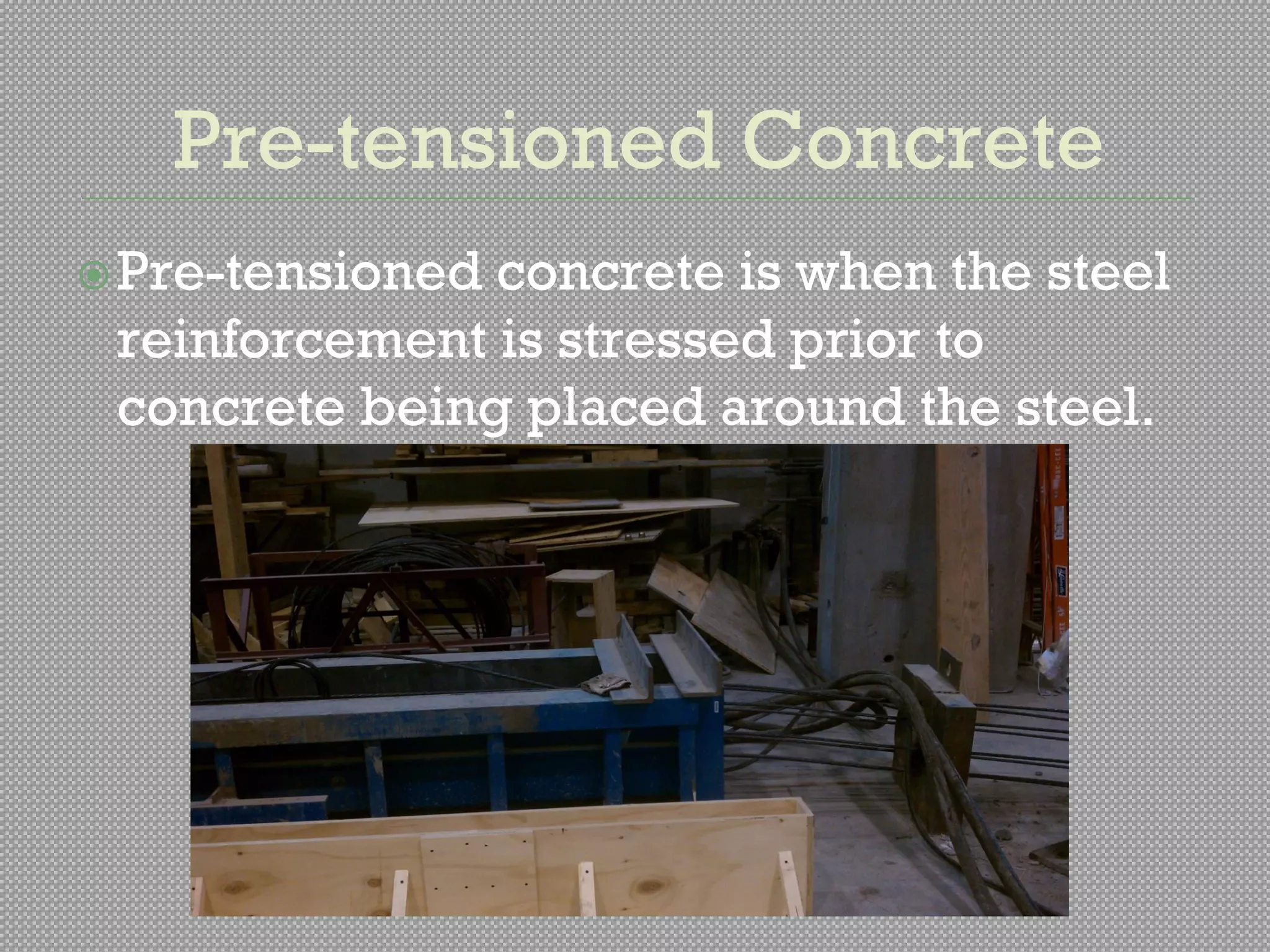
Pre-tensioned Concrete
Pre-tensioned concrete is when the steel
reinforcement is stressed prior to
concrete being placed around the steel.
Advantages of Pretension
Pretension is the easiest controlled of the
bonded stressings with the least chance
of error in the bonding process.
Tension caused by the steel is spread
throughout the length of the concrete
since it is bonded within the concrete
along the length of the member.
Concerns With Pre-tension
 Usually uses a mold
which is able to resist
the forces within the
tendons. Which are
more expensive than
regular molds.
 Exception comes
when the sides of the
mold our anchored
allowing mold to be
created between the
anchors without
supporting stress.
Concerns Cont.
 Concrete sample should be taken for every
new mix so that strength obtained may be
determined before cutting the tendons
releasing the stresses onto the concrete.
 Since pre-tension may only be set once
calculations for the camber must be correct. So,
pre-stress takes a large amount of preplanning.
Must consider self-weight deflections, pre-
stress deflections, dead load deflections, and
live load deflections.
Concerns Cont.
Since it may only tightened once and
cannot be retightened the designer must
also account for Creep of concrete,
elastic shortening of concrete, shrinkage
of concrete, relaxation of steel, slip at the
anchorage, and friction losses due to
intended and unintended (wobble)
curvature in the tendons in calculations
for the camber of the member in order to
have lasting quality of the structure.
Concerns Cont.
Pretension requires for a slightly higher
compression rating to cut the steel over
post-tensioned .6 instead of .55 of the
compressive strength of concrete at the
time of initial pre-stress before
accounting losses such as creep,
relaxation and shrinkage, and
redistribution of force effect.
Basic Common Construction Process of
Members
 Mold capable of supporting stresses created
by the steel is either delivered to job site or
molds are located off site.
 Required or preplanned pre-stresses are
determined and required reinforcement steel
is determined and set.
 Proper concrete mix is determined and placed
into molds. Self-consolidating concrete is
massively used for ease of finishing.
 Concrete is allowed to cure and reach a
needed strength great enough to support the
tension in the steel without cracking. Then
steel is cut and member is removed from mold
and is ready to install.
Prestressing Steel
(High Strength steel)
Forms
 Wires
 Strands
 Tendons
 Cables
 Bars
Source of Force
 Mechanical
 Hydraulic
 Electrical
 Chemical
Why Prestressed Concrete?
Concrete remains un-cracked
Reduction of steel corrosion
Increases durability
Good for pressure vessels
High span to depth ratio (ex: 45:1 vs. 28:1)
 less dead load
More economical
References
 www.todaysconcretetechnology.com
 www.utexas.edu
 www.dywidag-systems.com
 www.enotes.com
 www.tech9.com
 Indian Institute of Technology Madras
“Prestressed Concrete Structures”
ADVANTAGES OF PRE STRESSED CONCRETE BRIDGES
 Owners and designers
have long recognized
the low initial cost, low
maintenance needs and
long life expectancy of
prestressed concrete
bridges. This is reflected
in the increasing market
share of prestressed
concrete, which has
grown from zero in 1950
to more than 55 percent
today.
 This growth continues
very rapidly, not only for
bridges in the short span
range, but also for spans
in excess of 150 feet
which, heretofore, has
been nearly the
exclusive domain of
structural steel.
COST EFFICIENCIES AND SPEED OF CONSTRUCTION
 An old bridge located on a
main logging road in Idaho
was replaced with a
prestressed concrete bridge.
The bridge consists of integral
deck beams on precast
concrete abutments and wing
walls. The heavy spring
runoff dictated the need for a
shallow superstructure, and
the load capacity of the
bridge had to be sufficient to
carry off-highway logging
trucks that weigh as much as
110 tons each.
ALTERNATE TO STEEL BRIDGE
 The state of Minnesota
saved more than 16% -
a half a million dollars –
by planning for a
prestressed alternate to
a steel bridge.
 The 700-foot-long bridge
is jointless up to the
abutments and is the
longest continuous
bridge in the state. It also
contains the longest
single concrete span.

Prestressed concrete

  • 1.
  • 2.
    What is PrestressedConcrete?  Definition:  “Pre-stressed concrete is a form of reinforced concrete that builds in compressive stresses during construction to oppose those found when in use.”  In other words it is a combination of steel and concrete that takes advantages of the strengths of each material.
  • 3.
    3 Main Typesof Internal Prestressed Concrete  Pre-Tension Concrete: pre-stressing steel is tension stressed prior to the placement of the concrete and unloaded after concrete has harden to required strength.  Bonded post-tensioned concrete: unstressed pre-stressing steel is placed with in the concrete and then tension stressed after concrete has harden to required strength  Un-bonded post-tensioned concrete: differs from bonded post-tensioning by providing the pre- stressing steel permanent freedom of movement relative to the concrete.
  • 4.
    Pre-tensioned Concrete Pre-tensioned concreteis when the steel reinforcement is stressed prior to concrete being placed around the steel.
  • 5.
    Advantages of Pretension Pretensionis the easiest controlled of the bonded stressings with the least chance of error in the bonding process. Tension caused by the steel is spread throughout the length of the concrete since it is bonded within the concrete along the length of the member.
  • 6.
    Concerns With Pre-tension Usually uses a mold which is able to resist the forces within the tendons. Which are more expensive than regular molds.  Exception comes when the sides of the mold our anchored allowing mold to be created between the anchors without supporting stress.
  • 7.
    Concerns Cont.  Concretesample should be taken for every new mix so that strength obtained may be determined before cutting the tendons releasing the stresses onto the concrete.  Since pre-tension may only be set once calculations for the camber must be correct. So, pre-stress takes a large amount of preplanning. Must consider self-weight deflections, pre- stress deflections, dead load deflections, and live load deflections.
  • 8.
    Concerns Cont. Since itmay only tightened once and cannot be retightened the designer must also account for Creep of concrete, elastic shortening of concrete, shrinkage of concrete, relaxation of steel, slip at the anchorage, and friction losses due to intended and unintended (wobble) curvature in the tendons in calculations for the camber of the member in order to have lasting quality of the structure.
  • 9.
    Concerns Cont. Pretension requiresfor a slightly higher compression rating to cut the steel over post-tensioned .6 instead of .55 of the compressive strength of concrete at the time of initial pre-stress before accounting losses such as creep, relaxation and shrinkage, and redistribution of force effect.
  • 10.
    Basic Common ConstructionProcess of Members  Mold capable of supporting stresses created by the steel is either delivered to job site or molds are located off site.  Required or preplanned pre-stresses are determined and required reinforcement steel is determined and set.  Proper concrete mix is determined and placed into molds. Self-consolidating concrete is massively used for ease of finishing.  Concrete is allowed to cure and reach a needed strength great enough to support the tension in the steel without cracking. Then steel is cut and member is removed from mold and is ready to install.
  • 11.
    Prestressing Steel (High Strengthsteel) Forms  Wires  Strands  Tendons  Cables  Bars Source of Force  Mechanical  Hydraulic  Electrical  Chemical
  • 12.
    Why Prestressed Concrete? Concreteremains un-cracked Reduction of steel corrosion Increases durability Good for pressure vessels High span to depth ratio (ex: 45:1 vs. 28:1)  less dead load More economical
  • 13.
    References  www.todaysconcretetechnology.com  www.utexas.edu www.dywidag-systems.com  www.enotes.com  www.tech9.com  Indian Institute of Technology Madras “Prestressed Concrete Structures”
  • 14.
    ADVANTAGES OF PRESTRESSED CONCRETE BRIDGES  Owners and designers have long recognized the low initial cost, low maintenance needs and long life expectancy of prestressed concrete bridges. This is reflected in the increasing market share of prestressed concrete, which has grown from zero in 1950 to more than 55 percent today.  This growth continues very rapidly, not only for bridges in the short span range, but also for spans in excess of 150 feet which, heretofore, has been nearly the exclusive domain of structural steel.
  • 15.
    COST EFFICIENCIES ANDSPEED OF CONSTRUCTION  An old bridge located on a main logging road in Idaho was replaced with a prestressed concrete bridge. The bridge consists of integral deck beams on precast concrete abutments and wing walls. The heavy spring runoff dictated the need for a shallow superstructure, and the load capacity of the bridge had to be sufficient to carry off-highway logging trucks that weigh as much as 110 tons each.
  • 16.
    ALTERNATE TO STEELBRIDGE  The state of Minnesota saved more than 16% - a half a million dollars – by planning for a prestressed alternate to a steel bridge.  The 700-foot-long bridge is jointless up to the abutments and is the longest continuous bridge in the state. It also contains the longest single concrete span.