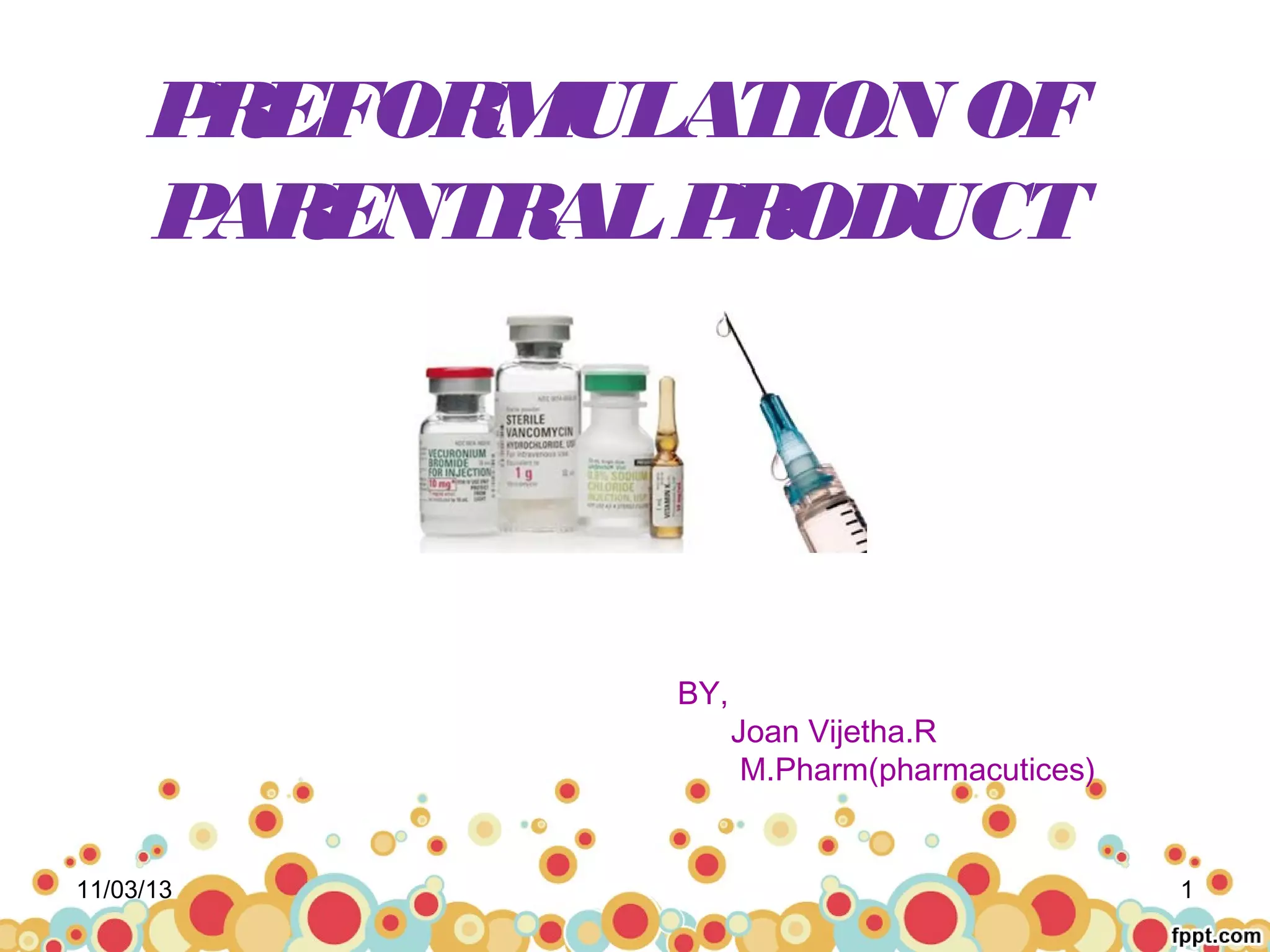
P
REFORMULATION OF
P
ARENTRAL P
RODUCT

BY,

11/03/13

Joan Vijetha.R
M.Pharm(pharmacutices)

1
CONTENT
 Introduction.
 Definition.
 Pre-formulation






11/03/13

studies

Bulk characterisation.
Solubility analysis.
Stability analysis.
Spectroscopy.
Microscopy.
Chromatography .
2
INTRODUCTION
 Pre-formulation

testing is the first step in the
rational development of dosage forms.
 Pre-formulation study is done mainly to
develop efficient dosage form.
 Gives information for design of dosage form.
 Used to identify molecular structure,
formula, molecular weight, etc.
 Therapeutic identification.
11/03/13

3
Definition
refers injectable route of
administration. It derived from Greek words
Para (Outside) and enter on (Intestine). So it
is a route of administration other than the
oral route.

 Parenteral

is done prior to
development of dosage form, it is essential
that certain fundamental physical and
chemical properties of the drug molecule and
other derivative properties of the drug is
11/03/13
4
determined.
 Per-formulation
Bulk characterisation
Bulk properties of the solid form such as
Crystallinity,
Polymorphism,
Particle size,
Powder flow property,
and
Surface characteristics are likely to change
during process development.

11/03/13

5
Crystallinity


Crystal habit and internal structure of a drug
can affect bulk and physicochemical
properties, which range form flow ability to
chemical stability.



The crystal habit describes the outer
appearance of crystals( plate, equate, needle,
bladed, etc.) and internal structure
arrangement.

11/03/13

6
Polymorphism
polymorphism is the ability of the
compound to crystallize as more than one
distinct crystalline species with different
internal structure.
 Formation of different polymorphs depends
on solvents, temperature, pressure, rate of
cooling, etc.
 Polymorphic transitions can also occur
during milling, granulating, drying and
compressing operations
 Different polymorphs vary in physical
properties such as dissolution, solid-state
11/03/13
7
stability, compatibility, etc.

Particle size







Study of particle size give an information about
solubility, dissolution rate, absorption, etc.
Fine particle characterization very important
property and here smallest particle should be tested
to facilitate homogeneous sample preparation.
Counter current Technique-To check particle size
and particle volume
BET (Brunauer, Emmet, Teller) Nitrogen
Adsorption Apparatus -Measurement of surface area
SEM( Scanning Electron Microscopy)- to check
surface morphology .

11/03/13

8
Powder flow property


The flow properties of a powder will
determine the nature and quantity of
excipients needed to prepare a
compressed or a powder dosage form.



This refers mainly to factors such
as the ability to process the powder
through machines.

11/03/13

9
HYGROSCOPICITY
 The

tendency of a solid to take up
water from the atmosphere, as it is
subjected to a controlled RH program
under isothermal condition i.e.
hygroscopicity.

 Classified

based on the amount of rate
of water uptake when a solid is exposed
to controlled RH value at a specified
11/03/13
10
temperature.
SOLUBILITY ANALYSIS
 Aqueous

Solubility
 Drug Pka / Ionization At Physiological
Ph
 Partition Coefficient
 Thermal effect

11/03/13

11
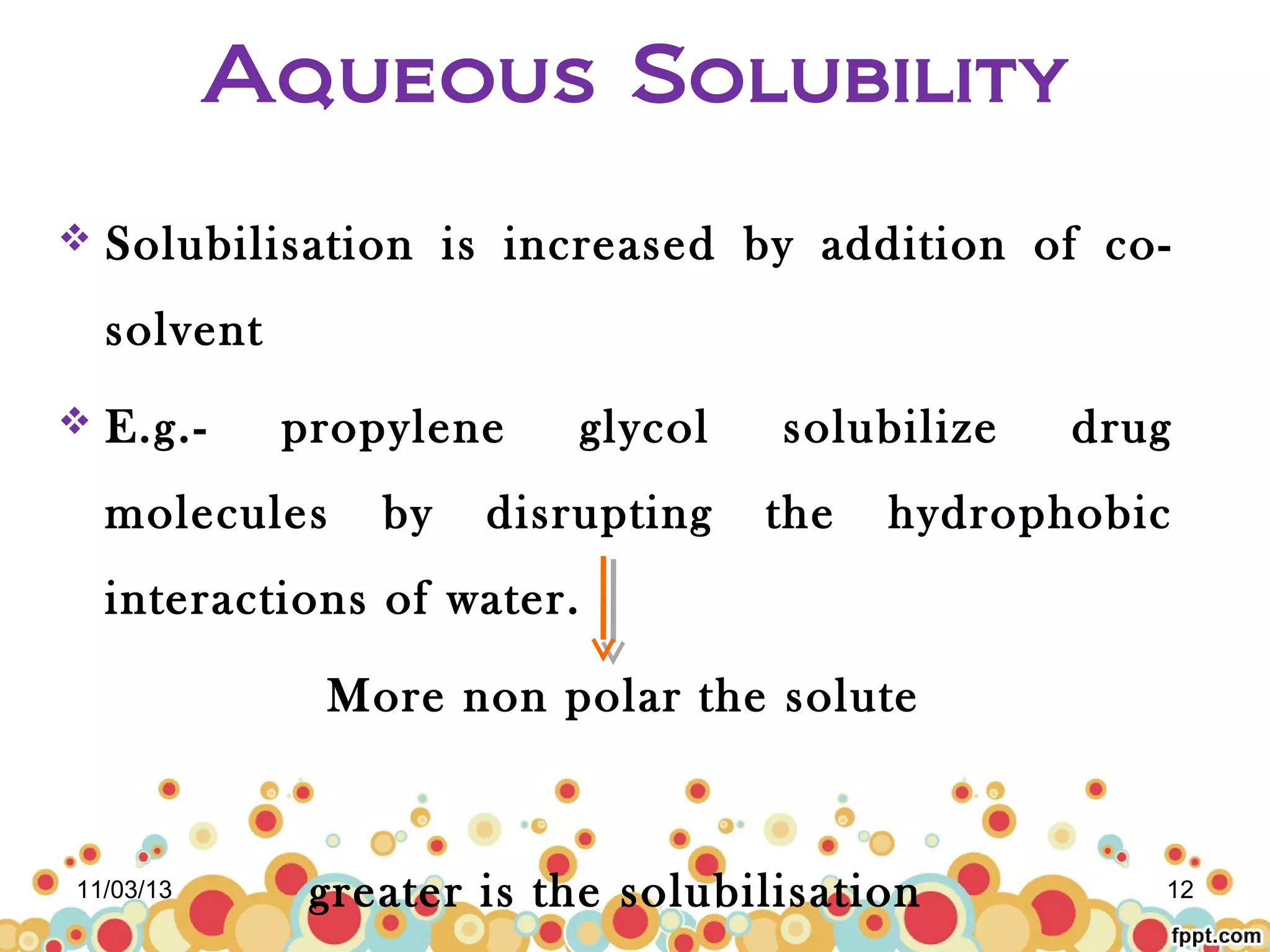
Aqueous Solubility


Solubilisation is increased by addition of cosolvent



E.g.-

propylene

molecules

by

glycol

disrupting

solubilize
the

drug

hydrophobic

interactions of water.
More non polar the solute

11/03/13

greater is the solubilisation

12
Drug pKa / Ionization at
physiological pH


pKa is the dissociation constant of a
drug.



The non ionized substances is lipid
soluble thus dissolve in lipid material
of the membrane and transported by
passive diffusion.

11/03/13


Where as, the ionized substances is 13


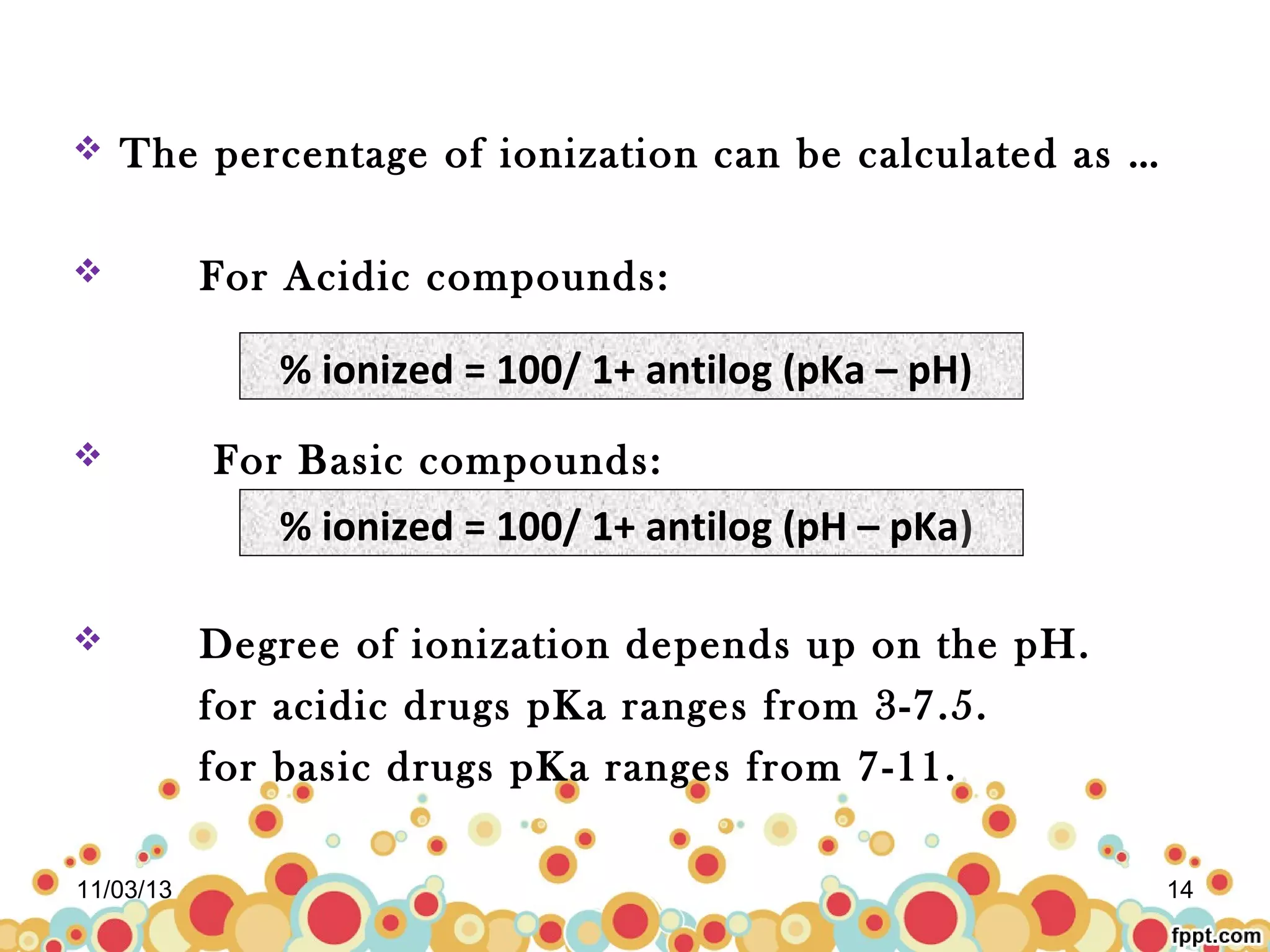
The percentage of ionization can be calculated as …



For Acidic compounds:

% ionized = 100/ 1+ antilog (pKa – pH)


For Basic compounds:

% ionized = 100/ 1+ antilog (pH – pKa)


11/03/13

Degree of ionization depends up on the pH.
for acidic drugs pKa ranges from 3-7.5.
for basic drugs pKa ranges from 7-11.
14
PARTITION COEFFICIENT
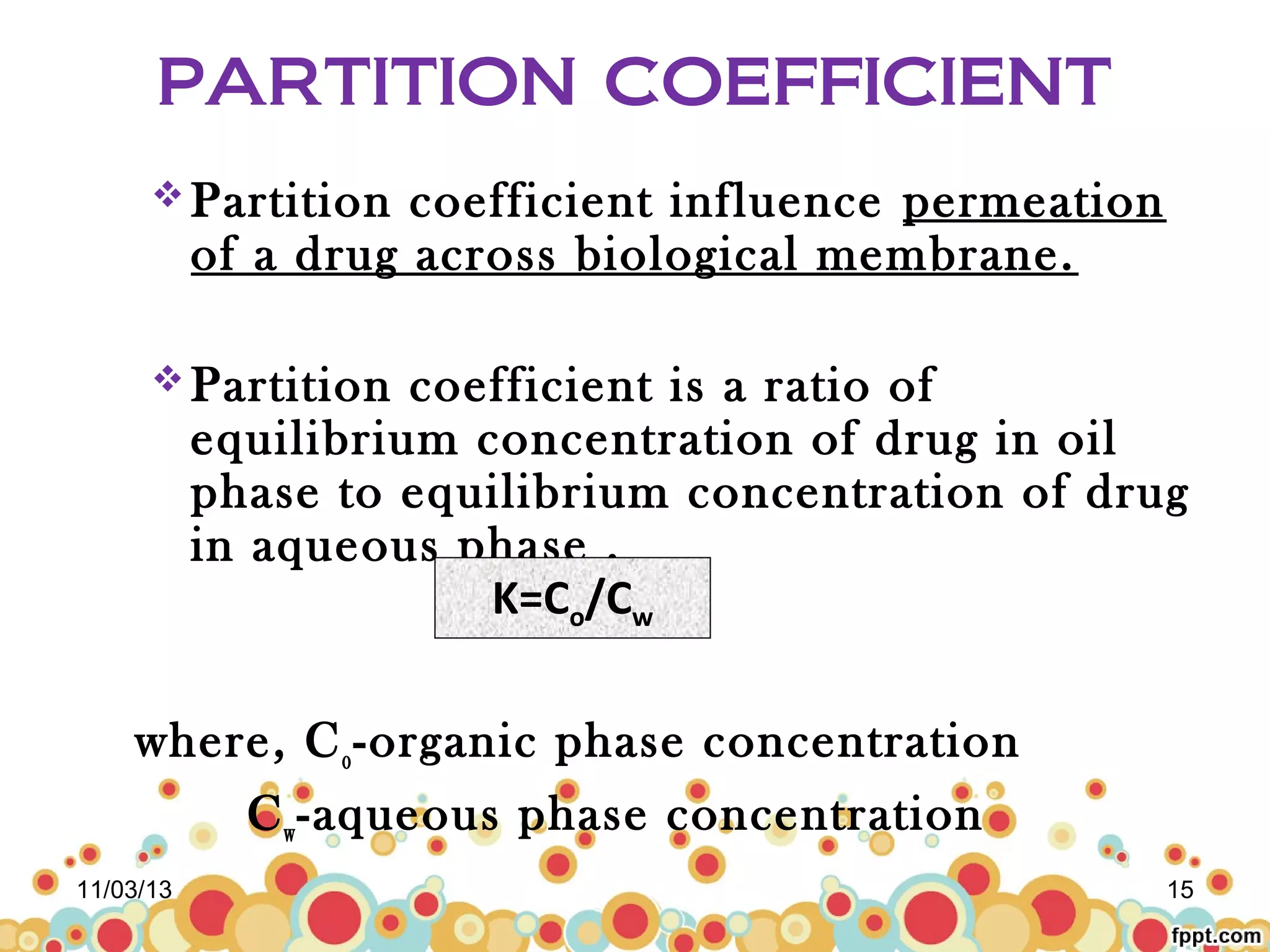
 Partition

coefficient influence permeation
of a drug across biological membrane.

 Partition

coefficient is a ratio of
equilibrium concentration of drug in oil
phase to equilibrium concentration of drug
in aqueous phase .
K=Co/Cw

where, C o -organic phase concentration
C w -aqueous phase concentration
11/03/13

15
THERMAL/HEAT
EFFECTS
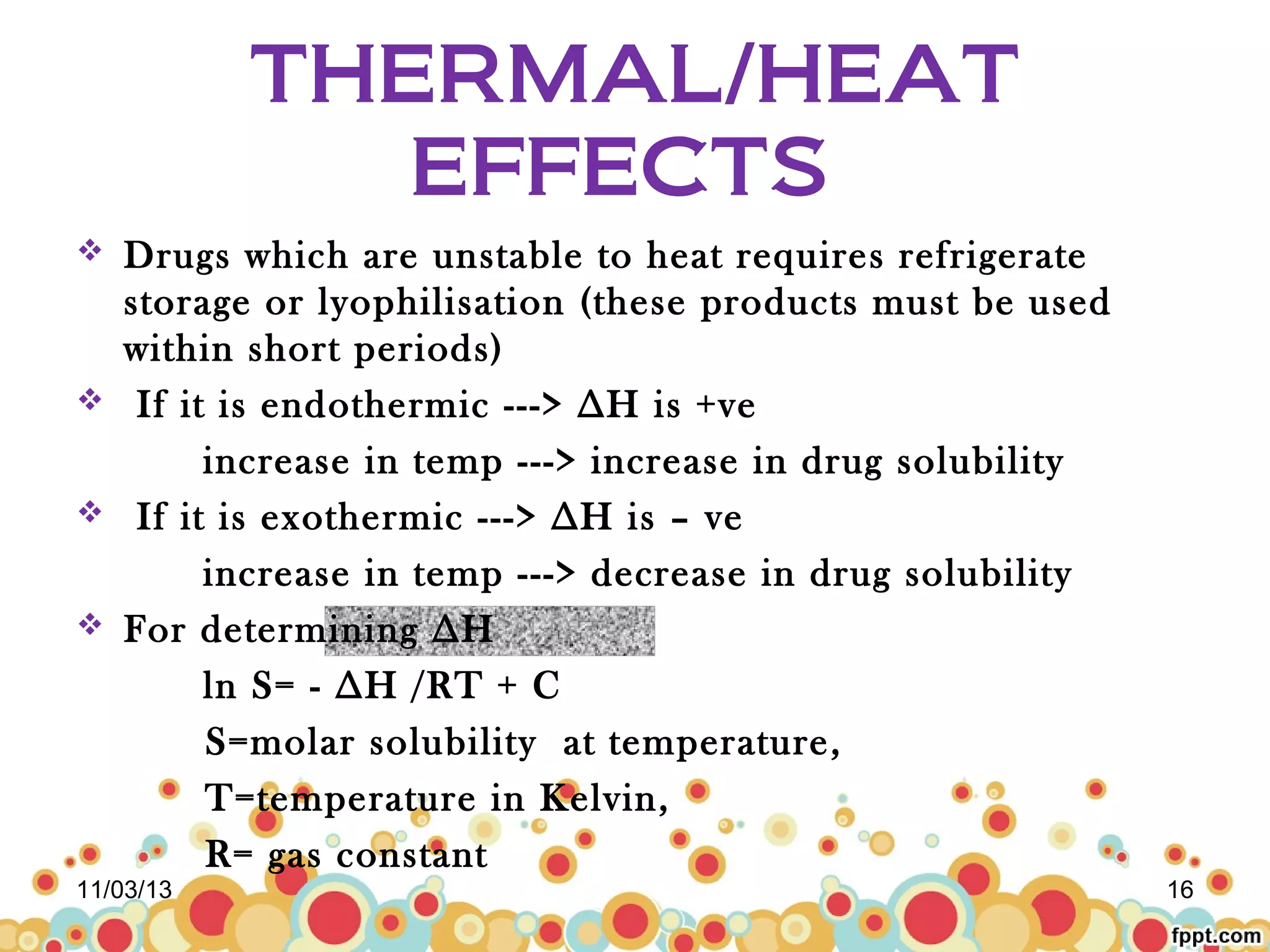
Drugs which are unstable to heat requires refrigerate
storage or lyophilisation (these products must be used
within short periods)
 If it is endothermic ---> ∆H is +ve
increase in temp ---> increase in drug solubility
 If it is exothermic ---> ∆H is – ve
increase in temp ---> decrease in drug solubility
 For determining ∆H
ln S= - ∆H /RT + C
S=molar solubility at temperature,
T=temperature in Kelvin,
R= gas constant


11/03/13

16
Stability analysis
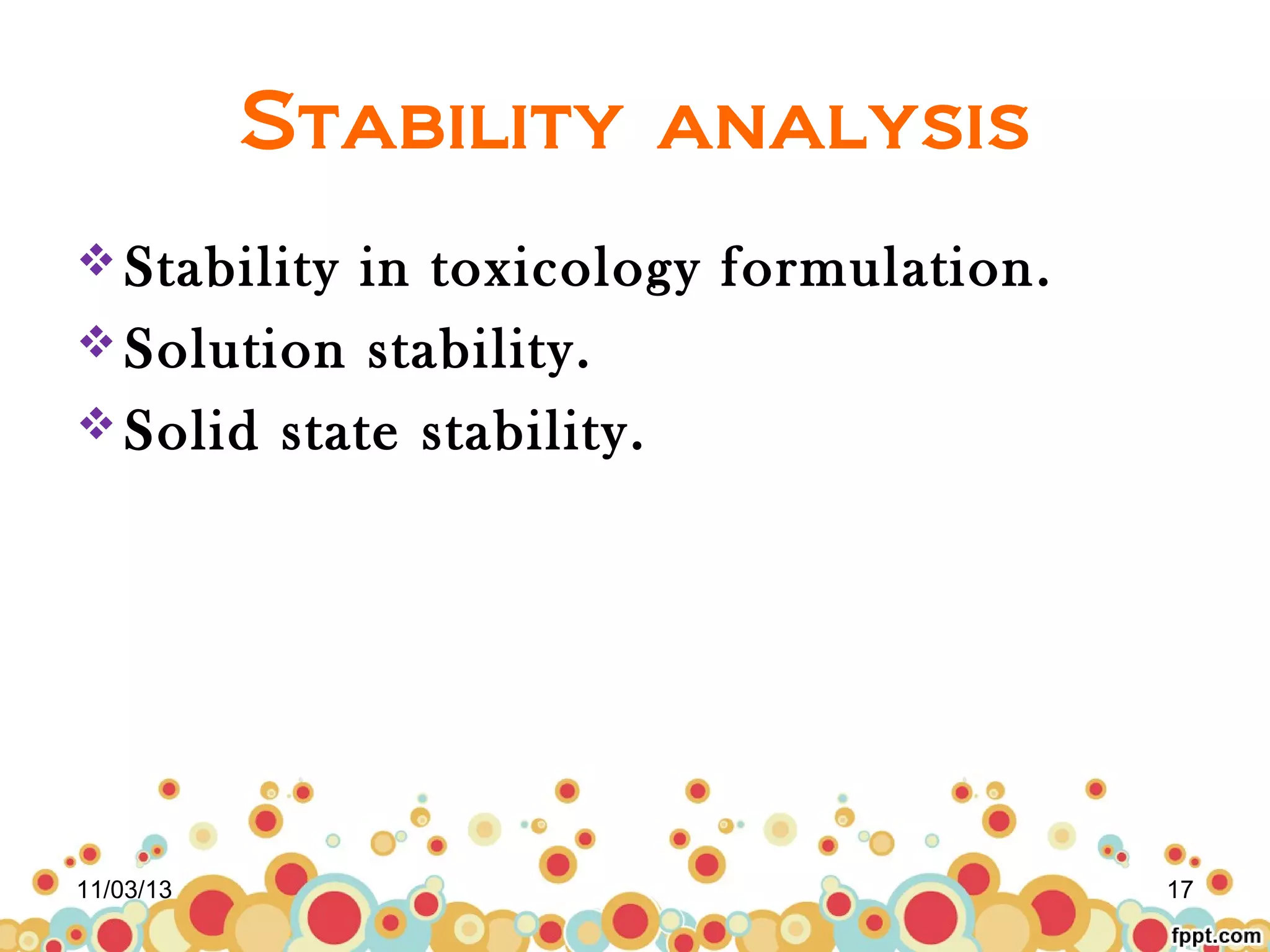
 Stability

in toxicology formulation.
 Solution stability.
 Solid state stability.

11/03/13

17
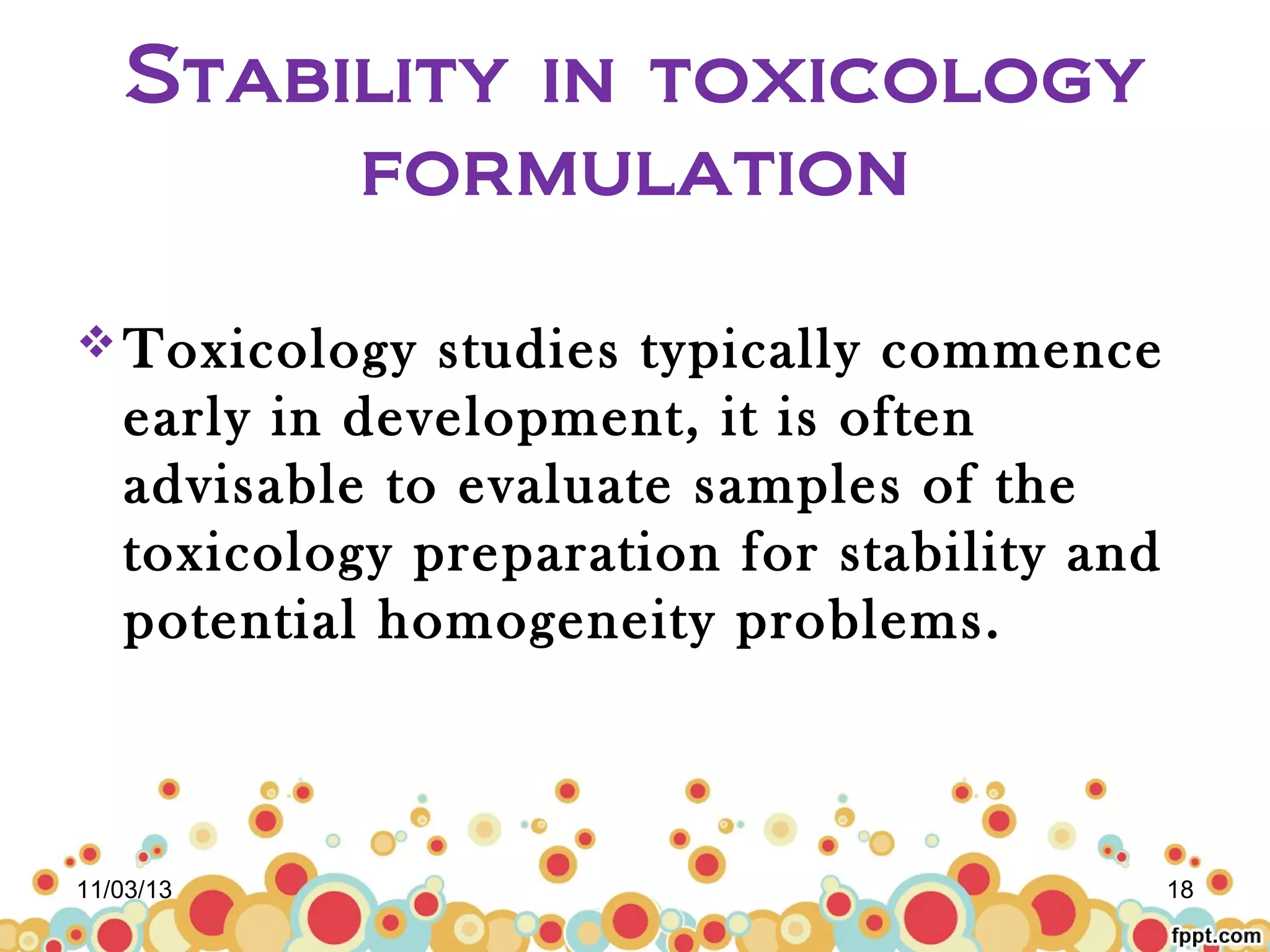
Stability in toxicology
formulation
 Toxicology

studies typically commence
early in development, it is often
advisable to evaluate samples of the
toxicology preparation for stability and
potential homogeneity problems.

11/03/13

18
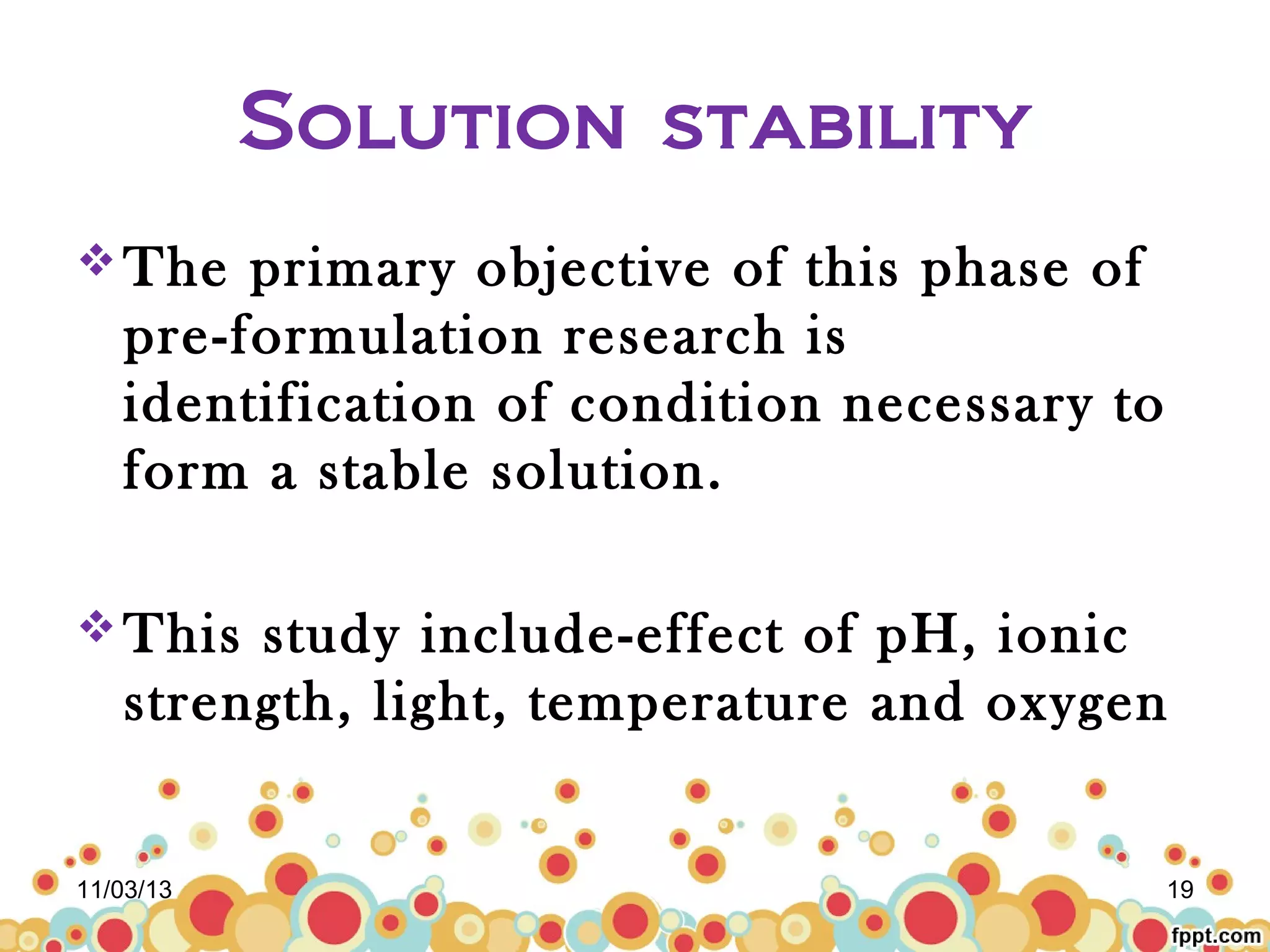
Solution stability
 The

primary objective of this phase of
pre-formulation research is
identification of condition necessary to
form a stable solution.

 This

study include-effect of pH, ionic
strength, light, temperature and oxygen

11/03/13

19
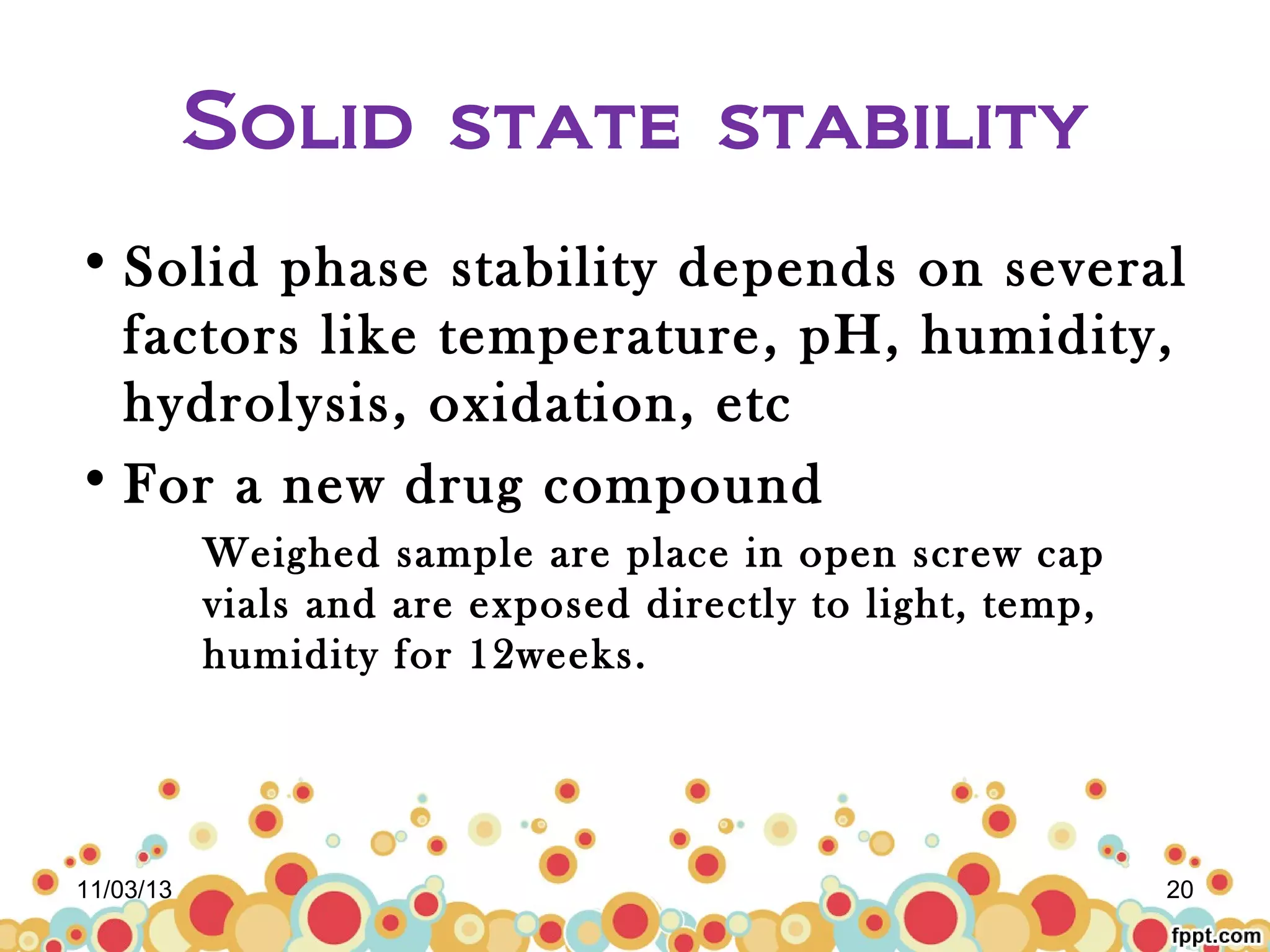
Solid state stability
• Solid phase stability depends on several
factors like temperature, pH, humidity,
hydrolysis, oxidation, etc
• For a new drug compound
Weighed sample are place in open screw cap
vials and are exposed directly to light, temp,
humidity for 12weeks.

11/03/13

20
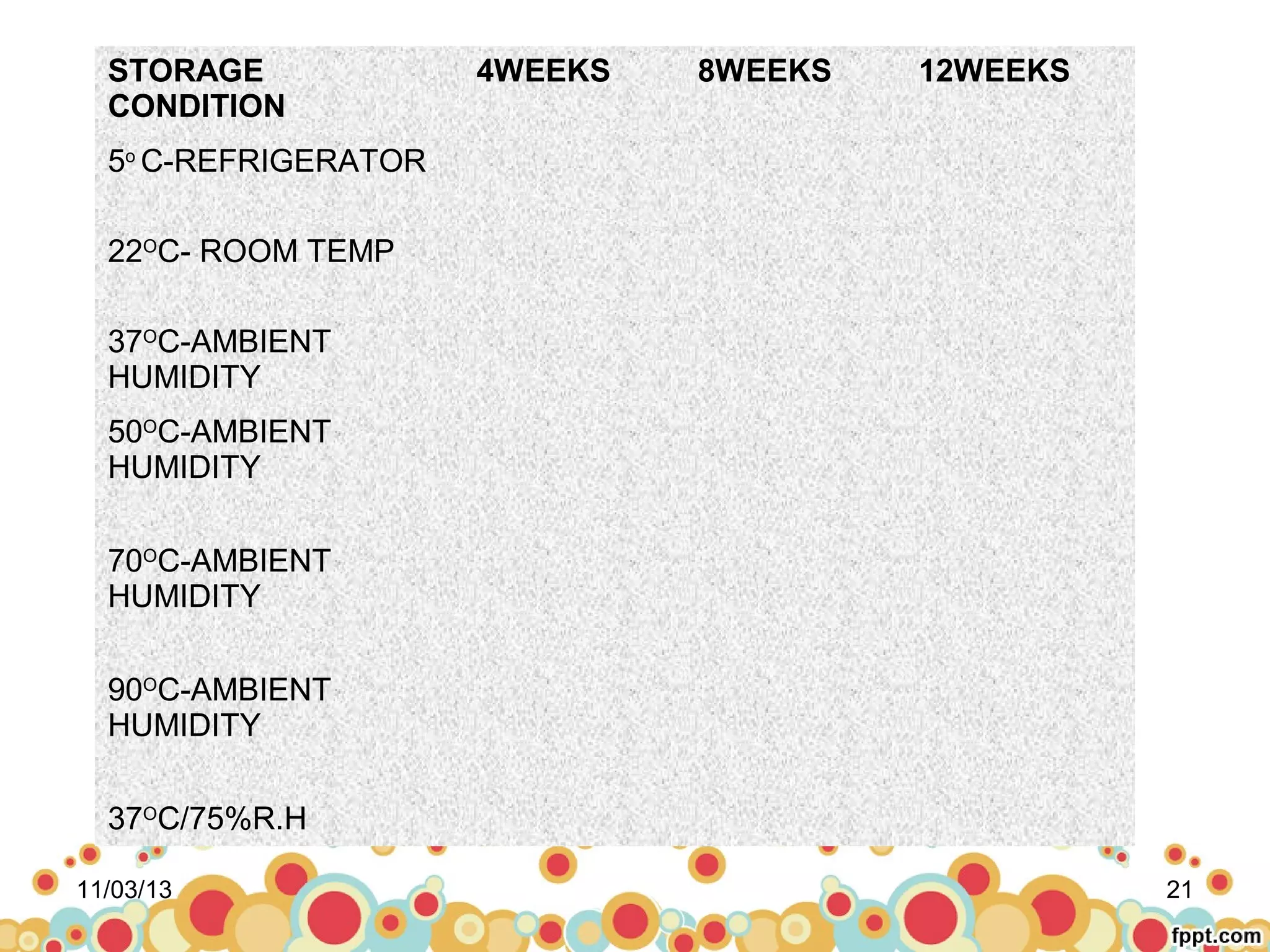
STORAGE
CONDITION

4WEEKS

8WEEKS

12WEEKS

5o C-REFRIGERATOR
22OC- ROOM TEMP
37OC-AMBIENT
HUMIDITY
50OC-AMBIENT
HUMIDITY
70OC-AMBIENT
HUMIDITY
90OC-AMBIENT
HUMIDITY
37OC/75%R.H
11/03/13

21
Hydrolysis
 Important

factor in drug stability.
 Hydrolytic reaction involves
nucleophilic attack.
 The condition catalysis the brake down
as follows
•
•
•

11/03/13

Presence of OH.
Presence of divalent metal ion.
Presence of light and heat.
22
Oxidation and
Reduction
 Oxidation

is controlled by
environment(i.e.) light, oxygen &
oxidizing agent.
 Reduction is based on redox reaction
where there is mutual change in
electrons.

11/03/13

23
Spectroscopy
UV and Visible Spectrophotometry: When
organic molecules in solution, or as liquid, are
exposed to light in the visible and ultraviolet
light regions of spectrum, they absorb light of
particular wavelengths depending on the type
of electronic transition that is associated with
the absorption.
 IR Spectrophotometer: The study of the
interaction of electromagnetic radiation with
vibrational and rotational resonances within a
molecular structure is termed as IR
Spectroscopy.
 X-Ray Diffraction: When a beam of non
homogenous x-rays is allowed to pass through 24
11/03/13

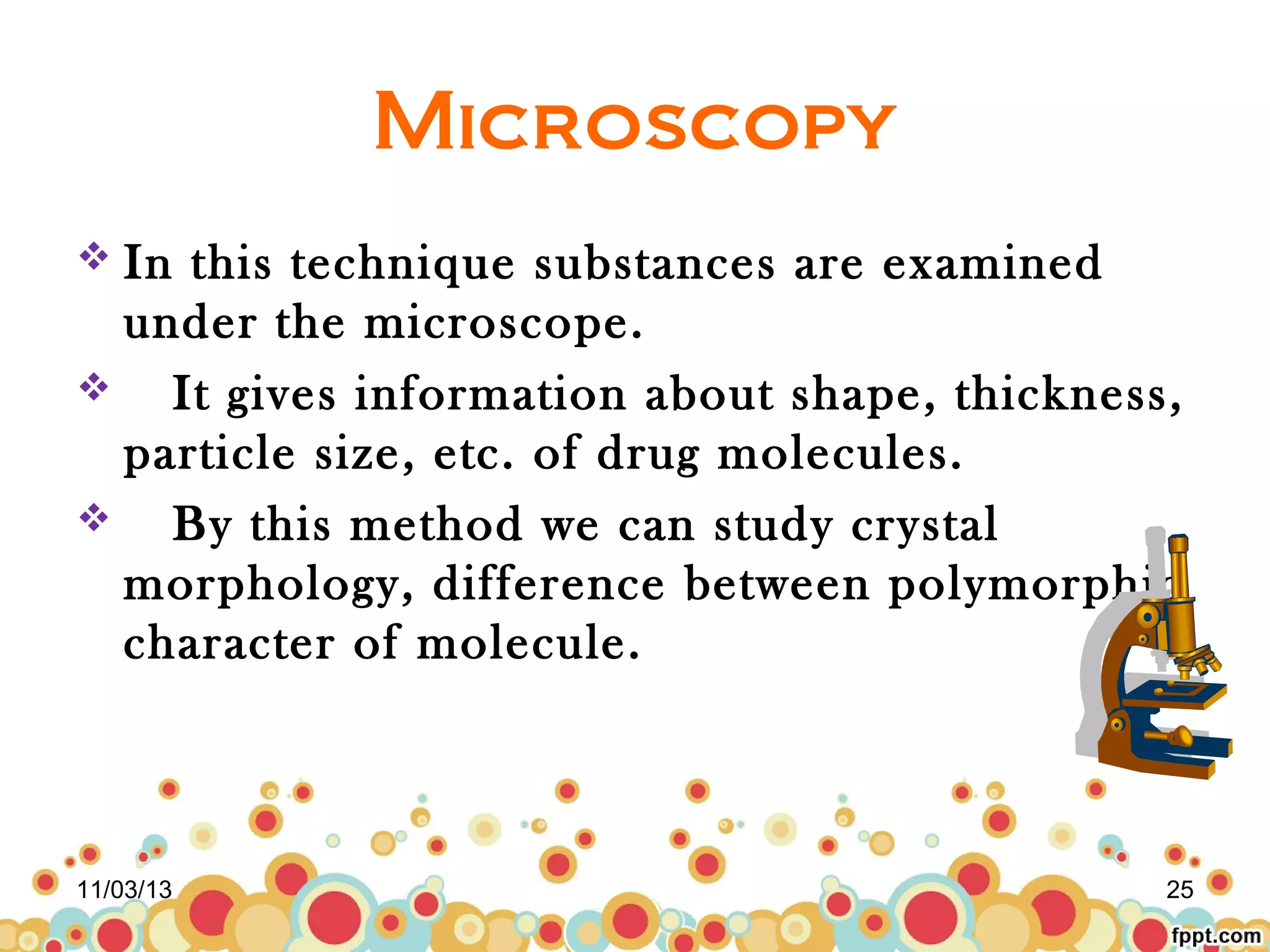
Microscopy
 In

this technique substances are examined
under the microscope.

It gives information about shape, thickness,
particle size, etc. of drug molecules.

By this method we can study crystal
morphology, difference between polymorphic
character of molecule.

11/03/13

25
Chromatography
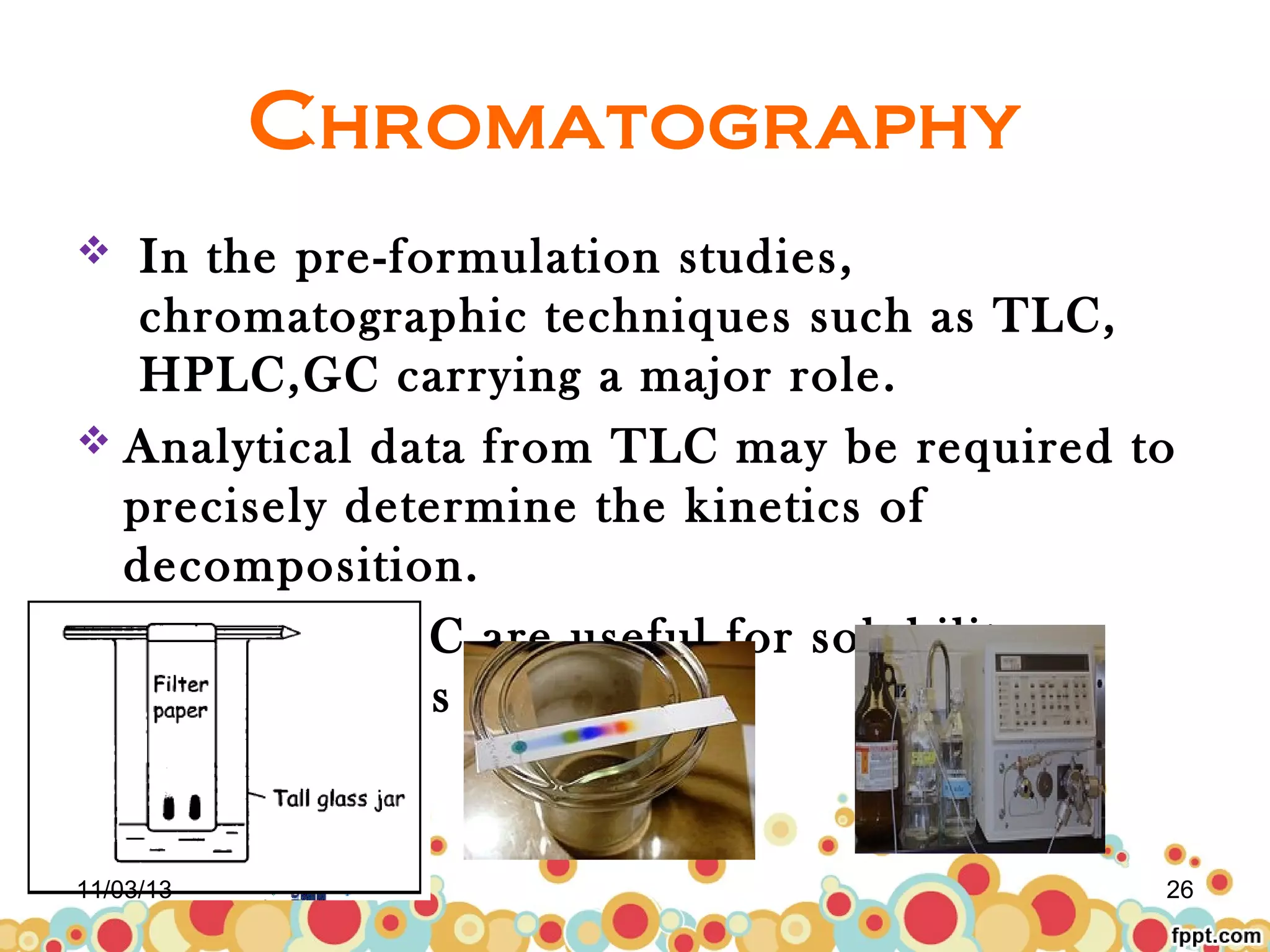
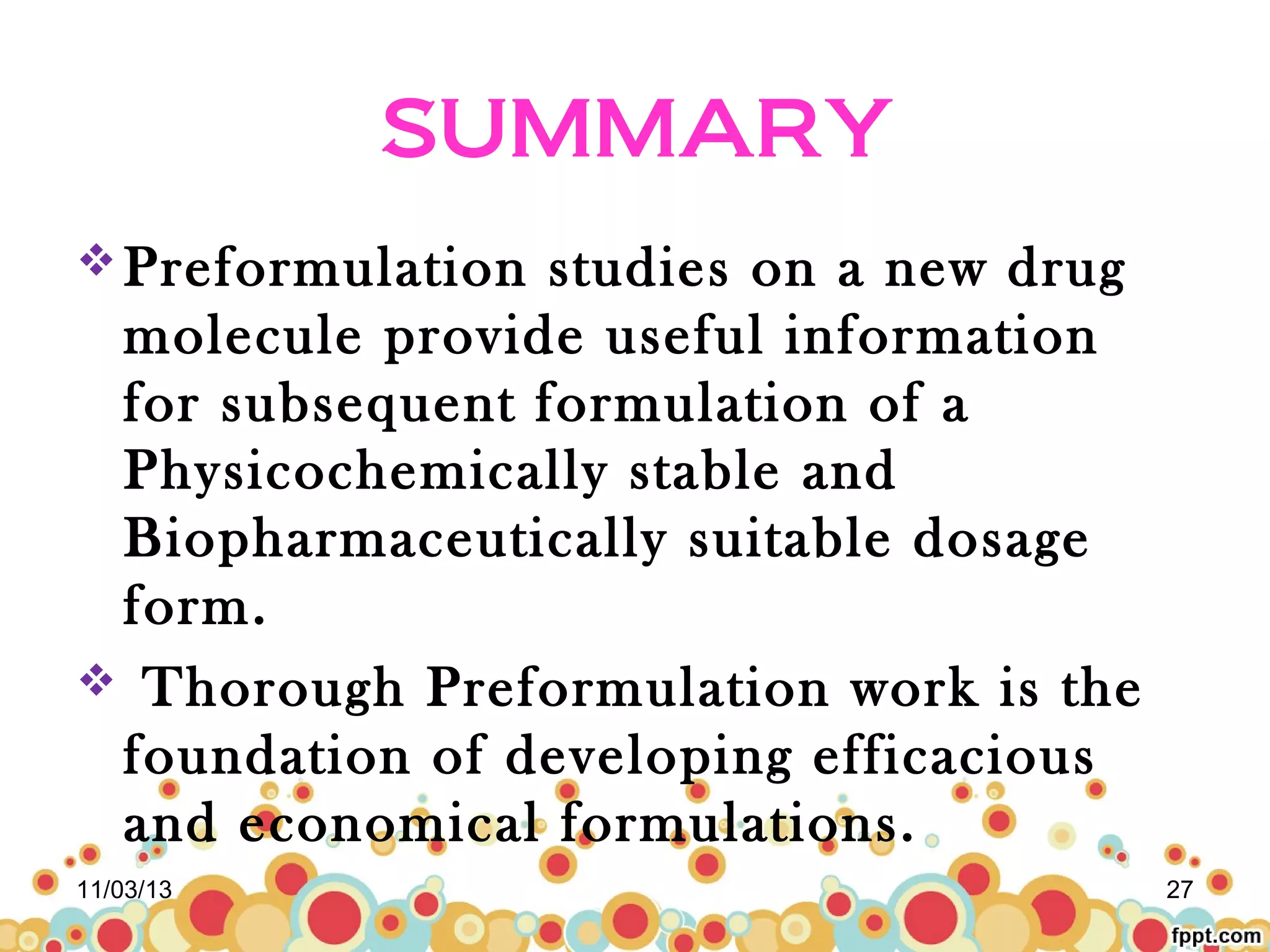
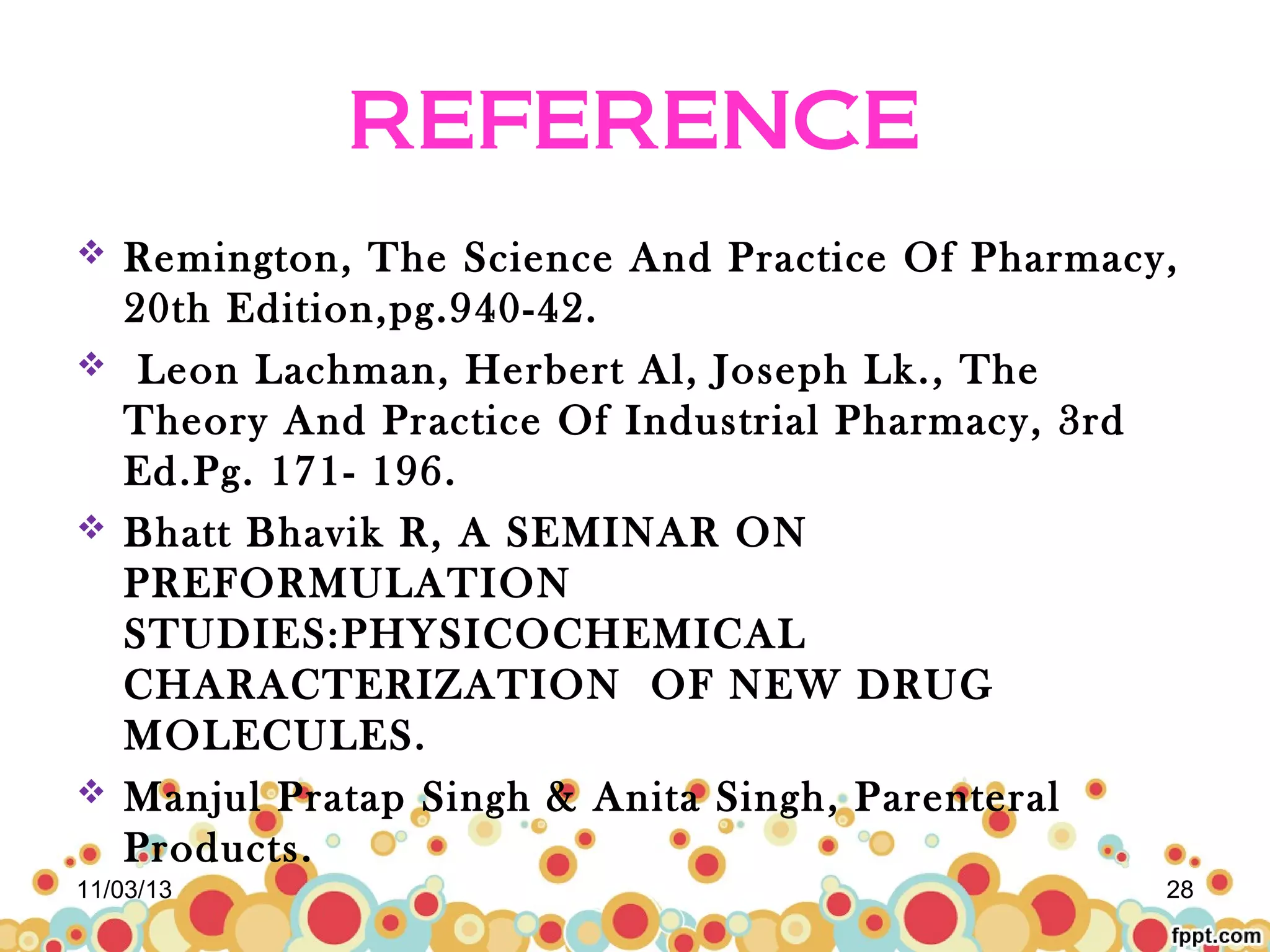
In the pre-formulation studies,
chromatographic techniques such as TLC,
HPLC,GC carrying a major role.
 Analytical data from TLC may be required to
precisely determine the kinetics of
decomposition.
 HPLC and GC are useful for solubility
measurements


11/03/13

26
SUMMARY
 Preformulation

studies on a new drug
molecule provide useful information
for subsequent formulation of a
Physicochemically stable and
Biopharmaceutically suitable dosage
form.
 Thorough Preformulation work is the
foundation of developing efficacious
and economical formulations.
11/03/13

27
REFERENCE







Remington, The Science And Practice Of Pharmacy,
20th Edition,pg.940-42.
Leon Lachman, Herbert Al, Joseph Lk., The
Theory And Practice Of Industrial Pharmacy, 3rd
Ed.Pg. 171- 196.
Bhatt Bhavik R, A SEMINAR ON
PREFORMULATION
STUDIES:PHYSICOCHEMICAL
CHARACTERIZATION OF NEW DRUG
MOLECULES.
Manjul Pratap Singh & Anita Singh, Parenteral
Products.

11/03/13

28
THANK You...

THANK
You...

THANK
THANK You...

11/03/13

29

Pre formulation

  • 1.
  • 2.
    CONTENT  Introduction.  Definition. Pre-formulation       11/03/13 studies Bulk characterisation. Solubility analysis. Stability analysis. Spectroscopy. Microscopy. Chromatography . 2
  • 3.
    INTRODUCTION  Pre-formulation testing isthe first step in the rational development of dosage forms.  Pre-formulation study is done mainly to develop efficient dosage form.  Gives information for design of dosage form.  Used to identify molecular structure, formula, molecular weight, etc.  Therapeutic identification. 11/03/13 3
  • 4.
    Definition refers injectable routeof administration. It derived from Greek words Para (Outside) and enter on (Intestine). So it is a route of administration other than the oral route.  Parenteral is done prior to development of dosage form, it is essential that certain fundamental physical and chemical properties of the drug molecule and other derivative properties of the drug is 11/03/13 4 determined.  Per-formulation
  • 5.
    Bulk characterisation Bulk propertiesof the solid form such as Crystallinity, Polymorphism, Particle size, Powder flow property, and Surface characteristics are likely to change during process development. 11/03/13 5
  • 6.
    Crystallinity  Crystal habit andinternal structure of a drug can affect bulk and physicochemical properties, which range form flow ability to chemical stability.  The crystal habit describes the outer appearance of crystals( plate, equate, needle, bladed, etc.) and internal structure arrangement. 11/03/13 6
  • 7.
    Polymorphism polymorphism is theability of the compound to crystallize as more than one distinct crystalline species with different internal structure.  Formation of different polymorphs depends on solvents, temperature, pressure, rate of cooling, etc.  Polymorphic transitions can also occur during milling, granulating, drying and compressing operations  Different polymorphs vary in physical properties such as dissolution, solid-state 11/03/13 7 stability, compatibility, etc. 
  • 8.
    Particle size      Study ofparticle size give an information about solubility, dissolution rate, absorption, etc. Fine particle characterization very important property and here smallest particle should be tested to facilitate homogeneous sample preparation. Counter current Technique-To check particle size and particle volume BET (Brunauer, Emmet, Teller) Nitrogen Adsorption Apparatus -Measurement of surface area SEM( Scanning Electron Microscopy)- to check surface morphology . 11/03/13 8
  • 9.
    Powder flow property  Theflow properties of a powder will determine the nature and quantity of excipients needed to prepare a compressed or a powder dosage form.  This refers mainly to factors such as the ability to process the powder through machines. 11/03/13 9
  • 10.
    HYGROSCOPICITY  The tendency ofa solid to take up water from the atmosphere, as it is subjected to a controlled RH program under isothermal condition i.e. hygroscopicity.  Classified based on the amount of rate of water uptake when a solid is exposed to controlled RH value at a specified 11/03/13 10 temperature.
  • 11.
    SOLUBILITY ANALYSIS  Aqueous Solubility Drug Pka / Ionization At Physiological Ph  Partition Coefficient  Thermal effect 11/03/13 11
  • 12.
    Aqueous Solubility  Solubilisation isincreased by addition of cosolvent  E.g.- propylene molecules by glycol disrupting solubilize the drug hydrophobic interactions of water. More non polar the solute 11/03/13 greater is the solubilisation 12
  • 13.
    Drug pKa /Ionization at physiological pH  pKa is the dissociation constant of a drug.  The non ionized substances is lipid soluble thus dissolve in lipid material of the membrane and transported by passive diffusion. 11/03/13  Where as, the ionized substances is 13
  • 14.
     The percentage ofionization can be calculated as …  For Acidic compounds: % ionized = 100/ 1+ antilog (pKa – pH)  For Basic compounds: % ionized = 100/ 1+ antilog (pH – pKa)  11/03/13 Degree of ionization depends up on the pH. for acidic drugs pKa ranges from 3-7.5. for basic drugs pKa ranges from 7-11. 14
  • 15.
    PARTITION COEFFICIENT  Partition coefficientinfluence permeation of a drug across biological membrane.  Partition coefficient is a ratio of equilibrium concentration of drug in oil phase to equilibrium concentration of drug in aqueous phase . K=Co/Cw where, C o -organic phase concentration C w -aqueous phase concentration 11/03/13 15
  • 16.
    THERMAL/HEAT EFFECTS Drugs which areunstable to heat requires refrigerate storage or lyophilisation (these products must be used within short periods)  If it is endothermic ---> ∆H is +ve increase in temp ---> increase in drug solubility  If it is exothermic ---> ∆H is – ve increase in temp ---> decrease in drug solubility  For determining ∆H ln S= - ∆H /RT + C S=molar solubility at temperature, T=temperature in Kelvin, R= gas constant  11/03/13 16
  • 17.
    Stability analysis  Stability intoxicology formulation.  Solution stability.  Solid state stability. 11/03/13 17
  • 18.
    Stability in toxicology formulation Toxicology studies typically commence early in development, it is often advisable to evaluate samples of the toxicology preparation for stability and potential homogeneity problems. 11/03/13 18
  • 19.
    Solution stability  The primaryobjective of this phase of pre-formulation research is identification of condition necessary to form a stable solution.  This study include-effect of pH, ionic strength, light, temperature and oxygen 11/03/13 19
  • 20.
    Solid state stability •Solid phase stability depends on several factors like temperature, pH, humidity, hydrolysis, oxidation, etc • For a new drug compound Weighed sample are place in open screw cap vials and are exposed directly to light, temp, humidity for 12weeks. 11/03/13 20
  • 21.
    STORAGE CONDITION 4WEEKS 8WEEKS 12WEEKS 5o C-REFRIGERATOR 22OC- ROOMTEMP 37OC-AMBIENT HUMIDITY 50OC-AMBIENT HUMIDITY 70OC-AMBIENT HUMIDITY 90OC-AMBIENT HUMIDITY 37OC/75%R.H 11/03/13 21
  • 22.
    Hydrolysis  Important factor indrug stability.  Hydrolytic reaction involves nucleophilic attack.  The condition catalysis the brake down as follows • • • 11/03/13 Presence of OH. Presence of divalent metal ion. Presence of light and heat. 22
  • 23.
    Oxidation and Reduction  Oxidation iscontrolled by environment(i.e.) light, oxygen & oxidizing agent.  Reduction is based on redox reaction where there is mutual change in electrons. 11/03/13 23
  • 24.
    Spectroscopy UV and VisibleSpectrophotometry: When organic molecules in solution, or as liquid, are exposed to light in the visible and ultraviolet light regions of spectrum, they absorb light of particular wavelengths depending on the type of electronic transition that is associated with the absorption.  IR Spectrophotometer: The study of the interaction of electromagnetic radiation with vibrational and rotational resonances within a molecular structure is termed as IR Spectroscopy.  X-Ray Diffraction: When a beam of non homogenous x-rays is allowed to pass through 24 11/03/13 
  • 25.
    Microscopy  In this techniquesubstances are examined under the microscope.  It gives information about shape, thickness, particle size, etc. of drug molecules.  By this method we can study crystal morphology, difference between polymorphic character of molecule. 11/03/13 25
  • 26.
    Chromatography In the pre-formulationstudies, chromatographic techniques such as TLC, HPLC,GC carrying a major role.  Analytical data from TLC may be required to precisely determine the kinetics of decomposition.  HPLC and GC are useful for solubility measurements  11/03/13 26
  • 27.
    SUMMARY  Preformulation studies ona new drug molecule provide useful information for subsequent formulation of a Physicochemically stable and Biopharmaceutically suitable dosage form.  Thorough Preformulation work is the foundation of developing efficacious and economical formulations. 11/03/13 27
  • 28.
    REFERENCE     Remington, The ScienceAnd Practice Of Pharmacy, 20th Edition,pg.940-42. Leon Lachman, Herbert Al, Joseph Lk., The Theory And Practice Of Industrial Pharmacy, 3rd Ed.Pg. 171- 196. Bhatt Bhavik R, A SEMINAR ON PREFORMULATION STUDIES:PHYSICOCHEMICAL CHARACTERIZATION OF NEW DRUG MOLECULES. Manjul Pratap Singh & Anita Singh, Parenteral Products. 11/03/13 28
  • 29.