Practical Security for Agile and DevOps 1st Edition Mark S Merkow
Practical Security for Agile and DevOps 1st Edition Mark S Merkow
Practical Security for Agile and DevOps 1st Edition Mark S Merkow
Practical Security for Agile and DevOps 1st Edition Mark S Merkow
Practical Security for Agile and DevOps 1st Edition Mark S Merkow
1.
Read Anytime AnywhereEasy Ebook Downloads at ebookmeta.com
Practical Security for Agile and DevOps 1st
Edition Mark S Merkow
https://ebookmeta.com/product/practical-security-for-agile-
and-devops-1st-edition-mark-s-merkow/
OR CLICK HERE
DOWLOAD EBOOK
Visit and Get More Ebook Downloads Instantly at https://ebookmeta.com
2.
Recommended digital products(PDF, EPUB, MOBI) that
you can download immediately if you are interested.
Practical Linux DevOps: Building a Linux Lab for Modern
Software Development 1st Edition John S. Tonello
https://ebookmeta.com/product/practical-linux-devops-building-a-linux-
lab-for-modern-software-development-1st-edition-john-s-tonello/
ebookmeta.com
Hands-On Guide to AgileOps: A Guide to Implementing Agile,
DevOps, and SRE for Cloud Operations 1st Edition Sabharwal
https://ebookmeta.com/product/hands-on-guide-to-agileops-a-guide-to-
implementing-agile-devops-and-sre-for-cloud-operations-1st-edition-
sabharwal/
ebookmeta.com
Model Driven DevOps Increasing agility and security in
your physical network through DevOps 1st Edition Steven
Carter
https://ebookmeta.com/product/model-driven-devops-increasing-agility-
and-security-in-your-physical-network-through-devops-1st-edition-
steven-carter/
ebookmeta.com
Language Acquisition second edition The Growth of Grammar
A Bradford Book Maria Teresa Guasti
https://ebookmeta.com/product/language-acquisition-second-edition-the-
growth-of-grammar-a-bradford-book-maria-teresa-guasti/
ebookmeta.com
3.
Letters from RisingPharmacy Stars Advice on Creating and
Advancing Your Career in a Changing Profession 1st Edition
Susan A. Cantrell
https://ebookmeta.com/product/letters-from-rising-pharmacy-stars-
advice-on-creating-and-advancing-your-career-in-a-changing-
profession-1st-edition-susan-a-cantrell/
ebookmeta.com
Reimagining Prosperity: Social and Economic Development in
Post-COVID India 1st Edition Arash Fazli
https://ebookmeta.com/product/reimagining-prosperity-social-and-
economic-development-in-post-covid-india-1st-edition-arash-fazli/
ebookmeta.com
The Czars 1st Edition James P Duffy Vincent L Ricci
https://ebookmeta.com/product/the-czars-1st-edition-james-p-duffy-
vincent-l-ricci/
ebookmeta.com
You're a Mean One, Matthew Prince (Boy Meets Boy 2) 1st
Edition Timothy Janovsky
https://ebookmeta.com/product/youre-a-mean-one-matthew-prince-boy-
meets-boy-2-1st-edition-timothy-janovsky-2/
ebookmeta.com
Officer Slater Mountain Man Police Force Book 1 1st
Edition Flora Madison
https://ebookmeta.com/product/officer-slater-mountain-man-police-
force-book-1-1st-edition-flora-madison-2/
ebookmeta.com
4.
The Dynamics ofModern Rugby 1st Edition Bruce Davies
https://ebookmeta.com/product/the-dynamics-of-modern-rugby-1st-
edition-bruce-davies/
ebookmeta.com
Boca Raton LondonNew York
CRC Press is an imprint of the
Taylor & Francis Group, an informa business
AN AUERBACH BO O K
Practical Security
for Agile and
DevOps
Mark S. Merkow, CISSP, CISM, CSSLP
Trademarks Used inThis Publication
Adobe is a registered trademark of Adobe, Inc., in San Jose, CA.
Alert Logic is a registered trademark of Alert Logic Inc., in Houston, TX.
Amazon, Amazon Web Services, and AWS are registered trademarks of Amazon Technologies, Inc., in Seattle, WA.
Atlassian and Jira are registered trademarks of Atlassian Pty Ltd., Sydney, Australia.
Azure is a registered trademark of Microsoft Corporation, in Redmond, WA (on hold pending further action as of
2019/09).
Barracuda is a registered trademark of Barracuda Networks Inc., in Campbell, CA.
Cigital is a registered trademark of Synopsys, Inc., in Mountain View, CA.
Citrix is a registered trademark of Citrix Systems, Inc.
Contrast Security is a registered trademark of Contrast Security, Inc., in Los Altos, CA.
CSSLP and (ISC)2 are registered trademarks of International Information Systems Security Certification
Consortium, Inc., in Clearwater, FL.
CWE and CVE are trademarks and MITRE is a registered trademark of MITRE Corporation, in McLean, VA.
Dell and Dell EMC are registered trademarks of Dell, Inc., or its subsidiaries.
Ethereum is a registered trademark of Stiftung Ethereum (Foundation Ethereum).
F5 Silverline is a registered trademark of F5 Networks, Inc., in Seattle, WA.
Fortify is a registered trademark of EntIT Software LLC, in Sunnyvale, CA.
Google Cloud Platform and GCP are trademarks and Google is a registered trademark of Google, Inc., in Mountain
View, CA.
HCL AppScan is a registered trademark of HCL Technologies Limited, in New Delhi, India.
ImmuniWeb is a globally registered trademark owned by High Tech Bridge SA, in Geneva, Switzerland.
Imperva is a registered trademark of Imperva, Inc., in Redwood City, CA.
ISACA is a registered trademark of Information Systems Audit and Control Association, Inc., in Schaumburg, IL.
IriusRisk is a registered trademark of Continuum Security, SL, in Spain.
Jama Connect is a trademark of Jama Software, in Portland, OR.
Kali Linux is a trademark of Offensive Security.
Kubernetes is a registered trademark of The Linux Foundation, in San Francisco, CA.
LinkedIn is a registered trademark of LinkedIn Corporation, in Sunnyvale, CA.
MICRO FOCUS, the Micro Focus logo, and Micro Focus product names are trademarks or registered trademarks
of Micro Focus IP Development Limited or its subsidiaries or affiliated companies in the United States, United
Kingdom, and other countries.
Microsoft is a registered trademark of Microsoft Corporation, in Redmond, WA.
Netflix is a registered trademark of Netflix, Inc., in Los Gatos, CA.
NICERC is a trademark of National Integrated Cyber Education Research Center, in Bossier City, LA.
Offensive Security is a registered trademark of Offensive Security Limited, in George Town, Grand Cayman.
OWASP is designated as non-final office action issued (clarification needed as of 2019/09).
Qualys is a registered trademark of Qualys, Inc., in Foster City, CA.
Radware is a registered trademark of Radware, in Mahwah, NJ.
ScienceSoft is a registered trademark of ScienceSoft USA Corporation, in McKinney, TX.
SonarQube is a trademark of SonarSource SA, in Switzerland.
Sonatype is a trademark of Sonatype Inc., in Fulton, MD.
Synopsys and Synopsys Coverity are registered trademarks of Synopsys, Inc., in the U.S. and/or other countries.
ThreatModeler is a registered trademark of ThreatModeler Software, Inc., in Jersey City, NJ.
Veracode is a service mark of Veracode Inc., in Burlington, MA.
Wallarm is a registered trademark of Wallarm, Inc., in San Francisco, CA.
WEBEX, CISCO, Cisco WebEx, the CISCO logo, and the Cisco WebEx logo are trademarks or registered trade
marks of Cisco Systems, Inc. and/or its affiliated entities in the United States and other countries.
ZOOM is a registered trademark of Zoom Video Communications, Inc.
12.
Dedication
This book isdedicated to the next generation of application security professionals to help alleviate the
struggle to reverse the curses of defective software no matter where it shows up.
vii
14.
Dedication vii
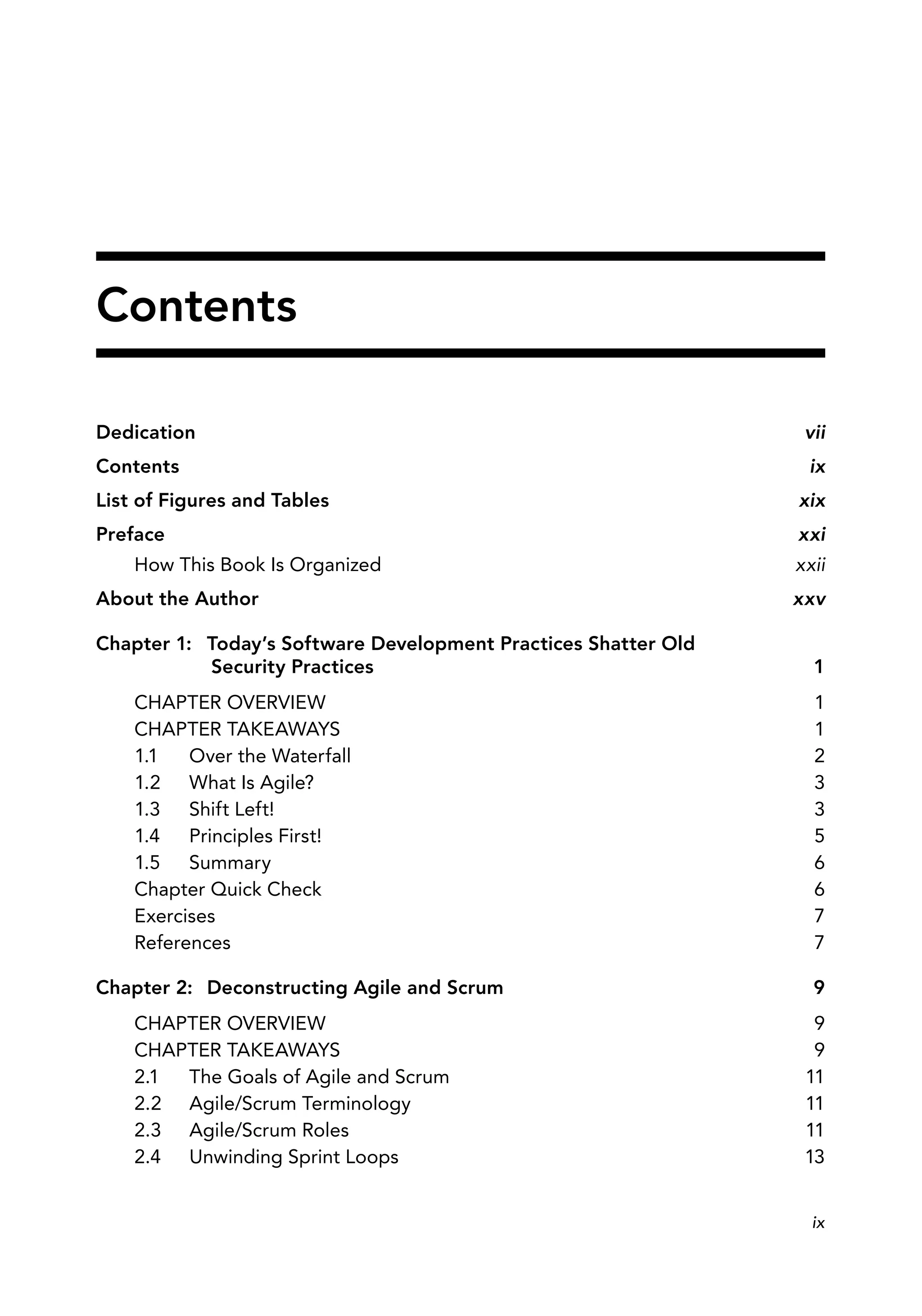
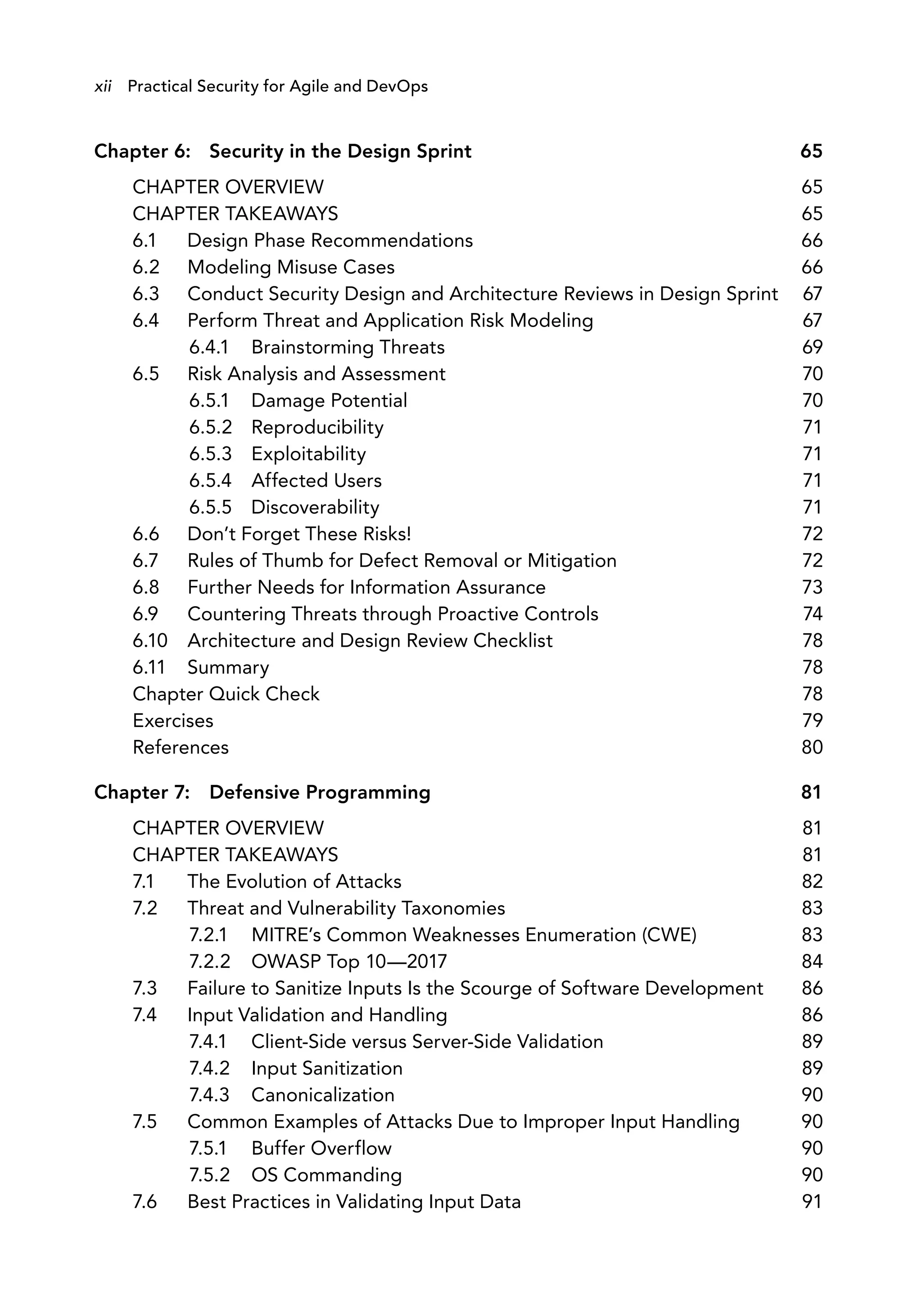
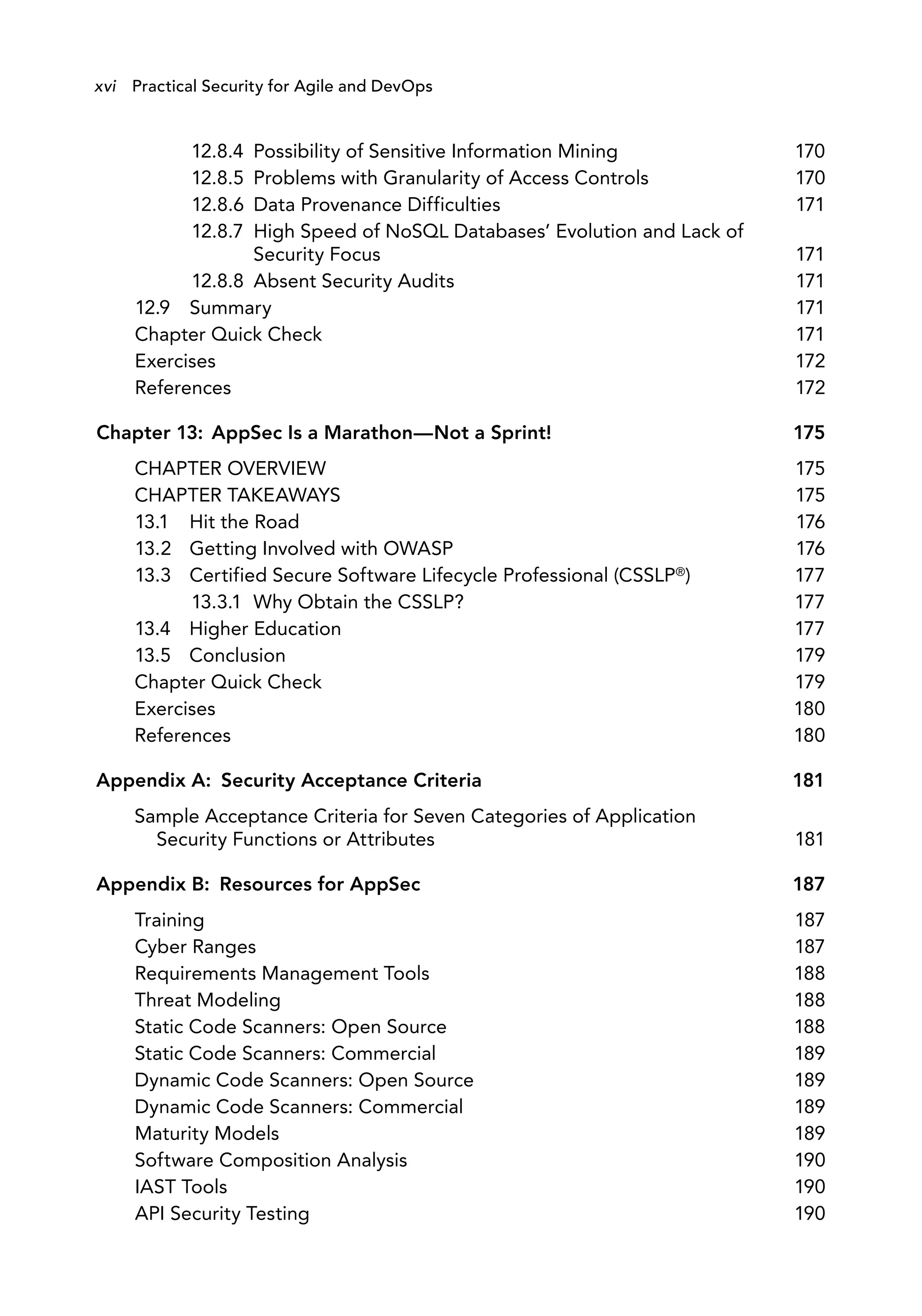
Contents ix
Listof Figures and Tables xix
Preface xxi
How This Book Is Organized xxii
About the Author xxv
Chapter 1: Today’s Software Development Practices Shatter Old
Security Practices 1
CHAPTER OVERVIEW 1
CHAPTER TAKEAWAYS 1
1.1 Over the Waterfall 2
1.2 What Is Agile? 3
1.3 Shift Left! 3
1.4 Principles First! 5
1.5 Summary 6
Chapter Quick Check 6
Exercises 7
References 7
Chapter 2: Deconstructing Agile and Scrum 9
CHAPTER OVERVIEW 9
CHAPTER TAKEAWAYS 9
2.1 The Goals of Agile and Scrum 11
2.2 Agile/Scrum Terminology 11
2.3 Agile/Scrum Roles 11
2.4 Unwinding Sprint Loops 13
Contents
ix
15.
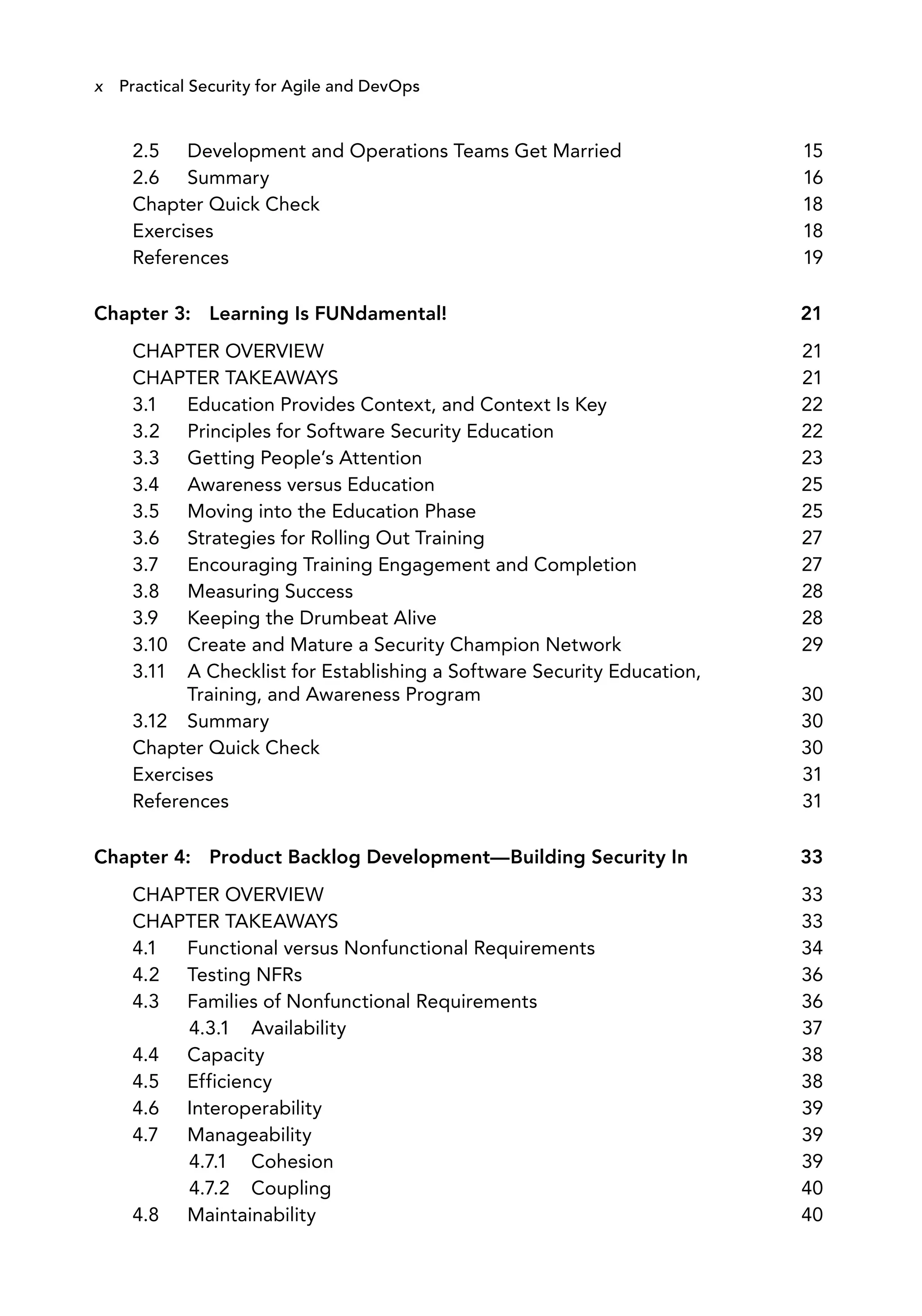
2.5 Development andOperations Teams Get Married 15
2.6 Summary 16
Chapter Quick Check 18
Exercises 18
References 19
Chapter 3: Learning Is FUNdamental! 21
CHAPTER OVERVIEW 21
CHAPTER TAKEAWAYS 21
3.1 Education Provides Context, and Context Is Key 22
3.2 Principles for Software Security Education 22
3.3 Getting People’s Attention 23
3.4 Awareness versus Education 25
3.5 Moving into the Education Phase 25
3.6 Strategies for Rolling Out Training 27
3.7 Encouraging Training Engagement and Completion 27
3.8 Measuring Success 28
3.9 Keeping the Drumbeat Alive 28
3.10 Create and Mature a Security Champion Network 29
3.11 A Checklist for Establishing a Software Security Education,
Training, and Awareness Program 30
3.12 Summary 30
Chapter Quick Check 30
Exercises 31
References 31
Chapter 4: Product Backlog Development—Building Security In 33
CHAPTER OVERVIEW 33
CHAPTER TAKEAWAYS 33
4.1 Functional versus Nonfunctional Requirements 34
4.2 Testing NFRs 36
4.3 Families of Nonfunctional Requirements 36
4.3.1 Availability 37
4.4 Capacity 38
4.5 Efficiency 38
4.6 Interoperability 39
4.7 Manageability 39
4.7.1 Cohesion 39
4.7.2 Coupling 40
4.8 Maintainability 40
x Practical Security for Agile and DevOps
16.
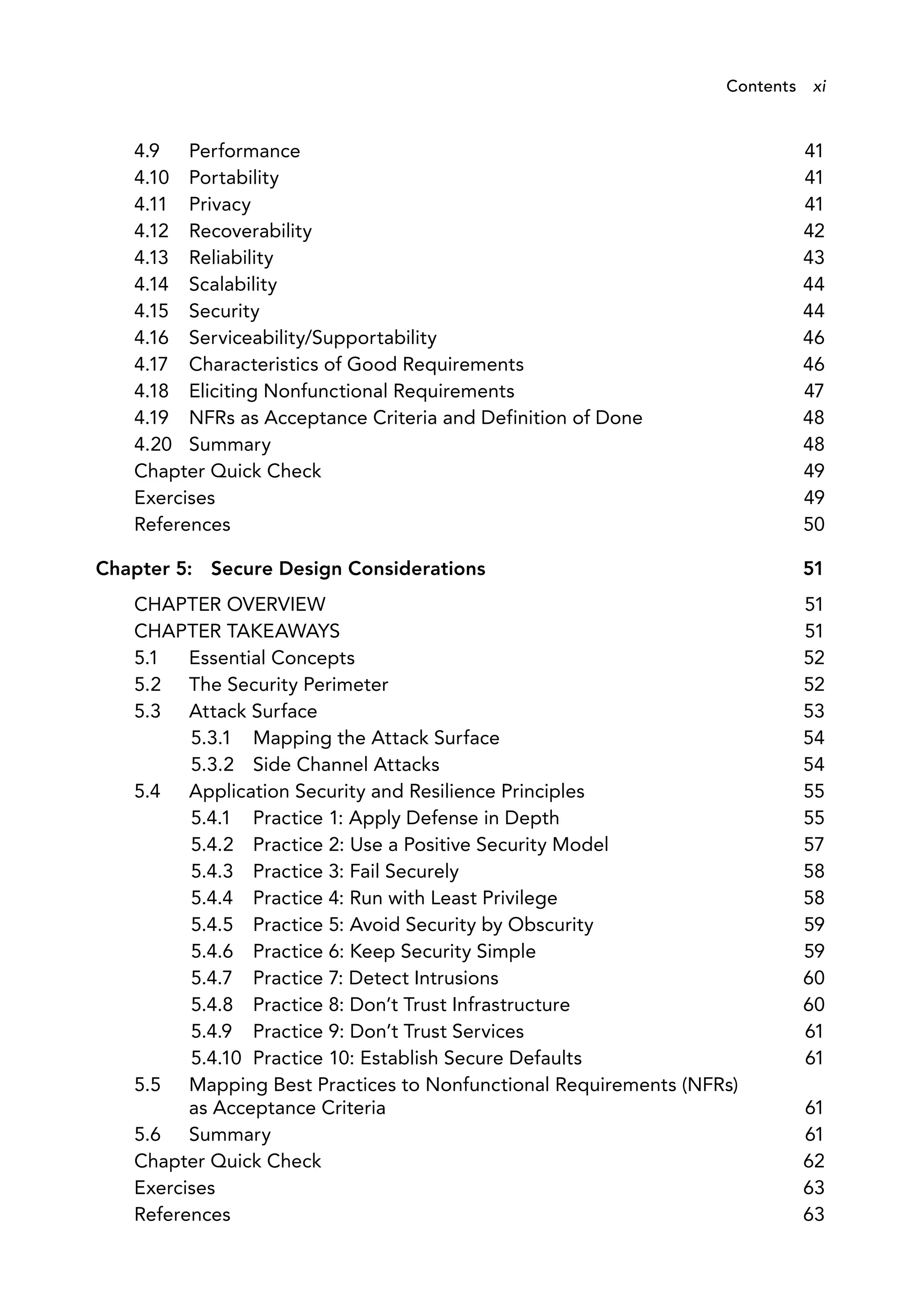
4.9 Performance 41
4.10Portability 41
4.11 Privacy 41
4.12 Recoverability 42
4.13 Reliability 43
4.14 Scalability 44
4.15 Security 44
4.16 Serviceability/Supportability 46
4.17 Characteristics of Good Requirements 46
4.18 Eliciting Nonfunctional Requirements 47
4.19 NFRs as Acceptance Criteria and Definition of Done 48
4.20 Summary 48
Chapter Quick Check 49
Exercises 49
References 50
Chapter 5: Secure Design Considerations 51
CHAPTER OVERVIEW 51
CHAPTER TAKEAWAYS 51
5.1 Essential Concepts 52
5.2 The Security Perimeter 52
5.3 Attack Surface 53
5.3.1 Mapping the Attack Surface 54
5.3.2 Side Channel Attacks 54
5.4 Application Security and Resilience Principles 55
5.4.1 Practice 1: Apply Defense in Depth 55
5.4.2 Practice 2: Use a Positive Security Model 57
5.4.3 Practice 3: Fail Securely 58
5.4.4 Practice 4: Run with Least Privilege 58
5.4.5 Practice 5: Avoid Security by Obscurity 59
5.4.6 Practice 6: Keep Security Simple 59
5.4.7 Practice 7: Detect Intrusions 60
5.4.8 Practice 8: Don’t Trust Infrastructure 60
5.4.9 Practice 9: Don’t Trust Services 61
5.4.10 Practice 10: Establish Secure Defaults 61
5.5 Mapping Best Practices to Nonfunctional Requirements (NFRs)
as Acceptance Criteria 61
5.6 Summary 61
Chapter Quick Check 62
Exercises 63
References 63
Contents xi
17.
Chapter 6: Securityin the Design Sprint 65
CHAPTER OVERVIEW 65
CHAPTER TAKEAWAYS 65
6.1 Design Phase Recommendations 66
6.2 Modeling Misuse Cases 66
6.3 Conduct Security Design and Architecture Reviews in Design Sprint 67
6.4 Perform Threat and Application Risk Modeling 67
6.4.1 Brainstorming Threats 69
6.5 Risk Analysis and Assessment 70
6.5.1 Damage Potential 70
6.5.2 Reproducibility 71
6.5.3 Exploitability 71
6.5.4 Affected Users 71
6.5.5 Discoverability 71
6.6 Don’t Forget These Risks! 72
6.7 Rules of Thumb for Defect Removal or Mitigation 72
6.8 Further Needs for Information Assurance 73
6.9 Countering Threats through Proactive Controls 74
6.10 Architecture and Design Review Checklist 78
6.11 Summary 78
Chapter Quick Check 78
Exercises 79
References 80
Chapter 7: Defensive Programming 81
CHAPTER OVERVIEW 81
CHAPTER TAKEAWAYS 81
7.1 The Evolution of Attacks 82
7.2 Threat and Vulnerability Taxonomies 83
7.2.1 MITRE’s Common Weaknesses Enumeration (CWE) 83
7.2.2 OWASP Top 10—2017 84
7.3 Failure to Sanitize Inputs Is the Scourge of Software Development 86
7.4 Input Validation and Handling 86
7.4.1 Client-Side versus Server-Side Validation 89
7.4.2 Input Sanitization 89
7.4.3 Canonicalization 90
7.5 Common Examples of Attacks Due to Improper Input Handling 90
7.5.1 Buffer Overflow 90
7.5.2 OS Commanding 90
7.6 Best Practices in Validating Input Data 91
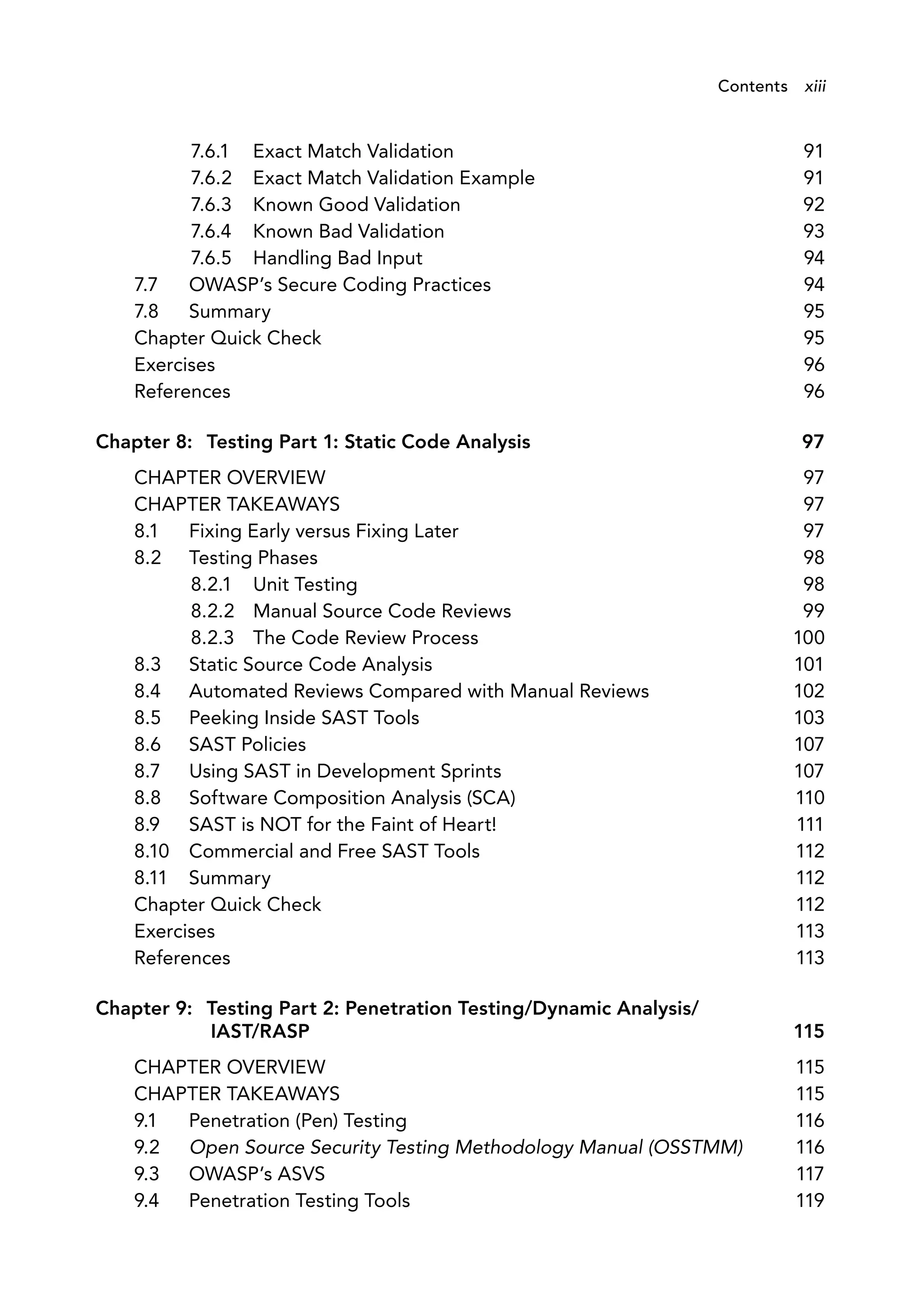
xii Practical Security for Agile and DevOps
18.
7.6.1 Exact MatchValidation 91
7.6.2 Exact Match Validation Example 91
7.6.3 Known Good Validation 92
7.6.4 Known Bad Validation 93
7.6.5 Handling Bad Input 94
7.7 OWASP’s Secure Coding Practices 94
7.8 Summary 95
Chapter Quick Check 95
Exercises 96
References 96
Chapter 8: Testing Part 1: Static Code Analysis 97
CHAPTER OVERVIEW 97
CHAPTER TAKEAWAYS 97
8.1 Fixing Early versus Fixing Later 97
8.2 Testing Phases 98
8.2.1 Unit Testing 98
8.2.2 Manual Source Code Reviews 99
8.2.3 The Code Review Process 100
8.3 Static Source Code Analysis 101
8.4 Automated Reviews Compared with Manual Reviews 102
8.5 Peeking Inside SAST Tools 103
8.6 SAST Policies 107
8.7 Using SAST in Development Sprints 107
8.8 Software Composition Analysis (SCA) 110
8.9 SAST is NOT for the Faint of Heart! 111
8.10 Commercial and Free SAST Tools 112
8.11 Summary 112
Chapter Quick Check 112
Exercises 113
References 113
Chapter 9: Testing Part 2: Penetration Testing/Dynamic Analysis/
IAST/RASP 115
CHAPTER OVERVIEW 115
CHAPTER TAKEAWAYS 115
9.1 Penetration (Pen) Testing 116
9.2 Open Source Security Testing Methodology Manual (OSSTMM) 116
9.3 OWASP’s ASVS 117
9.4 Penetration Testing Tools 119
Contents xiii
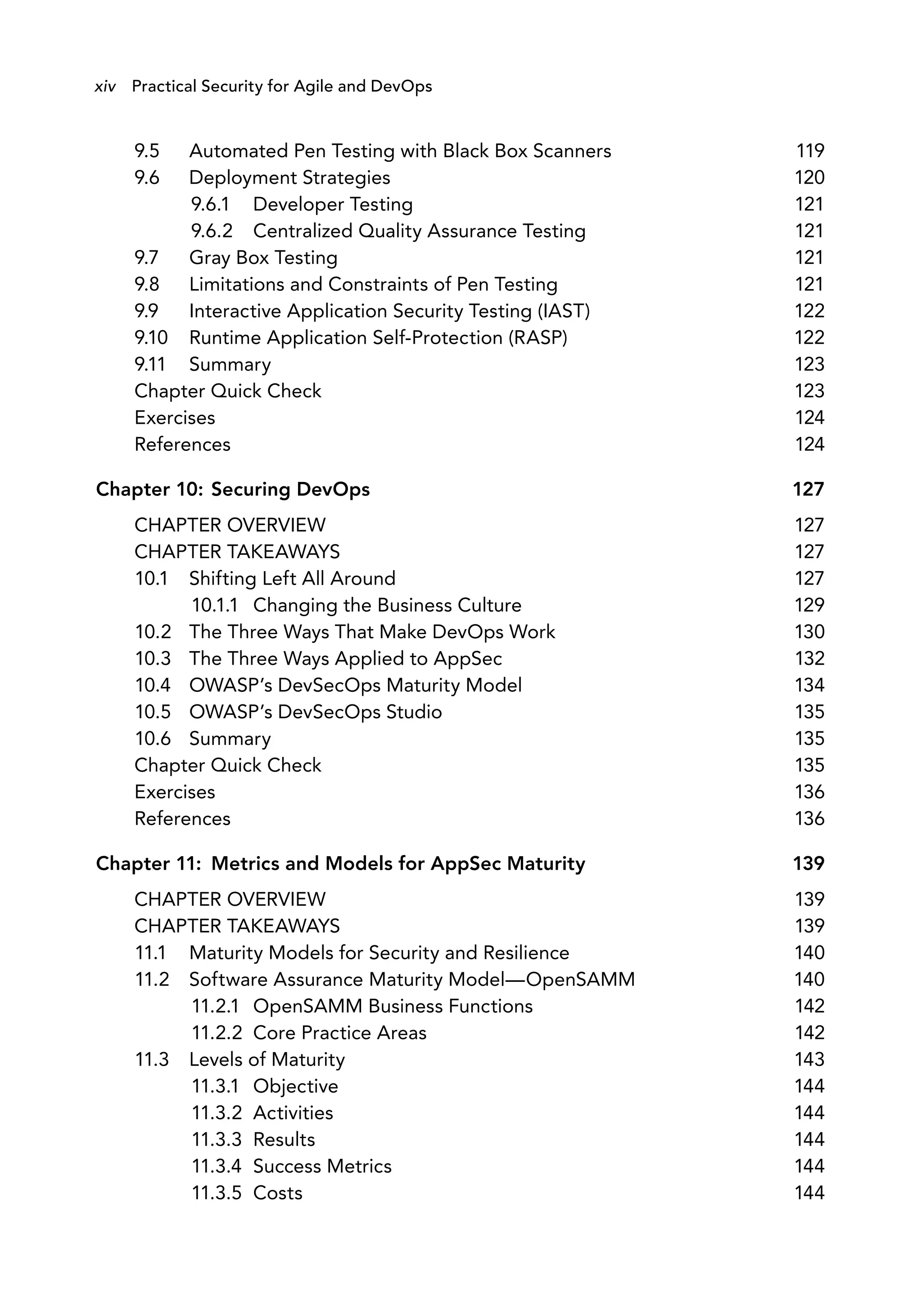
19.
9.5 Automated PenTesting with Black Box Scanners 119
9.6 Deployment Strategies 120
9.6.1 Developer Testing 121
9.6.2 Centralized Quality Assurance Testing 121
9.7 Gray Box Testing 121
9.8 Limitations and Constraints of Pen Testing 121
9.9 Interactive Application Security Testing (IAST) 122
9.10 Runtime Application Self-Protection (RASP) 122
9.11 Summary 123
Chapter Quick Check 123
Exercises 124
References 124
Chapter 10: Securing DevOps 127
CHAPTER OVERVIEW 127
CHAPTER TAKEAWAYS 127
10.1 Shifting Left All Around 127
10.1.1 Changing the Business Culture 129
10.2 The Three Ways That Make DevOps Work 130
10.3 The Three Ways Applied to AppSec 132
10.4 OWASP’s DevSecOps Maturity Model 134
10.5 OWASP’s DevSecOps Studio 135
10.6 Summary 135
Chapter Quick Check 135
Exercises 136
References 136
Chapter 11: Metrics and Models for AppSec Maturity 139
CHAPTER OVERVIEW 139
CHAPTER TAKEAWAYS 139
11.1 Maturity Models for Security and Resilience 140
11.2 Software Assurance Maturity Model—OpenSAMM 140
11.2.1 OpenSAMM Business Functions 142
11.2.2 Core Practice Areas 142
11.3 Levels of Maturity 143
11.3.1 Objective 144
11.3.2 Activities 144
11.3.3 Results 144
11.3.4 Success Metrics 144
11.3.5 Costs 144
xiv Practical Security for Agile and DevOps
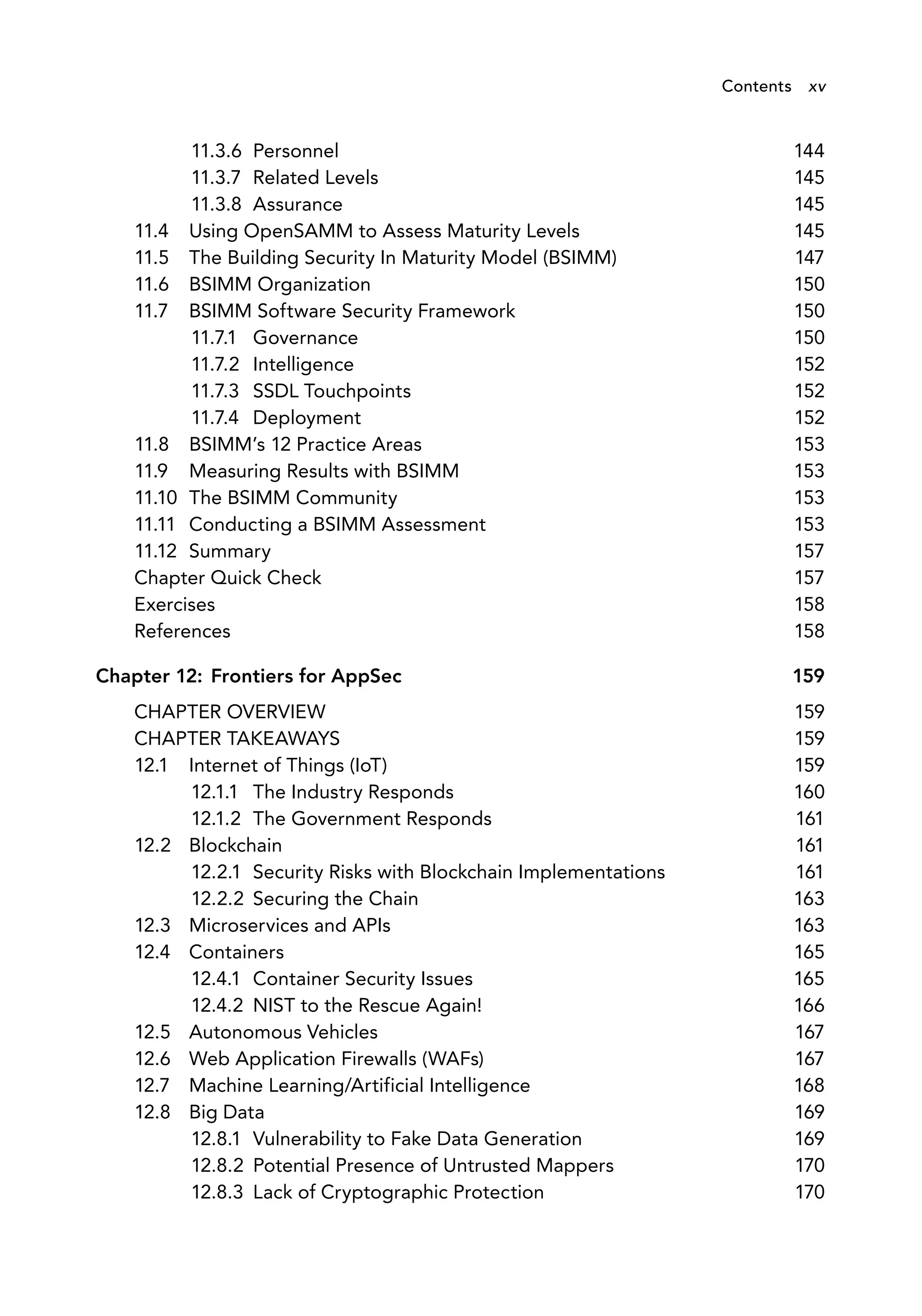
20.
11.3.6 Personnel 144
11.3.7Related Levels 145
11.3.8 Assurance 145
11.4 Using OpenSAMM to Assess Maturity Levels 145
11.5 The Building Security In Maturity Model (BSIMM) 147
11.6 BSIMM Organization 150
11.7 BSIMM Software Security Framework 150
11.7.1 Governance 150
11.7.2 Intelligence 152
11.7.3 SSDL Touchpoints 152
11.7.4 Deployment 152
11.8 BSIMM’s 12 Practice Areas 153
11.9 Measuring Results with BSIMM 153
11.10 The BSIMM Community 153
11.11 Conducting a BSIMM Assessment 153
11.12 Summary 157
Chapter Quick Check 157
Exercises 158
References 158
Chapter 12: Frontiers for AppSec 159
CHAPTER OVERVIEW 159
CHAPTER TAKEAWAYS 159
12.1 Internet of Things (IoT) 159
12.1.1 The Industry Responds 160
12.1.2 The Government Responds 161
12.2 Blockchain 161
12.2.1 Security Risks with Blockchain Implementations 161
12.2.2 Securing the Chain 163
12.3 Microservices and APIs 163
12.4 Containers 165
12.4.1 Container Security Issues 165
12.4.2 NIST to the Rescue Again! 166
12.5 Autonomous Vehicles 167
12.6 Web Application Firewalls (WAFs) 167
12.7 Machine Learning/Artificial Intelligence 168
12.8 Big Data 169
12.8.1 Vulnerability to Fake Data Generation 169
12.8.2 Potential Presence of Untrusted Mappers 170
12.8.3 Lack of Cryptographic Protection 170
Contents xv
21.
12.8.4 Possibility ofSensitive Information Mining 170
12.8.5 Problems with Granularity of Access Controls 170
12.8.6 Data Provenance Difficulties 171
12.8.7 High Speed of NoSQL Databases’ Evolution and Lack of
Security Focus 171
12.8.8 Absent Security Audits 171
12.9 Summary
Chapter Quick Check
171
171
Exercises 172
References 172
Chapter 13: AppSec Is a Marathon—Not a Sprint! 175
CHAPTER OVERVIEW 175
CHAPTER TAKEAWAYS 175
13.1 Hit the Road 176
13.2
13.3
Getting Involved with OWASP
Certified Secure Software Lifecycle Professional (CSSLP®)
13.3.1 Why Obtain the CSSLP?
176
177
177
13.4 Higher Education 177
13.5 Conclusion 179
Chapter Quick Check 179
Exercises 180
References 180
Appendix A: Security Acceptance Criteria 181
Sample Acceptance Criteria for Seven Categories of Application
Security Functions or Attributes 181
Appendix B: Resources for AppSec 187
Training 187
Cyber Ranges 187
Requirements Management Tools
Threat Modeling
188
188
Static Code Scanners: Open Source
Static Code Scanners: Commercial
188
189
Dynamic Code Scanners: Open Source 189
Dynamic Code Scanners: Commercial
Maturity Models
189
189
Software Composition Analysis 190
IAST Tools 190
API Security Testing 190
xvi Practical Security for Agile and DevOps
22.
Runtime Application Self-Protection(RASP) 190
Web Application Firewalls (WAFs) 191
Browser-centric Protection 191
Appendix C: Answers to Chapter Quick Check Questions 193
Glossary 203
Index 205
Contents xvii
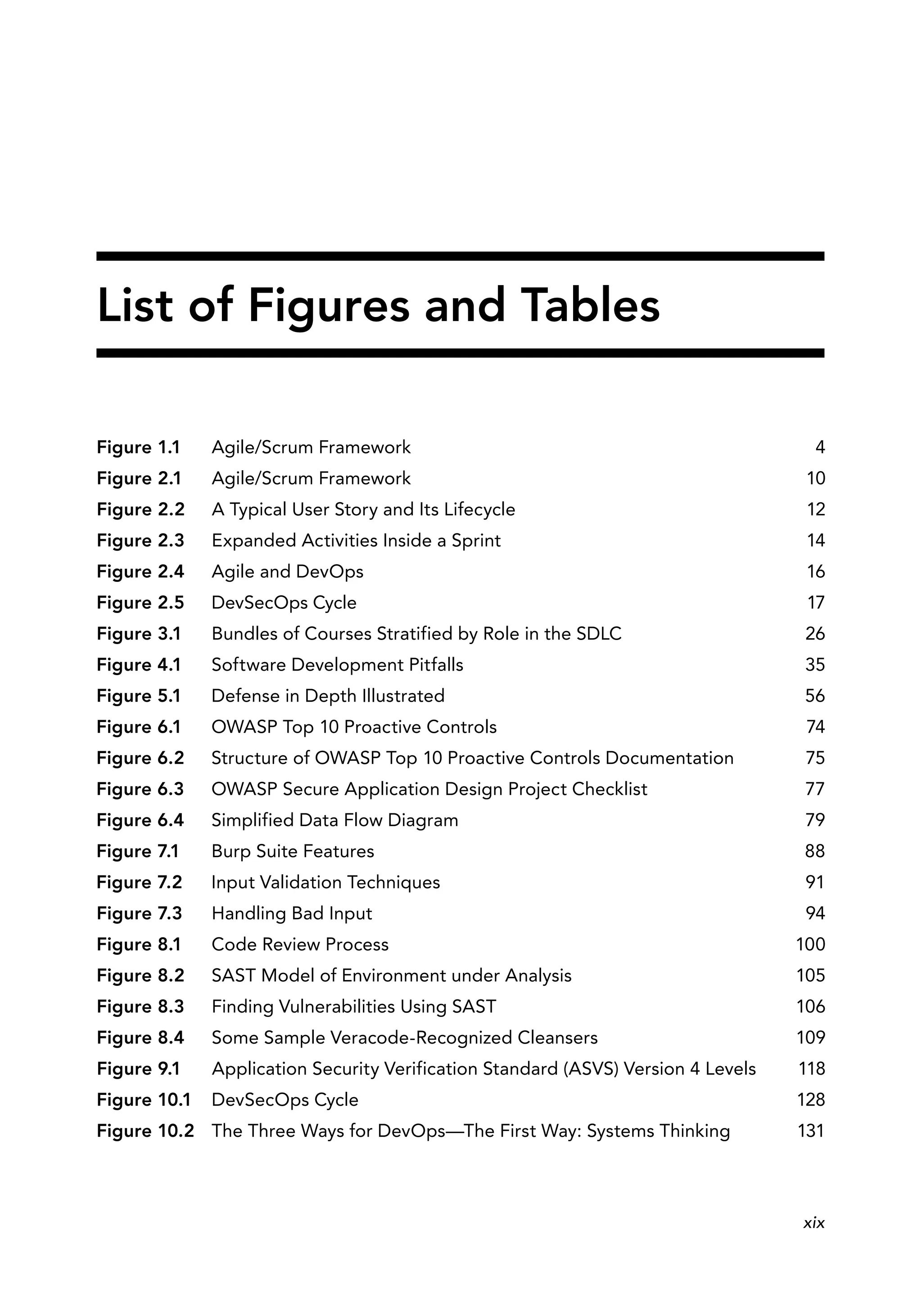
24.
Figure 1.1 Agile/ScrumFramework 4
Figure 2.1 Agile/Scrum Framework 10
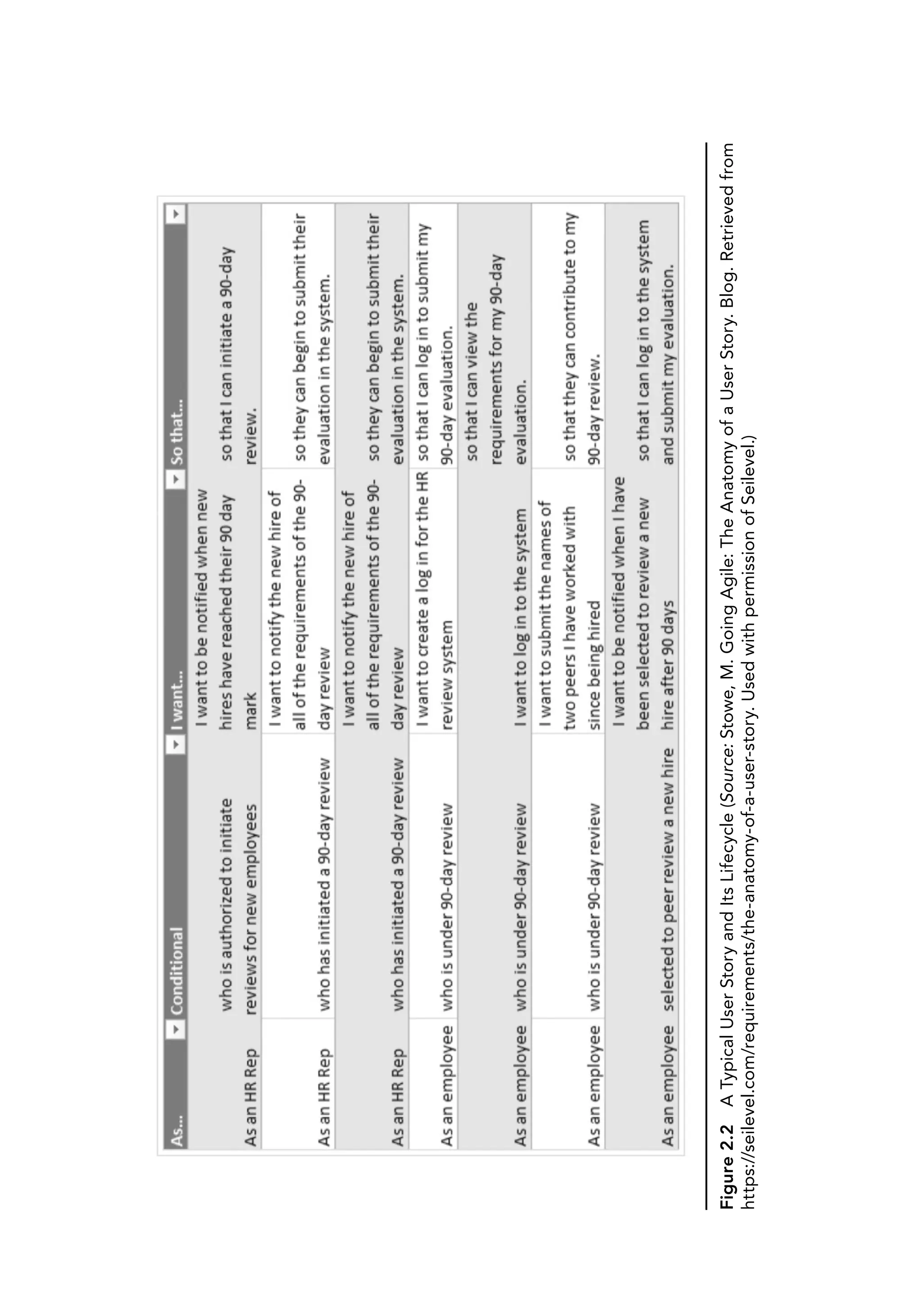
Figure 2.2 A Typical User Story and Its Lifecycle 12
Figure 2.3 Expanded Activities Inside a Sprint 14
Figure 2.4 Agile and DevOps 16
Figure 2.5 DevSecOps Cycle 17
Figure 3.1 Bundles of Courses Stratified by Role in the SDLC 26
Figure 4.1 Software Development Pitfalls 35
Figure 5.1 Defense in Depth Illustrated 56
Figure 6.1 OWASP Top 10 Proactive Controls 74
Figure 6.2 Structure of OWASP Top 10 Proactive Controls Documentation 75
Figure 6.3 OWASP Secure Application Design Project Checklist 77
Figure 6.4 Simplified Data Flow Diagram 79
Figure 7.1 Burp Suite Features 88
Figure 7.2 Input Validation Techniques 91
Figure 7.3 Handling Bad Input 94
Figure 8.1 Code Review Process 100
Figure 8.2 SAST Model of Environment under Analysis 105
Figure 8.3 Finding Vulnerabilities Using SAST 106
Figure 8.4 Some Sample Veracode-Recognized Cleansers 109
Figure 9.1 Application Security Verification Standard (ASVS) Version 4 Levels 118
Figure 10.1 DevSecOps Cycle 128
Figure 10.2 The Three Ways for DevOps—The First Way: Systems Thinking 131
List of Figures and Tables
xix
25.
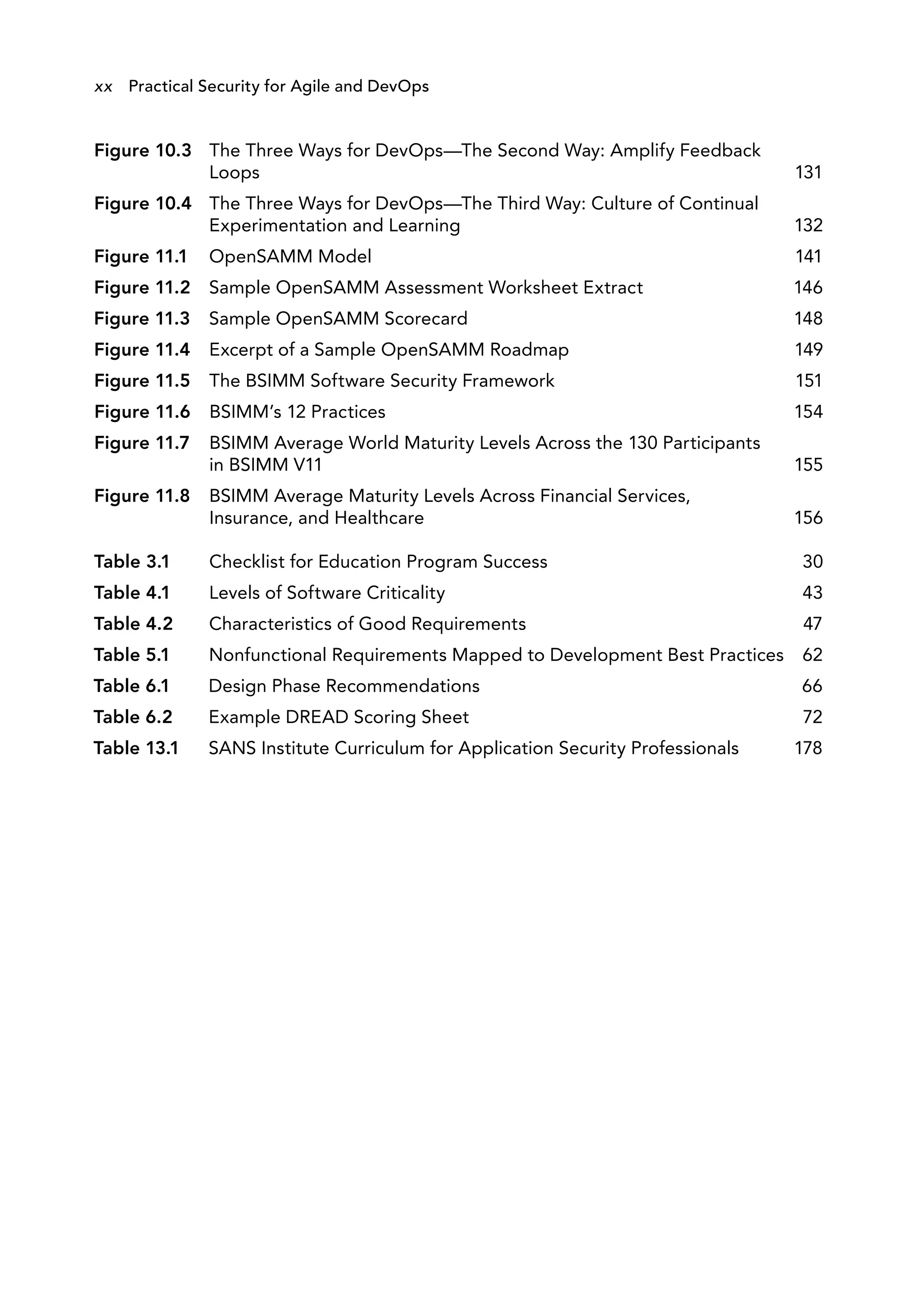
Figure 10.3 TheThree Ways for DevOps—The Second Way: Amplify Feedback
Loops 131
Figure 10.4 The Three Ways for DevOps—The Third Way: Culture of Continual
Experimentation and Learning 132
Figure 11.1 OpenSAMM Model 141
Figure 11.2 Sample OpenSAMM Assessment Worksheet Extract 146
Figure 11.3 Sample OpenSAMM Scorecard 148
Figure 11.4 Excerpt of a Sample OpenSAMM Roadmap 149
Figure 11.5 The BSIMM Software Security Framework 151
Figure 11.6 BSIMM’s 12 Practices 154
Figure 11.7 BSIMM Average World Maturity Levels Across the 130 Participants
in BSIMM V11 155
Figure 11.8 BSIMM Average Maturity Levels Across Financial Services,
Insurance, and Healthcare 156
Table 3.1 Checklist for Education Program Success 30
Table 4.1 Levels of Software Criticality 43
Table 4.2 Characteristics of Good Requirements 47
Table 5.1 Nonfunctional Requirements Mapped to Development Best Practices 62
Table 6.1 Design Phase Recommendations 66
Table 6.2 Example DREAD Scoring Sheet 72
Table 13.1 SANS Institute Curriculum for Application Security Professionals 178
xx Practical Security for Agile and DevOps
26.
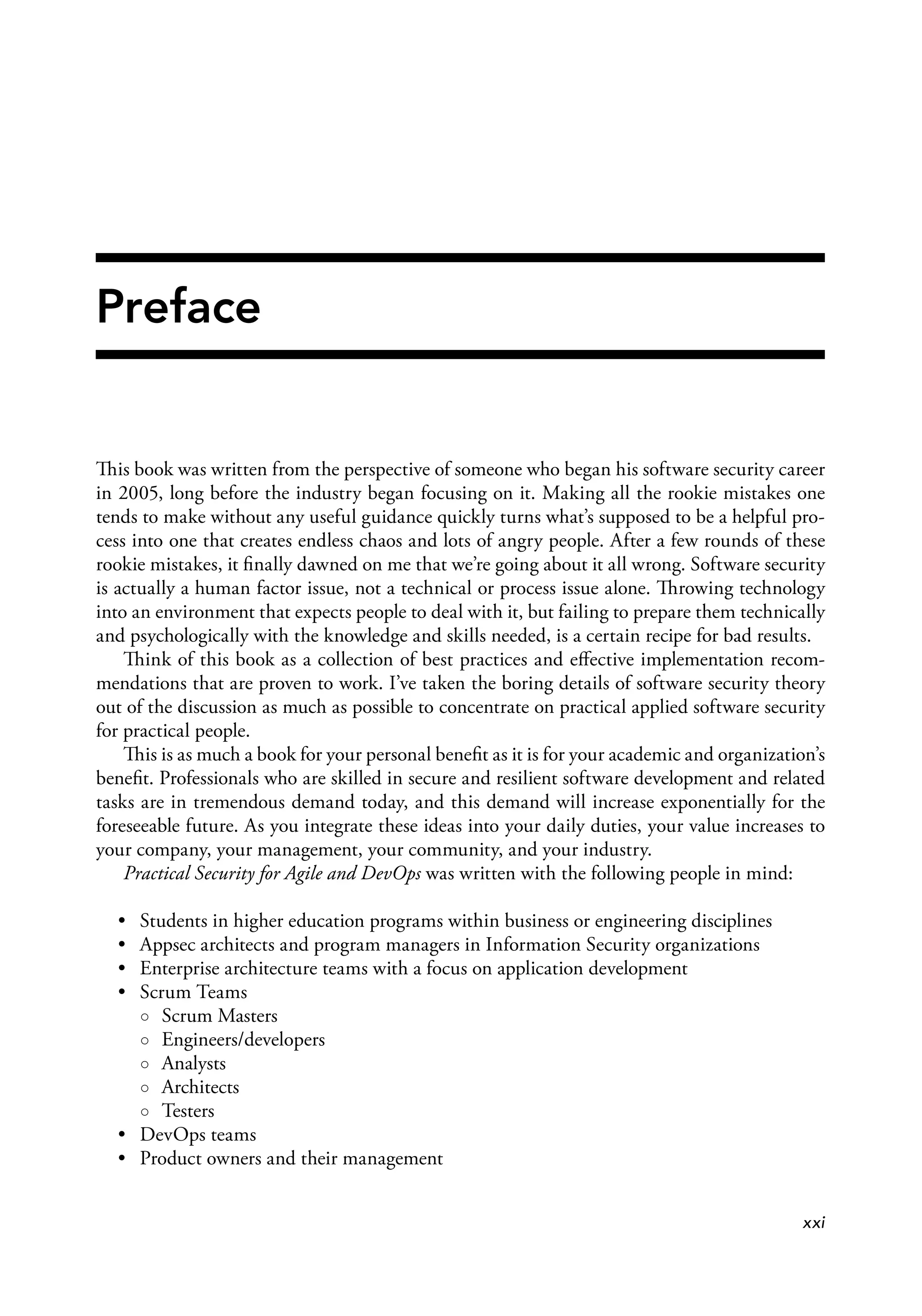
Preface
This book waswritten from the perspective of someone who began his software security career
in 2005, long before the industry began focusing on it. Making all the rookie mistakes one
tends to make without any useful guidance quickly turns what’s supposed to be a helpful pro
cess into one that creates endless chaos and lots of angry people. After a few rounds of these
rookie mistakes, it finally dawned on me that we’re going about it all wrong. Software security
is actually a human factor issue, not a technical or process issue alone. Throwing technology
into an environment that expects people to deal with it, but failing to prepare them technically
and psychologically with the knowledge and skills needed, is a certain recipe for bad results.
Think of this book as a collection of best practices and effective implementation recom
mendations that are proven to work. I’ve taken the boring details of software security theory
out of the discussion as much as possible to concentrate on practical applied software security
for practical people.
This is as much a book for your personal benefit as it is for your academic and organization’s
benefit. Professionals who are skilled in secure and resilient software development and related
tasks are in tremendous demand today, and this demand will increase exponentially for the
foreseeable future. As you integrate these ideas into your daily duties, your value increases to
your company, your management, your community, and your industry.
Practical Security for Agile and DevOps was written with the following people in mind:
• Students in higher education programs within business or engineering disciplines
• Appsec architects and program managers in Information Security organizations
• Enterprise architecture teams with a focus on application development
• Scrum Teams
○ Scrum Masters
○ Engineers/developers
○ Analysts
○ Architects
○ Testers
• DevOps teams
• Product owners and their management
xxi
27.
xxii Practical Securityfor Agile and DevOps
• Project managers
• Application security auditors
• Agile coaches and trainers
• Instructors and trainers in academia and private organizations
How This Book Is Organized
• Chapter 1 brings the state of software development up to date after the tsunami of changes
that have flipped software development and application security practices on their head
since the first edition of this book came out.
• Chapter 2 takes a detailed look at the Agile and Scrum software development methodol
ogy to explore how security controls need to change in light of an entirely new paradigm
on how software is developed and how software is used.
• Chapter 3 focuses on ways to educate everyone who has a hand in any software develop
ment project with appropriate and practical skills to Build Security In. We look at ways
of influencing development teams to espouse software security in their day-to-day activi
ties, establishing a role-based curriculum for everyone, suggestions on how to roll out
training, and ways to “keep the drumbeat alive” all year long through outreach and
events.
• Chapters 4 looks at the specification steps of new or altered software with ways to incor
porate security controls and other nonfunctional requirements into user stories that bring
to life the concepts of “Shift Left” and Building Security In. This chapter examines 15
families of nonfunctional requirements and 11 families of application security controls.
• Chapter 5 moves into foundational and fundamental principles for secure application
design. It covers important concepts, techniques, and design goals to meet well-understood
acceptance criteria on features an application must implement.
• Chapter 6 examines how the design sprint is adapted for proper consideration of security
and other nonfunctional requirements (NFRs) and ways to conduct threat modeling,
application risk analysis, and practical remediation while the design is still malleable.
• Chapter 7 on defensive programming includes information on the Common Weaknesses
Enumeration (CWE™), the OWASP Top 10 (2017), and some ways to address the funda
mental scourge of application security vulnerabilities—failure to sanitize inputs.
• Chapter 8 is focused on white box application analysis with sprint-based activities to
improve security and quality of an application under development. Static code analysis
is covered in depth for context on what these tools do and the assumptions they use for
operating.
• Chapter 9 looks at black box or grey box analysis techniques and tools for testing a run
ning version of an application for software or quality shortcomings.
• Chapter 10 is focused on techniques and activities to help transform the DevOps process
into a DevSecOps process with appropriate controls, metrics, and monitoring processes.
• Chapter 11 looks at two popular software maturity and metrics models for helping you
to determine the effectiveness and maturity of your secure development program.
• Chapter 12 takes a survey of the frontier where software use is expanding. It covers topics
including Internet of Things (IoT), artificial intelligence (AI), machine learning, block-
chains, microservices, application programming interfaces (APIs), containers, and more.
28.
Preface xxiii
• Chapter13 closes the book with a call to action to help you gain access to professional
education, certification programs, and industry initiatives to which you can contribute.
Each chapter logically builds on prior chapters to help you paint a complete set of practical
steps that lead to secure and resilient application software and responsive, secure development
practices that predictably and reliably produce high-quality and resilient applications.
30.
About the Author
MarkS. Merkow, CISSP, CISM, CSSLP, works at HealthEquity, Inc., in Tempe, Arizona,
helping to lead application and IT security architecture and engineering efforts in the office of
the CISO. In addition to his day job, Mark is a faculty member at the University of Denver,
where he works on developing and instructing online courses in topics across the Information
Security spectrum, with a focus on secure software development. He also works as an advisor
to the University of Denver’s Information and Computing Technology Curriculum Team for
new course development and changes to the curriculum.
Mark has over 40 years of experience in IT in a variety of roles, including application
development, systems analysis and design, security engineering, and security management.
Mark holds a Master of Science in Decision and Information Systems from Arizona State
University (ASU), a Master of Education in Distance Education from ASU, and a Bachelor of
Science in Computer Information Systems from ASU.
Mark has authored or coauthored 17 books on IT and has been a contributing editor to
four others. Mark remains very active in the information security community, working in a
variety of volunteer roles for the Phoenix Chapters of (ISC)2®, ISACA®, and OWASP. You can
find Mark’s LinkedIn® profile at: linkedin.com/in/markmerkow
xxv
32.
Chapter 1
Today’s SoftwareDevelopment
Practices Shatter Old
Security Practices
CHAPTER OVERVIEW
Software development techniques and methodologies leapfrog over themselves constantly,
making efforts to secure them a moving target that won’t wait. To address this fact, it’s essen
tial that application security controls and their implementation are as agile as the development
processes they support. In this chapter, you’ll find some strategies to address these moving
targets, while applying tried-and-true security control implementations that remain standing
over time.
CHAPTER TAKEAWAYS
• Examine the changes in the software development lifecycle (SDLC) since its inception.
• Explain the Agile/Scrum Framework for modern day software development.
• Describe the Shift Left approach to implementing software development security controls.
• Understand the principles that apply to successful implementation of application security
programs.
In the decade since Secure and Resilient Software Development1 was published, the world of
software development has flipped on its head; shed practices from the past; brought about
countless changes; and revolutionized how software is designed, developed, maintained, oper
ated, and managed.
These changes crept in slowly at first, then gained momentum, and have since overtaken
most of what we “know” about software development and the security tried-and-true methods
1
33.
2 Practical Securityfor Agile and DevOps
that we’ve relied on and implemented over the years. Involvement of application security
(appsec) professionals—if it happened at all—happened WAY too late, after executive deci
sions were already made to supplant old practices and the ink was already dried on contracts
with companies hired to make the change.
This late (or nonexistent) involvement in planning how to address security hobbles appsec
practitioners who are forced to bargain, barter, or somehow convince development teams that
they simply cannot ignore security. Compound this problem with the nonstop pace of change,
and appsec professionals must abandon old “ways” and try to adapt controls to a moving target.
Furthermore, the risks with all-new attack surfaces (such as autonomous vehicles), reliance on
the Internet of Things (IoT), and software that comes to life with kinetic activity can place
actual human lives in real danger of injury or death.
Although we may have less work on our hands to convince people that insecure software is
a clear and present danger, appsec professionals have to work much harder to get everyone on
board to apply best practices that we are confident will work.
A decade ago, we were striving to help appsec professionals convince development organi
zations to—minimally—address software security in every phase of development, and for the
most part over the decade, we saw that far more attention is being paid to appsec within the
SDLC. Now, however, we’re forced to adapt how we do things to new processes that may be
resistant to any changes that slow things down, while the risks and impacts of defective soft
ware increase exponentially.
Here’s the definition of software resilience that we’ll use throughout the book. This defini
tion is an adaptation of the National Infrastructure Advisory Council (NIAC) definition of
infrastructure resilience:
Software resilience is the ability to reduce the magnitude and/or duration of disruptive events.
The effectiveness of a resilient application or infrastructure software depends upon its ability
to anticipate, absorb, adapt to, and/or rapidly recover from a potentially disruptive event.2
In this chapter, we’re going to survey this new landscape for these changes to update our
own models on how to adapt to the brave new world and maintain software security, resilience,
and agility.
1.1 Over the Waterfall
New paradigms have rapidly replaced the Waterfall model of software development that we’ve
used since the beginning of the software age. Agile and Scrum SDLCs have all but displaced
the rigorous (and sometimes onerous) activities, and have most certainly displaced the notion
of “phase containment,” which appsec professionals have counted on as a reliable means to
prevent defects from creeping into subsequent phases.
This new landscape includes Agile/Scrum, DevOps, continuous integration/continuous
deployment (CI/CD), and the newest revolution working its way in, site reliability engineer
ing (SRE). To adapt to these changes, we need to understand how the rigor we’ve put into
Waterfall-based projects and processes has been swept away by the tsunami of change that
demands more software, faster and cheaper.
34.
Today’s Software DevelopmentPractices Shatter Old Security Practices 3
Changes in the software development paradigm forces change in the software security para
digm, which MUST work hand-in-hand with what development teams are expected to do.
While we typically had a shot at inspecting software for security issues at the end of the
development cycle (because of phase containment), this control point no longer exists. The
new paradigm we had to adopt is called Shift Left, preserving the notion that there are still
phases in the SDLC, while recognizing the fact that there aren’t.
1.2 What Is Agile?
In essence, Agile and Scrum are based on the philosophy that software takes on a life of its
own, constantly being improved, extended, and enhanced, and these changes can be delivered
in hours, rather than weeks, months, or years.
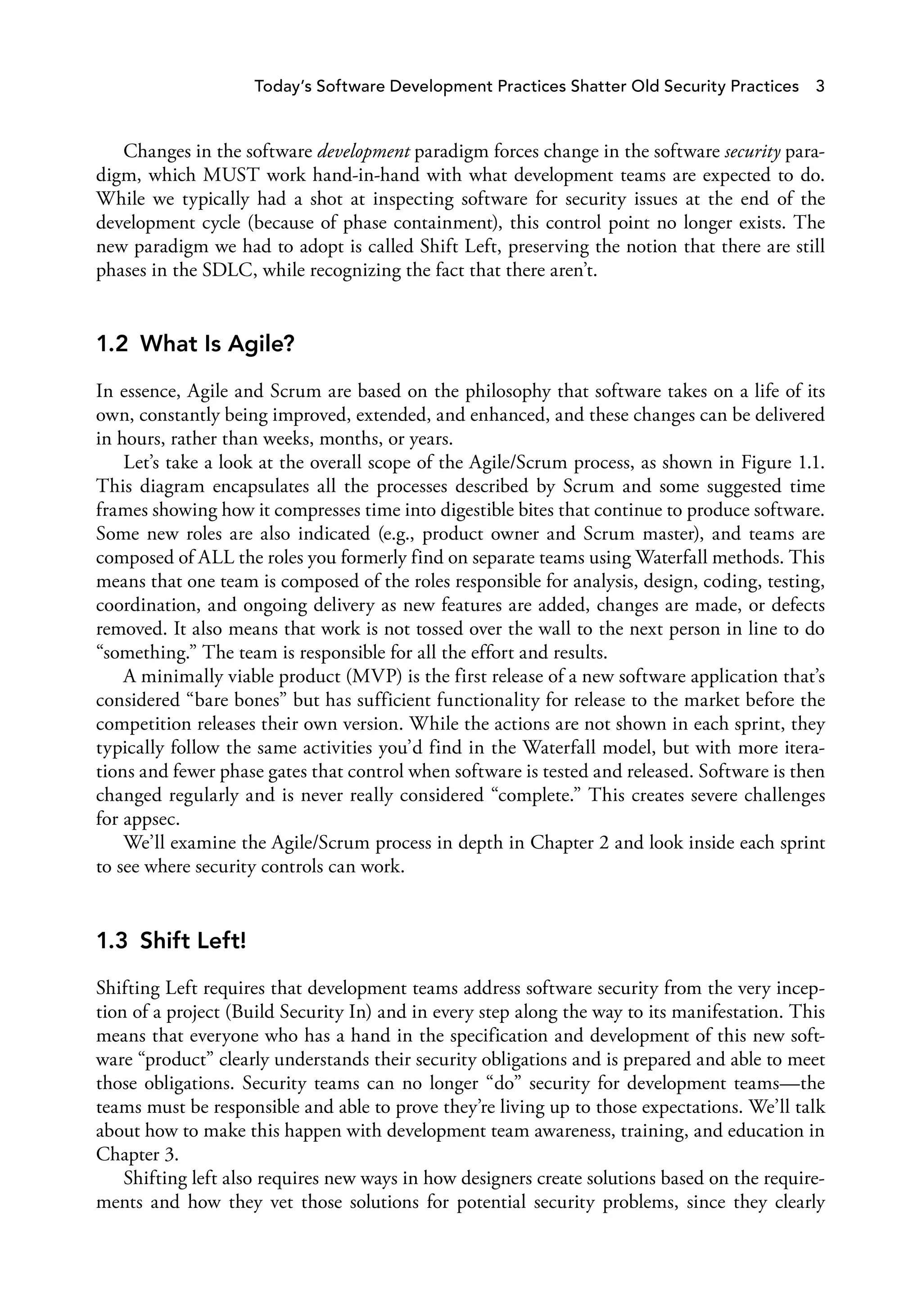
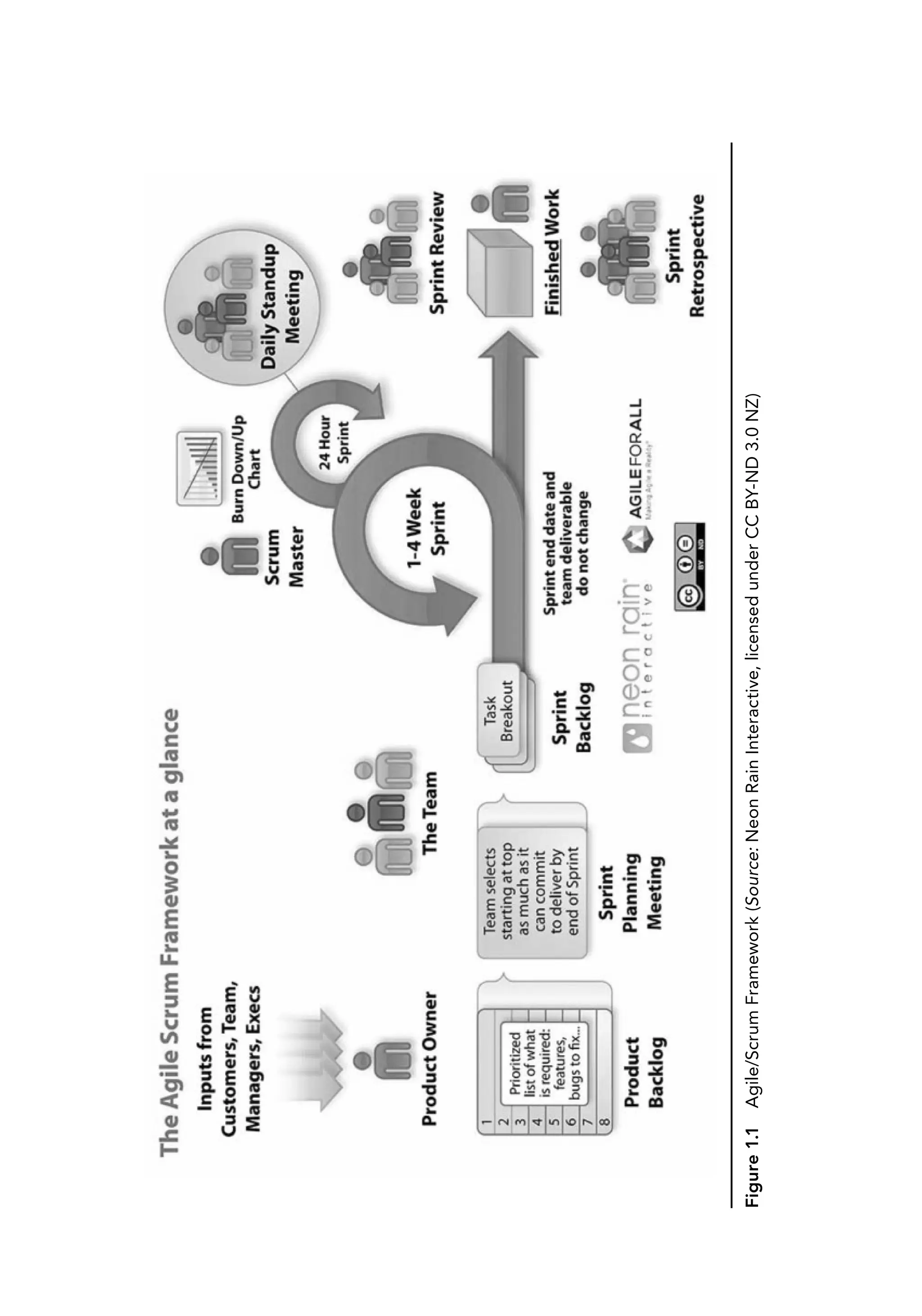
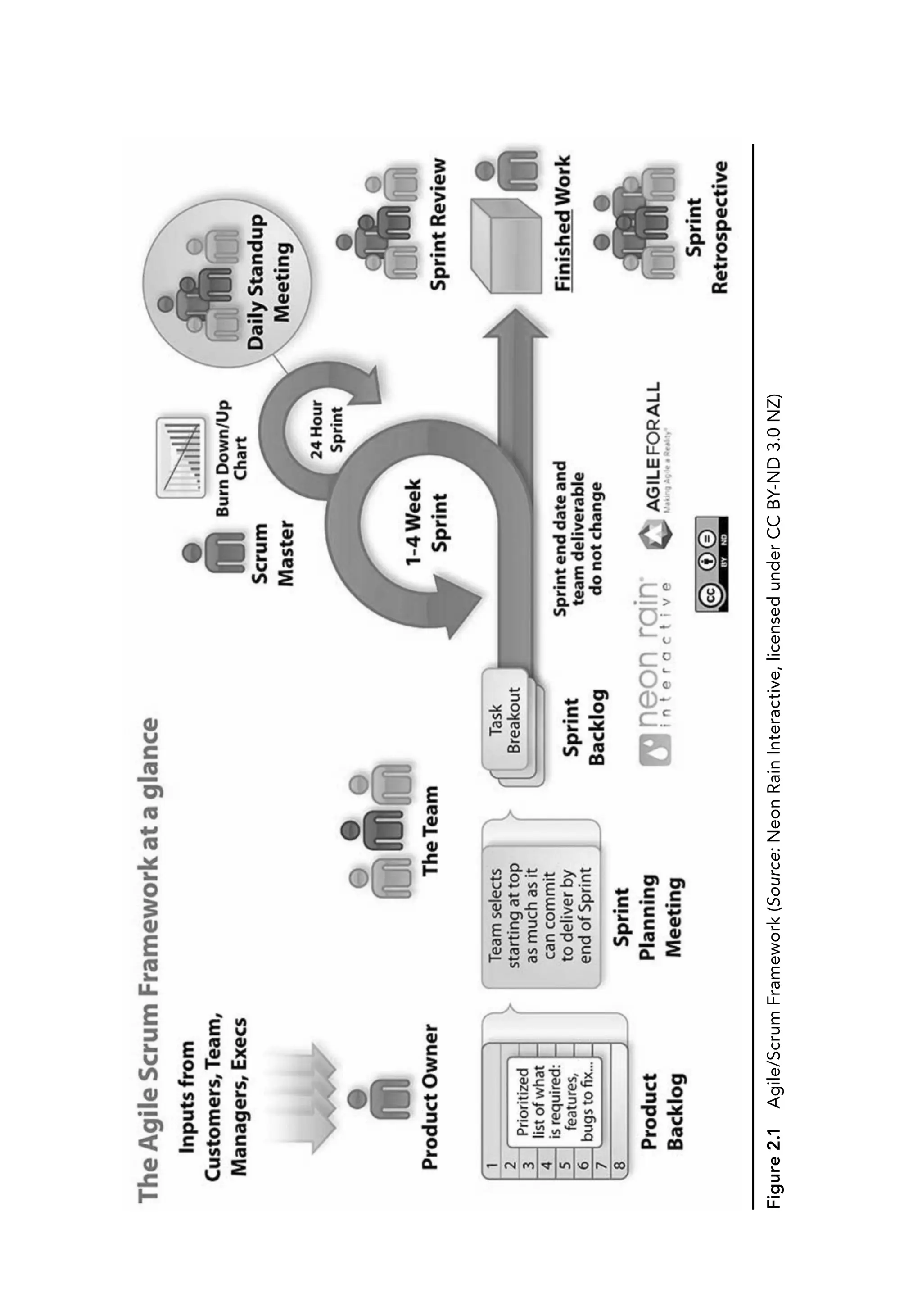
Let’s take a look at the overall scope of the Agile/Scrum process, as shown in Figure 1.1.
This diagram encapsulates all the processes described by Scrum and some suggested time
frames showing how it compresses time into digestible bites that continue to produce software.
Some new roles are also indicated (e.g., product owner and Scrum master), and teams are
composed of ALL the roles you formerly find on separate teams using Waterfall methods. This
means that one team is composed of the roles responsible for analysis, design, coding, testing,
coordination, and ongoing delivery as new features are added, changes are made, or defects
removed. It also means that work is not tossed over the wall to the next person in line to do
“something.” The team is responsible for all the effort and results.
A minimally viable product (MVP) is the first release of a new software application that’s
considered “bare bones” but has sufficient functionality for release to the market before the
competition releases their own version. While the actions are not shown in each sprint, they
typically follow the same activities you’d find in the Waterfall model, but with more itera
tions and fewer phase gates that control when software is tested and released. Software is then
changed regularly and is never really considered “complete.” This creates severe challenges
for appsec.
We’ll examine the Agile/Scrum process in depth in Chapter 2 and look inside each sprint
to see where security controls can work.
1.3 Shift Left!
Shifting Left requires that development teams address software security from the very incep
tion of a project (Build Security In) and in every step along the way to its manifestation. This
means that everyone who has a hand in the specification and development of this new soft
ware “product” clearly understands their security obligations and is prepared and able to meet
those obligations. Security teams can no longer “do” security for development teams—the
teams must be responsible and able to prove they’re living up to those expectations. We’ll talk
about how to make this happen with development team awareness, training, and education in
Chapter 3.
Shifting left also requires new ways in how designers create solutions based on the require
ments and how they vet those solutions for potential security problems, since they clearly
Today’s Software DevelopmentPractices Shatter Old Security Practices 5
understand that changes in design, once an application is developed, will cost potentially hun
dreds of times more than if the defects were caught while architecture and engineering is
underway.
Developers are affected because they’re not given the luxury of time for extensive testing, as
they often had with former practices. Now, developers may release new code all day and see it
deployed within minutes, so it’s vital that these developers “own” the responsibility for securing
it, which means developing it using a defensive programming state of mind. Shifting Left in the
development activity involves active use, and appropriate response, with security checks built
directly into their integrated development environment (IDE)—for example, Visual Studio or
Eclipse. Although these checks are on incomplete segments of an overall application, coding pro
vides the first opportunity for security inspection and is needed to continue the cycle of appsec.
Testing presents a major challenge to appsec because tolerance for long-running tests has
all but disappeared. Although it’s true that a comprehensive (finished this time) application is
needed for comprehensive testing, product managers won’t wait anymore while security tests
are run, and vulnerable applications may be deployed (ship it now—fix it later). Shifting left
in this environment forces security testing to happen incrementally, in what we used to call
integration testing—the point in development at which all the elements come together to build
a new version of the software. If the implementation of security testing is done correctly and
responsively to the needs of the product managers, it can serve as a control to actually “break”
a build and force remediation of defects. We’ll discuss this at length in Chapters 10 and 11
where we focus on testing.
Taken together, shifting left in the appsec space makes it possible to gain the assurance we
need that our applications are appropriately secure, but it changes the role of appsec profes
sionals from “doing” appsec to needing to empower everyone who touches software in the
SDLC with practical and appropriate knowledge, skills, and abilities.
Although the names and accelerated pace have significantly changed how we deal with
appsec, the activities of software development, as we understood them in Waterfall method
ologies, are still present. Requirements are still being gathered, designs are still being built,
coders are still coding, testers are still testing, and operators are still deploying and managing
applications in production. We can apply what we know works to help secure applications in
development, but we have to step back and let those who are intimate with the application do
the heavy lifting and prove to us that they’ve done what they needed to do!
At the end of the day, software security is a human factors issue—not a technical issue—
and for appsec professionals to succeed in implementing application controls, it’s vital to treat
the human factor in ways we know work, rather than throwing more tools at the problem.
1.4 Principles First!
Before we dig into the details on how to create and maintain excellence in application security
programs, let’s cover some enduring principles that we need to live by in everything we do to
secure application software and the processes used to create it:
• Secure application development is a PEOPLE issue, not a technical one.
• Every intervention into the SDLC affects people.
37.
6 Practical Securityfor Agile and DevOps
• Shift Left within the SDLC as much of the appsec work as you can—the more security
work that’s performed closest to the point at which defects are introduced is the surest way
of eliminating them and preventing “defect creep” from one phase or activity to the next.
• AppSec tools are great but are of questionable use if the people using them don’t understand:
○ What the tool is telling them
○ Why their code is vulnerable
○ How their code is vulnerable
○ What do to about the vulnerability
• People can only deal with so much change at one time—too many changes all at once to
their processes leads to chaos and, ultimately, rebellion.
• Automate everything that you can (scanning, remediation planning, retesting, etc.).
• There are only so many of us in the information security departments, but there are
thousands of development team staff who need accountability. Don’t treat security as a
punishment or barrier. Convince development team members that it empowers them—
makes them more valuable as employees and members of the development community—
and they’ll quickly learn that it does all these things!
1.5 Summary
In Chapter 1, we surveyed the modern-day landscape on how software is developed, oper
ated, and managed to understand the impacts these changes have imposed on how we design,
develop, and implement control mechanisms to assure software security and resilience. We’ll
begin to explore how appsec professionals can use Agile practices to improve Agile practices
with security controls and how baking in security from the very start is the surest way to gain
assurance that your applications can stand up and recover from chronic attacks.
Chapter Quick Check
1. A design principle to guide the selection of controls for an application to ensure its resil
ience against different forms of attack, and to reduce the probability of a single point of
failure in the security of the system is called:
a) Defense in depth
b) Least privilege
c) Security by obscurity
d) Secure defaults
2. Poor Application Software Security is:
a) A network security problem
b) An operating system security problem
c) A software development and engineering problem
d) A user-caused problem
38.
3. Giving aprogram the minimal authority to access resources is called:
a) Principle of Keep Security Simple
b) Principle of Least Privilege
c) Principle of Fail Securely
d) Principle of Defense in Depth
Exercises
1. Everyone feels the effects of flawed or vulnerable software when it’s attacked, and you’ve
likely seen some of the consequences from these attacks. Who is (or should be) ulti
mately responsible for assuring that software that’s released into the wild of the Internet
is developed and operated with security in mind?
2. You can get software cheap and fast, but it won’t be very good. You can get it good and
fast, but it won’t come cheaply.
Consider these tradeoffs and consequences:
• What do you think the choices being made are in today’s international software develop
ment community?
• What do you think we can do to change this and end the scourge of bad software?
References
1. Merkow, M. S. and Raghavan, L. (2010). Secure and Resilient Software Development. Boca Raton
(FL): CRC Press.
2. Department of Homeland Security (DHS). (2009, September 8). Critical Infrastructure
Resilience Final Report and Recommendations. National Infrastructure Advisory Council
(NIAC). Retrieved June 11, 2019, from http://www.dhs.gov/xlibrary/assets/niac/niac_critical_
infrastructure_resilience.pdf
Today’s Software Development Practices Shatter Old Security Practices 7
40.
Chapter 2
Deconstructing Agileand Scrum
CHAPTER OVERVIEW
Chapter 2 provides an examination of the activities found in the Scrum Model and how to
implement security controls. The movement to Scrum and DevOps underscores the need for
changes related to People, Process, and Technology that moves an organization from silo-based
software development to community- and team-based marriages that ultimately form into
DevSecOps that “Build Security In” for all custom-developed software.
CHAPTER TAKEAWAYS
• Determine the placement and timing of security activities in Scrum sprints for architec
ture and development.
• Determine steps that lead to “Shifting Left” the performance of security controls to pre
vent impeding the natural flow of Scrum processes.
• Examine the DevSecOps environment in which automation of security controls improves
both the software development lifecycle (SDLC) process and the software that it produces.
For purposes of context setting and terminology, we’re going to deconstruct the Agile/Scrum
development methodology to discover areas in which appsec controls help in securing software
in development and also help to control the development methodology itself. We’ll look at
ways to use Agile to secure Agile.
Let’s revisit the overall scope of the Agile/Scrum process, shown in Figure 2.1 (originally
Figure 1.1).
There’s Agile/Scrum as a formal, strict, tightly controlled process, and then there’s Agile/
Scrum as it’s implemented in the real world. Implementation of Agile will vary from the fun
damentalist and purist views to various elements that appear as Agile-like processes, and every
thing in between. It’s less important HOW it’s implemented in your environment than it is to
understand WHAT your specific implementation means to your appsec efforts.
9
Deconstructing Agile andScrum 11
2.1 The Goals of Agile and Scrum
Agile software development refers to software development lifecycle (SDLC) methodologies
based on the idea of iterative development, in which requirements and solutions evolve through
collaboration between self-organizing, cross-functional teams. Agile development is designed
to enable teams to deliver value faster, with greater quality and predictability and greater abili
ties to respond to change.1
Scrum and Kanban are the dominant implementations of Agile, and Scrum is the one most
often found in software development organizations.
2.2 Agile/Scrum Terminology
Here are some common terms and roles found within Agile SDLCs:
Product—the application under development, enhancement, or replacement.
Product Backlog—the list of features or requirements that the product must include. These
features are prioritized by the product owner for submission to sprints.
Product Owner—typically from a business unit or business area who becomes responsible for
the creation of new products through the specifications (user stories) they create and add to the
product backlog. Think of the product owner as the sponsor of the work the team performs
overall. Often, the Scrum team and the product owner work in entirely different organizations
(a business unit outside of the technology division of the firm).
User Stories—help to shift the focus from writing about requirements to talking about them.2
Stories use nontechnical language to provide context for the development team and their
efforts. After reading a user story, the team knows why they are building what they’re build
ing and what value it creates.3 User stories are added to sprints and “burned down” over the
duration of the sprint.
Figure 2.2 depicts an example of a typical user story4:
Sprint—a fixed, time-boxed period of time (typically from 2 to 4 weeks), during which spe
cific prioritized requirements (user stories) are fed in from the product backlog for design or
development.
Definition of Done (DoD)—An important Scrum concept that documents the state of
the product in relation to the acceptance criteria across all the user stories within a product
increment. DoD user stories can drive the quality of work and are used to assess when a user
story has been completed and meets all acceptance criteria.
2.3 Agile/Scrum Roles
Scrum role team titles are only relevant in establishing each person’s specific expertise, but
they don’t lock those who are in that role into only performing that activity. Teams are
Deconstructing Agile andScrum 13
self-organizing, so expertise is shared across the team as needed to meet their objectives. The
following are those roles of the team that you commonly find in Scrum:
• Scrum Master is the person who serves as conductor and coach to help team members
carry out their duties. Scrum masters are experts on Scrum, oversee the project through
out, and offer advice and direction. The Scrum master most often works on one project
at a time, gives it their full attention, and focuses on improving the team’s effectiveness.5
• Analysts work with the product owner and Scrum master to develop and refine the user
stories that are submitted for development within a development sprint.
• Architects work on the design of the application architecture and design to meet the
requirements described by the user stories. Design work is conducted in a design sprint,
sometimes called sprint zero.
• Designers work on the aspects of the product that relate to user interfaces and user expe
rience with the product. Essentially, designers are translators for the following aspects of
the product6:
○ Translate users’ desires and concerns for product owners.
○ Translate features for users—how the product will actually work and what it looks
like.
○ Translate experiences and interfaces for engineers.
• Engineer/Lead Engineer/Developers work to build (code) the features for the applica
tions based on user story requirements for each sprint.
• Testers/Quality Assurance (QA) Leads are those who work to determine if the applica
tion being delivered meets the acceptance criteria for the user stories and help to provide
proof for the DoD for those user stories and, ultimately, the product.
As you’ll see in Chapter 3, each of these roles require specialized application security train
ing to help them to gain the skills they need for ownership and responsibility of security for
their product.
2.4 Unwinding Sprint Loops
With the basic model and understanding of the roles people play within Scrum, let’s now take
a look at what happens inside each sprint as the cycle of development proceeds. Figure 2.3
expands on the steps inside a sprint loop.7
Under the paradigm of Building Security In, you can find opportunities for effective secu
rity controls throughout the product’s lifecycle.
Beginning with Requirements Refinement for product backlog development, this is the
opportunity to specify security functional and nonfunctional requirements (NFRs) as user
stories or constraints on existing user stories in the form of acceptance criteria that drives
the DoD. This approach forces everyone on the team to not only consider security but also
describe exactly how they plan to meet the control needs. This basic step will drive all follow-
on activity to address security requirements and concerns head on through the analysis stage,
world. Travellers hadbut few facilities in those days: the rough fishing boat
across the often angry loch; the coach that in October did not run “every
lawful day,” but only at intervals; the absence of all comfortable
accommodation would grievously affect the young men nowadays who set
out in a sleeping carriage from the depths of the Highlands to take their
berths in a P. and O. Robbie thought of none of these luxuries, which were
not yet invented. His parting from his father and brother was not emotional:
all that had been got over when the group about the doors had waved their
last good-bye. He was more anxious about the portmanteaux, upon which
he looked with honest pride, and which contained among many other things
the defective half-dozen of handkerchiefs. Ronald Drummond met him at
the side of the loch with his boxes, which contained a more ample outfit
than Robbie’s, and the sword-case which had been in the Peninsula, a
distinction which drew all eyes. “It’s me the next,” Jock shouted as a
parting salutation, as the brown sail was hoisted, and the boat, redolent of
herrings, carried the two adventurers away.
“Weel,” said Marg’ret, “the laddie’s gane, and good go with him. It’s ane
less to think of and fend for. And we must just all go back to our work.
Whoever comes or whoever goes, I have aye my dinner to think of, and the
clean clothes to be put into the drawers, and the stockings to darn a’ the
same.”
“If you’ll put an iron to the fire, Marg’ret, I’ll come and do the collars,”
said Mary, “he was always so particular, poor Robbie. There will be no fyke
now with trying to please him.”
“I cannot settle to work,” said Kirsteen, “and I will not. I’m not just a
machine for darning stockings. I wish I was Robbie going out into the
world.”
“Oh, Kirsteen, come and see the rabbits he gave me,” said Jeanie. “He
would not trust one of them to the boys, but gave them to me. Come and
take them some lettuce leaves. It will keep us in mind of Robbie.” There
was perhaps some danger that the recollection of the brother departed
would not last very long. So many had gone before him and there were still
others to go.
But Kirsteen avoided Jeanie and the rabbits and suddenly remembered
something she had to get at the “merchant’s,” which was a full mile off—
worsted for her mother’s knitting and needles for herself, who was always,
47.
to the reprobationof the elder members of the family, losing her needles.
She was glad to represent to herself that this errand was a necessity, for a
house without needles how can that be? and poor mother would be more
dependent than ever on everything being right for her work, on this
melancholy day. It was still quite early, about nine o’clock, and it was with
a compunction that Kirsteen gave herself the indulgence of this walk. A
morning away from work seemed to her almost an outrage upon life, only
to be excused by the circumstances and the necessity of the errand. She
walked along the familiar road not noting where she went, her thoughts far
away, following the travellers, her mind full of an agitation which was
scarcely sorrowful, a sort of exaltation over all that was common and
ordinary. The air and the motion were good for her, they were in harmony
with that condition of suppressed excitement in which from the depths of
her being everything seemed bubbling up. Kirsteen’s soul was like one of
the clear pools of the river by which she walked, into which some clear,
silvery, living thing had leaped and lived. Henceforward it was no more
silent, no longer without motion. The air displaced came up in shining
globules to the surface, dimpling over the water, a stir was in it from time to
time, a flash, a shimmering of all the ripples. Her mind, her heart were like
the pool—no longer mirroring the sky above and the pathway ferns and
grasses on the edge, but something that had an independent life. She
roamed along without being able to tell, had any one asked her, where she
was. The road was a beautiful road by the side of a mountain stream, which
was only called the burn, but which was big enough for trout or even now
and then salmon—which ran now along the side of the bill, now diving
deep down into a ravine, now half hid with big overreaching banks, now
flinging forth upon a bit of open country, flowing deep among the rocks,
chattering over the shallows, sometimes bass sometimes treble, an
unaccountable, unreasonable, changeable stream. Red rowan-tree berries
hung over it reflecting their colour in the water. The heather on the hill
came in deep russet tones of glory defeated, and the withered bracken with
tints of gold, all gaining a double brilliancy from the liquid medium that
returned their image. To all these things Kirsteen was so well accustomed
that perhaps she did not at any time stop to note them as a stranger might
have done. But to-day she did not know what was about her; she was
walking in more beautiful landscapes, in the land of imagination, by the
river of love, in the country of the heart. The pays du tendre which was
48.
ridiculous when allthe fine ladies and gentlemen postured about in their
high-heeled shoes is not absurd when a fresh and simple maiden crosses its
boundary. She went down the glen to the merchant’s and chose her wool,
and bought her needles, and said a few words to the women at their doors,
and shed a few more tears when they were sorry for her about her brother’s
going away, without ever leaving that visionary country, and came back
from the village more deeply lost in it than ever, and hearing the whisper of
last night in every motion of the branches and every song of the burns.
“Will ye wait for me, Kirsteen?” though it was only this morning that he
went away, and years and years must pass before he came back—“Ay, that I
will! That I will.”
She had nearly reached home again, coming back from the merchant’s—
for even her reverie and the charm of it could not keep Kirsteen’s step slow,
or subdue its airy, skimming tread—when she came up to the carter with his
cart who had carried Robbie’s luggage to Inveralton. She stopped to speak
to him, and walked along by his side timing her steps to those of his heavy,
slow tread and the movement of the laborious, patient horse. “Did you see
him, Duncan?” she said.
“Oh, ay, I saw him—and they got away fine in James Macgregor’s boat;
and a quick wind that would carry them over the loch in two or three
minutes.”
“And how was he looking, Duncan?”
“ ’Deed, Miss Kirsteen, very weel: he’s gaun to see the world—ye canna
expect a young boy like that to maen and graen. I have something here for
you.”
“Something for me!” She thought perhaps it was something that had
been put into the gig by mistake, and was not excited, for what should there
be for her? She watched with a little amusement Duncan’s conflict with the
different coats which had preserved his person from the night cold. He went
on talking while he struggled.
“The other laddie, Jock, I left to come home with the maister in the gig.
He thought it was fine—but I wouldna wonder if he was regretting Duncan
and the cart—afore now. Here it is at last, and a fecht to get it. It is a book
from Maister Ronald that you gave him a loan of—or something o’ that
kind—if I could but mind what gentles say—”
49.
“Gave him—a loanof—?” cried Kirsteen, breathless. She had to turn
away her head not to exhibit to Duncan the overwhelming blush which she
felt to cover her from head to foot. “Oh, yes,” she added after a moment,
taking the little parcel from his hand, “I—mind.”
Let us hope that to both of them the little fiction was forgiven. A loan of
—she had nothing to lend, nor had he ever borrowed from her. It was a
small paper parcel, as if it contained a little book. Kirsteen never could tell
how she succeeded in walking beside the carter for a few steps further, and
asking him sedately about his wife and the bairns. Her heart was beating in
her ears as if it would burst through. It was like a bird straining at its bonds,
eager to fly away.
Then she found herself at home where she had flown like the wind,
having informed Duncan that she was “in a great hurry”—but in the
passage, on the way to her own room, she met Mary, who was coming from
the kitchen with a number of shining white collars in her arms which she
had been ironing.
“Where have you been?” said Mary. “My mother has been yammering
for you. Is this an hour of the day to go stravaighing for pleasure about the
roads?”
Mary pronounced the last word “rods,” though she prided herself on
being very correct in her speech.
“Me—I have been to the merchant’s for my mother’s fingering for her
stockings,” Kirsteen said breathlessly.
“It was wheeling she wanted,” said Mary with exasperating calm; “that’s
just like you, running for one thing when it’s another that’s wanted. Is that it
in that small parcel like a book?”
“No, that’s not it,” said Kirsteen, clasping the little parcel closer and
closer.
“It’s some poetry-book you’ve had out with you to read,” said her sister,
as if the acme of wrong-doing had been reached. “I would not have thought
it of you, Kirsteen, to be reading poetry about the rods, the very morning
that Robbie’s gone away. And when my mother is so ill she cannot lift her
head.”
“I’ve been reading no poetry,” cried Kirsteen, with the most poignant
sense of injury. “Let me pass, Mary, I’m going up the stair.”
50.
But it wasMarg’ret now who interposed, coming out at the sound of the
altercation. She said, “Miss Kirsteen, I’m making some beef-tea for the
mistress. Come in like a dear and warm your hands, and ye can carry it up.
It will save me another trail up and down these stairs.”
Kirsteen stood for a moment obstructed on both sides with a sense of
contrariety which was almost intolerable. Tears of vexation rose to her eyes.
“Can I not have a moment to myself?” she cried.
“To read your poetry!” Mary called after her in her mild little
exasperating voice.
“Whist, whist, my lamb, say nothing,” said Marg’ret. “Your mother
canna bide to have a talking. Never you mind what she says, think upon the
mistress that’s lying up there, wanting to hear everything and canna—
wanting to be in the middle of everything and no equal to it. It was no that I
grudge going up the stairs, but just to keep a’ things quiet. And what’s that
you’ve gotten in your hand?”
“It’s just a small parcel,” said Kirsteen, covering it with her fingers. “It’s
just a—something I was buying—”
“Not sweeties,” said Marg’ret solemnly; “the bairns had more than
plenty last night—”
“Never you mind what it is,” said Kirsteen with a burst of impatience,
thrusting it into her pocket. “Give me the beef-tea and I’ll take it up stairs.”
Mrs. Douglas lay concealed behind her curtains, her face almost in a
fluid state with constant weeping. “Oh, set it down upon the table,” she
said. “Do they think there’s comfort in tea when a woman has parted with
her bairn? And where have ye been, Kirsteen? just when I was in want of ye
most; just when my head was sorest, and my heart like to break—Robbie
gone, and Mary so taken up with herself, and you—out of the way—”
“I’m very sorry, mother,” said poor Kirsteen. “I ran down to the
merchant’s to get you your yarn for your knitting. I thought you would like
to have it ready.”
Mrs. Douglas rocked her head back and forward on her pillow. “Do I
look like a person that’s thinking of yarn or of stockings, with my head
aching and my heart breaking? And none of you can match a colour. Are
you sure it’s the same? Most likely I will just have to send Marg’ret to
change it. What’s that bulging out your pocket? You will tear every pocket
you have with parcels in it as if ye were a lad and not a lass.”
51.
“It’s only avery small thing,” said Kirsteen.
“If that’s the yarn ye should never let them twist it up so tight. It takes
the softness all out of it. Where are ye going the moment you’ve come
back? Am I to have nobody near me, and me both ill in body, and sore, sore
distrest in mind? Oh, Kirsteen, I thought ye had a truer heart.”
“Mother, my heart’s true,” cried the girl, “and there’s nothing in the
world I would not do to please you. But let me go and put away my things,
let me go for a moment, just for a moment. I’ll be back again before you’ve
missed me.”
“You’re not always so tidy to put away your things,” said the invalid;
“sit down there by my bedside, and tell me how my bonnie lad looked at the
last. Did he keep up his heart? And was your father kind to him? And did
you see that he had his keys right, and the list of all his packages? Eh, me,
to think I have to lie here and could not see my laddie away.”
“But, mother, you have never done it,” said Kirsteen, “to any of the boys
—and Robbie never expected—”
“You need not mind me,” said Mrs. Douglas, “of the waik creature I’ve
always been. Aye in my bed or laid up, never good for anything. If you’ll
lift me up a little, Kirsteen, I might maybe try to swallow the beef tea; for
eh! I have much, much need of support on such a doleful day. Now another
pillow behind my back, and put the tray here; I cannot bear the sight of
food, but I must not let my strength run down. Where are you going now,
you restless thing? Just stay still where you are; for I cannot do without you,
Kirsteen. Kirsteen, do you hear me? The doctor says I’m never to be left by
myself.”
It was not till a long time after that Kirsteen was free. Her eager
expectation had fallen into an aching sense of suspense, a dull pang that
affected both mind and body. Instead of the rapid flight to her room full of
anticipation in which she had been arrested in entering the house, she went
soberly, prepared for any disenchantment. The room was shared with her
younger sister Jeanie, and it seemed quite probable that even a moment’s
solitude might be denied her. When she found it empty, however, and had
closed the door upon herself and her secret, it was with trembling hands that
she opened the little parcel. It might be the handkerchief sent back to her, it
might be some other plain intimation that he had changed his mind. But
when the covering was undone, Kirsteen’s heart leaped up again to that
52.
sudden passion ofjoy and content which she had first known yesterday. The
parcel contained the little Testament which Ronald had carried to church
many a Sunday, a small book bound in blue morocco, a little bent and worn
with use. On the flyleaf were his initials R. D., the letters of the
handkerchief, and underneath C. D. freshly written. He had made rather
clumsily, poor fellow, with a pencil, a sort of Runic knot of twisted lines to
link the two names together. That was all. Nowadays the young lover would
at least have added a letter; seventy years ago he had not thought of it.
Kirsteen’s heart gave a bound in her breast, and out of weariness and
contradiction and all the depressing influences of the morning, swam
suddenly into another world: a delicious atmosphere of perfect visionary
bliss. Never were public betrothals more certain, seldom so sweet. With a
timid movement, blushing at herself, she touched with her lips the letters on
the title-page.
53.
PART II.
CHAPTER V.
Mr.Douglas of Drumcarro was the son of one of the Scotch lairds who
had followed Prince Charlie, and had been attainted after the disastrous
conclusion of the Forty-Five. Born in those distracted times, and learning as
their very first lessons in life the expedients of a hunted man to escape his
pursuers, and the anguish of the mother as to the success of these
expedients, the two half-comprehending children, twin boys, had grown up
in great poverty and seclusion in the corner of a half-ruined house which
belonged to their mother’s father, and within cognizance of their own real
home, one of the great houses of the district which had passed into alien
hands. When they set out to make their fortune, at a very early age, their
mother also having in the meantime died, two half-educated but high-
spirited and strongly-feeling boys, they had parted with a kind of vow that
all their exertions should be addressed to the task of regaining their old
possessions and home, and that neither should set foot again upon that
beloved alienated land until able in some measure to redeem this pledge.
They went away in different directions, not unconfident of triumphantly
fulfilling the mutual promise; for fame and fortune do not seem very
difficult at sixteen, though so hard to acquire at a less hopeful age. Willie,
the younger, went to England, where some relations helped him on and
started him in a mildly successful career. He was the gentlest, the least
determined of the two, and fortune overtook him in a manner very soothing
after his troubled boyhood in the shape of a mild competency and comfort,
wife and children, and a life altogether alien to the romance of the
disinherited with which he had begun.
But Neil Douglas, the elder, went further afield. He went to the West
Indies, where at that period there were fortunes for the making, attended
however by many accessories of which people in the next generation spoke
darkly, and which still, perhaps, among unsophisticated people survive in
tradition, throwing a certain stain upon the planter’s fortunes. Whether these
supposed cruelties and horrors were all or almost all the exaggerations of a
following agitation, belonging like many similar atrocities in America to the
54.
Abolitionist imagination, isa question unnecessary to discuss. Up to the
time at which this story begins, whenever Mr. Douglas of Drumcarro
quarrelled with a neighbour over a boundary line or a shot upon the hill-
side, he was called “an auld slave-driver” by his opponent, with that sense
of having power to exasperate and injure which gives double piquancy to a
quarrel. And of him as of many another such it was told that he could not
sleep of nights; that he would wake even out of an after-dinner doze with
cries of remorse, and that dreams of flogged women and runaways in the
marshes pursued him whenever he closed his eyes. The one thing that
discredited these popular rumours among all who knew Drumcarro was that
he was neither tender-hearted nor imaginative, and highly unlikely to be
troubled by the recollection of severities which he would have had no
objection to repeat had he had the power. The truth was that he had by no
means found fortune so easily as he had hoped, and had worked in every
way with a dogged and fierce determination in spite of many failures, never
giving up his aim, until at last he had found himself with a little money, not
by any means what he had looked for and wanted, but enough to buy a
corner of his old inheritance, the little Highland estate and bare little house
of Drumcarro. Hither he came on his return from Jamaica, a fierce, high-
tempered, arbitrary man, by no means unworthy of the title of “auld slave-
driver,” so unanimously bestowed upon him by his neighbours, who,
however, could not ignore the claims of his old Douglas blood however
much they might dislike the man.
He had married a pretty little insipid girl, the daughter of one of his
brother’s friends in “the south country,” who brought with her a piano and a
few quickly-fading airs and graces to the Highland wilds, to sink as soon as
possible into the feeble and fanciful invalid, entirely subject to her
husband’s firmer will and looking upon him with terror, whom the reader
has already seen. Poor Mrs. Douglas had not vigour enough to make the
least stand against her fate. But for Marg’ret she would have fallen at once
into the domestic drudge which was all Drumcarro understood or wanted in
a wife. With Marg’ret to preserve her from that lower depth, she sank only
into invalidism—into a timid complaining, a good deal of real suffering,
and a conviction that she was the most sorely tried of women. But she bore
her despotic husband seven boys without a blemish, robust and long-limbed
lads equal to every encounter with fate. And this made him a proud man
among his kind, strongly confident of vanquishing every adverse
55.
circumstance, in theirpersons at least, if not, as Providence seemed to have
forbidden, in his own. He set his whole heart upon these boys—struggling
and sparing to get a certain amount of needful education for them, not very
much, it must be allowed; and by every means in his power, by old
relationships half-forgotten, by connections of his West Indian period, even
by such share as he could take in politics, contrived to get appointments for
them, one after another, either in the King’s or the Company’s service for
India. The last was much the best of any; it was a fine service, with
perpetual opportunities of fighting and of distinction, not so showy as the
distinctions to be gained in the Peninsula, but with far better opportunities
of getting on. The four eldest were there already, and Robbie had started to
follow them. For Jock, who took to his books more kindly than the others,
there was a prospect of a writership. It was more easy in those days to set
young men out in the world than it is now. Your friends thought of them,
your political leaders were accessible; even a passing visitor would remark
the boys in your nursery and lend a friendly hand. Nobody lends a friendly
hand nowadays, and seven sons is not a quiverful in which a poor man has
much reason to rejoice.
On the other hand the girls at Drumcarro were left without any care at
all. They were unlucky accidents, tares among the wheat, handmaids who
might be useful about the house, but who had no future, no capabilities of
advancing the family, creatures altogether of no account. Men in a higher
position than the laird of Drumcarro might have seen a means of
strengthening their house by alliances, through the means of four comely
daughters, but the poor little Highland lairdlings, who were their only
possible suitors, were not worth his trouble, and even of them the supply
was few. They too went out into the world, they did not remain to marry
and vegetate at home. Mr. Douglas felt that every farthing spent upon the
useless female portion of his household was so much taken from the boys,
and the consequence was that the girls grew up without even the meagre
education then considered necessary for women, and shut out by poverty,
by pride, by the impossibility of making the appearance required to do
credit to the family, even the homely gaieties of the country-side. They
grew up in the wilds like the heather and the bracken, by the grace of
nature, and acquired somehow the arts of reading and writing, and many
housewifely accomplishments, but without books, without society, without
any break in the monotony of life or prospect in their future. Their brothers
56.
had gone offone by one, depriving them in succession of the natural friends
and companions of their youth. And in this way there had happened a
domestic incident never now named in Drumcarro; the most awful of
catastrophes in the experience of the younger members of the family. The
eldest of the girls, named Anne, was the handsomest of the three elder
sisters. She was of the same type of beauty which promised a still more
perfect development in the little Jeanie, the youngest of the daughters; with
fair hair just touched with a golden light, blue eyes soft and tender, and a
complexion somewhat pale but apt to blush at any touch of sentiment or
feeling into the warmest variable radiance. She sang like a bird without any
training, she knew all the songs and stories of the district, and read every
poetry-book she could find (they were not many—The Gentle Shepherd, an
old copy of Barbour’s Bruce, some vagrant volumes of indifferent verse);
she was full of sentiment and dreamy youthful romance without anything to
feed upon. But just at the time when her favourite brother Nigel went away,
and Anne was downcast and melancholy, a young doctor came temporarily
to the district, and came in the usual course to see Mrs. Douglas, for whose
case he recommended certain remedies impossible to be carried out, as
doctors sometimes do. He advised change of air, cheerful company, and that
she should be kept from everything likely to agitate or disturb her. “That’s
sae easy—that’s sae likely,” said Marg’ret under her breath. But Anne
listened anxiously while the young doctor insisted upon his remedies. He
came again and again, with an interest in the patient which no one had ever
shown before. “If you could take her away into the sunshine—to a brighter
place, where she would see new faces and new scenes.” “Oh, but how could
I do that,” cried Anne, “when I have no place to take her to, and my father
would not let me if I had?” “Oh, Miss Anne, let me speak to your father,”
the young man pleaded. “You shall have a pleasant house to bring your
mother to, and love and service at her command, if you will but listen to
me.” Anne listened, nothing loth, and the young doctor, with a confidence
born of ignorance, afterwards asked for an interview with Drumcarro. What
happened was never known; the doctor departed in great haste, pale with
wrath, Mr. Douglas’s voice sounding loud as the burn when in spate after
him as he strode from the door; and Anne’s cheeks were white and her eyes
red for a week after. But at the end of that week Anne disappeared and was
no more seen. Marg’ret, who had risen very early in the middle of the
wintry dark, to see to some great washing or other household work, found,
57.
as was whisperedthrough the house, a candle nickering down in the socket
upon the hall-table, and the house-door open. To blow out the last flickering
flame, lest it should die in the socket and so foreshadow the extinction of
the race, was Marg’ret’s first alarmed precaution; and then she shut the
open door, but whether she saw or heard anything more nobody ever knew.
A faint picture of this scene, the rising and falling of the dying light, the
cold wind blowing in from the door, the wild darkness of the winter
morning, with its belated stars in a frosty sky looking in, remained in the
imagination of the family surrounding the name of Anne, which from that
day was never pronounced in the house. Where she went or what became of
her was supposed by the young ones to be absolutely unknown. But it is to
be hoped that even Drumcarro, savage as he was, ascertained the fate of his
daughter even while he cursed her. It came to be understood afterwards that
she had married her doctor and was happy; but that not for a long time, nor
to the sisters thus taught by the tremendous force of example what a
dreadful thing it was to look at any upstart doctor or minister or
insignificant person without a pedigree or pretensions like their own.
This was the only shape in which love had come near the door of
Drumcarro, and if there was a certain attraction even in the tragic mystery
of the tale, there was not much encouragement for the others to follow
Anne’s example, thus banished summarily and for ever from all relations
with her family. Also from that time no doctor except the old man who had
brought the children into the world was ever allowed to enter those sacred
doors, nor any minister younger or more seductive than Mr. Pyper. As for
other ineligible persons there were none in the country-side, so that Mary
and Kirsteen were safe from temptation. And thus they went on from day to
day and from year to year, in a complete isolation which poverty made
imperative more even than circumstances, the only event that ever
happened being the departure of a brother, or an unusually severe “attack”
of their mother’s continued ever-enduring illness. They were not
sufficiently educated nor sufficiently endowed to put them on a par with the
few high-born ladies of the district, with whom alone they would have been
allowed to associate; and there was native pride enough in themselves to
prevent them from forming friendships with the farmers’ daughters, also
very widely scattered and few in number, who, though the young ladies of
Drumcarro were so little superior to themselves in any outward attribute,
would have thought their acquaintance an honour. Nothing accordingly
58.
could exceed thedulness, the monotony of their lives, with no future, no
occupation except their work as almost servants in their father’s house, no
hope even of those vicissitudes of youth which sometimes in a moment
change a young maiden’s life. All was bald and gray about them, everything
but the scenery, in which, if there is nothing else, young minds find but an
imperfect compensation. Mary indeed had a compensation of another kind
in the comfortable apathy of a perfectly dull and stolid character, which had
little need of the higher acquirements of life. But Kirsteen with her quick
temper and high spirit and lively imagination was little adapted for a part so
blank. She was one of those who make a story for themselves.
CHAPTER VI.
Marg’ret was perhaps the only individual in the world who dared to
remonstrate with Mr. Douglas as to the neglect in which his daughters were
losing their youth and all its pleasures and hopes. Aunt Eelen it is true made
comments from time to time. She said: “Puir things, what will become of
them when Neil’s deed? They’ve neither siller nor learning; and no chance
of a man for one of them that I can see.”
“And yet they’re bonnie lasses,” said the sympathetic neighbour to
whom on her return home after Robbie’s departure she made this
confidence. “Oh, they’re well enough, but with a silly mother and a father
that’s just a madman, what can any person do for them?” Miss Eelen
Douglas was not quite assured in her own mind that it was not her duty to
do something for her young relations, and she took a great deal of pains to
prove to herself that it was impossible.
“What if you had them over at the New Year? There’s aye something
going on, and the ball at the Castle.”
“The ball at the Castle!” cried Miss Eelen with a scream. “And what
would they put on to go to the ball at the Castle? Potato-bags and
dishclouts? Na, na, I’m of his mind so far as that goes. If they cannot appear
like Drumcarro’s daughters they are best at home.”
“Bless me,” said the kind neighbour, “a bit white frock is no ruinous. If
it was only for a summer Sabbath to go to the kirk in, they must have white
frocks.”
“Ruinous or no ruinous it’s more than he’ll give them,” said Miss Eelen,
shutting up her thin lips as if they had been a purse. She was very decided
59.
that the whitefrocks could not come from her. And indeed her means were
very small, not much more than was absolutely necessary to maintain her
little house and the one maid who kept her old mahogany and her old silver
up to the polish which was necessary. Naturally all her neighbours and her
cousin Neil, who hoped to inherit from her, exaggerated Miss Eelen’s
income. But though she was poor, she had a compunction. She felt that the
white frocks ought to be obtained somehow, if even by the further pinching
of her own already pinched living, and that the great chance of the ball at
the Castle ought to be afforded to Drumcarro’s neglected girls. And she had
to reason with herself periodically as to the impossibility of this,
demonstrating how it was that she could not do it, that it was not her part to
do it, that if the father and the mother saw no necessity, how was she, a
cousin once removed, to take it upon her? For though they called her aunt
she was in reality Neil Douglas of Drumcarro’s cousin and no more.
Notwithstanding all these arguments a compunction was always present in
Miss Eelen’s worn out yet not extinguished heart.
“Besides,” she began again more briskly, “what would be the use? Ye’ll
no suppose that Lord John or Lord Thomas would offer for Drumcarro’s
lasses. They’re as good blood, maybe better; for it’s cauld watery stuff that
rins in those young lads’ veins. But Neil Douglas is a poor man; if he had
all or the half that rightly belongs to him, it would be anither matter. We’ll
say nothing about that I’m a Douglas myself, and it just fires me up when I
think of it. But right or wrong, as I’m saying, Drumcarro’s a poor man and
it’s no in the Castle his lasses will find mates. And he’s a proud man. I think
upon Anne, puir thing, and I cannot say another word. Na, na, it’s just a
case where nobody can interfere.”
“But Miss Anne’s very happy, and plenty of everything, as I hear.”
“Happy, and her father’s doors closed upon her, and her name wiped out
as if she were dead, far more than if she were dead! And bearing a name
that no man ever heard of, her, a Douglas!” Miss Eelen’s gray cheek took
on a flush of colour at the thought. She shook her head, agitating the little
gray ringlets on her forehead. “Na, na,” she said, “I’m vexed to think upon
the poor things—but I cannot interfere.”
“Maybe their father, if you were to speak to him—”
“Me speak to him! I would as soon speak to Duncan Nicol’s bull. My
dear, ye ken a great deal,” said Miss Eelen with irony, “but ye do not ken
60.
the Douglases. Andthat’s all that can be said.”
This, however, was not all that a more devoted friend, the only one they
had who feared neither Drumcarro nor anything else in the world, in their
interests, found to say. Marg’ret was not afraid of Drumcarro. Even she
avoided any unnecessary encounter with “the auld slave-driver,” but when it
was needful to resist or even to assail him she did not hesitate. And this
time it was not resistance but attack. She marched into the laird’s room with
her head held high, trumpets playing and banners flying, her broad white
capstrings finely starched and streaming behind her with the impulse of her
going, an unusual colour in her cheeks, her apron folded over one hand, the
other free to aid the eloquence of her speech. Several months had passed in
great quiet, the little stir of Robbie’s departure having died away along with
the faint excitement of the preparations for his departure, the making of his
linen, the packing of his portmanteaux. All had relapsed again into perfect
dulness and the routine of every day. Jamie, the next boy, was only
fourteen; a long time must elapse before he was able to follow his brother
into the world, and until his time should come there was no likelihood of
any other event stirring the echoes at Drumcarro. As for Marg’ret, the
routine was quite enough for her. To think what new variety of scone she
could make for their tea, how she could adapt the remains of the grouse to
make a little change, or improve the flavour of the trout, or com-pound a
beef-tea or a pudding which would tempt her mistress to a spoonful more,
was diversion enough for Marg’ret among the heavier burdens of her work.
But the bairns—and above all Kirsteen, who was her special darling.
Kirsteen had carried her head very high after Robbie went away. She had
been full of musings and of dreams, she had smiled to herself and sung to
herself fragments of a hundred little ditties, even amid the harassments of
her sick mother’s incessant demands, and all the dulness of her life. But
after a month or two that visionary delight had a little failed, the chill of
abandonment, of loneliness, of a life shut out from every relaxation, had
ceased to be neutralized by the secret inspiration which kept the smile on
her lips and the song in her heart. Kirsteen had not forgotten the secret
which was between her and Ronald, or ceased to be sustained by it; but she
was young, and the parting, the absence, the silence had begun to tell upon
her. He was gone; they were all gone, she said to herself. With everything in
the world to sustain the young sufferer, that chill of absence is always a sad
one. And her cheerfulness, if not her courage, had flagged. Her heart and
61.
her head haddrooped in spite of herself. She had been found moping in
corners, “thinking,” as she had said, and she had been seen with her eyes
wet, hastily drying the irrepressible tears. “Kirsteen greetin’!” One of the
boys had seen it, and mocked her with a jibe, of which afterwards he was
much ashamed; and little Jeanie had seen it, and had hurried off awestricken
to tell Marg’ret, “Kirsteen was in the parlour, just with nobody, and greetin’
like to break her heart.”
“Hoot awa’ with ye, it’ll be that auld pain in her head,” said Marg’ret
sending the little girl away. But this report brought affairs to a crisis. “The
bairn shall not just be left to think and think,” she said to herself, adding
however prudently, “no if I can help it.” Marg’ret had managed one way or
other to do most things she had set her heart upon, but upon this she could
not calculate. Drumcarro was not a man to be turned easily from his evil
ways. He was a “dour man.” The qualities which had enabled him in the
face of all discouragement to persevere through failure and disappointment
until he had at last gained so much if no more and become Drumcarro, were
all strong agents against the probability of getting him to yield now. He had
his own theories of his duty, and it was not likely that the representations of
his housekeeper would change them. Still Marg’ret felt that she must say
her say.
He was seated by himself in the little room which was specially his own,
in the heaviness of the afternoon. Dinner was over, and the air was still
conscious of the whisky and water which had accompanied it. A peat fire
burned with an intense red glow, and his chair and shabby writing-table
were drawn close to it. No wonder then that Drumcarro dozed when he
retired to that warm and still seclusion. Marg’ret took care not to go too
soon, to wait until the afternoon nap was over; but the laird’s eyes were still
heavy when she came in. He roused himself quickly with sharp impatience;
though the doze was habitual he was full of resentment at any suspicion of
it. He was reading in his room; this was the version of the matter which he
expected to be recognized in the family: a man nowadays would say he had
letters to write, but letters were not so universal an occupation then. A frank
or an opportunity, a private hand, or sure messenger with whom to trust the
missive were things of an occasional occurrence which justified
correspondence; but it was not a necessity of every day. Mr. Douglas made
no pretence of letters. He was reading; a much crumpled newspaper which
had already passed through several hands was spread out on the table before
62.
him. It wasa Glasgow paper, posted by the first reader the day after
publication to a gentleman on Loch Long, then forwarded by him to
Inveralton, thence to Drumcarro. Mr. Pyper at the Manse got it at fourth
hand. It would be difficult to trace its wanderings after that. The laird had it
spread upon his table, and was bending over it, winking one eye to get it
open when Marg’ret pushed open the door. She did not knock, but she made
a great deal of noise with the handle as she opened it, which came to much
the same thing.
“Well,” he said, turning upon her snappishly, “what may ye be wanting
now?”
“I was wanting—just to say something to ye, Drumcarro, if it’s
convenient to ye,” Marg’ret said.
“What do ye want? That’s your way of asking, as I know well. What ails
ye now, and what long story have ye to tell? The sooner it’s begun the
sooner it will be ended,” he said.
“There is truth in that,” replied Marg’ret sedately; “and I canna say I am
confident ye will be pleased with what I am going to say. For to meddle
between a father and his bairns is no a pleasant office, and to one that is but
a servant in the house.”
“And who may this be,” said Mr. Douglas grimly, “that is coming to
interfere between a father and his bairns,—meaning me and my family, as
I’m at liberty to judge?”
Marg’ret looked her master in the face, and made him a slight but serious
curtsey. “ ’Deed, sir, it’s just me,” she said.
“You!” said the laird with all the force of angry indignation which he
could throw into his voice. He roused himself to the fray, pushing up his
spectacles upon his forehead. “You’re a bonny one,” he said, “to burst into a
gentleman’s private room on whatever errand—let alone meddling in what’s
none of your concerns.”
“If ye think sae, sir,” said Marg’ret, “that’s just anither point we dinna
agree about; for if there’s a mair proper person to speak to ye about your
bairns than the person that has brought them up, and carried them in her
arms, and made their parritch and mended their clo’es all their life, I’m no
acquaint with her. Eh, me, what am I saying? There is anither that has a
better right—and that’s their mother. But she’s your wife, puir lamb, and ye
63.
ken weel thatye’ve sae dauntened her, and sae bowed her down, that if ye
were to take a’ their lives she would never get out a word.”
“Did she send ye here to tell me so?” cried Drumcarro.
“But me,” said Marg’ret, unheeding the question, “I’m no to be
dauntened neither by words nor looks. I’m nae man’s wife, the Lord be
thankit.”
“Ye may well say that,” said the laird, seizing an ever-ready weapon,
“for it’s well known ye never could get a man to look the way ye were on.”
Marg’ret paused for a moment and contemplated him, half moved by the
jibe, but with a slight wave of her hand put the temptation away. “I’m no to
be put off by ony remarks ye can make, sir,” she said; “maybe ye think ye
ken my affairs better than I do, for well I wot I ken yours better than you.
You’re no an ill father to your lads. I would never say sae, for it wouldna be
true; ye do your best for them and grudge naething. But the lassies are just
as precious a gift from their Maker as their brothers, and what’s ever done
for them? They’re just as neglecktit as the colley dogues: na, far mair, for
the colleys have a fine training to make them fit for their work—whereas
our young ladies, the Lord bless them—”
“Well,” said the father sharply, “and what have you to do with the young
ladies? Go away with you to your kitchen, and heat your girdle and make
your scones. That’s your vocation. The young ladies I tell ye are no concern
of yours.”
“Whose concern should they be when neither father nor mother take ony
heed?” said Marg’ret “Maister Douglas, how do you think your bonnie lads
would have come through if they had been left like that and nobody caring?
There’s Miss Kirsteen is just as clever and just as good as any one o’ them;
but what is the poor thing’s life worth if she’s never to see a thing, nor meet
a person out of Drumcarro House? Ye ken yoursel’ there’s little company in
Drumcarro House—you sitting here and the mistress maybe in her bed, and
neither kin nor friend to say a pleasant word. Lord bless us a’! I’m twice her
age and mair: but I would loup ower the linn the first dark day, if I was like
that lassie without the sight of a face or the sound of a voice of my ain
kind.”
“You’re just an auld fool,” said Drumcarro, “the lassie is as well off as
any lassie needs to be. Kirsteen—oh ay, I mind now, ye have always made a
64.
pet of Kirsteen.It’s maybe that that has given her her bold tongue and set
that spark in her eye.”
“Na,” said Marg’ret, “it was just her Maker did that, to make her ane of
the first in the land if them she belongs to dinna shut her up in a lonesome
glen in a dull hoose. But naebody shall say I’m speaking for Kirsteen alone;
there’s your bonny little Jeanie that will just be a beauty. Where she got it I
canna tell, ony mair than I can tell where Kirsteen got her grand spirit and
yon light in her ee. No from her poor mother, that was a bonny bit thing in
her day, but never like that. Jeanie will be just the flower o’ the haill
country-side, if ye can ca’ it a country-side that’s a’ howkit out into glens
and tangled with thae lochs and hills. If she were in a mair open country
there’s no a place from Ayr to Dumfries but would hear of her for her
beauty in twa or three years’ time. Ye may say beauty’s but skin deep, and
I’m saying nothing to the contrary; but it’s awfu’ pleasant to the sight of
men; and I’ll just tell you this, Drumcarro—though it’s maybe no a thing
that’s fit for me to say—there’s no a great man in a’ the land that bairn
mightna marry if she had justice done her. And maybe that will move ye, if
naething else will.”
A gleam had come into Drumcarro’s eyes as she spoke, but he answered
only by a loud and harsh laugh, leaning back in his chair and opening wide
a great cavern of a mouth. “The deil’s in the woman for marrying and
giving in marriage!” he said. “A bit lassie in a peenny? It’s a pity the Duke
marriet, Marg’ret, but it cannot be mended. If she’s to get a prince he’ll
come this way when she’s old enough. We’ll just wait till that time comes.”
“The time has come for the rest, if no for her,” said Marg’ret,
unexpectedly encouraged by this tone. “And eh? if ye would but think,
they’re young things, and youth comes but ance in a lifetime, and ye can
never win it back when it’s past. The laddies, bless them, are all away to get
their share; the lassies will never get as much, but just a bit triflin’ matter—
a white gown to go to a pairty, or a sight of Glasgow, or—”
“The woman’s daft!” said the laird. “Glasgow! what will they do there? a
white gown! a fiddlestick—what do they want that they haven’t got—plenty
of good meat, and a good roof over their heads, and nothing to do for’t but
sew their seams and knit their stockings and keep a pleasant tongue in their
heads. If ye stir up nonsense among them, I’ll just turn ye bag and baggage
out of my house.”
65.
“I would adviseye to do that, sir,” said Marg’ret calmly. “I’ll no need a
second telling. And ye’ll be sorry but ance for what ye have done, and
that’ll be a’ your life.”
“Ye saucy jade!” said the laird: but though he glared at her with fiery
eyes, he added no more on this subject. “The lassies!” he said, “a pingling
set aye wanting something! To spend your money on feeding them and
clothing them, that’s not enough it would appear! Ye must think of their
finery, their parties and their pleasures. Tell Kirsteen she must get a man to
do that for her. She’ll have no nonsense from me.”
“And where is she to get a man? And when she has gotten a man—the
only kind that will come her gait—”
Mr. Douglas rose up from his chair, and shook his clenched first. Rage
made him dumb. He stammered out an oath or two, incapable of giving vent
to the torrent of wrath that came to his lips. But Marg’ret did not wait till
his utterances became clear.
CHAPTER VII.
This was one of the days when Mrs. Douglas thought she felt a little
better, and certainly knew it was very dull in her bed-room, where it was
not possible to keep even Kirsteen stationary all day, so she had ventured to
come down stairs after the heavy midday dinner which filled the house with
odours. A little broth, served with what was considered great delicacy in
Drumcarro in a china dish on a white napkin, had sufficed for her small
appetite; and when everything was still in the house, in partial somnolence
after the meal, she had been brought to the parlour with all her shawls and
cushions, and established by the fire. The news of the great ball at the
Castle which had moved Marg’ret to the desperate step she had just taken
had its effect in the parlour too. Kirsteen who had said at first proudly,
“What am I heeding?” had, notwithstanding everything, begun to wake up a
little to the more usual sensations of a girl of twenty when any great event
of this description is about to take place. It would be bonny to see—it
would be fine just for once to be in grand company like the old Douglases
her forbears, and to see how the lords and ladies behaved themselves, if
they were really so different from common folk. And then Kirsteen began to
think of the music and the sound of the dancers’ feet upon the floor, in spite
of herself—and the imaginary strains went to her head. She was caught in
66.
the measure ofher dreams, swaying a little involuntarily to keep time, and
interjecting a real step, a dozen nimble twinklings of her feet in their strong
country shoes as she went across the room to fetch a new clew for her
mother’s knitting.
“What’s that you’re doing, Kirsteen, to shake the whole place?” said
Mrs. Douglas.
“Oh, it’s just nothing, mother.”
“She’s practising her steps,” said Mary, “for the grand ball.”
“Dear me, dear me,” Mrs. Douglas said. “How well I know by myself!
Many’s the time I’ve danced about the house so that nothing would keep me
still—but ye see what it all comes to. It’s just vanity and maybe worse than
vanity—and fades away like the morning dew.”
“But, mother,” said Kirsteen, “it was not your dancing nor the pleasure
you’ve had that made you ill; so we cannot say that’s what it comes to.”
“Pleasure!” said her mother. “It’s very little pleasure I have had in my
life since I marriet your father and came to this quiet place. Na, na, it’s no
pleasure—I was very light-hearted in my nature though you would not think
it. But that’s a thing that cannot last.”
“But you had it, mother,” said Mary, “even if it was short. There was that
ball you went to when you were sixteen, and the spangled muslin you had
on, and the officer that tore it with his spurs.”
Mrs. Douglas’s eyes lit up with a faint reflection of bygone fire. “Eh,
that spangled muslin,” she said, “I’ll never forget it, and what they all said
to me when I came home. It was not like the grand gowns that are the
fashion now. It was one of the last of the old mode before those awfu’
doings at the French Revolution that changed everything. My mother wore
a hoop under her gown standing out round her like a cart-wheel. I was not
old enough for that; but there was enough muslin in my petticoat to have
made three of these bit skimpit things.”
“I just wish,” said Mary with a sigh, “that we had it now.”
“It would be clean out of the fashion if ye had it; and what would ye do
with a spangled muslin here? Ye must have parties to go to, before ye have
any need for fine cla’es.”
Mary breathed again that profound sigh. “There’s the ball at the Castle,”
she said.