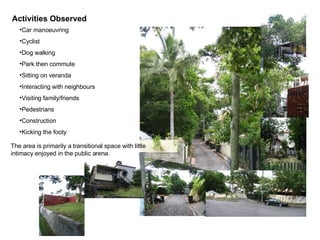
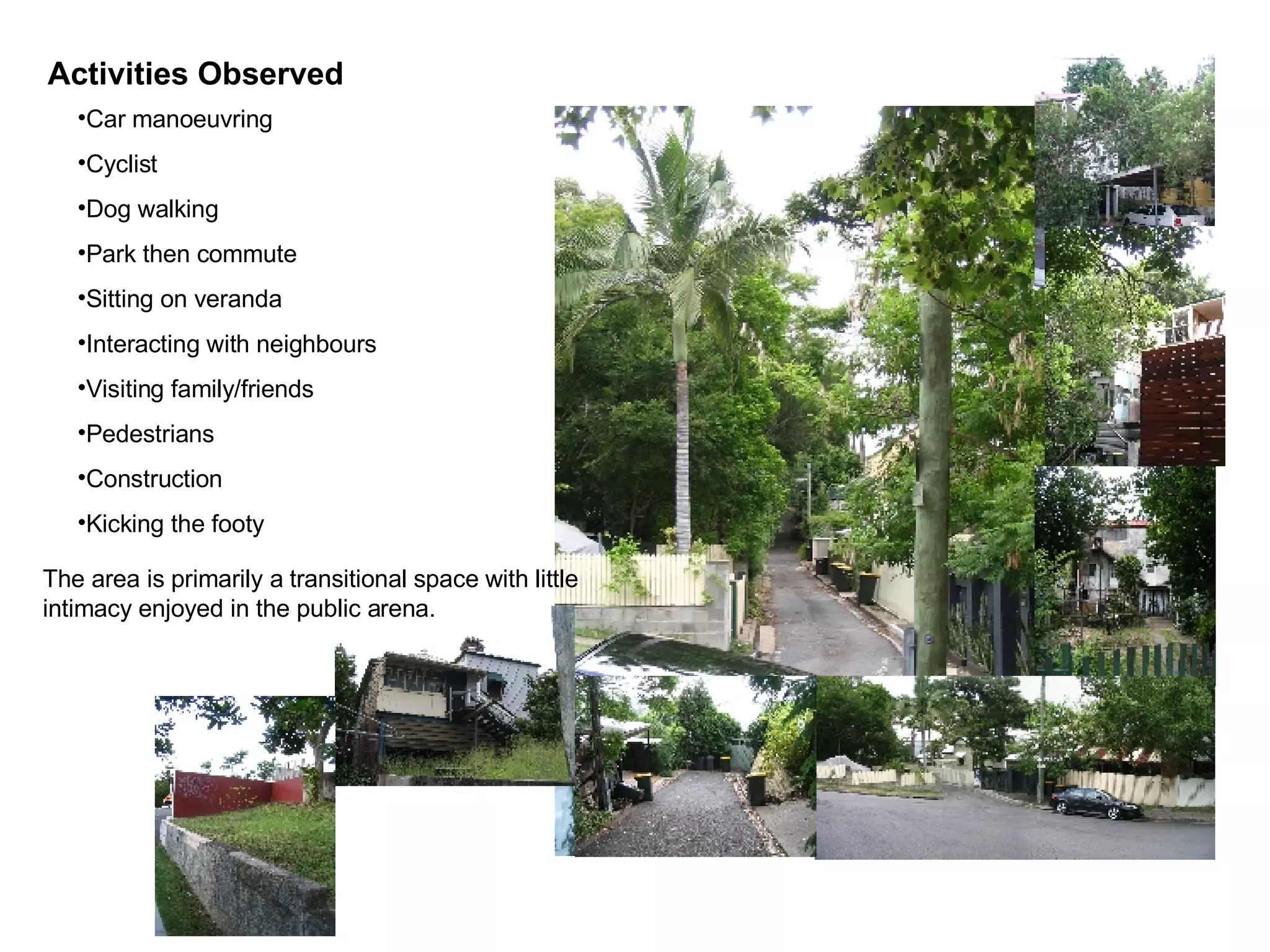
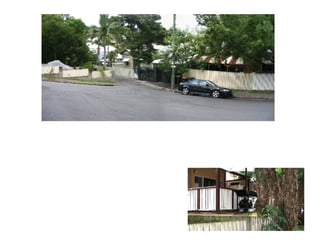
Activities Observed Car manoeuvring Cyclist Dog walking Park then commute Sitting on veranda Interacting with neighbours Visiting family/friends Pedestrians Construction Kicking the footy The area is primarily a transitional space with little intimacy enjoyed in the public arena.
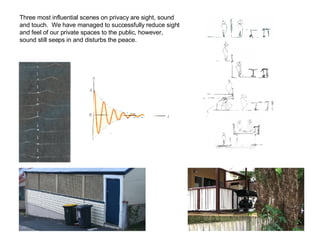
Three most influential scenes on privacy are sight, sound and touch.  We have managed to successfully reduce sight and feel of our private spaces to the public, however, sound still seeps in and disturbs the peace.
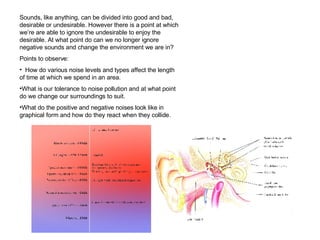
Sounds, like anything, can be divided into good and bad, desirable or undesirable. However there is a point at which we’re are able to ignore the undesirable to enjoy the desirable. At what point do can we no longer ignore negative sounds and change the environment we are in? Points to observe: How do various noise levels and types affect the length of time at which we spend in an area. What is our tolerance to noise pollution and at what point do we change our surroundings to suit.  What do the positive and negative noises look like in graphical form and how do they react when they collide.
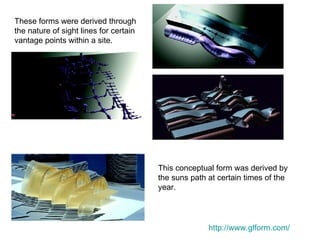
http:// www.glform.com / These forms were derived through the nature of sight lines for certain vantage points within a site. This conceptual form was derived by the suns path at certain times of the year.
 
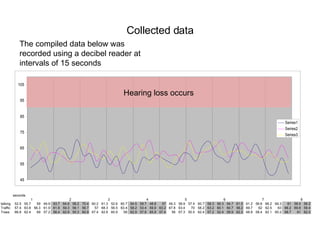
Collected data Hearing loss occurs The compiled data below was recorded using a decibel reader at intervals of 15 seconds
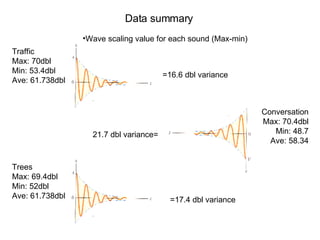
Data summary Traffic Max: 70dbl Min: 53.4dbl Ave: 61.738dbl Trees Max: 69.4dbl Min: 52dbl Ave: 61.738dbl Conversation Max: 70.4dbl Min: 48.7 Ave: 58.34 Wave scaling value for each sound (Max-min) =16.6 dbl variance =17.4 dbl variance 21.7 dbl variance=
 

Pr2

  • 1.
    Activities Observed Carmanoeuvring Cyclist Dog walking Park then commute Sitting on veranda Interacting with neighbours Visiting family/friends Pedestrians Construction Kicking the footy The area is primarily a transitional space with little intimacy enjoyed in the public arena.
  • 2.
    Three most influentialscenes on privacy are sight, sound and touch. We have managed to successfully reduce sight and feel of our private spaces to the public, however, sound still seeps in and disturbs the peace.
  • 3.
    Sounds, like anything,can be divided into good and bad, desirable or undesirable. However there is a point at which we’re are able to ignore the undesirable to enjoy the desirable. At what point do can we no longer ignore negative sounds and change the environment we are in? Points to observe: How do various noise levels and types affect the length of time at which we spend in an area. What is our tolerance to noise pollution and at what point do we change our surroundings to suit. What do the positive and negative noises look like in graphical form and how do they react when they collide.
  • 4.
    http:// www.glform.com /These forms were derived through the nature of sight lines for certain vantage points within a site. This conceptual form was derived by the suns path at certain times of the year.
  • 5.
  • 6.
    Collected data Hearingloss occurs The compiled data below was recorded using a decibel reader at intervals of 15 seconds
  • 7.
    Data summary TrafficMax: 70dbl Min: 53.4dbl Ave: 61.738dbl Trees Max: 69.4dbl Min: 52dbl Ave: 61.738dbl Conversation Max: 70.4dbl Min: 48.7 Ave: 58.34 Wave scaling value for each sound (Max-min) =16.6 dbl variance =17.4 dbl variance 21.7 dbl variance=
  • 8.