CHAPTER 14
NOISE EIA
Introduction
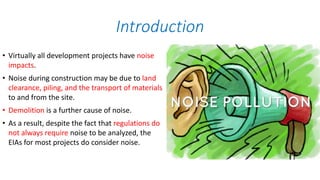
• Virtually all development projects have noise
impacts.
• Noise during construction may be due to land
clearance, piling, and the transport of materials
to and from the site.
• Demolition is a further cause of noise.
• As a result, despite the fact that regulations do
not always require noise to be analyzed, the
EIAs for most projects do consider noise.
Introduction
• Noise is a major and growing form of pollution.
• It can interfere with;
• communication,
• increase stress and annoyance,
• cause anger, and
• disturb sleep,
• Lead to lack of concentration, irritability and reduced efficiency.
• It can contribute to stress-related health problems such as high blood pressure.
• Prolonged exposure to high noise levels can cause deafness or partial hearing loss.
• Noise can also affect property values and community atmosphere.
• In Europe, 57 million people are annoyed by road traffic noise, 42 per cent of them seriously; and
the social costs of traffic noise in Europe amount to at least a 40 billion € per year (CE Delft 2007).
Introduction
• Although most EIAs are limited to the impact of
noise on people, noise may also affect animals.
• Although noise is linked to vibration, we deal only
with noise.
• It should be noted, however, that for some
studies like major railway projects and/or projects
involving substantial demolition or piling,
vibration effects can be significant and a full
vibration assessment must be carried out.
Introduction
Definitions and concepts
Definitions
• Noise is unwanted sound.
• It is the annoyance caused by noise that is
important in EIA.
• Noise impact assessment revolves around the
concept of quantifying and “objectifying”
people’s personal responses.
• Sound consists of pressure variations detectable
by the human ear.
• These pressure variations have two
characteristics, frequency and amplitude.
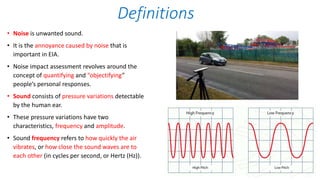
• Sound frequency refers to how quickly the air
vibrates, or how close the sound waves are to
each other (in cycles per second, or Hertz (Hz)).
• For example;
• the sound from a transformer has a wavelength of about
3.5 m, and buzzes at a frequency of 100 Hz;
• a television line emits waves of about 0.03 m, and whistles
at about 10,000 Hz or 10 kHz.
• The lowest frequency audible to humans is 18 Hz, and
the highest is 18,000 Hz.
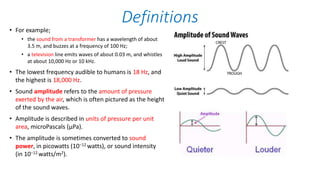
• Sound amplitude refers to the amount of pressure
exerted by the air, which is often pictured as the height
of the sound waves.
• Amplitude is described in units of pressure per unit
area, microPascals (μPa).
• The amplitude is sometimes converted to sound
power, in picowatts (10−12 watts), or sound intensity
(in 10−12 watts/m2).
Definitions
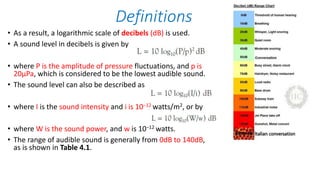
• As a result, a logarithmic scale of decibels (dB) is used.
• A sound level in decibels is given by
• where P is the amplitude of pressure fluctuations, and p is
20μPa, which is considered to be the lowest audible sound.
• The sound level can also be described as
• where I is the sound intensity and i is 10−12 watts/m2, or by
• where W is the sound power, and w is 10−12 watts.
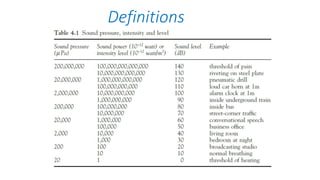
• The range of audible sound is generally from 0dB to 140dB,
as is shown in Table 4.1.
Definitions
Definitions
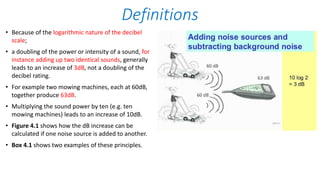
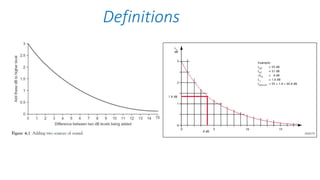
• Because of the logarithmic nature of the decibel
scale;
• a doubling of the power or intensity of a sound, for
instance adding up two identical sounds, generally
leads to an increase of 3dB, not a doubling of the
decibel rating.
• For example two mowing machines, each at 60dB,
together produce 63dB.
• Multiplying the sound power by ten (e.g. ten
mowing machines) leads to an increase of 10dB.
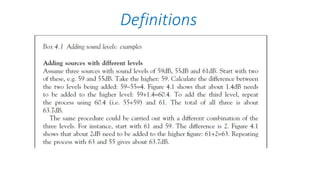
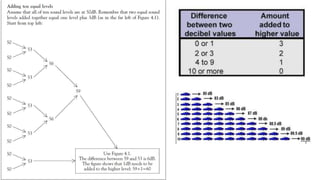
• Figure 4.1 shows how the dB increase can be
calculated if one noise source is added to another.
• Box 4.1 shows two examples of these principles.
Definitions
Definitions
Definitions
• Noise levels are rarely steady: they rise and fall with the types of
activity.
• Time-varying noise levels can be described in a number of ways.
• The principal measurement index for environmental noise is the
equivalent continuous noise level, LAeq.
• The LAeq is a notional steady noise level, which is calculated by
averaging all of the sound pressure/power/intensity
measurements, and converting that average into the dB scale.
• Most environmental noise meters read this index directly.
• LAeq has the dual advantages that it: takes into account both the
energy and duration of noise events.
Definitions
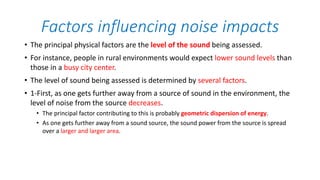
Factors influencing noise impacts
• The principal physical factors are the level of the sound being assessed.
• For instance, people in rural environments would expect lower sound levels than
those in a busy city center.
• The level of sound being assessed is determined by several factors.
• 1-First, as one gets further away from a source of sound in the environment, the
level of noise from the source decreases.
• The principal factor contributing to this is probably geometric dispersion of energy.
• As one gets further away from a sound source, the sound power from the source is spread
over a larger and larger area.
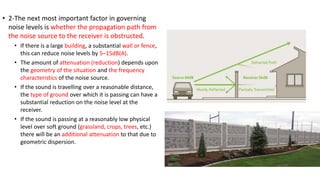
• 2-The next most important factor in governing
noise levels is whether the propagation path from
the noise source to the receiver is obstructed.
• If there is a large building, a substantial wall or fence,
this can reduce noise levels by 5–15dB(A).
• The amount of attenuation (reduction) depends upon
the geometry of the situation and the frequency
characteristics of the noise source.
• If the sound is travelling over a reasonable distance,
the type of ground over which it is passing can have a
substantial reduction on the noise level at the
receiver.
• If the sound is passing at a reasonably low physical
level over soft ground (grassland, crops, trees, etc.)
there will be an additional attenuation to that due to
geometric dispersion.
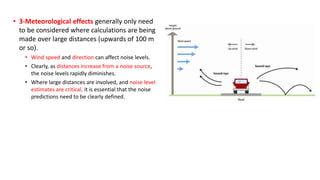
• 3-Meteorological effects generally only need
to be considered where calculations are being
made over large distances (upwards of 100 m
or so).
• Wind speed and direction can affect noise levels.
• Clearly, as distances increase from a noise source,
the noise levels rapidly diminishes.
• Where large distances are involved, and noise level
estimates are critical, it is essential that the noise
predictions need to be clearly defined.
Legislative background and interest
groups
• Noise is controlled in three ways: by
• 1-controlling overall noise levels,
• 2-setting limits on the emission of noise, and
• 3-keeping people and noise apart.
• The local authority environmental health officer’s opinion will be needed by the planning
authority.
• The Environmental Noise Directive requires European Member States to map noise in densely
populated areas and from major transport projects.
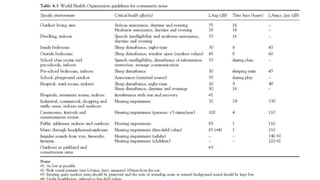
• The World Health Organization (WHO 1999) has also defined guideline levels for community
noise (Table 4.3).
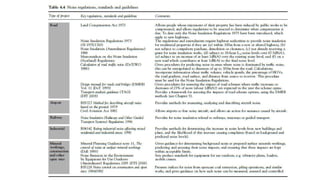
• Further legislation and guidance applies to specific types of developments: the key ones are
reviewed at Table 4.4.
Legislative background and interest
groups
Scoping and baseline studies
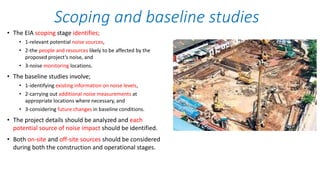
• The EIA scoping stage identifies;
• 1-relevant potential noise sources,
• 2-the people and resources likely to be affected by the
proposed project’s noise, and
• 3-noise monitoring locations.
• The baseline studies involve;
• 1-identifying existing information on noise levels,
• 2-carrying out additional noise measurements at
appropriate locations where necessary, and
• 3-considering future changes in baseline conditions.
• The project details should be analyzed and each
potential source of noise impact should be identified.
• Both on-site and off-site sources should be considered
during both the construction and operational stages.
Scoping and baseline studies
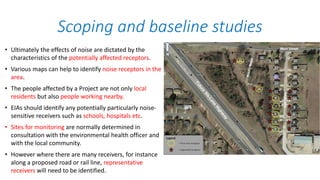
• Ultimately the effects of noise are dictated by the
characteristics of the potentially affected receptors.
• Various maps can help to identify noise receptors in the
area.
• The people affected by a Project are not only local
residents but also people working nearby.
• EIAs should identify any potentially particularly noise-
sensitive receivers such as schools, hospitals etc.
• Sites for monitoring are normally determined in
consultation with the environmental health officer and
with the local community.
• However where there are many receivers, for instance
along a proposed road or rail line, representative
receivers will need to be identified.
Scoping and baseline studies
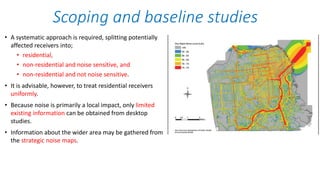
• A systematic approach is required, splitting potentially
affected receivers into;
• residential,
• non-residential and noise sensitive, and
• non-residential and not noise sensitive.
• It is advisable, however, to treat residential receivers
uniformly.
• Because noise is primarily a local impact, only limited
existing information can be obtained from desktop
studies.
• Information about the wider area may be gathered from
the strategic noise maps.
Scoping and baseline studies
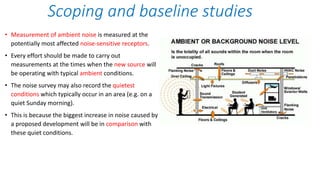
• Measurement of ambient noise is measured at the
potentially most affected noise-sensitive receptors.
• Every effort should be made to carry out
measurements at the times when the new source will
be operating with typical ambient conditions.
• The noise survey may also record the quietest
conditions which typically occur in an area (e.g. on a
quiet Sunday morning).
• This is because the biggest increase in noise caused by
a proposed development will be in comparison with
these quiet conditions.
Scoping and baseline studies
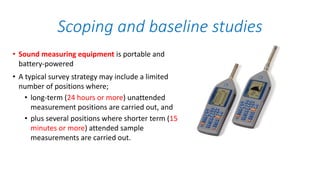
• Sound measuring equipment is portable and
battery-powered
• A typical survey strategy may include a limited
number of positions where;
• long-term (24 hours or more) unattended
measurement positions are carried out, and
• plus several positions where shorter term (15
minutes or more) attended sample
measurements are carried out.
Scoping and baseline studies
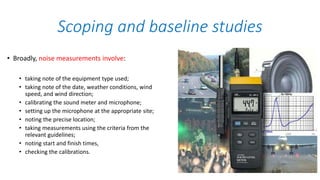
• Broadly, noise measurements involve:
• taking note of the equipment type used;
• taking note of the date, weather conditions, wind
speed, and wind direction;
• calibrating the sound meter and microphone;
• setting up the microphone at the appropriate site;
• noting the precise location;
• taking measurements using the criteria from the
relevant guidelines;
• noting start and finish times,
• checking the calibrations.
Scoping and baseline studies
• A final stage of scoping and baseline studies
is to consider whether baseline noise levels
are likely to change in the future in the
absence of the proposed development.
• For instance, if a development is proposed
near an industrial complex that is currently
under construction, then the future baseline
is likely to change.
• In some cases the future baseline may be
established through calculations.
Scoping and baseline studies
Impact prediction
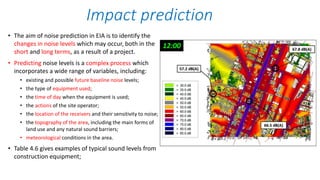
• The aim of noise prediction in EIA is to identify the
changes in noise levels which may occur, both in the
short and long terms, as a result of a project.
• Predicting noise levels is a complex process which
incorporates a wide range of variables, including:
• existing and possible future baseline noise levels;
• the type of equipment used;
• the time of day when the equipment is used;
• the actions of the site operator;
• the location of the receivers and their sensitivity to noise;
• the topography of the area, including the main forms of
land use and any natural sound barriers;
• meteorological conditions in the area.
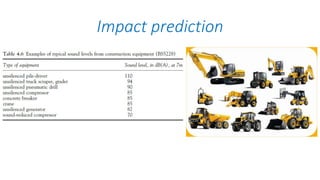
• Table 4.6 gives examples of typical sound levels from
construction equipment;
Impact prediction
Impact prediction
Mitigation
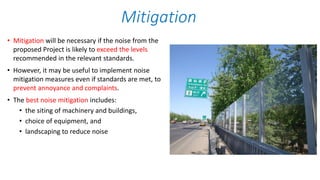
• Mitigation will be necessary if the noise from the
proposed Project is likely to exceed the levels
recommended in the relevant standards.
• However, it may be useful to implement noise
mitigation measures even if standards are met, to
prevent annoyance and complaints.
• The best noise mitigation includes:
• the siting of machinery and buildings,
• choice of equipment, and
• landscaping to reduce noise
Mitigation
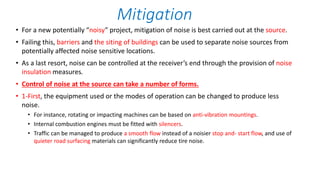
• For a new potentially “noisy” project, mitigation of noise is best carried out at the source.
• Failing this, barriers and the siting of buildings can be used to separate noise sources from
potentially affected noise sensitive locations.
• As a last resort, noise can be controlled at the receiver’s end through the provision of noise
insulation measures.
• Control of noise at the source can take a number of forms.
• 1-First, the equipment used or the modes of operation can be changed to produce less
noise.
• For instance, rotating or impacting machines can be based on anti-vibration mountings.
• Internal combustion engines must be fitted with silencers.
• Traffic can be managed to produce a smooth flow instead of a noisier stop and- start flow, and use of
quieter road surfacing materials can significantly reduce tire noise.
Mitigation
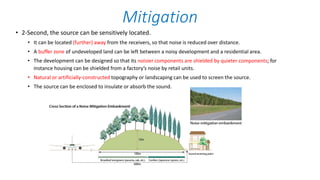
• 2-Second, the source can be sensitively located.
• It can be located (further) away from the receivers, so that noise is reduced over distance.
• A buffer zone of undeveloped land can be left between a noisy development and a residential area.
• The development can be designed so that its noisier components are shielded by quieter components; for
instance housing can be shielded from a factory’s noise by retail units.
• Natural or artificially-constructed topography or landscaping can be used to screen the source.
• The source can be enclosed to insulate or absorb the sound.
Mitigation
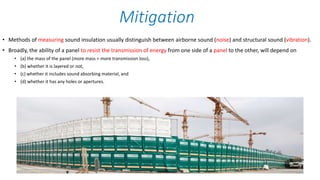
• Methods of measuring sound insulation usually distinguish between airborne sound (noise) and structural sound (vibration).
• Broadly, the ability of a panel to resist the transmission of energy from one side of a panel to the other, will depend on
• (a) the mass of the panel (more mass = more transmission loss),
• (b) whether it is layered or not,
• (c) whether it includes sound absorbing material, and
• (d) whether it has any holes or apertures.
Mitigation
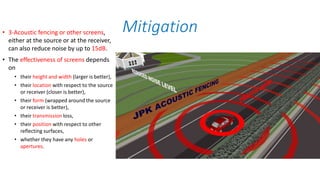
• 3-Acoustic fencing or other screens,
either at the source or at the receiver,
can also reduce noise by up to 15dB.
• The effectiveness of screens depends
on
• their height and width (larger is better),
• their location with respect to the source
or receiver (closer is better),
• their form (wrapped around the source
or receiver is better),
• their transmission loss,
• their position with respect to other
reflecting surfaces,
• whether they have any holes or
apertures.
Mitigation
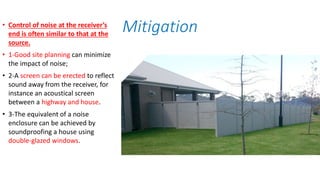
• Control of noise at the receiver’s
end is often similar to that at the
source.
• 1-Good site planning can minimize
the impact of noise;
• 2-A screen can be erected to reflect
sound away from the receiver, for
instance an acoustical screen
between a highway and house.
• 3-The equivalent of a noise
enclosure can be achieved by
soundproofing a house using
double-glazed windows.
Mitigation
Monitoring
Monitoring
• Any noise conditions imposed as part of a project’s planning are enforceable.
• These can apply not only to noise levels (e.g. during construction, operation),
• but also to noise monitoring to be conducted by the developer.
• If no planning conditions are set, local environmental health officers can still monitor
noise from a site,
• for instance in response to local residents’ complaints.
• A best practice EIA could propose not only noise-related planning conditions, but also a
noise monitoring program.
• The sites and noise-measurement techniques used in carrying out baseline noise surveys
should be such that comparable monitoring data can later be collected.
Conclusion
Conclusion
• This has only been a brief introduction to a very technically-complex topic.
• Noise prediction requires expert input, and probably computer models.
• Students are strongly urged to familiarize themselves with the relevant
regulations and standards as well as standard texts on acoustics and noise
control.
Noise EIA Examples
http://www.epd.gov.hk/eia/register/report/eiareport/eia_0392000/theme/0
5.pdf
http://sahra.org.za/sahris/sites/default/files/additionaldocs/Amakhala%20E
moyeni%20WEF%20DEIR%20-%20Appendix%20L%20_NIA_final.pdf
https://hal.archives-ouvertes.fr/hal-00811229/document
http://www.gov.ms/wp-content/uploads/2011/02/Montserrat-Sandmining-
EIA_Dec-2011_PART-TWO-ANNEX.pdf

Chapter 14 Noise.pptx

  • 1.
  • 2.
  • 3.
    • Virtually alldevelopment projects have noise impacts. • Noise during construction may be due to land clearance, piling, and the transport of materials to and from the site. • Demolition is a further cause of noise. • As a result, despite the fact that regulations do not always require noise to be analyzed, the EIAs for most projects do consider noise. Introduction
  • 4.
    • Noise isa major and growing form of pollution. • It can interfere with; • communication, • increase stress and annoyance, • cause anger, and • disturb sleep, • Lead to lack of concentration, irritability and reduced efficiency. • It can contribute to stress-related health problems such as high blood pressure. • Prolonged exposure to high noise levels can cause deafness or partial hearing loss. • Noise can also affect property values and community atmosphere. • In Europe, 57 million people are annoyed by road traffic noise, 42 per cent of them seriously; and the social costs of traffic noise in Europe amount to at least a 40 billion € per year (CE Delft 2007). Introduction
  • 5.
    • Although mostEIAs are limited to the impact of noise on people, noise may also affect animals. • Although noise is linked to vibration, we deal only with noise. • It should be noted, however, that for some studies like major railway projects and/or projects involving substantial demolition or piling, vibration effects can be significant and a full vibration assessment must be carried out. Introduction
  • 6.
  • 7.
    Definitions • Noise isunwanted sound. • It is the annoyance caused by noise that is important in EIA. • Noise impact assessment revolves around the concept of quantifying and “objectifying” people’s personal responses. • Sound consists of pressure variations detectable by the human ear. • These pressure variations have two characteristics, frequency and amplitude. • Sound frequency refers to how quickly the air vibrates, or how close the sound waves are to each other (in cycles per second, or Hertz (Hz)).
  • 8.
    • For example; •the sound from a transformer has a wavelength of about 3.5 m, and buzzes at a frequency of 100 Hz; • a television line emits waves of about 0.03 m, and whistles at about 10,000 Hz or 10 kHz. • The lowest frequency audible to humans is 18 Hz, and the highest is 18,000 Hz. • Sound amplitude refers to the amount of pressure exerted by the air, which is often pictured as the height of the sound waves. • Amplitude is described in units of pressure per unit area, microPascals (μPa). • The amplitude is sometimes converted to sound power, in picowatts (10−12 watts), or sound intensity (in 10−12 watts/m2). Definitions
  • 9.
    • As aresult, a logarithmic scale of decibels (dB) is used. • A sound level in decibels is given by • where P is the amplitude of pressure fluctuations, and p is 20μPa, which is considered to be the lowest audible sound. • The sound level can also be described as • where I is the sound intensity and i is 10−12 watts/m2, or by • where W is the sound power, and w is 10−12 watts. • The range of audible sound is generally from 0dB to 140dB, as is shown in Table 4.1. Definitions
  • 10.
  • 11.
    • Because ofthe logarithmic nature of the decibel scale; • a doubling of the power or intensity of a sound, for instance adding up two identical sounds, generally leads to an increase of 3dB, not a doubling of the decibel rating. • For example two mowing machines, each at 60dB, together produce 63dB. • Multiplying the sound power by ten (e.g. ten mowing machines) leads to an increase of 10dB. • Figure 4.1 shows how the dB increase can be calculated if one noise source is added to another. • Box 4.1 shows two examples of these principles. Definitions
  • 12.
  • 13.
  • 15.
    • Noise levelsare rarely steady: they rise and fall with the types of activity. • Time-varying noise levels can be described in a number of ways. • The principal measurement index for environmental noise is the equivalent continuous noise level, LAeq. • The LAeq is a notional steady noise level, which is calculated by averaging all of the sound pressure/power/intensity measurements, and converting that average into the dB scale. • Most environmental noise meters read this index directly. • LAeq has the dual advantages that it: takes into account both the energy and duration of noise events. Definitions
  • 16.
    Factors influencing noiseimpacts • The principal physical factors are the level of the sound being assessed. • For instance, people in rural environments would expect lower sound levels than those in a busy city center. • The level of sound being assessed is determined by several factors. • 1-First, as one gets further away from a source of sound in the environment, the level of noise from the source decreases. • The principal factor contributing to this is probably geometric dispersion of energy. • As one gets further away from a sound source, the sound power from the source is spread over a larger and larger area.
  • 17.
    • 2-The nextmost important factor in governing noise levels is whether the propagation path from the noise source to the receiver is obstructed. • If there is a large building, a substantial wall or fence, this can reduce noise levels by 5–15dB(A). • The amount of attenuation (reduction) depends upon the geometry of the situation and the frequency characteristics of the noise source. • If the sound is travelling over a reasonable distance, the type of ground over which it is passing can have a substantial reduction on the noise level at the receiver. • If the sound is passing at a reasonably low physical level over soft ground (grassland, crops, trees, etc.) there will be an additional attenuation to that due to geometric dispersion.
  • 18.
    • 3-Meteorological effectsgenerally only need to be considered where calculations are being made over large distances (upwards of 100 m or so). • Wind speed and direction can affect noise levels. • Clearly, as distances increase from a noise source, the noise levels rapidly diminishes. • Where large distances are involved, and noise level estimates are critical, it is essential that the noise predictions need to be clearly defined.
  • 19.
  • 20.
    • Noise iscontrolled in three ways: by • 1-controlling overall noise levels, • 2-setting limits on the emission of noise, and • 3-keeping people and noise apart. • The local authority environmental health officer’s opinion will be needed by the planning authority. • The Environmental Noise Directive requires European Member States to map noise in densely populated areas and from major transport projects. • The World Health Organization (WHO 1999) has also defined guideline levels for community noise (Table 4.3). • Further legislation and guidance applies to specific types of developments: the key ones are reviewed at Table 4.4. Legislative background and interest groups
  • 23.
  • 24.
    • The EIAscoping stage identifies; • 1-relevant potential noise sources, • 2-the people and resources likely to be affected by the proposed project’s noise, and • 3-noise monitoring locations. • The baseline studies involve; • 1-identifying existing information on noise levels, • 2-carrying out additional noise measurements at appropriate locations where necessary, and • 3-considering future changes in baseline conditions. • The project details should be analyzed and each potential source of noise impact should be identified. • Both on-site and off-site sources should be considered during both the construction and operational stages. Scoping and baseline studies
  • 25.
    • Ultimately theeffects of noise are dictated by the characteristics of the potentially affected receptors. • Various maps can help to identify noise receptors in the area. • The people affected by a Project are not only local residents but also people working nearby. • EIAs should identify any potentially particularly noise- sensitive receivers such as schools, hospitals etc. • Sites for monitoring are normally determined in consultation with the environmental health officer and with the local community. • However where there are many receivers, for instance along a proposed road or rail line, representative receivers will need to be identified. Scoping and baseline studies
  • 26.
    • A systematicapproach is required, splitting potentially affected receivers into; • residential, • non-residential and noise sensitive, and • non-residential and not noise sensitive. • It is advisable, however, to treat residential receivers uniformly. • Because noise is primarily a local impact, only limited existing information can be obtained from desktop studies. • Information about the wider area may be gathered from the strategic noise maps. Scoping and baseline studies
  • 27.
    • Measurement ofambient noise is measured at the potentially most affected noise-sensitive receptors. • Every effort should be made to carry out measurements at the times when the new source will be operating with typical ambient conditions. • The noise survey may also record the quietest conditions which typically occur in an area (e.g. on a quiet Sunday morning). • This is because the biggest increase in noise caused by a proposed development will be in comparison with these quiet conditions. Scoping and baseline studies
  • 28.
    • Sound measuringequipment is portable and battery-powered • A typical survey strategy may include a limited number of positions where; • long-term (24 hours or more) unattended measurement positions are carried out, and • plus several positions where shorter term (15 minutes or more) attended sample measurements are carried out. Scoping and baseline studies
  • 29.
    • Broadly, noisemeasurements involve: • taking note of the equipment type used; • taking note of the date, weather conditions, wind speed, and wind direction; • calibrating the sound meter and microphone; • setting up the microphone at the appropriate site; • noting the precise location; • taking measurements using the criteria from the relevant guidelines; • noting start and finish times, • checking the calibrations. Scoping and baseline studies
  • 30.
    • A finalstage of scoping and baseline studies is to consider whether baseline noise levels are likely to change in the future in the absence of the proposed development. • For instance, if a development is proposed near an industrial complex that is currently under construction, then the future baseline is likely to change. • In some cases the future baseline may be established through calculations. Scoping and baseline studies
  • 31.
  • 32.
    • The aimof noise prediction in EIA is to identify the changes in noise levels which may occur, both in the short and long terms, as a result of a project. • Predicting noise levels is a complex process which incorporates a wide range of variables, including: • existing and possible future baseline noise levels; • the type of equipment used; • the time of day when the equipment is used; • the actions of the site operator; • the location of the receivers and their sensitivity to noise; • the topography of the area, including the main forms of land use and any natural sound barriers; • meteorological conditions in the area. • Table 4.6 gives examples of typical sound levels from construction equipment; Impact prediction
  • 33.
  • 34.
  • 35.
    • Mitigation willbe necessary if the noise from the proposed Project is likely to exceed the levels recommended in the relevant standards. • However, it may be useful to implement noise mitigation measures even if standards are met, to prevent annoyance and complaints. • The best noise mitigation includes: • the siting of machinery and buildings, • choice of equipment, and • landscaping to reduce noise Mitigation
  • 36.
    • For anew potentially “noisy” project, mitigation of noise is best carried out at the source. • Failing this, barriers and the siting of buildings can be used to separate noise sources from potentially affected noise sensitive locations. • As a last resort, noise can be controlled at the receiver’s end through the provision of noise insulation measures. • Control of noise at the source can take a number of forms. • 1-First, the equipment used or the modes of operation can be changed to produce less noise. • For instance, rotating or impacting machines can be based on anti-vibration mountings. • Internal combustion engines must be fitted with silencers. • Traffic can be managed to produce a smooth flow instead of a noisier stop and- start flow, and use of quieter road surfacing materials can significantly reduce tire noise. Mitigation
  • 37.
    • 2-Second, thesource can be sensitively located. • It can be located (further) away from the receivers, so that noise is reduced over distance. • A buffer zone of undeveloped land can be left between a noisy development and a residential area. • The development can be designed so that its noisier components are shielded by quieter components; for instance housing can be shielded from a factory’s noise by retail units. • Natural or artificially-constructed topography or landscaping can be used to screen the source. • The source can be enclosed to insulate or absorb the sound. Mitigation
  • 38.
    • Methods ofmeasuring sound insulation usually distinguish between airborne sound (noise) and structural sound (vibration). • Broadly, the ability of a panel to resist the transmission of energy from one side of a panel to the other, will depend on • (a) the mass of the panel (more mass = more transmission loss), • (b) whether it is layered or not, • (c) whether it includes sound absorbing material, and • (d) whether it has any holes or apertures. Mitigation
  • 39.
    • 3-Acoustic fencingor other screens, either at the source or at the receiver, can also reduce noise by up to 15dB. • The effectiveness of screens depends on • their height and width (larger is better), • their location with respect to the source or receiver (closer is better), • their form (wrapped around the source or receiver is better), • their transmission loss, • their position with respect to other reflecting surfaces, • whether they have any holes or apertures. Mitigation
  • 40.
    • Control ofnoise at the receiver’s end is often similar to that at the source. • 1-Good site planning can minimize the impact of noise; • 2-A screen can be erected to reflect sound away from the receiver, for instance an acoustical screen between a highway and house. • 3-The equivalent of a noise enclosure can be achieved by soundproofing a house using double-glazed windows. Mitigation
  • 41.
  • 42.
    Monitoring • Any noiseconditions imposed as part of a project’s planning are enforceable. • These can apply not only to noise levels (e.g. during construction, operation), • but also to noise monitoring to be conducted by the developer. • If no planning conditions are set, local environmental health officers can still monitor noise from a site, • for instance in response to local residents’ complaints. • A best practice EIA could propose not only noise-related planning conditions, but also a noise monitoring program. • The sites and noise-measurement techniques used in carrying out baseline noise surveys should be such that comparable monitoring data can later be collected.
  • 43.
  • 44.
    Conclusion • This hasonly been a brief introduction to a very technically-complex topic. • Noise prediction requires expert input, and probably computer models. • Students are strongly urged to familiarize themselves with the relevant regulations and standards as well as standard texts on acoustics and noise control.
  • 45.