National Institute of Technology,
Warangal
Submitted by :
Tejasvi Gupta
198109
BTech in Biotechnology
IV year semester I
Stem Cell-Based Approaches to Red
Blood Cell Production for Transfusion
Introduction
 Blood transfusion involves transferring blood products into a person's circulation
intravenously. Transfusions are used for various medical conditions to replace lost
components of the blood.
 Supportive care for surgeries and trauma and cancer treatments all involve blood
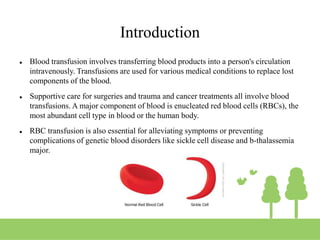
transfusions. A major component of blood is enucleated red blood cells (RBCs), the
most abundant cell type in blood or the human body.
 RBC transfusion is also essential for alleviating symptoms or preventing
complications of genetic blood disorders like sickle cell disease and b-thalassemia
major.
Blood
• Blood is a constantly circulating fluid providing the body with nutrition, oxygen,
and waste removal. It has four main components: plasma, red blood
cells(erythrocytes), white blood cells(leukocytes), and platelets.
• Based on the types of antigens and bodies present in the blood, it can be classified
into various groups :
Challenges in Blood Transfusion
• Blood compatibility is one of the biggest challenge in transfusion. Well-known ABO
and Rh antigens that are critical to transfusion compatibility, scientists also know of at
least 30 blood group systems that include most of the 308 recognised antigens.
• If blood is transfused from significantly different donors, recipients may develop
antibodies against immunogenic antigens not present in themselves, leading to
alloimmunisation in recipients.
• Even with matched groups of blood donors, the risks of infection through transfusion
always persist. Regular screening of donated blood for transfusion-transmissible
infections, which include HIV and hepatitis B and C viruses, is not a routine process
in 39 countries, increasing the risk of such infections.
Erythropoiesis
• Erythropoiesis is a physiological process that generates RBCs, also called
erythrocytes.
• Developmentally, erythropoiesis in humans occurs in different anatomic locations,
and the cells produced are from two distinct phases: primitive and definitive.
• The first wave of (transient) definitive erythropoiesis also begins in the yolk sac, but
the cell maturation occurs in the fetal liver.
• A second wave of (permanent) definitive erythropoiesis arises from multipotent
hematopoietic stem and progenitor cells (HSPCs), expands in the fetal liver, and later
homes to the bone marrow
Enucleation Mechanism
• The enucleation process involves the division of the orthochromatic erythroblast into
two bodies: the nucleus containing pyrenocyte and the enucleated reticolyte.
• The process is facilitated in the bone marrow by interactions with macrophages.
• The maturation process of the erythroblasts also severs the cytoskeletal connections
between the plasma and the nucleus making the process of enucleation dependent on
external factors such as macrophages for nucleus extrusion.
• In ex vivo conditions, in the absence of external forces to provide the right tension,
enucleation of mature erythroblasts is a challenge.
*Hematopoietic stem and progenitor cells (HSPC) primarily reside
in the bone marrow, though recent work has shown that they circulate
in blood and lymph and traffic to other hematopoietic and
nonhematopoietic organs during homeostasis and stress.
EX VIVO PRODUCTION OF HUMAN
RBC
• HSPCs are differentiated into the erythroid lineage by following three steps:
commitment, expansion, and maturation.
• To induce erythroid differentiation and maturation, various cytokines (most of
them include stem cell factor (SCF) and erythropoietin [EPO]) are added to the
culture medium and/or cells are cocultured with feeder cells of murine or human
origin.
• Stem cell factor is a cytokine that binds to the c-KIT receptor.
• A single unit of packed red cells for transfusion contains approximately 2-3 10^12
RBCs.
• We can only isolate 2.5-3 x10^6 to 20.3 x10^6 nucleated cells from 1 ml of
marrow harvested, of which approximately1.5% are CD34+ HSPCs.
* CD34 is a transmembrane phosphoglycoprotein
encoded by the CD34 gene in humans, mice, rats and
other species.
• The concentration of CD34+ HSPCs in peripheral blood (PB) is even lower.
• Cord blood (CB) from the umbilical cords of newborns provides an enriched source of CD34+ HSPCs, but
total and CD34+ cell number is limited.
• A single CB unit (80–200 ml of blood) has only approximately 6 to 10x10^8 nucleated cells 2% of which
are CD34 HSPCs.
• However, with limited ex vivo proliferation ability of lineage-restricted downstream cells, these
approaches can still not provide requisite numbers for RBC generation, even for a single transfusion unit.
• Ex vivo cultured RBCs can be obtained from various sources.
Different Approaches to ex vivo
generation
Stem cells are raw cells from which many specialized cells develop.
Stem Cells Types (Totipotent, Pluripotent, Multipotent, and Unipotent)
Stem Cells
Primary HSPC's :Source 1
• PB can provide circulating HSPCs in lower numbers, which can be increased by
mobilization using granulocyte colony-stimulating factor. CB provides an enriched
source of CD34+ HSPCs but the total and CD34+ cell number is limited.
• the generation of erythrocytes from CB HSPCs, but ex vivo enucleation from the
cultured cells appeared low (4%) [42]. Nonetheless, these cells were capable of
enucleation in a mouse model.
• Subsequently, the group achieved near-complete (90%) ex vivo terminal maturation of
erythroblasts (derived from CB and PB HSPCs) by coculturing them with mouse MS-5
cells.
• *MS-5cells generate mature T-cells from human hematopoietic stem and
progenitor cells.
• Little work has been done with PB as a source owing to its low amplification
potentials, but the Douay group’s CB protocol, when applied to PB-derived HSPCs,
seems to provide similar results (90% enucleation).
• It involves a magnetic cell-separation step and the use of human AB blood-type
serum for maturation for a total duration of 14 days to derive macrophages.
• These requirements and the use of an additional CB donor for deriving the
macrophages
Pluripotent Stem Cells: Source 2
• Human embryonic stem cells (ESCs) and induced pluripotent stem cells (iPSCs) are,
by definition, self-renewing and immortal stem cells that can give rise to any cell type.
They form another approach to obtaining HSPCs.
• The mononuclear cell fraction from either CB or adult PB can be separated and
reprogrammed to iPSCs.
• The human iPSCs can then be differentiated in vitro to CD45+ CD34+ HSPCs using
protocols that were initially developed to differentiate human ESCs.
• Human ESC- and iPSC-derived erythroblasts and RBCs express embryonic and fetal
hemoglobins.
• Most protocols lead to RBCs with predominant expression of fetal hemoglobin, with
little or no expression of adult hemoglobin.
• There is evidence to suggest that both human ESCs and iPSCs follow the in vivo
developmental model of erythropoiesis, starting with a primitive path expressing
embryonic globins, followed by the definitive path with expression of fetal and, later,
adult globins.
Extensively Expanding Erythroid
Precursors: Source 3
• Under conditions of stress such as erythrolysis or hypoxia, rapid expansion of
erythroid precursors is achieved in vivo by what is defined as “stress erythropoiesis.
• Mimicking stress erythropoiesis, erythroid precursors can be expanded in vitro by
activation of the glucocorticoid receptor.
• Even with better protocols, the amplification fold of CB-derived erythroid precursors
is restricted ,10^10-fold.
• Using interleukin 3 in this cytokine cocktail, erythroid cells from normal donor PB
have also been expanded.
Future
• One common problem with any starting cell population, except for adult PB HSPCs,
is the absence of adult hemoglobin.
• Although this may not be an issue, it would be beneficial to have adult hemoglobin
expression in adult patients.
• Another problem involves making culture conditions xenofree for clinical
applications. Many protocols use serum or feeder cells of animal origin, especially
for increasing enucleation efficiencies.
• These protocols need to be optimized to avoid the use of animal products.
• CB feeder-free protocols have already been optimised in this regard, and the use of
alternatives such as a human plasma or serum needed to be tested.
• Protocol optimization for increasing expansion fold to achieve the requisite numbers
of RBCs is also necessary.
Conclusion
• Tremendous progress has been made in the field of ex vivo RBC generation aimed at
clinical transfusion.
• With this rate of progress and with optimized protocols, we hope that in vitro
generated RBCs may soon complement blood donations for RBCs soon.
References
• World Health Organization. Global Database on Blood Safety: Summary report 2011. Available at
http://www.who.int/entity/bloodsafety/global_ database/GDBS_Summary_Report_2011.pdf. Accessed September
8, 2012.
• Adams RJ, McKie VC, Hsu L et al. Prevention of a first stroke by transfusions in children with sickle cell anemia
and abnormal results on transcranial Doppler ultrasonography. N Engl J Med 1998;339:5–11.
• Lucarelli G, Gaziev J. Advances in the allogeneic transplantation for thalassemia. Blood Rev 2008;22:53–63.
• U.S. Census Bureau. Global population composition. Available at http://www.census.
Gov/population/international/files/wp02/wp02004.pdf.
• Wang T-F, Chu S-C, Chen S-H et al. The effect of different harvest strategies on the nucleated cell yields of bone
marrow collection. Biol Blood Marrow Transplant 2011;17:351–355.
• Hao Q-L, Shah AJ, Thiemann FT et al. A functional comparison of CD34 + CD38- cells in cord blood and bone
marrow. Blood 1995; 86:3745–3753.
• Solves P, Carbonell-Uberos F, Mirabet V et al. CD34+ cell content for selecting umbilical cord blood units for
cryopreservation. Transfusion 2007;47:552–553.
• Csaszar E, Kirouac DC, Yu M et al. Rapid expansion of human hematopoietic stem cells by automated control of
inhibitory feedback signaling. Cell Stem Cell 2012;10:218–229.
• Boitano AE, Wang J, Romeo R et al. Aryl hydrocarbon receptor antagonists promote the expansion of human
hematopoietic stem cells. Science 2010;329:1345–1348.

ppt.pptx

  • 1.
    National Institute ofTechnology, Warangal Submitted by : Tejasvi Gupta 198109 BTech in Biotechnology IV year semester I Stem Cell-Based Approaches to Red Blood Cell Production for Transfusion
  • 2.
    Introduction  Blood transfusioninvolves transferring blood products into a person's circulation intravenously. Transfusions are used for various medical conditions to replace lost components of the blood.  Supportive care for surgeries and trauma and cancer treatments all involve blood transfusions. A major component of blood is enucleated red blood cells (RBCs), the most abundant cell type in blood or the human body.  RBC transfusion is also essential for alleviating symptoms or preventing complications of genetic blood disorders like sickle cell disease and b-thalassemia major.
  • 3.
    Blood • Blood isa constantly circulating fluid providing the body with nutrition, oxygen, and waste removal. It has four main components: plasma, red blood cells(erythrocytes), white blood cells(leukocytes), and platelets. • Based on the types of antigens and bodies present in the blood, it can be classified into various groups :
  • 4.
    Challenges in BloodTransfusion • Blood compatibility is one of the biggest challenge in transfusion. Well-known ABO and Rh antigens that are critical to transfusion compatibility, scientists also know of at least 30 blood group systems that include most of the 308 recognised antigens. • If blood is transfused from significantly different donors, recipients may develop antibodies against immunogenic antigens not present in themselves, leading to alloimmunisation in recipients. • Even with matched groups of blood donors, the risks of infection through transfusion always persist. Regular screening of donated blood for transfusion-transmissible infections, which include HIV and hepatitis B and C viruses, is not a routine process in 39 countries, increasing the risk of such infections.
  • 5.
    Erythropoiesis • Erythropoiesis isa physiological process that generates RBCs, also called erythrocytes. • Developmentally, erythropoiesis in humans occurs in different anatomic locations, and the cells produced are from two distinct phases: primitive and definitive. • The first wave of (transient) definitive erythropoiesis also begins in the yolk sac, but the cell maturation occurs in the fetal liver. • A second wave of (permanent) definitive erythropoiesis arises from multipotent hematopoietic stem and progenitor cells (HSPCs), expands in the fetal liver, and later homes to the bone marrow
  • 6.
    Enucleation Mechanism • Theenucleation process involves the division of the orthochromatic erythroblast into two bodies: the nucleus containing pyrenocyte and the enucleated reticolyte. • The process is facilitated in the bone marrow by interactions with macrophages. • The maturation process of the erythroblasts also severs the cytoskeletal connections between the plasma and the nucleus making the process of enucleation dependent on external factors such as macrophages for nucleus extrusion. • In ex vivo conditions, in the absence of external forces to provide the right tension, enucleation of mature erythroblasts is a challenge. *Hematopoietic stem and progenitor cells (HSPC) primarily reside in the bone marrow, though recent work has shown that they circulate in blood and lymph and traffic to other hematopoietic and nonhematopoietic organs during homeostasis and stress.
  • 8.
    EX VIVO PRODUCTIONOF HUMAN RBC • HSPCs are differentiated into the erythroid lineage by following three steps: commitment, expansion, and maturation. • To induce erythroid differentiation and maturation, various cytokines (most of them include stem cell factor (SCF) and erythropoietin [EPO]) are added to the culture medium and/or cells are cocultured with feeder cells of murine or human origin. • Stem cell factor is a cytokine that binds to the c-KIT receptor. • A single unit of packed red cells for transfusion contains approximately 2-3 10^12 RBCs. • We can only isolate 2.5-3 x10^6 to 20.3 x10^6 nucleated cells from 1 ml of marrow harvested, of which approximately1.5% are CD34+ HSPCs. * CD34 is a transmembrane phosphoglycoprotein encoded by the CD34 gene in humans, mice, rats and other species.
  • 9.
    • The concentrationof CD34+ HSPCs in peripheral blood (PB) is even lower. • Cord blood (CB) from the umbilical cords of newborns provides an enriched source of CD34+ HSPCs, but total and CD34+ cell number is limited. • A single CB unit (80–200 ml of blood) has only approximately 6 to 10x10^8 nucleated cells 2% of which are CD34 HSPCs. • However, with limited ex vivo proliferation ability of lineage-restricted downstream cells, these approaches can still not provide requisite numbers for RBC generation, even for a single transfusion unit. • Ex vivo cultured RBCs can be obtained from various sources.
  • 10.
    Different Approaches toex vivo generation
  • 11.
    Stem cells areraw cells from which many specialized cells develop. Stem Cells Types (Totipotent, Pluripotent, Multipotent, and Unipotent) Stem Cells
  • 12.
    Primary HSPC's :Source1 • PB can provide circulating HSPCs in lower numbers, which can be increased by mobilization using granulocyte colony-stimulating factor. CB provides an enriched source of CD34+ HSPCs but the total and CD34+ cell number is limited. • the generation of erythrocytes from CB HSPCs, but ex vivo enucleation from the cultured cells appeared low (4%) [42]. Nonetheless, these cells were capable of enucleation in a mouse model. • Subsequently, the group achieved near-complete (90%) ex vivo terminal maturation of erythroblasts (derived from CB and PB HSPCs) by coculturing them with mouse MS-5 cells. • *MS-5cells generate mature T-cells from human hematopoietic stem and progenitor cells.
  • 13.
    • Little workhas been done with PB as a source owing to its low amplification potentials, but the Douay group’s CB protocol, when applied to PB-derived HSPCs, seems to provide similar results (90% enucleation). • It involves a magnetic cell-separation step and the use of human AB blood-type serum for maturation for a total duration of 14 days to derive macrophages. • These requirements and the use of an additional CB donor for deriving the macrophages
  • 14.
    Pluripotent Stem Cells:Source 2 • Human embryonic stem cells (ESCs) and induced pluripotent stem cells (iPSCs) are, by definition, self-renewing and immortal stem cells that can give rise to any cell type. They form another approach to obtaining HSPCs. • The mononuclear cell fraction from either CB or adult PB can be separated and reprogrammed to iPSCs. • The human iPSCs can then be differentiated in vitro to CD45+ CD34+ HSPCs using protocols that were initially developed to differentiate human ESCs. • Human ESC- and iPSC-derived erythroblasts and RBCs express embryonic and fetal hemoglobins. • Most protocols lead to RBCs with predominant expression of fetal hemoglobin, with little or no expression of adult hemoglobin. • There is evidence to suggest that both human ESCs and iPSCs follow the in vivo developmental model of erythropoiesis, starting with a primitive path expressing embryonic globins, followed by the definitive path with expression of fetal and, later, adult globins.
  • 15.
    Extensively Expanding Erythroid Precursors:Source 3 • Under conditions of stress such as erythrolysis or hypoxia, rapid expansion of erythroid precursors is achieved in vivo by what is defined as “stress erythropoiesis. • Mimicking stress erythropoiesis, erythroid precursors can be expanded in vitro by activation of the glucocorticoid receptor. • Even with better protocols, the amplification fold of CB-derived erythroid precursors is restricted ,10^10-fold. • Using interleukin 3 in this cytokine cocktail, erythroid cells from normal donor PB have also been expanded.
  • 16.
    Future • One commonproblem with any starting cell population, except for adult PB HSPCs, is the absence of adult hemoglobin. • Although this may not be an issue, it would be beneficial to have adult hemoglobin expression in adult patients. • Another problem involves making culture conditions xenofree for clinical applications. Many protocols use serum or feeder cells of animal origin, especially for increasing enucleation efficiencies. • These protocols need to be optimized to avoid the use of animal products. • CB feeder-free protocols have already been optimised in this regard, and the use of alternatives such as a human plasma or serum needed to be tested. • Protocol optimization for increasing expansion fold to achieve the requisite numbers of RBCs is also necessary.
  • 17.
    Conclusion • Tremendous progresshas been made in the field of ex vivo RBC generation aimed at clinical transfusion. • With this rate of progress and with optimized protocols, we hope that in vitro generated RBCs may soon complement blood donations for RBCs soon.
  • 18.
    References • World HealthOrganization. Global Database on Blood Safety: Summary report 2011. Available at http://www.who.int/entity/bloodsafety/global_ database/GDBS_Summary_Report_2011.pdf. Accessed September 8, 2012. • Adams RJ, McKie VC, Hsu L et al. Prevention of a first stroke by transfusions in children with sickle cell anemia and abnormal results on transcranial Doppler ultrasonography. N Engl J Med 1998;339:5–11. • Lucarelli G, Gaziev J. Advances in the allogeneic transplantation for thalassemia. Blood Rev 2008;22:53–63. • U.S. Census Bureau. Global population composition. Available at http://www.census. Gov/population/international/files/wp02/wp02004.pdf. • Wang T-F, Chu S-C, Chen S-H et al. The effect of different harvest strategies on the nucleated cell yields of bone marrow collection. Biol Blood Marrow Transplant 2011;17:351–355. • Hao Q-L, Shah AJ, Thiemann FT et al. A functional comparison of CD34 + CD38- cells in cord blood and bone marrow. Blood 1995; 86:3745–3753. • Solves P, Carbonell-Uberos F, Mirabet V et al. CD34+ cell content for selecting umbilical cord blood units for cryopreservation. Transfusion 2007;47:552–553. • Csaszar E, Kirouac DC, Yu M et al. Rapid expansion of human hematopoietic stem cells by automated control of inhibitory feedback signaling. Cell Stem Cell 2012;10:218–229. • Boitano AE, Wang J, Romeo R et al. Aryl hydrocarbon receptor antagonists promote the expansion of human hematopoietic stem cells. Science 2010;329:1345–1348.