TERRORISM
CONTENTS:
 MEANING OF TERRORISM
 TERRORISTS
 SOME OF THE TERRORIST GROUPS
 CAUSES OF TERRORISM
 TERRORIST ATTACKS
 SOCIAL,POLITICAL AND ECONOMIC IMPACTS
 PREVENTION MEASURES
 PREVENTION ACTS AGAINST TERRORISM
MEANING OF TERRORISM:
 Terrorism actually comes from the latin word “fear’”.
 The unlawful use of force against persons or property to
intimidate the government ,civilian population for the
furtherance of social or political objectives is called
TERRORISM.
 Common threads of definitions identify terrorism as :
• POLITICAL
• PSYCHOLOGICAL
• COERCIVE
• DYNAMIC
• DELIBERATE
WHO IS A TERRORIST:
 One who engages himself in acts or an
act of terrorism.
 One who is the member of an armed
group that kills civilians as a mean of
political intimidation.
 One who is the member of a group that
engages in kidnapping and murder.
SOME OF THE TERRORIST
GROUPS
 Al-Qaeda
 Al-Ummah
 Lashkar-e-Toiba
 Armed Islamic Group(GIA)
 Al-Jihad a.k.a Egyptian Islamic Jihad
 National Liberation Army (ELN)-Columbia
 Islamic state
CAUSES OF TERRORISM
BELIEF IN VIOLENCE
RELIGIOUS EXTREMISM
POVERTY AND ECONOMIC
PROBLEMS
POLITICAL INSTABILITY
RECENT TERRORIST
ATTACKS
MUMBAI TERRORIST ATTACK
 It was the biggest terrorist attack in
India ever.
 The attack began on 26 November 2008
and lasted until 29 November 2008.
 Nearly 173 people were killed and 308
were wounded.
 The terrorists attacked eight places in
South Mumbai including
CHHATRAPATI SIVAJI
TERMINUS,TAJ MAHAL PALACE
,OBEROI TRIDENT,NARIMAN
HOUSE etc.
 Ajmal Kasab who was the only attacker
captured alive was hanged last
November.
ATTACK ON WORLD TRADE CENTRE
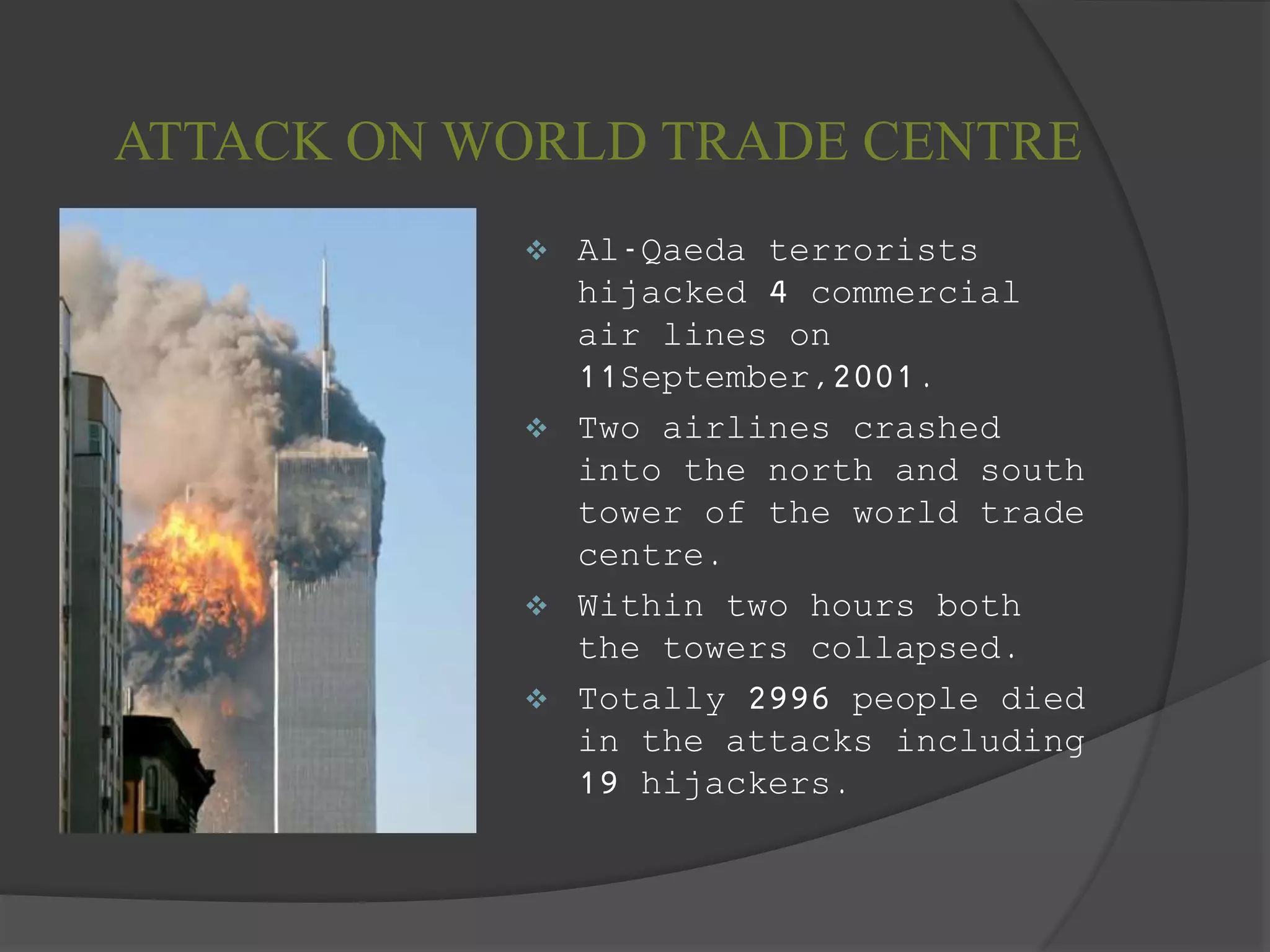
 Al-Qaeda terrorists
hijacked 4 commercial
air lines on
11September,2001.
 Two airlines crashed
into the north and south
tower of the world trade
centre.
 Within two hours both
the towers collapsed.
 Totally 2996 people died
in the attacks including
19 hijackers.
2013 HYDERABAD BLASTS
 The twin bombs exploded in
Dilsukhnagar , Hyderabad
which is a crowded area within
100 meters of each other on
21,february 2013.
 The first explosion occurred
outside a roadside eatery named
A1 mirchi followed by the other
between venkatadri theatre and
Dilsukhnagar bus stop.
 Nearly 17 were killed and 119
were injured in the blasts.
2006 MUMBAI TRAIN BOMBINGS
 The 11 july 2006 Mumbai train bombings were a
series of seven bomb blasts that took place over
a period of 11 minutes on a suburban railway in
Mumbai.
 The bombs were set off in pressure cookers , in
lunch boxes and placed in trains.
 209 were killed and over 700 were injured.
LONDON BOMBINGS
 The 7 july 2005 london bombings were a series of coordinated
suicide attacks in central London .
 Terrorists targeted civilians using the public transport system during
the morning rush hour.
 52 civilians were killed and over 700 more were injured in the
attacks.
 Out of 4,three were detonated in London Underground trains and
fourth on a doubledecker bus.
2005 DELHI BOMBINGS
 The Delhi bombings
occurred on 29october
2005.
 The blasts occurred two
days before the important
festival of diwali.
 The bombs were triggered
in two markets in south
and central Delhi and in
a bus in the Govindpuri area in the south of the city.
 62 people were killed and over 210 were injured in
the three explosions
MOSCOW THEATRE HOSTAGE
CRISIS
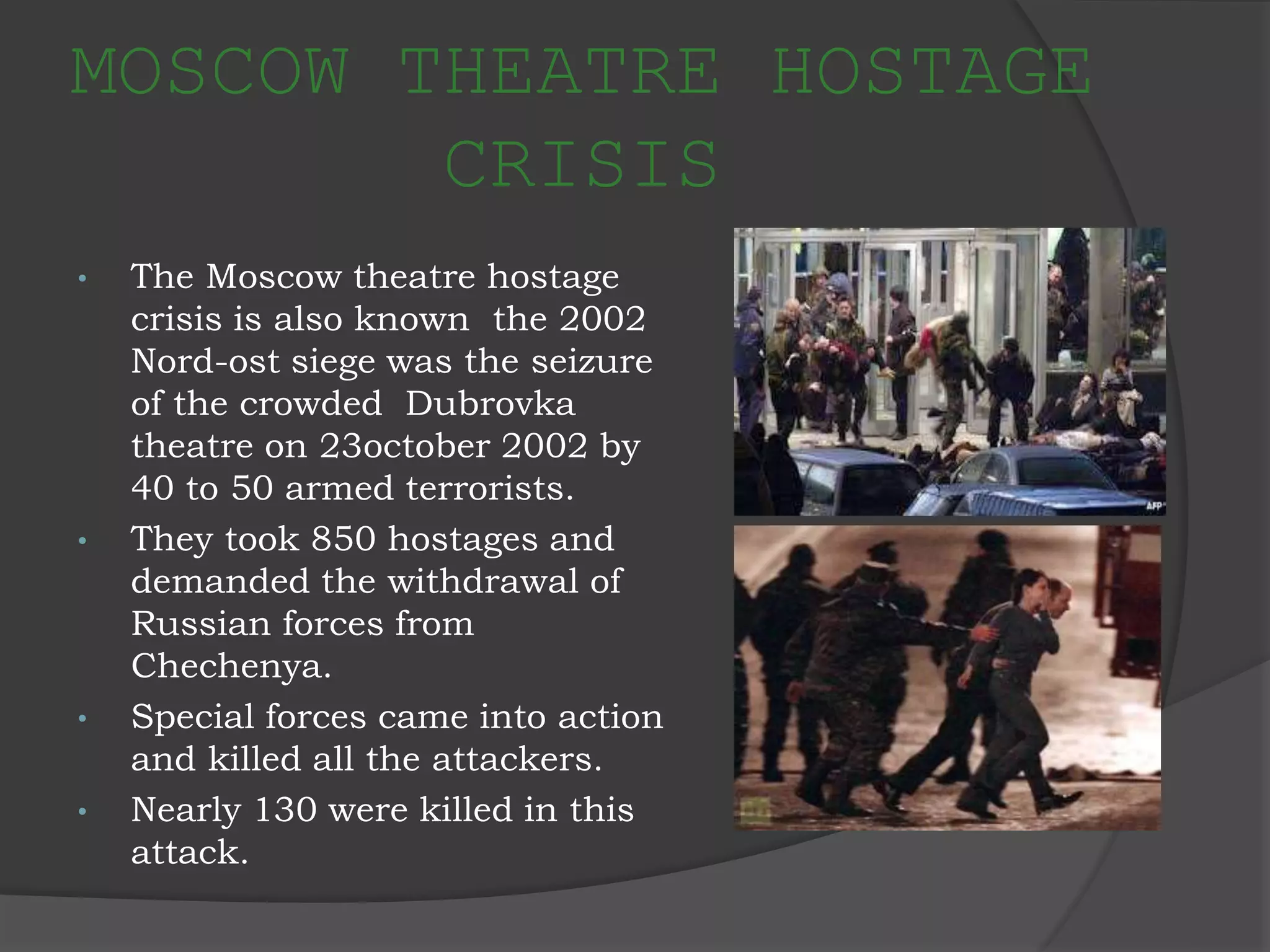
• The Moscow theatre hostage
crisis is also known the 2002
Nord-ost siege was the seizure
of the crowded Dubrovka
theatre on 23october 2002 by
40 to 50 armed terrorists.
• They took 850 hostages and
demanded the withdrawal of
Russian forces from
Chechenya.
• Special forces came into action
and killed all the attackers.
• Nearly 130 were killed in this
attack.
2007 HYDERABAD BOMBINGS
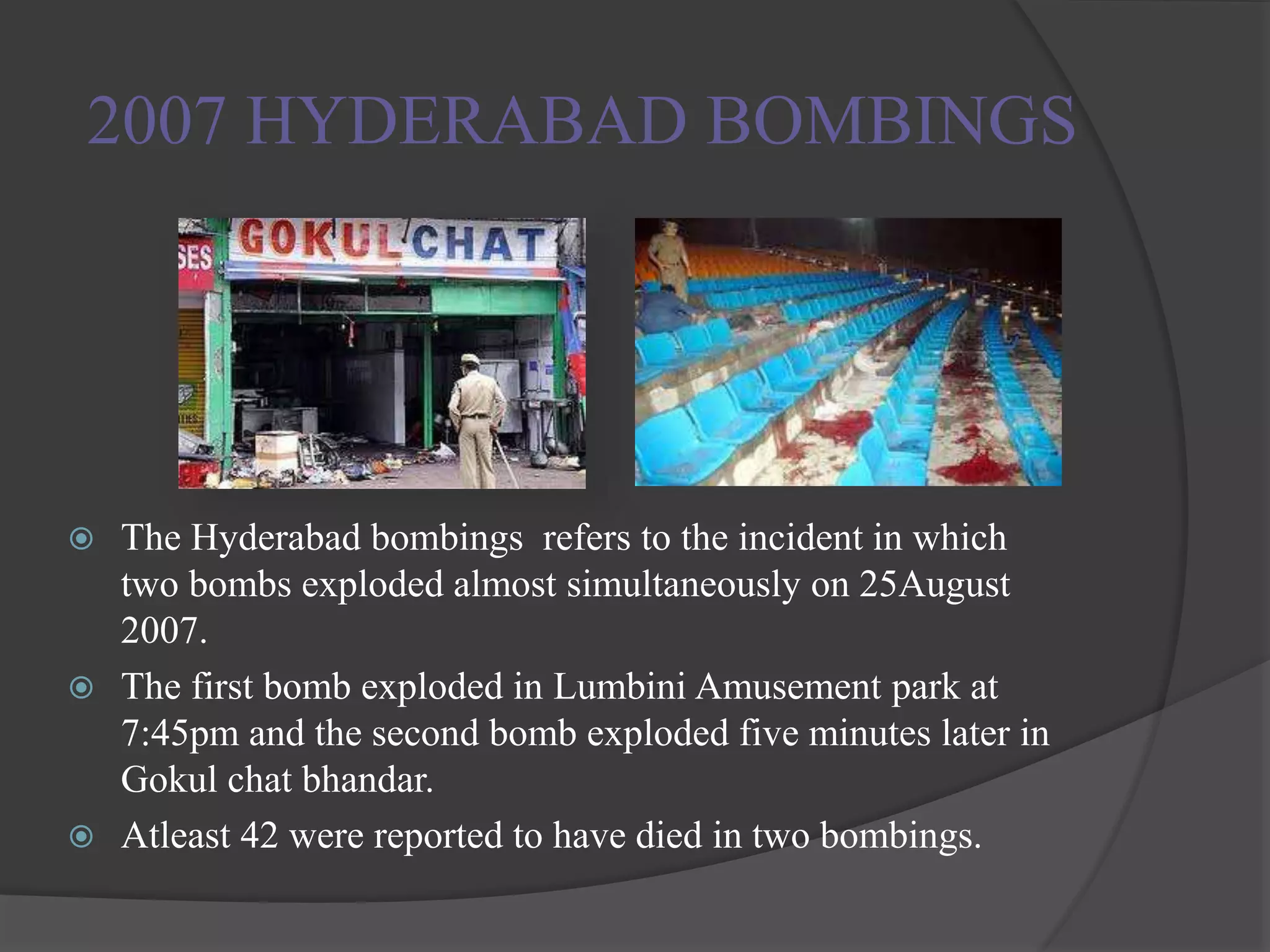
 The Hyderabad bombings refers to the incident in which
two bombs exploded almost simultaneously on 25August
2007.
 The first bomb exploded in Lumbini Amusement park at
7:45pm and the second bomb exploded five minutes later in
Gokul chat bhandar.
 Atleast 42 were reported to have died in two bombings.
Social ,political and economic impact
 Loss of property.
 Effects on productivity.
 Effect on tourism.
 Effects the living condition of population.
 Destabilization of an existing
government.
 Effect on financial market.
PREVENTION OF TERRORISM
 Primary prevention is education.
 Creating awareness among people
against terrorism.
 Increasing security around the nation.
 The one and only strength against
terrorism is unity of people.
 By protecting and mobilizing civil society.
 By eliminating the root of Terrorism.
GOVERNMENT ACTS AGAINST
TERRORISM:
o Terrorist and Disruptive activities
(prevention) Act,1987 (TADA).
o The right to shoot to kill 1997 Anti-Terrorism
Act.
o Legalizing the Impermissible: the new anti-
terrorism law.
o The prevention of Terrorism act,2002.
o Unlawful activities (prevention) Amendment
Act,2004.
CONCLUSION
IN HOPE FOR A TERROR
FREETOMORROW
THANKING YOU
BY
P.N.SHIVANI REDDY
G.DEEKSHA REDDY

Ppt on terrorism

  • 1.
  • 2.
    CONTENTS:  MEANING OFTERRORISM  TERRORISTS  SOME OF THE TERRORIST GROUPS  CAUSES OF TERRORISM  TERRORIST ATTACKS  SOCIAL,POLITICAL AND ECONOMIC IMPACTS  PREVENTION MEASURES  PREVENTION ACTS AGAINST TERRORISM
  • 3.
    MEANING OF TERRORISM: Terrorism actually comes from the latin word “fear’”.  The unlawful use of force against persons or property to intimidate the government ,civilian population for the furtherance of social or political objectives is called TERRORISM.  Common threads of definitions identify terrorism as : • POLITICAL • PSYCHOLOGICAL • COERCIVE • DYNAMIC • DELIBERATE
  • 4.
    WHO IS ATERRORIST:  One who engages himself in acts or an act of terrorism.  One who is the member of an armed group that kills civilians as a mean of political intimidation.  One who is the member of a group that engages in kidnapping and murder.
  • 5.
    SOME OF THETERRORIST GROUPS  Al-Qaeda  Al-Ummah  Lashkar-e-Toiba  Armed Islamic Group(GIA)  Al-Jihad a.k.a Egyptian Islamic Jihad  National Liberation Army (ELN)-Columbia  Islamic state
  • 6.
    CAUSES OF TERRORISM BELIEFIN VIOLENCE RELIGIOUS EXTREMISM POVERTY AND ECONOMIC PROBLEMS POLITICAL INSTABILITY
  • 7.
  • 8.
    MUMBAI TERRORIST ATTACK It was the biggest terrorist attack in India ever.  The attack began on 26 November 2008 and lasted until 29 November 2008.  Nearly 173 people were killed and 308 were wounded.  The terrorists attacked eight places in South Mumbai including CHHATRAPATI SIVAJI TERMINUS,TAJ MAHAL PALACE ,OBEROI TRIDENT,NARIMAN HOUSE etc.  Ajmal Kasab who was the only attacker captured alive was hanged last November.
  • 9.
    ATTACK ON WORLDTRADE CENTRE  Al-Qaeda terrorists hijacked 4 commercial air lines on 11September,2001.  Two airlines crashed into the north and south tower of the world trade centre.  Within two hours both the towers collapsed.  Totally 2996 people died in the attacks including 19 hijackers.
  • 10.
    2013 HYDERABAD BLASTS The twin bombs exploded in Dilsukhnagar , Hyderabad which is a crowded area within 100 meters of each other on 21,february 2013.  The first explosion occurred outside a roadside eatery named A1 mirchi followed by the other between venkatadri theatre and Dilsukhnagar bus stop.  Nearly 17 were killed and 119 were injured in the blasts.
  • 11.
    2006 MUMBAI TRAINBOMBINGS  The 11 july 2006 Mumbai train bombings were a series of seven bomb blasts that took place over a period of 11 minutes on a suburban railway in Mumbai.  The bombs were set off in pressure cookers , in lunch boxes and placed in trains.  209 were killed and over 700 were injured.
  • 12.
    LONDON BOMBINGS  The7 july 2005 london bombings were a series of coordinated suicide attacks in central London .  Terrorists targeted civilians using the public transport system during the morning rush hour.  52 civilians were killed and over 700 more were injured in the attacks.  Out of 4,three were detonated in London Underground trains and fourth on a doubledecker bus.
  • 13.
    2005 DELHI BOMBINGS The Delhi bombings occurred on 29october 2005.  The blasts occurred two days before the important festival of diwali.  The bombs were triggered in two markets in south and central Delhi and in a bus in the Govindpuri area in the south of the city.  62 people were killed and over 210 were injured in the three explosions
  • 14.
    MOSCOW THEATRE HOSTAGE CRISIS •The Moscow theatre hostage crisis is also known the 2002 Nord-ost siege was the seizure of the crowded Dubrovka theatre on 23october 2002 by 40 to 50 armed terrorists. • They took 850 hostages and demanded the withdrawal of Russian forces from Chechenya. • Special forces came into action and killed all the attackers. • Nearly 130 were killed in this attack.
  • 15.
    2007 HYDERABAD BOMBINGS The Hyderabad bombings refers to the incident in which two bombs exploded almost simultaneously on 25August 2007.  The first bomb exploded in Lumbini Amusement park at 7:45pm and the second bomb exploded five minutes later in Gokul chat bhandar.  Atleast 42 were reported to have died in two bombings.
  • 16.
    Social ,political andeconomic impact  Loss of property.  Effects on productivity.  Effect on tourism.  Effects the living condition of population.  Destabilization of an existing government.  Effect on financial market.
  • 17.
    PREVENTION OF TERRORISM Primary prevention is education.  Creating awareness among people against terrorism.  Increasing security around the nation.  The one and only strength against terrorism is unity of people.  By protecting and mobilizing civil society.  By eliminating the root of Terrorism.
  • 18.
    GOVERNMENT ACTS AGAINST TERRORISM: oTerrorist and Disruptive activities (prevention) Act,1987 (TADA). o The right to shoot to kill 1997 Anti-Terrorism Act. o Legalizing the Impermissible: the new anti- terrorism law. o The prevention of Terrorism act,2002. o Unlawful activities (prevention) Amendment Act,2004.
  • 19.
    CONCLUSION IN HOPE FORA TERROR FREETOMORROW
  • 20.