Transportation Problem in Operations
Research
Optimizing Logistics and Costs
Presented by: [Kavya Sagar]
Introduction
• A special type of Linear Programming Problem (LPP).
• Involves transporting goods from sources to destinations at
minimal cost.
• Essential in logistics, supply chains, and resource allocation.
Problem Definition
• Objective: Minimize transportation cost.
• Constraints: Meet supply and demand at each node.
• Components: Sources, Destinations, and Cost Matrix.
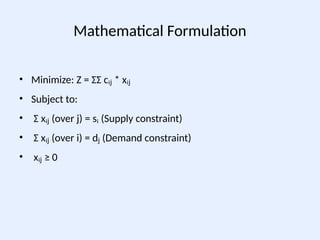
Mathematical Formulation
• Minimize: Z = ΣΣ cᵢ * xᵢ
ⱼ ⱼ
• Subject to:
• Σ xᵢ (over j) = sᵢ (Supply constraint)
ⱼ
• Σ xᵢ (over i) = d (Demand constraint)
ⱼ ⱼ
• xᵢ ≥ 0
ⱼ
Initial Solution Methods
• 1. North-West Corner Rule (NWCR)
• 2. Least Cost Method (LCM)
• 3. Vogel’s Approximation Method (VAM)
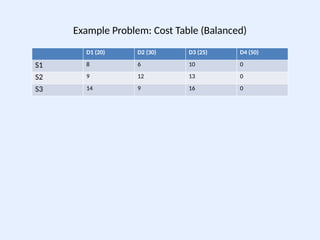
Example Problem: Cost Table (Balanced)
D1 (20) D2 (30) D3 (25) D4 (50)
S1 8 6 10 0
S2 9 12 13 0
S3 14 9 16 0
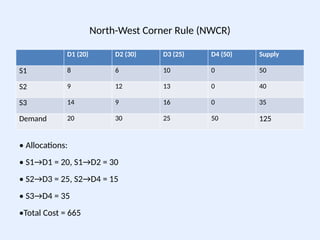
North-West Corner Rule (NWCR)
• Allocations:
• S1→D1 = 20, S1→D2 = 30
• S2→D3 = 25, S2→D4 = 15
• S3→D4 = 35
•Total Cost = 665
D1 (20) D2 (30) D3 (25) D4 (50) Supply
S1 8 6 10 0 50
S2 9 12 13 0 40
S3 14 9 16 0 35
Demand 20 30 25 50 125
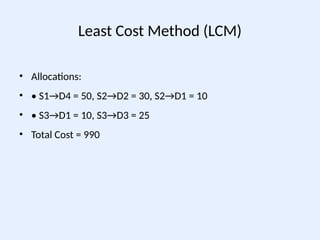
Least Cost Method (LCM)
• Allocations:
• • S1→D4 = 50, S2→D2 = 30, S2→D1 = 10
• • S3→D1 = 10, S3→D3 = 25
• Total Cost = 990
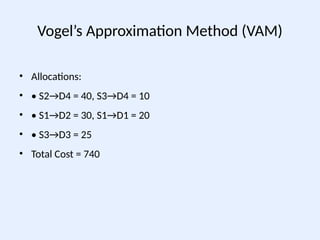
Vogel’s Approximation Method (VAM)
• Allocations:
• • S2→D4 = 40, S3→D4 = 10
• • S1→D2 = 30, S1→D1 = 20
• • S3→D3 = 25
• Total Cost = 740
Real-Life Applications
• Logistics and Freight Distribution
• Humanitarian Aid Logistics
• Retail Chain Supply Distribution
• Healthcare Delivery Networks
Advantages and Limitations
Advantages:
• Minimizes cost
• Streamlines decision-making
Limitations:
• Assumes constant unit costs
• Doesn’t consider route delays or dynamic changes
Conclusion
• Transportation problem aids cost optimization in logistics.
• Initial solutions using NWCR, LCM, and VAM are foundational.
• Useful in real-world decision-making across industries.
References
• Operations Research by Kanti Swarup
• Taha: Operations Research – An Introduction
• NPTEL, ResearchGate, MIT OpenCourseWare

ppt for solving transportation problem.pptx

  • 1.
    Transportation Problem inOperations Research Optimizing Logistics and Costs Presented by: [Kavya Sagar]
  • 2.
    Introduction • A specialtype of Linear Programming Problem (LPP). • Involves transporting goods from sources to destinations at minimal cost. • Essential in logistics, supply chains, and resource allocation.
  • 3.
    Problem Definition • Objective:Minimize transportation cost. • Constraints: Meet supply and demand at each node. • Components: Sources, Destinations, and Cost Matrix.
  • 4.
    Mathematical Formulation • Minimize:Z = ΣΣ cᵢ * xᵢ ⱼ ⱼ • Subject to: • Σ xᵢ (over j) = sᵢ (Supply constraint) ⱼ • Σ xᵢ (over i) = d (Demand constraint) ⱼ ⱼ • xᵢ ≥ 0 ⱼ
  • 5.
    Initial Solution Methods •1. North-West Corner Rule (NWCR) • 2. Least Cost Method (LCM) • 3. Vogel’s Approximation Method (VAM)
  • 6.
    Example Problem: CostTable (Balanced) D1 (20) D2 (30) D3 (25) D4 (50) S1 8 6 10 0 S2 9 12 13 0 S3 14 9 16 0
  • 7.
    North-West Corner Rule(NWCR) • Allocations: • S1→D1 = 20, S1→D2 = 30 • S2→D3 = 25, S2→D4 = 15 • S3→D4 = 35 •Total Cost = 665 D1 (20) D2 (30) D3 (25) D4 (50) Supply S1 8 6 10 0 50 S2 9 12 13 0 40 S3 14 9 16 0 35 Demand 20 30 25 50 125
  • 8.
    Least Cost Method(LCM) • Allocations: • • S1→D4 = 50, S2→D2 = 30, S2→D1 = 10 • • S3→D1 = 10, S3→D3 = 25 • Total Cost = 990
  • 9.
    Vogel’s Approximation Method(VAM) • Allocations: • • S2→D4 = 40, S3→D4 = 10 • • S1→D2 = 30, S1→D1 = 20 • • S3→D3 = 25 • Total Cost = 740
  • 10.
    Real-Life Applications • Logisticsand Freight Distribution • Humanitarian Aid Logistics • Retail Chain Supply Distribution • Healthcare Delivery Networks
  • 11.
    Advantages and Limitations Advantages: •Minimizes cost • Streamlines decision-making Limitations: • Assumes constant unit costs • Doesn’t consider route delays or dynamic changes
  • 12.
    Conclusion • Transportation problemaids cost optimization in logistics. • Initial solutions using NWCR, LCM, and VAM are foundational. • Useful in real-world decision-making across industries.
  • 13.
    References • Operations Researchby Kanti Swarup • Taha: Operations Research – An Introduction • NPTEL, ResearchGate, MIT OpenCourseWare