BLOOM’s Taxonomy
Parent Information Session: Monday 23rd April 2018
Who is Benjamin Bloom?
• American Educational Psychologist
• Created Bloom’s Taxonomy in 1956 to promote Higher Order Thinking
in education
• Contributed towards research in Mastery Learning
- pupils are taught at their level of proficiency
- Pupils are assessed
- Pupils given more opportunities to ‘master’ the learning or given
more challenging tasks
- Focus on process not content
What is Bloom’s Taxonomy?
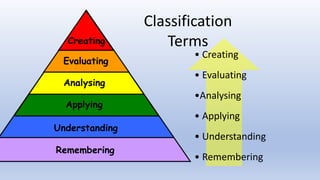
• Taxonomy: Classification
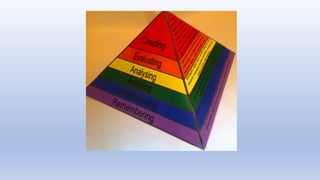
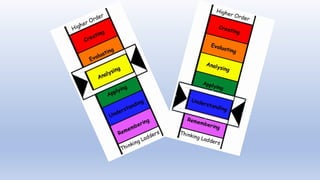
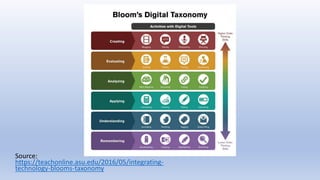
• Bloom’s classifies ways of thinking
from lower order to more difficult,
higher order skills
• These terms were updated in the 1990s
• Creating
• Evaluating
•Analysing
• Applying
• Understanding
• Remembering
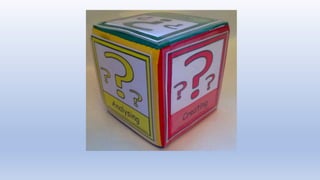
Classification
Terms
Creating
Evaluating
Analysing
Applying
Understanding
Remembering
Creating
Evaluating
Analysing
Applying
Understanding
Remembering
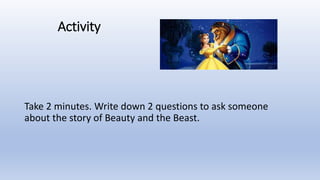
Activity
Take 2 minutes. Write down 2 questions to ask someone
about the story of Beauty and the Beast.
Activity
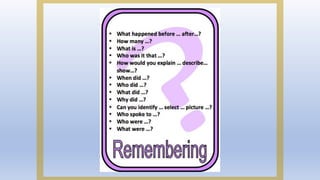
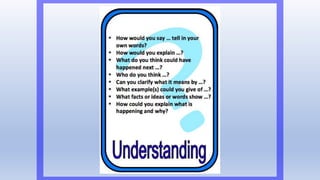
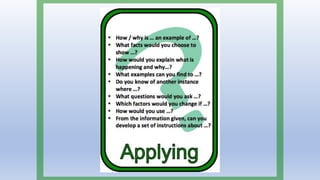
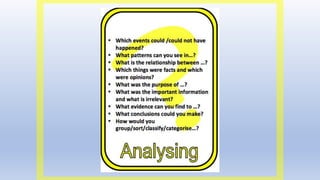
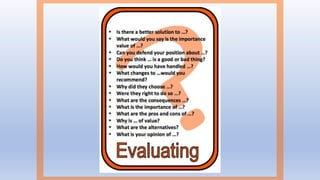
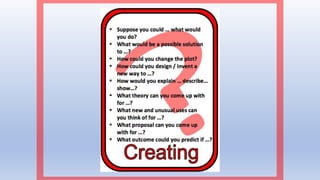
Now…use the question sheet to reflect on the level of thinking
required for each question you created.
How do we use it in the classroom?
• As part of Active Learning
• As part of play
• As part of Guided Reading
• Differentiation
• All Curricular Areas for feedback linked to Learning Intentions and
Success Criteria (Mid-lesson and plenary)
• Encouraging young people to think, question, reflect and work
together
• Teachers planning questioning before lessons and for Assessment
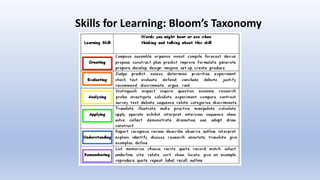
Skills for Learning: Bloom’s Taxonomy
How does it link to the curriculum?
• Used to inform the Experiences and Outcomes in Curriculum for
Excellence
• STEM
• Critical Thinking and Problem Solving
• Skills for learning, life and work
• Debating Skills
• Digital Learning
https://www.youtube.com/watch?v=fqgTBwElPzU
How does it link to the curriculum?
Mastery of basic skills of literacy and numeracy
Ability to work with others
Ability to cope with change
Well developed verbal skills
Decision-making and problem solving skills
Higher Order Thinking Skills encourage:
Source:
https://teachonline.asu.edu/2016/05/integrating-
technology-blooms-taxonomy
‘It is important that all learners are given
appropriate opportunities to develop
their thinking skills. These skills can be
developed across a range of contexts
including through more practical or
applied learning opportunities’
Curriculum for Excellence: Building the Curriculum 4: skills for learning, skills
for life and skills for work, Page 8
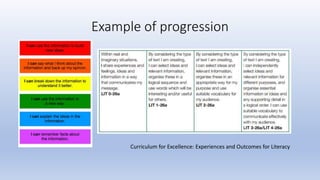
Example of progression
Curriculum for Excellence: Experiences and Outcomes for Literacy
How can this be used at home?
• Discussing stories being read
• Reflecting on the school day
• Questioning through play instead of directing play
• Use of Digital Technology

PPT BLOOM.ppt

  • 1.
    BLOOM’s Taxonomy Parent InformationSession: Monday 23rd April 2018
  • 2.
    Who is BenjaminBloom? • American Educational Psychologist • Created Bloom’s Taxonomy in 1956 to promote Higher Order Thinking in education • Contributed towards research in Mastery Learning - pupils are taught at their level of proficiency - Pupils are assessed - Pupils given more opportunities to ‘master’ the learning or given more challenging tasks - Focus on process not content
  • 3.
    What is Bloom’sTaxonomy? • Taxonomy: Classification • Bloom’s classifies ways of thinking from lower order to more difficult, higher order skills • These terms were updated in the 1990s
  • 4.
    • Creating • Evaluating •Analysing •Applying • Understanding • Remembering Classification Terms Creating Evaluating Analysing Applying Understanding Remembering
  • 5.
  • 6.
    Activity Take 2 minutes.Write down 2 questions to ask someone about the story of Beauty and the Beast.
  • 13.
    Activity Now…use the questionsheet to reflect on the level of thinking required for each question you created.
  • 14.
    How do weuse it in the classroom? • As part of Active Learning • As part of play • As part of Guided Reading • Differentiation • All Curricular Areas for feedback linked to Learning Intentions and Success Criteria (Mid-lesson and plenary) • Encouraging young people to think, question, reflect and work together • Teachers planning questioning before lessons and for Assessment
  • 19.
    Skills for Learning:Bloom’s Taxonomy
  • 20.
    How does itlink to the curriculum? • Used to inform the Experiences and Outcomes in Curriculum for Excellence • STEM • Critical Thinking and Problem Solving • Skills for learning, life and work • Debating Skills • Digital Learning https://www.youtube.com/watch?v=fqgTBwElPzU
  • 21.
    How does itlink to the curriculum? Mastery of basic skills of literacy and numeracy Ability to work with others Ability to cope with change Well developed verbal skills Decision-making and problem solving skills Higher Order Thinking Skills encourage:
  • 22.
  • 23.
    ‘It is importantthat all learners are given appropriate opportunities to develop their thinking skills. These skills can be developed across a range of contexts including through more practical or applied learning opportunities’ Curriculum for Excellence: Building the Curriculum 4: skills for learning, skills for life and skills for work, Page 8
  • 24.
    Example of progression Curriculumfor Excellence: Experiences and Outcomes for Literacy
  • 25.
    How can thisbe used at home? • Discussing stories being read • Reflecting on the school day • Questioning through play instead of directing play • Use of Digital Technology

Editor's Notes

  • #3 Emphasise that Higher order Thinking Moves Away from rite learning.
  • #5 Lower Order Thinking at bottom of pyramid, progressively moving to Higher Order Thinking. Revised Terminology.
  • #8 Remember facts about the information.
  • #9 Explain the ideas in the information.
  • #10 Use the information in a new way.
  • #11 Break down the information to understand it better.
  • #12 Say what I think about the information and back up opinion.
  • #13 Use information to build new ideas.
  • #21 Watch Video from 2.40 – 4.10
  • #23 Only some of these will apply to Primary aged pupils as sourced from further education document.