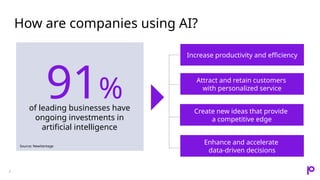
How are companiesusing AI?
of leading businesses have
ongoing investments in
artificial intelligence
91%
Source: NewVantage
Increase productivity and efficiency
Attract and retain customers
with personalized service
Enhance and accelerate
data-driven decisions
Create new ideas that provide
a competitive edge
2
3.
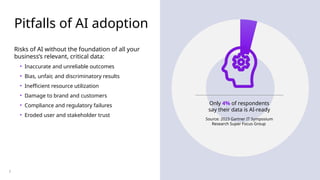
Only 4% ofrespondents
say their data is AI-ready
Pitfalls of AI adoption
Risks of AI without the foundation of all your
business’s relevant, critical data:
• Inaccurate and unreliable outcomes
• Bias, unfair, and discriminatory results
• Inefficient resource utilization
• Damage to brand and customers
• Compliance and regulatory failures
• Eroded user and stakeholder trust
Source: 2023 Gartner IT Symposium
Research Super Focus Group
3
4.
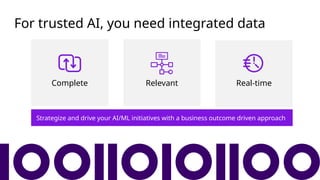
For trusted AI,you need integrated data
Real-time
Complete Relevant
Strategize and drive your AI/ML initiatives with a business outcome driven approach
5.
Building a soliddata integration strategy
Define goals and scope of data integration projects
Assess current IT landscape and identify data sources
Choose the right approach, tools, and partners
Design and implement data integration architecture
Ensure quality and governance throughout the process
Monitor and optimize performance and outcomes
5
6.
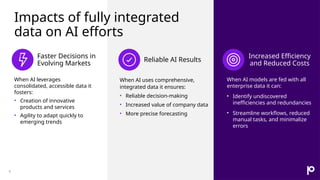
Impacts of fullyintegrated
data on AI efforts
When AI leverages
consolidated, accessible data it
fosters:
• Creation of innovative
products and services
• Agility to adapt quickly to
emerging trends
When AI uses comprehensive,
integrated data it ensures:
• Reliable decision-making
• Increased value of company data
• More precise forecasting
When AI models are fed with all
enterprise data it can:
• Identify undiscovered
inefficiencies and redundancies
• Streamline workflows, reduced
manual tasks, and minimalize
errors
Increased Efficiency
and Reduced Costs
Reliable AI Results
Faster Decisions in
Evolving Markets
6
7.
Precisely and AWSare partnering to
deliver data from your mission-critical
systems to enhance AI readiness
8.
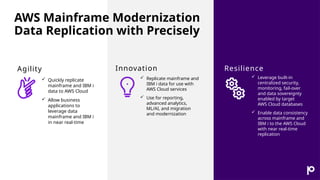
AWS Mainframe Modernization
DataReplication with Precisely
Quickly replicate
mainframe and IBM i
data to AWS Cloud
Allow business
applications to
leverage data
mainframe and IBM i
in near real-time
Agility
Replicate mainframe and
IBM i data for use with
AWS Cloud services
Use for reporting,
advanced analytics,
ML/AI, and migration
and modernization
Innovation
Leverage built-in
centralized security,
monitoring, fail-over
and data sovereignty
enabled by target
AWS Cloud databases
Enable data consistency
across mainframe and
IBM i to the AWS Cloud
with near real-time
replication
Resilience
9.
Benefits
Quickly Replicate
mainframe and
IBMi data
Supports mainframe
and IBM i
data sources
Pay per use by
GB of data
replicated
Resiliency
and
high availability
Built in integration
with Cloud DB and
AWS Services
Observability
and
auditability
10.
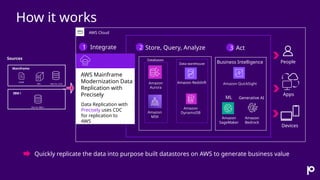
How it works
Quicklyreplicate the data into purpose built datastores on AWS to generate business value
AWS Mainframe
Modernization Data
Replication with
Precisely
Data Replication with
Precisely uses CDC
for replication to
AWS
People
Apps
Devices
Integrate
Databases
Data warehouse
Amazon
SageMaker
Store, Query, Analyze Act
Amazon
Bedrock
Amazon
Aurora
Business Intelligence
Amazon QuickSight
ML Generative AI
Amazon Redshift
1 2 3
AWS Cloud
Sources
Mainframe
IMS
IBM i
Db2 for IBM i
Db2 for z/OS
VSAM
Amazon
DynamoDB
Amazon
MSK
11.
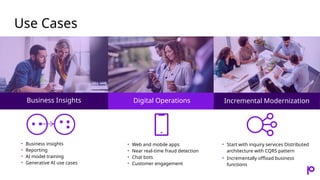
Use Cases
11
Business InsightsDigital Operations
• Web and mobile apps
• Near real-time fraud detection
• Chat bots
• Customer engagement
• Business insights
• Reporting
• AI model training
• Generative AI use cases
Incremental Modernization
• Start with inquiry services Distributed
architecture with CQRS pattern
• Incrementally offload business
functions
12.
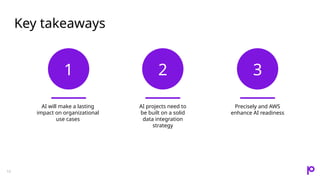
Key takeaways
2
AI projectsneed to
be built on a solid
data integration
strategy
1
AI will make a lasting
impact on organizational
use cases
3
Precisely and AWS
enhance AI readiness
12
13.
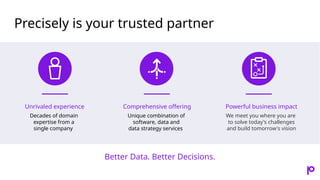
Precisely is yourtrusted partner
Powerful business impact
We meet you where you are
to solve today's challenges
and build tomorrow's vision
Comprehensive offering
Unique combination of
software, data and
data strategy services
Unrivaled experience
Decades of domain
expertise from a
single company
Better Data. Better Decisions.
#2 map to biz outcomes (read right side), new mechanism for rev (grow rev, manage risk, reduce costs)
#3 Clear is why – path has many risks, recognize risks up front, all top of mind, hallucination, bias – garbage in and garbage out – more relevant today than in the pass, autonomous system generating output without a human – damage brand, put stuff out there, misuse of efficiency,
Adding a layer to this in countries within GDPR are that minimal data is used to build AI models, anonymization must be used in LLMs, delicate balance of having someone’s permission to build on their data.
AI systems must integrate security practices to prevent data infringements and unauthorized access.
#5 **Step 1: Define Data Integration Goals and Scope**
Start by clarifying your specific AI objectives. Different AI use cases require different integration approaches. Defining goals, expected outcomes, and deliverables ensures clarity with stakeholders. Key questions to ask include: What business problems are we addressing? What are the data sources, challenges, and success criteria? This foundation sets the project’s scope and expectations.
**Step 2: Assess Your Current Data Landscape**
Next, assess your data environment. Conduct an audit of your data sources to identify gaps and issues related to data quality, accessibility, and compatibility. Prioritize critical data sources based on their value and relevance to the project, ensuring you’re addressing security and governance concerns early on.
**Step 3: Choose Your Data Integration Approach and Tools**
Select the best integration methods and tools based on your project’s complexity. Consider architecture (centralized or hybrid), techniques (ETL, ELT), and platforms (cloud, on-premise). Ensure the solution meets functionality, scalability, and performance needs while staying within budget and resources.
**Step 4: Design and Implement Your Data Integration Architecture**
Now, design an architecture that efficiently connects, transforms, and delivers data to your AI applications. Define data flows, transformations, and control standards for quality, governance, and security. Test and validate the architecture to ensure it meets project requirements.
**Step 5: Maintain Data Quality and Governance**
Data quality and governance are critical throughout the process. Assign clear roles for data management, implement tools for data validation and auditing, and continuously monitor metrics such as accuracy and consistency. This ensures reliable and compliant data for AI use.
**Step 6: Monitor and Optimize Performance**
Finally, treat data integration as an ongoing process. Monitor for bottlenecks or errors, implement optimizations, and continuously refine goals and deliverables as data needs evolve. Regularly review performance to ensure your integration pipeline is delivering value.
#8 Play up the innovation, AWS recognized Precisely as a leader in the space, joint innovation with AWS, integrations with CloudWatch monitoring and observability, moving to container based deployment easier upgrades, uptime
#10 Low impact – using logs and journals so no impact to your systems, once it’s delivered open to all AWS flavors (Bedrock, SageMaker)
All flavors of Kafka are supported (Apache Kafka, Confluent Kafka, Amazon MSK)
#13 Precisely is the trusted partner for data integrity, with decades of deep domain expertise that span software, data and data strategy services that empowers you to solve today's challenges while building tomorrow's vision.
#14 Do you have any customer examples of organizations incorporating data integration to fuel AI projects?
Are there elements other than data integration that customers can leverage to make data AI ready?








![[Keynote] Data Driven Organizations with AWS Data - 발표자: Agnes Panosian, Head...](https://cdn.slidesharecdn.com/ss_thumbnails/d1s01awsfordataintroslidesv2-230704005021-a670086c-thumbnail.jpg?width=640&height=640&fit=bounds)


