Presentation Suggestions
Dr. Burnett and Dr. Singiser
BIOL/CHEM 4900
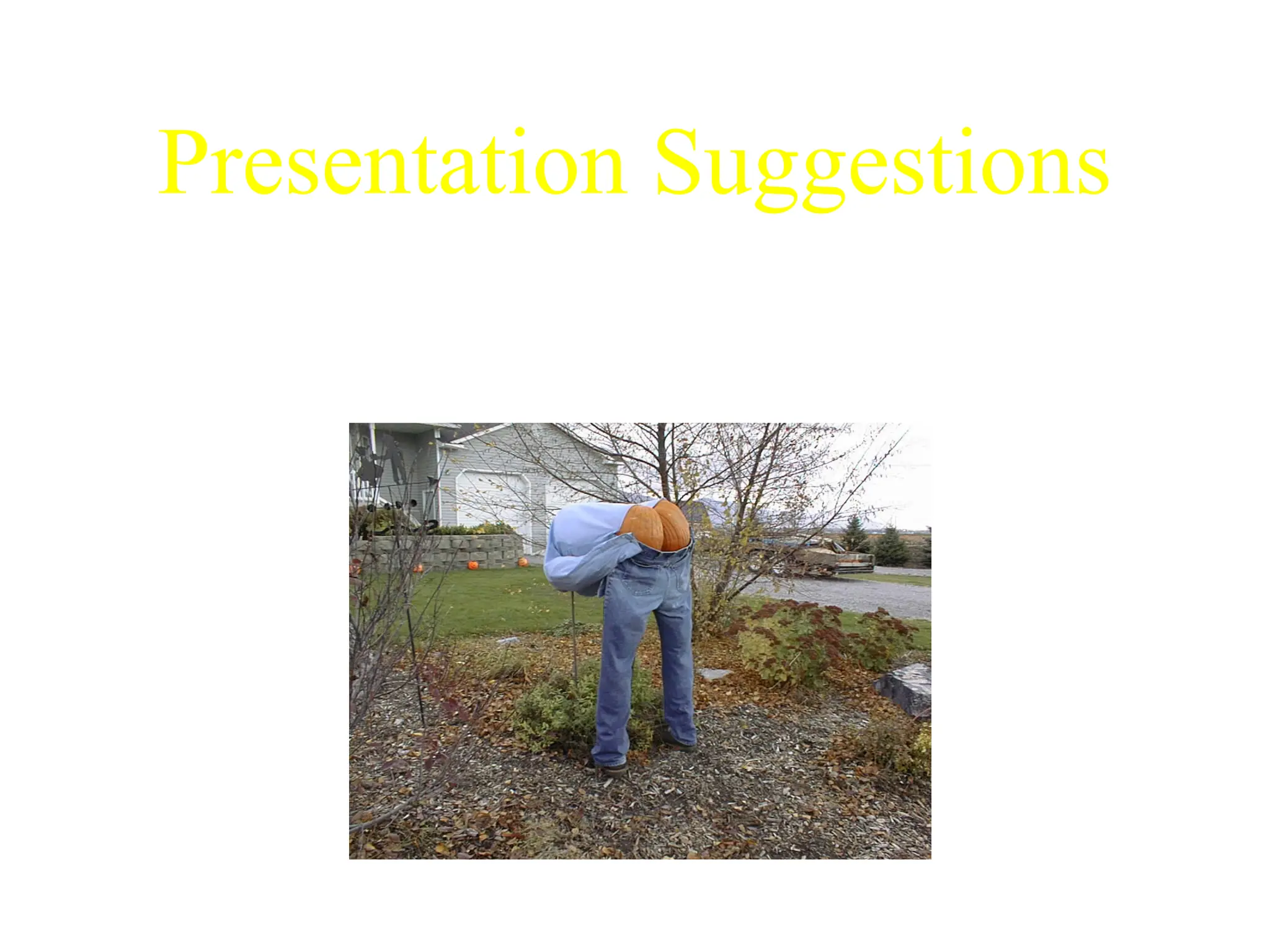
Photo courtesy of Dr. Nickie Cauthen
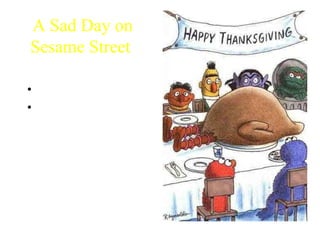
A Sad Day on
Sesame Street
• Citing your images
• Use small print
http://www.bilibala.com/veryveryfunny/html/jokedata/sadday.html
Example of a Bad Color Scheme
• Fonts in the same color family as the
background do not show up well.
• Here are some tips for good color
combinations
– Use the Design Templates
• Go under the format menu and select Slide Design
– Use the Standard Color schemes
• You can’t go wrong with the dark blue background
and yellow or white text
Another Bad Color Scheme
• Dark text on dark background
• Beware of shaded backgrounds
• The dark text is harder to read down here
Distracting Backgrounds
• Color
– Too bright
– Not enough contrast
– Some colors will look different when projected
• Distracting designs
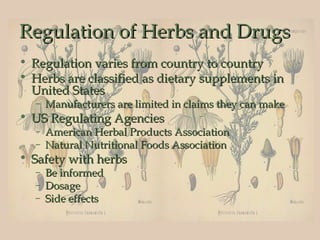
Regulation of Herbs and Drugs
• Regulation varies from country to country
Regulation varies from country to country
• Herbs are classified as dietary supplements in
Herbs are classified as dietary supplements in
United States
United States
– Manufacturers are limited in claims they can make
Manufacturers are limited in claims they can make
• US Regulating Agencies
US Regulating Agencies
– American Herbal Products Association
American Herbal Products Association
– Natural Nutritional Foods Association
Natural Nutritional Foods Association
• Safety with herbs
Safety with herbs
– Be informed
Be informed
– Dosage
Dosage
– Side effects
Side effects
Text on Slides
• How much text should be on a slide?
• Presentation vs. lecture
• Bullet points
Decorating Your House
for Halloween
• It is important to decorate your house for Halloween so that children
can find who is giving out candy. If your house isn’t decorated then
kids won’t come to your house.
• Spooky decorations are fun, but they may scare the smaller kids away.
• Cheesy decorations can be found EVERYWHERE and most people
love them.
• Funny decorations can be offensive to some so be careful. Make sure
they are politically correct and clean.
• Homemade decorations are the cheapest and they are fun to make.
You can make spooky, cheesy and funny decorations for ½ the cost of
buying them.
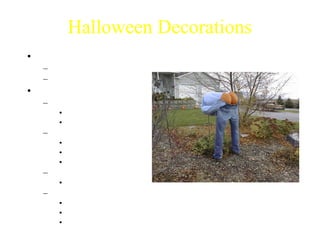
Halloween Decorations
• Importance
– Spirit
– Marking your house
• Types of Decorations
– Spooky
• Frightening
• Hard to find
– Cheesy
• Cheap
• Easy to find
• Loved by all
– Funny
• Can be offensive
– Homemade
• Cheap
• Fun to make
• Variety
Photo courtesy of Dr. Nickie Cauthen
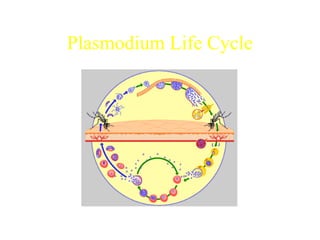
Plasmodium Life Cycle
http://www.who.int/tdr/diseases/malaria/lifecycle.htm
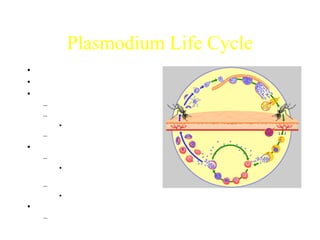
Plasmodium Life Cycle
• Mosquito bite
• Sporozoites enter blood
• Travel to liver
– Hepatocytes
– Asexual growth
• Schizonts  merozoites
– Merozoites to blood
• Merozoa to blood
– Infect RBC
• Release trophozoites,
merozoites, schizonts
– Merozoite transformation
• Gametocytes
• Passed to new mosquito
– Sexual cycle
http://www.who.int/tdr/diseases/malaria/lifecycle.htm
Summary of Helpful Points
• Fewer words on slides
• A picture says a thousand words
• Don’t read the slides
• Use correct grammar and spelling
• Animation
– Often helpful, but not always necessary
• Explain your graphics
• Keep slides in order; don’t flip back and forth
– Repeat slides if necessary
• Point things out using laser pointer, stick, whatever
• Make eye contact (with everyone)
• Don’t turn your back on the audience
• Avoid hugging the podium
Summary of Helpful Points
• Speak in a clear, loud voice
– Don’t trail off
• Slow down and think about what you are saying
• Practice your presentation
– Helps to avoid “um”, “okay”, etc.
– Helps pacing for time allotted
– Helps with pronunciation
– Don’t memorize (sounds scripted)
• Engage your audience
• When asking a question, if asked repeat it IN A DIFFERENT
WAY (they obviously didn’t get it the first time)
• Answer any questions and if you don’t know, you don’t know!!!
• If you don’t understand a question ask for a repeat
What is wrong with the
following slides?
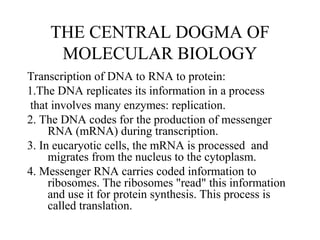
THE CENTRAL DOGMA OF
MOLECULAR BIOLOGY
Transcription of DNA to RNA to protein:
1.The DNA replicates its information in a process
that involves many enzymes: replication.
2. The DNA codes for the production of messenger
RNA (mRNA) during transcription.
3. In eucaryotic cells, the mRNA is processed and
migrates from the nucleus to the cytoplasm.
4. Messenger RNA carries coded information to
ribosomes. The ribosomes "read" this information
and use it for protein synthesis. This process is
called translation.
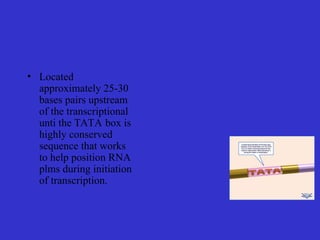
• Located
approximately 25-30
bases pairs upstream
of the transcriptional
unti the TATA box is
highly conserved
sequence that works
to help position RNA
plms during initiation
of transcription.
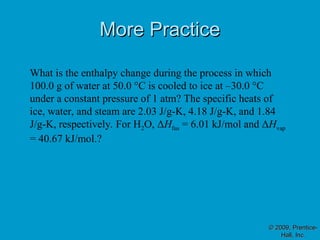
More Practice
More Practice
© 2009, Prentice-
© 2009, Prentice-
Hall, Inc.
Hall, Inc.
What is the enthalpy change during the process in which
100.0 g of water at 50.0 °C is cooled to ice at –30.0 °C
under a constant pressure of 1 atm? The specific heats of
ice, water, and steam are 2.03 J/g-K, 4.18 J/g-K, and 1.84
J/g-K, respectively. For H2O, ΔHfus = 6.01 kJ/mol and ΔHvap
= 40.67 kJ/mol.?
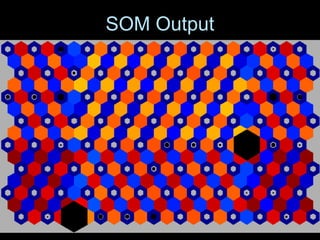
SOM Output
SOM Output
RNA information (in the form of
nucleotide sequences) is then
TRANSLATED into proteins
(long polypeptide chains) by
complex units called ribosomes.
Proteins are the work horses of
biological systems, i.e. enzymes,
messengers, and building blocks.
URSIDAE (Bears)
URSIDAE (Bears)
 Large Size
Large Size: Bears are large-bodied compared to many other carnivores.
: Bears are large-bodied compared to many other carnivores.
Most of their diet consists of vegetable matter. Meat is digested quickly but
vegetable matter takes much longer. Larger body size brings a decrease in
metabolic rate, so large body animals can survive on the small energy from
vegetable matter, even though they have to eat a vast amount of food to
satisfy their total energy needs.
 Powerful limbs and strong claws:
Powerful limbs and strong claws: Bears have long, powerful limbs with
Bears have long, powerful limbs with
strong claws used in climbing trees, digging and grubbing. The scapula has
a post-scapular fossa for the attachment of the subscapularis minor muscle
which prevents the humeri popping out of their joints as a bear hauls its
large body weight up trees.
 Grinding Molars:
Grinding Molars: The premolars of bears are much smaller than other
The premolars of bears are much smaller than other
carnivores and often lost at old age. The molars are broadened and
flattened for crushing and grinding up tough vegetable matter.
 Long Muzzle:
Long Muzzle: The long, powerful muzzle with its mobile snout and
The long, powerful muzzle with its mobile snout and
protruding lips are important for digging and grubbing. The long muzzle is
also a place for olfactory epithelium which accounts for the excellent sense
of smell.
of smell.
 Vestigial Tail:
Vestigial Tail: Unlike many other carnivores bears have a tail with no
Unlike many other carnivores bears have a tail with no
specialized function.
 Example of bad animations
Example of bad animations
 Example of bad animations
Example of bad animations
 Example of bad animations
Example of bad animations
 Example of bad animations
Example of bad animations
 Example of bad animations
Example of bad animations
 Example of bad animations
Example of bad animations
 Example of bad animations
Example of bad animations
 Example of bad animations
Example of bad animations
 Example of bad animations
Example of bad animations
 Example of bad animations
Example of bad animations
 Example of bad animations
Example of bad animations
 Example of bad animations
Example of bad animations
BLUNT END VS. STICKY END
 HaeIII and AluI cut straight across the double helix
HaeIII and AluI cut straight across the double helix
producing "blunt" ends. However, many restriction
enzymes cut in an offset fashion.
 The ends of the cut have an overhanging piece of
The ends of the cut have an overhanging piece of
single-stranded DNA. These are called
single-stranded DNA. These are called "sticky
"sticky
ends"
ends" because they are able to form with any base
because they are able to form with any base
pair DNA molecule that contains the complementary
sticky end. Any other source of DNA treated with the
same enzyme will produce such molecules.
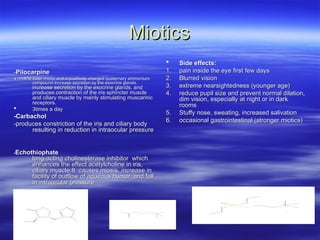
Miotics
Miotics
-
-Pilocarpine
Pilocarpine
a choline ester miotic and a positively charged quaternary ammonium
compound.Increase secretion by the exocrine glands.
increase secretion by the exocrine glands, and
produces contraction of the iris sphincter muscle
and ciliary muscle by mainly stimulating muscarinic
receptors.
receptors.
 3times a day
3times a day
-Carbachol
-Carbachol
-produces constriction of the iris and ciliary body
resulting in reduction in intraocular pressure
-
-Echothiophate
Echothiophate
long-acting cholinesterase inhibitor which
enhances the effect acetylcholine in iris,
ciliary muscle.It causes miosis, increase in
facility of outflow of aqueous humor, and fall
in intraocular pressure
 Side effects:
Side effects:
1.
1. pain inside the eye first few days
pain inside the eye first few days
2.
2. Blurred vision
Blurred vision
3.
3. extreme nearsightedness (younger age)
extreme nearsightedness (younger age)
4.
4. reduce pupil size and prevent normal dilation,
reduce pupil size and prevent normal dilation,
dim vision, especially at night or in dark
rooms
rooms
5.
5. Stuffy nose, sweating, increased salivation
Stuffy nose, sweating, increased salivation
6.
6. occasional gastrointestinal (stronger miotics)
occasional gastrointestinal (stronger miotics)
QuickTime™ and a
TIFF (Uncompressed) decompressor
are needed to see this picture.
Energy Changes Associated with
Changes of State
Changes of State
 The heat added to the
The heat added to the
system at the melting
and boiling points goes
into pulling the
into pulling the
molecules farther apart
from each other.
from each other.
 The temperature of the
The temperature of the
substance does not rise
during a phase change.
© 2009, Prentice-
© 2009, Prentice-
Hall, Inc.
Hall, Inc.
Outgroup Monotremata
Notorcytemorphia
Peramelemorphia
Dasyuromorphia
Microbiotheria
Paucituberculata
Didelphimorphia
Diprotodontia
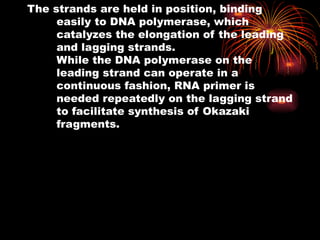
The strands are held in position, binding
easily to DNA polymerase, which
catalyzes the elongation of the leading
and lagging strands.
While the DNA polymerase on the
leading strand can operate in a
continuous fashion, RNA primer is
needed repeatedly on the lagging strand
to facilitate synthesis of Okazaki
fragments.
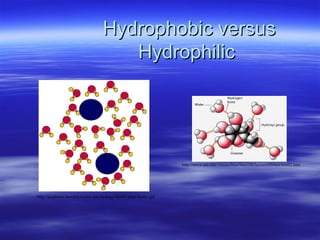
Hydrophobic and
Hydrophilic
• Hydrophilic-- water loving or a
molecule that is capable of
forming a hydrogen bond with
water.
• Hydrophobic-- water hating or a
molecule that repels water.
• Important function in cell’s
membrane structure.
Hydrophobic versus
Hydrophobic versus
Hydrophilic
Hydrophilic
http://www.uic.edu/classes/bios/bios100/lecturesf04am/lect02.htm
http://academic.brooklyn.cuny.edu/biology/bio4fv/page/hydro.gif
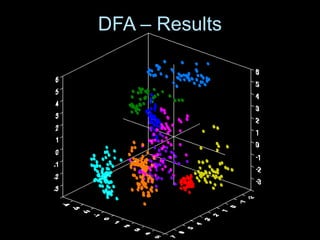
DFA – Results
DFA – Results
How Do Neural Networks Compute?
 Activation = the final value of a particular unit.
Activation = the final value of a particular unit.
 Calculated by adding inputs and bias
Calculated by adding inputs and bias
 Activation function
Activation function
Bias
Activation
Function
Final
Activation

Net Input
W1
W2
W3

PowerPoint Presentation Templatespptexamples.ppt

  • 1.
    Presentation Suggestions Dr. Burnettand Dr. Singiser BIOL/CHEM 4900 Photo courtesy of Dr. Nickie Cauthen
  • 2.
    A Sad Dayon Sesame Street • Citing your images • Use small print http://www.bilibala.com/veryveryfunny/html/jokedata/sadday.html
  • 3.
    Example of aBad Color Scheme • Fonts in the same color family as the background do not show up well. • Here are some tips for good color combinations – Use the Design Templates • Go under the format menu and select Slide Design – Use the Standard Color schemes • You can’t go wrong with the dark blue background and yellow or white text
  • 4.
    Another Bad ColorScheme • Dark text on dark background • Beware of shaded backgrounds • The dark text is harder to read down here
  • 5.
    Distracting Backgrounds • Color –Too bright – Not enough contrast – Some colors will look different when projected • Distracting designs
  • 6.
    Regulation of Herbsand Drugs Regulation of Herbs and Drugs • Regulation varies from country to country Regulation varies from country to country • Herbs are classified as dietary supplements in Herbs are classified as dietary supplements in United States United States – Manufacturers are limited in claims they can make Manufacturers are limited in claims they can make • US Regulating Agencies US Regulating Agencies – American Herbal Products Association American Herbal Products Association – Natural Nutritional Foods Association Natural Nutritional Foods Association • Safety with herbs Safety with herbs – Be informed Be informed – Dosage Dosage – Side effects Side effects
  • 7.
    Text on Slides •How much text should be on a slide? • Presentation vs. lecture • Bullet points
  • 8.
    Decorating Your House forHalloween • It is important to decorate your house for Halloween so that children can find who is giving out candy. If your house isn’t decorated then kids won’t come to your house. • Spooky decorations are fun, but they may scare the smaller kids away. • Cheesy decorations can be found EVERYWHERE and most people love them. • Funny decorations can be offensive to some so be careful. Make sure they are politically correct and clean. • Homemade decorations are the cheapest and they are fun to make. You can make spooky, cheesy and funny decorations for ½ the cost of buying them.
  • 9.
    Halloween Decorations • Importance –Spirit – Marking your house • Types of Decorations – Spooky • Frightening • Hard to find – Cheesy • Cheap • Easy to find • Loved by all – Funny • Can be offensive – Homemade • Cheap • Fun to make • Variety Photo courtesy of Dr. Nickie Cauthen
  • 10.
  • 11.
    Plasmodium Life Cycle •Mosquito bite • Sporozoites enter blood • Travel to liver – Hepatocytes – Asexual growth • Schizonts  merozoites – Merozoites to blood • Merozoa to blood – Infect RBC • Release trophozoites, merozoites, schizonts – Merozoite transformation • Gametocytes • Passed to new mosquito – Sexual cycle http://www.who.int/tdr/diseases/malaria/lifecycle.htm
  • 12.
    Summary of HelpfulPoints • Fewer words on slides • A picture says a thousand words • Don’t read the slides • Use correct grammar and spelling • Animation – Often helpful, but not always necessary • Explain your graphics • Keep slides in order; don’t flip back and forth – Repeat slides if necessary • Point things out using laser pointer, stick, whatever • Make eye contact (with everyone) • Don’t turn your back on the audience • Avoid hugging the podium
  • 13.
    Summary of HelpfulPoints • Speak in a clear, loud voice – Don’t trail off • Slow down and think about what you are saying • Practice your presentation – Helps to avoid “um”, “okay”, etc. – Helps pacing for time allotted – Helps with pronunciation – Don’t memorize (sounds scripted) • Engage your audience • When asking a question, if asked repeat it IN A DIFFERENT WAY (they obviously didn’t get it the first time) • Answer any questions and if you don’t know, you don’t know!!! • If you don’t understand a question ask for a repeat
  • 14.
    What is wrongwith the following slides?
  • 15.
    THE CENTRAL DOGMAOF MOLECULAR BIOLOGY Transcription of DNA to RNA to protein: 1.The DNA replicates its information in a process that involves many enzymes: replication. 2. The DNA codes for the production of messenger RNA (mRNA) during transcription. 3. In eucaryotic cells, the mRNA is processed and migrates from the nucleus to the cytoplasm. 4. Messenger RNA carries coded information to ribosomes. The ribosomes "read" this information and use it for protein synthesis. This process is called translation.
  • 16.
    • Located approximately 25-30 basespairs upstream of the transcriptional unti the TATA box is highly conserved sequence that works to help position RNA plms during initiation of transcription.
  • 17.
    More Practice More Practice ©2009, Prentice- © 2009, Prentice- Hall, Inc. Hall, Inc. What is the enthalpy change during the process in which 100.0 g of water at 50.0 °C is cooled to ice at –30.0 °C under a constant pressure of 1 atm? The specific heats of ice, water, and steam are 2.03 J/g-K, 4.18 J/g-K, and 1.84 J/g-K, respectively. For H2O, ΔHfus = 6.01 kJ/mol and ΔHvap = 40.67 kJ/mol.?
  • 18.
  • 19.
    RNA information (inthe form of nucleotide sequences) is then TRANSLATED into proteins (long polypeptide chains) by complex units called ribosomes. Proteins are the work horses of biological systems, i.e. enzymes, messengers, and building blocks.
  • 20.
    URSIDAE (Bears) URSIDAE (Bears) Large Size Large Size: Bears are large-bodied compared to many other carnivores. : Bears are large-bodied compared to many other carnivores. Most of their diet consists of vegetable matter. Meat is digested quickly but Most of their diet consists of vegetable matter. Meat is digested quickly but vegetable matter takes much longer. Larger body size brings a decrease in vegetable matter takes much longer. Larger body size brings a decrease in metabolic rate, so large body animals can survive on the small energy from metabolic rate, so large body animals can survive on the small energy from vegetable matter, even though they have to eat a vast amount of food to vegetable matter, even though they have to eat a vast amount of food to satisfy their total energy needs. satisfy their total energy needs.  Powerful limbs and strong claws: Powerful limbs and strong claws: Bears have long, powerful limbs with Bears have long, powerful limbs with strong claws used in climbing trees, digging and grubbing. The scapula has strong claws used in climbing trees, digging and grubbing. The scapula has a post-scapular fossa for the attachment of the subscapularis minor muscle a post-scapular fossa for the attachment of the subscapularis minor muscle which prevents the humeri popping out of their joints as a bear hauls its which prevents the humeri popping out of their joints as a bear hauls its large body weight up trees. large body weight up trees.  Grinding Molars: Grinding Molars: The premolars of bears are much smaller than other The premolars of bears are much smaller than other carnivores and often lost at old age. The molars are broadened and carnivores and often lost at old age. The molars are broadened and flattened for crushing and grinding up tough vegetable matter. flattened for crushing and grinding up tough vegetable matter.  Long Muzzle: Long Muzzle: The long, powerful muzzle with its mobile snout and The long, powerful muzzle with its mobile snout and protruding lips are important for digging and grubbing. The long muzzle is protruding lips are important for digging and grubbing. The long muzzle is also a place for olfactory epithelium which accounts for the excellent sense also a place for olfactory epithelium which accounts for the excellent sense of smell. of smell.  Vestigial Tail: Vestigial Tail: Unlike many other carnivores bears have a tail with no Unlike many other carnivores bears have a tail with no specialized function. specialized function.
  • 21.
     Example ofbad animations Example of bad animations  Example of bad animations Example of bad animations  Example of bad animations Example of bad animations  Example of bad animations Example of bad animations  Example of bad animations Example of bad animations  Example of bad animations Example of bad animations  Example of bad animations Example of bad animations  Example of bad animations Example of bad animations  Example of bad animations Example of bad animations  Example of bad animations Example of bad animations  Example of bad animations Example of bad animations  Example of bad animations Example of bad animations
  • 22.
    BLUNT END VS.STICKY END BLUNT END VS. STICKY END  HaeIII and AluI cut straight across the double helix HaeIII and AluI cut straight across the double helix producing "blunt" ends. However, many restriction producing "blunt" ends. However, many restriction enzymes cut in an offset fashion. enzymes cut in an offset fashion.  The ends of the cut have an overhanging piece of The ends of the cut have an overhanging piece of single-stranded DNA. These are called single-stranded DNA. These are called "sticky "sticky ends" ends" because they are able to form with any base because they are able to form with any base pair DNA molecule that contains the complementary pair DNA molecule that contains the complementary sticky end. Any other source of DNA treated with the sticky end. Any other source of DNA treated with the same enzyme will produce such molecules. same enzyme will produce such molecules.
  • 23.
    Miotics Miotics - -Pilocarpine Pilocarpine a choline estermiotic and a positively charged quaternary ammonium a choline ester miotic and a positively charged quaternary ammonium compound.Increase secretion by the exocrine glands. compound.Increase secretion by the exocrine glands. increase secretion by the exocrine glands, and increase secretion by the exocrine glands, and produces contraction of the iris sphincter muscle produces contraction of the iris sphincter muscle and ciliary muscle by mainly stimulating muscarinic and ciliary muscle by mainly stimulating muscarinic receptors. receptors.  3times a day 3times a day -Carbachol -Carbachol -produces constriction of the iris and ciliary body -produces constriction of the iris and ciliary body resulting in reduction in intraocular pressure resulting in reduction in intraocular pressure - -Echothiophate Echothiophate long-acting cholinesterase inhibitor which long-acting cholinesterase inhibitor which enhances the effect acetylcholine in iris, enhances the effect acetylcholine in iris, ciliary muscle.It causes miosis, increase in ciliary muscle.It causes miosis, increase in facility of outflow of aqueous humor, and fall facility of outflow of aqueous humor, and fall in intraocular pressure in intraocular pressure  Side effects: Side effects: 1. 1. pain inside the eye first few days pain inside the eye first few days 2. 2. Blurred vision Blurred vision 3. 3. extreme nearsightedness (younger age) extreme nearsightedness (younger age) 4. 4. reduce pupil size and prevent normal dilation, reduce pupil size and prevent normal dilation, dim vision, especially at night or in dark dim vision, especially at night or in dark rooms rooms 5. 5. Stuffy nose, sweating, increased salivation Stuffy nose, sweating, increased salivation 6. 6. occasional gastrointestinal (stronger miotics) occasional gastrointestinal (stronger miotics)
  • 24.
    QuickTime™ and a TIFF(Uncompressed) decompressor are needed to see this picture.
  • 25.
    Energy Changes Associatedwith Energy Changes Associated with Changes of State Changes of State  The heat added to the The heat added to the system at the melting system at the melting and boiling points goes and boiling points goes into pulling the into pulling the molecules farther apart molecules farther apart from each other. from each other.  The temperature of the The temperature of the substance does not rise substance does not rise during a phase change. during a phase change. © 2009, Prentice- © 2009, Prentice- Hall, Inc. Hall, Inc.
  • 26.
  • 27.
    The strands areheld in position, binding easily to DNA polymerase, which catalyzes the elongation of the leading and lagging strands. While the DNA polymerase on the leading strand can operate in a continuous fashion, RNA primer is needed repeatedly on the lagging strand to facilitate synthesis of Okazaki fragments.
  • 28.
    Hydrophobic and Hydrophilic • Hydrophilic--water loving or a molecule that is capable of forming a hydrogen bond with water. • Hydrophobic-- water hating or a molecule that repels water. • Important function in cell’s membrane structure.
  • 29.
  • 30.
  • 31.
    How Do NeuralNetworks Compute? How Do Neural Networks Compute?  Activation = the final value of a particular unit. Activation = the final value of a particular unit.  Calculated by adding inputs and bias Calculated by adding inputs and bias  Activation function Activation function Bias Activation Function Final Activation  Net Input W1 W2 W3