This document discusses adult ADHD, including prevalence rates, myths, and facts about the disorder. Some key points:
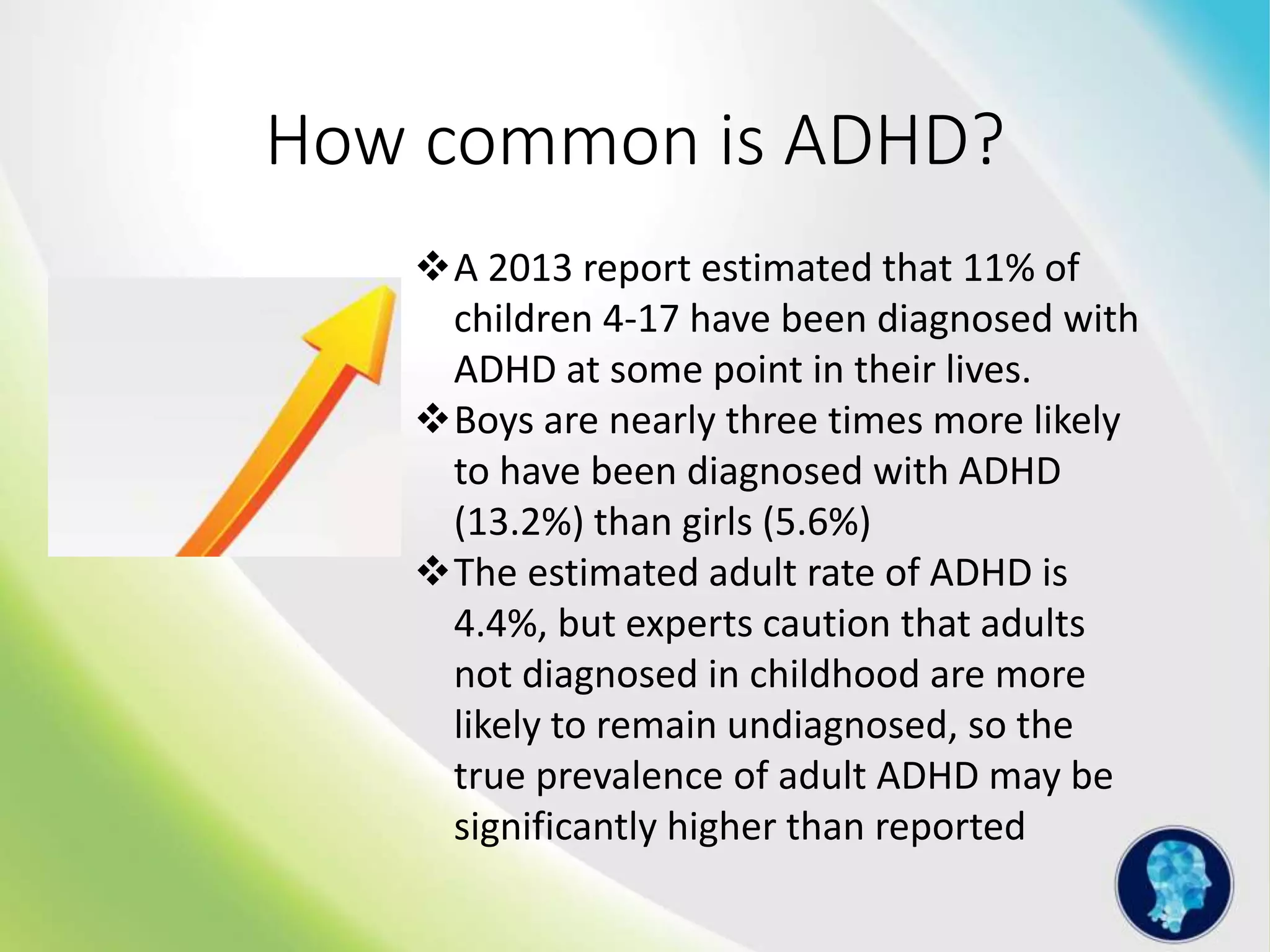
- ADHD affects an estimated 4.4% of adults, though the true rate may be higher as many adults are undiagnosed.
- ADHD is a real brain-based disorder, not a myth. Brain imaging shows differences in ADHD brains.
- At least 60% of children with ADHD continue to have symptoms as adults. Adults with ADHD may experience impairments in focus, organization, and other executive functions daily.
- While medication can help manage symptoms for many adults with ADHD, effort and organization strategies alone are usually not enough due to the neuro





![Proposed Criteria for ADHD in Adults
Russell A. Barkley, et al ADHD in Adults; What the Science Says, 2008
Proposed criteria for DSM-V for adults
6. Often has trouble doing things in their proper order or
sequence
7. Often is more likely to drive a motor vehicle much faster than
others ( excessive speeding) [ Alternate symptom for those
adults with no driving experience: Often has difficulty engaging
in leisure activities or doing fun things quietly]
8. Often has difficulty sustaining attention in tasks or play
activities
9. Often has difficulty organizing tasks and activities](https://image.slidesharecdn.com/6b5dd754-b8f4-4a84-a22c-9fe98d66cef7-160317204956/75/PowerPoint-presentation-15-2048.jpg)
![Additional Study findings
“ ...items which emphasize distractibility, impulsiveness, poor concentration or
persistence and problems with working memory and organization will be the
best constructs for identifying adults with ADHD. Items reflecting
hyperactivity proved much less useful for doing so in both studies”
“... adults with ADHD are far more likely to complain of difficulties involving EF
[executive functioning] than they are of hyperactivity. Difficulties with
impulsive decision making, stopping, starting and organizing activities,
persistence toward goals and planning for future events will prove to be
among the most significant complaints in identifying these adults with ADHD.”
p. 204 Russell A. Barkley, et al ADHD in Adults; What the Science Says, 2008](https://image.slidesharecdn.com/6b5dd754-b8f4-4a84-a22c-9fe98d66cef7-160317204956/75/PowerPoint-presentation-16-2048.jpg)


