PowerPower
TransformerTransformer
ProtectionProtection
The electrical windings and the magnetic core in a
transformer are subject to a number of different
forces during operation, for example:
Expansion and contraction due to thermal cycling
Vibration
Local heating due to magnetic flux
Impact forces due to through-fault current
Excessive heating due to overloading or inadequate
cooling
Why do Transformers Fail?
Transformer Protection
Cost of repairing damage
Cost of lost production
Adverse effects on the balance of the system
The spread of damage to adjacent equipment
The period of unavailability of the damaged
equipment
Costs and other factors to be considered
Transformer Protection
Windings
- Insulation deterioration from:
Moisture
Overheating
Vibration
Voltage surges
Mechanical Stress from through-faults
LTCs
- Malfunction of mechanical switching mechanism
- High resistance contacts
- Overheating
- Contamination of insulating oil
What Fails in Transformers?
Transformer Protection
Bushings
- General aging
- Contamination
- Cracking
- Internal moisture
Core Problems
- Core insulation failure
- Open ground strap
- Shorted laminations
- Core overheating
What Fails in Transformers?
Transformer Protection
Miscellaneous
- CT Issues
- Oil leakage
- Oil contamination
Metal particles
Moisture
What Fails in Transformers?
Transformer Protection
1003891001127100262Total
26101672412Miscellaneous
1422437Core failures
313671719
Terminal board
failures
1142101141541Bushing failures
2285212311949
Tap changer
failures
371445561551134Winding failures
% of TotalNumber% of TotalNumber% of TotalNumber
19881983-19821975-19651955-
Failure Statistics of Transformers
Source: IEEE C37.91
Failure Statistics of Transformers
Transformer Protection
87
T
50
51
51
G
High Side Low Side
“Guide for Protective Relay Applications for Power Transformers”
ANSI / IEEE C37.91
Transformer Protection
24: Overexcitation (V/Hz)
46: Negative Sequence Overcurrent
49: Thermal Overload
50: Instantaneous Phase Overcurrent
50G: Instantaneous Ground Overcurrent
50N: Instantaneous Residual Overcurrent
50BF: Breaker Failure
51G: Ground Inverse Time Overcurrent
51N: Residual Inverse Time Overcurrent
63: Sudden Pressure Relay (Buccholtz Relay)
81U: Underfrequency
87H: Unrestrained Phase Differential
87T: Transformer Phase Differential with Restraints’
87GD: Ground Differential (also known as “restricted earth fault”)
IEEE Devices used in Transformer Protection
Transformer Protection
Internal Short Circuits
- Phase Faults
- Ground Faults
System Short Circuits (Back Up Protection)
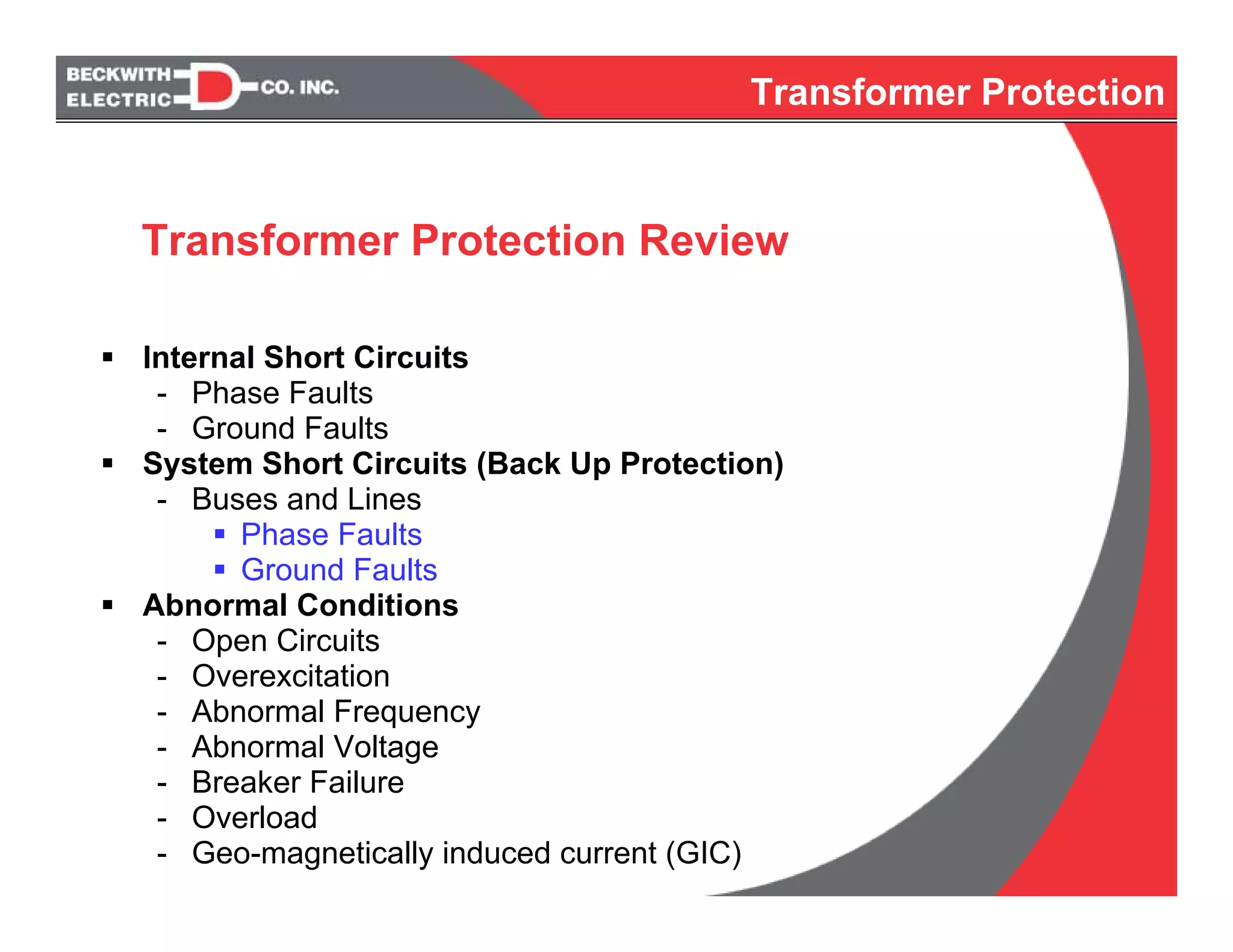
- Buses and Lines
Phase Faults
Ground Faults
Abnormal Conditions
- Open Circuits
- Overexcitation
- Abnormal Frequency
- Abnormal Voltage
- Breaker Failure
- Overload
- Geo-magnetically induced current (GIC)
Transformer Protection Review
Transformer Protection
Accumulated Gases
- Arcing by-products (Ex: Buchholz Relay)
Pressure Relays
- Arcing causing pressure waves in oil or gas space
(Sudden Pressure Relay)
Thermal
- Caused by overload, overexcitation, harmonics
and Geo-magnetically induced currents
Hot spot temperature
Top Oil
LTC Overheating
Types of Protection
Mechanical
Transformer Protection
In and Out of Zone
Phase
Fault
Ground
Fault
Breaker
Failure
Phase
Fault
Ground
Fault
Breaker
Failure
Overexcitation
Undervoltage
Underfrequency
Open Conductor
Overload
Transformer Electrical Protection Issues
Overexcitation
Transformer Protection
Internal Short Circuit
- Phase: 87T, 87H
- Ground: 87T, 87GD
System Short Circuit (Back Up Protection)
- Phase and Ground Faults
50, 50G, 50N, 51, 51G, 51N, 46
Detection Elements
Transformer Protection
Abnormal Operating Conditions
- Open Circuits: 46
- Overexcitation: 24
- Undervoltage: 27
- Abnormal Frequency: 81U
- Breaker Failure: 50BF, 50BF-N
Detection Elements
Transformer Protection
Fuses
- Small transformers (typ. <10 MVA)
- Short circuit protection only
Overcurrent protection
- High side
Through fault protection
Differential back-up protection for high side
faults
- Low side
System back up protection
Unbalanced load protection
Types of Protection
Electrical
Transformer Protection
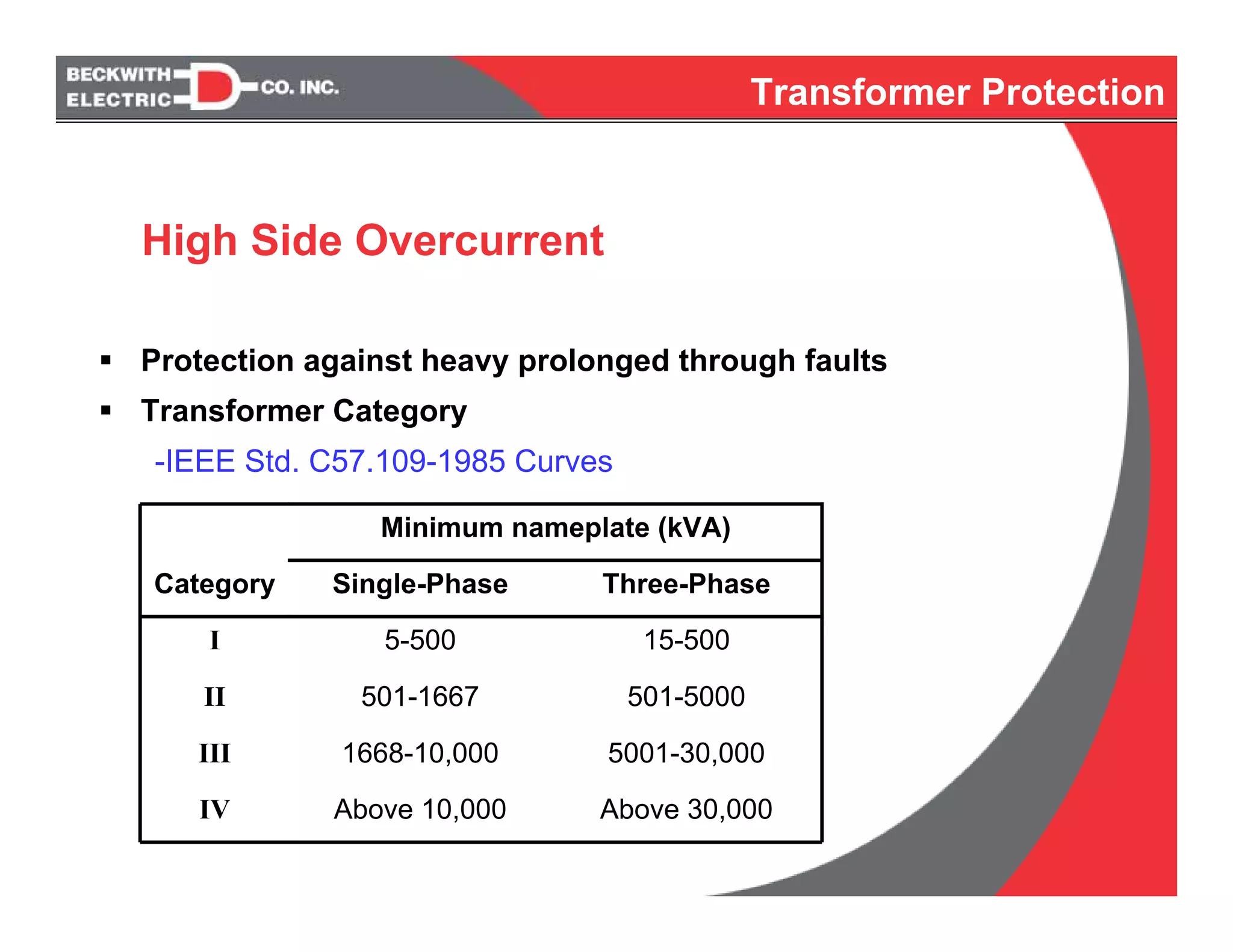
Protection against heavy prolonged through faults
Transformer Category
-IEEE Std. C57.109-1985 Curves
High Side Overcurrent
Above 30,000Above 10,000IV
5001-30,0001668-10,000III
501-5000501-1667II
15-5005-500I
Three-PhaseSingle-PhaseCategory
Minimum nameplate (kVA)
Transformer Protection
Through Fault
Category 1
Transformer Protection
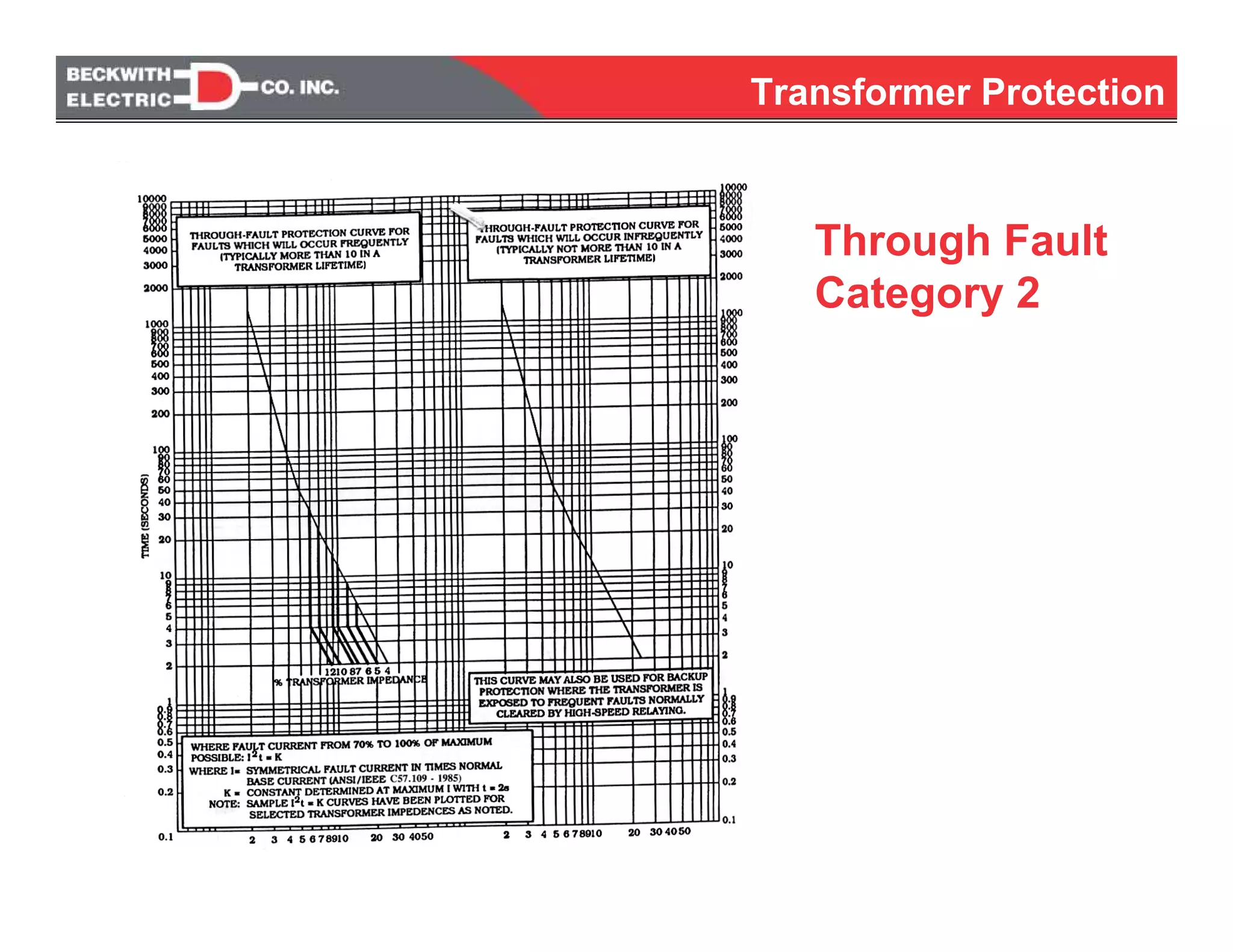
Through Fault
Category 2
Transformer Protection
Cat. 2 & 3
Fault Frequency Zones
Transformer Protection
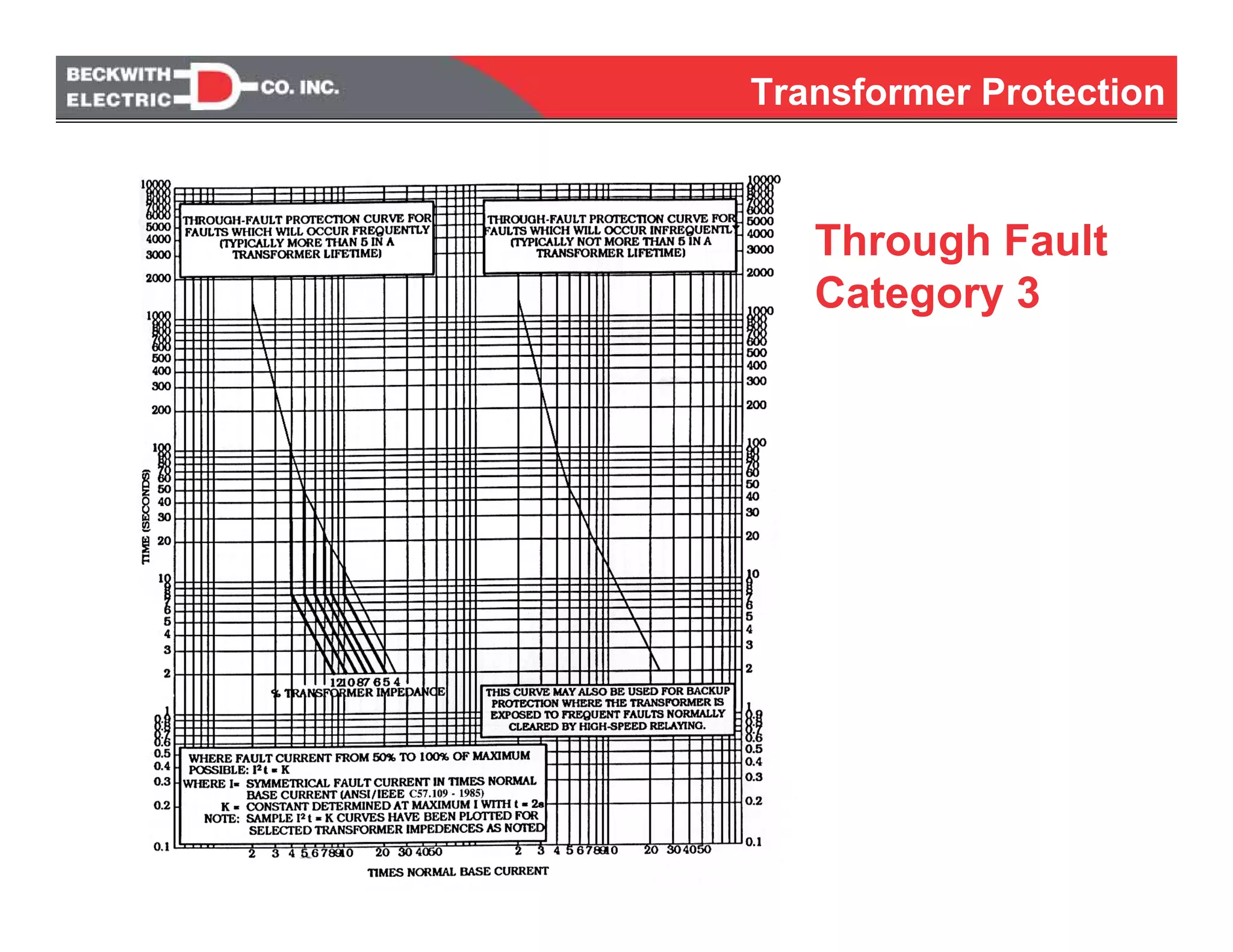
Through Fault
Category 3
Transformer Protection
Through Fault
Category 4
Transformer Protection
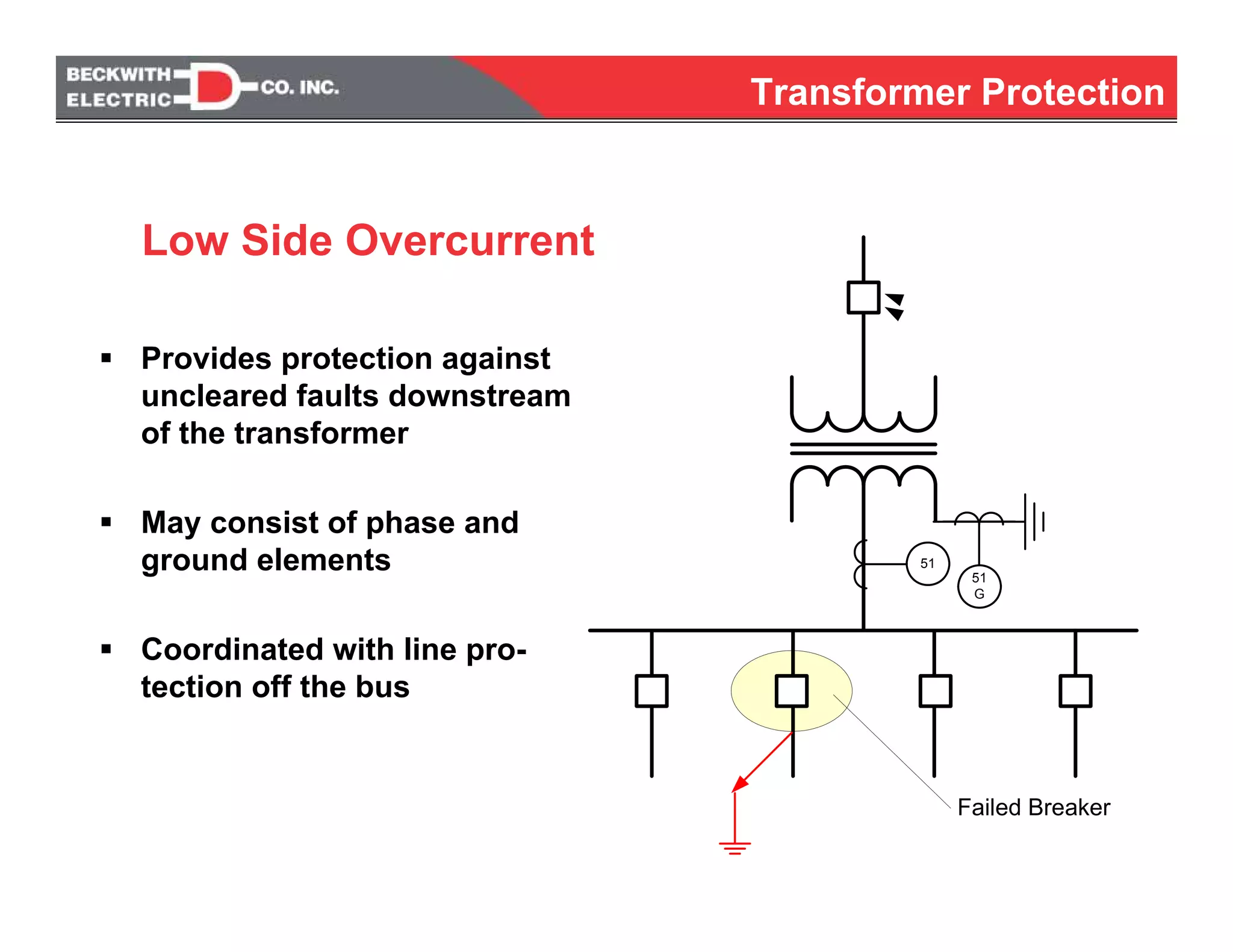
Failed Breaker
51
51
G
Provides protection against
uncleared faults downstream
of the transformer
May consist of phase and
ground elements
Coordinated with line pro-
tection off the bus
Low Side Overcurrent
Transformer Protection
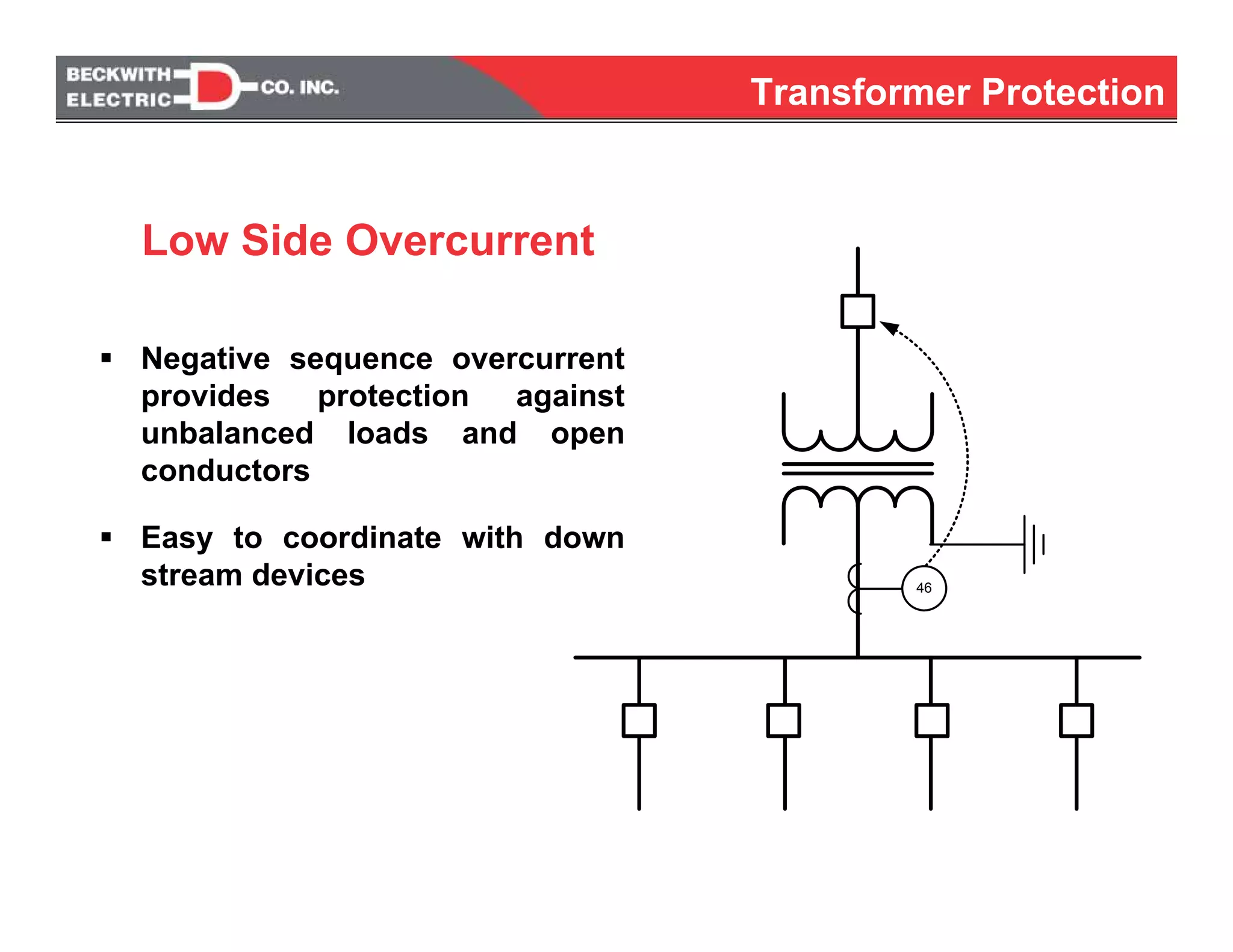
46
Negative sequence overcurrent
provides protection against
unbalanced loads and open
conductors
Easy to coordinate with down
stream devices
Low Side Overcurrent
Transformer Protection
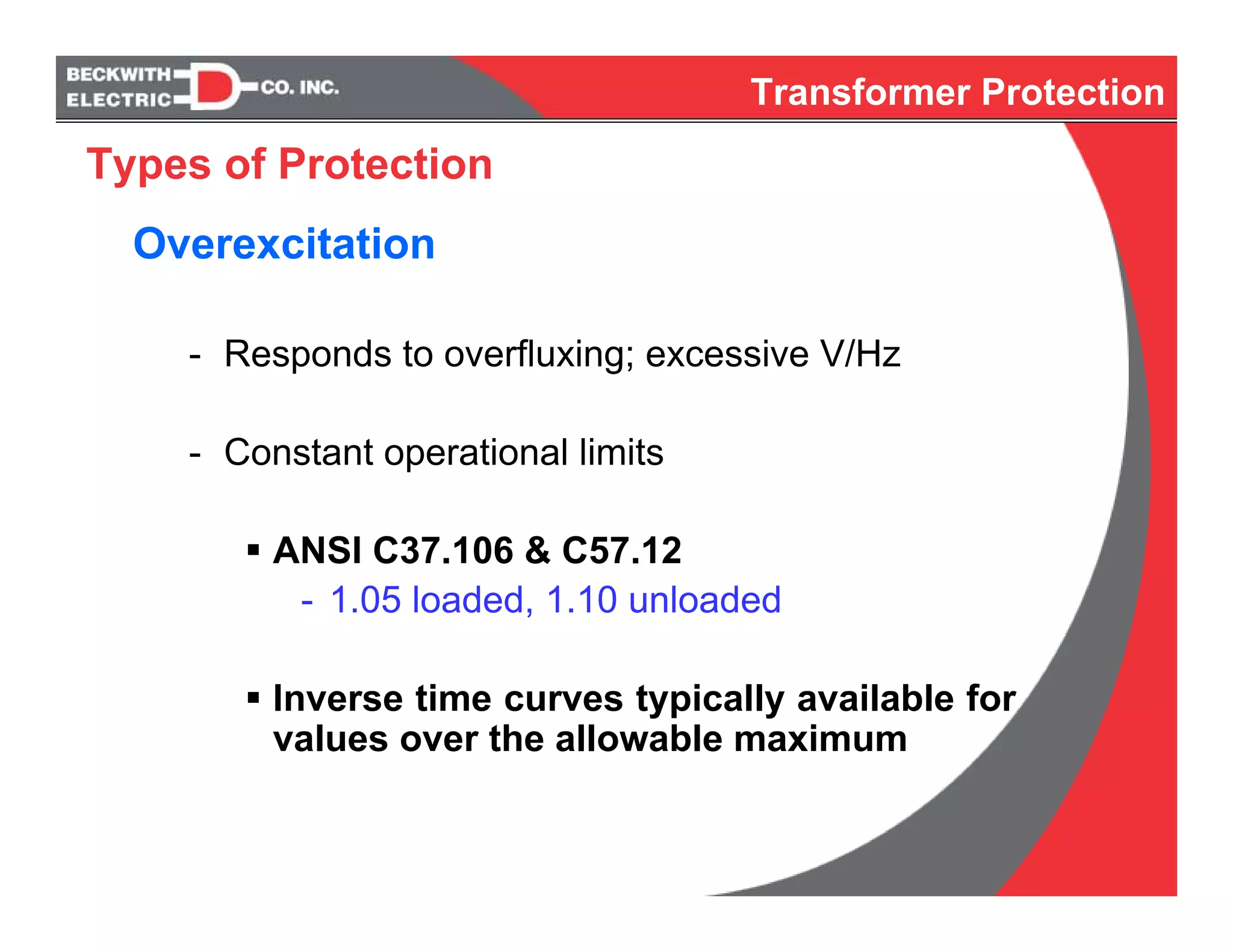
Overexcitation
- Responds to overfluxing; excessive V/Hz
- Constant operational limits
ANSI C37.106 & C57.12
- 1.05 loaded, 1.10 unloaded
Inverse time curves typically available for
values over the allowable maximum
Transformer Protection
Types of Protection
Generating Plants
-Excitation system runaway
-Sudden loss of load
-Operational issues (reduced frequency)
Static starts
Pumped hydro starting
Rotor warming
Transmission Systems
-Voltage and Reactive Support Control Failures
Capacitor banks ON when they should be OFF
Shunt reactors OFF when they should be ON
Near-end breaker failures resulting in voltage
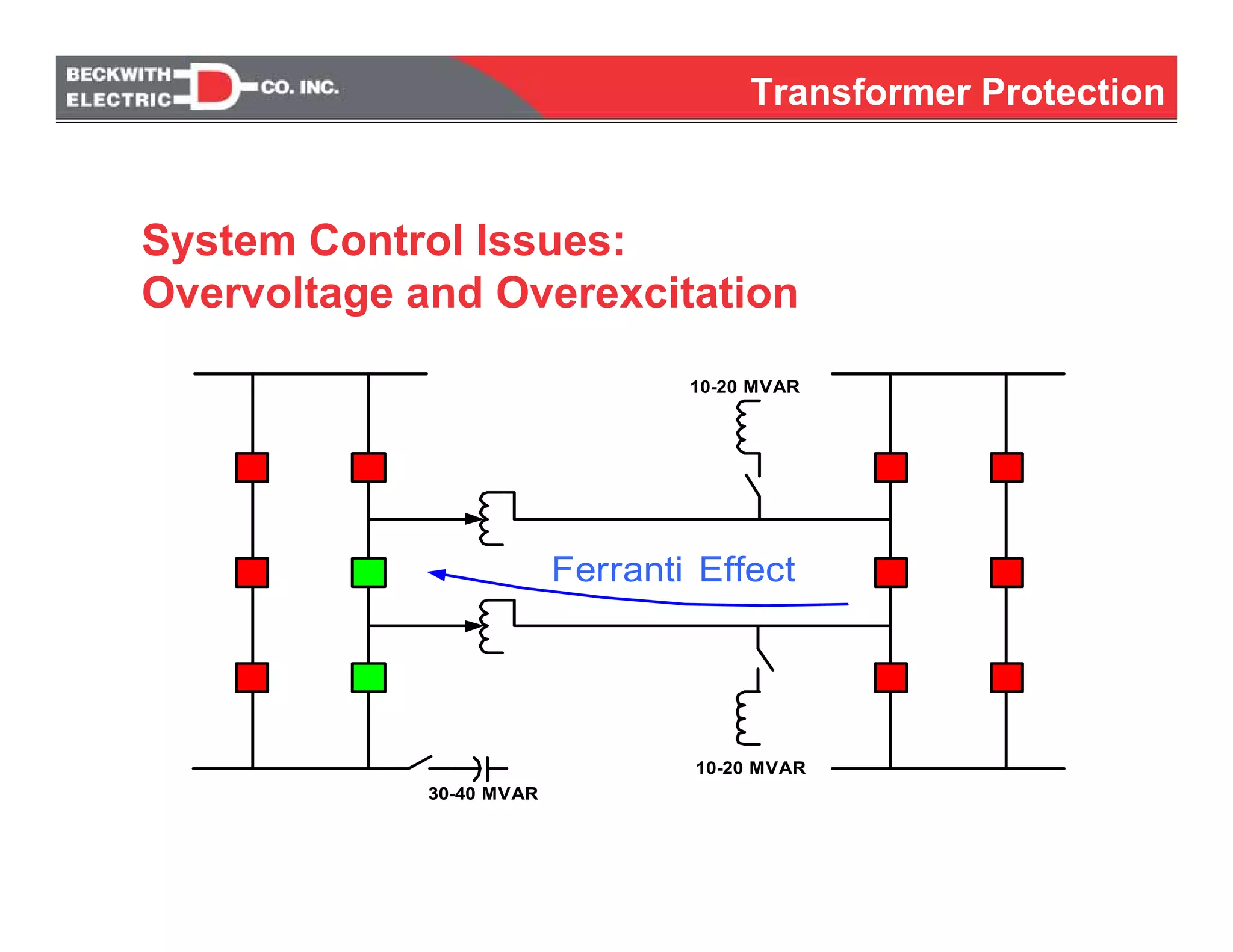
rise on line (Ferranti effect)
Runaway LTCs
Causes of Overexcitation
Transformer Protection
30-40 MVAR
10-20 MVAR
10-20 MVAR
Caps ON When They Should Be Off
System Control Issues:
Overvoltage and Overexcitation
Transformer Protection
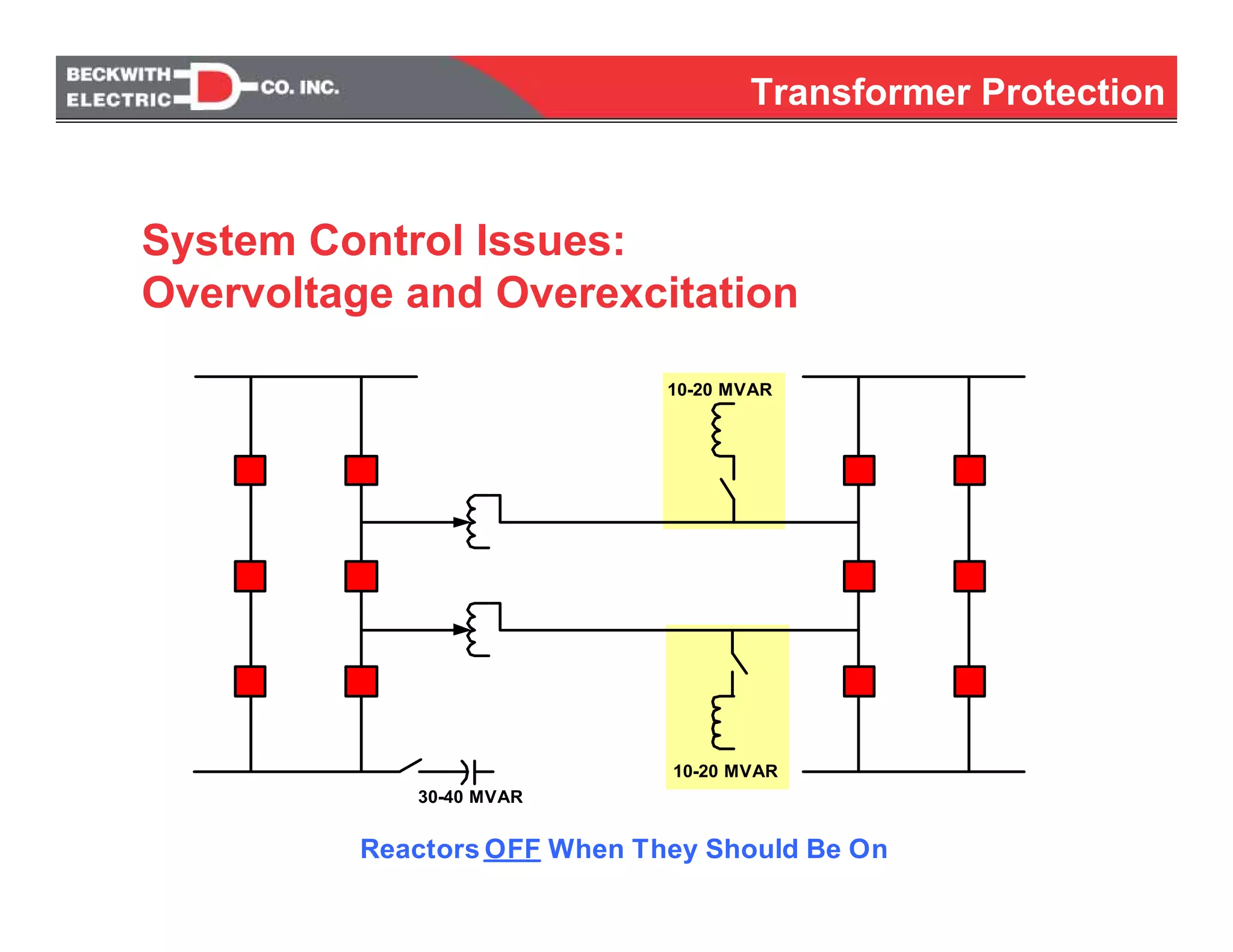
30-40 MVAR
10-20 MVAR
10-20 MVAR
Reactors OFF When They Should Be On
System Control Issues:
Overvoltage and Overexcitation
Transformer Protection
30-40 MVAR
10-20 MVAR
10-20 MVAR
Ferranti Effect
System Control Issues:
Overvoltage and Overexcitation
Transformer Protection
30-40 MVAR
10-20 MVAR
10-20 MVAR
Run-Away LTC
System Control Issues:
Overvoltage and Overexcitation
Transformer Protection
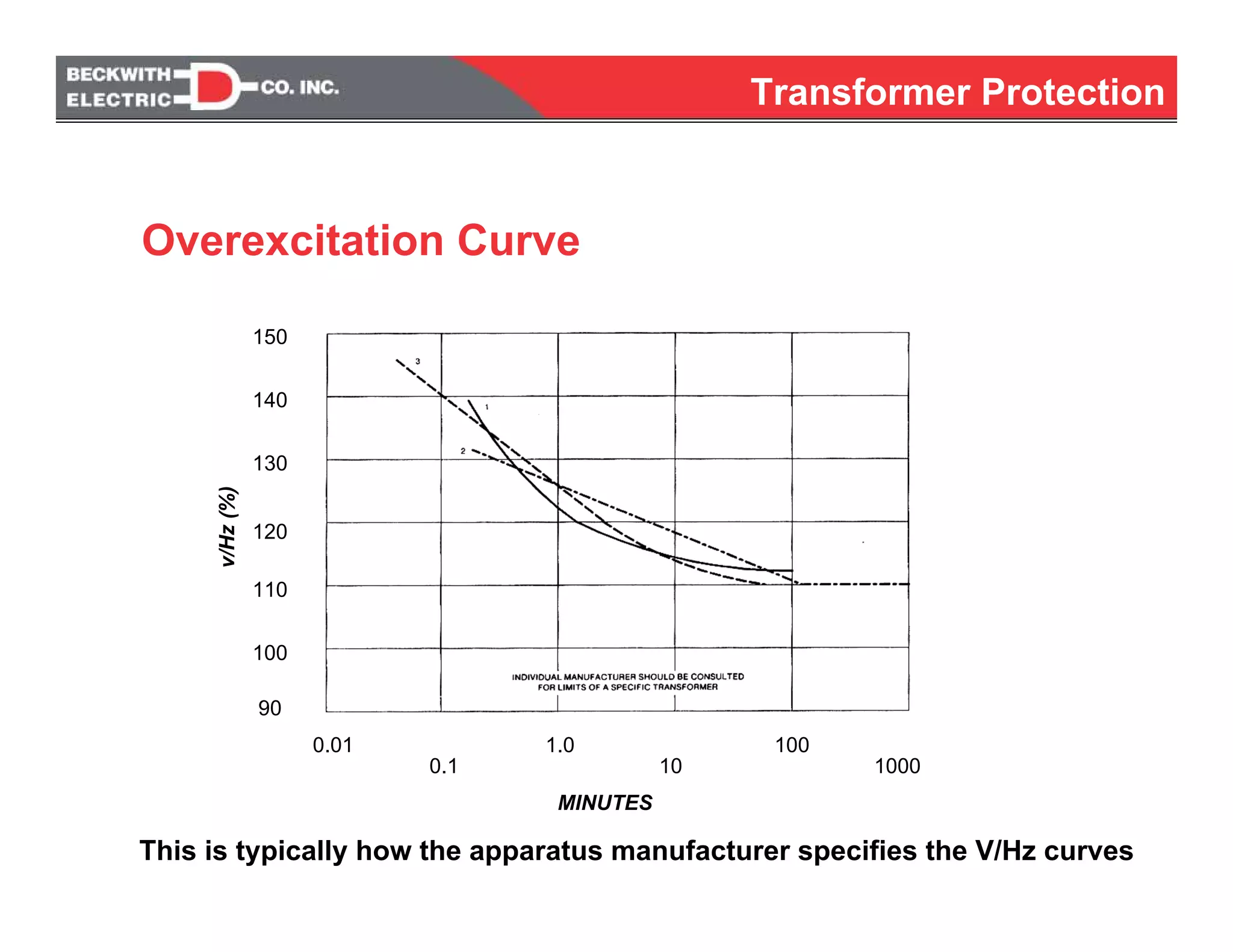
This is typically how the apparatus manufacturer specifies the V/Hz curves
0.01
0.1
1.0
10
100
1000
MINUTES
v/Hz(%)
90
100
110
120
130
140
150
Overexcitation Curve
Transformer Protection
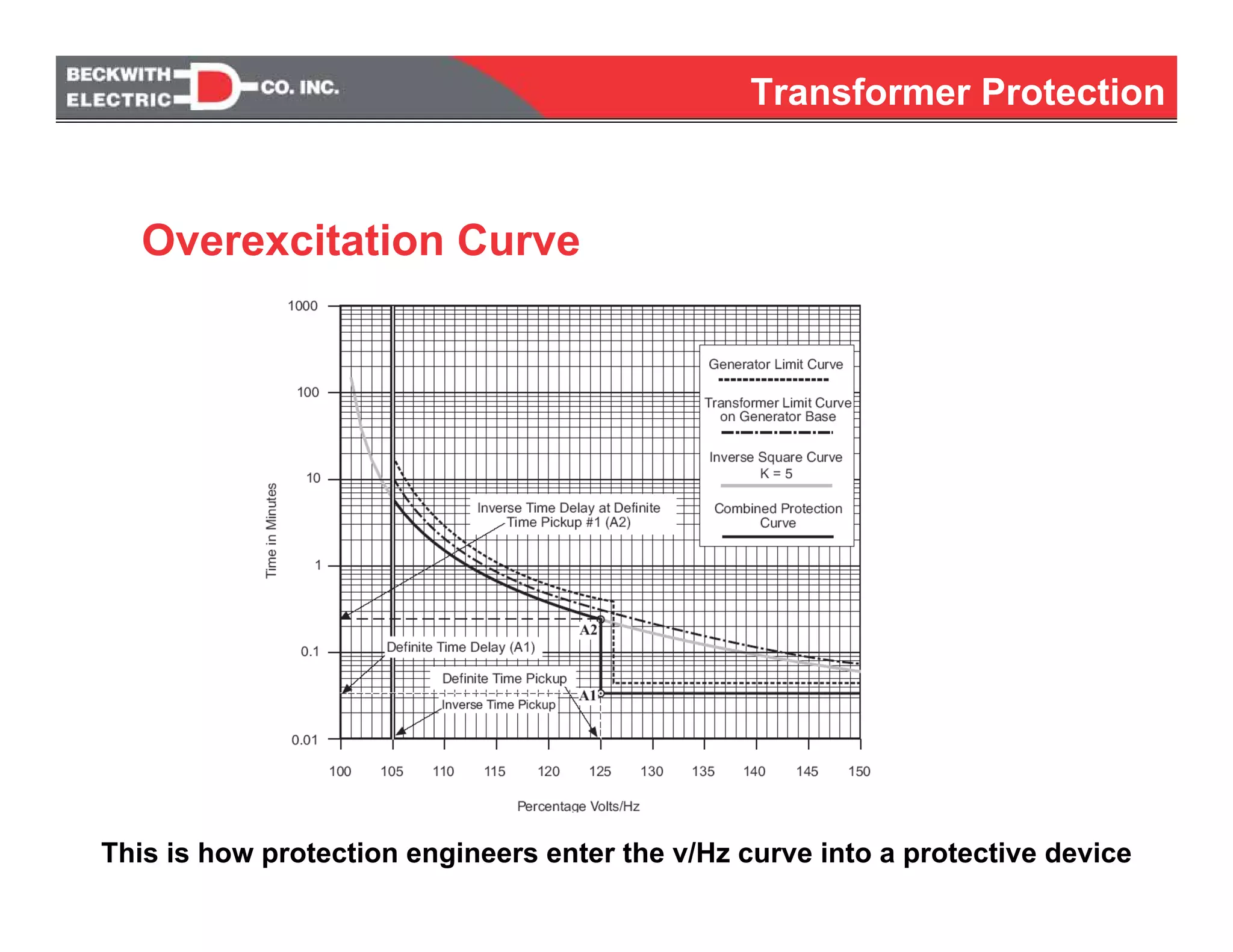
This is how protection engineers enter the v/Hz curve into a protective device
Overexcitation Curve
Transformer Protection
Differential Protection
Transformer Protection
• Differential protection provides high speed
detection of faults that can reduce damage due to
the flow of fault currents
• The location of the fault is determined more
precisely (i.e within the zone of differential
protection)
Advantages:
Types of Protection
Phase Differential
- Applied with variable percentage slopes to
accommodate CT saturation and CT ratio errors
- Applied with inrush and overexcitation restraints
- Pickup/slope setting should consider:
magnetizing current, turns ratio errors due to fixed
taps and +/-10% variation due to LTC
- May not be sensitive enough for all faults (low
level, ground faults near neutral)
Types of Protection
Transformer Protection
TRANSFORMER
TAP W-1
TAP W-2
Restraint W-1 Restraint W-2
Operate
RELAY
Basic Differential Relay
Transformer Protection
Phase Differential
TRANSFORMER
TAP W-1
TAP W-2
Restraint W-1 Restraint W-2
Operate
RELAY
= 0
Basic Differential Relay - External Fault
Transformer Protection
TRANSFORMER
TAPW-1
TAPW-2
Restraint W-1 Restraint W-2
Operate
RELAY
Basic Differential Relay - Internal Fault
Transformer Protection
Ground Differential
- Sensitive detection of ground faults, including
those near the neutral
- Does not require inrush or overexcitation restraint
- Low impedance grounded systems use directional
signal for added stability
- Low impedance grounded systems do not require
dedicated CTs, same set of CTs can be used for
phase differential, phase overcurrent, ground
differential and ground overcurrent protection
Types of Protection
Transformer Protection
What goes into a “unit” comes out of a “unit”
Kirchoff’s Law: The sum of the currents entering and
leaving a junction is zero
Straight forward concept, but not that simple in practice
with transformers
A host of issues presents itself to decrease security and
reliability of transformer differential protection
Differential Protection
Transformer Protection
UNIT
I1 I2
I3
I1 + I2 + I3 = 0
Typical Phase Differential Characteristic
Transformer Protection
CT ratio caused current mismatch
Transformation ratio caused current mismatch (fixed taps)
LTC induced current mismatch
Delta-wye transformation of currents
- Vector group and current derivation issues
Zero-sequence current elimination for external ground
faults on wye windings
Inrush phenomena and its resultant current mismatch
Unique Issues Applying to Transformer
Differential Protection
Transformer Protection
Harmonic content available during inrush period due to
point-on-wave switching (especially with newer transformers
with step-lap core construction)
Overexcitation phenomena and its resultant current
mismatch
Internal ground fault sensitivity concerns
Switch onto fault concerns
CT saturation, remanance and tolerance
Unique Issues Applying to Transformer
Differential Protection
Transformer Protection
CT ratios must be selected to account for:
- Transformer ratios
- If delta or wye connected CTs are applied
- Delta increases ratio by 1.73
Delta CTs must be used to filter zero-sequence
current on wye transformer windings
Classical Differential Compensation
Transformer Protection
Classical Differential Compensation
Transformer Protection
Transformer ratio
CT ratio
Phase angle shift and √ 3 factor due to delta/wye
connection
Zero-sequence current filtering for wye windings so
the differential quantities do not occur from external
ground faults
Compensation in Digital Relays
Transformer Protection
The compensation for the phase shift is achieved as follows:
Iabc: Measured CT currents (assuming CTs are connected in Y)
I'abc: Compensated three-phase currents.
Assuming a two winding transformer with a phase angle
difference between the primary and secondary as shown in the
following 12 cases.
Phase angle shift due to transformer connection in
electromechanical and static relays is accomplished using
appropriate connection of the cts.
The phase angle shift in Numerical Relays can easily be
compensated in software for any transformer type. All cts can
be connected in Y which allows the same cts to be used for both
metering and backup overcurrent functions
Phase Angle compensation in Numerical Relays
Transformer Protection
ABCABC II
⎥
⎥
⎥
⎦
⎤
⎢
⎢
⎢
⎣
⎡
=
100
010
001
' ABCABC II
⎥
⎥
⎥
⎦
⎤
⎢
⎢
⎢
⎣
⎡
−
−
−
=
101
110
011
3
1
'
A
C B
C
B
A
A
C
B
B
C A
C
B A
A
B C
B
A C
C
A B
B
A
C
C
B
A
A
C
B
ABCABC II
⎥
⎥
⎥
⎦
⎤
⎢
⎢
⎢
⎣
⎡
−
−
−
=
001
100
010
'
ABCABC II
⎥
⎥
⎥
⎦
⎤
⎢
⎢
⎢
⎣
⎡
=
010
001
100
'
ABCABC II
⎥
⎥
⎥
⎦
⎤
⎢
⎢
⎢
⎣
⎡
−
−
−
=
100
010
001
'
ABCABC II
⎥
⎥
⎥
⎦
⎤
⎢
⎢
⎢
⎣
⎡
=
001
100
010
'
ABCABC II
⎥
⎥
⎥
⎦
⎤
⎢
⎢
⎢
⎣
⎡
−
−
−
=
010
001
100
'
ABCABC II
⎥
⎥
⎥
⎦
⎤
⎢
⎢
⎢
⎣
⎡
−
−
−
=
011
101
110
3
1
'
ABCABC II
⎥
⎥
⎥
⎦
⎤
⎢
⎢
⎢
⎣
⎡
−
−
−
=
110
011
101
3
1
'
ABCABC II
⎥
⎥
⎥
⎦
⎤
⎢
⎢
⎢
⎣
⎡
−
−
−
=
101
110
011
3
1
'
ABCABC II
⎥
⎥
⎥
⎦
⎤
⎢
⎢
⎢
⎣
⎡
−
−
−
=
011
101
110
3
1
'
1:
0O
3:
60O
5:
120O
7:
180O
9:
240O
11:
300O
B
A
C
ABCABC II
⎥
⎥
⎥
⎦
⎤
⎢
⎢
⎢
⎣
⎡
−
−
−
=
110
011
101
3
1
'
2:
30O
4:
90O
6:
150O
8:
210O
10:
270O
12:
330O
y g
As an example, if we have a two winding transformer with Y/Delta-AC connection (or YD1)
with Y-Y cts. This will be equivalent to case 2 with a 30o phase shift.
Transformer Protection
1:1, Y-Y
1:1, 3Y1:1, 3Y
IA, IB, IC Ia, Ib, Ic
IA' = Ia'
IB' = Ib'
IC' = Ic'
IA', IB', IC' Ia', Ib', Ic'
Compensation: Base Model
Transformer Protection
1:1, Y-Y
1:1, 3Y4:1, 3Y
IA, IB, IC Ia, Ib, Ic
IA' = Ia' / 4
IB' = Ib' / 4
IC' = Ic' / 4
IA', IB', IC' Ia', Ib', Ic'
Compensation: Change in CT Ratio
Transformer Protection
2:1, Y-Y
1:1, 3Y1:1, 3Y
IA, IB, IC Ia, Ib, Ic
IA' = Ia' / 2
IB' = Ib' / 2
IC' = Ic' / 2
IA', IB', IC' Ia', Ib', Ic'
Compensation: Transformer Ratio
Transformer Protection
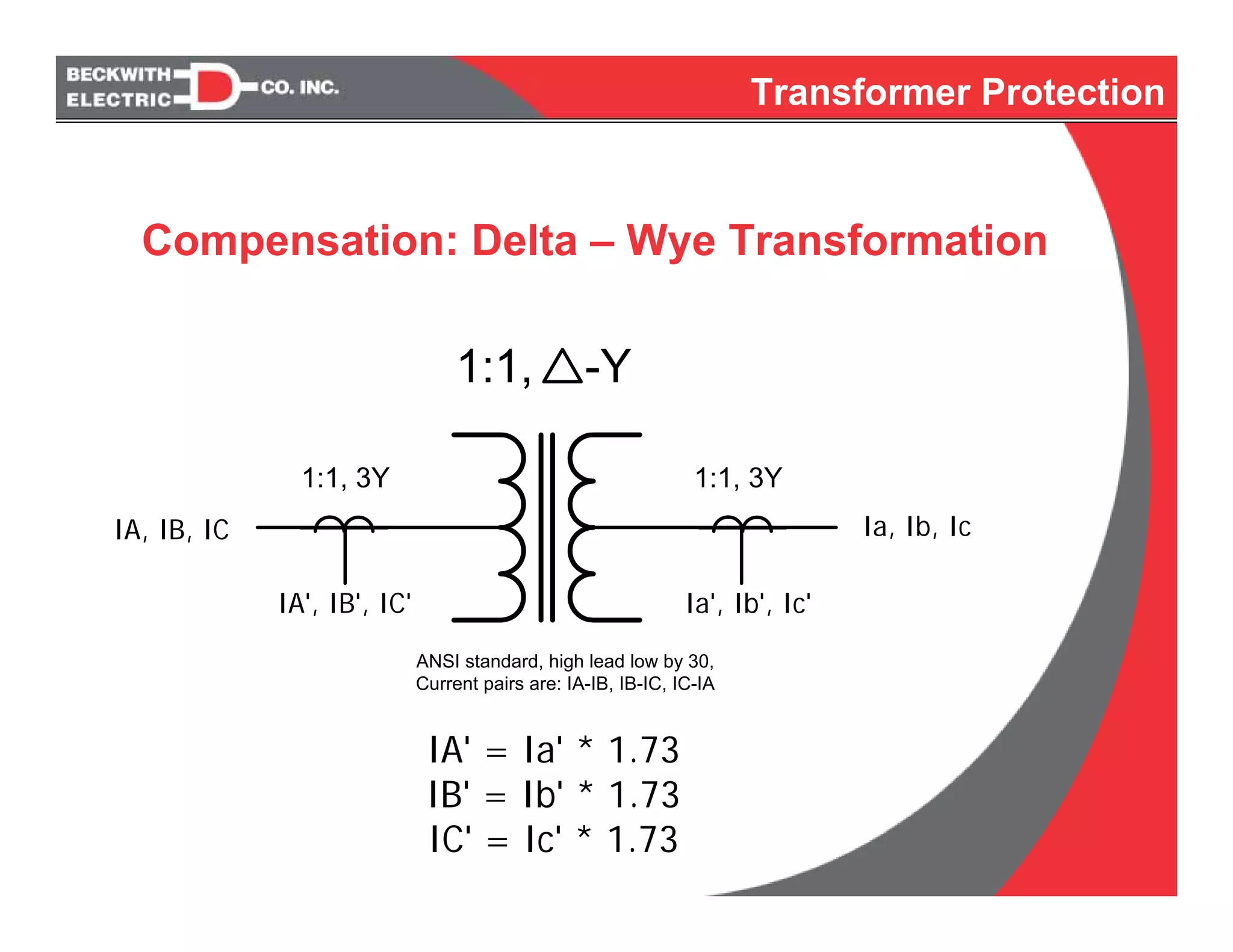
1:1, -Y
1:1, 3Y1:1, 3Y
IA, IB, IC Ia, Ib, Ic
IA' = Ia' * 1.73
IB' = Ib' * 1.73
IC' = Ic' * 1.73
ANSI standard, high lead low by 30,
Current pairs are: IA-IB, IB-IC, IC-IA
IA', IB', IC' Ia', Ib', Ic'
Compensation: Delta – Wye Transformation
Transformer Protection
3I0 = [Ia + Ib + Ic]
I0 = 1/3 *[Ia + Ib + Ic]
Used where filtering is required (Ex: Y/Y transformer).
Compensation: Zero-Sequence elimination
Transformer Protection
All wye CTs shown
Digital Relay Application
Transformer Protection
Phase segregated line currents
- Individual line current oscillography
- Currents may be easily used for overcurrent protection and
metering
- Easier to commission and troubleshoot
- Zero sequence elimination performed by calculation
However, for protection upgrade applications where one wants to
keep the existing wiring, it will be necessary for the relay to
accept either delta or wye CTs and recalculate the phase currents
from delta CTs for overcurrent function (Some digital relays like
M-3310/3311 have these features).
Benefits of Wye CTs
Transformer Protection
Inrush Detection and Restraint
- Initial inrush occurs during transformer energizing as the
core magnetizes
- Sympathy inrush occurs from adjacent transformer(s)
energizing, fault removal, allowing the transformer to
undergo a low level inrush
- Characterized by current into one winding of transformer,
and not out of the other winding(s)
- This causes a differential element to pickup
- Use inrush restraint to block differential element
during inrush period
Inrush Restraint
Transformer Protection
Inrush Detection and Restraint
- 2nd harmonic restraint has been employed for years
- “Gap” detection has also been employed
- As transformers are designed to closer tolerances, the
incidence of both 2nd harmonic and low current gaps in
waveform have decreased
- If 2nd harmonic restraint level is set too low, differential
element may be blocked for internal faults with CT
saturation (with associated harmonics generated)
Classical Inrush Detection
Transformer Protection
Inrush Detection and Restraint
- 4th harmonic is also generated during inrush
- Even harmonics are more prevalent than odd harmonics
during inrush
Odd harmonics are more prevalent during CT saturation
- Use 4th harmonic and 2nd harmonic together
Use RMS sum of the 2nd and 4th harmonic as inrush
restraint
- Result: Improved security while not sacrificing
reliability
Advanced Inrush Detection
Transformer Protection
2nd and 4th
Harmonics
During
Inrush
Typical Transformer Inrush Waveform
Inrush Oscillograph
Transformer Protection
As most circuit breakers are ganged three-pole, one
phase will be near voltage zero at the moment of
transformer energization
When a phase of a transformer is switched on near
zero voltage, the inrush is increased and so is the
resultant harmonics
Low levels of harmonics (especially modern
transformers) may not provide inrush restraint for
affected phase – security risk!
Employ cross-phase averaging to compensate for this
issue
Point-on-Wave Considerations During
Switch On
Transformer Protection
Provides security if any phase has low harmonic
content during inrush
Cross phase averaging uses the sum of harmonics
on all three phases as the restraint value
Cross Phase Averaging
Transformer Protection
Overexcitation occurs when volts per hertz level rises (V/Hz)
above the rated value
This may occur from:
- Load rejection (generator transformers)
- Malfunctioning of voltage and reactive support elements
- Malfunctioning of breakers and line protection (including transfer
trip communication equipment schemes)
- Malfunctioning of generator AVRs
The voltage rise at nominal frequency causes the V/Hz to rise
This causes the transformer core to saturate and thereby
increase the magnetizing current.
The increased magnetizing current contains 5th harmonic
component
This magnetizing current causes the differential element to
pickup
Overexcitation Restraint
Transformer Protection
VoltageCurrent
Transformer Magnetizing Current
Current into Transformer due to Overfluxing
Rated Voltage Overvoltage Voltage
24 Elements Tripping
Overexcitation Event
Transformer Protection
VoltageCurrent
11.57kV (RMS)
19.40kV (RMS
0.0 kA (RMS)
1.42kA (RMS) !!!
24 Elements Tripping
Overexcitation Event
Transformer Protection
High 5th Harmonic Currents
Overexcitation Event
Transformer Protection
259V of 5th Harmonic
190 A of 5th Harmonic !!!
Overexcitation Event
Transformer Protection
Use 5th harmonic level to detect overexcitation
Most relays block the differential element from functioning
during transformer overexcitation
An improved strategy is to raise the pick up level to
accommodate the increased difference currents caused
by the transformer saturation
This allows the differential element to rapidly trip if an
internal fault occurs during the overexcitation period
Result: Improved reliability while not sacrificing security
Overexcitation Restraint
Transformer Protection
Trip Characteristic – 87T
Transformer Protection
0.5
1.0
1.5
2.0
0.5 1.0 1.5 2.0
87T Pick Up
87T Pick Up
with 5th Harmonic Restraint
Slope 1
Slope 2
Slope 2
Breakpoint
TRIP
RESTRAIN
87T element is typically set with 30-40% pickup
This is to accommodate Class “C” CT accuracy during
a fault plus the effects of LTCs
That leaves a portion of the winding not covered for a
ground fault
Employ a ground differential element to improve
sensitivity (87GD)
Improved Ground Fault Sensitivity
Transformer Protection
Use 87GD
IA + IB + IC = 3I0
If fault is internal, opposite
polarity
If fault is external, same
polarity IG
IA
IB
IC
.
Improved Ground Fault Sensitivity
Transformer Protection
IG
IA
IB
IC
IG
IA
IB
IC
Internal ExternalInternal External
• .
Improved Ground Fault Sensitivity
Transformer Protection
- The directional element is used to provide security
against relay misoperation due to ct saturation. With
low level faults, the directional element is not
necessary as the CTs will not saturate.
Improved Ground Fault Sensitivity
Transformer Protection
IG
IA
IB
IC
3I0
IG
Residual current
calculated from
individual phase
currents. Paralleled
CTs shown to
illustrate principle.
0
90
180
270
IG
3IO
-3Io x IG cos (180) = 3IoIG
Trip Characteristic – 87GD
Transformer Protection
IG
IA
IB
IC
3I0
IG
Residual current
calculated from
individual phase
currents. Paralleled
CTs shown to
illustrate principle.
0
90
180
270
IG
3IO
-3Io x IG cos (0) = -3IoIG
Trip Characteristic – 87GD
Transformer Protection
Transformer is faulted on energizing
Harmonic restraint on unfaulted phases may work against
trip decision if cross phase averaging is used. This may
delay tripping until the inrush current is reduced
- Unfaulted phase may have high harmonics and delay 87T
operation
87H and 87GD can be used to provide high speed protection
for this condition
Switch-onto-Fault
Transformer Protection
High set element 87H can provide high speed protection
for severe faults as this function is not restrained by
harmonics
87H is set above the worst case inrush current
If fault is near the bushing end of the winding, the
current will be higher than the inrush current
Ground differential function can provide fast protection
during switching onto ground faults as this element is
not restrained using harmonics
Switch-onto-Fault
Transformer Protection
©2008 Beckwith Electric Co., Inc.

Power transformer protection

  • 1.
  • 2.
    The electrical windingsand the magnetic core in a transformer are subject to a number of different forces during operation, for example: Expansion and contraction due to thermal cycling Vibration Local heating due to magnetic flux Impact forces due to through-fault current Excessive heating due to overloading or inadequate cooling Why do Transformers Fail? Transformer Protection
  • 3.
    Cost of repairingdamage Cost of lost production Adverse effects on the balance of the system The spread of damage to adjacent equipment The period of unavailability of the damaged equipment Costs and other factors to be considered Transformer Protection
  • 4.
    Windings - Insulation deteriorationfrom: Moisture Overheating Vibration Voltage surges Mechanical Stress from through-faults LTCs - Malfunction of mechanical switching mechanism - High resistance contacts - Overheating - Contamination of insulating oil What Fails in Transformers? Transformer Protection
  • 5.
    Bushings - General aging -Contamination - Cracking - Internal moisture Core Problems - Core insulation failure - Open ground strap - Shorted laminations - Core overheating What Fails in Transformers? Transformer Protection
  • 6.
    Miscellaneous - CT Issues -Oil leakage - Oil contamination Metal particles Moisture What Fails in Transformers? Transformer Protection
  • 7.
    1003891001127100262Total 26101672412Miscellaneous 1422437Core failures 313671719 Terminal board failures 1142101141541Bushingfailures 2285212311949 Tap changer failures 371445561551134Winding failures % of TotalNumber% of TotalNumber% of TotalNumber 19881983-19821975-19651955- Failure Statistics of Transformers Source: IEEE C37.91 Failure Statistics of Transformers Transformer Protection
  • 8.
    87 T 50 51 51 G High Side LowSide “Guide for Protective Relay Applications for Power Transformers” ANSI / IEEE C37.91 Transformer Protection
  • 9.
    24: Overexcitation (V/Hz) 46:Negative Sequence Overcurrent 49: Thermal Overload 50: Instantaneous Phase Overcurrent 50G: Instantaneous Ground Overcurrent 50N: Instantaneous Residual Overcurrent 50BF: Breaker Failure 51G: Ground Inverse Time Overcurrent 51N: Residual Inverse Time Overcurrent 63: Sudden Pressure Relay (Buccholtz Relay) 81U: Underfrequency 87H: Unrestrained Phase Differential 87T: Transformer Phase Differential with Restraints’ 87GD: Ground Differential (also known as “restricted earth fault”) IEEE Devices used in Transformer Protection Transformer Protection
  • 10.
    Internal Short Circuits -Phase Faults - Ground Faults System Short Circuits (Back Up Protection) - Buses and Lines Phase Faults Ground Faults Abnormal Conditions - Open Circuits - Overexcitation - Abnormal Frequency - Abnormal Voltage - Breaker Failure - Overload - Geo-magnetically induced current (GIC) Transformer Protection Review Transformer Protection
  • 11.
    Accumulated Gases - Arcingby-products (Ex: Buchholz Relay) Pressure Relays - Arcing causing pressure waves in oil or gas space (Sudden Pressure Relay) Thermal - Caused by overload, overexcitation, harmonics and Geo-magnetically induced currents Hot spot temperature Top Oil LTC Overheating Types of Protection Mechanical Transformer Protection
  • 12.
    In and Outof Zone Phase Fault Ground Fault Breaker Failure Phase Fault Ground Fault Breaker Failure Overexcitation Undervoltage Underfrequency Open Conductor Overload Transformer Electrical Protection Issues Overexcitation Transformer Protection
  • 13.
    Internal Short Circuit -Phase: 87T, 87H - Ground: 87T, 87GD System Short Circuit (Back Up Protection) - Phase and Ground Faults 50, 50G, 50N, 51, 51G, 51N, 46 Detection Elements Transformer Protection
  • 14.
    Abnormal Operating Conditions -Open Circuits: 46 - Overexcitation: 24 - Undervoltage: 27 - Abnormal Frequency: 81U - Breaker Failure: 50BF, 50BF-N Detection Elements Transformer Protection
  • 15.
    Fuses - Small transformers(typ. <10 MVA) - Short circuit protection only Overcurrent protection - High side Through fault protection Differential back-up protection for high side faults - Low side System back up protection Unbalanced load protection Types of Protection Electrical Transformer Protection
  • 16.
    Protection against heavyprolonged through faults Transformer Category -IEEE Std. C57.109-1985 Curves High Side Overcurrent Above 30,000Above 10,000IV 5001-30,0001668-10,000III 501-5000501-1667II 15-5005-500I Three-PhaseSingle-PhaseCategory Minimum nameplate (kVA) Transformer Protection
  • 17.
  • 18.
  • 19.
    Cat. 2 &3 Fault Frequency Zones Transformer Protection
  • 20.
  • 21.
  • 22.
    Failed Breaker 51 51 G Provides protectionagainst uncleared faults downstream of the transformer May consist of phase and ground elements Coordinated with line pro- tection off the bus Low Side Overcurrent Transformer Protection
  • 23.
    46 Negative sequence overcurrent providesprotection against unbalanced loads and open conductors Easy to coordinate with down stream devices Low Side Overcurrent Transformer Protection
  • 24.
    Overexcitation - Responds tooverfluxing; excessive V/Hz - Constant operational limits ANSI C37.106 & C57.12 - 1.05 loaded, 1.10 unloaded Inverse time curves typically available for values over the allowable maximum Transformer Protection Types of Protection
  • 25.
    Generating Plants -Excitation systemrunaway -Sudden loss of load -Operational issues (reduced frequency) Static starts Pumped hydro starting Rotor warming Transmission Systems -Voltage and Reactive Support Control Failures Capacitor banks ON when they should be OFF Shunt reactors OFF when they should be ON Near-end breaker failures resulting in voltage rise on line (Ferranti effect) Runaway LTCs Causes of Overexcitation Transformer Protection
  • 26.
    30-40 MVAR 10-20 MVAR 10-20MVAR Caps ON When They Should Be Off System Control Issues: Overvoltage and Overexcitation Transformer Protection
  • 27.
    30-40 MVAR 10-20 MVAR 10-20MVAR Reactors OFF When They Should Be On System Control Issues: Overvoltage and Overexcitation Transformer Protection
  • 28.
    30-40 MVAR 10-20 MVAR 10-20MVAR Ferranti Effect System Control Issues: Overvoltage and Overexcitation Transformer Protection
  • 29.
    30-40 MVAR 10-20 MVAR 10-20MVAR Run-Away LTC System Control Issues: Overvoltage and Overexcitation Transformer Protection
  • 30.
    This is typicallyhow the apparatus manufacturer specifies the V/Hz curves 0.01 0.1 1.0 10 100 1000 MINUTES v/Hz(%) 90 100 110 120 130 140 150 Overexcitation Curve Transformer Protection
  • 31.
    This is howprotection engineers enter the v/Hz curve into a protective device Overexcitation Curve Transformer Protection
  • 32.
    Differential Protection Transformer Protection •Differential protection provides high speed detection of faults that can reduce damage due to the flow of fault currents • The location of the fault is determined more precisely (i.e within the zone of differential protection) Advantages: Types of Protection
  • 33.
    Phase Differential - Appliedwith variable percentage slopes to accommodate CT saturation and CT ratio errors - Applied with inrush and overexcitation restraints - Pickup/slope setting should consider: magnetizing current, turns ratio errors due to fixed taps and +/-10% variation due to LTC - May not be sensitive enough for all faults (low level, ground faults near neutral) Types of Protection Transformer Protection
  • 34.
    TRANSFORMER TAP W-1 TAP W-2 RestraintW-1 Restraint W-2 Operate RELAY Basic Differential Relay Transformer Protection Phase Differential
  • 35.
    TRANSFORMER TAP W-1 TAP W-2 RestraintW-1 Restraint W-2 Operate RELAY = 0 Basic Differential Relay - External Fault Transformer Protection
  • 36.
    TRANSFORMER TAPW-1 TAPW-2 Restraint W-1 RestraintW-2 Operate RELAY Basic Differential Relay - Internal Fault Transformer Protection
  • 37.
    Ground Differential - Sensitivedetection of ground faults, including those near the neutral - Does not require inrush or overexcitation restraint - Low impedance grounded systems use directional signal for added stability - Low impedance grounded systems do not require dedicated CTs, same set of CTs can be used for phase differential, phase overcurrent, ground differential and ground overcurrent protection Types of Protection Transformer Protection
  • 38.
    What goes intoa “unit” comes out of a “unit” Kirchoff’s Law: The sum of the currents entering and leaving a junction is zero Straight forward concept, but not that simple in practice with transformers A host of issues presents itself to decrease security and reliability of transformer differential protection Differential Protection Transformer Protection
  • 39.
    UNIT I1 I2 I3 I1 +I2 + I3 = 0 Typical Phase Differential Characteristic Transformer Protection
  • 40.
    CT ratio causedcurrent mismatch Transformation ratio caused current mismatch (fixed taps) LTC induced current mismatch Delta-wye transformation of currents - Vector group and current derivation issues Zero-sequence current elimination for external ground faults on wye windings Inrush phenomena and its resultant current mismatch Unique Issues Applying to Transformer Differential Protection Transformer Protection
  • 41.
    Harmonic content availableduring inrush period due to point-on-wave switching (especially with newer transformers with step-lap core construction) Overexcitation phenomena and its resultant current mismatch Internal ground fault sensitivity concerns Switch onto fault concerns CT saturation, remanance and tolerance Unique Issues Applying to Transformer Differential Protection Transformer Protection
  • 42.
    CT ratios mustbe selected to account for: - Transformer ratios - If delta or wye connected CTs are applied - Delta increases ratio by 1.73 Delta CTs must be used to filter zero-sequence current on wye transformer windings Classical Differential Compensation Transformer Protection
  • 43.
  • 44.
    Transformer ratio CT ratio Phaseangle shift and √ 3 factor due to delta/wye connection Zero-sequence current filtering for wye windings so the differential quantities do not occur from external ground faults Compensation in Digital Relays Transformer Protection
  • 45.
    The compensation forthe phase shift is achieved as follows: Iabc: Measured CT currents (assuming CTs are connected in Y) I'abc: Compensated three-phase currents. Assuming a two winding transformer with a phase angle difference between the primary and secondary as shown in the following 12 cases. Phase angle shift due to transformer connection in electromechanical and static relays is accomplished using appropriate connection of the cts. The phase angle shift in Numerical Relays can easily be compensated in software for any transformer type. All cts can be connected in Y which allows the same cts to be used for both metering and backup overcurrent functions Phase Angle compensation in Numerical Relays Transformer Protection
  • 46.
    ABCABC II ⎥ ⎥ ⎥ ⎦ ⎤ ⎢ ⎢ ⎢ ⎣ ⎡ = 100 010 001 ' ABCABCII ⎥ ⎥ ⎥ ⎦ ⎤ ⎢ ⎢ ⎢ ⎣ ⎡ − − − = 101 110 011 3 1 ' A C B C B A A C B B C A C B A A B C B A C C A B B A C C B A A C B ABCABC II ⎥ ⎥ ⎥ ⎦ ⎤ ⎢ ⎢ ⎢ ⎣ ⎡ − − − = 001 100 010 ' ABCABC II ⎥ ⎥ ⎥ ⎦ ⎤ ⎢ ⎢ ⎢ ⎣ ⎡ = 010 001 100 ' ABCABC II ⎥ ⎥ ⎥ ⎦ ⎤ ⎢ ⎢ ⎢ ⎣ ⎡ − − − = 100 010 001 ' ABCABC II ⎥ ⎥ ⎥ ⎦ ⎤ ⎢ ⎢ ⎢ ⎣ ⎡ = 001 100 010 ' ABCABC II ⎥ ⎥ ⎥ ⎦ ⎤ ⎢ ⎢ ⎢ ⎣ ⎡ − − − = 010 001 100 ' ABCABC II ⎥ ⎥ ⎥ ⎦ ⎤ ⎢ ⎢ ⎢ ⎣ ⎡ − − − = 011 101 110 3 1 ' ABCABC II ⎥ ⎥ ⎥ ⎦ ⎤ ⎢ ⎢ ⎢ ⎣ ⎡ − − − = 110 011 101 3 1 ' ABCABC II ⎥ ⎥ ⎥ ⎦ ⎤ ⎢ ⎢ ⎢ ⎣ ⎡ − − − = 101 110 011 3 1 ' ABCABC II ⎥ ⎥ ⎥ ⎦ ⎤ ⎢ ⎢ ⎢ ⎣ ⎡ − − − = 011 101 110 3 1 ' 1: 0O 3: 60O 5: 120O 7: 180O 9: 240O 11: 300O B A C ABCABC II ⎥ ⎥ ⎥ ⎦ ⎤ ⎢ ⎢ ⎢ ⎣ ⎡ − − − = 110 011 101 3 1 ' 2: 30O 4: 90O 6: 150O 8: 210O 10: 270O 12: 330O y g As an example, if we have a two winding transformer with Y/Delta-AC connection (or YD1) with Y-Y cts. This will be equivalent to case 2 with a 30o phase shift. Transformer Protection
  • 47.
    1:1, Y-Y 1:1, 3Y1:1,3Y IA, IB, IC Ia, Ib, Ic IA' = Ia' IB' = Ib' IC' = Ic' IA', IB', IC' Ia', Ib', Ic' Compensation: Base Model Transformer Protection
  • 48.
    1:1, Y-Y 1:1, 3Y4:1,3Y IA, IB, IC Ia, Ib, Ic IA' = Ia' / 4 IB' = Ib' / 4 IC' = Ic' / 4 IA', IB', IC' Ia', Ib', Ic' Compensation: Change in CT Ratio Transformer Protection
  • 49.
    2:1, Y-Y 1:1, 3Y1:1,3Y IA, IB, IC Ia, Ib, Ic IA' = Ia' / 2 IB' = Ib' / 2 IC' = Ic' / 2 IA', IB', IC' Ia', Ib', Ic' Compensation: Transformer Ratio Transformer Protection
  • 50.
    1:1, -Y 1:1, 3Y1:1,3Y IA, IB, IC Ia, Ib, Ic IA' = Ia' * 1.73 IB' = Ib' * 1.73 IC' = Ic' * 1.73 ANSI standard, high lead low by 30, Current pairs are: IA-IB, IB-IC, IC-IA IA', IB', IC' Ia', Ib', Ic' Compensation: Delta – Wye Transformation Transformer Protection
  • 51.
    3I0 = [Ia+ Ib + Ic] I0 = 1/3 *[Ia + Ib + Ic] Used where filtering is required (Ex: Y/Y transformer). Compensation: Zero-Sequence elimination Transformer Protection
  • 52.
    All wye CTsshown Digital Relay Application Transformer Protection
  • 53.
    Phase segregated linecurrents - Individual line current oscillography - Currents may be easily used for overcurrent protection and metering - Easier to commission and troubleshoot - Zero sequence elimination performed by calculation However, for protection upgrade applications where one wants to keep the existing wiring, it will be necessary for the relay to accept either delta or wye CTs and recalculate the phase currents from delta CTs for overcurrent function (Some digital relays like M-3310/3311 have these features). Benefits of Wye CTs Transformer Protection
  • 54.
    Inrush Detection andRestraint - Initial inrush occurs during transformer energizing as the core magnetizes - Sympathy inrush occurs from adjacent transformer(s) energizing, fault removal, allowing the transformer to undergo a low level inrush - Characterized by current into one winding of transformer, and not out of the other winding(s) - This causes a differential element to pickup - Use inrush restraint to block differential element during inrush period Inrush Restraint Transformer Protection
  • 55.
    Inrush Detection andRestraint - 2nd harmonic restraint has been employed for years - “Gap” detection has also been employed - As transformers are designed to closer tolerances, the incidence of both 2nd harmonic and low current gaps in waveform have decreased - If 2nd harmonic restraint level is set too low, differential element may be blocked for internal faults with CT saturation (with associated harmonics generated) Classical Inrush Detection Transformer Protection
  • 56.
    Inrush Detection andRestraint - 4th harmonic is also generated during inrush - Even harmonics are more prevalent than odd harmonics during inrush Odd harmonics are more prevalent during CT saturation - Use 4th harmonic and 2nd harmonic together Use RMS sum of the 2nd and 4th harmonic as inrush restraint - Result: Improved security while not sacrificing reliability Advanced Inrush Detection Transformer Protection
  • 57.
    2nd and 4th Harmonics During Inrush TypicalTransformer Inrush Waveform Inrush Oscillograph Transformer Protection
  • 58.
    As most circuitbreakers are ganged three-pole, one phase will be near voltage zero at the moment of transformer energization When a phase of a transformer is switched on near zero voltage, the inrush is increased and so is the resultant harmonics Low levels of harmonics (especially modern transformers) may not provide inrush restraint for affected phase – security risk! Employ cross-phase averaging to compensate for this issue Point-on-Wave Considerations During Switch On Transformer Protection
  • 59.
    Provides security ifany phase has low harmonic content during inrush Cross phase averaging uses the sum of harmonics on all three phases as the restraint value Cross Phase Averaging Transformer Protection
  • 60.
    Overexcitation occurs whenvolts per hertz level rises (V/Hz) above the rated value This may occur from: - Load rejection (generator transformers) - Malfunctioning of voltage and reactive support elements - Malfunctioning of breakers and line protection (including transfer trip communication equipment schemes) - Malfunctioning of generator AVRs The voltage rise at nominal frequency causes the V/Hz to rise This causes the transformer core to saturate and thereby increase the magnetizing current. The increased magnetizing current contains 5th harmonic component This magnetizing current causes the differential element to pickup Overexcitation Restraint Transformer Protection
  • 61.
    VoltageCurrent Transformer Magnetizing Current Currentinto Transformer due to Overfluxing Rated Voltage Overvoltage Voltage 24 Elements Tripping Overexcitation Event Transformer Protection
  • 62.
    VoltageCurrent 11.57kV (RMS) 19.40kV (RMS 0.0kA (RMS) 1.42kA (RMS) !!! 24 Elements Tripping Overexcitation Event Transformer Protection
  • 63.
    High 5th HarmonicCurrents Overexcitation Event Transformer Protection
  • 64.
    259V of 5thHarmonic 190 A of 5th Harmonic !!! Overexcitation Event Transformer Protection
  • 65.
    Use 5th harmoniclevel to detect overexcitation Most relays block the differential element from functioning during transformer overexcitation An improved strategy is to raise the pick up level to accommodate the increased difference currents caused by the transformer saturation This allows the differential element to rapidly trip if an internal fault occurs during the overexcitation period Result: Improved reliability while not sacrificing security Overexcitation Restraint Transformer Protection
  • 66.
    Trip Characteristic –87T Transformer Protection 0.5 1.0 1.5 2.0 0.5 1.0 1.5 2.0 87T Pick Up 87T Pick Up with 5th Harmonic Restraint Slope 1 Slope 2 Slope 2 Breakpoint TRIP RESTRAIN
  • 67.
    87T element istypically set with 30-40% pickup This is to accommodate Class “C” CT accuracy during a fault plus the effects of LTCs That leaves a portion of the winding not covered for a ground fault Employ a ground differential element to improve sensitivity (87GD) Improved Ground Fault Sensitivity Transformer Protection
  • 68.
    Use 87GD IA +IB + IC = 3I0 If fault is internal, opposite polarity If fault is external, same polarity IG IA IB IC . Improved Ground Fault Sensitivity Transformer Protection
  • 69.
    IG IA IB IC IG IA IB IC Internal ExternalInternal External •. Improved Ground Fault Sensitivity Transformer Protection
  • 70.
    - The directionalelement is used to provide security against relay misoperation due to ct saturation. With low level faults, the directional element is not necessary as the CTs will not saturate. Improved Ground Fault Sensitivity Transformer Protection
  • 71.
    IG IA IB IC 3I0 IG Residual current calculated from individualphase currents. Paralleled CTs shown to illustrate principle. 0 90 180 270 IG 3IO -3Io x IG cos (180) = 3IoIG Trip Characteristic – 87GD Transformer Protection
  • 72.
    IG IA IB IC 3I0 IG Residual current calculated from individualphase currents. Paralleled CTs shown to illustrate principle. 0 90 180 270 IG 3IO -3Io x IG cos (0) = -3IoIG Trip Characteristic – 87GD Transformer Protection
  • 73.
    Transformer is faultedon energizing Harmonic restraint on unfaulted phases may work against trip decision if cross phase averaging is used. This may delay tripping until the inrush current is reduced - Unfaulted phase may have high harmonics and delay 87T operation 87H and 87GD can be used to provide high speed protection for this condition Switch-onto-Fault Transformer Protection
  • 74.
    High set element87H can provide high speed protection for severe faults as this function is not restrained by harmonics 87H is set above the worst case inrush current If fault is near the bushing end of the winding, the current will be higher than the inrush current Ground differential function can provide fast protection during switching onto ground faults as this element is not restrained using harmonics Switch-onto-Fault Transformer Protection ©2008 Beckwith Electric Co., Inc.