Introduction to electrochemical methods
Introduction to
electro chemical
methods
PRESENTED BY:
NAUMAN ALTAF
Electrochemistry is the branch of chemistry
which concerns with interaction of electrical and
chemical effects
are the analytical techniques that are used in
measurement of potential,charge or current to
determine and analyte”s concentrations or to
characterize and analyze chemical reactivity.
Types of electro chemical methods
These groups are divided into five major groups
Potentiometry
Conductometry
Dielectrometry
Voltammetry
Coulometry
Potentiometry
The potentiometry is one of the methods of electro
analytical chemistry. It is usually implied to find the
concentration of solute in solution.
In potentiometric measurement potential between
two electrodes is measured by using high impedance
voltmeter.
Principle
The principle
involved in
potentiometry is
when the pair of
electrodes is
placed in the
sample solution. It
shows potential
difference by
addition of titrant
or by change in
concentration of
ions.
Instrumentation
Electrode
Indicator electrodes
Reference electrode
Titration vessel
Titration burette
Potentiometer
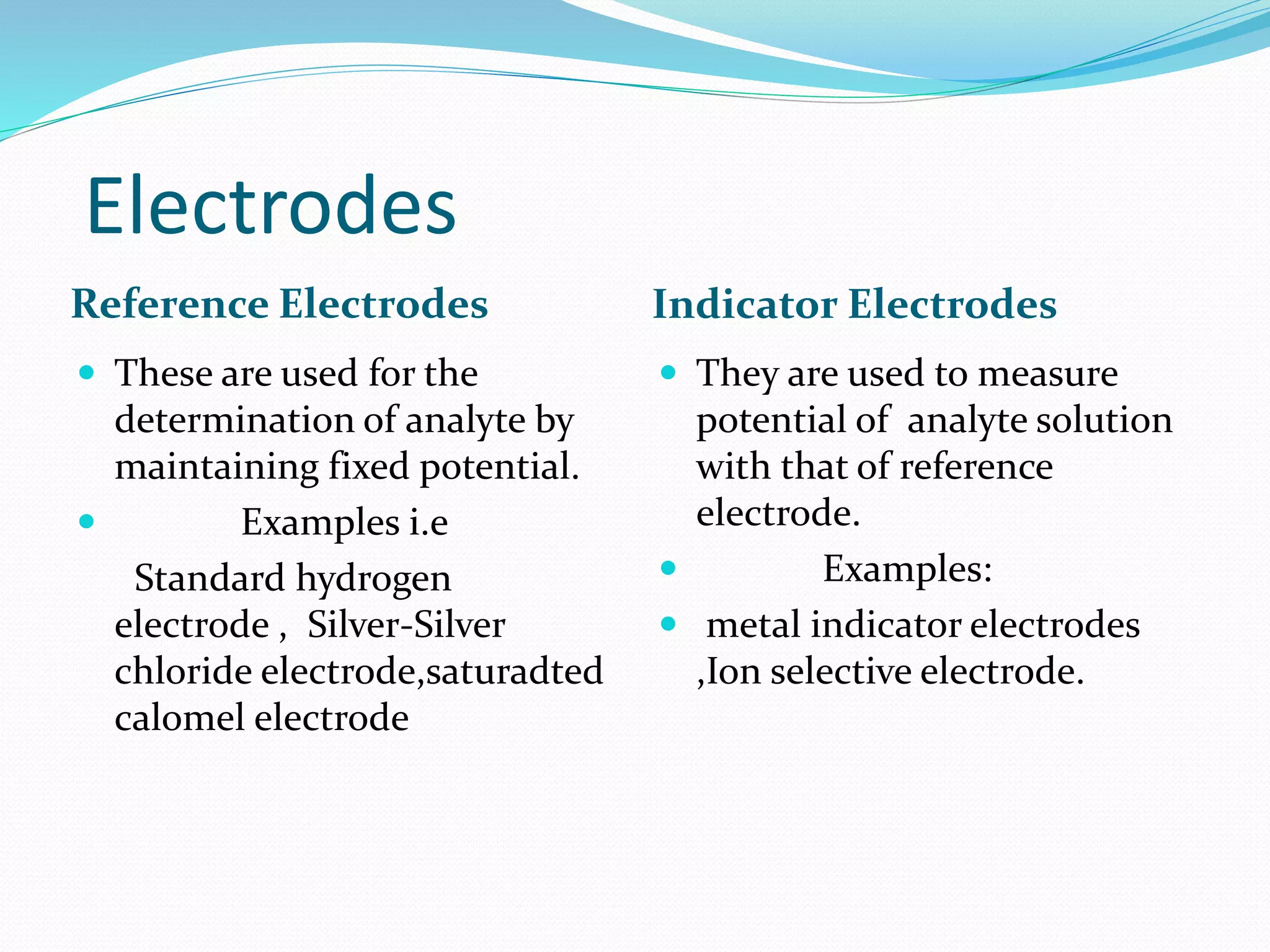
Electrodes
Reference Electrodes Indicator Electrodes
 These are used for the
determination of analyte by
maintaining fixed potential.
 Examples i.e
Standard hydrogen
electrode , Silver-Silver
chloride electrode,saturadted
calomel electrode
 They are used to measure
potential of analyte solution
with that of reference
electrode.
 Examples:
 metal indicator electrodes
,Ion selective electrode.
An ion-selective electrode (ISE), also known as a
specific ion electrode (SIE), is a transducer (or
sensor) that converts the activity of a specific ion
dissolved in a solution into an electrical potential.
Construction
An ideal ion selective
electrode(ISE)consists
of a thin membrane
across which only the
intended ion can be
transported.
The transport of ions
from a higher
concentration to a lower
one through a selective
binding with some sites
within a membrane
creates a potential
difference .
Types of ISE
There is four classes of ion-selective electrodes:
1. Glass membranes
– These are selective to H+ and certain
monovalent cations.
2. Solid-state electrodes
– These are made of inorganic salt crystals.
– The inorganic salt is made such to have
vacancies in its lattice structure.
– The vacancies allow the ion (needed to fill
the vacancy) to migrate through the salt.
3. Liquid-based electrodes
A mobile carrier transports the selected ion
across a membrane impregnated with a
liquid solution of the carrier.
4. Molecular (Compound) Electrodes
These contain a conventional electrode
surrounded by a membrane that isolates (or
generates) the analyte to which the electrode
responds.
For example, a CO2 electrode responds the
change in pH due to the presence of the CO2.
Advantages
 Ion selective electrode are relatively in expensive and
simple to use.
 Under the most favorable conditions when measuring
ions in relatively dilute aqueous solutions where
interfering ions are not problem they can be used very
rapidly and easily
 ISE is useful in applications where an order of
magnitude concentration is required, it is necessary to
know that a particular ion is below at certain
concentration level
Applications
 ISE are used for determining the concentration of
various ions in aqueous solutions.
 Pollution Monitoring:CN , F , S ,Cl,NO3 in effluents
and natural waters
 Agriculture:NO3 ,Cl,NH4 ,K,Ca,I CN in soil,plant
material ,fertilizers and feed stuffs.
 Food processing :NO3 ,NO2 in meat preservsatives.
 Fluorine in drinking water and other drinks.
 Biomedical labourities:Ca,K,I,Cl in body fluids(blood
,plasma ,serum,sweat)
 Explosives :F,Cl,NO3 in explosive materials and
combustion products.
 Calcium in dairy products.
ADVANTAGES
 They are invaluable for the continuous monitoring
of changes in concentration for example in
potentiometric titrations.
 ISE is useful in biological /medical applications
because of measuring the activity of ion directly
rather than c oncentration.
 ISE are one of the few techniques that can measure
both positive and negative ions.
 They are unaffected by sample colour and turbidity
 ISE’S can be used in aqueous solutions over a wide
temperature change.Crystal membrane can operate in
the range of 0 C to 80 C and plastic membrane from o
C to 50 C.
Limitations
 Precision is rarely better than 1%
 Electrodes can be fouled by proteins or other organic
solutes
 Interference by other ions
 Electrodes are fragile and have limited shelf life.
 Electrode response to the inactivity of uncomplex
ions.So ligands must be absent.
GLASS ELECTRODE
Introduction:
A glass electrode is
a type of ion-
selective electrode
made of a doped
glass membrane
that is sensitive to a
specific ion.
Construction of Glass Electrode
Construction
 Membrane electrodes may also be fabricated from:
Cellulose
Polyethylene
Collodion
liquid ion exchange reasons (that are insoluble in
water)
Salt crystals may also be used in place of glass as
ion -selective membrane electrodes
An electrochemical cell is a device capable of
either generating electrical energy from chemical
reactions or using electrical energy to cause
chemical reactions.
PARTS OF EC Cell:
.Electrochemical cell
consists of two half cells
each containing an
electrode immersed in a
solution of ions whose
activities determine the
electrode potential.
.A salt bridge containing an
inert electrolyte
KCl,connects the two half
cells. Ends of salt bridge are
fixed with porus frits align
their electrolyte ions to
move freely between the
half cells and the salt
bridge.This movemnet of
ions in the salt bridge
completes the electrical
circuit.
WORKING
In this cell the metallic copper
is reduced, zinc ions are
oxidized, and the electrons flow
through the external circuit
towards the copper electrode.
 The voltmeter measures the
potential difference between
the two metals in each instance,
corresponding to the
measurement of tendency of
the net cell reaction to reach the
equilibrium point.
 When the reaction proceeds,
this tendency, and thus the
potential, decreases
continuously down to zero, the
point at which equilibrium of
the complex reaction is reached.
Concept Of Electrode Potential
Defination:
It is the measure of tendency of metallic electrode to
lose or gain electrons when it is in contact with a
solution of its own salt.
Standard Electron Potential
It is the measure of tendency of metallic electrode to
lose or gain electrons when it is in contact with a
solution of its own salt of one molar concentration at
25°C at 1 atmospheric pressure.
Reference Electrode and Standard
Potential
 The absolute potential of a single electrode cannot be
measured but a relative potential can be assigned by
combining the electrode with a reference electrode to
form a cell and then measuring the cell emf.
 The potential of a reference electrode is known ,so the
potential of a unknown electrode can be obtained as a
difference. To compare a series of emf’s determined in
this way for a variety of electrodes ,it is necessary to
specify whether oxidation or reduction is occurring at
the electrode.
 According to the Gibb’s-Stockholm agreement or
convention the measured emf should be designed as a
reduction potential. That is the unknown electrode is the
cathode in the cell, and the relative ability of the electrode
to accept electrons is measured against the reference
electrode. The cell may thus be written as
Ecell =Ereference + Eunknown electrode
in which the unknown electrode is the right electrode in
the cell schematic. If the potentials are determined in the
standard conditions that is 25° C 1 atm pressure and unit
activity of all species, then for the standard reduction
potential ,
E ° cell = E °reference + E °unknown electrode
NERNST EQUATION
It is the most
important equation
in the field of
electrochemistry. It
was named after
WALTHER NERNST
German physical
chemist who
formulated that
equation in 1887.
 The Nernst equation is used to calculate the electrode potential
when deviating from standard conditions i.e. temp 25°
C,concentration 1 mole at 1 atm pressure:
E=Standard electrode potential
E ° = electrode potential
R=Gas constant (8.31 J/mol/K)
T=temperature (K)
n=no of electrons in half /complete reaction
f= Faraday's constant(96500C mol−10 )
ln=2.303log10
Q=reaction qoutient
Qr
nF
RT
EE ln 
 This equation is used when deviating from standard
Q
n
EE 10log
0591.0

Q
nF
RT
EE 10log
303.2
 
This equation is used in standard
conditions.
Electrochemical
sensors
Definition : An
electrochemical
device which
transforms effect of
electrochemical
interaction of
analyte – electrode
into a useful signal
Electrochemical Sensors
Electrochemical sensors are the most versatile and highly
developed chemical sensors.
They are divided into several
types:
• Potentiometric (measure voltage)
• Amperometric (measure current)
• Conductometric (measure conductivity)
In all these sensors, special electrodes are
used.
Working
principle
Consists of a
transducer element
covered by a recognition
element.
Recognition element
interacts with target
analyte and signal is
generated.
Electrochemical
transducers then
transforms the chemical
changes into electrical
signal.
Applications
 Electrochemical sensors are integral part of our daily life
e.g. blood glucose meter is used to measure blood glucose
level.
 Some examples include gas sensors such as used in homes
to detect carbondioxide,heavy metals, sensors for water
quality analysis.
 Additional examples where electrochemical sensors have
been applied include:
Food monitoring
Medical diagnostics
Envirmental monitoring
Manufacturing
POTENTIOMETER
Potentiometer is an
instrument for
measuring
electromotive force by
balancing it against the
potential difference
produced by passing a
known current through
a known variable
resistance .
Construction and Working Principle
 The potentiometer consists of a long resistive wire L made
up of magnum or with constantan and a battery of known
EMF V. This voltage is called as driver cell voltage.
 Connect the two ends of the resistive wire L to the battery
terminals as shown below; let us assume this is a primary
circuit arrangement. One terminal of another cell (whose
EMF E is to be measured) is at one end of the primary
circuit and another end of the cell terminal is connected to
any point on the resistive wire through a galvanometer G.
Now let us assume this arrangement is a secondary circuit.
The arrangement of the potentiometer as shown below.
Applications of Potentiometry
 Analysis of pollutants in water
 Drug analysis in pharmaceutical industry
 Food industry for analysis of quality
 Biochemical or biological assay or analysis to check the
quality of cosmetics
 Also used as analytical tool in textile ,paper ,paints
and more
potentiometery

potentiometery

  • 2.
    Introduction to electrochemicalmethods Introduction to electro chemical methods PRESENTED BY: NAUMAN ALTAF
  • 3.
    Electrochemistry is thebranch of chemistry which concerns with interaction of electrical and chemical effects
  • 4.
    are the analyticaltechniques that are used in measurement of potential,charge or current to determine and analyte”s concentrations or to characterize and analyze chemical reactivity.
  • 5.
    Types of electrochemical methods These groups are divided into five major groups Potentiometry Conductometry Dielectrometry Voltammetry Coulometry
  • 6.
    Potentiometry The potentiometry isone of the methods of electro analytical chemistry. It is usually implied to find the concentration of solute in solution. In potentiometric measurement potential between two electrodes is measured by using high impedance voltmeter.
  • 7.
    Principle The principle involved in potentiometryis when the pair of electrodes is placed in the sample solution. It shows potential difference by addition of titrant or by change in concentration of ions.
  • 8.
  • 9.
    Electrodes Reference Electrodes IndicatorElectrodes  These are used for the determination of analyte by maintaining fixed potential.  Examples i.e Standard hydrogen electrode , Silver-Silver chloride electrode,saturadted calomel electrode  They are used to measure potential of analyte solution with that of reference electrode.  Examples:  metal indicator electrodes ,Ion selective electrode.
  • 10.
    An ion-selective electrode(ISE), also known as a specific ion electrode (SIE), is a transducer (or sensor) that converts the activity of a specific ion dissolved in a solution into an electrical potential.
  • 11.
    Construction An ideal ionselective electrode(ISE)consists of a thin membrane across which only the intended ion can be transported. The transport of ions from a higher concentration to a lower one through a selective binding with some sites within a membrane creates a potential difference .
  • 12.
    Types of ISE Thereis four classes of ion-selective electrodes: 1. Glass membranes – These are selective to H+ and certain monovalent cations. 2. Solid-state electrodes – These are made of inorganic salt crystals. – The inorganic salt is made such to have vacancies in its lattice structure. – The vacancies allow the ion (needed to fill the vacancy) to migrate through the salt.
  • 13.
    3. Liquid-based electrodes Amobile carrier transports the selected ion across a membrane impregnated with a liquid solution of the carrier. 4. Molecular (Compound) Electrodes These contain a conventional electrode surrounded by a membrane that isolates (or generates) the analyte to which the electrode responds. For example, a CO2 electrode responds the change in pH due to the presence of the CO2.
  • 14.
    Advantages  Ion selectiveelectrode are relatively in expensive and simple to use.  Under the most favorable conditions when measuring ions in relatively dilute aqueous solutions where interfering ions are not problem they can be used very rapidly and easily  ISE is useful in applications where an order of magnitude concentration is required, it is necessary to know that a particular ion is below at certain concentration level
  • 15.
    Applications  ISE areused for determining the concentration of various ions in aqueous solutions.  Pollution Monitoring:CN , F , S ,Cl,NO3 in effluents and natural waters  Agriculture:NO3 ,Cl,NH4 ,K,Ca,I CN in soil,plant material ,fertilizers and feed stuffs.  Food processing :NO3 ,NO2 in meat preservsatives.
  • 16.
     Fluorine indrinking water and other drinks.  Biomedical labourities:Ca,K,I,Cl in body fluids(blood ,plasma ,serum,sweat)  Explosives :F,Cl,NO3 in explosive materials and combustion products.  Calcium in dairy products.
  • 17.
    ADVANTAGES  They areinvaluable for the continuous monitoring of changes in concentration for example in potentiometric titrations.  ISE is useful in biological /medical applications because of measuring the activity of ion directly rather than c oncentration.
  • 18.
     ISE areone of the few techniques that can measure both positive and negative ions.  They are unaffected by sample colour and turbidity  ISE’S can be used in aqueous solutions over a wide temperature change.Crystal membrane can operate in the range of 0 C to 80 C and plastic membrane from o C to 50 C.
  • 19.
    Limitations  Precision israrely better than 1%  Electrodes can be fouled by proteins or other organic solutes  Interference by other ions  Electrodes are fragile and have limited shelf life.  Electrode response to the inactivity of uncomplex ions.So ligands must be absent.
  • 20.
    GLASS ELECTRODE Introduction: A glasselectrode is a type of ion- selective electrode made of a doped glass membrane that is sensitive to a specific ion.
  • 21.
  • 22.
    Construction  Membrane electrodesmay also be fabricated from: Cellulose Polyethylene Collodion liquid ion exchange reasons (that are insoluble in water) Salt crystals may also be used in place of glass as ion -selective membrane electrodes
  • 26.
    An electrochemical cellis a device capable of either generating electrical energy from chemical reactions or using electrical energy to cause chemical reactions.
  • 27.
    PARTS OF ECCell: .Electrochemical cell consists of two half cells each containing an electrode immersed in a solution of ions whose activities determine the electrode potential. .A salt bridge containing an inert electrolyte KCl,connects the two half cells. Ends of salt bridge are fixed with porus frits align their electrolyte ions to move freely between the half cells and the salt bridge.This movemnet of ions in the salt bridge completes the electrical circuit.
  • 28.
    WORKING In this cellthe metallic copper is reduced, zinc ions are oxidized, and the electrons flow through the external circuit towards the copper electrode.  The voltmeter measures the potential difference between the two metals in each instance, corresponding to the measurement of tendency of the net cell reaction to reach the equilibrium point.  When the reaction proceeds, this tendency, and thus the potential, decreases continuously down to zero, the point at which equilibrium of the complex reaction is reached.
  • 29.
    Concept Of ElectrodePotential Defination: It is the measure of tendency of metallic electrode to lose or gain electrons when it is in contact with a solution of its own salt. Standard Electron Potential It is the measure of tendency of metallic electrode to lose or gain electrons when it is in contact with a solution of its own salt of one molar concentration at 25°C at 1 atmospheric pressure.
  • 30.
    Reference Electrode andStandard Potential  The absolute potential of a single electrode cannot be measured but a relative potential can be assigned by combining the electrode with a reference electrode to form a cell and then measuring the cell emf.  The potential of a reference electrode is known ,so the potential of a unknown electrode can be obtained as a difference. To compare a series of emf’s determined in this way for a variety of electrodes ,it is necessary to specify whether oxidation or reduction is occurring at the electrode.
  • 31.
     According tothe Gibb’s-Stockholm agreement or convention the measured emf should be designed as a reduction potential. That is the unknown electrode is the cathode in the cell, and the relative ability of the electrode to accept electrons is measured against the reference electrode. The cell may thus be written as Ecell =Ereference + Eunknown electrode in which the unknown electrode is the right electrode in the cell schematic. If the potentials are determined in the standard conditions that is 25° C 1 atm pressure and unit activity of all species, then for the standard reduction potential , E ° cell = E °reference + E °unknown electrode
  • 32.
    NERNST EQUATION It isthe most important equation in the field of electrochemistry. It was named after WALTHER NERNST German physical chemist who formulated that equation in 1887.
  • 33.
     The Nernstequation is used to calculate the electrode potential when deviating from standard conditions i.e. temp 25° C,concentration 1 mole at 1 atm pressure: E=Standard electrode potential E ° = electrode potential R=Gas constant (8.31 J/mol/K) T=temperature (K) n=no of electrons in half /complete reaction f= Faraday's constant(96500C mol−10 ) ln=2.303log10 Q=reaction qoutient Qr nF RT EE ln 
  • 34.
     This equationis used when deviating from standard Q n EE 10log 0591.0  Q nF RT EE 10log 303.2   This equation is used in standard conditions.
  • 35.
    Electrochemical sensors Definition : An electrochemical devicewhich transforms effect of electrochemical interaction of analyte – electrode into a useful signal
  • 36.
    Electrochemical Sensors Electrochemical sensorsare the most versatile and highly developed chemical sensors. They are divided into several types: • Potentiometric (measure voltage) • Amperometric (measure current) • Conductometric (measure conductivity) In all these sensors, special electrodes are used.
  • 37.
    Working principle Consists of a transducerelement covered by a recognition element. Recognition element interacts with target analyte and signal is generated. Electrochemical transducers then transforms the chemical changes into electrical signal.
  • 38.
    Applications  Electrochemical sensorsare integral part of our daily life e.g. blood glucose meter is used to measure blood glucose level.  Some examples include gas sensors such as used in homes to detect carbondioxide,heavy metals, sensors for water quality analysis.  Additional examples where electrochemical sensors have been applied include: Food monitoring Medical diagnostics Envirmental monitoring Manufacturing
  • 39.
    POTENTIOMETER Potentiometer is an instrumentfor measuring electromotive force by balancing it against the potential difference produced by passing a known current through a known variable resistance .
  • 40.
    Construction and WorkingPrinciple  The potentiometer consists of a long resistive wire L made up of magnum or with constantan and a battery of known EMF V. This voltage is called as driver cell voltage.  Connect the two ends of the resistive wire L to the battery terminals as shown below; let us assume this is a primary circuit arrangement. One terminal of another cell (whose EMF E is to be measured) is at one end of the primary circuit and another end of the cell terminal is connected to any point on the resistive wire through a galvanometer G. Now let us assume this arrangement is a secondary circuit. The arrangement of the potentiometer as shown below.
  • 42.
    Applications of Potentiometry Analysis of pollutants in water  Drug analysis in pharmaceutical industry  Food industry for analysis of quality  Biochemical or biological assay or analysis to check the quality of cosmetics  Also used as analytical tool in textile ,paper ,paints and more