SAMUEL NESSENTHALER 2019
PORTFOLIO
samnessen@gmail.com
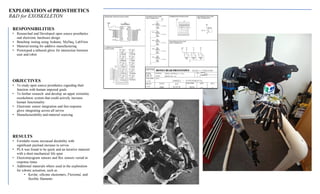
EXPLORATION of PROSTHETICS
R&D for EXOSKELETON
RESPONSIBILITIES
• Researched and Developed open source prosthetics
and electronic hardware design
• Benchtop testing using Arduino, MyDaq, LabView
• Material testing for additive manufacturing
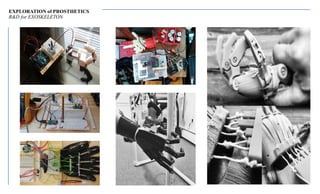
• Prototyped a tethered glove for interaction between
user and robot
OBJECTIVES
• To study open source prosthetics regarding their
function with human imposed goals
• To further research and develop an upper extremity
exoskeleton system that could actively increase
human functionality
• Electronic sensor integration and fast response
glove integrating across all servos
• Manufacturability and material sourcing
RESULTS
• Formlabs resins increased durability with
significant payload increase to servos
• PLA was found to be quick and an iterative material
with a short mechanical life span
• Electromyogram sensors and flex sensors varied in
response times
• Additional materials where used in the exploration
for robotic actuation, such as
• Kevlar, silicone elastomers, Flexional, and
flexible filaments
EXPLORATION of PROSTHETICS
R&D for EXOSKELETON
AUTONOMOUS COMMERCIAL
AIRMOBILITY SYSTEM
CONTRACT ENGINEER TECH
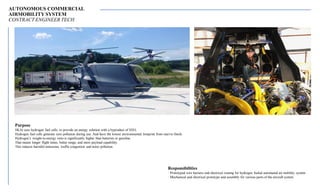
Purpose
SKAI uses hydrogen fuel cells, to provide an energy solution with a byproduct of H2O.
Hydrogen fuel cells generate zero pollution during use. And have the lowest environmental footprint from start to finish.
Hydrogen’s weight-to-energy ratio is significantly higher than batteries or gasoline.
That means longer flight times, better range, and more payload capability.
This reduces harmful emissions, traffic congestion and noise pollution.
Responsibilities
· Prototyped wire harness and electrical routing for hydrogen fueled automated air mobility system
· Mechanical and electrical prototype and assembly for various parts of the aircraft system
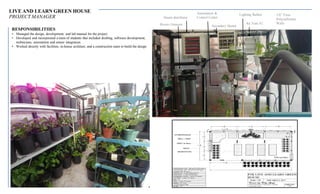
LIVE AND LEARN GREEN HOUSE
PROJECT MANAGER
SOLUTION
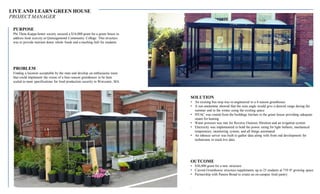
• An existing bus stop was re-engineered to a 4-season greenhouse
• A sun analemma showed that the suns angle would give a desired range during the
summer and in the winter using the existing space
• HVAC was routed from the buildings kitchen to the green house providing adequate
steam for heating
• Water pressure was met for Reverse Osmosis filtration and an irrigation system
• Electricity was implemented to hold the power rating for light ballasts, mechanical
temperature, monitoring system, and all things automated
• An inhouse server was built to gather data along with front end development for
technicians to track live data
OUTCOME
• $30,000 grant for a new structure
• Current Greenhouse structure supplements up to 25 students at 739 ft³ growing space
• Partnership with Panera Bread to create an on-campus food pantry
.
PURPOSE
Phi Theta Kappa honor society secured a $16,000 grant for a green house to
address food scarcity at Quinsigamond Community College. This structure
was to provide nutrient dense whole foods and a teaching hub for students.
PROBLEM
Finding a location acceptable by the state and develop an enthusiastic team
that could implement the vision of a four-season greenhouse to be later
scaled to meet specifications for food production security in Worcester, MA.
LIVE AND LEARN GREEN HOUSE
PROJECT MANAGER
RESPONSIBILITIIES
• Managed the design, development, and lab manual for the project
• Developed and incorporated a team of students that included drafting, software development,
technicians, automation and sensor integration
• Worked directly with facilities, in-house architect, and a construction team to build the design
Steam distributer
Secondary Heater
Air Vent #2
Lighting BallastAutomation &
Control Center
Revers Osmosis
1/8” Twin
Polycarbonate
Walls
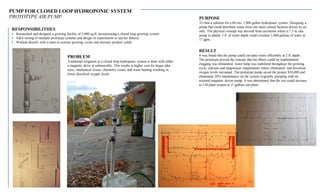
PUMP FOR CLOSED LOOP HYDROPONIC SYSTEM
PROTOTYPE AIR PUMP
RESPONSIBILITIIES
• Researched and designed a growing facility of 5,000 sq.ft. incorporating a closed loop growing system
• V&V testing of multiple prototype systems and design of experiments to test for failures
• Worked directly with a team to execute growing cycles and increase product yields
PROBLEM
Traditional irrigation in a closed loop hydroponic system is done with either
a magnetic drive or submersible. This results in higher cost for larger inlet
sizes, mechanical issues, chemistry issues, and water heating resulting in
lower dissolved oxygen levels.
RESULT
It was found that the pump could circulate water efficiently at 2 ft. depth.
The prototype proved the concept that bio-filters could be implemented,
clogging was eliminated, water temp was stabilized throughout the growing
cycle, calcium and magnesium supplements where eliminated, and dissolved
oxygen levels increased. The prototype pump saved the project $10,000 and
eliminated 20% maintenance on the system originally pumping with an
external magnetic driven pump. It was determined that the site could increase
to 138 plant system at 15 gallons per/plant.
PURPOSE
To find a solution for a 60 site, 1,800 gallon hydroponic system. Designing a
pump that could distribute water from one main central location driven by air
only. The physical concept was derived from cavitation where a 1.5 in.-dia.
pump in ideally 3 ft. of water depth could circulate 1,800 gallons of water at
17 gpm.
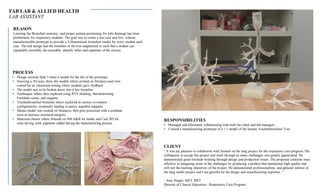
FAB LAB & ALLIED HEALTH
LAB ASSISTANT
PROCESS
• Design sessions held 3 times a month for the life of the prototype
• Sourcing a 3D scan, three abs models where printed on Stratasys and resin
coated for in- classroom testing where students gave feedback
• The model was to be broken down into 6 key branches
• Techniques where then explored using RTV molding, thermoforming,
Formlabs resins, and magnets
• Tracheobronchial branches where explored in various re-connect
configurations, eventually leading to epoxy engulfed magnets.
• Master model was created on Stratasys, then post processed with a urethane
resin to increase structural integrity
• Materials chosen where Smooth on 940 A&B for molds and Cast 305 for
resin having color pigments added during the manufacturing process
RESPONSIBILITIES
• Managed and fabricated, collaborating with both the client and lab managers
• Created a manufacturing prototype of a 1:1 model of the human Tracheobronchial Tree
CLIENT
“ It was my pleasure to collaborate with Samuel on the lung project for the respiratory care program. His
willingness to accept this project and work through its many challenges was greatly appreciated. He
demonstrated great fortitude working through design and production issues. The proposed solutions were
effective in mitigating some of the challenges by producing a product that maintained high quality and
still met the learning objectives of the project. He demonstrated professionalism, and genuine interest in
the lung model project and I am grateful for his design and manufacturing expertise. ”
- Amy Hogan, MET, RRT
Director of Clinical Education - Respiratory Care Program
REASON
Learning the Bronchial anatomy, and proper patient positioning for lobe drainage has been
problematic for respiratory students. The goal was to create a low-cost and low- volume
manufacturable prototype to provide a 3-dimensional bronchial model for every student each
year. The end design had the branches of the tree magnetized in such that a student can
repeatably assemble, dis-assemble, identify lobes and segments of the airway.
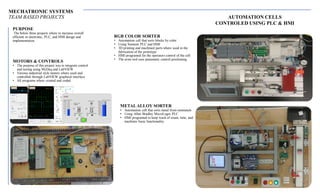
MECHATRONIC SYSTEMS
TEAM BASED PROJECTS AUTOMATION CELLS
CONTROLED USING PLC & HMI
METALALLOY SORTER
• Automation cell that sorts metal from nonmetals
• Using Allen Bradley MicroLogix PLC
• HMI programed to keep track of count, time, and
machines basic functionality
RGB COLOR SORTER
• Automation cell that sorts blocks by color
• Using Siemens PLC and HMI
• 3D printing and machined parts where used in the
fabrication of the prototype
• HMI programed for the operators control of the cell
• The arms tool uses pneumatic control positioning
MOTORS & CONTROLS
• The purpose of this project was to integrate control
and testing using MyDaq and LabVIEW
• Various industrial style motors where used and
controlled through LabVIEW graphical interface
• All programs where created and coded
PURPOSE
The below three projects where to increase overall
efficient in electronic, PLC, and HMI design and
implementation.
END OFARM TOOLING
WITH PENDANT INTEGRATION
TEAM BASED PROJECT
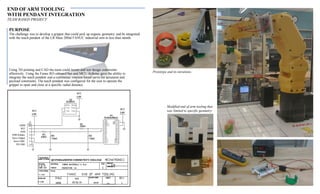
PURPOSE
The challenge was to develop a gripper that could pick up organic geometry and be integrated
with the teach pendent of the LR Mate 200id FANUC industrial arm in less than month.
Using 3D printing and CAD the team could iterate and test design constraints
effectively. Using the Fanuc RO onboard bus and MCU Arduino gave the ability to
integrate the teach pendent and a continuous rotation-based servo for actuation and
payload constraints. The teach pendant was configured for the user to operate the
gripper to open and close at a specific radial distance.
Modified end of arm tooling that
was limited to specific geometry
Prototype and its iterations.
WORK BENCH PROTOTYPING
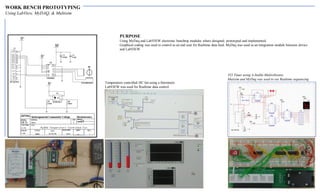
Using LabView, MyDAQ, & Multisim
Temperature controlled DC fan using a thermistor.
LabVIEW was used for Realtime data control.
555 Timer using A-Stable Multivibrator.
Mutisim and MyDaq was used to see Realtime sequencing
PURPOSE
Using MyDaq and LabVIEW electronic benchtop modules where designed, prototyped and implemented.
Graphical coding was used to control as an end user for Realtime data feed. MyDaq was used as an integration module between device
and LabVIEW
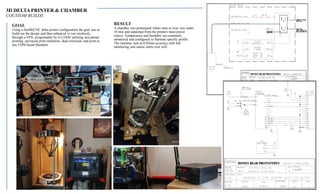
GOAL
Using a SeeMeCNC delta printer configuration the goal was to
build out the design and then enhanced to run wirelessly,
through a VPN, programable by G-CODE utilizing non-planar
printing, increased print resolution, dual extrusion, and print in
any FDM based filaments .
RESULT
A chamber was prototyped where time to evac was under
10 min and separated from the printers main power
source. Temperature and humidity are constantly
monitored and configured to filament specific profile.
The machine runs at 0.05mm accuracy with full
monitoring and sensor alerts over wifi.
3D DELTA PRINTER & CHAMBER
COUSTOM BUILDS
THANK YOU
samnessen@gmail.com
www.github.com/samnessen
www.instagram.com/samuelnessenthaler
www.linkedin.com/in/samuelnessenthaler

PORTFOLIO

  • 1.
  • 2.
    EXPLORATION of PROSTHETICS R&Dfor EXOSKELETON RESPONSIBILITIES • Researched and Developed open source prosthetics and electronic hardware design • Benchtop testing using Arduino, MyDaq, LabView • Material testing for additive manufacturing • Prototyped a tethered glove for interaction between user and robot OBJECTIVES • To study open source prosthetics regarding their function with human imposed goals • To further research and develop an upper extremity exoskeleton system that could actively increase human functionality • Electronic sensor integration and fast response glove integrating across all servos • Manufacturability and material sourcing RESULTS • Formlabs resins increased durability with significant payload increase to servos • PLA was found to be quick and an iterative material with a short mechanical life span • Electromyogram sensors and flex sensors varied in response times • Additional materials where used in the exploration for robotic actuation, such as • Kevlar, silicone elastomers, Flexional, and flexible filaments
  • 3.
  • 4.
    AUTONOMOUS COMMERCIAL AIRMOBILITY SYSTEM CONTRACTENGINEER TECH Purpose SKAI uses hydrogen fuel cells, to provide an energy solution with a byproduct of H2O. Hydrogen fuel cells generate zero pollution during use. And have the lowest environmental footprint from start to finish. Hydrogen’s weight-to-energy ratio is significantly higher than batteries or gasoline. That means longer flight times, better range, and more payload capability. This reduces harmful emissions, traffic congestion and noise pollution. Responsibilities · Prototyped wire harness and electrical routing for hydrogen fueled automated air mobility system · Mechanical and electrical prototype and assembly for various parts of the aircraft system
  • 5.
    LIVE AND LEARNGREEN HOUSE PROJECT MANAGER SOLUTION • An existing bus stop was re-engineered to a 4-season greenhouse • A sun analemma showed that the suns angle would give a desired range during the summer and in the winter using the existing space • HVAC was routed from the buildings kitchen to the green house providing adequate steam for heating • Water pressure was met for Reverse Osmosis filtration and an irrigation system • Electricity was implemented to hold the power rating for light ballasts, mechanical temperature, monitoring system, and all things automated • An inhouse server was built to gather data along with front end development for technicians to track live data OUTCOME • $30,000 grant for a new structure • Current Greenhouse structure supplements up to 25 students at 739 ft³ growing space • Partnership with Panera Bread to create an on-campus food pantry . PURPOSE Phi Theta Kappa honor society secured a $16,000 grant for a green house to address food scarcity at Quinsigamond Community College. This structure was to provide nutrient dense whole foods and a teaching hub for students. PROBLEM Finding a location acceptable by the state and develop an enthusiastic team that could implement the vision of a four-season greenhouse to be later scaled to meet specifications for food production security in Worcester, MA.
  • 6.
    LIVE AND LEARNGREEN HOUSE PROJECT MANAGER RESPONSIBILITIIES • Managed the design, development, and lab manual for the project • Developed and incorporated a team of students that included drafting, software development, technicians, automation and sensor integration • Worked directly with facilities, in-house architect, and a construction team to build the design Steam distributer Secondary Heater Air Vent #2 Lighting BallastAutomation & Control Center Revers Osmosis 1/8” Twin Polycarbonate Walls
  • 7.
    PUMP FOR CLOSEDLOOP HYDROPONIC SYSTEM PROTOTYPE AIR PUMP RESPONSIBILITIIES • Researched and designed a growing facility of 5,000 sq.ft. incorporating a closed loop growing system • V&V testing of multiple prototype systems and design of experiments to test for failures • Worked directly with a team to execute growing cycles and increase product yields PROBLEM Traditional irrigation in a closed loop hydroponic system is done with either a magnetic drive or submersible. This results in higher cost for larger inlet sizes, mechanical issues, chemistry issues, and water heating resulting in lower dissolved oxygen levels. RESULT It was found that the pump could circulate water efficiently at 2 ft. depth. The prototype proved the concept that bio-filters could be implemented, clogging was eliminated, water temp was stabilized throughout the growing cycle, calcium and magnesium supplements where eliminated, and dissolved oxygen levels increased. The prototype pump saved the project $10,000 and eliminated 20% maintenance on the system originally pumping with an external magnetic driven pump. It was determined that the site could increase to 138 plant system at 15 gallons per/plant. PURPOSE To find a solution for a 60 site, 1,800 gallon hydroponic system. Designing a pump that could distribute water from one main central location driven by air only. The physical concept was derived from cavitation where a 1.5 in.-dia. pump in ideally 3 ft. of water depth could circulate 1,800 gallons of water at 17 gpm.
  • 8.
    FAB LAB &ALLIED HEALTH LAB ASSISTANT PROCESS • Design sessions held 3 times a month for the life of the prototype • Sourcing a 3D scan, three abs models where printed on Stratasys and resin coated for in- classroom testing where students gave feedback • The model was to be broken down into 6 key branches • Techniques where then explored using RTV molding, thermoforming, Formlabs resins, and magnets • Tracheobronchial branches where explored in various re-connect configurations, eventually leading to epoxy engulfed magnets. • Master model was created on Stratasys, then post processed with a urethane resin to increase structural integrity • Materials chosen where Smooth on 940 A&B for molds and Cast 305 for resin having color pigments added during the manufacturing process RESPONSIBILITIES • Managed and fabricated, collaborating with both the client and lab managers • Created a manufacturing prototype of a 1:1 model of the human Tracheobronchial Tree CLIENT “ It was my pleasure to collaborate with Samuel on the lung project for the respiratory care program. His willingness to accept this project and work through its many challenges was greatly appreciated. He demonstrated great fortitude working through design and production issues. The proposed solutions were effective in mitigating some of the challenges by producing a product that maintained high quality and still met the learning objectives of the project. He demonstrated professionalism, and genuine interest in the lung model project and I am grateful for his design and manufacturing expertise. ” - Amy Hogan, MET, RRT Director of Clinical Education - Respiratory Care Program REASON Learning the Bronchial anatomy, and proper patient positioning for lobe drainage has been problematic for respiratory students. The goal was to create a low-cost and low- volume manufacturable prototype to provide a 3-dimensional bronchial model for every student each year. The end design had the branches of the tree magnetized in such that a student can repeatably assemble, dis-assemble, identify lobes and segments of the airway.
  • 9.
    MECHATRONIC SYSTEMS TEAM BASEDPROJECTS AUTOMATION CELLS CONTROLED USING PLC & HMI METALALLOY SORTER • Automation cell that sorts metal from nonmetals • Using Allen Bradley MicroLogix PLC • HMI programed to keep track of count, time, and machines basic functionality RGB COLOR SORTER • Automation cell that sorts blocks by color • Using Siemens PLC and HMI • 3D printing and machined parts where used in the fabrication of the prototype • HMI programed for the operators control of the cell • The arms tool uses pneumatic control positioning MOTORS & CONTROLS • The purpose of this project was to integrate control and testing using MyDaq and LabVIEW • Various industrial style motors where used and controlled through LabVIEW graphical interface • All programs where created and coded PURPOSE The below three projects where to increase overall efficient in electronic, PLC, and HMI design and implementation.
  • 10.
    END OFARM TOOLING WITHPENDANT INTEGRATION TEAM BASED PROJECT PURPOSE The challenge was to develop a gripper that could pick up organic geometry and be integrated with the teach pendent of the LR Mate 200id FANUC industrial arm in less than month. Using 3D printing and CAD the team could iterate and test design constraints effectively. Using the Fanuc RO onboard bus and MCU Arduino gave the ability to integrate the teach pendent and a continuous rotation-based servo for actuation and payload constraints. The teach pendant was configured for the user to operate the gripper to open and close at a specific radial distance. Modified end of arm tooling that was limited to specific geometry Prototype and its iterations.
  • 11.
    WORK BENCH PROTOTYPING UsingLabView, MyDAQ, & Multisim Temperature controlled DC fan using a thermistor. LabVIEW was used for Realtime data control. 555 Timer using A-Stable Multivibrator. Mutisim and MyDaq was used to see Realtime sequencing PURPOSE Using MyDaq and LabVIEW electronic benchtop modules where designed, prototyped and implemented. Graphical coding was used to control as an end user for Realtime data feed. MyDaq was used as an integration module between device and LabVIEW
  • 12.
    GOAL Using a SeeMeCNCdelta printer configuration the goal was to build out the design and then enhanced to run wirelessly, through a VPN, programable by G-CODE utilizing non-planar printing, increased print resolution, dual extrusion, and print in any FDM based filaments . RESULT A chamber was prototyped where time to evac was under 10 min and separated from the printers main power source. Temperature and humidity are constantly monitored and configured to filament specific profile. The machine runs at 0.05mm accuracy with full monitoring and sensor alerts over wifi. 3D DELTA PRINTER & CHAMBER COUSTOM BUILDS
  • 13.