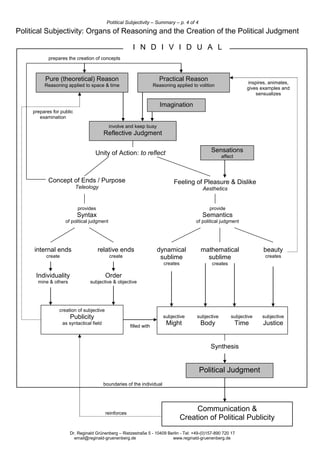
This document examines the emergence of political subjectivity and the ability for individual political judgment. It explores this topic from both a historical and philosophical perspective. Historically, the document focuses on 17th-18th century Europe during the Bourgeois Revolutions when new ideas of public order and human self-description emerged. Philosophically, the document analyzes Kant's concept of reflective judgment to identify the "organ of political reason." It develops a concept of political judgment by combining Kantian ideas of aesthetics, teleology, and different types of judgments. The result is a framework for political subjectivity defined by the unity of reflective individual judgments within an imagined public space, and fundamental concepts of individuality, order, justice