PROGRAMMING FOR
PROBLEM SOLVING --
PPS
SUBJECT CODE-
BTPS-101-18
UNIT – 8
POINTERS
By Dr.A.Deepa,AP,Chandigarh Engineering
College
Objectives
What is meant by pointer is and why it can ne used?
How to Declare and access a pointer variable
Example: Pointer Arithmetic–
What is Self Referential Structure
Beyond the syllabus--Activity
What is Linked List
By Dr.A.Deepa,AP,Chandigarh Engineering
College
By Dr.A.Deepa,AP,Chandigarh Engineering
College
Pointer is the variable which stores the
address of the another variable
Declaration of pointer :
syntax : datatype *pointername;
Example :
int *ptr;
char *pt;
Pointer
Assigning data to the pointer variable
syntax :
pointervariablename=&variablename;
For Example :
int *p,quantity=20;
p=&quantity;
For Example :
#include<stdio.h>
void main()
{int quantity=20,*p;
p=&quantity;
printf("%un",&p);
Printf(“%dn”,p);
printf("%dn",*p);
printf("%dn",*(&quantity));
}
Variable Value Address
Quantity 500
P 5048
20
500
By Dr.A.Deepa,AP,Chandigarh Engineering
College
Output:
5048
500
20
20
Why are Pointers Used ?
 To return more than one value from a function
 To pass arrays & strings more conveniently from one
function to another
 To manipulate arrays more easily by moving pointers to
them, Instead of moving the arrays themselves
 To allocate memory and access it (Dynamic Memory
Allocation)
 To create complex data structures such as Linked List,
Where one data structure must contain references to other
data structures
By Dr.A.Deepa,AP,Chandigarh Engineering
College
By Dr.A.Deepa,AP,Chandigarh Engineering
College
Advantages:
 A pointer enables us to access a variable that is defined outside the
function.
 Pointers are more efficient in handling the data tables.
 Pointers reduce the length and complexity of a program.
 They increase the execution speed.
 The use of a pointer array to character strings results in saving of
data storage space in memory.
 The function pointer can be used to call a function
 Pointer arrays give a convenient method for storing strings
Many of the ‘C’ Built-in functions that work with strings use Pointers
It provides a way of accessing a variable without referring to the
variable directly
By Dr.A.Deepa,AP,Chandigarh Engineering
College
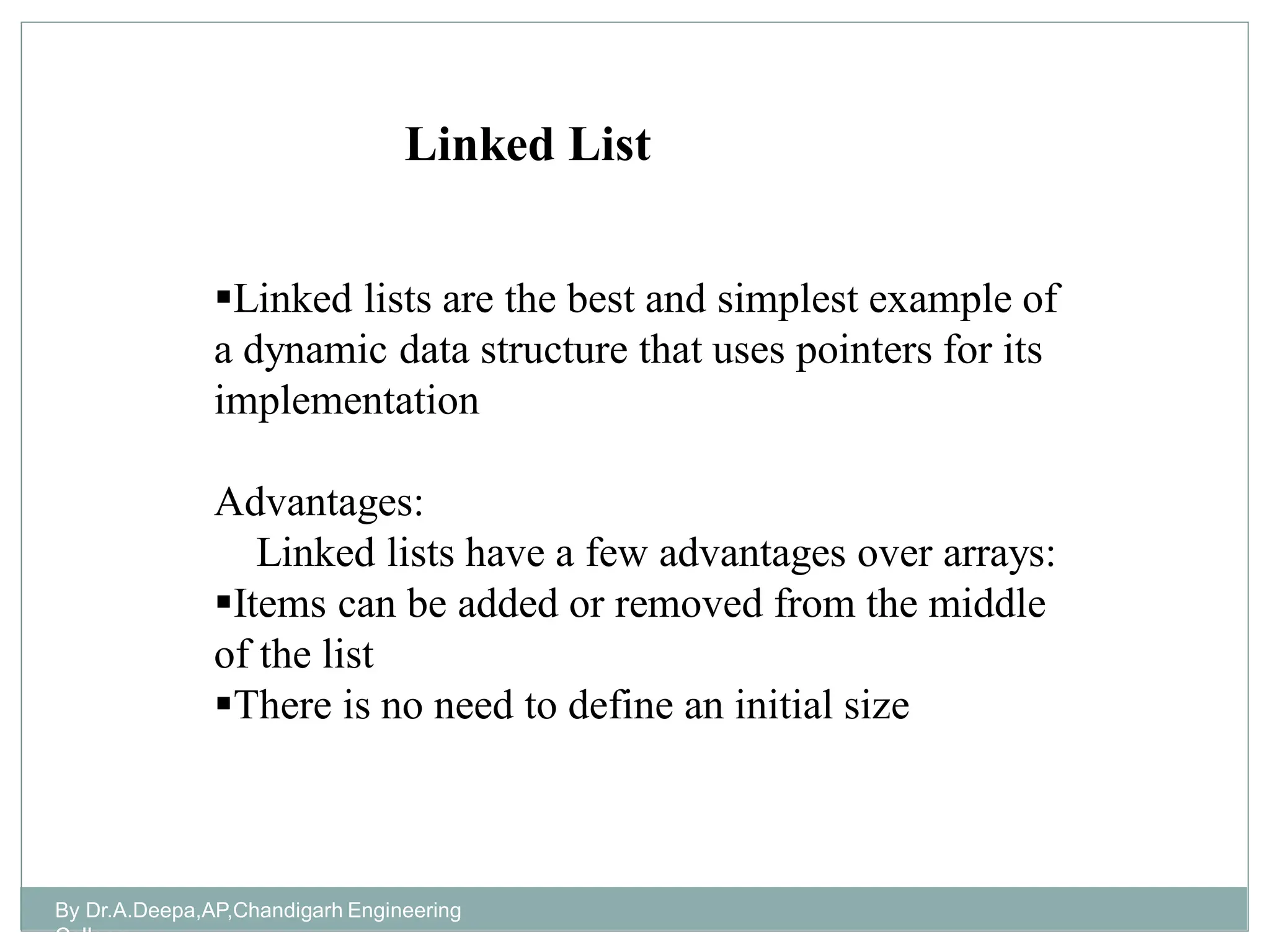
Linked lists are the best and simplest example of
a dynamic data structure that uses pointers for its
implementation
Advantages:
Linked lists have a few advantages over arrays:
Items can be added or removed from the middle
of the list
There is no need to define an initial size
Linked List
By Dr.A.Deepa,AP,Chandigarh Engineering
College
There is no "random" access - it is impossible to reach the nth item in
the array without first iterating over all items up until that item. This
means we have to start from the beginning of the list and count how
many times we advance in the list until we get to the desired item.
Dynamic memory allocation and pointers are required, which
complicates the code and increases the risk of memory leaks and
segment faults.
Linked lists have a much larger overhead over arrays, since linked
list items are dynamically allocated (which is less efficient in memory
usage) and each item in the list also must store an additional pointer.
Linked List
Disadvantages:
By Dr.A.Deepa,AP,Chandigarh Engineering
College
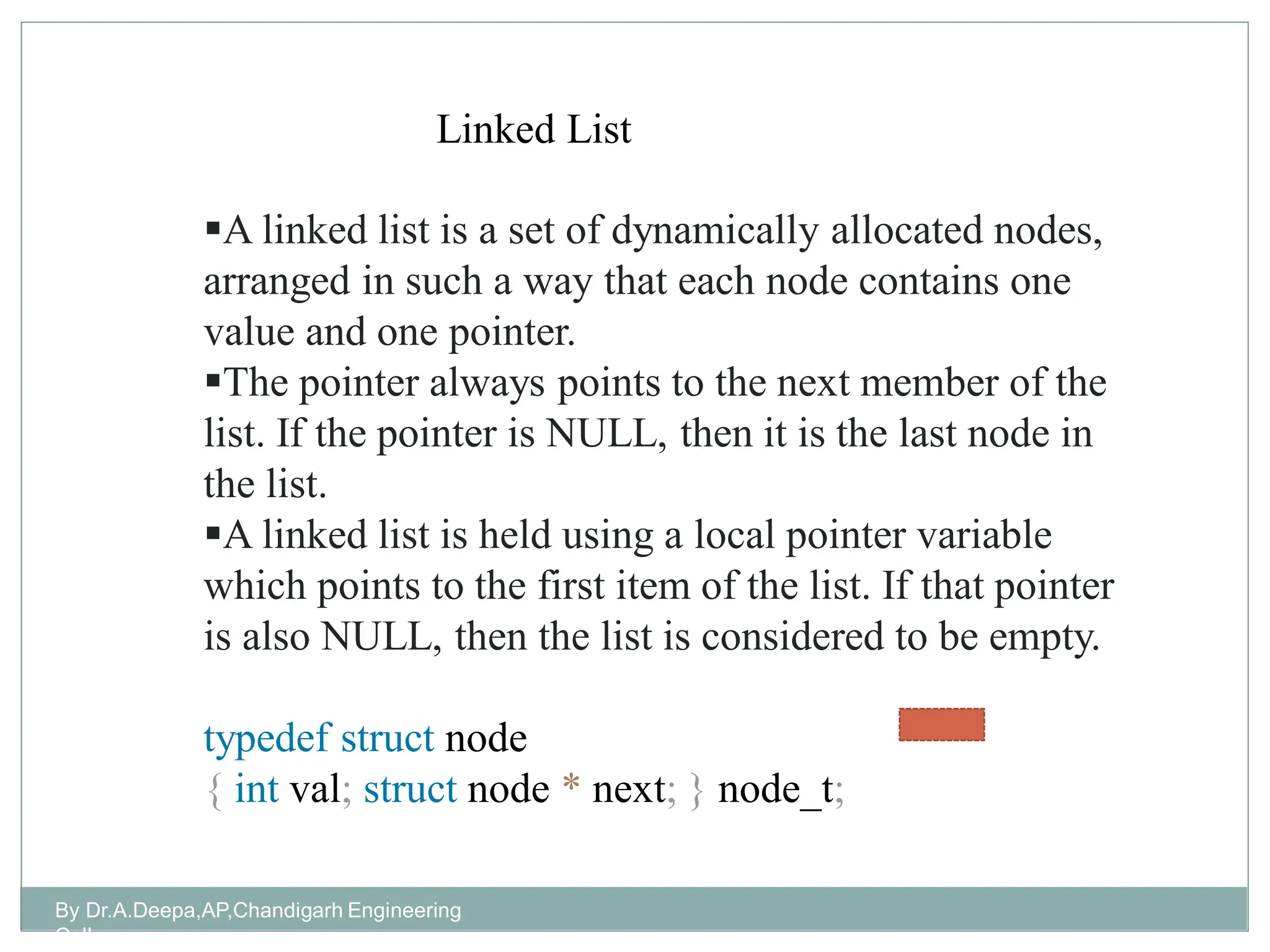
A linked list is a set of dynamically allocated nodes,
arranged in such a way that each node contains one
value and one pointer.
The pointer always points to the next member of the
list. If the pointer is NULL, then it is the last node in
the list.
A linked list is held using a local pointer variable
which points to the first item of the list. If that pointer
is also NULL, then the list is considered to be empty.
typedef struct node
{ int val; struct node * next; } node_t;
Linked List
By Dr.A.Deepa,AP,Chandigarh Engineering
College
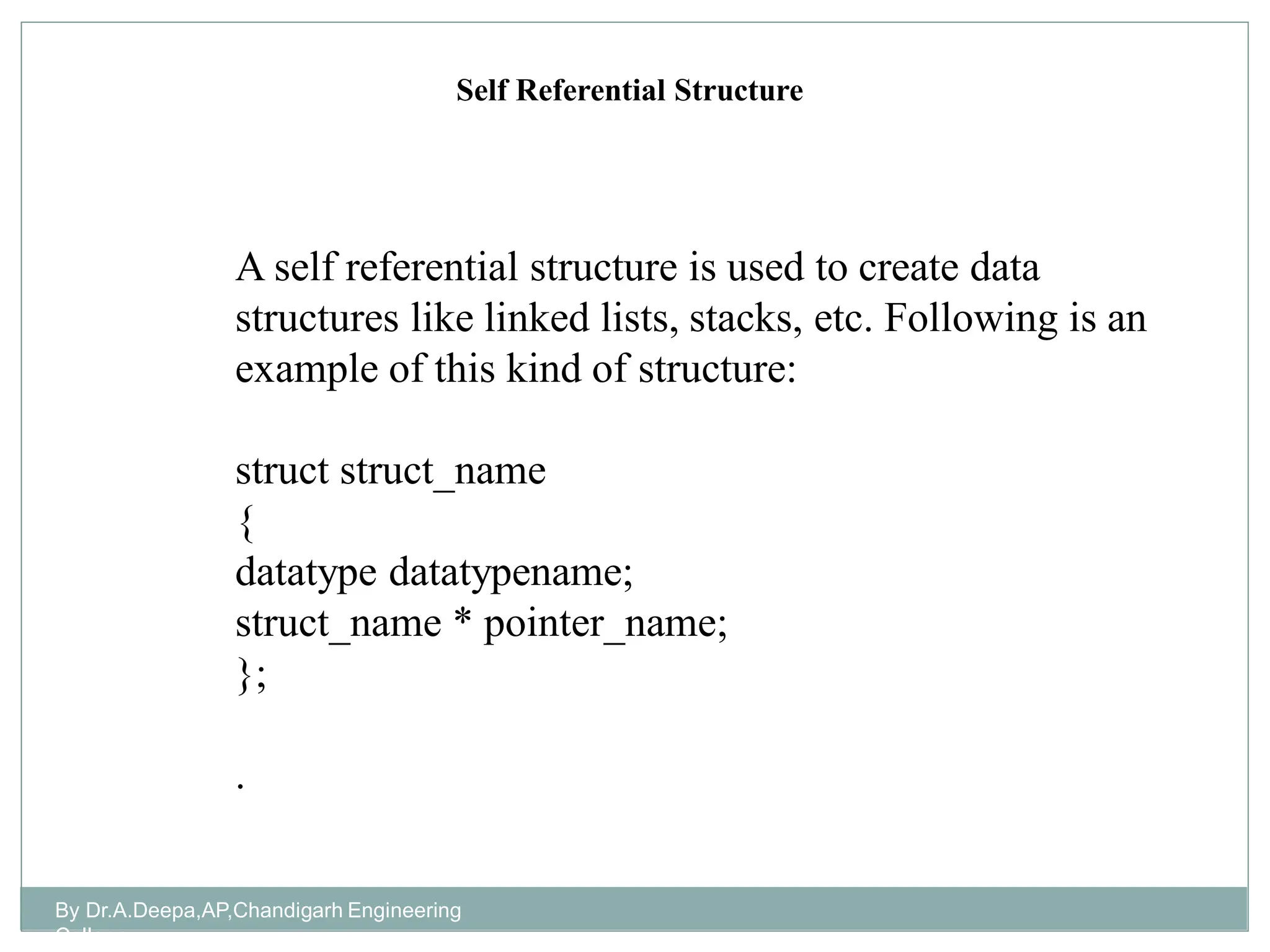
A self referential structure is used to create data
structures like linked lists, stacks, etc. Following is an
example of this kind of structure:
struct struct_name
{
datatype datatypename;
struct_name * pointer_name;
};
.
Self Referential Structure
By Dr.A.Deepa,AP,Chandigarh Engineering
College
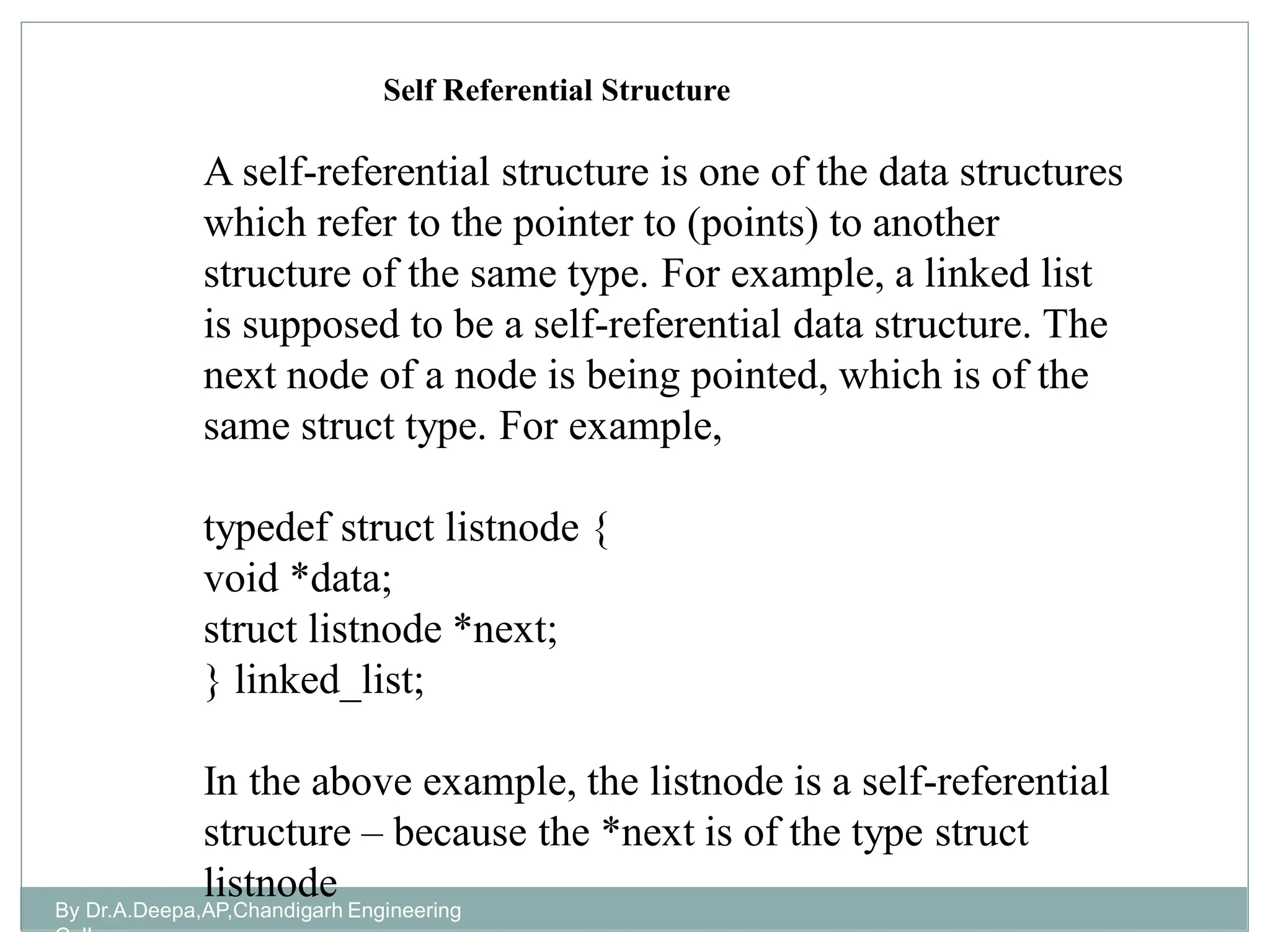
A self-referential structure is one of the data structures
which refer to the pointer to (points) to another
structure of the same type. For example, a linked list
is supposed to be a self-referential data structure. The
next node of a node is being pointed, which is of the
same struct type. For example,
typedef struct listnode {
void *data;
struct listnode *next;
} linked_list;
In the above example, the listnode is a self-referential
structure – because the *next is of the type struct
listnode
Self Referential Structure
By Dr.A.Deepa,AP,Chandigarh Engineering
College
Example:
struct node {
int data1;
char data2;
struct node* link;
};
int main()
{
struct node ob;
return 0;
}
Self Referential Structure
•In this example ‘link’is a pointer to a
structure of type ‘node’.
•Hence, the structure ‘node’is a self-
referential structure with ‘link’as the
referencing pointer.
By Dr.A.Deepa,AP,Chandigarh Engineering
College
Types of Self Referential Structures
•Self Referential Structure with Single Link
•Self Referential Structure with Multiple Links
Self Referential Structure with Single Link:
•These structures can have only one self-pointer as their
member.
•The following example will show us how to connect the
objects of a self-referential structure with the single link
and access the corresponding data members.
Self Referential Structure
10 20 30 40 NULL
Obj1 Obj2
By Dr.A.Deepa,AP,Chandigarh Engineering
College
#include <stdio.h>
struct node {
int data1;
int data2;
struct node* link;
};
int main()
{ struct node ob1; // Node1
// Initialization
ob1.link = NULL;
ob1.data1 = 10;
ob1.data2 = 20;
struct node ob2; // Node2
// Initialization
ob2.link = NULL;
ob2.data1 = 30;
ob2.data2 = 40;
// Linking ob1 and ob2
ob1.link = &ob2;
// Accessing data members of ob2 using ob1
printf("%d", ob1.link->data1);
printf("n%d", ob1.link->data2);
return 0;
}
Output
30
40
Example –Self Referential Structure
By Dr.A.Deepa,AP,Chandigarh Engineering
College
Beyond The Syllabus –
Activity Programs to Practice
By Dr.A.Deepa,AP,Chandigarh Engineering
College
Example:1
#include<stdio.h>
#include<conio.h>
void main()
{
int n=10;
int *ptr;
ptr=&n;
printf("Value of n is %d",n);
printf("nAddress of n is %x",&n);
printf("nAddres of pointer is %x",ptr);
printf("nvalue stored in pointer is
%d",*ptr);
getch();
}
Example 2
#include<stdio.h>
#include<stdlib.h>
#define size 10
void main()
{
char name[size];
char *i;
printf("n Enter your name ");
gets(name);
i=name;
printf("n Now printing your name is :");
while(*i != '0')
{
printf("%c",*i);
i++;
}
}
By Dr.A.Deepa,AP,Chandigarh Engineering
College
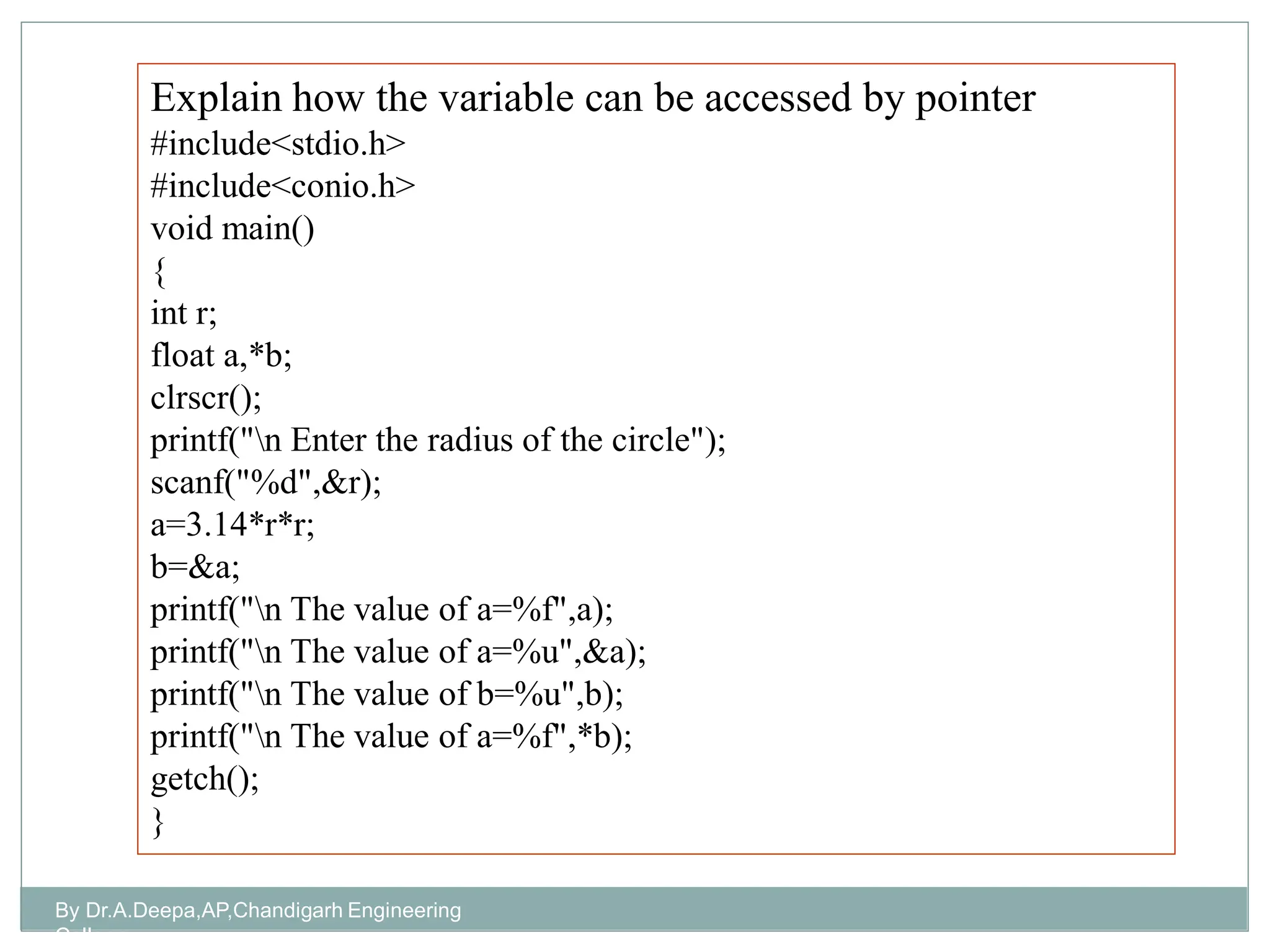
Explain how the variable can be accessed by pointer
#include<stdio.h>
#include<conio.h>
void main()
{
int r;
float a,*b;
clrscr();
printf("n Enter the radius of the circle");
scanf("%d",&r);
a=3.14*r*r;
b=&a;
printf("n The value of a=%f",a);
printf("n The value of a=%u",&a);
printf("n The value of b=%u",b);
printf("n The value of a=%f",*b);
getch();
}
By Dr.A.Deepa,AP,Chandigarh Engineering
College
Pointer Arithmetic
Addition and subtraction are the only operations that can be
performed on pointers.
Take a look at the following example :
Let var be an integer type variable
having the value 500 and stored at the
address 1000.
Then ptr_var has the value 1000 stored in it. Since integers
are 2 bytes long, after the expression “ptr_var++;” ptr_var will
have the value as 1002 and not 1001.
By Dr.A.Deepa,AP,Chandigarh Engineering
College
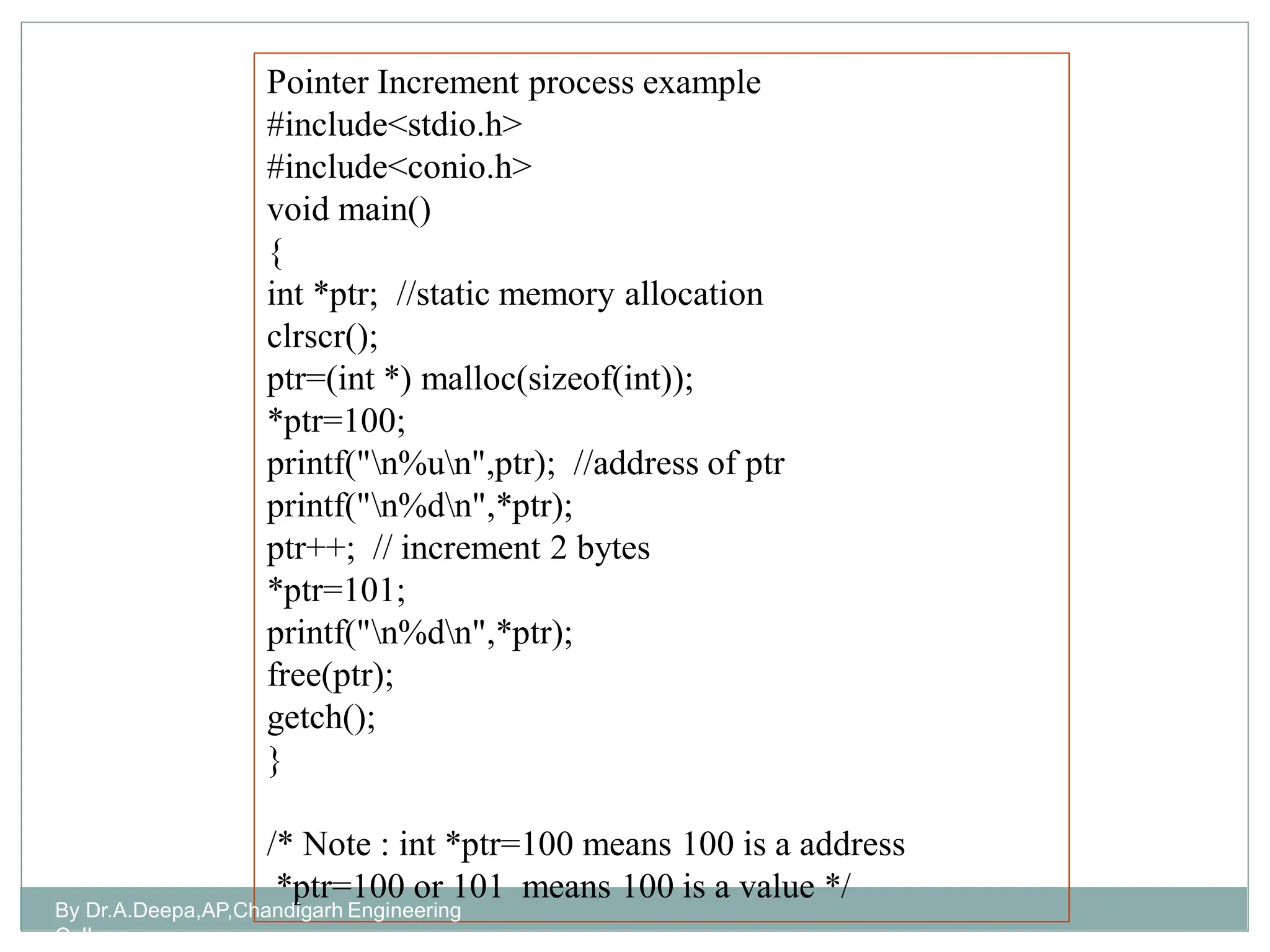
Pointer Increment process example
#include<stdio.h>
#include<conio.h>
void main()
{
int *ptr; //static memory allocation
clrscr();
ptr=(int *) malloc(sizeof(int));
*ptr=100;
printf("n%un",ptr); //address of ptr
printf("n%dn",*ptr);
ptr++; // increment 2 bytes
*ptr=101;
printf("n%dn",*ptr);
free(ptr);
getch();
}
/* Note : int *ptr=100 means 100 is a address
*ptr=100 or 101 means 100 is a value */
By Dr.A.Deepa,AP,Chandigarh Engineering
College
Each time a pointer is incremented, it points to the memory
location of the next element of its base type.
Each time it is decremented it points to the location of the previous
element.
All other pointers will increase or decrease depending on the
length of the data type they are pointing to.
Two pointers can be compared in a relational expression provided
both the pointers are pointing to variables of the same type.
POINTS
By Dr.A.Deepa,AP,Chandigarh Engineering
College
Increment & Decrement Operations Using Pointer
#include<stdio.h>
void main()
{
int i=100,*iptr;
float f=122.354,*fptr;
char c='d',*cptr;
iptr=&i;
fptr=&f;
cptr=&c;
printf("The values of the variables");
printf("n%d",*iptr);
By Dr.A.Deepa,AP,Chandigarh Engineering
College
printf("n%f",*fptr);
printf("n%c",*cptr);
printf("nStarting Address");
printf("n%u",iptr);
printf("n%u",fptr);
printf("n%u",cptr);
iptr++;
fptr++;
cptr++;
printf("nPointer Incrementing");
printf("n%u",iptr);
printf("n%u",fptr);
printf("n%u",cptr);
iptr--;
fptr--;
By Dr.A.Deepa,AP,Chandigarh Engineering
College
cptr--;
printf("nPointer Decrementing");
printf("n%u",iptr);
printf("n%u",fptr);
printf("n%u",cptr);
getch();
}
By Dr.A.Deepa,AP,Chandigarh Engineering
College
By Dr.A.Deepa,AP,Chandigarh Engineering
College
POINTER OPERATORS
&  Returns the memory address of the
operand
*  It is the complement of &. It returns the
value contained in the memory location pointed
to by the pointer variable’s value
Write a C program to find the length of the string Using Pointer
#include<stdio.h>
#include<string.h>
void main()
{
char *text[20],*pt;
int len;
pt=*text;
printf("Enter the string");
scanf("%s",*text);
while(*pt!='0')
{
putchar(*pt++);
}
len=pt -*text;
printf("nLength of the string is %d",len);
}
By Dr.A.Deepa,AP,Chandigarh Engineering
College
/*Add Two Numbers using pointers*/
#include<stdio.h>
void main()
{
int a,b,*c=&a,*d=&b;
printf(“Enter two numbers to be summed");
scanf("%d %d",&a,&b);
printf(“The sum of two numbers=%d",c +
d);
getch();
}
By Dr.A.Deepa,AP,Chandigarh Engineering
College
/* Array Using Pointers */
#include<stdio.h>
#include<conio.h>
void main()
{
int b[100],*iptr;
iptr=&b;
clrscr();
printf("The initial value of iptr is %un",iptr);
iptr++;
printf("Incremented value of iptr is %un",iptr);
getch();
}
By Dr.A.Deepa,AP,Chandigarh Engineering
College
POINTERS IN ARRAYS
#include<stdio.h>
#include<conio.h>
void main()
{
int arr[]={10,20,30,40};
int *ptr,i;
clrscr();
ptr=arr; // same as &arr[0];
printf("n The Result of the array is ");
for(i=0;i<4;i++)
{
printf("%dn",*ptr);
ptr++;
}
getch();
}
10
20
30
40
By Dr.A.Deepa,AP,Chandigarh Engineering
College
Pointers as Function Arguments
The address of the data item is passed and thus the function can
freely access the contents of that address from within the function
When pointers are passed to a function :
In this way, function arguments permit data-items to be altered in
the calling routine and the function.
When the arguments are pointers or arrays, a call by reference is
made to the function as opposed to a call by value for the variable
arguments.
By Dr.A.Deepa,AP,Chandigarh Engineering
College
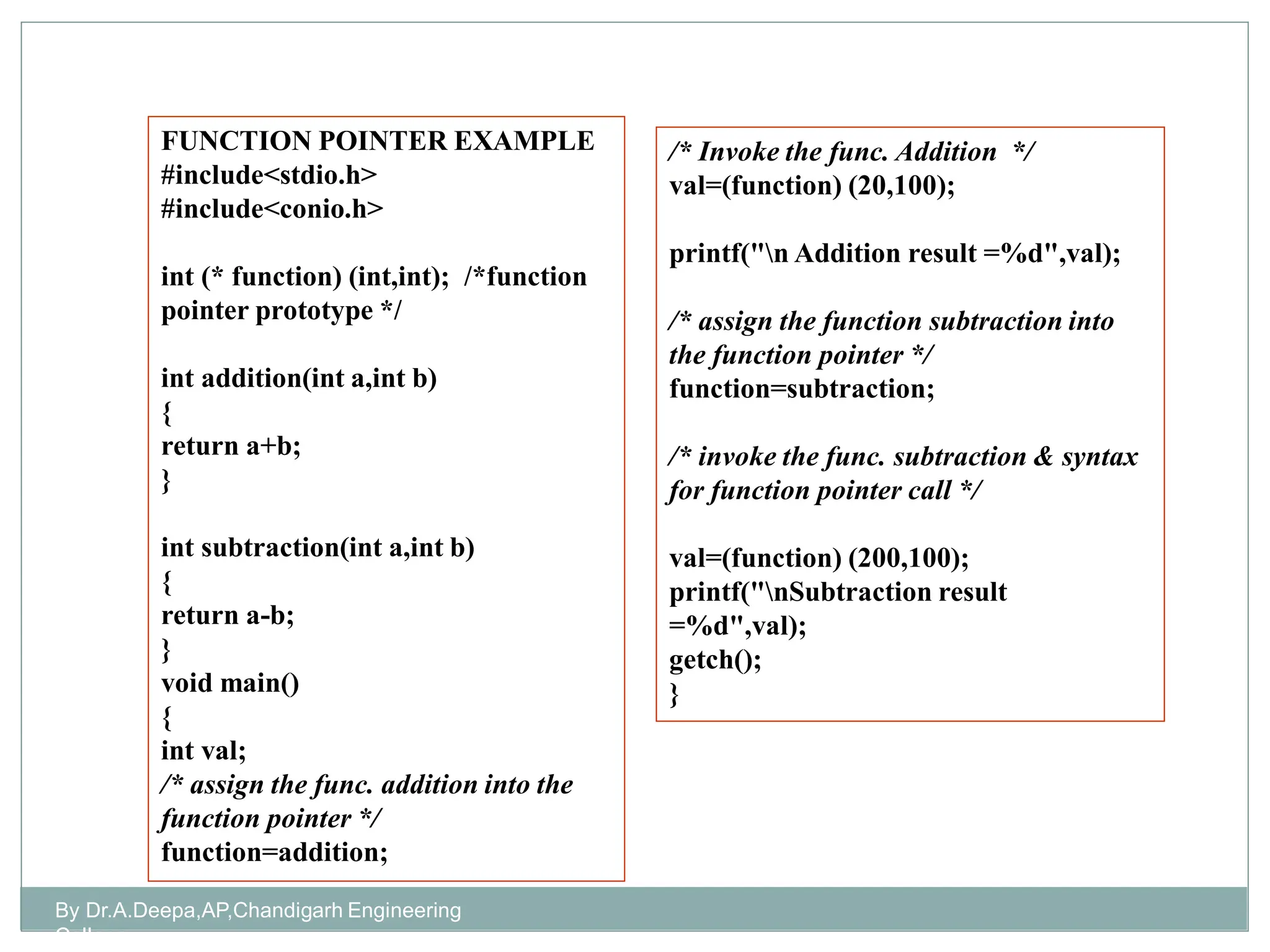
FUNCTION POINTER EXAMPLE
#include<stdio.h>
#include<conio.h>
int (* function) (int,int); /*function
pointer prototype */
int addition(int a,int b)
{
return a+b;
}
int subtraction(int a,int b)
{
return a-b;
}
void main()
{
int val;
/* assign the func. addition into the
function pointer */
function=addition;
/* Invoke the func. Addition */
val=(function) (20,100);
printf("n Addition result =%d",val);
/* assign the function subtraction into
the function pointer */
function=subtraction;
/* invoke the func. subtraction & syntax
for function pointer call */
val=(function) (200,100);
printf("nSubtraction result
=%d",val);
getch();
}
By Dr.A.Deepa,AP,Chandigarh Engineering
College
Pointers To Structures
Pointers to structures are allowed in C, but there are some special
aspects to structure pointers that a user of pointers to structures must be
aware of.
The following statement declares ptr as a pointer to data of that
type – Struct book *ptr;
By Dr.A.Deepa,AP,Chandigarh Engineering
College
How the structure can be
accessed by a pointer variable
#include<stdio.h>
#include<stdlib.h>
struct student
{
int roll_no;
char name[20];
float marks;
}st;
void main()
{
struct student *ptr;
printf("n t Enter the record");
printf("n Enter the Roll
Number");
scanf("%d",&st.roll_no);
printf("n Enter the Name");
scanf("%s",st.name);
printf("n Enter the Marks");
scanf("%f",&st.marks);
ptr=&st;
printf("n display the details using structure
variables");
printf( "%d %s %f", st.roll_no, st.name,
st.marks);
printf("n display the details using pointer
variables");
printf( "%d %s %f",ptr->roll_no, ptr->name,
ptr->marks);
}
void print_rec(int r,char n[ ],float m)
{
printf("n You have Entered Following record");
printf("n %d %s %f",r,n,m);
}
By Dr.A.Deepa,AP,Chandigarh Engineering
College
By Dr.A.Deepa,AP,Chandigarh Engineering
College
THANK
YOU

Pointers.pdf3hggggggggggggvvgggggghhhnhjkkkjj

  • 1.
    PROGRAMMING FOR PROBLEM SOLVING-- PPS SUBJECT CODE- BTPS-101-18
  • 2.
    UNIT – 8 POINTERS ByDr.A.Deepa,AP,Chandigarh Engineering College
  • 3.
    Objectives What is meantby pointer is and why it can ne used? How to Declare and access a pointer variable Example: Pointer Arithmetic– What is Self Referential Structure Beyond the syllabus--Activity What is Linked List By Dr.A.Deepa,AP,Chandigarh Engineering College
  • 4.
    By Dr.A.Deepa,AP,Chandigarh Engineering College Pointeris the variable which stores the address of the another variable Declaration of pointer : syntax : datatype *pointername; Example : int *ptr; char *pt; Pointer
  • 5.
    Assigning data tothe pointer variable syntax : pointervariablename=&variablename; For Example : int *p,quantity=20; p=&quantity; For Example : #include<stdio.h> void main() {int quantity=20,*p; p=&quantity; printf("%un",&p); Printf(“%dn”,p); printf("%dn",*p); printf("%dn",*(&quantity)); } Variable Value Address Quantity 500 P 5048 20 500 By Dr.A.Deepa,AP,Chandigarh Engineering College Output: 5048 500 20 20
  • 6.
    Why are PointersUsed ?  To return more than one value from a function  To pass arrays & strings more conveniently from one function to another  To manipulate arrays more easily by moving pointers to them, Instead of moving the arrays themselves  To allocate memory and access it (Dynamic Memory Allocation)  To create complex data structures such as Linked List, Where one data structure must contain references to other data structures By Dr.A.Deepa,AP,Chandigarh Engineering College
  • 7.
    By Dr.A.Deepa,AP,Chandigarh Engineering College Advantages: A pointer enables us to access a variable that is defined outside the function.  Pointers are more efficient in handling the data tables.  Pointers reduce the length and complexity of a program.  They increase the execution speed.  The use of a pointer array to character strings results in saving of data storage space in memory.  The function pointer can be used to call a function  Pointer arrays give a convenient method for storing strings Many of the ‘C’ Built-in functions that work with strings use Pointers It provides a way of accessing a variable without referring to the variable directly
  • 8.
    By Dr.A.Deepa,AP,Chandigarh Engineering College Linkedlists are the best and simplest example of a dynamic data structure that uses pointers for its implementation Advantages: Linked lists have a few advantages over arrays: Items can be added or removed from the middle of the list There is no need to define an initial size Linked List
  • 9.
    By Dr.A.Deepa,AP,Chandigarh Engineering College Thereis no "random" access - it is impossible to reach the nth item in the array without first iterating over all items up until that item. This means we have to start from the beginning of the list and count how many times we advance in the list until we get to the desired item. Dynamic memory allocation and pointers are required, which complicates the code and increases the risk of memory leaks and segment faults. Linked lists have a much larger overhead over arrays, since linked list items are dynamically allocated (which is less efficient in memory usage) and each item in the list also must store an additional pointer. Linked List Disadvantages:
  • 10.
    By Dr.A.Deepa,AP,Chandigarh Engineering College Alinked list is a set of dynamically allocated nodes, arranged in such a way that each node contains one value and one pointer. The pointer always points to the next member of the list. If the pointer is NULL, then it is the last node in the list. A linked list is held using a local pointer variable which points to the first item of the list. If that pointer is also NULL, then the list is considered to be empty. typedef struct node { int val; struct node * next; } node_t; Linked List
  • 11.
    By Dr.A.Deepa,AP,Chandigarh Engineering College Aself referential structure is used to create data structures like linked lists, stacks, etc. Following is an example of this kind of structure: struct struct_name { datatype datatypename; struct_name * pointer_name; }; . Self Referential Structure
  • 12.
    By Dr.A.Deepa,AP,Chandigarh Engineering College Aself-referential structure is one of the data structures which refer to the pointer to (points) to another structure of the same type. For example, a linked list is supposed to be a self-referential data structure. The next node of a node is being pointed, which is of the same struct type. For example, typedef struct listnode { void *data; struct listnode *next; } linked_list; In the above example, the listnode is a self-referential structure – because the *next is of the type struct listnode Self Referential Structure
  • 13.
    By Dr.A.Deepa,AP,Chandigarh Engineering College Example: structnode { int data1; char data2; struct node* link; }; int main() { struct node ob; return 0; } Self Referential Structure •In this example ‘link’is a pointer to a structure of type ‘node’. •Hence, the structure ‘node’is a self- referential structure with ‘link’as the referencing pointer.
  • 14.
    By Dr.A.Deepa,AP,Chandigarh Engineering College Typesof Self Referential Structures •Self Referential Structure with Single Link •Self Referential Structure with Multiple Links Self Referential Structure with Single Link: •These structures can have only one self-pointer as their member. •The following example will show us how to connect the objects of a self-referential structure with the single link and access the corresponding data members. Self Referential Structure 10 20 30 40 NULL Obj1 Obj2
  • 15.
    By Dr.A.Deepa,AP,Chandigarh Engineering College #include<stdio.h> struct node { int data1; int data2; struct node* link; }; int main() { struct node ob1; // Node1 // Initialization ob1.link = NULL; ob1.data1 = 10; ob1.data2 = 20; struct node ob2; // Node2 // Initialization ob2.link = NULL; ob2.data1 = 30; ob2.data2 = 40; // Linking ob1 and ob2 ob1.link = &ob2; // Accessing data members of ob2 using ob1 printf("%d", ob1.link->data1); printf("n%d", ob1.link->data2); return 0; } Output 30 40 Example –Self Referential Structure
  • 16.
    By Dr.A.Deepa,AP,Chandigarh Engineering College BeyondThe Syllabus – Activity Programs to Practice
  • 17.
    By Dr.A.Deepa,AP,Chandigarh Engineering College Example:1 #include<stdio.h> #include<conio.h> voidmain() { int n=10; int *ptr; ptr=&n; printf("Value of n is %d",n); printf("nAddress of n is %x",&n); printf("nAddres of pointer is %x",ptr); printf("nvalue stored in pointer is %d",*ptr); getch(); }
  • 18.
    Example 2 #include<stdio.h> #include<stdlib.h> #define size10 void main() { char name[size]; char *i; printf("n Enter your name "); gets(name); i=name; printf("n Now printing your name is :"); while(*i != '0') { printf("%c",*i); i++; } } By Dr.A.Deepa,AP,Chandigarh Engineering College
  • 19.
    Explain how thevariable can be accessed by pointer #include<stdio.h> #include<conio.h> void main() { int r; float a,*b; clrscr(); printf("n Enter the radius of the circle"); scanf("%d",&r); a=3.14*r*r; b=&a; printf("n The value of a=%f",a); printf("n The value of a=%u",&a); printf("n The value of b=%u",b); printf("n The value of a=%f",*b); getch(); } By Dr.A.Deepa,AP,Chandigarh Engineering College
  • 20.
    Pointer Arithmetic Addition andsubtraction are the only operations that can be performed on pointers. Take a look at the following example : Let var be an integer type variable having the value 500 and stored at the address 1000. Then ptr_var has the value 1000 stored in it. Since integers are 2 bytes long, after the expression “ptr_var++;” ptr_var will have the value as 1002 and not 1001. By Dr.A.Deepa,AP,Chandigarh Engineering College
  • 21.
    Pointer Increment processexample #include<stdio.h> #include<conio.h> void main() { int *ptr; //static memory allocation clrscr(); ptr=(int *) malloc(sizeof(int)); *ptr=100; printf("n%un",ptr); //address of ptr printf("n%dn",*ptr); ptr++; // increment 2 bytes *ptr=101; printf("n%dn",*ptr); free(ptr); getch(); } /* Note : int *ptr=100 means 100 is a address *ptr=100 or 101 means 100 is a value */ By Dr.A.Deepa,AP,Chandigarh Engineering College
  • 22.
    Each time apointer is incremented, it points to the memory location of the next element of its base type. Each time it is decremented it points to the location of the previous element. All other pointers will increase or decrease depending on the length of the data type they are pointing to. Two pointers can be compared in a relational expression provided both the pointers are pointing to variables of the same type. POINTS By Dr.A.Deepa,AP,Chandigarh Engineering College
  • 23.
    Increment & DecrementOperations Using Pointer #include<stdio.h> void main() { int i=100,*iptr; float f=122.354,*fptr; char c='d',*cptr; iptr=&i; fptr=&f; cptr=&c; printf("The values of the variables"); printf("n%d",*iptr); By Dr.A.Deepa,AP,Chandigarh Engineering College
  • 24.
  • 25.
  • 26.
    By Dr.A.Deepa,AP,Chandigarh Engineering College POINTEROPERATORS &  Returns the memory address of the operand *  It is the complement of &. It returns the value contained in the memory location pointed to by the pointer variable’s value
  • 27.
    Write a Cprogram to find the length of the string Using Pointer #include<stdio.h> #include<string.h> void main() { char *text[20],*pt; int len; pt=*text; printf("Enter the string"); scanf("%s",*text); while(*pt!='0') { putchar(*pt++); } len=pt -*text; printf("nLength of the string is %d",len); } By Dr.A.Deepa,AP,Chandigarh Engineering College
  • 28.
    /*Add Two Numbersusing pointers*/ #include<stdio.h> void main() { int a,b,*c=&a,*d=&b; printf(“Enter two numbers to be summed"); scanf("%d %d",&a,&b); printf(“The sum of two numbers=%d",c + d); getch(); } By Dr.A.Deepa,AP,Chandigarh Engineering College
  • 29.
    /* Array UsingPointers */ #include<stdio.h> #include<conio.h> void main() { int b[100],*iptr; iptr=&b; clrscr(); printf("The initial value of iptr is %un",iptr); iptr++; printf("Incremented value of iptr is %un",iptr); getch(); } By Dr.A.Deepa,AP,Chandigarh Engineering College
  • 30.
    POINTERS IN ARRAYS #include<stdio.h> #include<conio.h> voidmain() { int arr[]={10,20,30,40}; int *ptr,i; clrscr(); ptr=arr; // same as &arr[0]; printf("n The Result of the array is "); for(i=0;i<4;i++) { printf("%dn",*ptr); ptr++; } getch(); } 10 20 30 40 By Dr.A.Deepa,AP,Chandigarh Engineering College
  • 31.
    Pointers as FunctionArguments The address of the data item is passed and thus the function can freely access the contents of that address from within the function When pointers are passed to a function : In this way, function arguments permit data-items to be altered in the calling routine and the function. When the arguments are pointers or arrays, a call by reference is made to the function as opposed to a call by value for the variable arguments. By Dr.A.Deepa,AP,Chandigarh Engineering College
  • 32.
    FUNCTION POINTER EXAMPLE #include<stdio.h> #include<conio.h> int(* function) (int,int); /*function pointer prototype */ int addition(int a,int b) { return a+b; } int subtraction(int a,int b) { return a-b; } void main() { int val; /* assign the func. addition into the function pointer */ function=addition; /* Invoke the func. Addition */ val=(function) (20,100); printf("n Addition result =%d",val); /* assign the function subtraction into the function pointer */ function=subtraction; /* invoke the func. subtraction & syntax for function pointer call */ val=(function) (200,100); printf("nSubtraction result =%d",val); getch(); } By Dr.A.Deepa,AP,Chandigarh Engineering College
  • 33.
    Pointers To Structures Pointersto structures are allowed in C, but there are some special aspects to structure pointers that a user of pointers to structures must be aware of. The following statement declares ptr as a pointer to data of that type – Struct book *ptr; By Dr.A.Deepa,AP,Chandigarh Engineering College
  • 34.
    How the structurecan be accessed by a pointer variable #include<stdio.h> #include<stdlib.h> struct student { int roll_no; char name[20]; float marks; }st; void main() { struct student *ptr; printf("n t Enter the record"); printf("n Enter the Roll Number"); scanf("%d",&st.roll_no); printf("n Enter the Name"); scanf("%s",st.name); printf("n Enter the Marks"); scanf("%f",&st.marks); ptr=&st; printf("n display the details using structure variables"); printf( "%d %s %f", st.roll_no, st.name, st.marks); printf("n display the details using pointer variables"); printf( "%d %s %f",ptr->roll_no, ptr->name, ptr->marks); } void print_rec(int r,char n[ ],float m) { printf("n You have Entered Following record"); printf("n %d %s %f",r,n,m); } By Dr.A.Deepa,AP,Chandigarh Engineering College
  • 35.