RESPIRATORY PNF
DR.ARJUN PATEL
Respiratory PNF
Introduction
Definition
Principal
Neurophysiology
Aim
Indication
Contraindication
Effect
Clinical application
References
Introduction
Respiration: Essential part lung
Breathing: Under control of CNS
Respiratory rhythmicity: central pattern
generator (CPG)
Introduction
PNF: Facilitation make easier
Neuromuscular facilitation: Process by
which response of neuromuscular
mechanism is made easier
Developed by: dr.Herman Kabat and Miss
Mrgaret Knott
Definition
Neurophysiological facilitation of respiration
is the use of selective external
proprioceptive and tactile stimuli that
produce reflexive movement response in the
ventilatory apparatus to assist respiration.
Principal of Respiratory PNF
Use the stretch reflex to facilitate the initiation of
inhalation continue with repeated stretch through
range (repeated contraction) to facilitate an increase
Inspiratory volume.
Appropriate résistance strengthen the muscle and
guide to the chest motion.
Neural Control
Gamma
cell
Extra
Pyramidal
Input
Sensory input
Muscle Spindle
Golgitendon organ
P.H.C
A.H.C
U.M.N
L.M.N
Aims of PNF
To facilitate normal mechanical
respiratory movement pattern
To decrease muscle spasm
To maintain thoracic mobility
To produce reflex involuntary
respiratory movement reaction
Aims of PNF
To activate the diaphragm
To facilitate Inspiratory motor neuron
activity
To facilitate deeper breathing
swallowing and mouth closure
Indications
Direct Indications
Inadequate ventilation
Retention of secretions
Need of frequent suctioning
Indications
Indirect Indications
Chest mobilization
Trunk and shoulder mobility
Relief of pain
Relaxation
Decrease Spasticity
Contraindications
Fracture of Ribs
Active Tuberculosis
Effects of PNF
Visibly deeper respiration – larger expansion
of the ribs and increased epigastric excursion
Increased visible tone in abdominal muscles
Change in respiratory rate
Involuntary coughing
Effects of PNF
More normal respiratory pattern
Rapid return of mechanical stability
Change in breath sound on auscultation
Retention of improved respiratory pattern after
treatment period
Apparent increase in the level of consciousness
Clinical Application
 Co-contraction of the abdomen
 Vertebral pressure on upper and lower thoracic
vertebrae
 Intercostal stretch
 Manual pressure(moderate)
 Anterior stretch –lifting the posterior basal area
 Perioral stimulation
Co-contraction of the abdomen
Method: Pressure laterally over lower ribs
and pelvis, Alternate right and left sides
Observation:
Increase epigastric movement
 Increase muscle contraction
(rectus abdomens
Decrease girth in obese
Depression of umbilicus
Suggested mechanism: Stretch receptors in abdominal
muscle ,intercostals to phrenic reflex
Vertebral Pressure on Upper and
Lower Thoracic Vertebrae
Method: Manual
pressure to thoracic
vertebrae in Region of
T2-T5(Upper) and T7-
T10 (lower)
Observation: Pressure on upper vertebrae –increase
epigastric excursions ,deep breathing. Pressure on lower
vertebrae. Increase respiratory movement of Apical thorax
Suggested mechanism: dorsal root –mediated
intersegmental reflex
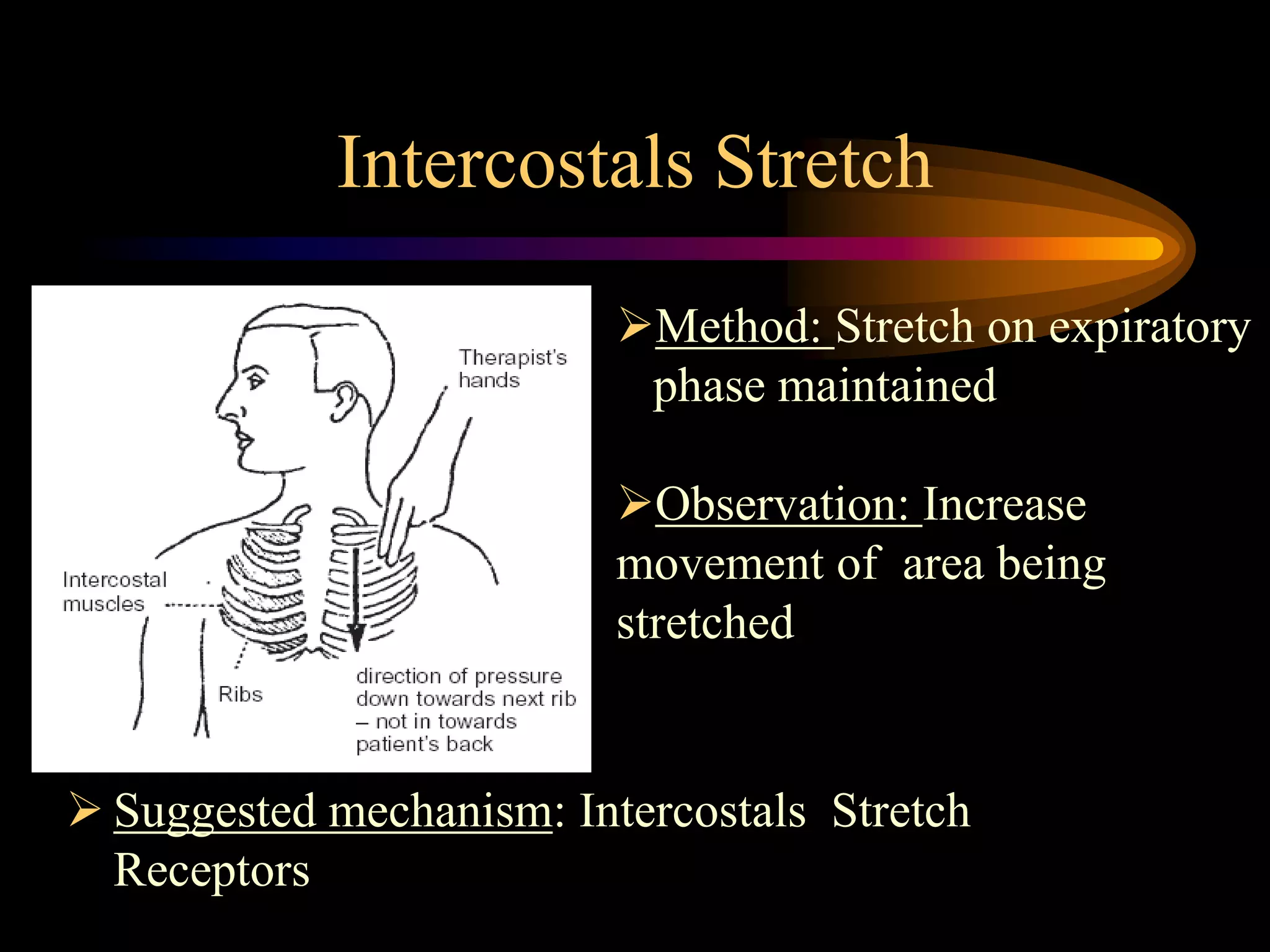
Intercostals Stretch
 Suggested mechanism: Intercostals Stretch
Receptors
Method: Stretch on expiratory
phase maintained
Observation: Increase
movement of area being
stretched
Manual Pressure (Moderate)
Method: moderate pressure over thorax
Observation: gradually increased excursion
Over applied pressure area
Suggested Mechanism: Cuteneous afferents
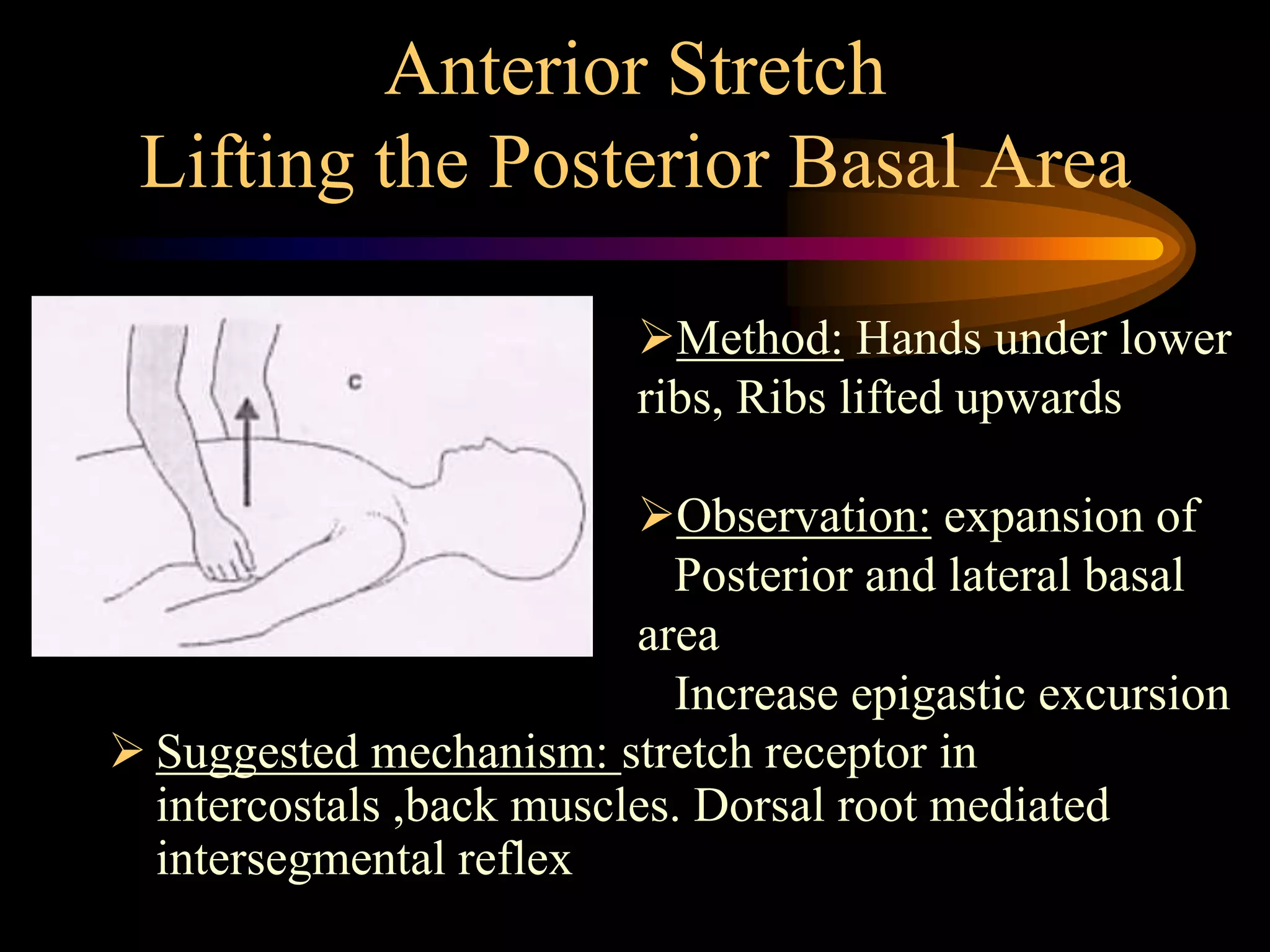
Anterior Stretch
Lifting the Posterior Basal Area
 Suggested mechanism: stretch receptor in
intercostals ,back muscles. Dorsal root mediated
intersegmental reflex
Method: Hands under lower
ribs, Ribs lifted upwards
Observation: expansion of
Posterior and lateral basal
area
Increase epigastic excursion
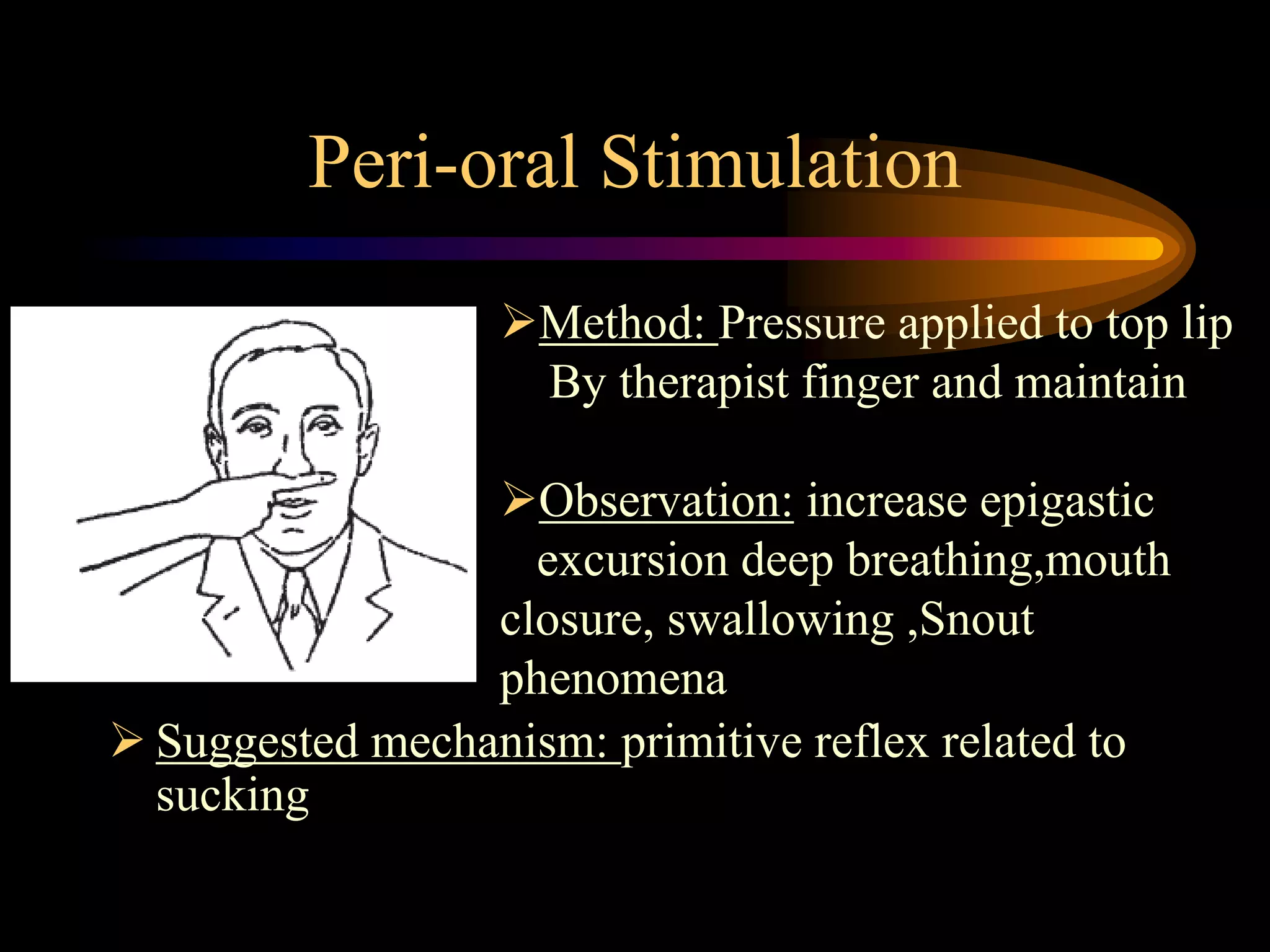
Peri-oral Stimulation
 Suggested mechanism: primitive reflex related to
sucking
Method: Pressure applied to top lip
By therapist finger and maintain
Observation: increase epigastic
excursion deep breathing,mouth
closure, swallowing ,Snout
phenomena

Pnf respiratory