1

Abstract— Pneumatic structure is basically a
constructed form that derives its rigidity from captured
pressurized gas. The technique has evolved during
different periods starting from the 50s and 60s. This
paper aims at understanding the history and principles
of pneumatic structures as well as their revival and
applications in the modern era.
Index Terms— Pneumatics,
I. INTRODUCTION
Pneumatic structures are basically membrane structures that
are stabilized by the pressure of compressed air. First
posited in the 1960s, the idea of pneumatic structures as a
progressive and lightweight alternative to ‘normal
construction has renewed relevance to the current re-
evaluation of energy use and new forms of climatically
responsive envelopes. In pneumatic constructions, the
pressure differences between the enclosed space and the
exterior are responsible for giving the building its shape and
also for stabilizing the hull. This system of using
membranes for construction evolved from practical
applications in other fields such the heliumdirigible and hot
air balloons. The fabric is pre-tensioned by an internal
overpressure of the air. The load developed is from the
tensile stresses. Its stabilization is done by pre-stressing the
membrane either by:-
A) Applying an external force which pulls the
membrane
B) Internal pressurizing if the membrane is volume
enclosing.
II. HISTORY OF PNEUMATIC STRUCTURES
A. Hot Air Balloonsand Airships
The first experiments with pneumatic structures were
undertaken during the development of hot-air balloons. An
effective start for the
development of
balloons just occurred at
the end of the 18th
century.
These balloons were made by linen and paper.
At the same year, Jaques A. C. Charles built the first
hydrogen balloon a derigible called the zepellin.
The idea of transposing the
dirigibles technology to
architecture tracks back to the
English engineer F. W.
Lanchester. His patent of a
pneumatic system for campaign
hospitals was approved in
England, in 1918, but was never
actually constructed, due to the lack of adequate membrane
materials or appeal to possible clients.
.
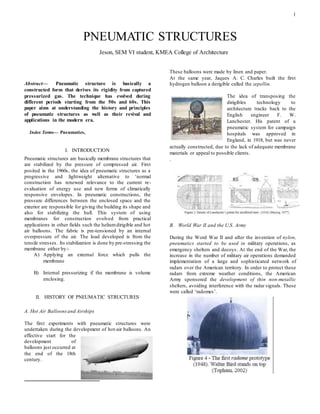
B. World War II and the U.S. Army
During the Word War II and after the invention of nylon,
pneumatics started to be used in military operations, as
emergency shelters and decoys. At the end of the War, the
increase in the number of military air operations demanded
implementation of a large and sophisticated network of
radars over the American territory. In order to protect these
radars from extreme weather conditions, the American
Army sponsored the development of thin non-metallic
shelters, avoiding interference with the radar signals. These
were called ‘radomes’.
Jeson, SEM VI student, KMEA College of Architecture
PNEUMATIC STRUCTURES
2
Walter Bird presented an overview of the field titled The
Development of Pneumatic Structures, Past, Present and
Future. Bird is an acknowledged pioneer in the use of
tensile fabric and pneumatic structures, which began with
his air-supported radome prototype for the US Air Force in
1946 made from neoprene-coated fiberglass fabric.
Bird concluded by noting the unique and outstanding
features of the air structure:
‘The air structure is the most efficient structural form
available to date … no other type of structure has the
potential of providing free-span coverage for so large an
area … as the air structure is constructed of lightweight,
flexible materials, it can be made easily portable and lends
itself readily to the design of demountable or removable
structures.
C. Utopian Ideas
Frei Otto was the first to undertake academic investigations,
especially about the process of form finding. Through
various publications, Otto broadened the landscape, not
only of pneumatics, but of tension structures in general.
Pneumatics were also part of the repertoire of Richard
Buckminster Fuller. His proposal of a pneumatic dome to
cover New York (1962, Figure 6) is a famous example of
Utopian pneumatic architecture. Realization of this project
would require a radical environmental transformation, a
sterilized enclosure without dust, pollution, exhaust gases
and so.
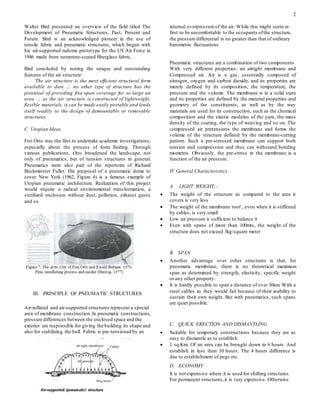
III. PRINCIPLE OF PNEUMATIC STRUCTURES
Air-inflated and air-supported structures represent a special
area of membrane construction.In pneumatic constructions,
pressure differences between the enclosed space and the
exterior are responsible for giving the building its shape and
also for stabilizing the hull. Fabric is pre-tensioned by an
internal overpressure of the air. While this might seem at
first to be uncomfortable to the occupants ofthe structure,
the pressure differential is no greater than that of ordinary
barometric fluctuations.
Pneumatic structures are a combination of two components
With very different properties: an airtight membrane and
Compressed air. Air is a gas, essentially composed of
nitrogen, oxygen and carbon dioxide, and its properties are
merely defined by its composition, the temperature, the
pressure and the volume. The membrane is in a solid state
and its properties are defined by the material properties and
geometry of the constituents, as well as by the way
materials are used for its construction, such as the chemical
composition and the elastic modulus of the yarn, the mass
density of the coating, the type of weaving and so on. The
compressed air pretensions the membrane and forms the
volume of the structure defined by the membrane-cutting
pattern. Such a pre-stressed membrane can support both
tension and compression and thus can withstand bending
moments. Obviously, the pre-stress in the membrane is a
function of the air pressure.
IV General Characteristics
A. LIGHT WEIGHT:-
 The weight of the structure as compared to the area it
covers is very less
 The weight of the membrane roof , even when it is stiffened
by cables, is very small
 Low air pressure is sufficient to balance it
 Even with spans of more than 100mts, the weight of the
structure does not exceed 3kg/square meter
B. SPAN
 Another advantage over other structures is that, for
pneumatic membrane, there is no theoretical maximum
span as determined by strength, elasticity, specific weight
or any other property.
 It is hardly possible to span a distance of over 36km. With a
steel cables as they would fail because of their inability to
sustain their own weight. But with pneumatics, such spans
are quiet possible.
C. QUICK ERECTION AND DISMANTLING
 Suitable for temporary constructions because they are as
easy to dismantle as to establish.
 1 sq.Km. Of an area can be brought down in 6 hours. And
establish in less than 10 hours. The 4 hours difference is
due to establishment of pegs etc.
D. ECONOMY
It is not expensive where it is used for shifting structures.
For permanent structures,it is very expensive. Otherwise
3
the cost per square foot of air supported structures is among
the lowest for large span roofs.
E. GOOD NATURAL LIGHT
Gives good natural light as translucent/transparent plastic
sheets are typically used to form the membrane. Daylight
can be brought in efficiently. There is a lot of flexibility in
getting sun light (50%-80%).
IV. CONCLUSION
Pneumatic structure is an efficient system having wide
applications in not only the architectural field but various
others as well. The possibilities of these structures can be
broadened with the advancement of technology and can be
incorporated for varied uses and scenarios.

Pneumatic structures (1)

  • 1.
    1  Abstract— Pneumatic structureis basically a constructed form that derives its rigidity from captured pressurized gas. The technique has evolved during different periods starting from the 50s and 60s. This paper aims at understanding the history and principles of pneumatic structures as well as their revival and applications in the modern era. Index Terms— Pneumatics, I. INTRODUCTION Pneumatic structures are basically membrane structures that are stabilized by the pressure of compressed air. First posited in the 1960s, the idea of pneumatic structures as a progressive and lightweight alternative to ‘normal construction has renewed relevance to the current re- evaluation of energy use and new forms of climatically responsive envelopes. In pneumatic constructions, the pressure differences between the enclosed space and the exterior are responsible for giving the building its shape and also for stabilizing the hull. This system of using membranes for construction evolved from practical applications in other fields such the heliumdirigible and hot air balloons. The fabric is pre-tensioned by an internal overpressure of the air. The load developed is from the tensile stresses. Its stabilization is done by pre-stressing the membrane either by:- A) Applying an external force which pulls the membrane B) Internal pressurizing if the membrane is volume enclosing. II. HISTORY OF PNEUMATIC STRUCTURES A. Hot Air Balloonsand Airships The first experiments with pneumatic structures were undertaken during the development of hot-air balloons. An effective start for the development of balloons just occurred at the end of the 18th century. These balloons were made by linen and paper. At the same year, Jaques A. C. Charles built the first hydrogen balloon a derigible called the zepellin. The idea of transposing the dirigibles technology to architecture tracks back to the English engineer F. W. Lanchester. His patent of a pneumatic system for campaign hospitals was approved in England, in 1918, but was never actually constructed, due to the lack of adequate membrane materials or appeal to possible clients. . B. World War II and the U.S. Army During the Word War II and after the invention of nylon, pneumatics started to be used in military operations, as emergency shelters and decoys. At the end of the War, the increase in the number of military air operations demanded implementation of a large and sophisticated network of radars over the American territory. In order to protect these radars from extreme weather conditions, the American Army sponsored the development of thin non-metallic shelters, avoiding interference with the radar signals. These were called ‘radomes’. Jeson, SEM VI student, KMEA College of Architecture PNEUMATIC STRUCTURES
  • 2.
    2 Walter Bird presentedan overview of the field titled The Development of Pneumatic Structures, Past, Present and Future. Bird is an acknowledged pioneer in the use of tensile fabric and pneumatic structures, which began with his air-supported radome prototype for the US Air Force in 1946 made from neoprene-coated fiberglass fabric. Bird concluded by noting the unique and outstanding features of the air structure: ‘The air structure is the most efficient structural form available to date … no other type of structure has the potential of providing free-span coverage for so large an area … as the air structure is constructed of lightweight, flexible materials, it can be made easily portable and lends itself readily to the design of demountable or removable structures. C. Utopian Ideas Frei Otto was the first to undertake academic investigations, especially about the process of form finding. Through various publications, Otto broadened the landscape, not only of pneumatics, but of tension structures in general. Pneumatics were also part of the repertoire of Richard Buckminster Fuller. His proposal of a pneumatic dome to cover New York (1962, Figure 6) is a famous example of Utopian pneumatic architecture. Realization of this project would require a radical environmental transformation, a sterilized enclosure without dust, pollution, exhaust gases and so. III. PRINCIPLE OF PNEUMATIC STRUCTURES Air-inflated and air-supported structures represent a special area of membrane construction.In pneumatic constructions, pressure differences between the enclosed space and the exterior are responsible for giving the building its shape and also for stabilizing the hull. Fabric is pre-tensioned by an internal overpressure of the air. While this might seem at first to be uncomfortable to the occupants ofthe structure, the pressure differential is no greater than that of ordinary barometric fluctuations. Pneumatic structures are a combination of two components With very different properties: an airtight membrane and Compressed air. Air is a gas, essentially composed of nitrogen, oxygen and carbon dioxide, and its properties are merely defined by its composition, the temperature, the pressure and the volume. The membrane is in a solid state and its properties are defined by the material properties and geometry of the constituents, as well as by the way materials are used for its construction, such as the chemical composition and the elastic modulus of the yarn, the mass density of the coating, the type of weaving and so on. The compressed air pretensions the membrane and forms the volume of the structure defined by the membrane-cutting pattern. Such a pre-stressed membrane can support both tension and compression and thus can withstand bending moments. Obviously, the pre-stress in the membrane is a function of the air pressure. IV General Characteristics A. LIGHT WEIGHT:-  The weight of the structure as compared to the area it covers is very less  The weight of the membrane roof , even when it is stiffened by cables, is very small  Low air pressure is sufficient to balance it  Even with spans of more than 100mts, the weight of the structure does not exceed 3kg/square meter B. SPAN  Another advantage over other structures is that, for pneumatic membrane, there is no theoretical maximum span as determined by strength, elasticity, specific weight or any other property.  It is hardly possible to span a distance of over 36km. With a steel cables as they would fail because of their inability to sustain their own weight. But with pneumatics, such spans are quiet possible. C. QUICK ERECTION AND DISMANTLING  Suitable for temporary constructions because they are as easy to dismantle as to establish.  1 sq.Km. Of an area can be brought down in 6 hours. And establish in less than 10 hours. The 4 hours difference is due to establishment of pegs etc. D. ECONOMY It is not expensive where it is used for shifting structures. For permanent structures,it is very expensive. Otherwise
  • 3.
    3 the cost persquare foot of air supported structures is among the lowest for large span roofs. E. GOOD NATURAL LIGHT Gives good natural light as translucent/transparent plastic sheets are typically used to form the membrane. Daylight can be brought in efficiently. There is a lot of flexibility in getting sun light (50%-80%). IV. CONCLUSION Pneumatic structure is an efficient system having wide applications in not only the architectural field but various others as well. The possibilities of these structures can be broadened with the advancement of technology and can be incorporated for varied uses and scenarios.