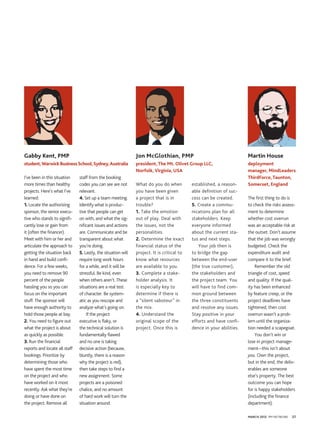
PM
                                                                   MARCH 2012 VOLUME 26, NUMBER 3


                            NETWORK
                            MAKING PROJECT MANAGEMENT INDISPENSABLE FOR BUSINESS RESULTS.®


HOW SAFE IS THE CLOUD?
STAKEHOLDER REALITY CHECK
WHAT TO KNOW
BEFORE YOU TAKE THE JOB
GANTT AS MOTIVATOR
LEADERSHIP WITHOUT
AUTHORITY
AIRPORT PROJECTS TAKE OFF


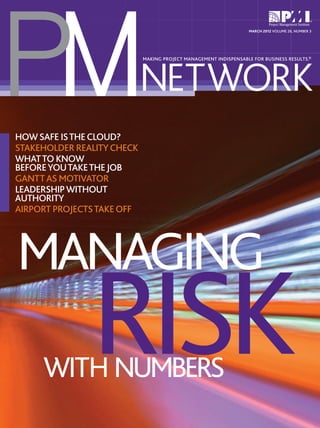
MANAGING
               RISK
     WITH NUMBERS
Lead
                     March 2012 | Volume 26, Number 3


                        38
                        Risk by the Numbers
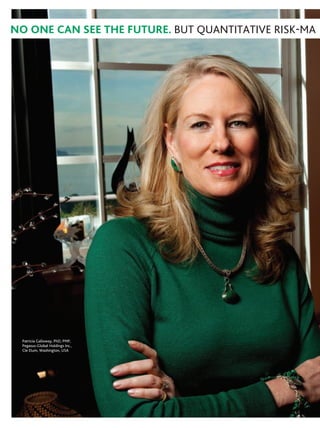
                        No one can see the
Patricia Galloway,
PhD, PMP, Pegasus-
                        future. But quantita-
Global Holdings         tive risk management
Inc., Cle Elum,         can help make it a
Washington, USA
                        little clearer.
                        By Sandra A. Swanson
Features                             MARCH 2012 | VOLUME 26, NUMBER 3


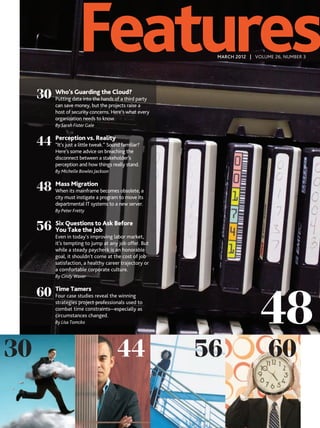
     30 Who’sdata into the handsCloud? party
        Putting
                Guarding the
                                 of a third
            can save money, but the projects raise a
            host of security concerns. Here’s what every
            organization needs to know.
            By Sarah Fister Gale


     44 Perception vs. Reality familiar?
        “It’s just a little tweak.” Sound
            Here’s some advice on breaching the
            disconnect between a stakeholder’s
            perception and how things really stand.
            By Michelle Bowles Jackson


     48 Massits mainframe becomes obsolete, a
        When
             Migration

            city must instigate a program to move its
            departmental IT systems to a new server.
            By Peter Fretty


     56 Six QuestionsJobAsk Before
        You Take the
                      to

            Even in today’s improving labor market,
            it’s tempting to jump at any job offer. But
            while a steady paycheck is an honorable
            goal, it shouldn’t come at the cost of job
            satisfaction, a healthy career trajectory or
            a comfortable corporate culture.
            By Cindy Waxer


                                                                           48
     60 Timecase studies reveal the winning
        Four
              Tamers

            strategies project professionals used to
            combat time constraints—especially as
            circumstances changed.
            By Lisa Tomcko


30                                       44                56                 60
11
                                                             also       March 2012 | VOLUMe 26, NUMBeR 3


                                                                                 Making project ManageMent
                                                                                 indispensable for business results.®


     thE PulSE
     8   Emerging Markets Ready
         for Takeoff
         Developing nations see airport
         project boom                                                        alSO In thIS ISSuE


15
     11 More Projects, Freezes Persist                                       7     Feedback
        IT spending increase doesn’t                                               Revisiting earned value
        necessarily mean more jobs                                                 management

     13 East Africa Looks for             VOICES                             18 Metrics
        Strength in Numbers                                                     Stats on the CIO agenda,
        Five nations hope partnership     20 Peer to Peer                       online shopping and clean
        will bring economic success          Leadership Without Authority       technology
                                             Pat Weaver, PMI-SP, PMP and
     14 Chicago Rail Project Puts a          Roberto Guandique               66 Help Desk
        Lot on the Line                                                         The Rise of VoIP
        High-profile revamp aims to       23 From the Top                       By Peter Fretty
        update transit route                 Regular Checkups
                                             Teresa Knudson, PMP, Mayo       68 Marketplace
     15 Sensing Bridge Problems              Clinic, Rochester, Minnesota,      Books that cover the
        Before It’s Too Late                 USA                                “bagel metaphor” and


20
        Projects seek to curb                                                   project management offices
        infrastructure disasters          26 Project Perspectives
                                             Can This Project Be Saved?      71 Directory of Services
     16 Little Green Schoolhouses                                               Project management
        U.S. schools ramp up              28 In the Trenches                    resources
        sustainability measures              Unclear on the Concept
                                             By Grace Willis, PMP            72 Closing Credit
                                                                                Japan’s 40-year nuclear
                                                                                cleanup
                                          COlumnIStS
                                          24 Trend Watch
                                             Leadership Counsel
                                             By Roberto Toledo, MBA,
                                             PMP, Contributing Editor


24
                                          25 What’s at Stake
                                             The Gantt You Might Not Know
                                             By Lynda Bourne, DPM, PMP


     DOWNLOAD THE PM NETWORK APP and read the magazine on your iPad, iPhone or iPod Touch.


28
NETwORk                                              THE PROFESSIONAL MAGAZINE OF THE PROJECT MANAGEMENT INSTITUTE

                                                                                              Publication & MeMbershiP
                                                                                              PM Network (ISSN 1040-8754) is published monthly by the Project Management Institute. PM
                                                                                              Network is printed in the USA by Quad Graphics, Sussex, wisconsin. Periodical postage paid
PMI Staff                                    contrIbutIng edItorS                             at Newtown Square, PA 19073-3299 and at additional mailing offices. Canadian agreement
                                                                                              #40030957. Postmaster: Send address changes to PM Network, 14 Campus Boulevard, New-
Vice President, Brand Management             Alfonso Bucero, PMP, Bucero PM Con-              town Square, PA 19073-3299 USA. Phone +1 610 356 4600, fax +1 610 482 9971.
Lesley Bakker; lesley.bakker@pmi.org         sulting                                             The mission of PM Network is to facilitate the exchange of information among professionals in
                                                                                              the field of project and program management, provide them with practical tools and techniques,
Publisher                                    Sheilina Somani, PMP, Positively                 and serve as a forum for discussion of emerging trends and issues. All articles in PM Network are
Donn Greenberg; donn.greenberg@pmi.org                                                        the views of the authors and are not necessarily those of PMI.
                                             Project Management                                  Subscription rate for members is US$42/year and is included in the annual dues. PMI is
Editor in Chief                              Roberto Toledo, MBA, PMP, Alpha PM               a nonprofit professional organization dedicated to advancing the state of the art of project
                                                                                              management. Membership in PMI is open to all at an annual dues of US$119. For information
Dan Goldfischer; dan.goldfischer@pmi.org     Consulting                                       on PMI programs and membership, or to report change of address or problems with your sub-
Publications Production Supervisor           Neal Whitten, PMP, The Neal Whitten              scription, contact:
Barbara Walsh; barbara.walsh@pmi.org         Group
Periodicals Associate
Natasha Pollard; natasha.pollard@pmi.org     2012 PMI board of dIrectorS
                                                                                              Project ManageMent institute
Reader Feedback: editorial@pmi.org           Chair                                            14 Campus Boulevard / Newtown Square, PA 19073-3299 USA
                                             Peter Monkhouse, BSc(Eng), MBA,                  Tel +1 610 356 4600; Fax +1 610 482 9971
Bookstore: bookstore@pmi.org                                                                  E-mail: customercare@pmi.org
                                             PEng, PMP                                        Toll-free: 1 855 746 7879 (United States) / 1 855 746 7879 (Canada) / 1 800 563 0665 (Mexico)
                                             +1 416 702 9574,                                 PMi asia Pacific service centre
advertISIng SaleS                            peter.monkhouse@bod.pmi.org                      Singapore
For advertising information, contact:                                                         Tel: +65 6496 5501 / E-mail: customercare.asiapac@pmi.org
                                             Vice Chair
J.T. Hroncich                                Deanna Landers, MBA, PMP                         PMi europe-Middle east-africa (eMea) service centre
                                                                                              Lelystad, Netherlands
PMI Advertising Sales Program                +1 303 378 8459,                                 Tel: +31 320 239 539 / E-mail: customercare.emea@pmi.org
c/o Capitol Media Solutions                  deanna.landers@bod.pmi.org                       toll-free numbers
3340 Peachtree Rd. NE, Suite 1050            Secretary-Treasurer and Chair,                   00 800 7464 8490: Austria, Belgium*, Bulgaria*, Czech Republic*, Denmark, Estonia*, Finland,
                                                                                              France, Germany, Hungary, Iceland, Ireland, Italy, Latvia*, Lithuania*, Luxembourg, Malta*,
Atlanta, GA 30326 USA                        Performance Oversight Committee                  Netherlands, Norway, Poland, Portugal, Slovak Republic*, Slovenia*, Spain, Sweden*, Switzer-
+1 404 347 3316                              Jane Farley, MSc, FPMINZ, PMP                    land, United kingdom, Vatican City
advertising@pmi.org                          +64 21 890 254, jane.farley@bod.pmi.org          00 800 4414 3100: Cyprus, Greece
Media kit: www.PMI.org/Advertising                                                            07 810 800 7464 8490: Russia*
                                             Chair, Strategy Development Oversight
                                                                                              +31 320 239 539 (toll number): Andorra, Belarus, Bosnia and Herzegovina, Croatia,
                                             Committee                                        Liechtenstein, Macedonia, Moldova, Monaco, Romania, Serbia and Montenegro, Ukraine
Project Management Institute                 Ricardo Triana, PMP                              *Use the toll number (+31 320 239 539) from mobile phones in these countries
Publishing Department                        +52 55 8421 8373,                                PMi india service centre
14 Campus Boulevard / Newtown Square,        ricardo.triana@bod.pmi.org                       New Delhi, India
                                                                                              Tel: +91 124 4517140 / E-mail: customercare.india@pmi.org
PA 19073-3299 USA
Tel +1 610 356 4600; Fax +1 610 356 4647     dIrectorS                                        other locations
  Address editorial inquiries, advertis-     Eugene (Gene) Bounds, PMP
                                                                                              Beijing, China; washington, D.C., USA; Shenzhen, China; Mumbai, India;
                                                                                              Bengaluru, India; Sydney, Australia; Montevideo, Uruguay; Porto Alegre, Brazil
ing and mailing list rental queries, and     +1 703 377 4186,
requests for reprints, bulk copies or        eugene.bounds@bod.pmi.org                        See www.PMI.org/AboutUs/Customer-Care.aspx for contact details.
reprint permission to PMI Publishing
                                             Steve DelGrosso, MSc, PMP                        Publications Mail agreeMent #40030957
Department.
                                             +1 919 848 6986,                                 Return Undeliverable Canadian Addresses to: Circulation Department /
  Unless otherwise specified, all letters    steve.delgrosso@bod.pmi.org                      P.O. Box 1051 / Fort Erie, Ontario L2A 6C7
and articles sent to PMI are assumed
                                             Herman Gonzalez, PMP                             © 2012 Project Management Institute, Inc. All rights reserved.
for publication and become the copyright
                                             +1 647 287 7247,
property of PMI if published.                                                                 “PMI,” the PMI logo, “Making project management indispensable for business results,” “PMI
                                             herman.gonzalez@bod.pmi.org                      Today,” “PM Network,” “Project Management Journal,” “PMBOk,” “CAPM,” “Certified Associate
                                                                                              in Project Management (CAPM),” “PMP,” “Project Management Professional (PMP),” the PMP
                                             Jon Mihalic, PMP                                 logo, “PgMP,” “Program Management Professional (PgMP),” “PMI-RMP,” “PMI Risk Management
PublIcatIon ServIceS                         +1 703 216 2548, jon.mihalic@bod.pmi.org         Professional (PMI-RMP),” “PMI-SP,” “PMI Scheduling Professional (PMI-SP),” “OPM3,” “PMI-
Imagination, Chicago, Illinois, USA                                                           ACP,” “PMI Agile Certified Practitioner (PMI-ACP),” the PMI Educational Foundation logo and
                                             William Moylan, PhD, PMP                         “Empowering the future of project management” are marks of Project Management Institute,
EVP, Association Strategy                    +1 248 473 5451,                                 Inc. For a comprehensive list of PMI marks, contact the PMI Legal Department.
Rebecca Rolfes; rrolfes@imaginepub.com       william.moylan@bod.pmi.org
                                                                                              PM Network welcomes story ideas and/or suggestions about sources. Our stories are written by profes-
Account Director                             Frank Parth, MS, MSSM, MBA, PMP                  sional journalists. Please contact Imagination editorial director Cyndee Miller or PMI editor in chief Dan
                                             +1 714 813 8971, frank.parth@bod.pmi.org         Goldfischer with your ideas and suggestions. If you are interested in submitting articles for the PMI
Rachel Brooks; rbrooks@imaginepub.com                                                         knowledge Shelf, located at www.PMI.org/knowledge-Center/knowledge-Shelf.aspx, please contact
Editorial Director                           Beth Partleton, PMP, Immediate Past Chair        Dan Goldfischer. More information can be found at www.PMI.org/en/knowledge-Center/Publications-
                                                                                              PM-Network.aspx . Published articles do not necessarily reflect the views of the magazine or the Project
Cyndee Miller; cmiller@imaginepub.com        +1 262 337 1097,                                 Management Institute. PM Network is not responsible for loss, damage, or any other injury to unsolic-
                                             beth.partleton@bod.pmi.org                       ited manuscripts or other material.
Senior Editor/Content Manager
                                             Vijay Prasad, M.Tech, PMP
Matthew Wright; mwright@imaginepub.com                                                        Digital eDition
                                             +91 98490 06070, vijay.prasad@bod.pmi.org        A digital edition of this issue is available to PMI members by logging on to www.PMI.org and
Editor                                                                                        selecting knowledge Center, then Back issues in the online library. The digital edition of PM
                                             Zbigbiew J. Traczyk, MSc, MBA, PMP               Network is also accessible on iPad, iPhone and iPod Touch, via the PM Network app.
Donovan Burba; dburba@imaginepub.com
                                             +48 601 606729
Editor                                       zbigniew.traczyk@bod.pmi.org                     reaDer services
                                                                                              For placing orders or for inquiries, please contact PMI Publishing Department at pmipub@pmi.org.
Louis La Plante; llaplante@imaginepub.com
                                             Ricardo Viana Vargas, MSc, PMI-RMP,              Permissions. Requests to reprint articles published in PM Network must be made in
Senior Art Director                                                                           writing to the publisher using the online form at www.PMI.org/Forms-Permissions.aspx.
                                             PMI-SP, PMP                                      No part of PM Network may be reproduced or transmitted in any form or by any means,
Gretchen Kirchner;                           +55 31 9255 3003                                 electronic or mechanical, including photocopy, recording, or any information storage and
gkirchner@imaginepub.com                     ricardo.vargas@bod.pmi.org                       retrieval system, without written permission from the publisher.
                                                                                              back issues. Back issues may be purchased when available by contacting documentdelivery@pmi.org.
Graphic Designer                             Diane White, MA, SCM, PMP                        Pricing varies with number of copies, and members receive a discount.
Jacqueline Cantu; jcantu@imaginepub.com      +1 813 416 1665, diane.white@bod.pmi.org         PDF Files. Articles in PDF format are available for download from the Marketplace at
                                                                                              www.PMI.org. The most recent five years are at no cost to members; older articles are US$10
Director of Production                                                                        each for members and US$5 each for student members. Non-member price for all articles is
                                                                                              US$15 each.
Kelley Hunsberger;                           Staff executIveS                                 glossy reprints. Requests for glossy reprints of articles in quantities of 100 or more can be sent
khunsberger@imaginepub.com                   President & Chief Executive Officer              to pmipub@pmi.org.
                                                                                              bulk copies of current issue. Copies of the current PM Network can be obtained in quantities
Production Manager                           Mark A. Langley                                  of 25 or more. Orders must be placed 40 days prior to date of issue. The cost is US$5.50 per
Allison Bratnick; abratnick@imaginepub.com   +1 610 355 1645, mark.langley@pmi.org            copy plus shipping.
                                                                                              change of address. Members can edit their demographics, including their addresses, by logging
                                                                                              onto www.PMI.org and accessing “My PMI.” All readers can send change of address information
                                                                                              to customercare@pmi.org or call PMI customer service at +1 610 356 4600 option 8.
Feedback
EVM, Revisited                                                                       Facebook

I am writing in response to Roger Kent’s comments in the Feedback section of the     can a project manager become the
January edition (page 6). I am amazed that a PMI publication would print—even        next ceo?
in a Feedback column—something that demonstrates such a basic misunder-
standing of professional project management.                                         A better question is: How is a CEO not a project manager?
    Mr. Kent seems to believe that understanding “percent complete” is somehow                                           —Jefferson Nicholson
unobtainable. Professionals believe that knowing what has been completed on
a project, in terms of tangible deliverables, and expressed as a percentage of       I feel that being a project manager is a great path to
planned completion to date, is critical.                                             executive leadership. As a project manager, you’re
    Mr. Kent fails to understand that if these numbers are made up, he has bigger    exposed to many different challenges and varying tech-
problems than a                                                                      nologies, and you are typically a master communicator
failure to apply                                                                     and problem solver. Marry that with some strategic
                                           The notion that EVM only works
earned value man-                                                                    thinking, and you are on your way.
                                           in the context of “very large,
agement (EVM).                             structured projects that last                                                             —Rick Roe
Likewise, tasks that                       over a year and spend more than
are “95 percent                            US$1 million” is nonsensical.                      join the discussion at
complete…for a                                                                                facebook.com/PMinstitute.
long time” are not making any progress while expending money. It doesn’t take
EVM to understand this, though EVM techniques will tend to highlight these is-
sues before they are uncorrectable.
                                                                                     Voices on Project ManageMent blog
    Finally, the notion that EVM only works in the context of “very large, struc-
tured projects that last over a year and spend more than US$1 million” is nonsen-    //Poll//
sical. EVM works for any project that has a budget, can associate that budget with   to what degree have
actual work, has a way to measure the work accomplished and compare it with          you noticed increased
planned accomplishments, and captures actual cost. These are the basis of having     schedule compression
                                                                                     on projects at your
a credible project plan and a credible project management method.
                                                                                     organization?
                                     —Saul Ackovitz, PMP, Reston, Virginia, USA
                                                                                     Extensive 43.5%
          We want to hear from you. Send letters to pmnetwork@imaginepub.com.
                                                                                     Some 43.5%
          Opinions expressed in Feedback are not necessarily those of PM Network.    Not at all 13%
thePul

      US$3.1                                   120 million US$150
           billion
The amount Brazil budgeted to rebuild its
                                               The number of annual passengers the Al
                                               Maktoum International Airport in Dubai,
                                                United Arab Emirates, will be able to        billion
                                                                                         The amount slotted for airport
 airport infrastructure to prepare for the       handle when it’s completed in 2017      projects in developing markets
  2014 World Cup and 2016 Olympics


       8   PM NETWORK March 2012 WWW.PMI.ORG
se                                                            EmErging
                                                              markEts
                                                              rEady
                                                              for
                                                              takEoff
                                                              high-flying economies in emerging
                                                              markets mean an influx of people
                                                              coming and going—further tax-
                                                              ing an already inadequate airport
                                                              infrastructure.
                                                                  Governments from Vietnam to
                                                              Saudi arabia to Kenya are respond-
                                                              ing with a fleet of megaprojects
                                                              to revamp ailing airports or start
                                                              new ones from scratch. roughly
                                                              US$150 billion is slotted for airport
                                                              infrastructure and expansion proj-
                                                              ects in developing regions, accord-
                                                              ing to arabian reach.
                                                                  Nearly one-third of that money
                                                              is being spent in booming Middle
                                                              East markets. That lineup includes
                                                              the luxurious US$10 billion al Mak-
                                                              toum International airport in
IMagE cOuRTEsy Of fOsTER + PaRTNERs


                                      Queen Alia International Airport, Amman, Jordan


                                                                          March 2012 PM NETWORK   9
thePulse

                                       Dubai, United Arab Emirates, which will be able to handle 12 million
                                                                                                                   Up iN The air
                                       tonnes of annual cargo capacity and 120 million passengers upon             A sampling of airport
                                       completion in 2017. In neighboring Qatar, New Doha International            megaprojects around the
                                       Airport is due to open later this year in the capital; it’s billed as the   globe:
                                       first global project designed with the new Airbus A380 in mind.             King abdul aziz
                                           Struggling for a return to normalcy after years of war, Iraq            international, Jeddah,
                                       recently announced it will build a new airport in Mansuriya, with           Saudi Arabia
                                       project planners working under the protection of Iraqi security             al Maktoum
                                       forces, according to AviationPros.com. Karbala also plans to seek           international airport,
  The NighT                            bids later this year for an airport capable of handling 5 million pas-      Dubai, United Arab Emirates
  ShifT                                sengers a year.                                                             New Doha international
  Almost all airport revamp                Not all teams face such extreme conditions, of course. But emerg-       airport, Doha, Qatar
  projects have to take place
                                       ing markets often present daunting project environments plagued
  without disrupting day-to-day                                                                                    Daxing international
  operations.                          by a lack of project management expertise and woefully inadequate           airport, Beijing, China
      Global engineering giant         infrastructures. At the same time, teams are under extreme time
  Bechtel is currently manag-          pressures to accommodate growing airport traffic.                           Dubai international
  ing an expansion project                                                                                         airport (Concourse 3),
  at McCarran Airport in Las               In response to a 15 percent jump in air traffic at Amman, Jor-
                                                                                                                   Dubai, United Arab Emirates
  Vegas, Nevada, USA. To avoid         dan’s Queen Alia International Airport, the government launched
  interfering with the airport’s       a major expansion project. The renovated airport will feature a
  500,000 annual flights—and
  associated stream of baggage         high-tech roof consisting of photovoltaic canopies that harness sun-
                                       light, providing renewable energy and natural ventilation. Slated for
  tractors, passengers and air-
  line employees—the project           completion later in 2012, a new US$600 million terminal should be
                                                                                                                     Although
  team must juggle construc-
  tion equipment, materials and
                                       able to handle 12 million passengers a year, nearly three times the           56 percent
  up to 2,000 workers.
      In response to this chal-
                                       current capacity.                                                             of U.S. com-
  lenge, Bechtel shifted some
                                           China’s four largest airports—including Hong Kong’s—each
                                       saw passenger traffic increase by at least 10 percent, according to
                                                                                                                     panies plan
  of the construction activities
  to the early-morning hours,          Airports Council International. To accommodate that influx, the               to increase
  when the flight schedule was         Chinese government is building Daxing International Airport near              tech spending,
  less aggressive.
      “Obviously, there is always
                                       Beijing. Scheduled for completion in 2017, the nine-runway facility           workers can
  a potential cost impact
  associated with nighttime
                                       will have a capacity of 200 million, staking its claim as the busi-
                                       est airport in the world. The new project would also relieve some
                                                                                                                     expect average
  working,” says Don Wright,           of the pressure on the Beijing Capital International Airport. The             raises of just
  Bechtel’s project manager on
  the Las Vegas expansion. “We
                                       facility is currently over capacity despite construction three years          2.8 percent.
  try to reduce nighttime work         ago of Terminal 3—which by itself is 17 percent larger than London,
                                                                                                                     Source: InformationWeek’s Outlook 2012,
  as much as possible, and we          England’s Heathrow Airport.                                                   and Computer Economics’ 2012 IT Salary
  would always advise contrac-                                                                                       Report

  tors if overtime was expected
  or required so they could plan       Will Brazil Be Ready?
  accordingly. Often, the con-         The 2008 Summer Olympics provided some of the impetus for
  struction costs for overtime         Beijing’s Terminal 3, and preparation for the 2014 World Cup and
  were significantly less than
  the costs of disrupting pas-         2016 Olympics is putting host Brazil in a similar spot. Hundreds of
  sengers and airlines during          thousands of visitors are expected to descend for each event, putting
  daytime hours.”                      more strain on an overburdened airport infrastructure.
                                           So far, the US$3.1 billion revamp has had a bumpy flight. In early
                                       2011, the Brazilian Audit Court criticized government officials for
                                       missing deadlines, not controlling costs and lacking transparency.
                                       Even soccer legend Pele, an ambassador to the World Cup, piled on,
                                       saying “Brazil is not ready.” An upgrade of the Viracopos-Campinas
                                       Airport near São Paulo suffered a significant schedule setback after
                                       project planners failed to obtain necessary environmental licenses.

  10   PM NETWORK MaRch 2012 WWW.PMI.ORG
Delays in the bidding process also hampered          how to schedule, given the rigid deadlines and
construction work at northeastern Brazil’s busiest   booming traffic. “Brazil has a short timeframe
airport, in Salvador.                                to deliver significant capacity and efficiency
     Experienced multinational partners are look-    upgrades to their airport infrastructure,” she says.
ing to help, drawing on their earlier experiences        Because the government requires consor-
with similar ventures. ICN Gateway, a network of     tia tendering for concessions at the airports
Australian construction companies and suppliers,     in Guarulhos, Campinas and Brasilia to have
is looking to fill that role in Brazil—again with    at least one team member with experience in
the Olympics as a common thread. The company         operation of airports with more than 5 million
is going in armed with experience preparing the      passengers per year, most Brazilian consor-
country’s infrastructure for the Sydney Olympics     tia will need a global partner in their team,
in 2000 and Melbourne’s 2006 Commonwealth            Ms. Costa-Wong says. Likewise, she says
Games.                                               multinationals hoping to get a foot in the door
     To land any large airport contract, companies   in Brazil will benefit from partnering with local
need to prove their project management exper-        firms.
tise, says Candida Costa-Wong, ICN’s interna-            If emerging markets can manage the myriad
tional business capability adviser in Melbourne,     challenges that airport projects pose, the sky’s the
Victoria, Australia. Companies also must know        limit. —Louis La Plante


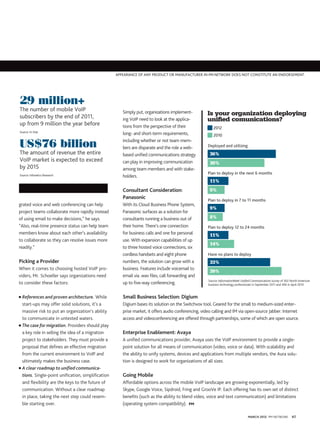
                                      IT Job ouTlook:

                                                                       More
                                                                       Projects,
                                                                       Freezes Persist
                                                                        U.S. companies plan to launch more IT
                                                                        projects in 2012—but that doesn’t necessarily
                                                                        mean a jump in job openings or salaries.
                                                                            Even as a talent war rages in Silicon Valley,
                                                                        career prospects remain sluggish overall. Infor-
                                                                        mationWeek’s Outlook 2012 report found that
                                                                        56 percent of the 605 U.S.-based tech profes-
                                                                        sionals surveyed planned increased tech spend-
                                                                        ing, and three-quarters reported heightened
                                                                        demand for new IT projects. However, the
                                                                        survey also found that hiring freezes will persist
                                                                        for nearly one-third of companies, and 36 per-
                                                                        cent said they’ll only fill openings for existing
                                                                        positions. The survey posits that outsourcing,
                                                                        virtualization and cloud computing are allow-
                                                                        ing companies to get by with smaller staffs.
                                                                            Overall IT compensation also remains
                                                                        flat, according to a tracking survey by Janco

                                                                                                                   March 2012 PM NETWORK   11
thePulse

                                       Different Skills, Different Fates
                                       Not all IT project professionals                         computing skills will have no        and oil and gas sectors—are
                                       are mired in a soft job market.                          trouble finding work.                struggling to fill roles, he says.
                                           “In the IT world, there are                             IT project managers frus-             “The ideal mix is someone
                                       always skill shortages in the                            trated with the U.S. market          who is bilingual with a project
                                       growth technologies, and                                 may also want to look beyond         management background and
                                       many IT organizations have no                            their home borders.                  knowledge of finance or engi-
                                       choice but to pay up for those                              “Many clients come to us          neering,” Mr. Shanahan says.
                                       skills or turn to service provid-                        who are developing projects              In Brazil, IT project man-
                                       ers for in-demand expertise—                             worldwide, and they’re looking       agers who speak English,
                                       and pay a premium,” according                            for project managers who can         Portuguese and Spanish can
                                       to Computer Economics’ 2012                              run big integrated projects,”        virtually write their own tick-
                                       IT Salary Report.                                        says Keric Shanahan, Experis,        ets, he says. “It’s taking 60 to
                                           Dice.com predicts that                               Atlanta, Georgia, USA.               90 days to fill many of these
                                       IT professionals with .Net,                                 Companies in Brazil and           high-tech roles, and the more
                                       mobile application develop-                              India—particularly in the            specific the request, the longer
                                       ment, virtualization and cloud                           finance, mining and metals,          it takes.”


                                                Associates and eJobDescription.com. The                             experience should find opportunities. Proj-
                                                total mean compensation for IT professionals                        ect management ranked number five on IT
                                                across North America increased only 0.81 per-                       recruitment website Dice.com’s list of priority
                                                cent last year to US$78,229 from US$77,604                          skills to hire for 2012, for example.
           “The best                            at the beginning of 2011. And even that came                            IT project managers looking to build their
       opportunities                            with a major caveat: The bump only put com-                         marketability should focus on honing their
              require                           pensation back to January 2008 levels.                              business analytic skills and demonstrating

         people who                                 Overall, 2012 doesn’t look all that promis-
                                                ing on the salary front. Computer Economics’
                                                                                                                    the strategic value they’ll bring to a project,
                                                                                                                    says Keric Shanahan, PMP, director of global
            can wear                            2012 IT Salary Report revealed that the aver-                       project management at Experis, an engineer-
       that business                            age pay raise for U.S. IT workers will be a less-                   ing, IT and finance resourcing firm in Atlanta,
         hat and not                            than-dazzling 2.8 percent, with little variance                     Georgia, USA.
          only run a                            for experience or position.                                             “The best opportunities,” he says, “require
                                                    Despite the mediocre market, project                            people who can wear that business hat and not
         project, but                           professionals with the right combination                            only run a project, but justify the requirements
          justify the                           of technical skills and project management                          that go into it.” —Sarah Fister Gale
       requirements
              that go                           Down and Out
             into it.”                          IT employment in the United States remains flat.
                                             EmploymEnT (in Thousands)


          —Keric Shanahan, PMP, Experis,
                   Atlanta, Georgia, USA                                 3,200


                                                                         3,000


                                                                         2,800


                                                                         2,600
                                                                                 2000   2001   2002   2003   2004    2005    2006        2007        2008         2009        2010

                                                                                               u.s. naTional novEmbEr EmploymEnT for iT by yEar
                                                                                                                                 Source: U.S. Bureau of Labor Statistics/Janco Associates


  12   PM NETWORK March 2012 WWW.PMI.ORG
East Africa Looks for                                                                                              Uganda
                                                                                                                                            Kenya


          Strength in Numbers
                                                                                                                         Rwanda
                                                                                                                       Burundi


          More than three decades after its first attempt             Not everyone is quite so bull-                                  Tanzania       Indian Ocean
          fizzled, the East African Community (EAC) is            ish on the prospects of the EAC
          once again positioning itself as an economic pow-       becoming a new project hot spot—
          erhouse in Africa. By combining forces, Kenya,          especially within the hoped-for schedule.
          Rwanda, Tanzania, Burundi and Uganda aim to                 The EAC leadership’s timeline for
          pull in investment to support and sustain eco-          regional integration is highly unrealistic, says
          nomic growth—and projects—across the region.            Mark Bohlund, senior economist, Sub-Saharan
              The EAC was first founded in 1967, but dis-         Africa at IHS Global Insight, London, England.
          banded 10 years later due to intense political          “The East African Common Market Protocol is
          infighting. It was revived in 2000, and in recent       nowhere near implemented, and when the leader-
          years, the consortium has seen steady economic          ship set those targets, they took little notice of their
          growth. Combined real GDP increased 5.9 percent         ability to meet them,” he explains.
          in 2010, compared to a 4.9 percent global rate.             The European Union took close to 50 years to
          In 2012, the World Bank predicts EAC econo-             achieve similar results, he says, “and they had supe-
          mies will expand between 5 and 7.6 percent, with        rior capacity during that time.”
          Rwanda and Tanzania leading the pack.                       The EAC region is also under renewed pres-
              That kind of growth is a powerful step toward       sure to deal with rising security issues, including
          the EAC’s goal of establishing a common currency        piracy, cyber crime, terrorism, human trafficking
                                                                                                                             Traffic
          this year and forming a political federation in 2015.
          A single currency—patterned after the euro—
                                                                  and money laundering. Beatrice Kiraso, EAC
                                                                  deputy secretary general in charge of politi-              Jams Stall
          could ease regional companies’ concerns about           cal federation, has said she’s worried that the            Growth?
          exchange rates and spur project activity.               threats, if left unaddressed, could greatly under-         Whether project investors
                                                                                                                             come or not could depend on
              The group has already opened up borders of all      mine regional integration.                                 the ability of East Africa Com-
          member states for labor and capital, and has a cus-         There are also economic realities to contend           munity countries to address
          toms union, common market, legislative assembly,        with. Burundi remains one of the world’s poor-             their abysmal infrastructure.
                                                                                                                             Investments in infrastructure
          bank and court. There are even calls to let South       est nations, still recovering from the wounds of a         in Sub-Saharan Africa have
          Sudan and the Democratic Republic of the Congo          decade-long civil war.                                     averaged about US$10 billion
          join the bloc.                                              Still, Mr. Bohlund says the nation has made            per year, which is only half
                                                                                                                             of what is needed to support
              As things stand, the efforts have sparked a         progress in improving its business environment
                                                                                                                             sustained economic growth,
          jump in intraregional trade from US$1.8 billion         over the past year; the World Bank ranked it eighth        according to the World Bank
          in 2005 to US$2.7 billion in 2008, according to a       on its 2012 list of the top business reformers.            Group.
          report in Financial Times. “The EAC is the fastest-         Rwanda, too, has made tremendous strides                   Port and transportation
                                                                                                                             network projects could make
          growing of all the Africa regional economic com-        in improving its business landscape. The World             or break the community’s
          munities,” Donald Deya, CEO of the Pan African          Bank’s Ease of Doing Business index ranked the             future, argues IHS Global
          Lawyers Union, told the U.K. financial newspaper.       country 45th in 2012, taking into account 10 cat-          Insight’s Mark Bohlund. 	
                                                                                                                                 Projects such as the mas-
              The potential for even more growth is signifi-      egories, including ease of securing construction           sive retrofit of the dilapidated
          cant: The EAC nations have more than 133 million        permits, access to electricity, credit availability and    Kenya-Uganda railways by
          people, with a combined GDP of US$80 billion.           protection for investors.                                  the Rift Valley Railways con-
                                                                                                                             sortium must be completed
              “We want to make business easier for the                “This makes Rwanda attractive for foreign
                                                                                                                             for the region to sustain any
          business community and to also make life easier         investors in spite of its small size and lack of           economic growth, he says. “If
          for East Africans,” Owora Richard Othieno, head         natural resources,” Mr. Bohlund says. “Many com-           they are successful with these
          of the EAC’s Department of Corporate Com-               panies can use Rwanda as a base for project opera-         kinds of projects, it should
                                                                                                                             have large implications for
          munication and Public Affairs, told Public Radio        tions due to its superior business environment.”           the cost of doing business in
          International.                                              Kenya, on the other hand, ranked 109th, falling        this region.”

                                                                                                                                    March 2012 PM NETWORK   13


PMN0312 1-17.indd 13                                                                                                                                        2/22/12 11:46 AM
thePulse

  three positions from the year before. But its advanced economy, size, location and                            in neighboring countries. “Tanzania is afraid
  thriving private sector give it many distinct advantages over its peers, Mr. Bohlund                          Kenyans will buy up its land, and Uganda fears
  says. Its strong banking sector and prime location on the Indian Ocean make it the                            Kenyans will take all their skilled labor jobs,” Mr.
  business and transportation hub for the entire region. “If you want to go to East                             Bohlund says.
  Africa, the easiest way is to go through Kenya,” he notes.                                                        Yet part of the bloc’s power is based on making
      Kenya may in fact be too strong. Its advanced economy could create tension                                the most of each member’s individual strengths.
  among other members, particularly when it brings its own citizens to run projects                             Both Tanzania and Uganda, for example, have
                                                                                                                huge oil deposits, making them attractive destina-
                                                                                                                tions for mining and energy projects. In January,
  Real GDP Growth Rates                                                                                         Tanzania announced that it had begun working
                                                                                                                on strategies to prepare the economy to better
   Partner State          2005       2006            2007          2008           2009            2010
                                                                                                                accommodate natural gas investments. The gov-
   Burundi                  0.9       5.5             3.6            4.5           3.5             3.9
                                                                                                                ernment is planning a major project to construct
   Tanzania                 7.4       6.7             7.1            7.4           6.0             7.0
                                                                                                                a gas pipeline from Mnazi Bay in Mtwara to Dar
   Uganda                  10.0       7.0             8.1           10.4           3.9             5.6
                                                                                                                es Salaam to be operational by the end of 2012,
   Kenya                    5.7        6.1            7.0             1.7          2.6             5.6
                                                                                                                according to Daily Monitor.
   Rwanda                   7.2       6.5             7.9           11.2            6.1            7.5
   EAST AFRICA              6.2       6.4             6.7            7.0           4.4             5.9              They may have joined forces, but each nation
                                                                                                                is wisely carving out its own niche.
                                                                                     Source: Partner States
                                           Note: Rates for Uganda were computed using GDP in local currency     —Sarah Fister Gale


                                                                                                              RIDERS


  Chicago
                                                                                                              GOAL: Complete the project without alienating
                                                                                                              commuters


  Rail Project
                                                                                                              CHALLENGE: The team has already exceeded the
                                                                                                              federally required efforts to inform the public during
                                                                                                              the planning and early construction stages. Follow-


  Puts a Lot
                                                                                                              ing the model of a decade-long CTA project to reno-
                                                                                                              vate the Brown Line completed in 2009, the Red
                                                                                                              Line team holds frequent community meetings.

  On the Line                                                                                                     “Input from public stakeholders—community
                                                                                                              leaders, elected officials, residents and transit
                                                                                                              riders—can inform decisions about project scope,
                                                                                                              scheduling and phasing,” says CTA spokeswoman.
  Every weekday, more than 250,000 rail                                                                       Catherine A. Hosinski.
  commuters ride the Red Line that connects
  the north and south sides of Chicago, Illinois,
  USA. Running 24 hours a day, seven days a
  week, it’s the city’s busiest line. Given that
  kind of traffic, the Chicago Transit Author-
  ity (CTA) decided to launch a US$1 billion
  mega makeover that covers track replace-
                                                               TRACK
  ment, station upgrades and power system                      GOAL: Replace dilapidated tracks over the approximately
  enhancements. Now the agency just needs                      10-mile (16-kilometer) stretch between 18th and 95th
                                                               streets to eliminate so-called “slow zones” where trains
  to figure out how to do all that within bud-                  must operate at 15 miles (24 kilometers) per hour, instead
  get, on schedule—and with minimal disrup-                    of the optimal 55 (89)
  tion to the city’s stakeholders.                             CHALLENGE: The Red Line travels through residential and
                                                               business areas, restricting the times that crews can labor
                                                               on the project. And because the line runs at grade on the
                                                               median of a major expressway, work must be scheduled
                                                               within space limitations and coordinated with the state
                                                               transportation department that oversees the expressway.


  14   PM NETWORK MARCH 2012 WWW.PMI.ORG
SENSING BRIDGE                                                              loads, weather, and other issues that cause damage or deterioration.”
                                                                                                               The issue is figuring out which bridges are fine and which ones

                               PROBLEMS BEFORE                                                             need repair.
                                                                                                               Making the wrong choice could lead to sudden closure of a criti-

                               IT’S TOO LATE                                                               cal transportation link—or worse, a collapse. In 2007, the eight-lane
                                                                                                           Interstate 35 bridge over the Mississippi River in Minneapolis, Min-
                                                                                                           nesota, USA, collapsed during evening rush hour, killing 13 people
                               Cash-strapped U.S. municipalities are playing a dangerous game              and injuring 145. It was the fifth-busiest bridge in the state, and was
                               with aging bridge infrastructure, often postponing maintenance proj-        out of commission for more than a year.
                               ects until absolutely necessary. But they now have a new weapon:                Using sensors can help municipalities better manage risk and align
                               high-tech tracking sensors that can better pinpoint those bridges in        maintenance funds with the bridges in the greatest need of repair.
                               need of immediate renovation.                                                   “Traditional metrics rely on visual inspections,” Dr. Sanayei says,
                                    “Using these sensors, we can increase safety, reduce risk and save     but that information should be complemented with sensors placed
                               millions of dollars annually by focusing investments on those bridges       around the structure to track strains and stresses associated with
                               that require fixing,” says Masoud Sanayei, PhD, a professor in the          everyday usage that cannot be easily found with visual inspections.
                               department of civil and environmental engineering at Tufts Univer-              Dr. Sanayei and his team are completing a pilot project to test the
                               sity in Medford, Massachusetts, USA.                                        technology on a bridge in Barre, Massachusetts. With support from
                                   “Just because a bridge is old doesn’t mean it will collapse,” he        the National Science Foundation, the team installed more than 200
                               explains. “It depends on how well it’s been built and maintained, traffic   sensors on the span. The data collected will then be compared to a


                                                                                                                                        STATIONS
                                                                                                                                        GOAL: Revamp aging and sometimes run-
                                                                                                                                        down stations, including adding elevators and
                                                                                                                                        rehabbing the platform and mezzanine at the
                                                                                                                                        69-year-old Clark and Division stop
                                                                                                                                        CHALLENGE: The work could entail multiple
                                                                                                                                        and simultaneous speed restrictions, single-
                                                                                                                                        track operations and temporary track closures—
                                                                                                                                        all while the station stays operational. That
                                                                                                                                        means the project team must develop not only
                                                                                                                                        service plans that reflect the multiple construc-
                                                                                                                                        tion projects, but also new service contingency
                                                                                                                                        plans for any unplanned interruptions, says Ms.
                                                                                                                                        Hosinski.
IMAGES COURTESY OF WIKIPEDIA


                                                                                                                         SUBWAY
                                                                                                                         GOAL: Upgrade the ventilation system on the underground
                                                                                                                         portion of the Red Line that runs through downtown
                                                                                                                         CHALLENGE: The bulk of Chicago tourists visit sometime
                                                                                                                         during May through October—and most of them congregate
                                                                                                                         downtown. Those additional passengers require the project
                                                                                                                         team to schedule accordingly and communicate any changes.


                                                                                                                                                         MARCH 2012 PM NETWORK     15
thePulse

                                                                                                          them is fairly small, whereas if the problem is left
                                                                                                          undiscovered it can lead to more costly problems.”
                                                                                                              Dr. Kalantari founded his company, Resen-
                                                                                                          sys—a startup funded by the University of Mary-
                                                                                                          land—to commercialize a technology that uses
                                                                                                          wireless sensors installed on bridges to track strain,


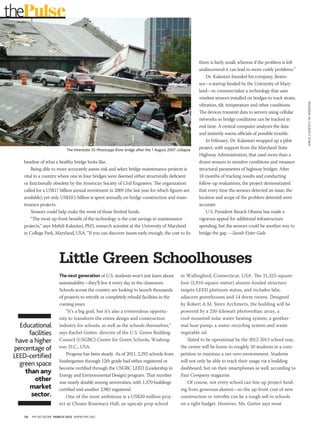
                                                                                                                                                                   IMaGE cOuRTEsy Of WIKIPEdIa
                                                                                                          vibration, tilt, temperature and other conditions.
                                                                                                          The devices transmit data to servers using cellular
                                                                                                          networks so bridge conditions can be tracked in
                                                                                                          real time. A central computer analyzes the data
                                                                                                          and instantly warns officials of possible trouble.
                                                                                                              In February, Dr. Kalantari wrapped up a pilot
                            The Interstate 35 Mississippi River bridge after the 1 August 2007 collapse   project, with support from the Maryland State
                                                                                                          Highway Administration, that used more than a
     baseline of what a healthy bridge looks like.                                                        dozen sensors to monitor conditions and measure
         Being able to more accurately assess risk and select bridge maintenance projects is              structural parameters of highway bridges. After
     vital in a country where one in four bridges were deemed either structurally deficient               18 months of tracking results and conducting
     or functionally obsolete by the American Society of Civil Engineers. The organization                follow-up evaluations, the project demonstrated
     called for a US$17 billion annual investment in 2009 (the last year for which figures are            that every time the sensors detected an issue, the
     available), yet only US$10.5 billion is spent annually on bridge construction and main-              location and scope of the problem detected were
     tenance projects.                                                                                    accurate.
         Sensors could help make the most of those limited funds.                                             U.S. President Barack Obama has made a
         “The most up-front benefit of the technology is the cost savings in maintenance                  vigorous appeal for additional infrastructure
     projects,” says Mehdi Kalantari, PhD, research scientist at the University of Maryland               spending, but the sensors could be another way to
     in College Park, Maryland, USA. “If you can discover issues early enough, the cost to fix            bridge the gap. —Sarah Fister Gale


                        Little Green Schoolhouses
                        The next generation of U.S. students won’t just learn about              in Wallingford, Connecticut, USA. The 31,325-square-
                        sustainability—they’ll live it every day in the classroom.               foot (2,910-square-meter) alumni-funded structure
                        Schools across the country are looking to launch thousands               targets LEED platinum status, and includes labs,
                        of projects to retrofit or completely rebuild facilities in the          adjacent greenhouses and 14 dorm rooms. Designed
                        coming years.                                                            by Robert A.M. Stern Architects, the building will be
                            “It’s a big goal, but it’s also a tremendous opportu-                powered by a 250-kilowatt photovoltaic array, a
                        nity to transform the entire design and construction                     roof-mounted solar water-heating system, a geother-
   Educational          industry for schools, as well as the schools themselves,”                mal heat pump, a water-recycling system and waste
       facilities       says Rachel Gutter, director of the U.S. Green Building                  vegetable oil.
  have a higher         Council (USGBC) Center for Green Schools, Washing-                           Slated to be operational by the 2012-2013 school year,
 percentage of          ton, D.C., USA.                                                          the center will be home to roughly 20 students in a com-
                            Progress has been steady. As of 2011, 2,292 schools from             petition to maintain a net-zero environment. Students
 LEED-certified
                        kindergarten through 12th grade had either registered or                 will not only be able to track their usage via a building
   green space
                        become certified through the USGBC LEED (Leadership in                   dashboard, but on their smartphones as well, according to
     than any           Energy and Environmental Design) program. That number                    Fast Company magazine.
         other          was nearly double among universities, with 1,370 buildings                   Of course, not every school can line up project fund-
       market           certified and another 2,982 registered.                                  ing from generous alumni—so the up-front cost of new
        sector.             One of the most ambitious is a US$20 million proj-                   construction or retrofits can be a tough sell to schools
                        ect at Choate Rosemary Hall, an upscale prep school                      on a tight budget. However, Ms. Gutter says most

     16   PM NETWORK March 2012 WWW.PMI.ORG
[metrics]                                  The laTesT
                                           sTaTisTics, surveys
                                           and sTudies


InsIde the CIO’s AgendA
Where they’re spendIng
more than half of CIos said their project investments would include:                                                                                   As most
wIndows 7                           server                           networK-Based                                 dAtA                                CIOs are
mIgrAtIOn vIrtualIzatIon                                              seCurIty                                 proteCtIon
                                                                                                                                                       direct
                                                                                                                                                       reports to

38%
of CIos were plannIng to
launCh data Center Con-
                                                                        of those,
                                                                        67 perCent
                                                                        Intend
                                                                        to adopt
                                                                        server
                                                                        vIrtualIza-
                                                                                                                                                       the CEO
                                                                                                                                                       or have a
                                                                                                                                                       seat at the
solIdatIon projeCts In 2012
                                                                        tIon.
                                                                                                                                                       executive
                                                                                                                                                       table, the

25%                                                                                                                                                    salary
                                                                        of those,
                                                                        55 perCent
                                                                        are Imple-
                                                                        mentIng
                                                                        software
                                                                                                                                                       and com-
saId they’ll IntroduCe
Cloud ComputIng
                                                                        as a servICe
                                                                        (saas).                                                                        pensation
                                                                                                                                                       needs
                                                                                                                                                       to be in
                 source: techtarget. results based on a survey of 2,642 global It professionals and business analysts published in january.


                                                                                                                                                       line with
the BOttOm LIne                                                                                                                                        [that of]
US$144,000                                                                 the average base salary of
                                                                           senior It executives in 2011
                                                                                                                                                       the busi-
                                                                                                                                                       ness line
                                                                                                                                                       leaders
                          The portion of                                                                                                               reporting
                          IT executives
                          who took on
                                                                                                           The portion of
                                                                                                           IT executives                               at that
                          new roles in
                          2011 in pursuit
                                                                                                           who reported
                                                                                                           a decrease in                               level.
     45%                  of greater
                          compensation
                                                                              17%                          compensation
                                                                                                           in 2011
                                                                                                                                                       —daniel m. ryan, CIo, City of Battle Creek,
                                                                                                                                                       michigan, usa


                                              source: CIo/It strategy media group. results based on a survey of more than 1,700 global It executives and professionals conducted in november 2011.


18   pm networK March 2012 www.pmI.org
taken to the
        the CryStal Ball                                                                                                                                     CleanerS


         49%                                                     the portion of executives in developing mar-
                                                                                                                                                             US$8.99 billion
                                                                                                                                                             The global spending on clean
                                                                 kets who expected the global economy to get
                                                                                                                                                             tech investments in 2011, a
                                                                 worse in the first six months of 2012
                                                                                                                                                             13 percent jump over 2010


         39%                                                     the portion of executives in developing mar-
                                                                 kets who expected their own economies to
                                                                 get worse in the first six months of 2012

        Source: Economic Conditions Snapshot, McKinsey Quarterly. Results based on a survey of 2,299 global executives across industries conducted
        in December 2011.
                                                                                                                                                              The increase
                                                                                                                                                              in clean tech
                                                                                                                                                              investments
                                                                                                                                                                in North
                                                                                                                                                                 America


Career ConneCtionS                                                                                                                                                  +
                                                                                                                                                                30%
                                                                                                                                                                                             -
     92% of our U.K. program and project management practitioners have a
     LinkedIn account

                                                                                                                                                                                        30%
                                                                                                                                                                                            The
                                                                                                                                                                                        decrease in
                                                                                                                                                                                        clean tech
     55% of those had been approached                                                                                                                                                  investments
     about a job opportunity through the                                                                                                                                                 in Europe
     social media network in the 12 months                                                                                                                                               and Israel
     prior to the survey

Source: 2012 Arras People Programme and Project Management Census, Arras People. Results based on an ongoing survey of 1,000 U.K. project                    Source: Quarterly Investment Monitor Report,
and program management practitioners who were actively looking for a new position in 2011.                                                                   Cleantech Group


Shopping networkS
The average number of consumer online purchases per person per month:


                                                                                                                                                                    90 perCent
                                                                                                                                         netherlandS: 2.6


                                                                                                                                                                    Of ChINESE
                                                                                                             FranCe: 2.6


                                                                                                                                                                    ONlINE
  China: 8.4


                                           USa: 5.2


                                                                               Uk: 4.3


                                                                                                                                                                    ShOPPERS
                                                                                                                                                                    USE SOCIAl
                                                                                                                                                                    MEDIA.

“Today’s global retailers have a huge opportunity to enhance the mechanisms necessary
to keep up with shoppers who are demanding more customization in terms of delivery
and returns, product choice and number of channels from which to choose.”
                                                                      Source: Customers Take Control, PwC. Results based on a survey of 7,005 consumers across three continents published in December 2011.


                                                                                                                                                                       March 2012 PM NETWORK            19
Voice

             Can you be a true project leader if you don’t have the power
Peer to
 Peer


             embedded in an organizational hierarchy?
             Two project professionals discuss what it takes to be


      Leadership Without
      Authority
                         Pat Weaver, PMI-SP, PMP: Some project managers are completely responsible for the on-
                         time, on-budget performance of work—but many organizations refuse to give them any control
                         over the people needed to do the work. The project manager is blamed for not achieving time
                         and cost outcomes.
                            This is a failure of organizational governance, which is the responsibility of executives,
                         and it’s all too common. A project manager with brilliant leadership capabilities, managing

      20   PM NETWORK March 2012 WWW.PMI.ORG
Pat Weaver, PMI-SP, PMP, is managing
                                                                                       director of Mosaic Project Services pty Ltd.,
                                                                                       a project management training and con-
                                                                                       sulting company in Melbourne, Australia.


                                                                                       Roberto Guandique is an Atlanta, Georgia,
                                                                                       USA-based partner at RTI (RealTech
                                                                                       International Inc.), an IT consulting and
                                                                                       training firm.


                                                                        and initiative. He or she does not need anybody to present the
                                                                        mantle of “authority.”

                                                                        Mr. Weaver: Leadership without management backup tends
                                                                        to create a mob on the rampage in one form or another. How-
                                                                        ever, far too many project managers rely on authority and have
                                                                        unhappy, unproductive workers in their team. The only way
                                                                        you become a true leader is if others decide to follow you. Your
                                                                        power, authority, position and management skills are largely
to make decisions or aren’t                                             irrelevant.

                                                                        Mr. Guandique: Yes, Mr. Weaver, nobody becomes a leader
an effective leader.                                                    without followers. But the true leader does not want followers;
                                                                        he or she wants to teach others how to be leaders. When I teach
                                                                        our junior people, I am trying to teach them to become inde-
                                                                        pendent, to give them autonomy. What I am trying not to do
  upwards, can sometimes overcome these hurdles, but good               is to have them depend on me to do what they are supposed to
  governance should be focused on removing those obstacles in           do themselves. This might seem like a paradox, but I think that
  the first place.                                                      every leader wants that.

  Roberto Guandique: Neither authority nor position will make           Mr. Weaver: Mr. Guandique, you’re correct—effective leader-
  you a leader. I see many professionals who, because they have         ship is embedded in the motivations of the people who elect to
  been given authority by someone higher up, think they are lead-       be your followers, and one of the key motivators is autonomy.
  ers. If that were the case, any fool with authority could be called   Good followers and good team members are also good leaders in
  a leader.                                                             their own right or aspire to become good leaders.
      When I was new in my career, I thought you needed author-
  ity to be a leader, but not anymore. If a person needs authority      Mr. Guandique: I have seen project managers who act domi-
  to lead, he or she is not a leader but a manager. A leader leads by   neering in order to be in control. It’s sad—many of the more
  pure charisma, dedication, engagement, knowledge, experience          experienced project managers are the ones who try to apply this

                                                                                                                        March 2012 PM NETWORK   21
Those who rely on
                                   authority or position are
                                   the worst leaders—and
                                   the most common.
                                           —Roberto Guandique, RTI, Atlanta, Georgia, USA


“behavioral leadership style,” and most of the time
with negative results.

Mr. Weaver: The fight to climb up the corporate
ladder in most Western corporations and bureau-
cracies, such as those in the United Kingdom, the
United States and Australia, does encourage selfish behaviors.            who people are following. Following can take many forms: the
Then, after succeeding in the corporate jungle, those same                person who is asked for advice to solve complex problems, the
people must become holistic, generous and supportive to be                person who is asked to help in negotiations or discussions, the
really effective top-level executives. It’s a hard task, and only a       person who is listened to in a meeting.
few succeed.                                                                 Leaders do not need to rely on power or authority; in fact,
                                                                          leaders can manage without formal authority if their followers
Mr. Guandique: If a leader is constantly living to the “Super-            are happy to follow.
man syndrome” created by some societies, he or she burns out
and the organization collapses. Leaders need to create other              Mr. Guandique: Sometimes the “I have 30 years’ experi-
leaders so they can take care of other personal and professional          ence and I have seen it all” mentality is the cause of failed
matters.                                                                  leadership in projects as well. We need to renew the way we
    A leader can be anybody who shows initiative to lead. Leader-         approach leadership in project management. Young, inexpe-
ship can be taught, but not everybody who goes to leadership              rienced project managers are more open to new paradigms,
training school becomes a leader. He or she must know the                 and eventually I believe they will be the
responsibility and sacrifice of leading.                                  ones who will change the approach to
                                                                          leadership.
Mr. Weaver: Leadership can be taught—but not in school. Core
traits include integrity and trust, which are innate, as well as great    Mr. Weaver: I completely disagree with
communication skills and efficient management capabilities, par-          Mr. Guandique on this point. Many of the            Join the
ticularly delegation. The last three can be taught or improved.           important traits that help leaders lead tend        discussion in
                                                                          to accumulate with age. Where older people          the Career
                                                                                                                              Central
Mr. Guandique: With so many employees, managers and “wan-                 can be at a disadvantage is cultural—what
                                                                                                                              group on
nabes” pretending to be leaders these days, how do we recognize           worked 20 years ago probably won’t be               LinkedIn.
a true leader?                                                            much use today.
    In my opinion, a leader does not try to blind us with his or              But the traits of any effective leader
her brilliance; a true leader makes us see ourselves so we can get        include a burning desire to keep on learn-
better. Few project managers I know have shown this capability.           ing, linked with flexibility, adaptability and the ability to
Those who rely on authority or position are the worst leaders—            develop rapport with and motivate their followers. Stuck-in-
and the most common.                                                      the-mud project managers who want to do the same things
                                                                          they did 10, 20 or even 30 years ago aren’t leaders—and aren’t
Mr. Weaver: If someone has to tell you they are a great leader,           very good managers. Great leaders are continually adapting to
they probably are not! To identify a leader, you just have to see         the needs of the situation and the needs of their followers. PM

22   PM NETWORK March 2012 WWW.PMI.ORG
Teresa Knudson, PMP, Mayo CliniC,
                                                    roChesTer, MinnesoTa, usa                              voices From the Top


Regular
Checkups
T       o keep ahead of the constant changes in the health-
        care sector, the world-renowned Mayo Clinic is rely-
        ing on robust project practices led by its enterprise
        portfolio management office (EPMO).
    Teresa Knudson, PMP, launched the EPMO after years
of working with senior leaders to develop project manage-
ment practices. Four years later, the prognosis is good. The
                                                                     ency. With the new portfolio system, every project must
                                                                     align to one of the eight portfolios to indicate ownership and
                                                                     to ensure that we are investing our resources in the projects
                                                                     that provide the most value to our patients. This streamlines
                                                                     and reinforces both the ownership and approval processes,
                                                                     and avoids projects working around the system.

EPMO has provided better oversight of the project portfolio,         Has the organization’s approach to
greater transparency over project progress, and a formal             project approval shifted?
structure for portfolio and project management that ensures          In the past, there were various avenues for project approval
these processes align with the clinic’s strategic goals, she says.   and funding, with inconsistency in the decision-making.
    “In the past, everyone adapted project management to             When we introduced standardized processes, the number
their own needs. Now we use A Guide to the Project Man-              of new projects seeking approval dropped from about 80
agement Body of Knowledge (PMBOK® Guide) and internal                to about 40 in the first year as project sponsors realized the
and external best practices as a basis for our project manage-       need for more information to support their business case.
ment practice,” Ms. Knudson says. “This hybrid approach              Leadership, in turn, had a better understanding of the proj-
has allowed us to follow a common methodology, structure             ects being proposed, which helped the prioritization and
and processes in all areas of our organization.”                     decision-making. As a result, 16 of the 40 proposed projects
                                                                     were approved.
What was the EPMO’s initial mission?                                     Now there’s much more visibility and structure. Every-          For us, the
Our first goal was to gain a better awareness of the projects        one completes the same four-page project charter docu-              best approach
that were underway and ensure that they were properly                ment that includes core data about the project goals, value,        was to utilize
aligned to our organizational objectives.                            alignment with strategic plans, objectives, risks, and required     a top-down
    We had an initial listing of about 26 projects, but those        costs and resources.                                                implementa-
were only the ones requiring US$5 million or more in capital                                                                             tion process
investments. After interviewing managers across the orga-            What advice would you offer other                                   that focused
nization, we discovered there were more than 400 projects            organizations about launching an EPMO?                              on the port-
ongoing. Some were listed twice, by different stakeholders;          As you begin, keep it simple. For us, the best approach was
                                                                                                                                         folio man-
some were listed as active even though they were completed;          to utilize a top-down implementation process that focused
and other projects had the same goals but were being deliv-          on the portfolio management needs of our senior leader-
                                                                                                                                         agement
ered multiple ways by different teams.                               ship. This provided immediate value to our senior leaders,
                                                                                                                                         needs of
    It became obvious very quickly that we needed better             who have since been able to reinforce its use across the            our senior
oversight.                                                           organization.                                                       leadership.
                                                                         The most important advice, however, is that you need to
How did you increase oversight?                                      continually look for ways to provide the most value to your
We broke the portfolio of 400 projects into eight enterprise         organization. This requires a good roadmap that is updated
portfolios that corresponded directly with Mayo Clinic’s             regularly, continual learning, and the ability to evolve and
leadership structure. Doing that created instant transpar-           improve. PM

                                                                                                                            March 2012 PM NETWORK   23
TRend Watch


                                                                         Here’s how to develop the kind of
       Leadership                                                        vision that can take you—and your
                                                                         team—to new levels.
         CounseL

T
                                                                         by RobeRto toledo, MbA, PMP, ContRibuting editoR


  The project management profession has evolved significantly since its early           his or her team but regularly reinforces and
  years. It is undeniable that one aspect that has become increasingly relevant is      checks on team members’ progress and
  how we look at the importance of people skills.                                       accomplishments.
      As project managers, technical knowledge is at the core of our toolbox. But       Be proactive. Turn visions into goals and assist
  people skills are what enable us to thrive in the profession.                         the team in achieving these goals. A leader
      Leadership may very well be a project manager’s most important “soft” skill. It   does not just dictate orders but provides the
  is the amalgamating ingredient of effective team dynamics, which is a determining     necessary momentum and the right environ-
  factor in achieving project goals. Projects have deliverables to produce, processes   ment for the team to achieve the desired goals.
  to follow and information to constantly communicate to stakeholders. Without a        always say “please” and “thank you.” Never
  leader imparting vision, motivation, knowledge and control (sometimes in a subtle     underestimate the power of politeness and
  way), a project has the potential to lose its focus and fail.                         gratitude to your teammates in building a
                                                                                        strong bond.
  Here are some basic ideas that can help you kick-start your development process.
  You were not born a leader. Leadership is a skill that is nurtured and cultured       In the end, the definition of a good leader is
  over time; you must practice and develop it.                                          rather simple: a person who accomplishes
  Lead by example. In general, people follow what they see in others. Set an            project goals while simultaneously developing
  example by exerting the practices and behaviors you want to see in your team.         the people around him or her to a higher level
  Develop your credibility by consistently following up on your words and trans-        as well. PM
  lating them into action.
  Be a “people catalyst.” Best practices dictate that a project is only as success-     Author’s note: Last October, I had the great privilege
                                                                                        to be part of PMI’s 2012 Leadership Institute Master
  ful as its project manager’s ability to effectively communicate with his or her       Class. In preparing this column, I experimented with
  team. Good leaders bring out the best in people. You should be able to com-           crowdsourcing, having three of my closest classmates
                                                                                        collaborate on it. My special thanks to naresh Saharya,
  municate your vision to the team. A good leader would focus on planning               PMP, Kevin Chui, PMP, and Ram Sriram, PMP, for their
  rather than on plans.                                                                 thoughtful insights on the subject.
  Show courage. Take informed, analyzed risks and act without fear.
  Build trust around you. Trust is the basis of relationships and team interac-
                                                                                                    Roberto Toledo, MBA, PMP, is managing partner
  tion. Focus on building trust among your team and between you and your                            of Alpha PM Consulting, a trainer and a consul-
  team members.                                                                                     tant who works across the Americas. He can be
                                                                                                    reached at rtoledo@alphapmconsulting.com or
  Set the strategy and constantly reinforce it. A good project manager trusts                       followed on twitter at @robertoledo.


  24   PM neTWORK March 2012 WWW.PMI.ORG
WhAT’S at Stake


                                                                       The GanTT
                                                                       You MiGhT
                                                                       noT Know
                                              He’s famous for his chart. But a century ago,
                                              Henry Gantt also came up with a revolutionary
                                              means to motivate project teams.


M
                                              by Lynda bourne, dPM, PMP


Most project managers are familiar with the Gantt chart—but there is more to            a bonus was not earned, the cause was inves-
Henry Laurence Gantt’s work than his useful document.                                   tigated, and removed or remedied. The system
    For example, most people think the concepts of stakeholder engagement and           proved highly effective and generated sustained
team motivation are relatively new. But after reading two books by Mr. Gantt, I         productivity improvements, in excess of 100
realized that he introduced these concepts nearly 100 years ago!                        percent.
    Mr. Gantt’s standout contribution was his approach to workforce manage-                 Mr. Gantt recognized that a system of man-
ment. It focused on the efficient use of labor, along with a fair division of rewards   agement requires all of its parts to work in har-
between the workers and factory owners when there was an improvement in pro-            mony if it is to be effective and that “in every
ductivity.                                                                              workroom, there is a fashion, or habit of work,
    His work was influenced by the idea of scientific management, introduced by         and the new worker follows that fashion, for it
Frederick Taylor, who held the theory that the best way to understand a complex         isn’t respectable not to.”
task is to break it down into its component parts. You then study and optimize              Consequently, “the changing of a system of
each part, and find the best way to complete the work from those parts.                 management is a very serious matter and can-
    What made Mr. Gantt’s work uniquely valuable was how he used this infor-            not be done by a busy superintendent in his
                                                         mation to motivate work-       spare time.”
                                                         ers. He recognized that            Today’s takeaway? Detailed planning and
 RecoMMended Reading                                     incentives are a far more      accurate recordkeeping are important, and
 If this column has sparked your interest,               powerful motivator than        charts help in that regard—but only if the plans
 check out henry Gantt’s books Work,                     penalties. Standardized        are realistic and the team is properly trained
 Wages, and Profits and organizing for Work. work was broken into                       and motivated to achieve the objectives. Mr.
                                                         tasks. Once a task had been    Gantt also said that forms “are simply the
                                                         set, each worker received      means to an end. If the end is not kept clearly
individual instruction. When he learned to perform a task during a set time and         in mind, the use of these forms … is apt to be
to the required quality, he was paid a bonus in addition to his daily wage.             detrimental rather than beneficial.” PM
    Supervisors earned rewards as well. A foreman received a bonus for each
worker on his team who received a reward, and the foreman’s bonus doubled if
all of the workers in his team achieved a reward. This encouraged the foreman to                   Lynda Bourne, DPM, PMP, is the managing
                                                                                                   director of Stakeholder Management pty Ltd.
work with and support the least-effective members of the team.                                     and director at Mosaic Project Services pty
    When everyone achieved the bonus, it showed that the plant as a whole was                      Ltd., both in Australia. Dr. Bourne graduated
                                                                                                   from RMIT as the first professional doctor of
working to its optimum productivity and generating maximum profits. Whenever                       project management.


                                                                                                                   March 2012 PM NETWORK      25
voices Project Perspectives


   Can This Project Be Saved?
   You’ve been handed a project that’s failing. Here’s what to do:


   Byron Love, PMP                                          Tony Pashigian                                               David Rodgers
   director of IT consulting services, Intrepid             engineering, program management and sales                    partner and vice presi-
   Solutions, Baltimore, Maryland, USA                      consultant, Grakon, Seattle, Washington, USA                 dent of consulting
                                                                                                                         services at IMPAQ
   Audit the nine Knowl-        is vectored toward          I have been in this situa-     tells everybody the status,   Accountability Busi-
   edge Areas in A Guide        achieving the success       tion and have launched         but it protects you.          ness Solutions, San
   to the Project Manage-       defined by the stake-       the programs smoothly          3. Assess the plan for        Diego, California, USA
   ment Body of Knowledge       holder.                     each time. The steps that      opportunities to compress
   (PMBOK® Guide) for               Because projects are    I go through are:              time or cost and define       I love this type of project,
   the project and gain an      executed by people, you     1. Make sure you clearly       what it costs for the com-    as projects in the red are
   understanding of the         will need an excellent      understand the scope           pression. Get the impact      usually ones that have
   issues that caused the       team to produce the         and have concurrence           in front of management,       the attention of the
   project to go off-track.     results your stakehold-     with the customer on a         stakeholders and pock-        business and that people
       On my projects, I        ers expect. You will        statement of work. You’ll      etbook holders to get         want back on track. The
   always ask the primary       need a cohesive team        never get it out of the        approval to execute.          key is not so much your
   stakeholder for a “state-    that can perform under      red if the finish line keeps   4. Do not wait for            project management
   ment of success,” which      pressure to endure          moving. Scope creep is         approval for time or cost     approach but how you
   is a narrative of the        the increased scrutiny      one thing, but this is a       compression. Get your         work with the stakehold-
   conditions that must be      that your project may       time when customers            team executing, at least,     ers to understand:
   present at the end of        receive.                    often try to get away          the “brutal reality” plan,    1. The urgency from
   the project in order for         Be prepared for         with “elegance creep,”         from step 2. You can’t        a business perspec-
   the primary stakehold-       your leadership to be       or subtle time-sucking or      afford to lose more time.     tive and the ultimate
   ers to consider the proj-    tested, as you may          expensive tweaks to the        5. If the compression         desired results if
   ect successful.              need to fight for new       project.                       solves the issue, then        successful
       The statement of         resources, obtain           2. Define the plan to          monitor closely. If it        2. The risk of not coming
   success will serve as a      additional training for     execute the project at a       doesn’t completely fix        through
   lighthouse to help you       current resources, or       normal pace with no fluff      the issue, you have to        3. The current barriers
   navigate the troubled        discipline and correct      and without regard for         find the strategic time       These three things paint
   seas of a red project.       poor performers. If there   the fact that your cost        and tactical means to         a picture of future suc-
   Once you have that,          are people on your team     or timing does not meet        inform the customer           cess and current reality
   you can then update          who are responsible         expectations. This is the      about the delay and your      that then allows you to
   your project plan, which     for running the project     brutal reality of the situa-   plans to mitigate it. The     use good project man-
   should address the nine      aground, you must hold      tion. You must get this in     earlier they know, the        agement principles to
   PMI Knowledge Areas          them accountable and        front of the stakeholders      more accepting they’ll        rally both stakeholders
   in such a way that each      perhaps replace them.       as soon as possible so         be. A last-minute surprise    and team members in
                                                            they can see what you’ve       miss will likely cause        creating a successful
                                                            inherited. This not only       them to melt down.            strategy.

   26   PM NETWORK March 2012 WWW.PMI.ORG
Gabby Kent, PMP                                                Jon McGlothian, PMP                                     Martin House
student, Warwick Business School, Sydney, Australia            president, The Mt. Olivet Group LLC,                    deployment
                                                               Norfolk, Virginia, USA                                  manager, MindLeaders
I’ve been in this situation    staff from the booking                                                                  ThirdForce, Taunton,
more times than healthy        codes you can see are not       What do you do when          established, a reason-     Somerset, England
projects. Here’s what I’ve     relevant.                       you have been given          able definition of suc-
learned:                       4. Set up a team meeting.       a project that is in         cess can be created.       The first thing to do is
1. Locate the authorizing      Identify what is produc-        trouble?                     5. Create a commu-         to check the risks assess-
sponsor, the senior execu-     tive that people can get        1. Take the emotion          nications plan for all     ment to determine
tive who stands to signifi-    on with, and what the sig-      out of play. Deal with       stakeholders. Keep         whether cost overrun
cantly lose or gain from       nificant issues and actions     the issues, not the          everyone informed          was an acceptable risk at
it (often the financer).       are. Communicate and be         personalities.               about the current sta-     the outset. Don’t assume
Meet with him or her and       transparent about what          2. Determine the exact       tus and next steps.        that the job was wrongly
articulate the approach to     you’re doing.                   financial status of the         Your job then is        budgeted. Check the
getting the situation back     5. Lastly, the situation will   project. It is critical to   to bridge the gap          expenditure audit and
in hand and build confi-       require long work hours         know what resources          between the end-user       compare it to the brief.
dence. For a few weeks,        for a while, and it will be     are available to you.        (the true customer),           Remember the old
you need to remove 90          stressful. Be kind, even        3. Complete a stake-         the stakeholders and       triangle of cost, speed
percent of the people          when others aren’t. These       holder analysis. It          the project team. You      and quality. If the qual-
hassling you so you can        situations are a real test      is especially key to         will have to find com-     ity has been enhanced
focus on the important         of character. Be system-        determine if there is        mon ground between         by feature creep, or the
stuff. The sponsor will        atic as you rescope and         a “silent saboteur” in       the three constituents     project deadlines have
have enough authority to       analyze what’s going on.        the mix.                     and resolve any issues.    tightened, then cost
hold those people at bay.          If the project              4. Understand the            Stay positive in your      overrun wasn’t a prob-
2. You need to figure out      executive is flaky, or          original scope of the        efforts and have confi-    lem until the organiza-
what the project is about      the technical solution is       project. Once this is        dence in your abilities.   tion needed a scapegoat.
as quickly as possible.        fundamentally flawed                                                                        You don’t win or
3. Run the financial           and no one is taking                                                                    lose in project manage-
reports and locate all staff   decisive action (because,                                                               ment—this isn’t about
bookings. Prioritize by        bluntly, there is a reason                                                              you. Own the project,
determining those who          why the project is red),                                                                but in the end, the deliv-
have spent the most time       then take steps to find a                                                               erables are someone
on the project and who         new assignment. Some                                                                    else’s property. The best
have worked on it most         projects are a poisoned                                                                 outcome you can hope
recently. Ask what they’re     chalice, and no amount                                                                  for is happy stakeholders
doing or have done on          of hard work will turn the                                                              (including the finance
the project. Remove all        situation around.                                                                       department).

                                                                                                                       March 2012 PM NETWORK   27
voices In the Trenches


   Unclear on the concept
   Does that job description sound ideal? Think again. Many
   organizations don’t know what a project manager really should do.
   by Grace Willis, PMP


   The ugly truth of project management job opportunities—often discovered after               Another example where I may have botched
   a candidate has been interviewed and hired—is that many hiring managers don’t           “establishes trust” was the time I voiced con-
   really know what a project manager does or is supposed to do.                           cerns to my director about developers who
       The job title “project manager” has been bastardized, with actual role responsi-    thought it was OK to habitually show up late to
   bilities ranging anywhere between that of an administrative assistant to a subject      daily stand-ups and surf the Internet on their
   matter expert and even a software developer.                                            cell phones during sprint planning sessions. I
       The title “project manager” has also been whitewashed in some organizations,        also called out a business product owner who
   given to everyone from a Project Management Professional (PMP)®-certified vet-          didn’t quite understand the concept of locking
   eran to a marketing traffic manager or office coordinator.                              down user stories for a sprint—and instead went
       This happens everywhere from small mom-and-pop operations to Fortune                directly to developers to “sneak in” a request.
   500 corporations.                                                                           The response to my concerns? I was told
       Here’s a summary of (cough, cough) “activities” I’ve been assigned or had to        to turn a blind eye and let the team members
   undertake during my career in project management:                                       do what they wanted.
   n Explain to developers in a purported long-standing agile organization expecta-

     tions of a daily stand-up meeting, what planning poker cards are used for and         Questions to ask—and answers You
     the importance of actually checking user requirements before coding                   Don’t Want to hear
   n Write governance and company policy documents for an application’s in-                Thus far, two hiring managers have admitted
     house use                                                                             to me that they thought they needed me—but
   n Code in XML                                                                           they weren’t quite ready.
   n Organize hotel, car rental and catered lunch for visiting vendors during a project        I resigned from one job after quickly assess-
     strategy session                                                                      ing the lay of the land. In the role, I had pri-
       In all these roles, I worked for executives who hired me as a project manager,      marily sent emails and filled out spreadsheets
   yet when it was time to get down to business, they didn’t know what project man-        with information no one ever read. During
   agement was.                                                                            the two-week period after I gave my notice,
                                                                                           they transitioned this burdensome (I’m being
   Project Manager…or Supernanny?                                                          sarcastic) duty to the receptionist. Yet, when I
   You know that line in the job description that reads, “Excellent interpersonal skills   looked at the job ad for my replacement, they
   and capable of dealing with all levels of staff”? Well, for many hiring managers,       asked for a PMP®-certified project manager.
   this line seems to mean that the project manager is to function like the neighbor-          In another job, I was basically hired to
   hood babysitter—working for “that family with the crazy kids.”                          revive dead-end projects that were never
       The hiring manager is akin to the stressed-out parent who needs Supernanny          properly vetted in the first place. The execu-
   to help clean up the mess of the project, control the team of rogue employees who       tive sponsor took a laissez-faire approach, and
   won’t cooperate and manage the overpriced, underachieving third-party vendor            ignored my recommendation to either kill the
   that no one vetted before contracts were signed.                                        project or start over properly.
       Another catchy line in job descriptions for project managers is the “establishes        So why does this happen and what can be
   trust” requirement. In my career, that has meant sharing personal details with my       done about it? I have two solutions: educate
   boss and team to be perceived as “team player.” I’ve survived everything from a         and interview more thoroughly.
   boss who was comfortable discussing her likely divorce to a developer who felt              The burden is on us project managers to edu-
   free to use team lunches as the opportunity to discuss bodily functions.                cate the hiring community. Part and parcel of
       Supposedly, this was how they established trust. I was told I needed to share       the education process is digging deeper during
   my feelings more.                                                                       interviews. In hindsight, I can definitely say that

   28   PM NETWORK March 2012 WWW.PMI.ORG
I was at fault for having gotten myself
into these roles because of my lazy inter-
viewing approach. Remembering that
interviewing is a two-way street can help
circumvent career mishaps. Interviews
provide an opportunity to learn if the
role is real project management à la
PMI standards…or its evil twin, “faux
project management.”
    Here are some questions that you
absolutely must ask in interviews, and
some warning signs to look for:
n Does your organization have a proj-

  ect management office? (Red flag:
  They don’t know what PMO stands
  for.)
n If they do have a PMO, are the proj-

  ect managers in it PMP-certified?
  (Red flag: No, you’d be the first.)
n Describe the existing project manage-

  ment process. (Red flag: They don’t
                                              The burden is on us ProjecT Managers
  have one, nor can they articulate           To educaTe The hiring coMMuniTy.
  what they expect.)
n Which project management tools are you currently using? (Red flag: Excel            department for which you’re interviewing is
  spreadsheets and emails.)                                                           the only one using it, and the hope is to push
n How familiar is your team with the concept of project management and how            project management tools and techniques
  have they worked with project managers in the past? (Red flag: Long silence.)       from the bottom up.)
n Can you describe a successful project from beginning to end, and what tools,          This is by no means a comprehensive list,
  documents and business procedures were used? (Red flag: No answer.)               but it should definitely help you glean enough
n Can you describe how you would support the project manager’s role within          information to determine if you should run for
  the team and across departments? (Red flag: The expectation is that the project   the hills or prepare yourself mentally for what
  manager relies solely on winning people over with his or her charming person-     you’ll be dealing with. You’ll also know more
  ality to get folks to cooperate.)                                                 about the competence of the person you’re
n Have you had a project manager on this team before and, if yes, why did he        most likely going to be reporting to. So good
  or she leave? (Red flag: “Things just didn’t work out, and we decided to part     luck, colleagues. Go forth and conquer. PM
  ways.” This could be a sign that the project manager fell victim to the scape-
  goat’s guillotine.)
n Would you describe this organization/department as weak, mixed or strong

  matrix? (Red flag: The hiring manager doesn’t have the foggiest idea what                   Grace Willis, PMP, is an independent consul-
                                                                                              tant for business process optimization in the
  you’re talking about.)                                                                      automotive industry in Berlin, Germany.
n Does a project management culture exist organization-wide? (Red flag: The


                                                                                                              March 2012 PM NETWORK      29
WhO’S
GuaRdIN
 ThE
cloud?by SaRah FISTER GalE               IlluSTRaTION © CJ buRTON/CORbIS


30   PM NETWORK March 2012 WWW.PMI.ORG
g
    Putting data into the hands of
      a third Party can save money, but
    the Projects raise a host of security
         concerns. here’s what every
       organization needs to know.


                             March 2012 PM NETWORK   31
What to aSk


1
2
                     O
When vetting cloud vendors for migration projects,
Marc Crudgington, Advantage Sales and Marketing,
Houston, Texas, USA, suggests asking the following
questions:
      how does the center’s recovery plan initiate?
      “You want to find out what triggers the move to
      the disaster-recovery site, how long that move
      will take and how you will gain access to the
      data,” Mr. Crudgington says.
      how long has the vendor been in business?
      How many customers does it have? And how
      financially viable is it? “If they haven’t been a
      provider for a long time, that might be a concern,”
      he says.
                                                             On the cutting edge not so long ago, cloud computing
                                                             is officially mainstream.
                                                                 Looking to cut costs and increase efficiencies, orga-
                                                             nizations are launching projects to move more and
                                                             more data to remote servers. Sixty-one percent of 1,700
                                                             executives from around the world and across sectors
                                                             reported they were using, evaluating or planning to
                                                             implement cloud computing this year, according to a
                                                             2011 survey by consulting giant Ernst & Young.
                                                                 The long-term forecast is also “cloudy,” with orga-
                                                             nizations reporting cloud computing’s share of the IT
                                                             spend will jump from 10 to 70 percent over the next
                                                             decade, according to Carbon Disclosure Project’s 2011
                                                             Cloud Computing: The IT Solution for the 21st Century
                                                             survey.
                                                                 Those high adoption rates, however, mask the seri-
                                                             ous issue of cloud security. Even mature organiza-
                                                             tions with stringent internal processes are vulnerable,
                                                             because cloud computing often means involving a
                                                             third-party vendor. That opens the door to technical
                                                             failures at outsourced data centers, concerns about
                                                             vendor longevity and an increased risk of cyber threats.


3
                                                                 A 2011 study of U.K.-based IT managers by Kasper-
      how do they respond to outages? “It’s not the          sky Lab found that 62 percent worried about the secu-
      most important concern if they’ve had an out-          rity of the cloud. What’s more, 60 percent said those
      age. It’s how long it lasted that’s important,” Mr.
                                                             fears prevented them from moving mission-critical data
      Crudgington says.


4
                                                             to cloud environments.
      Where is the data center located? “I’m less
      concerned about the safety of the neighborhood,”           The big question now is whether some fundamental
      he says, “but I do look at the likelihood of natural   project management due diligence is being skipped in
      disasters,” avoiding data centers in regions prone     the rush to the cloud.
      to floods, hurricanes or earthquakes.


5
      how secure is the physical perimeter? Look             Security DiSconnect
      at whether doors and server cages are locked,          The reasons for embracing the cloud are manifold. A
      and who has access to the building and the data
                                                             November 2011 study by tech consulting firm CSC
      center.


6
                                                             found that 93 percent of the 3,645 global IT decision-
      how often do they perform penetration tests?
                                                             makers surveyed reported better performance in at least
      These are conducted by third-party vendors who
      attempt to breach the network to determine the         one area of their IT departments since adopting the
      absolute level of security.                            cloud. Those improvements cut a wide swath:


 32    PM NETWORK March 2012 WWW.PMI.ORG
cloud
Surveillance


Despite fears about information security, the U.S.
federal government is rapidly launching cloud computing         n Increased data center efficiency and use
projects to cut IT costs and increase budget control.             (52 percent)
    InformationWeek’s 2011 Federal Government Cloud             n Lower operating costs (47 percent)

Computing Survey found 29 percent of the 137 business           n Reduced waste and lower energy consump-
technology decision-makers at U.S. federal government
                                                                  tion (64 percent)
agencies said they were using cloud services, up 10 per-
centage points from February 2010. Another 29 percent               In the United States alone, organizations
said their agencies will tap into the cloud by February 2012.   will save an estimated US$12.3 billion a year in
    U.S. CIO Steven VanRoekel said in December 2011 that        energy costs by 2020 by moving to the cloud,
the U.S. government has met 14 of the 25 points in the IT       per a 2011 report by the Carbon Disclosure
reform plan laid out by his predecessor, Vivek Kundra, real-
                                                                Project.
izing nearly US$1 billion in savings.
    However, 77 percent of the respondents cited secu-              However, some of those companies may
rity as their biggest concern, and that has caused many         not have looked before they leapt. More than
projects to be delayed or scaled back. To allay these fears,    half of the respondents to the Ernst & Young
the government created FedRAMP, the Federal Risk and            survey had not implemented any controls to
Authorization Management Program, a centralized risk-           mitigate the risks of a cloud migration project.
management and security body that acts as a go-between
                                                                The consequences of such a process oversight
between federal agencies and cloud providers.
    A success story at the state level could provide a          can be significant: The average organizational
blueprint as well. The state of Michigan implemented an         cost of a data breach is US$7.2 million, the
automated hosting solution for fast-track projects called       Ponemon Institute estimates.
MiCloud in 2011. Chief security officer Dan Lohrmann                 “As part of any cloud project plan, you’ve
says the move has helped the state lower customer costs
                                                                got to understand where your data is, who
for storage by reducing the per-gig rate from more than
US$2.80 to about US$0.38.                                       has access to it, and whether you can meet
    “It met the use needs by offering a service that did not    expectations for backup and recovery in case
have as much redundancy but had a much lower cost,” he          of a disaster,” says Bernie Wedge, lead for the
says.                                                           IT risk practice at Ernst & Young Americas in
    Moving to the cloud had its risks, Mr. Lohrmann admits,     Atlanta, Georgia, USA.
and security was a focus from the outset. To eliminate ven-
                                                                    Without a clear concept of who’s doing
dor issues, he chose to build a private cloud, which ranked
as the preferred model for government projects by almost        what, a gaping security maw can open. In a
half of all the InformationWeek respondents.                    two-part Ponemon study concluded in April
    “We built it in-house, which means we didn’t have           2011, 69 percent of cloud users said the pro-
to bid the project out or use vendor technology,” Mr.           vider was responsible for security, while only
Lohrmann says.
                                                                35 percent of providers thought it was up to
    Opting to build a private cloud cost more than a shared
public cloud system. It also meant his team had to ramp up      them to guard the data. Many major cloud
its cloud computing skill set, and the department still had     providers’ terms of service reflect that dis-
to purchase, configure and maintain all the hardware.           connect. The three largest cloud providers—
    But the extra cost and effort was worth it, Mr.             Google, Microsoft and Amazon—all have
Lohrmann says, because he has total control over the            various provisions in their user agreements
system, ensuring that critical data stays in the state’s own
                                                                absolving them from responsibility in the case
data centers. “I own all the pieces, and I made sure security
was built into all of our project specs,” he says.              of hacking.


                                                                                           March 2012 PM NETWORK   33
a Word
                                                                 FroM
                                                                 the Wise
                                                                 Executives who’ve implemented cloud

In the United States alone,
                                                                 migration projects offer some advice on how
                                                                 to address security concerns at the outset,


                                                             1
                                                                 strengthen the business case and increase
organizations are expected                                       buy-in:

                                                                 Start Small. “The biggest mistake you
to save an estimated                                             can make is to move everything to the cloud
                                                                 all at once,” says Daniel E. Retzer, XSP, Bir-

US$12.3 billion                                                  mingham, Alabama, USA. Like all IT projects,
                                                                 cloud transformation initiatives have risks,
                                                                 and you don’t want to put proprietary data
a year in energy                                                 or critical applications in the cloud before
                                                                 you’ve worked out all the kinks. If you are
costs by 2020 by moving                                          new to the cloud, choose a low-priority,
                                                                 easy-to-deliver project, such as email stor-

to the cloud.
                                                                 age, he suggests. “It will give you a sense of
                                                                 the benefits that the cloud can offer, and it


                                                             2
                                                                 will make it easier to extend this technology
                               Source: 2011 report by the
                               Carbon Disclosure Project
                                                                 onto other projects, initiatives and processes.

                                                                 PrePare your team. “You don’t want
                                                                 people learning as they go,” says Endre
                                                                 Jarraux Walls, Resources for Human Devel-
                                                                 opment, Philadelphia, Pennsylvania, USA.
                                                                 Educating the team about the latest tech-
                                                                 nologies, security trends and threats ensures


                                                             3
 No StoNe UNtUrNed                                               they know how to choose the right technol-
 From the moment organizations launch cloud com-                 ogy and vendor for the organization’s needs.
 puting projects, they must recognize that choosing the
                                                                 recognize the need for executive
 right vendor can make or break the entire endeavor.
                                                                 buy-in. Educate stakeholders about the
     “Vendor reputation is the most important aspect of          impact, benefits and steps you’ve taken to
 the vendor-selection process for cloud projects,” says          ensure data security, says Emmanuel Ebo
 Marc Crudgington, national IT director at Advantage             Freeman, PMP, Dun & Bradstreet Credit
 Sales and Marketing in Houston, Texas, USA. Because             Bureau, Accra, Ghana. “At the end of the day,
                                                                 you need funding to execute any project, and


                                                             4
 the company manages personal consumer data, it puts
                                                                 you have to have executive buy-in to make
 a high priority on finding a trustworthy and secure             that happen.”
 vendor. “If that data leaks, our reputation suffers,” he
 explains.                                                       Share your metricS. Once you imple-
                                                                 ment the project, measure your results and
     Project professionals should start by creating a risk
                                                                 share them with everyone in the company.
 registry that defines their concerns, including protec-         “That would enable the right buy-in as well
 tion from hackers, location of the data, user access and        as help in assessment for future cloud proj-
 back-up options.                                                ects,” says Bikram Barman, senior engineer-
     As credit consulting firm D&B (Dun & Bradstreet)            ing manager at Yahoo! in Bengaluru, India.
 opens its new office in Accra, Ghana, it sees the cloud         Demonstrate the benefits of an operational
                                                                 expenditure model versus a capital expen-
 as a faster track to ROI, says Emmanuel Ebo Freeman,
                                                                 diture model, and of scalability and rapid
 PMP, head of IT and operations. But it also means               deployment of projects, he adds. “Organiza-
 coming up with a secure back-up plan should the net-            tions should address and put in the right
 work go down—which in Ghana is not an uncommon                  mitigation for security, availability, interoper-
 occurrence.                                                     ability and portability concerns.”


                                                                                          March 2012 PM NETWORK      35
“As a credit referencing bureau, our systems
                                                          are mission-critical, and we can’t afford to have
                                                          downtime of even 20 minutes,” he says.
                                                              He’s considering using the company’s Inter-
                                                          net service provider, but he won’t make a deci-
                                                          sion until he thoroughly vets its security system,
                                                          including proof of third-party audits.
                                                              “Security is always front-of-mind for us,
                                                          whether data is on site or hosted,” Mr. Free-
                                                          man says. Along with evaluating the security
                                                          of the physical location, he’s investigating
                                                          additional data-encryption tools and assessing
                                                          the skill set of the vendor’s on-site IT team,
                                                          looking for:

Making the Case
                                                          1. In-depth technical skills
                                                          2. Project management skills and capability
                                                          3. Customer relationship skills and a mature
When it comes to the cloud, executives have heard
it all, from software vendors who promise no data            service delivery process
downtime to doomsday reports of massive data                  When Mr. Crudgington launches a cloud
hacking. With all the hype, it may be time for a          migration project, he meets with several ven-
reality check to ensure the project isn’t sabotaged       dors. “One of the first questions I ask is, ‘If a
before it even begins.                                    leak happens, what are you going to do?’” he
    To make the case, project leaders must define         says. Any vendor’s disaster-recovery plan should
the risks as well as the benefits of cloud projects.      define precisely how back-up systems will oper-
A winning ROI doesn’t have to be limited to the           ate and how clients can access data.
bottom line. At automation solutions provider XSP,            Along with talking to vendors’ existing cus-
for example, the company’s migration project has
                                                          tomers and reviewing third-party analyses, Mr.
provided greater budgetary control, as more of the
                                                          Crudgington’s vetting process also looks at
IT spend shifts to the vendor rather than hardware
                                                          whether data will be colocated on servers with
costs, says Daniel E. Retzer, managing director and
CTO of the company in Birmingham, Alabama, USA.           other clients.
    “The nice thing about operational expenses is
that you can turn them off when you don’t need
them and pay for only what you need,” he says.
“You can’t do that with a data center full of servers.”
    His team can also spin up servers in a matter
of minutes as opposed to weeks, letting it focus on
value-driven projects rather than hardware mainte-         Any vendor’s
nance.
    For Resources for Human Development (RHD),             disaster-
                                                           recovery plan
a human services not-for-profit organization in
Philadelphia, Pennsylvania, USA, the ROI of cloud
projects is based on increased reliability, better
performance and disaster recovery. If an in-house
system went down, for example, all of RHD’s offices
                                                           should define precisely
across the country would be impacted. By using a
cloud vendor with a robust disaster-recovery strat-        how back-up systems will
egy, the company reduces its risks, CTO Endre Jar-
raux Walls explains.                                       operate and how clients
    “These are huge issues for us, and they make
the business case for this project,” he says, noting
that the new system has achieved 99.999 percent
                                                           can access data.
                                                           —Marc Crudgington, Advantage Sales and Marketing, Houston, Texas, USA
uptime since its launch.
One of the most
                                  important aspects
                                  of dealing with security
                                  on cloud projects is
                                  educating the business
                                  functions and the
                                  executive team about the
                                  risks, the benefits and
                                  the rules of the road.
                                  —Bernie Wedge, Ernst & Young Americas, Atlanta, Georgia, USA
illUSTRATiON © CJ BURTON/CORBiS


                                                        “Getting all of this data is a key part of the due-    comes in armed with statistics that define the ROI
                                                    diligence process, because once you make the transition    in terms of energy and cost savings, and greater
                                                    to the cloud, you are at your vendor’s mercy,” he warns.   flexibility in service delivery. “When you have good
                                                                                                               numbers, it’s not a tough sell,” he says.
                                                    The NexT STep                                                  Holding educational sessions and establishing
                                                    Smart organizations take their cloud risk-manage-          defined processes for cloud projects helps prevent
                                                    ment strategies beyond the confines of the IT ven-         departments from “going rogue,” moving pieces of
                                                    dor relationship, crafting a cross-functional team         their own operations to a cloud vendor and bypass-
                                                    that can make the necessary cultural shifts.               ing the corporate IT function, Mr. Wedge adds.
                                                       “It’s a change management issue,” Mr. Wedge             “Departments that outsource data without going
                                                    says. “One of the most important aspects of deal-          through corporate IT often don’t consider the back-
                                                    ing with security on cloud projects is educating the       end issues and risks, like back-up recovery and data
                                                    business functions and the executive team about the        privacy,” he explains.
                                                    risks, the benefits and the rules of the road.”                Only once all those issues are addressed—from
                                                       Project leaders should hold meetings to present         the quality of the lock on the vendor’s door to the
                                                    the business case and reinforce stakeholder sup-           executive team’s understanding of security proto-
                                                    port, says Dan Lohrmann, chief security officer for        col—will organizations know their data is secure in
                                                    the state of Michigan, Lansing, Michigan, USA. He          the cloud. pM

                                                                                                                                                      March 2012 PM NETWORK   37
No oNe caN see the future. But quantitative risk-ma


 patricia galloway, phD, pmp,
 pegasus-global holdings inc.,
 cle elum, Washington, usa
nagement techniques can help make it a little clearer.


        risk
       by the
         numbers
                               by Sandra a. SwanSon :: photo by rick dahmS
e                               xpect the unexpected: That’s a basic job
                                       requirement for organizations and their team
                                       of project managers. But as they work to reduce
                                 uncertainty around projects, organizations must
                                        continually grapple with a balancing act
                                        between risk and reward.
                                  Choosing the Right teChnique
                                  Risk-analysis approaches should match the particular needs of a project in order to provide a good fit
                                  for users’ level of understanding, notes Patricia Galloway, PhD, PMP, CEO of Pegasus-Global Hold-
                                  ings Inc., an energy and infrastructure consultancy in Cle Elum, Washington, USA. Problems can
                                  emerge if a risk technique is too complex, for instance. While a highly detailed technique may be use-
                                  ful for the team performing the risk analysis, other users of that information may not have the same
                                  level of training—and could deem a technique unnecessarily detailed for their purposes.
                                      “In this situation, the value of the initial risk analysis is lost, potentially undermining the work
                                  to be done in the risk-monitoring phase,” Dr. Galloway says.
                                      What tool is right for your organization? Here are the pros and cons that come with some
                                  of the most popular quantitative risk-analysis approaches:

                                  Monte CARLo: A simulation technique that computes the project cost or schedule many
                                  times, using input values selected at random from probability distributions of possible costs or
                                  durations. The end result: a distribution of possible total project cost or completion dates.
                                     PRo: Real-time adjustment. Project professionals can more easily update an initiative’s risk-man-
                                  agement focus as execution moves forward. “Over time, some risk element events disappear while others
      oVeR tiMe,                  move into range,” says Jack Dignum, senior vice president and COO of Pegasus-Global Holdings Inc.
      soMe Risk                   in Cle Elum, Washington, USA. “For example, risks linked to permitting fade as permits are obtained,
        eLeMent                   while risks linked to detailed design may become more prevalent once those permits have been received.”
         eVents                      Con: The lure of high-tech razzle-dazzle. Because it’s a computer model, some project
      disAPPeAR
          whiLe                   managers are lulled into believing it consistently spits out the right answer, Mr. Dignum warns.
         otheRs                   Gut instincts are often ignored. “Project managers won’t challenge the model because they believe,
      MoVe into                   somehow, that the computer is ‘smarter’ than they are,” he says.
         RAnge.
             — JacK DIGNuM,
            PEGasus-GlObal
                                  sensitiVitY AnALYsis: A modeling technique used to help determine which risks
      HOlDINGs INc., clE EluM,    have the most potential impact on the project.
           WasHINGTON, usa
                                     PRo: A fairly good overview. By looking at how variables deviate from expectations, project
                                  professionals can get a grasp on how risks associated with those variables will affect an initiative.
                                     Con: Limitation. The approach is best suited to analyzing a single condition, but reality indicates
                                  that several variables change at the same time, says Rafael Alfredo Díaz Real, PhD, PMI-RMP, PMP,
                                  senior consultant at Alpha Consultoría, a project management training and consulting firm in Mexico


40   PM NETWORK March 2012 WWW.PMI.ORG
[casE study]


                              In ActIon: evALuAtIng A
                              MegApRoject’s RIsk AnALysIs
                              The largest civil engineering endeavor in Europe, the Crossrail project
                              will create major railway connections, including 21 kilometers (13 miles)
                              of tunnels, under the London, England area by 2018. HM Treasury, the
                              United Kingdom’s economics and finance ministry, hired Pegasus-Global           construction of the crossrail tunnel portal west of royal oak station, london, England
                              Holdings Inc. in Cle Elum, Washington, USA to evaluate the approxi-
                              mately US$25 billion megaproject’s initial risk analysis.
                                  This was a “full stakeholder involvement” risk-management program,
                              says Patricia Galloway, PhD, PMP. Everyone involved had an opportunity
                              to participate in the development and modeling of the full program
                              risk profile. For example, local governmental and quasi-governmental
                              units were invited to participate—even though at that point they had no
                              direct financial stake in the execution of the megaproject.
                                  That included labor unions. While they do not have authority to
                              pass laws, they do regulate the conditions under which their respective
                              memberships will work, notes Jack Dignum of Pegasus-Global. “Given
                              the high level of labor needed to execute the project and the fact that
                              there would be significant competition for that labor pool throughout
                              the duration of the project, the unions were invited to participate in the
                              development of the risk profile for the project,” he says.
                                  The total risk profile was divided into three types (delivery, program
                              and sponsor risks) and included seven steps:
                              1. Risk Identification, probability and Impact Quantification. All
                              risk elements received from stakeholders were categorized in a complex          3. Risk Leveling. “The extremely high number of individual risks
                              matrix, which considered such things as the location of individual tasks.       identified—several thousand—resulted in modeling being impracti-
                              The result was the development of a detailed risk register that reported        cal,” Dr. Galloway says. It would take too much time to run models,
                              risk elements and impact quantification.                                        and the results would be too unreliable over multiple runs. To address
                              2. Risk Level Review. A committee was established to manage and                 that concern, the review committee coalesced the highest risks in
                              control the risk-management program following development of the risk           terms of probability and consequence into a document called the
                              registers. The review committee was composed of commercial, planning            “Level 1 Risk Register.” That reduced the total number of risks, as
                              and legal departments of the project sponsor, the U.K. Department for           well as the what-if combinations among various risk elements, she
                              Transport.                                                                      explains. The result: a practical model and a higher level of reliability
                                  Stakeholders created their own risk registers, with the Crossrail risk-     in the model runs.
                              management team adding each list to the total register and then culling         4. Risk Modeling. Risk analysis software with Monte Carlo simula-
                              the combined profile of duplications.                                           tion was used to run probabilistic models of the Level 1 Risk Register.
                                  When the risk-management team asked the participants to review              The primary purpose of the model was to confirm or question the
                              the combined register, there was significant pushback by participants,          contingency cost amounts contained in the full megaproject cost
                              who complained that their specific risks had been dropped, Mr. Dignum           estimate in preparation at that time.
                              says. “It was described as a series of meetings where no one was happy,         5. Risk Model Reviews. The committee reviewed the results of
                              everyone thought the other participants’ risks were less important than         the model runs, adjusting the baseline assumptions to refine the risk
                              their risks, and where no one would agree to give up anything,” he says.        register and model assumptions. This review was conducted at the
                                  To address the problem, the Department for Transport had partici-           individual risk element level. Each change was fully documented and
photo courtEsy of wikimEdia


                              pants from its commercial, planning and legal departments form a “risk          reported back to the stakeholders who had participated in the assem-
                              review committee.”                                                              bly of the original risk profile.
                                  The first task was to educate those committee members about the             6. Model Adjustment. Based on committee reviews and consider-
                              purposes for a risk model and how one worked. They were then given              ing stakeholder comments, the model was adjusted and rerun. Steps
                              the full risk register to analyze and “rationalize” it to other stakeholders.   4, 5 and 6 were repeated several times as the project definition was
                                  “Once that process was developed with the input of the commit-              refined.
                              tee, it was the committee that presented it and defended it to the              7. Final Acceptance. “Our audit found the risk-management pro-
                              risk-participant universe,” Mr. Dignum explains.                                gram to be prudent and opined that it met—and in a number of
                                                                                                              instances, exceeded—the standards in the transportation industry,”
                                                                                                              Dr. Galloway says.


EvEryonE involvEd had an opportunity to participatE in thE dEvElopmEnt and modEling
of thE full program risk profilE—including labor unions.


                                                                                                                                                               March 2012 PM NETWORK       41
2 in 3 business                          City, Mexico. “Focusing on one change in one single variable is quite unrealistic in a real-
 executives worldwide                             world situation.”
   say their company’s
           focus on risk
      management has                              DECISION TREE: This diagramming technique (using decision and chance
    increased since the                           nodes) shows possible outcomes of a decision, weighing cost and other factors.
  2008 financial crisis,                              PRO: Provides options. The tool explicitly reveals the various options available on
     but just 1 in 10 say                         a project—all in an easy-to-glean model. “If an aspect of a project is going very poorly,
        their executive                           it can be stopped,” explains Charles Linville, PhD, president and founder of Ploughman
        management is
                                                  Analytics, a data management business analytics consultancy in Champaign, Illinois,
     highly effective in
 creating a strong risk-                          USA. “If an aspect of a project is going well, additional resources can be invested.”
 management culture.                                  CON: Lack of buy-in. Because it is often calculated with “educated guesses” by the
Source: Harvard Business Review Analytic Ser-     project manager or team, upper management often doubts its accuracy, Dr. Díaz Real warns.
vices and Zurich Financial Services Ltd. survey
                of 1,419 executives worldwide


                 What
                 GeoGraphy
                 has to Do
                 With it
                 Risk management isn’t as ingrained in
                 some parts of the world. In the Latin
                 American region, for example, risk man-
                 agement is still “in its toddler years,”
                 says Rafael Alfredo Díaz Real, PhD, PMI-
                 RMP, PMP, Alpha Consultoría, Mexico
                 City, Mexico.
                     Most large organizations carry out a
                 risk-management process during project
                 feasibility stages, which is generally
                 repeated (but not reanalyzed) for the planning stage, he says.
                     If only a couple months have passed since a feasibility study, the risk-management process may be valid. But because it
                 often takes at least six months to go from feasibility to planning, risks should be reviewed, Dr. Díaz Real advises.
                     Organizations tend to emphasize risk identification but neglect risk management as an integral process, he says.
                     “In my experience, although there may be a policy on this regard, it is rarely followed, as project teams are busier execut-
                 ing the project and solving risks turned into issues once they happen,” Dr. Díaz Real says. “There is not enough prevention
                 culture.”
                     This oversight is reflected in staffing choices: In his experience, risk managers are rarely assigned, and the task falls on the
                 project manager’s shoulders, regardless of the size of the initiative. As a result, the project manager becomes overburdened,
                 and risk management falls by the wayside.
                     Parts of the Middle East also suffer shortcomings when it comes to assessing risk, according to Imran Malik, PMP, director
                 of the customer program management office for Du, the Emirates Integrated Telecommunication Company, in Dubai, United
                 Arab Emirates.
                      “Organizations very often ignore risk management in our part of the world,” he says, citing two primary reasons:
                 1. There is a lack of organizational project management maturity in Middle Eastern markets.
                 2. The limited amount of qualified and skilled project professionals in the region keeps them too busy managing constraints
                    to see the big picture.
                     “That blurs the program vision and hinders the project manager’s ability to identify future risk,” he explains.
Many projects involve a significant aMount of iMprovisation—and that’s where an
iterative approach helps to Mitigate risk. —Charles Linville, PhD, Ploughman Analytics, Champaign, Illinois, USA


                          Risks
                          WoRth
                          taking                                 It’s All In the RelAtIonshIps
                                                                 For an effective assessment of uncertainty, organizations need to recognize
                            Risk management                      relationships among projects, Dr. Linville says. Determine:
                            profiling shouldn’t be               n Dependence on common resources, such as personnel, equipment or budgets
                            the only basis for deci-
                                                                 n Dependence on the same uncertain quantities
                            sions, notes Patricia
                                                                 n Interdependence (for example, Project A won’t work unless Project B is
                            Galloway, PhD, PMP,
                            Pegasus-Global Hold-                   successful)
                            ings Inc., Cle Elum,                     “If a project management team is overseeing something that it has done
                            Washington, USA.                     many times before, following carefully documented procedures that pretty
                            Overreliance on risk
                                                                 much always yield the same results, it may have had a chance to become
        management could cause organizations
        to shy away from innovation.                             very well-calibrated,” Dr. Linville says.
            “While a first-of-a-kind technology                      But that’s not always the case. Many projects involve a significant
        project may hold risks due to unknowns,                  amount of improvisation—and that’s where an iterative approach helps
        those risks may be assumed in order                      to mitigate risk, he says. “We iterate because we often don’t know what’s
        to gain advantage of the benefit of the                  going to be hard and what’s going to be easy, what’s going to be expensive
        project results when completed,” Dr.
                                                                 and what’s going to be affordable, what’s going to be important and what is
        Galloway says. And depending on the
        nature of the project, there may also                    going to be immaterial,” he says. “We iterate because it’s efficient to iterate.”
        be factors (such as tax incentives) that                     Organizations must also be willing to consider subjective assessments of
        would offset some of the assumed finan-                  uncertainty, Dr. Linville says. And many managers are loath to do so.
        cial investment risks, she says.                             “Numbers people in corporations—accounting, finance, and in some
                                                                 cases, those who practice predictive analytics—often like empirical data,
                                                                 and if empirical data aren’t available, they throw up their hands and say, ‘We
                                                                 don’t know.’ Well, it doesn’t matter if they know or not. The firm is going to
                                                                 be making a decision,” he says.
                                                                     Even if it makes subject-matter experts uncomfortable, there are times
                                                                 when project professionals must elicit subjective assessments of uncertainty
                                                                 from them. But, they should do so with the understanding that people
                                                                 known as “experts” tend toward overconfidence, Dr. Linville warns.
                                                                     “I’m not talking about overconfidence about the success of a project,
                                                                 although that may be present as well,” he says. “I’m talking about insuffi-
                              sensItIvIty                        ciently recognizing the existence of uncertainty.”
                              AnAlysIs Is
                             best suIted                         shARed ResponsIbIlIty
                           to AnAlyzIng                          A careful analysis of risk can help organizations pinpoint worthwhile
                                 A sIngle                        investments (and avoid bad ones). But there is no absolute answer in risk
                             condItIon,
                                                                 management, and it shouldn’t fall on a single person’s shoulders, Dr. Díaz
                             but ReAlIty
                               IndIcAtes                         Real notes.
                            thAt seveRAl                             “Tools may provide data—and in the best case, educated information.
                               vARIAbles                         But the final decision and the responsibility falls on the project manager and
                          chAnge At the                          the sponsor,” he says. “Both are part of the team, and decisions as important
                               sAMe tIMe.                        as these cannot be made alone.” pM
                               —Rafael Alfredo Díaz Real, PhD,
                             PMI-RMP, PMP, Alpha Consultoría,
                                          Mexico City, Mexico


                                                                                                                            March 2012 PM NETWORK    43
perception

“It’s just a little tweak.” Sound familiar?
     disconnect between a stakeholder’s
vs.
         reality         BY MICHELLE BOWLES JACKSON


                                Stakeholders and project man-
                                agers don’t always find themselves
                                on the same page. In fact, some-
                                 times it seems as if they’re not even
                                  reading the same book.
                                      From unrealistic schedules to
                                   changing requirements, project
                                   managers have to find ways to
                                    deal with stakeholder expecta-
                                    tions that don’t align with the
                                     situation on the ground. Here
                                       are some of the most common
                                        misperceptions and how proj-
                                         ect professionals can bring
                                       stakeholders back to reality.


Here’s some advice on breaching the
perception and how things really stand.
Mistrust vs.
Lack of Engagement
                       Perception: We haven’t been briefed on the
                       status of the project for a while; the project manager
                       must be keeping something a secret.

                       Reality: The project manager failed to conduct
                       a stakeholder analysis to engage them throughout
                       the effort.                                                  Project Failure vs.
                         Solution: To maintain open lines of communica-             Unrealistic
tion with external stakeholders, conduct a hybrid stakeholder analysis, sug-
gests John Turner, an independent project manager and developer working             Expectations
for Mace, a program and project management consultancy and construction
company in London, England.                                                          Perception: The team
    Early on, come up with a list of all of the individuals involved in and          isn’t hitting every milestone on
touched by the project. Then identify a select group of 10 or so key stake-          the dates specified, so the proj-
holders who are representative of the larger group based on their work expe-         ect is obviously a failure.
rience, proximity to the final user base and buy-in to the project concept.
    “For example, if you need to include someone to represent the financial          Reality: Those very specific
people in the organization, the representative should have a strong financial        project milestones are created
background,” Mr. Turner says. “If you are working on an IT project, stake-           months ahead of time, and
holder representatives should have some concept of what you are produc-              not all requirements can be known when an initiative
ing and the likely techniques for achieving it.”                                     launches. The project may still produce good results.
    Ask members of the select group for their top three or four priorities for
the project. From there, you can build a list of project requirements that           Solution: Project managers must be clear and trans-
encompasses the group’s input, thus creating the project’s scope.                    parent when managing stakeholder expectations, Mr.
    “Once you have blended stakeholders’ success factors and have a list             Turner says.
of requirements that stakeholders helped create, they are far more likely to             “Explain to stakeholders that a ‘project plan’ is merely
support the project as you will have created an inclusive endeavor from the          a ‘projection’ of what you expect to happen in the future.
outset,” Mr. Turner says.                                                            Say, ‘I can tell you with some confidence what will hap-
    If some priorities cannot be included in the list of project requirements,       pen over the next six to eight weeks, but beyond that it is
transfer them to a backlog so they are not forgotten and then commu-                 just not possible to know,’” he suggests.
nicate this to the group. Explain the reasons why—it’s too expensive, say,               Technology may change, for instance, or team mem-
or you don’t have enough team members available. The project team can                bers could come and go, forcing the original project plan
focus on certain aspects and perhaps complete the other tasks at a later             to be tweaked.
time, he suggests.                                                                       And that’s a good thing, Mr. Turner adds. “Following an
     Mr. Turner recently led a project in which he used Scrum methodology            outdated project plan will merely result in a death-march
and brought together the core stakeholder group every three weeks to gather          project that will fail.”
feedback on which priorities should form the focus of the next sprint.                   Instead of setting delivery dates in stone months out,
    “Everyone felt like they knew what was going on with the project,” he            project managers should communicate to stakeholders
says. “Half the job of a project manager is doing the job well; the other half is    what they can expect in the first few deliveries, he says.
letting stakeholders know what is going on, even if it is something that they            For distant milestones, tell stakeholders what they can
may not want to hear.”                                                               expect, not when, Mr. Turner adds.
                                                                                              If stakeholders insist upon setting far-off delivery
                                                                                          dates, it is imperative to make it clear that you are
                                                                                          proceeding on a best-case scenario. Then, as soon as
                                                                                          a milestone seems to be in jeopardy, this fact must be
                                                                                          communicated immediately.
                                                                                              Tell them, “Although I aimed to give you this par-
                                                                                          ticular piece of functionality in the sixth month, it’s
                                                                                          unlikely now.” Then, explain the reasons and commu-
                                                                                          nicate the new plan based on updated priorities set
                                                                                          by the business owner.
                                                                                              “If you wait until the end to communicate major
                                                                                          issues and then don’t deliver, you will lose your stake-
                                                                                          holders’ buy-in,” Mr. Turner says. “If stakeholders
                                                                                          have supplier choice and you fail to deliver, you won’t
                                                                                          get chosen again and will lose their business in the
                                                                                          future. If you are the only choice, this will still have an
                                                                                          impact in terms of reduced expectations and a termi-
                                                                                          nal lack of involvement in your next project.”
                                                                                         46   PM NETWORK March 2012 WWW.PMI.ORG
Minor Addition vs. Scope Creep
                   Perception: All we’re asking is for some new little requirements. There’s no reason to bother going through
                   any formal process to gain approval.

                   Reality: Those “little” requirements add up: The project experiences scope creep as resources work on undocu-
                   mented requirements, which translates into time and money lost.

                   Solution: The confusion often occurs when project scope management isn’t as strict as it should be and when
                   team members work closely with stakeholders, says Neda Akbarzadeh, CAPM, PMP, senior program manager for
                   audit, compliance and deployment at the U.S. Department of Homeland Security’s FEMA (Federal Emergency Man-
                   agement Agency) in Washington, D.C., USA.
                       To avoid these situations, communicate to external stakeholders as well as team members that no changes will
                   be accepted without the appropriate approval process.
                       Ms. Akbarzadeh even suggests including this in team members’ performance evaluations—and penalizing them if
                   they work on undocumented requirements.
                       Encourage team members to communicate scope creep immediately so you can ask stakeholders if a change
                   request is necessary.
                       “Have constant communication, or visits if necessary, with team members or team leads beyond the typical
                   status meetings,” she says. “It is important for project managers to understand what the team is working on or stay
                   informed about every task being worked on.”
                       A project management office can also help. An organization must provide tools, such as processes and an auto-
                   mated system, for project managers to use as a knowledge center, register the project streamlines, and document
                   the phases and deliverables, Ms. Akbarzadeh says.


 Fast, Cheap and High-Quality vs.
 You Can’t Have It All
                 Perception: Projects can be done quickly,              don’t understand the level of effort involved with each task,” she says.
                 inexpensively and at a high quality—without sac-           That disconnect arose on a recent time and attendance
                 rificing any constraints.                              system implementation project at Airports Company South
                                                                        Africa, an airport operator in Johannesburg, South Africa.
                  Reality: In many cases, something has to              The initiative not only involved integrating the new solution
                  give. If a project is completed quickly and inex-     with an existing financial system but also process changes for
                  pensively, quality could suffer. A project team       employees.
                  can conduct high-quality work in a short amount           “The client stakeholders assumed both the process
    of time, but stakeholders should expect increased costs as a        changes and the automation could be done concurrently and
    result of added resources.                                          quickly,” says Dorcas Mbali Nkomo, senior project manager
                                                                        at the company.
    Solution: The dissension often occurs as a result of execu-             In reality, a slew of unaccounted-for stakeholders—unions,
    tives or other divisions making promises to their stakeholders      human resources, IT and legal—had to be involved. For exam-
    without involving the project manager—and it manifests dur-         ple, the client stakeholder failed to realize the impact of the
    ing project kickoff, when stakeholders bring their unrealistic      new solution’s legacy.
    expectations to the table, Ms. Akbarzadeh attests.                      “Changes in processes resulted in changes in staff require-
        “It helps to get other departments, including distant           ments to perform a task. This subsequently would lead to
    stakeholders or policy/procedure owners, engaged to have a          changes in employee contracts, warranting extensive negotia-
    common understanding of how the work will be done and not           tions with labor unions,” Ms. Nkomo says.
    make promises that are not achievable,” she says.                       To overcome the challenge, the project team conducted
         To keep stakeholders up to date throughout the project life    workshops with key stakeholders from the various groups to
    cycle, initiate conversations outside of formal status or techni-   uncover solutions. In addition, Ms. Nkomo appointed change
    cal meetings. “At times, status meetings can get too technical      agents within the organization to educate colleagues on the
    for most stakeholders,” Ms. Akbarzadeh says.                        project’s benefits and impact.
        Project managers should shift their focus instead to provid-        “If project teams are to produce quality deliverables, stake-
    ing details on what exactly is required to reach each milestone.    holders need to be educated on the risk of ‘quick and dirty’
        “When it comes to accomplishing projects, stakeholders often    projects vs. well-planned projects,” Ms. Nkomo says. PM

                                                                                                                   March 2012 PM NETWORK    47
mass
 by Peter Fretty // Photos by DaviD ahntholz


migration
Michael D. Falkow, PMP, City of
inglewood, California, Usa
s       When its mainframe
        becomes obsolete, a
       city must instigate a
       program to move its
    departmental it systems
            to a neW server.
C                               City officials in Inglewood, California, USA realized their governmental systems,
                                          including the one that handled emergency response, were dependent on a main-
                                          frame that was rapidly becoming out-of-date. Although highly resilient, the main-
                                          frame increasingly cost more and more to maintain—and was becoming harder and
                                          harder to repair.
                                             As the mainframe aged and the old-school programmers and analysts retired, it
                                          became evident that migration to a new platform was imminent.
                                             “We needed an upgrade path that alleviated our dependency on the mainframe,
                                          took into account the budgetary limitations inherent to the public sector, and still
                                          provided a robust and desirable long-term solution without compromising the com-
                                          plex business needs of a multifaceted organization,” says Michael D. Falkow, PMP,
                                          CIO and assistant city manager for Inglewood. “We also needed to put the city in a
                                          position where its information technology and communications (ITC) department
                                          could efficiently and effectively support and maintain the line of business applications
                                          without having to rely upon expensive software developers.”
                                             The city decided there was no choice but to migrate to a new platform soon after
                                          Mr. Falkow became the ITC director in mid-2005.
                                             He launched a more than US$4 million strategic program to evaluate each and
                                          every line of business application that resided on the mainframe.
                                             “From a resource perspective, I was able to convince the city manager and city
                                          council to allow me to create a systems analysis and implementation division of the
                                          ITC department where the primary mission was to evaluate technology solutions
                                          across all city departments, and a public safety systems division focused solely on our
                                          police department’s technology needs,” Mr. Falkow says. “Inherent in this strategic
                                          evaluation was a buy-versus-build-versus-modernize approach.”
                                             ITC officials found that in some cases, it might be cost-effective and more efficient

US$900,000
                                          to purchase an entirely new system; in others it could prove beneficial to join forces
                                          with other organizations.

The amount of money                       Department by Department
the city of Inglewood,                    The mainframe decommissioning took over five years and involved a host of internal
california, usa saved by                  resources, including computer operators, systems analysts, project managers, devel-
                                          opers, business process experts and trainers, as well as dozens of contractors and
joining a consortium of                   consultants.
other cities on its public                    “After we evaluated each application, we created a project for each. In the case of
safety records manage-                    system replacements—for example, a homegrown line of business application being
                                          replaced with a commercial off-the-shelf solution—we issued a request for proposal
ment system, a savings                    (RFP) and went through the standard procurement process,” he says.
of more than 90 percent.                      The finance, payroll, timekeeping and personnel system as well as the library solu-
                                          tion fell into this category.
                                              “Given our resource limitations, we weren’t able to assign a specific project man-
                                          ager to each project,” Mr. Falkow says. “In some cases, the systems implementation
                                          specialist or systems analyst became the de facto project manager. In other cases, it
                                          was the business process expert within the department who took charge.”
                                              Once the project team acquired the new system, it trained the user base as part of
                                          its implementation process.


 50   PM NETWORK MarCh 2012 WWW.PMI.ORG
GETTiNG yOuR TEaM TO accEPT dEfEaT, NOT allOWiNG ThEM TO WallOW iN
sElf-PiTy aNd iNsTEad lEvERaGiNG ThE lOss as a sTRENGTh GOiNG fORWaRd is
a sKill ONly lEaRNEd ThROuGh ExPERiENcE. —Michael d. falkow, PMP

         Library SyStem: The process was
         one of the easiest systems to con-
         vert, and most of the schedule was
         to account for the demands of the
         bureaucracy, Mr. Falkow says.
             He and the library director visited
         a site in Phoenix, Arizona, USA to see
         a sizable and successful installation of
         the vendor system. After city council
         approval, the project team extracted
         all of the data from the mainframe
         library system, and the vendor con-
         verted it over to its system. After a
         few weeks of testing, the system went
         on line—nine months total, from RFP
         to go-live.

         Parking ticket SyStem: The
         parking ticket system proved much more complex than the library’s. The
         tool processes parking citations, not only for the city but for more than 60
         other municipal entities around the state as well. This provides net revenue
         to Inglewood through a government-to-government shared services model.
         Each client agency pays for the services it uses—including an administration
         fee for the program management provided by Inglewood.
             That financial incentive led the governmental agency to deem it worth-
         while to continue providing those services, Mr. Falkow says.
             But the cost of developing a replacement system was estimated at US$1.5
         million, and new server equipment would cost an additional US$300,000.


                                                                                        March 2012 PM NETWORK   51
The public-private
             all systems Go                                      partnership strategy for
             august 2005 Program launch
                                                                the parking ticket system
             September 2005 Began discussions on
                                                                   avoided an estimated
             homegrown computer-aided dispatch                       US$1.8 million in
             system
                                                                    capital expenditures
             October 2005 Request for proposal (RFP)
             issued for finance, payroll and human                  required to develop
             resources system
                                                                      and implement
             February 2006 Go-live at neighboring
             city through government-to-government                a replacement system,
             shared services model for the safety
             records management system
                                                                   and it shortened the
             September 2006 RFPs issued for dispatch
                                                                required implementation
             and parking ticket systems                             time by 24 months.
             November 2006 RFP issued for library                            —Michael D. Falkow, PMP
             system

             January 2007 Library system project          In addition, city officials voiced concerns about the need to
             launch                                       improve system backup and disaster-recovery capabilities.
             March 2007 Public-private partnership            “It was determined that the most cost-effective and timely
             established for parking ticket system        course of action was to contract with a private-sector out-
                                                          sourced service provider who could provide a hosted system
             October 2007 Vendor agreement on
                                                          and the related technical and operational support staff,” Mr.
             computer-aided dispatch system migration
                                                          Falkow says.
             March 2008 Library system goes live              The city issued its RFP in September 2006, and eventu-
             July 2008 Final client agency converted to   ally decided upon a vendor to provide a hosted, web-enabled
             new parking ticket solution                  citation management system, as well as the technical staff for
                                                          the conversion and implementation across all client agencies.
             august 2009 First attempt at the dispatch
                                                              “Upon completion of the implementation project, the city
             system project fails
                                                          was in a position to terminate the mainframe-based citation
             November 2009 New dispatch system            management system it had built, resulting in operational
             project launched                             savings associated with the maintenance and upkeep of the
             September 2010 Second attempt at             system,” Mr. Falkow says. “It also allowed for the retirement
             dispatch system goes live                    of the principal software engineer. That position was removed
                                                          from the budget from that point forward.”
             October 2011 Residential sound insulation
                                                              Overall, the initiative resulted in ongoing savings of more
             department project ends
                                                          than US$200,000 per year in personnel costs, he adds.
             November 2011 Mainframe fully                    The city of Inglewood was the first agency to implement
             decommissioned                               the hosted system, followed by the partner agencies based
                                                          upon their size, staff availability, configuration requirements
                                                          and physical location.
                                                              “The public-private partnership strategy avoided an esti-
                                                          mated US$1.8 million in capital expenditures required to
                                                          develop and implement a replacement system, and it short-
                                                          ened the required implementation time by 24 months,” Mr.
                                                          Falkow attests.

                                                          Residential sound insulation system: The ITC
                                                          team’s last project in the decommissioning program
                                                          involved residential sound insulation. This department’s


52   PM NETWORK March 2012 WWW.PMI.ORG
mission is to attain, coordinate and manage grant
funds provided by the U.S. Federal Aviation Admin-
istration and the Los Angeles World Airports, which
runs Los Angeles International Airport (known as
LAX). These funds are used to sound-insulate homes.
    To comply with the grant-reporting requirements,
the department must file financial reports.
    “Recently, the granting authorities asked for a great
deal of data that went back several years. We have
much of this data scanned and archived in our enter-
prise document management system or available in
hardcopy files,” Mr. Falkow says, “but the only way to
determine what exactly we need to retrieve is to access
the legacy finance system on the mainframe.”
    This required him to contact a retired mainframe
programmer/analyst for assistance. The project closed
in October 2011, wrapping up the complex multi-year
program.                                                       Mapping out an it
No Small ChaNge
                                                               Migration project
Looking back on the enterprise-wide systems upgrade            When the city of Inglewood, California, USA’s
program, the biggest lesson was the need to always             emergency-dispatch migration project failed, Micro
                                                               Focus was brought in to save the initiative. Here,
evaluate how a change might affect end-users before
                                                               Kevin Brearley, director of product management at
making a decision, Mr. Falkow says.                            the enterprise software maker in Newbury, Berkshire,
    “In the case of our emergency-response system,             England, offers his advice for IT migration projects:
knowing that a new system would have an impact on
                                                               To stay on track and ensure success with migrations, I
our 911 dispatchers and public safety personnel in the
                                                               follow this seven-step roadmap:
field, we chose to modernize with the help of an applica-
tion migration specialist rather than buy an off-the-shelf     1. Clearly establish delivery ownership and schedule
                                                                  commitments of each migration component.
solution,” he says. “You can’t really pinpoint a dollar
value here, but it is indeed a critical success factor. In     2. During the analysis and design delivery phase, apply
project management, success isn’t always based solely             expert advice to technical solution design to ensure
upon correctly implementing a solution on time and                the solution fits your requirements and environment.
on budget. If the users reject it, it’s a failure—usually an   3. Apply strong project management and solution
expensive one!”                                                   architecture expertise across your project life cycle
    The project teams knew that any major change in               and assign strong internal subject-matter experts to
                                                                  ensure solution adoption and success.
the way departments do business would be significantly
disruptive to the user base.                                   4. Prepare robust problem-resolution processes early
    Mr. Falkow also learned the significance of facilitat-        (toward the end of the “build phase”) and leverage
ing and supporting the project as a team effort—not               pre-existing test processes to avoid wasting time in
                                                                  post-migration testing and production support.
just internally but externally as well.
    “Vendors must be brought in as partners from the           5. Adopt an incident-tracking solution from the start
start, and they have to want success just as much as the          of your project and organize support processes and
                                                                  operations environment support during the project
customer,” he says. “When the going got tough and we
                                                                  initiation phase.
were trying to overcome hurdles, it was the strength of
our partnerships that pushed us over the top and made          6. Limit data conversion planning to only “input files.”
the program a success.”                                        7. Plan for cost savings, then track achievement.
    The organization also assigned a strategic account


                                                                                                         March 2012 PM NETWORK   53
What happens When a Mission-CritiCal
               projeCt Fails?
               Because of the mission-critical nature                                             “As a team, we were certainly unhappy,
               of supplying software to the emergency                                         as a great deal of effort went into the proj-
               call center and the city’s fleet of patrol                                     ect,” Mr. Falkow says. “I took special care
               vehicles, migrating the computer-aided                                         to work with my team to ensure that this
               dispatch system was the most intense                                           defeat wouldn’t permanently disable them
               project, says Michael D. Falkow, PMP,                                          from putting in the same or more effort
               City of Inglewood, California, USA.                                            going forward. Getting your team to accept
                   After a two-year failed attempt that                                       defeat, not allowing them to wallow in
               cost Inglewood US$210,000 (not includ-                                         self-pity and instead leveraging the loss
               ing internal staff costs), the city part-                                      as a strength going forward is a skill only
               nered with a vendor in August 2009.                                            learned through experience.”
                                                                                                  Not only did he have to report the fail-
               What Went Wrong: The dispatch                                                  ure to the city council, but he had to ask
               system was the most complex system                                             the members for an additional US$112,000
               in the migration program—not only                                              for a second attempt.
               because it is a mission-critical public                                            “Project failure is only as bad as you
               safety system but also because the                                             make it. If you learn from your mistakes,
               feature set was superior to any readily                                        leverage as much of the work you did
               available commercial system.                                  going forward and mitigate the costs of the next attempt,
                   “After all, we built, maintained and enhanced the         often the initial failure can be overshadowed by success,”
               system over the course of more than two decades,” Mr.         he says.
               Falkow says. “To make matters worse, we didn’t have the           The project team accomplished a rebound by leverag-
               funding available to purchase a commercial solution, which    ing much of the time, money and resources that went into
               we estimated would cost us more than US$1.5 million.”         the unsuccessful initiative and transferred it to the new
                   After an evaluation of options, the project team          partner.
               selected a subcontractor with the understanding that a            “The work we did with the first vendor involved
               code migration would take an estimated six months.            evaluating the interconnectivities among all the dispatch
                   “After 19 months, we had to abandon the project           screens, and understanding the way in which data was
               after a simple operating system security update took the      stored, manipulated and accessed in and from the main-
               development system down for nearly eight hours,” he says.     frame’s data structure,” Mr. Falkow explains.
               “We couldn’t risk taking a system as critical as a dispatch       Once the second project successfully wrapped up,
               system into production and have a simple patch break it.”     the new system allowed the governmental organiza-
                                                                             tion to eliminate two full-time employee positions
               What Was done about it: At this point, the city               through retirement, saving more than US$210,000
               switched to a vendor that could emulate the mainframe         annually in salary and benefits. In addition, the city
               environment on the new server platform.                       was able to finally decommission its aged mainframe,
                  The failure, while disheartening, didn’t disrupt end-      another savings of US$120,000 per year in mainte-
               users because they were still operating on the mainframe.     nance and support.


                             manager to provide a focal point to address challenges, help triage severe problems and maintain an
                             ongoing support dialogue.
                                 On a governmental program of this size, accountability falls heavily on all involved. The mainframe
                             migration was highly visible to the city manager and the city council because it was about more than just
                             money, Mr. Falkow explains. “It involved the way the city operates as a whole, and it set the stage for how
                             it would operate going forward,” he says.
                                 The city’s ITC department has achieved a 50 percent reduction in staff headcount, from 36 to 18.
                                 “That, coupled with the increases in revenue from our government-to-government operations and
                             decreases in maintenance fees, is dramatic to say the least,” Mr. Falkow says. “The entire program cost
                             less than anticipated as well. Each year, we came in under budget. Part of this shrinking budget was due
                             to cost-savings measures we intentionally put in place, and part of it was due to streamlining and other
                             efficiencies.” PM


54   PM NETWORK March 2012 WWW.PMI.ORG
6
career track


               QuEsTions
                To ask
               BEforE You TakE ThE JoB
                                                                                 1
                                                                by Cindy Waxer


               Even in today’s improving labor market, it’s
               tempting to jump at any job offer. But while a steady
               paycheck is an honorable goal, it shouldn’t come at
               the cost of job satisfaction, a healthy career trajectory
               or a comfortable corporate culture.
                  To ensure your next project management job is the
               perfect fit, ask your interviewers these six questions
               before you accept the job:
1
WhaT’s The corporaTe culTure lIke?
      If an organization’s corporate culture isn’t right for you, even the most enticing salary
      and benefits package might not be enough to keep you onboard. To make sure you’re join-
      ing a company that reflects your own personal beliefs, ask potential employers a few basic
      questions, suggests Everlyn Mwangi, PMP, retail quality assurance analyst at Safaricom, a
      telecom company in Nairobi, Kenya. “I’d want to know what environment I’d be working
      in in terms of dressing culture (some organizations have defined dress codes), corporate
      language, teamwork, corporate responsibility and any other expectations that the employer
      may have in terms of cultural fit,” she says.
          Even religious practices can play a factor—especially for a profession as mobile as project
                             management.
                                 “If, for example, you are a Christian and you got a job in a Muslim
                             country (or vice versa), what would the organization’s expectations
                             be? Such guidelines would be vital for me to know lest I find myself
                             going against my employer’s norms once I am hired,” Ms. Mwangi
                             explains.
                                 Another consideration: Is there a project management office
                             (PMO), and how does it fit into the corporate structure? Is project


                                                                                                2
                             management considered a senior management or junior-level activ-
                             ity? Getting the answers to these questions will help you discover how
                             much value the company places on project management and the level
                             of support you’re likely to receive from coworkers.


         WhaT WIll my role be, exacTly?
                            These days, a project manager’s job description can range from “a cog
                            in the wheel” to “a key contributor.” Because of this wide spectrum,
                            you must find out what role you will play in a company’s growth.

                                                                                         March 2012 PM NETWORK   57
view a                      “I’ve worked some places where a project man-
      slideshow               ager is supposed to set up meetings and take notes,”
      to find out
                              says Amy Forsberg, PMP, program manager at RPI,
what the project
                              a print-on-demand company in Seattle, Washing-
management job
market is like                ton, USA. “The other extreme is the project man-
out there. only               ager who leads projects, negotiates with vendors
on pmi’s career               and plays much more of an active role.”
central.                          Find out where project managers fit in the manage-
                              rial structure, Ms. Mwangi adds. “Will it be top level,
                              middle level, or will I be an operational manager?”
                                                                                            What project


                                                                                                             4
       Ask the hiring manager what a typical day looks like for an employee
    in a similar position at the organization, or ask what specific duties will be          management
    expected of you. Doing so will help you determine what to expect coming
    into work each day.
                                                                                            practices are in
                                                                                            place?
                                                                                            like it or not, some organizations aren’t at the
                                                                                            point where they consider project management
                                                                                            a strategic competency. And for those that do,
                                                                                            there are no hard and fast rules how to practice
                                                                                            project management.
                                                                                                “That’s all the more reason to ask whether a
                                                                                            potential employer has specific standards, meth-
                                                                                            ods and tools for project management or if they
                                                                                            allow project managers to carry on projects with
                                                                                            their own standards and procedures,” says Colin
                                                                                            A. McCall-Peat, PMP, enterprise PMO manager
                                                                                            at Gijima, an information and communications
                                                                                            technology firm in Johannesburg, South Africa.
                                                                                                The answer often correlates directly with


                                                                      3
                                                                                            how you can shape your role as a project profes-
                                                                                            sional at the organization.
                                                                                                “I worked for a company where I was respon-
                                                                                            sible for making sure stakeholders agreed with
                                                                                            the project, making sure the right team was in
 Where do you see                                                                           place and negotiating with vendors,” Ms. Fors-

 the organization                                                                           berg says. “In that case, I picked my own project
                                                                                            management processes.”
 in five years?                                                                                 Take your questions a step further to get into
                                                                                            the nitty-gritty details, Ms. Mwangi advises.
    in today’s economy, it can be commonplace to join a company only to discover            For example, “What is the project management
    that it’s merging with a competitor in eight months’ time. Avoid such surprises by      structure of the organization? Is it projectized,
    inquiring along these lines: “I like to know what the company’s business goals are,     functional or matrix? What type of projects will
    especially if the company is a start-up,” Ms. Forsberg says. “With a start-up, it is    I be running in terms of size and frequency?”
    important to know if they are planning to do an initial public offering, want to be         How an organization perceives a failed proj-
    acquired or something else.”                                                            ect, and its strategies for picking up the pieces,
         The answers to these questions often determine “if a paycheck is going to last     are also strong indicators of whether or not a
    more than six months,” she explains.                                                    potential employer is right for you.
         Determining an organization’s direction can also help you assess your own poten-       “Ask what the implications for a project
    tial for professional development.                                                      manager are if a project fails,” Mr. McCall-Peat
         “As the organization grows and expands, I would also expect my role to grow and    recommends. “And if a project has to change
    expand so that I’m able to keep up with the changing trends in project management,”     course, are there certain recovery steps and
    Ms. Mwangi says.                                                                        scope change management processes in place—
                                                                                            or does the company allow willy-nilly changes?”

    58   PM NETWORK March 2012 WWW.PMI.ORG
5
What technologies support project
management at the organization?
 Will your days be filled with Excel spreadsheets or a highly sophisticated
 project management system? The answer to this question could mean the dif-
 ference between being frustrated by mounds of paperwork and enjoying the
 simplicity of an automated process.
    Look for an organization that has implemented tools such as a portfolio management
 system, project management templates and a solid reporting structure, Mr. McCall-


6
 Peat suggests. Communication software varies from one company to the next, so find
 out exactly what is used, Ms. Forsberg recommends.


                        What                                                             Advice From Your Peers
                        opportunities                                                    Perhaps the most impor-         Will you have authority?
                        are there for                                                    tant thing would be to          Without it, one is impotent

                        advancement?                                                     ascertain the level of
                                                                                         management commitment
                                                                                                                         to perform project man-
                                                                                                                         agement. You may have
                                                                                         and support for program         taken on the responsibility,
                                                                                         management, and the true        but with no authority to
                                     You might have landed a new                         level of authority a pro-       effectuate your plans, it’s a
                                     job—but you still have to think                     gram manager is given.          bad trip down microman-
                                     about your future. There are a num-                 —Ray Abrishami, InLinx          agement and blame road.
                                     ber of specific questions you can ask               Communications, San             —Andrea Pappas,
                                     to seal your upward mobility.                       Francisco, California, USA      AutoScribe,
                                         “Ask to see the career frame-                                                   Washington D.C., USA
                                     work for the project management                     First you should create
                                     job family so that you can get an                   a relationship with the         I would ask about the
                                     idea of what different job titles                   interviewer and understand      organizational structure. Is
                                     there are, and how these differ-                    what he or she wants. If I      there project management
                                     ent levels are represented,” Mr.                    want to decide whether to       or functional leadership?
                                     McCall-Peat says. “A company                        accept or reject a job, I ask   Is it a weak, strong or bal-
                                     should also have a development                      what my job will be—and         anced matrix? Also, do
     roadmap for how to get from one level to the next—what kind                         the answer should not only      they have an internal proj-
     of qualifications, training, skills and competencies one needs to                   be a job title like “project    ect management method-
     progress.”                                                                          manager.” The answer            ology? If so, for how long
         Another concern: How far is an organization willing to go to                    should consist of a com-        and to what level of suc-
     help you move up its ranks? Will they pay for training or certifi-                  plete description to specify    cess? Some organizations
     cations? Do they offer a mentorship program that allows you to                      my duties, responsibili-        consider themselves proj-
     learn from the company’s leaders?                                                   ties and expectations. My       ect management-driven
         “If the project management role is valued by the company, it’ll                 second question is: Who         but don’t actually practice
     help you with additional education and will be more open to you                     will be my boss? To whom        what they preach.
     expanding your role within the organization,” Ms. Forsberg says.                    should I report? Sometimes      —Kathryn Meekings,
                                                                                         it is not acceptable for me     Drivetrain Power and Pro-
     Still, no matter how strong your investigative skills, there will                   to report to several bosses     pulsion, Sydney, Australia
     always be surprises once you start your position as a project                       if that means consuming
     professional at a new organization.                                                 most of my time collect-
         “I have never taken a job that was exactly like it was broad-                   ing information to prepare
     cast to me,” Ms. Forsberg says.                                                     reports with different for-     share your expertise
         But asking a few carefully thought-out questions can give                       mats for each boss.             and network in the pmi
                                                                                                                         career central group
     you a better idea of what you’re in for…before it’s too late. pm                    —Kiumars Mahmoodzadeh,
                                                                                                                         on linkedin.
                                                                                         TAM Iran khodro Co., Iran
T
                                         Four case studies
                                         to coMbat tiMe co


60   PM NETWORK March 2012 WWW.PMI.ORG
Time
reveal the winning strategies project proFessionals used
nstraints—especially as circuMstances changed.


          Tamers                                                        by Lisa Tomcko


                    With project teams spread across organizations and conti-
                    nents, keeping efforts on schedule has become increasingly
                    complex.
                       “Understanding advanced scheduling techniques will
                    be something especially indispensable for any project man-
                    ager in the future,” says Imad Mouflih, PMI-RMP, PMI-SP,
                    PMP, project manager at STC, a Riyadh, Saudi Arabia-
                    based telecom company.
                       From cutting years off a complex program to missing
                    deadlines without upsetting stakeholders, he and other
                    project professionals share their insights about managing
                    ever more intense scheduling demands.


                                                              March 2012 PM NETWORK   61
[caSE STudy]

     holding Team members accounTable
     The challenge: A 28-month, £145 million construction project at Heathrow


                                                                                                                                              rendering courtesy of grimshaw architects
     Airport in London, England involved integrating the schedules of more than 10
     teams and standardizing procedures across different tools. Project teams built a
     pier, a large corridor connecting the terminal with the gates.

     Scheduling Technique: Dimitris Antoniadis, PhD, operations and compliance manager at Carillion, a construction services com-
     pany in Worcester Park, Greater London, England, developed a project control handbook that detailed how all project manage-
     ment practices, including scheduling, were to be carried out. As parties joined the project, they received the document.
        They were also informed up front that they were to be held accountable for monitoring progress on their activities against
     the master schedule and, at designated intervals, rolling up that data into summary activities. Dr. Antoniadis would then insert
     the summaries into the master schedule. He required each activity to have a monetary value associated with it, so that if it were
     delayed or moved, impact on cost could be immediately assessed.
        At first, some stakeholders were wary of the transparent scheduling and project control procedures.
        “It took me two hours to convince a director from a separate party to use the work breakdown structure,” Dr. Antoniadis says.

     End result: Integrating the schedule with the cost, risks and opportunities in an overall program of works helped to result in a
     £35 million savings for the client, Dr. Antoniadis says.
        The standardization of scheduling procedures proved popular. “In the end, everybody, even the project’s sponsors, congratu-
     lated the team because the techniques did work.”

     Scheduling Takeaway: Develop an efficient, simplified system for monitoring the project that can be transferred across different
     scheduling tools. Build in the ability to order more detail on an activity’s progress as needed and consider combining risks with the
     schedule to better spot delays—and their monetary impact.


                     [caSE STudy]

                     Trimming 14 Years off a schedule
                    The challenge: The U.S. Department of Energy (DOE)               In 1999, when the program schedule was estimated, it
                    launched a US$3 billion environmental restoration            was determined it would take over four decades, ending
                    program that encompassed more than 70 projects.              in 2040. Several years into program execution, the DOE
                    The project’s scope included the remediation of several      requested that the schedule be accelerated by 14 years—
                    areas contaminated by nuclear waste at the Savannah          leaving Mr. Vakil with the task of fast-tracking a complex
                    River Site in South Carolina, USA, a 300-square-mile         program while maintaining the appropriate change con-
                    (483-square-kilometer) area.                                 trol. This acceleration would cut the project duration by
                                                       “From the outset, the     one third, resulting in substantial cost savings.
                                                   program’s size and com-
                                                   plexity made creating         Scheduling Technique: To tackle the sheer immen-
                                                   a master schedule and         sity of the program, Mr. Vakil broke down the entire
                                                   pricing out the multi-year    program into sub-projects and developed a master
                                                   baseline and overhead         schedule using the critical path method. He matched
                                                   factors, along with the       the estimating work breakdown structures (WBS) to
                                                   integration of seven proj-    the schedule WBS, identifying links between projects to
                                                   ect teams, very difficult,”   analyze subsequent schedule impacts.
                                                   says Manan Vakil, PMI-SP,         Mr. Vakil and his colleagues formatted the schedul-
                                                   PMP, project reporting        ing software to allow only the team responsible for a
                                                   manager at Fluor, who         project to provide schedule updates.
                                                   oversaw the program.              He also developed a consistent schedule cod-


62   PM NETWORK March 2012 WWW.PMI.ORG
ing structure across the program so that projects could be            Funding from the U.S. American Recovery and Reinvest-
reported at various levels of management, disciplines and           ment Act covered the cost of adding resources to execute the
remediation areas. For instance, upper management could             work in less time.
review schedule progress by milestones, while project teams
could review summary activities.                                    End result: By continuously analyzing the schedules of the
    When the client requested the intense schedule accelera-        projects in the program and monitoring time buffers that
tion, it offered Fluor a financial award for each project it suc-   were allotted to activities in case of delays, Mr. Vakil and his
cessfully completed early.                                          teams successfully accelerated the schedule and attained the
    At that point, Mr. Vakil developed another working sched-       financial awards. The program is now slated for completion
ule by pricing out the program without any overhead fac-            in 2026.
tors, moving resources to where they were most needed. He
assigned activities to be done in parallel—or early—when pos-       Scheduling Takeaway: Even the most massive projects
sible. He then took the pricing model amounts and put them          can be conquered when broken into manageable chunks.
into the change control to determine the monetary value.            Closely monitoring resources and managing projects simul-
Once the accelerated schedule was approved, it became the           taneously or out of sequence can cut years off of a com-
new baseline.                                                       plex program.


[caSE STudy]

SAlVAging An “UnreAliSTic” commiTmenT
The challenge: Eager to win an oil storage facility project in Fujairah, United
Arab Emirates, equipment maker Belleli Energy Srl committed to an 11-month
schedule—even though the client said it was anticipating a 13-month turnaround.
   Compounding that challenge was the fact that the US$22 million Socar
Aurora Fujairah Terminal project involved virtual team members based in Italy
and India, as well as foreign suppliers in India, Italy, the Netherlands and the
United States. An accelerated schedule put more pressure on all team members
to make their deadlines.

Scheduling Techniques: A. Vincent Paul Raj, PMI-SP, PMP, construction manager
at Belleli, and his team:
1. Ordered long-delivery-time items, such as roofs and pumps, as early
   as possible
2. Used a pre-determined list of qualified agencies to delegate inspection of all
   materials on each supplier’s premises
3. Airlifted critical items, such as main oil pumps and valve actuators, for speedier
   delivery
    Despite these efforts, though, the supplier from the Netherlands failed to
deliver the pumps for loading oil onto the ships on time. Without these items,
the project team could not complete construction, and the project missed its
deadline.
     “Of course stakeholders were not happy, but at least they were kept                            The Added Wrinkle of
                                                                                                    Scheduling Virtual Teams
informed about the situation,” Mr. Raj says. He forwarded them the project
schedule every week. As a result, stakeholders knew the delay was coming and                        “The conflicts that arise in all proj-
                                                                                                    ects—scheduling in particular—are
agreed to reset the schedule to a tentative 13-month time frame dependent
                                                                                                    more prone to arise in virtual teams,
upon when the pumps finally arrived.                                                                unless we maintain adequate human
    In an attempt to prevent further holdups, Mr. Raj and his team performed a                      resources and communication plans,
what-if analysis to identify key deliverables’ worst-case scenarios and how those                   and unless we realize that the needs of
situations would affect dependent activities along the critical path.                               a virtual team are the same as those of
                                                                                                    a face-to-face team.”
    The team divided the project into work packages (engineering, procurement,
construction, etc.). Within a package, each task was broken down to the individ-                    —Fernando Contreras, PMI-RMP, PMI-SP, PMP,
                                                                                                    Project Management & Engineering Services,
ual activity level. Pump and dome roof supply, for example, were deemed critical.                   Lima, Peru


                                                                                                            March 2012 PM NETWORK      63
Addicted to Technology
Project managers today have an array of scheduling tools at
their disposal. But never let yourself be utterly dependent
upon software, warns Patricia Di Cunto Bracco, PMI-SP,
PMP, project manager in the project management office of
Banco Bradesco S.A., a bank in São Paulo, Brazil. “We must
remember that the use of tools is fundamental to support-
ing the project manager, but interpretation of results is up
to the capability and experience of the professional.”         [caSE STudy]

                                                               SAving A ProjecT
                                                               ThAT ByPASSed due
                                                               diligence
   Team members were responsible for closely                   The challenge: A project team building an industrial
monitoring all supplier progress—and, in at least              plant in Thailand did not plan for country-specific front-
one case, terminating a poorly performing subcon-              end requirements, and the initiative was quickly thrown
tractor (having Belleli execute the work directly).            off schedule. Bob Albers, owner and managing director
   Temporary pumps were used until the perma-                  of Project Solutions International, a construction and
nent ones arrived. To mitigate risk, the team hired            energy project management consultancy in Bangkok,
a third party to inspect the pumps before delivery.            Thailand, was brought in to readjust the schedule and
   These extra measures raised the project con-                get the US$65 million project back on track.
struction cost by 10 percent, Mr. Raj says, but his                Once constructed, the plant will be used to refine
organization willingly absorbed the increase to win            the byproduct of a manufacturing process into a sell-
phase two of the project.                                      able commodity. But the client had not considered that
                                                               the process’s environmental consequences might make
End result: The Dutch subcontractor finally deliv-             obtaining land for the plant challenging. The team had
ered the pumps in December 2011, and although                  also underestimated how long it would take to secure
the project missed the 13-month deadline as well,              tax, machinery and product import and export incentives
stakeholders were forgiving because the team had               from the Thai government.
kept them abreast of the situation, Mr. Raj says.                  “Something that a lot of companies get into when
“Transparency in communication gained the trust                they go to work in a foreign country is they don’t under-
of stakeholders,” he adds. “Now they are negotiat-             stand the bureaucracies that they have to deal with,” Mr.
ing with us for the next phase of the project.”                Albers says.
    Missing the original commitment prompted
better communication between the company’s                     Scheduling Techniques: First, Mr. Albers worked on con-
commercial and project management units.                       vincing the home office in the United States to accept
    “The project management department gave                    that the unanticipated complications made hitting the
feedback to our project director that it’s not good            original completion date unfeasible.
to commit unpractical dates to the client,” Mr. Raj                Meanwhile, he and his team used project risk- and
says. “This was taken very seriously in phase two.”            resource-analyzing tools to come up with a new schedule—
    The project team gave the worst-case scenario              this time accounting for local conditions.
project delivery date, which was accepted by the
client.                                                        End result: The project team found that by reducing
                                                               engineering and construction durations, it could deliver
Scheduling Takeaway: Communicate across                        within six to eight weeks of the original date. Contrac-
departments during the planning phase to prevent               tors would have to take measures to complete the same
commitment to an unrealistic schedule. Especially              amount of work in less time, which naturally raised their
useful for fast-tracked projects, critical chain helps         costs. Mr. Albers explained the situation, and the client
break down tasks essential to hitting deliverable              signed off.
dates. Inform stakeholders of worst-case scenarios
so any delays don’t come as a surprise.                        Scheduling Takeaway: Perform due diligence on all of
                                                               the factors that could affect the schedule—especially
                                                               when working in a country with different regulations. PM

64   PM NETWORK March 2012 WWW.PMI.ORG
HelpDesk
The Rise of VoIP
Voice over Internet protocol can put an organization on the road to a unified communications strategy.
by Peter Fretty


When assessing the factors that contribute to a project’s success,      been no exception.”
a team’s ability to effectively communicate repeatedly surfaces to          VoIP for mobile devices and session initiation protocol (or SIP
the top. Many times, it’s the technology that serves as a crutch—       trunking—a service that allows organizations to use VoIP without los-
especially when legacy voice systems are end of life.                   ing the many features of its phone system) are surfacing as key areas
    “For many organizations, the handwriting has been on the wall for   of interest.
quite some time,” says Art Schoeller, principal analyst with research       In addition, the growing importance of unified communications
firm Forrester in Westport, Connecticut, USA.                           among organizations as a critical tool to enhance business productiv-
    Over the past decade, continued evolution has been the only con-    ity is having a profound impact on the VoIP services market.
stant within the world of corporate telecommunications, from the            VoIP helps reduce expensive charges for project team members
ongoing mobile explosion to the steady growth of voice over Internet    using mobile devices while traveling in other countries.
protocol (VoIP) to unified communications deployments designed to           “Instead of making the call incurring roaming charges, team
integrate all forms of communication (video, voice and data) into a     members could tap into a WiFi connection and use a ‘softphone’ like
single point of contact, whether onsite or mobile.                      Skype,” Mr. Schoeller says.
    The trend of organizations outsourcing their communications             VoIP truly excels when large organizations are ready to move to a
infrastructure has taken off in earnest, says Subha Rama, customer      centralized model for voice instead of using private branch exchange
research manager at Siemens Enterprise Communications in Oyster         (PBX) configurations at each site.
Bay, New York, USA. “The migration to Internet protocol tech-               “Ultimately, this can lead to a cloud model,” Mr. Schoeller says.
nologies is in full swing in the enterprise communications market,      “Plus, organizations are looking at moving to unified communica-
mainly because of the significant cost savings,” she says. “Given       tions, incorporating instant messaging (IM), presence [which shows
the economic instability in many of the global markets, companies       if someone is on the network and available] and web conferencing,
are looking at technologies and delivery models that would sig-         which is much more geared towards VoIP instead of traditional time-
nificantly reduce capital expenditures and result in sustained ROI.     division multiplexing environments.”
Widespread use has led to the evolution of cloud-based delivery             When properly deployed, VoIP can be the stimulus and backbone
models for core enterprise applications, and communications has         for a solid, unified communications deployment. “Tools such as inte-


Mobile VoIP VIPs
VoIp SerVIce       VIdeo      MobIle operatIng SySteM coMpatIbIlIty         group VIdeo             MeSSenger        detaIlS
Skype              Yes        PC, Mac, Android, iOS                         Only with premium       Yes              Free download.
                                                                                                                     Premium service
                                                                                                                     enhances features.
Google Voice       Yes        PC, Mac, Android, limited on iOS              Yes                     Yes              Requires Google
                                                                                                                     email account for full
                                                                                                                     functionality.
SipDroid           Yes        Android                                       No                      No               Requires Google Voice
                                                                                                                     number. Ongoing
                                                                                                                     development.
Fring              Yes        iOS or Android                                Yes                     Yes              Free download.
GrooVe IP          No         Android                                       No                      No               App costs US$4.99.
                                                                                                                     Requires Google Voice
                                                                                                                     number.


  66    PM NETWORK March 2012 WWW.PMI.ORG
APPEARANCE OF ANY PRODUCT OR MANUFACTURER IN PM NETWORK DOES NOT CONSTITUTE AN ENDORSEMENT.


29 million+
The number of mobile VoIP                              Simply put, organizations implement-
subscribers by the end of 2011,
                                                                                                     Is your organization deploying
                                                       ing VoIP need to look at the applica-         unified comunications?
up from 9 million the year before                      tions from the perspective of their               2012
Source: In-Stat
                                                       long- and short-term requirements,                2010

US$76 billion                                          including whether or not team mem-
                                                       bers are disparate and the role a web-        Deployed and utilizing
The amount of revenue the entire                       based unified communications strategy           36%
VoIP market is expected to exceed                      can play in improving communication             30%
by 2015                                                among team members and with stake-
                                                                                                     Plan to deploy in the next 6 months
Source: Infonetics Research                            holders.
                                                                                                       11%
                                                       Consultant Consideration:                       9%
                                                       Panasonic                                     Plan to deploy in 7 to 11 months
grated voice and web conferencing can help             With its Cloud Business Phone System,
                                                                                                       9%
project teams collaborate more rapidly instead         Panasonic surfaces as a solution for
of using email to make decisions,” he says.            consultants running a business out of           8%
“Also, real-time presence status can help team         their home. There’s one connection            Plan to deploy 12 to 24 months
members know about each other’s availability           for business calls and one for personal         11%
to collaborate so they can resolve issues more         use. With expansion capabilities of up
                                                                                                       14%
readily.”                                              to three hosted voice connections, six
                                                       cordless handsets and eight phone             Have no plans to deploy
Picking a Provider                                     numbers, the solution can grow with a           33%
When it comes to choosing hosted VoIP pro-             business. Features include voicemail to
                                                                                                       39%
viders, Mr. Schoeller says organizations need          email via .wav files, call forwarding and
                                                                                                      Source: InformationWeek Unified Communications Survey of 302 North American
to consider these factors:                             up to five-way conferencing.                   business technology professionals in September 2011 and 406 in April 2010


n References and proven architecture. While            Small Business Selection: Digium
  start-ups may offer solid solutions, it’s a          Digium bases its solution on the Switchvox tool. Geared for the small to medium-sized enter-
  massive risk to put an organization’s ability        prise market, it offers audio conferencing, video calling and IM via open-source Jabber. Internet
  to communicate in untested waters.                   access and videoconferencing are offered through partnerships, some of which are open source.
n The case for migration. Providers should play

  a key role in selling the idea of a migration        Enterprise Enablement: Avaya
  project to stakeholders. They must provide a         A unified communications provider, Avaya uses the VoIP environment to provide a single-
  proposal that defines an effective migration         point solution for all means of communication (video, voice or data). With scalability and
  from the current environment to VoIP and             the ability to unify systems, devices and applications from multiple vendors, the Aura solu-
  ultimately makes the business case.                  tion is designed to work for organizations of all sizes.
n A clear roadmap to unified communica-

  tions. Single-point unification, simplification      Going Mobile
  and flexibility are the keys to the future of        Affordable options across the mobile VoIP landscape are growing exponentially, led by
  communication. Without a clear roadmap               Skype, Google Voice, Sipdroid, Fring and GrooVe IP. Each offering has its own set of distinct
  in place, taking the next step could resem-          benefits (such as the ability to blend video, voice and text communication) and limitations
  ble starting over.                                   (operating system compatibility). PM

                                                                                                                                   MArCh 2012 PM NETWORK           67
pmiMarketplace
 HOW TO ORDER Online: Marketplace.PMI.org | Telephone: 1-866-276-4PMI (U.S. and Canada) or +1-770-280-4129 (international) | Email: info@bookorders.pmi.org
 Phone ordering hours now extended until 8:00 p.m. U.S. Eastern Time (GMT -5)


                                                   Monique Aubry, PhD, MPM, Ralf Müller, DBA, MBA, PMP, and Johannes Glückler, PhD
                                                   Governance and Communities of PMOs
                                                   A comprehensive survey and discussion of the theory surrounding multiple project management
                                                   offices (PMOs) form the basis of this research report. “Communities” are the newest approach,
                                                   characterized by opportunities and hurdles in current management contexts. The report includes
                                                   four case-study examples from the international telecommunications, healthcare, financial and
                                                   pharmaceutical industries; clear and helpful graphics that illuminate theoretical concepts and sum-
                                                   marize case study data; and an interesting and revealing “bagel metaphor” that discloses the short-
                                                   comings of centrally implemented PMOs. The authors describe benefits to both practitioners and
                                                   academics in their conclusions.

                                                   Project Management Institute, 2012, ISBN: 9781935589488, paperback, 106 pages, $23.95 Member, $29.95 Nonmember


Project Management Institute                                   Frank Ryle, PMP                                                   Lyssa Adkins
Practice Standard for Earned                                   Keeping Score: Project                                            Coaching Agile Teams: A
Value Management—Second                                        Management for the Pros                                           Companion for ScrumMasters,
Edition                                                                                                                          Agile Coaches, and Project
                                                                                    Integrating the                              Managers in Transition
                      This new edi-                                                 worlds of golf and
                      tion augments the                                             project management,                                                 Migrating from
                      earned value man-                                             this compelling and                                                 “command and
                      agement (EVM)                                                 provocative business                                                control” to agile
                      information in A                                              novel focuses on                                                    coaching requires a
                      Guide to the Proj-                                            three main charac-                                                  whole new mindset.
                      ect Management                                                ters challenged with                                                This timely book
                      Body of Knowledge                                             creating a flexible                                                 gives agile coaches
                      (PMBOK® Guide)–                          new project management framework to                                                      the insights needed
Fourth Edition. It addresses the use of                        transform a company facing dire straits.                          to adopt this mindset and guide teams
EVM for medium and small projects, as                          Readers follow the trio as they attempt                           to extraordinary performance in a reen-
well as shows that the technique is still                      to integrate three different project man-                         ergized work environment. Readers will
relevant for large projects. It also pro-                      agement perspectives into one inclusive,                          learn about the role of the agile coach, dis-
vides detailed explanations of the basic                       convergent approach, discovering paral-                           cover what works and what doesn’t, and
elements and processes of EVM and                              lels between the step-by-step structure of                        learn how to adapt powerful skills from
demonstrates how to scale EVM to fit                           project management and the hole-by-hole                           many allied disciplines, including the fields
varying project sizes and situations. The                      nature of golf. The narrative intertwines                         of professional coaching and mentoring.
standard also provides in-depth coverage                       logic and analysis with story and creativ-                            Coverage includes understanding what
of more complex EVM subjects. Filled                           ity, introducing a practical approach to                          it takes to be a great agile coach, master-
with graphical examples, the book allows                       managing projects and offering valuable                           ing all of the agile coach’s roles and creat-
readers to establish and execute EVM on                        lessons for almost any work environment.                          ing an environment where self-organized,
projects in almost any environment.                                                                                              high-performance teams can emerge.

Project Management Institute, 2011,                            International Institute for Learning, 2011,                       Addison-Wesley Professional, 2010,
ISBN: 9781935589358, paperback, 135 pages,                     ISBN: 9780983025702, paperback, 193 pages,                        ISBN: 9780321637703, paperback, 352 pages,
$44.75 Member, $55.95 Nonmember                                $18.95 Member, $19.95 Nonmember                                   $40.85 Member, $42.99 Nonmember


 68    PM NETWORK March 2012 WWW.PMI.ORG
Featured Books                                                                                  Marketplace.pMI.org


Serghei Floricel, PhD, Sorin Piperca and Marc Banik, PhD


Increasing Project Flexibility: The Response
Capacity of Complex Projects

“E
            xpect the unexpected” is excellent advice for all project
            managers, especially those involved in highly complex
            projects. While the importance of effectively handling
            unexpected events is often mentioned in project lit-
erature, formal study of the matter has been lacking. Increasing
Project Flexibility: The Response Capacity of Complex Projects fills
this void.
    Projects generate a social structure that is unique to each
organization. One of the essential properties of the structure is
its ability to deal with unexpected events or what the authors call
its “response capacity.” To explore and better understand this
element, the writers adopt a three-stage approach that includes
theoretical development, qualitative investigation and quantitative
exploration.
    In the theoretical development stage, the study draws on fun-
damental social theories and prior project management research
to propose three properties of the project structure that define its
response capacity: cohesion, flexibility and resourcefulness.
    Theory meets practice in the qualitative investigation stage.
The authors examine 17 field case studies completed across a
variety of business sectors. They use the studies to identify con-
crete activities and relations that correspond to the dimensions they developed
theoretically.                                                                                   While the importance
    In the quantitative exploration stage, the authors create a survey based on                  of effectively handling
the concrete examples gathered in the qualitative stage to measure the con-                      unexpected events is often
cepts developed theoretically.
                                                                                                 mentioned in project liter-
    This study is an important addition to project literature and research, its
details providing value to academics and practitioners alike.
                                                                                                 ature, formal study of the
                                                                                                 matter has been lacking.
Project Management Institute, 2011, ISBN: 9781935589372, paperback, 167 pages, $23.95 Member,
$29.95 Nonmember
                                                                                                 This book fills that void.


                                                                                                              March 2012 PM NETWORK   69
ServiceS Directory


aDvertiSer Directory
To receive free information about products or services advertised or listed in this issue,
please contact advertisers via their web address below.

page     advertiser                                                               UrL

7, 71    American Graduate University                                    www.agu.edu
17       Barbecana Inc                                           www.Barbecana.com
71       Bellevue University                                         www.bellevue.edu
70       Gartner                                            www.gartner.com/us/ppm
71       PM Educate                                             www.pmeducate.com
2        PM Solutions                                          www.pmsolutions.com
C2       PM Study                                                  www.PMstudy.com
55       Project Management Institute                                    www.pmi.org
4, C3    Project Management Training Institute                        www.4PMTI.com
C4       RMC Project Management                                  www.rmcproject.com
71       University of Houston                 www.tech.uh.edu/programs/professional/
65       Villanova                                               VillanovaU.com/Lead
71       University of Management and Technology                     www.umtweb.edu
“It is difficult
      to get an accurate
      estimate now
      because we really
      don’t have a very good
      understanding of the
      level of devastation,
      the amount of the
      meltdown, and the
      material that needs to
      be removed and the
      exact radiation level.”
  —Najmedin meshkati, PhD, university of
  Southern California, los angeles, California, uSa


                                                                                                                                              photo courtesy of IAeA


closing
                                                      The earthquake and tsunami that crippled the Fukushima Dai-ichi nuclear plant
                                                      in Ōkuma, Japan has prompted a 40-year-long project to decommission three
                                                      wrecked reactors and spent fuel rods.
                                                          Nuclear crisis minister Goshi Hosono acknowledged that it’s “an unprecedented


  Credit
                                                      project,” and that the process isn’t “totally foreseeable.”
                                                          “But we must do it even though we may face difficulties along the way,” he added.
                                                          Before the plan was approved, plant operator Tokyo Electric Power Company
                                                      (TEPCO) consulted with experts and nuclear regulators to determine the best
                                                      means of removing the toxic items—though the exact location of the melted fuel
                                                      remains unknown.
              PrOJECT: Fukushima Dai-ichi                 Because of the extremely high levels of radiation, the process will require yet-
                    nuclear plant cleanup             to-be-developed remotely controlled robots.
                 BuDGET: uS$14.8 billion                  TEPCO has been commissioned to start removing the spent fuel rods within
      ESTimaTED COmPlETiON DaTE: 2051                 two to three years, and engineers hope to begin disposing of the melted fuel
                                                      within a decade.


 72   Pm NETWOrK March 2012 WWW.Pmi.OrG
Pmnetwork201203 Dl
Pmnetwork201203 Dl

Pmnetwork201203 Dl

  • 1.
    PM MARCH 2012 VOLUME 26, NUMBER 3 NETWORK MAKING PROJECT MANAGEMENT INDISPENSABLE FOR BUSINESS RESULTS.® HOW SAFE IS THE CLOUD? STAKEHOLDER REALITY CHECK WHAT TO KNOW BEFORE YOU TAKE THE JOB GANTT AS MOTIVATOR LEADERSHIP WITHOUT AUTHORITY AIRPORT PROJECTS TAKE OFF MANAGING RISK WITH NUMBERS
  • 3.
    Lead March 2012 | Volume 26, Number 3 38 Risk by the Numbers No one can see the Patricia Galloway, PhD, PMP, Pegasus- future. But quantita- Global Holdings tive risk management Inc., Cle Elum, can help make it a Washington, USA little clearer. By Sandra A. Swanson
  • 5.
    Features MARCH 2012 | VOLUME 26, NUMBER 3 30 Who’sdata into the handsCloud? party Putting Guarding the of a third can save money, but the projects raise a host of security concerns. Here’s what every organization needs to know. By Sarah Fister Gale 44 Perception vs. Reality familiar? “It’s just a little tweak.” Sound Here’s some advice on breaching the disconnect between a stakeholder’s perception and how things really stand. By Michelle Bowles Jackson 48 Massits mainframe becomes obsolete, a When Migration city must instigate a program to move its departmental IT systems to a new server. By Peter Fretty 56 Six QuestionsJobAsk Before You Take the to Even in today’s improving labor market, it’s tempting to jump at any job offer. But while a steady paycheck is an honorable goal, it shouldn’t come at the cost of job satisfaction, a healthy career trajectory or a comfortable corporate culture. By Cindy Waxer 48 60 Timecase studies reveal the winning Four Tamers strategies project professionals used to combat time constraints—especially as circumstances changed. By Lisa Tomcko 30 44 56 60
  • 7.
    11 also March 2012 | VOLUMe 26, NUMBeR 3 Making project ManageMent indispensable for business results.® thE PulSE 8 Emerging Markets Ready for Takeoff Developing nations see airport project boom alSO In thIS ISSuE 15 11 More Projects, Freezes Persist 7 Feedback IT spending increase doesn’t Revisiting earned value necessarily mean more jobs management 13 East Africa Looks for VOICES 18 Metrics Strength in Numbers Stats on the CIO agenda, Five nations hope partnership 20 Peer to Peer online shopping and clean will bring economic success Leadership Without Authority technology Pat Weaver, PMI-SP, PMP and 14 Chicago Rail Project Puts a Roberto Guandique 66 Help Desk Lot on the Line The Rise of VoIP High-profile revamp aims to 23 From the Top By Peter Fretty update transit route Regular Checkups Teresa Knudson, PMP, Mayo 68 Marketplace 15 Sensing Bridge Problems Clinic, Rochester, Minnesota, Books that cover the Before It’s Too Late USA “bagel metaphor” and 20 Projects seek to curb project management offices infrastructure disasters 26 Project Perspectives Can This Project Be Saved? 71 Directory of Services 16 Little Green Schoolhouses Project management U.S. schools ramp up 28 In the Trenches resources sustainability measures Unclear on the Concept By Grace Willis, PMP 72 Closing Credit Japan’s 40-year nuclear cleanup COlumnIStS 24 Trend Watch Leadership Counsel By Roberto Toledo, MBA, PMP, Contributing Editor 24 25 What’s at Stake The Gantt You Might Not Know By Lynda Bourne, DPM, PMP DOWNLOAD THE PM NETWORK APP and read the magazine on your iPad, iPhone or iPod Touch. 28
  • 8.
    NETwORk THE PROFESSIONAL MAGAZINE OF THE PROJECT MANAGEMENT INSTITUTE Publication & MeMbershiP PM Network (ISSN 1040-8754) is published monthly by the Project Management Institute. PM Network is printed in the USA by Quad Graphics, Sussex, wisconsin. Periodical postage paid PMI Staff contrIbutIng edItorS at Newtown Square, PA 19073-3299 and at additional mailing offices. Canadian agreement #40030957. Postmaster: Send address changes to PM Network, 14 Campus Boulevard, New- Vice President, Brand Management Alfonso Bucero, PMP, Bucero PM Con- town Square, PA 19073-3299 USA. Phone +1 610 356 4600, fax +1 610 482 9971. Lesley Bakker; lesley.bakker@pmi.org sulting The mission of PM Network is to facilitate the exchange of information among professionals in the field of project and program management, provide them with practical tools and techniques, Publisher Sheilina Somani, PMP, Positively and serve as a forum for discussion of emerging trends and issues. All articles in PM Network are Donn Greenberg; donn.greenberg@pmi.org the views of the authors and are not necessarily those of PMI. Project Management Subscription rate for members is US$42/year and is included in the annual dues. PMI is Editor in Chief Roberto Toledo, MBA, PMP, Alpha PM a nonprofit professional organization dedicated to advancing the state of the art of project management. Membership in PMI is open to all at an annual dues of US$119. For information Dan Goldfischer; dan.goldfischer@pmi.org Consulting on PMI programs and membership, or to report change of address or problems with your sub- Publications Production Supervisor Neal Whitten, PMP, The Neal Whitten scription, contact: Barbara Walsh; barbara.walsh@pmi.org Group Periodicals Associate Natasha Pollard; natasha.pollard@pmi.org 2012 PMI board of dIrectorS Project ManageMent institute Reader Feedback: editorial@pmi.org Chair 14 Campus Boulevard / Newtown Square, PA 19073-3299 USA Peter Monkhouse, BSc(Eng), MBA, Tel +1 610 356 4600; Fax +1 610 482 9971 Bookstore: bookstore@pmi.org E-mail: customercare@pmi.org PEng, PMP Toll-free: 1 855 746 7879 (United States) / 1 855 746 7879 (Canada) / 1 800 563 0665 (Mexico) +1 416 702 9574, PMi asia Pacific service centre advertISIng SaleS peter.monkhouse@bod.pmi.org Singapore For advertising information, contact: Tel: +65 6496 5501 / E-mail: customercare.asiapac@pmi.org Vice Chair J.T. Hroncich Deanna Landers, MBA, PMP PMi europe-Middle east-africa (eMea) service centre Lelystad, Netherlands PMI Advertising Sales Program +1 303 378 8459, Tel: +31 320 239 539 / E-mail: customercare.emea@pmi.org c/o Capitol Media Solutions deanna.landers@bod.pmi.org toll-free numbers 3340 Peachtree Rd. NE, Suite 1050 Secretary-Treasurer and Chair, 00 800 7464 8490: Austria, Belgium*, Bulgaria*, Czech Republic*, Denmark, Estonia*, Finland, France, Germany, Hungary, Iceland, Ireland, Italy, Latvia*, Lithuania*, Luxembourg, Malta*, Atlanta, GA 30326 USA Performance Oversight Committee Netherlands, Norway, Poland, Portugal, Slovak Republic*, Slovenia*, Spain, Sweden*, Switzer- +1 404 347 3316 Jane Farley, MSc, FPMINZ, PMP land, United kingdom, Vatican City advertising@pmi.org +64 21 890 254, jane.farley@bod.pmi.org 00 800 4414 3100: Cyprus, Greece Media kit: www.PMI.org/Advertising 07 810 800 7464 8490: Russia* Chair, Strategy Development Oversight +31 320 239 539 (toll number): Andorra, Belarus, Bosnia and Herzegovina, Croatia, Committee Liechtenstein, Macedonia, Moldova, Monaco, Romania, Serbia and Montenegro, Ukraine Project Management Institute Ricardo Triana, PMP *Use the toll number (+31 320 239 539) from mobile phones in these countries Publishing Department +52 55 8421 8373, PMi india service centre 14 Campus Boulevard / Newtown Square, ricardo.triana@bod.pmi.org New Delhi, India Tel: +91 124 4517140 / E-mail: customercare.india@pmi.org PA 19073-3299 USA Tel +1 610 356 4600; Fax +1 610 356 4647 dIrectorS other locations Address editorial inquiries, advertis- Eugene (Gene) Bounds, PMP Beijing, China; washington, D.C., USA; Shenzhen, China; Mumbai, India; Bengaluru, India; Sydney, Australia; Montevideo, Uruguay; Porto Alegre, Brazil ing and mailing list rental queries, and +1 703 377 4186, requests for reprints, bulk copies or eugene.bounds@bod.pmi.org See www.PMI.org/AboutUs/Customer-Care.aspx for contact details. reprint permission to PMI Publishing Steve DelGrosso, MSc, PMP Publications Mail agreeMent #40030957 Department. +1 919 848 6986, Return Undeliverable Canadian Addresses to: Circulation Department / Unless otherwise specified, all letters steve.delgrosso@bod.pmi.org P.O. Box 1051 / Fort Erie, Ontario L2A 6C7 and articles sent to PMI are assumed Herman Gonzalez, PMP © 2012 Project Management Institute, Inc. All rights reserved. for publication and become the copyright +1 647 287 7247, property of PMI if published. “PMI,” the PMI logo, “Making project management indispensable for business results,” “PMI herman.gonzalez@bod.pmi.org Today,” “PM Network,” “Project Management Journal,” “PMBOk,” “CAPM,” “Certified Associate in Project Management (CAPM),” “PMP,” “Project Management Professional (PMP),” the PMP Jon Mihalic, PMP logo, “PgMP,” “Program Management Professional (PgMP),” “PMI-RMP,” “PMI Risk Management PublIcatIon ServIceS +1 703 216 2548, jon.mihalic@bod.pmi.org Professional (PMI-RMP),” “PMI-SP,” “PMI Scheduling Professional (PMI-SP),” “OPM3,” “PMI- Imagination, Chicago, Illinois, USA ACP,” “PMI Agile Certified Practitioner (PMI-ACP),” the PMI Educational Foundation logo and William Moylan, PhD, PMP “Empowering the future of project management” are marks of Project Management Institute, EVP, Association Strategy +1 248 473 5451, Inc. For a comprehensive list of PMI marks, contact the PMI Legal Department. Rebecca Rolfes; rrolfes@imaginepub.com william.moylan@bod.pmi.org PM Network welcomes story ideas and/or suggestions about sources. Our stories are written by profes- Account Director Frank Parth, MS, MSSM, MBA, PMP sional journalists. Please contact Imagination editorial director Cyndee Miller or PMI editor in chief Dan +1 714 813 8971, frank.parth@bod.pmi.org Goldfischer with your ideas and suggestions. If you are interested in submitting articles for the PMI Rachel Brooks; rbrooks@imaginepub.com knowledge Shelf, located at www.PMI.org/knowledge-Center/knowledge-Shelf.aspx, please contact Editorial Director Beth Partleton, PMP, Immediate Past Chair Dan Goldfischer. More information can be found at www.PMI.org/en/knowledge-Center/Publications- PM-Network.aspx . Published articles do not necessarily reflect the views of the magazine or the Project Cyndee Miller; cmiller@imaginepub.com +1 262 337 1097, Management Institute. PM Network is not responsible for loss, damage, or any other injury to unsolic- beth.partleton@bod.pmi.org ited manuscripts or other material. Senior Editor/Content Manager Vijay Prasad, M.Tech, PMP Matthew Wright; mwright@imaginepub.com Digital eDition +91 98490 06070, vijay.prasad@bod.pmi.org A digital edition of this issue is available to PMI members by logging on to www.PMI.org and Editor selecting knowledge Center, then Back issues in the online library. The digital edition of PM Zbigbiew J. Traczyk, MSc, MBA, PMP Network is also accessible on iPad, iPhone and iPod Touch, via the PM Network app. Donovan Burba; dburba@imaginepub.com +48 601 606729 Editor zbigniew.traczyk@bod.pmi.org reaDer services For placing orders or for inquiries, please contact PMI Publishing Department at pmipub@pmi.org. Louis La Plante; llaplante@imaginepub.com Ricardo Viana Vargas, MSc, PMI-RMP, Permissions. Requests to reprint articles published in PM Network must be made in Senior Art Director writing to the publisher using the online form at www.PMI.org/Forms-Permissions.aspx. PMI-SP, PMP No part of PM Network may be reproduced or transmitted in any form or by any means, Gretchen Kirchner; +55 31 9255 3003 electronic or mechanical, including photocopy, recording, or any information storage and gkirchner@imaginepub.com ricardo.vargas@bod.pmi.org retrieval system, without written permission from the publisher. back issues. Back issues may be purchased when available by contacting documentdelivery@pmi.org. Graphic Designer Diane White, MA, SCM, PMP Pricing varies with number of copies, and members receive a discount. Jacqueline Cantu; jcantu@imaginepub.com +1 813 416 1665, diane.white@bod.pmi.org PDF Files. Articles in PDF format are available for download from the Marketplace at www.PMI.org. The most recent five years are at no cost to members; older articles are US$10 Director of Production each for members and US$5 each for student members. Non-member price for all articles is US$15 each. Kelley Hunsberger; Staff executIveS glossy reprints. Requests for glossy reprints of articles in quantities of 100 or more can be sent khunsberger@imaginepub.com President & Chief Executive Officer to pmipub@pmi.org. bulk copies of current issue. Copies of the current PM Network can be obtained in quantities Production Manager Mark A. Langley of 25 or more. Orders must be placed 40 days prior to date of issue. The cost is US$5.50 per Allison Bratnick; abratnick@imaginepub.com +1 610 355 1645, mark.langley@pmi.org copy plus shipping. change of address. Members can edit their demographics, including their addresses, by logging onto www.PMI.org and accessing “My PMI.” All readers can send change of address information to customercare@pmi.org or call PMI customer service at +1 610 356 4600 option 8.
  • 9.
    Feedback EVM, Revisited Facebook I am writing in response to Roger Kent’s comments in the Feedback section of the can a project manager become the January edition (page 6). I am amazed that a PMI publication would print—even next ceo? in a Feedback column—something that demonstrates such a basic misunder- standing of professional project management. A better question is: How is a CEO not a project manager? Mr. Kent seems to believe that understanding “percent complete” is somehow —Jefferson Nicholson unobtainable. Professionals believe that knowing what has been completed on a project, in terms of tangible deliverables, and expressed as a percentage of I feel that being a project manager is a great path to planned completion to date, is critical. executive leadership. As a project manager, you’re Mr. Kent fails to understand that if these numbers are made up, he has bigger exposed to many different challenges and varying tech- problems than a nologies, and you are typically a master communicator failure to apply and problem solver. Marry that with some strategic The notion that EVM only works earned value man- thinking, and you are on your way. in the context of “very large, agement (EVM). structured projects that last —Rick Roe Likewise, tasks that over a year and spend more than are “95 percent US$1 million” is nonsensical. join the discussion at complete…for a facebook.com/PMinstitute. long time” are not making any progress while expending money. It doesn’t take EVM to understand this, though EVM techniques will tend to highlight these is- sues before they are uncorrectable. Voices on Project ManageMent blog Finally, the notion that EVM only works in the context of “very large, struc- tured projects that last over a year and spend more than US$1 million” is nonsen- //Poll// sical. EVM works for any project that has a budget, can associate that budget with to what degree have actual work, has a way to measure the work accomplished and compare it with you noticed increased planned accomplishments, and captures actual cost. These are the basis of having schedule compression on projects at your a credible project plan and a credible project management method. organization? —Saul Ackovitz, PMP, Reston, Virginia, USA Extensive 43.5% We want to hear from you. Send letters to pmnetwork@imaginepub.com. Some 43.5% Opinions expressed in Feedback are not necessarily those of PM Network. Not at all 13%
  • 10.
    thePul US$3.1 120 million US$150 billion The amount Brazil budgeted to rebuild its The number of annual passengers the Al Maktoum International Airport in Dubai, United Arab Emirates, will be able to billion The amount slotted for airport airport infrastructure to prepare for the handle when it’s completed in 2017 projects in developing markets 2014 World Cup and 2016 Olympics 8 PM NETWORK March 2012 WWW.PMI.ORG
  • 11.
    se EmErging markEts rEady for takEoff high-flying economies in emerging markets mean an influx of people coming and going—further tax- ing an already inadequate airport infrastructure. Governments from Vietnam to Saudi arabia to Kenya are respond- ing with a fleet of megaprojects to revamp ailing airports or start new ones from scratch. roughly US$150 billion is slotted for airport infrastructure and expansion proj- ects in developing regions, accord- ing to arabian reach. Nearly one-third of that money is being spent in booming Middle East markets. That lineup includes the luxurious US$10 billion al Mak- toum International airport in IMagE cOuRTEsy Of fOsTER + PaRTNERs Queen Alia International Airport, Amman, Jordan March 2012 PM NETWORK 9
  • 12.
    thePulse Dubai, United Arab Emirates, which will be able to handle 12 million Up iN The air tonnes of annual cargo capacity and 120 million passengers upon A sampling of airport completion in 2017. In neighboring Qatar, New Doha International megaprojects around the Airport is due to open later this year in the capital; it’s billed as the globe: first global project designed with the new Airbus A380 in mind. King abdul aziz Struggling for a return to normalcy after years of war, Iraq international, Jeddah, recently announced it will build a new airport in Mansuriya, with Saudi Arabia project planners working under the protection of Iraqi security al Maktoum forces, according to AviationPros.com. Karbala also plans to seek international airport, The NighT bids later this year for an airport capable of handling 5 million pas- Dubai, United Arab Emirates ShifT sengers a year. New Doha international Almost all airport revamp Not all teams face such extreme conditions, of course. But emerg- airport, Doha, Qatar projects have to take place ing markets often present daunting project environments plagued without disrupting day-to-day Daxing international operations. by a lack of project management expertise and woefully inadequate airport, Beijing, China Global engineering giant infrastructures. At the same time, teams are under extreme time Bechtel is currently manag- pressures to accommodate growing airport traffic. Dubai international ing an expansion project airport (Concourse 3), at McCarran Airport in Las In response to a 15 percent jump in air traffic at Amman, Jor- Dubai, United Arab Emirates Vegas, Nevada, USA. To avoid dan’s Queen Alia International Airport, the government launched interfering with the airport’s a major expansion project. The renovated airport will feature a 500,000 annual flights—and associated stream of baggage high-tech roof consisting of photovoltaic canopies that harness sun- light, providing renewable energy and natural ventilation. Slated for tractors, passengers and air- line employees—the project completion later in 2012, a new US$600 million terminal should be Although team must juggle construc- tion equipment, materials and able to handle 12 million passengers a year, nearly three times the 56 percent up to 2,000 workers. In response to this chal- current capacity. of U.S. com- lenge, Bechtel shifted some China’s four largest airports—including Hong Kong’s—each saw passenger traffic increase by at least 10 percent, according to panies plan of the construction activities to the early-morning hours, Airports Council International. To accommodate that influx, the to increase when the flight schedule was Chinese government is building Daxing International Airport near tech spending, less aggressive. “Obviously, there is always Beijing. Scheduled for completion in 2017, the nine-runway facility workers can a potential cost impact associated with nighttime will have a capacity of 200 million, staking its claim as the busi- est airport in the world. The new project would also relieve some expect average working,” says Don Wright, of the pressure on the Beijing Capital International Airport. The raises of just Bechtel’s project manager on the Las Vegas expansion. “We facility is currently over capacity despite construction three years 2.8 percent. try to reduce nighttime work ago of Terminal 3—which by itself is 17 percent larger than London, Source: InformationWeek’s Outlook 2012, as much as possible, and we England’s Heathrow Airport. and Computer Economics’ 2012 IT Salary would always advise contrac- Report tors if overtime was expected or required so they could plan Will Brazil Be Ready? accordingly. Often, the con- The 2008 Summer Olympics provided some of the impetus for struction costs for overtime Beijing’s Terminal 3, and preparation for the 2014 World Cup and were significantly less than the costs of disrupting pas- 2016 Olympics is putting host Brazil in a similar spot. Hundreds of sengers and airlines during thousands of visitors are expected to descend for each event, putting daytime hours.” more strain on an overburdened airport infrastructure. So far, the US$3.1 billion revamp has had a bumpy flight. In early 2011, the Brazilian Audit Court criticized government officials for missing deadlines, not controlling costs and lacking transparency. Even soccer legend Pele, an ambassador to the World Cup, piled on, saying “Brazil is not ready.” An upgrade of the Viracopos-Campinas Airport near São Paulo suffered a significant schedule setback after project planners failed to obtain necessary environmental licenses. 10 PM NETWORK MaRch 2012 WWW.PMI.ORG
  • 13.
    Delays in thebidding process also hampered how to schedule, given the rigid deadlines and construction work at northeastern Brazil’s busiest booming traffic. “Brazil has a short timeframe airport, in Salvador. to deliver significant capacity and efficiency Experienced multinational partners are look- upgrades to their airport infrastructure,” she says. ing to help, drawing on their earlier experiences Because the government requires consor- with similar ventures. ICN Gateway, a network of tia tendering for concessions at the airports Australian construction companies and suppliers, in Guarulhos, Campinas and Brasilia to have is looking to fill that role in Brazil—again with at least one team member with experience in the Olympics as a common thread. The company operation of airports with more than 5 million is going in armed with experience preparing the passengers per year, most Brazilian consor- country’s infrastructure for the Sydney Olympics tia will need a global partner in their team, in 2000 and Melbourne’s 2006 Commonwealth Ms. Costa-Wong says. Likewise, she says Games. multinationals hoping to get a foot in the door To land any large airport contract, companies in Brazil will benefit from partnering with local need to prove their project management exper- firms. tise, says Candida Costa-Wong, ICN’s interna- If emerging markets can manage the myriad tional business capability adviser in Melbourne, challenges that airport projects pose, the sky’s the Victoria, Australia. Companies also must know limit. —Louis La Plante IT Job ouTlook: More Projects, Freezes Persist U.S. companies plan to launch more IT projects in 2012—but that doesn’t necessarily mean a jump in job openings or salaries. Even as a talent war rages in Silicon Valley, career prospects remain sluggish overall. Infor- mationWeek’s Outlook 2012 report found that 56 percent of the 605 U.S.-based tech profes- sionals surveyed planned increased tech spend- ing, and three-quarters reported heightened demand for new IT projects. However, the survey also found that hiring freezes will persist for nearly one-third of companies, and 36 per- cent said they’ll only fill openings for existing positions. The survey posits that outsourcing, virtualization and cloud computing are allow- ing companies to get by with smaller staffs. Overall IT compensation also remains flat, according to a tracking survey by Janco March 2012 PM NETWORK 11
  • 14.
    thePulse Different Skills, Different Fates Not all IT project professionals computing skills will have no and oil and gas sectors—are are mired in a soft job market. trouble finding work. struggling to fill roles, he says. “In the IT world, there are IT project managers frus- “The ideal mix is someone always skill shortages in the trated with the U.S. market who is bilingual with a project growth technologies, and may also want to look beyond management background and many IT organizations have no their home borders. knowledge of finance or engi- choice but to pay up for those “Many clients come to us neering,” Mr. Shanahan says. skills or turn to service provid- who are developing projects In Brazil, IT project man- ers for in-demand expertise— worldwide, and they’re looking agers who speak English, and pay a premium,” according for project managers who can Portuguese and Spanish can to Computer Economics’ 2012 run big integrated projects,” virtually write their own tick- IT Salary Report. says Keric Shanahan, Experis, ets, he says. “It’s taking 60 to Dice.com predicts that Atlanta, Georgia, USA. 90 days to fill many of these IT professionals with .Net, Companies in Brazil and high-tech roles, and the more mobile application develop- India—particularly in the specific the request, the longer ment, virtualization and cloud finance, mining and metals, it takes.” Associates and eJobDescription.com. The experience should find opportunities. Proj- total mean compensation for IT professionals ect management ranked number five on IT across North America increased only 0.81 per- recruitment website Dice.com’s list of priority cent last year to US$78,229 from US$77,604 skills to hire for 2012, for example. “The best at the beginning of 2011. And even that came IT project managers looking to build their opportunities with a major caveat: The bump only put com- marketability should focus on honing their require pensation back to January 2008 levels. business analytic skills and demonstrating people who Overall, 2012 doesn’t look all that promis- ing on the salary front. Computer Economics’ the strategic value they’ll bring to a project, says Keric Shanahan, PMP, director of global can wear 2012 IT Salary Report revealed that the aver- project management at Experis, an engineer- that business age pay raise for U.S. IT workers will be a less- ing, IT and finance resourcing firm in Atlanta, hat and not than-dazzling 2.8 percent, with little variance Georgia, USA. only run a for experience or position. “The best opportunities,” he says, “require Despite the mediocre market, project people who can wear that business hat and not project, but professionals with the right combination only run a project, but justify the requirements justify the of technical skills and project management that go into it.” —Sarah Fister Gale requirements that go Down and Out into it.” IT employment in the United States remains flat. EmploymEnT (in Thousands) —Keric Shanahan, PMP, Experis, Atlanta, Georgia, USA 3,200 3,000 2,800 2,600 2000 2001 2002 2003 2004 2005 2006 2007 2008 2009 2010 u.s. naTional novEmbEr EmploymEnT for iT by yEar Source: U.S. Bureau of Labor Statistics/Janco Associates 12 PM NETWORK March 2012 WWW.PMI.ORG
  • 15.
    East Africa Looksfor Uganda Kenya Strength in Numbers Rwanda Burundi More than three decades after its first attempt Not everyone is quite so bull- Tanzania Indian Ocean fizzled, the East African Community (EAC) is ish on the prospects of the EAC once again positioning itself as an economic pow- becoming a new project hot spot— erhouse in Africa. By combining forces, Kenya, especially within the hoped-for schedule. Rwanda, Tanzania, Burundi and Uganda aim to The EAC leadership’s timeline for pull in investment to support and sustain eco- regional integration is highly unrealistic, says nomic growth—and projects—across the region. Mark Bohlund, senior economist, Sub-Saharan The EAC was first founded in 1967, but dis- Africa at IHS Global Insight, London, England. banded 10 years later due to intense political “The East African Common Market Protocol is infighting. It was revived in 2000, and in recent nowhere near implemented, and when the leader- years, the consortium has seen steady economic ship set those targets, they took little notice of their growth. Combined real GDP increased 5.9 percent ability to meet them,” he explains. in 2010, compared to a 4.9 percent global rate. The European Union took close to 50 years to In 2012, the World Bank predicts EAC econo- achieve similar results, he says, “and they had supe- mies will expand between 5 and 7.6 percent, with rior capacity during that time.” Rwanda and Tanzania leading the pack. The EAC region is also under renewed pres- That kind of growth is a powerful step toward sure to deal with rising security issues, including the EAC’s goal of establishing a common currency piracy, cyber crime, terrorism, human trafficking Traffic this year and forming a political federation in 2015. A single currency—patterned after the euro— and money laundering. Beatrice Kiraso, EAC deputy secretary general in charge of politi- Jams Stall could ease regional companies’ concerns about cal federation, has said she’s worried that the Growth? exchange rates and spur project activity. threats, if left unaddressed, could greatly under- Whether project investors come or not could depend on The group has already opened up borders of all mine regional integration. the ability of East Africa Com- member states for labor and capital, and has a cus- There are also economic realities to contend munity countries to address toms union, common market, legislative assembly, with. Burundi remains one of the world’s poor- their abysmal infrastructure. Investments in infrastructure bank and court. There are even calls to let South est nations, still recovering from the wounds of a in Sub-Saharan Africa have Sudan and the Democratic Republic of the Congo decade-long civil war. averaged about US$10 billion join the bloc. Still, Mr. Bohlund says the nation has made per year, which is only half of what is needed to support As things stand, the efforts have sparked a progress in improving its business environment sustained economic growth, jump in intraregional trade from US$1.8 billion over the past year; the World Bank ranked it eighth according to the World Bank in 2005 to US$2.7 billion in 2008, according to a on its 2012 list of the top business reformers. Group. report in Financial Times. “The EAC is the fastest- Rwanda, too, has made tremendous strides Port and transportation network projects could make growing of all the Africa regional economic com- in improving its business landscape. The World or break the community’s munities,” Donald Deya, CEO of the Pan African Bank’s Ease of Doing Business index ranked the future, argues IHS Global Lawyers Union, told the U.K. financial newspaper. country 45th in 2012, taking into account 10 cat- Insight’s Mark Bohlund. Projects such as the mas- The potential for even more growth is signifi- egories, including ease of securing construction sive retrofit of the dilapidated cant: The EAC nations have more than 133 million permits, access to electricity, credit availability and Kenya-Uganda railways by people, with a combined GDP of US$80 billion. protection for investors. the Rift Valley Railways con- sortium must be completed “We want to make business easier for the “This makes Rwanda attractive for foreign for the region to sustain any business community and to also make life easier investors in spite of its small size and lack of economic growth, he says. “If for East Africans,” Owora Richard Othieno, head natural resources,” Mr. Bohlund says. “Many com- they are successful with these of the EAC’s Department of Corporate Com- panies can use Rwanda as a base for project opera- kinds of projects, it should have large implications for munication and Public Affairs, told Public Radio tions due to its superior business environment.” the cost of doing business in International. Kenya, on the other hand, ranked 109th, falling this region.” March 2012 PM NETWORK 13 PMN0312 1-17.indd 13 2/22/12 11:46 AM
  • 16.
    thePulse threepositions from the year before. But its advanced economy, size, location and in neighboring countries. “Tanzania is afraid thriving private sector give it many distinct advantages over its peers, Mr. Bohlund Kenyans will buy up its land, and Uganda fears says. Its strong banking sector and prime location on the Indian Ocean make it the Kenyans will take all their skilled labor jobs,” Mr. business and transportation hub for the entire region. “If you want to go to East Bohlund says. Africa, the easiest way is to go through Kenya,” he notes. Yet part of the bloc’s power is based on making Kenya may in fact be too strong. Its advanced economy could create tension the most of each member’s individual strengths. among other members, particularly when it brings its own citizens to run projects Both Tanzania and Uganda, for example, have huge oil deposits, making them attractive destina- tions for mining and energy projects. In January, Real GDP Growth Rates Tanzania announced that it had begun working on strategies to prepare the economy to better Partner State 2005 2006 2007 2008 2009 2010 accommodate natural gas investments. The gov- Burundi 0.9 5.5 3.6 4.5 3.5 3.9 ernment is planning a major project to construct Tanzania 7.4 6.7 7.1 7.4 6.0 7.0 a gas pipeline from Mnazi Bay in Mtwara to Dar Uganda 10.0 7.0 8.1 10.4 3.9 5.6 es Salaam to be operational by the end of 2012, Kenya 5.7 6.1 7.0 1.7 2.6 5.6 according to Daily Monitor. Rwanda 7.2 6.5 7.9 11.2 6.1 7.5 EAST AFRICA 6.2 6.4 6.7 7.0 4.4 5.9 They may have joined forces, but each nation is wisely carving out its own niche. Source: Partner States Note: Rates for Uganda were computed using GDP in local currency —Sarah Fister Gale RIDERS Chicago GOAL: Complete the project without alienating commuters Rail Project CHALLENGE: The team has already exceeded the federally required efforts to inform the public during the planning and early construction stages. Follow- Puts a Lot ing the model of a decade-long CTA project to reno- vate the Brown Line completed in 2009, the Red Line team holds frequent community meetings. On the Line “Input from public stakeholders—community leaders, elected officials, residents and transit riders—can inform decisions about project scope, scheduling and phasing,” says CTA spokeswoman. Every weekday, more than 250,000 rail Catherine A. Hosinski. commuters ride the Red Line that connects the north and south sides of Chicago, Illinois, USA. Running 24 hours a day, seven days a week, it’s the city’s busiest line. Given that kind of traffic, the Chicago Transit Author- ity (CTA) decided to launch a US$1 billion mega makeover that covers track replace- TRACK ment, station upgrades and power system GOAL: Replace dilapidated tracks over the approximately enhancements. Now the agency just needs 10-mile (16-kilometer) stretch between 18th and 95th streets to eliminate so-called “slow zones” where trains to figure out how to do all that within bud- must operate at 15 miles (24 kilometers) per hour, instead get, on schedule—and with minimal disrup- of the optimal 55 (89) tion to the city’s stakeholders. CHALLENGE: The Red Line travels through residential and business areas, restricting the times that crews can labor on the project. And because the line runs at grade on the median of a major expressway, work must be scheduled within space limitations and coordinated with the state transportation department that oversees the expressway. 14 PM NETWORK MARCH 2012 WWW.PMI.ORG
  • 17.
    SENSING BRIDGE loads, weather, and other issues that cause damage or deterioration.” The issue is figuring out which bridges are fine and which ones PROBLEMS BEFORE need repair. Making the wrong choice could lead to sudden closure of a criti- IT’S TOO LATE cal transportation link—or worse, a collapse. In 2007, the eight-lane Interstate 35 bridge over the Mississippi River in Minneapolis, Min- nesota, USA, collapsed during evening rush hour, killing 13 people Cash-strapped U.S. municipalities are playing a dangerous game and injuring 145. It was the fifth-busiest bridge in the state, and was with aging bridge infrastructure, often postponing maintenance proj- out of commission for more than a year. ects until absolutely necessary. But they now have a new weapon: Using sensors can help municipalities better manage risk and align high-tech tracking sensors that can better pinpoint those bridges in maintenance funds with the bridges in the greatest need of repair. need of immediate renovation. “Traditional metrics rely on visual inspections,” Dr. Sanayei says, “Using these sensors, we can increase safety, reduce risk and save but that information should be complemented with sensors placed millions of dollars annually by focusing investments on those bridges around the structure to track strains and stresses associated with that require fixing,” says Masoud Sanayei, PhD, a professor in the everyday usage that cannot be easily found with visual inspections. department of civil and environmental engineering at Tufts Univer- Dr. Sanayei and his team are completing a pilot project to test the sity in Medford, Massachusetts, USA. technology on a bridge in Barre, Massachusetts. With support from “Just because a bridge is old doesn’t mean it will collapse,” he the National Science Foundation, the team installed more than 200 explains. “It depends on how well it’s been built and maintained, traffic sensors on the span. The data collected will then be compared to a STATIONS GOAL: Revamp aging and sometimes run- down stations, including adding elevators and rehabbing the platform and mezzanine at the 69-year-old Clark and Division stop CHALLENGE: The work could entail multiple and simultaneous speed restrictions, single- track operations and temporary track closures— all while the station stays operational. That means the project team must develop not only service plans that reflect the multiple construc- tion projects, but also new service contingency plans for any unplanned interruptions, says Ms. Hosinski. IMAGES COURTESY OF WIKIPEDIA SUBWAY GOAL: Upgrade the ventilation system on the underground portion of the Red Line that runs through downtown CHALLENGE: The bulk of Chicago tourists visit sometime during May through October—and most of them congregate downtown. Those additional passengers require the project team to schedule accordingly and communicate any changes. MARCH 2012 PM NETWORK 15
  • 18.
    thePulse them is fairly small, whereas if the problem is left undiscovered it can lead to more costly problems.” Dr. Kalantari founded his company, Resen- sys—a startup funded by the University of Mary- land—to commercialize a technology that uses wireless sensors installed on bridges to track strain, IMaGE cOuRTEsy Of WIKIPEdIa vibration, tilt, temperature and other conditions. The devices transmit data to servers using cellular networks so bridge conditions can be tracked in real time. A central computer analyzes the data and instantly warns officials of possible trouble. In February, Dr. Kalantari wrapped up a pilot The Interstate 35 Mississippi River bridge after the 1 August 2007 collapse project, with support from the Maryland State Highway Administration, that used more than a baseline of what a healthy bridge looks like. dozen sensors to monitor conditions and measure Being able to more accurately assess risk and select bridge maintenance projects is structural parameters of highway bridges. After vital in a country where one in four bridges were deemed either structurally deficient 18 months of tracking results and conducting or functionally obsolete by the American Society of Civil Engineers. The organization follow-up evaluations, the project demonstrated called for a US$17 billion annual investment in 2009 (the last year for which figures are that every time the sensors detected an issue, the available), yet only US$10.5 billion is spent annually on bridge construction and main- location and scope of the problem detected were tenance projects. accurate. Sensors could help make the most of those limited funds. U.S. President Barack Obama has made a “The most up-front benefit of the technology is the cost savings in maintenance vigorous appeal for additional infrastructure projects,” says Mehdi Kalantari, PhD, research scientist at the University of Maryland spending, but the sensors could be another way to in College Park, Maryland, USA. “If you can discover issues early enough, the cost to fix bridge the gap. —Sarah Fister Gale Little Green Schoolhouses The next generation of U.S. students won’t just learn about in Wallingford, Connecticut, USA. The 31,325-square- sustainability—they’ll live it every day in the classroom. foot (2,910-square-meter) alumni-funded structure Schools across the country are looking to launch thousands targets LEED platinum status, and includes labs, of projects to retrofit or completely rebuild facilities in the adjacent greenhouses and 14 dorm rooms. Designed coming years. by Robert A.M. Stern Architects, the building will be “It’s a big goal, but it’s also a tremendous opportu- powered by a 250-kilowatt photovoltaic array, a nity to transform the entire design and construction roof-mounted solar water-heating system, a geother- Educational industry for schools, as well as the schools themselves,” mal heat pump, a water-recycling system and waste facilities says Rachel Gutter, director of the U.S. Green Building vegetable oil. have a higher Council (USGBC) Center for Green Schools, Washing- Slated to be operational by the 2012-2013 school year, percentage of ton, D.C., USA. the center will be home to roughly 20 students in a com- Progress has been steady. As of 2011, 2,292 schools from petition to maintain a net-zero environment. Students LEED-certified kindergarten through 12th grade had either registered or will not only be able to track their usage via a building green space become certified through the USGBC LEED (Leadership in dashboard, but on their smartphones as well, according to than any Energy and Environmental Design) program. That number Fast Company magazine. other was nearly double among universities, with 1,370 buildings Of course, not every school can line up project fund- market certified and another 2,982 registered. ing from generous alumni—so the up-front cost of new sector. One of the most ambitious is a US$20 million proj- construction or retrofits can be a tough sell to schools ect at Choate Rosemary Hall, an upscale prep school on a tight budget. However, Ms. Gutter says most 16 PM NETWORK March 2012 WWW.PMI.ORG
  • 20.
    [metrics] The laTesT sTaTisTics, surveys and sTudies InsIde the CIO’s AgendA Where they’re spendIng more than half of CIos said their project investments would include: As most wIndows 7 server networK-Based dAtA CIOs are mIgrAtIOn vIrtualIzatIon seCurIty proteCtIon direct reports to 38% of CIos were plannIng to launCh data Center Con- of those, 67 perCent Intend to adopt server vIrtualIza- the CEO or have a seat at the solIdatIon projeCts In 2012 tIon. executive table, the 25% salary of those, 55 perCent are Imple- mentIng software and com- saId they’ll IntroduCe Cloud ComputIng as a servICe (saas). pensation needs to be in source: techtarget. results based on a survey of 2,642 global It professionals and business analysts published in january. line with the BOttOm LIne [that of] US$144,000 the average base salary of senior It executives in 2011 the busi- ness line leaders The portion of reporting IT executives who took on The portion of IT executives at that new roles in 2011 in pursuit who reported a decrease in level. 45% of greater compensation 17% compensation in 2011 —daniel m. ryan, CIo, City of Battle Creek, michigan, usa source: CIo/It strategy media group. results based on a survey of more than 1,700 global It executives and professionals conducted in november 2011. 18 pm networK March 2012 www.pmI.org
  • 21.
    taken to the the CryStal Ball CleanerS 49% the portion of executives in developing mar- US$8.99 billion The global spending on clean kets who expected the global economy to get tech investments in 2011, a worse in the first six months of 2012 13 percent jump over 2010 39% the portion of executives in developing mar- kets who expected their own economies to get worse in the first six months of 2012 Source: Economic Conditions Snapshot, McKinsey Quarterly. Results based on a survey of 2,299 global executives across industries conducted in December 2011. The increase in clean tech investments in North America Career ConneCtionS + 30% - 92% of our U.K. program and project management practitioners have a LinkedIn account 30% The decrease in clean tech 55% of those had been approached investments about a job opportunity through the in Europe social media network in the 12 months and Israel prior to the survey Source: 2012 Arras People Programme and Project Management Census, Arras People. Results based on an ongoing survey of 1,000 U.K. project Source: Quarterly Investment Monitor Report, and program management practitioners who were actively looking for a new position in 2011. Cleantech Group Shopping networkS The average number of consumer online purchases per person per month: 90 perCent netherlandS: 2.6 Of ChINESE FranCe: 2.6 ONlINE China: 8.4 USa: 5.2 Uk: 4.3 ShOPPERS USE SOCIAl MEDIA. “Today’s global retailers have a huge opportunity to enhance the mechanisms necessary to keep up with shoppers who are demanding more customization in terms of delivery and returns, product choice and number of channels from which to choose.” Source: Customers Take Control, PwC. Results based on a survey of 7,005 consumers across three continents published in December 2011. March 2012 PM NETWORK 19
  • 22.
    Voice Can you be a true project leader if you don’t have the power Peer to Peer embedded in an organizational hierarchy? Two project professionals discuss what it takes to be Leadership Without Authority Pat Weaver, PMI-SP, PMP: Some project managers are completely responsible for the on- time, on-budget performance of work—but many organizations refuse to give them any control over the people needed to do the work. The project manager is blamed for not achieving time and cost outcomes. This is a failure of organizational governance, which is the responsibility of executives, and it’s all too common. A project manager with brilliant leadership capabilities, managing 20 PM NETWORK March 2012 WWW.PMI.ORG
  • 23.
    Pat Weaver, PMI-SP,PMP, is managing director of Mosaic Project Services pty Ltd., a project management training and con- sulting company in Melbourne, Australia. Roberto Guandique is an Atlanta, Georgia, USA-based partner at RTI (RealTech International Inc.), an IT consulting and training firm. and initiative. He or she does not need anybody to present the mantle of “authority.” Mr. Weaver: Leadership without management backup tends to create a mob on the rampage in one form or another. How- ever, far too many project managers rely on authority and have unhappy, unproductive workers in their team. The only way you become a true leader is if others decide to follow you. Your power, authority, position and management skills are largely to make decisions or aren’t irrelevant. Mr. Guandique: Yes, Mr. Weaver, nobody becomes a leader an effective leader. without followers. But the true leader does not want followers; he or she wants to teach others how to be leaders. When I teach our junior people, I am trying to teach them to become inde- pendent, to give them autonomy. What I am trying not to do upwards, can sometimes overcome these hurdles, but good is to have them depend on me to do what they are supposed to governance should be focused on removing those obstacles in do themselves. This might seem like a paradox, but I think that the first place. every leader wants that. Roberto Guandique: Neither authority nor position will make Mr. Weaver: Mr. Guandique, you’re correct—effective leader- you a leader. I see many professionals who, because they have ship is embedded in the motivations of the people who elect to been given authority by someone higher up, think they are lead- be your followers, and one of the key motivators is autonomy. ers. If that were the case, any fool with authority could be called Good followers and good team members are also good leaders in a leader. their own right or aspire to become good leaders. When I was new in my career, I thought you needed author- ity to be a leader, but not anymore. If a person needs authority Mr. Guandique: I have seen project managers who act domi- to lead, he or she is not a leader but a manager. A leader leads by neering in order to be in control. It’s sad—many of the more pure charisma, dedication, engagement, knowledge, experience experienced project managers are the ones who try to apply this March 2012 PM NETWORK 21
  • 24.
    Those who relyon authority or position are the worst leaders—and the most common. —Roberto Guandique, RTI, Atlanta, Georgia, USA “behavioral leadership style,” and most of the time with negative results. Mr. Weaver: The fight to climb up the corporate ladder in most Western corporations and bureau- cracies, such as those in the United Kingdom, the United States and Australia, does encourage selfish behaviors. who people are following. Following can take many forms: the Then, after succeeding in the corporate jungle, those same person who is asked for advice to solve complex problems, the people must become holistic, generous and supportive to be person who is asked to help in negotiations or discussions, the really effective top-level executives. It’s a hard task, and only a person who is listened to in a meeting. few succeed. Leaders do not need to rely on power or authority; in fact, leaders can manage without formal authority if their followers Mr. Guandique: If a leader is constantly living to the “Super- are happy to follow. man syndrome” created by some societies, he or she burns out and the organization collapses. Leaders need to create other Mr. Guandique: Sometimes the “I have 30 years’ experi- leaders so they can take care of other personal and professional ence and I have seen it all” mentality is the cause of failed matters. leadership in projects as well. We need to renew the way we A leader can be anybody who shows initiative to lead. Leader- approach leadership in project management. Young, inexpe- ship can be taught, but not everybody who goes to leadership rienced project managers are more open to new paradigms, training school becomes a leader. He or she must know the and eventually I believe they will be the responsibility and sacrifice of leading. ones who will change the approach to leadership. Mr. Weaver: Leadership can be taught—but not in school. Core traits include integrity and trust, which are innate, as well as great Mr. Weaver: I completely disagree with communication skills and efficient management capabilities, par- Mr. Guandique on this point. Many of the Join the ticularly delegation. The last three can be taught or improved. important traits that help leaders lead tend discussion in to accumulate with age. Where older people the Career Central Mr. Guandique: With so many employees, managers and “wan- can be at a disadvantage is cultural—what group on nabes” pretending to be leaders these days, how do we recognize worked 20 years ago probably won’t be LinkedIn. a true leader? much use today. In my opinion, a leader does not try to blind us with his or But the traits of any effective leader her brilliance; a true leader makes us see ourselves so we can get include a burning desire to keep on learn- better. Few project managers I know have shown this capability. ing, linked with flexibility, adaptability and the ability to Those who rely on authority or position are the worst leaders— develop rapport with and motivate their followers. Stuck-in- and the most common. the-mud project managers who want to do the same things they did 10, 20 or even 30 years ago aren’t leaders—and aren’t Mr. Weaver: If someone has to tell you they are a great leader, very good managers. Great leaders are continually adapting to they probably are not! To identify a leader, you just have to see the needs of the situation and the needs of their followers. PM 22 PM NETWORK March 2012 WWW.PMI.ORG
  • 25.
    Teresa Knudson, PMP,Mayo CliniC, roChesTer, MinnesoTa, usa voices From the Top Regular Checkups T o keep ahead of the constant changes in the health- care sector, the world-renowned Mayo Clinic is rely- ing on robust project practices led by its enterprise portfolio management office (EPMO). Teresa Knudson, PMP, launched the EPMO after years of working with senior leaders to develop project manage- ment practices. Four years later, the prognosis is good. The ency. With the new portfolio system, every project must align to one of the eight portfolios to indicate ownership and to ensure that we are investing our resources in the projects that provide the most value to our patients. This streamlines and reinforces both the ownership and approval processes, and avoids projects working around the system. EPMO has provided better oversight of the project portfolio, Has the organization’s approach to greater transparency over project progress, and a formal project approval shifted? structure for portfolio and project management that ensures In the past, there were various avenues for project approval these processes align with the clinic’s strategic goals, she says. and funding, with inconsistency in the decision-making. “In the past, everyone adapted project management to When we introduced standardized processes, the number their own needs. Now we use A Guide to the Project Man- of new projects seeking approval dropped from about 80 agement Body of Knowledge (PMBOK® Guide) and internal to about 40 in the first year as project sponsors realized the and external best practices as a basis for our project manage- need for more information to support their business case. ment practice,” Ms. Knudson says. “This hybrid approach Leadership, in turn, had a better understanding of the proj- has allowed us to follow a common methodology, structure ects being proposed, which helped the prioritization and and processes in all areas of our organization.” decision-making. As a result, 16 of the 40 proposed projects were approved. What was the EPMO’s initial mission? Now there’s much more visibility and structure. Every- For us, the Our first goal was to gain a better awareness of the projects one completes the same four-page project charter docu- best approach that were underway and ensure that they were properly ment that includes core data about the project goals, value, was to utilize aligned to our organizational objectives. alignment with strategic plans, objectives, risks, and required a top-down We had an initial listing of about 26 projects, but those costs and resources. implementa- were only the ones requiring US$5 million or more in capital tion process investments. After interviewing managers across the orga- What advice would you offer other that focused nization, we discovered there were more than 400 projects organizations about launching an EPMO? on the port- ongoing. Some were listed twice, by different stakeholders; As you begin, keep it simple. For us, the best approach was folio man- some were listed as active even though they were completed; to utilize a top-down implementation process that focused and other projects had the same goals but were being deliv- on the portfolio management needs of our senior leader- agement ered multiple ways by different teams. ship. This provided immediate value to our senior leaders, needs of It became obvious very quickly that we needed better who have since been able to reinforce its use across the our senior oversight. organization. leadership. The most important advice, however, is that you need to How did you increase oversight? continually look for ways to provide the most value to your We broke the portfolio of 400 projects into eight enterprise organization. This requires a good roadmap that is updated portfolios that corresponded directly with Mayo Clinic’s regularly, continual learning, and the ability to evolve and leadership structure. Doing that created instant transpar- improve. PM March 2012 PM NETWORK 23
  • 26.
    TRend Watch Here’s how to develop the kind of Leadership vision that can take you—and your team—to new levels. CounseL T by RobeRto toledo, MbA, PMP, ContRibuting editoR The project management profession has evolved significantly since its early his or her team but regularly reinforces and years. It is undeniable that one aspect that has become increasingly relevant is checks on team members’ progress and how we look at the importance of people skills. accomplishments. As project managers, technical knowledge is at the core of our toolbox. But Be proactive. Turn visions into goals and assist people skills are what enable us to thrive in the profession. the team in achieving these goals. A leader Leadership may very well be a project manager’s most important “soft” skill. It does not just dictate orders but provides the is the amalgamating ingredient of effective team dynamics, which is a determining necessary momentum and the right environ- factor in achieving project goals. Projects have deliverables to produce, processes ment for the team to achieve the desired goals. to follow and information to constantly communicate to stakeholders. Without a always say “please” and “thank you.” Never leader imparting vision, motivation, knowledge and control (sometimes in a subtle underestimate the power of politeness and way), a project has the potential to lose its focus and fail. gratitude to your teammates in building a strong bond. Here are some basic ideas that can help you kick-start your development process. You were not born a leader. Leadership is a skill that is nurtured and cultured In the end, the definition of a good leader is over time; you must practice and develop it. rather simple: a person who accomplishes Lead by example. In general, people follow what they see in others. Set an project goals while simultaneously developing example by exerting the practices and behaviors you want to see in your team. the people around him or her to a higher level Develop your credibility by consistently following up on your words and trans- as well. PM lating them into action. Be a “people catalyst.” Best practices dictate that a project is only as success- Author’s note: Last October, I had the great privilege to be part of PMI’s 2012 Leadership Institute Master ful as its project manager’s ability to effectively communicate with his or her Class. In preparing this column, I experimented with team. Good leaders bring out the best in people. You should be able to com- crowdsourcing, having three of my closest classmates collaborate on it. My special thanks to naresh Saharya, municate your vision to the team. A good leader would focus on planning PMP, Kevin Chui, PMP, and Ram Sriram, PMP, for their rather than on plans. thoughtful insights on the subject. Show courage. Take informed, analyzed risks and act without fear. Build trust around you. Trust is the basis of relationships and team interac- Roberto Toledo, MBA, PMP, is managing partner tion. Focus on building trust among your team and between you and your of Alpha PM Consulting, a trainer and a consul- team members. tant who works across the Americas. He can be reached at rtoledo@alphapmconsulting.com or Set the strategy and constantly reinforce it. A good project manager trusts followed on twitter at @robertoledo. 24 PM neTWORK March 2012 WWW.PMI.ORG
  • 27.
    WhAT’S at Stake The GanTT You MiGhT noT Know He’s famous for his chart. But a century ago, Henry Gantt also came up with a revolutionary means to motivate project teams. M by Lynda bourne, dPM, PMP Most project managers are familiar with the Gantt chart—but there is more to a bonus was not earned, the cause was inves- Henry Laurence Gantt’s work than his useful document. tigated, and removed or remedied. The system For example, most people think the concepts of stakeholder engagement and proved highly effective and generated sustained team motivation are relatively new. But after reading two books by Mr. Gantt, I productivity improvements, in excess of 100 realized that he introduced these concepts nearly 100 years ago! percent. Mr. Gantt’s standout contribution was his approach to workforce manage- Mr. Gantt recognized that a system of man- ment. It focused on the efficient use of labor, along with a fair division of rewards agement requires all of its parts to work in har- between the workers and factory owners when there was an improvement in pro- mony if it is to be effective and that “in every ductivity. workroom, there is a fashion, or habit of work, His work was influenced by the idea of scientific management, introduced by and the new worker follows that fashion, for it Frederick Taylor, who held the theory that the best way to understand a complex isn’t respectable not to.” task is to break it down into its component parts. You then study and optimize Consequently, “the changing of a system of each part, and find the best way to complete the work from those parts. management is a very serious matter and can- What made Mr. Gantt’s work uniquely valuable was how he used this infor- not be done by a busy superintendent in his mation to motivate work- spare time.” ers. He recognized that Today’s takeaway? Detailed planning and RecoMMended Reading incentives are a far more accurate recordkeeping are important, and If this column has sparked your interest, powerful motivator than charts help in that regard—but only if the plans check out henry Gantt’s books Work, penalties. Standardized are realistic and the team is properly trained Wages, and Profits and organizing for Work. work was broken into and motivated to achieve the objectives. Mr. tasks. Once a task had been Gantt also said that forms “are simply the set, each worker received means to an end. If the end is not kept clearly individual instruction. When he learned to perform a task during a set time and in mind, the use of these forms … is apt to be to the required quality, he was paid a bonus in addition to his daily wage. detrimental rather than beneficial.” PM Supervisors earned rewards as well. A foreman received a bonus for each worker on his team who received a reward, and the foreman’s bonus doubled if all of the workers in his team achieved a reward. This encouraged the foreman to Lynda Bourne, DPM, PMP, is the managing director of Stakeholder Management pty Ltd. work with and support the least-effective members of the team. and director at Mosaic Project Services pty When everyone achieved the bonus, it showed that the plant as a whole was Ltd., both in Australia. Dr. Bourne graduated from RMIT as the first professional doctor of working to its optimum productivity and generating maximum profits. Whenever project management. March 2012 PM NETWORK 25
  • 28.
    voices Project Perspectives Can This Project Be Saved? You’ve been handed a project that’s failing. Here’s what to do: Byron Love, PMP Tony Pashigian David Rodgers director of IT consulting services, Intrepid engineering, program management and sales partner and vice presi- Solutions, Baltimore, Maryland, USA consultant, Grakon, Seattle, Washington, USA dent of consulting services at IMPAQ Audit the nine Knowl- is vectored toward I have been in this situa- tells everybody the status, Accountability Busi- edge Areas in A Guide achieving the success tion and have launched but it protects you. ness Solutions, San to the Project Manage- defined by the stake- the programs smoothly 3. Assess the plan for Diego, California, USA ment Body of Knowledge holder. each time. The steps that opportunities to compress (PMBOK® Guide) for Because projects are I go through are: time or cost and define I love this type of project, the project and gain an executed by people, you 1. Make sure you clearly what it costs for the com- as projects in the red are understanding of the will need an excellent understand the scope pression. Get the impact usually ones that have issues that caused the team to produce the and have concurrence in front of management, the attention of the project to go off-track. results your stakehold- with the customer on a stakeholders and pock- business and that people On my projects, I ers expect. You will statement of work. You’ll etbook holders to get want back on track. The always ask the primary need a cohesive team never get it out of the approval to execute. key is not so much your stakeholder for a “state- that can perform under red if the finish line keeps 4. Do not wait for project management ment of success,” which pressure to endure moving. Scope creep is approval for time or cost approach but how you is a narrative of the the increased scrutiny one thing, but this is a compression. Get your work with the stakehold- conditions that must be that your project may time when customers team executing, at least, ers to understand: present at the end of receive. often try to get away the “brutal reality” plan, 1. The urgency from the project in order for Be prepared for with “elegance creep,” from step 2. You can’t a business perspec- the primary stakehold- your leadership to be or subtle time-sucking or afford to lose more time. tive and the ultimate ers to consider the proj- tested, as you may expensive tweaks to the 5. If the compression desired results if ect successful. need to fight for new project. solves the issue, then successful The statement of resources, obtain 2. Define the plan to monitor closely. If it 2. The risk of not coming success will serve as a additional training for execute the project at a doesn’t completely fix through lighthouse to help you current resources, or normal pace with no fluff the issue, you have to 3. The current barriers navigate the troubled discipline and correct and without regard for find the strategic time These three things paint seas of a red project. poor performers. If there the fact that your cost and tactical means to a picture of future suc- Once you have that, are people on your team or timing does not meet inform the customer cess and current reality you can then update who are responsible expectations. This is the about the delay and your that then allows you to your project plan, which for running the project brutal reality of the situa- plans to mitigate it. The use good project man- should address the nine aground, you must hold tion. You must get this in earlier they know, the agement principles to PMI Knowledge Areas them accountable and front of the stakeholders more accepting they’ll rally both stakeholders in such a way that each perhaps replace them. as soon as possible so be. A last-minute surprise and team members in they can see what you’ve miss will likely cause creating a successful inherited. This not only them to melt down. strategy. 26 PM NETWORK March 2012 WWW.PMI.ORG
  • 29.
    Gabby Kent, PMP Jon McGlothian, PMP Martin House student, Warwick Business School, Sydney, Australia president, The Mt. Olivet Group LLC, deployment Norfolk, Virginia, USA manager, MindLeaders I’ve been in this situation staff from the booking ThirdForce, Taunton, more times than healthy codes you can see are not What do you do when established, a reason- Somerset, England projects. Here’s what I’ve relevant. you have been given able definition of suc- learned: 4. Set up a team meeting. a project that is in cess can be created. The first thing to do is 1. Locate the authorizing Identify what is produc- trouble? 5. Create a commu- to check the risks assess- sponsor, the senior execu- tive that people can get 1. Take the emotion nications plan for all ment to determine tive who stands to signifi- on with, and what the sig- out of play. Deal with stakeholders. Keep whether cost overrun cantly lose or gain from nificant issues and actions the issues, not the everyone informed was an acceptable risk at it (often the financer). are. Communicate and be personalities. about the current sta- the outset. Don’t assume Meet with him or her and transparent about what 2. Determine the exact tus and next steps. that the job was wrongly articulate the approach to you’re doing. financial status of the Your job then is budgeted. Check the getting the situation back 5. Lastly, the situation will project. It is critical to to bridge the gap expenditure audit and in hand and build confi- require long work hours know what resources between the end-user compare it to the brief. dence. For a few weeks, for a while, and it will be are available to you. (the true customer), Remember the old you need to remove 90 stressful. Be kind, even 3. Complete a stake- the stakeholders and triangle of cost, speed percent of the people when others aren’t. These holder analysis. It the project team. You and quality. If the qual- hassling you so you can situations are a real test is especially key to will have to find com- ity has been enhanced focus on the important of character. Be system- determine if there is mon ground between by feature creep, or the stuff. The sponsor will atic as you rescope and a “silent saboteur” in the three constituents project deadlines have have enough authority to analyze what’s going on. the mix. and resolve any issues. tightened, then cost hold those people at bay. If the project 4. Understand the Stay positive in your overrun wasn’t a prob- 2. You need to figure out executive is flaky, or original scope of the efforts and have confi- lem until the organiza- what the project is about the technical solution is project. Once this is dence in your abilities. tion needed a scapegoat. as quickly as possible. fundamentally flawed You don’t win or 3. Run the financial and no one is taking lose in project manage- reports and locate all staff decisive action (because, ment—this isn’t about bookings. Prioritize by bluntly, there is a reason you. Own the project, determining those who why the project is red), but in the end, the deliv- have spent the most time then take steps to find a erables are someone on the project and who new assignment. Some else’s property. The best have worked on it most projects are a poisoned outcome you can hope recently. Ask what they’re chalice, and no amount for is happy stakeholders doing or have done on of hard work will turn the (including the finance the project. Remove all situation around. department). March 2012 PM NETWORK 27
  • 30.
    voices In theTrenches Unclear on the concept Does that job description sound ideal? Think again. Many organizations don’t know what a project manager really should do. by Grace Willis, PMP The ugly truth of project management job opportunities—often discovered after Another example where I may have botched a candidate has been interviewed and hired—is that many hiring managers don’t “establishes trust” was the time I voiced con- really know what a project manager does or is supposed to do. cerns to my director about developers who The job title “project manager” has been bastardized, with actual role responsi- thought it was OK to habitually show up late to bilities ranging anywhere between that of an administrative assistant to a subject daily stand-ups and surf the Internet on their matter expert and even a software developer. cell phones during sprint planning sessions. I The title “project manager” has also been whitewashed in some organizations, also called out a business product owner who given to everyone from a Project Management Professional (PMP)®-certified vet- didn’t quite understand the concept of locking eran to a marketing traffic manager or office coordinator. down user stories for a sprint—and instead went This happens everywhere from small mom-and-pop operations to Fortune directly to developers to “sneak in” a request. 500 corporations. The response to my concerns? I was told Here’s a summary of (cough, cough) “activities” I’ve been assigned or had to to turn a blind eye and let the team members undertake during my career in project management: do what they wanted. n Explain to developers in a purported long-standing agile organization expecta- tions of a daily stand-up meeting, what planning poker cards are used for and Questions to ask—and answers You the importance of actually checking user requirements before coding Don’t Want to hear n Write governance and company policy documents for an application’s in- Thus far, two hiring managers have admitted house use to me that they thought they needed me—but n Code in XML they weren’t quite ready. n Organize hotel, car rental and catered lunch for visiting vendors during a project I resigned from one job after quickly assess- strategy session ing the lay of the land. In the role, I had pri- In all these roles, I worked for executives who hired me as a project manager, marily sent emails and filled out spreadsheets yet when it was time to get down to business, they didn’t know what project man- with information no one ever read. During agement was. the two-week period after I gave my notice, they transitioned this burdensome (I’m being Project Manager…or Supernanny? sarcastic) duty to the receptionist. Yet, when I You know that line in the job description that reads, “Excellent interpersonal skills looked at the job ad for my replacement, they and capable of dealing with all levels of staff”? Well, for many hiring managers, asked for a PMP®-certified project manager. this line seems to mean that the project manager is to function like the neighbor- In another job, I was basically hired to hood babysitter—working for “that family with the crazy kids.” revive dead-end projects that were never The hiring manager is akin to the stressed-out parent who needs Supernanny properly vetted in the first place. The execu- to help clean up the mess of the project, control the team of rogue employees who tive sponsor took a laissez-faire approach, and won’t cooperate and manage the overpriced, underachieving third-party vendor ignored my recommendation to either kill the that no one vetted before contracts were signed. project or start over properly. Another catchy line in job descriptions for project managers is the “establishes So why does this happen and what can be trust” requirement. In my career, that has meant sharing personal details with my done about it? I have two solutions: educate boss and team to be perceived as “team player.” I’ve survived everything from a and interview more thoroughly. boss who was comfortable discussing her likely divorce to a developer who felt The burden is on us project managers to edu- free to use team lunches as the opportunity to discuss bodily functions. cate the hiring community. Part and parcel of Supposedly, this was how they established trust. I was told I needed to share the education process is digging deeper during my feelings more. interviews. In hindsight, I can definitely say that 28 PM NETWORK March 2012 WWW.PMI.ORG
  • 31.
    I was atfault for having gotten myself into these roles because of my lazy inter- viewing approach. Remembering that interviewing is a two-way street can help circumvent career mishaps. Interviews provide an opportunity to learn if the role is real project management à la PMI standards…or its evil twin, “faux project management.” Here are some questions that you absolutely must ask in interviews, and some warning signs to look for: n Does your organization have a proj- ect management office? (Red flag: They don’t know what PMO stands for.) n If they do have a PMO, are the proj- ect managers in it PMP-certified? (Red flag: No, you’d be the first.) n Describe the existing project manage- ment process. (Red flag: They don’t The burden is on us ProjecT Managers have one, nor can they articulate To educaTe The hiring coMMuniTy. what they expect.) n Which project management tools are you currently using? (Red flag: Excel department for which you’re interviewing is spreadsheets and emails.) the only one using it, and the hope is to push n How familiar is your team with the concept of project management and how project management tools and techniques have they worked with project managers in the past? (Red flag: Long silence.) from the bottom up.) n Can you describe a successful project from beginning to end, and what tools, This is by no means a comprehensive list, documents and business procedures were used? (Red flag: No answer.) but it should definitely help you glean enough n Can you describe how you would support the project manager’s role within information to determine if you should run for the team and across departments? (Red flag: The expectation is that the project the hills or prepare yourself mentally for what manager relies solely on winning people over with his or her charming person- you’ll be dealing with. You’ll also know more ality to get folks to cooperate.) about the competence of the person you’re n Have you had a project manager on this team before and, if yes, why did he most likely going to be reporting to. So good or she leave? (Red flag: “Things just didn’t work out, and we decided to part luck, colleagues. Go forth and conquer. PM ways.” This could be a sign that the project manager fell victim to the scape- goat’s guillotine.) n Would you describe this organization/department as weak, mixed or strong matrix? (Red flag: The hiring manager doesn’t have the foggiest idea what Grace Willis, PMP, is an independent consul- tant for business process optimization in the you’re talking about.) automotive industry in Berlin, Germany. n Does a project management culture exist organization-wide? (Red flag: The March 2012 PM NETWORK 29
  • 32.
    WhO’S GuaRdIN ThE cloud?by SaRahFISTER GalE IlluSTRaTION © CJ buRTON/CORbIS 30 PM NETWORK March 2012 WWW.PMI.ORG
  • 33.
    g Putting data into the hands of a third Party can save money, but the Projects raise a host of security concerns. here’s what every organization needs to know. March 2012 PM NETWORK 31
  • 34.
    What to aSk 1 2 O When vetting cloud vendors for migration projects, Marc Crudgington, Advantage Sales and Marketing, Houston, Texas, USA, suggests asking the following questions: how does the center’s recovery plan initiate? “You want to find out what triggers the move to the disaster-recovery site, how long that move will take and how you will gain access to the data,” Mr. Crudgington says. how long has the vendor been in business? How many customers does it have? And how financially viable is it? “If they haven’t been a provider for a long time, that might be a concern,” he says. On the cutting edge not so long ago, cloud computing is officially mainstream. Looking to cut costs and increase efficiencies, orga- nizations are launching projects to move more and more data to remote servers. Sixty-one percent of 1,700 executives from around the world and across sectors reported they were using, evaluating or planning to implement cloud computing this year, according to a 2011 survey by consulting giant Ernst & Young. The long-term forecast is also “cloudy,” with orga- nizations reporting cloud computing’s share of the IT spend will jump from 10 to 70 percent over the next decade, according to Carbon Disclosure Project’s 2011 Cloud Computing: The IT Solution for the 21st Century survey. Those high adoption rates, however, mask the seri- ous issue of cloud security. Even mature organiza- tions with stringent internal processes are vulnerable, because cloud computing often means involving a third-party vendor. That opens the door to technical failures at outsourced data centers, concerns about vendor longevity and an increased risk of cyber threats. 3 A 2011 study of U.K.-based IT managers by Kasper- how do they respond to outages? “It’s not the sky Lab found that 62 percent worried about the secu- most important concern if they’ve had an out- rity of the cloud. What’s more, 60 percent said those age. It’s how long it lasted that’s important,” Mr. fears prevented them from moving mission-critical data Crudgington says. 4 to cloud environments. Where is the data center located? “I’m less concerned about the safety of the neighborhood,” The big question now is whether some fundamental he says, “but I do look at the likelihood of natural project management due diligence is being skipped in disasters,” avoiding data centers in regions prone the rush to the cloud. to floods, hurricanes or earthquakes. 5 how secure is the physical perimeter? Look Security DiSconnect at whether doors and server cages are locked, The reasons for embracing the cloud are manifold. A and who has access to the building and the data November 2011 study by tech consulting firm CSC center. 6 found that 93 percent of the 3,645 global IT decision- how often do they perform penetration tests? makers surveyed reported better performance in at least These are conducted by third-party vendors who attempt to breach the network to determine the one area of their IT departments since adopting the absolute level of security. cloud. Those improvements cut a wide swath: 32 PM NETWORK March 2012 WWW.PMI.ORG
  • 35.
    cloud Surveillance Despite fears aboutinformation security, the U.S. federal government is rapidly launching cloud computing n Increased data center efficiency and use projects to cut IT costs and increase budget control. (52 percent) InformationWeek’s 2011 Federal Government Cloud n Lower operating costs (47 percent) Computing Survey found 29 percent of the 137 business n Reduced waste and lower energy consump- technology decision-makers at U.S. federal government tion (64 percent) agencies said they were using cloud services, up 10 per- centage points from February 2010. Another 29 percent In the United States alone, organizations said their agencies will tap into the cloud by February 2012. will save an estimated US$12.3 billion a year in U.S. CIO Steven VanRoekel said in December 2011 that energy costs by 2020 by moving to the cloud, the U.S. government has met 14 of the 25 points in the IT per a 2011 report by the Carbon Disclosure reform plan laid out by his predecessor, Vivek Kundra, real- Project. izing nearly US$1 billion in savings. However, 77 percent of the respondents cited secu- However, some of those companies may rity as their biggest concern, and that has caused many not have looked before they leapt. More than projects to be delayed or scaled back. To allay these fears, half of the respondents to the Ernst & Young the government created FedRAMP, the Federal Risk and survey had not implemented any controls to Authorization Management Program, a centralized risk- mitigate the risks of a cloud migration project. management and security body that acts as a go-between The consequences of such a process oversight between federal agencies and cloud providers. A success story at the state level could provide a can be significant: The average organizational blueprint as well. The state of Michigan implemented an cost of a data breach is US$7.2 million, the automated hosting solution for fast-track projects called Ponemon Institute estimates. MiCloud in 2011. Chief security officer Dan Lohrmann “As part of any cloud project plan, you’ve says the move has helped the state lower customer costs got to understand where your data is, who for storage by reducing the per-gig rate from more than US$2.80 to about US$0.38. has access to it, and whether you can meet “It met the use needs by offering a service that did not expectations for backup and recovery in case have as much redundancy but had a much lower cost,” he of a disaster,” says Bernie Wedge, lead for the says. IT risk practice at Ernst & Young Americas in Moving to the cloud had its risks, Mr. Lohrmann admits, Atlanta, Georgia, USA. and security was a focus from the outset. To eliminate ven- Without a clear concept of who’s doing dor issues, he chose to build a private cloud, which ranked as the preferred model for government projects by almost what, a gaping security maw can open. In a half of all the InformationWeek respondents. two-part Ponemon study concluded in April “We built it in-house, which means we didn’t have 2011, 69 percent of cloud users said the pro- to bid the project out or use vendor technology,” Mr. vider was responsible for security, while only Lohrmann says. 35 percent of providers thought it was up to Opting to build a private cloud cost more than a shared public cloud system. It also meant his team had to ramp up them to guard the data. Many major cloud its cloud computing skill set, and the department still had providers’ terms of service reflect that dis- to purchase, configure and maintain all the hardware. connect. The three largest cloud providers— But the extra cost and effort was worth it, Mr. Google, Microsoft and Amazon—all have Lohrmann says, because he has total control over the various provisions in their user agreements system, ensuring that critical data stays in the state’s own absolving them from responsibility in the case data centers. “I own all the pieces, and I made sure security was built into all of our project specs,” he says. of hacking. March 2012 PM NETWORK 33
  • 37.
    a Word FroM the Wise Executives who’ve implemented cloud In the United States alone, migration projects offer some advice on how to address security concerns at the outset, 1 strengthen the business case and increase organizations are expected buy-in: Start Small. “The biggest mistake you to save an estimated can make is to move everything to the cloud all at once,” says Daniel E. Retzer, XSP, Bir- US$12.3 billion mingham, Alabama, USA. Like all IT projects, cloud transformation initiatives have risks, and you don’t want to put proprietary data a year in energy or critical applications in the cloud before you’ve worked out all the kinks. If you are costs by 2020 by moving new to the cloud, choose a low-priority, easy-to-deliver project, such as email stor- to the cloud. age, he suggests. “It will give you a sense of the benefits that the cloud can offer, and it 2 will make it easier to extend this technology Source: 2011 report by the Carbon Disclosure Project onto other projects, initiatives and processes. PrePare your team. “You don’t want people learning as they go,” says Endre Jarraux Walls, Resources for Human Devel- opment, Philadelphia, Pennsylvania, USA. Educating the team about the latest tech- nologies, security trends and threats ensures 3 No StoNe UNtUrNed they know how to choose the right technol- From the moment organizations launch cloud com- ogy and vendor for the organization’s needs. puting projects, they must recognize that choosing the recognize the need for executive right vendor can make or break the entire endeavor. buy-in. Educate stakeholders about the “Vendor reputation is the most important aspect of impact, benefits and steps you’ve taken to the vendor-selection process for cloud projects,” says ensure data security, says Emmanuel Ebo Marc Crudgington, national IT director at Advantage Freeman, PMP, Dun & Bradstreet Credit Sales and Marketing in Houston, Texas, USA. Because Bureau, Accra, Ghana. “At the end of the day, you need funding to execute any project, and 4 the company manages personal consumer data, it puts you have to have executive buy-in to make a high priority on finding a trustworthy and secure that happen.” vendor. “If that data leaks, our reputation suffers,” he explains. Share your metricS. Once you imple- ment the project, measure your results and Project professionals should start by creating a risk share them with everyone in the company. registry that defines their concerns, including protec- “That would enable the right buy-in as well tion from hackers, location of the data, user access and as help in assessment for future cloud proj- back-up options. ects,” says Bikram Barman, senior engineer- As credit consulting firm D&B (Dun & Bradstreet) ing manager at Yahoo! in Bengaluru, India. opens its new office in Accra, Ghana, it sees the cloud Demonstrate the benefits of an operational expenditure model versus a capital expen- as a faster track to ROI, says Emmanuel Ebo Freeman, diture model, and of scalability and rapid PMP, head of IT and operations. But it also means deployment of projects, he adds. “Organiza- coming up with a secure back-up plan should the net- tions should address and put in the right work go down—which in Ghana is not an uncommon mitigation for security, availability, interoper- occurrence. ability and portability concerns.” March 2012 PM NETWORK 35
  • 38.
    “As a creditreferencing bureau, our systems are mission-critical, and we can’t afford to have downtime of even 20 minutes,” he says. He’s considering using the company’s Inter- net service provider, but he won’t make a deci- sion until he thoroughly vets its security system, including proof of third-party audits. “Security is always front-of-mind for us, whether data is on site or hosted,” Mr. Free- man says. Along with evaluating the security of the physical location, he’s investigating additional data-encryption tools and assessing the skill set of the vendor’s on-site IT team, looking for: Making the Case 1. In-depth technical skills 2. Project management skills and capability 3. Customer relationship skills and a mature When it comes to the cloud, executives have heard it all, from software vendors who promise no data service delivery process downtime to doomsday reports of massive data When Mr. Crudgington launches a cloud hacking. With all the hype, it may be time for a migration project, he meets with several ven- reality check to ensure the project isn’t sabotaged dors. “One of the first questions I ask is, ‘If a before it even begins. leak happens, what are you going to do?’” he To make the case, project leaders must define says. Any vendor’s disaster-recovery plan should the risks as well as the benefits of cloud projects. define precisely how back-up systems will oper- A winning ROI doesn’t have to be limited to the ate and how clients can access data. bottom line. At automation solutions provider XSP, Along with talking to vendors’ existing cus- for example, the company’s migration project has tomers and reviewing third-party analyses, Mr. provided greater budgetary control, as more of the Crudgington’s vetting process also looks at IT spend shifts to the vendor rather than hardware whether data will be colocated on servers with costs, says Daniel E. Retzer, managing director and CTO of the company in Birmingham, Alabama, USA. other clients. “The nice thing about operational expenses is that you can turn them off when you don’t need them and pay for only what you need,” he says. “You can’t do that with a data center full of servers.” His team can also spin up servers in a matter of minutes as opposed to weeks, letting it focus on value-driven projects rather than hardware mainte- Any vendor’s nance. For Resources for Human Development (RHD), disaster- recovery plan a human services not-for-profit organization in Philadelphia, Pennsylvania, USA, the ROI of cloud projects is based on increased reliability, better performance and disaster recovery. If an in-house system went down, for example, all of RHD’s offices should define precisely across the country would be impacted. By using a cloud vendor with a robust disaster-recovery strat- how back-up systems will egy, the company reduces its risks, CTO Endre Jar- raux Walls explains. operate and how clients “These are huge issues for us, and they make the business case for this project,” he says, noting that the new system has achieved 99.999 percent can access data. —Marc Crudgington, Advantage Sales and Marketing, Houston, Texas, USA uptime since its launch.
  • 39.
    One of themost important aspects of dealing with security on cloud projects is educating the business functions and the executive team about the risks, the benefits and the rules of the road. —Bernie Wedge, Ernst & Young Americas, Atlanta, Georgia, USA illUSTRATiON © CJ BURTON/CORBiS “Getting all of this data is a key part of the due- comes in armed with statistics that define the ROI diligence process, because once you make the transition in terms of energy and cost savings, and greater to the cloud, you are at your vendor’s mercy,” he warns. flexibility in service delivery. “When you have good numbers, it’s not a tough sell,” he says. The NexT STep Holding educational sessions and establishing Smart organizations take their cloud risk-manage- defined processes for cloud projects helps prevent ment strategies beyond the confines of the IT ven- departments from “going rogue,” moving pieces of dor relationship, crafting a cross-functional team their own operations to a cloud vendor and bypass- that can make the necessary cultural shifts. ing the corporate IT function, Mr. Wedge adds. “It’s a change management issue,” Mr. Wedge “Departments that outsource data without going says. “One of the most important aspects of deal- through corporate IT often don’t consider the back- ing with security on cloud projects is educating the end issues and risks, like back-up recovery and data business functions and the executive team about the privacy,” he explains. risks, the benefits and the rules of the road.” Only once all those issues are addressed—from Project leaders should hold meetings to present the quality of the lock on the vendor’s door to the the business case and reinforce stakeholder sup- executive team’s understanding of security proto- port, says Dan Lohrmann, chief security officer for col—will organizations know their data is secure in the state of Michigan, Lansing, Michigan, USA. He the cloud. pM March 2012 PM NETWORK 37
  • 40.
    No oNe caNsee the future. But quantitative risk-ma patricia galloway, phD, pmp, pegasus-global holdings inc., cle elum, Washington, usa
  • 41.
    nagement techniques canhelp make it a little clearer. risk by the numbers by Sandra a. SwanSon :: photo by rick dahmS
  • 42.
    e xpect the unexpected: That’s a basic job requirement for organizations and their team of project managers. But as they work to reduce uncertainty around projects, organizations must continually grapple with a balancing act between risk and reward. Choosing the Right teChnique Risk-analysis approaches should match the particular needs of a project in order to provide a good fit for users’ level of understanding, notes Patricia Galloway, PhD, PMP, CEO of Pegasus-Global Hold- ings Inc., an energy and infrastructure consultancy in Cle Elum, Washington, USA. Problems can emerge if a risk technique is too complex, for instance. While a highly detailed technique may be use- ful for the team performing the risk analysis, other users of that information may not have the same level of training—and could deem a technique unnecessarily detailed for their purposes. “In this situation, the value of the initial risk analysis is lost, potentially undermining the work to be done in the risk-monitoring phase,” Dr. Galloway says. What tool is right for your organization? Here are the pros and cons that come with some of the most popular quantitative risk-analysis approaches: Monte CARLo: A simulation technique that computes the project cost or schedule many times, using input values selected at random from probability distributions of possible costs or durations. The end result: a distribution of possible total project cost or completion dates. PRo: Real-time adjustment. Project professionals can more easily update an initiative’s risk-man- agement focus as execution moves forward. “Over time, some risk element events disappear while others oVeR tiMe, move into range,” says Jack Dignum, senior vice president and COO of Pegasus-Global Holdings Inc. soMe Risk in Cle Elum, Washington, USA. “For example, risks linked to permitting fade as permits are obtained, eLeMent while risks linked to detailed design may become more prevalent once those permits have been received.” eVents Con: The lure of high-tech razzle-dazzle. Because it’s a computer model, some project disAPPeAR whiLe managers are lulled into believing it consistently spits out the right answer, Mr. Dignum warns. otheRs Gut instincts are often ignored. “Project managers won’t challenge the model because they believe, MoVe into somehow, that the computer is ‘smarter’ than they are,” he says. RAnge. — JacK DIGNuM, PEGasus-GlObal sensitiVitY AnALYsis: A modeling technique used to help determine which risks HOlDINGs INc., clE EluM, have the most potential impact on the project. WasHINGTON, usa PRo: A fairly good overview. By looking at how variables deviate from expectations, project professionals can get a grasp on how risks associated with those variables will affect an initiative. Con: Limitation. The approach is best suited to analyzing a single condition, but reality indicates that several variables change at the same time, says Rafael Alfredo Díaz Real, PhD, PMI-RMP, PMP, senior consultant at Alpha Consultoría, a project management training and consulting firm in Mexico 40 PM NETWORK March 2012 WWW.PMI.ORG
  • 43.
    [casE study] In ActIon: evALuAtIng A MegApRoject’s RIsk AnALysIs The largest civil engineering endeavor in Europe, the Crossrail project will create major railway connections, including 21 kilometers (13 miles) of tunnels, under the London, England area by 2018. HM Treasury, the United Kingdom’s economics and finance ministry, hired Pegasus-Global construction of the crossrail tunnel portal west of royal oak station, london, England Holdings Inc. in Cle Elum, Washington, USA to evaluate the approxi- mately US$25 billion megaproject’s initial risk analysis. This was a “full stakeholder involvement” risk-management program, says Patricia Galloway, PhD, PMP. Everyone involved had an opportunity to participate in the development and modeling of the full program risk profile. For example, local governmental and quasi-governmental units were invited to participate—even though at that point they had no direct financial stake in the execution of the megaproject. That included labor unions. While they do not have authority to pass laws, they do regulate the conditions under which their respective memberships will work, notes Jack Dignum of Pegasus-Global. “Given the high level of labor needed to execute the project and the fact that there would be significant competition for that labor pool throughout the duration of the project, the unions were invited to participate in the development of the risk profile for the project,” he says. The total risk profile was divided into three types (delivery, program and sponsor risks) and included seven steps: 1. Risk Identification, probability and Impact Quantification. All risk elements received from stakeholders were categorized in a complex 3. Risk Leveling. “The extremely high number of individual risks matrix, which considered such things as the location of individual tasks. identified—several thousand—resulted in modeling being impracti- The result was the development of a detailed risk register that reported cal,” Dr. Galloway says. It would take too much time to run models, risk elements and impact quantification. and the results would be too unreliable over multiple runs. To address 2. Risk Level Review. A committee was established to manage and that concern, the review committee coalesced the highest risks in control the risk-management program following development of the risk terms of probability and consequence into a document called the registers. The review committee was composed of commercial, planning “Level 1 Risk Register.” That reduced the total number of risks, as and legal departments of the project sponsor, the U.K. Department for well as the what-if combinations among various risk elements, she Transport. explains. The result: a practical model and a higher level of reliability Stakeholders created their own risk registers, with the Crossrail risk- in the model runs. management team adding each list to the total register and then culling 4. Risk Modeling. Risk analysis software with Monte Carlo simula- the combined profile of duplications. tion was used to run probabilistic models of the Level 1 Risk Register. When the risk-management team asked the participants to review The primary purpose of the model was to confirm or question the the combined register, there was significant pushback by participants, contingency cost amounts contained in the full megaproject cost who complained that their specific risks had been dropped, Mr. Dignum estimate in preparation at that time. says. “It was described as a series of meetings where no one was happy, 5. Risk Model Reviews. The committee reviewed the results of everyone thought the other participants’ risks were less important than the model runs, adjusting the baseline assumptions to refine the risk their risks, and where no one would agree to give up anything,” he says. register and model assumptions. This review was conducted at the To address the problem, the Department for Transport had partici- individual risk element level. Each change was fully documented and photo courtEsy of wikimEdia pants from its commercial, planning and legal departments form a “risk reported back to the stakeholders who had participated in the assem- review committee.” bly of the original risk profile. The first task was to educate those committee members about the 6. Model Adjustment. Based on committee reviews and consider- purposes for a risk model and how one worked. They were then given ing stakeholder comments, the model was adjusted and rerun. Steps the full risk register to analyze and “rationalize” it to other stakeholders. 4, 5 and 6 were repeated several times as the project definition was “Once that process was developed with the input of the commit- refined. tee, it was the committee that presented it and defended it to the 7. Final Acceptance. “Our audit found the risk-management pro- risk-participant universe,” Mr. Dignum explains. gram to be prudent and opined that it met—and in a number of instances, exceeded—the standards in the transportation industry,” Dr. Galloway says. EvEryonE involvEd had an opportunity to participatE in thE dEvElopmEnt and modEling of thE full program risk profilE—including labor unions. March 2012 PM NETWORK 41
  • 44.
    2 in 3business City, Mexico. “Focusing on one change in one single variable is quite unrealistic in a real- executives worldwide world situation.” say their company’s focus on risk management has DECISION TREE: This diagramming technique (using decision and chance increased since the nodes) shows possible outcomes of a decision, weighing cost and other factors. 2008 financial crisis, PRO: Provides options. The tool explicitly reveals the various options available on but just 1 in 10 say a project—all in an easy-to-glean model. “If an aspect of a project is going very poorly, their executive it can be stopped,” explains Charles Linville, PhD, president and founder of Ploughman management is Analytics, a data management business analytics consultancy in Champaign, Illinois, highly effective in creating a strong risk- USA. “If an aspect of a project is going well, additional resources can be invested.” management culture. CON: Lack of buy-in. Because it is often calculated with “educated guesses” by the Source: Harvard Business Review Analytic Ser- project manager or team, upper management often doubts its accuracy, Dr. Díaz Real warns. vices and Zurich Financial Services Ltd. survey of 1,419 executives worldwide What GeoGraphy has to Do With it Risk management isn’t as ingrained in some parts of the world. In the Latin American region, for example, risk man- agement is still “in its toddler years,” says Rafael Alfredo Díaz Real, PhD, PMI- RMP, PMP, Alpha Consultoría, Mexico City, Mexico. Most large organizations carry out a risk-management process during project feasibility stages, which is generally repeated (but not reanalyzed) for the planning stage, he says. If only a couple months have passed since a feasibility study, the risk-management process may be valid. But because it often takes at least six months to go from feasibility to planning, risks should be reviewed, Dr. Díaz Real advises. Organizations tend to emphasize risk identification but neglect risk management as an integral process, he says. “In my experience, although there may be a policy on this regard, it is rarely followed, as project teams are busier execut- ing the project and solving risks turned into issues once they happen,” Dr. Díaz Real says. “There is not enough prevention culture.” This oversight is reflected in staffing choices: In his experience, risk managers are rarely assigned, and the task falls on the project manager’s shoulders, regardless of the size of the initiative. As a result, the project manager becomes overburdened, and risk management falls by the wayside. Parts of the Middle East also suffer shortcomings when it comes to assessing risk, according to Imran Malik, PMP, director of the customer program management office for Du, the Emirates Integrated Telecommunication Company, in Dubai, United Arab Emirates. “Organizations very often ignore risk management in our part of the world,” he says, citing two primary reasons: 1. There is a lack of organizational project management maturity in Middle Eastern markets. 2. The limited amount of qualified and skilled project professionals in the region keeps them too busy managing constraints to see the big picture. “That blurs the program vision and hinders the project manager’s ability to identify future risk,” he explains.
  • 45.
    Many projects involvea significant aMount of iMprovisation—and that’s where an iterative approach helps to Mitigate risk. —Charles Linville, PhD, Ploughman Analytics, Champaign, Illinois, USA Risks WoRth taking It’s All In the RelAtIonshIps For an effective assessment of uncertainty, organizations need to recognize Risk management relationships among projects, Dr. Linville says. Determine: profiling shouldn’t be n Dependence on common resources, such as personnel, equipment or budgets the only basis for deci- n Dependence on the same uncertain quantities sions, notes Patricia n Interdependence (for example, Project A won’t work unless Project B is Galloway, PhD, PMP, Pegasus-Global Hold- successful) ings Inc., Cle Elum, “If a project management team is overseeing something that it has done Washington, USA. many times before, following carefully documented procedures that pretty Overreliance on risk much always yield the same results, it may have had a chance to become management could cause organizations to shy away from innovation. very well-calibrated,” Dr. Linville says. “While a first-of-a-kind technology But that’s not always the case. Many projects involve a significant project may hold risks due to unknowns, amount of improvisation—and that’s where an iterative approach helps those risks may be assumed in order to mitigate risk, he says. “We iterate because we often don’t know what’s to gain advantage of the benefit of the going to be hard and what’s going to be easy, what’s going to be expensive project results when completed,” Dr. and what’s going to be affordable, what’s going to be important and what is Galloway says. And depending on the nature of the project, there may also going to be immaterial,” he says. “We iterate because it’s efficient to iterate.” be factors (such as tax incentives) that Organizations must also be willing to consider subjective assessments of would offset some of the assumed finan- uncertainty, Dr. Linville says. And many managers are loath to do so. cial investment risks, she says. “Numbers people in corporations—accounting, finance, and in some cases, those who practice predictive analytics—often like empirical data, and if empirical data aren’t available, they throw up their hands and say, ‘We don’t know.’ Well, it doesn’t matter if they know or not. The firm is going to be making a decision,” he says. Even if it makes subject-matter experts uncomfortable, there are times when project professionals must elicit subjective assessments of uncertainty from them. But, they should do so with the understanding that people known as “experts” tend toward overconfidence, Dr. Linville warns. “I’m not talking about overconfidence about the success of a project, although that may be present as well,” he says. “I’m talking about insuffi- sensItIvIty ciently recognizing the existence of uncertainty.” AnAlysIs Is best suIted shARed ResponsIbIlIty to AnAlyzIng A careful analysis of risk can help organizations pinpoint worthwhile A sIngle investments (and avoid bad ones). But there is no absolute answer in risk condItIon, management, and it shouldn’t fall on a single person’s shoulders, Dr. Díaz but ReAlIty IndIcAtes Real notes. thAt seveRAl “Tools may provide data—and in the best case, educated information. vARIAbles But the final decision and the responsibility falls on the project manager and chAnge At the the sponsor,” he says. “Both are part of the team, and decisions as important sAMe tIMe. as these cannot be made alone.” pM —Rafael Alfredo Díaz Real, PhD, PMI-RMP, PMP, Alpha Consultoría, Mexico City, Mexico March 2012 PM NETWORK 43
  • 46.
    perception “It’s just alittle tweak.” Sound familiar? disconnect between a stakeholder’s
  • 47.
    vs. reality BY MICHELLE BOWLES JACKSON Stakeholders and project man- agers don’t always find themselves on the same page. In fact, some- times it seems as if they’re not even reading the same book. From unrealistic schedules to changing requirements, project managers have to find ways to deal with stakeholder expecta- tions that don’t align with the situation on the ground. Here are some of the most common misperceptions and how proj- ect professionals can bring stakeholders back to reality. Here’s some advice on breaching the perception and how things really stand.
  • 48.
    Mistrust vs. Lack ofEngagement Perception: We haven’t been briefed on the status of the project for a while; the project manager must be keeping something a secret. Reality: The project manager failed to conduct a stakeholder analysis to engage them throughout the effort. Project Failure vs. Solution: To maintain open lines of communica- Unrealistic tion with external stakeholders, conduct a hybrid stakeholder analysis, sug- gests John Turner, an independent project manager and developer working Expectations for Mace, a program and project management consultancy and construction company in London, England. Perception: The team Early on, come up with a list of all of the individuals involved in and isn’t hitting every milestone on touched by the project. Then identify a select group of 10 or so key stake- the dates specified, so the proj- holders who are representative of the larger group based on their work expe- ect is obviously a failure. rience, proximity to the final user base and buy-in to the project concept. “For example, if you need to include someone to represent the financial Reality: Those very specific people in the organization, the representative should have a strong financial project milestones are created background,” Mr. Turner says. “If you are working on an IT project, stake- months ahead of time, and holder representatives should have some concept of what you are produc- not all requirements can be known when an initiative ing and the likely techniques for achieving it.” launches. The project may still produce good results. Ask members of the select group for their top three or four priorities for the project. From there, you can build a list of project requirements that Solution: Project managers must be clear and trans- encompasses the group’s input, thus creating the project’s scope. parent when managing stakeholder expectations, Mr. “Once you have blended stakeholders’ success factors and have a list Turner says. of requirements that stakeholders helped create, they are far more likely to “Explain to stakeholders that a ‘project plan’ is merely support the project as you will have created an inclusive endeavor from the a ‘projection’ of what you expect to happen in the future. outset,” Mr. Turner says. Say, ‘I can tell you with some confidence what will hap- If some priorities cannot be included in the list of project requirements, pen over the next six to eight weeks, but beyond that it is transfer them to a backlog so they are not forgotten and then commu- just not possible to know,’” he suggests. nicate this to the group. Explain the reasons why—it’s too expensive, say, Technology may change, for instance, or team mem- or you don’t have enough team members available. The project team can bers could come and go, forcing the original project plan focus on certain aspects and perhaps complete the other tasks at a later to be tweaked. time, he suggests. And that’s a good thing, Mr. Turner adds. “Following an Mr. Turner recently led a project in which he used Scrum methodology outdated project plan will merely result in a death-march and brought together the core stakeholder group every three weeks to gather project that will fail.” feedback on which priorities should form the focus of the next sprint. Instead of setting delivery dates in stone months out, “Everyone felt like they knew what was going on with the project,” he project managers should communicate to stakeholders says. “Half the job of a project manager is doing the job well; the other half is what they can expect in the first few deliveries, he says. letting stakeholders know what is going on, even if it is something that they For distant milestones, tell stakeholders what they can may not want to hear.” expect, not when, Mr. Turner adds. If stakeholders insist upon setting far-off delivery dates, it is imperative to make it clear that you are proceeding on a best-case scenario. Then, as soon as a milestone seems to be in jeopardy, this fact must be communicated immediately. Tell them, “Although I aimed to give you this par- ticular piece of functionality in the sixth month, it’s unlikely now.” Then, explain the reasons and commu- nicate the new plan based on updated priorities set by the business owner. “If you wait until the end to communicate major issues and then don’t deliver, you will lose your stake- holders’ buy-in,” Mr. Turner says. “If stakeholders have supplier choice and you fail to deliver, you won’t get chosen again and will lose their business in the future. If you are the only choice, this will still have an impact in terms of reduced expectations and a termi- nal lack of involvement in your next project.” 46 PM NETWORK March 2012 WWW.PMI.ORG
  • 49.
    Minor Addition vs.Scope Creep Perception: All we’re asking is for some new little requirements. There’s no reason to bother going through any formal process to gain approval. Reality: Those “little” requirements add up: The project experiences scope creep as resources work on undocu- mented requirements, which translates into time and money lost. Solution: The confusion often occurs when project scope management isn’t as strict as it should be and when team members work closely with stakeholders, says Neda Akbarzadeh, CAPM, PMP, senior program manager for audit, compliance and deployment at the U.S. Department of Homeland Security’s FEMA (Federal Emergency Man- agement Agency) in Washington, D.C., USA. To avoid these situations, communicate to external stakeholders as well as team members that no changes will be accepted without the appropriate approval process. Ms. Akbarzadeh even suggests including this in team members’ performance evaluations—and penalizing them if they work on undocumented requirements. Encourage team members to communicate scope creep immediately so you can ask stakeholders if a change request is necessary. “Have constant communication, or visits if necessary, with team members or team leads beyond the typical status meetings,” she says. “It is important for project managers to understand what the team is working on or stay informed about every task being worked on.” A project management office can also help. An organization must provide tools, such as processes and an auto- mated system, for project managers to use as a knowledge center, register the project streamlines, and document the phases and deliverables, Ms. Akbarzadeh says. Fast, Cheap and High-Quality vs. You Can’t Have It All Perception: Projects can be done quickly, don’t understand the level of effort involved with each task,” she says. inexpensively and at a high quality—without sac- That disconnect arose on a recent time and attendance rificing any constraints. system implementation project at Airports Company South Africa, an airport operator in Johannesburg, South Africa. Reality: In many cases, something has to The initiative not only involved integrating the new solution give. If a project is completed quickly and inex- with an existing financial system but also process changes for pensively, quality could suffer. A project team employees. can conduct high-quality work in a short amount “The client stakeholders assumed both the process of time, but stakeholders should expect increased costs as a changes and the automation could be done concurrently and result of added resources. quickly,” says Dorcas Mbali Nkomo, senior project manager at the company. Solution: The dissension often occurs as a result of execu- In reality, a slew of unaccounted-for stakeholders—unions, tives or other divisions making promises to their stakeholders human resources, IT and legal—had to be involved. For exam- without involving the project manager—and it manifests dur- ple, the client stakeholder failed to realize the impact of the ing project kickoff, when stakeholders bring their unrealistic new solution’s legacy. expectations to the table, Ms. Akbarzadeh attests. “Changes in processes resulted in changes in staff require- “It helps to get other departments, including distant ments to perform a task. This subsequently would lead to stakeholders or policy/procedure owners, engaged to have a changes in employee contracts, warranting extensive negotia- common understanding of how the work will be done and not tions with labor unions,” Ms. Nkomo says. make promises that are not achievable,” she says. To overcome the challenge, the project team conducted To keep stakeholders up to date throughout the project life workshops with key stakeholders from the various groups to cycle, initiate conversations outside of formal status or techni- uncover solutions. In addition, Ms. Nkomo appointed change cal meetings. “At times, status meetings can get too technical agents within the organization to educate colleagues on the for most stakeholders,” Ms. Akbarzadeh says. project’s benefits and impact. Project managers should shift their focus instead to provid- “If project teams are to produce quality deliverables, stake- ing details on what exactly is required to reach each milestone. holders need to be educated on the risk of ‘quick and dirty’ “When it comes to accomplishing projects, stakeholders often projects vs. well-planned projects,” Ms. Nkomo says. PM March 2012 PM NETWORK 47
  • 50.
    mass by PeterFretty // Photos by DaviD ahntholz migration Michael D. Falkow, PMP, City of inglewood, California, Usa
  • 51.
    s When its mainframe becomes obsolete, a city must instigate a program to move its departmental it systems to a neW server.
  • 52.
    C City officials in Inglewood, California, USA realized their governmental systems, including the one that handled emergency response, were dependent on a main- frame that was rapidly becoming out-of-date. Although highly resilient, the main- frame increasingly cost more and more to maintain—and was becoming harder and harder to repair. As the mainframe aged and the old-school programmers and analysts retired, it became evident that migration to a new platform was imminent. “We needed an upgrade path that alleviated our dependency on the mainframe, took into account the budgetary limitations inherent to the public sector, and still provided a robust and desirable long-term solution without compromising the com- plex business needs of a multifaceted organization,” says Michael D. Falkow, PMP, CIO and assistant city manager for Inglewood. “We also needed to put the city in a position where its information technology and communications (ITC) department could efficiently and effectively support and maintain the line of business applications without having to rely upon expensive software developers.” The city decided there was no choice but to migrate to a new platform soon after Mr. Falkow became the ITC director in mid-2005. He launched a more than US$4 million strategic program to evaluate each and every line of business application that resided on the mainframe. “From a resource perspective, I was able to convince the city manager and city council to allow me to create a systems analysis and implementation division of the ITC department where the primary mission was to evaluate technology solutions across all city departments, and a public safety systems division focused solely on our police department’s technology needs,” Mr. Falkow says. “Inherent in this strategic evaluation was a buy-versus-build-versus-modernize approach.” ITC officials found that in some cases, it might be cost-effective and more efficient US$900,000 to purchase an entirely new system; in others it could prove beneficial to join forces with other organizations. The amount of money Department by Department the city of Inglewood, The mainframe decommissioning took over five years and involved a host of internal california, usa saved by resources, including computer operators, systems analysts, project managers, devel- opers, business process experts and trainers, as well as dozens of contractors and joining a consortium of consultants. other cities on its public “After we evaluated each application, we created a project for each. In the case of safety records manage- system replacements—for example, a homegrown line of business application being replaced with a commercial off-the-shelf solution—we issued a request for proposal ment system, a savings (RFP) and went through the standard procurement process,” he says. of more than 90 percent. The finance, payroll, timekeeping and personnel system as well as the library solu- tion fell into this category. “Given our resource limitations, we weren’t able to assign a specific project man- ager to each project,” Mr. Falkow says. “In some cases, the systems implementation specialist or systems analyst became the de facto project manager. In other cases, it was the business process expert within the department who took charge.” Once the project team acquired the new system, it trained the user base as part of its implementation process. 50 PM NETWORK MarCh 2012 WWW.PMI.ORG
  • 53.
    GETTiNG yOuR TEaMTO accEPT dEfEaT, NOT allOWiNG ThEM TO WallOW iN sElf-PiTy aNd iNsTEad lEvERaGiNG ThE lOss as a sTRENGTh GOiNG fORWaRd is a sKill ONly lEaRNEd ThROuGh ExPERiENcE. —Michael d. falkow, PMP Library SyStem: The process was one of the easiest systems to con- vert, and most of the schedule was to account for the demands of the bureaucracy, Mr. Falkow says. He and the library director visited a site in Phoenix, Arizona, USA to see a sizable and successful installation of the vendor system. After city council approval, the project team extracted all of the data from the mainframe library system, and the vendor con- verted it over to its system. After a few weeks of testing, the system went on line—nine months total, from RFP to go-live. Parking ticket SyStem: The parking ticket system proved much more complex than the library’s. The tool processes parking citations, not only for the city but for more than 60 other municipal entities around the state as well. This provides net revenue to Inglewood through a government-to-government shared services model. Each client agency pays for the services it uses—including an administration fee for the program management provided by Inglewood. That financial incentive led the governmental agency to deem it worth- while to continue providing those services, Mr. Falkow says. But the cost of developing a replacement system was estimated at US$1.5 million, and new server equipment would cost an additional US$300,000. March 2012 PM NETWORK 51
  • 54.
    The public-private all systems Go partnership strategy for august 2005 Program launch the parking ticket system September 2005 Began discussions on avoided an estimated homegrown computer-aided dispatch US$1.8 million in system capital expenditures October 2005 Request for proposal (RFP) issued for finance, payroll and human required to develop resources system and implement February 2006 Go-live at neighboring city through government-to-government a replacement system, shared services model for the safety records management system and it shortened the September 2006 RFPs issued for dispatch required implementation and parking ticket systems time by 24 months. November 2006 RFP issued for library —Michael D. Falkow, PMP system January 2007 Library system project In addition, city officials voiced concerns about the need to launch improve system backup and disaster-recovery capabilities. March 2007 Public-private partnership “It was determined that the most cost-effective and timely established for parking ticket system course of action was to contract with a private-sector out- sourced service provider who could provide a hosted system October 2007 Vendor agreement on and the related technical and operational support staff,” Mr. computer-aided dispatch system migration Falkow says. March 2008 Library system goes live The city issued its RFP in September 2006, and eventu- July 2008 Final client agency converted to ally decided upon a vendor to provide a hosted, web-enabled new parking ticket solution citation management system, as well as the technical staff for the conversion and implementation across all client agencies. august 2009 First attempt at the dispatch “Upon completion of the implementation project, the city system project fails was in a position to terminate the mainframe-based citation November 2009 New dispatch system management system it had built, resulting in operational project launched savings associated with the maintenance and upkeep of the September 2010 Second attempt at system,” Mr. Falkow says. “It also allowed for the retirement dispatch system goes live of the principal software engineer. That position was removed from the budget from that point forward.” October 2011 Residential sound insulation Overall, the initiative resulted in ongoing savings of more department project ends than US$200,000 per year in personnel costs, he adds. November 2011 Mainframe fully The city of Inglewood was the first agency to implement decommissioned the hosted system, followed by the partner agencies based upon their size, staff availability, configuration requirements and physical location. “The public-private partnership strategy avoided an esti- mated US$1.8 million in capital expenditures required to develop and implement a replacement system, and it short- ened the required implementation time by 24 months,” Mr. Falkow attests. Residential sound insulation system: The ITC team’s last project in the decommissioning program involved residential sound insulation. This department’s 52 PM NETWORK March 2012 WWW.PMI.ORG
  • 55.
    mission is toattain, coordinate and manage grant funds provided by the U.S. Federal Aviation Admin- istration and the Los Angeles World Airports, which runs Los Angeles International Airport (known as LAX). These funds are used to sound-insulate homes. To comply with the grant-reporting requirements, the department must file financial reports. “Recently, the granting authorities asked for a great deal of data that went back several years. We have much of this data scanned and archived in our enter- prise document management system or available in hardcopy files,” Mr. Falkow says, “but the only way to determine what exactly we need to retrieve is to access the legacy finance system on the mainframe.” This required him to contact a retired mainframe programmer/analyst for assistance. The project closed in October 2011, wrapping up the complex multi-year program. Mapping out an it No Small ChaNge Migration project Looking back on the enterprise-wide systems upgrade When the city of Inglewood, California, USA’s program, the biggest lesson was the need to always emergency-dispatch migration project failed, Micro Focus was brought in to save the initiative. Here, evaluate how a change might affect end-users before Kevin Brearley, director of product management at making a decision, Mr. Falkow says. the enterprise software maker in Newbury, Berkshire, “In the case of our emergency-response system, England, offers his advice for IT migration projects: knowing that a new system would have an impact on To stay on track and ensure success with migrations, I our 911 dispatchers and public safety personnel in the follow this seven-step roadmap: field, we chose to modernize with the help of an applica- tion migration specialist rather than buy an off-the-shelf 1. Clearly establish delivery ownership and schedule commitments of each migration component. solution,” he says. “You can’t really pinpoint a dollar value here, but it is indeed a critical success factor. In 2. During the analysis and design delivery phase, apply project management, success isn’t always based solely expert advice to technical solution design to ensure upon correctly implementing a solution on time and the solution fits your requirements and environment. on budget. If the users reject it, it’s a failure—usually an 3. Apply strong project management and solution expensive one!” architecture expertise across your project life cycle The project teams knew that any major change in and assign strong internal subject-matter experts to ensure solution adoption and success. the way departments do business would be significantly disruptive to the user base. 4. Prepare robust problem-resolution processes early Mr. Falkow also learned the significance of facilitat- (toward the end of the “build phase”) and leverage ing and supporting the project as a team effort—not pre-existing test processes to avoid wasting time in post-migration testing and production support. just internally but externally as well. “Vendors must be brought in as partners from the 5. Adopt an incident-tracking solution from the start start, and they have to want success just as much as the of your project and organize support processes and operations environment support during the project customer,” he says. “When the going got tough and we initiation phase. were trying to overcome hurdles, it was the strength of our partnerships that pushed us over the top and made 6. Limit data conversion planning to only “input files.” the program a success.” 7. Plan for cost savings, then track achievement. The organization also assigned a strategic account March 2012 PM NETWORK 53
  • 56.
    What happens Whena Mission-CritiCal projeCt Fails? Because of the mission-critical nature “As a team, we were certainly unhappy, of supplying software to the emergency as a great deal of effort went into the proj- call center and the city’s fleet of patrol ect,” Mr. Falkow says. “I took special care vehicles, migrating the computer-aided to work with my team to ensure that this dispatch system was the most intense defeat wouldn’t permanently disable them project, says Michael D. Falkow, PMP, from putting in the same or more effort City of Inglewood, California, USA. going forward. Getting your team to accept After a two-year failed attempt that defeat, not allowing them to wallow in cost Inglewood US$210,000 (not includ- self-pity and instead leveraging the loss ing internal staff costs), the city part- as a strength going forward is a skill only nered with a vendor in August 2009. learned through experience.” Not only did he have to report the fail- What Went Wrong: The dispatch ure to the city council, but he had to ask system was the most complex system the members for an additional US$112,000 in the migration program—not only for a second attempt. because it is a mission-critical public “Project failure is only as bad as you safety system but also because the make it. If you learn from your mistakes, feature set was superior to any readily leverage as much of the work you did available commercial system. going forward and mitigate the costs of the next attempt, “After all, we built, maintained and enhanced the often the initial failure can be overshadowed by success,” system over the course of more than two decades,” Mr. he says. Falkow says. “To make matters worse, we didn’t have the The project team accomplished a rebound by leverag- funding available to purchase a commercial solution, which ing much of the time, money and resources that went into we estimated would cost us more than US$1.5 million.” the unsuccessful initiative and transferred it to the new After an evaluation of options, the project team partner. selected a subcontractor with the understanding that a “The work we did with the first vendor involved code migration would take an estimated six months. evaluating the interconnectivities among all the dispatch “After 19 months, we had to abandon the project screens, and understanding the way in which data was after a simple operating system security update took the stored, manipulated and accessed in and from the main- development system down for nearly eight hours,” he says. frame’s data structure,” Mr. Falkow explains. “We couldn’t risk taking a system as critical as a dispatch Once the second project successfully wrapped up, system into production and have a simple patch break it.” the new system allowed the governmental organiza- tion to eliminate two full-time employee positions What Was done about it: At this point, the city through retirement, saving more than US$210,000 switched to a vendor that could emulate the mainframe annually in salary and benefits. In addition, the city environment on the new server platform. was able to finally decommission its aged mainframe, The failure, while disheartening, didn’t disrupt end- another savings of US$120,000 per year in mainte- users because they were still operating on the mainframe. nance and support. manager to provide a focal point to address challenges, help triage severe problems and maintain an ongoing support dialogue. On a governmental program of this size, accountability falls heavily on all involved. The mainframe migration was highly visible to the city manager and the city council because it was about more than just money, Mr. Falkow explains. “It involved the way the city operates as a whole, and it set the stage for how it would operate going forward,” he says. The city’s ITC department has achieved a 50 percent reduction in staff headcount, from 36 to 18. “That, coupled with the increases in revenue from our government-to-government operations and decreases in maintenance fees, is dramatic to say the least,” Mr. Falkow says. “The entire program cost less than anticipated as well. Each year, we came in under budget. Part of this shrinking budget was due to cost-savings measures we intentionally put in place, and part of it was due to streamlining and other efficiencies.” PM 54 PM NETWORK March 2012 WWW.PMI.ORG
  • 58.
    6 career track QuEsTions To ask BEforE You TakE ThE JoB 1 by Cindy Waxer Even in today’s improving labor market, it’s tempting to jump at any job offer. But while a steady paycheck is an honorable goal, it shouldn’t come at the cost of job satisfaction, a healthy career trajectory or a comfortable corporate culture. To ensure your next project management job is the perfect fit, ask your interviewers these six questions before you accept the job:
  • 59.
    1 WhaT’s The corporaTeculTure lIke? If an organization’s corporate culture isn’t right for you, even the most enticing salary and benefits package might not be enough to keep you onboard. To make sure you’re join- ing a company that reflects your own personal beliefs, ask potential employers a few basic questions, suggests Everlyn Mwangi, PMP, retail quality assurance analyst at Safaricom, a telecom company in Nairobi, Kenya. “I’d want to know what environment I’d be working in in terms of dressing culture (some organizations have defined dress codes), corporate language, teamwork, corporate responsibility and any other expectations that the employer may have in terms of cultural fit,” she says. Even religious practices can play a factor—especially for a profession as mobile as project management. “If, for example, you are a Christian and you got a job in a Muslim country (or vice versa), what would the organization’s expectations be? Such guidelines would be vital for me to know lest I find myself going against my employer’s norms once I am hired,” Ms. Mwangi explains. Another consideration: Is there a project management office (PMO), and how does it fit into the corporate structure? Is project 2 management considered a senior management or junior-level activ- ity? Getting the answers to these questions will help you discover how much value the company places on project management and the level of support you’re likely to receive from coworkers. WhaT WIll my role be, exacTly? These days, a project manager’s job description can range from “a cog in the wheel” to “a key contributor.” Because of this wide spectrum, you must find out what role you will play in a company’s growth. March 2012 PM NETWORK 57
  • 60.
    view a “I’ve worked some places where a project man- slideshow ager is supposed to set up meetings and take notes,” to find out says Amy Forsberg, PMP, program manager at RPI, what the project a print-on-demand company in Seattle, Washing- management job market is like ton, USA. “The other extreme is the project man- out there. only ager who leads projects, negotiates with vendors on pmi’s career and plays much more of an active role.” central. Find out where project managers fit in the manage- rial structure, Ms. Mwangi adds. “Will it be top level, middle level, or will I be an operational manager?” What project 4 Ask the hiring manager what a typical day looks like for an employee in a similar position at the organization, or ask what specific duties will be management expected of you. Doing so will help you determine what to expect coming into work each day. practices are in place? like it or not, some organizations aren’t at the point where they consider project management a strategic competency. And for those that do, there are no hard and fast rules how to practice project management. “That’s all the more reason to ask whether a potential employer has specific standards, meth- ods and tools for project management or if they allow project managers to carry on projects with their own standards and procedures,” says Colin A. McCall-Peat, PMP, enterprise PMO manager at Gijima, an information and communications technology firm in Johannesburg, South Africa. The answer often correlates directly with 3 how you can shape your role as a project profes- sional at the organization. “I worked for a company where I was respon- sible for making sure stakeholders agreed with the project, making sure the right team was in Where do you see place and negotiating with vendors,” Ms. Fors- the organization berg says. “In that case, I picked my own project management processes.” in five years? Take your questions a step further to get into the nitty-gritty details, Ms. Mwangi advises. in today’s economy, it can be commonplace to join a company only to discover For example, “What is the project management that it’s merging with a competitor in eight months’ time. Avoid such surprises by structure of the organization? Is it projectized, inquiring along these lines: “I like to know what the company’s business goals are, functional or matrix? What type of projects will especially if the company is a start-up,” Ms. Forsberg says. “With a start-up, it is I be running in terms of size and frequency?” important to know if they are planning to do an initial public offering, want to be How an organization perceives a failed proj- acquired or something else.” ect, and its strategies for picking up the pieces, The answers to these questions often determine “if a paycheck is going to last are also strong indicators of whether or not a more than six months,” she explains. potential employer is right for you. Determining an organization’s direction can also help you assess your own poten- “Ask what the implications for a project tial for professional development. manager are if a project fails,” Mr. McCall-Peat “As the organization grows and expands, I would also expect my role to grow and recommends. “And if a project has to change expand so that I’m able to keep up with the changing trends in project management,” course, are there certain recovery steps and Ms. Mwangi says. scope change management processes in place— or does the company allow willy-nilly changes?” 58 PM NETWORK March 2012 WWW.PMI.ORG
  • 61.
    5 What technologies supportproject management at the organization? Will your days be filled with Excel spreadsheets or a highly sophisticated project management system? The answer to this question could mean the dif- ference between being frustrated by mounds of paperwork and enjoying the simplicity of an automated process. Look for an organization that has implemented tools such as a portfolio management system, project management templates and a solid reporting structure, Mr. McCall- 6 Peat suggests. Communication software varies from one company to the next, so find out exactly what is used, Ms. Forsberg recommends. What Advice From Your Peers opportunities Perhaps the most impor- Will you have authority? are there for tant thing would be to Without it, one is impotent advancement? ascertain the level of management commitment to perform project man- agement. You may have and support for program taken on the responsibility, management, and the true but with no authority to You might have landed a new level of authority a pro- effectuate your plans, it’s a job—but you still have to think gram manager is given. bad trip down microman- about your future. There are a num- —Ray Abrishami, InLinx agement and blame road. ber of specific questions you can ask Communications, San —Andrea Pappas, to seal your upward mobility. Francisco, California, USA AutoScribe, “Ask to see the career frame- Washington D.C., USA work for the project management First you should create job family so that you can get an a relationship with the I would ask about the idea of what different job titles interviewer and understand organizational structure. Is there are, and how these differ- what he or she wants. If I there project management ent levels are represented,” Mr. want to decide whether to or functional leadership? McCall-Peat says. “A company accept or reject a job, I ask Is it a weak, strong or bal- should also have a development what my job will be—and anced matrix? Also, do roadmap for how to get from one level to the next—what kind the answer should not only they have an internal proj- of qualifications, training, skills and competencies one needs to be a job title like “project ect management method- progress.” manager.” The answer ology? If so, for how long Another concern: How far is an organization willing to go to should consist of a com- and to what level of suc- help you move up its ranks? Will they pay for training or certifi- plete description to specify cess? Some organizations cations? Do they offer a mentorship program that allows you to my duties, responsibili- consider themselves proj- learn from the company’s leaders? ties and expectations. My ect management-driven “If the project management role is valued by the company, it’ll second question is: Who but don’t actually practice help you with additional education and will be more open to you will be my boss? To whom what they preach. expanding your role within the organization,” Ms. Forsberg says. should I report? Sometimes —Kathryn Meekings, it is not acceptable for me Drivetrain Power and Pro- Still, no matter how strong your investigative skills, there will to report to several bosses pulsion, Sydney, Australia always be surprises once you start your position as a project if that means consuming professional at a new organization. most of my time collect- “I have never taken a job that was exactly like it was broad- ing information to prepare cast to me,” Ms. Forsberg says. reports with different for- share your expertise But asking a few carefully thought-out questions can give mats for each boss. and network in the pmi career central group you a better idea of what you’re in for…before it’s too late. pm —Kiumars Mahmoodzadeh, on linkedin. TAM Iran khodro Co., Iran
  • 62.
    T Four case studies to coMbat tiMe co 60 PM NETWORK March 2012 WWW.PMI.ORG
  • 63.
    Time reveal the winningstrategies project proFessionals used nstraints—especially as circuMstances changed. Tamers by Lisa Tomcko With project teams spread across organizations and conti- nents, keeping efforts on schedule has become increasingly complex. “Understanding advanced scheduling techniques will be something especially indispensable for any project man- ager in the future,” says Imad Mouflih, PMI-RMP, PMI-SP, PMP, project manager at STC, a Riyadh, Saudi Arabia- based telecom company. From cutting years off a complex program to missing deadlines without upsetting stakeholders, he and other project professionals share their insights about managing ever more intense scheduling demands. March 2012 PM NETWORK 61
  • 64.
    [caSE STudy] holding Team members accounTable The challenge: A 28-month, £145 million construction project at Heathrow rendering courtesy of grimshaw architects Airport in London, England involved integrating the schedules of more than 10 teams and standardizing procedures across different tools. Project teams built a pier, a large corridor connecting the terminal with the gates. Scheduling Technique: Dimitris Antoniadis, PhD, operations and compliance manager at Carillion, a construction services com- pany in Worcester Park, Greater London, England, developed a project control handbook that detailed how all project manage- ment practices, including scheduling, were to be carried out. As parties joined the project, they received the document. They were also informed up front that they were to be held accountable for monitoring progress on their activities against the master schedule and, at designated intervals, rolling up that data into summary activities. Dr. Antoniadis would then insert the summaries into the master schedule. He required each activity to have a monetary value associated with it, so that if it were delayed or moved, impact on cost could be immediately assessed. At first, some stakeholders were wary of the transparent scheduling and project control procedures. “It took me two hours to convince a director from a separate party to use the work breakdown structure,” Dr. Antoniadis says. End result: Integrating the schedule with the cost, risks and opportunities in an overall program of works helped to result in a £35 million savings for the client, Dr. Antoniadis says. The standardization of scheduling procedures proved popular. “In the end, everybody, even the project’s sponsors, congratu- lated the team because the techniques did work.” Scheduling Takeaway: Develop an efficient, simplified system for monitoring the project that can be transferred across different scheduling tools. Build in the ability to order more detail on an activity’s progress as needed and consider combining risks with the schedule to better spot delays—and their monetary impact. [caSE STudy] Trimming 14 Years off a schedule The challenge: The U.S. Department of Energy (DOE) In 1999, when the program schedule was estimated, it launched a US$3 billion environmental restoration was determined it would take over four decades, ending program that encompassed more than 70 projects. in 2040. Several years into program execution, the DOE The project’s scope included the remediation of several requested that the schedule be accelerated by 14 years— areas contaminated by nuclear waste at the Savannah leaving Mr. Vakil with the task of fast-tracking a complex River Site in South Carolina, USA, a 300-square-mile program while maintaining the appropriate change con- (483-square-kilometer) area. trol. This acceleration would cut the project duration by “From the outset, the one third, resulting in substantial cost savings. program’s size and com- plexity made creating Scheduling Technique: To tackle the sheer immen- a master schedule and sity of the program, Mr. Vakil broke down the entire pricing out the multi-year program into sub-projects and developed a master baseline and overhead schedule using the critical path method. He matched factors, along with the the estimating work breakdown structures (WBS) to integration of seven proj- the schedule WBS, identifying links between projects to ect teams, very difficult,” analyze subsequent schedule impacts. says Manan Vakil, PMI-SP, Mr. Vakil and his colleagues formatted the schedul- PMP, project reporting ing software to allow only the team responsible for a manager at Fluor, who project to provide schedule updates. oversaw the program. He also developed a consistent schedule cod- 62 PM NETWORK March 2012 WWW.PMI.ORG
  • 65.
    ing structure acrossthe program so that projects could be Funding from the U.S. American Recovery and Reinvest- reported at various levels of management, disciplines and ment Act covered the cost of adding resources to execute the remediation areas. For instance, upper management could work in less time. review schedule progress by milestones, while project teams could review summary activities. End result: By continuously analyzing the schedules of the When the client requested the intense schedule accelera- projects in the program and monitoring time buffers that tion, it offered Fluor a financial award for each project it suc- were allotted to activities in case of delays, Mr. Vakil and his cessfully completed early. teams successfully accelerated the schedule and attained the At that point, Mr. Vakil developed another working sched- financial awards. The program is now slated for completion ule by pricing out the program without any overhead fac- in 2026. tors, moving resources to where they were most needed. He assigned activities to be done in parallel—or early—when pos- Scheduling Takeaway: Even the most massive projects sible. He then took the pricing model amounts and put them can be conquered when broken into manageable chunks. into the change control to determine the monetary value. Closely monitoring resources and managing projects simul- Once the accelerated schedule was approved, it became the taneously or out of sequence can cut years off of a com- new baseline. plex program. [caSE STudy] SAlVAging An “UnreAliSTic” commiTmenT The challenge: Eager to win an oil storage facility project in Fujairah, United Arab Emirates, equipment maker Belleli Energy Srl committed to an 11-month schedule—even though the client said it was anticipating a 13-month turnaround. Compounding that challenge was the fact that the US$22 million Socar Aurora Fujairah Terminal project involved virtual team members based in Italy and India, as well as foreign suppliers in India, Italy, the Netherlands and the United States. An accelerated schedule put more pressure on all team members to make their deadlines. Scheduling Techniques: A. Vincent Paul Raj, PMI-SP, PMP, construction manager at Belleli, and his team: 1. Ordered long-delivery-time items, such as roofs and pumps, as early as possible 2. Used a pre-determined list of qualified agencies to delegate inspection of all materials on each supplier’s premises 3. Airlifted critical items, such as main oil pumps and valve actuators, for speedier delivery Despite these efforts, though, the supplier from the Netherlands failed to deliver the pumps for loading oil onto the ships on time. Without these items, the project team could not complete construction, and the project missed its deadline. “Of course stakeholders were not happy, but at least they were kept The Added Wrinkle of Scheduling Virtual Teams informed about the situation,” Mr. Raj says. He forwarded them the project schedule every week. As a result, stakeholders knew the delay was coming and “The conflicts that arise in all proj- ects—scheduling in particular—are agreed to reset the schedule to a tentative 13-month time frame dependent more prone to arise in virtual teams, upon when the pumps finally arrived. unless we maintain adequate human In an attempt to prevent further holdups, Mr. Raj and his team performed a resources and communication plans, what-if analysis to identify key deliverables’ worst-case scenarios and how those and unless we realize that the needs of situations would affect dependent activities along the critical path. a virtual team are the same as those of a face-to-face team.” The team divided the project into work packages (engineering, procurement, construction, etc.). Within a package, each task was broken down to the individ- —Fernando Contreras, PMI-RMP, PMI-SP, PMP, Project Management & Engineering Services, ual activity level. Pump and dome roof supply, for example, were deemed critical. Lima, Peru March 2012 PM NETWORK 63
  • 66.
    Addicted to Technology Projectmanagers today have an array of scheduling tools at their disposal. But never let yourself be utterly dependent upon software, warns Patricia Di Cunto Bracco, PMI-SP, PMP, project manager in the project management office of Banco Bradesco S.A., a bank in São Paulo, Brazil. “We must remember that the use of tools is fundamental to support- ing the project manager, but interpretation of results is up to the capability and experience of the professional.” [caSE STudy] SAving A ProjecT ThAT ByPASSed due diligence Team members were responsible for closely The challenge: A project team building an industrial monitoring all supplier progress—and, in at least plant in Thailand did not plan for country-specific front- one case, terminating a poorly performing subcon- end requirements, and the initiative was quickly thrown tractor (having Belleli execute the work directly). off schedule. Bob Albers, owner and managing director Temporary pumps were used until the perma- of Project Solutions International, a construction and nent ones arrived. To mitigate risk, the team hired energy project management consultancy in Bangkok, a third party to inspect the pumps before delivery. Thailand, was brought in to readjust the schedule and These extra measures raised the project con- get the US$65 million project back on track. struction cost by 10 percent, Mr. Raj says, but his Once constructed, the plant will be used to refine organization willingly absorbed the increase to win the byproduct of a manufacturing process into a sell- phase two of the project. able commodity. But the client had not considered that the process’s environmental consequences might make End result: The Dutch subcontractor finally deliv- obtaining land for the plant challenging. The team had ered the pumps in December 2011, and although also underestimated how long it would take to secure the project missed the 13-month deadline as well, tax, machinery and product import and export incentives stakeholders were forgiving because the team had from the Thai government. kept them abreast of the situation, Mr. Raj says. “Something that a lot of companies get into when “Transparency in communication gained the trust they go to work in a foreign country is they don’t under- of stakeholders,” he adds. “Now they are negotiat- stand the bureaucracies that they have to deal with,” Mr. ing with us for the next phase of the project.” Albers says. Missing the original commitment prompted better communication between the company’s Scheduling Techniques: First, Mr. Albers worked on con- commercial and project management units. vincing the home office in the United States to accept “The project management department gave that the unanticipated complications made hitting the feedback to our project director that it’s not good original completion date unfeasible. to commit unpractical dates to the client,” Mr. Raj Meanwhile, he and his team used project risk- and says. “This was taken very seriously in phase two.” resource-analyzing tools to come up with a new schedule— The project team gave the worst-case scenario this time accounting for local conditions. project delivery date, which was accepted by the client. End result: The project team found that by reducing engineering and construction durations, it could deliver Scheduling Takeaway: Communicate across within six to eight weeks of the original date. Contrac- departments during the planning phase to prevent tors would have to take measures to complete the same commitment to an unrealistic schedule. Especially amount of work in less time, which naturally raised their useful for fast-tracked projects, critical chain helps costs. Mr. Albers explained the situation, and the client break down tasks essential to hitting deliverable signed off. dates. Inform stakeholders of worst-case scenarios so any delays don’t come as a surprise. Scheduling Takeaway: Perform due diligence on all of the factors that could affect the schedule—especially when working in a country with different regulations. PM 64 PM NETWORK March 2012 WWW.PMI.ORG
  • 68.
    HelpDesk The Rise ofVoIP Voice over Internet protocol can put an organization on the road to a unified communications strategy. by Peter Fretty When assessing the factors that contribute to a project’s success, been no exception.” a team’s ability to effectively communicate repeatedly surfaces to VoIP for mobile devices and session initiation protocol (or SIP the top. Many times, it’s the technology that serves as a crutch— trunking—a service that allows organizations to use VoIP without los- especially when legacy voice systems are end of life. ing the many features of its phone system) are surfacing as key areas “For many organizations, the handwriting has been on the wall for of interest. quite some time,” says Art Schoeller, principal analyst with research In addition, the growing importance of unified communications firm Forrester in Westport, Connecticut, USA. among organizations as a critical tool to enhance business productiv- Over the past decade, continued evolution has been the only con- ity is having a profound impact on the VoIP services market. stant within the world of corporate telecommunications, from the VoIP helps reduce expensive charges for project team members ongoing mobile explosion to the steady growth of voice over Internet using mobile devices while traveling in other countries. protocol (VoIP) to unified communications deployments designed to “Instead of making the call incurring roaming charges, team integrate all forms of communication (video, voice and data) into a members could tap into a WiFi connection and use a ‘softphone’ like single point of contact, whether onsite or mobile. Skype,” Mr. Schoeller says. The trend of organizations outsourcing their communications VoIP truly excels when large organizations are ready to move to a infrastructure has taken off in earnest, says Subha Rama, customer centralized model for voice instead of using private branch exchange research manager at Siemens Enterprise Communications in Oyster (PBX) configurations at each site. Bay, New York, USA. “The migration to Internet protocol tech- “Ultimately, this can lead to a cloud model,” Mr. Schoeller says. nologies is in full swing in the enterprise communications market, “Plus, organizations are looking at moving to unified communica- mainly because of the significant cost savings,” she says. “Given tions, incorporating instant messaging (IM), presence [which shows the economic instability in many of the global markets, companies if someone is on the network and available] and web conferencing, are looking at technologies and delivery models that would sig- which is much more geared towards VoIP instead of traditional time- nificantly reduce capital expenditures and result in sustained ROI. division multiplexing environments.” Widespread use has led to the evolution of cloud-based delivery When properly deployed, VoIP can be the stimulus and backbone models for core enterprise applications, and communications has for a solid, unified communications deployment. “Tools such as inte- Mobile VoIP VIPs VoIp SerVIce VIdeo MobIle operatIng SySteM coMpatIbIlIty group VIdeo MeSSenger detaIlS Skype Yes PC, Mac, Android, iOS Only with premium Yes Free download. Premium service enhances features. Google Voice Yes PC, Mac, Android, limited on iOS Yes Yes Requires Google email account for full functionality. SipDroid Yes Android No No Requires Google Voice number. Ongoing development. Fring Yes iOS or Android Yes Yes Free download. GrooVe IP No Android No No App costs US$4.99. Requires Google Voice number. 66 PM NETWORK March 2012 WWW.PMI.ORG
  • 69.
    APPEARANCE OF ANYPRODUCT OR MANUFACTURER IN PM NETWORK DOES NOT CONSTITUTE AN ENDORSEMENT. 29 million+ The number of mobile VoIP Simply put, organizations implement- subscribers by the end of 2011, Is your organization deploying ing VoIP need to look at the applica- unified comunications? up from 9 million the year before tions from the perspective of their 2012 Source: In-Stat long- and short-term requirements, 2010 US$76 billion including whether or not team mem- bers are disparate and the role a web- Deployed and utilizing The amount of revenue the entire based unified communications strategy 36% VoIP market is expected to exceed can play in improving communication 30% by 2015 among team members and with stake- Plan to deploy in the next 6 months Source: Infonetics Research holders. 11% Consultant Consideration: 9% Panasonic Plan to deploy in 7 to 11 months grated voice and web conferencing can help With its Cloud Business Phone System, 9% project teams collaborate more rapidly instead Panasonic surfaces as a solution for of using email to make decisions,” he says. consultants running a business out of 8% “Also, real-time presence status can help team their home. There’s one connection Plan to deploy 12 to 24 months members know about each other’s availability for business calls and one for personal 11% to collaborate so they can resolve issues more use. With expansion capabilities of up 14% readily.” to three hosted voice connections, six cordless handsets and eight phone Have no plans to deploy Picking a Provider numbers, the solution can grow with a 33% When it comes to choosing hosted VoIP pro- business. Features include voicemail to 39% viders, Mr. Schoeller says organizations need email via .wav files, call forwarding and Source: InformationWeek Unified Communications Survey of 302 North American to consider these factors: up to five-way conferencing. business technology professionals in September 2011 and 406 in April 2010 n References and proven architecture. While Small Business Selection: Digium start-ups may offer solid solutions, it’s a Digium bases its solution on the Switchvox tool. Geared for the small to medium-sized enter- massive risk to put an organization’s ability prise market, it offers audio conferencing, video calling and IM via open-source Jabber. Internet to communicate in untested waters. access and videoconferencing are offered through partnerships, some of which are open source. n The case for migration. Providers should play a key role in selling the idea of a migration Enterprise Enablement: Avaya project to stakeholders. They must provide a A unified communications provider, Avaya uses the VoIP environment to provide a single- proposal that defines an effective migration point solution for all means of communication (video, voice or data). With scalability and from the current environment to VoIP and the ability to unify systems, devices and applications from multiple vendors, the Aura solu- ultimately makes the business case. tion is designed to work for organizations of all sizes. n A clear roadmap to unified communica- tions. Single-point unification, simplification Going Mobile and flexibility are the keys to the future of Affordable options across the mobile VoIP landscape are growing exponentially, led by communication. Without a clear roadmap Skype, Google Voice, Sipdroid, Fring and GrooVe IP. Each offering has its own set of distinct in place, taking the next step could resem- benefits (such as the ability to blend video, voice and text communication) and limitations ble starting over. (operating system compatibility). PM MArCh 2012 PM NETWORK 67
  • 70.
    pmiMarketplace HOW TOORDER Online: Marketplace.PMI.org | Telephone: 1-866-276-4PMI (U.S. and Canada) or +1-770-280-4129 (international) | Email: info@bookorders.pmi.org Phone ordering hours now extended until 8:00 p.m. U.S. Eastern Time (GMT -5) Monique Aubry, PhD, MPM, Ralf Müller, DBA, MBA, PMP, and Johannes Glückler, PhD Governance and Communities of PMOs A comprehensive survey and discussion of the theory surrounding multiple project management offices (PMOs) form the basis of this research report. “Communities” are the newest approach, characterized by opportunities and hurdles in current management contexts. The report includes four case-study examples from the international telecommunications, healthcare, financial and pharmaceutical industries; clear and helpful graphics that illuminate theoretical concepts and sum- marize case study data; and an interesting and revealing “bagel metaphor” that discloses the short- comings of centrally implemented PMOs. The authors describe benefits to both practitioners and academics in their conclusions. Project Management Institute, 2012, ISBN: 9781935589488, paperback, 106 pages, $23.95 Member, $29.95 Nonmember Project Management Institute Frank Ryle, PMP Lyssa Adkins Practice Standard for Earned Keeping Score: Project Coaching Agile Teams: A Value Management—Second Management for the Pros Companion for ScrumMasters, Edition Agile Coaches, and Project Integrating the Managers in Transition This new edi- worlds of golf and tion augments the project management, Migrating from earned value man- this compelling and “command and agement (EVM) provocative business control” to agile information in A novel focuses on coaching requires a Guide to the Proj- three main charac- whole new mindset. ect Management ters challenged with This timely book Body of Knowledge creating a flexible gives agile coaches (PMBOK® Guide)– new project management framework to the insights needed Fourth Edition. It addresses the use of transform a company facing dire straits. to adopt this mindset and guide teams EVM for medium and small projects, as Readers follow the trio as they attempt to extraordinary performance in a reen- well as shows that the technique is still to integrate three different project man- ergized work environment. Readers will relevant for large projects. It also pro- agement perspectives into one inclusive, learn about the role of the agile coach, dis- vides detailed explanations of the basic convergent approach, discovering paral- cover what works and what doesn’t, and elements and processes of EVM and lels between the step-by-step structure of learn how to adapt powerful skills from demonstrates how to scale EVM to fit project management and the hole-by-hole many allied disciplines, including the fields varying project sizes and situations. The nature of golf. The narrative intertwines of professional coaching and mentoring. standard also provides in-depth coverage logic and analysis with story and creativ- Coverage includes understanding what of more complex EVM subjects. Filled ity, introducing a practical approach to it takes to be a great agile coach, master- with graphical examples, the book allows managing projects and offering valuable ing all of the agile coach’s roles and creat- readers to establish and execute EVM on lessons for almost any work environment. ing an environment where self-organized, projects in almost any environment. high-performance teams can emerge. Project Management Institute, 2011, International Institute for Learning, 2011, Addison-Wesley Professional, 2010, ISBN: 9781935589358, paperback, 135 pages, ISBN: 9780983025702, paperback, 193 pages, ISBN: 9780321637703, paperback, 352 pages, $44.75 Member, $55.95 Nonmember $18.95 Member, $19.95 Nonmember $40.85 Member, $42.99 Nonmember 68 PM NETWORK March 2012 WWW.PMI.ORG
  • 71.
    Featured Books Marketplace.pMI.org Serghei Floricel, PhD, Sorin Piperca and Marc Banik, PhD Increasing Project Flexibility: The Response Capacity of Complex Projects “E xpect the unexpected” is excellent advice for all project managers, especially those involved in highly complex projects. While the importance of effectively handling unexpected events is often mentioned in project lit- erature, formal study of the matter has been lacking. Increasing Project Flexibility: The Response Capacity of Complex Projects fills this void. Projects generate a social structure that is unique to each organization. One of the essential properties of the structure is its ability to deal with unexpected events or what the authors call its “response capacity.” To explore and better understand this element, the writers adopt a three-stage approach that includes theoretical development, qualitative investigation and quantitative exploration. In the theoretical development stage, the study draws on fun- damental social theories and prior project management research to propose three properties of the project structure that define its response capacity: cohesion, flexibility and resourcefulness. Theory meets practice in the qualitative investigation stage. The authors examine 17 field case studies completed across a variety of business sectors. They use the studies to identify con- crete activities and relations that correspond to the dimensions they developed theoretically. While the importance In the quantitative exploration stage, the authors create a survey based on of effectively handling the concrete examples gathered in the qualitative stage to measure the con- unexpected events is often cepts developed theoretically. mentioned in project liter- This study is an important addition to project literature and research, its details providing value to academics and practitioners alike. ature, formal study of the matter has been lacking. Project Management Institute, 2011, ISBN: 9781935589372, paperback, 167 pages, $23.95 Member, $29.95 Nonmember This book fills that void. March 2012 PM NETWORK 69
  • 73.
    ServiceS Directory aDvertiSer Directory Toreceive free information about products or services advertised or listed in this issue, please contact advertisers via their web address below. page advertiser UrL 7, 71 American Graduate University www.agu.edu 17 Barbecana Inc www.Barbecana.com 71 Bellevue University www.bellevue.edu 70 Gartner www.gartner.com/us/ppm 71 PM Educate www.pmeducate.com 2 PM Solutions www.pmsolutions.com C2 PM Study www.PMstudy.com 55 Project Management Institute www.pmi.org 4, C3 Project Management Training Institute www.4PMTI.com C4 RMC Project Management www.rmcproject.com 71 University of Houston www.tech.uh.edu/programs/professional/ 65 Villanova VillanovaU.com/Lead 71 University of Management and Technology www.umtweb.edu
  • 74.
    “It is difficult to get an accurate estimate now because we really don’t have a very good understanding of the level of devastation, the amount of the meltdown, and the material that needs to be removed and the exact radiation level.” —Najmedin meshkati, PhD, university of Southern California, los angeles, California, uSa photo courtesy of IAeA closing The earthquake and tsunami that crippled the Fukushima Dai-ichi nuclear plant in Ōkuma, Japan has prompted a 40-year-long project to decommission three wrecked reactors and spent fuel rods. Nuclear crisis minister Goshi Hosono acknowledged that it’s “an unprecedented Credit project,” and that the process isn’t “totally foreseeable.” “But we must do it even though we may face difficulties along the way,” he added. Before the plan was approved, plant operator Tokyo Electric Power Company (TEPCO) consulted with experts and nuclear regulators to determine the best means of removing the toxic items—though the exact location of the melted fuel remains unknown. PrOJECT: Fukushima Dai-ichi Because of the extremely high levels of radiation, the process will require yet- nuclear plant cleanup to-be-developed remotely controlled robots. BuDGET: uS$14.8 billion TEPCO has been commissioned to start removing the spent fuel rods within ESTimaTED COmPlETiON DaTE: 2051 two to three years, and engineers hope to begin disposing of the melted fuel within a decade. 72 Pm NETWOrK March 2012 WWW.Pmi.OrG