A P P E N D I X B
ADVICE FOR THE
PROJECT MANAGEMENT
PROFESSIONAL (PMP)
EXAM AND RELATED
CERTIFICATIONS
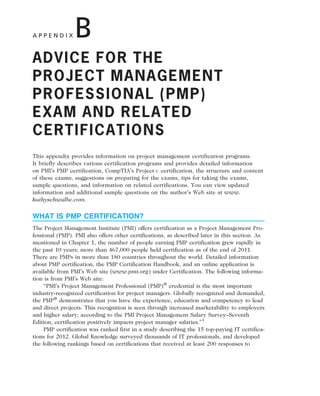
This appendix provides information on project management certification programs.
It briefly describes various certification programs and provides detailed information
on PMI’s PMP certification, CompTIA’s Projectþ certification, the structure and content
of these exams, suggestions on preparing for the exams, tips for taking the exams,
sample questions, and information on related certifications. You can view updated
information and additional sample questions on the author’s Web site at www.
kathyschwalbe.com.
WHAT IS PMP CERTIFICATION?
The Project Management Institute (PMI) offers certification as a Project Management Pro-
fessional (PMP). PMI also offers other certifications, as described later in this section. As
mentioned in Chapter 1, the number of people earning PMP certification grew rapidly in
the past 10 years; more than 467,000 people held certification as of the end of 2011.
There are PMPs in more than 180 countries throughout the world. Detailed information
about PMP certification, the PMP Certification Handbook, and an online application is
available from PMI’s Web site (www.pmi.org) under Certification. The following informa-
tion is from PMI’s Web site:
“PMI’s Project Management Professional (PMP)®
credential is the most important
industry-recognized certification for project managers. Globally recognized and demanded,
the PMP®
demonstrates that you have the experience, education and competency to lead
and direct projects. This recognition is seen through increased marketability to employers
and higher salary; according to the PMI Project Management Salary Survey–Seventh
Edition, certification positively impacts project manager salaries.”1
PMP certification was ranked first in a study describing the 15 top-paying IT certifica-
tions for 2012. Global Knowledge surveyed thousands of IT professionals, and developed
the following rankings based on certifications that received at least 200 responses to
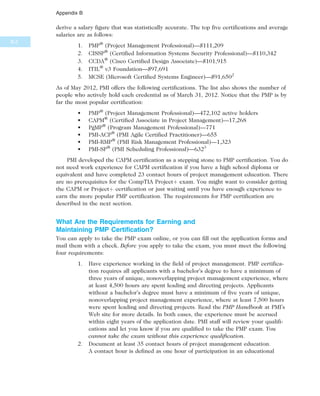
derive a salary figure that was statistically accurate. The top five certifications and average
salaries are as follows:
1. PMP®
(Project Management Professional)—$111,209
2. CISSP®
(Certified Information Systems Security Professional)—$110,342
3. CCDA®
(Cisco Certified Design Associate)—$101,915
4. ITIL®
v3 Foundation—$97,691
5. MCSE (Microsoft Certified Systems Engineer)—$91,6502
As of May 2012, PMI offers the following certifications. The list also shows the number of
people who actively hold each credential as of March 31, 2012. Notice that the PMP is by
far the most popular certification:
• PMP®
(Project Management Professional)—472,102 active holders
• CAPM®
(Certified Associate in Project Management)—17,268
• PgMP®
(Program Management Professional)—771
• PMI-ACP®
(PMI Agile Certified Practitioner)—655
• PMI-RMP®
(PMI Risk Management Professional)—1,323
• PMI-SP®
(PMI Scheduling Professional)—6323
PMI developed the CAPM certification as a stepping stone to PMP certification. You do
not need work experience for CAPM certification if you have a high school diploma or
equivalent and have completed 23 contact hours of project management education. There
are no prerequisites for the CompTIA Projectþ exam. You might want to consider getting
the CAPM or Projectþ certification or just waiting until you have enough experience to
earn the more popular PMP certification. The requirements for PMP certification are
described in the next section.
What Are the Requirements for Earning and
Maintaining PMP Certification?
You can apply to take the PMP exam online, or you can fill out the application forms and
mail them with a check. Before you apply to take the exam, you must meet the following
four requirements:
1. Have experience working in the field of project management. PMP certifica-
tion requires all applicants with a bachelor’s degree to have a minimum of
three years of unique, nonoverlapping project management experience, where
at least 4,500 hours are spent leading and directing projects. Applicants
without a bachelor’s degree must have a minimum of five years of unique,
nonoverlapping project management experience, where at least 7,500 hours
were spent leading and directing projects. Read the PMP Handbook at PMI’s
Web site for more details. In both cases, the experience must be accrued
within eight years of the application date. PMI staff will review your qualifi-
cations and let you know if you are qualified to take the PMP exam. You
cannot take the exam without this experience qualification.
2. Document at least 35 contact hours of project management education.
A contact hour is defined as one hour of participation in an educational
B.2
Appendix B
activity. There is no time frame for this requirement. The education can be
provided by a university or college, a training company or independent con-
sultant, a PMI chapter, a PMI Registered Education Provider (REP), a
company-sponsored program, or a distance-learning company. The hours
must include content on every knowledge area. You must list the course
title, institution, date, and number of hours for each course. For example,
if you took courses at a university 10 years ago that included 20 hours of
instruction related to project management, you could list those courses
on the education form along with a two-day, 15-hour PMP exam
preparation class.
3. Agree to the PMP certificant and candidate agreement and release statement.
This form certifies that application information is accurate and complete and
that candidates will conduct themselves in accordance with the Code of
Ethics and Professional Conduct, professional development requirements, and
other PMI certification program policies and procedures. You can simply
check a box to agree to this information when applying online. Note that PMI
randomly audits 10 to 15 percent of applications, so be prepared to provide
more detailed information, such as college transcripts and signatures of
supervisors or managers to verify experience.
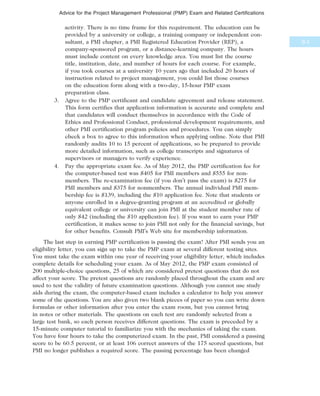
4. Pay the appropriate exam fee. As of May 2012, the PMP certification fee for
the computer-based test was $405 for PMI members and $555 for non-
members. The re-examination fee (if you don’t pass the exam) is $275 for
PMI members and $375 for nonmembers. The annual individual PMI mem-
bership fee is $139, including the $10 application fee. Note that students or
anyone enrolled in a degree-granting program at an accredited or globally
equivalent college or university can join PMI at the student member rate of
only $42 (including the $10 application fee). If you want to earn your PMP
certification, it makes sense to join PMI not only for the financial savings, but
for other benefits. Consult PMI’s Web site for membership information.
The last step in earning PMP certification is passing the exam! After PMI sends you an
eligibility letter, you can sign up to take the PMP exam at several different testing sites.
You must take the exam within one year of receiving your eligibility letter, which includes
complete details for scheduling your exam. As of May 2012, the PMP exam consisted of
200 multiple-choice questions, 25 of which are considered pretest questions that do not
affect your score. The pretest questions are randomly placed throughout the exam and are
used to test the validity of future examination questions. Although you cannot use study
aids during the exam, the computer-based exam includes a calculator to help you answer
some of the questions. You are also given two blank pieces of paper so you can write down
formulas or other information after you enter the exam room, but you cannot bring
in notes or other materials. The questions on each test are randomly selected from a
large test bank, so each person receives different questions. The exam is preceded by a
15-minute computer tutorial to familiarize you with the mechanics of taking the exam.
You have four hours to take the computerized exam. In the past, PMI considered a passing
score to be 60.5 percent, or at least 106 correct answers of the 175 scored questions, but
PMI no longer publishes a required score. The passing percentage has been changed
B.3
Advice for the Project Management Professional (PMP) Exam and Related Certifications
several times to achieve PMI’s goal of having about 75 percent of people pass the exam.
PMI uses the Modified Angoff Technique, a certification industry practice standard, to
determine the passing score. PMI reviews and revises the exam annually. Be sure to
consult PMI’s Web site for any notices about changes to the PMP exam.
PMI offers a professional development program for maintaining the PMP certification.
To maintain your PMP status, you must earn at least 60 Professional Development Units
within three years, pay a recertification fee every three years when you renew your certi-
fication ($60 for members as of May 2012), and agree to continue to adhere to PMI’s Code
of Ethics and Professional Conduct. The PMP Handbook, available from PMI’s Web site,
provides more details on maintaining your PMP status.
What Is the Structure and Content of the PMP Exam?
The PMP exam is based on information from the entire project management body of
knowledge and from the area of professional responsibility. Essentially, the exam reviews
concepts and terminology in PMI’s PMBOK®
Guide; texts such as this one help to rein-
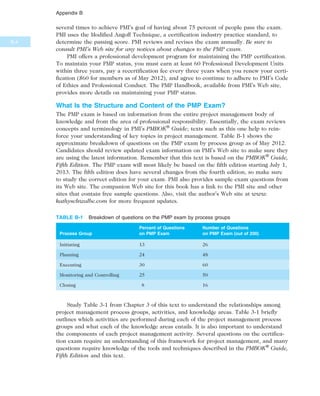
force your understanding of key topics in project management. Table B-1 shows the
approximate breakdown of questions on the PMP exam by process group as of May 2012.
Candidates should review updated exam information on PMI’s Web site to make sure they
are using the latest information. Remember that this text is based on the PMBOK®
Guide,
Fifth Edition. The PMP exam will most likely be based on the fifth edition starting July 1,
2013. The fifth edition does have several changes from the fourth edition, so make sure
to study the correct edition for your exam. PMI also provides sample exam questions from
its Web site. The companion Web site for this book has a link to the PMI site and other
sites that contain free sample questions. Also, visit the author’s Web site at www.
kathyschwalbe.com for more frequent updates.
Study Table 3-1 from Chapter 3 of this text to understand the relationships among
project management process groups, activities, and knowledge areas. Table 3-1 briefly
outlines which activities are performed during each of the project management process
groups and what each of the knowledge areas entails. It is also important to understand
the components of each project management activity. Several questions on the certifica-
tion exam require an understanding of this framework for project management, and many
questions require knowledge of the tools and techniques described in the PMBOK®
Guide,
Fifth Edition and this text.
TABLE B-1 Breakdown of questions on the PMP exam by process groups
Process Group
Percent of Questions
on PMP Exam
Number of Questions
on PMP Exam (out of 200)
Initiating 13 26
Planning 24 48
Executing 30 60
Monitoring and Controlling 25 50
Closing 8 16
B.4
Appendix B
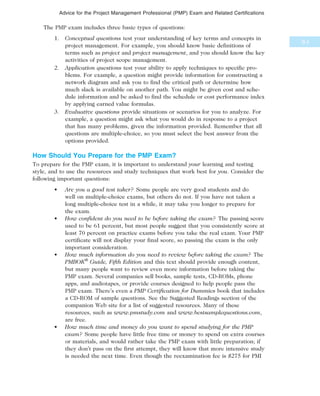
The PMP exam includes three basic types of questions:
1. Conceptual questions test your understanding of key terms and concepts in
project management. For example, you should know basic definitions of
terms such as project and project management, and you should know the key
activities of project scope management.
2. Application questions test your ability to apply techniques to specific pro-
blems. For example, a question might provide information for constructing a
network diagram and ask you to find the critical path or determine how
much slack is available on another path. You might be given cost and sche-
dule information and be asked to find the schedule or cost performance index
by applying earned value formulas.
3. Evaluative questions provide situations or scenarios for you to analyze. For
example, a question might ask what you would do in response to a project
that has many problems, given the information provided. Remember that all
questions are multiple-choice, so you must select the best answer from the
options provided.
How Should You Prepare for the PMP Exam?
To prepare for the PMP exam, it is important to understand your learning and testing
style, and to use the resources and study techniques that work best for you. Consider the
following important questions:
• Are you a good test taker? Some people are very good students and do
well on multiple-choice exams, but others do not. If you have not taken a
long multiple-choice test in a while, it may take you longer to prepare for
the exam.
• How confident do you need to be before taking the exam? The passing score
used to be 61 percent, but most people suggest that you consistently score at
least 70 percent on practice exams before you take the real exam. Your PMP
certificate will not display your final score, so passing the exam is the only
important consideration.
• How much information do you need to review before taking the exam? The
PMBOK®
Guide, Fifth Edition and this text should provide enough content,
but many people want to review even more information before taking the
PMP exam. Several companies sell books, sample tests, CD-ROMs, phone
apps, and audiotapes, or provide courses designed to help people pass the
PMP exam. There’s even a PMP Certification for Dummies book that includes
a CD-ROM of sample questions. See the Suggested Readings section of the
companion Web site for a list of suggested resources. Many of these
resources, such as www.pmstudy.com and www.bestsamplequestions.com,
are free.
• How much time and money do you want to spend studying for the PMP
exam? Some people have little free time or money to spend on extra courses
or materials, and would rather take the PMP exam with little preparation; if
they don’t pass on the first attempt, they will know that more intensive study
is needed the next time. Even though the reexamination fee is $275 for PMI
B.5
Advice for the Project Management Professional (PMP) Exam and Related Certifications
members, this cost is generally less than that of most exam preparation
courses. Spend the time and money you need to feel confident enough to pass
the exam, but don’t overextend yourself.
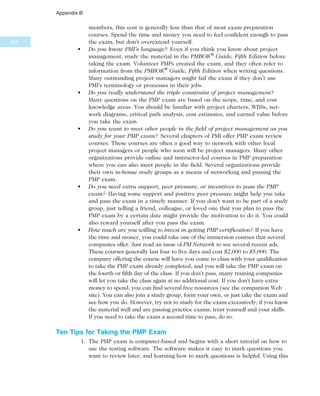
• Do you know PMI’s language? Even if you think you know about project
management, study the material in the PMBOK®
Guide, Fifth Edition before
taking the exam. Volunteer PMPs created the exam, and they often refer to
information from the PMBOK®
Guide, Fifth Edition when writing questions.
Many outstanding project managers might fail the exam if they don’t use
PMI’s terminology or processes in their jobs.
• Do you really understand the triple constraint of project management?
Many questions on the PMP exam are based on the scope, time, and cost
knowledge areas. You should be familiar with project charters, WBSs, net-
work diagrams, critical path analysis, cost estimates, and earned value before
you take the exam.
• Do you want to meet other people in the field of project management as you
study for your PMP exam? Several chapters of PMI offer PMP exam review
courses. These courses are often a good way to network with other local
project managers or people who soon will be project managers. Many other
organizations provide online and instructor-led courses in PMP preparation
where you can also meet people in the field. Several organizations provide
their own in-house study groups as a means of networking and passing the
PMP exam.
• Do you need extra support, peer pressure, or incentives to pass the PMP
exam? Having some support and positive peer pressure might help you take
and pass the exam in a timely manner. If you don’t want to be part of a study
group, just telling a friend, colleague, or loved one that you plan to pass the
PMP exam by a certain date might provide the motivation to do it. You could
also reward yourself after you pass the exam.
• How much are you willing to invest in getting PMP certification? If you have
the time and money, you could take one of the immersion courses that several
companies offer. Just read an issue of PM Network to see several recent ads.
These courses generally last four to five days and cost $2,000 to $5,000. The
company offering the course will have you come to class with your qualification
to take the PMP exam already completed, and you will take the PMP exam on
the fourth or fifth day of the class. If you don’t pass, many training companies
will let you take the class again at no additional cost. If you don’t have extra
money to spend, you can find several free resources (see the companion Web
site). You can also join a study group, form your own, or just take the exam and
see how you do. However, try not to study for the exam excessively; if you know
the material well and are passing practice exams, trust yourself and your skills.
If you need to take the exam a second time to pass, do so.
Ten Tips for Taking the PMP Exam
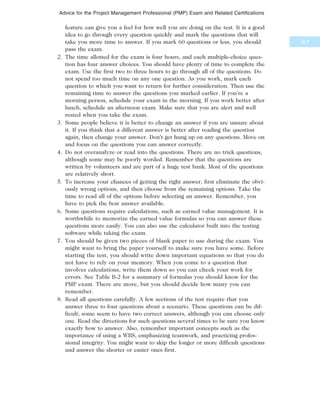
1. The PMP exam is computer-based and begins with a short tutorial on how to
use the testing software. The software makes it easy to mark questions you
want to review later, and learning how to mark questions is helpful. Using this
B.6
Appendix B
feature can give you a feel for how well you are doing on the test. It is a good
idea to go through every question quickly and mark the questions that will
take you more time to answer. If you mark 60 questions or less, you should
pass the exam.
2. The time allotted for the exam is four hours, and each multiple-choice ques-
tion has four answer choices. You should have plenty of time to complete the
exam. Use the first two to three hours to go through all of the questions. Do
not spend too much time on any one question. As you work, mark each
question to which you want to return for further consideration. Then use the
remaining time to answer the questions you marked earlier. If you’re a
morning person, schedule your exam in the morning. If you work better after
lunch, schedule an afternoon exam. Make sure that you are alert and well
rested when you take the exam.
3. Some people believe it is better to change an answer if you are unsure about
it. If you think that a different answer is better after reading the question
again, then change your answer. Don’t get hung up on any questions. Move on
and focus on the questions you can answer correctly.
4. Do not overanalyze or read into the questions. There are no trick questions,
although some may be poorly worded. Remember that the questions are
written by volunteers and are part of a huge test bank. Most of the questions
are relatively short.
5. To increase your chances of getting the right answer, first eliminate the obvi-
ously wrong options, and then choose from the remaining options. Take the
time to read all of the options before selecting an answer. Remember, you
have to pick the best answer available.
6. Some questions require calculations, such as earned value management. It is
worthwhile to memorize the earned value formulas so you can answer these
questions more easily. You can also use the calculator built into the testing
software while taking the exam.
7. You should be given two pieces of blank paper to use during the exam. You
might want to bring the paper yourself to make sure you have some. Before
starting the test, you should write down important equations so that you do
not have to rely on your memory. When you come to a question that
involves calculations, write them down so you can check your work for
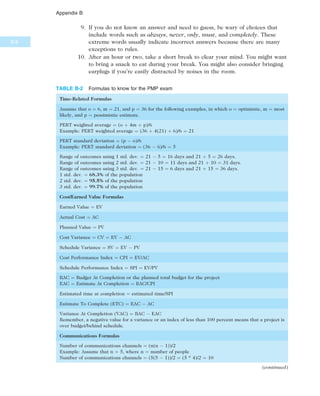
errors. See Table B-2 for a summary of formulas you should know for the
PMP exam. There are more, but you should decide how many you can
remember.
8. Read all questions carefully. A few sections of the test require that you
answer three to four questions about a scenario. These questions can be dif-
ficult; some seem to have two correct answers, although you can choose only
one. Read the directions for such questions several times to be sure you know
exactly how to answer. Also, remember important concepts such as the
importance of using a WBS, emphasizing teamwork, and practicing profes-
sional integrity. You might want to skip the longer or more difficult questions
and answer the shorter or easier ones first.
B.7
Advice for the Project Management Professional (PMP) Exam and Related Certifications
9. If you do not know an answer and need to guess, be wary of choices that
include words such as always, never, only, must, and completely. These
extreme words usually indicate incorrect answers because there are many
exceptions to rules.
10. After an hour or two, take a short break to clear your mind. You might want
to bring a snack to eat during your break. You might also consider bringing
earplugs if you’re easily distracted by noises in the room.
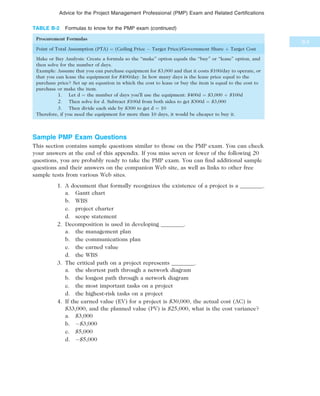
TABLE B-2 Formulas to know for the PMP exam
Time-Related Formulas
Assume that o ¼ 6, m ¼ 21, and p ¼ 36 for the following examples, in which o ¼ optimistic, m ¼ most
likely, and p ¼ pessimistic estimate.
PERT weighted average ¼ (o þ 4m þ p)/6
Example: PERT weighted average ¼ (36 þ 4(21) þ 6)/6 ¼ 21
PERT standard deviation ¼ (p À o)/6
Example: PERT standard deviation ¼ (36 À 6)/6 ¼ 5
Range of outcomes using 1 std. dev. ¼ 21 À 5 ¼ 16 days and 21 þ 5 ¼ 26 days.
Range of outcomes using 2 std. dev. ¼ 21 À 10 ¼ 11 days and 21 þ 10 ¼ 31 days.
Range of outcomes using 3 std. dev. ¼ 21 À 15 ¼ 6 days and 21 þ 15 ¼ 36 days.
1 std. dev. ¼ 68.3% of the population
2 std. dev. ¼ 95.5% of the population
3 std. dev. ¼ 99.7% of the population
Cost/Earned Value Formulas
Earned Value ¼ EV
Actual Cost ¼ AC
Planned Value ¼ PV
Cost Variance ¼ CV ¼ EV À AC
Schedule Variance ¼ SV ¼ EV À PV
Cost Performance Index ¼ CPI ¼ EV/AC
Schedule Performance Index ¼ SPI ¼ EV/PV
BAC ¼ Budget At Completion or the planned total budget for the project
EAC ¼ Estimate At Completion ¼ BAC/CPI
Estimated time at completion ¼ estimated time/SPI
Estimate To Complete (ETC) ¼ EAC À AC
Variance At Completion (VAC) ¼ BAC À EAC
Remember, a negative value for a variance or an index of less than 100 percent means that a project is
over budget/behind schedule.
Communications Formulas
Number of communications channels ¼ (n(n À 1))/2
Example: Assume that n ¼ 5, where n ¼ number of people
Number of communications channels ¼ (5(5 À 1))/2 ¼ (5 * 4)/2 ¼ 10
(continued)
B.8
Appendix B
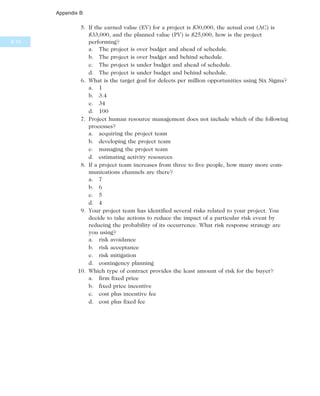
Sample PMP Exam Questions
This section contains sample questions similar to those on the PMP exam. You can check
your answers at the end of this appendix. If you miss seven or fewer of the following 20
questions, you are probably ready to take the PMP exam. You can find additional sample
questions and their answers on the companion Web site, as well as links to other free
sample tests from various Web sites.
1. A document that formally recognizes the existence of a project is a ________.
a. Gantt chart
b. WBS
c. project charter
d. scope statement
2. Decomposition is used in developing ________.
a. the management plan
b. the communications plan
c. the earned value
d. the WBS
3. The critical path on a project represents ________.
a. the shortest path through a network diagram
b. the longest path through a network diagram
c. the most important tasks on a project
d. the highest-risk tasks on a project
4. If the earned value (EV) for a project is $30,000, the actual cost (AC) is
$33,000, and the planned value (PV) is $25,000, what is the cost variance?
a. $3,000
b. À$3,000
c. $5,000
d. À$5,000
TABLE B-2 Formulas to know for the PMP exam (continued)
Procurement Formulas
Point of Total Assumption (PTA) ¼ (Ceiling Price À Target Price)/Government Share þ Target Cost
Make or Buy Analysis: Create a formula so the “make” option equals the “buy” or “lease” option, and
then solve for the number of days.
Example: Assume that you can purchase equipment for $3,000 and that it costs $100/day to operate, or
that you can lease the equipment for $400/day. In how many days is the lease price equal to the
purchase price? Set up an equation in which the cost to lease or buy the item is equal to the cost to
purchase or make the item.
1. Let d ¼ the number of days you’ll use the equipment: $400d ¼ $3,000 þ $100d
2. Then solve for d. Subtract $100d from both sides to get $300d ¼ $3,000
3. Then divide each side by $300 to get d ¼ 10
Therefore, if you need the equipment for more than 10 days, it would be cheaper to buy it.
B.9
Advice for the Project Management Professional (PMP) Exam and Related Certifications
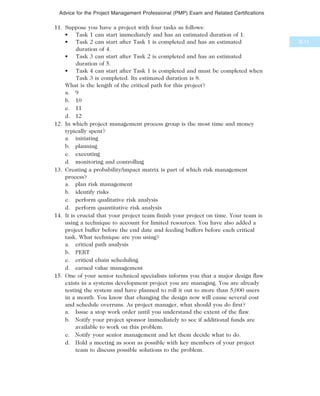
5. If the earned value (EV) for a project is $30,000, the actual cost (AC) is
$33,000, and the planned value (PV) is $25,000, how is the project
performing?
a. The project is over budget and ahead of schedule.
b. The project is over budget and behind schedule.
c. The project is under budget and ahead of schedule.
d. The project is under budget and behind schedule.
6. What is the target goal for defects per million opportunities using Six Sigma?
a. 1
b. 3.4
c. 34
d. 100
7. Project human resource management does not include which of the following
processes?
a. acquiring the project team
b. developing the project team
c. managing the project team
d. estimating activity resources
8. If a project team increases from three to five people, how many more com-
munications channels are there?
a. 7
b. 6
c. 5
d. 4
9. Your project team has identified several risks related to your project. You
decide to take actions to reduce the impact of a particular risk event by
reducing the probability of its occurrence. What risk response strategy are
you using?
a. risk avoidance
b. risk acceptance
c. risk mitigation
d. contingency planning
10. Which type of contract provides the least amount of risk for the buyer?
a. firm fixed price
b. fixed price incentive
c. cost plus incentive fee
d. cost plus fixed fee
B.10
Appendix B
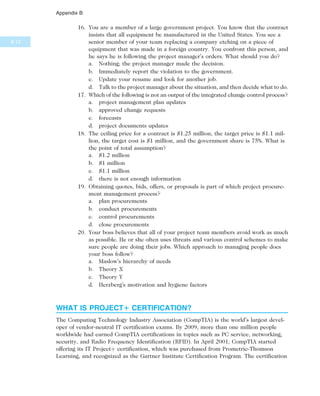
11. Suppose you have a project with four tasks as follows:
• Task 1 can start immediately and has an estimated duration of 1.
• Task 2 can start after Task 1 is completed and has an estimated
duration of 4.
• Task 3 can start after Task 2 is completed and has an estimated
duration of 5.
• Task 4 can start after Task 1 is completed and must be completed when
Task 3 is completed. Its estimated duration is 8.
What is the length of the critical path for this project?
a. 9
b. 10
c. 11
d. 12
12. In which project management process group is the most time and money
typically spent?
a. initiating
b. planning
c. executing
d. monitoring and controlling
13. Creating a probability/impact matrix is part of which risk management
process?
a. plan risk management
b. identify risks
c. perform qualitative risk analysis
d. perform quantitative risk analysis
14. It is crucial that your project team finish your project on time. Your team is
using a technique to account for limited resources. You have also added a
project buffer before the end date and feeding buffers before each critical
task. What technique are you using?
a. critical path analysis
b. PERT
c. critical chain scheduling
d. earned value management
15. One of your senior technical specialists informs you that a major design flaw
exists in a systems development project you are managing. You are already
testing the system and have planned to roll it out to more than 5,000 users
in a month. You know that changing the design now will cause several cost
and schedule overruns. As project manager, what should you do first?
a. Issue a stop work order until you understand the extent of the flaw.
b. Notify your project sponsor immediately to see if additional funds are
available to work on this problem.
c. Notify your senior management and let them decide what to do.
d. Hold a meeting as soon as possible with key members of your project
team to discuss possible solutions to the problem.
B.11
Advice for the Project Management Professional (PMP) Exam and Related Certifications
16. You are a member of a large government project. You know that the contract
insists that all equipment be manufactured in the United States. You see a
senior member of your team replacing a company etching on a piece of
equipment that was made in a foreign country. You confront this person, and
he says he is following the project manager’s orders. What should you do?
a. Nothing; the project manager made the decision.
b. Immediately report the violation to the government.
c. Update your resume and look for another job.
d. Talk to the project manager about the situation, and then decide what to do.
17. Which of the following is not an output of the integrated change control process?
a. project management plan updates
b. approved change requests
c. forecasts
d. project documents updates
18. The ceiling price for a contract is $1.25 million, the target price is $1.1 mil-
lion, the target cost is $1 million, and the government share is 75%. What is
the point of total assumption?
a. $1.2 million
b. $1 million
c. $1.1 million
d. there is not enough information
19. Obtaining quotes, bids, offers, or proposals is part of which project procure-
ment management process?
a. plan procurements
b. conduct procurements
c. control procurements
d. close procurements
20. Your boss believes that all of your project team members avoid work as much
as possible. He or she often uses threats and various control schemes to make
sure people are doing their jobs. Which approach to managing people does
your boss follow?
a. Maslow’s hierarchy of needs
b. Theory X
c. Theory Y
d. Herzberg’s motivation and hygiene factors
WHAT IS PROJECT1 CERTIFICATION?
The Computing Technology Industry Association (CompTIA) is the world’s largest devel-
oper of vendor-neutral IT certification exams. By 2009, more than one million people
worldwide had earned CompTIA certifications in topics such as PC service, networking,
security, and Radio Frequency Identification (RFID). In April 2001, CompTIA started
offering its IT Projectþ certification, which was purchased from Prometric-Thomson
Learning, and recognized as the Gartner Institute Certification Program. The certification
B.12
Appendix B
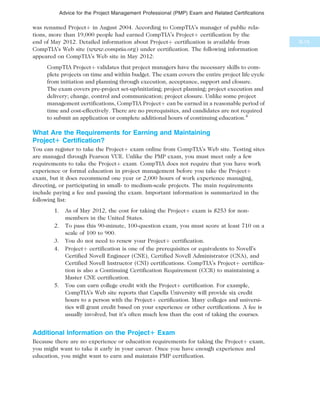
was renamed Projectþ in August 2004. According to CompTIA’s manager of public rela-
tions, more than 19,000 people had earned CompTIA’s Projectþ certification by the
end of May 2012. Detailed information about Projectþ certification is available from
CompTIA’s Web site (www.comptia.org) under certification. The following information
appeared on CompTIA’s Web site in May 2012:
CompTIA Projectþ validates that project managers have the necessary skills to com-
plete projects on time and within budget. The exam covers the entire project life cycle
from initiation and planning through execution, acceptance, support and closure.
The exam covers pre-project set-up/initiating; project planning; project execution and
delivery; change, control and communication; project closure. Unlike some project
management certifications, CompTIA Projectþ can be earned in a reasonable period of
time and cost-effectively. There are no prerequisites, and candidates are not required
to submit an application or complete additional hours of continuing education.4
What Are the Requirements for Earning and Maintaining
Project1 Certification?
You can register to take the Projectþ exam online from CompTIA’s Web site. Testing sites
are managed through Pearson VUE. Unlike the PMP exam, you must meet only a few
requirements to take the Projectþ exam. CompTIA does not require that you have work
experience or formal education in project management before you take the Projectþ
exam, but it does recommend one year or 2,000 hours of work experience managing,
directing, or participating in small- to medium-scale projects. The main requirements
include paying a fee and passing the exam. Important information is summarized in the
following list:
1. As of May 2012, the cost for taking the Projectþ exam is $253 for non-
members in the United States.
2. To pass this 90-minute, 100-question exam, you must score at least 710 on a
scale of 100 to 900.
3. You do not need to renew your Projectþ certification.
4. Projectþ certification is one of the prerequisites or equivalents to Novell’s
Certified Novell Engineer (CNE), Certified Novell Administrator (CNA), and
Certified Novell Instructor (CNI) certifications. CompTIA’s Projectþ certifica-
tion is also a Continuing Certification Requirement (CCR) to maintaining a
Master CNE certification.
5. You can earn college credit with the Projectþ certification. For example,
CompTIA’s Web site reports that Capella University will provide six credit
hours to a person with the Projectþ certification. Many colleges and universi-
ties will grant credit based on your experience or other certifications. A fee is
usually involved, but it’s often much less than the cost of taking the courses.
Additional Information on the Project1 Exam
Because there are no experience or education requirements for taking the Projectþ exam,
you might want to take it early in your career. Once you have enough experience and
education, you might want to earn and maintain PMP certification.
B.13
Advice for the Project Management Professional (PMP) Exam and Related Certifications
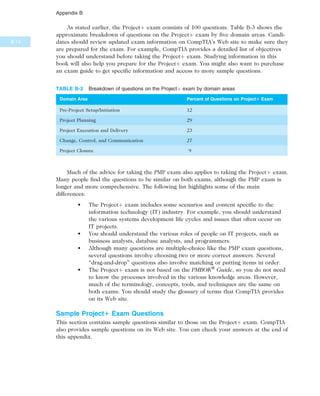
As stated earlier, the Projectþ exam consists of 100 questions. Table B-3 shows the
approximate breakdown of questions on the Projectþ exam by five domain areas. Candi-
dates should review updated exam information on CompTIA’s Web site to make sure they
are prepared for the exam. For example, CompTIA provides a detailed list of objectives
you should understand before taking the Projectþ exam. Studying information in this
book will also help you prepare for the Projectþ exam. You might also want to purchase
an exam guide to get specific information and access to more sample questions.
Much of the advice for taking the PMP exam also applies to taking the Projectþ exam.
Many people find the questions to be similar on both exams, although the PMP exam is
longer and more comprehensive. The following list highlights some of the main
differences:
• The Projectþ exam includes some scenarios and content specific to the
information technology (IT) industry. For example, you should understand
the various systems development life cycles and issues that often occur on
IT projects.
• You should understand the various roles of people on IT projects, such as
business analysts, database analysts, and programmers.
• Although many questions are multiple-choice like the PMP exam questions,
several questions involve choosing two or more correct answers. Several
“drag-and-drop” questions also involve matching or putting items in order.
• The Projectþ exam is not based on the PMBOK®
Guide, so you do not need
to know the processes involved in the various knowledge areas. However,
much of the terminology, concepts, tools, and techniques are the same on
both exams. You should study the glossary of terms that CompTIA provides
on its Web site.
Sample Project1 Exam Questions
This section contains sample questions similar to those on the Projectþ exam. CompTIA
also provides sample questions on its Web site. You can check your answers at the end of
this appendix.
TABLE B-3 Breakdown of questions on the Projectþ exam by domain areas
Domain Area Percent of Questions on Project1 Exam
Pre-Project Setup/Initiation 12
Project Planning 29
Project Execution and Delivery 23
Change, Control, and Communication 27
Project Closure 9
B.14
Appendix B
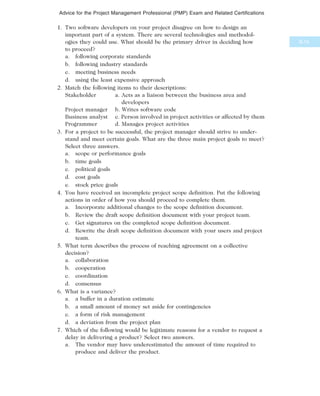
1. Two software developers on your project disagree on how to design an
important part of a system. There are several technologies and methodol-
ogies they could use. What should be the primary driver in deciding how
to proceed?
a. following corporate standards
b. following industry standards
c. meeting business needs
d. using the least expensive approach
2. Match the following items to their descriptions:
Stakeholder a. Acts as a liaison between the business area and
developers
Project manager b. Writes software code
Business analyst c. Person involved in project activities or affected by them
Programmer d. Manages project activities
3. For a project to be successful, the project manager should strive to under-
stand and meet certain goals. What are the three main project goals to meet?
Select three answers.
a. scope or performance goals
b. time goals
c. political goals
d. cost goals
e. stock price goals
4. You have received an incomplete project scope definition. Put the following
actions in order of how you should proceed to complete them.
a. Incorporate additional changes to the scope definition document.
b. Review the draft scope definition document with your project team.
c. Get signatures on the completed scope definition document.
d. Rewrite the draft scope definition document with your users and project
team.
5. What term describes the process of reaching agreement on a collective
decision?
a. collaboration
b. cooperation
c. coordination
d. consensus
6. What is a variance?
a. a buffer in a duration estimate
b. a small amount of money set aside for contingencies
c. a form of risk management
d. a deviation from the project plan
7. Which of the following would be legitimate reasons for a vendor to request a
delay in delivering a product? Select two answers.
a. The vendor may have underestimated the amount of time required to
produce and deliver the product.
B.15
Advice for the Project Management Professional (PMP) Exam and Related Certifications
b. The project contact from the vendor’s organization may be going on
vacation.
c. The vendor might be able to provide a better product by delivering it late.
d. The vendor might lose money by delivering the product late.
8. When should you involve stakeholders in the change control process on IT
projects?
a. before a change is submitted
b. after a change is submitted
c. when a change is submitted
d. throughout the life of a project
9. Which of the following techniques can be used to help manage requirements?
Select three answers.
a. prototyping
b. use case modeling
c. JAD
d. worst case modeling
10. Match the following items to their descriptions:
Lessons learned a. Leave a clear and complete history of a project
Project audits b. Review project progress and results
Project archives c. Document what went right or wrong on a project
WHAT OTHER EXAMS OR CERTIFICATIONS RELATED
TO PROJECT MANAGEMENT ARE AVAILABLE?
In recent years, several organizations have developed more certifications related to project
management and to IT project management in particular. Some involve taking exams,
while others require coursework or attendance at workshops. The following brief descrip-
tions pertain to other existing exams or certifications related to project management:
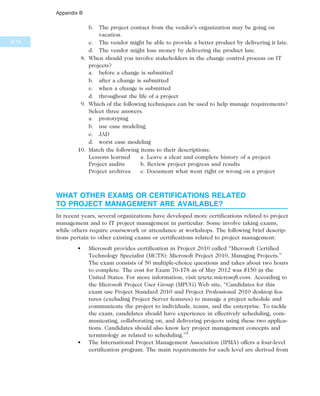
• Microsoft provides certification in Project 2010 called “Microsoft Certified
Technology Specialist (MCTS): Microsoft Project 2010, Managing Projects.”
The exam consists of 50 multiple-choice questions and takes about two hours
to complete. The cost for Exam 70-178 as of May 2012 was $150 in the
United States. For more information, visit www.microsoft.com. According to
the Microsoft Project User Group (MPUG) Web site, “Candidates for this
exam use Project Standard 2010 and Project Professional 2010 desktop fea-
tures (excluding Project Server features) to manage a project schedule and
communicate the project to individuals, teams, and the enterprise. To tackle
the exam, candidates should have experience in effectively scheduling, com-
municating, collaborating on, and delivering projects using these two applica-
tions. Candidates should also know key project management concepts and
terminology as related to scheduling.”5
• The International Project Management Association (IPMA) offers a four-level
certification program. The main requirements for each level are derived from
B.16
Appendix B
typical activities, responsibilities, and requirements from practice. The IPMA
four-level certification system, in descending order, includes the Certified
Projects Director, Certified Senior Project Manager, Certified Project Man-
ager, and Certified Project Management Associate. More than 150,000 people
worldwide have earned IPMA certifications, according to an estimate by PMI
in 2012. See www.ipma.ch for more details.
• Projects IN Controlled Environments (PRINCE2), a project management
methodology mentioned in Chapter 3, provides two certifications called
PRINCE2 Foundation and PRINCE2 Practitioner. PMI reported that more
than 665,000 people held the PRINCE2 Foundation certification and more
than 333,000 people held the PRINCE2 Practitioner certification by the end
of 2011. The following information is quoted from www.prince2.com as of
May 2012: “PRINCE2 is a process-based approach for project management,
providing an easily tailored and scaleable project management methodology
for the management of all types of projects. The method is the de-facto stan-
dard for project management in Europe and is practiced worldwide. PRINCE2
use is steadily growing in the USA and complements the PMBOK and PMP.”6
• Certified IT Project Manager (CITPM). In 1998, the Singapore Computer
Society collaborated with the Infocomm Development Authority of Singapore
to establish an Information Technology Project Management Certification
Program. PMI signed a Memorandum of Understanding with the Singapore
Computer Society to support and advance the global credentialing of project
management and IT expertise. In 2012, the Singapore Computer Society’s
Web site listed three levels of the CITPM Certification: CITPM (Senior),
CITPM, and CITPM (Associate). For more details, consult the society’s Web
site (www.scs.org.sg/about_certprog.php).
• PMI’s additional certifications. As mentioned earlier, PMI also offers certifica-
tion as a Certified Associate in Project Management (CAPM), a PMI-
Scheduling Professional (PMI-SP), a PMI-Risk Management Professional (PMI-
RMP), a PMI Agile Certified Practitioner (PMI-ACP), and a Program Manage-
ment Professional (PgMP). Check PMI’s Web site for updated information on
its certification programs.
• Many colleges, universities, and corporate training companies now provide
their own certificate programs or entire degrees in project management. Typ-
ing “project management certificate” into www.google.com in May 2012
resulted in 144,000 hits. Some of the certificate courses apply toward bache-
lor’s or advanced degrees. Like any other educational program, it is important
to research the quality of the program and find one that meets your specific
needs. A search for project management degrees at www.gradschools.com
under business and MBA listed 224 master’s degrees, 23 doctorate degrees,
and 91 certificate options; 120 of these degrees were available online and 190
used a campus format. Also, a site called www.mastersinprojectmanagement.
com provides information on many different programs. In 2012, the PMI Global
Accreditation Center (GAC) for Project Management Education Programs listed
85 degree programs at 39 schools in 13 countries with its unique accreditation.
See www.gacpm.org for more information.
B.17
Advice for the Project Management Professional (PMP) Exam and Related Certifications
Discussion Questions
1. What is PMP certification, and why do you think an increasing number of people have
earned it in the past 10 years?
2. What do you need to do before you can take the PMP exam? What is the exam itself like?
What do you need to do to maintain PMP certification? What do you need to do to take the
Projectþ exam? How does the Projectþ exam differ from the PMP exam? Do you need to
renew Projectþ certification?
3. What is the difference between conceptual, application, and evaluative questions? Which
project management process groups have the most questions on the PMP exam? What are
the five domain areas tested on the Projectþ exam?
4. Which tips for taking the PMP exam do you think would be most helpful for you?
5. If you plan to take the Projectþ or PMP exam soon, what should you do to prepare?
6. Briefly describe project management certification programs other than the PMP or Projectþ
certifications.
Exercises
1. Go to PMI’s Web site and review the information about taking the PMP exam and related
exams. Write a short paper summarizing what you found.
2. Go to CompTIA’s Web site and review the information about taking the Projectþ exam.
Write a short paper summarizing what you found.
3. Answer the 20 sample PMP questions in this text or take another sample test, and then
score your results. Summarize how you did and note the areas you would need to study
before you could take the PMP exam.
4. Interview someone who has PMP, Projectþ, or another project management-related certifi-
cation. Ask why the person earned the certification and how it has affected his or her
career. Summarize your findings in a short paper.
5. Do an Internet search on earning PMP or Projectþ certification. Be sure to search for
groups or similar sites related to these topics. What options did you find to help people pre-
pare for either exam? Before you took one of the exams, what would you do to help study
for it? Do you think you would need more information than this text to help you pass? Write
a short paper describing your findings and opinions.
6. Read a recent issue of PMI’s PM Network magazine. You can access a free sample copy
from PMI’s Web site. In a short paper, summarize all of the ads in the magazine that are
related to earning PMP or another project management-related certification. Include your
opinion of which ad, course, book, Web site, or other media appeals to you the most.
Answers to Sample PMP Exam Questions
1. c; 2. d; 3. b; 4. b; 5. a; 6. b; 7. d; 8. a; 9. c; 10. a; 11. b; 12. c; 13. c; 14. c; 15. d; 16. d; 17. c;
18. a; 19. b; 20. b
B.18
Appendix B
Answers to Sample Project1 Exam Questions
1. c; 2. c, d, a, b; 3. a, b, d; 4. b, d, a, c; 5. d; 6. d; 7. a, c; 8. d; 9. a, b, c; 10. c, b, a
End Notes
1
Project Management Institute, “Project Management Professional,” www.pmi.org (May 2012).
2
Randy Muller, “15 Top Paying IT Certifications for 2012,” Global Knowledge (2012).
3
Project Management Institute, “PMI Fact File,” PMI Today (May 2012).
4
CompTIA Web site, http://certification.comptia.org/getCertified/certifications/project.aspx
(May 2012).
5
Microsoft Project User Group Web site, www.mpug.com/News/Pages/Microsoft-Project-2010-
Certification-Questions.aspx (May 2012).
6
Projects IN Controlled Environments (PRINCE2) Web site, www.prince2.com (May 2012).
B.19
Advice for the Project Management Professional (PMP) Exam and Related Certifications
Pm pinfo

Pm pinfo

  • 1.
    A P PE N D I X B ADVICE FOR THE PROJECT MANAGEMENT PROFESSIONAL (PMP) EXAM AND RELATED CERTIFICATIONS This appendix provides information on project management certification programs. It briefly describes various certification programs and provides detailed information on PMI’s PMP certification, CompTIA’s Projectþ certification, the structure and content of these exams, suggestions on preparing for the exams, tips for taking the exams, sample questions, and information on related certifications. You can view updated information and additional sample questions on the author’s Web site at www. kathyschwalbe.com. WHAT IS PMP CERTIFICATION? The Project Management Institute (PMI) offers certification as a Project Management Pro- fessional (PMP). PMI also offers other certifications, as described later in this section. As mentioned in Chapter 1, the number of people earning PMP certification grew rapidly in the past 10 years; more than 467,000 people held certification as of the end of 2011. There are PMPs in more than 180 countries throughout the world. Detailed information about PMP certification, the PMP Certification Handbook, and an online application is available from PMI’s Web site (www.pmi.org) under Certification. The following informa- tion is from PMI’s Web site: “PMI’s Project Management Professional (PMP)® credential is the most important industry-recognized certification for project managers. Globally recognized and demanded, the PMP® demonstrates that you have the experience, education and competency to lead and direct projects. This recognition is seen through increased marketability to employers and higher salary; according to the PMI Project Management Salary Survey–Seventh Edition, certification positively impacts project manager salaries.”1 PMP certification was ranked first in a study describing the 15 top-paying IT certifica- tions for 2012. Global Knowledge surveyed thousands of IT professionals, and developed the following rankings based on certifications that received at least 200 responses to
  • 2.
    derive a salaryfigure that was statistically accurate. The top five certifications and average salaries are as follows: 1. PMP® (Project Management Professional)—$111,209 2. CISSP® (Certified Information Systems Security Professional)—$110,342 3. CCDA® (Cisco Certified Design Associate)—$101,915 4. ITIL® v3 Foundation—$97,691 5. MCSE (Microsoft Certified Systems Engineer)—$91,6502 As of May 2012, PMI offers the following certifications. The list also shows the number of people who actively hold each credential as of March 31, 2012. Notice that the PMP is by far the most popular certification: • PMP® (Project Management Professional)—472,102 active holders • CAPM® (Certified Associate in Project Management)—17,268 • PgMP® (Program Management Professional)—771 • PMI-ACP® (PMI Agile Certified Practitioner)—655 • PMI-RMP® (PMI Risk Management Professional)—1,323 • PMI-SP® (PMI Scheduling Professional)—6323 PMI developed the CAPM certification as a stepping stone to PMP certification. You do not need work experience for CAPM certification if you have a high school diploma or equivalent and have completed 23 contact hours of project management education. There are no prerequisites for the CompTIA Projectþ exam. You might want to consider getting the CAPM or Projectþ certification or just waiting until you have enough experience to earn the more popular PMP certification. The requirements for PMP certification are described in the next section. What Are the Requirements for Earning and Maintaining PMP Certification? You can apply to take the PMP exam online, or you can fill out the application forms and mail them with a check. Before you apply to take the exam, you must meet the following four requirements: 1. Have experience working in the field of project management. PMP certifica- tion requires all applicants with a bachelor’s degree to have a minimum of three years of unique, nonoverlapping project management experience, where at least 4,500 hours are spent leading and directing projects. Applicants without a bachelor’s degree must have a minimum of five years of unique, nonoverlapping project management experience, where at least 7,500 hours were spent leading and directing projects. Read the PMP Handbook at PMI’s Web site for more details. In both cases, the experience must be accrued within eight years of the application date. PMI staff will review your qualifi- cations and let you know if you are qualified to take the PMP exam. You cannot take the exam without this experience qualification. 2. Document at least 35 contact hours of project management education. A contact hour is defined as one hour of participation in an educational B.2 Appendix B
  • 3.
    activity. There isno time frame for this requirement. The education can be provided by a university or college, a training company or independent con- sultant, a PMI chapter, a PMI Registered Education Provider (REP), a company-sponsored program, or a distance-learning company. The hours must include content on every knowledge area. You must list the course title, institution, date, and number of hours for each course. For example, if you took courses at a university 10 years ago that included 20 hours of instruction related to project management, you could list those courses on the education form along with a two-day, 15-hour PMP exam preparation class. 3. Agree to the PMP certificant and candidate agreement and release statement. This form certifies that application information is accurate and complete and that candidates will conduct themselves in accordance with the Code of Ethics and Professional Conduct, professional development requirements, and other PMI certification program policies and procedures. You can simply check a box to agree to this information when applying online. Note that PMI randomly audits 10 to 15 percent of applications, so be prepared to provide more detailed information, such as college transcripts and signatures of supervisors or managers to verify experience. 4. Pay the appropriate exam fee. As of May 2012, the PMP certification fee for the computer-based test was $405 for PMI members and $555 for non- members. The re-examination fee (if you don’t pass the exam) is $275 for PMI members and $375 for nonmembers. The annual individual PMI mem- bership fee is $139, including the $10 application fee. Note that students or anyone enrolled in a degree-granting program at an accredited or globally equivalent college or university can join PMI at the student member rate of only $42 (including the $10 application fee). If you want to earn your PMP certification, it makes sense to join PMI not only for the financial savings, but for other benefits. Consult PMI’s Web site for membership information. The last step in earning PMP certification is passing the exam! After PMI sends you an eligibility letter, you can sign up to take the PMP exam at several different testing sites. You must take the exam within one year of receiving your eligibility letter, which includes complete details for scheduling your exam. As of May 2012, the PMP exam consisted of 200 multiple-choice questions, 25 of which are considered pretest questions that do not affect your score. The pretest questions are randomly placed throughout the exam and are used to test the validity of future examination questions. Although you cannot use study aids during the exam, the computer-based exam includes a calculator to help you answer some of the questions. You are also given two blank pieces of paper so you can write down formulas or other information after you enter the exam room, but you cannot bring in notes or other materials. The questions on each test are randomly selected from a large test bank, so each person receives different questions. The exam is preceded by a 15-minute computer tutorial to familiarize you with the mechanics of taking the exam. You have four hours to take the computerized exam. In the past, PMI considered a passing score to be 60.5 percent, or at least 106 correct answers of the 175 scored questions, but PMI no longer publishes a required score. The passing percentage has been changed B.3 Advice for the Project Management Professional (PMP) Exam and Related Certifications
  • 4.
    several times toachieve PMI’s goal of having about 75 percent of people pass the exam. PMI uses the Modified Angoff Technique, a certification industry practice standard, to determine the passing score. PMI reviews and revises the exam annually. Be sure to consult PMI’s Web site for any notices about changes to the PMP exam. PMI offers a professional development program for maintaining the PMP certification. To maintain your PMP status, you must earn at least 60 Professional Development Units within three years, pay a recertification fee every three years when you renew your certi- fication ($60 for members as of May 2012), and agree to continue to adhere to PMI’s Code of Ethics and Professional Conduct. The PMP Handbook, available from PMI’s Web site, provides more details on maintaining your PMP status. What Is the Structure and Content of the PMP Exam? The PMP exam is based on information from the entire project management body of knowledge and from the area of professional responsibility. Essentially, the exam reviews concepts and terminology in PMI’s PMBOK® Guide; texts such as this one help to rein- force your understanding of key topics in project management. Table B-1 shows the approximate breakdown of questions on the PMP exam by process group as of May 2012. Candidates should review updated exam information on PMI’s Web site to make sure they are using the latest information. Remember that this text is based on the PMBOK® Guide, Fifth Edition. The PMP exam will most likely be based on the fifth edition starting July 1, 2013. The fifth edition does have several changes from the fourth edition, so make sure to study the correct edition for your exam. PMI also provides sample exam questions from its Web site. The companion Web site for this book has a link to the PMI site and other sites that contain free sample questions. Also, visit the author’s Web site at www. kathyschwalbe.com for more frequent updates. Study Table 3-1 from Chapter 3 of this text to understand the relationships among project management process groups, activities, and knowledge areas. Table 3-1 briefly outlines which activities are performed during each of the project management process groups and what each of the knowledge areas entails. It is also important to understand the components of each project management activity. Several questions on the certifica- tion exam require an understanding of this framework for project management, and many questions require knowledge of the tools and techniques described in the PMBOK® Guide, Fifth Edition and this text. TABLE B-1 Breakdown of questions on the PMP exam by process groups Process Group Percent of Questions on PMP Exam Number of Questions on PMP Exam (out of 200) Initiating 13 26 Planning 24 48 Executing 30 60 Monitoring and Controlling 25 50 Closing 8 16 B.4 Appendix B
  • 5.
    The PMP examincludes three basic types of questions: 1. Conceptual questions test your understanding of key terms and concepts in project management. For example, you should know basic definitions of terms such as project and project management, and you should know the key activities of project scope management. 2. Application questions test your ability to apply techniques to specific pro- blems. For example, a question might provide information for constructing a network diagram and ask you to find the critical path or determine how much slack is available on another path. You might be given cost and sche- dule information and be asked to find the schedule or cost performance index by applying earned value formulas. 3. Evaluative questions provide situations or scenarios for you to analyze. For example, a question might ask what you would do in response to a project that has many problems, given the information provided. Remember that all questions are multiple-choice, so you must select the best answer from the options provided. How Should You Prepare for the PMP Exam? To prepare for the PMP exam, it is important to understand your learning and testing style, and to use the resources and study techniques that work best for you. Consider the following important questions: • Are you a good test taker? Some people are very good students and do well on multiple-choice exams, but others do not. If you have not taken a long multiple-choice test in a while, it may take you longer to prepare for the exam. • How confident do you need to be before taking the exam? The passing score used to be 61 percent, but most people suggest that you consistently score at least 70 percent on practice exams before you take the real exam. Your PMP certificate will not display your final score, so passing the exam is the only important consideration. • How much information do you need to review before taking the exam? The PMBOK® Guide, Fifth Edition and this text should provide enough content, but many people want to review even more information before taking the PMP exam. Several companies sell books, sample tests, CD-ROMs, phone apps, and audiotapes, or provide courses designed to help people pass the PMP exam. There’s even a PMP Certification for Dummies book that includes a CD-ROM of sample questions. See the Suggested Readings section of the companion Web site for a list of suggested resources. Many of these resources, such as www.pmstudy.com and www.bestsamplequestions.com, are free. • How much time and money do you want to spend studying for the PMP exam? Some people have little free time or money to spend on extra courses or materials, and would rather take the PMP exam with little preparation; if they don’t pass on the first attempt, they will know that more intensive study is needed the next time. Even though the reexamination fee is $275 for PMI B.5 Advice for the Project Management Professional (PMP) Exam and Related Certifications
  • 6.
    members, this costis generally less than that of most exam preparation courses. Spend the time and money you need to feel confident enough to pass the exam, but don’t overextend yourself. • Do you know PMI’s language? Even if you think you know about project management, study the material in the PMBOK® Guide, Fifth Edition before taking the exam. Volunteer PMPs created the exam, and they often refer to information from the PMBOK® Guide, Fifth Edition when writing questions. Many outstanding project managers might fail the exam if they don’t use PMI’s terminology or processes in their jobs. • Do you really understand the triple constraint of project management? Many questions on the PMP exam are based on the scope, time, and cost knowledge areas. You should be familiar with project charters, WBSs, net- work diagrams, critical path analysis, cost estimates, and earned value before you take the exam. • Do you want to meet other people in the field of project management as you study for your PMP exam? Several chapters of PMI offer PMP exam review courses. These courses are often a good way to network with other local project managers or people who soon will be project managers. Many other organizations provide online and instructor-led courses in PMP preparation where you can also meet people in the field. Several organizations provide their own in-house study groups as a means of networking and passing the PMP exam. • Do you need extra support, peer pressure, or incentives to pass the PMP exam? Having some support and positive peer pressure might help you take and pass the exam in a timely manner. If you don’t want to be part of a study group, just telling a friend, colleague, or loved one that you plan to pass the PMP exam by a certain date might provide the motivation to do it. You could also reward yourself after you pass the exam. • How much are you willing to invest in getting PMP certification? If you have the time and money, you could take one of the immersion courses that several companies offer. Just read an issue of PM Network to see several recent ads. These courses generally last four to five days and cost $2,000 to $5,000. The company offering the course will have you come to class with your qualification to take the PMP exam already completed, and you will take the PMP exam on the fourth or fifth day of the class. If you don’t pass, many training companies will let you take the class again at no additional cost. If you don’t have extra money to spend, you can find several free resources (see the companion Web site). You can also join a study group, form your own, or just take the exam and see how you do. However, try not to study for the exam excessively; if you know the material well and are passing practice exams, trust yourself and your skills. If you need to take the exam a second time to pass, do so. Ten Tips for Taking the PMP Exam 1. The PMP exam is computer-based and begins with a short tutorial on how to use the testing software. The software makes it easy to mark questions you want to review later, and learning how to mark questions is helpful. Using this B.6 Appendix B
  • 7.
    feature can giveyou a feel for how well you are doing on the test. It is a good idea to go through every question quickly and mark the questions that will take you more time to answer. If you mark 60 questions or less, you should pass the exam. 2. The time allotted for the exam is four hours, and each multiple-choice ques- tion has four answer choices. You should have plenty of time to complete the exam. Use the first two to three hours to go through all of the questions. Do not spend too much time on any one question. As you work, mark each question to which you want to return for further consideration. Then use the remaining time to answer the questions you marked earlier. If you’re a morning person, schedule your exam in the morning. If you work better after lunch, schedule an afternoon exam. Make sure that you are alert and well rested when you take the exam. 3. Some people believe it is better to change an answer if you are unsure about it. If you think that a different answer is better after reading the question again, then change your answer. Don’t get hung up on any questions. Move on and focus on the questions you can answer correctly. 4. Do not overanalyze or read into the questions. There are no trick questions, although some may be poorly worded. Remember that the questions are written by volunteers and are part of a huge test bank. Most of the questions are relatively short. 5. To increase your chances of getting the right answer, first eliminate the obvi- ously wrong options, and then choose from the remaining options. Take the time to read all of the options before selecting an answer. Remember, you have to pick the best answer available. 6. Some questions require calculations, such as earned value management. It is worthwhile to memorize the earned value formulas so you can answer these questions more easily. You can also use the calculator built into the testing software while taking the exam. 7. You should be given two pieces of blank paper to use during the exam. You might want to bring the paper yourself to make sure you have some. Before starting the test, you should write down important equations so that you do not have to rely on your memory. When you come to a question that involves calculations, write them down so you can check your work for errors. See Table B-2 for a summary of formulas you should know for the PMP exam. There are more, but you should decide how many you can remember. 8. Read all questions carefully. A few sections of the test require that you answer three to four questions about a scenario. These questions can be dif- ficult; some seem to have two correct answers, although you can choose only one. Read the directions for such questions several times to be sure you know exactly how to answer. Also, remember important concepts such as the importance of using a WBS, emphasizing teamwork, and practicing profes- sional integrity. You might want to skip the longer or more difficult questions and answer the shorter or easier ones first. B.7 Advice for the Project Management Professional (PMP) Exam and Related Certifications
  • 8.
    9. If youdo not know an answer and need to guess, be wary of choices that include words such as always, never, only, must, and completely. These extreme words usually indicate incorrect answers because there are many exceptions to rules. 10. After an hour or two, take a short break to clear your mind. You might want to bring a snack to eat during your break. You might also consider bringing earplugs if you’re easily distracted by noises in the room. TABLE B-2 Formulas to know for the PMP exam Time-Related Formulas Assume that o ¼ 6, m ¼ 21, and p ¼ 36 for the following examples, in which o ¼ optimistic, m ¼ most likely, and p ¼ pessimistic estimate. PERT weighted average ¼ (o þ 4m þ p)/6 Example: PERT weighted average ¼ (36 þ 4(21) þ 6)/6 ¼ 21 PERT standard deviation ¼ (p À o)/6 Example: PERT standard deviation ¼ (36 À 6)/6 ¼ 5 Range of outcomes using 1 std. dev. ¼ 21 À 5 ¼ 16 days and 21 þ 5 ¼ 26 days. Range of outcomes using 2 std. dev. ¼ 21 À 10 ¼ 11 days and 21 þ 10 ¼ 31 days. Range of outcomes using 3 std. dev. ¼ 21 À 15 ¼ 6 days and 21 þ 15 ¼ 36 days. 1 std. dev. ¼ 68.3% of the population 2 std. dev. ¼ 95.5% of the population 3 std. dev. ¼ 99.7% of the population Cost/Earned Value Formulas Earned Value ¼ EV Actual Cost ¼ AC Planned Value ¼ PV Cost Variance ¼ CV ¼ EV À AC Schedule Variance ¼ SV ¼ EV À PV Cost Performance Index ¼ CPI ¼ EV/AC Schedule Performance Index ¼ SPI ¼ EV/PV BAC ¼ Budget At Completion or the planned total budget for the project EAC ¼ Estimate At Completion ¼ BAC/CPI Estimated time at completion ¼ estimated time/SPI Estimate To Complete (ETC) ¼ EAC À AC Variance At Completion (VAC) ¼ BAC À EAC Remember, a negative value for a variance or an index of less than 100 percent means that a project is over budget/behind schedule. Communications Formulas Number of communications channels ¼ (n(n À 1))/2 Example: Assume that n ¼ 5, where n ¼ number of people Number of communications channels ¼ (5(5 À 1))/2 ¼ (5 * 4)/2 ¼ 10 (continued) B.8 Appendix B
  • 9.
    Sample PMP ExamQuestions This section contains sample questions similar to those on the PMP exam. You can check your answers at the end of this appendix. If you miss seven or fewer of the following 20 questions, you are probably ready to take the PMP exam. You can find additional sample questions and their answers on the companion Web site, as well as links to other free sample tests from various Web sites. 1. A document that formally recognizes the existence of a project is a ________. a. Gantt chart b. WBS c. project charter d. scope statement 2. Decomposition is used in developing ________. a. the management plan b. the communications plan c. the earned value d. the WBS 3. The critical path on a project represents ________. a. the shortest path through a network diagram b. the longest path through a network diagram c. the most important tasks on a project d. the highest-risk tasks on a project 4. If the earned value (EV) for a project is $30,000, the actual cost (AC) is $33,000, and the planned value (PV) is $25,000, what is the cost variance? a. $3,000 b. À$3,000 c. $5,000 d. À$5,000 TABLE B-2 Formulas to know for the PMP exam (continued) Procurement Formulas Point of Total Assumption (PTA) ¼ (Ceiling Price À Target Price)/Government Share þ Target Cost Make or Buy Analysis: Create a formula so the “make” option equals the “buy” or “lease” option, and then solve for the number of days. Example: Assume that you can purchase equipment for $3,000 and that it costs $100/day to operate, or that you can lease the equipment for $400/day. In how many days is the lease price equal to the purchase price? Set up an equation in which the cost to lease or buy the item is equal to the cost to purchase or make the item. 1. Let d ¼ the number of days you’ll use the equipment: $400d ¼ $3,000 þ $100d 2. Then solve for d. Subtract $100d from both sides to get $300d ¼ $3,000 3. Then divide each side by $300 to get d ¼ 10 Therefore, if you need the equipment for more than 10 days, it would be cheaper to buy it. B.9 Advice for the Project Management Professional (PMP) Exam and Related Certifications
  • 10.
    5. If theearned value (EV) for a project is $30,000, the actual cost (AC) is $33,000, and the planned value (PV) is $25,000, how is the project performing? a. The project is over budget and ahead of schedule. b. The project is over budget and behind schedule. c. The project is under budget and ahead of schedule. d. The project is under budget and behind schedule. 6. What is the target goal for defects per million opportunities using Six Sigma? a. 1 b. 3.4 c. 34 d. 100 7. Project human resource management does not include which of the following processes? a. acquiring the project team b. developing the project team c. managing the project team d. estimating activity resources 8. If a project team increases from three to five people, how many more com- munications channels are there? a. 7 b. 6 c. 5 d. 4 9. Your project team has identified several risks related to your project. You decide to take actions to reduce the impact of a particular risk event by reducing the probability of its occurrence. What risk response strategy are you using? a. risk avoidance b. risk acceptance c. risk mitigation d. contingency planning 10. Which type of contract provides the least amount of risk for the buyer? a. firm fixed price b. fixed price incentive c. cost plus incentive fee d. cost plus fixed fee B.10 Appendix B
  • 11.
    11. Suppose youhave a project with four tasks as follows: • Task 1 can start immediately and has an estimated duration of 1. • Task 2 can start after Task 1 is completed and has an estimated duration of 4. • Task 3 can start after Task 2 is completed and has an estimated duration of 5. • Task 4 can start after Task 1 is completed and must be completed when Task 3 is completed. Its estimated duration is 8. What is the length of the critical path for this project? a. 9 b. 10 c. 11 d. 12 12. In which project management process group is the most time and money typically spent? a. initiating b. planning c. executing d. monitoring and controlling 13. Creating a probability/impact matrix is part of which risk management process? a. plan risk management b. identify risks c. perform qualitative risk analysis d. perform quantitative risk analysis 14. It is crucial that your project team finish your project on time. Your team is using a technique to account for limited resources. You have also added a project buffer before the end date and feeding buffers before each critical task. What technique are you using? a. critical path analysis b. PERT c. critical chain scheduling d. earned value management 15. One of your senior technical specialists informs you that a major design flaw exists in a systems development project you are managing. You are already testing the system and have planned to roll it out to more than 5,000 users in a month. You know that changing the design now will cause several cost and schedule overruns. As project manager, what should you do first? a. Issue a stop work order until you understand the extent of the flaw. b. Notify your project sponsor immediately to see if additional funds are available to work on this problem. c. Notify your senior management and let them decide what to do. d. Hold a meeting as soon as possible with key members of your project team to discuss possible solutions to the problem. B.11 Advice for the Project Management Professional (PMP) Exam and Related Certifications
  • 12.
    16. You area member of a large government project. You know that the contract insists that all equipment be manufactured in the United States. You see a senior member of your team replacing a company etching on a piece of equipment that was made in a foreign country. You confront this person, and he says he is following the project manager’s orders. What should you do? a. Nothing; the project manager made the decision. b. Immediately report the violation to the government. c. Update your resume and look for another job. d. Talk to the project manager about the situation, and then decide what to do. 17. Which of the following is not an output of the integrated change control process? a. project management plan updates b. approved change requests c. forecasts d. project documents updates 18. The ceiling price for a contract is $1.25 million, the target price is $1.1 mil- lion, the target cost is $1 million, and the government share is 75%. What is the point of total assumption? a. $1.2 million b. $1 million c. $1.1 million d. there is not enough information 19. Obtaining quotes, bids, offers, or proposals is part of which project procure- ment management process? a. plan procurements b. conduct procurements c. control procurements d. close procurements 20. Your boss believes that all of your project team members avoid work as much as possible. He or she often uses threats and various control schemes to make sure people are doing their jobs. Which approach to managing people does your boss follow? a. Maslow’s hierarchy of needs b. Theory X c. Theory Y d. Herzberg’s motivation and hygiene factors WHAT IS PROJECT1 CERTIFICATION? The Computing Technology Industry Association (CompTIA) is the world’s largest devel- oper of vendor-neutral IT certification exams. By 2009, more than one million people worldwide had earned CompTIA certifications in topics such as PC service, networking, security, and Radio Frequency Identification (RFID). In April 2001, CompTIA started offering its IT Projectþ certification, which was purchased from Prometric-Thomson Learning, and recognized as the Gartner Institute Certification Program. The certification B.12 Appendix B
  • 13.
    was renamed Projectþin August 2004. According to CompTIA’s manager of public rela- tions, more than 19,000 people had earned CompTIA’s Projectþ certification by the end of May 2012. Detailed information about Projectþ certification is available from CompTIA’s Web site (www.comptia.org) under certification. The following information appeared on CompTIA’s Web site in May 2012: CompTIA Projectþ validates that project managers have the necessary skills to com- plete projects on time and within budget. The exam covers the entire project life cycle from initiation and planning through execution, acceptance, support and closure. The exam covers pre-project set-up/initiating; project planning; project execution and delivery; change, control and communication; project closure. Unlike some project management certifications, CompTIA Projectþ can be earned in a reasonable period of time and cost-effectively. There are no prerequisites, and candidates are not required to submit an application or complete additional hours of continuing education.4 What Are the Requirements for Earning and Maintaining Project1 Certification? You can register to take the Projectþ exam online from CompTIA’s Web site. Testing sites are managed through Pearson VUE. Unlike the PMP exam, you must meet only a few requirements to take the Projectþ exam. CompTIA does not require that you have work experience or formal education in project management before you take the Projectþ exam, but it does recommend one year or 2,000 hours of work experience managing, directing, or participating in small- to medium-scale projects. The main requirements include paying a fee and passing the exam. Important information is summarized in the following list: 1. As of May 2012, the cost for taking the Projectþ exam is $253 for non- members in the United States. 2. To pass this 90-minute, 100-question exam, you must score at least 710 on a scale of 100 to 900. 3. You do not need to renew your Projectþ certification. 4. Projectþ certification is one of the prerequisites or equivalents to Novell’s Certified Novell Engineer (CNE), Certified Novell Administrator (CNA), and Certified Novell Instructor (CNI) certifications. CompTIA’s Projectþ certifica- tion is also a Continuing Certification Requirement (CCR) to maintaining a Master CNE certification. 5. You can earn college credit with the Projectþ certification. For example, CompTIA’s Web site reports that Capella University will provide six credit hours to a person with the Projectþ certification. Many colleges and universi- ties will grant credit based on your experience or other certifications. A fee is usually involved, but it’s often much less than the cost of taking the courses. Additional Information on the Project1 Exam Because there are no experience or education requirements for taking the Projectþ exam, you might want to take it early in your career. Once you have enough experience and education, you might want to earn and maintain PMP certification. B.13 Advice for the Project Management Professional (PMP) Exam and Related Certifications
  • 14.
    As stated earlier,the Projectþ exam consists of 100 questions. Table B-3 shows the approximate breakdown of questions on the Projectþ exam by five domain areas. Candi- dates should review updated exam information on CompTIA’s Web site to make sure they are prepared for the exam. For example, CompTIA provides a detailed list of objectives you should understand before taking the Projectþ exam. Studying information in this book will also help you prepare for the Projectþ exam. You might also want to purchase an exam guide to get specific information and access to more sample questions. Much of the advice for taking the PMP exam also applies to taking the Projectþ exam. Many people find the questions to be similar on both exams, although the PMP exam is longer and more comprehensive. The following list highlights some of the main differences: • The Projectþ exam includes some scenarios and content specific to the information technology (IT) industry. For example, you should understand the various systems development life cycles and issues that often occur on IT projects. • You should understand the various roles of people on IT projects, such as business analysts, database analysts, and programmers. • Although many questions are multiple-choice like the PMP exam questions, several questions involve choosing two or more correct answers. Several “drag-and-drop” questions also involve matching or putting items in order. • The Projectþ exam is not based on the PMBOK® Guide, so you do not need to know the processes involved in the various knowledge areas. However, much of the terminology, concepts, tools, and techniques are the same on both exams. You should study the glossary of terms that CompTIA provides on its Web site. Sample Project1 Exam Questions This section contains sample questions similar to those on the Projectþ exam. CompTIA also provides sample questions on its Web site. You can check your answers at the end of this appendix. TABLE B-3 Breakdown of questions on the Projectþ exam by domain areas Domain Area Percent of Questions on Project1 Exam Pre-Project Setup/Initiation 12 Project Planning 29 Project Execution and Delivery 23 Change, Control, and Communication 27 Project Closure 9 B.14 Appendix B
  • 15.
    1. Two softwaredevelopers on your project disagree on how to design an important part of a system. There are several technologies and methodol- ogies they could use. What should be the primary driver in deciding how to proceed? a. following corporate standards b. following industry standards c. meeting business needs d. using the least expensive approach 2. Match the following items to their descriptions: Stakeholder a. Acts as a liaison between the business area and developers Project manager b. Writes software code Business analyst c. Person involved in project activities or affected by them Programmer d. Manages project activities 3. For a project to be successful, the project manager should strive to under- stand and meet certain goals. What are the three main project goals to meet? Select three answers. a. scope or performance goals b. time goals c. political goals d. cost goals e. stock price goals 4. You have received an incomplete project scope definition. Put the following actions in order of how you should proceed to complete them. a. Incorporate additional changes to the scope definition document. b. Review the draft scope definition document with your project team. c. Get signatures on the completed scope definition document. d. Rewrite the draft scope definition document with your users and project team. 5. What term describes the process of reaching agreement on a collective decision? a. collaboration b. cooperation c. coordination d. consensus 6. What is a variance? a. a buffer in a duration estimate b. a small amount of money set aside for contingencies c. a form of risk management d. a deviation from the project plan 7. Which of the following would be legitimate reasons for a vendor to request a delay in delivering a product? Select two answers. a. The vendor may have underestimated the amount of time required to produce and deliver the product. B.15 Advice for the Project Management Professional (PMP) Exam and Related Certifications
  • 16.
    b. The projectcontact from the vendor’s organization may be going on vacation. c. The vendor might be able to provide a better product by delivering it late. d. The vendor might lose money by delivering the product late. 8. When should you involve stakeholders in the change control process on IT projects? a. before a change is submitted b. after a change is submitted c. when a change is submitted d. throughout the life of a project 9. Which of the following techniques can be used to help manage requirements? Select three answers. a. prototyping b. use case modeling c. JAD d. worst case modeling 10. Match the following items to their descriptions: Lessons learned a. Leave a clear and complete history of a project Project audits b. Review project progress and results Project archives c. Document what went right or wrong on a project WHAT OTHER EXAMS OR CERTIFICATIONS RELATED TO PROJECT MANAGEMENT ARE AVAILABLE? In recent years, several organizations have developed more certifications related to project management and to IT project management in particular. Some involve taking exams, while others require coursework or attendance at workshops. The following brief descrip- tions pertain to other existing exams or certifications related to project management: • Microsoft provides certification in Project 2010 called “Microsoft Certified Technology Specialist (MCTS): Microsoft Project 2010, Managing Projects.” The exam consists of 50 multiple-choice questions and takes about two hours to complete. The cost for Exam 70-178 as of May 2012 was $150 in the United States. For more information, visit www.microsoft.com. According to the Microsoft Project User Group (MPUG) Web site, “Candidates for this exam use Project Standard 2010 and Project Professional 2010 desktop fea- tures (excluding Project Server features) to manage a project schedule and communicate the project to individuals, teams, and the enterprise. To tackle the exam, candidates should have experience in effectively scheduling, com- municating, collaborating on, and delivering projects using these two applica- tions. Candidates should also know key project management concepts and terminology as related to scheduling.”5 • The International Project Management Association (IPMA) offers a four-level certification program. The main requirements for each level are derived from B.16 Appendix B
  • 17.
    typical activities, responsibilities,and requirements from practice. The IPMA four-level certification system, in descending order, includes the Certified Projects Director, Certified Senior Project Manager, Certified Project Man- ager, and Certified Project Management Associate. More than 150,000 people worldwide have earned IPMA certifications, according to an estimate by PMI in 2012. See www.ipma.ch for more details. • Projects IN Controlled Environments (PRINCE2), a project management methodology mentioned in Chapter 3, provides two certifications called PRINCE2 Foundation and PRINCE2 Practitioner. PMI reported that more than 665,000 people held the PRINCE2 Foundation certification and more than 333,000 people held the PRINCE2 Practitioner certification by the end of 2011. The following information is quoted from www.prince2.com as of May 2012: “PRINCE2 is a process-based approach for project management, providing an easily tailored and scaleable project management methodology for the management of all types of projects. The method is the de-facto stan- dard for project management in Europe and is practiced worldwide. PRINCE2 use is steadily growing in the USA and complements the PMBOK and PMP.”6 • Certified IT Project Manager (CITPM). In 1998, the Singapore Computer Society collaborated with the Infocomm Development Authority of Singapore to establish an Information Technology Project Management Certification Program. PMI signed a Memorandum of Understanding with the Singapore Computer Society to support and advance the global credentialing of project management and IT expertise. In 2012, the Singapore Computer Society’s Web site listed three levels of the CITPM Certification: CITPM (Senior), CITPM, and CITPM (Associate). For more details, consult the society’s Web site (www.scs.org.sg/about_certprog.php). • PMI’s additional certifications. As mentioned earlier, PMI also offers certifica- tion as a Certified Associate in Project Management (CAPM), a PMI- Scheduling Professional (PMI-SP), a PMI-Risk Management Professional (PMI- RMP), a PMI Agile Certified Practitioner (PMI-ACP), and a Program Manage- ment Professional (PgMP). Check PMI’s Web site for updated information on its certification programs. • Many colleges, universities, and corporate training companies now provide their own certificate programs or entire degrees in project management. Typ- ing “project management certificate” into www.google.com in May 2012 resulted in 144,000 hits. Some of the certificate courses apply toward bache- lor’s or advanced degrees. Like any other educational program, it is important to research the quality of the program and find one that meets your specific needs. A search for project management degrees at www.gradschools.com under business and MBA listed 224 master’s degrees, 23 doctorate degrees, and 91 certificate options; 120 of these degrees were available online and 190 used a campus format. Also, a site called www.mastersinprojectmanagement. com provides information on many different programs. In 2012, the PMI Global Accreditation Center (GAC) for Project Management Education Programs listed 85 degree programs at 39 schools in 13 countries with its unique accreditation. See www.gacpm.org for more information. B.17 Advice for the Project Management Professional (PMP) Exam and Related Certifications
  • 18.
    Discussion Questions 1. Whatis PMP certification, and why do you think an increasing number of people have earned it in the past 10 years? 2. What do you need to do before you can take the PMP exam? What is the exam itself like? What do you need to do to maintain PMP certification? What do you need to do to take the Projectþ exam? How does the Projectþ exam differ from the PMP exam? Do you need to renew Projectþ certification? 3. What is the difference between conceptual, application, and evaluative questions? Which project management process groups have the most questions on the PMP exam? What are the five domain areas tested on the Projectþ exam? 4. Which tips for taking the PMP exam do you think would be most helpful for you? 5. If you plan to take the Projectþ or PMP exam soon, what should you do to prepare? 6. Briefly describe project management certification programs other than the PMP or Projectþ certifications. Exercises 1. Go to PMI’s Web site and review the information about taking the PMP exam and related exams. Write a short paper summarizing what you found. 2. Go to CompTIA’s Web site and review the information about taking the Projectþ exam. Write a short paper summarizing what you found. 3. Answer the 20 sample PMP questions in this text or take another sample test, and then score your results. Summarize how you did and note the areas you would need to study before you could take the PMP exam. 4. Interview someone who has PMP, Projectþ, or another project management-related certifi- cation. Ask why the person earned the certification and how it has affected his or her career. Summarize your findings in a short paper. 5. Do an Internet search on earning PMP or Projectþ certification. Be sure to search for groups or similar sites related to these topics. What options did you find to help people pre- pare for either exam? Before you took one of the exams, what would you do to help study for it? Do you think you would need more information than this text to help you pass? Write a short paper describing your findings and opinions. 6. Read a recent issue of PMI’s PM Network magazine. You can access a free sample copy from PMI’s Web site. In a short paper, summarize all of the ads in the magazine that are related to earning PMP or another project management-related certification. Include your opinion of which ad, course, book, Web site, or other media appeals to you the most. Answers to Sample PMP Exam Questions 1. c; 2. d; 3. b; 4. b; 5. a; 6. b; 7. d; 8. a; 9. c; 10. a; 11. b; 12. c; 13. c; 14. c; 15. d; 16. d; 17. c; 18. a; 19. b; 20. b B.18 Appendix B
  • 19.
    Answers to SampleProject1 Exam Questions 1. c; 2. c, d, a, b; 3. a, b, d; 4. b, d, a, c; 5. d; 6. d; 7. a, c; 8. d; 9. a, b, c; 10. c, b, a End Notes 1 Project Management Institute, “Project Management Professional,” www.pmi.org (May 2012). 2 Randy Muller, “15 Top Paying IT Certifications for 2012,” Global Knowledge (2012). 3 Project Management Institute, “PMI Fact File,” PMI Today (May 2012). 4 CompTIA Web site, http://certification.comptia.org/getCertified/certifications/project.aspx (May 2012). 5 Microsoft Project User Group Web site, www.mpug.com/News/Pages/Microsoft-Project-2010- Certification-Questions.aspx (May 2012). 6 Projects IN Controlled Environments (PRINCE2) Web site, www.prince2.com (May 2012). B.19 Advice for the Project Management Professional (PMP) Exam and Related Certifications