Boundaries,
Stresses,
and Faults
OH MY!
How do geologic events change and
shape Earth’s surface?
Remember…
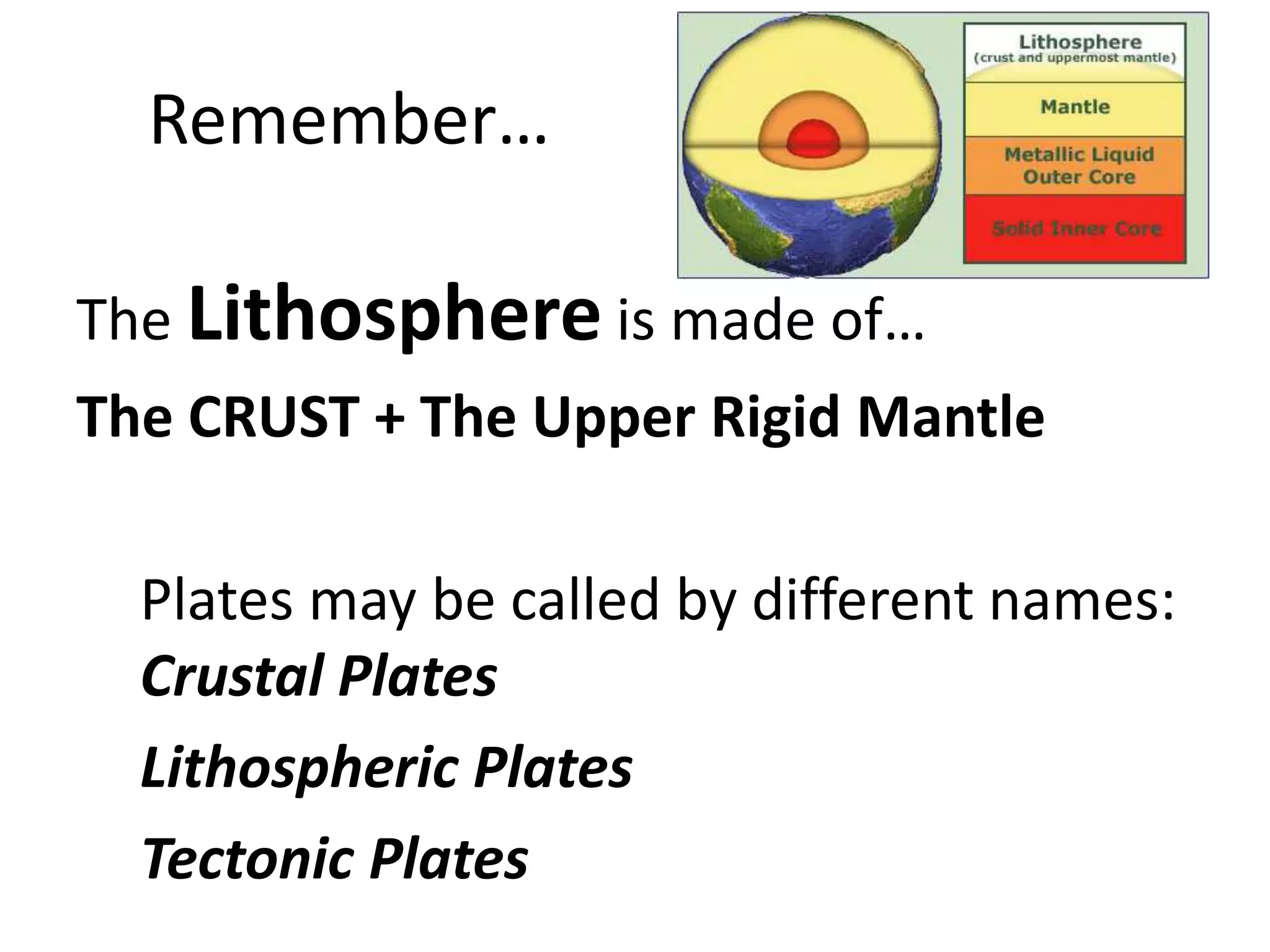
The Lithosphere is made of…
The CRUST + The Upper Rigid Mantle
Plates may be called by different names:
Crustal Plates
Lithospheric Plates
Tectonic Plates
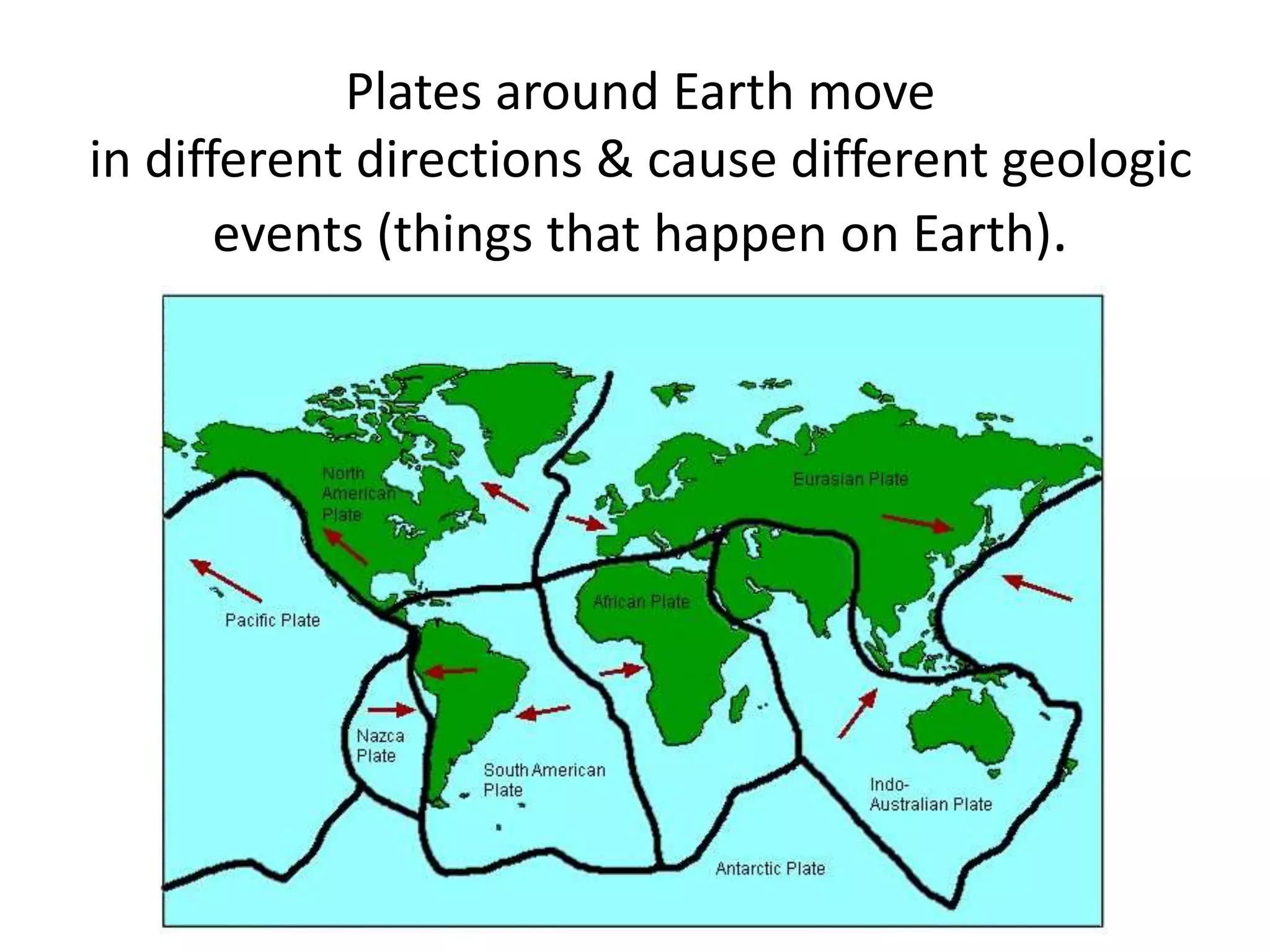
Plates around Earth move
in different directions & cause different geologic
events (things that happen on Earth).
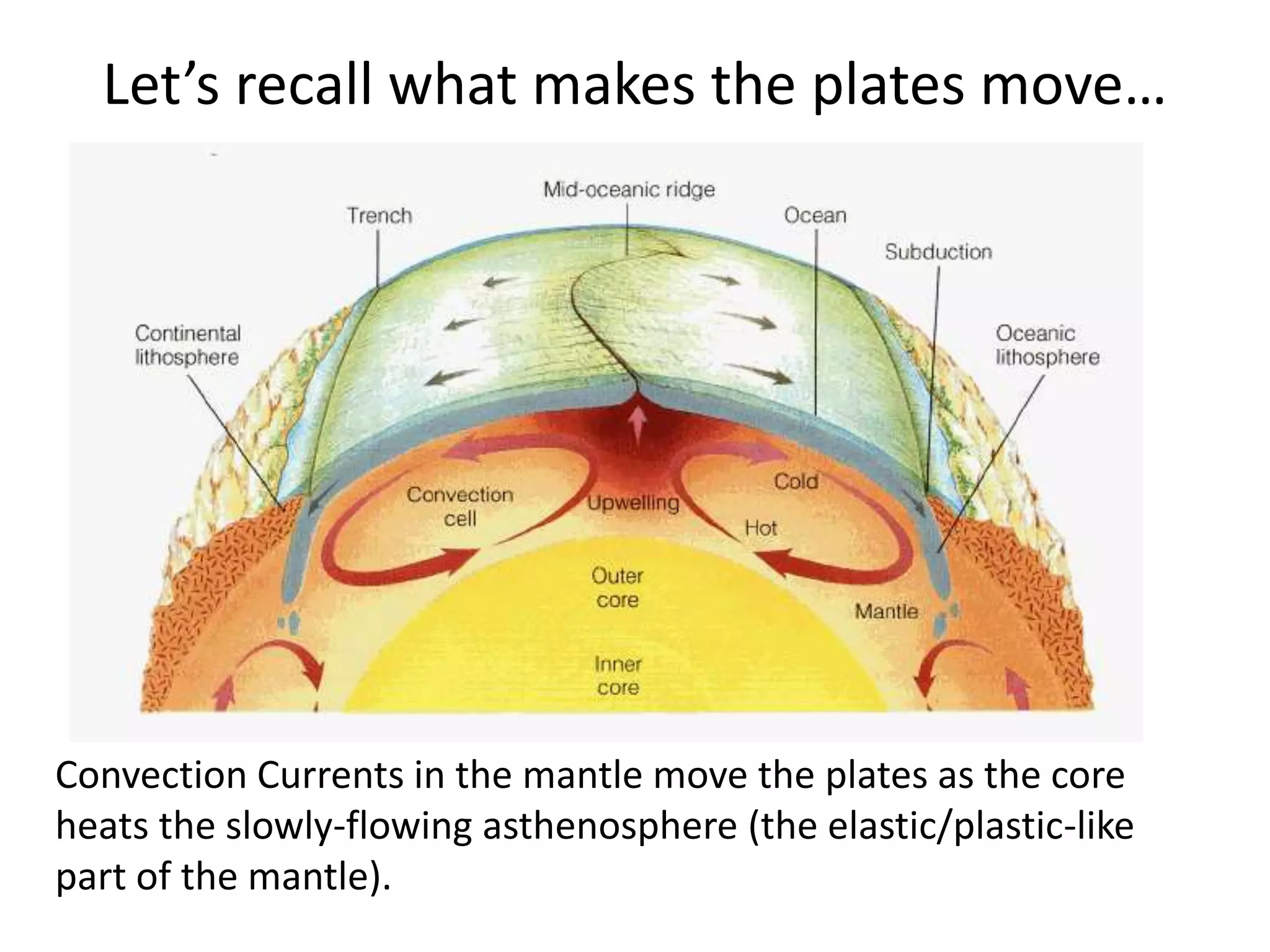
Let’s recall what makes the plates move…
Convection Currents in the mantle move the plates as the core
heats the slowly-flowing asthenosphere (the elastic/plastic-like
part of the mantle).
There are 3 types of Plate
Boundaries.
Each one has a type of STRESS on the
rock
& a way that it breaks, called a
FAULT:
• Divergent Boundaries
• Convergent Boundaries
• Transform Boundaries
Let’s
break it
down…
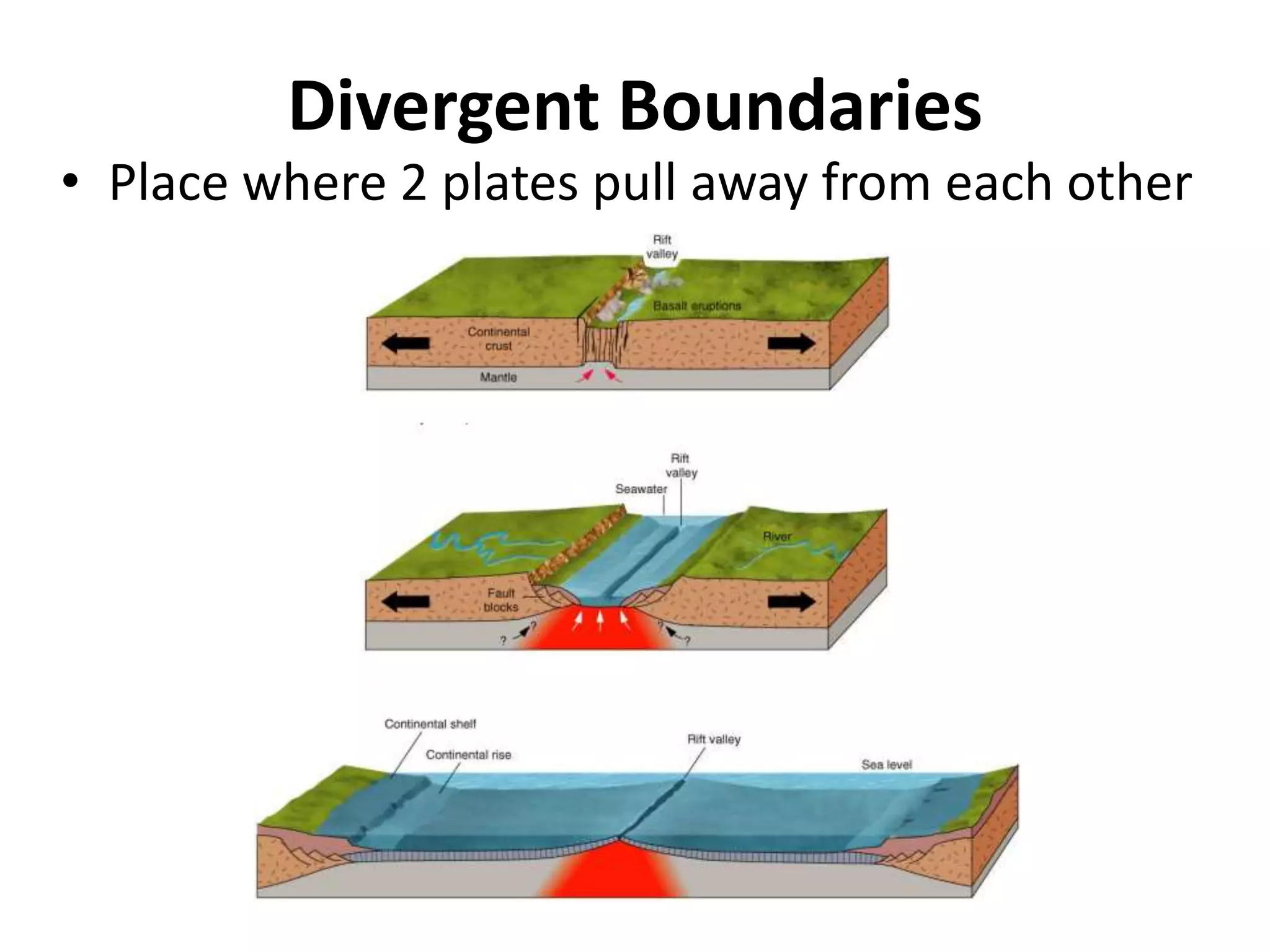
Divergent Boundaries
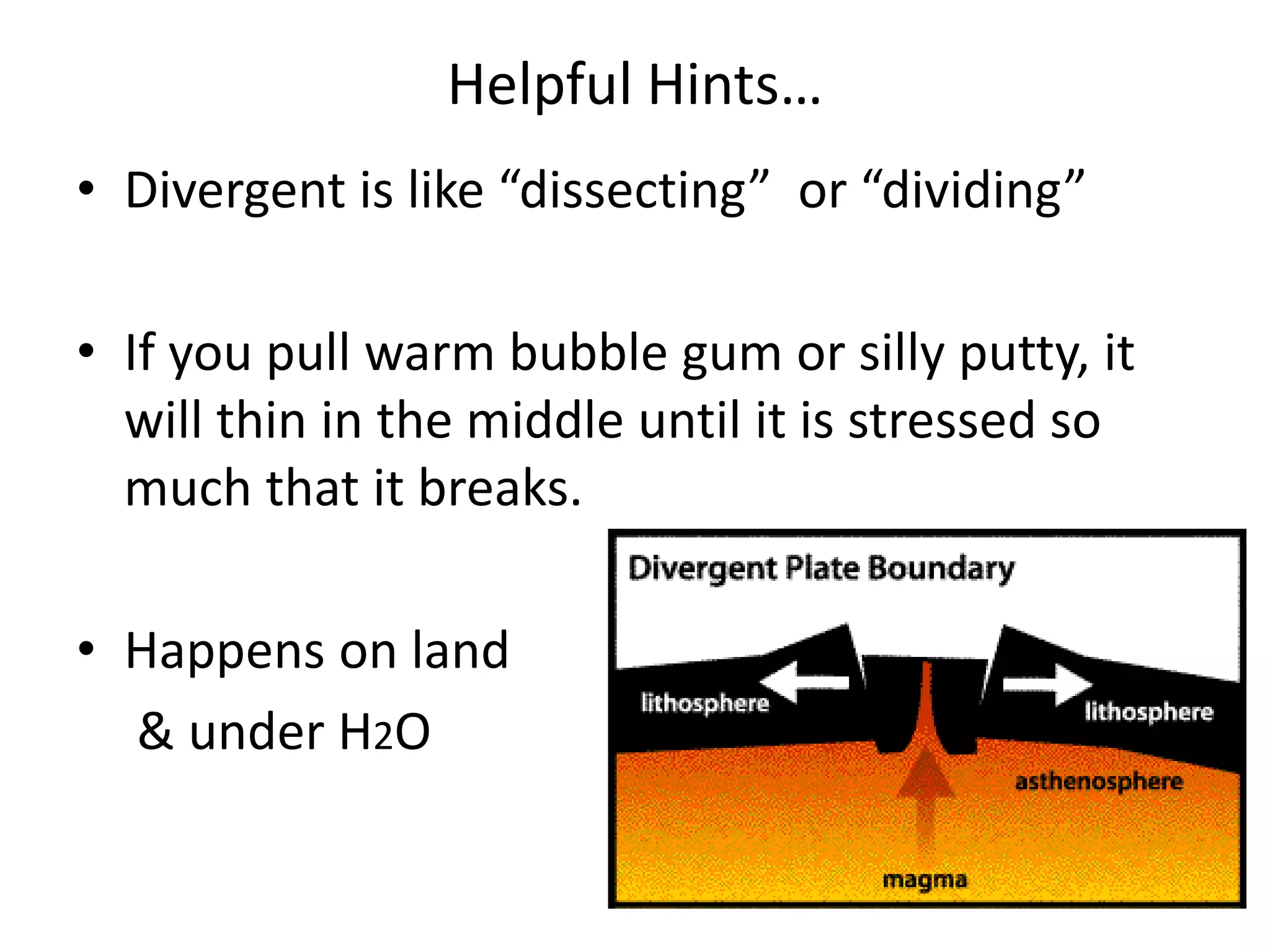
• Place where 2 plates pull away from each other
How is the rock pulled at Divergent
Boundaries?
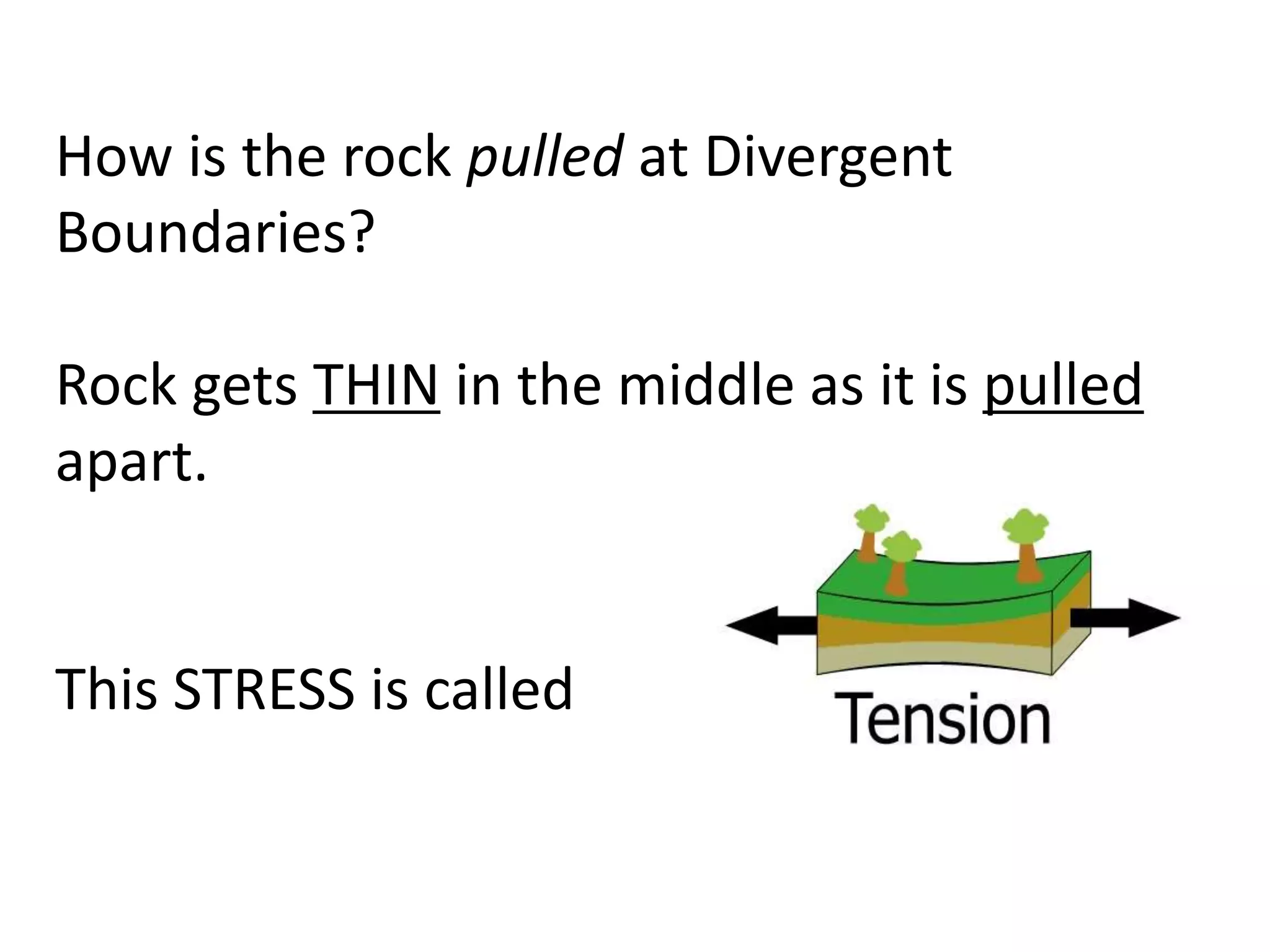
Rock gets THIN in the middle as it is pulled
apart.
This STRESS is called
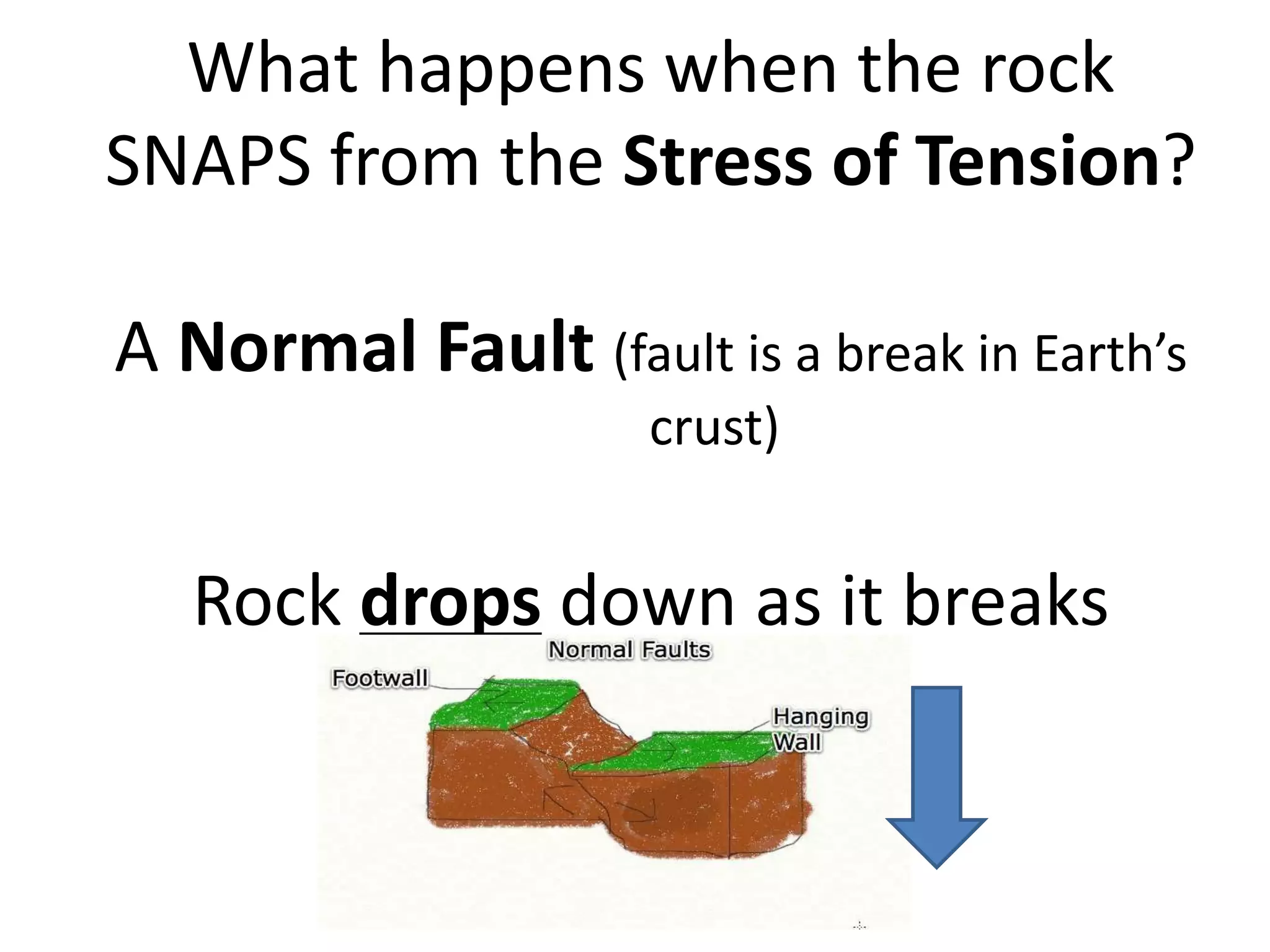
What happens when the rock
SNAPS from the Stress of Tension?
A Normal Fault (fault is a break in Earth’s
crust)
Rock drops down as it breaks
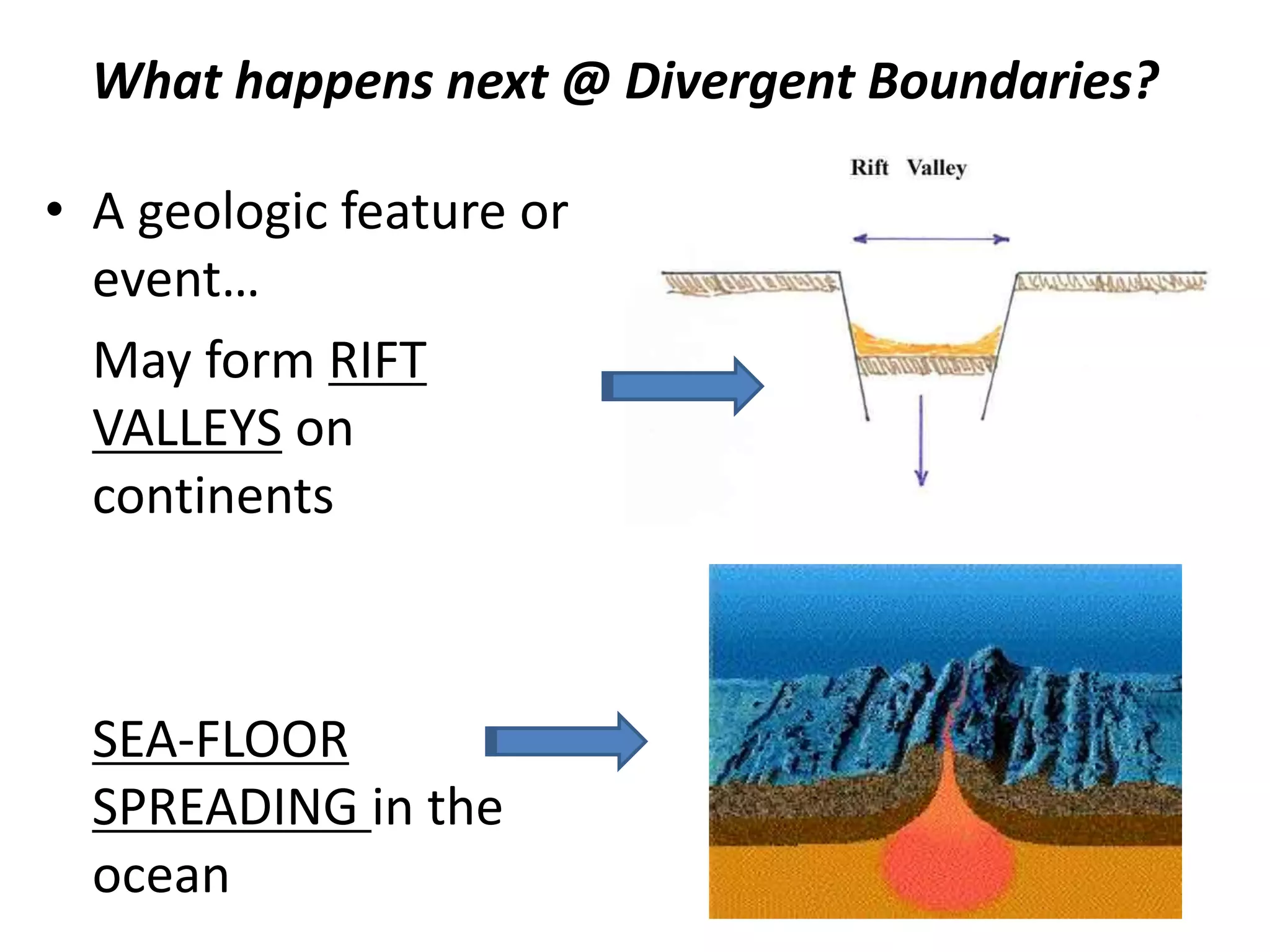
What happens next @ Divergent Boundaries?
• A geologic feature or
event…
May form RIFT
VALLEYS on
continents
SEA-FLOOR
SPREADING in the
ocean
Helpful Hints…
• Divergent is like “dissecting” or “dividing”
• If you pull warm bubble gum or silly putty, it
will thin in the middle until it is stressed so
much that it breaks.
• Happens on land
& under H2O
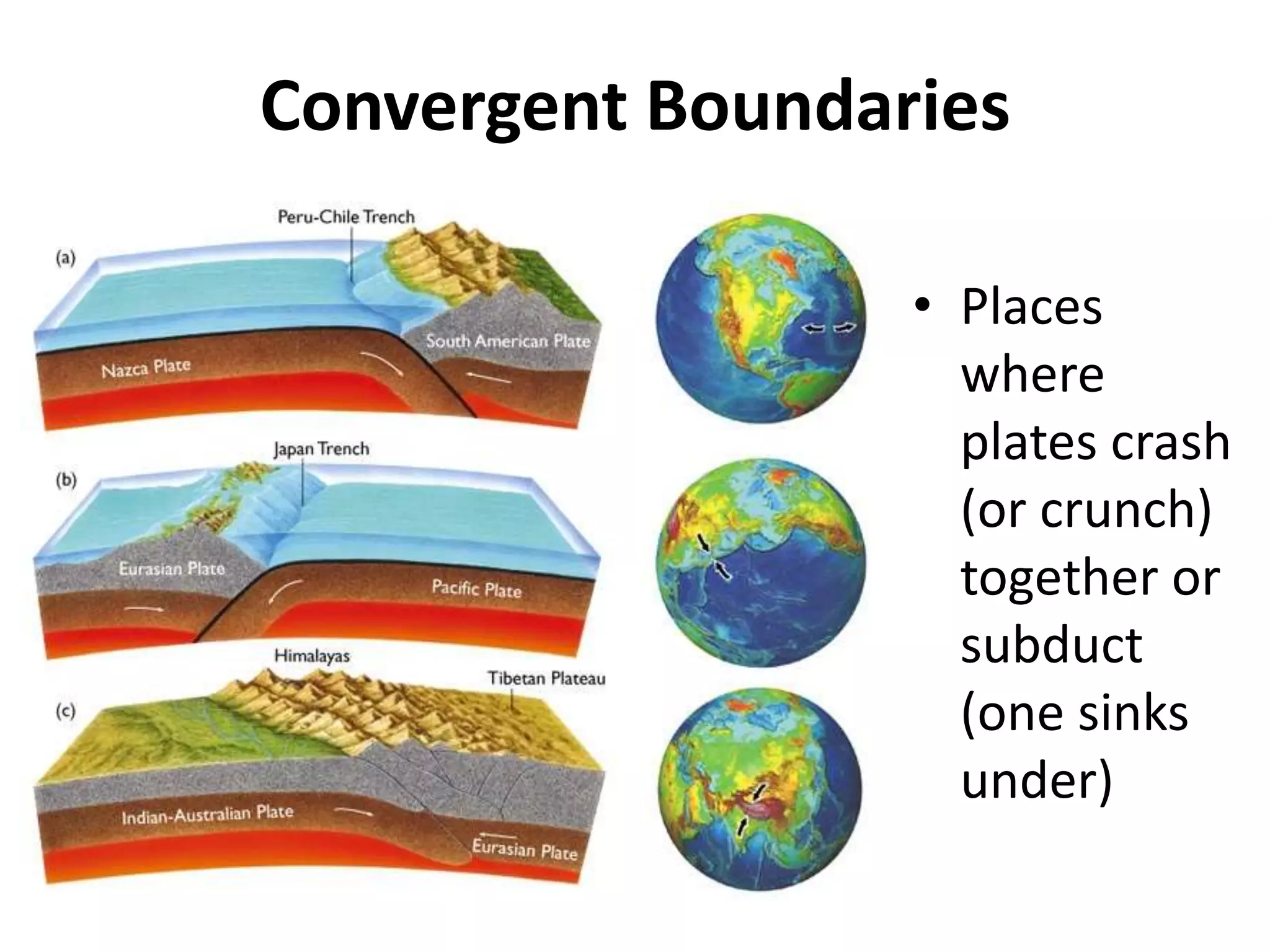
Convergent Boundaries
• Places
where
plates crash
(or crunch)
together or
subduct
(one sinks
under)
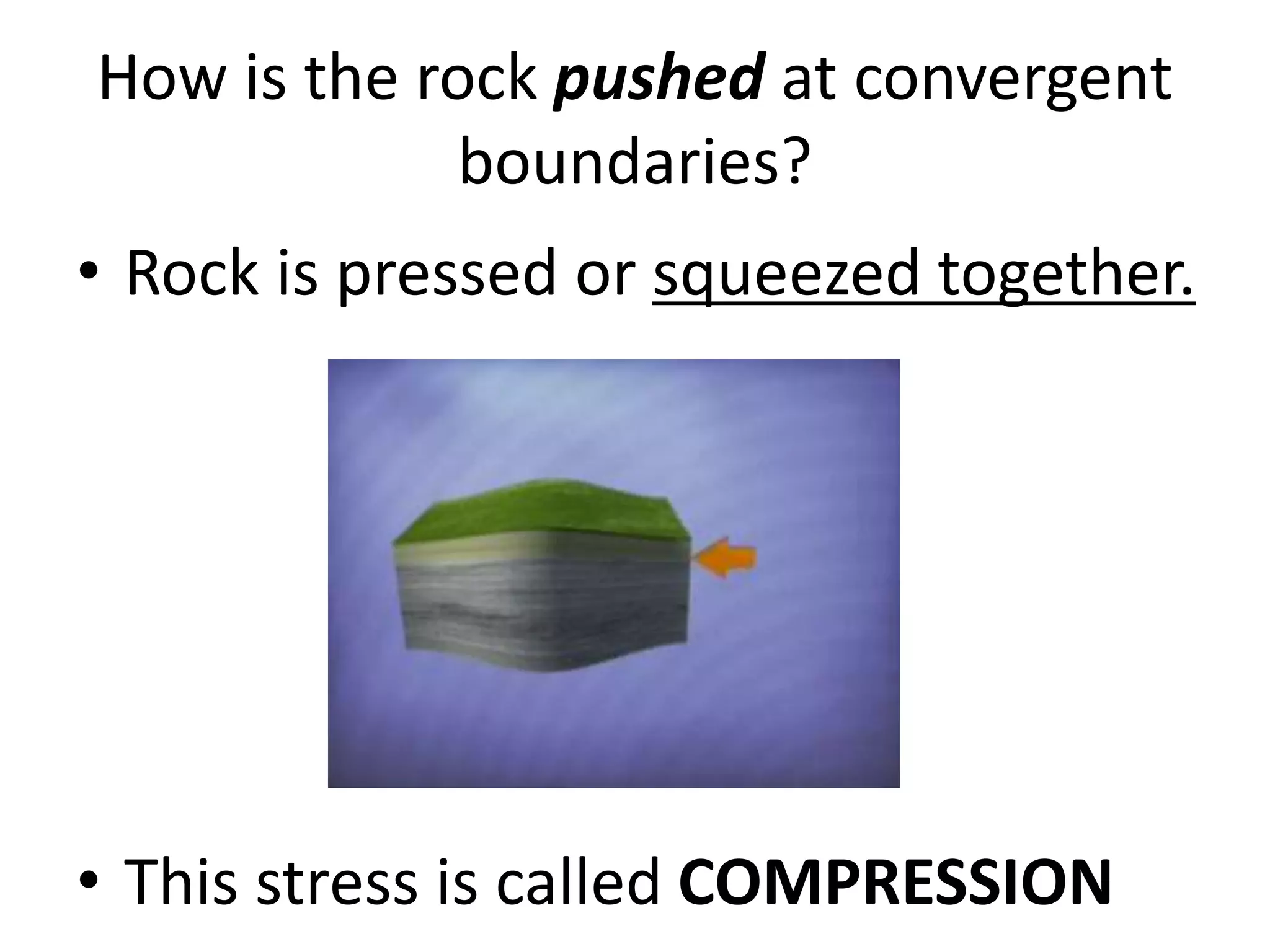
How is the rock pushed at convergent
boundaries?
• Rock is pressed or squeezed together.
• This stress is called COMPRESSION
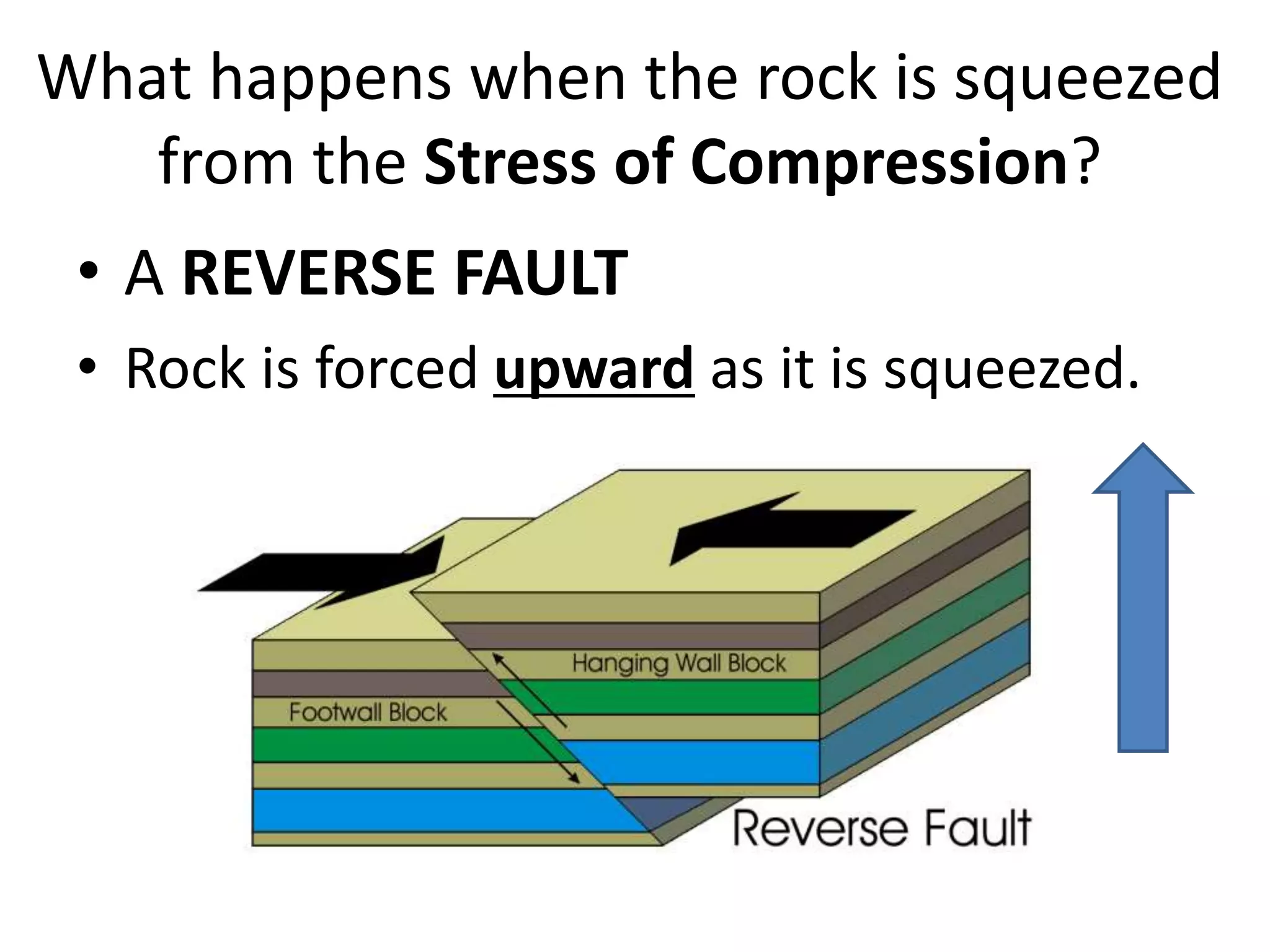
What happens when the rock is squeezed
from the Stress of Compression?
• A REVERSE FAULT
• Rock is forced upward as it is squeezed.
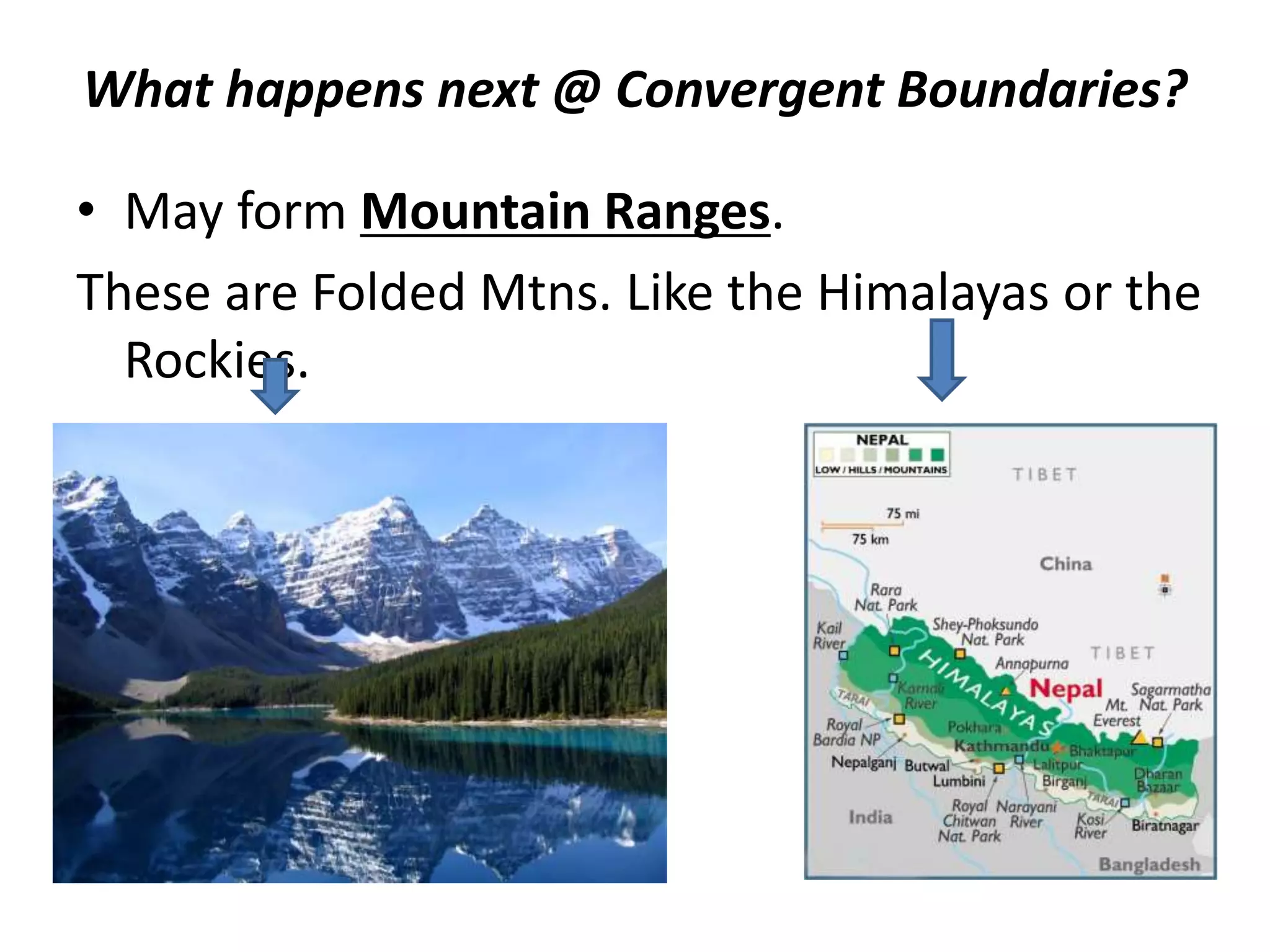
What happens next @ Convergent Boundaries?
• May form Mountain Ranges.
These are Folded Mtns. Like the Himalayas or the
Rockies.
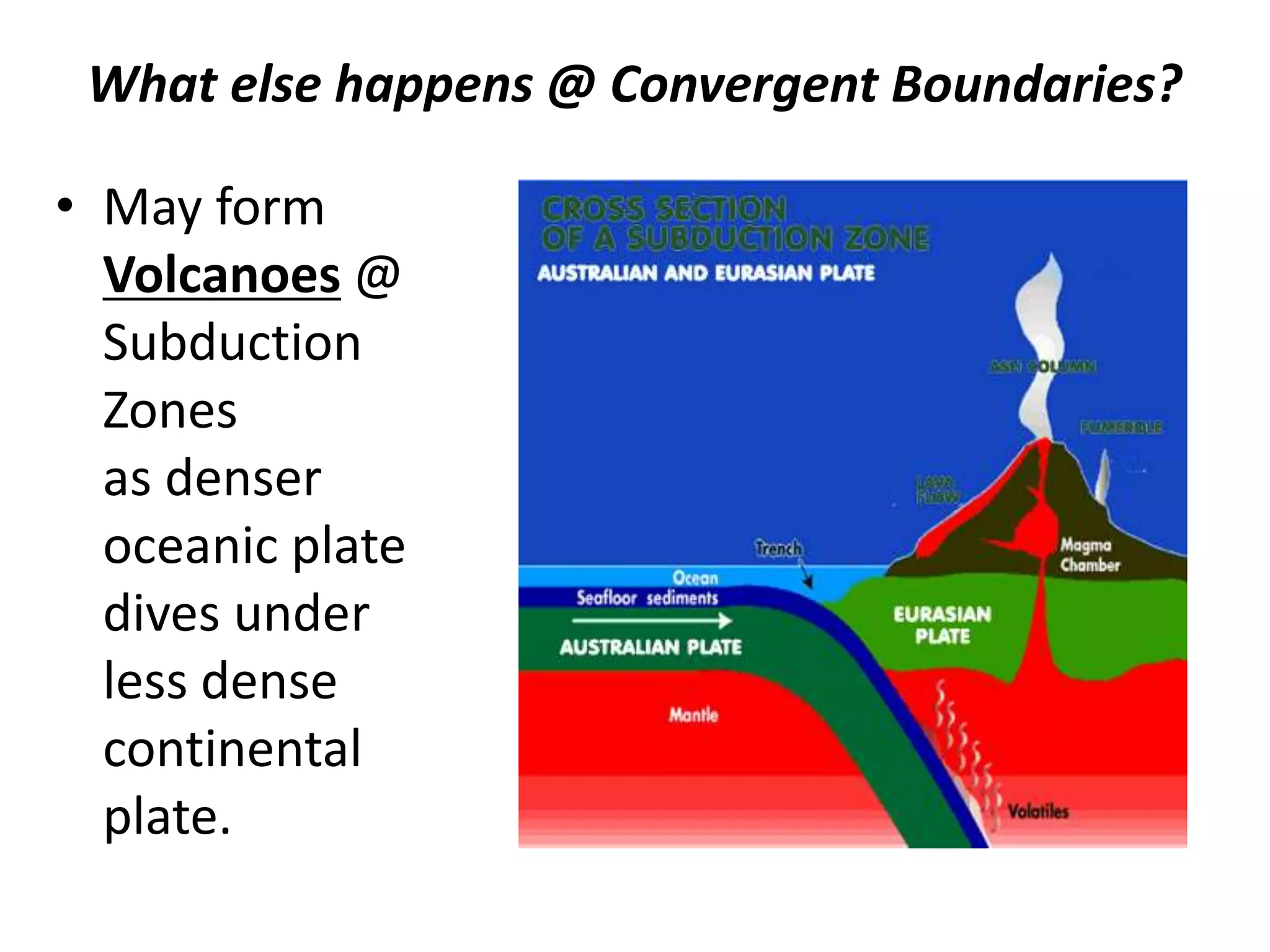
• May form
Volcanoes @
Subduction
Zones
as denser
oceanic plate
dives under
less dense
continental
plate.
What else happens @ Convergent Boundaries?
Helpful Hints…
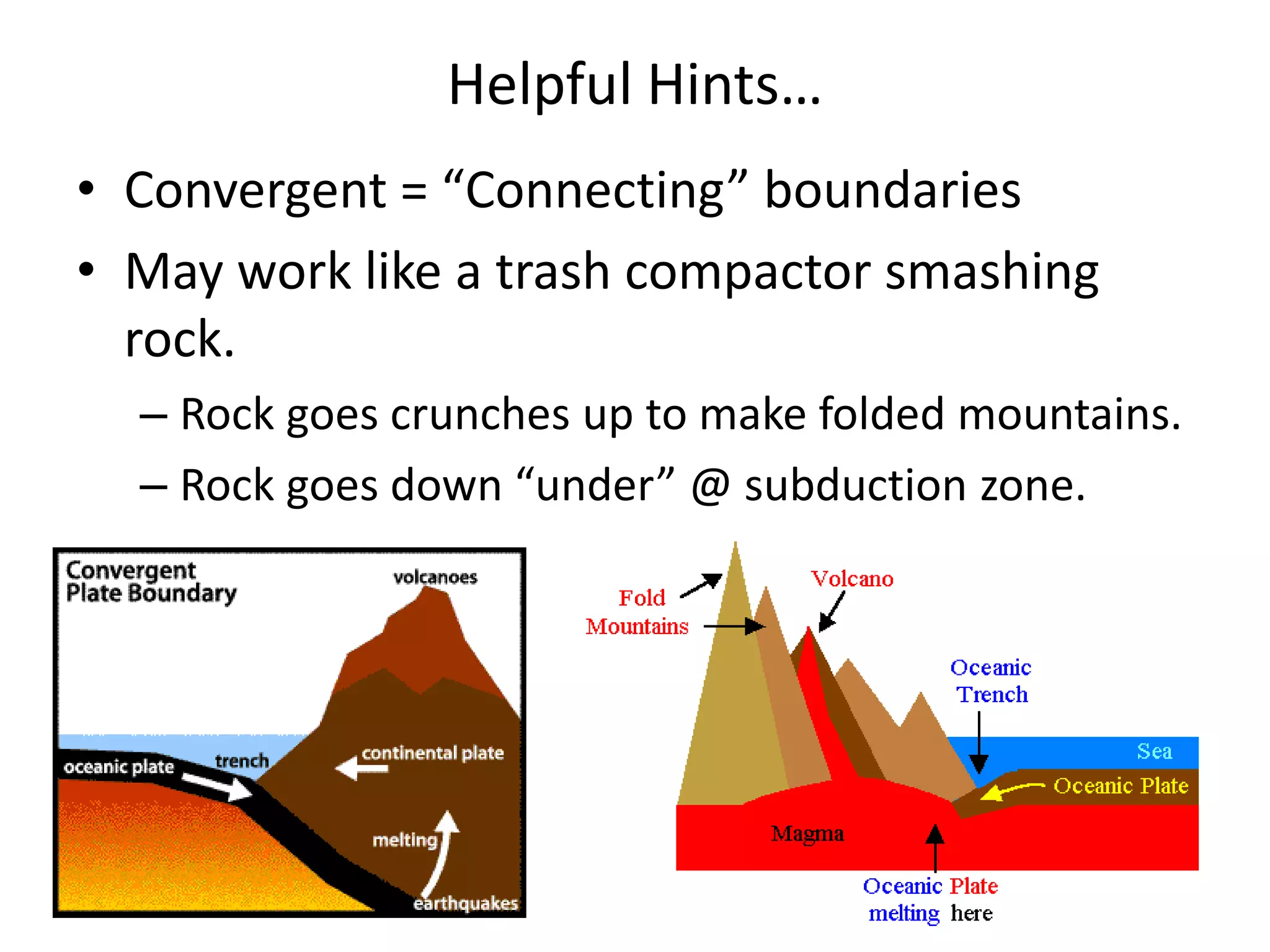
• Convergent = “Connecting” boundaries
• May work like a trash compactor smashing
rock.
– Rock goes crunches up to make folded mountains.
– Rock goes down “under” @ subduction zone.
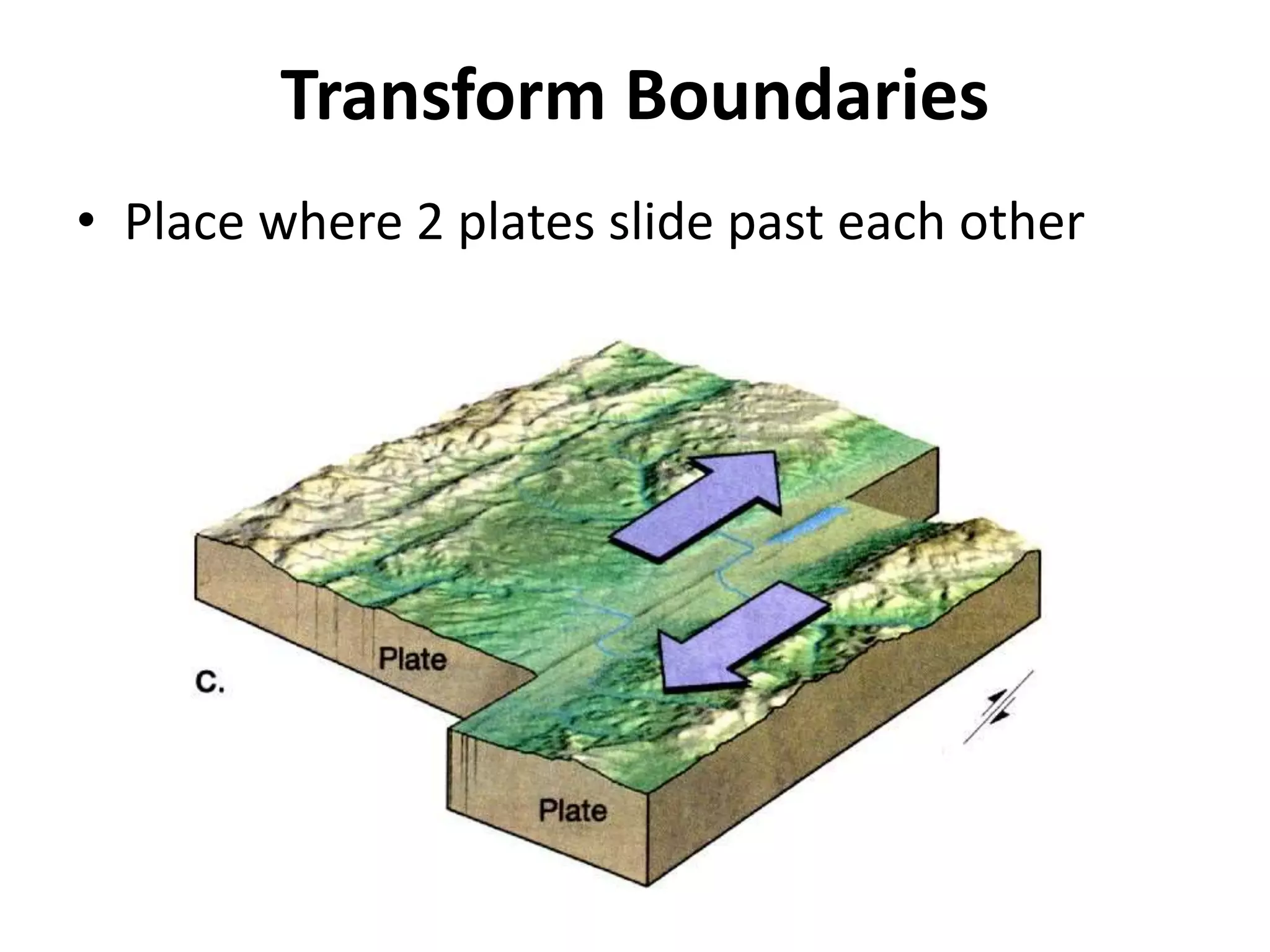
Transform Boundaries
• Place where 2 plates slide past each other
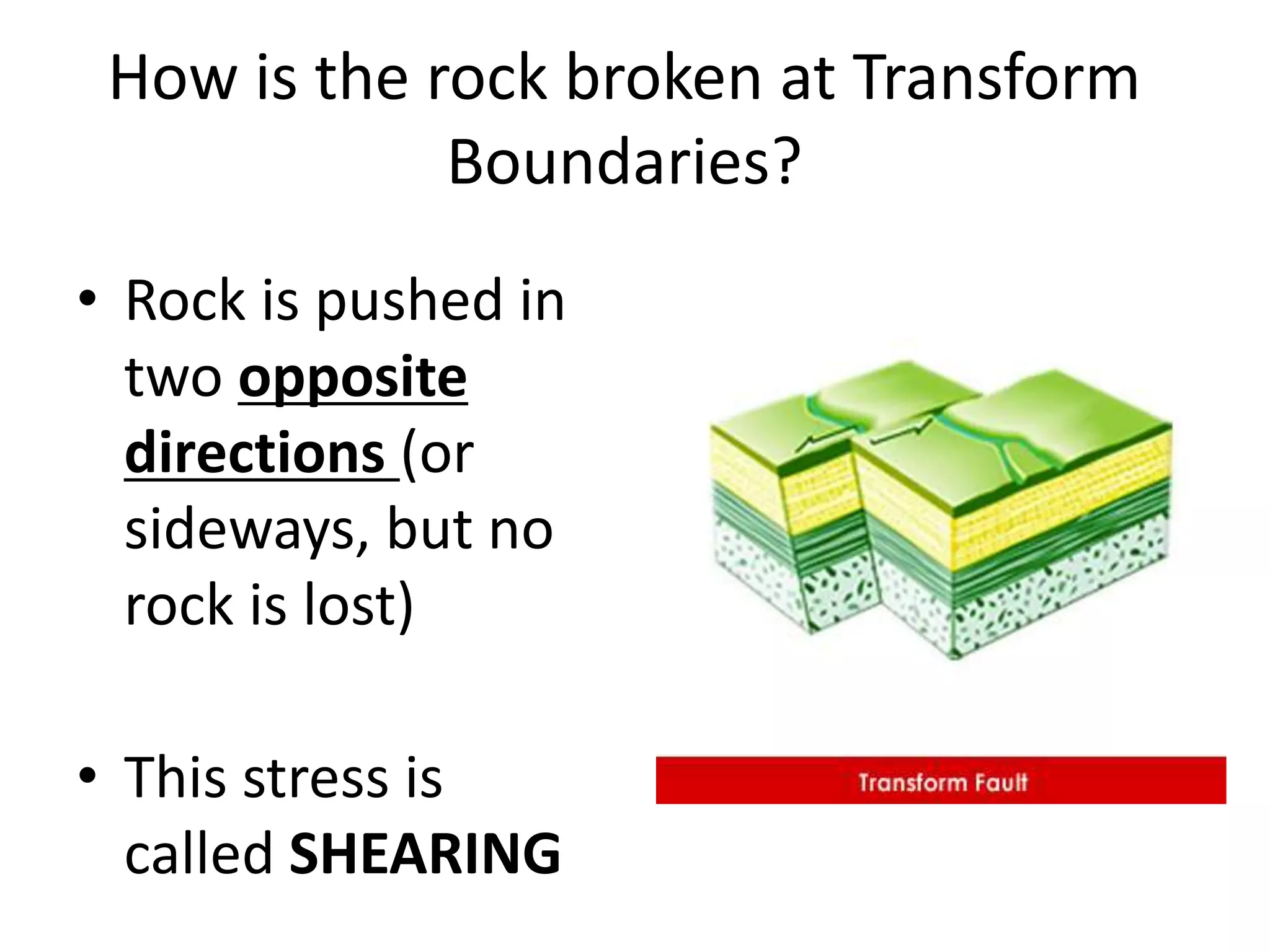
How is the rock broken at Transform
Boundaries?
• Rock is pushed in
two opposite
directions (or
sideways, but no
rock is lost)
• This stress is
called SHEARING
What happens when the rock is sheared
(or “cut”) from the Stress of Shearing?
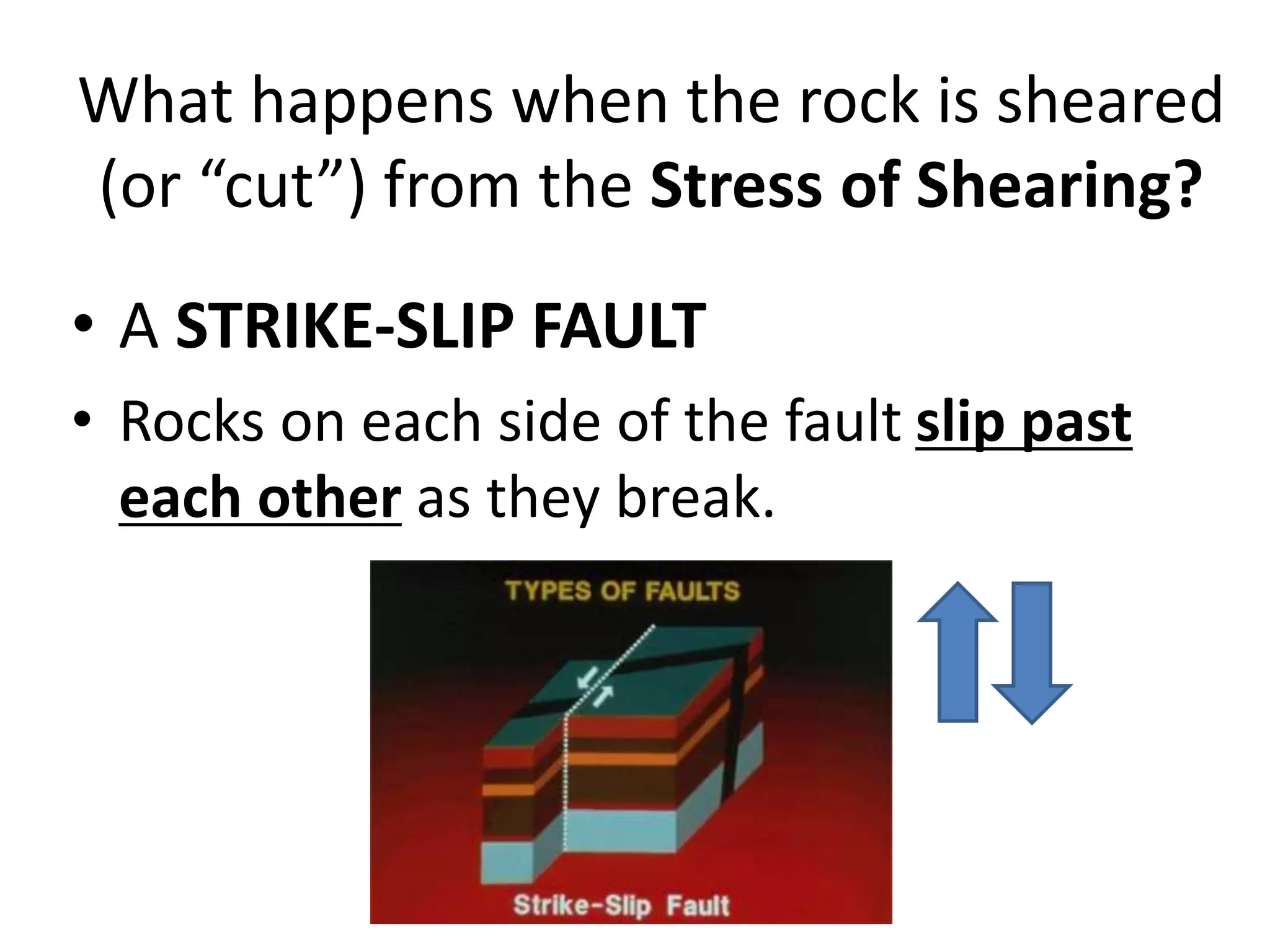
• A STRIKE-SLIP FAULT
• Rocks on each side of the fault slip past
each other as they break.
What happens next at Transform Boundaries?
• May cause
Earthquakes
when the rock
snaps from the
pressure.
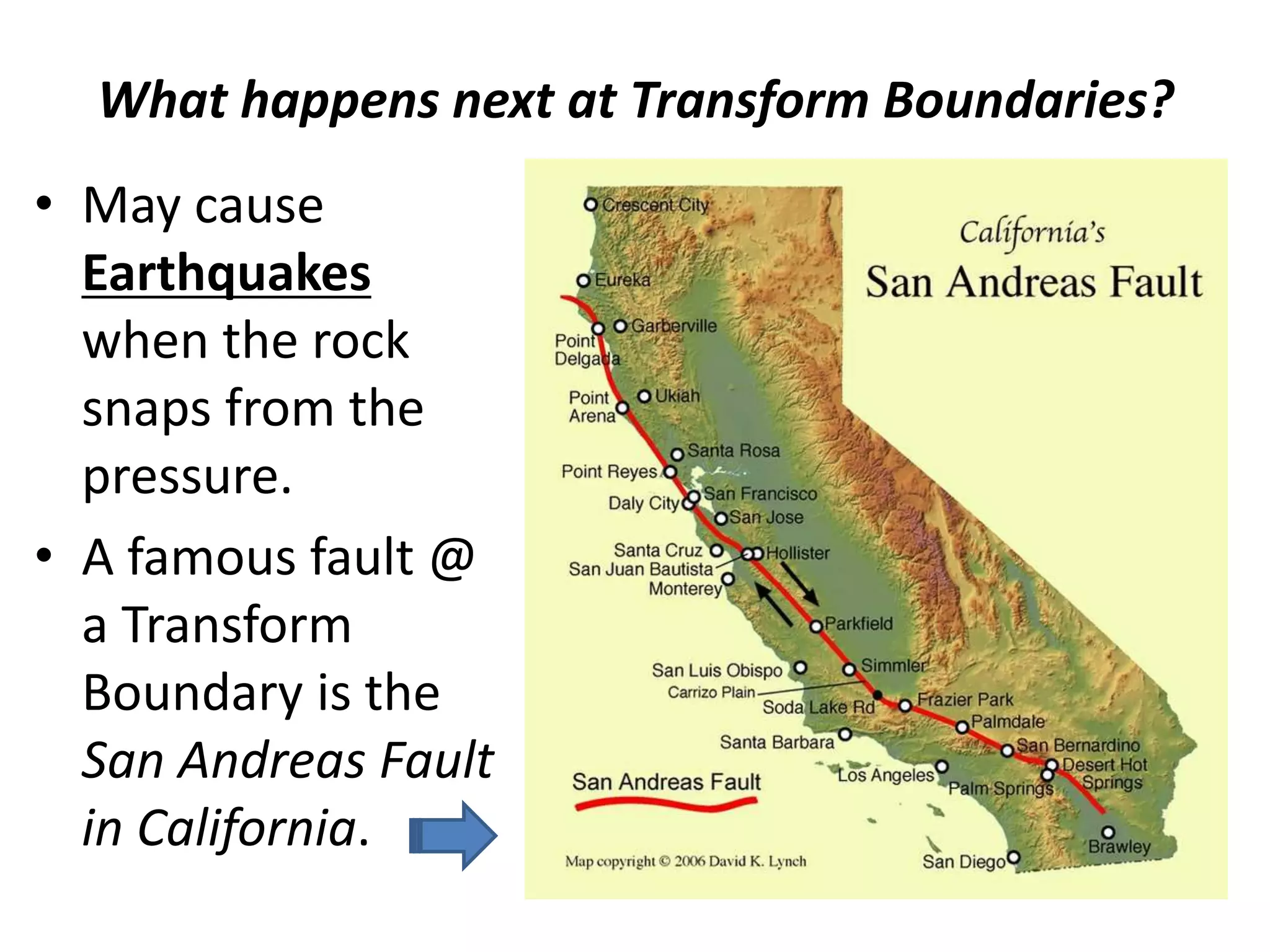
• A famous fault @
a Transform
Boundary is the
San Andreas Fault
in California.
Helpful Hints…
• Shearing means cutting (“Shears” are like
scissors)
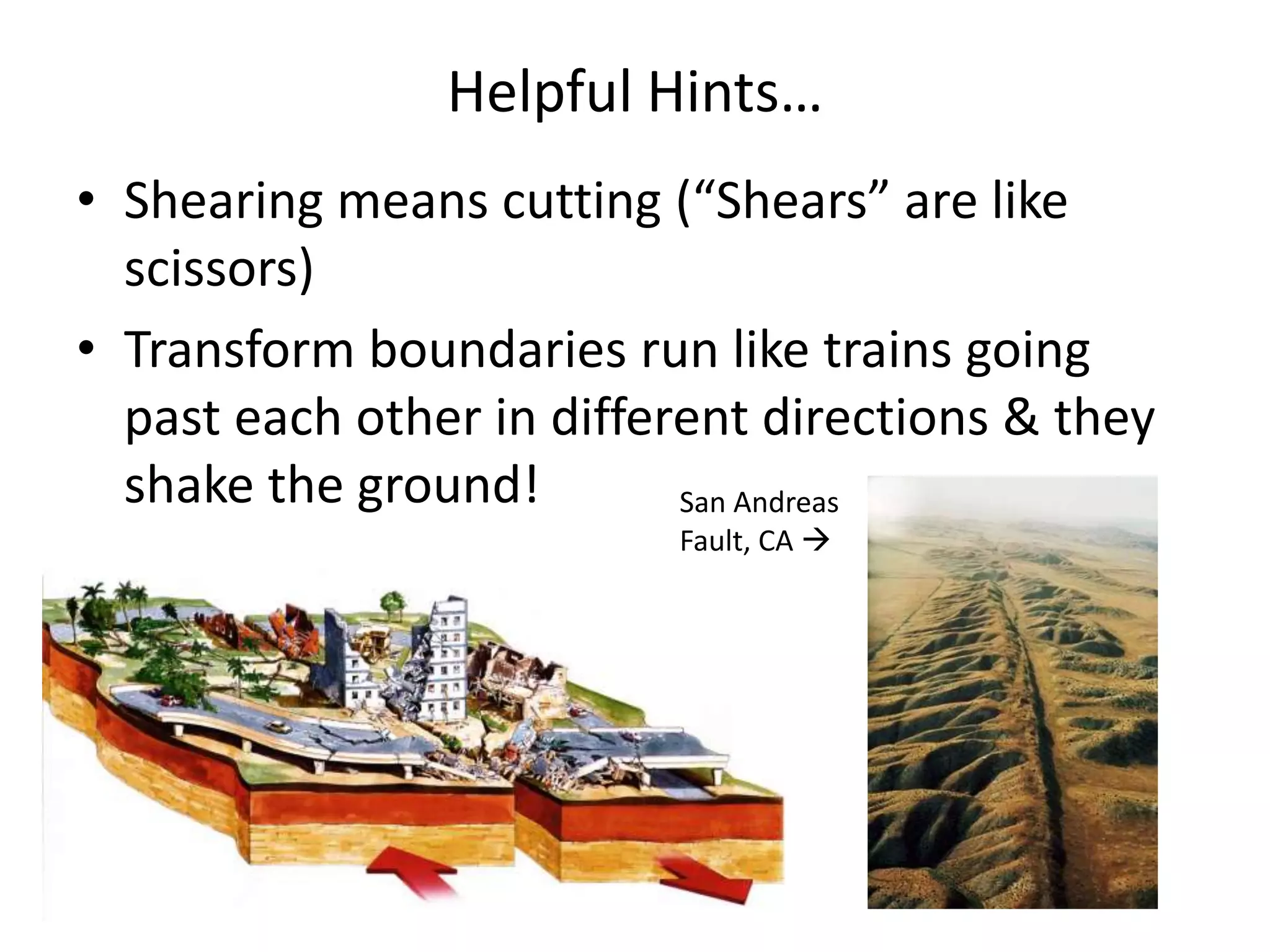
• Transform boundaries run like trains going
past each other in different directions & they
shake the ground! San Andreas
Fault, CA 
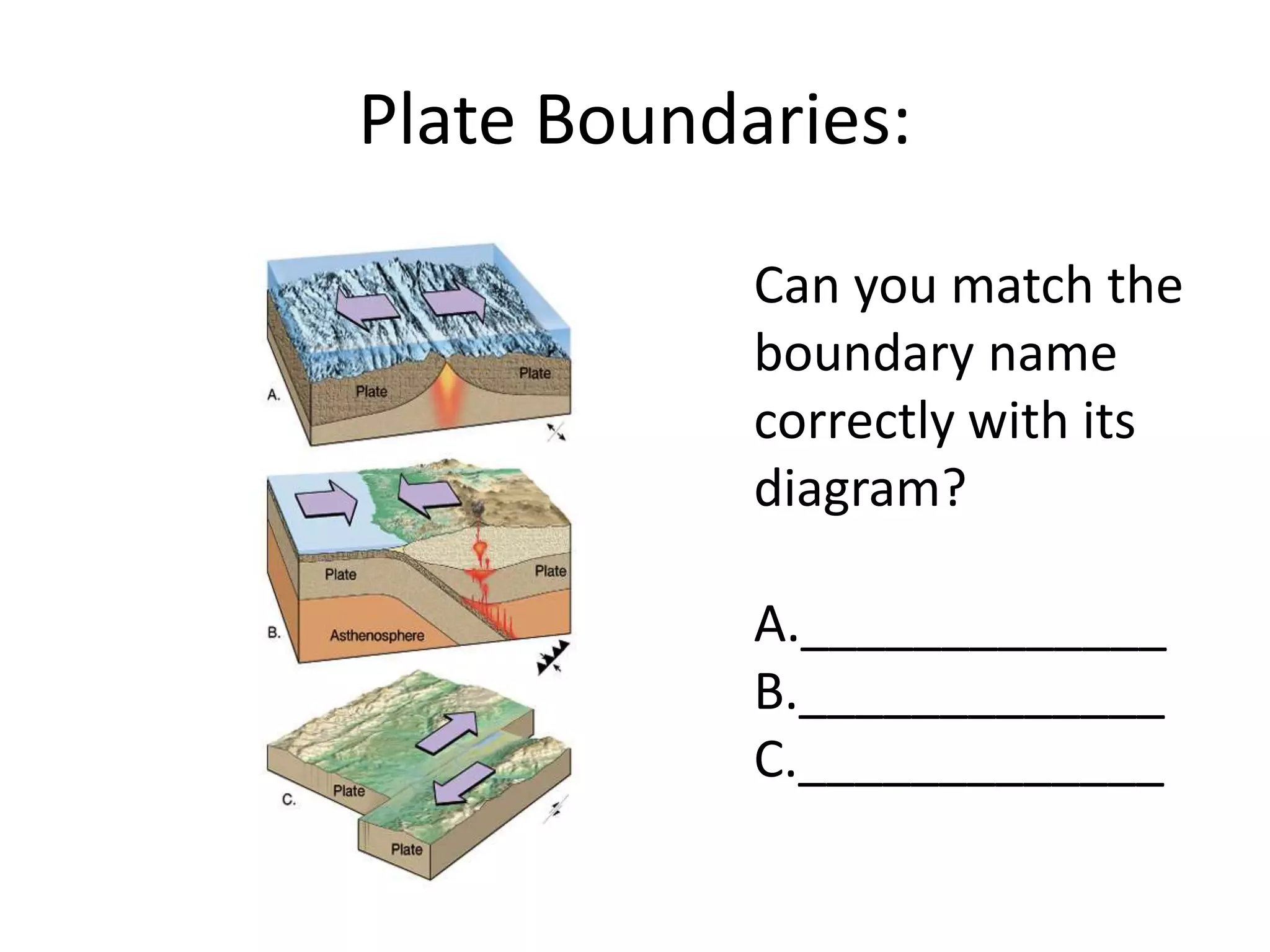
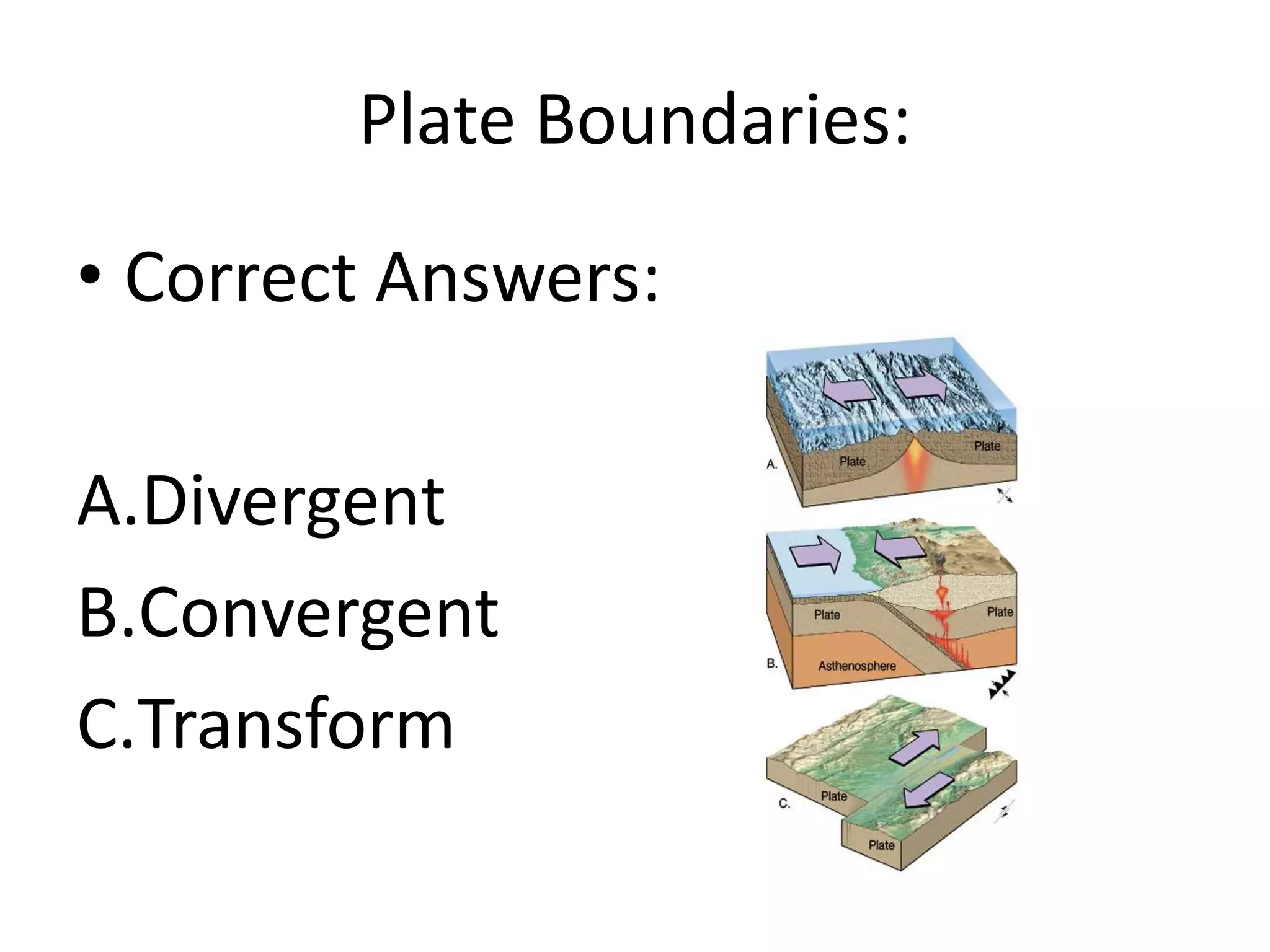
Can you match the
boundary name
correctly with its
diagram?
A._____________
B._____________
C._____________
Plate Boundaries:
Plate Boundaries:
• Correct Answers:
A.Divergent
B.Convergent
C.Transform
Standard:
S6E5. Students will investigate the scientific view of
how the earth’s surface is formed.
d. Describe processes that change rocks and the
surface of the earth.
Review: (Make sure you use voc. from your notes)
1. How does the process of subduction recycle
rock?
2. How can magma rise up on the ocean floor?
3. What happens to rock to form folded mountain
ranges?
Standard:
S6E5. Students will investigate the scientific view
of how the earth’s surface is formed
e. Recognize that lithospheric plates constantly
move and cause major geological events on the
earth’s surface.
Review:
1. List the geologic event(s) that can occur at each
plate boundary. (What happens or is formed here?)
•____ & ____ @ Divergent Boundaries
•____ & ____ @ Convergent Boundaries
•__________ @ Transform Boundaries
Standard:
S6E5. Students will investigate the scientific view
of how the earth’s surface is formed
f. Explain the effects of physical processes (plate
tectonics, erosion, deposition, volcanic eruption, gravity) on geological features
including oceans (composition, currents, and tides).
Review: (Make sure to use voc. from your notes)
1.Explain how Earthquakes occur.
2.How can new ocean floor be created?
3.How do mountain ranges form?
4.Why is density important at subduction zones?

Plate boundaries stresses faults ppt

  • 1.
    Boundaries, Stresses, and Faults OH MY! Howdo geologic events change and shape Earth’s surface?
  • 2.
    Remember… The Lithosphere ismade of… The CRUST + The Upper Rigid Mantle Plates may be called by different names: Crustal Plates Lithospheric Plates Tectonic Plates
  • 3.
    Plates around Earthmove in different directions & cause different geologic events (things that happen on Earth).
  • 4.
    Let’s recall whatmakes the plates move… Convection Currents in the mantle move the plates as the core heats the slowly-flowing asthenosphere (the elastic/plastic-like part of the mantle).
  • 5.
    There are 3types of Plate Boundaries. Each one has a type of STRESS on the rock & a way that it breaks, called a FAULT: • Divergent Boundaries • Convergent Boundaries • Transform Boundaries Let’s break it down…
  • 6.
    Divergent Boundaries • Placewhere 2 plates pull away from each other
  • 7.
    How is therock pulled at Divergent Boundaries? Rock gets THIN in the middle as it is pulled apart. This STRESS is called
  • 8.
    What happens whenthe rock SNAPS from the Stress of Tension? A Normal Fault (fault is a break in Earth’s crust) Rock drops down as it breaks
  • 9.
    What happens next@ Divergent Boundaries? • A geologic feature or event… May form RIFT VALLEYS on continents SEA-FLOOR SPREADING in the ocean
  • 10.
    Helpful Hints… • Divergentis like “dissecting” or “dividing” • If you pull warm bubble gum or silly putty, it will thin in the middle until it is stressed so much that it breaks. • Happens on land & under H2O
  • 11.
    Convergent Boundaries • Places where platescrash (or crunch) together or subduct (one sinks under)
  • 12.
    How is therock pushed at convergent boundaries? • Rock is pressed or squeezed together. • This stress is called COMPRESSION
  • 13.
    What happens whenthe rock is squeezed from the Stress of Compression? • A REVERSE FAULT • Rock is forced upward as it is squeezed.
  • 14.
    What happens next@ Convergent Boundaries? • May form Mountain Ranges. These are Folded Mtns. Like the Himalayas or the Rockies.
  • 15.
    • May form Volcanoes@ Subduction Zones as denser oceanic plate dives under less dense continental plate. What else happens @ Convergent Boundaries?
  • 16.
    Helpful Hints… • Convergent= “Connecting” boundaries • May work like a trash compactor smashing rock. – Rock goes crunches up to make folded mountains. – Rock goes down “under” @ subduction zone.
  • 17.
    Transform Boundaries • Placewhere 2 plates slide past each other
  • 18.
    How is therock broken at Transform Boundaries? • Rock is pushed in two opposite directions (or sideways, but no rock is lost) • This stress is called SHEARING
  • 19.
    What happens whenthe rock is sheared (or “cut”) from the Stress of Shearing? • A STRIKE-SLIP FAULT • Rocks on each side of the fault slip past each other as they break.
  • 20.
    What happens nextat Transform Boundaries? • May cause Earthquakes when the rock snaps from the pressure. • A famous fault @ a Transform Boundary is the San Andreas Fault in California.
  • 21.
    Helpful Hints… • Shearingmeans cutting (“Shears” are like scissors) • Transform boundaries run like trains going past each other in different directions & they shake the ground! San Andreas Fault, CA 
  • 22.
    Can you matchthe boundary name correctly with its diagram? A._____________ B._____________ C._____________ Plate Boundaries:
  • 23.
    Plate Boundaries: • CorrectAnswers: A.Divergent B.Convergent C.Transform
  • 24.
    Standard: S6E5. Students willinvestigate the scientific view of how the earth’s surface is formed. d. Describe processes that change rocks and the surface of the earth. Review: (Make sure you use voc. from your notes) 1. How does the process of subduction recycle rock? 2. How can magma rise up on the ocean floor? 3. What happens to rock to form folded mountain ranges?
  • 25.
    Standard: S6E5. Students willinvestigate the scientific view of how the earth’s surface is formed e. Recognize that lithospheric plates constantly move and cause major geological events on the earth’s surface. Review: 1. List the geologic event(s) that can occur at each plate boundary. (What happens or is formed here?) •____ & ____ @ Divergent Boundaries •____ & ____ @ Convergent Boundaries •__________ @ Transform Boundaries
  • 26.
    Standard: S6E5. Students willinvestigate the scientific view of how the earth’s surface is formed f. Explain the effects of physical processes (plate tectonics, erosion, deposition, volcanic eruption, gravity) on geological features including oceans (composition, currents, and tides). Review: (Make sure to use voc. from your notes) 1.Explain how Earthquakes occur. 2.How can new ocean floor be created? 3.How do mountain ranges form? 4.Why is density important at subduction zones?