Unit 2A Picture this! Art
Year 1/2
ABOUT THE UNIT
In this unit children explore an issue or event in their lives. They learn how to use a viewfinder and record their
observations and ideas using a variety of methods, including photography and collage. They look at and com-
ment on the work of photographers and illustrators.
WHERE THE UNIT FITS IN
This unit could be linked with English: drama activities – use language and actions to convey situations,
characters and emotions. It could also link with personal, social and health education (PSHE) when children
share their opinions on things that matter to them and explain their views; and with Unit 1A ‘An introduction to
modelling’, in the ICT scheme, when children create their own representations of real or fantasy situations.
WHAT THE UNIT COVERS
Art Craft Design 2D 3D Individual work Collaborative work
Line Tone Colour Pattern Texture Shape Form Space
Painting Collage Textiles Digital media Sculpture Print making
VOCABULARY
In this unit children will have an opportunity to use words and phrases related to:
• visual images, eg photograph, picture, illustration, painting, collage, sequence
• design, eg plan, outline, shape
• illustration, eg illuminated, pictured, decorated, drawn, illustrators
• style and size of letterforms
• layouts and arrangement
• collage, eg combining, overlapping, layering
• print, eg monoprint, press print
RESOURCES
For practical work
• viewfinders (made from a plastic slide mount or card frame 3–5cm wide)
• camera
• drawing and painting materials
• materials for paper collage, eg papers, glue, scissors
• materials for print making, eg base boards, rollers, paint or water-based printing inks, sponge,
objects for printing
Suggested examples of art, craft and design
• photographs from family albums, newspapers and magazines showing:
– good and bad composition
– different angles and viewpoints
– close-up and distant views
– posed and action shots
• a range of storybooks showing:
– interesting layouts
– different ways of linking words and images
– different approaches to illustration, eg books by Raymond Briggs or Jill Burton
EXPECTATIONS
At the end of this unit
most children will be
able to:
explore ways of framing images; investigate and use drawing,
print making, collage and photography to communicate ideas
and meanings in their own images; comment on differences
in others’ work; suggest ways of improving their own work
some children will not
have made so much
progress. They will be
able to:
communicate ideas and meanings in different ways; describe
what they think or feel about their own and others’ work
some children will have
progressed further.
They will be able to:
investigate and use line, shape, colour and tone to
communicate ideas and experiences in different media;
comment on similarities and differences between their own
and others’ work; adapt and improve their own work
PRIOR LEARNING
It is helpful if children have:
• looked at photographs and how they are composed
• looked at how stories are told when words and images are combined in storybooks
• looked at different styles and sizes of letterforms
• worked from observation, memory and imagination to create their own pictures
© QCA 2000 Browse, save, edit or print Schemes of Work from the Standards Site at www.standards.dfee.gov.uk Art - Unit 2A Picture this!
FUTURE LEARNING
In Unit 3A ‘Portraying relationships’, children use compositional skills to make a painting based on
relationships.
In Unit 4A ‘Viewpoints’, children photograph characters on location using the school environment as a setting
for developing a visual narrative based on a dream.
ADAPTING THE UNIT OF WORK
Children could:
• record small or large movements of a person in a series of still photographs and use these as a
basis
for developing a montage. This work could be linked with Unit 4A ‘Moving and growing’ in the
science
scheme of work
• use photography and other recording media to explore their surroundings and use this information as a
starting point to develop a three-dimensional environment. This work could be linked with Unit 6A
‘Interdependence and adaptation’ in the science scheme of work or Unit 14 ‘Investigating rivers’ in the
geography scheme of work
© QCA 2000 Browse, save, edit or print Schemes of Work from the Standards Site at www.standards.dfee.gov.uk Art - Unit 2A Picture this!
LEARNING OBJECTIVES POSSIBLE TEACHING ACTIVITIES LEARNING OUTCOMES POINTS TO NOTE
CHILDREN SHOULD LEARN CHILDREN
EXPLORING AND DEVELOPING IDEAS
• to record from first-
hand observation and
explore ideas
• Ask the children to pretend to be a camera. Give the children
viewfinders and ask them to walk around the classroom looking
through the viewfinder with one eye closed as though they were
looking through a camera’s viewfinder.
• Encourage the children to explore what happens when they move
closer to something or further away and when they hold the
viewfinder vertically or horizontally.
• Ask the children to frame something in their viewfinder that interests
them. Ask them to make a drawing of this – about the size of a colour
print – noticing whether their frame is wider (landscape) or taller
(portrait). Ask them to draw everything they see in their frame. Ask
them to take a photograph of what is in the drawing, keeping to
exactly the same angle and proportions.
• Compare the drawing with the photograph.
• frame and record an interesting viewpoint in a
drawing and a photograph
• identify similarities and differences between the
drawing and the photograph
• Make sure children hold the viewfinder in
front of their eye so that it successfully
frames what they see.
• This ‘framing’ technique can be used in
many art and design activities as a way of
encouraging children to be more selective
about what they want to include in their work.
• to ask and answer
questions about the
starting points for their
work
• Play a guessing game by showing the children a small part of a
photograph and asking them to identify what is happening in the
picture. Gradually reveal more of the picture by widening the frame
around it. Encourage the children to use visual clues, eg shapes,
colours, lines, actions, and to explain their reasons for their answers
and for changing their answers.
• comment on differences in the messages given by
part of an image compared with messages from
the whole image
© QCA 2000 Art - Unit 2A Picture this!
3
EXPLORING AND DEVELOPING IDEAS (Cont.)
• to record from
imagination and
experience and explore
ideas
• Give the children part of an image from a magazine photograph and
ask them to fix this to a larger sheet of paper. Ask them to draw what
might be outside the given image.
• Talk about how and why the photograph they have been given might
have been ‘cropped’, eg to focus attention on a particular idea or
person.
• Ask the children to give their image a title before and after they make
the bigger picture. Compare the two. Ask them to write captions for
their images, linking the words they use with the images they have
created.
• Use another image, placed in the middle of a blank piece of paper
and ask the children to draw on one side of the image what they think
happened just before the image was taken and on the other side what
happened just after the image was taken. Ask them to pay attention to
size, scale, colour and action in the photograph and to use visual
‘clues’.
• visualise the whole of an image from a given part
• make drawings and paintings using the visual
clues from given images
• The children could develop their drawing into
a painting where they match the colours and
tones in their painting to the given image.
This work would build on learning in Unit 1A
‘Self-portrait’. Remind the children about
colour mixing and how to make a colour
lighter or darker by adding white or black.
• Look at examples of illustrations in children’s
storybooks. Identify the variety of ways that
words and images are connected. Talk
about:
– different approaches to layout, eg placing
words over and alongside images
– different ways that images are drawn and
painted
– images that are more or less prominent
than words
– how images can be used to link one page
or part of a story with another.
INVESTIGATING AND MAKING
• to try out tools and
techniques and apply
these to materials and
processes, including
drawing
• Explore with the children issues that are of interest or concern to
them in their daily lives and agree a subject for a ‘news story’. Ask the
children to work in groups to act out scenes from the story, with each
member of the group playing a part.
• Ask each group to plan a storyboard showing a number of key
moments from the story. Develop a series of three or four black and
white images. Write captions that capture the main idea of each
image.
• create a storyboard for an event or an issue in their
lives
• A ‘storyboard’ is a sequence of images that
presents the main events of a story in the
order in which they happen. Consider how
different versions can be used to illustrate a
sequence of events in a story.
• Link with English by writing stories and
poems based on their art work. Links with the
National Literacy Strategy: Framework for
teaching, years 1 and 2, where children learn
about stories.
INVESTIGATING AND MAKING (Cont.)
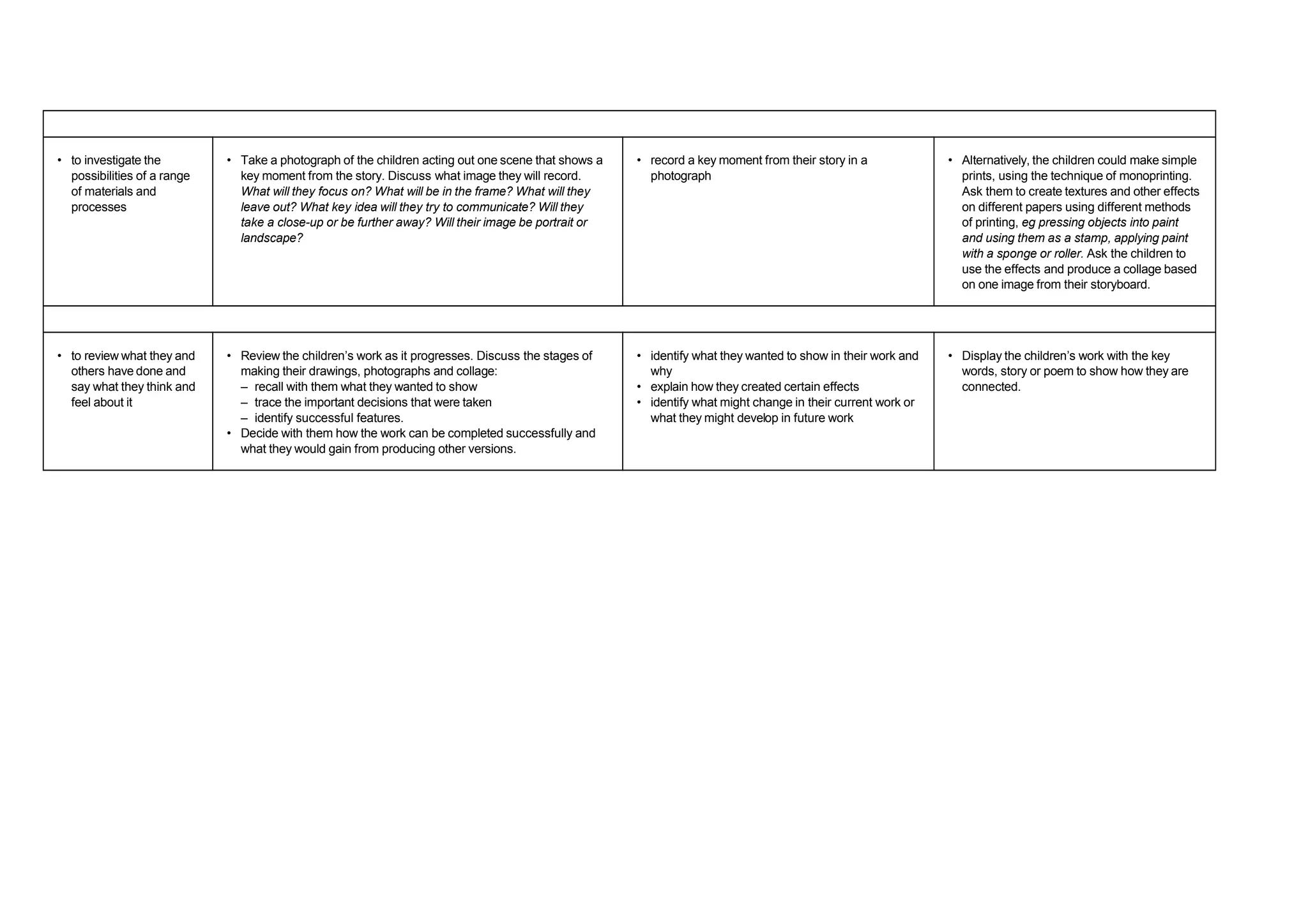
• to investigate the
possibilities of a range
of materials and
processes
• Take a photograph of the children acting out one scene that shows a
key moment from the story. Discuss what image they will record.
What will they focus on? What will be in the frame? What will they
leave out? What key idea will they try to communicate? Will they
take a close-up or be further away? Will their image be portrait or
landscape?
• record a key moment from their story in a
photograph
• Alternatively, the children could make simple
prints, using the technique of monoprinting.
Ask them to create textures and other effects
on different papers using different methods
of printing, eg pressing objects into paint
and using them as a stamp, applying paint
with a sponge or roller. Ask the children to
use the effects and produce a collage based
on one image from their storyboard.
EVALUATING AND DEVELOPING WORK
• to review what they and
others have done and
say what they think and
feel about it
• Review the children’s work as it progresses. Discuss the stages of
making their drawings, photographs and collage:
– recall with them what they wanted to show
– trace the important decisions that were taken
– identify successful features.
• Decide with them how the work can be completed successfully and
what they would gain from producing other versions.
• identify what they wanted to show in their work and
why
• explain how they created certain effects
• identify what might change in their current work or
what they might develop in future work
• Display the children’s work with the key
words, story or poem to show how they are
connected.
INVESTIGATING AND MAKING (Cont.)
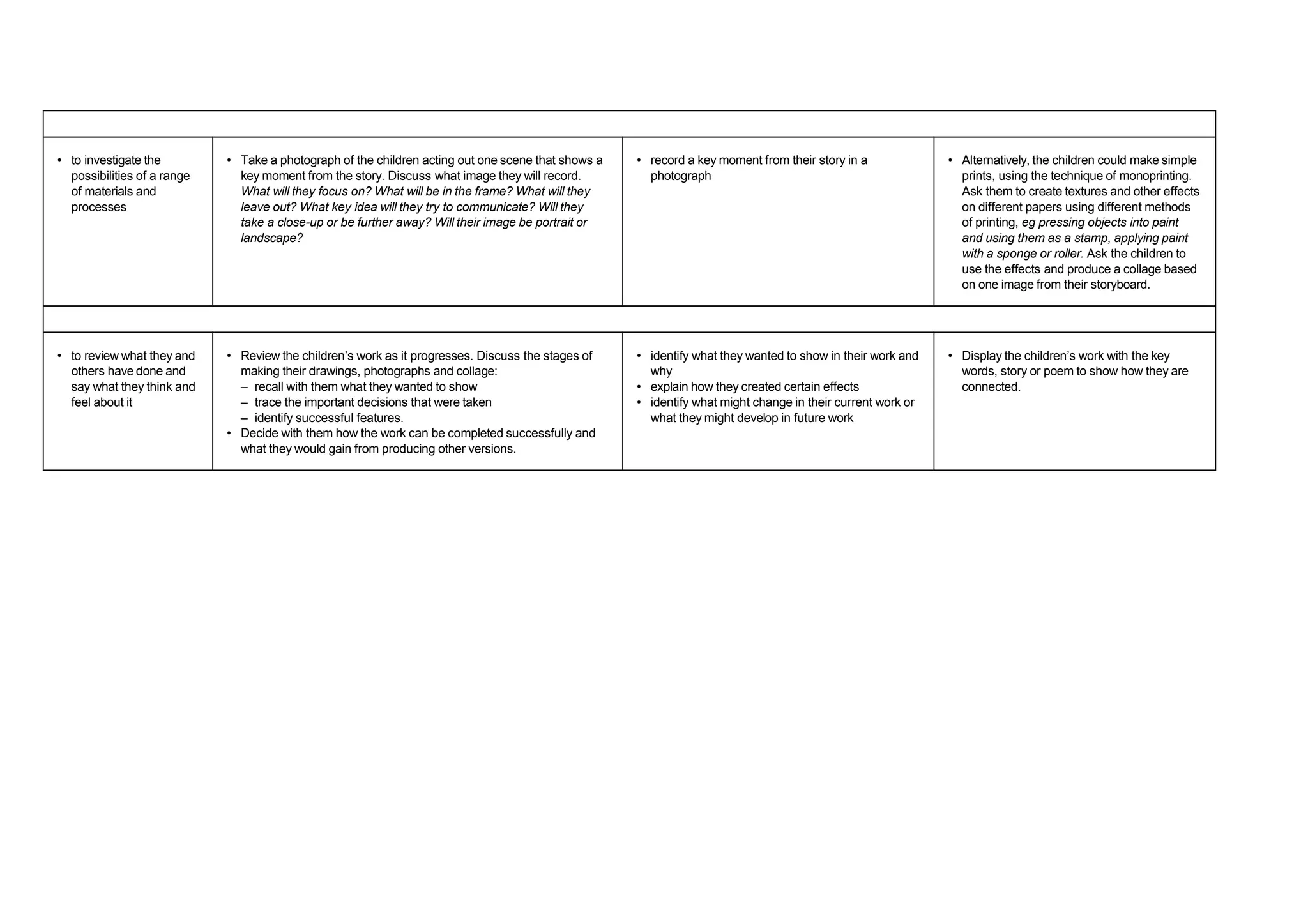
• to investigate the
possibilities of a range
of materials and
processes
• Take a photograph of the children acting out one scene that shows a
key moment from the story. Discuss what image they will record.
What will they focus on? What will be in the frame? What will they
leave out? What key idea will they try to communicate? Will they
take a close-up or be further away? Will their image be portrait or
landscape?
• record a key moment from their story in a
photograph
• Alternatively, the children could make simple
prints, using the technique of monoprinting.
Ask them to create textures and other effects
on different papers using different methods
of printing, eg pressing objects into paint
and using them as a stamp, applying paint
with a sponge or roller. Ask the children to
use the effects and produce a collage based
on one image from their storyboard.
EVALUATING AND DEVELOPING WORK
• to review what they and
others have done and
say what they think and
feel about it
• Review the children’s work as it progresses. Discuss the stages of
making their drawings, photographs and collage:
– recall with them what they wanted to show
– trace the important decisions that were taken
– identify successful features.
• Decide with them how the work can be completed successfully and
what they would gain from producing other versions.
• identify what they wanted to show in their work and
why
• explain how they created certain effects
• identify what might change in their current work or
what they might develop in future work
• Display the children’s work with the key
words, story or poem to show how they are
connected.

Picture This Scheme Of Work-Year 1/Year 2

  • 1.
    Unit 2A Picturethis! Art Year 1/2 ABOUT THE UNIT In this unit children explore an issue or event in their lives. They learn how to use a viewfinder and record their observations and ideas using a variety of methods, including photography and collage. They look at and com- ment on the work of photographers and illustrators. WHERE THE UNIT FITS IN This unit could be linked with English: drama activities – use language and actions to convey situations, characters and emotions. It could also link with personal, social and health education (PSHE) when children share their opinions on things that matter to them and explain their views; and with Unit 1A ‘An introduction to modelling’, in the ICT scheme, when children create their own representations of real or fantasy situations. WHAT THE UNIT COVERS Art Craft Design 2D 3D Individual work Collaborative work Line Tone Colour Pattern Texture Shape Form Space Painting Collage Textiles Digital media Sculpture Print making VOCABULARY In this unit children will have an opportunity to use words and phrases related to: • visual images, eg photograph, picture, illustration, painting, collage, sequence • design, eg plan, outline, shape • illustration, eg illuminated, pictured, decorated, drawn, illustrators • style and size of letterforms • layouts and arrangement • collage, eg combining, overlapping, layering • print, eg monoprint, press print RESOURCES For practical work • viewfinders (made from a plastic slide mount or card frame 3–5cm wide) • camera • drawing and painting materials • materials for paper collage, eg papers, glue, scissors • materials for print making, eg base boards, rollers, paint or water-based printing inks, sponge, objects for printing Suggested examples of art, craft and design • photographs from family albums, newspapers and magazines showing: – good and bad composition – different angles and viewpoints – close-up and distant views – posed and action shots • a range of storybooks showing: – interesting layouts – different ways of linking words and images – different approaches to illustration, eg books by Raymond Briggs or Jill Burton EXPECTATIONS At the end of this unit most children will be able to: explore ways of framing images; investigate and use drawing, print making, collage and photography to communicate ideas and meanings in their own images; comment on differences in others’ work; suggest ways of improving their own work some children will not have made so much progress. They will be able to: communicate ideas and meanings in different ways; describe what they think or feel about their own and others’ work some children will have progressed further. They will be able to: investigate and use line, shape, colour and tone to communicate ideas and experiences in different media; comment on similarities and differences between their own and others’ work; adapt and improve their own work PRIOR LEARNING It is helpful if children have: • looked at photographs and how they are composed • looked at how stories are told when words and images are combined in storybooks • looked at different styles and sizes of letterforms • worked from observation, memory and imagination to create their own pictures © QCA 2000 Browse, save, edit or print Schemes of Work from the Standards Site at www.standards.dfee.gov.uk Art - Unit 2A Picture this!
  • 2.
    FUTURE LEARNING In Unit3A ‘Portraying relationships’, children use compositional skills to make a painting based on relationships. In Unit 4A ‘Viewpoints’, children photograph characters on location using the school environment as a setting for developing a visual narrative based on a dream. ADAPTING THE UNIT OF WORK Children could: • record small or large movements of a person in a series of still photographs and use these as a basis for developing a montage. This work could be linked with Unit 4A ‘Moving and growing’ in the science scheme of work • use photography and other recording media to explore their surroundings and use this information as a starting point to develop a three-dimensional environment. This work could be linked with Unit 6A ‘Interdependence and adaptation’ in the science scheme of work or Unit 14 ‘Investigating rivers’ in the geography scheme of work © QCA 2000 Browse, save, edit or print Schemes of Work from the Standards Site at www.standards.dfee.gov.uk Art - Unit 2A Picture this!
  • 3.
    LEARNING OBJECTIVES POSSIBLETEACHING ACTIVITIES LEARNING OUTCOMES POINTS TO NOTE CHILDREN SHOULD LEARN CHILDREN EXPLORING AND DEVELOPING IDEAS • to record from first- hand observation and explore ideas • Ask the children to pretend to be a camera. Give the children viewfinders and ask them to walk around the classroom looking through the viewfinder with one eye closed as though they were looking through a camera’s viewfinder. • Encourage the children to explore what happens when they move closer to something or further away and when they hold the viewfinder vertically or horizontally. • Ask the children to frame something in their viewfinder that interests them. Ask them to make a drawing of this – about the size of a colour print – noticing whether their frame is wider (landscape) or taller (portrait). Ask them to draw everything they see in their frame. Ask them to take a photograph of what is in the drawing, keeping to exactly the same angle and proportions. • Compare the drawing with the photograph. • frame and record an interesting viewpoint in a drawing and a photograph • identify similarities and differences between the drawing and the photograph • Make sure children hold the viewfinder in front of their eye so that it successfully frames what they see. • This ‘framing’ technique can be used in many art and design activities as a way of encouraging children to be more selective about what they want to include in their work. • to ask and answer questions about the starting points for their work • Play a guessing game by showing the children a small part of a photograph and asking them to identify what is happening in the picture. Gradually reveal more of the picture by widening the frame around it. Encourage the children to use visual clues, eg shapes, colours, lines, actions, and to explain their reasons for their answers and for changing their answers. • comment on differences in the messages given by part of an image compared with messages from the whole image © QCA 2000 Art - Unit 2A Picture this! 3
  • 4.
    EXPLORING AND DEVELOPINGIDEAS (Cont.) • to record from imagination and experience and explore ideas • Give the children part of an image from a magazine photograph and ask them to fix this to a larger sheet of paper. Ask them to draw what might be outside the given image. • Talk about how and why the photograph they have been given might have been ‘cropped’, eg to focus attention on a particular idea or person. • Ask the children to give their image a title before and after they make the bigger picture. Compare the two. Ask them to write captions for their images, linking the words they use with the images they have created. • Use another image, placed in the middle of a blank piece of paper and ask the children to draw on one side of the image what they think happened just before the image was taken and on the other side what happened just after the image was taken. Ask them to pay attention to size, scale, colour and action in the photograph and to use visual ‘clues’. • visualise the whole of an image from a given part • make drawings and paintings using the visual clues from given images • The children could develop their drawing into a painting where they match the colours and tones in their painting to the given image. This work would build on learning in Unit 1A ‘Self-portrait’. Remind the children about colour mixing and how to make a colour lighter or darker by adding white or black. • Look at examples of illustrations in children’s storybooks. Identify the variety of ways that words and images are connected. Talk about: – different approaches to layout, eg placing words over and alongside images – different ways that images are drawn and painted – images that are more or less prominent than words – how images can be used to link one page or part of a story with another. INVESTIGATING AND MAKING • to try out tools and techniques and apply these to materials and processes, including drawing • Explore with the children issues that are of interest or concern to them in their daily lives and agree a subject for a ‘news story’. Ask the children to work in groups to act out scenes from the story, with each member of the group playing a part. • Ask each group to plan a storyboard showing a number of key moments from the story. Develop a series of three or four black and white images. Write captions that capture the main idea of each image. • create a storyboard for an event or an issue in their lives • A ‘storyboard’ is a sequence of images that presents the main events of a story in the order in which they happen. Consider how different versions can be used to illustrate a sequence of events in a story. • Link with English by writing stories and poems based on their art work. Links with the National Literacy Strategy: Framework for teaching, years 1 and 2, where children learn about stories.
  • 5.
    INVESTIGATING AND MAKING(Cont.) • to investigate the possibilities of a range of materials and processes • Take a photograph of the children acting out one scene that shows a key moment from the story. Discuss what image they will record. What will they focus on? What will be in the frame? What will they leave out? What key idea will they try to communicate? Will they take a close-up or be further away? Will their image be portrait or landscape? • record a key moment from their story in a photograph • Alternatively, the children could make simple prints, using the technique of monoprinting. Ask them to create textures and other effects on different papers using different methods of printing, eg pressing objects into paint and using them as a stamp, applying paint with a sponge or roller. Ask the children to use the effects and produce a collage based on one image from their storyboard. EVALUATING AND DEVELOPING WORK • to review what they and others have done and say what they think and feel about it • Review the children’s work as it progresses. Discuss the stages of making their drawings, photographs and collage: – recall with them what they wanted to show – trace the important decisions that were taken – identify successful features. • Decide with them how the work can be completed successfully and what they would gain from producing other versions. • identify what they wanted to show in their work and why • explain how they created certain effects • identify what might change in their current work or what they might develop in future work • Display the children’s work with the key words, story or poem to show how they are connected.
  • 6.
    INVESTIGATING AND MAKING(Cont.) • to investigate the possibilities of a range of materials and processes • Take a photograph of the children acting out one scene that shows a key moment from the story. Discuss what image they will record. What will they focus on? What will be in the frame? What will they leave out? What key idea will they try to communicate? Will they take a close-up or be further away? Will their image be portrait or landscape? • record a key moment from their story in a photograph • Alternatively, the children could make simple prints, using the technique of monoprinting. Ask them to create textures and other effects on different papers using different methods of printing, eg pressing objects into paint and using them as a stamp, applying paint with a sponge or roller. Ask the children to use the effects and produce a collage based on one image from their storyboard. EVALUATING AND DEVELOPING WORK • to review what they and others have done and say what they think and feel about it • Review the children’s work as it progresses. Discuss the stages of making their drawings, photographs and collage: – recall with them what they wanted to show – trace the important decisions that were taken – identify successful features. • Decide with them how the work can be completed successfully and what they would gain from producing other versions. • identify what they wanted to show in their work and why • explain how they created certain effects • identify what might change in their current work or what they might develop in future work • Display the children’s work with the key words, story or poem to show how they are connected.