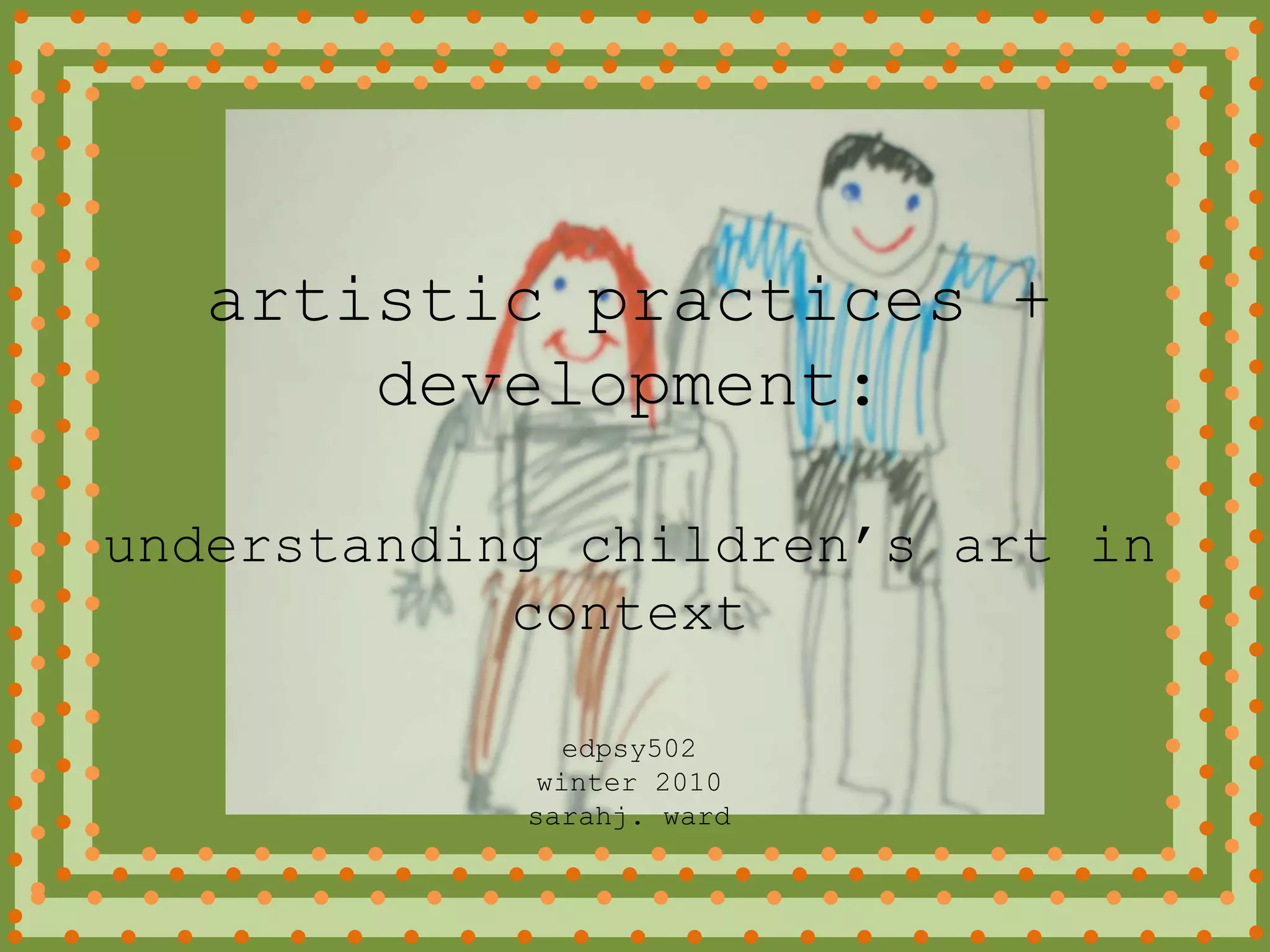
artistic practices + development:understanding children’s art in contextedpsy502winter 2010sarahj. ward
guiding question	Children’s artistic development is significant for a number of reasons including the development of motor and cognitive skills. There is a tendency to objectify creativity. It’s a trait you have or a trait you don’t. The research that follows seems to agree: 	creative and artistic development has been studied in individual children and their work, but continues to ignore the child governed worlds that are critical to all sorts of growth. how are children’s artistic practices influenced by their social context?
fine motor skillsstringing beadsusing scissorsdrawingpaintingwhat we know about artistic practice and development:cognitivespatial awareness
planning skills
abstract through (pictures as symbols)as both fine motor skills and cognitive skills advance together,children move from scribbling  identifying shapes in scribbles  drawing shapes  combining shapes to make objects  objects to pictures, with increased realism
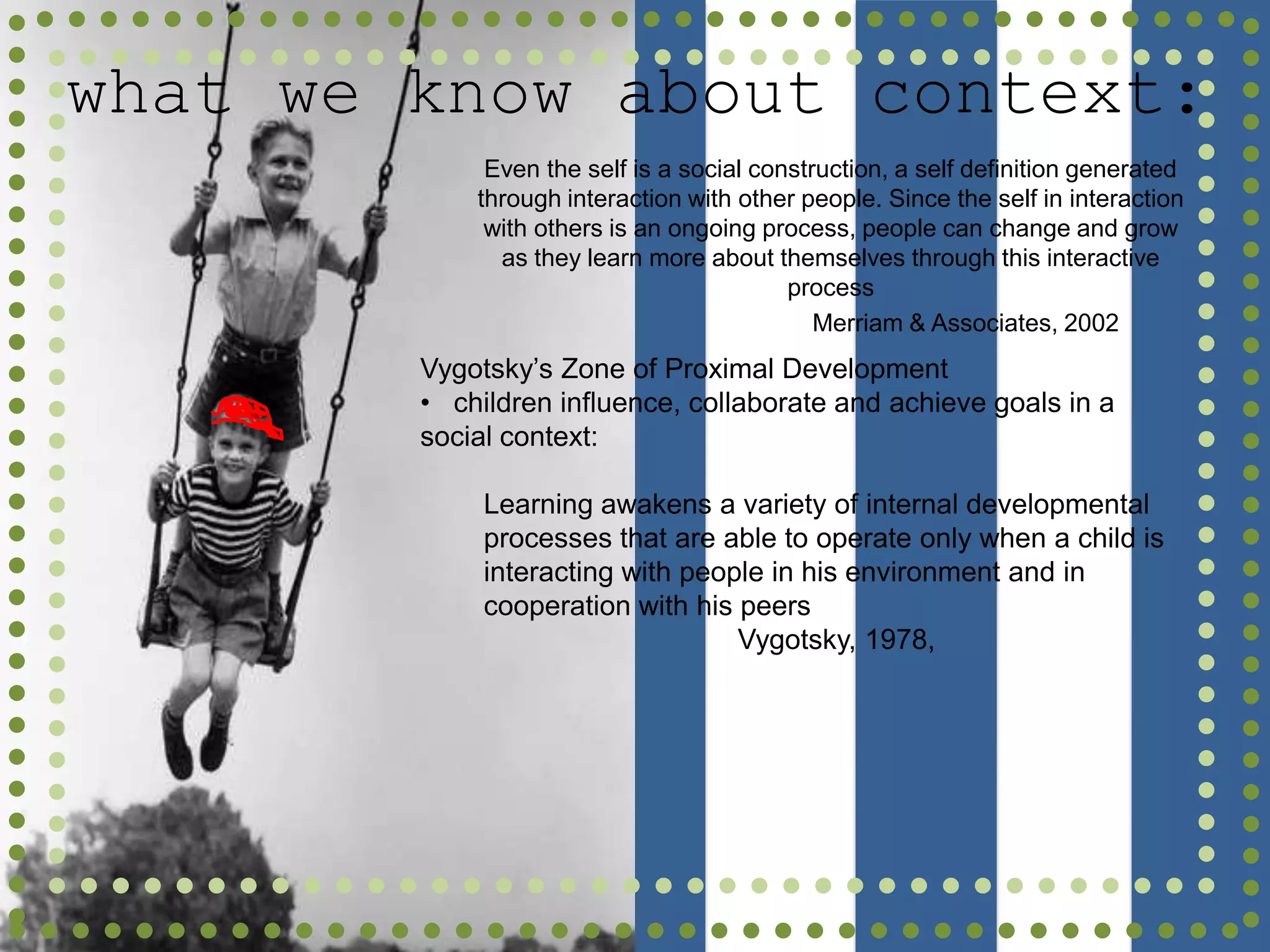
what we know about context:	Even the self is a social construction, a self definition generated through interaction with other people. Since the self in interaction with others is an ongoing process, people can change and grow as they learn more about themselves through this interactive process 						Merriam & Associates, 2002 Vygotsky’s Zone of Proximal Development   children influence, collaborate and achieve goals in a social context:Learning awakens a variety of internal developmental processes that are able to operate only when a child is interacting with people in his environment and in cooperation with his peersVygotsky, 1978,
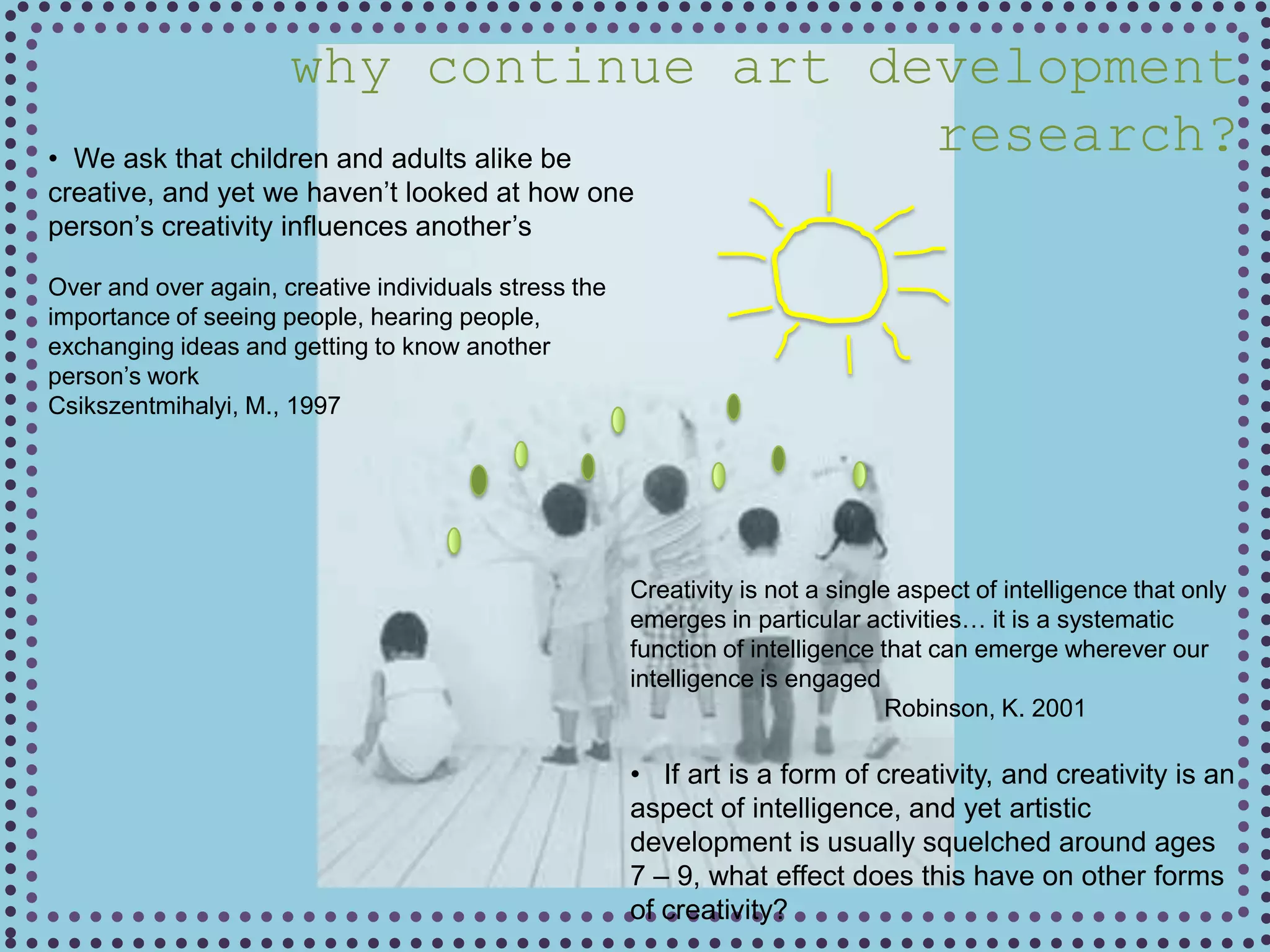
why continue art development research?  We ask that children and adults alike be creative, and yet we haven’t looked at how one person’s creativity influences another’sOver and over again, creative individuals stress the importance of seeing people, hearing people, exchanging ideas and getting to know another person’s work		Csikszentmihalyi, M., 1997Creativity is not a single aspect of intelligence that only emerges in particular activities… it is a systematic function of intelligence that can emerge wherever our intelligence is engaged 				Robinson, K. 2001   If art is a form of creativity, and creativity is an aspect of intelligence, and yet artistic development is usually squelched around ages 7 – 9, what effect does this have on other forms of creativity?approaches to researchWhat has been considered so far : artworkrole of the adultmotor skills developmentcognitive developmentLeft to themselves, children will draw representationally when they are ready. They will want to picture something from their own lives, from stories read to them or their own fantasy world. They will do this in their own good time without adult representation. 								Kellogg, 1968Why researching children is unique:	    Researchers have already passed through childhood and therefore bring to the table their own biases of what they believe to be childhood
    Children’s culture is in some ways similar to adult culture but it is wrong to assume that they are exactly the same
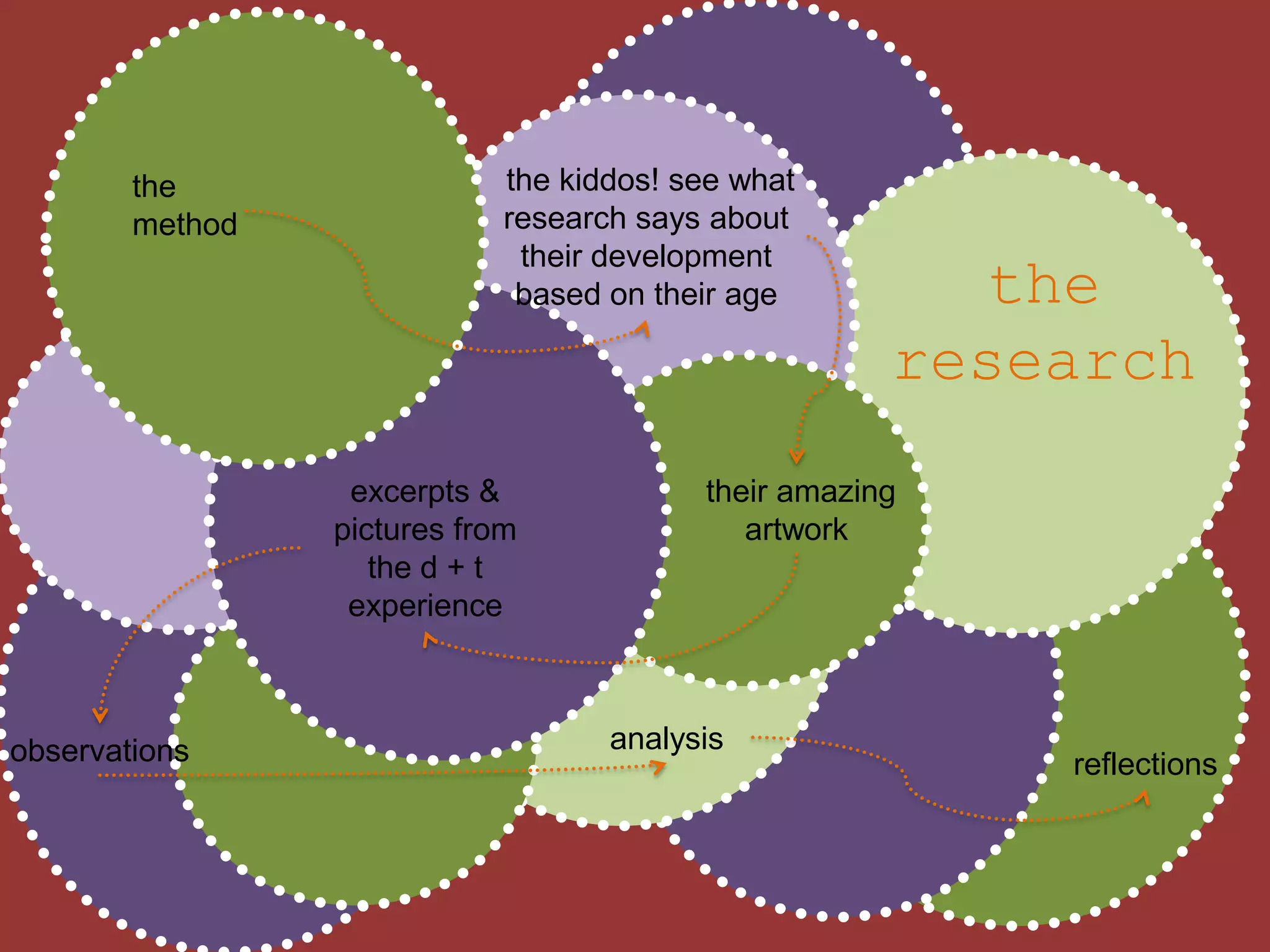
    If adults cannot fully enter into childhood, then it is understood that to study artistic development as it happens naturally with peers means that context is crucial  the kiddos! see what research says about their development based on their agethe methodthe research their amazing artworkexcerpts & pictures from the d + t experienceanalysisobservationsreflections
It should avoid the trap of an ‘adultist’ top-down approach to the research and the choice of methods and not seek to approximate the child’s world to that of the adult’s. The possible limitations in language and articulation of younger children may, in fact, actually be reinforced by adult attempts to place their own interpretation on the words and drawings of children…. [researchers] need to create the potential for children to have their own ideas and explanations heard and understood						Milburn & McKie, 1999, p.397draw + telld + t was originally introduced to health education circles in 1989Grounded in a philosophical position which is concerned with how the social world is interpreted, understood, experienced or producedMethods of data generation are flexible and sensitive to social contextMethods of analysis and explanation building involve understandings of complexity, detail and context Drawings have been used to project what is not overt Assist communication b/t children and adults (Milburn & McKie, 1999)
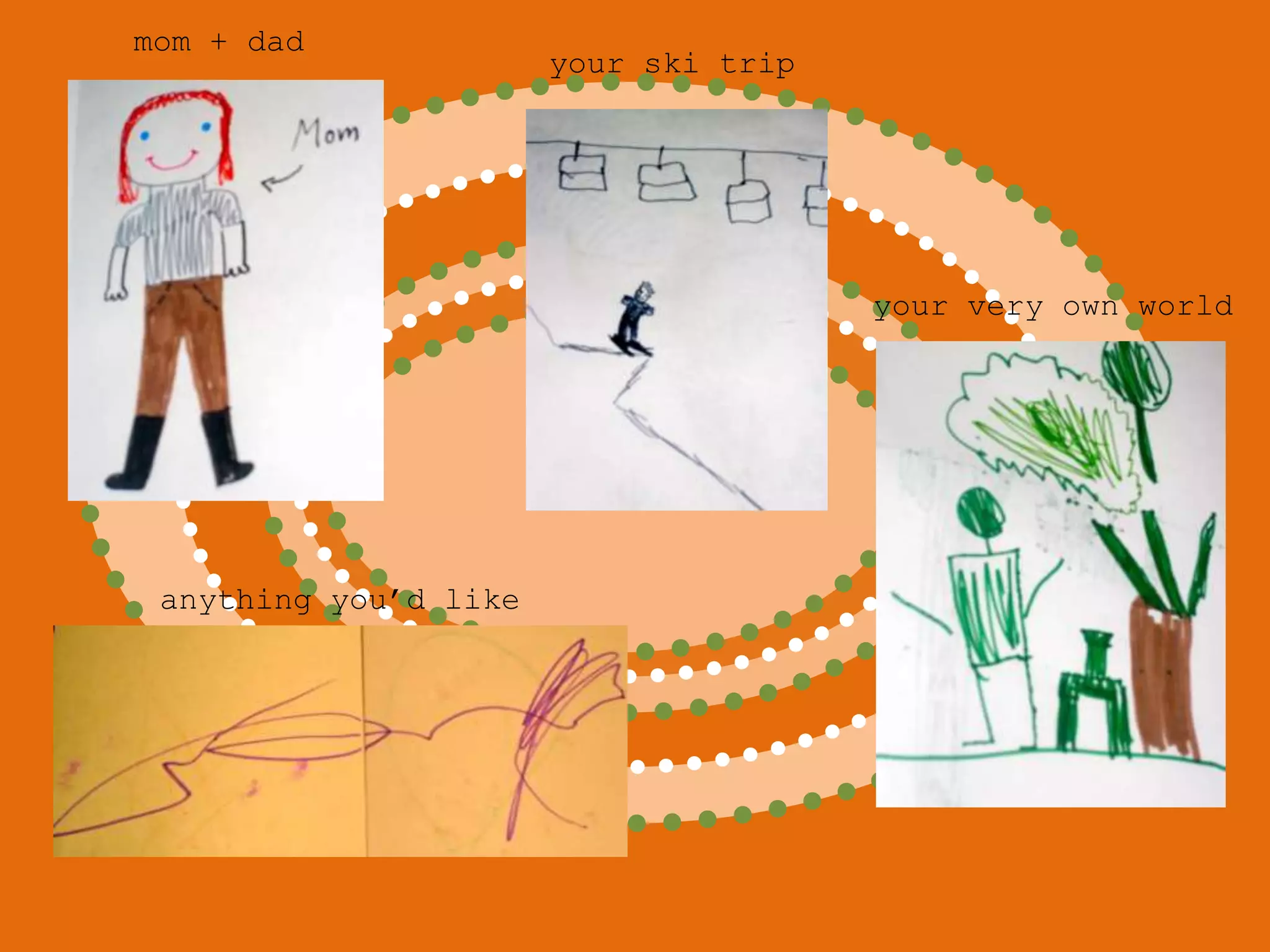
				a ski trip memory				if you had your very own 			world, what	would it look like				mom + dad				anything you’d likedraw + tell topicsI chose the draw + tell technique because it enabled me to come up with topics that I knew they were familiar with and also those that would show their individuality. I had them all draw at once, which was a challenge in itself because paying attention to 4 kids and their interactions with one another is a lot. If I were to conduct this research again I would use a video recorder so that I could go back and review the scene from different angles.
lylaIncreasingly concerned with realistic pictures
Average of ten parts a person including hair, eyes, pupils, ears, arm and fingers, leg and foot
 People and objects in motion
 Creates effective compositions
 Selects ideas that reflect personal experiences and culture
 Can create artwork based on observations
Can express ideas about artwork in detail
 Gives more complex reasons for what he or she likes and dislikes about a piece of art

Sjw Finalppt

  • 1.
    artistic practices +development:understanding children’s art in contextedpsy502winter 2010sarahj. ward
  • 2.
    guiding question Children’s artisticdevelopment is significant for a number of reasons including the development of motor and cognitive skills. There is a tendency to objectify creativity. It’s a trait you have or a trait you don’t. The research that follows seems to agree: creative and artistic development has been studied in individual children and their work, but continues to ignore the child governed worlds that are critical to all sorts of growth. how are children’s artistic practices influenced by their social context?
  • 3.
    fine motor skillsstringingbeadsusing scissorsdrawingpaintingwhat we know about artistic practice and development:cognitivespatial awareness
  • 4.
  • 5.
    abstract through (picturesas symbols)as both fine motor skills and cognitive skills advance together,children move from scribbling  identifying shapes in scribbles  drawing shapes  combining shapes to make objects  objects to pictures, with increased realism
  • 6.
    what we knowabout context: Even the self is a social construction, a self definition generated through interaction with other people. Since the self in interaction with others is an ongoing process, people can change and grow as they learn more about themselves through this interactive process Merriam & Associates, 2002 Vygotsky’s Zone of Proximal Development children influence, collaborate and achieve goals in a social context:Learning awakens a variety of internal developmental processes that are able to operate only when a child is interacting with people in his environment and in cooperation with his peersVygotsky, 1978,
  • 7.
    why continue artdevelopment research? We ask that children and adults alike be creative, and yet we haven’t looked at how one person’s creativity influences another’sOver and over again, creative individuals stress the importance of seeing people, hearing people, exchanging ideas and getting to know another person’s work Csikszentmihalyi, M., 1997Creativity is not a single aspect of intelligence that only emerges in particular activities… it is a systematic function of intelligence that can emerge wherever our intelligence is engaged Robinson, K. 2001 If art is a form of creativity, and creativity is an aspect of intelligence, and yet artistic development is usually squelched around ages 7 – 9, what effect does this have on other forms of creativity?approaches to researchWhat has been considered so far : artworkrole of the adultmotor skills developmentcognitive developmentLeft to themselves, children will draw representationally when they are ready. They will want to picture something from their own lives, from stories read to them or their own fantasy world. They will do this in their own good time without adult representation. Kellogg, 1968Why researching children is unique: Researchers have already passed through childhood and therefore bring to the table their own biases of what they believe to be childhood
  • 8.
    Children’s culture is in some ways similar to adult culture but it is wrong to assume that they are exactly the same
  • 9.
    If adults cannot fully enter into childhood, then it is understood that to study artistic development as it happens naturally with peers means that context is crucial the kiddos! see what research says about their development based on their agethe methodthe research their amazing artworkexcerpts & pictures from the d + t experienceanalysisobservationsreflections
  • 10.
    It should avoidthe trap of an ‘adultist’ top-down approach to the research and the choice of methods and not seek to approximate the child’s world to that of the adult’s. The possible limitations in language and articulation of younger children may, in fact, actually be reinforced by adult attempts to place their own interpretation on the words and drawings of children…. [researchers] need to create the potential for children to have their own ideas and explanations heard and understood Milburn & McKie, 1999, p.397draw + telld + t was originally introduced to health education circles in 1989Grounded in a philosophical position which is concerned with how the social world is interpreted, understood, experienced or producedMethods of data generation are flexible and sensitive to social contextMethods of analysis and explanation building involve understandings of complexity, detail and context Drawings have been used to project what is not overt Assist communication b/t children and adults (Milburn & McKie, 1999)
  • 11.
    a ski tripmemory if you had your very own world, what would it look like mom + dad anything you’d likedraw + tell topicsI chose the draw + tell technique because it enabled me to come up with topics that I knew they were familiar with and also those that would show their individuality. I had them all draw at once, which was a challenge in itself because paying attention to 4 kids and their interactions with one another is a lot. If I were to conduct this research again I would use a video recorder so that I could go back and review the scene from different angles.
  • 12.
  • 13.
    Average of tenparts a person including hair, eyes, pupils, ears, arm and fingers, leg and foot
  • 14.
    People andobjects in motion
  • 15.
    Creates effectivecompositions
  • 16.
    Selects ideasthat reflect personal experiences and culture
  • 17.
    Can createartwork based on observations
  • 18.
    Can express ideasabout artwork in detail
  • 19.
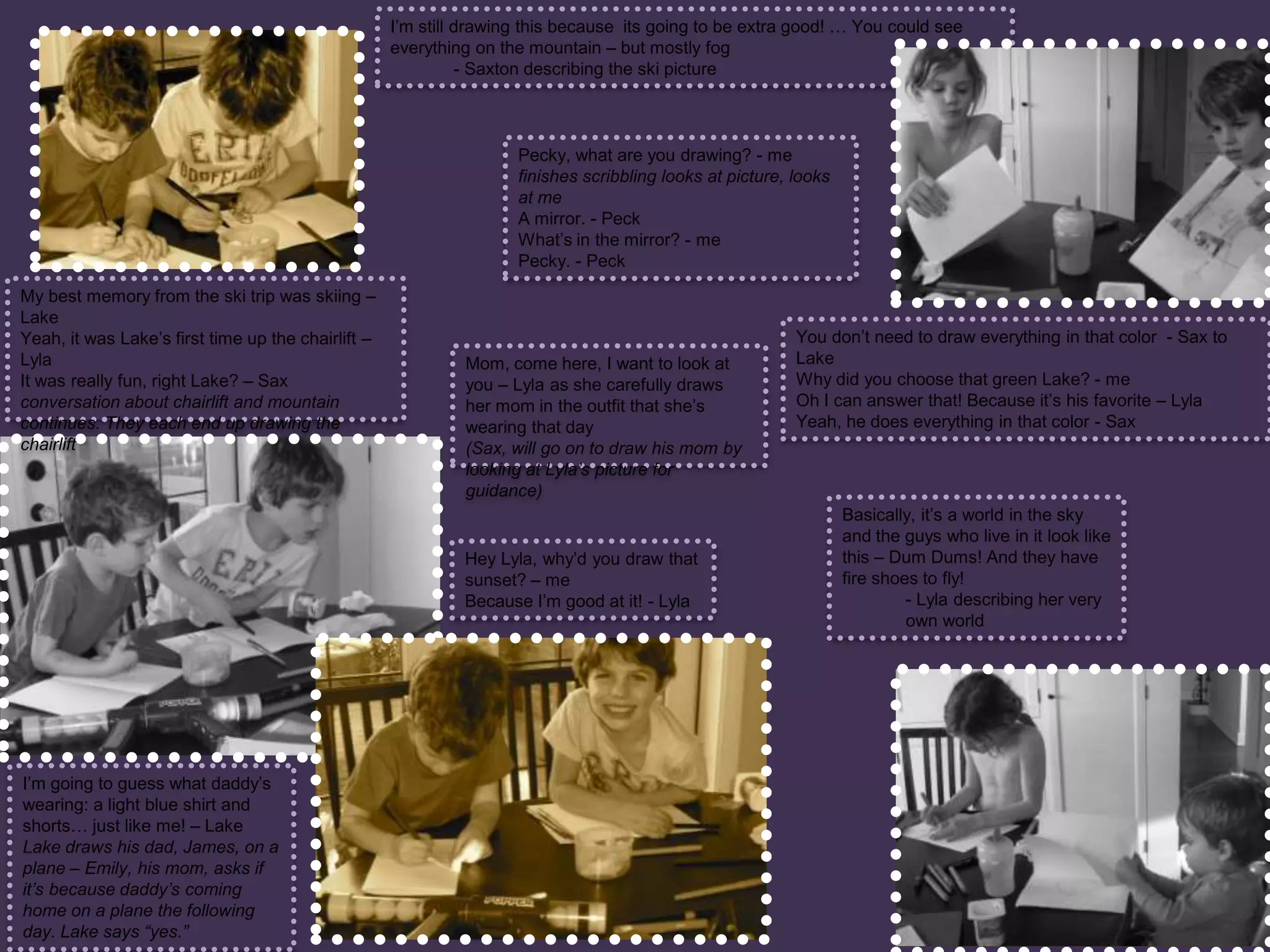
    Gives morecomplex reasons for what he or she likes and dislikes about a piece of art
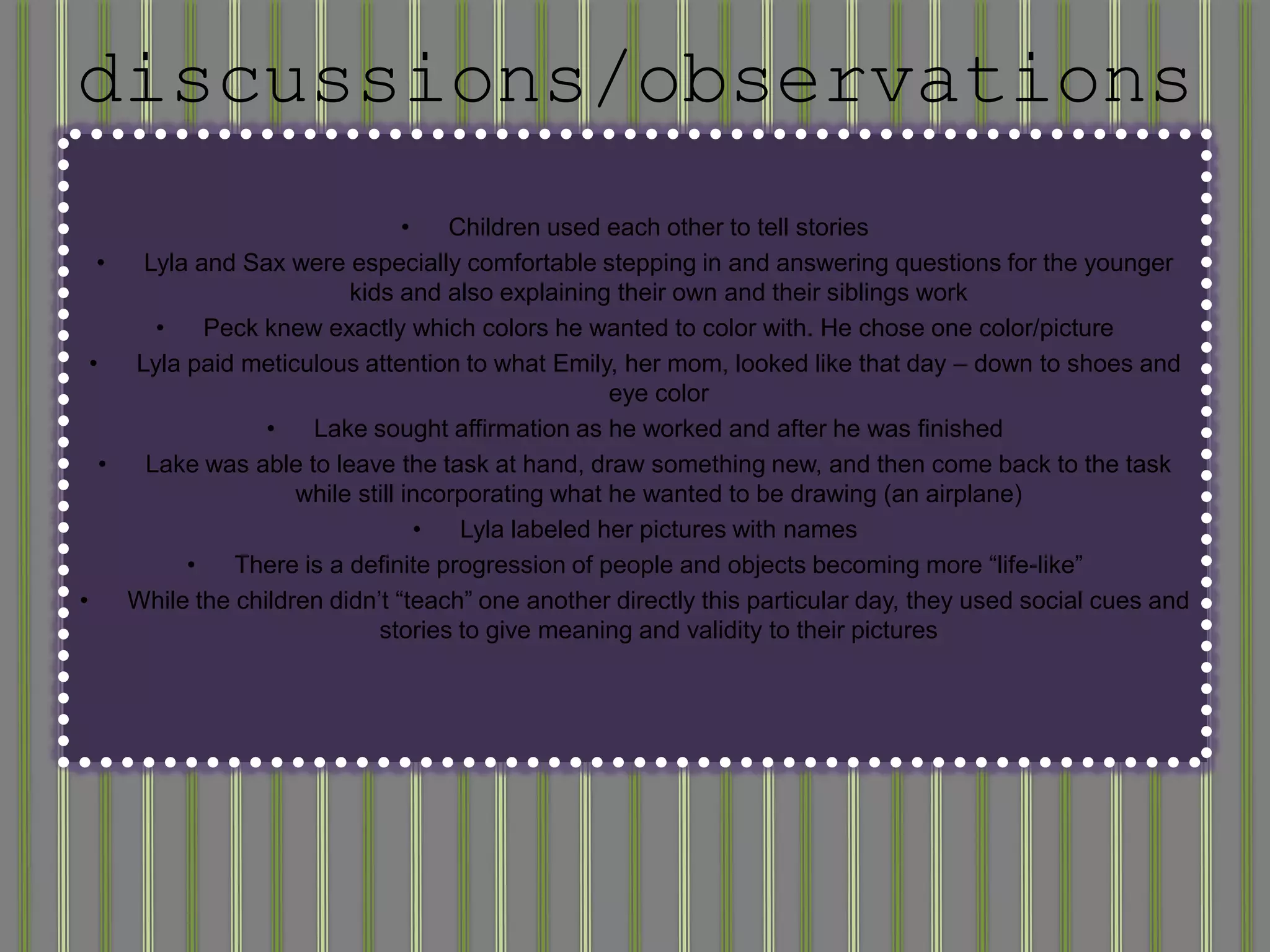
  • 20.
    Understands thereare different responses to art and knows that people’s experiences can influence art
  • 21.
    Experiments withlight and color to create visual effects
  • 22.
    Works with geometricshapes and principles to create artistic designs. 8-years old (pbs.org, 2010)
  • 23.
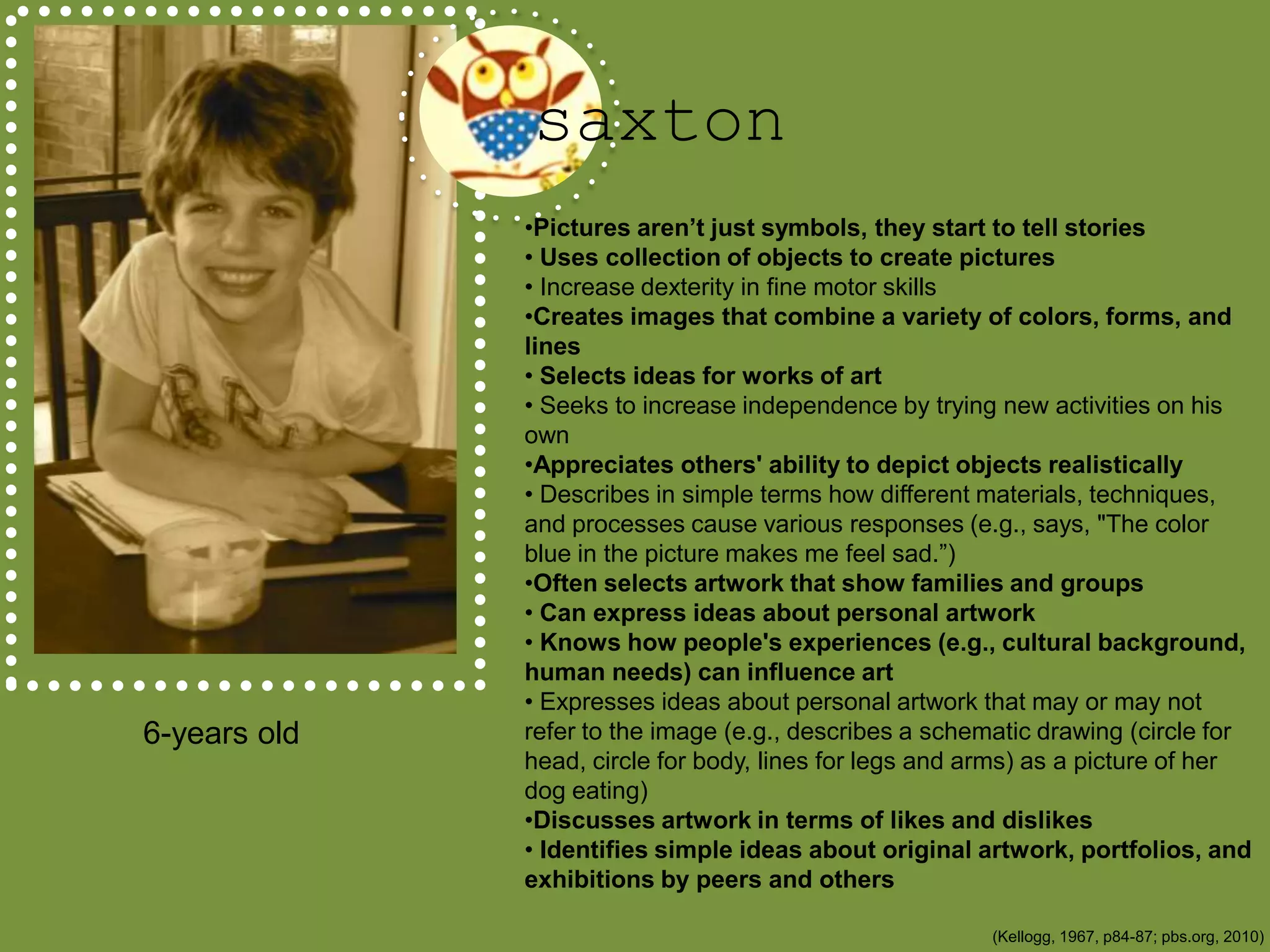
    saxtonPictures aren’t justsymbols, they start to tell stories
  • 24.
    Uses collectionof objects to create pictures
  • 25.
    Increase dexterityin fine motor skills
  • 26.
    Creates images thatcombine a variety of colors, forms, and lines
  • 27.
    Selects ideasfor works of art
  • 28.
    Seeks toincrease independence by trying new activities on his own
  • 29.
    Appreciates others' abilityto depict objects realistically
  • 30.
    Describes insimple terms how different materials, techniques, and processes cause various responses (e.g., says, "The color blue in the picture makes me feel sad.”)
  • 31.
    Often selects artworkthat show families and groups
  • 32.
    Can expressideas about personal artwork
  • 33.
    Knows howpeople's experiences (e.g., cultural background, human needs) can influence art
  • 34.
    Expresses ideasabout personal artwork that may or may not refer to the image (e.g., describes a schematic drawing (circle for head, circle for body, lines for legs and arms) as a picture of her dog eating)
  • 35.
    Discusses artwork interms of likes and dislikes
  • 36.
    Identifies simpleideas about original artwork, portfolios, and exhibitions by peers and others6-years old (Kellogg, 1967, p84-87; pbs.org, 2010)
  • 37.
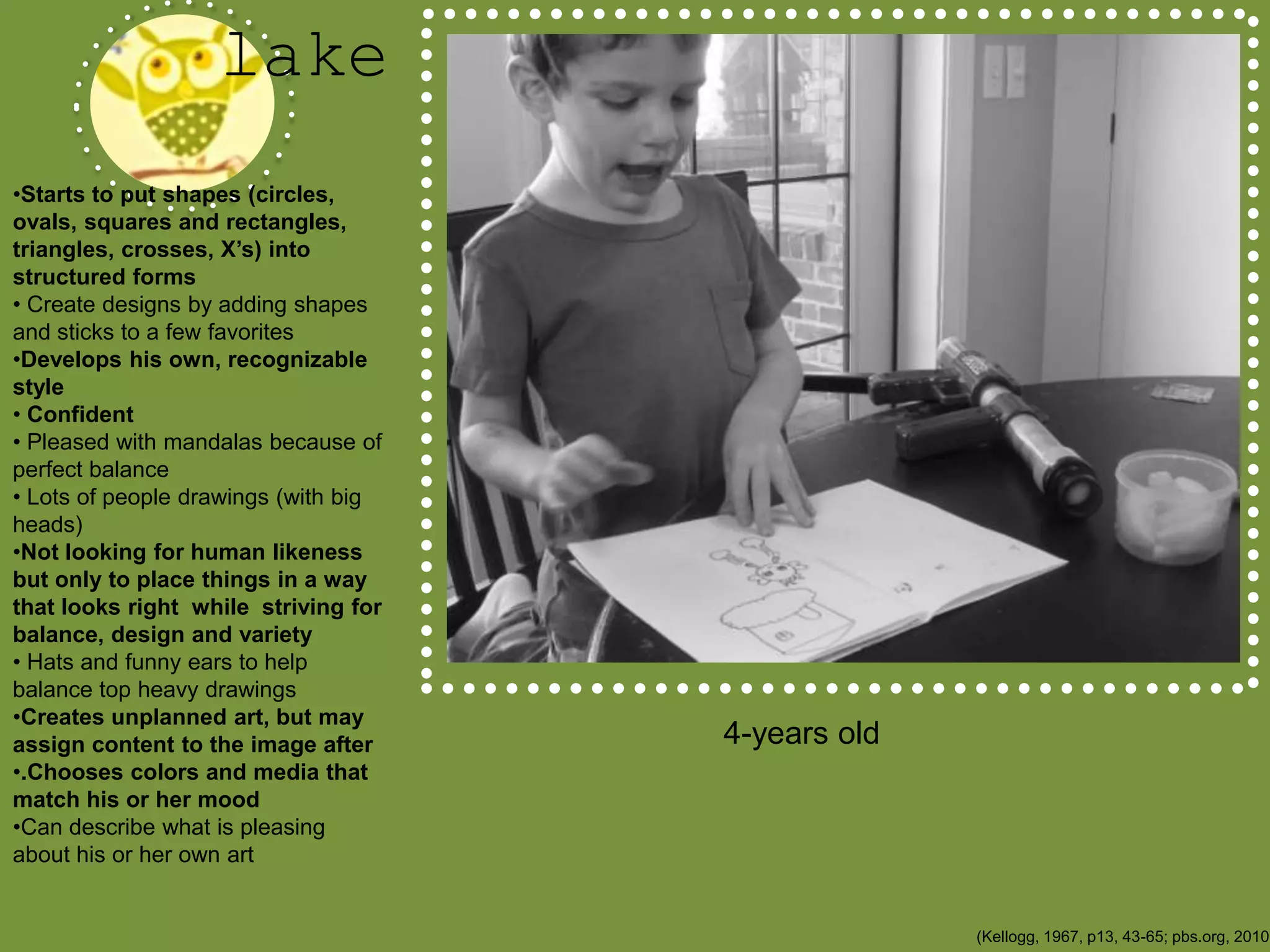
    lakeStarts to putshapes (circles, ovals, squares and rectangles, triangles, crosses, X’s) into structured forms
  • 38.
    Create designsby adding shapes and sticks to a few favorites
  • 39.
    Develops his own,recognizable style
  • 40.
  • 41.
    Pleased withmandalas because of perfect balance
  • 42.
    Lots ofpeople drawings (with big heads)
  • 43.
    Not looking forhuman likeness but only to place things in a way that looks right while striving for balance, design and variety
  • 44.
    Hats andfunny ears to help balance top heavy drawings
  • 45.
    Creates unplanned art,but may assign content to the image after
  • 46.
    .Chooses colors andmedia that match his or her mood
  • 47.
    Can describe whatis pleasing about his or her own art4-years old (Kellogg, 1967, p13, 43-65; pbs.org, 2010)
  • 48.
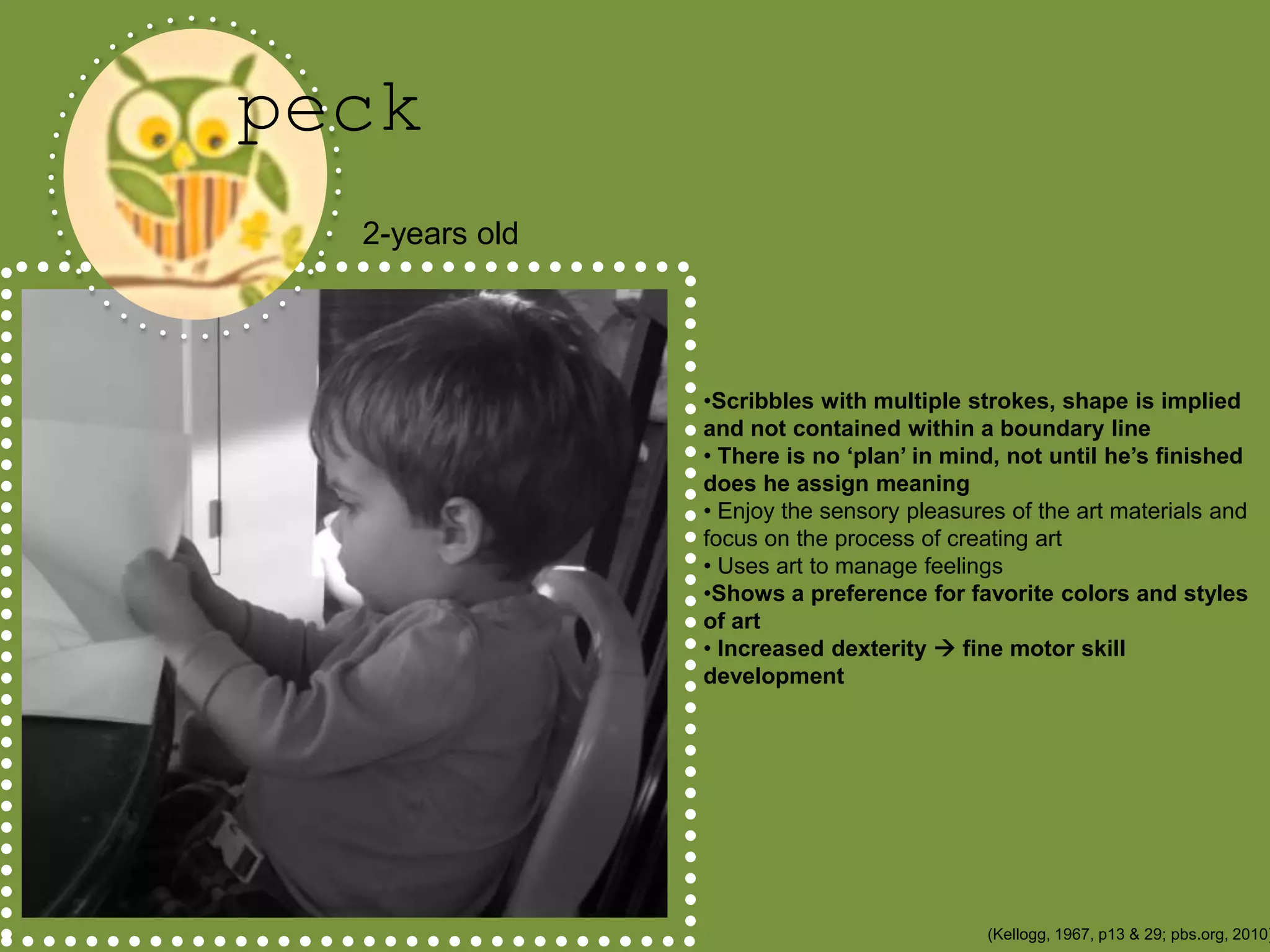
    peck2-years old Scribbleswith multiple strokes, shape is implied and not contained within a boundary line
  • 49.
    There isno ‘plan’ in mind, not until he’s finished does he assign meaning
  • 50.
    Enjoy thesensory pleasures of the art materials and focus on the process of creating art
  • 51.
    Uses artto manage feelings
  • 52.
    Shows a preferencefor favorite colors and styles of art
  • 53.
    Increased dexterity fine motor skill development(Kellogg, 1967, p13 & 29; pbs.org, 2010)
  • 54.
    mom + dadyourski tripyour very own worldanything you’d like
  • 55.
    I’m still drawingthis because its going to be extra good! … You could see everything on the mountain – but mostly fog - Saxton describing the ski picturePecky, what are you drawing? - mefinishes scribbling looks at picture, looks at meA mirror. - PeckWhat’s in the mirror? - mePecky. - PeckMy best memory from the ski trip was skiing – LakeYeah, it was Lake’s first time up the chairlift – LylaIt was really fun, right Lake? – Saxconversation about chairlift and mountain continues. They each end up drawing the chairliftYou don’t need to draw everything in that color - Sax to Lake Why did you choose that green Lake? - meOh I can answer that! Because it’s his favorite – LylaYeah, he does everything in that color - SaxMom, come here, I want to look at you – Lyla as she carefully draws her mom in the outfit that she’s wearing that day(Sax, will go on to draw his mom by looking at Lyla’s picture for guidance)Basically, it’s a world in the sky and the guys who live in it look like this – Dum Dums! And they have fire shoes to fly! - Lyla describing her very own worldHey Lyla, why’d you draw that sunset? – meBecause I’m good at it! - LylaI’m going to guess what daddy’s wearing: a light blue shirt and shorts… just like me! – LakeLake draws his dad, James, on a plane – Emily, his mom, asks if it’s because daddy’s coming home on a plane the following day. Lake says “yes.”
  • 56.
    discussions/observationsChildren used eachother to tell stories Lyla and Sax were especially comfortable stepping in and answering questions for the younger kids and also explaining their own and their siblings workPeck knew exactly which colors he wanted to color with. He chose one color/pictureLyla paid meticulous attention to what Emily, her mom, looked like that day – down to shoes and eye colorLake sought affirmation as he worked and after he was finishedLake was able to leave the task at hand, draw something new, and then come back to the task while still incorporating what he wanted to be drawing (an airplane)Lyla labeled her pictures with namesThere is a definite progression of people and objects becoming more “life-like” While the children didn’t “teach” one another directly this particular day, they used social cues and stories to give meaning and validity to their pictures
  • 57.
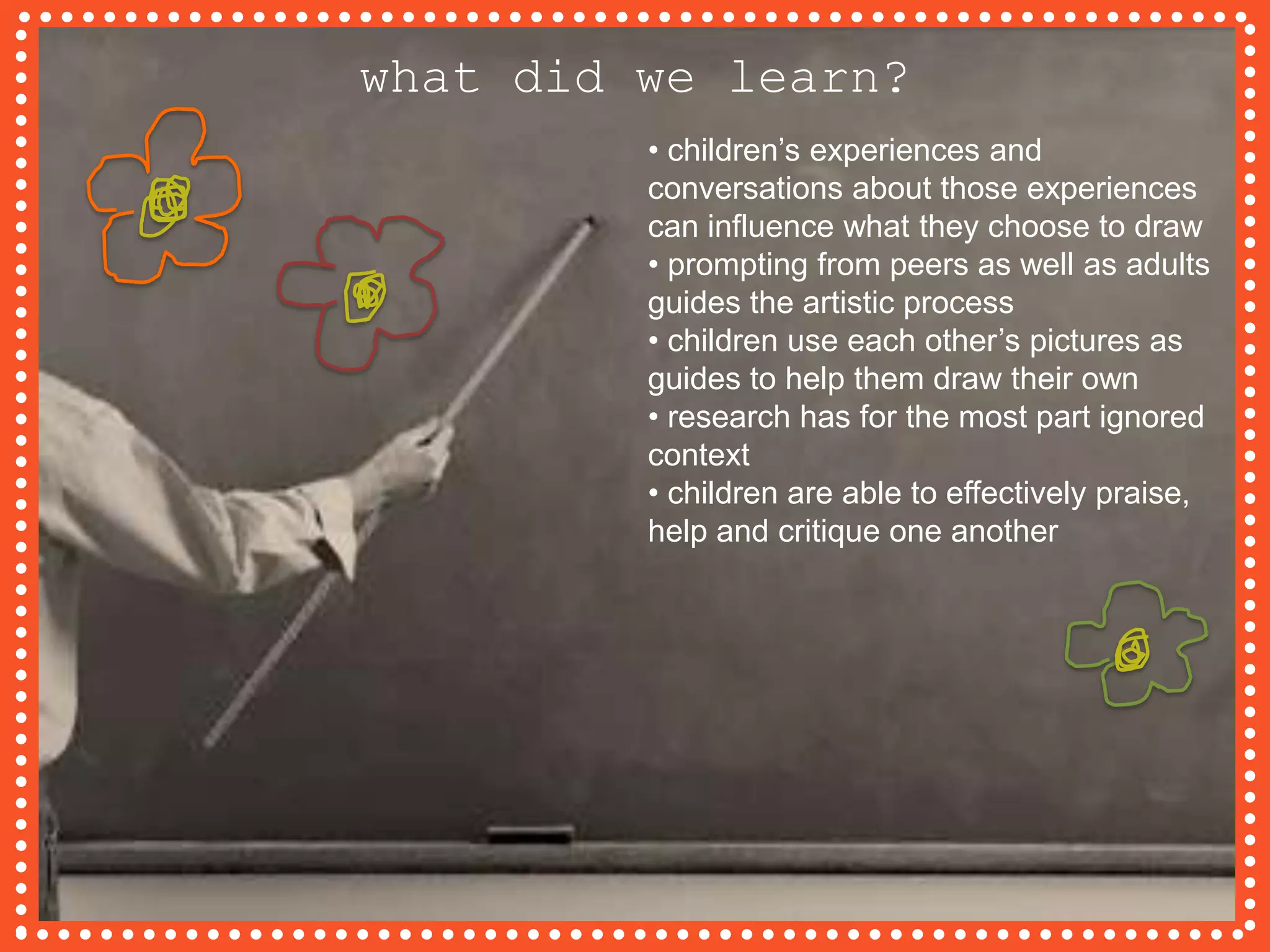
    what did welearn? children’s experiences and conversations about those experiences can influence what they choose to draw
  • 58.
    prompting frompeers as well as adults guides the artistic process
  • 59.
    children useeach other’s pictures as guides to help them draw their own
  • 60.
    research hasfor the most part ignored context
  • 61.
    children areable to effectively praise, help and critique one another reflections I think more time was needed to really see this project develop, as well as in depth interviews with the kids. Because there is so much importance put on creativity as an individual trait, a lot of that shines through even over just a few hours. The notion that art is meant to allow us to self create is powerful,Of all the things we normally do, interaction with others is the least predictable Csikszentmihalyi, M., 1997and in that sense of course it is so often viewed from behind a lens that is solely focusing on the individual. It was difficult to even attempt to break through that and really see the ZPD side of things, especially over the course of only a few hours. The in depth interviews with the kids would have also led to a greater understanding on my part. It’s difficult to figure out how they are making meaning without adding my own adult assumptions without being able to talk with them and poke in their minds just a bit further. It was really interesting to see very clearly the “stages” of development and how fine motor and cognitive skills go hand-in-hand. Although I have only just noticed the disconnect between research and practice (artistic practice with peers that is), it seems like it is a key to understanding creativity and making creativity less of an object, and therefore a trait that all people have – it’s just a matter of access. Perhaps in understanding creative practices such as drawing in context, acknowledging greater types and outlets of creativity will become more widely accepted – even, perhaps, the notion that creativity does not exist in individuals, but in communities. questions for future research How can we study artistic creativity in relation to other creativity? Can creativity and/or artistic progress be measured by observing the context?What does this say about school art practice? Informal settings?
  • 62.
    referencesBackett-Milburn, K. &McKie, L. (1999). A critical appraisal of the draw and write technique. Health Education Research : Theory and Practice. 14(3), 387-398. Berk, L.E. (2002). Infants and children: Prenatal through middle childhood. Boson: Allyn and BaconCsikszentmihaly, M. (1997). Finding flow: the psychology of engagement with everyday life. New York: Basic Books. Csikszentmihalyi, M., Gardner, H., and Feldman, D.H. (1994). Changing the World: a framework for the study of creativity. Westport: Praeger. Kellogg, R., and O’Dell, S. (1967). The Psychology of Children’s Art. New York, New York: Random House. Merriam S.B. & Associates (2002). Qualitative research in practice: Examples for discussion and analysis. San Francisco: Jossey-BassPBS Parents. Child Development Tracker. http://www.pbs.org/parents/childdevelopmenttracker/three/creativearts.html (Feb. 12, 2010). Vygotsky, L.S. (1978). Mind in society: the development of higher psychological processes. Cambridge: Harvard University Press.