Physics Of The Large And The Small Tasi 2009
Proceedings Of The 2009 Theoretical Advanced
Study Institute In Elementary Particle Physics
Csaba Csaki download
https://ebookbell.com/product/physics-of-the-large-and-the-small-
tasi-2009-proceedings-of-the-2009-theoretical-advanced-study-
institute-in-elementary-particle-physics-csaba-csaki-4650296
Explore and download more ebooks at ebookbell.com
Here are some recommended products that we believe you will be
interested in. You can click the link to download.
Models For Physics Of The Very Small And Very Large 1st Edition Thomas
J Buckholtz Auth
https://ebookbell.com/product/models-for-physics-of-the-very-small-
and-very-large-1st-edition-thomas-j-buckholtz-auth-10313988
Extracting Physics From Gravitational Waves Testing The Strongfield
Dynamics Of General Relativity And Inferring The Largescale Structure
Of The Universe 1st Edition Tjonnie G F Li Auth
https://ebookbell.com/product/extracting-physics-from-gravitational-
waves-testing-the-strongfield-dynamics-of-general-relativity-and-
inferring-the-largescale-structure-of-the-universe-1st-edition-
tjonnie-g-f-li-auth-5141626
Who Cares About Particle Physics Making Sense Of The Higgs Boson The
Large Hadron Collider And Cern 1st Edition Pauline Gagnon
https://ebookbell.com/product/who-cares-about-particle-physics-making-
sense-of-the-higgs-boson-the-large-hadron-collider-and-cern-1st-
edition-pauline-gagnon-5846630
An Introduction To The Philosophy Of Physics Locality Fields Energy
And Mass 1st Edition Marc Lange
https://ebookbell.com/product/an-introduction-to-the-philosophy-of-
physics-locality-fields-energy-and-mass-1st-edition-marc-
lange-43713862
The Adventures Of The Large Hadron Collider From The Big Bang To The
Higgs Boson Daniel Denegri
https://ebookbell.com/product/the-adventures-of-the-large-hadron-
collider-from-the-big-bang-to-the-higgs-boson-daniel-denegri-55374202
Large Deviations In Physics The Legacy Of The Law Of Large Numbers 1st
Edition Angelo Vulpiani
https://ebookbell.com/product/large-deviations-in-physics-the-legacy-
of-the-law-of-large-numbers-1st-edition-angelo-vulpiani-4697582
Physics Of The Atmosphere Climatology And Environmental Monitoring
Modern Problems Of Atmospheric Physics Climatology And Environmental
Monitoring 1st Edition Robert Zakinyan
https://ebookbell.com/product/physics-of-the-atmosphere-climatology-
and-environmental-monitoring-modern-problems-of-atmospheric-physics-
climatology-and-environmental-monitoring-1st-edition-robert-
zakinyan-47383436
Physics Of The Sun A First Course 2nd Dermott J Mullan
https://ebookbell.com/product/physics-of-the-sun-a-first-course-2nd-
dermott-j-mullan-49055682
Physics Of The Invisible Sun Instrumentation Observations And
Inferences Ashok Ambastha
https://ebookbell.com/product/physics-of-the-invisible-sun-
instrumentation-observations-and-inferences-ashok-ambastha-49443190
PHYSICS
OF THE
AND THE
LARGE
SMALL
7961 tp.indd 1 12/29/10 3:47 PM
This page intentionally left blank
NEW JERSEY • LONDON • SINGAPORE • BEIJING • SHANGHAI • HONG KONG • TAIPEI • CHENNAI
World Scientific
editors
Csaba Csaki
Cornell University, USA
Scott Dodelson
Fermilab, USA
PHYSICS
OF THE
AND THE
LARGE
SMALL
Proceedings of the Theoretical Advanced Study Institute
in Elementary Particle Physics
Boulder, Colorado, USA, 1 – 26 June 2009
7961 tp.indd 2 12/29/10 3:47 PM
British Library Cataloguing-in-Publication Data
A catalogue record for this book is available from the British Library.
For photocopying of material in this volume, please pay a copying fee through the Copyright
Clearance Center, Inc., 222 Rosewood Drive, Danvers, MA 01923, USA. In this case permission to
photocopy is not required from the publisher.
ISBN-13 978-981-4327-17-6
ISBN-10 981-4327-17-4
All rights reserved. This book, or parts thereof, may not be reproduced in any form or by any means,
electronic or mechanical, including photocopying, recording or any information storage and retrieval
system now known or to be invented, without written permission from the Publisher.
Copyright © 2011 by World Scientific Publishing Co. Pte. Ltd.
Published by
World Scientific Publishing Co. Pte. Ltd.
5 Toh Tuck Link, Singapore 596224
USA office: 27 Warren Street, Suite 401-402, Hackensack, NJ 07601
UK office: 57 Shelton Street, Covent Garden, London WC2H 9HE
Printed in Singapore.
PHYSICS OF THE LARGE AND THE SMALL
TASI 2009
Proceedings of the 2009 Theoretical Advanced Study Institute in Elementary Particle Physics
Benjamin - Physics of the Large & the Small.pmd 12/22/2010, 9:34 AM
1
December 22, 2010 9:24 WSPC - Proceedings Trim Size: 9in x 6in tasi2009
v
PREFACE
The Theoretical Advanced Study Institute (TASI) in elementary particle physics
has been held each summer since 1984. The early institutes were held at Michi-
gan, Yale, Santa Cruz, Santa Fe, and Brown. Since 1989 they have been hosted
by the University of Colorado at Boulder. Each year typically about sixty of the
most promising advanced theory graduate students in the United States, along
with a few international graduate students attend TASI. The emphasis of TASI has
shifted from year to year, but typically there have been courses of lectures in phe-
nomenology, field theory, string theory, mathematical physics, cosmology and the
particle-astrophysics interface, as well as series on experimental topics. TASI has
been highly successful in introducing students to a much broader range of ideas
and topics than they normally experience in their home institutions while working
on their dissertation topics.
This book contains write-ups of lectures from the 2009 summer school whose
title was “Physics of the large and small”. The idea was to give an introduction
to particle physics beyond the standard model and to cosmology. The focus of
the particle physics portion was TeV scale and LHC-related physics. The particle
physics lectures started with a series by Witold Skiba, who gave an introduction
to the methods of effective theories and their uses for electroweak precision mea-
surements. The next series of lectures were focusing on supersymmetry. Patrick
Fox gave an introduction to supersymmetry and the MSSM, and Patrick Meade
reviewed gauge mediated supersymmetry breaking. David Shih (not contained in
this volume) covered dynamical supersymmetry breaking. The next topic cov-
ers extra dimensions and related subjects. Hsin-Chia Cheng lectured on intro-
duction to extra dimensions, Tony Gherghetta on warped extra dimensions and
the AdS/CFT correspondence, and Roberto Contino on composite and pseudo-
Goldstone Higgs models. Gilad Perez (whose write-up was prepared together with
his student Oram Gedalia) gave an introduction to flavor physics and the relation
of flavor physics to TeV scale models. Kathryn Zurek lectured on the recently
popular topic of looking for unexpected types of physics scenarios at the LHC.
The final part of the particle physics program contained an introduction to collid-
ers and the LHC. Maxim Perelstein presented a series of lectures on introduction
December 22, 2010 9:24 WSPC - Proceedings Trim Size: 9in x 6in tasi2009
vi Preface
to collider physics, while Eva Halkiadakis introduced the students to the LHC ex-
periments. The cosmology lectures started with an introduction by Michael Turner
(not contained in these volumes). The next series were by Daniel Baumann on in-
flation and Rachel Bean on dark energy. There were two series on dark matter:
a theoretical one by Neal Weiner (not contained in this volume) who gave an
overview of possible candidate models for dark matter, and by Richard Schnee,
who gave an introduction to direct dark matter observation experiments. Elena
Pierpaoli introduced the students to the physics of the cosmic microwave back-
ground radiation, and Manoj Kaplinghat finally discussed the large scale structure
of the Universe. Michael Turner has also presented a very successful and well-
attended public lecture during the first week of the school.
The scientific program was organized by Csaba Csaki (particle physics) and
Scott Dodelson (cosmology), with invaluable assistance provided by the local di-
rector K. T. Mahanthappa, and the local organizers Tom DeGrand and Shanta
DeAlwis. We would like to thank Susan Spika and Elizabeth Price for the very
efficient and valuable secretarial help and daily operational organization of the
Institute; David Curtin and Greg Martinez for organizing the student seminars;
Joshua Berger and Philip Tanedo for designing and distributing the TASI-09 T-
shirts, Philip Tanedo for help with the manuscript, and to Tom DeGrand for orga-
nizing the hikes. Special thanks to the National Science Foundation, the Depart-
ment of Energy and the University of Colorado for their financial and material
support.
Csaba Csaki and Scott Dodelson
June 2010
December 22, 2010 9:24 WSPC - Proceedings Trim Size: 9in x 6in tasi2009
vii
CONTENTS
Preface v
Part A The Physics of the Small 1
Effective field theory and precision electroweak measurements 5
W. Skiba
Supersymmetry and the MSSM 73
P. J. Fox
Introduction to extra dimensions 125
H.-C. Cheng
A holographic view of beyond the standard model physics 165
T. Gherghetta
The Higgs as a composite Nambu-Goldstone boson 235
R. Contino
Flavor physics 309
O. Gedalia and G. Perez
Searching for unexpected physics at the LHC 385
K. M. Zurek
Introduction to collider physics 421
M. Perelstein
Introduction to the LHC experiments 489
E. Halkiadakis
December 22, 2010 9:24 WSPC - Proceedings Trim Size: 9in x 6in tasi2009
viii Contents
Part B The Physics of the Large 519
Inflation 523
D. Baumann
Cosmic acceleration 689
R. Bean
The cosmic microwave background 729
E. Pierpaoli
Large scale structure of the universe 755
M. Kaplinghat
Introduction to dark matter experiments 775
R. W. Schnee
List of student talks 831
Institute Directors 835
Lecturers 837
December
22,
2010
8:42
WSPC
-
Proceedings
Trim
Size:
9in
x
6in
photos
ix


! # 
$% 
'()
*+' 
,- .
/.* 0)
%1 
 ) 2 
1 %
34)
/!%01
/$4 
/ 1 
/.  5
/ . )(
//1  
/6).  7
 
/( 
/10  ( 
/3  8
!5 3 6
$9  7
2 
1 :
)-
 . 4
/9 (9 
4.  
%)0
; ( 27. 

$0)9
4 )
== 
% # 
/1  79 
: 
1 ) 9(
, 4 
,' 
$!; ; 
$$9' 
$1 * 
$1 0
$  =
$/5:
$2;
$1 0;+ 
$) :
$5) )
!%  :
    
. ; 
%9 --?)
 1: )
/4 *
%#
'.) 
%   (
; )*
!+4 
$%.) 
* - ()
 @0 
  (+   
/36,
December
22,
2010
8:42
WSPC
-
Proceedings
Trim
Size:
9in
x
6in
photos
xi
December 22, 2010 9:24 WSPC - Proceedings Trim Size: 9in x 6in tasi2009
PART A
The Physics of the Small
This page intentionally left blank
December 22, 2010 9:24 WSPC - Proceedings Trim Size: 9in x 6in tasi2009
3
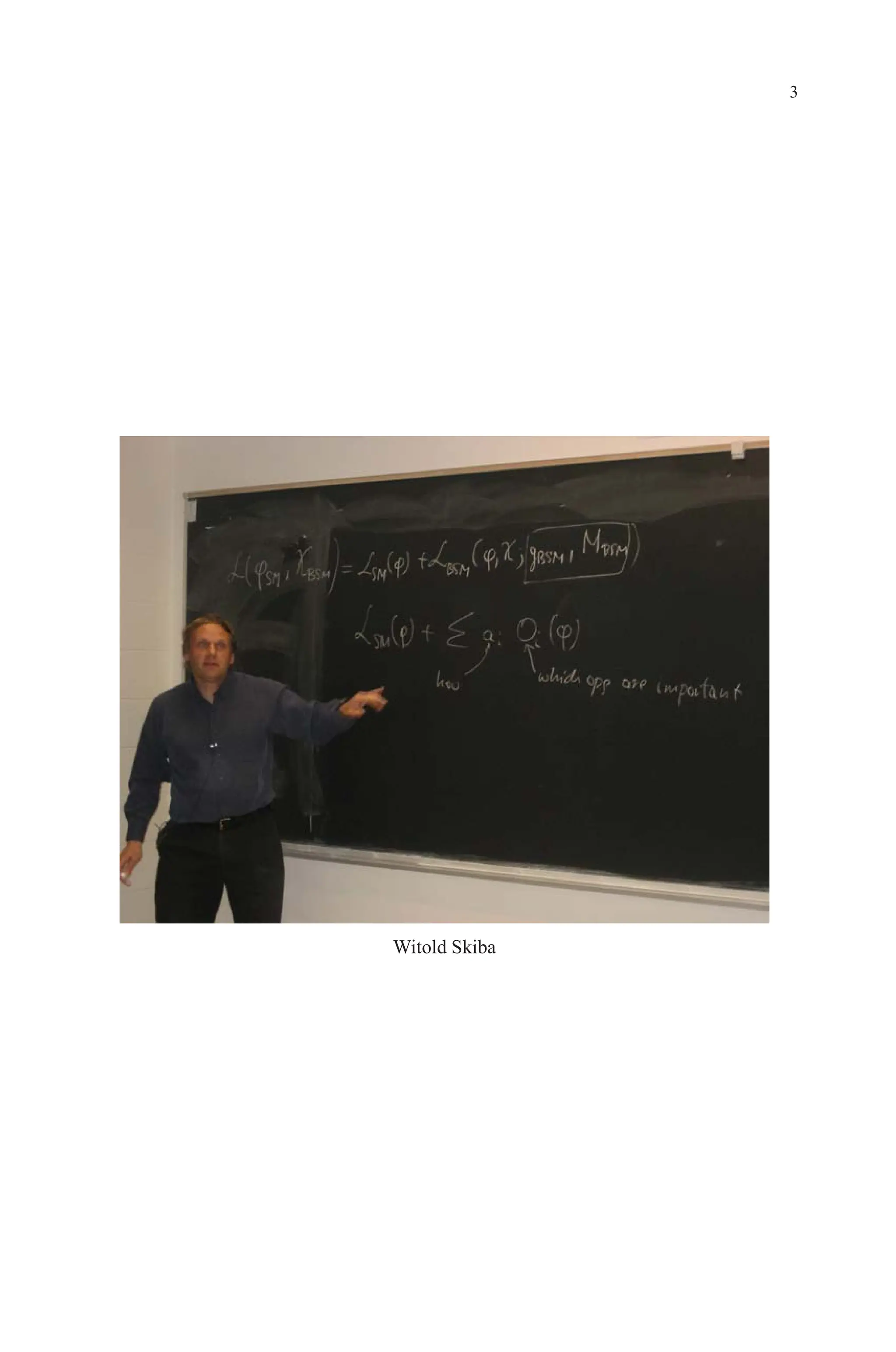
Witold Skiba
This page intentionally left blank
December 22, 2010 9:24 WSPC - Proceedings Trim Size: 9in x 6in tasi2009
5
EFFECTIVE FIELD THEORY AND PRECISION
ELECTROWEAK MEASUREMENTS
WITOLD SKIBA
Department of Physics, Yale University,
New Haven, CT 06520, USA
E-mail: witold.skiba@yale.edu
The first part of these lectures provides a brief introduction to the concepts and techniques
of effective field theory. The second part reviews precision electroweak constraints using
effective theory methods. Several simple extensions of the Standard Model are considered
as illustrations. The appendix contains some new results on the one-loop contributions of
electroweak triplet scalars to the T parameter and contains a discussion of decoupling in
that case.
Keywords: Effective field theory; Precision electroweak measurements; Physics beyond the
Standard Model.
1. Introduction
Phenomena involving distinct energy, or length, scales can often be analyzed by
considering one relevant scale at a time. In most branches of physics, this is such
an obvious statement that it does not require any justification. The multipole ex-
pansion in electrodynamics is useful because the short-distance details of charge
distribution are not important when observed from far away. One does not worry
about the sizes of planets, or their geography,when studying orbital motions in the
Solar System. Similarly, the hydrogen spectrum can be calculated quite precisely
without knowing that there are quarks and gluons inside the proton.
Taking advantage of scale separation in quantum field theories leads to ef-
fective field theories (EFTs).1
Fundamentally, there is no difference in how scale
separation manifests itself in classical mechanics, electrodynamics, quantum me-
chanics, or quantum field theory. The effects of large energy scales, or short dis-
tance scales, are suppressed by powers of the ratio of scales in the problem. This
observation follows from the equations of mechanics, electrodynamics, or quan-
tum mechanics. Calculations in field theory require extra care to ensure that large
energy scales decouple.2,3
December 22, 2010 9:24 WSPC - Proceedings Trim Size: 9in x 6in tasi2009
6 W. Skiba
Decoupling of large energy scales in field theory seems to be complicated by
the fact that integration over loop momenta involves all scales. However, this is
only a superficial obstacle which is straightforward to deal with in a convenient
regularization scheme, for example dimensional regularization. The decoupling of
large energy scales takes place in renormalizable quantum field theories whether
or not EFT techniques are used. There are many precision calculations that agree
with experiments despite neglecting the effects of heavy particles. For instance,
the original calculation of the anomalous magnetic moment of the electron, by
Schwinger, neglected the one-loop effects arising from weak interactions. Since
the weak interactions were not understood at the time, Schwinger’s calculation
included only the photon contribution, yet it agreed with the experiment within a
few percent.4
Without decoupling, the weak gauge boson contribution would be
of the same order as the photon contribution. This would result in a significant
discrepancy between theory and experiment and QED would likely have never
been established as the correct low-energy theory.
The decoupling of heavy states is, of course, the reason for building high-
energy accelerators. If quantum field theories were sensitive to all energy scales,
it would be much more useful to increase the precision of low-energy experiments
instead of building large colliders. By now, the anomalous magnetic moment of
the electron is known to more than ten significant digits. Calculations agree with
measurements despite that the theory used for these calculations does not in-
corporate any TeV-scale dynamics, grand unification, or any notions of quantum
gravity.
If decoupling of heavy scales is a generic feature of field theory, why would
one consider EFTs? That depends on whether the dynamics at high energy is
known and calculable or else the dynamics is either non-perturbative or unknown.
If the full theory is known and perturbative, EFTs often simplify calculations.
Complex computations can be broken into several easier tasks. If the full the-
ory is not known, EFTs allow one to parameterize the unknown interactions, to
estimate the magnitudes of these interactions, and to classify their relative impor-
tance. EFTs are applicable to both cases with the known and with the unknown
high-energy dynamics because in an effective description only the relevant de-
grees of freedom are used. The high-energy physics is encoded indirectly though
interactions among the light states.
The first part of these lecture notes introduces the techniques of EFT. Exam-
ples of EFTs are constructed explicitly starting from theories with heavy states and
perturbative interactions. Perturbative examples teach us how things work: how to
organize power counting, how to estimate the magnitudes of terms, and how to
stop worrying about non-renormalizable interactions. Readers familiar with the
December 22, 2010 9:24 WSPC - Proceedings Trim Size: 9in x 6in tasi2009
Effective field theory and precision electroweak measurements 7
concepts of EFTs are encouraged to go directly to the discussion of precision
electroweak measurements.
The second part of these notes is devoted to precision electroweak measure-
ments using an EFT approach. This is a good illustration of why using EFTs saves
time. The large body of precision electroweak measurements can be summarized
in terms of constraints on coefficients of effective operators. In turn, one can use
these coefficients to constrain extensions of the Standard Model (SM) without any
need for detailed calculations of cross sections, decay widths, etc.
The topic of precision electroweak measurements consists of two major
branches. One branch engages in comparisons of experimental data with accu-
rate calculations in the SM.5
It provides important tests of the SM and serves as
a starting point for work on extensions of the SM. This subject is not covered in
these notes. Another branch is concerned with extensions of the SM and their vi-
ability when compared with measurements. This subject is discussed here using
EFT techniques. The effective theory applicable to precision electroweak mea-
surements is well known: it is the Standard Model with higher-dimensional inter-
actions. Since we are not yet sure if the Higgs boson exists, one could formulate
an effective description with or without the Higgs boson. Only the EFT that in-
cludes the Higgs boson is discussed here. While there are differences between the
theories with and without the Higgs boson, these differences are technical instead
of conceptual.
These notes describe how effective theories are constructed and constrained
and how to use EFT for learning about extensions of the SM. The best known
example of the application of EFT to precision electroweak measurements are the
S and T parameters. The S and T parameters capture only a subset of available
precision measurements. The set of effective parameters can be systematically
enlarged depending on the assumptions about the underlying theory. Finally, sev-
eral toy extensions of the SM are presented as an illustration of how to constrain
the masses and couplings of heavy states using the constraints on EFTs. A more
complicated example of loop matching of electroweak scalar triplets is presented
in the Appendix. The one-loop results in the Appendix have not been published
elsewhere.
2. Effective Field Theories
The first step in constructing EFTs is identifying the relevant degrees of freedom
for the measurements of interest. In the simplest EFTs that will be considered
here, that means that light particles are included in the effective theory, while the
heavy ones are not. The dividing line between the light and heavy states is based
on whether or not the particles can be produced on shell at the available energies.
December 22, 2010 9:24 WSPC - Proceedings Trim Size: 9in x 6in tasi2009
8 W. Skiba
Of course, all field theories must be effective since we do not know all the heavy
states, for example at the Plank scale. There are many more sophisticated uses
of EFTs, for instance to heavy quark systems, non-relativistic QED and QCD,
nuclear interactions, gravitational radiation, etc. Some of these applications of
EFTs are described in the lecture notes in Refs. 6–9.
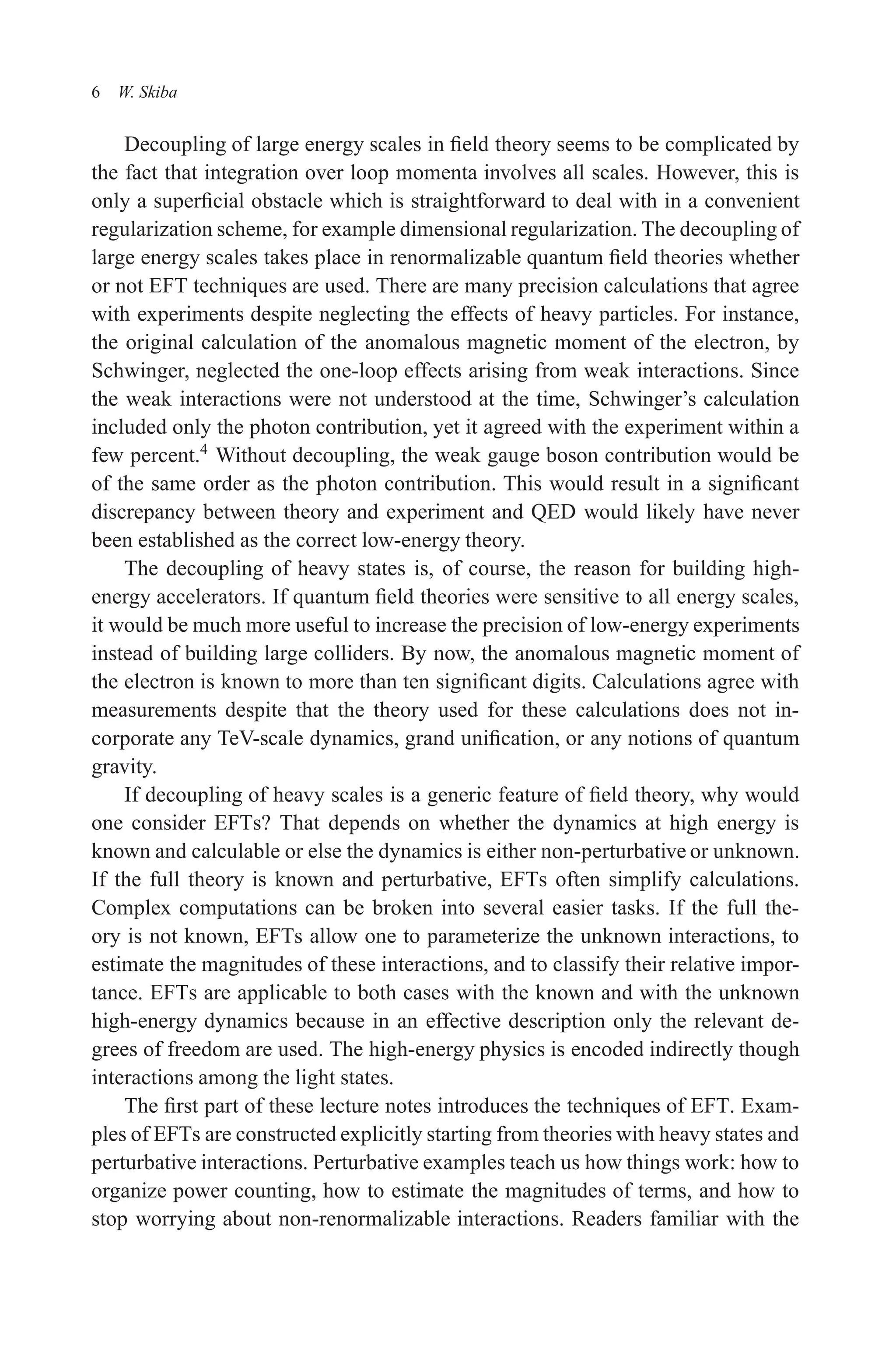
Formally, the heavy particles are “integrated out” of the action by performing
a path integral over the heavy states only
Z
D ϕH ei
R
L(ϕL, ϕH )
= ei
R
Leff (ϕL)
, (1)
where ϕL, ϕH denote the light and the heavy states. Like most calculations done
in practice, integrating out is performed using Feynman diagram methods instead
of path integrals. The effective Lagrangian can be expanded into a finite number
of terms of dimension four or less, and a tower of “higher dimensional” terms,
that is terms of dimension more than four
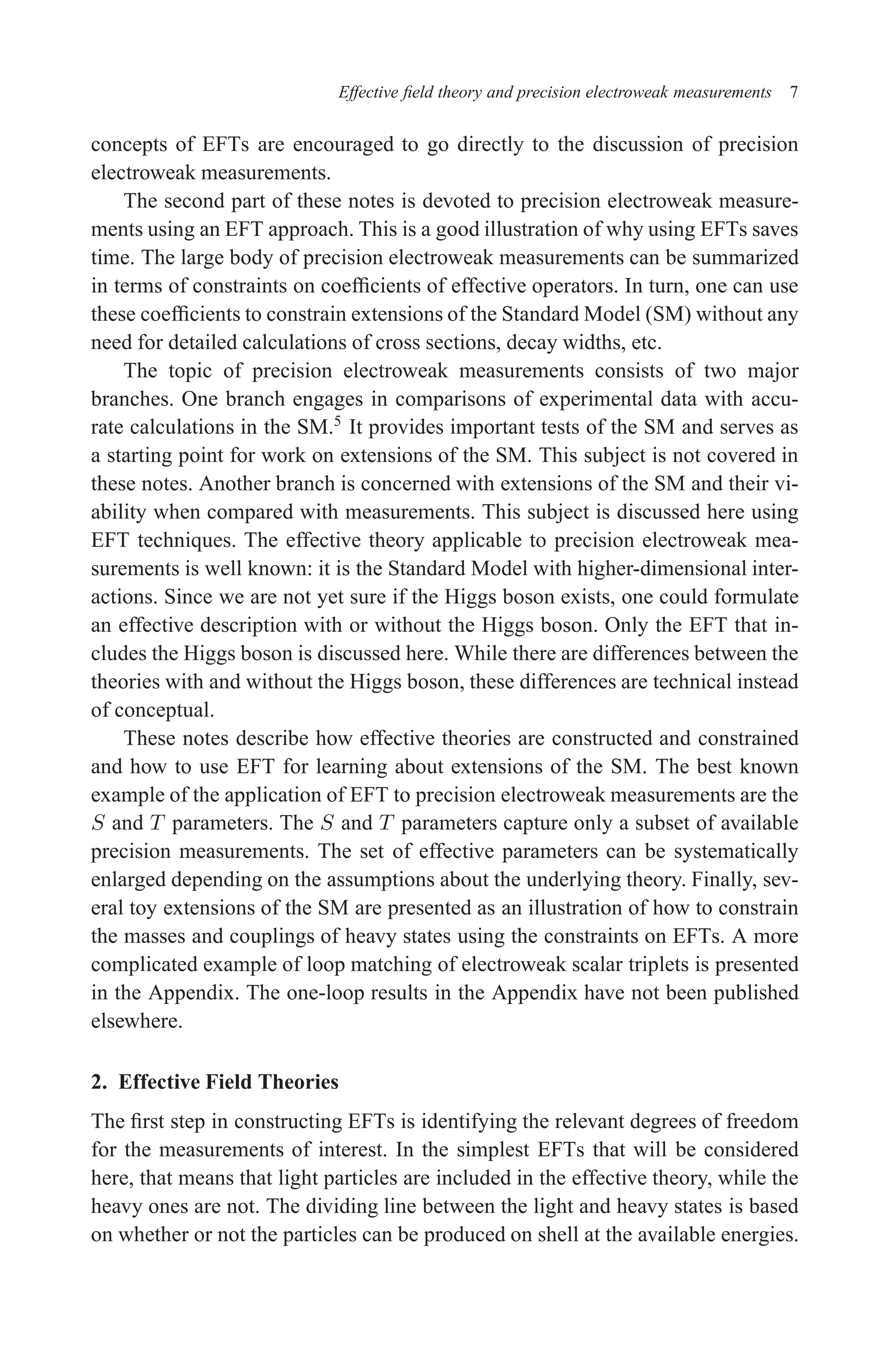
Leff (ϕL) = Ld≤4 +
X
i
Oi
Λdim(Oi)−4
, (2)
where Λ is an energy scale and dim(Oi) are the dimensions of operators Oi. What
is crucial for the EFT program is that the expansion of the effective Lagrangian
in Eq. (2) is into local terms in space-time. This can be done when the effective
Lagrangian is applied to processes at energies lower than the masses of the heavy
states ϕH .
Because we are dealing with weakly interacting theories, the dimension of
terms in the Lagrangian is determined by adding the dimensions of all fields mak-
ing up a term and the dimensions of derivatives. The field dimensions are deter-
mined from the kinetic energy terms and this is often referred to as the engineering
dimension. In strongly interacting theories, the dimensions of operators often dif-
fer significantly from the sum of the constituent field dimensions determined in
free theory. In weakly interacting theories considered here, by definition, the ef-
fects of interactions are small and can be treated order by order in perturbation
theory.
The sum over higher dimensional operators in Eq. (2) is in principle an infinite
sum. In practice, just a few terms are pertinent. Only a finite number of terms needs
to be kept because the theory needs to reproduce experiments to finite accuracy
and also because the theory can be tailored to specific processes of interest. The
higher the dimension of an operator, the smaller its contribution to low-energy
observables. Hence, obtaining results to a given accuracy requires a finite number
December 22, 2010 9:24 WSPC - Proceedings Trim Size: 9in x 6in tasi2009
Effective field theory and precision electroweak measurements 9
of terms.a
This is the reason why non-renormalizable theories are as good as
renormalizable theories. An infinite tower of operators is truncated and a finite
number of parameters is needed for making predictions, which is exactly the same
situation as in renormalizable theories.
It is a simplification to assume that different higher dimensional operators
in Eq. (2) are suppressed by the same scale Λ. Different operators can arise from
exchanges of distinct heavy states that are not part of the effective theory. The scale
Λ is often referred to as the cutoff of the EFT. This is a somewhat misleading term
that is not to be confused with a regulator used in loop calculations, for example a
momentum cutoff. Λ is related to the scale where the effective theory breaks down.
However, dimensionless coefficients do matter. One could redefine Λ by absorbing
dimensionless numbers into the definitions of operators. The breakdown scale of
an EFT is a physical scale that does not depend on the convention chosen for Λ.
This scale could be estimated experimentally by measuring the energy dependence
of amplitudes at small momentum. In EFTs, amplitudes grow at high energies
and exceed the limits from unitarity at the breakdown scale. It is clear that the
breakdown scale is physical since it corresponds to on-shell contributions from
heavy states.
The last remark regarding Eq. (2) is that terms in the Ld≤4 Lagrangian also
receive contributions from the heavy fields. Such contributions may not lead to ob-
servable consequences as the coefficients of interactions in Ld≤4 are determined
from low-energy observables. In some cases, the heavy fields violate symmetries
that would have been present in the full Lagrangian L(ϕL, ϕH = 0) if the heavy
fields are neglected. Symmetry-violating effects of heavy fields are certainly ob-
servable in Ld≤4.
2.1. Power counting and tree-level matching
EFTs are based on several systematic expansions. In addition to the usual loop
expansion in quantum field theory, one expands in the ratios of energy scales.
There can be several scales in the problem: the masses of heavy particles, the
energy at which the experiment is done, the momentum transfer, and so on. In
an EFT, one can independently keep track of powers of the ratio of scales and of
the logarithms of scale ratios. This could be useful, especially when logarithms
are large. Ratios of different scales can be kept to different orders depending on
the numerical values, which is something that is nearly impossible to do without
using EFTs.
aNot all terms of a given dimension need to be kept. For example, one may be studying 2 → 2
scattering. Some operators may contribute only to other scattering processes, for example 2 → 4, and
may not contribute indirectly through loops to the processes of interest at a given loop order.
December 22, 2010 9:24 WSPC - Proceedings Trim Size: 9in x 6in tasi2009
10 W. Skiba
When constructing an EFT one needs to be able to formally predict the mag-
nitudes of different Oi terms in the effective Lagrangian. This is referred to as
power counting the terms in the Lagrangian and it allows one to predict how dif-
ferent terms scale with energy. In the simple EFTs discussed here, power counting
is the same as dimensional analysis using the natural ~ = c = 1 units, in which
[mass] = [length]−1
. From now on, dimensions will be expressed in the units
of [mass], so that energy has dimension 1, while length has dimension −1. The
Lagrangian density has dimension 4 since
R
L d4
x must be dimensionless.
The dimensions of fields are determined from their kinetic energies because
in weakly interacting theories these terms always dominate. The kinetic energy
term for a scalar field, ∂µφ ∂µ
φ, implies that φ has dimension 1, while that of a
fermion, i ψ /
∂ ψ, implies that ψ has dimension 3
2 in 4 space-time dimensions.
A Yukawa theory consisting of a massless fermion interacting with with two
real scalar fields: a light one and a heavy one will serve as our working example.
The Lagrangian of the high-energy theory is taken to be
L = iψ /
∂ ψ +
1
2
(∂µΦ)2
−
M2
2
Φ2
+
1
2
(∂µϕ)2
−
m2
2
ϕ2
− λ ψψΦ − η ψψϕ. (3)
Let us assume that M  m. As this is a toy example, we do not worry whether
it is natural to have a hierarchy between m and M. The Yukawa couplings are
denoted as λ and η. We neglect the potential for Φ and ϕ as it is unimportant for
now.
As our first example of an EFT, we will consider tree-level effects. We want
to find an effective theory with only the light fields present: the fermion ψ and
scalar ϕ. The interactions generated by the exchanges of the heavy field Ψ will be
mocked up by new interactions involving the light fields.
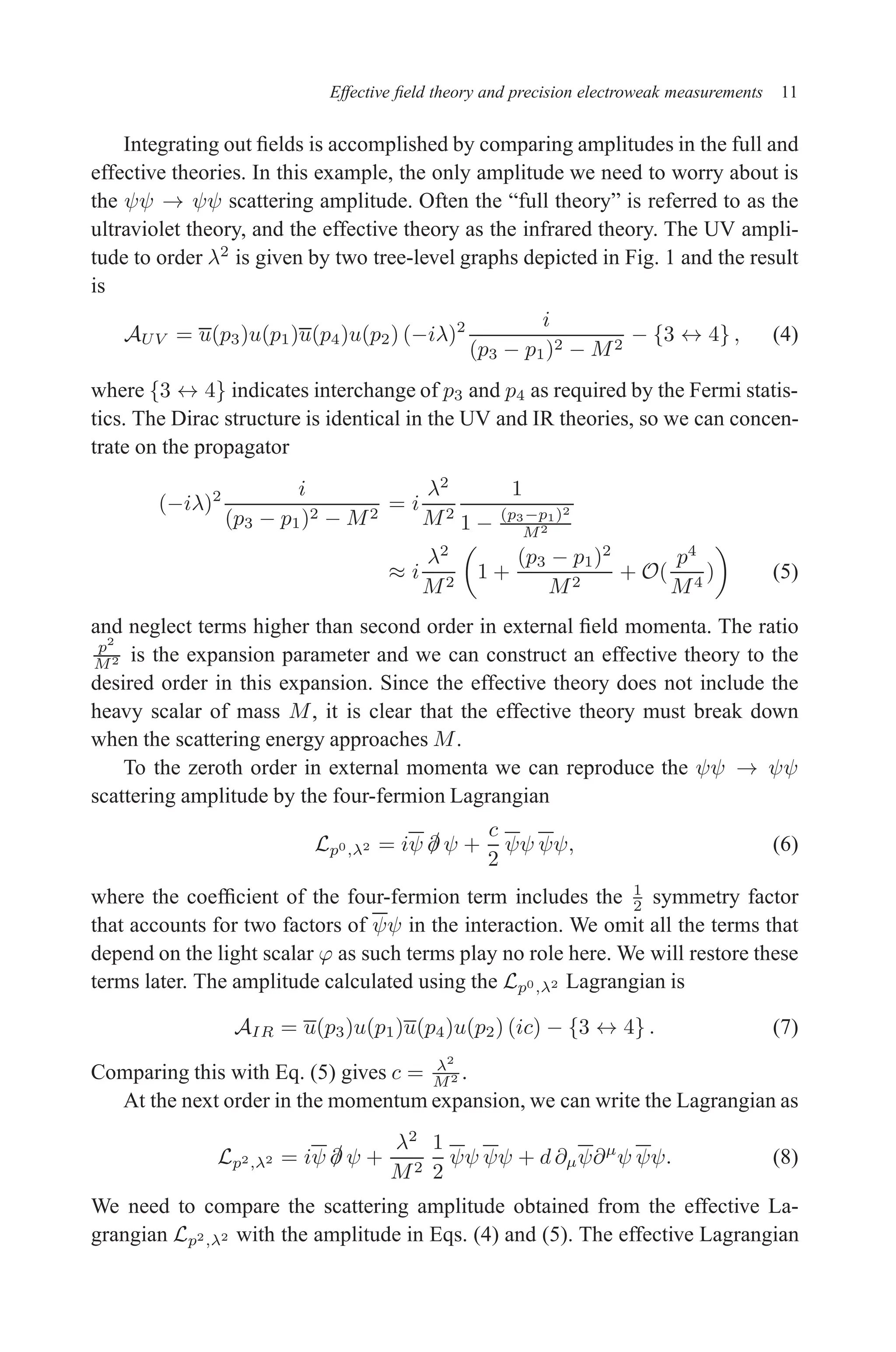
We want to examine the ψψ → ψψ scattering process to order λ2
in the
coupling constants, that is to the zeroth order in η, and keep terms to the second
order in the external momenta.
−
Φ
ψ
ψ ψ
ψ
Φ
1
2
3
4
1
2
3
4
Fig. 1. Tree-level diagrams proportional to λ2
that contribute to ψψ → ψψ scattering.
December 22, 2010 9:24 WSPC - Proceedings Trim Size: 9in x 6in tasi2009
Effective field theory and precision electroweak measurements 11
Integrating out fields is accomplished by comparing amplitudes in the full and
effective theories. In this example, the only amplitude we need to worry about is
the ψψ → ψψ scattering amplitude. Often the “full theory” is referred to as the
ultraviolet theory, and the effective theory as the infrared theory. The UV ampli-
tude to order λ2
is given by two tree-level graphs depicted in Fig. 1 and the result
is
AUV = u(p3)u(p1)u(p4)u(p2) (−iλ)2 i
(p3 − p1)2 − M2
− {3 ↔ 4} , (4)
where {3 ↔ 4} indicates interchange of p3 and p4 as required by the Fermi statis-
tics. The Dirac structure is identical in the UV and IR theories, so we can concen-
trate on the propagator
(−iλ)2 i
(p3 − p1)2 − M2
= i
λ2
M2
1
1 − (p3−p1)2
M2
≈ i
λ2
M2

1 +
(p3 − p1)2
M2
+ O(
p4
M4
)

(5)
and neglect terms higher than second order in external field momenta. The ratio
p2
M2 is the expansion parameter and we can construct an effective theory to the
desired order in this expansion. Since the effective theory does not include the
heavy scalar of mass M, it is clear that the effective theory must break down
when the scattering energy approaches M.
To the zeroth order in external momenta we can reproduce the ψψ → ψψ
scattering amplitude by the four-fermion Lagrangian
Lp0,λ2 = iψ /
∂ ψ +
c
2
ψψ ψψ, (6)
where the coefficient of the four-fermion term includes the 1
2 symmetry factor
that accounts for two factors of ψψ in the interaction. We omit all the terms that
depend on the light scalar ϕ as such terms play no role here. We will restore these
terms later. The amplitude calculated using the Lp0,λ2 Lagrangian is
AIR = u(p3)u(p1)u(p4)u(p2) (ic) − {3 ↔ 4} . (7)
Comparing this with Eq. (5) gives c = λ2
M2 .
At the next order in the momentum expansion, we can write the Lagrangian as
Lp2,λ2 = iψ /
∂ ψ +
λ2
M2
1
2
ψψ ψψ + d ∂µψ∂µ
ψ ψψ. (8)
We need to compare the scattering amplitude obtained from the effective La-
grangian Lp2,λ2 with the amplitude in Eqs. (4) and (5). The effective Lagrangian
December 22, 2010 9:24 WSPC - Proceedings Trim Size: 9in x 6in tasi2009
12 W. Skiba
needs to be valid both on-shell and off-shell as we could build up more com-
plicated diagrams from the effective interactions inserting them as parts of di-
agrams. For the matching procedure, we can use any choice of external mo-
menta that is convenient. When comparing the full and effective theories, we can
choose the momenta to be either on-shell or off-shell. The external particles, in
this case fermions ψ, are identical in the full and effective theories. The choice
of external momenta has nothing to do with the UV dynamics. In other words,
for any small external momenta the full and effective theories must be identi-
cal, thus one is allowed to make opportunistic choices of momenta to simplify
calculations.
In this example, it is useful to assume that the momenta are on-shell that is
p2
1 = . . . = p2
4 = 0. Therefore, the amplitude can only depend on the products of
different momenta pi · pj with i 6= j. With this assumption, the effective theory
needs to reproduce the −2i λ2
M2
p1·p3
M2 − {3 ↔ 4} part of the amplitude in Eq. (5).
The term proportional to d in the Lp2,λ2 Lagrangian gives the amplitude
AIR = id (p1 · p3 + p2 · p4) u(p3)u(p1)u(p4)u(p2) − {3 ↔ 4} . (9)
The momenta p1 and p2 are assumed to be incoming, thus they contribute −ipµ
1,2
to the amplitude, while the outgoing momenta contribute +ipµ
3,4. Conservation of
momentum, p1 + p2 = p3 + p4, implies p1 · p2 = p3 · p4, p1 · p3 = p2 · p4, and
p1 · p4 = p2 · p3. Hence, d = − λ2
M4 .
The derivative operator with the coefficient d is not the only two-derivative
term one can write with four fermions. For example, we could have included in
the Lagrangian the term (∂2
ψ)ψ ψψ + H.c. or included the term ∂µψψ ψ∂µ
ψ.
When constructing a general effective Lagrangian it is important to consider all
terms of a given order. There are four different ways to write two derivatives in the
four-fermion interaction. Integration by parts implies that there is one relationship
between the four possible terms. The term containing ∂2
does not contribute on
shell. In fact, this term can be removed from the effective Lagrangian using equa-
tions of motion.10,11
We will discuss this in more detail in Sec. 2.5. Thus, there are
only two independent two-derivative terms in this theory. At the tree level, only
one of these terms turned out to be necessary to match the UV theory.
2.2. Renormalization group running
So far we have focused on the fermions, but our original theory has two scalar
fields. At tree level, we have obtained the effective Lagrangian
Lp2,λ2 = iψ /
∂ ψ+
c
2
ψψ ψψ+d ∂µψ∂µ
ψ ψψ+
1
2
(∂µϕ)2
−
m2
2
ϕ2
−η ψψϕ (10)
December 22, 2010 9:24 WSPC - Proceedings Trim Size: 9in x 6in tasi2009
Effective field theory and precision electroweak measurements 13
and calculated the coefficients c and db
. Parameters do not exhibit scale depen-
dence at tree level, but it will become clear that we calculated the effective cou-
plings at the scale M that is c(µ = M) = λ2
M2 and d(µ = M) = − λ2
M4 .
Our next example will be computation of the ψψ → ψψ amplitude to the low-
est order in the momenta and to order λ2
η2
in the UV coupling constants. Such
contribution arises at one loop. Since loop integration generically yields factors
of 1
(4π)2 one expects then a correction of order η2
(4π)2 compared to the tree-level
amplitude. This is not an accurate estimate if there are several scales in the prob-
lem. We will assume that m ≪ M, so the scattering amplitude could contain large
log(M
m ). In fact, in an EFT one separates logarithm-enhanced contributions and
contributions independent of large logs. The log-independent contributions arise
from matching and the log-dependent ones are accounted for by the renormal-
ization group (RG) evolution of parameters. By definition, while matching one
compares theories with different field contents. This needs to be done using the
same renormalization scale in both theories. This so-called matching scale is usu-
ally the mass of the heavy particle that is being integrated out. No large logarithms
can arise in the process since only one scale is involved. The logs of the matching
scale divided by a low-energy scale must be identical in the two theories since the
two theories are designed to be identical at low energies. We will illustrate loop
matching in the next section. It is very useful that one can compute the matching
and running contributions independently. This can be done at different orders in
perturbation theory as dictated by the magnitudes of couplings and ratios of scales.
In our effective theory described in Eq. (10) we need to find the RG equation
for the Lagrangian parameters. For concreteness, let us assume we want to know
the amplitude at the scale m. Since we will be interested in the momentum in-
dependent part of the amplitude, we can neglect the term proportional to d. By
dimensional analysis, the amplitude we are after must be proportional to λ2
η2
16π2M2 .
The two-derivative term will always be proportional to 1
M4 , so it has to be sup-
pressed by m2
M2 compared to the leading term arising from the non-derivative term.
This reasoning only holds if one uses a mass-independent regulator, like dimen-
sional regularization with minimal subtraction. In dimensional regularization, the
renormalization scale µ only appears in logs.
In less suitable regularization schemes, the two-derivative term could con-
tribute as much as the non-derivative term as the extra power of 1
M2 could be-
come Λ2
M2 , where Λ is the regularization scale. With the natural choice Λ ≈ M,
bThe effective Lagrangian in Eq. (10) is not complete to order λ2 and p2, it only contains all tree-level
terms of this order. For example, the Yukawa coupling ψψϕ receives corrections proportional to ηλ2
at one loop.
December 22, 2010 9:24 WSPC - Proceedings Trim Size: 9in x 6in tasi2009
14 W. Skiba
the two-derivative term is not suppressed at all. Since the same argument holds
for terms with more and more derivatives, all terms would contribute exactly the
same and the momentum expansion would be pointless. This is, for example, how
hard momentum cut off and Pauli-Villars regulators behave. Such regulators do
their job, but they needlessly complicate power counting. From now on, we will
only be using dimensional regularization.
To calculate the RG running of the coefficient c, we need to obtain the relevant
Z factors. First, we need the fermion self energy diagram
p p + k
k
= (−iη)2
Z
dd
k
(2π)d
i(/
k + /
p)
(k + p)2
i
k2 − m2
= η2
Z
dd
l
(2π)d
Z 1
0
dx
/
l + (1 − x)/
p
[l2 − ∆2]2
=
iη2
(4π)2
1
ǫ
Z 1
0
dx(1 − x)/
p

+ finite
=
iη2
/
p
2(4π)2
1
ǫ
+ finite, (11)
where we used Feynman parameters to combine the denominators and shifted the
loop momentum l = k + xp. We then used the standard result for loop integrals
and expanded d = 4 − 2ǫ. Only the 1
ǫ pole is kept as the finite term does not enter
the RG calculation.
The second part of the calculation involves computing loop corrections to the
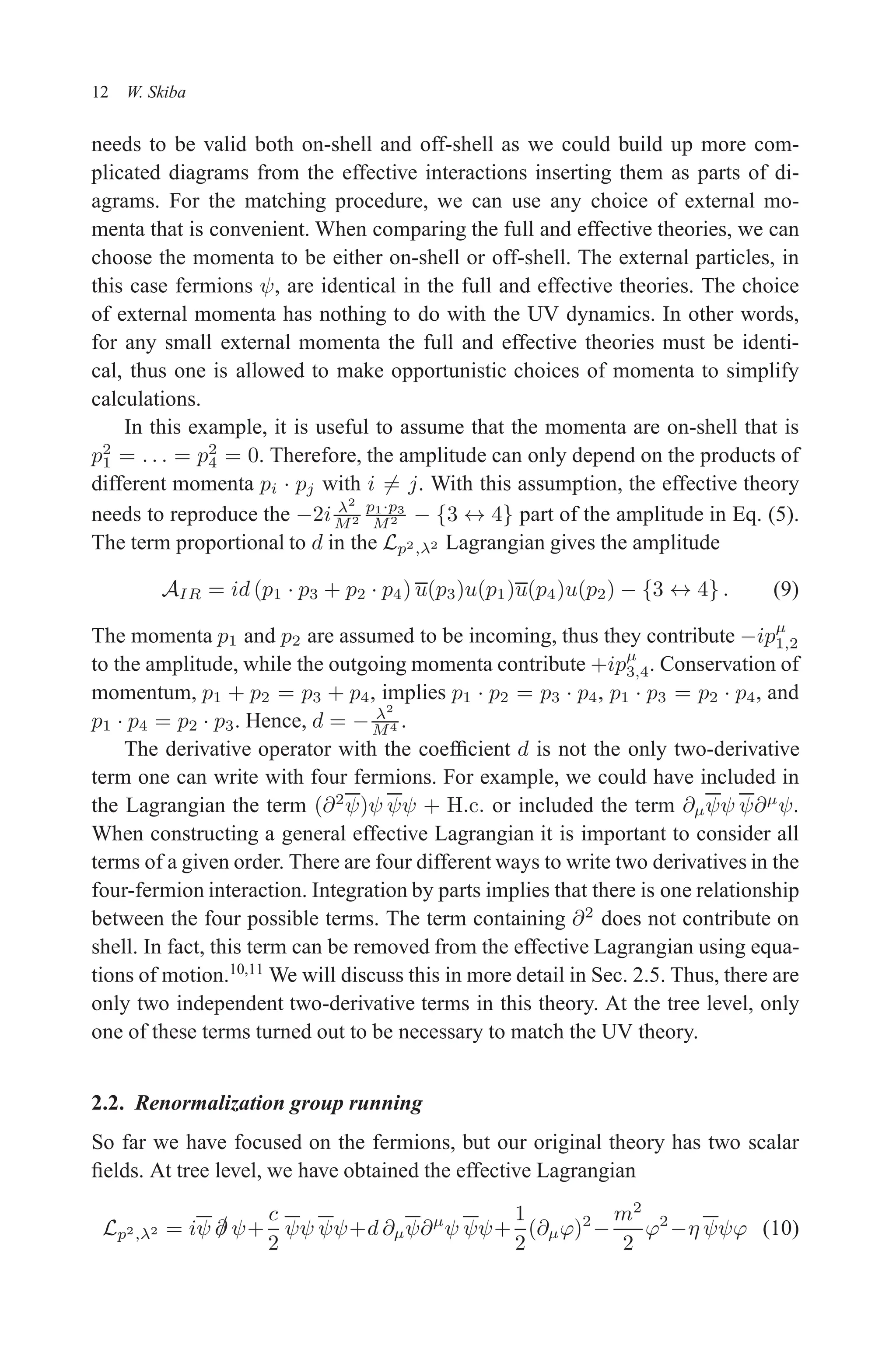
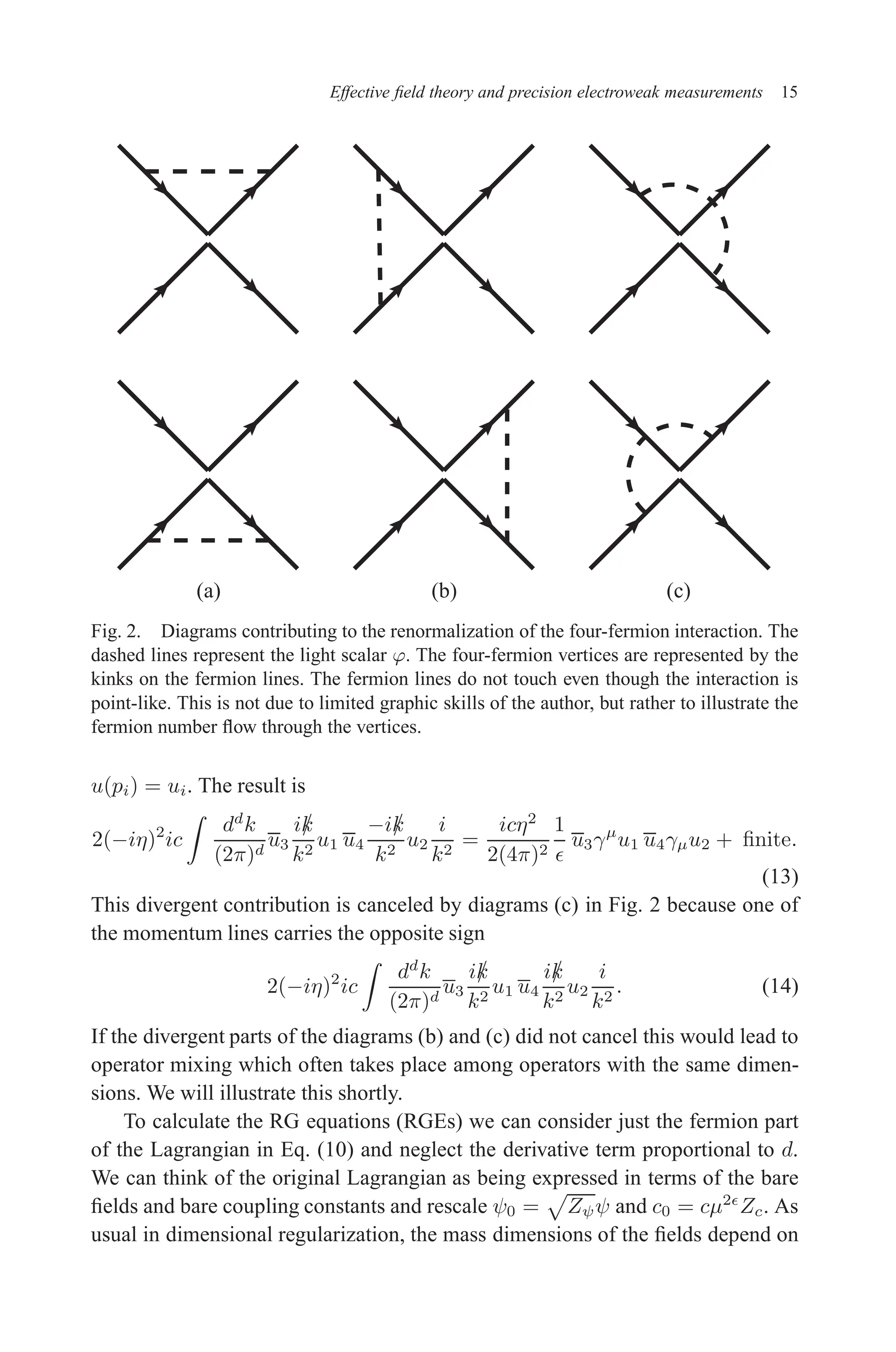
four-fermion vertex. There are six diagrams with a scalar exchange because there
are six different pairings of the external lines. The diagrams are depicted in Fig. 2
and there are two diagrams in each of the three topologies. All of these diagrams
are logarithmically divergent in the UV, so we can neglect the external momenta
and masses if we are interested in the divergent parts. The divergent terms must be
local and therefore be analytic in the external momenta. Extracting positive pow-
ers of momenta from a diagram reduces its degree of divergence which is apparent
from dimensional analysis. Diagrams (a) in Fig. 2 are the most straightforward to
deal with and the divergent part is easy to extract
2(−iη)2
ic
Z
dd
k
(2π)d
i/
k
k2
i/
k
k2
i
k2
= −2cη2
Z
dd
k
(2π)d
1
k4
= −
2icη2
(4π)2
1
ǫ
+ finite.
(12)
We did not mention the cross diagrams here, denoted {3 ↔ 4} in the previous
section, since they go along for the ride, but they participate in every step. Dia-
grams (b) in Fig. 2 require more care as the loop integral involves two different
fermion lines. To keep track of this we indicate the external spinors and abbreviate
December 22, 2010 9:24 WSPC - Proceedings Trim Size: 9in x 6in tasi2009
Effective field theory and precision electroweak measurements 15
(a) (b) (c)
Fig. 2. Diagrams contributing to the renormalization of the four-fermion interaction. The
dashed lines represent the light scalar ϕ. The four-fermion vertices are represented by the
kinks on the fermion lines. The fermion lines do not touch even though the interaction is
point-like. This is not due to limited graphic skills of the author, but rather to illustrate the
fermion number flow through the vertices.
u(pi) = ui. The result is
2(−iη)2
ic
Z
dd
k
(2π)d
u3
i/
k
k2
u1 u4
−i/
k
k2
u2
i
k2
=
icη2
2(4π)2
1
ǫ
u3γµ
u1 u4γµu2 + finite.
(13)
This divergent contribution is canceled by diagrams (c) in Fig. 2 because one of
the momentum lines carries the opposite sign
2(−iη)2
ic
Z
dd
k
(2π)d
u3
i/
k
k2
u1 u4
i/
k
k2
u2
i
k2
. (14)
If the divergent parts of the diagrams (b) and (c) did not cancel this would lead to
operator mixing which often takes place among operators with the same dimen-
sions. We will illustrate this shortly.
To calculate the RG equations (RGEs) we can consider just the fermion part
of the Lagrangian in Eq. (10) and neglect the derivative term proportional to d.
We can think of the original Lagrangian as being expressed in terms of the bare
fields and bare coupling constants and rescale ψ0 =
p
Zψψ and c0 = cµ2ǫ
Zc. As
usual in dimensional regularization, the mass dimensions of the fields depend on
December 22, 2010 9:24 WSPC - Proceedings Trim Size: 9in x 6in tasi2009
16 W. Skiba
the dimension of space-time. In d = 4 − 2ǫ, the fermion dimension is [ψ] = 3
2 − ǫ
and [L] = 4 − 2ǫ. We explicitly compensate for this change from the usual 4
space-time dimensions by including the factor µ2ǫ
in the interaction term. This
way, the coupling c does not alter its dimension when d = 4−2ǫ. The Lagrangian
is then
L = iψ0 /
∂ ψ0 +
c0
2
ψ0ψ0 ψ0ψ0 = iZψψ /
∂ ψ +
c
2
ZcZ2
ψµ2ǫ
ψψ ψψ
= iψ/
∂ψ + µ2ǫ c
2
ψψ ψψ + i(Zψ − 1)ψ/
∂ψ + µ2ǫ c
2
(ZcZ2
ψ − 1)ψψ ψψ, (15)
where in the last line we separated the counterterms. We can read off the coun-
terterms from Eqs. (11) and (12) by insisting that the counterterms cancel the
divergences we calculated previously.
Zψ − 1 = −
η2
2(4π)2
1
ǫ
and c(ZcZ2
ψ − 1) =
2cη2
(4π)2
1
ǫ
, (16)
where we used the minimal subtraction (MS) prescription and hence retained only
the 1
ǫ poles. Comparing the two equations in (16), we obtain Zc = 1 + 3η2
(4π)2
1
ǫ .
The standard way of computing RGEs is to use the fact that the bare quantities
do not depend on the renormalization scale
0 = µ
d
dµ
c0 = µ
d
dµ
(cµ2ǫ
Zc) = βcµ2ǫ
Zc + 2ǫcµ2ǫ
Zc + cµ2ǫ
µ
d
dµ
Zc, (17)
where βc ≡ µ dc
dµ. We have µ d
dµ Zc = 3
(4π)2 2ηβη
1
ǫ . Just like we had to compensate
for the dimension of c, the renormalized coupling η needs an extra factor of µǫ
to
remain dimensionless in the space-time where d = 4 − 2ǫ. Repeating the same
manipulations we used in Eq. (17), we obtain βη = −ǫη − η
d log Zη
d log µ . Keeping the
derivative of Zη would give us a term that is of higher order in η as for any Z
factor the scale dependence comes from the couplings. Thus, we keep only the
first term, βη = −ǫη, and get µ d
dµ Zc = − 6η2
(4π)2 . Finally,
βc =
6η2
(4π)2
c. (18)
We can now complete our task and compute the low-energy coupling, and thus
the scattering amplitude, to the leading log order
c(m) = c(M) −
6η2
(4π)2
c log

M
m

=
λ2
M2

1 −
6η2
(4π)2
log

M
m

. (19)
Of course, at this point it requires little extra work to re-sum the logarithms by
solving the RGEs. First, one needs to solve for the running of η. We will not
December 22, 2010 9:24 WSPC - Proceedings Trim Size: 9in x 6in tasi2009
Effective field theory and precision electroweak measurements 17
compute it in detail here, but βη = 5η3
(4π)2 . Solving this equation gives
1
η2(µ2)
−
1
η2(µ1)
=
10
(4π)2
log
µ1
µ2
. (20)
Putting the µ dependence of η from Eq. (20) into Eq. (18) and performing the
integral yields
c(m) = C(M)

η2
(m)
η2(M)
3
5
, (21)
which agrees with Eq. (19) to the linear order in log M
m

.
It is worth pointing out that the Yukawa interaction in the full theory, η ψψϕ,
receives corrections from the exchanges of both the light and the heavy scalars.
Hence, the beta function βη receives contributions proportional to η3
and ηλ2
.
In fact, βη = 5η3
(4π)2 + 3ηλ2
(4π)2 . The beta function has no dependence on the mass
of the heavy scalar nor on the renormalization scale, so one might be tempted to
use this beta function at any renormalization scale. For example, this would imply
that heavy particles contribute to the running of η at energy scales much smaller
than their mass. Clearly, this is unphysical. If this was true, we could count all
the electrically charged particles even as heavy as the Planck scale by measuring
the charge at two energy scales, for example by scattering at the center of mass
energies equal to the electron mass and equal to the Z mass. The fact that the
beta function has no dependence on the renormalization scale is characteristic of
mass-independent regulators, like dimensional regularization coupled with mini-
mal subtraction. When using dimensional regularization, heavy particles need to
be removed from the theory to get physical answers for the beta function. This
is yet another reason why dimensional regularization goes hand in hand with the
EFT approach.
The contribution from the heavy scalar, proportional to ηλ2
, is absent in the
effective theory since the heavy scalar was removed from the theory. However,
diagrams that reproduce the exchanges of the heavy scalar do exist in the effec-
tive theory. Such diagrams are proportional to cη and arise from the four-fermion
vertex corrections to the Yukawa interaction. Since c is proportional to 1
M2 , the
dimensionless βη must be suppressed by
m2
ψ
M2 . We assumed that mψ = 0, so the
cη contribution vanishes. Integrating out the heavy scalar changed the Yukawa βη
function in a step-wise manner while going from the full theory to the effective
theory. Calculations of the beta function performed using a mass-dependent regu-
lator yield a smooth transition from one asymptotic value of the beta function to
another, see for example Ref. 6. However, the predictions for physical quantities
are not regulator dependent.
December 22, 2010 9:24 WSPC - Proceedings Trim Size: 9in x 6in tasi2009
18 W. Skiba
It is interesting that lack of renormalizability of the four-fermion interaction
never played any role in our calculation. Our calculation would have looked iden-
tical if we wanted to obtain the RGE for the electric charge in QED. The number
of pertinent terms in the Lagrangian was finite since we were interested in a finite
order in the momentum expansion.
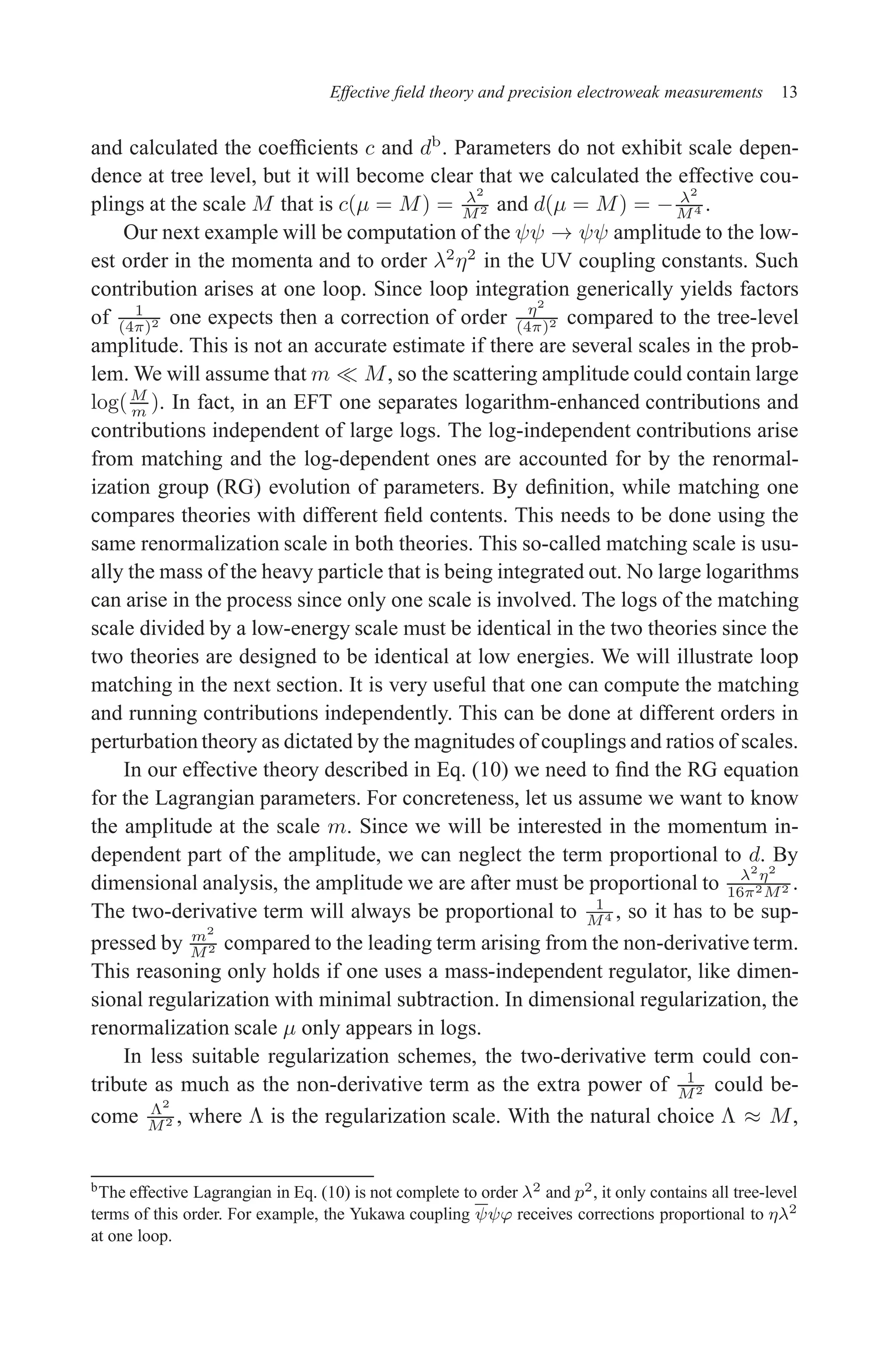
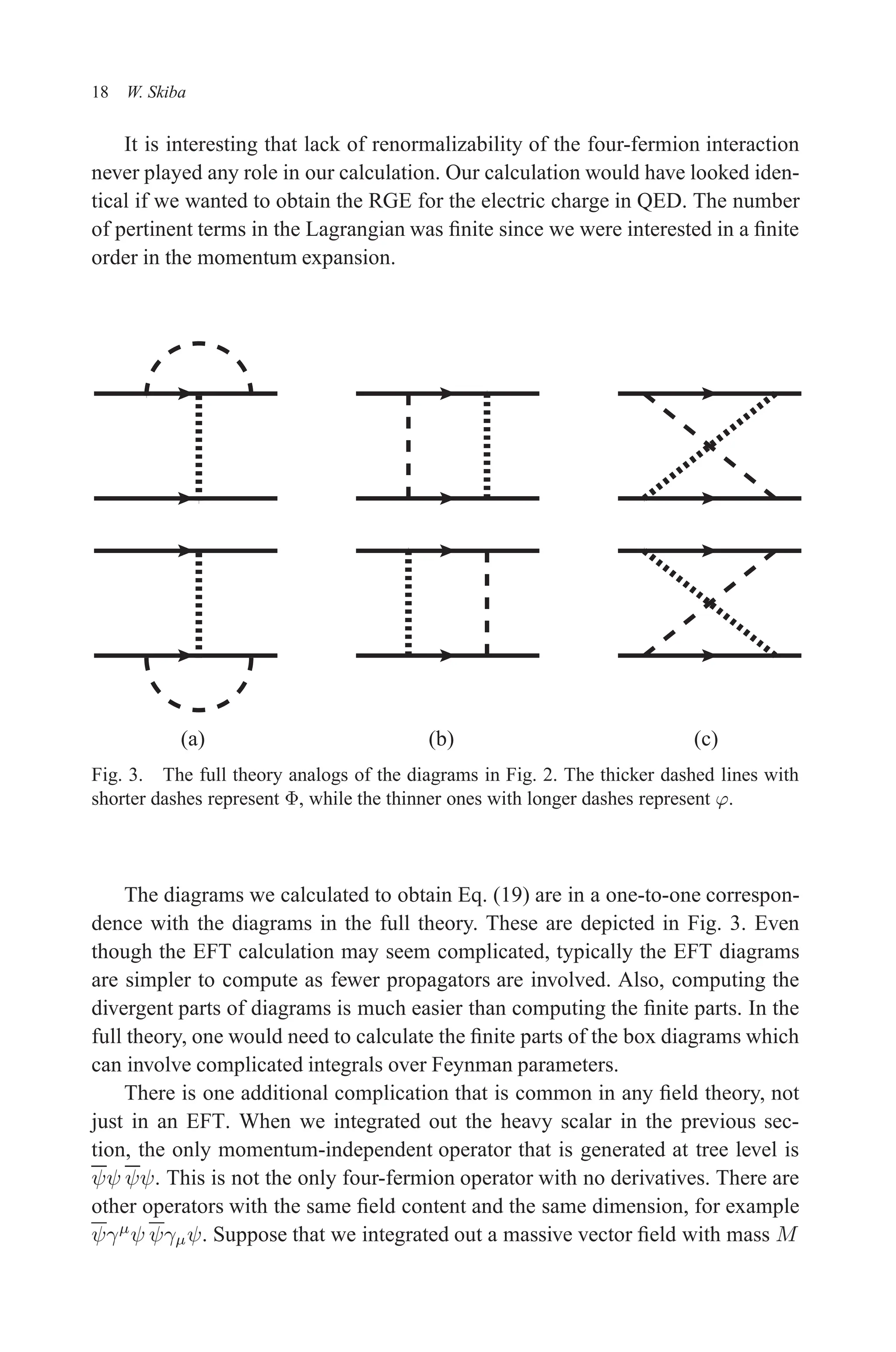
(a) (b) (c)
Fig. 3. The full theory analogs of the diagrams in Fig. 2. The thicker dashed lines with
shorter dashes represent Φ, while the thinner ones with longer dashes represent ϕ.
The diagrams we calculated to obtain Eq. (19) are in a one-to-one correspon-
dence with the diagrams in the full theory. These are depicted in Fig. 3. Even
though the EFT calculation may seem complicated, typically the EFT diagrams
are simpler to compute as fewer propagators are involved. Also, computing the
divergent parts of diagrams is much easier than computing the finite parts. In the
full theory, one would need to calculate the finite parts of the box diagrams which
can involve complicated integrals over Feynman parameters.
There is one additional complication that is common in any field theory, not
just in an EFT. When we integrated out the heavy scalar in the previous sec-
tion, the only momentum-independent operator that is generated at tree level is
ψψ ψψ. This is not the only four-fermion operator with no derivatives. There are
other operators with the same field content and the same dimension, for example
ψγµ
ψ ψγµψ. Suppose that we integrated out a massive vector field with mass M
December 22, 2010 9:24 WSPC - Proceedings Trim Size: 9in x 6in tasi2009
Effective field theory and precision electroweak measurements 19
and that our effective theory is instead
Lp0,V = iψ /
∂ ψ +
cV
2
ψγµ
ψ ψγµψ +
1
2
(∂µϕ)2
−
m2
2
ϕ2
− η ψψϕ. (22)
We could ask the same question about low-energy scattering in this theory, that
is ask about the RG evolution of the coefficient cV . The contributions from the
ϕ exchanges are identical to those depicted in Fig. 2. The only difference is that
the four-fermion vertex contains the γµ
matrices. Diagrams (a) give a divergent
contribution to the ψγµ
ψ ψγµψ operator. However, the sum of the divergent parts
of diagrams (b) and (c) is not proportional to the original operator, but instead pro-
portional to ψσµν
ψ ψσµν ψ, where σµν
= i
2 [γµ
, γν
]. This means that under RG
evolution these two operators mix. The two operators have the same dimensions,
field content, and symmetry properties thus loop corrections can turn one operator
into another.
To put it differently, it is not consistent to just keep a single four-fermion
operator in the effective Lagrangian in Eq. (22) at one loop. The theory needs to
be supplemented since there needs to be an additional counterterm to absorb the
divergence. At one loop it is enough to consider
Lp0,V T = iψ /
∂ ψ +
cV
2
ψγµ
ψ ψγµψ +
cT
2
ψσµν
ψ ψσµν ψ
+
1
2
(∂µϕ)2
−
m2
2
ϕ2
− η ψψϕ, (23)
but one expects that at higher loop orders all four-fermion operators are needed.
Since we assumed that the operator proportional to cV was generated by a heavy
vector field at tree level, we know that in our effective theory cT (µ = M) = 0
and cV (µ = M) 6= 0. At low energies, both coefficients will be nonzero.
We do not want to provide the calculation of the beta functions for the coef-
ficients cV and cT in great detail. This calculation is completely analogous to the
one for βc. The vector operator induces divergent contributions to itself and to the
tensor operator, while the tensor operator only generates a divergent contribution
for the vector operator. The coefficients of the two counterterms are
cV (ZV Z2
ψ − 1) =
η2
(4π)2
(−cV + 6cT )
1
ǫ
, (24)
cT (ZT Z2
ψ − 1) =
η2
(4π)2
cV
1
ǫ
, (25)
where we introduced separate Z factors for each operator since each requires a
counterterm. These Z factors imply that the beta functions are
βcV = 12 cT
η2
(4π)2
and βcT = 2 (cT + cV )
η2
(4π)2
. (26)
December 22, 2010 9:24 WSPC - Proceedings Trim Size: 9in x 6in tasi2009
20 W. Skiba
This result may look surprising when compared with Eqs. (24) and (25). The
difference in the structures of the divergences and the beta functions comes from
the wave function renormalization encoded in Zψ. It is easy to solve the RGEs in
Eq. (24) by treating them as one matrix equation
µ
d
dµ

cV
cT

=
2η2
(4π)2

0 6
1 1
 
cV
cT

. (27)
The eigenvectors of this matrix satisfy uncoupled RGEs and they correspond to
the combinations of operators that do not mix under one-loop renormalization.
2.3. One-loop matching
Construction of effective theories is a systematic process. We saw how RGEs can
account for each ratio of scales, and we now increase the accuracy of match-
ing calculations. To improve our ψψ → ψψ scattering calculation we compute
matching coefficients to one-loop order. As an example, we examine terms propor-
tional to λ4
. This calculation illustrates several important points about matching
calculations.
Our starting point is again the full theory with two scalars, described in Eq. (3).
Since we are only interested in the heavy scalar field, we can neglect the light
scalar for the time being and consider
L = iψ /
∂ ψ − σψψ +
1
2
(∂µΦ)2
−
M2
2
Φ2
− λ ψψΦ + O(ϕ). (28)
We added a small mass, σ, for the fermion to avoid possible IR divergences and
also to be able to obtain a nonzero answer for terms proportional to 1
M4 .
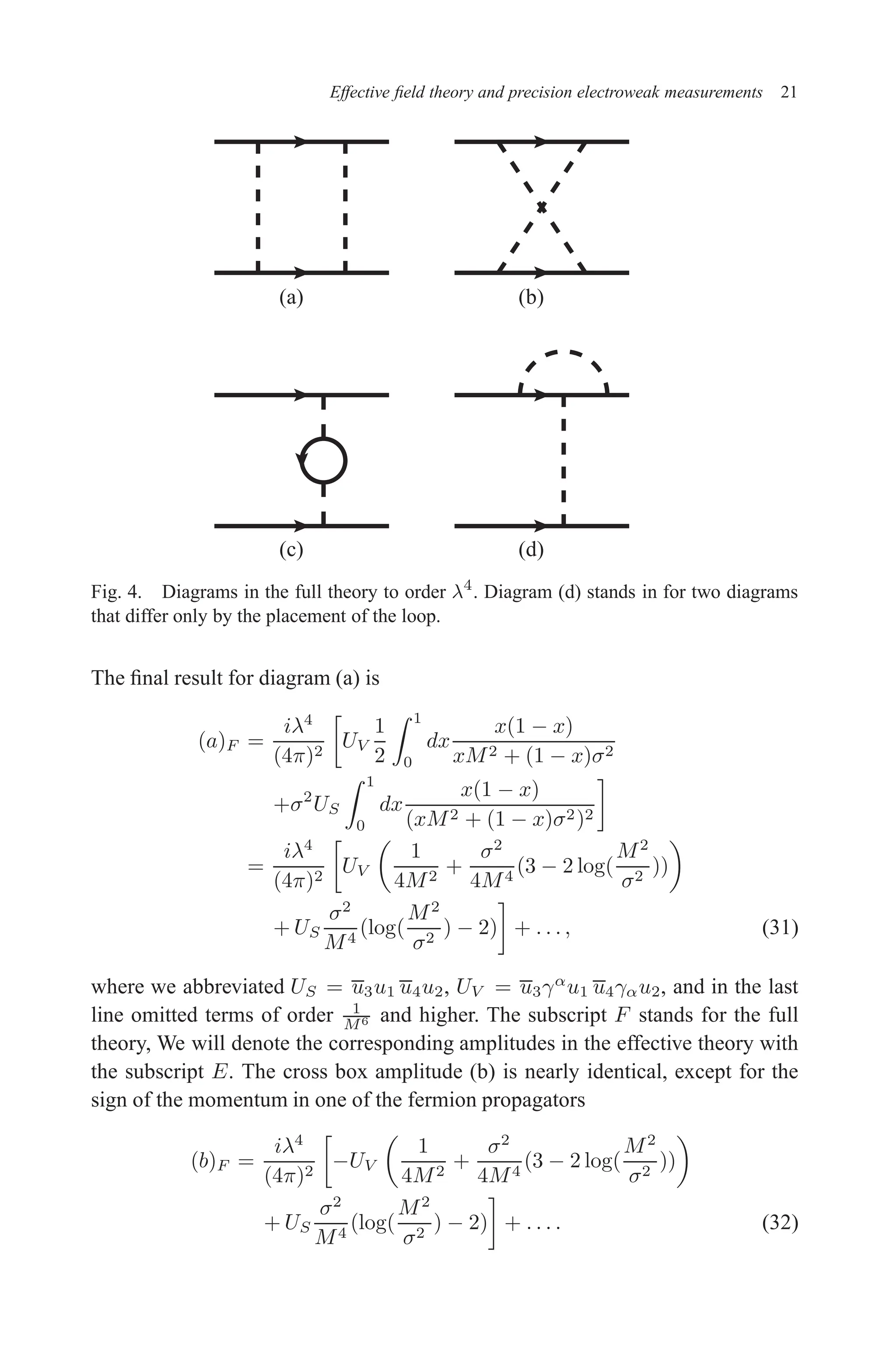
The diagrams that contribute to the scattering at one loop are illustrated in
Fig. 4. As we did before, we will focus on the momentum-independent part of
the amplitude and we will not explicitly write the terms related by exchange of
external fermions. The first diagram gives
(a) = (−iλ)4
Z
dd
k
(2π)d
u3
i(/
k + σ)
k2 − σ2
u1 u4i
i(−/
k + σ)
k2 − σ2
u2
i2
(k2 − M2)2
= λ4

−u3γα
u1 u4γβ
u2
Z
dd
k
(2π)d
kαkβ
(k2 − σ2)2(k2 − M2)2
+ u3u1 u4u2
Z
dd
k
(2π)d
σ2
(k2 − σ2)2(k2 − M2)2

. (29)
The loop integrals are straightforward to evaluate using Feynman parameterization
1
(k2 − σ2)2(k2 − M2)2
= 6
Z 1
0
dx
x(1 − x)
(k2 − xM2 − (1 − x)σ2)4
. (30)
December 22, 2010 9:24 WSPC - Proceedings Trim Size: 9in x 6in tasi2009
Effective field theory and precision electroweak measurements 21
(a) (b)
(c) (d)
Fig. 4. Diagrams in the full theory to order λ4
. Diagram (d) stands in for two diagrams
that differ only by the placement of the loop.
The final result for diagram (a) is
(a)F =
iλ4
(4π)2

UV
1
2
Z 1
0
dx
x(1 − x)
xM2 + (1 − x)σ2
+σ2
US
Z 1
0
dx
x(1 − x)
(xM2 + (1 − x)σ2)2

=
iλ4
(4π)2

UV

1
4M2
+
σ2
4M4
(3 − 2 log(
M2
σ2
))

+ US
σ2
M4
(log(
M2
σ2
) − 2)

+ . . . , (31)
where we abbreviated US = u3u1 u4u2, UV = u3γα
u1 u4γαu2, and in the last
line omitted terms of order 1
M6 and higher. The subscript F stands for the full
theory, We will denote the corresponding amplitudes in the effective theory with
the subscript E. The cross box amplitude (b) is nearly identical, except for the
sign of the momentum in one of the fermion propagators
(b)F =
iλ4
(4π)2

−UV

1
4M2
+
σ2
4M4
(3 − 2 log(
M2
σ2
))

+ US
σ2
M4
(log(
M2
σ2
) − 2)

+ . . . . (32)
December 22, 2010 9:24 WSPC - Proceedings Trim Size: 9in x 6in tasi2009
22 W. Skiba
Diagrams (c) and (d) are even simpler to evaluate, but they are divergent.
(c)F = −4
iλ4
(4π)2
σ2
M4
US

3
1
ǫ
+ 3 log(
µ2
σ2
) + 1

+ . . . , (33)
where 1
ǫ = 1
ǫ − γ + log(4π). µ is the regularization scale and it enters since
coupling λ carries a factor of µǫ
in dimensional regularization. The four Yukawa
couplings give λ4
µ4ǫ
. However, µ2ǫ
should be factored out of the calculation to
give the proper dimension of the four-fermion coupling, while the remaining µ2ǫ
is expanded for small ǫ and yields log(µ2
). In the following expression a factor of
two is included to account for two diagrams
(d)F = −2
iλ4
(4π)2M2
US

1
ǫ
+ 1 + log(
µ2
M2
) +
σ2
M2

2 − 3 log(
M2
σ2
)

+ . . . .
(34)
The sum of all of these contributions is
(a + . . . + d)F =
2iλ4
US
(4π)2M2

−
1
ǫ
− 1 − log(
µ2
M2
)
+
σ2
M2

−
6
ǫ
− 6 log(
µ2
σ2
) − 6 + 4 log(
M2
σ2
)

. (35)
We also need the fermion two-point function in order to calculate the wave
function renormalization in the effective theory. The calculation is identical to that
in Eq. (11). We need the finite part as well. The amplitude linear in momentum is
i/
p λ2
2(4π)2

1
ǫ + log( µ2
M2 ) + 1
2 + . . .

.
It is time to calculate in the effective theory. The effective theory has a four-
fermion interaction that was induced at tree level. Again, we neglect the light
scalar ϕ as it does not play any role in our calculation. The effective Lagrangian
is
L = izψ /
∂ ψ − σψψ +
c
2
ψψ ψψ. (36)
We established that at tree level, c = λ2
M2 , but do not yet want to substitute the
actual value of c as not to confuse the calculations in the full and effective theories.
To match the amplitudes we also need to compute one-loop scattering amplitude
in the effective theory. The two-point amplitude for the fermion kinetic energy
vanishes in the effective theory. The four-point diagrams in the effective theory are
depicted in Fig. 5. Diagrams in an effective theory have typically higher degrees
of UV divergence as they contain fewer propagators. For example, diagram (a)E
is quadratically divergent, while (a)F is finite. This is not an obstacle. We simply
regulate each diagram using dimensional regularization.
December 22, 2010 9:24 WSPC - Proceedings Trim Size: 9in x 6in tasi2009
Effective field theory and precision electroweak measurements 23
(a) (b)
(c) (d)
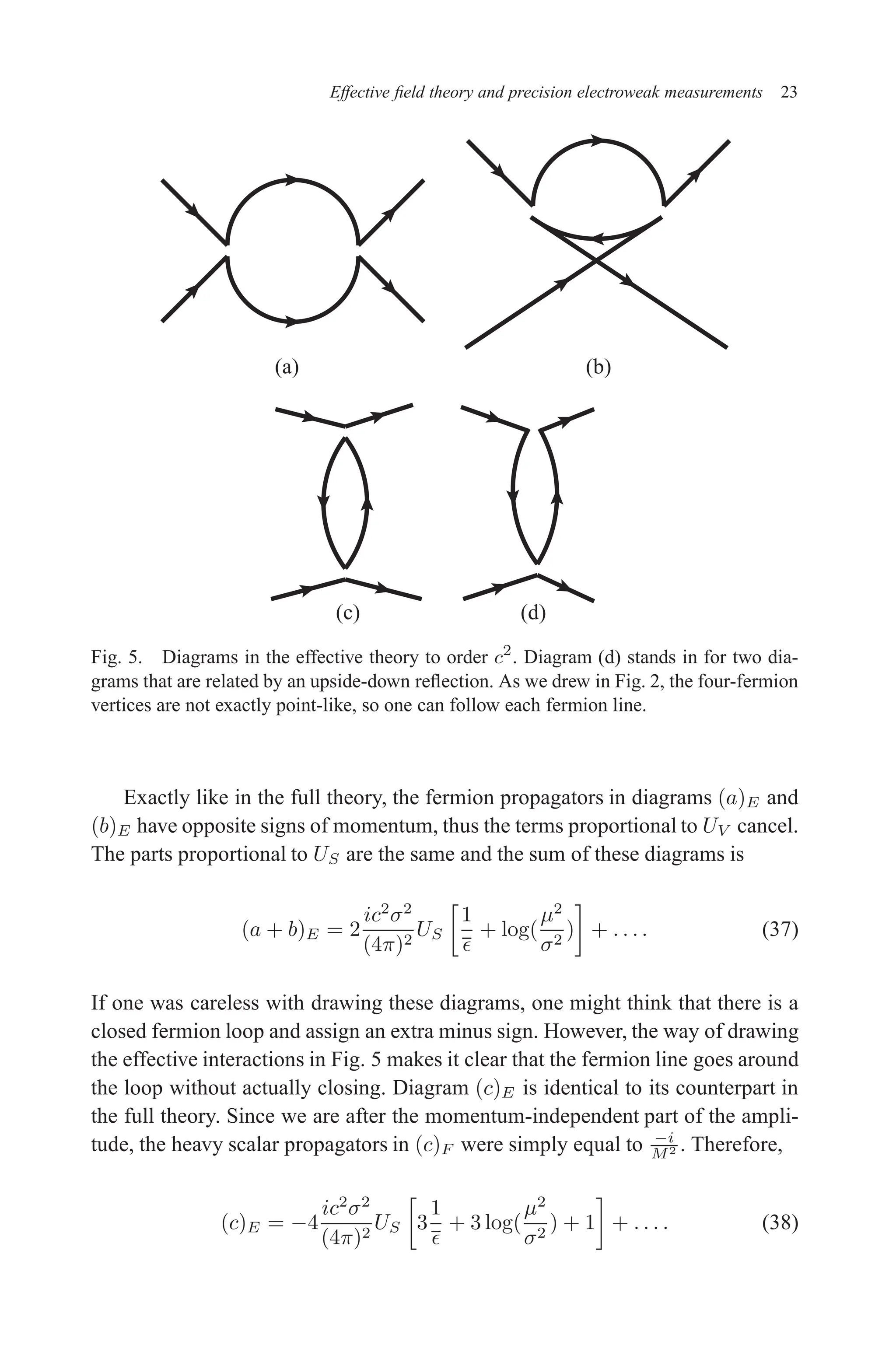
Fig. 5. Diagrams in the effective theory to order c2
. Diagram (d) stands in for two dia-
grams that are related by an upside-down reflection. As we drew in Fig. 2, the four-fermion
vertices are not exactly point-like, so one can follow each fermion line.
Exactly like in the full theory, the fermion propagators in diagrams (a)E and
(b)E have opposite signs of momentum, thus the terms proportional to UV cancel.
The parts proportional to US are the same and the sum of these diagrams is
(a + b)E = 2
ic2
σ2
(4π)2
US

1
ǫ
+ log(
µ2
σ2
)

+ . . . . (37)
If one was careless with drawing these diagrams, one might think that there is a
closed fermion loop and assign an extra minus sign. However, the way of drawing
the effective interactions in Fig. 5 makes it clear that the fermion line goes around
the loop without actually closing. Diagram (c)E is identical to its counterpart in
the full theory. Since we are after the momentum-independent part of the ampli-
tude, the heavy scalar propagators in (c)F were simply equal to −i
M2 . Therefore,
(c)E = −4
ic2
σ2
(4π)2
US

3
1
ǫ
+ 3 log(
µ2
σ2
) + 1

+ . . . . (38)
December 22, 2010 9:24 WSPC - Proceedings Trim Size: 9in x 6in tasi2009
24 W. Skiba
As in the full theory, (d)E includes a factor of two for two diagrams
(d)E = 2
ic2
σ2
(4π)2
US

3
1
ǫ
+ 3 log(
µ2
σ2
) + 1

+ . . . . (39)
The sum of these diagrams is
(a + . . . + d)E = −
2ic2
σ2
(4π)2
US

2
ǫ
+ 2 log(
µ2
σ2
) + 1

. (40)
Of course, we should set c = λ2
M2 at this point.
Before we compare the results let us make two important observations. There
are several logs in the amplitudes. In the full theory, log( µ2
M2 ), log(µ2
σ2 ) and
log(M2
σ2 ) appear, while in the effective theory only log(µ2
σ2 ) shows up. Interest-
ingly, comparing the full and effective theories diagram by diagram, the corre-
sponding coefficients in front of log(σ2
) are identical. This means that log(σ2
)
drops out of the difference between the full and effective theories so log(σ2
) never
appears in the matching coefficients. It had to be this way. We already argued that
the two theories are identical in the IR, so non-analytic terms depending on the
light fields must be the same. This would hold for all other quantities in the low-
energy theory, for instance for terms that depend on the external momenta. This
correspondence between logs of low-energy quantities does not have to happen,
in general, diagram by diagram, but it has to hold for the entire calculation. This
provides a useful check on matching calculations. When the full and effective the-
ory are compared, the only log that turns up is the log( µ2
M2 ). This is good news
as it means that there is only one scale in the matching calculation and we can
minimize the logs by setting µ = M.
The 1
ǫ poles are different in the full and effective theories as the effective
theory diagrams are more divergent. We simply add appropriate counterterms in
the full and the effective theories to cancel the divergences. The counterterms
in the two theories are not related. We compare the renormalized, or physical,
scattering amplitudes and make sure they are equal. We are going to use the MS
prescription and the counterterms will cancel just the 1
ǫ poles. It is clear that since
the counterterms differ on the two sides, the coefficients in the effective theory
depend on the choice of regulator. Of course, physical quantities will not depend
on the regulator.
Setting µ = M, the difference between Eqs. (35) and (40) gives
c(µ = M) =
λ2
M2
−
2λ4
(4π)2M2
−
10λ4
σ2
(4π)2M4
. (41)
To reproduce the two-point function in the full theory we set z = 1 + λ2
4(4π)2
in the MS prescription since there are no contributions in the effective theory.
December 22, 2010 9:24 WSPC - Proceedings Trim Size: 9in x 6in tasi2009
Effective field theory and precision electroweak measurements 25
To obtain physical scattering amplitude, the fermion field needs to be canonically
normalized by rescaling
√
zψ → ψcanonical. This rescaling gives an additional
contribution to the λ4
(4π)2M2 term in the scattering amplitude from the product of
the tree-level contribution and the wave function renormalization factor. Without
further analysis, it is not obvious that it is consistent to keep the last term in the
expression for c(µ = M). One would have to examine if there are any other terms
proportional to 1
M4 that were neglected. For example, the momentum-dependent
operator proportional to d in Eq. (8) could give a contribution of the same or-
der when the RG running in the effective theory is included. Such contribution
would be proportional to λ2
η2
σ2
(4π)2M4 log(M2
m2 ). There can also be contributions to the
fermion two-point function arising in the full theory from the heavy scalar ex-
change. We were originally interested in a theory with massless fermions which
means that σ = 0. It was a useful detour to do the matching calculation including
the 1
M4 terms as various logs and UV divergences do not fully show up in this
example at the 1
M2 order.
We calculated the scattering amplitudes arising from the exchanges of the
heavy scalar. In the calculation of the ψψ → ψψ scattering cross section, both
amplitudes coming from the exchanges of the heavy and light scalars have to be
added. These amplitudes depend on different coupling constants, but they can be
difficult to disentangle experimentally since the measurements are done at low
energies. The amplitude associated with the heavy scalar is measurable only if
the mass and the coupling of the light scalar can be inferred. This can be accom-
plished, for example, if the light scalar can be produced on-shell in the s channel.
Near the resonance corresponding to the light scalar, the scattering amplitude is
dominated by the light scalar and its mass and coupling can be determined. Once
the couplings of the light scalar are established, one could deduce the amplitude
associated with the heavy scalar by subtracting the amplitude with the light scalar
exchange. If the heavy and light states did not have identical spins one could
distinguish their contributions more easily as they would give different angular
dependence of the scattering cross section.
2.4. Naturalness and quadratic divergences
Integrating out a fermion in the Yukawa theory emphasizes several important
points. We are going to study the same “full” Lagrangian again, but this time
assume that the fermion is heavy and the scalar ϕ remains light
L = iψ /
∂ ψ − Mψψ +
1
2
(∂µϕ)2
−
m2
2
ϕ2
− η ψψϕ, (42)
where M ≫ m. We will integrate out ψ and keep ϕ in the effective theory. As we
did earlier, we have neglected the potential for ϕ assuming that it is zero. There
December 22, 2010 9:24 WSPC - Proceedings Trim Size: 9in x 6in tasi2009
26 W. Skiba
are no tree-level diagrams involving fermions ψ in the internal lines only. We are
going to examine diagrams with two scalars and four scalars for illustration pur-
poses. The diagrams resemble those of the Coleman-Weinberg effective potential
calculation, but we do not necessarily neglect external momenta. The momentum
dependence could be of interest. The two point function gives
= (−1)(−iηµǫ
)2
Z
dd
k
(2π)d
i2
Tr[(/
k + /
p + M)(/
k + M)]
[(k + p)2 − M2](k2 − M2)
= −
4iη2
(4π)2

(
3
ǫ
+ 1 + 3 log(
µ2
M2
))(M2
−
p2
6
)
+
p2
2
−
p4
20M2
+ . . .

, (43)
where we truncated the momentum expansion at order p4
. The four-point ampli-
tude, to the lowest order in momentum is
= −
8iη4
(4π)2

3(
1
ǫ
+ log(
µ2
M2
)) − 8 + . . .

. (44)
There are no logarithms involving m2
or p2
in Eqs. (43) and (44). Our effective
theory at the tree-level contains a free scalar field only, so in that effective theory
there are no interactions and no loop diagrams. Thus, logarithms involving m2
or p2
do not appear because they could not be reproduced in the effective theory.
Setting µ = M and choosing the counterterms to cancel the 1
ǫ poles we can read
off the matching coefficients in the scalar theory
L = (1 −
4η2
3(4π)2
)
(∂µϕ)2
2
− (m2
+
4η2
M2
(4π)2
)
ϕ2
2
+
η2
5(4π)2M2
(∂2
ϕ)2
2
+
64η2
(4π)2
ϕ4
4!
+ . . . (45)
To obtain physical scattering amplitudes one needs to absorb the 1 − 4η2
3(4π)2 fac-
tor in the scalar kinetic energy, so the field is canonically normalized. The scalar
effective Lagrangian in Eq. (45) is by no means a consistent approximation. For
example, we did not calculate the tadpole diagram and did not calculate the di-
agram with three scalar fields. Such diagrams do not vanish since the Yukawa
interaction is not symmetric under ϕ → −ϕ. There are no new features in those
calculations so we skipped them.
The scalar mass term, m2
+ 4η2
M2
(4π)2 , contains a contribution from the heavy
fermion. If the sum m2
+ 4η2
M2
(4π)2 is small compared to 4η2
M2
(4π)2 one calls the scalar
“light” compared to the heavy mass scale M. This requires a cancellation between
December 22, 2010 9:24 WSPC - Proceedings Trim Size: 9in x 6in tasi2009
Effective field theory and precision electroweak measurements 27
m2
and 4η2
M2
(4π)2 . Cancellation happens when the two terms are of opposite signs
and close in magnitude, yet their origins are unrelated. No symmetry of the theory
can relate the tree-level and the loop-level terms. If there was a symmetry that
ensured the tree-level and loop contributions are equal in magnitude and opposite
in sign, then small breaking of such symmetry could make make the sum m2
+
4η2
M2
(4π)2 small. But no symmetry is present in our Lagrangian. This is why light
scalars require a tuning of different terms unless there is a mechanism protecting
the mass term, for example the shift symmetry or supersymmetry.
The sensitivity of the scalar mass term to the heavy scales is often referred to as
the quadratic divergence of the scalar mass term. When one uses mass-dependent
regulators, the mass terms for scalar fields receive corrections proportional to
Λ2
(4π)2 . Having light scalars makes fine tuning necessary to cancel the large regula-
tor contribution. There are no quadratic divergences in dimensional regularization,
but the fine tuning of scalar masses is just the same. In dimensional regularization,
the scalar mass is quadratically sensitive to heavy particle masses. This is a much
more intuitive result compared to the statement about an unphysical regulator.
Fine tuning of scalar masses would not be necessary in dimensional regulariza-
tion if there were no heavy particles. For example, if the Standard Model (SM)
was a complete theory there would be no fine tuning associated with the Higgs
mass. Perhaps the SM is a complete theory valid even beyond the grand unifica-
tion scale, but there is gravity and we expect Planck-scale particles in any theory
of quantum gravity. Another term used for the fine tuning of the Higgs mass in the
SM is the hierarchy problem. Having a large hierarchy between the Higgs mass
and other large scales requires fine tuning, unless the Higgs mass is protected by
symmetry.
It is apparent from our calculation that radiative corrections generate all terms
allowed by symmetries. Even if zero at tree level, there is no reason to assume
that the potential for the scalar field vanishes. The potential is generated radia-
tively. We obtained nonzero potential in the effective theory when we integrated
out a heavy fermion. However, generation of terms by radiative corrections is not
at all particular to effective theory. The RG evolution in the full theory would do
the same. We saw another example of this in Sec. 2.2, where an operator absent at
one scale was generated radiatively. Therefore, having terms smaller than the sizes
of radiative corrections requires fine tuning. A theory with all coefficients whose
magnitudes are not substantially altered by radiative corrections is called techni-
cally natural. Technical naturalness does not require that all parameters are of the
same order, it only implies that none of the parameters receives radiative correc-
tions that significantly exceed its magnitude. As our calculation demonstrated, a
light scalar that is not protected by symmetry is not technically natural.
December 22, 2010 9:24 WSPC - Proceedings Trim Size: 9in x 6in tasi2009
28 W. Skiba
Naturalness is a stronger criterion. Dirac’s naturalness condition is that all
dimensionless coefficients are of order one and the dimensionful parameters are of
the same magnitude.12
A weaker naturalness criterion, due to ’t Hooft, is that small
parameters are natural if setting a small parameter to zero enhances the symmetry
of the theory.13
Technical naturalness is yet a weaker requirement. The relative
sizes of terms are dictated by the relative sizes of radiative corrections and not
necessarily by symmetries, although symmetries obviously affect the magnitudes
of radiative corrections. Technical naturalness has to do with how perturbative
field theory works.
2.5. Equations of motion
After determining the light field content and power counting of an EFT one turns
to enumerating higher-dimensional operators. It turns out that not all operators
are independent as long as one considers S-matrix elements with one insertion
of higher-dimensional operators. Let us consider again an effective theory of a
single scalar field theory that we discussed in the previous section. Suppose one
is interested in the following effective Lagrangian
Lϕ =
1
2
(∂µϕ)2
−
m2
2
ϕ2
−
η
4!
ϕ4
− c1ϕ6
+ c2ϕ3
∂2
ϕ, (46)
where both coefficients c1 and c2 are coefficients of operators of dimension 6. We
perform a field redefinition ϕ → ϕ′
+ c2ϕ′3
in the Lagrangian in Eq. (46). Field
redefinitions do not alter the S matrix as long as hϕ1|ϕ′
|0i 6= 0, where |ϕ1i is
a one-particle state created by the field ϕ. In other words, ϕ′
is an interpolating
field for the single-particle state |ϕ1i. This is guaranteed by the LSZ reduction
formula which picks out the poles corresponding to the physical external states in
the scattering amplitude.
Under the ϕ → ϕ′
+ c2ϕ′3
redefinition
Lϕ→
(∂µϕ′
)2
2
− c2ϕ′3
∂2
ϕ′
−
m2
2
ϕ′2
− c2m2
ϕ′4
−
η
4!
ϕ′4
−
η
3!
c2ϕ′6
− c1ϕ′6
+ c2ϕ′3
∂2
ϕ′
+ . . .
=
(∂µϕ′
)2
2
−
m2
2
ϕ′2
− (
η
4!
+ c2m2
)ϕ′4
− (c1 +
ηc2
3!
)ϕ′6
+ . . . , (47)
where we omitted terms quadratic in the coefficients c1,2. This field redefinition
removed the ϕ3
∂2
ϕ term and converted it into the ϕ6
term. Field redefinitions
are equivalent to using the lowest oder equations of motions to find redundancies
among higher dimensional operators. The equation of motion following from the
Lagrangian in Eq. (46) is ∂2
ϕ = −m2
ϕ − η
3! ϕ3
. Substituting the derivative part
December 22, 2010 9:24 WSPC - Proceedings Trim Size: 9in x 6in tasi2009
Effective field theory and precision electroweak measurements 29
of the ϕ3
∂2
ϕ operator with the equation of motion gives
LD4 = −c1ϕ6
+ c2ϕ3
∂2
ϕ → −c1ϕ6
+ c2ϕ3
(−m2
ϕ −
η
3!
ϕ3
)
= −(c1 +
ηc2
3!
)ϕ6
− c2m2
ϕ4
, (48)
which agrees with Eq. (47).
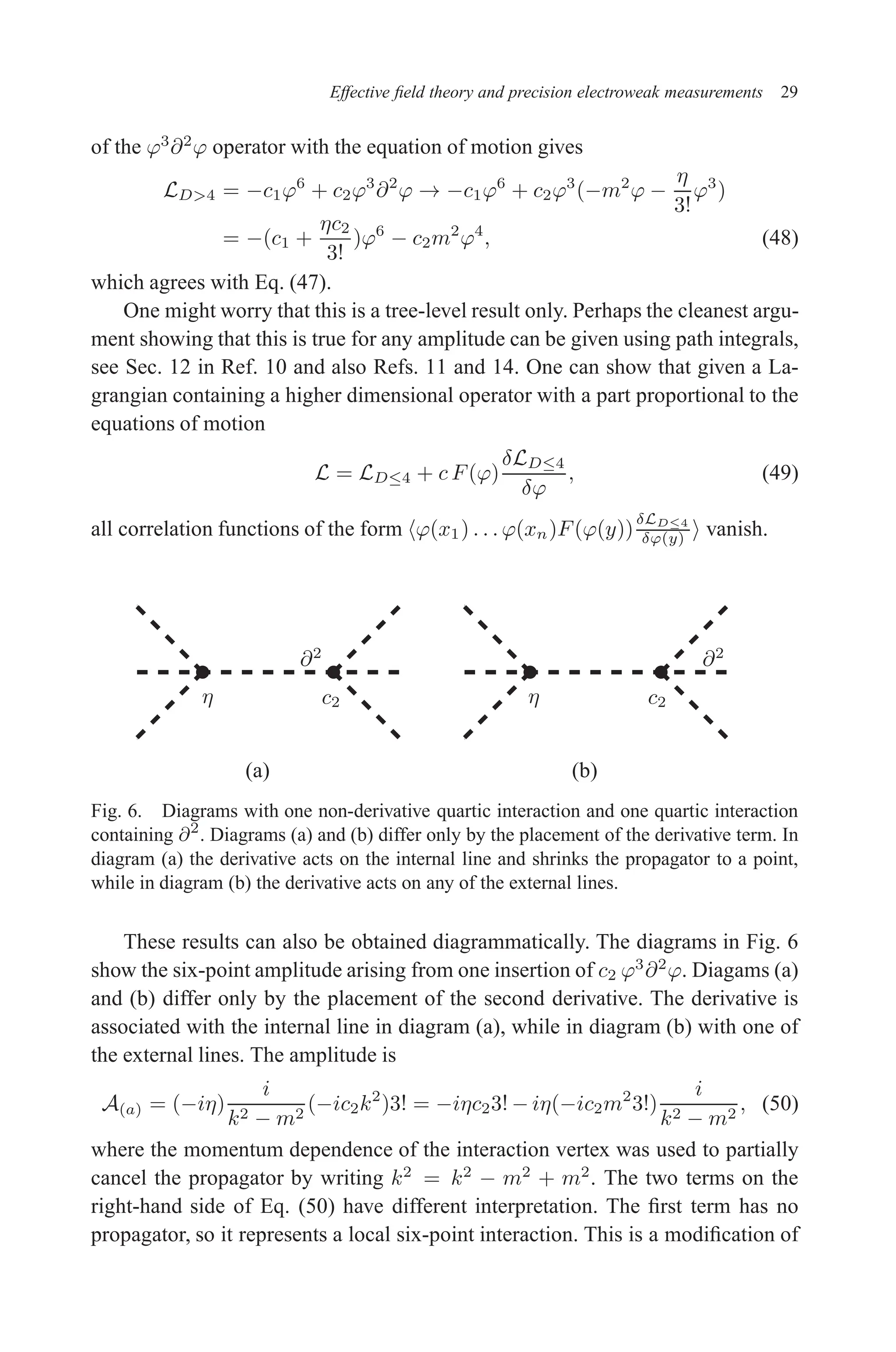
One might worry that this is a tree-level result only. Perhaps the cleanest argu-
ment showing that this is true for any amplitude can be given using path integrals,
see Sec. 12 in Ref. 10 and also Refs. 11 and 14. One can show that given a La-
grangian containing a higher dimensional operator with a part proportional to the
equations of motion
L = LD≤4 + c F(ϕ)
δLD≤4
δϕ
, (49)
all correlation functions of the form hϕ(x1) . . . ϕ(xn)F(ϕ(y))
δLD≤4
δϕ(y) i vanish.
η η
c2 c2
∂2
∂2
(a) (b)
Fig. 6. Diagrams with one non-derivative quartic interaction and one quartic interaction
containing ∂2
. Diagrams (a) and (b) differ only by the placement of the derivative term. In
diagram (a) the derivative acts on the internal line and shrinks the propagator to a point,
while in diagram (b) the derivative acts on any of the external lines.
These results can also be obtained diagrammatically. The diagrams in Fig. 6
show the six-point amplitude arising from one insertion of c2 ϕ3
∂2
ϕ. Diagams (a)
and (b) differ only by the placement of the second derivative. The derivative is
associated with the internal line in diagram (a), while in diagram (b) with one of
the external lines. The amplitude is
A(a) = (−iη)
i
k2 − m2
(−ic2k2
)3! = −iηc23! − iη(−ic2m2
3!)
i
k2 − m2
, (50)
where the momentum dependence of the interaction vertex was used to partially
cancel the propagator by writing k2
= k2
− m2
+ m2
. The two terms on the
right-hand side of Eq. (50) have different interpretation. The first term has no
propagator, so it represents a local six-point interaction. This is a modification of
December 22, 2010 9:24 WSPC - Proceedings Trim Size: 9in x 6in tasi2009
30 W. Skiba
the ϕ6
interaction and its coefficient is the same as the one in Eq. (48) even though
it may not be apparent at first. When comparing the amplitudes one needs to keep
track of the multiplicity factors. The ϕ6
interaction comes with the 6! symmetry
factor, while there are

6
3

choices of the external lines in Fig. 6(a).
The term with the propagator on the right-hand side of Eq. (50) together with
diagram (b) in Fig. 6 give the modification of the ϕ4
interaction in Eq. (48). Dia-
gram (b) is associated with the 3!·3 factor, where 3! comes from the permutations
of lines without the derivative and 3 comes from placing the derivative on either
of the 3 external lines. Combined with 3! in Eq. (50), we get 3! · 3 + 3! = 4! to
reproduce the coefficient of the ϕ4
term in Eq. (48).
2.6. Summary
We have constructed several effective theories so far. It is a good moment to pause
and review the observations we made. To construct an EFT one needs to identify
the light fields and their symmetries, and needs to establish a power counting
scheme. If the full theory is known then an EFT is derived perturbatively as a
chain of matching calculations interlaced by RG evolutions. Each heavy particle
is integrated out and new effective theory matched to the previous one, resulting
in a tower of effective field theories. Consecutive ratios of scales are accounted
for by the RG evolution.
This is a systematic procedure which can be carried out to the desired order
in the loop expansion. Matching is done order by order in the loop expansion.
When two theories are compared at a given loop order, the lower order results
are included in the matching. For example, in Sect. 2.3 we calculated loop dia-
grams in the effective theory including the effective interaction we obtained at the
tree level. At each order in the loop expansion, the effective theory valid below
a mass threshold is amended to match the results valid just above that threshold.
Matching calculations do not depend on any light scales and if logs appear in the
matching calculations, these have to be logs of the matching scale divided by the
renormalization scale. Such logs can be easily minimized to avoid spoiling per-
turbative expansion. The two theories that are matched across a heavy threshold
have in general different UV divergences and therefore different counterterms.
EFTs naturally contain higher-dimensional operators and are therefore non-re-
normalizable. In practice, this is of no consequence since the number of operators,
and therefore the number of parameters determined from experiment, is finite.
To preserve power counting and maintain consistent expansion in the inverse of
large mass scales one needs to employ a mass-independent regulator, for instance
dimensional regularization. Consequently, the renormalization scale only appears
December 22, 2010 9:24 WSPC - Proceedings Trim Size: 9in x 6in tasi2009
Effective field theory and precision electroweak measurements 31
in dimensionless ratios inside logarithms and so it does not alter power counting.
Contributions from the heavy fields do not automatically decouple when using
dimensional regularization, thus decoupling should be carried out explicitly by
constructing effective theories.
Large logarithms arise from the RG running only as one relates parameters of
the theory at different renormalization scales. The field content of the theory does
not change while its parameters are RG evolved. However, distinct operators of
the same dimension can mix with one another. The RG running and matching are
completely independent and can be done at unrelated orders in perturbationtheory.
The magnitudes of coupling constants and the ratios of scales dictate the relative
sizes of different contributions and dictate to what orders in perturbation theory
one needs to calculate. A commonly repeated phrase is that two-loop running
requires one-loop matching. This is true when the logarithms are very large, for
example in grand unified theories. The log(MGUT
Mweak
) is almost as large as (4π)2
,
so the logarithm compensates the loop suppression factor. This is not the case for
smaller ratios of scales.
The contributions of the heavy particles to an effective Lagrangian appear in
both renormalizable terms and in higher dimensional terms. For the renormal-
izable terms, the contributions from heavy fields are often unobservable as the
coefficients of the renormalizable terms are determined from low-energy experi-
ments. The contributions of the heavy fields simply redefine the coefficients that
were determined from experiments instead of being predicted by the theory. The
coefficients of the higher-dimensional operators are suppressed by inverse pow-
ers of the heavy masses. As one increases the masses of the heavy particles, their
effects diminish. This is the observation originally made in Ref. 3. This typical
situation is referred to as the decoupling of heavy fields.
Counterexamples of “non-decoupling” behavior are rare and easy to under-
stand. The suppression of higher-dimensional operators can be overcome by large
dimensionless coefficients. Suppose that the coefficient of a higher-dimensional
operator is proportional to h2
M2 , where h is a dimensionless coupling constant. If
h and M are proportional to each other, then taking M → ∞ does not bring h2
M2
to 0. Instead, h2
M2 can be finite in the M → ∞ limit. This happens naturally in
theories with spontaneous symmetry breaking. For example, the fermion Yukawa
couplings in the SM are proportional to the fermion masses divided by the Higgs
vacuum expectation value. We are going to see examples of non-decoupling in
Sec 6.3. The non-decoupling examples should be regarded with some degree of
caution. When M is large, the dimensionless coupling h must be large as well.
Thus the non-decoupling result, that is a nonzero limit for h2
M2 as M → ∞, is not
in the realm of perturbation theory. For masses M small enough that the corre-
December 22, 2010 9:24 WSPC - Proceedings Trim Size: 9in x 6in tasi2009
32 W. Skiba
sponding value of h is perturbative, there is no fall off of h2
M2 with increasing M
and such results are trustworthy.
When the high-energy theory is not known, or it is not perturbative, one still
benefits from constructing an EFT. One can power count the operators and then
enumerate the pertinent operators to the desired order. One cannot calculate the
coefficients, but one can estimate them. In a perturbative theory, explicit examples
tell us what magnitudes of coefficients to expect at any order of the loop expan-
sion. In strongly coupled QCD-like theories, or in supersymmetric theories, one
estimates coefficients differently, see for example Refs. 15 and 16.
3. Precision Electroweak Measurements
A common task for anyone interested in extensions of the SM is making sure that
the proposed hypothetical particles and their interactions are consistent with cur-
rent experimental knowledge. The sheer size of the Particle Data Book17
suggests
that the amount of available data is vast. A small subset of accurate data, consisting
of a few dozen observables on flavor diagonal processes involving the electroweak
W and Z gauge bosons, is referred to as the precision electroweak measurements.
The accuracy of the measurements in this set is at the 1% level or better. We will
describe the precision electroweak (PEW) measurements in Sec. 3.4.
This common task of analyzing SM extensions and comparing with experi-
ments is in principle straightforward. One needs to calculate all the observables,
including the contributions of the proposed new particles, and needs to make sure
that the results agree with the experiments within errors. In practice, this can be
quite tedious. When the new particles are heavy compared to the energies at which
the PEW measurements were made, one can integrate the new particles out and
construct an effective theory in terms of the SM fields only.18,19
The PEW experi-
ments can be used to constrain the coefficients of the effective theory. This can be,
and has been, done once for all, or at least until there is new data and the bounds
need to be updated. Various SM extensions can be constrained by comparing with
the bounds on the effective coefficients instead of comparing to the experimental
data. The EFT approach in this case is simply a time and effort saver, as direct
contact with experimental quantities can be done only once when constraining co-
efficients of higher-dimensional operators. Constraints on the effective operators
can be used to constrain masses and couplings of proposed particles. Integrating
out fields is much less time consuming than computing numerous cross sections
and decay widths.
The PEW measurements contain some low-energy data, observables at the Z
pole, and LEP2 data on e+
e−
scattering at various CM energies between the Z
December 22, 2010 9:24 WSPC - Proceedings Trim Size: 9in x 6in tasi2009
Effective field theory and precision electroweak measurements 33
mass and 209 GeV. Particles heavier than a few hundred GeV could not have been
produced directly in these experiments, so we can accurately capture the effects of
such particles using effective theory. The field content of the effective theory is the
same as the SM field content. We know all the light fields and their symmetries,
except for the sector responsible for EW symmetry breaking. We are going to as-
sume that EW symmetry is broken by the Higgs doublet and construct the effective
theory accordingly. Of course, it is possible to make a different assumption—that
there is no Higgs boson and the EW symmetry is nonlinearly realized. In that case
there would be no Higgs doublet in the effective theory, but just the three eaten
Goldstone bosons, see Refs. 20 and 21. However, the logic of applying effective
theory in the two cases is completely identical, so we only concentrate on one of
them. It is worth noting that the SM with a light Higgs boson fits the experimental
data very well, suggesting that the alternative is much less likely.
Given a Lagrangian for an extension of the SM we want to construct the ef-
fective Lagrangian
L(ϕSM ; χBSM ) −→ Leff = LSM (ϕSM ) +
X
i
ai Oi(ϕSM ), (51)
where we collectively denoted the SM fields as ϕSM and the heavy fields as
χBSM . All the information about the original Lagrangian and its parameters is
now encoded in the coefficients ai of the higher-dimensional operators Oi. The
operators Oi are independent of any hypothetical SM extension because they are
constructed from the known SM fields. We will discuss various Oi that are impor-
tant for PEW measurements in the following sections.
One can find two different approaches in the literature to constructing effective
theories for PEW observables. The difference between the two approaches is in
the treatment of the EW gauge sector. In one approach, an EFT is constructed in
terms of the gauge boson mass eigenstates—the γ, Z, and W bosons. In the other
approach, an effective theory is expressed in terms of the SU(2)L ×U(1)Y gauge
multiplets, Ai
µ and Bµ. Of course, actual calculations of any experimental quantity
are done in terms of the mass eigenstates. In the EFT approach, one avoids carry-
ing out these calculations anyway. However, when one expands around the Higgs
vacuum expectation value (vev) one completely looses all information about the
gauge symmetry and the constraints it imposes. For our goal, that is for constrain-
ing heavy fields with masses above the Higgs vev, using the full might of EW
gauge symmetry is a much better choice. The EW symmetry is broken by the
Higgs doublet at scales lower than the masses of particles that we integrate out to
obtain an effective theory. The interactions in any extension of the SM must obey
the SU(2)L × U(1)Y gauge invariance, so we should impose this symmetry on
our effective Lagrangian.
December 22, 2010 9:24 WSPC - Proceedings Trim Size: 9in x 6in tasi2009
34 W. Skiba
To stress this point further, let us compare the coefficients of two similar op-
erators written in terms of the W and Z bosons.
(A) : W+
µ W−µ
W+
ν W−ν
, (52)
(B) : ZµZµ
ZνZν
. (53)
Both operators have the same dimension and the same Lorentz structure. Oper-
ator (A) is present in the SM in the non-Abelian part of the gauge field strength
Ai
µν Aiµν
and has a coefficient of order one. However, operator (B) is absent in the
SM and can only arise from a gauge-invariant operator of a very high dimension,
thus its coefficient is strongly suppressed in any theory with a light Higgs. This
information is simply lost when one does not use gauge invariance.c
If one cannot
reliably estimate coefficients of operators then the effective theory is useless as it
cannot be made systematic.
From now on, all operators will be explicitly SU(2)L×U(1)Y gauge invariant
and built out of quarks, leptons, gauge and Higgs fields. All the operators we are
going to discuss are of dimension 6. There is only one gauge invariant operator
of dimension 5 consistent with gauge invariance and it gives the Majorana mass
for the neutrinos. The neutrino mass is inconsequential for PEW measurements.
Thus, the interesting operators start at dimension 6 and given the agreement of the
SM with data we do not need operators of dimension 8, or higher.
3.1. The S and T parameters
There is a special class of dimension-6 operators that arises in many extensions of
the SM. We are going to analyze this class of operators in this section and the next
one as well. These are the operators that do not contain any fermion fields. Such
operators originate whenever heavy fields directly couple only to the SM gauge
fields and the Higgs doublet. We are going to refer to such operators as “universal”
because they universally affect all quarks and leptons through fermion couplings
to the SM gauge fields. Sometimes such operators are referred to as “oblique.”
It is easy to enumerate all dimension-6 operators containing the gauge and
the Higgs fields only. The operator (H†
H)3
, where H denotes the Higgs doublet,
is an example. This operator is not constrained by the current data, as we have
not yet observed the Higgs boson. It alters the Higgs potential, but without know-
ing the Higgs mass and its couplings we have no information on operators like
(H†
H)3
. Here are another two operators that are not constrained by the present
cEven in theories without a light Higgs, in which the electroweak symmetry is nonlinearly realized,
there is still information about the SU(2)L × U(1)Y gauge invariance. Such effective theories can
also be written in terms of gauge eigenstates.
December 22, 2010 9:24 WSPC - Proceedings Trim Size: 9in x 6in tasi2009
Effective field theory and precision electroweak measurements 35
data: H†
H DµH†
Dµ
H and H†
H Ai
µν Aiµν
. Since there are no experiments in-
volving Higgs particles, operators involving the Higgs doublet are sensitive to the
Higgs vev only. After electroweak symmetry breaking, the two operators we just
mentioned renormalize dimension-4 terms that are already present in the SM: the
Higgs kinetic energy and the kinetic energies of the W and Z bosons, respectively.
Two important, and very tightly constrained experimentally, universal opera-
tors are
OS = H†
σi
HAi
µν Bµν
, (54)
OT = H†
DµH
2
, (55)
where σi
are the Pauli matrices, meanwhile Bµν and Ai
µν are the U(1)Y and
SU(2)L field strengths, respectively. The operator OS introduces kinetic mixing
between Bµ and A3
µ when the vev is substituted for H. The second operator,
OT , violates the custodial symmetry. The custodial symmetry guarantees the tree-
level relation between the W and Z masses, MW = MZ cos θw, where θw is the
weak mixing angle. After substituting hHi in OT , OT ∝ ZµZµ
while there is no
corresponding contribution to the W mass.
The custodial symmetry can be made explicit by combining the Higgs doublet
H with H̃ = iσ2H∗
into a two-by-two matrix Ω =

H̃, H

, see for example
Ref. 22 for more details. The SM Higgs Lagrangian
LHiggs =
1
2
tr DµΩ†
Dµ
Ω

− V tr(Ω†
Ω)

(56)
is invariant under SU(2)L × SU(2)R transformations that act Ω → LΩR†
.
The Higgs vev breaks SU(2)L × SU(2)R to its diagonal subgroup which is
called the custodial SU(2)c. The custodial symmetry is responsible for the
relation MW = MZ cos θw. The operator OT is contained in the operator
tr(Ω†
DµΩσ3) tr(Dµ
Ω†
Ωσ3) that does not preserve SU(2)L × SU(2)R, but only
preserves its SU(2)L × U(1)Y subgroup.
For the time being, we want to consider the SM Lagrangian amended by the
two higher-dimensional operators in Eqs. (54) and (55):
L = LSM + aS OS + aT OT . (57)
We called these operators OS and OT because there is a one-to-one corre-
spondence between these operators and the S and T parameters of Peskin and
Takeuchi23d
, see also Ref. 24 for earlier work on this topic. The S and T parame-
dThere are three parameters introduced in Ref. 23: S, T, and U. The U parameter corresponds to a
dimension-8 operator in a theory with a light Higgs boson. All three parameters are on equal footing
in theories in which the electroweak symmetry is nonlinearly realized.
December 22, 2010 9:24 WSPC - Proceedings Trim Size: 9in x 6in tasi2009
36 W. Skiba
ters are related to the coefficients aS and aT in Eq. (57) as follows
S =
4scv2
α
aS and T = −
v2
2α
aT , (58)
where v is the Higgs vev, s = sin θw, c = cos θw, and α is the fine structure
constant. The coefficients aS and aT should be evaluated at the renormalization
scale equal to the electroweak scale. In practice, scale dependence is often too tiny
to be of any relevance.
-1.25 -1.00 -0.75 -0.50 -0.25 0.00 0.25 0.50 0.75 1.00 1.25
S
-1.00
-0.75
-0.50
-0.25
0.00
0.25
0.50
0.75
1.00
T
all: MH
= 117 GeV
all: MH
= 340 GeV
all: MH
= 1000 GeV
*Z
, Vhad
, Rl
, Rq
asymmetries
MW
Q scattering
QW
E 158
Fig. 7. Combined constraints on the S and T parameters. This figure is reproduced from
the review by J. Erler and P. Langacker in Ref. 17. Different contours correspond to dif-
ferent assumed values of the Higgs mass and are all at the 1σ (39%) confidence level. The
Higgs mass dependence is discussed in Sect. 3.5.
The experimentally allowed range of the S and T parameters is shown in
Fig. 7. This is a key figure for understanding the EFT approach to constraints
on new physics from PEW measurements. The colored regions are allowed at the
1σ confidence level. The regions indicate the values of the operator coefficients
that are consistent with data. What is crucial is that Fig. 7 incorporates all the rele-
vant experimental data simultaneously. This is often referred to as global analysis
of PEW measurements. The relevant data are combined into one statistical like-
lihood function from which bounds on masses an couplings of hypothetical new
particles are determined. The global analysis provides more stringent constraints
December 22, 2010 9:24 WSPC - Proceedings Trim Size: 9in x 6in tasi2009
Effective field theory and precision electroweak measurements 37
than considering a few independent experiments and it also takes into account the
correlations between experimental data.
The global analysis, that includes all data and correlations, is possible using
the EFT methods. All of the data is included in bounding the effective param-
eters S and T . One needs to consider the two-dimensional allowed range for S
and T instead of the independent bounds on these parameters. When S and T
are bounded independently, one of the parameters is varied while the other one is
set to zero. This only gives bounds along the S = 0 and T = 0 axes of Fig. 7,
and the corresponding limits are S = −0.04 ± 0.09 and T = 0.02 ± 0.09.17
It
is clear that Fig. 7 contains a lot more information. Suppose that an extension of
the SM predicts nonzero values of S and T depending, for the sake of argument,
on one free parameter. The allowed range of this free parameter depends on how
S and T are correlated. If S and T happen to vary along the elongated part of
Fig. 7 the allowed range could be quite large. If S and T happen to lie along the
thin part of the allowed region, the range could be quite small. This information
would not be available if one considered one effective parameter at a time by re-
stricting the other one to be zero. Considering simultaneous bounds on S and T
is equivalent to using the likelihood function directly from the data and the EFT
provides simply an intermediate step of the calculation. In Sections 3.2 and 3.3
we are going to study effective Lagrangians, very much like the one in Eq. (57),
with more effective operators, but the logic of the approach will be exactly
the same.
Provided with the bounds in Fig. 7 one simply needs to match an extension of
the SM to Eq. (57). We will consider here a hypothetical fourth family of quarks as
an example. We will call such new quarks B and T and assume that they have the
same SU(2)L ×U(1)Y quantum numbers as the ordinary quarks. The Lagrangian
is
Lnew = iQL /
DQL + iTR /
DTR + iBR /
DBR
−
h
yT QLH̃TR + yB QLHBR + H.c.
i
, (59)
where QL =

T
B

L
is the left-handed SU(2) doublet and yT,B are the Yukawa
couplings. Given that hHi =
0
v
√
2
!
, the quark masses are MB,T = v
√
2
yB,T .
Since the new quarks, B and T , do not couple directly to the SM fermions, the
operators induced by integrating out these quarks are necessary universal. The
Yukawa part of the quark Lagrangian can be rewritten using the matrix represen-
December 22, 2010 9:24 WSPC - Proceedings Trim Size: 9in x 6in tasi2009
38 W. Skiba
tation of the Higgs field, Ω, by combining the right-handed fields into a doublet
yT QLH̃TR + yBQLHBR =
yT + yB
2
QLΩ QR +
yT − yB
2
QLΩ σ3 QR. (60)
Due to the presence of σ3 in the term proportionalto yT −yB, that term violates the
custodial symmetry, so we can expect contributions to the T parameter whenever
yT 6= yB.
Ai
µ Bµ
(a) (b)
Fig. 8. Fermion contributions to the operators OS (a) and OT (b). The dashed lines rep-
resent the Higgs doublet.
Before we plunge into calculations we can estimate how the S and T param-
eters depend on the quark masses. The one-loop diagrams are depicted in Fig. 8.
Assuming that MB = MT and therefore yB = yT , the contribution to the S
parameter can be estimated from diagram (a) in Fig. 8 to be
aS ∼
Nc
(4π)2
gg′
y2
M2
≈
Ncgg′
(4π)2
y2
y2v2
=
Ncgg′
(4π)2
1
v2
, (61)
where Nc = 3 is the number of colors, while g and g′
are the SU(2)L and
U(1)Y gauge couplings, respectively. The external lines consist of two gauge
fields and two Higgs fields, hence the diagram is proportional to the square of
the Yukawa coupling and to the g and g′
gauge couplings. This is an example of a
non-decoupling result as aS is constant for large quark mass M. Using Eq. (58),
we expect that S ∼ Nc
π for large M. This is the situation we mentioned in Sec. 2.6
where dimensionless coefficients compensate for mass suppression. The T param-
eter is even more interesting. Let us assume that MT ≫ MB so that only the T
quark runs in the loop in Fig. 8(b). The estimate for this diagram is
aT ∼
Nc
(4π)2
y4
T
M2
T
≈
Nc
(4π)2
M2
T
v4
(62)
December 22, 2010 9:24 WSPC - Proceedings Trim Size: 9in x 6in tasi2009
Effective field theory and precision electroweak measurements 39
and thus T ∼ Nc
4π
M2
T
v2 . Since four powers of the Yukawa coupling are needed to
generate OT , it is not surprising that the T parameter grows as M2
T . If we did
not take into account the full SU(2)L × U(1)Y symmetry, the Higgs Yukawa
couplings would have been absorbed into quark masses and it would be difficult
to understand Eqs. (61) and (62).
The actual calculation is easy, but there is one complication. We have been
treating the quarks as massive while they only obtain masses when the theory
is expanded around the Higgs vev. Chiral quarks are not truly massive fields, so
we need a small trick. We are going to match the theories in Eqs. (57) and (59)
with the Higgs background turned on. We will compare Eqs. (57) and (59) as a
function of the Higgs vev.25
We do not need to keep any external Higgs fields and
only keep the external gauge bosons. The Higgs vev will appear implicitly in the
masses of the quarks. This is quite a unique complication that does not happen
for fields with genuine mass terms, for example vector quarks. When the Higgs
background is turned on, the calculation is very similar to the one done in the
broken theory. However, we do not need to express the gauge fields in terms of
the mass eigenstates.
T B
T B
T B
B T
A3
µ A3
ν
A3
µ A3
ν
A1
µ A1
ν
A1
µ A1
ν
+
− −
Fig. 9. Diagrams that contribute to OT in the Higgs background. The Higgs vev is incor-
porated into the masses of the quarks in this calculation.
Expanding OT in Eq. (55) around the Higgs vev gives H†
DµH
2
=
v4
4
g2
4 (A3
µ)2
+ . . ., where we omitted terms with the Bµ field and terms with
derivatives. The relevant diagrams are shown in Fig. 9 and they can be calculated
at zero external momentum. We need to subtract diagrams with two external A1
µ
bosons because the diagrams with A3
µ’s contribute to both the OT operator and
to an overall, custodial symmetry preserving, gauge boson mass renormalization.
The operators that preserve custodial symmetry have equal coefficients of terms
Another Random Document on
Scribd Without Any Related Topics
A
German U-Boat Claims
Address by Admiral von Capelle
German Naval Secretary
dmiral Von Capelle, the German Secretary of the Navy,
delivered an address before the Reichstag, April 17, 1918, in
which he asserted that the submarine warfare of Germany was a
success. In the course of his speech he said:
The main question is, What do the western powers need for the
carrying on of the war and the supply of their homelands, and what
amount of tonnage is still at their disposal for that purpose? All
statistical calculations regarding tonnage are today almost
superfluous, as the visible successes of the U-boat war speak clearly
enough. The robbery of Dutch tonnage, by which the Anglo-Saxons
have incurred odium of the worst kind for decades to come, is the
best proof of how far the shipping shortage has already been felt by
our opponents. In addition to the sinkings there must be added a
great amount of wear and tear of ships and an enormous increase of
marine accidents, which Sir J. Ellerman, speaking in the Chamber of
Shipping recently, calculated at three times the peace losses. Will the
position of the western powers improve or deteriorate? That
depends upon their military achievements and the replacing of
sunken ships by new construction.
Dealing briefly with Sir Eric Geddes's recent speech on the occasion
of the debate on the naval estimates, Admiral von Capelle declared:
The assertion of the First Lord of the Admiralty that an
unwillingness to put to sea prevailed among the German U-boat
crews is a base calumny.
LOSSES AND CONSTRUCTION
As regards the assertions of British statesmen concerning the
extraordinarily great losses of U-boats, Admiral von Capelle said:
The statements in the foreign press are very greatly exaggerated.
Now, as before, our new construction surpasses our losses. The
number of U-boats, both from the point of view of quality and
quantity, is constantly rising. We can also continue absolutely to
reckon on our military achievements hitherto attained. Whether
Lloyd George can continue the naval war with prospects of success
depends, not upon his will but upon the position of the U-boats as
against shipbuilding. According to Lloyd's Register, something over
22,000,000 gross register tons were built in the last ten years before
the war in the whole world—that is, inclusive of the construction of
ourselves, our allies, and foreign countries. The entire output today
can in no case be more, for difficulties of all kinds and the shortage
of workmen and material have grown during the war. In the last ten
years—that is, in peace time—800,000 gross register tons of the
world's shipping was destroyed annually by natural causes. Now in
wartime the losses, as already mentioned, are considerably greater.
Thus, 1,400,000 gross register tons was the annual net increase for
the entire world. That gives, at any rate, a standard for the present
position. America's and Japan's new construction is to a certain
extent destined for the necessities of these countries.
In the main, therefore, only the figures of British shipbuilding come
into question. About the middle of 1917 there was talk of 3,000,000
tons in official quarters in Great Britain. Then Lloyd George dropped
to 2,000,000, and now, according to Bonar Law's statement, the
output is 1,160,000 tons. As against, therefore, about 100,000 tons
monthly put into service there are sinkings amounting to 600,000
tons, or six times as much. In brief, if the figures given are regarded
as too favorable and new construction at the rate of 150,000 tons
monthly—that is, 50 per cent. higher—be assumed, and the sinkings
be reduced to 450,000 tons, then the sinkings are still three times as
large as the amount of new construction.
THE COMING MONTHS
One other thing must especially be taken into consideration for the
coming months. Today every ship sunk strikes at the vital nerve of
our opponents. Today, when only the absolutely necessary cargoes
of foodstuffs and war necessities can still be transported, the sinking
of even one small ship has quite a different significance as compared
with the beginning of the U-boat war. Moreover, the loss of one ship
means a falling out of four to five cargoes. In these circumstances
even the greatest pessimist must say that the position of our
opponents is deteriorating in a considerably increasing extent and
with rapid strides, and that any doubt regarding the final success of
the U-boat war is unjustified.
Replying to a question of the reporter, Admiral von Capelle said:
Our opponents have been busily endeavoring to strengthen their
anti-submarine measures by all the means at their disposal, and,
naturally, they have attained a certain success. But they have at no
time had any decisive influence on the U-boat war, and, according to
human reckoning, they will not do so in the future. The American
submarine destroyers which have been so much talked about have
failed. The convoy system, which, it is true, offers ships a certain
measure of protection, has, on the other hand, also the great
disadvantage of reducing their transport capabilities. The statements
oscillate from 25 to 60 per cent.
For the rest, our commanders are specially trained for attacks on
convoys, and no day goes by when one or more ships are not struck
out of convoys. Experienced commanders manage to sink three to
four ships in succession belonging to the same convoy.
THE STEEL QUESTION
Admiral von Capelle then dealt with the steel question as regards
shipbuilding, which, he said, is practically the determinative factor
for shipbuilding. He continued:
Great Britain's steel imports in 1916 amounted to 763,000 tons, and
in 1917 only amounted to 497,000 tons. That means that already a
reduction of 37 per cent. has been effected, a reduction which will
presumably be further considerably increased during 1918.
Restriction of imports of ore from other countries, such as America,
caused by the U-boat war will also have a hampering effect on
shipbuilding in Great Britain. It is true that Sir Eric Geddes denied
that there was a lack of material, but expert circles in England give
the scarcity of steel as the main reason for the small shipbuilding
output.
American help in men and airplanes and American participation in
the war are comparatively small. If later on America wants to
maintain 500,000 troops in France, shipping to the amount of about
2,000,000 tons would be permanently needed. This shipping would
have to be withdrawn from the supply service of the Allies.
Moreover, according to statements made in the United States and
Great Britain, the intervention in the present campaign of such a big
army no longer comes into consideration. After America's entry into
the war material help for the Entente has not only not increased, but
has even decreased considerably. President Wilson's gigantic
armament program has brought about such economic difficulties
that America, the export country, must now begin to ration instead
of, as it was hoped, increasingly to help the Entente. To sum up, it
can be stated that the economic difficulties of our enemies have
been increased by America's entry into the war.
ENGLAND'S DANGER POINT
Later in the debate Admiral von Capelle said: The salient point of
the discussion is the economic internal and political results of the U-
boat war during the coming months. The danger point for England
has already been reached, and the situation of the western powers
grows worse from day to day.
Admiral von Capelle then briefly dealt with that calculation of the
world tonnage made by a Deputy which received some attention in
the Summer of last year. This calculation, he said, shows a
difference of 9,000,000 tons from the calculation of the Admiralty
Staff. In my opinion, the calculation of the Admiralty Staff is correct.
Whence otherwise comes the Entente's lack of tonnage, which, in
view of the facts, cannot be argued away? The Admiralty Staff in its
calculation adapted itself to the fluctuating situation of the world
shipping. At first each of the enemy States looked after itself. Later,
under Great Britain's leadership, common control of tonnage was
established.
Admiral von Capelle quoted the calculation of the American Shipping
Department, according to which the world tonnage in the Autumn of
1917 amounted to 32,000,000, of which 21,000,000 were given as
transoceanic. He insisted, however, that so much attention must not
be paid to all these calculations, but exhorted the people rather to
dwell on the joyful fact that the danger point for the western powers
had been reached.
At the close of the sitting Admiral von Capelle stated that all orders
for the construction of U-boats had been given independently by the
Naval Department and that the Naval Administration had never been
instructed to give orders for more U-boats by the Chancellor or the
Supreme Army Command. Every possible means, he said, for the
development of U-boat warfare had been done by the Naval
Department.
Admiral von Capelle in a supplemental statement before the
Reichstag, May 11, in discussing the naval estimates, said:
The reports for April are favorable. Naturally, losses occur,
but the main thing is that the increase in submarines
exceeds the losses. Our naval offensive is stronger today
than at the beginning of unrestricted submarine warfare.
That gives us an assured prospect of final success.
The submarine war is developing more and more into a
struggle between U-boat action and new construction of
ships. Thus far the monthly figures of destruction have
continued to be several times as large as those of new
construction. Even the British Ministry and the entire
British press admit that.
The latest appeal to British shipyard workers appears to
be especially significant. For the present the appeal does
not appear to have had great success. According to the
latest statements British shipbuilding fell from 192,000
tons in March to 112,000 in April; or, reckoned in ships,
from 32 to 22. That means a decline of 80,000 tons, or
about 40 per cent. [The British Admiralty stated that the
April new tonnage was reduced on account of the vast
amount of repairing to merchantmen.—Editor.]
America thus far has built little, and has fallen far below
expectations. Even if an increase is to be reckoned with in
the future, it will be used up completely by America
herself.
In addition to the sinkings by U-boats, there is a large
decline in cargo space owing to marine losses and to ships
becoming unserviceable. One of the best-known big
British ship owners declared at a meeting of shipping men
that the losses of the British merchant fleet through
marine accidents, owing to conditions created by the war,
were three times as large as in peace.
The Admiral's Statements Attacked
The British authorities asserted that Admiral von Capelle's figures
were misleading and untrue. The losses published in the White
Paper include marine risk and all losses by enemy action. They
include all losses, and not merely the losses of food ships, as
suggested in the German wireless message dated April 16. Even in
the figures of the world's output of shipbuilding von Capelle seems
to have been misled. He states that something over 2,000,000
gross tons were built annually in the last ten years, including allied
and enemy countries. The actual figures are 2,530,351 gross tons.
He further states that the entire output today can in no case be
more, owing to difficulties in regard to labor and material. The actual
world's output, as shown in the Parliamentary White Paper, excluding
enemy countries, amounted to 2,703,000 gross tons, and the output
is rapidly rising. Von Capelle tried to raise confusion with regard to
the figures 3,000,000 and 2,000,000 tons and the actual output for
1917. The Admiralty says no forecast was ever given that 3,000,000
tons, or even 2,000,000 tons, would be completed in that year.
Three million tons is the ultimate rate of production, which, as the
First Lord stated in the House of Commons, is well within the
present and prospective capacity of United Kingdom shipyards and
marine engineering works. The exaggerated figures of losses are still
relied on by the enemy. The average loss per month of British ships
during 1917, including marine risk, was 333,000 gross tons, whereas
Secretary von Capelle in his statement bases his argument on an
average loss from submarine attacks alone of 600,000 tons per
month. The figures for the quarter ended March 31, 1918, showed
British losses to be 687,576 tons, and for the month of March
216,003 tons, the lowest during any month, with one exception,
since January, 1917. With regard to steel, the First Lord has already
assured the House of Commons that arrangements have been made
for the supply of steel to give the output aimed at, and at the
present time the shipyards are in every case fully supplied with the
material.
The American production of new tonnage reached its stride in May,
and the estimate of over 4,000,000 tons per annum was regarded as
conservative. It was estimated that the total British and American
new tonnage in the year ending May, 1919, would exceed
6,000,000, as against total U-boat sinkings, based on the record of
the first quarter of 1918, of 4,500,000.
OFFICIAL RETURNS OF LOSSES
The following was the official report of losses of British, allied, and
neutral merchant tonnage due to enemy action and marine risk:
Period. British.
Allied
and Neutral.
Total.
1917. Month. Month. Month.
January 193,045 216,787 409,832
February 343,486 231,370 574,856
March 375,309 259,376 634,685
———— ———— —————
Quarter 911,840 707,533 1,619,373
April 555,056 338,821 893,877
May 374,419 255,917 630,336
June 432,395 280,326 712,721
———— ———— —————
Quarter 1,361,870 875,064 2,236,934
July 383,430 192,519 575,949
August 360,296 189,067 519,363
September 209,212 159,949 369,161
———— ———— ————
Quarter 952,938 541,535 1,494,473
October 289,973 197,364 487,337
November 196,560 136,883 333,443
Period.
1917. Gross Tons.
October 6,908,189
November 6,818,564
December 6,665,413
Period.
1918. Gross Tons.
January 6,336,663
February 6,326,965
March 7,295,620
December 296,356 155,707 452,063
———— ———— ————
Quarter 782,889 489,954 1,272,843
1918.
January 217,270 136,187 353,457
February 254,303 134,119 388,422
March 216,003 165,628 381,631
———— ———— ————
Quarter 687,576 435,934 1,123,510
The Secretary of the Ministry of Shipping stated that the
tonnage of steamships of 500 gross tons and over
entering and clearing United Kingdom ports from and to
ports overseas was as under:
This statement embraces all United Kingdom seaborne
traffic other than coastwise and cross Channel.
The Month's Submarine Record
The British Admiralty, in April, 1918, discontinued its weekly report
of merchant ships destroyed by submarines or mines, and
announced that it would publish a monthly report in terms of
tonnage. These figures are shown in the table above. The last
weekly report was for the period ended April 14, and showed that
eleven merchantmen over 1,600 tons, four under 1,600 tons, and
one fishing vessel had been sunk.
In regard to the sinkings in April, French official figures showed that
the total losses of allied and neutral ships, including those from
accidents at sea during the month, aggregated 381,631 tons.
Norway's losses from the beginning of the war to the end of April,
1918, amounted to 755 vessels, aggregating 1,115,519 tons, and
the lives of 1,006 seamen, in addition to about 700 men on fifty-
three vessels missing, two-thirds of which were declared to be war
losses.
The American steamship Lake Moor, manned by naval reserves, was
sunk by a German submarine in European waters about midnight on
April 11, with a loss of five officers and thirty-nine men. Five officers
and twelve enlisted men were landed at an English port. Eleven
men, including five navy gunners, were lost when the Old Dominion
liner Tyler was sunk off the French coast on May 3. The Canadian
Pacific Company's steamer Medora also was sunk off the French
coast. The Florence H. was wrecked in a French port by an internal
explosion on the night of April 17. Out of the crew of fifty-six men,
twenty-nine were listed as dead or missing, twelve were sent to
hospital badly burned, two were slightly injured, and only thirteen
escaped injury. Of the twenty-three men of the naval guard only six
were reported as survivors.
Six officers and thirteen men were reported missing as the result of
two naval disasters reported on May 1 by the British Admiralty. They
formed part of the crews of the sloop Cowslip, which was torpedoed
and sunk on April 25, and of Torpedo Boat 90, which foundered.
According to Archibald Hurd, a British authority on naval matters, the
area in the North Sea which was proclaimed by the British
Government as dangerous to shipping and therefore prohibited after
May 15 is the greatest mine field ever laid for the special purpose of
foiling submarines. It embraces 121,782 square miles, the base
forming a line between Norway and Scotland, and the peak
extending northward into the Arctic Circle.
A
A Secret Chapter of U-Boat History
How Ruthless Policy Was Adopted
The causes that led to Germany's adoption of the policy of
unrestricted submarine warfare on Feb. 1, 1917, were revealed a
year later by the Handelsblad, an Amsterdam newspaper, whose
correspondent had secured secret access to a number of highly
interesting and important documents long enough to read them and
make notes of their contents. The Dutch paper vouched for the
accuracy of the following information:
t the close of the year 1915 the German Admiralty Staff
prepared a semi-official memorandum to prove that an
unrestricted submarine campaign would compel Great Britain to sue
for peace in six months at the most. The character of the
argument conveys the impression that the chiefs of the German
Admiralty Staff had already made up their minds to adopt the most
drastic measures in regard to submarine warfare, but that they
wished to convince the Kaiser, the Imperial Chancellor, and the
German diplomatists of the certainty of good results on economic
and general, rather than merely military, grounds. To this end the
memorandum based its arguments on statistics of food prices,
freight, and insurance rates in Great Britain. It pointed out that the
effects on the prices of essential commodities, on the balance of
trade, and, above all, on the morale of the chief enemy, had been
such, even with the restricted submarine campaign of 1915, that, if
an unrestricted submarine war were decided upon, England could
not possibly hold out for more than a short period.
The memorandum was submitted to the Imperial Chancellor, who
passed it on to Dr. Helfferich, the Secretary of State for Finance. He,
however, rejected the document on the ground that, in the absence
of authentic estimates of stocks, it was impossible to set a time-limit
to England's staying power, and also that he was exceedingly
doubtful as to what line would be taken by neutrals, especially the
United States. Dr. Helfferich maintained that so desperate a remedy
should only be employed as a last resource. The authors of the
memorandum then sent a reply, in which they developed their
former arguments, and pointed to the gravity of the internal
situation in Germany. They emphasized the importance of using the
nearest and sharpest weapons of offense if a national collapse was
to be avoided. They reinforced their argument by adducing the
evidence of ten experts, representing finance, commerce, the mining
industry, and agriculture. They were Herr Waldemar Müller, the
President of the Dresdner Bank; Dr. Salomonsohn of the Disconto
Gesellschaft; Dr. Paul Reusch of Oberhausen, Royal Prussian
Councilor of Commerce; Dr. Springorum of Dortmund, Chancellor of
Commerce, member of the Prussian Upper House, (Herren Haus,)
General Director of Railways and Tramways at Hoesch, an
ironmaster, and a great expert in railways; Herr Max Schinkel of
Hamburg, President of the Norddeutsche Bank in Hamburg and of
the Disconto Gesellschaft in Berlin; Herr Zuckschwerdt of
Madgeburg, Councilor of Commerce, late member of the Prussian
Upper House; Herr Wilhelm von Finck of Munich, Privy Councilor,
chief of the banking house of Merck, Finck  Co., Munich; Councilor
of Economics R. Schmidt of Platzhof, member of the Württemberg
Upper Chamber and of the German Agricultural Council; Herr
Engelhard of Mannheim, Councilor of Commerce, President of the
Chamber of Commerce and member of the Baden Upper Chamber.
These experts were invited to send answers in writing to the three
following questions: (1) What would be the effect on England of
unrestricted submarine warfare? (2) What would be its effect on
Germany's relations with the United States and other neutrals? (3)
To what extent does the internal situation in Germany demand the
use of this drastic weapon?
The reader will do well to remember that the replies were written in
February, 1916—nearly two years ago. All agreed on the first point—
the effect on Great Britain. The effect of unrestricted submarine
warfare on England would be that she would have to sue for peace
in six months at the most. Herr Müller, who seemed to be in a
position to confirm the statistics given in the memorandum, pointed
out that the supply of indispensable foodstuffs was, at the time of
writing, less than the normal supply in peace time. He held that the
submarine war, if relentlessly and vigorously pursued, would
accomplish its purpose in less time than calculated in the
memorandum—in fact, three months should do it. Dr. Salomonsohn
also thought that six months was an excessive estimate, and that
less time would suffice.
On the question of the effect on neutrals the experts were divided.
Dr. Reusch suggested that the neutrals despised the restricted
submarine warfare of 1915, and held that every ship in British
waters, whether enemy or neutral, should be torpedoed without
warning. According to him, the world only respects those who, in a
great crisis, know how to make the most unscrupulous use of their
power.
Herr Müller predicted that ruthless submarine war would cause a
wholesale flight of neutrals from the war zone. Their newspapers
might abuse Germany at first, but they would soon get tired. The
danger was from the United States, but that would become less in
proportion as Germany operated more decisively and ruthlessly. Dr.
Salomonsohn adopted the same attitude. He recognized the
possibility of war with the United States, but was loath to throw
away so desirable a weapon on that account.
As to the third point, all the experts agreed that the internal
situation in Germany demanded that the most drastic methods of
submarine warfare should be employed. Herr Zuckschwerdt urged
the advisability of the most drastic measures owing to the feeling of
the nation. The nation would stand by the Government, but not if it
yielded to threats from America. Such weakness would lead to
serious consequences. Herr Schmidt admitted the possibility of
Germany not being able to hold out, and emphasized the importance
of taking drastic steps before disorder and unrest arose in the
agricultural districts.
T
Sea-Raider Wolf and Its Victims
Story of Its Operations
A third chapter of sea-raider history similar to those of the Möwe
and Seeadler was revealed when the Spanish steamship Igotz
Mendi, navigated by a German prize crew, ran aground on the
Danish coast, Feb. 24, 1918, while trying to reach the Kiel Canal with
a cargo of prisoners and booty. The next day the German
Government announced that the sea-raider Wolf, which had
captured the Igotz Mendi and ten other merchant vessels, with 400
prisoners, had successfully returned after fifteen months in the
Atlantic, Indian, and Pacific Oceans. The story of the Wolf's
operations, as gleaned by Danish and English correspondents from
the narratives of released prisoners, is told below. Some of the most
interesting passages were furnished by Australian medical officers
who had been captured on the British steamer Matunga:
he Wolf, a vessel of about 6,000 gross tonnage, armed with
several guns and torpedo tubes, carried a seaplane, known as
the Wolfchen, which was frequently used in the operations of the
sea raider. On some days the seaplane made as many as three
flights. The Wolf, apparently, proceeded from Germany to the Indian
Ocean, laying minefields off the Cape, Bombay, and Colombo. Early
in February, 1917, she captured the British steamship Turritella,
taking off all the officers and putting on board a prize crew which
worked the vessel with her own men. In every case of capture,
when the vessel was not sunk at once, this procedure was adopted.
The Wolf transferred a number of mines to the Turritella, with
instructions that they should be laid off Aden. A few days later the
Turritella encountered a British warship, whereupon the prize crew,
numbering twenty-seven, sank the Turritella, and were themselves
taken prisoner.
Three weeks later the Wolf overhauled the British steamer Jumna.
The Wolf thought that the British vessel was about to ram her, and
the port after-gun was fired before it was properly trained, killing
five of the raider's crew and wounding about twenty-three others.
The Jumna remained with the Wolf for several days, after which her
coal and stores were transferred to the raider, and she was sunk
with bombs. The next vessels to be captured and sunk were the
British steamships Wordsworth and Dee.
Early in June the Wolf, while at anchor under the lee of an island in
the Pacific, sighted the British steamship Wairuna, bound from
Auckland, N. Z., to San Francisco with coal, Kauri gum, pelts, and
copra. The Wolf sent over the seaplane which, flying low, dropped a
canvas bag on the Wairuna's deck, containing the message, Stop
immediately; take orders from German cruiser. Do not use your
wireless or I will bomb you. The Wairuna eased down, but did not
stop until the seaplane dropped a bomb just ahead of her. By this
time the Wolf had weighed anchor and proceeded to head off the
Wairuna. A prize crew was put on board with orders to bring the
ship under the lee of the island and anchor. All the officers, except
the master, were sent on board the Wolf. The following day possibly
a thousand tons of cargo were transferred.
CAPTURE OF THE MATUNGA
While the two vessels were anchored, the chief officer and second
engineer of the Turritella let themselves over the side of the Wolf
with the intention of swimming ashore. Later, the Wairuna was taken
out and sunk by gunfire, the bombs which had been placed on board
having failed to accomplish their purpose. The next captures were
the American vessels, Winslow, Beluga, and Encore, which were
either burned or sunk.
For nearly a week following this the Wolf hove to, sending the
seaplane up several times each day for scouting purposes.
Apparently she had picked up some information by her wireless
apparatus and was on the lookout for a vessel. On the third day the
Wolfchen went up three times, and, on returning from its last flight,
dropped lights. Early the next morning none of the prisoners was
allowed on deck. A gun was fired by the Wolf, and it was afterward
found that it was to stop the British steamer Matunga, with general
cargo and passengers, including a number of military officers and
men.
BETRAYED BY WIRELESS
It was on the morning of Aug. 5, when the Matunga was nearing the
coast of the territory formerly known as German New Guinea, that
she fell in with the Wolf, which was mistaken for an ordinary tramp
steamer, as the two vessels ran parallel to each other for about two
miles. Then the Wolf suddenly revealed her true character by
running up the German flag, dropping a portion of her forward
bulwarks, exposing the muzzles of her guns, and firing a shot across
the bows of the Matunga. At the same time the Wolf sent a seaplane
to circle over the Matunga at a low altitude for the obvious purpose
of ascertaining whether the latter was armed. Apparently satisfied
with the seaplane's report, the German Captain sent a prize crew,
armed with bayonets and pistols, to take possession of the British
ship. Before their arrival, however, all the Matunga's code books, log
books, and other papers were thrown overboard. During the time
the prize crew, all of whom spoke English well, were overhauling the
Matunga, it was learned that the Germans had been lying in wait for
her for five days, as they had somehow learned that she was
carrying 500 tons of coal, which they needed badly, and that the
German wireless operator had been following her course from the
time of her departure from Sydney toward the end of July.
The two ships, now both under German command, proceeded
together to a very secluded natural harbor on the north coast of
Dutch New Guinea, the entrance to which was watched by two
German guard boats, while a wireless plant was set up on a
neighboring hill and the Wolf's seaplane patrolled the sea around for
about 100 miles on the lookout for any threatened danger. The two
ships remained in the Dutch harbor for nearly a fortnight, during
which time the Wolf was careened and her hull scraped of barnacles
and weeds in the most thorough and methodical manner, after which
the coal was transferred from the Matunga's bunkers. The latter
vessel was then taken ten miles out to sea, where everything lying
loose was thrown into the hold and the hatches battened down to
obviate the possibility of any floating wreckage remaining after she
was sunk. Bombs were then placed on board and exploded, and the
Matunga went down in five or six minutes without leaving a trace.
Before the Matunga was sunk all her crew and passengers were
transferred to the Wolf, which then pursued a zigzag course across
the Pacific Ocean and through the China Sea to the vicinity of
Singapore, where she sowed her last remaining mines. According to
stories told by the crew, they had sown most of their mines off Cape
Town, Bombay, Colombo, the Australian coast, and in the Tasman
Sea, between Australia and New Zealand. They also boasted that on
one occasion, when off the coast of New South Wales, their
seaplane made an early morning expedition over Sydney Harbor (the
headquarters of the British Navy in the Pacific) and noted the
disposition of the shipping in that port. They also claimed that the
seaplane was the means of saving the Wolf from capture off the
Australian coast on one occasion, when she was successful in
sighting a warship in sufficient time to enable the Wolf to make good
her escape.
A week or more was spent by the Wolf in the China Sea and off
Singapore, whence she worked her way to the Indian Ocean for the
supposed purpose of picking up wireless instructions from Berlin and
Constantinople.
An American regiment marching through a French village (American
Official Photograph)
American troops, with full equipment, on parade in London (©
Western Newspaper Union)
A French château shelled by the Germans after they had been driven
from the village by Canadians (© Western Newspaper Union)
On Sept. 26, while still dodging about in the Indian Ocean, the Wolf
met and captured a Japanese ship, the Hitachi-maru, with thirty
passengers, a crew of about 100, and a valuable cargo of silk,
copper, rubber, and other goods, for Colombo. During the previous
day the Germans had been boasting that they were about to take a
big prize, and it afterward transpired that they based their
anticipations on the terms of a wireless message which they had
intercepted on that day. When first called upon by signal to stop, the
Japanese commander took no notice of the order, and held on his
way even after a shot had been fired across his ship's bow.
Thereupon the Wolf deliberately shelled her, destroying the wireless
apparatus, which had been sending out S O S signals, and killing
several members of the crew. While the shelling was going on, a
rush was made by the Japanese to lower the boats, and a number of
both crew and passengers jumped into the sea to escape the
gunfire. The Germans afterward admitted to the slaughter of fifteen,
but the Matunga people assert that the death roll must have been
much heavier. The steamer's funnels were shot away, the poop was
riddled with shot, and the decks were like a shambles. All this time
the Wolf's seaplane hovered over the Japanese ship ready to drop
bombs upon her and sink her in the event of any hostile ship coming
in sight.
After transferring the passengers and crew and as much of the cargo
as they could conveniently remove from the Hitachi-maru to the
Wolf, her decks were cleared of the wreckage their gunfire had
caused, and a prize crew was put in charge of her with a view of
taking her to Germany. Some weeks later, however, that intention
was abandoned for reasons known only to the Germans themselves,
and on Nov. 5 the Hitachi-maru was sunk.
IGOTZ MENDI TAKEN
The Wolf then proceeded on her voyage, and on Nov. 10 captured
the Spanish steamship Igotz Mendi, with a cargo of 5,500 tons of
coal, of which the Wolf was in sore need. The raider returned with
this steamer to the island off which the Hitachi-maru had been sunk,
and one evening all the married people, a few neutrals and others,
and some sick men were transferred from the Wolf to the Igotz
Mendi. The raider took aboard a large quantity of coal, and, after the
Spanish vessel had been painted gray, the two vessels parted
company. The Wolf reappeared on several occasions and reported
that she had captured and sunk the American sailing vessel John H.
Kirby and the French sailing vessel Maréchal Davout. On Boxing Day
the Wolf attempted to coal from the Igotz Mendi in mid-Atlantic, but,
owing to a heavy swell, the vessels bumped badly. It was afterward
stated that the Wolf had been so badly damaged that she was
making water.
A few days later two large steamships were sighted, and both the
Wolf and the Igotz Mendi hastily made preparations to escape. The
officers and crew changed their clothes to ordinary seamen's attire,
packed up their kitbags, and sent all the prisoners below.
Among the latter was the first officer of the Spanish ship, who saw a
German lay a number of bombs between the decks of the Igotz
Mendi ready to be exploded if it became necessary to sink that ship
with all her prisoners while the Wolf looked after her own safety.
These bombs were temporarily left in the charge of the German
wireless operator to whom the Spanish officer found an opportunity
of communicating a message to the effect that he was wanted
immediately on the bridge. The ruse was successful, for the operator
promptly obeyed the instruction, and in his temporary absence all
the bombs were thrown overboard. The German commander,
Lieutenant Rose, was furious. He held an investigation next day and
asked each prisoner if he knew anything about the bombs. When the
Spanish Chief Officer's turn came he answered:
Yes; I threw them overboard. I'll tell you why. It was not for me,
Captain Rose, but for the women and little children. I am not afraid
of you. You can shoot me if you want to, but you can't drown the
little children.
Rose confined him to his room, and the next time the Igotz Mendi
met the Wolf, Commander Nerger sentenced him to three years in a
German military prison.
Coaling having finished, the vessels proceeded north in company.
During the first week of January the Wolf sank the Norwegian bark
Storkbror, on the ground that the vessel had been British-owned
before the war. This was the Wolf's last prize. The last time the two
raiders were together was on Feb. 6, when the Wolf was supplied
with coal and other requirements from the Igotz Mendi. Thereafter,
each pursued her own course to Germany.
RAIDER MEETS DISASTER
About Feb. 7 the Igotz Mendi crossed the Arctic Circle, and,
encountering much ice, was forced back. Two attempts were made
at the Northern Passage, but as the ship was bumping badly against
the ice floes a course was shaped between Iceland and the Faroes
for the Norwegian coast. On the night of the 18th a wireless from
Berlin announced that the Wolf had arrived safely. At 3:30 P. M. on
Feb. 24 the Igotz Mendi ran aground near the Skaw, having
mistaken the lighthouse for the lightship in the foggy weather. Three
hours later a boat came off from the shore. The Igotz Mendi was
boarded at 8 o'clock by the commander of a Danish gunboat, who
discovered the true character of the ship, which the Germans were
endeavoring to conceal.
Next day twenty-two persons, including nine women, two children,
and two Americans, were landed in lifeboats and were cared for by
the British Consul. Many of them had suffered from inadequate
nourishment in the last five weeks. There had been an epidemic of
beri-beri and scurvy on board the vessel.
The Danish authorities interned the German commander of the Igotz
Mendi. The German prize crew refused to leave the ship.
The Berlin authorities on Feb. 25, 1918, issued an official
announcement containing these statements:
The auxiliary cruiser Wolf has returned home after fifteen
months in the Atlantic, Indian, and Pacific Oceans. The
Kaiser has telegraphed his welcome to the commander
and conferred the Order Pour le Mérite, together with a
number of iron crosses, on the officers and crew. The Wolf
was commanded by Frigate Captain Nerger and inflicted
the greatest damage on the enemy's shipping by the
destruction of cargo space and cargo. She brought home
more than four hundred members of crews of sunken
ships of various nationalities, especially numerous colored
and white British soldiers, besides several guns captured
from armed steamers and great quantities of valuable raw
materials, including rubber, copper, brass, zinc, cocoa
beans, copra, c., to the value of many million marks.
O
Career and Fate of the Raider
Seeadler
A German Adventure in the Pacific
Fitted out as a motor schooner under command of Count von
Luckner, with a crew of sixty-eight men, half of whom spoke
Norwegian, the German commerce raider Seeadler (Sea Eagle)
slipped out from Bremerhaven in December, 1916, encountered a
British cruiser, passed inspection, and later proceeded, with the aid
of two four-inch guns that had been hidden under a cargo of lumber,
to capture and destroy thirteen merchant vessels in the Atlantic
before rounding the Horn into the Pacific and there sinking three
American schooners before meeting a picturesque fate in the South
Sea Islands. The narrative of the Seeadler's career as here told by
Current History Magazine is believed to be the most complete yet
published.
n Christmas Day, 1916, the British patrol vessel Highland Scot
met and hailed a sailing vessel which declared itself without
ceremony to be the three-masted Norwegian schooner Irma, bound
from Christiania to Sydney with a cargo of lumber. As nothing was
more natural, the vessel was allowed to pass, and soon disappeared
on the horizon.
A few days later, in the Atlantic, running before a northerly gale, this
neatlooking, long-distance freighter threw its deck load of planks
and beams into the ocean, brought from their hiding places two
four-inch guns, six machine guns, two gasoline launches, and a
motor powerful enough to propel the vessel without the use of sails
on occasion. Then a wireless dispatch sent in cipher from aerials
concealed in the rigging announced that the German raider Seeadler
was ready for business. On the bow the legend, Irma, Christiania,
and at the masthead the flag of Norway remained to lure the raider's
victims to destruction.
The Seeadler had formerly been the American ship Pass of Balmaha,
2,800 tons, belonging to the Boston Lumber Company. In August,
1915, while on its way from New York to Archangel, it was captured
by a German submarine and sent to Bremen, where it was fitted out
as a raider. Under the name of the Seeadler it left Bremerhaven on
Dec. 21, 1916, in company with the Möwe, ran the British blockade
by the ruse indicated above, and began its career of destruction on
two oceans. While the Möwe waylaid its twenty-two victims along
the African coast, the Seeadler turned southwest and preyed on
South American trade.
One by one the Seeadler sent to the bottom the British ships Gladis
Royle, Lady Island, British Yeoman, Pinmore, Perse, Horngarth; the
French vessels Dupleix, Antonin, La Rochefoucauld, Charles Gounod,
and the Italian ship Buenos Aires. On March 7, 1917, it encountered
the French bark Cambronne two-thirds of the way between Rio de
Janeiro and the African coast and forced it to take on board 277 men
from the crews of the eleven vessels previously captured. The
Cambronne was compelled to carry these to Rio de Janeiro, where it
landed them on March 20, thus first revealing the work of the
Seeadler to the world. On March 22 the German Government
announced the safe completion of the second voyage of the Möwe.
(See Current History Magazine for May, 1917, p. 298.)
Having thus ended its operations in the Atlantic, the Seeadler
rounded Cape Horn with the intention of scouring the Pacific. In
June it sank two American schooners in that ocean, the A. B.
Johnson and R. C. Slade, adding another, the Manila, on July 8, and
making prisoners of all the crews. Captain Smith of the Slade
afterward told the story of his experiences. His ship had been
attacked on June 17, and he had at first tried to escape by outsailing
the raider; but after the ninth shell dropped near his ship he
surrendered. He continued:
They took all our men aboard the raider except the cook.
Next morning I went back on board with all my men and
packed up. We left the ship with our belongings June 18.
We were put on board the raider again. Shortly after I saw
from the raider that they cut holes in the masts and
placed dynamite bombs in each mast, and put fire to both
ends of the ship and left her. I saw the masts go over the
side and the ship was burning from end to end, and the
raider steamed away.
After six months of hard life at sea the raider was in need of repairs
and the crew longed for a rest on solid land. Casting about for an
island sufficiently isolated for his purpose, the Captain, Count von
Luckner, decided upon the French atoll of Mopeha, 265 miles west of
Tahiti; he believed the little island to be uninhabited. The Seeadler
dropped anchor near its jagged coral reefs July 31, 1917. On Aug. 1
Captain von Luckner took possession of the islet and raised the
German flag over what he called the Kaiser's last colony. But the
next day, during a picnic which he had organized to entertain his
crew and prisoners, leaving only a few men on board the Seeadler,
a heavy swell dropped the ship across an uncharted blade of the
reef, breaking the vessel's back. The Germans were prisoners
themselves on their own conquered islet!
Von Luckner had been incorrect in believing the island entirely
uninhabited. Three Tahitians lived there to make copra (dried
cocoanut) and to raise pigs and chickens for the firm of Grand, Miller
 Co. of Papeete; this firm was shortly to send a vessel to take away
its employes, a fact which the Germans learned with mixed
emotions.
They brought ashore everything they could from their wrecked ship,
including planks and beams, of which they constructed barracks;
also provisions, machine guns, and wireless apparatus. The heavy
guns were put out of commission—likewise the ship's motor. The
wireless plant, a very powerful one, was set up between two
cocoanut trees. It was equipped with sending and receiving
apparatus, and without difficulty its operator could hear Pago-Pago,
Tahiti, and Honolulu.
On Aug. 23 Count von Luckner and five men set out in an armed
motor sloop for the Cook Islands, which they reached in seven days.
There they succeeded in deceiving the local authorities, but a few
days later they and their boat were captured in the Fiji Islands by
the local constabulary and handed over to the British authorities.
Thus ended the Captain's hope of seizing an American ship and
returning to Mopeha for his crew.
On Sept. 5 the French schooner Lutece from Papeete arrived at
Mopeha to get the three Tahitians and their crops. First Lieutenant
Kling took a motor boat and a machine gun and captured the
schooner, which had a large cargo of flour, salmon, and beef, with a
supply of fresh water. Kling and the rest of the Germans, after
dismantling the wireless, left the island that night, abandoning forty-
eight prisoners, including the Americans, the crew of the Lutece, and
four natives. Before going they destroyed what they could not take
with them, cut down many trees to get the cocoanuts more easily,
and left to the prisoners very scant provisions, and bad at that. The
few cocoanuts that remained were largely destroyed by the great
number of rats on the island. There was plenty of fish and turtles.
After the flight of the Germans the French flag was hoisted on the
island and the twentieth-century Robinson Crusoes organized
themselves under Captain Southard of the Manila and M. Fain, one
of the owners of the Lutece. The camp was rebuilt, the supplies
rationed out, the catching of fish and turtles arranged, and the
question of going in search of help discussed. On Sept. 8 Pedro
Miller, one of the owners of the Lutece, set sail in an open boat with
Captains Southard and Porutu, a mate, Captain Williams, and three
sailors, hoping to reach the Island of Maupiti, eighty-five miles to the
east; but after struggling eight days against head winds and a high
sea he returned to Mopeha with his exhausted companions. Two
days later, Sept. 19, Captain Smith of the Slade, with two mates and
a sailor, left the island in a leaky whaleboat dubbed the Deliverer of
Mopeha and shaped their course toward the west; in ten days they
covered 1,080 miles and landed at Tutuila, one of the Samoan
Islands, where the American authorities informed Tahiti by wireless
of the serious plight of the men marooned on Mopeha. The British
Governor at Apia—Robert Louis Stevenson's last home—also offered
to send a relief ship; but the Governor of the French Establishments
of Oceania, declining this offer with thanks, dispatched the French
schooner Tiare-Taporo from Papeete on Oct. 4.
Two days later the relief expedition sighted Mopeha by means of a
column of smoke that rose from the island, for the Robinson Crusoes
had organized a permanent signal system to attract the attention of
passing vessels. The arrival of the rescuers was greeted with frantic
acclamations. By evening the last boatload of refugees was aboard
the Tiare-Taporo, and on the morning of Oct. 10 the schooner
reached Papeete, where the prisoners at last were free.
The fate of the Lutece with the main body of the Seeadler's crew
was indicated, though not fully explained, by a cable dispatch from
Valparaiso, Chile, March 5, 1918, stating that the Chilean schooner
Falcon had arrived there from the Easter Islands with fifty-eight
sailors formerly belonging to the crew of the Seeadler. The sailors
were interned by the Chilean Government. Count Felix von Luckner,
commander of the Seeadler, who, with five of his men, had been
captured by the local constabulary of the Fiji Islands, was interned
by the British in a camp near Auckland, New Zealand. In December
he and other interned Germans escaped to sea in an open boat and
traveled nearly 500 miles, suffering from lack of food and water, but
were recaptured after a two weeks' chase.
A
Treatment of British Prisoners
Shocking Brutalities in German War Prisons
Revealed in an Official Report
report issued by an official British Investigating Committee,
known as the Justice Younger Committee, appointed to
investigate the treatment of British soldiers by their German captors,
made public in April, 1918, presents a shocking record of barbarities.
The commission reported as follows:
There is now no doubt in the minds of the committee that
as early, at the latest, as the month of August, 1916, the
German Command were systematically employing their
British as well as other prisoners in forced labor close
behind the western firing line, thereby deliberately
exposing them to the fire of the guns of their own and
allied armies. This fact has never been acknowledged by
the German Government. On the contrary, it has always
been studiously concealed. But that the Germans are
chargeable, even from that early date, with inflicting the
physical cruelty and the mental torture inherent in such a
practice can no longer be doubted.
Characteristically the excuse put forward was that this
treatment, not apparently suggested to be otherwise
defensible, was forced upon the German Command as a
reprisal for what was asserted to be the fact, namely, that
German prisoners in British hands had at some time or
other been kept less than thirty kilometers (how much less
does not appear) behind the British firing line in France.
This statement was quite unfounded.
Furthermore, at the end of April, 1917, an agreement was
definitely concluded between the British and German
Governments that prisoners of war should not on either
side be employed within thirty kilometers of the firing line.
Nevertheless, the German Command continued without
intermission so to employ their British prisoners, under the
inhuman conditions stated in the report. And that certainly
until the end of 1917—it may be even until now—although
it has never even been suggested by the German
authorities, so far as the committee are aware, that the
thirty kilometers limit agreed upon has not been
scrupulously observed by the British Command in the
letter as well as in the spirit.
Prisoners of Respite
The German excuse is embodied in different official
documents, some of which enter into detailed descriptions
of the reprisals alleged to be in contemplation because of
it. These descriptions are in substantial accord with
treatment which the committee, from the information in
their possession, now know to have been in regular
operation for months before either the threat or the so-
called excuse for it, and to have continued in regular
operation after the solemn promise of April that it should
cease. These documents definitely commit the German
Command to at least a threatened course of conduct for
which the committee would have been slow to fix them
with conscious responsibility. Incidentally they corroborate
in advance the accuracy, in its incidents, of the
information, appalling as it is, which has independently
reached the committee from so many sides.
As a typical example, the committee set forth a transcript
in German-English of one of these pronouncements, of
which extensive use was made. It is a notice, entitled,
Conditions of Respite to German Prisoners. As here
given, it was handed to a British noncommissioned officer
to read out, and it was read out to his fellow-prisoners at
Lille on April 15, 1917:
Upon the German request to withdraw the German
prisoners of war to a distance of not less than thirty
kilometers from the front line, the British Government has
not replied; therefore it has been decided that all prisoners
of war who are captured in future will be kept as prisoners
of respite. Very short of food, bad lighting, bad lodgings, no
beds, and hard work beside the German guns, under heavy
shellfire. No pay, no soap for washing or shaving, no towels
or boots, c. The English prisoners of respite are all to
write to their relations or persons of influence in England
how badly they are treated, and that no alteration in the ill-
treatment will occur until the English Government has
consented to the German request; it is therefore in the
interest of all English prisoners of respite to do their best to
enable the German Government to remove all English
prisoners of respite to camps in Germany, where they will
be properly treated, with good food, good clothing, and you
will succeed by writing as mentioned above, and then
surely the English Government will consent to Germany's
request, for the sake of their own countrymen. You will be
supplied with postcard, note paper, and envelope, and all
this correspondence in which you will explain your
hardships will be sent as express mail to England.
Starved to Death
It seems that the prisoners, from as early as August,
1916, were kept in large numbers at certain places in the
west—Cambrai and Lille are frequently referred to in the
evidence—but in smaller numbers they were placed all
along the line. Their normal work was making roads,
repairing railways, constructing light railways, digging
trenches, erecting wire entanglements, making gun-pits,
loading ammunition, filling munition wagons, carrying
trench mortars, and doing general fatigue work, which
under the pain of death the noncommissioned officers
were compelled to supervise.
This work was not only forbidden by the laws of war, it
was also excessively hard. In many cases it lasted from
eight to nine hours a day, with long walks to and fro,
sometimes of ten kilometers in each direction, and for
long periods was carried on within range of the shellfire of
the allied armies. One witness was for nine months kept
at work within the range of British guns; another for many
months; others for shorter periods. Many were killed by
these guns; more were wounded; deaths from starvation
and overwork were constant. One instance of the allied
shellfire may be given. In May, 1917, a British or French
shell burst among a number of British and French
prisoners working behind the lines in Belgium. Seven were
killed; four were wounded.
But there is much more to tell. The men were half
starved. Two instances are given in the evidence of men
who weighed 180 pounds when captured. One was sent
back from the firing line too weak to walk, weighing only
112 pounds; the other escaped to the British lines
weighing no more. Another man lost twenty-eight pounds
in six weeks. Parcels did not reach these prisoners. In
consequence they were famished. Such was their hunger,
indeed, that we hear of them picking up for food potato
peelings that had been trampled under foot. One instance
is given of an Australian private who, starving, had fallen
out to pick up a piece of bread left on the roadside by
Belgian women for the prisoners. He was shot and killed
by the guard for so doing.
Some Merciful Guards
It was considered, so it would seem, to be no less than a
stroke of luck for prisoners to chance upon guards who
were more merciful. For instance, one of them speaking of
food at Cambrai says:
If it had not been for the French civilians giving us food as
we went along the roads to and from work we should most
certainly have starved. If the sentries saw us make a
movement out of the ranks to get food they would
immediately make a jab at us with their rifles, but
conditions here were not so bad as at Moretz, where if a
man stepped out of the ranks he was immediately shot. I
heard about this from men who had themselves been
working at Moretz, and had with their own eyes seen
comrades of theirs shot for moving from the ranks.
At Ervillers in February, 1917, a prisoner's allowance for
the day consisted of a quarter of a loaf of German black
bread, (about a quarter of a pound,) with coffee in the
morning; then soup at midday, and at 4:30 coffee again,
without sugar or milk. On this a man had to carry on
heavy work for over nine hours. The ration of the German
soldier at the same time and place consisted of a whole
loaf of bread per day, good, thick soup, with beans and
meat in it, coffee, jam, and sugar; two cigars and three
cigarettes. The food conditions at Marquion a little later
are thus described:
We used to beg the sentries to allow us to pick stinging
nettles and dandelions to eat, we were so hungry; in fact,
we were always hungry, and I should say we were semi-
starved all the time. While we were here our Sergeants put
in for more rations, but the answer they got was that we
were prisoners of war now and had no rights of any kind;
that the Germans could work us right up behind their front
lines if they liked, and put us on half the rations we were
then getting.
Welcome to our website – the perfect destination for book lovers and
knowledge seekers. We believe that every book holds a new world,
offering opportunities for learning, discovery, and personal growth.
That’s why we are dedicated to bringing you a diverse collection of
books, ranging from classic literature and specialized publications to
self-development guides and children's books.
More than just a book-buying platform, we strive to be a bridge
connecting you with timeless cultural and intellectual values. With an
elegant, user-friendly interface and a smart search system, you can
quickly find the books that best suit your interests. Additionally,
our special promotions and home delivery services help you save time
and fully enjoy the joy of reading.
Join us on a journey of knowledge exploration, passion nurturing, and
personal growth every day!
ebookbell.com

Physics Of The Large And The Small Tasi 2009 Proceedings Of The 2009 Theoretical Advanced Study Institute In Elementary Particle Physics Csaba Csaki


  • 1.
    Physics Of TheLarge And The Small Tasi 2009 Proceedings Of The 2009 Theoretical Advanced Study Institute In Elementary Particle Physics Csaba Csaki download https://ebookbell.com/product/physics-of-the-large-and-the-small- tasi-2009-proceedings-of-the-2009-theoretical-advanced-study- institute-in-elementary-particle-physics-csaba-csaki-4650296 Explore and download more ebooks at ebookbell.com

  • 2.
    Here are somerecommended products that we believe you will be interested in. You can click the link to download. Models For Physics Of The Very Small And Very Large 1st Edition Thomas J Buckholtz Auth https://ebookbell.com/product/models-for-physics-of-the-very-small- and-very-large-1st-edition-thomas-j-buckholtz-auth-10313988 Extracting Physics From Gravitational Waves Testing The Strongfield Dynamics Of General Relativity And Inferring The Largescale Structure Of The Universe 1st Edition Tjonnie G F Li Auth https://ebookbell.com/product/extracting-physics-from-gravitational- waves-testing-the-strongfield-dynamics-of-general-relativity-and- inferring-the-largescale-structure-of-the-universe-1st-edition- tjonnie-g-f-li-auth-5141626 Who Cares About Particle Physics Making Sense Of The Higgs Boson The Large Hadron Collider And Cern 1st Edition Pauline Gagnon https://ebookbell.com/product/who-cares-about-particle-physics-making- sense-of-the-higgs-boson-the-large-hadron-collider-and-cern-1st- edition-pauline-gagnon-5846630 An Introduction To The Philosophy Of Physics Locality Fields Energy And Mass 1st Edition Marc Lange https://ebookbell.com/product/an-introduction-to-the-philosophy-of- physics-locality-fields-energy-and-mass-1st-edition-marc- lange-43713862
  • 3.
    The Adventures OfThe Large Hadron Collider From The Big Bang To The Higgs Boson Daniel Denegri https://ebookbell.com/product/the-adventures-of-the-large-hadron- collider-from-the-big-bang-to-the-higgs-boson-daniel-denegri-55374202 Large Deviations In Physics The Legacy Of The Law Of Large Numbers 1st Edition Angelo Vulpiani https://ebookbell.com/product/large-deviations-in-physics-the-legacy- of-the-law-of-large-numbers-1st-edition-angelo-vulpiani-4697582 Physics Of The Atmosphere Climatology And Environmental Monitoring Modern Problems Of Atmospheric Physics Climatology And Environmental Monitoring 1st Edition Robert Zakinyan https://ebookbell.com/product/physics-of-the-atmosphere-climatology- and-environmental-monitoring-modern-problems-of-atmospheric-physics- climatology-and-environmental-monitoring-1st-edition-robert- zakinyan-47383436 Physics Of The Sun A First Course 2nd Dermott J Mullan https://ebookbell.com/product/physics-of-the-sun-a-first-course-2nd- dermott-j-mullan-49055682 Physics Of The Invisible Sun Instrumentation Observations And Inferences Ashok Ambastha https://ebookbell.com/product/physics-of-the-invisible-sun- instrumentation-observations-and-inferences-ashok-ambastha-49443190
  • 6.
    PHYSICS OF THE AND THE LARGE SMALL 7961tp.indd 1 12/29/10 3:47 PM
  • 7.
    This page intentionallyleft blank This page intentionally left blank
  • 8.
    NEW JERSEY •LONDON • SINGAPORE • BEIJING • SHANGHAI • HONG KONG • TAIPEI • CHENNAI World Scientific editors Csaba Csaki Cornell University, USA Scott Dodelson Fermilab, USA PHYSICS OF THE AND THE LARGE SMALL Proceedings of the Theoretical Advanced Study Institute in Elementary Particle Physics Boulder, Colorado, USA, 1 – 26 June 2009 7961 tp.indd 2 12/29/10 3:47 PM
  • 9.
    British Library Cataloguing-in-PublicationData A catalogue record for this book is available from the British Library. For photocopying of material in this volume, please pay a copying fee through the Copyright Clearance Center, Inc., 222 Rosewood Drive, Danvers, MA 01923, USA. In this case permission to photocopy is not required from the publisher. ISBN-13 978-981-4327-17-6 ISBN-10 981-4327-17-4 All rights reserved. This book, or parts thereof, may not be reproduced in any form or by any means, electronic or mechanical, including photocopying, recording or any information storage and retrieval system now known or to be invented, without written permission from the Publisher. Copyright © 2011 by World Scientific Publishing Co. Pte. Ltd. Published by World Scientific Publishing Co. Pte. Ltd. 5 Toh Tuck Link, Singapore 596224 USA office: 27 Warren Street, Suite 401-402, Hackensack, NJ 07601 UK office: 57 Shelton Street, Covent Garden, London WC2H 9HE Printed in Singapore. PHYSICS OF THE LARGE AND THE SMALL TASI 2009 Proceedings of the 2009 Theoretical Advanced Study Institute in Elementary Particle Physics Benjamin - Physics of the Large & the Small.pmd 12/22/2010, 9:34 AM 1
  • 10.
    December 22, 20109:24 WSPC - Proceedings Trim Size: 9in x 6in tasi2009 v PREFACE The Theoretical Advanced Study Institute (TASI) in elementary particle physics has been held each summer since 1984. The early institutes were held at Michi- gan, Yale, Santa Cruz, Santa Fe, and Brown. Since 1989 they have been hosted by the University of Colorado at Boulder. Each year typically about sixty of the most promising advanced theory graduate students in the United States, along with a few international graduate students attend TASI. The emphasis of TASI has shifted from year to year, but typically there have been courses of lectures in phe- nomenology, field theory, string theory, mathematical physics, cosmology and the particle-astrophysics interface, as well as series on experimental topics. TASI has been highly successful in introducing students to a much broader range of ideas and topics than they normally experience in their home institutions while working on their dissertation topics. This book contains write-ups of lectures from the 2009 summer school whose title was “Physics of the large and small”. The idea was to give an introduction to particle physics beyond the standard model and to cosmology. The focus of the particle physics portion was TeV scale and LHC-related physics. The particle physics lectures started with a series by Witold Skiba, who gave an introduction to the methods of effective theories and their uses for electroweak precision mea- surements. The next series of lectures were focusing on supersymmetry. Patrick Fox gave an introduction to supersymmetry and the MSSM, and Patrick Meade reviewed gauge mediated supersymmetry breaking. David Shih (not contained in this volume) covered dynamical supersymmetry breaking. The next topic cov- ers extra dimensions and related subjects. Hsin-Chia Cheng lectured on intro- duction to extra dimensions, Tony Gherghetta on warped extra dimensions and the AdS/CFT correspondence, and Roberto Contino on composite and pseudo- Goldstone Higgs models. Gilad Perez (whose write-up was prepared together with his student Oram Gedalia) gave an introduction to flavor physics and the relation of flavor physics to TeV scale models. Kathryn Zurek lectured on the recently popular topic of looking for unexpected types of physics scenarios at the LHC. The final part of the particle physics program contained an introduction to collid- ers and the LHC. Maxim Perelstein presented a series of lectures on introduction
  • 11.
    December 22, 20109:24 WSPC - Proceedings Trim Size: 9in x 6in tasi2009 vi Preface to collider physics, while Eva Halkiadakis introduced the students to the LHC ex- periments. The cosmology lectures started with an introduction by Michael Turner (not contained in these volumes). The next series were by Daniel Baumann on in- flation and Rachel Bean on dark energy. There were two series on dark matter: a theoretical one by Neal Weiner (not contained in this volume) who gave an overview of possible candidate models for dark matter, and by Richard Schnee, who gave an introduction to direct dark matter observation experiments. Elena Pierpaoli introduced the students to the physics of the cosmic microwave back- ground radiation, and Manoj Kaplinghat finally discussed the large scale structure of the Universe. Michael Turner has also presented a very successful and well- attended public lecture during the first week of the school. The scientific program was organized by Csaba Csaki (particle physics) and Scott Dodelson (cosmology), with invaluable assistance provided by the local di- rector K. T. Mahanthappa, and the local organizers Tom DeGrand and Shanta DeAlwis. We would like to thank Susan Spika and Elizabeth Price for the very efficient and valuable secretarial help and daily operational organization of the Institute; David Curtin and Greg Martinez for organizing the student seminars; Joshua Berger and Philip Tanedo for designing and distributing the TASI-09 T- shirts, Philip Tanedo for help with the manuscript, and to Tom DeGrand for orga- nizing the hikes. Special thanks to the National Science Foundation, the Depart- ment of Energy and the University of Colorado for their financial and material support. Csaba Csaki and Scott Dodelson June 2010
  • 12.
    December 22, 20109:24 WSPC - Proceedings Trim Size: 9in x 6in tasi2009 vii CONTENTS Preface v Part A The Physics of the Small 1 Effective field theory and precision electroweak measurements 5 W. Skiba Supersymmetry and the MSSM 73 P. J. Fox Introduction to extra dimensions 125 H.-C. Cheng A holographic view of beyond the standard model physics 165 T. Gherghetta The Higgs as a composite Nambu-Goldstone boson 235 R. Contino Flavor physics 309 O. Gedalia and G. Perez Searching for unexpected physics at the LHC 385 K. M. Zurek Introduction to collider physics 421 M. Perelstein Introduction to the LHC experiments 489 E. Halkiadakis
  • 13.
    December 22, 20109:24 WSPC - Proceedings Trim Size: 9in x 6in tasi2009 viii Contents Part B The Physics of the Large 519 Inflation 523 D. Baumann Cosmic acceleration 689 R. Bean The cosmic microwave background 729 E. Pierpaoli Large scale structure of the universe 755 M. Kaplinghat Introduction to dark matter experiments 775 R. W. Schnee List of student talks 831 Institute Directors 835 Lecturers 837
  • 14.
    December 22, 2010 8:42 WSPC - Proceedings Trim Size: 9in x 6in photos ix ! # $% '() *+' ,- . /.* 0) %1 ) 2 1 % 34) /!%01 /$4 / 1 /. 5 / . )( //1 /6). 7 /( /10 ( /3 8 !5 3 6 $9 7 2 1 : )- . 4 /9 (9 4. %)0 ; ( 27. $0)9 4 ) == % # /1 79 : 1 ) 9( , 4 ,' $!; ; $$9' $1 * $1 0 $ = $/5: $2; $1 0;+ $) : $5) ) !% : . ; %9 --?) 1: ) /4 * %# '.) % ( ; )* !+4 $%.) * - () @0 (+ /36,
  • 15.
  • 16.
    December 22, 20109:24 WSPC - Proceedings Trim Size: 9in x 6in tasi2009 PART A The Physics of the Small
  • 17.
    This page intentionallyleft blank This page intentionally left blank
  • 18.
    December 22, 20109:24 WSPC - Proceedings Trim Size: 9in x 6in tasi2009 3 Witold Skiba
  • 19.
    This page intentionallyleft blank This page intentionally left blank
  • 20.
    December 22, 20109:24 WSPC - Proceedings Trim Size: 9in x 6in tasi2009 5 EFFECTIVE FIELD THEORY AND PRECISION ELECTROWEAK MEASUREMENTS WITOLD SKIBA Department of Physics, Yale University, New Haven, CT 06520, USA E-mail: witold.skiba@yale.edu The first part of these lectures provides a brief introduction to the concepts and techniques of effective field theory. The second part reviews precision electroweak constraints using effective theory methods. Several simple extensions of the Standard Model are considered as illustrations. The appendix contains some new results on the one-loop contributions of electroweak triplet scalars to the T parameter and contains a discussion of decoupling in that case. Keywords: Effective field theory; Precision electroweak measurements; Physics beyond the Standard Model. 1. Introduction Phenomena involving distinct energy, or length, scales can often be analyzed by considering one relevant scale at a time. In most branches of physics, this is such an obvious statement that it does not require any justification. The multipole ex- pansion in electrodynamics is useful because the short-distance details of charge distribution are not important when observed from far away. One does not worry about the sizes of planets, or their geography,when studying orbital motions in the Solar System. Similarly, the hydrogen spectrum can be calculated quite precisely without knowing that there are quarks and gluons inside the proton. Taking advantage of scale separation in quantum field theories leads to ef- fective field theories (EFTs).1 Fundamentally, there is no difference in how scale separation manifests itself in classical mechanics, electrodynamics, quantum me- chanics, or quantum field theory. The effects of large energy scales, or short dis- tance scales, are suppressed by powers of the ratio of scales in the problem. This observation follows from the equations of mechanics, electrodynamics, or quan- tum mechanics. Calculations in field theory require extra care to ensure that large energy scales decouple.2,3
  • 21.
    December 22, 20109:24 WSPC - Proceedings Trim Size: 9in x 6in tasi2009 6 W. Skiba Decoupling of large energy scales in field theory seems to be complicated by the fact that integration over loop momenta involves all scales. However, this is only a superficial obstacle which is straightforward to deal with in a convenient regularization scheme, for example dimensional regularization. The decoupling of large energy scales takes place in renormalizable quantum field theories whether or not EFT techniques are used. There are many precision calculations that agree with experiments despite neglecting the effects of heavy particles. For instance, the original calculation of the anomalous magnetic moment of the electron, by Schwinger, neglected the one-loop effects arising from weak interactions. Since the weak interactions were not understood at the time, Schwinger’s calculation included only the photon contribution, yet it agreed with the experiment within a few percent.4 Without decoupling, the weak gauge boson contribution would be of the same order as the photon contribution. This would result in a significant discrepancy between theory and experiment and QED would likely have never been established as the correct low-energy theory. The decoupling of heavy states is, of course, the reason for building high- energy accelerators. If quantum field theories were sensitive to all energy scales, it would be much more useful to increase the precision of low-energy experiments instead of building large colliders. By now, the anomalous magnetic moment of the electron is known to more than ten significant digits. Calculations agree with measurements despite that the theory used for these calculations does not in- corporate any TeV-scale dynamics, grand unification, or any notions of quantum gravity. If decoupling of heavy scales is a generic feature of field theory, why would one consider EFTs? That depends on whether the dynamics at high energy is known and calculable or else the dynamics is either non-perturbative or unknown. If the full theory is known and perturbative, EFTs often simplify calculations. Complex computations can be broken into several easier tasks. If the full the- ory is not known, EFTs allow one to parameterize the unknown interactions, to estimate the magnitudes of these interactions, and to classify their relative impor- tance. EFTs are applicable to both cases with the known and with the unknown high-energy dynamics because in an effective description only the relevant de- grees of freedom are used. The high-energy physics is encoded indirectly though interactions among the light states. The first part of these lecture notes introduces the techniques of EFT. Exam- ples of EFTs are constructed explicitly starting from theories with heavy states and perturbative interactions. Perturbative examples teach us how things work: how to organize power counting, how to estimate the magnitudes of terms, and how to stop worrying about non-renormalizable interactions. Readers familiar with the
  • 22.
    December 22, 20109:24 WSPC - Proceedings Trim Size: 9in x 6in tasi2009 Effective field theory and precision electroweak measurements 7 concepts of EFTs are encouraged to go directly to the discussion of precision electroweak measurements. The second part of these notes is devoted to precision electroweak measure- ments using an EFT approach. This is a good illustration of why using EFTs saves time. The large body of precision electroweak measurements can be summarized in terms of constraints on coefficients of effective operators. In turn, one can use these coefficients to constrain extensions of the Standard Model (SM) without any need for detailed calculations of cross sections, decay widths, etc. The topic of precision electroweak measurements consists of two major branches. One branch engages in comparisons of experimental data with accu- rate calculations in the SM.5 It provides important tests of the SM and serves as a starting point for work on extensions of the SM. This subject is not covered in these notes. Another branch is concerned with extensions of the SM and their vi- ability when compared with measurements. This subject is discussed here using EFT techniques. The effective theory applicable to precision electroweak mea- surements is well known: it is the Standard Model with higher-dimensional inter- actions. Since we are not yet sure if the Higgs boson exists, one could formulate an effective description with or without the Higgs boson. Only the EFT that in- cludes the Higgs boson is discussed here. While there are differences between the theories with and without the Higgs boson, these differences are technical instead of conceptual. These notes describe how effective theories are constructed and constrained and how to use EFT for learning about extensions of the SM. The best known example of the application of EFT to precision electroweak measurements are the S and T parameters. The S and T parameters capture only a subset of available precision measurements. The set of effective parameters can be systematically enlarged depending on the assumptions about the underlying theory. Finally, sev- eral toy extensions of the SM are presented as an illustration of how to constrain the masses and couplings of heavy states using the constraints on EFTs. A more complicated example of loop matching of electroweak scalar triplets is presented in the Appendix. The one-loop results in the Appendix have not been published elsewhere. 2. Effective Field Theories The first step in constructing EFTs is identifying the relevant degrees of freedom for the measurements of interest. In the simplest EFTs that will be considered here, that means that light particles are included in the effective theory, while the heavy ones are not. The dividing line between the light and heavy states is based on whether or not the particles can be produced on shell at the available energies.
  • 23.
    December 22, 20109:24 WSPC - Proceedings Trim Size: 9in x 6in tasi2009 8 W. Skiba Of course, all field theories must be effective since we do not know all the heavy states, for example at the Plank scale. There are many more sophisticated uses of EFTs, for instance to heavy quark systems, non-relativistic QED and QCD, nuclear interactions, gravitational radiation, etc. Some of these applications of EFTs are described in the lecture notes in Refs. 6–9. Formally, the heavy particles are “integrated out” of the action by performing a path integral over the heavy states only Z D ϕH ei R L(ϕL, ϕH ) = ei R Leff (ϕL) , (1) where ϕL, ϕH denote the light and the heavy states. Like most calculations done in practice, integrating out is performed using Feynman diagram methods instead of path integrals. The effective Lagrangian can be expanded into a finite number of terms of dimension four or less, and a tower of “higher dimensional” terms, that is terms of dimension more than four Leff (ϕL) = Ld≤4 + X i Oi Λdim(Oi)−4 , (2) where Λ is an energy scale and dim(Oi) are the dimensions of operators Oi. What is crucial for the EFT program is that the expansion of the effective Lagrangian in Eq. (2) is into local terms in space-time. This can be done when the effective Lagrangian is applied to processes at energies lower than the masses of the heavy states ϕH . Because we are dealing with weakly interacting theories, the dimension of terms in the Lagrangian is determined by adding the dimensions of all fields mak- ing up a term and the dimensions of derivatives. The field dimensions are deter- mined from the kinetic energy terms and this is often referred to as the engineering dimension. In strongly interacting theories, the dimensions of operators often dif- fer significantly from the sum of the constituent field dimensions determined in free theory. In weakly interacting theories considered here, by definition, the ef- fects of interactions are small and can be treated order by order in perturbation theory. The sum over higher dimensional operators in Eq. (2) is in principle an infinite sum. In practice, just a few terms are pertinent. Only a finite number of terms needs to be kept because the theory needs to reproduce experiments to finite accuracy and also because the theory can be tailored to specific processes of interest. The higher the dimension of an operator, the smaller its contribution to low-energy observables. Hence, obtaining results to a given accuracy requires a finite number
  • 24.
    December 22, 20109:24 WSPC - Proceedings Trim Size: 9in x 6in tasi2009 Effective field theory and precision electroweak measurements 9 of terms.a This is the reason why non-renormalizable theories are as good as renormalizable theories. An infinite tower of operators is truncated and a finite number of parameters is needed for making predictions, which is exactly the same situation as in renormalizable theories. It is a simplification to assume that different higher dimensional operators in Eq. (2) are suppressed by the same scale Λ. Different operators can arise from exchanges of distinct heavy states that are not part of the effective theory. The scale Λ is often referred to as the cutoff of the EFT. This is a somewhat misleading term that is not to be confused with a regulator used in loop calculations, for example a momentum cutoff. Λ is related to the scale where the effective theory breaks down. However, dimensionless coefficients do matter. One could redefine Λ by absorbing dimensionless numbers into the definitions of operators. The breakdown scale of an EFT is a physical scale that does not depend on the convention chosen for Λ. This scale could be estimated experimentally by measuring the energy dependence of amplitudes at small momentum. In EFTs, amplitudes grow at high energies and exceed the limits from unitarity at the breakdown scale. It is clear that the breakdown scale is physical since it corresponds to on-shell contributions from heavy states. The last remark regarding Eq. (2) is that terms in the Ld≤4 Lagrangian also receive contributions from the heavy fields. Such contributions may not lead to ob- servable consequences as the coefficients of interactions in Ld≤4 are determined from low-energy observables. In some cases, the heavy fields violate symmetries that would have been present in the full Lagrangian L(ϕL, ϕH = 0) if the heavy fields are neglected. Symmetry-violating effects of heavy fields are certainly ob- servable in Ld≤4. 2.1. Power counting and tree-level matching EFTs are based on several systematic expansions. In addition to the usual loop expansion in quantum field theory, one expands in the ratios of energy scales. There can be several scales in the problem: the masses of heavy particles, the energy at which the experiment is done, the momentum transfer, and so on. In an EFT, one can independently keep track of powers of the ratio of scales and of the logarithms of scale ratios. This could be useful, especially when logarithms are large. Ratios of different scales can be kept to different orders depending on the numerical values, which is something that is nearly impossible to do without using EFTs. aNot all terms of a given dimension need to be kept. For example, one may be studying 2 → 2 scattering. Some operators may contribute only to other scattering processes, for example 2 → 4, and may not contribute indirectly through loops to the processes of interest at a given loop order.
  • 25.
    December 22, 20109:24 WSPC - Proceedings Trim Size: 9in x 6in tasi2009 10 W. Skiba When constructing an EFT one needs to be able to formally predict the mag- nitudes of different Oi terms in the effective Lagrangian. This is referred to as power counting the terms in the Lagrangian and it allows one to predict how dif- ferent terms scale with energy. In the simple EFTs discussed here, power counting is the same as dimensional analysis using the natural ~ = c = 1 units, in which [mass] = [length]−1 . From now on, dimensions will be expressed in the units of [mass], so that energy has dimension 1, while length has dimension −1. The Lagrangian density has dimension 4 since R L d4 x must be dimensionless. The dimensions of fields are determined from their kinetic energies because in weakly interacting theories these terms always dominate. The kinetic energy term for a scalar field, ∂µφ ∂µ φ, implies that φ has dimension 1, while that of a fermion, i ψ / ∂ ψ, implies that ψ has dimension 3 2 in 4 space-time dimensions. A Yukawa theory consisting of a massless fermion interacting with with two real scalar fields: a light one and a heavy one will serve as our working example. The Lagrangian of the high-energy theory is taken to be L = iψ / ∂ ψ + 1 2 (∂µΦ)2 − M2 2 Φ2 + 1 2 (∂µϕ)2 − m2 2 ϕ2 − λ ψψΦ − η ψψϕ. (3) Let us assume that M m. As this is a toy example, we do not worry whether it is natural to have a hierarchy between m and M. The Yukawa couplings are denoted as λ and η. We neglect the potential for Φ and ϕ as it is unimportant for now. As our first example of an EFT, we will consider tree-level effects. We want to find an effective theory with only the light fields present: the fermion ψ and scalar ϕ. The interactions generated by the exchanges of the heavy field Ψ will be mocked up by new interactions involving the light fields. We want to examine the ψψ → ψψ scattering process to order λ2 in the coupling constants, that is to the zeroth order in η, and keep terms to the second order in the external momenta. − Φ ψ ψ ψ ψ Φ 1 2 3 4 1 2 3 4 Fig. 1. Tree-level diagrams proportional to λ2 that contribute to ψψ → ψψ scattering.
  • 26.
    December 22, 20109:24 WSPC - Proceedings Trim Size: 9in x 6in tasi2009 Effective field theory and precision electroweak measurements 11 Integrating out fields is accomplished by comparing amplitudes in the full and effective theories. In this example, the only amplitude we need to worry about is the ψψ → ψψ scattering amplitude. Often the “full theory” is referred to as the ultraviolet theory, and the effective theory as the infrared theory. The UV ampli- tude to order λ2 is given by two tree-level graphs depicted in Fig. 1 and the result is AUV = u(p3)u(p1)u(p4)u(p2) (−iλ)2 i (p3 − p1)2 − M2 − {3 ↔ 4} , (4) where {3 ↔ 4} indicates interchange of p3 and p4 as required by the Fermi statis- tics. The Dirac structure is identical in the UV and IR theories, so we can concen- trate on the propagator (−iλ)2 i (p3 − p1)2 − M2 = i λ2 M2 1 1 − (p3−p1)2 M2 ≈ i λ2 M2 1 + (p3 − p1)2 M2 + O( p4 M4 ) (5) and neglect terms higher than second order in external field momenta. The ratio p2 M2 is the expansion parameter and we can construct an effective theory to the desired order in this expansion. Since the effective theory does not include the heavy scalar of mass M, it is clear that the effective theory must break down when the scattering energy approaches M. To the zeroth order in external momenta we can reproduce the ψψ → ψψ scattering amplitude by the four-fermion Lagrangian Lp0,λ2 = iψ / ∂ ψ + c 2 ψψ ψψ, (6) where the coefficient of the four-fermion term includes the 1 2 symmetry factor that accounts for two factors of ψψ in the interaction. We omit all the terms that depend on the light scalar ϕ as such terms play no role here. We will restore these terms later. The amplitude calculated using the Lp0,λ2 Lagrangian is AIR = u(p3)u(p1)u(p4)u(p2) (ic) − {3 ↔ 4} . (7) Comparing this with Eq. (5) gives c = λ2 M2 . At the next order in the momentum expansion, we can write the Lagrangian as Lp2,λ2 = iψ / ∂ ψ + λ2 M2 1 2 ψψ ψψ + d ∂µψ∂µ ψ ψψ. (8) We need to compare the scattering amplitude obtained from the effective La- grangian Lp2,λ2 with the amplitude in Eqs. (4) and (5). The effective Lagrangian
  • 27.
    December 22, 20109:24 WSPC - Proceedings Trim Size: 9in x 6in tasi2009 12 W. Skiba needs to be valid both on-shell and off-shell as we could build up more com- plicated diagrams from the effective interactions inserting them as parts of di- agrams. For the matching procedure, we can use any choice of external mo- menta that is convenient. When comparing the full and effective theories, we can choose the momenta to be either on-shell or off-shell. The external particles, in this case fermions ψ, are identical in the full and effective theories. The choice of external momenta has nothing to do with the UV dynamics. In other words, for any small external momenta the full and effective theories must be identi- cal, thus one is allowed to make opportunistic choices of momenta to simplify calculations. In this example, it is useful to assume that the momenta are on-shell that is p2 1 = . . . = p2 4 = 0. Therefore, the amplitude can only depend on the products of different momenta pi · pj with i 6= j. With this assumption, the effective theory needs to reproduce the −2i λ2 M2 p1·p3 M2 − {3 ↔ 4} part of the amplitude in Eq. (5). The term proportional to d in the Lp2,λ2 Lagrangian gives the amplitude AIR = id (p1 · p3 + p2 · p4) u(p3)u(p1)u(p4)u(p2) − {3 ↔ 4} . (9) The momenta p1 and p2 are assumed to be incoming, thus they contribute −ipµ 1,2 to the amplitude, while the outgoing momenta contribute +ipµ 3,4. Conservation of momentum, p1 + p2 = p3 + p4, implies p1 · p2 = p3 · p4, p1 · p3 = p2 · p4, and p1 · p4 = p2 · p3. Hence, d = − λ2 M4 . The derivative operator with the coefficient d is not the only two-derivative term one can write with four fermions. For example, we could have included in the Lagrangian the term (∂2 ψ)ψ ψψ + H.c. or included the term ∂µψψ ψ∂µ ψ. When constructing a general effective Lagrangian it is important to consider all terms of a given order. There are four different ways to write two derivatives in the four-fermion interaction. Integration by parts implies that there is one relationship between the four possible terms. The term containing ∂2 does not contribute on shell. In fact, this term can be removed from the effective Lagrangian using equa- tions of motion.10,11 We will discuss this in more detail in Sec. 2.5. Thus, there are only two independent two-derivative terms in this theory. At the tree level, only one of these terms turned out to be necessary to match the UV theory. 2.2. Renormalization group running So far we have focused on the fermions, but our original theory has two scalar fields. At tree level, we have obtained the effective Lagrangian Lp2,λ2 = iψ / ∂ ψ+ c 2 ψψ ψψ+d ∂µψ∂µ ψ ψψ+ 1 2 (∂µϕ)2 − m2 2 ϕ2 −η ψψϕ (10)
  • 28.
    December 22, 20109:24 WSPC - Proceedings Trim Size: 9in x 6in tasi2009 Effective field theory and precision electroweak measurements 13 and calculated the coefficients c and db . Parameters do not exhibit scale depen- dence at tree level, but it will become clear that we calculated the effective cou- plings at the scale M that is c(µ = M) = λ2 M2 and d(µ = M) = − λ2 M4 . Our next example will be computation of the ψψ → ψψ amplitude to the low- est order in the momenta and to order λ2 η2 in the UV coupling constants. Such contribution arises at one loop. Since loop integration generically yields factors of 1 (4π)2 one expects then a correction of order η2 (4π)2 compared to the tree-level amplitude. This is not an accurate estimate if there are several scales in the prob- lem. We will assume that m ≪ M, so the scattering amplitude could contain large log(M m ). In fact, in an EFT one separates logarithm-enhanced contributions and contributions independent of large logs. The log-independent contributions arise from matching and the log-dependent ones are accounted for by the renormal- ization group (RG) evolution of parameters. By definition, while matching one compares theories with different field contents. This needs to be done using the same renormalization scale in both theories. This so-called matching scale is usu- ally the mass of the heavy particle that is being integrated out. No large logarithms can arise in the process since only one scale is involved. The logs of the matching scale divided by a low-energy scale must be identical in the two theories since the two theories are designed to be identical at low energies. We will illustrate loop matching in the next section. It is very useful that one can compute the matching and running contributions independently. This can be done at different orders in perturbation theory as dictated by the magnitudes of couplings and ratios of scales. In our effective theory described in Eq. (10) we need to find the RG equation for the Lagrangian parameters. For concreteness, let us assume we want to know the amplitude at the scale m. Since we will be interested in the momentum in- dependent part of the amplitude, we can neglect the term proportional to d. By dimensional analysis, the amplitude we are after must be proportional to λ2 η2 16π2M2 . The two-derivative term will always be proportional to 1 M4 , so it has to be sup- pressed by m2 M2 compared to the leading term arising from the non-derivative term. This reasoning only holds if one uses a mass-independent regulator, like dimen- sional regularization with minimal subtraction. In dimensional regularization, the renormalization scale µ only appears in logs. In less suitable regularization schemes, the two-derivative term could con- tribute as much as the non-derivative term as the extra power of 1 M2 could be- come Λ2 M2 , where Λ is the regularization scale. With the natural choice Λ ≈ M, bThe effective Lagrangian in Eq. (10) is not complete to order λ2 and p2, it only contains all tree-level terms of this order. For example, the Yukawa coupling ψψϕ receives corrections proportional to ηλ2 at one loop.
  • 29.
    December 22, 20109:24 WSPC - Proceedings Trim Size: 9in x 6in tasi2009 14 W. Skiba the two-derivative term is not suppressed at all. Since the same argument holds for terms with more and more derivatives, all terms would contribute exactly the same and the momentum expansion would be pointless. This is, for example, how hard momentum cut off and Pauli-Villars regulators behave. Such regulators do their job, but they needlessly complicate power counting. From now on, we will only be using dimensional regularization. To calculate the RG running of the coefficient c, we need to obtain the relevant Z factors. First, we need the fermion self energy diagram p p + k k = (−iη)2 Z dd k (2π)d i(/ k + / p) (k + p)2 i k2 − m2 = η2 Z dd l (2π)d Z 1 0 dx / l + (1 − x)/ p [l2 − ∆2]2 = iη2 (4π)2 1 ǫ Z 1 0 dx(1 − x)/ p + finite = iη2 / p 2(4π)2 1 ǫ + finite, (11) where we used Feynman parameters to combine the denominators and shifted the loop momentum l = k + xp. We then used the standard result for loop integrals and expanded d = 4 − 2ǫ. Only the 1 ǫ pole is kept as the finite term does not enter the RG calculation. The second part of the calculation involves computing loop corrections to the four-fermion vertex. There are six diagrams with a scalar exchange because there are six different pairings of the external lines. The diagrams are depicted in Fig. 2 and there are two diagrams in each of the three topologies. All of these diagrams are logarithmically divergent in the UV, so we can neglect the external momenta and masses if we are interested in the divergent parts. The divergent terms must be local and therefore be analytic in the external momenta. Extracting positive pow- ers of momenta from a diagram reduces its degree of divergence which is apparent from dimensional analysis. Diagrams (a) in Fig. 2 are the most straightforward to deal with and the divergent part is easy to extract 2(−iη)2 ic Z dd k (2π)d i/ k k2 i/ k k2 i k2 = −2cη2 Z dd k (2π)d 1 k4 = − 2icη2 (4π)2 1 ǫ + finite. (12) We did not mention the cross diagrams here, denoted {3 ↔ 4} in the previous section, since they go along for the ride, but they participate in every step. Dia- grams (b) in Fig. 2 require more care as the loop integral involves two different fermion lines. To keep track of this we indicate the external spinors and abbreviate
  • 30.
    December 22, 20109:24 WSPC - Proceedings Trim Size: 9in x 6in tasi2009 Effective field theory and precision electroweak measurements 15 (a) (b) (c) Fig. 2. Diagrams contributing to the renormalization of the four-fermion interaction. The dashed lines represent the light scalar ϕ. The four-fermion vertices are represented by the kinks on the fermion lines. The fermion lines do not touch even though the interaction is point-like. This is not due to limited graphic skills of the author, but rather to illustrate the fermion number flow through the vertices. u(pi) = ui. The result is 2(−iη)2 ic Z dd k (2π)d u3 i/ k k2 u1 u4 −i/ k k2 u2 i k2 = icη2 2(4π)2 1 ǫ u3γµ u1 u4γµu2 + finite. (13) This divergent contribution is canceled by diagrams (c) in Fig. 2 because one of the momentum lines carries the opposite sign 2(−iη)2 ic Z dd k (2π)d u3 i/ k k2 u1 u4 i/ k k2 u2 i k2 . (14) If the divergent parts of the diagrams (b) and (c) did not cancel this would lead to operator mixing which often takes place among operators with the same dimen- sions. We will illustrate this shortly. To calculate the RG equations (RGEs) we can consider just the fermion part of the Lagrangian in Eq. (10) and neglect the derivative term proportional to d. We can think of the original Lagrangian as being expressed in terms of the bare fields and bare coupling constants and rescale ψ0 = p Zψψ and c0 = cµ2ǫ Zc. As usual in dimensional regularization, the mass dimensions of the fields depend on
  • 31.
    December 22, 20109:24 WSPC - Proceedings Trim Size: 9in x 6in tasi2009 16 W. Skiba the dimension of space-time. In d = 4 − 2ǫ, the fermion dimension is [ψ] = 3 2 − ǫ and [L] = 4 − 2ǫ. We explicitly compensate for this change from the usual 4 space-time dimensions by including the factor µ2ǫ in the interaction term. This way, the coupling c does not alter its dimension when d = 4−2ǫ. The Lagrangian is then L = iψ0 / ∂ ψ0 + c0 2 ψ0ψ0 ψ0ψ0 = iZψψ / ∂ ψ + c 2 ZcZ2 ψµ2ǫ ψψ ψψ = iψ/ ∂ψ + µ2ǫ c 2 ψψ ψψ + i(Zψ − 1)ψ/ ∂ψ + µ2ǫ c 2 (ZcZ2 ψ − 1)ψψ ψψ, (15) where in the last line we separated the counterterms. We can read off the coun- terterms from Eqs. (11) and (12) by insisting that the counterterms cancel the divergences we calculated previously. Zψ − 1 = − η2 2(4π)2 1 ǫ and c(ZcZ2 ψ − 1) = 2cη2 (4π)2 1 ǫ , (16) where we used the minimal subtraction (MS) prescription and hence retained only the 1 ǫ poles. Comparing the two equations in (16), we obtain Zc = 1 + 3η2 (4π)2 1 ǫ . The standard way of computing RGEs is to use the fact that the bare quantities do not depend on the renormalization scale 0 = µ d dµ c0 = µ d dµ (cµ2ǫ Zc) = βcµ2ǫ Zc + 2ǫcµ2ǫ Zc + cµ2ǫ µ d dµ Zc, (17) where βc ≡ µ dc dµ. We have µ d dµ Zc = 3 (4π)2 2ηβη 1 ǫ . Just like we had to compensate for the dimension of c, the renormalized coupling η needs an extra factor of µǫ to remain dimensionless in the space-time where d = 4 − 2ǫ. Repeating the same manipulations we used in Eq. (17), we obtain βη = −ǫη − η d log Zη d log µ . Keeping the derivative of Zη would give us a term that is of higher order in η as for any Z factor the scale dependence comes from the couplings. Thus, we keep only the first term, βη = −ǫη, and get µ d dµ Zc = − 6η2 (4π)2 . Finally, βc = 6η2 (4π)2 c. (18) We can now complete our task and compute the low-energy coupling, and thus the scattering amplitude, to the leading log order c(m) = c(M) − 6η2 (4π)2 c log M m = λ2 M2 1 − 6η2 (4π)2 log M m . (19) Of course, at this point it requires little extra work to re-sum the logarithms by solving the RGEs. First, one needs to solve for the running of η. We will not
  • 32.
    December 22, 20109:24 WSPC - Proceedings Trim Size: 9in x 6in tasi2009 Effective field theory and precision electroweak measurements 17 compute it in detail here, but βη = 5η3 (4π)2 . Solving this equation gives 1 η2(µ2) − 1 η2(µ1) = 10 (4π)2 log µ1 µ2 . (20) Putting the µ dependence of η from Eq. (20) into Eq. (18) and performing the integral yields c(m) = C(M) η2 (m) η2(M) 3 5 , (21) which agrees with Eq. (19) to the linear order in log M m . It is worth pointing out that the Yukawa interaction in the full theory, η ψψϕ, receives corrections from the exchanges of both the light and the heavy scalars. Hence, the beta function βη receives contributions proportional to η3 and ηλ2 . In fact, βη = 5η3 (4π)2 + 3ηλ2 (4π)2 . The beta function has no dependence on the mass of the heavy scalar nor on the renormalization scale, so one might be tempted to use this beta function at any renormalization scale. For example, this would imply that heavy particles contribute to the running of η at energy scales much smaller than their mass. Clearly, this is unphysical. If this was true, we could count all the electrically charged particles even as heavy as the Planck scale by measuring the charge at two energy scales, for example by scattering at the center of mass energies equal to the electron mass and equal to the Z mass. The fact that the beta function has no dependence on the renormalization scale is characteristic of mass-independent regulators, like dimensional regularization coupled with mini- mal subtraction. When using dimensional regularization, heavy particles need to be removed from the theory to get physical answers for the beta function. This is yet another reason why dimensional regularization goes hand in hand with the EFT approach. The contribution from the heavy scalar, proportional to ηλ2 , is absent in the effective theory since the heavy scalar was removed from the theory. However, diagrams that reproduce the exchanges of the heavy scalar do exist in the effec- tive theory. Such diagrams are proportional to cη and arise from the four-fermion vertex corrections to the Yukawa interaction. Since c is proportional to 1 M2 , the dimensionless βη must be suppressed by m2 ψ M2 . We assumed that mψ = 0, so the cη contribution vanishes. Integrating out the heavy scalar changed the Yukawa βη function in a step-wise manner while going from the full theory to the effective theory. Calculations of the beta function performed using a mass-dependent regu- lator yield a smooth transition from one asymptotic value of the beta function to another, see for example Ref. 6. However, the predictions for physical quantities are not regulator dependent.
  • 33.
    December 22, 20109:24 WSPC - Proceedings Trim Size: 9in x 6in tasi2009 18 W. Skiba It is interesting that lack of renormalizability of the four-fermion interaction never played any role in our calculation. Our calculation would have looked iden- tical if we wanted to obtain the RGE for the electric charge in QED. The number of pertinent terms in the Lagrangian was finite since we were interested in a finite order in the momentum expansion. (a) (b) (c) Fig. 3. The full theory analogs of the diagrams in Fig. 2. The thicker dashed lines with shorter dashes represent Φ, while the thinner ones with longer dashes represent ϕ. The diagrams we calculated to obtain Eq. (19) are in a one-to-one correspon- dence with the diagrams in the full theory. These are depicted in Fig. 3. Even though the EFT calculation may seem complicated, typically the EFT diagrams are simpler to compute as fewer propagators are involved. Also, computing the divergent parts of diagrams is much easier than computing the finite parts. In the full theory, one would need to calculate the finite parts of the box diagrams which can involve complicated integrals over Feynman parameters. There is one additional complication that is common in any field theory, not just in an EFT. When we integrated out the heavy scalar in the previous sec- tion, the only momentum-independent operator that is generated at tree level is ψψ ψψ. This is not the only four-fermion operator with no derivatives. There are other operators with the same field content and the same dimension, for example ψγµ ψ ψγµψ. Suppose that we integrated out a massive vector field with mass M
  • 34.
    December 22, 20109:24 WSPC - Proceedings Trim Size: 9in x 6in tasi2009 Effective field theory and precision electroweak measurements 19 and that our effective theory is instead Lp0,V = iψ / ∂ ψ + cV 2 ψγµ ψ ψγµψ + 1 2 (∂µϕ)2 − m2 2 ϕ2 − η ψψϕ. (22) We could ask the same question about low-energy scattering in this theory, that is ask about the RG evolution of the coefficient cV . The contributions from the ϕ exchanges are identical to those depicted in Fig. 2. The only difference is that the four-fermion vertex contains the γµ matrices. Diagrams (a) give a divergent contribution to the ψγµ ψ ψγµψ operator. However, the sum of the divergent parts of diagrams (b) and (c) is not proportional to the original operator, but instead pro- portional to ψσµν ψ ψσµν ψ, where σµν = i 2 [γµ , γν ]. This means that under RG evolution these two operators mix. The two operators have the same dimensions, field content, and symmetry properties thus loop corrections can turn one operator into another. To put it differently, it is not consistent to just keep a single four-fermion operator in the effective Lagrangian in Eq. (22) at one loop. The theory needs to be supplemented since there needs to be an additional counterterm to absorb the divergence. At one loop it is enough to consider Lp0,V T = iψ / ∂ ψ + cV 2 ψγµ ψ ψγµψ + cT 2 ψσµν ψ ψσµν ψ + 1 2 (∂µϕ)2 − m2 2 ϕ2 − η ψψϕ, (23) but one expects that at higher loop orders all four-fermion operators are needed. Since we assumed that the operator proportional to cV was generated by a heavy vector field at tree level, we know that in our effective theory cT (µ = M) = 0 and cV (µ = M) 6= 0. At low energies, both coefficients will be nonzero. We do not want to provide the calculation of the beta functions for the coef- ficients cV and cT in great detail. This calculation is completely analogous to the one for βc. The vector operator induces divergent contributions to itself and to the tensor operator, while the tensor operator only generates a divergent contribution for the vector operator. The coefficients of the two counterterms are cV (ZV Z2 ψ − 1) = η2 (4π)2 (−cV + 6cT ) 1 ǫ , (24) cT (ZT Z2 ψ − 1) = η2 (4π)2 cV 1 ǫ , (25) where we introduced separate Z factors for each operator since each requires a counterterm. These Z factors imply that the beta functions are βcV = 12 cT η2 (4π)2 and βcT = 2 (cT + cV ) η2 (4π)2 . (26)
  • 35.
    December 22, 20109:24 WSPC - Proceedings Trim Size: 9in x 6in tasi2009 20 W. Skiba This result may look surprising when compared with Eqs. (24) and (25). The difference in the structures of the divergences and the beta functions comes from the wave function renormalization encoded in Zψ. It is easy to solve the RGEs in Eq. (24) by treating them as one matrix equation µ d dµ cV cT = 2η2 (4π)2 0 6 1 1 cV cT . (27) The eigenvectors of this matrix satisfy uncoupled RGEs and they correspond to the combinations of operators that do not mix under one-loop renormalization. 2.3. One-loop matching Construction of effective theories is a systematic process. We saw how RGEs can account for each ratio of scales, and we now increase the accuracy of match- ing calculations. To improve our ψψ → ψψ scattering calculation we compute matching coefficients to one-loop order. As an example, we examine terms propor- tional to λ4 . This calculation illustrates several important points about matching calculations. Our starting point is again the full theory with two scalars, described in Eq. (3). Since we are only interested in the heavy scalar field, we can neglect the light scalar for the time being and consider L = iψ / ∂ ψ − σψψ + 1 2 (∂µΦ)2 − M2 2 Φ2 − λ ψψΦ + O(ϕ). (28) We added a small mass, σ, for the fermion to avoid possible IR divergences and also to be able to obtain a nonzero answer for terms proportional to 1 M4 . The diagrams that contribute to the scattering at one loop are illustrated in Fig. 4. As we did before, we will focus on the momentum-independent part of the amplitude and we will not explicitly write the terms related by exchange of external fermions. The first diagram gives (a) = (−iλ)4 Z dd k (2π)d u3 i(/ k + σ) k2 − σ2 u1 u4i i(−/ k + σ) k2 − σ2 u2 i2 (k2 − M2)2 = λ4 −u3γα u1 u4γβ u2 Z dd k (2π)d kαkβ (k2 − σ2)2(k2 − M2)2 + u3u1 u4u2 Z dd k (2π)d σ2 (k2 − σ2)2(k2 − M2)2 . (29) The loop integrals are straightforward to evaluate using Feynman parameterization 1 (k2 − σ2)2(k2 − M2)2 = 6 Z 1 0 dx x(1 − x) (k2 − xM2 − (1 − x)σ2)4 . (30)
  • 36.
    December 22, 20109:24 WSPC - Proceedings Trim Size: 9in x 6in tasi2009 Effective field theory and precision electroweak measurements 21 (a) (b) (c) (d) Fig. 4. Diagrams in the full theory to order λ4 . Diagram (d) stands in for two diagrams that differ only by the placement of the loop. The final result for diagram (a) is (a)F = iλ4 (4π)2 UV 1 2 Z 1 0 dx x(1 − x) xM2 + (1 − x)σ2 +σ2 US Z 1 0 dx x(1 − x) (xM2 + (1 − x)σ2)2 = iλ4 (4π)2 UV 1 4M2 + σ2 4M4 (3 − 2 log( M2 σ2 )) + US σ2 M4 (log( M2 σ2 ) − 2) + . . . , (31) where we abbreviated US = u3u1 u4u2, UV = u3γα u1 u4γαu2, and in the last line omitted terms of order 1 M6 and higher. The subscript F stands for the full theory, We will denote the corresponding amplitudes in the effective theory with the subscript E. The cross box amplitude (b) is nearly identical, except for the sign of the momentum in one of the fermion propagators (b)F = iλ4 (4π)2 −UV 1 4M2 + σ2 4M4 (3 − 2 log( M2 σ2 )) + US σ2 M4 (log( M2 σ2 ) − 2) + . . . . (32)
  • 37.
    December 22, 20109:24 WSPC - Proceedings Trim Size: 9in x 6in tasi2009 22 W. Skiba Diagrams (c) and (d) are even simpler to evaluate, but they are divergent. (c)F = −4 iλ4 (4π)2 σ2 M4 US 3 1 ǫ + 3 log( µ2 σ2 ) + 1 + . . . , (33) where 1 ǫ = 1 ǫ − γ + log(4π). µ is the regularization scale and it enters since coupling λ carries a factor of µǫ in dimensional regularization. The four Yukawa couplings give λ4 µ4ǫ . However, µ2ǫ should be factored out of the calculation to give the proper dimension of the four-fermion coupling, while the remaining µ2ǫ is expanded for small ǫ and yields log(µ2 ). In the following expression a factor of two is included to account for two diagrams (d)F = −2 iλ4 (4π)2M2 US 1 ǫ + 1 + log( µ2 M2 ) + σ2 M2 2 − 3 log( M2 σ2 ) + . . . . (34) The sum of all of these contributions is (a + . . . + d)F = 2iλ4 US (4π)2M2 − 1 ǫ − 1 − log( µ2 M2 ) + σ2 M2 − 6 ǫ − 6 log( µ2 σ2 ) − 6 + 4 log( M2 σ2 ) . (35) We also need the fermion two-point function in order to calculate the wave function renormalization in the effective theory. The calculation is identical to that in Eq. (11). We need the finite part as well. The amplitude linear in momentum is i/ p λ2 2(4π)2 1 ǫ + log( µ2 M2 ) + 1 2 + . . . . It is time to calculate in the effective theory. The effective theory has a four- fermion interaction that was induced at tree level. Again, we neglect the light scalar ϕ as it does not play any role in our calculation. The effective Lagrangian is L = izψ / ∂ ψ − σψψ + c 2 ψψ ψψ. (36) We established that at tree level, c = λ2 M2 , but do not yet want to substitute the actual value of c as not to confuse the calculations in the full and effective theories. To match the amplitudes we also need to compute one-loop scattering amplitude in the effective theory. The two-point amplitude for the fermion kinetic energy vanishes in the effective theory. The four-point diagrams in the effective theory are depicted in Fig. 5. Diagrams in an effective theory have typically higher degrees of UV divergence as they contain fewer propagators. For example, diagram (a)E is quadratically divergent, while (a)F is finite. This is not an obstacle. We simply regulate each diagram using dimensional regularization.
  • 38.
    December 22, 20109:24 WSPC - Proceedings Trim Size: 9in x 6in tasi2009 Effective field theory and precision electroweak measurements 23 (a) (b) (c) (d) Fig. 5. Diagrams in the effective theory to order c2 . Diagram (d) stands in for two dia- grams that are related by an upside-down reflection. As we drew in Fig. 2, the four-fermion vertices are not exactly point-like, so one can follow each fermion line. Exactly like in the full theory, the fermion propagators in diagrams (a)E and (b)E have opposite signs of momentum, thus the terms proportional to UV cancel. The parts proportional to US are the same and the sum of these diagrams is (a + b)E = 2 ic2 σ2 (4π)2 US 1 ǫ + log( µ2 σ2 ) + . . . . (37) If one was careless with drawing these diagrams, one might think that there is a closed fermion loop and assign an extra minus sign. However, the way of drawing the effective interactions in Fig. 5 makes it clear that the fermion line goes around the loop without actually closing. Diagram (c)E is identical to its counterpart in the full theory. Since we are after the momentum-independent part of the ampli- tude, the heavy scalar propagators in (c)F were simply equal to −i M2 . Therefore, (c)E = −4 ic2 σ2 (4π)2 US 3 1 ǫ + 3 log( µ2 σ2 ) + 1 + . . . . (38)
  • 39.
    December 22, 20109:24 WSPC - Proceedings Trim Size: 9in x 6in tasi2009 24 W. Skiba As in the full theory, (d)E includes a factor of two for two diagrams (d)E = 2 ic2 σ2 (4π)2 US 3 1 ǫ + 3 log( µ2 σ2 ) + 1 + . . . . (39) The sum of these diagrams is (a + . . . + d)E = − 2ic2 σ2 (4π)2 US 2 ǫ + 2 log( µ2 σ2 ) + 1 . (40) Of course, we should set c = λ2 M2 at this point. Before we compare the results let us make two important observations. There are several logs in the amplitudes. In the full theory, log( µ2 M2 ), log(µ2 σ2 ) and log(M2 σ2 ) appear, while in the effective theory only log(µ2 σ2 ) shows up. Interest- ingly, comparing the full and effective theories diagram by diagram, the corre- sponding coefficients in front of log(σ2 ) are identical. This means that log(σ2 ) drops out of the difference between the full and effective theories so log(σ2 ) never appears in the matching coefficients. It had to be this way. We already argued that the two theories are identical in the IR, so non-analytic terms depending on the light fields must be the same. This would hold for all other quantities in the low- energy theory, for instance for terms that depend on the external momenta. This correspondence between logs of low-energy quantities does not have to happen, in general, diagram by diagram, but it has to hold for the entire calculation. This provides a useful check on matching calculations. When the full and effective the- ory are compared, the only log that turns up is the log( µ2 M2 ). This is good news as it means that there is only one scale in the matching calculation and we can minimize the logs by setting µ = M. The 1 ǫ poles are different in the full and effective theories as the effective theory diagrams are more divergent. We simply add appropriate counterterms in the full and the effective theories to cancel the divergences. The counterterms in the two theories are not related. We compare the renormalized, or physical, scattering amplitudes and make sure they are equal. We are going to use the MS prescription and the counterterms will cancel just the 1 ǫ poles. It is clear that since the counterterms differ on the two sides, the coefficients in the effective theory depend on the choice of regulator. Of course, physical quantities will not depend on the regulator. Setting µ = M, the difference between Eqs. (35) and (40) gives c(µ = M) = λ2 M2 − 2λ4 (4π)2M2 − 10λ4 σ2 (4π)2M4 . (41) To reproduce the two-point function in the full theory we set z = 1 + λ2 4(4π)2 in the MS prescription since there are no contributions in the effective theory.
  • 40.
    December 22, 20109:24 WSPC - Proceedings Trim Size: 9in x 6in tasi2009 Effective field theory and precision electroweak measurements 25 To obtain physical scattering amplitude, the fermion field needs to be canonically normalized by rescaling √ zψ → ψcanonical. This rescaling gives an additional contribution to the λ4 (4π)2M2 term in the scattering amplitude from the product of the tree-level contribution and the wave function renormalization factor. Without further analysis, it is not obvious that it is consistent to keep the last term in the expression for c(µ = M). One would have to examine if there are any other terms proportional to 1 M4 that were neglected. For example, the momentum-dependent operator proportional to d in Eq. (8) could give a contribution of the same or- der when the RG running in the effective theory is included. Such contribution would be proportional to λ2 η2 σ2 (4π)2M4 log(M2 m2 ). There can also be contributions to the fermion two-point function arising in the full theory from the heavy scalar ex- change. We were originally interested in a theory with massless fermions which means that σ = 0. It was a useful detour to do the matching calculation including the 1 M4 terms as various logs and UV divergences do not fully show up in this example at the 1 M2 order. We calculated the scattering amplitudes arising from the exchanges of the heavy scalar. In the calculation of the ψψ → ψψ scattering cross section, both amplitudes coming from the exchanges of the heavy and light scalars have to be added. These amplitudes depend on different coupling constants, but they can be difficult to disentangle experimentally since the measurements are done at low energies. The amplitude associated with the heavy scalar is measurable only if the mass and the coupling of the light scalar can be inferred. This can be accom- plished, for example, if the light scalar can be produced on-shell in the s channel. Near the resonance corresponding to the light scalar, the scattering amplitude is dominated by the light scalar and its mass and coupling can be determined. Once the couplings of the light scalar are established, one could deduce the amplitude associated with the heavy scalar by subtracting the amplitude with the light scalar exchange. If the heavy and light states did not have identical spins one could distinguish their contributions more easily as they would give different angular dependence of the scattering cross section. 2.4. Naturalness and quadratic divergences Integrating out a fermion in the Yukawa theory emphasizes several important points. We are going to study the same “full” Lagrangian again, but this time assume that the fermion is heavy and the scalar ϕ remains light L = iψ / ∂ ψ − Mψψ + 1 2 (∂µϕ)2 − m2 2 ϕ2 − η ψψϕ, (42) where M ≫ m. We will integrate out ψ and keep ϕ in the effective theory. As we did earlier, we have neglected the potential for ϕ assuming that it is zero. There
  • 41.
    December 22, 20109:24 WSPC - Proceedings Trim Size: 9in x 6in tasi2009 26 W. Skiba are no tree-level diagrams involving fermions ψ in the internal lines only. We are going to examine diagrams with two scalars and four scalars for illustration pur- poses. The diagrams resemble those of the Coleman-Weinberg effective potential calculation, but we do not necessarily neglect external momenta. The momentum dependence could be of interest. The two point function gives = (−1)(−iηµǫ )2 Z dd k (2π)d i2 Tr[(/ k + / p + M)(/ k + M)] [(k + p)2 − M2](k2 − M2) = − 4iη2 (4π)2 ( 3 ǫ + 1 + 3 log( µ2 M2 ))(M2 − p2 6 ) + p2 2 − p4 20M2 + . . . , (43) where we truncated the momentum expansion at order p4 . The four-point ampli- tude, to the lowest order in momentum is = − 8iη4 (4π)2 3( 1 ǫ + log( µ2 M2 )) − 8 + . . . . (44) There are no logarithms involving m2 or p2 in Eqs. (43) and (44). Our effective theory at the tree-level contains a free scalar field only, so in that effective theory there are no interactions and no loop diagrams. Thus, logarithms involving m2 or p2 do not appear because they could not be reproduced in the effective theory. Setting µ = M and choosing the counterterms to cancel the 1 ǫ poles we can read off the matching coefficients in the scalar theory L = (1 − 4η2 3(4π)2 ) (∂µϕ)2 2 − (m2 + 4η2 M2 (4π)2 ) ϕ2 2 + η2 5(4π)2M2 (∂2 ϕ)2 2 + 64η2 (4π)2 ϕ4 4! + . . . (45) To obtain physical scattering amplitudes one needs to absorb the 1 − 4η2 3(4π)2 fac- tor in the scalar kinetic energy, so the field is canonically normalized. The scalar effective Lagrangian in Eq. (45) is by no means a consistent approximation. For example, we did not calculate the tadpole diagram and did not calculate the di- agram with three scalar fields. Such diagrams do not vanish since the Yukawa interaction is not symmetric under ϕ → −ϕ. There are no new features in those calculations so we skipped them. The scalar mass term, m2 + 4η2 M2 (4π)2 , contains a contribution from the heavy fermion. If the sum m2 + 4η2 M2 (4π)2 is small compared to 4η2 M2 (4π)2 one calls the scalar “light” compared to the heavy mass scale M. This requires a cancellation between
  • 42.
    December 22, 20109:24 WSPC - Proceedings Trim Size: 9in x 6in tasi2009 Effective field theory and precision electroweak measurements 27 m2 and 4η2 M2 (4π)2 . Cancellation happens when the two terms are of opposite signs and close in magnitude, yet their origins are unrelated. No symmetry of the theory can relate the tree-level and the loop-level terms. If there was a symmetry that ensured the tree-level and loop contributions are equal in magnitude and opposite in sign, then small breaking of such symmetry could make make the sum m2 + 4η2 M2 (4π)2 small. But no symmetry is present in our Lagrangian. This is why light scalars require a tuning of different terms unless there is a mechanism protecting the mass term, for example the shift symmetry or supersymmetry. The sensitivity of the scalar mass term to the heavy scales is often referred to as the quadratic divergence of the scalar mass term. When one uses mass-dependent regulators, the mass terms for scalar fields receive corrections proportional to Λ2 (4π)2 . Having light scalars makes fine tuning necessary to cancel the large regula- tor contribution. There are no quadratic divergences in dimensional regularization, but the fine tuning of scalar masses is just the same. In dimensional regularization, the scalar mass is quadratically sensitive to heavy particle masses. This is a much more intuitive result compared to the statement about an unphysical regulator. Fine tuning of scalar masses would not be necessary in dimensional regulariza- tion if there were no heavy particles. For example, if the Standard Model (SM) was a complete theory there would be no fine tuning associated with the Higgs mass. Perhaps the SM is a complete theory valid even beyond the grand unifica- tion scale, but there is gravity and we expect Planck-scale particles in any theory of quantum gravity. Another term used for the fine tuning of the Higgs mass in the SM is the hierarchy problem. Having a large hierarchy between the Higgs mass and other large scales requires fine tuning, unless the Higgs mass is protected by symmetry. It is apparent from our calculation that radiative corrections generate all terms allowed by symmetries. Even if zero at tree level, there is no reason to assume that the potential for the scalar field vanishes. The potential is generated radia- tively. We obtained nonzero potential in the effective theory when we integrated out a heavy fermion. However, generation of terms by radiative corrections is not at all particular to effective theory. The RG evolution in the full theory would do the same. We saw another example of this in Sec. 2.2, where an operator absent at one scale was generated radiatively. Therefore, having terms smaller than the sizes of radiative corrections requires fine tuning. A theory with all coefficients whose magnitudes are not substantially altered by radiative corrections is called techni- cally natural. Technical naturalness does not require that all parameters are of the same order, it only implies that none of the parameters receives radiative correc- tions that significantly exceed its magnitude. As our calculation demonstrated, a light scalar that is not protected by symmetry is not technically natural.
  • 43.
    December 22, 20109:24 WSPC - Proceedings Trim Size: 9in x 6in tasi2009 28 W. Skiba Naturalness is a stronger criterion. Dirac’s naturalness condition is that all dimensionless coefficients are of order one and the dimensionful parameters are of the same magnitude.12 A weaker naturalness criterion, due to ’t Hooft, is that small parameters are natural if setting a small parameter to zero enhances the symmetry of the theory.13 Technical naturalness is yet a weaker requirement. The relative sizes of terms are dictated by the relative sizes of radiative corrections and not necessarily by symmetries, although symmetries obviously affect the magnitudes of radiative corrections. Technical naturalness has to do with how perturbative field theory works. 2.5. Equations of motion After determining the light field content and power counting of an EFT one turns to enumerating higher-dimensional operators. It turns out that not all operators are independent as long as one considers S-matrix elements with one insertion of higher-dimensional operators. Let us consider again an effective theory of a single scalar field theory that we discussed in the previous section. Suppose one is interested in the following effective Lagrangian Lϕ = 1 2 (∂µϕ)2 − m2 2 ϕ2 − η 4! ϕ4 − c1ϕ6 + c2ϕ3 ∂2 ϕ, (46) where both coefficients c1 and c2 are coefficients of operators of dimension 6. We perform a field redefinition ϕ → ϕ′ + c2ϕ′3 in the Lagrangian in Eq. (46). Field redefinitions do not alter the S matrix as long as hϕ1|ϕ′ |0i 6= 0, where |ϕ1i is a one-particle state created by the field ϕ. In other words, ϕ′ is an interpolating field for the single-particle state |ϕ1i. This is guaranteed by the LSZ reduction formula which picks out the poles corresponding to the physical external states in the scattering amplitude. Under the ϕ → ϕ′ + c2ϕ′3 redefinition Lϕ→ (∂µϕ′ )2 2 − c2ϕ′3 ∂2 ϕ′ − m2 2 ϕ′2 − c2m2 ϕ′4 − η 4! ϕ′4 − η 3! c2ϕ′6 − c1ϕ′6 + c2ϕ′3 ∂2 ϕ′ + . . . = (∂µϕ′ )2 2 − m2 2 ϕ′2 − ( η 4! + c2m2 )ϕ′4 − (c1 + ηc2 3! )ϕ′6 + . . . , (47) where we omitted terms quadratic in the coefficients c1,2. This field redefinition removed the ϕ3 ∂2 ϕ term and converted it into the ϕ6 term. Field redefinitions are equivalent to using the lowest oder equations of motions to find redundancies among higher dimensional operators. The equation of motion following from the Lagrangian in Eq. (46) is ∂2 ϕ = −m2 ϕ − η 3! ϕ3 . Substituting the derivative part
  • 44.
    December 22, 20109:24 WSPC - Proceedings Trim Size: 9in x 6in tasi2009 Effective field theory and precision electroweak measurements 29 of the ϕ3 ∂2 ϕ operator with the equation of motion gives LD4 = −c1ϕ6 + c2ϕ3 ∂2 ϕ → −c1ϕ6 + c2ϕ3 (−m2 ϕ − η 3! ϕ3 ) = −(c1 + ηc2 3! )ϕ6 − c2m2 ϕ4 , (48) which agrees with Eq. (47). One might worry that this is a tree-level result only. Perhaps the cleanest argu- ment showing that this is true for any amplitude can be given using path integrals, see Sec. 12 in Ref. 10 and also Refs. 11 and 14. One can show that given a La- grangian containing a higher dimensional operator with a part proportional to the equations of motion L = LD≤4 + c F(ϕ) δLD≤4 δϕ , (49) all correlation functions of the form hϕ(x1) . . . ϕ(xn)F(ϕ(y)) δLD≤4 δϕ(y) i vanish. η η c2 c2 ∂2 ∂2 (a) (b) Fig. 6. Diagrams with one non-derivative quartic interaction and one quartic interaction containing ∂2 . Diagrams (a) and (b) differ only by the placement of the derivative term. In diagram (a) the derivative acts on the internal line and shrinks the propagator to a point, while in diagram (b) the derivative acts on any of the external lines. These results can also be obtained diagrammatically. The diagrams in Fig. 6 show the six-point amplitude arising from one insertion of c2 ϕ3 ∂2 ϕ. Diagams (a) and (b) differ only by the placement of the second derivative. The derivative is associated with the internal line in diagram (a), while in diagram (b) with one of the external lines. The amplitude is A(a) = (−iη) i k2 − m2 (−ic2k2 )3! = −iηc23! − iη(−ic2m2 3!) i k2 − m2 , (50) where the momentum dependence of the interaction vertex was used to partially cancel the propagator by writing k2 = k2 − m2 + m2 . The two terms on the right-hand side of Eq. (50) have different interpretation. The first term has no propagator, so it represents a local six-point interaction. This is a modification of
  • 45.
    December 22, 20109:24 WSPC - Proceedings Trim Size: 9in x 6in tasi2009 30 W. Skiba the ϕ6 interaction and its coefficient is the same as the one in Eq. (48) even though it may not be apparent at first. When comparing the amplitudes one needs to keep track of the multiplicity factors. The ϕ6 interaction comes with the 6! symmetry factor, while there are 6 3 choices of the external lines in Fig. 6(a). The term with the propagator on the right-hand side of Eq. (50) together with diagram (b) in Fig. 6 give the modification of the ϕ4 interaction in Eq. (48). Dia- gram (b) is associated with the 3!·3 factor, where 3! comes from the permutations of lines without the derivative and 3 comes from placing the derivative on either of the 3 external lines. Combined with 3! in Eq. (50), we get 3! · 3 + 3! = 4! to reproduce the coefficient of the ϕ4 term in Eq. (48). 2.6. Summary We have constructed several effective theories so far. It is a good moment to pause and review the observations we made. To construct an EFT one needs to identify the light fields and their symmetries, and needs to establish a power counting scheme. If the full theory is known then an EFT is derived perturbatively as a chain of matching calculations interlaced by RG evolutions. Each heavy particle is integrated out and new effective theory matched to the previous one, resulting in a tower of effective field theories. Consecutive ratios of scales are accounted for by the RG evolution. This is a systematic procedure which can be carried out to the desired order in the loop expansion. Matching is done order by order in the loop expansion. When two theories are compared at a given loop order, the lower order results are included in the matching. For example, in Sect. 2.3 we calculated loop dia- grams in the effective theory including the effective interaction we obtained at the tree level. At each order in the loop expansion, the effective theory valid below a mass threshold is amended to match the results valid just above that threshold. Matching calculations do not depend on any light scales and if logs appear in the matching calculations, these have to be logs of the matching scale divided by the renormalization scale. Such logs can be easily minimized to avoid spoiling per- turbative expansion. The two theories that are matched across a heavy threshold have in general different UV divergences and therefore different counterterms. EFTs naturally contain higher-dimensional operators and are therefore non-re- normalizable. In practice, this is of no consequence since the number of operators, and therefore the number of parameters determined from experiment, is finite. To preserve power counting and maintain consistent expansion in the inverse of large mass scales one needs to employ a mass-independent regulator, for instance dimensional regularization. Consequently, the renormalization scale only appears
  • 46.
    December 22, 20109:24 WSPC - Proceedings Trim Size: 9in x 6in tasi2009 Effective field theory and precision electroweak measurements 31 in dimensionless ratios inside logarithms and so it does not alter power counting. Contributions from the heavy fields do not automatically decouple when using dimensional regularization, thus decoupling should be carried out explicitly by constructing effective theories. Large logarithms arise from the RG running only as one relates parameters of the theory at different renormalization scales. The field content of the theory does not change while its parameters are RG evolved. However, distinct operators of the same dimension can mix with one another. The RG running and matching are completely independent and can be done at unrelated orders in perturbationtheory. The magnitudes of coupling constants and the ratios of scales dictate the relative sizes of different contributions and dictate to what orders in perturbation theory one needs to calculate. A commonly repeated phrase is that two-loop running requires one-loop matching. This is true when the logarithms are very large, for example in grand unified theories. The log(MGUT Mweak ) is almost as large as (4π)2 , so the logarithm compensates the loop suppression factor. This is not the case for smaller ratios of scales. The contributions of the heavy particles to an effective Lagrangian appear in both renormalizable terms and in higher dimensional terms. For the renormal- izable terms, the contributions from heavy fields are often unobservable as the coefficients of the renormalizable terms are determined from low-energy experi- ments. The contributions of the heavy fields simply redefine the coefficients that were determined from experiments instead of being predicted by the theory. The coefficients of the higher-dimensional operators are suppressed by inverse pow- ers of the heavy masses. As one increases the masses of the heavy particles, their effects diminish. This is the observation originally made in Ref. 3. This typical situation is referred to as the decoupling of heavy fields. Counterexamples of “non-decoupling” behavior are rare and easy to under- stand. The suppression of higher-dimensional operators can be overcome by large dimensionless coefficients. Suppose that the coefficient of a higher-dimensional operator is proportional to h2 M2 , where h is a dimensionless coupling constant. If h and M are proportional to each other, then taking M → ∞ does not bring h2 M2 to 0. Instead, h2 M2 can be finite in the M → ∞ limit. This happens naturally in theories with spontaneous symmetry breaking. For example, the fermion Yukawa couplings in the SM are proportional to the fermion masses divided by the Higgs vacuum expectation value. We are going to see examples of non-decoupling in Sec 6.3. The non-decoupling examples should be regarded with some degree of caution. When M is large, the dimensionless coupling h must be large as well. Thus the non-decoupling result, that is a nonzero limit for h2 M2 as M → ∞, is not in the realm of perturbation theory. For masses M small enough that the corre-
  • 47.
    December 22, 20109:24 WSPC - Proceedings Trim Size: 9in x 6in tasi2009 32 W. Skiba sponding value of h is perturbative, there is no fall off of h2 M2 with increasing M and such results are trustworthy. When the high-energy theory is not known, or it is not perturbative, one still benefits from constructing an EFT. One can power count the operators and then enumerate the pertinent operators to the desired order. One cannot calculate the coefficients, but one can estimate them. In a perturbative theory, explicit examples tell us what magnitudes of coefficients to expect at any order of the loop expan- sion. In strongly coupled QCD-like theories, or in supersymmetric theories, one estimates coefficients differently, see for example Refs. 15 and 16. 3. Precision Electroweak Measurements A common task for anyone interested in extensions of the SM is making sure that the proposed hypothetical particles and their interactions are consistent with cur- rent experimental knowledge. The sheer size of the Particle Data Book17 suggests that the amount of available data is vast. A small subset of accurate data, consisting of a few dozen observables on flavor diagonal processes involving the electroweak W and Z gauge bosons, is referred to as the precision electroweak measurements. The accuracy of the measurements in this set is at the 1% level or better. We will describe the precision electroweak (PEW) measurements in Sec. 3.4. This common task of analyzing SM extensions and comparing with experi- ments is in principle straightforward. One needs to calculate all the observables, including the contributions of the proposed new particles, and needs to make sure that the results agree with the experiments within errors. In practice, this can be quite tedious. When the new particles are heavy compared to the energies at which the PEW measurements were made, one can integrate the new particles out and construct an effective theory in terms of the SM fields only.18,19 The PEW experi- ments can be used to constrain the coefficients of the effective theory. This can be, and has been, done once for all, or at least until there is new data and the bounds need to be updated. Various SM extensions can be constrained by comparing with the bounds on the effective coefficients instead of comparing to the experimental data. The EFT approach in this case is simply a time and effort saver, as direct contact with experimental quantities can be done only once when constraining co- efficients of higher-dimensional operators. Constraints on the effective operators can be used to constrain masses and couplings of proposed particles. Integrating out fields is much less time consuming than computing numerous cross sections and decay widths. The PEW measurements contain some low-energy data, observables at the Z pole, and LEP2 data on e+ e− scattering at various CM energies between the Z
  • 48.
    December 22, 20109:24 WSPC - Proceedings Trim Size: 9in x 6in tasi2009 Effective field theory and precision electroweak measurements 33 mass and 209 GeV. Particles heavier than a few hundred GeV could not have been produced directly in these experiments, so we can accurately capture the effects of such particles using effective theory. The field content of the effective theory is the same as the SM field content. We know all the light fields and their symmetries, except for the sector responsible for EW symmetry breaking. We are going to as- sume that EW symmetry is broken by the Higgs doublet and construct the effective theory accordingly. Of course, it is possible to make a different assumption—that there is no Higgs boson and the EW symmetry is nonlinearly realized. In that case there would be no Higgs doublet in the effective theory, but just the three eaten Goldstone bosons, see Refs. 20 and 21. However, the logic of applying effective theory in the two cases is completely identical, so we only concentrate on one of them. It is worth noting that the SM with a light Higgs boson fits the experimental data very well, suggesting that the alternative is much less likely. Given a Lagrangian for an extension of the SM we want to construct the ef- fective Lagrangian L(ϕSM ; χBSM ) −→ Leff = LSM (ϕSM ) + X i ai Oi(ϕSM ), (51) where we collectively denoted the SM fields as ϕSM and the heavy fields as χBSM . All the information about the original Lagrangian and its parameters is now encoded in the coefficients ai of the higher-dimensional operators Oi. The operators Oi are independent of any hypothetical SM extension because they are constructed from the known SM fields. We will discuss various Oi that are impor- tant for PEW measurements in the following sections. One can find two different approaches in the literature to constructing effective theories for PEW observables. The difference between the two approaches is in the treatment of the EW gauge sector. In one approach, an EFT is constructed in terms of the gauge boson mass eigenstates—the γ, Z, and W bosons. In the other approach, an effective theory is expressed in terms of the SU(2)L ×U(1)Y gauge multiplets, Ai µ and Bµ. Of course, actual calculations of any experimental quantity are done in terms of the mass eigenstates. In the EFT approach, one avoids carry- ing out these calculations anyway. However, when one expands around the Higgs vacuum expectation value (vev) one completely looses all information about the gauge symmetry and the constraints it imposes. For our goal, that is for constrain- ing heavy fields with masses above the Higgs vev, using the full might of EW gauge symmetry is a much better choice. The EW symmetry is broken by the Higgs doublet at scales lower than the masses of particles that we integrate out to obtain an effective theory. The interactions in any extension of the SM must obey the SU(2)L × U(1)Y gauge invariance, so we should impose this symmetry on our effective Lagrangian.
  • 49.
    December 22, 20109:24 WSPC - Proceedings Trim Size: 9in x 6in tasi2009 34 W. Skiba To stress this point further, let us compare the coefficients of two similar op- erators written in terms of the W and Z bosons. (A) : W+ µ W−µ W+ ν W−ν , (52) (B) : ZµZµ ZνZν . (53) Both operators have the same dimension and the same Lorentz structure. Oper- ator (A) is present in the SM in the non-Abelian part of the gauge field strength Ai µν Aiµν and has a coefficient of order one. However, operator (B) is absent in the SM and can only arise from a gauge-invariant operator of a very high dimension, thus its coefficient is strongly suppressed in any theory with a light Higgs. This information is simply lost when one does not use gauge invariance.c If one cannot reliably estimate coefficients of operators then the effective theory is useless as it cannot be made systematic. From now on, all operators will be explicitly SU(2)L×U(1)Y gauge invariant and built out of quarks, leptons, gauge and Higgs fields. All the operators we are going to discuss are of dimension 6. There is only one gauge invariant operator of dimension 5 consistent with gauge invariance and it gives the Majorana mass for the neutrinos. The neutrino mass is inconsequential for PEW measurements. Thus, the interesting operators start at dimension 6 and given the agreement of the SM with data we do not need operators of dimension 8, or higher. 3.1. The S and T parameters There is a special class of dimension-6 operators that arises in many extensions of the SM. We are going to analyze this class of operators in this section and the next one as well. These are the operators that do not contain any fermion fields. Such operators originate whenever heavy fields directly couple only to the SM gauge fields and the Higgs doublet. We are going to refer to such operators as “universal” because they universally affect all quarks and leptons through fermion couplings to the SM gauge fields. Sometimes such operators are referred to as “oblique.” It is easy to enumerate all dimension-6 operators containing the gauge and the Higgs fields only. The operator (H† H)3 , where H denotes the Higgs doublet, is an example. This operator is not constrained by the current data, as we have not yet observed the Higgs boson. It alters the Higgs potential, but without know- ing the Higgs mass and its couplings we have no information on operators like (H† H)3 . Here are another two operators that are not constrained by the present cEven in theories without a light Higgs, in which the electroweak symmetry is nonlinearly realized, there is still information about the SU(2)L × U(1)Y gauge invariance. Such effective theories can also be written in terms of gauge eigenstates.
  • 50.
    December 22, 20109:24 WSPC - Proceedings Trim Size: 9in x 6in tasi2009 Effective field theory and precision electroweak measurements 35 data: H† H DµH† Dµ H and H† H Ai µν Aiµν . Since there are no experiments in- volving Higgs particles, operators involving the Higgs doublet are sensitive to the Higgs vev only. After electroweak symmetry breaking, the two operators we just mentioned renormalize dimension-4 terms that are already present in the SM: the Higgs kinetic energy and the kinetic energies of the W and Z bosons, respectively. Two important, and very tightly constrained experimentally, universal opera- tors are OS = H† σi HAi µν Bµν , (54) OT = H† DµH 2 , (55) where σi are the Pauli matrices, meanwhile Bµν and Ai µν are the U(1)Y and SU(2)L field strengths, respectively. The operator OS introduces kinetic mixing between Bµ and A3 µ when the vev is substituted for H. The second operator, OT , violates the custodial symmetry. The custodial symmetry guarantees the tree- level relation between the W and Z masses, MW = MZ cos θw, where θw is the weak mixing angle. After substituting hHi in OT , OT ∝ ZµZµ while there is no corresponding contribution to the W mass. The custodial symmetry can be made explicit by combining the Higgs doublet H with H̃ = iσ2H∗ into a two-by-two matrix Ω = H̃, H , see for example Ref. 22 for more details. The SM Higgs Lagrangian LHiggs = 1 2 tr DµΩ† Dµ Ω − V tr(Ω† Ω) (56) is invariant under SU(2)L × SU(2)R transformations that act Ω → LΩR† . The Higgs vev breaks SU(2)L × SU(2)R to its diagonal subgroup which is called the custodial SU(2)c. The custodial symmetry is responsible for the relation MW = MZ cos θw. The operator OT is contained in the operator tr(Ω† DµΩσ3) tr(Dµ Ω† Ωσ3) that does not preserve SU(2)L × SU(2)R, but only preserves its SU(2)L × U(1)Y subgroup. For the time being, we want to consider the SM Lagrangian amended by the two higher-dimensional operators in Eqs. (54) and (55): L = LSM + aS OS + aT OT . (57) We called these operators OS and OT because there is a one-to-one corre- spondence between these operators and the S and T parameters of Peskin and Takeuchi23d , see also Ref. 24 for earlier work on this topic. The S and T parame- dThere are three parameters introduced in Ref. 23: S, T, and U. The U parameter corresponds to a dimension-8 operator in a theory with a light Higgs boson. All three parameters are on equal footing in theories in which the electroweak symmetry is nonlinearly realized.
  • 51.
    December 22, 20109:24 WSPC - Proceedings Trim Size: 9in x 6in tasi2009 36 W. Skiba ters are related to the coefficients aS and aT in Eq. (57) as follows S = 4scv2 α aS and T = − v2 2α aT , (58) where v is the Higgs vev, s = sin θw, c = cos θw, and α is the fine structure constant. The coefficients aS and aT should be evaluated at the renormalization scale equal to the electroweak scale. In practice, scale dependence is often too tiny to be of any relevance. -1.25 -1.00 -0.75 -0.50 -0.25 0.00 0.25 0.50 0.75 1.00 1.25 S -1.00 -0.75 -0.50 -0.25 0.00 0.25 0.50 0.75 1.00 T all: MH = 117 GeV all: MH = 340 GeV all: MH = 1000 GeV *Z , Vhad , Rl , Rq asymmetries MW Q scattering QW E 158 Fig. 7. Combined constraints on the S and T parameters. This figure is reproduced from the review by J. Erler and P. Langacker in Ref. 17. Different contours correspond to dif- ferent assumed values of the Higgs mass and are all at the 1σ (39%) confidence level. The Higgs mass dependence is discussed in Sect. 3.5. The experimentally allowed range of the S and T parameters is shown in Fig. 7. This is a key figure for understanding the EFT approach to constraints on new physics from PEW measurements. The colored regions are allowed at the 1σ confidence level. The regions indicate the values of the operator coefficients that are consistent with data. What is crucial is that Fig. 7 incorporates all the rele- vant experimental data simultaneously. This is often referred to as global analysis of PEW measurements. The relevant data are combined into one statistical like- lihood function from which bounds on masses an couplings of hypothetical new particles are determined. The global analysis provides more stringent constraints
  • 52.
    December 22, 20109:24 WSPC - Proceedings Trim Size: 9in x 6in tasi2009 Effective field theory and precision electroweak measurements 37 than considering a few independent experiments and it also takes into account the correlations between experimental data. The global analysis, that includes all data and correlations, is possible using the EFT methods. All of the data is included in bounding the effective param- eters S and T . One needs to consider the two-dimensional allowed range for S and T instead of the independent bounds on these parameters. When S and T are bounded independently, one of the parameters is varied while the other one is set to zero. This only gives bounds along the S = 0 and T = 0 axes of Fig. 7, and the corresponding limits are S = −0.04 ± 0.09 and T = 0.02 ± 0.09.17 It is clear that Fig. 7 contains a lot more information. Suppose that an extension of the SM predicts nonzero values of S and T depending, for the sake of argument, on one free parameter. The allowed range of this free parameter depends on how S and T are correlated. If S and T happen to vary along the elongated part of Fig. 7 the allowed range could be quite large. If S and T happen to lie along the thin part of the allowed region, the range could be quite small. This information would not be available if one considered one effective parameter at a time by re- stricting the other one to be zero. Considering simultaneous bounds on S and T is equivalent to using the likelihood function directly from the data and the EFT provides simply an intermediate step of the calculation. In Sections 3.2 and 3.3 we are going to study effective Lagrangians, very much like the one in Eq. (57), with more effective operators, but the logic of the approach will be exactly the same. Provided with the bounds in Fig. 7 one simply needs to match an extension of the SM to Eq. (57). We will consider here a hypothetical fourth family of quarks as an example. We will call such new quarks B and T and assume that they have the same SU(2)L ×U(1)Y quantum numbers as the ordinary quarks. The Lagrangian is Lnew = iQL / DQL + iTR / DTR + iBR / DBR − h yT QLH̃TR + yB QLHBR + H.c. i , (59) where QL = T B L is the left-handed SU(2) doublet and yT,B are the Yukawa couplings. Given that hHi = 0 v √ 2 ! , the quark masses are MB,T = v √ 2 yB,T . Since the new quarks, B and T , do not couple directly to the SM fermions, the operators induced by integrating out these quarks are necessary universal. The Yukawa part of the quark Lagrangian can be rewritten using the matrix represen-
  • 53.
    December 22, 20109:24 WSPC - Proceedings Trim Size: 9in x 6in tasi2009 38 W. Skiba tation of the Higgs field, Ω, by combining the right-handed fields into a doublet yT QLH̃TR + yBQLHBR = yT + yB 2 QLΩ QR + yT − yB 2 QLΩ σ3 QR. (60) Due to the presence of σ3 in the term proportionalto yT −yB, that term violates the custodial symmetry, so we can expect contributions to the T parameter whenever yT 6= yB. Ai µ Bµ (a) (b) Fig. 8. Fermion contributions to the operators OS (a) and OT (b). The dashed lines rep- resent the Higgs doublet. Before we plunge into calculations we can estimate how the S and T param- eters depend on the quark masses. The one-loop diagrams are depicted in Fig. 8. Assuming that MB = MT and therefore yB = yT , the contribution to the S parameter can be estimated from diagram (a) in Fig. 8 to be aS ∼ Nc (4π)2 gg′ y2 M2 ≈ Ncgg′ (4π)2 y2 y2v2 = Ncgg′ (4π)2 1 v2 , (61) where Nc = 3 is the number of colors, while g and g′ are the SU(2)L and U(1)Y gauge couplings, respectively. The external lines consist of two gauge fields and two Higgs fields, hence the diagram is proportional to the square of the Yukawa coupling and to the g and g′ gauge couplings. This is an example of a non-decoupling result as aS is constant for large quark mass M. Using Eq. (58), we expect that S ∼ Nc π for large M. This is the situation we mentioned in Sec. 2.6 where dimensionless coefficients compensate for mass suppression. The T param- eter is even more interesting. Let us assume that MT ≫ MB so that only the T quark runs in the loop in Fig. 8(b). The estimate for this diagram is aT ∼ Nc (4π)2 y4 T M2 T ≈ Nc (4π)2 M2 T v4 (62)
  • 54.
    December 22, 20109:24 WSPC - Proceedings Trim Size: 9in x 6in tasi2009 Effective field theory and precision electroweak measurements 39 and thus T ∼ Nc 4π M2 T v2 . Since four powers of the Yukawa coupling are needed to generate OT , it is not surprising that the T parameter grows as M2 T . If we did not take into account the full SU(2)L × U(1)Y symmetry, the Higgs Yukawa couplings would have been absorbed into quark masses and it would be difficult to understand Eqs. (61) and (62). The actual calculation is easy, but there is one complication. We have been treating the quarks as massive while they only obtain masses when the theory is expanded around the Higgs vev. Chiral quarks are not truly massive fields, so we need a small trick. We are going to match the theories in Eqs. (57) and (59) with the Higgs background turned on. We will compare Eqs. (57) and (59) as a function of the Higgs vev.25 We do not need to keep any external Higgs fields and only keep the external gauge bosons. The Higgs vev will appear implicitly in the masses of the quarks. This is quite a unique complication that does not happen for fields with genuine mass terms, for example vector quarks. When the Higgs background is turned on, the calculation is very similar to the one done in the broken theory. However, we do not need to express the gauge fields in terms of the mass eigenstates. T B T B T B B T A3 µ A3 ν A3 µ A3 ν A1 µ A1 ν A1 µ A1 ν + − − Fig. 9. Diagrams that contribute to OT in the Higgs background. The Higgs vev is incor- porated into the masses of the quarks in this calculation. Expanding OT in Eq. (55) around the Higgs vev gives H† DµH 2 = v4 4 g2 4 (A3 µ)2 + . . ., where we omitted terms with the Bµ field and terms with derivatives. The relevant diagrams are shown in Fig. 9 and they can be calculated at zero external momentum. We need to subtract diagrams with two external A1 µ bosons because the diagrams with A3 µ’s contribute to both the OT operator and to an overall, custodial symmetry preserving, gauge boson mass renormalization. The operators that preserve custodial symmetry have equal coefficients of terms
  • 55.
    Another Random Documenton Scribd Without Any Related Topics
  • 56.
    A German U-Boat Claims Addressby Admiral von Capelle German Naval Secretary dmiral Von Capelle, the German Secretary of the Navy, delivered an address before the Reichstag, April 17, 1918, in which he asserted that the submarine warfare of Germany was a success. In the course of his speech he said: The main question is, What do the western powers need for the carrying on of the war and the supply of their homelands, and what amount of tonnage is still at their disposal for that purpose? All statistical calculations regarding tonnage are today almost superfluous, as the visible successes of the U-boat war speak clearly enough. The robbery of Dutch tonnage, by which the Anglo-Saxons have incurred odium of the worst kind for decades to come, is the best proof of how far the shipping shortage has already been felt by our opponents. In addition to the sinkings there must be added a great amount of wear and tear of ships and an enormous increase of marine accidents, which Sir J. Ellerman, speaking in the Chamber of Shipping recently, calculated at three times the peace losses. Will the position of the western powers improve or deteriorate? That depends upon their military achievements and the replacing of sunken ships by new construction. Dealing briefly with Sir Eric Geddes's recent speech on the occasion of the debate on the naval estimates, Admiral von Capelle declared: The assertion of the First Lord of the Admiralty that an unwillingness to put to sea prevailed among the German U-boat crews is a base calumny.
  • 57.
    LOSSES AND CONSTRUCTION Asregards the assertions of British statesmen concerning the extraordinarily great losses of U-boats, Admiral von Capelle said: The statements in the foreign press are very greatly exaggerated. Now, as before, our new construction surpasses our losses. The number of U-boats, both from the point of view of quality and quantity, is constantly rising. We can also continue absolutely to reckon on our military achievements hitherto attained. Whether Lloyd George can continue the naval war with prospects of success depends, not upon his will but upon the position of the U-boats as against shipbuilding. According to Lloyd's Register, something over 22,000,000 gross register tons were built in the last ten years before the war in the whole world—that is, inclusive of the construction of ourselves, our allies, and foreign countries. The entire output today can in no case be more, for difficulties of all kinds and the shortage of workmen and material have grown during the war. In the last ten years—that is, in peace time—800,000 gross register tons of the world's shipping was destroyed annually by natural causes. Now in wartime the losses, as already mentioned, are considerably greater. Thus, 1,400,000 gross register tons was the annual net increase for the entire world. That gives, at any rate, a standard for the present position. America's and Japan's new construction is to a certain extent destined for the necessities of these countries. In the main, therefore, only the figures of British shipbuilding come into question. About the middle of 1917 there was talk of 3,000,000 tons in official quarters in Great Britain. Then Lloyd George dropped to 2,000,000, and now, according to Bonar Law's statement, the output is 1,160,000 tons. As against, therefore, about 100,000 tons monthly put into service there are sinkings amounting to 600,000 tons, or six times as much. In brief, if the figures given are regarded as too favorable and new construction at the rate of 150,000 tons monthly—that is, 50 per cent. higher—be assumed, and the sinkings
  • 58.
    be reduced to450,000 tons, then the sinkings are still three times as large as the amount of new construction. THE COMING MONTHS One other thing must especially be taken into consideration for the coming months. Today every ship sunk strikes at the vital nerve of our opponents. Today, when only the absolutely necessary cargoes of foodstuffs and war necessities can still be transported, the sinking of even one small ship has quite a different significance as compared with the beginning of the U-boat war. Moreover, the loss of one ship means a falling out of four to five cargoes. In these circumstances even the greatest pessimist must say that the position of our opponents is deteriorating in a considerably increasing extent and with rapid strides, and that any doubt regarding the final success of the U-boat war is unjustified. Replying to a question of the reporter, Admiral von Capelle said: Our opponents have been busily endeavoring to strengthen their anti-submarine measures by all the means at their disposal, and, naturally, they have attained a certain success. But they have at no time had any decisive influence on the U-boat war, and, according to human reckoning, they will not do so in the future. The American submarine destroyers which have been so much talked about have failed. The convoy system, which, it is true, offers ships a certain measure of protection, has, on the other hand, also the great disadvantage of reducing their transport capabilities. The statements oscillate from 25 to 60 per cent. For the rest, our commanders are specially trained for attacks on convoys, and no day goes by when one or more ships are not struck out of convoys. Experienced commanders manage to sink three to four ships in succession belonging to the same convoy.
  • 59.
    THE STEEL QUESTION Admiralvon Capelle then dealt with the steel question as regards shipbuilding, which, he said, is practically the determinative factor for shipbuilding. He continued: Great Britain's steel imports in 1916 amounted to 763,000 tons, and in 1917 only amounted to 497,000 tons. That means that already a reduction of 37 per cent. has been effected, a reduction which will presumably be further considerably increased during 1918. Restriction of imports of ore from other countries, such as America, caused by the U-boat war will also have a hampering effect on shipbuilding in Great Britain. It is true that Sir Eric Geddes denied that there was a lack of material, but expert circles in England give the scarcity of steel as the main reason for the small shipbuilding output. American help in men and airplanes and American participation in the war are comparatively small. If later on America wants to maintain 500,000 troops in France, shipping to the amount of about 2,000,000 tons would be permanently needed. This shipping would have to be withdrawn from the supply service of the Allies. Moreover, according to statements made in the United States and Great Britain, the intervention in the present campaign of such a big army no longer comes into consideration. After America's entry into the war material help for the Entente has not only not increased, but has even decreased considerably. President Wilson's gigantic armament program has brought about such economic difficulties that America, the export country, must now begin to ration instead of, as it was hoped, increasingly to help the Entente. To sum up, it can be stated that the economic difficulties of our enemies have been increased by America's entry into the war. ENGLAND'S DANGER POINT
  • 60.
    Later in thedebate Admiral von Capelle said: The salient point of the discussion is the economic internal and political results of the U- boat war during the coming months. The danger point for England has already been reached, and the situation of the western powers grows worse from day to day. Admiral von Capelle then briefly dealt with that calculation of the world tonnage made by a Deputy which received some attention in the Summer of last year. This calculation, he said, shows a difference of 9,000,000 tons from the calculation of the Admiralty Staff. In my opinion, the calculation of the Admiralty Staff is correct. Whence otherwise comes the Entente's lack of tonnage, which, in view of the facts, cannot be argued away? The Admiralty Staff in its calculation adapted itself to the fluctuating situation of the world shipping. At first each of the enemy States looked after itself. Later, under Great Britain's leadership, common control of tonnage was established. Admiral von Capelle quoted the calculation of the American Shipping Department, according to which the world tonnage in the Autumn of 1917 amounted to 32,000,000, of which 21,000,000 were given as transoceanic. He insisted, however, that so much attention must not be paid to all these calculations, but exhorted the people rather to dwell on the joyful fact that the danger point for the western powers had been reached. At the close of the sitting Admiral von Capelle stated that all orders for the construction of U-boats had been given independently by the Naval Department and that the Naval Administration had never been instructed to give orders for more U-boats by the Chancellor or the Supreme Army Command. Every possible means, he said, for the development of U-boat warfare had been done by the Naval Department. Admiral von Capelle in a supplemental statement before the Reichstag, May 11, in discussing the naval estimates, said:
  • 61.
    The reports forApril are favorable. Naturally, losses occur, but the main thing is that the increase in submarines exceeds the losses. Our naval offensive is stronger today than at the beginning of unrestricted submarine warfare. That gives us an assured prospect of final success. The submarine war is developing more and more into a struggle between U-boat action and new construction of ships. Thus far the monthly figures of destruction have continued to be several times as large as those of new construction. Even the British Ministry and the entire British press admit that. The latest appeal to British shipyard workers appears to be especially significant. For the present the appeal does not appear to have had great success. According to the latest statements British shipbuilding fell from 192,000 tons in March to 112,000 in April; or, reckoned in ships, from 32 to 22. That means a decline of 80,000 tons, or about 40 per cent. [The British Admiralty stated that the April new tonnage was reduced on account of the vast amount of repairing to merchantmen.—Editor.] America thus far has built little, and has fallen far below expectations. Even if an increase is to be reckoned with in the future, it will be used up completely by America herself. In addition to the sinkings by U-boats, there is a large decline in cargo space owing to marine losses and to ships becoming unserviceable. One of the best-known big British ship owners declared at a meeting of shipping men that the losses of the British merchant fleet through marine accidents, owing to conditions created by the war, were three times as large as in peace.
  • 62.
    The Admiral's StatementsAttacked The British authorities asserted that Admiral von Capelle's figures were misleading and untrue. The losses published in the White Paper include marine risk and all losses by enemy action. They include all losses, and not merely the losses of food ships, as suggested in the German wireless message dated April 16. Even in the figures of the world's output of shipbuilding von Capelle seems to have been misled. He states that something over 2,000,000 gross tons were built annually in the last ten years, including allied and enemy countries. The actual figures are 2,530,351 gross tons. He further states that the entire output today can in no case be more, owing to difficulties in regard to labor and material. The actual world's output, as shown in the Parliamentary White Paper, excluding enemy countries, amounted to 2,703,000 gross tons, and the output is rapidly rising. Von Capelle tried to raise confusion with regard to the figures 3,000,000 and 2,000,000 tons and the actual output for 1917. The Admiralty says no forecast was ever given that 3,000,000 tons, or even 2,000,000 tons, would be completed in that year. Three million tons is the ultimate rate of production, which, as the First Lord stated in the House of Commons, is well within the present and prospective capacity of United Kingdom shipyards and marine engineering works. The exaggerated figures of losses are still relied on by the enemy. The average loss per month of British ships during 1917, including marine risk, was 333,000 gross tons, whereas Secretary von Capelle in his statement bases his argument on an average loss from submarine attacks alone of 600,000 tons per month. The figures for the quarter ended March 31, 1918, showed British losses to be 687,576 tons, and for the month of March 216,003 tons, the lowest during any month, with one exception, since January, 1917. With regard to steel, the First Lord has already assured the House of Commons that arrangements have been made for the supply of steel to give the output aimed at, and at the present time the shipyards are in every case fully supplied with the material.
  • 63.
    The American productionof new tonnage reached its stride in May, and the estimate of over 4,000,000 tons per annum was regarded as conservative. It was estimated that the total British and American new tonnage in the year ending May, 1919, would exceed 6,000,000, as against total U-boat sinkings, based on the record of the first quarter of 1918, of 4,500,000. OFFICIAL RETURNS OF LOSSES The following was the official report of losses of British, allied, and neutral merchant tonnage due to enemy action and marine risk: Period. British. Allied and Neutral. Total. 1917. Month. Month. Month. January 193,045 216,787 409,832 February 343,486 231,370 574,856 March 375,309 259,376 634,685 ———— ———— ————— Quarter 911,840 707,533 1,619,373 April 555,056 338,821 893,877 May 374,419 255,917 630,336 June 432,395 280,326 712,721 ———— ———— ————— Quarter 1,361,870 875,064 2,236,934 July 383,430 192,519 575,949 August 360,296 189,067 519,363 September 209,212 159,949 369,161 ———— ———— ———— Quarter 952,938 541,535 1,494,473 October 289,973 197,364 487,337 November 196,560 136,883 333,443
  • 64.
    Period. 1917. Gross Tons. October6,908,189 November 6,818,564 December 6,665,413 Period. 1918. Gross Tons. January 6,336,663 February 6,326,965 March 7,295,620 December 296,356 155,707 452,063 ———— ———— ———— Quarter 782,889 489,954 1,272,843 1918. January 217,270 136,187 353,457 February 254,303 134,119 388,422 March 216,003 165,628 381,631 ———— ———— ———— Quarter 687,576 435,934 1,123,510 The Secretary of the Ministry of Shipping stated that the tonnage of steamships of 500 gross tons and over entering and clearing United Kingdom ports from and to ports overseas was as under: This statement embraces all United Kingdom seaborne traffic other than coastwise and cross Channel. The Month's Submarine Record The British Admiralty, in April, 1918, discontinued its weekly report of merchant ships destroyed by submarines or mines, and announced that it would publish a monthly report in terms of tonnage. These figures are shown in the table above. The last weekly report was for the period ended April 14, and showed that eleven merchantmen over 1,600 tons, four under 1,600 tons, and one fishing vessel had been sunk.
  • 65.
    In regard tothe sinkings in April, French official figures showed that the total losses of allied and neutral ships, including those from accidents at sea during the month, aggregated 381,631 tons. Norway's losses from the beginning of the war to the end of April, 1918, amounted to 755 vessels, aggregating 1,115,519 tons, and the lives of 1,006 seamen, in addition to about 700 men on fifty- three vessels missing, two-thirds of which were declared to be war losses. The American steamship Lake Moor, manned by naval reserves, was sunk by a German submarine in European waters about midnight on April 11, with a loss of five officers and thirty-nine men. Five officers and twelve enlisted men were landed at an English port. Eleven men, including five navy gunners, were lost when the Old Dominion liner Tyler was sunk off the French coast on May 3. The Canadian Pacific Company's steamer Medora also was sunk off the French coast. The Florence H. was wrecked in a French port by an internal explosion on the night of April 17. Out of the crew of fifty-six men, twenty-nine were listed as dead or missing, twelve were sent to hospital badly burned, two were slightly injured, and only thirteen escaped injury. Of the twenty-three men of the naval guard only six were reported as survivors. Six officers and thirteen men were reported missing as the result of two naval disasters reported on May 1 by the British Admiralty. They formed part of the crews of the sloop Cowslip, which was torpedoed and sunk on April 25, and of Torpedo Boat 90, which foundered. According to Archibald Hurd, a British authority on naval matters, the area in the North Sea which was proclaimed by the British Government as dangerous to shipping and therefore prohibited after May 15 is the greatest mine field ever laid for the special purpose of foiling submarines. It embraces 121,782 square miles, the base forming a line between Norway and Scotland, and the peak extending northward into the Arctic Circle.
  • 67.
    A A Secret Chapterof U-Boat History How Ruthless Policy Was Adopted The causes that led to Germany's adoption of the policy of unrestricted submarine warfare on Feb. 1, 1917, were revealed a year later by the Handelsblad, an Amsterdam newspaper, whose correspondent had secured secret access to a number of highly interesting and important documents long enough to read them and make notes of their contents. The Dutch paper vouched for the accuracy of the following information: t the close of the year 1915 the German Admiralty Staff prepared a semi-official memorandum to prove that an unrestricted submarine campaign would compel Great Britain to sue for peace in six months at the most. The character of the argument conveys the impression that the chiefs of the German Admiralty Staff had already made up their minds to adopt the most drastic measures in regard to submarine warfare, but that they wished to convince the Kaiser, the Imperial Chancellor, and the German diplomatists of the certainty of good results on economic and general, rather than merely military, grounds. To this end the memorandum based its arguments on statistics of food prices, freight, and insurance rates in Great Britain. It pointed out that the effects on the prices of essential commodities, on the balance of trade, and, above all, on the morale of the chief enemy, had been such, even with the restricted submarine campaign of 1915, that, if an unrestricted submarine war were decided upon, England could not possibly hold out for more than a short period. The memorandum was submitted to the Imperial Chancellor, who passed it on to Dr. Helfferich, the Secretary of State for Finance. He,
  • 68.
    however, rejected thedocument on the ground that, in the absence of authentic estimates of stocks, it was impossible to set a time-limit to England's staying power, and also that he was exceedingly doubtful as to what line would be taken by neutrals, especially the United States. Dr. Helfferich maintained that so desperate a remedy should only be employed as a last resource. The authors of the memorandum then sent a reply, in which they developed their former arguments, and pointed to the gravity of the internal situation in Germany. They emphasized the importance of using the nearest and sharpest weapons of offense if a national collapse was to be avoided. They reinforced their argument by adducing the evidence of ten experts, representing finance, commerce, the mining industry, and agriculture. They were Herr Waldemar Müller, the President of the Dresdner Bank; Dr. Salomonsohn of the Disconto Gesellschaft; Dr. Paul Reusch of Oberhausen, Royal Prussian Councilor of Commerce; Dr. Springorum of Dortmund, Chancellor of Commerce, member of the Prussian Upper House, (Herren Haus,) General Director of Railways and Tramways at Hoesch, an ironmaster, and a great expert in railways; Herr Max Schinkel of Hamburg, President of the Norddeutsche Bank in Hamburg and of the Disconto Gesellschaft in Berlin; Herr Zuckschwerdt of Madgeburg, Councilor of Commerce, late member of the Prussian Upper House; Herr Wilhelm von Finck of Munich, Privy Councilor, chief of the banking house of Merck, Finck Co., Munich; Councilor of Economics R. Schmidt of Platzhof, member of the Württemberg Upper Chamber and of the German Agricultural Council; Herr Engelhard of Mannheim, Councilor of Commerce, President of the Chamber of Commerce and member of the Baden Upper Chamber. These experts were invited to send answers in writing to the three following questions: (1) What would be the effect on England of unrestricted submarine warfare? (2) What would be its effect on Germany's relations with the United States and other neutrals? (3) To what extent does the internal situation in Germany demand the use of this drastic weapon?
  • 69.
    The reader willdo well to remember that the replies were written in February, 1916—nearly two years ago. All agreed on the first point— the effect on Great Britain. The effect of unrestricted submarine warfare on England would be that she would have to sue for peace in six months at the most. Herr Müller, who seemed to be in a position to confirm the statistics given in the memorandum, pointed out that the supply of indispensable foodstuffs was, at the time of writing, less than the normal supply in peace time. He held that the submarine war, if relentlessly and vigorously pursued, would accomplish its purpose in less time than calculated in the memorandum—in fact, three months should do it. Dr. Salomonsohn also thought that six months was an excessive estimate, and that less time would suffice. On the question of the effect on neutrals the experts were divided. Dr. Reusch suggested that the neutrals despised the restricted submarine warfare of 1915, and held that every ship in British waters, whether enemy or neutral, should be torpedoed without warning. According to him, the world only respects those who, in a great crisis, know how to make the most unscrupulous use of their power. Herr Müller predicted that ruthless submarine war would cause a wholesale flight of neutrals from the war zone. Their newspapers might abuse Germany at first, but they would soon get tired. The danger was from the United States, but that would become less in proportion as Germany operated more decisively and ruthlessly. Dr. Salomonsohn adopted the same attitude. He recognized the possibility of war with the United States, but was loath to throw away so desirable a weapon on that account. As to the third point, all the experts agreed that the internal situation in Germany demanded that the most drastic methods of submarine warfare should be employed. Herr Zuckschwerdt urged the advisability of the most drastic measures owing to the feeling of the nation. The nation would stand by the Government, but not if it
  • 70.
    yielded to threatsfrom America. Such weakness would lead to serious consequences. Herr Schmidt admitted the possibility of Germany not being able to hold out, and emphasized the importance of taking drastic steps before disorder and unrest arose in the agricultural districts.
  • 71.
    T Sea-Raider Wolf andIts Victims Story of Its Operations A third chapter of sea-raider history similar to those of the Möwe and Seeadler was revealed when the Spanish steamship Igotz Mendi, navigated by a German prize crew, ran aground on the Danish coast, Feb. 24, 1918, while trying to reach the Kiel Canal with a cargo of prisoners and booty. The next day the German Government announced that the sea-raider Wolf, which had captured the Igotz Mendi and ten other merchant vessels, with 400 prisoners, had successfully returned after fifteen months in the Atlantic, Indian, and Pacific Oceans. The story of the Wolf's operations, as gleaned by Danish and English correspondents from the narratives of released prisoners, is told below. Some of the most interesting passages were furnished by Australian medical officers who had been captured on the British steamer Matunga: he Wolf, a vessel of about 6,000 gross tonnage, armed with several guns and torpedo tubes, carried a seaplane, known as the Wolfchen, which was frequently used in the operations of the sea raider. On some days the seaplane made as many as three flights. The Wolf, apparently, proceeded from Germany to the Indian Ocean, laying minefields off the Cape, Bombay, and Colombo. Early in February, 1917, she captured the British steamship Turritella, taking off all the officers and putting on board a prize crew which worked the vessel with her own men. In every case of capture, when the vessel was not sunk at once, this procedure was adopted. The Wolf transferred a number of mines to the Turritella, with instructions that they should be laid off Aden. A few days later the Turritella encountered a British warship, whereupon the prize crew,
  • 72.
    numbering twenty-seven, sankthe Turritella, and were themselves taken prisoner. Three weeks later the Wolf overhauled the British steamer Jumna. The Wolf thought that the British vessel was about to ram her, and the port after-gun was fired before it was properly trained, killing five of the raider's crew and wounding about twenty-three others. The Jumna remained with the Wolf for several days, after which her coal and stores were transferred to the raider, and she was sunk with bombs. The next vessels to be captured and sunk were the British steamships Wordsworth and Dee. Early in June the Wolf, while at anchor under the lee of an island in the Pacific, sighted the British steamship Wairuna, bound from Auckland, N. Z., to San Francisco with coal, Kauri gum, pelts, and copra. The Wolf sent over the seaplane which, flying low, dropped a canvas bag on the Wairuna's deck, containing the message, Stop immediately; take orders from German cruiser. Do not use your wireless or I will bomb you. The Wairuna eased down, but did not stop until the seaplane dropped a bomb just ahead of her. By this time the Wolf had weighed anchor and proceeded to head off the Wairuna. A prize crew was put on board with orders to bring the ship under the lee of the island and anchor. All the officers, except the master, were sent on board the Wolf. The following day possibly a thousand tons of cargo were transferred. CAPTURE OF THE MATUNGA While the two vessels were anchored, the chief officer and second engineer of the Turritella let themselves over the side of the Wolf with the intention of swimming ashore. Later, the Wairuna was taken out and sunk by gunfire, the bombs which had been placed on board having failed to accomplish their purpose. The next captures were the American vessels, Winslow, Beluga, and Encore, which were either burned or sunk.
  • 73.
    For nearly aweek following this the Wolf hove to, sending the seaplane up several times each day for scouting purposes. Apparently she had picked up some information by her wireless apparatus and was on the lookout for a vessel. On the third day the Wolfchen went up three times, and, on returning from its last flight, dropped lights. Early the next morning none of the prisoners was allowed on deck. A gun was fired by the Wolf, and it was afterward found that it was to stop the British steamer Matunga, with general cargo and passengers, including a number of military officers and men. BETRAYED BY WIRELESS It was on the morning of Aug. 5, when the Matunga was nearing the coast of the territory formerly known as German New Guinea, that she fell in with the Wolf, which was mistaken for an ordinary tramp steamer, as the two vessels ran parallel to each other for about two miles. Then the Wolf suddenly revealed her true character by running up the German flag, dropping a portion of her forward bulwarks, exposing the muzzles of her guns, and firing a shot across the bows of the Matunga. At the same time the Wolf sent a seaplane to circle over the Matunga at a low altitude for the obvious purpose of ascertaining whether the latter was armed. Apparently satisfied with the seaplane's report, the German Captain sent a prize crew, armed with bayonets and pistols, to take possession of the British ship. Before their arrival, however, all the Matunga's code books, log books, and other papers were thrown overboard. During the time the prize crew, all of whom spoke English well, were overhauling the Matunga, it was learned that the Germans had been lying in wait for her for five days, as they had somehow learned that she was carrying 500 tons of coal, which they needed badly, and that the German wireless operator had been following her course from the time of her departure from Sydney toward the end of July.
  • 74.
    The two ships,now both under German command, proceeded together to a very secluded natural harbor on the north coast of Dutch New Guinea, the entrance to which was watched by two German guard boats, while a wireless plant was set up on a neighboring hill and the Wolf's seaplane patrolled the sea around for about 100 miles on the lookout for any threatened danger. The two ships remained in the Dutch harbor for nearly a fortnight, during which time the Wolf was careened and her hull scraped of barnacles and weeds in the most thorough and methodical manner, after which the coal was transferred from the Matunga's bunkers. The latter vessel was then taken ten miles out to sea, where everything lying loose was thrown into the hold and the hatches battened down to obviate the possibility of any floating wreckage remaining after she was sunk. Bombs were then placed on board and exploded, and the Matunga went down in five or six minutes without leaving a trace. Before the Matunga was sunk all her crew and passengers were transferred to the Wolf, which then pursued a zigzag course across the Pacific Ocean and through the China Sea to the vicinity of Singapore, where she sowed her last remaining mines. According to stories told by the crew, they had sown most of their mines off Cape Town, Bombay, Colombo, the Australian coast, and in the Tasman Sea, between Australia and New Zealand. They also boasted that on one occasion, when off the coast of New South Wales, their seaplane made an early morning expedition over Sydney Harbor (the headquarters of the British Navy in the Pacific) and noted the disposition of the shipping in that port. They also claimed that the seaplane was the means of saving the Wolf from capture off the Australian coast on one occasion, when she was successful in sighting a warship in sufficient time to enable the Wolf to make good her escape. A week or more was spent by the Wolf in the China Sea and off Singapore, whence she worked her way to the Indian Ocean for the supposed purpose of picking up wireless instructions from Berlin and Constantinople.
  • 75.
    An American regimentmarching through a French village (American Official Photograph)
  • 76.
    American troops, withfull equipment, on parade in London (© Western Newspaper Union)
  • 77.
    A French châteaushelled by the Germans after they had been driven from the village by Canadians (© Western Newspaper Union) On Sept. 26, while still dodging about in the Indian Ocean, the Wolf met and captured a Japanese ship, the Hitachi-maru, with thirty passengers, a crew of about 100, and a valuable cargo of silk, copper, rubber, and other goods, for Colombo. During the previous day the Germans had been boasting that they were about to take a big prize, and it afterward transpired that they based their anticipations on the terms of a wireless message which they had intercepted on that day. When first called upon by signal to stop, the Japanese commander took no notice of the order, and held on his way even after a shot had been fired across his ship's bow. Thereupon the Wolf deliberately shelled her, destroying the wireless apparatus, which had been sending out S O S signals, and killing several members of the crew. While the shelling was going on, a rush was made by the Japanese to lower the boats, and a number of both crew and passengers jumped into the sea to escape the gunfire. The Germans afterward admitted to the slaughter of fifteen, but the Matunga people assert that the death roll must have been much heavier. The steamer's funnels were shot away, the poop was riddled with shot, and the decks were like a shambles. All this time the Wolf's seaplane hovered over the Japanese ship ready to drop bombs upon her and sink her in the event of any hostile ship coming in sight. After transferring the passengers and crew and as much of the cargo as they could conveniently remove from the Hitachi-maru to the Wolf, her decks were cleared of the wreckage their gunfire had caused, and a prize crew was put in charge of her with a view of taking her to Germany. Some weeks later, however, that intention was abandoned for reasons known only to the Germans themselves, and on Nov. 5 the Hitachi-maru was sunk.
  • 78.
    IGOTZ MENDI TAKEN TheWolf then proceeded on her voyage, and on Nov. 10 captured the Spanish steamship Igotz Mendi, with a cargo of 5,500 tons of coal, of which the Wolf was in sore need. The raider returned with this steamer to the island off which the Hitachi-maru had been sunk, and one evening all the married people, a few neutrals and others, and some sick men were transferred from the Wolf to the Igotz Mendi. The raider took aboard a large quantity of coal, and, after the Spanish vessel had been painted gray, the two vessels parted company. The Wolf reappeared on several occasions and reported that she had captured and sunk the American sailing vessel John H. Kirby and the French sailing vessel Maréchal Davout. On Boxing Day the Wolf attempted to coal from the Igotz Mendi in mid-Atlantic, but, owing to a heavy swell, the vessels bumped badly. It was afterward stated that the Wolf had been so badly damaged that she was making water. A few days later two large steamships were sighted, and both the Wolf and the Igotz Mendi hastily made preparations to escape. The officers and crew changed their clothes to ordinary seamen's attire, packed up their kitbags, and sent all the prisoners below. Among the latter was the first officer of the Spanish ship, who saw a German lay a number of bombs between the decks of the Igotz Mendi ready to be exploded if it became necessary to sink that ship with all her prisoners while the Wolf looked after her own safety. These bombs were temporarily left in the charge of the German wireless operator to whom the Spanish officer found an opportunity of communicating a message to the effect that he was wanted immediately on the bridge. The ruse was successful, for the operator promptly obeyed the instruction, and in his temporary absence all the bombs were thrown overboard. The German commander, Lieutenant Rose, was furious. He held an investigation next day and
  • 79.
    asked each prisonerif he knew anything about the bombs. When the Spanish Chief Officer's turn came he answered: Yes; I threw them overboard. I'll tell you why. It was not for me, Captain Rose, but for the women and little children. I am not afraid of you. You can shoot me if you want to, but you can't drown the little children. Rose confined him to his room, and the next time the Igotz Mendi met the Wolf, Commander Nerger sentenced him to three years in a German military prison. Coaling having finished, the vessels proceeded north in company. During the first week of January the Wolf sank the Norwegian bark Storkbror, on the ground that the vessel had been British-owned before the war. This was the Wolf's last prize. The last time the two raiders were together was on Feb. 6, when the Wolf was supplied with coal and other requirements from the Igotz Mendi. Thereafter, each pursued her own course to Germany. RAIDER MEETS DISASTER About Feb. 7 the Igotz Mendi crossed the Arctic Circle, and, encountering much ice, was forced back. Two attempts were made at the Northern Passage, but as the ship was bumping badly against the ice floes a course was shaped between Iceland and the Faroes for the Norwegian coast. On the night of the 18th a wireless from Berlin announced that the Wolf had arrived safely. At 3:30 P. M. on Feb. 24 the Igotz Mendi ran aground near the Skaw, having mistaken the lighthouse for the lightship in the foggy weather. Three hours later a boat came off from the shore. The Igotz Mendi was boarded at 8 o'clock by the commander of a Danish gunboat, who discovered the true character of the ship, which the Germans were endeavoring to conceal.
  • 80.
    Next day twenty-twopersons, including nine women, two children, and two Americans, were landed in lifeboats and were cared for by the British Consul. Many of them had suffered from inadequate nourishment in the last five weeks. There had been an epidemic of beri-beri and scurvy on board the vessel. The Danish authorities interned the German commander of the Igotz Mendi. The German prize crew refused to leave the ship. The Berlin authorities on Feb. 25, 1918, issued an official announcement containing these statements: The auxiliary cruiser Wolf has returned home after fifteen months in the Atlantic, Indian, and Pacific Oceans. The Kaiser has telegraphed his welcome to the commander and conferred the Order Pour le Mérite, together with a number of iron crosses, on the officers and crew. The Wolf was commanded by Frigate Captain Nerger and inflicted the greatest damage on the enemy's shipping by the destruction of cargo space and cargo. She brought home more than four hundred members of crews of sunken ships of various nationalities, especially numerous colored and white British soldiers, besides several guns captured from armed steamers and great quantities of valuable raw materials, including rubber, copper, brass, zinc, cocoa beans, copra, c., to the value of many million marks.
  • 81.
    O Career and Fateof the Raider Seeadler A German Adventure in the Pacific Fitted out as a motor schooner under command of Count von Luckner, with a crew of sixty-eight men, half of whom spoke Norwegian, the German commerce raider Seeadler (Sea Eagle) slipped out from Bremerhaven in December, 1916, encountered a British cruiser, passed inspection, and later proceeded, with the aid of two four-inch guns that had been hidden under a cargo of lumber, to capture and destroy thirteen merchant vessels in the Atlantic before rounding the Horn into the Pacific and there sinking three American schooners before meeting a picturesque fate in the South Sea Islands. The narrative of the Seeadler's career as here told by Current History Magazine is believed to be the most complete yet published. n Christmas Day, 1916, the British patrol vessel Highland Scot met and hailed a sailing vessel which declared itself without ceremony to be the three-masted Norwegian schooner Irma, bound from Christiania to Sydney with a cargo of lumber. As nothing was more natural, the vessel was allowed to pass, and soon disappeared on the horizon. A few days later, in the Atlantic, running before a northerly gale, this neatlooking, long-distance freighter threw its deck load of planks and beams into the ocean, brought from their hiding places two four-inch guns, six machine guns, two gasoline launches, and a motor powerful enough to propel the vessel without the use of sails on occasion. Then a wireless dispatch sent in cipher from aerials
  • 82.
    concealed in therigging announced that the German raider Seeadler was ready for business. On the bow the legend, Irma, Christiania, and at the masthead the flag of Norway remained to lure the raider's victims to destruction. The Seeadler had formerly been the American ship Pass of Balmaha, 2,800 tons, belonging to the Boston Lumber Company. In August, 1915, while on its way from New York to Archangel, it was captured by a German submarine and sent to Bremen, where it was fitted out as a raider. Under the name of the Seeadler it left Bremerhaven on Dec. 21, 1916, in company with the Möwe, ran the British blockade by the ruse indicated above, and began its career of destruction on two oceans. While the Möwe waylaid its twenty-two victims along the African coast, the Seeadler turned southwest and preyed on South American trade. One by one the Seeadler sent to the bottom the British ships Gladis Royle, Lady Island, British Yeoman, Pinmore, Perse, Horngarth; the French vessels Dupleix, Antonin, La Rochefoucauld, Charles Gounod, and the Italian ship Buenos Aires. On March 7, 1917, it encountered the French bark Cambronne two-thirds of the way between Rio de Janeiro and the African coast and forced it to take on board 277 men from the crews of the eleven vessels previously captured. The Cambronne was compelled to carry these to Rio de Janeiro, where it landed them on March 20, thus first revealing the work of the Seeadler to the world. On March 22 the German Government announced the safe completion of the second voyage of the Möwe. (See Current History Magazine for May, 1917, p. 298.) Having thus ended its operations in the Atlantic, the Seeadler rounded Cape Horn with the intention of scouring the Pacific. In June it sank two American schooners in that ocean, the A. B. Johnson and R. C. Slade, adding another, the Manila, on July 8, and making prisoners of all the crews. Captain Smith of the Slade afterward told the story of his experiences. His ship had been attacked on June 17, and he had at first tried to escape by outsailing
  • 83.
    the raider; butafter the ninth shell dropped near his ship he surrendered. He continued: They took all our men aboard the raider except the cook. Next morning I went back on board with all my men and packed up. We left the ship with our belongings June 18. We were put on board the raider again. Shortly after I saw from the raider that they cut holes in the masts and placed dynamite bombs in each mast, and put fire to both ends of the ship and left her. I saw the masts go over the side and the ship was burning from end to end, and the raider steamed away. After six months of hard life at sea the raider was in need of repairs and the crew longed for a rest on solid land. Casting about for an island sufficiently isolated for his purpose, the Captain, Count von Luckner, decided upon the French atoll of Mopeha, 265 miles west of Tahiti; he believed the little island to be uninhabited. The Seeadler dropped anchor near its jagged coral reefs July 31, 1917. On Aug. 1 Captain von Luckner took possession of the islet and raised the German flag over what he called the Kaiser's last colony. But the next day, during a picnic which he had organized to entertain his crew and prisoners, leaving only a few men on board the Seeadler, a heavy swell dropped the ship across an uncharted blade of the reef, breaking the vessel's back. The Germans were prisoners themselves on their own conquered islet! Von Luckner had been incorrect in believing the island entirely uninhabited. Three Tahitians lived there to make copra (dried cocoanut) and to raise pigs and chickens for the firm of Grand, Miller Co. of Papeete; this firm was shortly to send a vessel to take away its employes, a fact which the Germans learned with mixed emotions. They brought ashore everything they could from their wrecked ship, including planks and beams, of which they constructed barracks;
  • 84.
    also provisions, machineguns, and wireless apparatus. The heavy guns were put out of commission—likewise the ship's motor. The wireless plant, a very powerful one, was set up between two cocoanut trees. It was equipped with sending and receiving apparatus, and without difficulty its operator could hear Pago-Pago, Tahiti, and Honolulu. On Aug. 23 Count von Luckner and five men set out in an armed motor sloop for the Cook Islands, which they reached in seven days. There they succeeded in deceiving the local authorities, but a few days later they and their boat were captured in the Fiji Islands by the local constabulary and handed over to the British authorities. Thus ended the Captain's hope of seizing an American ship and returning to Mopeha for his crew. On Sept. 5 the French schooner Lutece from Papeete arrived at Mopeha to get the three Tahitians and their crops. First Lieutenant Kling took a motor boat and a machine gun and captured the schooner, which had a large cargo of flour, salmon, and beef, with a supply of fresh water. Kling and the rest of the Germans, after dismantling the wireless, left the island that night, abandoning forty- eight prisoners, including the Americans, the crew of the Lutece, and four natives. Before going they destroyed what they could not take with them, cut down many trees to get the cocoanuts more easily, and left to the prisoners very scant provisions, and bad at that. The few cocoanuts that remained were largely destroyed by the great number of rats on the island. There was plenty of fish and turtles. After the flight of the Germans the French flag was hoisted on the island and the twentieth-century Robinson Crusoes organized themselves under Captain Southard of the Manila and M. Fain, one of the owners of the Lutece. The camp was rebuilt, the supplies rationed out, the catching of fish and turtles arranged, and the question of going in search of help discussed. On Sept. 8 Pedro Miller, one of the owners of the Lutece, set sail in an open boat with Captains Southard and Porutu, a mate, Captain Williams, and three
  • 85.
    sailors, hoping toreach the Island of Maupiti, eighty-five miles to the east; but after struggling eight days against head winds and a high sea he returned to Mopeha with his exhausted companions. Two days later, Sept. 19, Captain Smith of the Slade, with two mates and a sailor, left the island in a leaky whaleboat dubbed the Deliverer of Mopeha and shaped their course toward the west; in ten days they covered 1,080 miles and landed at Tutuila, one of the Samoan Islands, where the American authorities informed Tahiti by wireless of the serious plight of the men marooned on Mopeha. The British Governor at Apia—Robert Louis Stevenson's last home—also offered to send a relief ship; but the Governor of the French Establishments of Oceania, declining this offer with thanks, dispatched the French schooner Tiare-Taporo from Papeete on Oct. 4. Two days later the relief expedition sighted Mopeha by means of a column of smoke that rose from the island, for the Robinson Crusoes had organized a permanent signal system to attract the attention of passing vessels. The arrival of the rescuers was greeted with frantic acclamations. By evening the last boatload of refugees was aboard the Tiare-Taporo, and on the morning of Oct. 10 the schooner reached Papeete, where the prisoners at last were free. The fate of the Lutece with the main body of the Seeadler's crew was indicated, though not fully explained, by a cable dispatch from Valparaiso, Chile, March 5, 1918, stating that the Chilean schooner Falcon had arrived there from the Easter Islands with fifty-eight sailors formerly belonging to the crew of the Seeadler. The sailors were interned by the Chilean Government. Count Felix von Luckner, commander of the Seeadler, who, with five of his men, had been captured by the local constabulary of the Fiji Islands, was interned by the British in a camp near Auckland, New Zealand. In December he and other interned Germans escaped to sea in an open boat and traveled nearly 500 miles, suffering from lack of food and water, but were recaptured after a two weeks' chase.
  • 86.
    A Treatment of BritishPrisoners Shocking Brutalities in German War Prisons Revealed in an Official Report report issued by an official British Investigating Committee, known as the Justice Younger Committee, appointed to investigate the treatment of British soldiers by their German captors, made public in April, 1918, presents a shocking record of barbarities. The commission reported as follows: There is now no doubt in the minds of the committee that as early, at the latest, as the month of August, 1916, the German Command were systematically employing their British as well as other prisoners in forced labor close behind the western firing line, thereby deliberately exposing them to the fire of the guns of their own and allied armies. This fact has never been acknowledged by the German Government. On the contrary, it has always been studiously concealed. But that the Germans are chargeable, even from that early date, with inflicting the physical cruelty and the mental torture inherent in such a practice can no longer be doubted. Characteristically the excuse put forward was that this treatment, not apparently suggested to be otherwise defensible, was forced upon the German Command as a reprisal for what was asserted to be the fact, namely, that German prisoners in British hands had at some time or other been kept less than thirty kilometers (how much less does not appear) behind the British firing line in France. This statement was quite unfounded.
  • 87.
    Furthermore, at theend of April, 1917, an agreement was definitely concluded between the British and German Governments that prisoners of war should not on either side be employed within thirty kilometers of the firing line. Nevertheless, the German Command continued without intermission so to employ their British prisoners, under the inhuman conditions stated in the report. And that certainly until the end of 1917—it may be even until now—although it has never even been suggested by the German authorities, so far as the committee are aware, that the thirty kilometers limit agreed upon has not been scrupulously observed by the British Command in the letter as well as in the spirit. Prisoners of Respite The German excuse is embodied in different official documents, some of which enter into detailed descriptions of the reprisals alleged to be in contemplation because of it. These descriptions are in substantial accord with treatment which the committee, from the information in their possession, now know to have been in regular operation for months before either the threat or the so- called excuse for it, and to have continued in regular operation after the solemn promise of April that it should cease. These documents definitely commit the German Command to at least a threatened course of conduct for which the committee would have been slow to fix them with conscious responsibility. Incidentally they corroborate in advance the accuracy, in its incidents, of the information, appalling as it is, which has independently reached the committee from so many sides. As a typical example, the committee set forth a transcript in German-English of one of these pronouncements, of
  • 88.
    which extensive usewas made. It is a notice, entitled, Conditions of Respite to German Prisoners. As here given, it was handed to a British noncommissioned officer to read out, and it was read out to his fellow-prisoners at Lille on April 15, 1917: Upon the German request to withdraw the German prisoners of war to a distance of not less than thirty kilometers from the front line, the British Government has not replied; therefore it has been decided that all prisoners of war who are captured in future will be kept as prisoners of respite. Very short of food, bad lighting, bad lodgings, no beds, and hard work beside the German guns, under heavy shellfire. No pay, no soap for washing or shaving, no towels or boots, c. The English prisoners of respite are all to write to their relations or persons of influence in England how badly they are treated, and that no alteration in the ill- treatment will occur until the English Government has consented to the German request; it is therefore in the interest of all English prisoners of respite to do their best to enable the German Government to remove all English prisoners of respite to camps in Germany, where they will be properly treated, with good food, good clothing, and you will succeed by writing as mentioned above, and then surely the English Government will consent to Germany's request, for the sake of their own countrymen. You will be supplied with postcard, note paper, and envelope, and all this correspondence in which you will explain your hardships will be sent as express mail to England. Starved to Death It seems that the prisoners, from as early as August, 1916, were kept in large numbers at certain places in the west—Cambrai and Lille are frequently referred to in the evidence—but in smaller numbers they were placed all along the line. Their normal work was making roads, repairing railways, constructing light railways, digging trenches, erecting wire entanglements, making gun-pits,
  • 89.
    loading ammunition, fillingmunition wagons, carrying trench mortars, and doing general fatigue work, which under the pain of death the noncommissioned officers were compelled to supervise. This work was not only forbidden by the laws of war, it was also excessively hard. In many cases it lasted from eight to nine hours a day, with long walks to and fro, sometimes of ten kilometers in each direction, and for long periods was carried on within range of the shellfire of the allied armies. One witness was for nine months kept at work within the range of British guns; another for many months; others for shorter periods. Many were killed by these guns; more were wounded; deaths from starvation and overwork were constant. One instance of the allied shellfire may be given. In May, 1917, a British or French shell burst among a number of British and French prisoners working behind the lines in Belgium. Seven were killed; four were wounded. But there is much more to tell. The men were half starved. Two instances are given in the evidence of men who weighed 180 pounds when captured. One was sent back from the firing line too weak to walk, weighing only 112 pounds; the other escaped to the British lines weighing no more. Another man lost twenty-eight pounds in six weeks. Parcels did not reach these prisoners. In consequence they were famished. Such was their hunger, indeed, that we hear of them picking up for food potato peelings that had been trampled under foot. One instance is given of an Australian private who, starving, had fallen out to pick up a piece of bread left on the roadside by Belgian women for the prisoners. He was shot and killed by the guard for so doing.
  • 90.
    Some Merciful Guards Itwas considered, so it would seem, to be no less than a stroke of luck for prisoners to chance upon guards who were more merciful. For instance, one of them speaking of food at Cambrai says: If it had not been for the French civilians giving us food as we went along the roads to and from work we should most certainly have starved. If the sentries saw us make a movement out of the ranks to get food they would immediately make a jab at us with their rifles, but conditions here were not so bad as at Moretz, where if a man stepped out of the ranks he was immediately shot. I heard about this from men who had themselves been working at Moretz, and had with their own eyes seen comrades of theirs shot for moving from the ranks. At Ervillers in February, 1917, a prisoner's allowance for the day consisted of a quarter of a loaf of German black bread, (about a quarter of a pound,) with coffee in the morning; then soup at midday, and at 4:30 coffee again, without sugar or milk. On this a man had to carry on heavy work for over nine hours. The ration of the German soldier at the same time and place consisted of a whole loaf of bread per day, good, thick soup, with beans and meat in it, coffee, jam, and sugar; two cigars and three cigarettes. The food conditions at Marquion a little later are thus described: We used to beg the sentries to allow us to pick stinging nettles and dandelions to eat, we were so hungry; in fact, we were always hungry, and I should say we were semi- starved all the time. While we were here our Sergeants put in for more rations, but the answer they got was that we were prisoners of war now and had no rights of any kind; that the Germans could work us right up behind their front lines if they liked, and put us on half the rations we were then getting.
  • 91.
    Welcome to ourwebsite – the perfect destination for book lovers and knowledge seekers. We believe that every book holds a new world, offering opportunities for learning, discovery, and personal growth. That’s why we are dedicated to bringing you a diverse collection of books, ranging from classic literature and specialized publications to self-development guides and children's books. More than just a book-buying platform, we strive to be a bridge connecting you with timeless cultural and intellectual values. With an elegant, user-friendly interface and a smart search system, you can quickly find the books that best suit your interests. Additionally, our special promotions and home delivery services help you save time and fully enjoy the joy of reading. Join us on a journey of knowledge exploration, passion nurturing, and personal growth every day! ebookbell.com