PHYSICS
12/16/16Prepared By Soham Kansodaria
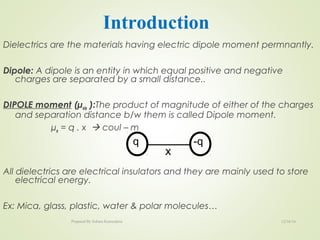
Dielectrics are the materials having electric dipole moment permnantly.
Dipole: A dipole is an entity in which equal positive and negative
charges are separated by a small distance..
DIPOLE moment (µele ):The product of magnitude of either of the charges
and separation distance b/w them is called Dipole moment.
µe = q . x  coul – m
All dielectrics are electrical insulators and they are mainly used to store
electrical energy.
Ex: Mica, glass, plastic, water & polar molecules…
X
q -q
Introduction
12/16/16Prepared By Soham Kansodaria
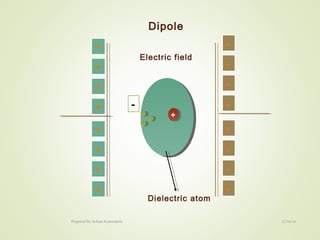
++
Electric field
Dielectric atom
+
+
+
+
+
+
+
+
-
Dipole
-
-
-
-
-
-
-
-
12/16/16Prepared By Soham Kansodaria
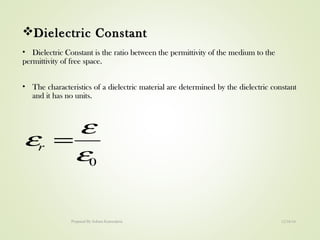
0ε
ε
ε =r
Dielectric ConstantDielectric Constant
• Dielectric Constant is the ratio between the permittivity of the medium to theDielectric Constant is the ratio between the permittivity of the medium to the
permittivity of free space.permittivity of free space.
• The characteristics of a dielectric material are determined by the dielectric constantThe characteristics of a dielectric material are determined by the dielectric constant
and it has no units.and it has no units.
12/16/16Prepared By Soham Kansodaria
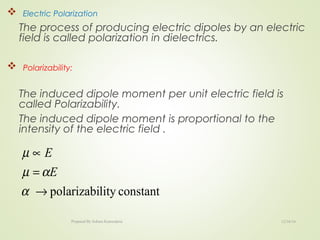
 Electric Polarization
The process of producing electric dipoles by an electric
field is called polarization in dielectrics.
 Polarizability:
The induced dipole moment per unit electric field is
called Polarizability.
The induced dipole moment is proportional to the
intensity of the electric field .
constantlitypolarizabi→
=
∝
α
αµ
µ
E
E
12/16/16Prepared By Soham Kansodaria
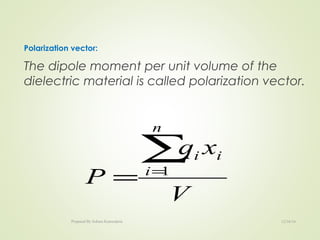
Polarization vector:
The dipole moment per unit volume of the
dielectric material is called polarization vector.
V
xq
P
n
i
ii∑=
= 1
12/16/16Prepared By Soham Kansodaria
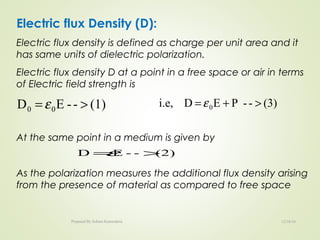
Electric flux Density (D):
Electric flux density is defined as charge per unit area and it
has same units of dielectric polarization.
Electric flux density D at a point in a free space or air in terms
of Electric field strength is
At the same point in a medium is given by
As the polarization measures the additional flux density arising
from the presence of material as compared to free space
(1)--ED 00 >= ε (3)--PEDi.e, 0 >+= ε
(2)--ED >=ε
12/16/16Prepared By Soham Kansodaria
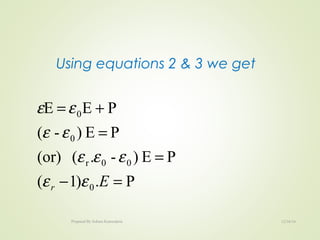
Using equations 2 & 3 we get
P.)1(
PE)-.((or)
PE)-(
PEE
0
00r
0
0
=−
=
=
+=
Er εε
εεε
εε
εε
12/16/16Prepared By Soham Kansodaria
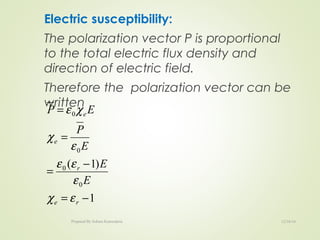
Electric susceptibility:
The polarization vector P is proportional
to the total electric flux density and
direction of electric field.
Therefore the polarization vector can be
written
1
)1(
0
0
0
0
−=
−
=
=
=
re
r
e
e
E
E
E
P
EP
εχ
ε
εε
ε
χ
χε
12/16/16Prepared By Soham Kansodaria
Various polarization processes:
When the specimen is placed inside a d.c. electric field, polarization
is due to four types of processes….
1.Electronic polarization
2.Ionic polarization
3.Orientation polarization
4.Space charge polarization
12/16/16Prepared By Soham Kansodaria
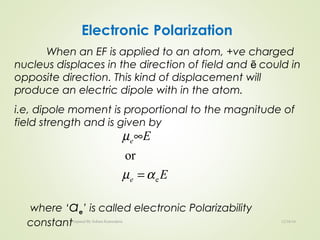
Electronic Polarization
When an EF is applied to an atom, +ve charged
nucleus displaces in the direction of field and could inẽ
opposite direction. This kind of displacement will
produce an electric dipole with in the atom.
i.e, dipole moment is proportional to the magnitude of
field strength and is given by
where ‘αe’ is called electronic Polarizability
constant
E
E
e
e
e
or
αµ
µ
=
∞
12/16/16Prepared By Soham Kansodaria
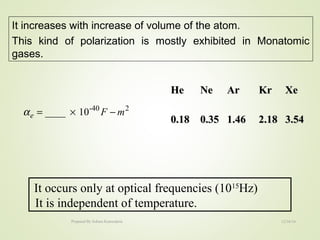
It increases with increase of volume of the atom.
This kind of polarization is mostly exhibited in Monatomic
gases.
10____ 2-40
mFe −×=α
HeHe NeNe ArAr KrKr XeXe
0.180.18 0.350.35 1.461.46 2.182.18 3.543.54
It occurs only at optical frequencies (1015
Hz)
It is independent of temperature.
12/16/16Prepared By Soham Kansodaria
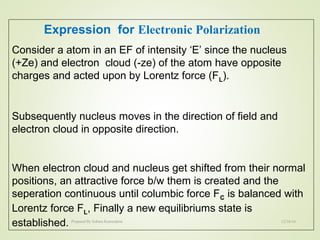
Expression for Electronic Polarization
Consider a atom in an EF of intensity ‘E’ since the nucleus
(+Ze) and electron cloud (-ze) of the atom have opposite
charges and acted upon by Lorentz force (FL).
Subsequently nucleus moves in the direction of field and
electron cloud in opposite direction.
When electron cloud and nucleus get shifted from their normal
positions, an attractive force b/w them is created and the
seperation continuous until columbic force FC is balanced with
Lorentz force FL, Finally a new equilibriums state is
established. 12/16/16Prepared By Soham Kansodaria
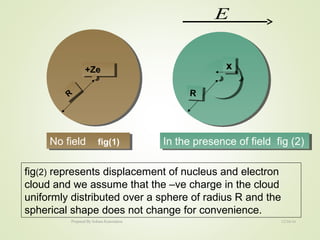
fig(2) represents displacement of nucleus and electron
cloud and we assume that the –ve charge in the cloud
uniformly distributed over a sphere of radius R and the
spherical shape does not change for convenience.
+Ze+Ze
RR
No field fig(1)No field fig(1)
xx
RR
In the presence of field fig (2)In the presence of field fig (2)
E
12/16/16Prepared By Soham Kansodaria
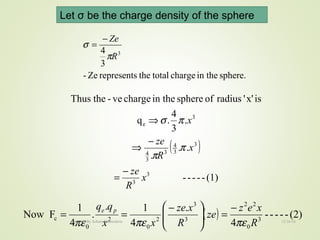
Let σ be the charge density of the sphere
sphere.in thechargetotaltherepresentsZe-
3
4 3
R
Ze
π
σ
−
=
( )
(1)-----
..
.
.
3
4
.q
isx''radiusofspherein thechargeve-theThus
3
3
3
3
4
3
3
4
3
e
x
R
ze
x
R
ze
x
−
=
−
⇒
⇒
π
π
πσ
( ) (2)-----
4
.
4
1.
.
4
1
FNow 3
0
22
3
3
2
0
2
0
c
R
xez
ze
R
xze
xx
qq pe
πεπεπε
−
=




 −
== 12/16/16Prepared By Soham Kansodaria
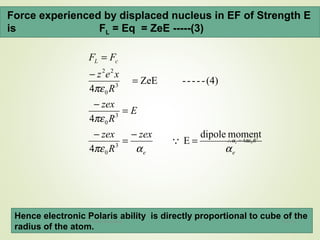
Force experienced by displaced nucleus in EF of Strength E
is FL = Eq = ZeE -----(3)
ee
cL
zex
R
zex
E
R
zex
R
xez
FF
ααπε
πε
πε
momentdipole
E
4
4
(4)-----ZeE
4
3
0
3
0
3
0
22
=
−
=
−
=
−
=
−
=
 3
04 Re πεα =∴
Hence electronic Polaris ability is directly proportional to cube of the
radius of the atom.
12/16/16Prepared By Soham Kansodaria
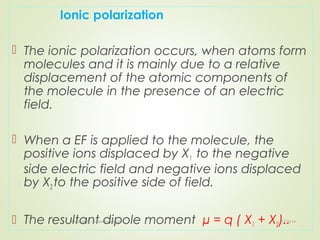
Ionic polarization
 The ionic polarization occurs, when atoms form
molecules and it is mainly due to a relative
displacement of the atomic components of
the molecule in the presence of an electric
field.
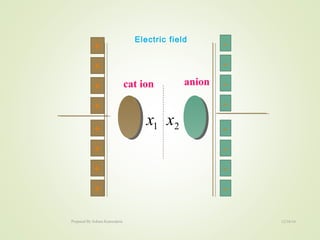
 When a EF is applied to the molecule, the
positive ions displaced by X1 to the negative
side electric field and negative ions displaced
by X2 to the positive side of field.
 The resultant dipole moment µ = q ( X1 + X2)..12/16/16Prepared By Soham Kansodaria
Electric field
+
+
+
+
1x 2x
anioncat ion
+
+
+
+
-
-
-
-
-
-
-
-
12/16/16Prepared By Soham Kansodaria
Restoring force constant depend upon the mass of the ion and
natural frequency and is given by
[ ]Mm
w
eE
xx
wm
eE
x
xwmeEF
11
2
0
21
2
0
2
0
.
or
.
+=+∴
=
==
12/16/16Prepared By Soham Kansodaria
Where ‘M’ mass of anion and ‘m’ is mass of cat ion
[ ]
[ ]Mm
ionic
ionic
Mmionic
w
e
E
w
Ee
xx
11
2
0
2
11
2
0
2
21
or
)e(
+⇒=
+=+=∴
µ
α
µ
This polarization occurs at frequency 1013
Hz (IR).
It is a slower process compared to electronic
polarization.
It is independent of temperature.
12/16/16Prepared By Soham Kansodaria
Orientational Polarization
It is also called dipolar or molecular polarization. The
molecules such as H2 , N2,O2,Cl2 ,CH4,CCl4 etc., does not carry
any dipole because centre of positive charge and centre of
negative charge coincides. On the other hand molecules like
CH3Cl, H2O,HCl, ethyl acetate ( polar molecules) carries
dipoles even in the absence of electric field.
How ever the net dipole moment is negligibly small since all
the molecular dipoles are oriented randomly when there is no
EF. In the presence of the electric field these all dipoles orient
them selves in the direction of field as a result the net dipole
moment becomes enormous. 12/16/16Prepared By Soham Kansodaria
 It occurs at a frequency 106
Hz to 1010
Hz.
 It is slow process compare to ionic polarization.
 It greatly depends on temperature.
12/16/16Prepared By Soham Kansodaria
[ ] kTw
e
R
kT
EN
kT
EN
NP
ori
mMooriionicelec
orie
o
o
orie
orieo
3
4
3
..
3
..
.
2
11
2
0
2
3
2
2
µ
πεαααα
µ
α
α
µ
µ
+++=++=∴
=
=⇒=

Expression for orientation polarization
This is called Langevin–Debye equation for total Polaris ability in
dielectrics.
12/16/16Prepared By Soham Kansodaria
Internal fields or local fields
Local field or internal field in a dielectric is the space and time average ofLocal field or internal field in a dielectric is the space and time average of
the electric field intensity acting on a particular molecule in the dielectricthe electric field intensity acting on a particular molecule in the dielectric
material.material.
12/16/16Prepared By Soham Kansodaria
Evaluation of internal field
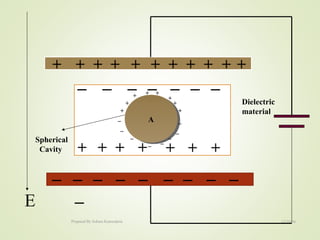
Consider a dielectric be placed between the plates of a parallel
plate capacitor and let there be an imaginary spherical cavity
around the atom A inside the dielectric.
The internal field at the atom site ‘A’ can be made up of four
components E1 ,E2, E3 & E4.
12/16/16Prepared By Soham Kansodaria
+ ++ ++ + + + + ++
_ _ _ _ _ _ _ __
E
Dielectric
material
Spherical
Cavity
A
__
_
__ ___
+ + + + + ++
+
+ +
+
+ +
+
+
_
_
__
_
__
_
12/16/16Prepared By Soham Kansodaria
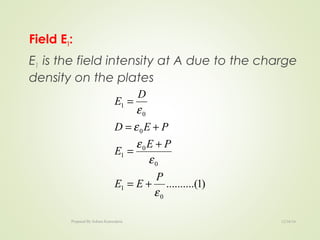
Field E1:
E1 is the field intensity at A due to the charge
density on the plates
)1(..........
0
1
0
0
1
0
0
1
ε
ε
ε
ε
ε
P
EE
PE
E
PED
D
E
+=
+
=
+=
=
12/16/16Prepared By Soham Kansodaria
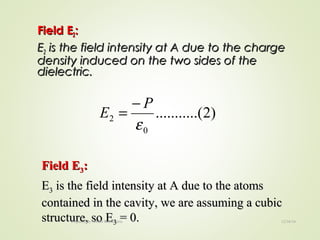
Field EField E22::
EE22 is the field intensity at A due to the chargeis the field intensity at A due to the charge
density induced on the two sides of thedensity induced on the two sides of the
dielectric.dielectric.
)2.(..........
0
2
ε
P
E
−
=
Field EField E33::
EE33 is the field intensity at A due to the atomsis the field intensity at A due to the atoms
contained in the cavity, we are assuming a cubiccontained in the cavity, we are assuming a cubic
structure, so Estructure, so E33 = 0.= 0. 12/16/16Prepared By Soham Kansodaria
+ +
E
θ θd r
p q
R
dA
r
A
+
+
+
+ +
+
+
+
++
_
_
_
_
_
_
_
_ _
_
_
_
12/16/16Prepared By Soham Kansodaria
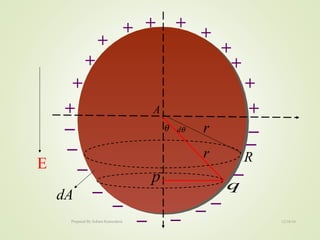
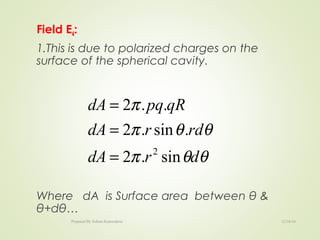
Field E4:
1.This is due to polarized charges on the
surface of the spherical cavity.
Where dA is Surface area between θ &
θ+dθ…
θθπ
θθπ
π
drdA
rdrdA
qRpqdA
sin.2
.sin.2
..2
2
=
=
=
12/16/16Prepared By Soham Kansodaria
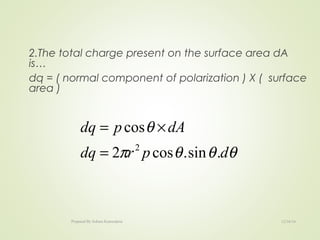
2.The total charge present on the surface area dA
is…
dq = ( normal component of polarization ) X ( surface
area )
θθθπ
θ
dprdq
dApdq
.sin.cos2
cos
2
=
×=
12/16/16Prepared By Soham Kansodaria
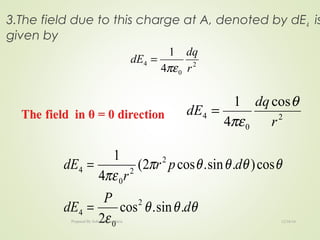
3.The field due to this charge at A, denoted by dE4 is
given by
2
0
4
4
1
r
dq
dE
πε
=
2
0
4
cos
4
1
r
dq
dE
θ
πε
=
θθθ
ε
θθθθπ
πε
d
P
dE
dpr
r
dE
.sin.cos
2
cos).sin.cos2(
4
1
2
0
4
2
2
0
4
=
=
12/16/16Prepared By Soham Kansodaria
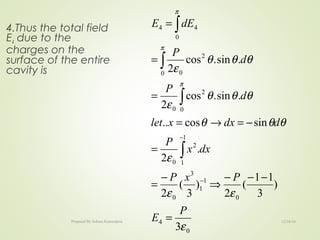
4.Thus the total field
E4 due to the
charges on the
surface of the entire
cavity is
0
4
0
1
1
3
0
1
1
2
0
0
2
0
0
2
0
0
44
3
)
3
11
(
2
)
3
(
2
.
2
sincos..
.sin.cos
2
.sin.cos
2
ε
εε
ε
θθθ
θθθ
ε
θθθ
ε
π
π
π
P
E
PxP
dxx
P
ddxxlet
d
P
d
P
dEE
=
−−−
⇒
−
=
=
−=→=
=
=
=
−
−
∫
∫
∫
∫
12/16/16Prepared By Soham Kansodaria
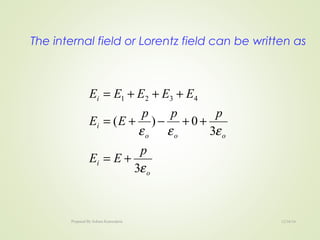
The internal field or Lorentz field can be written as
o
i
ooo
i
i
p
EE
ppp
EE
EEEEE
ε
εεε
3
3
0)(
4321
+=
++−+=
+++=
12/16/16Prepared By Soham Kansodaria
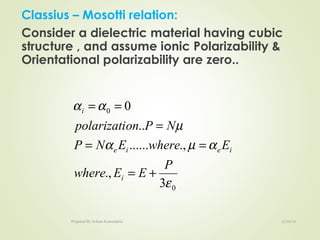
Classius – Mosotti relation:
Consider a dielectric material having cubic
structure , and assume ionic Polarizability &
Orientational polarizability are zero..
0
0
3
.,
.,......
..
0
ε
αµα
µ
αα
P
EEwhere
EwhereENP
NPonpolarizati
i
ieie
i
+=
==
=
==
12/16/16Prepared By Soham Kansodaria
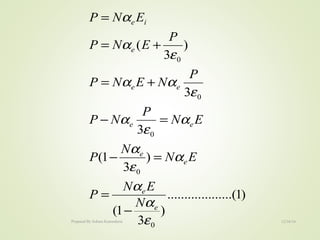
)1.........(..........
)
3
1(
)
3
1(
3
3
)
3
(
0
0
0
0
0
ε
α
α
α
ε
α
α
ε
α
ε
αα
ε
α
α
e
e
e
e
ee
ee
e
ie
N
EN
P
EN
N
P
EN
P
NP
P
NENP
P
ENP
ENP
−
=
=−
=−
+=
+=
=
12/16/16Prepared By Soham Kansodaria
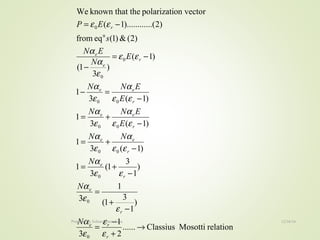
relationMosottiClassius......
2
1
3
)
1
3
1(
1
3
)
1
3
1(
3
1
)1(3
1
)1(3
1
)1(3
1
)1(
)
3
1(
)2(&)1(eqfrom
)2...().........1(
on vectorpolarizatitheknown thatWe
0
0
0
00
00
00
0
0
n
0
→
+
−
=
−
+
=
−
+=
−
+=
−
+=
−
=−
−=
−
−=
r
re
r
e
r
e
r
ee
r
ee
r
ee
r
e
e
r
N
N
N
NN
E
ENN
E
ENN
E
N
EN
s
EP
ε
ε
ε
α
ε
ε
α
εε
α
εε
α
ε
α
εε
α
ε
α
εε
α
ε
α
εε
ε
α
α
εε
12/16/16Prepared By Soham Kansodaria
Ferro electric materials or Ferro electricity
 Ferro electric crystals exhibit spontaneous polarization I.e. electric
polarization with out electric field.
 Ferro electric crystals possess high dielectric constant.
 each unit cell of a Ferro electric crystal carries
a reversible electric dipole moment.
Examples: Barium Titanate (BaTiO3) , Sodium nitrate (NaNO3) ,Rochelle salt
etc..
12/16/16Prepared By Soham Kansodaria
Piezo- electricity
The process of creating electric polarization by
mechanical stress is called as piezo electric effect.
This process is used in conversion of mechanical
energy into electrical energy and also electrical
energy into mechanical energy.
According to inverse piezo electric effect, when an
electric stress is applied, the material becomes
strained. This strain is directly proportional to the
applied field.
Examples: quartz crystal , Rochelle salt etc.,
Piezo electric materials or peizo electric
semiconductors such as Gas, Zno and CdS are finding
applications in ultrasonic amplifiers.
12/16/16Prepared By Soham Kansodaria
THANK YOUTHANK YOU
12/16/16Prepared By Soham Kansodaria

Physics Dielectric

  • 1.
  • 2.
    Dielectrics are thematerials having electric dipole moment permnantly. Dipole: A dipole is an entity in which equal positive and negative charges are separated by a small distance.. DIPOLE moment (µele ):The product of magnitude of either of the charges and separation distance b/w them is called Dipole moment. µe = q . x  coul – m All dielectrics are electrical insulators and they are mainly used to store electrical energy. Ex: Mica, glass, plastic, water & polar molecules… X q -q Introduction 12/16/16Prepared By Soham Kansodaria
  • 3.
  • 4.
    0ε ε ε =r Dielectric ConstantDielectricConstant • Dielectric Constant is the ratio between the permittivity of the medium to theDielectric Constant is the ratio between the permittivity of the medium to the permittivity of free space.permittivity of free space. • The characteristics of a dielectric material are determined by the dielectric constantThe characteristics of a dielectric material are determined by the dielectric constant and it has no units.and it has no units. 12/16/16Prepared By Soham Kansodaria
  • 5.
     Electric Polarization Theprocess of producing electric dipoles by an electric field is called polarization in dielectrics.  Polarizability: The induced dipole moment per unit electric field is called Polarizability. The induced dipole moment is proportional to the intensity of the electric field . constantlitypolarizabi→ = ∝ α αµ µ E E 12/16/16Prepared By Soham Kansodaria
  • 6.
    Polarization vector: The dipolemoment per unit volume of the dielectric material is called polarization vector. V xq P n i ii∑= = 1 12/16/16Prepared By Soham Kansodaria
  • 7.
    Electric flux Density(D): Electric flux density is defined as charge per unit area and it has same units of dielectric polarization. Electric flux density D at a point in a free space or air in terms of Electric field strength is At the same point in a medium is given by As the polarization measures the additional flux density arising from the presence of material as compared to free space (1)--ED 00 >= ε (3)--PEDi.e, 0 >+= ε (2)--ED >=ε 12/16/16Prepared By Soham Kansodaria
  • 8.
    Using equations 2& 3 we get P.)1( PE)-.((or) PE)-( PEE 0 00r 0 0 =− = = += Er εε εεε εε εε 12/16/16Prepared By Soham Kansodaria
  • 9.
    Electric susceptibility: The polarizationvector P is proportional to the total electric flux density and direction of electric field. Therefore the polarization vector can be written 1 )1( 0 0 0 0 −= − = = = re r e e E E E P EP εχ ε εε ε χ χε 12/16/16Prepared By Soham Kansodaria
  • 10.
    Various polarization processes: Whenthe specimen is placed inside a d.c. electric field, polarization is due to four types of processes…. 1.Electronic polarization 2.Ionic polarization 3.Orientation polarization 4.Space charge polarization 12/16/16Prepared By Soham Kansodaria
  • 11.
    Electronic Polarization When anEF is applied to an atom, +ve charged nucleus displaces in the direction of field and could inẽ opposite direction. This kind of displacement will produce an electric dipole with in the atom. i.e, dipole moment is proportional to the magnitude of field strength and is given by where ‘αe’ is called electronic Polarizability constant E E e e e or αµ µ = ∞ 12/16/16Prepared By Soham Kansodaria
  • 12.
    It increases withincrease of volume of the atom. This kind of polarization is mostly exhibited in Monatomic gases. 10____ 2-40 mFe −×=α HeHe NeNe ArAr KrKr XeXe 0.180.18 0.350.35 1.461.46 2.182.18 3.543.54 It occurs only at optical frequencies (1015 Hz) It is independent of temperature. 12/16/16Prepared By Soham Kansodaria
  • 13.
    Expression for ElectronicPolarization Consider a atom in an EF of intensity ‘E’ since the nucleus (+Ze) and electron cloud (-ze) of the atom have opposite charges and acted upon by Lorentz force (FL). Subsequently nucleus moves in the direction of field and electron cloud in opposite direction. When electron cloud and nucleus get shifted from their normal positions, an attractive force b/w them is created and the seperation continuous until columbic force FC is balanced with Lorentz force FL, Finally a new equilibriums state is established. 12/16/16Prepared By Soham Kansodaria
  • 14.
    fig(2) represents displacementof nucleus and electron cloud and we assume that the –ve charge in the cloud uniformly distributed over a sphere of radius R and the spherical shape does not change for convenience. +Ze+Ze RR No field fig(1)No field fig(1) xx RR In the presence of field fig (2)In the presence of field fig (2) E 12/16/16Prepared By Soham Kansodaria
  • 15.
    Let σ bethe charge density of the sphere sphere.in thechargetotaltherepresentsZe- 3 4 3 R Ze π σ − = ( ) (1)----- .. . . 3 4 .q isx''radiusofspherein thechargeve-theThus 3 3 3 3 4 3 3 4 3 e x R ze x R ze x − = − ⇒ ⇒ π π πσ ( ) (2)----- 4 . 4 1. . 4 1 FNow 3 0 22 3 3 2 0 2 0 c R xez ze R xze xx qq pe πεπεπε − =      − == 12/16/16Prepared By Soham Kansodaria
  • 16.
    Force experienced bydisplaced nucleus in EF of Strength E is FL = Eq = ZeE -----(3) ee cL zex R zex E R zex R xez FF ααπε πε πε momentdipole E 4 4 (4)-----ZeE 4 3 0 3 0 3 0 22 = − = − = − = − =  3 04 Re πεα =∴ Hence electronic Polaris ability is directly proportional to cube of the radius of the atom. 12/16/16Prepared By Soham Kansodaria
  • 17.
    Ionic polarization  Theionic polarization occurs, when atoms form molecules and it is mainly due to a relative displacement of the atomic components of the molecule in the presence of an electric field.  When a EF is applied to the molecule, the positive ions displaced by X1 to the negative side electric field and negative ions displaced by X2 to the positive side of field.  The resultant dipole moment µ = q ( X1 + X2)..12/16/16Prepared By Soham Kansodaria
  • 18.
    Electric field + + + + 1x 2x anioncation + + + + - - - - - - - - 12/16/16Prepared By Soham Kansodaria
  • 19.
    Restoring force constantdepend upon the mass of the ion and natural frequency and is given by [ ]Mm w eE xx wm eE x xwmeEF 11 2 0 21 2 0 2 0 . or . +=+∴ = == 12/16/16Prepared By Soham Kansodaria
  • 20.
    Where ‘M’ massof anion and ‘m’ is mass of cat ion [ ] [ ]Mm ionic ionic Mmionic w e E w Ee xx 11 2 0 2 11 2 0 2 21 or )e( +⇒= +=+=∴ µ α µ This polarization occurs at frequency 1013 Hz (IR). It is a slower process compared to electronic polarization. It is independent of temperature. 12/16/16Prepared By Soham Kansodaria
  • 21.
    Orientational Polarization It isalso called dipolar or molecular polarization. The molecules such as H2 , N2,O2,Cl2 ,CH4,CCl4 etc., does not carry any dipole because centre of positive charge and centre of negative charge coincides. On the other hand molecules like CH3Cl, H2O,HCl, ethyl acetate ( polar molecules) carries dipoles even in the absence of electric field. How ever the net dipole moment is negligibly small since all the molecular dipoles are oriented randomly when there is no EF. In the presence of the electric field these all dipoles orient them selves in the direction of field as a result the net dipole moment becomes enormous. 12/16/16Prepared By Soham Kansodaria
  • 22.
     It occursat a frequency 106 Hz to 1010 Hz.  It is slow process compare to ionic polarization.  It greatly depends on temperature. 12/16/16Prepared By Soham Kansodaria
  • 23.
    [ ] kTw e R kT EN kT EN NP ori mMooriionicelec orie o o orie orieo 3 4 3 .. 3 .. . 2 11 2 0 2 3 2 2 µ πεαααα µ α α µ µ +++=++=∴ = =⇒=  Expressionfor orientation polarization This is called Langevin–Debye equation for total Polaris ability in dielectrics. 12/16/16Prepared By Soham Kansodaria
  • 24.
    Internal fields orlocal fields Local field or internal field in a dielectric is the space and time average ofLocal field or internal field in a dielectric is the space and time average of the electric field intensity acting on a particular molecule in the dielectricthe electric field intensity acting on a particular molecule in the dielectric material.material. 12/16/16Prepared By Soham Kansodaria
  • 25.
    Evaluation of internalfield Consider a dielectric be placed between the plates of a parallel plate capacitor and let there be an imaginary spherical cavity around the atom A inside the dielectric. The internal field at the atom site ‘A’ can be made up of four components E1 ,E2, E3 & E4. 12/16/16Prepared By Soham Kansodaria
  • 26.
    + ++ +++ + + + ++ _ _ _ _ _ _ _ __ E Dielectric material Spherical Cavity A __ _ __ ___ + + + + + ++ + + + + + + + + _ _ __ _ __ _ 12/16/16Prepared By Soham Kansodaria
  • 27.
    Field E1: E1 isthe field intensity at A due to the charge density on the plates )1(.......... 0 1 0 0 1 0 0 1 ε ε ε ε ε P EE PE E PED D E += + = += = 12/16/16Prepared By Soham Kansodaria
  • 28.
    Field EField E22:: EE22is the field intensity at A due to the chargeis the field intensity at A due to the charge density induced on the two sides of thedensity induced on the two sides of the dielectric.dielectric. )2.(.......... 0 2 ε P E − = Field EField E33:: EE33 is the field intensity at A due to the atomsis the field intensity at A due to the atoms contained in the cavity, we are assuming a cubiccontained in the cavity, we are assuming a cubic structure, so Estructure, so E33 = 0.= 0. 12/16/16Prepared By Soham Kansodaria
  • 29.
    + + E θ θdr p q R dA r A + + + + + + + + ++ _ _ _ _ _ _ _ _ _ _ _ _ 12/16/16Prepared By Soham Kansodaria
  • 30.
    Field E4: 1.This isdue to polarized charges on the surface of the spherical cavity. Where dA is Surface area between θ & θ+dθ… θθπ θθπ π drdA rdrdA qRpqdA sin.2 .sin.2 ..2 2 = = = 12/16/16Prepared By Soham Kansodaria
  • 31.
    2.The total chargepresent on the surface area dA is… dq = ( normal component of polarization ) X ( surface area ) θθθπ θ dprdq dApdq .sin.cos2 cos 2 = ×= 12/16/16Prepared By Soham Kansodaria
  • 32.
    3.The field dueto this charge at A, denoted by dE4 is given by 2 0 4 4 1 r dq dE πε = 2 0 4 cos 4 1 r dq dE θ πε = θθθ ε θθθθπ πε d P dE dpr r dE .sin.cos 2 cos).sin.cos2( 4 1 2 0 4 2 2 0 4 = = 12/16/16Prepared By Soham Kansodaria
  • 33.
    4.Thus the totalfield E4 due to the charges on the surface of the entire cavity is 0 4 0 1 1 3 0 1 1 2 0 0 2 0 0 2 0 0 44 3 ) 3 11 ( 2 ) 3 ( 2 . 2 sincos.. .sin.cos 2 .sin.cos 2 ε εε ε θθθ θθθ ε θθθ ε π π π P E PxP dxx P ddxxlet d P d P dEE = −−− ⇒ − = = −=→= = = = − − ∫ ∫ ∫ ∫ 12/16/16Prepared By Soham Kansodaria
  • 34.
    The internal fieldor Lorentz field can be written as o i ooo i i p EE ppp EE EEEEE ε εεε 3 3 0)( 4321 += ++−+= +++= 12/16/16Prepared By Soham Kansodaria
  • 35.
    Classius – Mosottirelation: Consider a dielectric material having cubic structure , and assume ionic Polarizability & Orientational polarizability are zero.. 0 0 3 ., .,...... .. 0 ε αµα µ αα P EEwhere EwhereENP NPonpolarizati i ieie i += == = == 12/16/16Prepared By Soham Kansodaria
  • 36.
  • 37.
  • 38.
    Ferro electric materialsor Ferro electricity  Ferro electric crystals exhibit spontaneous polarization I.e. electric polarization with out electric field.  Ferro electric crystals possess high dielectric constant.  each unit cell of a Ferro electric crystal carries a reversible electric dipole moment. Examples: Barium Titanate (BaTiO3) , Sodium nitrate (NaNO3) ,Rochelle salt etc.. 12/16/16Prepared By Soham Kansodaria
  • 39.
    Piezo- electricity The processof creating electric polarization by mechanical stress is called as piezo electric effect. This process is used in conversion of mechanical energy into electrical energy and also electrical energy into mechanical energy. According to inverse piezo electric effect, when an electric stress is applied, the material becomes strained. This strain is directly proportional to the applied field. Examples: quartz crystal , Rochelle salt etc., Piezo electric materials or peizo electric semiconductors such as Gas, Zno and CdS are finding applications in ultrasonic amplifiers. 12/16/16Prepared By Soham Kansodaria
  • 40.