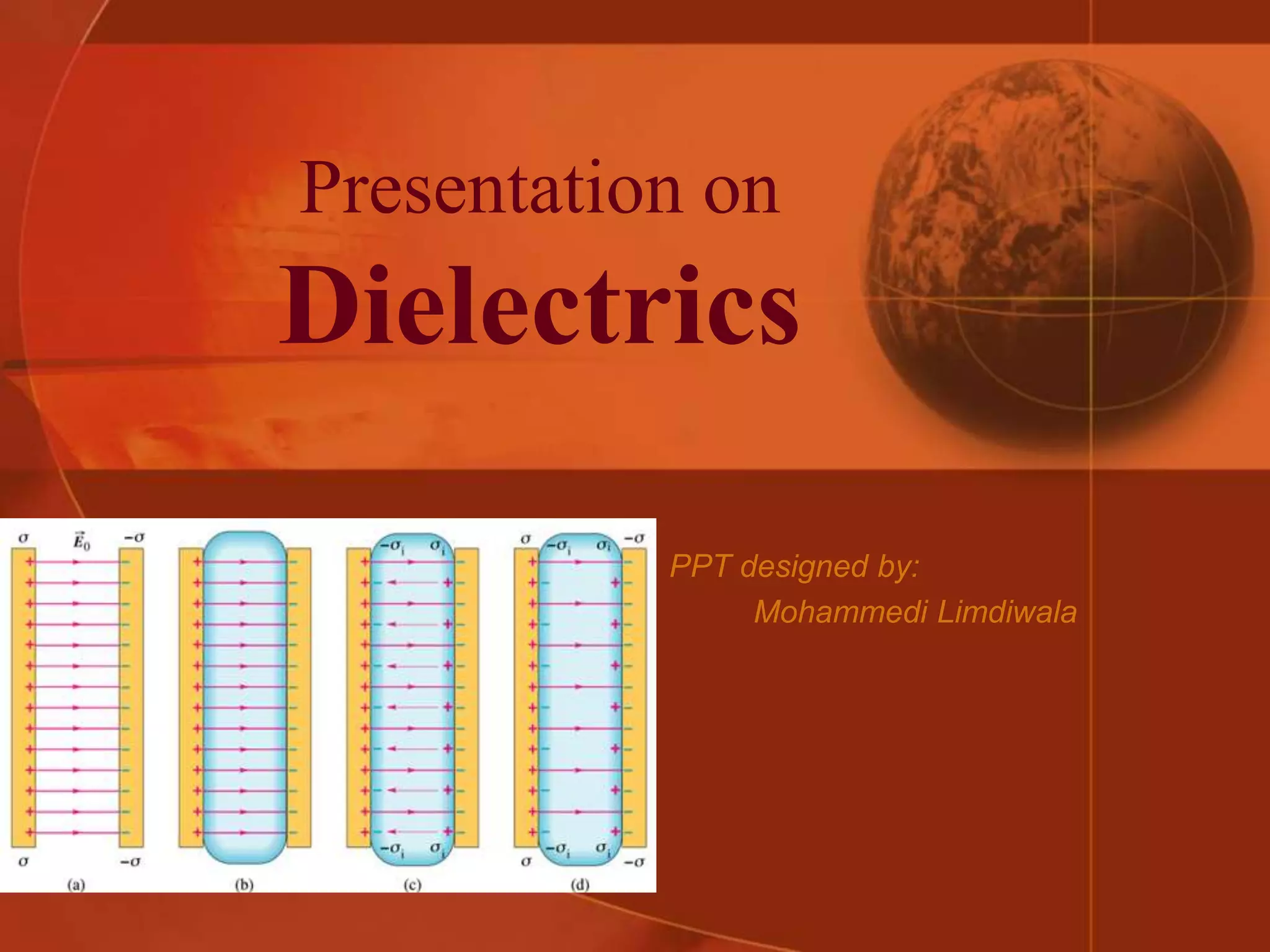
Presentation on
Dielectrics
PPT designed by:
Mohammedi Limdiwala
Contents
• Introduction
• Basic terms
• Polarization of Dielectric
• Polarization method
• Internal Field
• Clausius-Mossotti Equation
• Types of dielectric
• Properties of good Dielectric
• Application of Dielectric
Mohdlimdi23 - Dielectrics24 Nov '14 2
Introduction
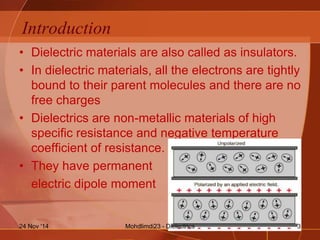
• Dielectric materials are also called as insulators.
• In dielectric materials, all the electrons are tightly
bound to their parent molecules and there are no
free charges
• Dielectrics are non-metallic materials of high
specific resistance and negative temperature
coefficient of resistance.
• They have permanent
electric dipole moment
Mohdlimdi23 - Dielectrics24 Nov '14 3
Basic Terms
• Electric Field : The region around the charge within which
its effect is felt or experienced is known as electric field.
• Electric flux Ø : It is defined as the total number of electric
lines of force passing through a given area in the electric field.
• Electric flux density : It is defined as the number of electric
lines of force passing normally through an unit area of cross
section in the field.
• Dielectric Constant  r : Determines he characteristics of a
dielectric.
• Polarization vector P : It is the dipole moment per unit
volume of the dielectric material.
E
D
Mohdlimdi23 - Dielectrics24 Nov '14 4
Basic Terms
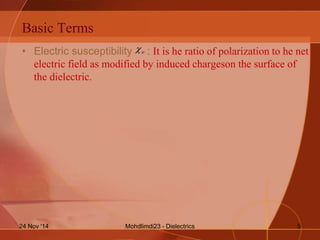
• Electric susceptibility : It is he ratio of polarization to he net
electric field as modified by induced chargeson the surface of
the dielectric.
e
Mohdlimdi23 - Dielectrics24 Nov '14 5
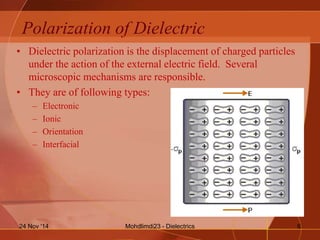
Polarization of Dielectric
• Dielectric polarization is the displacement of charged particles
under the action of the external electric field. Several
microscopic mechanisms are responsible.
• They are of following types:
– Electronic
– Ionic
– Orientation
– Interfacial
Mohdlimdi23 - Dielectrics24 Nov '14 6
Polarization of Dielectric
Electronic Polarization
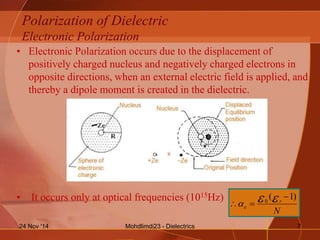
• Electronic Polarization occurs due to the displacement of
positively charged nucleus and negatively charged electrons in
opposite directions, when an external electric field is applied, and
thereby a dipole moment is created in the dielectric.
• It occurs only at optical frequencies (1015Hz)
N
r
e
)1(0

 
Mohdlimdi23 - Dielectrics24 Nov '14 7
Polarization of Dielectric
Ionic Polarization
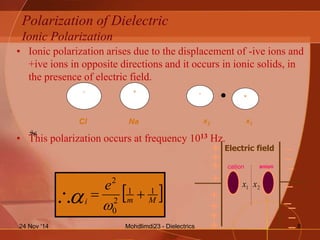
• Ionic polarization arises due to the displacement of -ive ions and
+ive ions in opposite directions and it occurs in ionic solids, in
the presence of electric field.
• This polarization occurs at frequency 1013 Hz.
 Mmi
e 11
2
0
2
 
- +
Cl Na
-
+
x2 x1
Electric field+
+
+
+
+
+
+
+
_
__
_
_
_
_
_1x 2x
anioncation
Mohdlimdi23 - Dielectrics24 Nov '14 8
Polarization of Dielectric
Orientation Polarization
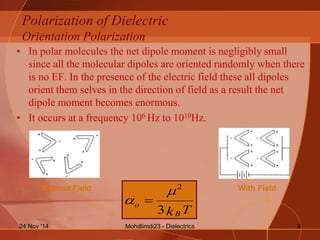
• In polar molecules the net dipole moment is negligibly small
since all the molecular dipoles are oriented randomly when there
is no EF. In the presence of the electric field these all dipoles
orient them selves in the direction of field as a result the net
dipole moment becomes enormous.
• It occurs at a frequency 106 Hz to 1010Hz.
TkB
o
3
2

 
Without Field With Field
Mohdlimdi23 - Dielectrics24 Nov '14 9
Polarization of Dielectric
Interfacial Polarization
• The space-charge polarization occurs due to the diffusion of ions,
along the field direction, thereby giving rise to redistribution of
charges in the dielectrics.
Without Field With Field
Mohdlimdi23 - Dielectrics24 Nov '14 10
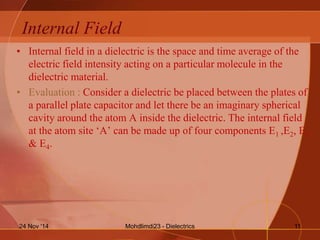
Internal Field
• Internal field in a dielectric is the space and time average of the
electric field intensity acting on a particular molecule in the
dielectric material.
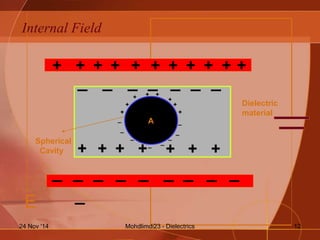
• Evaluation : Consider a dielectric be placed between the plates of
a parallel plate capacitor and let there be an imaginary spherical
cavity around the atom A inside the dielectric. The internal field
at the atom site ‘A’ can be made up of four components E1 ,E2, E3
& E4.
Mohdlimdi23 - Dielectrics24 Nov '14 11
Internal Field
+ ++ ++ + + + + ++
_ _ _ _ _ _ _ __
E
Dielectric
material
Spherical
Cavity
A
__
_
__ ___
+ + + + + ++
+
+ +
+
+ +
+
+
_
_
__
_
__
_
Mohdlimdi23 - Dielectrics24 Nov '14 12
Internal Field
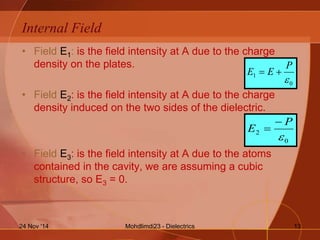
• Field E1: is the field intensity at A due to the charge
density on the plates.
• Field E2: is the field intensity at A due to the charge
density induced on the two sides of the dielectric.
• Field E3: is the field intensity at A due to the atoms
contained in the cavity, we are assuming a cubic
structure, so E3 = 0.
0
1

P
EE 
0
2

P
E


Mohdlimdi23 - Dielectrics24 Nov '14 13
Internal Field
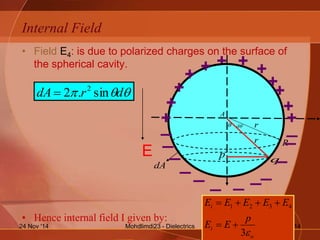
• Field E4: is due to polarized charges on the surface of
the spherical cavity.
• Hence internal field I given by:
+ +
E
 d r
p q
R
dA
r
A
+
+
+
+ +
+
+
+
++
_
_
_
_
_
_
__ _
_
_
_
 drdA sin.2 2

o
i
i
p
EE
EEEEE
3
4321


Mohdlimdi23 - Dielectrics24 Nov '14 14
Clausius-Mossotti Equation
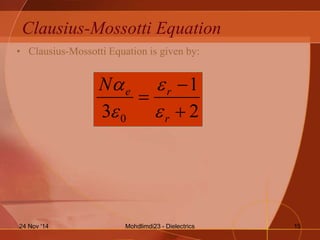
• Clausius-Mossotti Equation is given by:
2
1
3 0 


r
reN




Mohdlimdi23 - Dielectrics24 Nov '14 15
Types of Dielectric Materials
• Dielectric materials can be divided into
following groups:
– Solid Dielectrics - are of following types:
• Mica – is inorganic material and is crystalline in nature.
• Glass – is inorganic material made by fusion of different oxides.
• Rubber – is a organic polymer, which can be natural or artificial.
• Ceramic – is non-metallic organic compound such as silicates
Mohdlimdi23 - Dielectrics24 Nov '14 16
Types of Dielectric Materials
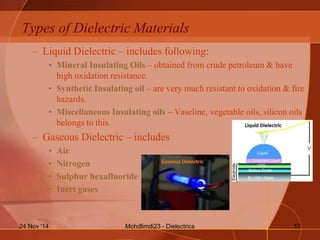
– Liquid Dielectric – includes following:
• Mineral Insulating Oils – obtained from crude petroleum & have
high oxidation resistance.
• Synthetic Insulating oil – are very much resistant to oxidation & fire
hazards.
• Miscellaneous Insulating oils – Vaseline, vegetable oils, silicon oils
belongs to this.
– Gaseous Dielectric – includes
• Air
• Nitrogen
• Sulphur hexafluoride
• Inert gases
Mohdlimdi23 - Dielectrics24 Nov '14 17
Properties of a Good Dielectric Material
• High resistivity to leakage current.
• High dielectric strength.
• High mechanical strength.
• High fire resistance.
• Low thermal expansion.
• Low dielectric loss.
• Low water absorption quality.
• High chemical inertness.
Mohdlimdi23 - Dielectrics24 Nov '14 18
Application of Dielectric
Capacitors
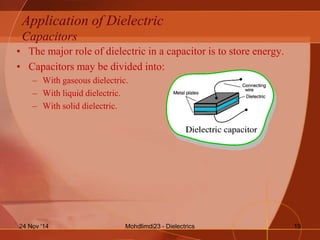
• The major role of dielectric in a capacitor is to store energy.
• Capacitors may be divided into:
– With gaseous dielectric.
– With liquid dielectric.
– With solid dielectric.
Mohdlimdi23 - Dielectrics24 Nov '14 19
Application of Dielectric
Transformer
• The major role of dielectric in a transformer is to as insulators as
well as cooling agent.
• Transformer may be divided into:
– With gaseous dielectric.
– With liquid dielectric.
– With solid dielectric.
Mohdlimdi23 - Dielectrics24 Nov '14 20
Thank You
Mohdlimdi23 - Dielectrics24 Nov '14 21

Dielectrics and its applications

  • 1.
  • 2.
    Contents • Introduction • Basicterms • Polarization of Dielectric • Polarization method • Internal Field • Clausius-Mossotti Equation • Types of dielectric • Properties of good Dielectric • Application of Dielectric Mohdlimdi23 - Dielectrics24 Nov '14 2
  • 3.
    Introduction • Dielectric materialsare also called as insulators. • In dielectric materials, all the electrons are tightly bound to their parent molecules and there are no free charges • Dielectrics are non-metallic materials of high specific resistance and negative temperature coefficient of resistance. • They have permanent electric dipole moment Mohdlimdi23 - Dielectrics24 Nov '14 3
  • 4.
    Basic Terms • ElectricField : The region around the charge within which its effect is felt or experienced is known as electric field. • Electric flux Ø : It is defined as the total number of electric lines of force passing through a given area in the electric field. • Electric flux density : It is defined as the number of electric lines of force passing normally through an unit area of cross section in the field. • Dielectric Constant  r : Determines he characteristics of a dielectric. • Polarization vector P : It is the dipole moment per unit volume of the dielectric material. E D Mohdlimdi23 - Dielectrics24 Nov '14 4
  • 5.
    Basic Terms • Electricsusceptibility : It is he ratio of polarization to he net electric field as modified by induced chargeson the surface of the dielectric. e Mohdlimdi23 - Dielectrics24 Nov '14 5
  • 6.
    Polarization of Dielectric •Dielectric polarization is the displacement of charged particles under the action of the external electric field. Several microscopic mechanisms are responsible. • They are of following types: – Electronic – Ionic – Orientation – Interfacial Mohdlimdi23 - Dielectrics24 Nov '14 6
  • 7.
    Polarization of Dielectric ElectronicPolarization • Electronic Polarization occurs due to the displacement of positively charged nucleus and negatively charged electrons in opposite directions, when an external electric field is applied, and thereby a dipole moment is created in the dielectric. • It occurs only at optical frequencies (1015Hz) N r e )1(0    Mohdlimdi23 - Dielectrics24 Nov '14 7
  • 8.
    Polarization of Dielectric IonicPolarization • Ionic polarization arises due to the displacement of -ive ions and +ive ions in opposite directions and it occurs in ionic solids, in the presence of electric field. • This polarization occurs at frequency 1013 Hz.  Mmi e 11 2 0 2   - + Cl Na - + x2 x1 Electric field+ + + + + + + + _ __ _ _ _ _ _1x 2x anioncation Mohdlimdi23 - Dielectrics24 Nov '14 8
  • 9.
    Polarization of Dielectric OrientationPolarization • In polar molecules the net dipole moment is negligibly small since all the molecular dipoles are oriented randomly when there is no EF. In the presence of the electric field these all dipoles orient them selves in the direction of field as a result the net dipole moment becomes enormous. • It occurs at a frequency 106 Hz to 1010Hz. TkB o 3 2    Without Field With Field Mohdlimdi23 - Dielectrics24 Nov '14 9
  • 10.
    Polarization of Dielectric InterfacialPolarization • The space-charge polarization occurs due to the diffusion of ions, along the field direction, thereby giving rise to redistribution of charges in the dielectrics. Without Field With Field Mohdlimdi23 - Dielectrics24 Nov '14 10
  • 11.
    Internal Field • Internalfield in a dielectric is the space and time average of the electric field intensity acting on a particular molecule in the dielectric material. • Evaluation : Consider a dielectric be placed between the plates of a parallel plate capacitor and let there be an imaginary spherical cavity around the atom A inside the dielectric. The internal field at the atom site ‘A’ can be made up of four components E1 ,E2, E3 & E4. Mohdlimdi23 - Dielectrics24 Nov '14 11
  • 12.
    Internal Field + ++++ + + + + ++ _ _ _ _ _ _ _ __ E Dielectric material Spherical Cavity A __ _ __ ___ + + + + + ++ + + + + + + + + _ _ __ _ __ _ Mohdlimdi23 - Dielectrics24 Nov '14 12
  • 13.
    Internal Field • FieldE1: is the field intensity at A due to the charge density on the plates. • Field E2: is the field intensity at A due to the charge density induced on the two sides of the dielectric. • Field E3: is the field intensity at A due to the atoms contained in the cavity, we are assuming a cubic structure, so E3 = 0. 0 1  P EE  0 2  P E   Mohdlimdi23 - Dielectrics24 Nov '14 13
  • 14.
    Internal Field • FieldE4: is due to polarized charges on the surface of the spherical cavity. • Hence internal field I given by: + + E  d r p q R dA r A + + + + + + + + ++ _ _ _ _ _ _ __ _ _ _ _  drdA sin.2 2  o i i p EE EEEEE 3 4321   Mohdlimdi23 - Dielectrics24 Nov '14 14
  • 15.
    Clausius-Mossotti Equation • Clausius-MossottiEquation is given by: 2 1 3 0    r reN     Mohdlimdi23 - Dielectrics24 Nov '14 15
  • 16.
    Types of DielectricMaterials • Dielectric materials can be divided into following groups: – Solid Dielectrics - are of following types: • Mica – is inorganic material and is crystalline in nature. • Glass – is inorganic material made by fusion of different oxides. • Rubber – is a organic polymer, which can be natural or artificial. • Ceramic – is non-metallic organic compound such as silicates Mohdlimdi23 - Dielectrics24 Nov '14 16
  • 17.
    Types of DielectricMaterials – Liquid Dielectric – includes following: • Mineral Insulating Oils – obtained from crude petroleum & have high oxidation resistance. • Synthetic Insulating oil – are very much resistant to oxidation & fire hazards. • Miscellaneous Insulating oils – Vaseline, vegetable oils, silicon oils belongs to this. – Gaseous Dielectric – includes • Air • Nitrogen • Sulphur hexafluoride • Inert gases Mohdlimdi23 - Dielectrics24 Nov '14 17
  • 18.
    Properties of aGood Dielectric Material • High resistivity to leakage current. • High dielectric strength. • High mechanical strength. • High fire resistance. • Low thermal expansion. • Low dielectric loss. • Low water absorption quality. • High chemical inertness. Mohdlimdi23 - Dielectrics24 Nov '14 18
  • 19.
    Application of Dielectric Capacitors •The major role of dielectric in a capacitor is to store energy. • Capacitors may be divided into: – With gaseous dielectric. – With liquid dielectric. – With solid dielectric. Mohdlimdi23 - Dielectrics24 Nov '14 19
  • 20.
    Application of Dielectric Transformer •The major role of dielectric in a transformer is to as insulators as well as cooling agent. • Transformer may be divided into: – With gaseous dielectric. – With liquid dielectric. – With solid dielectric. Mohdlimdi23 - Dielectrics24 Nov '14 20
  • 21.
    Thank You Mohdlimdi23 -Dielectrics24 Nov '14 21