ART INTEGRATED PROJECT
NAME: PRATISH KR. AGARWAL
CLASS: XII SECTION E
ROLL NUMBER: 18
SUBJECT: PHYSICS
TOPIC
SUSTAINABLE DEVELOPMENT GOALS
GOAL 09
“Industry, Innovation & Infrastructure”
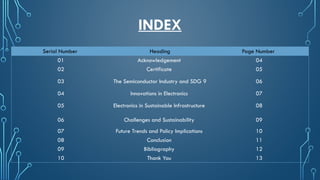
INDEX
Serial Number Heading Page Number
01 Acknowledgement 04
02 Certificate 05
03 The Semiconductor Industry and SDG 9 06
04 Innovations in Electronics 07
05 Electronics in Sustainable Infrastructure 08
06 Challenges and Sustainability 09
07 Future Trends and Policy Implications 10
08 Conclusion 11
09 Bibliography 12
10 Thank You 13
ACKNOWLEDGEMENT
I wanted to take a moment to express my heartfelt gratitude for our Physics Teacher, Mr.
Arghya Karmakar, your unwavering support and valuable insights throughout the duration of
my project. Your encouragement and guidance motivated me to strive for excellence, and I am
truly grateful for the impact you’ve had on my work. Additionally, I would like to extend my
appreciation to Mrs. Gurmeet Kaur Arjani, School Principal for the resources provided and
the overall support from the school administration. Your belief in my abilities fueled my
determination to give my best efforts. Last but not least, I want to acknowledge the
understanding and patience of my family and friends during this project. Their unwavering
encouragement kept me going, even during challenging times. If there are any other individuals
who directly or indirectly supported my project, please convey my gratitude to them as well.
This endeavor would not have been possible without the collective effort of everyone involved.
Thank you for being an integral part of my journey!
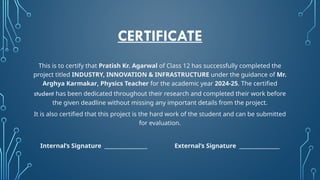
CERTIFICATE
This is to certify that Pratish Kr. Agarwal of Class 12 has successfully completed the
project titled INDUSTRY, INNOVATION & INFRASTRUCTURE under the guidance of Mr.
Arghya Karmakar, Physics Teacher for the academic year 2024-25. The certified
student has been dedicated throughout their research and completed their work before
the given deadline without missing any important details from the project.
It is also certified that this project is the hard work of the student and can be submitted
for evaluation.
Internal’s Signature _________________ External’s Signature ________________
THE SEMICONDUCTOR INDUSTRY AND SDG 9
1. Energy Efficiency and Clean Energy Solutions: Semiconductors play a pivotal role in
driving energy efficiency across various sectors. They enable efficient harnessing,
conversion, transmission, and storage of renewable energy. By powering information
technology, semiconductors support clean energy solutions, making them indispensable
for a cleaner and more sustainable future.
2. Innovation and Connectivity: Advancements in semiconductor technology lead to
innovations in communication networks, smart cities, and transportation systems. These
innovations enhance connectivity, improve transportation efficiency, and contribute to
resilient infrastructure by enabling real-time data exchange and monitoring.
3. Supply Chain Collaboration and Emissions Reduction: Semiconductor companies are
increasingly committing to ambitious emissions-reduction targets. Achieving net-zero
emissions will require collaboration with peers, suppliers, and the complete engagement
of fabs (semiconductor manufacturing facilities). By addressing emissions along their
entire supply chain, semiconductor companies contribute to sustainable industrialization
and climate action.
INNOVATIONS IN ELECTRONICS
1. Energy-Efficient Chips: The development of ultra-low-power AI chips and
energy-efficient semiconductors like Silicon Carbide (SiC) and Gallium Nitride
(GaN) for power systems.
2. Sustainable Manufacturing Practices: Adoption of green manufacturing
strategies, such as digital and green fabrication plants, renewable energy
usage, and enhanced recycling solutions.
3. Green Computing: Design and use of technology that reduces energy
consumption and carbon emissions, exemplified by IBM’s 2nm chip and
Samsung’s vertically stackable chips.
ELECTRONICS IN SUSTAINABLE INFRASTRUCTURE
1. Smart Grids: Semiconductors are integral in smart grids, managing power supply and demand efficiently, and integrating
renewable energy sources.
2. Renewable Energy Systems: Semiconductor chips in solar panels and wind turbines optimize the harnessing and
distribution of renewable energy.
3. IoT and Connectivity: Internet of Things (IoT) devices, which rely on semiconductors, enable real-time data management
and resource optimization in smart cities.
4. Advanced Monitoring Systems: Electronics with semiconductor sensors facilitate advanced monitoring and predictive
maintenance of infrastructure, reducing downtime and extending the lifespan of assets.
5. Efficient Transportation: Semiconductors in vehicle electronics improve fuel efficiency and enable electric vehicles,
contributing to sustainable transport solutions.
6. Resource Management: Electronic systems help in efficient water and waste management, crucial for sustainable urban
development.
7. Digital Inclusion: Electronics enable broader access to information and communication technology, fostering innovation
and empowering communities, especially in developing regions.
CHALLENGES AND SUSTAINABILITY
1. E-Waste Management: Challenge- Rapid obsolescence leads to massive e-
waste. Strategy- Implement take-back schemes and recycling programs.
2. Resource Depletion: Challenge- High demand for rare minerals depletes
resources. Strategy- Develop alternative materials and promote sustainable
mining.
3. Energy Consumption: Challenge- Manufacturing and operation consume vast
energy. Strategy- Optimize energy use and switch to renewable sources.
4. Carbon Emissions: Challenge- Greenhouse gas emissions from production and
use. Strategy- Adopt carbon-neutral manufacturing and offset initiatives.
5. Toxic Materials: Challenge- Use of hazardous substances in electronics.
Strategy- Transition to non-toxic, biodegradable materials.
6. Water Usage: Challenge- Large water footprint in semiconductor fabrication.
Strategy- Implement water reclamation and efficient usage practices.
FUTURE TRENDS AND POLICY IMPLICATIONS
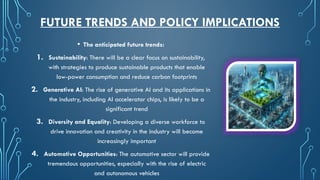
• The anticipated future trends:
1. Sustainability: There will be a clear focus on sustainability,
with strategies to produce sustainable products that enable
low-power consumption and reduce carbon footprints
2. Generative AI: The rise of generative AI and its applications in
the industry, including AI accelerator chips, is likely to be a
significant trend
3. Diversity and Equality: Developing a diverse workforce to
drive innovation and creativity in the industry will become
increasingly important
4. Automotive Opportunities: The automotive sector will provide
tremendous opportunities, especially with the rise of electric
and autonomous vehicles
Promoting R&D: Offering tax incentives, grants, and support for technology transfer to
encourage innovation within the startup ecosystem
Facilitating University-Industry Partnerships: Policies that promote university-industry
partnerships and knowledge exchange contribute to a robust innovation system
Supporting Transition to Digital Economy: Assisting industries in transitioning towards the
digital economy, which is vital for innovation and technological development
1. Encouraging Sustainable Practices: Implementing regulations that encourage companies to
set and achieve ambitious decarbonization goals and invest in renewable energy sources
• Policy support is crucial for fostering innovation and sustainability in this field.
Governments can play a pivotal role by:
CONCLUSION
The semiconductor industry is crucial for achieving SDG 9. Innovations in
electronics, such as energy-efficient chips, contribute to sustainable
infrastructure. Semiconductors enable smart grids and renewable energy
systems. However, addressing environmental challenges and promoting policy
support are essential for long-term sustainability. Future trends include
miniaturization, quantum computing, and IoT devices. Policy alignment ensures
innovation and sustainability go hand in hand. As we look to the future, the
semiconductor and electronics industry faces exciting prospects. Continued
miniaturization of components will lead to more powerful and compact devices.
Quantum computing holds the promise of revolutionizing computation, while the
proliferation of Internet of Things (IoT) devices will connect our world like never
before. However, to ensure sustainable progress, policymakers must provide
robust support for research, development, and implementation. By aligning
policy frameworks with innovation, we can drive the industry toward a future
where technological advancements go hand in hand with environmental
stewardship and societal well-being.
➢ Learn CBSE
➢ Cbsetuts
➢ en.wikipedia.org
➢ Vedantu
➢ Toppr
➢ Collegedunia
➢ Jagranjosh
BIBLIOGRAPHY
PHYSICS AIP CLASS XII PRATISH AGARWAL.pptx

PHYSICS AIP CLASS XII PRATISH AGARWAL.pptx

  • 1.
    ART INTEGRATED PROJECT NAME:PRATISH KR. AGARWAL CLASS: XII SECTION E ROLL NUMBER: 18 SUBJECT: PHYSICS
  • 2.
    TOPIC SUSTAINABLE DEVELOPMENT GOALS GOAL09 “Industry, Innovation & Infrastructure”
  • 3.
    INDEX Serial Number HeadingPage Number 01 Acknowledgement 04 02 Certificate 05 03 The Semiconductor Industry and SDG 9 06 04 Innovations in Electronics 07 05 Electronics in Sustainable Infrastructure 08 06 Challenges and Sustainability 09 07 Future Trends and Policy Implications 10 08 Conclusion 11 09 Bibliography 12 10 Thank You 13
  • 4.
    ACKNOWLEDGEMENT I wanted totake a moment to express my heartfelt gratitude for our Physics Teacher, Mr. Arghya Karmakar, your unwavering support and valuable insights throughout the duration of my project. Your encouragement and guidance motivated me to strive for excellence, and I am truly grateful for the impact you’ve had on my work. Additionally, I would like to extend my appreciation to Mrs. Gurmeet Kaur Arjani, School Principal for the resources provided and the overall support from the school administration. Your belief in my abilities fueled my determination to give my best efforts. Last but not least, I want to acknowledge the understanding and patience of my family and friends during this project. Their unwavering encouragement kept me going, even during challenging times. If there are any other individuals who directly or indirectly supported my project, please convey my gratitude to them as well. This endeavor would not have been possible without the collective effort of everyone involved. Thank you for being an integral part of my journey!
  • 5.
    CERTIFICATE This is tocertify that Pratish Kr. Agarwal of Class 12 has successfully completed the project titled INDUSTRY, INNOVATION & INFRASTRUCTURE under the guidance of Mr. Arghya Karmakar, Physics Teacher for the academic year 2024-25. The certified student has been dedicated throughout their research and completed their work before the given deadline without missing any important details from the project. It is also certified that this project is the hard work of the student and can be submitted for evaluation. Internal’s Signature _________________ External’s Signature ________________
  • 6.
    THE SEMICONDUCTOR INDUSTRYAND SDG 9 1. Energy Efficiency and Clean Energy Solutions: Semiconductors play a pivotal role in driving energy efficiency across various sectors. They enable efficient harnessing, conversion, transmission, and storage of renewable energy. By powering information technology, semiconductors support clean energy solutions, making them indispensable for a cleaner and more sustainable future. 2. Innovation and Connectivity: Advancements in semiconductor technology lead to innovations in communication networks, smart cities, and transportation systems. These innovations enhance connectivity, improve transportation efficiency, and contribute to resilient infrastructure by enabling real-time data exchange and monitoring. 3. Supply Chain Collaboration and Emissions Reduction: Semiconductor companies are increasingly committing to ambitious emissions-reduction targets. Achieving net-zero emissions will require collaboration with peers, suppliers, and the complete engagement of fabs (semiconductor manufacturing facilities). By addressing emissions along their entire supply chain, semiconductor companies contribute to sustainable industrialization and climate action.
  • 7.
    INNOVATIONS IN ELECTRONICS 1.Energy-Efficient Chips: The development of ultra-low-power AI chips and energy-efficient semiconductors like Silicon Carbide (SiC) and Gallium Nitride (GaN) for power systems. 2. Sustainable Manufacturing Practices: Adoption of green manufacturing strategies, such as digital and green fabrication plants, renewable energy usage, and enhanced recycling solutions. 3. Green Computing: Design and use of technology that reduces energy consumption and carbon emissions, exemplified by IBM’s 2nm chip and Samsung’s vertically stackable chips.
  • 8.
    ELECTRONICS IN SUSTAINABLEINFRASTRUCTURE 1. Smart Grids: Semiconductors are integral in smart grids, managing power supply and demand efficiently, and integrating renewable energy sources. 2. Renewable Energy Systems: Semiconductor chips in solar panels and wind turbines optimize the harnessing and distribution of renewable energy. 3. IoT and Connectivity: Internet of Things (IoT) devices, which rely on semiconductors, enable real-time data management and resource optimization in smart cities. 4. Advanced Monitoring Systems: Electronics with semiconductor sensors facilitate advanced monitoring and predictive maintenance of infrastructure, reducing downtime and extending the lifespan of assets. 5. Efficient Transportation: Semiconductors in vehicle electronics improve fuel efficiency and enable electric vehicles, contributing to sustainable transport solutions. 6. Resource Management: Electronic systems help in efficient water and waste management, crucial for sustainable urban development. 7. Digital Inclusion: Electronics enable broader access to information and communication technology, fostering innovation and empowering communities, especially in developing regions.
  • 9.
    CHALLENGES AND SUSTAINABILITY 1.E-Waste Management: Challenge- Rapid obsolescence leads to massive e- waste. Strategy- Implement take-back schemes and recycling programs. 2. Resource Depletion: Challenge- High demand for rare minerals depletes resources. Strategy- Develop alternative materials and promote sustainable mining. 3. Energy Consumption: Challenge- Manufacturing and operation consume vast energy. Strategy- Optimize energy use and switch to renewable sources. 4. Carbon Emissions: Challenge- Greenhouse gas emissions from production and use. Strategy- Adopt carbon-neutral manufacturing and offset initiatives. 5. Toxic Materials: Challenge- Use of hazardous substances in electronics. Strategy- Transition to non-toxic, biodegradable materials. 6. Water Usage: Challenge- Large water footprint in semiconductor fabrication. Strategy- Implement water reclamation and efficient usage practices.
  • 10.
    FUTURE TRENDS ANDPOLICY IMPLICATIONS • The anticipated future trends: 1. Sustainability: There will be a clear focus on sustainability, with strategies to produce sustainable products that enable low-power consumption and reduce carbon footprints 2. Generative AI: The rise of generative AI and its applications in the industry, including AI accelerator chips, is likely to be a significant trend 3. Diversity and Equality: Developing a diverse workforce to drive innovation and creativity in the industry will become increasingly important 4. Automotive Opportunities: The automotive sector will provide tremendous opportunities, especially with the rise of electric and autonomous vehicles
  • 11.
    Promoting R&D: Offeringtax incentives, grants, and support for technology transfer to encourage innovation within the startup ecosystem Facilitating University-Industry Partnerships: Policies that promote university-industry partnerships and knowledge exchange contribute to a robust innovation system Supporting Transition to Digital Economy: Assisting industries in transitioning towards the digital economy, which is vital for innovation and technological development 1. Encouraging Sustainable Practices: Implementing regulations that encourage companies to set and achieve ambitious decarbonization goals and invest in renewable energy sources • Policy support is crucial for fostering innovation and sustainability in this field. Governments can play a pivotal role by:
  • 12.
    CONCLUSION The semiconductor industryis crucial for achieving SDG 9. Innovations in electronics, such as energy-efficient chips, contribute to sustainable infrastructure. Semiconductors enable smart grids and renewable energy systems. However, addressing environmental challenges and promoting policy support are essential for long-term sustainability. Future trends include miniaturization, quantum computing, and IoT devices. Policy alignment ensures innovation and sustainability go hand in hand. As we look to the future, the semiconductor and electronics industry faces exciting prospects. Continued miniaturization of components will lead to more powerful and compact devices. Quantum computing holds the promise of revolutionizing computation, while the proliferation of Internet of Things (IoT) devices will connect our world like never before. However, to ensure sustainable progress, policymakers must provide robust support for research, development, and implementation. By aligning policy frameworks with innovation, we can drive the industry toward a future where technological advancements go hand in hand with environmental stewardship and societal well-being.
  • 13.
    ➢ Learn CBSE ➢Cbsetuts ➢ en.wikipedia.org ➢ Vedantu ➢ Toppr ➢ Collegedunia ➢ Jagranjosh BIBLIOGRAPHY