TOP TEN B2B
           PHYSICAL SECURITY TECHNOLOGY
                     MARKETING TRENDS: 2009


                                                             Targets
                                        Are You Missing Your Targets?


                                             BY JAMES MCDONALD
Physical Security Consultant, CEO of MassBiz, LLC, www.PhysicalSecurityTechnologist.com, www.PHYSECTECH.org
2


© 2009 by James McDonald
Copyright holder is licensing this under the Creative Commons License, Attribution 3.0
http://creativecommons.org/licenses/by/3.0/us/


PLEASE FEEL FREE TO POST THIS ON YOUR BLOG OR
EMAIL IT TO WHOMEVER YOU BELIEVE WOULD
BENEFIT FROM READING IT. THANK YOU.
3


                                                                              TABLE OF CONTENTS
Introduction ................................................................................................................................................................................................................... 4

Number One: Marketing To Your Data Base .............................................................................................................................................................. 9

Number Two: Virtual Events...................................................................................................................................................................................... 10

Number Three: Social Media in Physical Security B2B Marketing: ...................................................................................................................... 11

Number Four: Content Marketing is the Differentiating Factor: ........................................................................................................................... 17

Number Five: Marketing Automation: ..................................................................................................................................................................... 18

Number Six: No Inquiry Left Behind:........................................................................................................................................................................ 19

Number Six: Death of Print Advertising ................................................................................................................................................................... 20

Number Seven: Sales Optimization: ........................................................................................................................................................................ 20

Number Nine: Installed Base Marketing: ................................................................................................................................................................ 23

Number Ten: Green Is In ........................................................................................................................................................................................... 24

Your Challenge ........................................................................................................................................................................................................... 25

Glossary of Web 2.0 Terms ....................................................................................................................................................................................... 27

Contact Information ................................................................................................................................................................................................... 31
4


INTRODUCTION
Thank you for your interest in this e-book. In it, I describe how I see the changes in the marketing world
and how power is shifting from traditional marketing to worldwide social and network marketing in the
business to business sales world. I hope you can benefit from some of these ideas. As we move
forward we are quickly learning from the new “Pro’s” of social media marketing and applying their
techniques to B2B marketing in my industry, physical security technologies. Please feel free to pass
this book around and challenge these ideas. I never want come across having all the answers; I am
looking at a problem and the new opportunities that present themselves in this ever changing economy.
I’m glad the last half of 2008 is over and we are moving forward in 2009. Last year for me was a
wakeup call to “The party’s over” and I’m sure you have all dusted off our “Recession Marketing”
Manuals. If you don’t have one and you sell physical security technologies, we at PST have an idea for
you! If you’re like me you are facing the stark reality of doing more with less in 2009. Keeping that in
mind, I would share my ideas for the Top Ten “Physical Security Technology” Business to Business
(B2B) Marketing Trends for 2009. Some of these are ideas I am sure you are aware of and others are
ones that we have been working on since the 4th quarter of last year as we saw ‘change’ become a way
of life.

Traditional Marketing has typically two major forms:

      •     Direct Marketing This type of marketing focuses on directly generating leads and revenue:
                   Marketing:
            tradeshows, websites, seminars/webinars, email, direct mail, etc.
5


      •     Brand Marketing This type of marketing is "softer" and seeks to create an image or
                    Marketing:
            reputation for the company in the mind of the customer: advertising, public relations,
            "parties", analyst relations, sponsorships, logos, tag lines, etc.

A few common attributes of both of these types of marketing are: They are one-way, push-driven.
These activities are from the company to the prospect. The prospect does not ask for them. They are
brand-generated. The content comes entirely from the brand to the customer. B2B marketing typically
consists of a combination of one-to-many broadcasting–via trade advertising, PR placements, etc.–
followed by a sales process that may or may not be enabled by the marketing department. This
perspective has been translated to the web, where one-to-many broadcasting persists as the norm.
Companies attempt to amass followers, fans and opt-ins to create meaningful audience sizes for
marketing impact.

Social Media Marketing is defined by a new set of characteristics:

      •     It's a multi-way dialog Brands talk to customers, customers talk to brands and most
                   multi-      dialog.
            importantly - customers talk to each other.
      •     It's participatory. Social media marketing depends on user participation - that's what
                 participatory.
            makes it social.
     •      It's user-generated. Most of the content and connections in an online community are
                 user-
            created by the users - not by the brand. Sure, there will be content and conversations that
            are brand-generated, but they will be the minority.
6


                                                        Social Media
                                                         Marketing
                                                   (Customer Engagement)


                                          Brand                         Direct
                                         Marketing                     Marketing
                                     (Image and Reputation)       (Lead Generation)


With the socialization of media, the traditional outlook toward interactive marketing loses its impact. A
new era of inclusive communications is here. While web users are generally accepting of brands
interacting with them online, they are not willing to be obviously “marketed to” in social spaces. Two
guidelines should be considered for any brand hoping to effectively navigate the social web:

Align with existing activities of your core audience. Today, almost any company’s most profitable
customers are likely working online; they are getting things done, networking, and completing tasks that
are core to their job function via the internet. We recommend that B2B brands consistently offer to
help their customers do those core activities better. This will result in the development of an
extraordinarily valued asset in the networked economy: vocal, connected “fans” of an organization.
Recognize the principle of Equal Online Influence: all web users are equal. While financial resources
7


may differ, and established brand names carry their equity to the online space, three smart people in a
garage are still able to create more compelling online experiences than large corporations. With this
understanding, the imperative to help, share and enable becomes ever more important. However, we
do think that to best help the physical security industry better communicate their needs and solutions
to the end-users. To capture solid metrics and provide measurable ROI, we think 2009 is the year that
interactive online video comes into its own. Video has traditionally been considered a one-way medium
whereby people sit back, watch and let the marketers tell their story in a 60 second commercial.
However, the online video opportunity is to change that behavior, to get people to engage, interact,
respond and begin the sales process to create their own stories in only seconds of engagement. By
clicking the links on the left you can learn more about the details of our services and platforms that will
help you better communicate your story. It does not matter if you're selling a solution or describing a
need, the platform is for everyone. Our focus is to integrate interactive, professionally produced video,
on our platform and interface it within the social media platform to create a 24/7/365, quasi, virtual
‘Trade Show’. This will allow conversations to happen within peer groups and when a recommendation
is made or a RFI/RFP is generated, suppliers can quickly prove their ability to solve the problem in a
virtual world. Video can now offer the same type of interaction we all have experienced live in the past.

The CEO of each company will tell the company story (Elevator Pitch), all in less than 3 minutes. The
VP of Sales will provide a quick product demonstration. Perhaps the CTO answers frequently asked
questions (FAQ) in an easy to navigate, searchable video format. “Case Studies” by other end-users
from each vertical market that the company is perusing will be presented using online video. Note:
Here is the important part, on our 2.0 and 3.0 versions of our community; our advertising partners will
8


be able to build their own communities that can be used not only for marketing but for internal
communications, dealer/supplier communications, training, service communications and finally end-
user communications and education after the sale. Are you excited yet? I am. Are you nervous? We
have a lot to do to create the new content needed in this new ‘On-Demand’ world, but we can do it if we
keep making the end-user and their problems the focus of these technology solutions.

Who did I write this e-book for, you may ask? I am writing to senior executives and managers who are
responsible for an organizations marketing. It is March, 2009 and I am watching the marketing
pendulum swing away from traditional agency marketing to the new viral/social media platforms.
According to the New York Times, newspapers across the country are going from downsizing to a slow
death spiral. “In 2009 and 2010, all the two-newspaper markets will become one-newspaper markets,
and you will start to see one-newspaper markets become no-newspaper markets,” said Mike Simonton,
a senior director at Fitch Ratings, who analyzes the industry.

As Bob Dylan said in 1963 “Come gather 'round people, wherever you roam, And admit that the waters,
around you have grown, and accept it that soon, you'll be drenched to the bone. If your time to you, is
worth savin', then you better start swimmin', or you'll sink like a stone, for the times they are a-
changing'.”
9


NUMBER ONE: MARKETING TO YOUR DATA BASE
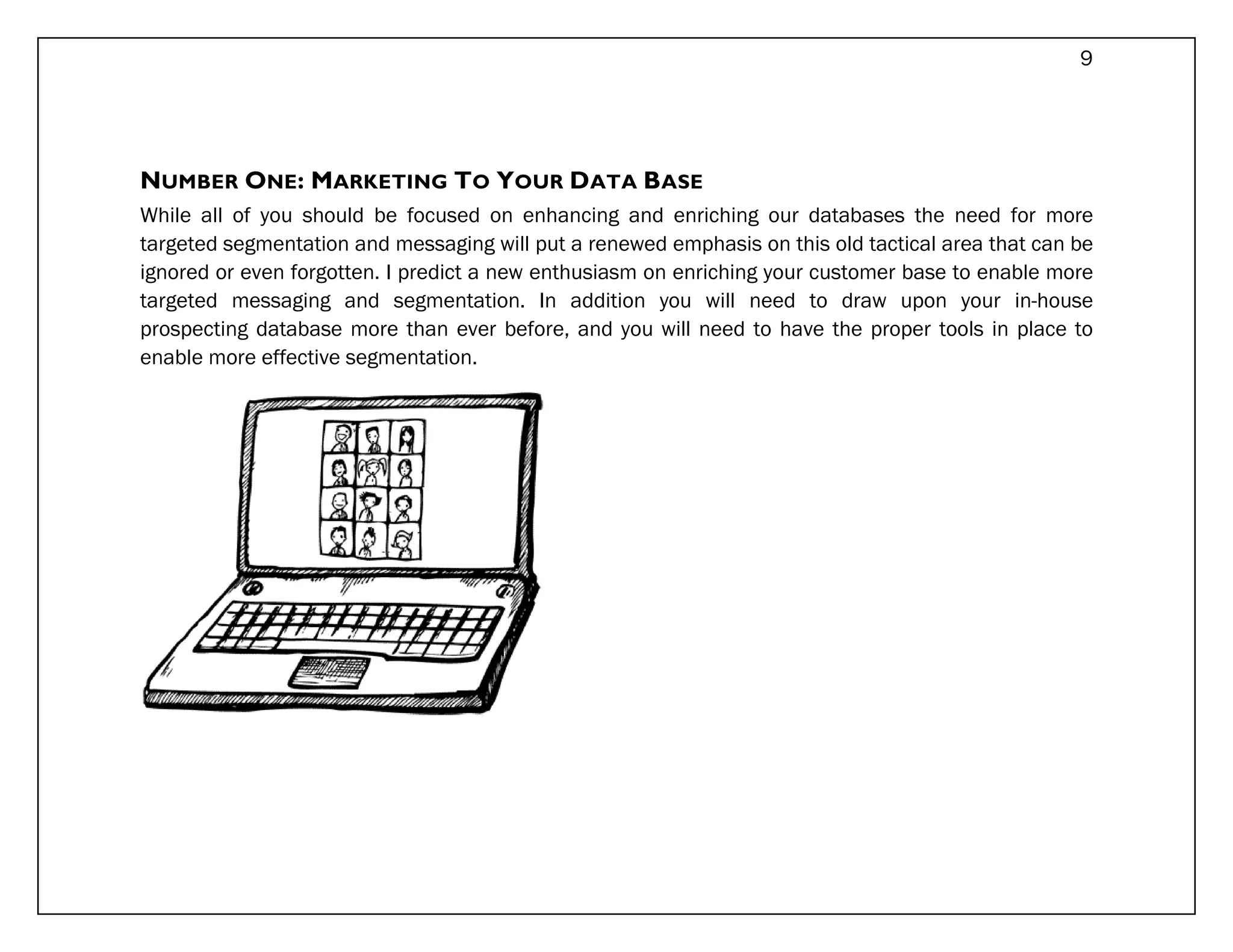
While all of you should be focused on enhancing and enriching our databases the need for more
targeted segmentation and messaging will put a renewed emphasis on this old tactical area that can be
ignored or even forgotten. I predict a new enthusiasm on enriching your customer base to enable more
targeted messaging and segmentation. In addition you will need to draw upon your in-house
prospecting database more than ever before, and you will need to have the proper tools in place to
enable more effective segmentation.
10


NUMBER TWO: VIRTUAL EVENTS
You have all been experimenting with virtual events, and most of us have made the ever ready webinar
a standard part of our marketing repertoire. What I’m talking about is going one step further and really
committing to virtual events where you actually represent a virtual event environment that will integrate
a variety of rich media formats. I recently read where physical event attendance will be down by 60-70%
this year and just look at the number of companies already canceling user conferences. The technology,
bandwidth, and conditioning of the prospect experience have all come to a point where virtual events
could be the preferred format going forward.
11


NUMBER THREE: SOCIAL MEDIA IN PHYSICAL SECURITY B2B MARKETING:
The use of social media will become a more prevalent part of most B2B marketing strategies. It has to
be. The value of creating a two-way communication channel between you and your customers is too
great to ignore any longer. You want an ROI for social media? Here’s one. It’s free, it syndicates your
content, it makes you more searchable, it helps you to learn more about your customer, it helps your
prospects learn more about you and so on. If I read one more twitter post about how you’re trying to
figure out a strategy and an ROI on social media I’m going to shoot myself. Just Do It.

Our reason for launching www.PHYSECTECH.org is all about making this work. Our 1.0 version of this
solution is up and running and our 2.0 version is underdevelopment for release later on 2009. We are
integrating our site into other social Media sites, so they can all work as one.

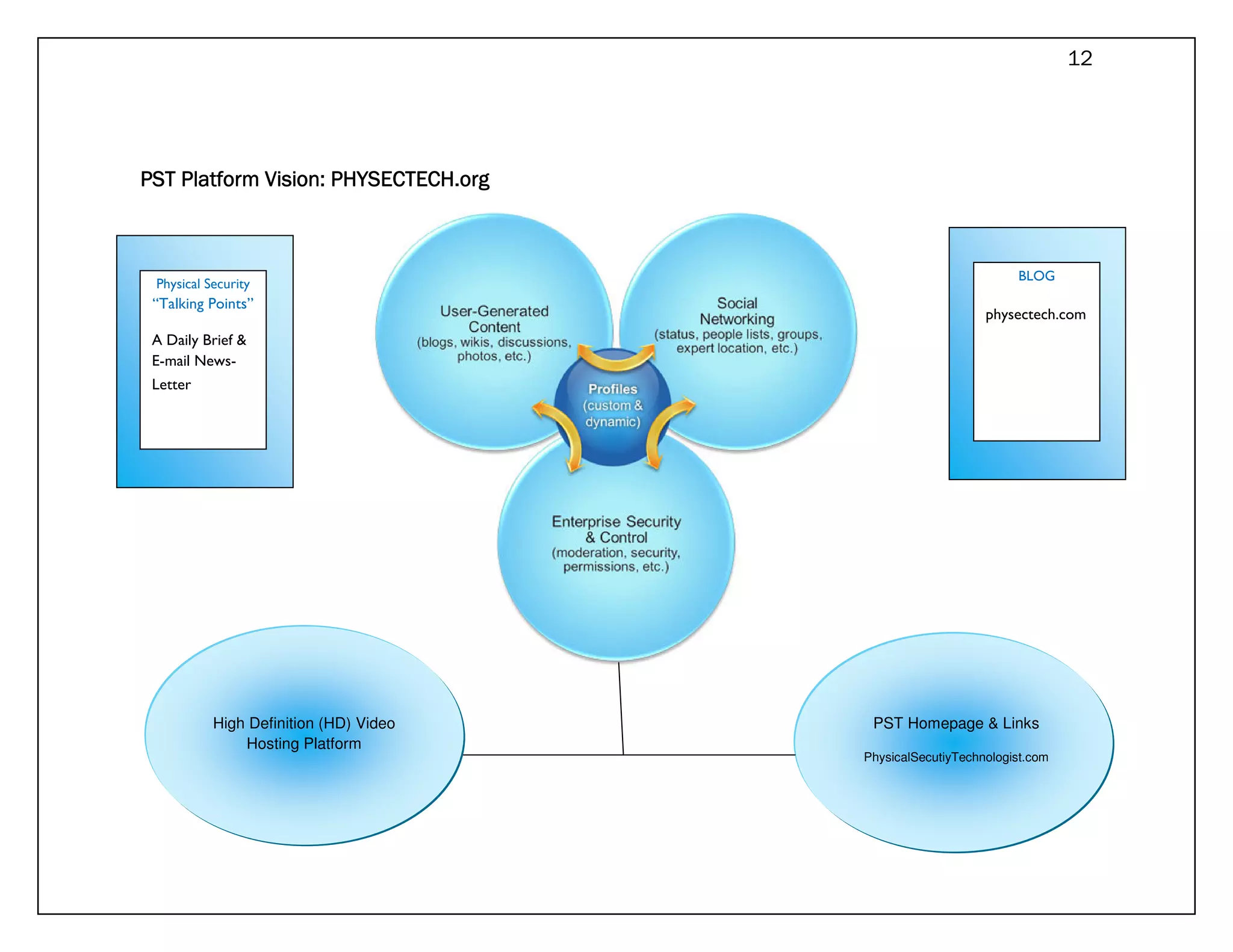
We will enable Social Media Marketing by building on-line Neighborhood Sub-Communities that
combine four key areas of capability:

   • User-generated content (blogs, wikis, discussions, photos, videos, voting, etc.)
   • Social networking (friend lists, user-created groups, status, presence, etc.)
   • Profiles. Members maintain their own profiles, which are customized for the different needs of
     each community, and they can change dynamically over time.
   • Enterprise security and control. Ensure each user has the right permissions, the content meets
     your standards, the community integrates with your systems, etc.
12


PST Platform Vision: PHYSECTECH.org


                                                                 BLOG
 Physical Security
 “Talking Points”
                                                            physectech.com
 A Daily Brief &
 E-mail News-
 Letter


           High Definition (HD) Video    PST Homepage & Links
               Hosting Platform
                                        PhysicalSecutiyTechnologist.com
13


User-
User-Generated Content - PST communities allow members to contribute content and participate using
the full range of Web 2.0 features. This provides community members with a rich participation
experience that meets their needs:

  • Blogs—each member can have their own blog, and blog entries can be aggregated into collective
    views (e.g., most recent posts, most active contributors, highest rated posts, etc.)
  • Discussions—create threaded discussion forums where members reply to posts from other
    members
  • Wikis—a post from one member can be edited by another member, maintaining version and
    author history
  • Videos—upload and share videos
  • Photos—upload photos, embed images in posts, create photo albums
  • Calendars—mark events and posts on a personal or group calendar
  • Tagging—members can "tag" content to allow other members to find that content via "tag clouds."
  • Mapping—apply "geo tags" to display content or member location on a map
  • RSS feeds—use RSS to incorporate content from external sources, or create RSS feeds to
    syndicate content to other sources and users
  • Podcasts—upload and syndicate podcasts
  • Bookmarks—mark and share URLS with other members
  • Voting &Rating—vote on content and aggregate the results
  • Status-members can update the community and their friends on what they are doing
14


   • An activity feed is generated to share the content that users create with the members of the
     community.

Social Networking – PST communities contain social networking facilities that allow:

   •   Members to maintain their own profiles
   •   Administrators to change profile definitions
   •   Members to find other members (expert location)
   •   Members to participate with other members in groups
   •   Members to create people lists and track who they are interested in
   •   Members to update status messages, i.e. what are you doing right now?
   •   Members to manage their profile privacy and who can view them
   •   Administrators to allow for people to see who is online via presence
   •   Members to create their own groups and invite others to join
   •   Administrators to create focused neighborhoods within their community

Profiles - Members maintain their own profiles in a PST community. PST profiles are both custom and
dynamic.

   • Custom -The definition of a profile is customized to meet the specific needs of each community.
     For example: A community for employees might contain profile attributes such as name, title, key
     responsibilities, work background, manager's name, etc.
15


  • Dynamic - Community administrators can add profile attributes over time as the needs of the
    community change. They can also decide if the new attributes are required or optional. Members
    also have the option of deciding if their profile attributes are public or private. For example, you
    may want to ask members for their birth date or location, but some members might not want that
    information displayed.

Enterprise Security & Control - It's crucial to ensure that the content for your community is properly
organized, protected, and meets your standards for quality. PST addresses these needs through
Enterprise Security and Control that spans two major areas:

  • Community administrators - PST will provide community administrators with the tools they need
    to:
        o Organize content. Create an unlimited number of categories to any level of depth, pull in
          RSS feeds, create link lists, etc.
        o Manage users. Segment users into different groups and assign them appropriate status
          (trusted, untrusted, suspended, etc.)
        o Assign permissions. Manage the relationship between users and content: which users can
          post to which category? Who can read what? Who can edit certain wikis? Who can
          comment on what content?
        o Moderate content. Content moderation can be manual (i.e., explicitly approved by a
          moderator) and automated (based on rules that are applies to every bit of content,
          including user submissions and RSS feeds).
16


     o Understand community activity. Reports and metrics provide insight into community
        participation.
• Enterprise IT - PST communities are built specifically for enterprises and incorporate key features:
     o Multiple authentication methods. Combine integration with single sign-on systems, and
        identity management systems with password authentication to control who has access to
        your community and what they can do.
               PST communities can authenticate users in multiple ways, including integrating with
               your single sign on system or identity management system(s), passwords, etc. In
               communities that mix employees with customers, prospects or partners, employees
               can be authenticated via integration with SSO or identity management systems while
               customers, prospects or partners can be authenticated via user name and password.
     o Integration with enterprise search. If you use an enterprise search system, PST can
        integrate with it to provide expanded search capabilities in your community.
     o Data migration. Need to move some existing content or user profiles into your new PST
        community? No problem. We have a variety of ways to do it.
     o Backup/recovery. The PST on-demand platform ensures your data is well managed and
        available.
     o Secure reliable operation. The PST on-demand platform data center is SaaS Type II certified
        and optimized for Web 2.0 traffic patterns.
17


NUMBER FOUR: CONTENT MARKETING IS THE DIFFERENTIATING FACTOR:
At the end of the day when I get asked, "what’s really changed about marketing,” the one thing I say is
that in the 21st century marketing is really about content publishing. You must create content that our
prospects perceive as valuable across each stage of their buying cycle. You need to syndicate that
content to support thought leadership, brand awareness, and inquiry generation; you must always
update the content to keep our Search engine optimization (SEO) high, etc. At the end of the day it’s
about content. Have your meetings become more about topics than about events, and advertising? If
you’re not producing relevant ‘value added’ content for your ecosystem that is searchable and
syndicated across social networks you might as well close up shop today. If you’re not sure about this
and if it works, all I can say is “You’re reading content marketing now!”
                                                          marketing

I am not the expert on this area by any means, however, I have been using a few books to develop our
road map, they are:

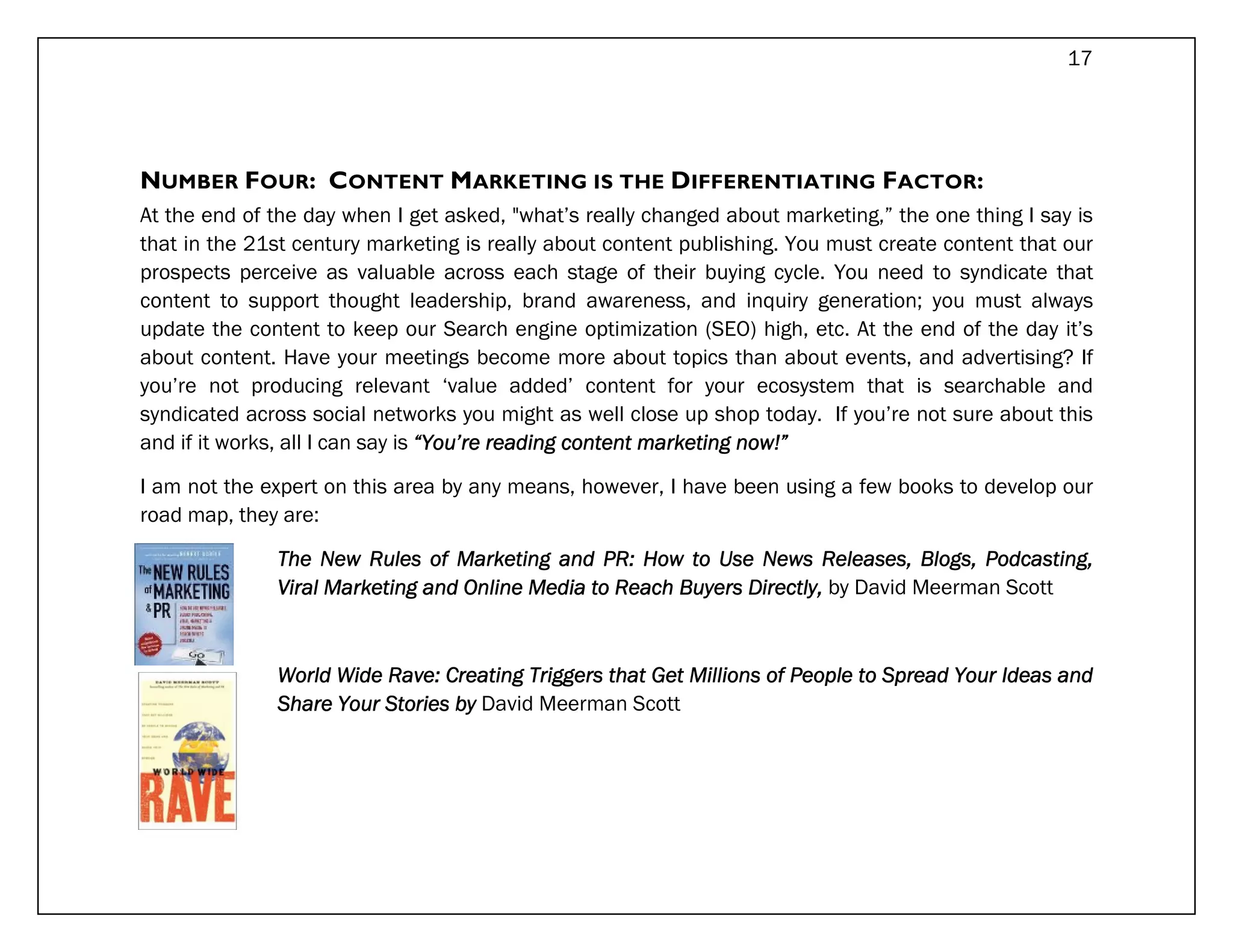
              The New Rules of Marketing and PR: How to Use News Releases, Blogs, Podcasting,
              Viral Marketing and Online Media to Reach Buyers Directly, by David Meerman Scott
                                                        Buyers


              World Wide Rave: Creating Triggers that Get Millions of People to Spread Your Ideas and
              Share Your Stories by David Meerman Scott
18


NUMBER FIVE: MARKETING AUTOMATION:
As the pressure to drive operational efficiencies grows for marketers you will be required to look more
                                                   and more at marketing automation technologies
                                                   above and beyond just core CRM. I’m referring to
                                                   those systems that can define and automate
                                                   nurturing workflows, implicitly and explicitly score
                                                   leads, and integrate marketing analytics for a better
                                                   view of our ROI and conversion rates. The reality is
                                                   that most companies today that use these systems
                                                   are really just using the email automation
                                                   capabilities of these advanced platforms. Most are
                                                   not utilizing the powerful segmentation platforms
                                                   that these systems provide. In addition most B2B
                                                   marketing departments will quickly find that their
                                                   current level of skill sets will have a hard time
                                                   leveraging these systems as it’s more about
                                                   workflow versus pretty graphics. The hard reality will
                                                   be that you really need a segmentation stagey that is
                                                   relevant and supported by your data to really extract
value from these systems. However I expect these systems to gain momentum in 2009 and by the end
of 2010 they will be fairly common and required to be competitive. I believe that more affordable and
19


flexible licensing models will need to be explored by the automation vendors. The challenge with Sales
2.0 technology is to use it as a catalyst for changing a company's business processes.


NUMBER SIX: NO INQUIRY LEFT BEHIND:
In 2009 the marketing mantra becomes “No inquiry left behind”. You must all do a better job at
managing inquires/leads and scoring them before passing to sales. This process becomes ever more
important in a recessionary environment where conversion rates, inquiries, and leads accepted by sales
all have to optimized continuously to get the performance you need especially with reduced budgets.
We are building many response tools into our platforms to service the community. I want a response on
my sites to be immediate. For Example: If an end-user is watching an interactive video on a new IP
camera and he has seen enough, when he clicks the box on the video to request more information, I
want the information sent then, automatically. We know who the prospect is, we know where the
prospect is and we know how to reach the prospect. When the prospect clicks the box, the prospect
gives us permission to forward their information to you and your information to them, immediately. This
can all be done with a Salesforce.com type application.
20


NUMBER SIX: DEATH OF PRINT ADVERTISING
Are you tired of the media produced research saying that you really need to optimize both print and
online for effective brand awareness? In 2009 with ever less B2B print mediums to go around you will
all realize that it’s really about optimizing our content across the buying cycle and driving people back to
our website where you will embody our brand experience to build relationships and demand conversion.
In short I see most of our awareness mix shifting entirely to online media channels, social media, and
context based search engine optimization (SEO). Besides how many more books are going to stop
publishing and become blogs anyway?


NUMBER SEVEN: SALES OPTIMIZATION:
The best marketing in the world doesn’t matter if your sales force can’t convert. I would expect that
more focus is applied to looking at the sales cycle side by side with the buying cycle and asking the
question: What is my standardized sales content offering? Sales will need marketing more than ever in
2009 in order to provide relevant selling content and to optimize the sales cycle.

I was initially trained as a sales counselor, in 1982 by Larry Wilson, over a two week period with annual
refresher training every year. Most of the “sales people” I have met in the physical security industry are
order takers not problem solvers. This must change. Companies with the most effective sales forces
use technology to manage the process of communicating best practices throughout the sales
21


organization.    The key to both communicating with customers and with the rest of the sales
organization is having a process and methodology for understanding what works during actual sales
situations. The key to using sales technology effectively is to get your marketing and sales organizations
aligned so that customers are empowered to promote your firm and its offerings. We are using
Salesforce.com which uses a sophisticated suite of tools in order to manage its internal and external
communications. This empowers our sales management through real-time analytics and dashboards so
that they now know exactly when the reps are following up on things that are appropriate, The “Holy
Grail” of business is profitable growth. More specifically, however, businesses are striving for
sustainable profitable growth.

My experiences have taught me there are three primary drivers that have the greatest impact on
sustainable growth: 1) Customers, 2) Culture, and, 3) Leadership. The most important work a
leadership team does is to positively influence these drivers in order to achieve or enhance sustainable
growth. Customer loyalty is the single, greatest influence of sustainable growth. Leaders focus not only
on how to gain more customers, but, more importantly, how to move customers from merely satisfied to
satisfied and loyal. The goal is to receive continuous feedback from the customer regarding loyalty
factors and then enroll the employees in finding new opportunities to add value to these factors.
Organizational Culture can be a leader’s worst nightmare or best asset. Why? The function of a leader
is to bring about change, whereas the function of a culture is to keep things the way they are.
22


The challenge for the leader is to understand this dichotomy and help shape the culture into one of
commitment rather than mere compliance. The goal is to create new and powerful cultural norms     s
(beliefs and behaviors) that support the current and future business strategies.

Leaders have two major responsibilities:

• To create the strategy—where we are going and how we are going to get there, and,

• To enroll the people in wanting to get there with all their commitment, passion, cooperation, and
  creativity.

Leaders need to be adept at facilitating those organizational changes that result in: 1) reducing costs,
2) increasing top line revenue, and/or 3) creating greater differentiation and unique value to the
customer’s buying experience. This is another whole book, so don’t get me started. My point is the
learning ‘Counselor Selling’ and ‘Social Style Sales Strategies’ in 1982 taught me that you can have the
greatest product but if it not presented to the client in a way that they understand, that builds their
trust, they will not work with you to help drive your solution within their organization. This is what I call
selling.
23


NUMBER NINE: INSTALLED BASE MARKETING:
A tough economy will put increased emphasis on marketing into the installed base customer set and
driving cross-sell up sell. In fact if times get really tough the companies that best leverage their installed
base for business will survive and thrive. In tough times people buy from whom they know and trust and
businesses aren’t any different. If you’re selling tech you’re in for a long haul in growing new business in
2009. Leverage your installed base you’ll see new business.

I need to add a little story here. Over the last two years I have been only working with Fortune 100 and
Fortune 500 clients. I was consulting for a privately held ‘Network Services’ company who deployed
solutions to 60 of the Fortune 100. My goal was to diversify my client into the ‘Physical Security
Technology’ market within their client list that most OEMs and Integrators would be pleased to have
one of these names as a reference. I had been working for months to get my clients account
executives to allow me to meet one of their clients but with very little success. Finally one of their long-
term representatives called me and told me about an account, a Fortune 100 account. My client was
primarily deploying their phone system and we set up a meeting to discuss other opportunities. The
main meeting went well but with no commitment. We went to dinner with some of the vendor
representatives and a couple of managers of the company. After dinner our AE received a call from a
VP of the company who was on site of one of the active jobs nearby and he had some concerns. The AE
and one of our project managers went to the site at 11:00pm and listened to all of the concerns as we
toured the facility. The VP and I spoke about the concerns and talked about how things could be
different down the road. We did our best to build trust that night. I got back to my hotel at 3:00am. I
24


was at the airport at 7:00am and home at noon, still not sure how I did. Well two weeks later my client
began to receive POs to single source all low power installation work throughout the chain. For
Example: We replaced 6 other low power contractors on each re-model job. We not only picked up the
security work, but we installed the intercom, emergency lighting, music system, point of sale (POS)
system, etc. Labor alone for 2009 is somewhere in the $35,000,000 – $50,000,000 dollar range, for
those of you keeping score. I believe all because we responded, we listened, and we performed for our
client.

NUMBER TEN: GREEN IS IN
I was at a meeting in the fall of 2007 discussing the security convergence and greening of data centers
within the Fortune 500. You may say that this was a trend back in 2008 but I really see it continuing
with gusto as marketers realize that there are hard value propositions with going green. Every product
management team should investigate if they can do things within their existing technology set that can
drive better power consumption, or reduced waste. This can be a big winner in a tough economy, and
besides everybody feels good about it.
25


YOUR CHALLENGE
Now is a critical time for B2B marketing executives to understand and evaluate where Web 2.0
initiatives fit into their marketplaces, brands, budgets, organizational structures and skillets. As an
array of websites and brands have risen around Web 2.0 technology – MySpace, Facebook, LinkedIn,
Twitter and countless others – consumers and even business customers are acclimated to and expect
a higher level of engagement from companies of all types, including B2B media companies. While
consumers place significantly higher trust in editorial reviews from established media versus
unaffiliated blogs, heavy print publication readers tend to be heavy blog readers as well. In addition,
B2B marketers are actively testing the opportunity to engage with their business customers through
Web 2.0 sites, spending an estimated $40 million advertising on social networking sites in 2008,
estimated to increase to at least $210 million by 2012. When properly implemented, Web 2.0 tactics
and technologies offer varied and valuable benefits for physical security companies.

If you are going to spend the time doing it, do it right! Remember, nobody cares about your products
except you. Be sincere: Sincerity is a critical element; if you aren’t able to be sincere, then social media
is probably not the best medium for you. Being sincere in your social communications will increase your
credibility, and if you appear to be simply going through the motions, people are unlikely to waste their
attention on your messages. Sincerity goes a long way toward believability and credibility.
26


Focus on the individuals: Participation in online communities and social media should be focused on
the individuals, not the corporate entity. For example, it is OK to have group blogs for a company as
long as posts are tied to individuals (real people), but you wouldn’t want to have a blog where every
post is authored by “company name” or “admin”. People work at companies, but the real connections
and networks happen between individuals. Not all about you: Social media is a conversation, which is
by definition two-way. In other words, it isn’t all about you, your company, your products or your agenda.
Participation involves listening and participating in the broader community of people. Don’t just expect
people to help you; jump in and help other people in areas where you have some expertise. If all you do
is pimp your products without adding to the broader conversation, people will lose interest in you pretty
quickly. Be a part of the community: Just talking at people isn’t going to cut it in this new social world
where the community is critical. You should be a part of the broader community of people with similar
interests both online and offline by participating in, but not trying to control the community. Everyone’s
a peer: The days of expert speakers who talk at us while we passively absorb the information with little
or no opportunity for discussion are gradually disappearing. We each come into a discussion with
unique and diverse ideas, and we learn by listening and sharing ideas with our peers, aka everyone.

Good luck on your journey, Shakespeare said: “We know what we are, but know not what we may be.”
Do not be afraid of this change, embrace the possibilities and enjoy your day.
27


GLOSSARY OF WEB 2.0 TERMS
Blog: A user-generated website where entries are made in journal style and displayed in reverse
chronological order. A typical blog combines text, images, and links to other blogs, web pages, and
other media related to its topics. The ability for readers to leave comments in an interactive format is an
important part of many blogs.

Delicious: Delicious – www.delicious.com – is a social bookmarking service that allows users to tag,
save, manage and share web pages from a centralized source. With emphasis on the power of the
community, Delicious greatly improves how people discover, remember and share on the Internet.

Digg: Digg – www.digg.com – is a place for people to discover and share content from anywhere on the
web. From the biggest online destinations to the most obscure blog, Digg surfaces the best stuff as
voted on by users. Digg provides a place where people can collectively determine the value of content
and changes the way people consume information online, according to the Digg website.

Facebook: Celebrating five years in 2009, Facebook – www.facebook.com – is a social networking site
that allows people the power to share and makes the world more open and connected. Millions of
people use Facebook everyday to keep up with friends, upload an unlimited number of photos, share
links and videos and learn more about the people they meet.

Flickr: Flickr – www.flickr.com – is an image and video hosting website, web services suite and online
community platform. In addition to being a popular Web site for users to share personal photographs,
the service is widely used by bloggers as a photo repository. According to the Flickr website, Flickr has
28


two main goals: 1) help people make their content available to the people who matter to them, and 2)
enable new ways of organizing photos and video.

Forums/Discussion Boards: An Internet forum, or message board, is an online discussion site. It is the
modern equivalent of a traditional bulletin board. People participating in an Internet forum can build
bonds with each other and interest groups form around a discussion topics or sections in the forum.

Friend Feed: Friend Feed – www.friendfeed.com – is a service for users to keep up-to-date on the web
pages, photos, videos and music that their friends and family are sharing. In other words, it lets users
tap into their existing social networks as a tool for discovering interesting information. Users get a
customized feed made up of the content that their friends shared – from news articles to family photos
to interesting links and videos.

Go2Web20.net: This site – Go2Web20.net – is a directory of more than 2,800 Web 2.0 applications
and services.

Google Knol Google’s Knol project – http://knol.google.com – is a site that hosts many knols (units of
knowledge) written about various subjects. The authors of the knols can take credit for their writing,
provide credentials, and elicit reviews and comments. Users can provide feedback, comments, and
related information. So the Knol project is a platform for sharing information, with multiple cues that
help you evaluate the quality and veracity of information.
29


LinkedIn: LinkedIn – www.linkedin.com – is an interconnected network of experienced professionals
from around the world, representing 170 industries and 200 countries. You can find, get introduced to,
and collaborate with qualified professionals that you need to work with to accomplish your goals.

Mashup: A mash up is a Web application that combines data from more than one source into a single
integrated tool, thereby creating a new and distinct web service that was not originally provided by
either source. An example is Digg.com, which is a mash up of various news websites controlled almost
entirely by the users of the website.

Microblogging: Microblogging is a form of multimedia blogging that allows users to send brief text
updates (for example, 140 characters or fewer) or micromedia such as photos or audio clips and
publish them, either to be viewed by anyone or by a restricted group chosen by the user. The messages
can be submitted by a variety of means, including text messaging, instant messaging, email, digital
audio or the web.

MySpace: MySpace – www.myspace.com – is a popular social networking website with an interactive,
user-submitted network of friends, personal profiles, blogs, groups, photos, music, and videos for
teenagers and adults internationally.

PhysicalSecurityTechnologist.com - www.physicalsecuritytechnologist.com is a fully customizable,
widget driven homepage designed for Security Directors, Executives and Professionals to get their news
and find solutions on a daily basis.
30


PHYSECTECH.ORG – www.physectech.org is web 2.0 community with a focus on the physical security
industry. Their Mission is to increase the effectiveness of our member security professionals,
executives, end-users and their enterprises.

Podcast: A podcast is a series of audio or video digital files which is distributed over the Internet by
syndicated download, through Web feeds, to portable media players and personal computers. Though
the same content may also be made available by direct download or streaming, a podcast is
distinguished from most other digital media formats by its ability to be syndicated, subscribed to, and
downloaded automatically when new content is added.

Reddit: Reddit – www.reddit.com – is a social news website on which users can post links to content
on the web. Other users may then vote the posted links down or up, causing them to appear more or
less prominently on the Reddit home page.

RSS: RSS or Really Simple Syndication is a family of Web feed formats used to publish frequently
updated works—such as blog entries, news headlines, audio, and video—in a standardized format. Web
feeds benefit publishers by letting them syndicate content automatically; they benefit readers who want
to subscribe to timely updates from favored websites or to aggregate feeds from many sites into one
place.

Second Life: Second Life – www.secondlife.com – is an online, 3D virtual world developed by Linden
Lab that launched in 2003 and is accessible via the Internet. A free client program called the Second
Life Viewer enables its users, called Residents, to interact with each other through avatars. Residents
31


can explore, meet other residents, socialize, participate in individual and group activities, and create
and trade virtual property and services with one another, or travel throughout the world, which
residents refer to as the grid.

Social Bookmarking: Social bookmarking is a method for Internet users to store, organize, search, and
manage bookmarks of web pages on the Internet with the help of metadata. Simply put, users can
bookmark any article or web page they want and share that bookmark virally with other users. There are
a variety of highly-trafficked sites that offer social bookmarking: Digg, Yahoo! Buzz, Reddit, Delicious,
Technorati, StumbleUpon, Kaboodle, and many others.


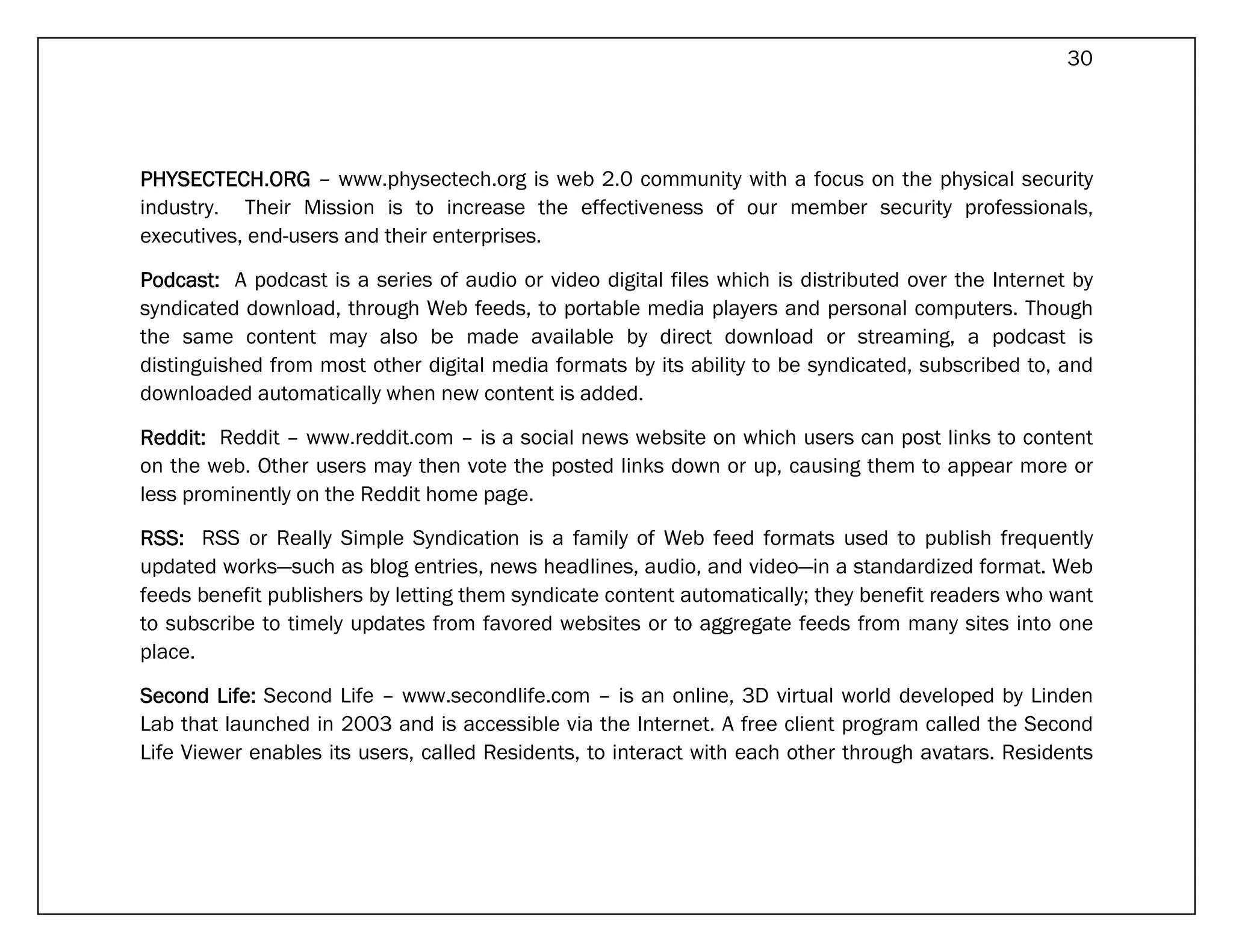
CONTACT INFORMATION

James McDonald, CEO                                    Websites: www.massbiz.com &
MassBiz, LLC                                           www.PhysicalSecurityTechnologist.com
109 Bay Path Road                                      Community: www.PHYSECTECH.org
East Brookfield, MA 01515                              Blog:
                                                       Blog www.physectech.com
Phone/Fax: (877) 214-2900                              Email: jamie.mcdonald@massbiz.com

Physical Security Technology Marleting Trends 2009

  • 1.
    TOP TEN B2B PHYSICAL SECURITY TECHNOLOGY MARKETING TRENDS: 2009 Targets Are You Missing Your Targets? BY JAMES MCDONALD Physical Security Consultant, CEO of MassBiz, LLC, www.PhysicalSecurityTechnologist.com, www.PHYSECTECH.org
  • 2.
    2 © 2009 byJames McDonald Copyright holder is licensing this under the Creative Commons License, Attribution 3.0 http://creativecommons.org/licenses/by/3.0/us/ PLEASE FEEL FREE TO POST THIS ON YOUR BLOG OR EMAIL IT TO WHOMEVER YOU BELIEVE WOULD BENEFIT FROM READING IT. THANK YOU.
  • 3.
    3 TABLE OF CONTENTS Introduction ................................................................................................................................................................................................................... 4 Number One: Marketing To Your Data Base .............................................................................................................................................................. 9 Number Two: Virtual Events...................................................................................................................................................................................... 10 Number Three: Social Media in Physical Security B2B Marketing: ...................................................................................................................... 11 Number Four: Content Marketing is the Differentiating Factor: ........................................................................................................................... 17 Number Five: Marketing Automation: ..................................................................................................................................................................... 18 Number Six: No Inquiry Left Behind:........................................................................................................................................................................ 19 Number Six: Death of Print Advertising ................................................................................................................................................................... 20 Number Seven: Sales Optimization: ........................................................................................................................................................................ 20 Number Nine: Installed Base Marketing: ................................................................................................................................................................ 23 Number Ten: Green Is In ........................................................................................................................................................................................... 24 Your Challenge ........................................................................................................................................................................................................... 25 Glossary of Web 2.0 Terms ....................................................................................................................................................................................... 27 Contact Information ................................................................................................................................................................................................... 31
  • 4.
    4 INTRODUCTION Thank you foryour interest in this e-book. In it, I describe how I see the changes in the marketing world and how power is shifting from traditional marketing to worldwide social and network marketing in the business to business sales world. I hope you can benefit from some of these ideas. As we move forward we are quickly learning from the new “Pro’s” of social media marketing and applying their techniques to B2B marketing in my industry, physical security technologies. Please feel free to pass this book around and challenge these ideas. I never want come across having all the answers; I am looking at a problem and the new opportunities that present themselves in this ever changing economy. I’m glad the last half of 2008 is over and we are moving forward in 2009. Last year for me was a wakeup call to “The party’s over” and I’m sure you have all dusted off our “Recession Marketing” Manuals. If you don’t have one and you sell physical security technologies, we at PST have an idea for you! If you’re like me you are facing the stark reality of doing more with less in 2009. Keeping that in mind, I would share my ideas for the Top Ten “Physical Security Technology” Business to Business (B2B) Marketing Trends for 2009. Some of these are ideas I am sure you are aware of and others are ones that we have been working on since the 4th quarter of last year as we saw ‘change’ become a way of life. Traditional Marketing has typically two major forms: • Direct Marketing This type of marketing focuses on directly generating leads and revenue: Marketing: tradeshows, websites, seminars/webinars, email, direct mail, etc.
  • 5.
    5 • Brand Marketing This type of marketing is "softer" and seeks to create an image or Marketing: reputation for the company in the mind of the customer: advertising, public relations, "parties", analyst relations, sponsorships, logos, tag lines, etc. A few common attributes of both of these types of marketing are: They are one-way, push-driven. These activities are from the company to the prospect. The prospect does not ask for them. They are brand-generated. The content comes entirely from the brand to the customer. B2B marketing typically consists of a combination of one-to-many broadcasting–via trade advertising, PR placements, etc.– followed by a sales process that may or may not be enabled by the marketing department. This perspective has been translated to the web, where one-to-many broadcasting persists as the norm. Companies attempt to amass followers, fans and opt-ins to create meaningful audience sizes for marketing impact. Social Media Marketing is defined by a new set of characteristics: • It's a multi-way dialog Brands talk to customers, customers talk to brands and most multi- dialog. importantly - customers talk to each other. • It's participatory. Social media marketing depends on user participation - that's what participatory. makes it social. • It's user-generated. Most of the content and connections in an online community are user- created by the users - not by the brand. Sure, there will be content and conversations that are brand-generated, but they will be the minority.
  • 6.
    6 Social Media Marketing (Customer Engagement) Brand Direct Marketing Marketing (Image and Reputation) (Lead Generation) With the socialization of media, the traditional outlook toward interactive marketing loses its impact. A new era of inclusive communications is here. While web users are generally accepting of brands interacting with them online, they are not willing to be obviously “marketed to” in social spaces. Two guidelines should be considered for any brand hoping to effectively navigate the social web: Align with existing activities of your core audience. Today, almost any company’s most profitable customers are likely working online; they are getting things done, networking, and completing tasks that are core to their job function via the internet. We recommend that B2B brands consistently offer to help their customers do those core activities better. This will result in the development of an extraordinarily valued asset in the networked economy: vocal, connected “fans” of an organization. Recognize the principle of Equal Online Influence: all web users are equal. While financial resources
  • 7.
    7 may differ, andestablished brand names carry their equity to the online space, three smart people in a garage are still able to create more compelling online experiences than large corporations. With this understanding, the imperative to help, share and enable becomes ever more important. However, we do think that to best help the physical security industry better communicate their needs and solutions to the end-users. To capture solid metrics and provide measurable ROI, we think 2009 is the year that interactive online video comes into its own. Video has traditionally been considered a one-way medium whereby people sit back, watch and let the marketers tell their story in a 60 second commercial. However, the online video opportunity is to change that behavior, to get people to engage, interact, respond and begin the sales process to create their own stories in only seconds of engagement. By clicking the links on the left you can learn more about the details of our services and platforms that will help you better communicate your story. It does not matter if you're selling a solution or describing a need, the platform is for everyone. Our focus is to integrate interactive, professionally produced video, on our platform and interface it within the social media platform to create a 24/7/365, quasi, virtual ‘Trade Show’. This will allow conversations to happen within peer groups and when a recommendation is made or a RFI/RFP is generated, suppliers can quickly prove their ability to solve the problem in a virtual world. Video can now offer the same type of interaction we all have experienced live in the past. The CEO of each company will tell the company story (Elevator Pitch), all in less than 3 minutes. The VP of Sales will provide a quick product demonstration. Perhaps the CTO answers frequently asked questions (FAQ) in an easy to navigate, searchable video format. “Case Studies” by other end-users from each vertical market that the company is perusing will be presented using online video. Note: Here is the important part, on our 2.0 and 3.0 versions of our community; our advertising partners will
  • 8.
    8 be able tobuild their own communities that can be used not only for marketing but for internal communications, dealer/supplier communications, training, service communications and finally end- user communications and education after the sale. Are you excited yet? I am. Are you nervous? We have a lot to do to create the new content needed in this new ‘On-Demand’ world, but we can do it if we keep making the end-user and their problems the focus of these technology solutions. Who did I write this e-book for, you may ask? I am writing to senior executives and managers who are responsible for an organizations marketing. It is March, 2009 and I am watching the marketing pendulum swing away from traditional agency marketing to the new viral/social media platforms. According to the New York Times, newspapers across the country are going from downsizing to a slow death spiral. “In 2009 and 2010, all the two-newspaper markets will become one-newspaper markets, and you will start to see one-newspaper markets become no-newspaper markets,” said Mike Simonton, a senior director at Fitch Ratings, who analyzes the industry. As Bob Dylan said in 1963 “Come gather 'round people, wherever you roam, And admit that the waters, around you have grown, and accept it that soon, you'll be drenched to the bone. If your time to you, is worth savin', then you better start swimmin', or you'll sink like a stone, for the times they are a- changing'.”
  • 9.
    9 NUMBER ONE: MARKETINGTO YOUR DATA BASE While all of you should be focused on enhancing and enriching our databases the need for more targeted segmentation and messaging will put a renewed emphasis on this old tactical area that can be ignored or even forgotten. I predict a new enthusiasm on enriching your customer base to enable more targeted messaging and segmentation. In addition you will need to draw upon your in-house prospecting database more than ever before, and you will need to have the proper tools in place to enable more effective segmentation.
  • 10.
    10 NUMBER TWO: VIRTUALEVENTS You have all been experimenting with virtual events, and most of us have made the ever ready webinar a standard part of our marketing repertoire. What I’m talking about is going one step further and really committing to virtual events where you actually represent a virtual event environment that will integrate a variety of rich media formats. I recently read where physical event attendance will be down by 60-70% this year and just look at the number of companies already canceling user conferences. The technology, bandwidth, and conditioning of the prospect experience have all come to a point where virtual events could be the preferred format going forward.
  • 11.
    11 NUMBER THREE: SOCIALMEDIA IN PHYSICAL SECURITY B2B MARKETING: The use of social media will become a more prevalent part of most B2B marketing strategies. It has to be. The value of creating a two-way communication channel between you and your customers is too great to ignore any longer. You want an ROI for social media? Here’s one. It’s free, it syndicates your content, it makes you more searchable, it helps you to learn more about your customer, it helps your prospects learn more about you and so on. If I read one more twitter post about how you’re trying to figure out a strategy and an ROI on social media I’m going to shoot myself. Just Do It. Our reason for launching www.PHYSECTECH.org is all about making this work. Our 1.0 version of this solution is up and running and our 2.0 version is underdevelopment for release later on 2009. We are integrating our site into other social Media sites, so they can all work as one. We will enable Social Media Marketing by building on-line Neighborhood Sub-Communities that combine four key areas of capability: • User-generated content (blogs, wikis, discussions, photos, videos, voting, etc.) • Social networking (friend lists, user-created groups, status, presence, etc.) • Profiles. Members maintain their own profiles, which are customized for the different needs of each community, and they can change dynamically over time. • Enterprise security and control. Ensure each user has the right permissions, the content meets your standards, the community integrates with your systems, etc.
  • 12.
    12 PST Platform Vision:PHYSECTECH.org BLOG Physical Security “Talking Points” physectech.com A Daily Brief & E-mail News- Letter High Definition (HD) Video PST Homepage & Links Hosting Platform PhysicalSecutiyTechnologist.com
  • 13.
    13 User- User-Generated Content -PST communities allow members to contribute content and participate using the full range of Web 2.0 features. This provides community members with a rich participation experience that meets their needs: • Blogs—each member can have their own blog, and blog entries can be aggregated into collective views (e.g., most recent posts, most active contributors, highest rated posts, etc.) • Discussions—create threaded discussion forums where members reply to posts from other members • Wikis—a post from one member can be edited by another member, maintaining version and author history • Videos—upload and share videos • Photos—upload photos, embed images in posts, create photo albums • Calendars—mark events and posts on a personal or group calendar • Tagging—members can "tag" content to allow other members to find that content via "tag clouds." • Mapping—apply "geo tags" to display content or member location on a map • RSS feeds—use RSS to incorporate content from external sources, or create RSS feeds to syndicate content to other sources and users • Podcasts—upload and syndicate podcasts • Bookmarks—mark and share URLS with other members • Voting &Rating—vote on content and aggregate the results • Status-members can update the community and their friends on what they are doing
  • 14.
    14 • An activity feed is generated to share the content that users create with the members of the community. Social Networking – PST communities contain social networking facilities that allow: • Members to maintain their own profiles • Administrators to change profile definitions • Members to find other members (expert location) • Members to participate with other members in groups • Members to create people lists and track who they are interested in • Members to update status messages, i.e. what are you doing right now? • Members to manage their profile privacy and who can view them • Administrators to allow for people to see who is online via presence • Members to create their own groups and invite others to join • Administrators to create focused neighborhoods within their community Profiles - Members maintain their own profiles in a PST community. PST profiles are both custom and dynamic. • Custom -The definition of a profile is customized to meet the specific needs of each community. For example: A community for employees might contain profile attributes such as name, title, key responsibilities, work background, manager's name, etc.
  • 15.
    15 •Dynamic - Community administrators can add profile attributes over time as the needs of the community change. They can also decide if the new attributes are required or optional. Members also have the option of deciding if their profile attributes are public or private. For example, you may want to ask members for their birth date or location, but some members might not want that information displayed. Enterprise Security & Control - It's crucial to ensure that the content for your community is properly organized, protected, and meets your standards for quality. PST addresses these needs through Enterprise Security and Control that spans two major areas: • Community administrators - PST will provide community administrators with the tools they need to: o Organize content. Create an unlimited number of categories to any level of depth, pull in RSS feeds, create link lists, etc. o Manage users. Segment users into different groups and assign them appropriate status (trusted, untrusted, suspended, etc.) o Assign permissions. Manage the relationship between users and content: which users can post to which category? Who can read what? Who can edit certain wikis? Who can comment on what content? o Moderate content. Content moderation can be manual (i.e., explicitly approved by a moderator) and automated (based on rules that are applies to every bit of content, including user submissions and RSS feeds).
  • 16.
    16 o Understand community activity. Reports and metrics provide insight into community participation. • Enterprise IT - PST communities are built specifically for enterprises and incorporate key features: o Multiple authentication methods. Combine integration with single sign-on systems, and identity management systems with password authentication to control who has access to your community and what they can do. PST communities can authenticate users in multiple ways, including integrating with your single sign on system or identity management system(s), passwords, etc. In communities that mix employees with customers, prospects or partners, employees can be authenticated via integration with SSO or identity management systems while customers, prospects or partners can be authenticated via user name and password. o Integration with enterprise search. If you use an enterprise search system, PST can integrate with it to provide expanded search capabilities in your community. o Data migration. Need to move some existing content or user profiles into your new PST community? No problem. We have a variety of ways to do it. o Backup/recovery. The PST on-demand platform ensures your data is well managed and available. o Secure reliable operation. The PST on-demand platform data center is SaaS Type II certified and optimized for Web 2.0 traffic patterns.
  • 17.
    17 NUMBER FOUR: CONTENTMARKETING IS THE DIFFERENTIATING FACTOR: At the end of the day when I get asked, "what’s really changed about marketing,” the one thing I say is that in the 21st century marketing is really about content publishing. You must create content that our prospects perceive as valuable across each stage of their buying cycle. You need to syndicate that content to support thought leadership, brand awareness, and inquiry generation; you must always update the content to keep our Search engine optimization (SEO) high, etc. At the end of the day it’s about content. Have your meetings become more about topics than about events, and advertising? If you’re not producing relevant ‘value added’ content for your ecosystem that is searchable and syndicated across social networks you might as well close up shop today. If you’re not sure about this and if it works, all I can say is “You’re reading content marketing now!” marketing I am not the expert on this area by any means, however, I have been using a few books to develop our road map, they are: The New Rules of Marketing and PR: How to Use News Releases, Blogs, Podcasting, Viral Marketing and Online Media to Reach Buyers Directly, by David Meerman Scott Buyers World Wide Rave: Creating Triggers that Get Millions of People to Spread Your Ideas and Share Your Stories by David Meerman Scott
  • 18.
    18 NUMBER FIVE: MARKETINGAUTOMATION: As the pressure to drive operational efficiencies grows for marketers you will be required to look more and more at marketing automation technologies above and beyond just core CRM. I’m referring to those systems that can define and automate nurturing workflows, implicitly and explicitly score leads, and integrate marketing analytics for a better view of our ROI and conversion rates. The reality is that most companies today that use these systems are really just using the email automation capabilities of these advanced platforms. Most are not utilizing the powerful segmentation platforms that these systems provide. In addition most B2B marketing departments will quickly find that their current level of skill sets will have a hard time leveraging these systems as it’s more about workflow versus pretty graphics. The hard reality will be that you really need a segmentation stagey that is relevant and supported by your data to really extract value from these systems. However I expect these systems to gain momentum in 2009 and by the end of 2010 they will be fairly common and required to be competitive. I believe that more affordable and
  • 19.
    19 flexible licensing modelswill need to be explored by the automation vendors. The challenge with Sales 2.0 technology is to use it as a catalyst for changing a company's business processes. NUMBER SIX: NO INQUIRY LEFT BEHIND: In 2009 the marketing mantra becomes “No inquiry left behind”. You must all do a better job at managing inquires/leads and scoring them before passing to sales. This process becomes ever more important in a recessionary environment where conversion rates, inquiries, and leads accepted by sales all have to optimized continuously to get the performance you need especially with reduced budgets. We are building many response tools into our platforms to service the community. I want a response on my sites to be immediate. For Example: If an end-user is watching an interactive video on a new IP camera and he has seen enough, when he clicks the box on the video to request more information, I want the information sent then, automatically. We know who the prospect is, we know where the prospect is and we know how to reach the prospect. When the prospect clicks the box, the prospect gives us permission to forward their information to you and your information to them, immediately. This can all be done with a Salesforce.com type application.
  • 20.
    20 NUMBER SIX: DEATHOF PRINT ADVERTISING Are you tired of the media produced research saying that you really need to optimize both print and online for effective brand awareness? In 2009 with ever less B2B print mediums to go around you will all realize that it’s really about optimizing our content across the buying cycle and driving people back to our website where you will embody our brand experience to build relationships and demand conversion. In short I see most of our awareness mix shifting entirely to online media channels, social media, and context based search engine optimization (SEO). Besides how many more books are going to stop publishing and become blogs anyway? NUMBER SEVEN: SALES OPTIMIZATION: The best marketing in the world doesn’t matter if your sales force can’t convert. I would expect that more focus is applied to looking at the sales cycle side by side with the buying cycle and asking the question: What is my standardized sales content offering? Sales will need marketing more than ever in 2009 in order to provide relevant selling content and to optimize the sales cycle. I was initially trained as a sales counselor, in 1982 by Larry Wilson, over a two week period with annual refresher training every year. Most of the “sales people” I have met in the physical security industry are order takers not problem solvers. This must change. Companies with the most effective sales forces use technology to manage the process of communicating best practices throughout the sales
  • 21.
    21 organization. The key to both communicating with customers and with the rest of the sales organization is having a process and methodology for understanding what works during actual sales situations. The key to using sales technology effectively is to get your marketing and sales organizations aligned so that customers are empowered to promote your firm and its offerings. We are using Salesforce.com which uses a sophisticated suite of tools in order to manage its internal and external communications. This empowers our sales management through real-time analytics and dashboards so that they now know exactly when the reps are following up on things that are appropriate, The “Holy Grail” of business is profitable growth. More specifically, however, businesses are striving for sustainable profitable growth. My experiences have taught me there are three primary drivers that have the greatest impact on sustainable growth: 1) Customers, 2) Culture, and, 3) Leadership. The most important work a leadership team does is to positively influence these drivers in order to achieve or enhance sustainable growth. Customer loyalty is the single, greatest influence of sustainable growth. Leaders focus not only on how to gain more customers, but, more importantly, how to move customers from merely satisfied to satisfied and loyal. The goal is to receive continuous feedback from the customer regarding loyalty factors and then enroll the employees in finding new opportunities to add value to these factors. Organizational Culture can be a leader’s worst nightmare or best asset. Why? The function of a leader is to bring about change, whereas the function of a culture is to keep things the way they are.
  • 22.
    22 The challenge forthe leader is to understand this dichotomy and help shape the culture into one of commitment rather than mere compliance. The goal is to create new and powerful cultural norms s (beliefs and behaviors) that support the current and future business strategies. Leaders have two major responsibilities: • To create the strategy—where we are going and how we are going to get there, and, • To enroll the people in wanting to get there with all their commitment, passion, cooperation, and creativity. Leaders need to be adept at facilitating those organizational changes that result in: 1) reducing costs, 2) increasing top line revenue, and/or 3) creating greater differentiation and unique value to the customer’s buying experience. This is another whole book, so don’t get me started. My point is the learning ‘Counselor Selling’ and ‘Social Style Sales Strategies’ in 1982 taught me that you can have the greatest product but if it not presented to the client in a way that they understand, that builds their trust, they will not work with you to help drive your solution within their organization. This is what I call selling.
  • 23.
    23 NUMBER NINE: INSTALLEDBASE MARKETING: A tough economy will put increased emphasis on marketing into the installed base customer set and driving cross-sell up sell. In fact if times get really tough the companies that best leverage their installed base for business will survive and thrive. In tough times people buy from whom they know and trust and businesses aren’t any different. If you’re selling tech you’re in for a long haul in growing new business in 2009. Leverage your installed base you’ll see new business. I need to add a little story here. Over the last two years I have been only working with Fortune 100 and Fortune 500 clients. I was consulting for a privately held ‘Network Services’ company who deployed solutions to 60 of the Fortune 100. My goal was to diversify my client into the ‘Physical Security Technology’ market within their client list that most OEMs and Integrators would be pleased to have one of these names as a reference. I had been working for months to get my clients account executives to allow me to meet one of their clients but with very little success. Finally one of their long- term representatives called me and told me about an account, a Fortune 100 account. My client was primarily deploying their phone system and we set up a meeting to discuss other opportunities. The main meeting went well but with no commitment. We went to dinner with some of the vendor representatives and a couple of managers of the company. After dinner our AE received a call from a VP of the company who was on site of one of the active jobs nearby and he had some concerns. The AE and one of our project managers went to the site at 11:00pm and listened to all of the concerns as we toured the facility. The VP and I spoke about the concerns and talked about how things could be different down the road. We did our best to build trust that night. I got back to my hotel at 3:00am. I
  • 24.
    24 was at theairport at 7:00am and home at noon, still not sure how I did. Well two weeks later my client began to receive POs to single source all low power installation work throughout the chain. For Example: We replaced 6 other low power contractors on each re-model job. We not only picked up the security work, but we installed the intercom, emergency lighting, music system, point of sale (POS) system, etc. Labor alone for 2009 is somewhere in the $35,000,000 – $50,000,000 dollar range, for those of you keeping score. I believe all because we responded, we listened, and we performed for our client. NUMBER TEN: GREEN IS IN I was at a meeting in the fall of 2007 discussing the security convergence and greening of data centers within the Fortune 500. You may say that this was a trend back in 2008 but I really see it continuing with gusto as marketers realize that there are hard value propositions with going green. Every product management team should investigate if they can do things within their existing technology set that can drive better power consumption, or reduced waste. This can be a big winner in a tough economy, and besides everybody feels good about it.
  • 25.
    25 YOUR CHALLENGE Now isa critical time for B2B marketing executives to understand and evaluate where Web 2.0 initiatives fit into their marketplaces, brands, budgets, organizational structures and skillets. As an array of websites and brands have risen around Web 2.0 technology – MySpace, Facebook, LinkedIn, Twitter and countless others – consumers and even business customers are acclimated to and expect a higher level of engagement from companies of all types, including B2B media companies. While consumers place significantly higher trust in editorial reviews from established media versus unaffiliated blogs, heavy print publication readers tend to be heavy blog readers as well. In addition, B2B marketers are actively testing the opportunity to engage with their business customers through Web 2.0 sites, spending an estimated $40 million advertising on social networking sites in 2008, estimated to increase to at least $210 million by 2012. When properly implemented, Web 2.0 tactics and technologies offer varied and valuable benefits for physical security companies. If you are going to spend the time doing it, do it right! Remember, nobody cares about your products except you. Be sincere: Sincerity is a critical element; if you aren’t able to be sincere, then social media is probably not the best medium for you. Being sincere in your social communications will increase your credibility, and if you appear to be simply going through the motions, people are unlikely to waste their attention on your messages. Sincerity goes a long way toward believability and credibility.
  • 26.
    26 Focus on theindividuals: Participation in online communities and social media should be focused on the individuals, not the corporate entity. For example, it is OK to have group blogs for a company as long as posts are tied to individuals (real people), but you wouldn’t want to have a blog where every post is authored by “company name” or “admin”. People work at companies, but the real connections and networks happen between individuals. Not all about you: Social media is a conversation, which is by definition two-way. In other words, it isn’t all about you, your company, your products or your agenda. Participation involves listening and participating in the broader community of people. Don’t just expect people to help you; jump in and help other people in areas where you have some expertise. If all you do is pimp your products without adding to the broader conversation, people will lose interest in you pretty quickly. Be a part of the community: Just talking at people isn’t going to cut it in this new social world where the community is critical. You should be a part of the broader community of people with similar interests both online and offline by participating in, but not trying to control the community. Everyone’s a peer: The days of expert speakers who talk at us while we passively absorb the information with little or no opportunity for discussion are gradually disappearing. We each come into a discussion with unique and diverse ideas, and we learn by listening and sharing ideas with our peers, aka everyone. Good luck on your journey, Shakespeare said: “We know what we are, but know not what we may be.” Do not be afraid of this change, embrace the possibilities and enjoy your day.
  • 27.
    27 GLOSSARY OF WEB2.0 TERMS Blog: A user-generated website where entries are made in journal style and displayed in reverse chronological order. A typical blog combines text, images, and links to other blogs, web pages, and other media related to its topics. The ability for readers to leave comments in an interactive format is an important part of many blogs. Delicious: Delicious – www.delicious.com – is a social bookmarking service that allows users to tag, save, manage and share web pages from a centralized source. With emphasis on the power of the community, Delicious greatly improves how people discover, remember and share on the Internet. Digg: Digg – www.digg.com – is a place for people to discover and share content from anywhere on the web. From the biggest online destinations to the most obscure blog, Digg surfaces the best stuff as voted on by users. Digg provides a place where people can collectively determine the value of content and changes the way people consume information online, according to the Digg website. Facebook: Celebrating five years in 2009, Facebook – www.facebook.com – is a social networking site that allows people the power to share and makes the world more open and connected. Millions of people use Facebook everyday to keep up with friends, upload an unlimited number of photos, share links and videos and learn more about the people they meet. Flickr: Flickr – www.flickr.com – is an image and video hosting website, web services suite and online community platform. In addition to being a popular Web site for users to share personal photographs, the service is widely used by bloggers as a photo repository. According to the Flickr website, Flickr has
  • 28.
    28 two main goals:1) help people make their content available to the people who matter to them, and 2) enable new ways of organizing photos and video. Forums/Discussion Boards: An Internet forum, or message board, is an online discussion site. It is the modern equivalent of a traditional bulletin board. People participating in an Internet forum can build bonds with each other and interest groups form around a discussion topics or sections in the forum. Friend Feed: Friend Feed – www.friendfeed.com – is a service for users to keep up-to-date on the web pages, photos, videos and music that their friends and family are sharing. In other words, it lets users tap into their existing social networks as a tool for discovering interesting information. Users get a customized feed made up of the content that their friends shared – from news articles to family photos to interesting links and videos. Go2Web20.net: This site – Go2Web20.net – is a directory of more than 2,800 Web 2.0 applications and services. Google Knol Google’s Knol project – http://knol.google.com – is a site that hosts many knols (units of knowledge) written about various subjects. The authors of the knols can take credit for their writing, provide credentials, and elicit reviews and comments. Users can provide feedback, comments, and related information. So the Knol project is a platform for sharing information, with multiple cues that help you evaluate the quality and veracity of information.
  • 29.
    29 LinkedIn: LinkedIn –www.linkedin.com – is an interconnected network of experienced professionals from around the world, representing 170 industries and 200 countries. You can find, get introduced to, and collaborate with qualified professionals that you need to work with to accomplish your goals. Mashup: A mash up is a Web application that combines data from more than one source into a single integrated tool, thereby creating a new and distinct web service that was not originally provided by either source. An example is Digg.com, which is a mash up of various news websites controlled almost entirely by the users of the website. Microblogging: Microblogging is a form of multimedia blogging that allows users to send brief text updates (for example, 140 characters or fewer) or micromedia such as photos or audio clips and publish them, either to be viewed by anyone or by a restricted group chosen by the user. The messages can be submitted by a variety of means, including text messaging, instant messaging, email, digital audio or the web. MySpace: MySpace – www.myspace.com – is a popular social networking website with an interactive, user-submitted network of friends, personal profiles, blogs, groups, photos, music, and videos for teenagers and adults internationally. PhysicalSecurityTechnologist.com - www.physicalsecuritytechnologist.com is a fully customizable, widget driven homepage designed for Security Directors, Executives and Professionals to get their news and find solutions on a daily basis.
  • 30.
    30 PHYSECTECH.ORG – www.physectech.orgis web 2.0 community with a focus on the physical security industry. Their Mission is to increase the effectiveness of our member security professionals, executives, end-users and their enterprises. Podcast: A podcast is a series of audio or video digital files which is distributed over the Internet by syndicated download, through Web feeds, to portable media players and personal computers. Though the same content may also be made available by direct download or streaming, a podcast is distinguished from most other digital media formats by its ability to be syndicated, subscribed to, and downloaded automatically when new content is added. Reddit: Reddit – www.reddit.com – is a social news website on which users can post links to content on the web. Other users may then vote the posted links down or up, causing them to appear more or less prominently on the Reddit home page. RSS: RSS or Really Simple Syndication is a family of Web feed formats used to publish frequently updated works—such as blog entries, news headlines, audio, and video—in a standardized format. Web feeds benefit publishers by letting them syndicate content automatically; they benefit readers who want to subscribe to timely updates from favored websites or to aggregate feeds from many sites into one place. Second Life: Second Life – www.secondlife.com – is an online, 3D virtual world developed by Linden Lab that launched in 2003 and is accessible via the Internet. A free client program called the Second Life Viewer enables its users, called Residents, to interact with each other through avatars. Residents
  • 31.
    31 can explore, meetother residents, socialize, participate in individual and group activities, and create and trade virtual property and services with one another, or travel throughout the world, which residents refer to as the grid. Social Bookmarking: Social bookmarking is a method for Internet users to store, organize, search, and manage bookmarks of web pages on the Internet with the help of metadata. Simply put, users can bookmark any article or web page they want and share that bookmark virally with other users. There are a variety of highly-trafficked sites that offer social bookmarking: Digg, Yahoo! Buzz, Reddit, Delicious, Technorati, StumbleUpon, Kaboodle, and many others. CONTACT INFORMATION James McDonald, CEO Websites: www.massbiz.com & MassBiz, LLC www.PhysicalSecurityTechnologist.com 109 Bay Path Road Community: www.PHYSECTECH.org East Brookfield, MA 01515 Blog: Blog www.physectech.com Phone/Fax: (877) 214-2900 Email: jamie.mcdonald@massbiz.com