NATURE OF RADIATION
•The term radiation applies to the emission &propagation of energy
through space or material
• TYPES OF RADIATION
1)Electromagnetic Radiation(ex .light wave,heat waves,xray,Y rays )
-defined by Maxwell in terms of oscillating electrical &magnetic field.
EM rays range from 10-7 M(radiowaves to 10 -13 (ultra high energy xray)
2)Particulate radiation
5.
2)Particulate radiation
-Refers toenergy propagated by traveling corpuscles
which have definite rest mass
-elementary atomic particles eletron,protons,Neutron
-positron ,neutriono are subatomic particles
Photon Beam mayundergo the following 4
process
ATTENUATION
ABSORPTION
SCATTERING
TRANSMITTED
10.
ATTENUATION
• Attenuation isthe product of absorption and scattering. It is the
removal of photons from the beam due to absorption and scattering.
• it is given by the relation
I is the number of transmitted photons,
I0 is the number of incident photons,
e is the base of natural logarithm and
µ is the linear attenuation coefficient of the absorber material
12.
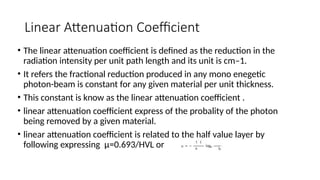
Linear Attenuation Coefficient
•The linear attenuation coefficient is defined as the reduction in the
radiation intensity per unit path length and its unit is cm–1.
• It refers the fractional reduction produced in any mono enegetic
photon-beam is constant for any given material per unit thickness.
• This constant is know as the linear attenuation coefficient .
• linear attenuation coefficient express of the probality of the photon
being removed by a given material.
• linear attenuation coefficient is related to the half value layer by
following expressing µ=0.693/HVL or
13.
Mass Attenuation Coefficient
•Themass attenuation coefficient is obtained by dividing
the linear attenuation coefficient by the density P
•has the symbol µ/p and unit cm2/g
•The mass attenuation coefficient is independent of
density
14.
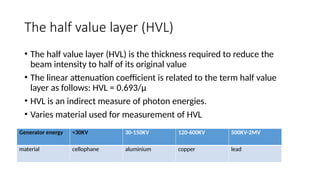
The half valuelayer (HVL)
• The half value layer (HVL) is the thickness required to reduce the
beam intensity to half of its original value
• The linear attenuation coefficient is related to the term half value
layer as follows: HVL = 0.693/µ
• HVL is an indirect measure of photon energies.
• Varies material used for measurement of HVL
Generator energy <30KV 30-150KV 120-600KV 500KV-2MV
material cellophane aluminium copper lead
15.
X-RAY AND GAMMA-RAYINTERACTIONS
or photon beam attenuation
•When traversing matter, photons will penetrate
without interaction, scatter, or be absorbed
•There are four major types of interactions of x-ray and
γ ray photons with matter, the first three of which play
a role in diagnostic radiology and nuclear medicine
16.
THERE ARE FIVEBASIC WAYS THAT AN X-RAY
PHOTON CAN INTERACT WITH MATTER
1. Coherent scattering
2. Photoelectric effect
3. Compton scattering
4. Pair production
5. Photodisintegration
17.
COHERENT SCATTERING
• "coherentscattering" is given to those interactions in which radiation un
dergoes a change in direction without a change in wavelength.
• For this reason, term "unmodified scattering" is sometimes used.
• There are two types
1) Thomson scattering-Thomson scattering a single electron
is involved in the interaction
2) Rayleigh scattering-Ray leigh scattering results from a cooperative
interaction with all the electrons of an atom
Both types of coherent scattering may be described in terms of a wave-
particle interaction, and are therefore some times called "classical
scattering.
18.
• Low-energy radiationencounters the electrons of an atom and sets them into
vibration at the frequency of the radiation
• This is the only type of interaction between x rays and matter that does not cause
ionization
• no ionization occurs with coherent scattering. Its only effect is to change the
direction of the incident radiation
• coherent scattering occurs
throughout the diagnostic
energy range, but it never plays a
major role
• it produces scattered radiation
• which contributes to film fog,
the total quantity is too small to
be important in diagnostic radiology.
PAIR PRODUCTION
• Whena photon having energy > 1.02 MeV, passes near the nucleus of
an atom, will be subjected to strong nuclear field.
• The photon may suddenly disappear and become a positron and
electron pair
• r. For each particle 0.511 MeV energy is required and the excess
energy > 1.02 MeV, would be shared between the positron and
electron as kinetic energy