PHOTOGRAPHY
COMPOSITIONS
SUBMITTED TO :
MR.SAI KRISHNA
MRS.SHAYLA
MRS.LALITHA DEVI
SUBMITTED BY :
D.HEMANTH KUMAR
19011BA036
RULE OF THIRDS
 Rule of thirds is a guideline which
applies to the process of
composing visual images.
 The concept behind the rule of
thirds is the human eye focuses on
center.
 In rule of thirds 2 vertical and 2
horizontal lines, so the focus
placed at the center to capture the
detail in the photograph.
RULE OF THIRDS
EMPHASIZING THE PATTERN
 The idea of repeating something
can seem boring. But the human
brain actually likes patterns.
 They are great focal points for
viewers.
 Patterns in photography create
attention. Think of something easy
to overlook. When framed to
highlight the pattern.
PATTERN
BREAKING THE PATTERN
 The break can be achieved by
introducing an element in a
contrasting color, with a different
shape or texture.
 Removing one of the elements
that make up the pattern can also
work. Focus on the break to create
emphasis.
 The pattern consists of different
pattern, shapes, and colours etc.
PATTERN
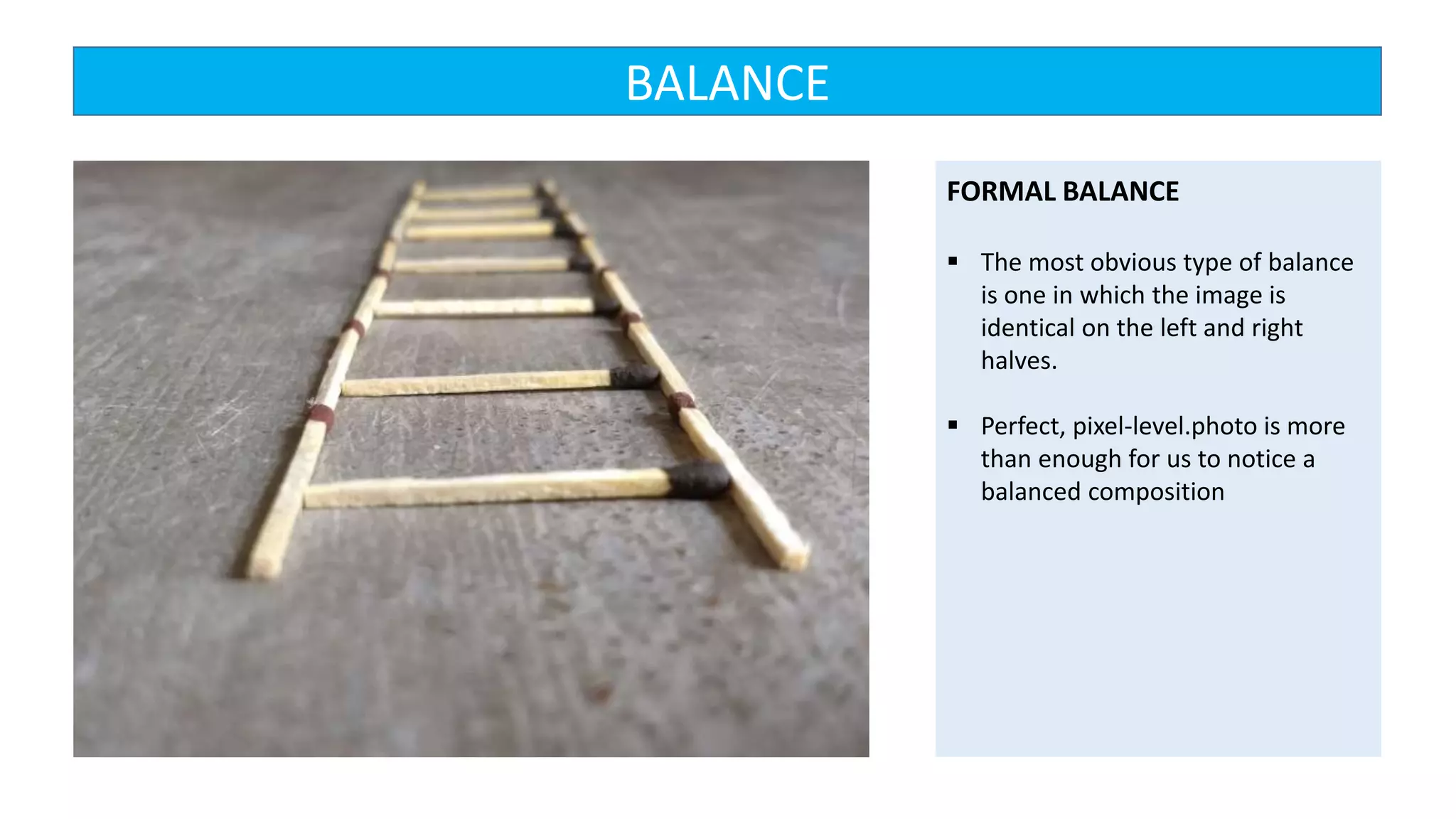
FORMAL BALANCE
 The most obvious type of balance
is one in which the image is
identical on the left and right
halves.
 Perfect, pixel-level.photo is more
than enough for us to notice a
balanced composition
BALANCE
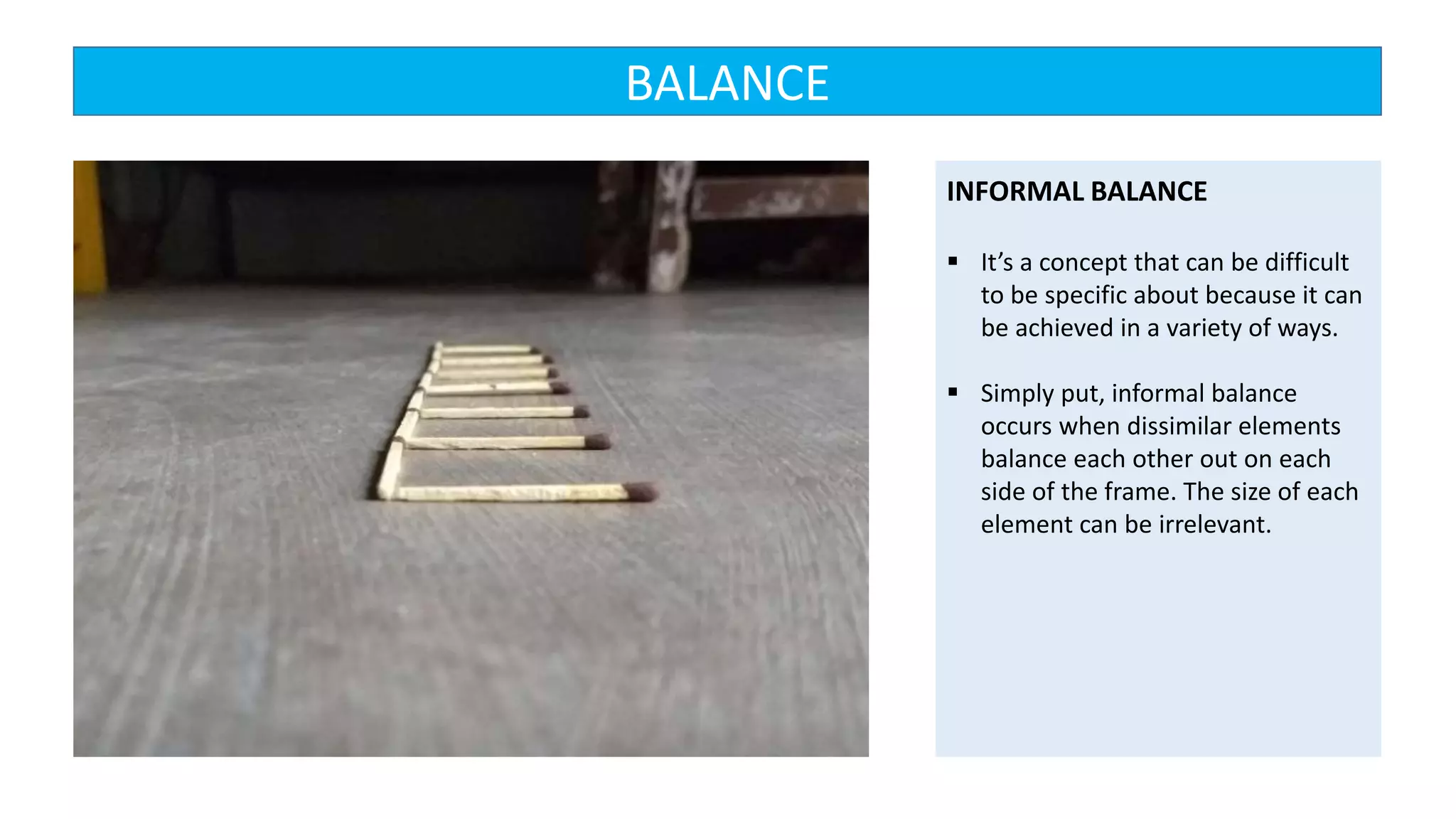
INFORMAL BALANCE
 It’s a concept that can be difficult
to be specific about because it can
be achieved in a variety of ways.
 Simply put, informal balance
occurs when dissimilar elements
balance each other out on each
side of the frame. The size of each
element can be irrelevant.
BALANCE
RADIAL BALANCE
 Elements spaced equally around a
central point, like spokes on a
wheel.
BALANCE
UNITY
 Describes the visual relationship
between elements in
a photograph.
 It helps create a cohesive image.
Using similar colors or tones,
concepts or elements cultivates a
sense of unity.
UNITY
CONTRAST
 In photography is the visual ratio
of different tones in an image.
 This difference is what creates the
textures, highlights, shadows,
colors and clarity in a photograph.
TONAL CONTRAST
 difference in bright and dark areas
in a photo.
 This composition is what makes
the subjects within the photo
appear defined or undefined.
CONTRAST
HIGH CONTRAST
 A high contrast image has a wide
range of tones full of blacks and
whites with dark shadows and
bright highlights.
CONTRAST
LOW CONTRAST
 A high contrast image has a wide
range of tones full of blacks and
whites with dark shadows and
bright highlights.
 A low contrast image blends light
and dark areas, creating a more
flat or soft photo.
 There are hardly any highlights and
shadows and the images are
composed mostly in shades of
gray.
CONTRAST
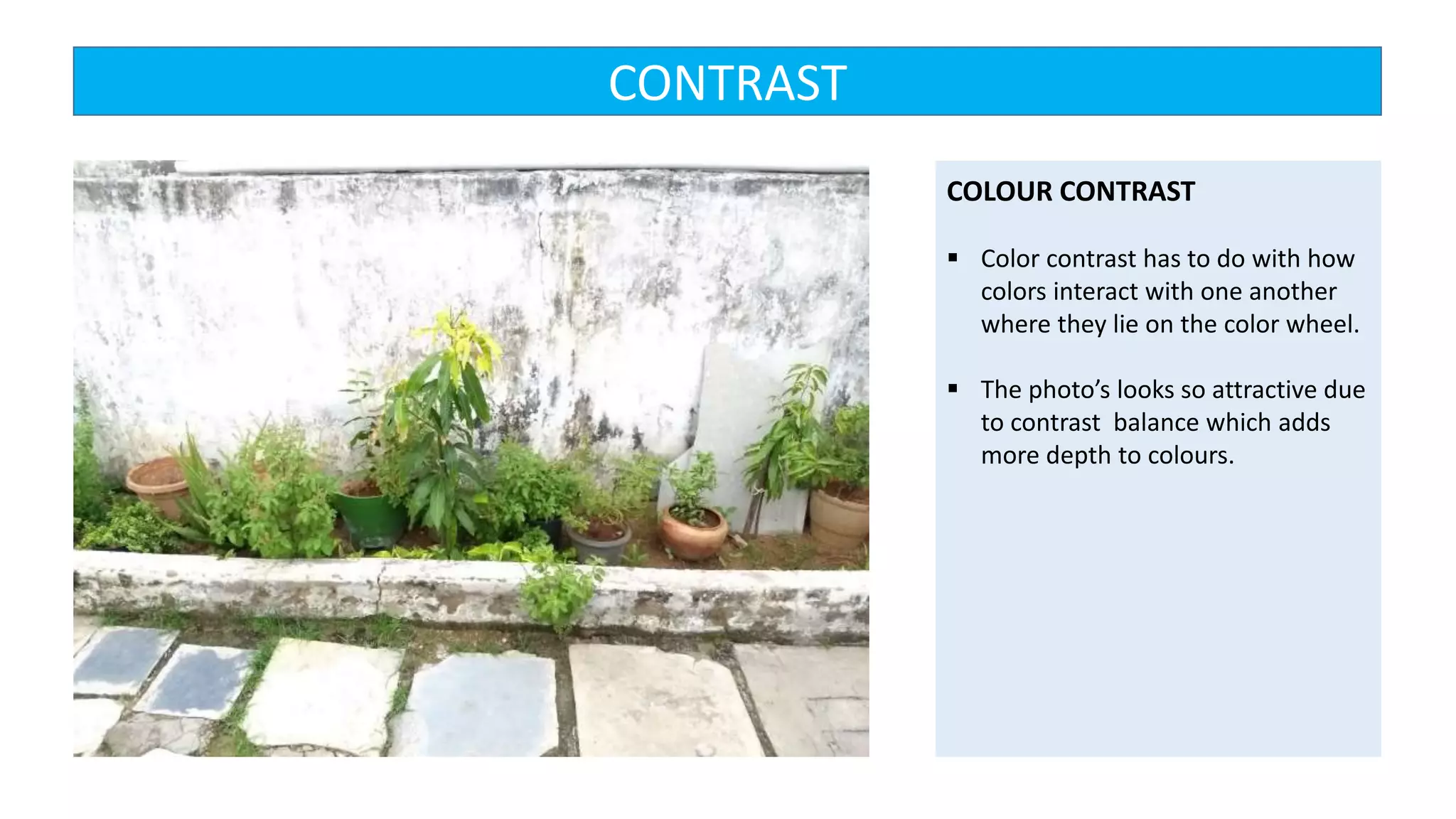
COLOUR CONTRAST
 Color contrast has to do with how
colors interact with one another
where they lie on the color wheel.
 The photo’s looks so attractive due
to contrast balance which adds
more depth to colours.
CONTRAST
MOVEMENT
 Movement in photography
describes the relationship
between the camera’s shutter
speed and a subject.
SUSPENDED MOVEMENT
 Suspended movement illustrates
one of the camera’s most
remarkable attributes.
 The ability to freeze a literal split
second, to capture details
imperceptible to the human eye.
MOVEMENT
MOTION BLUR
 motion blur can be a striking
representation of dynamic energy
when incorporated deliberately.
 motion blur, usually produced at
very slow shutter speed.
 The photo captured while it is
motion looks blur due to its slow
shutter speed.
MOVEMENT
Visual flow
 Visual flow is dynamic, continuous,
and unforced. Repeating elements
can establish rhythm and build
momentum to carry the eye from
one point to the next.
 Visual flow takes the viewer’s eye
on a graceful, often gently
meandering, visual journey
through photographic
composition.
MOVEMENT
THANK YOU

Photography Compostion

  • 1.
    PHOTOGRAPHY COMPOSITIONS SUBMITTED TO : MR.SAIKRISHNA MRS.SHAYLA MRS.LALITHA DEVI SUBMITTED BY : D.HEMANTH KUMAR 19011BA036
  • 2.
    RULE OF THIRDS Rule of thirds is a guideline which applies to the process of composing visual images.  The concept behind the rule of thirds is the human eye focuses on center.  In rule of thirds 2 vertical and 2 horizontal lines, so the focus placed at the center to capture the detail in the photograph. RULE OF THIRDS
  • 3.
    EMPHASIZING THE PATTERN The idea of repeating something can seem boring. But the human brain actually likes patterns.  They are great focal points for viewers.  Patterns in photography create attention. Think of something easy to overlook. When framed to highlight the pattern. PATTERN
  • 4.
    BREAKING THE PATTERN The break can be achieved by introducing an element in a contrasting color, with a different shape or texture.  Removing one of the elements that make up the pattern can also work. Focus on the break to create emphasis.  The pattern consists of different pattern, shapes, and colours etc. PATTERN
  • 5.
    FORMAL BALANCE  Themost obvious type of balance is one in which the image is identical on the left and right halves.  Perfect, pixel-level.photo is more than enough for us to notice a balanced composition BALANCE
  • 6.
    INFORMAL BALANCE  It’sa concept that can be difficult to be specific about because it can be achieved in a variety of ways.  Simply put, informal balance occurs when dissimilar elements balance each other out on each side of the frame. The size of each element can be irrelevant. BALANCE
  • 7.
    RADIAL BALANCE  Elementsspaced equally around a central point, like spokes on a wheel. BALANCE
  • 8.
    UNITY  Describes thevisual relationship between elements in a photograph.  It helps create a cohesive image. Using similar colors or tones, concepts or elements cultivates a sense of unity. UNITY
  • 9.
    CONTRAST  In photographyis the visual ratio of different tones in an image.  This difference is what creates the textures, highlights, shadows, colors and clarity in a photograph. TONAL CONTRAST  difference in bright and dark areas in a photo.  This composition is what makes the subjects within the photo appear defined or undefined. CONTRAST
  • 10.
    HIGH CONTRAST  Ahigh contrast image has a wide range of tones full of blacks and whites with dark shadows and bright highlights. CONTRAST
  • 11.
    LOW CONTRAST  Ahigh contrast image has a wide range of tones full of blacks and whites with dark shadows and bright highlights.  A low contrast image blends light and dark areas, creating a more flat or soft photo.  There are hardly any highlights and shadows and the images are composed mostly in shades of gray. CONTRAST
  • 12.
    COLOUR CONTRAST  Colorcontrast has to do with how colors interact with one another where they lie on the color wheel.  The photo’s looks so attractive due to contrast balance which adds more depth to colours. CONTRAST
  • 13.
    MOVEMENT  Movement inphotography describes the relationship between the camera’s shutter speed and a subject. SUSPENDED MOVEMENT  Suspended movement illustrates one of the camera’s most remarkable attributes.  The ability to freeze a literal split second, to capture details imperceptible to the human eye. MOVEMENT
  • 14.
    MOTION BLUR  motionblur can be a striking representation of dynamic energy when incorporated deliberately.  motion blur, usually produced at very slow shutter speed.  The photo captured while it is motion looks blur due to its slow shutter speed. MOVEMENT
  • 15.
    Visual flow  Visualflow is dynamic, continuous, and unforced. Repeating elements can establish rhythm and build momentum to carry the eye from one point to the next.  Visual flow takes the viewer’s eye on a graceful, often gently meandering, visual journey through photographic composition. MOVEMENT
  • 16.