Sealing the Deal: The Effects of Deal Characteristics, Macroeconomic
Indicators and Target-bidder Dynamics on U.S. Mergers and Acquisitions
Bidding Outcome Since 2009
by Laurence Lê Huỳnh Ngọc Phi
under the Direction of
Professor Steven Schmeiser
A Thesis
Submitted to the Faculty of Mount Holyoke College
in Partial Fulfillment of the Requirements for the Degree of Bachelor of Arts
with Honors
Department of Economics
Mount Holyoke College
South Hadley, MA 01075
May 2014
Dành tặng ba mẹ, anh hai, anh ba, và Phinix, mong em mau đến.
ABSTRACT
When a firm makes a bid to buy another firm, the target firm can either
accept or reject the bid. Facing an M&A bid, management typically performs
cost-benefit analysis of handing over the firm’s control power while
shareholders typically agonize over the discrepancy between their immediate
monetary rewards and their future financial gains. Can numbers tell us
anything about the outcome of a merger & acquisition bid? Do firms’ size,
profitability, bid premium, and macroeconomic data have any predictive
power over the turnout of a corporate sale vote?
The majority of past studies have approached M&A from acquirers’
perspective and leaves targets’ decision-to-sell passive and price-driven1.
However, there is evidence that bid premium has little effect on target’s
acceptance of the bid2. In addition, more recent studies have focused on
targets’ willingness-to-sell as a determinant of the bid outcome. Therefore, it
is crucial to study the bid outcome from a holistic approach that takes into
account the relativity in size and profitability between target firms and bidder
firms, historical bid information, deal characteristics, as well as
macroeconomic data at bidding time.
I will use empirical data of domestic M&A deals between public firms
from 2009 to 2013 to study whether targets’ and acquirers’ size and profit,
toehold, deal characteristics such as bid premium, cash/stock weight, etc., and
macroeconomic data such as growth projections and market volatility have
any effect on the outcome of an M&A bid. The result shows that persistent
conversation, increasing GDP level coupled with market volatility increase the
bid success probability, whereas large bid appreciation and resistance from

target depress the bid success probability.
_________________________
1. Betton, Sandra and Eckbo, B. Espen. Toehold, Bid jumps, and expected payoffs in
takeovers. The Review of Financial Studies, vol.13, no.4 (2000): 841-882
2. Branch, B. and Wang, J. Takevoer Success Prediction and performance of risk arbitrage,
Journal of Business & Economic Studies, 2009, p14-22
ACKNOWLEDGMENTS
I would like to thank my advisor, Steven Schmeiser, for his Corporate
Governance class that introduced me to the topic of M&A, and for his patient
guidance and support in writing this thesis. I am also grateful for receiving
astute and passionate instructions from Haley Hedlin and Bradford Westgate
in both theoretical statistics and empirical data analysis. Without the help and
M&A law expertise of Mr. James Kruse, this project could not be completed. I
am also thankful for the Economics, Mathematics & Statistics, and Music
Department at Mount Holyoke College, namely Professor Adelman, Professor
Moseley, Professor Hartley, Professor Margaret Robinson, Professor
Shepardson, Professor Schipull, Mark Gionfriddo, and Michele Scanlon. I am
also indebted to the following people who have believed in me and who have
helped me in so many different ways: Joshua Nelson (SGA), Karen Griffin
and Amanda Donohue (AA), Ryan Colby’11 (Amherst), Brian Cheney and
Joshua Tandy (GS). Especially, thank you Thu Quach ’11 (MHC) and Giang
Nguyen’13 (NUS) for your help with assess to Bloomberg data, and many
other little big things.
To my friends (Estefania, Brandon, Dinh Nguyen, Madame Vaget),
you’re the best. To my former teachers, Monsieur Nam, Madame Duc, Ms.
Thuy Lien, thay Doan Vu, thay Vinh, anh Quan, for giving me important
building block of a fulfilling learning life. To Mr. Le Sang, for your inspiring
autobiography. To Francoise, Mae, Gerard, Emil, Homboy, Phuong, Charles,
Tabi, Yoo & many more, for your beautiful soul and creations, I hope to join
you soon. To the Nguyens, the Hoogendyks, the Harpers, the Monty-
Carbonaries, Steve, Rick and Meredith, for all my new childhood memory.
And last but not least, to my parents and brothers, for everything you have
given me in my life.
TABLE OF CONTENTS
CHAPTER 1 INTRODUCTION…………………………………….. 1
CHAPTER 2 A CLOSER LOOK AT M & A………………………. 4
2.1 History of M&A………………………………….. 5
2.2 Firm’s Performance as Motivations for M&A…… 6
2.3 Benefits of Mergers and Acquisitions
to Shareholders…………………………………….9
2.4 Characteristics of Target Firms/ Sellers………… 10
2.5 Characteristics of Acquirer……………………… 12
2.6 Different Methods of Takeover and the
Case of Choosing One vs. the Other……………..13
CHAPTER 3 MODELING BID OUTCOME………………………16
3.1 Bid Information…………………………………..18
3.1.1 Offer Premium…………………………... 18
3.1.2 Cash/Stock Weight……………………… 19
3.1.3 Bid Appreciation as a Determinant
of Bid Outcome…………………………. 20
3.2 Target-Bidder Dynamics…………………………21
3.2.1 Toehold………………………………….. 21
3.2.2 Target Solicitation vs. Resistance…….…. 22
3.2.3 Public Status, Firm’s Size
and Profitability…………………………. 24
3.3 Macroeconomic Environment……………………25
3.4 Other Factors Affecting the Bid Outcome………. 27
CHAPTER 4 METHODOLOGY…………………………………... 28
4.1 Data………………………………………………28
4.1.1 Data Collection and
Variable Construction…………………… 28
4.1.2 Preliminary Statistic Findings……………34
4.2 Model Estimation Method………………………. 41
4.2.1 Predicting the Bid Success Probability…. 41
4.2.2 Estimating the Final Bid Appreciation….. 44
CHAPTER 4 METHODOLOGY (Continued)
4.3 Empirical Results………………………………...45
4.3.1 Parameter Estimates…………………….. 45
4.3.2 Goodness of Fit…………………………..50
CHAPTER 5 DISCUSSION…………………………………………52
CHAPTER 6 CONCLUSION………………………………………. 55
APPENDIX………………………………………………………………. 58
REFERENCES……………………………………………………………61
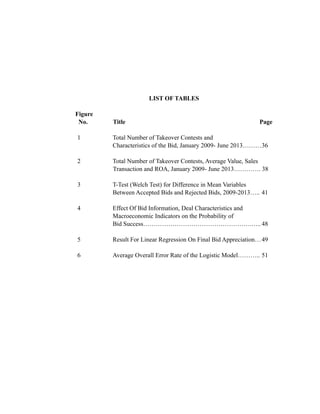
LIST OF TABLES
Figure
No. Title Page
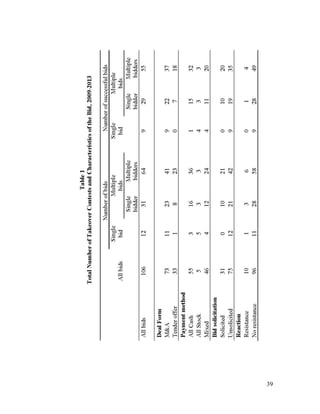
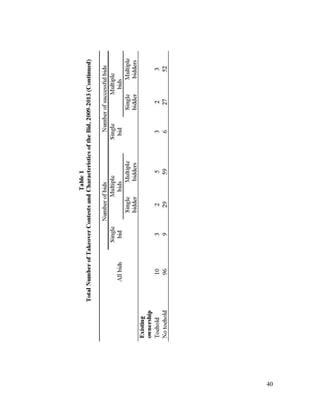
1 Total Number of Takeover Contests and
Characteristics of the Bid, January 2009- June 2013………36
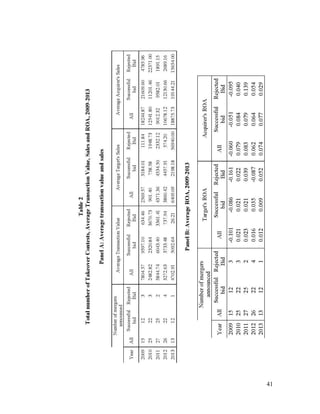
2 Total Number of Takeover Contests, Average Value, Sales
Transaction and ROA, January 2009- June 2013…………. 38
3 T-Test (Welch Test) for Difference in Mean Variables
Between Accepted Bids and Rejected Bids, 2009-2013….. 41
4 Effect Of Bid Information, Deal Characteristics and
Macroeconomic Indicators on the Probability of
Bid Success…………………………………………….…..48
5 Result For Linear Regression On Final Bid Appreciation…49
6 Average Overall Error Rate of the Logistic Model……….. 51
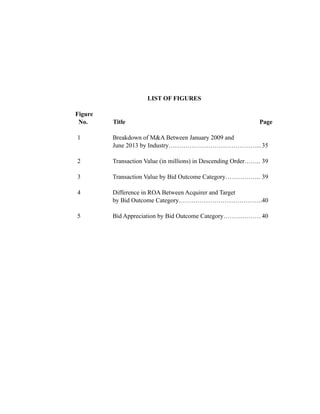
LIST OF FIGURES
Figure
No. Title Page
1 Breakdown of M&A Between January 2009 and
June 2013 by Industry……………………………………...35
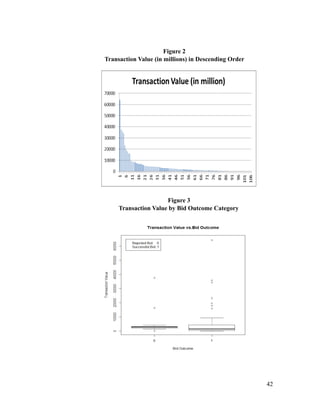
2 Transaction Value (in millions) in Descending Order…….. 39
3 Transaction Value by Bid Outcome Category…………….. 39
4 Difference in ROA Between Acquirer and Target
by Bid Outcome Category………………………………….40
5 Bid Appreciation by Bid Outcome Category………………40
CHAPTER 1
INTRODUCTION
Mergers and acquisitions have evolved from a powerful corporate tool
to a corporate culture that attracts enormous academic, professional, media
and general public attention. On one hand, mergers and acquisitions are
associated with the rage of hostility by “corporate raiders” from the 1980s. On
the other hand, those carried out properly, arguably create organizational
synergies that in turn improve production capacity, enable cost-efficient
scalability, fuel growth, and increase shareholders’ value. From now on, M&A
will be used to denote mergers and acquisitions.
Last summer, the management buyout conversation between Dell’s
shareholders and its founder, Mr. Michael Dell created a buzz in the corporate
world. The deal attracted even more attention after Dell’s shareholders voted
to reject Mr. Michael Dell’s initial bid. Competing bidders soon started getting
themselves involved by placing rival bids. Following Dell’s rejected bid, a
Wall Street Journal article commenting on the possible scenarios noted that
the outcome of a failed corporate sale vote was often of mixed nature. It cited
two examples: Dynergy’s holding company filed for bankruptcy within
months of rejecting buyout and M&A offers, while Dollar Thrifty finally
agreed to sell to Hertz at twice the price of the initial, rejected bid after 2
'1
years. What goes on behind closed doors during M&A talks and negotiations?
How do firms approach M&A decision and valuation? Why do some go
through and some don’t?
Research in M&A traditionally approaches these transactions from the
acquirers’ perspective and thus assumes that targets’ decision-to-sell is price-
driven. This particularly rings true for the M&A in the 1980s. However, there
was evidence that bid premium (the excess in price between the acquirer’s
offer and target’s unaffected stock price expressed as a percentage of target’s
unaffected stock price) has little effect on target’s acceptance of the bid. In
addition, antitakeover laws adopted in the late 1980s and early 1990s almost
eliminate hostile tender offers (Bertrand and Mullainathan 2003). This
particular change allows targets to better position themselves in a M&A
conversation than previously possible. As a result, recent studies moved from
just studying M&A from acquirers’ perspectives to also studying target’s
willingness-to-sell as a determinant of the bid outcome. In this paper, I would
like to use a holistic approach to study the bid outcome by exploring new
determinants alongside those studied in previous researches. Besides historical
bid information and deal hostility ranking, the variables I’m interested in
adding to existing models are the relative size and profitability between target
firms and bidder firms, and macroeconomic data. By bid outcome, I will be
referring to first of all, whether the closing bid is accepted or rejected, and
'2
secondly, the bid value itself. Most studies focus on M&A deals further back
in history, this thesis will provide an in-depth analysis of the most recent,
post-crisis deals.
The outline of this thesis is as follows: chapter 2 will provide
taxonomy to discuss M&A history and describe M&A from a process
perspective. Chapter 3 will exhibit the commonly studied bid outcome’s
predictive factors and justify for the need to include new bid outcome’s
determinants to better capture deal’s information. Chapter 4 will present the
statistical models and findings on M&A deals happening between January
2009 and June 2013. Chapter 5 will provide conclusion and suggestions for
possible extensions of the models discussed.
'3
CHAPTER 2
A CLOSER LOOK AT M&A
Manne (1965) argues that M&A are powerful corporate strategy to
gain control of both the corporate entity and the market. Since its emergence,
M&A has become a prolific research topic that attracts a large influx of
multidisciplinary contributions. Studies within the field of industrial
organization and strategic management attempt to study the motivations
behind different types of M&A, quantify synergy between firms, and evaluate
mergers’ success via merged entity’s post-merger performance. Financial
economists look at deal multiples and rely on stock returns to characterize
M&A, calculate gains and develop arbitrage strategies. Game theory
economists study the likelihood that a firm would become a bidding target, the
success probability of a bid, and the bidding/auction process. Meanwhile,
corporate governance scholars investigate the interactions between corporate
ownership structure and takeover defense, and the classic agency problem that
is conflicts of interest between management and shareholders. Last but not
least, law and policy scholars assess the antitrust connotations in merger and
'4
acquisition at the industry level, while building legal system to accommodate
M&A related litigation.
'5
2.1 History of M&A
The first and second merger waves between 1820s and 1920s start
after the relaxation of antitrust legislation (Goergen et al 2005). The third
merger wave between 1950s and1970s is characterized by the dominance of
conglomerate mergers in the United States (Steiner 1975). The 1980s wave
showcases a surge in mergers volume, composed mostly of hostile takeovers,
acquisitions activities that transform several industries and careers,
widespread industry deregulation and creative financing tools invented by
Wall Street investment banks (Jarrell et al. 1988). In the 1990s, mergers
activities take turn to decrease in both leverage and hostility degree as
compared to the 1980s but triumph in size (Holmstrom and Kaplan 2001).
This decade also witnesses high growth in M&A activities in Europe and Asia
while the next decade (2000s) witnessed dominance by US deals in both
numbers and size. However, the abrupt crisis of 2007-2008 might cause this
wave of M&A between 2003 and 2007 to be too short (Gregoriou and
Renneboog 2007). As the M&A activities after 2008 are still unfolding, it
could still be too early to characterize this next wave of M&A activities.
However, it is still of great interest to study post-financial crisis M&A deals.
My thesis attempts to identify the defining characteristics of deals in this post-
crisis period from Jan 2009 until June 2013.
2.2 Firm’s Performance as Motivations for M&A
'6
In 20 years from 1968 to 1988, budget for acquisitions activities grew
from $43.6 billion to $246.9 billion (Weston & Chung, 1990) and 40% of
capital expenditure in 1988 was allocated to investment in acquisition (Weiner
1989). Whether or not these huge spending on mergers and acquisitions are
justifiable depends on the benefits accrued by the merged entity. Many
theoretical studies reason that the firms realize these following gains from
mergers and acquisitions: increased market power (Ellert 1976), foothold in a
new market, geographically or industrially (Sherman 1997), operating
synergies (Mandelker 1974), operational efficiency (Eckbo 1986), additional
resources and factors of production that fuel growth (Ansoff et al. 1971) and
augmenting debt capacity (Lewellen 1971). In addition, M&A present many
tax loopholes otherwise unavailable to corporate, alongside opportunities to
change price earnings ratio, and a way to replace current inefficient
management (Ansoff et al. 1971); they also function as useful corporate tool
to avoid bankruptcy altogether, capitalize upon managerial inefficiencies and
valuation discrepancies while achieving portfolio diversification (Altman
1968, Dewey 1961).
Kitching (1967) analyzes the motives and benefits of 181 U.S. mergers
and acquisitions and divided these activities into five categories: horizontal,
vertical, concentric marketing, concentric technology and conglomerate
merger and acquisition. Most M&A are grouped into the big 3 groups of
'7
horizontal, vertical, and conglomerate. In horizontal M&A, firms typically
seek to merge and acquire other competing firms within its industry to
eliminate the acquired competitor, increase its market power and thus benefit
from economies of scale. Since merger and acquisition create a single entity of
bigger size, the deal helps consolidate market share and provide the merged
firms with impotent market power, pooled resources, higher bargaining power
and thus allow them to charge a higher price while incurring lower costs.
Walter and Barney (1990) suggest that horizontal mergers offer several
benefits that can be linked to “market power” and “efficiency”. However,
Dewey (1961) challenges the effects of merger and acquisition on increasing
market power and instead credited the industry’s expansion rate and the firms’
life cycles as the single important determinant of market power. He argues that
most mergers “have nothing to do with either the creation of market power or
the realization of scale economies” and that horizontal merger functions more
as a “civilized alternative” to bankruptcy or assets transfer from failing to
rising firms.
In vertical M&A, firms often further secure its supply chain by
internalizing its suppliers. Scherer (1970) and Williamson (1970) suggest that
vertical integration reduce uncertainty in the market, while locking in the
availability of products and stable prices by both buyers and suppliers. They
can also strategically acquire other firms competing for the same customer
'8
using different technology (concentric marketing). Steiner (1975) classifies
these mergers as “market extension mergers” and cited the four industries in
which most mergers exert this goal: dairies, beer, cement, and oil.
The next category is concentric technology (Kitching 1967), or
product extension (Steiner 1975) where firms using the same technology but
serve a different customer population merge. The last category is
conglomerate merger, where firms acquire others in different industries to
diversify risk and strengthen their competitive position. Kitching (1967) also
noted that the failure rate of concentric acquisitions is relatively high while
that of horizontal mergers is low. Since debt is cheaper than equity, merged
entities under the conglomerate umbrella were able to leverage its capital
structure of combined assets as collateral and gain access to additional
borrowing not available to a single firm with smaller capital capacity
(Lewellen 1971).
Despite the many argued benefits of M&A, there is not a silver bullet
to increase firms’ performance since data shows a mixed result. Research by
Goldberg (1983), Ravenscraft and Scherer (1987), and Steiner (1975)
emphasize the role of enhanced market power in increasing firms’ well-being
and present mixed results on firms’ profitability using accounting-based
metrics. Ravenscraft and Scherer (1987) analyze data on U.S. manufacturing
corporations from 1957 to 1977 and find that acquired corporations fare worse
'9
than pre-merger period unless targets and acquirers are of roughly the same
size. Ansoff et al. (1971) found from their sample of deals within the U.S.
manufacturing space between 1946 and 1965 that high-growth acquirers stall
while initial slow-growth acquirers accomplish impressive growth rate post-
merger.
2.3 Benefits of Mergers and Acquisitions to Shareholders
Shareholders of target firm see hefty financial gains through mergers
and acquisitions activities. Jarrell and Poulsen (1987) calculate that premiums
paid in tender offer averaged 19% in the 1960s, 35% in the 1970s, and 30%
between the first half of the 1980s. In addition, shareholders of acquiring
firms also benefit from excess stock return in light of M&A activities.
Shareholders see a gain of 1-2% in the immediate period around the public
announcement (Jarrel and Poulsen, 1987). Jensen and Ruback (1983) compute
an average gain of 5% in the 1960s, and 2.2% in the 1970s. Asquith, Bruner
and Mullins (1982) find an increase by 2.8% on average as a result of M&A
announcement for deals from 1963 to 1979. They also conclude that stock
returns are positively correlated to the size of target firms, more specifically
cumulative excess return from a bid for a target half the acquirer’s size was
1.8% larger than return from a bid for a target one-tenth the acquirer’s size.
Stock return to bidding firms’ shareholders is also correlated to the successful
'10
outcome of the bid (successful bid yield 4% greater stock returns then
unsuccessful bid). Halpern (1973) concludes that acquirer and target firms’
shareholders benefit equally from M&A announcement while Mandelker
(1974) observes a 14% stock appreciation for acquirer firms versus a 3.9% for
target firm.
2.4 Characteristics of Target Firms/Sellers
Studies on U.S. data in the 1960s by Hayes and Taussig (1967), Binder
(1970), Monroe and Simkowitz (1971) and Stevens (1973) analyze data on
conglomerate takeover targets in the 1950s and 1960s and note that acquired
firms tend to be small, relatively unprofitable, and record low equity growth.
Whereas Monroe and Simkowitz (1971) use a univariate discriminant model,
Stevens (1973) chooses the multiple discriminant analysis model to tease out
the effects of leverage (as proxied by liabilities/assets), profitability (EBIT/
sales), activity & turnover (sales/assets), liquidity (non-working capital/
assets), dividend policy and price earnings ratio on the acquisition probability
and concludes that low PE ratios and dividend payout do not play an
important role in increasing bid probability. Arguing that different acquiring
firms are attracted to different financial and product characteristics of their
targets, studies by Harris et al (1982) develop a new construction of an “index
of attractiveness”, assigning varying weight instead of a fixed weight to
'11
different firms’ characteristics . The probability of being acquired is said to
increase for smaller firms, highly liquid firms and firms with lower price
earnings in the period of 1974-1975 and firms with little debt in the next
period 1976-1977. This conclusion echoes with that of Stevens (1973) and
Monroe and Simkowitz (1971). Low market/book ratio implies
undervaluation (Walkling 1989); low debt and high liquidity firms (Jensen
1986) signal poorly managed firms.
Palepu (1982) challenges the notion that firms are acquired because
they are undervalued, citing that there is not a significance difference in book
value between targets and non-targets (although market value might be
different). Targets in his sample also exert higher PE ratio than the rest of non-
targets (thus busting the belief that firms are acquired because they have low
P/E ratio). Building on the work of Palepu, Ambrose and Megginson (1992)
apply a similar analytical method to takeover target in 1981-1986 and saw a
reduced explanatory effect. They also find that the presence of voting
increases bid probability, the presence of blank-check preferred stock and the
increase in institutional shareholdings in the quarter reduce takeover bid,
while the presence of poison pills defense has no effect. In summary, previous
studies of acquired firms present inconsistent and changing patterns in the
explanatory power of target firm’s financial factors on the probability of
receiving an acquisition bid.
'12
A small proportion of studies on IPO firms also links IPO to the
probability of becoming acquisition target. Zingales (1995) suggests that
going public serves as a preliminary valuation screen test for the ultimate goal
of selling out to prospective bidders. Hsieh et al (2011) compare IPO target to
bankrupt firms and find that IPO target becomes acquisition target because of
their positive growth rate and strong performance and not because they are
failing and heading down the bankruptcy road. On a different note, firms with
high willingness to sell (which go out to solicit a deal from buyers instead of
reacting to bid offer) will take the following legal and financial actions to
smooth a deal’s process: resolve unregistered trademark, obtain patents or
necessary disclosure from third party, and settle securities sales litigation
(Sherman, 1998). Literature on target firm as an active entity in M&A is more
limited than that on target firm as an acquirer’s pick.
2.5 Characteristics of Acquirer
Firms are more likely to acquire other firms if they accumulate large
reserves of cash (Hartford 1999). Firms with precedent acquisition experience
are more likely to capitalize on existing vetting & integration guidelines and
hence make more acquisitions (Haleblian and Kim, 2006). Ansoff et al. (1971)
distinguish low-growth-rate and high-growth-rate acquirers since the former
decreased dividend payout and took on new debt to finance an acquisition,
'13
whereas the latter increased dividend payout while increasing equity
financing.
Some studies within the IPO literature identify newly IPO firms as
prolific acquirer and argue that IPO (1) reveals acquirer’s potential market
value and thus reduces threat of asymmetric information and cost of collecting
information for target firms, and (2) provides acquirer with newly raised
capital to finance M&A. As a case in point, 77% of newly IPO firms between
1985 and 2004 purchase at least one company within their IPO year and on
average, a newly publicly traded firm acquires four other companies within
the first five years of IPO (Celikyurt et al 2010) and over 1/3 of firms acquire
others within their first three years of IPO ( Hovakimian and Hutton 2010).
2.6 Different Methods of Takeover and the Case of Choosing One vs.
the Other
There are several mechanisms to take over control in a corporate
setting. Manne (1965) lists three categories: direct purchase of shares, proxy
fights and merger. The first method, direct purchase of shares, can either take
form of takeover or tender offer. In a takeover, the bidder negotiates target’s
shares price with the target firm’s board of directors and makes an offer. If
target’s management concludes that this offer reflects the true worth of its
company, it will present the offer and its recommendation to shareholders who
'14
will vote to accept or reject. In a tender offer, the bidder makes a direct offer
to the shareholders while circumventing the board of directors all together.
Offenberg and Pirinski (2009) claim that tender offers cost more than mergers,
but complete its course more quickly due to the current regulatory setup. Dyl
and Hoffmeister (1972) list five types of tender offer: (1) friendly tender offer
where target and acquirer negotiate on price and payment method, (2)
unfriendly tender offer where bid attempt is abrupt and leaves target surprised,
(3) white knight tender offer where unfriendly offer is countered by a larger
cash offer negotiated with a firm friendlier to the target, (4) black knight
tender offer where multiple unfriendly bidders compete, and (5) tender offer
that evolves from unfriendly to friendly as the size of bid premium increases
with negotiation. Even though it is not true that bid will always increase in
value as negotiation progresses, I will incorporate this last observation by Dyl
and Hoffmeister into my model by counting the total number of bids leading
to the final (winning or losing) bid.
In a tender offer, the target firm will continue to exist as long as there
are minority shareholders holding out, however most tender offers oscillate
towards merger as the increasing number of shares accumulated provides
acquiring firm corporate control. Under the current legal environment, a
friendly approach to negotiation is preferred to a hostile tender offer, unless
'15
the intention is to replace incumbent management (Betton, Eckbo, Thorburn
2008).
In the second method (proxy fight), unlike takeover and tender offer
where substantial share ownership is crucial, aspiring acquirers do not have to
own any shares in a proxy contest (or proxy fight). They instead draw existing
shareholders-voters’ attention to potential issues in hope to leverage their
votes to put in place election of a certain board seats, or some changes. Manne
(1965) notes that proxy fights typically signal issues with target firms’
compensation distribution and often happen in the lack thereof of large block-
holding.
The third method (merger) is characterized by the convergence in
industrial and economic goals of all involved entities (Goldberg 1983).
'16
CHAPTER 3
MODELING BID OUTCOME
After figuring out whether, why and how a merger and acquisition deal
will add value to the acquiring firms, typically a bidder will pick a target firm
while a target firm will solicit a sale of its own company to buyers. Parties
will approach their counter parties to make a bid. A takeover is successful if a
bid culminates in successfully closing an acquisition deal; a takeover bid fails
if the target votes to turn down the acquirer’s offer.
The evolution of both M&A law and market competition allow targets
to actively seek buyers, solicit competing bids, and in some cases flat out
reject acquirer’s bid whether or not competing bids exist. Target firms have
come to set their own agenda, development goals, and appetite for merger and
acquisition. As a result, the target’s response to M&A bids might follow a
pattern different from those exerted within earlier legal framework. Much
literature on M&A in the past shed light on the acquirers’ motivation, and
painted sellers as passive price taking entities. However, as sellers gain
momentum in this M&A process over the years, and accumulate more
negotiation power due to both asymmetry information and a scarcity of good
'17
M&A candidates, there is a need to also understand the drivers of targets’
decision to sell, their resistance, and dynamics around corporate sale vote.
M&A is a lengthy process that involves considerable amount of time,
effort, and organizational resources from buyers, sellers, and all involved
financial institutions. For this reason, the dependent variable (bid outcome) is
censored. In other words, only companies who have strong belief in their
ability to close a deal with targets will reach out to make bids. By bid
outcome, I mean (1) the corporate sale vote’s outcome, in other words,
whether we can tell apart deals that are more likely to seal successfully to the
ones set up to fail, for a lack of better term and (2) the bid value.
Since M&A involves lots of resources, understanding the M&A
dynamics that lead to a successful bid will help acquirers and buyers reserve
those resources for other value-creating projects, otherwise wasted on deals
that lead nowhere or drag on endlessly. Given the acquirer’s characteristics,
bidding climate (whether or not other bidders present themselves along the
bidding process), target firm’s characteristics and macroeconomic conditions,
what can we predict about the bid outcome? The next paragraph will survey
the determinants of interest for bid outcome analysis. Some factors are the
focus of past research, while others are my addition. They can be grouped into
three categories: bid information, target-bidder dynamics and macroeconomic
data.
'18
3.1 Bid Information
3.1.1 Offer Premium
Offer premium is measured as the difference between bid price and the
unaffected, pre-announcement-date share price expressed as a percentage of
the pre-announcement share price. The effect of bid premium on the bid
outcome remains ambiguous throughout the M&A literature. Past research
that attempts to predict the bid’s success probability come to vastly different
conclusions: Betton & Eckbo (2000) find positive correlation between high
bid offer premium and success probability of the initial bid. A survey of 647
takeovers between 1979 and 1987 by Jennings and Mazzeo (1993) shows that
higher bid premiums raise the probability of success as it reduces resistance
from target firm’s shareholders and deter incoming competing bids. However,
more recent studies by Mitchell and Pulvino (2001), Baker and Savasoglu
(2001), Branch et al (2008) show the negligible effects of offer premium on
shareholders’ decision to sell. Research by Hayes and Taussig (1967)
resonates with this same conclusion, adding that opposition from target
management tends to drive up the offer premium. Dyl and Hoffmeister (1972)
also conclude from their model that bid premium does not affect the outcome
of tender offer.
3.1.2 Cash/Stock Weight
'19
Target management is (1) more likely to accept cash offer instead of
all-stock or mixed offer and (2) more motivated by cash than by stock for tax
reasons if their firm is small (Fishman 1989). Jennings and Mazzeo (1993)
analyze 647 initial proposals from mid-1979 to 1987 and find that weight of
cash in the offer is positively correlated to the numbers of competing bids.
Mitchell and Pulvino (2001) examine 4750 mergers from 1963 to 1998 and
found that cash tender offer (mix of cash and shares) increases the odds while
100% cash payment decreases it. Their piecewise linear model also suggests
that cash deals are more likely to fail in depreciating markets.
Betton and Eckbo (2008) resonate with the large portion of cash
offered by acquirer in multiple bids, and add that bidders of great potential
raise the optimal amount of cash, but rallies for a stock payment if unsure of
its pick of target, or if the acquirer stock is overpriced. Target who
undervalues acquirer pushes away from acquirers’ stocks and towards cash
payment. The motivation and effect of mixed offers stay ambiguous.
'20
3.1.3 Bid Appreciation as a Determinant of Bid Outcome
There is reason to believe that the stock market does not always reflect
companies’ true values, it assigns instead a price tag mirroring the
expectations of investors on a company’s future worth. Stock prices at any
given time can be undervalued, valued at its true worth, or overvalued.
Schipper and Thompson argue that stock prices absorb market information
and/or shocks in such a way that they immediately adjust at the surface of any
tip or clue about M&A(1983). Since bid premium measures the excess in bid
value in comparison to stock price before the announcement date; it is a
function of the base stock price. Previous research assume that base stock
price stay presumably “unaffected” post announcement. However, I believe
that market reactions to M&A news derive substantial noise and in return
affect base stock price. Hence I propose using bid appreciation instead of bid
premium as an alternative bid outcome determinant. Bid appreciation captures
acquirer’s valuation of target in a granular way and controls for market
fluctuations outside of what is already accounted for by acquirer when it
makes the bid. Betton and Eckbo surveyed a similar variable called the bid
jump for their data sets of tender offer contests and auctions and find that
large bid jump is positively correlated with bidding costs, and that strategic
bidders tend to offer a high initial bid to forestall competing bids in tender
offer contest (2008). They report an average jump of 10% from initial bid to
'21
second bid, and 14% from initial bid to the final bid. Since bid appreciation
(or bid jump) seizes both observable and unobservable information about the
bid, it can be used to study bids regardless of deal form (tender offer contests
or not), auction form (whether there are auctions involving multiple bidders),
and inherent market reactions or shocks. In other words, bid appreciation
provides a more rigorous basis for bid success analysis than bid premium.
3.2 Target-Bidder Dynamics
3.2.1 Toehold
A bidder is said to have a toehold if it owns at least 5% in the target
firm at the time of bidding. Institutional entities or individual’s share
ownerships exceeding this threshold will trigger filling of form 13D or 13G
with the SEC. Existing shares ownership facilitates the goal of gaining
corporate control, as it levied the burden of share purchase. Researches by
Walking (1985), Jennings and Mazzeo (1993), Betton and Eckbo (2000)
suggest that toehold bidding increases the success probability in a tender offer
for the bidder, whereas resistance from target’s management (as exerted
through legal action against the bidder, shareholder list withholding,
recommendation against accepting bid, and mostly through their shares
ownership in the target) hinder shares tendering and the probability of success.
Bidder owning a large portion of target’s shares can influence the vote and
'22
target management (through placement of board of directors). Toehold is often
negatively correlated with offer premium. Winning acquirers have large
toehold in successful, single-bid contest but small toehold in multiple-bid
contest.
3.2.2 Target Solicitation vs. Resistance
There is not an extensive body of work on target firm’s willingness to
sell since this factor depends on target management’s goal and is typically not
observable. Graebner and Eisenhardt (2004) cite financial and strategic
hurdles as incentives for firms to seek help from acquirers who have the
ability to lift them through these obstacles. Their research focuses on
entrepreneurial start-ups, a different population than firms used in other
studies surveyed for this paper. Bodt et al. (2011) classify target firms that
initiate and/or solicit selling and that choose the auction methods (vs. a
negotiation process) as those that have high willingness to sell. Cousin, de
Bodt, and Demidova (2011) classified firms that actively seek out buyers and
set up auction processes as high WTS and those that once received takeover
bid did not bother looking for alternatives buyers as low WTS. It can be
inferred that a firm’s high WTS is negatively correlated with its resistance,
and thus a bid for target with high WTS will be more likely to be successful.
Financial status can also be indicative of target’s willingness to sell,
and it is common to see various financial ratio, together with a proxy for
'23
either (1) target’s reaction to bid’s hostility or (2) target’s vulnerability to
bidder’s takeover attempt, in bid outcome modeling. Schwert (2000) uses a
probit model on 2,346 transactions from 1975 to 1996 to predict whether a
takeover offer is successful given the level of hostility.The findings show that
un-negotiated offers (highly hostile bid) and pre-bid hostility depress success
rate. Pre-bid hostility is determined by bidder and target’s decision in making
their bid public: bidder will make bid public to put shareholders’ pressure on
management, and target will attract competing bids (only possible if
preliminary merger agreement allows for a go-shop period). The researcher
also mentions that modeling success rate is tricky in a sense that firms shy
away from making the offer if it is certain that a bid would fail. Unfortunately
he does not elaborate further on this statement.
Dyl and Hoffmeister (1972) survey 84 cash tender offers with known
outcomes between 1976 and 1977 and develop four different multivariate
discriminant variable models to predict the outcome of cash tender offer using
firms’ financial metrics (growth, dividend payout, ratios etc) and vulnerability
index (size as compared to bidder and bidder’s toehold). Their model lists
target management’s opposition as the single most important factor in
determining bid’s success and identifies small size as the subsequent
determinant of bid success, whereas the bid premium is not of crucial effect.
Hirshleifer and Titman (1990) argue that bidders who, via their bid,
'24
successfully reveal the potential improvement post-takeover stand a high
chance to tender enough shares to gain control. They argue that the bidder’s
uncertainty of the prices at which shareholders will tender is correlated to
offers’ failure. Other factors influencing shareholders’ decision to tender
shares include transaction costs, tax and liquidity considerations. Their
theoretical framework highlights that some defense mechanisms can actually
raise the probability of the tender offer’s success because they induce bidders
to offer a higher premium.
In short, resistance as exerted by target’s hostile reaction, official
actions and legal lawsuits against bidder to deter bid, is of heavier weight in
determining bid’s success at this stage in M&A. Resistance is a good proxy
for low willingness to sell. Similarly, fierce resistance from target and the
presence of a poison pill depress the success rate of bid.
It is less common to see models that incorporate the relative effects of
industry characteristics, size and other characteristics of both buyers and
sellers into predicting the bid outcome. Though Betton, Eckbo, and Thorburn
(2007) develop fairly holistic model studying 7,470 initial merger bids &
tender offers and conclude that the presence of the acquirer’s toehold in the
target firm, its public company status and size, high bid premium and all-cash
offer in a horizontal merger or acquisition increase the initial bid’s probability
of success.
'25
3.2.3 Public Status, Firm’s Size and Profitability
Mitchell and Pulvino (2001) conclude that private bidder is more
likely to fail than public bidder while bigger size helps increase bidder’s
chance of winning the transaction. For the scope of this research, I propose
using sales (or revenues) and return on assets as proxies for firm’s size and
profitability respectively. To reduce the risk of comparing apples to oranges,
and to give these metrics a comparative baseline, size ratio and difference in
the return on assets ratios will be considered instead of the size and
profitability metrics in their separate contexts.
3.3 Macroeconomic Environment
There has not been much literature on how the market’s volatility
influences shareholders’ decision to sell. Most research devotes to understand
the effect of stock market’s bubble on M&A level of activities. Aharon et al.
(2010) find that the level and value of M&A activities rise during the
technology bubble, and decrease at intensifying pace after the bubble first
bursts. Damodaran resonates this finding, suggesting that waves of mergers
and acquisitions tend to rise together with bullish stock market. The historical
waves of M&A presented earlier in Chapter 2 show a pattern of high
frequency and total transaction value of mergers and acquisitions during
booming market period. After the 2007-2008 financial crisis, M&A will not be
'26
as robust as they were during the 80s hostile rage, the 2000s tech dot com, or
the surge since 2003. Given the context of a recovering economy, will bid
outcome determinants affect M&A bid the same way they did in previous
M&A waves? Will target firms be more willing to sell if the economy is
inching back to its previous level of growth? Will bid be more or less likely to
result in a materialized transaction if the market is volatile?
If investors do not have optimistic outlook on the market at the
recovery time post market crash, they would scale back on investment &
M&A ventures. Similarly, if the market is volatile, risk-adverse firms would
prefer not to initiate M&A deal, whereas sellers looking to overcome a capital
hurdle, or seek shelter from a large firm would prefer to seal the deal. The
VIX index which measured the implied volatility of S&P 500 tends to move in
opposite direction with the stock market. In a volatile market where stock
fluctuates ferociously, investors will buy into future options to hedge against
the risk in their stock portfolio, all of which sends VIX appreciating.
Apart from the bid outcome determinant on the acquirer, buyer, and
deal-level, it might be of economic value to include and test for the
significance of bid outcome determinant on the macro level (stock market
volatility, and industry cycle). Are firms more willing to buy or sell during
volatile stock market? It can be argued that if both sides are risk adverse and
only involve in M&A for gains from stock undervaluation, a deal in volatile
'27
market is unlikely to reach this goal. If the target handing over control thinks
that its acquirer will provide great shelter to market volatility and ground for
further development, target’s willingness to sell will increase. At the bottom
their industry cycle, firms can be more likely to strike a deal to consolidate its
operations and help keep each other stay afloat. In other words, dire market
conditions provide firms with healthy financial standing great opportunities to
amass additional market shares from smaller firms. At the peak of its industry
cycle, acquirer of conglomerate M&A nature, for the sake of diversification,
might be interested in buying firms of opposite cycle. Target firm might not be
as interested because it can be inferred that the conglomerate would abandon
it instead of investing in it when its cycle descends. Similarly, firms of
horizontal and vertical M&A may want to merge to build momentum for
recovering cycle, or accelerate their growing market power in expanding
cycle.
3.4 Other Factors Affecting the Bid Outcome
Sherman (1998) mentions that sellers suffer from “seller’s
remorse” (concern about tax implication of the sale, uncertainty on
management’s compensation), “don’t-call-my-baby-ugly” syndrome, stringent
price fixation when acquirers discover and focus on problems during
negotiations, and a last minute decision not to sell due to a shift in strategic
'28
planning or exogenous circumstances. These struggles and agonies add
friction to the target’s resistance and decrease their willingness to sell, thus
hinder the success probability of a bid.
'29
CHAPTER 4
METHODOLOGY
4.1 Data
4.1.1 Data Collection and Variable Construction
Unlike most intensive research on M&A transactions which have
focused on the period of time before the financial crisis in 2007 and 2008, I
explore recent deals in the U.S. while avoiding the disruptive effect of the
financial crisis in 2007-2008. My database source is Bloomberg (best option
available when MHC does not have access to SDC Platinum, the most popular
data source for M&A papers). Between January 2009 and June 2013,
Bloomberg reported 618 transactions that fall into its category of merger and
acquisition (as opposed to leverage buyout, management buyout, cross-
borders acquisitions among other scenarios not in the scope of this research:
asset sales, divestiture, spin off). Typically, in most cases where the acquirer is
a private equity fund, it is hard to find disclosure on deal metrics. Therefore I
dropped all deals where at least one of the involved parties (bidder or target) is
private, as further information beneficial to the purpose of this study is not
freely and/or publicly available. In line with previous research, financial
institutions (SIC code 62 or 67) will also be dropped from the sample to avoid
'30
any confounding factors associated with firms in this highly regulated
industry. Deals involving one firm buying other firm’s large division and deals
that are blocked by the FTC (Federal Trade Commission) for antitrust and
monopoly concern are also dropped from the sample, for example, Wolverine
buying the PLG division of Collective Brands, or Integrated bidding to buy
PLX Technology.
Preliminary investigation shows that some of the reported successful
bid had at least one previous failed bid. Betton and Eckbo (2000) populate
each M&A transaction in their data set with details on each bid ever made
(including the initial bid, the final bid and every bid in between). For the
purpose of this study, I will collect information attached to the initial bid and
the final bid only. Because M&A talks typically last one year, including every
single bid in between the initial (opening) and final (closing) bid will lead to
multicolinearity problem among the metrics on size and profitability and
among the annual macroeconomic data.
Given the name of acquirer and targets from Bloomberg query, I
combed through the SEC filings to further investigate these deals. The
presence of SEC forms such as Definitive proxy statement (DEFM) filings
often identifies transactions as mergers and acquisitions, whereas that of SC
14D9 filing signals tender offer processes. These forms contain a section
called “Background of the Merger” that provides information on historical
'31
bids leading up to the final bid, whether the bid is solicited by target, target’s
management reactions to the bid (resistant actions, whether the board accepts
the bid, or whether the board recommends shareholders to vote for or against
the bid), number of total bidders, as well as other events leading up to the
outcome of the final bid. Companies often report bid price offered by involved
parties in case of auction or competition between multiple bidders, however
only winning bidder’s identity is disclosed. There was no way to identify and
collect data on bidders other than the one disclosed in the filings.
Target’s schedule 13 disclosed on SEC (either SC 13D or SC 13G)
reveals toehold size and the name of the corporate entity that owns more than
5% of target’s shares. Financials data such as sales/revenues, net income and
average total assets are available in10-k filing. Since target and acquiring
firms do not always have the same fiscal year endings, I collected annual data
from target and acquirer’s filling period closest to each other and to the deal’s
announcement date. For example, Gentiva Health announced its acquisition of
Odyssey Health on May 24th, 2010. Metrics from Odyssey Health’s filing
come from fiscal year ended December 31, 2009 and those from Gentiva
Health’s filing come from fiscal year ended January 3rd, 2010. The two
variables of interest are size ratio and difference in ROA, calculated as
followed:
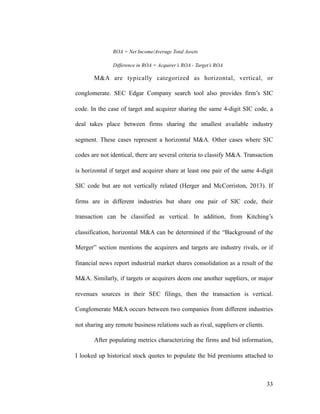
Sales Ratio = Acquirer’s Revenues/Target’s Revenues
'32
ROA = Net Income/Average Total Assets
Difference in ROA = Acquirer’s ROA - Target’s ROA
M&A are typically categorized as horizontal, vertical, or
conglomerate. SEC Edgar Company search tool also provides firm’s SIC
code. In the case of target and acquirer sharing the same 4-digit SIC code, a
deal takes place between firms sharing the smallest available industry
segment. These cases represent a horizontal M&A. Other cases where SIC
codes are not identical, there are several criteria to classify M&A. Transaction
is horizontal if target and acquirer share at least one pair of the same 4-digit
SIC code but are not vertically related (Herger and McCorriston, 2013). If
firms are in different industries but share one pair of SIC code, their
transaction can be classified as vertical. In addition, from Kitching’s
classification, horizontal M&A can be determined if the “Background of the
Merger” section mentions the acquirers and targets are industry rivals, or if
financial news report industrial market shares consolidation as a result of the
M&A. Similarly, if targets or acquirers deem one another suppliers, or major
revenues sources in their SEC filings, then the transaction is vertical.
Conglomerate M&A occurs between two companies from different industries
not sharing any remote business relations such as rival, suppliers or clients.
After populating metrics characterizing the firms and bid information,
I looked up historical stock quotes to populate the bid premiums attached to
'33
each bid. Previous research pays close attention to bid premium at different
time before the announcement date and typically include 3 of these time tags:
90 days, 60 days, 30 days, and 1 day before the announcement date. It is
argued that rumors about mergers and acquisitions start several weeks before
the announcement date, therefore I included in my data set stock quotes at 90
days, 30 days, and 1 day before the announcement date. Historical stock
quotes are readily accessible for almost all firms in my dataset on Google
Finance and InvestorPoint. Historical stock quotes for target firms that stop
trading after merger and acquisitions are available in Bloomberg. Walkling
(1985) draws attention to the base date used in premium calculating. He
argues that taking the date following SEC filings would lead to an
underestimated bid offer premium, since news about takeover, merger and
acquisition appears first in the financial press or press release from involved
firms (before the full-fledged report with SEC), and sometimes circulated on
the street months before the official announcement. The base price () for
premium calculations is the closed priced at t equals 1 day, 30 days, and 90
days before the date the transaction is made public via financial news.Bid
premium is calculated as:
Bid premium at time t = [(Bid Value - Stock Price at time t)/ Stock price at time t] * 100
The inconsistence in findings on the effect of bid premium on bid outcome
can be explained in several ways, for instance, deal rumors spread on the
'34
streets months before the official announcement date, the variability in stock
prices follows a random walk, and stock prices reflect market’s expectation of
a company’s worth, not the true worth itself. I propose using bid appreciation
in place of bid premium as a determinant of bid outcome. Bid premium and
bid appreciation contain drastically different information about the bid. Bid
premium measures the surplus between the acquirer’s bid and the target’s
stock value at a given time, whereas bid appreciation measures the jump to
acquirer’s final bid from its initial bid. Bid appreciation is calculated as
followed:
Bid appreciation = [(Final bid - Initial Bid)/Initial Bid]*100
Since the base value is now the initial bid (instead of the presumably
“unaffected” stock price), bid appreciation reflects information true to the
value assigned to target by acquirer while controlling for the shifting in stock
prices and other events affecting the stock price before announcement date.
As stated above, macroeconomics data of interest include VIX
(volatility index), Fed’s fund rate and GDP (gross domestic product).
Econstats.com and the Federal Reserve Systems provide daily data on VIX
index and Fed fund’s rate respectively from which I calculated the weighted
average quarter and annual. The US Bureau of Economic Analysis provides
GDP data (available as both quarter and annual value and in 2009 dollars in
this dataset) that can be merged with the bid’s data by time tag.
'35
This data also contains GAAP metrics instead of financial ratios such
as Deal Multiple, Enterprise Value, EBITDA, etc that are freely available to
researchers. It is also a bit more comprehensive than usual data sets in the
sense that it contains both the initial and the final bid outcome. However,
since the M&A waves post-crisis are still unfolding, this data set is smaller
than data set typically used in M&A research paper (5 years’ worth of data vs.
10 years or 30 years). The collection process is long and painstaking because
it contained information not automatically available in commercial database
(notably initial bid value, resistance, total bidders, etc) that requires combing
through various schedules in SEC filings.
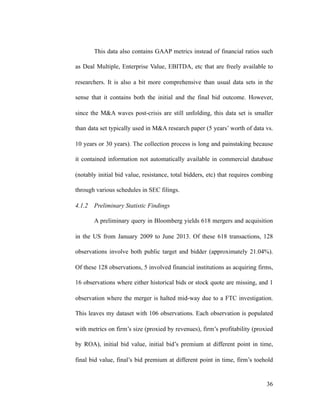
4.1.2 Preliminary Statistic Findings
A preliminary query in Bloomberg yields 618 mergers and acquisition
in the US from January 2009 to June 2013. Of these 618 transactions, 128
observations involve both public target and bidder (approximately 21.04%).
Of these 128 observations, 5 involved financial institutions as acquiring firms,
16 observations where either historical bids or stock quote are missing, and 1
observation where the merger is halted mid-way due to a FTC investigation.
This leaves my dataset with 106 observations. Each observation is populated
with metrics on firm’s size (proxied by revenues), firm’s profitability (proxied
by ROA), initial bid value, initial bid’s premium at different point in time,
final bid value, final’s bid premium at different point in time, firm’s toehold
'36
size, bid resistance, bid solicitation, type of merger, and macroeconomics data
in both quarter and annual value. This data matrix contains 106 rows and 56
columns.
'37
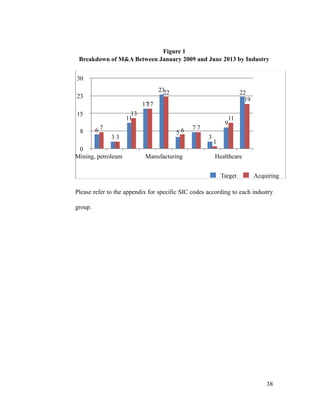
Figure 1
Breakdown of M&A Between January 2009 and June 2013 by Industry
'
Please refer to the appendix for specific SIC codes according to each industry
group.
0
8
15
23
30
Mining, petroleum Manufacturing Healthcare
19
11
1
76
22
17
13
3
7
22
9
3
7
5
23
17
11
3
6
Target Acquiring
'38
!
'39
!
'40
! 

'41
Figure 2
Transaction Value (in millions) in Descending Order
'
Figure 3
Transaction Value by Bid Outcome Category
'
'42
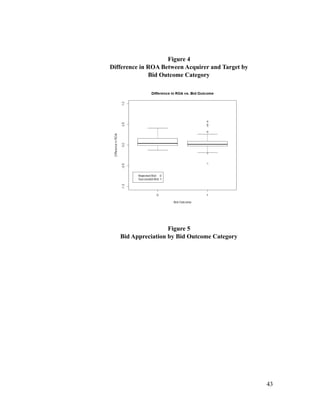
Figure 4
Difference in ROA Between Acquirer and Target by
Bid Outcome Category
'
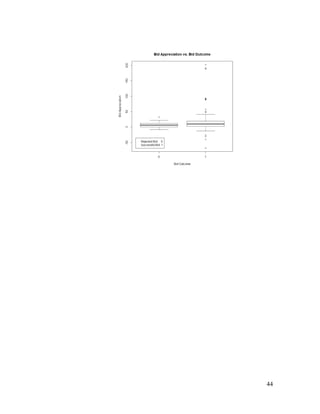
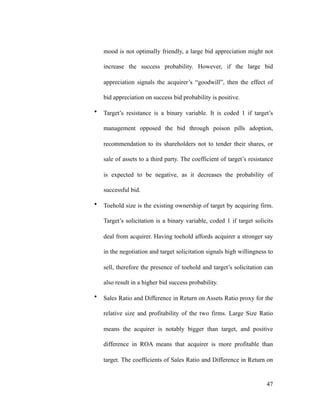
Figure 5
Bid Appreciation by Bid Outcome Category
'43
' 

'44
Table 3
T-test (Welch test) for Difference in Mean Variables Between Accepted
Bids and Rejected Bids, 2009-2013
4.2 Model and Estimation Method
4.2.1 Predicting the Bid Success Probability
Since there are many possible bid outcome determinants (as mentioned
in chapter 3), each observation in this data set is categorized by a large
number of features. To find the optimal combination of features, Koller and
Sahami (1996) propose a “feature selection” search algorithm called backward
elimination method. The backward selection algorithm is performed on a full
model including all probable determinants. It will eliminate variable (or
feature) that provides little or no information on the dependent variable given
other remaining variables’ assumed predictive power.
I would like to present a logit model related to the model by Mitchell
& Pulvino (2001) and Betton & Eckbo (2009). Since the outcome of the bid is
coded 1 as accepted (deal) and 0 as rejected (no deal), the dependent variable
Variables
Mean of Variable
for Accepted Bids
Mean of Variable
for Rejected Bid
t df
p-
value
Transaction
Value
4952.226 1739.718 2.706 77.025 0.008
Difference
in ROA
0.054 0.0519 0.044 15.277 0.9653
Bid
Appreciation
13.204 46.257 -1.635 12.535 0.127
'45
is a binary variable. Therefore, I will use a logit model to estimate the
probability that the bid is successful, ie two firms come to a consensus that a
deal will materialize, unless further development results in a post deal-closing
break-up. The probability a bid is successful is estimated as a function of the
various determinants, specifically:
Probability (bid is successful) = βo + βi∗Xi
where Xi are features vectors including final bid premium, total number of
bid counts, bid appreciation, toehold size, bid’s cash weight, target’s
resistance, target’s solicitation, sales ratio, difference in ROA ratio, volatility
index, Fed’s Fund Rate, GDP.
• Final bid premium have three different time tags, 90 days, 30 days
and 1 day before announcement date and are not included in the
model simultaneously to avoid multi-collinearity. The effect of
final bid premium is ambiguous, although it is likely to increase
the probability of bid success assumed no deal information is
leaked out.
• Bid appreciation is a function of the initial bid. Thus there are two
different scenarios involving a large bid appreciation: the initial bid
is low which might offend target and affect the mood of the M&A
conversation; or the acquirer raises its bid by a remarkable amount
throughout the deal conversation. If the initial bid is low and the
'46
mood is not optimally friendly, a large bid appreciation might not
increase the success probability. However, if the large bid
appreciation signals the acquirer’s “goodwill”, then the effect of
bid appreciation on success bid probability is positive.
• Target’s resistance is a binary variable. It is coded 1 if target’s
management opposed the bid through poison pills adoption,
recommendation to its shareholders not to tender their shares, or
sale of assets to a third party. The coefficient of target’s resistance
is expected to be negative, as it decreases the probability of
successful bid.
• Toehold size is the existing ownership of target by acquiring firm.
Target’s solicitation is a binary variable, coded 1 if target solicits
deal from acquirer. Having toehold affords acquirer a stronger say
in the negotiation and target solicitation signals high willingness to
sell, therefore the presence of toehold and target’s solicitation can
also result in a higher bid success probability.

• Sales Ratio and Difference in Return on Assets Ratio proxy for the
relative size and profitability of the two firms. Large Size Ratio
means the acquirer is notably bigger than target, and positive
difference in ROA means that acquirer is more profitable than
target. The coefficients of Sales Ratio and Difference in Return on
'47
Assets Ratio are expected to be positive because having a strong
operational and financial standing will help in convincing target of
acquirer’s ability to carry out the deal financially at the least and to
operate businesses at the most.
• Post-crisis recovering market (low Fed Fund’s rate) and eminent
volatility (high VIX) can induce smaller firms to hand over
corporate control to larger firms or to merge with similar size firms
to stay strong together. However, target might also be motivated to
resist M&A offer and wait for a less volatile market (coupled with
a better recovering macroeconomic environment). The coefficient
of volatility and of Fed Fund’s rate is ambiguous, whereas that of
GDP is expected to be positive because M&A surge during boom
market.
4.2.2 Estimating the Final Bid Appreciation
I use a multivariate linear regression model to estimate the effect of
bid information and macroeconomics data on the final bid’s appreciation from
the initial bid. The final bid appreciation is estimated as followed:
Final bid’s appreciation = βo+βi∗Xi
where Xi is characteristics vectors including initial bid premium, total number
of bid counts, bid appreciation, number of bidders, toehold size, bid’s cash
weight, target’s resistance, target’s solicitation, sales ratio, difference in ROA
'48
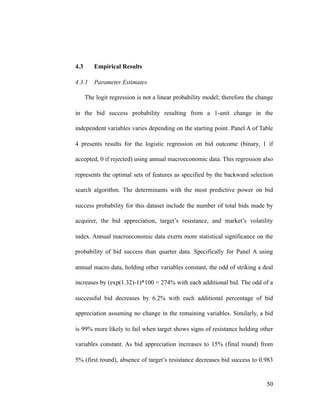
ratio, volatility index, Fed’s Fund Rate, GDP. The same backward model
selection method is applied for this model.
• A large initial bid premium might imply that either target is
undervalued, or acquirer attaches valuation above market
consensus. If the latter is true where the stock market has not
caught on target’s underestimated stock prices, then the coefficient
of initial bid premium is positive
• It is not always the case that the bid value keeps increasing with
the number of bids made. It is quite often that the adjusted bid is
lower than the previous bid. However, bidder’s decision to make
one additional bid signals its high willingness to buy, and thus the
bid counts’ coefficient is positive
• Target’s resistance is likely to increase bid appreciation, whereas
toehold decreases it. Sales ratio and difference in ROA might not
be relevant in this model (they affect the price, not so much the bid
jump)
• The effects of macroeconomics on bid appreciation remain
ambiguous
'49
4.3 Empirical Results
4.3.1 Parameter Estimates
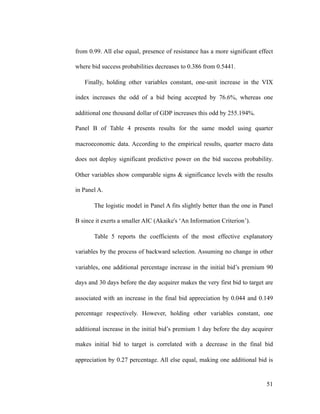
The logit regression is not a linear probability model; therefore the change
in the bid success probability resulting from a 1-unit change in the
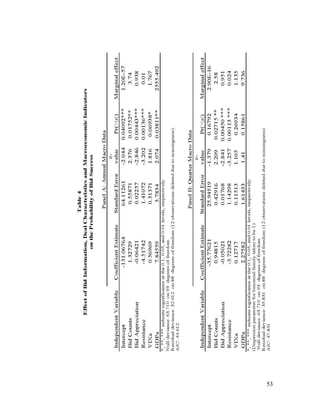
independent variables varies depending on the starting point. Panel A of Table
4 presents results for the logistic regression on bid outcome (binary, 1 if
accepted, 0 if rejected) using annual macroeconomic data. This regression also
represents the optimal sets of features as specified by the backward selection
search algorithm. The determinants with the most predictive power on bid
success probability for this dataset include the number of total bids made by
acquirer, the bid appreciation, target’s resistance, and market’s volatility
index. Annual macroeconomic data exerts more statistical significance on the
probability of bid success than quarter data. Specifically for Panel A using
annual macro data, holding other variables constant, the odd of striking a deal
increases by (exp(1.32)-1)*100 = 274% with each additional bid. The odd of a
successful bid decreases by 6.2% with each additional percentage of bid
appreciation assuming no change in the remaining variables. Similarly, a bid
is 99% more likely to fail when target shows signs of resistance holding other
variables constant. As bid appreciation increases to 15% (final round) from
5% (first round), absence of target’s resistance decreases bid success to 0.983
'50
from 0.99. All else equal, presence of resistance has a more significant effect
where bid success probabilities decreases to 0.386 from 0.5441.
Finally, holding other variables constant, one-unit increase in the VIX
index increases the odd of a bid being accepted by 76.6%, whereas one
additional one thousand dollar of GDP increases this odd by 255.194%.
Panel B of Table 4 presents results for the same model using quarter
macroeconomic data. According to the empirical results, quarter macro data
does not deploy significant predictive power on the bid success probability.
Other variables show comparable signs & significance levels with the results
in Panel A.
The logistic model in Panel A fits slightly better than the one in Panel
B since it exerts a smaller AIC (Akaike's ‘An Information Criterion’).
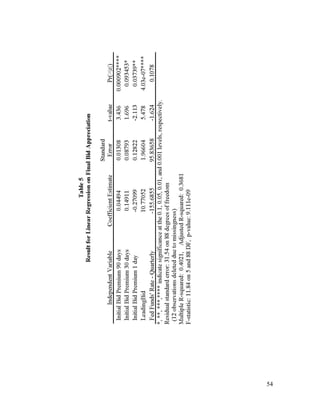
Table 5 reports the coefficients of the most effective explanatory
variables by the process of backward selection. Assuming no change in other
variables, one additional percentage increase in the initial bid’s premium 90
days and 30 days before the day acquirer makes the very first bid to target are
associated with an increase in the final bid appreciation by 0.044 and 0.149
percentage respectively. However, holding other variables constant, one
additional increase in the initial bid’s premium 1 day before the day acquirer
makes initial bid to target is correlated with a decrease in the final bid
appreciation by 0.27 percentage. All else equal, making one additional bid is
'51
associated with an increase in bid appreciation by 10.77 percentage. Fed’s
Fund Rate is not statistically significant in this model.
'52
'
'53
'
'54
4.3.2 Goodness of Fit
To measure the goodness-of-fit and predictive power of the logit model, I
will proceed to randomly partition the data set into two sub-data sets: training
data and test data. I will fit the model on the training data, and then predict the
test data using the fitted model to assess the predictive ability of the fitted
model. Hastie et al suggests that it is difficult to set a threshold for sufficiently
sized training data, and a common split of data set for model assessment
purposes is 50% training data, 25% validating, and 25% testing (2009).
Training data will be used to estimate the models, validating data will help
identify model with best performance (analytically through AIC, BIC,..or
through cross-validation), and testing data will help quantify model’s
prediction error. They argue that splitting data set into different sections
(training, validating, and testing) reduces the risk of model over-fitting
possibly incurred through bootstrapping (resampling with replacement) and
jackknifing. For standard cross-validation, training and validating data sets
will be divided further into smaller sections on which all but one section are
used for model fitting and the last section for model selection. However, given
this data set’s small size, partition following this standard cross-validation
method (in order to fit the best model) would result in limited observations in
each section and largely varied predictive power between the models. For this
reason, the employed backward selection method allows the researcher to fit
'55
the best model on the entire data set, and thus provides a good alternative for
standard cross-validation.
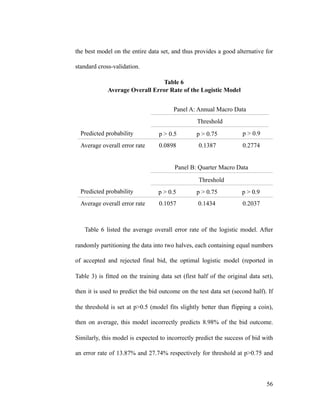
Table 6
Average Overall Error Rate of the Logistic Model
Table 6 listed the average overall error rate of the logistic model. After
randomly partitioning the data into two halves, each containing equal numbers
of accepted and rejected final bid, the optimal logistic model (reported in
Table 3) is fitted on the training data set (first half of the original data set),
then it is used to predict the bid outcome on the test data set (second half). If
the threshold is set at p>0.5 (model fits slightly better than flipping a coin),
then on average, this model incorrectly predicts 8.98% of the bid outcome.
Similarly, this model is expected to incorrectly predict the success of bid with
an error rate of 13.87% and 27.74% respectively for threshold at p>0.75 and
Panel A: Annual Macro Data
Threshold
Predicted probability p > 0.5 p > 0.75 p > 0.9
Average overall error rate 0.0898 0.1387 0.2774
Panel B: Quarter Macro Data
Threshold
Predicted probability p > 0.5 p > 0.75 p > 0.9
Average overall error rate 0.1057 0.1434 0.2037
'56
p>0.9 (higher threshold forces higher correctness standard for the predictions,
ie: larger threshold p restricts the number of false positive).
'57
CHAPTER 5
DISCUSSION
The t-test shows that there is not enough statistical evidence to conclude
that the mean bid appreciation and size ratio between the accepted bids and
rejected bids are different. However, there is enough of statistical evidence to
conclude that the mean transaction values between accepted bids and rejected
bids are different. Specifically, the mean transaction value of the accepted bids
is 2.8 times higher than that of the rejected bids.
The probability of a successful bid decreases with resistance from target
and with increasing bid appreciation. Suppose target’s resistance changes from
0 to 1, the estimated bid success probability will decrease to 0.454 from 0.987
(for the sample averages). Since bid appreciation is a function of the initial
bid, high bid appreciation implies large gap between the initial bid and the
final bid. An initial bid that undervalues target might not start off the
conversation in a friendly mood, and this case seems to triumph over the case
where acquirer raises its bid after accessing target’s data room and adjusting
its offer. The probability of a successful bid also increases with continuing
conversation between target and acquirer as on-going negotiation furthers
'58
monetary and time involvement from both sides. Furthermore, increasing bid
count accompanied by bid appreciation shows acquirer’s unceasing
willingness to strike a deal, thus raises the bid success probability.
The effects of relative firm size and profitability, toehold, and total number
of bidders are not statistically significant. In addition, the effects of
macroeconomic data remain ambiguous since quarter VIX is not statistically
significant whereas annual VIX is. If the causal effect is present and true, the
empirical result implies that escalating market volatility encourages deal
closing; this might be the result of unobservable motives behind deal
initiating. Precisely, if acquirer makes an unsolicited bid, it has strong belief in
its ability to finance the deal and expand its operations in a volatile market;
this belief might spring from its strong financial standing whether it is
absolute or relative to that of target. If target solicits a deal from acquirer, it
signals a high willingness-to-sell and market volatility seems to reinforce this
willingness-to-sell.
The finding from the linear regression model suggests that if acquirer sets
a high basis for a M&A conversation with a high initial bid, it will find its
final bid appreciation smaller than if it first offers a lower initial bid. In fact, a
larger 1-day-prior initial bid premium is negatively correlated to the bid
appreciation. Connecting back to the logistic model where larger bid
appreciation hinders the bid success probability, it may be of interest for
'59
acquirer to approach target with a notably sizable offer (high 1-day-prior
initial bid premium) because this initial offer will set off a mood favorable for
negotiation between the two firms. The average bid appreciation is 19.46%
with a fairly large maximum of 202.5%
In contrast to the 1-day-prior initial bid premium, the 90-days-prior and
30-days-prior initial bid premium are positively correlated to the bid
appreciation. There is reason to believe that large 90-days prior and 30-days
prior initial bid premiums suggest either high valuation that acquirer assigns
to target or acquirer’s strong belief that target’s stock is undervalued. This
could also reflect a decreasing target stock’s price (between the 90-days prior
or 30-days prior time tags and the 1-day prior time tag). If target stock has not
been decreasing, then it is very likely that acquirer’s interest is strong. If the
causal relationship as implied by models is true, then target can easily learn
this signaled and feed it into the negotiation process in order to lock in an
even higher bid appreciation (jump from the initial bid to the final bid).
'60
CHAPTER 6
CONCLUSION
Given the sizable body of work on M&A bid outcome, most models study
bid outcome as primarily dependent on bid premium. In fact, very few models
take into account the role of target, firms’ dynamics and macroeconomic data
on the results of corporate sale’s vote. This thesis addresses this gap in current
literature and makes various contributions. First of all, it takes a holistic
approach and argues for the use of bid appreciation in bid outcome modeling
whereas past studies have focused entirely on the effect of bid premium and
where findings remain inconsistent. Second, it provides simple yet inclusive
statistical modeling framework that can equip firms with business acumen
during M&A negotiations.
This paper also shares the difficulty in teasing out causal effects with
other M&A empirical research in particular and corporate finance empirical
research in general (Hermalin et al, 2003). In other words, there might be
unobserved variables that determine both the dependent and independent
variables, directly or indirectly. In corporate finance setting, this problem is in
particular eminent because of its complex organizational structure,
'61
confidentiality agreement (talks behind closed doors) and most importantly
persisting lack of data. This endogeneity further complicates the censored
dependent variable mentioned in Chapter 3. This model is, after all, not
perfect because it makes several assumptions about real-life data and events
and thus simplifies complex structures. The data set’s small size (106
observations) and meticulous construction also count as drawbacks. This
model did, however, provide me with some insights into answering the
burning questions I had since last August. For further extension of this model,
it would firstly be beneficial to run it on a larger set of data to test its
predictive ability. This might not be hard with the help of SDC or other
comprehensive database, although it will take time to comb through SEC for
the first bid’s information and other model’s features. Second, a thorough
examination of other plausible driving forces will extend our understanding of
the bid outcome. One interesting determinant worth studying is the high-speed
trading recently described by Micheal Lewis in Flash Boys (2014). Walkling
(2005) cites several research suggesting that stock arbitraging is correlated
with probability of bid success. Similar to stock arbitraging, high speed
trading, or high frequency trading, is a practice by traders who capitalize on
the difference in stock prices sprung from the split second between trades
placement. Suggestions for influential bid outcome determinants include
organizational structure of involved firms, industry-specific cycles, existing
'62
legal framework and effects of types of merger and acquisitions (horizontal
and vertical versus conglomerate). The ever-evolving technological and legal
driving forces present exciting opportunities to advance the literature, and this,
I invite other scholars to contribute.
'63
APPENDIX
List of Industry by SIC Codes
Codes Used in R:
#Data clean-up & Descriptive Stats
mydata = read.csv("WIP.csv", header=T)
attach(mydata)
mydata$accepted = as.numeric(Rejected == 0)
rej = mydata[mydata$Rejected == 1,]
acc = mydata[mydata$Rejected == 0,]
mydata$SizeRatio=ASales/TSales
Industry First 2 digits of SIC code
Mining & Petroleum 10 to 13
Construction & Transportation 17, 40 to 47
Consumer Products (Food, Textile,
Print)
20, 22, 23, 26,27
Chemicals 28 to 34
Manufacturing 35 to 39
Communications 48
Wholesale of utilities, services &
products
49 to 51
Retail 52 to 59
Healthcare 63, 64, 80
Services 67, 70 to 87
'64
mydata$ProfitRatio=ANetIncome/TNetIncome
mydata$TargetROA=TNetIncome/TAverageTotalAssets
mydata$AcqROA=ANetIncome/AAverageTotalAssets
mydata$DiffROA=mydata$AcqROA-mydata$TargetROA
mydata$BidApp = ((FinalBid - InitialBid)/InitialBid)*100
mydata$LeadingBid = BidCounts - 1
LeadingBid = mydata$LeadingBid
summary(mydata)

'65
Codes Used in R: (Continued)
dim(mydata)
attach(mydata)
#Backward selection of model
full=glm(accepted ~ fBidPrem90 + BidCounts + BidApp + ThSize + fBidCW
+ Resistance + SolicitedByTarget + SizeRatio + DiffROA + VIXa + FedRateA
+ GDPa, data = mydata, family = "binomial")
null=glm(accepted ~ BidCounts + BidApp + Resistance, data = mydata,
family = "binomial")
step(full,scope=list(upper=full, lower=null),data=mydata,
direction="backward")
#Random assign to training data vs. test data
rej = mydata[mydata$Rejected == 1,]
acc = mydata[mydata$Rejected == 0,]
nrej = dim(rej)[1]
nacc = dim(acc)[1]
trainIndsR = sample(1:nrej,nrej/2+1)
testIndsR = setdiff(1:nrej, trainIndsR)
trainDataRej = rej[trainIndsR,]
testDataRej = rej[testIndsR,]
trainIndsA = sample(1:nacc,nacc/2)
testIndsA = setdiff(1:nacc, trainIndsA)
trainDataAcc = acc[trainIndsA,]
testDataAcc = acc[testIndsA,]
trainData = rbind(trainDataAcc, trainDataRej)
attach(trainData)
nrow(trainData)
testData = rbind(testDataAcc, testDataRej)
attach(testData)
nrow(testData)
#T-test
t.test(acc$TransactionValueMil, rej$TransactionValueMil)
t.test(acc$DiffROA, rej$DiffROA)
'66
t.test(acc$BidApp, rej$BidApp)
#Linear regression
opt=lm(BidApp ~ iBidPrem90 + iBidPrem30 + iBidPrem1 + LeadingBid +
FedRateA + VIXa + GDPa)
summary(opt)
'67
REFERENCES
Aharon, David Y., Ilanit Gavious, and Rami Yosef. "Stock market bubble
effects on mergers and acquisitions." The Quarterly Review of
Economics and Finance50.4 (2010): 456-470.
Altman, Edward I. "Financial ratios, discriminant analysis and the prediction
of corporate bankruptcy." The journal of finance 23.4 (1968): 589-609.
Ambrose, Brent W., and William L. Megginson. "The role of asset structure,
ownership structure, and takeover defenses in determining acquisition
likelihood." Journal of Financial and Quantitative Analysis 27.04
(1992): 575-589.
Ansoff, HI., Brandenburg, RG., Portner, FE., and R. Radosevich. "Acquisition
behavior of US manufacturing firms, 1946-1965". Nashville:
Vanderbilt University Press, 1971.
Asquith, Paul, Robert F. Bruner, and David W. Mullins Jr. "The gains to
bidding firms from merger." Journal of Financial Economics 11.1
(1983): 121-139.
Austin, Douglas V., and Jay A. Fishman. Corporations in conflict--the tender
offer. Masterco Press, 1970.
Baker, Malcolm, and Serkan Savaşoglu. "Limited arbitrage in mergers and
acquisitions." Journal of Financial Economics 64.1 (2002): 91-115.
Betton, Sandra, B. Espen Eckbo, and Karin Thorburn. "Corporate
takeovers."Elsevier/North-Holland Handbook of Finance
Series (2008).
Branch, Ben and Jia Wang. "Takeover Success Prediction and Performance of
Risk Arbitrage." Journal of Business & Economic Studies 15.2 (2009).
'68
Celikyurt, Ugur, Merih Sevilir, and Anil Shivdasani. "Going public to acquire?
The acquisition motive in IPOs." Journal of Financial Economics 96.3
(2010): 345-363.
Desai, Chintal A., and Robert Savickas. "On the causes of volatility effects of
conglomerate breakups." Journal of Corporate Finance 16.4 (2010):
554-571.
Dewey, Donald. "Mergers and cartels: Some reservations about policy." The
American Economic Review (1961): 255-262.
Ellert, James C. "Mergers, antitrust law enforcement and stockholder
returns."The Journal of Finance 31.2 (1976): 715-732.
Fidrmuc, Jana P., et al. "One size does not fit all: Selling firms to private
equity versus strategic acquirers." Journal of Corporate Finance 18.4
(2012): 828-848.
Giammarino, Ronald M., and Robert L. Heinkel. "A model of dynamic
takeover behavior." The journal of finance 41.2 (1986): 465-480.
Goergen, Marc, Marina Martynova, and Luc Renneboog. "Corporate
governance convergence: evidence from takeover regulation reforms
in Europe." Oxford Review of Economic Policy 21.2 (2005): 243-268.
Goldberg, Walter H. Mergers: Motives, modes, methods. Aldershot, England:
Gower, 1983.
Graebner, Melissa E., and Kathleen M. Eisenhardt. "The seller's side of the
story: Acquisition as courtship and governance as syndicate in
entrepreneurial firms." Administrative Science Quarterly 49.3 (2004):
366-403.
Gregoriou, Greg N., and Luc Renneboog. International mergers and
acquisitions activity since 1990: Recent research and quantitative
analysis. Elsevier, 2007.
Harford, Jarrad. "Corporate cash reserves and acquisitions." The Journal of
Finance 54.6 (1999): 1969-1997
.
'69
Harris, Robert S., et al. "Characteristics of acquired firms: fixed and random
coefficients probit analyses." Southern Economic Journal (1982):
164-184.
Hastie, Trevor, et al. “The elements of statistical learning”. Vol. 2. No. 1. New
York: Springer, 2009.
Hayes, Samuel L., and Russell A. Taussig. "Tactics of cash takeover
bids."Harvard Business Review 45.2 (1967): 135-148.
Hermalin, Benjamin E., and Michael S. Weisbach. Boards of directors as an
endogenously determined institution: A survey of the economic
literature. No. w8161. National Bureau of Economic Research, 2001.
Hindley, Brian. "Separation of ownership and control in the modern
corporation."Journal of Law and Economics (1970): 185-221.
Hirshleifer, David, and Ivan PL Png. "Facilitation of competing bids and the
price of a takeover target." Review of Financial Studies 2.4 (1989):
587-606.
Hirshleifer, David, and Sheridan Titman. "Share tendering strategies and the
success of hostile takeover bids." Journal of Political Economy 98.2
(1990): 295.
Holmstrom, Bengt, and Steven N. Kaplan. " Corporate Governance and
Merger Activity in the United States: Making Sense of the 1980s and
1990s." The Journal of Economic Perspectivs 15.2 (2001):121-144.
Hoffmeister, J. Ronald, and Edward A. Dyl. "Predicting outcomes of cash
tender offers." Financial Management (1981): 50-58.
Hovakimian, Armen, and Irena Hutton. "Merger-Motivated IPOs." Financial
Management 39.4 (2010): 1547-1573.
Hsieh, Jim, Evgeny Lyandres, and Alexei Zhdanov. "A theory of merger-
driven IPOs." Journal of Financial and Quantitative Analysis 46.5
(2011): 1367.
'70
Jarrell, Gregg A., and Annette B. Poulsen. "Shark repellents and stock prices:
The effects of antitakeover amendments since 1980." Journal of
Financial Economics 19.1 (1987): 127-168.
Jennings, Robert H., and Michael A. Mazzeo. "Competing bids, target
management resistance, and the structure of takeover bids." Review of
Financial Studies 6.4 (1993): 883-909.
Jensen, Michael C., and Richard S. Ruback. "The market for corporate
control: The scientific evidence." Journal of Financial economics 11.1
(1983): 5-50.
Kitching, John. "Why do mergers miscarry." Harvard Business Review 45.6
(1967): 84-101.
Koller, Daphne, and Mehran Sahami. "Toward optimal feature
selection." (1996).
Lewellen, Wilbur G. "A pure financial rationale for the conglomerate
merger."The Journal of Finance 26.2 (1971): 521-537.
Lewis, Michael. Flash Boys. WW Norton & Company, 2014.
Manne, Henry G. "Mergers and the market for corporate control." The Journal
of Political Economy (1965): 110-120.
Mitchell, M.; Pulvino, T. (2001) "Characteristics of Risk and Return in Risk
Arbitrage", The Journal of Finance, Vol 56, no. 6, pp. 2135-2175.
Monroe, Robert J., and Michael A. Simkowitz. "Investment characteristics of
conglomerate targets: A discriminant analysis." Southern Journal of
Business 9 (1971): 1-16.
Offenberg, David, and Christo Pirinsky. "How do Acquirers Choose between
Mergers and Tender Offers?." Unpublished working paper. Loyola
Marymount University (2013).
Palepu, Krishna G. "Predicting takeover targets: A methodological and
empirical analysis." Journal of Accounting and Economics 8.1 (1986):
3-35.
'71
Ravenscraft, David J., and Frederic M. Scherer. Mergers, sell-offs, and
economic efficiency. Brookings Institution Press, 1987.
Schwert, G. William. "Hostility in takeovers: in the eyes of the
beholder?." The Journal of Finance 55.6 (2000): 2599-2640.
Schipper, Katherine, and Rex Thompson. "The impact of merger-related
regulations on the shareholders of acquiring firms." Journal of
Accounting research (1983): 184-221.
Steiner, Peter Otto. Mergers: Motives, effects, policies. Ann Arbor: University
of Michigan Press, 1975.
Stevens, Donald L. "Financial characteristics of merged firms: A multivariate
analysis." Journal of Financial and Quantitative Analysis 8.02 (1973):
149-158.
Walkling, Ralph A. "Predicting tender offer success: A logistic
analysis."Journal of financial and Quantitative Analysis 20.04 (1985):
461-478.
Weston, J. Fred, and Kwang S. Chung. "Takeovers and corporate
restructuring: An overview." Business Economics (1990): 6-11.
Wooldridge, Jeffrey. Introductory econometrics: A modern approach. Cengage
Learning, 2012.
Zingales, Luigi. "Insider ownership and the decision to go public." The
Review of Economic Studies 62.3 (1995): 425-448.
'72

Phi.M&A.Thesis

  • 1.
    Sealing the Deal:The Effects of Deal Characteristics, Macroeconomic Indicators and Target-bidder Dynamics on U.S. Mergers and Acquisitions Bidding Outcome Since 2009 by Laurence Lê Huỳnh Ngọc Phi under the Direction of Professor Steven Schmeiser A Thesis Submitted to the Faculty of Mount Holyoke College in Partial Fulfillment of the Requirements for the Degree of Bachelor of Arts with Honors Department of Economics Mount Holyoke College South Hadley, MA 01075 May 2014
  • 2.
    Dành tặng bamẹ, anh hai, anh ba, và Phinix, mong em mau đến.
  • 3.
    ABSTRACT When a firmmakes a bid to buy another firm, the target firm can either accept or reject the bid. Facing an M&A bid, management typically performs cost-benefit analysis of handing over the firm’s control power while shareholders typically agonize over the discrepancy between their immediate monetary rewards and their future financial gains. Can numbers tell us anything about the outcome of a merger & acquisition bid? Do firms’ size, profitability, bid premium, and macroeconomic data have any predictive power over the turnout of a corporate sale vote? The majority of past studies have approached M&A from acquirers’ perspective and leaves targets’ decision-to-sell passive and price-driven1. However, there is evidence that bid premium has little effect on target’s acceptance of the bid2. In addition, more recent studies have focused on targets’ willingness-to-sell as a determinant of the bid outcome. Therefore, it is crucial to study the bid outcome from a holistic approach that takes into account the relativity in size and profitability between target firms and bidder firms, historical bid information, deal characteristics, as well as macroeconomic data at bidding time. I will use empirical data of domestic M&A deals between public firms from 2009 to 2013 to study whether targets’ and acquirers’ size and profit, toehold, deal characteristics such as bid premium, cash/stock weight, etc., and macroeconomic data such as growth projections and market volatility have any effect on the outcome of an M&A bid. The result shows that persistent conversation, increasing GDP level coupled with market volatility increase the bid success probability, whereas large bid appreciation and resistance from target depress the bid success probability. _________________________ 1. Betton, Sandra and Eckbo, B. Espen. Toehold, Bid jumps, and expected payoffs in takeovers. The Review of Financial Studies, vol.13, no.4 (2000): 841-882 2. Branch, B. and Wang, J. Takevoer Success Prediction and performance of risk arbitrage, Journal of Business & Economic Studies, 2009, p14-22
  • 4.
    ACKNOWLEDGMENTS I would liketo thank my advisor, Steven Schmeiser, for his Corporate Governance class that introduced me to the topic of M&A, and for his patient guidance and support in writing this thesis. I am also grateful for receiving astute and passionate instructions from Haley Hedlin and Bradford Westgate in both theoretical statistics and empirical data analysis. Without the help and M&A law expertise of Mr. James Kruse, this project could not be completed. I am also thankful for the Economics, Mathematics & Statistics, and Music Department at Mount Holyoke College, namely Professor Adelman, Professor Moseley, Professor Hartley, Professor Margaret Robinson, Professor Shepardson, Professor Schipull, Mark Gionfriddo, and Michele Scanlon. I am also indebted to the following people who have believed in me and who have helped me in so many different ways: Joshua Nelson (SGA), Karen Griffin and Amanda Donohue (AA), Ryan Colby’11 (Amherst), Brian Cheney and Joshua Tandy (GS). Especially, thank you Thu Quach ’11 (MHC) and Giang Nguyen’13 (NUS) for your help with assess to Bloomberg data, and many other little big things. To my friends (Estefania, Brandon, Dinh Nguyen, Madame Vaget), you’re the best. To my former teachers, Monsieur Nam, Madame Duc, Ms. Thuy Lien, thay Doan Vu, thay Vinh, anh Quan, for giving me important building block of a fulfilling learning life. To Mr. Le Sang, for your inspiring autobiography. To Francoise, Mae, Gerard, Emil, Homboy, Phuong, Charles, Tabi, Yoo & many more, for your beautiful soul and creations, I hope to join you soon. To the Nguyens, the Hoogendyks, the Harpers, the Monty- Carbonaries, Steve, Rick and Meredith, for all my new childhood memory. And last but not least, to my parents and brothers, for everything you have given me in my life.
  • 5.
    TABLE OF CONTENTS CHAPTER1 INTRODUCTION…………………………………….. 1 CHAPTER 2 A CLOSER LOOK AT M & A………………………. 4 2.1 History of M&A………………………………….. 5 2.2 Firm’s Performance as Motivations for M&A…… 6 2.3 Benefits of Mergers and Acquisitions to Shareholders…………………………………….9 2.4 Characteristics of Target Firms/ Sellers………… 10 2.5 Characteristics of Acquirer……………………… 12 2.6 Different Methods of Takeover and the Case of Choosing One vs. the Other……………..13 CHAPTER 3 MODELING BID OUTCOME………………………16 3.1 Bid Information…………………………………..18 3.1.1 Offer Premium…………………………... 18 3.1.2 Cash/Stock Weight……………………… 19 3.1.3 Bid Appreciation as a Determinant of Bid Outcome…………………………. 20 3.2 Target-Bidder Dynamics…………………………21 3.2.1 Toehold………………………………….. 21 3.2.2 Target Solicitation vs. Resistance…….…. 22 3.2.3 Public Status, Firm’s Size and Profitability…………………………. 24 3.3 Macroeconomic Environment……………………25 3.4 Other Factors Affecting the Bid Outcome………. 27 CHAPTER 4 METHODOLOGY…………………………………... 28 4.1 Data………………………………………………28 4.1.1 Data Collection and Variable Construction…………………… 28 4.1.2 Preliminary Statistic Findings……………34 4.2 Model Estimation Method………………………. 41 4.2.1 Predicting the Bid Success Probability…. 41
  • 6.
    4.2.2 Estimating theFinal Bid Appreciation….. 44
  • 7.
    CHAPTER 4 METHODOLOGY(Continued) 4.3 Empirical Results………………………………...45 4.3.1 Parameter Estimates…………………….. 45 4.3.2 Goodness of Fit…………………………..50 CHAPTER 5 DISCUSSION…………………………………………52 CHAPTER 6 CONCLUSION………………………………………. 55 APPENDIX………………………………………………………………. 58 REFERENCES……………………………………………………………61
  • 8.
    LIST OF TABLES Figure No.Title Page 1 Total Number of Takeover Contests and Characteristics of the Bid, January 2009- June 2013………36 2 Total Number of Takeover Contests, Average Value, Sales Transaction and ROA, January 2009- June 2013…………. 38 3 T-Test (Welch Test) for Difference in Mean Variables Between Accepted Bids and Rejected Bids, 2009-2013….. 41 4 Effect Of Bid Information, Deal Characteristics and Macroeconomic Indicators on the Probability of Bid Success…………………………………………….…..48 5 Result For Linear Regression On Final Bid Appreciation…49 6 Average Overall Error Rate of the Logistic Model……….. 51
  • 9.
    LIST OF FIGURES Figure No.Title Page 1 Breakdown of M&A Between January 2009 and June 2013 by Industry……………………………………...35 2 Transaction Value (in millions) in Descending Order…….. 39 3 Transaction Value by Bid Outcome Category…………….. 39 4 Difference in ROA Between Acquirer and Target by Bid Outcome Category………………………………….40 5 Bid Appreciation by Bid Outcome Category………………40
  • 11.
    CHAPTER 1 INTRODUCTION Mergers andacquisitions have evolved from a powerful corporate tool to a corporate culture that attracts enormous academic, professional, media and general public attention. On one hand, mergers and acquisitions are associated with the rage of hostility by “corporate raiders” from the 1980s. On the other hand, those carried out properly, arguably create organizational synergies that in turn improve production capacity, enable cost-efficient scalability, fuel growth, and increase shareholders’ value. From now on, M&A will be used to denote mergers and acquisitions. Last summer, the management buyout conversation between Dell’s shareholders and its founder, Mr. Michael Dell created a buzz in the corporate world. The deal attracted even more attention after Dell’s shareholders voted to reject Mr. Michael Dell’s initial bid. Competing bidders soon started getting themselves involved by placing rival bids. Following Dell’s rejected bid, a Wall Street Journal article commenting on the possible scenarios noted that the outcome of a failed corporate sale vote was often of mixed nature. It cited two examples: Dynergy’s holding company filed for bankruptcy within months of rejecting buyout and M&A offers, while Dollar Thrifty finally agreed to sell to Hertz at twice the price of the initial, rejected bid after 2 '1
  • 12.
    years. What goeson behind closed doors during M&A talks and negotiations? How do firms approach M&A decision and valuation? Why do some go through and some don’t? Research in M&A traditionally approaches these transactions from the acquirers’ perspective and thus assumes that targets’ decision-to-sell is price- driven. This particularly rings true for the M&A in the 1980s. However, there was evidence that bid premium (the excess in price between the acquirer’s offer and target’s unaffected stock price expressed as a percentage of target’s unaffected stock price) has little effect on target’s acceptance of the bid. In addition, antitakeover laws adopted in the late 1980s and early 1990s almost eliminate hostile tender offers (Bertrand and Mullainathan 2003). This particular change allows targets to better position themselves in a M&A conversation than previously possible. As a result, recent studies moved from just studying M&A from acquirers’ perspectives to also studying target’s willingness-to-sell as a determinant of the bid outcome. In this paper, I would like to use a holistic approach to study the bid outcome by exploring new determinants alongside those studied in previous researches. Besides historical bid information and deal hostility ranking, the variables I’m interested in adding to existing models are the relative size and profitability between target firms and bidder firms, and macroeconomic data. By bid outcome, I will be referring to first of all, whether the closing bid is accepted or rejected, and '2
  • 13.
    secondly, the bidvalue itself. Most studies focus on M&A deals further back in history, this thesis will provide an in-depth analysis of the most recent, post-crisis deals. The outline of this thesis is as follows: chapter 2 will provide taxonomy to discuss M&A history and describe M&A from a process perspective. Chapter 3 will exhibit the commonly studied bid outcome’s predictive factors and justify for the need to include new bid outcome’s determinants to better capture deal’s information. Chapter 4 will present the statistical models and findings on M&A deals happening between January 2009 and June 2013. Chapter 5 will provide conclusion and suggestions for possible extensions of the models discussed. '3
  • 14.
    CHAPTER 2 A CLOSERLOOK AT M&A Manne (1965) argues that M&A are powerful corporate strategy to gain control of both the corporate entity and the market. Since its emergence, M&A has become a prolific research topic that attracts a large influx of multidisciplinary contributions. Studies within the field of industrial organization and strategic management attempt to study the motivations behind different types of M&A, quantify synergy between firms, and evaluate mergers’ success via merged entity’s post-merger performance. Financial economists look at deal multiples and rely on stock returns to characterize M&A, calculate gains and develop arbitrage strategies. Game theory economists study the likelihood that a firm would become a bidding target, the success probability of a bid, and the bidding/auction process. Meanwhile, corporate governance scholars investigate the interactions between corporate ownership structure and takeover defense, and the classic agency problem that is conflicts of interest between management and shareholders. Last but not least, law and policy scholars assess the antitrust connotations in merger and '4
  • 15.
    acquisition at theindustry level, while building legal system to accommodate M&A related litigation. '5
  • 16.
    2.1 History ofM&A The first and second merger waves between 1820s and 1920s start after the relaxation of antitrust legislation (Goergen et al 2005). The third merger wave between 1950s and1970s is characterized by the dominance of conglomerate mergers in the United States (Steiner 1975). The 1980s wave showcases a surge in mergers volume, composed mostly of hostile takeovers, acquisitions activities that transform several industries and careers, widespread industry deregulation and creative financing tools invented by Wall Street investment banks (Jarrell et al. 1988). In the 1990s, mergers activities take turn to decrease in both leverage and hostility degree as compared to the 1980s but triumph in size (Holmstrom and Kaplan 2001). This decade also witnesses high growth in M&A activities in Europe and Asia while the next decade (2000s) witnessed dominance by US deals in both numbers and size. However, the abrupt crisis of 2007-2008 might cause this wave of M&A between 2003 and 2007 to be too short (Gregoriou and Renneboog 2007). As the M&A activities after 2008 are still unfolding, it could still be too early to characterize this next wave of M&A activities. However, it is still of great interest to study post-financial crisis M&A deals. My thesis attempts to identify the defining characteristics of deals in this post- crisis period from Jan 2009 until June 2013. 2.2 Firm’s Performance as Motivations for M&A '6
  • 17.
    In 20 yearsfrom 1968 to 1988, budget for acquisitions activities grew from $43.6 billion to $246.9 billion (Weston & Chung, 1990) and 40% of capital expenditure in 1988 was allocated to investment in acquisition (Weiner 1989). Whether or not these huge spending on mergers and acquisitions are justifiable depends on the benefits accrued by the merged entity. Many theoretical studies reason that the firms realize these following gains from mergers and acquisitions: increased market power (Ellert 1976), foothold in a new market, geographically or industrially (Sherman 1997), operating synergies (Mandelker 1974), operational efficiency (Eckbo 1986), additional resources and factors of production that fuel growth (Ansoff et al. 1971) and augmenting debt capacity (Lewellen 1971). In addition, M&A present many tax loopholes otherwise unavailable to corporate, alongside opportunities to change price earnings ratio, and a way to replace current inefficient management (Ansoff et al. 1971); they also function as useful corporate tool to avoid bankruptcy altogether, capitalize upon managerial inefficiencies and valuation discrepancies while achieving portfolio diversification (Altman 1968, Dewey 1961). Kitching (1967) analyzes the motives and benefits of 181 U.S. mergers and acquisitions and divided these activities into five categories: horizontal, vertical, concentric marketing, concentric technology and conglomerate merger and acquisition. Most M&A are grouped into the big 3 groups of '7
  • 18.
    horizontal, vertical, andconglomerate. In horizontal M&A, firms typically seek to merge and acquire other competing firms within its industry to eliminate the acquired competitor, increase its market power and thus benefit from economies of scale. Since merger and acquisition create a single entity of bigger size, the deal helps consolidate market share and provide the merged firms with impotent market power, pooled resources, higher bargaining power and thus allow them to charge a higher price while incurring lower costs. Walter and Barney (1990) suggest that horizontal mergers offer several benefits that can be linked to “market power” and “efficiency”. However, Dewey (1961) challenges the effects of merger and acquisition on increasing market power and instead credited the industry’s expansion rate and the firms’ life cycles as the single important determinant of market power. He argues that most mergers “have nothing to do with either the creation of market power or the realization of scale economies” and that horizontal merger functions more as a “civilized alternative” to bankruptcy or assets transfer from failing to rising firms. In vertical M&A, firms often further secure its supply chain by internalizing its suppliers. Scherer (1970) and Williamson (1970) suggest that vertical integration reduce uncertainty in the market, while locking in the availability of products and stable prices by both buyers and suppliers. They can also strategically acquire other firms competing for the same customer '8
  • 19.
    using different technology(concentric marketing). Steiner (1975) classifies these mergers as “market extension mergers” and cited the four industries in which most mergers exert this goal: dairies, beer, cement, and oil. The next category is concentric technology (Kitching 1967), or product extension (Steiner 1975) where firms using the same technology but serve a different customer population merge. The last category is conglomerate merger, where firms acquire others in different industries to diversify risk and strengthen their competitive position. Kitching (1967) also noted that the failure rate of concentric acquisitions is relatively high while that of horizontal mergers is low. Since debt is cheaper than equity, merged entities under the conglomerate umbrella were able to leverage its capital structure of combined assets as collateral and gain access to additional borrowing not available to a single firm with smaller capital capacity (Lewellen 1971). Despite the many argued benefits of M&A, there is not a silver bullet to increase firms’ performance since data shows a mixed result. Research by Goldberg (1983), Ravenscraft and Scherer (1987), and Steiner (1975) emphasize the role of enhanced market power in increasing firms’ well-being and present mixed results on firms’ profitability using accounting-based metrics. Ravenscraft and Scherer (1987) analyze data on U.S. manufacturing corporations from 1957 to 1977 and find that acquired corporations fare worse '9
  • 20.
    than pre-merger periodunless targets and acquirers are of roughly the same size. Ansoff et al. (1971) found from their sample of deals within the U.S. manufacturing space between 1946 and 1965 that high-growth acquirers stall while initial slow-growth acquirers accomplish impressive growth rate post- merger. 2.3 Benefits of Mergers and Acquisitions to Shareholders Shareholders of target firm see hefty financial gains through mergers and acquisitions activities. Jarrell and Poulsen (1987) calculate that premiums paid in tender offer averaged 19% in the 1960s, 35% in the 1970s, and 30% between the first half of the 1980s. In addition, shareholders of acquiring firms also benefit from excess stock return in light of M&A activities. Shareholders see a gain of 1-2% in the immediate period around the public announcement (Jarrel and Poulsen, 1987). Jensen and Ruback (1983) compute an average gain of 5% in the 1960s, and 2.2% in the 1970s. Asquith, Bruner and Mullins (1982) find an increase by 2.8% on average as a result of M&A announcement for deals from 1963 to 1979. They also conclude that stock returns are positively correlated to the size of target firms, more specifically cumulative excess return from a bid for a target half the acquirer’s size was 1.8% larger than return from a bid for a target one-tenth the acquirer’s size. Stock return to bidding firms’ shareholders is also correlated to the successful '10
  • 21.
    outcome of thebid (successful bid yield 4% greater stock returns then unsuccessful bid). Halpern (1973) concludes that acquirer and target firms’ shareholders benefit equally from M&A announcement while Mandelker (1974) observes a 14% stock appreciation for acquirer firms versus a 3.9% for target firm. 2.4 Characteristics of Target Firms/Sellers Studies on U.S. data in the 1960s by Hayes and Taussig (1967), Binder (1970), Monroe and Simkowitz (1971) and Stevens (1973) analyze data on conglomerate takeover targets in the 1950s and 1960s and note that acquired firms tend to be small, relatively unprofitable, and record low equity growth. Whereas Monroe and Simkowitz (1971) use a univariate discriminant model, Stevens (1973) chooses the multiple discriminant analysis model to tease out the effects of leverage (as proxied by liabilities/assets), profitability (EBIT/ sales), activity & turnover (sales/assets), liquidity (non-working capital/ assets), dividend policy and price earnings ratio on the acquisition probability and concludes that low PE ratios and dividend payout do not play an important role in increasing bid probability. Arguing that different acquiring firms are attracted to different financial and product characteristics of their targets, studies by Harris et al (1982) develop a new construction of an “index of attractiveness”, assigning varying weight instead of a fixed weight to '11
  • 22.
    different firms’ characteristics. The probability of being acquired is said to increase for smaller firms, highly liquid firms and firms with lower price earnings in the period of 1974-1975 and firms with little debt in the next period 1976-1977. This conclusion echoes with that of Stevens (1973) and Monroe and Simkowitz (1971). Low market/book ratio implies undervaluation (Walkling 1989); low debt and high liquidity firms (Jensen 1986) signal poorly managed firms. Palepu (1982) challenges the notion that firms are acquired because they are undervalued, citing that there is not a significance difference in book value between targets and non-targets (although market value might be different). Targets in his sample also exert higher PE ratio than the rest of non- targets (thus busting the belief that firms are acquired because they have low P/E ratio). Building on the work of Palepu, Ambrose and Megginson (1992) apply a similar analytical method to takeover target in 1981-1986 and saw a reduced explanatory effect. They also find that the presence of voting increases bid probability, the presence of blank-check preferred stock and the increase in institutional shareholdings in the quarter reduce takeover bid, while the presence of poison pills defense has no effect. In summary, previous studies of acquired firms present inconsistent and changing patterns in the explanatory power of target firm’s financial factors on the probability of receiving an acquisition bid. '12
  • 23.
    A small proportionof studies on IPO firms also links IPO to the probability of becoming acquisition target. Zingales (1995) suggests that going public serves as a preliminary valuation screen test for the ultimate goal of selling out to prospective bidders. Hsieh et al (2011) compare IPO target to bankrupt firms and find that IPO target becomes acquisition target because of their positive growth rate and strong performance and not because they are failing and heading down the bankruptcy road. On a different note, firms with high willingness to sell (which go out to solicit a deal from buyers instead of reacting to bid offer) will take the following legal and financial actions to smooth a deal’s process: resolve unregistered trademark, obtain patents or necessary disclosure from third party, and settle securities sales litigation (Sherman, 1998). Literature on target firm as an active entity in M&A is more limited than that on target firm as an acquirer’s pick. 2.5 Characteristics of Acquirer Firms are more likely to acquire other firms if they accumulate large reserves of cash (Hartford 1999). Firms with precedent acquisition experience are more likely to capitalize on existing vetting & integration guidelines and hence make more acquisitions (Haleblian and Kim, 2006). Ansoff et al. (1971) distinguish low-growth-rate and high-growth-rate acquirers since the former decreased dividend payout and took on new debt to finance an acquisition, '13
  • 24.
    whereas the latterincreased dividend payout while increasing equity financing. Some studies within the IPO literature identify newly IPO firms as prolific acquirer and argue that IPO (1) reveals acquirer’s potential market value and thus reduces threat of asymmetric information and cost of collecting information for target firms, and (2) provides acquirer with newly raised capital to finance M&A. As a case in point, 77% of newly IPO firms between 1985 and 2004 purchase at least one company within their IPO year and on average, a newly publicly traded firm acquires four other companies within the first five years of IPO (Celikyurt et al 2010) and over 1/3 of firms acquire others within their first three years of IPO ( Hovakimian and Hutton 2010). 2.6 Different Methods of Takeover and the Case of Choosing One vs. the Other There are several mechanisms to take over control in a corporate setting. Manne (1965) lists three categories: direct purchase of shares, proxy fights and merger. The first method, direct purchase of shares, can either take form of takeover or tender offer. In a takeover, the bidder negotiates target’s shares price with the target firm’s board of directors and makes an offer. If target’s management concludes that this offer reflects the true worth of its company, it will present the offer and its recommendation to shareholders who '14
  • 25.
    will vote toaccept or reject. In a tender offer, the bidder makes a direct offer to the shareholders while circumventing the board of directors all together. Offenberg and Pirinski (2009) claim that tender offers cost more than mergers, but complete its course more quickly due to the current regulatory setup. Dyl and Hoffmeister (1972) list five types of tender offer: (1) friendly tender offer where target and acquirer negotiate on price and payment method, (2) unfriendly tender offer where bid attempt is abrupt and leaves target surprised, (3) white knight tender offer where unfriendly offer is countered by a larger cash offer negotiated with a firm friendlier to the target, (4) black knight tender offer where multiple unfriendly bidders compete, and (5) tender offer that evolves from unfriendly to friendly as the size of bid premium increases with negotiation. Even though it is not true that bid will always increase in value as negotiation progresses, I will incorporate this last observation by Dyl and Hoffmeister into my model by counting the total number of bids leading to the final (winning or losing) bid. In a tender offer, the target firm will continue to exist as long as there are minority shareholders holding out, however most tender offers oscillate towards merger as the increasing number of shares accumulated provides acquiring firm corporate control. Under the current legal environment, a friendly approach to negotiation is preferred to a hostile tender offer, unless '15
  • 26.
    the intention isto replace incumbent management (Betton, Eckbo, Thorburn 2008). In the second method (proxy fight), unlike takeover and tender offer where substantial share ownership is crucial, aspiring acquirers do not have to own any shares in a proxy contest (or proxy fight). They instead draw existing shareholders-voters’ attention to potential issues in hope to leverage their votes to put in place election of a certain board seats, or some changes. Manne (1965) notes that proxy fights typically signal issues with target firms’ compensation distribution and often happen in the lack thereof of large block- holding. The third method (merger) is characterized by the convergence in industrial and economic goals of all involved entities (Goldberg 1983). '16
  • 27.
    CHAPTER 3 MODELING BIDOUTCOME After figuring out whether, why and how a merger and acquisition deal will add value to the acquiring firms, typically a bidder will pick a target firm while a target firm will solicit a sale of its own company to buyers. Parties will approach their counter parties to make a bid. A takeover is successful if a bid culminates in successfully closing an acquisition deal; a takeover bid fails if the target votes to turn down the acquirer’s offer. The evolution of both M&A law and market competition allow targets to actively seek buyers, solicit competing bids, and in some cases flat out reject acquirer’s bid whether or not competing bids exist. Target firms have come to set their own agenda, development goals, and appetite for merger and acquisition. As a result, the target’s response to M&A bids might follow a pattern different from those exerted within earlier legal framework. Much literature on M&A in the past shed light on the acquirers’ motivation, and painted sellers as passive price taking entities. However, as sellers gain momentum in this M&A process over the years, and accumulate more negotiation power due to both asymmetry information and a scarcity of good '17
  • 28.
    M&A candidates, thereis a need to also understand the drivers of targets’ decision to sell, their resistance, and dynamics around corporate sale vote. M&A is a lengthy process that involves considerable amount of time, effort, and organizational resources from buyers, sellers, and all involved financial institutions. For this reason, the dependent variable (bid outcome) is censored. In other words, only companies who have strong belief in their ability to close a deal with targets will reach out to make bids. By bid outcome, I mean (1) the corporate sale vote’s outcome, in other words, whether we can tell apart deals that are more likely to seal successfully to the ones set up to fail, for a lack of better term and (2) the bid value. Since M&A involves lots of resources, understanding the M&A dynamics that lead to a successful bid will help acquirers and buyers reserve those resources for other value-creating projects, otherwise wasted on deals that lead nowhere or drag on endlessly. Given the acquirer’s characteristics, bidding climate (whether or not other bidders present themselves along the bidding process), target firm’s characteristics and macroeconomic conditions, what can we predict about the bid outcome? The next paragraph will survey the determinants of interest for bid outcome analysis. Some factors are the focus of past research, while others are my addition. They can be grouped into three categories: bid information, target-bidder dynamics and macroeconomic data. '18
  • 29.
    3.1 Bid Information 3.1.1Offer Premium Offer premium is measured as the difference between bid price and the unaffected, pre-announcement-date share price expressed as a percentage of the pre-announcement share price. The effect of bid premium on the bid outcome remains ambiguous throughout the M&A literature. Past research that attempts to predict the bid’s success probability come to vastly different conclusions: Betton & Eckbo (2000) find positive correlation between high bid offer premium and success probability of the initial bid. A survey of 647 takeovers between 1979 and 1987 by Jennings and Mazzeo (1993) shows that higher bid premiums raise the probability of success as it reduces resistance from target firm’s shareholders and deter incoming competing bids. However, more recent studies by Mitchell and Pulvino (2001), Baker and Savasoglu (2001), Branch et al (2008) show the negligible effects of offer premium on shareholders’ decision to sell. Research by Hayes and Taussig (1967) resonates with this same conclusion, adding that opposition from target management tends to drive up the offer premium. Dyl and Hoffmeister (1972) also conclude from their model that bid premium does not affect the outcome of tender offer. 3.1.2 Cash/Stock Weight '19
  • 30.
    Target management is(1) more likely to accept cash offer instead of all-stock or mixed offer and (2) more motivated by cash than by stock for tax reasons if their firm is small (Fishman 1989). Jennings and Mazzeo (1993) analyze 647 initial proposals from mid-1979 to 1987 and find that weight of cash in the offer is positively correlated to the numbers of competing bids. Mitchell and Pulvino (2001) examine 4750 mergers from 1963 to 1998 and found that cash tender offer (mix of cash and shares) increases the odds while 100% cash payment decreases it. Their piecewise linear model also suggests that cash deals are more likely to fail in depreciating markets. Betton and Eckbo (2008) resonate with the large portion of cash offered by acquirer in multiple bids, and add that bidders of great potential raise the optimal amount of cash, but rallies for a stock payment if unsure of its pick of target, or if the acquirer stock is overpriced. Target who undervalues acquirer pushes away from acquirers’ stocks and towards cash payment. The motivation and effect of mixed offers stay ambiguous. '20
  • 31.
    3.1.3 Bid Appreciationas a Determinant of Bid Outcome There is reason to believe that the stock market does not always reflect companies’ true values, it assigns instead a price tag mirroring the expectations of investors on a company’s future worth. Stock prices at any given time can be undervalued, valued at its true worth, or overvalued. Schipper and Thompson argue that stock prices absorb market information and/or shocks in such a way that they immediately adjust at the surface of any tip or clue about M&A(1983). Since bid premium measures the excess in bid value in comparison to stock price before the announcement date; it is a function of the base stock price. Previous research assume that base stock price stay presumably “unaffected” post announcement. However, I believe that market reactions to M&A news derive substantial noise and in return affect base stock price. Hence I propose using bid appreciation instead of bid premium as an alternative bid outcome determinant. Bid appreciation captures acquirer’s valuation of target in a granular way and controls for market fluctuations outside of what is already accounted for by acquirer when it makes the bid. Betton and Eckbo surveyed a similar variable called the bid jump for their data sets of tender offer contests and auctions and find that large bid jump is positively correlated with bidding costs, and that strategic bidders tend to offer a high initial bid to forestall competing bids in tender offer contest (2008). They report an average jump of 10% from initial bid to '21
  • 32.
    second bid, and14% from initial bid to the final bid. Since bid appreciation (or bid jump) seizes both observable and unobservable information about the bid, it can be used to study bids regardless of deal form (tender offer contests or not), auction form (whether there are auctions involving multiple bidders), and inherent market reactions or shocks. In other words, bid appreciation provides a more rigorous basis for bid success analysis than bid premium. 3.2 Target-Bidder Dynamics 3.2.1 Toehold A bidder is said to have a toehold if it owns at least 5% in the target firm at the time of bidding. Institutional entities or individual’s share ownerships exceeding this threshold will trigger filling of form 13D or 13G with the SEC. Existing shares ownership facilitates the goal of gaining corporate control, as it levied the burden of share purchase. Researches by Walking (1985), Jennings and Mazzeo (1993), Betton and Eckbo (2000) suggest that toehold bidding increases the success probability in a tender offer for the bidder, whereas resistance from target’s management (as exerted through legal action against the bidder, shareholder list withholding, recommendation against accepting bid, and mostly through their shares ownership in the target) hinder shares tendering and the probability of success. Bidder owning a large portion of target’s shares can influence the vote and '22
  • 33.
    target management (throughplacement of board of directors). Toehold is often negatively correlated with offer premium. Winning acquirers have large toehold in successful, single-bid contest but small toehold in multiple-bid contest. 3.2.2 Target Solicitation vs. Resistance There is not an extensive body of work on target firm’s willingness to sell since this factor depends on target management’s goal and is typically not observable. Graebner and Eisenhardt (2004) cite financial and strategic hurdles as incentives for firms to seek help from acquirers who have the ability to lift them through these obstacles. Their research focuses on entrepreneurial start-ups, a different population than firms used in other studies surveyed for this paper. Bodt et al. (2011) classify target firms that initiate and/or solicit selling and that choose the auction methods (vs. a negotiation process) as those that have high willingness to sell. Cousin, de Bodt, and Demidova (2011) classified firms that actively seek out buyers and set up auction processes as high WTS and those that once received takeover bid did not bother looking for alternatives buyers as low WTS. It can be inferred that a firm’s high WTS is negatively correlated with its resistance, and thus a bid for target with high WTS will be more likely to be successful. Financial status can also be indicative of target’s willingness to sell, and it is common to see various financial ratio, together with a proxy for '23
  • 34.
    either (1) target’sreaction to bid’s hostility or (2) target’s vulnerability to bidder’s takeover attempt, in bid outcome modeling. Schwert (2000) uses a probit model on 2,346 transactions from 1975 to 1996 to predict whether a takeover offer is successful given the level of hostility.The findings show that un-negotiated offers (highly hostile bid) and pre-bid hostility depress success rate. Pre-bid hostility is determined by bidder and target’s decision in making their bid public: bidder will make bid public to put shareholders’ pressure on management, and target will attract competing bids (only possible if preliminary merger agreement allows for a go-shop period). The researcher also mentions that modeling success rate is tricky in a sense that firms shy away from making the offer if it is certain that a bid would fail. Unfortunately he does not elaborate further on this statement. Dyl and Hoffmeister (1972) survey 84 cash tender offers with known outcomes between 1976 and 1977 and develop four different multivariate discriminant variable models to predict the outcome of cash tender offer using firms’ financial metrics (growth, dividend payout, ratios etc) and vulnerability index (size as compared to bidder and bidder’s toehold). Their model lists target management’s opposition as the single most important factor in determining bid’s success and identifies small size as the subsequent determinant of bid success, whereas the bid premium is not of crucial effect. Hirshleifer and Titman (1990) argue that bidders who, via their bid, '24
  • 35.
    successfully reveal thepotential improvement post-takeover stand a high chance to tender enough shares to gain control. They argue that the bidder’s uncertainty of the prices at which shareholders will tender is correlated to offers’ failure. Other factors influencing shareholders’ decision to tender shares include transaction costs, tax and liquidity considerations. Their theoretical framework highlights that some defense mechanisms can actually raise the probability of the tender offer’s success because they induce bidders to offer a higher premium. In short, resistance as exerted by target’s hostile reaction, official actions and legal lawsuits against bidder to deter bid, is of heavier weight in determining bid’s success at this stage in M&A. Resistance is a good proxy for low willingness to sell. Similarly, fierce resistance from target and the presence of a poison pill depress the success rate of bid. It is less common to see models that incorporate the relative effects of industry characteristics, size and other characteristics of both buyers and sellers into predicting the bid outcome. Though Betton, Eckbo, and Thorburn (2007) develop fairly holistic model studying 7,470 initial merger bids & tender offers and conclude that the presence of the acquirer’s toehold in the target firm, its public company status and size, high bid premium and all-cash offer in a horizontal merger or acquisition increase the initial bid’s probability of success. '25
  • 36.
    3.2.3 Public Status,Firm’s Size and Profitability Mitchell and Pulvino (2001) conclude that private bidder is more likely to fail than public bidder while bigger size helps increase bidder’s chance of winning the transaction. For the scope of this research, I propose using sales (or revenues) and return on assets as proxies for firm’s size and profitability respectively. To reduce the risk of comparing apples to oranges, and to give these metrics a comparative baseline, size ratio and difference in the return on assets ratios will be considered instead of the size and profitability metrics in their separate contexts. 3.3 Macroeconomic Environment There has not been much literature on how the market’s volatility influences shareholders’ decision to sell. Most research devotes to understand the effect of stock market’s bubble on M&A level of activities. Aharon et al. (2010) find that the level and value of M&A activities rise during the technology bubble, and decrease at intensifying pace after the bubble first bursts. Damodaran resonates this finding, suggesting that waves of mergers and acquisitions tend to rise together with bullish stock market. The historical waves of M&A presented earlier in Chapter 2 show a pattern of high frequency and total transaction value of mergers and acquisitions during booming market period. After the 2007-2008 financial crisis, M&A will not be '26
  • 37.
    as robust asthey were during the 80s hostile rage, the 2000s tech dot com, or the surge since 2003. Given the context of a recovering economy, will bid outcome determinants affect M&A bid the same way they did in previous M&A waves? Will target firms be more willing to sell if the economy is inching back to its previous level of growth? Will bid be more or less likely to result in a materialized transaction if the market is volatile? If investors do not have optimistic outlook on the market at the recovery time post market crash, they would scale back on investment & M&A ventures. Similarly, if the market is volatile, risk-adverse firms would prefer not to initiate M&A deal, whereas sellers looking to overcome a capital hurdle, or seek shelter from a large firm would prefer to seal the deal. The VIX index which measured the implied volatility of S&P 500 tends to move in opposite direction with the stock market. In a volatile market where stock fluctuates ferociously, investors will buy into future options to hedge against the risk in their stock portfolio, all of which sends VIX appreciating. Apart from the bid outcome determinant on the acquirer, buyer, and deal-level, it might be of economic value to include and test for the significance of bid outcome determinant on the macro level (stock market volatility, and industry cycle). Are firms more willing to buy or sell during volatile stock market? It can be argued that if both sides are risk adverse and only involve in M&A for gains from stock undervaluation, a deal in volatile '27
  • 38.
    market is unlikelyto reach this goal. If the target handing over control thinks that its acquirer will provide great shelter to market volatility and ground for further development, target’s willingness to sell will increase. At the bottom their industry cycle, firms can be more likely to strike a deal to consolidate its operations and help keep each other stay afloat. In other words, dire market conditions provide firms with healthy financial standing great opportunities to amass additional market shares from smaller firms. At the peak of its industry cycle, acquirer of conglomerate M&A nature, for the sake of diversification, might be interested in buying firms of opposite cycle. Target firm might not be as interested because it can be inferred that the conglomerate would abandon it instead of investing in it when its cycle descends. Similarly, firms of horizontal and vertical M&A may want to merge to build momentum for recovering cycle, or accelerate their growing market power in expanding cycle. 3.4 Other Factors Affecting the Bid Outcome Sherman (1998) mentions that sellers suffer from “seller’s remorse” (concern about tax implication of the sale, uncertainty on management’s compensation), “don’t-call-my-baby-ugly” syndrome, stringent price fixation when acquirers discover and focus on problems during negotiations, and a last minute decision not to sell due to a shift in strategic '28
  • 39.
    planning or exogenouscircumstances. These struggles and agonies add friction to the target’s resistance and decrease their willingness to sell, thus hinder the success probability of a bid. '29
  • 40.
    CHAPTER 4 METHODOLOGY 4.1 Data 4.1.1Data Collection and Variable Construction Unlike most intensive research on M&A transactions which have focused on the period of time before the financial crisis in 2007 and 2008, I explore recent deals in the U.S. while avoiding the disruptive effect of the financial crisis in 2007-2008. My database source is Bloomberg (best option available when MHC does not have access to SDC Platinum, the most popular data source for M&A papers). Between January 2009 and June 2013, Bloomberg reported 618 transactions that fall into its category of merger and acquisition (as opposed to leverage buyout, management buyout, cross- borders acquisitions among other scenarios not in the scope of this research: asset sales, divestiture, spin off). Typically, in most cases where the acquirer is a private equity fund, it is hard to find disclosure on deal metrics. Therefore I dropped all deals where at least one of the involved parties (bidder or target) is private, as further information beneficial to the purpose of this study is not freely and/or publicly available. In line with previous research, financial institutions (SIC code 62 or 67) will also be dropped from the sample to avoid '30
  • 41.
    any confounding factorsassociated with firms in this highly regulated industry. Deals involving one firm buying other firm’s large division and deals that are blocked by the FTC (Federal Trade Commission) for antitrust and monopoly concern are also dropped from the sample, for example, Wolverine buying the PLG division of Collective Brands, or Integrated bidding to buy PLX Technology. Preliminary investigation shows that some of the reported successful bid had at least one previous failed bid. Betton and Eckbo (2000) populate each M&A transaction in their data set with details on each bid ever made (including the initial bid, the final bid and every bid in between). For the purpose of this study, I will collect information attached to the initial bid and the final bid only. Because M&A talks typically last one year, including every single bid in between the initial (opening) and final (closing) bid will lead to multicolinearity problem among the metrics on size and profitability and among the annual macroeconomic data. Given the name of acquirer and targets from Bloomberg query, I combed through the SEC filings to further investigate these deals. The presence of SEC forms such as Definitive proxy statement (DEFM) filings often identifies transactions as mergers and acquisitions, whereas that of SC 14D9 filing signals tender offer processes. These forms contain a section called “Background of the Merger” that provides information on historical '31
  • 42.
    bids leading upto the final bid, whether the bid is solicited by target, target’s management reactions to the bid (resistant actions, whether the board accepts the bid, or whether the board recommends shareholders to vote for or against the bid), number of total bidders, as well as other events leading up to the outcome of the final bid. Companies often report bid price offered by involved parties in case of auction or competition between multiple bidders, however only winning bidder’s identity is disclosed. There was no way to identify and collect data on bidders other than the one disclosed in the filings. Target’s schedule 13 disclosed on SEC (either SC 13D or SC 13G) reveals toehold size and the name of the corporate entity that owns more than 5% of target’s shares. Financials data such as sales/revenues, net income and average total assets are available in10-k filing. Since target and acquiring firms do not always have the same fiscal year endings, I collected annual data from target and acquirer’s filling period closest to each other and to the deal’s announcement date. For example, Gentiva Health announced its acquisition of Odyssey Health on May 24th, 2010. Metrics from Odyssey Health’s filing come from fiscal year ended December 31, 2009 and those from Gentiva Health’s filing come from fiscal year ended January 3rd, 2010. The two variables of interest are size ratio and difference in ROA, calculated as followed: Sales Ratio = Acquirer’s Revenues/Target’s Revenues '32
  • 43.
    ROA = NetIncome/Average Total Assets Difference in ROA = Acquirer’s ROA - Target’s ROA M&A are typically categorized as horizontal, vertical, or conglomerate. SEC Edgar Company search tool also provides firm’s SIC code. In the case of target and acquirer sharing the same 4-digit SIC code, a deal takes place between firms sharing the smallest available industry segment. These cases represent a horizontal M&A. Other cases where SIC codes are not identical, there are several criteria to classify M&A. Transaction is horizontal if target and acquirer share at least one pair of the same 4-digit SIC code but are not vertically related (Herger and McCorriston, 2013). If firms are in different industries but share one pair of SIC code, their transaction can be classified as vertical. In addition, from Kitching’s classification, horizontal M&A can be determined if the “Background of the Merger” section mentions the acquirers and targets are industry rivals, or if financial news report industrial market shares consolidation as a result of the M&A. Similarly, if targets or acquirers deem one another suppliers, or major revenues sources in their SEC filings, then the transaction is vertical. Conglomerate M&A occurs between two companies from different industries not sharing any remote business relations such as rival, suppliers or clients. After populating metrics characterizing the firms and bid information, I looked up historical stock quotes to populate the bid premiums attached to '33
  • 44.
    each bid. Previousresearch pays close attention to bid premium at different time before the announcement date and typically include 3 of these time tags: 90 days, 60 days, 30 days, and 1 day before the announcement date. It is argued that rumors about mergers and acquisitions start several weeks before the announcement date, therefore I included in my data set stock quotes at 90 days, 30 days, and 1 day before the announcement date. Historical stock quotes are readily accessible for almost all firms in my dataset on Google Finance and InvestorPoint. Historical stock quotes for target firms that stop trading after merger and acquisitions are available in Bloomberg. Walkling (1985) draws attention to the base date used in premium calculating. He argues that taking the date following SEC filings would lead to an underestimated bid offer premium, since news about takeover, merger and acquisition appears first in the financial press or press release from involved firms (before the full-fledged report with SEC), and sometimes circulated on the street months before the official announcement. The base price () for premium calculations is the closed priced at t equals 1 day, 30 days, and 90 days before the date the transaction is made public via financial news.Bid premium is calculated as: Bid premium at time t = [(Bid Value - Stock Price at time t)/ Stock price at time t] * 100 The inconsistence in findings on the effect of bid premium on bid outcome can be explained in several ways, for instance, deal rumors spread on the '34
  • 45.
    streets months beforethe official announcement date, the variability in stock prices follows a random walk, and stock prices reflect market’s expectation of a company’s worth, not the true worth itself. I propose using bid appreciation in place of bid premium as a determinant of bid outcome. Bid premium and bid appreciation contain drastically different information about the bid. Bid premium measures the surplus between the acquirer’s bid and the target’s stock value at a given time, whereas bid appreciation measures the jump to acquirer’s final bid from its initial bid. Bid appreciation is calculated as followed: Bid appreciation = [(Final bid - Initial Bid)/Initial Bid]*100 Since the base value is now the initial bid (instead of the presumably “unaffected” stock price), bid appreciation reflects information true to the value assigned to target by acquirer while controlling for the shifting in stock prices and other events affecting the stock price before announcement date. As stated above, macroeconomics data of interest include VIX (volatility index), Fed’s fund rate and GDP (gross domestic product). Econstats.com and the Federal Reserve Systems provide daily data on VIX index and Fed fund’s rate respectively from which I calculated the weighted average quarter and annual. The US Bureau of Economic Analysis provides GDP data (available as both quarter and annual value and in 2009 dollars in this dataset) that can be merged with the bid’s data by time tag. '35
  • 46.
    This data alsocontains GAAP metrics instead of financial ratios such as Deal Multiple, Enterprise Value, EBITDA, etc that are freely available to researchers. It is also a bit more comprehensive than usual data sets in the sense that it contains both the initial and the final bid outcome. However, since the M&A waves post-crisis are still unfolding, this data set is smaller than data set typically used in M&A research paper (5 years’ worth of data vs. 10 years or 30 years). The collection process is long and painstaking because it contained information not automatically available in commercial database (notably initial bid value, resistance, total bidders, etc) that requires combing through various schedules in SEC filings. 4.1.2 Preliminary Statistic Findings A preliminary query in Bloomberg yields 618 mergers and acquisition in the US from January 2009 to June 2013. Of these 618 transactions, 128 observations involve both public target and bidder (approximately 21.04%). Of these 128 observations, 5 involved financial institutions as acquiring firms, 16 observations where either historical bids or stock quote are missing, and 1 observation where the merger is halted mid-way due to a FTC investigation. This leaves my dataset with 106 observations. Each observation is populated with metrics on firm’s size (proxied by revenues), firm’s profitability (proxied by ROA), initial bid value, initial bid’s premium at different point in time, final bid value, final’s bid premium at different point in time, firm’s toehold '36
  • 47.
    size, bid resistance,bid solicitation, type of merger, and macroeconomics data in both quarter and annual value. This data matrix contains 106 rows and 56 columns. '37
  • 48.
    Figure 1 Breakdown ofM&A Between January 2009 and June 2013 by Industry ' Please refer to the appendix for specific SIC codes according to each industry group. 0 8 15 23 30 Mining, petroleum Manufacturing Healthcare 19 11 1 76 22 17 13 3 7 22 9 3 7 5 23 17 11 3 6 Target Acquiring '38
  • 49.
  • 50.
  • 51.
  • 52.
    Figure 2 Transaction Value(in millions) in Descending Order ' Figure 3 Transaction Value by Bid Outcome Category ' '42
  • 53.
    Figure 4 Difference inROA Between Acquirer and Target by Bid Outcome Category ' Figure 5 Bid Appreciation by Bid Outcome Category '43
  • 54.
  • 55.
    Table 3 T-test (Welchtest) for Difference in Mean Variables Between Accepted Bids and Rejected Bids, 2009-2013 4.2 Model and Estimation Method 4.2.1 Predicting the Bid Success Probability Since there are many possible bid outcome determinants (as mentioned in chapter 3), each observation in this data set is categorized by a large number of features. To find the optimal combination of features, Koller and Sahami (1996) propose a “feature selection” search algorithm called backward elimination method. The backward selection algorithm is performed on a full model including all probable determinants. It will eliminate variable (or feature) that provides little or no information on the dependent variable given other remaining variables’ assumed predictive power. I would like to present a logit model related to the model by Mitchell & Pulvino (2001) and Betton & Eckbo (2009). Since the outcome of the bid is coded 1 as accepted (deal) and 0 as rejected (no deal), the dependent variable Variables Mean of Variable for Accepted Bids Mean of Variable for Rejected Bid t df p- value Transaction Value 4952.226 1739.718 2.706 77.025 0.008 Difference in ROA 0.054 0.0519 0.044 15.277 0.9653 Bid Appreciation 13.204 46.257 -1.635 12.535 0.127 '45
  • 56.
    is a binaryvariable. Therefore, I will use a logit model to estimate the probability that the bid is successful, ie two firms come to a consensus that a deal will materialize, unless further development results in a post deal-closing break-up. The probability a bid is successful is estimated as a function of the various determinants, specifically: Probability (bid is successful) = βo + βi∗Xi where Xi are features vectors including final bid premium, total number of bid counts, bid appreciation, toehold size, bid’s cash weight, target’s resistance, target’s solicitation, sales ratio, difference in ROA ratio, volatility index, Fed’s Fund Rate, GDP. • Final bid premium have three different time tags, 90 days, 30 days and 1 day before announcement date and are not included in the model simultaneously to avoid multi-collinearity. The effect of final bid premium is ambiguous, although it is likely to increase the probability of bid success assumed no deal information is leaked out. • Bid appreciation is a function of the initial bid. Thus there are two different scenarios involving a large bid appreciation: the initial bid is low which might offend target and affect the mood of the M&A conversation; or the acquirer raises its bid by a remarkable amount throughout the deal conversation. If the initial bid is low and the '46
  • 57.
    mood is notoptimally friendly, a large bid appreciation might not increase the success probability. However, if the large bid appreciation signals the acquirer’s “goodwill”, then the effect of bid appreciation on success bid probability is positive. • Target’s resistance is a binary variable. It is coded 1 if target’s management opposed the bid through poison pills adoption, recommendation to its shareholders not to tender their shares, or sale of assets to a third party. The coefficient of target’s resistance is expected to be negative, as it decreases the probability of successful bid. • Toehold size is the existing ownership of target by acquiring firm. Target’s solicitation is a binary variable, coded 1 if target solicits deal from acquirer. Having toehold affords acquirer a stronger say in the negotiation and target solicitation signals high willingness to sell, therefore the presence of toehold and target’s solicitation can also result in a higher bid success probability. • Sales Ratio and Difference in Return on Assets Ratio proxy for the relative size and profitability of the two firms. Large Size Ratio means the acquirer is notably bigger than target, and positive difference in ROA means that acquirer is more profitable than target. The coefficients of Sales Ratio and Difference in Return on '47
  • 58.
    Assets Ratio areexpected to be positive because having a strong operational and financial standing will help in convincing target of acquirer’s ability to carry out the deal financially at the least and to operate businesses at the most. • Post-crisis recovering market (low Fed Fund’s rate) and eminent volatility (high VIX) can induce smaller firms to hand over corporate control to larger firms or to merge with similar size firms to stay strong together. However, target might also be motivated to resist M&A offer and wait for a less volatile market (coupled with a better recovering macroeconomic environment). The coefficient of volatility and of Fed Fund’s rate is ambiguous, whereas that of GDP is expected to be positive because M&A surge during boom market. 4.2.2 Estimating the Final Bid Appreciation I use a multivariate linear regression model to estimate the effect of bid information and macroeconomics data on the final bid’s appreciation from the initial bid. The final bid appreciation is estimated as followed: Final bid’s appreciation = βo+βi∗Xi where Xi is characteristics vectors including initial bid premium, total number of bid counts, bid appreciation, number of bidders, toehold size, bid’s cash weight, target’s resistance, target’s solicitation, sales ratio, difference in ROA '48
  • 59.
    ratio, volatility index,Fed’s Fund Rate, GDP. The same backward model selection method is applied for this model. • A large initial bid premium might imply that either target is undervalued, or acquirer attaches valuation above market consensus. If the latter is true where the stock market has not caught on target’s underestimated stock prices, then the coefficient of initial bid premium is positive • It is not always the case that the bid value keeps increasing with the number of bids made. It is quite often that the adjusted bid is lower than the previous bid. However, bidder’s decision to make one additional bid signals its high willingness to buy, and thus the bid counts’ coefficient is positive • Target’s resistance is likely to increase bid appreciation, whereas toehold decreases it. Sales ratio and difference in ROA might not be relevant in this model (they affect the price, not so much the bid jump) • The effects of macroeconomics on bid appreciation remain ambiguous '49
  • 60.
    4.3 Empirical Results 4.3.1Parameter Estimates The logit regression is not a linear probability model; therefore the change in the bid success probability resulting from a 1-unit change in the independent variables varies depending on the starting point. Panel A of Table 4 presents results for the logistic regression on bid outcome (binary, 1 if accepted, 0 if rejected) using annual macroeconomic data. This regression also represents the optimal sets of features as specified by the backward selection search algorithm. The determinants with the most predictive power on bid success probability for this dataset include the number of total bids made by acquirer, the bid appreciation, target’s resistance, and market’s volatility index. Annual macroeconomic data exerts more statistical significance on the probability of bid success than quarter data. Specifically for Panel A using annual macro data, holding other variables constant, the odd of striking a deal increases by (exp(1.32)-1)*100 = 274% with each additional bid. The odd of a successful bid decreases by 6.2% with each additional percentage of bid appreciation assuming no change in the remaining variables. Similarly, a bid is 99% more likely to fail when target shows signs of resistance holding other variables constant. As bid appreciation increases to 15% (final round) from 5% (first round), absence of target’s resistance decreases bid success to 0.983 '50
  • 61.
    from 0.99. Allelse equal, presence of resistance has a more significant effect where bid success probabilities decreases to 0.386 from 0.5441. Finally, holding other variables constant, one-unit increase in the VIX index increases the odd of a bid being accepted by 76.6%, whereas one additional one thousand dollar of GDP increases this odd by 255.194%. Panel B of Table 4 presents results for the same model using quarter macroeconomic data. According to the empirical results, quarter macro data does not deploy significant predictive power on the bid success probability. Other variables show comparable signs & significance levels with the results in Panel A. The logistic model in Panel A fits slightly better than the one in Panel B since it exerts a smaller AIC (Akaike's ‘An Information Criterion’). Table 5 reports the coefficients of the most effective explanatory variables by the process of backward selection. Assuming no change in other variables, one additional percentage increase in the initial bid’s premium 90 days and 30 days before the day acquirer makes the very first bid to target are associated with an increase in the final bid appreciation by 0.044 and 0.149 percentage respectively. However, holding other variables constant, one additional increase in the initial bid’s premium 1 day before the day acquirer makes initial bid to target is correlated with a decrease in the final bid appreciation by 0.27 percentage. All else equal, making one additional bid is '51
  • 62.
    associated with anincrease in bid appreciation by 10.77 percentage. Fed’s Fund Rate is not statistically significant in this model. '52
  • 63.
  • 64.
  • 65.
    4.3.2 Goodness ofFit To measure the goodness-of-fit and predictive power of the logit model, I will proceed to randomly partition the data set into two sub-data sets: training data and test data. I will fit the model on the training data, and then predict the test data using the fitted model to assess the predictive ability of the fitted model. Hastie et al suggests that it is difficult to set a threshold for sufficiently sized training data, and a common split of data set for model assessment purposes is 50% training data, 25% validating, and 25% testing (2009). Training data will be used to estimate the models, validating data will help identify model with best performance (analytically through AIC, BIC,..or through cross-validation), and testing data will help quantify model’s prediction error. They argue that splitting data set into different sections (training, validating, and testing) reduces the risk of model over-fitting possibly incurred through bootstrapping (resampling with replacement) and jackknifing. For standard cross-validation, training and validating data sets will be divided further into smaller sections on which all but one section are used for model fitting and the last section for model selection. However, given this data set’s small size, partition following this standard cross-validation method (in order to fit the best model) would result in limited observations in each section and largely varied predictive power between the models. For this reason, the employed backward selection method allows the researcher to fit '55
  • 66.
    the best modelon the entire data set, and thus provides a good alternative for standard cross-validation. Table 6 Average Overall Error Rate of the Logistic Model Table 6 listed the average overall error rate of the logistic model. After randomly partitioning the data into two halves, each containing equal numbers of accepted and rejected final bid, the optimal logistic model (reported in Table 3) is fitted on the training data set (first half of the original data set), then it is used to predict the bid outcome on the test data set (second half). If the threshold is set at p>0.5 (model fits slightly better than flipping a coin), then on average, this model incorrectly predicts 8.98% of the bid outcome. Similarly, this model is expected to incorrectly predict the success of bid with an error rate of 13.87% and 27.74% respectively for threshold at p>0.75 and Panel A: Annual Macro Data Threshold Predicted probability p > 0.5 p > 0.75 p > 0.9 Average overall error rate 0.0898 0.1387 0.2774 Panel B: Quarter Macro Data Threshold Predicted probability p > 0.5 p > 0.75 p > 0.9 Average overall error rate 0.1057 0.1434 0.2037 '56
  • 67.
    p>0.9 (higher thresholdforces higher correctness standard for the predictions, ie: larger threshold p restricts the number of false positive). '57
  • 68.
    CHAPTER 5 DISCUSSION The t-testshows that there is not enough statistical evidence to conclude that the mean bid appreciation and size ratio between the accepted bids and rejected bids are different. However, there is enough of statistical evidence to conclude that the mean transaction values between accepted bids and rejected bids are different. Specifically, the mean transaction value of the accepted bids is 2.8 times higher than that of the rejected bids. The probability of a successful bid decreases with resistance from target and with increasing bid appreciation. Suppose target’s resistance changes from 0 to 1, the estimated bid success probability will decrease to 0.454 from 0.987 (for the sample averages). Since bid appreciation is a function of the initial bid, high bid appreciation implies large gap between the initial bid and the final bid. An initial bid that undervalues target might not start off the conversation in a friendly mood, and this case seems to triumph over the case where acquirer raises its bid after accessing target’s data room and adjusting its offer. The probability of a successful bid also increases with continuing conversation between target and acquirer as on-going negotiation furthers '58
  • 69.
    monetary and timeinvolvement from both sides. Furthermore, increasing bid count accompanied by bid appreciation shows acquirer’s unceasing willingness to strike a deal, thus raises the bid success probability. The effects of relative firm size and profitability, toehold, and total number of bidders are not statistically significant. In addition, the effects of macroeconomic data remain ambiguous since quarter VIX is not statistically significant whereas annual VIX is. If the causal effect is present and true, the empirical result implies that escalating market volatility encourages deal closing; this might be the result of unobservable motives behind deal initiating. Precisely, if acquirer makes an unsolicited bid, it has strong belief in its ability to finance the deal and expand its operations in a volatile market; this belief might spring from its strong financial standing whether it is absolute or relative to that of target. If target solicits a deal from acquirer, it signals a high willingness-to-sell and market volatility seems to reinforce this willingness-to-sell. The finding from the linear regression model suggests that if acquirer sets a high basis for a M&A conversation with a high initial bid, it will find its final bid appreciation smaller than if it first offers a lower initial bid. In fact, a larger 1-day-prior initial bid premium is negatively correlated to the bid appreciation. Connecting back to the logistic model where larger bid appreciation hinders the bid success probability, it may be of interest for '59
  • 70.
    acquirer to approachtarget with a notably sizable offer (high 1-day-prior initial bid premium) because this initial offer will set off a mood favorable for negotiation between the two firms. The average bid appreciation is 19.46% with a fairly large maximum of 202.5% In contrast to the 1-day-prior initial bid premium, the 90-days-prior and 30-days-prior initial bid premium are positively correlated to the bid appreciation. There is reason to believe that large 90-days prior and 30-days prior initial bid premiums suggest either high valuation that acquirer assigns to target or acquirer’s strong belief that target’s stock is undervalued. This could also reflect a decreasing target stock’s price (between the 90-days prior or 30-days prior time tags and the 1-day prior time tag). If target stock has not been decreasing, then it is very likely that acquirer’s interest is strong. If the causal relationship as implied by models is true, then target can easily learn this signaled and feed it into the negotiation process in order to lock in an even higher bid appreciation (jump from the initial bid to the final bid). '60
  • 71.
    CHAPTER 6 CONCLUSION Given thesizable body of work on M&A bid outcome, most models study bid outcome as primarily dependent on bid premium. In fact, very few models take into account the role of target, firms’ dynamics and macroeconomic data on the results of corporate sale’s vote. This thesis addresses this gap in current literature and makes various contributions. First of all, it takes a holistic approach and argues for the use of bid appreciation in bid outcome modeling whereas past studies have focused entirely on the effect of bid premium and where findings remain inconsistent. Second, it provides simple yet inclusive statistical modeling framework that can equip firms with business acumen during M&A negotiations. This paper also shares the difficulty in teasing out causal effects with other M&A empirical research in particular and corporate finance empirical research in general (Hermalin et al, 2003). In other words, there might be unobserved variables that determine both the dependent and independent variables, directly or indirectly. In corporate finance setting, this problem is in particular eminent because of its complex organizational structure, '61
  • 72.
    confidentiality agreement (talksbehind closed doors) and most importantly persisting lack of data. This endogeneity further complicates the censored dependent variable mentioned in Chapter 3. This model is, after all, not perfect because it makes several assumptions about real-life data and events and thus simplifies complex structures. The data set’s small size (106 observations) and meticulous construction also count as drawbacks. This model did, however, provide me with some insights into answering the burning questions I had since last August. For further extension of this model, it would firstly be beneficial to run it on a larger set of data to test its predictive ability. This might not be hard with the help of SDC or other comprehensive database, although it will take time to comb through SEC for the first bid’s information and other model’s features. Second, a thorough examination of other plausible driving forces will extend our understanding of the bid outcome. One interesting determinant worth studying is the high-speed trading recently described by Micheal Lewis in Flash Boys (2014). Walkling (2005) cites several research suggesting that stock arbitraging is correlated with probability of bid success. Similar to stock arbitraging, high speed trading, or high frequency trading, is a practice by traders who capitalize on the difference in stock prices sprung from the split second between trades placement. Suggestions for influential bid outcome determinants include organizational structure of involved firms, industry-specific cycles, existing '62
  • 73.
    legal framework andeffects of types of merger and acquisitions (horizontal and vertical versus conglomerate). The ever-evolving technological and legal driving forces present exciting opportunities to advance the literature, and this, I invite other scholars to contribute. '63
  • 74.
    APPENDIX List of Industryby SIC Codes Codes Used in R: #Data clean-up & Descriptive Stats mydata = read.csv("WIP.csv", header=T) attach(mydata) mydata$accepted = as.numeric(Rejected == 0) rej = mydata[mydata$Rejected == 1,] acc = mydata[mydata$Rejected == 0,] mydata$SizeRatio=ASales/TSales Industry First 2 digits of SIC code Mining & Petroleum 10 to 13 Construction & Transportation 17, 40 to 47 Consumer Products (Food, Textile, Print) 20, 22, 23, 26,27 Chemicals 28 to 34 Manufacturing 35 to 39 Communications 48 Wholesale of utilities, services & products 49 to 51 Retail 52 to 59 Healthcare 63, 64, 80 Services 67, 70 to 87 '64
  • 75.
  • 76.
    Codes Used inR: (Continued) dim(mydata) attach(mydata) #Backward selection of model full=glm(accepted ~ fBidPrem90 + BidCounts + BidApp + ThSize + fBidCW + Resistance + SolicitedByTarget + SizeRatio + DiffROA + VIXa + FedRateA + GDPa, data = mydata, family = "binomial") null=glm(accepted ~ BidCounts + BidApp + Resistance, data = mydata, family = "binomial") step(full,scope=list(upper=full, lower=null),data=mydata, direction="backward") #Random assign to training data vs. test data rej = mydata[mydata$Rejected == 1,] acc = mydata[mydata$Rejected == 0,] nrej = dim(rej)[1] nacc = dim(acc)[1] trainIndsR = sample(1:nrej,nrej/2+1) testIndsR = setdiff(1:nrej, trainIndsR) trainDataRej = rej[trainIndsR,] testDataRej = rej[testIndsR,] trainIndsA = sample(1:nacc,nacc/2) testIndsA = setdiff(1:nacc, trainIndsA) trainDataAcc = acc[trainIndsA,] testDataAcc = acc[testIndsA,] trainData = rbind(trainDataAcc, trainDataRej) attach(trainData) nrow(trainData) testData = rbind(testDataAcc, testDataRej) attach(testData) nrow(testData) #T-test t.test(acc$TransactionValueMil, rej$TransactionValueMil) t.test(acc$DiffROA, rej$DiffROA) '66
  • 77.
    t.test(acc$BidApp, rej$BidApp) #Linear regression opt=lm(BidApp~ iBidPrem90 + iBidPrem30 + iBidPrem1 + LeadingBid + FedRateA + VIXa + GDPa) summary(opt) '67
  • 78.
    REFERENCES Aharon, David Y.,Ilanit Gavious, and Rami Yosef. "Stock market bubble effects on mergers and acquisitions." The Quarterly Review of Economics and Finance50.4 (2010): 456-470. Altman, Edward I. "Financial ratios, discriminant analysis and the prediction of corporate bankruptcy." The journal of finance 23.4 (1968): 589-609. Ambrose, Brent W., and William L. Megginson. "The role of asset structure, ownership structure, and takeover defenses in determining acquisition likelihood." Journal of Financial and Quantitative Analysis 27.04 (1992): 575-589. Ansoff, HI., Brandenburg, RG., Portner, FE., and R. Radosevich. "Acquisition behavior of US manufacturing firms, 1946-1965". Nashville: Vanderbilt University Press, 1971. Asquith, Paul, Robert F. Bruner, and David W. Mullins Jr. "The gains to bidding firms from merger." Journal of Financial Economics 11.1 (1983): 121-139. Austin, Douglas V., and Jay A. Fishman. Corporations in conflict--the tender offer. Masterco Press, 1970. Baker, Malcolm, and Serkan Savaşoglu. "Limited arbitrage in mergers and acquisitions." Journal of Financial Economics 64.1 (2002): 91-115. Betton, Sandra, B. Espen Eckbo, and Karin Thorburn. "Corporate takeovers."Elsevier/North-Holland Handbook of Finance Series (2008). Branch, Ben and Jia Wang. "Takeover Success Prediction and Performance of Risk Arbitrage." Journal of Business & Economic Studies 15.2 (2009). '68
  • 79.
    Celikyurt, Ugur, MerihSevilir, and Anil Shivdasani. "Going public to acquire? The acquisition motive in IPOs." Journal of Financial Economics 96.3 (2010): 345-363. Desai, Chintal A., and Robert Savickas. "On the causes of volatility effects of conglomerate breakups." Journal of Corporate Finance 16.4 (2010): 554-571. Dewey, Donald. "Mergers and cartels: Some reservations about policy." The American Economic Review (1961): 255-262. Ellert, James C. "Mergers, antitrust law enforcement and stockholder returns."The Journal of Finance 31.2 (1976): 715-732. Fidrmuc, Jana P., et al. "One size does not fit all: Selling firms to private equity versus strategic acquirers." Journal of Corporate Finance 18.4 (2012): 828-848. Giammarino, Ronald M., and Robert L. Heinkel. "A model of dynamic takeover behavior." The journal of finance 41.2 (1986): 465-480. Goergen, Marc, Marina Martynova, and Luc Renneboog. "Corporate governance convergence: evidence from takeover regulation reforms in Europe." Oxford Review of Economic Policy 21.2 (2005): 243-268. Goldberg, Walter H. Mergers: Motives, modes, methods. Aldershot, England: Gower, 1983. Graebner, Melissa E., and Kathleen M. Eisenhardt. "The seller's side of the story: Acquisition as courtship and governance as syndicate in entrepreneurial firms." Administrative Science Quarterly 49.3 (2004): 366-403. Gregoriou, Greg N., and Luc Renneboog. International mergers and acquisitions activity since 1990: Recent research and quantitative analysis. Elsevier, 2007. Harford, Jarrad. "Corporate cash reserves and acquisitions." The Journal of Finance 54.6 (1999): 1969-1997 . '69
  • 80.
    Harris, Robert S.,et al. "Characteristics of acquired firms: fixed and random coefficients probit analyses." Southern Economic Journal (1982): 164-184. Hastie, Trevor, et al. “The elements of statistical learning”. Vol. 2. No. 1. New York: Springer, 2009. Hayes, Samuel L., and Russell A. Taussig. "Tactics of cash takeover bids."Harvard Business Review 45.2 (1967): 135-148. Hermalin, Benjamin E., and Michael S. Weisbach. Boards of directors as an endogenously determined institution: A survey of the economic literature. No. w8161. National Bureau of Economic Research, 2001. Hindley, Brian. "Separation of ownership and control in the modern corporation."Journal of Law and Economics (1970): 185-221. Hirshleifer, David, and Ivan PL Png. "Facilitation of competing bids and the price of a takeover target." Review of Financial Studies 2.4 (1989): 587-606. Hirshleifer, David, and Sheridan Titman. "Share tendering strategies and the success of hostile takeover bids." Journal of Political Economy 98.2 (1990): 295. Holmstrom, Bengt, and Steven N. Kaplan. " Corporate Governance and Merger Activity in the United States: Making Sense of the 1980s and 1990s." The Journal of Economic Perspectivs 15.2 (2001):121-144. Hoffmeister, J. Ronald, and Edward A. Dyl. "Predicting outcomes of cash tender offers." Financial Management (1981): 50-58. Hovakimian, Armen, and Irena Hutton. "Merger-Motivated IPOs." Financial Management 39.4 (2010): 1547-1573. Hsieh, Jim, Evgeny Lyandres, and Alexei Zhdanov. "A theory of merger- driven IPOs." Journal of Financial and Quantitative Analysis 46.5 (2011): 1367. '70
  • 81.
    Jarrell, Gregg A.,and Annette B. Poulsen. "Shark repellents and stock prices: The effects of antitakeover amendments since 1980." Journal of Financial Economics 19.1 (1987): 127-168. Jennings, Robert H., and Michael A. Mazzeo. "Competing bids, target management resistance, and the structure of takeover bids." Review of Financial Studies 6.4 (1993): 883-909. Jensen, Michael C., and Richard S. Ruback. "The market for corporate control: The scientific evidence." Journal of Financial economics 11.1 (1983): 5-50. Kitching, John. "Why do mergers miscarry." Harvard Business Review 45.6 (1967): 84-101. Koller, Daphne, and Mehran Sahami. "Toward optimal feature selection." (1996). Lewellen, Wilbur G. "A pure financial rationale for the conglomerate merger."The Journal of Finance 26.2 (1971): 521-537. Lewis, Michael. Flash Boys. WW Norton & Company, 2014. Manne, Henry G. "Mergers and the market for corporate control." The Journal of Political Economy (1965): 110-120. Mitchell, M.; Pulvino, T. (2001) "Characteristics of Risk and Return in Risk Arbitrage", The Journal of Finance, Vol 56, no. 6, pp. 2135-2175. Monroe, Robert J., and Michael A. Simkowitz. "Investment characteristics of conglomerate targets: A discriminant analysis." Southern Journal of Business 9 (1971): 1-16. Offenberg, David, and Christo Pirinsky. "How do Acquirers Choose between Mergers and Tender Offers?." Unpublished working paper. Loyola Marymount University (2013). Palepu, Krishna G. "Predicting takeover targets: A methodological and empirical analysis." Journal of Accounting and Economics 8.1 (1986): 3-35. '71
  • 82.
    Ravenscraft, David J.,and Frederic M. Scherer. Mergers, sell-offs, and economic efficiency. Brookings Institution Press, 1987. Schwert, G. William. "Hostility in takeovers: in the eyes of the beholder?." The Journal of Finance 55.6 (2000): 2599-2640. Schipper, Katherine, and Rex Thompson. "The impact of merger-related regulations on the shareholders of acquiring firms." Journal of Accounting research (1983): 184-221. Steiner, Peter Otto. Mergers: Motives, effects, policies. Ann Arbor: University of Michigan Press, 1975. Stevens, Donald L. "Financial characteristics of merged firms: A multivariate analysis." Journal of Financial and Quantitative Analysis 8.02 (1973): 149-158. Walkling, Ralph A. "Predicting tender offer success: A logistic analysis."Journal of financial and Quantitative Analysis 20.04 (1985): 461-478. Weston, J. Fred, and Kwang S. Chung. "Takeovers and corporate restructuring: An overview." Business Economics (1990): 6-11. Wooldridge, Jeffrey. Introductory econometrics: A modern approach. Cengage Learning, 2012. Zingales, Luigi. "Insider ownership and the decision to go public." The Review of Economic Studies 62.3 (1995): 425-448. '72