S T R A T E G I C H U M A N R E S O U R C E M A N A G E M E N T
BOOK III & VI
PHILIPPINE LABOR CODE
The Labor Code of the Philippines is the
legal code governing employment
practices and labor relations in the
Philippines.
It was enacted through Presidential
Decree No. 442 on Labor day, May 1, 1974,
by President Ferdinand Marcos in the
exercise of his then extant legislative
powers.
PHILIPPINE LABOR CODE
CONDITIONS OF EMPLOYMENT
TITLE I: WORKING CONDITIONS AND
REST PERIODS
1
2
3
TITLE II: WAGES
TITLE III: WORKING CONDITIONS FOR
SPECIAL GROUPS OF EMPLOYEES
ART. 82. Coverage
The provision of this Title shall apply to employees in all
establishments and undertakings whether for profit or not,
but not to government employees, managerial employees,
field personnel, members of the family of the employer
who are dependent on him for support, domestic helpers,
persons in the personal service of another, and workers
who are paid by results as determined by the Secretary of
Labor in appropriate regulations.
CHAPTER I: HOURS OF WORK
TITLE I: WORKING CONDITIONS & REST
PERIODS
FIELD PERSONNEL
refer to non-agricultural employees who regularly
perform their duties away from the principal place of
business or branch office of the employer.
CHAPTER I: HOURS OF WORK
MANAGERIAL EMPLOYEES
refer to those whose primary duty consists of the
management of the establishment in which they are
employed or of a department or subdivision thereof,
and to other officers or members of the managerial staff.
ART 83. NORMAL HOURS OF WORK
Shall not exceed 8 hours in a regular working day
PURPOSE: to safeguard the health and welfare of the laborer
and in a way to minimize unemployment by utilizing different
shifts.
REGULAR WORKING DAYS: The regular working days of
covered employees shall not be more than five days in a
workweek. The workweek may begin at any hour and on any
day, including Saturday or Sunday, designated by the employer.
CHAPTER I: HOURS OF WORK
ART 84. HOURS WORKED
SHALL INCLUDE:
1.All time during which an employee is required to
be on duty or to be at a prescribed workplace; and
2. All time during which an employee is suffered
or permitted to work
CHAPTER I: HOURS OF WORK
ART 85. MEAL PERIODS
subject to such regulations as the Secretary of Labor may
prescribe, it shall be the duty of every employer to give his
employees not less than 60 minutes time-off for their
regular meals.
(1) Should not be less than sixty (60) minutes, and is time-
off/non-compensable
(2) Under specified cases, may be less than sixty (60) minutes,
but should not be less than twenty (20) minutes and must be
with full pay.
(3) If less than twenty (20) minutes, it becomes only a rest
period and is thus considered as work time
CHAPTER I: HOURS OF WORK
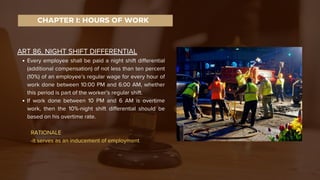
ART 86. NIGHT SHIFT DIFFERENTIAL
Every employee shall be paid a night shift differential
(additional compensation) of not less than ten percent
(10%) of an employee’s regular wage for every hour of
work done between 10:00 PM and 6:00 AM, whether
this period is part of the worker’s regular shift.
If work done between 10 PM and 6 AM is overtime
work, then the 10%-night shift differential should be
based on his overtime rate.
RATIONALE
-it serves as an inducement of employment
CHAPTER I: HOURS OF WORK
ART 87. OVERTIME WORK
Work may be performed beyond eight (8) hours a day
provided that the employee is paid for the overtime
work, an additional compensation equivalent to his
regular wage plus at least twenty-five percent (25%)
thereof. Work performed beyond eight hours on a
holiday or rest day shall be paid an additional
compensation equivalent to the rate of the first eight
hours on a holiday or rest day plus at least thirty percent
(30%) thereof.
30% of 130% if on aspecial holiday/rest day
1. 25% of regular wage if done on a regular workday
2. 30% of 150% if on special holiday AND rest day
3. 30% of 200% if on a regular holiday
CHAPTER I: HOURS OF WORK
RATIONALE:
employee is given OT pay because he is made to work longerthan what is commensurate with
his agreed compensation for the statutorily fixed or voluntarily agreed hours of labor he is
supposed to do.
- As a rule, cannot be waived, as it is intended to benefit laborers and employees. But when the
waiver is madein consideration of benefits and privileges which may even exceed the overtime pay,
the waiver may be permitted.
NOTE: OT pay will not preclude payment of night shift differential pay
CHAPTER I: HOURS OF WORK
WORKDAY: the 24-hour period which commences from the time the employee regularly
starts to work. e.g., if the worker starts to work 8 am today, the workday is from 8am today
up to 8 am tom.
COMPRESSED WORKWEEK -allowable under the following conditions:
1. It is voluntary on the part of the worker.
2.There will be no diminution of the weekly or monthly take- home pay and fringe benefits of the
employees.
3.The value of the benefits that will accrue to the employees under the proposed schedule is more than or
at least commensurate with the one-hour OT pay that is due them during weekdays based on the
employee’s quantification.
4. The one-hour OT pay will become due and payable if they are made or permitted to work on a day not
scheduled for work on the compressed work week.
5.The work does not involve strenuous physical exertion and employees must have adequate rest periods
5. The arrangement is of temporary duration.
CHAPTER I: HOURS OF WORK
ART. 88. UNDERTIME NOT OFFSET BY OVERTIME
Undertime work on any particular day shall not be offset by overtime work on
any other day. Permission given to the employee to go on leave on some other
day of the week shall not exempt the employer from paying the additional
compensation required in this Chapter.
RATIONALE
- An employee’s regular pay rate is lower than the overtime rate. Offsetting the
undertime hours against the overtime hours would result in undue deprivation of the
employee’s extra pay for overtime work.
CHAPTER I: HOURS OF WORK
ART. 89. EMERGENCY OVERTIME WORK
Any employee may be required by the employer to perform overtime work in any of
the following cases:
(a) When the country is at war or when any other national or local emergency has been
declared by the National Assembly75 or the Chief Executive;
(b) When it is necessary to prevent loss of life or property or in case of imminent danger
to public safety due to an actual or impending emergency in the locality caused by
serious accidents, fire, flood, typhoon, earthquake, epidemic, or other disaster or
calamity;
(c) When there is urgent work to be performed on machines, installations, or equipment,
in order to avoid serious loss or damage to the employer or some other cause of similar
nature;
CHAPTER I: HOURS OF WORK
(d) When the work is necessary to prevent loss or damage to
perishable goods; and
(e) Where the completion or continuation of the work started before
the eighth hour is necessary to prevent serious obstruction or
prejudice to the business or operations of the employer.
Any employee required to render overtime work under this Article
shall be paid the additional compensation required in this Chapter
CHAPTER I: HOURS OF WORK
ART. 90. COMPUTATION OF ADDITIONAL
COMPENSATION
For purposes of computing overtime and other
additional remuneration as required by this
Chapter, the "regular wage" of an employee
shall include the cash wage only, without
deduction on account of facilities provided by
the employer.
CHAPTER I: HOURS OF WORK
ART 91. RIGHT TO A WEEKLY REST DAY
(a) It shall be the duty of every employer, whether operating
for profit or not, to provide each of his employees a rest
period of not less than twenty-four (24) consecutive hours
after every six (6) consecutive normal work days.
(b) The employer shall determine and schedule the weekly
rest day of his employees subject to collective bargaining
agreement and to such rules and regulations as the
Secretary of Labor and Employment may provide. However,
the employer shall respect the preference of employees as
to their weekly rest day when such preference is based on
religious grounds.
CHAPTER II: WEEKLY REST PERIODS
ART 92. WHEN EMPLOYER MAY REQUIRE WORK
ON A REST DAY
The employer may require his employees to work on any
day:
(a) In case of actual or impending emergencies caused by
serious accident, fire, flood, typhoon, earthquake, epidemic
or other disaster or calamity to prevent loss of life and
property, or imminent danger to public safety;
(b) In cases of urgent work to be performed on the
machinery, equipment, or installation, to avoid serious loss
which the employer would otherwise suffer;
CHAPTER II: WEEKLY REST PERIODS
(c) In the event of abnormal pressure of work due to
special circumstances, where the employer cannot
ordinarily be expected to resort to other measures;
(d) To prevent loss or damage to perishable goods;
(e) Where the nature of the work requires continuous
operations and the stoppage of work may result in
irreparable injury or loss to the employer; and
(f) Under other circumstances analogous or similar to the
foregoing as determined by the Secretary of Labor and
Employment.
CHAPTER II: WEEKLY REST PERIODS
ART 93. COMPENSATION FOR REST DAY,
SUNDAY, OR HOLIDAY WORK
(a) Where an employee is made or permitted to work on his
scheduled rest day, he shall be paid an additional
compensation of at least thirty percent (30%) of his regular
wage. An employee shall be entitled to such additional
compensation for work performed on Sunday only when it is
his established rest day.
(b) When the nature of the work of the employee is such that
he has no regular workdays and no regular rest days can be
scheduled, he shall be paid an additional compensation of at
least thirty percent (30%) of his regular wage for work
performed on Sundays and holidays.
CHAPTER II: WEEKLY REST PERIODS
(c) Work performed on any special holiday77 shall be
paid an additional compensation of at least thirty percent
(30%) of the regular wage of the employee. Where such
holiday work falls on the employee’s scheduled rest day,
he shall be entitled to an additional compensation of at
least fifty per cent (50%) of his regular wage.
(d) Where the collective bargaining agreement or other
applicable employment contract stipulates the payment
of a higher premium pay than that prescribed under this
Article, the employer shall pay such higher rate.
CHAPTER II: WEEKLY REST PERIODS
CHAPTER III: HOLIDAYS, SERVICE
INCENTIVE LEAVESAND SERVICE
CHARGES ART 94. RIGHT TO HOLIDAY PAY
(a) Every worker shall be paid his regular daily wage during
regular holidays, except in retail and service
establishments regularly employing less than ten (10)
workers;
(b) The employer may require an employee to work on any
holiday but such employee shall be paid a compensation
equivalent to twice his regular rate; and
(c) As used in this Article, "holiday" includes: New Year’s
Day, Maundy Thursday, Good Friday, the ninth of April, the
first of May, the twelfth of June, the fourth of July, the
thirtieth of November, the twenty-fifth and thirtieth of
December and the day designated by law for holding a
general election.
CHAPTER III: HOLIDAYS, SERVICE
INCENTIVE LEAVESAND SERVICE
CHARGES
HOLIDAY PAY: A day’s pay given by law to an
employee even if he does not work on a regular
holiday.It is limited to the ten (10) regularholidays listed
by law.
- employee should not have been absent without pay
on the working day preceding the regular holiday.
Art. 94(b) refers to regular holidays, special holidays are
taken care of under Art. 93
PREMIUM PAY: Additional compensation for work
performed on a scheduled rest day or holiday.
CHAPTER III: HOLIDAYS, SERVICE
INCENTIVE LEAVESAND SERVICE
CHARGES
ART 95. RIGHT TO SERVICE INCENTIVE LEAVE
(a) Every employee who has rendered at least one year of
service shall be entitled to a yearly service incentive leave of
five days with pay.
(b) This provision shall not apply to those who are already
enjoying the benefit herein provided, those enjoying
vacation leave with pay of at least five days and those
employed in establishments regularly employing less than
ten employees or in establishments exempted from granting
this benefit by the Secretary of Labor and Employment after
considering the viability or financial condition of such
establishment.
(c) The grant of benefit in excess of that provided herein
shall not be made a subject of arbitration or any court or
administrative action.
CHAPTER III: HOLIDAYS, SERVICE
INCENTIVE LEAVESAND SERVICE
CHARGES
ONE (1) YEAR OF SERVICE.
service within 12 months, whether continuous or
broken, reckonedfrom the date the employee
startedworking including authorized absences and
paid regularholidays unless the number of working day
in the establishment as a matter of practice or policy,
or provided in the employment contract is less than 12
months.
-SIL is commutable i.e., convertible to cash- the cash
equivalent is aimed primarily at encouraging workers to
work continuously and with dedication to the company.
CHAPTER III: HOLIDAYS, SERVICE
INCENTIVE LEAVESAND SERVICE
CHARGES
ART 96. SERVICE CHARGES
All service charges collected by hotels, restaurants and
similar establishments shall be distributed completely
and equally among the covered workers except
managerial employees. In the event that the minimum
wage is increased by law or wage order, service charges
paid to the covered employees shall not be considered
in determining the employer’s compliance with the
increased minimum wage.
CHAPTER III: HOLIDAYS, SERVICE
INCENTIVE LEAVESAND SERVICE
CHARGES
TO BE DISTRIBUTED TWICE A MONTH AND AT THE
RATE OF:
1.85% for all coveredemployees to be equally
distributed among them
2. 15% for management (may answer for losses and
breakages or distributed to management)
- If collection of service charges is abolished, the share
of covered employees shall be considered integrated
in their wages based on the average monthly share of
each employee for the past 12 months immediately
preceding the abolition.
(a) "Person" means an individual, partnership, association, corporation, business trust,
legal representatives, or any organized group of persons.
(b) "Employer" includes any person acting directly or indirectly in the interest of an
employer in relation to an employee and shall include the government and all its branches,
subdivisions and instrumentalities, all government-owned or controlled corporations and
institutions, as well as non-profit private institutions, or organizations.
(c) "Employee" includes any individual employed by an employer.
CHAPTER I: PRELIMINARY MATTERS
TITLE II: WAGES
(d) "Agriculture" includes farming in all its branches and, among other things, includes
cultivation and tillage of soil, dairying, the production, cultivation, growing and harvesting
of any agricultural and horticultural commodities, the raising of livestock or poultry, and
any practices performed by a farmer on a farm as an incident to or in conjunction with such
farming operations, but does not include the manufacturing or processing of sugar,
coconuts, abaca, tobacco, pineapples or other farm products.
(e) "Employ" includes to suffer or permit to work.
CHAPTER I: PRELIMINARY MATTERS
TITLE II: WAGES
ART. 97. Definitions. – As used in this Title:
(f) "Wage" paid to any employee shall mean the remuneration or earnings, however
designated, capable of being expressed in terms of money, whether fixed or ascertained
on a time, task, piece, or commission basis, or other method of calculating the same, which
is payable by an employer to an employee under a written or unwritten contract of
employment for work done or to be done, or for services rendered or to be rendered and
includes the fair and reasonable value, as determined by the Secretary of Labor and
Employment, of board, lodging, or other facilities customarily furnished by the employer to
the employee. "Fair and reasonable value" shall not include any profit to the employer, or
to any person affiliated with the employer.
CHAPTER I: PRELIMINARY MATTERS
TITLE II: WAGES
ART. 98. Application of Title – This Title shall not apply to farm tenancy or leasehold,
domestic service and persons working in their respective homes in needle work or in any
cottage industry duly registered in accordance with law.
This Title shall not apply to the following:
1. Household or domestic helpers
2. Homeworkers engaged in needlework
3. Workers employed in any establishment duly registered with the National Cottage
Industry
4. Workers in any duly registered cooperatives
Barangay Micro Business Enterprises (BMBEs)
CHAPTER I: PRELIMINARY MATTERS
TITLE II: WAGES
ART. 99. Regional Minimum Wages – The minimum wage rates for agricultural and non-
agricultural employees and workers in each and every region of the country shall be those
prescribed by the Regional Tripartite Wages and Productivity Boards.
amended by Section 3 of R.A. No. 6727 (1989), Wage Rationalization Act
Regional Tripartite and Productivity Boards - government bodies established to regulate
and set Philippines minimum wage rates across its different regions.
CHAPTER II: MINIMUM WAGE RATES
TITLE II: WAGES
ART. 100. Prohibition Against Elimination or Diminution of Benefits – Nothing in this
Book shall be construed to eliminate or in any way diminish supplements, or other
employee benefits being enjoyed at the time of promulgation of this Code.
Legal requirements before facilities can be deducted from the employees’ wages:
1. Proof that such facilities are customarily furnished by the trade
2. Voluntarily Accepted in writing by the employee
3. Charged at Fair & Reasonable Value
CHAPTER II: MINIMUM WAGE RATES
TITLE II: WAGES
The Non-Diminution Rule - the benefits being given to employees cannot be taken back
or reduced unilaterally by the employer because the benefit has become part of the
employment contract, written or unwritten.
The rule is applicable if it is shown that the grant of the benefit is:
1. based on an express policy, or
2. has ripened into practice over a long period of time, and the practice is consistent and
deliberate.
3. It is not due to an error in the construction /application of a doubtful or difficult question
of law.
CHAPTER II: MINIMUM WAGE RATES
TITLE II: WAGES
Bonus
a supplement or employment benefit given under certain conditions, such as success
of the business or greater production or output.
an amount granted voluntarily to an employee for his industry and loyalty which
contributed to the success and realization of profits of the employer’s business.
not a demandable and enforceable obligation
13th Month Pay (or “Its Equivalent”) - additional income based on wage required
by P.D. 851 which is equivalent to 1/12 of the total basic salary earned by an
employee within a calendar year.
may be given anytime but not later than Dec. 24
CHAPTER II: MINIMUM WAGE RATES
TITLE II: WAGES
Coverage: - All rank-and-file employees regardless of their designation or employment
status and irrespective of the method by which their wages are paid, are entitled to this
benefit, provided, that they have worked for at least one (1) month during the calendar
year
Forms:
1. Christmas bonus
2. midyear bonus
3. profit sharing payments; and
4. other cash bonuses amounting to not less than 1/12 of its basic salary
It must always be in the form of legal tender.
CHAPTER II: MINIMUM WAGE RATES
TITLE II: WAGES
ART. 101. Payment by Results – (a) The Secretary of Labor and Employment shall regulate
the payment of wages by results, including pakyao, piecework, and other non-time work,
in order to ensure the payment of fair and reasonable wage rates, preferably through time
and motion studies or in consultation with representatives of workers’ and employers’
organizations.
Book III, Rule VII, Chapter I, Section 9 of the Omnibus Rules Implementing the Labor
Code, states workers who are paid based on the results of their work must still receive
at least the minimum wage. If they work fewer hours, they should be paid a portion of
that minimum wage based on how long they worked.
CHAPTER II: MINIMUM WAGE RATES
TITLE II: WAGES
ART. 102. Forms of Payment – No employer shall pay the wages of an employee by
means of promissory notes, vouchers, coupons, tokens, tickets, chits, or any object other
than legal tender, even when expressly requested by the employee.
DOLE Labor Advisory No. 26 (2020), "Payment of Wages and Other Monetary
Benefits Through Transaction Accounts," provides guidelines on how employers can
pay employees' wages and other monetary benefits using transaction accounts like
bank accounts or e-wallet for as long as the employees agree and the method ensures
they get their full payment on time.
CHAPTER III: PAYMENT OF WAGES
TITLE II: WAGES
ART. 103. Time of Payment – Wages shall be paid at least once every two (2) weeks or
twice a month at intervals not exceeding sixteen (16) days. If on account of force majeure
or circumstances beyond the employer’s control, payment of wages on or within the time
herein provided cannot be made, the employer shall pay the wages immediately after such
force majeure or circumstances have ceased. No employer shall make payment with less
frequency than once a month.
The payment of wages of employees engaged to perform a task which cannot be completed in two
(2) weeks shall be subject to the following conditions, in the absence of a collective bargaining
agreement or arbitration award:
1. That payments are made at intervals not exceeding sixteen (16) days, in proportion to the amount of
work completed;
2. That final settlement is made upon completion of the work.
CHAPTER III: PAYMENT OF WAGES
TITLE II: WAGES
ART. 104. Place of Payment – Payment of wages shall be made at or near the place of
undertaking, except as otherwise provided by such regulations as the Secretary of Labor
and Employment may prescribe under conditions to ensure greater protection of wages.
Exceptions:
1. When payment cannot be effected at or near the place of work by reason of
deterioration of peace and security
2. When the employer provides for free transportation to the employees back and forth.
3. And under analogous circumstances
payment of wages in bars, night or day clubs, massage clinics or similar establishments
are prohibited except for the workers therein.
CHAPTER III: PAYMENT OF WAGES
TITLE II: WAGES
Section 7 of R.A. No. 6727 (Wage Rationalization Act) says that if the majority of
employees agree in writing, companies with 25 or more employees that are within 1
kilometer of a bank must pay wages and benefits through that bank, following the usual
pay schedule.
Additionally, the 1996 Labor Advisory on paying wages via ATMs allows this method as long as:
1. Employees agree in writing.
2. Employees get enough time to withdraw their pay, and if done during work hours, it counts as
paid time.
3. The ATM system ensures workers get paid on time and the correct amount.
4. An ATM is within 1 kilometer of the workplace.
5. Employers must provide a record of payments if employees ask.
6. There are no extra costs or loss of benefits for employees.
7. Employers are responsible for making sure wage laws are followed under this system.
CHAPTER III: PAYMENT OF WAGES
TITLE II: WAGES
ART. 105. Direct Payment of Wages – Wages shall be paid directly to the workers to
whom they are due, except:
(a) In cases of force majeure where it is impossible to pay workers, workers can
authorize someone else in writing to receive their pay on their behalf.
(b) If a worker dies, the employer can pay their wages directly to the heirs without court
proceedings. Adult heirs must sign an affidavit confirming their relationship to the
deceased. If any heirs are minors, their guardian will sign. The employer pays through the
Department of Labor, which helps divide the money among the heirs, and after payment,
the employer has no further liability.
CHAPTER III: PAYMENT OF WAGES
TITLE II: WAGES
ART. 106. Contractor or Subcontractor – Whenever an employer enters into a contract
with another person for the performance of the former’s work, the employees of the
contractor and of the latter’s subcontractor, if any, shall be paid in accordance with the
provisions of this Code.
If the contractor or subcontractor doesn’t pay their employees, the employer is also
responsible for those unpaid wages, just as if they were their own employees.
The Secretary of Labor can create rules to limit or stop contracting out labor to protect
workers' rights. They can differentiate between "labor-only" contracting and other types of
contracting. In "labor-only" contracting, the contractor acts as an agent of the employer
and is responsible for the workers as if they were directly employed by the employer.
CHAPTER III: PAYMENT OF WAGES
TITLE II: WAGES
ART. 107. Indirect Employer – The provisions of the immediately preceding article shall
likewise apply to any person, partnership, association or corporation which, not being an
employer, contracts with an independent contractor for the performance of any work, task,
job or project.
ART. 108. Posting of Bond – An employer or indirect employer may require the contractor
or subcontractor to furnish a bond equal to the cost of labor under contract, on condition
that the bond will answer for the wages due the employees should the contractor or
subcontractor, as the case may be, fail to pay the same.
CHAPTER III: PAYMENT OF WAGES
TITLE II: WAGES
ART. 109. Solidary Liability – The provisions of existing laws to the contrary
notwithstanding, every employer or indirect employer shall be held responsible with his
contractor or subcontractor for any violation of any provision of this Code. For purposes of
determining the extent of their civil liability under this Chapter, they shall be considered as
direct employers.
ART. 110. Worker Preference in Case of Bankruptcy – In the event of bankruptcy or
liquidation of an employer’s business, his workers shall enjoy first preference as regards
their wages and other monetary claims, any provisions of law to the contrary
notwithstanding. Such unpaid wages and monetary claims shall be paid in full before
claims of the government and other creditors may be paid.
CHAPTER III: PAYMENT OF WAGES
TITLE II: WAGES
ART. 111. Attorney's Fees – (a) In cases of unlawful withholding of wages, the culpable
party may be assessed attorney’s fees equivalent to ten percent of the amount of wages
recovered.
(b) It shall be unlawful for any person to demand or accept, in any judicial or administrative
proceedings for the recovery of wages, attorney’s fees which exceed ten percent of the
amount of wages recovered.
CHAPTER III: PAYMENT OF WAGES
TITLE II: WAGES
ART. 112. Non-Interference in Disposal of Wages – No employer shall limit or otherwise
interfere with the freedom of any employee to dispose of his wages. He shall not in any
manner force, compel, or oblige his employees to purchase merchandise, commodities or
other property from any other person, or otherwise make use of any store or services of
such employer or any other person.
CHAPTER IV: PROHIBITION REGARDING
WAGES
TITLE II: WAGES
ART. 113. Wage Deduction – No employer, in his own behalf or in behalf of any person,
shall make any deduction from the wages of his employees, except:
(a) In cases where the worker is insured with his consent by the employer, and the
deduction is to recompense the employer for the amount paid by him as premium on the
insurance;
(b) For union dues, in cases where the right of the worker or his union to check-off has
been recognized by the employer or authorized in writing by the individual worker
concerned; and
(c) In cases where the employer is authorized by law or regulations issued by the Secretary
of Labor and Employment.
CHAPTER IV: PROHIBITION REGARDING
WAGES
TITLE II: WAGES
ART. 114. Deposits for Loss or Damage – No employer shall require his worker to make
deposits from which deductions shall be made for the reimbursement of loss of or damage
to tools, materials, or equipment supplied by the employer, except when the employer is
engaged in such trades, occupations or business where the practice of making deductions
or requiring deposits is a recognized one, or is necessary or desirable as determined by
the Secretary of Labor and Employment in appropriate rules and regulations.
CHAPTER IV: PROHIBITION REGARDING
WAGES
TITLE II: WAGES
ART. 115. Limitations – No deduction from the deposits of an employee for the actual
amount of the loss or damage shall be made unless the employee has been heard
thereon, and his responsibility has been clearly shown.
ART. 116. Withholding of Wages and Kickbacks Prohibited – It shall be unlawful for any
person, directly or indirectly, to withhold any amount from the wages of a worker or induce
him to give up any part of his wages by force, stealth, intimidation, threat or by any other
means whatsoever without the worker’s consent.
CHAPTER IV: PROHIBITION REGARDING
WAGES
TITLE II: WAGES
ART. 117. Deduction to Ensure Employment – It shall be unlawful to make any deduction
from the wages of any employee for the benefit of the employer or his representative or
intermediary as consideration of a promise of employment or retention in employment.
ART. 118. Retaliatory Measures – It shall be unlawful for an employer to refuse to pay or
reduce the wages and benefits, discharge or in any manner discriminate against any
employee who has filed any complaint or instituted any proceeding under this Title or has
testified or is about to testify in such proceedings.
ART. 119. False Reporting – It shall be unlawful for any person to make any statement, report,
or record filed or kept pursuant to the provisions of this Code knowing such statement, report
or record to be false in any material respect.
CHAPTER IV: PROHIBITION REGARDING
WAGES
TITLE II: WAGES
CHAPTER V – WAGE STUDIES, WAGE
AGREEMENTS, AND WAGE
DETERMINATION
Arts. 120, 121, 122, 123, 124,
126, and 127 were
incorporated by R.A. No.
6727, Wage Rationalization
Act of 1989
Title II
CHAPTER V – WAGE STUDIES, WAGE
AGREEMENTS, AND WAGE
DETERMINATION
ART. 120. Creation of National Wages and Productivity Commission.
Title II
A National Wages and Productivity Commission, called "the Commission," is created. It will be
attached to the Department of Labor and Employment (DOLE) to coordinate policies and programs
related to wages and productivity.
CHAPTER V – WAGE STUDIES, WAGE
AGREEMENTS, AND WAGE
DETERMINATION
ART. 121. Powers and Functions of the Commission.
Title II
The Commission shall have the following powers and functions:
a. National consultative and advisory body to the President of the Philippines and Congress
b. Formulate policies and guidelines
c. Prescribe rules and guidelines
d. Review regional wage levels set by the Regional Tripartite Wages and Productivity Boards
e. Undertake studies, researches and surveys. Collect and compile data and periodically disseminate
information.
f. Review plans and programs of the Regional Tripartite Wages and Productivity Boards
g. Technical and administrative supervision over the Regional Tripartite Wages and Productivity Boards
h. To call, from time to time, a national tripartite conference
i. To exercise such powers and functions as may be necessary to implement this Act.
CHAPTER V – WAGE STUDIES, WAGE
AGREEMENTS, AND WAGE
DETERMINATION
ART. 121. Powers and Functions of the Commission.
Title II
The Commission shall be composed of :
Chairman: Secretary of Labor and Employment serves as the ex-officio chairman.
Vice-Chairman: Director-General of the National Economic and Development Authority (NEDA) serves
as the ex-officio vice-chairman.
Commission Members:
Two representatives from the workers' sector.
Two representatives from the employers' sector.
All appointed by the President of the Philippines, based on recommendations from the Secretary of
Labor and Employment.
Representatives serve a five-year term.
CHAPTER V – WAGE STUDIES, WAGE
AGREEMENTS, AND WAGE
DETERMINATION
ART. 121. Powers and Functions of the Commission.
Title II
The Commission shall be composed of :
Executive Director: Serves as a member of the Commission.
Secretariat:
Headed by an Executive Director and two Deputy Directors, all appointed by the President of the
Philippines based on the Secretary of Labor’s recommendations.
Ranks and Benefits:
The Executive Director has the same rank, salary, and benefits as a Department Assistant Secretary.
Deputy Directors have the same rank and benefits as Bureau Directors.
Labor and management representatives receive the same benefits as those in the Employees’
Compensation Commission.
CHAPTER V – WAGE STUDIES, WAGE
AGREEMENTS, AND WAGE
DETERMINATION
ART. 122. Creation of Regional Tripartite Wages and Productivity Boards.
Title II
Established the Regional Boards, in all regions, including autonomous regions as may be
established by law. The Commission shall determine the offices/headquarters of the respective
Regional Boards.
The Regional Boards shall have the following powers and
functions in their respective territorial jurisdictions:
a. To develop plans, programs and projects for their respective regions.
b. To determine, fix, and issue minimum wage rates applicable in their regions, provinces or industries
subject to guidelines issued by the Commission.
c. To undertake studies, researches, and surveys, to collect and compile, and periodically disseminate
data.
d. To coordinate with the other Regional Boards.
CHAPTER V – WAGE STUDIES, WAGE
AGREEMENTS, AND WAGE
DETERMINATION
ART. 122. Creation of Regional Tripartite Wages and Productivity Boards.
Title II
The Regional Boards shall have the following powers and
functions in their respective territorial jurisdictions:
e. To receive, process and act on applications for exemption from prescribed wage rates.
f. To exercise such other powers and functions as may be necessary to carry out their mandate under
this Code.
Implementation: The regional offices of the Department of Labor and Employment (DOLE) handle the
implementation of the Board’s plans, programs, and projects within their region, under the technical
supervision of the Regional Boards.
CHAPTER V – WAGE STUDIES, WAGE
AGREEMENTS, AND WAGE
DETERMINATION
ART. 122. Creation of Regional Tripartite Wages and Productivity Boards.
Title II
The Regional Board shall be composed of :
Chairman: Regional Director of the Department of Labor and Employment
Vice-Chairman: Regional Directors of the National Economic and Development Authority and the
Department of Trade and Industry
Regional Board Members:
Two representatives from the workers' sector.
Two representatives from the employers' sector.
All appointed by the President of the Philippines, based on recommendations from the Secretary of
Labor and Employment.
Representatives serve a five-year term.
Each Regional Board to be headed by its chairman shall be assisted by a Secretariat.
CHAPTER V – WAGE STUDIES, WAGE
AGREEMENTS, AND WAGE
DETERMINATION
ART. 123. Wage Order.
Title II
(as per Sec. 12 of R.A. No. 6727, amended by R.A. No. 8188)
Violation: Any individual or business entity that refuses or fails to comply with prescribed wage
increases or adjustments will face penalties.
Penalties:
A fine between ₱25,000 and ₱100,000.
Imprisonment for 2 to 4 years.
Or both, depending on the court’s decision.
No Probation: Anyone convicted under this law is not eligible for benefits provided for under the
Probation Law.
CHAPTER V – WAGE STUDIES, WAGE
AGREEMENTS, AND WAGE
DETERMINATION
ART. 123. Wage Order.
Title II
Issuance of Wage Orders: The Regional Board can issue a Wage Order when conditions in the
region justify it. They study relevant facts and decide based on set criteria.
Effectiveness: A Wage Order becomes effective 15 days after being fully published in at least
one regional newspaper.
Public Hearings: Before setting wages, the Regional Board shall conduct public hearings or
consultations, notifying employees’ and employers’ groups, provincial, city and municipal
officials, and other stakeholders.
Appeal Process: Anyone dissatisfied with a Wage Order can appeal to the Commission within 10
days of its publication. The Commission must resolve the appeal within 60 days.
Appeal Condition: Filing an appeal does not stop the Wage Order unless the appealing party
provides a guarantee to the Commission for payment to the employees affected by the wage
increase if the order is upheld.
CHAPTER V – WAGE STUDIES, WAGE
AGREEMENTS, AND WAGE
DETERMINATION
ART. 124. Standards/Criteria for Minimum Wage Fixing.
Title II
The regional minimum wages to be established by the Regional Board shall provide a living
standard that supports employees' health, efficiency, and well-being, aligned with national economic
and social program.
In the determination of such regional minimum wages, the Regional Board shall, among other
relevant factors, consider the following:
(a) The demand for living wages;
(b) Wage adjustment vis-à-vis the consumer price index;
c) The cost of living and changes or increases therein;
(d) The needs of workers and their families;
(e) The need to induce industries to invest in the
countryside;
(f) Improvements in standards of living;
(g) The prevailing wage levels;
(h) Fair return of the capital invested and capacity to pay
of employers;
(i) Effects on employment generation and family income;
and
(j) The equitable distribution of income and wealth along
the imperatives of economic and social development.
CHAPTER V – WAGE STUDIES, WAGE
AGREEMENTS, AND WAGE
DETERMINATION
ART. 124. Standards/Criteria for Minimum Wage Fixing.
Title II
Standard Minimum Wages: The minimum wages set under this regulation will be the standard
for all regions.
Regional Variations: Wages may differ based on industry, province, or locality if the Regional
Board believes such variations are necessary.
Annual Registration Requirement: Any person, company, corporation, partnership or any other
entity engaged in business must submit an annual report to the Regional Board, Commission,
and National Statistics Office, detailing:
The names of all workers below the managerial level, including learners, apprentices, and
disabled/handicapped workers.
Their respective salaries and wages, as outlined in their employment contracts.
CHAPTER V – WAGE STUDIES, WAGE
AGREEMENTS, AND WAGE
DETERMINATION
ART. 124. Standards/Criteria for Minimum Wage Fixing.
Title II
Wage Structure Distortion: If a wage increase from a law or wage order creates imbalances in a
company's wage structure, the employer and union must negotiate to fix these issues.
Dispute Resolution
If disputes arise, they should first be resolved through the grievance procedure in the collective
bargaining agreement.
If unresolved, the dispute will go to voluntary arbitration, which must be decided within 10 days from
the time said dispute was referred to voluntary arbitration, unless both parties agree otherwise.
Dispute Resolution where there are no collective agreements or recognized labor unions:
employers and workers should work together to address distortions.
Disputes will be handled by the National Conciliation and Mediation Board.
If unresolved after 10 days, it will go to the National Labor Relations Commission (NLRC), which must
conduct continuous hearings and decide within 20 days.
CHAPTER V – WAGE STUDIES, WAGE
AGREEMENTS, AND WAGE
DETERMINATION
ART. 124. Standards/Criteria for Minimum Wage Fixing.
Title II
No Delay in Wage Increases: Ongoing disputes about wage distortions will not delay the
implementation of any prescribed wage increases.
Wage Distortion Defined: Wage distortion occurs when an increase in wage rates leads to the
loss of clear differences in pay among various employee groups. This can erase distinctions
based on factors like skills, length of service, or other logical bases of differentiation.
Wage Rates for All Workers: Workers paid based on results (like piecework, takay, pakyaw or
task basis) must earn not less than the prescribed wage rates for an 8-hour workday or a
proportional amount for shorter hours.
Apprenticeship and Learnership Agreements: Wage clauses in apprenticeship and learnership
agreements will automatically be updated to match the prescribed wage rates.
CHAPTER V – WAGE STUDIES, WAGE
AGREEMENTS, AND WAGE
DETERMINATION
ART. 125. Freedom to Bargain.
Title II
No wage order shall be construed to prevent workers in particular firms or enterprises or industries
from bargaining for higher wages with their respective employers.
CHAPTER V – WAGE STUDIES, WAGE
AGREEMENTS, AND WAGE
DETERMINATION
ART. 126. Prohibition Against Injunction.
Title II
No preliminary or permanent injunction or temporary restraining order may be issued by any court,
tribunal or other entity against any proceedings before the Commission or the Regional Boards.
CHAPTER V – WAGE STUDIES, WAGE
AGREEMENTS, AND WAGE
DETERMINATION
ART. 127. Non-Diminution of Benefits.
Title II
No wage order issued by any regional board shall provide for wage rates lower than the statutory
minimum wage rates prescribed by Congress.
CHAPTER VI – ADMINISTRATION AND
ENFORCEMENT
ART. 128. Visitorial and Enforcement Power.
Title II
(a) The Secretary of Labor and Employment or his duly authorized representatives, including labor regulation
officers can visit an employer’s workplace at any time to review records, inspect the premises, question
employees, and investigate to check for violations of labor laws or which may aid in the enforcement of this
Code and of any labor law, wage order or rules and regulations issued pursuant thereto.
(b) The Secretary of Labor and Employment or authorized representatives can issue compliance orders to
give effect to the labor standards provisions of this Code and other labor legislation to ensure labor standards
are followed based on inspection findings of labor employment and enforcement officers or industrial safety
engineers. These orders can be enforced through writs of execution, unless the employer disputes the
findings with valid documentary proof that was not considered during the inspection. Employers can appeal
an order issued by a representative of the Secretary of Labor and Employment to the latter. If the order
includes a monetary award, the employer must post a cash or surety bond equal to the award amount to
proceed with the appeal.
CHAPTER VI – ADMINISTRATION AND
ENFORCEMENT
ART. 128. Visitorial and Enforcement Power.
Title II
(c) The Secretary of Labor and Employment can stop work or suspend operations of any unit or department of
an establishment if safety violations put workers' health at serious risk. A hearing must happen within 24
hours to decide if the stoppage or suspension should continue. If the violation is the employer's fault, they
must pay the affected workers their wages during the stoppage.
(d) It shall be unlawful for anyone to obstruct, impede, delay or otherwise render ineffective the orders of the
Secretary of Labor and Employment or his duly authorized representatives and no inferior court or entity can
issue a temporary or permanent injunction or restraining order or otherwise assume jurisdiction over any case
involving the enforcement orders issued in accordance with this Article.
(e) Any government employee found guilty of violation of, or abuse of authority, under this Article shall, after
appropriate administrative investigation, be subject to summary dismissal from the service.
CHAPTER VI – ADMINISTRATION AND
ENFORCEMENT
ART. 128. Visitorial and Enforcement Power.
Title II
(f) The Secretary of Labor and Employment may, by appropriate regulations, require employers to keep and
maintain such employment records as may be necessary in aid of his visitorial and enforcement powers under
this Code.
CHAPTER VI – ADMINISTRATION AND
ENFORCEMENT
ART. 129. Recovery of Wages, Simple Money Claims and Other Benefits.
Title II
The Regional Director of the Department of Labor and Employment or any of the duly authorized hearing
officers of the Department can handle cases about recovering wages and other monetary claims up to
P5,000 for employees or person employed in domestic or household service or househelper. Provided, that
such complaint does not include a claim for reinstatement. The Regional Director or hearing officer shall
decide or resolve the complaint within thirty (30) calendar days from the date of the filing of the same. Any
recovered money will be held in a special account and paid to the employee. If the employee cannot be
found after 3 years, the money shall be held as a special fund of the Department of Labor and Employment to
help other workers.
Any decision or resolution of the Regional Director or hearing officer may be appealed to the National Labor
Relations Commission (NLRC) within 5 days from receipt of a copy of said decision or resolution. The NLRC
shall resolve the appeal within ten (10) calendar days from the submission of the last pleading required or
allowed under its rules.
CHAPTER VI – ADMINISTRATION AND
ENFORCEMENT
ART. 129. Recovery of Wages, Simple Money Claims and Other Benefits.
Title II
The Secretary of Labor and Employment or his duly authorized representative may supervise the payment of
unpaid wages and other monetary claims and benefits, including legal interest, found owing to any employee
or house helper under this Code.
CHAPTER I – EMPLOYMENT OF WOMEN
Title III - WORKING CONDITIONS FOR SPECIAL
GROUPS OF EMPLOYEES
RA No. 10151, “An Act Allowing the Employment of Night Workers, Thereby Repealing Articles 130 and 131 of P.D. No. 442,
as amended, Otherwise Known as the Labor Code of the Philippines” (2011) repealed the former Arts. 130 and 131:
Article 130: Night Work Prohibition
General Rule: Women cannot work
during the following hours:
a. In industrial jobs: Between 10 PM
and 6 AM.
b. In commercial/non-industrial jobs:
Between midnight and 6 AM
(excluding agriculture).
c. In agricultural jobs: At night, unless
given at least 9 consecutive hours of
rest.
Article 131: Exceptions to Night Work Prohibition
The restrictions do not apply in these situations:
a. Emergencies: In cases of accidents, natural disasters, or threats to public safety.
b. Urgent machinery work: To avoid significant loss for the employer.
c. Perishable goods: When work is needed to prevent loss of these items.
d. Managerial or technical roles: If the woman holds a responsible position or provides
health and welfare services.
e. Specialized skills: If the work requires skills that women can perform better than men.
f. Family members: If the women are immediate family members of the business owner.
g. Other cases: As determined by the Secretary of Labor and Employment through
regulations.
CHAPTER I – EMPLOYMENT OF
WOMEN
ART. 130. [132] Facilities for Women.
Title III
The Secretary of Labor and Employment shall establish standards that will ensure the safety and health of
women employees. In appropriate cases, he shall, by regulations, require any employer to:
(a) Offer suitable seats for women that they can use during breaks and while working, as long as it does
not hinder their job performance;
(b) To establish separate toilet rooms and lavatories for men and women and provide at least a dressing
room for women;
(c) To establish a nursery in a workplace for the benefit of the women employees therein; and
(d) To determine appropriate minimum age and other standards for retirement or termination in special
occupations such as those of flight attendants and the like.
CHAPTER I – EMPLOYMENT OF
WOMEN
ART. 131. [133] Maternity Leave Benefits.
Title III
Article 131 has been replaced by R.A. No. 11210 (2019), which increases maternity leave for female workers to
105 days. This law allows an optional extension of an additional 30 days of unpaid leave. Solo mothers are
granted an extra 15 days of leave. For detailed regulations, refer to the law's Implementing Rules and
Regulations and DOLE D.A. No. 1 (2019).
(a) Employers must provide maternity leave to pregnant employees who have worked for at least six months
in the past twelve months. This includes:
At least 2 weeks of leave before the expected delivery date.
4 weeks of leave after a normal delivery or abortion.
The maternity leave will be paid based on the employee's regular or average weekly wages. Employers can
ask for a medical certificate confirming that delivery is likely to happen within two weeks.
CHAPTER I – EMPLOYMENT OF
WOMEN
ART. 131. [133] Maternity Leave Benefits.
Title III
(b) Maternity leave can be extended without pay if a woman has a medically certified illness related to her
pregnancy, delivery, abortion, or miscarriage that makes her unable to work. However, if she has unused
leave credits, she can use those for the extended leave.
(c) The maternity leave provided in this Article shall be paid by the employer only for the first four (4)
deliveries by a woman employee after the effectivity of this Code.
CHAPTER I – EMPLOYMENT OF
WOMEN
ART. 132. [134] Family Planning Services; Incentives for Family Planning.
Title III
(a) Employers that are required by law to have a clinic or infirmary must offer free family planning services to
their employees. This shall include, but not be limited to, the application or use of contraceptive pills and
intrauterine devices.
(b) The Department of Labor and Employment will work with other government agencies to create incentive
programs that encourage female workers to participate in family planning.
CHAPTER I – EMPLOYMENT OF
WOMEN
ART. 133. [135] Discrimination Prohibited.
Title III
As amended by Sec. 1 of R.A. No. 6725 (1989), “An Act Strengthening the Prohibition on Discrimination
Against Women with Respect to Terms and Conditions of Employment, Amending for the Purpose Article One
Hundred Thirty-Five of the Labor Code, As Amended.” See also Sec. 3 of R.A. No. 7877, “Anti-Sexual
Harassment Act of 1995” which defines work, education or training-related sexual harassment.
It shall be unlawful for any employer to discriminate against any woman employee with respect to terms and
conditions of employment solely on account of her sex.
CHAPTER I – EMPLOYMENT OF
WOMEN
ART. 133. [135] Discrimination Prohibited.
Title III
The following are acts of discrimination:
(a) Payment of a lesser compensation, including wage, salary or other form of remuneration and fringe
benefits, to a female employee as against a male employee, for work of equal value; and
(b) Favoring a male employee over a female employee with respect to promotion, training opportunities, study
and scholarship grants solely on account of their sexes.
If someone intentionally commits an unlawful act or violates rules mentioned in this article, they can face
criminal penalties as outlined in Articles 288 and 289 of the Code. Additionally, the employee affected by this
act can file a separate legal action for financial claims, including damages. Both the criminal case and the
financial claim can proceed independently.
CHAPTER I – EMPLOYMENT OF
WOMEN
ART. 134. [136] Stipulation Against Marriage.
Title III
Employers cannot require female employees to remain unmarried as a condition of their employment or
continuation of employment. It is also illegal to consider a woman resigned or separated from her job if she
gets married, or to dismiss, discharge, discriminate or otherwise prejudice against her simply because she is
married.
CHAPTER I – EMPLOYMENT OF
WOMEN
ART. 135. [137] Prohibited Acts.
Title III
It shall be unlawful for any employer:
(1) To deny any woman employee the benefits provided for in this Chapter or to discharge any woman
employed by him for the purpose of preventing her from enjoying any of the benefits provided under this
Code;
(2) To discharge such woman on account of her pregnancy, or while on leave or in confinement due to her
pregnancy;
(3) To discharge or refuse the admission of such woman upon returning to her work for fear that she may
again be pregnant.
CHAPTER I – EMPLOYMENT OF
WOMEN
ART. 136. [138] Classification of Certain Women Workers.
Title III
Women who is permitted or suffered to work in night club, cocktail lounge, massage clinic, bar or similar
establishments, whether they are paid or not, and are under the employer's control for a significant amount of
time, will be classified as employees. This classification applies for labor and social legislation purposes, as
determined by the Secretary of Labor and Employment.
BOOK 3 CHAPTER II
EMPLOYMENT OF MINORS
(a) No child below fifteen (15) years of age shall be
employed, except when he works directly under the sole
responsibility of his parents or guardian, and his
employment does not in any way interfere with his
schooling.
1
(b) Any person between fifteen (15) and eighteen (18)
years of age may be employed for such number of hours
and such periods of the day as determined by the
Secretary of Labor and Employment in appropriate
regulations.
2
(c) The foregoing provisions shall in no case allow the
employment of a person below eighteen (18) years of age
in an undertaking which is hazardous or deleterious in
nature as determined by the Secretary of Labor and
Employment.
3
ART. 137. [139] Minimum Employable Age.
“Section 3. Eligibility for employment
SEC. 3, RULE XII, BOOK III OF
THE OMNIBUS RULES
IMPLEMENTING THE LABOR
CODE PROVIDES
Any person of either sex, between
15 and 18 years of age, may be
employed in any non-hazardous
work. No employer shall
discriminate against such person in
regard to terms and conditions of
employment on account of his age
“Section 3. Eligibility for employment
ART. 138. PROHIBITION AGAINST CHILD
DISCRIMINATION.
Prohibits employers from discriminating against
individuals based on their age when it comes to
the terms and conditions of employment.
No employer shall discriminate against any
person in respect to terms and conditions of
employment on account of his age
R.A. NO. 10917 (2016), AN ACT
AMENDING CERTAIN PROVISIONS
OF R.A. NO. 9547 (2009) AND
R.A. NO. 7323 (1992) OR SPECIAL
PROGRAM FOR EMPLOYMENT OF
STUDENTS (SPES),
which provides that “any person or entity employing at
least ten (10) persons may employ poor but deserving
students, out-of-school youth (OSY) or dependents of
displaced or would-be displaced workers due to business
closures, or work stoppages, or natural calamities,
intending to enroll in any secondary, tertiary or technical-
vocational institutions, fifteen (15) years of age but not
more than thirty (30) years old” during summer and/or
Christmas vacations for those enrolled in the secondary
level and at any time of the year for OSY and those
enrolled in tertiary, vocational or technical education
CHAPTER III
ART. 139
COVERAGE.
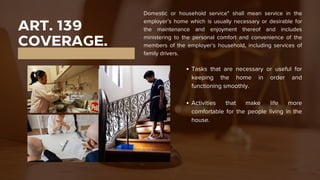
Domestic or household service" shall mean service in the
employer’s home which is usually necessary or desirable for
the maintenance and enjoyment thereof and includes
ministering to the personal comfort and convenience of the
members of the employer’s household, including services of
family drivers.
Tasks that are necessary or useful for
keeping the home in order and
functioning smoothly.
Activities that make life more
comfortable for the people living in the
house.
ART. 140. [142] CONTRACT OF DOMESTIC
SERVICE
domestic worker” or “Kasambahay” is “any person
engaged in domestic work within an employment
relationship such as, but not limited to, the following:
general househelp, nursemaid or “yaya”, cook, gardener,
or laundry person, but shall exclude any person who
performs domestic work only occasionally or sporadically
and not on an occupational basis.
1
the original contract of domestic service shall not last for
more than two (2) years but it may be renewed for such
periods as may be agreed upon by the parties.
2
R.A. NO. 10361 (2013), DOMESTIC
WORKERS ACT OR BATAS
KASAMBAHAY, PROVIDES
“All articles or provisions of Chapter III (Employment of
Househelpers) of Presidential Decree No. 442, as amended
and renumbered by Republic Act No. 10151, are hereby
expressly repealed. All laws, decrees, executive orders,
issuances, rules, and regulations or parts thereof
inconsistent with the provisions of this Act are hereby
repealed or modified accordingly.” The Labor Code
provisions on househelpers can also be reconciled with
pertinent provisions of the Civil Code, e.g., Arts. 1689 to 1699
(Household Service).
R.A. NO. 10361 (2013), DOMESTIC
WORKERS ACT OR BATAS
KASAMBAHAY, PROVIDES
-In Pursuant to Sec. 11 of R.A. No. 10361, “[a]n employment
contract shall be executed by and between the domestic
worker and the employer before the commencement of the
service in a language or dialect understood by both the
domestic worker and the employer. The domestic worker
shall be provided a copy of the duly signed employment
contract
ART. 142. MINIMUM
CASH WAGE.
-The minimum wage rates prescribed under this
Chapter shall be the basic cash wages which shall be
paid to the househelpers in addition to lodging, food
and medical attendance
Sec. 30 (Social and Other Benefits) of R.A. No. 10361
requires that a domestic worker who has rendered at
least one (1) month of service be covered by the SSS,
PhilHealth, and HDMF or Pag-IBIG, and be entitled to all
the benefits in accordance with the pertinent provisions
provided by law.
ART. 143. [145] ASSIGNMENT TO
NON-HOUSEHOLD WORK. 117
No househelper shall be assigned to
work in a commercial, industrial or
agricultural enterprise at a wage or
salary rate lower than that provided
for agricultural or non-agricultural
workers as prescribed herein.
ART. 144. [146] OPPORTUNITY
FOR EDUCATION.
If the househelper is under the age of
eighteen (18) years, the employer
shall give him or her an opportunity
for at least elementary education. The
cost of education shall be part of the
househelper’s compensation, unless
there is a stipulation
(contract/kasabutan) to the contrary.
ART. 145. [147] TREATMENT OF
HOUSEHELPERS. 119
The employer shall treat the househelper in a just and
humane manner. In no case shall physical violence be
used upon the househelper.
.Sec. 5 (Standard of Treatment) of RA No. 10361
prohibits the employer or any member of the household
from subjecting a domestic worker or “kasambahay” to
any kind of abuse nor inflicting any form of physical
violence or harassment or any act tending to degrade
the dignity of a domestic worker.
ART. 146. [148] BOARD, LODGING, AND
MEDICAL ATTENDANCE.
The employer shall furnish the househelper, free of
charge, suitable and sanitary living quarters as well as
adequate food and medical attendance.
ART. 147. [149] INDEMNITY FOR
UNJUST TERMINATION OF SERVICES.
If the period of household service is fixed, neither
the employer nor the househelper may terminate
the contract before the expiration of the term,
except for a just cause. If the househelper is
unjustly dismissed, he or she shall be paid the
compensation already earned plus that for fifteen
(15) days by way of indemnity.
ART. 148. [150] SERVICE OF TERMINATION
NOTICE.
1 Sec. 32 (Termination of Service) of R.A. No. 10361 provides:
“Neither the domestic worker nor the employer may terminate
the contract before the expiration of the term except for
grounds provided for in Sections 33 and 34 of this Act
1
If the domestic worker is unjustly dismissed, the domestic
worker shall be paid the compensation already earned plus the
equivalent of fifteen (15) days work by way of indemnity.
2
If the domestic worker leaves without justifiable reason, any
unpaid salary due not exceeding the equivalent fifteen (15) days
work shall be forfeited. In addition, the employer may recover
from the domestic worker costs incurred related to the
deployment expenses, if any: Provided, That the service has
been terminated within six (6) months.
3
If the duration of the household service is not
determined either in stipulation or by the nature of
the service, the employer or the househelper may
give notice to put an end to the relationship five (5)
days before the intended termination of the service.
ART. 149. [151] EMPLOYMENT
CERTIFICATION.
Upon the severance of the household service relation,
the employer shall give the househelper a written
statement of the nature and duration of the service and
his or her efficiency and conduct as househelper
A.Sec. 35 (Employment Certification) of R.A. No. 10361
requires that “upon the severance of the employment
relationship, the employer shall issue the domestic
worker within five (5) days from request a certificate of
employment indicating the nature, duration of the
service and work performance
ART. 150. [152] EMPLOYMENT
RECORD.
The employer may keep such records
as he may deem necessary to reflect
the actual terms and conditions of
employment of his househelper,
which the latter shall authenticate by
signature or thumbmark upon request
of the employer.
CHAPTER IV
ART. 151. [153] REGULATION OF
INDUSTRIAL HOMEWORKERS
The employment of industrial homeworkers and field
personnel shall be regulated by the government through
the appropriate regulations issued by the Secretary of
Labor and Employment to ensure the general welfare
and protection of homeworkers and field personnel and
the industries employing them
ART. 152. [154] REGULATIONS OF
SECRETARY OF LABOR.
The regulations or orders to be issued pursuant to
this Chapter shall be designed to assure the
minimum terms and conditions of employment
applicable to the industrial homeworkers or field
personnel involved.
ART. 153. [155] DISTRIBUTION OF
HOMEWORK.
the "employer" of homeworkers includes any
person, natural or artificial who, for his account or
benefit, or on behalf of any person residing outside
the country, directly or indirectly, or through an
employee, agent contractor, sub-contractor or any
other person
CHAPTER V
EMPLOYMENT
OF NIGHT
WORKERS
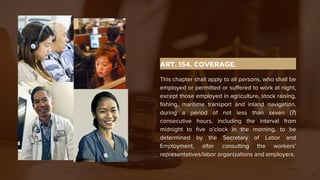
ART. 154. COVERAGE.
This chapter shall apply to all persons, who shall be
employed or permitted or suffered to work at night,
except those employed in agriculture, stock raising,
fishing, maritime transport and inland navigation,
during a period of not less than seven (7)
consecutive hours, including the interval from
midnight to five o’clock in the morning, to be
determined by the Secretary of Labor and
Employment, after consulting the workers’
representatives/labor organizations and employers.
ART. 154. COVERAGE.
“Night worker” means any employed person
whose work requires performance of a
substantial number of hours of night work
which exceeds a specified limit. This limit shall
be fixed by the Secretary of Labor after
consulting the workers’ representatives/labor
organizations and employers.
1
2
DOLE D.O. No. 119 (2012) defines a “night
worker” as “any employed person whose work
covers the period from 10 o’clock in the evening
to 6 o’clock the following morning provided that
the worker performs no less than seven (7)
consecutive hours of work.
ART. 155. HEALTH ASSESSMENT.
At their request, workers shall have the right to
undergo a health assessment without charge and
to receive advice on how to reduce or avoid health
problems associated with their work
With the exception of a finding of unfitness for night
work, the findings of such assessments shall not be
transmitted to others without the workers’ consent
and shall not be used to their detriment.
ART. 156.
MANDATORY
FACILITIES.
Suitable first-aid facilities shall be made available
for workers performing night work, including
arrangements where such workers, where
necessary, can be taken immediately to a place
for appropriate treatment. The employers are
likewise required to provide safe and healthful
working conditions and adequate or reasonable
facilities such as sleeping or resting quarters in
the establishment and transportation from the
work premises to the nearest point of their
residence subject to exceptions and guidelines
to be provided by the DOLE.
ART. 157.
TRANSFER.
Night workers who are certified as unfit for night
work, due to health reasons, shall be transferred,
whenever practicable, to a similar job for which they
are fit to work.
If such transfer to a similar job is not practicable,
these workers shall be granted the same benefits
as other workers who are unable to work, or to
secure employment during such period.
Night worker certified as temporarily unfit for night
work shall be given the same protection against
dismissal or notice of dismissal as other workers
who are prevented from working for reasons of
health.
ART. 158. WOMEN NIGHT WORKERS.
Measures shall be taken to ensure
that an alternative to night work is
available to women workers who
would otherwise be called upon to
perform such work
1
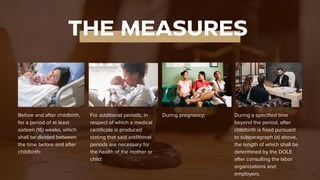
THE MEASURES
Before and after childbirth,
for a period of at least
sixteen (16) weeks, which
shall be divided between
the time before and after
childbirth;
For additional periods, in
respect of which a medical
certificate is produced
stating that said additional
periods are necessary for
the health of the mother or
child:
During pregnancy; During a specified time
beyond the period, after
childbirth is fixed pursuant
to subparagraph (a) above,
the length of which shall be
determined by the DOLE
after consulting the labor
organizations and
employers.
DURING THE PERIODS REFERRED
TO IN THIS ARTICLE:
A woman worker shall not be dismissed or given
notice of dismissal, except for just or authorized
causes provided for in this Code that are not
connected with pregnancy, childbirth and childcare
responsibilities
1
A woman worker shall not lose the benefits regarding
her status, seniority, and access to promotion which
may attach to her regular night work position
2
Pregnant women and nursing mothers may be allowed
to work at night only if a competent physician, other
than the company physician, shall certify their fitness
to render night work, and specify, in the case of
pregnant employees, the period of the pregnancy that
they can safely work
3
DURING THE PERIODS REFERRED
TO IN THIS ARTICLE:
Transfer to day work if possible, so they
don't have to work at night.
1
Social security benefits to support them
financially during this period.
2
Extended maternity leave if needed for
health reasons.
3
ART. 159. COMPENSATION.
The compensation for night workers in the form
of working time, pay or similar benefits shall
recognize the exceptional nature of night work.
Higher pay (night shift differential)
Reduced working hours
Additional benefits specific to night work
ART. 160. SOCIAL SERVICES.
Appropriate social services shall be provided for
night workers and, where necessary, for workers
performing night work.
Health and medical support
Access to counseling or wellness programs
Other services that cater to their well-being,
considering the challenges of night work
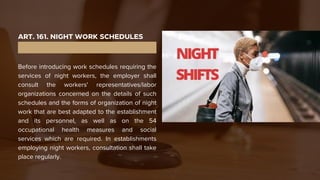
ART. 161. NIGHT WORK SCHEDULES
Before introducing work schedules requiring the
services of night workers, the employer shall
consult the workers' representatives/labor
organizations concerned on the details of such
schedules and the forms of organization of night
work that are best adapted to the establishment
and its personnel, as well as on the 54
occupational health measures and social
services which are required. In establishments
employing night workers, consultation shall take
place regularly.
BOOK 6
ART. 293. [278]. Coverage
The provisions of this Title
shall apply to all
establishments or
undertakings, whether for
profit or not.
Title I - Termination of Employment
ART. 294. [279] SECURITY OF
TENURE.
In cases of regular employment, the employer shall
not terminate the services of an employee except for
a just cause or when authorized by this Title. An
employee who is unjustly dismissed from work shall
be entitled to reinstatement without loss of seniority
rights and other privileges and to his full backwages,
inclusive ofallowances, and to his other benefits or
their monetary equivalent computed from the time
his compensation was withheld from him up to the
time of his actual reinstatement.
ART. 295. [280] Regular and Casual
Employment
Employment is considered regular if the
employee performs tasks necessary or
desirable to the employer's business, unless
the employment is for a specific project or
seasonal work, where the end date is
predetermined. Casual employment applies
when the job doesn't fall under regular
employment. However, if an employee has
completed at least one year of service,
whether continuous or not, they will be
regarded as a regular employee as long as the
activity continues
ART. 296. [281] Probationary
Employment
Probationary periods cannot exceed six
months unless extended by an
apprenticeship agreement. During this
time, an employee may
be terminated for just cause or if they fail
to meet the reasonable standards set by
the employer at the time of hiring. If the
employee continues to work after the
probationary period, they automatically
become a regular employee.
ART. 297. [282] Termination
by Employer
Grounds for employer-initiated termination
include:
Serious misconduct or willful disobedience
of lawful orders,
1.
Gross and habitual neglect of duties,
2.
Fraud of breach of trust by the employee
3.
Committing a crime or offense against the
employer, their family, or representatives,
and
4.
Other similar causes.
5.
These grounds provide just cause for the
employer to legally terminate an employee.
ART. 298. [283] Closure of
Establishment and Reduction of
Personnel
Employers may terminate employees due to reasons
like the installation of labor-saving
devices,redundancy, retrenchment to prevent losses,
or closure of the business. Employers must provide a
one-month written notice to employees and the
Ministry of Labor.
In cases of termination due to labor-saving devices or
redundancy, employees are entitled to separation
pay of at least one month’s salary or one month’s pay
for each year of service, whichever is higher. For
retrenchment or business closures (excluding serious
financial losses), separation pay is at least one
month’s salary or half a month’s pay for each year of
service. Six months or more is counted as a full year.
ART. 299. Disease as Ground
for Termination
An employer may terminate an
employee's services if the employee has a
disease that is legally prohibited for continued
employment or poses a health risk to the
employee or their co-workers. The terminated
employee is entitled to separation pay of at least
one month’s salary or half a month’s salary for
each year of service, whichever is greater. Six
months or more is considered a full year.
ART. 300. Termination by
Employee
A. An employee can resign without just cause
by providing a one-month written
notice. If no notice is given, the employer may
seek damages.
B. No notice is required if the resignation is
due to just causes such as:
Serious insult by the employer,
1.
Inhumane or unbearable treatment,
2.
A crime or offense committed by the
employer against the employee or their
family, or
3.
Other similar causes
4.
ART. 301. When Employment
not Deemed Terminated
Employment is not Terminated if
the business is suspended for
up to six months or the
employee is fulfilling military or
civic duties. In such cases, the
employee retains their seniority
rights and must be reinstated if
they wish to return to work
within one month of resumption
of operations.
ART. 302. Retirement
Employees can retire once they reach the retirement age set
in collective agreements or other contracts. Upon retirement,
they are entitled to receive all retirement benefits under
existing laws or agreements.
If no retirement plan exists, employees aged 60 to 65, with at
least five years of service, can retire and are entitled to a
retirement pay of at least half a month’s salary for every year
of service. Six months or more is considered a full year.
For underground miners, retirement age is 50 to 60, with
similar benefits.
Small retail, service, and agricultural businesses with 10 or
fewer employees are exempt. Any violation of these
provisions is illegal and subject to penalties. Employees retain
the right to any additional benefits provided by company
policies or laws.
Title II - Retirement from the Service

Philippines' labor code book one and book 6

  • 1.
    S T RA T E G I C H U M A N R E S O U R C E M A N A G E M E N T BOOK III & VI
  • 2.
    PHILIPPINE LABOR CODE TheLabor Code of the Philippines is the legal code governing employment practices and labor relations in the Philippines. It was enacted through Presidential Decree No. 442 on Labor day, May 1, 1974, by President Ferdinand Marcos in the exercise of his then extant legislative powers.
  • 3.
  • 4.
    CONDITIONS OF EMPLOYMENT TITLEI: WORKING CONDITIONS AND REST PERIODS 1 2 3 TITLE II: WAGES TITLE III: WORKING CONDITIONS FOR SPECIAL GROUPS OF EMPLOYEES
  • 5.
    ART. 82. Coverage Theprovision of this Title shall apply to employees in all establishments and undertakings whether for profit or not, but not to government employees, managerial employees, field personnel, members of the family of the employer who are dependent on him for support, domestic helpers, persons in the personal service of another, and workers who are paid by results as determined by the Secretary of Labor in appropriate regulations. CHAPTER I: HOURS OF WORK TITLE I: WORKING CONDITIONS & REST PERIODS
  • 6.
    FIELD PERSONNEL refer tonon-agricultural employees who regularly perform their duties away from the principal place of business or branch office of the employer. CHAPTER I: HOURS OF WORK MANAGERIAL EMPLOYEES refer to those whose primary duty consists of the management of the establishment in which they are employed or of a department or subdivision thereof, and to other officers or members of the managerial staff.
  • 7.
    ART 83. NORMALHOURS OF WORK Shall not exceed 8 hours in a regular working day PURPOSE: to safeguard the health and welfare of the laborer and in a way to minimize unemployment by utilizing different shifts. REGULAR WORKING DAYS: The regular working days of covered employees shall not be more than five days in a workweek. The workweek may begin at any hour and on any day, including Saturday or Sunday, designated by the employer. CHAPTER I: HOURS OF WORK
  • 8.
    ART 84. HOURSWORKED SHALL INCLUDE: 1.All time during which an employee is required to be on duty or to be at a prescribed workplace; and 2. All time during which an employee is suffered or permitted to work CHAPTER I: HOURS OF WORK
  • 9.
    ART 85. MEALPERIODS subject to such regulations as the Secretary of Labor may prescribe, it shall be the duty of every employer to give his employees not less than 60 minutes time-off for their regular meals. (1) Should not be less than sixty (60) minutes, and is time- off/non-compensable (2) Under specified cases, may be less than sixty (60) minutes, but should not be less than twenty (20) minutes and must be with full pay. (3) If less than twenty (20) minutes, it becomes only a rest period and is thus considered as work time CHAPTER I: HOURS OF WORK
  • 10.
    ART 86. NIGHTSHIFT DIFFERENTIAL Every employee shall be paid a night shift differential (additional compensation) of not less than ten percent (10%) of an employee’s regular wage for every hour of work done between 10:00 PM and 6:00 AM, whether this period is part of the worker’s regular shift. If work done between 10 PM and 6 AM is overtime work, then the 10%-night shift differential should be based on his overtime rate. RATIONALE -it serves as an inducement of employment CHAPTER I: HOURS OF WORK
  • 11.
    ART 87. OVERTIMEWORK Work may be performed beyond eight (8) hours a day provided that the employee is paid for the overtime work, an additional compensation equivalent to his regular wage plus at least twenty-five percent (25%) thereof. Work performed beyond eight hours on a holiday or rest day shall be paid an additional compensation equivalent to the rate of the first eight hours on a holiday or rest day plus at least thirty percent (30%) thereof. 30% of 130% if on aspecial holiday/rest day 1. 25% of regular wage if done on a regular workday 2. 30% of 150% if on special holiday AND rest day 3. 30% of 200% if on a regular holiday CHAPTER I: HOURS OF WORK
  • 12.
    RATIONALE: employee is givenOT pay because he is made to work longerthan what is commensurate with his agreed compensation for the statutorily fixed or voluntarily agreed hours of labor he is supposed to do. - As a rule, cannot be waived, as it is intended to benefit laborers and employees. But when the waiver is madein consideration of benefits and privileges which may even exceed the overtime pay, the waiver may be permitted. NOTE: OT pay will not preclude payment of night shift differential pay CHAPTER I: HOURS OF WORK
  • 13.
    WORKDAY: the 24-hourperiod which commences from the time the employee regularly starts to work. e.g., if the worker starts to work 8 am today, the workday is from 8am today up to 8 am tom. COMPRESSED WORKWEEK -allowable under the following conditions: 1. It is voluntary on the part of the worker. 2.There will be no diminution of the weekly or monthly take- home pay and fringe benefits of the employees. 3.The value of the benefits that will accrue to the employees under the proposed schedule is more than or at least commensurate with the one-hour OT pay that is due them during weekdays based on the employee’s quantification. 4. The one-hour OT pay will become due and payable if they are made or permitted to work on a day not scheduled for work on the compressed work week. 5.The work does not involve strenuous physical exertion and employees must have adequate rest periods 5. The arrangement is of temporary duration. CHAPTER I: HOURS OF WORK
  • 14.
    ART. 88. UNDERTIMENOT OFFSET BY OVERTIME Undertime work on any particular day shall not be offset by overtime work on any other day. Permission given to the employee to go on leave on some other day of the week shall not exempt the employer from paying the additional compensation required in this Chapter. RATIONALE - An employee’s regular pay rate is lower than the overtime rate. Offsetting the undertime hours against the overtime hours would result in undue deprivation of the employee’s extra pay for overtime work. CHAPTER I: HOURS OF WORK
  • 15.
    ART. 89. EMERGENCYOVERTIME WORK Any employee may be required by the employer to perform overtime work in any of the following cases: (a) When the country is at war or when any other national or local emergency has been declared by the National Assembly75 or the Chief Executive; (b) When it is necessary to prevent loss of life or property or in case of imminent danger to public safety due to an actual or impending emergency in the locality caused by serious accidents, fire, flood, typhoon, earthquake, epidemic, or other disaster or calamity; (c) When there is urgent work to be performed on machines, installations, or equipment, in order to avoid serious loss or damage to the employer or some other cause of similar nature; CHAPTER I: HOURS OF WORK
  • 16.
    (d) When thework is necessary to prevent loss or damage to perishable goods; and (e) Where the completion or continuation of the work started before the eighth hour is necessary to prevent serious obstruction or prejudice to the business or operations of the employer. Any employee required to render overtime work under this Article shall be paid the additional compensation required in this Chapter CHAPTER I: HOURS OF WORK
  • 17.
    ART. 90. COMPUTATIONOF ADDITIONAL COMPENSATION For purposes of computing overtime and other additional remuneration as required by this Chapter, the "regular wage" of an employee shall include the cash wage only, without deduction on account of facilities provided by the employer. CHAPTER I: HOURS OF WORK
  • 18.
    ART 91. RIGHTTO A WEEKLY REST DAY (a) It shall be the duty of every employer, whether operating for profit or not, to provide each of his employees a rest period of not less than twenty-four (24) consecutive hours after every six (6) consecutive normal work days. (b) The employer shall determine and schedule the weekly rest day of his employees subject to collective bargaining agreement and to such rules and regulations as the Secretary of Labor and Employment may provide. However, the employer shall respect the preference of employees as to their weekly rest day when such preference is based on religious grounds. CHAPTER II: WEEKLY REST PERIODS
  • 19.
    ART 92. WHENEMPLOYER MAY REQUIRE WORK ON A REST DAY The employer may require his employees to work on any day: (a) In case of actual or impending emergencies caused by serious accident, fire, flood, typhoon, earthquake, epidemic or other disaster or calamity to prevent loss of life and property, or imminent danger to public safety; (b) In cases of urgent work to be performed on the machinery, equipment, or installation, to avoid serious loss which the employer would otherwise suffer; CHAPTER II: WEEKLY REST PERIODS
  • 20.
    (c) In theevent of abnormal pressure of work due to special circumstances, where the employer cannot ordinarily be expected to resort to other measures; (d) To prevent loss or damage to perishable goods; (e) Where the nature of the work requires continuous operations and the stoppage of work may result in irreparable injury or loss to the employer; and (f) Under other circumstances analogous or similar to the foregoing as determined by the Secretary of Labor and Employment. CHAPTER II: WEEKLY REST PERIODS
  • 21.
    ART 93. COMPENSATIONFOR REST DAY, SUNDAY, OR HOLIDAY WORK (a) Where an employee is made or permitted to work on his scheduled rest day, he shall be paid an additional compensation of at least thirty percent (30%) of his regular wage. An employee shall be entitled to such additional compensation for work performed on Sunday only when it is his established rest day. (b) When the nature of the work of the employee is such that he has no regular workdays and no regular rest days can be scheduled, he shall be paid an additional compensation of at least thirty percent (30%) of his regular wage for work performed on Sundays and holidays. CHAPTER II: WEEKLY REST PERIODS
  • 22.
    (c) Work performedon any special holiday77 shall be paid an additional compensation of at least thirty percent (30%) of the regular wage of the employee. Where such holiday work falls on the employee’s scheduled rest day, he shall be entitled to an additional compensation of at least fifty per cent (50%) of his regular wage. (d) Where the collective bargaining agreement or other applicable employment contract stipulates the payment of a higher premium pay than that prescribed under this Article, the employer shall pay such higher rate. CHAPTER II: WEEKLY REST PERIODS
  • 23.
    CHAPTER III: HOLIDAYS,SERVICE INCENTIVE LEAVESAND SERVICE CHARGES ART 94. RIGHT TO HOLIDAY PAY (a) Every worker shall be paid his regular daily wage during regular holidays, except in retail and service establishments regularly employing less than ten (10) workers; (b) The employer may require an employee to work on any holiday but such employee shall be paid a compensation equivalent to twice his regular rate; and (c) As used in this Article, "holiday" includes: New Year’s Day, Maundy Thursday, Good Friday, the ninth of April, the first of May, the twelfth of June, the fourth of July, the thirtieth of November, the twenty-fifth and thirtieth of December and the day designated by law for holding a general election.
  • 24.
    CHAPTER III: HOLIDAYS,SERVICE INCENTIVE LEAVESAND SERVICE CHARGES HOLIDAY PAY: A day’s pay given by law to an employee even if he does not work on a regular holiday.It is limited to the ten (10) regularholidays listed by law. - employee should not have been absent without pay on the working day preceding the regular holiday. Art. 94(b) refers to regular holidays, special holidays are taken care of under Art. 93 PREMIUM PAY: Additional compensation for work performed on a scheduled rest day or holiday.
  • 25.
    CHAPTER III: HOLIDAYS,SERVICE INCENTIVE LEAVESAND SERVICE CHARGES ART 95. RIGHT TO SERVICE INCENTIVE LEAVE (a) Every employee who has rendered at least one year of service shall be entitled to a yearly service incentive leave of five days with pay. (b) This provision shall not apply to those who are already enjoying the benefit herein provided, those enjoying vacation leave with pay of at least five days and those employed in establishments regularly employing less than ten employees or in establishments exempted from granting this benefit by the Secretary of Labor and Employment after considering the viability or financial condition of such establishment. (c) The grant of benefit in excess of that provided herein shall not be made a subject of arbitration or any court or administrative action.
  • 26.
    CHAPTER III: HOLIDAYS,SERVICE INCENTIVE LEAVESAND SERVICE CHARGES ONE (1) YEAR OF SERVICE. service within 12 months, whether continuous or broken, reckonedfrom the date the employee startedworking including authorized absences and paid regularholidays unless the number of working day in the establishment as a matter of practice or policy, or provided in the employment contract is less than 12 months. -SIL is commutable i.e., convertible to cash- the cash equivalent is aimed primarily at encouraging workers to work continuously and with dedication to the company.
  • 27.
    CHAPTER III: HOLIDAYS,SERVICE INCENTIVE LEAVESAND SERVICE CHARGES ART 96. SERVICE CHARGES All service charges collected by hotels, restaurants and similar establishments shall be distributed completely and equally among the covered workers except managerial employees. In the event that the minimum wage is increased by law or wage order, service charges paid to the covered employees shall not be considered in determining the employer’s compliance with the increased minimum wage.
  • 28.
    CHAPTER III: HOLIDAYS,SERVICE INCENTIVE LEAVESAND SERVICE CHARGES TO BE DISTRIBUTED TWICE A MONTH AND AT THE RATE OF: 1.85% for all coveredemployees to be equally distributed among them 2. 15% for management (may answer for losses and breakages or distributed to management) - If collection of service charges is abolished, the share of covered employees shall be considered integrated in their wages based on the average monthly share of each employee for the past 12 months immediately preceding the abolition.
  • 29.
    (a) "Person" meansan individual, partnership, association, corporation, business trust, legal representatives, or any organized group of persons. (b) "Employer" includes any person acting directly or indirectly in the interest of an employer in relation to an employee and shall include the government and all its branches, subdivisions and instrumentalities, all government-owned or controlled corporations and institutions, as well as non-profit private institutions, or organizations. (c) "Employee" includes any individual employed by an employer. CHAPTER I: PRELIMINARY MATTERS TITLE II: WAGES
  • 30.
    (d) "Agriculture" includesfarming in all its branches and, among other things, includes cultivation and tillage of soil, dairying, the production, cultivation, growing and harvesting of any agricultural and horticultural commodities, the raising of livestock or poultry, and any practices performed by a farmer on a farm as an incident to or in conjunction with such farming operations, but does not include the manufacturing or processing of sugar, coconuts, abaca, tobacco, pineapples or other farm products. (e) "Employ" includes to suffer or permit to work. CHAPTER I: PRELIMINARY MATTERS TITLE II: WAGES
  • 31.
    ART. 97. Definitions.– As used in this Title: (f) "Wage" paid to any employee shall mean the remuneration or earnings, however designated, capable of being expressed in terms of money, whether fixed or ascertained on a time, task, piece, or commission basis, or other method of calculating the same, which is payable by an employer to an employee under a written or unwritten contract of employment for work done or to be done, or for services rendered or to be rendered and includes the fair and reasonable value, as determined by the Secretary of Labor and Employment, of board, lodging, or other facilities customarily furnished by the employer to the employee. "Fair and reasonable value" shall not include any profit to the employer, or to any person affiliated with the employer. CHAPTER I: PRELIMINARY MATTERS TITLE II: WAGES
  • 32.
    ART. 98. Applicationof Title – This Title shall not apply to farm tenancy or leasehold, domestic service and persons working in their respective homes in needle work or in any cottage industry duly registered in accordance with law. This Title shall not apply to the following: 1. Household or domestic helpers 2. Homeworkers engaged in needlework 3. Workers employed in any establishment duly registered with the National Cottage Industry 4. Workers in any duly registered cooperatives Barangay Micro Business Enterprises (BMBEs) CHAPTER I: PRELIMINARY MATTERS TITLE II: WAGES
  • 33.
    ART. 99. RegionalMinimum Wages – The minimum wage rates for agricultural and non- agricultural employees and workers in each and every region of the country shall be those prescribed by the Regional Tripartite Wages and Productivity Boards. amended by Section 3 of R.A. No. 6727 (1989), Wage Rationalization Act Regional Tripartite and Productivity Boards - government bodies established to regulate and set Philippines minimum wage rates across its different regions. CHAPTER II: MINIMUM WAGE RATES TITLE II: WAGES
  • 34.
    ART. 100. ProhibitionAgainst Elimination or Diminution of Benefits – Nothing in this Book shall be construed to eliminate or in any way diminish supplements, or other employee benefits being enjoyed at the time of promulgation of this Code. Legal requirements before facilities can be deducted from the employees’ wages: 1. Proof that such facilities are customarily furnished by the trade 2. Voluntarily Accepted in writing by the employee 3. Charged at Fair & Reasonable Value CHAPTER II: MINIMUM WAGE RATES TITLE II: WAGES
  • 35.
    The Non-Diminution Rule- the benefits being given to employees cannot be taken back or reduced unilaterally by the employer because the benefit has become part of the employment contract, written or unwritten. The rule is applicable if it is shown that the grant of the benefit is: 1. based on an express policy, or 2. has ripened into practice over a long period of time, and the practice is consistent and deliberate. 3. It is not due to an error in the construction /application of a doubtful or difficult question of law. CHAPTER II: MINIMUM WAGE RATES TITLE II: WAGES
  • 36.
    Bonus a supplement oremployment benefit given under certain conditions, such as success of the business or greater production or output. an amount granted voluntarily to an employee for his industry and loyalty which contributed to the success and realization of profits of the employer’s business. not a demandable and enforceable obligation 13th Month Pay (or “Its Equivalent”) - additional income based on wage required by P.D. 851 which is equivalent to 1/12 of the total basic salary earned by an employee within a calendar year. may be given anytime but not later than Dec. 24 CHAPTER II: MINIMUM WAGE RATES TITLE II: WAGES
  • 37.
    Coverage: - Allrank-and-file employees regardless of their designation or employment status and irrespective of the method by which their wages are paid, are entitled to this benefit, provided, that they have worked for at least one (1) month during the calendar year Forms: 1. Christmas bonus 2. midyear bonus 3. profit sharing payments; and 4. other cash bonuses amounting to not less than 1/12 of its basic salary It must always be in the form of legal tender. CHAPTER II: MINIMUM WAGE RATES TITLE II: WAGES
  • 38.
    ART. 101. Paymentby Results – (a) The Secretary of Labor and Employment shall regulate the payment of wages by results, including pakyao, piecework, and other non-time work, in order to ensure the payment of fair and reasonable wage rates, preferably through time and motion studies or in consultation with representatives of workers’ and employers’ organizations. Book III, Rule VII, Chapter I, Section 9 of the Omnibus Rules Implementing the Labor Code, states workers who are paid based on the results of their work must still receive at least the minimum wage. If they work fewer hours, they should be paid a portion of that minimum wage based on how long they worked. CHAPTER II: MINIMUM WAGE RATES TITLE II: WAGES
  • 39.
    ART. 102. Formsof Payment – No employer shall pay the wages of an employee by means of promissory notes, vouchers, coupons, tokens, tickets, chits, or any object other than legal tender, even when expressly requested by the employee. DOLE Labor Advisory No. 26 (2020), "Payment of Wages and Other Monetary Benefits Through Transaction Accounts," provides guidelines on how employers can pay employees' wages and other monetary benefits using transaction accounts like bank accounts or e-wallet for as long as the employees agree and the method ensures they get their full payment on time. CHAPTER III: PAYMENT OF WAGES TITLE II: WAGES
  • 40.
    ART. 103. Timeof Payment – Wages shall be paid at least once every two (2) weeks or twice a month at intervals not exceeding sixteen (16) days. If on account of force majeure or circumstances beyond the employer’s control, payment of wages on or within the time herein provided cannot be made, the employer shall pay the wages immediately after such force majeure or circumstances have ceased. No employer shall make payment with less frequency than once a month. The payment of wages of employees engaged to perform a task which cannot be completed in two (2) weeks shall be subject to the following conditions, in the absence of a collective bargaining agreement or arbitration award: 1. That payments are made at intervals not exceeding sixteen (16) days, in proportion to the amount of work completed; 2. That final settlement is made upon completion of the work. CHAPTER III: PAYMENT OF WAGES TITLE II: WAGES
  • 41.
    ART. 104. Placeof Payment – Payment of wages shall be made at or near the place of undertaking, except as otherwise provided by such regulations as the Secretary of Labor and Employment may prescribe under conditions to ensure greater protection of wages. Exceptions: 1. When payment cannot be effected at or near the place of work by reason of deterioration of peace and security 2. When the employer provides for free transportation to the employees back and forth. 3. And under analogous circumstances payment of wages in bars, night or day clubs, massage clinics or similar establishments are prohibited except for the workers therein. CHAPTER III: PAYMENT OF WAGES TITLE II: WAGES
  • 42.
    Section 7 ofR.A. No. 6727 (Wage Rationalization Act) says that if the majority of employees agree in writing, companies with 25 or more employees that are within 1 kilometer of a bank must pay wages and benefits through that bank, following the usual pay schedule. Additionally, the 1996 Labor Advisory on paying wages via ATMs allows this method as long as: 1. Employees agree in writing. 2. Employees get enough time to withdraw their pay, and if done during work hours, it counts as paid time. 3. The ATM system ensures workers get paid on time and the correct amount. 4. An ATM is within 1 kilometer of the workplace. 5. Employers must provide a record of payments if employees ask. 6. There are no extra costs or loss of benefits for employees. 7. Employers are responsible for making sure wage laws are followed under this system. CHAPTER III: PAYMENT OF WAGES TITLE II: WAGES
  • 43.
    ART. 105. DirectPayment of Wages – Wages shall be paid directly to the workers to whom they are due, except: (a) In cases of force majeure where it is impossible to pay workers, workers can authorize someone else in writing to receive their pay on their behalf. (b) If a worker dies, the employer can pay their wages directly to the heirs without court proceedings. Adult heirs must sign an affidavit confirming their relationship to the deceased. If any heirs are minors, their guardian will sign. The employer pays through the Department of Labor, which helps divide the money among the heirs, and after payment, the employer has no further liability. CHAPTER III: PAYMENT OF WAGES TITLE II: WAGES
  • 44.
    ART. 106. Contractoror Subcontractor – Whenever an employer enters into a contract with another person for the performance of the former’s work, the employees of the contractor and of the latter’s subcontractor, if any, shall be paid in accordance with the provisions of this Code. If the contractor or subcontractor doesn’t pay their employees, the employer is also responsible for those unpaid wages, just as if they were their own employees. The Secretary of Labor can create rules to limit or stop contracting out labor to protect workers' rights. They can differentiate between "labor-only" contracting and other types of contracting. In "labor-only" contracting, the contractor acts as an agent of the employer and is responsible for the workers as if they were directly employed by the employer. CHAPTER III: PAYMENT OF WAGES TITLE II: WAGES
  • 45.
    ART. 107. IndirectEmployer – The provisions of the immediately preceding article shall likewise apply to any person, partnership, association or corporation which, not being an employer, contracts with an independent contractor for the performance of any work, task, job or project. ART. 108. Posting of Bond – An employer or indirect employer may require the contractor or subcontractor to furnish a bond equal to the cost of labor under contract, on condition that the bond will answer for the wages due the employees should the contractor or subcontractor, as the case may be, fail to pay the same. CHAPTER III: PAYMENT OF WAGES TITLE II: WAGES
  • 46.
    ART. 109. SolidaryLiability – The provisions of existing laws to the contrary notwithstanding, every employer or indirect employer shall be held responsible with his contractor or subcontractor for any violation of any provision of this Code. For purposes of determining the extent of their civil liability under this Chapter, they shall be considered as direct employers. ART. 110. Worker Preference in Case of Bankruptcy – In the event of bankruptcy or liquidation of an employer’s business, his workers shall enjoy first preference as regards their wages and other monetary claims, any provisions of law to the contrary notwithstanding. Such unpaid wages and monetary claims shall be paid in full before claims of the government and other creditors may be paid. CHAPTER III: PAYMENT OF WAGES TITLE II: WAGES
  • 47.
    ART. 111. Attorney'sFees – (a) In cases of unlawful withholding of wages, the culpable party may be assessed attorney’s fees equivalent to ten percent of the amount of wages recovered. (b) It shall be unlawful for any person to demand or accept, in any judicial or administrative proceedings for the recovery of wages, attorney’s fees which exceed ten percent of the amount of wages recovered. CHAPTER III: PAYMENT OF WAGES TITLE II: WAGES
  • 48.
    ART. 112. Non-Interferencein Disposal of Wages – No employer shall limit or otherwise interfere with the freedom of any employee to dispose of his wages. He shall not in any manner force, compel, or oblige his employees to purchase merchandise, commodities or other property from any other person, or otherwise make use of any store or services of such employer or any other person. CHAPTER IV: PROHIBITION REGARDING WAGES TITLE II: WAGES
  • 49.
    ART. 113. WageDeduction – No employer, in his own behalf or in behalf of any person, shall make any deduction from the wages of his employees, except: (a) In cases where the worker is insured with his consent by the employer, and the deduction is to recompense the employer for the amount paid by him as premium on the insurance; (b) For union dues, in cases where the right of the worker or his union to check-off has been recognized by the employer or authorized in writing by the individual worker concerned; and (c) In cases where the employer is authorized by law or regulations issued by the Secretary of Labor and Employment. CHAPTER IV: PROHIBITION REGARDING WAGES TITLE II: WAGES
  • 50.
    ART. 114. Depositsfor Loss or Damage – No employer shall require his worker to make deposits from which deductions shall be made for the reimbursement of loss of or damage to tools, materials, or equipment supplied by the employer, except when the employer is engaged in such trades, occupations or business where the practice of making deductions or requiring deposits is a recognized one, or is necessary or desirable as determined by the Secretary of Labor and Employment in appropriate rules and regulations. CHAPTER IV: PROHIBITION REGARDING WAGES TITLE II: WAGES
  • 51.
    ART. 115. Limitations– No deduction from the deposits of an employee for the actual amount of the loss or damage shall be made unless the employee has been heard thereon, and his responsibility has been clearly shown. ART. 116. Withholding of Wages and Kickbacks Prohibited – It shall be unlawful for any person, directly or indirectly, to withhold any amount from the wages of a worker or induce him to give up any part of his wages by force, stealth, intimidation, threat or by any other means whatsoever without the worker’s consent. CHAPTER IV: PROHIBITION REGARDING WAGES TITLE II: WAGES
  • 52.
    ART. 117. Deductionto Ensure Employment – It shall be unlawful to make any deduction from the wages of any employee for the benefit of the employer or his representative or intermediary as consideration of a promise of employment or retention in employment. ART. 118. Retaliatory Measures – It shall be unlawful for an employer to refuse to pay or reduce the wages and benefits, discharge or in any manner discriminate against any employee who has filed any complaint or instituted any proceeding under this Title or has testified or is about to testify in such proceedings. ART. 119. False Reporting – It shall be unlawful for any person to make any statement, report, or record filed or kept pursuant to the provisions of this Code knowing such statement, report or record to be false in any material respect. CHAPTER IV: PROHIBITION REGARDING WAGES TITLE II: WAGES
  • 53.
    CHAPTER V –WAGE STUDIES, WAGE AGREEMENTS, AND WAGE DETERMINATION Arts. 120, 121, 122, 123, 124, 126, and 127 were incorporated by R.A. No. 6727, Wage Rationalization Act of 1989 Title II
  • 54.
    CHAPTER V –WAGE STUDIES, WAGE AGREEMENTS, AND WAGE DETERMINATION ART. 120. Creation of National Wages and Productivity Commission. Title II A National Wages and Productivity Commission, called "the Commission," is created. It will be attached to the Department of Labor and Employment (DOLE) to coordinate policies and programs related to wages and productivity.
  • 55.
    CHAPTER V –WAGE STUDIES, WAGE AGREEMENTS, AND WAGE DETERMINATION ART. 121. Powers and Functions of the Commission. Title II The Commission shall have the following powers and functions: a. National consultative and advisory body to the President of the Philippines and Congress b. Formulate policies and guidelines c. Prescribe rules and guidelines d. Review regional wage levels set by the Regional Tripartite Wages and Productivity Boards e. Undertake studies, researches and surveys. Collect and compile data and periodically disseminate information. f. Review plans and programs of the Regional Tripartite Wages and Productivity Boards g. Technical and administrative supervision over the Regional Tripartite Wages and Productivity Boards h. To call, from time to time, a national tripartite conference i. To exercise such powers and functions as may be necessary to implement this Act.
  • 56.
    CHAPTER V –WAGE STUDIES, WAGE AGREEMENTS, AND WAGE DETERMINATION ART. 121. Powers and Functions of the Commission. Title II The Commission shall be composed of : Chairman: Secretary of Labor and Employment serves as the ex-officio chairman. Vice-Chairman: Director-General of the National Economic and Development Authority (NEDA) serves as the ex-officio vice-chairman. Commission Members: Two representatives from the workers' sector. Two representatives from the employers' sector. All appointed by the President of the Philippines, based on recommendations from the Secretary of Labor and Employment. Representatives serve a five-year term.
  • 57.
    CHAPTER V –WAGE STUDIES, WAGE AGREEMENTS, AND WAGE DETERMINATION ART. 121. Powers and Functions of the Commission. Title II The Commission shall be composed of : Executive Director: Serves as a member of the Commission. Secretariat: Headed by an Executive Director and two Deputy Directors, all appointed by the President of the Philippines based on the Secretary of Labor’s recommendations. Ranks and Benefits: The Executive Director has the same rank, salary, and benefits as a Department Assistant Secretary. Deputy Directors have the same rank and benefits as Bureau Directors. Labor and management representatives receive the same benefits as those in the Employees’ Compensation Commission.
  • 58.
    CHAPTER V –WAGE STUDIES, WAGE AGREEMENTS, AND WAGE DETERMINATION ART. 122. Creation of Regional Tripartite Wages and Productivity Boards. Title II Established the Regional Boards, in all regions, including autonomous regions as may be established by law. The Commission shall determine the offices/headquarters of the respective Regional Boards. The Regional Boards shall have the following powers and functions in their respective territorial jurisdictions: a. To develop plans, programs and projects for their respective regions. b. To determine, fix, and issue minimum wage rates applicable in their regions, provinces or industries subject to guidelines issued by the Commission. c. To undertake studies, researches, and surveys, to collect and compile, and periodically disseminate data. d. To coordinate with the other Regional Boards.
  • 59.
    CHAPTER V –WAGE STUDIES, WAGE AGREEMENTS, AND WAGE DETERMINATION ART. 122. Creation of Regional Tripartite Wages and Productivity Boards. Title II The Regional Boards shall have the following powers and functions in their respective territorial jurisdictions: e. To receive, process and act on applications for exemption from prescribed wage rates. f. To exercise such other powers and functions as may be necessary to carry out their mandate under this Code. Implementation: The regional offices of the Department of Labor and Employment (DOLE) handle the implementation of the Board’s plans, programs, and projects within their region, under the technical supervision of the Regional Boards.
  • 60.
    CHAPTER V –WAGE STUDIES, WAGE AGREEMENTS, AND WAGE DETERMINATION ART. 122. Creation of Regional Tripartite Wages and Productivity Boards. Title II The Regional Board shall be composed of : Chairman: Regional Director of the Department of Labor and Employment Vice-Chairman: Regional Directors of the National Economic and Development Authority and the Department of Trade and Industry Regional Board Members: Two representatives from the workers' sector. Two representatives from the employers' sector. All appointed by the President of the Philippines, based on recommendations from the Secretary of Labor and Employment. Representatives serve a five-year term. Each Regional Board to be headed by its chairman shall be assisted by a Secretariat.
  • 61.
    CHAPTER V –WAGE STUDIES, WAGE AGREEMENTS, AND WAGE DETERMINATION ART. 123. Wage Order. Title II (as per Sec. 12 of R.A. No. 6727, amended by R.A. No. 8188) Violation: Any individual or business entity that refuses or fails to comply with prescribed wage increases or adjustments will face penalties. Penalties: A fine between ₱25,000 and ₱100,000. Imprisonment for 2 to 4 years. Or both, depending on the court’s decision. No Probation: Anyone convicted under this law is not eligible for benefits provided for under the Probation Law.
  • 62.
    CHAPTER V –WAGE STUDIES, WAGE AGREEMENTS, AND WAGE DETERMINATION ART. 123. Wage Order. Title II Issuance of Wage Orders: The Regional Board can issue a Wage Order when conditions in the region justify it. They study relevant facts and decide based on set criteria. Effectiveness: A Wage Order becomes effective 15 days after being fully published in at least one regional newspaper. Public Hearings: Before setting wages, the Regional Board shall conduct public hearings or consultations, notifying employees’ and employers’ groups, provincial, city and municipal officials, and other stakeholders. Appeal Process: Anyone dissatisfied with a Wage Order can appeal to the Commission within 10 days of its publication. The Commission must resolve the appeal within 60 days. Appeal Condition: Filing an appeal does not stop the Wage Order unless the appealing party provides a guarantee to the Commission for payment to the employees affected by the wage increase if the order is upheld.
  • 63.
    CHAPTER V –WAGE STUDIES, WAGE AGREEMENTS, AND WAGE DETERMINATION ART. 124. Standards/Criteria for Minimum Wage Fixing. Title II The regional minimum wages to be established by the Regional Board shall provide a living standard that supports employees' health, efficiency, and well-being, aligned with national economic and social program. In the determination of such regional minimum wages, the Regional Board shall, among other relevant factors, consider the following: (a) The demand for living wages; (b) Wage adjustment vis-à-vis the consumer price index; c) The cost of living and changes or increases therein; (d) The needs of workers and their families; (e) The need to induce industries to invest in the countryside; (f) Improvements in standards of living; (g) The prevailing wage levels; (h) Fair return of the capital invested and capacity to pay of employers; (i) Effects on employment generation and family income; and (j) The equitable distribution of income and wealth along the imperatives of economic and social development.
  • 64.
    CHAPTER V –WAGE STUDIES, WAGE AGREEMENTS, AND WAGE DETERMINATION ART. 124. Standards/Criteria for Minimum Wage Fixing. Title II Standard Minimum Wages: The minimum wages set under this regulation will be the standard for all regions. Regional Variations: Wages may differ based on industry, province, or locality if the Regional Board believes such variations are necessary. Annual Registration Requirement: Any person, company, corporation, partnership or any other entity engaged in business must submit an annual report to the Regional Board, Commission, and National Statistics Office, detailing: The names of all workers below the managerial level, including learners, apprentices, and disabled/handicapped workers. Their respective salaries and wages, as outlined in their employment contracts.
  • 65.
    CHAPTER V –WAGE STUDIES, WAGE AGREEMENTS, AND WAGE DETERMINATION ART. 124. Standards/Criteria for Minimum Wage Fixing. Title II Wage Structure Distortion: If a wage increase from a law or wage order creates imbalances in a company's wage structure, the employer and union must negotiate to fix these issues. Dispute Resolution If disputes arise, they should first be resolved through the grievance procedure in the collective bargaining agreement. If unresolved, the dispute will go to voluntary arbitration, which must be decided within 10 days from the time said dispute was referred to voluntary arbitration, unless both parties agree otherwise. Dispute Resolution where there are no collective agreements or recognized labor unions: employers and workers should work together to address distortions. Disputes will be handled by the National Conciliation and Mediation Board. If unresolved after 10 days, it will go to the National Labor Relations Commission (NLRC), which must conduct continuous hearings and decide within 20 days.
  • 66.
    CHAPTER V –WAGE STUDIES, WAGE AGREEMENTS, AND WAGE DETERMINATION ART. 124. Standards/Criteria for Minimum Wage Fixing. Title II No Delay in Wage Increases: Ongoing disputes about wage distortions will not delay the implementation of any prescribed wage increases. Wage Distortion Defined: Wage distortion occurs when an increase in wage rates leads to the loss of clear differences in pay among various employee groups. This can erase distinctions based on factors like skills, length of service, or other logical bases of differentiation. Wage Rates for All Workers: Workers paid based on results (like piecework, takay, pakyaw or task basis) must earn not less than the prescribed wage rates for an 8-hour workday or a proportional amount for shorter hours. Apprenticeship and Learnership Agreements: Wage clauses in apprenticeship and learnership agreements will automatically be updated to match the prescribed wage rates.
  • 67.
    CHAPTER V –WAGE STUDIES, WAGE AGREEMENTS, AND WAGE DETERMINATION ART. 125. Freedom to Bargain. Title II No wage order shall be construed to prevent workers in particular firms or enterprises or industries from bargaining for higher wages with their respective employers.
  • 68.
    CHAPTER V –WAGE STUDIES, WAGE AGREEMENTS, AND WAGE DETERMINATION ART. 126. Prohibition Against Injunction. Title II No preliminary or permanent injunction or temporary restraining order may be issued by any court, tribunal or other entity against any proceedings before the Commission or the Regional Boards.
  • 69.
    CHAPTER V –WAGE STUDIES, WAGE AGREEMENTS, AND WAGE DETERMINATION ART. 127. Non-Diminution of Benefits. Title II No wage order issued by any regional board shall provide for wage rates lower than the statutory minimum wage rates prescribed by Congress.
  • 70.
    CHAPTER VI –ADMINISTRATION AND ENFORCEMENT ART. 128. Visitorial and Enforcement Power. Title II (a) The Secretary of Labor and Employment or his duly authorized representatives, including labor regulation officers can visit an employer’s workplace at any time to review records, inspect the premises, question employees, and investigate to check for violations of labor laws or which may aid in the enforcement of this Code and of any labor law, wage order or rules and regulations issued pursuant thereto. (b) The Secretary of Labor and Employment or authorized representatives can issue compliance orders to give effect to the labor standards provisions of this Code and other labor legislation to ensure labor standards are followed based on inspection findings of labor employment and enforcement officers or industrial safety engineers. These orders can be enforced through writs of execution, unless the employer disputes the findings with valid documentary proof that was not considered during the inspection. Employers can appeal an order issued by a representative of the Secretary of Labor and Employment to the latter. If the order includes a monetary award, the employer must post a cash or surety bond equal to the award amount to proceed with the appeal.
  • 71.
    CHAPTER VI –ADMINISTRATION AND ENFORCEMENT ART. 128. Visitorial and Enforcement Power. Title II (c) The Secretary of Labor and Employment can stop work or suspend operations of any unit or department of an establishment if safety violations put workers' health at serious risk. A hearing must happen within 24 hours to decide if the stoppage or suspension should continue. If the violation is the employer's fault, they must pay the affected workers their wages during the stoppage. (d) It shall be unlawful for anyone to obstruct, impede, delay or otherwise render ineffective the orders of the Secretary of Labor and Employment or his duly authorized representatives and no inferior court or entity can issue a temporary or permanent injunction or restraining order or otherwise assume jurisdiction over any case involving the enforcement orders issued in accordance with this Article. (e) Any government employee found guilty of violation of, or abuse of authority, under this Article shall, after appropriate administrative investigation, be subject to summary dismissal from the service.
  • 72.
    CHAPTER VI –ADMINISTRATION AND ENFORCEMENT ART. 128. Visitorial and Enforcement Power. Title II (f) The Secretary of Labor and Employment may, by appropriate regulations, require employers to keep and maintain such employment records as may be necessary in aid of his visitorial and enforcement powers under this Code.
  • 73.
    CHAPTER VI –ADMINISTRATION AND ENFORCEMENT ART. 129. Recovery of Wages, Simple Money Claims and Other Benefits. Title II The Regional Director of the Department of Labor and Employment or any of the duly authorized hearing officers of the Department can handle cases about recovering wages and other monetary claims up to P5,000 for employees or person employed in domestic or household service or househelper. Provided, that such complaint does not include a claim for reinstatement. The Regional Director or hearing officer shall decide or resolve the complaint within thirty (30) calendar days from the date of the filing of the same. Any recovered money will be held in a special account and paid to the employee. If the employee cannot be found after 3 years, the money shall be held as a special fund of the Department of Labor and Employment to help other workers. Any decision or resolution of the Regional Director or hearing officer may be appealed to the National Labor Relations Commission (NLRC) within 5 days from receipt of a copy of said decision or resolution. The NLRC shall resolve the appeal within ten (10) calendar days from the submission of the last pleading required or allowed under its rules.
  • 74.
    CHAPTER VI –ADMINISTRATION AND ENFORCEMENT ART. 129. Recovery of Wages, Simple Money Claims and Other Benefits. Title II The Secretary of Labor and Employment or his duly authorized representative may supervise the payment of unpaid wages and other monetary claims and benefits, including legal interest, found owing to any employee or house helper under this Code.
  • 75.
    CHAPTER I –EMPLOYMENT OF WOMEN Title III - WORKING CONDITIONS FOR SPECIAL GROUPS OF EMPLOYEES RA No. 10151, “An Act Allowing the Employment of Night Workers, Thereby Repealing Articles 130 and 131 of P.D. No. 442, as amended, Otherwise Known as the Labor Code of the Philippines” (2011) repealed the former Arts. 130 and 131: Article 130: Night Work Prohibition General Rule: Women cannot work during the following hours: a. In industrial jobs: Between 10 PM and 6 AM. b. In commercial/non-industrial jobs: Between midnight and 6 AM (excluding agriculture). c. In agricultural jobs: At night, unless given at least 9 consecutive hours of rest. Article 131: Exceptions to Night Work Prohibition The restrictions do not apply in these situations: a. Emergencies: In cases of accidents, natural disasters, or threats to public safety. b. Urgent machinery work: To avoid significant loss for the employer. c. Perishable goods: When work is needed to prevent loss of these items. d. Managerial or technical roles: If the woman holds a responsible position or provides health and welfare services. e. Specialized skills: If the work requires skills that women can perform better than men. f. Family members: If the women are immediate family members of the business owner. g. Other cases: As determined by the Secretary of Labor and Employment through regulations.
  • 76.
    CHAPTER I –EMPLOYMENT OF WOMEN ART. 130. [132] Facilities for Women. Title III The Secretary of Labor and Employment shall establish standards that will ensure the safety and health of women employees. In appropriate cases, he shall, by regulations, require any employer to: (a) Offer suitable seats for women that they can use during breaks and while working, as long as it does not hinder their job performance; (b) To establish separate toilet rooms and lavatories for men and women and provide at least a dressing room for women; (c) To establish a nursery in a workplace for the benefit of the women employees therein; and (d) To determine appropriate minimum age and other standards for retirement or termination in special occupations such as those of flight attendants and the like.
  • 77.
    CHAPTER I –EMPLOYMENT OF WOMEN ART. 131. [133] Maternity Leave Benefits. Title III Article 131 has been replaced by R.A. No. 11210 (2019), which increases maternity leave for female workers to 105 days. This law allows an optional extension of an additional 30 days of unpaid leave. Solo mothers are granted an extra 15 days of leave. For detailed regulations, refer to the law's Implementing Rules and Regulations and DOLE D.A. No. 1 (2019). (a) Employers must provide maternity leave to pregnant employees who have worked for at least six months in the past twelve months. This includes: At least 2 weeks of leave before the expected delivery date. 4 weeks of leave after a normal delivery or abortion. The maternity leave will be paid based on the employee's regular or average weekly wages. Employers can ask for a medical certificate confirming that delivery is likely to happen within two weeks.
  • 78.
    CHAPTER I –EMPLOYMENT OF WOMEN ART. 131. [133] Maternity Leave Benefits. Title III (b) Maternity leave can be extended without pay if a woman has a medically certified illness related to her pregnancy, delivery, abortion, or miscarriage that makes her unable to work. However, if she has unused leave credits, she can use those for the extended leave. (c) The maternity leave provided in this Article shall be paid by the employer only for the first four (4) deliveries by a woman employee after the effectivity of this Code.
  • 79.
    CHAPTER I –EMPLOYMENT OF WOMEN ART. 132. [134] Family Planning Services; Incentives for Family Planning. Title III (a) Employers that are required by law to have a clinic or infirmary must offer free family planning services to their employees. This shall include, but not be limited to, the application or use of contraceptive pills and intrauterine devices. (b) The Department of Labor and Employment will work with other government agencies to create incentive programs that encourage female workers to participate in family planning.
  • 80.
    CHAPTER I –EMPLOYMENT OF WOMEN ART. 133. [135] Discrimination Prohibited. Title III As amended by Sec. 1 of R.A. No. 6725 (1989), “An Act Strengthening the Prohibition on Discrimination Against Women with Respect to Terms and Conditions of Employment, Amending for the Purpose Article One Hundred Thirty-Five of the Labor Code, As Amended.” See also Sec. 3 of R.A. No. 7877, “Anti-Sexual Harassment Act of 1995” which defines work, education or training-related sexual harassment. It shall be unlawful for any employer to discriminate against any woman employee with respect to terms and conditions of employment solely on account of her sex.
  • 81.
    CHAPTER I –EMPLOYMENT OF WOMEN ART. 133. [135] Discrimination Prohibited. Title III The following are acts of discrimination: (a) Payment of a lesser compensation, including wage, salary or other form of remuneration and fringe benefits, to a female employee as against a male employee, for work of equal value; and (b) Favoring a male employee over a female employee with respect to promotion, training opportunities, study and scholarship grants solely on account of their sexes. If someone intentionally commits an unlawful act or violates rules mentioned in this article, they can face criminal penalties as outlined in Articles 288 and 289 of the Code. Additionally, the employee affected by this act can file a separate legal action for financial claims, including damages. Both the criminal case and the financial claim can proceed independently.
  • 82.
    CHAPTER I –EMPLOYMENT OF WOMEN ART. 134. [136] Stipulation Against Marriage. Title III Employers cannot require female employees to remain unmarried as a condition of their employment or continuation of employment. It is also illegal to consider a woman resigned or separated from her job if she gets married, or to dismiss, discharge, discriminate or otherwise prejudice against her simply because she is married.
  • 83.
    CHAPTER I –EMPLOYMENT OF WOMEN ART. 135. [137] Prohibited Acts. Title III It shall be unlawful for any employer: (1) To deny any woman employee the benefits provided for in this Chapter or to discharge any woman employed by him for the purpose of preventing her from enjoying any of the benefits provided under this Code; (2) To discharge such woman on account of her pregnancy, or while on leave or in confinement due to her pregnancy; (3) To discharge or refuse the admission of such woman upon returning to her work for fear that she may again be pregnant.
  • 84.
    CHAPTER I –EMPLOYMENT OF WOMEN ART. 136. [138] Classification of Certain Women Workers. Title III Women who is permitted or suffered to work in night club, cocktail lounge, massage clinic, bar or similar establishments, whether they are paid or not, and are under the employer's control for a significant amount of time, will be classified as employees. This classification applies for labor and social legislation purposes, as determined by the Secretary of Labor and Employment.
  • 85.
    BOOK 3 CHAPTERII EMPLOYMENT OF MINORS (a) No child below fifteen (15) years of age shall be employed, except when he works directly under the sole responsibility of his parents or guardian, and his employment does not in any way interfere with his schooling. 1 (b) Any person between fifteen (15) and eighteen (18) years of age may be employed for such number of hours and such periods of the day as determined by the Secretary of Labor and Employment in appropriate regulations. 2 (c) The foregoing provisions shall in no case allow the employment of a person below eighteen (18) years of age in an undertaking which is hazardous or deleterious in nature as determined by the Secretary of Labor and Employment. 3 ART. 137. [139] Minimum Employable Age.
  • 86.
    “Section 3. Eligibilityfor employment SEC. 3, RULE XII, BOOK III OF THE OMNIBUS RULES IMPLEMENTING THE LABOR CODE PROVIDES Any person of either sex, between 15 and 18 years of age, may be employed in any non-hazardous work. No employer shall discriminate against such person in regard to terms and conditions of employment on account of his age “Section 3. Eligibility for employment
  • 87.
    ART. 138. PROHIBITIONAGAINST CHILD DISCRIMINATION. Prohibits employers from discriminating against individuals based on their age when it comes to the terms and conditions of employment. No employer shall discriminate against any person in respect to terms and conditions of employment on account of his age
  • 88.
    R.A. NO. 10917(2016), AN ACT AMENDING CERTAIN PROVISIONS OF R.A. NO. 9547 (2009) AND R.A. NO. 7323 (1992) OR SPECIAL PROGRAM FOR EMPLOYMENT OF STUDENTS (SPES), which provides that “any person or entity employing at least ten (10) persons may employ poor but deserving students, out-of-school youth (OSY) or dependents of displaced or would-be displaced workers due to business closures, or work stoppages, or natural calamities, intending to enroll in any secondary, tertiary or technical- vocational institutions, fifteen (15) years of age but not more than thirty (30) years old” during summer and/or Christmas vacations for those enrolled in the secondary level and at any time of the year for OSY and those enrolled in tertiary, vocational or technical education
  • 89.
  • 90.
    ART. 139 COVERAGE. Domestic orhousehold service" shall mean service in the employer’s home which is usually necessary or desirable for the maintenance and enjoyment thereof and includes ministering to the personal comfort and convenience of the members of the employer’s household, including services of family drivers. Tasks that are necessary or useful for keeping the home in order and functioning smoothly. Activities that make life more comfortable for the people living in the house.
  • 91.
    ART. 140. [142]CONTRACT OF DOMESTIC SERVICE domestic worker” or “Kasambahay” is “any person engaged in domestic work within an employment relationship such as, but not limited to, the following: general househelp, nursemaid or “yaya”, cook, gardener, or laundry person, but shall exclude any person who performs domestic work only occasionally or sporadically and not on an occupational basis. 1 the original contract of domestic service shall not last for more than two (2) years but it may be renewed for such periods as may be agreed upon by the parties. 2
  • 92.
    R.A. NO. 10361(2013), DOMESTIC WORKERS ACT OR BATAS KASAMBAHAY, PROVIDES “All articles or provisions of Chapter III (Employment of Househelpers) of Presidential Decree No. 442, as amended and renumbered by Republic Act No. 10151, are hereby expressly repealed. All laws, decrees, executive orders, issuances, rules, and regulations or parts thereof inconsistent with the provisions of this Act are hereby repealed or modified accordingly.” The Labor Code provisions on househelpers can also be reconciled with pertinent provisions of the Civil Code, e.g., Arts. 1689 to 1699 (Household Service).
  • 93.
    R.A. NO. 10361(2013), DOMESTIC WORKERS ACT OR BATAS KASAMBAHAY, PROVIDES -In Pursuant to Sec. 11 of R.A. No. 10361, “[a]n employment contract shall be executed by and between the domestic worker and the employer before the commencement of the service in a language or dialect understood by both the domestic worker and the employer. The domestic worker shall be provided a copy of the duly signed employment contract
  • 94.
    ART. 142. MINIMUM CASHWAGE. -The minimum wage rates prescribed under this Chapter shall be the basic cash wages which shall be paid to the househelpers in addition to lodging, food and medical attendance Sec. 30 (Social and Other Benefits) of R.A. No. 10361 requires that a domestic worker who has rendered at least one (1) month of service be covered by the SSS, PhilHealth, and HDMF or Pag-IBIG, and be entitled to all the benefits in accordance with the pertinent provisions provided by law.
  • 95.
    ART. 143. [145]ASSIGNMENT TO NON-HOUSEHOLD WORK. 117 No househelper shall be assigned to work in a commercial, industrial or agricultural enterprise at a wage or salary rate lower than that provided for agricultural or non-agricultural workers as prescribed herein.
  • 96.
    ART. 144. [146]OPPORTUNITY FOR EDUCATION. If the househelper is under the age of eighteen (18) years, the employer shall give him or her an opportunity for at least elementary education. The cost of education shall be part of the househelper’s compensation, unless there is a stipulation (contract/kasabutan) to the contrary.
  • 97.
    ART. 145. [147]TREATMENT OF HOUSEHELPERS. 119 The employer shall treat the househelper in a just and humane manner. In no case shall physical violence be used upon the househelper. .Sec. 5 (Standard of Treatment) of RA No. 10361 prohibits the employer or any member of the household from subjecting a domestic worker or “kasambahay” to any kind of abuse nor inflicting any form of physical violence or harassment or any act tending to degrade the dignity of a domestic worker.
  • 98.
    ART. 146. [148]BOARD, LODGING, AND MEDICAL ATTENDANCE. The employer shall furnish the househelper, free of charge, suitable and sanitary living quarters as well as adequate food and medical attendance.
  • 99.
    ART. 147. [149]INDEMNITY FOR UNJUST TERMINATION OF SERVICES. If the period of household service is fixed, neither the employer nor the househelper may terminate the contract before the expiration of the term, except for a just cause. If the househelper is unjustly dismissed, he or she shall be paid the compensation already earned plus that for fifteen (15) days by way of indemnity.
  • 100.
    ART. 148. [150]SERVICE OF TERMINATION NOTICE. 1 Sec. 32 (Termination of Service) of R.A. No. 10361 provides: “Neither the domestic worker nor the employer may terminate the contract before the expiration of the term except for grounds provided for in Sections 33 and 34 of this Act 1 If the domestic worker is unjustly dismissed, the domestic worker shall be paid the compensation already earned plus the equivalent of fifteen (15) days work by way of indemnity. 2 If the domestic worker leaves without justifiable reason, any unpaid salary due not exceeding the equivalent fifteen (15) days work shall be forfeited. In addition, the employer may recover from the domestic worker costs incurred related to the deployment expenses, if any: Provided, That the service has been terminated within six (6) months. 3 If the duration of the household service is not determined either in stipulation or by the nature of the service, the employer or the househelper may give notice to put an end to the relationship five (5) days before the intended termination of the service.
  • 101.
    ART. 149. [151]EMPLOYMENT CERTIFICATION. Upon the severance of the household service relation, the employer shall give the househelper a written statement of the nature and duration of the service and his or her efficiency and conduct as househelper A.Sec. 35 (Employment Certification) of R.A. No. 10361 requires that “upon the severance of the employment relationship, the employer shall issue the domestic worker within five (5) days from request a certificate of employment indicating the nature, duration of the service and work performance
  • 102.
    ART. 150. [152]EMPLOYMENT RECORD. The employer may keep such records as he may deem necessary to reflect the actual terms and conditions of employment of his househelper, which the latter shall authenticate by signature or thumbmark upon request of the employer.
  • 103.
  • 104.
    ART. 151. [153]REGULATION OF INDUSTRIAL HOMEWORKERS The employment of industrial homeworkers and field personnel shall be regulated by the government through the appropriate regulations issued by the Secretary of Labor and Employment to ensure the general welfare and protection of homeworkers and field personnel and the industries employing them
  • 105.
    ART. 152. [154]REGULATIONS OF SECRETARY OF LABOR. The regulations or orders to be issued pursuant to this Chapter shall be designed to assure the minimum terms and conditions of employment applicable to the industrial homeworkers or field personnel involved.
  • 106.
    ART. 153. [155]DISTRIBUTION OF HOMEWORK. the "employer" of homeworkers includes any person, natural or artificial who, for his account or benefit, or on behalf of any person residing outside the country, directly or indirectly, or through an employee, agent contractor, sub-contractor or any other person
  • 107.
  • 108.
    ART. 154. COVERAGE. Thischapter shall apply to all persons, who shall be employed or permitted or suffered to work at night, except those employed in agriculture, stock raising, fishing, maritime transport and inland navigation, during a period of not less than seven (7) consecutive hours, including the interval from midnight to five o’clock in the morning, to be determined by the Secretary of Labor and Employment, after consulting the workers’ representatives/labor organizations and employers.
  • 109.
    ART. 154. COVERAGE. “Nightworker” means any employed person whose work requires performance of a substantial number of hours of night work which exceeds a specified limit. This limit shall be fixed by the Secretary of Labor after consulting the workers’ representatives/labor organizations and employers. 1 2 DOLE D.O. No. 119 (2012) defines a “night worker” as “any employed person whose work covers the period from 10 o’clock in the evening to 6 o’clock the following morning provided that the worker performs no less than seven (7) consecutive hours of work.
  • 110.
    ART. 155. HEALTHASSESSMENT. At their request, workers shall have the right to undergo a health assessment without charge and to receive advice on how to reduce or avoid health problems associated with their work With the exception of a finding of unfitness for night work, the findings of such assessments shall not be transmitted to others without the workers’ consent and shall not be used to their detriment.
  • 111.
    ART. 156. MANDATORY FACILITIES. Suitable first-aidfacilities shall be made available for workers performing night work, including arrangements where such workers, where necessary, can be taken immediately to a place for appropriate treatment. The employers are likewise required to provide safe and healthful working conditions and adequate or reasonable facilities such as sleeping or resting quarters in the establishment and transportation from the work premises to the nearest point of their residence subject to exceptions and guidelines to be provided by the DOLE.
  • 112.
    ART. 157. TRANSFER. Night workerswho are certified as unfit for night work, due to health reasons, shall be transferred, whenever practicable, to a similar job for which they are fit to work. If such transfer to a similar job is not practicable, these workers shall be granted the same benefits as other workers who are unable to work, or to secure employment during such period. Night worker certified as temporarily unfit for night work shall be given the same protection against dismissal or notice of dismissal as other workers who are prevented from working for reasons of health.
  • 113.
    ART. 158. WOMENNIGHT WORKERS. Measures shall be taken to ensure that an alternative to night work is available to women workers who would otherwise be called upon to perform such work 1
  • 114.
    THE MEASURES Before andafter childbirth, for a period of at least sixteen (16) weeks, which shall be divided between the time before and after childbirth; For additional periods, in respect of which a medical certificate is produced stating that said additional periods are necessary for the health of the mother or child: During pregnancy; During a specified time beyond the period, after childbirth is fixed pursuant to subparagraph (a) above, the length of which shall be determined by the DOLE after consulting the labor organizations and employers.
  • 115.
    DURING THE PERIODSREFERRED TO IN THIS ARTICLE: A woman worker shall not be dismissed or given notice of dismissal, except for just or authorized causes provided for in this Code that are not connected with pregnancy, childbirth and childcare responsibilities 1 A woman worker shall not lose the benefits regarding her status, seniority, and access to promotion which may attach to her regular night work position 2 Pregnant women and nursing mothers may be allowed to work at night only if a competent physician, other than the company physician, shall certify their fitness to render night work, and specify, in the case of pregnant employees, the period of the pregnancy that they can safely work 3
  • 116.
    DURING THE PERIODSREFERRED TO IN THIS ARTICLE: Transfer to day work if possible, so they don't have to work at night. 1 Social security benefits to support them financially during this period. 2 Extended maternity leave if needed for health reasons. 3
  • 117.
    ART. 159. COMPENSATION. Thecompensation for night workers in the form of working time, pay or similar benefits shall recognize the exceptional nature of night work. Higher pay (night shift differential) Reduced working hours Additional benefits specific to night work
  • 118.
    ART. 160. SOCIALSERVICES. Appropriate social services shall be provided for night workers and, where necessary, for workers performing night work. Health and medical support Access to counseling or wellness programs Other services that cater to their well-being, considering the challenges of night work
  • 119.
    ART. 161. NIGHTWORK SCHEDULES Before introducing work schedules requiring the services of night workers, the employer shall consult the workers' representatives/labor organizations concerned on the details of such schedules and the forms of organization of night work that are best adapted to the establishment and its personnel, as well as on the 54 occupational health measures and social services which are required. In establishments employing night workers, consultation shall take place regularly.
  • 120.
  • 121.
    ART. 293. [278].Coverage The provisions of this Title shall apply to all establishments or undertakings, whether for profit or not. Title I - Termination of Employment
  • 122.
    ART. 294. [279]SECURITY OF TENURE. In cases of regular employment, the employer shall not terminate the services of an employee except for a just cause or when authorized by this Title. An employee who is unjustly dismissed from work shall be entitled to reinstatement without loss of seniority rights and other privileges and to his full backwages, inclusive ofallowances, and to his other benefits or their monetary equivalent computed from the time his compensation was withheld from him up to the time of his actual reinstatement.
  • 123.
    ART. 295. [280]Regular and Casual Employment Employment is considered regular if the employee performs tasks necessary or desirable to the employer's business, unless the employment is for a specific project or seasonal work, where the end date is predetermined. Casual employment applies when the job doesn't fall under regular employment. However, if an employee has completed at least one year of service, whether continuous or not, they will be regarded as a regular employee as long as the activity continues
  • 124.
    ART. 296. [281]Probationary Employment Probationary periods cannot exceed six months unless extended by an apprenticeship agreement. During this time, an employee may be terminated for just cause or if they fail to meet the reasonable standards set by the employer at the time of hiring. If the employee continues to work after the probationary period, they automatically become a regular employee.
  • 125.
    ART. 297. [282]Termination by Employer Grounds for employer-initiated termination include: Serious misconduct or willful disobedience of lawful orders, 1. Gross and habitual neglect of duties, 2. Fraud of breach of trust by the employee 3. Committing a crime or offense against the employer, their family, or representatives, and 4. Other similar causes. 5. These grounds provide just cause for the employer to legally terminate an employee.
  • 126.
    ART. 298. [283]Closure of Establishment and Reduction of Personnel Employers may terminate employees due to reasons like the installation of labor-saving devices,redundancy, retrenchment to prevent losses, or closure of the business. Employers must provide a one-month written notice to employees and the Ministry of Labor. In cases of termination due to labor-saving devices or redundancy, employees are entitled to separation pay of at least one month’s salary or one month’s pay for each year of service, whichever is higher. For retrenchment or business closures (excluding serious financial losses), separation pay is at least one month’s salary or half a month’s pay for each year of service. Six months or more is counted as a full year.
  • 127.
    ART. 299. Diseaseas Ground for Termination An employer may terminate an employee's services if the employee has a disease that is legally prohibited for continued employment or poses a health risk to the employee or their co-workers. The terminated employee is entitled to separation pay of at least one month’s salary or half a month’s salary for each year of service, whichever is greater. Six months or more is considered a full year.
  • 128.
    ART. 300. Terminationby Employee A. An employee can resign without just cause by providing a one-month written notice. If no notice is given, the employer may seek damages. B. No notice is required if the resignation is due to just causes such as: Serious insult by the employer, 1. Inhumane or unbearable treatment, 2. A crime or offense committed by the employer against the employee or their family, or 3. Other similar causes 4.
  • 129.
    ART. 301. WhenEmployment not Deemed Terminated Employment is not Terminated if the business is suspended for up to six months or the employee is fulfilling military or civic duties. In such cases, the employee retains their seniority rights and must be reinstated if they wish to return to work within one month of resumption of operations.
  • 130.
    ART. 302. Retirement Employeescan retire once they reach the retirement age set in collective agreements or other contracts. Upon retirement, they are entitled to receive all retirement benefits under existing laws or agreements. If no retirement plan exists, employees aged 60 to 65, with at least five years of service, can retire and are entitled to a retirement pay of at least half a month’s salary for every year of service. Six months or more is considered a full year. For underground miners, retirement age is 50 to 60, with similar benefits. Small retail, service, and agricultural businesses with 10 or fewer employees are exempt. Any violation of these provisions is illegal and subject to penalties. Employees retain the right to any additional benefits provided by company policies or laws. Title II - Retirement from the Service