Unit-I
1.1: Internal and External Factors Affecting
Quality of Fresh Produce
Name of subject : Post Harvest Engineering
Subject Code :PEFT-615B
Credit : 3 ( 2-1)
Name of Subject Coordinator : Prof. M.B.Bera
Introduction to Postharvest Food Systems
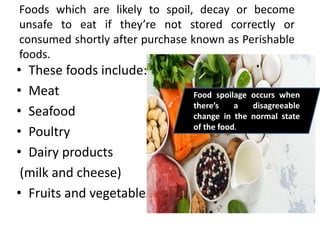
Foods which are likely to spoil, decay or become
unsafe to eat if they’re not stored correctly or
consumed shortly after purchase known as Perishable
foods.
• These foods include:
• Meat
• Seafood
• Poultry
• Dairy products
(milk and cheese)
• Fruits and vegetables
Food spoilage occurs when
there’s a disagreeable
change in the normal state
of the food.
1. Many studies and field observations indicates 40-50% of horticultural crops
produced in developing countries are lost before they can be consumed.
2. Approximately 30-40% of total fruits production is lost in between harvest
and final consumption.
3. Reasons of losses are mainly :
 High rates of bruising,
 Water loss,
 Subsequent decay during postharvest handling .
4. Nutritional loss
1. Vitamins
2. Antioxidant, and health-promoting substances)
3. Decreased market value of fresh produce.
5. Main causes of postharvest loss include:
1. lack of temperature management,
2. rough handling,
3. poor packaging material,
4. lack of education about the need to maintain quality.
Post harvest Losses
Quality of fresh produce is governed by many
factors. All these decide the rate of deterioration
and spoilage and it needed to controlled properly.
There are so many causes for losses in the post-harvest food chain
that it helps to classify them into 2 groups and a number of sub-
groups
A. PRIMARY CAUSES OF LOSS are those causes:
Directly affect the food and may be classified into the following
groups :
• Biological
• Microbiological
• Chemical
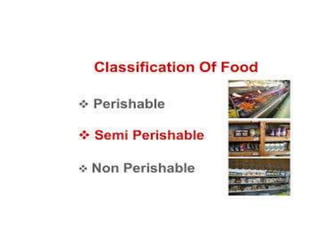
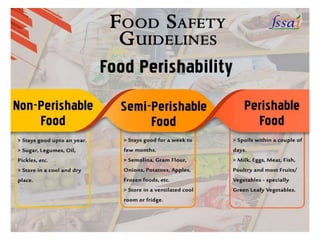
Perishable Foods
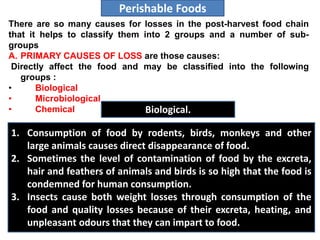
1. Consumption of food by rodents, birds, monkeys and other
large animals causes direct disappearance of food.
2. Sometimes the level of contamination of food by the excreta,
hair and feathers of animals and birds is so high that the food is
condemned for human consumption.
3. Insects cause both weight losses through consumption of the
food and quality losses because of their excreta, heating, and
unpleasant odours that they can impart to food.
Biological.
Microbiological Damage to stored foods
(fungi and bacteria )
.
Micro-organisms usually directly consume small amount
of the food but they damage the food to the point that it
becomes unacceptable because of rotting or other
defects.
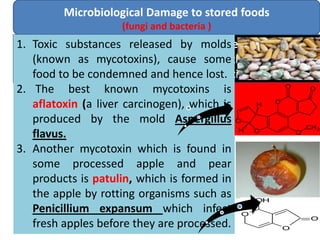
1. Toxic substances released by molds
(known as mycotoxins), cause some
food to be condemned and hence lost.
2. The best known mycotoxins is
aflatoxin (a liver carcinogen), which is
produced by the mold Aspergillus
flavus.
3. Another mycotoxin which is found in
some processed apple and pear
products is patulin, which is formed in
the apple by rotting organisms such as
Penicillium expansum which infect
fresh apples before they are processed.
Many of the chemical constituents naturally
present in stored foods spontaneously react
causing lose of colour, flavour, texture and
nutritional value.
Chemical
An example is the Maillard relation' that
causes browning and discoloration in
dried fruits and other product.
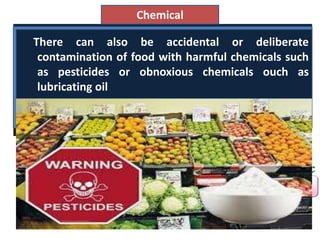
There can also be accidental or deliberate
contamination of food with harmful chemicals such
as pesticides or obnoxious chemicals ouch as
lubricating oil
Other reasons of Losses
1. A number of enzyme-activated reactions can
occur in foods in storage giving rise to oft-
flavours, discoloration and softening.
2. One example of this problem is the unpleasant
flavours that develop in frozen vegetables that
have not been blanched to inactivate these
enzymes before freezing.
Biochemical reason
Biochemical, Microbiological, Mechanical and
Physiological factors cause most of the losses in
perishable crops.
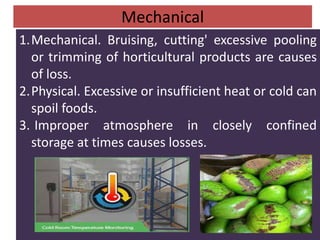
Mechanical
1.Mechanical. Bruising, cutting' excessive pooling
or trimming of horticultural products are causes
of loss.
2.Physical. Excessive or insufficient heat or cold can
spoil foods.
3. Improper atmosphere in closely confined
storage at times causes losses.
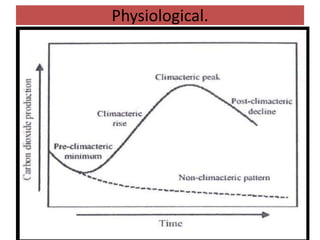
Physiological.
1. Natural respiratory losses which occur in all living
organisms account for a significant level of weight
lose.
2. Generates heat and bring about changes during
ripening, senescence, including wilting, and
termination of dormancy (e.g., sprouting).
3. Production of ethylene results in premature
ripening of certain crops.
4. Such processes may increase the susceptibility of
the commodity to mechanical damage or
infection by pathogens.
5. A reduction in nutritional level and consumer
acceptance may also arise with these changes.
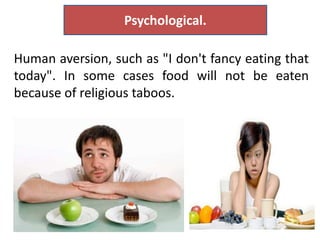
Human aversion, such as "I don't fancy eating that
today". In some cases food will not be eaten
because of religious taboos.
Psychological.
SECONDARY CAUSES OF LOSS
These are multiplier to the conditions that encourage a
primary cause of loss. They are usually the result of
inadequate or non-assistant capital expenditures,
technology and quality control. Some examples are:
1.Inadequate harvesting, packaging and handling skills.
2.Lack of adequate containers for the handling & transport of
perishables to the market before it get spoils.
3. Inadequate storage facilities with refrigeration
4.Inadequate drying equipment or poor drying facilities during rainy
season.
5.traditional processing and marketing systems can be responsible
for high losses.
6.Legal standards can affect the retention or rejection of food for
human use by being too lax or unduly strict.
7.Bumper crops can overload the post-harvest handling system or
exceed the consumption need and cause excessive wastage.
Conscientious, knowledgeable management is essential
for maintaining tool in good condition during marketing
and storage.
Food losses categorized by the types and stages of the food pipeline. The
four columns (of a commodity type) denote the estimated waste
percentages in Europe, North America, Asia, and sub-Saharan Africa,
respectively. Notice that the bars show the food losses in percentage of
what enters at each step. The data for generating this figure are
obtained from Reference [77].
Losses may occur anywhere from the point where the food has been
harvested or gathered up to the point of consumption. For the sake
of convenience the losses can be broken down into the following
sub-headings:
Sites of Losses
Harvest.
The separation of the commodity from the plant
that produced it. In the case of roots, tubers and
bulbs the commodity is lifted out of the soil.
Preparation.
The preliminary separation or extraction of the
edible from the non-edible portion, e.g., the
peeling of fruits and vegetables.
Preservation
It is the prevention of lose and spoilage of
foods. For example, the sun-drying of fruit, the
use of refrigeration and the use of fungicides to
inhibit mold growth in fruits.
Processing
It is the conversion of edible food into another
form more acceptable or more convenient to the
consumer, for example, the manufacture of fruit
juice and the canning of fruits and vegetables.
All forms of transportation are used to convey
foods from the point of production to the
ultimate point of consumption.
Post-harvest losses in fresh root/tuber crops
have their origin in mechanical damage,
physiological processes, infection by decay
organisms and, occasionally, pest infestation.
.
Transportation.
Magnitude of losses
1. Reliable statistics on losses are few. It is possible to find
individual cases with losses ranging from 0% to 100%.
2. The extent of losses is highly variable depending on a number of
conditions. Stable foods such as cereal grains can be stored in
good condition for several years, whereas perishable foods
such as fruit a and vegetables, spoil quickly unless given special
treatment such as canning and freezing.
3. The longer the time the food is stored the more opportunity
there is for losses of all kinds to occur. Perishable crops
generally suffer from higher losses than the cereals.
4. A number of figures for the extent of loss is quoted in
scientific literature and by the communications media, but
much of this information is unreliable because the amount
of loss has been estimated and has not been obtained by
actual measurements. There is often the temptation to
cite "worst case" figures to dramatize the problem.
5. Another problem is that even some of the figures that have
been obtained by careful measurements are manipulated
for various reasons.
6. In some cases there is the temptation to exaggerate the
figures of loss, particularly if there is a prospect that high
figures of loss will prompt aid from donors.
8. In other cases there is a temptation to minimize loss figures
in order to prevent the embarrassment of acknowledging
the magnitude of losses, or for political, financial or
trading reasons.
6. The extent of losses can be unwittingly exaggerated unless the arithmetical
calculations are correctly performed. Some examples of misleading
arithmetical calculations are discussed by Bourne (1977).
7. The pattern of losses varies widely from country to country. There is a marked
contrast between the site of major losses in developed countries and
developing countries.
8. In a typical developed country losses may be fairly high during harvesting
because the agricultural machinery that is used to harvest the crops leaves
some of the commodity in the field and mechanically damages some of it.
9. Considerable quantities of foods a may be discarded at the point of harvest
because they are of the wrong size, shape or colour. These are planned losses.
10. In developing countries harvest losses are usually lower because most of the
crop is hand picked. The amount of material rejected in developing countries is
less because the expectation of quality and uniformity is generally lower than
for developed countries.
11. In developed countries losses are generally small during processing, storage and
handling because of the efficiency of the equipment, good quality storage
facilities, and close control of critical variables by a highly knowledgeable cadre
of managers. In contrast, in developing countries losses in processing, storage
and handling tend to be rather high because of poor facilities and frequently
inadequate knowledge of methods to care for the food properly.
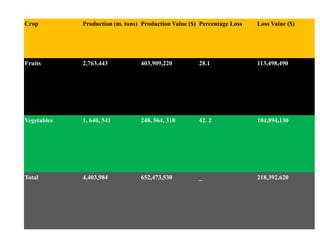
Crop Production (m. tons) Production Value ($) Percentage Loss Loss Value ($)
Fruits 2,763,443 403,909,220 28.1 113,498,490
Vegetables 1, 640, 541 248, 564, 310 42. 2 104,894,130
Total 4,403,984 652,473,530 _ 218,392,620
Key causes of food losses and waste (adapted with permission from
Reference [22]).
FOOD QUALITY AND ENVIRONMENTAL FACTORS
• Food products often deteriorate in quality or in
value/usefulness as a function of flow time through the
logistics system.
• The deterioration as a function of time tt can be
described by a non-decreasing function that we
henceforth denote as ζ(t)ζ(t).
• In general, ζ(t)ζ(t) is linear for fruits or vegetables and
exponential for fish/meat.
• The decay itself is a complex phenomenon and could
refer to many aspects, including those that can be
directly detected by the customers (e.g., color, texture,
firmness, taste) and those that are latent but perhaps
even more important, such as degradation of vitamin
content or growth of bacteria.
• Furthermore, the decay rate is strongly influenced by
the environmental parameters such as temperature,
humidity, vibration, and so on.
Temperature management
• In case of fresh fruits and vegetables, optimum quality is
ensured only when they are promptly cooled to their
optimum temperature after harvest and subsequently
maintained under optimum temperature conditions.
• Several studies have shown that promptly pre-cooling
berry fruits and subsequently maintaining optimum
temperature significantly reduces loss of quality during
storage and extends shelf life.
• Recent data show that if strawberries are not pre-
cooled adequately after harvest, the waste at the retail
level can be as high as 50% .
• Also, fluctuating temperature during the distribution
process often results in loss of shelf life.
Temperature management is the most important and simplest
way for delaying the quality deterioration of fresh foods,
starting from production to distribution.
Humidity
• Humidity of the surrounding environment is also an
important factor in food logistics, and should be
maintained at a level that minimizes the water vapor
pressure deficit between the product and the
environment.
• When the relative humidity is too low, transpiration is
enhanced, which results in loss of moisture.
• For example, strawberries stored at 10∘C and 95%
relative humidity experience ∼∼7% more quality loss
after four days than when stored at 75% relative
humidity
• The use of protective packaging maintains a higher
level of humidity and thus helps reduce loss of
moisture.
Vibration
• In-transit vibration results in quality
degradation of the food products at the
consumer end and results in reduced profit for
the produce industry.
• Especially fruits like berries and grapes are
highly susceptible to in-transit vibration, which
causes skin abrasion, bruising, discoloration,
and thus reduced shelf life.
• It is reported in a studied that there is a range
of frequencies that causes maximum damage to
perishable products, which are found to be
between 7.5 and 10 Hertz for these two
commodities.

PHE 1.pptx

  • 1.
    Unit-I 1.1: Internal andExternal Factors Affecting Quality of Fresh Produce Name of subject : Post Harvest Engineering Subject Code :PEFT-615B Credit : 3 ( 2-1) Name of Subject Coordinator : Prof. M.B.Bera Introduction to Postharvest Food Systems
  • 4.
    Foods which arelikely to spoil, decay or become unsafe to eat if they’re not stored correctly or consumed shortly after purchase known as Perishable foods. • These foods include: • Meat • Seafood • Poultry • Dairy products (milk and cheese) • Fruits and vegetables Food spoilage occurs when there’s a disagreeable change in the normal state of the food.
  • 5.
    1. Many studiesand field observations indicates 40-50% of horticultural crops produced in developing countries are lost before they can be consumed. 2. Approximately 30-40% of total fruits production is lost in between harvest and final consumption. 3. Reasons of losses are mainly :  High rates of bruising,  Water loss,  Subsequent decay during postharvest handling . 4. Nutritional loss 1. Vitamins 2. Antioxidant, and health-promoting substances) 3. Decreased market value of fresh produce. 5. Main causes of postharvest loss include: 1. lack of temperature management, 2. rough handling, 3. poor packaging material, 4. lack of education about the need to maintain quality. Post harvest Losses Quality of fresh produce is governed by many factors. All these decide the rate of deterioration and spoilage and it needed to controlled properly.
  • 6.
    There are somany causes for losses in the post-harvest food chain that it helps to classify them into 2 groups and a number of sub- groups A. PRIMARY CAUSES OF LOSS are those causes: Directly affect the food and may be classified into the following groups : • Biological • Microbiological • Chemical Perishable Foods 1. Consumption of food by rodents, birds, monkeys and other large animals causes direct disappearance of food. 2. Sometimes the level of contamination of food by the excreta, hair and feathers of animals and birds is so high that the food is condemned for human consumption. 3. Insects cause both weight losses through consumption of the food and quality losses because of their excreta, heating, and unpleasant odours that they can impart to food. Biological.
  • 7.
    Microbiological Damage tostored foods (fungi and bacteria ) . Micro-organisms usually directly consume small amount of the food but they damage the food to the point that it becomes unacceptable because of rotting or other defects. 1. Toxic substances released by molds (known as mycotoxins), cause some food to be condemned and hence lost. 2. The best known mycotoxins is aflatoxin (a liver carcinogen), which is produced by the mold Aspergillus flavus. 3. Another mycotoxin which is found in some processed apple and pear products is patulin, which is formed in the apple by rotting organisms such as Penicillium expansum which infect fresh apples before they are processed.
  • 8.
    Many of thechemical constituents naturally present in stored foods spontaneously react causing lose of colour, flavour, texture and nutritional value. Chemical An example is the Maillard relation' that causes browning and discoloration in dried fruits and other product. There can also be accidental or deliberate contamination of food with harmful chemicals such as pesticides or obnoxious chemicals ouch as lubricating oil
  • 9.
    Other reasons ofLosses 1. A number of enzyme-activated reactions can occur in foods in storage giving rise to oft- flavours, discoloration and softening. 2. One example of this problem is the unpleasant flavours that develop in frozen vegetables that have not been blanched to inactivate these enzymes before freezing. Biochemical reason Biochemical, Microbiological, Mechanical and Physiological factors cause most of the losses in perishable crops.
  • 10.
    Mechanical 1.Mechanical. Bruising, cutting'excessive pooling or trimming of horticultural products are causes of loss. 2.Physical. Excessive or insufficient heat or cold can spoil foods. 3. Improper atmosphere in closely confined storage at times causes losses.
  • 11.
    Physiological. 1. Natural respiratorylosses which occur in all living organisms account for a significant level of weight lose. 2. Generates heat and bring about changes during ripening, senescence, including wilting, and termination of dormancy (e.g., sprouting). 3. Production of ethylene results in premature ripening of certain crops. 4. Such processes may increase the susceptibility of the commodity to mechanical damage or infection by pathogens. 5. A reduction in nutritional level and consumer acceptance may also arise with these changes.
  • 12.
    Human aversion, suchas "I don't fancy eating that today". In some cases food will not be eaten because of religious taboos. Psychological.
  • 13.
    SECONDARY CAUSES OFLOSS These are multiplier to the conditions that encourage a primary cause of loss. They are usually the result of inadequate or non-assistant capital expenditures, technology and quality control. Some examples are: 1.Inadequate harvesting, packaging and handling skills. 2.Lack of adequate containers for the handling & transport of perishables to the market before it get spoils. 3. Inadequate storage facilities with refrigeration 4.Inadequate drying equipment or poor drying facilities during rainy season. 5.traditional processing and marketing systems can be responsible for high losses. 6.Legal standards can affect the retention or rejection of food for human use by being too lax or unduly strict. 7.Bumper crops can overload the post-harvest handling system or exceed the consumption need and cause excessive wastage. Conscientious, knowledgeable management is essential for maintaining tool in good condition during marketing and storage.
  • 14.
    Food losses categorizedby the types and stages of the food pipeline. The four columns (of a commodity type) denote the estimated waste percentages in Europe, North America, Asia, and sub-Saharan Africa, respectively. Notice that the bars show the food losses in percentage of what enters at each step. The data for generating this figure are obtained from Reference [77].
  • 15.
    Losses may occuranywhere from the point where the food has been harvested or gathered up to the point of consumption. For the sake of convenience the losses can be broken down into the following sub-headings: Sites of Losses Harvest. The separation of the commodity from the plant that produced it. In the case of roots, tubers and bulbs the commodity is lifted out of the soil. Preparation. The preliminary separation or extraction of the edible from the non-edible portion, e.g., the peeling of fruits and vegetables. Preservation It is the prevention of lose and spoilage of foods. For example, the sun-drying of fruit, the use of refrigeration and the use of fungicides to inhibit mold growth in fruits. Processing It is the conversion of edible food into another form more acceptable or more convenient to the consumer, for example, the manufacture of fruit juice and the canning of fruits and vegetables.
  • 16.
    All forms oftransportation are used to convey foods from the point of production to the ultimate point of consumption. Post-harvest losses in fresh root/tuber crops have their origin in mechanical damage, physiological processes, infection by decay organisms and, occasionally, pest infestation. . Transportation.
  • 17.
    Magnitude of losses 1.Reliable statistics on losses are few. It is possible to find individual cases with losses ranging from 0% to 100%. 2. The extent of losses is highly variable depending on a number of conditions. Stable foods such as cereal grains can be stored in good condition for several years, whereas perishable foods such as fruit a and vegetables, spoil quickly unless given special treatment such as canning and freezing. 3. The longer the time the food is stored the more opportunity there is for losses of all kinds to occur. Perishable crops generally suffer from higher losses than the cereals.
  • 18.
    4. A numberof figures for the extent of loss is quoted in scientific literature and by the communications media, but much of this information is unreliable because the amount of loss has been estimated and has not been obtained by actual measurements. There is often the temptation to cite "worst case" figures to dramatize the problem. 5. Another problem is that even some of the figures that have been obtained by careful measurements are manipulated for various reasons. 6. In some cases there is the temptation to exaggerate the figures of loss, particularly if there is a prospect that high figures of loss will prompt aid from donors. 8. In other cases there is a temptation to minimize loss figures in order to prevent the embarrassment of acknowledging the magnitude of losses, or for political, financial or trading reasons.
  • 19.
    6. The extentof losses can be unwittingly exaggerated unless the arithmetical calculations are correctly performed. Some examples of misleading arithmetical calculations are discussed by Bourne (1977). 7. The pattern of losses varies widely from country to country. There is a marked contrast between the site of major losses in developed countries and developing countries. 8. In a typical developed country losses may be fairly high during harvesting because the agricultural machinery that is used to harvest the crops leaves some of the commodity in the field and mechanically damages some of it. 9. Considerable quantities of foods a may be discarded at the point of harvest because they are of the wrong size, shape or colour. These are planned losses. 10. In developing countries harvest losses are usually lower because most of the crop is hand picked. The amount of material rejected in developing countries is less because the expectation of quality and uniformity is generally lower than for developed countries. 11. In developed countries losses are generally small during processing, storage and handling because of the efficiency of the equipment, good quality storage facilities, and close control of critical variables by a highly knowledgeable cadre of managers. In contrast, in developing countries losses in processing, storage and handling tend to be rather high because of poor facilities and frequently inadequate knowledge of methods to care for the food properly.
  • 20.
    Crop Production (m.tons) Production Value ($) Percentage Loss Loss Value ($) Fruits 2,763,443 403,909,220 28.1 113,498,490 Vegetables 1, 640, 541 248, 564, 310 42. 2 104,894,130 Total 4,403,984 652,473,530 _ 218,392,620
  • 21.
    Key causes offood losses and waste (adapted with permission from Reference [22]).
  • 22.
    FOOD QUALITY ANDENVIRONMENTAL FACTORS • Food products often deteriorate in quality or in value/usefulness as a function of flow time through the logistics system. • The deterioration as a function of time tt can be described by a non-decreasing function that we henceforth denote as ζ(t)ζ(t). • In general, ζ(t)ζ(t) is linear for fruits or vegetables and exponential for fish/meat. • The decay itself is a complex phenomenon and could refer to many aspects, including those that can be directly detected by the customers (e.g., color, texture, firmness, taste) and those that are latent but perhaps even more important, such as degradation of vitamin content or growth of bacteria. • Furthermore, the decay rate is strongly influenced by the environmental parameters such as temperature, humidity, vibration, and so on.
  • 23.
    Temperature management • Incase of fresh fruits and vegetables, optimum quality is ensured only when they are promptly cooled to their optimum temperature after harvest and subsequently maintained under optimum temperature conditions. • Several studies have shown that promptly pre-cooling berry fruits and subsequently maintaining optimum temperature significantly reduces loss of quality during storage and extends shelf life. • Recent data show that if strawberries are not pre- cooled adequately after harvest, the waste at the retail level can be as high as 50% . • Also, fluctuating temperature during the distribution process often results in loss of shelf life. Temperature management is the most important and simplest way for delaying the quality deterioration of fresh foods, starting from production to distribution.
  • 24.
    Humidity • Humidity ofthe surrounding environment is also an important factor in food logistics, and should be maintained at a level that minimizes the water vapor pressure deficit between the product and the environment. • When the relative humidity is too low, transpiration is enhanced, which results in loss of moisture. • For example, strawberries stored at 10∘C and 95% relative humidity experience ∼∼7% more quality loss after four days than when stored at 75% relative humidity • The use of protective packaging maintains a higher level of humidity and thus helps reduce loss of moisture.
  • 25.
    Vibration • In-transit vibrationresults in quality degradation of the food products at the consumer end and results in reduced profit for the produce industry. • Especially fruits like berries and grapes are highly susceptible to in-transit vibration, which causes skin abrasion, bruising, discoloration, and thus reduced shelf life. • It is reported in a studied that there is a range of frequencies that causes maximum damage to perishable products, which are found to be between 7.5 and 10 Hertz for these two commodities.