´
 INSTITUTO TECNOLOGICO Y DE ESTUDIOS SUPERIORES DE MONTERREY
               CAMPUS CAMPUS MONTERREY


SCHOOL OF ENGINEERING AND INFORMATION TECHNOLOGIES
                GRADUATE PROGRAMS


               DOCTOR OF PHILOSOPHY
                         IN
   INFORMATION TECHNOLOGIES AND COMMUNICATIONS
           MAJOR IN INTELLIGENT SYSTEMS

                          Dissertation
            Coordination of Multiple Robotic Agents
             For Disaster and Emergency Response

                              By

                   ´
                Jesus Salvador Cepeda Barrera

                      DECEMBER 2012
Coordination of Multiple Robotic Agents
   For Disaster and Emergency Response
                     A dissertation presented by

                    ´
                 Jesus Salvador Cepeda Barrera

                        Submitted to the
Graduate Programs in Engineering and Information Technologies
   in partial fulfillment of the requirements for the degree of

                    Doctor of Philosophy
                              in
        Information Technologies and Communications
                 Major in Intelligent Systems


                               Thesis Committee:

           Dr. Rogelio Soto    -   Tecnol´ gico de Monterrey
                                         o
      Dr. Luiz Chaimowicz      -   Universidade Federal de Minas Gerais
      Dr. Jos´ Luis Gordillo
             e                 -   Tecnol´ gico de Monterrey
                                         o
      Dr. Leonardo Garrido     -   Tecnol´ gico de Monterrey
                                         o
      Dr. Ernesto Rodr´guez
                      ı        -   Tecnol´ gico de Monterrey
                                         o


  Instituto Tecnol´ gico y de Estudios Superiores de Monterrey
                  o
                  Campus Campus Monterrey
                         December 2012
Instituto Tecnol´ gico y de Estudios Superiores de Monterrey
                  o
                  Campus Campus Monterrey
                    School of Engineering and Information Technologies
                                    Graduate Program

The committee members hereby certify that have read the dissertation presented by Jes´ s Sal-
                                                                                         u
vador Cepeda Barrera and that it is fully adequate in scope and quality as a partial fulfillment
of the requirements for the degree of Doctor of Philosophy in Information Technologies
and Communications, with a major in Intelligent Systems.


                                  Dissertation Committee


                                                     Dr. Rogelio Soto
                                                     Advisor


                                                     Dr. Luiz Chaimowicz
                                                     External Co-Advisor
                                                     Universidade Federal de Minas Gerais


                                                     Dr. Jos´ Luis Gordillo
                                                            e
                                                     Committee Member


                                                     Dr. Leonardo Garrido
                                                     Committee Member


                                                     Dr. Ernesto Rodr´guez
                                                                     ı
                                                     Committee Member


                                      Dr. C´ sar Vargas
                                            e
                             Director of the Doctoral Program in
                               Information Technologies and
                                      Communications


                                               i
Copyright Declaration


I, hereby, declare that I wrote this dissertation entirely by myself and, that, it exclusively
describes my own research.


                                                     Jes´ s Salvador Cepeda Barrera
                                                        u
                                                     Monterrey, N.L., M´ xico
                                                                        e
                                                     December 2012


                          c 2012 by Jes´ s Salvador Cepeda Barrera
                                       u
                                    All Rights Reserved


                                              ii
Dedicatoria


Dedico este trabajo a todos quienes me dieron la oportunidad y confiaron en que valdr´a la
                                                                                     ı
pena este tiempo que no solo requiri´ de trabajo arduo y de nuevas experiencias, sino que
                                    o
demand´ por apoyo constante, paciencia y aliento ante los per´odos m´ s dif´ciles.
       o                                                     ı      a      ı

A mi padre por su sacrificio eterno para convencerme de pensar en grande y de hacer que
                                             ´
valga la pena el camino y sus dificultades. A el por aguantar hasta estos d´as la econom´a del
                                                                          ı              ı
estudiante y confiar siempre que lo mejor est´ por venir. A ti pap´ por tu amor y gu´a con
                                              a                     a                  ı
sabidur´a para permitirme llegar hasta donde me lo proponga.
        ı

A mi madre por su abrazo sin igual que siempre abre nuevas brechas cuando pareciera que ya
no hay por donde continuar. A ella por el regazo donde renacen las fuerzas y motivaci´ n para
                                                                                     o
volver a intentar. A ti mam´ por el amor que siempre me da seguridad para seguir adelante
                           a
sabiendo que hay alguien que por siempre me ha de acompa˜ ar.
                                                           n

A mi hermana por saber demostrarme, sin intenciones, que la preparaci´ n nunca estar´ de
                                                                       o               a
m´ s, que la vida puede complicarse tanto como uno quiera y por ende existe la necesidad de
  a
ser cada vez m´ s. A ti por ejemplo de lucha y rebeld´a.
                a                                    ı

A los t´os tecn´ logos que nunca han dejado de invertir ni de creer en mi. A ustedes sin quienes
       ı       o
no hubiera sido posible llegar a este momento. Entre econom´a, herramientas y confianza
                                                                   ı
constante, ustedes me dieron siempre motivaci´ n y F´ para ser ejemplo y apostar con el mayor
                                               o      e
esfuerzo.

Al abuelo que siempre quiso un ingeniero y ahora se le hizo doctor. Le dedico este trabajo
que sin sus conocimientos y compa˜ ´a en el taller nunca hubiera tenido la integridad que lo
                                    nı
caracteriza. A usted por ense˜ arme que la ingenier´a no es una decisi´ n, sino una convicci´ n.
                             n                     ı                  o                     o

Finalmente, a la mujer que por su existencia es gu´a y voz divina. A ti que sabes decir y hacer
                                                   ı
lo que hace falta. A ti que complementas como ying y yang, como sol y luna, como piel
morena y cabellos rizados. A ti mi linda esposa por tu amor constante que nunca permiti´      o
tristezas ni en los peores momentos. Lo dedico por tu firme disposici´ n a dejar todo por vivir
                                                                      o
                                                  ´
y aprender cosas que nunca te imaginaste, por tu animo vivo por recorrer el mundo a mi lado.
A ti princesa por confiar en mi y acompa˜ arme en cada una de estas p´ ginas.
                                         n                              a


                                              iii
Acknowledgements


           If the observer were intelligent (and extraterrestrial observers are always pre-
      sumed to be intelligent) he would conclude that the earth is inhabited by a few
      very large organisms whose individual parts are subordinate to a central direct-
      ing force. He might not be able to find any central brain or other controlling unit,
      but human biologists have the same difficulty when they try to analyse an ant
      hill. The individual ants are not impressive objects in fact they are rather stupid,
      even for insects but the colony as a whole behaves with striking intelligence. –
      Jonathan Norton Leonard

I want to express my deepest feeling of gratitude to all of you who contributed for me to not
be an individual ant. Advisors, peers, friends, and the robotics gurus, which doubtfully will
read this but who surely deserve my gratitude because without them this work won’t even be
possible.

Thanks Prof. Rogelio Soto for your constant confidence in my ideas and for supporting and
guiding all my developments during this dissertation. Thanks for the opportunity you gave
me for working with you and developing that which I like the most and I doesn’t even knew
it existed.

Thanks Prof. Jos´ L. Gordillo for the hard times you gave me and for sharing your knowledge.
                  e
I really appreciate both things, definitively you make me a more integral professional.

Thanks Prof. Luiz Chaimowicz, for opening the research doors from the very first day. Thanks
for believing in my developments and letting me live a little of the amazing Brazilian experi-
ence. Thanks for your constant guidance even when we are more than 8000km apart. Thanks
for showing me my very first experiences around real robotics and for making me understand
that it is Skynet and not the Terminator which we shall fear.

Thanks eRobots friends and colleagues for not only sharing your knowledge and experiences
with me, but also for validating my own. Thanks for your constant support and company when
nobody else should be working. Thanks for your words when I needed them the most, you
really are a fundamental part of this work.

Thanks Prof. Mario Montenegro and the Verlabians for the most accurate and guided knowl-
edge I’ve ever had about mobile robotics. Thanks for giving me the chance to be part of your
team. Thanks for letting me learn from you and be your mexican friend even though I worked
with Windows.

Thanks God and Life for giving me this opportunity.


                                               iv
Coordination of Multiple Robotic Agents
                For Disaster and Emergency Response
                                  by
                    Jes´ s Salvador Cepeda Barrera
                       u

                                         Abstract

In recent years, the use of Multi-Robot Systems (MRS) has become popular for several appli-
cation domains. The main reason for using these MRS is that they are a convenient solution
in terms of costs, performance, efficiency, reliability, and reduced human exposure. In that
way, existing robots and implementation domains are of increasing number and complexity,
turning coordination and cooperation fundamental features among robotics research.
      Accordingly, developing a team of cooperative autonomous mobile robots has been one
of the most challenging goals in artificial intelligence. Research has witnessed a large body
of significant advances in the control of single mobile robots, dramatically improving the
feasibility and suitability of MRS. These vast scientific contributions have also created the
need for coupling these advances, leading researchers to the challenging task of developing
multi-robot coordination infrastructures.
      Moreover, considering all possible environments where robots interact, disaster scenar-
ios come to be among the most challenging ones. These scenarios have no specific structure
and are highly dynamic, uncertain and inherently hostile. They involve devastating effects
on wildlife, biodiversity, agriculture, urban areas, human health, and also economy. So, they
reside among the most serious social issues for the intellectual community.
      Following these concerns and challenges, this dissertation addresses the problem of how
can we coordinate and control multiple robots so as to achieve cooperative behavior for assist-
ing in disaster and emergency response. The essential motivation resides in the possibilities
that a MRS can have for disaster response including improved performance in sensing and
action, while speeding up operations by parallelism. Finally, it represents an opportunity for
empowering responders’ abilities and efficiency in the critical 72 golden hours, which are
essential for increasing the survival rate and for preventing a larger damage.
      Therefore, herein we achieve urban search and rescue (USAR) modularization leverag-
ing local perceptions and mission decomposition into robotic tasks. Then, we have developed
a behavior-based control architecture for coordinating mobile robots, enhancing most relevant
control characteristics reported in literature. Furthermore, we have implemented a hybrid in-
frastructure in order to ensure robustness for USAR mission accomplishment with current
technology, which is better for simple, fast, reactive control. These single and multi-robot
architectures were designed under the service-oriented paradigm, thus leveraging reusability,
scalability and extendibility.
      Finally, we have inherently studied the emergence of rescue robotic team behaviors and
their applicability in real disasters. By implementing distributed autonomous behaviors, we
observed the opportunity for adding adaptivity features so as to autonomously learn additional
behaviors and possibly increase performance towards cognitive systems.

                                              v
List of Figures

 1.1  Number of survivors and casualties in the Kobe earthquake in 1995. Image
      from [267]. . . . . . . . . . . . . . . . . . . . . . . . . . . . . . . . . . . .       3
 1.2 Percentage of survival chances in accordance to when victim is located. Based
      on [69]. . . . . . . . . . . . . . . . . . . . . . . . . . . . . . . . . . . . . .      3
 1.3 70 years for autonomous control levels. Edited from [44]. . . . . . . . . . . .          6
 1.4 Mobile robot control scheme. Image from [255]. . . . . . . . . . . . . . . .             9
 1.5 Minsky’s interpretation of behaviors. Image from [188]. . . . . . . . . . . .           18
 1.6 Classic and new artificial intelligence approaches. Edited from [255]. . . . .           18
 1.7 Behavior in robotics control. Image from [138]. . . . . . . . . . . . . . . . .         19
 1.8 Coordination methods for behavior-based control. Edited from [11]. . . . . .            19
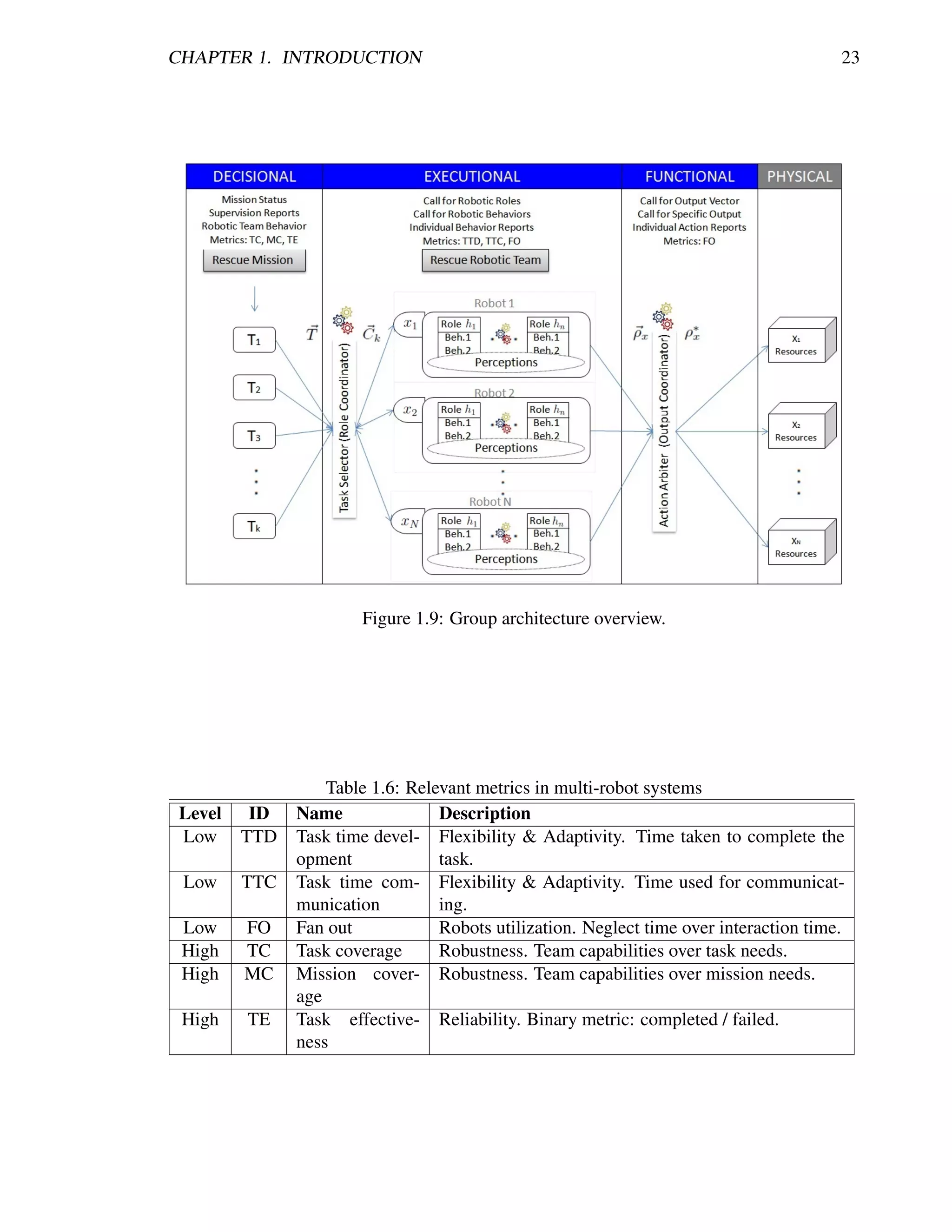
 1.9 Group architecture overview. . . . . . . . . . . . . . . . . . . . . . . . . . .        23
 1.10 Service-oriented group architecture. . . . . . . . . . . . . . . . . . . . . . .       25

 2.1    Major challenges for networked robots. Image from [150]. . . . . . . . . . .         30
 2.2    Typical USAR Scenario. Image from [267]. . . . . . . . . . . . . . . . . . .         30
 2.3    Real pictures from the WTC Tower 2. a) shows a rescue robot within the white
        box navigating in the rubble; b) robots-eye view with three sets of victim
        remains. Image edited from [194] and [193]. . . . . . . . . . . . . . . . . .        31
 2.4    Typical problems with rescue robots. Image from [268]. . . . . . . . . . . . .       35
 2.5    Template-based information system for disaster response. Image based on [156,
        56]. . . . . . . . . . . . . . . . . . . . . . . . . . . . . . . . . . . . . . . .   41
 2.6    Examples of templates for disaster response. Image based on [156, 56]. . . .         42
 2.7    Task force in rescue infrastructure. Image from [14]. . . . . . . . . . . . . .      43
 2.8    Rescue Communicator, R-Comm: a) Long version, b) Short version. Image
        from [14]. . . . . . . . . . . . . . . . . . . . . . . . . . . . . . . . . . . . .   43
 2.9    Handy terminal and RFID tag. Image from [14]. . . . . . . . . . . . . . . . .        44
 2.10   Database for Rescue Management System, DaRuMa. Edited from [210]. . . .              44
 2.11   RoboCup Rescue Concept. Image from [270]. . . . . . . . . . . . . . . . . .          46
 2.12   USARSim Robot Models. Edited from [284, 67]. . . . . . . . . . . . . . . .           47
 2.13   USARSim Disaster Snapshot. Edited from [18, 17]. . . . . . . . . . . . . . .         47
 2.14   Sensor Readings Comparison. Top: Simulation, Bottom: Reality. Image
        from [67]. . . . . . . . . . . . . . . . . . . . . . . . . . . . . . . . . . . . .   48
 2.15   Control Architecture for Rescue Robot Systems. Image from [3]. . . . . . . .         50
 2.16   Coordinated exploration using costs and utilities. Frontier assignment consid-
        ering a) only costs; b) costs and utilities; c) three robots paths results. Edited
        from [58]. . . . . . . . . . . . . . . . . . . . . . . . . . . . . . . . . . . . .   52

                                             vi
2.17   Supervisor sketch for MRS patrolling. Image from [168]. . . . . . . . . . . . 53
2.18   Algorithm for determining occupancy grids. Image from [33]. . . . . . . . . 54
2.19   Multi-Robot generated maps in RoboCup Rescue 2007. Image from [225]. . . 55
2.20   Behavioral mapping idea. Image from [164]. . . . . . . . . . . . . . . . . . . 55
2.21   3D mapping using USARSim. Left) Kurt3D and its simulated counterpart.
       Right) 3D color-coded map. Edited from [20]. . . . . . . . . . . . . . . . . . 56
2.22   Face recognition in USARSim. Left) Successful recognition. Right) False
       positive. Image from [20]. . . . . . . . . . . . . . . . . . . . . . . . . . . . 57
2.23   Human pedestrian vision-based detection procedure. Image from [90]. . . . . 57
2.24   Human pedestrian vision-based detection procedure. Image from hal.inria.fr/inria-
       00496980/en/. . . . . . . . . . . . . . . . . . . . . . . . . . . . . . . . . . . 58
2.25   Human behavior vision-based recognition. Edited from [207]. . . . . . . . . 58
2.26   Visual path following procedure. Edited from [103]. . . . . . . . . . . . . . . 59
2.27   Visual path following tests in 3D terrain. Edited from [103]. . . . . . . . . . 59
2.28   START Algorithm. Victims are sorted in: Minor, Delayed, Immediate and
       Expectant; based on the assessment of: Mobility, Respiration, Perfusion and
       Mental Status. Image from [80]. . . . . . . . . . . . . . . . . . . . . . . . . 61
2.29   Safety, security and rescue robotics teleoperation stages. Image from [36]. . . 61
2.30   Interface for multi-robot rescue systems. Image from [209]. . . . . . . . . . . 62
2.31   Desired information for rescue robot interfaces: a)multiple image displays, b)
       multiple map displays. Edited from [292]. . . . . . . . . . . . . . . . . . . . 63
2.32   Touch-screen technologies for rescue robotics. Edited from [185]. . . . . . . 64
2.33   MRS for autonomous exploration, mapping and deployment. a) the complete
       heterogeneous team; b) sub-team with mapping capabilities. Image from [130]. 65
2.34   MRS result for autonomous exploration, mapping and deployment. a) origi-
       nal floor map; b) robots collected map; c) autonomous planned deployment.
       Edited from [130]. . . . . . . . . . . . . . . . . . . . . . . . . . . . . . . . 65
2.35   MRS for search and monitoring: a) Piper J3 UAVs; b) heterogeneous UGVs.
       Edited from [131]. . . . . . . . . . . . . . . . . . . . . . . . . . . . . . . . 66
2.36   Demonstration of integrated search operations: a) robots at initial positions, b)
       robots searching for human target, c) alert of target found, d) display nearest
       UGV view of the target. Edited from [131]. . . . . . . . . . . . . . . . . . . 67
2.37   CRASAR MicroVGTV and Inuktun [91, 194, 158, 201]. . . . . . . . . . . . 70
2.38   TerminatorBot [282, 281, 204]. . . . . . . . . . . . . . . . . . . . . . . . . . 70
2.39   Leg-in-Rotor Jumping Inspector [204, 267]. . . . . . . . . . . . . . . . . . . 71
2.40   Cubic/Planar Transformational Robot [266]. . . . . . . . . . . . . . . . . . . 71
2.41   iRobot ATRV - FONTANA [199, 91, 158]. . . . . . . . . . . . . . . . . . . . 71
2.42   FUMA [181, 245]. . . . . . . . . . . . . . . . . . . . . . . . . . . . . . . . 72
2.43   Darmstadt University - Monstertruck [8]. . . . . . . . . . . . . . . . . . . . 72
2.44   Resko at UniKoblenz - Robbie [151]. . . . . . . . . . . . . . . . . . . . . . 72
2.45   Independent [84]. . . . . . . . . . . . . . . . . . . . . . . . . . . . . . . . . 73
2.46   Uppsala University Sweden - Surt [211]. . . . . . . . . . . . . . . . . . . . . 73
2.47   Taylor [199]. . . . . . . . . . . . . . . . . . . . . . . . . . . . . . . . . . . 73
2.48   iRobot Packbot [91, 158]. . . . . . . . . . . . . . . . . . . . . . . . . . . . . 74
2.49   SPAWAR Urbot [91, 158]. . . . . . . . . . . . . . . . . . . . . . . . . . . . 74

                                          vii
2.50   Foster-Miller Solem [91, 194, 158]. . . . . . . . . . . . . . . . . . . . . . .      74
2.51   Shinobi - Kamui [189]. . . . . . . . . . . . . . . . . . . . . . . . . . . . . .     75
2.52   CEO Mission II [277]. . . . . . . . . . . . . . . . . . . . . . . . . . . . . .      75
2.53   Aladdin [215, 61]. . . . . . . . . . . . . . . . . . . . . . . . . . . . . . . . .   75
2.54   Pelican United - Kenaf [204, 216]. . . . . . . . . . . . . . . . . . . . . . . .     76
2.55   Tehzeeb [265]. . . . . . . . . . . . . . . . . . . . . . . . . . . . . . . . . .     76
2.56   ResQuake Silver2009 [190, 187]. . . . . . . . . . . . . . . . . . . . . . . .        76
2.57   Jacobs Rugbot [224, 85, 249]. . . . . . . . . . . . . . . . . . . . . . . . . .      77
2.58   PLASMA-Rx [87]. . . . . . . . . . . . . . . . . . . . . . . . . . . . . . . .        77
2.59   MRL rescue robots NAJI VI and NAJI VII [252]. . . . . . . . . . . . . . . .          77
2.60   Helios IX and Carrier Parent and Child [121, 180, 267]. . . . . . . . . . . . .      78
2.61   KOHGA : Kinesthetic Observation-Help-Guidance Agent [142, 181, 189, 276].            78
2.62   OmniTread OT-4 [40]. . . . . . . . . . . . . . . . . . . . . . . . . . . . . .       78
2.63   Hyper Souryu IV [204, 276]. . . . . . . . . . . . . . . . . . . . . . . . . . .      79
2.64   Rescue robots: a) Talon, b) Wolverine V-2, c) RHex, d) iSENSYS IP3, e)
       Intelligent Aerobot, f) muFly microcopter, g) Chinese firefighting robot, h)
       Teleoperated extinguisher, i) Unmanned surface vehicle, j) Predator, k) T-
       HAWK, l) Bluefin HAUV. Images from [181, 158, 204, 267, 287]. . . . . . .             80
2.65   Jacobs University rescue arenas. Image from [249]. . . . . . . . . . . . . . .       81
2.66   Arena in which multiple Kenafs were tested. Image from [205]. . . . . . . .          82
2.67   Exploration strategy and centralized, global 3D map: a) frontiers in current
       global map, b) allocation and path planning towards the best frontier, c) a
       final 3D global map. Image from [205]. . . . . . . . . . . . . . . . . . . . .        82
2.68   Mapping data: a) raw from individual robots, b) fused and corrected in a new
       global map. Image from [205]. . . . . . . . . . . . . . . . . . . . . . . . . .      83
2.69   Building exploration and temperature gradient mapping: a) robots as mobile
       sensors navigating and deploying static sensors, b) temperature map. Image
       from [144]. . . . . . . . . . . . . . . . . . . . . . . . . . . . . . . . . . . .    84
2.70   Building structure exploration and temperature mapping using static sensors,
       human mobile sensor, and UAV mobile sensor. Image from [98]. . . . . . . .           84
2.71   Helios IX in a door-opening procedure. Image from [121]. . . . . . . . . . .         85
2.72   Real model and generated maps of the 60 m. hall: a) real 3D model, b)
       generated 3D map with snapshots, c) 2D map with CPS, d) 2D map with dead
       reckoning. Image from [121]. . . . . . . . . . . . . . . . . . . . . . . . . . .     86
2.73   IRS-U and K-CFD real tests with rescue robots: a) deployment of Kohga
       and Souryu robots, b) Kohga finding a victim, c) operator being notified of
       victim found, d) Kohga waiting until human rescuer assists the victim, e)
       Souryu finding a victim, f) Kohga and Souryu awaiting for assistance, g) hu-
       man rescuers aiding the victim, and h) both robots continue exploring. Images
       from [276]. . . . . . . . . . . . . . . . . . . . . . . . . . . . . . . . . . . .    87
2.74   Types of entries in mine rescue operations: a) Surface Entry (SE), b) Borehole
       Entry (BE), c) Void Entry (VE), d) Inuktun being deployed in a BE [201]. . .         89
2.75   Standardized test arenas for rescue robotics: a) Red Arena, b) Orange Arena,
       c) Yellow Arena. Image from [67]. . . . . . . . . . . . . . . . . . . . . . . .      91


                                           viii
3.1    MaSE Methodology. Image from [289]. . . . . . . . . . . . . . . . . . . . . 94
3.2    USAR Requirements (most relevant references to build this diagram include:
       [261, 19, 80, 87, 254, 269, 204, 267, 268]). . . . . . . . . . . . . . . . . . . 96
3.3    Sequence Diagram I: Exploration and Mapping (most relevant references to
       build this diagram include: [173, 174, 175, 176, 21, 221, 86, 232, 10, 58, 271,
       101, 33, 240, 92, 126, 194, 204]). . . . . . . . . . . . . . . . . . . . . . . . . 99
3.4    Sequence Diagram IIa: Recognize and Identify - Local (most relevant refer-
       ences to build this diagram include: [170, 175, 221, 23, 242, 163, 90, 207, 89,
       226]). . . . . . . . . . . . . . . . . . . . . . . . . . . . . . . . . . . . . . . 100
3.5    Sequence Diagram IIb: Recognize and Identify - Remote (most relevant ref-
       erences to build this diagram include: [170, 175, 221, 23, 242, 163, 90, 207,
       89, 226]). . . . . . . . . . . . . . . . . . . . . . . . . . . . . . . . . . . . . 101
3.6    Sequence Diagram III: Support and Relief (most relevant references to build
       this diagram include: [58, 33, 80, 19, 226, 150, 267, 204, 87, 254]). . . . . . . 102
3.7    Robots used in this dissertation: to the left a simulated version of an Adept
       Pioneer 3DX, in the middle the real version of an Adept Pioneer 3AT, and to
       the right a Dr. Robot Jaguar V2. . . . . . . . . . . . . . . . . . . . . . . . . 103
3.8    Roles, behaviors and actions mappings. . . . . . . . . . . . . . . . . . . . . 106
3.9    Roles, behaviors and actions mappings. . . . . . . . . . . . . . . . . . . . . 107
3.10   Behavior-based control architecture for individual robots. Edited image from [178].108
3.11   The Hybrid Paradigm. Image from [192]. . . . . . . . . . . . . . . . . . . . 109
3.12   Group architecture. . . . . . . . . . . . . . . . . . . . . . . . . . . . . . . . 110
3.13   Architecture topology: at the top the system element communicating wireless
       with the subsystems. Subsystems include their nodes, which can be differ-
       ent types of computers. Finally, components represent the running software
       services depending on the existing hardware and node’s capabilities. . . . . . 112
3.14   Microsoft Robotics Developer Studio principal components. . . . . . . . . . 114
3.15   CCR Architecture: when a message is posted into a given Port or PortSet,
       triggered Receivers call for Arbiters subscribed to the messaged port in order
       for a task to be queued and dispatched to the threading pool. Ports defined as
       persistent are concurrently being listened, while non-persistent are one-time
       listened. Image from [137]. . . . . . . . . . . . . . . . . . . . . . . . . . . . 116
3.16   DSS Architecture. The DSS is responsible for loading services and manag-
       ing the communications between applications through the Service Forwarder.
       Services could be distributed in a same host and/or through the network. Im-
       age from [137]. . . . . . . . . . . . . . . . . . . . . . . . . . . . . . . . . . 117
3.17   MSRDS Operational Schema. Even though DSS is on top of CCR, many
       services access CCR directly, which at the same time is working on low level
       as the mechanism for orchestration to happen, so it is placed sidewards to the
       DSS. Image from [137]. . . . . . . . . . . . . . . . . . . . . . . . . . . . . . 118


                                          ix
3.18 Behavior examples designed as services. Top represents the handle collision
     behavior, which according to a goal/current heading and the laser scanner sen-
     sor, it evaluates the possible collisions and outputs the corresponding steering
     and driving velocities. Middle represents the detection (victim/threat) behav-
     ior, which according to the attributes to recognize and the camera sensor, it
     implements the SURF algorithm and outputs a flag indicating if the object
     has been found and the attributes that correspond. Bottom represents the seek
     behavior, which according to a goal position, its current position and the laser
     scanner sensor, it evaluates the best heading using the VFH algorithm and
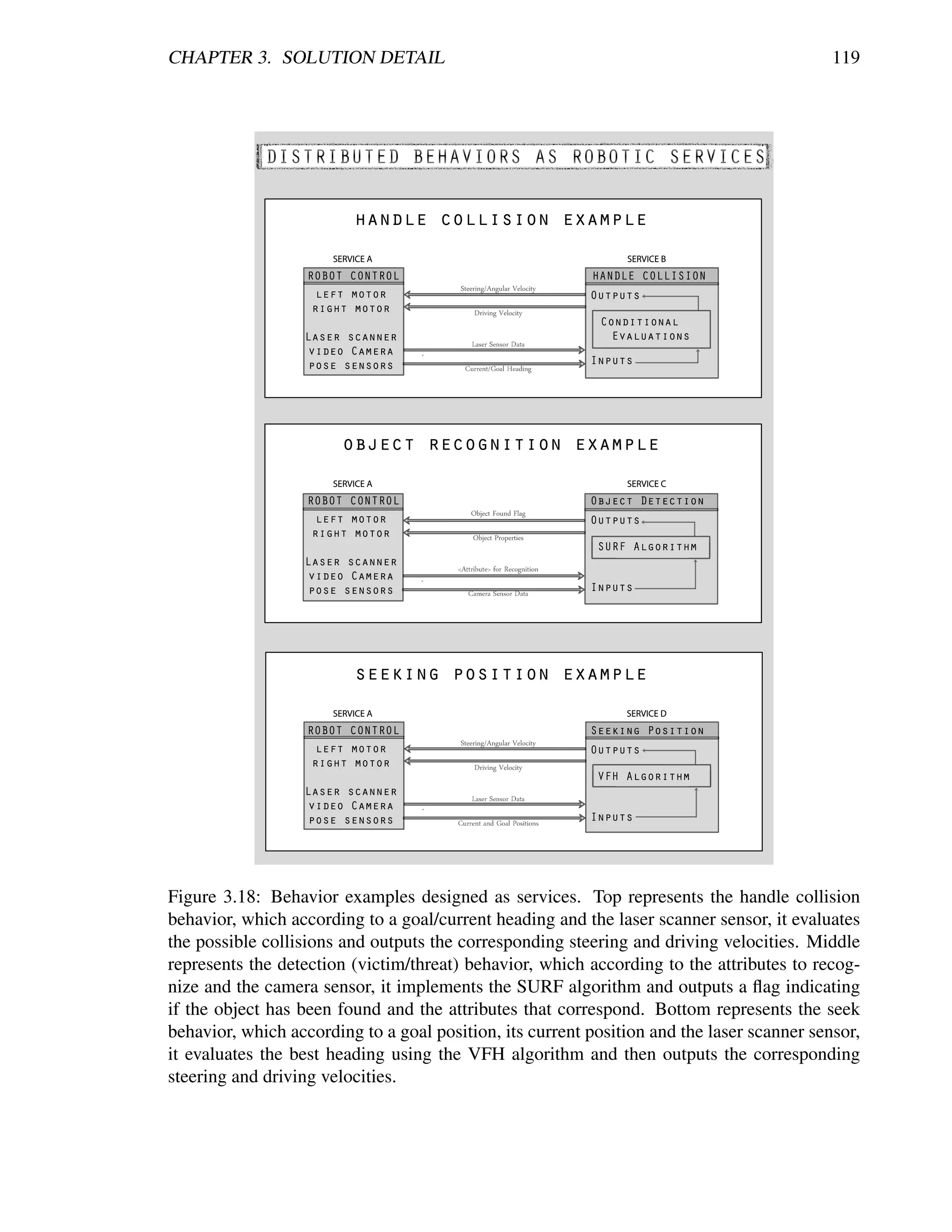
     then outputs the corresponding steering and driving velocities. . . . . . . . . 119

4.1  Process to Quick Simulation. Starting from a simple script in SPL we can
     decide which is more useful for our robotic control needs and programming
     skills, either going through C# or VPL. . . . . . . . . . . . . . . . . . . . . .   122
4.2 Created service for fast simulations with maze-like scenarios. Available at
     http://erobots.codeplex.com/. . . . . . . . . . . . . . . . . . . . . . . . . . .   123
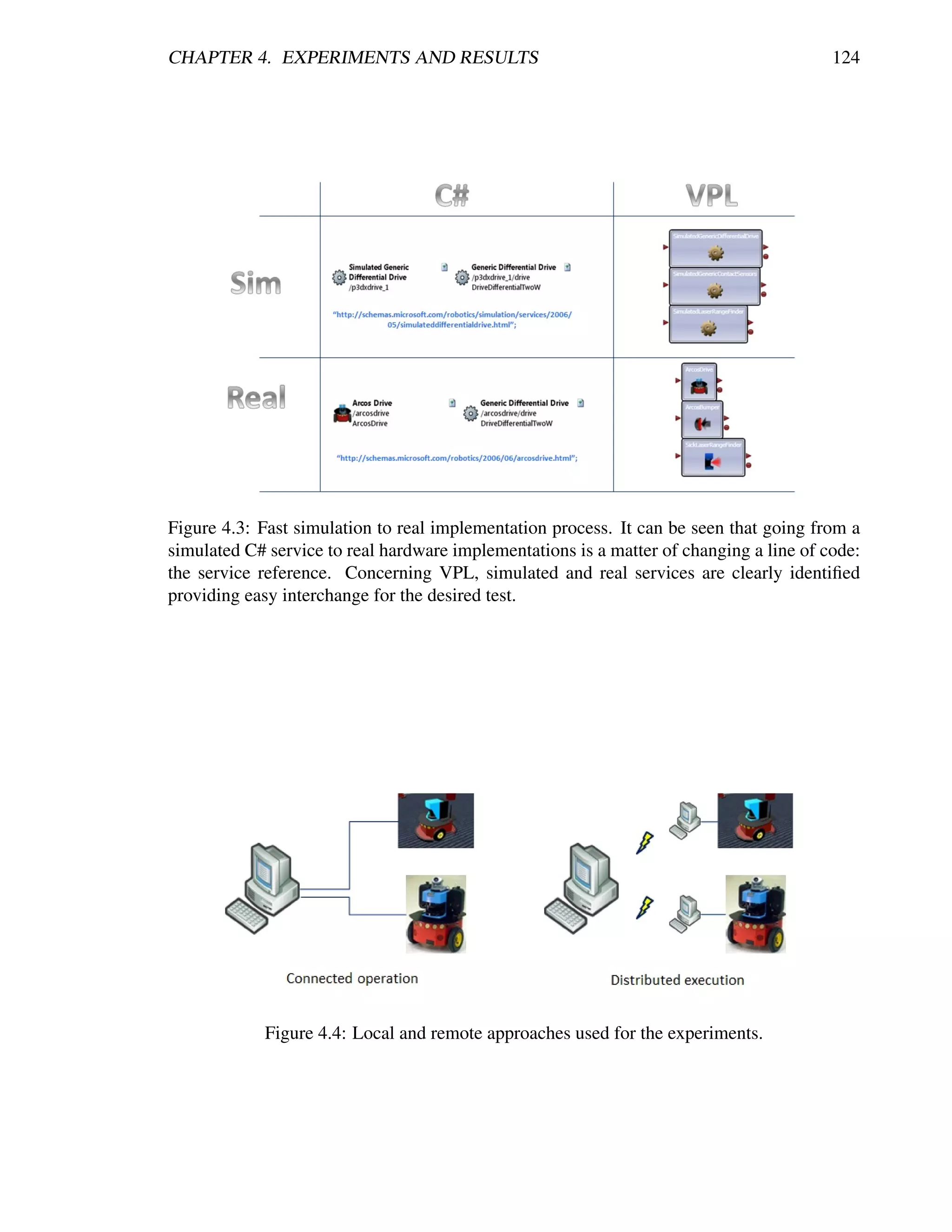
4.3 Fast simulation to real implementation process. It can be seen that going from
     a simulated C# service to real hardware implementations is a matter of chang-
     ing a line of code: the service reference. Concerning VPL, simulated and real
     services are clearly identified providing easy interchange for the desired test. .   124
4.4 Local and remote approaches used for the experiments. . . . . . . . . . . . .        124
4.5 Speech recognition service experiment for voice-commanded robot naviga-
     tion. Available at http://erobots.codeplex.com/. . . . . . . . . . . . . . . . .    125
4.6 Vision-based recognition service experiment for visual-joystick robot naviga-
     tion. Available at http://erobots.codeplex.com/. . . . . . . . . . . . . . . . .    126
4.7 Wall-follow behavior service. View is from top, the red path is made of a robot
     following the left (white) wall in the maze, while the blue one corresponds to
     another robot following the right wall. . . . . . . . . . . . . . . . . . . . . .   127
4.8 Seek behavior service. Three robots in a maze viewed from the top, one static
     and the other two going to specified goal positions. The red and blue paths
     are generated by each one of the navigating robots. To the left of the picture a
     simple console for appreciating the VFH [41] algorithm operations. . . . . .        127
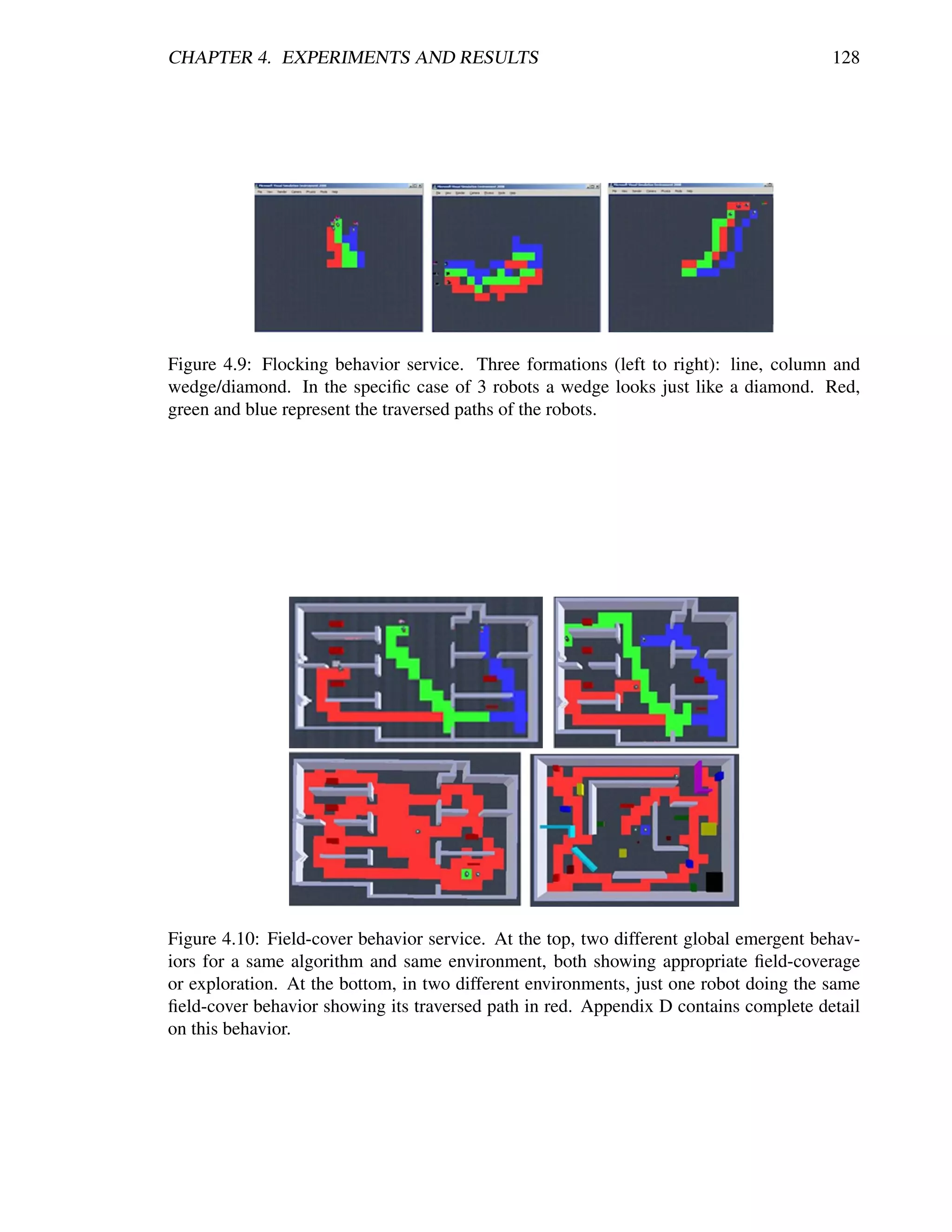
4.9 Flocking behavior service. Three formations (left to right): line, column and
     wedge/diamond. In the specific case of 3 robots a wedge looks just like a
     diamond. Red, green and blue represent the traversed paths of the robots. . .       128
4.10 Field-cover behavior service. At the top, two different global emergent behav-
     iors for a same algorithm and same environment, both showing appropriate
     field-coverage or exploration. At the bottom, in two different environments,
     just one robot doing the same field-cover behavior showing its traversed path
     in red. Appendix D contains complete detail on this behavior. . . . . . . . . .     128
4.11 Victim and Threat behavior services. Being limited to vision-based detection,
     different figures were used to simulate threats and victims according to recent
     literature [116, 20, 275, 207]. To recognize them, already coded algorithms
     were implemented including SURF [26], HoG [90] and face-detection [279]
     from the popular OpenCV [45] and EmguCV [96] libraries. . . . . . . . . . .         129


                                           x
4.12 Simultaneous localization and mapping features for the MSRDS VSE. Robot
     1 is the red path, robot 3 the green and robot 3 the blue. They are not only
     mapping the environment by themselves, but also contributing towards a team
     map. Nevertheless localization is a simulation cheat and laser scanners have
     no uncertainty as they will have in real hardware. . . . . . . . . . . . . . . .       130
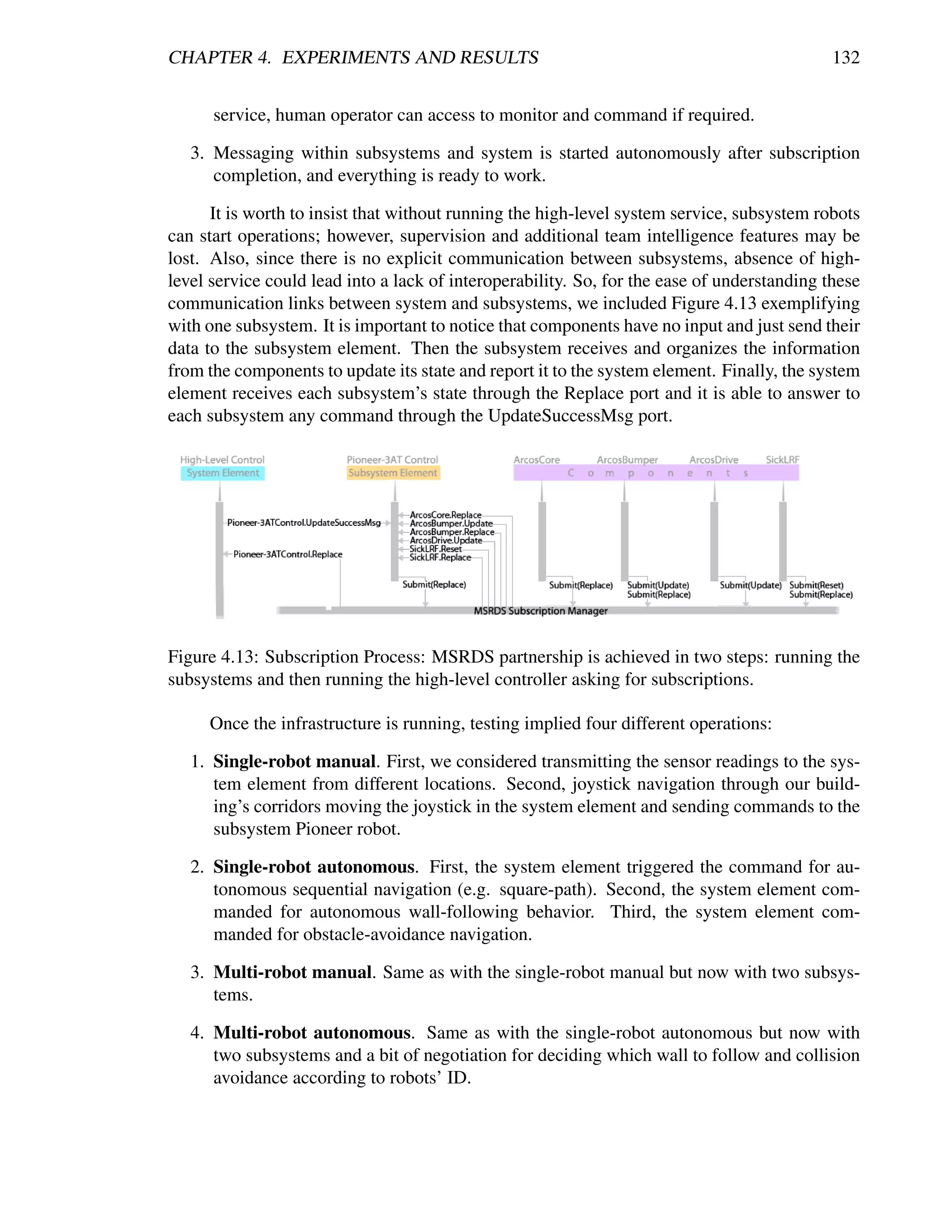
4.13 Subscription Process: MSRDS partnership is achieved in two steps: running
     the subsystems and then running the high-level controller asking for subscrip-
     tions. . . . . . . . . . . . . . . . . . . . . . . . . . . . . . . . . . . . . . . .   132
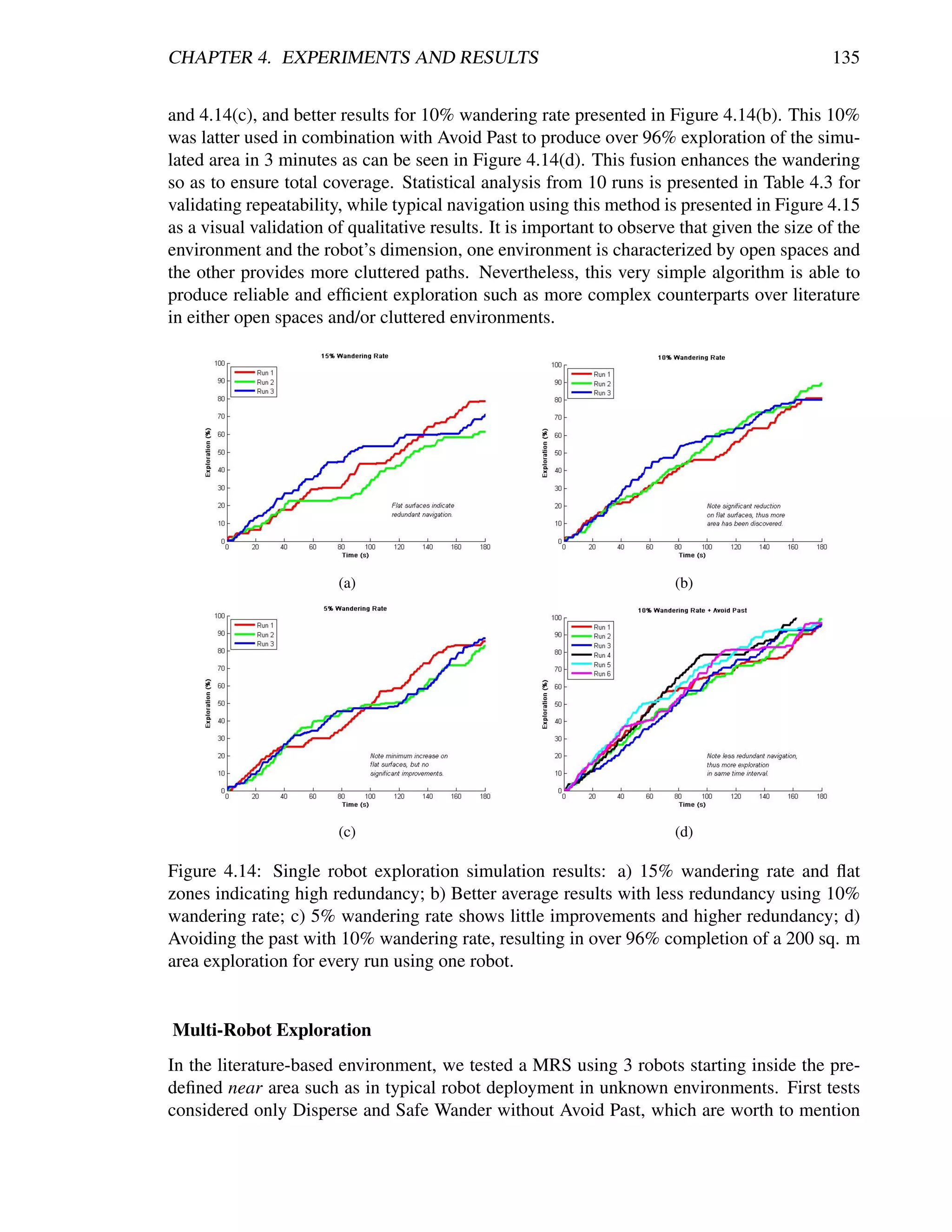
4.14 Single robot exploration simulation results: a) 15% wandering rate and flat
     zones indicating high redundancy; b) Better average results with less redun-
     dancy using 10% wandering rate; c) 5% wandering rate shows little improve-
     ments and higher redundancy; d) Avoiding the past with 10% wandering rate,
     resulting in over 96% completion of a 200 sq. m area exploration for every
     run using one robot. . . . . . . . . . . . . . . . . . . . . . . . . . . . . . . .     135
4.15 Typical navigation for qualitative appreciation: a) The environment based
     upon Burgard’s work in [58]; b) A second more cluttered environment. Snap-
     shots are taken from the top view and the traversed paths are drawn in red.
     For both scenarios the robot efficiently traverses the complete area using the
     same algorithm. Black circle with D indicates deployment point. . . . . . . .          136
4.16 Autonomous exploration showing representative results in a single run for 3
     robots avoiding their own past. Full exploration is completed at almost 3 times
     faster than using a single robot, and the exploration quality shows a balanced
     result meaning an efficient resources (robots) management. . . . . . . . . . .          137
4.17 Autonomous exploration showing representative results in a single run for 3
     robots avoiding their own and teammates’ past. Results show more interfer-
     ence and imbalance at exploration quality when compared to avoiding their
     own past only. . . . . . . . . . . . . . . . . . . . . . . . . . . . . . . . . . .     138
4.18 Qualitative appreciation: a) Navigation results from Burgard’s work [58]; b)
     Our gathered results. Path is drawn in red, green and blue for each robot.
     High similarity with a much simpler algorithm can be appreciated. Black
     circle with D indicates deployment point. . . . . . . . . . . . . . . . . . . .        138
4.19 The emergent in-zone coverage behavior for long time running the exploration
     algorithm. Each color (red, green and blue) shows an area explored by a
     different robot. Black circle with D indicates deployment point. . . . . . . .         139
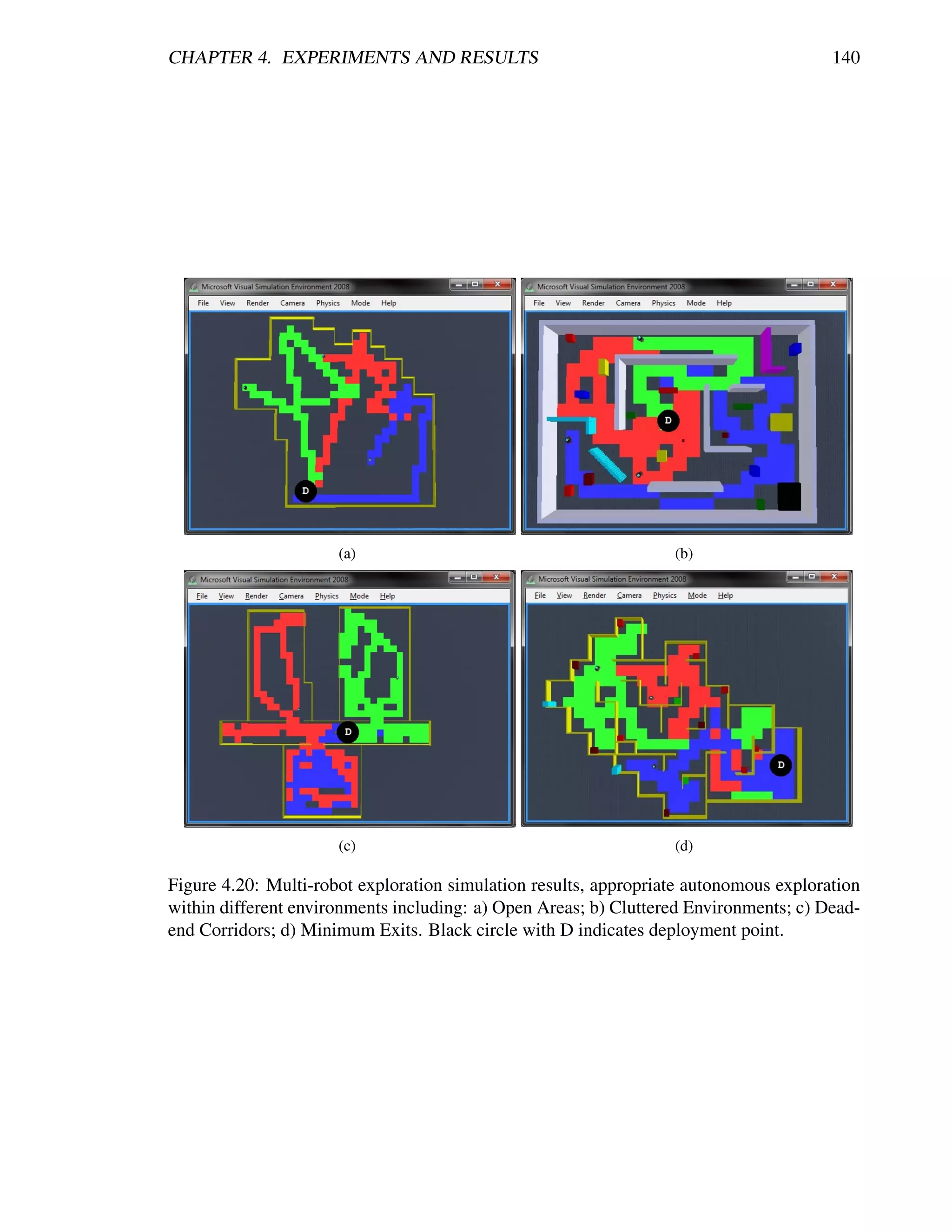
4.20 Multi-robot exploration simulation results, appropriate autonomous explo-
     ration within different environments including: a) Open Areas; b) Cluttered
     Environments; c) Dead-end Corridors; d) Minimum Exits. Black circle with
     D indicates deployment point. . . . . . . . . . . . . . . . . . . . . . . . . .        140
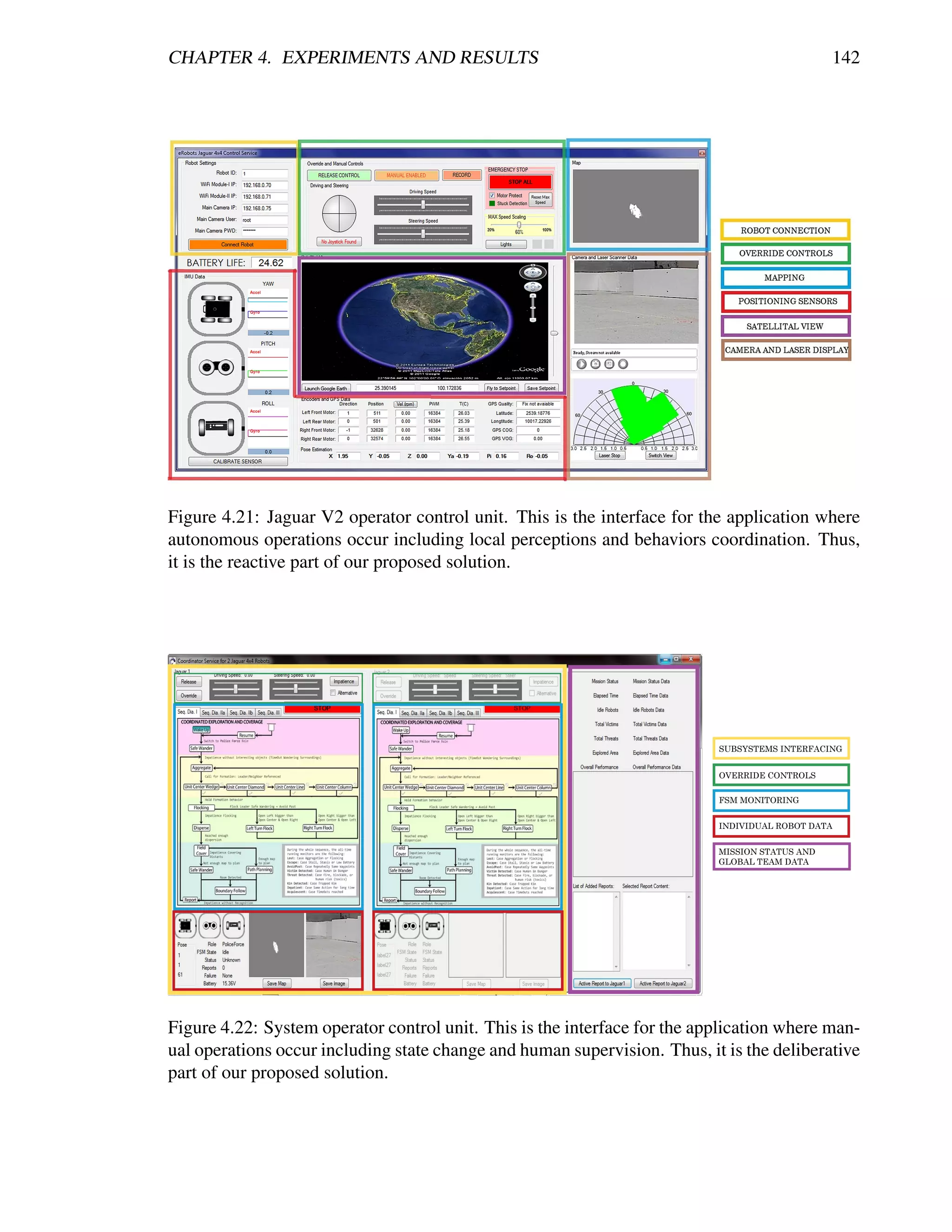
4.21 Jaguar V2 operator control unit. This is the interface for the application where
     autonomous operations occur including local perceptions and behaviors coor-
     dination. Thus, it is the reactive part of our proposed solution. . . . . . . . .      142
4.22 System operator control unit. This is the interface for the application where
     manual operations occur including state change and human supervision. Thus,
     it is the deliberative part of our proposed solution. . . . . . . . . . . . . . . .    142
4.23 Template structure for creating and managing reports. Based on [156, 56]. . .          143

                                            xi
4.24 Deployment of a Jaguar V2 for single robot autonomous exploration experi-
     ments. . . . . . . . . . . . . . . . . . . . . . . . . . . . . . . . . . . . . . .   144
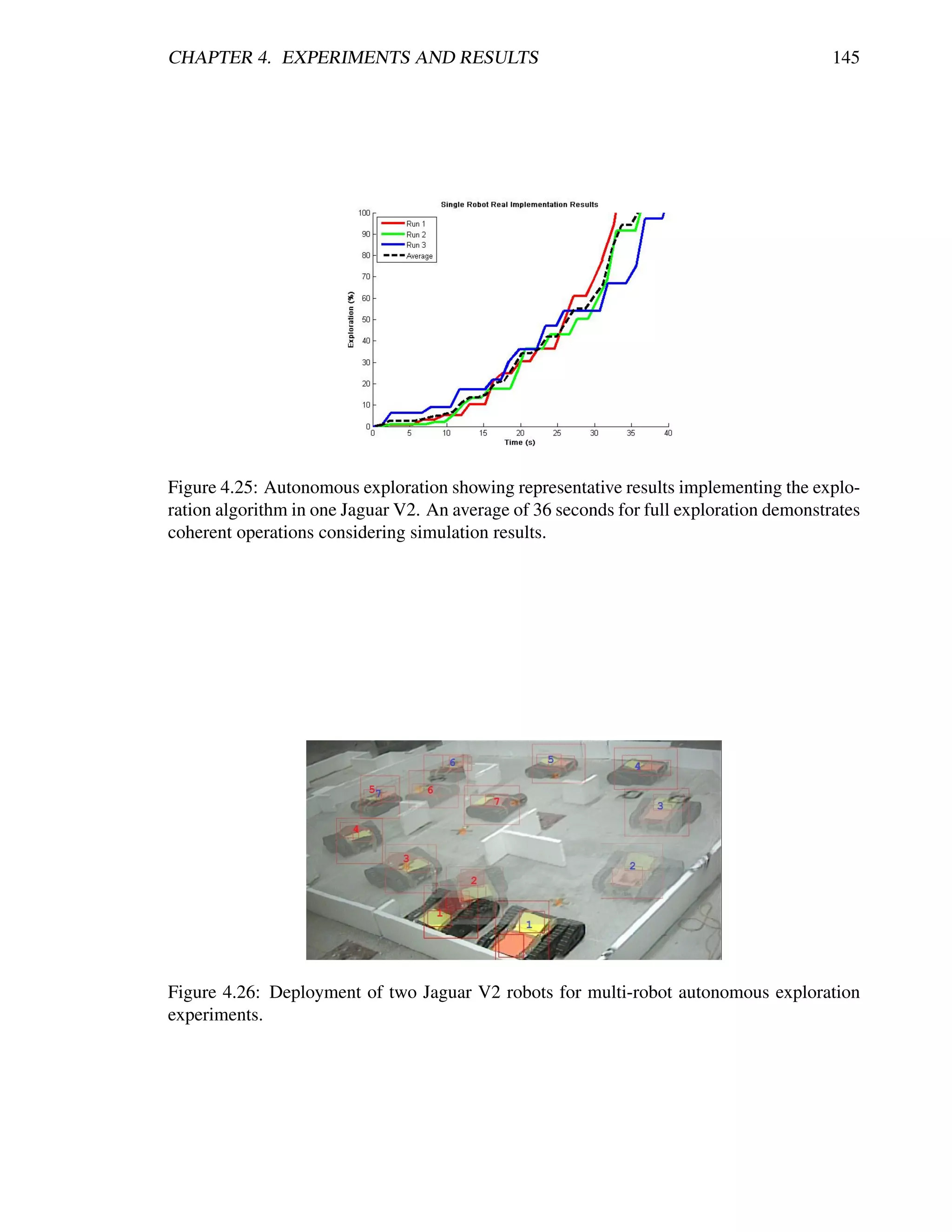
4.25 Autonomous exploration showing representative results implementing the ex-
     ploration algorithm in one Jaguar V2. An average of 36 seconds for full ex-
     ploration demonstrates coherent operations considering simulation results. . .       145
4.26 Deployment of two Jaguar V2 robots for multi-robot autonomous exploration
     experiments. . . . . . . . . . . . . . . . . . . . . . . . . . . . . . . . . . . .   145
4.27 Autonomous exploration showing representative results for a single run using
     2 robots avoiding their own past. An almost half of the time for full explo-
     ration when compared to single robot runs demonstrates efficient resource
     management. The resultant exploration quality shows the trend towards per-
     fect balancing between the two robots. . . . . . . . . . . . . . . . . . . . . .     146
4.28 Comparison between: a) typical literature exploration process and b) our pro-
     posed exploration. Clear steps and complexity reduction can be appreciated
     between sensing and acting. . . . . . . . . . . . . . . . . . . . . . . . . . .      147

A.1 Generic single robot architecture. Image from [2]. . . . . . . . . . . . . . . . 154
A.2 Autonomous Robot Architecture - AuRa. Image from [12]. . . . . . . . . . . 155

D.1 8 possible 45◦ heading cases with 3 neighbor waypoints to evaluate so as to
    define a CCW, CW or ZERO angular acceleration command. For example,
    if heading in the -45◦ case, the neighbors to evaluate are B, C and D, as left,
    center and right, respectively. . . . . . . . . . . . . . . . . . . . . . . . . . . 181
D.2 Implemented 2-state Finite State Automata for autonomous exploration. . . . 184


                                           xii
List of Tables

 1.1    Comparison of event magnitude. Edited from [182]. . . . . . . . . . . . . . .                                                               7
 1.2    Important concepts and characteristics on the control of multi-robot systems.
        Based on [53, 11, 2, 24]. . . . . . . . . . . . . . . . . . . . . . . . . . . . .                                                          13
 1.3    FSA, FSM and BBC relationships. Edited from [192]. . . . . . . . . . . . . .                                                               20
 1.4    Components of a hybrid-intelligence architecture. Based on [192]. . . . . . .                                                              21
 1.5    Nomenclature. . . . . . . . . . . . . . . . . . . . . . . . . . . . . . . . . . .                                                          22
 1.6    Relevant metrics in multi-robot systems . . . . . . . . . . . . . . . . . . . .                                                            23

 2.1    Factors influencing the scope of the disaster relief effort from [83]. . . . . . . 40
 2.2    A classification of robotic behaviors. Based on [178, 223]. . . . . . . . . . . 51
 2.3    Recommendations for designing a rescue robot [37, 184, 194, 33, 158, 201, 267]. 69

 3.1    Main advantages and disadvantages for using wheeled and tracked robots [255,
        192]. . . . . . . . . . . . . . . . . . . . . . . . . . . . . . . . . . . . . . . . 103

 4.1    Experiments’ results: average delays . . . . . . . . .                                 . . .       . . . . . .             . . . .         133
 4.2    Metrics used in the experiments. . . . . . . . . . . .                                 . . .       . . . . . .             . . . .         134
 4.3    Average and Standard Deviation for full exploration                                    time        in 10 runs              using
        Avoid Past + 10% wandering rate with 1 robot. . . .                                    . . .       . . . . . .             . . . .         136
 4.4    Average and Standard Deviation for full exploration                                    time        in 10 runs              using
        Avoid Past + 10% wandering rate with 3 robots. . . .                                   . . .       . . . . . .             . . . .         137
 4.5    Average and Standard Deviation for full exploration                                    time        in 10 runs              using
        Avoid Kins Past + 10% wandering rate with 3 robots.                                    . . .       . . . . . .             . . . .         138

 B.1 Comparison among different software systems engineering techniques [219,
     46, 82, 293, 4]. . . . . . . . . . . . . . . . . . . . . . . . . . . . . . . . . . 161

 C.1    Wake up behavior. . . . . .    .   .   .   .   .   .   .   .   .   .   .   .   .   .   .   .   .   .   .   .   .   .   .   .   .   .   .   162
 C.2    Resume behavior. . . . . .     .   .   .   .   .   .   .   .   .   .   .   .   .   .   .   .   .   .   .   .   .   .   .   .   .   .   .   163
 C.3    Wait behavior. . . . . . . .   .   .   .   .   .   .   .   .   .   .   .   .   .   .   .   .   .   .   .   .   .   .   .   .   .   .   .   163
 C.4    Handle Collision behavior.     .   .   .   .   .   .   .   .   .   .   .   .   .   .   .   .   .   .   .   .   .   .   .   .   .   .   .   164
 C.5    Avoid Past behavior. . . .     .   .   .   .   .   .   .   .   .   .   .   .   .   .   .   .   .   .   .   .   .   .   .   .   .   .   .   164
 C.6    Locate behavior. . . . . . .   .   .   .   .   .   .   .   .   .   .   .   .   .   .   .   .   .   .   .   .   .   .   .   .   .   .   .   165
 C.7    Drive Towards behavior. .      .   .   .   .   .   .   .   .   .   .   .   .   .   .   .   .   .   .   .   .   .   .   .   .   .   .   .   165
 C.8    Safe Wander behavior. . .      .   .   .   .   .   .   .   .   .   .   .   .   .   .   .   .   .   .   .   .   .   .   .   .   .   .   .   166
 C.9    Seek behavior. . . . . . . .   .   .   .   .   .   .   .   .   .   .   .   .   .   .   .   .   .   .   .   .   .   .   .   .   .   .   .   166
 C.10   Path Planning behavior. . .    .   .   .   .   .   .   .   .   .   .   .   .   .   .   .   .   .   .   .   .   .   .   .   .   .   .   .   167


                                                       xiii
C.11   Aggregate behavior. . . . . . .    .   .   .   .   .   .   .   .   .   .   .   .   .   .   .   .   .   .   .   .   .   .   .   .   .   167
C.12   Unit Center Line behavior. . .     .   .   .   .   .   .   .   .   .   .   .   .   .   .   .   .   .   .   .   .   .   .   .   .   .   167
C.13   Unit Center Column behavior.       .   .   .   .   .   .   .   .   .   .   .   .   .   .   .   .   .   .   .   .   .   .   .   .   .   168
C.14   Unit Center Diamond behavior.      .   .   .   .   .   .   .   .   .   .   .   .   .   .   .   .   .   .   .   .   .   .   .   .   .   168
C.15   Unit Center Wedge behavior. .      .   .   .   .   .   .   .   .   .   .   .   .   .   .   .   .   .   .   .   .   .   .   .   .   .   169
C.16   Hold Formation behavior. . . .     .   .   .   .   .   .   .   .   .   .   .   .   .   .   .   .   .   .   .   .   .   .   .   .   .   169
C.17   Lost behavior. . . . . . . . . .   .   .   .   .   .   .   .   .   .   .   .   .   .   .   .   .   .   .   .   .   .   .   .   .   .   169
C.18   Flocking behavior. . . . . . .     .   .   .   .   .   .   .   .   .   .   .   .   .   .   .   .   .   .   .   .   .   .   .   .   .   170
C.19   Disperse behavior. . . . . . . .   .   .   .   .   .   .   .   .   .   .   .   .   .   .   .   .   .   .   .   .   .   .   .   .   .   171
C.20   Field Cover behavior. . . . . .    .   .   .   .   .   .   .   .   .   .   .   .   .   .   .   .   .   .   .   .   .   .   .   .   .   171
C.21   Wall Follow behavior. . . . . .    .   .   .   .   .   .   .   .   .   .   .   .   .   .   .   .   .   .   .   .   .   .   .   .   .   172
C.22   Escape behavior. . . . . . . .     .   .   .   .   .   .   .   .   .   .   .   .   .   .   .   .   .   .   .   .   .   .   .   .   .   172
C.23   Report behavior. . . . . . . . .   .   .   .   .   .   .   .   .   .   .   .   .   .   .   .   .   .   .   .   .   .   .   .   .   .   172
C.24   Track behavior. . . . . . . . .    .   .   .   .   .   .   .   .   .   .   .   .   .   .   .   .   .   .   .   .   .   .   .   .   .   173
C.25   Inspect behavior. . . . . . . .    .   .   .   .   .   .   .   .   .   .   .   .   .   .   .   .   .   .   .   .   .   .   .   .   .   173
C.26   Victim behavior. . . . . . . . .   .   .   .   .   .   .   .   .   .   .   .   .   .   .   .   .   .   .   .   .   .   .   .   .   .   174
C.27   Threat behavior. . . . . . . . .   .   .   .   .   .   .   .   .   .   .   .   .   .   .   .   .   .   .   .   .   .   .   .   .   .   174
C.28   Kin behavior. . . . . . . . . .    .   .   .   .   .   .   .   .   .   .   .   .   .   .   .   .   .   .   .   .   .   .   .   .   .   175
C.29   Give Aid behavior. . . . . . .     .   .   .   .   .   .   .   .   .   .   .   .   .   .   .   .   .   .   .   .   .   .   .   .   .   175
C.30   Aid- behavior. . . . . . . . . .   .   .   .   .   .   .   .   .   .   .   .   .   .   .   .   .   .   .   .   .   .   .   .   .   .   176
C.31   Impatient behavior. . . . . . .    .   .   .   .   .   .   .   .   .   .   .   .   .   .   .   .   .   .   .   .   .   .   .   .   .   176
C.32   Acquiescent behavior. . . . . .    .   .   .   .   .   .   .   .   .   .   .   .   .   .   .   .   .   .   .   .   .   .   .   .   .   176
C.33   Unknown behavior. . . . . . .      .   .   .   .   .   .   .   .   .   .   .   .   .   .   .   .   .   .   .   .   .   .   .   .   .   177


                                                  xiv
Contents

Abstract                                                                                                                  v

List of Figures                                                                                                          xii

List of Tables                                                                                                           xiv

1   Introduction                                                                                                          1
    1.1 Motivation . . . . . . . . . . . . . . . . . . . . . .   .   .   .   .   .   .   .   .   .   .   .   .   .   .    2
    1.2 Problem Statement and Context . . . . . . . . . .        .   .   .   .   .   .   .   .   .   .   .   .   .   .    6
         1.2.1 Disaster Response . . . . . . . . . . . . .       .   .   .   .   .   .   .   .   .   .   .   .   .   .    6
         1.2.2 Mobile Robotics . . . . . . . . . . . . . .       .   .   .   .   .   .   .   .   .   .   .   .   .   .    8
         1.2.3 Search and Rescue Robotics . . . . . . . .        .   .   .   .   .   .   .   .   .   .   .   .   .   .   12
         1.2.4 Problem Description . . . . . . . . . . . .       .   .   .   .   .   .   .   .   .   .   .   .   .   .   15
    1.3 Research Questions and Objectives . . . . . . . . .      .   .   .   .   .   .   .   .   .   .   .   .   .   .   16
    1.4 Solution Overview . . . . . . . . . . . . . . . . .      .   .   .   .   .   .   .   .   .   .   .   .   .   .   17
         1.4.1 Dynamic Roles + Behavior-based Robotics           .   .   .   .   .   .   .   .   .   .   .   .   .   .   17
         1.4.2 Architecture + Service-Oriented Design . .        .   .   .   .   .   .   .   .   .   .   .   .   .   .   20
         1.4.3 Testbeds Overview . . . . . . . . . . . . .       .   .   .   .   .   .   .   .   .   .   .   .   .   .   24
    1.5 Main Contributions . . . . . . . . . . . . . . . . .     .   .   .   .   .   .   .   .   .   .   .   .   .   .   25
    1.6 Thesis Organization . . . . . . . . . . . . . . . . .    .   .   .   .   .   .   .   .   .   .   .   .   .   .   26

2   Literature Review – State of the Art                                                                                 28
    2.1 Fundamental Problems and Open Issues . . . . . . . . . . . .                     .   .   .   .   .   .   .   .   29
    2.2 Rescue Robotics Relevant Software Contributions . . . . . . .                    .   .   .   .   .   .   .   .   38
         2.2.1 Disaster Engineering and Information Systems . . . .                      .   .   .   .   .   .   .   .   38
         2.2.2 Environments for Software Research and Development                        .   .   .   .   .   .   .   .   45
         2.2.3 Frameworks, Algorithms and Interfaces . . . . . . . .                     .   .   .   .   .   .   .   .   49
    2.3 Rescue Robotics Relevant Hardware Contributions . . . . . .                      .   .   .   .   .   .   .   .   68
    2.4 Testbed and Real-World USAR Implementations . . . . . . .                        .   .   .   .   .   .   .   .   79
         2.4.1 Testbed Implementations . . . . . . . . . . . . . . . .                   .   .   .   .   .   .   .   .   81
         2.4.2 Real-World Implementations . . . . . . . . . . . . . .                    .   .   .   .   .   .   .   .   87
    2.5 International Standards . . . . . . . . . . . . . . . . . . . . .                .   .   .   .   .   .   .   .   90

3   Solution Detail                                                              93
    3.1 Towards Modular Rescue: USAR Mission Decomposition . . . . . . . . . . 95
    3.2 Multi-Agent Robotic System for USAR: Task Allocation and Role Assignment 98

                                             xv
3.3   Roles, Behaviors and Actions: Organization, Autonomy and Reliability                                                  .   .   .   104
    3.4   Hybrid Intelligence for Multidisciplinary Needs: Control Architecture .                                               .   .   .   106
    3.5   Service-Oriented Design: Deployment, Extendibility and Scalability . .                                                .   .   .   113
          3.5.1 MSRDS Functionality . . . . . . . . . . . . . . . . . . . . . .                                                 .   .   .   113

4   Experiments and Results                                                                                                                 121
    4.1 Setting up the path from simulation to real implementation                                  .   .   .   .   .   .   .   .   .   .   122
    4.2 Testing behavior services . . . . . . . . . . . . . . . . . .                               .   .   .   .   .   .   .   .   .   .   123
    4.3 Testing the service-oriented infrastructure . . . . . . . . .                               .   .   .   .   .   .   .   .   .   .   130
    4.4 Testing more complete operations . . . . . . . . . . . . .                                  .   .   .   .   .   .   .   .   .   .   133
        4.4.1 Simulation tests . . . . . . . . . . . . . . . . . . .                                .   .   .   .   .   .   .   .   .   .   134
        4.4.2 Real implementation tests . . . . . . . . . . . . .                                   .   .   .   .   .   .   .   .   .   .   139

5   Conclusions and Future Work                                                           148
    5.1 Summary of Contributions . . . . . . . . . . . . . . . . . . . . . . . . . . . 148
    5.2 Future Work . . . . . . . . . . . . . . . . . . . . . . . . . . . . . . . . . . . 151

A Getting Deeper in MRS Architectures                                                                                                       153

B Frameworks for Robotic Software                                                                                                           158

C Set of Actions Organized as Robotic Behaviors                                                                                             162

D Field Cover Behavior Composition                                                                                                          178
  D.1 Behavior 1: Avoid Obstacles . .       .   .   .   .   .   .   .   .   .   .   .   .   .   .   .   .   .   .   .   .   .   .   .   .   178
  D.2 Behavior 2: Avoid Past . . . . .      .   .   .   .   .   .   .   .   .   .   .   .   .   .   .   .   .   .   .   .   .   .   .   .   180
  D.3 Behavior 3: Locate Open Area .        .   .   .   .   .   .   .   .   .   .   .   .   .   .   .   .   .   .   .   .   .   .   .   .   180
  D.4 Behavior 4: Disperse . . . . . .      .   .   .   .   .   .   .   .   .   .   .   .   .   .   .   .   .   .   .   .   .   .   .   .   182
  D.5 Emergent Behavior: Field Cover        .   .   .   .   .   .   .   .   .   .   .   .   .   .   .   .   .   .   .   .   .   .   .   .   182

Bibliography                                                                                                                                210


                                                xvi
Chapter 1

Introduction

        “One can expect the human race to continue attempting systems just within or
         just beyond our reach; and software systems are perhaps the most intricate
         and complex of man’s handiworks. The management of this complex craft
         will demand our best use of new languages and systems, our best adaptation
         of proven engineering management methods, liberal doses of common sense,
         and a God-given humility to recognize our fallibility and limitations.”

                                        – Frederick P. Brooks, Jr. (Computer Scientist)

        C HAPTER O BJECTIVES
            — Why this dissertation.
            — What we are dealing with.
            — What we are solving.
            — How we are solving it.
            — Where we are contributing.
            — How the document is organized.

      In recent years, the use of Multi-Robot Systems (MRS) has become popular for several
application domains such as military, exploration, surveillance, search and rescue, and even
home and industry automation. The main reason for using these MRS is that they are a
convenient solution in terms of costs, performance, efficiency, reliability, and reduced human
exposure to harmful environments. In that way, existing robots and implementation domains
are of increasing number and complexity, turning coordination and cooperation fundamental
features among robotics research [99].
      Accordingly, developing a team of cooperative autonomous mobile robots with efficient
performance has been one of the most challenging goals in artificial intelligence. The co-
ordination and cooperation of MRS has involved state of the art problems such as efficient
navigation, multi-robot path planning, exploration, traffic control, localization and mapping,
formation and docking control, coverage and flocking algorithms, target tracking, individual
and team cognition, tasks’ analysis, efficient resource management, suitable communications,
among others. As a result, research has witnessed a large body of significant advances in
the control of single mobile robots, dramatically improving the feasibility and suitability of
cooperative robotics. These vast scientific contributions created the need for coupling these

                                              1
CHAPTER 1. INTRODUCTION                                                                       2


advances, leading researchers to develop inter-robot communication frameworks. Finding a
framework for cooperative coordination of multiple mobile robots that ensures the autonomy
and the individual requirements of the involved robots has always been a challenge too.
      Moreover, considering all possible environments where robots interact, disaster scenar-
ios come to be among the most challenging ones. These scenarios, either man-made or natu-
ral, have no specific structure and are highly dynamic, uncertain and inherently hostile. These
disastrous events like: earthquakes, floods, fires, terrorist attacks, hurricanes, trapped popu-
lations, or even chemical, biological, radiological or nuclear explosions(CBRN or CBRNE);
involve devastating effects on wildlife, biodiversity, agriculture, urban areas, human health,
and also economy. So, the rapidly acting to save lives, avoid further environmental damage
and restore basic infrastructure has been among the most serious social issues for the intellec-
tual community.
      For that reason, technology-based solutions for disaster and emergency situations are
main topics for relevant international associations, which had created specific divisions for
research on this area such as IEEE Safety, Security and Rescue Robotics (IEEE SSRR)
and the RoboCup Rescue, both active since 2002. Therefore, this dissertation focuses on
an improvement for disaster response and recovery, encouraging the relationship between
multiple robots as an important tool for mitigating disasters by cooperation, coordination and
communication among them and human operators.


1.1 Motivation
Historically, rescue robotics began in 1995 with one of the most devastating urban disasters
in the 20th century: the Hanshin-Awajii earthquake in January 17th in Kobe, Japan. Accord-
ing to [267], this disaster claimed more than 6,000 human lives, affected more than 2 million
people, damaged more than 785,000 houses, direct damage costs were estimated above 100
billion USD, and death rates reached 12.5% in some regions. The same year robotics re-
searchers in the US pushed the idea of the new research field while serving as rescue workers
at the bombing of the Murrah federal building in Oklahoma City [91]. Then, the 9/11 events
consolidated the area by being the first known place in the world to have real implementations
of rescue robots searching for victims and paths through the rubble, inspecting structures, and
looking for hazardous materials [194]. Additionally, the 2005 World Disasters report [283]
indicates that between 1995 and 2004 more than 900,000 human lives were lost and direct
damage costs surpassed the 738 billion USD, just in urban disasters. Merely indicating that
something needs and can be done.
      Furthermore, these incidents as well as other mentioned disasters can also put the res-
cuers at risk of injury or death. In Mexico City the 1985 earthquake killed 135 rescuers during
disaster response operations [69]. In the World Trade Center in 2001, 402 rescuers lost their
lives [184]. More recently in March 2011, in the nuclear disaster in Fukushima, Japan [227]
rescuers were not even allowed to enter the ravaged area because it implied critical radiation
exposure. So, the rescue task is dangerous and time consuming, with the risk of further prob-
lems arising on the site [37]. To reduce these additional risks to the rescuers and victims,
the search is carried out slowly and delicately provoking a direct impact on the time to locate
CHAPTER 1. INTRODUCTION                                                                        3


survivors. Typically, the mortality rate increases and peaks the second day, meaning that sur-
vivors who are not located in the first 48 hours after the event are unlikely to survive beyond
a few weeks in the hospital [204]. Figure 1.1 shows the survivors rescued in the Kobe earth-
quake. As can be seen, beyond the third day there are almost no more victims rescued. Then,
Figure 1.2 shows the average survival chances in a urban disaster according to the days after
the incident. It can be appreciated that after the first day the chances of surviving are dramati-
cally decreased by more than 40%, and also after the third day another critical decrease shows
no more than 30% chances of surviving. So, there is a clear urgency for rescuers in the first
3 days where chances are good for raising survival rate, thus giving definition to the popular
term among rescue teams of “72 golden hours”.


Figure 1.1: Number of survivors and casualties in the Kobe earthquake in 1995. Image
from [267].


Figure 1.2: Percentage of survival chances in accordance to when victim is located. Based
on [69].

      Consequently, real catastrophes and international contributions within the IEEE SSRR
and the RoboCup Rescue lead researchers to define the main usage of robotics in the so called
CHAPTER 1. INTRODUCTION                                                                        4


Urban Search and Rescue (USAR) missions. The essence of USAR is to save lives but,
Robin Murphy and Satoshi Tadokoro, two of the major contributors in the area, refer the
following possibilities for robots operating in urban disasters [204, 267]:

     Search. Aimed to gather information on the disaster, locate victims, dangerous ma-
     terials or any potential hazards in a faster way without increasing risks for secondary
     damages.

     Reconnaissance and mapping. For providing situational awareness. It is broader than
     search in the way that it creates a reference of the ravaged zone in order to aid in the
     coordination of the rescue effort, thus increasing the speed of the search, decreasing the
     risk to rescue workers, and providing a quantitative investigation of damage at hand.

     Rubble removal. Using robotics can be faster than manually and with a smaller foot-
     print (e.g., exoskeletons) than traditional construction cranes.

     Structural inspection. Providing better viewing angles at closer distances without ex-
     posing the rescuers nor the survivors.

     In-situ medical assessment and intervention. Since medical doctors may not be per-
     mitted inside the critical ravaged area, called hot zone, robotic medical aid ranges from
     verbal interactions, visual inspections and transporting medications; to complete sur-
     vivors’ diagnosis and telemedicine. This is perhaps the most challenging task for robots.

     Acting as a mobile beacon or repeater. Serve as landmark for localization and ren-
     dezvous purposes or simply extending the wireless communication ranges.

     Serving as a surrogate. Decreasing the risk to the rescue workers, robots may be used
     as sensor extensions for enhancing rescuers’ perceptions enabling them to remotely
     gather information of the zone and monitor other rescuers progress and needs.

     Adaptively shoring unstable rubble. In order to prevent secondary collapse and avoid-
     ing higher risks for rescuers and survivors.

     Providing logistics support. Provide recovery actions and assistance by autonomously
     transporting equipment, supplies and goods from storage areas to distribution points and
     evacuation and assistance centres.

     Instant deployment. Avoiding the initial overall evaluations for letting human rescuers
     to go on site, robots can go instantly, thus improving speed of operations in order to raise
     survival rate.

     Other. General uses may suggest robots doing particular operations that are impossible
     or difficult to perform by humans, as they can enter smaller areas and operate without
     breaks. Also, robots can operate for long periods in harsher conditions in a more ef-
     ficient way than humans do (e.g., they don’t need water or food, no need to rest, no
     distractions, and the only fatigue is power running low).
CHAPTER 1. INTRODUCTION                                                                       5


     In the same line, multi-agent robotic systems (MARS, or simply MRS) have inherent
characteristics that come to be of huge benefit for USAR implementations. According to [159]
some remarkable properties of these systems are:

      Diversity. They apply to a large range of tasks and domains. Thus, they are a versatile
      tool for disaster and emergency support where tasks are plenty.

      Greater efficiency. In general, MRS exchanging information and cooperating tend to
      be more efficient than a single robot.

      Improved system performance. It has been demonstrated that multiple robots finish
      tasks faster and more accurately than a single robot.

      Fault tolerance. Using redundant units makes a system more tolerable to failures by
      enabling possible replacements.

      Robustness. By introducing redundancy and fault tolerance, a task is lesser compro-
      mised and thus the system is more robust.

      Lower economic cost. Multiple simpler robots are usually a better and more affordable
      option than one powerful and expensive robot, essentially for research projects.

      Ease of development. Having multiple agents allow developers to focus more pre-
      cisely than when trying to have one almighty agent. This is helpful when the task is
      as complex as disaster response.

      Distributed sensing and action. This feature allows for better and faster reconnais-
      sance while being more flexible and adaptable to the current situation.

      Inherent parallelism. The use of multiple robots at the same time will inherently search
      and cover faster than a single unit.

      So, the essential motivation for developing this dissertation resides in the possibilities
and capabilities that a MRS can have for disaster response and recovery. As referred, there are
plenty of applications for rescue robotics and the complexity of USAR demands for multiple
robots. This multiplicity promises an improved performance in sensing and action that are
crucial in a disaster race against time. Also, it provides a way for speeding up operations
by addressing diverse tasks at the same time. Finally, it represents an opportunity for instant
deployment and for increasing the number of first responders in the critical 72 golden hours,
which are essential for increasing the survival rate and for preventing a larger damage.
      Additionally, before getting into the specific problem statement, it is worth to refer that
choosing the option for multiple robots keeps developments herein aligned with international
state of the art trends as shown in Figure 1.3. Finally, this topic provides us with an insight
into social, life and cognitive sciences, which, in the end, are all about us.
CHAPTER 1. INTRODUCTION                                                                        6


            Figure 1.3: 70 years for autonomous control levels. Edited from [44].

1.2 Problem Statement and Context
The purpose of this section is to narrow the research field into the specific problematic we
are dealing with. In order to do that, it is important to give a precise context on disasters and
hazards and about mobile robotics. Then we will be able to present an overview of search and
rescue robotics (SAR or simply rescue robotics) for finally stating the problem we address
herein.

1.2.1    Disaster Response
Everyday people around the world confront experiences that cause death, injuries, destroy per-
sonal belongings and interrupt daily activities. These incidents are known as accidents, crises,
emergencies, disasters, or catastrophes. Particularly, disasters are defined as deadly, destruc-
tive, and disruptive events that occur when hazards interact with human vulnerability [182].
The hazard comes to be the threat such as an earthquake, CBRNE, terrorist attack, among
others previously referred (a complete list of hazards is presented in [182]). This dissertation
focuses on aiding in emergencies and disasters such as Table 1.1 classifies.
       Once a disaster has occurred, it changes with time through 4 phases that characterize the
emergency management according to [182, 267] and [204]. In spite of the description pre-
sented below, it is worth to refer that Mitigation and Preparedness are pre-incident activities,
whereas Response and Recover are post-incident. Particularly, disaster and emergency re-
sponse requires the capabilities of being as fast as possible for rescuing survivors and avoiding
any further damage, while being cautious and delicate enough to prevent any additional risk.
This dissertation is settled precisely in this phase, where the first responders’ post-incident
actions reside. The description of the 4 phases is now presented.

Ph. 1: Mitigation. Refers to disaster prevention and loss reduction.
CHAPTER 1. INTRODUCTION                                                                      7


Ph. 2: Preparedness. Efforts to increase readiness for a disaster.
Ph. 3: Response (Rescue). Actions immediately after the disaster for protecting lives and
       property.
Ph. 4: Recovery. Actions to restore the basic infrastructure of the community or, preferably,
       improved communities.


                 Table 1.1: Comparison of event magnitude. Edited from [182].
                     Accidents     Crises        Emergencies/        Calamities/ Catas-
                                                 Disasters           trophes
     Injuries        few           many          scores              hundreds/thousands
     Deaths          few           many          scores              hundreds/thousands
     Damage          minor         moderate      major               severe
     Disruption      minor         moderate      major               severe
     Geographic      localized     disperse      disperse/diffuse    disperse/diffuse
     Impact
     Availability    abundant      sufficient     limited             scarce
     of Resources
     Number of few                 many          hundreds            hundreds/thousands
     Responders
     Recovery        minutes/      days/weeks months/years           years/decades
     Time            hours/days

      During the response phase search and rescue operations take place. In general, these
operations consist on activities such as looking for lost individuals, locating and diagnosing
victims, freeing extricated persons, providing first aids and basic medical care, and transport-
ing the victims away from the dangers. The human operational procedure that persists among
different disasters is described by D. McEntire in [182] as the following steps:
1)     Gather the facts. Noticing just what happened, the estimated number of victims and
       rescuers, type and age of constructions, potential environmental influence, presence of
       other hazards or any detail for improving situational awareness.
2)     Asses damage. Determine the structural damage in order to define the best actions basi-
       cally including: entering with medical operation teams, evacuating and freeing victims,
       or securing the perimeter.
3)     Identify and acquire resources. Includes the need for goods, personnel, tools, equip-
       ment and technology.
4)     Establish rescue priorities. Determining the urgency of the situations for defining which
       rescues must be done before others.
5)     Develop a rescue plan. Who will enter the zone, how they will enter, which tools are
       going to be needed, how they will leave, how to ensure safety for rescuers and victims;
       all the necessary for following an strategy.
CHAPTER 1. INTRODUCTION                                                                          8


6)    Conduct disaster and emergency response operations. Search and rescue, cover, fol-
      low walls, analyse debris, listen for noises indicating survivors, develop everything that
      is considered as useful for saving lives. According to [267], this step is the one that
      takes the longest time.
7)    Evaluate progress. Prevention of further damage demands for continuously monitor-
      ing the situation including to see if the plan is working or there must be a better strategy.

       In the described procedure, research has witnessed characteristic human behavior [182].
For example, typically the first volunteers to engage are untrained people. This provokes a
lack of skills that shows people willing to help but unable to handle equipments, coordinate
efforts, or develop any data entry or efficient resources administration and/or distribution. An-
other example is that there are emergent and spontaneous rescuers so that the number can be
overwhelming to manage, therefore causing division of labor and encountered priorities so
that some of them are willing to save relatives, friends and neighbors, without noticing other
possible survivors. Additionally, professional rescuers are not always willing to use volun-
teers in their own operations, thus from time to time, there are huge crowds with just a few
working hands. This situation leads into frustrations that compromise safeness of volunteers,
professional rescue teams, and victims, thus decreasing survival rates while increasing possi-
bilities for larger damages. The only good behavior that persists is that victims do cooperate
with each other and with rescuers during the search and rescue.
       Consequently, we can think of volunteering rescue robotic teams for conducting the
search and rescue operations at step 6, which constitutes the most time-consuming disaster
response activities. Robots do not feel emotions such as preferences for relatives, they are
typically built for an specific task, and they will surely not become frustrated. Moreover,
robots have demonstrated to be highly capable for search and coverage, wall following, and
sensing under harsh environments. So, as R. Murphy et al. referred in [204]: there is a
particular need to start using robots in tactical search and rescue, which covers how the field
teams actually find, support, and extract survivors.

1.2.2    Mobile Robotics
Given the very broad definition of robot, it is important to state that we refer to the machine
that has sensors, a processing ability for emulating cognition and interpreting sensors’ signals
(perceive), and actuators in order to enable it to exert forces upon the environment to reach
some kind of locomotion, thus referring a mobile robot. When considering one single mobile
robot, designers must take into account at least an architecture upon which the robotic re-
sources are settled in order to interact with the real world. Then robotic control takes place as
a natural coupling of the hardware and software resources conforming the robotic system that
must develop an specified task. This robotic control has received huge amounts of contribu-
tions from the robotics community most them focusing in at least one of the topics presented
in Figure 1.4: perception and robot sensing (interpretation of the environment), localization
and mapping (representation of the environment), intelligence and planning, and mobility
control.
      Furthermore, a good coupling of the blocks in Figure 1.4 shall result in mobile robots ca-
pable to develop tasks with certain autonomy. Bekey defines autonomy in [29] as: a systems’
CHAPTER 1. INTRODUCTION                                                                          9


                 Figure 1.4: Mobile robot control scheme. Image from [255].

capability of operating in the real-world environment without any form of external control
for extended periods of time; they must be able to survive dynamic environments, maintain
their internal structures and processes, use the environment to locate and obtain materials for
sustenance, and exhibit a variety of behaviors. This means that autonomous systems must
perform some task while, within limits, being able to adapt to environment’s dynamics. In
this dissertation special efforts towards autonomy including every block represented in Figure
1.4 are required.
       Moreover, when considering multiple mobile robots there are additional factors that in-
tervene for having a successful autonomous system. First of all, the main intention of using
multiple entities is to have some kind of cooperation, thus it is important to define cooperative
behavior. Cao et al. in [63] refer that: “given some task specified by a designer a multiple-
robot system displays cooperative behavior if due to some underlying mechanism, there is an
increase in the total utility of the system”. So, pursuing this increase in utility (better perfor-
mance) cooperative robotics addresses major research axes [63] and coordination aspects [99]
presented below.

      Group Architecture. This is the basic element of a multi-robot system, it is the persis-
      tent structure allowing for variations at team composition such as the number of robots,
      the level of autonomy, the levels of heterogeneity and homogeneity between them, and
      the physical constraints. Similar to individual robot architectures, it refers to the set
      of principles organizing the control system (collective behaviors) and determining its
      capabilities, limitations and interactions (sensing, reasoning, communication and act-
      ing constraints). Key features of a group architecture for mobile robots are: multi-level
      control, centralization / decentralization, entities differentiation, communications, and
      the ability to model other agents.
CHAPTER 1. INTRODUCTION                                                                       10


      Resource Conflicts. This is perhaps the principal aspect concerning MRS coordination
      (or control). Sharing of space, tasks and resources such as information, knowledge, or
      hardware capabilities (e.g., cooperative manipulation), requires for coordination among
      the actions of each robot in order for not interfering with each other, and end up devel-
      oping autonomous, coherent and high-performance operations. This may additionally
      require for robots taking into account the actions executed by others in order for being
      more efficient and faster at task development (e.g., avoiding the typical issue of “every-
      one going everywhere”). Typical resource conflicts also deal with the rational division,
      distribution and allocation of tasks for achieving an specific goal, mission or global task.

      Cooperation Level. This aspect considers specifically how robots are cooperating in
      a given system. The usual is to have robots operating together towards a common
      goal, but there is also cooperation through competitive approaches. Also, there are
      types of cooperation called innate or eusocial, and intentional, which implies direct
      communication through actions in the environment or messaging.

      Navigation Problems. Inherent problems for mobile robots in the physical world in-
      clude geometrical navigational issues such as path planning, formation control, pattern
      generations, collision-avoidance, among others. Each robot in the team must have an
      individual architecture for correct navigation, but it is the group architecture where nav-
      igational control should be organized.

      Adaptivity and Learning. This final element considers the capabilities to adapt to
      changes in the environment or in the MRS in order to optimize task performance and
      efficiently deal with dynamics and uncertainty. Typical approaches involve reinforce-
      ment learning techniques for automatically finding the correct values for the control
      parameters that will lead to a desired cooperative behavior, which can be a difficult and
      time-consuming task for a human designer.

      Perhaps the first important aspect this dissertation concerns is the implementation of a
group architecture that consolidates the infrastructure for a team of multiple robots for search
and rescue operations. For these means it is included in Appendix A a deeper context on this
topic. From those readings the following list of the characteristics that an architecture must
have for successful performance and relevance in a multi-disciplinary research area such as
rescue robotics, which involves rapidly-changing software and hardware technologies. So, an
appropriate group architecture must consider:

   • Robotic task and domain independence.

   • Robot hardware and software abstraction.

   • Extendibility and scalability.

   • Reusability.

   • Simple upgrading.

   • Simple integration of new components and devices.
CHAPTER 1. INTRODUCTION                                                                     11


   • Simple debugging and prototyping.

   • Support for parallelism.

   • Support for modularity.

   • Use of standardized tools.

      These characteristics are fully considered in the implementations concerning this dis-
sertation and are detailed further in this document. What is more, the architectural design
involves the need for a coordination and cooperation mechanism for confronting the disaster
response requirements. This implies not only solving individual robot control problems but
also the resource conflicts and navigational problems that arise. For this means information
on robotic control is included.

Mobile Robots Control and Autonomy
A typical issue when defining robotic control is to find where it fits among robotic software.
According to [29] there are two basic perspectives: 1) Some designers refer exclusively to
robot motion control including maintaining velocities and accelerations at a given set point,
and orientation according to certain path. Also, they consider a “low-level” control for which
the key is to ensure steady-states, quick response time and other control theory aspects. 2) On
the other hand, other designers consider robotic control to the ability of the robot to follow
directions towards a goal. This means that planning a path to follow resides in a way of “high-
level” control that constantly sends the commands or directions to the robot control in order
to reach a defined goal. So, it turns difficult to find a clear division between each perspective.
      Fortunately, a general definition for robotic control states that: “it is the process of
taking information about the environment, through the robot’s sensors, processing it as nec-
essary in order to make decisions about how to act, and then executing those actions in the
environment”– Matari´ [177]. Thus, robotic control typically requires the integration of mul-
                        c
tiple disciplines such as biology, control theory, kinematics, dynamics, computer engineering,
and even psychology, organization theory and economics. So, this integration implies the
need for multiple levels of control supporting the idea of the necessity for the individual and
group architectures.
      Accordingly, from the two perspectives and the definition, we can refer that robotic
control happens essentially at two major levels for which we can embrace the concepts of
platform control and activity control provided by R. Murphy in [204]. The first one is the one
that moves the robot fluidly and efficiently through any given environment by changing (and
maintaining) kinematic variables such as velocity and acceleration. This control is usually
achieved with classic control theory such as PID controllers and thus can be classified as a
low-level control. The next level refers to the navigational control, which main concern is to
keep the robot operational in terms of avoiding collisions and dangerous situations, and to be
able to take the robot from one location to another. This control typically includes additional
problems such as localization and environment representation (mapping). So, generally it
needs to use other control strategies lying under artificial intelligence such as behavior-based
control and probabilistic methods, and thus being classified as a high-level control.
CHAPTER 1. INTRODUCTION                                                                        12


      Consequently, we must clarify that this dissertation supposes that there is already a
robust, working low-level platform control for every robot. So, there is the need for developing
the high-level activity control for each unit and the whole MRS to operate in search and
rescue missions. In that way, this need for the activity control leads us to three major design
issues [159]:
   1. It is not clear how a robot control system should be decomposed; meaning particular
      problems at intra-robot control (individuals) that differ from inter-robot control (group).
   2. The interactions between separate subsystems are not limited to directly visible connect-
      ing links; interactions are also mediated via the environment so that emergent behavior
      is a possibility.
   3. As system complexity grows, the number of potential interactions between the compo-
      nents of the system also grows.
      Moreover, the control system must address and demonstrate characteristics presented in
Table 1.2. What is important to notice is that coordination of multi-robot teams in dynamic
environments is a very challenging task. Fundamentally, for having a successfully controlled
robotic team, every action performed by each robot during the cooperative operations must
take into account not only the robot’s perceptions but also its properties, the task requirements,
information flow, teammates’ status, and the global and local characteristics of the environ-
ment. Additionally, there must exist a coordination mechanism for synchronizing the actions
of the multiple robots. This mechanism should help in the exchange of necessary informa-
tion for mission accomplishment and task execution, as well as provide the flexibility and
reliability for efficient and robust interoperability.
      Furthermore, for fulfilling controller needs, robotics community has been highly con-
cerned in creating standardized frameworks for developing robotic software. Since they are
significant for this dissertation, information on them is included in Appendix B, particularly
focusing in Service-Oriented Robotics (SOR). Robotic control as well as individuals and
group architectures must consider the service-oriented approach as a way of promoting its
importance and reusability capabilities. In this way, software development concerning this
dissertation turns to be capable of being implemented among different resources and circum-
stances and thus becoming a more interesting, relevant and portable solution with a better
impact.

1.2.3    Search and Rescue Robotics
Having explained briefs on disasters and mobile robots, it is appropriate to merge both re-
search fields and refer about robotics intended for disaster response. In spite of all the pre-
viously referred possibilities for robotics in search and rescue operations, this technology is
new and its acceptance as well as its hardware and software completeness will take time. Ac-
cording to [204], as of 2006, rescue robotics took place only in four major disasters: World
Trade Center, and hurricanes Katrina, Rita and Wilma. Also, in 2011, in the nuclear disaster
at Fukushima, Japan, robots were barely used because of problems such as mobility in harsh
environments where debris is scattered all over with tangled steel beams and collapsed struc-
tures, difficulties in communication because of thick concrete walls and lots of metal, and
CHAPTER 1. INTRODUCTION                                                                              13


Table 1.2: Important concepts and characteristics on the control of multi-robot systems. Based
on [53, 11, 2, 24].
    Situatedness         The robots are entities situated and surrounded by the real world. They
                         do not operate upon abstract representations.
    Embodiment           Each robot has a physical presence (a body). This has consequences in
                         its dynamic interactions with the world.
    Reactivity           The robots must take into account events with time bounds compatible
                         with the correct and efficient achievement of their goals.
    Coherence            Referring that robots should appear to an observer to have coherence of
                         actions towards goals.
    Relevance        /   The active behavior should be relevant to the local situation residing on
    Locality             the robot’s sensors.
    Adequacy         /   The behavior selection mechanism must go towards the mission accom-
    Consistency          plishment guided by their tasks’ objectives.
    Representation       The world aspect should be shared between behaviors and also trigger
                         for new behaviors.
    Emergence            Given a group of behaviors there is an inherent global behavior with
                         group and individual’s implications.
    Synthesis            To automatically derive a program for mission accomplishing.
    Communication        Increase performance by explicit information sharing.
    Cooperation          Proposing that robots should achieve more by operating together.
    Interference         Creation of protocols for avoiding unnecessary redundancies.
    Density              N number of robots should be able to do in 1 unit of time, what 1 robot
                         should in N units of time.
    Individuality        Interchangeability results in robustness because of repeatability or un-
                         necessary robots operating.
    Learning     /       Automate the acquisition of new behaviors and the tuning and modifi-
    Adaptability         cation of existing ones according to the current situation.
    Robustness           The control should be able to exploit the redundancy of the processing
                         functions. This implies to be decentralized to some extent.
    Programmability      A useful robotic system should be able to achieve multiple tasks de-
                         scribed at an abstract level. Its functions should be easily combined
                         according to the task to be executed.
    Extendibility        Integration of new functions and definition of new tasks should be easy.
    Scalability          The approach should easily scale to any number of robots.
    Flexibility          The behaviors should be flexible to support many social patterns.
    Reliability          The robot can act correctly in any given situation over time.
CHAPTER 1. INTRODUCTION                                                                      14


physical presence within adverse environments because radiation affects electronics [227].
In short, the typical difficulty of sending robots inside major disasters is the need for a big
and slow robot that can overcome the referred challenges [217]. Not to mention the need
for robots capable of performing specific complex tasks like opening and closing doors and
valves, manipulating fire fighting hoses, or even carefully handling rubble to find survivors.
       It is worth to mention that there are many types of robots proposed for search and rescue,
including robots that can withstand radiation and fire-fighter robots that shoot water to build-
ings, but the thing is that there is still not one all-mighty unit. For that reason, most typical
rescue robotics implementations in the United States and Japan reside in local incidents such
as urban fires, and search with unmanned vehicles (UxVs). In fact, most of the real implemen-
tations used robotics only as the eyes of the rescue teams in order to gather more information
from the environment as well as to monitor its conditions in order for better decision making.
And even that way, all the real operations allowed only for teleoperated robots and no auton-
omy at all [204]. Nevertheless, these real implementations are the ones responsible of having
a better understanding of the sensing and acting requirements as well as listing the possible
applications for robots in a search and rescue operation.
       On the other hand, making use of the typical USAR scenarios where rescue robotics
research is implemented there are the contributions within the IEEE SSRR society and the
RoboCup Rescue. Main tasks include mobility and autonomy (act), search for victims and
hazards (sense), and simultaneous localization and mapping (SLAM) (reason). Also, human-
robot interactions have been deeply explored. The simulated software version of the RoboCup
Rescue has shown interesting contributions in exploration, mapping and victim detection al-
gorithms. Good sources describing some of these contributions can be found at [20, 19]. The
real testbed version has not only validated functionality of previously simulated contributions,
but also pushed the design of unmanned ground vehicles (UGVs) that show complex abilities
for mobility and autonomy. Also, it has leveraged the better usage of proprioceptive instru-
mentation for localization as well as exteroceptive instrumentation for mapping and victims
and hazards detection. Good examples of these contributions can be found at [224, 261].
       So, even though the referred RoboCup contributions are simulated solutions far from
reaching a real disaster response operation, they are pushing the idea of having UGVs that can
enable rescuers to find victims faster as well as identifying possibilities for secondary damage.
Also, they are leveraging the possibility for other unmanned vehicles such as larger UGVs
that can be able to remove rubble faster than humans do, unmanned aerial vehicles (UAVs)
to extend the senses of the responders by providing a birds eye view of the situation, and
unmanned underwater vehicles (UUVs) and unmanned surface vehicles (USVs) for similarly
extending and enhancing the rescuers’ senses [204].
       In summary, some researchers are encouraging the development of practical technolo-
gies such as design of rescue robots, intelligent sensors, information equipment, and human
interfaces for assisting in urban search and rescue missions, particularly victim search, infor-
mation gathering, and communications [267]. Some other researchers are leveraging devel-
opments such as processing systems for monitoring and teleoperating multiple robots [108],
and creating expert systems on simple triage and rapid medical treatment of victims [80].
And there are few others intending the analysis and design of real USAR robot teams for
the RoboCup [261, 8], fire-fighting [206, 98], damaged building inspection [141], mine res-
cue [201], underwater exploration robots [203], and unmanned aerial systems for after-collapse
CHAPTER 1. INTRODUCTION                                                                       15


inspection [228]; but they are still in a premature phase not fully implemented and with no
autonomy at all. So, we can synthesize that researchers are addressing rescue robotics chal-
lenges in the following order of priority: mobility, teleoperation and wireless communica-
tions, human-robot interaction, and robotic cooperation [268]; and we can also refer that the
fundamental work is being leaded mainly by Robin Murphy, Satoshi Tadokoro, Andreas Birk,
among others (refer Chapter 2 for full details).
      The truth is that there are a lot of open issues and fundamental problems in this barely
explored and challenging research field of rescue robotics. There is an explicit need for robots
helping to quickly locate, assess and even extricate victims who cannot be reached; and there
is an urgency for extending the rescuers’ ability to see and act in order to improve disaster
response operations, reduce risks of secondary damage, and even raise survival rates. Also,
there is an important number of robotics researchers around the globe focusing on particular
problems in the area, but there seems to be no direct (maybe less) effort towards generating
a collaborative rescue multi-robot system, which appears to be further in the future. In fact,
the RoboCup Rescue estimates a fully autonomous collaborative rescue robotic team by 2050,
which sounds pretty much as a reasonable timeline.

1.2.4     Problem Description
At this point we have presented several possibilities and problems that involve robotics for
disaster and emergency response. We have mentioned that robots come to fit well as rescuer
units for conducting search and rescue operations but several needs must be met. First we
defined the need for crafting an appropriate architecture for the individual robots as well as
for the complete multi-robot team. Next we added the necessity for appropriate robotic control
and the efficient coordination of units in order to take advantage of the inherent characteristics
of a MRS and be able to provide efficient and robust interoperability in dynamic environments.
Then we included the requirement for software design under the service-oriented paradigm.
Finally, we expressed that there is indeed a good number of relevant contributions using single
robots for search and rescue but that is not the case when using multiple robots. Thus, in
general the central problem this dissertation addresses is the following:

        H OW DO WE COORDINATE AND CONTROL MULTIPLE ROBOTS SO AS TO ACHIEVE
        COOPERATIVE BEHAVIOR FOR ASSISTING IN DISASTER AND EMERGENCY RE -
        SPONSE , SPECIFICALLY, IN URBAN SEARCH AND RESCUE OPERATIONS ?

      It has to be clear that this problem implies the use of multiple robotic agents working
together in a highly uncertain and dynamic environment where there are the special needs for
quick convergence, robustness, intelligence and efficiency. Also, even though the essential
purpose is to address navigational issues, other factors include: time, physical environmen-
tal conditions, communications management, security management, resources management,
logistics management, information management, strategy, and adaptivity [83]. So, we can
generalize by mentioning that the rescue robotic team must be prepared for navigating in
hostile dynamic environment where the time is critical, the sensitivity and multi-agent coop-
eration are crucial, and finally, strategy is vital to scope the efforts towards supporting human
rescuers to achieve faster and more secure USAR operations.
CHAPTER 1. INTRODUCTION                                                                   16


1.3 Research Questions and Objectives
Having stated problem, the general idea of having a MRS for efficiently assisting human first
responders in a disaster scenario includes several objectives to complete. In Robin Murphy’s
words the most pressing challenges for rescue robotics reside in:

      “How to reduce mission times ? How to localize, map, and integrate data from the
      robots into the larger geographic information systems used by strategic decision
      makers? How to make rescue robot operations more efficient in order to find more
      survivors or provide more timely information to responders? How to improve the
      overall reliability of rescue robots?”
      – Robin. R. Murphy [204]

     Consequently, we can state the following research questions addressed herein:

   1. H OW   TO FORMULATE , DESCRIBE , DECOMPOSE AND ALLOCATE             USAR    MISSIONS
      AMONG A    MRS SO AS TO ACHIEVE FASTER COMPLETION ?

   2. H OW TO PROVIDE APPROPRIATE COMMUNICATION , INTERACTION , AND CONFLICT
      RECOGNITION AND RECONCILIATION BETWEEN THE MRS SO AS TO ACHIEVE EF -
      FICIENT INTEROPERABILITY IN USAR?

   3. H OW TO ENSURE ROBUSTNESS FOR USAR MISSION ACCOMPLISHMENT WITH CUR -
      RENT TECHNOLOGY WHICH IS BETTER FOR SIMPLE BUT FAST CONTROL ?

   4. H OW TO MEASURE PERFORMANCE IN USAR SO AS TO LEARN AND ADAPT ROBOTIC
      BEHAVIORS ?

   5. H OW TO MAKE THE WHOLE SYSTEM EXTENDIBLE , SCALABLE , ROBUST AND RELI -
      ABLE ?

      In such way, we can define the following objectives in order to develop an answer to the
stated questions:

   1. Modularize search and rescue missions.

       (a) Identify main USAR requirements.
       (b) Decompose USAR operations in fundamental tasks or subjects so as to allocate
           them among robots.
       (c) Define robotic basic requirements for USAR.

   2. Determine the basic structure for the multi-agent robotic system.

       (a) Control architecture for the autonomous mobile robots.
       (b) Control architecture for the rescue team.

   3. Create a distributed system structure for coordination and control of a MRS for USAR.
CHAPTER 1. INTRODUCTION                                                                       17


        (a) Identify possibilities for defining roles in accordance to fundamental tasks in USAR.
        (b) Define appropriate robotic behaviors needed for the tasks and matching the defined
            roles.
        (c) Decompose behaviors into observable disjoint actions.

   4. Develop innovative algorithms and computational models for mobile robots coordina-
      tion and cooperation towards USAR operations.

        (a) Create the mechanism for synchronization of the MRS actions in order to go co-
            herently and efficiently towards mission accomplishment.
        (b) Create the robotic behaviors for USAR.
        (c) Create the mechanism for coordinating behavioral outputs in individual robots
            (connect the actions).
        (d) Identify the possibilities for an adaptivity feature so as to learn additional behav-
            iors and increase performance.

   5. Demonstrate results.

        (a) Make use of standardized tools for developing the robotic software for both simu-
            lation and real implementations.
        (b) Implement experiments with real robots and testbed scenarios.

     So, next section provides an overview about how we fulfill such objectives so as to push
forward rescue robotics state of the art.


1.4 Solution Overview
Perhaps the most important thing when working towards a long term goal is to provide solu-
tions with certain capabilities for continuity in order to achieve increasing development and
suitability for future technologies. In this way, solutions provided herein intend to promote a
modular development in order for fully integrating and adding new control elements as well as
new software and hardware resources so as to permit upgrades. The main purpose is to have
a solution that can be constantly improved according to the current rescue robotics advances
so that performance and efficiency can be increased. So, in this section, general information
characterizing our solution approach is presented. First is described the behavioral and coor-
dination strategies, then the architectural and service-oriented design, and finally briefs on the
typical testbeds for research experiments.

1.4.1    Dynamic Roles + Behavior-based Robotics
When considering human cognition M. Minsky states in The Emotion Machine [188] that the
human mind has many different ways of thinking that are used according to different circum-
stances. He considers emotions, intuitions and feelings as these different ways of thinking,
which he calls selectors. In Figure 1.5 is exposed how given a set of resources it depends on
CHAPTER 1. INTRODUCTION                                                                            18


the active selectors which resources are used. It can be appreciated that some resources can
be shared among multiple selectors.


             Figure 1.5: Minsky’s interpretation of behaviors. Image from [188].

       In robotics, these selectors come to be the frontiers for sets of actions that activate robotic
resources according to different circumstances (perceptions). This approach was introduced
by R. Brooks in a now-classic paper that suggests a control composition in terms of robotic
behaviors [49]. This control strategy revolutionized the area of artificial intelligence by essen-
tially characterizing a close coupling between perception and action, without an intermediate
cognitive layer. Thus, a classification aroused of what is now known as classic and new arti-
ficial intelligence, refer to Figure 1.6. The major motivation for using this new AI resides in
that there is no need for accurate knowledge of the robot’s dynamics and kinematics, neither
for carefully constructed maps of the environment the way classic AI and traditional methods
do. So, it is a well suited strategy for addressing time-varying, unpredictable and unstructured
situations [29].


      Figure 1.6: Classic and new artificial intelligence approaches. Edited from [255].

      Accordingly, in new AI, as stated by M. Matari´ in [175] behavior-based control comes
                                                     c
as an extension of any reactive architecture, making a compromise between a purely reactive
CHAPTER 1. INTRODUCTION                                                                           19


system and a highly deliberative system; it employs various forms of interpretation and rep-
resentations for a given state enabling for relevance and locality. She refers that this strategy
enables for implementing a basic unit of abstraction and control, which limits for doing an spe-
cific mapping between a perception and a given response, while permitting the add-up of more
behaviors or control units. So, behaviors work as the building blocks for robotic actions [11].
Thus, the inherent modularity is highly desirable for constructing increasingly more complex
systems, and also for creating a distributed control that facilitates scalability, extendibility, ro-
bustness, feasibility and organization to design complex systems, flexibility and setup speed.
Also, according to [52], using behavior-based control implies a direct impact on situatedness,
embodiment, reactivity, cooperation, learning and emergence (refer Table 1.2). Finally, for
the ease of understanding these building blocks, Figure 1.7 represents the basic code structure
of a given behavior.


                  Figure 1.7: Behavior in robotics control. Image from [138].

      So, the proposed solution herein considers the qualitative definition of robotic behaviors
needed for USAR operations, and the decomposition of them into robotic actions concerning
multiple unmanned ground vehicles. In such way, it can be referred that individual robot ar-
chitectures reside in a behavior-based “horizontal” structure that is intended to be coordinated
for showing coherent performance towards mission accomplishment. Coordination is mainly
addressed in the four approaches shown in Figure 1.8, their usage is described in Chapter 3.


       Figure 1.8: Coordination methods for behavior-based control. Edited from [11].

      What is more, for reducing the number of triggered behaviors in a given circumstance
and thus simplifying single robot action coordination a dynamic role assignment is proposed.
CHAPTER 1. INTRODUCTION                                                                         20


As defined in [75] a role is a function that one or more robots perform during the execution of
a cooperative task while certain internal and external conditions are satisfied. So, which role
to perform depends on the robot’s internal state, and other external states such as other robots,
environment and mission status. This role will define which controllers (behaviors) will be
controlling the robot in that moment. So, the role-assignment mechanism allows the robots
to assume and exchange roles during cooperation and thus changing their active behaviors
dynamically during the task execution.
      Additionally, for ensuring the correct procedure towards mission accomplishment, a
mechanism for specifying what robots should be doing at a given time or circumstance is
proposed. This mechanism is the so called finite state automata (FSA) [192]. For its de-
velopment it is required to define a finite number of discrete states K, the stimulus Σ for
demanding a state change, the transition function δ for selecting the appropriate state accord-
ing to the given stimulus, and a pre-defined pair of states: initial s and final F. All these results
in the finite state machine (FSM) used to remind what is needed for constructing a FSA. It is
commonly known as M for machine and it is defined as in Equation 1.1. Table 1.3 refers the
relationship of using a FSM and FSA within the context of behavior-based control (BBC).

                                      M = {K, Σ, δ, s, F }                                   (1.1)


              Table 1.3: FSA, FSM and BBC relationships. Edited from [192].
    FSM     FSA                              Behavioral Analog
     K      set of states                    set of behaviors
     Σ      state stimulus                   behavior releaser/trigger
     δ      function that computes new state function that computes new behavior
     s      initial state                    initial behavior
     F      termination state                termination behavior

      So, using these strategies with a precise match with USAR robotic requirements lead
us into the goal diagram and sequence diagrams that enabled us for completely defining and
decomposing roles, behaviors and actions. Full detail on this is presented in Chapter 3.

1.4.2    Architecture + Service-Oriented Design
As referred in the previous section, the idea for the individual robots architecture comes to fit
well with the “horizontal” structure provided by the new AI and behavior-based robotics. This
is mainly due to the advantages in focusing and fully attending the local perceptions and quick
responding to the current circumstances. Nevertheless, there must exist something that en-
sures reliable control and robust mission completion at the multi-robot level. For these means,
we propose a classic AI mechanism providing plans and higher level decision/supervision in
the traditional “vertical” approach of sense-think-act. Thus, the group architecture proposed
herein resides in the classification of hybrid architecture, which is primarily characterized
for providing the structure for merging deliberation and reaction [192].
      Generally describing, the proposed hybrid architecture concerns the elements present
in AuRA and Alami et al.’s work (refer to Appendix A) but at two levels: single-robot and
CHAPTER 1. INTRODUCTION                                                                         21


multi-robot. These elements are properly defined by R. Murphy in [192] and are presented
in Table 1.4 with their specific component at each level. It is worth to mention that these
components interact essentially at the Decisional, Executional, and Functional levels.

        Table 1.4: Components of a hybrid-intelligence architecture. Based on [192].
                                 Single-Robot               Multi-Robot
        Sequencer                FSM                        Task and Mission Su-
                                                            pervisor
        Resource Manager         Behavioral      Manage- Reports Database
                                 ment
        Cartographer             Robot State                Robots States Fusion
        Planner                  Behaviors Releasers        Mission Planner
        Evaluator                Low-level Metrics          High-level Metrics
        Emergence                Learning      Behaviors Learning New Behav-
                                 Weights                    iors

      Accordingly, a nomenclature based in [11] is shown in Table 1.5. In general terms, the
idea is that having a determined pool of robots we can form a rescue robotic team defined as X,
where every element in the vector represents a physical robotic unit. Once we have the robots,
a set of roles Hx can be defined for each xi robot, containing a subset of robotic behaviors
Bxh , which basically refer to the mapping between the perceptions Sx and the responses or
actions Rx (Bxh : Sx → Rx ; so called β-mapping), both of which are linked to the physical
robot capabilities. It is worth to clarify that these roles and behaviors are considered to be the
abstraction units for facilitating the control and coordination of the robotic team, including
aspects such as scalability and redundancies. Also, these roles and behaviors represent the
capabilities of each robot and the whole team for solving different tasks and thus resulting in
a measure for task and mission coverage.
      The nomenclature representations are used in Figure 1.9 for graphically showing an
overview of the group architecture proposed herein. As can be seen, the architecture is di-
vided into the 5 principal divisions, allowing this research work for focusing in the Decision,
Execution and Functional control levels. The Decisional Level is where the mission status,
supervision reports and team behavior take place. In this level is where the mission is parti-
tioned in tasks. Then the call for roles, behavior activation and individual behavior reports
take place in the Execution Level. It is at this level of control where the task allocation and the
coordination of robot roles (H) occur. Finally, a coordinated output from the active robotic
behaviors (Bxh ) is expected to come in the form of ρ∗ for each robotic unit at the Functional
Level, including also the correspondent action reports. Below these levels are the wiring and
hardware specifications, which are not main research topics for this dissertation work.
      Furthermore, as mentioned in the evaluator component in Table 1.4 and as shown in
Figure 1.9 we are considering some low-level and high-level metrics. These metrics are de-
scribed in Table 1.6 and their principal purpose is to provide a way for evaluating single
robots actions and team performance in order to provide a way of learning. The intention
is to automatically obtain better behavior parameters (GB ) according to operability as well
as to generate new emerging behaviors (β-mappings) for gaining efficiency. Other particular
metrics are described in Chapter 4.
CHAPTER 1. INTRODUCTION                                                                                  22


                                     Table 1.5: Nomenclature.
 Description (Type)                      Representation
 Set of Robots (INT)                      X = [x1 , x2 , x3 , · · · , xN ] for N robots.

 Set of Robot Roles (INT)                 Hx = [h1 , h2 , h3 , · · · , hn ] n roles for each x robot.

 Set of Robot Behaviors (INT)             Bxh = [β1 , β2 , β3 , · · · , βM ] M behaviors for h roles
                                          for x robots.

 Set of Behavior Gains (FLOAT)            GB = [g1 |β1 , g2 |β2 , g3 |β3 , · · · , gM |βM ] for M behav-
                                          iors as their control parameters.

 Set of Robot Perceptions (FLOAT) Sx = [(P1 , λ1 )x , (P2 , λ2 )x , (P3 , λ3 )x , · · · , (Pp , λp )x ]
                                  p perceptions for x robots.

 Set of Robot Responses (FLOAT)           Rx = [r1 , r2 , r3 , · · · , rm ] m responses for x robots.

 Set of Possible Outputs (FLOAT)          ρx = [g1 r1 , g2 r2 , g3 r3 , · · · , gM rM ] M outputs
                                          with as special scaling operator for x robots.

 Specific Output (FLOAT)                   ρ∗ for x robots from the arbitration of ρx .
                                           x

 Set of Tasks (INT)                       T = [t1 , t2 , t3 , · · · , tk ] for k tasks.

 Set of Capabilities (BOOL)               Ck = [(B1 , H1 )k , (B2 , H2 )k , (B3 , H3 )k , · · · , (BN , HN )k ]
                                          for k tasks for N robots.

 Set of Neighbors (INT)                   Nx = [n1 , n2 , n3 , · · · , nq ] q neighbors for x robots.
                                                    |C |
 Task Coverage (FLOAT)                    T Ci =    √i     for i task and N robots.
                                                      N
                                                                 k
 Mission Coverage (FLOAT)                 MC =      √1       ·         |Ci | for k tasks and N robots.
                                                     N ∗k        i=1


      So, the last thing to refer is that every behavior is coded under the service-oriented
paradigm. In this way, every single piece of code is highly reusable. Also, the architecture and
communications are settled upon this SOR approach. Even though we mentioned ROS and
MSRDS as robotic frameworks promoting SOR design, we decided to go with MSRDS be-
cause of its two main additional features: the Concurrency and Coordination Runtime (CCR)
and the Distributed Software Services (DSS).
      Essentially, the CCR is a programming model for automatic multi-threading and inter-
task synchronization that helps to prevent typical deadlocks while dealing with suitable com-
munications methods and robotics requirements such as asynchrony, concurrency, coordina-
tion and failure handling. The DSS is the one that provides the flexibility of distribution
and loosely coupling of services including the tools to deploy lightweight controllers and
web-based interfaces in non hi-spec computers such as commercial handhelds. Both features
CHAPTER 1. INTRODUCTION                                                                23


                      Figure 1.9: Group architecture overview.


                  Table 1.6: Relevant metrics in multi-robot systems
Level    ID   Name               Description
Low     TTD   Task time devel- Flexibility & Adaptivity. Time taken to complete the
              opment             task.
 Low    TTC   Task time com- Flexibility & Adaptivity. Time used for communicat-
              munication         ing.
 Low    FO    Fan out            Robots utilization. Neglect time over interaction time.
 High   TC    Task coverage      Robustness. Team capabilities over task needs.
 High   MC    Mission cover- Robustness. Team capabilities over mission needs.
              age
 High   TE    Task effective- Reliability. Binary metric: completed / failed.
              ness
CHAPTER 1. INTRODUCTION                                                                     24


enable us to code more efficiently in a well structured fashion. For a complete description on
how they work and MSRDS functionality refer to [70].
      In that way, Figure 1.10 shows the basic unit of representation of the infrastructure for
organizing the MRS in the service-oriented approach. Every element there such as system,
subsystem and components; are intended to work as a service or group of services (applica-
tion). The complete description on its features and elements is presented in Chapter 3. For
now it is worth to mention that important aspects on the proposed architecture include:

   • JAUS-compliant topology leveraging a clear distinction between levels of competence
     (individual robot (subsystem) and robotic team (system) intelligence) and the simple
     integration of new components and devices [106].

   • Easy to upgrade, share, reuse, integrate, and to continue developing.

   • Robotic platform independent, mission/domain independent, operator use independent
     (autonomous and semi-autonomous), computer resource independent, and global state
     independent (decentralized).

   • Time-suitable communications with one-to-many control capabilities.

   • Manageability of code heterogeneity by standardizing a service structure.

   • Ease of integrating new robots to the network by self-identifying without reprogram-
     ming or reconfiguring (self-discoverable capabilities)

   • Inherent negotiation structure where every robot can offer its services for interaction
     and ask for other robots’ running services.

   • Fully meshed data interchange for robots in the network

   • Capability to handle communication disruption where a disconnected out-of-communication-
     range robot can resynchronize and continue communications when connection is recov-
     ered (association/dissociation).

   • Easily extended in accordance to mission requirements and available software and hard-
     ware resources by instantiating the current elements.

   • Capability to have more interconnected system elements each with different level of
     functionality leveraging distribution, modularity, extendibility and scalability features.


1.4.3    Testbeds Overview
For demonstrating the feasibility of the solution proposed herein simulations in MSRDS and
real implementations results using research academical robotic platforms are included. Even
though Chapter 4 refers the complete detail on every test, here it is worth to mention the
general experimentation idea. This idea concerns multiple unmanned ground vehicles nav-
igating in maze-like arenas representing disasters aftermath scenarios. Their main purpose
is to gather information from the environment and map it to a central station. Thus testing
CHAPTER 1. INTRODUCTION                                                                       25


                      Figure 1.10: Service-oriented group architecture.

the architecture for coupling the MRS, validating behaviors and coordinating simultaneous
triggered actions are our main tests. General assessment and deliberation on the type of aid to
give to an entity (victim, hazard or endangered kin) as well as complete rounds of coordinated
search and rescue operations are out of the scope of this work.


1.5 Main Contributions
According to [182], tools and equipment are a key aspect for successful search and rescue
operations, but they are usually disaster-specific needs. So, it is outside our scope to gen-
erate such an specific robotic team, instead we focus in a broader approach of coordinated
navigation, assuming we will be capable of implementing the same strategy regardless of the
robotics resources, which are very particular to each specific disaster. It is important to re-
member that the attractiveness of robots for disasters resides from their potential to extend the
senses of the responders into the interior of the rubble or through hazardous materials [204],
thus implying the need for navigating.
       So the principal benefit of the project resides in the expectations of robotics applied in
disastrous events and the study of behavior emergence in rescue robotic teams. More specifi-
cally, the focus is to find and test the appropriate behaviors for multi-robot systems addressing
a disaster scenario, in order to develop an strategy for choosing the best combination of roles,
behaviors and actions (RBA) for mission accomplishing. So, we can refer the main contribu-
tions in the following list:
   • USAR modularization leveraging local perceptions and mission decomposition into
     subtasks concerning specific role, behaviors and actions.
   • Primitive and composite service-oriented behaviors fully described, decomposed into
     robotic actions, and organized by roles for addressing USAR operations.
CHAPTER 1. INTRODUCTION                                                                      26


   • USAR robotic distributed coordinator in a RBA plus FSM strategy with a JAUS-compliant
     and SOR-based infrastructure focusing in features such as modularity, scalability, ex-
     tendibility, among others.

   • An emergent robotic behavior for single and multi-robot autonomous exploration of un-
     known environments with essential features such as coordinating without any delibera-
     tive process, simple targeting/mapping technique with no need for a-priori knowledge of
     the environment or calculating explicit resultant forces, robots are free of leaving line-
     of-sight and task completion is not compromised to every robot’s functionality. Also,
     our algorithm decreases computational complexity from typical O(n2 T ) (n robots, T
     frontiers) in deliberative systems and O(n2 ) (nxn grid world) in reactive systems, to
     O(1) when robots are dispersed and O(m2 ) whenever m robots need to disperse.

   • Study of emergence of rescue robotic team behaviors and their applicability in real
     disasters.

       Consequently, we can summarize that the main purpose of this work is to create a co-
ordinator mechanism that serves as an infrastructure to autonomous decisional and functional
abilities in order to allow robotic units to demonstrate cooperative behavior for coherently de-
veloping USAR operations. This includes the partition of a USAR mission in tasks that must
be efficiently distributed among the robotic resources and their conflicts resolution. Also, it is
important to mention that there is no intended contribution in robots giving some kind of real
aid such as medical treatment, rubble removal, fire extinguish, deep structural inspection or
shoring unstable rubble; but there is a clear intention for emulating its development when the
system determines any kind of aid is needed. So, main contributions in robotic actions reside
within search, reconnaissance and mapping, serving as a surrogates, and even representing
mobile beacons/repeaters.
       In the end, the ideal long term solution should be a highly adaptive, fault tolerant het-
erogeneous multi-robot system, that would be able to flexibly handle different tasks and en-
vironments, which means: task allocation solving, obstacle/failure overcoming, and efficient
autonomous decision, navigation and exploration. In other words, the ideal is to create a
robotic team in which each unit behaves coherently and takes time for reorganizing if tactic
or performance is not working well, thus showing group tactical goals and/or team strate-
gical decision-making so as to achieve a crucial impact in the so called “72 golden hours”
for increasing the survival rate, avoiding further environmental damage, and restoring basic
infrastructure.


1.6 Thesis Organization
This work is organized as follows: in the next chapter we discuss a literature review on the
state of the art of rescue robotics, focusing on major addressed issues, software contributions,
robotic units and team designs, real and simulated implementations, and the given standards
until today. Then, Chapter 3 includes the detail on the provided solution, referring every
procedure to fulfill the previously referred objectives including detail on USAR operations
requirements, the task decomposition and allocation, the hybrid intelligence approach, the
CHAPTER 1. INTRODUCTION                                                                  27


dynamic role assignment and behavioral details, and the implemented service-oriented design.
In Chapter 4 the experiments are described as well as the results for simulation tests and
real implementations; this chapter includes the proposed MRS for experimentation. Finally,
Chapter 5 brings the conclusion of this dissertation including a summary of contributions,
final discussion and the possibilities for future work.
Chapter 2

Literature Review – State of the Art

        “So even if we do find a complete set of basic laws, there will still be in the years
         ahead the intellectually challenging task of developing better approximation
         methods, so that we can make useful predictions of the probable outcomes in
         complicated and realistic situations.”

                                             – Stephen Hawking. (Theoretical Physicist)

        C HAPTER O BJECTIVES
            — What robots do in rescue missions.
            — Which are the major software contributions.
            — Which are the major hardware contributions.
            — Which are the major MRS contributions.
            — How contributions are being evaluated.
      A good start point when looking for a solution is to identify what has been done, the
state of the art and the worldwide trends around the problem of interest. In such way, cur-
rent technological innovations are important tools that can be used to improve disaster and
emergency response and recovery. So, knowing what technology is available is crucial when
trying to enhance emergency management. The typical technology that is implemented for
these situations includes [182, 267]:
   • Radar devices such as Doppler radar for severe weather forecasting and microwaves for
     detecting respiration under debris.
   • Traffic signal preemption devices for allowing responders to arrive without unnecessary
     delay.
   • Detection equipment for determining present mass destruction weapons.
   • Listening devices and extraction equipment for locating and removing victims under
     the debris including acoustic probes for listening to sound from victims.
   • Communication devices such as amateur (ham) radios for sharing information when
     other communication systems fail. Also, equipment as the ACU-1000 for linking in
     a single real-time communication system all the present mobile radios, cell phones,
     satellite technology and regular phones.

                                               28
CHAPTER 2. LITERATURE REVIEW – STATE OF THE ART                                              29


   • Global positioning systems (GPS) for plotting damage and critical assets.
   • Video cameras and remote sensing devices such as bending cameras head and light
     with telescopic stick or cable for search under rubble, and infrared cameras for human
     detection by means of thermal imaging; for providing information about the damages.
   • Personal digital assistants (PDAs) and smartphones for communicating via phone, e-
     mail or messaging in order to contact resources and schedule activities.
   • Geographic information systems (GIS) for organizing and accessing spatial informa-
     tion such as physical damage, economic loss, social impacts, location of resources and
     assets. Also, equipment as the HAZUS for analysing scientific and engineering infor-
     mation with GIS in order to estimate the hazard-related damage including shelter and
     medical needs.
   • Variety of tools such as pneumatic jacks for lifting structures, spreader hydraulic tools
     for opening narrow gaps, air/engine tools for cutting structures, jack hammers for drilling
     holes in concrete structures.
   • Teleoperated robots such as submarine vehicles for underwater search, ground vehicles
     to capture victims, ground vehicles for searching fire, ground vehicles for remote fire
     extinguishing, and air vehicles for video streaming.
      Therefore, we can refer that different sensing and communication devices are being im-
plemented by human rescuers and mobile technology in order to reduce the impact of disas-
trous events. Also, rescue teams are capable of using more technological tools than before be-
cause of lower costs of computers, software, and other equipment. Thus, this chapter presents
information on the incorporation of robotic technology for disaster response including: major
addressed problems for mobile robots in disasters, main rescue robotic software and hardware
contributions, most relevant teams of rescue robots, important tests and real implementations,
and the international standards achieved until today.


2.1 Fundamental Problems and Open Issues
Intending to implement mobile robots in disaster scenarios imply a variety of challenges that
must be addressed not only from a robotics perspective but also from some other disciplines
such as artificial intelligence and sensor networking. At hand, having a MRS for collabora-
tively assisting a rescue mission implies several challenges that are consistent among different
application domains for which a generic diagram is presented in Figure 2.1. As can be seen,
the main problems that arise reside at the intersection of control, perception and communica-
tion, which are responsible for attaining the adaptivity, networking and decision making that
will provide the capabilities for efficient operations [150].
      Being more precise, concerning this work’s particular implementation domain it is worth
to describe the structure of a typical USAR scenario in order to better understand the situa-
tion. An illustration of a USAR scenario is presented in Figure 2.2. It can be appreciated that
through time solution is being addressed in three main approaches: robots and systems, simu-
lation and human responders. Each of them represent a tool for gathering more data from the
CHAPTER 2. LITERATURE REVIEW – STATE OF THE ART                                                30


           Figure 2.1: Major challenges for networked robots. Image from [150].

incident in order to record and map it on to a central station (usually a GIS) for better decision
making and more efficient search and rescue operations. Also, each of them intends to provide
parallel actions that can reduce operations time, reduce risks of humans, prevent secondary
damage, and raise the survival rate. Particularly, robots and systems are expected to improve
the capability of advanced equipment and the method of USAR essentially by complement-
ing human abilities and supporting difficult human tasks with the mere intention to empower
responders’ ability and efficiency [267, 268]. According to [204], these expectations imply
previously described robotic applications such as search, reconnaissance and mapping, rubble
removal, structural inspection, in-situ medical assessment and intervention, sensitive extrica-
tion and evacuation of victims, mobile repeaters, humans’ surrogates, adaptively shoring, and
logistics support. For complete details refer to [268].


                   Figure 2.2: Typical USAR Scenario. Image from [267].

      Moreover, inside the USAR scenario robots are intended to operate at the hot zone of the
disaster. Typically in the US, the hot zone is the rescue site in which movement is restricted
CHAPTER 2. LITERATURE REVIEW – STATE OF THE ART                                             31


(confined spaces), there is poor ventilation, is noisy and wet, and it is exposed to environmen-
tal conditions such as rain, snow, CBRNE materials, and natural lightning conditions [196].
Figure 2.3 shows an image taken from the WTC Tower 2 with a robot in it for demonstrating
the challenges imposed by the rubble and the difficulties for victim recognition.


Figure 2.3: Real pictures from the WTC Tower 2. a) shows a rescue robot within the white
box navigating in the rubble; b) robots-eye view with three sets of victim remains. Image
edited from [194] and [193].

      So, based on the general challenge of developing an efficient MRS for disaster response
operations and on the particularities concerning networked robots and the typical USAR sce-
nario we are able to state the major addressed issues for robotic search and rescue. Each
challenge is described below.

      Control. As previously referred, the platform control and activity control are a chal-
      lenging task because of the mechanical complexities of the different UxVs and the
      characteristics of the environments [204]. This challenging task such as motion con-
      trol have been being developed for the purpose of improving communications [132],
      localization [119, 144, 286], information integration [165], deployment [76, 144], cov-
      erage/tracking [140, 129, 160, 149, 39, 89, 226, 7, 248], cooperative reconnaissance
      [285, 58, 130, 101, 131, 290, 205, 100, 164], cooperative manipulation [262], and coor-
      dination of groups of unmanned vehicles [199, 112, 202, 119, 120, 271, 93, 167], among
      other tasks. An overview of all the issues to control a MRS can be found at [130].

      Communications. In order to enhance rescuers sensing capabilities and to record gath-
      ered information on the environment robots rely on real-time communications either
      through tether or wireless radio links [204]. At a lower level, communications enable for
      state feedback of the MRS, which exchanges information for robot feedforward control;
      at a higher level, robots share information for planning and for coordination/cooperation
      control [150]. The challenge resides in that large quantities of data such as image and
      range finder are necessary for enough situation awareness and efficient task execution,
      but there is typically a destroyed communication infrastructure and ad hoc networks and
      satellite phones are likely to become saturated [204, 268]. Also, implementing lossy
      compression reduces bandwidth, but the cost is losing information critical to computer
      vision enhancements and artificial intelligence augmentation. Moreover, using wireless
      communications demands for encrypted video so as to not be intercepted by a news
      agency, violating a survivors privacy [194]. Examples of successful communication
CHAPTER 2. LITERATURE REVIEW – STATE OF THE ART                                             32


    networks among multiple robots can be found in [119, 76, 130, 131]. However, im-
    plementations in disaster scenarios haven’t demonstrated solid contributions but rather
    point to promising directions for future work in hybrid tether-wireless communication
    approaches allowing for reducing computational costs, enough bandwidth, latency and
    stability. It is worth to mention that in the WTC disaster just one robot was intended to
    be wireless and it was lost and never recovered [194].
    Sensors and perceptions. According to [196] sensors for rescue robots fall into two
    main categories: control of the robot and victim/hazards identification. For the first
    category, sensors must permit control of the robot through confined, cluttered spaces;
    perhaps localization and pose estimation sensors are the greatest challenge. Thus, small-
    sized range finders are needed in order to attain good localization and mapping results,
    and to aid odometry and GPSs sensors, which are not always available or sufficient.
    Relevant works in this category can be found in [130, 33]. On the other hand, victim
    and hazards detection and identification requires specific sensing devices and algorithms
    for which research development is being carried out. Essentially, there is the need for
    a sensor that can perceive victims obscured by rubble and another to refer the victim’s
    status. For this, smaller and better sensors are not sufficient but improvements in sens-
    ing algorithms are also needed [204]. At this time, autonomous detection is considered
    well beyond the capabilities of computer vision so humans are expected to interpret
    all sensing data in real-time and it is still difficult (refer to Figure 2.3). Nevertheless,
    it has been demonstrated that video cameras are essential not only for detection pur-
    poses but for navigational issues and teleoperation means [196]. Color cameras have
    been successfully used in aiding to find victims [194] and black and white cameras for
    structural inspection [203]. Also, lightning for the cameras and special purpose video
    devices such omni-cams or fish-eye cameras, 3D range cameras and forward looking in-
    frared (FLIR) miniature cameras for thermal imaging are of significant importance but
    may not be always useful and typically they are large and noisy (at WTC disaster col-
    lapsed structures where too hot that FLIR readings were irrelevant [194]). Moreover,
    other personal protection sensors are being implemented such as small-size sensors
    for CBRNE materials, oxygen, hydrogen sulfide, methane, and carbon dioxide sensors,
    which can be beneficial in preventing rescue workers from also becoming victims [196].
    Additionally, rapid sampling, distributed sensing and data fusing are important prob-
    lems to be solved [268]. Relevant works towards USAR detection tasks can be found
    in [163, 90, 246, 130, 116, 161], among others. In short, new developments for smaller
    and robust sensing devices is a must. Also, interchangeable sensors between robotic
    platforms are desired and thus standards and cost-reduction are needed. Here comes the
    possibility for implementing artificial intelligence so as to take advantage from inex-
    pensive sensors in order to improve problems such as the lack of depth perception, hard
    to interpret data, lack of peripheral vision or feedback, payload support, unclear planar
    laser readings, among others.
    Mobility. According to [204] the problem of mobility remains a major issue for all
    modalities of rescue robots (aerial, ground, underground, surface and underwater) but
    specially for ground robots. It states that the essential challenge resides in the com-
    plexity of the environment, which is currently lacking of a useful characterization of
CHAPTER 2. LITERATURE REVIEW – STATE OF THE ART                                             33


    rubble to facilitate actuation and mechanical design. In general, robotic platforms need
    to be small to fit through voids but at the same time highly mobile, flexible, stable and
    self-righting (or better highly symmetrical with no side up). Also, real implementations
    have shown the need for not losing traction, tolerating moderated vertical drops, and
    sealed enclosures for dealing with harsh conditions [196, 194]. With these character-
    istics in mind, robots are expected to exhibit efficiency in their mechanisms, control,
    and sensing; so as to improve navigational performance such as speed and power econ-
    omy [268]. Most relevant robotic designs and mobility features for search and rescue
    are detailed in Section 2.3.

    Power. Since implementation domain implies inherent risks, flammable solutions such
    as combustion are left apart and electrical battery power is preferred. According to [204],
    the most important aspects concerning the power source are: robot payload capabilities
    and location providing good vehicle stability and ease of replacing without special tools.
    Many batteries exist that can be used and the appropriate one must be particular of the
    robotic resources. So, choosing the right one and knowing the batteries state of the art
    is the main challenge.

    Human-robot interaction. Rescue robots interact with human rescuers and with hu-
    man victims, they are part of a human-centric system. According to [68, 204], this
    produces four basic problems: 1)human-to-robot ratio for safe and reliable operations,
    where nowadays a single robot requires multiple human operators; 2)humans teleop-
    erating robots must be highly prepared and trained, this is a scarce resource in a re-
    sponse team; 3)user interfaces are insufficient, non friendly and difficult to interpret;
    and 4)there is the need for controlling the robots in order to approach humans in an
    ’affective robotics’ approach so as to seem helpful. These four problems determine if a
    robot can be used in a disaster scenario such as the case of a robot at the WTC that was
    rejected because of the complexity of its interface [194]. Perhaps these implications and
    the desired semi-autonomy to augment human rescuers abilities motivated the RoboCup
    Rescue to suggest the needed information for a user interface: a) the robot’s perspec-
    tive plus perceptions that enhance the impression of telepresence; b) robot’s status and
    critical sensor information; and c) a map providing the bird-eye view of the locality.
    Moreover, relevant guidelines have been proposed such as in [292]. The thing is that
    the human-robot interaction must provide a way of cooperation with an interface that
    reduces fatigue and confusion in order to achieve a more intelligent robot team [196].
    What is more, acceptance of rescue robots within existing social structure must be en-
    couraged [193].

    Localization and data integration. As previously referred a robot must localize itself
    in order to operate efficiently and this is a challenging task in USAR missions. In ad-
    dition to the instrumentation problems, computation and robustness in the presence of
    noise and affected sensor models are basic for practical localization and data integration.
    As we had stated in USAR GIS mapping is necessary to use information gathered by
    multiple robots and systems and come up with a strategy and decision making process,
    so it is of crucial importance to have an adequate distributed localization mechanism
CHAPTER 2. LITERATURE REVIEW – STATE OF THE ART                                           34


    and to deal with particular problems that arise when robot networks are used for identi-
    fying, localizing, and then tracking targets in a dynamic setting [150]. Field experience
    is needed for determining when to consider sensor readings as reliable or it is better
    to discard data or use a fusing technique (typically Kalman filtering [288]). Relevant
    developments can be found in [130, 33].

    Autonomy. This problem is perhaps the ‘Holy Grail’ for robotics and artificial intelli-
    gence as stated by Birk and Carpin in [33]. It is in the middle between the ideal au-
    tonomous robot rescue team that would traverse a USAR scenario, locate victims, and
    communicate with the home base [196]; and the unrealistic and undesirable solution
    system for disaster response [194]. In a broad manner it is accepted that a greater de-
    gree of autonomy with improved sensors and operator training will greatly enhance the
    use of robots at USAR operations, but an issue of trust from the human rescuers must be
    solved first with further successful deployments and awareness of robotic tools to assist
    the rescue effort [37, 194, 33]. That is the main reason why all robots in the first real
    implementation at WTC were teleoperated as well as those in the latest nuclear disas-
    ter in Fukushima. In fact, in [194] were demonstrated some forms of semiautonomous
    control for USA, but they were not allowed to use it, however they stated that it was
    more likely to achieve autonomous navigation with miniaturized range sensors than au-
    tonomous detection of victims, which represents very challenging issues for computer
    vision under unstructured lightning conditions. So, for autonomous navigation typical
    path planning algorithms, path following and more methodical algorithms might not
    be as helpful because of the diversity of the voids. Therefore, from a practical soft-
    ware perspective, autonomy must be adjustable (i.e., the degree of human interaction
    varies) so that rescuers can know what is going on a take appropriate override com-
    mands, while robots serve as tools enhancing rescue teams capabilities [196]. What is
    more, research groups are working towards the system intelligence that can be fitted in
    on-board processing units since communications may be intermittent or restricted.

    Cooperation. As the mission is challenging enough, an heterogeneous solution to cover
    disaster areas comes to be an invaluable tool. Robots, humans and other technological
    systems must be used in a cooperative and collaborative manner so as to achieve ef-
    ficient operations. Main developments concerning cooperation can be found in [199,
    112, 202, 119, 120, 271, 93, 167, 58, 33, 130, 101, 131, 290, 222, 205, 100, 164].

    Performance metrics. Until today there are no standardized metrics because evalua-
    tion of rescue robots is complex. On one hand, disaster situations are different case
    by case and this represents no simple characterization among them leaving no room
    for performance comparison [268]. On the other hand, robots and their missions are
    also different and are highly dependant on human operators. So, for now it has been
    proposed to evaluate post-mission results such as video analysis for missed victims and
    avoidable collisions [194], and disaster ad hoc qualitative metrics [204]. It is worth to
    refer that RoboCup Rescue evaluates quantitative metrics such as number of victims
    found [19], traversing time [295] and map correctness [155, 6], but these metrics do not
    capture the value of a robot in establishing that there are no survivors or dangers in a
    particular area. Thus, metrics for measuring performance remain undefined.
CHAPTER 2. LITERATURE REVIEW – STATE OF THE ART                                            35


      Components performances. According to [268], research must be done in high-power
      actuators, stiff mechanisms, sensor miniaturization, light weight, battery performance,
      low energy consumption, and higher sensing ability (reliable data). These important
      component technologies are the essential features that provide reliability, environment
      resistance, durability, water-proof, heat-proof, dust-proof, and anti-explosion; all of
      which are crucial for in-disaster operations.

      So, we can conclude at this point that the research field of rescue robotics is large,
with many different research areas open for investigation. Also, it can be deducted from
the majority of the work in this area that mobile robots are an essential tool within USAR
and their utilisation will increase in the future [37, 194, 33, 204, 268]. For now they have
several problems to be solved and are not ready because of size needs, insufficient mobility,
situation awareness, wireless communications and sensing capabilities. For example UAVs
have been successfully deployed for gathering overview information of disaster but they lack
of important aspects such as the robustness against bad weather, obstacles such as birds and
electric power lines, wireless communication, limitation of payload and aviation regulation.
On the other hand, UGVs successfully deployed for finding victims need the human operator
to help for deciding if a victim is detected and even though they are teleoperated, they still
lack of good mobility and actuation. Problems are about the same among different modalities
of robots and Figure 2.4 depicts the most important ones. The important thing is that there
is a clearly open path towards researching and pushing forward worldwide trends such as
ubiquitous systems to have information on security sensors, fire detectors, among others; and
miniaturization of devices in order to reduce the robotic platforms physical, computational,
power, and communication constraints so as to facilitate autonomy.


            Figure 2.4: Typical problems with rescue robots. Image from [268].

      Last but not least, it is worth to take a look at the following list concerning the most
relevant research contributions in rescue robotics. They are listed according to the leader
researcher including the developments done since 2000 until today. After the list, Section 2.2
presents the description of the most relevant software contributions.
CHAPTER 2. LITERATURE REVIEW – STATE OF THE ART                                            36


  • Robin Murphy, Texas A&M, Center for Robot Assisted Search And Rescue (CRASAR).

       – understandings of in-field USAR [69];
       – mobile robots opportunities and sensing and mobility requirements in USAR [196];
       – team of teleoperated heterogeneous robots for a mixed human-robot initiative for
         coordinated victim localization [199];
       – recommendations and experiences towards the RoboCup Rescue and standardiza-
         tion of robots potential tasks in USAR [198, 197];
       – experiences in mobility, communications and sensing at the WTC implementa-
         tions [194];
       – recommendations and synopsis of HRI based on the findings, from the post-hoc
         analysis of 8 years of implementations, that impact the robotics, computer science,
         engineering, psychology, affective and rescue robotic fields [68, 193, 32];
       – novel taxonomy on UGV failures according to WTC implementations and other 9
         relevant USAR studies [65];
       – multi-touch techniques and devices validation tests for HRI and teleoperation of
         robots in USAR [186, 185];
       – survey on rescue robotics including robot design, concepts, methods of evaluation,
         fundamental problems and open issues [204];
       – survey and experiences of rescue robots for mine rescue [200, 201];
       – robots that diagnose and help victims with simple triage and rapid treatment (start)
         methods concerning mobility, respiration, blood pressure and mental state [80];
       – underwater and aerial after collapse structural inspections including damage foot-
         print and mapping of the debris [228, 203];
       – study of the domain theory and robotics applicability and requirements for wild-
         land firefighting [195];
       – deployment of different robots for aiding in the Fukushima nuclear disaster [237].

  • Satoshi Tadokoro, Tohoku University, Tadokoro. Laboratory.

       – understandings of the rescue process after the Kobe earthquake, explaining the
         opportunities for robots [269]
       – understandings of the simulation, robotic, and infrastructure projects of the RoboCup
         Rescue [270];
       – design of special video devices for USAR [123] and implementation in the Fukushima
         nuclear disaster [237];
       – robot hardware and control software design for USAR [215, 61];
       – in-field demonstration experiments with robots training along with human first
         responders [276];
       – guidelines for human interfaces for using rescue robots in different modalities [292];
CHAPTER 2. LITERATURE REVIEW – STATE OF THE ART                                          37


       – exploration and map building reports from RoboCup Rescue implementations [205];
       – complete book on rescue robots, robotic teams for USAR, demonstrations and real
         implementations, and the unsolved problems and future roadmap [267];
       – survey on the advances and contributions for USAR methods and rescue robot
         designs including evaluation metrics and standardizations, and the open issues
         and challenges [268].

  • Fumitoshi Matsuno, Kyoto University, Matsuno Laboratory.

       – development of snake-like rescue robot platform [142];
       – RoboCup Rescue experiences and recommendations on the effective multiple robot
         cooperative activities for USAR [246];
       – robotic rescue platforms for USAR operations [245, 181];
       – development of groups of rescue robot development platforms for building inspec-
         tion [141];
       – development of on-rubble rescue teams using tracked robots [180, 189];
       – implementation of rescue robots in the Fukushima nuclear disaster [237];
       – information infrastructures and ubiquitous sensing and information collection for
         rescue systems [14];
       – generation of topological behavioral trace maps using multiple rescue robots [164];
       – the HELIOS system for specialized USAR robotic operations [121].

  • Andreas Birk, Jacobs University (International University Bremen), Robotics Group.

       – individual rescue robot control architecture for ensuring semi-autonomous opera-
         tions [34];
       – understandings of software component reuse and its potential for rescue robots [145];
       – merging technique for multiple noisy maps provided by multiple rescue robots [66];
       – USARSim, a high fidelity robot simulation tool based on a commercial game en-
         gine, and intended to be the bridge between the RoboCup Rescue Simulation and
         Real Robot Leagues [67, 18, 17, 20];
       – multiple rescue robots exploration while ensuring to keep every unit inside com-
         munications range [239];
       – cooperative and decentralized mapping in the RoboCup Rescue Real Robot League
         and in USARSim implementations [33, 225];
       – human-machine interface (HMI) for adjustable autonomy in rescue robots [35];
       – mechatronic component design for adjusting the footprint of a rescue robot so as
         to maximize navigational performance [85];
       – complete hardware and software framework for fully autonomous operations of a
         rescue robot implemented in RoboCup Rescue Real Robot League [224];
CHAPTER 2. LITERATURE REVIEW – STATE OF THE ART                                             38


         – efficient semi-autonomous human-robot cooperative exploration [209]
         – teleoperation and networking multi-leveled framework for the heterogeneous wire-
           less traffic for USAR [36].

   • Other relevant researchers, several institutions, several laboratories.

         – an overview of rescue robotics field [91];
         – survey on rescue robots, deployment scenarios and autonomous rescue swarms
           including an analysis of the gap between RoboCup Rescue and the real world [261,
           212];
         – metrics and evaluation methods for the RoboCup Rescue and general multi-robot
           teams [254, 143];
         – rescue robot designs [282, 40, 158, 265, 8, 266, 84, 277, 187, 211, 216, 249, 87,
           151, 252];
         – system for continuous navigation of rescue teams [9];
         – a multi-platform on-board system for teleoperating different modalities of un-
           manned vehicles [108];
         – multi-robot systems for exploration and rescue including fire-fighting, temperature
           collection, reconnaissance and surveillance, target tracking and situational aware-
           ness [242, 140, 129, 76, 119, 149, 58, 120, 132, 144, 130, 101, 229, 131, 39, 290,
           206, 98, 7, 226, 248, 126, 168, 100, 13, 57, 256, 232, 10, 43, 112, 295, 253, 60,
           240, 114, 259, 280, 92, 169, 294, 25];
         – useful coordination and swarm intelligence algorithms [241, 75, 74, 78, 112, 78,
           79, 271, 93, 89, 166, 167, 161, 162, 208, 118, 5].


2.2 Rescue Robotics Relevant Software Contributions
This section is intended to provide information on some of the most relevant software de-
velopments that have contributed towards the use of robotic technology for urban search and
rescue. It is important to clarify that there have been plenty of successful algorithms for
working with multiple robots in several application domains that could be useful for rescue
implementations. Nevertheless, in spite of these indirect contributions, information herein
resides essentially in solutions intended directly for the rescue domain and related tasks.

2.2.1    Disaster Engineering and Information Systems
Perhaps the most basic contributions towards using robotics to mitigate disasters reside in the
identification of the factors that are involved in a rescue scenario. This provides a way to
understand what we are dealing with and what must be taken into consideration for proposing
solutions. Also, this disaster analysis creates a path for developing more precise tools such
as experts systems and template-based methodologies for information management and task
force definition.
CHAPTER 2. LITERATURE REVIEW – STATE OF THE ART                                                 39


       In [83] an appropriate disaster engineering can be found based on the 2004 Asian
Tsunami. This particular disaster presented the opportunity to develop a profound analysis
not only because of its large damage but also because at the beginning of the disaster response
operations everything was carried out with an important lack of organization. Every country
tried to help in their own way resulting in a sudden congregation of large amounts of resources
that caused delays, provisions piling up, and aid not reaching victims. The present lack of co-
ordination among the various parties also provoked tensions between the in-site rescue teams,
which were different at elemental human levels such as cultural, racial, religious, political and
other sensitivities important when conducting a team effort. Fortunately, the ability to adapt
and improvise plans on the fly permitted the isolated countries to get connected in a network
of networks with assigned leaders coordinating the efforts. This turned operations more struc-
tured and aid could reach the victims more quickly. So, a lesson was learned showing up that
even with limited resources a useful contribution can be made if the needs are well-identified
and the rescue efforts are properly coordinated. This resulted in a so called Large Scale Sys-
tems Engineering framework concerning the conceptualization and planning of how a disaster
relief could be carried out. The most important is the definition of the most critical constraints
affecting a disaster response shown in Table 2.1.
       Accordingly, in order to address constraints such as time, environmental, information,
and even people, different damage assessment systems have been created. The importance
of determining the extent of damage to life, property, the environment, resides in the priori-
tization of relief efforts in order to define a strategy that can match our intentions for raising
survival rate and reducing further damage. In [81], an expert system to assess the damage for
planning purposes is presented. This software helps to prepare initial damage maps by fusing
data from Satellite Remote Sensing (SRS) and Geographic Information Systems. A typical
technique consist in visual change algorithms that compare (subtraction, ratio, correlativity,
comparability. . . ) pre-disaster and post-disaster satellite images, but authors created an expert
system consisting in an human expert, a knowledge base, an inference engine based on deci-
sion trees, and a user interface. In that way, using a dataset for experimentation the system
was fed with a set of rules such as “IF (IMAGE CHANGE=HIGH) AND (BUILDING DEN-
SITY=HIGH) THEN (PIXEL=SEVERELY DAMAGED AREA” and obtained over 60% of
accuracy for determining the real damage extent in all cases. The most important of this kind
of developments is the additional information that could be used for planning and structuring
information.
       In addition, relevant information structures have been defined in order to organize data
for developing more efficient disaster response operations. These structures are in fact a
template-based information system, which is expected to facilitate preparedness and impro-
visation by first gathering information from the ravaged zone, and subsequently provide a
protocol for coordinating rescue teams without compromising their autonomy and creativity.
A template that is consistent among different literature is shown in Figure 2.5 [156, 56]. It
matches different characteristics of the typical short-lasting (ephemeral) teams that emerge in
a disaster scenario with communication needs that must be met in order for efficient opera-
tions. Concerning the boundaries and membership characteristics, which refer to members
entering and exiting different rescue groups, information is needed on what they should com-
municate among the groups, where they are, why and when they leave a group, and who to
communicate to. In the case of leadership, several leaders may help for coordination among
CHAPTER 2. LITERATURE REVIEW – STATE OF THE ART                                          40


     Table 2.1: Factors influencing the scope of the disaster relief effort from [83].
       Limiting Factors      Important questions to consider
     Primary Boundaries
                             How much time do we have to scope the efforts?
             Time            What must be done to minimize the time needed to
                             aid the survivors?
                             What is the current political relationship between the
                             affected nation and the aiding organizations?
            Political        What is the current internal political state (potential
                             civil/social unrest) of the affected country?
                             How much assistance is the affected government will-
                             ing to accept?
     External Limitations
                             What are the causes of the disaster?
                             What is the extent of the damage due to the disaster?
        Environmental        What are the environment conditions that would limit
                             the relief efforts (e.g. proximity to helping country,
                             accessibility to victims)?
          Information        How much information on the disaster do we have?
                             How accurate is the information provided to us?
     Internal Limitations
                             How can technology enhance relief efforts?
                             What extent and depth of training does the response
                             team have?
           Capability        How far can this training be converted to relevant skill
                             sets to carry out the rescue efforts?
                             What is the extent of the coordination effort required?
                             What is the range and extent of the critical resources
                             present allocated to the response team?
                             How are the resources contributing to the overall re-
                             lief effectiveness in terms of reliability, maintainabil-
                             ity, supportability, dependability and capability?
                             People What is the state of the victims?
           Resources         What are the perceptions of the public of the affected
                             country and aiding countries and organizations with
                             regards to the disaster?
                             How are recent world developments (e.g. frequencies
                             of events, economy climate, social relationships with
                             the victims) shaping the willingness of people to as-
                             sist in the relief efforts?
CHAPTER 2. LITERATURE REVIEW – STATE OF THE ART                                              41


different groups so they need to inform who to communicate to and what they are doing.
Then, the networking characteristic or organizational morphology must adapt to the changing
operations requirements so they must deal with what to report just before changing in order
not to lose focus and strategy. Work, tasks and roles primarily concern where they should
be done and why. Then, activities serve as organizational form and behavior triggered by
rules of procedures and thus dealing with the what to do and who to report factors. Next, the
ephemeral is concerned in completing the task, rather than adopting the best approach or even
a better method, so, the only way to quickly convert decision into action is to act on an ad
hoc basis considering who to communicate to, how to develop actions and how to decompose
activities. As for memory, it is practically impossible for rescue groups to replicate or base
current operations on previous experiences, but there is an opportunity for using knowledge
for future reference in order to develop best practices on how to act and activities decomposi-
tion. The final characteristic is intelligence, which is very restricted for rescue teams because
they intervene and act on the ground with only partial information or local intelligence crucial
for defining what to do an when to do it. So, this mapping produces the template that has been
used in major disaster such as the WTC. Examples are shown in Figure 2.6.


Figure 2.5: Template-based information system for disaster response. Image based on [156,
56].

      With this information in mind, other important contributions consider the definition of
information flow and management so as to achieve a productive disaster relief strategy. We
have stated the importance of quickly collecting global information on the disaster area and
victims buried in the debris awaiting rescue. In [14] they provide their view for ideal in-
formation collection and sharing in disasters. It is based upon an ubiquitous device called
Rescue-Communicator (R-Comm) and RFID technologies working along with mobile robots
CHAPTER 2. LITERATURE REVIEW – STATE OF THE ART                                             42


    Figure 2.6: Examples of templates for disaster response. Image based on [156, 56].

and information systems. The R-Comm comprises a microprocessor, a memory, three com-
pact flash slots, a voice playback module including a speaker, a voice recording module in-
cluding a microphone, a battery including a power control module, and two serial interfaces.
One of the compact flash slots is equipped with wireless/wired communication. The system
can operate for 72 h, which is the critical time for humans to survive. It is supposed to be
triggered by emergency situations (senses vibrations or voltage drop) and play recorded mes-
sages in order to seek for a human response at the microphones and send information to local
or ad hoc R-Comm networks. Then, RFID technologies are used for marking the environment
in order for the ease of mapping and recognizing which zones have been already covered and
even for denoting if they are safe or dangerous. Finally, additional information is collected
with the deployment of mobile devices such as humans with PDAs and unmanned vehicles as
rescue robots. Figure 2.7 shows a graphic representation of what is intended for information
collection using technology. Then, Figure 2.8 shows a picture of an R-Comm and Figure 2.9
shows a picture of example RFID devices used in rescue robotics experimentation. In the
end, R-Comm, RFID and mobile devices information is sent through a network into an infor-
mation system known as Database for Rescue Management (DaRuMa) in order to integrate
information and provide better situational awareness with an integrated map with different
recognition marks.
      According to [210], the DaRuMa consists in a reference system that utilizes a proto-
col for rescue information sharing called Mitigation Information Sharing Protocol (MISP),
which provides functions to access and to maintain geographical information databases over
networks. Through a middleware it translates MISP to SQL in order to get SQL tables from
XML structures in a MySQL server database. The main advantage is that it is highly portable
to several OS and hardware and it is able to support multiple connections at the same time en-
abling for integrating information from multiple devices in a parallel way. Additionally, there
is a developed tool for linking the created database with the Google Earth, a popular GIS.
Figure 2.10 shows a diagram for representing how the DaRuMa system collects information
from different devices and interacts with them for communication and sharing purposes.
CHAPTER 2. LITERATURE REVIEW – STATE OF THE ART                                 43


            Figure 2.7: Task force in rescue infrastructure. Image from [14].


Figure 2.8: Rescue Communicator, R-Comm: a) Long version, b) Short version. Image
from [14].
CHAPTER 2. LITERATURE REVIEW – STATE OF THE ART                                    44


             Figure 2.9: Handy terminal and RFID tag. Image from [14].


  Figure 2.10: Database for Rescue Management System, DaRuMa. Edited from [210].
CHAPTER 2. LITERATURE REVIEW – STATE OF THE ART                                                   45


2.2.2    Environments for Software Research and Development
We have previously mentioned the existence of the RoboCup Rescue, which stands for Sim-
ulated and Real Robot leagues. This competition has served importantly as a test bed for
artificial intelligence and intelligent robotics research. As stated in [270] it is an initiative that
intends to provide emergency decision and action support through the integration of disaster
information, prediction, planning, and human interface in the virtual disaster world where
various kinds of disasters are simulated. The Simulation League consists of a software world
of simulated disasters in which different agents interact as victims and rescuers in order for
testing diverse algorithms so as to maximize virtual disaster experience in order to use it for
the human world and perhaps reaching transparent implementations towards real disasters
mitigation. The overall concept of the RoboCup Rescue remains persistent as it is in Fig-
ure 2.11. Nevertheless the simulator has evolved into the most recent implementations using
the so called USARSim.
      The USARSim is a software that has been internationally validated for robotics and
automation research. It is a high fidelity robot simulation tool based on a commercial game
engine which can be used as a bridging tool between the RoboCup Rescue Real Robot League
and the RoboCup Rescue Simulation League [67]. The main purpose is to provide an envi-
ronment for the study of HRI, multi-robot coordination, true 3D mapping and exploration of
environments by multi-robot teams, development of novel mobility modes for obstacle traver-
sal, and practice and development for real robots that will compete in the physical league.
Among the most relevant advantages are the capabilities for rendering video, representing
robot automation and behavior, and accurately representing the remote environment that links
the operator’s awareness with the robot’s behaviors. Today, the USARSim consists of sev-
eral robot and sensor models (Figure 2.12) including the possibility for designing your own
devices, and also environmental models representing different disasters (Figure 2.13) and in-
ternational standard arenas for research comparison and competition (refer section sec:stds).
Robots in the simulator are used to develop typical rescue activities such as autonomously ne-
gotiating compromised and collapsed structures, finding victims and ascertaining their condi-
tion, producing practical maps of victim locations, delivering sustenance and communications
to victims, identifying hazards, and providing structural shoring [18].
      Furthermore, the USARSim is providing the infrastructure for comparing different de-
velopments in terms of score vectors [254]. The most important aspect about these vectors
is that they are based upon the high fidelity framework so that the difference between multi-
ple implementations in simulation and real robots remains minimal. As can be seen in Fig-
ure 2.14, the data collected from the sensor reading in the simulator (top) are very similar to
the ones collected from the real version (bottom). This allows researchers to be able to com-
pare almost essentially the algorithms and intelligence behind their systems trying to reach
standardized missions in which they must find victims and extinguish fires while using com-
munications and navigating efficiently.
      On the other hand, according to [17] the main drawbacks reside in the ability to cre-
ate, import and export textured models with arbitrarily complicated geometry in a variety of
formats is of paramount importance, also the ideal next generation simulation engine shall
allow the simulation of tracked vehicles and sophisticated friction modelling. What is more,
CHAPTER 2. LITERATURE REVIEW – STATE OF THE ART                      46


            Figure 2.11: RoboCup Rescue Concept. Image from [270].
CHAPTER 2. LITERATURE REVIEW – STATE OF THE ART                           47


           Figure 2.12: USARSim Robot Models. Edited from [284, 67].


          Figure 2.13: USARSim Disaster Snapshot. Edited from [18, 17].
CHAPTER 2. LITERATURE REVIEW – STATE OF THE ART                              48


Figure 2.14: Sensor Readings Comparison. Top: Simulation, Bottom: Reality. Image
from [67].
CHAPTER 2. LITERATURE REVIEW – STATE OF THE ART                                                 49


it should should be easy to add a new robot and to code novel components based on the avail-
able primitives and backward compatibility with the standard USARSim interface should be
assured. For the complete details on this system refer to [284].

2.2.3    Frameworks, Algorithms and Interfaces
As a barely explored research field, just a few direct contributions have been made directly to
rescue robotics but several other applications that serve for search and rescue as well as other
disaster response operations are being used in the field.

Control Architectures for Rescue Robots and Systems
Perhaps a good start point is to reference that until now there is no known single robot or
multi-robot architecture that serves as the default infrastructure for working with robot in dis-
asters. In [3], authors propose a generic architecture for rescue missions in which they divide
the control blocks according to the level of intelligence or computational requirements. At
the lowest level reside the sensors and actuators interfacing. Then, a reactive level is included
concerning basic robot behaviors for exploration and self-preservation, and essential sensing
for self-localization. Next, an advanced reactive layer is included concerning simultaneous lo-
calization and mapping (SLAM) and goal-driven navigation behaviors as well as identification
modules for target finding and feature classification. Then, at the highest level are included
the learning capabilities and the coordination of the lower levels. Each level is linked via user
interface and a communication handler. Figure 2.15 shows a representation of the architec-
ture. The relevance of this infrastructure is that it considers all the needs for a rescue scenario
with an approach independent from robotic hardware and in a well-fashioned level distribu-
tion enabling researchers to focus in particular blocks while constructing the more complex
system.

Navigation and Mapping
Concerning the navigation of mobile robots a huge amount of algorithms can be found in
literature for a wide variety of locomotion mechanisms including different mobile modali-
ties. Among the modern classic approaches there are the behavior-based works inspired by
R. Brooks research [49, 50, 51, 54, 52, 53] which lead to representative contributions that can
be summarized in Table 2.2.
       Moreover, more recent research developments include works such as automated explo-
ration and mapping. The main goal in robotic exploration is to minimize the overall time
for covering an unknown environment. It has been widely accepted that the key for efficient
exploration is to carefully assign robots to sequential targets until the environment is covered,
the so-called next-best-view (NBV) problem [115]. Typically, those targets are called fron-
tiers, which are boundaries between open and unknown space that are gathered from range
sensors and sophisticated mapping techniques [291, 127]. In [57, 58] is presented an strategy
that became relevant because it was one of the first developments not to use landmarks and
sonars (as in [241]) but relying on the information from a laser scanner sensor. Their idea is
to pick up the sensor readings, determine the frontiers and select the best so as to navigate
CHAPTER 2. LITERATURE REVIEW – STATE OF THE ART                                    50


     Figure 2.15: Control Architecture for Rescue Robot Systems. Image from [3].
CHAPTER 2. LITERATURE REVIEW – STATE OF THE ART                                                     51


            Table 2.2: A classification of robotic behaviors. Based on [178, 223].
    Relative motion require- Multi-robot behaviors
    ments
    Relative to other robots        Formations [220, 263, 264, 23, 24], flocking [170,
                                    172], natural herding, schooling, sorting, clump-
                                    ing [28, 172], condensation, aggregation [109, 172],
                                    dispersion [183, 172].
    Relative to the environment     Search [104, 105, 172], foraging [22, 172], grazing,
                                    harvesting, deployment [128], coverage [59, 39, 89,
                                    226, 104], localization [191], mapping [117], explo-
                                    ration [31, 172], avoiding the past [21].
    Relative to external agents     Pursuit [146], predator-prey [64], target tracking [27].
    Relative to other robots and Containment, orbiting, surrounding, perimeter
    the environment                 search [88, 168].
    Relative to other robots, ex- Evasion, tactical overwatch, soccer [260].
    ternal agents, and the envi-
    ronment


to. For doing this, authors use the readings that indicate the maximum laser range and then
allocate their indexes in a vector. Once they have finished determining the frontiers they cal-
culate costs and utilities according to equations 2.1 and 2.2. It is supposed that for every
robot i and set of frontiers t there must exist a utility Ut and a cost Vti . The utility is calculated
according to a probability P , which is subtracted from the initial utility value according to
the neighboring frontiers in a distance d minor than a user-defined max. range that had been
previously assigned to other robots. The cost is the calculated distance from the robot’s posi-
tion to the frontier cell taking into consideration possible obstacles and a user-defined scaling
factor β. So, maximizing the utility minus the cost is an strategy with complexity O(i2 t) that
leads to successful results as shown in Figure 2.16. This approach has been demonstrated in
simulation, with real robots and with interesting variations in the formulations of costs and
utilities such as including targets that less impact robots’ localization, less compromise com-
munications, and even the ones that fulfill multiple criteria according to the current situation
or local perceptions [256, 232, 10, 112, 295, 43, 101, 253, 240, 60, 280, 169, 25]. What is
more, it has been extended to strategies segmenting the environment by matching frontiers to
segments leading to O(n3 ) complexity, where n is the biggest number between the number of
robots and segments [290]; and even to strategies that learn from the structural composition
of the environment for example to choose between rooms and corridors [259].

                                (i, t) = argmax(i ,t ) (Ut − β· Vti )                            (2.1)

                                                              n−1
                        U (tn | t1 , . . . , tn−1 ) = Utn −         P ( tn − ti )                (2.2)
                                                              i=1

      Another strategy for multi-robot exploration has resided in the implementation of cover-
age algorithms [86]. These algorithms usually assign target positions to the robots according
CHAPTER 2. LITERATURE REVIEW – STATE OF THE ART                                              52


Figure 2.16: Coordinated exploration using costs and utilities. Frontier assignment consider-
ing a) only costs; b) costs and utilities; c) three robots paths results. Edited from [58].

to their locality and use different motion control strategies to reach, and sometimes remain
in, the assigned position. Also, when the knowledge of the environment is enough to have
an a-priori map, the implementation of Voronoi Tesellations [15] is very typical. Relevant
literature on these can be found in [89, 7, 226].
       The previous examples of multi-robot exploration reside in an important drawback: ei-
ther they need an a-priori map or their results are highly compromised in dynamic environ-
ments. So, another attractive example for multi-robot exploration that does not quite rely
on a fixed environment is the one presented in [168]. In their work, authors make use of
simple behaviors such as reach. f rontier, avoid. teammate, keep. going, stay. on. f rontier,
patrol. clockwise and patrol. counterclockwise. With the coordination among those behav-
iors using a finite state automata, they are able to conceive a fully decentralized algorithm
for multi-robot border patrolling which provided satisfactory results in extensive simulation
tests and through real robots experiments. As can be appreciated in Figure 2.17 the states
and triggering actions reside in a very simplistic approach that results in efficient multi-robot
operations.
       Summarizing autonomous exploration contributions, it can be stated that more sophis-
ticated works try to coordinate robots such that they do not tend to move toward the same
unknown area while having a balanced target location assignment with less interferences be-
tween robots. Furthermore, recent works tend to include communications as well as other
behavioral strategies for better MRS functionality into the target allocation process. Never-
theless, the reality is that most of these NBV-based approaches still fall short of presenting
a MRS that is reliable and efficient in exploring highly uncertain and unstructured environ-
ments, robust to robot failures and sensor uncertainty, and effective in exploiting the benefits
of using a multi-robot platform.
       Concerning map generation, it is acknowledged that mapping unstructured and dynamic
environments is an open and challenging problem [33]. Several approaches exist among which
reside the generation of abstract, topological maps, whereas others tend to produce more
CHAPTER 2. LITERATURE REVIEW – STATE OF THE ART                                53


        Figure 2.17: Supervisor sketch for MRS patrolling. Image from [168].
CHAPTER 2. LITERATURE REVIEW – STATE OF THE ART                                               54


detailed, metric maps. In this mapping problem, robot localization appears to be among the
most challenging issues even when there have been impressive contributions to solve it [274,
94]. Additionally, when the mapping entities are multiple robots, there are other important
challenges such as the map-merging issue and multi-robot global localization. Recent research
works as in [66, 33, 225] use different stochastic strategies for developing appropriate map
merging from the readings of laser scanner sensors and odometry so as to produce a detailed,
metric map based upon occupancy grids. These grids are a numerical value assigned to a
current 2D (x, y, θ) position in respect to what has been perceived by the sensors. These
numerical values typically indicate with certain probability the existence of: an obstacle, an
open space, or an unknown area. Figure 2.18 shows the algorithm for defining the occupancy
grid that authors use as the mapping procedure in [33]. Next, in Figure 2.19 is shown the
graphical equivalent of the occupancy grid in a grayscale formatting for which white is an
open space, black is an obstacle, and the gray shaded are unknown areas [225]. In general,
for addressing exploration and metric mapping a very complete source can be found in [273].


         Figure 2.18: Algorithm for determining occupancy grids. Image from [33].

      On the other hand, other researchers work in the generation of different strategical maps
that can fit better the necessities and the constraints of a rescue mission. In [164], researchers
show their development towards the generation of behavioral trace maps (BTM), which they
argue are representations of map information which are richer in content compared to tradi-
tional topological maps but less memory and computation intensive compared to SLAM or
metric mapping. As shown in Figure 2.20 the maps represent a topological linkage of used
behaviors for which a human operator can interpret what the robot has confronted in each
situation, better detailing the environment without the need of precise numerical values.
      Finally, as the sensors’ costs are being reduced and the possibility of collecting more
precise 3D information from an environment, researches have been able to produce more in-
teresting 3D mapping solutions. In [20] this kind of mapping has been demonstrated using the
CHAPTER 2. LITERATURE REVIEW – STATE OF THE ART                                      55


 Figure 2.19: Multi-Robot generated maps in RoboCup Rescue 2007. Image from [225].


              Figure 2.20: Behavioral mapping idea. Image from [164].
CHAPTER 2. LITERATURE REVIEW – STATE OF THE ART                                              56


USARSim environment and a mobile robot with a laser scanner mounted over a tilt device,
which enables for the three-dimensional readings. This work is interesting because authors’
main intention is to provide an already working framework for 3D mapping algorithmic tests
and the study of its possibilities. Also, as shown in Figure 2.21 the simulated robot is highly
similar to its real counterpart thus providing the opportunity for transparency and easy migra-
tion of code from simulated environments to the real world. In the same figure, in the right
side there is a map resulting from the sensor readings in which the color codes are as follows:
black, obstacles in the map generated with the 2D data; white, free areas in the map generated
with the 2D data; blue, unexplored areas in the map generated with the 2D data; gray, obsta-
cles detected by the 3D laser; green, solid ground free of holes and 3D obstacles (traversable
areas).


Figure 2.21: 3D mapping using USARSim. Left) Kurt3D and its simulated counterpart.
Right) 3D color-coded map. Edited from [20].

      Another example of 3D mapping using laser scanners is the work in [205] in which re-
searchers report their obtained results from the map building in RoboCup Rescue Real Robot
League 2009. Nevertheless, most recent approaches are following the trend of implement-
ing the Microsoft Kinect [233], which is a sensing device that interprets 3D scene information
from a continuously-projected infrared structured light and an RGB camera with a multi-array
microphone so as to provide full-body 3D motion capture, facial recognition and voice recog-
nition capabilities. Also, for developers there is a software development kit (SDK) [233],
which has been released as open source for accessing all the device capabilities. Until now
there are only a few formal literature reports on the use of Kinect since it is very recent, but
taking a look at popular internet search engines is a good idea for knowing where is the state
of the art on its robotics usage (tip: try searching for “kinect robot mapping”).

Recognition and Identification
Examples on detection and recognition contributions vary from object detection to more com-
plex situational recognitions. As for object detection, in [116] researchers make use of scale-
invariant feature transform (SIFT) detectors [163] in the so called speeded up robust features
CHAPTER 2. LITERATURE REVIEW – STATE OF THE ART                                             57


(SURF) algorithm for recognizing danger signs. Even though their approach is a very simple
usage of already developed algorithms, the implementations showed an appropriate applica-
tion for efficient recognition in rescue missions. In addition, other researchers have developed
precise facial recognition implementations in the USARSim environment [20] by using the
famous work for robust real-time facial recognition in [279]. This simulated faces recogni-
tion has a little drawbacks with false positives as can be appreciated from Figure 2.22. The
important point is that either for danger signs or for human facial recognition both have been
successfully implemented and thus seem to be useful for USAR operations.


Figure 2.22: Face recognition in USARSim. Left) Successful recognition. Right) False posi-
tive. Image from [20].

      Furthermore, in the process of identifying human victims and differentiating them among
human rescue teams, other researchers have made important contributions. In [90], researchers
show a successful algorithm for identifying human bodies by doing as they call a robust
“pedestrian detection”. Using a strategy called histograms of oriented gradients (HoG) and a
SVM classifier system in a process depicted in Figure 2.23, they are able to identify humans
with impressive results. Figure 2.24 shows the pedestrian detection that can be done with the
algorithm. What is more, this algorithm has been extended and tested for recognizing other
objects such as cars, buses, motorcycles, bicycles, cows, sheep, horses, cats and dogs. So, the
challenge reside in that in rescue situations there are unstructured images in which recogni-
tion must be done. Also, in the case of humans, there are many of them around that are not
precisely victims or desired targets for detection. So, an algorithm like this must be aided in
some way to identify victims from non-victims.


    Figure 2.23: Human pedestrian vision-based detection procedure. Image from [90].

       Towards finding a solution for recognizing human victims from non-victims, in [207] an
interesting posture recognition and classification is proposed. This algorithm helps to detect
if the human body is in a normal action such as walking, standing or sitting; or in an abnormal
event such as lying down or falling. They used a dataset of videos and images for teaching
CHAPTER 2. LITERATURE REVIEW – STATE OF THE ART                                              58


Figure 2.24: Human pedestrian vision-based detection procedure.                   Image from
hal.inria.fr/inria-00496980/en/.

their algorithm the actions or postures that represent a normal action. Then, every recognized
posture that is outside from the learned set is considered as an abnormal event. Also, an
stochastic method is used as an adaptivity feature for determining which is the most likely
posture to be happening and then classify it. Figure 2.25 shows the real-time results of a
set of snapshots from a video signal. As can be seen, recognition ranges from green normal
actions and yellow not-quite normal, to orange possibly-abnormal and red abnormal actions;
the black bar in the normal actions refer the probability of matching learned postures, so when
it is null it must have recognized an abnormal yellow, orange or red action.


         Figure 2.25: Human behavior vision-based recognition. Edited from [207].

      In this way, the previously described use of SIFT and SURF for object detection, the hu-
man face and body recognition algorithms, and this last strategy for detecting human behavior,
all can be of important aid for the visual recognition of particular targets in a rescue mission
CHAPTER 2. LITERATURE REVIEW – STATE OF THE ART                                              59


such as victims, rescuers, and hazards. But, additionally, there are also other researchers fo-
cusing in the use of vision-based recognition and detection for navigational purposes. An
impressive and recent work presented in [103] demonstrates how using stereo-vision with
positioning sensors such as GPS, a robot can be able to learn and repeat paths. Figure 2.26
shows the implemented procedure in which they basically start with a teach pass for the robot
to record the stereo images and extract their main features using the SURF algorithm so as to
achieve the stereo image coordinates, a 64-dimensional image descriptor, and the 3D position
of the features, in order to input those values to a localization system and create a traversing
map. Once they have a map built, then they run the repeat pass in which the mobile robot
develops the same mapped path by controlling its movements in accordance to the captured
visual scenes and the localization provided by the visual odometry and positioning sensors.
In Figure 2.27 are presented the results of one teach pass and seven repeat passes made while
building the route. All repeat passes were completed fully autonomously despite significant
non-planar camera motion and the blue non-GPS localization sections. So, even when full
autonomy is not quite the short-term goal, this type of contributions allow human operators to
be confident on the robot capabilities and thus can focus in more important activities because
of the augmented autonomy.


              Figure 2.26: Visual path following procedure. Edited from [103].


          Figure 2.27: Visual path following tests in 3D terrain. Edited from [103].
CHAPTER 2. LITERATURE REVIEW – STATE OF THE ART                                                60


       Last but not least for recognition and identification, there is a more directed rescue ap-
plication presented in [80] in which researchers propose a robot-assisted mass-casualty triage
or urgency prioritization by means of recognizing the victims’ health status. They argue the
implementation of a widely accepted triage system called Simple Triage and Rapid Treat-
ment (START), which provides a simple algorithm for sorting victims on the basis of signs:
mobility, respiratory frequency, blood perfusion, and mental state. For mobility, moving com-
mands are produced to see if the victim is able to follow them in which case will indicate
that victims are physically stable and mental aware. For respiration frequency, if a victim is
not breathing it is a sign of death, if it is breathing more than 30 breaths per second then it is
probably in shock, otherwise it is considered stable. For blood perfusion, it requires to check
victim’s radial pulse for determining if blood irrigation is normal or if has been affected. For
mental state, commands are produced to see if the victim can follow or there is a possible
brain injury. So, according to the results of the assessment victims can be classified into four
categories: minor (green) indicating the victim can wait to receive treatment and even help
other victims, delayed (yellow) indicating the victim is not able to move but it is stable and
can also wait for treatment, immediate (red) indicating the victim can be saved only if it is
rapidly transported to medical care facilities, and expectant (black) in which victims have low
chances to survive or are death; refer to Figure 2.28. Researchers’ idea proposes to develop
robots that can be able to assist in rescue missions by developing the START method so as
to help rescuers to reach inaccessible victims and recognize their urgency, but this work is
still under development. The main challenges reside in the robot capabilities to interact with
humans (physically and socially), robot range of action and fine control of movements, sensor
placement and design, compliant manipulators, and the human acceptance of a robotic unit
intending to help.

Teleoperation and Human-Robot Interfaces
As for teleoperation, several works have considered the simple approach of joystick com-
mands to motor activations. Nevertheless, in [36] authors provide a complete framework for
teleoperating robots for safety, security and rescue, considering important aspects such as be-
havior and mission levels where a single operator triggers short-time, autonomous behaviors,
respectively, and supervises a whole team of autonomously operating robots. This means that
they consider significant amounts of heterogeneous data to be transmitted between the robots
and the adaptable operator control unit (OCU) such as video, maps, goal points, victim data,
hazards data, among others. With this information authors provide not only low-level motion
teleoperation but also higher behavioral and goal-driven teleoperation commands, refer to Fig-
ure 2.29. This provides an environment for better robot autonomy and less user dependence
thus allowing operators to control several units with relative ease.
       Moreover, authors in [209, 36] not only enhance operations by improving teleopera-
tion but by providing an augmented autonomy with a very complete, adaptable user interface
(UI) such as the presented in Figure 2.30. Their design follows general guidelines from the
literature, based on intensive surveys of existing similar systems as well as evaluations of
approaches in the particular domain of rescue robots. As can be seen, it provides the sensor
readings (orientation, video, battery, position and speed) for the selected robot in the list of
active robots, as well as the override commanding area for manual triggering of behaviors
CHAPTER 2. LITERATURE REVIEW – STATE OF THE ART                                              61


Figure 2.28: START Algorithm. Victims are sorted in: Minor, Delayed, Immediate and Ex-
pectant; based on the assessment of: Mobility, Respiration, Perfusion and Mental Status.
Image from [80].


  Figure 2.29: Safety, security and rescue robotics teleoperation stages. Image from [36].
CHAPTER 2. LITERATURE REVIEW – STATE OF THE ART                                                 62


or mission changes. In the center it includes the global representation of the information
collected by the robots. And it also includes a list of victims that have been found along
the mission development. In general, this UI allow operators to access at any time to local
perceptions of every robot as well as to have a global mapping of the gathered information,
thus having better situational awareness and more tools for better decision making. What is
more, the interface can be tuned with parameter and rules for automatically changing its dis-
play and control functions based on relevance measures, the current robot locality, and user
preferences [35] (i.e., the non-selected robot has found a victim so the display changes au-
tomatically to that robot). Their framework has proved its usefulness in different field tests
including USARSim and real robot operations, demonstrating that it is indeed beneficial to
use a multi-robot network that is supervised by a single operator; this interface has led the
Jacobs University to the best results in RoboCup Rescue in the latest years. Other similar in-
terfaces have also demonstrated successful large multi-robot teams (24 robots) teleoperation
in USARSim [20].


          Figure 2.30: Interface for multi-robot rescue systems. Image from [209].

     Besides the presented characteristics, researchers in [292] recommend the following
aspects as guidelines for designing UI (or OCU) for rescue robotics looking towards stan-
dardization:
   • Multiple image display: it is important not only to include the robot’s eye view but also
     an image that shows the robot itself and/or its surroundings for the ease of understanding
     where is the robot. Refer to Figure 2.31 a).
   • Multiple environmental maps: if the environmental map is available in advance it is
     crucial to use it even though it may have changed due to the disaster. If it is not available,
CHAPTER 2. LITERATURE REVIEW – STATE OF THE ART                                               63


      a map must be drawn in parallel to the search display. Also, not only is important to
      have a global map but a local map for each robot. The orientation of the map must be
      selected such that the operator’s burden of mental rotation is minimized. So, the global
      map should be north-up in most cases and the local map should be consistent with the
      camera view. Refer to Figure 2.31 b).

   • Windows arrangement: the time to interpret information is crucial so it is a need to
     show every image at the same moment. Rearranging windows and overlapping of them
     are key aspects to avoid.

   • Visibility of display devices: it is important to consider that the main interest of rescue
     robotics is to implement robots in the 72-golden hours, this implies daylight changing
     conditions that must be considered when choosing the display devices for having good
     quality of visualization at any time of the day.

   • Pointing devices: the ideal pointing device for working with the control units is a touch
     screen.

   • Resistance of devices: as the intention is to use devices outdoors, the best is for them to
     be water and dust proof.


Figure 2.31: Desired information for rescue robot interfaces: a)multiple image displays, b)
multiple map displays. Edited from [292].

      Finally, another important work to mention on teleoperation and user interfaces is the
one presented in [186, 185]. In these works researchers make use of novel touch-screen
devices for monitoring and controlling teams of robots for rescue applications. They have
created a dynamically resizing, ergonomic, and multi-touch controller called the DREAM
controller. With this controller the human operator can control the camera mounted on a
mobile robot and the driving of the robot. It has particular features such as control for the
pan-tilt unit (PTU) and the automatic direction reversal (ADR), which toggles for controlling
the robot driving forwards or backwards. What is more, in the same touch-screen the imaging
from the robot camera views and the generated map are displayed. Also, the operator can
interact with this information by zooming, servoing, among other functions. Figure 2.32
shows the DREAM controller detailed in the left and the complete interface touch-screen
device in the right. The main drawback of this interface is that the visibility is not optimal at
outdoors.
CHAPTER 2. LITERATURE REVIEW – STATE OF THE ART                                            64


       Figure 2.32: Touch-screen technologies for rescue robotics. Edited from [185].

Full Autonomy
In the end, it is important to remember that the main goal of rescue robotics software is to
provide an integrated solution with full autonomous, intelligent capabilities. Among the main
contributions there is the work in [130] in which researchers present different experiments
with teams of mobile robots for autonomous exploration, mapping, deployment and detec-
tion. Even though the environment is not as adverse as a rescue scenario, the experiments
concerned integral operations with multiple heterogeneous robots (Figure 2.33) that explore a
complete building, map the environment and deploy a sensor network covering as much open
space as possible. As for exploration they implement a frontier-based algorithm similar to
the previously described from [58]. For mapping, each robot uses a SLAM to maintain an
independent local pose estimate, which is sent to the remote operator so as to be processed
through a second SLAM algorithm to generate consistent global pose estimates for all robots.
In-between the process an occupancy grip map, combining data from all robots is gener-
ated and further used for deployment operations. This deployment comes from a generated
planned sensor deployment positions to meet several criteria, including minimizing pathway
obstruction, achieving a minimum distance between sensor robots, and maximizing visibility
coverage. Researchers demonstrated successful operations with complete exploration, map-
ping and deployment as shown in Figure 2.34.
      Another example exhibiting full autonomy but in a more complex scenario is the work
presented in [131]. In their work, researchers integrated various challenges from several com-
ponent technologies developed towards the establishment of a framework for deploying an
adaptive system of heterogeneous robots for urban surveillance. With major contributions in
CHAPTER 2. LITERATURE REVIEW – STATE OF THE ART                                     65


Figure 2.33: MRS for autonomous exploration, mapping and deployment. a) the complete
heterogeneous team; b) sub-team with mapping capabilities. Image from [130].


Figure 2.34: MRS result for autonomous exploration, mapping and deployment. a) original
floor map; b) robots collected map; c) autonomous planned deployment. Edited from [130].
CHAPTER 2. LITERATURE REVIEW – STATE OF THE ART                                               66


cooperative control strategies for search, identification and localization of targets, the team of
robots presented in Figure 2.35 is able to monitor a small village, and search for and localize
human targets, while ensuring that the information from the team is available to a remotely
located control unit. As an integral demonstration, researchers developed a task with mini-
mal human intervention in which all the robots start from a given position and begin to look
for a human with an specified color uniform. If the human has been found, an alert is sent
to the main operator control unit and images containing the human target are displayed. In-
between the process of visual recognition and exploration of the environment a 3D mapping
is being carried out. A graphical representation of this demonstration and its results is shown
in Figure 2.36. The most interesting about this development is that robots had different char-
acteristics in software and hardware, and human developers were from different universities
thus implying the use of different control strategies. Nevertheless, they successfully demon-
strated that diverse robots and robot control architectures could be reliably aggregated into a
team with a single, uniform operator control station, being able to perform tightly coordinated
tasks such as distributed surveillance and coordinated movements in a real-world scenario.


Figure 2.35: MRS for search and monitoring: a) Piper J3 UAVs; b) heterogeneous UGVs.
Edited from [131].
CHAPTER 2. LITERATURE REVIEW – STATE OF THE ART                                               67


Figure 2.36: Demonstration of integrated search operations: a) robots at initial positions, b)
robots searching for human target, c) alert of target found, d) display nearest UGV view of
the target. Edited from [131].

      A final software contribution to mention resides in the works from the Jacobs University
(former IUB) in the RoboCup Rescue Real Robot League in which researchers demonstrate
one of the most relevant teams over the latest RoboCup years [19]. In [224], researchers
present a version of an integrated hardware and software framework for autonomous opera-
tions of an individual rescue robot. As for the software, it basically consists in two modules: a
server program running at the robot, and a control unit running at the operator station. At the
server program several threads are occurring among which the sensor thread is responsible for
managing information from the sensors, the mapping thread develops an occupancy grid map-
ping (2D and 3D) and an SLAM algorithm, and the autonomy thread analyses sensor data and
generates the appropriate moving commands. This last autonomy thread is based upon robotic
behaviors that are triggered according to robot’s perception and current, detected, pre-defined
situation (obstacle, dangerous pitch/roll, stuck, victim found,etc.). Each of these situations
has its own level of importance and flags for triggering behaviors. At the same time, each
behavior has its own priority. Thus, the most suitable actions are selected according to a given
local perception for which the most relevant detected situation will trigger a set of behaviors
that will be coordinated according to their priorities. Among the possible actions reside: avoid
an obstacle, rotate towards largest opening, back off, stop and wait for confirmation when vic-
tim has been detected, and motion plan towards unexplored areas according to the generated
occupancy grid. With this simple behavioral strategy, researchers are able to deal with dif-
ferent problems that arise at the test arenas and perform efficiently for locating victims and
generating maps of the environment.
CHAPTER 2. LITERATURE REVIEW – STATE OF THE ART                                              68


       So, summarizing this section we have presented information concerning important de-
tails in disaster engineering and information management, research software environments as
the USARSim for testing diverse algorithms, and different frameworks, algorithms and inter-
faces useful for USAR operations. We have presented control architectures specially designed
for rescue robots that have been proposed in literature. Additionally, we included descriptions
of relevant works in the three most contributed areas that aid for rescue operations: navigation
and mapping, recognition and identification, and teleoperation and human-robot interfaces.
Finally, projects concerning minimal human intervention to fully autonomous robot opera-
tions were described. Now, the next section is dedicated for describing the major contributions
concerning physical robotic design that has been proposed for rescue robotics.


2.3 Rescue Robotics Relevant Hardware Contributions
Having stated the principal advances in software for rescue robotics now it is appropriate
to include information on the robotic units that have demonstrated successful operations in
terms of mobility, control, communications, sensing and other design lineaments. Some of the
robots included herein have been applied in real world disasters and some others have been
designed for applications in the RoboCup Rescue Real Robot League. Both types concern
design aspects that have been stated in consensus among relevant literature on the topic and
which are included in Table 2.3.
CHAPTER 2. LITERATURE REVIEW – STATE OF THE ART                                         69


Table 2.3: Recommendations for designing a rescue robot [37, 184, 194, 33, 158, 201, 267].
         Characteristic  Description
                         Even though design size depends highly on the robot
                         modality (air,water,ground. . . ), in general the robot
                         should be small in dimension and mass so as to be able
              Small      to enter areas of a search environment which will be typ-
                         ically inaccessible for humans. Also, it is useful for the
                         robot to be man-packable in order for easier deployment
                         and transportation.
                         An important point for using robots in disaster scenar-
                         ios is to avoid human exposure by sending robotic surro-
                         gates, which are exposed to various challenges that will
           Expendable    compromise their integrity. Hence, cheap expendable
                         robots are required in order for maintaining low replace-
                         ment costs and make it affordable.
                         This means that human-robot interfaces must be user-
                         friendly and that there is no high training required or
                         special equipment (such as power, communication links,
              Usable     among others) for operating the robots. Communications
                         are desired to be wireless and time-suitable for transmit-
                         ting real-time video and audio.
                         The rescue environment implies several hazards such
                         as water, dust, fire, mud, or other contamina-
                         tion/decontamination agents that could adversely affect
       Hazards-protected the robots and control units. So, robotic equipment must
                         be protected in some way from these hazards. Also, the
                         use of safety ropes and communication tethers are appro-
                         priate in terms of robot protection.
                         Robots must have at least a color and FLIR or black and
                         white video cameras, two-way audio (to enable rescuers
                         to talk with a survivor), control units capable of handling
                         computer vision algorithms and perceptual cueing, and
                         the possibility of hazardous material, structural and vic-
         Instrumentation
                         tim assessments. It is typical to have robots equipped
                         with laser scanners, stereo-cameras, 3D ranging devices,
                         CO2 sensors, contact sensors, force sensors, infrared
                         sensors, encoders, gyroscopes, accelerometers, magnetic
                         compasses, and other pose sensors.
                         Until now there is no known rubble terrain characteri-
                         zation that indicates the needs for clearances or specific
             Mobility    mobility features. Despite, any robot should take into
                         consideration the possibility to flip over so invertibility
                         (no side-up) or self-righting capabilities are desirable.
CHAPTER 2. LITERATURE REVIEW – STATE OF THE ART                                                70


      Some relevant ground robots that have either been implemented in real major disasters,
won in some category over the RoboCup Rescue years, or simply have been among the most
novel ideas for rescue robotic design are presented from Figure 2.37 to 2.63. Along with the
picture of each robot are presented the details concerning their design. It has to be clear that
characteristics of the robot and its capabilities are highly dependant on the application scenario
and thus there is no one all-mighty, best robot among all the presented herein [204, 201]. All of
them are developed with essential exploration (mobility) purposes in adverse terrains. Some
of them include mapping capabilities, victim recognition systems, and even manipulators and
camera masts. All of them use electrical power sources, and their weight and dimensions are
considered to be man-packable.

Miniature Robots


            Figure 2.37: CRASAR MicroVGTV and Inuktun [91, 194, 158, 201].


                         Figure 2.38: TerminatorBot [282, 281, 204].
CHAPTER 2. LITERATURE REVIEW – STATE OF THE ART                            71


                 Figure 2.39: Leg-in-Rotor Jumping Inspector [204, 267].


                 Figure 2.40: Cubic/Planar Transformational Robot [266].

Wheeled Robots


                 Figure 2.41: iRobot ATRV - FONTANA [199, 91, 158].
CHAPTER 2. LITERATURE REVIEW – STATE OF THE ART                      72


                       Figure 2.42: FUMA [181, 245].


             Figure 2.43: Darmstadt University - Monstertruck [8].


               Figure 2.44: Resko at UniKoblenz - Robbie [151].
CHAPTER 2. LITERATURE REVIEW – STATE OF THE ART                         73


                            Figure 2.45: Independent [84].


                 Figure 2.46: Uppsala University Sweden - Surt [211].

Tracked Robots


                              Figure 2.47: Taylor [199].
CHAPTER 2. LITERATURE REVIEW – STATE OF THE ART                   74


                   Figure 2.48: iRobot Packbot [91, 158].


                   Figure 2.49: SPAWAR Urbot [91, 158].


               Figure 2.50: Foster-Miller Solem [91, 194, 158].
CHAPTER 2. LITERATURE REVIEW – STATE OF THE ART           75


                    Figure 2.51: Shinobi - Kamui [189].


                    Figure 2.52: CEO Mission II [277].


                      Figure 2.53: Aladdin [215, 61].
CHAPTER 2. LITERATURE REVIEW – STATE OF THE ART                   76


                Figure 2.54: Pelican United - Kenaf [204, 216].


                         Figure 2.55: Tehzeeb [265].


                Figure 2.56: ResQuake Silver2009 [190, 187].
CHAPTER 2. LITERATURE REVIEW – STATE OF THE ART                        77


                   Figure 2.57: Jacobs Rugbot [224, 85, 249].


                        Figure 2.58: PLASMA-Rx [87].


          Figure 2.59: MRL rescue robots NAJI VI and NAJI VII [252].
CHAPTER 2. LITERATURE REVIEW – STATE OF THE ART                                    78


           Figure 2.60: Helios IX and Carrier Parent and Child [121, 180, 267].


Figure 2.61: KOHGA : Kinesthetic Observation-Help-Guidance Agent [142, 181, 189, 276].


                           Figure 2.62: OmniTread OT-4 [40].
CHAPTER 2. LITERATURE REVIEW – STATE OF THE ART                                              79


                          Figure 2.63: Hyper Souryu IV [204, 276].

As can be appreciated, the vast majority are tracked robots. According to literature consensus
this is due to the high capabilities for confronting obstacles and because of larger payload
capacities. Nevertheless, the cost of these benefits reside in the energy consumption and in
the overall robot weight, both aspects for which a wheeled robot tends to be more efficient.
Also, complementary teams of robots and composite re-configurable serpentine systems are
among the most recent trends for rescue robots.
       Finally, other robots worth to mention include the Foster-Miller Talon, which is a tracked
differential robot with flippers and arm similar to the Solem; the Remotec ANDROS Wolver-
ine V-2 tracked robot for bomb disposal, slow speed and heavy weight operations; the RHex
hexapod, which is very proficient in different terrains including waterproof and swimming ca-
pabilities [204]; iSENSYS IP3 and other medium-sized UAVs for surveillance and search [181,
204, 228]; muFly and µDrones as fully autonomous micro helicopters for search and moni-
toring purposes [247, 157]; among other several bigger and commercial robots designed for
fire-fighting, search and rescue [158, 204, 267, 201, 213]. Also, multimillionaire, novel de-
signs with military purposes are worth to mention such as the Predator UAV, T-HAWK UAV,
Bluefin HAUV UUV, among others [287]. Refer to Figure 2.64 for identifying some of the
mentioned.
       Besides robot designs, humanoid modelled victims have been proposed for standard
testing purposes [267]. Also, there are trends being carried out towards the adaptation of the
environments through networked robots and devices [244, 14]. These trends intention is to
simplify information collection such as mapping, recognition and prioritization of exploration
sites by implementing ubiquitous devices (refer section 2.2.1) that interact with rescue robotic
systems when a disaster occurs.


2.4 Testbed and Real-World USAR Implementations
At this point robotic units and software contributions have been described. Now, this sec-
tion includes information on the use of rescue robots for developing disaster response opera-
tions. For the ease of understanding complexity described systems are classified in controlled
testbeds and real-world implementations. The former constitutes mainly RoboCup Rescue
Real Robot League equivalent developments, and the latter the most relevant uses of robots in
latest disastrous events.
CHAPTER 2. LITERATURE REVIEW – STATE OF THE ART                                       80


Figure 2.64: Rescue robots: a) Talon, b) Wolverine V-2, c) RHex, d) iSENSYS IP3, e) In-
telligent Aerobot, f) muFly microcopter, g) Chinese firefighting robot, h) Teleoperated ex-
tinguisher, i) Unmanned surface vehicle, j) Predator, k) T-HAWK, l) Bluefin HAUV. Images
from [181, 158, 204, 267, 287].
CHAPTER 2. LITERATURE REVIEW – STATE OF THE ART                                              81


2.4.1    Testbed Implementations
Developing controlled tests shows the possibilities to realize practically usable search and
rescue high-performance technology. It allows for operating devices and evaluate their per-
formance, while discovering their real utility and drawbacks. For this reason, researchers
at different laboratories build their own test arenas such as the presented in Figure 2.65.
These test scenarios provide the opportunity for several tests such as multiple robot recon-
naissance and surveillance [242, 144, 132, 98], navigation for exploration and mapping [117,
241, 239, 130, 148, 224, 225, 249, 205, 136, 103], among other international competition
activities [212, 261] (refer section 2.5).


              Figure 2.65: Jacobs University rescue arenas. Image from [249].

      In [205] researchers present one of the most recent and relevant developments that has
been validated within these simulated man-made scenarios. Using several homogeneous units
of Kenaf (refer Figure 2.54) robots their goal is to navigate autonomously in an stepped terrain
and gather enough information for creating a complete, full, integrated 3D map of the environ-
ment. Developers argue that if the rescue robots have the capability to search autonomously
in such an environment, the chances of rapid mapping in a large-scale disaster environment
are increased. The main challenges reside in the robots’ capabilities for collaboratively cov-
ering the environment autonomously and integrate their individual information into a unique
map. Also, since the terrain is uneven as Figure 2.66 shows, the necessity for stabilizing the
robot and its sensors for correct readings represents an important challenge too. So, using a
3D laser scanner they implemented a frontier-based coverage and exploration algorithm (refer
section 2.2.3) for creating a digitial elevation map (DEM). This exploration strategy is shown
in Figure 2.67 with the generated map of the complete environment at its right. It consisted
in a segmentation of the current global map and the allocation of the best frontier for each
robot according to their distance towards it, but no coordination among the robots has been
carried out so the situation of multiple robot exploring the same frontier was possible. Then,
CHAPTER 2. LITERATURE REVIEW – STATE OF THE ART                                             82


the centralized map was created by fusing each robot’s gathered data in the DaRuMa (refer
section 2.2.1) for updating the map into a new current and corrected global map that must be
segmented again until no unvisited frontiers are found, refer to Figure 2.68. Consequently, re-
searchers had the opportunity to successfully validate their hardware capabilities and software
algorithms to fulfill their goals.


        Figure 2.66: Arena in which multiple Kenafs were tested. Image from [205].


Figure 2.67: Exploration strategy and centralized, global 3D map: a) frontiers in current
global map, b) allocation and path planning towards the best frontier, c) a final 3D global
map. Image from [205].
CHAPTER 2. LITERATURE REVIEW – STATE OF THE ART                                              83


Figure 2.68: Mapping data: a) raw from individual robots, b) fused and corrected in a new
global map. Image from [205].

      On the other hand, more real implementations include building and real-world environ-
ments inspection for sensing and monitoring purposes. In [144] the deployment of ground
robots similar to Robbie (refer Figure 2.44) for temperature reading that is applied as a possi-
ble task for fire-fighting or toxic-environment missions. Their main idea it to deploy humans
and robots in unknown building and disperse while following gradients of temperature and
concentration of toxins, and looking for possible victims. Also, while moving forwards static
sensors must be deployed for maintaining information connectivity, visibility and always-in-
range communications. Figure 2.69 shows a snapshot of the deployed robots and the resulting
temperature map obtained from a burning building as an experimental exercise developed by
several US universities. The main challenges reside in networking, sensing and navigation
strategy generation and control including problems such as robot localization, information
flow, real-time maps updating, using the sensors data for updating the coverage strategy for
defining new target locations, and map integration. For localization and communications, re-
searchers automatically deployed along with the temperature sensors other RFID tags and at
hand, manually deployed repeaters. Consequently, the main benefits from this implementa-
tion are the validated algorithms for navigation strategy and control, reliable communications
in adverse scenarios, and the temperature map integration.
CHAPTER 2. LITERATURE REVIEW – STATE OF THE ART                                               84


Figure 2.69: Building exploration and temperature gradient mapping: a) robots as mobile
sensors navigating and deploying static sensors, b) temperature map. Image from [144].

      Additionally, in [98] a similar building exploration and temperature mapping is done
but through aerial vehicles working as mobile sensor nodes. As illustrated in Figure 2.70, a
three-floor building was simulated by means of the structure. Smoke and fire machines where
used to simulate the fires. Different sensing strategies were carried out in order to fulfill
their main goal, which consisted in evaluating the data readings from mobile and static sensor
nodes. Sensor 14 is a human firefighter walking around the structure, sensor 6 is represented
by a UAV, and the rest are static deployed sensors. Researchers argue that due to the open
space and the wind blowing only some static sensors near to fires were able to perceive the
temperature raises, but all sensing strategies worked well even though human was about 10
times slower in speed when compared to the UAV. The principal benefit of this implementation
is the confirmation of the feasibility and reliability of their routing protocol and the different
possibilities for appropriate sensing in firefighting missions pushing forwards towards their
ultimate goal, which is to use the advantages of mobility with low-cost embedded devices and
thus improve the response time in mission-critical situations.


Figure 2.70: Building structure exploration and temperature mapping using static sensors,
human mobile sensor, and UAV mobile sensor. Image from [98].
CHAPTER 2. LITERATURE REVIEW – STATE OF THE ART                                             85


      What is more, another building inspection testbed but with the objective of structural
assessment and mapping is presented in [121]. In their developments they use a set of multiple
Helios Carriers and Helios IX (refer Figure 2.60) for teleoperated exploration and 3D mapping
of a 60 meter hall and one of the Tokyo subways stations. They deploy multiple Helios
Carriers to analyse the environment and send 3D images of the scenario, which are used by
one Helios IX so as to open the closed doors (refer Figure 2.71) and remove obstacles up
to 8 kg. for the Carriers to be able to complete the exploration. Another Helios IX is used
for more specific search and rescue activities once the 3D map is generated by the Carriers.
For localization of the robots they use a technique they call collaborative positioning system
(CPS), which consists in sensors at each robot that are particularly used for recognition among
them so that they can help each other to estimate its current pose. The major benefits from
these controlled implementations are the knowledge of the time demands for creating large
3D maps, the need for accurate planning of the deployment of each robot so as to lessen the
exploration and map-generation time, the validation of the CPS as a better localization method
than typical dead reckoning (refer Figure 2.72), among other important confirmations of the
individual robot’s features. The main drawback is the lack of autonomy of the robots.


          Figure 2.71: Helios IX in a door-opening procedure. Image from [121].

       Final to describe herein, more directed and real USAR operations for acquiring ex-
perience in the rescue robotics research field are presented in [276]. In these controlled
experiments robots as the Kohga and Souryu (refer Figures 2.61 and 2.63) are used along
with Japanese rescue teams from the International Rescue System Institute (IRS-U) and the
Kawasaki City Fire Department (K-CFD). Their main goals reside in deploying the robots as
scouting devices to search for remaining victims and to investigate the inside situation of the
town after a supposed earthquake. Both teleoperated robots found several victims as shown
in Figure 2.73. Once a robot detected a victim it reported the situation to the rescue teams
and asks for a human rescuer to assist the victims and waited there activating the two-way
radio communications for voice-messaging between the victim with the human operators un-
til the human rescuer reached the location. Once the human arrived the robot continued its
operations transmitting constantly video and sensors data. These experiments provided the
CHAPTER 2. LITERATURE REVIEW – STATE OF THE ART                                                86


Figure 2.72: Real model and generated maps of the 60 m. hall: a) real 3D model, b) gener-
ated 3D map with snapshots, c) 2D map with CPS, d) 2D map with dead reckoning. Image
from [121].

opportunity areas for improving robots such as the additional back-view camera that is now
in all Souryu robots. Also, it was useful for the validation of mobility, portability, and ease of
operation including basic advantages and disadvantages of using a tether (Souryu) or work-
ing wireless (Kohga). This communications feature determined that the tether is very much
useful because it offers bidirectional aural communication like the telephone, avoiding the
need to press the “press to talk” switch to talk with another team member, and thus avoiding
the problem of momentarily stop working while pressing the switch. It is argued that these
strategy enables easy and uninterrupted communication between a victim, a rescuer and other
rescuers on the ground. On the other hand, the Kohga was advantageous in terms for higher
mobility but there was a slight delay in receiving images from the camera because of the delay
in the wireless communication line. Moreover, it was determined as useful to have a zoom
capability in its video cameras for enhancing the capabilities of standing up in the flippers for
better sensor readings. In summary, this testbed provided several “first experiences” that led
to important knowledge in terms of robotic hardware and underground communications tech-
nology, which highlighted the need to maintain high quality, wide bandwidth, high reliability,
and no delay.
CHAPTER 2. LITERATURE REVIEW – STATE OF THE ART                                             87


Figure 2.73: IRS-U and K-CFD real tests with rescue robots: a) deployment of Kohga and
Souryu robots, b) Kohga finding a victim, c) operator being notified of victim found, d) Ko-
hga waiting until human rescuer assists the victim, e) Souryu finding a victim, f) Kohga and
Souryu awaiting for assistance, g) human rescuers aiding the victim, and h) both robots con-
tinue exploring. Images from [276].


2.4.2    Real-World Implementations
Perhaps the first attempt of using rescue robots in real disasters is the specialized, teleoper-
ated vehicle for mapping, sampling and monitoring radiation levels in the surroundings of
Unit 4 in the Chernobyl nuclear plant [1]. Nevertheless, it was not until the WTC 9/11 disas-
ter that scientists reported the implementation of rescue robots. According to [194], Inuktun
and Solem robots (refer Figures 2.37 and 2.50) were implemented as teleoperated, tethered
tools for searching for victims and for paths through the rubble that would be quicker to ex-
cavate, structural inspection, and detection of hazardous materials. These robots are credited
for finding multiple sets of human remains, but technical search is measured by the number
of survivors found, so this statistic is meaningless within the rescue community. The primary
lessons learned concerned: 1) the need for the acceptance of robotic tools for USAR because
federal authorities restricted a lot the use of robots; 2) the need for a complete and user-
friendly human-robot interface because even when equipped with FLIR cameras the provided
imaging was not so representative and easy to understand thus demanding a lot of extra time;
and 3) other hardware implications such as specific mobility features for rolling over, self-
righting, and freeing from getting stuck. Also, reinforcing this hardware implications, several
years later the same research group intended to use the Inuktun in the 2005 La Conchita mud-
slide in the US, but it completely failed within 2 to 4 minutes because of poor mobility [204].
So, the major benefit from these implementations has been the roadmap towards defining the
needs and the opportunities for developing more effective rescue robots.
      Another set of disasters that have served for rescue robotics research are hurricanes
Katrina, Rita and Wilma in the US [204]. This scenarios provided the knowledge that the
dimensions of the ravaged area influences directly to choose the type of robots that will serve
best. In these events, UAVs such as the iSENSYS IP3 (refer Figure 2.64 d)) were used because
of the ease of deployment and transportation, and because they fly below regulated airspace.
CHAPTER 2. LITERATURE REVIEW – STATE OF THE ART                                               88


These robots were intended for surveying and sending information directly to responders so
as to reduce unnecessary delays. It is important to clarify that these UAVs where tether-less
and not compromised the mission as reported in [228]. Also, Inuktuns were successfully used
for searching indoor environments that were considered unsafe for human entry, and showed
that no one was trapped as believed. So, in contrast with the La Conchita mudslide, these
scenarios provided more favorable terrain for the robots to traverse.
       Furthermore, rescue robots have been extensively used for mine rescue operations [201].
In 2006, in the Sago Mine disaster in West Virginia it was reported that for reaching the vic-
tims it was necessary to traverse environments saturated with carbon monoxide and methane
and heavy rubble [204]. So, the Wolverine (refer Figure 2.64 b)) was deployed relying on
the the advantage of being able to enter a mine faster than a person and also being less likely
to create an explosion. Unfortunately, it got stuck at 2.3 km before reaching the victims, but
it highlighted the need to maintain reliable wireless communications with more agile robots.
Despite, this Wolverine has demonstrated its abilities for surface entries (refer Figure 2.74) in
mine rescue as has been used widely. Nevertheless, some other scenarios have other charac-
teristics such as the 2007 collapse of the Crandall Canyon mine in Utah, which prohibited the
use of Wolverine [200]. This scenario required for a small-sized robot deployed through bore-
holes and void entries and descending more than 600 meters in order to begin to search (refer
Figure 2.74). The searching terrain demanded for the robot to be waterproof, to have good
traction in mud and rubble and to carry its own lightning system. An Inuktun-like robot was
used but it was concluded that the needed was a serpentine robot. So, mine rescue operations
have shown a clear classification of entry types each with their own characteristic physical
challenges [201], that influence which robot to choose.
       These lack of significant results because of ground mobility problems is not quite the
case for underwater and aerial inspections. In [203], an underwater inspection mission af-
ter the hurricane Ike is reported. The mission consisted in determining scour and locating
debris without exposing human rescuers. So, an unmanned underwater vehicle (UUV) was
deployed. The robot autonomously navigated towards a bridge and when being near enough it
was teleoperated for the inspection routines. It successfully completed the mission objectives
and left important findings such as the importance of control of unmanned vehicles in swift
currents, the challenge of underwater localization and obstacle avoidance, the need for mul-
tiple camera views, the opportunity for collaborating between UUVs and unmanned surface
vehicles (USV), which must map the navigable zone for the UUV; and the important chal-
lenge interpreting underwater video signals. As for aerial inspections, the most recent event
in which UAVs successfully participated is the Fukushima nuclear disaster [227, 237]. This
disastrous event disabled the rescuers to implement any kind of ground robot because of the
mechanical difficulties that the rubble implied. So, the use of UAVs for teleoperated damage
assessment seemed to be the only opportunity for rescue robotics and several T-HAWK robots
(refer to Figure 2.64) were deployed [287].
       In summary, real implementations have shown a lack of significant results to the rescue
community provoking the need for extending the testbed implementations in a more standard-
ized approach. Next section is intended to describe this intention.
CHAPTER 2. LITERATURE REVIEW – STATE OF THE ART                                         89


Figure 2.74: Types of entries in mine rescue operations: a) Surface Entry (SE), b) Borehole
Entry (BE), c) Void Entry (VE), d) Inuktun being deployed in a BE [201].
CHAPTER 2. LITERATURE REVIEW – STATE OF THE ART                                              90


2.5 International Standards
Perhaps the last important thing to include in this chapter is the description of the achieved
standards in order to have a reference for comparing different research contributions so as to
determine its relevance. According to [204], the E54.08 subcommittee on operational equip-
ment within the E54 Homeland Security application committee of ASTM International started
developing an urban search and rescue (USAR) robot performance standard with the National
Institute of Standards and Technology (NIST) as a US Department of Homeland Security
(DHS) program from 2005 to 2010. Thus, the National Institute of Standards and Technology
(NIST) created a test bed to aid research within robotic USAR planning to cover sensing,
mobility, navigation, planning, integration, and operator control under the extreme conditions
of rescue [198, 212, 204]. Basically, this test bed constitutes the RoboCup Rescue competi-
tions for the Simulation and Real Robot Leagues, offering zones to test mobile commercial
and experimental robots and sensors with varying degrees of difficulty. In Figure 2.75 the
main standard environmental models (arenas) of the NIST are presented in their simulated
(USARSim) and real versions. The arenas consist as described [214]:

      Simulated Victims. Simulated victims with several signs of life such as form, motion,
      head, sound and CO2 are distributed throughout the arenas requiring directional viewing
      through access holes at different elevations.

      Yellow Arena. For robots capable of fully autonomous navigation and victim identifi-
      cation, this arena consists of random mazes of hallways and rooms with continuous 15◦
      pitch and roll ramp flooring.

      Orange Arena. For robots capable of autonomous or remote teleoperative navigation
      and victim identification, this arena consists of moderate terrains with crossing 15◦ pitch
      and roll ramps and structured obstacles such as stairs, inclined planes, and others.

      Red Arena. For robots capable of autonomous or remote teleoperative navigation and
      victim identification, this arena consists of complex step field terrains requiring ad-
      vanced robot mobility.

      Blue Arena. For robots capable of mobile manipulation on complex terrains to place
      simple block or bottle payloads carried in from the start or picked up within the arenas.

      Black/Yellow Arena (RADIO DROP-OUT ZONE). For robots capable of autonomous
      navigation with reasonable mobility to operate on complex terrains.

      Black Arena (Vehicle Collapse Scenario). For robots capable of searching a simu-
      lated vehicle collapse scenario accessible on each side from the RED ARENA and the
      ORANGE ARENA.

      Aerial Arena. For small unmanned aerial systems under 2 kg with vertical take-off and
      landing (VTOL) capabilities that can perform station-keeping, obstacle avoidance, and
      line following tasks with varying degrees of autonomy.
CHAPTER 2. LITERATURE REVIEW – STATE OF THE ART                                               91


Figure 2.75: Standardized test arenas for rescue robotics: a) Red Arena, b) Orange Arena, c)
Yellow Arena. Image from [67].

      Furthermore, it is stated in [204] that there is the intention for the standards to consist
of performance measures that encompass basic functionality, adequacy and appropriateness
for the task, interoperability, efficiency, sustainability and robotic components. Among the
robotic components systems include platforms, sensors, operator interfaces, software, com-
putational models and analyses, communication, and information. Nevertheless, development
of requirements, guidelines, performance metrics, test methods, certification, reassessment,
and training procedures is still being planned. For now, the performance measuring standards
reside in the characteristics and challenges conforming the described RoboCup Rescue arenas
only for UGVs [268]. Further intention in standardizing interfaces and providing guidelines
for operator control units is also being carried out [292].
      Despite the non-ready standardized performance measures, main quantitative metrics
being used at RoboCup Rescue are based on locating victims (RFID-based technologies are
used for simulating victims), providing information about the victims that had been located
(readable data from RFID tags at 2 m ranges and taking pictures from victims), and developing
a comprehensive map of the explored environment. A total score vector S is calculated as
shown in Equation 2.3 in accordance to [19]. The variables VID , VST , and VLO reward 10
points for each victim identified, victim’s status, and victim’s location reported, respectively.
Then t is a scaling factor from 0 to 1 for measuring the metric accuracy of the map M ,
which can represent up to 50 points according to reported scoring tags located, multi-robot
data fusion into a single map, attributes over the map, groupings (e.g., recognizing rooms),
accuracy, skeleton quality and utility. Next, up to 50 points can be awarded for the exploration
efforts E, which are measured according to the logged positions of the robots and the total
area of the environment in a range from 0 to 1. Finally, C stands for the number of collisions,
B for a maximum 20 points bonus for additional information produced, and N for the number
of human operators required, which typically is 1 thus implying a scaling factor of 4; fully
CHAPTER 2. LITERATURE REVIEW – STATE OF THE ART                                              92


autonomous systems are not scaled. It is important to clarify that this evaluation scheme is for
the Real Robot League, for the simulation version the score vector can be found at [254].
                  VID · 10 + VST · 10 + VLO · 10 + t · M + E · 50 − C · 5 + B
             S=                                                                            (2.3)
                                           (1 + N )2
      In the end, for better knowing the current standards it is highly recommended to visit
the following websites:
      NIST - I NTELLIGENT S YSTEMS D IVISION :
      www.nist.gov/el/isd/
      ROBOTICS P ROGRAMS /P ROJECTS IN I NTELLIGENT S YSTEMS D IVISION :
      www.nist.gov/el/isd/robotics.cfm
      H OMELAND S ECURITY P ROGRAMS /P ROJECTS IN I NTELLIGENT S YSTEMS D IVISION :
      www.nist.gov/el/isd/hs.cfm
      D EPARTMENT OF H OMELAND S ECURITY USAR ROBOT P ERFORMANCE S TANDARDS :
      www.nist.gov/el/isd/ks/respons robot test methods.cfm
      S TANDARD T EST M ETHODS F OR R ESPONSE ROBOTS :
      www.nist.gov/el/isd/ks/upload/DHS NIST ASTM Robot Test Methods-2.pdf

     Concluding this chapter, we have presented information on the worldwide developments
towards an autonomous MRS for rescue operations. So, according to the presented works and
more precisely to Tadokoro in [267] the roadmap for 2015 is as follows:

      Information collection. Multiple UAVs and UGVs will collaboratively search and gat-
      her information from disasters. This implies that sensing technology for characterizing
      and recognizing disasters and victims from the sky should be established. Also, broad-
      band mobile communications should be of high performance and stable during disasters
      in such a way that information collection by teleoperated and autonomous robots, dis-
      tributed sensors, home networks, and ad hoc networks should be possible.

      Exploration in confined spaces. Mini-actuator robots should be able to enter the rub-
      ble and navigate over and inside the debris. Also, miniaturized equipment such as
      computers and sensors are required so as to achieve semi-autonomy and localization
      with sufficient accuracy.

      Victim triage and structural damage assessment. Robot emergency diagnosis of vic-
      tims should be possible as well as 3D mapping in real time. This demands for an ad-
      equate sensing for situational awareness among robots and human operators and inter-
      faces that reduce strain on operators and augment autonomy and intelligence on robots.

      Hazard-protection. Robotic equipment should be heat and water resistant.

       The multiple use of UGVs for collaboratively search and gather information from disas-
ters is a primary goal on this dissertation. For now on, this document focuses on the descrip-
tion of the proposed solution and the developed tests concerning this dissertation. The next
chapter specifies the addressed solution.
Chapter 3

Solution Detail

        “I would rather discover a single fact, even a small one, than debate the great
         issues at length without discovering anything at all.”

            – Galileo Galilei. (Physicist, Mathematician, Astronomer and Philosopher)

        “When we go to the field, it’s often like what we did at the La Conchita mud-
         slide. . . It’s to take advantage of some of the down cycles that the rescuers
         have.”

                                                – Robin R. Murphy. (Robotics Scientist)

         C HAPTER O BJECTIVES
             — Which tasks, which mission.
             — Why and how a MRS for rescue.
             — How behavior-based MRS.
             — How hybrid intelligence.
             — How service-oriented.

       Concerning the core of this dissertation work, this chapter contains the deepest of our
thoughts towards solving the problem: How do we coordinate and control multiple robots so
as to achieve cooperative behavior for assisting in urban search and rescue operations? Each
of the sections included is intended to give answer and fulfill each of the research questions
and objectives stated in section 1.3. First, information on the tasks and roles in a rescue mis-
sion is presented. Second, those tasks are matched to a team of multiple mobile robots. Third,
each robot is given with a set of generic capabilities so as to be able to address each described
task. Fourth, those robots are coupled in a multi-robot architecture for the ease of coordina-
tion, interaction and communication. And finally, a novel solution design is implemented so
as to permit the solution not to be fixed but rather flexible and scalable.
       It is worth to mention that the solution procedure is based upon a popular analysis and
design methodology called Multi-agent Systems Engineering (MaSE) [289], which among
other reasons matched precisely our interests of coordinating local behaviors of individual
agents to provide an appropriate system-level behavior. A graphical representation of this
methodology is presented in Figure 3.1.

                                               93
CHAPTER 3. SOLUTION DETAIL                                      94


              Figure 3.1: MaSE Methodology. Image from [289].
CHAPTER 3. SOLUTION DETAIL                                                                    95


3.1 Towards Modular Rescue: USAR Mission Decomposi-
    tion
According to the MaSe methodology, the first requirement is to capture the goals. In order
to do this we extracted the common objectives from the state of the art developments, most
representative surveys, and the achieved standards and trends on rescue robotics. This includes
mainly the developments listed on rescue robotics in section 2.1 as well as the references
presented in section 2.5, both in Chapter 2.
      Briefly, it is worth to say that the essence of rescue robotics (refer section 1.1) denotes
the main goal: to save human lives and reduce the damage. In order to do that, we found three
main global tasks (or stages):

      1) Exploration and Mapping. Navigate through the environment in order to get the
      structural design while trying to localize important features or objects such as threats or
      victims.

      2) Recognize and Identify. Identify different entities such as teammates, threats or
      victims, and recognize its status for determining the appropriate actions towards aid-
      ing.

      3) Support and Relief. Provide the appropriate aid for damage control and victims
      support and relief.

      According to these global tasks, we determined that the particular goals for a team of
robots in a rescue mission are the ones presented in Figure 3.2. It can be seen that there
exists an inherent parallelism in terms of priorities when it comes to finding a threat or a
victim, but also there is a very relevant issue which is the map quality, which also determines
the team’s performance when in absence of threats or victims (refer to performance metrics
in section 2.1). Then, it is considered a level of characterization, which basically resides
in the recognition stage and the sensor data interpretation so as to come up with a single
map, a threat report or victim report. In this level, maps are intended to have appropriate
definition, for example, have the number of rooms and corridors; while threats and victims are
intended to be located, diagnosed and classified with the possibility of additional information
such as photos of the current situation. Lastly, actions corresponding to the threat or victim
classification come to take place.
      Once we have defined the goals and its hierarchy, we needed to reach the complete set
of concurrent tasks that will conform a rescue mission. Following the MaSE methodology, we
used different cases presented in literature, mainly focusing in the different scenarios provided
by the RoboCup and described previously in section 2.5. Using this information we defined
three main sequence diagrams described below:

      Sequence Diagram I: Exploration and Mapping. This is the start-up diagram, here
      is where every robot in the team starts once deployment has been done or support and
      relief operations have ended for a given entity. Being the first diagram, it consists of
      an initialization stage and the information gathering (exploration) loop. This loop is an
      aggregation-dispersion action that is considered so that the robots can start exploring the
CHAPTER 3. SOLUTION DETAIL                                                         96


Figure 3.2: USAR Requirements (most relevant references to build this diagram include:
[261, 19, 80, 87, 254, 269, 204, 267, 268]).
CHAPTER 3. SOLUTION DETAIL                                                                  97


    environment in an structured way (flock) just before they disperse to cover the distant
    points and meet again in a given point. This loop is considered important because of
    the relevance it has over literature to aggregate the robots in a so-called rendezvous
    point so as to reduce mapping errors and/or possible communication disruptions once
    every unit has been dispersed towards covering the environment [232, 101, 240, 92]. It
    is important to clarify that the coverage of distant points or the exploration strategies
    may vary according to the amount of information that has been gathered. Also, at any
    moment during the exploration loop, critical situations may be triggered, taking the
    robot out of the loop and entering another set of operations. These critical situations
    include: victim/threat/endangered-kin detected, control message asking for particular
    task, or damaged/stuck/low-battery robot. For better understanding these sequential
    operations, Figure 3.3 shows a graphical representation of this diagram. Details in
    figure are described further in the document.
    Sequence Diagram II: Recognize and Identify. This second diagram occurs when-
    ever a critical situation has been triggered. In such way, it is composed of an initial
    triggering stage, which can happen either local or remote. Local refers to the own
    sensors of the robot detecting a victim or a threat for example. Remote means that
    a message has been sent to the robot so for it to assist either with a threat, victim or
    endangered-kin. This difference in triggering makes a difference also in the second step
    of the diagram, the approaching or pursuing stage. In the case of the local triggering,
    this stage consists in the robot tracking and approaching itself to the corresponding en-
    tity; in the case of the remote triggering, it is assumed that the message contains the
    pose of the entity so for the robot to seek for it. Once the entity has been reached there
    comes an analysis and inspection stage for fulfilling the recognition goals of classifi-
    cation and status so that the data can be reported to a main station and then deliberate
    the appropriate actions to take. These actions will take the robot outside this diagram
    either back to the exploration and mapping, or forwards to the support and relief. For
    better understanding these sequential operations, Figures 3.4 and 3.5 show a graphical
    representation of these diagrams, local and remote, respectively. Details in figures are
    described further in the document.
    Sequence Diagram III: Support and Relief. This is the final operations diagram, so
    here is where the critical support and aiding actions occur. The first step is to deter-
    mine if any kind of possible aid matches the current need of the entity, which can be
    the threat, victim or kin. If no action is possible, then an aid failed report is generated
    so that a main station can send another robot or human rescuer to give appropriate sup-
    port. But in the case an action is possible, the robot must develop the corresponding
    operations among which most relevant literature refers: rubble removal, in-situ medical
    assessment, acting as mobile beacon or surrogate, adaptively shoring unstable rubble,
    entity transportation, display information to victim, clear a blockade, extinguish a fire,
    alert of risks, among others [204, 267]. Once developing the support and relief action,
    it can still fail and generate an aid failed report, or succeed and generate an updated
    success report, either way, after making the report the last operation is to go back to
    the exploration and mapping stage. For better understanding these sequential opera-
    tions, Figure 3.6 shows a graphical representation of this diagram. Details in figure are
CHAPTER 3. SOLUTION DETAIL                                                                     98


      described further in the document.

      So, at this point we have established the USAR requirements and sequentially ordered
the different operations that could be found among the most relevant literature in rescue
robotics. We can say that this is a complete decomposition of the generic rescue operations
that we will find among a pool of robots deployed in a USAR mission, independently of the
nature of the disaster. Now, it is time for defining the basic robotic requirements to fulfill these
operations.


3.2 Multi-Agent Robotic System for USAR: Task Allocation
    and Role Assignment
Given the complete list of goals and tasks that conform a rescue mission presented in the
previous section, it will be to ambitious to pretend to code everything and deploy a complete
MRS that fulfills every task just within the reaches of this dissertation. So, this section is
intended to delimit the scope in terms of the robotic team in order to end up with a more
integral solution, we are getting into the roles and concurrent tasks final phases of the MaSE
analysis stage.
      First of all, it becomes easier to think of allocating tasks and assigning roles among ho-
mogeneous robots because there are no additional capabilities to evaluate. Also, equipping
the robots with the least instrumentation referred in Table 2.3 such as laser scanner, video
camera, and pose sensors; simplifies the challenge while leaving room for more sophisticated
developments and future work. In this way, robotic resources concerning the solution herein
include middle-sized ground wheeled and tracked robots presented in Figure 3.7. Their main
advantages and disadvantages are summarized in Table 3.1. It is assumed that with a team of
2-3 robots we still gain the advantages concerning a MRS presented in section 1.1 such as ro-
bustness by redundancy and superior performance by parallelism. Finally, it is worth to clarify
that one of the main objectives of this work is to provide the ease of extending software so-
lutions to upgraded and heterogeneous hardware, nevertheless for the ease of demonstrations
and because of our laboratory resources, the proposed MRS has been limited.
CHAPTER 3. SOLUTION DETAIL                                                                   99


Figure 3.3: Sequence Diagram I: Exploration and Mapping (most relevant references to build
this diagram include: [173, 174, 175, 176, 21, 221, 86, 232, 10, 58, 271, 101, 33, 240, 92, 126,
194, 204]).
CHAPTER 3. SOLUTION DETAIL                                                            100


Figure 3.4: Sequence Diagram IIa: Recognize and Identify - Local (most relevant references
to build this diagram include: [170, 175, 221, 23, 242, 163, 90, 207, 89, 226]).
CHAPTER 3. SOLUTION DETAIL                                                             101


Figure 3.5: Sequence Diagram IIb: Recognize and Identify - Remote (most relevant references
to build this diagram include: [170, 175, 221, 23, 242, 163, 90, 207, 89, 226]).
CHAPTER 3. SOLUTION DETAIL                                                              102


Figure 3.6: Sequence Diagram III: Support and Relief (most relevant references to build this
diagram include: [58, 33, 80, 19, 226, 150, 267, 204, 87, 254]).
CHAPTER 3. SOLUTION DETAIL                                                                   103


Figure 3.7: Robots used in this dissertation: to the left a simulated version of an Adept Pioneer
3DX, in the middle the real version of an Adept Pioneer 3AT, and to the right a Dr. Robot
Jaguar V2.


Table 3.1: Main advantages and disadvantages for using wheeled and tracked robots [255,
192].
       Mobile Mechanism               Advantages                   Disadvantages
                                    High mobility       Low obstacle performance
             Wheeled               Energy efficient
                              High obstacle performance          Heavy
                                    Large Payload       High energy consumption
             Tracked
                                Cramped Construction

       Perhaps the main issue once we have defined the pool of robots is the task allocation
problem or the coordination of the team towards solving multiple tasks in a given mission.
According to [29], an interesting task allocation problem arises in cases when a team of robots
is tasked with a global goal, but the robots have only local information and multiple capabil-
ities among which they must select the appropriate ones autonomously. This is precisely the
situation we are dealing with, but including the already mentioned three main global tasks.
These tasks as well as relevant literature on the experiences within disaster response and res-
cue robotics testbeds (essentially [182, 9, 254], lead us to come up with the definition of the
following roles:

      Police Force (PF). This role is responsible for the tasks concerning the exploration and
      mapping global task. It is the main role for gathering information from the environment.

      Ambulance Team (AT). This role is responsible for the tasks concerning the victims
      including the tracking, approaching, seeking, diagnosing and aiding.

      Firefighter Brigade (FB). This role is responsible for the tasks concerning the threats
      including the tracking, approaching, seeking, inspecting and aiding.

      Team Rescuer (TR). This role is responsible for the tasks concerning the endangered
      kins including the seeking and aiding.

      Trapped (T). This role is defined for identifying a damaged robot.
CHAPTER 3. SOLUTION DETAIL                                                                    104


      These roles simplify the task allocation process because of delimiting the possible tasks
a robot can develop. They can be dynamically assigned following the strategy presented
in [75, 78]. This means that at any given moment a robot can change its role according to its
local perceptions, but also that if a robot has not finished doing some task it may stick to its
role until completing its duty. So, recalling Figures 3.3, 3.4, 3.5 and 3.6, it can be understood
that a robot in a PF role can change to any other role according to its perceptions, for example
it can change to AT if a victim has been detected by its sensors, or to TR if it has received an
endangered-kin alert message. In a similar way, if a robot is currently on a FB role and its
sensors identify a victim, it may send a message of victim found but will not change its role
to AT until finishing the tasks corresponding to its current role and if the reported victim has
not been attended yet.
      So, even though the roles have simplified the problem, there are still multiple tasks
among each one of them. Thus, for each robot to know the current status of the mission
and therefore the most relevant operations so as to be coherent (refer to Table 1.2), a finite
state machine (FSM) is introduced (refer to Table 1.3 and Equation 1.1). Recalling again
Figures 3.3, 3.4, 3.5 and 3.6, the operations in white boxes represent the set of states K from
which a robot can move according to the black arrows, which represent the function δ that
computes the next state. It is worth to mention that states have at most two possibilities for the
following state, so δ has always one option according to an alternative flag, which if set then
the next state is represented by the rightmost arrow. The stimulus Σ for changing from state to
state is based upon the acquiescence and impatience concepts presented in [221]. We intend
to be flexible so as to trigger the stimulus autonomously according to the local perceptions,
enough gathered information, performance metrics or other learning approaches; or triggering
it manually by a human operator so as to end up with a semi-autonomous system, which is
more likely to match the state-of-the-art, where almost every real implementation has been
fully teleoperated. The last concepts in the FSM are the initial state s and the final state
F , both of which are clearly denoted in every sequence diagram as the top and the bottom,
respectively.
      Furthermore, each of the states or operations in the sequence diagrams is finally de-
composed into primitive or composite actions, which ultimately activate the corresponding
robotic resources according to the different circumstances or robotic perceptions. These sets
of actions are fully described in the next section.


3.3 Roles, Behaviors and Actions: Organization, Autonomy
    and Reliability
In section 1.4 an introduction to robotic behaviors was presented. It was stated that this control
strategy is well-suited for unknown and unstructured situations because of enhancing local-
ity. Behaviors were described as the abstraction units that serve as building blocks towards
complex systems, thus facilitating scalability and organization. Herein, behaviors are about
to conform the operations referred in the previous section but now in terms of robotic control.
This section is highly based upon the idea that it is not the belief which makes a better robot,
but its behavior, and this is how we intend to define the agent classes, according to the next
MaSE phase.
CHAPTER 3. SOLUTION DETAIL                                                                  105


       According to Maja Matri´ and Ronald Arkin [175, 11], the challenge when defining
                                 c
a behavior-based system and that which determines its effectiveness is the design of each
behavior. Matari´ states that all the power, elegance and complexity of a behavior-based
                   c
system reside in the particular way in which behaviors are defined and applied. She refers that
the main issues reside in how to create them, which are the most adequate for a given situation,
and how they must be combined in order to be productive and cooperative. Reinforcing the
idea, Arkin refers that the main issue is to come up with the right behavioral building blocks,
clearly identifying the primitive ones, effectively coordinating them, and finally to ground
them to the robotic resources such as sensors and actuators. So, in this work we need a proper
definition of primitive behaviors including a clear control phase referring the actions to do, a
triggering or releasers phase, and the arbiters for coordinating simultaneous outputs. In the
case of composite behaviors, the difference is to define the primitive behaviors that conform
its control phase.
       With these requirements and assuming that at the moment of deployment we are in an
almost no-knowledge system, we have pre-defined a set of behaviors presented in Tables C.1-
C.33 included in Appendix C. It is important to mention that the majority are based upon
useful and practical reported behaviors in literature. Also, even though it is not explicitly
referred in each of them, every behavior out of the initialization stage can be inhibited by
acquiescent and impatient behaviors according to a state transition in the FSM (black arrows
in sequence diagrams), or even by the escape behavior if the robot has a problem. What is
more, all behaviors consider 2D navigation and maps for the ease of developments and some
of them are based on popular algorithms such as the SURF [26] for visual recognition or the
VFH [41] for autonomous navigation with obstacle avoidance. This is done in order to take
advantage from the already existing software contributions, coding them in a state-of-the-
art fashion as will be described in section 3.5 while reducing the amount of work towards a
more integral solution concerning this dissertation. The central idea of all these behaviors is
that with no specific strategy or plan but with simple emergence of efficient local behaviors,
complex global strategy can be achieved [52].
       Most of those behaviors happen without interfering with each other because of the roles
and finite state machine assembly. Thus, by controlling the triggering/releasing action of each
behavior, we dismiss the arbitration stage. Nevertheless, for the cases where multiple behav-
iors trigger simultaneously for example in the case of the safe wander or field cover operations,
where there are the avoid past plus avoid obstacles plus the locate open area behaviors occur-
ring, each behavior contributes with an amount of its output in the way of a weighted sum-
mation such as in [21] (refer to fusion in Figure 1.8). This fusion coordination as well as the
manual triggering of behaviors leave room for the possibility for better coordinating behaviors
or creating new emergent ones, according to the amount of gathered sensor data or measured
performance, but this will be out of the scope of this dissertation. We know that it will be
an ideal solution to have all behaviors transitioning and fusing autonomously while showing
efficient operations towards mission completion, but full autonomy for USAR missions is still
a long-term goal, so we must aim for operator use and semi-autonomous operations so as to
reduce coordination complexity and increase system’s reliability, also known as sliding auton-
omy [124, 251]. In Chapter 4 implementations of individual and coordinated/fused behaviors
will better explain what has been referred.
       Summarizing this section, Figures 3.8 and 3.9 show a graphical representation of the
CHAPTER 3. SOLUTION DETAIL                                                                 106


roles, behaviors, and actions organization, including some examples of possible robotic aid
such as alerting humans or fire extinguishing. All this constitutes the functional level of our
system recalling Alami’s architecture A.1, and gives definition to the reactive layer according
to Arkin’s AuRA A.2. So, the next step is to define the executional and decisional levels
that correspond to the deliberative layer of our system. Following the MaSE methodology
next section refers the conversations and the architecture for completing the assembly of our
rescue MRS.


                     Figure 3.8: Roles, behaviors and actions mappings.


3.4 Hybrid Intelligence for Multidisciplinary Needs: Con-
    trol Architecture
At this point it must be clear that the control strategy for each individual robot is based on
robotic behaviors. This constitutes its individual control architecture which is represented in
Figure 3.10. Among activations we have the roles, the finite states, and also the current mis-
sion situation and robots’ local perceptions. For the stimuli, control and actions, we have the
CHAPTER 3. SOLUTION DETAIL                                         107


              Figure 3.9: Roles, behaviors and actions mappings.
CHAPTER 3. SOLUTION DETAIL                                                                    108


inputs, the ballistic or servo control, and the resultant operations/actions for which the behav-
ior was designed. Also, we have referred that for cases when multiple behaviors are giving a
desired action, a weighted summation is done so as to end up with a fused unique actuator re-
sponse. So, among other already mentioned benefits, this control strategy enable us for close
coupling perceptions and actions so that we can come up with adequate, autonomous and in-
time operations even when dealing with highly unpredictable and unstructured environments.
Nevertheless, there is still the need for a higher level control that ensures the appropriate cog-
nition/planning at the multi-robot level for mission accomplishment. For this reason, a higher
level architecture was created for coupling the rescue team and providing the deliberative and
supervision control layers.


Figure 3.10: Behavior-based control architecture for individual robots.            Edited image
from [178].

       Providing a deliberative layer to a behavior-based layer, which is nearly reactive, is to
create a hybrid architecture. According to [192], under this hybrid paradigm, the robot first
plans (deliberates) how to best decompose a task into subtasks and then what are the suitable
behaviors to accomplish each subtask. In this work, the robot can choose autonomously the
next best behavior according to its local perceptions, but also its performance can be enhanced
if some global knowledge is provided, meaning that each robot knows something outside of
itself so as to derive a better next best behavior. Using Figure 3.11 it is easier to understand
that a hybrid approach provides our system the possibility to close couple sensing and acting,
but also to enhance the internal operations by some sort of planning. Through this we combine
local control with higher-level control approaches to achieve both robustness and the ability to
influence the entire team’s actions through global goals, plans, or control, in order to end-up
with a much more reliable system [223].
       Therefore, using information about the characteristics to make a relevant multi-robot
architecture [218], being inspired in the initiative towards standardization in unmanned sys-
tems composition and communications JAUS [106], and taking into account the most popular
concepts on group architectures [63], we have created a multi-robot architecture with the fol-
lowing design lineaments:

      Robotic hardware independent. Leveraging heterogeneity and reusability, hardware
      abstraction is essential so the architecture shall not limit to specific robots only.

      Mission/domain independent. As a modular and portable architecture, the core should
CHAPTER 3. SOLUTION DETAIL                                                               109


                 Figure 3.11: The Hybrid Paradigm. Image from [192].

    remain persistent, while team composition [99] and behavior vary according to different
    tasks.

    Sliding autonomy. The system can be autonomous or semi-autonomous, the human
    operator can control and monitor the robots but is not required for full functionality.

    Computer resource independent. Must provide flexibility in computer resources de-
    mand, ranging from hi-spec computers to simple handhelds and microcontrollers.

    Global centralized, local decentralized. The system can consider global team state
    (centralized communication) for increasing performance but should not require it for
    local decision-making, thus intelligence resides on robot, refer [153]. Multi-agent sys-
    tems that are decentralized include advantages such as fault tolerance, natural exploita-
    tion of parallelism, reliability, and scalability. However, achieving global coherency
    in these systems can be difficult, thus requiring a central station that enhances global
    coordination [223].

    Distributed. As shown in [175] distribution fits better for behavior-based control, which
    matches our long-term goal and the intended modularity. Also, team composition can be
    enhanced distributing by hierarchies (sub-teams) or distributing by peer agents through
    a network [63], according to the mission’s needs. With distributed-control it is assumed
    that close coupling of perception with action among robots, each working on local goals,
    can accomplish a global task.

    Upgradeable. Leveraging extendibility and scalability, the architecture must provide
    the ease of rapid technology insertion such as new hardware (e.g. sensors) and software
    (e.g. behaviors) components. We want a system that has a good balance between gen-
    eral enough for extendability, scalability and upgrades, while being specific enough for
    concrete contributions.

    Interoperability. Three levels of interoperability are desired: human-human, human-
    robot and robot-robot.

    Reliable communication. Time-suitable and robust communications are essential for
    multi-robot coordination. Nevertheless, communications in hazardous environments
    should not be essential for task completion, for robustness’ sake. This way the job
CHAPTER 3. SOLUTION DETAIL                                                                    110


      is guaranteed even in the event of a communications breakdown. In this way, our ar-
      chitecture should not rely on robots communicating with each other through explicit
      communication but rather through the environment and sensing.

      One-to-many control. Human operators must be able to command and monitor multi-
      ple robots at the same time.

      The described architecture is represented in Figure 3.12 (for understanding nomencla-
ture refer to Tables 1.5 and 1.6). For the ease of representing it graphically we have distributed
the levels horizontally being the highest level to the left. At this level the mission is globally
decomposed such as we presented in section 3.1 so that according to a given task, the ex-
ecutional level can derive the most appropriate role and start developing the corresponding
behavioral sequence taking into account their activations including mainly the robot’s local
perceptions. When the corresponding behaviors have been triggered, simultaneous outputs
are fused to derive the optimal command that is sent to the robot actuators or physical re-
sources. This happens for every robot in the team. It is worth to mention that every robot
has a capabilities vector that is intended to match a given task, but since this work is limited
to homogeneous robots, we leave it expressed in the architecture but unused in tests. Finally,
everywhere in the architecture where there are a set of gears represent that a coordination is
being done, either inter-robot (roles and tasks) or intra-robot (behaviors and actions).


                               Figure 3.12: Group architecture.

     Furthermore, for grounding the architecture to hardware resources we decided to use a
topology similar to JAUS [106] because of the clear distinction between levels of competence
CHAPTER 3. SOLUTION DETAIL                                                                              111


and the simple integration of new components and devices [218]. This topology is shown in
Figure 3.13 and includes the following elements1 :
   1. System. At the top, there is the element representing the logical grouping of multiple
      robotic subsystems in order to gain some cooperative and cognitive benefits. So, here
      is developed the planning, reasoning and decision-making for better team performance
      in a given mission. Also, at this element resides the operator control unit OCU (or user
      interface UI) that enables human operator to monitor and send higher-level commands
      to multiple subsystems, matching our one-to-many control design goal. So, the whole
      system can perform in a fully autonomous or semi-autonomous way being operator–
      use independent. Finally, this element can also represent signal repeaters for longer
      area networks, OCU’s for human-human interoperability, and local centralizations (sub-
      teams coordinators) for larger systems.

   2. Subsystems. Can be represented by independent entities such as robots and sensor
      stations. In general, a subsystem is the entity that is composed of computer nodes and
      software/hardware components that enable them to work.

   3. Nodes. Contain the assets or components in order to provide a complete application
      for ensuring appropriate entity behavior. They can be several types of interconnected
      computers enabling for distribution and better team organization, increasing modularity
      and simplifying the addition of reusable code as in [77].

   4. Components. The place where the services operate. A service could be either hardware
      controlling drivers or more sophisticated software algorithms (e.g. a robotic behavior),
      and, since it is a class, it can be instantiated in a same node. So, by integrating different
      components we give definition to the applications running at nodes. It is worth to say
      that the number of components will be mainly limited by the node capabilities.

   5. Wireless TCP/IP Communications. Communications between subsystems and the
      system element is done through a common Wireless Area Network using the TCP/IP
      transport protocol. The messaging between them corresponds to an echoed CCR port
      being sent by the Service Forwarder. The Service Forwarder looks for the specified
      transport (TCP/IP) and then goes through the network until reaching the subscriber.
      This CCR port, is part of the Main Port of standardized services. The message sent
      through this port corresponds to a user-defined State class containing the objects that
      characterize the subsystem’s status. This class is also part of every service in MSRDS.
      So, by implementing this communication structure we enable for an already settled
      messaging protocol that can be easily user-modified to achieve specific robotic behavior
      and tasks’ requirements within a robust communications network. For details on this
      communication process refer to [70].

   6. Serial Communications. Inside each subsystem a different communication protocol
      can be used among the existing nodes. This communication can be achieved by serial
      networks such as RS232 links, CAN buses, or even through Ethernet. It is important
   1
   Some of the concepts to understand the description of the elements competing service-oriented robotics and
MSRDS were presented in Appendix B and in section 1.4.2 and are detailed in next section.
CHAPTER 3. SOLUTION DETAIL                                                                   112


      to refer that nodes can be microcontrollers, handhelds, laptops, or even workstations;
      where at least one of them must be running a windows-based environment for being
      able to handle communications within the MSRDS.


Figure 3.13: Architecture topology: at the top the system element communicating wireless
with the subsystems. Subsystems include their nodes, which can be different types of com-
puters. Finally, components represent the running software services depending on the existing
hardware and node’s capabilities.

       In Figure 3.13 we show an explicit 2-leveled approach allowing for the hybrid intel-
ligence purpose (or mixed-initiative as in [199]) with main focus in differentiating between
individual robot intelligence (autonomous perception-action) and robotic team intelligence
(human deliberation and planning), matching the decentralization and distribution lineaments.
Moreover, this architecture can be easily extended in accordance to mission requirements and
available software and hardware resources by instantiating the current elements fulfilling our
mission/domain independent and upgradeable design goals. Also, it has the ability to have
more interconnected system elements each with different level of functionality leveraging dis-
tribution, modularity, extendibility and scalability features. It is worth to reinforce that even
if it looks like there is a centralization by using a system element, this is done so as to op-
timize global parameters and to have a monitoring central station rather than for ensuring
functionality.
       In summary, the architecture provides the infrastructure for re-coding only what hard-
ware we are going to use and how the mission is going to be solved (tasks). Thus, the system is
settled to couple the team composition, reasoning, decision-making, learning, and messaging
for mission solving [63, 99]. Additionally, in fulfilling such objectives, using the Microsoft
Robotics Developer Studio (MSRDS) robotic framework we match the following design goals
at hand: robot hardware abstraction and rapid technology insertion because of service-oriented
design, and distributed, computer resource independent, time-suitable communications and
CHAPTER 3. SOLUTION DETAIL                                                                 113


concurrent robotic processing, because of the CCR and DSS characteristics. Also, it provides
us with the infrastructure for reusability within services standardization and an environment
for simple debugging and prototyping among other advantages described in [72]. Next section
provides deeper information on the advantages of developing service-oriented systems plus
the use of MSRDS.


3.5 Service-Oriented Design: Deployment, Extendibility and
    Scalability
Concerning the last phase of the MaSE methodology, we finish the design stage with this
section. This constitutes how the MRS is going to be finally designed in order for successful
deployment. Following the state-of-the-art trends in the frameworks for robotic software we
choose to work under the service-oriented robotics (SOR) paradigm. It is important to recall
Appendix B to have a clear definition on services and understanding the relevance of develop-
ing service-oriented solutions over other programming approaches. Also, section 1.4.2 briefly
describes the MSRDS framework and its CCR and DSS components, which are key elements
in this section.
       In general, we choose service-oriented because of its manageability of heterogeneity,
the self-discoverable internet capabilities, the information exchange structure, and its high
capabilities for reusability and modularity without depending on fixed platforms, devices,
protocols or technologies. All of these, among other characteristics are present in MSRDS
and ROS.
       Nowadays is perhaps more convenient to develop using ROS and not MSRDS, essen-
tially because of the recent growth of service repositories [107]. But at the time most of the
algorithms concerning this dissertation were developed, MSRDS and ROS had a very similar
support among the robotics community. So, choosing among them was a matter of explor-
ing the systems and identifying the one with characteristics that simplified or enhanced our
intended implementations. In this way, the Visual Studio debugging environment, the Con-
currency and Coordination Runtime (CCR), the Decentralized Software Services (DSS), the
integrated simulation service, and the available tutorials at that time turned us towards using
MSRDS as reported in [70].

3.5.1    MSRDS Functionality
The MSRDS is a Windows-based system focused on facilitating the creation of robotics appli-
cations. It is built upon a lightweight service-oriented programming model that makes simple
the development of asynchronous, state-driven applications. Its environment enables users
for interacting and controlling robots with different programming languages. Moreover, its
platform provides a common programming framework that enables code and skills transfer
including the integration of external applications [135]. Its main components are depicted in
Figure 3.14 and described below.

      CCR. This is a programming model for multi-threading and inter-task synchronization.
      Differently from past programming models, enables the real-time robotics requirements
CHAPTER 3. SOLUTION DETAIL                                                                114


        Figure 3.14: Microsoft Robotics Developer Studio principal components.

    for moving actuators at the same time sensors are being listened, without the use of
    classic and conventional complexities such as manual multi-threading, use of mutual
    exclusions (mutexes), locks, semaphores, and specific critical sections, thus preventing
    typical deadlocks while dealing with asynchrony, concurrency, coordination and failure
    handling; using a simple, open, protocol. The basic tool for CCR to work is called Port.
    Through ports, messages from sensors and actuators are concurrently being listened
    (and/or modified) for developing actions and updating the robot’s state. Ports could be
    independent or belong to a given group called PortSet. Once a portset has a message that
    has been received, a specific Arbiter, which can get single messages or compose logical
    operations between them, dispatches the corresponding task for being automatically
    multi-threaded by the CCR. Figure 3.15 shows graphically the process.

    DSS. This provides the flexibility of distribution and loosely coupling of services. It
    is built on top of CCR, giving definition to Services or Applications. A DSS appli-
    cation is usually called a service too, because it is basically a program using multi-
    ple services or instances of a service. These services are mainly (but not limited to):
    hardware components such as sensors and actuators, software components as user in-
    terfaces, orchestrators and repositories; or aggregations referring to sensor-fusion and
    related tasks. Also, services can be operating in a same hosting environment, or DSS
    Node, or distributed over a network, giving flexibility for execution of computational
    expensive services in distributed computers. By these means, it is worth to describe
    the 7 components of a service. The unique key for each service is the Service URI,
    which refers to the dynamical Universal Resource Identifier (URI) assigned to a service
    that has been instantiated in a DSS node, enabling the service to be identified among
    other running instances of the same service. The second component is the Contract
    Identifier, which is created, static and unique, within the service for identifying it from
    other services, also enabling to communicate elements of their Main Port portset among
    subscribed services. Reader must notice that when multiple instances of a service are
    running in the same application, each instance will contain the same contract identi-
    fier but different service URI. The third component of a service is the Service State,
    which carries the current contents of a service. This state could be useful for creating
    a FSM (finite state machine) for controlling a robot; also, it can be accessed for basic
CHAPTER 3. SOLUTION DETAIL                                                                  115


    information, for example if the service is a laser range finder, state must have angu-
    lar range, distance measurements, and sensor resolution. Fourth component is formed
    by the Service Partners, which enable a DSS application to be composed by several
    services providing higher level functions and conforming more complex applications.
    These partner definitions are the “cables”, wiring-up the services that must communi-
    cate. The fifth component is the Main Port, or operations port, which is a CCR portset
    where services can talk to each other. An important feature of this port is that it is a
    private member of a service with specific types of ports (defined at service creation)
    that can serve as channels for specific information sharing, thus providing a well orga-
    nized infrastructure for coupling distributed services. The sixth component of a service
    is formed by the Service Handlers, which need to be consistent with each type of port
    defined in the Main Port. These handlers operate in terms of the received messages in
    the main port, which can come in the form of requested information or as a notification,
    in order to develop specific actions in accordance to the type of port received. So, the
    last component is composed by Event Notifications, which represent announcements as
    result of changes to a service state. For listening to those notifications a service must
    specify a subscription to the monitored service. Also, each subscription will represent
    a message on a particular CCR port, providing differentiation between notifications and
    enabling for orchestration using CCR primitives. Additionally, as DSS applications can
    work in a distributed fashion through the network. There is a special port called Service
    Forwarder, which is responsible for the linkage (partnering) of services and/or applica-
    tions running in remote nodes. Figure 3.16 has a graphic representation of services in
    DSS architecture.

    VSE. Is an already developed service for providing a simulation environment that en-
    ables for rapid prototyping of software solutions. This simulator has a very realistic
    physics engine but lacks from simulating typical sensors’ errors.

    VPL. Is a visual environment that enables for programming with visual blocks, which
    correspond to already provided services. In this way, non-expert programmers are able
    to quickly start developing solutions or simple software services. Also, this component
    serves as a tool for easy conforming robotics applications that are built upon the aggre-
    gation of multiple services. Even it works in a drag-and-drop fashion, it also provides
    the option to generate C# code.

    Samples and Tutorials. This is a set of already developed services demonstrating con-
    trol and interaction with simulated and popular academic robots. Also, popular algo-
    rithms such as visual tracking or recognition are already provided.

    Visual Studio. Finally, this is the integrated development environment (IDE) that pro-
    vides a nice framework towards rapid debugging and prototyping, simplifying the diffi-
    culties for error detection in service-oriented systems. It is important to mention that the
    coding of services is independent of languages and programming teams, thus program-
    ming languages for creating services could be different with most common including:
    Python, VB, C++, and C#.
CHAPTER 3. SOLUTION DETAIL                                                             116


Figure 3.15: CCR Architecture: when a message is posted into a given Port or PortSet, trig-
gered Receivers call for Arbiters subscribed to the messaged port in order for a task to be
queued and dispatched to the threading pool. Ports defined as persistent are concurrently
being listened, while non-persistent are one-time listened. Image from [137].
CHAPTER 3. SOLUTION DETAIL                                                          117


Figure 3.16: DSS Architecture. The DSS is responsible for loading services and managing
the communications between applications through the Service Forwarder. Services could be
distributed in a same host and/or through the network. Image from [137].
CHAPTER 3. SOLUTION DETAIL                                                                   118


      Having explained the components, the typical schema for MSRDS to work is shown in
Figure 3.17. This design is used repeatedly in this dissertation. In this way we are flexible to
upgrading sensors or actuators while being able to maintain the core behavioral component (or
user interface) that orchestrates operations from perceptions to actions. At the same time we
are able to plug-in newly developed services or more sophisticated algorithms in repositories
such as in [243, 147, 133, 152, 275, 250, 73, 185], or even taking our encapsulated devel-
opments towards newly proposed architectures for search and rescue such as in [3]. Three
graphic examples of how behaviors are coded under this design paradigm are demonstrated
in Figure 3.18: at the top the handle collision behavior, at the middle the visual recognition
behavior, and at the bottom the seek behavior, all of them with their generic inputs and outputs.


Figure 3.17: MSRDS Operational Schema. Even though DSS is on top of CCR, many services
access CCR directly, which at the same time is working on low level as the mechanism for
orchestration to happen, so it is placed sidewards to the DSS. Image from [137].

       Concluding this chapter, we have followed the Multi-agent Systems Engineering method-
ology so as to generate a MRS that is able to deal with urban search and rescue missions. This
included listing the essential requirements and making a hierarchical diagram of the most rel-
evant goals. Then, we decomposed the goals into global and local tasks according to a defined
team of robots. Additionally, we took those tasks into robotic operations and clearly orga-
nized it as roles, behaviors, and actions. Following, we developed an architecture in order to
couple those elements and provide robustness to our system by means of hybrid intelligence,
leaving the deliberative parts to human operators (open for possible future autonomy) and the
autonomous reactions to the robots. Finally, we have explained how everything herein was
coded so that it can be completely reused and upgraded according to state-of-the-art possibil-
ities and needs. Thus, we end-up this chapter with a proposed MRS for rescue missions that
falls into the following classification according to [95, 63, 99, 110]:
CHAPTER 3. SOLUTION DETAIL                                                                  119


Figure 3.18: Behavior examples designed as services. Top represents the handle collision
behavior, which according to a goal/current heading and the laser scanner sensor, it evaluates
the possible collisions and outputs the corresponding steering and driving velocities. Middle
represents the detection (victim/threat) behavior, which according to the attributes to recog-
nize and the camera sensor, it implements the SURF algorithm and outputs a flag indicating
if the object has been found and the attributes that correspond. Bottom represents the seek
behavior, which according to a goal position, its current position and the laser scanner sensor,
it evaluates the best heading using the VFH algorithm and then outputs the corresponding
steering and driving velocities.
CHAPTER 3. SOLUTION DETAIL                                                                 120


   • Single-task robots because each robot can develop as most one task at a time.

   • Multi-robot tasks because even when some tasks require only one robot, performance
     is enhanced with multiple entities.

   • Time-extended assignment because even when there can be instantaneous allocations
     according to robots’ local perceptions, we will consider a global model of how tasks are
     expected to arrive over time.

   • SIZE-PAIR/LIM because we will use only 2-3 robots at most.

   • COM-NONE because robots will not communicate explicitly to each other but rather
     using the environment and perceptions.

   • TOP-TREE because explicit communications topology will be delimited to a hierarchy
     tree with controlling humans or supervisors at the top.

   • BAND-LOW because we will always assume that communications in hazardous envi-
     ronments imply a very hard cost so that there are very independent robots.

   • ARR-DYN because their collective configuration may change dynamically according
     to tasks.

   • PROC-FSA because of the use of finite state models to simplify the reasoning.

   • CMP-HOM because the composition of the robotic team is essentially by homoge-
     neous (same physical characteristics) robots.

   • Cooperative because there is a team of robots operating together to perform a global
     mission.

   • Aware because robots have some kind of knowledge of their team mates (e.g. their
     roles and poses).

   • Strong/Weak coordination because in some cases the robots follow a set of rules to
     interact with each other (e.g. flocking), but there are also other situations in which they
     develop weak coordination because of each of them developing independent tasks (e.g.
     tracking and object).

   • Distributed/Weakly-Centralized because even though communication occurs towards
     a central station controlled/supervised by human operators, robots are completely au-
     tonomous in the decision process with respect to each other and there is no leader.
     Weakly centralized is considered because in the flocking example, one robot may as-
     sume a leader role just to assign proper positions to other robots in the formation.

   • Hybrid because the system is provided with an overall strategy (deliberation), while
     still enhancing locality for autonomous operations (reaction).

      Next chapter includes simulated and real implementations of this proposed MRS, demon-
strating the usefulness of our solution.
Chapter 4

Experiments and Results

         “The central idea that I’ve been playing with for the last 12-15 years is that
          what we are and what biological systems are. It’s not what’s in the head, it’s
          in their interaction with the world. You can’t view it as the head, and the
          body hanging off the head, being directed by the brain, and the world being
          something else out there. It’s a complete system, coupled together.”

                                                   – Rodney Brooks. (Robotics Scientist)

         C HAPTER O BJECTIVES
             — Which simulated and real tests.
             — What qualitative and quantitative results.
             — How good is it.

       It will be to ambitious to think that we can develop tests including all the three global
tasks and every sequence diagram within this dissertation, even semi-autonomously. There
are a lot of open issues outside the scope of this dissertation that make it harder to develop full
operations. Some of them are the simultaneous localization and mapping problem, reliable
communications, sensor data, and actuator operations; robust low-level control for maintain-
ing commanded steering and driving velocities, and even having powerful enough computers
for human–multi-robot interfacing. In this way, we delimited our tests to implement more
relevant behaviors and develop autonomous operations that are easier to be compared with
state-of-the-art literature. This means that for example everything related to the Support and
Relief stage is perhaps to soon to be trying to test [80, 204], but it is still important to include
in our planned solution.
       Accordingly, the experimentation phase resided in simulations using the MSRDS VSE
and testing the architecture and the most relevant autonomous operations in real implementa-
tions. The following sections present details on these experiments.


                                               121
CHAPTER 4. EXPERIMENTS AND RESULTS                                                         122


4.1 Setting up the path from simulation to real implemen-
    tation
This section is included as an argument for the validity of simulated tests over real imple-
mentations. Here we demonstrate a quick way we created to reach reliable 3D simulated
environments and the fast process to go to real hardware within a highly transparent service
interchange.
      Using MSRDS, the easiest way we have found for creating simulated environments, be-
sides just modifying already created ones, is to save SimStates (scenes) into .XML files or into
Scripts from SPL (for more information on SPL refer to [125]), and then load them through
C# or VPL. Basically, we developed the entities and environments with SPL. This software
enables the programmer to create realistic worlds, taking simple polygons (for example a
box) with appropriate meshes and making use of a realistic physics engine (the MSRDS uses
AGEIA PhysX Engine). SPL menus enable users for creating the environments and entities
in a script composed by click-based programming. Most typical actuators and sensors are
included in the wide variety of SPL simulation tools. Also, besides the already built robots’
models, SPL provides the easy creation of other robots including joints and drives. Another
way to create these entities is following the samples on C# and importing computer models
for an specific robot or object, or even just importing the already provided models within the
MSRDS installation.
      Once the environment and the entities are already defined, the SPL Script is exported
into an XML and then loaded from a C# DSS Service, or the SPL Script is saved and then
loaded from a VPL file, ending-up with the complete 3D simulated world. Figure4.1 shows
graphically these two options. What is more, we have created a service adapting code from
internet repositories that from simple image files we can create 3D maze-like scenarios as
shown in Figure 4.2. This and some other generic services developed within this dissertation
are available online at http://erobots.codeplex.com/.


Figure 4.1: Process to Quick Simulation. Starting from a simple script in SPL we can de-
cide which is more useful for our robotic control needs and programming skills, either going
through C# or VPL.
CHAPTER 4. EXPERIMENTS AND RESULTS                                                          123


Figure 4.2: Created service for fast simulations with maze-like scenarios. Available at
http://erobots.codeplex.com/.

      Having briefly explained how we set-up simulations, the important thing relies in how
to take it transparently into real implementations. Here, the best aspect is that MSRDS has al-
ready working services for generic differential/skid drives, laser scanners, and webcam-based
sensors. So, for the particular case of the Pioneer robots, MSRDS provides its complete simu-
lated version and drivers for real hardware including every service to control each component
of the robot. In this way, commands sent to the simulated robot are identical than those needed
by the real hardware. Thus, going from simulation to reality when services are properly de-
signed is a matter of changing a reference in the service name which is going to be used in
C#, or changing the corresponding service block in VPL. Figure 4.3 shows the simplicity of
this process.
      As may be inferred, one of the biggest issues in robotics research is that simulated hard-
ware never behaves as real hardware. For this reason, next section presents our experiences in
simulating and implementing our behavior services among other technologies.


4.2 Testing behavior services
This section presents the tests we developed in order to explore the functionality of SOR
systems under the implementation of services provided by different enterprises. Also, we de-
veloped experiments concerning the use of different types of technologies in order to observe
the system’s performance. And lastly, we implemented the most relevant behaviors described
in the previous chapter in a service-oriented fashion. All the experiments were developed
both for simulation and real implementation using the Pioneer robots. Additionally, tests
were developed locally using a piggy-backed laptop in real robots or running all the simula-
tion services in the same computer, and remotely by using wireless connected computers; this
is graphically represented in Figure 4.4 and was developed so as to explore the real impact of
the communications overhead among networked services in real-time performance [82, 73].
      First, taking advantage from the MSRDS examples, we implemented a simple program
CHAPTER 4. EXPERIMENTS AND RESULTS                                                       124


Figure 4.3: Fast simulation to real implementation process. It can be seen that going from a
simulated C# service to real hardware implementations is a matter of changing a line of code:
the service reference. Concerning VPL, simulated and real services are clearly identified
providing easy interchange for the desired test.


             Figure 4.4: Local and remote approaches used for the experiments.
CHAPTER 4. EXPERIMENTS AND RESULTS                                                       125


for achieving voice-commanded navigation in simulation and real implementations using the
MS Speech Recognition service. This application consisted in recognizing voice-commands
such as ’Turn Left’, ’Turn Right’, ’Move Forwards’, ’Move Backwards’, ’Stop’, and alter-
native phrases for same commands in order control the robot’s movements. This experiment
showed us the feasibility of developing applications using already built services by the same
company providing the development framework. We showed that in either way, VPL or C#,
simulated and real implementation worked equally well. Also, the real-time processing fitted
the needs for controlling a real Pioneer-3AT via serial port without any inconvenient. Addi-
tionally, it must be referred that because of using an already developed service, it was fast
and easy to develop the complete speech recognition application for teleoperated navigation.
Figure 4.5 shows a snapshot of the speech recognition service in its simulated version.


Figure 4.5: Speech recognition service experiment for voice-commanded robot navigation.
Available at http://erobots.codeplex.com/.

      Second, considering that using vision sensors requires a high computational processing
time, we decided to test MSRDS under the implementation of an off-the-shelf service pro-
vided by the Company RoboRealm [238]. The main intention was to observe MSRDS real-
time behavior with higher processing demand service, which, at the same time, has been cre-
ated by external-to-Microsoft providers. Therefore, we developed an approach for operating
the RoboRealm vision system through MSRDS. One of the experiments consisted in a visual
joystick, which provided the vision commands for the robot to navigate. It resided in using a
real webcam for tracking an object and determining its center of gravity (COG). So, depend-
ing on the COG location with respect to the center of the image, the speed of the wheels was
CHAPTER 4. EXPERIMENTS AND RESULTS                                                             126


settled as if using a typical hardware joystick, thus driving the robot forward, backward, turn-
ing and stopping. Code changes for implementing simulation and real implementation resided
very similar to speech recognition experiment and section 4.1 explanations. Figure 4.6 shows
a snapshot of how simulation looks when running MSRDS and RoboRealm. From this exper-
iment we observed that MSRDS is well-suited for operating with real-time vision processing
and robot control. Results were basically the same for simulation and real implementation
tests. So, this test resulted for us in an application for vision processing and robotics control
using SOA-based robotics, enabling us to implement services as in [275, 116, 279] with a
very simple, fast and yet robust method. Also, it is worth to mention that applications with
RoboRealm are easy to do and very extensive: from simple feature recognition as road signs
for navigation, to more complex situational recognition [207]; in a click-based programming
language.


Figure 4.6: Vision-based recognition service experiment for visual-joystick robot navigation.
Available at http://erobots.codeplex.com/.

      Finally, even though for every real implementation we used the Pioneer services pro-
vided within MSRDS for controlling its motors, in this experiment we implemented au-
tonomous mobile robot navigation with Laser Range Finder sensor service and MobileR-
obots Arcos Bumper service, as the external-to-Microsoft providers of hardware-controlling
services. Keeping our exploration purposes on SOA-based robotics, we created a boundary-
follow behavior for testing the simulated result and the real version of it, as well as capabilities
for real-time orchestration between sensor and actuator services. Here, an interesting behavior
was observed: while in simulation the robot followed the wall without any trouble, in real ex-
periments the robot sometimes starts turning trying to find the lost wall. The obvious answer
is that real sensors are not as predictable and robust as in simulation. Thus we reinforced the
point of advantage with SOA-based robotics for fast achieving real experiments in order to
deal with real and more relevant robotics’ problems. With this experiment the most interesting
observations reside in the establishment of MSRDS as an orchestration service for interacting
with real sensor and actuator services provided by MobileRobots, the Pioneer manufacturer.
Also, that we observed appropriate real-time behavior with capabilities of instant reaction to
minimal sensor changes and no communication problem neither locally nor remote.
      Therefore, having obtained confidence in the SOR approach we started developing the
behaviors described in the previous chapter in a service-oriented fashion, intending to reduce
CHAPTER 4. EXPERIMENTS AND RESULTS                                                          127


time costs in the development and deployment. Among the most relevant include: wall-follow,
seek (used by 15 out of the 36 behaviors), flock (including safe wander, hold formation, lost,
aggregate and every formation used), field cover1 (including disperse, safe wander, handle
collisions, avoid past and move forward), and victim/threat (visual recognition). Figures 4.7-
4.11 show snapshots of these robotic behavior services, all of which are also available at
http://erobots.codeplex.com/. Other behaviors not shown or not implemented include more
sophisticated operations such as giving aid, which is a barely explored set of actions accord-
ing to state-of-the-art literature and out of the scope of this dissertation; or perhaps have no
significant appreciation such as wait or resume.


Figure 4.7: Wall-follow behavior service. View is from top, the red path is made of a robot
following the left (white) wall in the maze, while the blue one corresponds to another robot
following the right wall.


Figure 4.8: Seek behavior service. Three robots in a maze viewed from the top, one static and
the other two going to specified goal positions. The red and blue paths are generated by each
one of the navigating robots. To the left of the picture a simple console for appreciating the
VFH [41] algorithm operations.


   1
       Refer to Appendix D for complete detail on this behavior.
CHAPTER 4. EXPERIMENTS AND RESULTS                                                     128


Figure 4.9: Flocking behavior service. Three formations (left to right): line, column and
wedge/diamond. In the specific case of 3 robots a wedge looks just like a diamond. Red,
green and blue represent the traversed paths of the robots.


Figure 4.10: Field-cover behavior service. At the top, two different global emergent behav-
iors for a same algorithm and same environment, both showing appropriate field-coverage
or exploration. At the bottom, in two different environments, just one robot doing the same
field-cover behavior showing its traversed path in red. Appendix D contains complete detail
on this behavior.
CHAPTER 4. EXPERIMENTS AND RESULTS                                                      129


Figure 4.11: Victim and Threat behavior services. Being limited to vision-based detec-
tion, different figures were used to simulate threats and victims according to recent litera-
ture [116, 20, 275, 207]. To recognize them, already coded algorithms were implemented
including SURF [26], HoG [90] and face-detection [279] from the popular OpenCV [45] and
EmguCV [96] libraries.
CHAPTER 4. EXPERIMENTS AND RESULTS                                                             130


      Closing the section, the best experience from these tests resided in achieving fast 3D
simulation environments and then quickly getting into the real implementations using off-the-
shelf services with MSRDS. Also, since we observed appropriate processing times under real
robotic requirements, it gave us the confidence towards implementing our intended architec-
ture without hesitating about any possible communication inconvenient. Next section details
the experiences with the implementation of our proposed infrastructure.


4.3 Testing the service-oriented infrastructure
At this point, experiments lead us into a nice integrated application containing all the available
behavior services that have been coded, plus additional features such as being able to create 3D
simulation environments as fast as creating an image file, and even almost perfect localization
and mapping as can be appreciated in Figure 4.12. Nevertheless, in the words of Mong-ying
A. Hsieh et al. in [131]: “Field-testing is expensive, tiring, and frustrating, but irreplaceable in
moving the competency of the system forward. In the field, sensors and perceptual algorithms
are pushed to their limits [. . . ]”. Thus, achieving good localization is perhaps the biggest
problem towards successfully implementing every coded behavior in real robots. So, in this
section we describe the first step towards relevant real implementations: test the infrastructure.


Figure 4.12: Simultaneous localization and mapping features for the MSRDS VSE. Robot 1
is the red path, robot 3 the green and robot 3 the blue. They are not only mapping the environ-
ment by themselves, but also contributing towards a team map. Nevertheless localization is a
simulation cheat and laser scanners have no uncertainty as they will have in real hardware.

      It is worth to recall that many architectures for MRS had been proposed [63, 223] and
evaluated [218], but there are only a few working under the service-oriented paradigm and
fulfilling the architectural and coordination requirements we address. One example can be
SIRENA [38], a JAVA-based framework to seamlessly connect heterogeneous devices from
the industrial, automotive, telecommunication and home automation domains. Maybe it is
one of the first projects that pointed out the benefits of using a Service-Oriented Architecture
(SOA). Even though in its current state of development it has showed its feasibility and func-
tionality, communication has been limiting scalability in the intended application for real-time
CHAPTER 4. EXPERIMENTS AND RESULTS                                                            131


embedded networked devices. A second example is SENORA [231], this framework, based
on peer to peer technology, can accommodate a large number of mobile robots with limited
affects on the quality of service. It has been tested on robots working cooperatively to obtain
sensory information from remote locations. Its efficiency and scalability have been demon-
strated. Nevertheless, there has been a lack of adequate abstraction and standardization caus-
ing difficulties in reusing and in the integration of services. As a third example there is [73],
which consists in an instrumented industrial robot that must be able to localize itself, map
its surroundings and navigate autonomously. The relevance of this project is that everything
works as a service-on-demand, meaning that there were localization services, navigation ser-
vices, kinematic control services, feature extraction services, SLAM services, and some other
operational services. These allows for upgrading any of the services without demanding any
changes in other parts of the system. Accordingly, in our work we want to demonstrate ade-
quate abstractions as in [73] but already working with multiple robots as [231] intended, while
maintaining time-suitable communications for achieving good multi-robot interoperability.
      Additionally, we want to fulfill architectural requirements such as robot hardware ab-
straction, extendibility and scalability, reusability, simple upgrading and integration of new
components and devices, simple debugging, ease of prototyping, and use of standardized tools
to add relevance. Also, we concern on particular requirements for multi-robot coordination
such as having a persistent structure allowing for variations at team composition, an approach
to hybrid intelligence control for decentralization and distribution, and the use of suitable mes-
saging allowing the user to easily modify what needs to be communicated. In this way, the
experiments are intended to demonstrate functionality and interoperability with a team of Pio-
neer robots achieving: time-suitable communications, individual and cooperative autonomous
operations, semi-autonomous user-commanded operations, and the ease of adding/removing
robotic units to the working system. Our focus is to prove that the infrastructure facilitates the
integration of current and new developments in terms of robotic software and hardware, while
keeping a modular structure in order for it to be flexible without demanding complete system
modifications.
      In this way, we implemented the architecture design and topology described in sec-
tion 3.4. For the system element we used a laptop running Windows 7 with Intel Core 2 Duo at
2.20 GHz and 3 GB RAM. For subsystems (homogeneous) we used 3 RS232-connected nodes
consisting in: 1) a laptop running Windows XP with Intel Atom at 1.6GHz and 1 GB RAM
for organizing data and controlling the robot including image processing and communications
with system element; 2) the Pioneer Microcontroller with the embedded ARCOS software for
managing the skid-drive, encoders, compass, bumpers, and sonars ; and 3) a SICK LMS200
sensor providing laser scanner readings. System and subsystems were connected through the
WAN at our laboratory, which was being normally used by other colleagues. Now, the typical
configuration when running this kind of infrastructures requires for a human operator to log
into an operator control unit (OCU), then connect to robots, communicate high-level data, and
finally robotic platforms receive the message and start operating. In our architecture steps are
similar:
   1. Every node in the subsystem must be started, and then services will load and start the
      specified partners for operating and subscribing all components.

   2. Run the system service specifying subscriptions to the existing subsystems. In this
CHAPTER 4. EXPERIMENTS AND RESULTS                                                           132


      service, human operator can access to monitor and command if required.

   3. Messaging within subsystems and system is started autonomously after subscription
      completion, and everything is ready to work.

      It is worth to insist that without running the high-level system service, subsystem robots
can start operations; however, supervision and additional team intelligence features may be
lost. Also, since there is no explicit communication between subsystems, absence of high-
level service could lead into a lack of interoperability. So, for the ease of understanding these
communication links between system and subsystems, we included Figure 4.13 exemplifying
with one subsystem. It is important to notice that components have no input and just send their
data to the subsystem element. Then the subsystem receives and organizes the information
from the components to update its state and report it to the system element. Finally, the system
element receives each subsystem’s state through the Replace port and it is able to answer to
each subsystem any command through the UpdateSuccessMsg port.


Figure 4.13: Subscription Process: MSRDS partnership is achieved in two steps: running the
subsystems and then running the high-level controller asking for subscriptions.

     Once the infrastructure is running, testing implied four different operations:

   1. Single-robot manual. First, we considered transmitting the sensor readings to the sys-
      tem element from different locations. Second, joystick navigation through our build-
      ing’s corridors moving the joystick in the system element and sending commands to the
      subsystem Pioneer robot.

   2. Single-robot autonomous. First, the system element triggered the command for au-
      tonomous sequential navigation (e.g. square-path). Second, the system element com-
      manded for autonomous wall-following behavior. Third, the system element com-
      manded for obstacle-avoidance navigation.

   3. Multi-robot manual. Same as with the single-robot manual but now with two subsys-
      tems.

   4. Multi-robot autonomous. Same as with the single-robot autonomous but now with
      two subsystems and a bit of negotiation for deciding which wall to follow and collision
      avoidance according to robots’ ID.
CHAPTER 4. EXPERIMENTS AND RESULTS                                                          133


                       Table 4.1: Experiments’ results: average delays

      Single-Robot (15 Minutes)                     Multi-Robot (30 Minutes)
      Messages Sent from Subsystem: 4213 Messages Sent from Subsystem 1: 8778
      Messages Received in System: 4210    Messages Received in System: 8762
      Total loss: 0.07%                                      Total loss: 0.18%
      Messages per second: 4.6778                 Messages per second: 4.6890
      Highest delay: 0.219 s                             Highest delay: 0.234 s
                                         Messages Sent from Subsystem 2: 8789
                                           Messages Received in System: 8764
                                                             Total loss: 0.28%
                                                  Messages per second: 4.6954
                                                         Highest delay: 0.219 s


      In spite of the four basic differences in our experiments and that the number of col-
leagues using the network as well as the subsystems’ positions were changing, results in
delays showed practically the same. Some of these results are shown in Table 4.1.
      These experiments showed the successful instantiation of the architecture using mul-
tiple Pioneer robots and a remote station. Quantitative preliminary results indicated that
the architecture is task-independent and robot-number-independent when referring to time-
suitable communications including a well balanced messaging (less than 0.1% difference for
2 homogeneous robots). Also, it enabled us for fully controlling the robots and reaching the
requirements for concurrent robotic processing, while having an appropriate communication
time with the higher level control during the manual and autonomous operations. Finally, it
is worth to emphasize that even when non-SOA approaches could reduce delays to half as
demonstrated in [4], the observed results suffice for good MRS interoperability and thus the
real impact could not be considered as a disadvantage.
      In view of that, for our intended application in search and rescue missions, where robots
need to exchange application-specific data or information, such as capabilities, tasks, loca-
tion, sensor readings, etc.; this architecture comes to be useful. Also, even though run-time
overhead is not as important as it was because modern hardware is fast and cheap, CCR and
DSS come to be essential for reducing complexity. Therefore, in next section we detail more
sophisticated operations using this infrastructure but with a different set of robots.


4.4 Testing more complete operations
Because of the huge amount of operations conforming each of the described global tasks in a
rescue mission and the lack of a good possibility to evaluate our contributions with literature,
we decided to implement the most popular operations for a rescue MRS: the autonomous ex-
ploration of unknown environments. This operation has become very popular for the robotics
community mainly because it is a challenging task, with several potential applications. The
CHAPTER 4. EXPERIMENTS AND RESULTS                                                           134


main goal in robotic exploration is to minimize the overall time for covering an unknown envi-
ronment. So, we used our field-cover behavior to achieve single and multi-robot autonomous
exploration, evaluating essentially the time for covering a complete environment. For a com-
plete description on how the algorithm works refer to Appendix D and reference [71]. Fol-
lowing are presented the simulated and real tests.

4.4.1    Simulation tests
For simulation test, we used a set of 3 Pioneer robots in their simulated version for MSRDS.
Also, for better appreciation of our results, we implemented a 200 sq. mt 3D simulated
environment qualitatively equivalent to the used in Burgard’s work [58], one of the most
relevant in recent literature. Robots are equipped with laser range scanners limited to 2m and
180◦ view, and have a maximum velocity of 0.5m/s. As for metrics, we used the percentage
of explored area over time as well as a exploration quality metric proposed to measure the
balance of individual exploration within multiple robots [295], refer to Table 4.2.

  METRIC                  DESCRIPTION                                EXAMPLE
  EXPLORATION             For single and multiple robots, mea-       In Figure 4.25, an av-
  (%)                     sures the percent of gathered locations    erage of 100% Explo-
                          from the total 1-meter grid discrete en-   ration was achieved in
                          vironment. With this metric we know        36 seconds.
                          the total explored area in a given time
                          and the speed of exploration.
  EXPLORATION             For multiple robots only, measures         In Figure 4.27(b), two
  QUALITY (%)             how much of the total team’s explo-        robots reached 100%
                          ration has been contributed by each        Exploration with ap-
                          teammate. With this metric we know         proximately 50% Ex-
                          our performance in terms of resource       ploration Quality each.
                          management and robot utilization.
                         Table 4.2: Metrics used in the experiments.


Single Robot Exploration
Since our algorithm can do a dispersion or not, depending on the robots’ proximity, we de-
cided to test it for an individual robots first. These tests first considered the Safe Wander
behavior without the Avoid Past action, so as to evaluate the importance of the wandering
factor [10]. Figure 4.14 shows representative results for multiple runs using different wander
rates. Since we are plotting the percentage of exploration over time, the flat zones in the curves
indicate exploration redundancy (i.e. there was a period of time in which the robot did not
reach unexplored areas). Consequently, in these results, we want to minimize the flat zones
in the graph so as to refer to a minimum exploration redundancy, while gathering the highest
percentage in the shortest time. It is worth to mention that by safe wandering we can’t ensure
total exploration so we defined a fixed 3-minute period to compare achieved explorations. We
observed higher redundancy for 15% and 5% wandering rates as presented in Figures 4.14(a)
CHAPTER 4. EXPERIMENTS AND RESULTS                                                             135


and 4.14(c), and better results for 10% wandering rate presented in Figure 4.14(b). This 10%
was latter used in combination with Avoid Past to produce over 96% exploration of the simu-
lated area in 3 minutes as can be seen in Figure 4.14(d). This fusion enhances the wandering
so as to ensure total coverage. Statistical analysis from 10 runs is presented in Table 4.3 for
validating repeatability, while typical navigation using this method is presented in Figure 4.15
as a visual validation of qualitative results. It is important to observe that given the size of the
environment and the robot’s dimension, one environment is characterized by open spaces and
the other provides more cluttered paths. Nevertheless, this very simple algorithm is able to
produce reliable and efficient exploration such as more complex counterparts over literature
in either open spaces and/or cluttered environments.


                        (a)                                              (b)


                        (c)                                              (d)

Figure 4.14: Single robot exploration simulation results: a) 15% wandering rate and flat
zones indicating high redundancy; b) Better average results with less redundancy using 10%
wandering rate; c) 5% wandering rate shows little improvements and higher redundancy; d)
Avoiding the past with 10% wandering rate, resulting in over 96% completion of a 200 sq. m
area exploration for every run using one robot.


Multi-Robot Exploration
In the literature-based environment, we tested a MRS using 3 robots starting inside the pre-
defined near area such as in typical robot deployment in unknown environments. First tests
considered only Disperse and Safe Wander without Avoid Past, which are worth to mention
CHAPTER 4. EXPERIMENTS AND RESULTS                                                           136

                          RUNS AVERAGE STD. DEVIATION
                           10   177.33 s     6.8 s
Table 4.3: Average and Standard Deviation for full exploration time in 10 runs using Avoid
Past + 10% wandering rate with 1 robot.


                           (a)                                     (b)

Figure 4.15: Typical navigation for qualitative appreciation: a) The environment based upon
Burgard’s work in [58]; b) A second more cluttered environment. Snapshots are taken from
the top view and the traversed paths are drawn in red. For both scenarios the robot efficiently
traverses the complete area using the same algorithm. Black circle with D indicates deploy-
ment point.

because results show sometimes quite efficient exploration, while other times can’t ensure full
exploration. So, this combination may be appropriate in cases where it is preferable to get an
initial rough model of the environment and then focus on improving potentially interesting
areas with more specific detail (e.g. planetary exploration) [295].
       Nevertheless, more efficient results for cases where guaranteed total coverage is neces-
sary (e.g. surveillance and reconnaissance, land mine detection [204]) were achieved using
our exploration algorithm using Avoid Past. In our first approach, we intended to be less-
dependent on communications so that robots avoid their own past only. Figure 4.16 shows
the typical results for a single run with the total exploration on Figure 4.16(a) and exploration
quality on Figure 4.16(b). We seek for the least flat zones in robots’ exploration as well as
a reduced team redundancy, which represented locations visited by two or more robots. We
can see that for every experiment, full exploration is achieved averaging a time reduction to
about 40% of the required time for single robot exploration in the same environment, and
even to about 30% without counting the dispersion time. This is highly coherent to what is
appreciated in the exploration quality, which showed a trend towards a perfect balance just
after dispersion occurred, meaning that with 3 robots we can almost explore 3 times faster.
Additionally, team redundancy holds around 10%, representing a good resource management.
It must be clear that, because of the wandering factor, not every run gives the same results,
but even when atypical cases occurred, such as when one robot is trapped at dispersion, the
team delays exploration while being redundant in their attempt to disperse, and then develops
a very efficient full exploration in about 50 seconds after dispersion, while resulting in a per-
fectly balanced exploration quality. Table 4.4 presents the statistical analysis from 10 runs so
CHAPTER 4. EXPERIMENTS AND RESULTS                                                           137


as to validate repeatability.


                   (a) Exploration.                           (b) Exploration Quality.

Figure 4.16: Autonomous exploration showing representative results in a single run for 3
robots avoiding their own past. Full exploration is completed at almost 3 times faster than
using a single robot, and the exploration quality shows a balanced result meaning an efficient
resources (robots) management.


                           RUNS AVERAGE STD. DEVIATION
                            10   74.88 s      5.3 s
Table 4.4: Average and Standard Deviation for full exploration time in 10 runs using Avoid
Past + 10% wandering rate with 3 robots.

       The next approach consider avoiding also teammates’ past. For this case, we assumed
that every robot can communicate its past locations concurrently during exploration, which
we know can be a difficult assumption in real implementations. Even though we were expect-
ing a natural reduction in team redundancy, we observed a higher impact of interference and
no improvements in redundancy. These virtual paths to be avoided tend to trap the robots,
generating higher individuals’ redundancy (flat zones) and thus producing an imbalanced ex-
ploration quality, which resulted in larger times for full exploration in typical cases, refer to
Figures 4.17(a) and 4.17(b). In these experiments, atypical cases such as where robots got dis-
persed the best they can, resulted in exploration where individuals have practically just their
own past to avoid and thus giving similar results to avoiding their own past only. Table 4.5
presents the statistical analysis from 10 runs running this algorithm. Finally, Figure 4.18
shows a visual qualitative comparison between Burgard’s results and our results. It can be
observed a high similarity with way different algorithms.
       An additional observation to exploration results is shown in Figure 4.19, a naviga-
tional emergent behavior that results from running the exploration algorithm for a long time,
which can be described as territorial exploration or even as in-zone coverage for surveillance
tasks [204, 92]. What is more, in Figure 4.20 we present the navigation paths of the same
autonomous exploration algorithm in different environments including open areas, cluttered
areas, dead-end corridors and rooms with minimum exits; all of them with inherent charac-
teristics for challenging multiple robots efficient exploration. It can be observed that even in
CHAPTER 4. EXPERIMENTS AND RESULTS                                                       138


                 (a) Exploration.                          (b) Exploration Quality.

Figure 4.17: Autonomous exploration showing representative results in a single run for 3
robots avoiding their own and teammates’ past. Results show more interference and imbalance
at exploration quality when compared to avoiding their own past only.


                         RUNS AVERAGE STD. DEVIATION
                          10   92.71 s     4.06 s
Table 4.5: Average and Standard Deviation for full exploration time in 10 runs using Avoid
Kins Past + 10% wandering rate with 3 robots.


                              (a)                             (b)

Figure 4.18: Qualitative appreciation: a) Navigation results from Burgard’s work [58]; b) Our
gathered results. Path is drawn in red, green and blue for each robot. High similarity with a
much simpler algorithm can be appreciated. Black circle with D indicates deployment point.
CHAPTER 4. EXPERIMENTS AND RESULTS                                                            139


adverse scenarios appropriate autonomous exploration is always achieved. Particularly, we
observed that when dealing with large open areas such as in Figure 4.20(a) robots fulfill a
quick overall exploration of the whole environment, but we noticed that it takes more time
to achieve an in-zone coverage compared with other scenarios. We found that this could be
enhanced by avoiding also kins’ past, but it will imply full dependence on communications,
which are highly compromised in large areas. Another example is shown in Figure 4.20(b)
considering cluttered environments, these situations demand for more coordination at the
dispersion process as well as difficulties for exploring close gaps. Still, it can be observed
that robots were successfully distributed and practically achieved full exploration. Next, Fig-
ure 4.20(c) presents an environment that is particularly characterised because of compromis-
ing typical potential fields solutions because of reaching local minima or even being trapped
within avoiding the past and a dead-end corridor. With this experiment we observed that it
took more time for the robots to get dispersed and to escape the dead-end corridors in order to
explore the rooms, nevertheless full exploration is not compromised and robots successfully
navigate autonomously through the complete environment. The final environment shown in
Figure 4.20(d) presents an scenario where the robots are constantly getting inside rooms with
minimum exits, thus complicating the efficient dispersion and spreading through the environ-
ment. In spite of that, it can be appreciated how the robots efficiently explore the complete
environment. We observed that the most relevant action for successfully exploring this kind
of environments is the dispersion that robots keep on doing each time 2 or more face each
other.


Figure 4.19: The emergent in-zone coverage behavior for long time running the exploration
algorithm. Each color (red, green and blue) shows an area explored by a different robot. Black
circle with D indicates deployment point.

      Summarizing, we have successfully demonstrated that our algorithm works for single
and multi-robot autonomous exploration. What is more, we have demonstrated that even
when it is way simpler, it achieves similar results to complex solutions over literature. Finally,
we have tested its robustness against different scenarios and still get successful results. So,
the next step is to demonstrate how it works with real robots.

4.4.2    Real implementation tests
For the field tests another set of robots was used. It consisted in a pair of Jaguar V2 robots with
the characteristics presented below. Further information can be found at DrRobot Inc. [134].
      Power. Rechargeable LiPo battery at 22.2V 10AH.
CHAPTER 4. EXPERIMENTS AND RESULTS                                                     140


                      (a)                                         (b)


                      (c)                                         (d)

Figure 4.20: Multi-robot exploration simulation results, appropriate autonomous exploration
within different environments including: a) Open Areas; b) Cluttered Environments; c) Dead-
end Corridors; d) Minimum Exits. Black circle with D indicates deployment point.
CHAPTER 4. EXPERIMENTS AND RESULTS                                                            141


      Mobility. Skid-steering differential drive with 2 motors for tracks and 1 for the arms,
      all of them at 24V and rated current 2.75A. This turns into a carrying capacity of 15Kg
      and 50Kg dragging.
      Instrumentation. Motion and sensing controller (PWM, position and speed control),
      5Hz GPS and 9 DOF IMU (Gyro/Accelerometer/Compass), laser scanner (30m), tem-
      perature sensing and voltage monitoring, headlights and color camera (640x480, 30fps)
      with audio.
      Dimensions. Height: 176mm. Width: 700mm. Length: 820mm (extended arms) /
      640mm (folded arms) Weight: 25Kg.
      Communications. WiFi802.11G and Ethernet.
       For controlling the robots as well as for appropriately interfacing with a system ele-
ment two OCUs (or UIs) were created. Concerning the interface for robot control, meaning
the subsystems control application, where the behaviors are processed along with the local
perceptions, Figure 4.21 shows how it is composed. The robot connection section is for spec-
ifying to which robot the interface is going to be connected. The override controls are for
manually moving the robot when the computer is wireless linked to the robot. The mapping
section uses a counting strategy for colouring an image file in grayscale according to laser
scanner readings and current pose at every received update (approximately at 10Hz). The
positioning sensors section include the gyroscope, accelerometer, compass, encoders, and gps
readings, plus a section referring the pose estimation of the robot. When operations are out-
doors and the gps is working properly the satellital view section displays the current latitude
and longitude readings as well as the orientation of the robot. Finally, the camera and laser
display section include the video streaming and the laser readings in two different views: top
and front.
       Concerning the interface for the system element, where the next state is commanded
and robots are monitored and possibly overridden by human operator, Figure 4.22 shows how
it is composed. The first thing to say is that this interface was based upon the works of
Andreas Birk et al. reported in [36] and described in Chapter 2. The subsystems interfacing
section has everything related to each robot in the team including the override controls, the
fsm monitoring and the current status as well as the sensor readings. The override controls
section includes a release button which enables the autonomous control mode, an override
button for manually driving and steering the robot, and the impatience button together with
the alternative checkbox for transitioning states in the active sequence diagram. The fsm
monitoring section contains the sequence diagrams as they were presented in section 3.1 but
with the current operation being highlighted so as to supervise what is being developed by
each robot. The individual robot data section includes information on the current state of
the robot as well as its pose and sensors’ readings. Finally, the mission status and global
team data section includes the overall evaluations of the team performance, with a space for
a fused map and another for the reports list followed by buttons for commanding a robot to
attend certain report such as an endangered-kin or a failed aid to a victim or threat. It is worth
to mention that these reports are predefined structures that are fully complaint with relevant
works particularly [156, 56]. Thus, predefined options for filling these reports were defined
and are graphically displayed in Figure 4.23.
CHAPTER 4. EXPERIMENTS AND RESULTS                                                         142


Figure 4.21: Jaguar V2 operator control unit. This is the interface for the application where
autonomous operations occur including local perceptions and behaviors coordination. Thus,
it is the reactive part of our proposed solution.


Figure 4.22: System operator control unit. This is the interface for the application where man-
ual operations occur including state change and human supervision. Thus, it is the deliberative
part of our proposed solution.
CHAPTER 4. EXPERIMENTS AND RESULTS                                                           143


  Figure 4.23: Template structure for creating and managing reports. Based on [156, 56].

      The last step to reach the field tests was to solve the localization problem [94]. Thus, in
order to simplify tests, for the ease of focusing in the performance of our proposed algorithm
and taking into account that even the more sophisticated localization algorithms are not good
enough for the intended real scenarios, we created a very robust localization service using an
external camera that continuously tracks the robots’ pose and messages it to our system-level
OCU. This message is then forwarded to each robot so that both of them can know with good
precision where they are at any moment. Another important thing to mention is that the laser
scanner was limited to 2m and 130◦ field of view, and maximum velocity was set to 0.25m/s,
half of the limit used in the simulations. The environment consisted in an approximate 1:10
scaled version of the simulation scenario so that by using the same metrics (refer to Table 4.2),
expected results were available at hand.
CHAPTER 4. EXPERIMENTS AND RESULTS                                                         144


Single Robot Exploration
For single robot exploration experiments, a Jaguar V2 was wirelessly connected to an external
computer, which was receiving the localization data and human operator commands for start-
ing the autonomous operations (subsystem and system elements). The robot was deployed
inside the exploration maze and once the communications link was ready, it started exploring
autonomously. Figure 4.24 shows a screenshot of the robot in the environment, including the
tracking and markers for localization, and a typical autonomous navigation pattern resulting
from our exploration algorithm.
      We have stated that maximum speed was set to half the speed of the simulation experi-
ments and the environment area was reduced to approximately 10%. So, the expected results
for over 96% explored area must be around 36 seconds (2 ∗ 180s/10 = 36s, refer to Fig-
ure 4.14(d)). Figure 4.25 demonstrates coherent results for 3 representative runs, validating
our proposed exploration algorithm functionality for single robot operations. It can be appre-
ciated that there are very little flat zones (redundancy) and close results among multiple runs,
referring robustness in the exploration algorithm.


Figure 4.24: Deployment of a Jaguar V2 for single robot autonomous exploration experi-
ments.


Multi-Robot Exploration
For the case of multiple robots, a second robot was included as an additional subsystem el-
ement as refered in section 3.4 and detailed in [72]. Figure 4.26 shows a screenshot of the
typical deployment used during the experiments including the tracking and markers for local-
ization, and an example of navigational pattern when the robots meet along the exploration
task.
      This time, considering the average results from the single robot real experiments, the
ideal expected result when using two robots must be around half of the time so as to validate
the algorithm functionality. Figure 4.27(a) shows the results from a representative run includ-
ing robot’s exploration and team’s redundancy. It can be appreciated that full exploration is
achieved almost at half of the time of using only one robot and that redundancy stays very
close to 10%. What is more, Figure 4.27(b) presents an adequate balance in the exploration
CHAPTER 4. EXPERIMENTS AND RESULTS                                                       145


Figure 4.25: Autonomous exploration showing representative results implementing the explo-
ration algorithm in one Jaguar V2. An average of 36 seconds for full exploration demonstrates
coherent operations considering simulation results.


Figure 4.26: Deployment of two Jaguar V2 robots for multi-robot autonomous exploration
experiments.
CHAPTER 4. EXPERIMENTS AND RESULTS                                                           146


quality for each robot. Thus, these results demonstrate the validity of our proposed algorithm
when implemented in a team of multiple robots.


                  (a) Exploration.                            (b) Exploration Quality.

Figure 4.27: Autonomous exploration showing representative results for a single run using 2
robots avoiding their own past. An almost half of the time for full exploration when compared
to single robot runs demonstrates efficient resource management. The resultant exploration
quality shows the trend towards perfect balancing between the two robots.

       Summarizing these experiments, we have presented an efficient robotic exploration
method using single and multiple robots in 3D simulated environments and in a real testbed
scenario. Our approach achieves similar navigational behavior such as most relevant papers
in literature including [58, 290, 101, 240, 259]. Since there are no standard metrics and
benchmarks, it is a little bit difficult to quantitatively compare our approach with others. In
spite of that, we can conclude that our approach presented very good results with the advan-
tages of using less computational power, coordinating without any bidding/negotiation pro-
cess, and without requiring any sophisticated targeting/mapping technique. Furthermore, we
differ from similar reactive approaches as [21, 10, 114], in that we use a reduced complexity
algorithm with no a-priori knowledge of the environment and without calculating explicit re-
sultant forces. Additionally, we need no static roles neither relay robots so that we are free of
leaving line-of-sight, and we are not depending on every robot’s functionality for task comple-
tion. Moreover, we need no specific world structure and no significant deliberation process,
and thus our algorithm decreases computational complexity from typical O(n2 T ) (n robots,
T frontiers) in deliberative systems and O(n2 ) (nxn grid world) in reactive systems, to O(1)
when robots are dispersed and O(m2 ) whenever m robots need to disperse, and still achieves
efficient exploration times, which is largely due to the fact that all operations are composed of
simple conditional checks and no complex calculations are being done (refer to [71] for the
full details). In short, we use a very simple approach with way reduced operations as shown
in Figure 4.28, and still gather similar and/or better results.
       We have demonstrated with these tests that the essence for efficient exploration is to ap-
propriately remember the traversed locations so as to avoid being redundant and time-wasting.
Also, by observing efficient robot dispersion and the effect of avoiding teammates past, we
demonstrated that interference is a key issue to be avoided. Hence, our critical need is a
reliable localization that can enable the robots to appropriately allocate spatial information
CHAPTER 4. EXPERIMENTS AND RESULTS                                                          147


Figure 4.28: Comparison between: a) typical literature exploration process and b) our pro-
posed exploration. Clear steps and complexity reduction can be appreciated between sensing
and acting.

(waypoints). In this way, perhaps a mixed strategy of our algorithm with a periodic target
allocation method presented in [43] can result interesting. What is more, the presented explo-
ration strategy could be extended with additional behaviors that can result in a more flexible
and multi-objective autonomous exploration strategy as authors suggest in [25]. The chal-
lenge here resides in defining the appropriate weights for each action so that the emergent
behavior performs efficiently.

      Concluding this chapter, we have developed a series of experiments to test the proposed
solution. We have demonstrated the functionality of most of the autonomous behaviors, which
constituted the coordination of the actions developed by the robots. Also, we implemented
an instance of the proposed infrastructure for coupling our MRS and giving it the additional
feature to deliberate and follow a plan, which is supervised and controlled by human operators.
This constituted the coordination of the actions developed by the team of robots. Finally, while
testing the infrastructure, we contributed towards an alternative solution to the autonomous
exploration problem with single and multiple robots. So, the last thing in order to complete
this dissertation is to summarize the contributions and settle the path towards future work.
Chapter 5

Conclusions and Future Work

        “It’s not us saving people. It’s us getting the technology to the people who will
         use it to save people. I always hate it when I hear people saying that we think
         we’re rescuers. We’re not. We’re scientists. That’s our role.”

                                                – Robin R. Murphy. (Robotics Scientist)

         C HAPTER O BJECTIVES
             — Summarize contributions.
             — Establish further work plans.

     In this last chapter we present a summary of the accomplished work, highlighting its
more relevant contributions and real impact of this dissertation. Then, we finish the chapter
presenting a discussion towards the future directions and possibilities for this dissertation
project.


5.1 Summary of Contributions
This dissertation focused in the rescue robotics research area, which has received particular
attention from the research community since 2002. Thus, being almost 10 years-old, most
relevant contributions have been limited to understanding the complexity of conducting search
and rescue operations and the possibilities for empowering rescuers’ abilities and efficiency by
using mobile robots. On the other hand, mobile robotics research area has more than 30 years
receiving relevant contributions. Therefore, we tried to take advantage on this contrast so as to
derive a clear path towards mobile robots possibilities in disaster response operations, while
bringing some of the most relevant software solutions in literature towards rescue robotics.
Here we describe what we have accomplished by following this strategy.
      First of all, we have developed a very profound research concerning the multiple dis-
ciplines that conform the rescue robotics research field. From these readings, we were able
to follow an inductive reasoning in order derive a synthesis and comprehend the most rele-
vant and popular tasks that are being addressed by the robotics community and that could fit
into the concept of disaster and emergency response operations. In this way, we ended-up
with a very concise and generic goals diagram presented in Chapter 3. This diagram not only

                                              148
CHAPTER 5. CONCLUSIONS AND FUTURE WORK                                                       149


provides a clear panorama of what is more important in search and rescue operations, but
also served as the map towards easily identifying the main USAR requirements so that we
were able to decompose disaster response operations into fundamental robotic tasks ready to
be allocated among a pool of robots, specifically the type of robots presented in Chapter 2,
section 2.3.
       Accordingly, once having the list of requirements and robotics tasks, we were able to
organize them in sequential order so that we found three major tasks or sequence diagrams
composing a complete strategy including the fundamental actions that describe the major pos-
sibilities for ground robots in disaster response operations. These actions included in Chap-
ter 3, section 3.1, conform a very valuable deduction of a very vast research in autonomous
mobile robots operations that is considered to have a relevant impact in disastrous events. That
is the main reason we have not only listed them in this dissertation but also organized them
according to the roles found in most complete demonstrations in RoboCup Rescue, and more
relevant behavior-based contributions found over literature (refer to Figures 3.8 and 3.9). In
short, with the development of a very profound research, we have achieved USAR modular-
ization leveraging local perceptions, literature-based operations where robots are good at, and
rescue mission decomposition into subtasks concerning specific robotic roles, behaviors and
actions.
       The next step concerned to take the philosophical and theoretical understandings into
practical contributions. In order to do this, we developed a profound study of the differ-
ent frameworks for developing robotic software (refer to Appendix B), intending to increase
the impact and relevance of our real-world robotic developments. Thus, we have defined
and created a very integral set of primitive and composite, service-oriented robotic behaviors,
concerning the previously deducted requirements and actions for disaster response operations.
These behaviors have been fully described and decomposed into robotic, observable, disjoint
actions. This detailing is also a very valuable tool that served not only for this dissertation
completion, but also for future developments concerning the need of several control char-
acteristics that were highly addressed herein such as situatedness, embodiment, reactivity,
relevance, locality, consistency, representation, synthesis, cooperation, interference, individu-
ality, adaptability, extendibility, programmability, emergence, reliability and robustness (refer
to Table 1.2). It is worth to mention that not all behaviors were coded or demonstrated herein,
and this is mainly because they are an important set of actions concerning disaster response
operations but they remain to be an open issue until today. Nevertheless, the ones that were
coded possess the ability to be easily reused independently of the constantly updated hardware
(i.e. more affordable or better sensors). This characteristic is perhaps the most important path
towards easily continuing the works herein.
       Following these developments, we implemented a pair of architectures for fulfilling the
need of coupling at one level the robotic behaviors that compose the robot control, and at
a higher level for coupling the robots that compose the multi-robot system. The essence of
these architectures relies in taking as much advantage as possible from current technology
which is better for simple, fast, and reactive control. Thus, we have exploited the capabilities
of the service-oriented design to couple our system at both levels, resulting in a careful inte-
gration that is characterized by a very relevant set of features such as modularity, flexibility,
extendibility, scalability, easy to upgrade, heterogeneity management, inherent negotiation
structure, fully meshed data interchange, handles communication disruption, highly reusable,
CHAPTER 5. CONCLUSIONS AND FUTURE WORK                                                      150


robust and reliable for efficient interoperability (refer to Chapter 1, section 1.4.2, and Ap-
pendix B). Experimentation included in Chapter 4 demonstrates these characteristics, which
are inherently present in the different tests concerning different and multiple robots connected
through a wireless network.
      Finally, the last concise contribution is the inherent study of the emergence of rescue
robotic behaviors and their applicability in real disaster response operations. By implement-
ing distributed autonomous behaviors, we recognized that there is a huge possibility for per-
formance evaluation and thus there exists the opportunity for adding adaptivity features so
as to learn additional behaviors and possibly increase performance and capabilities of robots
in search and rescue operations. As it is described in Chapter 4, section 4.4, and in Ap-
pendix D, the field cover behavior comes to be an excellent example of this contribution. In
the particular case of autonomous exploration, the field cover emergent behavior resulted in a
simple and robust algorithm with very relevant features for highly uncertain and dynamic en-
vironments such as coordinating without any deliberative process, simple targeting/mapping
technique with no need for a-priori knowledge of the environment or calculating explicit re-
sultant forces, robots are free of leaving line-of-sight and task completion is not compromised
to every robot’s functionality. Also, the algorithm decreases computational complexity from
typical O(n2 T ) (n robots, T frontiers) in deliberative systems and O(n2 ) (nxn grid world) in
reactive systems, to O(1) when robots are dispersed and O(m2 ) whenever m robots need to
disperse. So, with this composite behavior it is demonstrated that the exact combination of
primitive behaviors could lead into several advantages that result in simpler solutions with
very robust performance. Thus the possibilities for extending this work, concerning not only
the service-oriented design, but also the different behaviors that can be combined, end-up
being one of the most important and interesting contributions.
      In short, we can summarize contributions as follows:

   • USAR modularization leveraging local perceptions, literature-based operations where
     robots are good at, and mission decomposition into subtasks concerning specific robotic
     roles, behaviors and actions.

   • Primitive and composite, service-oriented, robotic behaviors for addressing USAR op-
     erations.

   • Behavior-based control architecture for coordinating autonomous mobile robots ac-
     tions.

   • Hybrid system infrastructure that served for synchronization of the MRS as a USAR,
     distributed, semi-autonomous, robotic coordinator based on the organizational strategy
     of roles, behaviors and actions (RBA) and working under a finite state machine (FSM).

   • Studied the emergence of rescue robotic team behaviors and their applicability in real
     search and rescue operations.

      Besides these contributions, it is also important to refer that information in Chapter 2
refers a vast survey on rescue robotics research, covering the most relevant literature from
its beginning until today. This is very valuable information not only in terms of this disser-
tation but because of filtering 10-years (perhaps more) of research. Then, in Chapter 4 we
CHAPTER 5. CONCLUSIONS AND FUTURE WORK                                                        151


demonstrated a methodology for quick setup of robotics simulations and a fast path towards
the real implementations, intending to reduce time costs in the development and deployment
of robotic systems. This resulted in a relevant contribution reported in [70]. Following this
information, the demonstrated functionality of the service-oriented, generic architecture for
the MRS, essentially its scalability and extendibility features, resulted also in another relevant
contribution reported in [72]. Finally, we demonstrated that the essence for efficient explo-
ration is to appropriately remember the traversed locations so as to avoid being redundant
and time-wasting, and not quite to appropriately define the next best target location. This
simplification also resulted in a relevant contribution reported in [71].


5.2 Future Work
Having stated what has been accomplished, it is time to refer the future steps for this work.
Perhaps the best starting point is to refer the possibilities for scalability and extendibility.
About scalability, it will be interesting to test the team architecture using more real robots.
Also, instantiating multiple system elements and interconnecting them so as to have sub-
teams of rescue robots seems like a first step towards much more complex multi-robot sys-
tems. Then, about extendibility, the behavioral architecture of the robots provides a very
simple way of adding more behaviors so as to address different or additional tasks. Also,
if the robots’ characteristics change, the service-oriented design facilitates the process for
adding/modifying behaviors by enabling developers to change focused parts of the software
application. Moreover, thinking of the sequence diagrams and the manual triggering for the
next state, adding more states to the FSM is a simple task. The conflict may come when
transitioning becomes autonomous. So, these characteristics are perhaps the most important
reasons we proposed a nomenclature in Chapter 1 that was not completely exploited in this
dissertation, we intended to provide a clear path towards the applicability of our system for
diverse missions/tasks and using diverse robotic resources.
      Another important step towards the future is implementing more complete operations
in more complete/real scenarios. Perhaps the most important reasons for this are time and
laboratory resources. For example, at the beginning of this dissertation we do not even had
a working mobile robot, not to think of a team of them. This situation severely delimits
the work generating a lack of more realistic implementations. Nowadays, the possibilities
for software resources are much more broad as the popularity of the ROS [107] continues
rising, so integrating complex algorithms and even having robust 3D localization systems is
available at hand. So, the challenge resides in setting up a team of mobile robots and start
generating diverse scenarios such as described in [267]. Then, it will be interesting to pursue
relevant goals such as autonomously mapping an environment with characteristics identifying
simulated victims, hazards and damaged kins. Also, a good challenge could be to provide a
general deliberation of the type of aid required according to the victim, hazard or damaged
kin status in order to simulate a response action. In this way, complete rounds of coordinated
search and rescue operations are developed.
      Furthermore, in such a young research area, where there are no standardized evaluation
metrics, knowing that a system is performing well is typically qualitatively. Within this disser-
tation we think that evaluating the use of behaviors could lead into learning so as to increase
CHAPTER 5. CONCLUSIONS AND FUTURE WORK                                                     152


performance. What is more, in Chapter 1 we even proposed a table of metrics that was not
used because it was thought for complete rounds of coordinated operations. In [268], authors
propose a list with more than 20 possible metrics for evaluating rescue robots’ performance.
Also, the RoboCup Rescue promotes its own metrics and score vectors. So, this turns out
to be a good opportunity area for future work, either implementing some of those metrics
proposed herein or in literature, or even defining new ones that can be turned into standards
or at least provide a generic evaluation method so that the real impact of contributions can
be quantitatively measured. Additionally, once having this evaluators/metrics, systems could
tend to be more autonomous because of their capabilities for learning from what they have
done.
      More precise enhancements to this work could be to test the service-oriented property of
dynamic discoverability so as to enhance far reaches exploration [92] by allowing the individ-
ual robots to connect and disconnect automatically according to communication ranges and
dynamically defined rendezvous/aggregation points as in [232]. With this approach, robots
can leave communications range for a certain time and then autonomously come back to con-
nection with more data from the far reaches in the unknown environment. Also, we need to
dispose of the camera-based localization so as to give more precise quantitative evaluations
such as map quality/utility as referred in [155, 6].
      In general, there is still a long way in terms of mobility, uncertainty and 3D locations
management. All of these are essential for appropriately trying to coordinate single and multi-
robot systems. Nevertheless, we believe it is by providing these alternative approaches that
we can have a good resource for evaluation purposes that will lead us to address complex
problems and effectively resolve them the way they are. In the end, we think that if more peo-
ple start working with this trend of SOA-based robotics and thus more service independent
providers are active, robotics research could step forward in a faster and more effective way
with more sharing of solutions. We are seeing services as the modules for building complex
and perhaps cognitive robotics systems.

     Stated the contributions and the future work, the last thing worth to include is a quote
with which we feel very empathic after having completed this work. It is from Joseph Engel-
berger, the “Father of Robotics”.

        “You end up with a tremendous respect for a human being if you’re a roboti-
         cist”

                                  – Joseph Engelberger, quoted in Robotics Age, 1985.
Appendix A

Getting Deeper in MRS Architectures

In order to better understand group architectures it is important to describe a single robot ar-
chitecture. In this dissertation both concepts refer to the software organization of a robotic
system either for one or multiple robots. So, a robot architecture typically involves multiple
control levels for generating the desired actions from perceptions in order to achieve a given
state or goal. For the ease of understanding we include two relevant examples that demon-
strated functionality, appropriate control organization, and successful tests within different
robotic platforms.
      First, there is the development of Alami et al. in [2], which is described as a generic
architecture suitable for autonomy and intelligent robotic control. This architecture is based
upon being task and domain independent and extendible at the robot and behavior levels,
meaning that it can be used for different purposes with different robotic resources. Also,
its modular structure allows for easily developing what is needed for an specific task, thus
enabling designers for simplicity and focus. Figure A.1 shows an illustration of the referred
single robot architecture. Important aspect to notice is the separation of control levels by
blocks concerning differences in operational frequency and complexity. The higher level,
called Decisional, is the one in charge of monitoring and supervising the progress in order to
update mission’s status or modify plans. Then, the Executional level receives the updates from
the supervisor and thus calls for executing the required functional module(s). The Functional
level takes care of the perceptions that are reported to higher levels and used for controlling
the active module(s). This functional modularity enables for dealing with different tasks and
robotic resources. Finally, the Logical and Physical levels represent the electrical signals and
other physical interactions between sensors, actuators and the environment.
      Another relevant example designed under the same lineaments is provided by Arkin and
Balch in [12] shown in Figure A.2. Their architecture known as Autonomous Robot Architec-
ture (AuRA) has served as inspiration of plenty other works and implementations requiring
autonomous robots. Perhaps looking less organized than Alami et al.’s work, the idea of hav-
ing multiple control levels is basically the same. It has the equivalent decisional level with the
Cartographer and Planner entities maintaining spatial information and monitoring the status
of the mission and its tasks. Then the executional level comes to be the sequencer trigger-
ing the modules at the functional level called motor schemas (robot behaviors). Also, these
modules can be triggered by sensors’ perceptions including the stored spatial information at
the cartographer block. Thus, a coordinated output from the triggered executional modules is


                                               153
APPENDIX A. GETTING DEEPER IN MRS ARCHITECTURES                            154


          Figure A.1: Generic single robot architecture. Image from [2].
APPENDIX A. GETTING DEEPER IN MRS ARCHITECTURES                                            155


sent to the actuators for working at the physical level and interacting with the environment.
An important additional aspect is the Homeostatic control, which manages the integrity and
relationship among motor schemas by modifying its gains and thus enabling for adaptation
and learning. Finally, there is an explicit division of layers into deliberative and reactive,
this implies specific characteristics of the elements that reside in each of them. This strategy
is known as hybrid architecture for which a complete description can be found at [192],
including purely reactive and purely deliberative approaches.


          Figure A.2: Autonomous Robot Architecture - AuRa. Image from [12].

      Accordingly, organizing a multiple-robot control system requires to extend the idea of
managing multiple levels of control and functionality in order to conform a group. So, robots
in a given MRS must have their individual architecture such as the ones mentioned above but
coupled in a group architecture. This higher-level structure typically requires for additional
information and control essentially at the decisional and execution control levels, which are
responsible for addressing the task allocation and other resource conflicts. Some historical
examples of representative general purpose architectures for building and controlling multiple
APPENDIX A. GETTING DEEPER IN MRS ARCHITECTURES                                            156


autonomous mobile robots are briefly described below.

     NERD HERD [174]. This architecture is one of the first studies in behavior-based
     robotics for multiple robots in which simple ballistic behaviors are combined in or-
     der to conform more complex team behaviors. Its key features reside in: distributed
     and decentralized control, and capabilities for extensibility and scalability. Then, being
     practically an evolution of authors’ previous works on behavior-based architectures, the
     MURDOCH [111] project modularized not only but control but tasks by implementing
     subject-based control strategies. This allowed for having sub-scenarios and directed
     communications. The main features of this evolution are: a publish/subscribe based
     messaging for task allocation, and negotiations using multi-agent theory (ContractNet)
     in multi-robot systems.

     Task Control Architecture (TCA) [257]. This work inspired with its ability for con-
     current planning, execution and perception for handling several tasks in a parallel way
     using multiple robots. Its key features reside in: an efficient resource management
     mechanism for task allocation and failure overcoming, task trees for interleaving plan-
     ning and execution, and concurrent system status monitoring. Nowadays it is discontin-
     ued but authors have created the Distributed Robot Architecture (DIRA) [258] in which
     individual autonomy and explicit coordination among multiple robots is achieved via a
     3-layered infrastructure: planner, executive and behavioral.

     ACTRESS [179]. Considering that every task has its own needs, this work’s design
     focuses on distribution, communication protocol, and negotiation, in order to enable
     robots to work separately or cooperatively as the task demands. Its key features reside
     in: a message protocol designed for distributed/decentralized cooperation, a separa-
     tion of problem solving strategies in accordance to leveled communication system, and
     multi-robot negotiation at task, cooperation and communication levels.

     CEBOT [102]. Having its name from cellular robotics, this work deals with a self-
     organizing robotic system that consists of a number of autonomous robots organized in
     cells, which can communicate, approach, connect and cooperate with each other. Its
     key features reside in: modular structures for collective intelligence and self-organizing
     robotic systems, and robot self-recognition used for coordinating efforts towards a goal.

     ALLIANCE [221]. Perhaps the most popular and representative work, it is a distributed
     fault-tolerant behavior-based cooperative architecture for heterogeneous mobile robots.
     It is characterized for implementing a fixed set of motivational controllers for behavior
     selection, which at the same time have priorities (subsumption idea from [49]). Con-
     trollers use the sensors’ data, communications and modelling of actions between each
     robot for better decision making. Its key features reside in: robustness at mission ac-
     complishing, fault tolerance by using concepts of robot impatience and acquiescence,
     coherent cooperation between robots, and automatic adjustment of controllers’ param-
     eters.

     M+ System [42]. Taking basis in opportunistic re-scheduling this work is similar to
     the TCA in the way of doing concurrent planning. Its key features reside in: robots
APPENDIX A. GETTING DEEPER IN MRS ARCHITECTURES                                      157


     concurrently detecting and solving coordination issues, and an effective cooperation
     through a “round-robin” mechanism.

     A more complete description of some of the mentioned architectures along with other
popular ones such as GOFER [62] and SWARMS [30], can be found in [63, 223, 16]. Also, a
good evaluation of some of them is presented in [218] and [11].
Appendix B

Frameworks for Robotic Software

According to [55], in recent years, there has been a growing concern in the robotics com-
munity for developing better software for mobile robots. Issues such as simplicity, con-
sistency, modularity, code reuse, integration, completeness and hardware abstraction have
become key points. With these general objectives in mind, different robotic programming
frameworks have been proposed such as Player [113], ROCI [77], ORCA [47], and more re-
cently ROS [230, 107] and Microsoft Robotics Developer Studio (MSRDS) [234, 135] (an
over-view of some of these frameworks can be found in [55]).
      In a parallel path, state of the art trend is to implement Service-Oriented Architec-
tures (SOA) or Service-Oriented Computing (SOC), into the area of robotics. Yu et al. define
SOA in [293] as: “a new paradigm in distributed systems aiming at building loosely-coupled
systems that are extendible, flexible and fit well with existing legacy systems”. SOA promotes
cost-efficient development of complex applications because of leveraging service exchange,
and strongly supporting the concurrent and collaborative design. Thus, applications built
upon this strategy are faster developed, reusable, and upgradeable. From the previously re-
ferred programming frameworks ROS and MSRDS use SOA for developing a networkable
framework for mobile robots giving definition to Service-Oriented Robotics (SOR).
      Thus, in a brief timeline, we can accommodate these frameworks and trend as follows:

     Before. Robotics software was developed using 0’s and 1’s, assembly and procedural
     programming languages, limiting its reusability and being highly delimited to particular
     hardware. It was very difficult to upgrade code and give continuity to sophisticated
     solutions.

     2001 [260, 113]. Player/Stage framework was introduced by Brian Gerkey and person-
     nel from the University of Southern California (USC). This system promoted object-
     oriented computing (OOC) towards reusable code, modularity, scalability, and ease of
     update and maintenance. This implies to instantiate Player modules/classes and connect
     them through communication sockets characteristic of the own system. The essential
     disadvantage in using Player object-oriented development is that it requires for tightly
     coupled classes based on the inheritance relationships. So, developers must have knowl-
     edge of application domain and programming. Also, the reuse by inheritance requires
     for library functions to be imported at compilation time (only offline upgrading) and are
     platform dependent.

                                            158
APPENDIX B. FRAMEWORKS FOR ROBOTIC SOFTWARE                                                 159


      2003 [77]. ROCI (Remote Objects Control Interface) was introduced by Chaimow-
      icz and personnel from the University of Pennsylvania (UPenn) as a self-describing,
      objected-oriented programming framework that facilitates the development of robust
      applications for dynamic multi-robot teams. It consists in a kernel that coordinates
      multiple self-contained modules that serve as building blocks for complex applica-
      tions. This was a very nice implementation of hardware abstraction and generic mobile
      robotics processes encapsulation, but still resided in object-oriented computing.

      2006 [135, 234]. From the private sector, it is released the first version of the Microsoft
      Robotics Developer Studio (MSRDS). It was novel framework because it was the first
      to introduce the service-oriented systems engineering (SOSE) into robotics research,
      but relying on Windows and not being open-source limited its popularity. Nevertheless,
      for the first time code reuse happened at the service level. Services have standard in-
      terfaces and are published on Internet repository. They are platform-independent and
      can be searched and remotely accessed. Service brokerage enables systematic sharing
      of services, meaning that service providers can program but do not have to understand
      the applications that use their services, while service consumers may use services but
      do not have to understand its code deeply. Additionally, the possibility for the services
      to be discovered after the application has been deployed, allows an application to be
      recomposed at runtime (online upgrading and maintenance).

      2007 [47, 48]. This was the time for component-based systems engineering (CBSE)
      with the rise of ORCA by Makarenko and personnel from the University of Sidney.
      Relying on the same lineaments of Player, ORCA provides with a more useful pro-
      gramming approach in terms of modularity and reuse. This framework consists in de-
      veloping components under certain pre-defined models as the encapsulated software to
      be reused. There is no need to fully understand applications or components code if they
      have homogeneous models. So, it is more promising that object-oriented but still lacked
      of some important features of service-oriented.

      2009 [230, 107]. The Robot Operating System (ROS) started to be hugely promoted
      by the designers of Player, essentially by Brian Gerkey and personnel from Willow
      Garage. It appeared as an evolution of Player and ORCA offering a framework with
      the same advantages from both, plus being more friendly among diverse technologies
      and being highly capable of network distribution. This was the first service-oriented
      robotics framework that was released as open-source.

      Today. MSRDS and ROS are the most popular service-oriented robotic frameworks.
      MSRDS is now in its fourth release (RDS 4) but still not open-source and only available
      for Windows. ROS has grown incredibly, being supported by a huge robotics commu-
      nity a thus providing very large service repositories. Also, both contributions have an
      explicit trend to what is now known as cloud robotics [122].
      Being more precise, services are mainly a defined class whose instance is a remote
object connected through a proxy, in order to reach a desired behavior. Then, a service-
oriented architecture is essentially a collection of services. In robotics, these services are
mainly (but not limited to): hardware components such as drivers for sensors and actuators;
APPENDIX B. FRAMEWORKS FOR ROBOTIC SOFTWARE                                                    160


software components such as user interfaces, orchestrators (robot control algorithms), and
repositories (databases); or aggregations referring to sensor-fusion, filtering and related tasks.
So, the main advantage of this implementation resides in that there are pre-developed services
that exist in repositories that developers can use for their specific application. Also, if a service
is not available, the developer can build its own and contribute to the community. In such way,
SOR is composed of independent providers all around the globe, allowing to build robotics
software in distributed teams with large code bases and without a single person crafting the
entire software, enabling faster setup and easier development of complex applications [82].
Other benefits on using SOR are the following [4]:

   • Manageability of heterogeneity by standardizing a service structure.

   • Ease of integrating new robots to the network by self-identifying without reprogram-
     ming or reconfiguring (self-discoverable capabilities).

   • An inherent negotiation structure where every robot can offer its services for interaction
     and ask for other robots’ running services.

   • Fully meshed data interchange for robots in the network.

   • Ability to handle communication disruption where a disconnected out-of-communication-
     range robot can resynchronize and continue communications when connection is recov-
     ered.

   • Mechanisms for making reusability more direct than in traditional approaches, enabling
     for using the same robot’s code for different applications.

      On the other hand, the well-known disadvantage of implementing SOR is the reduced
efficiency when compared to classical software solutions because of the additional layer of
standard interfaces, which are necessary to guarantee concurrent coordination among ser-
vices [73, 82]. The crucial effect resides in the communications overhead among networked
services, having an important impact in real-time performance. Fortunately for us, nowa-
days the run-time overhead is not as important as it was because modern hardware is fast and
cheap [218].
      Summarizing, in Table B.1 we synthesize the main characteristics of the different pro-
gramming approaches that are popular among the most relevant frameworks for robotic soft-
ware.
Table B.1: Comparison among different software systems engineering techniques [219, 46, 82, 293, 4].
                                                                Object-Oriented Component-Based Service-Oriented
                                                                       √              √                √
                         Reusability                                   √              √                √
                         Modularity
                         Module unit                                 library           component
                                                                                          √                   service
                                                                                                                √
                 Management of complexity                                                 √                     √
                  Shorten deployment time                              √                  √                     √
              Assembly and integration of parts                                           √                     √
                       Loosely coupling                                √                  √
                       Tightly coupling                                                   √                       √
                           Stateless                                   √                  √                       √
                           Stateful                                                                               √
                    Platform independent                                                                          √
                    Protocols independent                                                                         √
                     Devices independent                                                                          √
                   Technology independent                                                                         √
                  Internet search/discovery                                                √                      √
               Easy maintenance and upgrades                                               √                      √
                   Self-describing modules                                                 √                      √
                   Self-contained modules
                                                                                                                        APPENDIX B. FRAMEWORKS FOR ROBOTIC SOFTWARE


                                                                                           √                      √
                    Feasible organization                                                                         √
           Feasible module sharing/substitutability                                        √                      √
       Feasible information exchange among modules                                                                √
  Run-time dynamic discovery/upgrade (online composition)              √                   √                      √
Compilation-time static module discovery (offline composition)          √                   √
                  White-box encapsulation                                                  √                      √
                  Black-box encapsulation                                                                         √
      Heterogeneous providers/composition of modules                                                              √
          Developers may not know the application
                                                                                                                        161
Appendix C

Set of Actions Organized as Robotic
Behaviors

Classification, types and description of behaviors are essentially based upon [172, 175, 11,
192] Ballistic control type implies a fixed sequence of steps, while servo control refers to
“in-flight” corrections for a closed-loop control.

                              Table C.1: Wake up behavior.
                   Behavior Name (ID):                             Wake up (WU)
                    Literature aliases: Initialize, Setup, Ready, Start, Deploy
                        Classification:                                  Protective
                         Control type:                                    Ballistic
                               Inputs:                                            -
                                                                   Enable motors
                                                        Initialize state variables
                              Actions:                Set Police Force (PF) role
                                                 Call for Safe Wander behavior
                            Releasers:                        Initial deployment
                         Inhibited by:                    Resume, Safe Wander
         Sequence diagram operations:                         Initialization stage
                     Main references:                                             -


                                            162
APPENDIX C. SET OF ACTIONS ORGANIZED AS ROBOTIC BEHAVIORS                               163


                          Table C.2: Resume behavior.
             Behavior Name (ID):                                    Resume (RES)
                Literature aliases:                                  Restart, Reset
                    Classification:                                        Protective
                     Control type:                                          Ballistic
                           Inputs:                                                  -
                                                       Re-initialize state variables
                                                        Set Police Force (PF) role
                          Actions:
                                                   Call for Safe Wander behavior
                       Releasers:           Finished reporting or updating report
                    Inhibited by:                                      Safe Wander
     Sequence diagram operations:      Initialization stage, Re-establishing stage
                 Main references:                                                   -


                           Table C.3: Wait behavior.
              Behavior Name (ID):                                      Wait (WT)
                 Literature aliases:                         Halt, Queue, Stop
                     Classification:                    Cooperative, Protective
                      Control type:                                      Servo
                            Inputs:                         Number of lost kins
                                        Stop motors until every robot in Police
                           Actions:      Force (PF) role is docked and holding
                                                                     formation
                        Releasers:                                  Lost robot
                     Inhibited by:            Hold Formation, Flocking ready
      Sequence diagram operations:                Flocking surroundings stage
                  Main references:                                        [167]
APPENDIX C. SET OF ACTIONS ORGANIZED AS ROBOTIC BEHAVIORS                          164


                       Table C.4: Handle Collision behavior.
                Behavior Name (ID):                   Handle Collision (HC)
                   Literature aliases:                     Avoid Obstacles
                       Classification:                             Protective
                        Control type:                                 Servo
                              Inputs:            Distance and obstacle type
                                                                 Avoid sides
                              Actions:                         Avoid corners
                                                                  Avoid kins
                          Releasers:                              Always on
                       Inhibited by:     Wall Follow, Inspect, Aid Blockade
        Sequence diagram operations:                                     All
                    Main references:                          [11, 236, 278]


                          Table C.5: Avoid Past behavior.
             Behavior Name (ID):                                Avoid Past (AP)
                Literature aliases:          Motion Planner, Waypoint Manager
                    Classification:                                   Explorative
                     Control type:                                         Servo
                           Inputs:                                Waypoints list
                                                    Evaluate neighbor waypoints
                                                  Add waypoint to waypoint list
                          Actions:
                                                   Increase waypoint visit count
                                         Steer away from most visited waypoint
                       Releasers:              Field Cover and visited waypoint
                    Inhibited by:      Seek, Wall Follow, Path Planning, Report
     Sequence diagram operations:     Covering distants stage, Approaching stage
                 Main references:                                           [21]
APPENDIX C. SET OF ACTIONS ORGANIZED AS ROBOTIC BEHAVIORS                             165


                           Table C.6: Locate behavior.
            Behavior Name (ID):                                     Locate (LOC)
               Literature aliases:                                Adjust Heading
                   Classification:                          Explorative, Protective
                    Control type:                                           Servo
                          Inputs:         Current heading, goal type and location
                                                                Identify goal type
                         Actions:                          Calculate goal heading
                                            Steer until achieving desired heading
                      Releasers:     Safe Wander or Field Cover and wander rate
                   Inhibited by:            Handle Collision, Victim/Threat/Kin
    Sequence diagram operations:                          Covering distants stage
                Main references:                                                [7]


                       Table C.7: Drive Towards behavior.
               Behavior Name (ID):                        Drive Towards (DT)
                  Literature aliases:              Arrive, Cruise, Approach
                      Classification:                             Explorative
                       Control type:                                  Servo
                             Inputs:                        Distance to goal
                                        Determine zone according to distance
                            Actions:
                                                     Adjust driving velocity
                         Releasers:                                Approach
                      Inhibited by:                Inspect, Handle Collision
       Sequence diagram operations:                      Approaching stage
                   Main references:                                     [23]
APPENDIX C. SET OF ACTIONS ORGANIZED AS ROBOTIC BEHAVIORS                             166


                          Table C.8: Safe Wander behavior.
          Behavior Name (ID):                                      Safe Wander (SW)
             Literature aliases:                                    Random Explorer
                 Classification:                                            Explorative
                  Control type:                                               Ballistic
                        Inputs:                             Distance to objects nearby
                                                                        Move forward
                                                                     Locate open area
                       Actions:
                                                                      Handle collision
                                                                            Avoid Past
                    Releasers:               Wake up, Resume, or Field Cover ended
                 Inhibited by:     Aggregate, Wall Follow, Report, Victim/Threat/Kin
  Sequence diagram operations:            Initialization stage, Covering distants stage
              Main references:                                                    [175]


                             Table C.9: Seek behavior.
             Behavior Name (ID):                                        Seek (SK)
                Literature aliases: Homing, Attract, GoTo, Local Path Planner
                    Classification:                     Appetitive, Explorative
                     Control type:                                      Servo
                           Inputs:                        Goal position (X,Y)
                                               Create Vector Field Histogram
                          Actions:
                                                  Motion control towards goal
                        Releasers:       Aggregate, Hold Formation, Seeking
                     Inhibited by:       Inspect, Disperse, Victim/Threat/Kin
                                              Approaching, Rendezvous, and
     Sequence diagram operations:               Flocking Surroundings stages
                 Main references:                          [171, 175, 236, 41]
APPENDIX C. SET OF ACTIONS ORGANIZED AS ROBOTIC BEHAVIORS                               167


                         Table C.10: Path Planning behavior.
         Behavior Name (ID):                                          Path Planning (PP)
            Literature aliases:                                           Motion Planner
                Classification:                                                Explorative
                 Control type:                                                     Servo
                       Inputs:                                       Goal position (X,Y)
                                                    Determine the wayfront propagation
                      Actions:                              List target waypoints to goal
                                                                   Seek to each waypoint
                   Releasers:             Field Cover ended plus enough 2D map to plan
                Inhibited by:       Safe Wander, Wall Follow, Report, Victim/Threat/Kin
 Sequence diagram operations:                                     Covering distants stage
             Main references:                                              [10, 154, 224]


                          Table C.11: Aggregate behavior.
              Behavior Name (ID):                                  Aggregate (AG)
                 Literature aliases:                 Cohesion, Dock, Rendezvous
                     Classification:                                      Appetitive
                      Control type:                                           Servo
                            Inputs:                     Police Force robots’ poses
                                         Determine centroid of all PF robots’ poses
                           Actions:
                                                            Seek towards centroid
                       Releasers:         Safe Wander, Resume, Call for formation
                    Inhibited by:                     Disperse, Victim/Threat/Kin
     Sequence diagram operations:                                Rendezvous stage
                 Main references:                                    [171, 175, 23]


                       Table C.12: Unit Center Line behavior.
           Behavior Name (ID):                                Unit Center Line (UCL)
              Literature aliases:                                          Form Line
                  Classification:                                          Cooperative
                   Control type:                                                Servo
                         Inputs:                   Robot ID and number of PF robots
                                                                           Aggregate
                        Actions:           Determine pose according to line formation
                                                                        Seek position
                     Releasers:       Aggregation/Rendezvous, Structured Exploration
                  Inhibited by:          Hold Formation, Disperse, Victim/Threat/Kin
   Sequence diagram operations:         Rendezvous and Flocking surroundings stages
               Main references:                                                  [23]
APPENDIX C. SET OF ACTIONS ORGANIZED AS ROBOTIC BEHAVIORS                             168


                     Table C.13: Unit Center Column behavior.
           Behavior Name (ID):                          Unit Center Column (UCC)
              Literature aliases:                                    Form Column
                  Classification:                                       Cooperative
                   Control type:                                             Servo
                         Inputs:                 Robot ID and number of PF robots
                                                                         Aggregate
                        Actions:     Determine pose according to column formation
                                                                      Seek position
                     Releasers:     Aggregation/Rendezvous, Structured Exploration
                  Inhibited by:        Hold Formation, Disperse, Victim/Threat/Kin
   Sequence diagram operations:       Rendezvous and Flocking surroundings stages
               Main references:                                                [23]


                     Table C.14: Unit Center Diamond behavior.
           Behavior Name (ID):                         Unit Center Diamond (UCD)
              Literature aliases:                                   Form Diamond
                  Classification:                                       Cooperative
                   Control type:                                             Servo
                         Inputs:                 Robot ID and number of PF robots
                                                                         Aggregate
                        Actions:    Determine pose according to diamond formation
                                                                      Seek position
                     Releasers:     Aggregation/Rendezvous, Structured Exploration
                  Inhibited by:        Hold Formation, Disperse, Victim/Threat/Kin
   Sequence diagram operations:       Rendezvous and Flocking surroundings stages
               Main references:                                                [23]
APPENDIX C. SET OF ACTIONS ORGANIZED AS ROBOTIC BEHAVIORS                              169


                      Table C.15: Unit Center Wedge behavior.
           Behavior Name (ID):                            Unit Center Wedge (UCW)
              Literature aliases:                                      Form Wedge
                  Classification:                                        Cooperative
                   Control type:                                              Servo
                         Inputs:                  Robot ID and number of PF robots
                                                                          Aggregate
                        Actions:       Determine pose according to wedge formation
                                                                       Seek position
                     Releasers:      Aggregation/Rendezvous, Structured Exploration
                  Inhibited by:         Hold Formation, Disperse, Victim/Threat/Kin
   Sequence diagram operations:        Rendezvous and Flocking surroundings stages
               Main references:                                                 [23]


                       Table C.16: Hold Formation behavior.
            Behavior Name (ID):                                Hold Formation (HF)
               Literature aliases:                                Align, Keep Pose
                   Classification:                                      Cooperative
                    Control type:                                             Servo
                          Inputs:                                  Position to hold
                                                                      Seek position
                         Actions:
                                                                       Call for Lost
                      Releasers:              Docked in formation, Flocking ready
                   Inhibited by:                 Lost, Disperse, Victim/Threat/Kin
    Sequence diagram operations:       Rendezvous and Flocking surroundings stages
                Main references:                                     [23, 271, 208]


                             Table C.17: Lost behavior.
              Behavior Name (ID):                                         Lost (L)
                 Literature aliases:                       Undocked, Unaligned
                     Classification:                                  Cooperative
                      Control type:                                        Servo
                            Inputs:                              Position to hold
                                                           Message of lost robot
                           Actions:
                                                           Seek towards position
                        Releasers:                         Hold formation failed
                     Inhibited by:      Disperse, Hold Formation, Flocking ready
      Sequence diagram operations:                   Flocking surroundings stage
                  Main references:                                          [167]
APPENDIX C. SET OF ACTIONS ORGANIZED AS ROBOTIC BEHAVIORS                             170


                             Table C.18: Flocking behavior.
           Behavior Name (ID):                                              Flock (FL)
             Literature aliases: Joint Explore, Sweep Cover, Structured Exploration
                 Classification:                                            Cooperative
                  Control type:                                               Ballistic
                        Inputs:                                              Robot ID
                                                                 Determine the leader
                       Actions:                           If leader, then Safe Wander
                                                  If not leader, then Hold Formation
                     Releasers:                                         Flocking ready
                  Inhibited by:                          Disperse, Victim/Threat/Kin
  Sequence diagram operations:                           Flocking surroundings stage
              Main references:                                [105, 171, 23, 236, 235]
APPENDIX C. SET OF ACTIONS ORGANIZED AS ROBOTIC BEHAVIORS                               171


                           Table C.19: Disperse behavior.
                Behavior Name (ID):                             Disperse (DI)
                   Literature aliases:                               Separate
                       Classification:                              Appetitive
                        Control type:                                   Servo
                              Inputs:              Police Force robots’ poses
                                                  Locate PF robots’ centroid
                              Actions:                Turn 180 degrees away
                                            Move forward until comfort zone
                          Releasers:             Field Cover, Flocking ended
                       Inhibited by:     Dispersion ready, Victim/Threat/Kin
        Sequence diagram operations:                  Covering distants stage
                    Main references:                                [171, 23]


                         Table C.20: Field Cover behavior.
          Behavior Name (ID):                                       Field Cover (FC)
             Literature aliases:                               Survey, Patrol, Swipe
                 Classification:                                          Cooperative
                  Control type:                                             Ballistic
                        Inputs:                                        Waypoints list
                                                                            Disperse
                       Actions:                                     Locate open area
                                                                        Safe Wander
                    Releasers:                                      Dispersion ready
                 Inhibited by:     Path Plan, Wall Follow, Report, Victim/Threat/Kin
  Sequence diagram operations:                               Covering distants stage
              Main references:                                                  [58]
APPENDIX C. SET OF ACTIONS ORGANIZED AS ROBOTIC BEHAVIORS                                 172


                         Table C.21: Wall Follow behavior.
                   Behavior Name (ID):                     Wall Follow (WF)
                      Literature aliases:            Boundary Follow
                          Classification:                   Explorative
                           Control type:                          Servo
                                 Inputs: Laser readings, side to follow
                                                       Search for wall
                                Actions:
                                                        Move forward
                              Releasers:               Room detected
                           Inhibited by:   Report, Victim/Threat/Kin
           Sequence diagram operations:        Covering distants stage
                       Main references:                                -


                           Table C.22: Escape behavior.
             Behavior Name (ID):                                       Escape (ESC)
                Literature aliases:       Stuck, Stall, Stasis, Low Battery, Damage
                    Classification:                                          Protective
                     Control type:                                           Ballistic
                           Inputs:                       Odometry data, Battery level
                                             If odometry anomaly, Locate open area
                                        If located open area, Translate safe distance
                          Actions:
                                                           If low battery, Seek home
                                                 If no improvement, set Trapped role
                       Releasers:                     Odometry anomaly, low battery
                    Inhibited by:                                        Trapped role
     Sequence diagram operations:                                                  All
                 Main references:                                               [224]


                           Table C.23: Report behavior.
           Behavior Name (ID):                                           Report (REP)
              Literature aliases:                            Communicate, Message
                  Classification:                                          Cooperative
                   Control type:                                              Ballistic
                         Inputs:                                       Report content
                                      Generate report template message using content
                        Actions:
                                                             Send it to central station
                     Releasers:                 Victim/Threat/Kin inspected or aided
                  Inhibited by:                                    Resume, Give Aid
   Sequence diagram operations:                                                     All
               Main references:                              [156, 272, 56, 222, 168]
APPENDIX C. SET OF ACTIONS ORGANIZED AS ROBOTIC BEHAVIORS                                  173


                            Table C.24: Track behavior.
           Behavior Name (ID):                                            Track (TRA)
               Literature aliases:                                        Pursue, Hunt
                   Classification:                                Perceptive, Appetitive
                    Control type:                                                 Servo
                          Inputs:                                        Object to track
                                                                 Locate attribute/object
                                       Hold attribute in line of sight (AVM or SURF)
                         Actions:                                        Drive Towards
                                                                     Handle Collisions
                                                                        Call for Inspect
                     Releasers:                                    Victim/Threat found
                  Inhibited by:                                         Inspect, Report
   Sequence diagram operations:                           Approaching/Pursuing stage
               Main references:       [278], AVM tracking [97], SURF tracking [26]


                           Table C.25: Inspect behavior.
           Behavior Name (ID):                                            Inspect (INS)
              Literature aliases:                   Analyze, Orbit, Extract Features
                  Classification:                                           Perceptive
                   Control type:                                             Ballistic
                         Inputs:                                    Object to inspect
                                     Predefined navigation routine surrounding object
                        Actions:                                    Report attributes
                                                    Wait for central station decision
                     Releasers:                            Object to inspect reached
                  Inhibited by:                                     Report, Give Aid
   Sequence diagram operations:                         Analysis/Examination stage
               Main references:                                                      -
APPENDIX C. SET OF ACTIONS ORGANIZED AS ROBOTIC BEHAVIORS                                 174


                            Table C.26: Victim behavior.
           Behavior Name (ID):                                          Victim (VIC)
              Literature aliases:            Human Recognition, Face Recognition
                  Classification:                                          Supportive
                   Control type:                                             Ballistic
                         Inputs:                                    Object attributes
                                                           Evaluate reported objects
                         Actions:   If not reported, switch to Ambulance Team role
                                     Call for Seek/Track, Approach, Inspect routine
                     Releasers:                         Visual recognition of victim
                  Inhibited by:                                   Resume, Give Aid
   Sequence diagram operations:                         Triggering recognition stage
               Main references:                                [90, 224, 32, 20, 207]


                            Table C.27: Threat behavior.
           Behavior Name (ID):                                            Threat (TH)
              Literature aliases:      Threat Detected, Fire Detected, Hazmat Found
                  Classification:                                            Supportive
                   Control type:                                              Ballistic
                         Inputs:                                      Object attributes
                                                             Evaluate reported objects
                        Actions:    If not reported, switch to Firefighter Brigade role
                                       Call for Seek/Track, Approach, Inspect routine
                     Releasers:                            Visual recognition of threat
                  Inhibited by:                                     Resume, Give Aid
   Sequence diagram operations:                           Triggering recognition stage
               Main references:                                     [224, 32, 116, 20]
APPENDIX C. SET OF ACTIONS ORGANIZED AS ROBOTIC BEHAVIORS                                    175


                             Table C.28: Kin behavior.
            Behavior Name (ID):                                                Kin (K)
                Literature aliases:                    Trapped Kin, Endangered Kin
                    Classification:                                         Supportive
                     Control type:                                           Ballistic
                           Inputs:                                   Object attributes
                                                            Evaluate reported objects
                          Actions:      If not reported, switch to Team Rescuer role
                                                        Call for Seek, Inspect routine
                      Releasers:                          Message of endangered kin
                   Inhibited by:                                   Resume, Give Aid
    Sequence diagram operations:                         Triggering recognition stage
                Main references:                                                 [224]


                          Table C.29: Give Aid behavior.
           Behavior Name (ID):                                           Give Aid (GA)
              Literature aliases:                                   Help, Support, Relief
                  Classification:                                              Supportive
                   Control type:                                                 Ballistic
                         Inputs:                        Object attributes and robot role
                                                              Determine appropriate aid
                        Actions:      If available/possible, call for corresponding Aid-
                                                          If unavailable, call for Report
                     Releasers:                   Central station accepts to evaluate aid
                  Inhibited by:                                             Aid- , Report
   Sequence diagram operations:                                    Aid determining stage
               Main references:                                            [80, 224, 204]
APPENDIX C. SET OF ACTIONS ORGANIZED AS ROBOTIC BEHAVIORS                                176


                             Table C.30: Aid- behavior.
           Behavior Name (ID):                                             Aid- (Ax)
              Literature aliases:                                                    -
                  Classification:                                           Supportive
                   Control type:                                                Servo
                         Inputs:                                     Object attributes
                                       Include the possibility of rubble removal, fire
                                     extinguising, displaying info, enabling two-way
                        Actions:
                                    communications, send alerts, transporting object,
                                                  or even in-situ medical assessment
                     Releasers:                                       Aid determined
                  Inhibited by:                         Aid finished or failed, Report
   Sequence diagram operations:                             Support and Relief stage
               Main references:                                    [224, 204, 20, 268]


                           Table C.31: Impatient behavior.
           Behavior Name (ID):                                      Impatient (IMP)
              Literature aliases:                                        Timeout
                  Classification:                                     Cooperative
                   Control type:                                         Ballistic
                         Inputs: Current behavior, robot role, current global task
                                                      Increase impatience count
                        Actions:
                                                           Call for Acquiescence
                      Releasers:            Manual triggering, reached timeout
                   Inhibited by:                                     Acquiescent
   Sequence diagram operations:                                                All
               Main references:                                             [221]


                         Table C.32: Acquiescent behavior.
           Behavior Name (ID):                                   Acquiescent (ACQ)
              Literature aliases:                                      Relinquish
                  Classification:                                     Cooperative
                   Control type:                                         Ballistic
                         Inputs: Current behavior, robot role, current global task
                                               Determine next behavior or state
                        Actions:
                                                        Change to new behavior
                      Releasers:                                        Impatient
                   Inhibited by:                                                 -
   Sequence diagram operations:                                                All
               Main references:                                             [221]
APPENDIX C. SET OF ACTIONS ORGANIZED AS ROBOTIC BEHAVIORS                       177


                          Table C.33: Unknown behavior.
              Behavior Name (ID):                              Unknown (U)
                 Literature aliases: Failure, Damage, Malfunction, Trapped
                     Classification:                                Protective
                      Control type:                                 Ballistic
                            Inputs:                                Error type
                                                                 Stop motors
                           Actions:
                                                                      Report
                         Releasers:           Failure detected, Escape failed
                      Inhibited by:                        Manual triggering
      Sequence diagram operations:                                        All
                  Main references:                                     [224]
Appendix D

Field Cover Behavior Composition

For this behavior we focus on the very basis of robotic exploration according to Yamauchi:
“Given what you know about the world, where should you move to gain as much new informa-
tion as possible?” [291]. In this way, we propose a behavior-based approach for multi-robot
exploration that puts together the simplicity and good performance of purely reactive control
with some of the benefits of deliberative approaches, regarding the ability of reasoning about
the environment.
      The proposed solution makes use of four different robotic behaviors and a resultant
emergent behavior.


D.1 Behavior 1: Avoid Obstacles
The first behavior is the Avoid Obstacles. This protective behavior considers 3 particu-
lar conditions for maintaining the robot’s integrity. The first condition is to check for possible
corners in order to avoid getting stuck or spending unnecessary time there because of the
avoiding the past effect. The methodology for detecting the corners is to check for the dis-
tance measurements of 6 fixed laser points for each side (left, right, front) and according to
their values determine if there is a high probability of being a corner. There are multiple cases
considering corners: 1) if the corner has been detected at the left, then robot must turn right
with an equivalent steering speed according to the angle where the corner has been detected;
2) if it has been detected at the right, then robot must turn left with an equivalent steering
speed according to the angle where the corner has been detected; and 3) if the corner has
been detected at the front, then robot must turn randomly to right or left with an equivalent
steering speed according to the distance towards the corner. The next condition is to keep a
safe distance to obstacles, steering away from them if it is still possible to avoid collision, or
translating a fixed safe distance if obstacles are already too close. The third and final condi-
tion is to avoid teammates so as not to interfere or collide with them. Most of the times this is
done by steering away from the robot nearby, but other times we found it useful to translate a
fixed distance. It is worth to refer that the main reason for differentiating between teammates
and moving obstacles resides in that we can control a teammate so as to make a more efficient
avoidance. Pseudocode referring these operations is presented in Algorithm 1.


                                               178
APPENDIX D. FIELD COVER BEHAVIOR COMPOSITION                                                179


AvoidingObstacleAngle = 0;
Check the distance measurements of 18 different laser points (6 for left, 6 for front, and 6 for
right) that imply a high probability of CornerDetected either in front, left or right;
if CornerDetected then
    AvoidingObstacleAngle = an orthogonal angle towards the detected corner side;
else
    Find nearest obstacle location and distance within laser scanner data;
    if Nearest Obstacle Distance < Aware of Obstacles Distance then
         if Nearest Obstacle Distance is too close then
             do a fixed backwards translation to preserve the robot’s integrity;
         else
             AvoidindObstacleAngle = an orthogonal angle towards the nearest obstacle
             location;
         end
    else
         if Any Kins’ Distance < Aware of Kin Distance then
             With 30% chance, do a fixed translation to preserve the robot’s integrity;
             With 70% chance, AvoidingObstacleAngle = an orthogonal angle towards the
             nearby kin’s location;
         else
             Do nothing;
         end
    end
end
return AvoidingObstacleAngle;
                          Algorithm 1: Avoid Obstacles Pseudocode.
APPENDIX D. FIELD COVER BEHAVIOR COMPOSITION                                                 180


D.2 Behavior 2: Avoid Past
The second behavior is for gathering the newest locations: the Avoid Past. This kind of
explorative behavior was introduced by Balch and Arkin in [21] as a mechanism for avoiding
local minima when navigating towards a goal. It was proposed also for autonomous explo-
ration, but it leaded to a constant conflict of getting stuck in corners, therefore the importance
of anticipated corners avoidance in previous behavior. Additionally, the algorithm required
a static discrete environment grid which must be known at hand, which is not possible for
unknown environments. Furthermore, the complexity in order to compute the vector so as
to derive the updated potential field goes up to O(n2 ) for a supposed nxn grid world. Thus,
the more the resolution of the world (smaller grid-cell size) the more computational power
required. Nevertheless, it is from them and from the experience presented in works such as
in [114], that we considered the idea of enhancing reactivity with local spatial memory so as
to produce our own algorithm.
      Our Avoid Past does not get the aforementioned problems. First of all, because
of the simple recognition of corners provided within the Avoid Obstacles, we never get stuck
neither spend unnecessary time there. Next, we are using a hashtable data structure for storing
the robot traversed locations (the past). Basically, concerning the size of the used robots, we
consider an implicit 1-meter grid discretization in which the actual robot position (x,y) is
rounded. We then use a fixed number of digits, for x and y, to create the string “xy” as a key
to the hashtable, that is queried and updated whenever the robot visits that location. Thus,
each location has a unique key, turning the hashtable to be able to look up for an element
with complexity O(1), which is a property of this data structure. It is important to mention
that this discretization can accommodate imperfect localization within the grid resolution and
we do not require any a-priori knowledge of the environment. To set the robot direction, a
steering speed reaction is computed by evaluating the number of visits of the 3-front neighbor
(x,y) locations in the hashtable. These 3 neighbors depend on the robot orientation according
to 8 possible 45◦ heading cases (ABC, BCD, CDE, DEF, EFG, FGH, GHA, HAB) shown
in Figure D.1. It is important to notice, that evaluating 3 neighbors without a hashtable data
structure will turn our location search complexity into O(n) for n locations, where n is an
increasing number as exploration goes by, thus the hashtable is very helpful. Additionally,
we keep all operations with the 3 neighbors within IF-THEN conditional checks leveraging
simplicity and reduced computational cost. Pseudocode referring these operations is presented
in Algorithm 2.


D.3 Behavior 3: Locate Open Area
The third behavior, named Locate Open Area, is composed of an algorithm for locating
the largest open area in which the robot’s width fits. It consists of a wandering rate that
represents the frequency at which the robot must locate the open area, which is basically the
biggest surface without obstacles being perceived by the laser scanner. So, if this behavior is
triggered the robot stops moving and turns towards the open area to continue its navigation.
This behavior represents the wandering factor of our exploration algorithm and resulted very
important for the obtained performance. For example, when the robot enters a small room, it
APPENDIX D. FIELD COVER BEHAVIOR COMPOSITION                                             181


Figure D.1: 8 possible 45◦ heading cases with 3 neighbor waypoints to evaluate so as to
define a CCW, CW or ZERO angular acceleration command. For example, if heading in the
-45◦ case, the neighbors to evaluate are B, C and D, as left, center and right, respectively.


AvoidingP astAngle = 0;
Evaluate the neighbor waypoints according to current heading angle;
if Neighbor Waypoint at the Center is Free and Unvisited then
    AvoidingP astAngle = 0;
else
    if Neighbor Waypoint at the Left is Free and Unvisited then
        AvoidingP astAngle = 45;
    else
        if Neighbor Waypoint at the Right is Free and Unvisited then
            AvoidingP astAngle = −45;
        else
            AvoidingP astAngle = an angle between -115 and 115 according to visit counts
            proportions of the left, center and right neighbor waypoints;
        end
    end
end
return AvoidingP astAngle;
                            Algorithm 2: Avoid Past Pseudocode.
APPENDIX D. FIELD COVER BEHAVIOR COMPOSITION                                                   182


tends to be trapped within its past and the corners of the room, if this happens there is still the
chance of locating the exit as the largest open area and escape from this situation in order to
continue exploring. Pseudocode referring these operations is presented in Algorithm 3.

Find the best heading as the middle laser point of a set of consecutive laser points that fit a
safe width for the robot to traverse, and have the biggest distance measurements;
if DistanceT oBestHeading > Saf eDistance then
    Do a turning action towards the determined best heading;
else
    Do nothing;
end
                        Algorithm 3: Locate Open Area Pseudocode.


D.4 Behavior 4: Disperse
The next operation is our cooperative behavior called Disperse. This behavior is inspired
by the work of Matari´ [173]. It activates just in the case two or more robots get into a prede-
                        c
fined comfort zone. Thus, for m robots near in a pool of n robots, where m ≤ n, we call for
simple conditional checks so as to derive an appropriate dispersion action. It must be stated
that this operation serves as the coordination mechanism for efficiently spreading the robots
as well as for avoiding teammates interference. Even though it is not active at all times, if (and
only if) it is triggered, a temporal O(m2 ) complexity is added to the model, which is finally
dropped when the m involved robots have dispersed. The frequency of activation depends
on the number of robots and the relative physical dimensions between robots and the envi-
ronment, which is important before deployment decisions. Actions concerning this behavior
include steering away from the nearest robot if m = 1, or steer away from the centroid of the
group of m > 1; then a move forward action is triggered until reaching out the defined near
area or comfort zone. It is important to clarify that this behavior firstly checks for any possible
avoiding obstacles action, which if exists then the dispersion effect is overridden until robot’s
integrity is ensured. Pseudocode referring these operations is presented in Algorithm 4.


D.5 Emergent Behavior: Field Cover
Last, with a Finite State Automata (FSA) we achieve our Field Cover emergent behavior.
In this emergent behavior, we fuse the outputs of the triggered behaviors with different strate-
gies (either subsumption [49] or weighted summation [21]) according to the current state.
In Figure D.2 there are 2 states conforming the FSA that results in coordinated autonomous
exploration: Dispersing and ReadyToExplore. Initially, assuming that robots are deployed
together, the <if m robots near> condition is triggered so that the initial state comes to be
Dispersing. During this state, the Disperse and Avoid Obstacles behaviors take control of the
outputs. As can be appreciated in the Algorithm 4, the Avoid Obstacles behavior overrides
(subsumes) any action from the Disperse behavior. This means that if any obstacle is detected,
main dispersion actions are suspended. An important thing to mention is that for this particular
APPENDIX D. FIELD COVER BEHAVIOR COMPOSITION                                                  183


if Any Avoid Obstacles condition is triggered then
    Do the avoiding obstacle turning or translating action immediately (do not return an
    AvoidObstacleAngle, but stop and turn the robot in-situ).;
    //Doing this operation immediately and not implementing a fusion with the disperse
    behavior resulted in a more efficient dispersion effect, this is why it is not treated as the
    avoid obstacles behavior is implemented.
else
    Determine the number of kins inside the Comfort Zone distance parameter;
    if Number of Kins inside Comfort Zone == 0 then
        return Status = ReadyT oExplore;
    else
        Status = Dispersing;
        if Number of Kins inside Comfort Zone > 1 then
            Determine the centroid of all robots’ poses;
            if Distance to Centroid < Dead Zone then
                Set DrivingSpeed equal to 1.5 ∗ M axDrivingSpeed, and do a turning
                action to an orthogonal angle towards centroid location;
            else
                Set DrivingSpeed equal to M axDrivingSpeed, and do a turning action to
                an orthogonal angle towards centroid location;
            end
        else
            if Distance to Kin < Dead Zone then
                Set DrivingSpeed equal to 1.5 ∗ M axDrivingSpeed, and do a turning
                action to an orthogonal angle towards kin location;
            else
                Set DrivingSpeed equal to M axDrivingSpeed, and do a turning action to
                an orthogonal angle towards kin location;
            end
        end
    end
end
                              Algorithm 4: Disperse Pseudocode.
APPENDIX D. FIELD COVER BEHAVIOR COMPOSITION                                                 184


state, we observed that immediately stopping and turning towards the AvoidObstacleAngle (or
translating to safety as the Avoid Obstacles behavior commands), was more efficient in order
to get all robots dispersed, than by returning a desired angle as the behavior is implemented.
       Then, once all the robots have been dispersed, the <if m robots dispersed> condition
is triggered so that the new state comes to be the ReadyToExplore. In this state, two main
actions can happen. First, if the wandering rate is triggered, the Locate Open Area behavior is
activated, subsuming any other action out of turning towards the determined best heading if it
is appropriate, or holding the current driving and steering speeds, which means to do/change
nothing (refer to Algorithm 3). Second, if the wandering rate is not triggered, we fuse outputs
from the Avoid Obstacles and Avoid Past behaviors in a weighted summation. This summation
requires for a careful balance between behaviors gains for which the most important is to
establish an appropriate AvoidP astGain < AvoidObstaclesGain relation [21]. In this way,
with this simple 2-state FSA, we ensure that robots are constantly commanded to spread and
explore the environment. Thus, it can be referred that this FSA constitutes the deliberative part
in our algorithm since it decides which behaviors are the best according to a given situation, so
that the combination of this with the behaviors’ outputs lead us into a hybrid solution such as
the presented in [139] with the main difference that we do not calculate any forces, potential
fields, nor have any sequential targets, thus reducing complexity and avoiding typical local
minima problems. Pseudocode referring these operations is presented in Algorithm 5.


    Figure D.2: Implemented 2-state Finite State Automata for autonomous exploration.
APPENDIX D. FIELD COVER BEHAVIOR COMPOSITION                                           185


if Status = Dispersing then
    Disperse;
else
    if Wandering Rate triggers then
        LocateOpenArea;
    else
        Get the current AvoidingP astAngle and AvoidingObstacleAngle;
        //This is to do smoother turning reactions with larger distances towards obstacles;
        if Distance to Nearest Obstacle in Front < Aware of Obstacles Distance then
            DrivingSpeedF actor =
            DistancetoN earestObstacleinF ront/Awareof ObstacleDistance;
        else
            DrivingSpeedF actor = 0 ;
        end
        DrivingSpeed = DrivingGain∗M axDrivingSpeed∗(1−DrivingSpeedF actor);
        //Here is the fusion (weighted summation) for simultaneous obstacles and past
        avoidance;
        SteeringSpeed = SteeringGain ∗ ((AvoidingP astAngle ∗ AvoidP astGain +
        AvoidingObstacleAngle ∗ AvoidObstaclesGain)/2);
        Ensure driving and steering velocities are within max and min possible values;
        Set the driving and steering velocities;
    end
    if m robots near then
        Status = Dispersing
    end
end
                            Algorithm 5: Field Cover Pseudocode.
Bibliography

 [1] A BOUAF, J. Trial by fire: teleoperated robot targets chernobyl. Computer Graphics
     and Applications, IEEE 18, 4 (jul/aug 1998), 10 –14.

 [2] A LAMI , R., C HATILA , R., F LEURY, S., G HALLAB , M., AND I NGRAND , F. An
     architecture for autonomy. International Journal of Robotics Research 17 (1998), 315–
     337.

 [3] A LI , S., AND M ERTSCHING , B. Towards a generic control architecture of rescue
     robot systems. In Safety, Security and Rescue Robotics, 2008. SSRR 2008. IEEE Inter-
     national Workshop on (oct. 2008), pp. 89 –94.

 [4] A LNOUNOU , Y., H AIDAR , M., PAULIK , M., AND A L -H OLOU , N. Service-oriented
     architecture: On the suitability for mobile robots. In Electro/Information Technology
     (EIT), 2010 IEEE International Conference on (may 2010), pp. 1 –5.

 [5] A LTSHULER , Y., YANOVSKI , V., WAGNER , I., AND B RUCKSTEIN , A. Swarm ant
     robotics for a dynamic cleaning problem - analytic lower bounds and impossibility
     results. In Autonomous Robots and Agents, 2009. ICARA 2009. 4th International Con-
     ference on (feb. 2009), pp. 216 –221.

 [6] A MIGONI , F. Experimental evaluation of some exploration strategies for mobile
     robots. In Robotics and Automation, 2008. ICRA 2008. IEEE International Confer-
     ence on (may 2008), pp. 2818 –2823.

 [7] A NDERSON , M., AND PAPANIKOLOPOULOS , N. Implicit cooperation strategies for
     multi-robot search of unknown areas. Journal of Intelligent Robotics Systems 53 (De-
     cember 2008), 381–397.

 [8] A NDRILUKA , M., F RIEDMANN , M., KOHLBRECHER , S., M EYER , J., P ETERSEN ,
     K., R EINL , C., S CHAUSS , P., S CHNITZPAN , P., S TROBEL , A., T HOMAS , D., AND
     VON S TRYK , O. Robocuprescue 2009 - robot league team: Darmstadt rescue robot
     team (germany), 2009. Institut f¨ r Flugsysteme und Regelungstechnik.
                                     u

 [9] A NGERMANN , M., K HIDER , M., AND ROBERTSON , P. Towards operational sys-
     tems for continuous navigation of rescue teams. In Position, Location and Navigation
     Symposium, 2008 IEEE/ION (may 2008), pp. 153 –158.


                                          186
BIBLIOGRAPHY                                                                           187


[10] A RKIN , R., AND D IAZ , J. Line-of-sight constrained exploration for reactive multia-
     gent robotic teams. In Advanced Motion Control, 2002. 7th International Workshop on
     (2002), pp. 455 – 461.

[11] A RKIN , R. C. Behavior-Based Robotics. The MIT Press, 1998.

[12] A RKIN , R. C., AND BALCH , T. Aura: Principles and practice in review. Journal of
     Experimental and Theoretical Artificial Intelligence 9 (1997), 175–189.

[13] A RRICHIELLO , F., H EIDARSSON , H., C HIAVERINI , S., AND S UKHATME , G. S. Co-
     operative caging using autonomous aquatic surface vehicles. In Robotics and Automa-
     tion (ICRA), 2010 IEEE International Conference on (may 2010), pp. 4763 –4769.

[14] A SAMA , H., H ADA , Y., K AWABATA , K., N ODA , I., TAKIZAWA , O., M EGURO , J.,
     I SHIKAWA , K., H ASHIZUME , T., O HGA , T., TAKITA , K., H ATAYAMA , M., M AT-
     SUNO , F., AND TADOKORO , S. Rescue Robotics. DDT Project on Robots and Systems
     for Urban Search and Rescue. Springer, March 2009, ch. 4. Information Infrastructure
     for Rescue System, pp. 57–70.

[15] AURENHAMMER , F., AND K LEIN , R. Handbook of Computational Geometry Auren-
     hammer, F. and Klein, R. ”Voronoi Diagrams.” Ch. 5 in Handbook of Computational
     Geometry (Ed. J.-R. Sack and J. Urrutia). Amsterdam, Netherlands: North-Holland,
     pp. 201-290, 2000. Elsevier Science B. V., 2000, ch. 5. Voronoi Diagrams, pp. 201–
     290.

[16] BADANO , B. M. I. A Multi-Agent Architecture with Distributed Coordination for an
     Autonomous Robot. PhD thesis, Universitat de Girona, 2008.

[17] BALAGUER , B., BALAKIRSKY, S., C ARPIN , S., L EWIS , M., AND S CRAPPER , C.
     Usarsim: a validated simulator for research in robotics and automation. In IEEE/RSJ
     IROS (2008).

[18] BALAKIRSKY, S. Usarsim: Providing a framework for multi-robot performance eval-
     uation. In In: Proceedings of PerMIS (2006), pp. 98–102.

[19] BALAKIRSKY, S., C ARPIN , S., K LEINER , A., L EWIS , M., V ISSER , A., WANG ,
     J., AND Z IPARO , V. A. Towards heterogeneous robot teams for disaster mitigation:
     Results and performance metrics from robocup rescue. Journal of Field Robotics 24,
     11-12 (2007), 943–967.

[20] BALAKIRSKY, S., C ARPIN , S., AND L EWIS , M. Robots, games, and research: success
     stories in usarsim. In Proceedings of the 2009 IEEE/RSJ international conference on
     Intelligent robots and systems (Piscataway, NJ, USA, 2009), IROS’09, IEEE Press,
     pp. 1–1.

[21] BALCH , T. Avoiding the past: a simple but effective strategy for reactive navigation.
     In Robotics and Automation, 1993. Proceedings., 1993 IEEE International Conference
     on (may 1993), vol. vol.1, pp. 678 –685.
BIBLIOGRAPHY                                                                             188


[22] BALCH , T. The impact of diversity on performance in multi-robot foraging. In In Proc.
     Autonomous Agents 99 (1999), ACM Press, pp. 92–99.

[23] BALCH , T., AND A RKIN , R. Behavior-based formation control for multirobot teams.
     Robotics and Automation, IEEE Transactions on 14, 6 (dec 1998), 926 –939.

[24] BALCH , T., AND H YBINETTE , M. Social potentials for scalable multi-robot forma-
     tions. In Robotics and Automation, 2000. Proceedings. ICRA ’00. IEEE International
     Conference on (2000), vol. 1, pp. 73 –80 vol.1.

[25] BASILICO , N., AND A MIGONI , F. Defining effective exploration strategies for search
     and rescue applications with multi-criteria decision making. In Robotics and Automa-
     tion (ICRA), 2011 IEEE International Conference on (may 2011), pp. 4260 –4265.

[26] BAY, H., E SS , A., T UYTELAARS , T., AND VAN G OOL , L. Speeded-up robust features
     (surf). Comput. Vis. Image Underst. 110, 3 (June 2008), 346–359.

[27] B EARD , R., M C L AIN , T., G OODRICH , M., AND A NDERSON , E. Coordinated target
     assignment and intercept for unmanned air vehicles. Robotics and Automation, IEEE
     Transactions on 18, 6 (dec 2002), 911 – 922.

[28] B ECKERS , R., H OLL , O. E., AND D ENEUBOURG , J. L. From local actions to global
     tasks: Stigmergy and collective robotics. In Proc. 14th Int. Workshop Synth. Simul.
     Living Syst. (1994), R. Brooks and P. Maes, Eds., MIT Press, pp. 181–189.

[29] B EKEY, G. A. Autonomous Robots: From Biological Inspiration to Implementation
     and Control. The MIT Press, 2005.

[30] B ENI , G. The concept of cellular robotic system. In Intelligent Control, 1988. Pro-
     ceedings., IEEE International Symposium on (aug 1988), pp. 57 –62.

[31] B ERHAULT, M., H UANG , H., K ESKINOCAK , P., KOENIG , S., E LMAGHRABY, W.,
     G RIFFIN , P., AND K LEYWEGT, A. Robot exploration with combinatorial auctions.
     In Intelligent Robots and Systems, 2003. (IROS 2003). Proceedings. 2003 IEEE/RSJ
     International Conference on (oct. 2003), vol. 2, pp. 1957 – 1962 vol.2.

[32] B ETHEL , C., AND M URPHY, R. R. Survey of non-facial/non-verbal affective ex-
     pressions for appearance-constrained robots. Systems, Man, and Cybernetics, Part C:
     Applications and Reviews, IEEE Transactions on 38, 1 (jan. 2008), 83 –92.

[33] B IRK , A., AND C ARPIN , S. Rescue robotics - a crucial milestone on the road to
     autonomous systems. Advanced Robotics Journal 20, 5 (2006), 595–605.

[34] B IRK , A., AND K ENN , H. A control architecture for a rescue robot ensuring safe semi-
     autonomous operation. In RoboCup-02: Robot Soccer World Cup VI, G. Kaminka,
     P. Lima, and R. Rojas, Eds., LNAI. Springer, 2002.
BIBLIOGRAPHY                                                                            189


[35] B IRK , A., AND P FINGSTHORN , M. A hmi supporting adjustable autonomy of rescue
     robots. In RoboCup 2005: Robot WorldCup IX, I. Noda, A. Jacoff, A. Bredenfeld,
     and Y. Takahashi, Eds., vol. 4020 of Lecture Notes in Artificial Intelligence (LNAI).
     Springer, 2006, pp. 255 – 266.

[36] B IRK , A., S CHWERTFEGER , S., AND PATHAK , K. A networking framework for
     teleoperation in safety, security, and rescue robotics. Wireless Communications, IEEE
     16, 1 (february 2009), 6 –13.

[37] B LITCH , J. G. Artificial intelligence technologies for robot assisted urban search and
     rescue. Expert Systems with Applications 11, 2 (1996), 109 – 124. Army Applications
     of Artificial Intelligence.

[38] B OHN , H., B OBEK , A., AND G OLATOWSKI , F. Sirena - service infrastructure for
     real-time embedded networked devices: A service oriented framework for different
     domains. In In International Conference on Networking (ICN) (2006).

[39] B OONPINON , N., AND S UDSANG , A. Constrained coverage for heterogeneous multi-
     robot team. In Robotics and Biomimetics, 2007. ROBIO 2007. IEEE International
     Conference on (dec. 2007), pp. 799 –804.

[40] B ORENSTEIN , J., AND B ORRELL , A. The omnitread ot-4 serpentine robot. In Robotics
     and Automation, 2008. ICRA 2008. IEEE International Conference on (may 2008),
     pp. 1766 –1767.

[41] B ORENSTEIN , J., AND KOREN , Y. The vector field histogram-fast obstacle avoidance
     for mobile robots. Robotics and Automation, IEEE Transactions on 7, 3 (jun 1991),
     278 –288.

[42] B OTELHO , S. C., AND A LAMI , R. A multi-robot cooperative task achievement sys-
     tem. In Robotics and Automation, 2000. Proceedings. ICRA ’00. IEEE International
     Conference on (2000), vol. 3, pp. 2716 –2721 vol.3.

[43] B OURGAULT, F., M AKARENKO , A., W ILLIAMS , S., G ROCHOLSKY, B., AND
     D URRANT-W HYTE , H. Information based adaptive robotic exploration. In Intelli-
     gent Robots and Systems, 2002. IEEE/RSJ International Conference on (2002), vol. 1,
     pp. 540 – 545 vol.1.

[44] B OWEN , D., AND M AC K ENZIE , S. Autonomous collaborative unmanned vehicles:
     Technological drivers and constraints. Tech. rep., Defence Research and Development
     Canada, 2003.

[45] B RADSKI , G. The OpenCV Library. Dr. Dobb’s Journal of Software Tools (2000).

[46] B REIVOLD , H., AND L ARSSON , M. Component-based and service-oriented software
     engineering: Key concepts and principles. In Software Engineering and Advanced
     Applications, 2007. 33rd EUROMICRO Conference on (aug. 2007), pp. 13 –20.
BIBLIOGRAPHY                                                                             190


[47] B ROOKS , A., K AUPP, T., M AKARENKO , A., W ILLIAMS , S., AND O REBACK , A. To-
     wards component-based robotics. In Intelligent Robots and Systems (IROS ). IEEE/RSJ
     International Conference on (aug. 2005), pp. 163 – 168.

[48] B ROOKS , A., K AUPP, T., M AKARENKO , A., W ILLIAMS , S., AND O REB ACK , A.¨
     Orca: A component model and repository. In Software Engineering for Experimental
     Robotics, D. Brugali, Ed., vol. 30 of Springer Tracts in Advanced Robotics. Springer -
     Verlag, Berlin / Heidelberg, April 2007.

[49] B ROOKS , R. A robust layered control system for a mobile robot. Robotics and Au-
     tomation, IEEE Journal of 2, 1 (mar 1986), 14 – 23.

[50] B ROOKS , R. Intelligence without representation. MIT Artificial Intelligence Report 47
     (1987), 1–12.

[51] B ROOKS , R. A robot that walks; emergent behaviors from a carefully evolved network.
     In Robotics and Automation, 1989. Proceedings., 1989 IEEE International Conference
     on (may 1989), vol. vol. 2, pp. 692 –698.

[52] B ROOKS , R. Elephants don’t play chess. Robotics and Autonomous Systems 6, 1-2
     (1990), 3– 15.

[53] B ROOKS , R. Intelligence without reason. In COMPUTERS AND THOUGHT, IJCAI-
     91 (1991), Morgan Kaufmann, pp. 569–595.

[54] B ROOKS , R., AND F LYNN , A. M. Fast, cheap and out of control: A robot invasion of
     the solar system. The British Interplanetary Society 42, 10 (1989), 478–485.

[55] B RUGALI , D., Ed. Software Engineering for Experimental Robotics, vol. 30 of
     Springer Tracts in Advanced Robotics. Springer - Verlag, Berlin / Heidelberg, April
     2007.

[56] B UI , T., AND TAN , A. A template-based methodology for large-scale ha/dr involving
     ephemeral groups - a workflow perspective. In System Sciences, 2007. HICSS 2007.
     40th Annual Hawaii International Conference on (jan. 2007), p. 34.

[57] B URGARD , W., M OORS , M., F OX , D., S IMMONS , R., AND T HRUN , S. Collaborative
     multi-robot exploration. In Robotics and Automation, 2000. Proceedings. ICRA ’00.
     IEEE International Conference on (2000), vol. 1, pp. 476 –481 vol.1.

[58] B URGARD , W., M OORS , M., S TACHNISS , C., AND S CHNEIDER , F. Coordinated
     multi-robot exploration. Robotics, IEEE Transactions on 21, 3 (june 2005), 376 – 386.

[59] B UTLER , Z., R IZZI , A., AND H OLLIS , R. Cooperative coverage of rectilinear environ-
     ments. In Robotics and Automation, 2000. Proceedings. ICRA ’00. IEEE International
     Conference on (2000), vol. 3, pp. 2722 –2727 vol.3.

[60] C ALISI , D., FARINELLI , A., I OCCHI , L., AND NARDI , D. Multi-objective exploration
     and search for autonomous rescue robots. J. Field Robotics 24, 8-9 (2007), 763–777.
BIBLIOGRAPHY                                                                            191


[61] C ALISI , D., NARDI , D., O HNO , K., AND TADOKORO , S. A semi-autonomous tracked
     robot system for rescue missions. In SICE Annual Conference, 2008 (aug. 2008),
     pp. 2066 –2069.

[62] C ALOUD , P., C HOI , W., L ATOMBE , J. C., L E PAPE , C., AND Y IM , M. Indoor
     automation with many mobile robots. In Intelligent Robots and Systems ’90. ’Towards
     a New Frontier of Applications’, Proceedings. IROS ’90. IEEE International Workshop
     on (jul 1990), pp. 67 –72 vol.1.

[63] C AO , Y. U., F UKUNAGA , A. S., AND K AHNG , A. Cooperative mobile robotics:
     Antecedents and directions. Autonomous Robots 4 (1997), 7–27.

[64] C AO , Z., TAN , M., L I , L., G U , N., AND WANG , S. Cooperative hunting by dis-
     tributed mobile robots based on local interaction. Robotics, IEEE Transactions on 22,
     2 (april 2006), 402 – 406.

[65] C ARLSON , J., AND M URPHY, R. R. How ugvs physically fail in the field. Robotics,
     IEEE Transactions on 21, 3 (june 2005), 423 – 437.

[66] C ARPIN , S., AND B IRK , A. Stochastic map merging in noisy rescue environments. In
     RoboCup 2004: Robot Soccer World Cup VIII, D. Nardi, M. Riedmiller, and C. Sam-
     mut, Eds., vol. 3276 of Lecture Notes in Artificial Intelligence (LNAI). Springer, 2005,
     p. p.483ff.

[67] C ARPIN , S., WANG , J., L EWIS , M., B IRK , A., AND JACOFF , A. High fidelity tools
     for rescue robotics: Results and perspectives. In RoboCup (2005), A. Bredenfeld,
     A. Jacoff, I. Noda, and Y. Takahashi, Eds., vol. 4020 of Lecture Notes in Computer
     Science, Springer, pp. 301–311.

[68] C ASPER , J., AND M URPHY, R. R. Human-robot interactions during the robot-assisted
     urban search and rescue response at the world trade center. Systems, Man, and Cyber-
     netics, Part B: Cybernetics, IEEE Transactions on 33, 3 (june 2003), 367 – 385.

[69] C ASPER , J. L., M ICIRE , M., AND M URPHY, R. R. Issues in intelligent robots for
     search and rescue. In Society of Photo-Optical Instrumentation Engineers (SPIE) Con-
     ference Series (jul 2000), . C. M. S. G. R. Gerhart, R. W. Gunderson, Ed., vol. 4024 of
     Presented at the Society of Photo-Optical Instrumentation Engineers (SPIE) Confer-
     ence, pp. 292–302.

[70] C EPEDA , J. S., C HAIMOWICZ , L., AND S OTO , R. Exploring microsoft robotics studio
     as a mechanism for service-oriented robotics. Latin American Robotics Symposium and
     Intelligent Robotics Meeting 0 (2010), 7–12.

[71] C EPEDA , J. S., C HAIMOWICZ , L., S OTO , R., G ORDILLO , J., A LAN´S -R EYES , E.,
                                                                           I
     AND C ARRILLO -A RCE , L. C. A behavior-based strategy for single and multi-robot au-
     tonomous exploration. Sensors Special Issue: New Trends towards Automatic Vehicle
     Control and Perception Systems (2012), 12772–12797.
BIBLIOGRAPHY                                                                         192


[72] C EPEDA , J. S., S OTO , R., G ORDILLO , J., AND C HAIMOWICZ , L. Towards a service-
     oriented architecture for teams of heterogeneous autonomous robots. In Artificial In-
     telligence (MICAI), 2011 10th Mexican International Conference on (26 2011-dec. 4
     2011), pp. 102 –108.

[73] C ESETTI , A., S COTTI , C. P., D I B UO , G., AND L ONGHI , S. A service oriented
     architecture supporting an autonomous mobile robot for industrial applications. In
     Control Automation (MED), 8th Mediterranean Conference on (june 2010), pp. 604
     –609.

[74] C HAIMOWICZ , L. Dynamic Coordination of Cooperative Robots: A Hybrid Systems
     Approach. PhD thesis, Universidade Federal de Minas Gerais, 2002.

[75] C HAIMOWICZ , L., C AMPOS , M., AND K UMAR , V. Dynamic role assignment for
     cooperative robots. In Robotics and Automation, 2002. Proceedings. ICRA ’02. IEEE
     International Conference on (2002), vol. vol.1, pp. 293 – 298.

[76] C HAIMOWICZ , L., C OWLEY, A., G ROCHOLSKY, B., AND J. F. K ELLER , M. A. H.,
     K UMAR , V., AND TAYLOR , C. J. Deploying air-ground multi-robot teams in urban
     environments. In Proceedings of the Third Multi-Robot Systems Workshop (Washington
     D. C., March 2005).

[77] C HAIMOWICZ , L., C OWLEY, A., S ABELLA , V., AND TAYLOR , C. J. Roci: a dis-
     tributed framework for multi-robot perception and control. In Intelligent Robots and
     Systems, 2003. (IROS 2003). Proceedings. 2003 IEEE/RSJ International Conference
     on (oct. 2003), vol. vol.1, pp. 266 – 271.

[78] C HAIMOWICZ , L., K UMAR , V., AND C AMPOS , M. F. M. A paradigm for dynamic
     coordination of multiple robots. Autonomous Robots 17 (2004), 7–21.

[79] C HAIMOWICZ , L., M ICHAEL , N., AND K UMAR , V. Controlling swarms of robots
     using interpolated implicit functions. In Robotics and Automation, 2005. ICRA 2005.
     Proceedings of the 2005 IEEE International Conference on (april 2005), pp. 2487 –
     2492.

[80] C HANG , C., AND M URPHY, R. R. Towards robot-assisted mass-casualty triage. In
     Networking, Sensing and Control, 2007 IEEE International Conference on (april 2007),
     pp. 267 –272.

[81] C HEEMA , U. Expert systems for earthquake damage assessment. Aerospace and Elec-
     tronic Systems Magazine, IEEE 22, 9 (sept. 2007), 6 –10.

[82] C HEN , Y., AND BAI , X. On robotics applications in service-oriented architecture.
     In Distributed Computing Systems Workshops, 2008. ICDCS ’08. 28th International
     Conference on (june 2008), pp. 551 –556.

[83] C HIA , E. S. Engineering disaster relief. Technology and Society Magazine, IEEE 26,
     3 (fall 2007), 24 –29.
BIBLIOGRAPHY                                                                            193


[84] C HOMPUSRI , Y., K HUEANSUWONG , P., D UANGKAW, A., P HOTSATHIAN , T., J UN -
     LEE , S., NAMVONG , N., AND S UTHAKORN , J. Robocuprescue 2006 - robot league
     team: Independent (thailand), 2006.

[85] C HONNAPARAMUTT, W., AND B IRK , A. A new mechatronic component for adjusting
     the footprint of tracked rescue robots. In RoboCup 2006: Robot Soccer World Cup X,
     G. Lakemeyer, E. Sklar, D. Sorrenti, and T. Takahashi, Eds., vol. 4434 of Lecture Notes
     in Computer Science. Springer Berlin / Heidelberg, 2007, pp. 450–457.

[86] C HOSET, H. Coverage for robotics a survey of recent results. Annals of Mathematics
     and Artificial Intelligence 31, 1-4 (May 2001), 113–126.

[87] C HUENGSATIANSUP, K., S AJJAPONGSE , K., K RUAPRADITSIRI , P., C HANMA , C.,
     T ERMTHANASOMBAT, N., S UTTASUPA , Y., S ATTARATNAMAI , S., P ONGKAEW,
     E., U DSATID , P., H ATTHA , B., W IBULPOLPRASERT, P., U SAPHAPANUS ,
     P., T ULYANON , N., W ONGSAISUWAN , M., WANNASUPHOPRASIT, W., AND
     C HONGSTITVATANA , P. Plasma-rx: Autonomous rescue robots. In Robotics and
     Biomimetics, 2008. ROBIO 2008. IEEE International Conference on (feb. 2009),
     pp. 1986–1990.

[88] C LARK , J., AND F IERRO , R. Cooperative hybrid control of robotic sensors for perime-
     ter detection and tracking. In American Control Conference, 2005. Proceedings of the
     2005 (june 2005), pp. 3500 – 3505 vol. 5.

[89] C ORRELL , N., AND M ARTINOLI , A. Robust distributed coverage using a swarm of
     miniature robots. In Robotics and Automation, 2007 IEEE International Conference
     on (april 2007), pp. 379 –384.

[90] DALAL , N., AND T RIGGS , W. Histograms of oriented gradients for human detection.
     2005 IEEE Computer Society Conference on Computer Vision and Pattern Recognition
     CVPR05 1, 3 (2004), 886–893.

[91] DAVIDS , A. Urban search and rescue robots: from tragedy to technology. Intelligent
     Systems, IEEE 17, 2 (march-april 2002), 81 –83.

[92]   DE  H OOG , J., C AMERON , S., AND V ISSER , A. Role-based autonomous multi-robot
       exploration. In Future Computing, Service Computation, Cognitive, Adaptive, Con-
       tent, Patterns, 2009. COMPUTATIONWORLD ’09. Computation World: (nov. 2009),
       pp. 482 –487.

[93] D IAS , M., Z LOT, R., K ALRA , N., AND S TENTZ , A. Market-based multirobot co-
     ordination: A survey and analysis. Proceedings of the IEEE 94, 7 (july 2006), 1257
     –1270.

[94] D ISSANAYAKE , M., N EWMAN , P., C LARK , S., D URRANT-W HYTE , H., AND
     C SORBA , M. A solution to the simultaneous localization and map building (slam)
     problem. Robotics and Automation, IEEE Transactions on 17, 3 (jun 2001), 229 –241.
BIBLIOGRAPHY                                                                              194


 [95] D UDEK , G., J ENKIN , M. R. M., M ILIOS , E., AND W ILKES , D. A taxonomy for
      multi-agent robotics. Autonomous Robots 3, 4 (1996), 375–397.

 [96] E MGU CV. Emgu cv, a cross platform .net wrapper to the opencv image processing
      library [online]: http://www.emgu.com/, 2012.

 [97] E REMEEV, D.              Library avm sdk simple.net           [online]:     http://edv-
      detail.narod.ru/library avm sdk simple net.html, 2012.

 [98] E RMAN , A., H OESEL , L., H AVINGA , P., AND W U , J. Enabling mobility in hetero-
      geneous wireless sensor networks cooperating with uavs for mission- critical manage-
      ment. Wireless Communications, IEEE 15, 6 (december 2008), 38 –46.

 [99] FARINELLI , A., I OCCHI , L., AND NARDI , D. Multirobot systems: a classification
      focused on coordination. Systems, Man, and Cybernetics, Part B: Cybernetics, IEEE
      Transactions on 34, 5 (oct. 2004), 2015 –2028.

[100] F LOCCHINI , P., K ELLETT, M., M ASON , P., AND S ANTORO , N. Map construc-
      tion and exploration by mobile agents scattered in a dangerous network. In Parallel
      Distributed Processing, 2009. IPDPS 2009. IEEE International Symposium on (may
      2009), pp. 1 –10.

[101] F OX , D., KO , J., KONOLIGE , K., L IMKETKAI , B., S CHULZ , D., AND S TEWART, B.
      Distributed multirobot exploration and mapping. Proceedings of the IEEE 94, 7 (july
      2006), 1325 –1339.

[102] F UKUDA , T., AND I RITANI , G. Evolutional and self-organizing robots-artificial life in
      robotics. In Emerging Technologies and Factory Automation, 1994. ETFA ’94., IEEE
      Symposium on (nov 1994), pp. 10 –19.

[103] F URGALE , P., AND BARFOOT, T. Visual path following on a manifold in unstructured
      three-dimensional terrain. In Robotics and Automation (ICRA), 2010 IEEE Interna-
      tional Conference on (may 2010), pp. 534 –539.

[104] G AGE , D. W. Sensor abstractions to support many-robot systems. In Proceedings of
      SPIE Mobile Robots VII (1992), pp. 235–246.

[105] G AGE , D. W. Randomized search strategies with imperfect sensors. In In Proceedings
      of SPIE Mobile Robots VIII (1993), pp. 270–279.

[106] G ALLUZZO , T., AND K ENT, D. The joint architecture for unmanned systems (jaus)
      [online]: http://www.openjaus.com, 2012.

[107] G ARAGE , W. Ros framework [online]: http://www.ros.org/, 2012.

[108] G ARCIA , R. D., VALAVANIS , K. P., AND KONTITSIS , M. A multiplatform on-board
      processing system for miniature unmanned vehicles. In ICRA (2006), pp. 2156–2163.

[109] G AZI , V. Swarm aggregations using artificial potentials and sliding-mode control.
      Robotics, IEEE Transactions on 21, 6 (dec. 2005), 1208 – 1214.
BIBLIOGRAPHY                                                                               195


[110] G ERKEY, B. P. A formal analysis and taxonomy of task allocation in multi-robot
      systems. The International Journal of Robotics Research 23, 9 (2004), 939–954.
                                  ´
[111] G ERKEY, B. P., AND M ATARI C , M. J. Murdoch: Publish/Subscribe Task Allocation
      for Heterogeneous Agents. ACM Press, 2000, pp. 203–204.
                                    ´
[112] G ERKEY, B. P., AND M ATARI C , M. J. Sold!: auction methods for multirobot co-
      ordination. Robotics and Automation, IEEE Transactions on 18, 5 (oct 2002), 758 –
      768.

[113] G ERKEY, B. P., VAUGHAN , R. T., S TØY, K., H OWARD , A., S UKHATME , G. S., AND
              ´
      M ATARI C , M. J. Most valuable player: A robot device server for distributed control. In
      Proceeding of the IEEE/RSJ International Conference on Intelligent Robotic Systems
      (IROS) (Wailea, Hawaii, November 2001), IEEE.

[114] G IFFORD , C., W EBB , R., B LEY, J., L EUNG , D., C ALNON , M., M AKAREWICZ ,
      J., BANZ , B., AND AGAH , A. Low-cost multi-robot exploration and mapping. In
      Technologies for Practical Robot Applications, 2008. TePRA 2008. IEEE International
      Conference on (nov. 2008), pp. 74 –79.
            ´        ˜
[115] G ONZ ALEZ -BA NOS , H. H., AND L ATOMBE , J.-C. Navigation strategies for exploring
      indoor environments. I. J. Robotic Res. 21, 10-11 (2002), 829–848.

[116] G OSSOW, D., P ELLENZ , J., AND PAULUS , D. Danger sign detection using color
      histograms and surf matching. In Safety, Security and Rescue Robotics, 2008. SSRR
      2008. IEEE International Workshop on (oct. 2008), pp. 13 –18.

[117] G RABOWSKI , R., NAVARRO -S ERMENT, L., PAREDIS , C., AND K HOSLA , P. Hetero-
      geneous teams of modular robots for mapping and exploration. Autonomous Robots -
      Special Issue on Heterogeneous Multirobot Systems 8 (3) (1999), 271298.

[118] G RANT, L. L., AND V ENAYAGAMOORTHY, G. K. Swarm Intelligence for Collective
      Robotic Search. No. 177. Springer, 2009, p. 29.

[119] G ROCHOLSKY, B., BAYRAKTAR , S., K UMAR , V., TAYLOR , C. J., AND PAPPAS , G.
      Synergies in feature localization by air-ground robot teams. In in Proc. 9th Int. Symp.
      Experimental Robotics (ISER04 (2004), pp. 353–362.

[120] G ROCHOLSKY, B., S WAMINATHAN , R., K ELLER , J., K UMAR , V., AND PAPPAS , G.
      Information driven coordinated air-ground proactive sensing. In Robotics and Automa-
      tion, 2005. ICRA 2005. Proceedings of the 2005 IEEE International Conference on
      (april 2005), pp. 2211 – 2216.

[121] G UARNIERI , M., K URAZUME , R., M ASUDA , H., I NOH , T., TAKITA , K., D EBEN -
      EST, P., H ODOSHIMA , R., F UKUSHIMA , E., AND H IROSE , S. Helios system: A team
      of tracked robots for special urban search and rescue operations. In Intelligent Robots
      and Systems, 2009. IROS 2009. IEEE/RSJ International Conference on (oct. 2009),
      pp. 2795 –2800.
BIBLIOGRAPHY                                                                             196


[122] G UIZZO , E. Robots with their heads in the clouds. Spectrum, IEEE 48, 3 (march
      2011), 16 –18.

[123] H ATAZAKI , K., KONYO , M., I SAKI , K., TADOKORO , S., AND TAKEMURA , F. Ac-
      tive scope camera for urban search and rescue. In Intelligent Robots and Systems, 2007.
      IROS 2007. IEEE/RSJ International Conference on (29 2007-nov. 2 2007), pp. 2596 –
      2602.

[124] H EGER , F., AND S INGH , S. Sliding autonomy for complex coordinated multi-robot
      tasks: Analysis & experiments. In Proceedings of Robotics: Science and Systems
      (Philadelphia, USA, August 2006).

[125] H ELLOA PPS. Ms robotics helloapps [online]: http://www.helloapps.com/, 2012.

[126] H OLLINGER , G., S INGH , S., AND K EHAGIAS , A. Efficient, guaranteed search with
      multi-agent teams. In Proceedings of Robotics: Science and Systems (Seattle, USA,
      June 2009).

[127] H OLZ , D., BASILICO , N., A MIGONI , F., AND B EHNKE , S. Evaluating the efficiency
      of frontier-based exploration strategies. In Robotics (ISR), 2010 41st International
      Symposium on and 2010 6th German Conference on Robotics (ROBOTIK) (june 2010),
      pp. 1 –8.
                              ´
[128] H OWARD , A., M ATARI C , M. J., AND S UKHATME , G. S. An incremental self-
      deployment algorithm for mobile sensor networks. Auton. Robots 13 (September 2002),
      113–126.
                              ´
[129] H OWARD , A., M ATARI C , M. J., AND S UKHATME , G. S. Mobile sensor network
      deployment using potential fields: A distributed, scalable solution to the area coverage
      problem. In Distributed Autonomous Robotic Systems (2002).

[130] H OWARD , A., PARKER , L. E., AND S UKHATME , G. S. Experiments with a large
      heterogeneous mobile robot team: Exploration, mapping, deployment and detection.
      The International Journal of Robotics Research 25, 5-6 (2006), 431–447.

[131] H SIEH , M. A., C OWLEY, A., K ELLER , J. F., C HAIMOWICZ , L., G ROCHOLSKY, B.,
      K UMAR , V., TAYLOR , C. J., E NDO , Y., A RKIN , R. C., J UNG , B., AND ET AL . Adap-
      tive teams of autonomous aerial and ground robots for situational awareness. Journal
      of Field Robotics 24, 11-12 (2007), 991–1014.

[132] H SIEH , M. A., C OWLEY, A., K UMAR , V., AND TAYLOR , C. Towards the deployment
      of a mobile robot network with end-to-end performance guarantees. In Robotics and
      Automation, 2006. ICRA 2006. Proceedings 2006 IEEE International Conference on
      (may 2006), pp. 2085 –2090.

[133] H UNG , W.-H., L IU , P., AND K ANG , S.-C. Service-based simulator for security robot.
      In Advanced robotics and Its Social Impacts, 2008. ARSO 2008. IEEE Workshop on
      (aug. 2008), pp. 1 –3.
BIBLIOGRAPHY                                                                             197


[134] I NC ., D. R. Dr robot, inc. extend your imagination: Jaguar platform specification
      [online]: http://jaguar.drrobot.com/specification.asp, 2012.

[135] JACKSON , J. Microsoft robotics studio: A technical introduction. Robotics Automation
      Magazine, IEEE 14, 4 (dec. 2007), 82 –87.

[136] JAYASIRI , A., M ANN , G., AND G OSINE , R. Mobile robot navigation in unknown
      environments based on supervisory control of partially-observed fuzzy discrete event
      systems. In Advanced Robotics, 2009. ICAR 2009. International Conference on (june
      2009), pp. 1 –6.

[137] J OHNS , K., AND TAYLOR , T. Professional Microsoft Robotics Developer Studio. Wi-
      ley Publishing, Inc., 2008.

[138] J ONES , J. L. Robot Programming: A Practical Guide to Behavior-Based Robotics.
      McGrawHill, 2004.
            ´                                                          ´
[139] J ULI A , M., R EINOSO , O., G IL , A., BALLESTA , M., AND PAY A , L. A hybrid so-
      lution to the multi-robot integrated exploration problem. Engineering Applications of
      Artificial Intelligence 23, 4 (2010), 473 – 486.

[140] J UNG , B., AND S., S. G. Tracking targets using multiple robots: The effect of envi-
      ronment occlusion. Autonomous Robots 13 (November 2002), 191–205.

[141] K AMEGAWA , T., S AIKAI , K., S UZUKI , S., G OFUKU , A., O OMURA , S., H ORIKIRI ,
      T., AND M ATSUNO , F. Development of grouped rescue robot platforms for informa-
      tion collection in damaged buildings. In SICE Annual Conference, 2008 (aug. 2008),
      pp. 1642 –1647.

[142] K AMEGAWA , T., YAMASAKI , T., I GARASHI , H., AND M ATSUNO , F. Development
      of the snake-like rescue robot. In Robotics and Automation, 2004. Proceedings. ICRA
      ’04. 2004 IEEE International Conference on (april-1 may 2004), vol. 5, pp. 5081 –
      5086 Vol.5.

[143] K ANNAN , B., AND PARKER , L. Metrics for quantifying system performance in intel-
      ligent, fault-tolerant multi-robot teams. In Intelligent Robots and Systems, 2007. IROS
      2007. IEEE/RSJ International Conference on (29 2007-nov. 2 2007), pp. 951 –958.

[144] K ANTOR , G., S INGH , S., P ETERSON , R., RUS , D., DAS , A., K UMAR , V., P EREIRA ,
      G., AND S PLETZER , J. Distributed Search and Rescue with Robot and Sensor Teams.
      Springer, 2006, p. 529538.

[145] K ENN , H., AND B IRK , A. From games to applications: Component reuse in rescue
      robots. In In RoboCup 2004: Robot Soccer World Cup VIII, Lecture Notes in Artificial
      Intelligence (LNAI (2005), Springer.

[146] K IM , J., E SPOSITO , J. M., AND K UMAR , V. An rrt-based algorithm for testing
      and validating multi-robot controllers. In Robotics: Science and Systems’05 (2005),
      pp. 249–256.
BIBLIOGRAPHY                                                                              198


[147] K IM , S. H., AND J EON , J. W. Programming lego mindstorms nxt with visual program-
      ming. In Control, Automation and Systems, 2007. ICCAS ’07. International Conference
      on (oct. 2007), pp. 2468 –2472.

[148] KOES , M., N OURBAKHSH , I., AND S YCARA , K. Constraint optimization coordi-
      nation architecture for search and rescue robotics. In Robotics and Automation, 2006.
      ICRA 2006. Proceedings 2006 IEEE International Conference on (may 2006), pp. 3977
      –3982.

[149] KONG , C. S., P ENG , N. A., AND R EKLEITIS , I. Distributed coverage with multi-
      robot system. In Robotics and Automation, 2006. ICRA 2006. Proceedings 2006 IEEE
      International Conference on (may 2006), pp. 2423 –2429.

[150] K UMAR , V., RUS , D., AND S UKHATME , G. S. Networked Robots. Springer, 2008,
      ch. 41. Networked Robots, pp. 943–958.
                    ¨
[151] L ANG , D., H ASELICH , M., P RINZEN , M., BAUSCHKE , S., G EMMEL , A., G IESEN ,
                              ´
      J., H AHN , R., H ARAK E , L., R EIMCHE , P., S ONNEN , G., VON S TEIMKER , M.,
      T HIERFELDER , S., AND PAULUS , D. Robocuprescue 2011 - robot league team: resko-
      at-unikoblenz (germany), 2011.

[152] L ANG , H., WANG , Y., AND DE S ILVA , C. Mobile robot localization and object pose
      estimation using optical encoder, vision and laser sensors. In Automation and Logistics,
      2008. ICAL 2008. IEEE International Conference on (sept. 2008), pp. 617 –622.

[153] L ATHROP, S., AND KORPELA , C. Towards a distributed, cognitive robotic architecture
      for autonomous heterogeneous robotic platforms. In Technologies for Practical Robot
      Applications, 2009. TePRA 2009. IEEE International Conference on (nov. 2009), pp. 61
      –66.

[154] L AVALLE , S. M. Planning Algorithms. Cambridge University Press, 2006.

[155] L EE , D., AND R ECCE , M. Quantitative evaluation of the exploration strategies of a
      mobile robot. Int. J. Rob. Res. 16, 4 (Aug. 1997), 413–447.

[156] L EE , J., AND B UI , T. A template-based methodology for disaster management infor-
      mation systems. In System Sciences, 2000. Proceedings of the 33rd Annual Hawaii
      International Conference on (jan. 2000), p. 7 pp. vol.2.

[157] L EROUX , C. Microdrones: Micro drone autonomous navigation of environment sens-
      ing [online]: http://www.ist-microdrones.org, 2011.

[158] L IU , J., WANG , Y., L I , B., AND M A , S. Current research, key performances and
      future development of search and rescue robots. Frontiers of Mechanical Engineering
      in China 2 (2007), 404–416.

[159] L IU , J., AND W U , J. Multi-Agent Robotic Systems. CRC Press, 2001.
BIBLIOGRAPHY                                                                             199


[160] L IU , Z., A NG , M.H., J., AND S EAH , W. Reinforcement learning of cooperative
      behaviors for multi-robot tracking of multiple moving targets. In Intelligent Robots
      and Systems, 2005. (IROS 2005). 2005 IEEE/RSJ International Conference on (aug.
      2005), pp. 1289 – 1294.

[161] L OCHMATTER , T., AND M ARTINOLI , A. Simulation experiments with bio-inspired
      algorithms for odor source localization in laminar wind flow. In Machine Learning
      and Applications, 2008. ICMLA ’08. Seventh International Conference on (dec. 2008),
      pp. 437 –443.

[162] L OCHMATTER , T., RODUIT, P., C IANCI , C., C ORRELL , N., JACOT, J., AND M ARTI -
      NOLI , A. Swistrack - a flexible open source tracking software for multi-agent systems.
      In Intelligent Robots and Systems, 2008. IROS 2008. IEEE/RSJ International Confer-
      ence on (sept. 2008), pp. 4004 –4010.

[163] L OWE , D. G. Distinctive image features from scale- invariant keypoints. International
      Journal of Computer Vision 602 (2004), 91–110.

[164] M ANO , H., M IYAZAWA , K., C HATTERJEE , R., AND M ATSUNO , F. Autonomous
      generation of behavioral trace maps using rescue robots. In Intelligent Robots and Sys-
      tems, 2009. IROS 2009. IEEE/RSJ International Conference on (oct. 2009), pp. 2809
      –2814.

[165] M ANYIKA , J., AND D URRANT-W HYTE , H. Data Fusion and Sensor Management:
      A Decentralized Information-Theoretic Approach. Prentice Hall PTR, Upper Saddle
      River, NJ, USA, 1995.

[166] M ARCOLINO , L., AND C HAIMOWICZ , L. A coordination mechanism for swarm nav-
      igation: experiments and analysis. In AAMAS (3) (2008), pp. 1203–1206.

[167] M ARCOLINO , L., AND C HAIMOWICZ , L. No robot left behind: Coordination to over-
      come local minima in swarm navigation. In Robotics and Automation, 2008. ICRA
      2008. IEEE International Conference on (may 2008), pp. 1904 –1909.

[168] M ARINO , A., PARKER , L. E., A NTONELLI , G., AND C ACCAVALE , F. Behavioral
      control for multi-robot perimeter patrol: A finite state automata approach. In Robotics
      and Automation, 2009. ICRA ’09. IEEE International Conference on (may 2009),
      pp. 831 –836.

[169] M ARJOVI , A., N UNES , J., M ARQUES , L., AND DE A LMEIDA , A. Multi-robot ex-
      ploration and fire searching. In Intelligent Robots and Systems, 2009. IROS 2009.
      IEEE/RSJ International Conference on (oct. 2009), pp. 1929 –1934.
                ´
[170] M ATARI C , M. J. Designing emergent behaviors: From local interactions to collective
      intelligence. In In In Proceedings of the International Conference on Simulation of
      Adaptive Behavior: From Animals to Animats (1992), vol. 2, pp. 432–441.
              ´
[171] M ATARI C , M. J. Group behavior and group learning. In From Perception to Action
      Conference, 1994., Proceedings (sept. 1994), pp. 326 – 329.
BIBLIOGRAPHY                                                                             200

                ´
[172] M ATARI C , M. J. Interaction and Intelligent Behavior. PhD thesis, Massachusetts
      Institute of Technology, Cambridge, MA, USA, 1994.
              ´
[173] M ATARI C , M. J. Designing and understanding adaptive group behavior. Adaptive
      Behavior 4 (1995), 51–80.
              ´
[174] M ATARI C , M. J. Issues and approaches in the design of collective autonomous agents.
      Robotics and Autonomous Systems 16, 2-4 (1995), 321–331.
               ´
[175] M ATARI C , M. J. Behavior-based control: Examples from navigation, learning, and
      group behavior. Journal of Experimental and Theoretical Artificial Intelligence 9
      (1997), 323–336.
               ´
[176] M ATARI C , M. J. Coordination and learning in multirobot systems. Intelligent Systems
      and their Applications, IEEE 13, 2 (mar/apr 1998), 6 –8.
               ´
[177] M ATARI C , M. J. Situated robotics. In Encyclopedia of Cognitive Science. Nature
      Publishing Group, 2002.
              ´
[178] M ATARI C , M. J., AND M ICHAUD , F. Behavior-Based Systems. Springer, 2008, ch. 38.
      Behavior-Based Systems, pp. 891–909.

[179] M ATSUMOTO , A., A SAMA , H., I SHIDA , Y., O ZAKI , K., AND E NDO , I. Communi-
      cation in the autonomous and decentralized robot system actress. In Intelligent Robots
      and Systems ’90. ’Towards a New Frontier of Applications’, Proceedings. IROS ’90.
      IEEE International Workshop on (Jul 1990), vol. vol. 2, pp. 835–840.

[180] M ATSUNO , F., H IROSE , S., A KIYAMA , I., I NOH , T., G UARNIERI , M., S HIROMA ,
      N., K AMEGAWA , T., O HNO , K., AND S ATO , N. Introduction of mission unit on
      information collection by on-rubble mobile platforms of development of rescue robot
      systems (ddt) project in japan. In SICE-ICASE, 2006. International Joint Conference
      (oct. 2006), pp. 4186 –4191.

[181] M ATSUNO , F., AND TADOKORO , S. Rescue robots and systems in japan. In Robotics
      and Biomimetics, 2004. ROBIO 2004. IEEE International Conference on (aug. 2004),
      pp. 12 –20.

[182] M C E NTIRE , D. A. Disaster Response and Recovery. Wiley Publishing, Inc., 2007.

[183] M C L URKIN , J., AND S MITH , J. Distributed algorithms for dispersion in indoor envi-
      ronments using a swarm of autonomous mobile robots. In 7th Distributed Autonomous
      Robotic Systems (2004).

[184] M ICIRE , M. Analysis of the robotic-assisted search and rescue response to the world
      trade center disaster. Master’s thesis, University of South Florida, May 2002.

[185] M ICIRE , M., D ESAI , M., D RURY, J. L., M C C ANN , E., N ORTON , A., T SUI , K. M.,
      AND YANCO , H. A. Design and validation of two-handed multi-touch tabletop con-
      trollers for robot teleoperation. In IUI (2011), pp. 145–154.
BIBLIOGRAPHY                                                                            201


[186] M ICIRE , M., AND YANCO , H. Improving disaster response with multi-touch tech-
      nologies. In Intelligent Robots and Systems, 2007. IROS 2007. IEEE/RSJ International
      Conference on (29 2007-nov. 2 2007), pp. 2567 –2568.

[187] M IHANKHAH , E., A BOOSAEEDAN , E., K ALANTARI , A., S EMSARILAR , H., M OT-
      TAGHI , S., A LIZADEHARJMAND , M., F OROUZIDEH , A., S HARH , M. A. M.,
      S HAHRYARI , S., AND M OGHADMNEJAD , N. Robocuprescue 2009 - robot league
      team: Resquake (iran), 2009.

[188] M INSKY, M. The Emotion Machine: Commonsense Thinking, Artificial Intelligence,
      and the Future of the Human Mind. Simon & Schuster, 2006.

[189] M IZUMOTO , H., M ANO , H., KON , K., S ATO , N., K ANAI , R., G OTO , K., S HIN , H.,
      I GARASHI , H., AND M ATSUNO , F. Robocuprescue 2009 - robot league team: Shinobi
      (japan), 2009.

[190] M OOSAVIAN , S. A. A., K ALANTARI , A., S EMSARILAR , H., A BOOSAEEDAN , E.,
      AND M IHANKHAH , E. Resquake: A tele-operative rescue robot. Journal of Mechani-
      cal Design 131, 8 (2009), 081005.

[191] M OURIKIS , A., AND ROUMELIOTIS , S. Performance analysis of multirobot coopera-
      tive localization. Robotics, IEEE Transactions on 22, 4 (aug. 2006), 666 –681.

[192] M URPHY, R. R. Introduction to AI Robotics. The MIT Press, 2000.

[193] M URPHY, R. R. Human-robot interaction in rescue robotics. Systems, Man, and Cy-
      bernetics, Part C: Applications and Reviews, IEEE Transactions on 34, 2 (may 2004),
      138 –153.

[194] M URPHY, R. R. Trial by fire. Robotics Automation Magazine, IEEE 11, 3 (sept. 2004),
      50 – 61.

[195] M URPHY, R. R., B ROWN , R., G RANT, R., AND A RNETT, C. Preliminary domain
      theory for robot-assisted wildland firefighting. In Safety, Security Rescue Robotics
      (SSRR), 2009 IEEE International Workshop on (nov. 2009), pp. 1 –6.

[196] M URPHY, R. R., C ASPER , J., H YAMS , J., M ICIRE , M., AND M INTEN , B. Mobility
      and sensing demands in usar. In Industrial Electronics Society, 2000. IECON 2000.
      26th Annual Conference of the IEEE (2000), vol. 1, pp. 138 –142 vol.1.

[197] M URPHY, R. R., C ASPER , J., AND M ICIRE , M. Potential tasks and research issues
      for mobile robots in robocup rescue. In RoboCup 2000: Robot Soccer World Cup IV
      (London, UK, 2001), Springer-Verlag, pp. 339–344.

[198] M URPHY, R. R., C ASPER , J., M ICIRE , M., AND H YAMS , J. Assessment of the nist
      standard test bed for urban search and rescue, 2000.
BIBLIOGRAPHY                                                                             202


[199] M URPHY, R. R., C ASPER , J., M ICIRE , M., H YAMS , J., ROBIN , D., M URPHY, R.,
      M URPHY, R., M URPHY, R. R., C ASPER , J. L., M ICIRE , M. J., AND H YAMS , J.
      Mixed-initiative control of multiple heterogeneous robots for urban search and rescue,
      2000.

[200] M URPHY, R. R., K RAVITZ , J., P ELIGREN , K., M ILWARD , J., AND S TANWAY, J.
      Preliminary report: Rescue robot at crandall canyon, utah, mine disaster. In Robotics
      and Automation, 2008. ICRA 2008. IEEE International Conference on (may 2008),
      pp. 2205 –2206.

[201] M URPHY, R. R., K RAVITZ , J., S TOVER , S., AND S HOURESHI , R. Mobile robots in
      mine rescue and recovery. Robotics Automation Magazine, IEEE 16, 2 (june 2009), 91
      –103.

[202] M URPHY, R. R., L ISETTI , C. L., TARDIF, R., I RISH , L., AND G AGE , A. Emotion-
      based control of cooperating heterogeneous mobile robots. Robotics and Automation,
      IEEE Transactions on 18, 5 (oct 2002), 744 – 757.

[203] M URPHY, R. R., S TEIMLE , E., H ALL , M., L INDEMUTH , M., T REJO , D.,
      H URLEBAUS , S., M EDINA -C ETINA , Z., AND S LOCUM , D. Robot-assisted bridge
      inspection after hurricane ike. In Safety, Security Rescue Robotics (SSRR), 2009 IEEE
      International Workshop on (nov. 2009), pp. 1 –5.

[204] M URPHY, R. R., TADOKORO , S., NARDI , D., JACOFF , A., F IORINI , P., C HOSET, H.,
      AND E RKMEN , A. M. Search and Rescue Robotics. Springer, 2008, ch. 50. Search
      and Rescue Robotics, p. 11511173.

[205] NAGATANI , K., O KADA , Y., T OKUNAGA , N., YOSHIDA , K., K IRIBAYASHI , S.,
      O HNO , K., TAKEUCHI , E., TADOKORO , S., A KIYAMA , H., N ODA , I., YOSHIDA ,
      T., AND KOYANAGI , E. Multi-robot exploration for search and rescue missions: A
      report of map building in robocuprescue 2009. In Safety, Security Rescue Robotics
      (SSRR), 2009 IEEE International Workshop on (nov. 2009), pp. 1 –6.

[206] NAGHSH , A., G ANCET, J., TANOTO , A., AND ROAST, C. Analysis and design of
      human-robot swarm interaction in firefighting. In Robot and Human Interactive Com-
      munication, 2008. RO-MAN 2008. The 17th IEEE International Symposium on (aug.
      2008), pp. 255 –260.

[207] NATER , F., G RABNER , H., , AND G OOL , L. V. Exploiting simple hierarchies for un-
      supervised human behavior analysis. In In Proceedings IEEE Conference on Computer
      Vision and Pattern Recognition (CVPR) (June 2010).

[208] NAVARRO , I., P UGH , J., M ARTINOLI , A., AND M ATIA , F. A distributed scalable ap-
      proach to formation control in multi-robot systems. In Proceedings of the International
      Symposium on Distributed A utonomous Robotic Systems (2008).

[209] N EVATIA , Y., S TOYANOV, T., R ATHNAM , R., P FINGSTHORN , M., M ARKOV, S.,
      A MBRUS , R., AND B IRK , A. Augmented autonomy: Improving human-robot team
BIBLIOGRAPHY                                                                             203


        performance in urban search and rescue. In Intelligent Robots and Systems, 2008.
        IROS 2008. IEEE/RSJ International Conference on (sept. 2008), pp. 2103 –2108.

[210] N ODA , I., H ADA , Y., ICHI M EGURO , J., AND S HIMORA , H. Rescue Robotics. DDT
      Project on Robots and Systems for Urban Search and Rescue. Springer, 2009, ch. 8.
      Information Sharing and Integration Framework Among Rescue Robots Information
      Systems, pp. 145–160.

[211] N ORDFELTH , A., W ETZIG , C., P ERSSON , M., H AMRIN , P., K UIVINEN , R., FALK ,
      P., AND L UNDGREN , B. Robocuprescue 2009 - robot league team: Robocuprescue
      team (rrt) uppsala university (sweden), 2009.

[212] N OURBAKHSH , I., S YCARA , K., KOES , M., YONG , M., L EWIS , M., AND B URION ,
      S. Human-robot teaming for search and rescue. Pervasive Computing, IEEE 4, 1
      (jan.-march 2005), 72 – 79.

[213]   OF   C OMPANIES , I. G.        International submarine engineering ltd. [online]:
        http://www.ise.bc.ca/products.html, 2012.

[214]   OF S TANDARDS , N. I., AND T ECHNOLOGY. Performance metrics and test arenas for
        autonomous mobile robots [online]: http://www.nist.gov/el/isd/testarenas.cfm, 2011.

[215] O HNO , K., M ORIMURA , S., TADOKORO , S., KOYANAGI , E., AND YOSHIDA ,
      T. Semi-autonomous control of 6-dof crawler robot having flippers for getting over
      unknown-steps. In Intelligent Robots and Systems, 2007. IROS 2007. IEEE/RSJ Inter-
      national Conference on (29 2007-nov. 2 2007), pp. 2559 –2560.

[216] O HNO , K., AND YOSHIDA , T. Robocuprescue 2010 - robot league team: Pelican
      united (japan), 2010.

[217] O LSON , G. M., S HEPPARD , S. B., AND S OLOWAY, E.                                Can
      japan send in robots to fix troubled nuclear reactors?                         [online]:
      http://spectrum.ieee.org/automaton/robotics/industrial-robots/japan-robots-to-fix-
      troubled-nuclear-reactors, 2011. This is an electronic document. Date of publication:
      [March 22, 2011]. Date retrieved: June 23, 2011. Date last modified: [Date
      unavailable].

[218] O REBACK , A., AND C HRISTENSEN , H. I. Evaluation of architectures for mobile
      robotics. Autonomous Robots 14 (2003), 33–49.

[219] PAPAZOGLOU , M., T RAVERSO , P., D USTDAR , S., AND L EYMANN , F. Service-
      oriented computing: State of the art and research challenges. Computer 40, 11 (nov.
      2007), 38 –45.

[220] PARKER , L. E. Designing control laws for cooperative agent teams. In Robotics and
      Automation, 1993. Proceedings., 1993 IEEE International Conference on (may 1993),
      pp. 582 –587 vol.3.
BIBLIOGRAPHY                                                                          204


[221] PARKER , L. E. Alliance: an architecture for fault tolerant multirobot cooperation.
      Robotics and Automation, IEEE Transactions on 14, 2 (apr 1998), 220 –240.

[222] PARKER , L. E. Distributed intelligence: Overview of the field and its application in
      multi-robot systems. Journal of Physical Agents 2, 1 (2008), 5–14.

[223] PARKER , L. E. Multiple Mobile Robot Systems. Springer, 2008, ch. 40. Multiple
      Mobile Robot Systems, pp. 921–942.

[224] PATHAK , K., B IRK , A., S CHWERTFEGER , S., D ELCHEF, I., AND M ARKOV, S. Fully
      autonomous operations of a jacobs rugbot in the robocup rescue robot league 2006. In
      Safety, Security and Rescue Robotics, 2007. SSRR 2007. IEEE International Workshop
      on (sept. 2007), pp. 1 –6.

[225] P FINGSTHORN , M., N EVATIA , Y., S TOYANOV, T., R ATHNAM , R., M ARKOV, S.,
      AND B IRK , A. Towards cooperative and decentralized mapping in the jacobs virtual
      rescue team. In RoboCup (2008), pp. 225–234.

[226] P IMENTA , L. C. A., S CHWAGER , M., L INDSEY, Q., K UMAR , V., RUS , D.,
      M ESQUITA , R. C., AND P EREIRA , G. Simultaneous coverage and tracking (scat)
      of moving targets with robot networks. In WAFR (2008), pp. 85–99.

[227] P OOL , R. Fukushima: the facts. Engineering Technology 6, 4 (may 2011), 32 –36.

[228] P RATT, K., M URPHY, R. R., B URKE , J., C RAIGHEAD , J., G RIFFIN , C., AND
      S TOVER , S. Use of tethered small unmanned aerial system at berkman plaza ii col-
      lapse. In Safety, Security and Rescue Robotics, 2008. SSRR 2008. IEEE International
      Workshop on (oct. 2008), pp. 134 –139.

[229] P UGH , J., AND M ARTINOLI , A. Inspiring and modeling multi-robot search with par-
      ticle swarm optimization. In Swarm Intelligence Symposium, 2007. SIS 2007. IEEE
      (april 2007), pp. 332 –339.

[230] Q UIGLEY, M., C ONLEY, K., G ERKEY, B. P., FAUST, J., F OOTE , T., L EIBS , J.,
      W HEELER , R., AND N G , A. Y. Ros: an open-source robot operating system. In
      ICRA Workshop on Open Source Software (2009).

[231] R AHMAN , M., M IAH , M., G UEAIEB , W., AND S ADDIK , A. Senora: A p2p service-
      oriented framework for collaborative multirobot sensor networks. Sensors Journal,
      IEEE 7, 5 (may 2007), 658 –666.

[232] R EKLEITIS , I., D UDEK , G., AND M ILIOS , E. Multi-robot collaboration for robust
      exploration. Annals of Mathematics and Artificial Intelligence 31 (2001), 7–40.

[233] R ESEARCH , M. Kinect for windows sdk beta [online]: http://www.microsoft.com/en-
      us/kinectforwindows/, 2012.

[234] R ESEARCH , M.     Microsoft robotics [online]: http://www.microsoft.com/robotics/,
      2012.
BIBLIOGRAPHY                                                                            205


[235] R EYNOLDS , C.       Red 3d, steering behaviors, boids and opensteer [online]:
      http://red3d.com/cwr/, 2012.

[236] R EYNOLDS , C. W. Steering behaviors for autonomous characters, vol. San Jose,.
      Citeseer, 1999, pp. 763–782.

[237] R ICHARDSON , D. Robots to the rescue? Engineering Technology 6, 4 (may 2011), 52
      –54.

[238] ROBO R EALM. Roborealm vision for machines [online]: http://www.roborealm.com/,
      2012.

[239] ROOKER , M. N., AND B IRK , A. Combining exploration and ad-hoc networking in
      robocup rescue. In RoboCup 2004: Robot Soccer World Cup VIII, D. Nardi, M. Ried-
      miller, and C. Sammut, Eds., vol. 3276 of Lecture Notes in Artificial Intelligence
      (LNAI). Springer, 2005, pp. pp.236–246.

[240] ROOKER , M. N., AND B IRK , A. Multi-robot exploration under the constraints of
      wireless networking. Control Engineering Practice 15, 4 (2007), 435 – 445.

[241] ROY, N., AND D UDEK , G. Collaborative robot exploration and rendezvous: Algo-
      rithms, performance bounds and observations. Autonomous Robots 11, 2 (2001), 117–
      136.

[242] RYBSKI , P., PAPANIKOLOPOULOS , N., S TOETER , S., K RANTZ , D., Y ESIN , K.,
      G INI , M., VOYLES , R., H OUGEN , D., N ELSON , B., AND E RICKSON , M. Enlisting
      rangers and scouts for reconnaissance and surveillance. Robotics Automation Maga-
      zine, IEEE 7, 4 (dec 2000), 14 –24.
            ´                                                         ´
[243] S ALL E , D., T RAONMILIN , M., C ANOU , J., AND D UPOURQU E , V. Using microsoft
      robotics studio for the design of generic robotics controllers: the robubox software.
      In IEEE ICRA 2007 Workshop on Software Development and Integration in Robotics
      (SDIR-II) (April 2007), D. Brugali, C. Schlegel, I. A. Nesnas, W. D. Smart, and
      A. Braendle, Eds., SDIR-II, IEEE Robotics and Automation Society.

[244] S ANFELIU , A., A NDRADE , J UANAND E MDE , W. R., AND I LA , V. S. Ubiq-
      uitous networking robotics in urban settings [online]: http://www.urus.upc.es/ ,
      http://www.urus.upc.es/nuevooutcomes.html, 2011.

[245] S ATO , N., M ATSUNO , F., AND S HIROMA , N. Fuma : Platform development and
      system integration for rescue missions. In Safety, Security and Rescue Robotics, 2007.
      SSRR 2007. IEEE International Workshop on (sept. 2007), pp. 1 –6.

[246] S ATO , N., M ATSUNO , F., YAMASAKI , T., K AMEGAWA , T., S HIROMA , N., AND
      I GARASHI , H. Cooperative task execution by a multiple robot team and its operators
      in search and rescue operations. In Intelligent Robots and Systems, 2004. (IROS 2004).
      Proceedings. 2004 IEEE/RSJ International Conference on (sept.-2 oct. 2004), vol. 2,
      pp. 1083 – 1088 vol.2.
BIBLIOGRAPHY                                                                             206


[247] S CHAFROTH , D., B OUABDALLAH , S., B ERMES , C., AND S IEGWART, R. From the
      test benches to the first prototype of the mufly micro helicopter. Journal of Intelligent
      Robotic Systems 54 (2009), 245–260.

[248] S CHWAGER , M., M C L URKIN , J., S LOTINE , J.-J. E., AND RUS , D. From theory
      to practice: Distributed coverage control experiments with groups of robots. In ISER
      (2008), pp. 127–136.
                                                          ¨
[249] S CHWERTFEGER , S., P OPPINGA , J., PATHAK , K., B ULOW, H., VASKEVICIUS , N.,
      AND B IRK , A. Robocuprescue 2009 - robot league team: Jacobs university (germany),
      2009.

[250] S COTTI , C. P., C ESETTI , A., DI B UO , G., AND L ONGHI , S. Service oriented real-
      time implementation of slam capability for mobile robots, 2010.

[251] S ELLNER , B., H EGER , F., H IATT, L., S IMMONS , R., AND S INGH , S. Coordinated
      multiagent teams and sliding autonomy for large-scale assembly. Proceedings of the
      IEEE 94, 7 (july 2006), 1425 –1444.

[252] S HAHRI , A. M., N OROUZI , M., K ARAMBAKHSH , A., M ASHAT, A. H., C HEGINI , J.,
      M ONTAZERZOHOUR , H., R AHMANI , M., NAMAZIFAR , M. J., A SADI , B., M ASHAT,
      M. A., K ARIMI , M., M AHDIKHANI , B., AND A ZIZI , V. Robocuprescue 2010 - robot
      league team: Mrl rescue robot (iran), 2010.

[253] S HENG , W., YANG , Q., TAN , J., AND X I , N. Distributed multi-robot coordination in
      area exploration. Robotics and Autonomous Systems 54, 12 (2006), 945 – 955.

[254] S IDDHARTHA , H., S ARIKA , R., AND K ARLAPALEM , K. Score vector : A new eval-
      uation scheme for robocup rescue simuation competition 2009, 2009.

[255] S IEGWART, R., AND N OURBAKHSH , I. R.           Introduction to Autonomous Mobile
      Robots. The MIT Press, 2004.

[256] S IMMONS , R., A PFELBAUM , D., B URGARD , W., F OX , D., M OORS , M., AND ET AL .
      Coordination for multi-robot exploration and mapping. In In Proceedings of the AAAI
      National Conference on Artificial Intelligence (2000), AAAI.

[257] S IMMONS , R., L IN , L. J., AND F EDOR , C. Autonomous task control for mobile
      robots. In Intelligent Control, 1990. Proceedings., 5th IEEE International Symposium
      on (sep 1990), vol. vol. 2, pp. 663 –668.

[258] S IMMONS , R., S INGH , S., H ERSHBERGER , D., R AMOS , J., AND S MITH , T. First
      results in the coordination of heterogeneous robots for large-scale assembly. In Exper-
      imental Robotics VII, vol. 271 of Lecture Notes in Control and Information Sciences.
      Springer Berlin / Heidelberg, 2001, pp. 323–332.

[259] S TACHNISS , C., M ARTINEZ M OZOS , O., AND B URGARD , W. Efficient exploration
      of unknown indoor environments using a team of mobile robots. Annals of Mathematics
      and Artificial Intelligence 52 (2008), 205–227.
BIBLIOGRAPHY                                                                           207


[260] S TONE , P., AND V ELOSO , M. A layered approach to learning client behaviours in
      robocup soccer server. Applied Artificial Intelligence 12 (December 1998), 165–188.

[261] S TORMONT, D. P. Autonomous rescue robot swarms for first responders. In Compu-
      tational Intelligence for Homeland Security and Personal Safety, 2005. CIHSPS 2005.
      Proceedings of the 2005 IEEE International Conference on (31 2005-april 1 2005),
      pp. 151 –157.

[262] S UGAR , T., D ESAI , J., K UMAR , V., AND O STROWSKI , J. Coordination of multiple
      mobile manipulators. In Robotics and Automation, 2001. Proceedings 2001 ICRA.
      IEEE International Conference on (2001), vol. 3, pp. 3022 – 3027 vol.3.

[263] S UGIHARA , K., AND S UZUKI , I. Distributed motion coordination of multiple mobile
      robots. In Intelligent Control, 1990. Proceedings., 5th IEEE International Symposium
      on (sep 1990), pp. 138 –143 vol.1.

[264] S UGIHARA , K., AND S UZUKI , I. Distributed algorithms for formation of geometric
      patterns with many mobile robots. Journal of Robotic Systems 13, 3 (1996), 127–139.

[265] S UTHAKORN , J., S HAH , S., JANTARAJIT, S., O NPRASERT, W., S AENSUPO , W.,
      S AEUNG , S., NAKDHAMABHORN , S., S A -I NG , V., AND R EAUNGAMORNRAT, S. On
      the design and development of a rough terrain robot for rescue missions. In Robotics
      and Biomimetics, 2008. ROBIO 2008. IEEE International Conference on (feb. 2009),
      pp. 1830 –1835.

[266] TABATA , K., I NABA , A., Z HANG , Q., AND A MANO , H. Development of a trans-
      formational mobile robot to search victims under debris and rubbles. In Intelligent
      Robots and Systems, 2004. (IROS 2004). Proceedings. 2004 IEEE/RSJ International
      Conference on (sept.-2 oct. 2004), vol. 1, pp. 46 – 51 vol.1.

[267] TADOKORO , S. Rescue Robotics. DDT Project on Robots and Systems for Urban
      Search and Rescue. Springer, 2009.

[268] TADOKORO , S. Rescue robotics challenge. In Advanced Robotics and its Social Im-
      pacts (ARSO), 2010 IEEE Workshop on (oct. 2010), pp. 92 –98.

[269] TADOKORO , S., TAKAMORI , T., O SUKA , K., AND T SURUTANI , S. Investigation re-
      port of the rescue problem at hanshin-awaji earthquake in kobe. In Intelligent Robots
      and Systems, 2000. (IROS 2000). Proceedings. 2000 IEEE/RSJ International Confer-
      ence on (2000), vol. 3, pp. 1880 –1885 vol.3.

[270] TAKAHASHI , T., AND TADOKORO , S. Working with robots in disasters. Robotics
      Automation Magazine, IEEE 9, 3 (sep 2002), 34 – 39.

[271] TAN , J. A scalable graph model and coordination algorithms for multi-robot systems.
      In Advanced Intelligent Mechatronics. Proceedings, 2005 IEEE/ASME International
      Conference on (july 2005), pp. 1529 –1534.
BIBLIOGRAPHY                                                                             208


[272] TANG , F., AND PARKER , L. E. Asymtre: Automated synthesis of multi- robot task
      solutions through software reconfiguration. In Robotics and Automation, 2005. ICRA
      2005. Proceedings of the 2005 IEEE International Conference on (april 2005), pp. 1501
      – 1508.

[273] T HRUN , S. A probabilistic online mapping algorithm for teams of mobile robots.
      International Journal of Robotics Research 20, 5 (2001), 335–363.

[274] T HRUN , S., F OX , D., B URGARD , W., AND D ELLAERT, F. Robust monte carlo local-
      ization for mobile robots. Artificial Intelligence 128, 1-2 (2000), 99–141.

[275] T RUNG , P., A FZULPURKAR , N., AND B ODHALE , D. Development of vision service
      in robotics studio for road signs recognition and control of lego mindstorms robot. In
      Robotics and Biomimetics, 2008. ROBIO 2008. IEEE International Conference on (feb.
      2009), pp. 1176 –1181.

[276] T SUBOUCHI , T., O SUKA , K., M ATSUNO , F., A SAMA , H., TADOKORO , S.,
      O NOSATO , M., YOKOKOHJI , Y., NAKANISHI , H., D OI , T., M URATA , M.,
      K ABURAGI , Y., TANIMURA , I., U EDA , N., M AKABE , K., S UZUMORI , K., KOY-
      ANAGI , E., YOSHIDA , T., TAKIZAWA , O., TAKAMORI , T., H ADA , Y., , AND N ODA ,
      I. Rescue Robotics. DDT Project on Robots and Systems for Urban Search and Res-
      cue. Springer, 2009, ch. 9. Demonstration Experiments on Rescue Search Robots and
      On-Scenario Training in Practical Field with First Responders, pp. 161–174.

[277] T UNWANNARUX , A., AND T UNWANNARUX , S. The ceo mission ii, rescue robot with
      multi-joint mechanical arm. World Academy of Science, Engineering and Technology
      27, 2007.

[278] VADAKKEPAT, P., M IIN , O. C., P ENG , X., AND L EE , T. H. Fuzzy behavior-based
      control of mobile robots. Fuzzy Systems, IEEE Transactions on 12, 4 (aug. 2004), 559
      – 565.

[279] V IOLA , P., AND J ONES , M. J. Robust real-time face detection. Int. J. Comput. Vision
      57 (May 2004), 137–154.

[280] V ISSER , A., AND S LAMET, B. Including communication success in the estimation of
      information gain for multi-robot exploration. In Modeling and Optimization in Mobile,
      Ad Hoc, and Wireless Networks and Workshops, 2008. WiOPT 2008. 6th International
      Symposium on (april 2008), pp. 680 –687.

[281] VOYLES , R., G ODZDANKER , R., AND K IM , T.-H. Auxiliary motive power for ter-
      minatorbot: An actuator toolbox. In Safety, Security and Rescue Robotics, 2007. SSRR
      2007. IEEE International Workshop on (sept. 2007), pp. 1 –5.

[282] VOYLES , R., AND L ARSON , A. Terminatorbot: a novel robot with dual-use mech-
      anism for locomotion and manipulation. Mechatronics, IEEE/ASME Transactions on
      10, 1 (feb. 2005), 17 –25.
BIBLIOGRAPHY                                                                               209


[283] WALTER , J. International federation of red cross and red crescent societies: World
      disasters report. Kumarian Press, Bloomfield, 2005.

[284] WANG ,        J.,    AND       BALAKIRSKY,         S.              Usarsim      [online]:
      http://sourceforge.net/projects/usarsim/, 2012.

[285] WANG , J., L EWIS , M., AND S CERRI , P. Cooperating robots for search and rescue.
      In Proceedings of the AAMAS 1st International Workshop on Agent Technology for
      Disaster Management (2004), pp. 92–99.

[286] WANG , Q., X IE , G., WANG , L., AND W U , M. Integrated heterogeneous multi-robot
      system for collaborative navigation. In Frontiers in the Convergence of Bioscience and
      Information Technologies, 2007. FBIT 2007 (oct. 2007), pp. 651 –656.

[287] W EISS , L. G.             Autonomous robots in the fog of war [online]:
      http://spectrum.ieee.org/robotics/military-robots/autonomous-robots-in-the-fog-
      of-war/0, 2011. This is an electronic document. Date of publication: [August 1, 2011].
      Date retrieved: August 3, 2011. Date last modified: [Date unavailable].

[288] W ELCH , G., AND B ISHOP, G. An introduction to the kalman filter. Tech. rep., Uni-
      versity of North Carolina at Chapel Hill Department of Computer Science, 2001.

[289] W OOD , M. F., AND D ELOACH , S. A. An overview of the multiagent systems en-
      gineering methodology. AgentOriented Software Engineering 1957, January (2001),
      207–221.

[290] W URM , K., S TACHNISS , C., AND B URGARD , W. Coordinated multi-robot explo-
      ration using a segmentation of the environment. In Intelligent Robots and Systems,
      2008. IROS 2008. IEEE/RSJ International Conference on (sept. 2008), pp. 1160 –1165.

[291] YAMAUCHI , B. A frontier-based approach for autonomous exploration. In Compu-
      tational Intelligence in Robotics and Automation, 1997. CIRA’97., Proceedings., 1997
      IEEE International Symposium on (jul 1997), pp. 146 –151.

[292] YOKOKOHJI , Y., T UBOUCHI , T., TANAKA , A., YOSHIDA , T., KOYANAGI , E., M AT-
      SUNO , F., H IROSE , S., K UWAHARA , H., TAKEMURA , F., I NO , T., TAKITA , K., S HI -
      ROMA , N., K AMEGAWA , T., H ADA , Y., O SUKA , K., WATASUE , T., K IMURA , T.,
      NAKANISHI , H., H ORIGUCHI , Y., TADOKORO , S., AND O HNO , K. Rescue Robotics.
      DDT Project on Robots and Systems for Urban Search and Rescue. Springer, 2009,
      ch. 7. Design Guidelines for Human Interface for Rescue Robots, pp. 131–144.

[293] Y U , J., C HA , J., L U , Y., AND YAO , S. A service-oriented architecture framework for
      the distributed concurrent and collaborative design, vol. 1. IEEE, 2008, pp. 872–876.

[294] Z HAO , J., S U , X., AND YAN , J. A novel strategy for distributed multi-robot coordi-
      nation in area exploration. In Measuring Technology and Mechatronics Automation,
      2009. ICMTMA ’09. International Conference on (april 2009), vol. 2, pp. 24 –27.
BIBLIOGRAPHY                                                                        210


[295] Z LOT, R., S TENTZ , A., D IAS , M., AND T HAYER , S. Multi-robot exploration con-
      trolled by a market economy. In Robotics and Automation, 2002. Proceedings. ICRA
      ’02. IEEE International Conference on (2002), vol. 3, pp. 3016 –3023.

PhD Thesis - Coordination of Multiple Robotic Agents for Disaster and Emergency Response

  • 1.
    ´ INSTITUTO TECNOLOGICOY DE ESTUDIOS SUPERIORES DE MONTERREY CAMPUS CAMPUS MONTERREY SCHOOL OF ENGINEERING AND INFORMATION TECHNOLOGIES GRADUATE PROGRAMS DOCTOR OF PHILOSOPHY IN INFORMATION TECHNOLOGIES AND COMMUNICATIONS MAJOR IN INTELLIGENT SYSTEMS Dissertation Coordination of Multiple Robotic Agents For Disaster and Emergency Response By ´ Jesus Salvador Cepeda Barrera DECEMBER 2012
  • 2.
    Coordination of MultipleRobotic Agents For Disaster and Emergency Response A dissertation presented by ´ Jesus Salvador Cepeda Barrera Submitted to the Graduate Programs in Engineering and Information Technologies in partial fulfillment of the requirements for the degree of Doctor of Philosophy in Information Technologies and Communications Major in Intelligent Systems Thesis Committee: Dr. Rogelio Soto - Tecnol´ gico de Monterrey o Dr. Luiz Chaimowicz - Universidade Federal de Minas Gerais Dr. Jos´ Luis Gordillo e - Tecnol´ gico de Monterrey o Dr. Leonardo Garrido - Tecnol´ gico de Monterrey o Dr. Ernesto Rodr´guez ı - Tecnol´ gico de Monterrey o Instituto Tecnol´ gico y de Estudios Superiores de Monterrey o Campus Campus Monterrey December 2012
  • 3.
    Instituto Tecnol´ gicoy de Estudios Superiores de Monterrey o Campus Campus Monterrey School of Engineering and Information Technologies Graduate Program The committee members hereby certify that have read the dissertation presented by Jes´ s Sal- u vador Cepeda Barrera and that it is fully adequate in scope and quality as a partial fulfillment of the requirements for the degree of Doctor of Philosophy in Information Technologies and Communications, with a major in Intelligent Systems. Dissertation Committee Dr. Rogelio Soto Advisor Dr. Luiz Chaimowicz External Co-Advisor Universidade Federal de Minas Gerais Dr. Jos´ Luis Gordillo e Committee Member Dr. Leonardo Garrido Committee Member Dr. Ernesto Rodr´guez ı Committee Member Dr. C´ sar Vargas e Director of the Doctoral Program in Information Technologies and Communications i
  • 4.
    Copyright Declaration I, hereby,declare that I wrote this dissertation entirely by myself and, that, it exclusively describes my own research. Jes´ s Salvador Cepeda Barrera u Monterrey, N.L., M´ xico e December 2012 c 2012 by Jes´ s Salvador Cepeda Barrera u All Rights Reserved ii
  • 5.
    Dedicatoria Dedico este trabajoa todos quienes me dieron la oportunidad y confiaron en que valdr´a la ı pena este tiempo que no solo requiri´ de trabajo arduo y de nuevas experiencias, sino que o demand´ por apoyo constante, paciencia y aliento ante los per´odos m´ s dif´ciles. o ı a ı A mi padre por su sacrificio eterno para convencerme de pensar en grande y de hacer que ´ valga la pena el camino y sus dificultades. A el por aguantar hasta estos d´as la econom´a del ı ı estudiante y confiar siempre que lo mejor est´ por venir. A ti pap´ por tu amor y gu´a con a a ı sabidur´a para permitirme llegar hasta donde me lo proponga. ı A mi madre por su abrazo sin igual que siempre abre nuevas brechas cuando pareciera que ya no hay por donde continuar. A ella por el regazo donde renacen las fuerzas y motivaci´ n para o volver a intentar. A ti mam´ por el amor que siempre me da seguridad para seguir adelante a sabiendo que hay alguien que por siempre me ha de acompa˜ ar. n A mi hermana por saber demostrarme, sin intenciones, que la preparaci´ n nunca estar´ de o a m´ s, que la vida puede complicarse tanto como uno quiera y por ende existe la necesidad de a ser cada vez m´ s. A ti por ejemplo de lucha y rebeld´a. a ı A los t´os tecn´ logos que nunca han dejado de invertir ni de creer en mi. A ustedes sin quienes ı o no hubiera sido posible llegar a este momento. Entre econom´a, herramientas y confianza ı constante, ustedes me dieron siempre motivaci´ n y F´ para ser ejemplo y apostar con el mayor o e esfuerzo. Al abuelo que siempre quiso un ingeniero y ahora se le hizo doctor. Le dedico este trabajo que sin sus conocimientos y compa˜ ´a en el taller nunca hubiera tenido la integridad que lo nı caracteriza. A usted por ense˜ arme que la ingenier´a no es una decisi´ n, sino una convicci´ n. n ı o o Finalmente, a la mujer que por su existencia es gu´a y voz divina. A ti que sabes decir y hacer ı lo que hace falta. A ti que complementas como ying y yang, como sol y luna, como piel morena y cabellos rizados. A ti mi linda esposa por tu amor constante que nunca permiti´ o tristezas ni en los peores momentos. Lo dedico por tu firme disposici´ n a dejar todo por vivir o ´ y aprender cosas que nunca te imaginaste, por tu animo vivo por recorrer el mundo a mi lado. A ti princesa por confiar en mi y acompa˜ arme en cada una de estas p´ ginas. n a iii
  • 6.
    Acknowledgements If the observer were intelligent (and extraterrestrial observers are always pre- sumed to be intelligent) he would conclude that the earth is inhabited by a few very large organisms whose individual parts are subordinate to a central direct- ing force. He might not be able to find any central brain or other controlling unit, but human biologists have the same difficulty when they try to analyse an ant hill. The individual ants are not impressive objects in fact they are rather stupid, even for insects but the colony as a whole behaves with striking intelligence. – Jonathan Norton Leonard I want to express my deepest feeling of gratitude to all of you who contributed for me to not be an individual ant. Advisors, peers, friends, and the robotics gurus, which doubtfully will read this but who surely deserve my gratitude because without them this work won’t even be possible. Thanks Prof. Rogelio Soto for your constant confidence in my ideas and for supporting and guiding all my developments during this dissertation. Thanks for the opportunity you gave me for working with you and developing that which I like the most and I doesn’t even knew it existed. Thanks Prof. Jos´ L. Gordillo for the hard times you gave me and for sharing your knowledge. e I really appreciate both things, definitively you make me a more integral professional. Thanks Prof. Luiz Chaimowicz, for opening the research doors from the very first day. Thanks for believing in my developments and letting me live a little of the amazing Brazilian experi- ence. Thanks for your constant guidance even when we are more than 8000km apart. Thanks for showing me my very first experiences around real robotics and for making me understand that it is Skynet and not the Terminator which we shall fear. Thanks eRobots friends and colleagues for not only sharing your knowledge and experiences with me, but also for validating my own. Thanks for your constant support and company when nobody else should be working. Thanks for your words when I needed them the most, you really are a fundamental part of this work. Thanks Prof. Mario Montenegro and the Verlabians for the most accurate and guided knowl- edge I’ve ever had about mobile robotics. Thanks for giving me the chance to be part of your team. Thanks for letting me learn from you and be your mexican friend even though I worked with Windows. Thanks God and Life for giving me this opportunity. iv
  • 7.
    Coordination of MultipleRobotic Agents For Disaster and Emergency Response by Jes´ s Salvador Cepeda Barrera u Abstract In recent years, the use of Multi-Robot Systems (MRS) has become popular for several appli- cation domains. The main reason for using these MRS is that they are a convenient solution in terms of costs, performance, efficiency, reliability, and reduced human exposure. In that way, existing robots and implementation domains are of increasing number and complexity, turning coordination and cooperation fundamental features among robotics research. Accordingly, developing a team of cooperative autonomous mobile robots has been one of the most challenging goals in artificial intelligence. Research has witnessed a large body of significant advances in the control of single mobile robots, dramatically improving the feasibility and suitability of MRS. These vast scientific contributions have also created the need for coupling these advances, leading researchers to the challenging task of developing multi-robot coordination infrastructures. Moreover, considering all possible environments where robots interact, disaster scenar- ios come to be among the most challenging ones. These scenarios have no specific structure and are highly dynamic, uncertain and inherently hostile. They involve devastating effects on wildlife, biodiversity, agriculture, urban areas, human health, and also economy. So, they reside among the most serious social issues for the intellectual community. Following these concerns and challenges, this dissertation addresses the problem of how can we coordinate and control multiple robots so as to achieve cooperative behavior for assist- ing in disaster and emergency response. The essential motivation resides in the possibilities that a MRS can have for disaster response including improved performance in sensing and action, while speeding up operations by parallelism. Finally, it represents an opportunity for empowering responders’ abilities and efficiency in the critical 72 golden hours, which are essential for increasing the survival rate and for preventing a larger damage. Therefore, herein we achieve urban search and rescue (USAR) modularization leverag- ing local perceptions and mission decomposition into robotic tasks. Then, we have developed a behavior-based control architecture for coordinating mobile robots, enhancing most relevant control characteristics reported in literature. Furthermore, we have implemented a hybrid in- frastructure in order to ensure robustness for USAR mission accomplishment with current technology, which is better for simple, fast, reactive control. These single and multi-robot architectures were designed under the service-oriented paradigm, thus leveraging reusability, scalability and extendibility. Finally, we have inherently studied the emergence of rescue robotic team behaviors and their applicability in real disasters. By implementing distributed autonomous behaviors, we observed the opportunity for adding adaptivity features so as to autonomously learn additional behaviors and possibly increase performance towards cognitive systems. v
  • 8.
    List of Figures 1.1 Number of survivors and casualties in the Kobe earthquake in 1995. Image from [267]. . . . . . . . . . . . . . . . . . . . . . . . . . . . . . . . . . . . 3 1.2 Percentage of survival chances in accordance to when victim is located. Based on [69]. . . . . . . . . . . . . . . . . . . . . . . . . . . . . . . . . . . . . . 3 1.3 70 years for autonomous control levels. Edited from [44]. . . . . . . . . . . . 6 1.4 Mobile robot control scheme. Image from [255]. . . . . . . . . . . . . . . . 9 1.5 Minsky’s interpretation of behaviors. Image from [188]. . . . . . . . . . . . 18 1.6 Classic and new artificial intelligence approaches. Edited from [255]. . . . . 18 1.7 Behavior in robotics control. Image from [138]. . . . . . . . . . . . . . . . . 19 1.8 Coordination methods for behavior-based control. Edited from [11]. . . . . . 19 1.9 Group architecture overview. . . . . . . . . . . . . . . . . . . . . . . . . . . 23 1.10 Service-oriented group architecture. . . . . . . . . . . . . . . . . . . . . . . 25 2.1 Major challenges for networked robots. Image from [150]. . . . . . . . . . . 30 2.2 Typical USAR Scenario. Image from [267]. . . . . . . . . . . . . . . . . . . 30 2.3 Real pictures from the WTC Tower 2. a) shows a rescue robot within the white box navigating in the rubble; b) robots-eye view with three sets of victim remains. Image edited from [194] and [193]. . . . . . . . . . . . . . . . . . 31 2.4 Typical problems with rescue robots. Image from [268]. . . . . . . . . . . . . 35 2.5 Template-based information system for disaster response. Image based on [156, 56]. . . . . . . . . . . . . . . . . . . . . . . . . . . . . . . . . . . . . . . . 41 2.6 Examples of templates for disaster response. Image based on [156, 56]. . . . 42 2.7 Task force in rescue infrastructure. Image from [14]. . . . . . . . . . . . . . 43 2.8 Rescue Communicator, R-Comm: a) Long version, b) Short version. Image from [14]. . . . . . . . . . . . . . . . . . . . . . . . . . . . . . . . . . . . . 43 2.9 Handy terminal and RFID tag. Image from [14]. . . . . . . . . . . . . . . . . 44 2.10 Database for Rescue Management System, DaRuMa. Edited from [210]. . . . 44 2.11 RoboCup Rescue Concept. Image from [270]. . . . . . . . . . . . . . . . . . 46 2.12 USARSim Robot Models. Edited from [284, 67]. . . . . . . . . . . . . . . . 47 2.13 USARSim Disaster Snapshot. Edited from [18, 17]. . . . . . . . . . . . . . . 47 2.14 Sensor Readings Comparison. Top: Simulation, Bottom: Reality. Image from [67]. . . . . . . . . . . . . . . . . . . . . . . . . . . . . . . . . . . . . 48 2.15 Control Architecture for Rescue Robot Systems. Image from [3]. . . . . . . . 50 2.16 Coordinated exploration using costs and utilities. Frontier assignment consid- ering a) only costs; b) costs and utilities; c) three robots paths results. Edited from [58]. . . . . . . . . . . . . . . . . . . . . . . . . . . . . . . . . . . . . 52 vi
  • 9.
    2.17 Supervisor sketch for MRS patrolling. Image from [168]. . . . . . . . . . . . 53 2.18 Algorithm for determining occupancy grids. Image from [33]. . . . . . . . . 54 2.19 Multi-Robot generated maps in RoboCup Rescue 2007. Image from [225]. . . 55 2.20 Behavioral mapping idea. Image from [164]. . . . . . . . . . . . . . . . . . . 55 2.21 3D mapping using USARSim. Left) Kurt3D and its simulated counterpart. Right) 3D color-coded map. Edited from [20]. . . . . . . . . . . . . . . . . . 56 2.22 Face recognition in USARSim. Left) Successful recognition. Right) False positive. Image from [20]. . . . . . . . . . . . . . . . . . . . . . . . . . . . 57 2.23 Human pedestrian vision-based detection procedure. Image from [90]. . . . . 57 2.24 Human pedestrian vision-based detection procedure. Image from hal.inria.fr/inria- 00496980/en/. . . . . . . . . . . . . . . . . . . . . . . . . . . . . . . . . . . 58 2.25 Human behavior vision-based recognition. Edited from [207]. . . . . . . . . 58 2.26 Visual path following procedure. Edited from [103]. . . . . . . . . . . . . . . 59 2.27 Visual path following tests in 3D terrain. Edited from [103]. . . . . . . . . . 59 2.28 START Algorithm. Victims are sorted in: Minor, Delayed, Immediate and Expectant; based on the assessment of: Mobility, Respiration, Perfusion and Mental Status. Image from [80]. . . . . . . . . . . . . . . . . . . . . . . . . 61 2.29 Safety, security and rescue robotics teleoperation stages. Image from [36]. . . 61 2.30 Interface for multi-robot rescue systems. Image from [209]. . . . . . . . . . . 62 2.31 Desired information for rescue robot interfaces: a)multiple image displays, b) multiple map displays. Edited from [292]. . . . . . . . . . . . . . . . . . . . 63 2.32 Touch-screen technologies for rescue robotics. Edited from [185]. . . . . . . 64 2.33 MRS for autonomous exploration, mapping and deployment. a) the complete heterogeneous team; b) sub-team with mapping capabilities. Image from [130]. 65 2.34 MRS result for autonomous exploration, mapping and deployment. a) origi- nal floor map; b) robots collected map; c) autonomous planned deployment. Edited from [130]. . . . . . . . . . . . . . . . . . . . . . . . . . . . . . . . 65 2.35 MRS for search and monitoring: a) Piper J3 UAVs; b) heterogeneous UGVs. Edited from [131]. . . . . . . . . . . . . . . . . . . . . . . . . . . . . . . . 66 2.36 Demonstration of integrated search operations: a) robots at initial positions, b) robots searching for human target, c) alert of target found, d) display nearest UGV view of the target. Edited from [131]. . . . . . . . . . . . . . . . . . . 67 2.37 CRASAR MicroVGTV and Inuktun [91, 194, 158, 201]. . . . . . . . . . . . 70 2.38 TerminatorBot [282, 281, 204]. . . . . . . . . . . . . . . . . . . . . . . . . . 70 2.39 Leg-in-Rotor Jumping Inspector [204, 267]. . . . . . . . . . . . . . . . . . . 71 2.40 Cubic/Planar Transformational Robot [266]. . . . . . . . . . . . . . . . . . . 71 2.41 iRobot ATRV - FONTANA [199, 91, 158]. . . . . . . . . . . . . . . . . . . . 71 2.42 FUMA [181, 245]. . . . . . . . . . . . . . . . . . . . . . . . . . . . . . . . 72 2.43 Darmstadt University - Monstertruck [8]. . . . . . . . . . . . . . . . . . . . 72 2.44 Resko at UniKoblenz - Robbie [151]. . . . . . . . . . . . . . . . . . . . . . 72 2.45 Independent [84]. . . . . . . . . . . . . . . . . . . . . . . . . . . . . . . . . 73 2.46 Uppsala University Sweden - Surt [211]. . . . . . . . . . . . . . . . . . . . . 73 2.47 Taylor [199]. . . . . . . . . . . . . . . . . . . . . . . . . . . . . . . . . . . 73 2.48 iRobot Packbot [91, 158]. . . . . . . . . . . . . . . . . . . . . . . . . . . . . 74 2.49 SPAWAR Urbot [91, 158]. . . . . . . . . . . . . . . . . . . . . . . . . . . . 74 vii
  • 10.
    2.50 Foster-Miller Solem [91, 194, 158]. . . . . . . . . . . . . . . . . . . . . . . 74 2.51 Shinobi - Kamui [189]. . . . . . . . . . . . . . . . . . . . . . . . . . . . . . 75 2.52 CEO Mission II [277]. . . . . . . . . . . . . . . . . . . . . . . . . . . . . . 75 2.53 Aladdin [215, 61]. . . . . . . . . . . . . . . . . . . . . . . . . . . . . . . . . 75 2.54 Pelican United - Kenaf [204, 216]. . . . . . . . . . . . . . . . . . . . . . . . 76 2.55 Tehzeeb [265]. . . . . . . . . . . . . . . . . . . . . . . . . . . . . . . . . . 76 2.56 ResQuake Silver2009 [190, 187]. . . . . . . . . . . . . . . . . . . . . . . . 76 2.57 Jacobs Rugbot [224, 85, 249]. . . . . . . . . . . . . . . . . . . . . . . . . . 77 2.58 PLASMA-Rx [87]. . . . . . . . . . . . . . . . . . . . . . . . . . . . . . . . 77 2.59 MRL rescue robots NAJI VI and NAJI VII [252]. . . . . . . . . . . . . . . . 77 2.60 Helios IX and Carrier Parent and Child [121, 180, 267]. . . . . . . . . . . . . 78 2.61 KOHGA : Kinesthetic Observation-Help-Guidance Agent [142, 181, 189, 276]. 78 2.62 OmniTread OT-4 [40]. . . . . . . . . . . . . . . . . . . . . . . . . . . . . . 78 2.63 Hyper Souryu IV [204, 276]. . . . . . . . . . . . . . . . . . . . . . . . . . . 79 2.64 Rescue robots: a) Talon, b) Wolverine V-2, c) RHex, d) iSENSYS IP3, e) Intelligent Aerobot, f) muFly microcopter, g) Chinese firefighting robot, h) Teleoperated extinguisher, i) Unmanned surface vehicle, j) Predator, k) T- HAWK, l) Bluefin HAUV. Images from [181, 158, 204, 267, 287]. . . . . . . 80 2.65 Jacobs University rescue arenas. Image from [249]. . . . . . . . . . . . . . . 81 2.66 Arena in which multiple Kenafs were tested. Image from [205]. . . . . . . . 82 2.67 Exploration strategy and centralized, global 3D map: a) frontiers in current global map, b) allocation and path planning towards the best frontier, c) a final 3D global map. Image from [205]. . . . . . . . . . . . . . . . . . . . . 82 2.68 Mapping data: a) raw from individual robots, b) fused and corrected in a new global map. Image from [205]. . . . . . . . . . . . . . . . . . . . . . . . . . 83 2.69 Building exploration and temperature gradient mapping: a) robots as mobile sensors navigating and deploying static sensors, b) temperature map. Image from [144]. . . . . . . . . . . . . . . . . . . . . . . . . . . . . . . . . . . . 84 2.70 Building structure exploration and temperature mapping using static sensors, human mobile sensor, and UAV mobile sensor. Image from [98]. . . . . . . . 84 2.71 Helios IX in a door-opening procedure. Image from [121]. . . . . . . . . . . 85 2.72 Real model and generated maps of the 60 m. hall: a) real 3D model, b) generated 3D map with snapshots, c) 2D map with CPS, d) 2D map with dead reckoning. Image from [121]. . . . . . . . . . . . . . . . . . . . . . . . . . . 86 2.73 IRS-U and K-CFD real tests with rescue robots: a) deployment of Kohga and Souryu robots, b) Kohga finding a victim, c) operator being notified of victim found, d) Kohga waiting until human rescuer assists the victim, e) Souryu finding a victim, f) Kohga and Souryu awaiting for assistance, g) hu- man rescuers aiding the victim, and h) both robots continue exploring. Images from [276]. . . . . . . . . . . . . . . . . . . . . . . . . . . . . . . . . . . . 87 2.74 Types of entries in mine rescue operations: a) Surface Entry (SE), b) Borehole Entry (BE), c) Void Entry (VE), d) Inuktun being deployed in a BE [201]. . . 89 2.75 Standardized test arenas for rescue robotics: a) Red Arena, b) Orange Arena, c) Yellow Arena. Image from [67]. . . . . . . . . . . . . . . . . . . . . . . . 91 viii
  • 11.
    3.1 MaSE Methodology. Image from [289]. . . . . . . . . . . . . . . . . . . . . 94 3.2 USAR Requirements (most relevant references to build this diagram include: [261, 19, 80, 87, 254, 269, 204, 267, 268]). . . . . . . . . . . . . . . . . . . 96 3.3 Sequence Diagram I: Exploration and Mapping (most relevant references to build this diagram include: [173, 174, 175, 176, 21, 221, 86, 232, 10, 58, 271, 101, 33, 240, 92, 126, 194, 204]). . . . . . . . . . . . . . . . . . . . . . . . . 99 3.4 Sequence Diagram IIa: Recognize and Identify - Local (most relevant refer- ences to build this diagram include: [170, 175, 221, 23, 242, 163, 90, 207, 89, 226]). . . . . . . . . . . . . . . . . . . . . . . . . . . . . . . . . . . . . . . 100 3.5 Sequence Diagram IIb: Recognize and Identify - Remote (most relevant ref- erences to build this diagram include: [170, 175, 221, 23, 242, 163, 90, 207, 89, 226]). . . . . . . . . . . . . . . . . . . . . . . . . . . . . . . . . . . . . 101 3.6 Sequence Diagram III: Support and Relief (most relevant references to build this diagram include: [58, 33, 80, 19, 226, 150, 267, 204, 87, 254]). . . . . . . 102 3.7 Robots used in this dissertation: to the left a simulated version of an Adept Pioneer 3DX, in the middle the real version of an Adept Pioneer 3AT, and to the right a Dr. Robot Jaguar V2. . . . . . . . . . . . . . . . . . . . . . . . . 103 3.8 Roles, behaviors and actions mappings. . . . . . . . . . . . . . . . . . . . . 106 3.9 Roles, behaviors and actions mappings. . . . . . . . . . . . . . . . . . . . . 107 3.10 Behavior-based control architecture for individual robots. Edited image from [178].108 3.11 The Hybrid Paradigm. Image from [192]. . . . . . . . . . . . . . . . . . . . 109 3.12 Group architecture. . . . . . . . . . . . . . . . . . . . . . . . . . . . . . . . 110 3.13 Architecture topology: at the top the system element communicating wireless with the subsystems. Subsystems include their nodes, which can be differ- ent types of computers. Finally, components represent the running software services depending on the existing hardware and node’s capabilities. . . . . . 112 3.14 Microsoft Robotics Developer Studio principal components. . . . . . . . . . 114 3.15 CCR Architecture: when a message is posted into a given Port or PortSet, triggered Receivers call for Arbiters subscribed to the messaged port in order for a task to be queued and dispatched to the threading pool. Ports defined as persistent are concurrently being listened, while non-persistent are one-time listened. Image from [137]. . . . . . . . . . . . . . . . . . . . . . . . . . . . 116 3.16 DSS Architecture. The DSS is responsible for loading services and manag- ing the communications between applications through the Service Forwarder. Services could be distributed in a same host and/or through the network. Im- age from [137]. . . . . . . . . . . . . . . . . . . . . . . . . . . . . . . . . . 117 3.17 MSRDS Operational Schema. Even though DSS is on top of CCR, many services access CCR directly, which at the same time is working on low level as the mechanism for orchestration to happen, so it is placed sidewards to the DSS. Image from [137]. . . . . . . . . . . . . . . . . . . . . . . . . . . . . . 118 ix
  • 12.
    3.18 Behavior examplesdesigned as services. Top represents the handle collision behavior, which according to a goal/current heading and the laser scanner sen- sor, it evaluates the possible collisions and outputs the corresponding steering and driving velocities. Middle represents the detection (victim/threat) behav- ior, which according to the attributes to recognize and the camera sensor, it implements the SURF algorithm and outputs a flag indicating if the object has been found and the attributes that correspond. Bottom represents the seek behavior, which according to a goal position, its current position and the laser scanner sensor, it evaluates the best heading using the VFH algorithm and then outputs the corresponding steering and driving velocities. . . . . . . . . 119 4.1 Process to Quick Simulation. Starting from a simple script in SPL we can decide which is more useful for our robotic control needs and programming skills, either going through C# or VPL. . . . . . . . . . . . . . . . . . . . . . 122 4.2 Created service for fast simulations with maze-like scenarios. Available at http://erobots.codeplex.com/. . . . . . . . . . . . . . . . . . . . . . . . . . . 123 4.3 Fast simulation to real implementation process. It can be seen that going from a simulated C# service to real hardware implementations is a matter of chang- ing a line of code: the service reference. Concerning VPL, simulated and real services are clearly identified providing easy interchange for the desired test. . 124 4.4 Local and remote approaches used for the experiments. . . . . . . . . . . . . 124 4.5 Speech recognition service experiment for voice-commanded robot naviga- tion. Available at http://erobots.codeplex.com/. . . . . . . . . . . . . . . . . 125 4.6 Vision-based recognition service experiment for visual-joystick robot naviga- tion. Available at http://erobots.codeplex.com/. . . . . . . . . . . . . . . . . 126 4.7 Wall-follow behavior service. View is from top, the red path is made of a robot following the left (white) wall in the maze, while the blue one corresponds to another robot following the right wall. . . . . . . . . . . . . . . . . . . . . . 127 4.8 Seek behavior service. Three robots in a maze viewed from the top, one static and the other two going to specified goal positions. The red and blue paths are generated by each one of the navigating robots. To the left of the picture a simple console for appreciating the VFH [41] algorithm operations. . . . . . 127 4.9 Flocking behavior service. Three formations (left to right): line, column and wedge/diamond. In the specific case of 3 robots a wedge looks just like a diamond. Red, green and blue represent the traversed paths of the robots. . . 128 4.10 Field-cover behavior service. At the top, two different global emergent behav- iors for a same algorithm and same environment, both showing appropriate field-coverage or exploration. At the bottom, in two different environments, just one robot doing the same field-cover behavior showing its traversed path in red. Appendix D contains complete detail on this behavior. . . . . . . . . . 128 4.11 Victim and Threat behavior services. Being limited to vision-based detection, different figures were used to simulate threats and victims according to recent literature [116, 20, 275, 207]. To recognize them, already coded algorithms were implemented including SURF [26], HoG [90] and face-detection [279] from the popular OpenCV [45] and EmguCV [96] libraries. . . . . . . . . . . 129 x
  • 13.
    4.12 Simultaneous localizationand mapping features for the MSRDS VSE. Robot 1 is the red path, robot 3 the green and robot 3 the blue. They are not only mapping the environment by themselves, but also contributing towards a team map. Nevertheless localization is a simulation cheat and laser scanners have no uncertainty as they will have in real hardware. . . . . . . . . . . . . . . . 130 4.13 Subscription Process: MSRDS partnership is achieved in two steps: running the subsystems and then running the high-level controller asking for subscrip- tions. . . . . . . . . . . . . . . . . . . . . . . . . . . . . . . . . . . . . . . . 132 4.14 Single robot exploration simulation results: a) 15% wandering rate and flat zones indicating high redundancy; b) Better average results with less redun- dancy using 10% wandering rate; c) 5% wandering rate shows little improve- ments and higher redundancy; d) Avoiding the past with 10% wandering rate, resulting in over 96% completion of a 200 sq. m area exploration for every run using one robot. . . . . . . . . . . . . . . . . . . . . . . . . . . . . . . . 135 4.15 Typical navigation for qualitative appreciation: a) The environment based upon Burgard’s work in [58]; b) A second more cluttered environment. Snap- shots are taken from the top view and the traversed paths are drawn in red. For both scenarios the robot efficiently traverses the complete area using the same algorithm. Black circle with D indicates deployment point. . . . . . . . 136 4.16 Autonomous exploration showing representative results in a single run for 3 robots avoiding their own past. Full exploration is completed at almost 3 times faster than using a single robot, and the exploration quality shows a balanced result meaning an efficient resources (robots) management. . . . . . . . . . . 137 4.17 Autonomous exploration showing representative results in a single run for 3 robots avoiding their own and teammates’ past. Results show more interfer- ence and imbalance at exploration quality when compared to avoiding their own past only. . . . . . . . . . . . . . . . . . . . . . . . . . . . . . . . . . . 138 4.18 Qualitative appreciation: a) Navigation results from Burgard’s work [58]; b) Our gathered results. Path is drawn in red, green and blue for each robot. High similarity with a much simpler algorithm can be appreciated. Black circle with D indicates deployment point. . . . . . . . . . . . . . . . . . . . 138 4.19 The emergent in-zone coverage behavior for long time running the exploration algorithm. Each color (red, green and blue) shows an area explored by a different robot. Black circle with D indicates deployment point. . . . . . . . 139 4.20 Multi-robot exploration simulation results, appropriate autonomous explo- ration within different environments including: a) Open Areas; b) Cluttered Environments; c) Dead-end Corridors; d) Minimum Exits. Black circle with D indicates deployment point. . . . . . . . . . . . . . . . . . . . . . . . . . 140 4.21 Jaguar V2 operator control unit. This is the interface for the application where autonomous operations occur including local perceptions and behaviors coor- dination. Thus, it is the reactive part of our proposed solution. . . . . . . . . 142 4.22 System operator control unit. This is the interface for the application where manual operations occur including state change and human supervision. Thus, it is the deliberative part of our proposed solution. . . . . . . . . . . . . . . . 142 4.23 Template structure for creating and managing reports. Based on [156, 56]. . . 143 xi
  • 14.
    4.24 Deployment ofa Jaguar V2 for single robot autonomous exploration experi- ments. . . . . . . . . . . . . . . . . . . . . . . . . . . . . . . . . . . . . . . 144 4.25 Autonomous exploration showing representative results implementing the ex- ploration algorithm in one Jaguar V2. An average of 36 seconds for full ex- ploration demonstrates coherent operations considering simulation results. . . 145 4.26 Deployment of two Jaguar V2 robots for multi-robot autonomous exploration experiments. . . . . . . . . . . . . . . . . . . . . . . . . . . . . . . . . . . . 145 4.27 Autonomous exploration showing representative results for a single run using 2 robots avoiding their own past. An almost half of the time for full explo- ration when compared to single robot runs demonstrates efficient resource management. The resultant exploration quality shows the trend towards per- fect balancing between the two robots. . . . . . . . . . . . . . . . . . . . . . 146 4.28 Comparison between: a) typical literature exploration process and b) our pro- posed exploration. Clear steps and complexity reduction can be appreciated between sensing and acting. . . . . . . . . . . . . . . . . . . . . . . . . . . 147 A.1 Generic single robot architecture. Image from [2]. . . . . . . . . . . . . . . . 154 A.2 Autonomous Robot Architecture - AuRa. Image from [12]. . . . . . . . . . . 155 D.1 8 possible 45◦ heading cases with 3 neighbor waypoints to evaluate so as to define a CCW, CW or ZERO angular acceleration command. For example, if heading in the -45◦ case, the neighbors to evaluate are B, C and D, as left, center and right, respectively. . . . . . . . . . . . . . . . . . . . . . . . . . . 181 D.2 Implemented 2-state Finite State Automata for autonomous exploration. . . . 184 xii
  • 15.
    List of Tables 1.1 Comparison of event magnitude. Edited from [182]. . . . . . . . . . . . . . . 7 1.2 Important concepts and characteristics on the control of multi-robot systems. Based on [53, 11, 2, 24]. . . . . . . . . . . . . . . . . . . . . . . . . . . . . 13 1.3 FSA, FSM and BBC relationships. Edited from [192]. . . . . . . . . . . . . . 20 1.4 Components of a hybrid-intelligence architecture. Based on [192]. . . . . . . 21 1.5 Nomenclature. . . . . . . . . . . . . . . . . . . . . . . . . . . . . . . . . . . 22 1.6 Relevant metrics in multi-robot systems . . . . . . . . . . . . . . . . . . . . 23 2.1 Factors influencing the scope of the disaster relief effort from [83]. . . . . . . 40 2.2 A classification of robotic behaviors. Based on [178, 223]. . . . . . . . . . . 51 2.3 Recommendations for designing a rescue robot [37, 184, 194, 33, 158, 201, 267]. 69 3.1 Main advantages and disadvantages for using wheeled and tracked robots [255, 192]. . . . . . . . . . . . . . . . . . . . . . . . . . . . . . . . . . . . . . . . 103 4.1 Experiments’ results: average delays . . . . . . . . . . . . . . . . . . . . . . 133 4.2 Metrics used in the experiments. . . . . . . . . . . . . . . . . . . . . . . . . 134 4.3 Average and Standard Deviation for full exploration time in 10 runs using Avoid Past + 10% wandering rate with 1 robot. . . . . . . . . . . . . . . . . 136 4.4 Average and Standard Deviation for full exploration time in 10 runs using Avoid Past + 10% wandering rate with 3 robots. . . . . . . . . . . . . . . . . 137 4.5 Average and Standard Deviation for full exploration time in 10 runs using Avoid Kins Past + 10% wandering rate with 3 robots. . . . . . . . . . . . . . 138 B.1 Comparison among different software systems engineering techniques [219, 46, 82, 293, 4]. . . . . . . . . . . . . . . . . . . . . . . . . . . . . . . . . . 161 C.1 Wake up behavior. . . . . . . . . . . . . . . . . . . . . . . . . . . . . . . . . 162 C.2 Resume behavior. . . . . . . . . . . . . . . . . . . . . . . . . . . . . . . . . 163 C.3 Wait behavior. . . . . . . . . . . . . . . . . . . . . . . . . . . . . . . . . . . 163 C.4 Handle Collision behavior. . . . . . . . . . . . . . . . . . . . . . . . . . . . 164 C.5 Avoid Past behavior. . . . . . . . . . . . . . . . . . . . . . . . . . . . . . . 164 C.6 Locate behavior. . . . . . . . . . . . . . . . . . . . . . . . . . . . . . . . . . 165 C.7 Drive Towards behavior. . . . . . . . . . . . . . . . . . . . . . . . . . . . . 165 C.8 Safe Wander behavior. . . . . . . . . . . . . . . . . . . . . . . . . . . . . . 166 C.9 Seek behavior. . . . . . . . . . . . . . . . . . . . . . . . . . . . . . . . . . . 166 C.10 Path Planning behavior. . . . . . . . . . . . . . . . . . . . . . . . . . . . . . 167 xiii
  • 16.
    C.11 Aggregate behavior. . . . . . . . . . . . . . . . . . . . . . . . . . . . . . . . 167 C.12 Unit Center Line behavior. . . . . . . . . . . . . . . . . . . . . . . . . . . . 167 C.13 Unit Center Column behavior. . . . . . . . . . . . . . . . . . . . . . . . . . 168 C.14 Unit Center Diamond behavior. . . . . . . . . . . . . . . . . . . . . . . . . . 168 C.15 Unit Center Wedge behavior. . . . . . . . . . . . . . . . . . . . . . . . . . . 169 C.16 Hold Formation behavior. . . . . . . . . . . . . . . . . . . . . . . . . . . . . 169 C.17 Lost behavior. . . . . . . . . . . . . . . . . . . . . . . . . . . . . . . . . . . 169 C.18 Flocking behavior. . . . . . . . . . . . . . . . . . . . . . . . . . . . . . . . 170 C.19 Disperse behavior. . . . . . . . . . . . . . . . . . . . . . . . . . . . . . . . . 171 C.20 Field Cover behavior. . . . . . . . . . . . . . . . . . . . . . . . . . . . . . . 171 C.21 Wall Follow behavior. . . . . . . . . . . . . . . . . . . . . . . . . . . . . . . 172 C.22 Escape behavior. . . . . . . . . . . . . . . . . . . . . . . . . . . . . . . . . 172 C.23 Report behavior. . . . . . . . . . . . . . . . . . . . . . . . . . . . . . . . . . 172 C.24 Track behavior. . . . . . . . . . . . . . . . . . . . . . . . . . . . . . . . . . 173 C.25 Inspect behavior. . . . . . . . . . . . . . . . . . . . . . . . . . . . . . . . . 173 C.26 Victim behavior. . . . . . . . . . . . . . . . . . . . . . . . . . . . . . . . . . 174 C.27 Threat behavior. . . . . . . . . . . . . . . . . . . . . . . . . . . . . . . . . . 174 C.28 Kin behavior. . . . . . . . . . . . . . . . . . . . . . . . . . . . . . . . . . . 175 C.29 Give Aid behavior. . . . . . . . . . . . . . . . . . . . . . . . . . . . . . . . 175 C.30 Aid- behavior. . . . . . . . . . . . . . . . . . . . . . . . . . . . . . . . . . . 176 C.31 Impatient behavior. . . . . . . . . . . . . . . . . . . . . . . . . . . . . . . . 176 C.32 Acquiescent behavior. . . . . . . . . . . . . . . . . . . . . . . . . . . . . . . 176 C.33 Unknown behavior. . . . . . . . . . . . . . . . . . . . . . . . . . . . . . . . 177 xiv
  • 17.
    Contents Abstract v List of Figures xii List of Tables xiv 1 Introduction 1 1.1 Motivation . . . . . . . . . . . . . . . . . . . . . . . . . . . . . . . . . . . . 2 1.2 Problem Statement and Context . . . . . . . . . . . . . . . . . . . . . . . . 6 1.2.1 Disaster Response . . . . . . . . . . . . . . . . . . . . . . . . . . . 6 1.2.2 Mobile Robotics . . . . . . . . . . . . . . . . . . . . . . . . . . . . 8 1.2.3 Search and Rescue Robotics . . . . . . . . . . . . . . . . . . . . . . 12 1.2.4 Problem Description . . . . . . . . . . . . . . . . . . . . . . . . . . 15 1.3 Research Questions and Objectives . . . . . . . . . . . . . . . . . . . . . . . 16 1.4 Solution Overview . . . . . . . . . . . . . . . . . . . . . . . . . . . . . . . 17 1.4.1 Dynamic Roles + Behavior-based Robotics . . . . . . . . . . . . . . 17 1.4.2 Architecture + Service-Oriented Design . . . . . . . . . . . . . . . . 20 1.4.3 Testbeds Overview . . . . . . . . . . . . . . . . . . . . . . . . . . . 24 1.5 Main Contributions . . . . . . . . . . . . . . . . . . . . . . . . . . . . . . . 25 1.6 Thesis Organization . . . . . . . . . . . . . . . . . . . . . . . . . . . . . . . 26 2 Literature Review – State of the Art 28 2.1 Fundamental Problems and Open Issues . . . . . . . . . . . . . . . . . . . . 29 2.2 Rescue Robotics Relevant Software Contributions . . . . . . . . . . . . . . . 38 2.2.1 Disaster Engineering and Information Systems . . . . . . . . . . . . 38 2.2.2 Environments for Software Research and Development . . . . . . . . 45 2.2.3 Frameworks, Algorithms and Interfaces . . . . . . . . . . . . . . . . 49 2.3 Rescue Robotics Relevant Hardware Contributions . . . . . . . . . . . . . . 68 2.4 Testbed and Real-World USAR Implementations . . . . . . . . . . . . . . . 79 2.4.1 Testbed Implementations . . . . . . . . . . . . . . . . . . . . . . . . 81 2.4.2 Real-World Implementations . . . . . . . . . . . . . . . . . . . . . . 87 2.5 International Standards . . . . . . . . . . . . . . . . . . . . . . . . . . . . . 90 3 Solution Detail 93 3.1 Towards Modular Rescue: USAR Mission Decomposition . . . . . . . . . . 95 3.2 Multi-Agent Robotic System for USAR: Task Allocation and Role Assignment 98 xv
  • 18.
    3.3 Roles, Behaviors and Actions: Organization, Autonomy and Reliability . . . 104 3.4 Hybrid Intelligence for Multidisciplinary Needs: Control Architecture . . . . 106 3.5 Service-Oriented Design: Deployment, Extendibility and Scalability . . . . . 113 3.5.1 MSRDS Functionality . . . . . . . . . . . . . . . . . . . . . . . . . 113 4 Experiments and Results 121 4.1 Setting up the path from simulation to real implementation . . . . . . . . . . 122 4.2 Testing behavior services . . . . . . . . . . . . . . . . . . . . . . . . . . . . 123 4.3 Testing the service-oriented infrastructure . . . . . . . . . . . . . . . . . . . 130 4.4 Testing more complete operations . . . . . . . . . . . . . . . . . . . . . . . 133 4.4.1 Simulation tests . . . . . . . . . . . . . . . . . . . . . . . . . . . . . 134 4.4.2 Real implementation tests . . . . . . . . . . . . . . . . . . . . . . . 139 5 Conclusions and Future Work 148 5.1 Summary of Contributions . . . . . . . . . . . . . . . . . . . . . . . . . . . 148 5.2 Future Work . . . . . . . . . . . . . . . . . . . . . . . . . . . . . . . . . . . 151 A Getting Deeper in MRS Architectures 153 B Frameworks for Robotic Software 158 C Set of Actions Organized as Robotic Behaviors 162 D Field Cover Behavior Composition 178 D.1 Behavior 1: Avoid Obstacles . . . . . . . . . . . . . . . . . . . . . . . . . . 178 D.2 Behavior 2: Avoid Past . . . . . . . . . . . . . . . . . . . . . . . . . . . . . 180 D.3 Behavior 3: Locate Open Area . . . . . . . . . . . . . . . . . . . . . . . . . 180 D.4 Behavior 4: Disperse . . . . . . . . . . . . . . . . . . . . . . . . . . . . . . 182 D.5 Emergent Behavior: Field Cover . . . . . . . . . . . . . . . . . . . . . . . . 182 Bibliography 210 xvi
  • 19.
    Chapter 1 Introduction “One can expect the human race to continue attempting systems just within or just beyond our reach; and software systems are perhaps the most intricate and complex of man’s handiworks. The management of this complex craft will demand our best use of new languages and systems, our best adaptation of proven engineering management methods, liberal doses of common sense, and a God-given humility to recognize our fallibility and limitations.” – Frederick P. Brooks, Jr. (Computer Scientist) C HAPTER O BJECTIVES — Why this dissertation. — What we are dealing with. — What we are solving. — How we are solving it. — Where we are contributing. — How the document is organized. In recent years, the use of Multi-Robot Systems (MRS) has become popular for several application domains such as military, exploration, surveillance, search and rescue, and even home and industry automation. The main reason for using these MRS is that they are a convenient solution in terms of costs, performance, efficiency, reliability, and reduced human exposure to harmful environments. In that way, existing robots and implementation domains are of increasing number and complexity, turning coordination and cooperation fundamental features among robotics research [99]. Accordingly, developing a team of cooperative autonomous mobile robots with efficient performance has been one of the most challenging goals in artificial intelligence. The co- ordination and cooperation of MRS has involved state of the art problems such as efficient navigation, multi-robot path planning, exploration, traffic control, localization and mapping, formation and docking control, coverage and flocking algorithms, target tracking, individual and team cognition, tasks’ analysis, efficient resource management, suitable communications, among others. As a result, research has witnessed a large body of significant advances in the control of single mobile robots, dramatically improving the feasibility and suitability of cooperative robotics. These vast scientific contributions created the need for coupling these 1
  • 20.
    CHAPTER 1. INTRODUCTION 2 advances, leading researchers to develop inter-robot communication frameworks. Finding a framework for cooperative coordination of multiple mobile robots that ensures the autonomy and the individual requirements of the involved robots has always been a challenge too. Moreover, considering all possible environments where robots interact, disaster scenar- ios come to be among the most challenging ones. These scenarios, either man-made or natu- ral, have no specific structure and are highly dynamic, uncertain and inherently hostile. These disastrous events like: earthquakes, floods, fires, terrorist attacks, hurricanes, trapped popu- lations, or even chemical, biological, radiological or nuclear explosions(CBRN or CBRNE); involve devastating effects on wildlife, biodiversity, agriculture, urban areas, human health, and also economy. So, the rapidly acting to save lives, avoid further environmental damage and restore basic infrastructure has been among the most serious social issues for the intellec- tual community. For that reason, technology-based solutions for disaster and emergency situations are main topics for relevant international associations, which had created specific divisions for research on this area such as IEEE Safety, Security and Rescue Robotics (IEEE SSRR) and the RoboCup Rescue, both active since 2002. Therefore, this dissertation focuses on an improvement for disaster response and recovery, encouraging the relationship between multiple robots as an important tool for mitigating disasters by cooperation, coordination and communication among them and human operators. 1.1 Motivation Historically, rescue robotics began in 1995 with one of the most devastating urban disasters in the 20th century: the Hanshin-Awajii earthquake in January 17th in Kobe, Japan. Accord- ing to [267], this disaster claimed more than 6,000 human lives, affected more than 2 million people, damaged more than 785,000 houses, direct damage costs were estimated above 100 billion USD, and death rates reached 12.5% in some regions. The same year robotics re- searchers in the US pushed the idea of the new research field while serving as rescue workers at the bombing of the Murrah federal building in Oklahoma City [91]. Then, the 9/11 events consolidated the area by being the first known place in the world to have real implementations of rescue robots searching for victims and paths through the rubble, inspecting structures, and looking for hazardous materials [194]. Additionally, the 2005 World Disasters report [283] indicates that between 1995 and 2004 more than 900,000 human lives were lost and direct damage costs surpassed the 738 billion USD, just in urban disasters. Merely indicating that something needs and can be done. Furthermore, these incidents as well as other mentioned disasters can also put the res- cuers at risk of injury or death. In Mexico City the 1985 earthquake killed 135 rescuers during disaster response operations [69]. In the World Trade Center in 2001, 402 rescuers lost their lives [184]. More recently in March 2011, in the nuclear disaster in Fukushima, Japan [227] rescuers were not even allowed to enter the ravaged area because it implied critical radiation exposure. So, the rescue task is dangerous and time consuming, with the risk of further prob- lems arising on the site [37]. To reduce these additional risks to the rescuers and victims, the search is carried out slowly and delicately provoking a direct impact on the time to locate
  • 21.
    CHAPTER 1. INTRODUCTION 3 survivors. Typically, the mortality rate increases and peaks the second day, meaning that sur- vivors who are not located in the first 48 hours after the event are unlikely to survive beyond a few weeks in the hospital [204]. Figure 1.1 shows the survivors rescued in the Kobe earth- quake. As can be seen, beyond the third day there are almost no more victims rescued. Then, Figure 1.2 shows the average survival chances in a urban disaster according to the days after the incident. It can be appreciated that after the first day the chances of surviving are dramati- cally decreased by more than 40%, and also after the third day another critical decrease shows no more than 30% chances of surviving. So, there is a clear urgency for rescuers in the first 3 days where chances are good for raising survival rate, thus giving definition to the popular term among rescue teams of “72 golden hours”. Figure 1.1: Number of survivors and casualties in the Kobe earthquake in 1995. Image from [267]. Figure 1.2: Percentage of survival chances in accordance to when victim is located. Based on [69]. Consequently, real catastrophes and international contributions within the IEEE SSRR and the RoboCup Rescue lead researchers to define the main usage of robotics in the so called
  • 22.
    CHAPTER 1. INTRODUCTION 4 Urban Search and Rescue (USAR) missions. The essence of USAR is to save lives but, Robin Murphy and Satoshi Tadokoro, two of the major contributors in the area, refer the following possibilities for robots operating in urban disasters [204, 267]: Search. Aimed to gather information on the disaster, locate victims, dangerous ma- terials or any potential hazards in a faster way without increasing risks for secondary damages. Reconnaissance and mapping. For providing situational awareness. It is broader than search in the way that it creates a reference of the ravaged zone in order to aid in the coordination of the rescue effort, thus increasing the speed of the search, decreasing the risk to rescue workers, and providing a quantitative investigation of damage at hand. Rubble removal. Using robotics can be faster than manually and with a smaller foot- print (e.g., exoskeletons) than traditional construction cranes. Structural inspection. Providing better viewing angles at closer distances without ex- posing the rescuers nor the survivors. In-situ medical assessment and intervention. Since medical doctors may not be per- mitted inside the critical ravaged area, called hot zone, robotic medical aid ranges from verbal interactions, visual inspections and transporting medications; to complete sur- vivors’ diagnosis and telemedicine. This is perhaps the most challenging task for robots. Acting as a mobile beacon or repeater. Serve as landmark for localization and ren- dezvous purposes or simply extending the wireless communication ranges. Serving as a surrogate. Decreasing the risk to the rescue workers, robots may be used as sensor extensions for enhancing rescuers’ perceptions enabling them to remotely gather information of the zone and monitor other rescuers progress and needs. Adaptively shoring unstable rubble. In order to prevent secondary collapse and avoid- ing higher risks for rescuers and survivors. Providing logistics support. Provide recovery actions and assistance by autonomously transporting equipment, supplies and goods from storage areas to distribution points and evacuation and assistance centres. Instant deployment. Avoiding the initial overall evaluations for letting human rescuers to go on site, robots can go instantly, thus improving speed of operations in order to raise survival rate. Other. General uses may suggest robots doing particular operations that are impossible or difficult to perform by humans, as they can enter smaller areas and operate without breaks. Also, robots can operate for long periods in harsher conditions in a more ef- ficient way than humans do (e.g., they don’t need water or food, no need to rest, no distractions, and the only fatigue is power running low).
  • 23.
    CHAPTER 1. INTRODUCTION 5 In the same line, multi-agent robotic systems (MARS, or simply MRS) have inherent characteristics that come to be of huge benefit for USAR implementations. According to [159] some remarkable properties of these systems are: Diversity. They apply to a large range of tasks and domains. Thus, they are a versatile tool for disaster and emergency support where tasks are plenty. Greater efficiency. In general, MRS exchanging information and cooperating tend to be more efficient than a single robot. Improved system performance. It has been demonstrated that multiple robots finish tasks faster and more accurately than a single robot. Fault tolerance. Using redundant units makes a system more tolerable to failures by enabling possible replacements. Robustness. By introducing redundancy and fault tolerance, a task is lesser compro- mised and thus the system is more robust. Lower economic cost. Multiple simpler robots are usually a better and more affordable option than one powerful and expensive robot, essentially for research projects. Ease of development. Having multiple agents allow developers to focus more pre- cisely than when trying to have one almighty agent. This is helpful when the task is as complex as disaster response. Distributed sensing and action. This feature allows for better and faster reconnais- sance while being more flexible and adaptable to the current situation. Inherent parallelism. The use of multiple robots at the same time will inherently search and cover faster than a single unit. So, the essential motivation for developing this dissertation resides in the possibilities and capabilities that a MRS can have for disaster response and recovery. As referred, there are plenty of applications for rescue robotics and the complexity of USAR demands for multiple robots. This multiplicity promises an improved performance in sensing and action that are crucial in a disaster race against time. Also, it provides a way for speeding up operations by addressing diverse tasks at the same time. Finally, it represents an opportunity for instant deployment and for increasing the number of first responders in the critical 72 golden hours, which are essential for increasing the survival rate and for preventing a larger damage. Additionally, before getting into the specific problem statement, it is worth to refer that choosing the option for multiple robots keeps developments herein aligned with international state of the art trends as shown in Figure 1.3. Finally, this topic provides us with an insight into social, life and cognitive sciences, which, in the end, are all about us.
  • 24.
    CHAPTER 1. INTRODUCTION 6 Figure 1.3: 70 years for autonomous control levels. Edited from [44]. 1.2 Problem Statement and Context The purpose of this section is to narrow the research field into the specific problematic we are dealing with. In order to do that, it is important to give a precise context on disasters and hazards and about mobile robotics. Then we will be able to present an overview of search and rescue robotics (SAR or simply rescue robotics) for finally stating the problem we address herein. 1.2.1 Disaster Response Everyday people around the world confront experiences that cause death, injuries, destroy per- sonal belongings and interrupt daily activities. These incidents are known as accidents, crises, emergencies, disasters, or catastrophes. Particularly, disasters are defined as deadly, destruc- tive, and disruptive events that occur when hazards interact with human vulnerability [182]. The hazard comes to be the threat such as an earthquake, CBRNE, terrorist attack, among others previously referred (a complete list of hazards is presented in [182]). This dissertation focuses on aiding in emergencies and disasters such as Table 1.1 classifies. Once a disaster has occurred, it changes with time through 4 phases that characterize the emergency management according to [182, 267] and [204]. In spite of the description pre- sented below, it is worth to refer that Mitigation and Preparedness are pre-incident activities, whereas Response and Recover are post-incident. Particularly, disaster and emergency re- sponse requires the capabilities of being as fast as possible for rescuing survivors and avoiding any further damage, while being cautious and delicate enough to prevent any additional risk. This dissertation is settled precisely in this phase, where the first responders’ post-incident actions reside. The description of the 4 phases is now presented. Ph. 1: Mitigation. Refers to disaster prevention and loss reduction.
  • 25.
    CHAPTER 1. INTRODUCTION 7 Ph. 2: Preparedness. Efforts to increase readiness for a disaster. Ph. 3: Response (Rescue). Actions immediately after the disaster for protecting lives and property. Ph. 4: Recovery. Actions to restore the basic infrastructure of the community or, preferably, improved communities. Table 1.1: Comparison of event magnitude. Edited from [182]. Accidents Crises Emergencies/ Calamities/ Catas- Disasters trophes Injuries few many scores hundreds/thousands Deaths few many scores hundreds/thousands Damage minor moderate major severe Disruption minor moderate major severe Geographic localized disperse disperse/diffuse disperse/diffuse Impact Availability abundant sufficient limited scarce of Resources Number of few many hundreds hundreds/thousands Responders Recovery minutes/ days/weeks months/years years/decades Time hours/days During the response phase search and rescue operations take place. In general, these operations consist on activities such as looking for lost individuals, locating and diagnosing victims, freeing extricated persons, providing first aids and basic medical care, and transport- ing the victims away from the dangers. The human operational procedure that persists among different disasters is described by D. McEntire in [182] as the following steps: 1) Gather the facts. Noticing just what happened, the estimated number of victims and rescuers, type and age of constructions, potential environmental influence, presence of other hazards or any detail for improving situational awareness. 2) Asses damage. Determine the structural damage in order to define the best actions basi- cally including: entering with medical operation teams, evacuating and freeing victims, or securing the perimeter. 3) Identify and acquire resources. Includes the need for goods, personnel, tools, equip- ment and technology. 4) Establish rescue priorities. Determining the urgency of the situations for defining which rescues must be done before others. 5) Develop a rescue plan. Who will enter the zone, how they will enter, which tools are going to be needed, how they will leave, how to ensure safety for rescuers and victims; all the necessary for following an strategy.
  • 26.
    CHAPTER 1. INTRODUCTION 8 6) Conduct disaster and emergency response operations. Search and rescue, cover, fol- low walls, analyse debris, listen for noises indicating survivors, develop everything that is considered as useful for saving lives. According to [267], this step is the one that takes the longest time. 7) Evaluate progress. Prevention of further damage demands for continuously monitor- ing the situation including to see if the plan is working or there must be a better strategy. In the described procedure, research has witnessed characteristic human behavior [182]. For example, typically the first volunteers to engage are untrained people. This provokes a lack of skills that shows people willing to help but unable to handle equipments, coordinate efforts, or develop any data entry or efficient resources administration and/or distribution. An- other example is that there are emergent and spontaneous rescuers so that the number can be overwhelming to manage, therefore causing division of labor and encountered priorities so that some of them are willing to save relatives, friends and neighbors, without noticing other possible survivors. Additionally, professional rescuers are not always willing to use volun- teers in their own operations, thus from time to time, there are huge crowds with just a few working hands. This situation leads into frustrations that compromise safeness of volunteers, professional rescue teams, and victims, thus decreasing survival rates while increasing possi- bilities for larger damages. The only good behavior that persists is that victims do cooperate with each other and with rescuers during the search and rescue. Consequently, we can think of volunteering rescue robotic teams for conducting the search and rescue operations at step 6, which constitutes the most time-consuming disaster response activities. Robots do not feel emotions such as preferences for relatives, they are typically built for an specific task, and they will surely not become frustrated. Moreover, robots have demonstrated to be highly capable for search and coverage, wall following, and sensing under harsh environments. So, as R. Murphy et al. referred in [204]: there is a particular need to start using robots in tactical search and rescue, which covers how the field teams actually find, support, and extract survivors. 1.2.2 Mobile Robotics Given the very broad definition of robot, it is important to state that we refer to the machine that has sensors, a processing ability for emulating cognition and interpreting sensors’ signals (perceive), and actuators in order to enable it to exert forces upon the environment to reach some kind of locomotion, thus referring a mobile robot. When considering one single mobile robot, designers must take into account at least an architecture upon which the robotic re- sources are settled in order to interact with the real world. Then robotic control takes place as a natural coupling of the hardware and software resources conforming the robotic system that must develop an specified task. This robotic control has received huge amounts of contribu- tions from the robotics community most them focusing in at least one of the topics presented in Figure 1.4: perception and robot sensing (interpretation of the environment), localization and mapping (representation of the environment), intelligence and planning, and mobility control. Furthermore, a good coupling of the blocks in Figure 1.4 shall result in mobile robots ca- pable to develop tasks with certain autonomy. Bekey defines autonomy in [29] as: a systems’
  • 27.
    CHAPTER 1. INTRODUCTION 9 Figure 1.4: Mobile robot control scheme. Image from [255]. capability of operating in the real-world environment without any form of external control for extended periods of time; they must be able to survive dynamic environments, maintain their internal structures and processes, use the environment to locate and obtain materials for sustenance, and exhibit a variety of behaviors. This means that autonomous systems must perform some task while, within limits, being able to adapt to environment’s dynamics. In this dissertation special efforts towards autonomy including every block represented in Figure 1.4 are required. Moreover, when considering multiple mobile robots there are additional factors that in- tervene for having a successful autonomous system. First of all, the main intention of using multiple entities is to have some kind of cooperation, thus it is important to define cooperative behavior. Cao et al. in [63] refer that: “given some task specified by a designer a multiple- robot system displays cooperative behavior if due to some underlying mechanism, there is an increase in the total utility of the system”. So, pursuing this increase in utility (better perfor- mance) cooperative robotics addresses major research axes [63] and coordination aspects [99] presented below. Group Architecture. This is the basic element of a multi-robot system, it is the persis- tent structure allowing for variations at team composition such as the number of robots, the level of autonomy, the levels of heterogeneity and homogeneity between them, and the physical constraints. Similar to individual robot architectures, it refers to the set of principles organizing the control system (collective behaviors) and determining its capabilities, limitations and interactions (sensing, reasoning, communication and act- ing constraints). Key features of a group architecture for mobile robots are: multi-level control, centralization / decentralization, entities differentiation, communications, and the ability to model other agents.
  • 28.
    CHAPTER 1. INTRODUCTION 10 Resource Conflicts. This is perhaps the principal aspect concerning MRS coordination (or control). Sharing of space, tasks and resources such as information, knowledge, or hardware capabilities (e.g., cooperative manipulation), requires for coordination among the actions of each robot in order for not interfering with each other, and end up devel- oping autonomous, coherent and high-performance operations. This may additionally require for robots taking into account the actions executed by others in order for being more efficient and faster at task development (e.g., avoiding the typical issue of “every- one going everywhere”). Typical resource conflicts also deal with the rational division, distribution and allocation of tasks for achieving an specific goal, mission or global task. Cooperation Level. This aspect considers specifically how robots are cooperating in a given system. The usual is to have robots operating together towards a common goal, but there is also cooperation through competitive approaches. Also, there are types of cooperation called innate or eusocial, and intentional, which implies direct communication through actions in the environment or messaging. Navigation Problems. Inherent problems for mobile robots in the physical world in- clude geometrical navigational issues such as path planning, formation control, pattern generations, collision-avoidance, among others. Each robot in the team must have an individual architecture for correct navigation, but it is the group architecture where nav- igational control should be organized. Adaptivity and Learning. This final element considers the capabilities to adapt to changes in the environment or in the MRS in order to optimize task performance and efficiently deal with dynamics and uncertainty. Typical approaches involve reinforce- ment learning techniques for automatically finding the correct values for the control parameters that will lead to a desired cooperative behavior, which can be a difficult and time-consuming task for a human designer. Perhaps the first important aspect this dissertation concerns is the implementation of a group architecture that consolidates the infrastructure for a team of multiple robots for search and rescue operations. For these means it is included in Appendix A a deeper context on this topic. From those readings the following list of the characteristics that an architecture must have for successful performance and relevance in a multi-disciplinary research area such as rescue robotics, which involves rapidly-changing software and hardware technologies. So, an appropriate group architecture must consider: • Robotic task and domain independence. • Robot hardware and software abstraction. • Extendibility and scalability. • Reusability. • Simple upgrading. • Simple integration of new components and devices.
  • 29.
    CHAPTER 1. INTRODUCTION 11 • Simple debugging and prototyping. • Support for parallelism. • Support for modularity. • Use of standardized tools. These characteristics are fully considered in the implementations concerning this dis- sertation and are detailed further in this document. What is more, the architectural design involves the need for a coordination and cooperation mechanism for confronting the disaster response requirements. This implies not only solving individual robot control problems but also the resource conflicts and navigational problems that arise. For this means information on robotic control is included. Mobile Robots Control and Autonomy A typical issue when defining robotic control is to find where it fits among robotic software. According to [29] there are two basic perspectives: 1) Some designers refer exclusively to robot motion control including maintaining velocities and accelerations at a given set point, and orientation according to certain path. Also, they consider a “low-level” control for which the key is to ensure steady-states, quick response time and other control theory aspects. 2) On the other hand, other designers consider robotic control to the ability of the robot to follow directions towards a goal. This means that planning a path to follow resides in a way of “high- level” control that constantly sends the commands or directions to the robot control in order to reach a defined goal. So, it turns difficult to find a clear division between each perspective. Fortunately, a general definition for robotic control states that: “it is the process of taking information about the environment, through the robot’s sensors, processing it as nec- essary in order to make decisions about how to act, and then executing those actions in the environment”– Matari´ [177]. Thus, robotic control typically requires the integration of mul- c tiple disciplines such as biology, control theory, kinematics, dynamics, computer engineering, and even psychology, organization theory and economics. So, this integration implies the need for multiple levels of control supporting the idea of the necessity for the individual and group architectures. Accordingly, from the two perspectives and the definition, we can refer that robotic control happens essentially at two major levels for which we can embrace the concepts of platform control and activity control provided by R. Murphy in [204]. The first one is the one that moves the robot fluidly and efficiently through any given environment by changing (and maintaining) kinematic variables such as velocity and acceleration. This control is usually achieved with classic control theory such as PID controllers and thus can be classified as a low-level control. The next level refers to the navigational control, which main concern is to keep the robot operational in terms of avoiding collisions and dangerous situations, and to be able to take the robot from one location to another. This control typically includes additional problems such as localization and environment representation (mapping). So, generally it needs to use other control strategies lying under artificial intelligence such as behavior-based control and probabilistic methods, and thus being classified as a high-level control.
  • 30.
    CHAPTER 1. INTRODUCTION 12 Consequently, we must clarify that this dissertation supposes that there is already a robust, working low-level platform control for every robot. So, there is the need for developing the high-level activity control for each unit and the whole MRS to operate in search and rescue missions. In that way, this need for the activity control leads us to three major design issues [159]: 1. It is not clear how a robot control system should be decomposed; meaning particular problems at intra-robot control (individuals) that differ from inter-robot control (group). 2. The interactions between separate subsystems are not limited to directly visible connect- ing links; interactions are also mediated via the environment so that emergent behavior is a possibility. 3. As system complexity grows, the number of potential interactions between the compo- nents of the system also grows. Moreover, the control system must address and demonstrate characteristics presented in Table 1.2. What is important to notice is that coordination of multi-robot teams in dynamic environments is a very challenging task. Fundamentally, for having a successfully controlled robotic team, every action performed by each robot during the cooperative operations must take into account not only the robot’s perceptions but also its properties, the task requirements, information flow, teammates’ status, and the global and local characteristics of the environ- ment. Additionally, there must exist a coordination mechanism for synchronizing the actions of the multiple robots. This mechanism should help in the exchange of necessary informa- tion for mission accomplishment and task execution, as well as provide the flexibility and reliability for efficient and robust interoperability. Furthermore, for fulfilling controller needs, robotics community has been highly con- cerned in creating standardized frameworks for developing robotic software. Since they are significant for this dissertation, information on them is included in Appendix B, particularly focusing in Service-Oriented Robotics (SOR). Robotic control as well as individuals and group architectures must consider the service-oriented approach as a way of promoting its importance and reusability capabilities. In this way, software development concerning this dissertation turns to be capable of being implemented among different resources and circum- stances and thus becoming a more interesting, relevant and portable solution with a better impact. 1.2.3 Search and Rescue Robotics Having explained briefs on disasters and mobile robots, it is appropriate to merge both re- search fields and refer about robotics intended for disaster response. In spite of all the pre- viously referred possibilities for robotics in search and rescue operations, this technology is new and its acceptance as well as its hardware and software completeness will take time. Ac- cording to [204], as of 2006, rescue robotics took place only in four major disasters: World Trade Center, and hurricanes Katrina, Rita and Wilma. Also, in 2011, in the nuclear disaster at Fukushima, Japan, robots were barely used because of problems such as mobility in harsh environments where debris is scattered all over with tangled steel beams and collapsed struc- tures, difficulties in communication because of thick concrete walls and lots of metal, and
  • 31.
    CHAPTER 1. INTRODUCTION 13 Table 1.2: Important concepts and characteristics on the control of multi-robot systems. Based on [53, 11, 2, 24]. Situatedness The robots are entities situated and surrounded by the real world. They do not operate upon abstract representations. Embodiment Each robot has a physical presence (a body). This has consequences in its dynamic interactions with the world. Reactivity The robots must take into account events with time bounds compatible with the correct and efficient achievement of their goals. Coherence Referring that robots should appear to an observer to have coherence of actions towards goals. Relevance / The active behavior should be relevant to the local situation residing on Locality the robot’s sensors. Adequacy / The behavior selection mechanism must go towards the mission accom- Consistency plishment guided by their tasks’ objectives. Representation The world aspect should be shared between behaviors and also trigger for new behaviors. Emergence Given a group of behaviors there is an inherent global behavior with group and individual’s implications. Synthesis To automatically derive a program for mission accomplishing. Communication Increase performance by explicit information sharing. Cooperation Proposing that robots should achieve more by operating together. Interference Creation of protocols for avoiding unnecessary redundancies. Density N number of robots should be able to do in 1 unit of time, what 1 robot should in N units of time. Individuality Interchangeability results in robustness because of repeatability or un- necessary robots operating. Learning / Automate the acquisition of new behaviors and the tuning and modifi- Adaptability cation of existing ones according to the current situation. Robustness The control should be able to exploit the redundancy of the processing functions. This implies to be decentralized to some extent. Programmability A useful robotic system should be able to achieve multiple tasks de- scribed at an abstract level. Its functions should be easily combined according to the task to be executed. Extendibility Integration of new functions and definition of new tasks should be easy. Scalability The approach should easily scale to any number of robots. Flexibility The behaviors should be flexible to support many social patterns. Reliability The robot can act correctly in any given situation over time.
  • 32.
    CHAPTER 1. INTRODUCTION 14 physical presence within adverse environments because radiation affects electronics [227]. In short, the typical difficulty of sending robots inside major disasters is the need for a big and slow robot that can overcome the referred challenges [217]. Not to mention the need for robots capable of performing specific complex tasks like opening and closing doors and valves, manipulating fire fighting hoses, or even carefully handling rubble to find survivors. It is worth to mention that there are many types of robots proposed for search and rescue, including robots that can withstand radiation and fire-fighter robots that shoot water to build- ings, but the thing is that there is still not one all-mighty unit. For that reason, most typical rescue robotics implementations in the United States and Japan reside in local incidents such as urban fires, and search with unmanned vehicles (UxVs). In fact, most of the real implemen- tations used robotics only as the eyes of the rescue teams in order to gather more information from the environment as well as to monitor its conditions in order for better decision making. And even that way, all the real operations allowed only for teleoperated robots and no auton- omy at all [204]. Nevertheless, these real implementations are the ones responsible of having a better understanding of the sensing and acting requirements as well as listing the possible applications for robots in a search and rescue operation. On the other hand, making use of the typical USAR scenarios where rescue robotics research is implemented there are the contributions within the IEEE SSRR society and the RoboCup Rescue. Main tasks include mobility and autonomy (act), search for victims and hazards (sense), and simultaneous localization and mapping (SLAM) (reason). Also, human- robot interactions have been deeply explored. The simulated software version of the RoboCup Rescue has shown interesting contributions in exploration, mapping and victim detection al- gorithms. Good sources describing some of these contributions can be found at [20, 19]. The real testbed version has not only validated functionality of previously simulated contributions, but also pushed the design of unmanned ground vehicles (UGVs) that show complex abilities for mobility and autonomy. Also, it has leveraged the better usage of proprioceptive instru- mentation for localization as well as exteroceptive instrumentation for mapping and victims and hazards detection. Good examples of these contributions can be found at [224, 261]. So, even though the referred RoboCup contributions are simulated solutions far from reaching a real disaster response operation, they are pushing the idea of having UGVs that can enable rescuers to find victims faster as well as identifying possibilities for secondary damage. Also, they are leveraging the possibility for other unmanned vehicles such as larger UGVs that can be able to remove rubble faster than humans do, unmanned aerial vehicles (UAVs) to extend the senses of the responders by providing a birds eye view of the situation, and unmanned underwater vehicles (UUVs) and unmanned surface vehicles (USVs) for similarly extending and enhancing the rescuers’ senses [204]. In summary, some researchers are encouraging the development of practical technolo- gies such as design of rescue robots, intelligent sensors, information equipment, and human interfaces for assisting in urban search and rescue missions, particularly victim search, infor- mation gathering, and communications [267]. Some other researchers are leveraging devel- opments such as processing systems for monitoring and teleoperating multiple robots [108], and creating expert systems on simple triage and rapid medical treatment of victims [80]. And there are few others intending the analysis and design of real USAR robot teams for the RoboCup [261, 8], fire-fighting [206, 98], damaged building inspection [141], mine res- cue [201], underwater exploration robots [203], and unmanned aerial systems for after-collapse
  • 33.
    CHAPTER 1. INTRODUCTION 15 inspection [228]; but they are still in a premature phase not fully implemented and with no autonomy at all. So, we can synthesize that researchers are addressing rescue robotics chal- lenges in the following order of priority: mobility, teleoperation and wireless communica- tions, human-robot interaction, and robotic cooperation [268]; and we can also refer that the fundamental work is being leaded mainly by Robin Murphy, Satoshi Tadokoro, Andreas Birk, among others (refer Chapter 2 for full details). The truth is that there are a lot of open issues and fundamental problems in this barely explored and challenging research field of rescue robotics. There is an explicit need for robots helping to quickly locate, assess and even extricate victims who cannot be reached; and there is an urgency for extending the rescuers’ ability to see and act in order to improve disaster response operations, reduce risks of secondary damage, and even raise survival rates. Also, there is an important number of robotics researchers around the globe focusing on particular problems in the area, but there seems to be no direct (maybe less) effort towards generating a collaborative rescue multi-robot system, which appears to be further in the future. In fact, the RoboCup Rescue estimates a fully autonomous collaborative rescue robotic team by 2050, which sounds pretty much as a reasonable timeline. 1.2.4 Problem Description At this point we have presented several possibilities and problems that involve robotics for disaster and emergency response. We have mentioned that robots come to fit well as rescuer units for conducting search and rescue operations but several needs must be met. First we defined the need for crafting an appropriate architecture for the individual robots as well as for the complete multi-robot team. Next we added the necessity for appropriate robotic control and the efficient coordination of units in order to take advantage of the inherent characteristics of a MRS and be able to provide efficient and robust interoperability in dynamic environments. Then we included the requirement for software design under the service-oriented paradigm. Finally, we expressed that there is indeed a good number of relevant contributions using single robots for search and rescue but that is not the case when using multiple robots. Thus, in general the central problem this dissertation addresses is the following: H OW DO WE COORDINATE AND CONTROL MULTIPLE ROBOTS SO AS TO ACHIEVE COOPERATIVE BEHAVIOR FOR ASSISTING IN DISASTER AND EMERGENCY RE - SPONSE , SPECIFICALLY, IN URBAN SEARCH AND RESCUE OPERATIONS ? It has to be clear that this problem implies the use of multiple robotic agents working together in a highly uncertain and dynamic environment where there are the special needs for quick convergence, robustness, intelligence and efficiency. Also, even though the essential purpose is to address navigational issues, other factors include: time, physical environmen- tal conditions, communications management, security management, resources management, logistics management, information management, strategy, and adaptivity [83]. So, we can generalize by mentioning that the rescue robotic team must be prepared for navigating in hostile dynamic environment where the time is critical, the sensitivity and multi-agent coop- eration are crucial, and finally, strategy is vital to scope the efforts towards supporting human rescuers to achieve faster and more secure USAR operations.
  • 34.
    CHAPTER 1. INTRODUCTION 16 1.3 Research Questions and Objectives Having stated problem, the general idea of having a MRS for efficiently assisting human first responders in a disaster scenario includes several objectives to complete. In Robin Murphy’s words the most pressing challenges for rescue robotics reside in: “How to reduce mission times ? How to localize, map, and integrate data from the robots into the larger geographic information systems used by strategic decision makers? How to make rescue robot operations more efficient in order to find more survivors or provide more timely information to responders? How to improve the overall reliability of rescue robots?” – Robin. R. Murphy [204] Consequently, we can state the following research questions addressed herein: 1. H OW TO FORMULATE , DESCRIBE , DECOMPOSE AND ALLOCATE USAR MISSIONS AMONG A MRS SO AS TO ACHIEVE FASTER COMPLETION ? 2. H OW TO PROVIDE APPROPRIATE COMMUNICATION , INTERACTION , AND CONFLICT RECOGNITION AND RECONCILIATION BETWEEN THE MRS SO AS TO ACHIEVE EF - FICIENT INTEROPERABILITY IN USAR? 3. H OW TO ENSURE ROBUSTNESS FOR USAR MISSION ACCOMPLISHMENT WITH CUR - RENT TECHNOLOGY WHICH IS BETTER FOR SIMPLE BUT FAST CONTROL ? 4. H OW TO MEASURE PERFORMANCE IN USAR SO AS TO LEARN AND ADAPT ROBOTIC BEHAVIORS ? 5. H OW TO MAKE THE WHOLE SYSTEM EXTENDIBLE , SCALABLE , ROBUST AND RELI - ABLE ? In such way, we can define the following objectives in order to develop an answer to the stated questions: 1. Modularize search and rescue missions. (a) Identify main USAR requirements. (b) Decompose USAR operations in fundamental tasks or subjects so as to allocate them among robots. (c) Define robotic basic requirements for USAR. 2. Determine the basic structure for the multi-agent robotic system. (a) Control architecture for the autonomous mobile robots. (b) Control architecture for the rescue team. 3. Create a distributed system structure for coordination and control of a MRS for USAR.
  • 35.
    CHAPTER 1. INTRODUCTION 17 (a) Identify possibilities for defining roles in accordance to fundamental tasks in USAR. (b) Define appropriate robotic behaviors needed for the tasks and matching the defined roles. (c) Decompose behaviors into observable disjoint actions. 4. Develop innovative algorithms and computational models for mobile robots coordina- tion and cooperation towards USAR operations. (a) Create the mechanism for synchronization of the MRS actions in order to go co- herently and efficiently towards mission accomplishment. (b) Create the robotic behaviors for USAR. (c) Create the mechanism for coordinating behavioral outputs in individual robots (connect the actions). (d) Identify the possibilities for an adaptivity feature so as to learn additional behav- iors and increase performance. 5. Demonstrate results. (a) Make use of standardized tools for developing the robotic software for both simu- lation and real implementations. (b) Implement experiments with real robots and testbed scenarios. So, next section provides an overview about how we fulfill such objectives so as to push forward rescue robotics state of the art. 1.4 Solution Overview Perhaps the most important thing when working towards a long term goal is to provide solu- tions with certain capabilities for continuity in order to achieve increasing development and suitability for future technologies. In this way, solutions provided herein intend to promote a modular development in order for fully integrating and adding new control elements as well as new software and hardware resources so as to permit upgrades. The main purpose is to have a solution that can be constantly improved according to the current rescue robotics advances so that performance and efficiency can be increased. So, in this section, general information characterizing our solution approach is presented. First is described the behavioral and coor- dination strategies, then the architectural and service-oriented design, and finally briefs on the typical testbeds for research experiments. 1.4.1 Dynamic Roles + Behavior-based Robotics When considering human cognition M. Minsky states in The Emotion Machine [188] that the human mind has many different ways of thinking that are used according to different circum- stances. He considers emotions, intuitions and feelings as these different ways of thinking, which he calls selectors. In Figure 1.5 is exposed how given a set of resources it depends on
  • 36.
    CHAPTER 1. INTRODUCTION 18 the active selectors which resources are used. It can be appreciated that some resources can be shared among multiple selectors. Figure 1.5: Minsky’s interpretation of behaviors. Image from [188]. In robotics, these selectors come to be the frontiers for sets of actions that activate robotic resources according to different circumstances (perceptions). This approach was introduced by R. Brooks in a now-classic paper that suggests a control composition in terms of robotic behaviors [49]. This control strategy revolutionized the area of artificial intelligence by essen- tially characterizing a close coupling between perception and action, without an intermediate cognitive layer. Thus, a classification aroused of what is now known as classic and new arti- ficial intelligence, refer to Figure 1.6. The major motivation for using this new AI resides in that there is no need for accurate knowledge of the robot’s dynamics and kinematics, neither for carefully constructed maps of the environment the way classic AI and traditional methods do. So, it is a well suited strategy for addressing time-varying, unpredictable and unstructured situations [29]. Figure 1.6: Classic and new artificial intelligence approaches. Edited from [255]. Accordingly, in new AI, as stated by M. Matari´ in [175] behavior-based control comes c as an extension of any reactive architecture, making a compromise between a purely reactive
  • 37.
    CHAPTER 1. INTRODUCTION 19 system and a highly deliberative system; it employs various forms of interpretation and rep- resentations for a given state enabling for relevance and locality. She refers that this strategy enables for implementing a basic unit of abstraction and control, which limits for doing an spe- cific mapping between a perception and a given response, while permitting the add-up of more behaviors or control units. So, behaviors work as the building blocks for robotic actions [11]. Thus, the inherent modularity is highly desirable for constructing increasingly more complex systems, and also for creating a distributed control that facilitates scalability, extendibility, ro- bustness, feasibility and organization to design complex systems, flexibility and setup speed. Also, according to [52], using behavior-based control implies a direct impact on situatedness, embodiment, reactivity, cooperation, learning and emergence (refer Table 1.2). Finally, for the ease of understanding these building blocks, Figure 1.7 represents the basic code structure of a given behavior. Figure 1.7: Behavior in robotics control. Image from [138]. So, the proposed solution herein considers the qualitative definition of robotic behaviors needed for USAR operations, and the decomposition of them into robotic actions concerning multiple unmanned ground vehicles. In such way, it can be referred that individual robot ar- chitectures reside in a behavior-based “horizontal” structure that is intended to be coordinated for showing coherent performance towards mission accomplishment. Coordination is mainly addressed in the four approaches shown in Figure 1.8, their usage is described in Chapter 3. Figure 1.8: Coordination methods for behavior-based control. Edited from [11]. What is more, for reducing the number of triggered behaviors in a given circumstance and thus simplifying single robot action coordination a dynamic role assignment is proposed.
  • 38.
    CHAPTER 1. INTRODUCTION 20 As defined in [75] a role is a function that one or more robots perform during the execution of a cooperative task while certain internal and external conditions are satisfied. So, which role to perform depends on the robot’s internal state, and other external states such as other robots, environment and mission status. This role will define which controllers (behaviors) will be controlling the robot in that moment. So, the role-assignment mechanism allows the robots to assume and exchange roles during cooperation and thus changing their active behaviors dynamically during the task execution. Additionally, for ensuring the correct procedure towards mission accomplishment, a mechanism for specifying what robots should be doing at a given time or circumstance is proposed. This mechanism is the so called finite state automata (FSA) [192]. For its de- velopment it is required to define a finite number of discrete states K, the stimulus Σ for demanding a state change, the transition function δ for selecting the appropriate state accord- ing to the given stimulus, and a pre-defined pair of states: initial s and final F. All these results in the finite state machine (FSM) used to remind what is needed for constructing a FSA. It is commonly known as M for machine and it is defined as in Equation 1.1. Table 1.3 refers the relationship of using a FSM and FSA within the context of behavior-based control (BBC). M = {K, Σ, δ, s, F } (1.1) Table 1.3: FSA, FSM and BBC relationships. Edited from [192]. FSM FSA Behavioral Analog K set of states set of behaviors Σ state stimulus behavior releaser/trigger δ function that computes new state function that computes new behavior s initial state initial behavior F termination state termination behavior So, using these strategies with a precise match with USAR robotic requirements lead us into the goal diagram and sequence diagrams that enabled us for completely defining and decomposing roles, behaviors and actions. Full detail on this is presented in Chapter 3. 1.4.2 Architecture + Service-Oriented Design As referred in the previous section, the idea for the individual robots architecture comes to fit well with the “horizontal” structure provided by the new AI and behavior-based robotics. This is mainly due to the advantages in focusing and fully attending the local perceptions and quick responding to the current circumstances. Nevertheless, there must exist something that en- sures reliable control and robust mission completion at the multi-robot level. For these means, we propose a classic AI mechanism providing plans and higher level decision/supervision in the traditional “vertical” approach of sense-think-act. Thus, the group architecture proposed herein resides in the classification of hybrid architecture, which is primarily characterized for providing the structure for merging deliberation and reaction [192]. Generally describing, the proposed hybrid architecture concerns the elements present in AuRA and Alami et al.’s work (refer to Appendix A) but at two levels: single-robot and
  • 39.
    CHAPTER 1. INTRODUCTION 21 multi-robot. These elements are properly defined by R. Murphy in [192] and are presented in Table 1.4 with their specific component at each level. It is worth to mention that these components interact essentially at the Decisional, Executional, and Functional levels. Table 1.4: Components of a hybrid-intelligence architecture. Based on [192]. Single-Robot Multi-Robot Sequencer FSM Task and Mission Su- pervisor Resource Manager Behavioral Manage- Reports Database ment Cartographer Robot State Robots States Fusion Planner Behaviors Releasers Mission Planner Evaluator Low-level Metrics High-level Metrics Emergence Learning Behaviors Learning New Behav- Weights iors Accordingly, a nomenclature based in [11] is shown in Table 1.5. In general terms, the idea is that having a determined pool of robots we can form a rescue robotic team defined as X, where every element in the vector represents a physical robotic unit. Once we have the robots, a set of roles Hx can be defined for each xi robot, containing a subset of robotic behaviors Bxh , which basically refer to the mapping between the perceptions Sx and the responses or actions Rx (Bxh : Sx → Rx ; so called β-mapping), both of which are linked to the physical robot capabilities. It is worth to clarify that these roles and behaviors are considered to be the abstraction units for facilitating the control and coordination of the robotic team, including aspects such as scalability and redundancies. Also, these roles and behaviors represent the capabilities of each robot and the whole team for solving different tasks and thus resulting in a measure for task and mission coverage. The nomenclature representations are used in Figure 1.9 for graphically showing an overview of the group architecture proposed herein. As can be seen, the architecture is di- vided into the 5 principal divisions, allowing this research work for focusing in the Decision, Execution and Functional control levels. The Decisional Level is where the mission status, supervision reports and team behavior take place. In this level is where the mission is parti- tioned in tasks. Then the call for roles, behavior activation and individual behavior reports take place in the Execution Level. It is at this level of control where the task allocation and the coordination of robot roles (H) occur. Finally, a coordinated output from the active robotic behaviors (Bxh ) is expected to come in the form of ρ∗ for each robotic unit at the Functional Level, including also the correspondent action reports. Below these levels are the wiring and hardware specifications, which are not main research topics for this dissertation work. Furthermore, as mentioned in the evaluator component in Table 1.4 and as shown in Figure 1.9 we are considering some low-level and high-level metrics. These metrics are de- scribed in Table 1.6 and their principal purpose is to provide a way for evaluating single robots actions and team performance in order to provide a way of learning. The intention is to automatically obtain better behavior parameters (GB ) according to operability as well as to generate new emerging behaviors (β-mappings) for gaining efficiency. Other particular metrics are described in Chapter 4.
  • 40.
    CHAPTER 1. INTRODUCTION 22 Table 1.5: Nomenclature. Description (Type) Representation Set of Robots (INT) X = [x1 , x2 , x3 , · · · , xN ] for N robots. Set of Robot Roles (INT) Hx = [h1 , h2 , h3 , · · · , hn ] n roles for each x robot. Set of Robot Behaviors (INT) Bxh = [β1 , β2 , β3 , · · · , βM ] M behaviors for h roles for x robots. Set of Behavior Gains (FLOAT) GB = [g1 |β1 , g2 |β2 , g3 |β3 , · · · , gM |βM ] for M behav- iors as their control parameters. Set of Robot Perceptions (FLOAT) Sx = [(P1 , λ1 )x , (P2 , λ2 )x , (P3 , λ3 )x , · · · , (Pp , λp )x ] p perceptions for x robots. Set of Robot Responses (FLOAT) Rx = [r1 , r2 , r3 , · · · , rm ] m responses for x robots. Set of Possible Outputs (FLOAT) ρx = [g1 r1 , g2 r2 , g3 r3 , · · · , gM rM ] M outputs with as special scaling operator for x robots. Specific Output (FLOAT) ρ∗ for x robots from the arbitration of ρx . x Set of Tasks (INT) T = [t1 , t2 , t3 , · · · , tk ] for k tasks. Set of Capabilities (BOOL) Ck = [(B1 , H1 )k , (B2 , H2 )k , (B3 , H3 )k , · · · , (BN , HN )k ] for k tasks for N robots. Set of Neighbors (INT) Nx = [n1 , n2 , n3 , · · · , nq ] q neighbors for x robots. |C | Task Coverage (FLOAT) T Ci = √i for i task and N robots. N k Mission Coverage (FLOAT) MC = √1 · |Ci | for k tasks and N robots. N ∗k i=1 So, the last thing to refer is that every behavior is coded under the service-oriented paradigm. In this way, every single piece of code is highly reusable. Also, the architecture and communications are settled upon this SOR approach. Even though we mentioned ROS and MSRDS as robotic frameworks promoting SOR design, we decided to go with MSRDS be- cause of its two main additional features: the Concurrency and Coordination Runtime (CCR) and the Distributed Software Services (DSS). Essentially, the CCR is a programming model for automatic multi-threading and inter- task synchronization that helps to prevent typical deadlocks while dealing with suitable com- munications methods and robotics requirements such as asynchrony, concurrency, coordina- tion and failure handling. The DSS is the one that provides the flexibility of distribution and loosely coupling of services including the tools to deploy lightweight controllers and web-based interfaces in non hi-spec computers such as commercial handhelds. Both features
  • 41.
    CHAPTER 1. INTRODUCTION 23 Figure 1.9: Group architecture overview. Table 1.6: Relevant metrics in multi-robot systems Level ID Name Description Low TTD Task time devel- Flexibility & Adaptivity. Time taken to complete the opment task. Low TTC Task time com- Flexibility & Adaptivity. Time used for communicat- munication ing. Low FO Fan out Robots utilization. Neglect time over interaction time. High TC Task coverage Robustness. Team capabilities over task needs. High MC Mission cover- Robustness. Team capabilities over mission needs. age High TE Task effective- Reliability. Binary metric: completed / failed. ness
  • 42.
    CHAPTER 1. INTRODUCTION 24 enable us to code more efficiently in a well structured fashion. For a complete description on how they work and MSRDS functionality refer to [70]. In that way, Figure 1.10 shows the basic unit of representation of the infrastructure for organizing the MRS in the service-oriented approach. Every element there such as system, subsystem and components; are intended to work as a service or group of services (applica- tion). The complete description on its features and elements is presented in Chapter 3. For now it is worth to mention that important aspects on the proposed architecture include: • JAUS-compliant topology leveraging a clear distinction between levels of competence (individual robot (subsystem) and robotic team (system) intelligence) and the simple integration of new components and devices [106]. • Easy to upgrade, share, reuse, integrate, and to continue developing. • Robotic platform independent, mission/domain independent, operator use independent (autonomous and semi-autonomous), computer resource independent, and global state independent (decentralized). • Time-suitable communications with one-to-many control capabilities. • Manageability of code heterogeneity by standardizing a service structure. • Ease of integrating new robots to the network by self-identifying without reprogram- ming or reconfiguring (self-discoverable capabilities) • Inherent negotiation structure where every robot can offer its services for interaction and ask for other robots’ running services. • Fully meshed data interchange for robots in the network • Capability to handle communication disruption where a disconnected out-of-communication- range robot can resynchronize and continue communications when connection is recov- ered (association/dissociation). • Easily extended in accordance to mission requirements and available software and hard- ware resources by instantiating the current elements. • Capability to have more interconnected system elements each with different level of functionality leveraging distribution, modularity, extendibility and scalability features. 1.4.3 Testbeds Overview For demonstrating the feasibility of the solution proposed herein simulations in MSRDS and real implementations results using research academical robotic platforms are included. Even though Chapter 4 refers the complete detail on every test, here it is worth to mention the general experimentation idea. This idea concerns multiple unmanned ground vehicles nav- igating in maze-like arenas representing disasters aftermath scenarios. Their main purpose is to gather information from the environment and map it to a central station. Thus testing
  • 43.
    CHAPTER 1. INTRODUCTION 25 Figure 1.10: Service-oriented group architecture. the architecture for coupling the MRS, validating behaviors and coordinating simultaneous triggered actions are our main tests. General assessment and deliberation on the type of aid to give to an entity (victim, hazard or endangered kin) as well as complete rounds of coordinated search and rescue operations are out of the scope of this work. 1.5 Main Contributions According to [182], tools and equipment are a key aspect for successful search and rescue operations, but they are usually disaster-specific needs. So, it is outside our scope to gen- erate such an specific robotic team, instead we focus in a broader approach of coordinated navigation, assuming we will be capable of implementing the same strategy regardless of the robotics resources, which are very particular to each specific disaster. It is important to re- member that the attractiveness of robots for disasters resides from their potential to extend the senses of the responders into the interior of the rubble or through hazardous materials [204], thus implying the need for navigating. So the principal benefit of the project resides in the expectations of robotics applied in disastrous events and the study of behavior emergence in rescue robotic teams. More specifi- cally, the focus is to find and test the appropriate behaviors for multi-robot systems addressing a disaster scenario, in order to develop an strategy for choosing the best combination of roles, behaviors and actions (RBA) for mission accomplishing. So, we can refer the main contribu- tions in the following list: • USAR modularization leveraging local perceptions and mission decomposition into subtasks concerning specific role, behaviors and actions. • Primitive and composite service-oriented behaviors fully described, decomposed into robotic actions, and organized by roles for addressing USAR operations.
  • 44.
    CHAPTER 1. INTRODUCTION 26 • USAR robotic distributed coordinator in a RBA plus FSM strategy with a JAUS-compliant and SOR-based infrastructure focusing in features such as modularity, scalability, ex- tendibility, among others. • An emergent robotic behavior for single and multi-robot autonomous exploration of un- known environments with essential features such as coordinating without any delibera- tive process, simple targeting/mapping technique with no need for a-priori knowledge of the environment or calculating explicit resultant forces, robots are free of leaving line- of-sight and task completion is not compromised to every robot’s functionality. Also, our algorithm decreases computational complexity from typical O(n2 T ) (n robots, T frontiers) in deliberative systems and O(n2 ) (nxn grid world) in reactive systems, to O(1) when robots are dispersed and O(m2 ) whenever m robots need to disperse. • Study of emergence of rescue robotic team behaviors and their applicability in real disasters. Consequently, we can summarize that the main purpose of this work is to create a co- ordinator mechanism that serves as an infrastructure to autonomous decisional and functional abilities in order to allow robotic units to demonstrate cooperative behavior for coherently de- veloping USAR operations. This includes the partition of a USAR mission in tasks that must be efficiently distributed among the robotic resources and their conflicts resolution. Also, it is important to mention that there is no intended contribution in robots giving some kind of real aid such as medical treatment, rubble removal, fire extinguish, deep structural inspection or shoring unstable rubble; but there is a clear intention for emulating its development when the system determines any kind of aid is needed. So, main contributions in robotic actions reside within search, reconnaissance and mapping, serving as a surrogates, and even representing mobile beacons/repeaters. In the end, the ideal long term solution should be a highly adaptive, fault tolerant het- erogeneous multi-robot system, that would be able to flexibly handle different tasks and en- vironments, which means: task allocation solving, obstacle/failure overcoming, and efficient autonomous decision, navigation and exploration. In other words, the ideal is to create a robotic team in which each unit behaves coherently and takes time for reorganizing if tactic or performance is not working well, thus showing group tactical goals and/or team strate- gical decision-making so as to achieve a crucial impact in the so called “72 golden hours” for increasing the survival rate, avoiding further environmental damage, and restoring basic infrastructure. 1.6 Thesis Organization This work is organized as follows: in the next chapter we discuss a literature review on the state of the art of rescue robotics, focusing on major addressed issues, software contributions, robotic units and team designs, real and simulated implementations, and the given standards until today. Then, Chapter 3 includes the detail on the provided solution, referring every procedure to fulfill the previously referred objectives including detail on USAR operations requirements, the task decomposition and allocation, the hybrid intelligence approach, the
  • 45.
    CHAPTER 1. INTRODUCTION 27 dynamic role assignment and behavioral details, and the implemented service-oriented design. In Chapter 4 the experiments are described as well as the results for simulation tests and real implementations; this chapter includes the proposed MRS for experimentation. Finally, Chapter 5 brings the conclusion of this dissertation including a summary of contributions, final discussion and the possibilities for future work.
  • 46.
    Chapter 2 Literature Review– State of the Art “So even if we do find a complete set of basic laws, there will still be in the years ahead the intellectually challenging task of developing better approximation methods, so that we can make useful predictions of the probable outcomes in complicated and realistic situations.” – Stephen Hawking. (Theoretical Physicist) C HAPTER O BJECTIVES — What robots do in rescue missions. — Which are the major software contributions. — Which are the major hardware contributions. — Which are the major MRS contributions. — How contributions are being evaluated. A good start point when looking for a solution is to identify what has been done, the state of the art and the worldwide trends around the problem of interest. In such way, cur- rent technological innovations are important tools that can be used to improve disaster and emergency response and recovery. So, knowing what technology is available is crucial when trying to enhance emergency management. The typical technology that is implemented for these situations includes [182, 267]: • Radar devices such as Doppler radar for severe weather forecasting and microwaves for detecting respiration under debris. • Traffic signal preemption devices for allowing responders to arrive without unnecessary delay. • Detection equipment for determining present mass destruction weapons. • Listening devices and extraction equipment for locating and removing victims under the debris including acoustic probes for listening to sound from victims. • Communication devices such as amateur (ham) radios for sharing information when other communication systems fail. Also, equipment as the ACU-1000 for linking in a single real-time communication system all the present mobile radios, cell phones, satellite technology and regular phones. 28
  • 47.
    CHAPTER 2. LITERATUREREVIEW – STATE OF THE ART 29 • Global positioning systems (GPS) for plotting damage and critical assets. • Video cameras and remote sensing devices such as bending cameras head and light with telescopic stick or cable for search under rubble, and infrared cameras for human detection by means of thermal imaging; for providing information about the damages. • Personal digital assistants (PDAs) and smartphones for communicating via phone, e- mail or messaging in order to contact resources and schedule activities. • Geographic information systems (GIS) for organizing and accessing spatial informa- tion such as physical damage, economic loss, social impacts, location of resources and assets. Also, equipment as the HAZUS for analysing scientific and engineering infor- mation with GIS in order to estimate the hazard-related damage including shelter and medical needs. • Variety of tools such as pneumatic jacks for lifting structures, spreader hydraulic tools for opening narrow gaps, air/engine tools for cutting structures, jack hammers for drilling holes in concrete structures. • Teleoperated robots such as submarine vehicles for underwater search, ground vehicles to capture victims, ground vehicles for searching fire, ground vehicles for remote fire extinguishing, and air vehicles for video streaming. Therefore, we can refer that different sensing and communication devices are being im- plemented by human rescuers and mobile technology in order to reduce the impact of disas- trous events. Also, rescue teams are capable of using more technological tools than before be- cause of lower costs of computers, software, and other equipment. Thus, this chapter presents information on the incorporation of robotic technology for disaster response including: major addressed problems for mobile robots in disasters, main rescue robotic software and hardware contributions, most relevant teams of rescue robots, important tests and real implementations, and the international standards achieved until today. 2.1 Fundamental Problems and Open Issues Intending to implement mobile robots in disaster scenarios imply a variety of challenges that must be addressed not only from a robotics perspective but also from some other disciplines such as artificial intelligence and sensor networking. At hand, having a MRS for collabora- tively assisting a rescue mission implies several challenges that are consistent among different application domains for which a generic diagram is presented in Figure 2.1. As can be seen, the main problems that arise reside at the intersection of control, perception and communica- tion, which are responsible for attaining the adaptivity, networking and decision making that will provide the capabilities for efficient operations [150]. Being more precise, concerning this work’s particular implementation domain it is worth to describe the structure of a typical USAR scenario in order to better understand the situa- tion. An illustration of a USAR scenario is presented in Figure 2.2. It can be appreciated that through time solution is being addressed in three main approaches: robots and systems, simu- lation and human responders. Each of them represent a tool for gathering more data from the
  • 48.
    CHAPTER 2. LITERATUREREVIEW – STATE OF THE ART 30 Figure 2.1: Major challenges for networked robots. Image from [150]. incident in order to record and map it on to a central station (usually a GIS) for better decision making and more efficient search and rescue operations. Also, each of them intends to provide parallel actions that can reduce operations time, reduce risks of humans, prevent secondary damage, and raise the survival rate. Particularly, robots and systems are expected to improve the capability of advanced equipment and the method of USAR essentially by complement- ing human abilities and supporting difficult human tasks with the mere intention to empower responders’ ability and efficiency [267, 268]. According to [204], these expectations imply previously described robotic applications such as search, reconnaissance and mapping, rubble removal, structural inspection, in-situ medical assessment and intervention, sensitive extrica- tion and evacuation of victims, mobile repeaters, humans’ surrogates, adaptively shoring, and logistics support. For complete details refer to [268]. Figure 2.2: Typical USAR Scenario. Image from [267]. Moreover, inside the USAR scenario robots are intended to operate at the hot zone of the disaster. Typically in the US, the hot zone is the rescue site in which movement is restricted
  • 49.
    CHAPTER 2. LITERATUREREVIEW – STATE OF THE ART 31 (confined spaces), there is poor ventilation, is noisy and wet, and it is exposed to environmen- tal conditions such as rain, snow, CBRNE materials, and natural lightning conditions [196]. Figure 2.3 shows an image taken from the WTC Tower 2 with a robot in it for demonstrating the challenges imposed by the rubble and the difficulties for victim recognition. Figure 2.3: Real pictures from the WTC Tower 2. a) shows a rescue robot within the white box navigating in the rubble; b) robots-eye view with three sets of victim remains. Image edited from [194] and [193]. So, based on the general challenge of developing an efficient MRS for disaster response operations and on the particularities concerning networked robots and the typical USAR sce- nario we are able to state the major addressed issues for robotic search and rescue. Each challenge is described below. Control. As previously referred, the platform control and activity control are a chal- lenging task because of the mechanical complexities of the different UxVs and the characteristics of the environments [204]. This challenging task such as motion con- trol have been being developed for the purpose of improving communications [132], localization [119, 144, 286], information integration [165], deployment [76, 144], cov- erage/tracking [140, 129, 160, 149, 39, 89, 226, 7, 248], cooperative reconnaissance [285, 58, 130, 101, 131, 290, 205, 100, 164], cooperative manipulation [262], and coor- dination of groups of unmanned vehicles [199, 112, 202, 119, 120, 271, 93, 167], among other tasks. An overview of all the issues to control a MRS can be found at [130]. Communications. In order to enhance rescuers sensing capabilities and to record gath- ered information on the environment robots rely on real-time communications either through tether or wireless radio links [204]. At a lower level, communications enable for state feedback of the MRS, which exchanges information for robot feedforward control; at a higher level, robots share information for planning and for coordination/cooperation control [150]. The challenge resides in that large quantities of data such as image and range finder are necessary for enough situation awareness and efficient task execution, but there is typically a destroyed communication infrastructure and ad hoc networks and satellite phones are likely to become saturated [204, 268]. Also, implementing lossy compression reduces bandwidth, but the cost is losing information critical to computer vision enhancements and artificial intelligence augmentation. Moreover, using wireless communications demands for encrypted video so as to not be intercepted by a news agency, violating a survivors privacy [194]. Examples of successful communication
  • 50.
    CHAPTER 2. LITERATUREREVIEW – STATE OF THE ART 32 networks among multiple robots can be found in [119, 76, 130, 131]. However, im- plementations in disaster scenarios haven’t demonstrated solid contributions but rather point to promising directions for future work in hybrid tether-wireless communication approaches allowing for reducing computational costs, enough bandwidth, latency and stability. It is worth to mention that in the WTC disaster just one robot was intended to be wireless and it was lost and never recovered [194]. Sensors and perceptions. According to [196] sensors for rescue robots fall into two main categories: control of the robot and victim/hazards identification. For the first category, sensors must permit control of the robot through confined, cluttered spaces; perhaps localization and pose estimation sensors are the greatest challenge. Thus, small- sized range finders are needed in order to attain good localization and mapping results, and to aid odometry and GPSs sensors, which are not always available or sufficient. Relevant works in this category can be found in [130, 33]. On the other hand, victim and hazards detection and identification requires specific sensing devices and algorithms for which research development is being carried out. Essentially, there is the need for a sensor that can perceive victims obscured by rubble and another to refer the victim’s status. For this, smaller and better sensors are not sufficient but improvements in sens- ing algorithms are also needed [204]. At this time, autonomous detection is considered well beyond the capabilities of computer vision so humans are expected to interpret all sensing data in real-time and it is still difficult (refer to Figure 2.3). Nevertheless, it has been demonstrated that video cameras are essential not only for detection pur- poses but for navigational issues and teleoperation means [196]. Color cameras have been successfully used in aiding to find victims [194] and black and white cameras for structural inspection [203]. Also, lightning for the cameras and special purpose video devices such omni-cams or fish-eye cameras, 3D range cameras and forward looking in- frared (FLIR) miniature cameras for thermal imaging are of significant importance but may not be always useful and typically they are large and noisy (at WTC disaster col- lapsed structures where too hot that FLIR readings were irrelevant [194]). Moreover, other personal protection sensors are being implemented such as small-size sensors for CBRNE materials, oxygen, hydrogen sulfide, methane, and carbon dioxide sensors, which can be beneficial in preventing rescue workers from also becoming victims [196]. Additionally, rapid sampling, distributed sensing and data fusing are important prob- lems to be solved [268]. Relevant works towards USAR detection tasks can be found in [163, 90, 246, 130, 116, 161], among others. In short, new developments for smaller and robust sensing devices is a must. Also, interchangeable sensors between robotic platforms are desired and thus standards and cost-reduction are needed. Here comes the possibility for implementing artificial intelligence so as to take advantage from inex- pensive sensors in order to improve problems such as the lack of depth perception, hard to interpret data, lack of peripheral vision or feedback, payload support, unclear planar laser readings, among others. Mobility. According to [204] the problem of mobility remains a major issue for all modalities of rescue robots (aerial, ground, underground, surface and underwater) but specially for ground robots. It states that the essential challenge resides in the com- plexity of the environment, which is currently lacking of a useful characterization of
  • 51.
    CHAPTER 2. LITERATUREREVIEW – STATE OF THE ART 33 rubble to facilitate actuation and mechanical design. In general, robotic platforms need to be small to fit through voids but at the same time highly mobile, flexible, stable and self-righting (or better highly symmetrical with no side up). Also, real implementations have shown the need for not losing traction, tolerating moderated vertical drops, and sealed enclosures for dealing with harsh conditions [196, 194]. With these character- istics in mind, robots are expected to exhibit efficiency in their mechanisms, control, and sensing; so as to improve navigational performance such as speed and power econ- omy [268]. Most relevant robotic designs and mobility features for search and rescue are detailed in Section 2.3. Power. Since implementation domain implies inherent risks, flammable solutions such as combustion are left apart and electrical battery power is preferred. According to [204], the most important aspects concerning the power source are: robot payload capabilities and location providing good vehicle stability and ease of replacing without special tools. Many batteries exist that can be used and the appropriate one must be particular of the robotic resources. So, choosing the right one and knowing the batteries state of the art is the main challenge. Human-robot interaction. Rescue robots interact with human rescuers and with hu- man victims, they are part of a human-centric system. According to [68, 204], this produces four basic problems: 1)human-to-robot ratio for safe and reliable operations, where nowadays a single robot requires multiple human operators; 2)humans teleop- erating robots must be highly prepared and trained, this is a scarce resource in a re- sponse team; 3)user interfaces are insufficient, non friendly and difficult to interpret; and 4)there is the need for controlling the robots in order to approach humans in an ’affective robotics’ approach so as to seem helpful. These four problems determine if a robot can be used in a disaster scenario such as the case of a robot at the WTC that was rejected because of the complexity of its interface [194]. Perhaps these implications and the desired semi-autonomy to augment human rescuers abilities motivated the RoboCup Rescue to suggest the needed information for a user interface: a) the robot’s perspec- tive plus perceptions that enhance the impression of telepresence; b) robot’s status and critical sensor information; and c) a map providing the bird-eye view of the locality. Moreover, relevant guidelines have been proposed such as in [292]. The thing is that the human-robot interaction must provide a way of cooperation with an interface that reduces fatigue and confusion in order to achieve a more intelligent robot team [196]. What is more, acceptance of rescue robots within existing social structure must be en- couraged [193]. Localization and data integration. As previously referred a robot must localize itself in order to operate efficiently and this is a challenging task in USAR missions. In ad- dition to the instrumentation problems, computation and robustness in the presence of noise and affected sensor models are basic for practical localization and data integration. As we had stated in USAR GIS mapping is necessary to use information gathered by multiple robots and systems and come up with a strategy and decision making process, so it is of crucial importance to have an adequate distributed localization mechanism
  • 52.
    CHAPTER 2. LITERATUREREVIEW – STATE OF THE ART 34 and to deal with particular problems that arise when robot networks are used for identi- fying, localizing, and then tracking targets in a dynamic setting [150]. Field experience is needed for determining when to consider sensor readings as reliable or it is better to discard data or use a fusing technique (typically Kalman filtering [288]). Relevant developments can be found in [130, 33]. Autonomy. This problem is perhaps the ‘Holy Grail’ for robotics and artificial intelli- gence as stated by Birk and Carpin in [33]. It is in the middle between the ideal au- tonomous robot rescue team that would traverse a USAR scenario, locate victims, and communicate with the home base [196]; and the unrealistic and undesirable solution system for disaster response [194]. In a broad manner it is accepted that a greater de- gree of autonomy with improved sensors and operator training will greatly enhance the use of robots at USAR operations, but an issue of trust from the human rescuers must be solved first with further successful deployments and awareness of robotic tools to assist the rescue effort [37, 194, 33]. That is the main reason why all robots in the first real implementation at WTC were teleoperated as well as those in the latest nuclear disas- ter in Fukushima. In fact, in [194] were demonstrated some forms of semiautonomous control for USA, but they were not allowed to use it, however they stated that it was more likely to achieve autonomous navigation with miniaturized range sensors than au- tonomous detection of victims, which represents very challenging issues for computer vision under unstructured lightning conditions. So, for autonomous navigation typical path planning algorithms, path following and more methodical algorithms might not be as helpful because of the diversity of the voids. Therefore, from a practical soft- ware perspective, autonomy must be adjustable (i.e., the degree of human interaction varies) so that rescuers can know what is going on a take appropriate override com- mands, while robots serve as tools enhancing rescue teams capabilities [196]. What is more, research groups are working towards the system intelligence that can be fitted in on-board processing units since communications may be intermittent or restricted. Cooperation. As the mission is challenging enough, an heterogeneous solution to cover disaster areas comes to be an invaluable tool. Robots, humans and other technological systems must be used in a cooperative and collaborative manner so as to achieve ef- ficient operations. Main developments concerning cooperation can be found in [199, 112, 202, 119, 120, 271, 93, 167, 58, 33, 130, 101, 131, 290, 222, 205, 100, 164]. Performance metrics. Until today there are no standardized metrics because evalua- tion of rescue robots is complex. On one hand, disaster situations are different case by case and this represents no simple characterization among them leaving no room for performance comparison [268]. On the other hand, robots and their missions are also different and are highly dependant on human operators. So, for now it has been proposed to evaluate post-mission results such as video analysis for missed victims and avoidable collisions [194], and disaster ad hoc qualitative metrics [204]. It is worth to refer that RoboCup Rescue evaluates quantitative metrics such as number of victims found [19], traversing time [295] and map correctness [155, 6], but these metrics do not capture the value of a robot in establishing that there are no survivors or dangers in a particular area. Thus, metrics for measuring performance remain undefined.
  • 53.
    CHAPTER 2. LITERATUREREVIEW – STATE OF THE ART 35 Components performances. According to [268], research must be done in high-power actuators, stiff mechanisms, sensor miniaturization, light weight, battery performance, low energy consumption, and higher sensing ability (reliable data). These important component technologies are the essential features that provide reliability, environment resistance, durability, water-proof, heat-proof, dust-proof, and anti-explosion; all of which are crucial for in-disaster operations. So, we can conclude at this point that the research field of rescue robotics is large, with many different research areas open for investigation. Also, it can be deducted from the majority of the work in this area that mobile robots are an essential tool within USAR and their utilisation will increase in the future [37, 194, 33, 204, 268]. For now they have several problems to be solved and are not ready because of size needs, insufficient mobility, situation awareness, wireless communications and sensing capabilities. For example UAVs have been successfully deployed for gathering overview information of disaster but they lack of important aspects such as the robustness against bad weather, obstacles such as birds and electric power lines, wireless communication, limitation of payload and aviation regulation. On the other hand, UGVs successfully deployed for finding victims need the human operator to help for deciding if a victim is detected and even though they are teleoperated, they still lack of good mobility and actuation. Problems are about the same among different modalities of robots and Figure 2.4 depicts the most important ones. The important thing is that there is a clearly open path towards researching and pushing forward worldwide trends such as ubiquitous systems to have information on security sensors, fire detectors, among others; and miniaturization of devices in order to reduce the robotic platforms physical, computational, power, and communication constraints so as to facilitate autonomy. Figure 2.4: Typical problems with rescue robots. Image from [268]. Last but not least, it is worth to take a look at the following list concerning the most relevant research contributions in rescue robotics. They are listed according to the leader researcher including the developments done since 2000 until today. After the list, Section 2.2 presents the description of the most relevant software contributions.
  • 54.
    CHAPTER 2. LITERATUREREVIEW – STATE OF THE ART 36 • Robin Murphy, Texas A&M, Center for Robot Assisted Search And Rescue (CRASAR). – understandings of in-field USAR [69]; – mobile robots opportunities and sensing and mobility requirements in USAR [196]; – team of teleoperated heterogeneous robots for a mixed human-robot initiative for coordinated victim localization [199]; – recommendations and experiences towards the RoboCup Rescue and standardiza- tion of robots potential tasks in USAR [198, 197]; – experiences in mobility, communications and sensing at the WTC implementa- tions [194]; – recommendations and synopsis of HRI based on the findings, from the post-hoc analysis of 8 years of implementations, that impact the robotics, computer science, engineering, psychology, affective and rescue robotic fields [68, 193, 32]; – novel taxonomy on UGV failures according to WTC implementations and other 9 relevant USAR studies [65]; – multi-touch techniques and devices validation tests for HRI and teleoperation of robots in USAR [186, 185]; – survey on rescue robotics including robot design, concepts, methods of evaluation, fundamental problems and open issues [204]; – survey and experiences of rescue robots for mine rescue [200, 201]; – robots that diagnose and help victims with simple triage and rapid treatment (start) methods concerning mobility, respiration, blood pressure and mental state [80]; – underwater and aerial after collapse structural inspections including damage foot- print and mapping of the debris [228, 203]; – study of the domain theory and robotics applicability and requirements for wild- land firefighting [195]; – deployment of different robots for aiding in the Fukushima nuclear disaster [237]. • Satoshi Tadokoro, Tohoku University, Tadokoro. Laboratory. – understandings of the rescue process after the Kobe earthquake, explaining the opportunities for robots [269] – understandings of the simulation, robotic, and infrastructure projects of the RoboCup Rescue [270]; – design of special video devices for USAR [123] and implementation in the Fukushima nuclear disaster [237]; – robot hardware and control software design for USAR [215, 61]; – in-field demonstration experiments with robots training along with human first responders [276]; – guidelines for human interfaces for using rescue robots in different modalities [292];
  • 55.
    CHAPTER 2. LITERATUREREVIEW – STATE OF THE ART 37 – exploration and map building reports from RoboCup Rescue implementations [205]; – complete book on rescue robots, robotic teams for USAR, demonstrations and real implementations, and the unsolved problems and future roadmap [267]; – survey on the advances and contributions for USAR methods and rescue robot designs including evaluation metrics and standardizations, and the open issues and challenges [268]. • Fumitoshi Matsuno, Kyoto University, Matsuno Laboratory. – development of snake-like rescue robot platform [142]; – RoboCup Rescue experiences and recommendations on the effective multiple robot cooperative activities for USAR [246]; – robotic rescue platforms for USAR operations [245, 181]; – development of groups of rescue robot development platforms for building inspec- tion [141]; – development of on-rubble rescue teams using tracked robots [180, 189]; – implementation of rescue robots in the Fukushima nuclear disaster [237]; – information infrastructures and ubiquitous sensing and information collection for rescue systems [14]; – generation of topological behavioral trace maps using multiple rescue robots [164]; – the HELIOS system for specialized USAR robotic operations [121]. • Andreas Birk, Jacobs University (International University Bremen), Robotics Group. – individual rescue robot control architecture for ensuring semi-autonomous opera- tions [34]; – understandings of software component reuse and its potential for rescue robots [145]; – merging technique for multiple noisy maps provided by multiple rescue robots [66]; – USARSim, a high fidelity robot simulation tool based on a commercial game en- gine, and intended to be the bridge between the RoboCup Rescue Simulation and Real Robot Leagues [67, 18, 17, 20]; – multiple rescue robots exploration while ensuring to keep every unit inside com- munications range [239]; – cooperative and decentralized mapping in the RoboCup Rescue Real Robot League and in USARSim implementations [33, 225]; – human-machine interface (HMI) for adjustable autonomy in rescue robots [35]; – mechatronic component design for adjusting the footprint of a rescue robot so as to maximize navigational performance [85]; – complete hardware and software framework for fully autonomous operations of a rescue robot implemented in RoboCup Rescue Real Robot League [224];
  • 56.
    CHAPTER 2. LITERATUREREVIEW – STATE OF THE ART 38 – efficient semi-autonomous human-robot cooperative exploration [209] – teleoperation and networking multi-leveled framework for the heterogeneous wire- less traffic for USAR [36]. • Other relevant researchers, several institutions, several laboratories. – an overview of rescue robotics field [91]; – survey on rescue robots, deployment scenarios and autonomous rescue swarms including an analysis of the gap between RoboCup Rescue and the real world [261, 212]; – metrics and evaluation methods for the RoboCup Rescue and general multi-robot teams [254, 143]; – rescue robot designs [282, 40, 158, 265, 8, 266, 84, 277, 187, 211, 216, 249, 87, 151, 252]; – system for continuous navigation of rescue teams [9]; – a multi-platform on-board system for teleoperating different modalities of un- manned vehicles [108]; – multi-robot systems for exploration and rescue including fire-fighting, temperature collection, reconnaissance and surveillance, target tracking and situational aware- ness [242, 140, 129, 76, 119, 149, 58, 120, 132, 144, 130, 101, 229, 131, 39, 290, 206, 98, 7, 226, 248, 126, 168, 100, 13, 57, 256, 232, 10, 43, 112, 295, 253, 60, 240, 114, 259, 280, 92, 169, 294, 25]; – useful coordination and swarm intelligence algorithms [241, 75, 74, 78, 112, 78, 79, 271, 93, 89, 166, 167, 161, 162, 208, 118, 5]. 2.2 Rescue Robotics Relevant Software Contributions This section is intended to provide information on some of the most relevant software de- velopments that have contributed towards the use of robotic technology for urban search and rescue. It is important to clarify that there have been plenty of successful algorithms for working with multiple robots in several application domains that could be useful for rescue implementations. Nevertheless, in spite of these indirect contributions, information herein resides essentially in solutions intended directly for the rescue domain and related tasks. 2.2.1 Disaster Engineering and Information Systems Perhaps the most basic contributions towards using robotics to mitigate disasters reside in the identification of the factors that are involved in a rescue scenario. This provides a way to understand what we are dealing with and what must be taken into consideration for proposing solutions. Also, this disaster analysis creates a path for developing more precise tools such as experts systems and template-based methodologies for information management and task force definition.
  • 57.
    CHAPTER 2. LITERATUREREVIEW – STATE OF THE ART 39 In [83] an appropriate disaster engineering can be found based on the 2004 Asian Tsunami. This particular disaster presented the opportunity to develop a profound analysis not only because of its large damage but also because at the beginning of the disaster response operations everything was carried out with an important lack of organization. Every country tried to help in their own way resulting in a sudden congregation of large amounts of resources that caused delays, provisions piling up, and aid not reaching victims. The present lack of co- ordination among the various parties also provoked tensions between the in-site rescue teams, which were different at elemental human levels such as cultural, racial, religious, political and other sensitivities important when conducting a team effort. Fortunately, the ability to adapt and improvise plans on the fly permitted the isolated countries to get connected in a network of networks with assigned leaders coordinating the efforts. This turned operations more struc- tured and aid could reach the victims more quickly. So, a lesson was learned showing up that even with limited resources a useful contribution can be made if the needs are well-identified and the rescue efforts are properly coordinated. This resulted in a so called Large Scale Sys- tems Engineering framework concerning the conceptualization and planning of how a disaster relief could be carried out. The most important is the definition of the most critical constraints affecting a disaster response shown in Table 2.1. Accordingly, in order to address constraints such as time, environmental, information, and even people, different damage assessment systems have been created. The importance of determining the extent of damage to life, property, the environment, resides in the priori- tization of relief efforts in order to define a strategy that can match our intentions for raising survival rate and reducing further damage. In [81], an expert system to assess the damage for planning purposes is presented. This software helps to prepare initial damage maps by fusing data from Satellite Remote Sensing (SRS) and Geographic Information Systems. A typical technique consist in visual change algorithms that compare (subtraction, ratio, correlativity, comparability. . . ) pre-disaster and post-disaster satellite images, but authors created an expert system consisting in an human expert, a knowledge base, an inference engine based on deci- sion trees, and a user interface. In that way, using a dataset for experimentation the system was fed with a set of rules such as “IF (IMAGE CHANGE=HIGH) AND (BUILDING DEN- SITY=HIGH) THEN (PIXEL=SEVERELY DAMAGED AREA” and obtained over 60% of accuracy for determining the real damage extent in all cases. The most important of this kind of developments is the additional information that could be used for planning and structuring information. In addition, relevant information structures have been defined in order to organize data for developing more efficient disaster response operations. These structures are in fact a template-based information system, which is expected to facilitate preparedness and impro- visation by first gathering information from the ravaged zone, and subsequently provide a protocol for coordinating rescue teams without compromising their autonomy and creativity. A template that is consistent among different literature is shown in Figure 2.5 [156, 56]. It matches different characteristics of the typical short-lasting (ephemeral) teams that emerge in a disaster scenario with communication needs that must be met in order for efficient opera- tions. Concerning the boundaries and membership characteristics, which refer to members entering and exiting different rescue groups, information is needed on what they should com- municate among the groups, where they are, why and when they leave a group, and who to communicate to. In the case of leadership, several leaders may help for coordination among
  • 58.
    CHAPTER 2. LITERATUREREVIEW – STATE OF THE ART 40 Table 2.1: Factors influencing the scope of the disaster relief effort from [83]. Limiting Factors Important questions to consider Primary Boundaries How much time do we have to scope the efforts? Time What must be done to minimize the time needed to aid the survivors? What is the current political relationship between the affected nation and the aiding organizations? Political What is the current internal political state (potential civil/social unrest) of the affected country? How much assistance is the affected government will- ing to accept? External Limitations What are the causes of the disaster? What is the extent of the damage due to the disaster? Environmental What are the environment conditions that would limit the relief efforts (e.g. proximity to helping country, accessibility to victims)? Information How much information on the disaster do we have? How accurate is the information provided to us? Internal Limitations How can technology enhance relief efforts? What extent and depth of training does the response team have? Capability How far can this training be converted to relevant skill sets to carry out the rescue efforts? What is the extent of the coordination effort required? What is the range and extent of the critical resources present allocated to the response team? How are the resources contributing to the overall re- lief effectiveness in terms of reliability, maintainabil- ity, supportability, dependability and capability? People What is the state of the victims? Resources What are the perceptions of the public of the affected country and aiding countries and organizations with regards to the disaster? How are recent world developments (e.g. frequencies of events, economy climate, social relationships with the victims) shaping the willingness of people to as- sist in the relief efforts?
  • 59.
    CHAPTER 2. LITERATUREREVIEW – STATE OF THE ART 41 different groups so they need to inform who to communicate to and what they are doing. Then, the networking characteristic or organizational morphology must adapt to the changing operations requirements so they must deal with what to report just before changing in order not to lose focus and strategy. Work, tasks and roles primarily concern where they should be done and why. Then, activities serve as organizational form and behavior triggered by rules of procedures and thus dealing with the what to do and who to report factors. Next, the ephemeral is concerned in completing the task, rather than adopting the best approach or even a better method, so, the only way to quickly convert decision into action is to act on an ad hoc basis considering who to communicate to, how to develop actions and how to decompose activities. As for memory, it is practically impossible for rescue groups to replicate or base current operations on previous experiences, but there is an opportunity for using knowledge for future reference in order to develop best practices on how to act and activities decomposi- tion. The final characteristic is intelligence, which is very restricted for rescue teams because they intervene and act on the ground with only partial information or local intelligence crucial for defining what to do an when to do it. So, this mapping produces the template that has been used in major disaster such as the WTC. Examples are shown in Figure 2.6. Figure 2.5: Template-based information system for disaster response. Image based on [156, 56]. With this information in mind, other important contributions consider the definition of information flow and management so as to achieve a productive disaster relief strategy. We have stated the importance of quickly collecting global information on the disaster area and victims buried in the debris awaiting rescue. In [14] they provide their view for ideal in- formation collection and sharing in disasters. It is based upon an ubiquitous device called Rescue-Communicator (R-Comm) and RFID technologies working along with mobile robots
  • 60.
    CHAPTER 2. LITERATUREREVIEW – STATE OF THE ART 42 Figure 2.6: Examples of templates for disaster response. Image based on [156, 56]. and information systems. The R-Comm comprises a microprocessor, a memory, three com- pact flash slots, a voice playback module including a speaker, a voice recording module in- cluding a microphone, a battery including a power control module, and two serial interfaces. One of the compact flash slots is equipped with wireless/wired communication. The system can operate for 72 h, which is the critical time for humans to survive. It is supposed to be triggered by emergency situations (senses vibrations or voltage drop) and play recorded mes- sages in order to seek for a human response at the microphones and send information to local or ad hoc R-Comm networks. Then, RFID technologies are used for marking the environment in order for the ease of mapping and recognizing which zones have been already covered and even for denoting if they are safe or dangerous. Finally, additional information is collected with the deployment of mobile devices such as humans with PDAs and unmanned vehicles as rescue robots. Figure 2.7 shows a graphic representation of what is intended for information collection using technology. Then, Figure 2.8 shows a picture of an R-Comm and Figure 2.9 shows a picture of example RFID devices used in rescue robotics experimentation. In the end, R-Comm, RFID and mobile devices information is sent through a network into an infor- mation system known as Database for Rescue Management (DaRuMa) in order to integrate information and provide better situational awareness with an integrated map with different recognition marks. According to [210], the DaRuMa consists in a reference system that utilizes a proto- col for rescue information sharing called Mitigation Information Sharing Protocol (MISP), which provides functions to access and to maintain geographical information databases over networks. Through a middleware it translates MISP to SQL in order to get SQL tables from XML structures in a MySQL server database. The main advantage is that it is highly portable to several OS and hardware and it is able to support multiple connections at the same time en- abling for integrating information from multiple devices in a parallel way. Additionally, there is a developed tool for linking the created database with the Google Earth, a popular GIS. Figure 2.10 shows a diagram for representing how the DaRuMa system collects information from different devices and interacts with them for communication and sharing purposes.
  • 61.
    CHAPTER 2. LITERATUREREVIEW – STATE OF THE ART 43 Figure 2.7: Task force in rescue infrastructure. Image from [14]. Figure 2.8: Rescue Communicator, R-Comm: a) Long version, b) Short version. Image from [14].
  • 62.
    CHAPTER 2. LITERATUREREVIEW – STATE OF THE ART 44 Figure 2.9: Handy terminal and RFID tag. Image from [14]. Figure 2.10: Database for Rescue Management System, DaRuMa. Edited from [210].
  • 63.
    CHAPTER 2. LITERATUREREVIEW – STATE OF THE ART 45 2.2.2 Environments for Software Research and Development We have previously mentioned the existence of the RoboCup Rescue, which stands for Sim- ulated and Real Robot leagues. This competition has served importantly as a test bed for artificial intelligence and intelligent robotics research. As stated in [270] it is an initiative that intends to provide emergency decision and action support through the integration of disaster information, prediction, planning, and human interface in the virtual disaster world where various kinds of disasters are simulated. The Simulation League consists of a software world of simulated disasters in which different agents interact as victims and rescuers in order for testing diverse algorithms so as to maximize virtual disaster experience in order to use it for the human world and perhaps reaching transparent implementations towards real disasters mitigation. The overall concept of the RoboCup Rescue remains persistent as it is in Fig- ure 2.11. Nevertheless the simulator has evolved into the most recent implementations using the so called USARSim. The USARSim is a software that has been internationally validated for robotics and automation research. It is a high fidelity robot simulation tool based on a commercial game engine which can be used as a bridging tool between the RoboCup Rescue Real Robot League and the RoboCup Rescue Simulation League [67]. The main purpose is to provide an envi- ronment for the study of HRI, multi-robot coordination, true 3D mapping and exploration of environments by multi-robot teams, development of novel mobility modes for obstacle traver- sal, and practice and development for real robots that will compete in the physical league. Among the most relevant advantages are the capabilities for rendering video, representing robot automation and behavior, and accurately representing the remote environment that links the operator’s awareness with the robot’s behaviors. Today, the USARSim consists of sev- eral robot and sensor models (Figure 2.12) including the possibility for designing your own devices, and also environmental models representing different disasters (Figure 2.13) and in- ternational standard arenas for research comparison and competition (refer section sec:stds). Robots in the simulator are used to develop typical rescue activities such as autonomously ne- gotiating compromised and collapsed structures, finding victims and ascertaining their condi- tion, producing practical maps of victim locations, delivering sustenance and communications to victims, identifying hazards, and providing structural shoring [18]. Furthermore, the USARSim is providing the infrastructure for comparing different de- velopments in terms of score vectors [254]. The most important aspect about these vectors is that they are based upon the high fidelity framework so that the difference between multi- ple implementations in simulation and real robots remains minimal. As can be seen in Fig- ure 2.14, the data collected from the sensor reading in the simulator (top) are very similar to the ones collected from the real version (bottom). This allows researchers to be able to com- pare almost essentially the algorithms and intelligence behind their systems trying to reach standardized missions in which they must find victims and extinguish fires while using com- munications and navigating efficiently. On the other hand, according to [17] the main drawbacks reside in the ability to cre- ate, import and export textured models with arbitrarily complicated geometry in a variety of formats is of paramount importance, also the ideal next generation simulation engine shall allow the simulation of tracked vehicles and sophisticated friction modelling. What is more,
  • 64.
    CHAPTER 2. LITERATUREREVIEW – STATE OF THE ART 46 Figure 2.11: RoboCup Rescue Concept. Image from [270].
  • 65.
    CHAPTER 2. LITERATUREREVIEW – STATE OF THE ART 47 Figure 2.12: USARSim Robot Models. Edited from [284, 67]. Figure 2.13: USARSim Disaster Snapshot. Edited from [18, 17].
  • 66.
    CHAPTER 2. LITERATUREREVIEW – STATE OF THE ART 48 Figure 2.14: Sensor Readings Comparison. Top: Simulation, Bottom: Reality. Image from [67].
  • 67.
    CHAPTER 2. LITERATUREREVIEW – STATE OF THE ART 49 it should should be easy to add a new robot and to code novel components based on the avail- able primitives and backward compatibility with the standard USARSim interface should be assured. For the complete details on this system refer to [284]. 2.2.3 Frameworks, Algorithms and Interfaces As a barely explored research field, just a few direct contributions have been made directly to rescue robotics but several other applications that serve for search and rescue as well as other disaster response operations are being used in the field. Control Architectures for Rescue Robots and Systems Perhaps a good start point is to reference that until now there is no known single robot or multi-robot architecture that serves as the default infrastructure for working with robot in dis- asters. In [3], authors propose a generic architecture for rescue missions in which they divide the control blocks according to the level of intelligence or computational requirements. At the lowest level reside the sensors and actuators interfacing. Then, a reactive level is included concerning basic robot behaviors for exploration and self-preservation, and essential sensing for self-localization. Next, an advanced reactive layer is included concerning simultaneous lo- calization and mapping (SLAM) and goal-driven navigation behaviors as well as identification modules for target finding and feature classification. Then, at the highest level are included the learning capabilities and the coordination of the lower levels. Each level is linked via user interface and a communication handler. Figure 2.15 shows a representation of the architec- ture. The relevance of this infrastructure is that it considers all the needs for a rescue scenario with an approach independent from robotic hardware and in a well-fashioned level distribu- tion enabling researchers to focus in particular blocks while constructing the more complex system. Navigation and Mapping Concerning the navigation of mobile robots a huge amount of algorithms can be found in literature for a wide variety of locomotion mechanisms including different mobile modali- ties. Among the modern classic approaches there are the behavior-based works inspired by R. Brooks research [49, 50, 51, 54, 52, 53] which lead to representative contributions that can be summarized in Table 2.2. Moreover, more recent research developments include works such as automated explo- ration and mapping. The main goal in robotic exploration is to minimize the overall time for covering an unknown environment. It has been widely accepted that the key for efficient exploration is to carefully assign robots to sequential targets until the environment is covered, the so-called next-best-view (NBV) problem [115]. Typically, those targets are called fron- tiers, which are boundaries between open and unknown space that are gathered from range sensors and sophisticated mapping techniques [291, 127]. In [57, 58] is presented an strategy that became relevant because it was one of the first developments not to use landmarks and sonars (as in [241]) but relying on the information from a laser scanner sensor. Their idea is to pick up the sensor readings, determine the frontiers and select the best so as to navigate
  • 68.
    CHAPTER 2. LITERATUREREVIEW – STATE OF THE ART 50 Figure 2.15: Control Architecture for Rescue Robot Systems. Image from [3].
  • 69.
    CHAPTER 2. LITERATUREREVIEW – STATE OF THE ART 51 Table 2.2: A classification of robotic behaviors. Based on [178, 223]. Relative motion require- Multi-robot behaviors ments Relative to other robots Formations [220, 263, 264, 23, 24], flocking [170, 172], natural herding, schooling, sorting, clump- ing [28, 172], condensation, aggregation [109, 172], dispersion [183, 172]. Relative to the environment Search [104, 105, 172], foraging [22, 172], grazing, harvesting, deployment [128], coverage [59, 39, 89, 226, 104], localization [191], mapping [117], explo- ration [31, 172], avoiding the past [21]. Relative to external agents Pursuit [146], predator-prey [64], target tracking [27]. Relative to other robots and Containment, orbiting, surrounding, perimeter the environment search [88, 168]. Relative to other robots, ex- Evasion, tactical overwatch, soccer [260]. ternal agents, and the envi- ronment to. For doing this, authors use the readings that indicate the maximum laser range and then allocate their indexes in a vector. Once they have finished determining the frontiers they cal- culate costs and utilities according to equations 2.1 and 2.2. It is supposed that for every robot i and set of frontiers t there must exist a utility Ut and a cost Vti . The utility is calculated according to a probability P , which is subtracted from the initial utility value according to the neighboring frontiers in a distance d minor than a user-defined max. range that had been previously assigned to other robots. The cost is the calculated distance from the robot’s posi- tion to the frontier cell taking into consideration possible obstacles and a user-defined scaling factor β. So, maximizing the utility minus the cost is an strategy with complexity O(i2 t) that leads to successful results as shown in Figure 2.16. This approach has been demonstrated in simulation, with real robots and with interesting variations in the formulations of costs and utilities such as including targets that less impact robots’ localization, less compromise com- munications, and even the ones that fulfill multiple criteria according to the current situation or local perceptions [256, 232, 10, 112, 295, 43, 101, 253, 240, 60, 280, 169, 25]. What is more, it has been extended to strategies segmenting the environment by matching frontiers to segments leading to O(n3 ) complexity, where n is the biggest number between the number of robots and segments [290]; and even to strategies that learn from the structural composition of the environment for example to choose between rooms and corridors [259]. (i, t) = argmax(i ,t ) (Ut − β· Vti ) (2.1) n−1 U (tn | t1 , . . . , tn−1 ) = Utn − P ( tn − ti ) (2.2) i=1 Another strategy for multi-robot exploration has resided in the implementation of cover- age algorithms [86]. These algorithms usually assign target positions to the robots according
  • 70.
    CHAPTER 2. LITERATUREREVIEW – STATE OF THE ART 52 Figure 2.16: Coordinated exploration using costs and utilities. Frontier assignment consider- ing a) only costs; b) costs and utilities; c) three robots paths results. Edited from [58]. to their locality and use different motion control strategies to reach, and sometimes remain in, the assigned position. Also, when the knowledge of the environment is enough to have an a-priori map, the implementation of Voronoi Tesellations [15] is very typical. Relevant literature on these can be found in [89, 7, 226]. The previous examples of multi-robot exploration reside in an important drawback: ei- ther they need an a-priori map or their results are highly compromised in dynamic environ- ments. So, another attractive example for multi-robot exploration that does not quite rely on a fixed environment is the one presented in [168]. In their work, authors make use of simple behaviors such as reach. f rontier, avoid. teammate, keep. going, stay. on. f rontier, patrol. clockwise and patrol. counterclockwise. With the coordination among those behav- iors using a finite state automata, they are able to conceive a fully decentralized algorithm for multi-robot border patrolling which provided satisfactory results in extensive simulation tests and through real robots experiments. As can be appreciated in Figure 2.17 the states and triggering actions reside in a very simplistic approach that results in efficient multi-robot operations. Summarizing autonomous exploration contributions, it can be stated that more sophis- ticated works try to coordinate robots such that they do not tend to move toward the same unknown area while having a balanced target location assignment with less interferences be- tween robots. Furthermore, recent works tend to include communications as well as other behavioral strategies for better MRS functionality into the target allocation process. Never- theless, the reality is that most of these NBV-based approaches still fall short of presenting a MRS that is reliable and efficient in exploring highly uncertain and unstructured environ- ments, robust to robot failures and sensor uncertainty, and effective in exploiting the benefits of using a multi-robot platform. Concerning map generation, it is acknowledged that mapping unstructured and dynamic environments is an open and challenging problem [33]. Several approaches exist among which reside the generation of abstract, topological maps, whereas others tend to produce more
  • 71.
    CHAPTER 2. LITERATUREREVIEW – STATE OF THE ART 53 Figure 2.17: Supervisor sketch for MRS patrolling. Image from [168].
  • 72.
    CHAPTER 2. LITERATUREREVIEW – STATE OF THE ART 54 detailed, metric maps. In this mapping problem, robot localization appears to be among the most challenging issues even when there have been impressive contributions to solve it [274, 94]. Additionally, when the mapping entities are multiple robots, there are other important challenges such as the map-merging issue and multi-robot global localization. Recent research works as in [66, 33, 225] use different stochastic strategies for developing appropriate map merging from the readings of laser scanner sensors and odometry so as to produce a detailed, metric map based upon occupancy grids. These grids are a numerical value assigned to a current 2D (x, y, θ) position in respect to what has been perceived by the sensors. These numerical values typically indicate with certain probability the existence of: an obstacle, an open space, or an unknown area. Figure 2.18 shows the algorithm for defining the occupancy grid that authors use as the mapping procedure in [33]. Next, in Figure 2.19 is shown the graphical equivalent of the occupancy grid in a grayscale formatting for which white is an open space, black is an obstacle, and the gray shaded are unknown areas [225]. In general, for addressing exploration and metric mapping a very complete source can be found in [273]. Figure 2.18: Algorithm for determining occupancy grids. Image from [33]. On the other hand, other researchers work in the generation of different strategical maps that can fit better the necessities and the constraints of a rescue mission. In [164], researchers show their development towards the generation of behavioral trace maps (BTM), which they argue are representations of map information which are richer in content compared to tradi- tional topological maps but less memory and computation intensive compared to SLAM or metric mapping. As shown in Figure 2.20 the maps represent a topological linkage of used behaviors for which a human operator can interpret what the robot has confronted in each situation, better detailing the environment without the need of precise numerical values. Finally, as the sensors’ costs are being reduced and the possibility of collecting more precise 3D information from an environment, researches have been able to produce more in- teresting 3D mapping solutions. In [20] this kind of mapping has been demonstrated using the
  • 73.
    CHAPTER 2. LITERATUREREVIEW – STATE OF THE ART 55 Figure 2.19: Multi-Robot generated maps in RoboCup Rescue 2007. Image from [225]. Figure 2.20: Behavioral mapping idea. Image from [164].
  • 74.
    CHAPTER 2. LITERATUREREVIEW – STATE OF THE ART 56 USARSim environment and a mobile robot with a laser scanner mounted over a tilt device, which enables for the three-dimensional readings. This work is interesting because authors’ main intention is to provide an already working framework for 3D mapping algorithmic tests and the study of its possibilities. Also, as shown in Figure 2.21 the simulated robot is highly similar to its real counterpart thus providing the opportunity for transparency and easy migra- tion of code from simulated environments to the real world. In the same figure, in the right side there is a map resulting from the sensor readings in which the color codes are as follows: black, obstacles in the map generated with the 2D data; white, free areas in the map generated with the 2D data; blue, unexplored areas in the map generated with the 2D data; gray, obsta- cles detected by the 3D laser; green, solid ground free of holes and 3D obstacles (traversable areas). Figure 2.21: 3D mapping using USARSim. Left) Kurt3D and its simulated counterpart. Right) 3D color-coded map. Edited from [20]. Another example of 3D mapping using laser scanners is the work in [205] in which re- searchers report their obtained results from the map building in RoboCup Rescue Real Robot League 2009. Nevertheless, most recent approaches are following the trend of implement- ing the Microsoft Kinect [233], which is a sensing device that interprets 3D scene information from a continuously-projected infrared structured light and an RGB camera with a multi-array microphone so as to provide full-body 3D motion capture, facial recognition and voice recog- nition capabilities. Also, for developers there is a software development kit (SDK) [233], which has been released as open source for accessing all the device capabilities. Until now there are only a few formal literature reports on the use of Kinect since it is very recent, but taking a look at popular internet search engines is a good idea for knowing where is the state of the art on its robotics usage (tip: try searching for “kinect robot mapping”). Recognition and Identification Examples on detection and recognition contributions vary from object detection to more com- plex situational recognitions. As for object detection, in [116] researchers make use of scale- invariant feature transform (SIFT) detectors [163] in the so called speeded up robust features
  • 75.
    CHAPTER 2. LITERATUREREVIEW – STATE OF THE ART 57 (SURF) algorithm for recognizing danger signs. Even though their approach is a very simple usage of already developed algorithms, the implementations showed an appropriate applica- tion for efficient recognition in rescue missions. In addition, other researchers have developed precise facial recognition implementations in the USARSim environment [20] by using the famous work for robust real-time facial recognition in [279]. This simulated faces recogni- tion has a little drawbacks with false positives as can be appreciated from Figure 2.22. The important point is that either for danger signs or for human facial recognition both have been successfully implemented and thus seem to be useful for USAR operations. Figure 2.22: Face recognition in USARSim. Left) Successful recognition. Right) False posi- tive. Image from [20]. Furthermore, in the process of identifying human victims and differentiating them among human rescue teams, other researchers have made important contributions. In [90], researchers show a successful algorithm for identifying human bodies by doing as they call a robust “pedestrian detection”. Using a strategy called histograms of oriented gradients (HoG) and a SVM classifier system in a process depicted in Figure 2.23, they are able to identify humans with impressive results. Figure 2.24 shows the pedestrian detection that can be done with the algorithm. What is more, this algorithm has been extended and tested for recognizing other objects such as cars, buses, motorcycles, bicycles, cows, sheep, horses, cats and dogs. So, the challenge reside in that in rescue situations there are unstructured images in which recogni- tion must be done. Also, in the case of humans, there are many of them around that are not precisely victims or desired targets for detection. So, an algorithm like this must be aided in some way to identify victims from non-victims. Figure 2.23: Human pedestrian vision-based detection procedure. Image from [90]. Towards finding a solution for recognizing human victims from non-victims, in [207] an interesting posture recognition and classification is proposed. This algorithm helps to detect if the human body is in a normal action such as walking, standing or sitting; or in an abnormal event such as lying down or falling. They used a dataset of videos and images for teaching
  • 76.
    CHAPTER 2. LITERATUREREVIEW – STATE OF THE ART 58 Figure 2.24: Human pedestrian vision-based detection procedure. Image from hal.inria.fr/inria-00496980/en/. their algorithm the actions or postures that represent a normal action. Then, every recognized posture that is outside from the learned set is considered as an abnormal event. Also, an stochastic method is used as an adaptivity feature for determining which is the most likely posture to be happening and then classify it. Figure 2.25 shows the real-time results of a set of snapshots from a video signal. As can be seen, recognition ranges from green normal actions and yellow not-quite normal, to orange possibly-abnormal and red abnormal actions; the black bar in the normal actions refer the probability of matching learned postures, so when it is null it must have recognized an abnormal yellow, orange or red action. Figure 2.25: Human behavior vision-based recognition. Edited from [207]. In this way, the previously described use of SIFT and SURF for object detection, the hu- man face and body recognition algorithms, and this last strategy for detecting human behavior, all can be of important aid for the visual recognition of particular targets in a rescue mission
  • 77.
    CHAPTER 2. LITERATUREREVIEW – STATE OF THE ART 59 such as victims, rescuers, and hazards. But, additionally, there are also other researchers fo- cusing in the use of vision-based recognition and detection for navigational purposes. An impressive and recent work presented in [103] demonstrates how using stereo-vision with positioning sensors such as GPS, a robot can be able to learn and repeat paths. Figure 2.26 shows the implemented procedure in which they basically start with a teach pass for the robot to record the stereo images and extract their main features using the SURF algorithm so as to achieve the stereo image coordinates, a 64-dimensional image descriptor, and the 3D position of the features, in order to input those values to a localization system and create a traversing map. Once they have a map built, then they run the repeat pass in which the mobile robot develops the same mapped path by controlling its movements in accordance to the captured visual scenes and the localization provided by the visual odometry and positioning sensors. In Figure 2.27 are presented the results of one teach pass and seven repeat passes made while building the route. All repeat passes were completed fully autonomously despite significant non-planar camera motion and the blue non-GPS localization sections. So, even when full autonomy is not quite the short-term goal, this type of contributions allow human operators to be confident on the robot capabilities and thus can focus in more important activities because of the augmented autonomy. Figure 2.26: Visual path following procedure. Edited from [103]. Figure 2.27: Visual path following tests in 3D terrain. Edited from [103].
  • 78.
    CHAPTER 2. LITERATUREREVIEW – STATE OF THE ART 60 Last but not least for recognition and identification, there is a more directed rescue ap- plication presented in [80] in which researchers propose a robot-assisted mass-casualty triage or urgency prioritization by means of recognizing the victims’ health status. They argue the implementation of a widely accepted triage system called Simple Triage and Rapid Treat- ment (START), which provides a simple algorithm for sorting victims on the basis of signs: mobility, respiratory frequency, blood perfusion, and mental state. For mobility, moving com- mands are produced to see if the victim is able to follow them in which case will indicate that victims are physically stable and mental aware. For respiration frequency, if a victim is not breathing it is a sign of death, if it is breathing more than 30 breaths per second then it is probably in shock, otherwise it is considered stable. For blood perfusion, it requires to check victim’s radial pulse for determining if blood irrigation is normal or if has been affected. For mental state, commands are produced to see if the victim can follow or there is a possible brain injury. So, according to the results of the assessment victims can be classified into four categories: minor (green) indicating the victim can wait to receive treatment and even help other victims, delayed (yellow) indicating the victim is not able to move but it is stable and can also wait for treatment, immediate (red) indicating the victim can be saved only if it is rapidly transported to medical care facilities, and expectant (black) in which victims have low chances to survive or are death; refer to Figure 2.28. Researchers’ idea proposes to develop robots that can be able to assist in rescue missions by developing the START method so as to help rescuers to reach inaccessible victims and recognize their urgency, but this work is still under development. The main challenges reside in the robot capabilities to interact with humans (physically and socially), robot range of action and fine control of movements, sensor placement and design, compliant manipulators, and the human acceptance of a robotic unit intending to help. Teleoperation and Human-Robot Interfaces As for teleoperation, several works have considered the simple approach of joystick com- mands to motor activations. Nevertheless, in [36] authors provide a complete framework for teleoperating robots for safety, security and rescue, considering important aspects such as be- havior and mission levels where a single operator triggers short-time, autonomous behaviors, respectively, and supervises a whole team of autonomously operating robots. This means that they consider significant amounts of heterogeneous data to be transmitted between the robots and the adaptable operator control unit (OCU) such as video, maps, goal points, victim data, hazards data, among others. With this information authors provide not only low-level motion teleoperation but also higher behavioral and goal-driven teleoperation commands, refer to Fig- ure 2.29. This provides an environment for better robot autonomy and less user dependence thus allowing operators to control several units with relative ease. Moreover, authors in [209, 36] not only enhance operations by improving teleopera- tion but by providing an augmented autonomy with a very complete, adaptable user interface (UI) such as the presented in Figure 2.30. Their design follows general guidelines from the literature, based on intensive surveys of existing similar systems as well as evaluations of approaches in the particular domain of rescue robots. As can be seen, it provides the sensor readings (orientation, video, battery, position and speed) for the selected robot in the list of active robots, as well as the override commanding area for manual triggering of behaviors
  • 79.
    CHAPTER 2. LITERATUREREVIEW – STATE OF THE ART 61 Figure 2.28: START Algorithm. Victims are sorted in: Minor, Delayed, Immediate and Ex- pectant; based on the assessment of: Mobility, Respiration, Perfusion and Mental Status. Image from [80]. Figure 2.29: Safety, security and rescue robotics teleoperation stages. Image from [36].
  • 80.
    CHAPTER 2. LITERATUREREVIEW – STATE OF THE ART 62 or mission changes. In the center it includes the global representation of the information collected by the robots. And it also includes a list of victims that have been found along the mission development. In general, this UI allow operators to access at any time to local perceptions of every robot as well as to have a global mapping of the gathered information, thus having better situational awareness and more tools for better decision making. What is more, the interface can be tuned with parameter and rules for automatically changing its dis- play and control functions based on relevance measures, the current robot locality, and user preferences [35] (i.e., the non-selected robot has found a victim so the display changes au- tomatically to that robot). Their framework has proved its usefulness in different field tests including USARSim and real robot operations, demonstrating that it is indeed beneficial to use a multi-robot network that is supervised by a single operator; this interface has led the Jacobs University to the best results in RoboCup Rescue in the latest years. Other similar in- terfaces have also demonstrated successful large multi-robot teams (24 robots) teleoperation in USARSim [20]. Figure 2.30: Interface for multi-robot rescue systems. Image from [209]. Besides the presented characteristics, researchers in [292] recommend the following aspects as guidelines for designing UI (or OCU) for rescue robotics looking towards stan- dardization: • Multiple image display: it is important not only to include the robot’s eye view but also an image that shows the robot itself and/or its surroundings for the ease of understanding where is the robot. Refer to Figure 2.31 a). • Multiple environmental maps: if the environmental map is available in advance it is crucial to use it even though it may have changed due to the disaster. If it is not available,
  • 81.
    CHAPTER 2. LITERATUREREVIEW – STATE OF THE ART 63 a map must be drawn in parallel to the search display. Also, not only is important to have a global map but a local map for each robot. The orientation of the map must be selected such that the operator’s burden of mental rotation is minimized. So, the global map should be north-up in most cases and the local map should be consistent with the camera view. Refer to Figure 2.31 b). • Windows arrangement: the time to interpret information is crucial so it is a need to show every image at the same moment. Rearranging windows and overlapping of them are key aspects to avoid. • Visibility of display devices: it is important to consider that the main interest of rescue robotics is to implement robots in the 72-golden hours, this implies daylight changing conditions that must be considered when choosing the display devices for having good quality of visualization at any time of the day. • Pointing devices: the ideal pointing device for working with the control units is a touch screen. • Resistance of devices: as the intention is to use devices outdoors, the best is for them to be water and dust proof. Figure 2.31: Desired information for rescue robot interfaces: a)multiple image displays, b) multiple map displays. Edited from [292]. Finally, another important work to mention on teleoperation and user interfaces is the one presented in [186, 185]. In these works researchers make use of novel touch-screen devices for monitoring and controlling teams of robots for rescue applications. They have created a dynamically resizing, ergonomic, and multi-touch controller called the DREAM controller. With this controller the human operator can control the camera mounted on a mobile robot and the driving of the robot. It has particular features such as control for the pan-tilt unit (PTU) and the automatic direction reversal (ADR), which toggles for controlling the robot driving forwards or backwards. What is more, in the same touch-screen the imaging from the robot camera views and the generated map are displayed. Also, the operator can interact with this information by zooming, servoing, among other functions. Figure 2.32 shows the DREAM controller detailed in the left and the complete interface touch-screen device in the right. The main drawback of this interface is that the visibility is not optimal at outdoors.
  • 82.
    CHAPTER 2. LITERATUREREVIEW – STATE OF THE ART 64 Figure 2.32: Touch-screen technologies for rescue robotics. Edited from [185]. Full Autonomy In the end, it is important to remember that the main goal of rescue robotics software is to provide an integrated solution with full autonomous, intelligent capabilities. Among the main contributions there is the work in [130] in which researchers present different experiments with teams of mobile robots for autonomous exploration, mapping, deployment and detec- tion. Even though the environment is not as adverse as a rescue scenario, the experiments concerned integral operations with multiple heterogeneous robots (Figure 2.33) that explore a complete building, map the environment and deploy a sensor network covering as much open space as possible. As for exploration they implement a frontier-based algorithm similar to the previously described from [58]. For mapping, each robot uses a SLAM to maintain an independent local pose estimate, which is sent to the remote operator so as to be processed through a second SLAM algorithm to generate consistent global pose estimates for all robots. In-between the process an occupancy grip map, combining data from all robots is gener- ated and further used for deployment operations. This deployment comes from a generated planned sensor deployment positions to meet several criteria, including minimizing pathway obstruction, achieving a minimum distance between sensor robots, and maximizing visibility coverage. Researchers demonstrated successful operations with complete exploration, map- ping and deployment as shown in Figure 2.34. Another example exhibiting full autonomy but in a more complex scenario is the work presented in [131]. In their work, researchers integrated various challenges from several com- ponent technologies developed towards the establishment of a framework for deploying an adaptive system of heterogeneous robots for urban surveillance. With major contributions in
  • 83.
    CHAPTER 2. LITERATUREREVIEW – STATE OF THE ART 65 Figure 2.33: MRS for autonomous exploration, mapping and deployment. a) the complete heterogeneous team; b) sub-team with mapping capabilities. Image from [130]. Figure 2.34: MRS result for autonomous exploration, mapping and deployment. a) original floor map; b) robots collected map; c) autonomous planned deployment. Edited from [130].
  • 84.
    CHAPTER 2. LITERATUREREVIEW – STATE OF THE ART 66 cooperative control strategies for search, identification and localization of targets, the team of robots presented in Figure 2.35 is able to monitor a small village, and search for and localize human targets, while ensuring that the information from the team is available to a remotely located control unit. As an integral demonstration, researchers developed a task with mini- mal human intervention in which all the robots start from a given position and begin to look for a human with an specified color uniform. If the human has been found, an alert is sent to the main operator control unit and images containing the human target are displayed. In- between the process of visual recognition and exploration of the environment a 3D mapping is being carried out. A graphical representation of this demonstration and its results is shown in Figure 2.36. The most interesting about this development is that robots had different char- acteristics in software and hardware, and human developers were from different universities thus implying the use of different control strategies. Nevertheless, they successfully demon- strated that diverse robots and robot control architectures could be reliably aggregated into a team with a single, uniform operator control station, being able to perform tightly coordinated tasks such as distributed surveillance and coordinated movements in a real-world scenario. Figure 2.35: MRS for search and monitoring: a) Piper J3 UAVs; b) heterogeneous UGVs. Edited from [131].
  • 85.
    CHAPTER 2. LITERATUREREVIEW – STATE OF THE ART 67 Figure 2.36: Demonstration of integrated search operations: a) robots at initial positions, b) robots searching for human target, c) alert of target found, d) display nearest UGV view of the target. Edited from [131]. A final software contribution to mention resides in the works from the Jacobs University (former IUB) in the RoboCup Rescue Real Robot League in which researchers demonstrate one of the most relevant teams over the latest RoboCup years [19]. In [224], researchers present a version of an integrated hardware and software framework for autonomous opera- tions of an individual rescue robot. As for the software, it basically consists in two modules: a server program running at the robot, and a control unit running at the operator station. At the server program several threads are occurring among which the sensor thread is responsible for managing information from the sensors, the mapping thread develops an occupancy grid map- ping (2D and 3D) and an SLAM algorithm, and the autonomy thread analyses sensor data and generates the appropriate moving commands. This last autonomy thread is based upon robotic behaviors that are triggered according to robot’s perception and current, detected, pre-defined situation (obstacle, dangerous pitch/roll, stuck, victim found,etc.). Each of these situations has its own level of importance and flags for triggering behaviors. At the same time, each behavior has its own priority. Thus, the most suitable actions are selected according to a given local perception for which the most relevant detected situation will trigger a set of behaviors that will be coordinated according to their priorities. Among the possible actions reside: avoid an obstacle, rotate towards largest opening, back off, stop and wait for confirmation when vic- tim has been detected, and motion plan towards unexplored areas according to the generated occupancy grid. With this simple behavioral strategy, researchers are able to deal with dif- ferent problems that arise at the test arenas and perform efficiently for locating victims and generating maps of the environment.
  • 86.
    CHAPTER 2. LITERATUREREVIEW – STATE OF THE ART 68 So, summarizing this section we have presented information concerning important de- tails in disaster engineering and information management, research software environments as the USARSim for testing diverse algorithms, and different frameworks, algorithms and inter- faces useful for USAR operations. We have presented control architectures specially designed for rescue robots that have been proposed in literature. Additionally, we included descriptions of relevant works in the three most contributed areas that aid for rescue operations: navigation and mapping, recognition and identification, and teleoperation and human-robot interfaces. Finally, projects concerning minimal human intervention to fully autonomous robot opera- tions were described. Now, the next section is dedicated for describing the major contributions concerning physical robotic design that has been proposed for rescue robotics. 2.3 Rescue Robotics Relevant Hardware Contributions Having stated the principal advances in software for rescue robotics now it is appropriate to include information on the robotic units that have demonstrated successful operations in terms of mobility, control, communications, sensing and other design lineaments. Some of the robots included herein have been applied in real world disasters and some others have been designed for applications in the RoboCup Rescue Real Robot League. Both types concern design aspects that have been stated in consensus among relevant literature on the topic and which are included in Table 2.3.
  • 87.
    CHAPTER 2. LITERATUREREVIEW – STATE OF THE ART 69 Table 2.3: Recommendations for designing a rescue robot [37, 184, 194, 33, 158, 201, 267]. Characteristic Description Even though design size depends highly on the robot modality (air,water,ground. . . ), in general the robot should be small in dimension and mass so as to be able Small to enter areas of a search environment which will be typ- ically inaccessible for humans. Also, it is useful for the robot to be man-packable in order for easier deployment and transportation. An important point for using robots in disaster scenar- ios is to avoid human exposure by sending robotic surro- gates, which are exposed to various challenges that will Expendable compromise their integrity. Hence, cheap expendable robots are required in order for maintaining low replace- ment costs and make it affordable. This means that human-robot interfaces must be user- friendly and that there is no high training required or special equipment (such as power, communication links, Usable among others) for operating the robots. Communications are desired to be wireless and time-suitable for transmit- ting real-time video and audio. The rescue environment implies several hazards such as water, dust, fire, mud, or other contamina- tion/decontamination agents that could adversely affect Hazards-protected the robots and control units. So, robotic equipment must be protected in some way from these hazards. Also, the use of safety ropes and communication tethers are appro- priate in terms of robot protection. Robots must have at least a color and FLIR or black and white video cameras, two-way audio (to enable rescuers to talk with a survivor), control units capable of handling computer vision algorithms and perceptual cueing, and the possibility of hazardous material, structural and vic- Instrumentation tim assessments. It is typical to have robots equipped with laser scanners, stereo-cameras, 3D ranging devices, CO2 sensors, contact sensors, force sensors, infrared sensors, encoders, gyroscopes, accelerometers, magnetic compasses, and other pose sensors. Until now there is no known rubble terrain characteri- zation that indicates the needs for clearances or specific Mobility mobility features. Despite, any robot should take into consideration the possibility to flip over so invertibility (no side-up) or self-righting capabilities are desirable.
  • 88.
    CHAPTER 2. LITERATUREREVIEW – STATE OF THE ART 70 Some relevant ground robots that have either been implemented in real major disasters, won in some category over the RoboCup Rescue years, or simply have been among the most novel ideas for rescue robotic design are presented from Figure 2.37 to 2.63. Along with the picture of each robot are presented the details concerning their design. It has to be clear that characteristics of the robot and its capabilities are highly dependant on the application scenario and thus there is no one all-mighty, best robot among all the presented herein [204, 201]. All of them are developed with essential exploration (mobility) purposes in adverse terrains. Some of them include mapping capabilities, victim recognition systems, and even manipulators and camera masts. All of them use electrical power sources, and their weight and dimensions are considered to be man-packable. Miniature Robots Figure 2.37: CRASAR MicroVGTV and Inuktun [91, 194, 158, 201]. Figure 2.38: TerminatorBot [282, 281, 204].
  • 89.
    CHAPTER 2. LITERATUREREVIEW – STATE OF THE ART 71 Figure 2.39: Leg-in-Rotor Jumping Inspector [204, 267]. Figure 2.40: Cubic/Planar Transformational Robot [266]. Wheeled Robots Figure 2.41: iRobot ATRV - FONTANA [199, 91, 158].
  • 90.
    CHAPTER 2. LITERATUREREVIEW – STATE OF THE ART 72 Figure 2.42: FUMA [181, 245]. Figure 2.43: Darmstadt University - Monstertruck [8]. Figure 2.44: Resko at UniKoblenz - Robbie [151].
  • 91.
    CHAPTER 2. LITERATUREREVIEW – STATE OF THE ART 73 Figure 2.45: Independent [84]. Figure 2.46: Uppsala University Sweden - Surt [211]. Tracked Robots Figure 2.47: Taylor [199].
  • 92.
    CHAPTER 2. LITERATUREREVIEW – STATE OF THE ART 74 Figure 2.48: iRobot Packbot [91, 158]. Figure 2.49: SPAWAR Urbot [91, 158]. Figure 2.50: Foster-Miller Solem [91, 194, 158].
  • 93.
    CHAPTER 2. LITERATUREREVIEW – STATE OF THE ART 75 Figure 2.51: Shinobi - Kamui [189]. Figure 2.52: CEO Mission II [277]. Figure 2.53: Aladdin [215, 61].
  • 94.
    CHAPTER 2. LITERATUREREVIEW – STATE OF THE ART 76 Figure 2.54: Pelican United - Kenaf [204, 216]. Figure 2.55: Tehzeeb [265]. Figure 2.56: ResQuake Silver2009 [190, 187].
  • 95.
    CHAPTER 2. LITERATUREREVIEW – STATE OF THE ART 77 Figure 2.57: Jacobs Rugbot [224, 85, 249]. Figure 2.58: PLASMA-Rx [87]. Figure 2.59: MRL rescue robots NAJI VI and NAJI VII [252].
  • 96.
    CHAPTER 2. LITERATUREREVIEW – STATE OF THE ART 78 Figure 2.60: Helios IX and Carrier Parent and Child [121, 180, 267]. Figure 2.61: KOHGA : Kinesthetic Observation-Help-Guidance Agent [142, 181, 189, 276]. Figure 2.62: OmniTread OT-4 [40].
  • 97.
    CHAPTER 2. LITERATUREREVIEW – STATE OF THE ART 79 Figure 2.63: Hyper Souryu IV [204, 276]. As can be appreciated, the vast majority are tracked robots. According to literature consensus this is due to the high capabilities for confronting obstacles and because of larger payload capacities. Nevertheless, the cost of these benefits reside in the energy consumption and in the overall robot weight, both aspects for which a wheeled robot tends to be more efficient. Also, complementary teams of robots and composite re-configurable serpentine systems are among the most recent trends for rescue robots. Finally, other robots worth to mention include the Foster-Miller Talon, which is a tracked differential robot with flippers and arm similar to the Solem; the Remotec ANDROS Wolver- ine V-2 tracked robot for bomb disposal, slow speed and heavy weight operations; the RHex hexapod, which is very proficient in different terrains including waterproof and swimming ca- pabilities [204]; iSENSYS IP3 and other medium-sized UAVs for surveillance and search [181, 204, 228]; muFly and µDrones as fully autonomous micro helicopters for search and moni- toring purposes [247, 157]; among other several bigger and commercial robots designed for fire-fighting, search and rescue [158, 204, 267, 201, 213]. Also, multimillionaire, novel de- signs with military purposes are worth to mention such as the Predator UAV, T-HAWK UAV, Bluefin HAUV UUV, among others [287]. Refer to Figure 2.64 for identifying some of the mentioned. Besides robot designs, humanoid modelled victims have been proposed for standard testing purposes [267]. Also, there are trends being carried out towards the adaptation of the environments through networked robots and devices [244, 14]. These trends intention is to simplify information collection such as mapping, recognition and prioritization of exploration sites by implementing ubiquitous devices (refer section 2.2.1) that interact with rescue robotic systems when a disaster occurs. 2.4 Testbed and Real-World USAR Implementations At this point robotic units and software contributions have been described. Now, this sec- tion includes information on the use of rescue robots for developing disaster response opera- tions. For the ease of understanding complexity described systems are classified in controlled testbeds and real-world implementations. The former constitutes mainly RoboCup Rescue Real Robot League equivalent developments, and the latter the most relevant uses of robots in latest disastrous events.
  • 98.
    CHAPTER 2. LITERATUREREVIEW – STATE OF THE ART 80 Figure 2.64: Rescue robots: a) Talon, b) Wolverine V-2, c) RHex, d) iSENSYS IP3, e) In- telligent Aerobot, f) muFly microcopter, g) Chinese firefighting robot, h) Teleoperated ex- tinguisher, i) Unmanned surface vehicle, j) Predator, k) T-HAWK, l) Bluefin HAUV. Images from [181, 158, 204, 267, 287].
  • 99.
    CHAPTER 2. LITERATUREREVIEW – STATE OF THE ART 81 2.4.1 Testbed Implementations Developing controlled tests shows the possibilities to realize practically usable search and rescue high-performance technology. It allows for operating devices and evaluate their per- formance, while discovering their real utility and drawbacks. For this reason, researchers at different laboratories build their own test arenas such as the presented in Figure 2.65. These test scenarios provide the opportunity for several tests such as multiple robot recon- naissance and surveillance [242, 144, 132, 98], navigation for exploration and mapping [117, 241, 239, 130, 148, 224, 225, 249, 205, 136, 103], among other international competition activities [212, 261] (refer section 2.5). Figure 2.65: Jacobs University rescue arenas. Image from [249]. In [205] researchers present one of the most recent and relevant developments that has been validated within these simulated man-made scenarios. Using several homogeneous units of Kenaf (refer Figure 2.54) robots their goal is to navigate autonomously in an stepped terrain and gather enough information for creating a complete, full, integrated 3D map of the environ- ment. Developers argue that if the rescue robots have the capability to search autonomously in such an environment, the chances of rapid mapping in a large-scale disaster environment are increased. The main challenges reside in the robots’ capabilities for collaboratively cov- ering the environment autonomously and integrate their individual information into a unique map. Also, since the terrain is uneven as Figure 2.66 shows, the necessity for stabilizing the robot and its sensors for correct readings represents an important challenge too. So, using a 3D laser scanner they implemented a frontier-based coverage and exploration algorithm (refer section 2.2.3) for creating a digitial elevation map (DEM). This exploration strategy is shown in Figure 2.67 with the generated map of the complete environment at its right. It consisted in a segmentation of the current global map and the allocation of the best frontier for each robot according to their distance towards it, but no coordination among the robots has been carried out so the situation of multiple robot exploring the same frontier was possible. Then,
  • 100.
    CHAPTER 2. LITERATUREREVIEW – STATE OF THE ART 82 the centralized map was created by fusing each robot’s gathered data in the DaRuMa (refer section 2.2.1) for updating the map into a new current and corrected global map that must be segmented again until no unvisited frontiers are found, refer to Figure 2.68. Consequently, re- searchers had the opportunity to successfully validate their hardware capabilities and software algorithms to fulfill their goals. Figure 2.66: Arena in which multiple Kenafs were tested. Image from [205]. Figure 2.67: Exploration strategy and centralized, global 3D map: a) frontiers in current global map, b) allocation and path planning towards the best frontier, c) a final 3D global map. Image from [205].
  • 101.
    CHAPTER 2. LITERATUREREVIEW – STATE OF THE ART 83 Figure 2.68: Mapping data: a) raw from individual robots, b) fused and corrected in a new global map. Image from [205]. On the other hand, more real implementations include building and real-world environ- ments inspection for sensing and monitoring purposes. In [144] the deployment of ground robots similar to Robbie (refer Figure 2.44) for temperature reading that is applied as a possi- ble task for fire-fighting or toxic-environment missions. Their main idea it to deploy humans and robots in unknown building and disperse while following gradients of temperature and concentration of toxins, and looking for possible victims. Also, while moving forwards static sensors must be deployed for maintaining information connectivity, visibility and always-in- range communications. Figure 2.69 shows a snapshot of the deployed robots and the resulting temperature map obtained from a burning building as an experimental exercise developed by several US universities. The main challenges reside in networking, sensing and navigation strategy generation and control including problems such as robot localization, information flow, real-time maps updating, using the sensors data for updating the coverage strategy for defining new target locations, and map integration. For localization and communications, re- searchers automatically deployed along with the temperature sensors other RFID tags and at hand, manually deployed repeaters. Consequently, the main benefits from this implementa- tion are the validated algorithms for navigation strategy and control, reliable communications in adverse scenarios, and the temperature map integration.
  • 102.
    CHAPTER 2. LITERATUREREVIEW – STATE OF THE ART 84 Figure 2.69: Building exploration and temperature gradient mapping: a) robots as mobile sensors navigating and deploying static sensors, b) temperature map. Image from [144]. Additionally, in [98] a similar building exploration and temperature mapping is done but through aerial vehicles working as mobile sensor nodes. As illustrated in Figure 2.70, a three-floor building was simulated by means of the structure. Smoke and fire machines where used to simulate the fires. Different sensing strategies were carried out in order to fulfill their main goal, which consisted in evaluating the data readings from mobile and static sensor nodes. Sensor 14 is a human firefighter walking around the structure, sensor 6 is represented by a UAV, and the rest are static deployed sensors. Researchers argue that due to the open space and the wind blowing only some static sensors near to fires were able to perceive the temperature raises, but all sensing strategies worked well even though human was about 10 times slower in speed when compared to the UAV. The principal benefit of this implementation is the confirmation of the feasibility and reliability of their routing protocol and the different possibilities for appropriate sensing in firefighting missions pushing forwards towards their ultimate goal, which is to use the advantages of mobility with low-cost embedded devices and thus improve the response time in mission-critical situations. Figure 2.70: Building structure exploration and temperature mapping using static sensors, human mobile sensor, and UAV mobile sensor. Image from [98].
  • 103.
    CHAPTER 2. LITERATUREREVIEW – STATE OF THE ART 85 What is more, another building inspection testbed but with the objective of structural assessment and mapping is presented in [121]. In their developments they use a set of multiple Helios Carriers and Helios IX (refer Figure 2.60) for teleoperated exploration and 3D mapping of a 60 meter hall and one of the Tokyo subways stations. They deploy multiple Helios Carriers to analyse the environment and send 3D images of the scenario, which are used by one Helios IX so as to open the closed doors (refer Figure 2.71) and remove obstacles up to 8 kg. for the Carriers to be able to complete the exploration. Another Helios IX is used for more specific search and rescue activities once the 3D map is generated by the Carriers. For localization of the robots they use a technique they call collaborative positioning system (CPS), which consists in sensors at each robot that are particularly used for recognition among them so that they can help each other to estimate its current pose. The major benefits from these controlled implementations are the knowledge of the time demands for creating large 3D maps, the need for accurate planning of the deployment of each robot so as to lessen the exploration and map-generation time, the validation of the CPS as a better localization method than typical dead reckoning (refer Figure 2.72), among other important confirmations of the individual robot’s features. The main drawback is the lack of autonomy of the robots. Figure 2.71: Helios IX in a door-opening procedure. Image from [121]. Final to describe herein, more directed and real USAR operations for acquiring ex- perience in the rescue robotics research field are presented in [276]. In these controlled experiments robots as the Kohga and Souryu (refer Figures 2.61 and 2.63) are used along with Japanese rescue teams from the International Rescue System Institute (IRS-U) and the Kawasaki City Fire Department (K-CFD). Their main goals reside in deploying the robots as scouting devices to search for remaining victims and to investigate the inside situation of the town after a supposed earthquake. Both teleoperated robots found several victims as shown in Figure 2.73. Once a robot detected a victim it reported the situation to the rescue teams and asks for a human rescuer to assist the victims and waited there activating the two-way radio communications for voice-messaging between the victim with the human operators un- til the human rescuer reached the location. Once the human arrived the robot continued its operations transmitting constantly video and sensors data. These experiments provided the
  • 104.
    CHAPTER 2. LITERATUREREVIEW – STATE OF THE ART 86 Figure 2.72: Real model and generated maps of the 60 m. hall: a) real 3D model, b) gener- ated 3D map with snapshots, c) 2D map with CPS, d) 2D map with dead reckoning. Image from [121]. opportunity areas for improving robots such as the additional back-view camera that is now in all Souryu robots. Also, it was useful for the validation of mobility, portability, and ease of operation including basic advantages and disadvantages of using a tether (Souryu) or work- ing wireless (Kohga). This communications feature determined that the tether is very much useful because it offers bidirectional aural communication like the telephone, avoiding the need to press the “press to talk” switch to talk with another team member, and thus avoiding the problem of momentarily stop working while pressing the switch. It is argued that these strategy enables easy and uninterrupted communication between a victim, a rescuer and other rescuers on the ground. On the other hand, the Kohga was advantageous in terms for higher mobility but there was a slight delay in receiving images from the camera because of the delay in the wireless communication line. Moreover, it was determined as useful to have a zoom capability in its video cameras for enhancing the capabilities of standing up in the flippers for better sensor readings. In summary, this testbed provided several “first experiences” that led to important knowledge in terms of robotic hardware and underground communications tech- nology, which highlighted the need to maintain high quality, wide bandwidth, high reliability, and no delay.
  • 105.
    CHAPTER 2. LITERATUREREVIEW – STATE OF THE ART 87 Figure 2.73: IRS-U and K-CFD real tests with rescue robots: a) deployment of Kohga and Souryu robots, b) Kohga finding a victim, c) operator being notified of victim found, d) Ko- hga waiting until human rescuer assists the victim, e) Souryu finding a victim, f) Kohga and Souryu awaiting for assistance, g) human rescuers aiding the victim, and h) both robots con- tinue exploring. Images from [276]. 2.4.2 Real-World Implementations Perhaps the first attempt of using rescue robots in real disasters is the specialized, teleoper- ated vehicle for mapping, sampling and monitoring radiation levels in the surroundings of Unit 4 in the Chernobyl nuclear plant [1]. Nevertheless, it was not until the WTC 9/11 disas- ter that scientists reported the implementation of rescue robots. According to [194], Inuktun and Solem robots (refer Figures 2.37 and 2.50) were implemented as teleoperated, tethered tools for searching for victims and for paths through the rubble that would be quicker to ex- cavate, structural inspection, and detection of hazardous materials. These robots are credited for finding multiple sets of human remains, but technical search is measured by the number of survivors found, so this statistic is meaningless within the rescue community. The primary lessons learned concerned: 1) the need for the acceptance of robotic tools for USAR because federal authorities restricted a lot the use of robots; 2) the need for a complete and user- friendly human-robot interface because even when equipped with FLIR cameras the provided imaging was not so representative and easy to understand thus demanding a lot of extra time; and 3) other hardware implications such as specific mobility features for rolling over, self- righting, and freeing from getting stuck. Also, reinforcing this hardware implications, several years later the same research group intended to use the Inuktun in the 2005 La Conchita mud- slide in the US, but it completely failed within 2 to 4 minutes because of poor mobility [204]. So, the major benefit from these implementations has been the roadmap towards defining the needs and the opportunities for developing more effective rescue robots. Another set of disasters that have served for rescue robotics research are hurricanes Katrina, Rita and Wilma in the US [204]. This scenarios provided the knowledge that the dimensions of the ravaged area influences directly to choose the type of robots that will serve best. In these events, UAVs such as the iSENSYS IP3 (refer Figure 2.64 d)) were used because of the ease of deployment and transportation, and because they fly below regulated airspace.
  • 106.
    CHAPTER 2. LITERATUREREVIEW – STATE OF THE ART 88 These robots were intended for surveying and sending information directly to responders so as to reduce unnecessary delays. It is important to clarify that these UAVs where tether-less and not compromised the mission as reported in [228]. Also, Inuktuns were successfully used for searching indoor environments that were considered unsafe for human entry, and showed that no one was trapped as believed. So, in contrast with the La Conchita mudslide, these scenarios provided more favorable terrain for the robots to traverse. Furthermore, rescue robots have been extensively used for mine rescue operations [201]. In 2006, in the Sago Mine disaster in West Virginia it was reported that for reaching the vic- tims it was necessary to traverse environments saturated with carbon monoxide and methane and heavy rubble [204]. So, the Wolverine (refer Figure 2.64 b)) was deployed relying on the the advantage of being able to enter a mine faster than a person and also being less likely to create an explosion. Unfortunately, it got stuck at 2.3 km before reaching the victims, but it highlighted the need to maintain reliable wireless communications with more agile robots. Despite, this Wolverine has demonstrated its abilities for surface entries (refer Figure 2.74) in mine rescue as has been used widely. Nevertheless, some other scenarios have other charac- teristics such as the 2007 collapse of the Crandall Canyon mine in Utah, which prohibited the use of Wolverine [200]. This scenario required for a small-sized robot deployed through bore- holes and void entries and descending more than 600 meters in order to begin to search (refer Figure 2.74). The searching terrain demanded for the robot to be waterproof, to have good traction in mud and rubble and to carry its own lightning system. An Inuktun-like robot was used but it was concluded that the needed was a serpentine robot. So, mine rescue operations have shown a clear classification of entry types each with their own characteristic physical challenges [201], that influence which robot to choose. These lack of significant results because of ground mobility problems is not quite the case for underwater and aerial inspections. In [203], an underwater inspection mission af- ter the hurricane Ike is reported. The mission consisted in determining scour and locating debris without exposing human rescuers. So, an unmanned underwater vehicle (UUV) was deployed. The robot autonomously navigated towards a bridge and when being near enough it was teleoperated for the inspection routines. It successfully completed the mission objectives and left important findings such as the importance of control of unmanned vehicles in swift currents, the challenge of underwater localization and obstacle avoidance, the need for mul- tiple camera views, the opportunity for collaborating between UUVs and unmanned surface vehicles (USV), which must map the navigable zone for the UUV; and the important chal- lenge interpreting underwater video signals. As for aerial inspections, the most recent event in which UAVs successfully participated is the Fukushima nuclear disaster [227, 237]. This disastrous event disabled the rescuers to implement any kind of ground robot because of the mechanical difficulties that the rubble implied. So, the use of UAVs for teleoperated damage assessment seemed to be the only opportunity for rescue robotics and several T-HAWK robots (refer to Figure 2.64) were deployed [287]. In summary, real implementations have shown a lack of significant results to the rescue community provoking the need for extending the testbed implementations in a more standard- ized approach. Next section is intended to describe this intention.
  • 107.
    CHAPTER 2. LITERATUREREVIEW – STATE OF THE ART 89 Figure 2.74: Types of entries in mine rescue operations: a) Surface Entry (SE), b) Borehole Entry (BE), c) Void Entry (VE), d) Inuktun being deployed in a BE [201].
  • 108.
    CHAPTER 2. LITERATUREREVIEW – STATE OF THE ART 90 2.5 International Standards Perhaps the last important thing to include in this chapter is the description of the achieved standards in order to have a reference for comparing different research contributions so as to determine its relevance. According to [204], the E54.08 subcommittee on operational equip- ment within the E54 Homeland Security application committee of ASTM International started developing an urban search and rescue (USAR) robot performance standard with the National Institute of Standards and Technology (NIST) as a US Department of Homeland Security (DHS) program from 2005 to 2010. Thus, the National Institute of Standards and Technology (NIST) created a test bed to aid research within robotic USAR planning to cover sensing, mobility, navigation, planning, integration, and operator control under the extreme conditions of rescue [198, 212, 204]. Basically, this test bed constitutes the RoboCup Rescue competi- tions for the Simulation and Real Robot Leagues, offering zones to test mobile commercial and experimental robots and sensors with varying degrees of difficulty. In Figure 2.75 the main standard environmental models (arenas) of the NIST are presented in their simulated (USARSim) and real versions. The arenas consist as described [214]: Simulated Victims. Simulated victims with several signs of life such as form, motion, head, sound and CO2 are distributed throughout the arenas requiring directional viewing through access holes at different elevations. Yellow Arena. For robots capable of fully autonomous navigation and victim identifi- cation, this arena consists of random mazes of hallways and rooms with continuous 15◦ pitch and roll ramp flooring. Orange Arena. For robots capable of autonomous or remote teleoperative navigation and victim identification, this arena consists of moderate terrains with crossing 15◦ pitch and roll ramps and structured obstacles such as stairs, inclined planes, and others. Red Arena. For robots capable of autonomous or remote teleoperative navigation and victim identification, this arena consists of complex step field terrains requiring ad- vanced robot mobility. Blue Arena. For robots capable of mobile manipulation on complex terrains to place simple block or bottle payloads carried in from the start or picked up within the arenas. Black/Yellow Arena (RADIO DROP-OUT ZONE). For robots capable of autonomous navigation with reasonable mobility to operate on complex terrains. Black Arena (Vehicle Collapse Scenario). For robots capable of searching a simu- lated vehicle collapse scenario accessible on each side from the RED ARENA and the ORANGE ARENA. Aerial Arena. For small unmanned aerial systems under 2 kg with vertical take-off and landing (VTOL) capabilities that can perform station-keeping, obstacle avoidance, and line following tasks with varying degrees of autonomy.
  • 109.
    CHAPTER 2. LITERATUREREVIEW – STATE OF THE ART 91 Figure 2.75: Standardized test arenas for rescue robotics: a) Red Arena, b) Orange Arena, c) Yellow Arena. Image from [67]. Furthermore, it is stated in [204] that there is the intention for the standards to consist of performance measures that encompass basic functionality, adequacy and appropriateness for the task, interoperability, efficiency, sustainability and robotic components. Among the robotic components systems include platforms, sensors, operator interfaces, software, com- putational models and analyses, communication, and information. Nevertheless, development of requirements, guidelines, performance metrics, test methods, certification, reassessment, and training procedures is still being planned. For now, the performance measuring standards reside in the characteristics and challenges conforming the described RoboCup Rescue arenas only for UGVs [268]. Further intention in standardizing interfaces and providing guidelines for operator control units is also being carried out [292]. Despite the non-ready standardized performance measures, main quantitative metrics being used at RoboCup Rescue are based on locating victims (RFID-based technologies are used for simulating victims), providing information about the victims that had been located (readable data from RFID tags at 2 m ranges and taking pictures from victims), and developing a comprehensive map of the explored environment. A total score vector S is calculated as shown in Equation 2.3 in accordance to [19]. The variables VID , VST , and VLO reward 10 points for each victim identified, victim’s status, and victim’s location reported, respectively. Then t is a scaling factor from 0 to 1 for measuring the metric accuracy of the map M , which can represent up to 50 points according to reported scoring tags located, multi-robot data fusion into a single map, attributes over the map, groupings (e.g., recognizing rooms), accuracy, skeleton quality and utility. Next, up to 50 points can be awarded for the exploration efforts E, which are measured according to the logged positions of the robots and the total area of the environment in a range from 0 to 1. Finally, C stands for the number of collisions, B for a maximum 20 points bonus for additional information produced, and N for the number of human operators required, which typically is 1 thus implying a scaling factor of 4; fully
  • 110.
    CHAPTER 2. LITERATUREREVIEW – STATE OF THE ART 92 autonomous systems are not scaled. It is important to clarify that this evaluation scheme is for the Real Robot League, for the simulation version the score vector can be found at [254]. VID · 10 + VST · 10 + VLO · 10 + t · M + E · 50 − C · 5 + B S= (2.3) (1 + N )2 In the end, for better knowing the current standards it is highly recommended to visit the following websites: NIST - I NTELLIGENT S YSTEMS D IVISION : www.nist.gov/el/isd/ ROBOTICS P ROGRAMS /P ROJECTS IN I NTELLIGENT S YSTEMS D IVISION : www.nist.gov/el/isd/robotics.cfm H OMELAND S ECURITY P ROGRAMS /P ROJECTS IN I NTELLIGENT S YSTEMS D IVISION : www.nist.gov/el/isd/hs.cfm D EPARTMENT OF H OMELAND S ECURITY USAR ROBOT P ERFORMANCE S TANDARDS : www.nist.gov/el/isd/ks/respons robot test methods.cfm S TANDARD T EST M ETHODS F OR R ESPONSE ROBOTS : www.nist.gov/el/isd/ks/upload/DHS NIST ASTM Robot Test Methods-2.pdf Concluding this chapter, we have presented information on the worldwide developments towards an autonomous MRS for rescue operations. So, according to the presented works and more precisely to Tadokoro in [267] the roadmap for 2015 is as follows: Information collection. Multiple UAVs and UGVs will collaboratively search and gat- her information from disasters. This implies that sensing technology for characterizing and recognizing disasters and victims from the sky should be established. Also, broad- band mobile communications should be of high performance and stable during disasters in such a way that information collection by teleoperated and autonomous robots, dis- tributed sensors, home networks, and ad hoc networks should be possible. Exploration in confined spaces. Mini-actuator robots should be able to enter the rub- ble and navigate over and inside the debris. Also, miniaturized equipment such as computers and sensors are required so as to achieve semi-autonomy and localization with sufficient accuracy. Victim triage and structural damage assessment. Robot emergency diagnosis of vic- tims should be possible as well as 3D mapping in real time. This demands for an ad- equate sensing for situational awareness among robots and human operators and inter- faces that reduce strain on operators and augment autonomy and intelligence on robots. Hazard-protection. Robotic equipment should be heat and water resistant. The multiple use of UGVs for collaboratively search and gather information from disas- ters is a primary goal on this dissertation. For now on, this document focuses on the descrip- tion of the proposed solution and the developed tests concerning this dissertation. The next chapter specifies the addressed solution.
  • 111.
    Chapter 3 Solution Detail “I would rather discover a single fact, even a small one, than debate the great issues at length without discovering anything at all.” – Galileo Galilei. (Physicist, Mathematician, Astronomer and Philosopher) “When we go to the field, it’s often like what we did at the La Conchita mud- slide. . . It’s to take advantage of some of the down cycles that the rescuers have.” – Robin R. Murphy. (Robotics Scientist) C HAPTER O BJECTIVES — Which tasks, which mission. — Why and how a MRS for rescue. — How behavior-based MRS. — How hybrid intelligence. — How service-oriented. Concerning the core of this dissertation work, this chapter contains the deepest of our thoughts towards solving the problem: How do we coordinate and control multiple robots so as to achieve cooperative behavior for assisting in urban search and rescue operations? Each of the sections included is intended to give answer and fulfill each of the research questions and objectives stated in section 1.3. First, information on the tasks and roles in a rescue mis- sion is presented. Second, those tasks are matched to a team of multiple mobile robots. Third, each robot is given with a set of generic capabilities so as to be able to address each described task. Fourth, those robots are coupled in a multi-robot architecture for the ease of coordina- tion, interaction and communication. And finally, a novel solution design is implemented so as to permit the solution not to be fixed but rather flexible and scalable. It is worth to mention that the solution procedure is based upon a popular analysis and design methodology called Multi-agent Systems Engineering (MaSE) [289], which among other reasons matched precisely our interests of coordinating local behaviors of individual agents to provide an appropriate system-level behavior. A graphical representation of this methodology is presented in Figure 3.1. 93
  • 112.
    CHAPTER 3. SOLUTIONDETAIL 94 Figure 3.1: MaSE Methodology. Image from [289].
  • 113.
    CHAPTER 3. SOLUTIONDETAIL 95 3.1 Towards Modular Rescue: USAR Mission Decomposi- tion According to the MaSe methodology, the first requirement is to capture the goals. In order to do this we extracted the common objectives from the state of the art developments, most representative surveys, and the achieved standards and trends on rescue robotics. This includes mainly the developments listed on rescue robotics in section 2.1 as well as the references presented in section 2.5, both in Chapter 2. Briefly, it is worth to say that the essence of rescue robotics (refer section 1.1) denotes the main goal: to save human lives and reduce the damage. In order to do that, we found three main global tasks (or stages): 1) Exploration and Mapping. Navigate through the environment in order to get the structural design while trying to localize important features or objects such as threats or victims. 2) Recognize and Identify. Identify different entities such as teammates, threats or victims, and recognize its status for determining the appropriate actions towards aid- ing. 3) Support and Relief. Provide the appropriate aid for damage control and victims support and relief. According to these global tasks, we determined that the particular goals for a team of robots in a rescue mission are the ones presented in Figure 3.2. It can be seen that there exists an inherent parallelism in terms of priorities when it comes to finding a threat or a victim, but also there is a very relevant issue which is the map quality, which also determines the team’s performance when in absence of threats or victims (refer to performance metrics in section 2.1). Then, it is considered a level of characterization, which basically resides in the recognition stage and the sensor data interpretation so as to come up with a single map, a threat report or victim report. In this level, maps are intended to have appropriate definition, for example, have the number of rooms and corridors; while threats and victims are intended to be located, diagnosed and classified with the possibility of additional information such as photos of the current situation. Lastly, actions corresponding to the threat or victim classification come to take place. Once we have defined the goals and its hierarchy, we needed to reach the complete set of concurrent tasks that will conform a rescue mission. Following the MaSE methodology, we used different cases presented in literature, mainly focusing in the different scenarios provided by the RoboCup and described previously in section 2.5. Using this information we defined three main sequence diagrams described below: Sequence Diagram I: Exploration and Mapping. This is the start-up diagram, here is where every robot in the team starts once deployment has been done or support and relief operations have ended for a given entity. Being the first diagram, it consists of an initialization stage and the information gathering (exploration) loop. This loop is an aggregation-dispersion action that is considered so that the robots can start exploring the
  • 114.
    CHAPTER 3. SOLUTIONDETAIL 96 Figure 3.2: USAR Requirements (most relevant references to build this diagram include: [261, 19, 80, 87, 254, 269, 204, 267, 268]).
  • 115.
    CHAPTER 3. SOLUTIONDETAIL 97 environment in an structured way (flock) just before they disperse to cover the distant points and meet again in a given point. This loop is considered important because of the relevance it has over literature to aggregate the robots in a so-called rendezvous point so as to reduce mapping errors and/or possible communication disruptions once every unit has been dispersed towards covering the environment [232, 101, 240, 92]. It is important to clarify that the coverage of distant points or the exploration strategies may vary according to the amount of information that has been gathered. Also, at any moment during the exploration loop, critical situations may be triggered, taking the robot out of the loop and entering another set of operations. These critical situations include: victim/threat/endangered-kin detected, control message asking for particular task, or damaged/stuck/low-battery robot. For better understanding these sequential operations, Figure 3.3 shows a graphical representation of this diagram. Details in figure are described further in the document. Sequence Diagram II: Recognize and Identify. This second diagram occurs when- ever a critical situation has been triggered. In such way, it is composed of an initial triggering stage, which can happen either local or remote. Local refers to the own sensors of the robot detecting a victim or a threat for example. Remote means that a message has been sent to the robot so for it to assist either with a threat, victim or endangered-kin. This difference in triggering makes a difference also in the second step of the diagram, the approaching or pursuing stage. In the case of the local triggering, this stage consists in the robot tracking and approaching itself to the corresponding en- tity; in the case of the remote triggering, it is assumed that the message contains the pose of the entity so for the robot to seek for it. Once the entity has been reached there comes an analysis and inspection stage for fulfilling the recognition goals of classifi- cation and status so that the data can be reported to a main station and then deliberate the appropriate actions to take. These actions will take the robot outside this diagram either back to the exploration and mapping, or forwards to the support and relief. For better understanding these sequential operations, Figures 3.4 and 3.5 show a graphical representation of these diagrams, local and remote, respectively. Details in figures are described further in the document. Sequence Diagram III: Support and Relief. This is the final operations diagram, so here is where the critical support and aiding actions occur. The first step is to deter- mine if any kind of possible aid matches the current need of the entity, which can be the threat, victim or kin. If no action is possible, then an aid failed report is generated so that a main station can send another robot or human rescuer to give appropriate sup- port. But in the case an action is possible, the robot must develop the corresponding operations among which most relevant literature refers: rubble removal, in-situ medical assessment, acting as mobile beacon or surrogate, adaptively shoring unstable rubble, entity transportation, display information to victim, clear a blockade, extinguish a fire, alert of risks, among others [204, 267]. Once developing the support and relief action, it can still fail and generate an aid failed report, or succeed and generate an updated success report, either way, after making the report the last operation is to go back to the exploration and mapping stage. For better understanding these sequential opera- tions, Figure 3.6 shows a graphical representation of this diagram. Details in figure are
  • 116.
    CHAPTER 3. SOLUTIONDETAIL 98 described further in the document. So, at this point we have established the USAR requirements and sequentially ordered the different operations that could be found among the most relevant literature in rescue robotics. We can say that this is a complete decomposition of the generic rescue operations that we will find among a pool of robots deployed in a USAR mission, independently of the nature of the disaster. Now, it is time for defining the basic robotic requirements to fulfill these operations. 3.2 Multi-Agent Robotic System for USAR: Task Allocation and Role Assignment Given the complete list of goals and tasks that conform a rescue mission presented in the previous section, it will be to ambitious to pretend to code everything and deploy a complete MRS that fulfills every task just within the reaches of this dissertation. So, this section is intended to delimit the scope in terms of the robotic team in order to end up with a more integral solution, we are getting into the roles and concurrent tasks final phases of the MaSE analysis stage. First of all, it becomes easier to think of allocating tasks and assigning roles among ho- mogeneous robots because there are no additional capabilities to evaluate. Also, equipping the robots with the least instrumentation referred in Table 2.3 such as laser scanner, video camera, and pose sensors; simplifies the challenge while leaving room for more sophisticated developments and future work. In this way, robotic resources concerning the solution herein include middle-sized ground wheeled and tracked robots presented in Figure 3.7. Their main advantages and disadvantages are summarized in Table 3.1. It is assumed that with a team of 2-3 robots we still gain the advantages concerning a MRS presented in section 1.1 such as ro- bustness by redundancy and superior performance by parallelism. Finally, it is worth to clarify that one of the main objectives of this work is to provide the ease of extending software so- lutions to upgraded and heterogeneous hardware, nevertheless for the ease of demonstrations and because of our laboratory resources, the proposed MRS has been limited.
  • 117.
    CHAPTER 3. SOLUTIONDETAIL 99 Figure 3.3: Sequence Diagram I: Exploration and Mapping (most relevant references to build this diagram include: [173, 174, 175, 176, 21, 221, 86, 232, 10, 58, 271, 101, 33, 240, 92, 126, 194, 204]).
  • 118.
    CHAPTER 3. SOLUTIONDETAIL 100 Figure 3.4: Sequence Diagram IIa: Recognize and Identify - Local (most relevant references to build this diagram include: [170, 175, 221, 23, 242, 163, 90, 207, 89, 226]).
  • 119.
    CHAPTER 3. SOLUTIONDETAIL 101 Figure 3.5: Sequence Diagram IIb: Recognize and Identify - Remote (most relevant references to build this diagram include: [170, 175, 221, 23, 242, 163, 90, 207, 89, 226]).
  • 120.
    CHAPTER 3. SOLUTIONDETAIL 102 Figure 3.6: Sequence Diagram III: Support and Relief (most relevant references to build this diagram include: [58, 33, 80, 19, 226, 150, 267, 204, 87, 254]).
  • 121.
    CHAPTER 3. SOLUTIONDETAIL 103 Figure 3.7: Robots used in this dissertation: to the left a simulated version of an Adept Pioneer 3DX, in the middle the real version of an Adept Pioneer 3AT, and to the right a Dr. Robot Jaguar V2. Table 3.1: Main advantages and disadvantages for using wheeled and tracked robots [255, 192]. Mobile Mechanism Advantages Disadvantages High mobility Low obstacle performance Wheeled Energy efficient High obstacle performance Heavy Large Payload High energy consumption Tracked Cramped Construction Perhaps the main issue once we have defined the pool of robots is the task allocation problem or the coordination of the team towards solving multiple tasks in a given mission. According to [29], an interesting task allocation problem arises in cases when a team of robots is tasked with a global goal, but the robots have only local information and multiple capabil- ities among which they must select the appropriate ones autonomously. This is precisely the situation we are dealing with, but including the already mentioned three main global tasks. These tasks as well as relevant literature on the experiences within disaster response and res- cue robotics testbeds (essentially [182, 9, 254], lead us to come up with the definition of the following roles: Police Force (PF). This role is responsible for the tasks concerning the exploration and mapping global task. It is the main role for gathering information from the environment. Ambulance Team (AT). This role is responsible for the tasks concerning the victims including the tracking, approaching, seeking, diagnosing and aiding. Firefighter Brigade (FB). This role is responsible for the tasks concerning the threats including the tracking, approaching, seeking, inspecting and aiding. Team Rescuer (TR). This role is responsible for the tasks concerning the endangered kins including the seeking and aiding. Trapped (T). This role is defined for identifying a damaged robot.
  • 122.
    CHAPTER 3. SOLUTIONDETAIL 104 These roles simplify the task allocation process because of delimiting the possible tasks a robot can develop. They can be dynamically assigned following the strategy presented in [75, 78]. This means that at any given moment a robot can change its role according to its local perceptions, but also that if a robot has not finished doing some task it may stick to its role until completing its duty. So, recalling Figures 3.3, 3.4, 3.5 and 3.6, it can be understood that a robot in a PF role can change to any other role according to its perceptions, for example it can change to AT if a victim has been detected by its sensors, or to TR if it has received an endangered-kin alert message. In a similar way, if a robot is currently on a FB role and its sensors identify a victim, it may send a message of victim found but will not change its role to AT until finishing the tasks corresponding to its current role and if the reported victim has not been attended yet. So, even though the roles have simplified the problem, there are still multiple tasks among each one of them. Thus, for each robot to know the current status of the mission and therefore the most relevant operations so as to be coherent (refer to Table 1.2), a finite state machine (FSM) is introduced (refer to Table 1.3 and Equation 1.1). Recalling again Figures 3.3, 3.4, 3.5 and 3.6, the operations in white boxes represent the set of states K from which a robot can move according to the black arrows, which represent the function δ that computes the next state. It is worth to mention that states have at most two possibilities for the following state, so δ has always one option according to an alternative flag, which if set then the next state is represented by the rightmost arrow. The stimulus Σ for changing from state to state is based upon the acquiescence and impatience concepts presented in [221]. We intend to be flexible so as to trigger the stimulus autonomously according to the local perceptions, enough gathered information, performance metrics or other learning approaches; or triggering it manually by a human operator so as to end up with a semi-autonomous system, which is more likely to match the state-of-the-art, where almost every real implementation has been fully teleoperated. The last concepts in the FSM are the initial state s and the final state F , both of which are clearly denoted in every sequence diagram as the top and the bottom, respectively. Furthermore, each of the states or operations in the sequence diagrams is finally de- composed into primitive or composite actions, which ultimately activate the corresponding robotic resources according to the different circumstances or robotic perceptions. These sets of actions are fully described in the next section. 3.3 Roles, Behaviors and Actions: Organization, Autonomy and Reliability In section 1.4 an introduction to robotic behaviors was presented. It was stated that this control strategy is well-suited for unknown and unstructured situations because of enhancing local- ity. Behaviors were described as the abstraction units that serve as building blocks towards complex systems, thus facilitating scalability and organization. Herein, behaviors are about to conform the operations referred in the previous section but now in terms of robotic control. This section is highly based upon the idea that it is not the belief which makes a better robot, but its behavior, and this is how we intend to define the agent classes, according to the next MaSE phase.
  • 123.
    CHAPTER 3. SOLUTIONDETAIL 105 According to Maja Matri´ and Ronald Arkin [175, 11], the challenge when defining c a behavior-based system and that which determines its effectiveness is the design of each behavior. Matari´ states that all the power, elegance and complexity of a behavior-based c system reside in the particular way in which behaviors are defined and applied. She refers that the main issues reside in how to create them, which are the most adequate for a given situation, and how they must be combined in order to be productive and cooperative. Reinforcing the idea, Arkin refers that the main issue is to come up with the right behavioral building blocks, clearly identifying the primitive ones, effectively coordinating them, and finally to ground them to the robotic resources such as sensors and actuators. So, in this work we need a proper definition of primitive behaviors including a clear control phase referring the actions to do, a triggering or releasers phase, and the arbiters for coordinating simultaneous outputs. In the case of composite behaviors, the difference is to define the primitive behaviors that conform its control phase. With these requirements and assuming that at the moment of deployment we are in an almost no-knowledge system, we have pre-defined a set of behaviors presented in Tables C.1- C.33 included in Appendix C. It is important to mention that the majority are based upon useful and practical reported behaviors in literature. Also, even though it is not explicitly referred in each of them, every behavior out of the initialization stage can be inhibited by acquiescent and impatient behaviors according to a state transition in the FSM (black arrows in sequence diagrams), or even by the escape behavior if the robot has a problem. What is more, all behaviors consider 2D navigation and maps for the ease of developments and some of them are based on popular algorithms such as the SURF [26] for visual recognition or the VFH [41] for autonomous navigation with obstacle avoidance. This is done in order to take advantage from the already existing software contributions, coding them in a state-of-the- art fashion as will be described in section 3.5 while reducing the amount of work towards a more integral solution concerning this dissertation. The central idea of all these behaviors is that with no specific strategy or plan but with simple emergence of efficient local behaviors, complex global strategy can be achieved [52]. Most of those behaviors happen without interfering with each other because of the roles and finite state machine assembly. Thus, by controlling the triggering/releasing action of each behavior, we dismiss the arbitration stage. Nevertheless, for the cases where multiple behav- iors trigger simultaneously for example in the case of the safe wander or field cover operations, where there are the avoid past plus avoid obstacles plus the locate open area behaviors occur- ring, each behavior contributes with an amount of its output in the way of a weighted sum- mation such as in [21] (refer to fusion in Figure 1.8). This fusion coordination as well as the manual triggering of behaviors leave room for the possibility for better coordinating behaviors or creating new emergent ones, according to the amount of gathered sensor data or measured performance, but this will be out of the scope of this dissertation. We know that it will be an ideal solution to have all behaviors transitioning and fusing autonomously while showing efficient operations towards mission completion, but full autonomy for USAR missions is still a long-term goal, so we must aim for operator use and semi-autonomous operations so as to reduce coordination complexity and increase system’s reliability, also known as sliding auton- omy [124, 251]. In Chapter 4 implementations of individual and coordinated/fused behaviors will better explain what has been referred. Summarizing this section, Figures 3.8 and 3.9 show a graphical representation of the
  • 124.
    CHAPTER 3. SOLUTIONDETAIL 106 roles, behaviors, and actions organization, including some examples of possible robotic aid such as alerting humans or fire extinguishing. All this constitutes the functional level of our system recalling Alami’s architecture A.1, and gives definition to the reactive layer according to Arkin’s AuRA A.2. So, the next step is to define the executional and decisional levels that correspond to the deliberative layer of our system. Following the MaSE methodology next section refers the conversations and the architecture for completing the assembly of our rescue MRS. Figure 3.8: Roles, behaviors and actions mappings. 3.4 Hybrid Intelligence for Multidisciplinary Needs: Con- trol Architecture At this point it must be clear that the control strategy for each individual robot is based on robotic behaviors. This constitutes its individual control architecture which is represented in Figure 3.10. Among activations we have the roles, the finite states, and also the current mis- sion situation and robots’ local perceptions. For the stimuli, control and actions, we have the
  • 125.
    CHAPTER 3. SOLUTIONDETAIL 107 Figure 3.9: Roles, behaviors and actions mappings.
  • 126.
    CHAPTER 3. SOLUTIONDETAIL 108 inputs, the ballistic or servo control, and the resultant operations/actions for which the behav- ior was designed. Also, we have referred that for cases when multiple behaviors are giving a desired action, a weighted summation is done so as to end up with a fused unique actuator re- sponse. So, among other already mentioned benefits, this control strategy enable us for close coupling perceptions and actions so that we can come up with adequate, autonomous and in- time operations even when dealing with highly unpredictable and unstructured environments. Nevertheless, there is still the need for a higher level control that ensures the appropriate cog- nition/planning at the multi-robot level for mission accomplishment. For this reason, a higher level architecture was created for coupling the rescue team and providing the deliberative and supervision control layers. Figure 3.10: Behavior-based control architecture for individual robots. Edited image from [178]. Providing a deliberative layer to a behavior-based layer, which is nearly reactive, is to create a hybrid architecture. According to [192], under this hybrid paradigm, the robot first plans (deliberates) how to best decompose a task into subtasks and then what are the suitable behaviors to accomplish each subtask. In this work, the robot can choose autonomously the next best behavior according to its local perceptions, but also its performance can be enhanced if some global knowledge is provided, meaning that each robot knows something outside of itself so as to derive a better next best behavior. Using Figure 3.11 it is easier to understand that a hybrid approach provides our system the possibility to close couple sensing and acting, but also to enhance the internal operations by some sort of planning. Through this we combine local control with higher-level control approaches to achieve both robustness and the ability to influence the entire team’s actions through global goals, plans, or control, in order to end-up with a much more reliable system [223]. Therefore, using information about the characteristics to make a relevant multi-robot architecture [218], being inspired in the initiative towards standardization in unmanned sys- tems composition and communications JAUS [106], and taking into account the most popular concepts on group architectures [63], we have created a multi-robot architecture with the fol- lowing design lineaments: Robotic hardware independent. Leveraging heterogeneity and reusability, hardware abstraction is essential so the architecture shall not limit to specific robots only. Mission/domain independent. As a modular and portable architecture, the core should
  • 127.
    CHAPTER 3. SOLUTIONDETAIL 109 Figure 3.11: The Hybrid Paradigm. Image from [192]. remain persistent, while team composition [99] and behavior vary according to different tasks. Sliding autonomy. The system can be autonomous or semi-autonomous, the human operator can control and monitor the robots but is not required for full functionality. Computer resource independent. Must provide flexibility in computer resources de- mand, ranging from hi-spec computers to simple handhelds and microcontrollers. Global centralized, local decentralized. The system can consider global team state (centralized communication) for increasing performance but should not require it for local decision-making, thus intelligence resides on robot, refer [153]. Multi-agent sys- tems that are decentralized include advantages such as fault tolerance, natural exploita- tion of parallelism, reliability, and scalability. However, achieving global coherency in these systems can be difficult, thus requiring a central station that enhances global coordination [223]. Distributed. As shown in [175] distribution fits better for behavior-based control, which matches our long-term goal and the intended modularity. Also, team composition can be enhanced distributing by hierarchies (sub-teams) or distributing by peer agents through a network [63], according to the mission’s needs. With distributed-control it is assumed that close coupling of perception with action among robots, each working on local goals, can accomplish a global task. Upgradeable. Leveraging extendibility and scalability, the architecture must provide the ease of rapid technology insertion such as new hardware (e.g. sensors) and software (e.g. behaviors) components. We want a system that has a good balance between gen- eral enough for extendability, scalability and upgrades, while being specific enough for concrete contributions. Interoperability. Three levels of interoperability are desired: human-human, human- robot and robot-robot. Reliable communication. Time-suitable and robust communications are essential for multi-robot coordination. Nevertheless, communications in hazardous environments should not be essential for task completion, for robustness’ sake. This way the job
  • 128.
    CHAPTER 3. SOLUTIONDETAIL 110 is guaranteed even in the event of a communications breakdown. In this way, our ar- chitecture should not rely on robots communicating with each other through explicit communication but rather through the environment and sensing. One-to-many control. Human operators must be able to command and monitor multi- ple robots at the same time. The described architecture is represented in Figure 3.12 (for understanding nomencla- ture refer to Tables 1.5 and 1.6). For the ease of representing it graphically we have distributed the levels horizontally being the highest level to the left. At this level the mission is globally decomposed such as we presented in section 3.1 so that according to a given task, the ex- ecutional level can derive the most appropriate role and start developing the corresponding behavioral sequence taking into account their activations including mainly the robot’s local perceptions. When the corresponding behaviors have been triggered, simultaneous outputs are fused to derive the optimal command that is sent to the robot actuators or physical re- sources. This happens for every robot in the team. It is worth to mention that every robot has a capabilities vector that is intended to match a given task, but since this work is limited to homogeneous robots, we leave it expressed in the architecture but unused in tests. Finally, everywhere in the architecture where there are a set of gears represent that a coordination is being done, either inter-robot (roles and tasks) or intra-robot (behaviors and actions). Figure 3.12: Group architecture. Furthermore, for grounding the architecture to hardware resources we decided to use a topology similar to JAUS [106] because of the clear distinction between levels of competence
  • 129.
    CHAPTER 3. SOLUTIONDETAIL 111 and the simple integration of new components and devices [218]. This topology is shown in Figure 3.13 and includes the following elements1 : 1. System. At the top, there is the element representing the logical grouping of multiple robotic subsystems in order to gain some cooperative and cognitive benefits. So, here is developed the planning, reasoning and decision-making for better team performance in a given mission. Also, at this element resides the operator control unit OCU (or user interface UI) that enables human operator to monitor and send higher-level commands to multiple subsystems, matching our one-to-many control design goal. So, the whole system can perform in a fully autonomous or semi-autonomous way being operator– use independent. Finally, this element can also represent signal repeaters for longer area networks, OCU’s for human-human interoperability, and local centralizations (sub- teams coordinators) for larger systems. 2. Subsystems. Can be represented by independent entities such as robots and sensor stations. In general, a subsystem is the entity that is composed of computer nodes and software/hardware components that enable them to work. 3. Nodes. Contain the assets or components in order to provide a complete application for ensuring appropriate entity behavior. They can be several types of interconnected computers enabling for distribution and better team organization, increasing modularity and simplifying the addition of reusable code as in [77]. 4. Components. The place where the services operate. A service could be either hardware controlling drivers or more sophisticated software algorithms (e.g. a robotic behavior), and, since it is a class, it can be instantiated in a same node. So, by integrating different components we give definition to the applications running at nodes. It is worth to say that the number of components will be mainly limited by the node capabilities. 5. Wireless TCP/IP Communications. Communications between subsystems and the system element is done through a common Wireless Area Network using the TCP/IP transport protocol. The messaging between them corresponds to an echoed CCR port being sent by the Service Forwarder. The Service Forwarder looks for the specified transport (TCP/IP) and then goes through the network until reaching the subscriber. This CCR port, is part of the Main Port of standardized services. The message sent through this port corresponds to a user-defined State class containing the objects that characterize the subsystem’s status. This class is also part of every service in MSRDS. So, by implementing this communication structure we enable for an already settled messaging protocol that can be easily user-modified to achieve specific robotic behavior and tasks’ requirements within a robust communications network. For details on this communication process refer to [70]. 6. Serial Communications. Inside each subsystem a different communication protocol can be used among the existing nodes. This communication can be achieved by serial networks such as RS232 links, CAN buses, or even through Ethernet. It is important 1 Some of the concepts to understand the description of the elements competing service-oriented robotics and MSRDS were presented in Appendix B and in section 1.4.2 and are detailed in next section.
  • 130.
    CHAPTER 3. SOLUTIONDETAIL 112 to refer that nodes can be microcontrollers, handhelds, laptops, or even workstations; where at least one of them must be running a windows-based environment for being able to handle communications within the MSRDS. Figure 3.13: Architecture topology: at the top the system element communicating wireless with the subsystems. Subsystems include their nodes, which can be different types of com- puters. Finally, components represent the running software services depending on the existing hardware and node’s capabilities. In Figure 3.13 we show an explicit 2-leveled approach allowing for the hybrid intel- ligence purpose (or mixed-initiative as in [199]) with main focus in differentiating between individual robot intelligence (autonomous perception-action) and robotic team intelligence (human deliberation and planning), matching the decentralization and distribution lineaments. Moreover, this architecture can be easily extended in accordance to mission requirements and available software and hardware resources by instantiating the current elements fulfilling our mission/domain independent and upgradeable design goals. Also, it has the ability to have more interconnected system elements each with different level of functionality leveraging dis- tribution, modularity, extendibility and scalability features. It is worth to reinforce that even if it looks like there is a centralization by using a system element, this is done so as to op- timize global parameters and to have a monitoring central station rather than for ensuring functionality. In summary, the architecture provides the infrastructure for re-coding only what hard- ware we are going to use and how the mission is going to be solved (tasks). Thus, the system is settled to couple the team composition, reasoning, decision-making, learning, and messaging for mission solving [63, 99]. Additionally, in fulfilling such objectives, using the Microsoft Robotics Developer Studio (MSRDS) robotic framework we match the following design goals at hand: robot hardware abstraction and rapid technology insertion because of service-oriented design, and distributed, computer resource independent, time-suitable communications and
  • 131.
    CHAPTER 3. SOLUTIONDETAIL 113 concurrent robotic processing, because of the CCR and DSS characteristics. Also, it provides us with the infrastructure for reusability within services standardization and an environment for simple debugging and prototyping among other advantages described in [72]. Next section provides deeper information on the advantages of developing service-oriented systems plus the use of MSRDS. 3.5 Service-Oriented Design: Deployment, Extendibility and Scalability Concerning the last phase of the MaSE methodology, we finish the design stage with this section. This constitutes how the MRS is going to be finally designed in order for successful deployment. Following the state-of-the-art trends in the frameworks for robotic software we choose to work under the service-oriented robotics (SOR) paradigm. It is important to recall Appendix B to have a clear definition on services and understanding the relevance of develop- ing service-oriented solutions over other programming approaches. Also, section 1.4.2 briefly describes the MSRDS framework and its CCR and DSS components, which are key elements in this section. In general, we choose service-oriented because of its manageability of heterogeneity, the self-discoverable internet capabilities, the information exchange structure, and its high capabilities for reusability and modularity without depending on fixed platforms, devices, protocols or technologies. All of these, among other characteristics are present in MSRDS and ROS. Nowadays is perhaps more convenient to develop using ROS and not MSRDS, essen- tially because of the recent growth of service repositories [107]. But at the time most of the algorithms concerning this dissertation were developed, MSRDS and ROS had a very similar support among the robotics community. So, choosing among them was a matter of explor- ing the systems and identifying the one with characteristics that simplified or enhanced our intended implementations. In this way, the Visual Studio debugging environment, the Con- currency and Coordination Runtime (CCR), the Decentralized Software Services (DSS), the integrated simulation service, and the available tutorials at that time turned us towards using MSRDS as reported in [70]. 3.5.1 MSRDS Functionality The MSRDS is a Windows-based system focused on facilitating the creation of robotics appli- cations. It is built upon a lightweight service-oriented programming model that makes simple the development of asynchronous, state-driven applications. Its environment enables users for interacting and controlling robots with different programming languages. Moreover, its platform provides a common programming framework that enables code and skills transfer including the integration of external applications [135]. Its main components are depicted in Figure 3.14 and described below. CCR. This is a programming model for multi-threading and inter-task synchronization. Differently from past programming models, enables the real-time robotics requirements
  • 132.
    CHAPTER 3. SOLUTIONDETAIL 114 Figure 3.14: Microsoft Robotics Developer Studio principal components. for moving actuators at the same time sensors are being listened, without the use of classic and conventional complexities such as manual multi-threading, use of mutual exclusions (mutexes), locks, semaphores, and specific critical sections, thus preventing typical deadlocks while dealing with asynchrony, concurrency, coordination and failure handling; using a simple, open, protocol. The basic tool for CCR to work is called Port. Through ports, messages from sensors and actuators are concurrently being listened (and/or modified) for developing actions and updating the robot’s state. Ports could be independent or belong to a given group called PortSet. Once a portset has a message that has been received, a specific Arbiter, which can get single messages or compose logical operations between them, dispatches the corresponding task for being automatically multi-threaded by the CCR. Figure 3.15 shows graphically the process. DSS. This provides the flexibility of distribution and loosely coupling of services. It is built on top of CCR, giving definition to Services or Applications. A DSS appli- cation is usually called a service too, because it is basically a program using multi- ple services or instances of a service. These services are mainly (but not limited to): hardware components such as sensors and actuators, software components as user in- terfaces, orchestrators and repositories; or aggregations referring to sensor-fusion and related tasks. Also, services can be operating in a same hosting environment, or DSS Node, or distributed over a network, giving flexibility for execution of computational expensive services in distributed computers. By these means, it is worth to describe the 7 components of a service. The unique key for each service is the Service URI, which refers to the dynamical Universal Resource Identifier (URI) assigned to a service that has been instantiated in a DSS node, enabling the service to be identified among other running instances of the same service. The second component is the Contract Identifier, which is created, static and unique, within the service for identifying it from other services, also enabling to communicate elements of their Main Port portset among subscribed services. Reader must notice that when multiple instances of a service are running in the same application, each instance will contain the same contract identi- fier but different service URI. The third component of a service is the Service State, which carries the current contents of a service. This state could be useful for creating a FSM (finite state machine) for controlling a robot; also, it can be accessed for basic
  • 133.
    CHAPTER 3. SOLUTIONDETAIL 115 information, for example if the service is a laser range finder, state must have angu- lar range, distance measurements, and sensor resolution. Fourth component is formed by the Service Partners, which enable a DSS application to be composed by several services providing higher level functions and conforming more complex applications. These partner definitions are the “cables”, wiring-up the services that must communi- cate. The fifth component is the Main Port, or operations port, which is a CCR portset where services can talk to each other. An important feature of this port is that it is a private member of a service with specific types of ports (defined at service creation) that can serve as channels for specific information sharing, thus providing a well orga- nized infrastructure for coupling distributed services. The sixth component of a service is formed by the Service Handlers, which need to be consistent with each type of port defined in the Main Port. These handlers operate in terms of the received messages in the main port, which can come in the form of requested information or as a notification, in order to develop specific actions in accordance to the type of port received. So, the last component is composed by Event Notifications, which represent announcements as result of changes to a service state. For listening to those notifications a service must specify a subscription to the monitored service. Also, each subscription will represent a message on a particular CCR port, providing differentiation between notifications and enabling for orchestration using CCR primitives. Additionally, as DSS applications can work in a distributed fashion through the network. There is a special port called Service Forwarder, which is responsible for the linkage (partnering) of services and/or applica- tions running in remote nodes. Figure 3.16 has a graphic representation of services in DSS architecture. VSE. Is an already developed service for providing a simulation environment that en- ables for rapid prototyping of software solutions. This simulator has a very realistic physics engine but lacks from simulating typical sensors’ errors. VPL. Is a visual environment that enables for programming with visual blocks, which correspond to already provided services. In this way, non-expert programmers are able to quickly start developing solutions or simple software services. Also, this component serves as a tool for easy conforming robotics applications that are built upon the aggre- gation of multiple services. Even it works in a drag-and-drop fashion, it also provides the option to generate C# code. Samples and Tutorials. This is a set of already developed services demonstrating con- trol and interaction with simulated and popular academic robots. Also, popular algo- rithms such as visual tracking or recognition are already provided. Visual Studio. Finally, this is the integrated development environment (IDE) that pro- vides a nice framework towards rapid debugging and prototyping, simplifying the diffi- culties for error detection in service-oriented systems. It is important to mention that the coding of services is independent of languages and programming teams, thus program- ming languages for creating services could be different with most common including: Python, VB, C++, and C#.
  • 134.
    CHAPTER 3. SOLUTIONDETAIL 116 Figure 3.15: CCR Architecture: when a message is posted into a given Port or PortSet, trig- gered Receivers call for Arbiters subscribed to the messaged port in order for a task to be queued and dispatched to the threading pool. Ports defined as persistent are concurrently being listened, while non-persistent are one-time listened. Image from [137].
  • 135.
    CHAPTER 3. SOLUTIONDETAIL 117 Figure 3.16: DSS Architecture. The DSS is responsible for loading services and managing the communications between applications through the Service Forwarder. Services could be distributed in a same host and/or through the network. Image from [137].
  • 136.
    CHAPTER 3. SOLUTIONDETAIL 118 Having explained the components, the typical schema for MSRDS to work is shown in Figure 3.17. This design is used repeatedly in this dissertation. In this way we are flexible to upgrading sensors or actuators while being able to maintain the core behavioral component (or user interface) that orchestrates operations from perceptions to actions. At the same time we are able to plug-in newly developed services or more sophisticated algorithms in repositories such as in [243, 147, 133, 152, 275, 250, 73, 185], or even taking our encapsulated devel- opments towards newly proposed architectures for search and rescue such as in [3]. Three graphic examples of how behaviors are coded under this design paradigm are demonstrated in Figure 3.18: at the top the handle collision behavior, at the middle the visual recognition behavior, and at the bottom the seek behavior, all of them with their generic inputs and outputs. Figure 3.17: MSRDS Operational Schema. Even though DSS is on top of CCR, many services access CCR directly, which at the same time is working on low level as the mechanism for orchestration to happen, so it is placed sidewards to the DSS. Image from [137]. Concluding this chapter, we have followed the Multi-agent Systems Engineering method- ology so as to generate a MRS that is able to deal with urban search and rescue missions. This included listing the essential requirements and making a hierarchical diagram of the most rel- evant goals. Then, we decomposed the goals into global and local tasks according to a defined team of robots. Additionally, we took those tasks into robotic operations and clearly orga- nized it as roles, behaviors, and actions. Following, we developed an architecture in order to couple those elements and provide robustness to our system by means of hybrid intelligence, leaving the deliberative parts to human operators (open for possible future autonomy) and the autonomous reactions to the robots. Finally, we have explained how everything herein was coded so that it can be completely reused and upgraded according to state-of-the-art possibil- ities and needs. Thus, we end-up this chapter with a proposed MRS for rescue missions that falls into the following classification according to [95, 63, 99, 110]:
  • 137.
    CHAPTER 3. SOLUTIONDETAIL 119 Figure 3.18: Behavior examples designed as services. Top represents the handle collision behavior, which according to a goal/current heading and the laser scanner sensor, it evaluates the possible collisions and outputs the corresponding steering and driving velocities. Middle represents the detection (victim/threat) behavior, which according to the attributes to recog- nize and the camera sensor, it implements the SURF algorithm and outputs a flag indicating if the object has been found and the attributes that correspond. Bottom represents the seek behavior, which according to a goal position, its current position and the laser scanner sensor, it evaluates the best heading using the VFH algorithm and then outputs the corresponding steering and driving velocities.
  • 138.
    CHAPTER 3. SOLUTIONDETAIL 120 • Single-task robots because each robot can develop as most one task at a time. • Multi-robot tasks because even when some tasks require only one robot, performance is enhanced with multiple entities. • Time-extended assignment because even when there can be instantaneous allocations according to robots’ local perceptions, we will consider a global model of how tasks are expected to arrive over time. • SIZE-PAIR/LIM because we will use only 2-3 robots at most. • COM-NONE because robots will not communicate explicitly to each other but rather using the environment and perceptions. • TOP-TREE because explicit communications topology will be delimited to a hierarchy tree with controlling humans or supervisors at the top. • BAND-LOW because we will always assume that communications in hazardous envi- ronments imply a very hard cost so that there are very independent robots. • ARR-DYN because their collective configuration may change dynamically according to tasks. • PROC-FSA because of the use of finite state models to simplify the reasoning. • CMP-HOM because the composition of the robotic team is essentially by homoge- neous (same physical characteristics) robots. • Cooperative because there is a team of robots operating together to perform a global mission. • Aware because robots have some kind of knowledge of their team mates (e.g. their roles and poses). • Strong/Weak coordination because in some cases the robots follow a set of rules to interact with each other (e.g. flocking), but there are also other situations in which they develop weak coordination because of each of them developing independent tasks (e.g. tracking and object). • Distributed/Weakly-Centralized because even though communication occurs towards a central station controlled/supervised by human operators, robots are completely au- tonomous in the decision process with respect to each other and there is no leader. Weakly centralized is considered because in the flocking example, one robot may as- sume a leader role just to assign proper positions to other robots in the formation. • Hybrid because the system is provided with an overall strategy (deliberation), while still enhancing locality for autonomous operations (reaction). Next chapter includes simulated and real implementations of this proposed MRS, demon- strating the usefulness of our solution.
  • 139.
    Chapter 4 Experiments andResults “The central idea that I’ve been playing with for the last 12-15 years is that what we are and what biological systems are. It’s not what’s in the head, it’s in their interaction with the world. You can’t view it as the head, and the body hanging off the head, being directed by the brain, and the world being something else out there. It’s a complete system, coupled together.” – Rodney Brooks. (Robotics Scientist) C HAPTER O BJECTIVES — Which simulated and real tests. — What qualitative and quantitative results. — How good is it. It will be to ambitious to think that we can develop tests including all the three global tasks and every sequence diagram within this dissertation, even semi-autonomously. There are a lot of open issues outside the scope of this dissertation that make it harder to develop full operations. Some of them are the simultaneous localization and mapping problem, reliable communications, sensor data, and actuator operations; robust low-level control for maintain- ing commanded steering and driving velocities, and even having powerful enough computers for human–multi-robot interfacing. In this way, we delimited our tests to implement more relevant behaviors and develop autonomous operations that are easier to be compared with state-of-the-art literature. This means that for example everything related to the Support and Relief stage is perhaps to soon to be trying to test [80, 204], but it is still important to include in our planned solution. Accordingly, the experimentation phase resided in simulations using the MSRDS VSE and testing the architecture and the most relevant autonomous operations in real implementa- tions. The following sections present details on these experiments. 121
  • 140.
    CHAPTER 4. EXPERIMENTSAND RESULTS 122 4.1 Setting up the path from simulation to real implemen- tation This section is included as an argument for the validity of simulated tests over real imple- mentations. Here we demonstrate a quick way we created to reach reliable 3D simulated environments and the fast process to go to real hardware within a highly transparent service interchange. Using MSRDS, the easiest way we have found for creating simulated environments, be- sides just modifying already created ones, is to save SimStates (scenes) into .XML files or into Scripts from SPL (for more information on SPL refer to [125]), and then load them through C# or VPL. Basically, we developed the entities and environments with SPL. This software enables the programmer to create realistic worlds, taking simple polygons (for example a box) with appropriate meshes and making use of a realistic physics engine (the MSRDS uses AGEIA PhysX Engine). SPL menus enable users for creating the environments and entities in a script composed by click-based programming. Most typical actuators and sensors are included in the wide variety of SPL simulation tools. Also, besides the already built robots’ models, SPL provides the easy creation of other robots including joints and drives. Another way to create these entities is following the samples on C# and importing computer models for an specific robot or object, or even just importing the already provided models within the MSRDS installation. Once the environment and the entities are already defined, the SPL Script is exported into an XML and then loaded from a C# DSS Service, or the SPL Script is saved and then loaded from a VPL file, ending-up with the complete 3D simulated world. Figure4.1 shows graphically these two options. What is more, we have created a service adapting code from internet repositories that from simple image files we can create 3D maze-like scenarios as shown in Figure 4.2. This and some other generic services developed within this dissertation are available online at http://erobots.codeplex.com/. Figure 4.1: Process to Quick Simulation. Starting from a simple script in SPL we can de- cide which is more useful for our robotic control needs and programming skills, either going through C# or VPL.
  • 141.
    CHAPTER 4. EXPERIMENTSAND RESULTS 123 Figure 4.2: Created service for fast simulations with maze-like scenarios. Available at http://erobots.codeplex.com/. Having briefly explained how we set-up simulations, the important thing relies in how to take it transparently into real implementations. Here, the best aspect is that MSRDS has al- ready working services for generic differential/skid drives, laser scanners, and webcam-based sensors. So, for the particular case of the Pioneer robots, MSRDS provides its complete simu- lated version and drivers for real hardware including every service to control each component of the robot. In this way, commands sent to the simulated robot are identical than those needed by the real hardware. Thus, going from simulation to reality when services are properly de- signed is a matter of changing a reference in the service name which is going to be used in C#, or changing the corresponding service block in VPL. Figure 4.3 shows the simplicity of this process. As may be inferred, one of the biggest issues in robotics research is that simulated hard- ware never behaves as real hardware. For this reason, next section presents our experiences in simulating and implementing our behavior services among other technologies. 4.2 Testing behavior services This section presents the tests we developed in order to explore the functionality of SOR systems under the implementation of services provided by different enterprises. Also, we de- veloped experiments concerning the use of different types of technologies in order to observe the system’s performance. And lastly, we implemented the most relevant behaviors described in the previous chapter in a service-oriented fashion. All the experiments were developed both for simulation and real implementation using the Pioneer robots. Additionally, tests were developed locally using a piggy-backed laptop in real robots or running all the simula- tion services in the same computer, and remotely by using wireless connected computers; this is graphically represented in Figure 4.4 and was developed so as to explore the real impact of the communications overhead among networked services in real-time performance [82, 73]. First, taking advantage from the MSRDS examples, we implemented a simple program
  • 142.
    CHAPTER 4. EXPERIMENTSAND RESULTS 124 Figure 4.3: Fast simulation to real implementation process. It can be seen that going from a simulated C# service to real hardware implementations is a matter of changing a line of code: the service reference. Concerning VPL, simulated and real services are clearly identified providing easy interchange for the desired test. Figure 4.4: Local and remote approaches used for the experiments.
  • 143.
    CHAPTER 4. EXPERIMENTSAND RESULTS 125 for achieving voice-commanded navigation in simulation and real implementations using the MS Speech Recognition service. This application consisted in recognizing voice-commands such as ’Turn Left’, ’Turn Right’, ’Move Forwards’, ’Move Backwards’, ’Stop’, and alter- native phrases for same commands in order control the robot’s movements. This experiment showed us the feasibility of developing applications using already built services by the same company providing the development framework. We showed that in either way, VPL or C#, simulated and real implementation worked equally well. Also, the real-time processing fitted the needs for controlling a real Pioneer-3AT via serial port without any inconvenient. Addi- tionally, it must be referred that because of using an already developed service, it was fast and easy to develop the complete speech recognition application for teleoperated navigation. Figure 4.5 shows a snapshot of the speech recognition service in its simulated version. Figure 4.5: Speech recognition service experiment for voice-commanded robot navigation. Available at http://erobots.codeplex.com/. Second, considering that using vision sensors requires a high computational processing time, we decided to test MSRDS under the implementation of an off-the-shelf service pro- vided by the Company RoboRealm [238]. The main intention was to observe MSRDS real- time behavior with higher processing demand service, which, at the same time, has been cre- ated by external-to-Microsoft providers. Therefore, we developed an approach for operating the RoboRealm vision system through MSRDS. One of the experiments consisted in a visual joystick, which provided the vision commands for the robot to navigate. It resided in using a real webcam for tracking an object and determining its center of gravity (COG). So, depend- ing on the COG location with respect to the center of the image, the speed of the wheels was
  • 144.
    CHAPTER 4. EXPERIMENTSAND RESULTS 126 settled as if using a typical hardware joystick, thus driving the robot forward, backward, turn- ing and stopping. Code changes for implementing simulation and real implementation resided very similar to speech recognition experiment and section 4.1 explanations. Figure 4.6 shows a snapshot of how simulation looks when running MSRDS and RoboRealm. From this exper- iment we observed that MSRDS is well-suited for operating with real-time vision processing and robot control. Results were basically the same for simulation and real implementation tests. So, this test resulted for us in an application for vision processing and robotics control using SOA-based robotics, enabling us to implement services as in [275, 116, 279] with a very simple, fast and yet robust method. Also, it is worth to mention that applications with RoboRealm are easy to do and very extensive: from simple feature recognition as road signs for navigation, to more complex situational recognition [207]; in a click-based programming language. Figure 4.6: Vision-based recognition service experiment for visual-joystick robot navigation. Available at http://erobots.codeplex.com/. Finally, even though for every real implementation we used the Pioneer services pro- vided within MSRDS for controlling its motors, in this experiment we implemented au- tonomous mobile robot navigation with Laser Range Finder sensor service and MobileR- obots Arcos Bumper service, as the external-to-Microsoft providers of hardware-controlling services. Keeping our exploration purposes on SOA-based robotics, we created a boundary- follow behavior for testing the simulated result and the real version of it, as well as capabilities for real-time orchestration between sensor and actuator services. Here, an interesting behavior was observed: while in simulation the robot followed the wall without any trouble, in real ex- periments the robot sometimes starts turning trying to find the lost wall. The obvious answer is that real sensors are not as predictable and robust as in simulation. Thus we reinforced the point of advantage with SOA-based robotics for fast achieving real experiments in order to deal with real and more relevant robotics’ problems. With this experiment the most interesting observations reside in the establishment of MSRDS as an orchestration service for interacting with real sensor and actuator services provided by MobileRobots, the Pioneer manufacturer. Also, that we observed appropriate real-time behavior with capabilities of instant reaction to minimal sensor changes and no communication problem neither locally nor remote. Therefore, having obtained confidence in the SOR approach we started developing the behaviors described in the previous chapter in a service-oriented fashion, intending to reduce
  • 145.
    CHAPTER 4. EXPERIMENTSAND RESULTS 127 time costs in the development and deployment. Among the most relevant include: wall-follow, seek (used by 15 out of the 36 behaviors), flock (including safe wander, hold formation, lost, aggregate and every formation used), field cover1 (including disperse, safe wander, handle collisions, avoid past and move forward), and victim/threat (visual recognition). Figures 4.7- 4.11 show snapshots of these robotic behavior services, all of which are also available at http://erobots.codeplex.com/. Other behaviors not shown or not implemented include more sophisticated operations such as giving aid, which is a barely explored set of actions accord- ing to state-of-the-art literature and out of the scope of this dissertation; or perhaps have no significant appreciation such as wait or resume. Figure 4.7: Wall-follow behavior service. View is from top, the red path is made of a robot following the left (white) wall in the maze, while the blue one corresponds to another robot following the right wall. Figure 4.8: Seek behavior service. Three robots in a maze viewed from the top, one static and the other two going to specified goal positions. The red and blue paths are generated by each one of the navigating robots. To the left of the picture a simple console for appreciating the VFH [41] algorithm operations. 1 Refer to Appendix D for complete detail on this behavior.
  • 146.
    CHAPTER 4. EXPERIMENTSAND RESULTS 128 Figure 4.9: Flocking behavior service. Three formations (left to right): line, column and wedge/diamond. In the specific case of 3 robots a wedge looks just like a diamond. Red, green and blue represent the traversed paths of the robots. Figure 4.10: Field-cover behavior service. At the top, two different global emergent behav- iors for a same algorithm and same environment, both showing appropriate field-coverage or exploration. At the bottom, in two different environments, just one robot doing the same field-cover behavior showing its traversed path in red. Appendix D contains complete detail on this behavior.
  • 147.
    CHAPTER 4. EXPERIMENTSAND RESULTS 129 Figure 4.11: Victim and Threat behavior services. Being limited to vision-based detec- tion, different figures were used to simulate threats and victims according to recent litera- ture [116, 20, 275, 207]. To recognize them, already coded algorithms were implemented including SURF [26], HoG [90] and face-detection [279] from the popular OpenCV [45] and EmguCV [96] libraries.
  • 148.
    CHAPTER 4. EXPERIMENTSAND RESULTS 130 Closing the section, the best experience from these tests resided in achieving fast 3D simulation environments and then quickly getting into the real implementations using off-the- shelf services with MSRDS. Also, since we observed appropriate processing times under real robotic requirements, it gave us the confidence towards implementing our intended architec- ture without hesitating about any possible communication inconvenient. Next section details the experiences with the implementation of our proposed infrastructure. 4.3 Testing the service-oriented infrastructure At this point, experiments lead us into a nice integrated application containing all the available behavior services that have been coded, plus additional features such as being able to create 3D simulation environments as fast as creating an image file, and even almost perfect localization and mapping as can be appreciated in Figure 4.12. Nevertheless, in the words of Mong-ying A. Hsieh et al. in [131]: “Field-testing is expensive, tiring, and frustrating, but irreplaceable in moving the competency of the system forward. In the field, sensors and perceptual algorithms are pushed to their limits [. . . ]”. Thus, achieving good localization is perhaps the biggest problem towards successfully implementing every coded behavior in real robots. So, in this section we describe the first step towards relevant real implementations: test the infrastructure. Figure 4.12: Simultaneous localization and mapping features for the MSRDS VSE. Robot 1 is the red path, robot 3 the green and robot 3 the blue. They are not only mapping the environ- ment by themselves, but also contributing towards a team map. Nevertheless localization is a simulation cheat and laser scanners have no uncertainty as they will have in real hardware. It is worth to recall that many architectures for MRS had been proposed [63, 223] and evaluated [218], but there are only a few working under the service-oriented paradigm and fulfilling the architectural and coordination requirements we address. One example can be SIRENA [38], a JAVA-based framework to seamlessly connect heterogeneous devices from the industrial, automotive, telecommunication and home automation domains. Maybe it is one of the first projects that pointed out the benefits of using a Service-Oriented Architecture (SOA). Even though in its current state of development it has showed its feasibility and func- tionality, communication has been limiting scalability in the intended application for real-time
  • 149.
    CHAPTER 4. EXPERIMENTSAND RESULTS 131 embedded networked devices. A second example is SENORA [231], this framework, based on peer to peer technology, can accommodate a large number of mobile robots with limited affects on the quality of service. It has been tested on robots working cooperatively to obtain sensory information from remote locations. Its efficiency and scalability have been demon- strated. Nevertheless, there has been a lack of adequate abstraction and standardization caus- ing difficulties in reusing and in the integration of services. As a third example there is [73], which consists in an instrumented industrial robot that must be able to localize itself, map its surroundings and navigate autonomously. The relevance of this project is that everything works as a service-on-demand, meaning that there were localization services, navigation ser- vices, kinematic control services, feature extraction services, SLAM services, and some other operational services. These allows for upgrading any of the services without demanding any changes in other parts of the system. Accordingly, in our work we want to demonstrate ade- quate abstractions as in [73] but already working with multiple robots as [231] intended, while maintaining time-suitable communications for achieving good multi-robot interoperability. Additionally, we want to fulfill architectural requirements such as robot hardware ab- straction, extendibility and scalability, reusability, simple upgrading and integration of new components and devices, simple debugging, ease of prototyping, and use of standardized tools to add relevance. Also, we concern on particular requirements for multi-robot coordination such as having a persistent structure allowing for variations at team composition, an approach to hybrid intelligence control for decentralization and distribution, and the use of suitable mes- saging allowing the user to easily modify what needs to be communicated. In this way, the experiments are intended to demonstrate functionality and interoperability with a team of Pio- neer robots achieving: time-suitable communications, individual and cooperative autonomous operations, semi-autonomous user-commanded operations, and the ease of adding/removing robotic units to the working system. Our focus is to prove that the infrastructure facilitates the integration of current and new developments in terms of robotic software and hardware, while keeping a modular structure in order for it to be flexible without demanding complete system modifications. In this way, we implemented the architecture design and topology described in sec- tion 3.4. For the system element we used a laptop running Windows 7 with Intel Core 2 Duo at 2.20 GHz and 3 GB RAM. For subsystems (homogeneous) we used 3 RS232-connected nodes consisting in: 1) a laptop running Windows XP with Intel Atom at 1.6GHz and 1 GB RAM for organizing data and controlling the robot including image processing and communications with system element; 2) the Pioneer Microcontroller with the embedded ARCOS software for managing the skid-drive, encoders, compass, bumpers, and sonars ; and 3) a SICK LMS200 sensor providing laser scanner readings. System and subsystems were connected through the WAN at our laboratory, which was being normally used by other colleagues. Now, the typical configuration when running this kind of infrastructures requires for a human operator to log into an operator control unit (OCU), then connect to robots, communicate high-level data, and finally robotic platforms receive the message and start operating. In our architecture steps are similar: 1. Every node in the subsystem must be started, and then services will load and start the specified partners for operating and subscribing all components. 2. Run the system service specifying subscriptions to the existing subsystems. In this
  • 150.
    CHAPTER 4. EXPERIMENTSAND RESULTS 132 service, human operator can access to monitor and command if required. 3. Messaging within subsystems and system is started autonomously after subscription completion, and everything is ready to work. It is worth to insist that without running the high-level system service, subsystem robots can start operations; however, supervision and additional team intelligence features may be lost. Also, since there is no explicit communication between subsystems, absence of high- level service could lead into a lack of interoperability. So, for the ease of understanding these communication links between system and subsystems, we included Figure 4.13 exemplifying with one subsystem. It is important to notice that components have no input and just send their data to the subsystem element. Then the subsystem receives and organizes the information from the components to update its state and report it to the system element. Finally, the system element receives each subsystem’s state through the Replace port and it is able to answer to each subsystem any command through the UpdateSuccessMsg port. Figure 4.13: Subscription Process: MSRDS partnership is achieved in two steps: running the subsystems and then running the high-level controller asking for subscriptions. Once the infrastructure is running, testing implied four different operations: 1. Single-robot manual. First, we considered transmitting the sensor readings to the sys- tem element from different locations. Second, joystick navigation through our build- ing’s corridors moving the joystick in the system element and sending commands to the subsystem Pioneer robot. 2. Single-robot autonomous. First, the system element triggered the command for au- tonomous sequential navigation (e.g. square-path). Second, the system element com- manded for autonomous wall-following behavior. Third, the system element com- manded for obstacle-avoidance navigation. 3. Multi-robot manual. Same as with the single-robot manual but now with two subsys- tems. 4. Multi-robot autonomous. Same as with the single-robot autonomous but now with two subsystems and a bit of negotiation for deciding which wall to follow and collision avoidance according to robots’ ID.
  • 151.
    CHAPTER 4. EXPERIMENTSAND RESULTS 133 Table 4.1: Experiments’ results: average delays Single-Robot (15 Minutes) Multi-Robot (30 Minutes) Messages Sent from Subsystem: 4213 Messages Sent from Subsystem 1: 8778 Messages Received in System: 4210 Messages Received in System: 8762 Total loss: 0.07% Total loss: 0.18% Messages per second: 4.6778 Messages per second: 4.6890 Highest delay: 0.219 s Highest delay: 0.234 s Messages Sent from Subsystem 2: 8789 Messages Received in System: 8764 Total loss: 0.28% Messages per second: 4.6954 Highest delay: 0.219 s In spite of the four basic differences in our experiments and that the number of col- leagues using the network as well as the subsystems’ positions were changing, results in delays showed practically the same. Some of these results are shown in Table 4.1. These experiments showed the successful instantiation of the architecture using mul- tiple Pioneer robots and a remote station. Quantitative preliminary results indicated that the architecture is task-independent and robot-number-independent when referring to time- suitable communications including a well balanced messaging (less than 0.1% difference for 2 homogeneous robots). Also, it enabled us for fully controlling the robots and reaching the requirements for concurrent robotic processing, while having an appropriate communication time with the higher level control during the manual and autonomous operations. Finally, it is worth to emphasize that even when non-SOA approaches could reduce delays to half as demonstrated in [4], the observed results suffice for good MRS interoperability and thus the real impact could not be considered as a disadvantage. In view of that, for our intended application in search and rescue missions, where robots need to exchange application-specific data or information, such as capabilities, tasks, loca- tion, sensor readings, etc.; this architecture comes to be useful. Also, even though run-time overhead is not as important as it was because modern hardware is fast and cheap, CCR and DSS come to be essential for reducing complexity. Therefore, in next section we detail more sophisticated operations using this infrastructure but with a different set of robots. 4.4 Testing more complete operations Because of the huge amount of operations conforming each of the described global tasks in a rescue mission and the lack of a good possibility to evaluate our contributions with literature, we decided to implement the most popular operations for a rescue MRS: the autonomous ex- ploration of unknown environments. This operation has become very popular for the robotics community mainly because it is a challenging task, with several potential applications. The
  • 152.
    CHAPTER 4. EXPERIMENTSAND RESULTS 134 main goal in robotic exploration is to minimize the overall time for covering an unknown envi- ronment. So, we used our field-cover behavior to achieve single and multi-robot autonomous exploration, evaluating essentially the time for covering a complete environment. For a com- plete description on how the algorithm works refer to Appendix D and reference [71]. Fol- lowing are presented the simulated and real tests. 4.4.1 Simulation tests For simulation test, we used a set of 3 Pioneer robots in their simulated version for MSRDS. Also, for better appreciation of our results, we implemented a 200 sq. mt 3D simulated environment qualitatively equivalent to the used in Burgard’s work [58], one of the most relevant in recent literature. Robots are equipped with laser range scanners limited to 2m and 180◦ view, and have a maximum velocity of 0.5m/s. As for metrics, we used the percentage of explored area over time as well as a exploration quality metric proposed to measure the balance of individual exploration within multiple robots [295], refer to Table 4.2. METRIC DESCRIPTION EXAMPLE EXPLORATION For single and multiple robots, mea- In Figure 4.25, an av- (%) sures the percent of gathered locations erage of 100% Explo- from the total 1-meter grid discrete en- ration was achieved in vironment. With this metric we know 36 seconds. the total explored area in a given time and the speed of exploration. EXPLORATION For multiple robots only, measures In Figure 4.27(b), two QUALITY (%) how much of the total team’s explo- robots reached 100% ration has been contributed by each Exploration with ap- teammate. With this metric we know proximately 50% Ex- our performance in terms of resource ploration Quality each. management and robot utilization. Table 4.2: Metrics used in the experiments. Single Robot Exploration Since our algorithm can do a dispersion or not, depending on the robots’ proximity, we de- cided to test it for an individual robots first. These tests first considered the Safe Wander behavior without the Avoid Past action, so as to evaluate the importance of the wandering factor [10]. Figure 4.14 shows representative results for multiple runs using different wander rates. Since we are plotting the percentage of exploration over time, the flat zones in the curves indicate exploration redundancy (i.e. there was a period of time in which the robot did not reach unexplored areas). Consequently, in these results, we want to minimize the flat zones in the graph so as to refer to a minimum exploration redundancy, while gathering the highest percentage in the shortest time. It is worth to mention that by safe wandering we can’t ensure total exploration so we defined a fixed 3-minute period to compare achieved explorations. We observed higher redundancy for 15% and 5% wandering rates as presented in Figures 4.14(a)
  • 153.
    CHAPTER 4. EXPERIMENTSAND RESULTS 135 and 4.14(c), and better results for 10% wandering rate presented in Figure 4.14(b). This 10% was latter used in combination with Avoid Past to produce over 96% exploration of the simu- lated area in 3 minutes as can be seen in Figure 4.14(d). This fusion enhances the wandering so as to ensure total coverage. Statistical analysis from 10 runs is presented in Table 4.3 for validating repeatability, while typical navigation using this method is presented in Figure 4.15 as a visual validation of qualitative results. It is important to observe that given the size of the environment and the robot’s dimension, one environment is characterized by open spaces and the other provides more cluttered paths. Nevertheless, this very simple algorithm is able to produce reliable and efficient exploration such as more complex counterparts over literature in either open spaces and/or cluttered environments. (a) (b) (c) (d) Figure 4.14: Single robot exploration simulation results: a) 15% wandering rate and flat zones indicating high redundancy; b) Better average results with less redundancy using 10% wandering rate; c) 5% wandering rate shows little improvements and higher redundancy; d) Avoiding the past with 10% wandering rate, resulting in over 96% completion of a 200 sq. m area exploration for every run using one robot. Multi-Robot Exploration In the literature-based environment, we tested a MRS using 3 robots starting inside the pre- defined near area such as in typical robot deployment in unknown environments. First tests considered only Disperse and Safe Wander without Avoid Past, which are worth to mention
  • 154.
    CHAPTER 4. EXPERIMENTSAND RESULTS 136 RUNS AVERAGE STD. DEVIATION 10 177.33 s 6.8 s Table 4.3: Average and Standard Deviation for full exploration time in 10 runs using Avoid Past + 10% wandering rate with 1 robot. (a) (b) Figure 4.15: Typical navigation for qualitative appreciation: a) The environment based upon Burgard’s work in [58]; b) A second more cluttered environment. Snapshots are taken from the top view and the traversed paths are drawn in red. For both scenarios the robot efficiently traverses the complete area using the same algorithm. Black circle with D indicates deploy- ment point. because results show sometimes quite efficient exploration, while other times can’t ensure full exploration. So, this combination may be appropriate in cases where it is preferable to get an initial rough model of the environment and then focus on improving potentially interesting areas with more specific detail (e.g. planetary exploration) [295]. Nevertheless, more efficient results for cases where guaranteed total coverage is neces- sary (e.g. surveillance and reconnaissance, land mine detection [204]) were achieved using our exploration algorithm using Avoid Past. In our first approach, we intended to be less- dependent on communications so that robots avoid their own past only. Figure 4.16 shows the typical results for a single run with the total exploration on Figure 4.16(a) and exploration quality on Figure 4.16(b). We seek for the least flat zones in robots’ exploration as well as a reduced team redundancy, which represented locations visited by two or more robots. We can see that for every experiment, full exploration is achieved averaging a time reduction to about 40% of the required time for single robot exploration in the same environment, and even to about 30% without counting the dispersion time. This is highly coherent to what is appreciated in the exploration quality, which showed a trend towards a perfect balance just after dispersion occurred, meaning that with 3 robots we can almost explore 3 times faster. Additionally, team redundancy holds around 10%, representing a good resource management. It must be clear that, because of the wandering factor, not every run gives the same results, but even when atypical cases occurred, such as when one robot is trapped at dispersion, the team delays exploration while being redundant in their attempt to disperse, and then develops a very efficient full exploration in about 50 seconds after dispersion, while resulting in a per- fectly balanced exploration quality. Table 4.4 presents the statistical analysis from 10 runs so
  • 155.
    CHAPTER 4. EXPERIMENTSAND RESULTS 137 as to validate repeatability. (a) Exploration. (b) Exploration Quality. Figure 4.16: Autonomous exploration showing representative results in a single run for 3 robots avoiding their own past. Full exploration is completed at almost 3 times faster than using a single robot, and the exploration quality shows a balanced result meaning an efficient resources (robots) management. RUNS AVERAGE STD. DEVIATION 10 74.88 s 5.3 s Table 4.4: Average and Standard Deviation for full exploration time in 10 runs using Avoid Past + 10% wandering rate with 3 robots. The next approach consider avoiding also teammates’ past. For this case, we assumed that every robot can communicate its past locations concurrently during exploration, which we know can be a difficult assumption in real implementations. Even though we were expect- ing a natural reduction in team redundancy, we observed a higher impact of interference and no improvements in redundancy. These virtual paths to be avoided tend to trap the robots, generating higher individuals’ redundancy (flat zones) and thus producing an imbalanced ex- ploration quality, which resulted in larger times for full exploration in typical cases, refer to Figures 4.17(a) and 4.17(b). In these experiments, atypical cases such as where robots got dis- persed the best they can, resulted in exploration where individuals have practically just their own past to avoid and thus giving similar results to avoiding their own past only. Table 4.5 presents the statistical analysis from 10 runs running this algorithm. Finally, Figure 4.18 shows a visual qualitative comparison between Burgard’s results and our results. It can be observed a high similarity with way different algorithms. An additional observation to exploration results is shown in Figure 4.19, a naviga- tional emergent behavior that results from running the exploration algorithm for a long time, which can be described as territorial exploration or even as in-zone coverage for surveillance tasks [204, 92]. What is more, in Figure 4.20 we present the navigation paths of the same autonomous exploration algorithm in different environments including open areas, cluttered areas, dead-end corridors and rooms with minimum exits; all of them with inherent charac- teristics for challenging multiple robots efficient exploration. It can be observed that even in
  • 156.
    CHAPTER 4. EXPERIMENTSAND RESULTS 138 (a) Exploration. (b) Exploration Quality. Figure 4.17: Autonomous exploration showing representative results in a single run for 3 robots avoiding their own and teammates’ past. Results show more interference and imbalance at exploration quality when compared to avoiding their own past only. RUNS AVERAGE STD. DEVIATION 10 92.71 s 4.06 s Table 4.5: Average and Standard Deviation for full exploration time in 10 runs using Avoid Kins Past + 10% wandering rate with 3 robots. (a) (b) Figure 4.18: Qualitative appreciation: a) Navigation results from Burgard’s work [58]; b) Our gathered results. Path is drawn in red, green and blue for each robot. High similarity with a much simpler algorithm can be appreciated. Black circle with D indicates deployment point.
  • 157.
    CHAPTER 4. EXPERIMENTSAND RESULTS 139 adverse scenarios appropriate autonomous exploration is always achieved. Particularly, we observed that when dealing with large open areas such as in Figure 4.20(a) robots fulfill a quick overall exploration of the whole environment, but we noticed that it takes more time to achieve an in-zone coverage compared with other scenarios. We found that this could be enhanced by avoiding also kins’ past, but it will imply full dependence on communications, which are highly compromised in large areas. Another example is shown in Figure 4.20(b) considering cluttered environments, these situations demand for more coordination at the dispersion process as well as difficulties for exploring close gaps. Still, it can be observed that robots were successfully distributed and practically achieved full exploration. Next, Fig- ure 4.20(c) presents an environment that is particularly characterised because of compromis- ing typical potential fields solutions because of reaching local minima or even being trapped within avoiding the past and a dead-end corridor. With this experiment we observed that it took more time for the robots to get dispersed and to escape the dead-end corridors in order to explore the rooms, nevertheless full exploration is not compromised and robots successfully navigate autonomously through the complete environment. The final environment shown in Figure 4.20(d) presents an scenario where the robots are constantly getting inside rooms with minimum exits, thus complicating the efficient dispersion and spreading through the environ- ment. In spite of that, it can be appreciated how the robots efficiently explore the complete environment. We observed that the most relevant action for successfully exploring this kind of environments is the dispersion that robots keep on doing each time 2 or more face each other. Figure 4.19: The emergent in-zone coverage behavior for long time running the exploration algorithm. Each color (red, green and blue) shows an area explored by a different robot. Black circle with D indicates deployment point. Summarizing, we have successfully demonstrated that our algorithm works for single and multi-robot autonomous exploration. What is more, we have demonstrated that even when it is way simpler, it achieves similar results to complex solutions over literature. Finally, we have tested its robustness against different scenarios and still get successful results. So, the next step is to demonstrate how it works with real robots. 4.4.2 Real implementation tests For the field tests another set of robots was used. It consisted in a pair of Jaguar V2 robots with the characteristics presented below. Further information can be found at DrRobot Inc. [134]. Power. Rechargeable LiPo battery at 22.2V 10AH.
  • 158.
    CHAPTER 4. EXPERIMENTSAND RESULTS 140 (a) (b) (c) (d) Figure 4.20: Multi-robot exploration simulation results, appropriate autonomous exploration within different environments including: a) Open Areas; b) Cluttered Environments; c) Dead- end Corridors; d) Minimum Exits. Black circle with D indicates deployment point.
  • 159.
    CHAPTER 4. EXPERIMENTSAND RESULTS 141 Mobility. Skid-steering differential drive with 2 motors for tracks and 1 for the arms, all of them at 24V and rated current 2.75A. This turns into a carrying capacity of 15Kg and 50Kg dragging. Instrumentation. Motion and sensing controller (PWM, position and speed control), 5Hz GPS and 9 DOF IMU (Gyro/Accelerometer/Compass), laser scanner (30m), tem- perature sensing and voltage monitoring, headlights and color camera (640x480, 30fps) with audio. Dimensions. Height: 176mm. Width: 700mm. Length: 820mm (extended arms) / 640mm (folded arms) Weight: 25Kg. Communications. WiFi802.11G and Ethernet. For controlling the robots as well as for appropriately interfacing with a system ele- ment two OCUs (or UIs) were created. Concerning the interface for robot control, meaning the subsystems control application, where the behaviors are processed along with the local perceptions, Figure 4.21 shows how it is composed. The robot connection section is for spec- ifying to which robot the interface is going to be connected. The override controls are for manually moving the robot when the computer is wireless linked to the robot. The mapping section uses a counting strategy for colouring an image file in grayscale according to laser scanner readings and current pose at every received update (approximately at 10Hz). The positioning sensors section include the gyroscope, accelerometer, compass, encoders, and gps readings, plus a section referring the pose estimation of the robot. When operations are out- doors and the gps is working properly the satellital view section displays the current latitude and longitude readings as well as the orientation of the robot. Finally, the camera and laser display section include the video streaming and the laser readings in two different views: top and front. Concerning the interface for the system element, where the next state is commanded and robots are monitored and possibly overridden by human operator, Figure 4.22 shows how it is composed. The first thing to say is that this interface was based upon the works of Andreas Birk et al. reported in [36] and described in Chapter 2. The subsystems interfacing section has everything related to each robot in the team including the override controls, the fsm monitoring and the current status as well as the sensor readings. The override controls section includes a release button which enables the autonomous control mode, an override button for manually driving and steering the robot, and the impatience button together with the alternative checkbox for transitioning states in the active sequence diagram. The fsm monitoring section contains the sequence diagrams as they were presented in section 3.1 but with the current operation being highlighted so as to supervise what is being developed by each robot. The individual robot data section includes information on the current state of the robot as well as its pose and sensors’ readings. Finally, the mission status and global team data section includes the overall evaluations of the team performance, with a space for a fused map and another for the reports list followed by buttons for commanding a robot to attend certain report such as an endangered-kin or a failed aid to a victim or threat. It is worth to mention that these reports are predefined structures that are fully complaint with relevant works particularly [156, 56]. Thus, predefined options for filling these reports were defined and are graphically displayed in Figure 4.23.
  • 160.
    CHAPTER 4. EXPERIMENTSAND RESULTS 142 Figure 4.21: Jaguar V2 operator control unit. This is the interface for the application where autonomous operations occur including local perceptions and behaviors coordination. Thus, it is the reactive part of our proposed solution. Figure 4.22: System operator control unit. This is the interface for the application where man- ual operations occur including state change and human supervision. Thus, it is the deliberative part of our proposed solution.
  • 161.
    CHAPTER 4. EXPERIMENTSAND RESULTS 143 Figure 4.23: Template structure for creating and managing reports. Based on [156, 56]. The last step to reach the field tests was to solve the localization problem [94]. Thus, in order to simplify tests, for the ease of focusing in the performance of our proposed algorithm and taking into account that even the more sophisticated localization algorithms are not good enough for the intended real scenarios, we created a very robust localization service using an external camera that continuously tracks the robots’ pose and messages it to our system-level OCU. This message is then forwarded to each robot so that both of them can know with good precision where they are at any moment. Another important thing to mention is that the laser scanner was limited to 2m and 130◦ field of view, and maximum velocity was set to 0.25m/s, half of the limit used in the simulations. The environment consisted in an approximate 1:10 scaled version of the simulation scenario so that by using the same metrics (refer to Table 4.2), expected results were available at hand.
  • 162.
    CHAPTER 4. EXPERIMENTSAND RESULTS 144 Single Robot Exploration For single robot exploration experiments, a Jaguar V2 was wirelessly connected to an external computer, which was receiving the localization data and human operator commands for start- ing the autonomous operations (subsystem and system elements). The robot was deployed inside the exploration maze and once the communications link was ready, it started exploring autonomously. Figure 4.24 shows a screenshot of the robot in the environment, including the tracking and markers for localization, and a typical autonomous navigation pattern resulting from our exploration algorithm. We have stated that maximum speed was set to half the speed of the simulation experi- ments and the environment area was reduced to approximately 10%. So, the expected results for over 96% explored area must be around 36 seconds (2 ∗ 180s/10 = 36s, refer to Fig- ure 4.14(d)). Figure 4.25 demonstrates coherent results for 3 representative runs, validating our proposed exploration algorithm functionality for single robot operations. It can be appre- ciated that there are very little flat zones (redundancy) and close results among multiple runs, referring robustness in the exploration algorithm. Figure 4.24: Deployment of a Jaguar V2 for single robot autonomous exploration experi- ments. Multi-Robot Exploration For the case of multiple robots, a second robot was included as an additional subsystem el- ement as refered in section 3.4 and detailed in [72]. Figure 4.26 shows a screenshot of the typical deployment used during the experiments including the tracking and markers for local- ization, and an example of navigational pattern when the robots meet along the exploration task. This time, considering the average results from the single robot real experiments, the ideal expected result when using two robots must be around half of the time so as to validate the algorithm functionality. Figure 4.27(a) shows the results from a representative run includ- ing robot’s exploration and team’s redundancy. It can be appreciated that full exploration is achieved almost at half of the time of using only one robot and that redundancy stays very close to 10%. What is more, Figure 4.27(b) presents an adequate balance in the exploration
  • 163.
    CHAPTER 4. EXPERIMENTSAND RESULTS 145 Figure 4.25: Autonomous exploration showing representative results implementing the explo- ration algorithm in one Jaguar V2. An average of 36 seconds for full exploration demonstrates coherent operations considering simulation results. Figure 4.26: Deployment of two Jaguar V2 robots for multi-robot autonomous exploration experiments.
  • 164.
    CHAPTER 4. EXPERIMENTSAND RESULTS 146 quality for each robot. Thus, these results demonstrate the validity of our proposed algorithm when implemented in a team of multiple robots. (a) Exploration. (b) Exploration Quality. Figure 4.27: Autonomous exploration showing representative results for a single run using 2 robots avoiding their own past. An almost half of the time for full exploration when compared to single robot runs demonstrates efficient resource management. The resultant exploration quality shows the trend towards perfect balancing between the two robots. Summarizing these experiments, we have presented an efficient robotic exploration method using single and multiple robots in 3D simulated environments and in a real testbed scenario. Our approach achieves similar navigational behavior such as most relevant papers in literature including [58, 290, 101, 240, 259]. Since there are no standard metrics and benchmarks, it is a little bit difficult to quantitatively compare our approach with others. In spite of that, we can conclude that our approach presented very good results with the advan- tages of using less computational power, coordinating without any bidding/negotiation pro- cess, and without requiring any sophisticated targeting/mapping technique. Furthermore, we differ from similar reactive approaches as [21, 10, 114], in that we use a reduced complexity algorithm with no a-priori knowledge of the environment and without calculating explicit re- sultant forces. Additionally, we need no static roles neither relay robots so that we are free of leaving line-of-sight, and we are not depending on every robot’s functionality for task comple- tion. Moreover, we need no specific world structure and no significant deliberation process, and thus our algorithm decreases computational complexity from typical O(n2 T ) (n robots, T frontiers) in deliberative systems and O(n2 ) (nxn grid world) in reactive systems, to O(1) when robots are dispersed and O(m2 ) whenever m robots need to disperse, and still achieves efficient exploration times, which is largely due to the fact that all operations are composed of simple conditional checks and no complex calculations are being done (refer to [71] for the full details). In short, we use a very simple approach with way reduced operations as shown in Figure 4.28, and still gather similar and/or better results. We have demonstrated with these tests that the essence for efficient exploration is to ap- propriately remember the traversed locations so as to avoid being redundant and time-wasting. Also, by observing efficient robot dispersion and the effect of avoiding teammates past, we demonstrated that interference is a key issue to be avoided. Hence, our critical need is a reliable localization that can enable the robots to appropriately allocate spatial information
  • 165.
    CHAPTER 4. EXPERIMENTSAND RESULTS 147 Figure 4.28: Comparison between: a) typical literature exploration process and b) our pro- posed exploration. Clear steps and complexity reduction can be appreciated between sensing and acting. (waypoints). In this way, perhaps a mixed strategy of our algorithm with a periodic target allocation method presented in [43] can result interesting. What is more, the presented explo- ration strategy could be extended with additional behaviors that can result in a more flexible and multi-objective autonomous exploration strategy as authors suggest in [25]. The chal- lenge here resides in defining the appropriate weights for each action so that the emergent behavior performs efficiently. Concluding this chapter, we have developed a series of experiments to test the proposed solution. We have demonstrated the functionality of most of the autonomous behaviors, which constituted the coordination of the actions developed by the robots. Also, we implemented an instance of the proposed infrastructure for coupling our MRS and giving it the additional feature to deliberate and follow a plan, which is supervised and controlled by human operators. This constituted the coordination of the actions developed by the team of robots. Finally, while testing the infrastructure, we contributed towards an alternative solution to the autonomous exploration problem with single and multiple robots. So, the last thing in order to complete this dissertation is to summarize the contributions and settle the path towards future work.
  • 166.
    Chapter 5 Conclusions andFuture Work “It’s not us saving people. It’s us getting the technology to the people who will use it to save people. I always hate it when I hear people saying that we think we’re rescuers. We’re not. We’re scientists. That’s our role.” – Robin R. Murphy. (Robotics Scientist) C HAPTER O BJECTIVES — Summarize contributions. — Establish further work plans. In this last chapter we present a summary of the accomplished work, highlighting its more relevant contributions and real impact of this dissertation. Then, we finish the chapter presenting a discussion towards the future directions and possibilities for this dissertation project. 5.1 Summary of Contributions This dissertation focused in the rescue robotics research area, which has received particular attention from the research community since 2002. Thus, being almost 10 years-old, most relevant contributions have been limited to understanding the complexity of conducting search and rescue operations and the possibilities for empowering rescuers’ abilities and efficiency by using mobile robots. On the other hand, mobile robotics research area has more than 30 years receiving relevant contributions. Therefore, we tried to take advantage on this contrast so as to derive a clear path towards mobile robots possibilities in disaster response operations, while bringing some of the most relevant software solutions in literature towards rescue robotics. Here we describe what we have accomplished by following this strategy. First of all, we have developed a very profound research concerning the multiple dis- ciplines that conform the rescue robotics research field. From these readings, we were able to follow an inductive reasoning in order derive a synthesis and comprehend the most rele- vant and popular tasks that are being addressed by the robotics community and that could fit into the concept of disaster and emergency response operations. In this way, we ended-up with a very concise and generic goals diagram presented in Chapter 3. This diagram not only 148
  • 167.
    CHAPTER 5. CONCLUSIONSAND FUTURE WORK 149 provides a clear panorama of what is more important in search and rescue operations, but also served as the map towards easily identifying the main USAR requirements so that we were able to decompose disaster response operations into fundamental robotic tasks ready to be allocated among a pool of robots, specifically the type of robots presented in Chapter 2, section 2.3. Accordingly, once having the list of requirements and robotics tasks, we were able to organize them in sequential order so that we found three major tasks or sequence diagrams composing a complete strategy including the fundamental actions that describe the major pos- sibilities for ground robots in disaster response operations. These actions included in Chap- ter 3, section 3.1, conform a very valuable deduction of a very vast research in autonomous mobile robots operations that is considered to have a relevant impact in disastrous events. That is the main reason we have not only listed them in this dissertation but also organized them according to the roles found in most complete demonstrations in RoboCup Rescue, and more relevant behavior-based contributions found over literature (refer to Figures 3.8 and 3.9). In short, with the development of a very profound research, we have achieved USAR modular- ization leveraging local perceptions, literature-based operations where robots are good at, and rescue mission decomposition into subtasks concerning specific robotic roles, behaviors and actions. The next step concerned to take the philosophical and theoretical understandings into practical contributions. In order to do this, we developed a profound study of the differ- ent frameworks for developing robotic software (refer to Appendix B), intending to increase the impact and relevance of our real-world robotic developments. Thus, we have defined and created a very integral set of primitive and composite, service-oriented robotic behaviors, concerning the previously deducted requirements and actions for disaster response operations. These behaviors have been fully described and decomposed into robotic, observable, disjoint actions. This detailing is also a very valuable tool that served not only for this dissertation completion, but also for future developments concerning the need of several control char- acteristics that were highly addressed herein such as situatedness, embodiment, reactivity, relevance, locality, consistency, representation, synthesis, cooperation, interference, individu- ality, adaptability, extendibility, programmability, emergence, reliability and robustness (refer to Table 1.2). It is worth to mention that not all behaviors were coded or demonstrated herein, and this is mainly because they are an important set of actions concerning disaster response operations but they remain to be an open issue until today. Nevertheless, the ones that were coded possess the ability to be easily reused independently of the constantly updated hardware (i.e. more affordable or better sensors). This characteristic is perhaps the most important path towards easily continuing the works herein. Following these developments, we implemented a pair of architectures for fulfilling the need of coupling at one level the robotic behaviors that compose the robot control, and at a higher level for coupling the robots that compose the multi-robot system. The essence of these architectures relies in taking as much advantage as possible from current technology which is better for simple, fast, and reactive control. Thus, we have exploited the capabilities of the service-oriented design to couple our system at both levels, resulting in a careful inte- gration that is characterized by a very relevant set of features such as modularity, flexibility, extendibility, scalability, easy to upgrade, heterogeneity management, inherent negotiation structure, fully meshed data interchange, handles communication disruption, highly reusable,
  • 168.
    CHAPTER 5. CONCLUSIONSAND FUTURE WORK 150 robust and reliable for efficient interoperability (refer to Chapter 1, section 1.4.2, and Ap- pendix B). Experimentation included in Chapter 4 demonstrates these characteristics, which are inherently present in the different tests concerning different and multiple robots connected through a wireless network. Finally, the last concise contribution is the inherent study of the emergence of rescue robotic behaviors and their applicability in real disaster response operations. By implement- ing distributed autonomous behaviors, we recognized that there is a huge possibility for per- formance evaluation and thus there exists the opportunity for adding adaptivity features so as to learn additional behaviors and possibly increase performance and capabilities of robots in search and rescue operations. As it is described in Chapter 4, section 4.4, and in Ap- pendix D, the field cover behavior comes to be an excellent example of this contribution. In the particular case of autonomous exploration, the field cover emergent behavior resulted in a simple and robust algorithm with very relevant features for highly uncertain and dynamic en- vironments such as coordinating without any deliberative process, simple targeting/mapping technique with no need for a-priori knowledge of the environment or calculating explicit re- sultant forces, robots are free of leaving line-of-sight and task completion is not compromised to every robot’s functionality. Also, the algorithm decreases computational complexity from typical O(n2 T ) (n robots, T frontiers) in deliberative systems and O(n2 ) (nxn grid world) in reactive systems, to O(1) when robots are dispersed and O(m2 ) whenever m robots need to disperse. So, with this composite behavior it is demonstrated that the exact combination of primitive behaviors could lead into several advantages that result in simpler solutions with very robust performance. Thus the possibilities for extending this work, concerning not only the service-oriented design, but also the different behaviors that can be combined, end-up being one of the most important and interesting contributions. In short, we can summarize contributions as follows: • USAR modularization leveraging local perceptions, literature-based operations where robots are good at, and mission decomposition into subtasks concerning specific robotic roles, behaviors and actions. • Primitive and composite, service-oriented, robotic behaviors for addressing USAR op- erations. • Behavior-based control architecture for coordinating autonomous mobile robots ac- tions. • Hybrid system infrastructure that served for synchronization of the MRS as a USAR, distributed, semi-autonomous, robotic coordinator based on the organizational strategy of roles, behaviors and actions (RBA) and working under a finite state machine (FSM). • Studied the emergence of rescue robotic team behaviors and their applicability in real search and rescue operations. Besides these contributions, it is also important to refer that information in Chapter 2 refers a vast survey on rescue robotics research, covering the most relevant literature from its beginning until today. This is very valuable information not only in terms of this disser- tation but because of filtering 10-years (perhaps more) of research. Then, in Chapter 4 we
  • 169.
    CHAPTER 5. CONCLUSIONSAND FUTURE WORK 151 demonstrated a methodology for quick setup of robotics simulations and a fast path towards the real implementations, intending to reduce time costs in the development and deployment of robotic systems. This resulted in a relevant contribution reported in [70]. Following this information, the demonstrated functionality of the service-oriented, generic architecture for the MRS, essentially its scalability and extendibility features, resulted also in another relevant contribution reported in [72]. Finally, we demonstrated that the essence for efficient explo- ration is to appropriately remember the traversed locations so as to avoid being redundant and time-wasting, and not quite to appropriately define the next best target location. This simplification also resulted in a relevant contribution reported in [71]. 5.2 Future Work Having stated what has been accomplished, it is time to refer the future steps for this work. Perhaps the best starting point is to refer the possibilities for scalability and extendibility. About scalability, it will be interesting to test the team architecture using more real robots. Also, instantiating multiple system elements and interconnecting them so as to have sub- teams of rescue robots seems like a first step towards much more complex multi-robot sys- tems. Then, about extendibility, the behavioral architecture of the robots provides a very simple way of adding more behaviors so as to address different or additional tasks. Also, if the robots’ characteristics change, the service-oriented design facilitates the process for adding/modifying behaviors by enabling developers to change focused parts of the software application. Moreover, thinking of the sequence diagrams and the manual triggering for the next state, adding more states to the FSM is a simple task. The conflict may come when transitioning becomes autonomous. So, these characteristics are perhaps the most important reasons we proposed a nomenclature in Chapter 1 that was not completely exploited in this dissertation, we intended to provide a clear path towards the applicability of our system for diverse missions/tasks and using diverse robotic resources. Another important step towards the future is implementing more complete operations in more complete/real scenarios. Perhaps the most important reasons for this are time and laboratory resources. For example, at the beginning of this dissertation we do not even had a working mobile robot, not to think of a team of them. This situation severely delimits the work generating a lack of more realistic implementations. Nowadays, the possibilities for software resources are much more broad as the popularity of the ROS [107] continues rising, so integrating complex algorithms and even having robust 3D localization systems is available at hand. So, the challenge resides in setting up a team of mobile robots and start generating diverse scenarios such as described in [267]. Then, it will be interesting to pursue relevant goals such as autonomously mapping an environment with characteristics identifying simulated victims, hazards and damaged kins. Also, a good challenge could be to provide a general deliberation of the type of aid required according to the victim, hazard or damaged kin status in order to simulate a response action. In this way, complete rounds of coordinated search and rescue operations are developed. Furthermore, in such a young research area, where there are no standardized evaluation metrics, knowing that a system is performing well is typically qualitatively. Within this disser- tation we think that evaluating the use of behaviors could lead into learning so as to increase
  • 170.
    CHAPTER 5. CONCLUSIONSAND FUTURE WORK 152 performance. What is more, in Chapter 1 we even proposed a table of metrics that was not used because it was thought for complete rounds of coordinated operations. In [268], authors propose a list with more than 20 possible metrics for evaluating rescue robots’ performance. Also, the RoboCup Rescue promotes its own metrics and score vectors. So, this turns out to be a good opportunity area for future work, either implementing some of those metrics proposed herein or in literature, or even defining new ones that can be turned into standards or at least provide a generic evaluation method so that the real impact of contributions can be quantitatively measured. Additionally, once having this evaluators/metrics, systems could tend to be more autonomous because of their capabilities for learning from what they have done. More precise enhancements to this work could be to test the service-oriented property of dynamic discoverability so as to enhance far reaches exploration [92] by allowing the individ- ual robots to connect and disconnect automatically according to communication ranges and dynamically defined rendezvous/aggregation points as in [232]. With this approach, robots can leave communications range for a certain time and then autonomously come back to con- nection with more data from the far reaches in the unknown environment. Also, we need to dispose of the camera-based localization so as to give more precise quantitative evaluations such as map quality/utility as referred in [155, 6]. In general, there is still a long way in terms of mobility, uncertainty and 3D locations management. All of these are essential for appropriately trying to coordinate single and multi- robot systems. Nevertheless, we believe it is by providing these alternative approaches that we can have a good resource for evaluation purposes that will lead us to address complex problems and effectively resolve them the way they are. In the end, we think that if more peo- ple start working with this trend of SOA-based robotics and thus more service independent providers are active, robotics research could step forward in a faster and more effective way with more sharing of solutions. We are seeing services as the modules for building complex and perhaps cognitive robotics systems. Stated the contributions and the future work, the last thing worth to include is a quote with which we feel very empathic after having completed this work. It is from Joseph Engel- berger, the “Father of Robotics”. “You end up with a tremendous respect for a human being if you’re a roboti- cist” – Joseph Engelberger, quoted in Robotics Age, 1985.
  • 171.
    Appendix A Getting Deeperin MRS Architectures In order to better understand group architectures it is important to describe a single robot ar- chitecture. In this dissertation both concepts refer to the software organization of a robotic system either for one or multiple robots. So, a robot architecture typically involves multiple control levels for generating the desired actions from perceptions in order to achieve a given state or goal. For the ease of understanding we include two relevant examples that demon- strated functionality, appropriate control organization, and successful tests within different robotic platforms. First, there is the development of Alami et al. in [2], which is described as a generic architecture suitable for autonomy and intelligent robotic control. This architecture is based upon being task and domain independent and extendible at the robot and behavior levels, meaning that it can be used for different purposes with different robotic resources. Also, its modular structure allows for easily developing what is needed for an specific task, thus enabling designers for simplicity and focus. Figure A.1 shows an illustration of the referred single robot architecture. Important aspect to notice is the separation of control levels by blocks concerning differences in operational frequency and complexity. The higher level, called Decisional, is the one in charge of monitoring and supervising the progress in order to update mission’s status or modify plans. Then, the Executional level receives the updates from the supervisor and thus calls for executing the required functional module(s). The Functional level takes care of the perceptions that are reported to higher levels and used for controlling the active module(s). This functional modularity enables for dealing with different tasks and robotic resources. Finally, the Logical and Physical levels represent the electrical signals and other physical interactions between sensors, actuators and the environment. Another relevant example designed under the same lineaments is provided by Arkin and Balch in [12] shown in Figure A.2. Their architecture known as Autonomous Robot Architec- ture (AuRA) has served as inspiration of plenty other works and implementations requiring autonomous robots. Perhaps looking less organized than Alami et al.’s work, the idea of hav- ing multiple control levels is basically the same. It has the equivalent decisional level with the Cartographer and Planner entities maintaining spatial information and monitoring the status of the mission and its tasks. Then the executional level comes to be the sequencer trigger- ing the modules at the functional level called motor schemas (robot behaviors). Also, these modules can be triggered by sensors’ perceptions including the stored spatial information at the cartographer block. Thus, a coordinated output from the triggered executional modules is 153
  • 172.
    APPENDIX A. GETTINGDEEPER IN MRS ARCHITECTURES 154 Figure A.1: Generic single robot architecture. Image from [2].
  • 173.
    APPENDIX A. GETTINGDEEPER IN MRS ARCHITECTURES 155 sent to the actuators for working at the physical level and interacting with the environment. An important additional aspect is the Homeostatic control, which manages the integrity and relationship among motor schemas by modifying its gains and thus enabling for adaptation and learning. Finally, there is an explicit division of layers into deliberative and reactive, this implies specific characteristics of the elements that reside in each of them. This strategy is known as hybrid architecture for which a complete description can be found at [192], including purely reactive and purely deliberative approaches. Figure A.2: Autonomous Robot Architecture - AuRa. Image from [12]. Accordingly, organizing a multiple-robot control system requires to extend the idea of managing multiple levels of control and functionality in order to conform a group. So, robots in a given MRS must have their individual architecture such as the ones mentioned above but coupled in a group architecture. This higher-level structure typically requires for additional information and control essentially at the decisional and execution control levels, which are responsible for addressing the task allocation and other resource conflicts. Some historical examples of representative general purpose architectures for building and controlling multiple
  • 174.
    APPENDIX A. GETTINGDEEPER IN MRS ARCHITECTURES 156 autonomous mobile robots are briefly described below. NERD HERD [174]. This architecture is one of the first studies in behavior-based robotics for multiple robots in which simple ballistic behaviors are combined in or- der to conform more complex team behaviors. Its key features reside in: distributed and decentralized control, and capabilities for extensibility and scalability. Then, being practically an evolution of authors’ previous works on behavior-based architectures, the MURDOCH [111] project modularized not only but control but tasks by implementing subject-based control strategies. This allowed for having sub-scenarios and directed communications. The main features of this evolution are: a publish/subscribe based messaging for task allocation, and negotiations using multi-agent theory (ContractNet) in multi-robot systems. Task Control Architecture (TCA) [257]. This work inspired with its ability for con- current planning, execution and perception for handling several tasks in a parallel way using multiple robots. Its key features reside in: an efficient resource management mechanism for task allocation and failure overcoming, task trees for interleaving plan- ning and execution, and concurrent system status monitoring. Nowadays it is discontin- ued but authors have created the Distributed Robot Architecture (DIRA) [258] in which individual autonomy and explicit coordination among multiple robots is achieved via a 3-layered infrastructure: planner, executive and behavioral. ACTRESS [179]. Considering that every task has its own needs, this work’s design focuses on distribution, communication protocol, and negotiation, in order to enable robots to work separately or cooperatively as the task demands. Its key features reside in: a message protocol designed for distributed/decentralized cooperation, a separa- tion of problem solving strategies in accordance to leveled communication system, and multi-robot negotiation at task, cooperation and communication levels. CEBOT [102]. Having its name from cellular robotics, this work deals with a self- organizing robotic system that consists of a number of autonomous robots organized in cells, which can communicate, approach, connect and cooperate with each other. Its key features reside in: modular structures for collective intelligence and self-organizing robotic systems, and robot self-recognition used for coordinating efforts towards a goal. ALLIANCE [221]. Perhaps the most popular and representative work, it is a distributed fault-tolerant behavior-based cooperative architecture for heterogeneous mobile robots. It is characterized for implementing a fixed set of motivational controllers for behavior selection, which at the same time have priorities (subsumption idea from [49]). Con- trollers use the sensors’ data, communications and modelling of actions between each robot for better decision making. Its key features reside in: robustness at mission ac- complishing, fault tolerance by using concepts of robot impatience and acquiescence, coherent cooperation between robots, and automatic adjustment of controllers’ param- eters. M+ System [42]. Taking basis in opportunistic re-scheduling this work is similar to the TCA in the way of doing concurrent planning. Its key features reside in: robots
  • 175.
    APPENDIX A. GETTINGDEEPER IN MRS ARCHITECTURES 157 concurrently detecting and solving coordination issues, and an effective cooperation through a “round-robin” mechanism. A more complete description of some of the mentioned architectures along with other popular ones such as GOFER [62] and SWARMS [30], can be found in [63, 223, 16]. Also, a good evaluation of some of them is presented in [218] and [11].
  • 176.
    Appendix B Frameworks forRobotic Software According to [55], in recent years, there has been a growing concern in the robotics com- munity for developing better software for mobile robots. Issues such as simplicity, con- sistency, modularity, code reuse, integration, completeness and hardware abstraction have become key points. With these general objectives in mind, different robotic programming frameworks have been proposed such as Player [113], ROCI [77], ORCA [47], and more re- cently ROS [230, 107] and Microsoft Robotics Developer Studio (MSRDS) [234, 135] (an over-view of some of these frameworks can be found in [55]). In a parallel path, state of the art trend is to implement Service-Oriented Architec- tures (SOA) or Service-Oriented Computing (SOC), into the area of robotics. Yu et al. define SOA in [293] as: “a new paradigm in distributed systems aiming at building loosely-coupled systems that are extendible, flexible and fit well with existing legacy systems”. SOA promotes cost-efficient development of complex applications because of leveraging service exchange, and strongly supporting the concurrent and collaborative design. Thus, applications built upon this strategy are faster developed, reusable, and upgradeable. From the previously re- ferred programming frameworks ROS and MSRDS use SOA for developing a networkable framework for mobile robots giving definition to Service-Oriented Robotics (SOR). Thus, in a brief timeline, we can accommodate these frameworks and trend as follows: Before. Robotics software was developed using 0’s and 1’s, assembly and procedural programming languages, limiting its reusability and being highly delimited to particular hardware. It was very difficult to upgrade code and give continuity to sophisticated solutions. 2001 [260, 113]. Player/Stage framework was introduced by Brian Gerkey and person- nel from the University of Southern California (USC). This system promoted object- oriented computing (OOC) towards reusable code, modularity, scalability, and ease of update and maintenance. This implies to instantiate Player modules/classes and connect them through communication sockets characteristic of the own system. The essential disadvantage in using Player object-oriented development is that it requires for tightly coupled classes based on the inheritance relationships. So, developers must have knowl- edge of application domain and programming. Also, the reuse by inheritance requires for library functions to be imported at compilation time (only offline upgrading) and are platform dependent. 158
  • 177.
    APPENDIX B. FRAMEWORKSFOR ROBOTIC SOFTWARE 159 2003 [77]. ROCI (Remote Objects Control Interface) was introduced by Chaimow- icz and personnel from the University of Pennsylvania (UPenn) as a self-describing, objected-oriented programming framework that facilitates the development of robust applications for dynamic multi-robot teams. It consists in a kernel that coordinates multiple self-contained modules that serve as building blocks for complex applica- tions. This was a very nice implementation of hardware abstraction and generic mobile robotics processes encapsulation, but still resided in object-oriented computing. 2006 [135, 234]. From the private sector, it is released the first version of the Microsoft Robotics Developer Studio (MSRDS). It was novel framework because it was the first to introduce the service-oriented systems engineering (SOSE) into robotics research, but relying on Windows and not being open-source limited its popularity. Nevertheless, for the first time code reuse happened at the service level. Services have standard in- terfaces and are published on Internet repository. They are platform-independent and can be searched and remotely accessed. Service brokerage enables systematic sharing of services, meaning that service providers can program but do not have to understand the applications that use their services, while service consumers may use services but do not have to understand its code deeply. Additionally, the possibility for the services to be discovered after the application has been deployed, allows an application to be recomposed at runtime (online upgrading and maintenance). 2007 [47, 48]. This was the time for component-based systems engineering (CBSE) with the rise of ORCA by Makarenko and personnel from the University of Sidney. Relying on the same lineaments of Player, ORCA provides with a more useful pro- gramming approach in terms of modularity and reuse. This framework consists in de- veloping components under certain pre-defined models as the encapsulated software to be reused. There is no need to fully understand applications or components code if they have homogeneous models. So, it is more promising that object-oriented but still lacked of some important features of service-oriented. 2009 [230, 107]. The Robot Operating System (ROS) started to be hugely promoted by the designers of Player, essentially by Brian Gerkey and personnel from Willow Garage. It appeared as an evolution of Player and ORCA offering a framework with the same advantages from both, plus being more friendly among diverse technologies and being highly capable of network distribution. This was the first service-oriented robotics framework that was released as open-source. Today. MSRDS and ROS are the most popular service-oriented robotic frameworks. MSRDS is now in its fourth release (RDS 4) but still not open-source and only available for Windows. ROS has grown incredibly, being supported by a huge robotics commu- nity a thus providing very large service repositories. Also, both contributions have an explicit trend to what is now known as cloud robotics [122]. Being more precise, services are mainly a defined class whose instance is a remote object connected through a proxy, in order to reach a desired behavior. Then, a service- oriented architecture is essentially a collection of services. In robotics, these services are mainly (but not limited to): hardware components such as drivers for sensors and actuators;
  • 178.
    APPENDIX B. FRAMEWORKSFOR ROBOTIC SOFTWARE 160 software components such as user interfaces, orchestrators (robot control algorithms), and repositories (databases); or aggregations referring to sensor-fusion, filtering and related tasks. So, the main advantage of this implementation resides in that there are pre-developed services that exist in repositories that developers can use for their specific application. Also, if a service is not available, the developer can build its own and contribute to the community. In such way, SOR is composed of independent providers all around the globe, allowing to build robotics software in distributed teams with large code bases and without a single person crafting the entire software, enabling faster setup and easier development of complex applications [82]. Other benefits on using SOR are the following [4]: • Manageability of heterogeneity by standardizing a service structure. • Ease of integrating new robots to the network by self-identifying without reprogram- ming or reconfiguring (self-discoverable capabilities). • An inherent negotiation structure where every robot can offer its services for interaction and ask for other robots’ running services. • Fully meshed data interchange for robots in the network. • Ability to handle communication disruption where a disconnected out-of-communication- range robot can resynchronize and continue communications when connection is recov- ered. • Mechanisms for making reusability more direct than in traditional approaches, enabling for using the same robot’s code for different applications. On the other hand, the well-known disadvantage of implementing SOR is the reduced efficiency when compared to classical software solutions because of the additional layer of standard interfaces, which are necessary to guarantee concurrent coordination among ser- vices [73, 82]. The crucial effect resides in the communications overhead among networked services, having an important impact in real-time performance. Fortunately for us, nowa- days the run-time overhead is not as important as it was because modern hardware is fast and cheap [218]. Summarizing, in Table B.1 we synthesize the main characteristics of the different pro- gramming approaches that are popular among the most relevant frameworks for robotic soft- ware.
  • 179.
    Table B.1: Comparisonamong different software systems engineering techniques [219, 46, 82, 293, 4]. Object-Oriented Component-Based Service-Oriented √ √ √ Reusability √ √ √ Modularity Module unit library component √ service √ Management of complexity √ √ Shorten deployment time √ √ √ Assembly and integration of parts √ √ Loosely coupling √ √ Tightly coupling √ √ Stateless √ √ √ Stateful √ Platform independent √ Protocols independent √ Devices independent √ Technology independent √ Internet search/discovery √ √ Easy maintenance and upgrades √ √ Self-describing modules √ √ Self-contained modules APPENDIX B. FRAMEWORKS FOR ROBOTIC SOFTWARE √ √ Feasible organization √ Feasible module sharing/substitutability √ √ Feasible information exchange among modules √ Run-time dynamic discovery/upgrade (online composition) √ √ √ Compilation-time static module discovery (offline composition) √ √ White-box encapsulation √ √ Black-box encapsulation √ Heterogeneous providers/composition of modules √ Developers may not know the application 161
  • 180.
    Appendix C Set ofActions Organized as Robotic Behaviors Classification, types and description of behaviors are essentially based upon [172, 175, 11, 192] Ballistic control type implies a fixed sequence of steps, while servo control refers to “in-flight” corrections for a closed-loop control. Table C.1: Wake up behavior. Behavior Name (ID): Wake up (WU) Literature aliases: Initialize, Setup, Ready, Start, Deploy Classification: Protective Control type: Ballistic Inputs: - Enable motors Initialize state variables Actions: Set Police Force (PF) role Call for Safe Wander behavior Releasers: Initial deployment Inhibited by: Resume, Safe Wander Sequence diagram operations: Initialization stage Main references: - 162
  • 181.
    APPENDIX C. SETOF ACTIONS ORGANIZED AS ROBOTIC BEHAVIORS 163 Table C.2: Resume behavior. Behavior Name (ID): Resume (RES) Literature aliases: Restart, Reset Classification: Protective Control type: Ballistic Inputs: - Re-initialize state variables Set Police Force (PF) role Actions: Call for Safe Wander behavior Releasers: Finished reporting or updating report Inhibited by: Safe Wander Sequence diagram operations: Initialization stage, Re-establishing stage Main references: - Table C.3: Wait behavior. Behavior Name (ID): Wait (WT) Literature aliases: Halt, Queue, Stop Classification: Cooperative, Protective Control type: Servo Inputs: Number of lost kins Stop motors until every robot in Police Actions: Force (PF) role is docked and holding formation Releasers: Lost robot Inhibited by: Hold Formation, Flocking ready Sequence diagram operations: Flocking surroundings stage Main references: [167]
  • 182.
    APPENDIX C. SETOF ACTIONS ORGANIZED AS ROBOTIC BEHAVIORS 164 Table C.4: Handle Collision behavior. Behavior Name (ID): Handle Collision (HC) Literature aliases: Avoid Obstacles Classification: Protective Control type: Servo Inputs: Distance and obstacle type Avoid sides Actions: Avoid corners Avoid kins Releasers: Always on Inhibited by: Wall Follow, Inspect, Aid Blockade Sequence diagram operations: All Main references: [11, 236, 278] Table C.5: Avoid Past behavior. Behavior Name (ID): Avoid Past (AP) Literature aliases: Motion Planner, Waypoint Manager Classification: Explorative Control type: Servo Inputs: Waypoints list Evaluate neighbor waypoints Add waypoint to waypoint list Actions: Increase waypoint visit count Steer away from most visited waypoint Releasers: Field Cover and visited waypoint Inhibited by: Seek, Wall Follow, Path Planning, Report Sequence diagram operations: Covering distants stage, Approaching stage Main references: [21]
  • 183.
    APPENDIX C. SETOF ACTIONS ORGANIZED AS ROBOTIC BEHAVIORS 165 Table C.6: Locate behavior. Behavior Name (ID): Locate (LOC) Literature aliases: Adjust Heading Classification: Explorative, Protective Control type: Servo Inputs: Current heading, goal type and location Identify goal type Actions: Calculate goal heading Steer until achieving desired heading Releasers: Safe Wander or Field Cover and wander rate Inhibited by: Handle Collision, Victim/Threat/Kin Sequence diagram operations: Covering distants stage Main references: [7] Table C.7: Drive Towards behavior. Behavior Name (ID): Drive Towards (DT) Literature aliases: Arrive, Cruise, Approach Classification: Explorative Control type: Servo Inputs: Distance to goal Determine zone according to distance Actions: Adjust driving velocity Releasers: Approach Inhibited by: Inspect, Handle Collision Sequence diagram operations: Approaching stage Main references: [23]
  • 184.
    APPENDIX C. SETOF ACTIONS ORGANIZED AS ROBOTIC BEHAVIORS 166 Table C.8: Safe Wander behavior. Behavior Name (ID): Safe Wander (SW) Literature aliases: Random Explorer Classification: Explorative Control type: Ballistic Inputs: Distance to objects nearby Move forward Locate open area Actions: Handle collision Avoid Past Releasers: Wake up, Resume, or Field Cover ended Inhibited by: Aggregate, Wall Follow, Report, Victim/Threat/Kin Sequence diagram operations: Initialization stage, Covering distants stage Main references: [175] Table C.9: Seek behavior. Behavior Name (ID): Seek (SK) Literature aliases: Homing, Attract, GoTo, Local Path Planner Classification: Appetitive, Explorative Control type: Servo Inputs: Goal position (X,Y) Create Vector Field Histogram Actions: Motion control towards goal Releasers: Aggregate, Hold Formation, Seeking Inhibited by: Inspect, Disperse, Victim/Threat/Kin Approaching, Rendezvous, and Sequence diagram operations: Flocking Surroundings stages Main references: [171, 175, 236, 41]
  • 185.
    APPENDIX C. SETOF ACTIONS ORGANIZED AS ROBOTIC BEHAVIORS 167 Table C.10: Path Planning behavior. Behavior Name (ID): Path Planning (PP) Literature aliases: Motion Planner Classification: Explorative Control type: Servo Inputs: Goal position (X,Y) Determine the wayfront propagation Actions: List target waypoints to goal Seek to each waypoint Releasers: Field Cover ended plus enough 2D map to plan Inhibited by: Safe Wander, Wall Follow, Report, Victim/Threat/Kin Sequence diagram operations: Covering distants stage Main references: [10, 154, 224] Table C.11: Aggregate behavior. Behavior Name (ID): Aggregate (AG) Literature aliases: Cohesion, Dock, Rendezvous Classification: Appetitive Control type: Servo Inputs: Police Force robots’ poses Determine centroid of all PF robots’ poses Actions: Seek towards centroid Releasers: Safe Wander, Resume, Call for formation Inhibited by: Disperse, Victim/Threat/Kin Sequence diagram operations: Rendezvous stage Main references: [171, 175, 23] Table C.12: Unit Center Line behavior. Behavior Name (ID): Unit Center Line (UCL) Literature aliases: Form Line Classification: Cooperative Control type: Servo Inputs: Robot ID and number of PF robots Aggregate Actions: Determine pose according to line formation Seek position Releasers: Aggregation/Rendezvous, Structured Exploration Inhibited by: Hold Formation, Disperse, Victim/Threat/Kin Sequence diagram operations: Rendezvous and Flocking surroundings stages Main references: [23]
  • 186.
    APPENDIX C. SETOF ACTIONS ORGANIZED AS ROBOTIC BEHAVIORS 168 Table C.13: Unit Center Column behavior. Behavior Name (ID): Unit Center Column (UCC) Literature aliases: Form Column Classification: Cooperative Control type: Servo Inputs: Robot ID and number of PF robots Aggregate Actions: Determine pose according to column formation Seek position Releasers: Aggregation/Rendezvous, Structured Exploration Inhibited by: Hold Formation, Disperse, Victim/Threat/Kin Sequence diagram operations: Rendezvous and Flocking surroundings stages Main references: [23] Table C.14: Unit Center Diamond behavior. Behavior Name (ID): Unit Center Diamond (UCD) Literature aliases: Form Diamond Classification: Cooperative Control type: Servo Inputs: Robot ID and number of PF robots Aggregate Actions: Determine pose according to diamond formation Seek position Releasers: Aggregation/Rendezvous, Structured Exploration Inhibited by: Hold Formation, Disperse, Victim/Threat/Kin Sequence diagram operations: Rendezvous and Flocking surroundings stages Main references: [23]
  • 187.
    APPENDIX C. SETOF ACTIONS ORGANIZED AS ROBOTIC BEHAVIORS 169 Table C.15: Unit Center Wedge behavior. Behavior Name (ID): Unit Center Wedge (UCW) Literature aliases: Form Wedge Classification: Cooperative Control type: Servo Inputs: Robot ID and number of PF robots Aggregate Actions: Determine pose according to wedge formation Seek position Releasers: Aggregation/Rendezvous, Structured Exploration Inhibited by: Hold Formation, Disperse, Victim/Threat/Kin Sequence diagram operations: Rendezvous and Flocking surroundings stages Main references: [23] Table C.16: Hold Formation behavior. Behavior Name (ID): Hold Formation (HF) Literature aliases: Align, Keep Pose Classification: Cooperative Control type: Servo Inputs: Position to hold Seek position Actions: Call for Lost Releasers: Docked in formation, Flocking ready Inhibited by: Lost, Disperse, Victim/Threat/Kin Sequence diagram operations: Rendezvous and Flocking surroundings stages Main references: [23, 271, 208] Table C.17: Lost behavior. Behavior Name (ID): Lost (L) Literature aliases: Undocked, Unaligned Classification: Cooperative Control type: Servo Inputs: Position to hold Message of lost robot Actions: Seek towards position Releasers: Hold formation failed Inhibited by: Disperse, Hold Formation, Flocking ready Sequence diagram operations: Flocking surroundings stage Main references: [167]
  • 188.
    APPENDIX C. SETOF ACTIONS ORGANIZED AS ROBOTIC BEHAVIORS 170 Table C.18: Flocking behavior. Behavior Name (ID): Flock (FL) Literature aliases: Joint Explore, Sweep Cover, Structured Exploration Classification: Cooperative Control type: Ballistic Inputs: Robot ID Determine the leader Actions: If leader, then Safe Wander If not leader, then Hold Formation Releasers: Flocking ready Inhibited by: Disperse, Victim/Threat/Kin Sequence diagram operations: Flocking surroundings stage Main references: [105, 171, 23, 236, 235]
  • 189.
    APPENDIX C. SETOF ACTIONS ORGANIZED AS ROBOTIC BEHAVIORS 171 Table C.19: Disperse behavior. Behavior Name (ID): Disperse (DI) Literature aliases: Separate Classification: Appetitive Control type: Servo Inputs: Police Force robots’ poses Locate PF robots’ centroid Actions: Turn 180 degrees away Move forward until comfort zone Releasers: Field Cover, Flocking ended Inhibited by: Dispersion ready, Victim/Threat/Kin Sequence diagram operations: Covering distants stage Main references: [171, 23] Table C.20: Field Cover behavior. Behavior Name (ID): Field Cover (FC) Literature aliases: Survey, Patrol, Swipe Classification: Cooperative Control type: Ballistic Inputs: Waypoints list Disperse Actions: Locate open area Safe Wander Releasers: Dispersion ready Inhibited by: Path Plan, Wall Follow, Report, Victim/Threat/Kin Sequence diagram operations: Covering distants stage Main references: [58]
  • 190.
    APPENDIX C. SETOF ACTIONS ORGANIZED AS ROBOTIC BEHAVIORS 172 Table C.21: Wall Follow behavior. Behavior Name (ID): Wall Follow (WF) Literature aliases: Boundary Follow Classification: Explorative Control type: Servo Inputs: Laser readings, side to follow Search for wall Actions: Move forward Releasers: Room detected Inhibited by: Report, Victim/Threat/Kin Sequence diagram operations: Covering distants stage Main references: - Table C.22: Escape behavior. Behavior Name (ID): Escape (ESC) Literature aliases: Stuck, Stall, Stasis, Low Battery, Damage Classification: Protective Control type: Ballistic Inputs: Odometry data, Battery level If odometry anomaly, Locate open area If located open area, Translate safe distance Actions: If low battery, Seek home If no improvement, set Trapped role Releasers: Odometry anomaly, low battery Inhibited by: Trapped role Sequence diagram operations: All Main references: [224] Table C.23: Report behavior. Behavior Name (ID): Report (REP) Literature aliases: Communicate, Message Classification: Cooperative Control type: Ballistic Inputs: Report content Generate report template message using content Actions: Send it to central station Releasers: Victim/Threat/Kin inspected or aided Inhibited by: Resume, Give Aid Sequence diagram operations: All Main references: [156, 272, 56, 222, 168]
  • 191.
    APPENDIX C. SETOF ACTIONS ORGANIZED AS ROBOTIC BEHAVIORS 173 Table C.24: Track behavior. Behavior Name (ID): Track (TRA) Literature aliases: Pursue, Hunt Classification: Perceptive, Appetitive Control type: Servo Inputs: Object to track Locate attribute/object Hold attribute in line of sight (AVM or SURF) Actions: Drive Towards Handle Collisions Call for Inspect Releasers: Victim/Threat found Inhibited by: Inspect, Report Sequence diagram operations: Approaching/Pursuing stage Main references: [278], AVM tracking [97], SURF tracking [26] Table C.25: Inspect behavior. Behavior Name (ID): Inspect (INS) Literature aliases: Analyze, Orbit, Extract Features Classification: Perceptive Control type: Ballistic Inputs: Object to inspect Predefined navigation routine surrounding object Actions: Report attributes Wait for central station decision Releasers: Object to inspect reached Inhibited by: Report, Give Aid Sequence diagram operations: Analysis/Examination stage Main references: -
  • 192.
    APPENDIX C. SETOF ACTIONS ORGANIZED AS ROBOTIC BEHAVIORS 174 Table C.26: Victim behavior. Behavior Name (ID): Victim (VIC) Literature aliases: Human Recognition, Face Recognition Classification: Supportive Control type: Ballistic Inputs: Object attributes Evaluate reported objects Actions: If not reported, switch to Ambulance Team role Call for Seek/Track, Approach, Inspect routine Releasers: Visual recognition of victim Inhibited by: Resume, Give Aid Sequence diagram operations: Triggering recognition stage Main references: [90, 224, 32, 20, 207] Table C.27: Threat behavior. Behavior Name (ID): Threat (TH) Literature aliases: Threat Detected, Fire Detected, Hazmat Found Classification: Supportive Control type: Ballistic Inputs: Object attributes Evaluate reported objects Actions: If not reported, switch to Firefighter Brigade role Call for Seek/Track, Approach, Inspect routine Releasers: Visual recognition of threat Inhibited by: Resume, Give Aid Sequence diagram operations: Triggering recognition stage Main references: [224, 32, 116, 20]
  • 193.
    APPENDIX C. SETOF ACTIONS ORGANIZED AS ROBOTIC BEHAVIORS 175 Table C.28: Kin behavior. Behavior Name (ID): Kin (K) Literature aliases: Trapped Kin, Endangered Kin Classification: Supportive Control type: Ballistic Inputs: Object attributes Evaluate reported objects Actions: If not reported, switch to Team Rescuer role Call for Seek, Inspect routine Releasers: Message of endangered kin Inhibited by: Resume, Give Aid Sequence diagram operations: Triggering recognition stage Main references: [224] Table C.29: Give Aid behavior. Behavior Name (ID): Give Aid (GA) Literature aliases: Help, Support, Relief Classification: Supportive Control type: Ballistic Inputs: Object attributes and robot role Determine appropriate aid Actions: If available/possible, call for corresponding Aid- If unavailable, call for Report Releasers: Central station accepts to evaluate aid Inhibited by: Aid- , Report Sequence diagram operations: Aid determining stage Main references: [80, 224, 204]
  • 194.
    APPENDIX C. SETOF ACTIONS ORGANIZED AS ROBOTIC BEHAVIORS 176 Table C.30: Aid- behavior. Behavior Name (ID): Aid- (Ax) Literature aliases: - Classification: Supportive Control type: Servo Inputs: Object attributes Include the possibility of rubble removal, fire extinguising, displaying info, enabling two-way Actions: communications, send alerts, transporting object, or even in-situ medical assessment Releasers: Aid determined Inhibited by: Aid finished or failed, Report Sequence diagram operations: Support and Relief stage Main references: [224, 204, 20, 268] Table C.31: Impatient behavior. Behavior Name (ID): Impatient (IMP) Literature aliases: Timeout Classification: Cooperative Control type: Ballistic Inputs: Current behavior, robot role, current global task Increase impatience count Actions: Call for Acquiescence Releasers: Manual triggering, reached timeout Inhibited by: Acquiescent Sequence diagram operations: All Main references: [221] Table C.32: Acquiescent behavior. Behavior Name (ID): Acquiescent (ACQ) Literature aliases: Relinquish Classification: Cooperative Control type: Ballistic Inputs: Current behavior, robot role, current global task Determine next behavior or state Actions: Change to new behavior Releasers: Impatient Inhibited by: - Sequence diagram operations: All Main references: [221]
  • 195.
    APPENDIX C. SETOF ACTIONS ORGANIZED AS ROBOTIC BEHAVIORS 177 Table C.33: Unknown behavior. Behavior Name (ID): Unknown (U) Literature aliases: Failure, Damage, Malfunction, Trapped Classification: Protective Control type: Ballistic Inputs: Error type Stop motors Actions: Report Releasers: Failure detected, Escape failed Inhibited by: Manual triggering Sequence diagram operations: All Main references: [224]
  • 196.
    Appendix D Field CoverBehavior Composition For this behavior we focus on the very basis of robotic exploration according to Yamauchi: “Given what you know about the world, where should you move to gain as much new informa- tion as possible?” [291]. In this way, we propose a behavior-based approach for multi-robot exploration that puts together the simplicity and good performance of purely reactive control with some of the benefits of deliberative approaches, regarding the ability of reasoning about the environment. The proposed solution makes use of four different robotic behaviors and a resultant emergent behavior. D.1 Behavior 1: Avoid Obstacles The first behavior is the Avoid Obstacles. This protective behavior considers 3 particu- lar conditions for maintaining the robot’s integrity. The first condition is to check for possible corners in order to avoid getting stuck or spending unnecessary time there because of the avoiding the past effect. The methodology for detecting the corners is to check for the dis- tance measurements of 6 fixed laser points for each side (left, right, front) and according to their values determine if there is a high probability of being a corner. There are multiple cases considering corners: 1) if the corner has been detected at the left, then robot must turn right with an equivalent steering speed according to the angle where the corner has been detected; 2) if it has been detected at the right, then robot must turn left with an equivalent steering speed according to the angle where the corner has been detected; and 3) if the corner has been detected at the front, then robot must turn randomly to right or left with an equivalent steering speed according to the distance towards the corner. The next condition is to keep a safe distance to obstacles, steering away from them if it is still possible to avoid collision, or translating a fixed safe distance if obstacles are already too close. The third and final condi- tion is to avoid teammates so as not to interfere or collide with them. Most of the times this is done by steering away from the robot nearby, but other times we found it useful to translate a fixed distance. It is worth to refer that the main reason for differentiating between teammates and moving obstacles resides in that we can control a teammate so as to make a more efficient avoidance. Pseudocode referring these operations is presented in Algorithm 1. 178
  • 197.
    APPENDIX D. FIELDCOVER BEHAVIOR COMPOSITION 179 AvoidingObstacleAngle = 0; Check the distance measurements of 18 different laser points (6 for left, 6 for front, and 6 for right) that imply a high probability of CornerDetected either in front, left or right; if CornerDetected then AvoidingObstacleAngle = an orthogonal angle towards the detected corner side; else Find nearest obstacle location and distance within laser scanner data; if Nearest Obstacle Distance < Aware of Obstacles Distance then if Nearest Obstacle Distance is too close then do a fixed backwards translation to preserve the robot’s integrity; else AvoidindObstacleAngle = an orthogonal angle towards the nearest obstacle location; end else if Any Kins’ Distance < Aware of Kin Distance then With 30% chance, do a fixed translation to preserve the robot’s integrity; With 70% chance, AvoidingObstacleAngle = an orthogonal angle towards the nearby kin’s location; else Do nothing; end end end return AvoidingObstacleAngle; Algorithm 1: Avoid Obstacles Pseudocode.
  • 198.
    APPENDIX D. FIELDCOVER BEHAVIOR COMPOSITION 180 D.2 Behavior 2: Avoid Past The second behavior is for gathering the newest locations: the Avoid Past. This kind of explorative behavior was introduced by Balch and Arkin in [21] as a mechanism for avoiding local minima when navigating towards a goal. It was proposed also for autonomous explo- ration, but it leaded to a constant conflict of getting stuck in corners, therefore the importance of anticipated corners avoidance in previous behavior. Additionally, the algorithm required a static discrete environment grid which must be known at hand, which is not possible for unknown environments. Furthermore, the complexity in order to compute the vector so as to derive the updated potential field goes up to O(n2 ) for a supposed nxn grid world. Thus, the more the resolution of the world (smaller grid-cell size) the more computational power required. Nevertheless, it is from them and from the experience presented in works such as in [114], that we considered the idea of enhancing reactivity with local spatial memory so as to produce our own algorithm. Our Avoid Past does not get the aforementioned problems. First of all, because of the simple recognition of corners provided within the Avoid Obstacles, we never get stuck neither spend unnecessary time there. Next, we are using a hashtable data structure for storing the robot traversed locations (the past). Basically, concerning the size of the used robots, we consider an implicit 1-meter grid discretization in which the actual robot position (x,y) is rounded. We then use a fixed number of digits, for x and y, to create the string “xy” as a key to the hashtable, that is queried and updated whenever the robot visits that location. Thus, each location has a unique key, turning the hashtable to be able to look up for an element with complexity O(1), which is a property of this data structure. It is important to mention that this discretization can accommodate imperfect localization within the grid resolution and we do not require any a-priori knowledge of the environment. To set the robot direction, a steering speed reaction is computed by evaluating the number of visits of the 3-front neighbor (x,y) locations in the hashtable. These 3 neighbors depend on the robot orientation according to 8 possible 45◦ heading cases (ABC, BCD, CDE, DEF, EFG, FGH, GHA, HAB) shown in Figure D.1. It is important to notice, that evaluating 3 neighbors without a hashtable data structure will turn our location search complexity into O(n) for n locations, where n is an increasing number as exploration goes by, thus the hashtable is very helpful. Additionally, we keep all operations with the 3 neighbors within IF-THEN conditional checks leveraging simplicity and reduced computational cost. Pseudocode referring these operations is presented in Algorithm 2. D.3 Behavior 3: Locate Open Area The third behavior, named Locate Open Area, is composed of an algorithm for locating the largest open area in which the robot’s width fits. It consists of a wandering rate that represents the frequency at which the robot must locate the open area, which is basically the biggest surface without obstacles being perceived by the laser scanner. So, if this behavior is triggered the robot stops moving and turns towards the open area to continue its navigation. This behavior represents the wandering factor of our exploration algorithm and resulted very important for the obtained performance. For example, when the robot enters a small room, it
  • 199.
    APPENDIX D. FIELDCOVER BEHAVIOR COMPOSITION 181 Figure D.1: 8 possible 45◦ heading cases with 3 neighbor waypoints to evaluate so as to define a CCW, CW or ZERO angular acceleration command. For example, if heading in the -45◦ case, the neighbors to evaluate are B, C and D, as left, center and right, respectively. AvoidingP astAngle = 0; Evaluate the neighbor waypoints according to current heading angle; if Neighbor Waypoint at the Center is Free and Unvisited then AvoidingP astAngle = 0; else if Neighbor Waypoint at the Left is Free and Unvisited then AvoidingP astAngle = 45; else if Neighbor Waypoint at the Right is Free and Unvisited then AvoidingP astAngle = −45; else AvoidingP astAngle = an angle between -115 and 115 according to visit counts proportions of the left, center and right neighbor waypoints; end end end return AvoidingP astAngle; Algorithm 2: Avoid Past Pseudocode.
  • 200.
    APPENDIX D. FIELDCOVER BEHAVIOR COMPOSITION 182 tends to be trapped within its past and the corners of the room, if this happens there is still the chance of locating the exit as the largest open area and escape from this situation in order to continue exploring. Pseudocode referring these operations is presented in Algorithm 3. Find the best heading as the middle laser point of a set of consecutive laser points that fit a safe width for the robot to traverse, and have the biggest distance measurements; if DistanceT oBestHeading > Saf eDistance then Do a turning action towards the determined best heading; else Do nothing; end Algorithm 3: Locate Open Area Pseudocode. D.4 Behavior 4: Disperse The next operation is our cooperative behavior called Disperse. This behavior is inspired by the work of Matari´ [173]. It activates just in the case two or more robots get into a prede- c fined comfort zone. Thus, for m robots near in a pool of n robots, where m ≤ n, we call for simple conditional checks so as to derive an appropriate dispersion action. It must be stated that this operation serves as the coordination mechanism for efficiently spreading the robots as well as for avoiding teammates interference. Even though it is not active at all times, if (and only if) it is triggered, a temporal O(m2 ) complexity is added to the model, which is finally dropped when the m involved robots have dispersed. The frequency of activation depends on the number of robots and the relative physical dimensions between robots and the envi- ronment, which is important before deployment decisions. Actions concerning this behavior include steering away from the nearest robot if m = 1, or steer away from the centroid of the group of m > 1; then a move forward action is triggered until reaching out the defined near area or comfort zone. It is important to clarify that this behavior firstly checks for any possible avoiding obstacles action, which if exists then the dispersion effect is overridden until robot’s integrity is ensured. Pseudocode referring these operations is presented in Algorithm 4. D.5 Emergent Behavior: Field Cover Last, with a Finite State Automata (FSA) we achieve our Field Cover emergent behavior. In this emergent behavior, we fuse the outputs of the triggered behaviors with different strate- gies (either subsumption [49] or weighted summation [21]) according to the current state. In Figure D.2 there are 2 states conforming the FSA that results in coordinated autonomous exploration: Dispersing and ReadyToExplore. Initially, assuming that robots are deployed together, the <if m robots near> condition is triggered so that the initial state comes to be Dispersing. During this state, the Disperse and Avoid Obstacles behaviors take control of the outputs. As can be appreciated in the Algorithm 4, the Avoid Obstacles behavior overrides (subsumes) any action from the Disperse behavior. This means that if any obstacle is detected, main dispersion actions are suspended. An important thing to mention is that for this particular
  • 201.
    APPENDIX D. FIELDCOVER BEHAVIOR COMPOSITION 183 if Any Avoid Obstacles condition is triggered then Do the avoiding obstacle turning or translating action immediately (do not return an AvoidObstacleAngle, but stop and turn the robot in-situ).; //Doing this operation immediately and not implementing a fusion with the disperse behavior resulted in a more efficient dispersion effect, this is why it is not treated as the avoid obstacles behavior is implemented. else Determine the number of kins inside the Comfort Zone distance parameter; if Number of Kins inside Comfort Zone == 0 then return Status = ReadyT oExplore; else Status = Dispersing; if Number of Kins inside Comfort Zone > 1 then Determine the centroid of all robots’ poses; if Distance to Centroid < Dead Zone then Set DrivingSpeed equal to 1.5 ∗ M axDrivingSpeed, and do a turning action to an orthogonal angle towards centroid location; else Set DrivingSpeed equal to M axDrivingSpeed, and do a turning action to an orthogonal angle towards centroid location; end else if Distance to Kin < Dead Zone then Set DrivingSpeed equal to 1.5 ∗ M axDrivingSpeed, and do a turning action to an orthogonal angle towards kin location; else Set DrivingSpeed equal to M axDrivingSpeed, and do a turning action to an orthogonal angle towards kin location; end end end end Algorithm 4: Disperse Pseudocode.
  • 202.
    APPENDIX D. FIELDCOVER BEHAVIOR COMPOSITION 184 state, we observed that immediately stopping and turning towards the AvoidObstacleAngle (or translating to safety as the Avoid Obstacles behavior commands), was more efficient in order to get all robots dispersed, than by returning a desired angle as the behavior is implemented. Then, once all the robots have been dispersed, the <if m robots dispersed> condition is triggered so that the new state comes to be the ReadyToExplore. In this state, two main actions can happen. First, if the wandering rate is triggered, the Locate Open Area behavior is activated, subsuming any other action out of turning towards the determined best heading if it is appropriate, or holding the current driving and steering speeds, which means to do/change nothing (refer to Algorithm 3). Second, if the wandering rate is not triggered, we fuse outputs from the Avoid Obstacles and Avoid Past behaviors in a weighted summation. This summation requires for a careful balance between behaviors gains for which the most important is to establish an appropriate AvoidP astGain < AvoidObstaclesGain relation [21]. In this way, with this simple 2-state FSA, we ensure that robots are constantly commanded to spread and explore the environment. Thus, it can be referred that this FSA constitutes the deliberative part in our algorithm since it decides which behaviors are the best according to a given situation, so that the combination of this with the behaviors’ outputs lead us into a hybrid solution such as the presented in [139] with the main difference that we do not calculate any forces, potential fields, nor have any sequential targets, thus reducing complexity and avoiding typical local minima problems. Pseudocode referring these operations is presented in Algorithm 5. Figure D.2: Implemented 2-state Finite State Automata for autonomous exploration.
  • 203.
    APPENDIX D. FIELDCOVER BEHAVIOR COMPOSITION 185 if Status = Dispersing then Disperse; else if Wandering Rate triggers then LocateOpenArea; else Get the current AvoidingP astAngle and AvoidingObstacleAngle; //This is to do smoother turning reactions with larger distances towards obstacles; if Distance to Nearest Obstacle in Front < Aware of Obstacles Distance then DrivingSpeedF actor = DistancetoN earestObstacleinF ront/Awareof ObstacleDistance; else DrivingSpeedF actor = 0 ; end DrivingSpeed = DrivingGain∗M axDrivingSpeed∗(1−DrivingSpeedF actor); //Here is the fusion (weighted summation) for simultaneous obstacles and past avoidance; SteeringSpeed = SteeringGain ∗ ((AvoidingP astAngle ∗ AvoidP astGain + AvoidingObstacleAngle ∗ AvoidObstaclesGain)/2); Ensure driving and steering velocities are within max and min possible values; Set the driving and steering velocities; end if m robots near then Status = Dispersing end end Algorithm 5: Field Cover Pseudocode.
  • 204.
    Bibliography [1] ABOUAF, J. Trial by fire: teleoperated robot targets chernobyl. Computer Graphics and Applications, IEEE 18, 4 (jul/aug 1998), 10 –14. [2] A LAMI , R., C HATILA , R., F LEURY, S., G HALLAB , M., AND I NGRAND , F. An architecture for autonomy. International Journal of Robotics Research 17 (1998), 315– 337. [3] A LI , S., AND M ERTSCHING , B. Towards a generic control architecture of rescue robot systems. In Safety, Security and Rescue Robotics, 2008. SSRR 2008. IEEE Inter- national Workshop on (oct. 2008), pp. 89 –94. [4] A LNOUNOU , Y., H AIDAR , M., PAULIK , M., AND A L -H OLOU , N. Service-oriented architecture: On the suitability for mobile robots. In Electro/Information Technology (EIT), 2010 IEEE International Conference on (may 2010), pp. 1 –5. [5] A LTSHULER , Y., YANOVSKI , V., WAGNER , I., AND B RUCKSTEIN , A. Swarm ant robotics for a dynamic cleaning problem - analytic lower bounds and impossibility results. In Autonomous Robots and Agents, 2009. ICARA 2009. 4th International Con- ference on (feb. 2009), pp. 216 –221. [6] A MIGONI , F. Experimental evaluation of some exploration strategies for mobile robots. In Robotics and Automation, 2008. ICRA 2008. IEEE International Confer- ence on (may 2008), pp. 2818 –2823. [7] A NDERSON , M., AND PAPANIKOLOPOULOS , N. Implicit cooperation strategies for multi-robot search of unknown areas. Journal of Intelligent Robotics Systems 53 (De- cember 2008), 381–397. [8] A NDRILUKA , M., F RIEDMANN , M., KOHLBRECHER , S., M EYER , J., P ETERSEN , K., R EINL , C., S CHAUSS , P., S CHNITZPAN , P., S TROBEL , A., T HOMAS , D., AND VON S TRYK , O. Robocuprescue 2009 - robot league team: Darmstadt rescue robot team (germany), 2009. Institut f¨ r Flugsysteme und Regelungstechnik. u [9] A NGERMANN , M., K HIDER , M., AND ROBERTSON , P. Towards operational sys- tems for continuous navigation of rescue teams. In Position, Location and Navigation Symposium, 2008 IEEE/ION (may 2008), pp. 153 –158. 186
  • 205.
    BIBLIOGRAPHY 187 [10] A RKIN , R., AND D IAZ , J. Line-of-sight constrained exploration for reactive multia- gent robotic teams. In Advanced Motion Control, 2002. 7th International Workshop on (2002), pp. 455 – 461. [11] A RKIN , R. C. Behavior-Based Robotics. The MIT Press, 1998. [12] A RKIN , R. C., AND BALCH , T. Aura: Principles and practice in review. Journal of Experimental and Theoretical Artificial Intelligence 9 (1997), 175–189. [13] A RRICHIELLO , F., H EIDARSSON , H., C HIAVERINI , S., AND S UKHATME , G. S. Co- operative caging using autonomous aquatic surface vehicles. In Robotics and Automa- tion (ICRA), 2010 IEEE International Conference on (may 2010), pp. 4763 –4769. [14] A SAMA , H., H ADA , Y., K AWABATA , K., N ODA , I., TAKIZAWA , O., M EGURO , J., I SHIKAWA , K., H ASHIZUME , T., O HGA , T., TAKITA , K., H ATAYAMA , M., M AT- SUNO , F., AND TADOKORO , S. Rescue Robotics. DDT Project on Robots and Systems for Urban Search and Rescue. Springer, March 2009, ch. 4. Information Infrastructure for Rescue System, pp. 57–70. [15] AURENHAMMER , F., AND K LEIN , R. Handbook of Computational Geometry Auren- hammer, F. and Klein, R. ”Voronoi Diagrams.” Ch. 5 in Handbook of Computational Geometry (Ed. J.-R. Sack and J. Urrutia). Amsterdam, Netherlands: North-Holland, pp. 201-290, 2000. Elsevier Science B. V., 2000, ch. 5. Voronoi Diagrams, pp. 201– 290. [16] BADANO , B. M. I. A Multi-Agent Architecture with Distributed Coordination for an Autonomous Robot. PhD thesis, Universitat de Girona, 2008. [17] BALAGUER , B., BALAKIRSKY, S., C ARPIN , S., L EWIS , M., AND S CRAPPER , C. Usarsim: a validated simulator for research in robotics and automation. In IEEE/RSJ IROS (2008). [18] BALAKIRSKY, S. Usarsim: Providing a framework for multi-robot performance eval- uation. In In: Proceedings of PerMIS (2006), pp. 98–102. [19] BALAKIRSKY, S., C ARPIN , S., K LEINER , A., L EWIS , M., V ISSER , A., WANG , J., AND Z IPARO , V. A. Towards heterogeneous robot teams for disaster mitigation: Results and performance metrics from robocup rescue. Journal of Field Robotics 24, 11-12 (2007), 943–967. [20] BALAKIRSKY, S., C ARPIN , S., AND L EWIS , M. Robots, games, and research: success stories in usarsim. In Proceedings of the 2009 IEEE/RSJ international conference on Intelligent robots and systems (Piscataway, NJ, USA, 2009), IROS’09, IEEE Press, pp. 1–1. [21] BALCH , T. Avoiding the past: a simple but effective strategy for reactive navigation. In Robotics and Automation, 1993. Proceedings., 1993 IEEE International Conference on (may 1993), vol. vol.1, pp. 678 –685.
  • 206.
    BIBLIOGRAPHY 188 [22] BALCH , T. The impact of diversity on performance in multi-robot foraging. In In Proc. Autonomous Agents 99 (1999), ACM Press, pp. 92–99. [23] BALCH , T., AND A RKIN , R. Behavior-based formation control for multirobot teams. Robotics and Automation, IEEE Transactions on 14, 6 (dec 1998), 926 –939. [24] BALCH , T., AND H YBINETTE , M. Social potentials for scalable multi-robot forma- tions. In Robotics and Automation, 2000. Proceedings. ICRA ’00. IEEE International Conference on (2000), vol. 1, pp. 73 –80 vol.1. [25] BASILICO , N., AND A MIGONI , F. Defining effective exploration strategies for search and rescue applications with multi-criteria decision making. In Robotics and Automa- tion (ICRA), 2011 IEEE International Conference on (may 2011), pp. 4260 –4265. [26] BAY, H., E SS , A., T UYTELAARS , T., AND VAN G OOL , L. Speeded-up robust features (surf). Comput. Vis. Image Underst. 110, 3 (June 2008), 346–359. [27] B EARD , R., M C L AIN , T., G OODRICH , M., AND A NDERSON , E. Coordinated target assignment and intercept for unmanned air vehicles. Robotics and Automation, IEEE Transactions on 18, 6 (dec 2002), 911 – 922. [28] B ECKERS , R., H OLL , O. E., AND D ENEUBOURG , J. L. From local actions to global tasks: Stigmergy and collective robotics. In Proc. 14th Int. Workshop Synth. Simul. Living Syst. (1994), R. Brooks and P. Maes, Eds., MIT Press, pp. 181–189. [29] B EKEY, G. A. Autonomous Robots: From Biological Inspiration to Implementation and Control. The MIT Press, 2005. [30] B ENI , G. The concept of cellular robotic system. In Intelligent Control, 1988. Pro- ceedings., IEEE International Symposium on (aug 1988), pp. 57 –62. [31] B ERHAULT, M., H UANG , H., K ESKINOCAK , P., KOENIG , S., E LMAGHRABY, W., G RIFFIN , P., AND K LEYWEGT, A. Robot exploration with combinatorial auctions. In Intelligent Robots and Systems, 2003. (IROS 2003). Proceedings. 2003 IEEE/RSJ International Conference on (oct. 2003), vol. 2, pp. 1957 – 1962 vol.2. [32] B ETHEL , C., AND M URPHY, R. R. Survey of non-facial/non-verbal affective ex- pressions for appearance-constrained robots. Systems, Man, and Cybernetics, Part C: Applications and Reviews, IEEE Transactions on 38, 1 (jan. 2008), 83 –92. [33] B IRK , A., AND C ARPIN , S. Rescue robotics - a crucial milestone on the road to autonomous systems. Advanced Robotics Journal 20, 5 (2006), 595–605. [34] B IRK , A., AND K ENN , H. A control architecture for a rescue robot ensuring safe semi- autonomous operation. In RoboCup-02: Robot Soccer World Cup VI, G. Kaminka, P. Lima, and R. Rojas, Eds., LNAI. Springer, 2002.
  • 207.
    BIBLIOGRAPHY 189 [35] B IRK , A., AND P FINGSTHORN , M. A hmi supporting adjustable autonomy of rescue robots. In RoboCup 2005: Robot WorldCup IX, I. Noda, A. Jacoff, A. Bredenfeld, and Y. Takahashi, Eds., vol. 4020 of Lecture Notes in Artificial Intelligence (LNAI). Springer, 2006, pp. 255 – 266. [36] B IRK , A., S CHWERTFEGER , S., AND PATHAK , K. A networking framework for teleoperation in safety, security, and rescue robotics. Wireless Communications, IEEE 16, 1 (february 2009), 6 –13. [37] B LITCH , J. G. Artificial intelligence technologies for robot assisted urban search and rescue. Expert Systems with Applications 11, 2 (1996), 109 – 124. Army Applications of Artificial Intelligence. [38] B OHN , H., B OBEK , A., AND G OLATOWSKI , F. Sirena - service infrastructure for real-time embedded networked devices: A service oriented framework for different domains. In In International Conference on Networking (ICN) (2006). [39] B OONPINON , N., AND S UDSANG , A. Constrained coverage for heterogeneous multi- robot team. In Robotics and Biomimetics, 2007. ROBIO 2007. IEEE International Conference on (dec. 2007), pp. 799 –804. [40] B ORENSTEIN , J., AND B ORRELL , A. The omnitread ot-4 serpentine robot. In Robotics and Automation, 2008. ICRA 2008. IEEE International Conference on (may 2008), pp. 1766 –1767. [41] B ORENSTEIN , J., AND KOREN , Y. The vector field histogram-fast obstacle avoidance for mobile robots. Robotics and Automation, IEEE Transactions on 7, 3 (jun 1991), 278 –288. [42] B OTELHO , S. C., AND A LAMI , R. A multi-robot cooperative task achievement sys- tem. In Robotics and Automation, 2000. Proceedings. ICRA ’00. IEEE International Conference on (2000), vol. 3, pp. 2716 –2721 vol.3. [43] B OURGAULT, F., M AKARENKO , A., W ILLIAMS , S., G ROCHOLSKY, B., AND D URRANT-W HYTE , H. Information based adaptive robotic exploration. In Intelli- gent Robots and Systems, 2002. IEEE/RSJ International Conference on (2002), vol. 1, pp. 540 – 545 vol.1. [44] B OWEN , D., AND M AC K ENZIE , S. Autonomous collaborative unmanned vehicles: Technological drivers and constraints. Tech. rep., Defence Research and Development Canada, 2003. [45] B RADSKI , G. The OpenCV Library. Dr. Dobb’s Journal of Software Tools (2000). [46] B REIVOLD , H., AND L ARSSON , M. Component-based and service-oriented software engineering: Key concepts and principles. In Software Engineering and Advanced Applications, 2007. 33rd EUROMICRO Conference on (aug. 2007), pp. 13 –20.
  • 208.
    BIBLIOGRAPHY 190 [47] B ROOKS , A., K AUPP, T., M AKARENKO , A., W ILLIAMS , S., AND O REBACK , A. To- wards component-based robotics. In Intelligent Robots and Systems (IROS ). IEEE/RSJ International Conference on (aug. 2005), pp. 163 – 168. [48] B ROOKS , A., K AUPP, T., M AKARENKO , A., W ILLIAMS , S., AND O REB ACK , A.¨ Orca: A component model and repository. In Software Engineering for Experimental Robotics, D. Brugali, Ed., vol. 30 of Springer Tracts in Advanced Robotics. Springer - Verlag, Berlin / Heidelberg, April 2007. [49] B ROOKS , R. A robust layered control system for a mobile robot. Robotics and Au- tomation, IEEE Journal of 2, 1 (mar 1986), 14 – 23. [50] B ROOKS , R. Intelligence without representation. MIT Artificial Intelligence Report 47 (1987), 1–12. [51] B ROOKS , R. A robot that walks; emergent behaviors from a carefully evolved network. In Robotics and Automation, 1989. Proceedings., 1989 IEEE International Conference on (may 1989), vol. vol. 2, pp. 692 –698. [52] B ROOKS , R. Elephants don’t play chess. Robotics and Autonomous Systems 6, 1-2 (1990), 3– 15. [53] B ROOKS , R. Intelligence without reason. In COMPUTERS AND THOUGHT, IJCAI- 91 (1991), Morgan Kaufmann, pp. 569–595. [54] B ROOKS , R., AND F LYNN , A. M. Fast, cheap and out of control: A robot invasion of the solar system. The British Interplanetary Society 42, 10 (1989), 478–485. [55] B RUGALI , D., Ed. Software Engineering for Experimental Robotics, vol. 30 of Springer Tracts in Advanced Robotics. Springer - Verlag, Berlin / Heidelberg, April 2007. [56] B UI , T., AND TAN , A. A template-based methodology for large-scale ha/dr involving ephemeral groups - a workflow perspective. In System Sciences, 2007. HICSS 2007. 40th Annual Hawaii International Conference on (jan. 2007), p. 34. [57] B URGARD , W., M OORS , M., F OX , D., S IMMONS , R., AND T HRUN , S. Collaborative multi-robot exploration. In Robotics and Automation, 2000. Proceedings. ICRA ’00. IEEE International Conference on (2000), vol. 1, pp. 476 –481 vol.1. [58] B URGARD , W., M OORS , M., S TACHNISS , C., AND S CHNEIDER , F. Coordinated multi-robot exploration. Robotics, IEEE Transactions on 21, 3 (june 2005), 376 – 386. [59] B UTLER , Z., R IZZI , A., AND H OLLIS , R. Cooperative coverage of rectilinear environ- ments. In Robotics and Automation, 2000. Proceedings. ICRA ’00. IEEE International Conference on (2000), vol. 3, pp. 2722 –2727 vol.3. [60] C ALISI , D., FARINELLI , A., I OCCHI , L., AND NARDI , D. Multi-objective exploration and search for autonomous rescue robots. J. Field Robotics 24, 8-9 (2007), 763–777.
  • 209.
    BIBLIOGRAPHY 191 [61] C ALISI , D., NARDI , D., O HNO , K., AND TADOKORO , S. A semi-autonomous tracked robot system for rescue missions. In SICE Annual Conference, 2008 (aug. 2008), pp. 2066 –2069. [62] C ALOUD , P., C HOI , W., L ATOMBE , J. C., L E PAPE , C., AND Y IM , M. Indoor automation with many mobile robots. In Intelligent Robots and Systems ’90. ’Towards a New Frontier of Applications’, Proceedings. IROS ’90. IEEE International Workshop on (jul 1990), pp. 67 –72 vol.1. [63] C AO , Y. U., F UKUNAGA , A. S., AND K AHNG , A. Cooperative mobile robotics: Antecedents and directions. Autonomous Robots 4 (1997), 7–27. [64] C AO , Z., TAN , M., L I , L., G U , N., AND WANG , S. Cooperative hunting by dis- tributed mobile robots based on local interaction. Robotics, IEEE Transactions on 22, 2 (april 2006), 402 – 406. [65] C ARLSON , J., AND M URPHY, R. R. How ugvs physically fail in the field. Robotics, IEEE Transactions on 21, 3 (june 2005), 423 – 437. [66] C ARPIN , S., AND B IRK , A. Stochastic map merging in noisy rescue environments. In RoboCup 2004: Robot Soccer World Cup VIII, D. Nardi, M. Riedmiller, and C. Sam- mut, Eds., vol. 3276 of Lecture Notes in Artificial Intelligence (LNAI). Springer, 2005, p. p.483ff. [67] C ARPIN , S., WANG , J., L EWIS , M., B IRK , A., AND JACOFF , A. High fidelity tools for rescue robotics: Results and perspectives. In RoboCup (2005), A. Bredenfeld, A. Jacoff, I. Noda, and Y. Takahashi, Eds., vol. 4020 of Lecture Notes in Computer Science, Springer, pp. 301–311. [68] C ASPER , J., AND M URPHY, R. R. Human-robot interactions during the robot-assisted urban search and rescue response at the world trade center. Systems, Man, and Cyber- netics, Part B: Cybernetics, IEEE Transactions on 33, 3 (june 2003), 367 – 385. [69] C ASPER , J. L., M ICIRE , M., AND M URPHY, R. R. Issues in intelligent robots for search and rescue. In Society of Photo-Optical Instrumentation Engineers (SPIE) Con- ference Series (jul 2000), . C. M. S. G. R. Gerhart, R. W. Gunderson, Ed., vol. 4024 of Presented at the Society of Photo-Optical Instrumentation Engineers (SPIE) Confer- ence, pp. 292–302. [70] C EPEDA , J. S., C HAIMOWICZ , L., AND S OTO , R. Exploring microsoft robotics studio as a mechanism for service-oriented robotics. Latin American Robotics Symposium and Intelligent Robotics Meeting 0 (2010), 7–12. [71] C EPEDA , J. S., C HAIMOWICZ , L., S OTO , R., G ORDILLO , J., A LAN´S -R EYES , E., I AND C ARRILLO -A RCE , L. C. A behavior-based strategy for single and multi-robot au- tonomous exploration. Sensors Special Issue: New Trends towards Automatic Vehicle Control and Perception Systems (2012), 12772–12797.
  • 210.
    BIBLIOGRAPHY 192 [72] C EPEDA , J. S., S OTO , R., G ORDILLO , J., AND C HAIMOWICZ , L. Towards a service- oriented architecture for teams of heterogeneous autonomous robots. In Artificial In- telligence (MICAI), 2011 10th Mexican International Conference on (26 2011-dec. 4 2011), pp. 102 –108. [73] C ESETTI , A., S COTTI , C. P., D I B UO , G., AND L ONGHI , S. A service oriented architecture supporting an autonomous mobile robot for industrial applications. In Control Automation (MED), 8th Mediterranean Conference on (june 2010), pp. 604 –609. [74] C HAIMOWICZ , L. Dynamic Coordination of Cooperative Robots: A Hybrid Systems Approach. PhD thesis, Universidade Federal de Minas Gerais, 2002. [75] C HAIMOWICZ , L., C AMPOS , M., AND K UMAR , V. Dynamic role assignment for cooperative robots. In Robotics and Automation, 2002. Proceedings. ICRA ’02. IEEE International Conference on (2002), vol. vol.1, pp. 293 – 298. [76] C HAIMOWICZ , L., C OWLEY, A., G ROCHOLSKY, B., AND J. F. K ELLER , M. A. H., K UMAR , V., AND TAYLOR , C. J. Deploying air-ground multi-robot teams in urban environments. In Proceedings of the Third Multi-Robot Systems Workshop (Washington D. C., March 2005). [77] C HAIMOWICZ , L., C OWLEY, A., S ABELLA , V., AND TAYLOR , C. J. Roci: a dis- tributed framework for multi-robot perception and control. In Intelligent Robots and Systems, 2003. (IROS 2003). Proceedings. 2003 IEEE/RSJ International Conference on (oct. 2003), vol. vol.1, pp. 266 – 271. [78] C HAIMOWICZ , L., K UMAR , V., AND C AMPOS , M. F. M. A paradigm for dynamic coordination of multiple robots. Autonomous Robots 17 (2004), 7–21. [79] C HAIMOWICZ , L., M ICHAEL , N., AND K UMAR , V. Controlling swarms of robots using interpolated implicit functions. In Robotics and Automation, 2005. ICRA 2005. Proceedings of the 2005 IEEE International Conference on (april 2005), pp. 2487 – 2492. [80] C HANG , C., AND M URPHY, R. R. Towards robot-assisted mass-casualty triage. In Networking, Sensing and Control, 2007 IEEE International Conference on (april 2007), pp. 267 –272. [81] C HEEMA , U. Expert systems for earthquake damage assessment. Aerospace and Elec- tronic Systems Magazine, IEEE 22, 9 (sept. 2007), 6 –10. [82] C HEN , Y., AND BAI , X. On robotics applications in service-oriented architecture. In Distributed Computing Systems Workshops, 2008. ICDCS ’08. 28th International Conference on (june 2008), pp. 551 –556. [83] C HIA , E. S. Engineering disaster relief. Technology and Society Magazine, IEEE 26, 3 (fall 2007), 24 –29.
  • 211.
    BIBLIOGRAPHY 193 [84] C HOMPUSRI , Y., K HUEANSUWONG , P., D UANGKAW, A., P HOTSATHIAN , T., J UN - LEE , S., NAMVONG , N., AND S UTHAKORN , J. Robocuprescue 2006 - robot league team: Independent (thailand), 2006. [85] C HONNAPARAMUTT, W., AND B IRK , A. A new mechatronic component for adjusting the footprint of tracked rescue robots. In RoboCup 2006: Robot Soccer World Cup X, G. Lakemeyer, E. Sklar, D. Sorrenti, and T. Takahashi, Eds., vol. 4434 of Lecture Notes in Computer Science. Springer Berlin / Heidelberg, 2007, pp. 450–457. [86] C HOSET, H. Coverage for robotics a survey of recent results. Annals of Mathematics and Artificial Intelligence 31, 1-4 (May 2001), 113–126. [87] C HUENGSATIANSUP, K., S AJJAPONGSE , K., K RUAPRADITSIRI , P., C HANMA , C., T ERMTHANASOMBAT, N., S UTTASUPA , Y., S ATTARATNAMAI , S., P ONGKAEW, E., U DSATID , P., H ATTHA , B., W IBULPOLPRASERT, P., U SAPHAPANUS , P., T ULYANON , N., W ONGSAISUWAN , M., WANNASUPHOPRASIT, W., AND C HONGSTITVATANA , P. Plasma-rx: Autonomous rescue robots. In Robotics and Biomimetics, 2008. ROBIO 2008. IEEE International Conference on (feb. 2009), pp. 1986–1990. [88] C LARK , J., AND F IERRO , R. Cooperative hybrid control of robotic sensors for perime- ter detection and tracking. In American Control Conference, 2005. Proceedings of the 2005 (june 2005), pp. 3500 – 3505 vol. 5. [89] C ORRELL , N., AND M ARTINOLI , A. Robust distributed coverage using a swarm of miniature robots. In Robotics and Automation, 2007 IEEE International Conference on (april 2007), pp. 379 –384. [90] DALAL , N., AND T RIGGS , W. Histograms of oriented gradients for human detection. 2005 IEEE Computer Society Conference on Computer Vision and Pattern Recognition CVPR05 1, 3 (2004), 886–893. [91] DAVIDS , A. Urban search and rescue robots: from tragedy to technology. Intelligent Systems, IEEE 17, 2 (march-april 2002), 81 –83. [92] DE H OOG , J., C AMERON , S., AND V ISSER , A. Role-based autonomous multi-robot exploration. In Future Computing, Service Computation, Cognitive, Adaptive, Con- tent, Patterns, 2009. COMPUTATIONWORLD ’09. Computation World: (nov. 2009), pp. 482 –487. [93] D IAS , M., Z LOT, R., K ALRA , N., AND S TENTZ , A. Market-based multirobot co- ordination: A survey and analysis. Proceedings of the IEEE 94, 7 (july 2006), 1257 –1270. [94] D ISSANAYAKE , M., N EWMAN , P., C LARK , S., D URRANT-W HYTE , H., AND C SORBA , M. A solution to the simultaneous localization and map building (slam) problem. Robotics and Automation, IEEE Transactions on 17, 3 (jun 2001), 229 –241.
  • 212.
    BIBLIOGRAPHY 194 [95] D UDEK , G., J ENKIN , M. R. M., M ILIOS , E., AND W ILKES , D. A taxonomy for multi-agent robotics. Autonomous Robots 3, 4 (1996), 375–397. [96] E MGU CV. Emgu cv, a cross platform .net wrapper to the opencv image processing library [online]: http://www.emgu.com/, 2012. [97] E REMEEV, D. Library avm sdk simple.net [online]: http://edv- detail.narod.ru/library avm sdk simple net.html, 2012. [98] E RMAN , A., H OESEL , L., H AVINGA , P., AND W U , J. Enabling mobility in hetero- geneous wireless sensor networks cooperating with uavs for mission- critical manage- ment. Wireless Communications, IEEE 15, 6 (december 2008), 38 –46. [99] FARINELLI , A., I OCCHI , L., AND NARDI , D. Multirobot systems: a classification focused on coordination. Systems, Man, and Cybernetics, Part B: Cybernetics, IEEE Transactions on 34, 5 (oct. 2004), 2015 –2028. [100] F LOCCHINI , P., K ELLETT, M., M ASON , P., AND S ANTORO , N. Map construc- tion and exploration by mobile agents scattered in a dangerous network. In Parallel Distributed Processing, 2009. IPDPS 2009. IEEE International Symposium on (may 2009), pp. 1 –10. [101] F OX , D., KO , J., KONOLIGE , K., L IMKETKAI , B., S CHULZ , D., AND S TEWART, B. Distributed multirobot exploration and mapping. Proceedings of the IEEE 94, 7 (july 2006), 1325 –1339. [102] F UKUDA , T., AND I RITANI , G. Evolutional and self-organizing robots-artificial life in robotics. In Emerging Technologies and Factory Automation, 1994. ETFA ’94., IEEE Symposium on (nov 1994), pp. 10 –19. [103] F URGALE , P., AND BARFOOT, T. Visual path following on a manifold in unstructured three-dimensional terrain. In Robotics and Automation (ICRA), 2010 IEEE Interna- tional Conference on (may 2010), pp. 534 –539. [104] G AGE , D. W. Sensor abstractions to support many-robot systems. In Proceedings of SPIE Mobile Robots VII (1992), pp. 235–246. [105] G AGE , D. W. Randomized search strategies with imperfect sensors. In In Proceedings of SPIE Mobile Robots VIII (1993), pp. 270–279. [106] G ALLUZZO , T., AND K ENT, D. The joint architecture for unmanned systems (jaus) [online]: http://www.openjaus.com, 2012. [107] G ARAGE , W. Ros framework [online]: http://www.ros.org/, 2012. [108] G ARCIA , R. D., VALAVANIS , K. P., AND KONTITSIS , M. A multiplatform on-board processing system for miniature unmanned vehicles. In ICRA (2006), pp. 2156–2163. [109] G AZI , V. Swarm aggregations using artificial potentials and sliding-mode control. Robotics, IEEE Transactions on 21, 6 (dec. 2005), 1208 – 1214.
  • 213.
    BIBLIOGRAPHY 195 [110] G ERKEY, B. P. A formal analysis and taxonomy of task allocation in multi-robot systems. The International Journal of Robotics Research 23, 9 (2004), 939–954. ´ [111] G ERKEY, B. P., AND M ATARI C , M. J. Murdoch: Publish/Subscribe Task Allocation for Heterogeneous Agents. ACM Press, 2000, pp. 203–204. ´ [112] G ERKEY, B. P., AND M ATARI C , M. J. Sold!: auction methods for multirobot co- ordination. Robotics and Automation, IEEE Transactions on 18, 5 (oct 2002), 758 – 768. [113] G ERKEY, B. P., VAUGHAN , R. T., S TØY, K., H OWARD , A., S UKHATME , G. S., AND ´ M ATARI C , M. J. Most valuable player: A robot device server for distributed control. In Proceeding of the IEEE/RSJ International Conference on Intelligent Robotic Systems (IROS) (Wailea, Hawaii, November 2001), IEEE. [114] G IFFORD , C., W EBB , R., B LEY, J., L EUNG , D., C ALNON , M., M AKAREWICZ , J., BANZ , B., AND AGAH , A. Low-cost multi-robot exploration and mapping. In Technologies for Practical Robot Applications, 2008. TePRA 2008. IEEE International Conference on (nov. 2008), pp. 74 –79. ´ ˜ [115] G ONZ ALEZ -BA NOS , H. H., AND L ATOMBE , J.-C. Navigation strategies for exploring indoor environments. I. J. Robotic Res. 21, 10-11 (2002), 829–848. [116] G OSSOW, D., P ELLENZ , J., AND PAULUS , D. Danger sign detection using color histograms and surf matching. In Safety, Security and Rescue Robotics, 2008. SSRR 2008. IEEE International Workshop on (oct. 2008), pp. 13 –18. [117] G RABOWSKI , R., NAVARRO -S ERMENT, L., PAREDIS , C., AND K HOSLA , P. Hetero- geneous teams of modular robots for mapping and exploration. Autonomous Robots - Special Issue on Heterogeneous Multirobot Systems 8 (3) (1999), 271298. [118] G RANT, L. L., AND V ENAYAGAMOORTHY, G. K. Swarm Intelligence for Collective Robotic Search. No. 177. Springer, 2009, p. 29. [119] G ROCHOLSKY, B., BAYRAKTAR , S., K UMAR , V., TAYLOR , C. J., AND PAPPAS , G. Synergies in feature localization by air-ground robot teams. In in Proc. 9th Int. Symp. Experimental Robotics (ISER04 (2004), pp. 353–362. [120] G ROCHOLSKY, B., S WAMINATHAN , R., K ELLER , J., K UMAR , V., AND PAPPAS , G. Information driven coordinated air-ground proactive sensing. In Robotics and Automa- tion, 2005. ICRA 2005. Proceedings of the 2005 IEEE International Conference on (april 2005), pp. 2211 – 2216. [121] G UARNIERI , M., K URAZUME , R., M ASUDA , H., I NOH , T., TAKITA , K., D EBEN - EST, P., H ODOSHIMA , R., F UKUSHIMA , E., AND H IROSE , S. Helios system: A team of tracked robots for special urban search and rescue operations. In Intelligent Robots and Systems, 2009. IROS 2009. IEEE/RSJ International Conference on (oct. 2009), pp. 2795 –2800.
  • 214.
    BIBLIOGRAPHY 196 [122] G UIZZO , E. Robots with their heads in the clouds. Spectrum, IEEE 48, 3 (march 2011), 16 –18. [123] H ATAZAKI , K., KONYO , M., I SAKI , K., TADOKORO , S., AND TAKEMURA , F. Ac- tive scope camera for urban search and rescue. In Intelligent Robots and Systems, 2007. IROS 2007. IEEE/RSJ International Conference on (29 2007-nov. 2 2007), pp. 2596 – 2602. [124] H EGER , F., AND S INGH , S. Sliding autonomy for complex coordinated multi-robot tasks: Analysis & experiments. In Proceedings of Robotics: Science and Systems (Philadelphia, USA, August 2006). [125] H ELLOA PPS. Ms robotics helloapps [online]: http://www.helloapps.com/, 2012. [126] H OLLINGER , G., S INGH , S., AND K EHAGIAS , A. Efficient, guaranteed search with multi-agent teams. In Proceedings of Robotics: Science and Systems (Seattle, USA, June 2009). [127] H OLZ , D., BASILICO , N., A MIGONI , F., AND B EHNKE , S. Evaluating the efficiency of frontier-based exploration strategies. In Robotics (ISR), 2010 41st International Symposium on and 2010 6th German Conference on Robotics (ROBOTIK) (june 2010), pp. 1 –8. ´ [128] H OWARD , A., M ATARI C , M. J., AND S UKHATME , G. S. An incremental self- deployment algorithm for mobile sensor networks. Auton. Robots 13 (September 2002), 113–126. ´ [129] H OWARD , A., M ATARI C , M. J., AND S UKHATME , G. S. Mobile sensor network deployment using potential fields: A distributed, scalable solution to the area coverage problem. In Distributed Autonomous Robotic Systems (2002). [130] H OWARD , A., PARKER , L. E., AND S UKHATME , G. S. Experiments with a large heterogeneous mobile robot team: Exploration, mapping, deployment and detection. The International Journal of Robotics Research 25, 5-6 (2006), 431–447. [131] H SIEH , M. A., C OWLEY, A., K ELLER , J. F., C HAIMOWICZ , L., G ROCHOLSKY, B., K UMAR , V., TAYLOR , C. J., E NDO , Y., A RKIN , R. C., J UNG , B., AND ET AL . Adap- tive teams of autonomous aerial and ground robots for situational awareness. Journal of Field Robotics 24, 11-12 (2007), 991–1014. [132] H SIEH , M. A., C OWLEY, A., K UMAR , V., AND TAYLOR , C. Towards the deployment of a mobile robot network with end-to-end performance guarantees. In Robotics and Automation, 2006. ICRA 2006. Proceedings 2006 IEEE International Conference on (may 2006), pp. 2085 –2090. [133] H UNG , W.-H., L IU , P., AND K ANG , S.-C. Service-based simulator for security robot. In Advanced robotics and Its Social Impacts, 2008. ARSO 2008. IEEE Workshop on (aug. 2008), pp. 1 –3.
  • 215.
    BIBLIOGRAPHY 197 [134] I NC ., D. R. Dr robot, inc. extend your imagination: Jaguar platform specification [online]: http://jaguar.drrobot.com/specification.asp, 2012. [135] JACKSON , J. Microsoft robotics studio: A technical introduction. Robotics Automation Magazine, IEEE 14, 4 (dec. 2007), 82 –87. [136] JAYASIRI , A., M ANN , G., AND G OSINE , R. Mobile robot navigation in unknown environments based on supervisory control of partially-observed fuzzy discrete event systems. In Advanced Robotics, 2009. ICAR 2009. International Conference on (june 2009), pp. 1 –6. [137] J OHNS , K., AND TAYLOR , T. Professional Microsoft Robotics Developer Studio. Wi- ley Publishing, Inc., 2008. [138] J ONES , J. L. Robot Programming: A Practical Guide to Behavior-Based Robotics. McGrawHill, 2004. ´ ´ [139] J ULI A , M., R EINOSO , O., G IL , A., BALLESTA , M., AND PAY A , L. A hybrid so- lution to the multi-robot integrated exploration problem. Engineering Applications of Artificial Intelligence 23, 4 (2010), 473 – 486. [140] J UNG , B., AND S., S. G. Tracking targets using multiple robots: The effect of envi- ronment occlusion. Autonomous Robots 13 (November 2002), 191–205. [141] K AMEGAWA , T., S AIKAI , K., S UZUKI , S., G OFUKU , A., O OMURA , S., H ORIKIRI , T., AND M ATSUNO , F. Development of grouped rescue robot platforms for informa- tion collection in damaged buildings. In SICE Annual Conference, 2008 (aug. 2008), pp. 1642 –1647. [142] K AMEGAWA , T., YAMASAKI , T., I GARASHI , H., AND M ATSUNO , F. Development of the snake-like rescue robot. In Robotics and Automation, 2004. Proceedings. ICRA ’04. 2004 IEEE International Conference on (april-1 may 2004), vol. 5, pp. 5081 – 5086 Vol.5. [143] K ANNAN , B., AND PARKER , L. Metrics for quantifying system performance in intel- ligent, fault-tolerant multi-robot teams. In Intelligent Robots and Systems, 2007. IROS 2007. IEEE/RSJ International Conference on (29 2007-nov. 2 2007), pp. 951 –958. [144] K ANTOR , G., S INGH , S., P ETERSON , R., RUS , D., DAS , A., K UMAR , V., P EREIRA , G., AND S PLETZER , J. Distributed Search and Rescue with Robot and Sensor Teams. Springer, 2006, p. 529538. [145] K ENN , H., AND B IRK , A. From games to applications: Component reuse in rescue robots. In In RoboCup 2004: Robot Soccer World Cup VIII, Lecture Notes in Artificial Intelligence (LNAI (2005), Springer. [146] K IM , J., E SPOSITO , J. M., AND K UMAR , V. An rrt-based algorithm for testing and validating multi-robot controllers. In Robotics: Science and Systems’05 (2005), pp. 249–256.
  • 216.
    BIBLIOGRAPHY 198 [147] K IM , S. H., AND J EON , J. W. Programming lego mindstorms nxt with visual program- ming. In Control, Automation and Systems, 2007. ICCAS ’07. International Conference on (oct. 2007), pp. 2468 –2472. [148] KOES , M., N OURBAKHSH , I., AND S YCARA , K. Constraint optimization coordi- nation architecture for search and rescue robotics. In Robotics and Automation, 2006. ICRA 2006. Proceedings 2006 IEEE International Conference on (may 2006), pp. 3977 –3982. [149] KONG , C. S., P ENG , N. A., AND R EKLEITIS , I. Distributed coverage with multi- robot system. In Robotics and Automation, 2006. ICRA 2006. Proceedings 2006 IEEE International Conference on (may 2006), pp. 2423 –2429. [150] K UMAR , V., RUS , D., AND S UKHATME , G. S. Networked Robots. Springer, 2008, ch. 41. Networked Robots, pp. 943–958. ¨ [151] L ANG , D., H ASELICH , M., P RINZEN , M., BAUSCHKE , S., G EMMEL , A., G IESEN , ´ J., H AHN , R., H ARAK E , L., R EIMCHE , P., S ONNEN , G., VON S TEIMKER , M., T HIERFELDER , S., AND PAULUS , D. Robocuprescue 2011 - robot league team: resko- at-unikoblenz (germany), 2011. [152] L ANG , H., WANG , Y., AND DE S ILVA , C. Mobile robot localization and object pose estimation using optical encoder, vision and laser sensors. In Automation and Logistics, 2008. ICAL 2008. IEEE International Conference on (sept. 2008), pp. 617 –622. [153] L ATHROP, S., AND KORPELA , C. Towards a distributed, cognitive robotic architecture for autonomous heterogeneous robotic platforms. In Technologies for Practical Robot Applications, 2009. TePRA 2009. IEEE International Conference on (nov. 2009), pp. 61 –66. [154] L AVALLE , S. M. Planning Algorithms. Cambridge University Press, 2006. [155] L EE , D., AND R ECCE , M. Quantitative evaluation of the exploration strategies of a mobile robot. Int. J. Rob. Res. 16, 4 (Aug. 1997), 413–447. [156] L EE , J., AND B UI , T. A template-based methodology for disaster management infor- mation systems. In System Sciences, 2000. Proceedings of the 33rd Annual Hawaii International Conference on (jan. 2000), p. 7 pp. vol.2. [157] L EROUX , C. Microdrones: Micro drone autonomous navigation of environment sens- ing [online]: http://www.ist-microdrones.org, 2011. [158] L IU , J., WANG , Y., L I , B., AND M A , S. Current research, key performances and future development of search and rescue robots. Frontiers of Mechanical Engineering in China 2 (2007), 404–416. [159] L IU , J., AND W U , J. Multi-Agent Robotic Systems. CRC Press, 2001.
  • 217.
    BIBLIOGRAPHY 199 [160] L IU , Z., A NG , M.H., J., AND S EAH , W. Reinforcement learning of cooperative behaviors for multi-robot tracking of multiple moving targets. In Intelligent Robots and Systems, 2005. (IROS 2005). 2005 IEEE/RSJ International Conference on (aug. 2005), pp. 1289 – 1294. [161] L OCHMATTER , T., AND M ARTINOLI , A. Simulation experiments with bio-inspired algorithms for odor source localization in laminar wind flow. In Machine Learning and Applications, 2008. ICMLA ’08. Seventh International Conference on (dec. 2008), pp. 437 –443. [162] L OCHMATTER , T., RODUIT, P., C IANCI , C., C ORRELL , N., JACOT, J., AND M ARTI - NOLI , A. Swistrack - a flexible open source tracking software for multi-agent systems. In Intelligent Robots and Systems, 2008. IROS 2008. IEEE/RSJ International Confer- ence on (sept. 2008), pp. 4004 –4010. [163] L OWE , D. G. Distinctive image features from scale- invariant keypoints. International Journal of Computer Vision 602 (2004), 91–110. [164] M ANO , H., M IYAZAWA , K., C HATTERJEE , R., AND M ATSUNO , F. Autonomous generation of behavioral trace maps using rescue robots. In Intelligent Robots and Sys- tems, 2009. IROS 2009. IEEE/RSJ International Conference on (oct. 2009), pp. 2809 –2814. [165] M ANYIKA , J., AND D URRANT-W HYTE , H. Data Fusion and Sensor Management: A Decentralized Information-Theoretic Approach. Prentice Hall PTR, Upper Saddle River, NJ, USA, 1995. [166] M ARCOLINO , L., AND C HAIMOWICZ , L. A coordination mechanism for swarm nav- igation: experiments and analysis. In AAMAS (3) (2008), pp. 1203–1206. [167] M ARCOLINO , L., AND C HAIMOWICZ , L. No robot left behind: Coordination to over- come local minima in swarm navigation. In Robotics and Automation, 2008. ICRA 2008. IEEE International Conference on (may 2008), pp. 1904 –1909. [168] M ARINO , A., PARKER , L. E., A NTONELLI , G., AND C ACCAVALE , F. Behavioral control for multi-robot perimeter patrol: A finite state automata approach. In Robotics and Automation, 2009. ICRA ’09. IEEE International Conference on (may 2009), pp. 831 –836. [169] M ARJOVI , A., N UNES , J., M ARQUES , L., AND DE A LMEIDA , A. Multi-robot ex- ploration and fire searching. In Intelligent Robots and Systems, 2009. IROS 2009. IEEE/RSJ International Conference on (oct. 2009), pp. 1929 –1934. ´ [170] M ATARI C , M. J. Designing emergent behaviors: From local interactions to collective intelligence. In In In Proceedings of the International Conference on Simulation of Adaptive Behavior: From Animals to Animats (1992), vol. 2, pp. 432–441. ´ [171] M ATARI C , M. J. Group behavior and group learning. In From Perception to Action Conference, 1994., Proceedings (sept. 1994), pp. 326 – 329.
  • 218.
    BIBLIOGRAPHY 200 ´ [172] M ATARI C , M. J. Interaction and Intelligent Behavior. PhD thesis, Massachusetts Institute of Technology, Cambridge, MA, USA, 1994. ´ [173] M ATARI C , M. J. Designing and understanding adaptive group behavior. Adaptive Behavior 4 (1995), 51–80. ´ [174] M ATARI C , M. J. Issues and approaches in the design of collective autonomous agents. Robotics and Autonomous Systems 16, 2-4 (1995), 321–331. ´ [175] M ATARI C , M. J. Behavior-based control: Examples from navigation, learning, and group behavior. Journal of Experimental and Theoretical Artificial Intelligence 9 (1997), 323–336. ´ [176] M ATARI C , M. J. Coordination and learning in multirobot systems. Intelligent Systems and their Applications, IEEE 13, 2 (mar/apr 1998), 6 –8. ´ [177] M ATARI C , M. J. Situated robotics. In Encyclopedia of Cognitive Science. Nature Publishing Group, 2002. ´ [178] M ATARI C , M. J., AND M ICHAUD , F. Behavior-Based Systems. Springer, 2008, ch. 38. Behavior-Based Systems, pp. 891–909. [179] M ATSUMOTO , A., A SAMA , H., I SHIDA , Y., O ZAKI , K., AND E NDO , I. Communi- cation in the autonomous and decentralized robot system actress. In Intelligent Robots and Systems ’90. ’Towards a New Frontier of Applications’, Proceedings. IROS ’90. IEEE International Workshop on (Jul 1990), vol. vol. 2, pp. 835–840. [180] M ATSUNO , F., H IROSE , S., A KIYAMA , I., I NOH , T., G UARNIERI , M., S HIROMA , N., K AMEGAWA , T., O HNO , K., AND S ATO , N. Introduction of mission unit on information collection by on-rubble mobile platforms of development of rescue robot systems (ddt) project in japan. In SICE-ICASE, 2006. International Joint Conference (oct. 2006), pp. 4186 –4191. [181] M ATSUNO , F., AND TADOKORO , S. Rescue robots and systems in japan. In Robotics and Biomimetics, 2004. ROBIO 2004. IEEE International Conference on (aug. 2004), pp. 12 –20. [182] M C E NTIRE , D. A. Disaster Response and Recovery. Wiley Publishing, Inc., 2007. [183] M C L URKIN , J., AND S MITH , J. Distributed algorithms for dispersion in indoor envi- ronments using a swarm of autonomous mobile robots. In 7th Distributed Autonomous Robotic Systems (2004). [184] M ICIRE , M. Analysis of the robotic-assisted search and rescue response to the world trade center disaster. Master’s thesis, University of South Florida, May 2002. [185] M ICIRE , M., D ESAI , M., D RURY, J. L., M C C ANN , E., N ORTON , A., T SUI , K. M., AND YANCO , H. A. Design and validation of two-handed multi-touch tabletop con- trollers for robot teleoperation. In IUI (2011), pp. 145–154.
  • 219.
    BIBLIOGRAPHY 201 [186] M ICIRE , M., AND YANCO , H. Improving disaster response with multi-touch tech- nologies. In Intelligent Robots and Systems, 2007. IROS 2007. IEEE/RSJ International Conference on (29 2007-nov. 2 2007), pp. 2567 –2568. [187] M IHANKHAH , E., A BOOSAEEDAN , E., K ALANTARI , A., S EMSARILAR , H., M OT- TAGHI , S., A LIZADEHARJMAND , M., F OROUZIDEH , A., S HARH , M. A. M., S HAHRYARI , S., AND M OGHADMNEJAD , N. Robocuprescue 2009 - robot league team: Resquake (iran), 2009. [188] M INSKY, M. The Emotion Machine: Commonsense Thinking, Artificial Intelligence, and the Future of the Human Mind. Simon & Schuster, 2006. [189] M IZUMOTO , H., M ANO , H., KON , K., S ATO , N., K ANAI , R., G OTO , K., S HIN , H., I GARASHI , H., AND M ATSUNO , F. Robocuprescue 2009 - robot league team: Shinobi (japan), 2009. [190] M OOSAVIAN , S. A. A., K ALANTARI , A., S EMSARILAR , H., A BOOSAEEDAN , E., AND M IHANKHAH , E. Resquake: A tele-operative rescue robot. Journal of Mechani- cal Design 131, 8 (2009), 081005. [191] M OURIKIS , A., AND ROUMELIOTIS , S. Performance analysis of multirobot coopera- tive localization. Robotics, IEEE Transactions on 22, 4 (aug. 2006), 666 –681. [192] M URPHY, R. R. Introduction to AI Robotics. The MIT Press, 2000. [193] M URPHY, R. R. Human-robot interaction in rescue robotics. Systems, Man, and Cy- bernetics, Part C: Applications and Reviews, IEEE Transactions on 34, 2 (may 2004), 138 –153. [194] M URPHY, R. R. Trial by fire. Robotics Automation Magazine, IEEE 11, 3 (sept. 2004), 50 – 61. [195] M URPHY, R. R., B ROWN , R., G RANT, R., AND A RNETT, C. Preliminary domain theory for robot-assisted wildland firefighting. In Safety, Security Rescue Robotics (SSRR), 2009 IEEE International Workshop on (nov. 2009), pp. 1 –6. [196] M URPHY, R. R., C ASPER , J., H YAMS , J., M ICIRE , M., AND M INTEN , B. Mobility and sensing demands in usar. In Industrial Electronics Society, 2000. IECON 2000. 26th Annual Conference of the IEEE (2000), vol. 1, pp. 138 –142 vol.1. [197] M URPHY, R. R., C ASPER , J., AND M ICIRE , M. Potential tasks and research issues for mobile robots in robocup rescue. In RoboCup 2000: Robot Soccer World Cup IV (London, UK, 2001), Springer-Verlag, pp. 339–344. [198] M URPHY, R. R., C ASPER , J., M ICIRE , M., AND H YAMS , J. Assessment of the nist standard test bed for urban search and rescue, 2000.
  • 220.
    BIBLIOGRAPHY 202 [199] M URPHY, R. R., C ASPER , J., M ICIRE , M., H YAMS , J., ROBIN , D., M URPHY, R., M URPHY, R., M URPHY, R. R., C ASPER , J. L., M ICIRE , M. J., AND H YAMS , J. Mixed-initiative control of multiple heterogeneous robots for urban search and rescue, 2000. [200] M URPHY, R. R., K RAVITZ , J., P ELIGREN , K., M ILWARD , J., AND S TANWAY, J. Preliminary report: Rescue robot at crandall canyon, utah, mine disaster. In Robotics and Automation, 2008. ICRA 2008. IEEE International Conference on (may 2008), pp. 2205 –2206. [201] M URPHY, R. R., K RAVITZ , J., S TOVER , S., AND S HOURESHI , R. Mobile robots in mine rescue and recovery. Robotics Automation Magazine, IEEE 16, 2 (june 2009), 91 –103. [202] M URPHY, R. R., L ISETTI , C. L., TARDIF, R., I RISH , L., AND G AGE , A. Emotion- based control of cooperating heterogeneous mobile robots. Robotics and Automation, IEEE Transactions on 18, 5 (oct 2002), 744 – 757. [203] M URPHY, R. R., S TEIMLE , E., H ALL , M., L INDEMUTH , M., T REJO , D., H URLEBAUS , S., M EDINA -C ETINA , Z., AND S LOCUM , D. Robot-assisted bridge inspection after hurricane ike. In Safety, Security Rescue Robotics (SSRR), 2009 IEEE International Workshop on (nov. 2009), pp. 1 –5. [204] M URPHY, R. R., TADOKORO , S., NARDI , D., JACOFF , A., F IORINI , P., C HOSET, H., AND E RKMEN , A. M. Search and Rescue Robotics. Springer, 2008, ch. 50. Search and Rescue Robotics, p. 11511173. [205] NAGATANI , K., O KADA , Y., T OKUNAGA , N., YOSHIDA , K., K IRIBAYASHI , S., O HNO , K., TAKEUCHI , E., TADOKORO , S., A KIYAMA , H., N ODA , I., YOSHIDA , T., AND KOYANAGI , E. Multi-robot exploration for search and rescue missions: A report of map building in robocuprescue 2009. In Safety, Security Rescue Robotics (SSRR), 2009 IEEE International Workshop on (nov. 2009), pp. 1 –6. [206] NAGHSH , A., G ANCET, J., TANOTO , A., AND ROAST, C. Analysis and design of human-robot swarm interaction in firefighting. In Robot and Human Interactive Com- munication, 2008. RO-MAN 2008. The 17th IEEE International Symposium on (aug. 2008), pp. 255 –260. [207] NATER , F., G RABNER , H., , AND G OOL , L. V. Exploiting simple hierarchies for un- supervised human behavior analysis. In In Proceedings IEEE Conference on Computer Vision and Pattern Recognition (CVPR) (June 2010). [208] NAVARRO , I., P UGH , J., M ARTINOLI , A., AND M ATIA , F. A distributed scalable ap- proach to formation control in multi-robot systems. In Proceedings of the International Symposium on Distributed A utonomous Robotic Systems (2008). [209] N EVATIA , Y., S TOYANOV, T., R ATHNAM , R., P FINGSTHORN , M., M ARKOV, S., A MBRUS , R., AND B IRK , A. Augmented autonomy: Improving human-robot team
  • 221.
    BIBLIOGRAPHY 203 performance in urban search and rescue. In Intelligent Robots and Systems, 2008. IROS 2008. IEEE/RSJ International Conference on (sept. 2008), pp. 2103 –2108. [210] N ODA , I., H ADA , Y., ICHI M EGURO , J., AND S HIMORA , H. Rescue Robotics. DDT Project on Robots and Systems for Urban Search and Rescue. Springer, 2009, ch. 8. Information Sharing and Integration Framework Among Rescue Robots Information Systems, pp. 145–160. [211] N ORDFELTH , A., W ETZIG , C., P ERSSON , M., H AMRIN , P., K UIVINEN , R., FALK , P., AND L UNDGREN , B. Robocuprescue 2009 - robot league team: Robocuprescue team (rrt) uppsala university (sweden), 2009. [212] N OURBAKHSH , I., S YCARA , K., KOES , M., YONG , M., L EWIS , M., AND B URION , S. Human-robot teaming for search and rescue. Pervasive Computing, IEEE 4, 1 (jan.-march 2005), 72 – 79. [213] OF C OMPANIES , I. G. International submarine engineering ltd. [online]: http://www.ise.bc.ca/products.html, 2012. [214] OF S TANDARDS , N. I., AND T ECHNOLOGY. Performance metrics and test arenas for autonomous mobile robots [online]: http://www.nist.gov/el/isd/testarenas.cfm, 2011. [215] O HNO , K., M ORIMURA , S., TADOKORO , S., KOYANAGI , E., AND YOSHIDA , T. Semi-autonomous control of 6-dof crawler robot having flippers for getting over unknown-steps. In Intelligent Robots and Systems, 2007. IROS 2007. IEEE/RSJ Inter- national Conference on (29 2007-nov. 2 2007), pp. 2559 –2560. [216] O HNO , K., AND YOSHIDA , T. Robocuprescue 2010 - robot league team: Pelican united (japan), 2010. [217] O LSON , G. M., S HEPPARD , S. B., AND S OLOWAY, E. Can japan send in robots to fix troubled nuclear reactors? [online]: http://spectrum.ieee.org/automaton/robotics/industrial-robots/japan-robots-to-fix- troubled-nuclear-reactors, 2011. This is an electronic document. Date of publication: [March 22, 2011]. Date retrieved: June 23, 2011. Date last modified: [Date unavailable]. [218] O REBACK , A., AND C HRISTENSEN , H. I. Evaluation of architectures for mobile robotics. Autonomous Robots 14 (2003), 33–49. [219] PAPAZOGLOU , M., T RAVERSO , P., D USTDAR , S., AND L EYMANN , F. Service- oriented computing: State of the art and research challenges. Computer 40, 11 (nov. 2007), 38 –45. [220] PARKER , L. E. Designing control laws for cooperative agent teams. In Robotics and Automation, 1993. Proceedings., 1993 IEEE International Conference on (may 1993), pp. 582 –587 vol.3.
  • 222.
    BIBLIOGRAPHY 204 [221] PARKER , L. E. Alliance: an architecture for fault tolerant multirobot cooperation. Robotics and Automation, IEEE Transactions on 14, 2 (apr 1998), 220 –240. [222] PARKER , L. E. Distributed intelligence: Overview of the field and its application in multi-robot systems. Journal of Physical Agents 2, 1 (2008), 5–14. [223] PARKER , L. E. Multiple Mobile Robot Systems. Springer, 2008, ch. 40. Multiple Mobile Robot Systems, pp. 921–942. [224] PATHAK , K., B IRK , A., S CHWERTFEGER , S., D ELCHEF, I., AND M ARKOV, S. Fully autonomous operations of a jacobs rugbot in the robocup rescue robot league 2006. In Safety, Security and Rescue Robotics, 2007. SSRR 2007. IEEE International Workshop on (sept. 2007), pp. 1 –6. [225] P FINGSTHORN , M., N EVATIA , Y., S TOYANOV, T., R ATHNAM , R., M ARKOV, S., AND B IRK , A. Towards cooperative and decentralized mapping in the jacobs virtual rescue team. In RoboCup (2008), pp. 225–234. [226] P IMENTA , L. C. A., S CHWAGER , M., L INDSEY, Q., K UMAR , V., RUS , D., M ESQUITA , R. C., AND P EREIRA , G. Simultaneous coverage and tracking (scat) of moving targets with robot networks. In WAFR (2008), pp. 85–99. [227] P OOL , R. Fukushima: the facts. Engineering Technology 6, 4 (may 2011), 32 –36. [228] P RATT, K., M URPHY, R. R., B URKE , J., C RAIGHEAD , J., G RIFFIN , C., AND S TOVER , S. Use of tethered small unmanned aerial system at berkman plaza ii col- lapse. In Safety, Security and Rescue Robotics, 2008. SSRR 2008. IEEE International Workshop on (oct. 2008), pp. 134 –139. [229] P UGH , J., AND M ARTINOLI , A. Inspiring and modeling multi-robot search with par- ticle swarm optimization. In Swarm Intelligence Symposium, 2007. SIS 2007. IEEE (april 2007), pp. 332 –339. [230] Q UIGLEY, M., C ONLEY, K., G ERKEY, B. P., FAUST, J., F OOTE , T., L EIBS , J., W HEELER , R., AND N G , A. Y. Ros: an open-source robot operating system. In ICRA Workshop on Open Source Software (2009). [231] R AHMAN , M., M IAH , M., G UEAIEB , W., AND S ADDIK , A. Senora: A p2p service- oriented framework for collaborative multirobot sensor networks. Sensors Journal, IEEE 7, 5 (may 2007), 658 –666. [232] R EKLEITIS , I., D UDEK , G., AND M ILIOS , E. Multi-robot collaboration for robust exploration. Annals of Mathematics and Artificial Intelligence 31 (2001), 7–40. [233] R ESEARCH , M. Kinect for windows sdk beta [online]: http://www.microsoft.com/en- us/kinectforwindows/, 2012. [234] R ESEARCH , M. Microsoft robotics [online]: http://www.microsoft.com/robotics/, 2012.
  • 223.
    BIBLIOGRAPHY 205 [235] R EYNOLDS , C. Red 3d, steering behaviors, boids and opensteer [online]: http://red3d.com/cwr/, 2012. [236] R EYNOLDS , C. W. Steering behaviors for autonomous characters, vol. San Jose,. Citeseer, 1999, pp. 763–782. [237] R ICHARDSON , D. Robots to the rescue? Engineering Technology 6, 4 (may 2011), 52 –54. [238] ROBO R EALM. Roborealm vision for machines [online]: http://www.roborealm.com/, 2012. [239] ROOKER , M. N., AND B IRK , A. Combining exploration and ad-hoc networking in robocup rescue. In RoboCup 2004: Robot Soccer World Cup VIII, D. Nardi, M. Ried- miller, and C. Sammut, Eds., vol. 3276 of Lecture Notes in Artificial Intelligence (LNAI). Springer, 2005, pp. pp.236–246. [240] ROOKER , M. N., AND B IRK , A. Multi-robot exploration under the constraints of wireless networking. Control Engineering Practice 15, 4 (2007), 435 – 445. [241] ROY, N., AND D UDEK , G. Collaborative robot exploration and rendezvous: Algo- rithms, performance bounds and observations. Autonomous Robots 11, 2 (2001), 117– 136. [242] RYBSKI , P., PAPANIKOLOPOULOS , N., S TOETER , S., K RANTZ , D., Y ESIN , K., G INI , M., VOYLES , R., H OUGEN , D., N ELSON , B., AND E RICKSON , M. Enlisting rangers and scouts for reconnaissance and surveillance. Robotics Automation Maga- zine, IEEE 7, 4 (dec 2000), 14 –24. ´ ´ [243] S ALL E , D., T RAONMILIN , M., C ANOU , J., AND D UPOURQU E , V. Using microsoft robotics studio for the design of generic robotics controllers: the robubox software. In IEEE ICRA 2007 Workshop on Software Development and Integration in Robotics (SDIR-II) (April 2007), D. Brugali, C. Schlegel, I. A. Nesnas, W. D. Smart, and A. Braendle, Eds., SDIR-II, IEEE Robotics and Automation Society. [244] S ANFELIU , A., A NDRADE , J UANAND E MDE , W. R., AND I LA , V. S. Ubiq- uitous networking robotics in urban settings [online]: http://www.urus.upc.es/ , http://www.urus.upc.es/nuevooutcomes.html, 2011. [245] S ATO , N., M ATSUNO , F., AND S HIROMA , N. Fuma : Platform development and system integration for rescue missions. In Safety, Security and Rescue Robotics, 2007. SSRR 2007. IEEE International Workshop on (sept. 2007), pp. 1 –6. [246] S ATO , N., M ATSUNO , F., YAMASAKI , T., K AMEGAWA , T., S HIROMA , N., AND I GARASHI , H. Cooperative task execution by a multiple robot team and its operators in search and rescue operations. In Intelligent Robots and Systems, 2004. (IROS 2004). Proceedings. 2004 IEEE/RSJ International Conference on (sept.-2 oct. 2004), vol. 2, pp. 1083 – 1088 vol.2.
  • 224.
    BIBLIOGRAPHY 206 [247] S CHAFROTH , D., B OUABDALLAH , S., B ERMES , C., AND S IEGWART, R. From the test benches to the first prototype of the mufly micro helicopter. Journal of Intelligent Robotic Systems 54 (2009), 245–260. [248] S CHWAGER , M., M C L URKIN , J., S LOTINE , J.-J. E., AND RUS , D. From theory to practice: Distributed coverage control experiments with groups of robots. In ISER (2008), pp. 127–136. ¨ [249] S CHWERTFEGER , S., P OPPINGA , J., PATHAK , K., B ULOW, H., VASKEVICIUS , N., AND B IRK , A. Robocuprescue 2009 - robot league team: Jacobs university (germany), 2009. [250] S COTTI , C. P., C ESETTI , A., DI B UO , G., AND L ONGHI , S. Service oriented real- time implementation of slam capability for mobile robots, 2010. [251] S ELLNER , B., H EGER , F., H IATT, L., S IMMONS , R., AND S INGH , S. Coordinated multiagent teams and sliding autonomy for large-scale assembly. Proceedings of the IEEE 94, 7 (july 2006), 1425 –1444. [252] S HAHRI , A. M., N OROUZI , M., K ARAMBAKHSH , A., M ASHAT, A. H., C HEGINI , J., M ONTAZERZOHOUR , H., R AHMANI , M., NAMAZIFAR , M. J., A SADI , B., M ASHAT, M. A., K ARIMI , M., M AHDIKHANI , B., AND A ZIZI , V. Robocuprescue 2010 - robot league team: Mrl rescue robot (iran), 2010. [253] S HENG , W., YANG , Q., TAN , J., AND X I , N. Distributed multi-robot coordination in area exploration. Robotics and Autonomous Systems 54, 12 (2006), 945 – 955. [254] S IDDHARTHA , H., S ARIKA , R., AND K ARLAPALEM , K. Score vector : A new eval- uation scheme for robocup rescue simuation competition 2009, 2009. [255] S IEGWART, R., AND N OURBAKHSH , I. R. Introduction to Autonomous Mobile Robots. The MIT Press, 2004. [256] S IMMONS , R., A PFELBAUM , D., B URGARD , W., F OX , D., M OORS , M., AND ET AL . Coordination for multi-robot exploration and mapping. In In Proceedings of the AAAI National Conference on Artificial Intelligence (2000), AAAI. [257] S IMMONS , R., L IN , L. J., AND F EDOR , C. Autonomous task control for mobile robots. In Intelligent Control, 1990. Proceedings., 5th IEEE International Symposium on (sep 1990), vol. vol. 2, pp. 663 –668. [258] S IMMONS , R., S INGH , S., H ERSHBERGER , D., R AMOS , J., AND S MITH , T. First results in the coordination of heterogeneous robots for large-scale assembly. In Exper- imental Robotics VII, vol. 271 of Lecture Notes in Control and Information Sciences. Springer Berlin / Heidelberg, 2001, pp. 323–332. [259] S TACHNISS , C., M ARTINEZ M OZOS , O., AND B URGARD , W. Efficient exploration of unknown indoor environments using a team of mobile robots. Annals of Mathematics and Artificial Intelligence 52 (2008), 205–227.
  • 225.
    BIBLIOGRAPHY 207 [260] S TONE , P., AND V ELOSO , M. A layered approach to learning client behaviours in robocup soccer server. Applied Artificial Intelligence 12 (December 1998), 165–188. [261] S TORMONT, D. P. Autonomous rescue robot swarms for first responders. In Compu- tational Intelligence for Homeland Security and Personal Safety, 2005. CIHSPS 2005. Proceedings of the 2005 IEEE International Conference on (31 2005-april 1 2005), pp. 151 –157. [262] S UGAR , T., D ESAI , J., K UMAR , V., AND O STROWSKI , J. Coordination of multiple mobile manipulators. In Robotics and Automation, 2001. Proceedings 2001 ICRA. IEEE International Conference on (2001), vol. 3, pp. 3022 – 3027 vol.3. [263] S UGIHARA , K., AND S UZUKI , I. Distributed motion coordination of multiple mobile robots. In Intelligent Control, 1990. Proceedings., 5th IEEE International Symposium on (sep 1990), pp. 138 –143 vol.1. [264] S UGIHARA , K., AND S UZUKI , I. Distributed algorithms for formation of geometric patterns with many mobile robots. Journal of Robotic Systems 13, 3 (1996), 127–139. [265] S UTHAKORN , J., S HAH , S., JANTARAJIT, S., O NPRASERT, W., S AENSUPO , W., S AEUNG , S., NAKDHAMABHORN , S., S A -I NG , V., AND R EAUNGAMORNRAT, S. On the design and development of a rough terrain robot for rescue missions. In Robotics and Biomimetics, 2008. ROBIO 2008. IEEE International Conference on (feb. 2009), pp. 1830 –1835. [266] TABATA , K., I NABA , A., Z HANG , Q., AND A MANO , H. Development of a trans- formational mobile robot to search victims under debris and rubbles. In Intelligent Robots and Systems, 2004. (IROS 2004). Proceedings. 2004 IEEE/RSJ International Conference on (sept.-2 oct. 2004), vol. 1, pp. 46 – 51 vol.1. [267] TADOKORO , S. Rescue Robotics. DDT Project on Robots and Systems for Urban Search and Rescue. Springer, 2009. [268] TADOKORO , S. Rescue robotics challenge. In Advanced Robotics and its Social Im- pacts (ARSO), 2010 IEEE Workshop on (oct. 2010), pp. 92 –98. [269] TADOKORO , S., TAKAMORI , T., O SUKA , K., AND T SURUTANI , S. Investigation re- port of the rescue problem at hanshin-awaji earthquake in kobe. In Intelligent Robots and Systems, 2000. (IROS 2000). Proceedings. 2000 IEEE/RSJ International Confer- ence on (2000), vol. 3, pp. 1880 –1885 vol.3. [270] TAKAHASHI , T., AND TADOKORO , S. Working with robots in disasters. Robotics Automation Magazine, IEEE 9, 3 (sep 2002), 34 – 39. [271] TAN , J. A scalable graph model and coordination algorithms for multi-robot systems. In Advanced Intelligent Mechatronics. Proceedings, 2005 IEEE/ASME International Conference on (july 2005), pp. 1529 –1534.
  • 226.
    BIBLIOGRAPHY 208 [272] TANG , F., AND PARKER , L. E. Asymtre: Automated synthesis of multi- robot task solutions through software reconfiguration. In Robotics and Automation, 2005. ICRA 2005. Proceedings of the 2005 IEEE International Conference on (april 2005), pp. 1501 – 1508. [273] T HRUN , S. A probabilistic online mapping algorithm for teams of mobile robots. International Journal of Robotics Research 20, 5 (2001), 335–363. [274] T HRUN , S., F OX , D., B URGARD , W., AND D ELLAERT, F. Robust monte carlo local- ization for mobile robots. Artificial Intelligence 128, 1-2 (2000), 99–141. [275] T RUNG , P., A FZULPURKAR , N., AND B ODHALE , D. Development of vision service in robotics studio for road signs recognition and control of lego mindstorms robot. In Robotics and Biomimetics, 2008. ROBIO 2008. IEEE International Conference on (feb. 2009), pp. 1176 –1181. [276] T SUBOUCHI , T., O SUKA , K., M ATSUNO , F., A SAMA , H., TADOKORO , S., O NOSATO , M., YOKOKOHJI , Y., NAKANISHI , H., D OI , T., M URATA , M., K ABURAGI , Y., TANIMURA , I., U EDA , N., M AKABE , K., S UZUMORI , K., KOY- ANAGI , E., YOSHIDA , T., TAKIZAWA , O., TAKAMORI , T., H ADA , Y., , AND N ODA , I. Rescue Robotics. DDT Project on Robots and Systems for Urban Search and Res- cue. Springer, 2009, ch. 9. Demonstration Experiments on Rescue Search Robots and On-Scenario Training in Practical Field with First Responders, pp. 161–174. [277] T UNWANNARUX , A., AND T UNWANNARUX , S. The ceo mission ii, rescue robot with multi-joint mechanical arm. World Academy of Science, Engineering and Technology 27, 2007. [278] VADAKKEPAT, P., M IIN , O. C., P ENG , X., AND L EE , T. H. Fuzzy behavior-based control of mobile robots. Fuzzy Systems, IEEE Transactions on 12, 4 (aug. 2004), 559 – 565. [279] V IOLA , P., AND J ONES , M. J. Robust real-time face detection. Int. J. Comput. Vision 57 (May 2004), 137–154. [280] V ISSER , A., AND S LAMET, B. Including communication success in the estimation of information gain for multi-robot exploration. In Modeling and Optimization in Mobile, Ad Hoc, and Wireless Networks and Workshops, 2008. WiOPT 2008. 6th International Symposium on (april 2008), pp. 680 –687. [281] VOYLES , R., G ODZDANKER , R., AND K IM , T.-H. Auxiliary motive power for ter- minatorbot: An actuator toolbox. In Safety, Security and Rescue Robotics, 2007. SSRR 2007. IEEE International Workshop on (sept. 2007), pp. 1 –5. [282] VOYLES , R., AND L ARSON , A. Terminatorbot: a novel robot with dual-use mech- anism for locomotion and manipulation. Mechatronics, IEEE/ASME Transactions on 10, 1 (feb. 2005), 17 –25.
  • 227.
    BIBLIOGRAPHY 209 [283] WALTER , J. International federation of red cross and red crescent societies: World disasters report. Kumarian Press, Bloomfield, 2005. [284] WANG , J., AND BALAKIRSKY, S. Usarsim [online]: http://sourceforge.net/projects/usarsim/, 2012. [285] WANG , J., L EWIS , M., AND S CERRI , P. Cooperating robots for search and rescue. In Proceedings of the AAMAS 1st International Workshop on Agent Technology for Disaster Management (2004), pp. 92–99. [286] WANG , Q., X IE , G., WANG , L., AND W U , M. Integrated heterogeneous multi-robot system for collaborative navigation. In Frontiers in the Convergence of Bioscience and Information Technologies, 2007. FBIT 2007 (oct. 2007), pp. 651 –656. [287] W EISS , L. G. Autonomous robots in the fog of war [online]: http://spectrum.ieee.org/robotics/military-robots/autonomous-robots-in-the-fog- of-war/0, 2011. This is an electronic document. Date of publication: [August 1, 2011]. Date retrieved: August 3, 2011. Date last modified: [Date unavailable]. [288] W ELCH , G., AND B ISHOP, G. An introduction to the kalman filter. Tech. rep., Uni- versity of North Carolina at Chapel Hill Department of Computer Science, 2001. [289] W OOD , M. F., AND D ELOACH , S. A. An overview of the multiagent systems en- gineering methodology. AgentOriented Software Engineering 1957, January (2001), 207–221. [290] W URM , K., S TACHNISS , C., AND B URGARD , W. Coordinated multi-robot explo- ration using a segmentation of the environment. In Intelligent Robots and Systems, 2008. IROS 2008. IEEE/RSJ International Conference on (sept. 2008), pp. 1160 –1165. [291] YAMAUCHI , B. A frontier-based approach for autonomous exploration. In Compu- tational Intelligence in Robotics and Automation, 1997. CIRA’97., Proceedings., 1997 IEEE International Symposium on (jul 1997), pp. 146 –151. [292] YOKOKOHJI , Y., T UBOUCHI , T., TANAKA , A., YOSHIDA , T., KOYANAGI , E., M AT- SUNO , F., H IROSE , S., K UWAHARA , H., TAKEMURA , F., I NO , T., TAKITA , K., S HI - ROMA , N., K AMEGAWA , T., H ADA , Y., O SUKA , K., WATASUE , T., K IMURA , T., NAKANISHI , H., H ORIGUCHI , Y., TADOKORO , S., AND O HNO , K. Rescue Robotics. DDT Project on Robots and Systems for Urban Search and Rescue. Springer, 2009, ch. 7. Design Guidelines for Human Interface for Rescue Robots, pp. 131–144. [293] Y U , J., C HA , J., L U , Y., AND YAO , S. A service-oriented architecture framework for the distributed concurrent and collaborative design, vol. 1. IEEE, 2008, pp. 872–876. [294] Z HAO , J., S U , X., AND YAN , J. A novel strategy for distributed multi-robot coordi- nation in area exploration. In Measuring Technology and Mechatronics Automation, 2009. ICMTMA ’09. International Conference on (april 2009), vol. 2, pp. 24 –27.
  • 228.
    BIBLIOGRAPHY 210 [295] Z LOT, R., S TENTZ , A., D IAS , M., AND T HAYER , S. Multi-robot exploration con- trolled by a market economy. In Robotics and Automation, 2002. Proceedings. ICRA ’02. IEEE International Conference on (2002), vol. 3, pp. 3016 –3023.