This project has received funding from the Innovative Medicines Initiative 2 Joint Undertaking under grant agreement No 853992. This Joint Undertaking receives
support from the European Union’s Horizon 2020 research and innovation programme and EFPIA.
Copyright © PharmaLedger Consortium 2020 – 2023 PharmaLedger: www.pharmaledger.eu IMI: www.imi.europa.eu
D1.2 Use case prioritization and selection for
deployment
Deliverable No D1.1 Use case prioritization and selection for deployment
Work package No. and Title WP1 Requirements & Business Use Cases
Version - Status V1.2 – Final
Date of Issue 10/11/2020 / 15/11/2021
Dissemination Level PUBLIC (PU)
Filename D1.1 Use case prioritization and selection for deployment
Ref. Ares(2021)7012750 - 15/11/2021
This project has received funding from the Innovative Medicines Initiative 2 Joint Undertaking under grant agreement No 853992. This Joint Undertaking receives
support from the European Union’s Horizon 2020 research and innovation programme and EFPIA.
Copyright © PharmaLedger Consortium 2020 – 2023 PharmaLedger: www.pharmaledger.eu IMI: www.imi.europa.eu
Copyright © 2020-2022, PharmaLedger Consortium
Disclaimer: Any information on this deliverable solely reflects the author’s view and neither IMI nor the European Union or EFPIA
are responsible for any use that may be made of the information contained herein.
This document and its contents remain the property of the beneficiaries of the PharmaLedger Consortium and may not be re-
used, distributed or reproduced without the expressed written approval of the PharmaLedger Coordinators, Maria Eugenia Beltran
and Daniel Fritz (Universidad Politécnica de Madrid and Novartis respectively; contact@pharmaledger.eu)
THIS DOCUMENT AND INFORMATION IS PROVIDED BY THE COPYRIGHT HOLDERS AND CONTRIBUTORS "AS IS" AND ANY EXPRESS
OR IMPLIED WARRANTIES, INCLUDING, BUT NOT LIMITED TO, THE IMPLIED WARRANTIES OF MERCHANTABILITY AND FITNESS FOR
A PARTICULAR PURPOSE ARE DISCLAIMED. IN NO EVENT SHALL THE COPYRIGHT OWNER OR CONTRIBUTORS BE LIABLE FOR ANY
DIRECT, INDIRECT, INCIDENTAL, SPECIAL, EXEMPLARY, OR CONSEQUENTIAL DAMAGES (INCLUDING, BUT NOT LIMITED TO,
PROCUREMENT OF SUBSTITUTE GOODS OR SERVICES; LOSS OF USE, DATA, OR PROFITS; OR BUSINESS INTERRUPTION) HOWEVER
CAUSED AND ON ANY THEORY OF LIABILITY, WHETHER IN CONTRACT, STRICT LIABILITY, OR TORT (INCLUDING NEGLIGENCE OR
OTHERWISE) ARISING IN ANY WAY OUT OF THE USE OF THIS DOCUMENT, EVEN IF ADVISED OF THE POSSIBILITY OF SUCH DAMAGE.
PharmaLedger – 853992 | Deliverable D1.1 v1.2 | Public 3/21
DOCUMENT INFO
Authors
Use Case / Deliverable Leading Authors and contributors
Task 1.1 Leaders UPM and MSD
ePI (electronic Product
Information)
Leaders: Ken Thrusby (MSD) and Maher (NVS)
Contributors: Lynn Wang (JNJ), Xenia-Cecilia (UPM) / Georgios Poulentzas,
Panagiotis Lalagkas, Christos Kontogiorgis (DUT), Espen Kon (EKON), Paul
Marley (GSK), Tracy Williams (GSK), Luis Campos (PDMFC), Chris Patsonakis
(CERTH), Anastasia Theodouli (CERTH), Silke Berghman (UCB)
Clinical Supply Chain Use Case Leaders: Chad Sklodosky (PFE) and Francesco Spoto (NVS)
Contributors: A. Balan (RMS), Jackie Purdie (ONO), Luis Campos (PDMFC);
Vila, Henry (MSD); REIMER, BONNIE G MSD),Chris Patsonakis (CERTH),
Anastasia Theodouli (CERTH), Antonio Tramontano (NVS), Hrishikesh
Nashikkar (NVS), Flora Nanda (PFE), Robert Miller (PFE)
Finished Goods Traceability Use
Case
Leaders: Jan Wortmann (BYR), Rebecca Weilandt (RCH), Bernhard Salb
(RCH)
Contributors: Lynn Wang (JNJ), G. d Groote (MSD), A. Balan (RMS) L.
Campos (PDMFC), M Senator (PFZ), P Gzincic (PFZ), Dave Ottemess (ABB),
Soeren Franke (BAY), Himanshu Agrawal (GSK),Greg Goger (ABB), Stefano
Zanobini (UCB)
Trust in Medicine - Create Anti-
Counterfeiting Capabilities with
Blockchain Use Case
Leaders: Daniel Fritz (NVS) / Carlos Goncalves (INCM)
Contributors: Clarisse Dias da Mota (NVS), Alberto López (INCM), Stephan
Schwarze(BAYER), Dave Ottemess (ABB), Scott Smitt (ABB), Nikkos, Cecilia
Vera and Maria Eugenia Beltran (UPM), Luis Campos (PDMFC), Paolo
Migliari (MSD), Tamanna Khan (TVS), Espen Kon (EKON), Ashadul Hoque
(TVS), Lee Nolte Häger (NOVO), Stefano Zanobini (UCB)
Clinical trial recruitment Use Case Leaders: Robert Miller (PFE), Nick Cancar (PFE), Ken Nessel (PFE)
Contributors: Ingrid Klingmann (EFGCP), Claire Kingston (JNJ), Tom
Giannaris (Bayer), Jackie Purdie (ONO), Nikkos, Cecilia, Xenia (UPM), Luis
Campos (PDMFC), Disa Lee (UCB),Chris Patsonakis (CERTH), Anastasia
Theodouli (CERTH)
Personalized Medicine Use Case Leaders: Emesse Toth (UCB), Cecilia Vera (UPM), Maria Eugenia Beltran
(UPM), Georgios Poulentzas, Panagiotis Lalagkas, Christos Kontogiorgis
(DUT)
Contributors: Kim Crimin (ABB), Nikolaos Liappas (UPM), Michael Sammeth
(UKW), OPBG (Francesca Rocchi, Marco Ciabattini, Giuseppe Pontrelli,
Franco De Crescenzo), Luis Campos (PDMFC), Radu Tamaian (ICS)
eConsent Use Case: Transparent
and trusted trial participant
consenting – Automating and
streamlining clinical trial
processes by leveraging
blockchain-based electronic
informed consent
Leaders: Baldwin Mak (BI), Marianne Logger (BI), Jackie Purdie (ONO),
Despina Daliani (ONO).
Contributors: Ingrid Klingmann (EFGCP), A. Balan (RMS), Francesca Rocchi
(OPBG), Marco Ciabattini (OPBG), Cecilia Vera (UPM), Maria Eugenia
Beltran (UPM), Giuseppe Pontrelli (OPBG), Franco De Crescenzo (OPBG)
X.Briand (NVS), Luis Campos (PDMFC), Chris Patsonakis (CERTH), Anastasia
Theodouli (CERTH)
PharmaLedger – 853992 | Deliverable D1.1 v1.2 | PUBLIC 4/21
Use Case / Deliverable Leading Authors and contributors
IOT Medical devices in clinical
trials Use Case
Leaders: Disa Lee (UCB); Maria Eugenia Beltran (UPM), Jose Gabriel Terius
(UPM), Giuseppe Pontrelli (OPBG), Michael Odowu
Contributors: Claire Kingston (JNJ), Greg Silvesti (ABB), Georgios
Poulentzas, Panagiotis Lalagkas, Christos Kontogiorgis (DUT), OPBG
(Francesca Rocchi, Marco Ciabattini, Giuseppe Pontrelli, Franco De
Crescenzo), Michael Idowu (ONO), Luis Campos (PDMFC), Bernhard Greve
(UCB),Chris Patsonakis (CERTH), Anastasia Theodouli (CERTH), Radu
Tamaian (ICS)
Deliverable 1.2 Leaders: Macrea, Raluca (MSD), Paolo Migliari (MSD), Mirjam Luttikholt
(MSD), Maria Eugenia Beltran (UPM), Jose Gabriel Terius (UPM), Cecilia
Vera (UPM)
Contributors for the overall use cases and deliverable: All partners
Document History
Date Version Editor Change Status
15/01/2020 UC Templates UPM / MSD Teams
UC templates provided to Use cases
leader
Draft
16/01 –
31/03/2020
UC Templates All use cases
participants
Weekly editions of the UC
nominations in the Excel
Draft
06/04 –
16/06/2020
UC Templates
All use cases
participants
UC revision and catch up for 1st
selection pass
Draft
17/06 –
29/08/2020
UC Templates
All use cases
participants
First draft document integration Draft
24/09/2020 V0.1 UPM / MSD Teams
First and Second draft document
integration
Draft
09/10/2020 V0.2 UPM / MSD Teams
Third draft document integration
and integration
Draft
10/11/2020 V1.0 UPM / MSD Teams
Full formatting and final draft - Final
review
Draft
01/05/2021 V1.1
María Eugenia
Beltrán/ Cecilia
Vera
Updates requested by IMI/EC for
disclaimer and acknowledgement &
resubmission for technical problems
Final
15/11/2021 V1.2
María Eugenia
Beltrán/ Cecilia
Vera
Re-formatting, re-shaping,
resubmission for technical problems
Final
Disclaimer: Any information on this deliverable solely reflects the author’s view and neither IMI nor the European
Union or EFPIA are responsible for any use that may be made of the information contained herein.
PharmaLedger – 853992 | Deliverable D1.1 v1.2 | PUBLIC 5/21
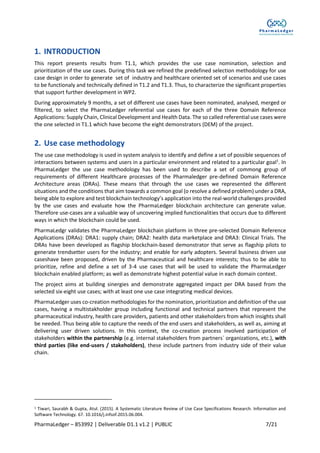
TABLE OF CONTENT
EXECUTIVE SUMMARY..................................................................................................................................6
INTRODUCTION.............................................................................................................................................7
1. Use case methodology..........................................................................................................................7
1.1 Definition and selection methodological approach......................................................................8
1.2 Results from the Use Cases prioritization and selection process...............................................10
1.2.1 Use Cases nomination.........................................................................................................10
1.2.2 First evaluation pass ...........................................................................................................12
1.2.3 Detailed use case definition and second evaluation pass ..................................................14
1.2.1 Roadmap.............................................................................................................................21
2. Conclusions and Next Steps................................................................................................................21
Table of Figures
Figure 1 Use Cases prioritization and selection methodology workflow .....................................................8
Figure 2 standardized scale based on the pre-defined criteria ....................................................................9
Figure 3 Template for nominating use cases..............................................................................................11
Figure 4 Clinical Supply Chain prioritization ...............................................................................................13
Figure 5 Health Data Use Case prioritization..............................................................................................13
Figure 6 DRA3 Clinical Trials Use Case prioritization ..................................................................................14
Figure 7 PharmaLedger selected use cases ................................................................................................14
Figure 8 eLeaflet description .....................................................................................................................15
Figure 9 Clinical Supply Chain Use Case description..................................................................................15
Figure 10 Supply Chain finished goods use Case description ....................................................................16
Figure 11 Anticounterfeiting use Case description.....................................................................................16
Figure 12 eConsent use Case description .................................................................................................17
Figure 13 Clinical Trial Recruitment use Case description........................................................................17
Figure 13 IoT Clinical Devices.....................................................................................................................18
Figure 15 Personalized medicine use Case description ............................................................................18
Figure 16 Use Cases Value Chain ...............................................................................................................19
Figure 17 DRA1 use Case synergetic capabilities description...................................................................19
Figure 18 DRA2 use Case synergetic capabilities description...................................................................20
Figure 19 DRA3 use Case synergetic capabilities description...................................................................20
Figure 20 Preliminary selected demonstrative use cases roadmap (DRA1, DRA2, DRA3) ........................21
PharmaLedger – 853992 | Deliverable D1.1 v1.2 | PUBLIC 6/21
EXECUTIVE SUMMARY
This report presents results from T1.1, which provides the use case nomination, selection and
prioritization of the use cases.
A methodology with a standardized criteria has been defined for nominating and evaluating the use cases;
overall over 88 use cases were nominated having 2 phases for filtering and assessing the use cases
regarding value, feasibility and suitability; as well as the value generated by using blockchain.
As a result: 8 use cases have been selected as the main representatives of the three PharmaLedger
Domains: supply chain, heath data and clinical trials; with an additional “key enabler” use case (Dynamic
Consent) that ensures that patient consent is also provided as a main piece when the patient privacy and
consenting of sharing of data is needed to be approached. The eight use cases selected are the following:
• DRA1: Supply Chain: eLeaflet/ eProduct Information (ePI); Clinical Supply Chain (CSC), Finished
Goods end to end Traceability, Supply chain, and AntiCounterfeiting.
• DRA2: Health Data: IoT medical devices and Personalized Medicine; and additional key enabler
(module) to support dynamic ePermissioning (dynamic consent for informed consent)
• DRA3: Clinical Trial: eConsent, Clinical Trial Recruitment
PharmaLedger – 853992 | Deliverable D1.1 v1.2 | PUBLIC 7/21
1. INTRODUCTION
This report presents results from T1.1, which provides the use case nomination, selection and
prioritization of the use cases. During this task we refined the predefined selection methodology for use
case design in order to generate set of industry and healthcare oriented set of scenarios and use cases
to be functionaly and technically defined in T1.2 and T1.3. Thus, to characterize the significant properties
that support further development in WP2.
During approximately 9 months, a set of different use cases have been nominated, analysed, merged or
filtered, to select the PharmaLedger referential use cases for each of the three Domain Reference
Applications: Supply Chain, Clinical Development and Health Data. The so called referential use cases were
the one selected in T1.1 which have become the eight demonstrators (DEM) of the project.
2. Use case methodology
The use case methodology is used in system analysis to identify and define a set of possible sequences of
interactions between systems and users in a particular environment and related to a particular goal1
. In
PharmaLedger the use case methodology has been used to describe a set of commong group of
requirements of different Healthcare processes of the Pharmaledger pre-defined Domain Reference
Architecture areas (DRAs). These means that through the use cases we represented the different
situations and the conditions that aim towards a common goal (o resolve a defined problem) under a DRA,
being able to explore and test blockchain technology’s application into the real-world challenges provided
by the use cases and evaluate how the PharmaLedger blockchain architecture can generate value.
Therefore use-cases are a valuable way of uncovering implied functionalities that occurs due to different
ways in which the blockchain could be used.
PharmaLedgr validates the PharmaLedger blockchain platform in three pre-selected Domain Reference
Applications (DRAs): DRA1: supply chain; DRA2: health data marketplace and DRA3: Clinical Trials. The
DRAs have been developed as flagship blockchain-based demonstrator that serve as flagship pilots to
generate trendsetter users for the industry; and enable for early adopters. Several business driven use
caseshave been proposed, driven by the Pharmaceutical and healthcare interests; thus to be able to
prioritize, refine and define a set of 3-4 use cases that will be used to validate the PharmaLedger
blockchain enabled platform; as well as demonstrate highest potential value in each domain context.
The project aims at building sinergies and demonstrate aggregated impact per DRA based from the
selected six-eight use cases; with at least one use case integrating medical devices.
PharmaLedger uses co-creation methodologies for the nomination, prioritization and definition of the use
cases, having a multistakholder group including functional and technical partners that represent the
pharmaceutical industry, health care providers, patients and other stakeholders from which insights shall
be needed. Thus being able to capture the needs of the end users and stakeholders, as well as, aiming at
delivering user driven solutions. In this context, the co-creation process involved participation of
stakeholders within the partnership (e.g. internal stakeholders from partners` organizations, etc.), with
third parties (like end-users / stakeholders), these include partners from industry side of their value
chain.
1 Tiwari, Saurabh & Gupta, Atul. (2015). A Systematic Literature Review of Use Case Specifications Research. Information and
Software Technology. 67. 10.1016/j.infsof.2015.06.004.
PharmaLedger – 853992 | Deliverable D1.1 v1.2 | PUBLIC 8/21
2.1 Definition and selection methodological approach
PharmaLedger had predefined a methodology for use case design in order to generate set of industry
and healthcare oriented set of scenarios and use cases to be analyzed and designed. This brought as set
of use cases proposals that have been refined by the various DRAs partners (grouped in teams) based on
end users` requirements, area or domain needs and busienss or health care value driven goals. This
methodology was refined during WP1 activities in order to ensure a common language and criteria for
evaluation and selection of the use cases (UCs).
The design and selection of scenarios and use cases has constituted the use-case view, and thus generated
the PharmaLedger use case roadmap vision. For doing so we have nominated and prioritized the use
cases that have be considered to be both, of feasible and generate the highest value, and thus become
the PharmaLedger flagship use cases. The use case process are foreseen to iterate in an agile manner,
through the course of the project, supporting improvement and insights feedback, refininng and updating
the use cases and its impact over the healthcare sector.
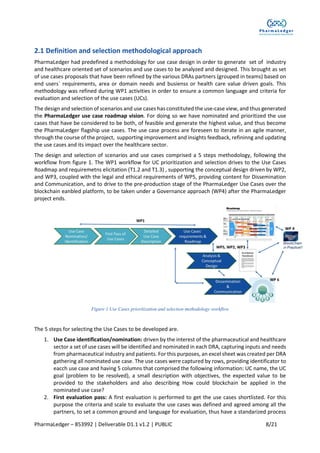
The design and selection of scenarios and use cases comprised a 5 steps methodology, following the
workflow from figure 1. The WP1 workflow for UC prioritization and selection drives to the Use Cases
Roadmap and requiremetns elicitation (T1.2 and T1.3) , supporting the conceptual design driven by WP2,
and WP3, coupled with the legal and ethical requirements of WP5, providing content for Dissemination
and Communication, and to drive to the pre-production stage of the PharmaLedger Use Cases over the
blockchain eanbled platform, to be taken under a Governance approach (WP4) after the PharmaLedger
project ends.
Figure 1 Use Cases prioritization and selection methodology workflow
The 5 steps for selecting the Use Cases to be developed are.
1. Use Case identification/nomination: driven by the interest of the pharmaceutical and healthcare
sector a set of use cases will be identified and nominated in each DRA, capturing inputs and needs
from pharmaceutical industry and patients. For this purposes, an excel sheet was created per DRA
gathering all nominated use case. The use cases were captured by rows, providing identificator to
eacch use case and having 5 columns that comprised the following information: UC name, the UC
goal (problem to be resolved), a small description with objectives, the expected value to be
provided to the stakeholders and also describing How could blockchain be applied in the
nominated use case?
2. First evaluation pass: A first evaluation is performed to get the use cases shortlisted. For this
purpose the criteria and scale to evaluate the use cases was defined and agreed among all the
partners, to set a common ground and language for evaluation, thus have a standarized process
PharmaLedger – 853992 | Deliverable D1.1 v1.2 | PUBLIC 9/21
with a common evaluation criteria. Three criateria were defined: feasibility, suitability and added
value as a consensus among partners; which was defined as follows:
• Feasible: (‘can it be done?’). To answer this question means that the following
issues/questions need to be approached:
o Do the incentives exist to bring the necessary stakeholders together to solve/pursue this
problem/opportunity?
o Is there a ‘minimally viable product’ and a ‘minimally viable ecosystem’ where the value
proposition can be tested and proven?
o Do data standards exist that would facilitate the exchange of data between disparate
organizations?
o Can any regulatory/legal resistance be overcome?
• Suitable: (‘is blockchain necessary?’) To answer this question means that the following
issues/questions need to be approached:
o Are the core benefits of blockchain necessary to this use case?
o Is a ‘decentralized’ solution necessary or highly valuable?
o Is PharmaLedger the best consortia to advance this use case?
o Can the requirements for transaction privacy and transparency be met?
• Valuable: (‘will the value motivate action?’) To answer this question means that the
following issues/questions need to be approached:
o Does the use case align to the strategy and needs of the stakeholders?
o Are there already other viable solutions available or nearly available?
o Is the value sufficient to motivate the investment necessary to address the use case?
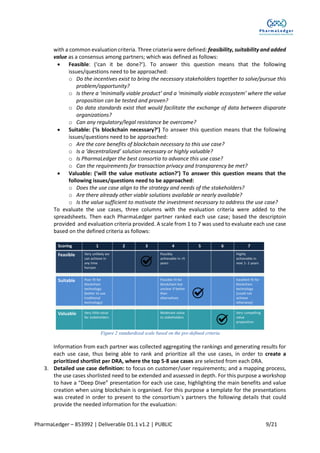
To evaluate the use cases, three columns with the evaluation criteria were added to the
spreadsheets. Then each PharmaLedger partner ranked each use case; based the descriptoin
provided and evaluation criteria provided. A scale from 1 to 7 was used to evaluate each use case
based on the defined criteria as follows:
Figure 2 standardized scale based on the pre-defined criteria
Information from each partner was collected aggregating the rankings and generating results for
each use case, thus being able to rank and prioritize all the use cases, in order to create a
prioritized shortlist per DRA, where the top 5-8 use cases are selected from each DRA.
3. Detailed use case definition: to focus on customer/user requirements; and a mapping process,
the use cases shorlisted need to be extended and assessed in depth. For this purpose a workshop
to have a “Deep Dive” presentation for each use case, highlighting the main benefits and value
creation when using blockchain is organised. For this purpose a template for the presentations
was created in order to present to the consortium`s partners the following details that could
provide the needed information for the evaluation:
PharmaLedger – 853992 | Deliverable D1.1 v1.2 | PUBLIC 10/21
• Context and Use Case Objectives (problem that needs to be solved)
• Current Situation/State of the Opportunity (how problem is currently addressed)
• Future Vision & Solution Description/ Logical Schema
• Why Blockchain? (how blockchain solves the problem and the benefits of using blockchain)
• Stakeholders & Associated Value Proposition
• Risks/ Challenges/ Complexity Considerations. This shall includes the legal, regulatory and
data privacy considerations.
• Realizing the opportunity
• Collaborations & Resources Needed
As for analysing why the blockchain, it was important to asses the events and data will be captured
on the blockchain:
o Step 1: Collect Usability/Efficiency/ Immutability goals and requirements
o Step 2: Document the Business Process flow
o Step 3: Break each process flow into a series of discrete business steps
o Step 4: Decide which business steps require recorded events and determine
confidentiality requirements
o Step 5: Model the completion of each step as a recorded event
o Step 6: Decide what data fields are to be included in the recorded event
4. Second evaluation pass: Several workshops with pharma companies, patients, stakeholders and
partners were performed during weekly meeings. In this regard, to evaluate the “Deep Dive” , a
review regarding the PharmaLedger ecosystem benefits (potential synergies of use cases that
could provide a roadmap) was analysed, was approach, taking in account evaluaiton of the use
cases regarding previous prioritization scoring (first evaluation pass), while also evaluationg:
• the value for the participants (the value was measured on a scale from -1 to 2, where -
1=negative, 0=not affected,1=ambivalent, 2=positive)
• Complexity: perception of deployment complexity; the use case is evaluated with respect to
several parameters such as regulatory, confidentiality, geography, transaction volume,
standards and incentives. The value is measured on a scale from -1 to 2, where -1= highly
complex, 0= complex, 1=possible but risky and 2 = seems feasible.
In this context, the top 3-4 use cases ranked in each DRA, are the ones selected per DRA, to be
fully defined (functionally and technically) and further deployed, validated and evaluated. These
use cases also are analysed in terms of synergies in order to see how those logically build on each
other for creation of value during beyond duration of the project; and thus create the Use Case
Roadmap.
5. Handover of Use Cases to T1.2 and T1.3 for Analysis, Conceptual and Technical requirements
eliciatation and gathering, to enabl ethe use case solution architecture and organizational model
over WP2, including the implementation strategy.
The deployed and validated use cases will become the flagship use case pilots and act as trendsetters of
blockchain adoption by the ecosystem and serve as a reference for the healthcare industry.
2.2 Results from the Use Cases prioritization and selection process
2.2.1 Use Cases nomination
As for the use cases nomination and collection gathering the DRA leaders (DRA1: supply chain; DRA2:
health data marketplace and DRA3: Clinical Trials) have led weekly meetings to manage the collection of
use cases that were considered as important (meaning this to be considered of having value/impact and
PharmaLedger – 853992 | Deliverable D1.1 v1.2 | PUBLIC 11/21
a feasible level of complexity) for each PharmaLedger partner in both the pharmaceutical and healthcare
domains, and for which a suitable development using blockkchain could be developed.
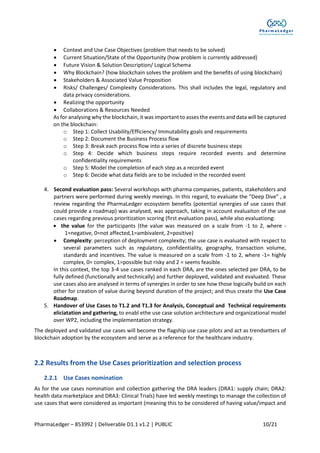
Figure 3 Template for nominating use cases
For this purpose the participant partners surveyed both potential use cases from internal perspectives
and from H2020 projects for use cases, capturing all inputs in an excel template as shown in fig. 3. The
excel template was used as a working sheet to nominate, collect and clasify the use cases per each DRA.
The excel was filled with potential Use Cases depicting the description, providing a category based on the
main function / hierarchy, a concise description, an explanation of how blockchain could be used, as well
as a concise definition of the use case scope.
During the process, overall 88 use cases were nominated and collected through all DRAs in the excel
templates; with different scopes through the DRAs. The list of Use Cases per DRA is presented in the
following tables:
DRA1 - Supply Chain: 47 Business Use Cases were nominated; shown in the following table.
• UC 1.01 Full End to End Traceability
• UC 1.02 Provenance/Chain of Custody
• UC 1.03 Chain of Custody
• UC 1.04 Chain of Identity (pers. medicine)
• UC 1.05 E-prescription
• UC 1.06 Patient anti-counterfeit feature check
• UC 1.07 Anti-counterfeit AI
• UC 1.08 Authenticity verification
• UC 1.09 Quality inquiry / recall notification
• UC 1.10 Package inserts (leaflets)
• UC 1.11 Personalized medicine
• UC 1.12 Clinical Supply Chain
• UC 1.13 Serialization compliance
• UC 1.14 Supplier qualification (TPRM)
• UC 1.15 Certifications/licenses - CofA
• UC 1.16 Quarantine & Recalls
• UC 1.17 Product Data (Annex 16)
• UC 1.18 Regulatory reporting
• UC 1.19 Controlled substance monitoring
• UC 1.20 Returns
• UC 1.21 Collaborative planning - VMI
• UC 1.22 Detailed TPT analysis: Inv.
optimization
• UC 1.23 Drug shortages
• UC 1.24 Inventory Vsibility
• UC 1.25 Parallel import/diversion
• UC 1.26 Dispute resolution
• UC 1.27 Batch release
• UC 1.28 Real-time Monitoring/Visibility (T&T)
• UC 1.29 Stability budget (cold chain)
• UC 1.30 Exceptions – Alerts/notifications
• UC 1.31 Sample distribution management
• UC 1.32 Financial processes
• UC 1.33 Chargebacks and Rebates
• UC 1.34 Freight cost management
• UC 1.35 Import/export declarations
• UC 1.36 E-Bill of lading
• UC 1.37 EDIFact next generation
• UC 1.38 Document Digitization
• UC 1.39 Cold Chain Traceability
• UC 1.40 Decentralized Identity and Verificable
Credentials of Organizations
• UC 1.41 Third Party Risk Management of
material, product or service suppliers
• UC 1.42 Verification of Regulatory
Compliance including Licenses and deviations of
products including registered product supply
chain (EMA GDP Annex 16)
• UC 1.43 Manufacturing Process
• UC 1.44 Serialization & Product Tracking
• UC 1.45 Counterfeit Features
• UC 1.46 IoT in supply chain
• UC 1.47 Supply Chain Traceability of Finished
Goods
Business Use Case Master
Description
Story Suitability of blockchain Scope/Deliverables/Phases
RDA1
Supply
Chain
Business Use Case
Name
Short description of the business use case from the perspective of the users.
Highlight current challenges and problems solved.
Why blockchain could be the solution
(pros/cons)? What values blockchain
will create?
What needs to be bulit for a minimum
viable product? Will additional phases
be required for additional benefits?
What would be out of scope for this
use case?
ID Name Category
PharmaLedger – 853992 | Deliverable D1.1 v1.2 | PUBLIC 12/21
DRA2- Health Data: 20 Business Use Cases were nominated; shown in the following table.
• UC 2.01 Dynamic consenting of data
• UC 2.02 Recruitment of patients for clinical trials
• UC 2.03 Use marketplace data for generating
RWE (changed from 'use anonymized data for
RWE')
• UC 2.04 Support drug design (with RWE/RWD)
• UC 2.05 Medical Devices access / authentication
• UC 2.06 Reall World Evidence/Real World Data
• UC 2.07 Patient Identity mng for various data
sources
• UC 2.08 Identity mng for various data sources
• UC 2.09 Support diagnosis and prevention
• UC 2.10 Personalise treatments for patients
• UC 2.11 Clinical trial (protocol) or research
design
• UC 2.12 In Silico clinical trials
• UC 2.13 Ability for participants to share their
data anonymously or not by granting access
to researchers including visibility of who has
access to the data for specific purpose
• UC 2.14 Incentivising data sharing
• UC 2.15 Data grovenance, transparency, and
integrity
• UC 2.16 Value-based contracts (payers)
• UC 2.17 Digital Immunization Passport (DIP)
• UC 2.18 E-prescription Application
• UC2.19 Implementing blockchain
infrastructure in a coupon program space
• UC 2.20 Blockchain Pilot with third party
partners
DRA3- Clinical Trials: 21 Business Use Cases were nominated; shown in the following table.
• UC 3.01 Clinical trial data transparency/
integrity
• UC 3.02 eConsent (w/Children optional)
• UC 3.03 Labs and Genomics
• UC 3.04 Contract based vendor management
(metrics, invoicing, payments based on
delivery) -replace from KPI and Metrics
• UC 3.05 Tracking eTMF docs
• UC 3.06 Clinical Data (Management)
• UC 3.07 Clinical trial supply
• UC 3.08 Bio specimen tracking-
• UC 3.09 Reg package approval at every step
(from IRB-IEC approval to before First Patient
In) and submission
• UC 3.10 Patient adherence to either complete
assessments or medication
• UC 3.11 Avoid site misconduct (GCP issue)
• UC 3.12 Participant DID
• UC 3.13 Investigator DID
• UC 3.14 Document Digitalization
• UC 3.15 Pseudo-Anonymization (coded) study
(blinding)
• UC 3.16 Patient reimbursement
• UC 3.17 Use of connected IoT devices (medical)
• UC 3.18 Patient Safety
• UC 3.19 Access to submission documentation for
Health Authorities
• UC 3.20 Clinical trial results to pass back to
patient (as part of EMR)
• UC 3.21 Patient Data sharing
2.2.2 First evaluation pass
Following the methodology the 88 Use cases were evaluated regarding the Feasibility, Suitability and
Value by all partners in all DRAs. This quantitative evaluation supported to provide a scoring to each use
case and allow to have a ranking in each DRA. As a result, 25 use cases were selected, using the
prioritization and ranking for the results per DRA shown in the following figures.
As for DRA1: Clinical Supply Chain, the following figure (figure 4) shows the results for the first seven use
cases in the ranking, as well as the concentration of the use cases that were highly feasible (right hand
side).
PharmaLedger – 853992 | Deliverable D1.1 v1.2 | PUBLIC 13/21
Figure 4 Clinical Supply Chain prioritization
As for DRA2 -Health Data: the following figure (figure 5) shows the results for the first eight use cases in
the ranking, as well as the concentration of the use cases that were highly feasible (right hand side)
Figure 5 Health Data Use Case prioritization
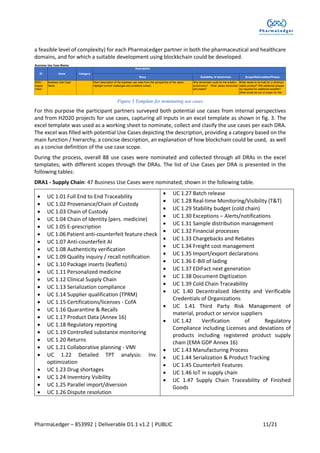
As for DRA3- Clinical Trials: the following figure (figure 6) shows the results for the first ten use cases in
the ranking, as well as the concentration of the use cases that were highly feasible (right hand side)
PharmaLedger – 853992 | Deliverable D1.1 v1.2 | PUBLIC 14/21
Figure 6 DRA3 Clinical Trials Use Case prioritization
2.2.3 Detailed use case definition and second evaluation pass
A detailed use case definition was performed using the Deep Dive approach for the 25 use case selected.
Internal presentations following the structure provided in point 3 of chapter 1.1. were performed for each
of the 25 use cases, in order to assess in depth each use case in a second evaluation pass. The second
evaluation pass has been qualitative, taking in account the complexity and value of the use cases (specially
the roadmaps of the Pharma companies), based on the Deep Dive information.
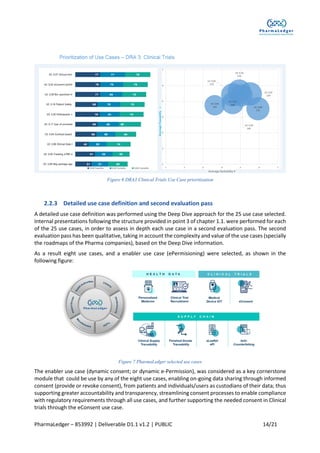
As a result eight use cases, and a enabler use case (ePermisioning) were selected, as shown in the
following figure:
Figure 7 PharmaLedger selected use cases
The enabler use case (dynamic consent; or dynamic e-Permission), was considered as a key cornerstone
module that could be use by any of the eight use cases, enabling on-going data sharing through informed
consent (provide or revoke consent), from patients and individuals/users as custodians of their data; thus
supporting greater accountability and transparency, streamlining consent processes to enable compliance
with regulatory requirements through all use cases, and further supporting the needed consent in Clinical
trials through the eConsent use case.
PharmaLedger – 853992 | Deliverable D1.1 v1.2 | PUBLIC 15/21
The following figures show a summary of the concept of each of the eight selected use cases, to be the
PharmaLedger Demonstrators (extracted from the Deep Dive exercise)
DRA1- Use Case: eLeaflet / eProduct-Information (ePI)
Figure 8 eLeaflet description
DRA1- Use Case: Clinical Supply Chain
Figure 9 Clinical Supply Chain Use Case description
PharmaLedger – 853992 | Deliverable D1.1 v1.2 | PUBLIC 16/21
DRA1- Use Case: Supply Chain Finished Goods
Figure 10 Supply Chain finished goods use Case description
DRA1- Use Case: Anticounterfeiting
Figure 11 Anticounterfeiting use Case description
PharmaLedger – 853992 | Deliverable D1.1 v1.2 | PUBLIC 17/21
DRA3- Use Case Clinical Trials: eConsent
Figure 12 eConsent use Case description
DRA3- Clinical Trials Recruitment Use Case
Figure 13 Clinical Trial Recruitment use Case description
PharmaLedger – 853992 | Deliverable D1.1 v1.2 | PUBLIC 18/21
DRA2- Use Case IoT in Clinical Devices
Figure 14 IoT Clinical Devices
use Case description
DRA2- Use Case Personalized Medicine
Figure 15 Personalized medicine use Case description
PharmaLedger – 853992 | Deliverable D1.1 v1.2 | PUBLIC 19/21
The selected use cases compose a vision how together can support a value chain to generate impact, per
and cross DRAs (over the pharmaceutical value chain):
Figure 16 Use Cases Value Chain
Per DRA, the capabilities of each use case also strengthen the overall DRA impact and characterization as
follows:
• DRA1 use cases capabilities, provide an end to end traceability model using blockchain that could
support from the upstream to the downstream processes in the supply chain.
Figure 17 DRA1 use Case synergetic capabilities description
PharmaLedger – 853992 | Deliverable D1.1 v1.2 | PUBLIC 20/21
• DRA2 use cases capabilities, provide a model using blockchain that could support from
identification to traceability of drugs and claims in the health data domain.
Figure 18 DRA2 use Case synergetic capabilities description
• DRA3 use cases capabilities, provide a model using blockchain that could support from
identification in the investigator and Point of Care (PoC) to the submission and payments in
Clinical Trials.
Figure 19 DRA3 use Case synergetic capabilities description
PharmaLedger – 853992 | Deliverable D1.1 v1.2 | PUBLIC 21/21
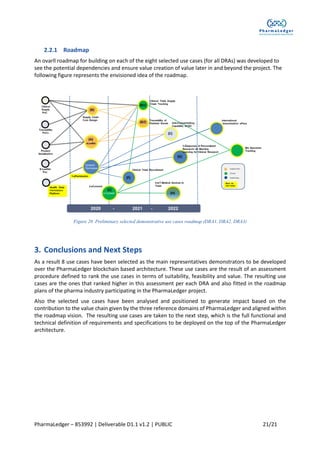
2.2.1 Roadmap
An ovarll roadmap for building on each of the eight selected use cases (for all DRAs) was developed to
see the potential dependencies and ensure value creation of value later in and beyond the project. The
following figure represents the envisioned idea of the roadmap.
Figure 20 Preliminary selected demonstrative use cases roadmap (DRA1, DRA2, DRA3)
3. Conclusions and Next Steps
As a result 8 use cases have been selected as the main representatives demonstrators to be developed
over the PharmaLedger blockchain based architecture. These use cases are the result of an assessment
procedure defined to rank the use cases in terms of suitability, feasibility and value. The resulting use
cases are the ones that ranked higher in this assessment per each DRA and also fitted in the roadmap
plans of the pharma industry participating in the PharmaLedger project.
Also the selected use cases have been analysed and positioned to generate impact based on the
contribution to the value chain given by the three reference domains of PharmaLedger and aligned within
the roadmap vision. The resulting use cases are taken to the next step, which is the full functional and
technical definition of requirements and specifications to be deployed on the top of the PharmaLedger
architecture.

PharmaLedger – Use case prioritization and selection for deployment

  • 1.
    This project hasreceived funding from the Innovative Medicines Initiative 2 Joint Undertaking under grant agreement No 853992. This Joint Undertaking receives support from the European Union’s Horizon 2020 research and innovation programme and EFPIA. Copyright © PharmaLedger Consortium 2020 – 2023 PharmaLedger: www.pharmaledger.eu IMI: www.imi.europa.eu D1.2 Use case prioritization and selection for deployment Deliverable No D1.1 Use case prioritization and selection for deployment Work package No. and Title WP1 Requirements & Business Use Cases Version - Status V1.2 – Final Date of Issue 10/11/2020 / 15/11/2021 Dissemination Level PUBLIC (PU) Filename D1.1 Use case prioritization and selection for deployment Ref. Ares(2021)7012750 - 15/11/2021
  • 2.
    This project hasreceived funding from the Innovative Medicines Initiative 2 Joint Undertaking under grant agreement No 853992. This Joint Undertaking receives support from the European Union’s Horizon 2020 research and innovation programme and EFPIA. Copyright © PharmaLedger Consortium 2020 – 2023 PharmaLedger: www.pharmaledger.eu IMI: www.imi.europa.eu Copyright © 2020-2022, PharmaLedger Consortium Disclaimer: Any information on this deliverable solely reflects the author’s view and neither IMI nor the European Union or EFPIA are responsible for any use that may be made of the information contained herein. This document and its contents remain the property of the beneficiaries of the PharmaLedger Consortium and may not be re- used, distributed or reproduced without the expressed written approval of the PharmaLedger Coordinators, Maria Eugenia Beltran and Daniel Fritz (Universidad Politécnica de Madrid and Novartis respectively; contact@pharmaledger.eu) THIS DOCUMENT AND INFORMATION IS PROVIDED BY THE COPYRIGHT HOLDERS AND CONTRIBUTORS "AS IS" AND ANY EXPRESS OR IMPLIED WARRANTIES, INCLUDING, BUT NOT LIMITED TO, THE IMPLIED WARRANTIES OF MERCHANTABILITY AND FITNESS FOR A PARTICULAR PURPOSE ARE DISCLAIMED. IN NO EVENT SHALL THE COPYRIGHT OWNER OR CONTRIBUTORS BE LIABLE FOR ANY DIRECT, INDIRECT, INCIDENTAL, SPECIAL, EXEMPLARY, OR CONSEQUENTIAL DAMAGES (INCLUDING, BUT NOT LIMITED TO, PROCUREMENT OF SUBSTITUTE GOODS OR SERVICES; LOSS OF USE, DATA, OR PROFITS; OR BUSINESS INTERRUPTION) HOWEVER CAUSED AND ON ANY THEORY OF LIABILITY, WHETHER IN CONTRACT, STRICT LIABILITY, OR TORT (INCLUDING NEGLIGENCE OR OTHERWISE) ARISING IN ANY WAY OUT OF THE USE OF THIS DOCUMENT, EVEN IF ADVISED OF THE POSSIBILITY OF SUCH DAMAGE.
  • 3.
    PharmaLedger – 853992| Deliverable D1.1 v1.2 | Public 3/21 DOCUMENT INFO Authors Use Case / Deliverable Leading Authors and contributors Task 1.1 Leaders UPM and MSD ePI (electronic Product Information) Leaders: Ken Thrusby (MSD) and Maher (NVS) Contributors: Lynn Wang (JNJ), Xenia-Cecilia (UPM) / Georgios Poulentzas, Panagiotis Lalagkas, Christos Kontogiorgis (DUT), Espen Kon (EKON), Paul Marley (GSK), Tracy Williams (GSK), Luis Campos (PDMFC), Chris Patsonakis (CERTH), Anastasia Theodouli (CERTH), Silke Berghman (UCB) Clinical Supply Chain Use Case Leaders: Chad Sklodosky (PFE) and Francesco Spoto (NVS) Contributors: A. Balan (RMS), Jackie Purdie (ONO), Luis Campos (PDMFC); Vila, Henry (MSD); REIMER, BONNIE G MSD),Chris Patsonakis (CERTH), Anastasia Theodouli (CERTH), Antonio Tramontano (NVS), Hrishikesh Nashikkar (NVS), Flora Nanda (PFE), Robert Miller (PFE) Finished Goods Traceability Use Case Leaders: Jan Wortmann (BYR), Rebecca Weilandt (RCH), Bernhard Salb (RCH) Contributors: Lynn Wang (JNJ), G. d Groote (MSD), A. Balan (RMS) L. Campos (PDMFC), M Senator (PFZ), P Gzincic (PFZ), Dave Ottemess (ABB), Soeren Franke (BAY), Himanshu Agrawal (GSK),Greg Goger (ABB), Stefano Zanobini (UCB) Trust in Medicine - Create Anti- Counterfeiting Capabilities with Blockchain Use Case Leaders: Daniel Fritz (NVS) / Carlos Goncalves (INCM) Contributors: Clarisse Dias da Mota (NVS), Alberto López (INCM), Stephan Schwarze(BAYER), Dave Ottemess (ABB), Scott Smitt (ABB), Nikkos, Cecilia Vera and Maria Eugenia Beltran (UPM), Luis Campos (PDMFC), Paolo Migliari (MSD), Tamanna Khan (TVS), Espen Kon (EKON), Ashadul Hoque (TVS), Lee Nolte Häger (NOVO), Stefano Zanobini (UCB) Clinical trial recruitment Use Case Leaders: Robert Miller (PFE), Nick Cancar (PFE), Ken Nessel (PFE) Contributors: Ingrid Klingmann (EFGCP), Claire Kingston (JNJ), Tom Giannaris (Bayer), Jackie Purdie (ONO), Nikkos, Cecilia, Xenia (UPM), Luis Campos (PDMFC), Disa Lee (UCB),Chris Patsonakis (CERTH), Anastasia Theodouli (CERTH) Personalized Medicine Use Case Leaders: Emesse Toth (UCB), Cecilia Vera (UPM), Maria Eugenia Beltran (UPM), Georgios Poulentzas, Panagiotis Lalagkas, Christos Kontogiorgis (DUT) Contributors: Kim Crimin (ABB), Nikolaos Liappas (UPM), Michael Sammeth (UKW), OPBG (Francesca Rocchi, Marco Ciabattini, Giuseppe Pontrelli, Franco De Crescenzo), Luis Campos (PDMFC), Radu Tamaian (ICS) eConsent Use Case: Transparent and trusted trial participant consenting – Automating and streamlining clinical trial processes by leveraging blockchain-based electronic informed consent Leaders: Baldwin Mak (BI), Marianne Logger (BI), Jackie Purdie (ONO), Despina Daliani (ONO). Contributors: Ingrid Klingmann (EFGCP), A. Balan (RMS), Francesca Rocchi (OPBG), Marco Ciabattini (OPBG), Cecilia Vera (UPM), Maria Eugenia Beltran (UPM), Giuseppe Pontrelli (OPBG), Franco De Crescenzo (OPBG) X.Briand (NVS), Luis Campos (PDMFC), Chris Patsonakis (CERTH), Anastasia Theodouli (CERTH)
  • 4.
    PharmaLedger – 853992| Deliverable D1.1 v1.2 | PUBLIC 4/21 Use Case / Deliverable Leading Authors and contributors IOT Medical devices in clinical trials Use Case Leaders: Disa Lee (UCB); Maria Eugenia Beltran (UPM), Jose Gabriel Terius (UPM), Giuseppe Pontrelli (OPBG), Michael Odowu Contributors: Claire Kingston (JNJ), Greg Silvesti (ABB), Georgios Poulentzas, Panagiotis Lalagkas, Christos Kontogiorgis (DUT), OPBG (Francesca Rocchi, Marco Ciabattini, Giuseppe Pontrelli, Franco De Crescenzo), Michael Idowu (ONO), Luis Campos (PDMFC), Bernhard Greve (UCB),Chris Patsonakis (CERTH), Anastasia Theodouli (CERTH), Radu Tamaian (ICS) Deliverable 1.2 Leaders: Macrea, Raluca (MSD), Paolo Migliari (MSD), Mirjam Luttikholt (MSD), Maria Eugenia Beltran (UPM), Jose Gabriel Terius (UPM), Cecilia Vera (UPM) Contributors for the overall use cases and deliverable: All partners Document History Date Version Editor Change Status 15/01/2020 UC Templates UPM / MSD Teams UC templates provided to Use cases leader Draft 16/01 – 31/03/2020 UC Templates All use cases participants Weekly editions of the UC nominations in the Excel Draft 06/04 – 16/06/2020 UC Templates All use cases participants UC revision and catch up for 1st selection pass Draft 17/06 – 29/08/2020 UC Templates All use cases participants First draft document integration Draft 24/09/2020 V0.1 UPM / MSD Teams First and Second draft document integration Draft 09/10/2020 V0.2 UPM / MSD Teams Third draft document integration and integration Draft 10/11/2020 V1.0 UPM / MSD Teams Full formatting and final draft - Final review Draft 01/05/2021 V1.1 María Eugenia Beltrán/ Cecilia Vera Updates requested by IMI/EC for disclaimer and acknowledgement & resubmission for technical problems Final 15/11/2021 V1.2 María Eugenia Beltrán/ Cecilia Vera Re-formatting, re-shaping, resubmission for technical problems Final Disclaimer: Any information on this deliverable solely reflects the author’s view and neither IMI nor the European Union or EFPIA are responsible for any use that may be made of the information contained herein.
  • 5.
    PharmaLedger – 853992| Deliverable D1.1 v1.2 | PUBLIC 5/21 TABLE OF CONTENT EXECUTIVE SUMMARY..................................................................................................................................6 INTRODUCTION.............................................................................................................................................7 1. Use case methodology..........................................................................................................................7 1.1 Definition and selection methodological approach......................................................................8 1.2 Results from the Use Cases prioritization and selection process...............................................10 1.2.1 Use Cases nomination.........................................................................................................10 1.2.2 First evaluation pass ...........................................................................................................12 1.2.3 Detailed use case definition and second evaluation pass ..................................................14 1.2.1 Roadmap.............................................................................................................................21 2. Conclusions and Next Steps................................................................................................................21 Table of Figures Figure 1 Use Cases prioritization and selection methodology workflow .....................................................8 Figure 2 standardized scale based on the pre-defined criteria ....................................................................9 Figure 3 Template for nominating use cases..............................................................................................11 Figure 4 Clinical Supply Chain prioritization ...............................................................................................13 Figure 5 Health Data Use Case prioritization..............................................................................................13 Figure 6 DRA3 Clinical Trials Use Case prioritization ..................................................................................14 Figure 7 PharmaLedger selected use cases ................................................................................................14 Figure 8 eLeaflet description .....................................................................................................................15 Figure 9 Clinical Supply Chain Use Case description..................................................................................15 Figure 10 Supply Chain finished goods use Case description ....................................................................16 Figure 11 Anticounterfeiting use Case description.....................................................................................16 Figure 12 eConsent use Case description .................................................................................................17 Figure 13 Clinical Trial Recruitment use Case description........................................................................17 Figure 13 IoT Clinical Devices.....................................................................................................................18 Figure 15 Personalized medicine use Case description ............................................................................18 Figure 16 Use Cases Value Chain ...............................................................................................................19 Figure 17 DRA1 use Case synergetic capabilities description...................................................................19 Figure 18 DRA2 use Case synergetic capabilities description...................................................................20 Figure 19 DRA3 use Case synergetic capabilities description...................................................................20 Figure 20 Preliminary selected demonstrative use cases roadmap (DRA1, DRA2, DRA3) ........................21
  • 6.
    PharmaLedger – 853992| Deliverable D1.1 v1.2 | PUBLIC 6/21 EXECUTIVE SUMMARY This report presents results from T1.1, which provides the use case nomination, selection and prioritization of the use cases. A methodology with a standardized criteria has been defined for nominating and evaluating the use cases; overall over 88 use cases were nominated having 2 phases for filtering and assessing the use cases regarding value, feasibility and suitability; as well as the value generated by using blockchain. As a result: 8 use cases have been selected as the main representatives of the three PharmaLedger Domains: supply chain, heath data and clinical trials; with an additional “key enabler” use case (Dynamic Consent) that ensures that patient consent is also provided as a main piece when the patient privacy and consenting of sharing of data is needed to be approached. The eight use cases selected are the following: • DRA1: Supply Chain: eLeaflet/ eProduct Information (ePI); Clinical Supply Chain (CSC), Finished Goods end to end Traceability, Supply chain, and AntiCounterfeiting. • DRA2: Health Data: IoT medical devices and Personalized Medicine; and additional key enabler (module) to support dynamic ePermissioning (dynamic consent for informed consent) • DRA3: Clinical Trial: eConsent, Clinical Trial Recruitment
  • 7.
    PharmaLedger – 853992| Deliverable D1.1 v1.2 | PUBLIC 7/21 1. INTRODUCTION This report presents results from T1.1, which provides the use case nomination, selection and prioritization of the use cases. During this task we refined the predefined selection methodology for use case design in order to generate set of industry and healthcare oriented set of scenarios and use cases to be functionaly and technically defined in T1.2 and T1.3. Thus, to characterize the significant properties that support further development in WP2. During approximately 9 months, a set of different use cases have been nominated, analysed, merged or filtered, to select the PharmaLedger referential use cases for each of the three Domain Reference Applications: Supply Chain, Clinical Development and Health Data. The so called referential use cases were the one selected in T1.1 which have become the eight demonstrators (DEM) of the project. 2. Use case methodology The use case methodology is used in system analysis to identify and define a set of possible sequences of interactions between systems and users in a particular environment and related to a particular goal1 . In PharmaLedger the use case methodology has been used to describe a set of commong group of requirements of different Healthcare processes of the Pharmaledger pre-defined Domain Reference Architecture areas (DRAs). These means that through the use cases we represented the different situations and the conditions that aim towards a common goal (o resolve a defined problem) under a DRA, being able to explore and test blockchain technology’s application into the real-world challenges provided by the use cases and evaluate how the PharmaLedger blockchain architecture can generate value. Therefore use-cases are a valuable way of uncovering implied functionalities that occurs due to different ways in which the blockchain could be used. PharmaLedgr validates the PharmaLedger blockchain platform in three pre-selected Domain Reference Applications (DRAs): DRA1: supply chain; DRA2: health data marketplace and DRA3: Clinical Trials. The DRAs have been developed as flagship blockchain-based demonstrator that serve as flagship pilots to generate trendsetter users for the industry; and enable for early adopters. Several business driven use caseshave been proposed, driven by the Pharmaceutical and healthcare interests; thus to be able to prioritize, refine and define a set of 3-4 use cases that will be used to validate the PharmaLedger blockchain enabled platform; as well as demonstrate highest potential value in each domain context. The project aims at building sinergies and demonstrate aggregated impact per DRA based from the selected six-eight use cases; with at least one use case integrating medical devices. PharmaLedger uses co-creation methodologies for the nomination, prioritization and definition of the use cases, having a multistakholder group including functional and technical partners that represent the pharmaceutical industry, health care providers, patients and other stakeholders from which insights shall be needed. Thus being able to capture the needs of the end users and stakeholders, as well as, aiming at delivering user driven solutions. In this context, the co-creation process involved participation of stakeholders within the partnership (e.g. internal stakeholders from partners` organizations, etc.), with third parties (like end-users / stakeholders), these include partners from industry side of their value chain. 1 Tiwari, Saurabh & Gupta, Atul. (2015). A Systematic Literature Review of Use Case Specifications Research. Information and Software Technology. 67. 10.1016/j.infsof.2015.06.004.
  • 8.
    PharmaLedger – 853992| Deliverable D1.1 v1.2 | PUBLIC 8/21 2.1 Definition and selection methodological approach PharmaLedger had predefined a methodology for use case design in order to generate set of industry and healthcare oriented set of scenarios and use cases to be analyzed and designed. This brought as set of use cases proposals that have been refined by the various DRAs partners (grouped in teams) based on end users` requirements, area or domain needs and busienss or health care value driven goals. This methodology was refined during WP1 activities in order to ensure a common language and criteria for evaluation and selection of the use cases (UCs). The design and selection of scenarios and use cases has constituted the use-case view, and thus generated the PharmaLedger use case roadmap vision. For doing so we have nominated and prioritized the use cases that have be considered to be both, of feasible and generate the highest value, and thus become the PharmaLedger flagship use cases. The use case process are foreseen to iterate in an agile manner, through the course of the project, supporting improvement and insights feedback, refininng and updating the use cases and its impact over the healthcare sector. The design and selection of scenarios and use cases comprised a 5 steps methodology, following the workflow from figure 1. The WP1 workflow for UC prioritization and selection drives to the Use Cases Roadmap and requiremetns elicitation (T1.2 and T1.3) , supporting the conceptual design driven by WP2, and WP3, coupled with the legal and ethical requirements of WP5, providing content for Dissemination and Communication, and to drive to the pre-production stage of the PharmaLedger Use Cases over the blockchain eanbled platform, to be taken under a Governance approach (WP4) after the PharmaLedger project ends. Figure 1 Use Cases prioritization and selection methodology workflow The 5 steps for selecting the Use Cases to be developed are. 1. Use Case identification/nomination: driven by the interest of the pharmaceutical and healthcare sector a set of use cases will be identified and nominated in each DRA, capturing inputs and needs from pharmaceutical industry and patients. For this purposes, an excel sheet was created per DRA gathering all nominated use case. The use cases were captured by rows, providing identificator to eacch use case and having 5 columns that comprised the following information: UC name, the UC goal (problem to be resolved), a small description with objectives, the expected value to be provided to the stakeholders and also describing How could blockchain be applied in the nominated use case? 2. First evaluation pass: A first evaluation is performed to get the use cases shortlisted. For this purpose the criteria and scale to evaluate the use cases was defined and agreed among all the partners, to set a common ground and language for evaluation, thus have a standarized process
  • 9.
    PharmaLedger – 853992| Deliverable D1.1 v1.2 | PUBLIC 9/21 with a common evaluation criteria. Three criateria were defined: feasibility, suitability and added value as a consensus among partners; which was defined as follows: • Feasible: (‘can it be done?’). To answer this question means that the following issues/questions need to be approached: o Do the incentives exist to bring the necessary stakeholders together to solve/pursue this problem/opportunity? o Is there a ‘minimally viable product’ and a ‘minimally viable ecosystem’ where the value proposition can be tested and proven? o Do data standards exist that would facilitate the exchange of data between disparate organizations? o Can any regulatory/legal resistance be overcome? • Suitable: (‘is blockchain necessary?’) To answer this question means that the following issues/questions need to be approached: o Are the core benefits of blockchain necessary to this use case? o Is a ‘decentralized’ solution necessary or highly valuable? o Is PharmaLedger the best consortia to advance this use case? o Can the requirements for transaction privacy and transparency be met? • Valuable: (‘will the value motivate action?’) To answer this question means that the following issues/questions need to be approached: o Does the use case align to the strategy and needs of the stakeholders? o Are there already other viable solutions available or nearly available? o Is the value sufficient to motivate the investment necessary to address the use case? To evaluate the use cases, three columns with the evaluation criteria were added to the spreadsheets. Then each PharmaLedger partner ranked each use case; based the descriptoin provided and evaluation criteria provided. A scale from 1 to 7 was used to evaluate each use case based on the defined criteria as follows: Figure 2 standardized scale based on the pre-defined criteria Information from each partner was collected aggregating the rankings and generating results for each use case, thus being able to rank and prioritize all the use cases, in order to create a prioritized shortlist per DRA, where the top 5-8 use cases are selected from each DRA. 3. Detailed use case definition: to focus on customer/user requirements; and a mapping process, the use cases shorlisted need to be extended and assessed in depth. For this purpose a workshop to have a “Deep Dive” presentation for each use case, highlighting the main benefits and value creation when using blockchain is organised. For this purpose a template for the presentations was created in order to present to the consortium`s partners the following details that could provide the needed information for the evaluation:
  • 10.
    PharmaLedger – 853992| Deliverable D1.1 v1.2 | PUBLIC 10/21 • Context and Use Case Objectives (problem that needs to be solved) • Current Situation/State of the Opportunity (how problem is currently addressed) • Future Vision & Solution Description/ Logical Schema • Why Blockchain? (how blockchain solves the problem and the benefits of using blockchain) • Stakeholders & Associated Value Proposition • Risks/ Challenges/ Complexity Considerations. This shall includes the legal, regulatory and data privacy considerations. • Realizing the opportunity • Collaborations & Resources Needed As for analysing why the blockchain, it was important to asses the events and data will be captured on the blockchain: o Step 1: Collect Usability/Efficiency/ Immutability goals and requirements o Step 2: Document the Business Process flow o Step 3: Break each process flow into a series of discrete business steps o Step 4: Decide which business steps require recorded events and determine confidentiality requirements o Step 5: Model the completion of each step as a recorded event o Step 6: Decide what data fields are to be included in the recorded event 4. Second evaluation pass: Several workshops with pharma companies, patients, stakeholders and partners were performed during weekly meeings. In this regard, to evaluate the “Deep Dive” , a review regarding the PharmaLedger ecosystem benefits (potential synergies of use cases that could provide a roadmap) was analysed, was approach, taking in account evaluaiton of the use cases regarding previous prioritization scoring (first evaluation pass), while also evaluationg: • the value for the participants (the value was measured on a scale from -1 to 2, where - 1=negative, 0=not affected,1=ambivalent, 2=positive) • Complexity: perception of deployment complexity; the use case is evaluated with respect to several parameters such as regulatory, confidentiality, geography, transaction volume, standards and incentives. The value is measured on a scale from -1 to 2, where -1= highly complex, 0= complex, 1=possible but risky and 2 = seems feasible. In this context, the top 3-4 use cases ranked in each DRA, are the ones selected per DRA, to be fully defined (functionally and technically) and further deployed, validated and evaluated. These use cases also are analysed in terms of synergies in order to see how those logically build on each other for creation of value during beyond duration of the project; and thus create the Use Case Roadmap. 5. Handover of Use Cases to T1.2 and T1.3 for Analysis, Conceptual and Technical requirements eliciatation and gathering, to enabl ethe use case solution architecture and organizational model over WP2, including the implementation strategy. The deployed and validated use cases will become the flagship use case pilots and act as trendsetters of blockchain adoption by the ecosystem and serve as a reference for the healthcare industry. 2.2 Results from the Use Cases prioritization and selection process 2.2.1 Use Cases nomination As for the use cases nomination and collection gathering the DRA leaders (DRA1: supply chain; DRA2: health data marketplace and DRA3: Clinical Trials) have led weekly meetings to manage the collection of use cases that were considered as important (meaning this to be considered of having value/impact and
  • 11.
    PharmaLedger – 853992| Deliverable D1.1 v1.2 | PUBLIC 11/21 a feasible level of complexity) for each PharmaLedger partner in both the pharmaceutical and healthcare domains, and for which a suitable development using blockkchain could be developed. Figure 3 Template for nominating use cases For this purpose the participant partners surveyed both potential use cases from internal perspectives and from H2020 projects for use cases, capturing all inputs in an excel template as shown in fig. 3. The excel template was used as a working sheet to nominate, collect and clasify the use cases per each DRA. The excel was filled with potential Use Cases depicting the description, providing a category based on the main function / hierarchy, a concise description, an explanation of how blockchain could be used, as well as a concise definition of the use case scope. During the process, overall 88 use cases were nominated and collected through all DRAs in the excel templates; with different scopes through the DRAs. The list of Use Cases per DRA is presented in the following tables: DRA1 - Supply Chain: 47 Business Use Cases were nominated; shown in the following table. • UC 1.01 Full End to End Traceability • UC 1.02 Provenance/Chain of Custody • UC 1.03 Chain of Custody • UC 1.04 Chain of Identity (pers. medicine) • UC 1.05 E-prescription • UC 1.06 Patient anti-counterfeit feature check • UC 1.07 Anti-counterfeit AI • UC 1.08 Authenticity verification • UC 1.09 Quality inquiry / recall notification • UC 1.10 Package inserts (leaflets) • UC 1.11 Personalized medicine • UC 1.12 Clinical Supply Chain • UC 1.13 Serialization compliance • UC 1.14 Supplier qualification (TPRM) • UC 1.15 Certifications/licenses - CofA • UC 1.16 Quarantine & Recalls • UC 1.17 Product Data (Annex 16) • UC 1.18 Regulatory reporting • UC 1.19 Controlled substance monitoring • UC 1.20 Returns • UC 1.21 Collaborative planning - VMI • UC 1.22 Detailed TPT analysis: Inv. optimization • UC 1.23 Drug shortages • UC 1.24 Inventory Vsibility • UC 1.25 Parallel import/diversion • UC 1.26 Dispute resolution • UC 1.27 Batch release • UC 1.28 Real-time Monitoring/Visibility (T&T) • UC 1.29 Stability budget (cold chain) • UC 1.30 Exceptions – Alerts/notifications • UC 1.31 Sample distribution management • UC 1.32 Financial processes • UC 1.33 Chargebacks and Rebates • UC 1.34 Freight cost management • UC 1.35 Import/export declarations • UC 1.36 E-Bill of lading • UC 1.37 EDIFact next generation • UC 1.38 Document Digitization • UC 1.39 Cold Chain Traceability • UC 1.40 Decentralized Identity and Verificable Credentials of Organizations • UC 1.41 Third Party Risk Management of material, product or service suppliers • UC 1.42 Verification of Regulatory Compliance including Licenses and deviations of products including registered product supply chain (EMA GDP Annex 16) • UC 1.43 Manufacturing Process • UC 1.44 Serialization & Product Tracking • UC 1.45 Counterfeit Features • UC 1.46 IoT in supply chain • UC 1.47 Supply Chain Traceability of Finished Goods Business Use Case Master Description Story Suitability of blockchain Scope/Deliverables/Phases RDA1 Supply Chain Business Use Case Name Short description of the business use case from the perspective of the users. Highlight current challenges and problems solved. Why blockchain could be the solution (pros/cons)? What values blockchain will create? What needs to be bulit for a minimum viable product? Will additional phases be required for additional benefits? What would be out of scope for this use case? ID Name Category
  • 12.
    PharmaLedger – 853992| Deliverable D1.1 v1.2 | PUBLIC 12/21 DRA2- Health Data: 20 Business Use Cases were nominated; shown in the following table. • UC 2.01 Dynamic consenting of data • UC 2.02 Recruitment of patients for clinical trials • UC 2.03 Use marketplace data for generating RWE (changed from 'use anonymized data for RWE') • UC 2.04 Support drug design (with RWE/RWD) • UC 2.05 Medical Devices access / authentication • UC 2.06 Reall World Evidence/Real World Data • UC 2.07 Patient Identity mng for various data sources • UC 2.08 Identity mng for various data sources • UC 2.09 Support diagnosis and prevention • UC 2.10 Personalise treatments for patients • UC 2.11 Clinical trial (protocol) or research design • UC 2.12 In Silico clinical trials • UC 2.13 Ability for participants to share their data anonymously or not by granting access to researchers including visibility of who has access to the data for specific purpose • UC 2.14 Incentivising data sharing • UC 2.15 Data grovenance, transparency, and integrity • UC 2.16 Value-based contracts (payers) • UC 2.17 Digital Immunization Passport (DIP) • UC 2.18 E-prescription Application • UC2.19 Implementing blockchain infrastructure in a coupon program space • UC 2.20 Blockchain Pilot with third party partners DRA3- Clinical Trials: 21 Business Use Cases were nominated; shown in the following table. • UC 3.01 Clinical trial data transparency/ integrity • UC 3.02 eConsent (w/Children optional) • UC 3.03 Labs and Genomics • UC 3.04 Contract based vendor management (metrics, invoicing, payments based on delivery) -replace from KPI and Metrics • UC 3.05 Tracking eTMF docs • UC 3.06 Clinical Data (Management) • UC 3.07 Clinical trial supply • UC 3.08 Bio specimen tracking- • UC 3.09 Reg package approval at every step (from IRB-IEC approval to before First Patient In) and submission • UC 3.10 Patient adherence to either complete assessments or medication • UC 3.11 Avoid site misconduct (GCP issue) • UC 3.12 Participant DID • UC 3.13 Investigator DID • UC 3.14 Document Digitalization • UC 3.15 Pseudo-Anonymization (coded) study (blinding) • UC 3.16 Patient reimbursement • UC 3.17 Use of connected IoT devices (medical) • UC 3.18 Patient Safety • UC 3.19 Access to submission documentation for Health Authorities • UC 3.20 Clinical trial results to pass back to patient (as part of EMR) • UC 3.21 Patient Data sharing 2.2.2 First evaluation pass Following the methodology the 88 Use cases were evaluated regarding the Feasibility, Suitability and Value by all partners in all DRAs. This quantitative evaluation supported to provide a scoring to each use case and allow to have a ranking in each DRA. As a result, 25 use cases were selected, using the prioritization and ranking for the results per DRA shown in the following figures. As for DRA1: Clinical Supply Chain, the following figure (figure 4) shows the results for the first seven use cases in the ranking, as well as the concentration of the use cases that were highly feasible (right hand side).
  • 13.
    PharmaLedger – 853992| Deliverable D1.1 v1.2 | PUBLIC 13/21 Figure 4 Clinical Supply Chain prioritization As for DRA2 -Health Data: the following figure (figure 5) shows the results for the first eight use cases in the ranking, as well as the concentration of the use cases that were highly feasible (right hand side) Figure 5 Health Data Use Case prioritization As for DRA3- Clinical Trials: the following figure (figure 6) shows the results for the first ten use cases in the ranking, as well as the concentration of the use cases that were highly feasible (right hand side)
  • 14.
    PharmaLedger – 853992| Deliverable D1.1 v1.2 | PUBLIC 14/21 Figure 6 DRA3 Clinical Trials Use Case prioritization 2.2.3 Detailed use case definition and second evaluation pass A detailed use case definition was performed using the Deep Dive approach for the 25 use case selected. Internal presentations following the structure provided in point 3 of chapter 1.1. were performed for each of the 25 use cases, in order to assess in depth each use case in a second evaluation pass. The second evaluation pass has been qualitative, taking in account the complexity and value of the use cases (specially the roadmaps of the Pharma companies), based on the Deep Dive information. As a result eight use cases, and a enabler use case (ePermisioning) were selected, as shown in the following figure: Figure 7 PharmaLedger selected use cases The enabler use case (dynamic consent; or dynamic e-Permission), was considered as a key cornerstone module that could be use by any of the eight use cases, enabling on-going data sharing through informed consent (provide or revoke consent), from patients and individuals/users as custodians of their data; thus supporting greater accountability and transparency, streamlining consent processes to enable compliance with regulatory requirements through all use cases, and further supporting the needed consent in Clinical trials through the eConsent use case.
  • 15.
    PharmaLedger – 853992| Deliverable D1.1 v1.2 | PUBLIC 15/21 The following figures show a summary of the concept of each of the eight selected use cases, to be the PharmaLedger Demonstrators (extracted from the Deep Dive exercise) DRA1- Use Case: eLeaflet / eProduct-Information (ePI) Figure 8 eLeaflet description DRA1- Use Case: Clinical Supply Chain Figure 9 Clinical Supply Chain Use Case description
  • 16.
    PharmaLedger – 853992| Deliverable D1.1 v1.2 | PUBLIC 16/21 DRA1- Use Case: Supply Chain Finished Goods Figure 10 Supply Chain finished goods use Case description DRA1- Use Case: Anticounterfeiting Figure 11 Anticounterfeiting use Case description
  • 17.
    PharmaLedger – 853992| Deliverable D1.1 v1.2 | PUBLIC 17/21 DRA3- Use Case Clinical Trials: eConsent Figure 12 eConsent use Case description DRA3- Clinical Trials Recruitment Use Case Figure 13 Clinical Trial Recruitment use Case description
  • 18.
    PharmaLedger – 853992| Deliverable D1.1 v1.2 | PUBLIC 18/21 DRA2- Use Case IoT in Clinical Devices Figure 14 IoT Clinical Devices use Case description DRA2- Use Case Personalized Medicine Figure 15 Personalized medicine use Case description
  • 19.
    PharmaLedger – 853992| Deliverable D1.1 v1.2 | PUBLIC 19/21 The selected use cases compose a vision how together can support a value chain to generate impact, per and cross DRAs (over the pharmaceutical value chain): Figure 16 Use Cases Value Chain Per DRA, the capabilities of each use case also strengthen the overall DRA impact and characterization as follows: • DRA1 use cases capabilities, provide an end to end traceability model using blockchain that could support from the upstream to the downstream processes in the supply chain. Figure 17 DRA1 use Case synergetic capabilities description
  • 20.
    PharmaLedger – 853992| Deliverable D1.1 v1.2 | PUBLIC 20/21 • DRA2 use cases capabilities, provide a model using blockchain that could support from identification to traceability of drugs and claims in the health data domain. Figure 18 DRA2 use Case synergetic capabilities description • DRA3 use cases capabilities, provide a model using blockchain that could support from identification in the investigator and Point of Care (PoC) to the submission and payments in Clinical Trials. Figure 19 DRA3 use Case synergetic capabilities description
  • 21.
    PharmaLedger – 853992| Deliverable D1.1 v1.2 | PUBLIC 21/21 2.2.1 Roadmap An ovarll roadmap for building on each of the eight selected use cases (for all DRAs) was developed to see the potential dependencies and ensure value creation of value later in and beyond the project. The following figure represents the envisioned idea of the roadmap. Figure 20 Preliminary selected demonstrative use cases roadmap (DRA1, DRA2, DRA3) 3. Conclusions and Next Steps As a result 8 use cases have been selected as the main representatives demonstrators to be developed over the PharmaLedger blockchain based architecture. These use cases are the result of an assessment procedure defined to rank the use cases in terms of suitability, feasibility and value. The resulting use cases are the ones that ranked higher in this assessment per each DRA and also fitted in the roadmap plans of the pharma industry participating in the PharmaLedger project. Also the selected use cases have been analysed and positioned to generate impact based on the contribution to the value chain given by the three reference domains of PharmaLedger and aligned within the roadmap vision. The resulting use cases are taken to the next step, which is the full functional and technical definition of requirements and specifications to be deployed on the top of the PharmaLedger architecture.