Postgraduate Certificate in
Academic Practice (PGCAP)


                          1
2
                    21st
“The illiterate of the     century will not be those who cannot
read and write, it will be those who cannot learn, unlearn and
relearn.” Alvin Toffler Future Shock, 1970


                      Postgraduate Certificate in
                      Academic Practice (PGCAP)
                                     #LTHESep12: Induction event
                                                     (25 Sep 12)
                                                                         The PGCAP Team

                                                                           Chrissi Nerantzi
                                                                  Twitter @chrissinerantzi
                                                                                   @pgcap


                  http://www.hr.salford.ac.uk/employee-development-section/pgcap-

                You will need to download a QR scanner app to your smart phone first
3


Intended learning outcomes

• Discuss key features of the PGCAP, structure and
  requirements
• Introduction to the Learning and Teaching in Higher
  Education (LTHE or core) module
• Recognise value of being part of a learning
  community

please add your personalised learning outcomes
AGENDA

          Welcome

 The PGCAP programme and
     the Salford context

Online programme space and
         e-portfolios

 Getting to know each other

     LTHE module (core)

Learning, Reflecting, Observin
               g

        Eat ‘n’ meet
5


                   Welcome

          Christina Kennedy
President of the University of Salford Students' Union
                     for 2012/2013


           Dr. Brian Murphy
       Head of Academic Development (HRD)
Learning and Teaching Strategy and
    Themes for future development
Accessible higher education
Student focused
Pedagogically excellent
Internationally orientated
Research informed
Employability and enterprise led
                                       6
Pedagogically excellent
• Development of active learning in partnership with the learners to
  develop an educative community.
• High quality teaching and supervision provided by staff on all modules
  and programmes.
• High quality and timely feedback provided to all students in all
  elements of their assessment.
• Opportunity for detailed evaluation and meaningful reflection
  on the quality of modules and programmes with time and
  resources provided for appropriate enhancement activity.
• Development and support for innovative and inclusive approaches to
  education and assessment which help staff and students to develop
  and learn more effectively.
• Clarity in what is expected of staff.
• Greater proportion of staff with PGCAP and Fellowship of HEA

          video http://www.adu.salford.ac.uk/html/aspire/p.html
The PGCAP
•   an exciting opportunity to learn
    and develop with colleagues from
    different disciplines and
    professional areas
•   to be open, creative, and
    experiment in a safe environment
    and within a learning community
•   to discuss, debate and challenge
    anything linked to teaching and
    learning including theories
•   to engage in a conversation about
    teaching and learning at the
    University of Salford
•   to become a professional teacher
    in HE
•   gain a recognised Teaching
    Qualification in HE
•   a programme accredited by the
    HEA and NMC
9


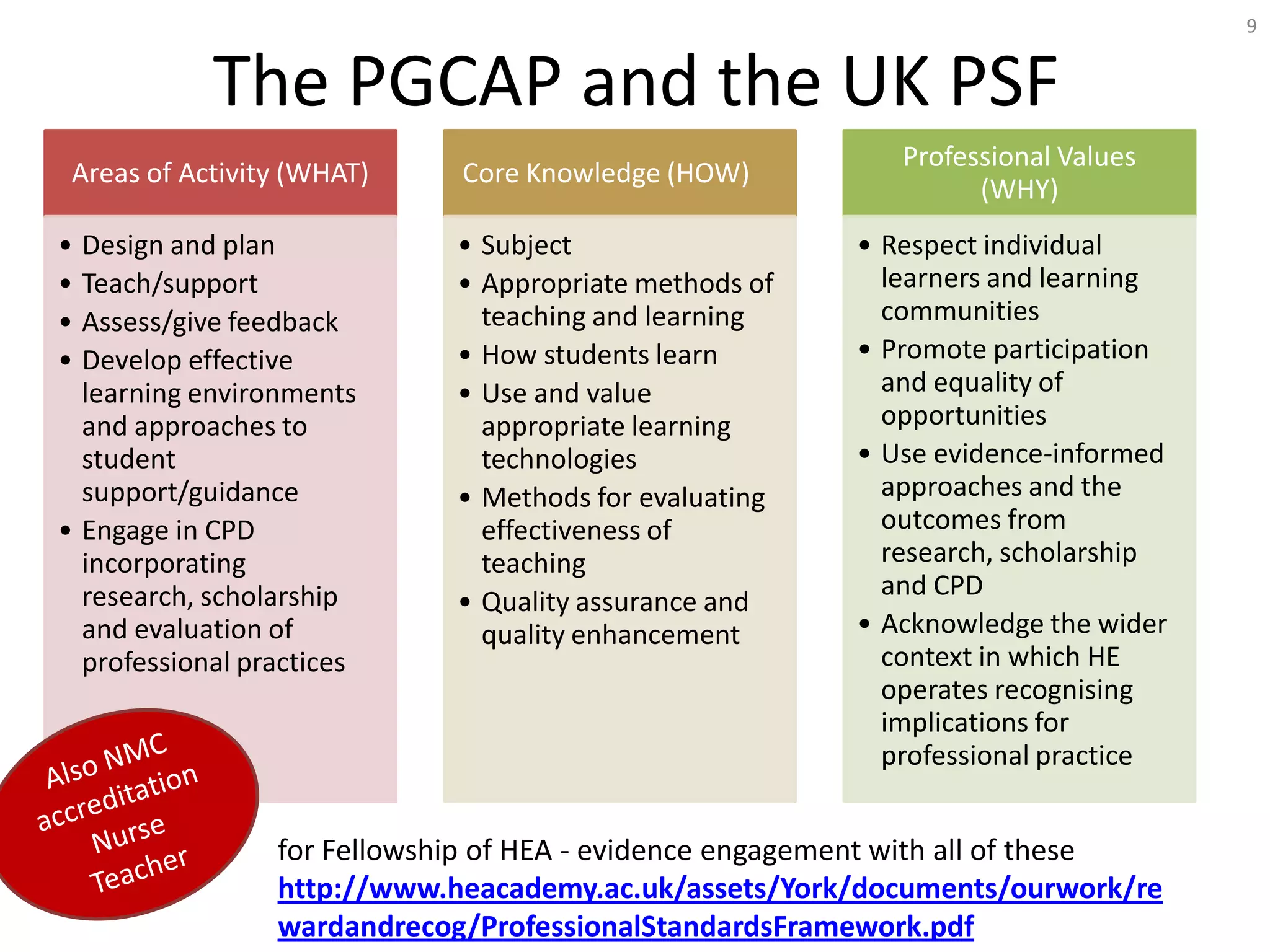
            The PGCAP and the UK PSF
                                                            Professional Values
 Areas of Activity (WHAT)    Core Knowledge (HOW)
                                                                  (WHY)
• Design and plan            • Subject                  • Respect individual
• Teach/support              • Appropriate methods of     learners and learning
• Assess/give feedback         teaching and learning      communities
• Develop effective          • How students learn       • Promote participation
  learning environments      • Use and value              and equality of
  and approaches to            appropriate learning       opportunities
  student                      technologies             • Use evidence-informed
  support/guidance           • Methods for evaluating     approaches and the
• Engage in CPD                effectiveness of           outcomes from
  incorporating                teaching                   research, scholarship
  research, scholarship                                   and CPD
                             • Quality assurance and
  and evaluation of            quality enhancement      • Acknowledge the wider
  professional practices                                  context in which HE
                                                          operates recognising
                                                          implications for
                                                          professional practice


                 for Fellowship of HEA - evidence engagement with all of these
                 http://www.heacademy.ac.uk/assets/York/documents/ourwork/re
                 wardandrecog/ProfessionalStandardsFramework.pdf
10


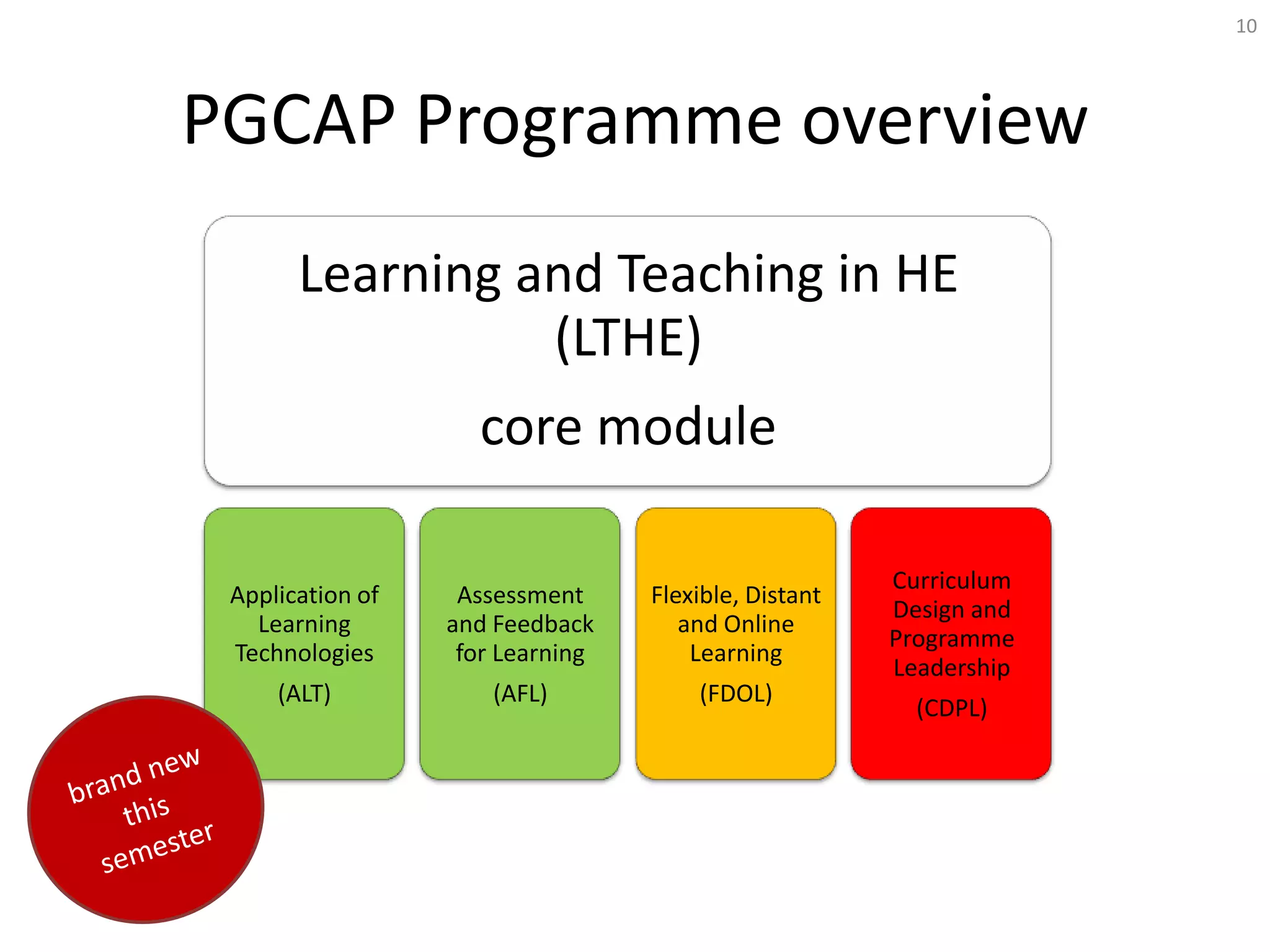
PGCAP Programme overview
       Learning and Teaching in HE
                 (LTHE)
                    core module

                                                      Curriculum
 Application of    Assessment     Flexible, Distant
                                                      Design and
   Learning       and Feedback       and Online
                                                      Programme
 Technologies      for Learning       Learning
                                                      Leadership
     (ALT)            (AFL)           (FDOL)
                                                        (CDPL)
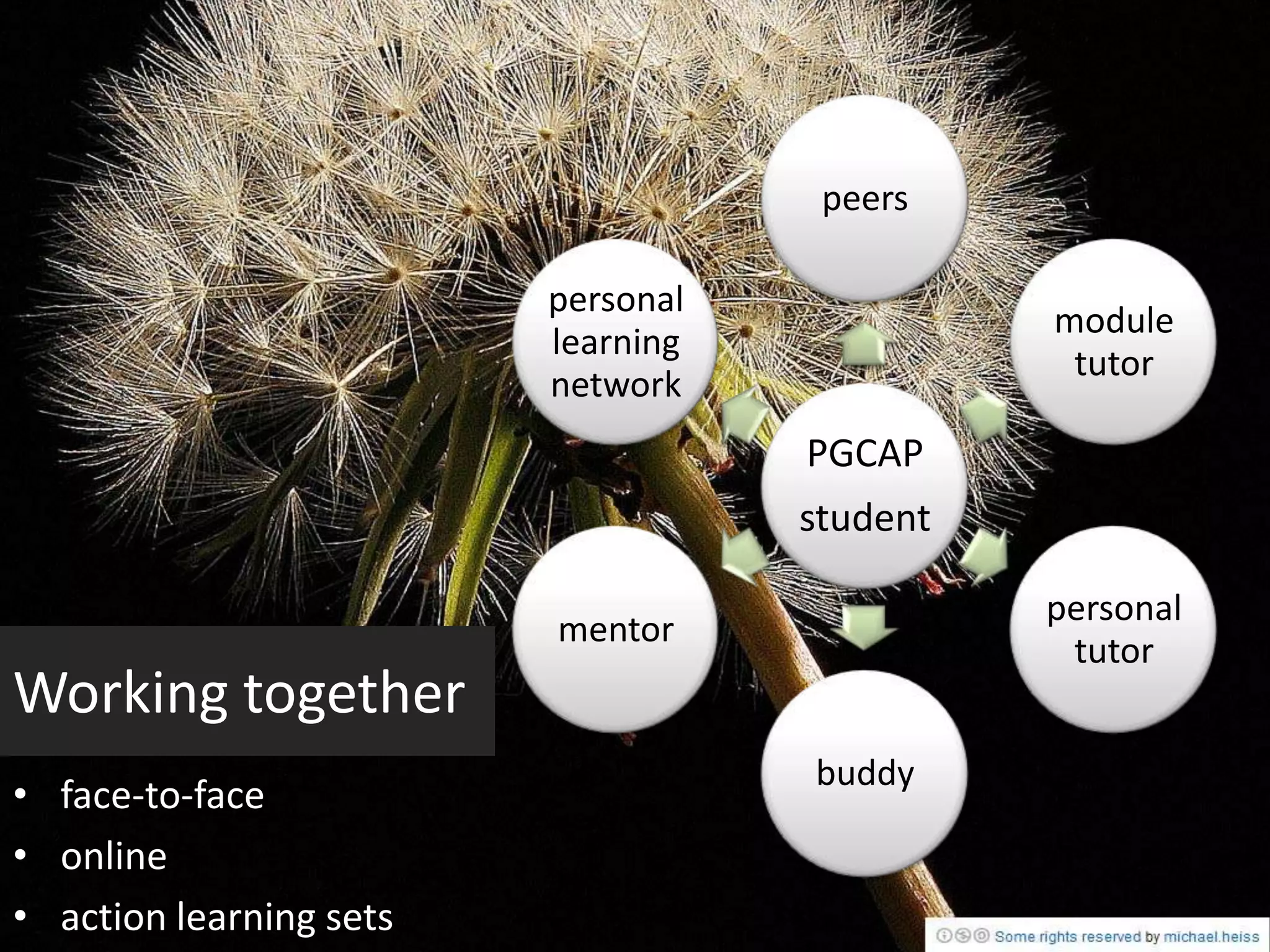
peers

                         personal
                                              module
                         learning
                                               tutor
                         network
                                    PGCAP
                                    student

                                              personal
                         mentor
                                               tutor
Working together
                                    buddy
• face-to-face
• online
• action learning sets
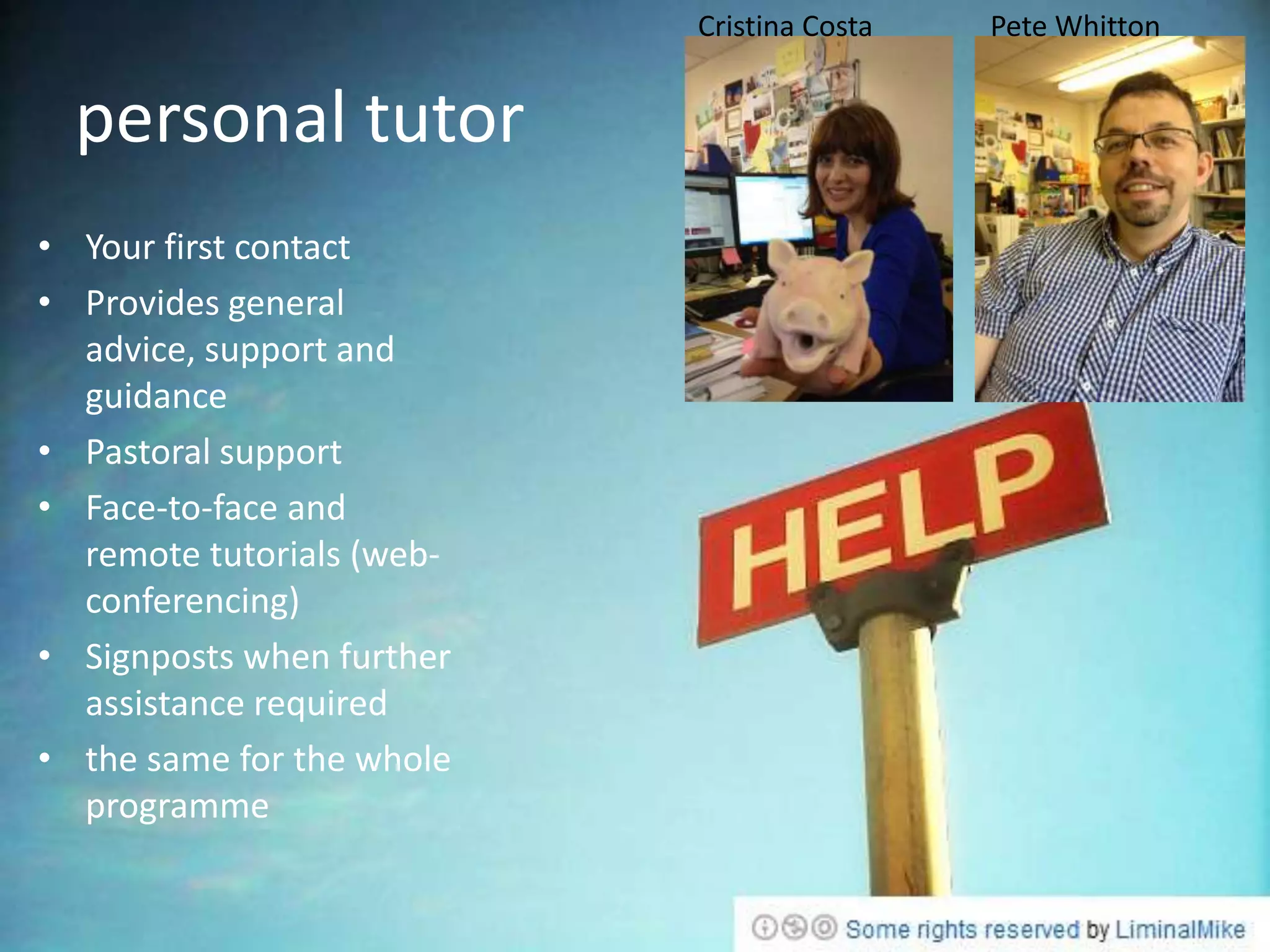
Cristina Costa   Pete Whitton


  personal tutor
• Your first contact
• Provides general
  advice, support and
  guidance
• Pastoral support
• Face-to-face and
  remote tutorials (web-
  conferencing)
• Signposts when further
  assistance required
• the same for the whole
  programme
13


          Online learning spaces
•   Course information
•   Module content: activities and resources
•   LaSU reading lists
•   Weekly discussions, helpline
•   Web-conferencing
•   e-portfolio
•   PGCAP news blog
•   Twitter
Learning and Assessment
                          14
15

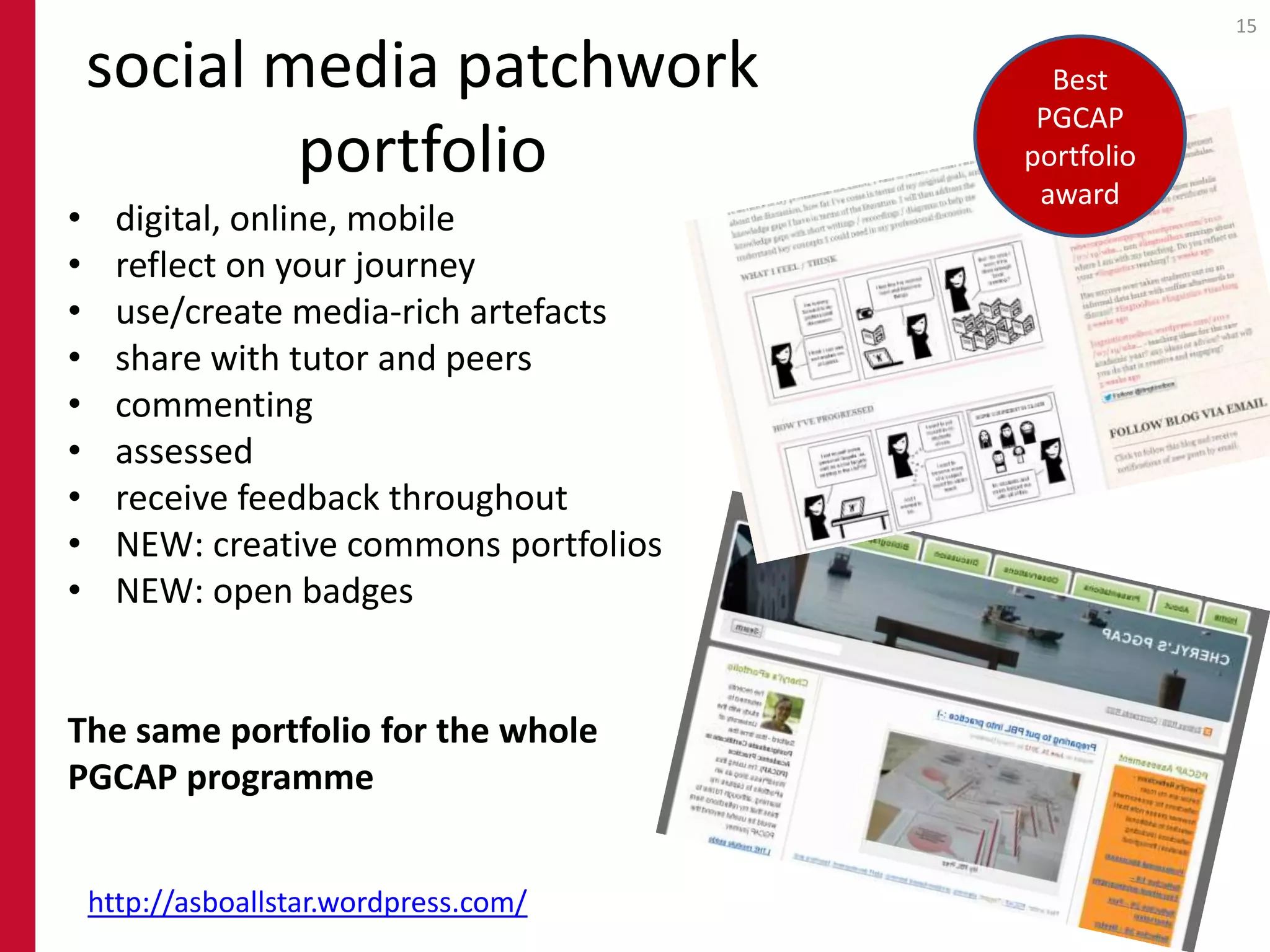
    social media patchwork                 Best
                                          PGCAP
            portfolio                    portfolio
                                          award
•     digital, online, mobile
•     reflect on your journey
•     use/create media-rich artefacts
•     share with tutor and peers
•     commenting
•     assessed
•     receive feedback throughout
•     NEW: creative commons portfolios
•     NEW: open badges


The same portfolio for the whole
PGCAP programme


    http://asboallstar.wordpress.com/
16


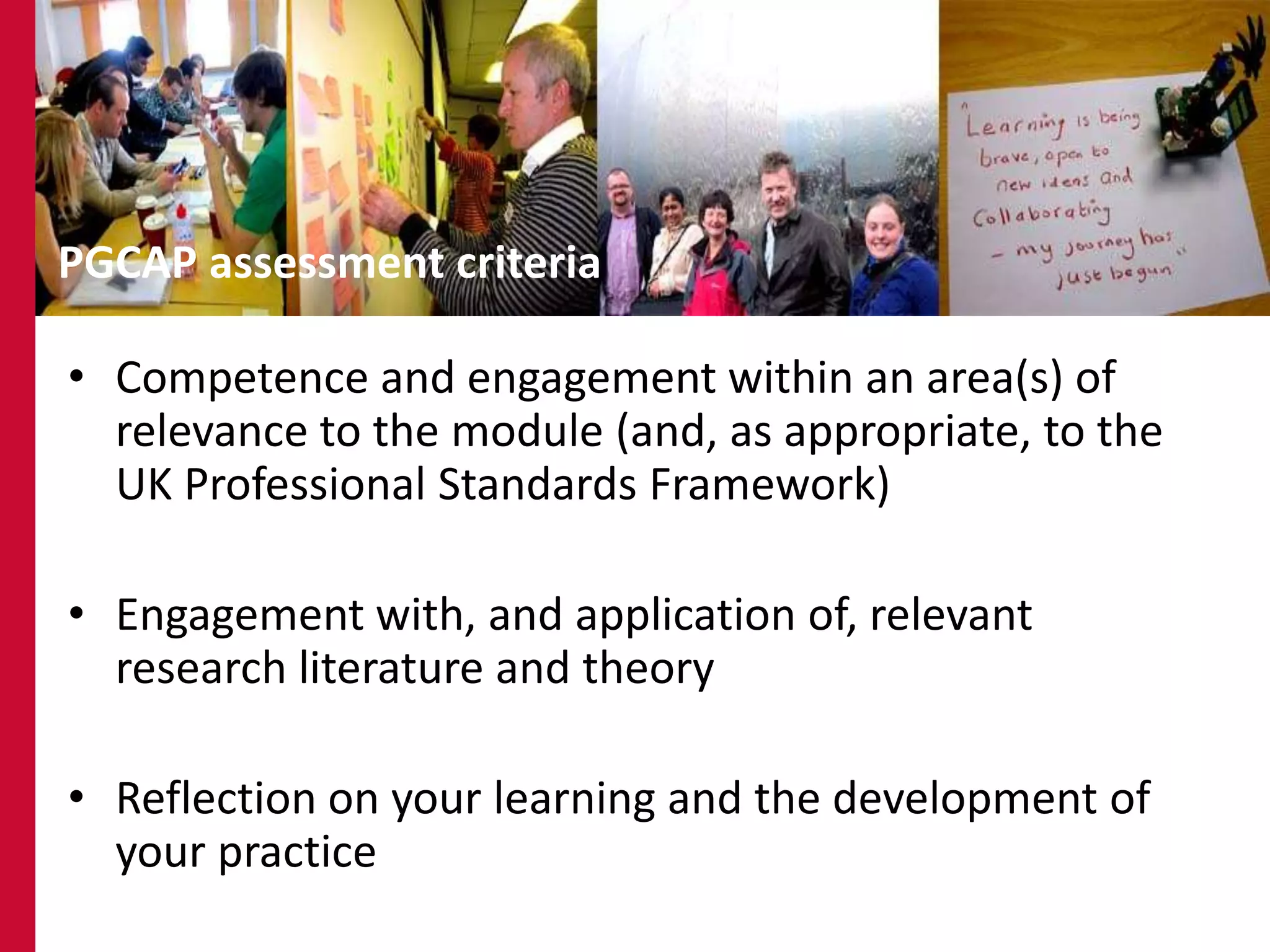
PGCAP assessment criteria

• Competence and engagement within an area(s) of
  relevance to the module (and, as appropriate, to the
  UK Professional Standards Framework)

• Engagement with, and application of, relevant
  research literature and theory

• Reflection on your learning and the development of
  your practice
17


PGCAP level of attainment descriptors

•   a passing (excellent) assignment
•   a passing (good) assignment
•   a passing assignment
•   a failing assignment
• ongoing opportunities to provide
               feedback, comment on any
               aspect of the module to
               tutor, programme leader

             • staff/student committee

             • opportunity to engage in
               research activities and provide
               input

Your voice   • Module Evaluation
               Questionnaire
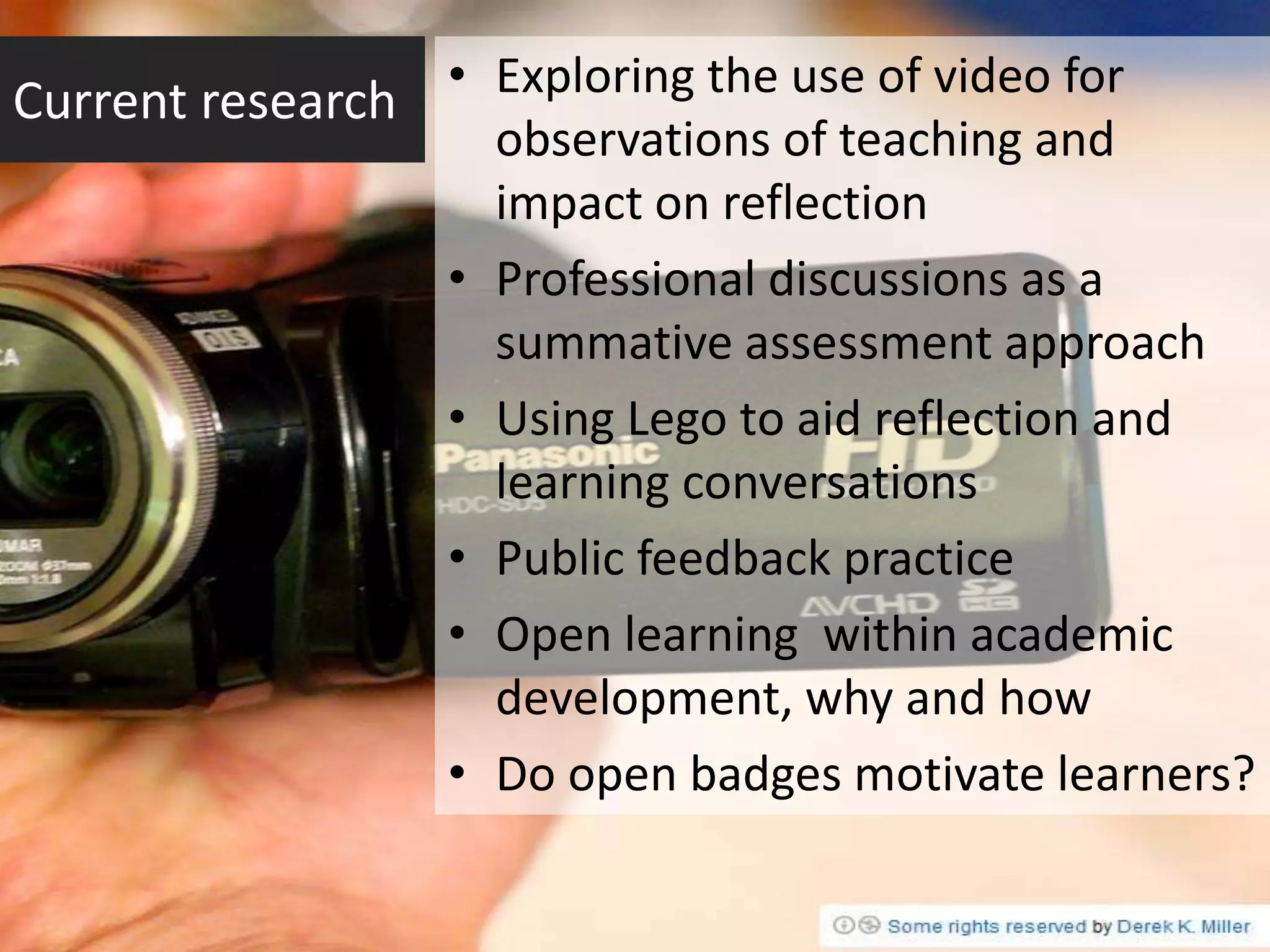
Current research • Exploring the use of video for
                       observations of teaching and
                       impact on reflection
                   •   Professional discussions as a
                       summative assessment approach
                   •   Using Lego to aid reflection and
                       learning conversations
                   •   Public feedback practice
                   •   Open learning within academic
                       development, why and how
                   •   Do open badges motivate learners?
20


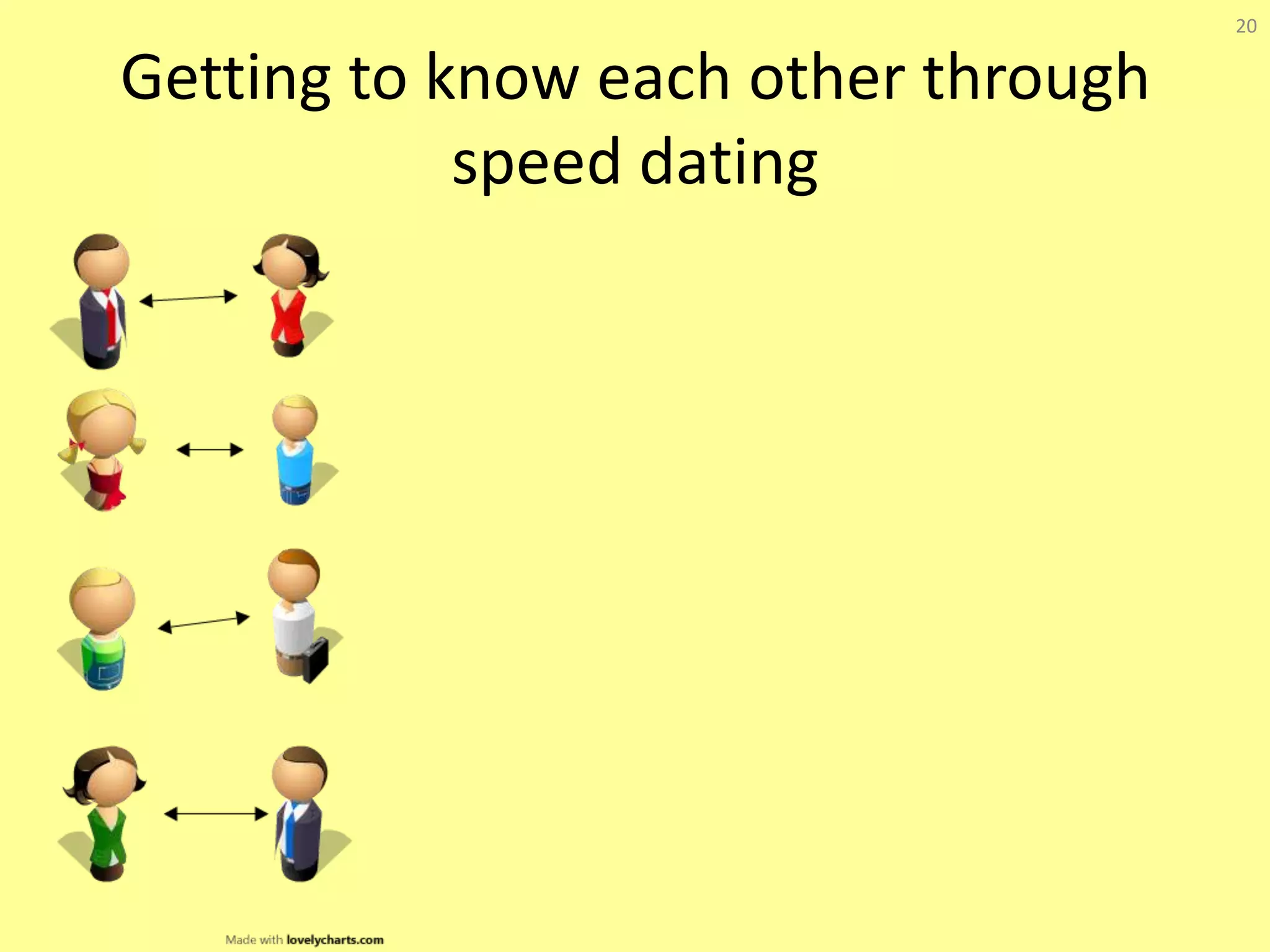
Getting to know each other through
            speed dating
22


Making is connecting

10 mins: In your action learning
sets, create a model that represents
effective teamwork for you using Lego.

Assess each other’s model
Who is the winning team?
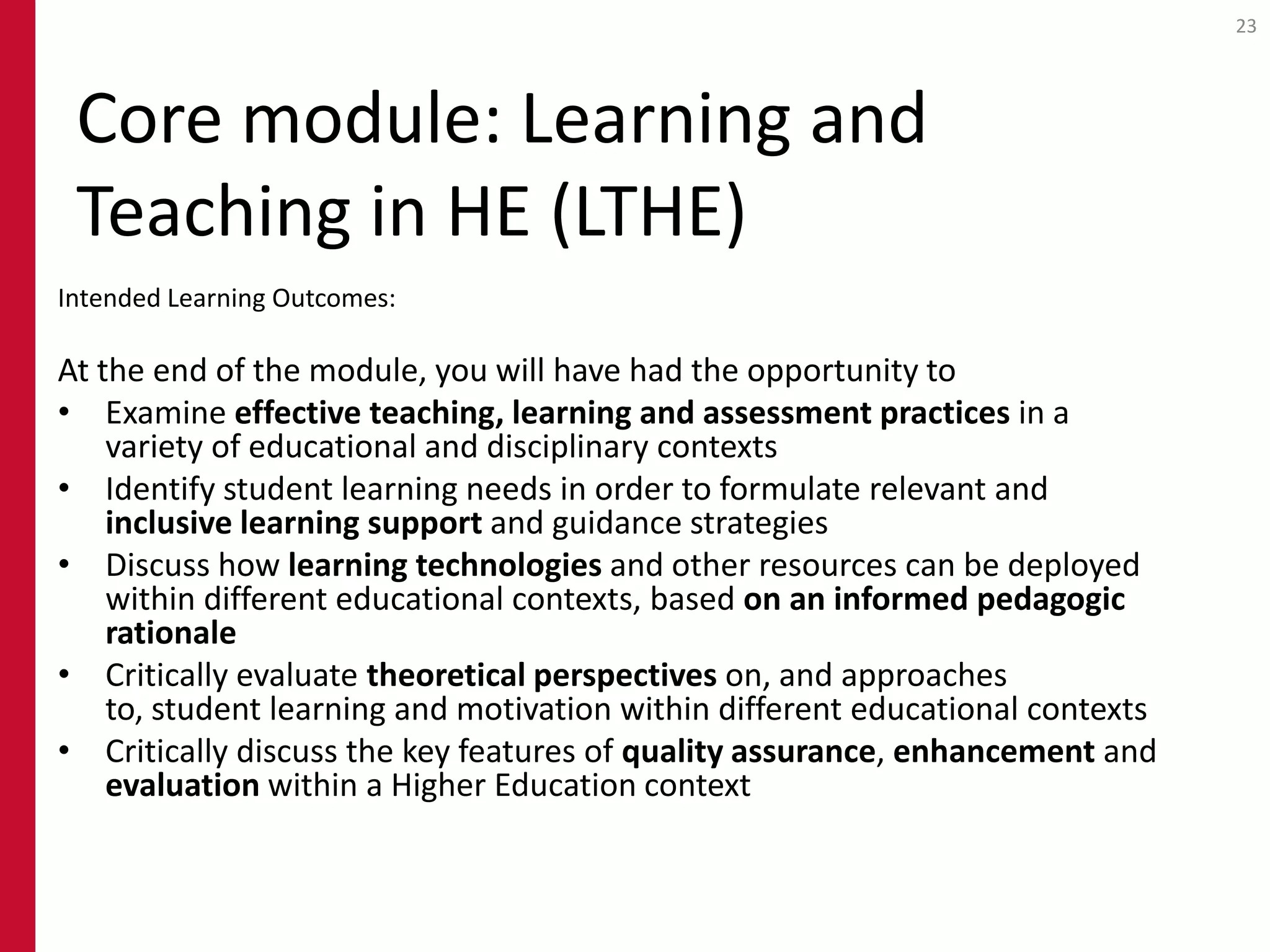
23


 Core module: Learning and
 Teaching in HE (LTHE)
Intended Learning Outcomes:

At the end of the module, you will have had the opportunity to
• Examine effective teaching, learning and assessment practices in a
    variety of educational and disciplinary contexts
• Identify student learning needs in order to formulate relevant and
    inclusive learning support and guidance strategies
• Discuss how learning technologies and other resources can be deployed
    within different educational contexts, based on an informed pedagogic
    rationale
• Critically evaluate theoretical perspectives on, and approaches
    to, student learning and motivation within different educational contexts
• Critically discuss the key features of quality assurance, enhancement and
    evaluation within a Higher Education context
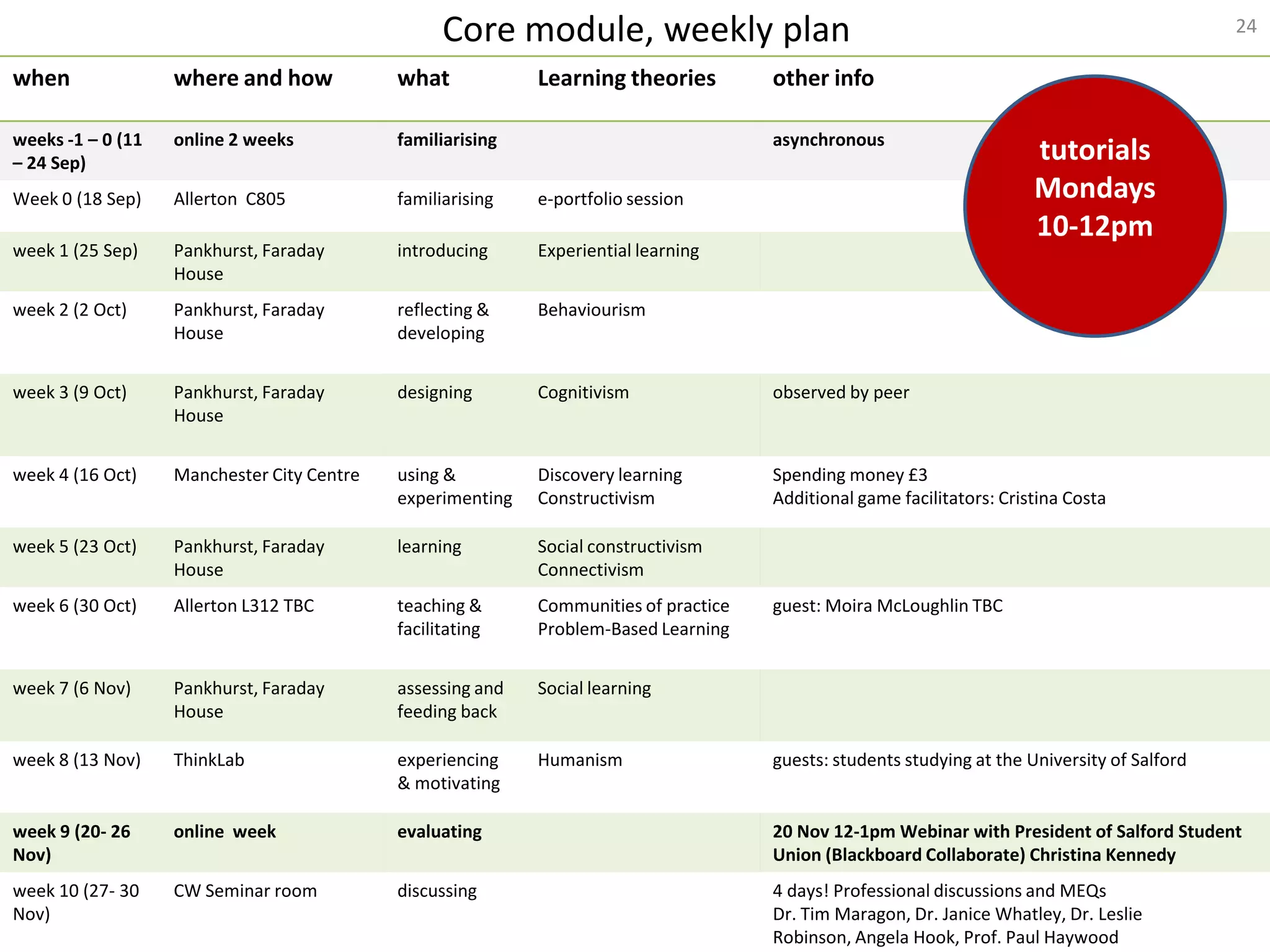
Core module, weekly plan                                                                     24

when               where and how            what            Learning theories         other info

weeks -1 – 0 (11   online 2 weeks           familiarising                             asynchronous
– 24 Sep)                                                                                                               tutorials
Week 0 (18 Sep)    Allerton C805            familiarising   e-portfolio session                                         Mondays
                                                                                                                        10-12pm
week 1 (25 Sep)    Pankhurst, Faraday       introducing     Experiential learning
                   House
week 2 (2 Oct)     Pankhurst, Faraday       reflecting &    Behaviourism
                   House                    developing


week 3 (9 Oct)     Pankhurst, Faraday       designing       Cognitivism               observed by peer
                   House


week 4 (16 Oct)    Manchester City Centre   using &         Discovery learning        Spending money £3
                                            experimenting   Constructivism            Additional game facilitators: Cristina Costa

week 5 (23 Oct)    Pankhurst, Faraday       learning        Social constructivism
                   House                                    Connectivism
week 6 (30 Oct)    Allerton L312 TBC        teaching &      Communities of practice   guest: Moira McLoughlin TBC
                                            facilitating    Problem-Based Learning


week 7 (6 Nov)     Pankhurst, Faraday       assessing and   Social learning
                   House                    feeding back

week 8 (13 Nov)    ThinkLab                 experiencing    Humanism                  guests: students studying at the University of Salford
                                            & motivating

week 9 (20- 26     online week              evaluating                                20 Nov 12-1pm Webinar with President of Salford Student
Nov)                                                                                  Union (Blackboard Collaborate) Christina Kennedy
week 10 (27- 30    CW Seminar room          discussing                                4 days! Professional discussions and MEQs
Nov)                                                                                  Dr. Tim Maragon, Dr. Janice Whatley, Dr. Leslie
                                                                                      Robinson, Angela Hook, Prof. Paul Haywood
25


     Assessment, e-portfolio-based
   1. Reflective journal (in-module assessment – 60%)
   Ongoing critical reflective commentary on teaching, observations
   to be completed on a regular basis
   (6 posts – point system: 10 points for each out of 60:
   add to title 1/6, 2/6 etc.)
   equivalent of 3000 words (if 6 posts ~500 words each)

   2. Professional discussion (end-of-module assessment – 40%)
   panel: PGCAP tutor and academic
   equivalent of 2000 words


Draft facility available until end of week 9!
26


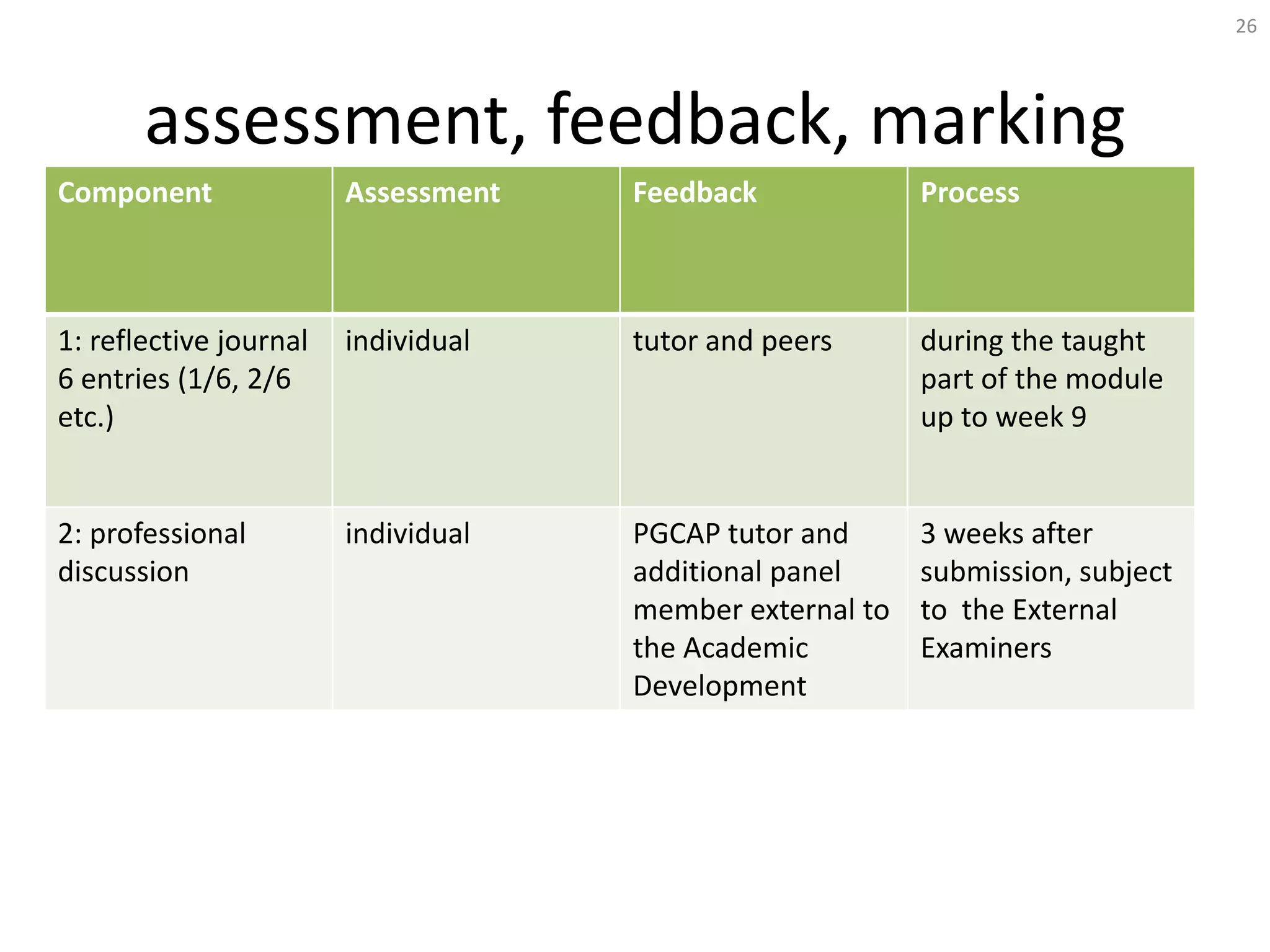
       assessment, feedback, marking
Component               Assessment   Feedback             Process


1: reflective journal   individual   tutor and peers      during the taught
6 entries (1/6, 2/6                                       part of the module
etc.)                                                     up to week 9


2: professional         individual   PGCAP tutor and      3 weeks after
discussion                           additional panel     submission, subject
                                     member external to   to the External
                                     the Academic         Examiners
                                     Development
27


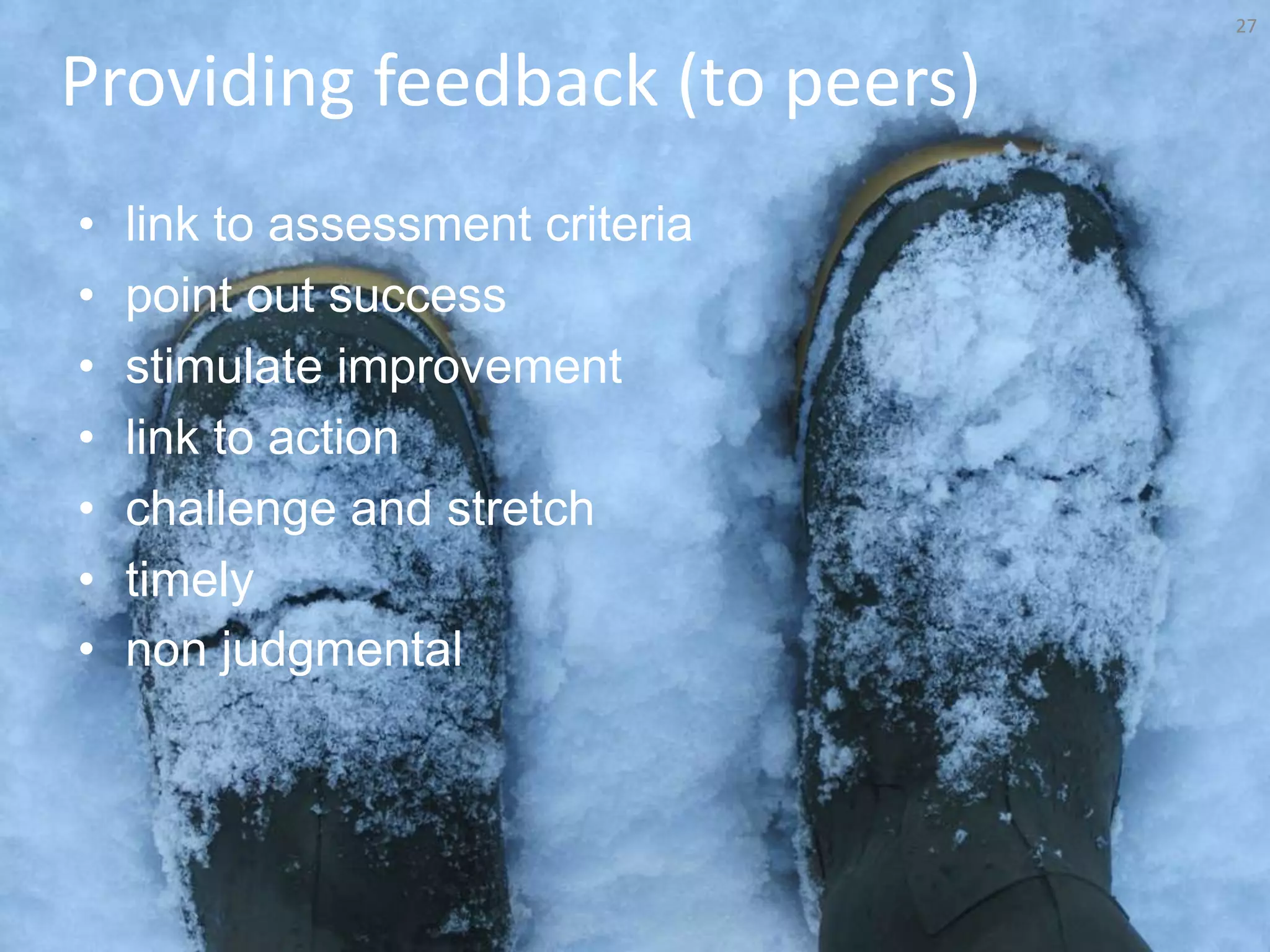
Providing feedback (to peers)
•   link to assessment criteria
•   point out success
•   stimulate improvement
•   link to action
•   challenge and stretch
•   timely
•   non judgmental
28


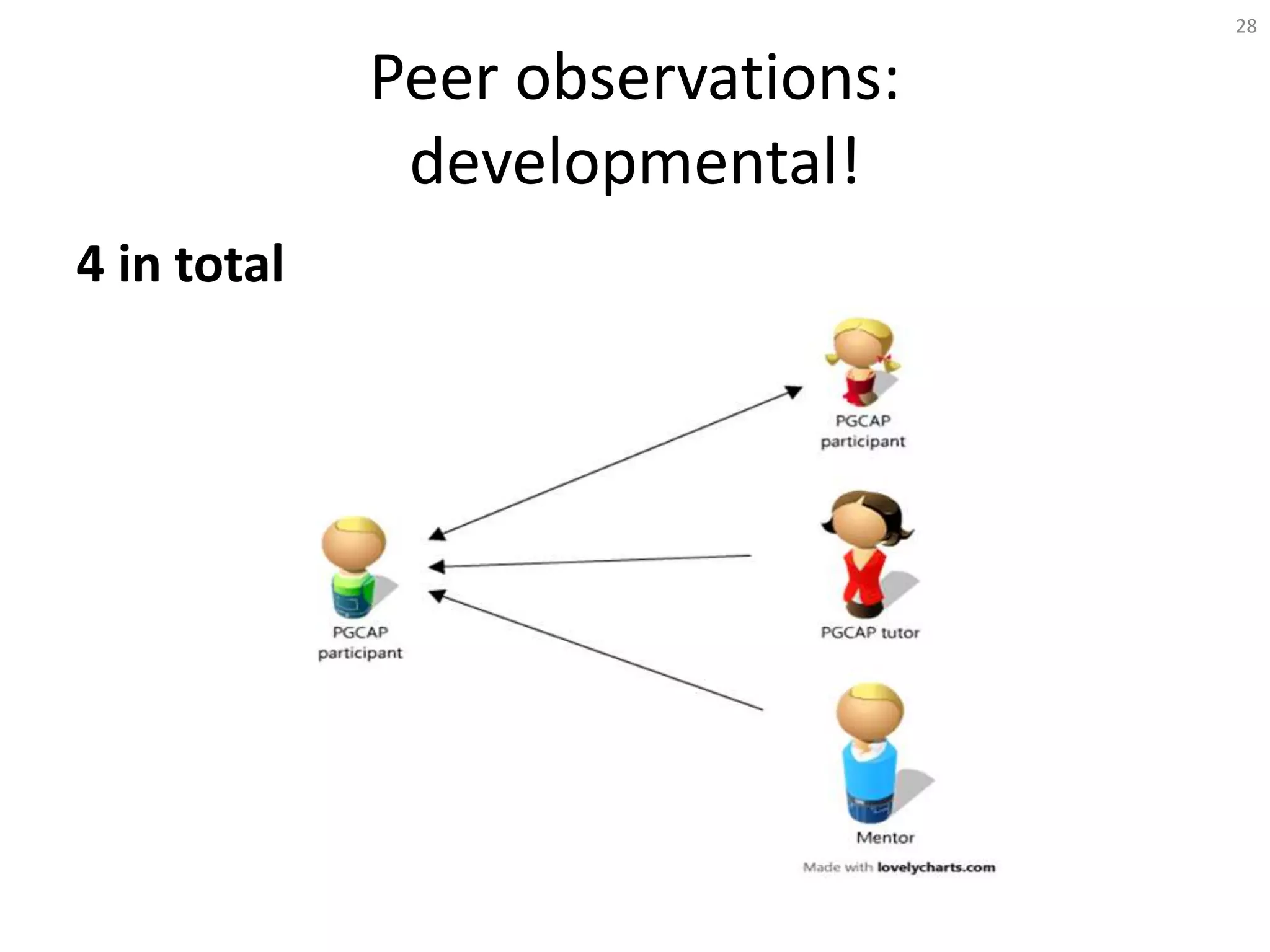
             Peer observations:
              developmental!
4 in total
30


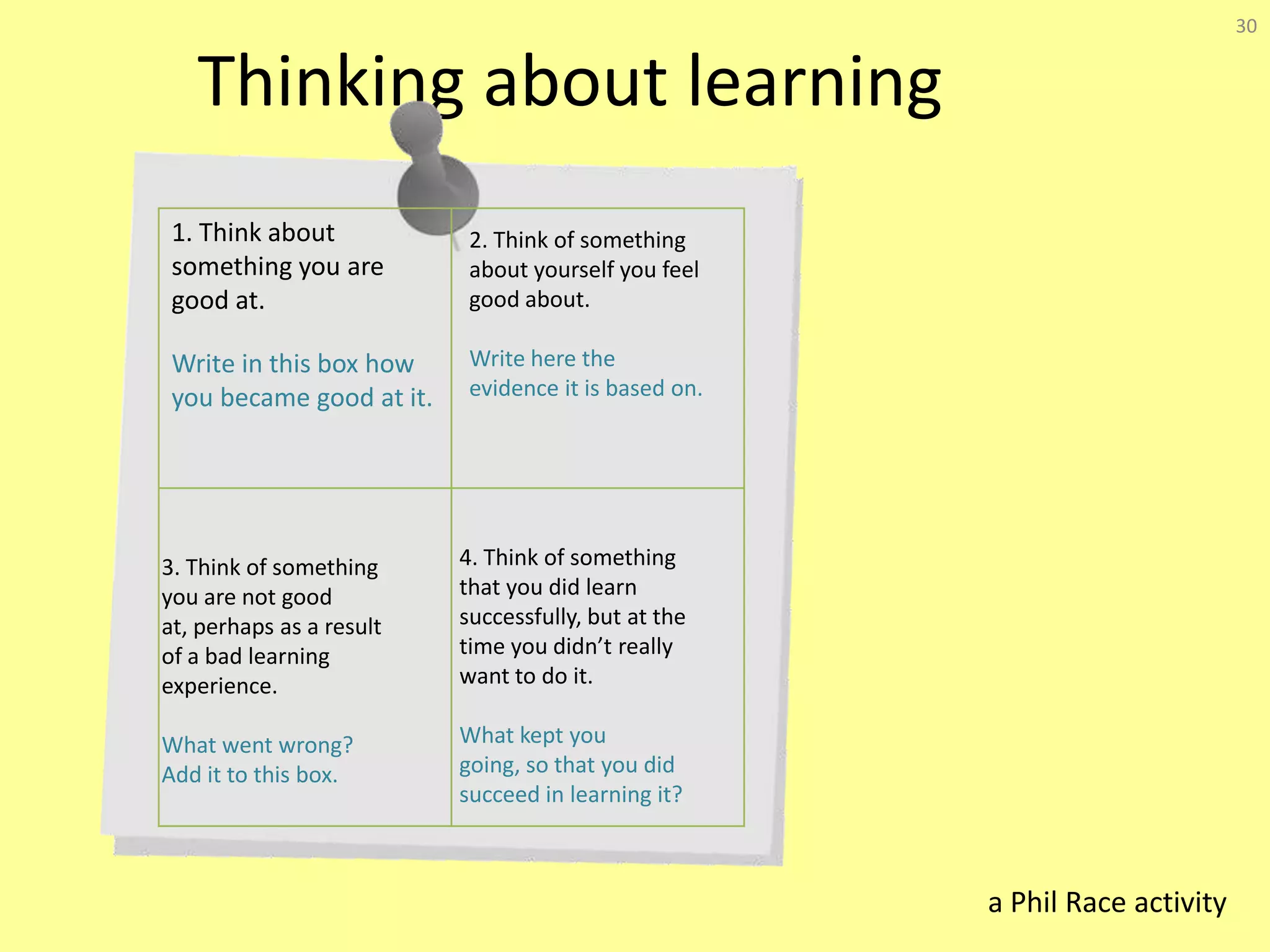
   Thinking about learning
 1. Think about            2. Think of something
 something you are         about yourself you feel
 good at.                  good about.

 Write in this box how     Write here the
 you became good at it.    evidence it is based on.


3. Think of something     4. Think of something
you are not good          that you did learn
at, perhaps as a result   successfully, but at the
of a bad learning         time you didn’t really
experience.               want to do it.

What went wrong?          What kept you
Add it to this box.       going, so that you did
                          succeed in learning it?


                                                      a Phil Race activity
31


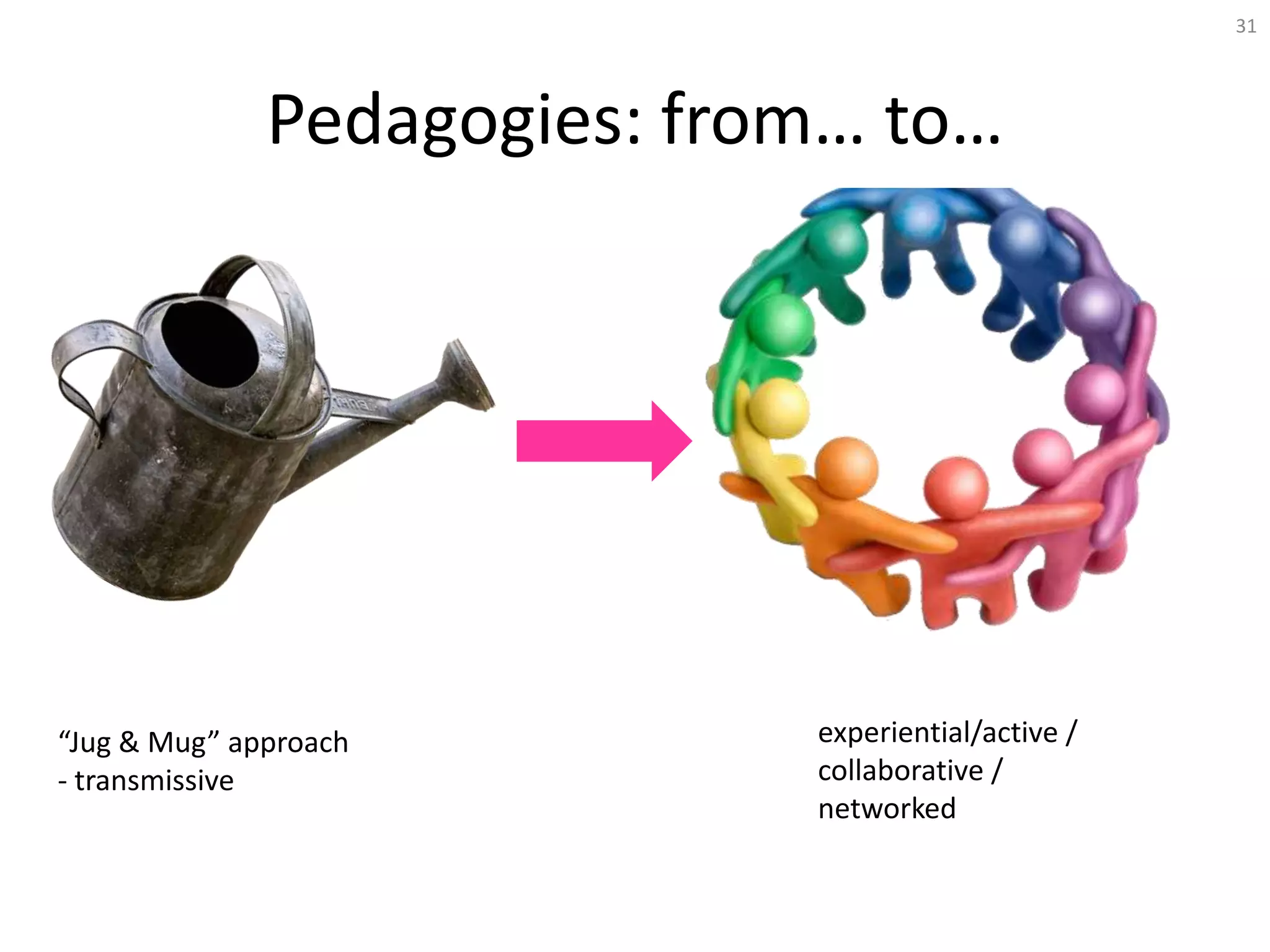
              Pedagogies: from… to…


“Jug & Mug” approach         experiential/active /
- transmissive               collaborative /
                             networked
32


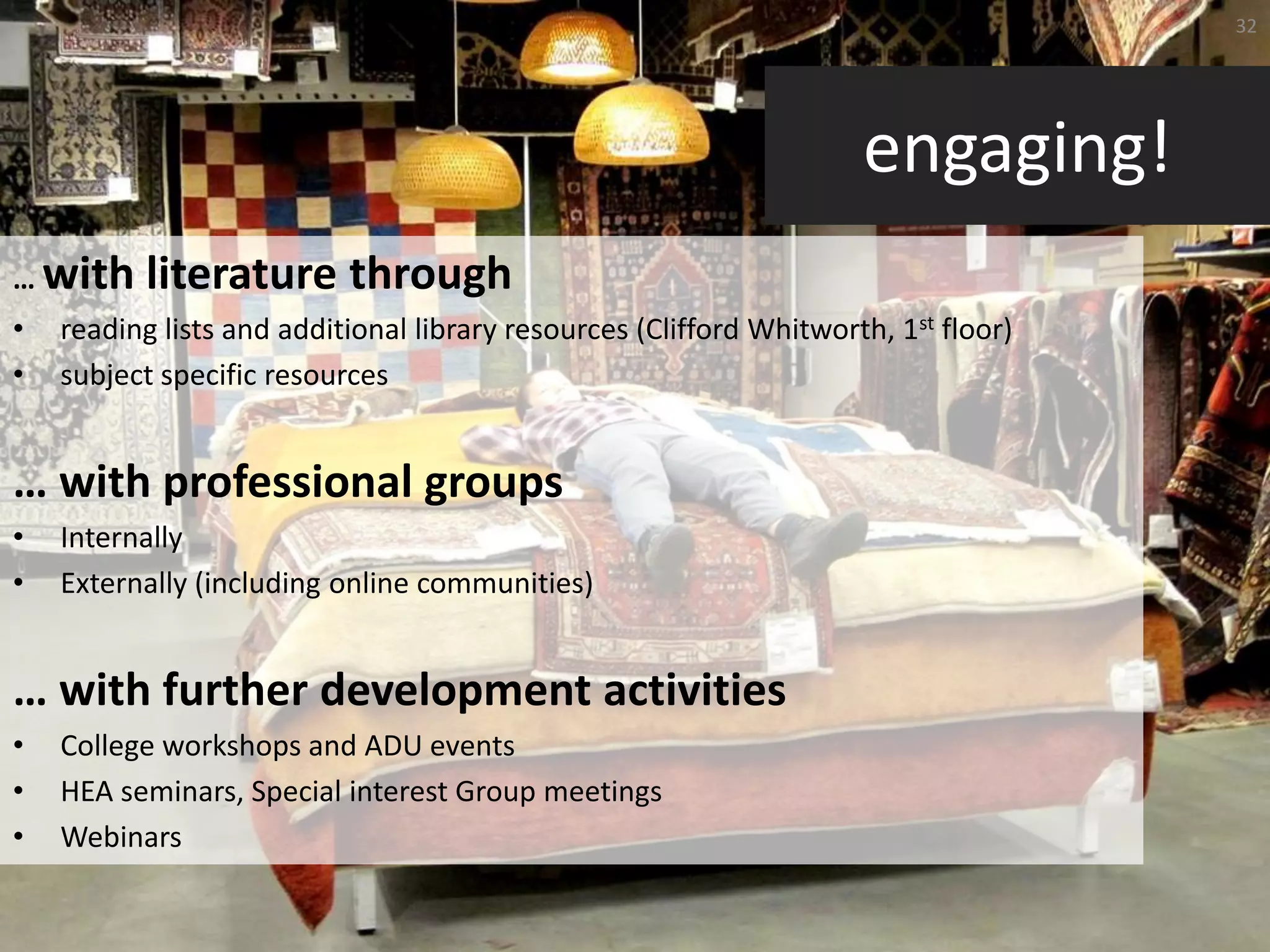
                                                                     engaging!
… with     literature through
•   reading lists and additional library resources (Clifford Whitworth, 1st floor)
•   subject specific resources


… with professional groups
•   Internally
•   Externally (including online communities)


… with further development activities
•   College workshops and ADU events
•   HEA seminars, Special interest Group meetings
•   Webinars
33
Intended learning outcomes
• Recognise value of being part of a learning
  community

• Discuss key features of the PGCAP, structure and
  requirements

• Introduction to the Learning and Teaching in
  Higher Education (LTHE or core) module

• please add your personalised learning outcome


http://www.flickr.com/photos/mikejonesphoto/2932001534/
36


Lunch time
 Eat ‘n’ meet your
tutor, the team and
   past/current
    participants
37


                                      References
•   Andresen, L (1995) Accredited Courses in Teaching and Learning, in: Brew, A (ed.) Directions in Staff
    Development, Buckingham: The Society for Research into Higher Education & Open University Press, pp.
    36-50.

•   Cousin, G (2010) Education Development for the 21st Century, SEDA Conference, Chester 2010, 17
    November, (p. 6)

•   Kember, D et. al (1999) Determining the level of reflective thinking from students’ written journals using a
    coding scheme based on the work of Mezirow, International Journal of Lifelong Education, Vol 18, No 1,
    pp. 18-30.

•   Moon, J (2004) A handbook of reflective and experiential learning, theory and practice, Oxon:
    RoutledgeFalmer.
38


Postgraduate Certificate in Academic Practice (PGCAP),
University of Salford (UK)

Module: Learning and Teaching in HE (LTHE)

Module tutor: Chrissi Nerantzi, Academic Developer
Personal tutors: Cristina Costa and Pete Whitton


Site: http://www.hr.salford.ac.uk/employee-development-
section/pgcap-

Twitter: @pgcap

PGCAP #lthesep12 week1 induction

  • 1.
  • 2.
    2 21st “The illiterate of the century will not be those who cannot read and write, it will be those who cannot learn, unlearn and relearn.” Alvin Toffler Future Shock, 1970 Postgraduate Certificate in Academic Practice (PGCAP) #LTHESep12: Induction event (25 Sep 12) The PGCAP Team Chrissi Nerantzi Twitter @chrissinerantzi @pgcap http://www.hr.salford.ac.uk/employee-development-section/pgcap- You will need to download a QR scanner app to your smart phone first
  • 3.
    3 Intended learning outcomes •Discuss key features of the PGCAP, structure and requirements • Introduction to the Learning and Teaching in Higher Education (LTHE or core) module • Recognise value of being part of a learning community please add your personalised learning outcomes
  • 4.
    AGENDA Welcome The PGCAP programme and the Salford context Online programme space and e-portfolios Getting to know each other LTHE module (core) Learning, Reflecting, Observin g Eat ‘n’ meet
  • 5.
    5 Welcome Christina Kennedy President of the University of Salford Students' Union for 2012/2013 Dr. Brian Murphy Head of Academic Development (HRD)
  • 6.
    Learning and TeachingStrategy and Themes for future development Accessible higher education Student focused Pedagogically excellent Internationally orientated Research informed Employability and enterprise led 6
  • 7.
    Pedagogically excellent • Developmentof active learning in partnership with the learners to develop an educative community. • High quality teaching and supervision provided by staff on all modules and programmes. • High quality and timely feedback provided to all students in all elements of their assessment. • Opportunity for detailed evaluation and meaningful reflection on the quality of modules and programmes with time and resources provided for appropriate enhancement activity. • Development and support for innovative and inclusive approaches to education and assessment which help staff and students to develop and learn more effectively. • Clarity in what is expected of staff. • Greater proportion of staff with PGCAP and Fellowship of HEA video http://www.adu.salford.ac.uk/html/aspire/p.html
  • 8.
    The PGCAP • an exciting opportunity to learn and develop with colleagues from different disciplines and professional areas • to be open, creative, and experiment in a safe environment and within a learning community • to discuss, debate and challenge anything linked to teaching and learning including theories • to engage in a conversation about teaching and learning at the University of Salford • to become a professional teacher in HE • gain a recognised Teaching Qualification in HE • a programme accredited by the HEA and NMC
  • 9.
    9 The PGCAP and the UK PSF Professional Values Areas of Activity (WHAT) Core Knowledge (HOW) (WHY) • Design and plan • Subject • Respect individual • Teach/support • Appropriate methods of learners and learning • Assess/give feedback teaching and learning communities • Develop effective • How students learn • Promote participation learning environments • Use and value and equality of and approaches to appropriate learning opportunities student technologies • Use evidence-informed support/guidance • Methods for evaluating approaches and the • Engage in CPD effectiveness of outcomes from incorporating teaching research, scholarship research, scholarship and CPD • Quality assurance and and evaluation of quality enhancement • Acknowledge the wider professional practices context in which HE operates recognising implications for professional practice for Fellowship of HEA - evidence engagement with all of these http://www.heacademy.ac.uk/assets/York/documents/ourwork/re wardandrecog/ProfessionalStandardsFramework.pdf
  • 10.
    10 PGCAP Programme overview Learning and Teaching in HE (LTHE) core module Curriculum Application of Assessment Flexible, Distant Design and Learning and Feedback and Online Programme Technologies for Learning Learning Leadership (ALT) (AFL) (FDOL) (CDPL)
  • 11.
    peers personal module learning tutor network PGCAP student personal mentor tutor Working together buddy • face-to-face • online • action learning sets
  • 12.
    Cristina Costa Pete Whitton personal tutor • Your first contact • Provides general advice, support and guidance • Pastoral support • Face-to-face and remote tutorials (web- conferencing) • Signposts when further assistance required • the same for the whole programme
  • 13.
    13 Online learning spaces • Course information • Module content: activities and resources • LaSU reading lists • Weekly discussions, helpline • Web-conferencing • e-portfolio • PGCAP news blog • Twitter
  • 14.
  • 15.
    15 social media patchwork Best PGCAP portfolio portfolio award • digital, online, mobile • reflect on your journey • use/create media-rich artefacts • share with tutor and peers • commenting • assessed • receive feedback throughout • NEW: creative commons portfolios • NEW: open badges The same portfolio for the whole PGCAP programme http://asboallstar.wordpress.com/
  • 16.
    16 PGCAP assessment criteria •Competence and engagement within an area(s) of relevance to the module (and, as appropriate, to the UK Professional Standards Framework) • Engagement with, and application of, relevant research literature and theory • Reflection on your learning and the development of your practice
  • 17.
    17 PGCAP level ofattainment descriptors • a passing (excellent) assignment • a passing (good) assignment • a passing assignment • a failing assignment
  • 18.
    • ongoing opportunitiesto provide feedback, comment on any aspect of the module to tutor, programme leader • staff/student committee • opportunity to engage in research activities and provide input Your voice • Module Evaluation Questionnaire
  • 19.
    Current research •Exploring the use of video for observations of teaching and impact on reflection • Professional discussions as a summative assessment approach • Using Lego to aid reflection and learning conversations • Public feedback practice • Open learning within academic development, why and how • Do open badges motivate learners?
  • 20.
    20 Getting to knoweach other through speed dating
  • 21.
    22 Making is connecting 10mins: In your action learning sets, create a model that represents effective teamwork for you using Lego. Assess each other’s model Who is the winning team?
  • 22.
    23 Core module:Learning and Teaching in HE (LTHE) Intended Learning Outcomes: At the end of the module, you will have had the opportunity to • Examine effective teaching, learning and assessment practices in a variety of educational and disciplinary contexts • Identify student learning needs in order to formulate relevant and inclusive learning support and guidance strategies • Discuss how learning technologies and other resources can be deployed within different educational contexts, based on an informed pedagogic rationale • Critically evaluate theoretical perspectives on, and approaches to, student learning and motivation within different educational contexts • Critically discuss the key features of quality assurance, enhancement and evaluation within a Higher Education context
  • 23.
    Core module, weeklyplan 24 when where and how what Learning theories other info weeks -1 – 0 (11 online 2 weeks familiarising asynchronous – 24 Sep) tutorials Week 0 (18 Sep) Allerton C805 familiarising e-portfolio session Mondays 10-12pm week 1 (25 Sep) Pankhurst, Faraday introducing Experiential learning House week 2 (2 Oct) Pankhurst, Faraday reflecting & Behaviourism House developing week 3 (9 Oct) Pankhurst, Faraday designing Cognitivism observed by peer House week 4 (16 Oct) Manchester City Centre using & Discovery learning Spending money £3 experimenting Constructivism Additional game facilitators: Cristina Costa week 5 (23 Oct) Pankhurst, Faraday learning Social constructivism House Connectivism week 6 (30 Oct) Allerton L312 TBC teaching & Communities of practice guest: Moira McLoughlin TBC facilitating Problem-Based Learning week 7 (6 Nov) Pankhurst, Faraday assessing and Social learning House feeding back week 8 (13 Nov) ThinkLab experiencing Humanism guests: students studying at the University of Salford & motivating week 9 (20- 26 online week evaluating 20 Nov 12-1pm Webinar with President of Salford Student Nov) Union (Blackboard Collaborate) Christina Kennedy week 10 (27- 30 CW Seminar room discussing 4 days! Professional discussions and MEQs Nov) Dr. Tim Maragon, Dr. Janice Whatley, Dr. Leslie Robinson, Angela Hook, Prof. Paul Haywood
  • 24.
    25 Assessment, e-portfolio-based 1. Reflective journal (in-module assessment – 60%) Ongoing critical reflective commentary on teaching, observations to be completed on a regular basis (6 posts – point system: 10 points for each out of 60: add to title 1/6, 2/6 etc.) equivalent of 3000 words (if 6 posts ~500 words each) 2. Professional discussion (end-of-module assessment – 40%) panel: PGCAP tutor and academic equivalent of 2000 words Draft facility available until end of week 9!
  • 25.
    26 assessment, feedback, marking Component Assessment Feedback Process 1: reflective journal individual tutor and peers during the taught 6 entries (1/6, 2/6 part of the module etc.) up to week 9 2: professional individual PGCAP tutor and 3 weeks after discussion additional panel submission, subject member external to to the External the Academic Examiners Development
  • 26.
    27 Providing feedback (topeers) • link to assessment criteria • point out success • stimulate improvement • link to action • challenge and stretch • timely • non judgmental
  • 27.
    28 Peer observations: developmental! 4 in total
  • 28.
    30 Thinking about learning 1. Think about 2. Think of something something you are about yourself you feel good at. good about. Write in this box how Write here the you became good at it. evidence it is based on. 3. Think of something 4. Think of something you are not good that you did learn at, perhaps as a result successfully, but at the of a bad learning time you didn’t really experience. want to do it. What went wrong? What kept you Add it to this box. going, so that you did succeed in learning it? a Phil Race activity
  • 29.
    31 Pedagogies: from… to… “Jug & Mug” approach experiential/active / - transmissive collaborative / networked
  • 30.
    32 engaging! … with literature through • reading lists and additional library resources (Clifford Whitworth, 1st floor) • subject specific resources … with professional groups • Internally • Externally (including online communities) … with further development activities • College workshops and ADU events • HEA seminars, Special interest Group meetings • Webinars
  • 31.
  • 32.
    Intended learning outcomes •Recognise value of being part of a learning community • Discuss key features of the PGCAP, structure and requirements • Introduction to the Learning and Teaching in Higher Education (LTHE or core) module • please add your personalised learning outcome http://www.flickr.com/photos/mikejonesphoto/2932001534/
  • 33.
    36 Lunch time Eat‘n’ meet your tutor, the team and past/current participants
  • 34.
    37 References • Andresen, L (1995) Accredited Courses in Teaching and Learning, in: Brew, A (ed.) Directions in Staff Development, Buckingham: The Society for Research into Higher Education & Open University Press, pp. 36-50. • Cousin, G (2010) Education Development for the 21st Century, SEDA Conference, Chester 2010, 17 November, (p. 6) • Kember, D et. al (1999) Determining the level of reflective thinking from students’ written journals using a coding scheme based on the work of Mezirow, International Journal of Lifelong Education, Vol 18, No 1, pp. 18-30. • Moon, J (2004) A handbook of reflective and experiential learning, theory and practice, Oxon: RoutledgeFalmer.
  • 35.
    38 Postgraduate Certificate inAcademic Practice (PGCAP), University of Salford (UK) Module: Learning and Teaching in HE (LTHE) Module tutor: Chrissi Nerantzi, Academic Developer Personal tutors: Cristina Costa and Pete Whitton Site: http://www.hr.salford.ac.uk/employee-development- section/pgcap- Twitter: @pgcap

Editor's Notes

  • #3 QR: http://goqr.me/CN – to introduce myselfFlipchartMarkersSticky notesyellow tapenumbers on name tagsmy name tagmy toolkitbuilding blocksUK PSF print out for everybody, include in folders
  • #4 CN
  • #8 Teaching qualifications? More academics at Salford to gain teaching qualifications in HE through our PGCAP or the individual route to gain Fellowship of the Higher Education Academy? Could the UK Professional Standards Framework be mentioned here?
  • #10 NC
  • #11 core taughtoptional modules self-study with personal tutor support all optional modules together launch day bringing everybody together – groups, tutors
  • #14 NCLogin and demo the Bb spaceMention pre-induction tasks & twitter
  • #15 Use book assessment and feedback, read the extract in green book
  • #16 NC / CN
  • #17 NC
  • #18 CN
  • #21 walk around the room, constantly walking and starting to chat with other people who are going in the same direction. clockwise and anti-clockwise walking5 minwe will join this walk
  • #24 design and plan learning activities appropriate for your subject apply effective teaching, learning, assessment/feedback and support strategies including technology enhanced approaches in your practice discuss learning theories linked to your own subjectdiscuss key features of quality assurance, enhancement and evaluation within the HE context and implications for professional practicedevelop reflective skills and engage in educational research
  • #25 CN
  • #26 CN
  • #27 CN
  • #28 Ask everybody to contribute to this. Then reveal
  • #29 NC
  • #30 CN
  • #31 Do on 4 sticky notes and then create on a wall the cross and see what other people have written (collect the data)NC
  • #32 Pedagogies (add literature maybe change images)Transmission -> experiential learning, social constructivism, networked learning, connectivism
  • #33 NC
  • #35 CN