CLASSIFICATION OF
PELVIC FRACTURES
Dept of Urology
Govt Royapettah Hospital and Kilpauk Medical
College
Chennai 1
Moderators:
Professors:
 Prof. Dr. G. Sivasankar, M.S., M.Ch.,
 Prof. Dr. A. Senthilvel, M.S., M.Ch.,
Asst Professors:
 Dr. J. Sivabalan, M.S., M.Ch.,
 Dr. R. Bhargavi, M.S., M.Ch.,
 Dr. S. Raju, M.S., M.Ch.,
 Dr. K. Muthurathinam, M.S., M.Ch.,
 Dr. D. Tamilselvan, M.S., M.Ch.,
 Dr. K. Senthilkumar, M.S., M.Ch.
Dept Of Urology, KMC and GRH,
Chennai 2
PELVIC FRACTURES
 Fractures of the pelvis account for less than
5% of all skeletal injuries, but it is important
because it associated with:-
1. Soft tissue injuries and blood loss.
2. Shock.
3. Sepsis.
4. ARDS.
 Because of those mortality rate exceeds
10%.
Dept Of Urology, KMC and GRH,
Chennai 3
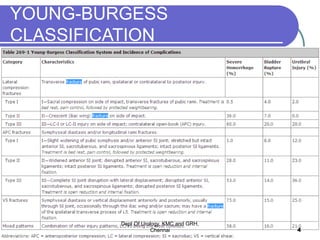
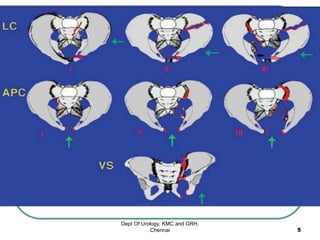
YOUNG-BURGESS
CLASSIFICATION
Dept Of Urology, KMC and GRH,
Chennai 4
Dept Of Urology, KMC and GRH,
Chennai 5
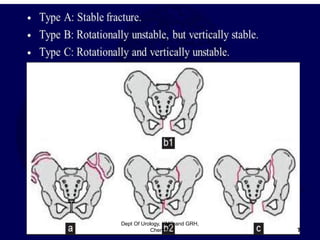
TILES CLASSIFICATION
Dept Of Urology, KMC and GRH,
Chennai 6
Dept Of Urology, KMC and GRH,
Chennai 7
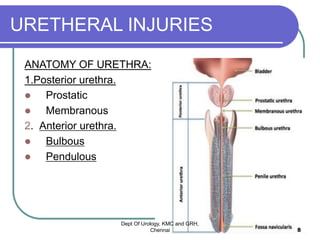
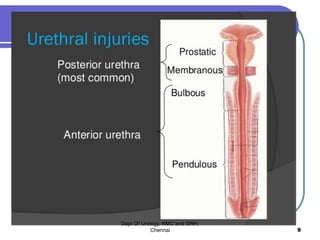
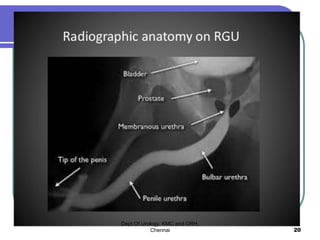
ANATOMY OF URETHRA:
1.Posterior urethra.
 Prostatic
 Membranous
2. Anterior urethra.
 Bulbous
 Pendulous
URETHERAL INJURIES
Dept Of Urology, KMC and GRH,
Chennai 8
Dept Of Urology, KMC and GRH,
Chennai 9
Posterior urethral injuries.
 Posterior urethra injured in 1.6-9.9% of
pelvic fracture.
 Complete: 73%
 Partial: 27%
Dept Of Urology, KMC and GRH,
Chennai 10
CLASSIFICATION
Radiological classification:
 Colapinto and McCallum classified posterior urethral injuries into
three categories based on radiological findings from retrograde
urethrography:
 Type 1: the membranous urethra is stretched but not severed.
 Type 2: the membranous urethra is ruptured above the urogenital
diaphragm, the contrast material extravasates into the pelvic
extraperitoneal space above the urogenital diaphragm.
 Type 3: the membranous urethra is ruptured and the injury
extends into the bulbous urethra due to a tear in the urogenital
diaphragm. Contrast material leaks above and below the
urogenital diaphragm
Dept Of Urology, KMC and GRH,
Chennai 11
Extended anatomical classification
Goldman et al. [3] proposed a classification of urethral injuries based on the anatomical
description of traumatic urethral injuries:
(I)
Posterior urethra is stretched but still intact (Colapinto-McCallum type 1).
(II)
Partial or complete pure posterior urethral injury with tear of the membranous urethra while
the urogenital diaphragm is intact.
Contrast medium extravasates only above the urogenital diaphragm (Colapinto-McCallum
type 2).
(III)
Partial or complete anterior and posterior urethral injury with disruption of the urogenital
diaphragm;
contrast agent leaks above and below the urogenital diaphragm (Colapinto-McCallum type
3).
(IV)
Bladder neck injury extending into the urethra. The extravasation of contrast medium is
around the bladder neck.
(V)
Bladder base injury with periurethral extravasation similar to posterior urethral injury.
(VI)
Partial or complete isolated anterior urethral injury.
Dept Of Urology, KMC and GRH,
Chennai 12
American association of surgery of trauma (AAST) classification:
1.Contusion: blood at urethral meatus and retrograde urethrography is
normal.
2.Stretch injury: elongation of the urethra with no extravasation on
urethrography.
3.Partial disruption: extravasation of urethrography contrast medium at
the injury site, with visualization in the bladder.
4.Complete disruption: extravasation of urethrography contrast medium at
the injury site with no visualization in the bladder; <2 cm of urethra
separation.
5.Complete disruption; complete transection with >2 cm of urethral
separation or extension into the prostate or vagina.
Dept Of Urology, KMC and GRH,
Chennai 13
Anatomical and functional classification:
 Al Rifaei et al. developed a new combined anatomical and functional
classification of posterior urethral injuries secondary to pelvic fractures:
 Type 1: Prostatic injury; 1a: proximal avulsion of the prostate. 1b: partial
or complete transprostatic rupture.
 Type 2: Stretching of the membranous urethra (Colapinto-McCallum type
1).
 Type 3: Incomplete or complete supradiaphragmatic rupture of the
prostatomembranous urethra (Colapinto-McCallum type 2).
 Type 4: Incomplete or complete infradiaphragmatic rupture of the
prostatomembranous urethra (Colapinto-McCallum type 3).
 Type 5: Variable combined urethral injuries affecting more than one level,
injury to the proximal sphincteric mechanism (bladder neck) combined
with prostatic and/or membranous urethral injury.
Dept Of Urology, KMC and GRH,
Chennai 14
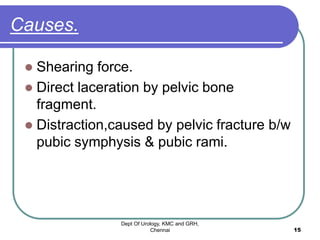
Causes.
 Shearing force.
 Direct laceration by pelvic bone
fragment.
 Distraction,caused by pelvic fracture b/w
pubic symphysis & pubic rami.
Dept Of Urology, KMC and GRH,
Chennai 15
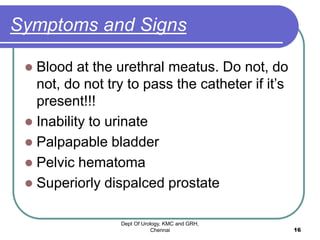
Symptoms and Signs
 Blood at the urethral meatus. Do not, do
not, do not try to pass the catheter if it’s
present!!!
 Inability to urinate
 Palpapable bladder
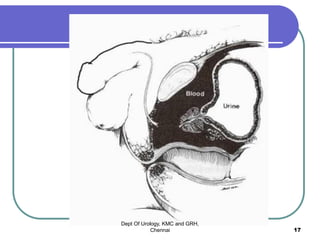
 Pelvic hematoma
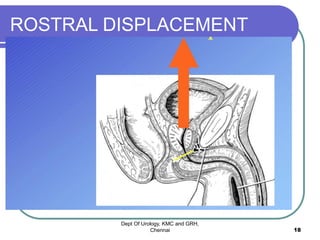
 Superiorly dispalced prostate
Dept Of Urology, KMC and GRH,
Chennai 16
Dept Of Urology, KMC and GRH,
Chennai 17
ROSTRAL DISPLACEMENT
Dept Of Urology, KMC and GRH,
Chennai 18
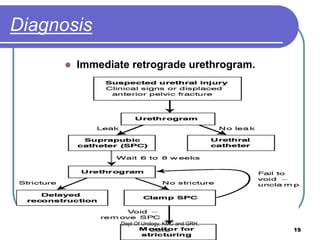
Diagnosis
 Immediate retrograde urethrogram.
Dept Of Urology, KMC and GRH,
Chennai 19
Dept Of Urology, KMC and GRH,
Chennai 20
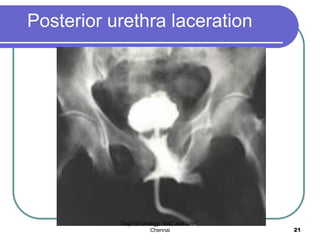
Posterior urethra laceration
Dept Of Urology, KMC and GRH,
Chennai 21
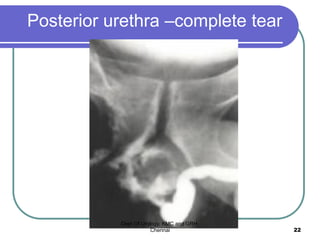
Posterior urethra –complete tear
Dept Of Urology, KMC and GRH,
Chennai 22
Treatment
 Suprapubic cystostomy (Initial treatment)
 If incomplete laceration – spontaneous healing
in 2-3 weeks
 Complete laceration – reconstruction after 3
months
 Primary repair – not recommended. Surgery is
difficult because of hematomas.
Dept Of Urology, KMC and GRH,
Chennai 23
PRIMARY REPAIR
Primary realignment techniques include:
 simple passage of a catheter across the defect
 catheter realignment using flexible/rigid endoscopes and biplanar
fluoroscopy
 use of interlocking sounds (‘railroading’) or magnetic catheters to
place the catheter
 catheter traction or perineal traction sutures to pull the prostate
back to its normal location
 pelvic haematoma evacuation and dissection of the prostatic
apex (without suture anastomosis) over a catheter.
 Open realignment techniques that include suture anastomosis
between the prostatic apex and the membranous urethra should
be considered a form of immediate open urethroplasty.
Dept Of Urology, KMC and GRH,
Chennai 24
DELAYED REPAIR
 Webster
 Turner warwick
 Waterhouse
 Perineal approach
 Progressive perineal
 PAPA / Transpubic
Dept Of Urology, KMC and GRH,
Chennai 25
Complications.
1. Stricture:
 Primary repair →50%
 Delayed repair→ 5%
2. Impotence:
 Primary repair →30-80%
 Delayed repair →30-35%
3. Incontinence:
 <2% pts
 Typically ass:with sacral fracture & S2-S4 nerve
injury.
Dept Of Urology, KMC and GRH,
Chennai 26
Anterior Urethral Injuries
 Causes.
 Stradle injuries→Laceration or Contusion
 Self instrumentation or iatrogenic may
cause partial disruption.
Dept Of Urology, KMC and GRH,
Chennai 27
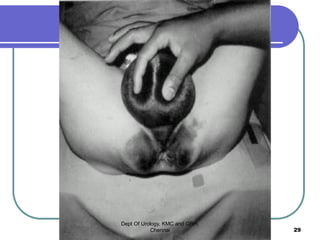
Symptoms & Signs
 History of fall
 Local pain in perineum
 History of instrumentation
 Massive perineal hematoma
 Butterfly sign(hematoma)
Dept Of Urology, KMC and GRH,
Chennai 28
Dept Of Urology, KMC and GRH,
Chennai 29
Treatment
 Contusion:.if no extravasation urethra intact,after
urethrography pt:allowed to void if ok no additional
treatment.
 If bleeding present urethral catheter can be done.
 Laceration:.S/P cystostomy→14-21 days
 Urethral catheter avoided because it converts
incomplete tear to complete one.
 Pts: who develops complete occlusion of urethra
should have S/P for 3-6 months before definite repairs.
Dept Of Urology, KMC and GRH,
Chennai 30
THANKS
Dept Of Urology, KMC and GRH,
Chennai 31

Pfudd classification

  • 1.
    CLASSIFICATION OF PELVIC FRACTURES Deptof Urology Govt Royapettah Hospital and Kilpauk Medical College Chennai 1
  • 2.
    Moderators: Professors:  Prof. Dr.G. Sivasankar, M.S., M.Ch.,  Prof. Dr. A. Senthilvel, M.S., M.Ch., Asst Professors:  Dr. J. Sivabalan, M.S., M.Ch.,  Dr. R. Bhargavi, M.S., M.Ch.,  Dr. S. Raju, M.S., M.Ch.,  Dr. K. Muthurathinam, M.S., M.Ch.,  Dr. D. Tamilselvan, M.S., M.Ch.,  Dr. K. Senthilkumar, M.S., M.Ch. Dept Of Urology, KMC and GRH, Chennai 2
  • 3.
    PELVIC FRACTURES  Fracturesof the pelvis account for less than 5% of all skeletal injuries, but it is important because it associated with:- 1. Soft tissue injuries and blood loss. 2. Shock. 3. Sepsis. 4. ARDS.  Because of those mortality rate exceeds 10%. Dept Of Urology, KMC and GRH, Chennai 3
  • 4.
  • 5.
    Dept Of Urology,KMC and GRH, Chennai 5
  • 6.
    TILES CLASSIFICATION Dept OfUrology, KMC and GRH, Chennai 6
  • 7.
    Dept Of Urology,KMC and GRH, Chennai 7
  • 8.
    ANATOMY OF URETHRA: 1.Posteriorurethra.  Prostatic  Membranous 2. Anterior urethra.  Bulbous  Pendulous URETHERAL INJURIES Dept Of Urology, KMC and GRH, Chennai 8
  • 9.
    Dept Of Urology,KMC and GRH, Chennai 9
  • 10.
    Posterior urethral injuries. Posterior urethra injured in 1.6-9.9% of pelvic fracture.  Complete: 73%  Partial: 27% Dept Of Urology, KMC and GRH, Chennai 10
  • 11.
    CLASSIFICATION Radiological classification:  Colapintoand McCallum classified posterior urethral injuries into three categories based on radiological findings from retrograde urethrography:  Type 1: the membranous urethra is stretched but not severed.  Type 2: the membranous urethra is ruptured above the urogenital diaphragm, the contrast material extravasates into the pelvic extraperitoneal space above the urogenital diaphragm.  Type 3: the membranous urethra is ruptured and the injury extends into the bulbous urethra due to a tear in the urogenital diaphragm. Contrast material leaks above and below the urogenital diaphragm Dept Of Urology, KMC and GRH, Chennai 11
  • 12.
    Extended anatomical classification Goldmanet al. [3] proposed a classification of urethral injuries based on the anatomical description of traumatic urethral injuries: (I) Posterior urethra is stretched but still intact (Colapinto-McCallum type 1). (II) Partial or complete pure posterior urethral injury with tear of the membranous urethra while the urogenital diaphragm is intact. Contrast medium extravasates only above the urogenital diaphragm (Colapinto-McCallum type 2). (III) Partial or complete anterior and posterior urethral injury with disruption of the urogenital diaphragm; contrast agent leaks above and below the urogenital diaphragm (Colapinto-McCallum type 3). (IV) Bladder neck injury extending into the urethra. The extravasation of contrast medium is around the bladder neck. (V) Bladder base injury with periurethral extravasation similar to posterior urethral injury. (VI) Partial or complete isolated anterior urethral injury. Dept Of Urology, KMC and GRH, Chennai 12
  • 13.
    American association ofsurgery of trauma (AAST) classification: 1.Contusion: blood at urethral meatus and retrograde urethrography is normal. 2.Stretch injury: elongation of the urethra with no extravasation on urethrography. 3.Partial disruption: extravasation of urethrography contrast medium at the injury site, with visualization in the bladder. 4.Complete disruption: extravasation of urethrography contrast medium at the injury site with no visualization in the bladder; <2 cm of urethra separation. 5.Complete disruption; complete transection with >2 cm of urethral separation or extension into the prostate or vagina. Dept Of Urology, KMC and GRH, Chennai 13
  • 14.
    Anatomical and functionalclassification:  Al Rifaei et al. developed a new combined anatomical and functional classification of posterior urethral injuries secondary to pelvic fractures:  Type 1: Prostatic injury; 1a: proximal avulsion of the prostate. 1b: partial or complete transprostatic rupture.  Type 2: Stretching of the membranous urethra (Colapinto-McCallum type 1).  Type 3: Incomplete or complete supradiaphragmatic rupture of the prostatomembranous urethra (Colapinto-McCallum type 2).  Type 4: Incomplete or complete infradiaphragmatic rupture of the prostatomembranous urethra (Colapinto-McCallum type 3).  Type 5: Variable combined urethral injuries affecting more than one level, injury to the proximal sphincteric mechanism (bladder neck) combined with prostatic and/or membranous urethral injury. Dept Of Urology, KMC and GRH, Chennai 14
  • 15.
    Causes.  Shearing force. Direct laceration by pelvic bone fragment.  Distraction,caused by pelvic fracture b/w pubic symphysis & pubic rami. Dept Of Urology, KMC and GRH, Chennai 15
  • 16.
    Symptoms and Signs Blood at the urethral meatus. Do not, do not, do not try to pass the catheter if it’s present!!!  Inability to urinate  Palpapable bladder  Pelvic hematoma  Superiorly dispalced prostate Dept Of Urology, KMC and GRH, Chennai 16
  • 17.
    Dept Of Urology,KMC and GRH, Chennai 17
  • 18.
    ROSTRAL DISPLACEMENT Dept OfUrology, KMC and GRH, Chennai 18
  • 19.
    Diagnosis  Immediate retrogradeurethrogram. Dept Of Urology, KMC and GRH, Chennai 19
  • 20.
    Dept Of Urology,KMC and GRH, Chennai 20
  • 21.
    Posterior urethra laceration DeptOf Urology, KMC and GRH, Chennai 21
  • 22.
    Posterior urethra –completetear Dept Of Urology, KMC and GRH, Chennai 22
  • 23.
    Treatment  Suprapubic cystostomy(Initial treatment)  If incomplete laceration – spontaneous healing in 2-3 weeks  Complete laceration – reconstruction after 3 months  Primary repair – not recommended. Surgery is difficult because of hematomas. Dept Of Urology, KMC and GRH, Chennai 23
  • 24.
    PRIMARY REPAIR Primary realignmenttechniques include:  simple passage of a catheter across the defect  catheter realignment using flexible/rigid endoscopes and biplanar fluoroscopy  use of interlocking sounds (‘railroading’) or magnetic catheters to place the catheter  catheter traction or perineal traction sutures to pull the prostate back to its normal location  pelvic haematoma evacuation and dissection of the prostatic apex (without suture anastomosis) over a catheter.  Open realignment techniques that include suture anastomosis between the prostatic apex and the membranous urethra should be considered a form of immediate open urethroplasty. Dept Of Urology, KMC and GRH, Chennai 24
  • 25.
    DELAYED REPAIR  Webster Turner warwick  Waterhouse  Perineal approach  Progressive perineal  PAPA / Transpubic Dept Of Urology, KMC and GRH, Chennai 25
  • 26.
    Complications. 1. Stricture:  Primaryrepair →50%  Delayed repair→ 5% 2. Impotence:  Primary repair →30-80%  Delayed repair →30-35% 3. Incontinence:  <2% pts  Typically ass:with sacral fracture & S2-S4 nerve injury. Dept Of Urology, KMC and GRH, Chennai 26
  • 27.
    Anterior Urethral Injuries Causes.  Stradle injuries→Laceration or Contusion  Self instrumentation or iatrogenic may cause partial disruption. Dept Of Urology, KMC and GRH, Chennai 27
  • 28.
    Symptoms & Signs History of fall  Local pain in perineum  History of instrumentation  Massive perineal hematoma  Butterfly sign(hematoma) Dept Of Urology, KMC and GRH, Chennai 28
  • 29.
    Dept Of Urology,KMC and GRH, Chennai 29
  • 30.
    Treatment  Contusion:.if noextravasation urethra intact,after urethrography pt:allowed to void if ok no additional treatment.  If bleeding present urethral catheter can be done.  Laceration:.S/P cystostomy→14-21 days  Urethral catheter avoided because it converts incomplete tear to complete one.  Pts: who develops complete occlusion of urethra should have S/P for 3-6 months before definite repairs. Dept Of Urology, KMC and GRH, Chennai 30
  • 31.
    THANKS Dept Of Urology,KMC and GRH, Chennai 31