PETROLEUM REFIANRY
ENGINEERING
Course Outline
• Introduction; origin; formation and composition of petroleum. Indigenous
and world resources. Refinery products; properties; significant tests and
standard test methods; characterization and evaluation of crude oil stocks;
generation of crude processing data;
• Crude pre heating and preliminary treatment; pipe still heaters; desalting;
atmospheric and vacuum distillation; steam stripping; arrangement of
towers.
• Calculation of number of trays, types of reflux employed; Packie’s
approach; processing plans, schemes and product patterns of refineries.
• Modern separation, conversion and treatment processes. Thermal &
catalytic cracking and reforming, hydrocracking.
• Auxiliary processes and operations; refinery corrosion and metals;
blending plants, product design and marketing. Use of linear programming
techniques to solve refinery blending and production problems; overview
of petroleum act.
Books
• Recommended Book(s)
• L. Nelson, Petroleum Refinery Engineering, 1991, MacGraw Hill.
• D. Hobson, Modern Petroleum technology, 1991, Applied Sc.
Publisher.
• H. Cary and G.E Handwork ,Petroleum
Refinery Technology & Economics,
• 2001 Dekker.
• Parkash, Refining Processes Handbook, 2003, Elsevier / GPP.
Introduction
• Petroleum is a fossilized mass that has accumulated below the earth’s
surface from time immemorial. Raw petroleum is known as crude
(petroleum) oil or mineral oil.
• It is a mixture of various organic substances and is the source of
hydrocarbons, such as methane, ethane, propane, butane, pentane,
and various other paraffinic (CnH2n+2), naphthenic (CnH2n), and
aromatic hydrocarbons, the building blocks of today’s organic
industry.
• Various petroleum products, such as gaseous and liquid fuels,
lubricating oil, solvents, asphalts, waxes, and coke, are derived from
refining crude oil
• Many lighter hydrocarbons and other organic chemicals are
synthesized by thermal and catalytic treatments of these
hydrocarbons. The hydrocarbon processing industry is basically
divided into three distinct activities—petroleum production,
petroleum refining, and petrochemical manufacture.
• Refineries produce cooking gas (liquefied petroleum gas or LPG),
motor spirit (also known as petrol or gasoline), naphtha, kerosene,
aviation turbine fuel (ATF), high speed diesel (HSD), lubricating base
oils, wax, coke, bitumen (or asphalt), etc., which are mostly a mixture
of various hydrocarbons (the organic compounds made of carbon and
hydrogen as the major constituent elements).
• In a petrochemical plant (where one or more petrochemicals are
produced) or in a petrochemical complex (where many petrochemical
products are produced), pure hydrocarbons or other organic
chemicals with a definite number and type of constituent element or
compound are produced from the products in refineries.
• Thus, petrochemicals are derived from petroleum products obtained
from refineries. Products from a petrochemical complex are plastics,
rubbers, synthetic fibers, raw materials for soap and detergents,
alcohols, paints, pharmaceuticals, etc.
COMPOSITION OF CRUDE OIL
• The compounds in crude petroleum oil are essentially hydrocarbons
or substituted hydrocarbons in which the major elements are carbon
at 85%–90% and hydrogen at 10%–14%, and the rest with non-
hydrocarbon elements—sulfur (0.2%–3%), nitrogen (< 0.1–2%),
oxygen (1%–1.5%), and organo-metallic compounds of nickel,
vanadium, arsenic, lead, and other metals in traces (in parts per
million or parts per billion concentration).
• Inorganic salts of magnesium chloride, sodium chlorides, and other
mineral salts are also accompanied with crude oil from the well either
because of water from formation or water and chemicals injected
during drilling and production.
HYDROCARBON GROUPS
• Compounds only made of carbon and hydrogen are called
hydrocarbons. These hydrocarbons are grouped as paraffin's,
naphthenes, aromatics, and olefins. Crude oil contains these
hydrocarbons in different proportions, except olefins, which are
produced during processing.
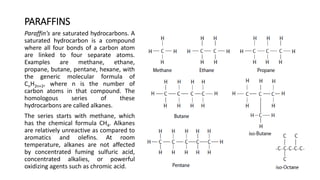
PARAFFINS
Paraffin's are saturated hydrocarbons. A
saturated hydrocarbon is a compound
where all four bonds of a carbon atom
are linked to four separate atoms.
Examples are methane, ethane,
propane, butane, pentane, hexane, with
the generic molecular formula of
CnH2n+2, where n is the number of
carbon atoms in that compound. The
homologous series of these
hydrocarbons are called alkanes.
The series starts with methane, which
has the chemical formula CH4. Alkanes
are relatively unreactive as compared to
aromatics and olefins. At room
temperature, alkanes are not affected
by concentrated fuming sulfuric acid,
concentrated alkalies, or powerful
oxidizing agents such as chromic acid.
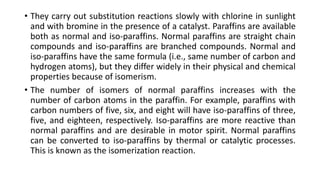
• They carry out substitution reactions slowly with chlorine in sunlight
and with bromine in the presence of a catalyst. Paraffins are available
both as normal and iso-paraffins. Normal paraffins are straight chain
compounds and iso-paraffins are branched compounds. Normal and
iso-paraffins have the same formula (i.e., same number of carbon and
hydrogen atoms), but they differ widely in their physical and chemical
properties because of isomerism.
• The number of isomers of normal paraffins increases with the
number of carbon atoms in the paraffin. For example, paraffins with
carbon numbers of five, six, and eight will have iso-paraffins of three,
five, and eighteen, respectively. Iso-paraffins are more reactive than
normal paraffins and are desirable in motor spirit. Normal paraffins
can be converted to iso-paraffins by thermal or catalytic processes.
This is known as the isomerization reaction.
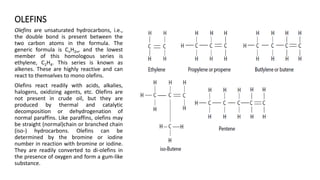
OLEFINS
Olefins are unsaturated hydrocarbons, i.e.,
the double bond is present between the
two carbon atoms in the formula. The
generic formula is CnH2n, and the lowest
member of this homologous series is
ethylene, C2H4. This series is known as
alkenes. These are highly reactive and can
react to themselves to mono olefins.
Olefins react readily with acids, alkalies,
halogens, oxidizing agents, etc. Olefins are
not present in crude oil, but they are
produced by thermal and catalytic
decomposition or dehydrogenation of
normal paraffins. Like paraffins, olefins may
be straight (normal)chain or branched chain
(iso-) hydrocarbons. Olefins can be
determined by the bromine or iodine
number in reaction with bromine or iodine.
They are readily converted to di-olefins in
the presence of oxygen and form a gum-like
substance.
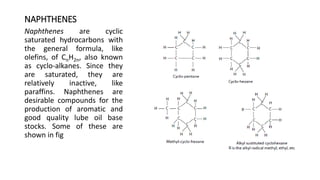
NAPHTHENES
Naphthenes are cyclic
saturated hydrocarbons with
the general formula, like
olefins, of CnH2n, also known
as cyclo-alkanes. Since they
are saturated, they are
relatively inactive, like
paraffins. Naphthenes are
desirable compounds for the
production of aromatic and
good quality lube oil base
stocks. Some of these are
shown in fig
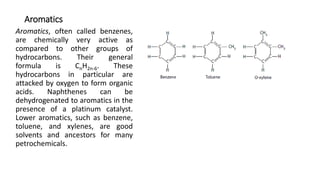
Aromatics
Aromatics, often called benzenes,
are chemically very active as
compared to other groups of
hydrocarbons. Their general
formula is CnH2n-6. These
hydrocarbons in particular are
attacked by oxygen to form organic
acids. Naphthenes can be
dehydrogenated to aromatics in the
presence of a platinum catalyst.
Lower aromatics, such as benzene,
toluene, and xylenes, are good
solvents and ancestors for many
petrochemicals.
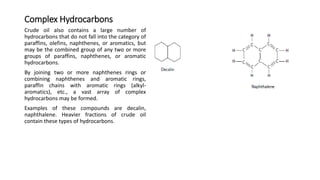
Complex Hydrocarbons
Crude oil also contains a large number of
hydrocarbons that do not fall into the category of
paraffins, olefins, naphthenes, or aromatics, but
may be the combined group of any two or more
groups of paraffins, naphthenes, or aromatic
hydrocarbons.
By joining two or more naphthenes rings or
combining naphthenes and aromatic rings,
paraffin chains with aromatic rings (alkyl-
aromatics), etc., a vast array of complex
hydrocarbons may be formed.
Examples of these compounds are decalin,
naphthalene. Heavier fractions of crude oil
contain these types of hydrocarbons.
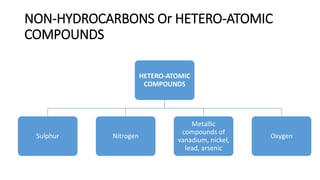
NON-HYDROCARBONS Or HETERO-ATOMIC
COMPOUNDS
HETERO-ATOMIC
COMPOUNDS
Sulphur Nitrogen
Metallic
compounds of
vanadium, nickel,
lead, arsenic
Oxygen
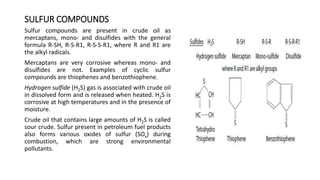
SULFUR COMPOUNDS
Sulfur compounds are present in crude oil as
mercaptans, mono- and disulfides with the general
formula R-SH, R-S-R1, R-S-S-R1, where R and R1 are
the alkyl radicals.
Mercaptans are very corrosive whereas mono- and
disulfides are not. Examples of cyclic sulfur
compounds are thiophenes and benzothiophene.
Hydrogen sulfide (H2S) gas is associated with crude oil
in dissolved form and is released when heated. H2S is
corrosive at high temperatures and in the presence of
moisture.
Crude oil that contains large amounts of H2S is called
sour crude. Sulfur present in petroleum fuel products
also forms various oxides of sulfur (SOx) during
combustion, which are strong environmental
pollutants.
• H2S can be removed from gases by absorption in an amine solution. In
the light distillates, sulfur may be present as H2S, mercaptans, and
thiophenes, but in the heavier fractions of crude oil, 80%–90% of the
sulfur is usually present in the complex ring structure of
hydrocarbons.
• In this combination, the sulfur atom is very stable and non-reactive.
As a result, sulfur from heavier petroleum cannot be removed
without a destructive reaction, such as severe thermal or catalytic
reactions. Nowadays, sulfur is recovered during refining and sold as a
product. Sulfur also has a poisoning effect on various catalysts.
NITROGEN COMPOUNDS
• Nitrogen compounds in hydrocarbons are usually found in the heavier
parts of the crude oil. These are responsible for colour and colour
instability and poisoning of certain catalysts.
• Nitrogen in petroleum fuels causes the generation of oxides of
nitrogen (NOx), which are also strong pollutants of the atmosphere.
Nitrogen can be eliminated from petroleum products by catalytic
hydrogenation. Like sulfur, nitrogen in the heavier parts of petroleum
cannot be removed without severe cracking or hydrogenation
reactions.
OXYGEN COMPOUNDS
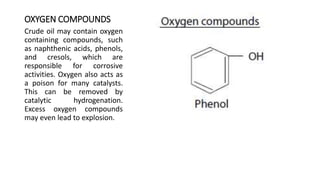
Crude oil may contain oxygen
containing compounds, such
as naphthenic acids, phenols,
and cresols, which are
responsible for corrosive
activities. Oxygen also acts as
a poison for many catalysts.
This can be removed by
catalytic hydrogenation.
Excess oxygen compounds
may even lead to explosion.
METALLIC COMPOUNDS
• Metallic compounds of vanadium, nickel, lead, arsenic, etc., are also
found in crude oil. Vanadium and nickel are found in the form of
organo-metallic compounds mostly in the heavier fractions of crude
oil where the metal atoms are distributed within the compound in a
complex form called porphyrins. Petroleum fuels containing these
metallic compounds may damage the burners, lines, and walls of the
combustion chambers.
PHYSICAL PROPERTIES OF CRUDE OIL
• Crude oil is sometimes classified as paraffinic base, naphthenic base, or
asphaltic base, according to the prevalence of the hydrocarbon groups.
• API gravity is expressed as the relation developed by the American
Petroleum Institute, as
API = 141.5/s - 131.5,
where “s” is the specific gravity of oil measured with respect to water, both
at 60°F (15.5°C). Since oil is lighter than water, API gravity is always greater
than 10. The lighter the oil, the larger the API gravity. However, gravity is not
the only measurement of crude oil, but a mere indicator of lightness.
ORIGIN OF HYDROCARBONS
• The word petroleum is derived from the Latin words for rock (petra)
and oleum (oil).
• It is found in the form of gas and/or liquid phases in porous rock
structures. Both gases and liquids are rich mixtures of organic
components consisting of carbon and hydrogen and hence are known
as hydrocarbons in general.
• The most abundant hydrocarbon gas in nature, methane, is also
available in large quantities from the coal bed (known as coal bed
methane). Large quantities of methane are also available as hydrates
under the sea bed in the Arctic region and are known as gas hydrates
SEDIMENTARY ROCKS
• There are many hypotheses about the origin of the formation of
crude oil. To date, it is generally agreed that crude petroleum oil was
formed from decaying plants and vegetables and dead animals and
converted to oil by the action of high pressure and high temperature
under the earth’s surface, and by the action of the biological activities
of micro-organisms.
• Organic materials of plant or animal origin accumulate in the lowest
places, gradually buried under the surface of Earth.
• Thus, huge amounts of organic matter are trapped layer after layer in
the earth’s crust and rock. Rocks that bear these organic layers are
called sedimentary rocks
KEROGEN
• Several kilometers below the earth’s surface, organic sediments are
decayed biologically to a mass, known as kerogen, which has a very
high mass of organic-to-inorganic ratio favorable for conversion to
hydrocarbon.
• The temperature of Earth increases with depth (geothermal gradient)
at the rate of approximately 30°C per kilometer. Thus, at a depth of 4–
5 km, called kitchen by geologists, temperatures of 120°C–150°C exist
where kerogen is converted to hydrocarbon oil under very high
pressure of rocks and soil
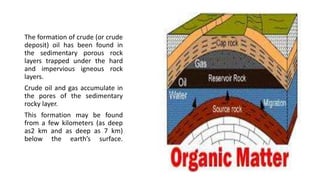
The formation of crude (or crude
deposit) oil has been found in
the sedimentary porous rock
layers trapped under the hard
and impervious igneous rock
layers.
Crude oil and gas accumulate in
the pores of the sedimentary
rocky layer.
This formation may be found
from a few kilometers (as deep
as2 km and as deep as 7 km)
below the earth’s surface.
EXPLORATION TECHNIQUES
• The selection of a drilling site is a tricky and costly affair. Though some
visible evidence of a hydrocarbon source, like seepage of oil and gas
from the surface, the visual appearance of surface and vegetation,
the presence of oil or gas in fountains or rivers, etc., are sometimes
used in locating oil and gas reserves, and many ancient oil fields were
discovered by these events.
MODERN EXPLORATION TECHNIQUES
• Modern exploration techniques use geophysical, geochemical, and
geotechnical methods. Exploration of the surface of Earth can be
useful for imaging or mapping sub-surface structures favourable for
oil and gas accumulation.
• In the geophysical methods, gravimetric(measurement of gravity &
weight), magneto metric (measures magnetism), seismic (relating to
earthquakes or other vibrations of the earth), radioactive, and
stratigraphic (study of rock layers) studies of the surface are gathered
• Chemical analysis of the surface soil and rocks are carried out by
geochemical methods (measurements of one or more chemical
properties of a naturally occurring material).
• Geotechnical methods, such as the mechanical properties of rocks
and surface, are measured.
•
GRAVIMETRIC METHOD
• Gravity of the earth’s surface varies with distance from the surface of
Earth and the type of material, such as salt, water, oil, gas, or mineral
matter. The measurement of a small variation of gravity or
acceleration due to gravity is recorded with accuracy and the data are
converted to retrieve a geological structure of the sub-surface of
Earth. A gravimeter is a very sensitive instrument, usually a spring
type balance with high resolution and accuracy capable of detecting a
minute variation in gravity. Porous and oil-containing rock layers and
salt have lower density compared to the surrounding non-porous and
hard rock layers. Thus, a gravimetric curve is acquired and analysed
for the location of deposit.
MAGNETOMETRIC METHOD
• Earth has its own magnetic field that varies from one location to
another owing to the different structural materials of rocks. A
variation of magnetic field strength is recorded by a sensitive
instrument, called a magnetometer. Igneous non-porous rocks are
found to be magnetic as compared to sedimentary rocks containing
organic deposits.
• Thus, a magnetometric survey can also be used to locate oil deposits.
Both the gravimetric and magnetometric methods are done
simultaneously to predict a reproducible sub-surface structure. After
the zone is confi rmed by gravimetric and magnetometric surveys, a
seismic survey is carried out for a clear image of
the sub-surface structure.
REFERENCE
• Fundamentals of Petroleum and Petrochemical Engineering
• Uttam Ray Chaudhuri

Petroleum Refinery Engineering

  • 1.
  • 2.
    Course Outline • Introduction;origin; formation and composition of petroleum. Indigenous and world resources. Refinery products; properties; significant tests and standard test methods; characterization and evaluation of crude oil stocks; generation of crude processing data; • Crude pre heating and preliminary treatment; pipe still heaters; desalting; atmospheric and vacuum distillation; steam stripping; arrangement of towers. • Calculation of number of trays, types of reflux employed; Packie’s approach; processing plans, schemes and product patterns of refineries. • Modern separation, conversion and treatment processes. Thermal & catalytic cracking and reforming, hydrocracking. • Auxiliary processes and operations; refinery corrosion and metals; blending plants, product design and marketing. Use of linear programming techniques to solve refinery blending and production problems; overview of petroleum act.
  • 3.
    Books • Recommended Book(s) •L. Nelson, Petroleum Refinery Engineering, 1991, MacGraw Hill. • D. Hobson, Modern Petroleum technology, 1991, Applied Sc. Publisher. • H. Cary and G.E Handwork ,Petroleum Refinery Technology & Economics, • 2001 Dekker. • Parkash, Refining Processes Handbook, 2003, Elsevier / GPP.
  • 4.
    Introduction • Petroleum isa fossilized mass that has accumulated below the earth’s surface from time immemorial. Raw petroleum is known as crude (petroleum) oil or mineral oil. • It is a mixture of various organic substances and is the source of hydrocarbons, such as methane, ethane, propane, butane, pentane, and various other paraffinic (CnH2n+2), naphthenic (CnH2n), and aromatic hydrocarbons, the building blocks of today’s organic industry. • Various petroleum products, such as gaseous and liquid fuels, lubricating oil, solvents, asphalts, waxes, and coke, are derived from refining crude oil
  • 5.
    • Many lighterhydrocarbons and other organic chemicals are synthesized by thermal and catalytic treatments of these hydrocarbons. The hydrocarbon processing industry is basically divided into three distinct activities—petroleum production, petroleum refining, and petrochemical manufacture. • Refineries produce cooking gas (liquefied petroleum gas or LPG), motor spirit (also known as petrol or gasoline), naphtha, kerosene, aviation turbine fuel (ATF), high speed diesel (HSD), lubricating base oils, wax, coke, bitumen (or asphalt), etc., which are mostly a mixture of various hydrocarbons (the organic compounds made of carbon and hydrogen as the major constituent elements).
  • 6.
    • In apetrochemical plant (where one or more petrochemicals are produced) or in a petrochemical complex (where many petrochemical products are produced), pure hydrocarbons or other organic chemicals with a definite number and type of constituent element or compound are produced from the products in refineries. • Thus, petrochemicals are derived from petroleum products obtained from refineries. Products from a petrochemical complex are plastics, rubbers, synthetic fibers, raw materials for soap and detergents, alcohols, paints, pharmaceuticals, etc.
  • 7.
    COMPOSITION OF CRUDEOIL • The compounds in crude petroleum oil are essentially hydrocarbons or substituted hydrocarbons in which the major elements are carbon at 85%–90% and hydrogen at 10%–14%, and the rest with non- hydrocarbon elements—sulfur (0.2%–3%), nitrogen (< 0.1–2%), oxygen (1%–1.5%), and organo-metallic compounds of nickel, vanadium, arsenic, lead, and other metals in traces (in parts per million or parts per billion concentration). • Inorganic salts of magnesium chloride, sodium chlorides, and other mineral salts are also accompanied with crude oil from the well either because of water from formation or water and chemicals injected during drilling and production.
  • 8.
    HYDROCARBON GROUPS • Compoundsonly made of carbon and hydrogen are called hydrocarbons. These hydrocarbons are grouped as paraffin's, naphthenes, aromatics, and olefins. Crude oil contains these hydrocarbons in different proportions, except olefins, which are produced during processing.
  • 9.
    PARAFFINS Paraffin's are saturatedhydrocarbons. A saturated hydrocarbon is a compound where all four bonds of a carbon atom are linked to four separate atoms. Examples are methane, ethane, propane, butane, pentane, hexane, with the generic molecular formula of CnH2n+2, where n is the number of carbon atoms in that compound. The homologous series of these hydrocarbons are called alkanes. The series starts with methane, which has the chemical formula CH4. Alkanes are relatively unreactive as compared to aromatics and olefins. At room temperature, alkanes are not affected by concentrated fuming sulfuric acid, concentrated alkalies, or powerful oxidizing agents such as chromic acid.
  • 10.
    • They carryout substitution reactions slowly with chlorine in sunlight and with bromine in the presence of a catalyst. Paraffins are available both as normal and iso-paraffins. Normal paraffins are straight chain compounds and iso-paraffins are branched compounds. Normal and iso-paraffins have the same formula (i.e., same number of carbon and hydrogen atoms), but they differ widely in their physical and chemical properties because of isomerism. • The number of isomers of normal paraffins increases with the number of carbon atoms in the paraffin. For example, paraffins with carbon numbers of five, six, and eight will have iso-paraffins of three, five, and eighteen, respectively. Iso-paraffins are more reactive than normal paraffins and are desirable in motor spirit. Normal paraffins can be converted to iso-paraffins by thermal or catalytic processes. This is known as the isomerization reaction.
  • 11.
    OLEFINS Olefins are unsaturatedhydrocarbons, i.e., the double bond is present between the two carbon atoms in the formula. The generic formula is CnH2n, and the lowest member of this homologous series is ethylene, C2H4. This series is known as alkenes. These are highly reactive and can react to themselves to mono olefins. Olefins react readily with acids, alkalies, halogens, oxidizing agents, etc. Olefins are not present in crude oil, but they are produced by thermal and catalytic decomposition or dehydrogenation of normal paraffins. Like paraffins, olefins may be straight (normal)chain or branched chain (iso-) hydrocarbons. Olefins can be determined by the bromine or iodine number in reaction with bromine or iodine. They are readily converted to di-olefins in the presence of oxygen and form a gum-like substance.
  • 12.
    NAPHTHENES Naphthenes are cyclic saturatedhydrocarbons with the general formula, like olefins, of CnH2n, also known as cyclo-alkanes. Since they are saturated, they are relatively inactive, like paraffins. Naphthenes are desirable compounds for the production of aromatic and good quality lube oil base stocks. Some of these are shown in fig
  • 13.
    Aromatics Aromatics, often calledbenzenes, are chemically very active as compared to other groups of hydrocarbons. Their general formula is CnH2n-6. These hydrocarbons in particular are attacked by oxygen to form organic acids. Naphthenes can be dehydrogenated to aromatics in the presence of a platinum catalyst. Lower aromatics, such as benzene, toluene, and xylenes, are good solvents and ancestors for many petrochemicals.
  • 14.
    Complex Hydrocarbons Crude oilalso contains a large number of hydrocarbons that do not fall into the category of paraffins, olefins, naphthenes, or aromatics, but may be the combined group of any two or more groups of paraffins, naphthenes, or aromatic hydrocarbons. By joining two or more naphthenes rings or combining naphthenes and aromatic rings, paraffin chains with aromatic rings (alkyl- aromatics), etc., a vast array of complex hydrocarbons may be formed. Examples of these compounds are decalin, naphthalene. Heavier fractions of crude oil contain these types of hydrocarbons.
  • 15.
    NON-HYDROCARBONS Or HETERO-ATOMIC COMPOUNDS HETERO-ATOMIC COMPOUNDS SulphurNitrogen Metallic compounds of vanadium, nickel, lead, arsenic Oxygen
  • 16.
    SULFUR COMPOUNDS Sulfur compoundsare present in crude oil as mercaptans, mono- and disulfides with the general formula R-SH, R-S-R1, R-S-S-R1, where R and R1 are the alkyl radicals. Mercaptans are very corrosive whereas mono- and disulfides are not. Examples of cyclic sulfur compounds are thiophenes and benzothiophene. Hydrogen sulfide (H2S) gas is associated with crude oil in dissolved form and is released when heated. H2S is corrosive at high temperatures and in the presence of moisture. Crude oil that contains large amounts of H2S is called sour crude. Sulfur present in petroleum fuel products also forms various oxides of sulfur (SOx) during combustion, which are strong environmental pollutants.
  • 17.
    • H2S canbe removed from gases by absorption in an amine solution. In the light distillates, sulfur may be present as H2S, mercaptans, and thiophenes, but in the heavier fractions of crude oil, 80%–90% of the sulfur is usually present in the complex ring structure of hydrocarbons. • In this combination, the sulfur atom is very stable and non-reactive. As a result, sulfur from heavier petroleum cannot be removed without a destructive reaction, such as severe thermal or catalytic reactions. Nowadays, sulfur is recovered during refining and sold as a product. Sulfur also has a poisoning effect on various catalysts.
  • 18.
    NITROGEN COMPOUNDS • Nitrogencompounds in hydrocarbons are usually found in the heavier parts of the crude oil. These are responsible for colour and colour instability and poisoning of certain catalysts. • Nitrogen in petroleum fuels causes the generation of oxides of nitrogen (NOx), which are also strong pollutants of the atmosphere. Nitrogen can be eliminated from petroleum products by catalytic hydrogenation. Like sulfur, nitrogen in the heavier parts of petroleum cannot be removed without severe cracking or hydrogenation reactions.
  • 19.
    OXYGEN COMPOUNDS Crude oilmay contain oxygen containing compounds, such as naphthenic acids, phenols, and cresols, which are responsible for corrosive activities. Oxygen also acts as a poison for many catalysts. This can be removed by catalytic hydrogenation. Excess oxygen compounds may even lead to explosion.
  • 20.
    METALLIC COMPOUNDS • Metalliccompounds of vanadium, nickel, lead, arsenic, etc., are also found in crude oil. Vanadium and nickel are found in the form of organo-metallic compounds mostly in the heavier fractions of crude oil where the metal atoms are distributed within the compound in a complex form called porphyrins. Petroleum fuels containing these metallic compounds may damage the burners, lines, and walls of the combustion chambers.
  • 21.
    PHYSICAL PROPERTIES OFCRUDE OIL • Crude oil is sometimes classified as paraffinic base, naphthenic base, or asphaltic base, according to the prevalence of the hydrocarbon groups. • API gravity is expressed as the relation developed by the American Petroleum Institute, as API = 141.5/s - 131.5, where “s” is the specific gravity of oil measured with respect to water, both at 60°F (15.5°C). Since oil is lighter than water, API gravity is always greater than 10. The lighter the oil, the larger the API gravity. However, gravity is not the only measurement of crude oil, but a mere indicator of lightness.
  • 22.
    ORIGIN OF HYDROCARBONS •The word petroleum is derived from the Latin words for rock (petra) and oleum (oil). • It is found in the form of gas and/or liquid phases in porous rock structures. Both gases and liquids are rich mixtures of organic components consisting of carbon and hydrogen and hence are known as hydrocarbons in general. • The most abundant hydrocarbon gas in nature, methane, is also available in large quantities from the coal bed (known as coal bed methane). Large quantities of methane are also available as hydrates under the sea bed in the Arctic region and are known as gas hydrates
  • 23.
    SEDIMENTARY ROCKS • Thereare many hypotheses about the origin of the formation of crude oil. To date, it is generally agreed that crude petroleum oil was formed from decaying plants and vegetables and dead animals and converted to oil by the action of high pressure and high temperature under the earth’s surface, and by the action of the biological activities of micro-organisms. • Organic materials of plant or animal origin accumulate in the lowest places, gradually buried under the surface of Earth. • Thus, huge amounts of organic matter are trapped layer after layer in the earth’s crust and rock. Rocks that bear these organic layers are called sedimentary rocks
  • 24.
    KEROGEN • Several kilometersbelow the earth’s surface, organic sediments are decayed biologically to a mass, known as kerogen, which has a very high mass of organic-to-inorganic ratio favorable for conversion to hydrocarbon. • The temperature of Earth increases with depth (geothermal gradient) at the rate of approximately 30°C per kilometer. Thus, at a depth of 4– 5 km, called kitchen by geologists, temperatures of 120°C–150°C exist where kerogen is converted to hydrocarbon oil under very high pressure of rocks and soil
  • 25.
    The formation ofcrude (or crude deposit) oil has been found in the sedimentary porous rock layers trapped under the hard and impervious igneous rock layers. Crude oil and gas accumulate in the pores of the sedimentary rocky layer. This formation may be found from a few kilometers (as deep as2 km and as deep as 7 km) below the earth’s surface.
  • 26.
    EXPLORATION TECHNIQUES • Theselection of a drilling site is a tricky and costly affair. Though some visible evidence of a hydrocarbon source, like seepage of oil and gas from the surface, the visual appearance of surface and vegetation, the presence of oil or gas in fountains or rivers, etc., are sometimes used in locating oil and gas reserves, and many ancient oil fields were discovered by these events.
  • 27.
    MODERN EXPLORATION TECHNIQUES •Modern exploration techniques use geophysical, geochemical, and geotechnical methods. Exploration of the surface of Earth can be useful for imaging or mapping sub-surface structures favourable for oil and gas accumulation. • In the geophysical methods, gravimetric(measurement of gravity & weight), magneto metric (measures magnetism), seismic (relating to earthquakes or other vibrations of the earth), radioactive, and stratigraphic (study of rock layers) studies of the surface are gathered
  • 28.
    • Chemical analysisof the surface soil and rocks are carried out by geochemical methods (measurements of one or more chemical properties of a naturally occurring material). • Geotechnical methods, such as the mechanical properties of rocks and surface, are measured. •
  • 29.
    GRAVIMETRIC METHOD • Gravityof the earth’s surface varies with distance from the surface of Earth and the type of material, such as salt, water, oil, gas, or mineral matter. The measurement of a small variation of gravity or acceleration due to gravity is recorded with accuracy and the data are converted to retrieve a geological structure of the sub-surface of Earth. A gravimeter is a very sensitive instrument, usually a spring type balance with high resolution and accuracy capable of detecting a minute variation in gravity. Porous and oil-containing rock layers and salt have lower density compared to the surrounding non-porous and hard rock layers. Thus, a gravimetric curve is acquired and analysed for the location of deposit.
  • 30.
    MAGNETOMETRIC METHOD • Earthhas its own magnetic field that varies from one location to another owing to the different structural materials of rocks. A variation of magnetic field strength is recorded by a sensitive instrument, called a magnetometer. Igneous non-porous rocks are found to be magnetic as compared to sedimentary rocks containing organic deposits. • Thus, a magnetometric survey can also be used to locate oil deposits. Both the gravimetric and magnetometric methods are done simultaneously to predict a reproducible sub-surface structure. After the zone is confi rmed by gravimetric and magnetometric surveys, a seismic survey is carried out for a clear image of the sub-surface structure.
  • 31.
    REFERENCE • Fundamentals ofPetroleum and Petrochemical Engineering • Uttam Ray Chaudhuri