Protecting Employees from
WorkplaceHazards
• Employers must protect employees from hazards
such as sharp objects, impact, burns, harmful
substances, air quality, dangerous light, noise
exposures and many others that can cause injury.
• Employers must:
– Use all feasible engineering and work practice
controls to eliminate and reduce hazards
– Use personal protective equipment (PPE) if the
controls don’t eliminate the hazards.
• PPE is the last level of control!
3.
Engineering Controls
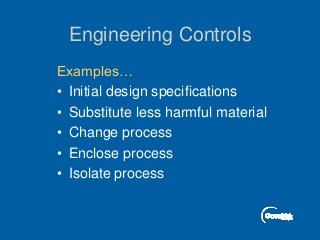
If .. . The work environment can be
physically changed to prevent employee
exposure to the potential hazard,
Then . . . The hazard can be eliminated
with an engineering control
Administrative Controls
(Work PracticeControls)
If . . . Employees can change the way
they do their jobs and the exposure to the
potential hazard is removed,
Then . . . The hazard can be eliminated
with a work practice control
6.
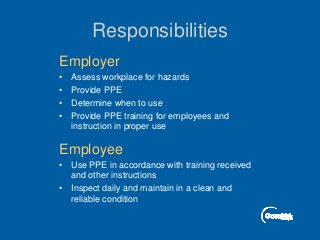
Responsibilities
Employer
• Assess workplacefor hazards
• Provide PPE
• Determine when to use
• Provide PPE training for employees and
instruction in proper use
Employee
• Use PPE in accordance with training received
and other instructions
• Inspect daily and maintain in a clean and
reliable condition
7.
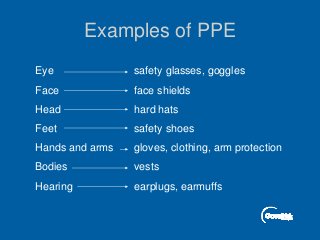
Examples of PPE
Eyesafety glasses, goggles
Face face shields
Head hard hats
Feet safety shoes
Hands and arms gloves, clothing, arm protection
Bodies vests
Hearing earplugs, earmuffs
8.
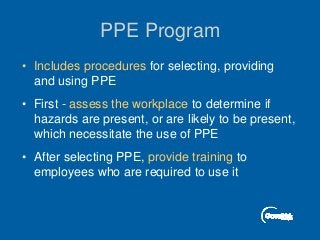
PPE Program
• Includesprocedures for selecting, providing
and using PPE
• First - assess the workplace to determine if
hazards are present, or are likely to be present,
which necessitate the use of PPE
• After selecting PPE, provide training to
employees who are required to use it
9.
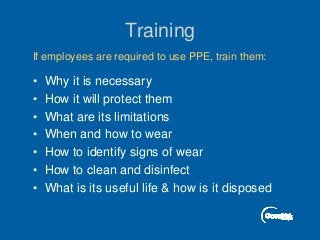
Training
• Why itis necessary
• How it will protect them
• What are its limitations
• When and how to wear
• How to identify signs of wear
• How to clean and disinfect
• What is its useful life & how is it disposed
If employees are required to use PPE, train them:
10.
Summary
Employers must implement
aPPE program where they:
• Assess the workplace for hazards
• Use engineering and work practice controls to eliminate or
reduce hazards before using PPE
• Select appropriate PPE to protect employees from hazards
that cannot be eliminated
• Inform employees why the PPE is necessary, how and
when it must be worn
• Train employees how to use and care for their PPE,
including how to recognize deterioration and failure
• Require employees to wear selected PPE