personal-development-Human resources management in business.ppt
1.
To get themost out of this presentation, view it in
Slide Show mode. Click on the button above and
the presentation will play automatically.
2.
OCR Level 3
CambridgeTechnicals
in Business
Unit 5: Human resources management in
business
Personal Development Plan
3.
What is aPersonal
Development Plan?
Organisations are increasingly
using Personal Development
Plans as a way to form the basis of
training and career development of
individuals.
Learners hoping to continue studies
into higher education are likely to
be expected to complete a Personal
Development Plan.
4.
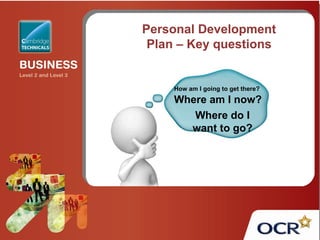
Personal Development
Plan –Key questions
Where am I now?
Where do I
want to go?
How am I going to get there?
5.
Where am Inow?
Identifying strengths
Identifying weaknesses
Identifying existing skills/qualifications
What are the features of a
Personal Development Plan
6.
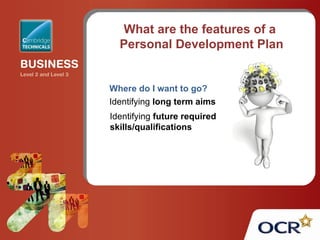
What are thefeatures of a
Personal Development Plan
Where do I want to go?
Identifying future required
skills/qualifications
Identifying long term aims
7.
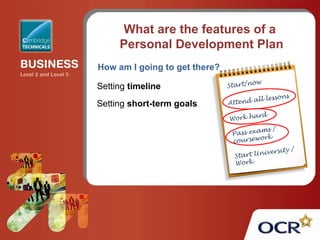
What are thefeatures of a
Personal Development Plan
How am I going to get there?
Setting short-term goals
Setting timeline Start/now
Attend all lessons
Work hard
Pass exams /
coursework
Start University /
Work
8.
Benefits and risks
Whatare the benefits of completing a Personal
Development Plan?
What are the risks of
completing a Personal
Development Plan?
9.
The benefits
There areboth benefits for the
individual and employer:
• Individual: The plan can be
a motivating factor
• Become focused on self-
improvement and understand the
long-term implications of efforts
• Employer’s point of view:
The plans encourage
employees to be proactive
about their career planning
10.
The risks
• Businesseswill be constantly
assessing whether raising
expectations of the opportunities
that may be presented to
employees could cause more
damage than not offering a
PDP programme at all.
11.
Thank you forusing
this OCR resource.
Other OCR resources are
available at www.ocr.org.uk
To give us feedback on, or ideas about, the OCR resources you
have used e-mail resourcesfeedback@ocr.org.uk