Performance measurement
methodology
Maksym Pugach
A couple of years ago in a
company,
somewhere in the city….
Eclipse Vert.x is a polyglot event-driven
application framework that runs on the
Java Virtual Machine
Vert.x promises for our case
● Just wrap your existing code into a Vert.x and it works (JS and Ruby in our
case)
● More performant than other solutions
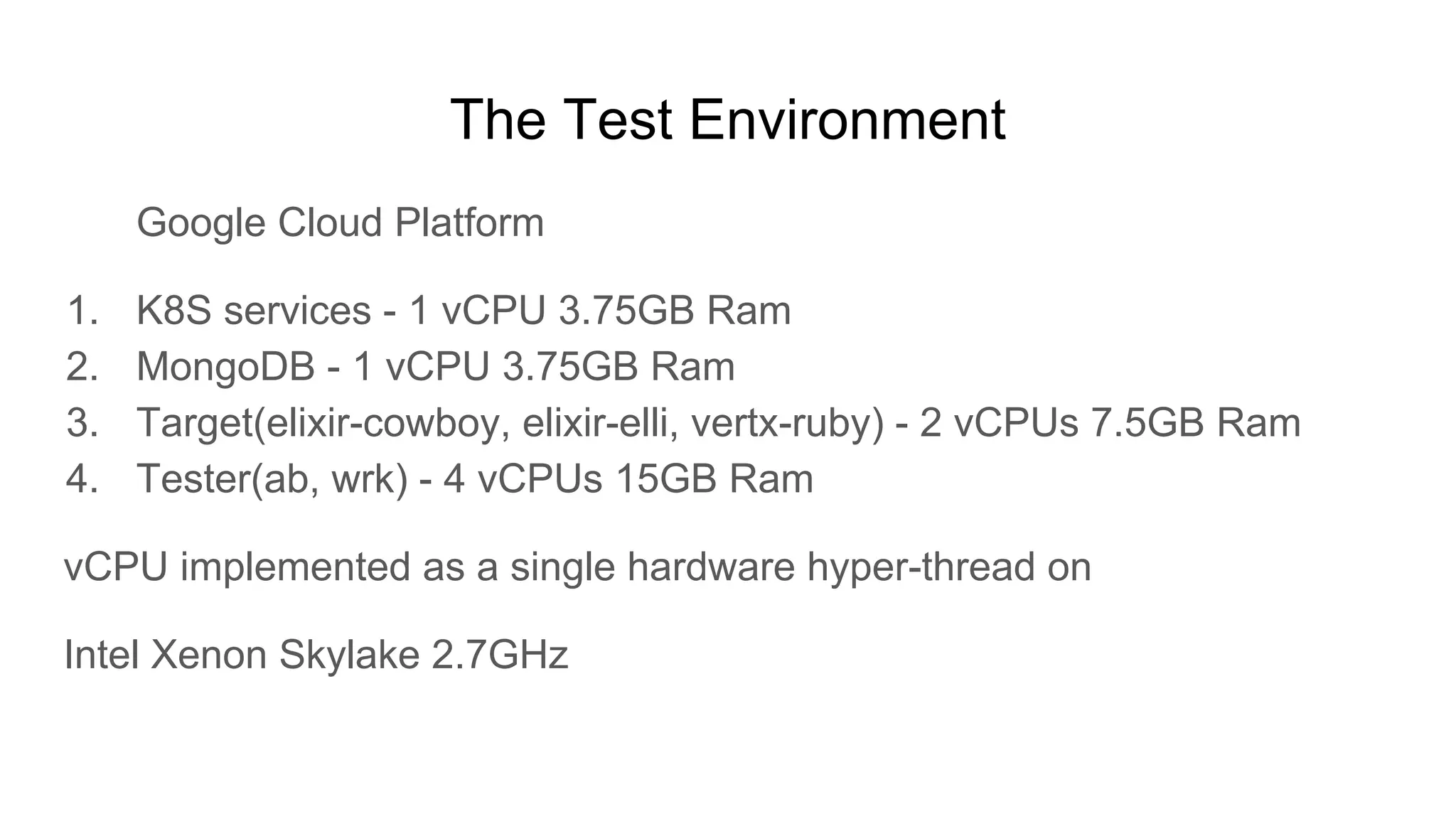
The Test Environment
Google Cloud Platform
1. K8S services - 1 vCPU 3.75GB Ram
2. MongoDB - 1 vCPU 3.75GB Ram
3. Target(elixir-cowboy, elixir-elli, vertx-ruby) - 2 vCPUs 7.5GB Ram
4. Tester(ab, wrk) - 4 vCPUs 15GB Ram
vCPU implemented as a single hardware hyper-thread on
Intel Xenon Skylake 2.7GHz
The Test Environment
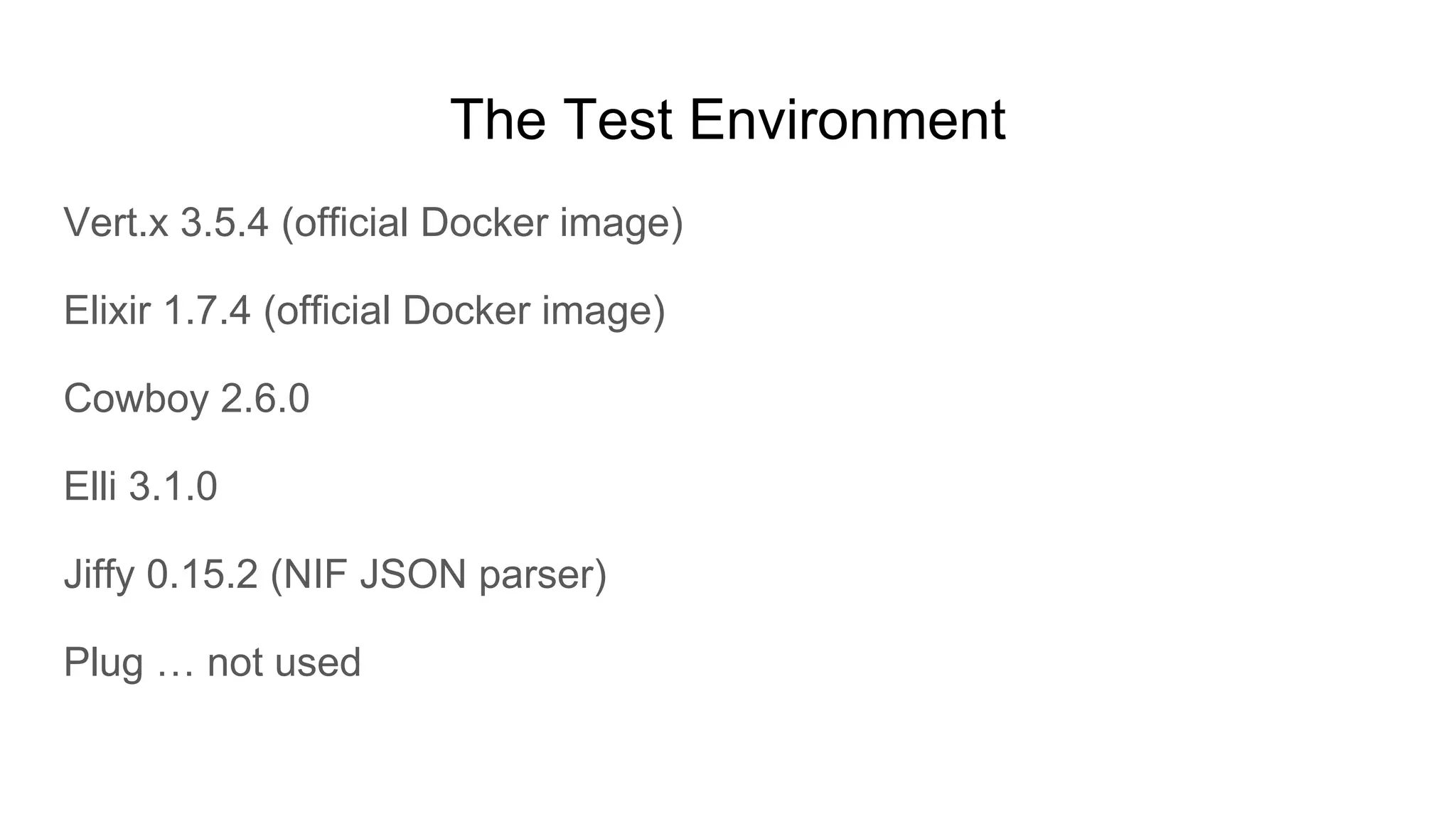
Vert.x 3.5.4 (official Docker image)
Elixir 1.7.4 (official Docker image)
Cowboy 2.6.0
Elli 3.1.0
Jiffy 0.15.2 (NIF JSON parser)
Plug … not used
Tools and Methodology
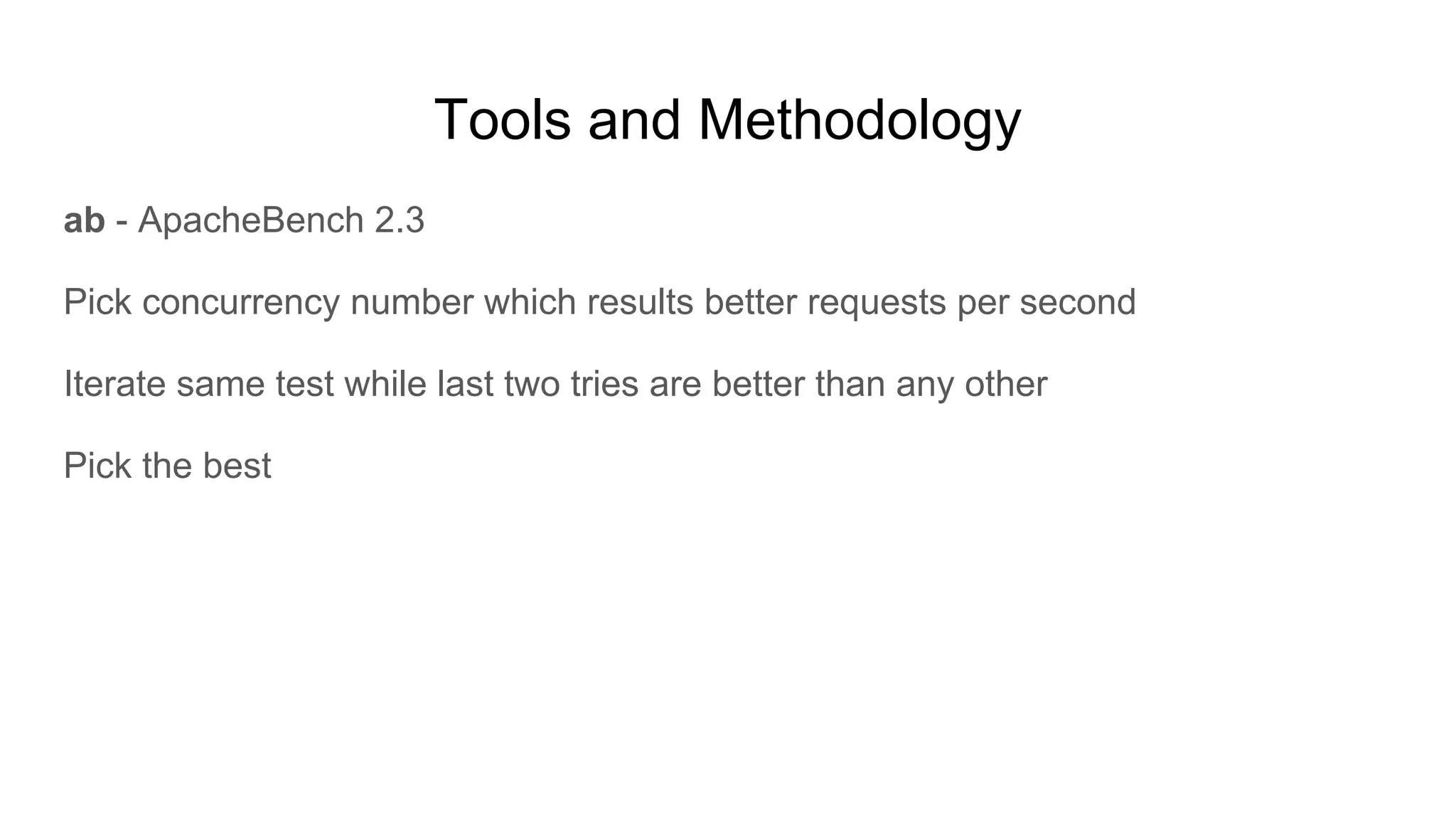
ab - ApacheBench 2.3
Pick concurrency number which results better requests per second
Iterate same test while last two tries are better than any other
Pick the best
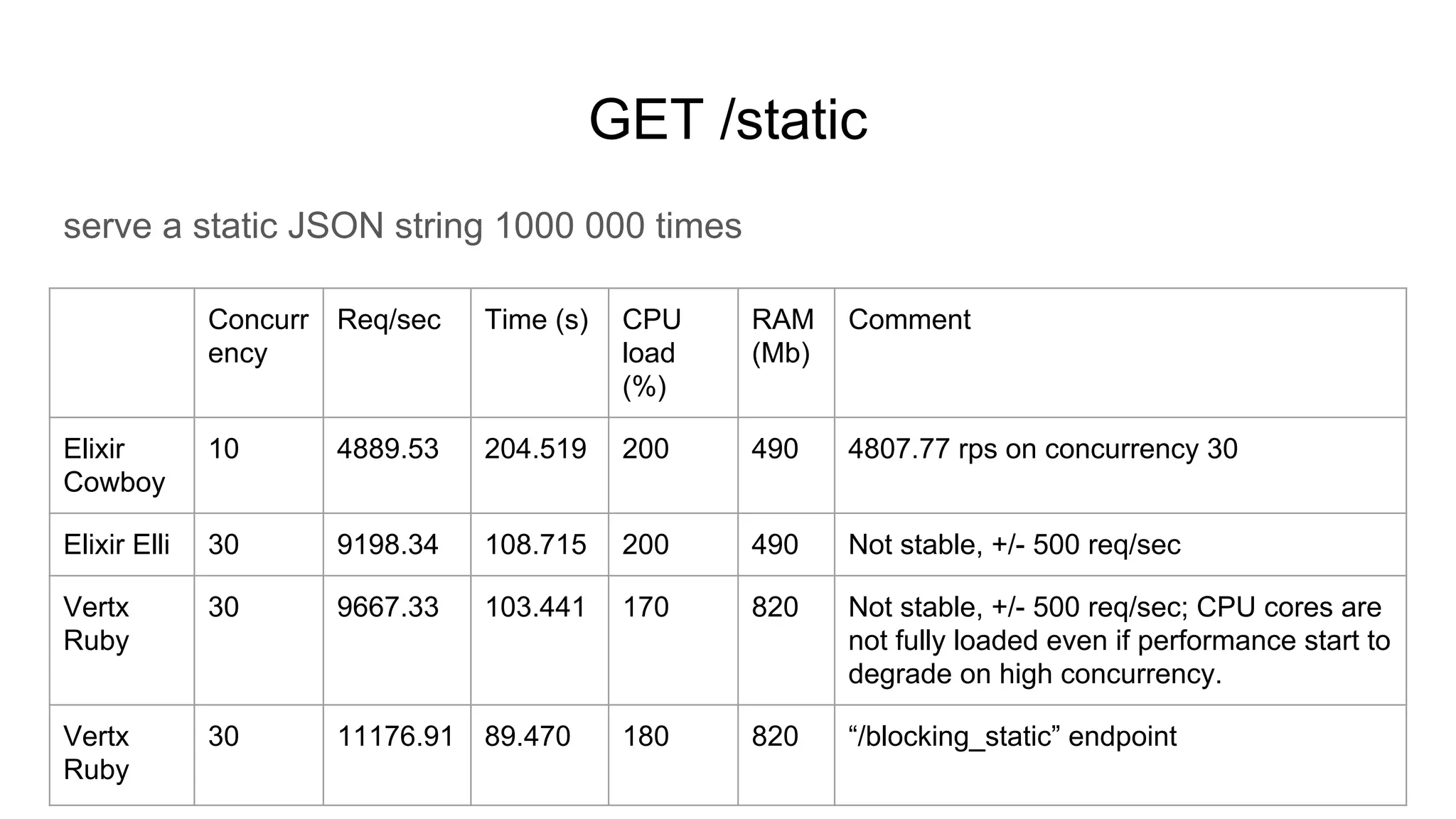
GET /static
serve a static JSON string 1000 000 times
Concurr
ency
Req/sec Time (s) CPU
load
(%)
RAM
(Mb)
Comment
Elixir
Cowboy
10 4889.53 204.519 200 490 4807.77 rps on concurrency 30
Elixir Elli 30 9198.34 108.715 200 490 Not stable, +/- 500 req/sec
Vertx
Ruby
30 9667.33 103.441 170 820 Not stable, +/- 500 req/sec; CPU cores are
not fully loaded even if performance start to
degrade on high concurrency.
Vertx
Ruby
30 11176.91 89.470 180 820 “/blocking_static” endpoint
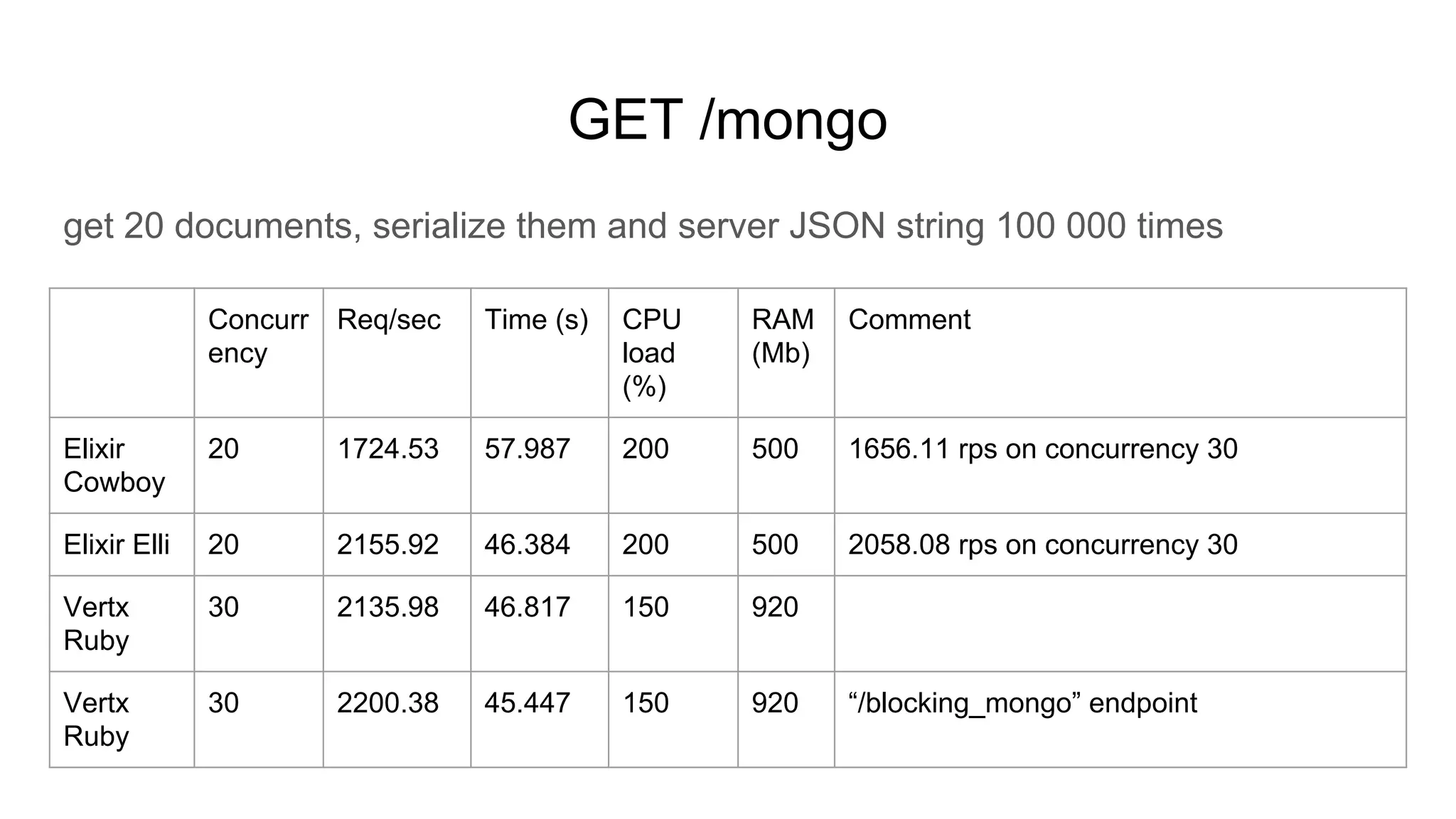
GET /mongo
get 20 documents, serialize them and server JSON string 100 000 times
Concurr
ency
Req/sec Time (s) CPU
load
(%)
RAM
(Mb)
Comment
Elixir
Cowboy
20 1724.53 57.987 200 500 1656.11 rps on concurrency 30
Elixir Elli 20 2155.92 46.384 200 500 2058.08 rps on concurrency 30
Vertx
Ruby
30 2135.98 46.817 150 920
Vertx
Ruby
30 2200.38 45.447 150 920 “/blocking_mongo” endpoint
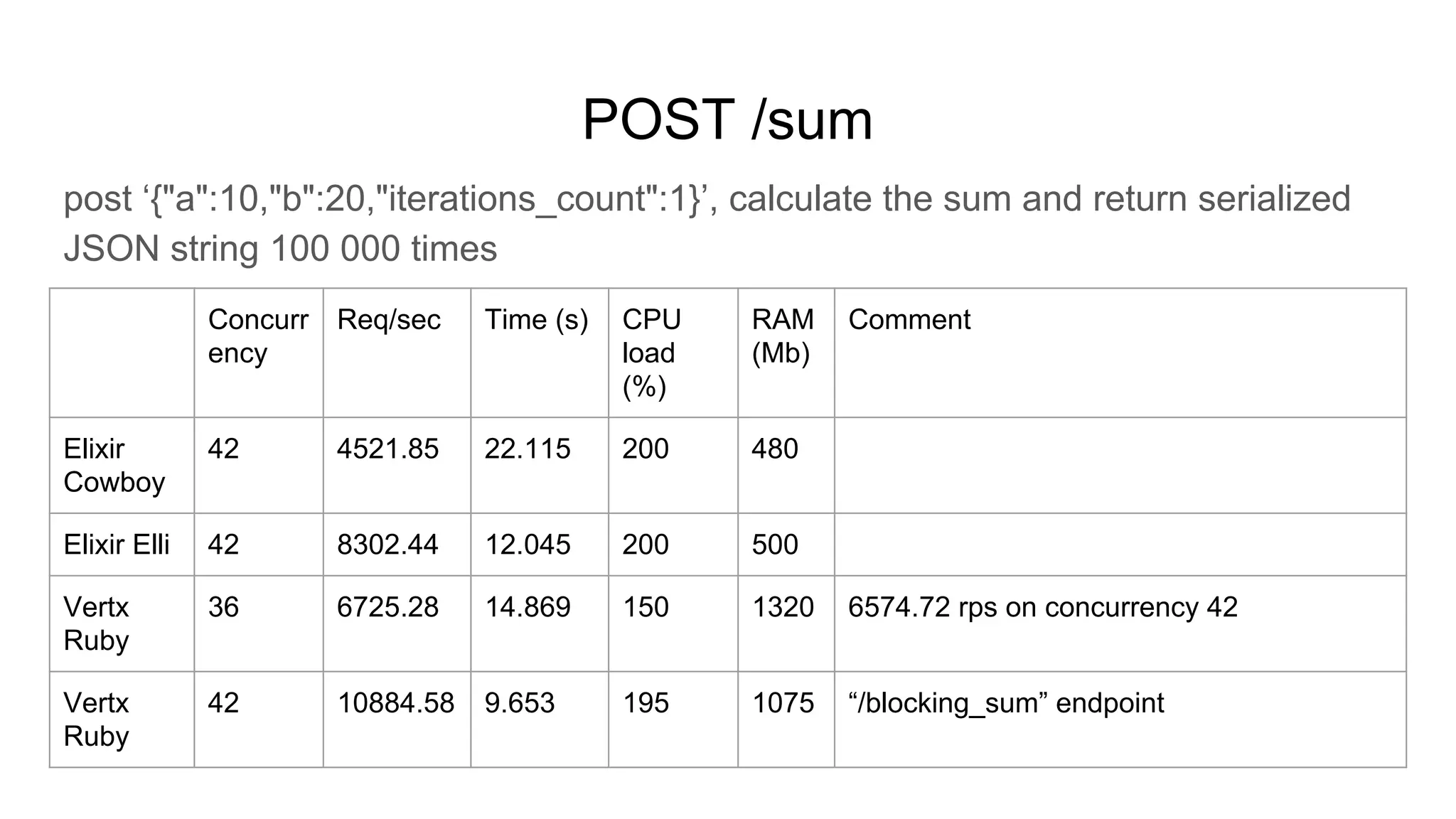
POST /sum
post ‘{"a":10,"b":20,"iterations_count":1}’, calculate the sum and return serialized
JSON string 100 000 times
Concurr
ency
Req/sec Time (s) CPU
load
(%)
RAM
(Mb)
Comment
Elixir
Cowboy
42 4521.85 22.115 200 480
Elixir Elli 42 8302.44 12.045 200 500
Vertx
Ruby
36 6725.28 14.869 150 1320 6574.72 rps on concurrency 42
Vertx
Ruby
42 10884.58 9.653 195 1075 “/blocking_sum” endpoint
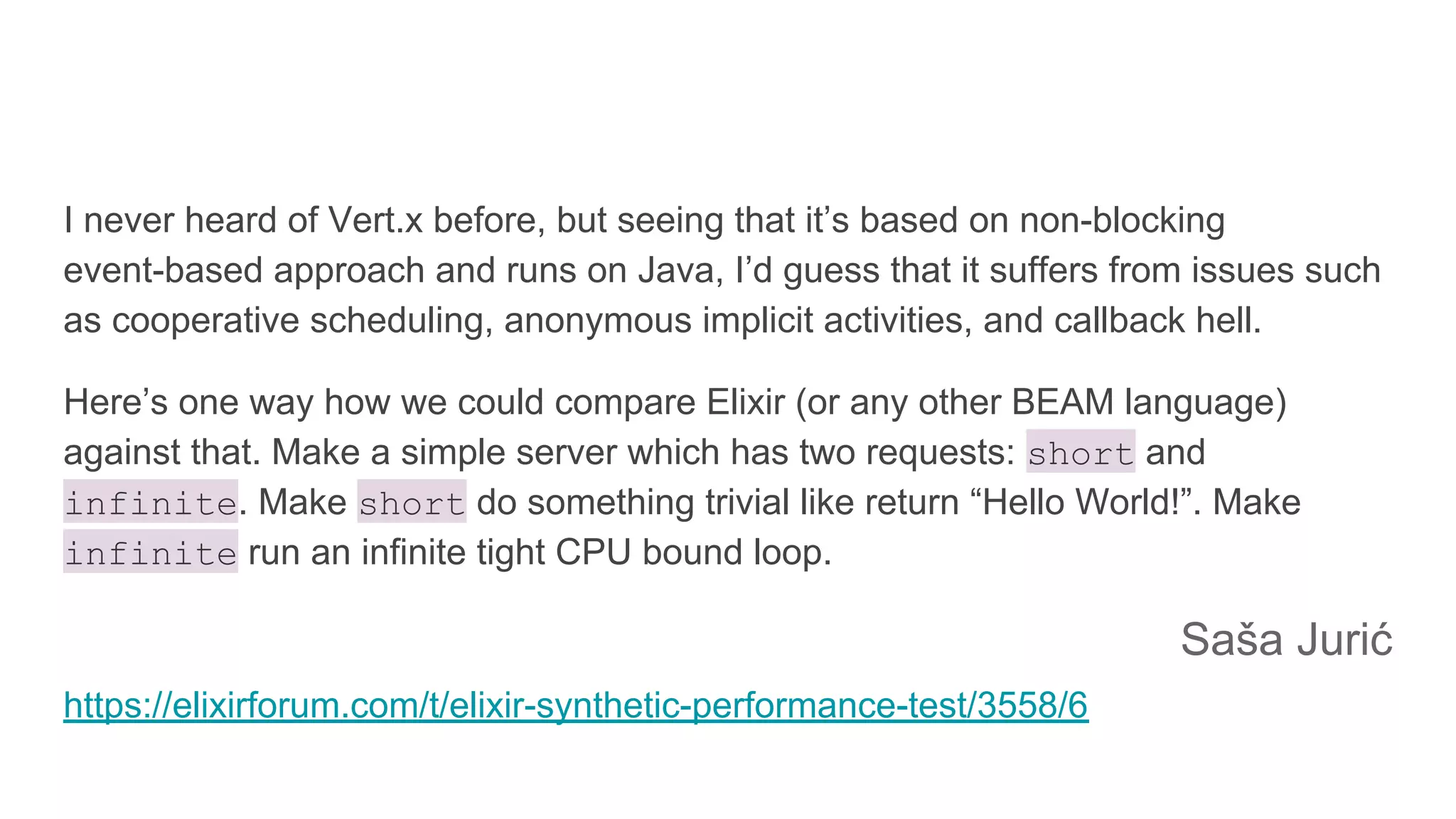
I never heard of Vert.x before, but seeing that it’s based on non-blocking
event-based approach and runs on Java, I’d guess that it suffers from issues such
as cooperative scheduling, anonymous implicit activities, and callback hell.
Here’s one way how we could compare Elixir (or any other BEAM language)
against that. Make a simple server which has two requests: short and
infinite. Make short do something trivial like return “Hello World!”. Make
infinite run an infinite tight CPU bound loop.
Saša Jurić
https://elixirforum.com/t/elixir-synthetic-performance-test/3558/6
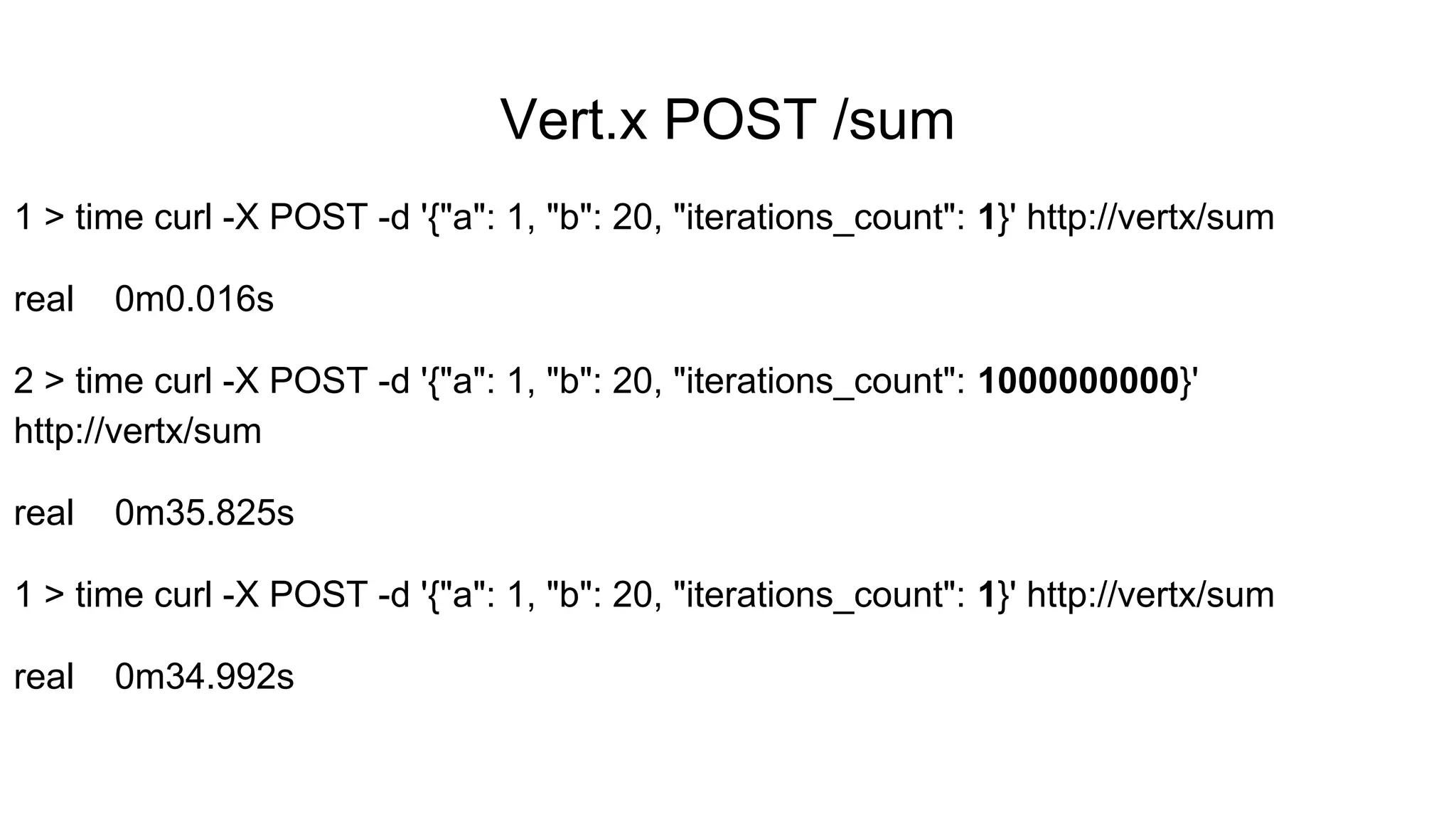
Vert.x POST /sum
1 > time curl -X POST -d '{"a": 1, "b": 20, "iterations_count": 1}' http://vertx/sum
real 0m0.016s
2 > time curl -X POST -d '{"a": 1, "b": 20, "iterations_count": 1000000000}'
http://vertx/sum
real 0m35.825s
1 > time curl -X POST -d '{"a": 1, "b": 20, "iterations_count": 1}' http://vertx/sum
real 0m34.992s
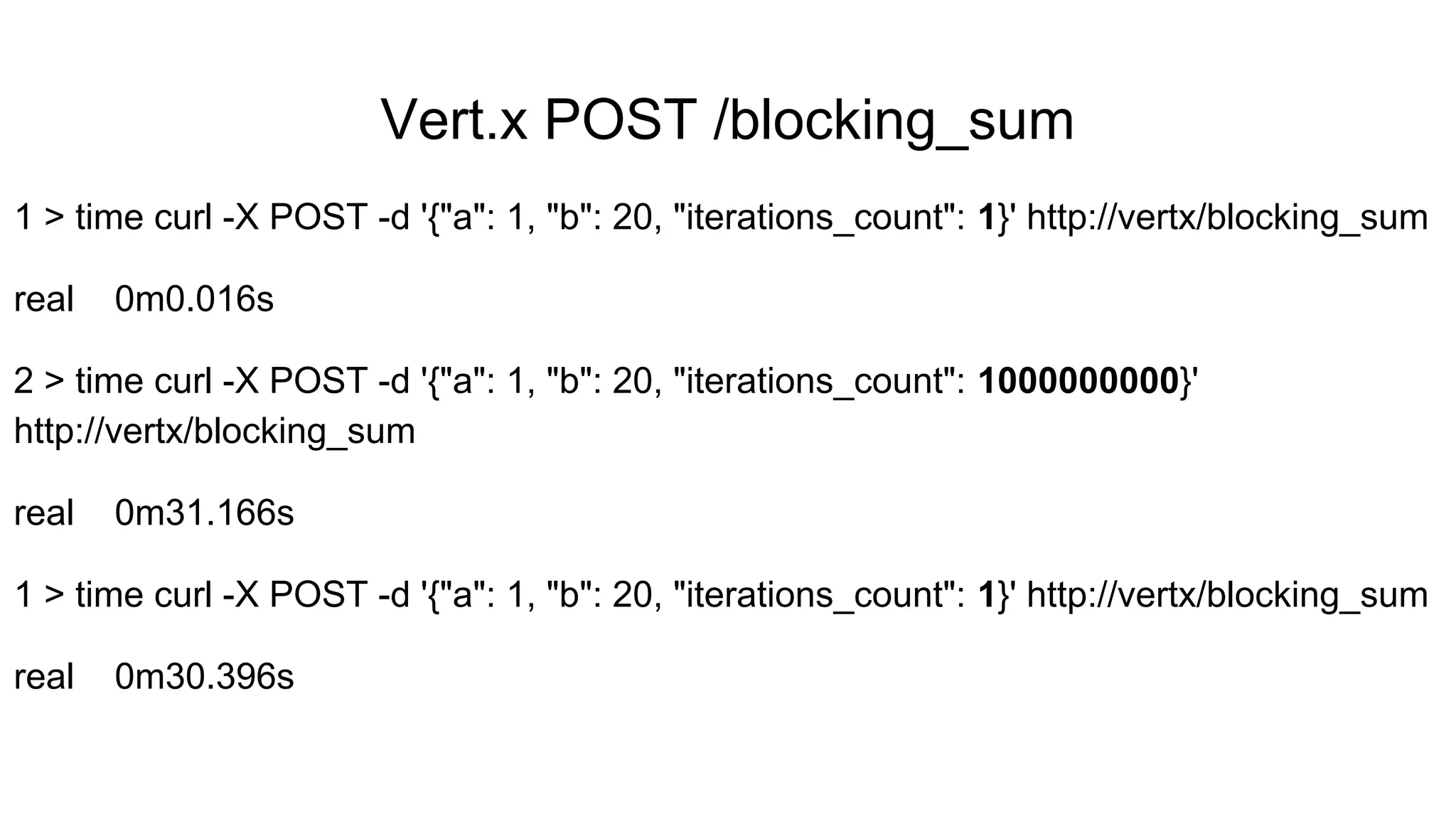
Vert.x POST /blocking_sum
1 > time curl -X POST -d '{"a": 1, "b": 20, "iterations_count": 1}' http://vertx/blocking_sum
real 0m0.016s
2 > time curl -X POST -d '{"a": 1, "b": 20, "iterations_count": 1000000000}'
http://vertx/blocking_sum
real 0m31.166s
1 > time curl -X POST -d '{"a": 1, "b": 20, "iterations_count": 1}' http://vertx/blocking_sum
real 0m30.396s
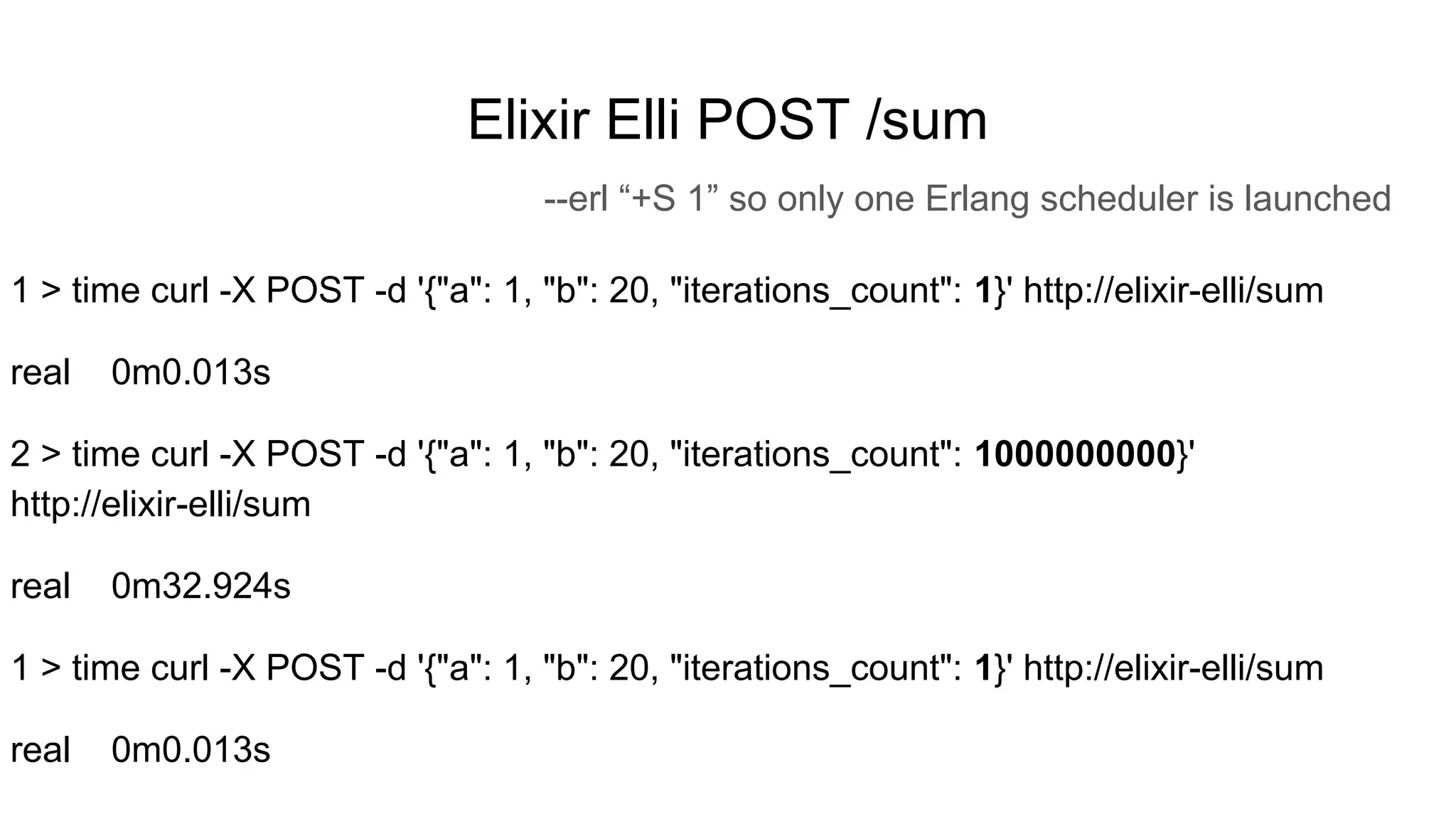
Elixir Elli POST /sum
--erl “+S 1” so only one Erlang scheduler is launched
1 > time curl -X POST -d '{"a": 1, "b": 20, "iterations_count": 1}' http://elixir-elli/sum
real 0m0.013s
2 > time curl -X POST -d '{"a": 1, "b": 20, "iterations_count": 1000000000}'
http://elixir-elli/sum
real 0m32.924s
1 > time curl -X POST -d '{"a": 1, "b": 20, "iterations_count": 1}' http://elixir-elli/sum
real 0m0.013s
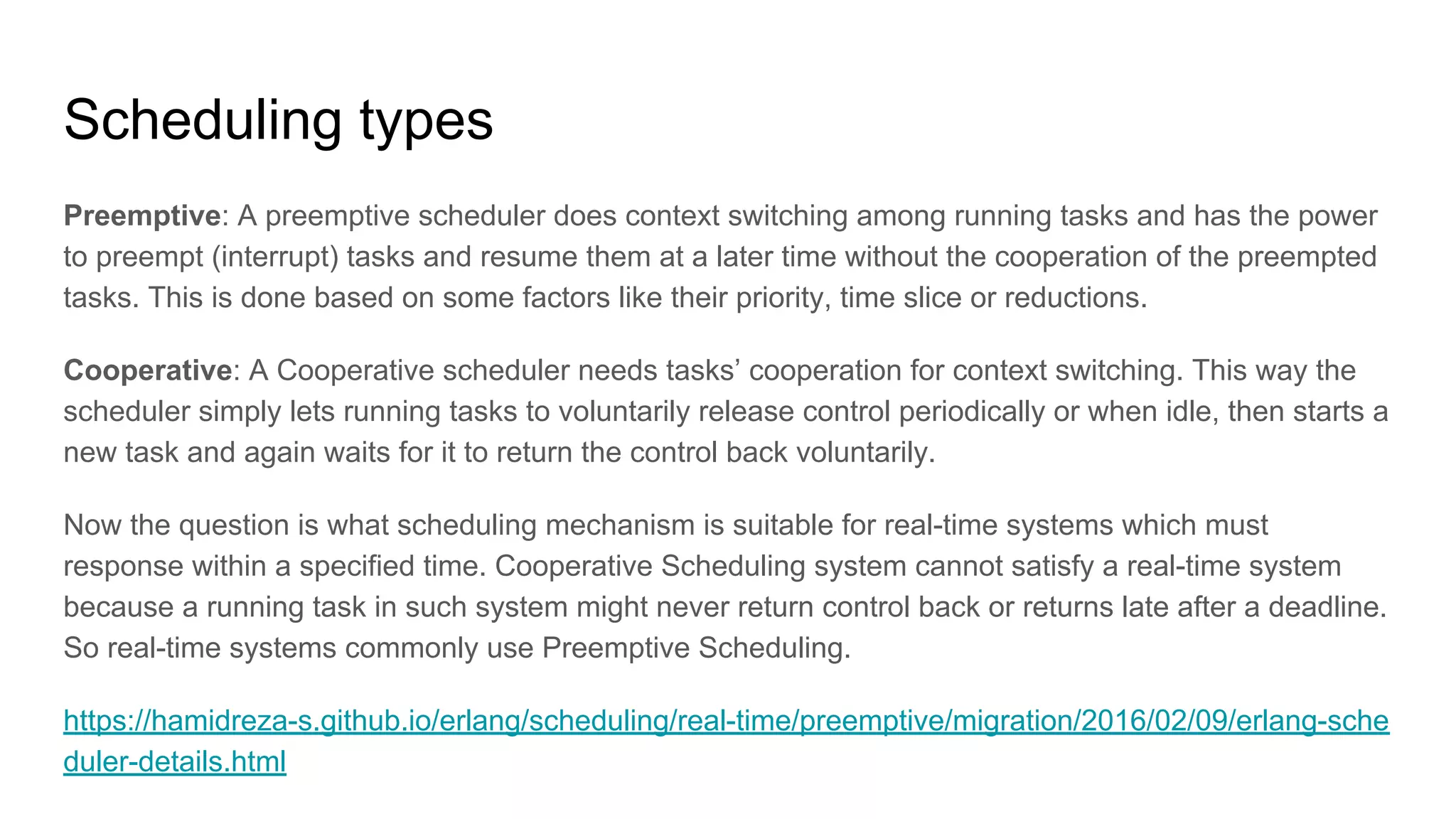
Scheduling types
Preemptive: A preemptive scheduler does context switching among running tasks and has the power
to preempt (interrupt) tasks and resume them at a later time without the cooperation of the preempted
tasks. This is done based on some factors like their priority, time slice or reductions.
Cooperative: A Cooperative scheduler needs tasks’ cooperation for context switching. This way the
scheduler simply lets running tasks to voluntarily release control periodically or when idle, then starts a
new task and again waits for it to return the control back voluntarily.
Now the question is what scheduling mechanism is suitable for real-time systems which must
response within a specified time. Cooperative Scheduling system cannot satisfy a real-time system
because a running task in such system might never return control back or returns late after a deadline.
So real-time systems commonly use Preemptive Scheduling.
https://hamidreza-s.github.io/erlang/scheduling/real-time/preemptive/migration/2016/02/09/erlang-sche
duler-details.html
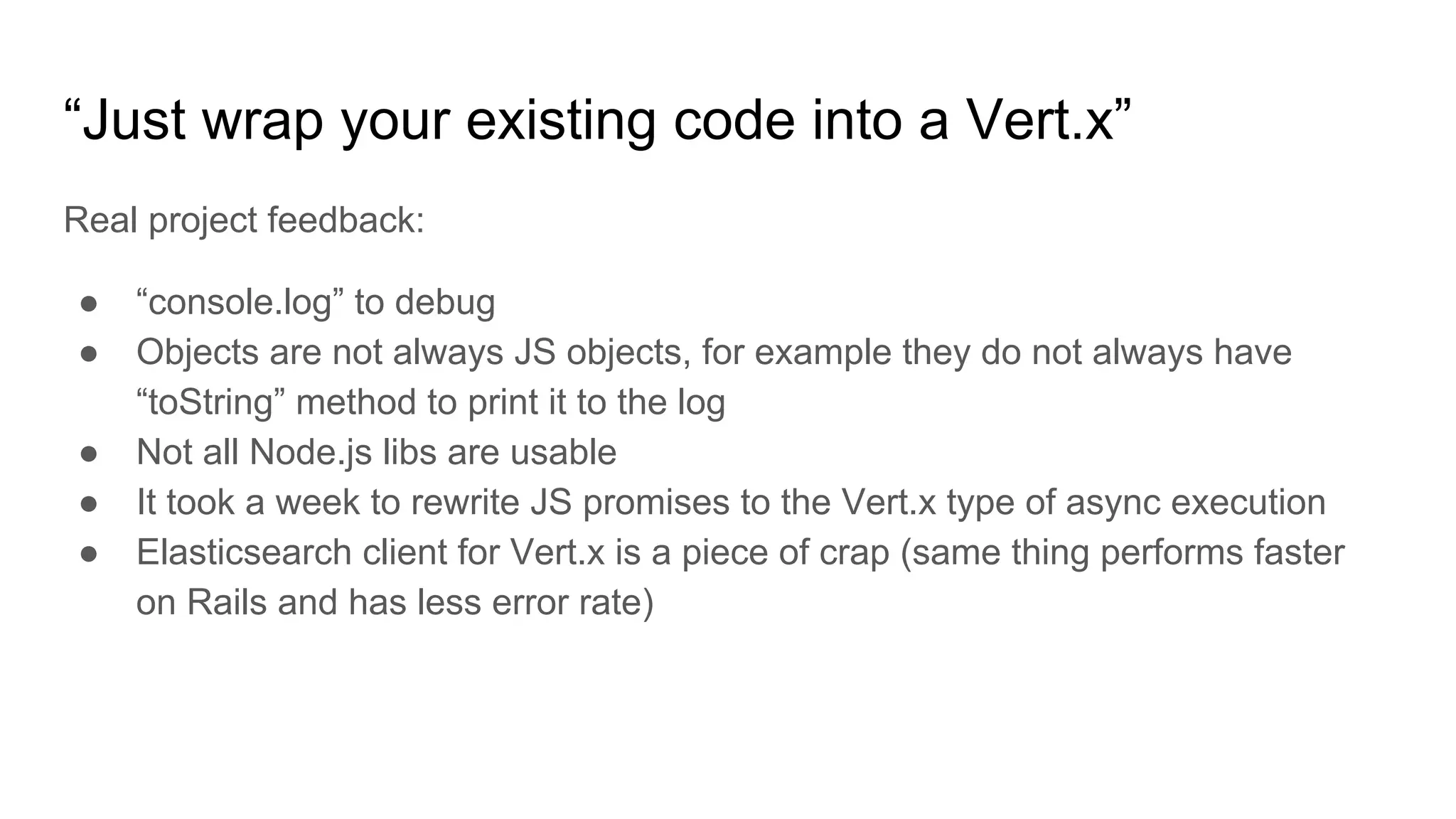
“Just wrap your existing code into a Vert.x”
Real project feedback:
● “console.log” to debug
● Objects are not always JS objects, for example they do not always have
“toString” method to print it to the log
● Not all Node.js libs are usable
● It took a week to rewrite JS promises to the Vert.x type of async execution
● Elasticsearch client for Vert.x is a piece of crap (same thing performs faster
on Rails and has less error rate)
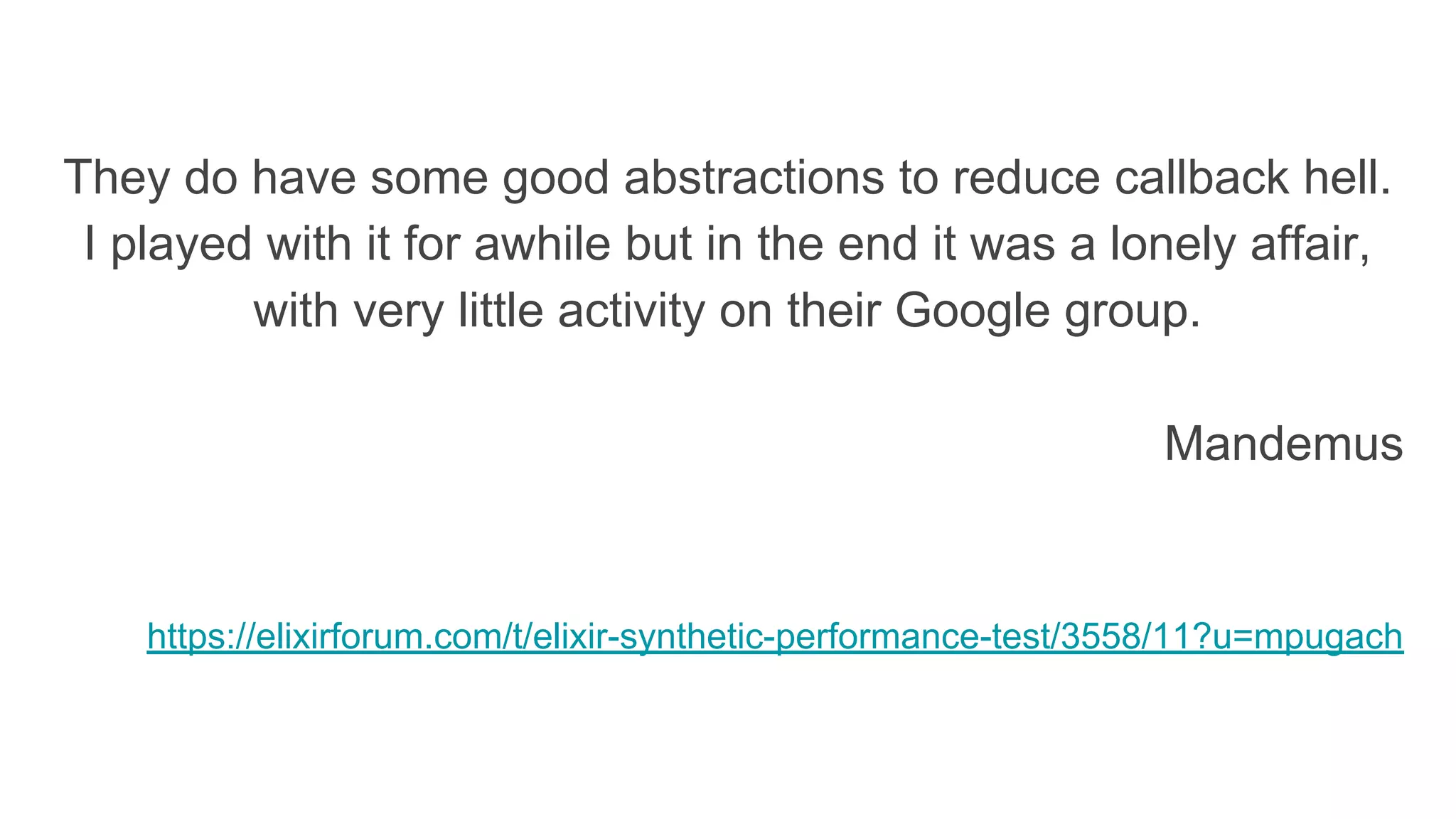
They do have some good abstractions to reduce callback hell.
I played with it for awhile but in the end it was a lonely affair,
with very little activity on their Google group.
Mandemus
https://elixirforum.com/t/elixir-synthetic-performance-test/3558/11?u=mpugach
Questions
1. Vert.x does not utilize the CPU fully in our test, is it a bottleneck?
2. Does Vert.x language translation affects performance?
3. Do they have :observer.start ?
4. Does the community active?
5. What about documentation?
6. How about other ecosystem, can I reuse libraries?
Repo
https://github.com/litslink/elixir_vertx_benchmark/tree/round_1
Links
https://gist.github.com/Gazler/c539b7ef443a6ea5a182
https://elixirforum.com/t/elixir-synthetic-performance-test/3558
https://elixirforum.com/t/plug-post-performance/473
https://elixirforum.com/t/evaluating-elixir-phoenix-for-a-web-scale-performance-critical-application/832
https://www.theerlangelist.com/article/phoenix_latency
https://crypt.codemancers.com/posts/2017-11-22-elixir-remote-debugging/
https://hamidreza-s.github.io/erlang/scheduling/real-time/preemptive/migration/2016/02/09/erlang-schedul
er-details.html
https://en.wikipedia.org/wiki/Vert.x
https://stackoverflow.com/questions/40709931/vertx-scaling-the-number-of-instances-per-thread/4071632
1#40716321
Presentation sponsor
https://jobs.dou.ua/companies/litslink/vacancies

Performance measurement methodology — Maksym Pugach | Elixir Evening Club 3

  • 1.
  • 2.
  • 3.
    A couple ofyears ago in a company, somewhere in the city….
  • 6.
    Eclipse Vert.x isa polyglot event-driven application framework that runs on the Java Virtual Machine
  • 7.
    Vert.x promises forour case ● Just wrap your existing code into a Vert.x and it works (JS and Ruby in our case) ● More performant than other solutions
  • 8.
    The Test Environment GoogleCloud Platform 1. K8S services - 1 vCPU 3.75GB Ram 2. MongoDB - 1 vCPU 3.75GB Ram 3. Target(elixir-cowboy, elixir-elli, vertx-ruby) - 2 vCPUs 7.5GB Ram 4. Tester(ab, wrk) - 4 vCPUs 15GB Ram vCPU implemented as a single hardware hyper-thread on Intel Xenon Skylake 2.7GHz
  • 9.
    The Test Environment Vert.x3.5.4 (official Docker image) Elixir 1.7.4 (official Docker image) Cowboy 2.6.0 Elli 3.1.0 Jiffy 0.15.2 (NIF JSON parser) Plug … not used
  • 10.
    Tools and Methodology ab- ApacheBench 2.3 Pick concurrency number which results better requests per second Iterate same test while last two tries are better than any other Pick the best
  • 11.
    GET /static serve astatic JSON string 1000 000 times Concurr ency Req/sec Time (s) CPU load (%) RAM (Mb) Comment Elixir Cowboy 10 4889.53 204.519 200 490 4807.77 rps on concurrency 30 Elixir Elli 30 9198.34 108.715 200 490 Not stable, +/- 500 req/sec Vertx Ruby 30 9667.33 103.441 170 820 Not stable, +/- 500 req/sec; CPU cores are not fully loaded even if performance start to degrade on high concurrency. Vertx Ruby 30 11176.91 89.470 180 820 “/blocking_static” endpoint
  • 12.
    GET /mongo get 20documents, serialize them and server JSON string 100 000 times Concurr ency Req/sec Time (s) CPU load (%) RAM (Mb) Comment Elixir Cowboy 20 1724.53 57.987 200 500 1656.11 rps on concurrency 30 Elixir Elli 20 2155.92 46.384 200 500 2058.08 rps on concurrency 30 Vertx Ruby 30 2135.98 46.817 150 920 Vertx Ruby 30 2200.38 45.447 150 920 “/blocking_mongo” endpoint
  • 13.
    POST /sum post ‘{"a":10,"b":20,"iterations_count":1}’,calculate the sum and return serialized JSON string 100 000 times Concurr ency Req/sec Time (s) CPU load (%) RAM (Mb) Comment Elixir Cowboy 42 4521.85 22.115 200 480 Elixir Elli 42 8302.44 12.045 200 500 Vertx Ruby 36 6725.28 14.869 150 1320 6574.72 rps on concurrency 42 Vertx Ruby 42 10884.58 9.653 195 1075 “/blocking_sum” endpoint
  • 14.
    I never heardof Vert.x before, but seeing that it’s based on non-blocking event-based approach and runs on Java, I’d guess that it suffers from issues such as cooperative scheduling, anonymous implicit activities, and callback hell. Here’s one way how we could compare Elixir (or any other BEAM language) against that. Make a simple server which has two requests: short and infinite. Make short do something trivial like return “Hello World!”. Make infinite run an infinite tight CPU bound loop. Saša Jurić https://elixirforum.com/t/elixir-synthetic-performance-test/3558/6
  • 15.
    Vert.x POST /sum 1> time curl -X POST -d '{"a": 1, "b": 20, "iterations_count": 1}' http://vertx/sum real 0m0.016s 2 > time curl -X POST -d '{"a": 1, "b": 20, "iterations_count": 1000000000}' http://vertx/sum real 0m35.825s 1 > time curl -X POST -d '{"a": 1, "b": 20, "iterations_count": 1}' http://vertx/sum real 0m34.992s
  • 16.
    Vert.x POST /blocking_sum 1> time curl -X POST -d '{"a": 1, "b": 20, "iterations_count": 1}' http://vertx/blocking_sum real 0m0.016s 2 > time curl -X POST -d '{"a": 1, "b": 20, "iterations_count": 1000000000}' http://vertx/blocking_sum real 0m31.166s 1 > time curl -X POST -d '{"a": 1, "b": 20, "iterations_count": 1}' http://vertx/blocking_sum real 0m30.396s
  • 17.
    Elixir Elli POST/sum --erl “+S 1” so only one Erlang scheduler is launched 1 > time curl -X POST -d '{"a": 1, "b": 20, "iterations_count": 1}' http://elixir-elli/sum real 0m0.013s 2 > time curl -X POST -d '{"a": 1, "b": 20, "iterations_count": 1000000000}' http://elixir-elli/sum real 0m32.924s 1 > time curl -X POST -d '{"a": 1, "b": 20, "iterations_count": 1}' http://elixir-elli/sum real 0m0.013s
  • 18.
    Scheduling types Preemptive: Apreemptive scheduler does context switching among running tasks and has the power to preempt (interrupt) tasks and resume them at a later time without the cooperation of the preempted tasks. This is done based on some factors like their priority, time slice or reductions. Cooperative: A Cooperative scheduler needs tasks’ cooperation for context switching. This way the scheduler simply lets running tasks to voluntarily release control periodically or when idle, then starts a new task and again waits for it to return the control back voluntarily. Now the question is what scheduling mechanism is suitable for real-time systems which must response within a specified time. Cooperative Scheduling system cannot satisfy a real-time system because a running task in such system might never return control back or returns late after a deadline. So real-time systems commonly use Preemptive Scheduling. https://hamidreza-s.github.io/erlang/scheduling/real-time/preemptive/migration/2016/02/09/erlang-sche duler-details.html
  • 20.
    “Just wrap yourexisting code into a Vert.x” Real project feedback: ● “console.log” to debug ● Objects are not always JS objects, for example they do not always have “toString” method to print it to the log ● Not all Node.js libs are usable ● It took a week to rewrite JS promises to the Vert.x type of async execution ● Elasticsearch client for Vert.x is a piece of crap (same thing performs faster on Rails and has less error rate)
  • 21.
    They do havesome good abstractions to reduce callback hell. I played with it for awhile but in the end it was a lonely affair, with very little activity on their Google group. Mandemus https://elixirforum.com/t/elixir-synthetic-performance-test/3558/11?u=mpugach
  • 22.
    Questions 1. Vert.x doesnot utilize the CPU fully in our test, is it a bottleneck? 2. Does Vert.x language translation affects performance? 3. Do they have :observer.start ? 4. Does the community active? 5. What about documentation? 6. How about other ecosystem, can I reuse libraries?
  • 24.
  • 25.
  • 26.