BUILDING MICROSERVICES
WITH VERT.X 3.0
AGRAJ MANGAL
AGENDA
• Microservices
• Why, why not ?
• Comparison with Monolithic Architecture
• Vert.x
• Concepts: Event Loop, Verticles, Event Bus
• Modules: core, web
• Comparisons
• Real-life Example - Pulse
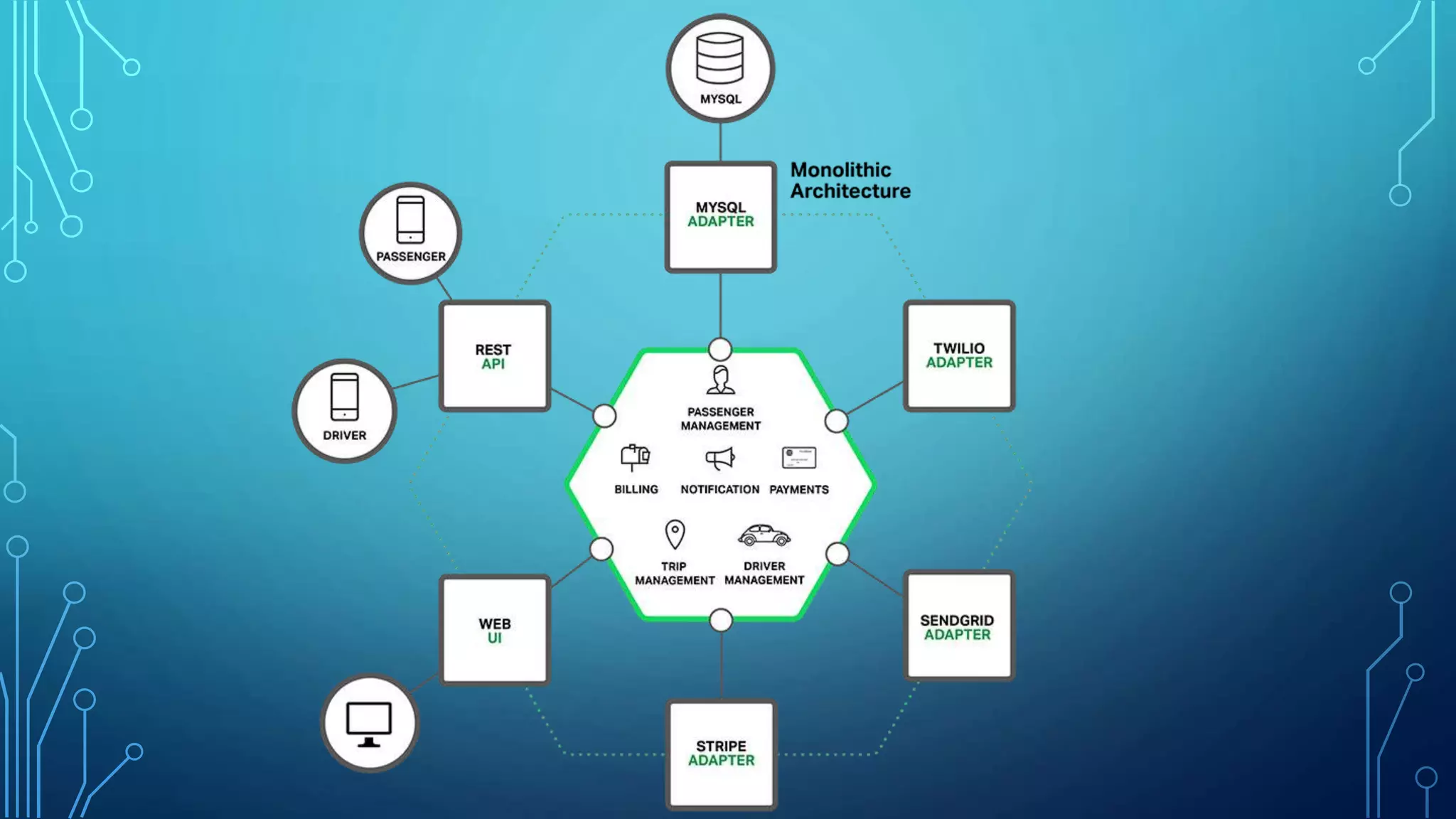
MONOLITHIC ARCHITECTURE
• Logically Different Modules
• But Packaged & deployed as a Single Unit
• Initial Phases of Project
• Simple to Deploy
• Vertical Scaling
• Later on
• Difficult to Manage & Scale
• Longer Startup Times
• Slow down Development
• CI becomes challenging
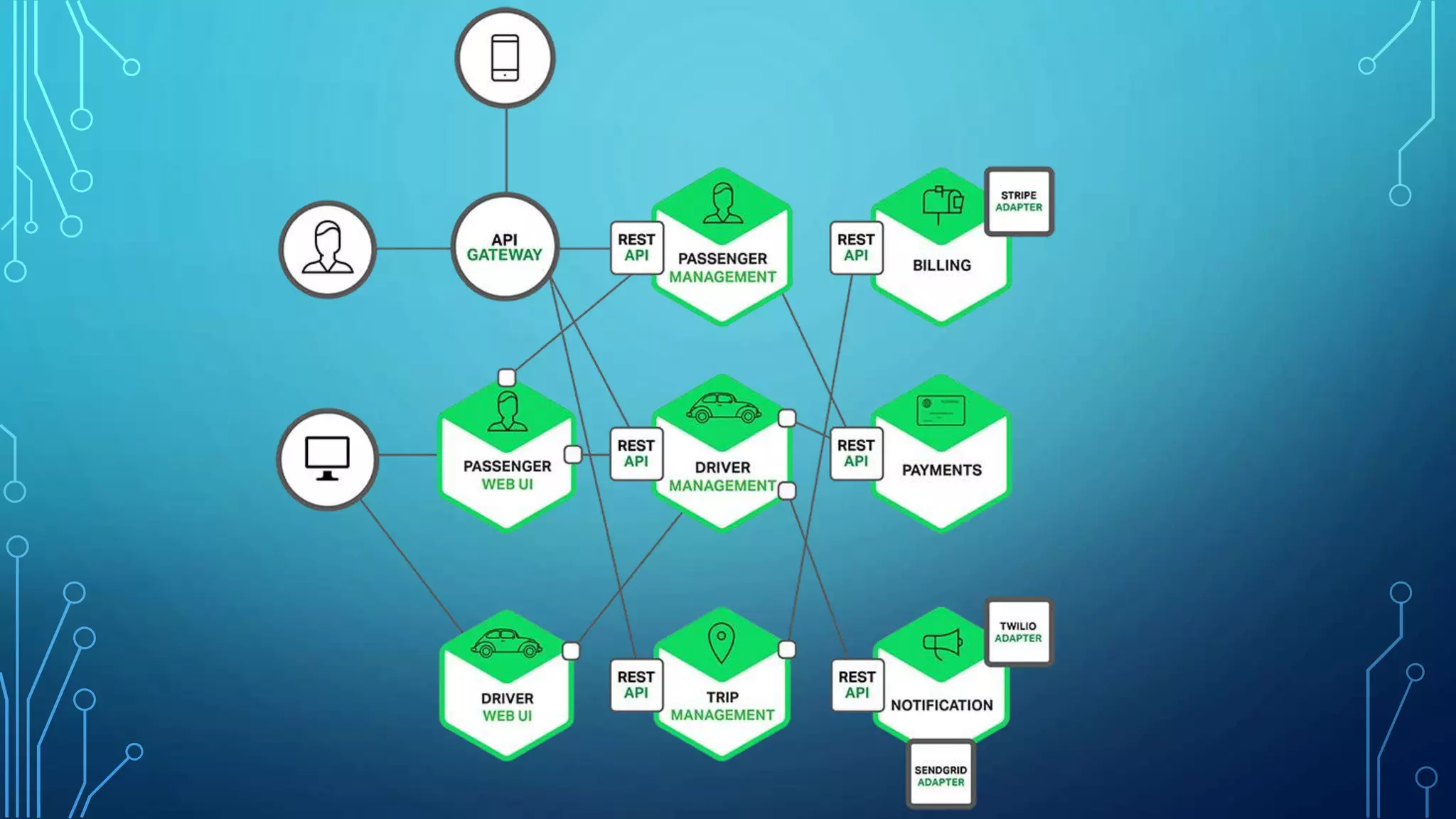
MICROSERVICES PATTERN
• Split into Smaller, Interconnected Services
• Loose Coupling
• Service == Functional Area
• Service exposes APIs – consumed by other services & clients
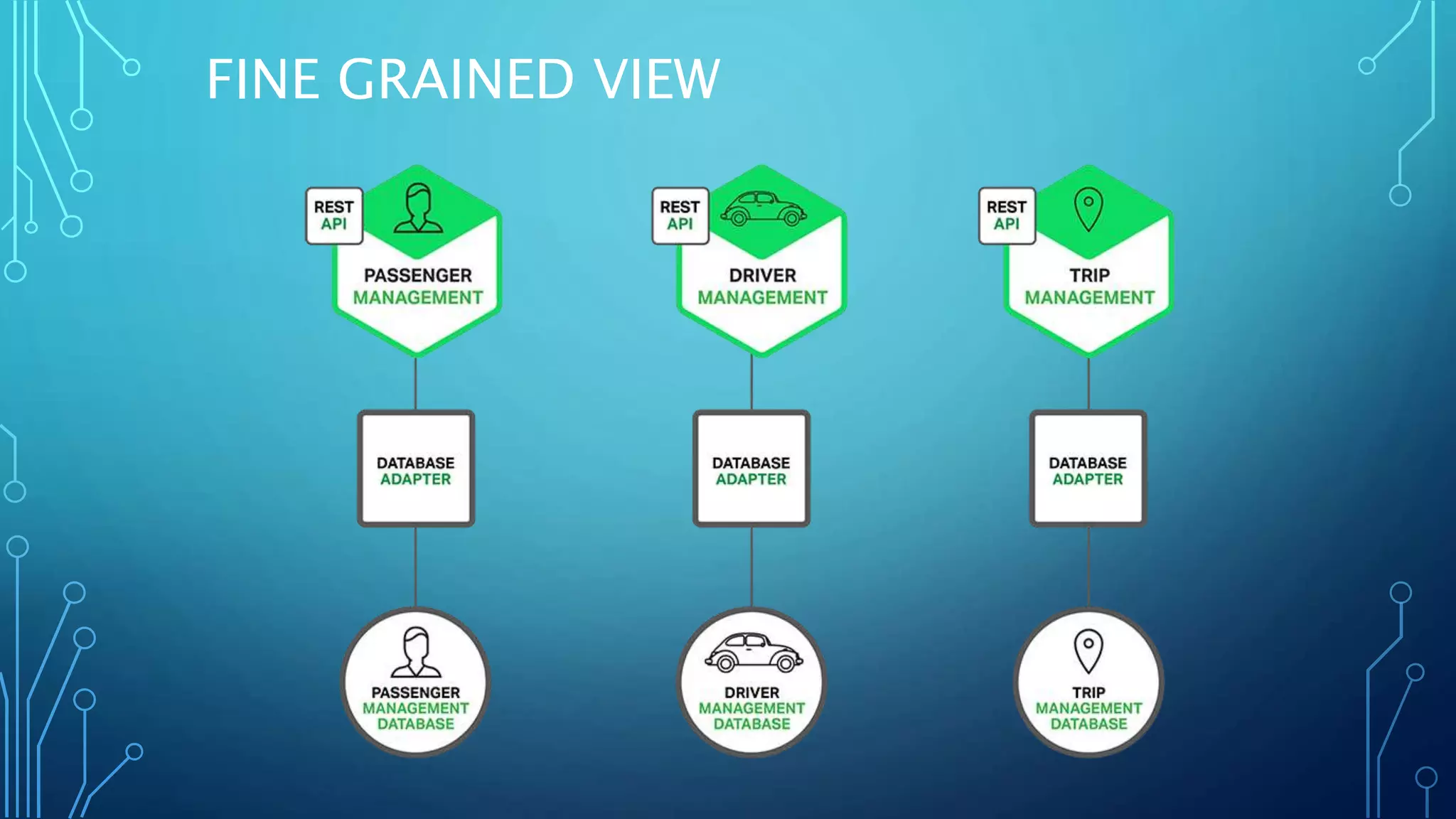
FINE GRAINED VIEW
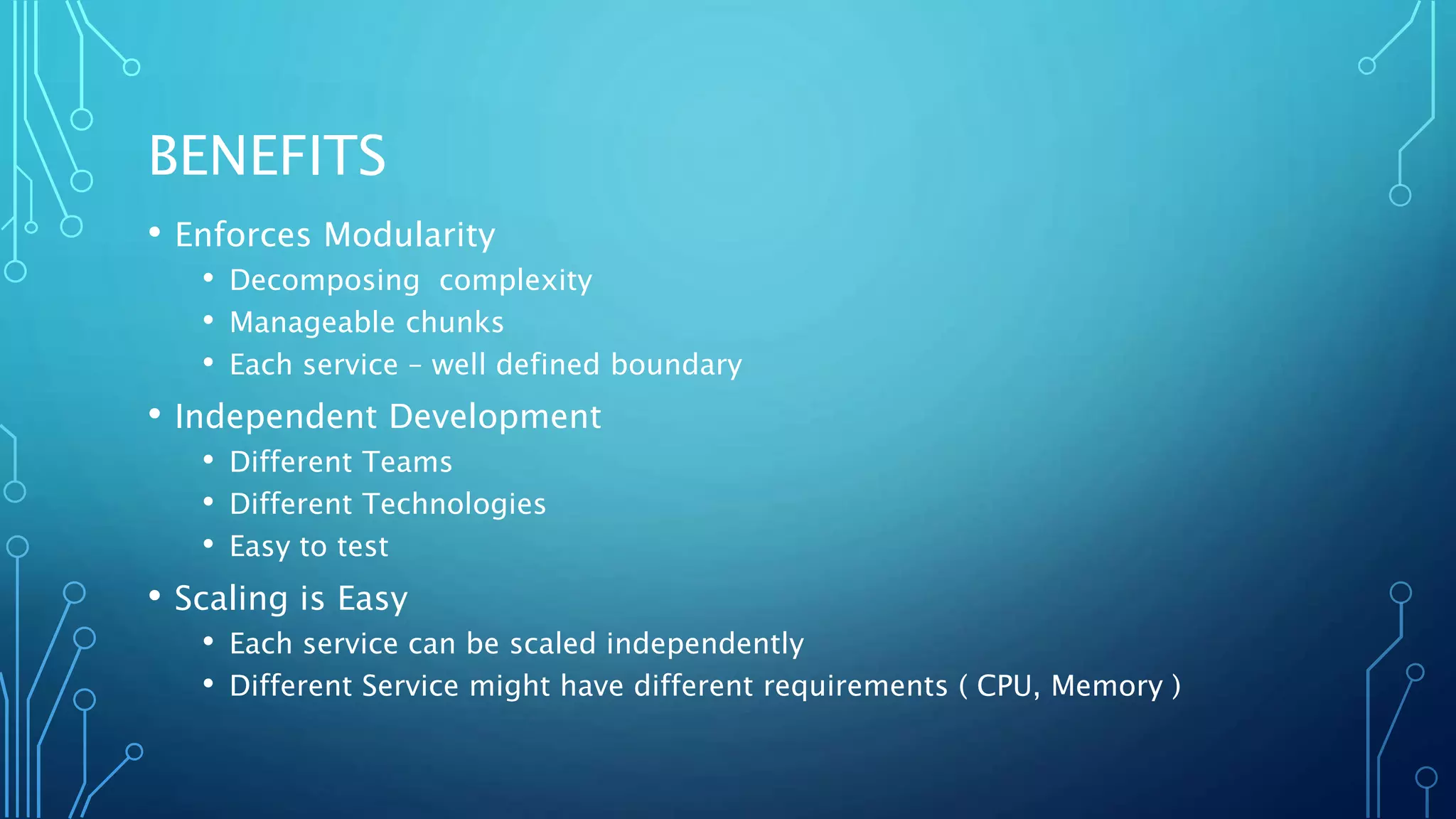
BENEFITS
• Enforces Modularity
• Decomposing complexity
• Manageable chunks
• Each service – well defined boundary
• Independent Development
• Different Teams
• Different Technologies
• Easy to test
• Scaling is Easy
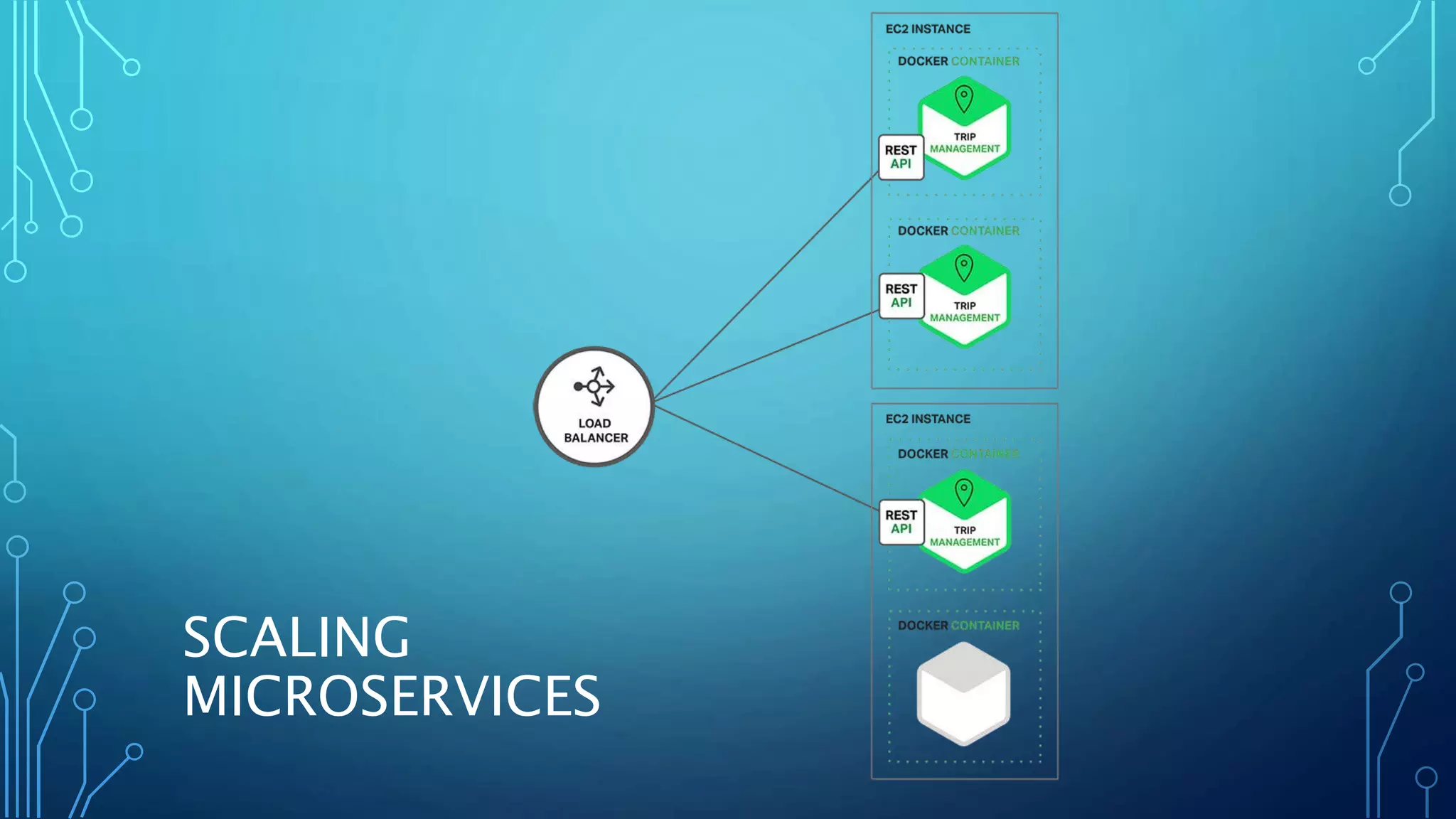
• Each service can be scaled independently
• Different Service might have different requirements ( CPU, Memory )
SCALING
MICROSERVICES
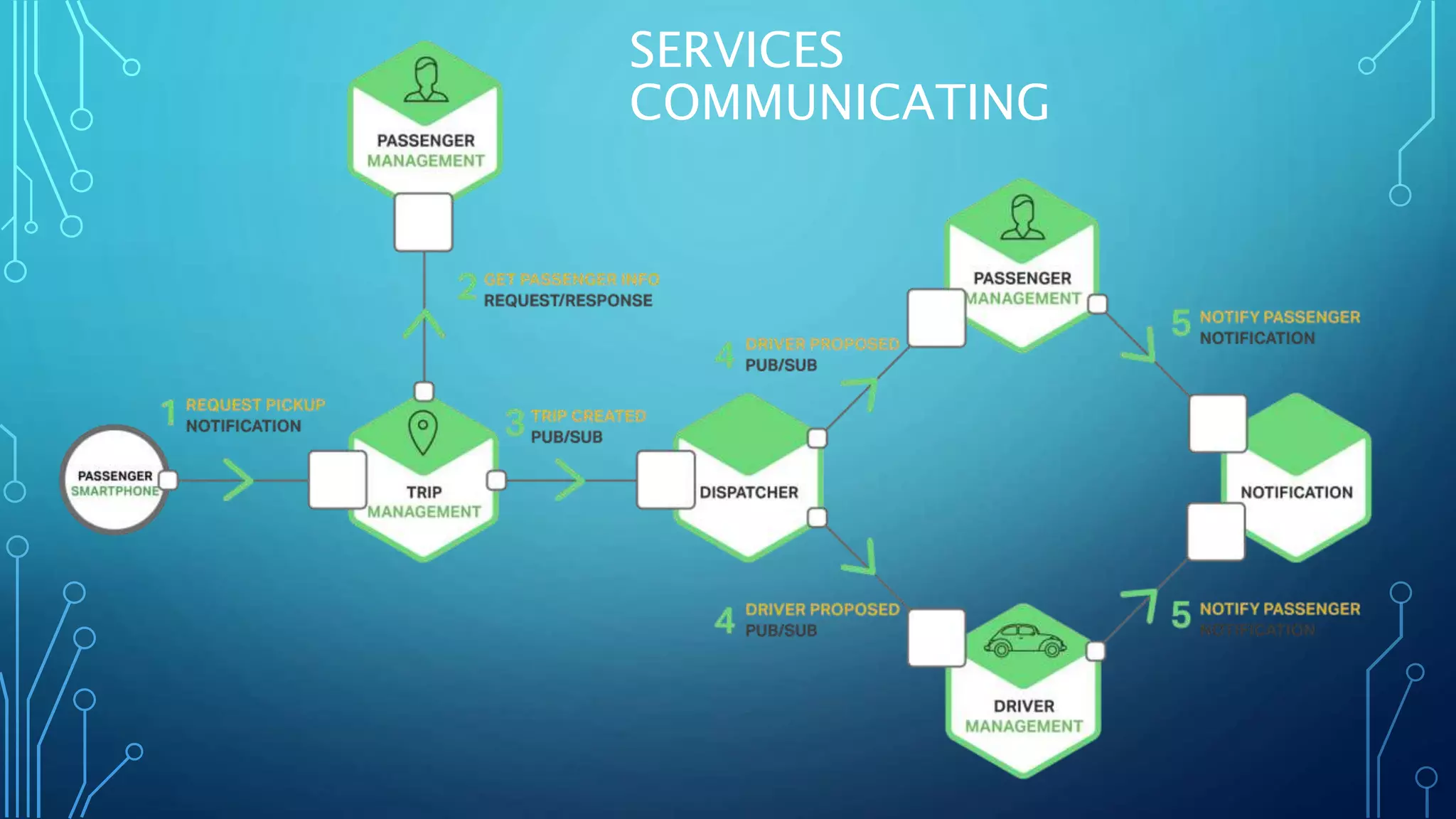
SERVICES
COMMUNICATING
DRAWBACKS
• Partitioned Database Architecture
• Have to settle for Eventual Consistency
• ACID transactions not possible
• Deploying
• Though scalable, but more complex
• Many more moving parts
• Service Discovery required
• Polyglot (Java, JavaScript, Groovy, Ruby, Python etc.)
• Event-driven & Non-blocking programming model
• Super simple Concurrency Model
• Lightweight ~ 650Kb
• “Ideal choice for creating light-weight, high-
performance, microservices”
• Public module repository
• Reactive applications
• Asynchronous APIs
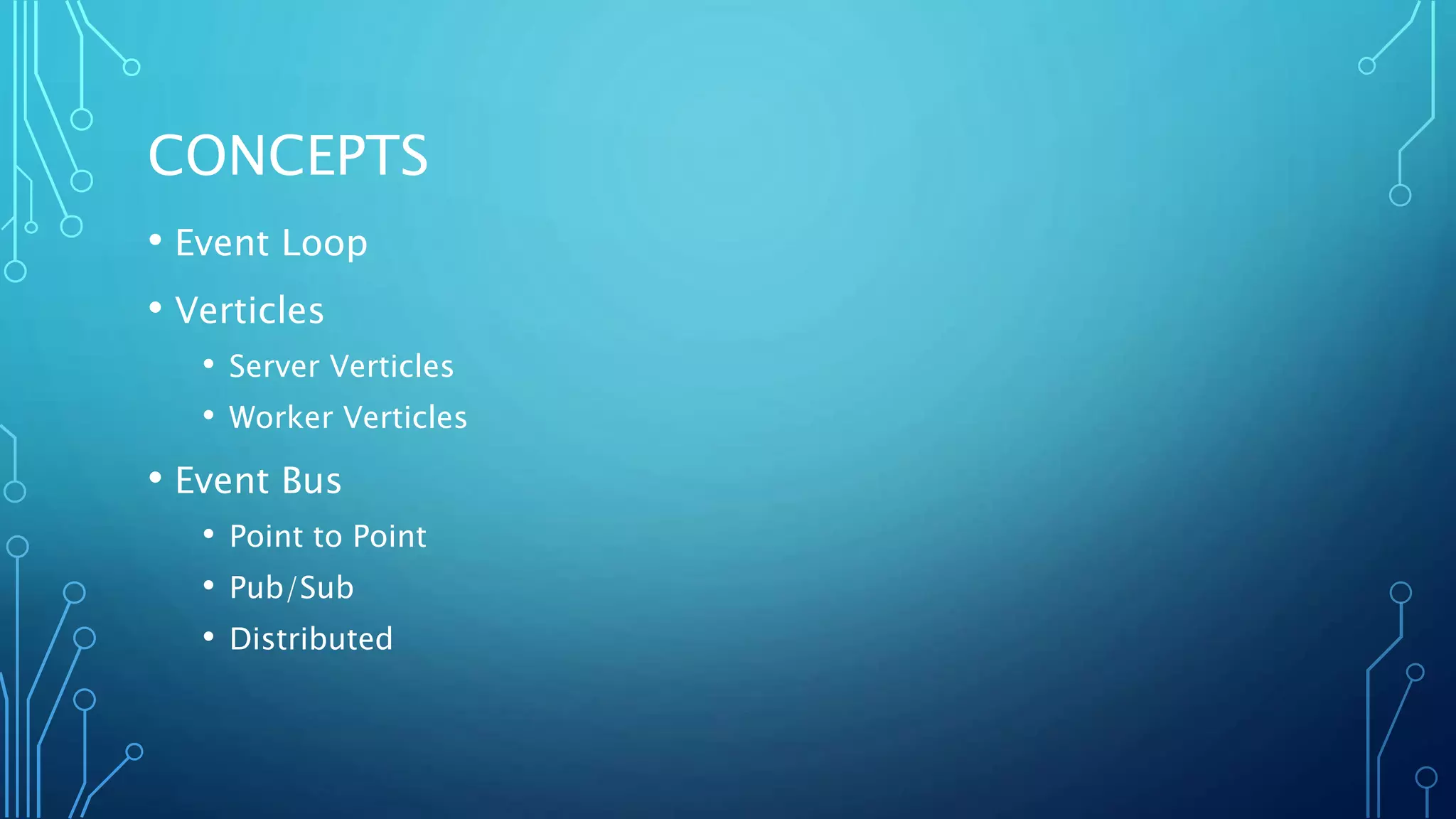
CONCEPTS
• Event Loop
• Verticles
• Server Verticles
• Worker Verticles
• Event Bus
• Point to Point
• Pub/Sub
• Distributed
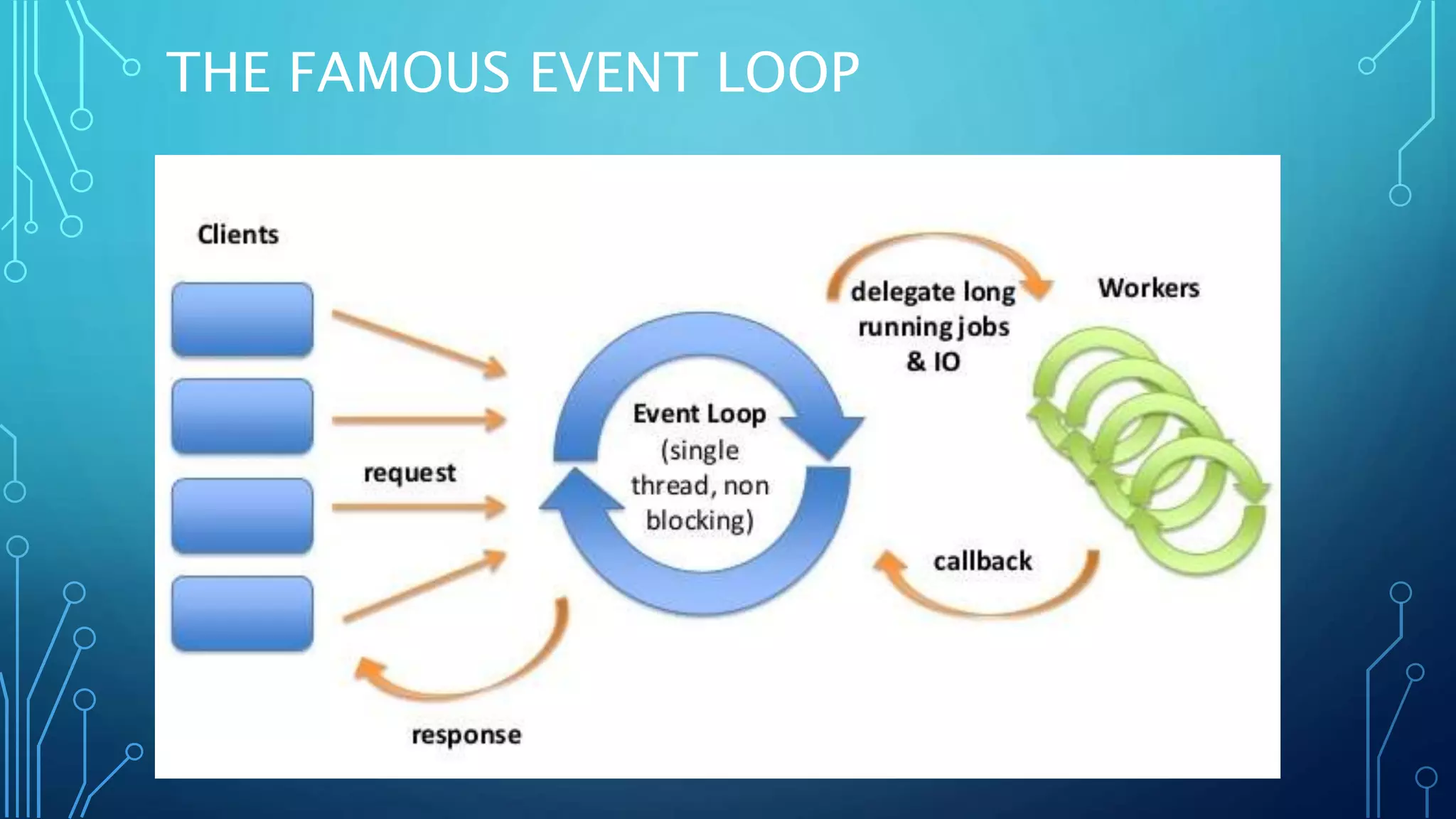
THE FAMOUS EVENT LOOP
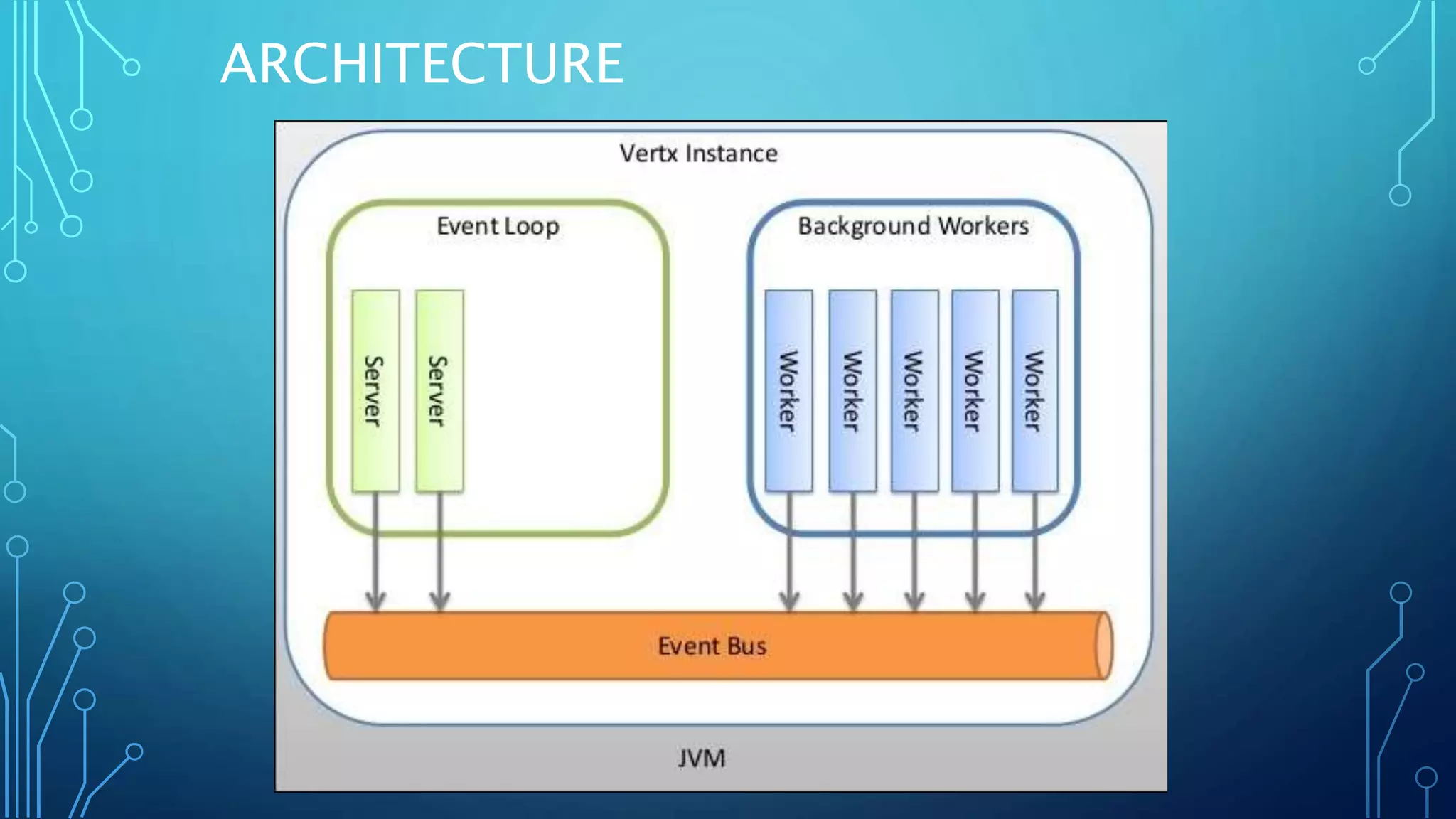
ARCHITECTURE
• Don’t Block the Event Loop
• Workers “can” block
• Message Passing using Event Bus
• Concurrency Model
• A Verticle instance is always Single threaded
• No more Locking, synchronized & race conditions
• Actor-like concurrency model
• Scaling
• By Creating more Verticle Instances
• For TCP & HTTP servers, Vert.x does automatic load balancing
• Use FAT Jar for Deployment
VERT.X MODULES
• Core
• Web
• Data Access
• MongoDB, JDBC, Redis, MySQL
• Authentication Modules
• JWT, OAuth 2, JDBC Auth, Shiro Auth, MongoDB auth
• Messaging Systems
• Kafka, RabbitMQ
• Clustering – Hazelcast
VERT.X CORE
• Servers & clients
• TCP/SSL
• HTTP/HTTPS
• Websocket & SockJS
• EventBus
• Shared Maps & Sets
• Buffers & Flow Control
• Container API – Deploy & Undeploy Verticles
• Timers & Files
• Logging
• Configuration
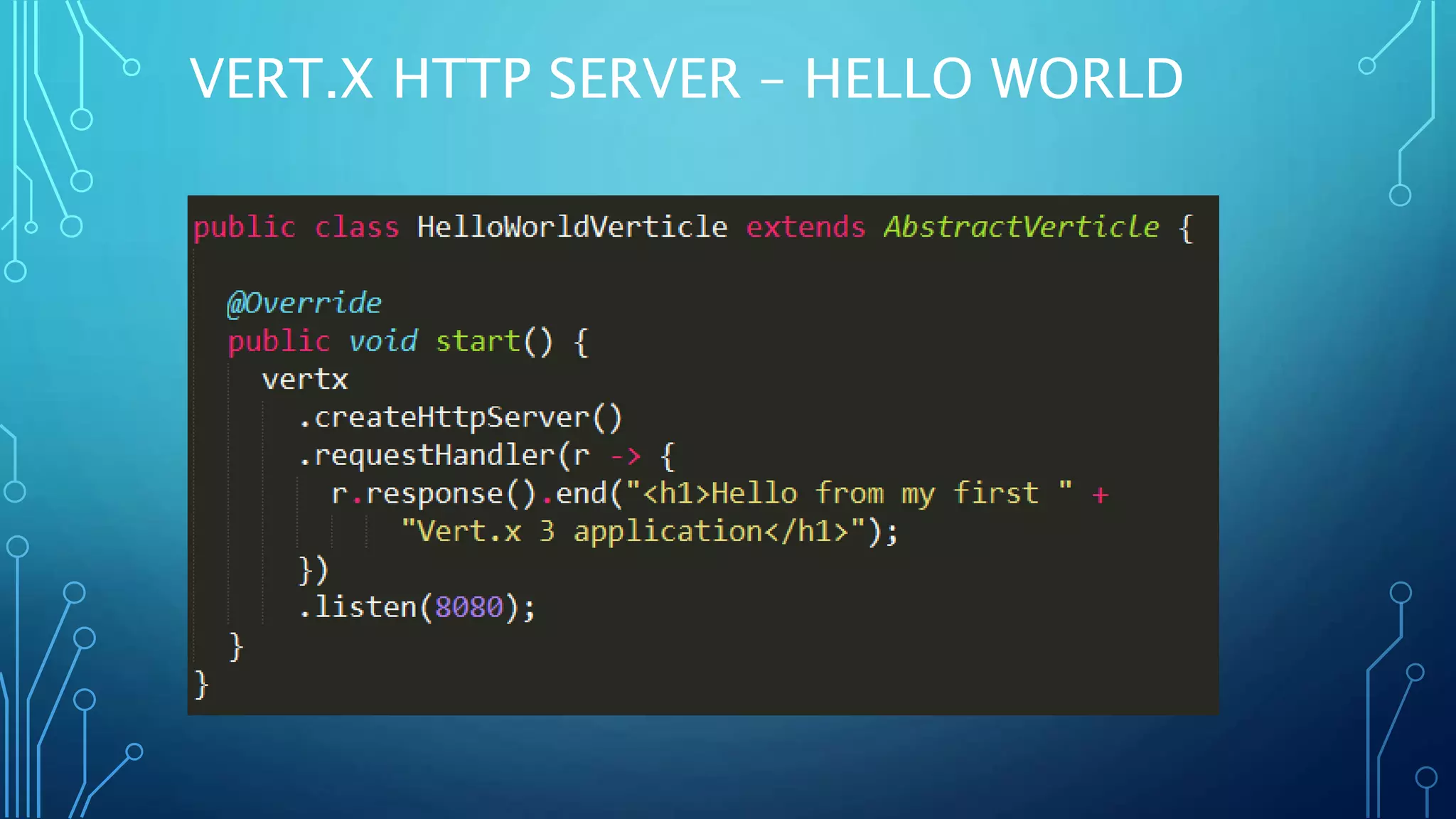
VERT.X HTTP SERVER – HELLO WORLD
VERT.X WEB
• Routing
• Regex Matching
• Request Body Handling, parameters extraction
• Cookie Parsing & Handling
• Multipart Form & File Upload
• Session support ( sticky & non-sticky )
• CORS & CSRF Support
• Authentication & Authorization
• SockJS Support
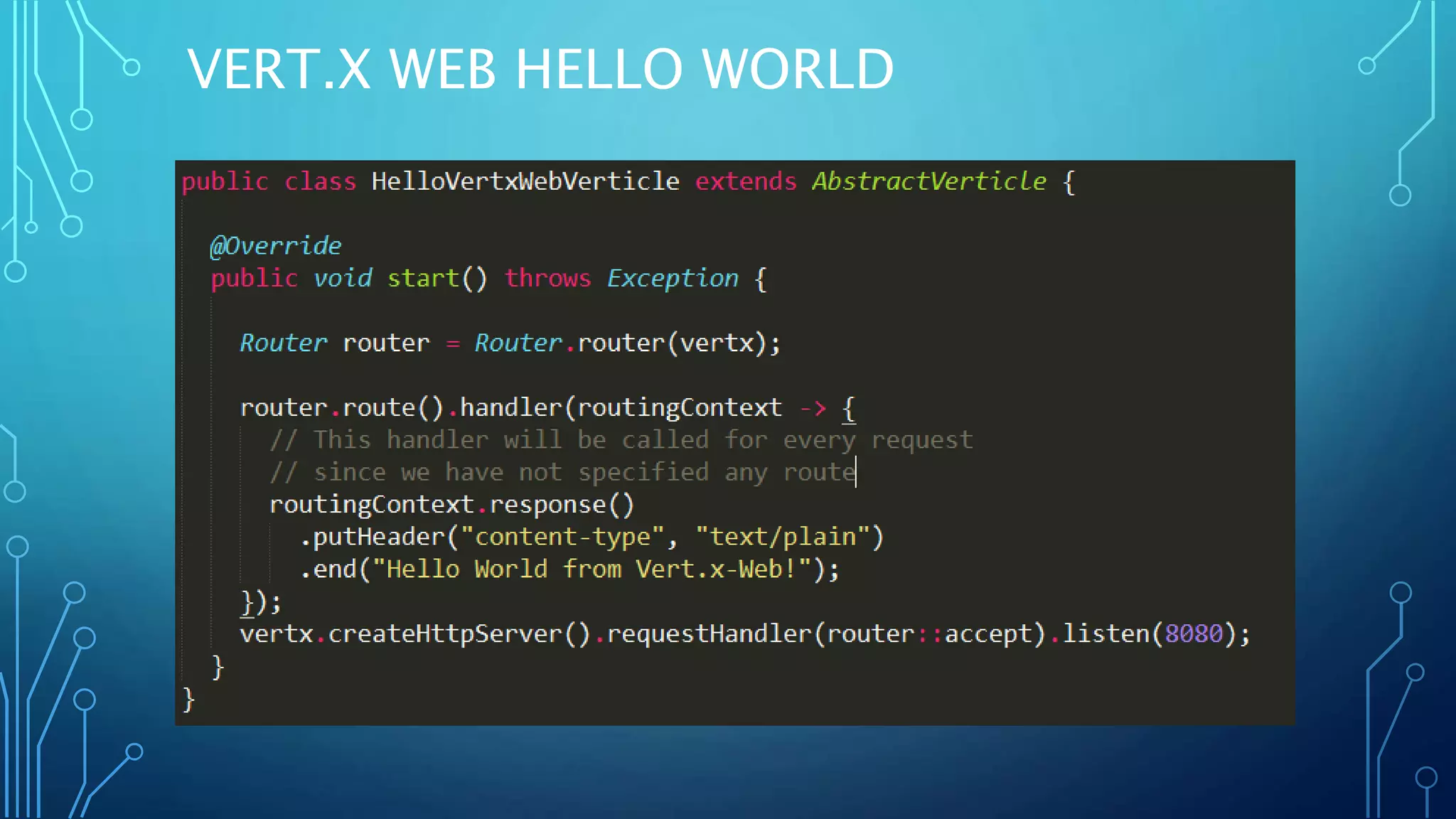
VERT.X WEB HELLO WORLD
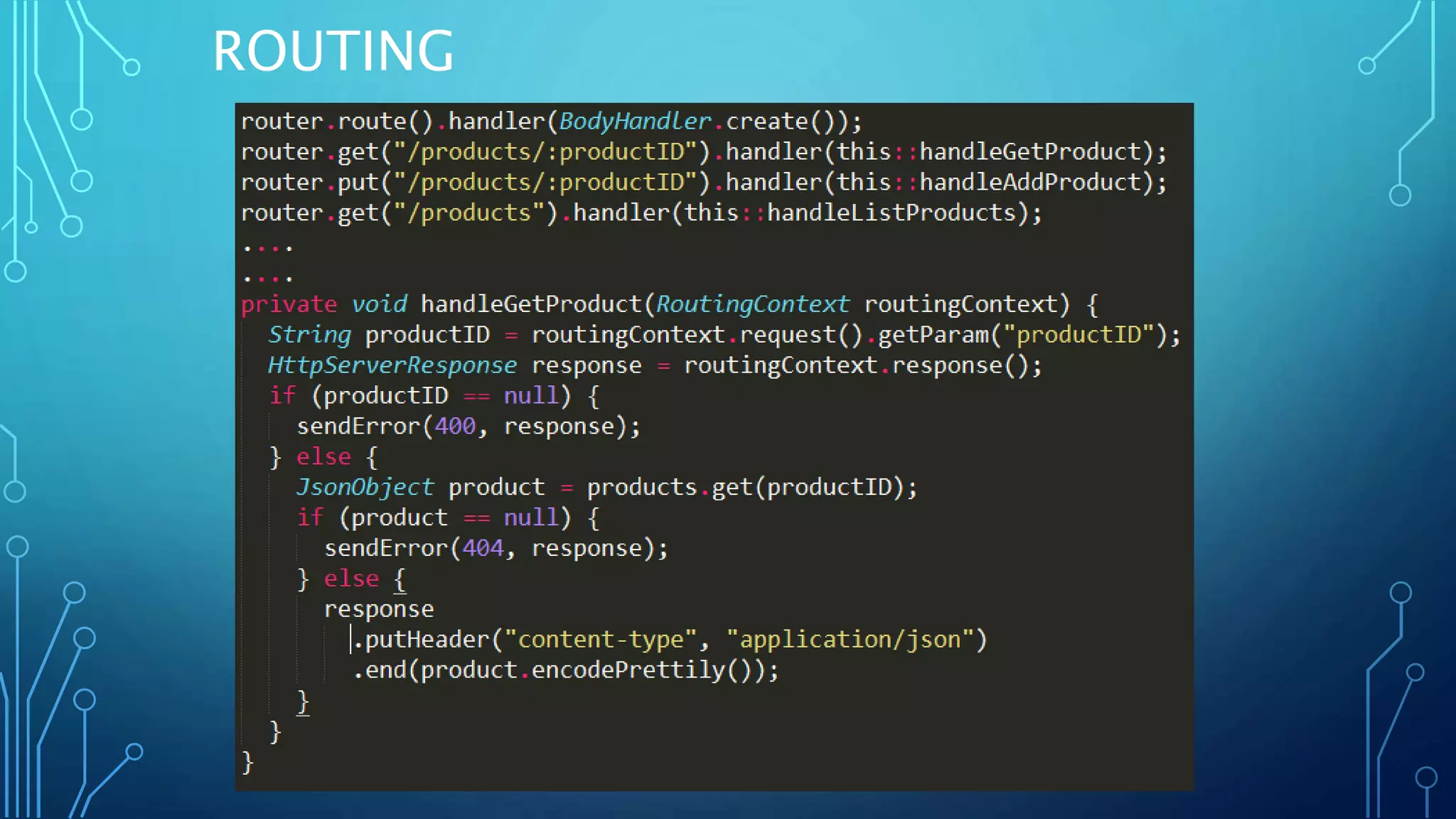
ROUTING
ROUTING
• Chain of Routers
• Either “end” it
• Or pass it to the “next” one
• Various Options – Route by
• HTTP Method Type
• Exact Path
• Regex Matching
• MIME type of request
• Decide Routing Order
VERT.X WEB
• BodyHandler
• Retrieve Request Body
• Limit Body Size
• Handle File Uploads
• CookieHandler
• Get, Add, Delete Cookie
• SessionHandler
• Sticky & Non-Sticky Sessions
• Vert.x don’t put actual data in Session Cookie – Session UUID is used to
lookup data on the server
• Session timeouts
VERT.X WEB
• Authentication & Authorization
• Support for Basic-Auth, Redirect-Auth, FormLogin
• JWT
• OAuth2
• Static Resources
• StaticHandler
• Caching – set headers ( cache-control, last-modified, date )
• Configurable webroot, index page
• Disable File Caching - .vertx
• Templating Support
• Handlebars, Jade, MVEL, Thymeleaf
• CORS & CSFR Handlers
DISTRIBUTED SUPPORT
DISTRIBUTED EVENT BUS
• Connect multiple Vert.x
instances across JVMs
• Event bus extends to client side
Javascript
• Ideal for “real-time” web
applications
• vertx-eventbus.js
CLUSTERING
• Hazelcast
• Shared Data Structures
REALTIME COMMUNICATION - SOCKJS
• Excellent Support for Low-latency, full-duplex cross-communication
channel
• Tries
• Native Websocket
• Browser specific transport protocols
• Polling for old browsers
• Heartbeats – prevent load balancers & proxies to close long running
http requests
• Vert.x – built in support for SockJS
• SockJS event bus bridge
• Distributed event bus
• Extend’s vert.x server side event bus to JavaScript clients
• vertx-eventbus.js – publish & register messages
APPLICATION PACKAGING
• Maven & Gradle Tooling Support
• Packaging
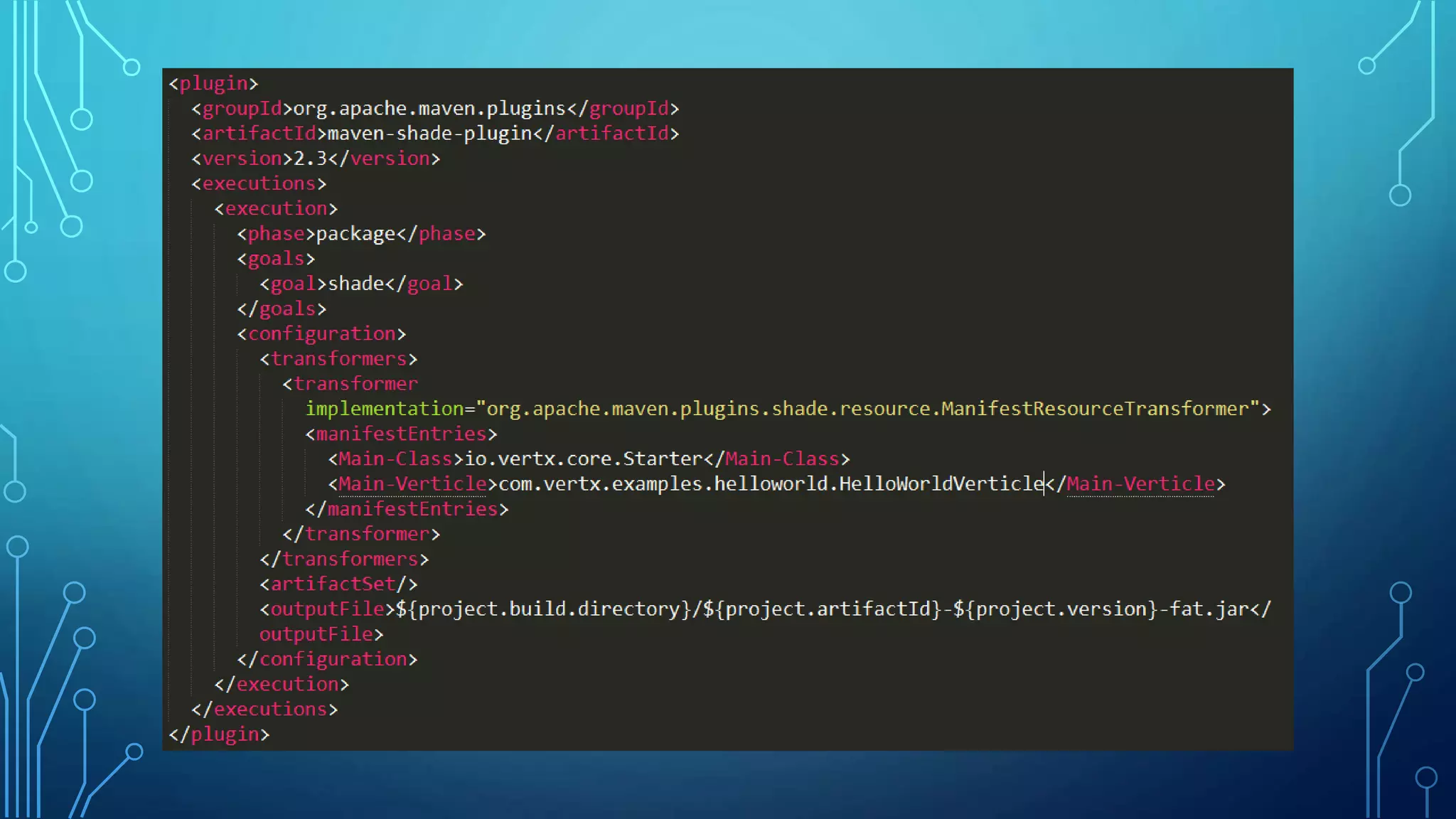
• Use maven-shade-plugin to package as FAT Jar
• Run the Jar
MESSAGE TYPES – EVENT BUS
• Primitives & their Boxed Types
• String
• org.vertx.java.core.json.JsonObject
• org.vertx.java.core.json.JsonArray
• org.vertx.java.core.buffer.Buffer
• Custom Type Support – Write your own Serializer
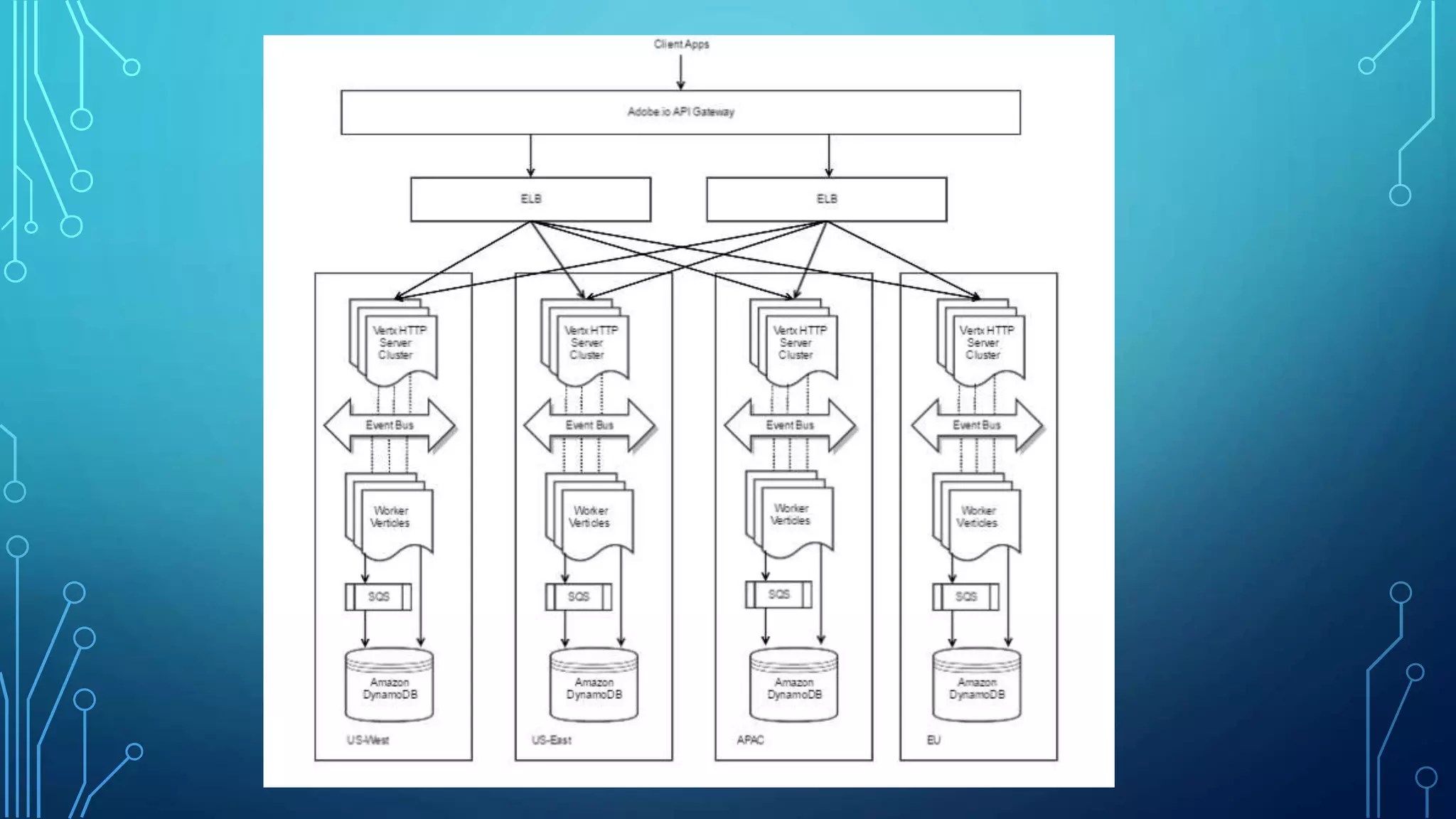
REAL-LIFE EXAMPLE - PULSE
• Marketing Cloud Core Service
• REST API for Notifications
• Vertx-Web powered Microservice
COMPARISONS
• Vert.x Vs Netty
• Application Vs Infrastructure
• Vert.x provides higher level IO
• Vert.x Vs Jetty
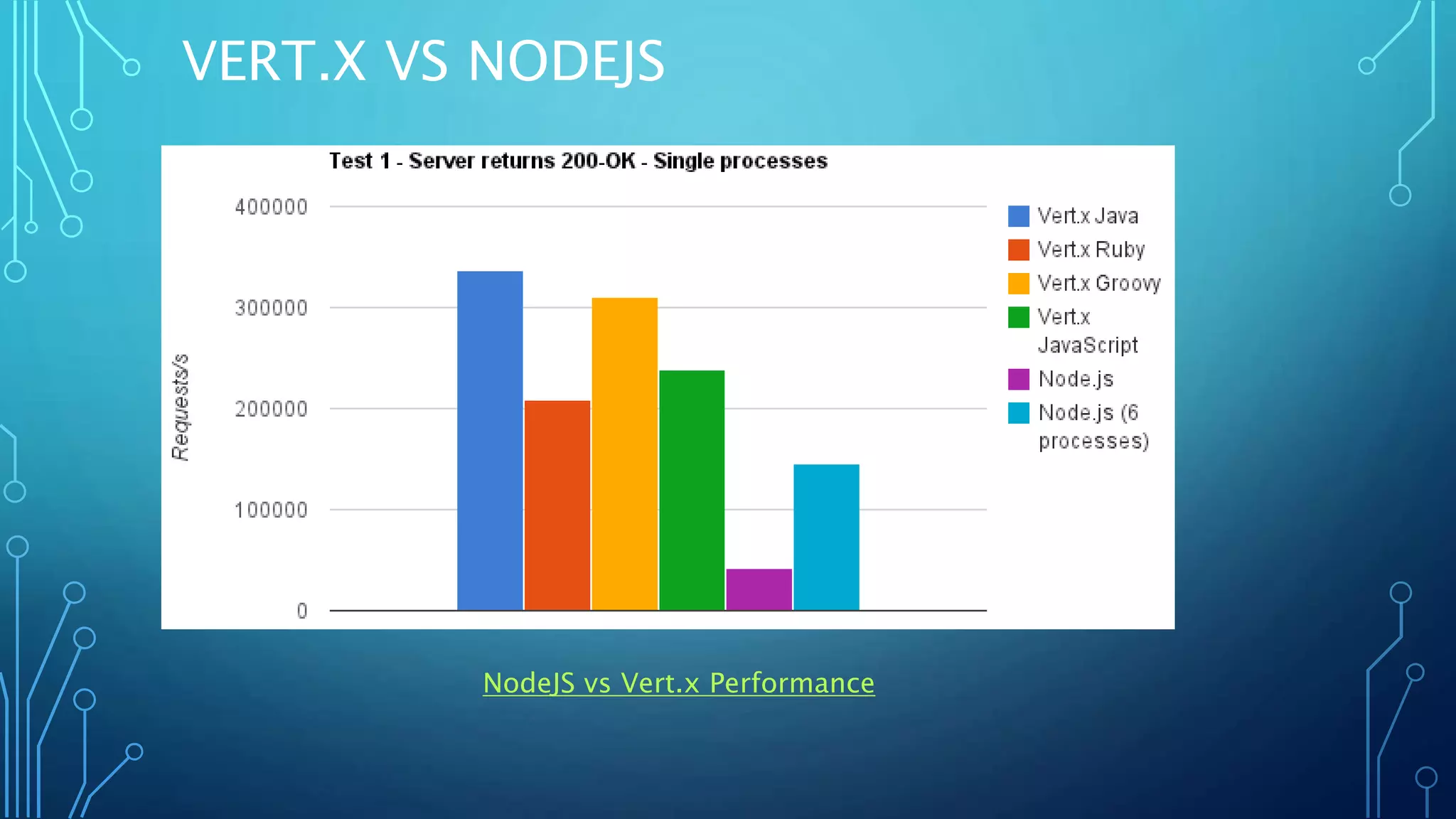
• Vert.x Vs NodeJS
• Use all available cores
VERT.X VS NODEJS
NodeJS vs Vert.x Performance
RESOURCES
• Nginx Microservices Introduction
• NodeJS Event Loop
• Interview with Tim Fox on Vert.x 3
• SockJS

Building microservices with vert.x 3.0

  • 1.
  • 2.
    AGENDA • Microservices • Why,why not ? • Comparison with Monolithic Architecture • Vert.x • Concepts: Event Loop, Verticles, Event Bus • Modules: core, web • Comparisons • Real-life Example - Pulse
  • 3.
    MONOLITHIC ARCHITECTURE • LogicallyDifferent Modules • But Packaged & deployed as a Single Unit • Initial Phases of Project • Simple to Deploy • Vertical Scaling • Later on • Difficult to Manage & Scale • Longer Startup Times • Slow down Development • CI becomes challenging
  • 5.
    MICROSERVICES PATTERN • Splitinto Smaller, Interconnected Services • Loose Coupling • Service == Functional Area • Service exposes APIs – consumed by other services & clients
  • 7.
  • 8.
    BENEFITS • Enforces Modularity •Decomposing complexity • Manageable chunks • Each service – well defined boundary • Independent Development • Different Teams • Different Technologies • Easy to test • Scaling is Easy • Each service can be scaled independently • Different Service might have different requirements ( CPU, Memory )
  • 9.
  • 10.
  • 11.
    DRAWBACKS • Partitioned DatabaseArchitecture • Have to settle for Eventual Consistency • ACID transactions not possible • Deploying • Though scalable, but more complex • Many more moving parts • Service Discovery required
  • 12.
    • Polyglot (Java,JavaScript, Groovy, Ruby, Python etc.) • Event-driven & Non-blocking programming model • Super simple Concurrency Model • Lightweight ~ 650Kb • “Ideal choice for creating light-weight, high- performance, microservices” • Public module repository • Reactive applications • Asynchronous APIs
  • 13.
    CONCEPTS • Event Loop •Verticles • Server Verticles • Worker Verticles • Event Bus • Point to Point • Pub/Sub • Distributed
  • 14.
  • 15.
  • 16.
    • Don’t Blockthe Event Loop • Workers “can” block • Message Passing using Event Bus • Concurrency Model • A Verticle instance is always Single threaded • No more Locking, synchronized & race conditions • Actor-like concurrency model • Scaling • By Creating more Verticle Instances • For TCP & HTTP servers, Vert.x does automatic load balancing • Use FAT Jar for Deployment
  • 17.
    VERT.X MODULES • Core •Web • Data Access • MongoDB, JDBC, Redis, MySQL • Authentication Modules • JWT, OAuth 2, JDBC Auth, Shiro Auth, MongoDB auth • Messaging Systems • Kafka, RabbitMQ • Clustering – Hazelcast
  • 18.
    VERT.X CORE • Servers& clients • TCP/SSL • HTTP/HTTPS • Websocket & SockJS • EventBus • Shared Maps & Sets • Buffers & Flow Control • Container API – Deploy & Undeploy Verticles • Timers & Files • Logging • Configuration
  • 19.
    VERT.X HTTP SERVER– HELLO WORLD
  • 20.
    VERT.X WEB • Routing •Regex Matching • Request Body Handling, parameters extraction • Cookie Parsing & Handling • Multipart Form & File Upload • Session support ( sticky & non-sticky ) • CORS & CSRF Support • Authentication & Authorization • SockJS Support
  • 21.
  • 22.
  • 23.
    ROUTING • Chain ofRouters • Either “end” it • Or pass it to the “next” one • Various Options – Route by • HTTP Method Type • Exact Path • Regex Matching • MIME type of request • Decide Routing Order
  • 24.
    VERT.X WEB • BodyHandler •Retrieve Request Body • Limit Body Size • Handle File Uploads • CookieHandler • Get, Add, Delete Cookie • SessionHandler • Sticky & Non-Sticky Sessions • Vert.x don’t put actual data in Session Cookie – Session UUID is used to lookup data on the server • Session timeouts
  • 25.
    VERT.X WEB • Authentication& Authorization • Support for Basic-Auth, Redirect-Auth, FormLogin • JWT • OAuth2 • Static Resources • StaticHandler • Caching – set headers ( cache-control, last-modified, date ) • Configurable webroot, index page • Disable File Caching - .vertx • Templating Support • Handlebars, Jade, MVEL, Thymeleaf • CORS & CSFR Handlers
  • 26.
    DISTRIBUTED SUPPORT DISTRIBUTED EVENTBUS • Connect multiple Vert.x instances across JVMs • Event bus extends to client side Javascript • Ideal for “real-time” web applications • vertx-eventbus.js CLUSTERING • Hazelcast • Shared Data Structures
  • 27.
    REALTIME COMMUNICATION -SOCKJS • Excellent Support for Low-latency, full-duplex cross-communication channel • Tries • Native Websocket • Browser specific transport protocols • Polling for old browsers • Heartbeats – prevent load balancers & proxies to close long running http requests • Vert.x – built in support for SockJS • SockJS event bus bridge • Distributed event bus • Extend’s vert.x server side event bus to JavaScript clients • vertx-eventbus.js – publish & register messages
  • 28.
    APPLICATION PACKAGING • Maven& Gradle Tooling Support • Packaging • Use maven-shade-plugin to package as FAT Jar • Run the Jar
  • 30.
    MESSAGE TYPES –EVENT BUS • Primitives & their Boxed Types • String • org.vertx.java.core.json.JsonObject • org.vertx.java.core.json.JsonArray • org.vertx.java.core.buffer.Buffer • Custom Type Support – Write your own Serializer
  • 31.
    REAL-LIFE EXAMPLE -PULSE • Marketing Cloud Core Service • REST API for Notifications • Vertx-Web powered Microservice
  • 33.
    COMPARISONS • Vert.x VsNetty • Application Vs Infrastructure • Vert.x provides higher level IO • Vert.x Vs Jetty • Vert.x Vs NodeJS • Use all available cores
  • 34.
    VERT.X VS NODEJS NodeJSvs Vert.x Performance
  • 35.
    RESOURCES • Nginx MicroservicesIntroduction • NodeJS Event Loop • Interview with Tim Fox on Vert.x 3 • SockJS