Performance Evaluation & Compensation Methods in
FMCG Firm
Presented
Group Member
 Sunny Kumar
 Muhammad Faizan
 Musferah Humayun
 Syeda Meher Un Nisa
 Sumaira Khaliq
Introduction
• The journey of Shan’s remarkable success starts from 1981 when the dream of
one man became a reality! A visionary entrepreneur, an avowed humanist and
a committed philanthropist, Mr. Sikander Sultan, Chairman, Shan Foods (Pvt.)
Ltd.
• Initially, recipe mixes were only shared within the broader family but in a very
short span of time they gained popularity and orders started pouring in from
friends, acquaintances and general consumers. Overtime, the company
prospered, and Mr. Sultan decided to launch his very own brand, “SHAN” and
since then there has been no turning back
Mission & Vision
• Establish Shan as the leading culinary brand, offering authentic traditional
recipes & home food solutions, with relentless focus on excellence in all we
do, ensuring a wholesome experience for our consumers around the world.
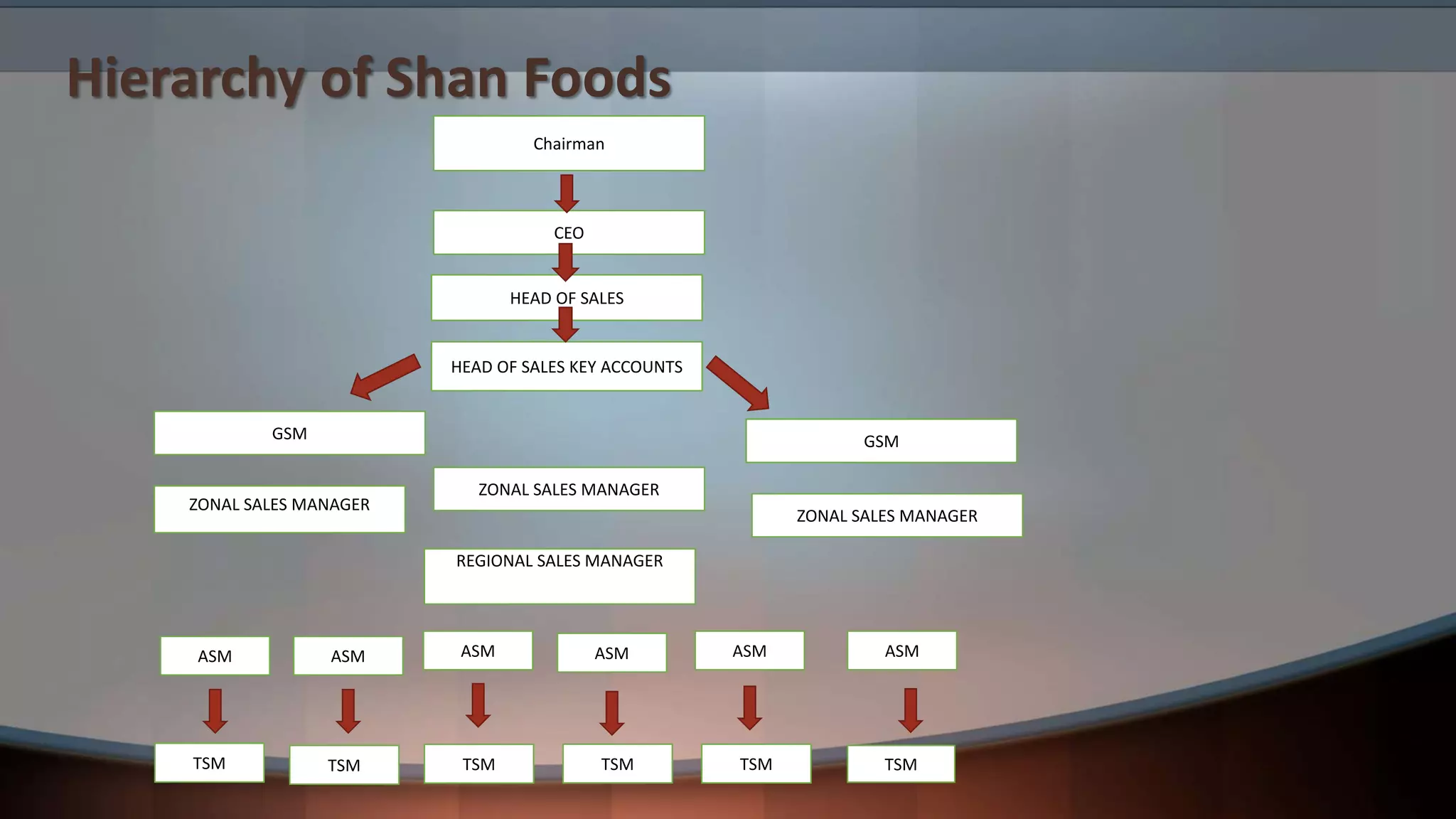
Hierarchy of Shan Foods
Chairman
CEO
HEAD OF SALES
HEAD OF SALES KEY ACCOUNTS
GSM GSM
REGIONAL SALES MANAGER
ASM
ZONAL SALES MANAGER
ZONAL SALES MANAGER
ZONAL SALES MANAGER
ASM ASM ASM ASMASM
TSM TSM TSM TSM TSM TSM
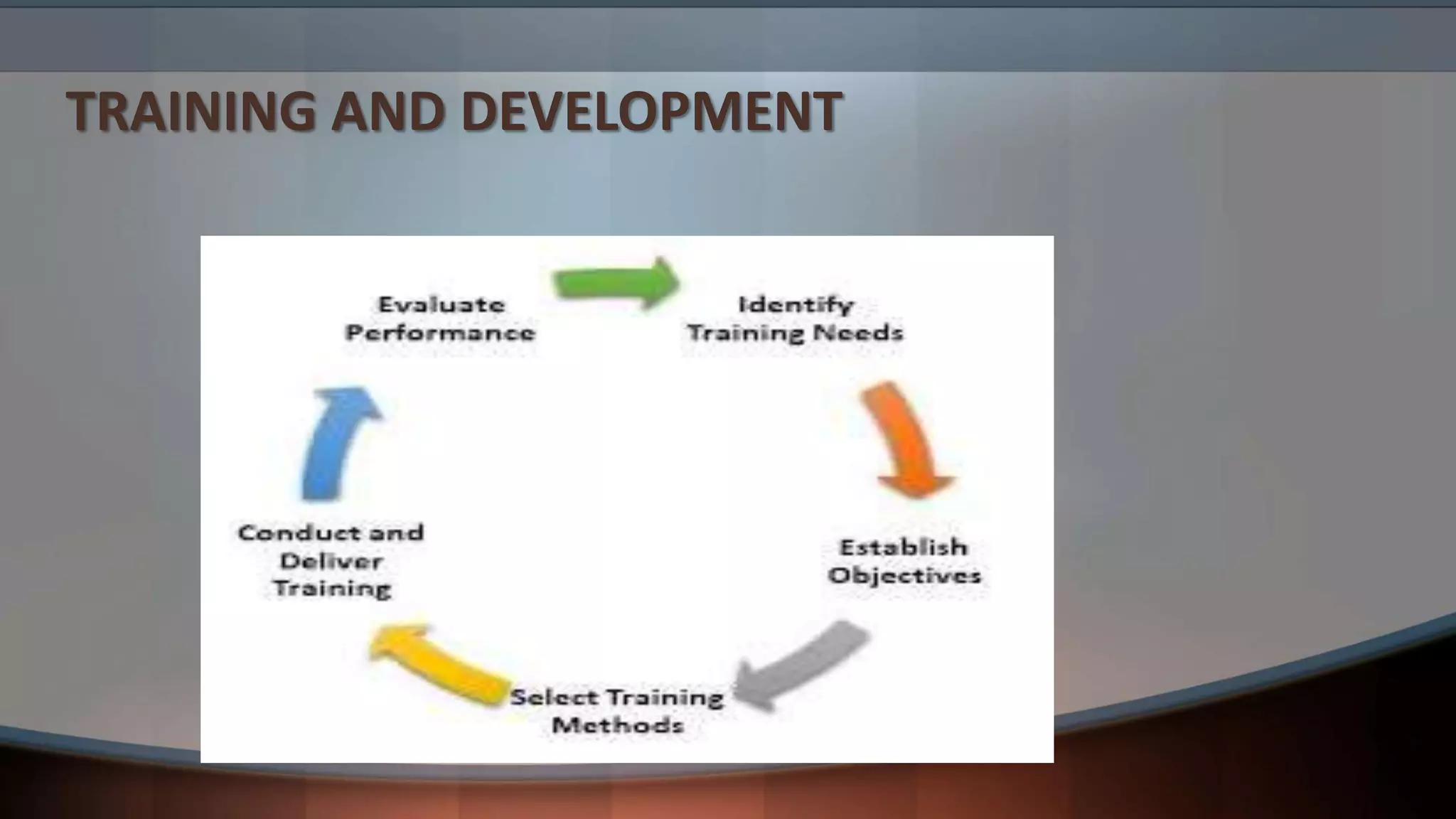
TRAINING AND DEVELOPMENT
HUMAN RESOURCE OF SHAN
• Shan Foods has presence in over 80 destinations
covering five continents with over a thousand
people working across the globe. This diverse
reach calls for a dynamic workforce that can
drive to meet milestones and have the
determination to reach greater heights while
striving to become better versions of
themselves.
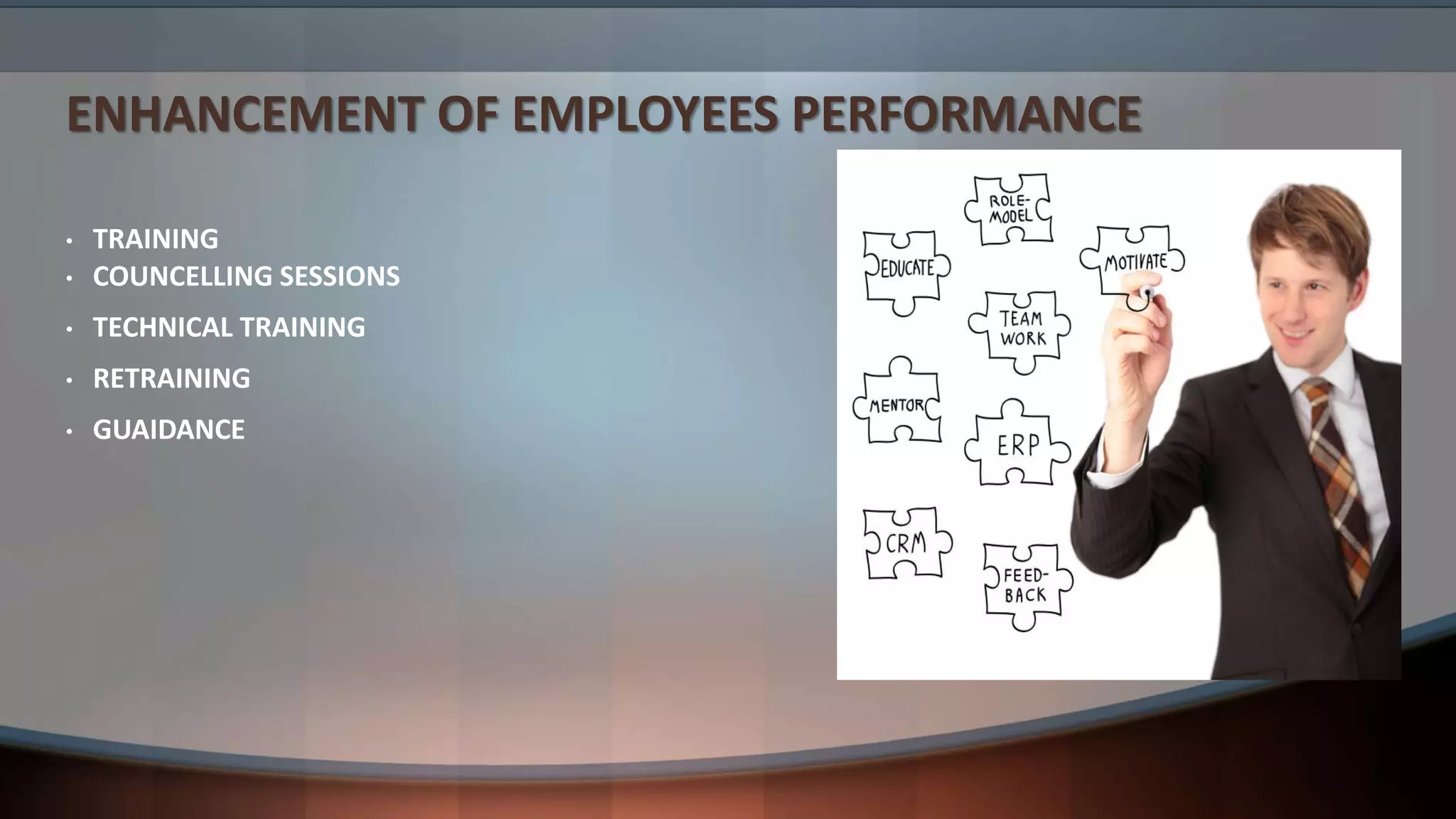
ENHANCEMENT OF EMPLOYEES PERFORMANCE
• TRAINING
• COUNCELLING SESSIONS
• TECHNICAL TRAINING
• RETRAINING
• GUAIDANCE
METHODS OF TRAINING
• Discussion
• Role playing
• Lectures
• Panels
TRAINING FOR NEW SALE REPRESENTATIVES
1. Company knowledge
2. Product knowledge
3. Knowledge of competitors and industry
4. Customer / market knowledge
5. Sales techniques and selling skills
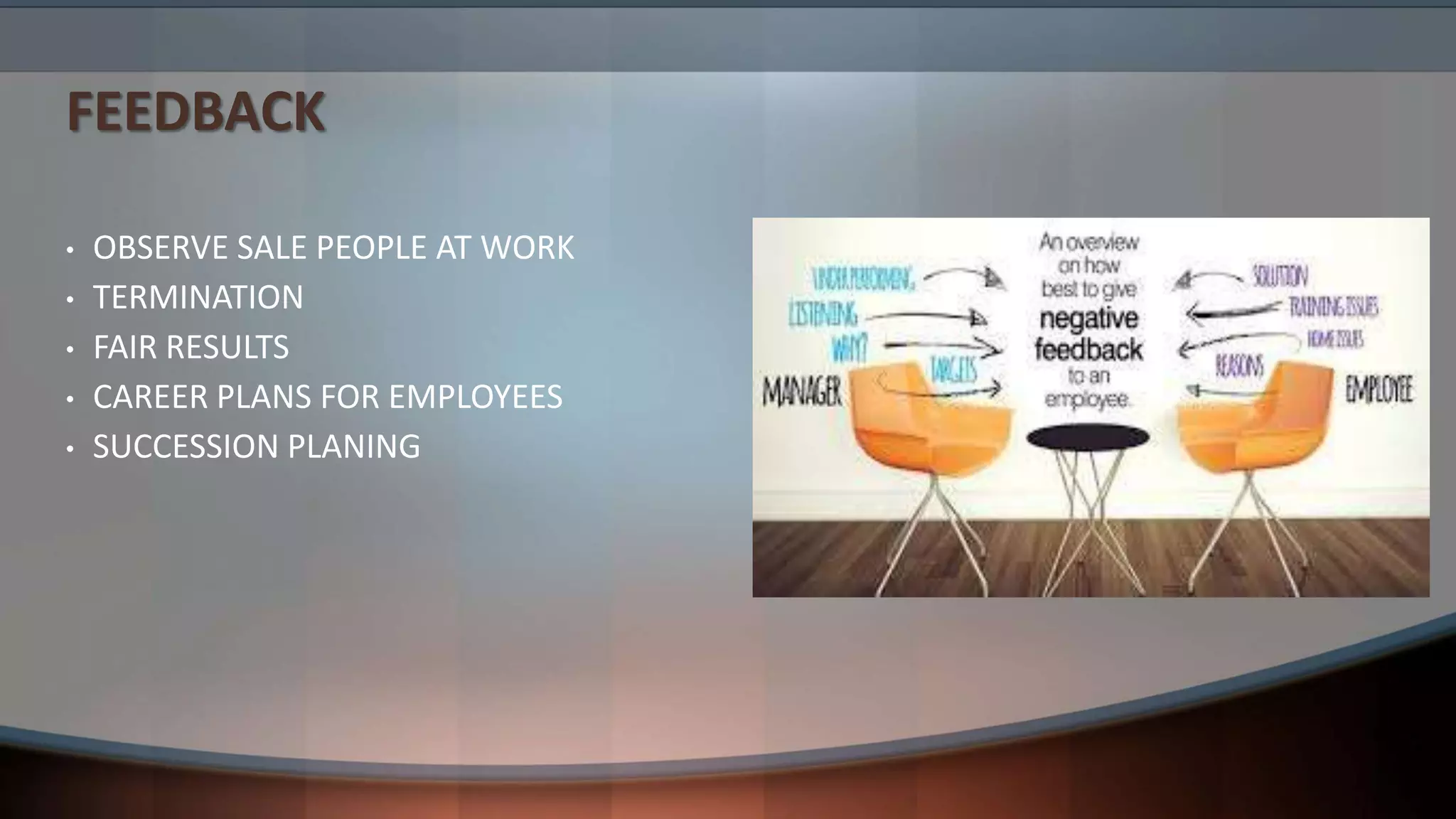
FEEDBACK
• OBSERVE SALE PEOPLE AT WORK
• TERMINATION
• FAIR RESULTS
• CAREER PLANS FOR EMPLOYEES
• SUCCESSION PLANING
Who judges the employee performance
Line Manager judges the employee performance.
Reason:
He is directly or indirectly connected with the salespeople.
He is connected through following ways:
• They conduct meetings every day.
• The line managers visit the field and check with the stores, take feedback
about the salespeople.
Criteria for judging employee performance
 Coverage:
Every sales representative is given a territory and monthly they are given a target that
is the coverage and according to the achievement of the target, they are given
compensations, benefits.
 Availability:
• The products should be available at every shop. Availability is a very important factor.
The sales people use the term "Activate the shop". This term means that presence of
the product occurs.
 Visibility:
• The product should be visible to the customers. The visibility attract the customers.
 FIFO/LIFO:
• FIFO (First In First Out):
In this, the stock that came first will be sold out first.
• LIFO (Last In First Out):
In this, the stock that came in last, will be sold out first.
 Market Hygiene:
Market hygiene is maintaining the FIFO. The visits are frequently
OBJECTIVE BEHIND COMPENSATION
• Pay Fairly based on performance (past 3 months).
• Attract and retain the talent by rewarding them and providing basic facilities.
• Employee’s needs and wants are always considered.
• To encourage and keep the employee motivated.
SALARY GRADING AND STRUCTURE
• Grading is based on the ranks of the employees.
Sales force is divided into two parts
• Sales management
• Sales Representative
• Basic salary 80-90%
• Basic salary 30-40%
• Variable 10-20%
• Variable 60-70%(category, overall target achievement)
• Other benefits
• No other benefits
Intrinsic and Extrinsic rewards
Intrinsic rewards:(non-physical reward)
1. Feeling of contentment one finds in the completion of any task.
2. directly related to job performance as a successful task automatically produces it.
3. Verbal praises in everyday meeting.
4. Recognition
5. Short trips with in the country
6. Umerah tickets on achiving yearly objectives (on lucky draws)
7. Training and giveaways
8. 20 Paid holidays (allowed holidays) along with daily allowance or pocket money for
a holiday which is around 800 rupees
Extrinsic rewards: (physical reward)
1. Emotionally attached with the employees as employees value such rewards.
2. Extrinsic reward is also directly related to the job performance of the
employees.
3. Receive a reward every time they accomplish a task. It depends upon the
policy of the company
4. The regular competitive salary.
5. Bonus based on the performance.
6. Fringe benefits(medical, insurance etc.).
Perks and Privileges
• Privileges granted to employees in addition to their salaries and benefits (such
as medial and pension plans).
• 'True' perks have little or no cash value or tax implications and may include
company car, vacations, reserved parking space, spacious office, private dining
and washroom facilities, etc.
• Expected exposure of a new market on free fund
• Transport
• Fuel
• Travelling expenses
• Fringe benefits.
Employee’s right to question Feedback
• Is always Motivating force
• Employee’s feedback is always welcome
Employee relation with manager
• Shan’s manager always maintain good relation with employees.
• Problems faced by employees.
• Equality
• Council
Compensation is fair
• Always based on perform.
• No biasness
• Compensation is in the form of cashments , recognization and promotion.
Comparative Analysis
• Job Description and KPI:
• We studied that we planed the evaluation on the bases of Job Description but
in Shan Foods, they do base on Key performance indicators (KPI). There are
many KPIs based on them, employees are evaluated.
• Evaluation Information Sources:
• We have studied many sources for evaluation like manager’s field visits,
manager personal insight and external sources. They told us about the
universal accounts. These accounts are yearly account which evaluate
employee on their all targets
Recommendation
• Firstly, through comprehensive interview with the area of manager of Shan
Foods, we identify the Gray of the company. According to our knowledge of
the work, we find out that Shan Foods are not providing the fringe benefits to
their sales bookers or sales reps Like issuance. As for as we studied that there
is highest turnover rate in Sales department. We identified that sales bookers
are one, who travels a lot through motor bike and other vehicles. So, there is
great possibility of happening an accident. That is reason why there is great
turnover in Sales department. We recommend them to give their sales
bookers fringe benefits.
• Secondly, we recommend them to implement the Performance management
system, Systems that facilitate the attainment of individual and corporate
goals. Performance
• Objective of the Performance Management system will be,
• Lists of Accomplishments
• Goals and Objectives
• Results from 360-Degree Feedback Processes
• Supervisor Ratings
• Individual Development Plans

Performance evaluation and sales compensation methods of Shan Foods

  • 1.
    Performance Evaluation &Compensation Methods in FMCG Firm Presented Group Member  Sunny Kumar  Muhammad Faizan  Musferah Humayun  Syeda Meher Un Nisa  Sumaira Khaliq
  • 2.
    Introduction • The journeyof Shan’s remarkable success starts from 1981 when the dream of one man became a reality! A visionary entrepreneur, an avowed humanist and a committed philanthropist, Mr. Sikander Sultan, Chairman, Shan Foods (Pvt.) Ltd. • Initially, recipe mixes were only shared within the broader family but in a very short span of time they gained popularity and orders started pouring in from friends, acquaintances and general consumers. Overtime, the company prospered, and Mr. Sultan decided to launch his very own brand, “SHAN” and since then there has been no turning back
  • 3.
    Mission & Vision •Establish Shan as the leading culinary brand, offering authentic traditional recipes & home food solutions, with relentless focus on excellence in all we do, ensuring a wholesome experience for our consumers around the world.
  • 4.
    Hierarchy of ShanFoods Chairman CEO HEAD OF SALES HEAD OF SALES KEY ACCOUNTS GSM GSM REGIONAL SALES MANAGER ASM ZONAL SALES MANAGER ZONAL SALES MANAGER ZONAL SALES MANAGER ASM ASM ASM ASMASM TSM TSM TSM TSM TSM TSM
  • 5.
  • 6.
    HUMAN RESOURCE OFSHAN • Shan Foods has presence in over 80 destinations covering five continents with over a thousand people working across the globe. This diverse reach calls for a dynamic workforce that can drive to meet milestones and have the determination to reach greater heights while striving to become better versions of themselves.
  • 7.
    ENHANCEMENT OF EMPLOYEESPERFORMANCE • TRAINING • COUNCELLING SESSIONS • TECHNICAL TRAINING • RETRAINING • GUAIDANCE
  • 8.
    METHODS OF TRAINING •Discussion • Role playing • Lectures • Panels
  • 9.
    TRAINING FOR NEWSALE REPRESENTATIVES 1. Company knowledge 2. Product knowledge 3. Knowledge of competitors and industry 4. Customer / market knowledge 5. Sales techniques and selling skills
  • 10.
    FEEDBACK • OBSERVE SALEPEOPLE AT WORK • TERMINATION • FAIR RESULTS • CAREER PLANS FOR EMPLOYEES • SUCCESSION PLANING
  • 11.
    Who judges theemployee performance Line Manager judges the employee performance. Reason: He is directly or indirectly connected with the salespeople. He is connected through following ways: • They conduct meetings every day. • The line managers visit the field and check with the stores, take feedback about the salespeople.
  • 12.
    Criteria for judgingemployee performance  Coverage: Every sales representative is given a territory and monthly they are given a target that is the coverage and according to the achievement of the target, they are given compensations, benefits.  Availability: • The products should be available at every shop. Availability is a very important factor. The sales people use the term "Activate the shop". This term means that presence of the product occurs.  Visibility: • The product should be visible to the customers. The visibility attract the customers.
  • 13.
     FIFO/LIFO: • FIFO(First In First Out): In this, the stock that came first will be sold out first. • LIFO (Last In First Out): In this, the stock that came in last, will be sold out first.  Market Hygiene: Market hygiene is maintaining the FIFO. The visits are frequently
  • 14.
    OBJECTIVE BEHIND COMPENSATION •Pay Fairly based on performance (past 3 months). • Attract and retain the talent by rewarding them and providing basic facilities. • Employee’s needs and wants are always considered. • To encourage and keep the employee motivated.
  • 15.
    SALARY GRADING ANDSTRUCTURE • Grading is based on the ranks of the employees. Sales force is divided into two parts • Sales management • Sales Representative • Basic salary 80-90% • Basic salary 30-40% • Variable 10-20% • Variable 60-70%(category, overall target achievement) • Other benefits • No other benefits
  • 16.
    Intrinsic and Extrinsicrewards Intrinsic rewards:(non-physical reward) 1. Feeling of contentment one finds in the completion of any task. 2. directly related to job performance as a successful task automatically produces it. 3. Verbal praises in everyday meeting. 4. Recognition 5. Short trips with in the country 6. Umerah tickets on achiving yearly objectives (on lucky draws) 7. Training and giveaways 8. 20 Paid holidays (allowed holidays) along with daily allowance or pocket money for a holiday which is around 800 rupees
  • 17.
    Extrinsic rewards: (physicalreward) 1. Emotionally attached with the employees as employees value such rewards. 2. Extrinsic reward is also directly related to the job performance of the employees. 3. Receive a reward every time they accomplish a task. It depends upon the policy of the company 4. The regular competitive salary. 5. Bonus based on the performance. 6. Fringe benefits(medical, insurance etc.).
  • 18.
    Perks and Privileges •Privileges granted to employees in addition to their salaries and benefits (such as medial and pension plans). • 'True' perks have little or no cash value or tax implications and may include company car, vacations, reserved parking space, spacious office, private dining and washroom facilities, etc. • Expected exposure of a new market on free fund • Transport • Fuel • Travelling expenses • Fringe benefits.
  • 19.
    Employee’s right toquestion Feedback • Is always Motivating force • Employee’s feedback is always welcome
  • 20.
    Employee relation withmanager • Shan’s manager always maintain good relation with employees. • Problems faced by employees. • Equality • Council
  • 21.
    Compensation is fair •Always based on perform. • No biasness • Compensation is in the form of cashments , recognization and promotion.
  • 22.
    Comparative Analysis • JobDescription and KPI: • We studied that we planed the evaluation on the bases of Job Description but in Shan Foods, they do base on Key performance indicators (KPI). There are many KPIs based on them, employees are evaluated. • Evaluation Information Sources: • We have studied many sources for evaluation like manager’s field visits, manager personal insight and external sources. They told us about the universal accounts. These accounts are yearly account which evaluate employee on their all targets
  • 23.
    Recommendation • Firstly, throughcomprehensive interview with the area of manager of Shan Foods, we identify the Gray of the company. According to our knowledge of the work, we find out that Shan Foods are not providing the fringe benefits to their sales bookers or sales reps Like issuance. As for as we studied that there is highest turnover rate in Sales department. We identified that sales bookers are one, who travels a lot through motor bike and other vehicles. So, there is great possibility of happening an accident. That is reason why there is great turnover in Sales department. We recommend them to give their sales bookers fringe benefits.
  • 24.
    • Secondly, werecommend them to implement the Performance management system, Systems that facilitate the attainment of individual and corporate goals. Performance • Objective of the Performance Management system will be, • Lists of Accomplishments • Goals and Objectives • Results from 360-Degree Feedback Processes • Supervisor Ratings • Individual Development Plans