UNIT- III
Training and Development
Unit- III Topics to be covered…..
◦ Training: Need, process, importance, aligning training with organization’s
strategy, training methods- on the job and off the job, organizational
development, evaluation of training program, emerging issue in training
◦ Executive development: Meaning, Importance, Steps, Methods
◦ Performance appraisal: Meaning, importance, steps, tools- graphic rating
scale, alternate ranking method, paired comparison, forced distribution,
critical incident, BARS, MBO, 360 degrees. Problems in performance appraisal
Unit- III
◦ Compensation: Steps of determining compensation, components
of pay structure, factors influencing compensation levels, wage
differentials & incentives, profit sharing, gain sharing, employees’
stock option plans. Brief introduction of social security, health,
retirement & other benefits.
Training
◦ Training is a systematic process through which an organization’s
human resources gain knowledge and develop skills by instruction
and practical activities that result in improved corporate
performance. Training enables an employee to do his present job
more efficiently and prepare himself for a higher level job.
Training is expensive………Without
training it is more expensive
Need of Training
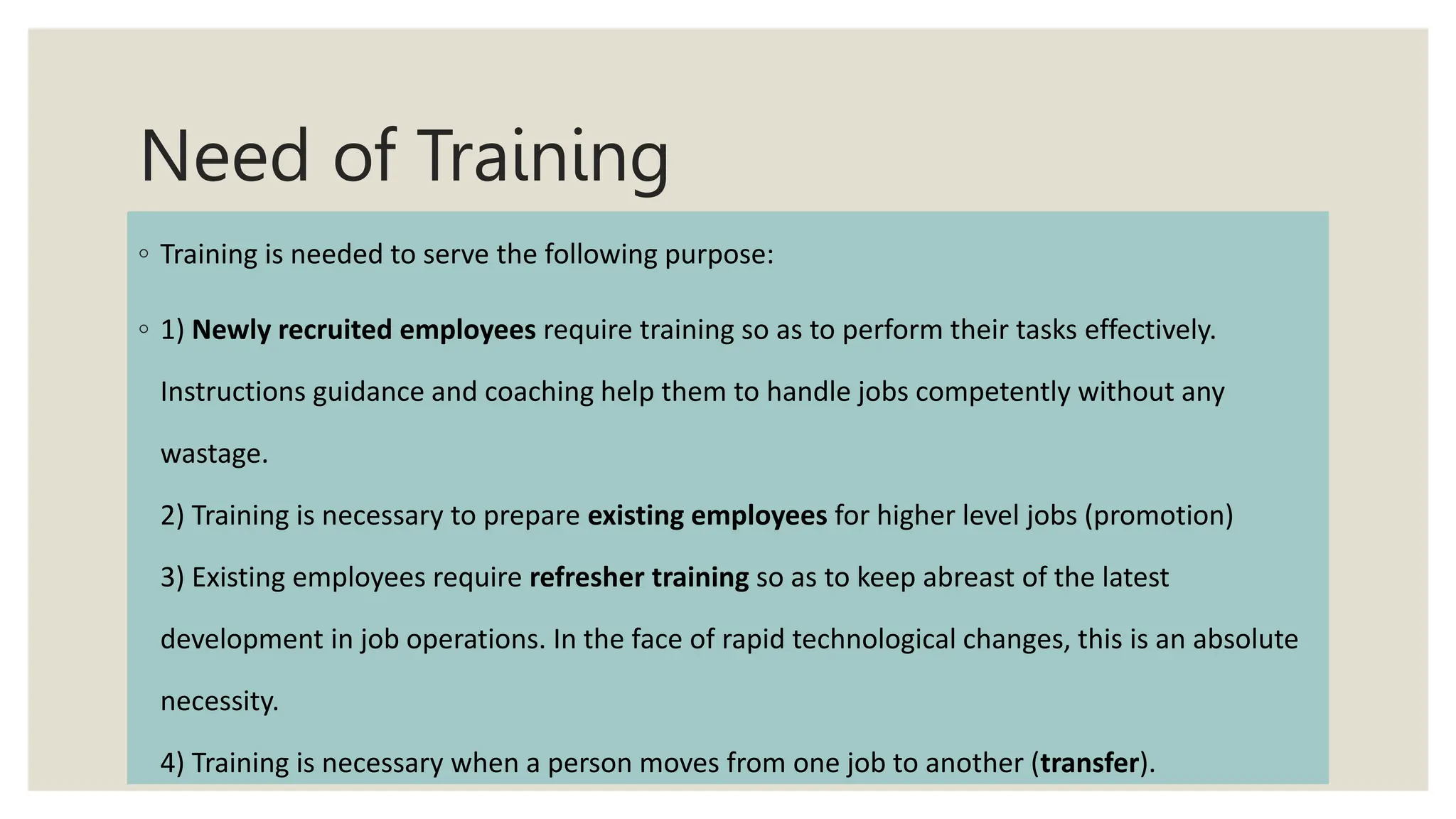
◦ Training is needed to serve the following purpose:
◦ 1) Newly recruited employees require training so as to perform their tasks effectively.
Instructions guidance and coaching help them to handle jobs competently without any
wastage.
2) Training is necessary to prepare existing employees for higher level jobs (promotion)
3) Existing employees require refresher training so as to keep abreast of the latest
development in job operations. In the face of rapid technological changes, this is an absolute
necessity.
4) Training is necessary when a person moves from one job to another (transfer).
Need of Training
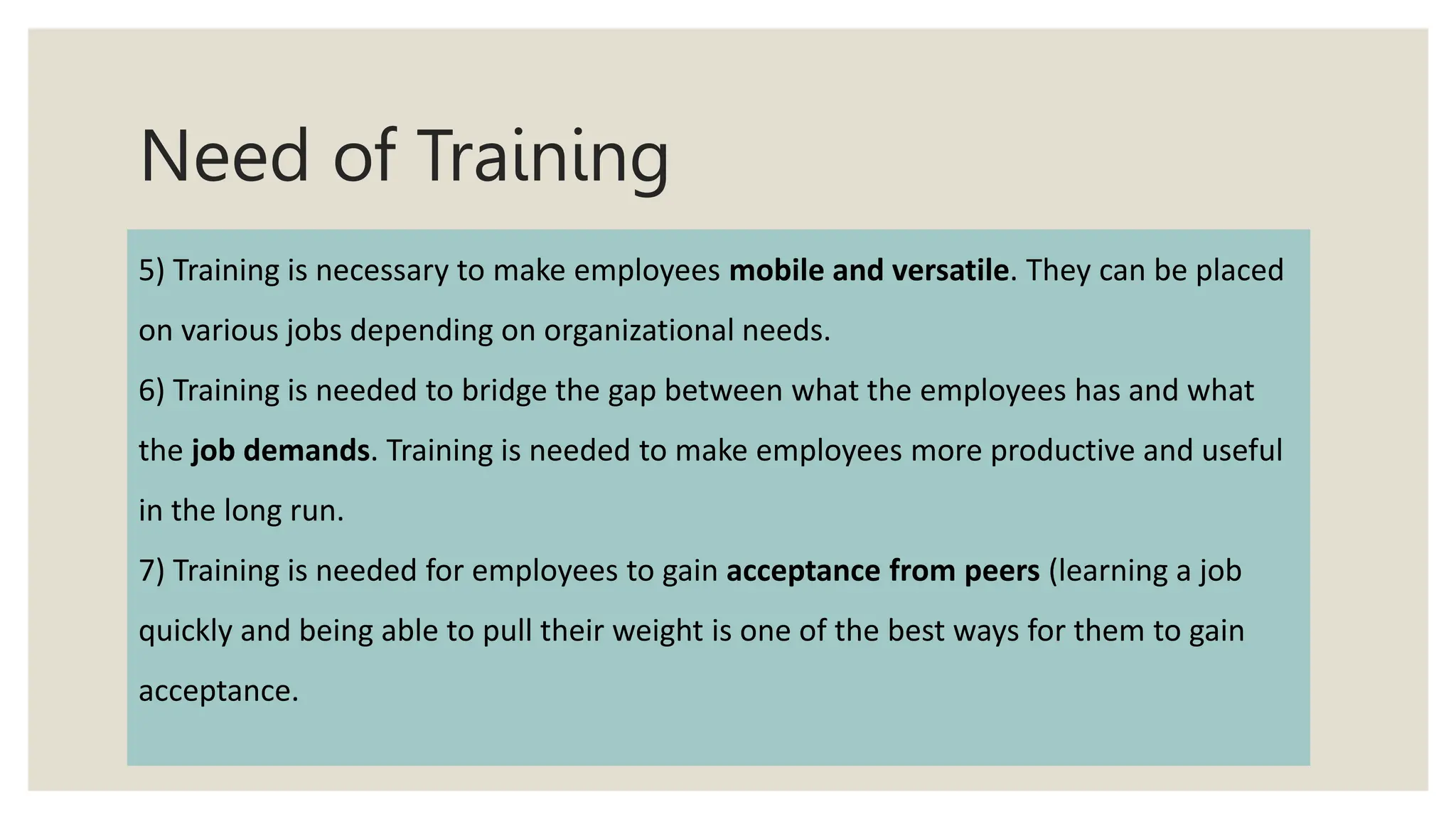
5) Training is necessary to make employees mobile and versatile. They can be placed
on various jobs depending on organizational needs.
6) Training is needed to bridge the gap between what the employees has and what
the job demands. Training is needed to make employees more productive and useful
in the long run.
7) Training is needed for employees to gain acceptance from peers (learning a job
quickly and being able to pull their weight is one of the best ways for them to gain
acceptance.
Benefits of Training
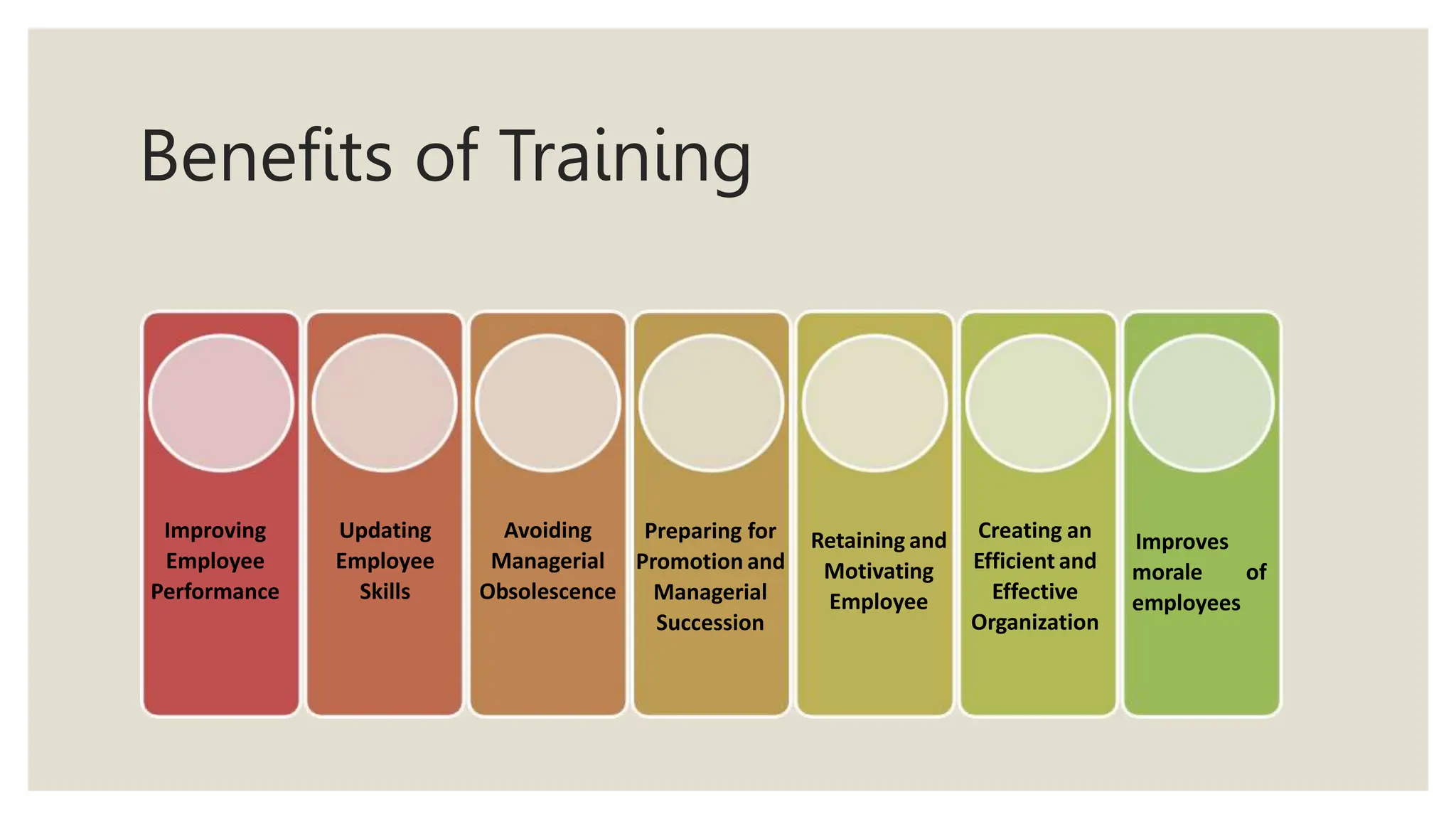
Improving
Employee
Performance
Updating
Employee
Skills
Avoiding
Managerial
Obsolescence
Preparing for
Promotion and
Managerial
Succession
Retaining and
Motivating
Employee
Creating an
Efficient and
Effective
Organization
Improves
morale of
employees
Process of Training/A systematic
approach to training
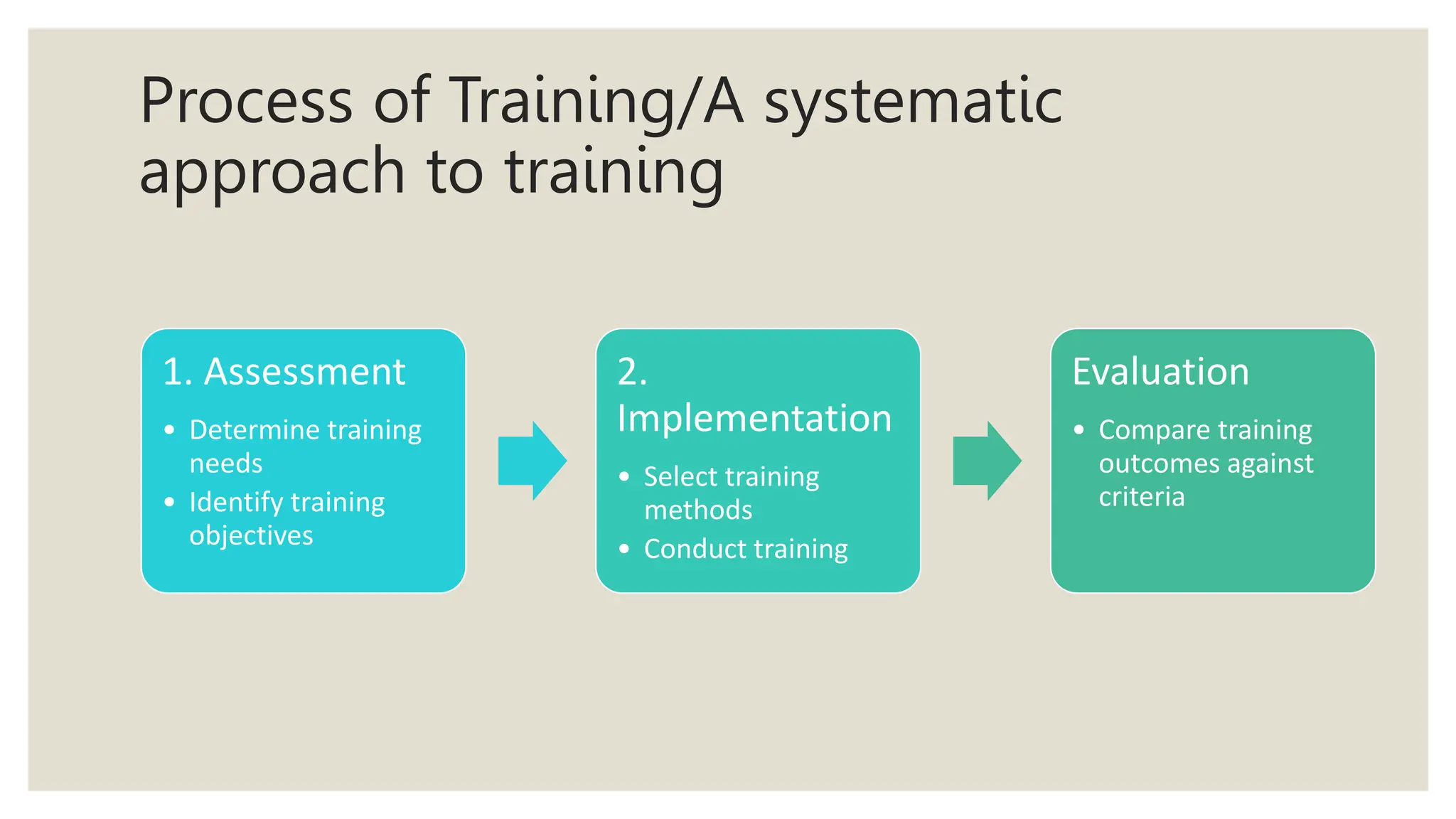
1. Assessment
• Determine training
needs
• Identify training
objectives
2.
Implementation
• Select training
methods
• Conduct training
Evaluation
• Compare training
outcomes against
criteria
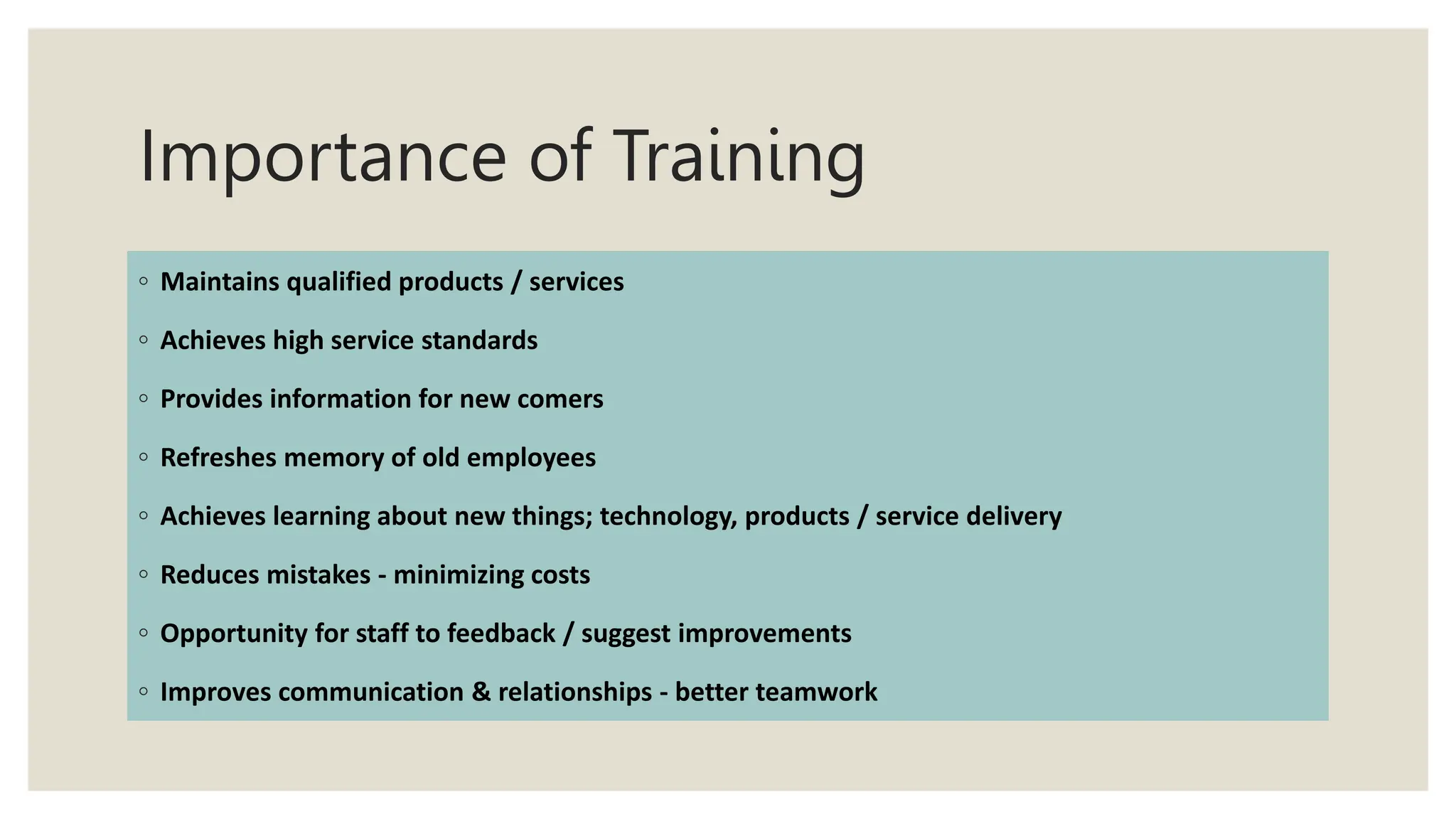
Importance of Training
◦ Maintains qualified products / services
◦ Achieves high service standards
◦ Provides information for new comers
◦ Refreshes memory of old employees
◦ Achieves learning about new things; technology, products / service delivery
◦ Reduces mistakes - minimizing costs
◦ Opportunity for staff to feedback / suggest improvements
◦ Improves communication & relationships - better teamwork
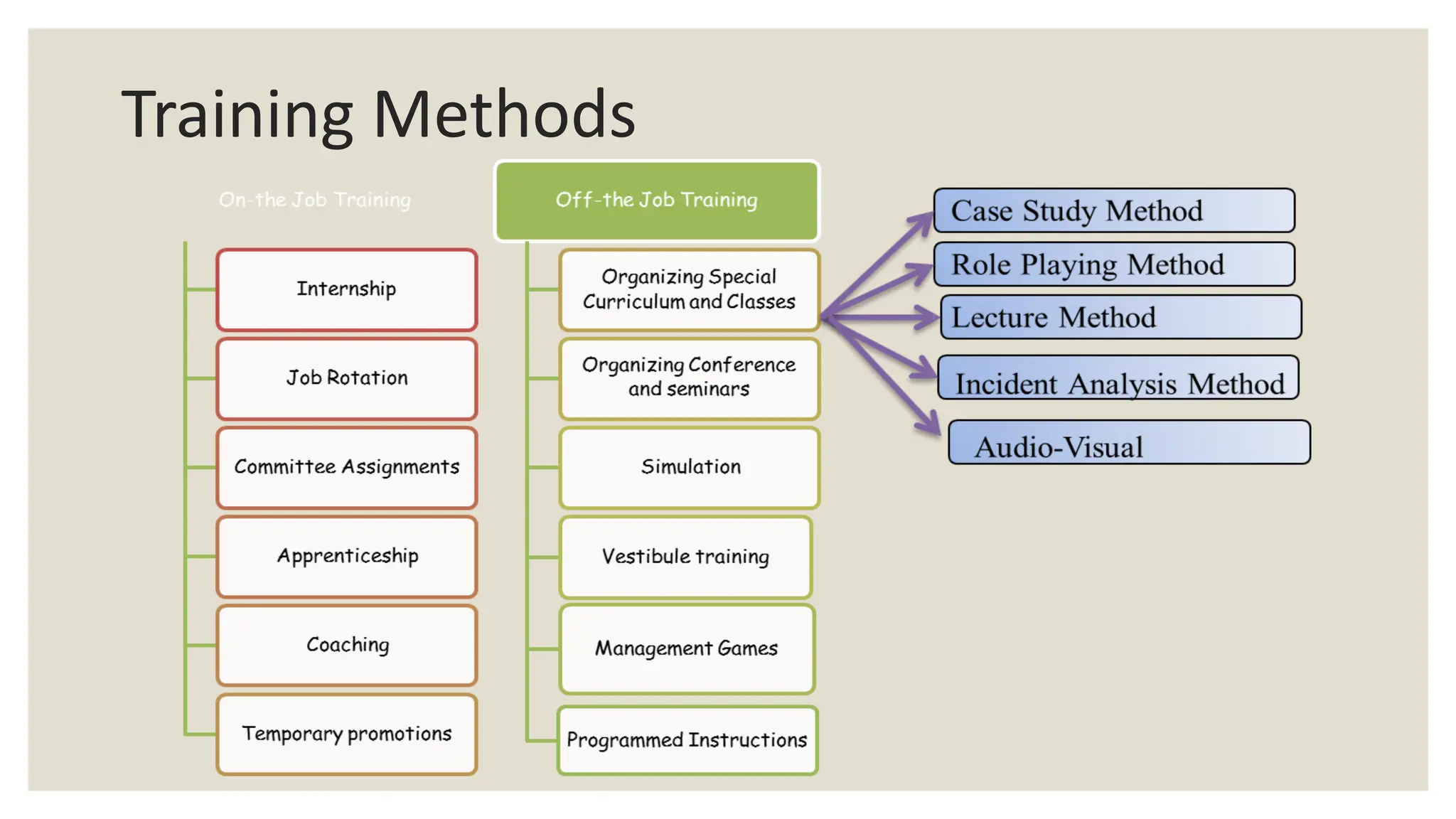
Training Methods
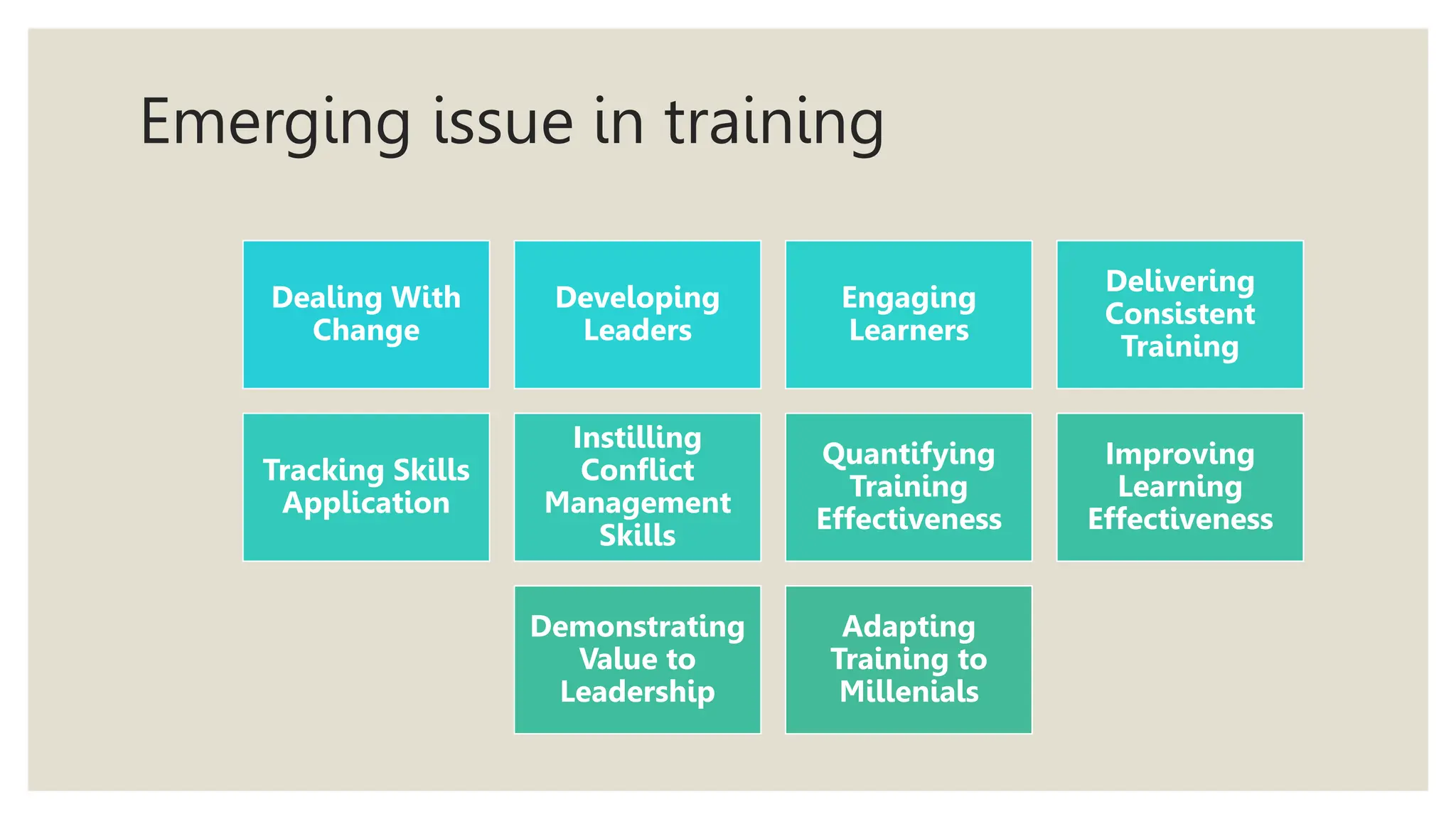
Emerging issue in training
Dealing With
Change
Developing
Leaders
Engaging
Learners
Delivering
Consistent
Training
Tracking Skills
Application
Instilling
Conflict
Management
Skills
Quantifying
Training
Effectiveness
Improving
Learning
Effectiveness
Demonstrating
Value to
Leadership
Adapting
Training to
Millenials
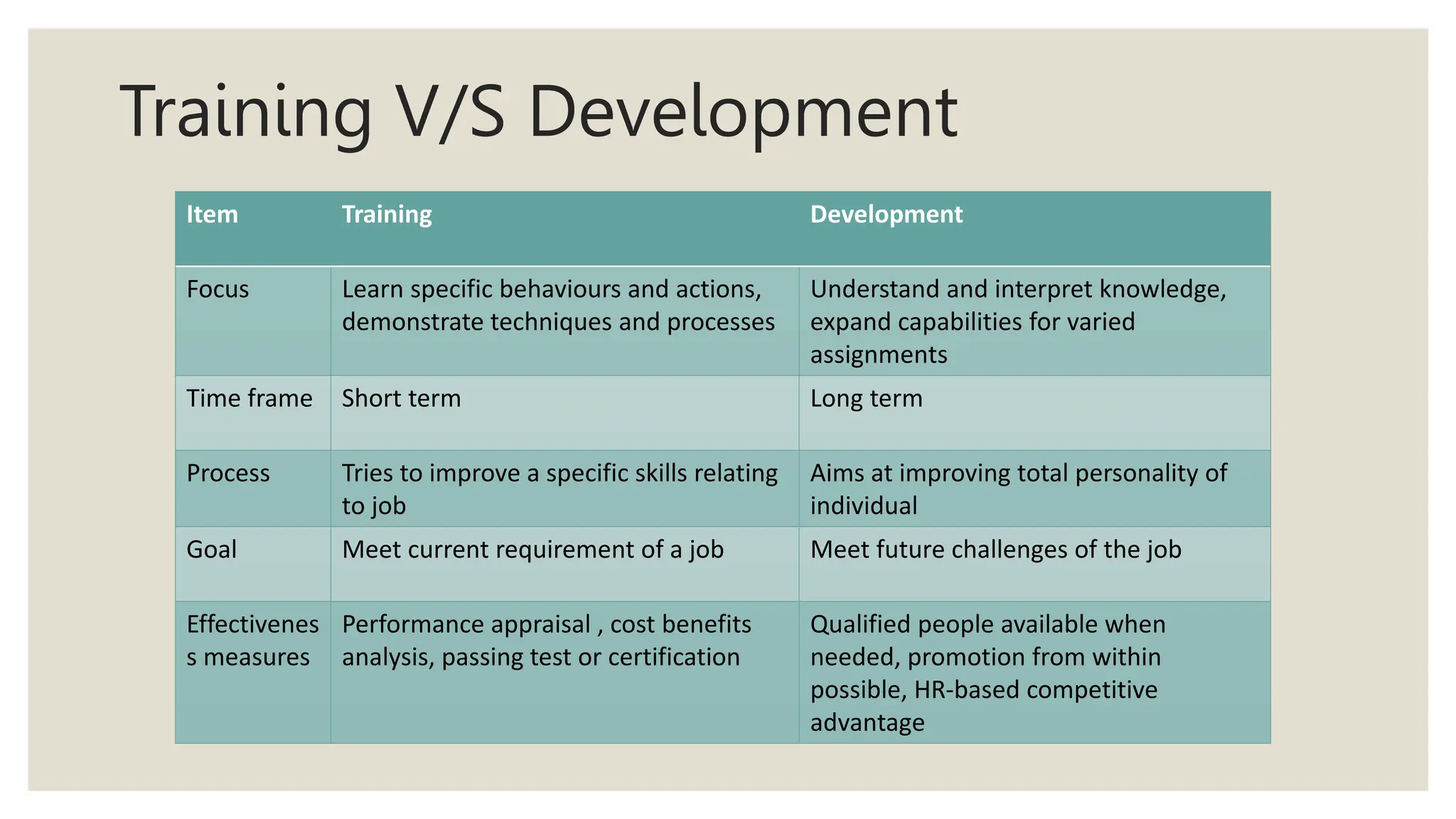
Training V/S Development
Item Training Development
Focus Learn specific behaviours and actions,
demonstrate techniques and processes
Understand and interpret knowledge,
expand capabilities for varied
assignments
Time frame Short term Long term
Process Tries to improve a specific skills relating
to job
Aims at improving total personality of
individual
Goal Meet current requirement of a job Meet future challenges of the job
Effectivenes
s measures
Performance appraisal , cost benefits
analysis, passing test or certification
Qualified people available when
needed, promotion from within
possible, HR-based competitive
advantage
Executive Development
◦ Executive development or management development is a systematic process of
growth and development by which the managers develop their abilities to
manage
◦ Executive Development consists of all the means by which executives learn to
improve their behavior and performance.
◦ Executive development is a planned effort to improve current and future
managerial performance.
Importance of Executive Development
◦ 1. The size and complexity of organisation, both business and non-business are
increasing. Managers need to be developed to handle the problems of giant and
complex organisation in the face of increasing competition.
◦ 2. The rapid rate of Technological and Social change in society requires training of
managers so that they are able to cope with these changes.
◦ 3. Business and industrial leaders are increasingly recognizing their social and
public responsibilities.
Importance of Executive Development
◦ 4. Labor management relations are becoming increasingly complex.
Executives require new and better skills in union negotiation, collective
bargaining and grievance redressed.
◦ 5. There is a noticeable shift from owner-managed to professionally
managed enterprises.
◦ 6. Executives need education and training to understand and adjust to
changes in socio-economic forces.
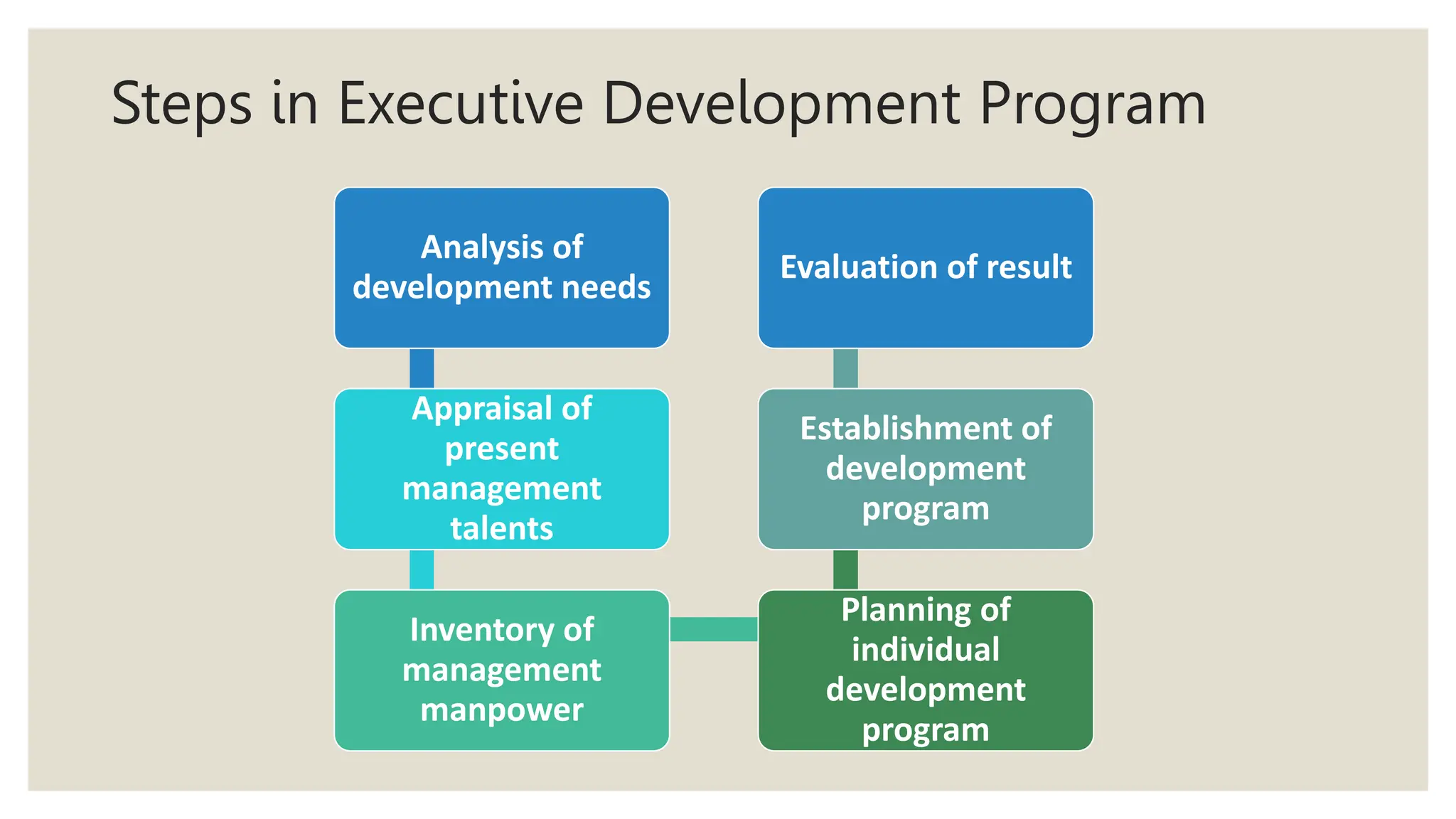
Steps in Executive Development Program
Analysis of
development needs
Appraisal of
present
management
talents
Inventory of
management
manpower
Planning of
individual
development
program
Establishment of
development
program
Evaluation of result
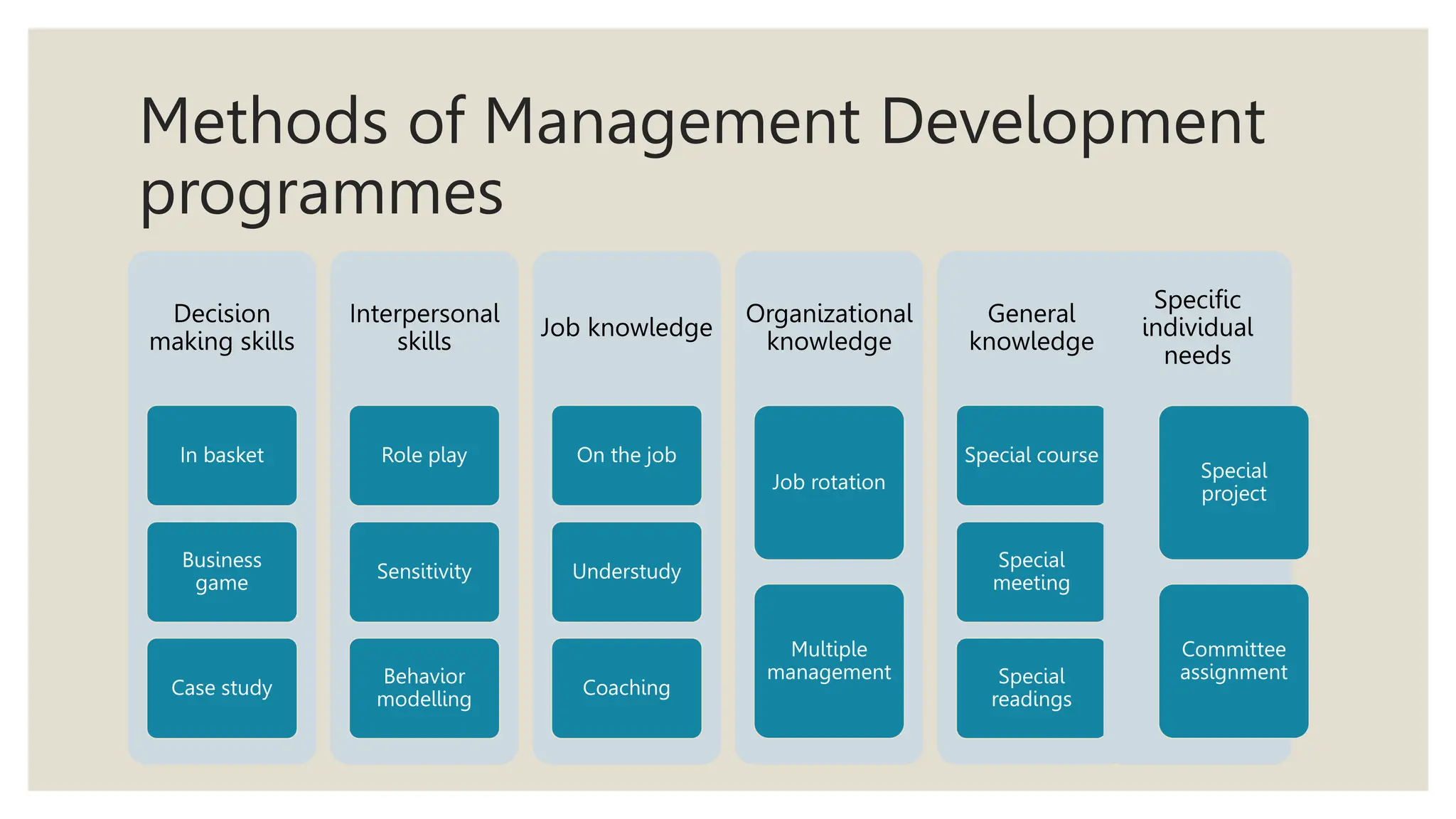
Methods of Management Development
programmes
Decision
making skills
In basket
Business
game
Case study
Interpersonal
skills
Role play
Sensitivity
Behavior
modelling
Job knowledge
On the job
Understudy
Coaching
Organizational
knowledge
Job rotation
Multiple
management
General
knowledge
Special course
Special
meeting
Special
readings
Specific
individual
needs
Special
project
Committee
assignment
Performance Appraisal
◦ Performance Appraisals is the assessment of individual’s performance in a systematic way.
◦ It is a developmental tool used for all round development of the employee and the organization.
◦ The performance is measured against such factors as job knowledge, quality and quantity of
output, initiative, leadership abilities, supervision, dependability, co-operation, judgment,
versatility and health.
◦ “It is formal, structured system of measuring, evaluating job related behaviors and outcomes to
discover reasons of performance and how to perform effectively in future so that employee,
organization and society all benefits.”
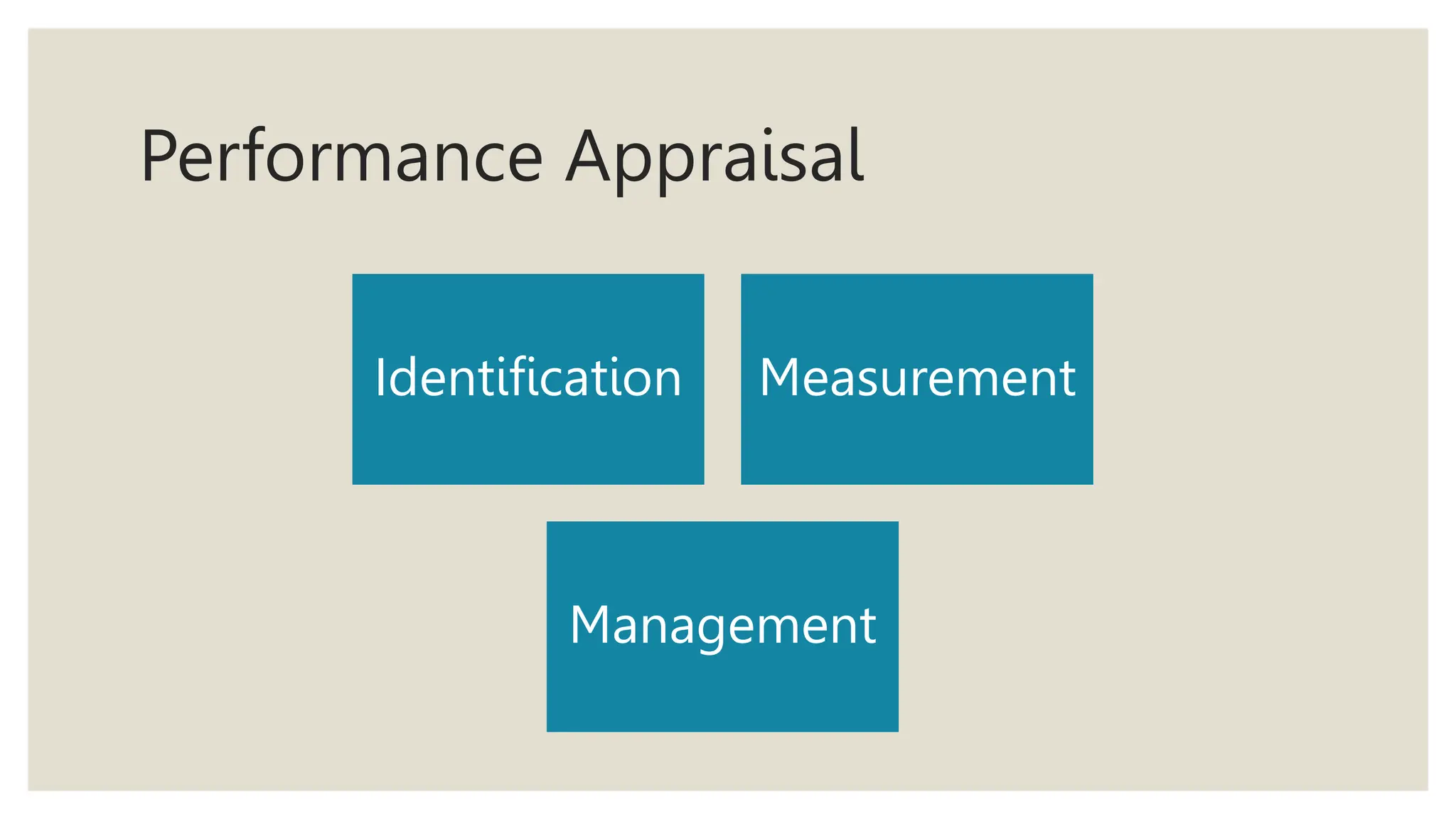
Performance Appraisal
Identification Measurement
Management
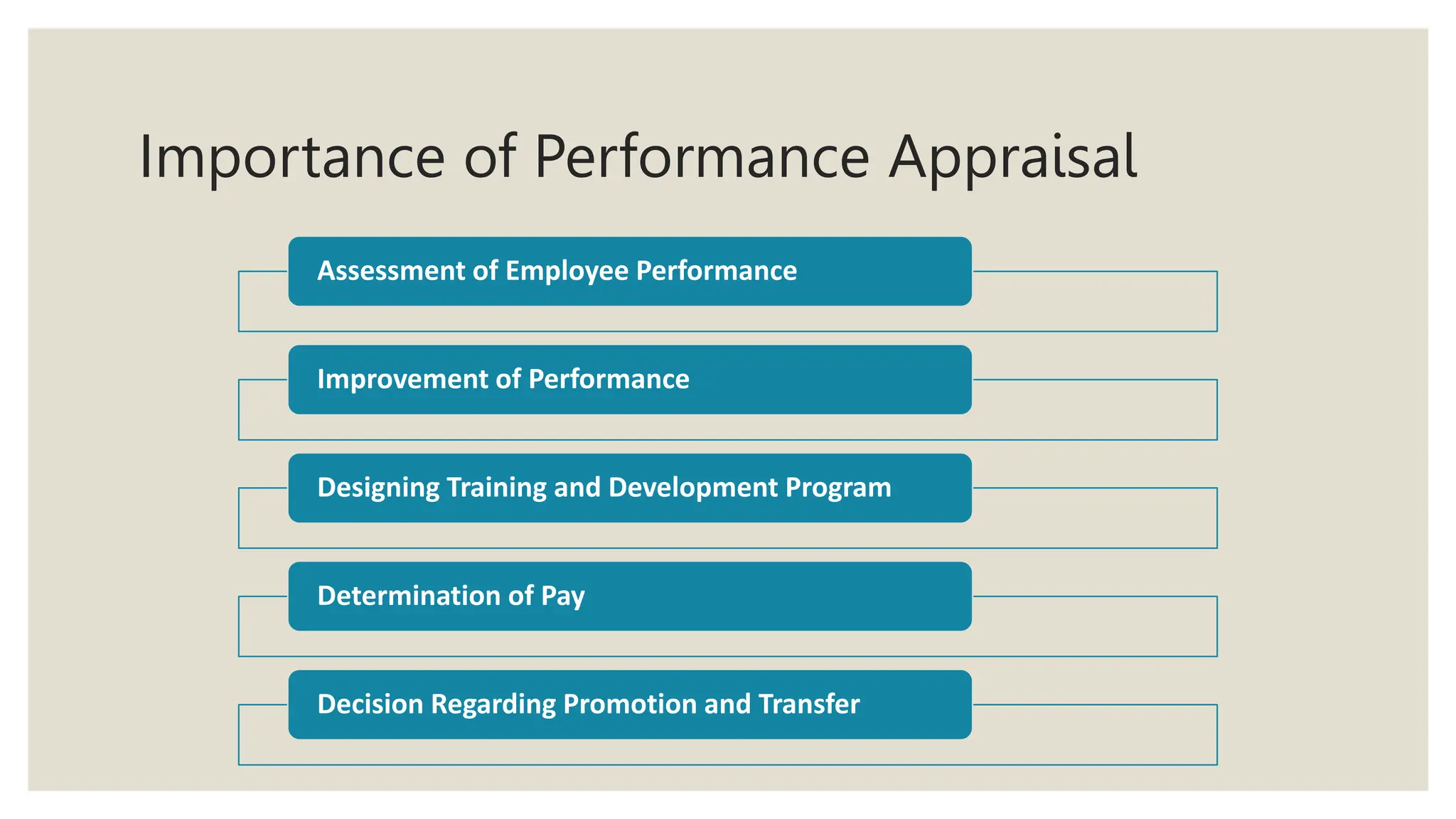
Importance of Performance Appraisal
Assessment of Employee Performance
Improvement of Performance
Designing Training and Development Program
Determination of Pay
Decision Regarding Promotion and Transfer
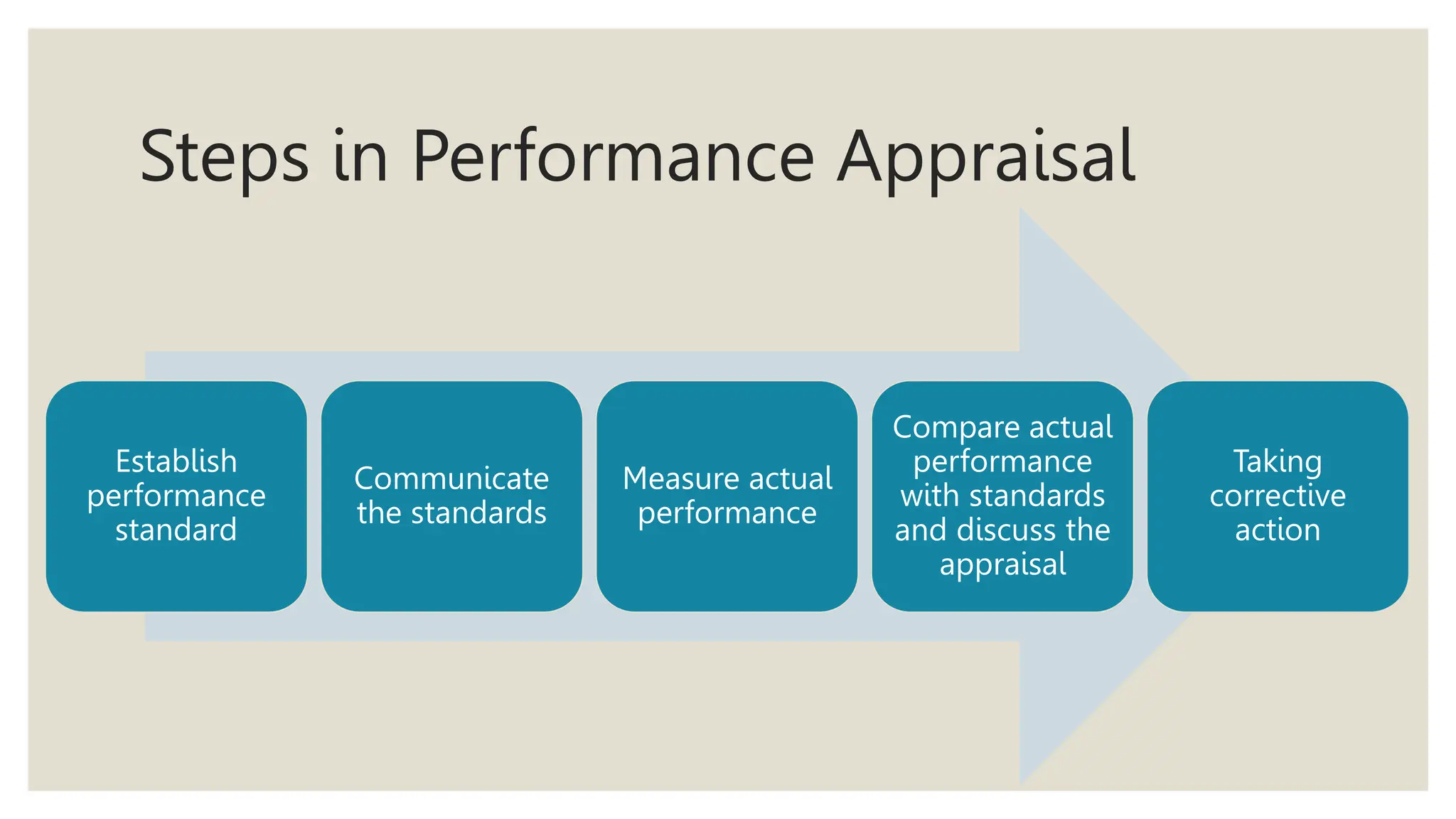
Steps in Performance Appraisal
Establish
performance
standard
Communicate
the standards
Measure actual
performance
Compare actual
performance
with standards
and discuss the
appraisal
Taking
corrective
action
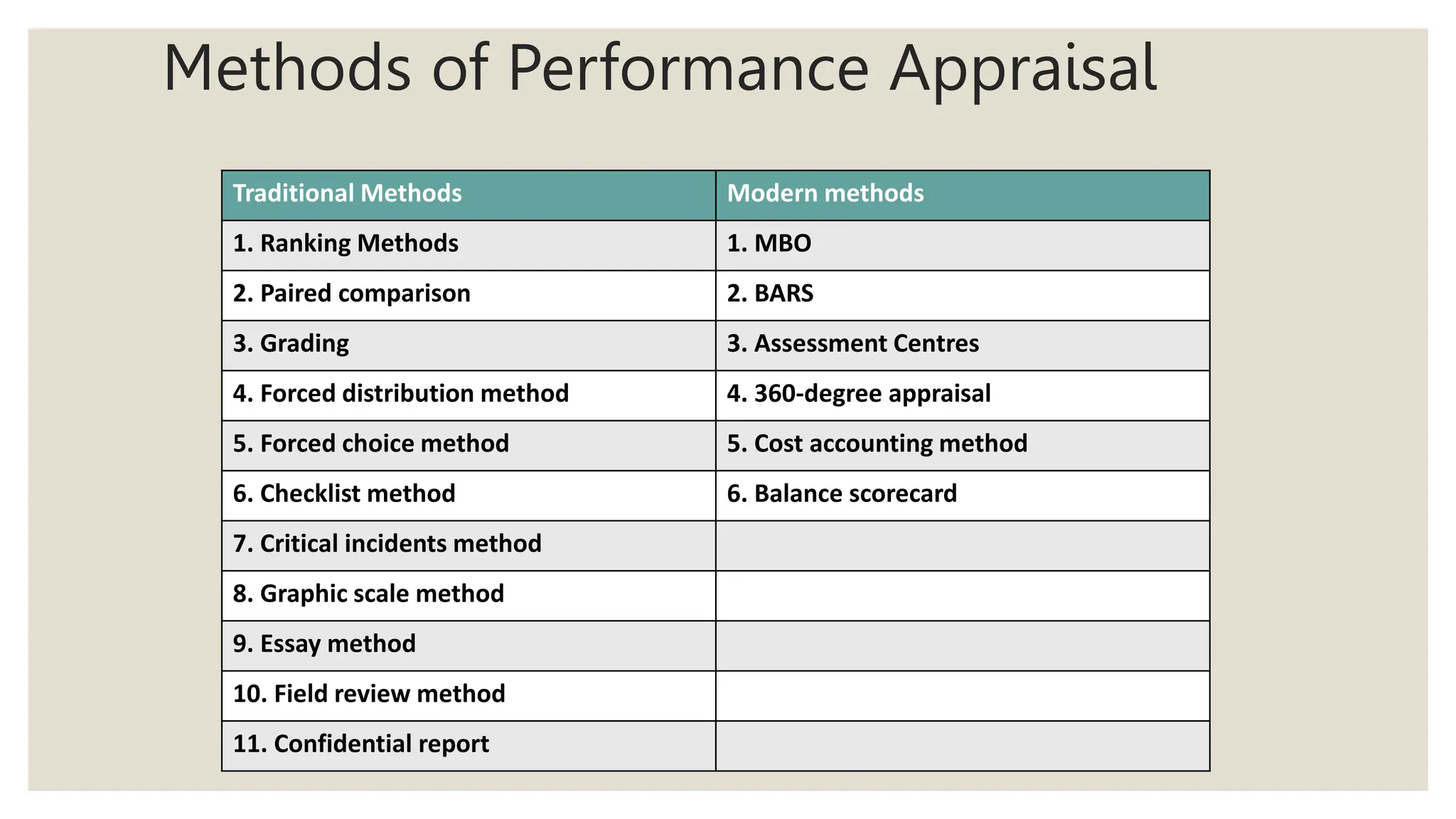
Methods of Performance Appraisal
Traditional Methods Modern methods
1. Ranking Methods 1. MBO
2. Paired comparison 2. BARS
3. Grading 3. Assessment Centres
4. Forced distribution method 4. 360-degree appraisal
5. Forced choice method 5. Cost accounting method
6. Checklist method 6. Balance scorecard
7. Critical incidents method
8. Graphic scale method
9. Essay method
10. Field review method
11. Confidential report
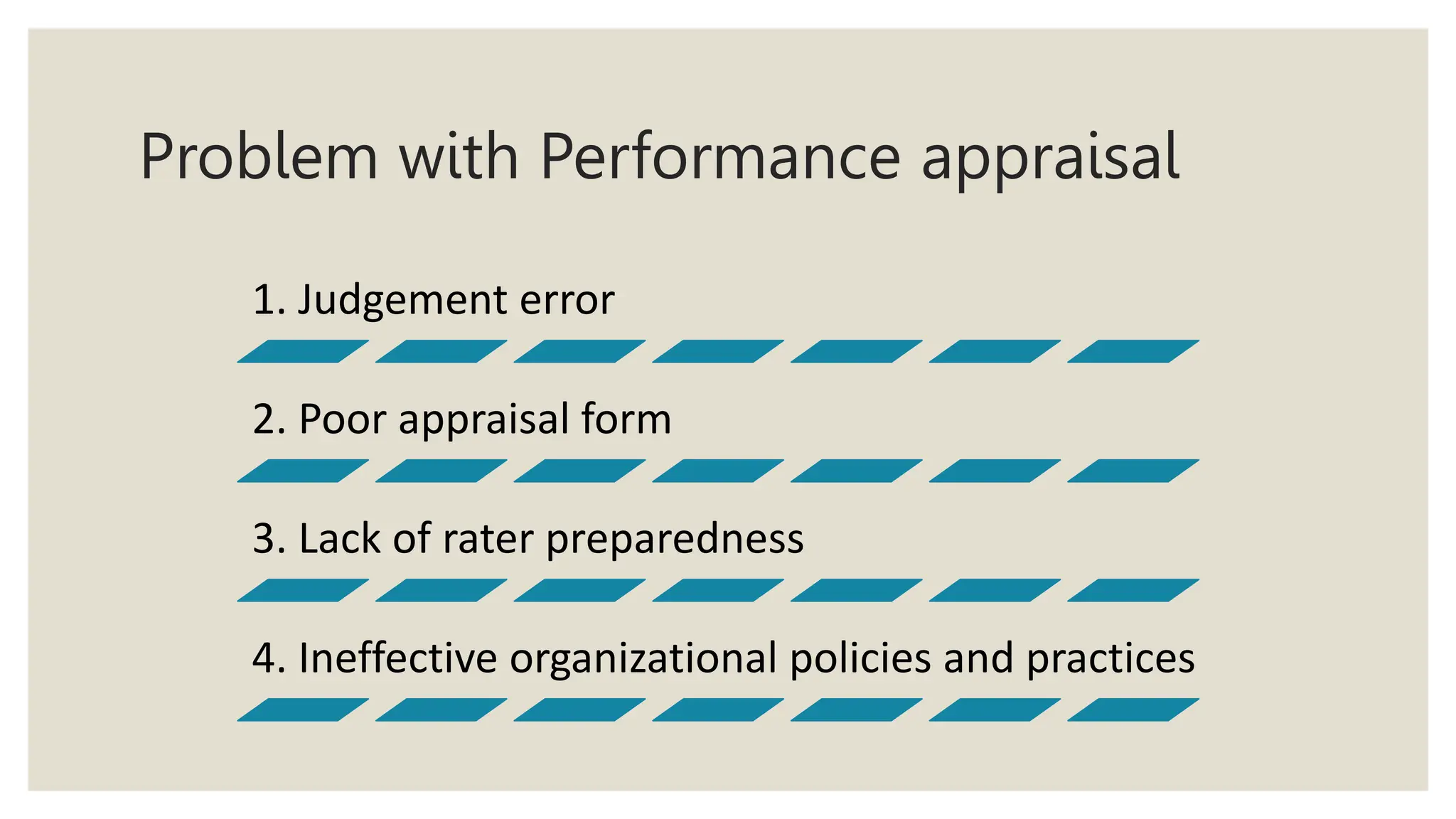
Problem with Performance appraisal
1. Judgement error
2. Poor appraisal form
3. Lack of rater preparedness
4. Ineffective organizational policies and practices
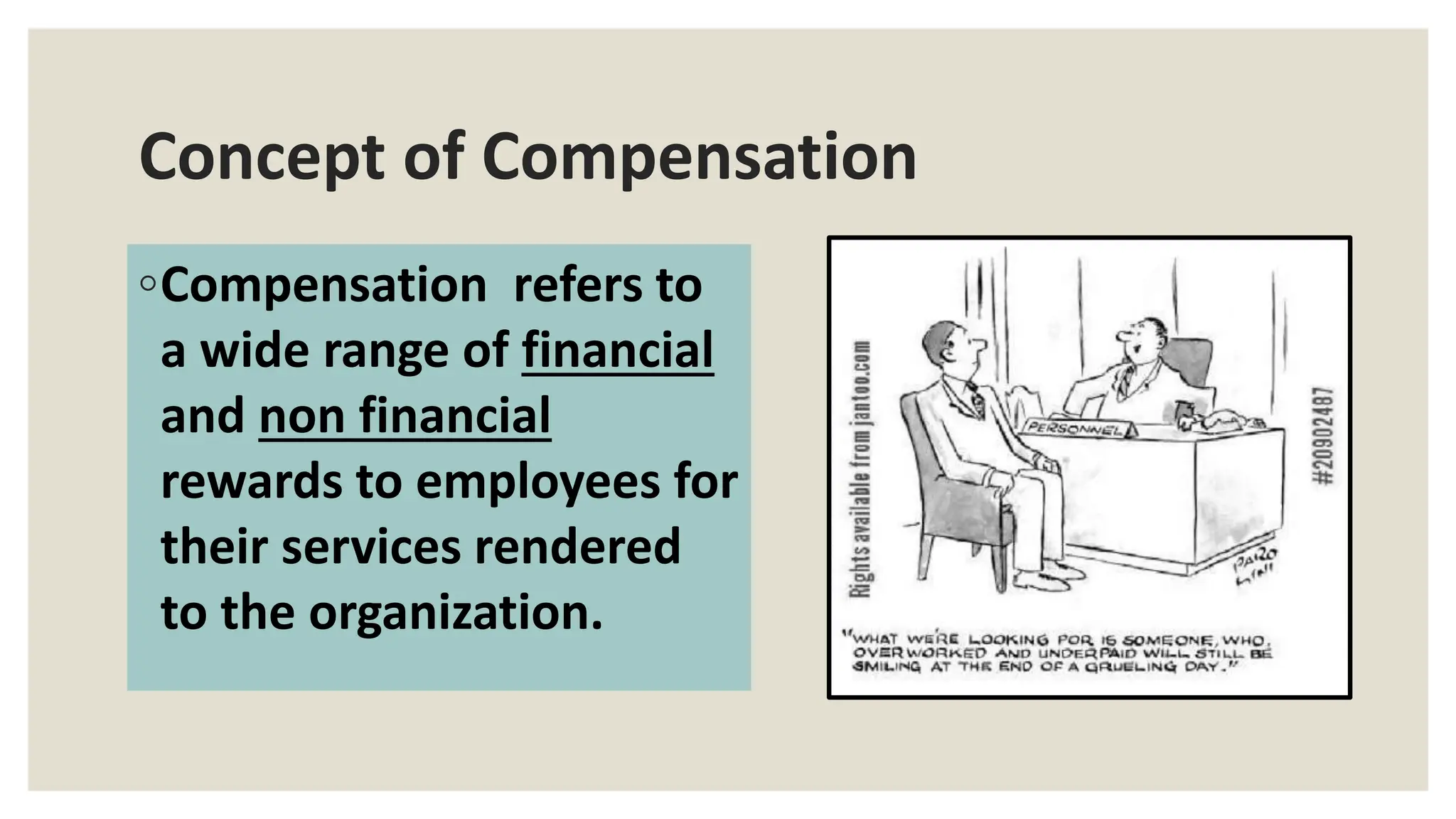
Concept of Compensation
◦Compensation refers to
a wide range of financial
and non financial
rewards to employees for
their services rendered
to the organization.
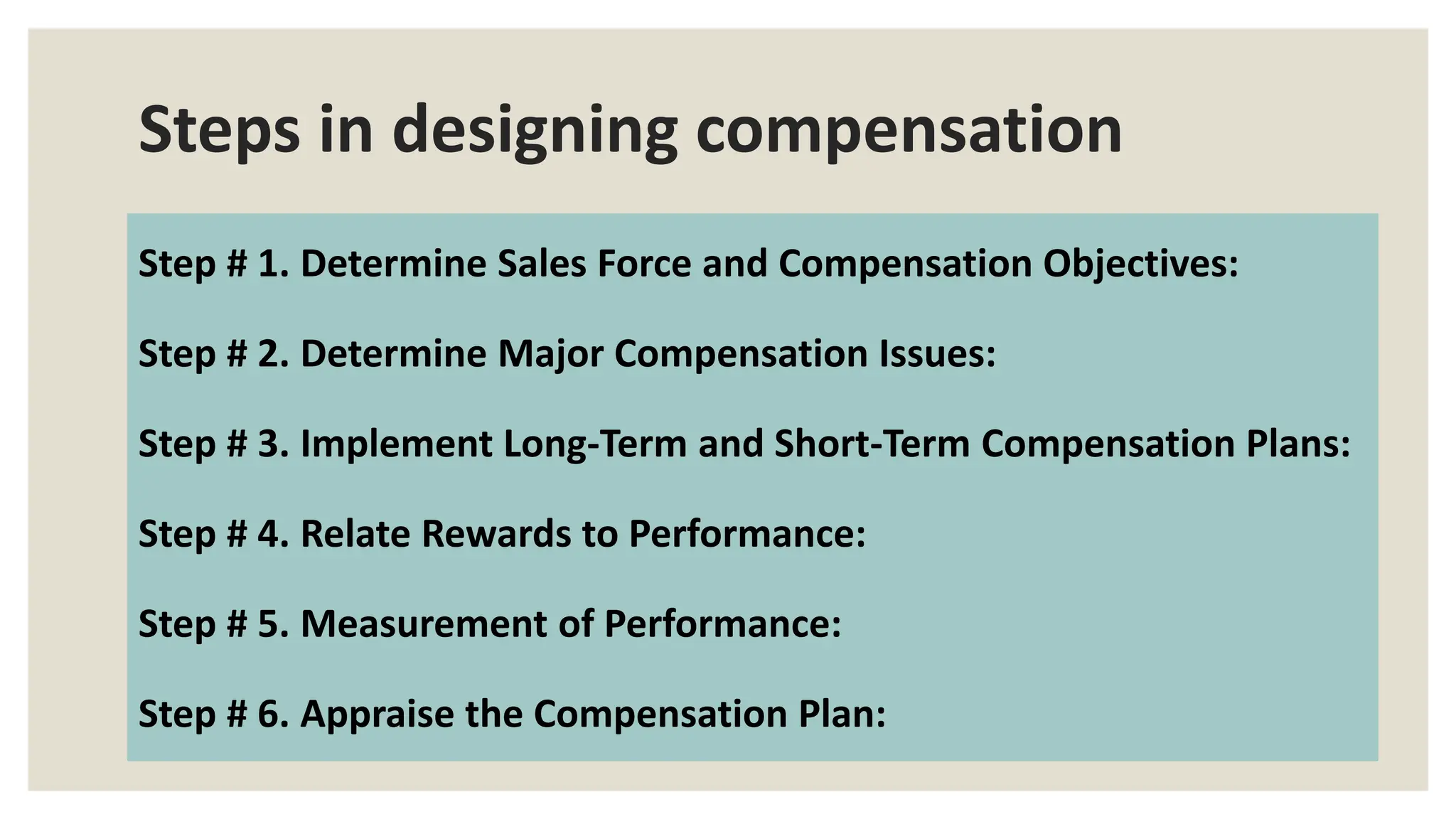
Steps in designing compensation
Step # 1. Determine Sales Force and Compensation Objectives:
Step # 2. Determine Major Compensation Issues:
Step # 3. Implement Long-Term and Short-Term Compensation Plans:
Step # 4. Relate Rewards to Performance:
Step # 5. Measurement of Performance:
Step # 6. Appraise the Compensation Plan:
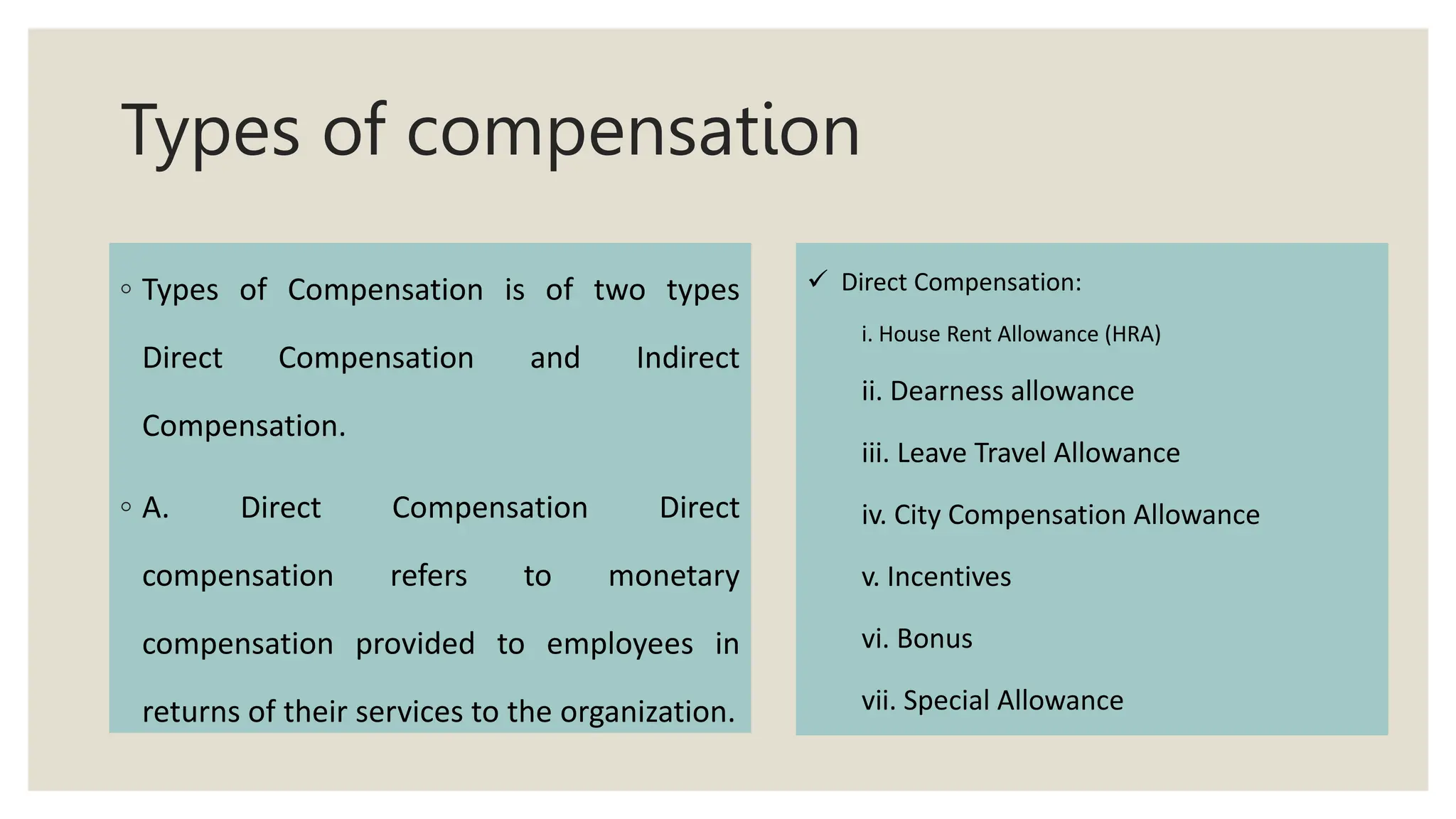
Types of compensation
◦ Types of Compensation is of two types
Direct Compensation and Indirect
Compensation.
◦ A. Direct Compensation Direct
compensation refers to monetary
compensation provided to employees in
returns of their services to the organization.
 Direct Compensation:
i. House Rent Allowance (HRA)
ii. Dearness allowance
iii. Leave Travel Allowance
iv. City Compensation Allowance
v. Incentives
vi. Bonus
vii. Special Allowance
Types of compensation
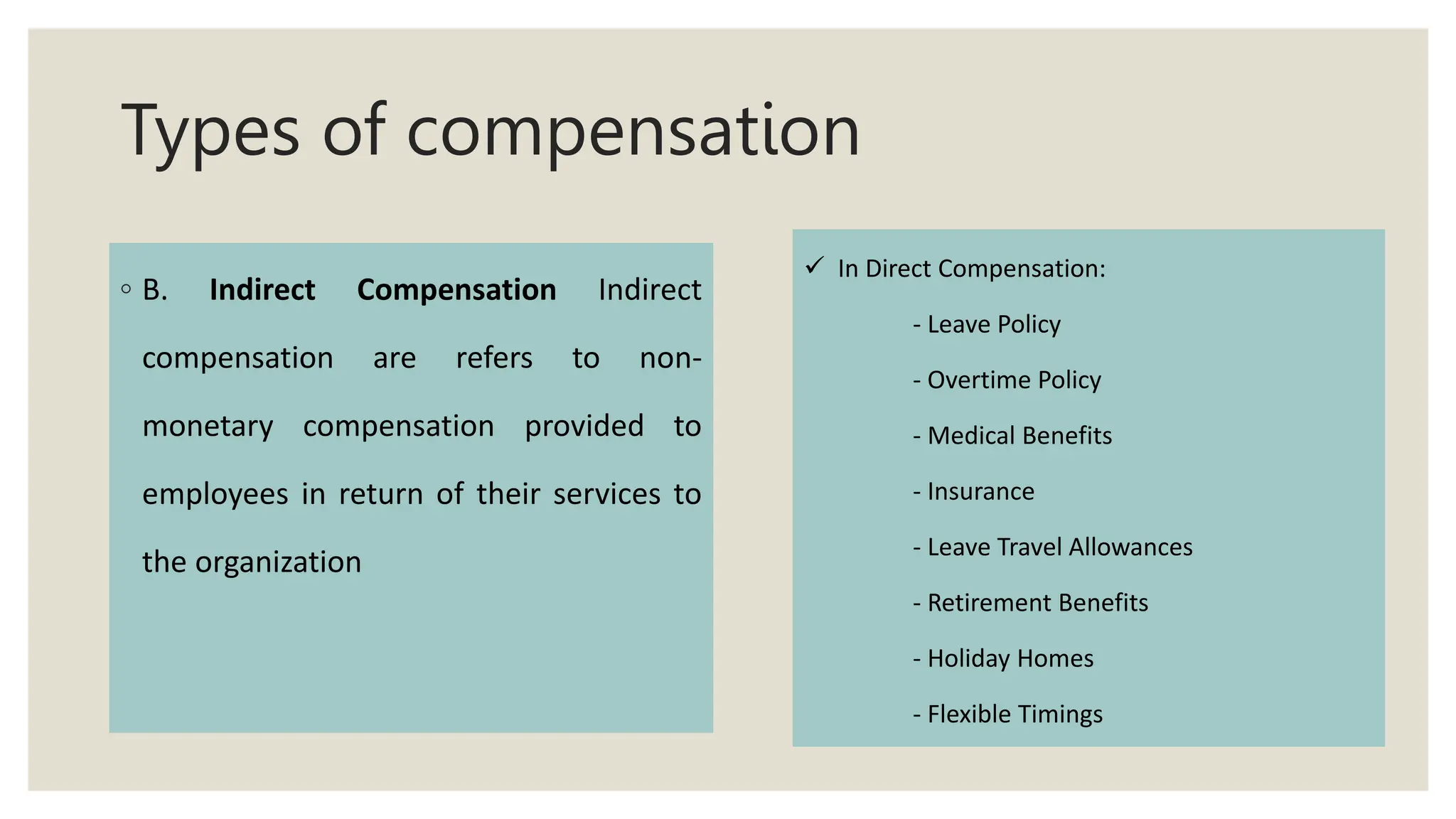
◦ B. Indirect Compensation Indirect
compensation are refers to non-
monetary compensation provided to
employees in return of their services to
the organization
 In Direct Compensation:
- Leave Policy
- Overtime Policy
- Medical Benefits
- Insurance
- Leave Travel Allowances
- Retirement Benefits
- Holiday Homes
- Flexible Timings
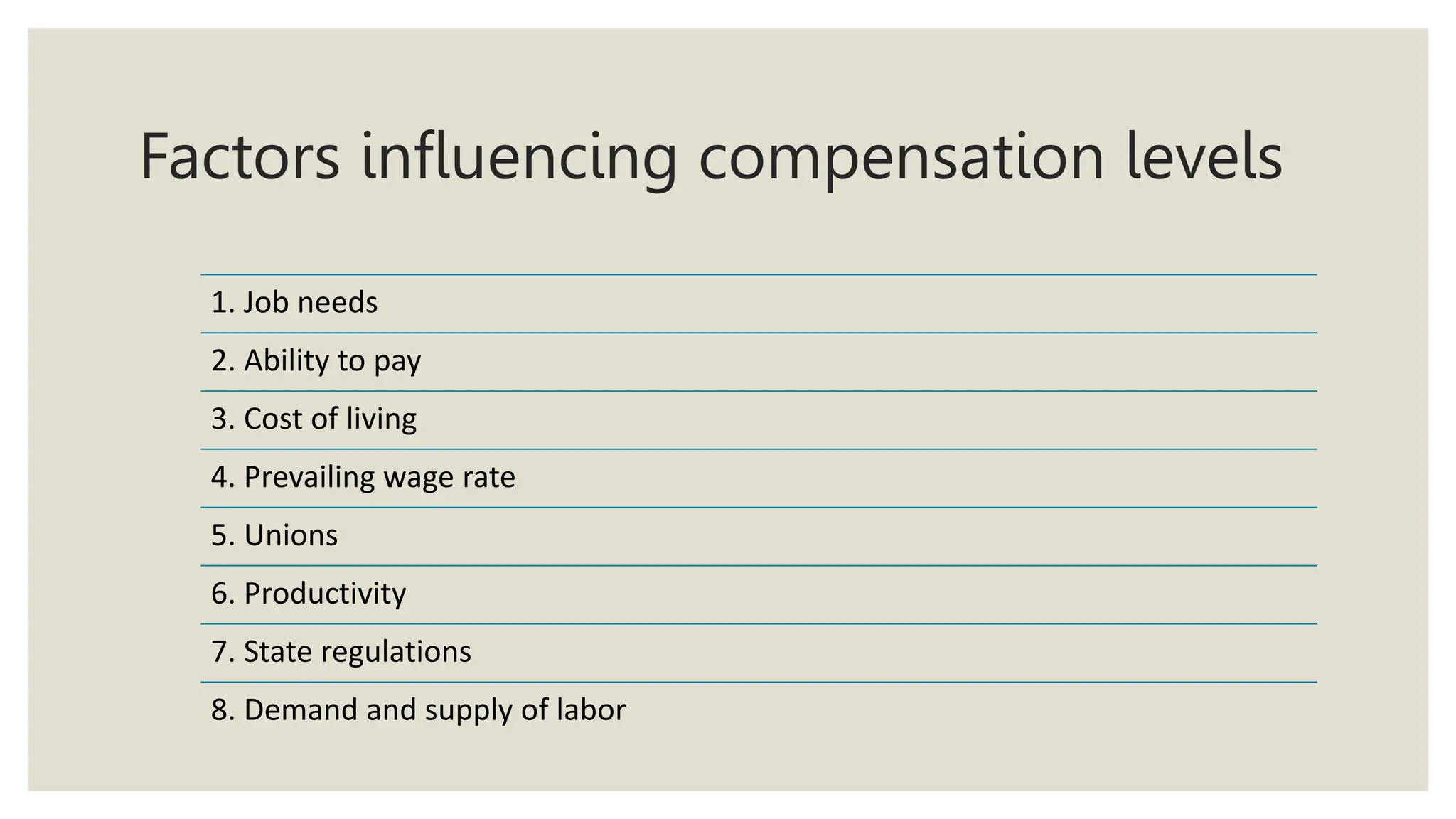
Factors influencing compensation levels
1. Job needs
2. Ability to pay
3. Cost of living
4. Prevailing wage rate
5. Unions
6. Productivity
7. State regulations
8. Demand and supply of labor
Wage Differentials
◦ Wage differential refers to differences in wage rates due to the location of company, hours of
work, working conditions, type of product manufactured, or other factors.
◦ Are Wage Differentials Justified?
◦ Salary differentials on the basis of occupations, units and areas (when real wages are taken into
account) can be justified on the basis of equal pay for equal work among workers. They are also
justified in view of varying conditions of demand and supply and varied job requirements like skill,
knowledge, aptitude, ability, experience etc. But the object of the Government is to minimize income
inequalities and inequalities in the distribution of wealth.
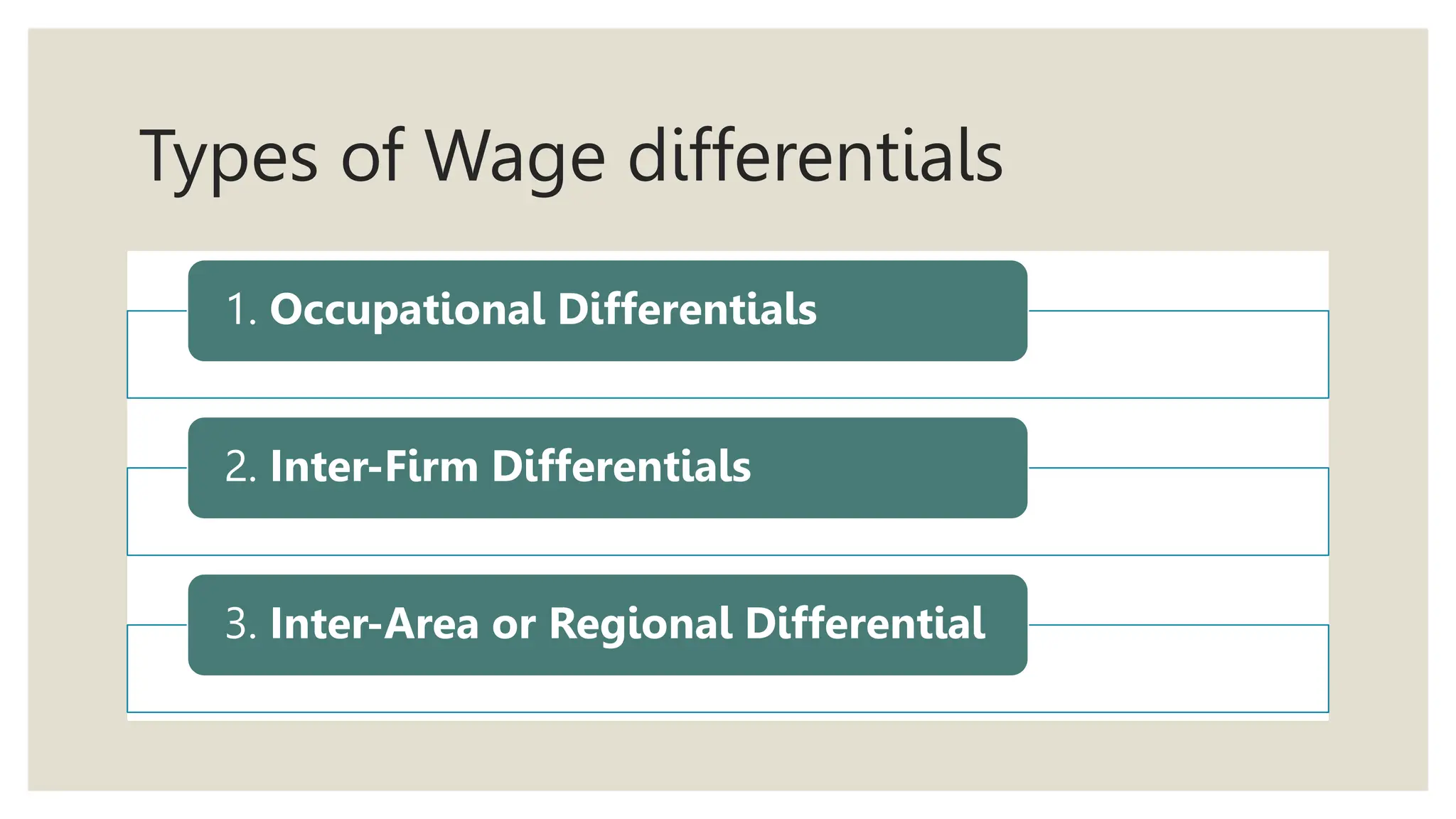
Types of Wage differentials
1. Occupational Differentials
2. Inter-Firm Differentials
3. Inter-Area or Regional Differential
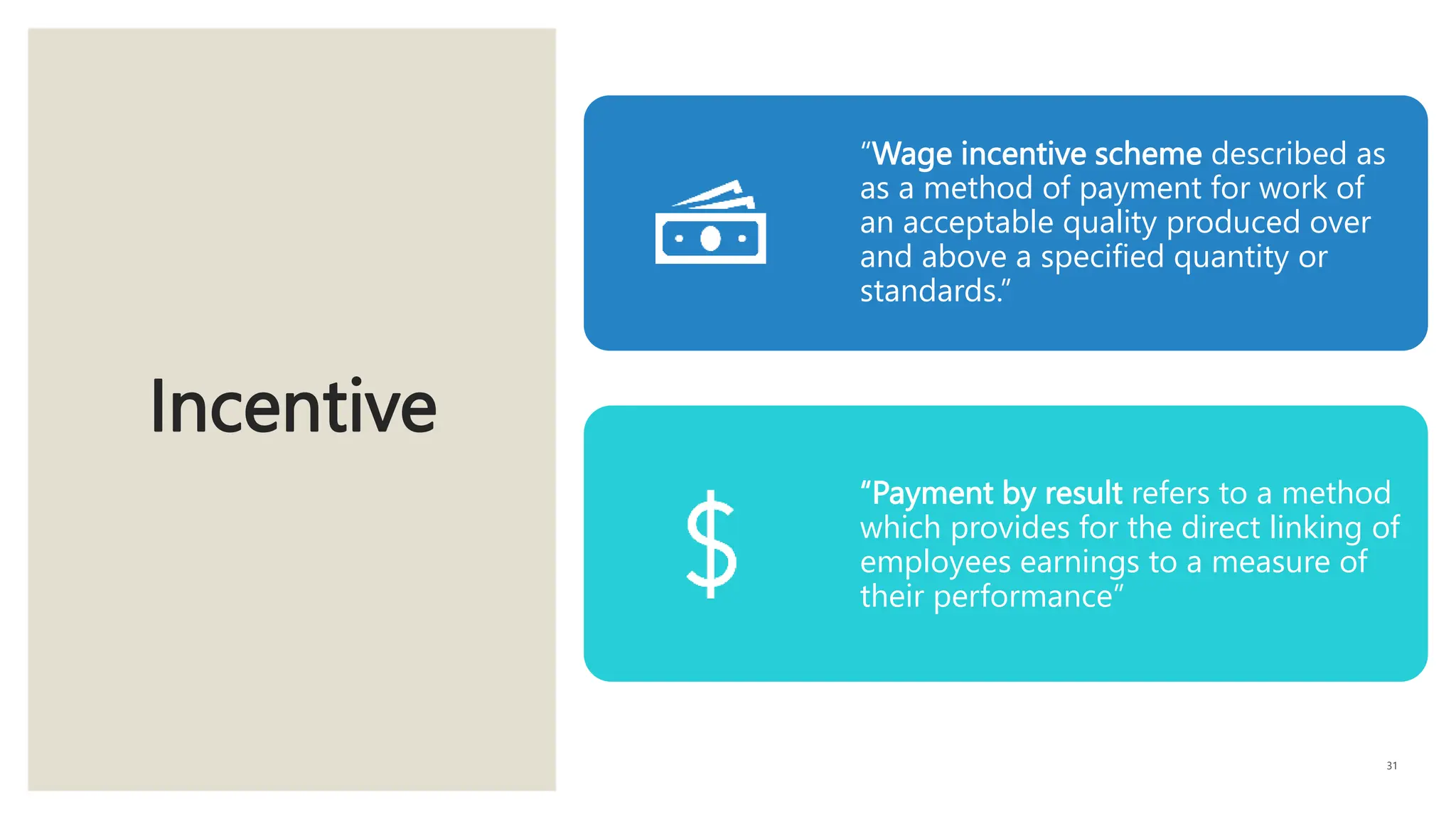
Incentive
31
“Wage incentive scheme described as
as a method of payment for work of
an acceptable quality produced over
and above a specified quantity or
standards.”
“Payment by result refers to a method
which provides for the direct linking of
employees earnings to a measure of
their performance”
32
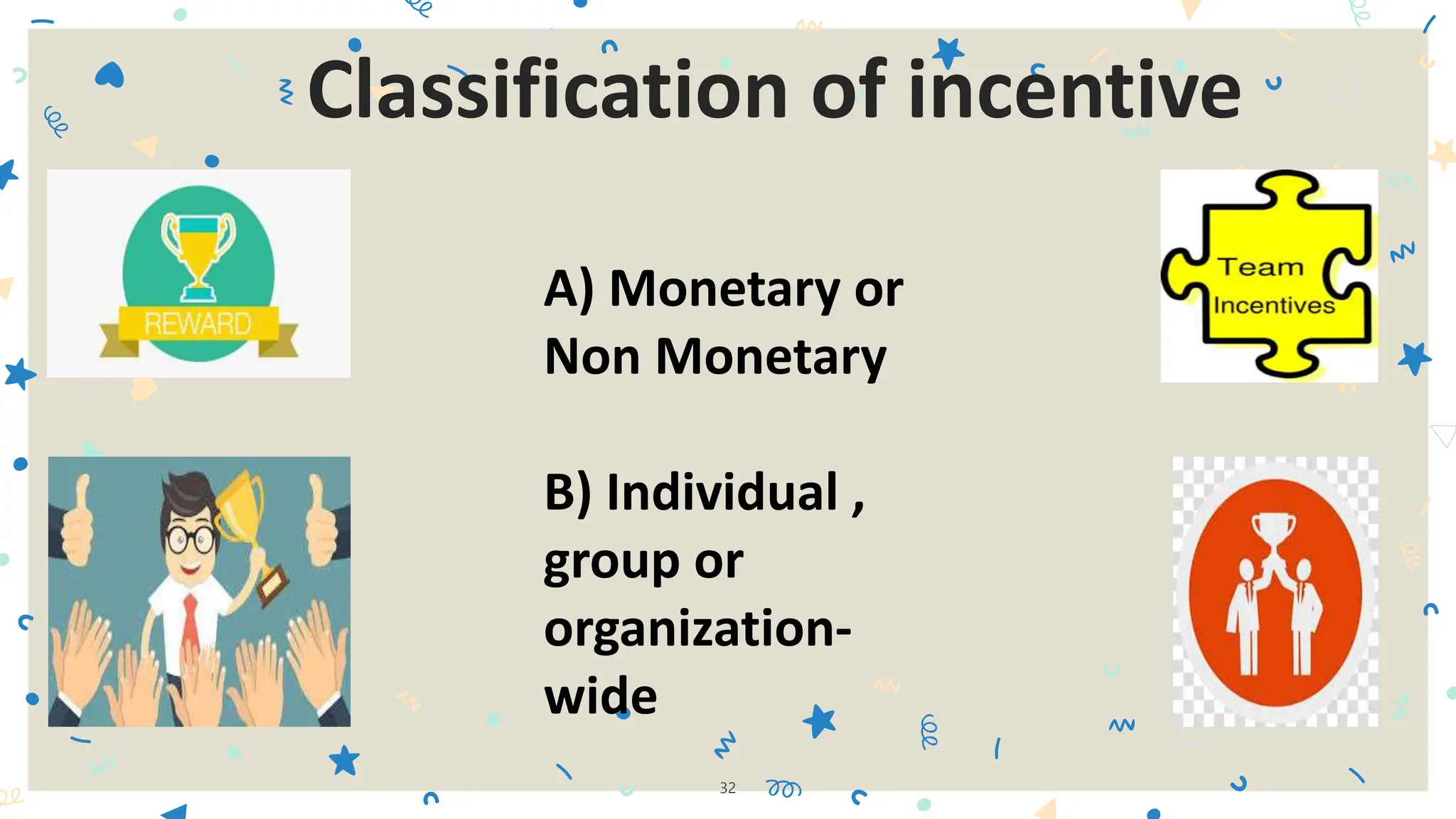
Classification of incentive
A) Monetary or
Non Monetary
B) Individual ,
group or
organization-
wide
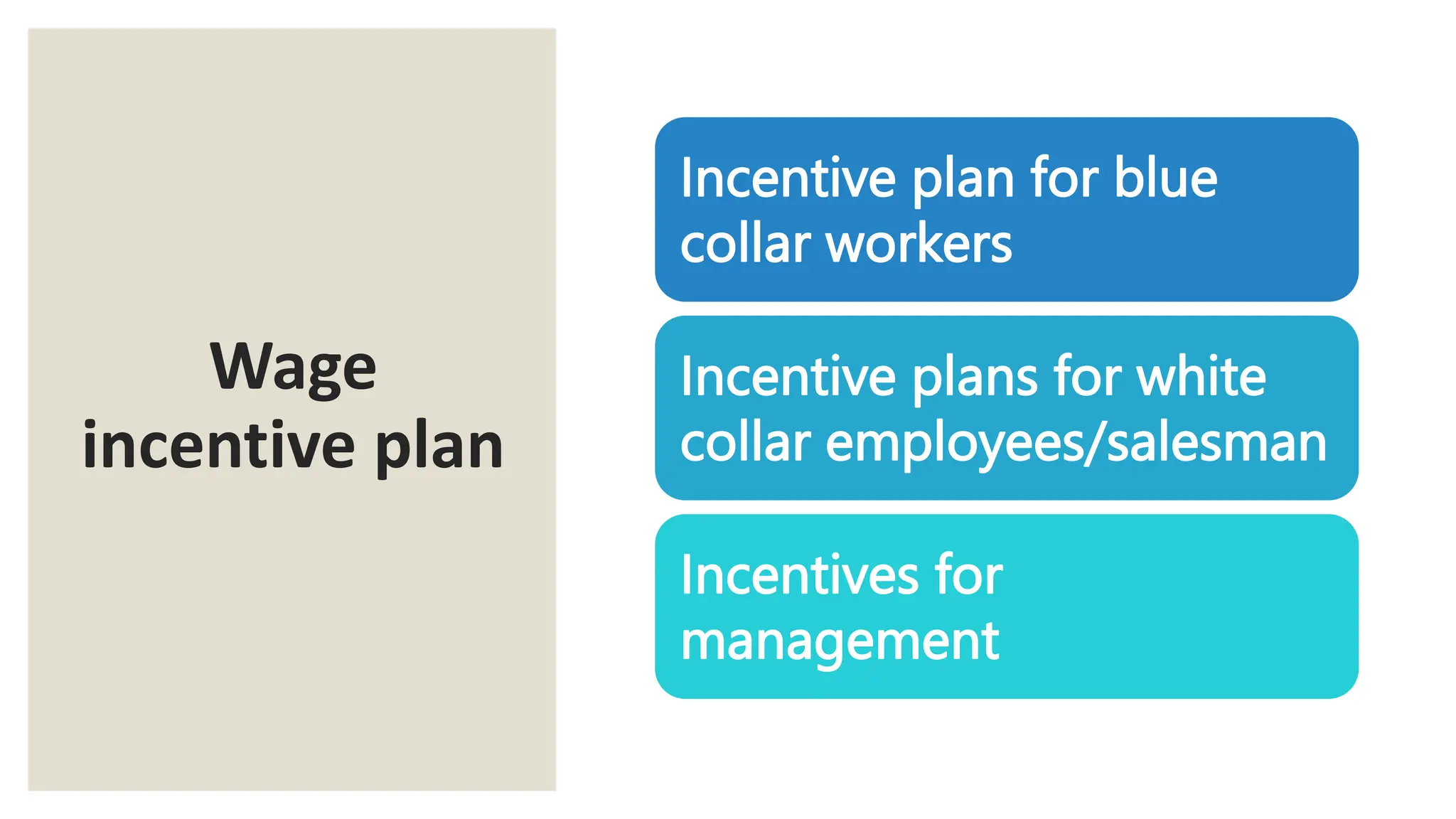
Wage
incentive plan
Incentive plan for blue
collar workers
Incentive plans for white
collar employees/salesman
Incentives for
management
Social Security
◦Social security is defined as the security that the society
furnishes through appropriate organizations against
certain risks to which its members are exposed.
◦Social security benefits in India are provided in two
major ways:
1. Social Insurance.
2. Social Assistance.
Type of Social Security benefits
◦Retirement Benefits
◦Disability Benefits
◦Survivors Benefits
◦Supplemental Security Income Benefits
ANY QUESTION ???
THANK YOU !!!

trainingand development meaning and importance

  • 1.
  • 2.
    Unit- III Topicsto be covered….. ◦ Training: Need, process, importance, aligning training with organization’s strategy, training methods- on the job and off the job, organizational development, evaluation of training program, emerging issue in training ◦ Executive development: Meaning, Importance, Steps, Methods ◦ Performance appraisal: Meaning, importance, steps, tools- graphic rating scale, alternate ranking method, paired comparison, forced distribution, critical incident, BARS, MBO, 360 degrees. Problems in performance appraisal
  • 3.
    Unit- III ◦ Compensation:Steps of determining compensation, components of pay structure, factors influencing compensation levels, wage differentials & incentives, profit sharing, gain sharing, employees’ stock option plans. Brief introduction of social security, health, retirement & other benefits.
  • 4.
    Training ◦ Training isa systematic process through which an organization’s human resources gain knowledge and develop skills by instruction and practical activities that result in improved corporate performance. Training enables an employee to do his present job more efficiently and prepare himself for a higher level job. Training is expensive………Without training it is more expensive
  • 5.
    Need of Training ◦Training is needed to serve the following purpose: ◦ 1) Newly recruited employees require training so as to perform their tasks effectively. Instructions guidance and coaching help them to handle jobs competently without any wastage. 2) Training is necessary to prepare existing employees for higher level jobs (promotion) 3) Existing employees require refresher training so as to keep abreast of the latest development in job operations. In the face of rapid technological changes, this is an absolute necessity. 4) Training is necessary when a person moves from one job to another (transfer).
  • 6.
    Need of Training 5)Training is necessary to make employees mobile and versatile. They can be placed on various jobs depending on organizational needs. 6) Training is needed to bridge the gap between what the employees has and what the job demands. Training is needed to make employees more productive and useful in the long run. 7) Training is needed for employees to gain acceptance from peers (learning a job quickly and being able to pull their weight is one of the best ways for them to gain acceptance.
  • 7.
    Benefits of Training Improving Employee Performance Updating Employee Skills Avoiding Managerial Obsolescence Preparingfor Promotion and Managerial Succession Retaining and Motivating Employee Creating an Efficient and Effective Organization Improves morale of employees
  • 8.
    Process of Training/Asystematic approach to training 1. Assessment • Determine training needs • Identify training objectives 2. Implementation • Select training methods • Conduct training Evaluation • Compare training outcomes against criteria
  • 9.
    Importance of Training ◦Maintains qualified products / services ◦ Achieves high service standards ◦ Provides information for new comers ◦ Refreshes memory of old employees ◦ Achieves learning about new things; technology, products / service delivery ◦ Reduces mistakes - minimizing costs ◦ Opportunity for staff to feedback / suggest improvements ◦ Improves communication & relationships - better teamwork
  • 10.
  • 11.
    Emerging issue intraining Dealing With Change Developing Leaders Engaging Learners Delivering Consistent Training Tracking Skills Application Instilling Conflict Management Skills Quantifying Training Effectiveness Improving Learning Effectiveness Demonstrating Value to Leadership Adapting Training to Millenials
  • 12.
    Training V/S Development ItemTraining Development Focus Learn specific behaviours and actions, demonstrate techniques and processes Understand and interpret knowledge, expand capabilities for varied assignments Time frame Short term Long term Process Tries to improve a specific skills relating to job Aims at improving total personality of individual Goal Meet current requirement of a job Meet future challenges of the job Effectivenes s measures Performance appraisal , cost benefits analysis, passing test or certification Qualified people available when needed, promotion from within possible, HR-based competitive advantage
  • 13.
    Executive Development ◦ Executivedevelopment or management development is a systematic process of growth and development by which the managers develop their abilities to manage ◦ Executive Development consists of all the means by which executives learn to improve their behavior and performance. ◦ Executive development is a planned effort to improve current and future managerial performance.
  • 14.
    Importance of ExecutiveDevelopment ◦ 1. The size and complexity of organisation, both business and non-business are increasing. Managers need to be developed to handle the problems of giant and complex organisation in the face of increasing competition. ◦ 2. The rapid rate of Technological and Social change in society requires training of managers so that they are able to cope with these changes. ◦ 3. Business and industrial leaders are increasingly recognizing their social and public responsibilities.
  • 15.
    Importance of ExecutiveDevelopment ◦ 4. Labor management relations are becoming increasingly complex. Executives require new and better skills in union negotiation, collective bargaining and grievance redressed. ◦ 5. There is a noticeable shift from owner-managed to professionally managed enterprises. ◦ 6. Executives need education and training to understand and adjust to changes in socio-economic forces.
  • 16.
    Steps in ExecutiveDevelopment Program Analysis of development needs Appraisal of present management talents Inventory of management manpower Planning of individual development program Establishment of development program Evaluation of result
  • 17.
    Methods of ManagementDevelopment programmes Decision making skills In basket Business game Case study Interpersonal skills Role play Sensitivity Behavior modelling Job knowledge On the job Understudy Coaching Organizational knowledge Job rotation Multiple management General knowledge Special course Special meeting Special readings Specific individual needs Special project Committee assignment
  • 18.
    Performance Appraisal ◦ PerformanceAppraisals is the assessment of individual’s performance in a systematic way. ◦ It is a developmental tool used for all round development of the employee and the organization. ◦ The performance is measured against such factors as job knowledge, quality and quantity of output, initiative, leadership abilities, supervision, dependability, co-operation, judgment, versatility and health. ◦ “It is formal, structured system of measuring, evaluating job related behaviors and outcomes to discover reasons of performance and how to perform effectively in future so that employee, organization and society all benefits.”
  • 19.
  • 20.
    Importance of PerformanceAppraisal Assessment of Employee Performance Improvement of Performance Designing Training and Development Program Determination of Pay Decision Regarding Promotion and Transfer
  • 21.
    Steps in PerformanceAppraisal Establish performance standard Communicate the standards Measure actual performance Compare actual performance with standards and discuss the appraisal Taking corrective action
  • 22.
    Methods of PerformanceAppraisal Traditional Methods Modern methods 1. Ranking Methods 1. MBO 2. Paired comparison 2. BARS 3. Grading 3. Assessment Centres 4. Forced distribution method 4. 360-degree appraisal 5. Forced choice method 5. Cost accounting method 6. Checklist method 6. Balance scorecard 7. Critical incidents method 8. Graphic scale method 9. Essay method 10. Field review method 11. Confidential report
  • 23.
    Problem with Performanceappraisal 1. Judgement error 2. Poor appraisal form 3. Lack of rater preparedness 4. Ineffective organizational policies and practices
  • 24.
    Concept of Compensation ◦Compensationrefers to a wide range of financial and non financial rewards to employees for their services rendered to the organization.
  • 25.
    Steps in designingcompensation Step # 1. Determine Sales Force and Compensation Objectives: Step # 2. Determine Major Compensation Issues: Step # 3. Implement Long-Term and Short-Term Compensation Plans: Step # 4. Relate Rewards to Performance: Step # 5. Measurement of Performance: Step # 6. Appraise the Compensation Plan:
  • 26.
    Types of compensation ◦Types of Compensation is of two types Direct Compensation and Indirect Compensation. ◦ A. Direct Compensation Direct compensation refers to monetary compensation provided to employees in returns of their services to the organization.  Direct Compensation: i. House Rent Allowance (HRA) ii. Dearness allowance iii. Leave Travel Allowance iv. City Compensation Allowance v. Incentives vi. Bonus vii. Special Allowance
  • 27.
    Types of compensation ◦B. Indirect Compensation Indirect compensation are refers to non- monetary compensation provided to employees in return of their services to the organization  In Direct Compensation: - Leave Policy - Overtime Policy - Medical Benefits - Insurance - Leave Travel Allowances - Retirement Benefits - Holiday Homes - Flexible Timings
  • 28.
    Factors influencing compensationlevels 1. Job needs 2. Ability to pay 3. Cost of living 4. Prevailing wage rate 5. Unions 6. Productivity 7. State regulations 8. Demand and supply of labor
  • 29.
    Wage Differentials ◦ Wagedifferential refers to differences in wage rates due to the location of company, hours of work, working conditions, type of product manufactured, or other factors. ◦ Are Wage Differentials Justified? ◦ Salary differentials on the basis of occupations, units and areas (when real wages are taken into account) can be justified on the basis of equal pay for equal work among workers. They are also justified in view of varying conditions of demand and supply and varied job requirements like skill, knowledge, aptitude, ability, experience etc. But the object of the Government is to minimize income inequalities and inequalities in the distribution of wealth.
  • 30.
    Types of Wagedifferentials 1. Occupational Differentials 2. Inter-Firm Differentials 3. Inter-Area or Regional Differential
  • 31.
    Incentive 31 “Wage incentive schemedescribed as as a method of payment for work of an acceptable quality produced over and above a specified quantity or standards.” “Payment by result refers to a method which provides for the direct linking of employees earnings to a measure of their performance”
  • 32.
    32 Classification of incentive A)Monetary or Non Monetary B) Individual , group or organization- wide
  • 33.
    Wage incentive plan Incentive planfor blue collar workers Incentive plans for white collar employees/salesman Incentives for management
  • 34.
    Social Security ◦Social securityis defined as the security that the society furnishes through appropriate organizations against certain risks to which its members are exposed. ◦Social security benefits in India are provided in two major ways: 1. Social Insurance. 2. Social Assistance.
  • 35.
    Type of SocialSecurity benefits ◦Retirement Benefits ◦Disability Benefits ◦Survivors Benefits ◦Supplemental Security Income Benefits
  • 36.