Health
Optimizing
Physical
Education
1
RUTCHEL BALBIN-ESPADERA
HOPE 1
This subject will help you learn and understand
the different health related fitness and skill related
fitness components. This is designed to help you clearly
identify the different abilities of the body in order for
you to be physically fit. You are considered physically
fit whenever you can do series of physical activities
without being or feeling tired. Through this lesson, you
will also deeply learn the value of eating well and how
it affects the entire system of your body.
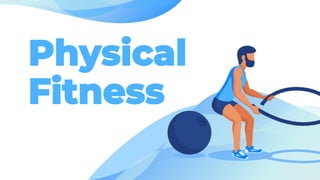
Physical
Fitness
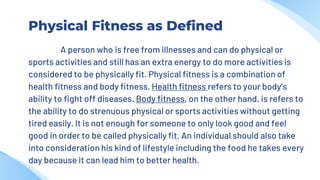
Physical Fitness as Defined
A person who is free from illnesses and can do physical or
sports activities and still has an extra energy to do more activities is
considered to be physically fit. Physical fitness is a combination of
health fitness and body fitness. Health fitness refers to your body’s
ability to fight off diseases. Body fitness, on the other hand, is refers to
the ability to do strenuous physical or sports activities without getting
tired easily. It is not enough for someone to only look good and feel
good in order to be called physically fit. An individual should also take
into consideration his kind of lifestyle including the food he takes every
day because it can lead him to better health.
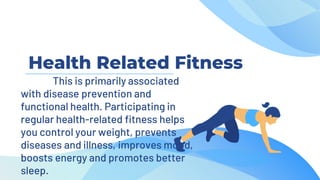
Health Related Fitness
This is primarily associated
with disease prevention and
functional health. Participating in
regular health-related fitness helps
you control your weight, prevents
diseases and illness, improves mood,
boosts energy and promotes better
sleep.
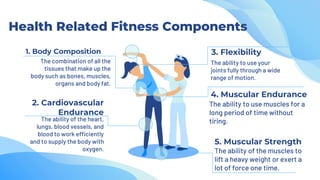
Health Related Fitness Components
2. Cardiovascular
Endurance
The ability of the heart,
lungs, blood vessels, and
blood to work efficiently
and to supply the body with
oxygen.
1. Body Composition
The combination of all the
tissues that make up the
body such as bones, muscles,
organs and body fat.
4. Muscular Endurance
The ability to use muscles for a
long period of time without
tiring.
3. Flexibility
The ability to use your
joints fully through a wide
range of motion.
5. Muscular Strength
The ability of the muscles to
lift a heavy weight or exert a
lot of force one time.
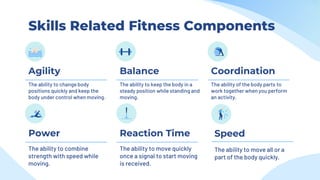
Agility
The ability to change body
positions quickly and keep the
body under control when moving.
Balance
The ability to keep the body in a
steady position while standing and
moving.
Skills Related Fitness Components
Power
The ability to combine
strength with speed while
moving.
Reaction Time
The ability to move quickly
once a signal to start moving
is received.
Coordination
The ability of the body parts to
work together when you perform
an activity.
Speed
The ability to move all or a
part of the body quickly.
Specific
Components
of Physical
Fitness
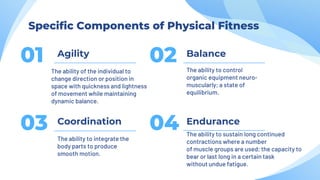
Agility
01
The ability of the individual to
change direction or position in
space with quickness and lightness
of movement while maintaining
dynamic balance.
Balance
02 The ability to control
organic equipment neuro-
muscularly; a state of
equilibrium.
Coordination
03
The ability to integrate the
body parts to produce
smooth motion.
Endurance
04 The ability to sustain long continued
contractions where a number
of muscle groups are used; the capacity to
bear or last long in a certain task
without undue fatigue.
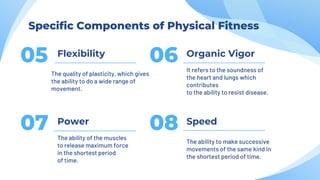
Specific Components of Physical Fitness
Flexibility
05
The quality of plasticity, which gives
the ability to do a wide range of
movement.
Organic Vigor
06 It refers to the soundness of
the heart and lungs which
contributes
to the ability to resist disease.
Power
07 The ability of the muscles
to release maximum force
in the shortest period
of time.
Speed
08
The ability to make successive
movements of the same kind in
the shortest period of time.
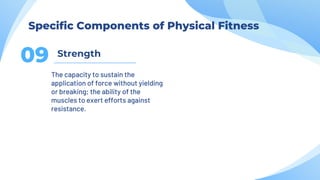
Specific Components of Physical Fitness
Strength
09
The capacity to sustain the
application of force without yielding
or breaking; the ability of the
muscles to exert efforts against
resistance.
Specific Components of Physical Fitness
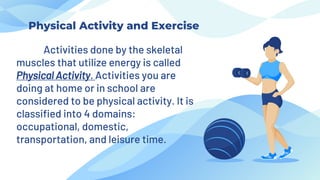
Activities done by the skeletal
muscles that utilize energy is called
Physical Activity. Activities you are
doing at home or in school are
considered to be physical activity. It is
classified into 4 domains:
occupational, domestic,
transportation, and leisure time.
Physical Activity and Exercise
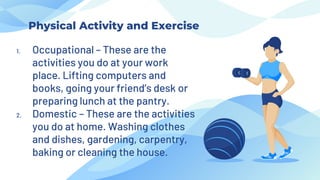
1. Occupational – These are the
activities you do at your work
place. Lifting computers and
books, going your friend’s desk or
preparing lunch at the pantry.
2. Domestic – These are the activities
you do at home. Washing clothes
and dishes, gardening, carpentry,
baking or cleaning the house.
Physical Activity and Exercise
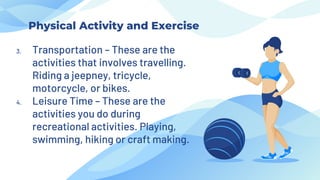
3. Transportation – These are the
activities that involves travelling.
Riding a jeepney, tricycle,
motorcycle, or bikes.
4. Leisure Time – These are the
activities you do during
recreational activities. Playing,
swimming, hiking or craft making.
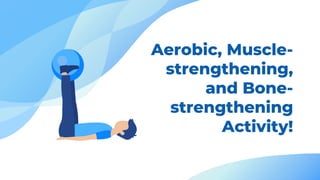
Aerobic, Muscle-
strengthening,
and Bone-
strengthening
Activity!
Aerobic
Aerobic activities, also called
endurance activities, are physical
activities in which people move
their large muscles in a rhythmic
manner for a sustained period.
Muscle-Strengthening Activity
This kind of activity, which includes
resistance training and lifting
weights, causes the body’s
muscles to work or hold against an
applied force or weight.
Bone-Strengthening Activity
This kind of activity (sometimes
called weight-bearing or weight-
loading activity) produces a force
on the bones that promotes bone
growth and strength.
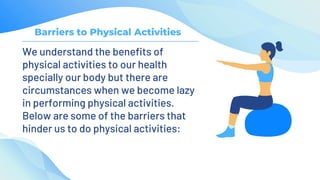
Barriers to Physical Activities
We understand the benefits of
physical activities to our health
specially our body but there are
circumstances when we become lazy
in performing physical activities.
Below are some of the barriers that
hinder us to do physical activities:
03
04
02
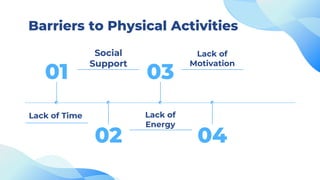
Barriers to Physical Activities
Social
Support
Lack of
Motivation
Lack of Time Lack of
Energy
01
07
08
06
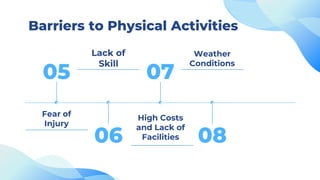
Barriers to Physical Activities
Lack of
Skill
Weather
Conditions
Fear of
Injury
High Costs
and Lack of
Facilities
05
Eating Habits
The term eating habits (or food habits)
refers to why and how people eat, which foods
they eat, and with whom they eat, as well as the
ways people obtain, store, use, and discard
food. Individual, social, cultural, religious,
economic, environmental, and political factors
all influence people's eating habits.
Influences on Food Choices
There are many factors that
determine what foods a person eats. In
addition to personal preferences, there
are cultural, social, religious, economic,
environmental, and even political factors.
Individual Preferences
Every individual has unique likes and
dislikes concerning foods. These preferences
develop over time, and are influenced by
personal experiences such as encouragement
to eat, exposure to a food, family customs and
rituals, advertising, and personal values.
Cultural Influences
A cultural group provides guidelines
regarding acceptable foods, food
combinations, eating patterns, and
eating behaviors. Compliance with these
guidelines creates a sense of identity and
belonging for the individual.
Social Influences
Members of a social group depend on
each other, share a common culture, and
influence each other's behaviors and
values. A person's membership in
particular peer, work, or community
groups impacts food behaviors.
Religious Influences
Religious proscriptions range from a
few to many, from relaxed to highly
restrictive. This will affect a
follower's food choices and
behaviors.
Economic Influences
Money, values, and consumer skills
all affect what a person purchases. The
price of a food, however, is not an
indicator of its nutritional value. Cost is a
complex combination of a food's
availability, status, and demand.
Environmental Influences
The influence of the environment on
food habits derives from a composite of
ecological and social factors. Foods that
are commonly and easily grown within a
specific region frequently become a part
of the local cuisine.
Political Influences
Political factors also influence food
availability and trends. Food laws and trade
agreements affect what is available within and
across countries, and also affect food prices.
Food labeling laws determine what consumers
know about the food they purchase.
Eating habits are thus the
result of both external factors, such
as politics, and internal factors, such
as values. These habits are formed,
and may change, over a person's
lifetime.
Improving Your
Eating Habits
When it comes to eating, we have
strong habits. Some are good (“I always
eat breakfast”), and some are not so good
(“I always clean my plate”). Although many
of our eating habits were established
during childhood, it doesn’t mean it’s too
late to change them.
Making sudden, radical changes to eating
habits such as eating nothing but cabbage soup,
can lead to short term weight loss. However, such
radical changes are neither healthy nor a good
idea, and won’t be successful in the long run.
Permanently improving your eating habits requires
a thoughtful approach in which you Reflect,
Replace, and Reinforce.
● REFLECT on all of your specific eating
habits, both bad and good; and, your
common triggers for unhealthy eating.
● REPLACE your unhealthy eating habits
with healthier ones.
● REINFORCE your new, healthier eating
habits.

Thank You!

PE11.v1.pdf

  • 1.
  • 2.
    HOPE 1 This subjectwill help you learn and understand the different health related fitness and skill related fitness components. This is designed to help you clearly identify the different abilities of the body in order for you to be physically fit. You are considered physically fit whenever you can do series of physical activities without being or feeling tired. Through this lesson, you will also deeply learn the value of eating well and how it affects the entire system of your body.
  • 3.
  • 4.
    Physical Fitness asDefined A person who is free from illnesses and can do physical or sports activities and still has an extra energy to do more activities is considered to be physically fit. Physical fitness is a combination of health fitness and body fitness. Health fitness refers to your body’s ability to fight off diseases. Body fitness, on the other hand, is refers to the ability to do strenuous physical or sports activities without getting tired easily. It is not enough for someone to only look good and feel good in order to be called physically fit. An individual should also take into consideration his kind of lifestyle including the food he takes every day because it can lead him to better health.
  • 5.
    Health Related Fitness Thisis primarily associated with disease prevention and functional health. Participating in regular health-related fitness helps you control your weight, prevents diseases and illness, improves mood, boosts energy and promotes better sleep.
  • 6.
    Health Related FitnessComponents 2. Cardiovascular Endurance The ability of the heart, lungs, blood vessels, and blood to work efficiently and to supply the body with oxygen. 1. Body Composition The combination of all the tissues that make up the body such as bones, muscles, organs and body fat. 4. Muscular Endurance The ability to use muscles for a long period of time without tiring. 3. Flexibility The ability to use your joints fully through a wide range of motion. 5. Muscular Strength The ability of the muscles to lift a heavy weight or exert a lot of force one time.
  • 7.
    Agility The ability tochange body positions quickly and keep the body under control when moving. Balance The ability to keep the body in a steady position while standing and moving. Skills Related Fitness Components Power The ability to combine strength with speed while moving. Reaction Time The ability to move quickly once a signal to start moving is received. Coordination The ability of the body parts to work together when you perform an activity. Speed The ability to move all or a part of the body quickly.
  • 8.
  • 9.
    Agility 01 The ability ofthe individual to change direction or position in space with quickness and lightness of movement while maintaining dynamic balance. Balance 02 The ability to control organic equipment neuro- muscularly; a state of equilibrium. Coordination 03 The ability to integrate the body parts to produce smooth motion. Endurance 04 The ability to sustain long continued contractions where a number of muscle groups are used; the capacity to bear or last long in a certain task without undue fatigue. Specific Components of Physical Fitness
  • 10.
    Flexibility 05 The quality ofplasticity, which gives the ability to do a wide range of movement. Organic Vigor 06 It refers to the soundness of the heart and lungs which contributes to the ability to resist disease. Power 07 The ability of the muscles to release maximum force in the shortest period of time. Speed 08 The ability to make successive movements of the same kind in the shortest period of time. Specific Components of Physical Fitness
  • 11.
    Strength 09 The capacity tosustain the application of force without yielding or breaking; the ability of the muscles to exert efforts against resistance. Specific Components of Physical Fitness
  • 12.
    Activities done bythe skeletal muscles that utilize energy is called Physical Activity. Activities you are doing at home or in school are considered to be physical activity. It is classified into 4 domains: occupational, domestic, transportation, and leisure time. Physical Activity and Exercise
  • 13.
    1. Occupational –These are the activities you do at your work place. Lifting computers and books, going your friend’s desk or preparing lunch at the pantry. 2. Domestic – These are the activities you do at home. Washing clothes and dishes, gardening, carpentry, baking or cleaning the house. Physical Activity and Exercise
  • 14.
    Physical Activity andExercise 3. Transportation – These are the activities that involves travelling. Riding a jeepney, tricycle, motorcycle, or bikes. 4. Leisure Time – These are the activities you do during recreational activities. Playing, swimming, hiking or craft making.
  • 16.
  • 17.
    Aerobic Aerobic activities, alsocalled endurance activities, are physical activities in which people move their large muscles in a rhythmic manner for a sustained period.
  • 18.
    Muscle-Strengthening Activity This kindof activity, which includes resistance training and lifting weights, causes the body’s muscles to work or hold against an applied force or weight.
  • 19.
    Bone-Strengthening Activity This kindof activity (sometimes called weight-bearing or weight- loading activity) produces a force on the bones that promotes bone growth and strength.
  • 20.
    Barriers to PhysicalActivities We understand the benefits of physical activities to our health specially our body but there are circumstances when we become lazy in performing physical activities. Below are some of the barriers that hinder us to do physical activities:
  • 21.
    03 04 02 Barriers to PhysicalActivities Social Support Lack of Motivation Lack of Time Lack of Energy 01
  • 22.
    07 08 06 Barriers to PhysicalActivities Lack of Skill Weather Conditions Fear of Injury High Costs and Lack of Facilities 05
  • 23.
    Eating Habits The termeating habits (or food habits) refers to why and how people eat, which foods they eat, and with whom they eat, as well as the ways people obtain, store, use, and discard food. Individual, social, cultural, religious, economic, environmental, and political factors all influence people's eating habits.
  • 24.
    Influences on FoodChoices There are many factors that determine what foods a person eats. In addition to personal preferences, there are cultural, social, religious, economic, environmental, and even political factors.
  • 25.
    Individual Preferences Every individualhas unique likes and dislikes concerning foods. These preferences develop over time, and are influenced by personal experiences such as encouragement to eat, exposure to a food, family customs and rituals, advertising, and personal values.
  • 26.
    Cultural Influences A culturalgroup provides guidelines regarding acceptable foods, food combinations, eating patterns, and eating behaviors. Compliance with these guidelines creates a sense of identity and belonging for the individual.
  • 27.
    Social Influences Members ofa social group depend on each other, share a common culture, and influence each other's behaviors and values. A person's membership in particular peer, work, or community groups impacts food behaviors.
  • 28.
    Religious Influences Religious proscriptionsrange from a few to many, from relaxed to highly restrictive. This will affect a follower's food choices and behaviors.
  • 29.
    Economic Influences Money, values,and consumer skills all affect what a person purchases. The price of a food, however, is not an indicator of its nutritional value. Cost is a complex combination of a food's availability, status, and demand.
  • 30.
    Environmental Influences The influenceof the environment on food habits derives from a composite of ecological and social factors. Foods that are commonly and easily grown within a specific region frequently become a part of the local cuisine.
  • 31.
    Political Influences Political factorsalso influence food availability and trends. Food laws and trade agreements affect what is available within and across countries, and also affect food prices. Food labeling laws determine what consumers know about the food they purchase.
  • 32.
    Eating habits arethus the result of both external factors, such as politics, and internal factors, such as values. These habits are formed, and may change, over a person's lifetime.
  • 33.
  • 34.
    When it comesto eating, we have strong habits. Some are good (“I always eat breakfast”), and some are not so good (“I always clean my plate”). Although many of our eating habits were established during childhood, it doesn’t mean it’s too late to change them.
  • 35.
    Making sudden, radicalchanges to eating habits such as eating nothing but cabbage soup, can lead to short term weight loss. However, such radical changes are neither healthy nor a good idea, and won’t be successful in the long run. Permanently improving your eating habits requires a thoughtful approach in which you Reflect, Replace, and Reinforce.
  • 36.
    ● REFLECT onall of your specific eating habits, both bad and good; and, your common triggers for unhealthy eating. ● REPLACE your unhealthy eating habits with healthier ones. ● REINFORCE your new, healthier eating habits.
  • 38.