PCR    & ITS APPLICATIONS
Polymerase Chain Reaction PCR means Polymerase Chain Reaction It is a technique used to amplify the DNA It was developed in 1984 by Kary Mullis In 1993 Mullis won the Nobel Prize  Thermal cycler is an apparatus used to carryout  a PCR reaction
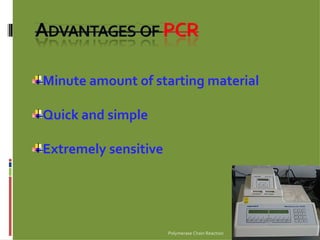
Polymerase Chain Reaction Minute amount of starting material   Quick and simple Extremely sensitive
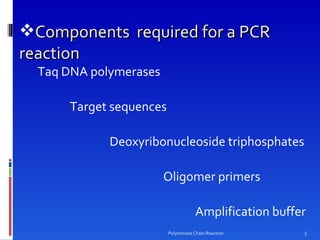
Components  required for a PCR reaction Taq DNA polymerases   Target sequences  Deoxyribonucleoside triphosphates Oligomer primers  Amplification buffer Polymerase Chain Reaction
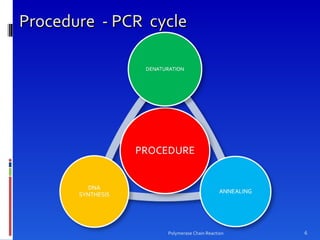
Procedure  - PCR  cycle Polymerase Chain Reaction
Procedure - Polymerase Chain reaction Polymerase Chain Reaction
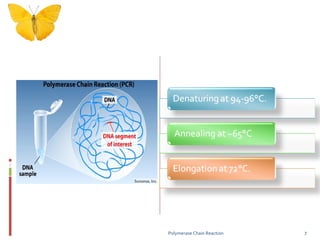
Procedure - Polymerase Chain reaction Polymerase Chain Reaction Denaturation Annealing Dna synthesis
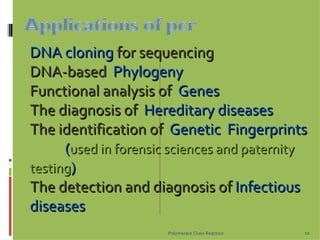
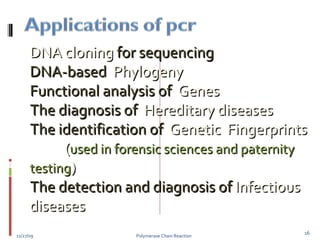
DNA cloning  for sequencing   DNA-based  Phylogeny  Functional analysis of  Genes The diagnosis of  Hereditary diseases The identification of  Genetic  Fingerprints    ( used in forensic sciences and paternity testing ) The detection and diagnosis of  Infectious  diseases Polymerase Chain Reaction
Polymerase Chain Reaction What is  PCR? What is the use of PCR? Protocol  Applications
Polymerase chain reaction Polymerase Chain Reaction
Polymerase Chain Reaction
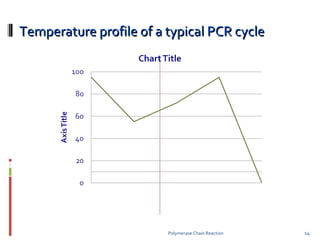
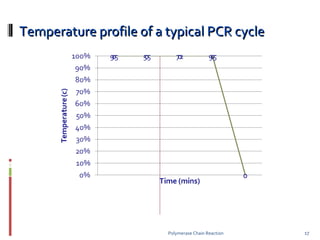
Temperature profile of a typical PCR cycle Polymerase Chain Reaction
Polymerase Chain Reaction
DNA cloning  for sequencing   DNA-based  Phylogeny  Functional analysis of  Genes The diagnosis of  Hereditary diseases The identification of  Genetic  Fingerprints    ( used in forensic sciences and paternity testing ) The detection and diagnosis of  Infectious  diseases 06/06/09 Polymerase Chain Reaction
Temperature profile of a typical PCR cycle Polymerase Chain Reaction

PCR

  • 1.
    PCR   & ITS APPLICATIONS
  • 3.
    Polymerase Chain ReactionPCR means Polymerase Chain Reaction It is a technique used to amplify the DNA It was developed in 1984 by Kary Mullis In 1993 Mullis won the Nobel Prize Thermal cycler is an apparatus used to carryout a PCR reaction
  • 4.
    Polymerase Chain ReactionMinute amount of starting material Quick and simple Extremely sensitive
  • 5.
    Components requiredfor a PCR reaction Taq DNA polymerases Target sequences Deoxyribonucleoside triphosphates Oligomer primers Amplification buffer Polymerase Chain Reaction
  • 6.
    Procedure -PCR cycle Polymerase Chain Reaction
  • 7.
    Procedure - PolymeraseChain reaction Polymerase Chain Reaction
  • 8.
    Procedure - PolymeraseChain reaction Polymerase Chain Reaction Denaturation Annealing Dna synthesis
  • 9.
    Procedure - PolymeraseChain reaction Polymerase Chain Reaction Denaturation Annealing Dna synthesis
  • 10.
    DNA cloning for sequencing DNA-based Phylogeny Functional analysis of Genes The diagnosis of Hereditary diseases The identification of Genetic Fingerprints ( used in forensic sciences and paternity testing ) The detection and diagnosis of Infectious diseases Polymerase Chain Reaction
  • 11.
    Polymerase Chain ReactionWhat is PCR? What is the use of PCR? Protocol Applications
  • 12.
    Polymerase chain reactionPolymerase Chain Reaction
  • 13.
  • 14.
    Temperature profile ofa typical PCR cycle Polymerase Chain Reaction
  • 15.
  • 16.
    DNA cloning for sequencing DNA-based Phylogeny Functional analysis of Genes The diagnosis of Hereditary diseases The identification of Genetic Fingerprints ( used in forensic sciences and paternity testing ) The detection and diagnosis of Infectious diseases 06/06/09 Polymerase Chain Reaction
  • 17.
    Temperature profile ofa typical PCR cycle Polymerase Chain Reaction